The parliament is getting a bit boring and I don’t think that anyone should be forced to listen to any more politicians today, so I am going to wrap up the blog a little early.
We will be back with the final day tomorrow (before the winter break) so don’t despair! And it will be early. And I will gather as much Midwinter Ball goss as I can (although I can not stand the event and am not going) for anyone desperate enough to want to hear it.
Until then – take care of you. Ax
15.33 AEST
The view from Bowers
Here is how the second last QT before the winter break looked to Mike Bowers:
The Family of the late Richard Scolyer, wife Katie Nicoll and children Emily, Matthew and Lucy sit in the house watching condolence motions before question time in the House of Representatives chamber of Parliament House in Canberra this afternoon. Photograph by Mike Bowers. Tuesday 1st July 2026.The Minister for Health Mark Butler during question time in the House of Representatives chamber of Parliament House in Canberra this afternoon. Photograph by Mike Bowers. Tuesday 1st July 2026.The Prime Minister Anthony Albanese during question time in the House of Representatives chamber of Parliament House in Canberra this afternoon. Photograph by Mike Bowers. Tuesday 1st July 2026.
15.18 AEST
Question time ends
That is it for today. One more to go before the break.
And what did we learn? Once again, the Coalition have nothing. In the absence of any policies – or indeed, any identity beyond Sky News appearances, the Coalition do not know how to attack Labor on policy. So it’s culture war, light touch stuff that Labor is able to bat away.
15.15 AEST
LNP upset over cost of flat white
Andrew Wilcox, the LNP MP who looks like he came out of the Joh era LNP central casting asks:
A flat white cost $2 more today than it did in 2022 where Labor came to power. The government ‘s 70 cents as a tax cut will not even cover the increase let alone the coffee itself. Prime Minister, why does Labor keep making Australians pay more?
Albanese:
We on the side of the house are proudly today and the 1 July talking about the tax cuts that come in and talking about the real wage increases, talking about the Medicare urgent care clinics and extra pharmaceuticals on the PBS. We’re talking about the free TAFE places and the fact we made urgent care clinics permanent. We’re talking about the two weeks Paid Parental Leave picking it up to six months. Talking about payday super, talking about all that.
And they are talking about a cup of coffee.
No wonder some of the ones on the frontbench say they need a rebrand. Because they certainly do because it is certainly trying to take liberal out of the Liberal Party. It is not their brand, it is the problem Mr Speaker. It is not a sales pitch, it is the policies. It is not what you call yourself, it is who you are, the fact that you vote against any change to cost of living that will help people.
There is a point of order which is not a point of order.
Albanese:
And what I’m talking about is the cost-of-living support which we are giving the side of the house that those on the side of the house voted against. Every single one of these measures, they voted against. I am really proud of what we are doing. The strongest annual economic growth in almost three years. Inflation, lower than it was when we came to government, wages going up, pay packets going much faster than any time in the Coalition. The smallest gender pay on record. Lowest unemployment in 50 years. We are laserlike focused on cost of living. Those opposite vote against every single – every single cost-of-living measure.
15.12 AEST
Fowler electorate and energy bills
Dai Le then asks Chris Bowen:
You’ve written to the ACCC and the AER over the retailer conduct on fixed charges. From today households are promised three hours of so-called free power, 11.00 am to 2.00 pm when most Fowler families are at work and still paying full price and fixed charges outside the window.
Can the minister say this isn’t give with one hand, take with the other hand and no household energy bill goes up?
Bowen:
I can confirm to the honourable member there is nothing so-called about free power when it’s a requirement of law for the energy companies to provide it as an option to people in the relevant jurisdictions including the constituents of We’ve been very clear solar share is not for everyone but for those people who can move power to the middle of home, people who work from whom, we spoor, or people who can use smart devices to schedule their devices to be used in the middle of the day it is a very good option for them and that is why we are requiring energy companies to deliver it and we say to energy companies it is a requirement of law it be delivered from today. The other elements that we are delivering include the default market offer which has seen people in the endeavour energy network which covers the people of Fowler receive a 3.4 per cent reduction this year.
The other thing we are delivering is cheaper home batteries which 2,720 households in Fowler have taken up and are also experiencing reducing their bills very dramatically.
That is a rate in Fowler which is substantially more than other electorates. The member for Fowler has previously claimed this is a policy for inner city electorates. That is just not true because the people of Fowler are taking up cheaper home batteries at a much faster rate than electorates that have higher wealth than the people of Fowler because the people of Fowler want to reduce their bills and they know cheaper home batteries are very good. That’s why this government is delivering and I’m disappointed the member for Fowler doesn’t support to policy.
15.02 AEST
Calm. The. Farm.
Anthony Albanese is again asked if he can guarantee that house prices won’t fall further. Which is the Coalition arguing that house prices should remain at 14 times the average income as the usual state of affairs.
Houses are not something you are flipping the month after you bought them. They are supposed to be a long term investment. Which means the price cycles go up and down in that time, but overall you should be buying and selling in the same market – and the usual order of things is that after a number of years you more likely than not, will sell for more than what you paid.
But our ideas of housing have become so skewed, we now have politicians (and media) arguing that it is normal to have house prices be as inflated as they are and that no one should do anything to try and stop an artificial market inflation, despite the damage it is doing to society as a whole.
14.53 AEST
For goodness sake
Berries and Cream (Tim Wilson) is told to shut it or risk missing out on delivering the matter of public importance straight after QT.
Angus Taylor then gets his big boy voice on to ask: Labor’s toxic taxes are tanking the housing market. Housing data released today shows house prices have already fallen further than Treasury predicted, around 3 per cent in Sydney and Melbourne over the last quarter. HSBC and Morgan Stanley predict further falls of 8 to 10 per cent. Will the Prime Minister guarantee house prices won’t fall any further?
ARE WE FRICKING SERIOUS? STILL WITH THIS BULLSHIT?
Albanese is a bit more circumspect:
I’m asked about house prices and our tax policy. I’m more than happy to announce that our tanks policy is indeed about helping first homeowners get into their own home. That is primary purpose of housing is a secure roof over people’s heads. That is what is being delivered. It’s been delivered for people like Christian Williams, 31.
He’d given up on ever owning a home of his own in the electorate of I was trying to save pretty aggressively you read there’s another 7 per cent increase this month, a 2 per cent increase this month. It just feels like a run away dream at that point. I’m feeling a little more confident now.”
In Albury, Andrea from Ray White Albury north managing director. ‘First home buyer confidence was on the rise, I don’t think they’re competing with as many investors.”
Jason Barnett in Geelong, the managing — managing director of Barnett real estate, ‘First home buyers are the active market.” In Camperdown in the electorate of Sydney, Juan said, ‘That the purchasings there of a two-bedroom warehouse conversion apartment that was sold…”They were familiar with the area and wanted to live in a property that was close to the action. It’s real people.
There is a point of order on relevance which is not a point of order.
Albanese:
I take the interjection from the Leader of the Opposition. He said, ‘Why is it relevant?” I tell you what’s relevant, is people getting into their own homes that’s what’s relevant.
Like Brooklyn, Lachie and their dog in the electorate of Corangamite where we were at Cliftons Springs just a little while ago. This is what they had to say. ‘Renting was frustrating because our money wasn’t going anywhere but now it is.” That’s exactly the point. Because now they had a chance to invest in themselves.
That is happening in electorates and in states and territories right around this nation. That is what we are aiming for, making sure that young people get a fair crack unlike those opposite, who their housing spokesperson has said just yesterday, on ABC, said that they basically have lost their way for two decades. For two decades.
14.48 AEST
What is it with Australia’s property market obsession?
Luke Slawomirski
Even The Guardian isn’t immune to overreacting to modest corrections in Australian property values.
Firstly, compared to a year ago Sydney house prices are still up. They’ve slid over the past few months, but since when is tracking monthly property values a thing?
Secondly, while 50k sounds like a lot, the median house price in Sydney is over $1.7 million (apartments are about $880,000). Hardly a sign of financial ruin.
For owner-occupiers who bought in the last few months, a slight correction is materially meaningless anyway. It doesn’t affect their income or repayments. Nobody suddenly comes and removes a bedroom. And if they’re selling up and moving, the ‘loss’ is offset by paying less for the next dwelling.
For investors (the majority of whom are high-income earners), a correction is part of the game – and miniscule compared to the market gains recorded in recent years.
Is a sense of perspective too much to ask?
14.44 AEST
What is it exactly the Coalition is trying to prove?
Then we get this question from a Coalition backbencher (I am not going to learn their names until they do something interesting. I do not have the capacity to learn more useless names)
Isn’t it true that the Albanese Labor government’s 70 cent a day tax cut has already been eaten up by inflation, unlike the coalition’s tax back guarantee, which is protected from inflation and would provide a typical Australian worker a far bigger $400 tax cut this year.
This is just the frustrated economists in the Coalition’s tactics team trying to prove how smart they are. But they can’t decide whether they want people to have tax cuts or not – or if having a tax cut would be inflationary or not (because workers are always to blame for inflation, even when they have absolutely no control or impact over inflation) and what their economic policy actually is.
14.41 AEST
When will the government signs the United Nations Treaty on the Prohibition of Nuclear Weapons?
Independent MP Nicolette Boele asks a question that isn’t linked to the media cycle, but probably should be:
Today marks 80 years since the US began nuclear testing in the marshall island. It’s also 63 years since Britain last tested on Australian soil, 30 years since France detonated nuclear bombs on French Polynesia. Our Pacific family is calling loudly and clearly for us to honour the legacy of the lives lost and damaged by disease and environments destroyed by committing to ban nuclear weapons. When will the government signs the United Nations Treaty on the Prohibition of Nuclear Weapons?
Richard Marles:
I thank the member for her question and if you’ll indulge me, can I add to my acknowledgement to my good friend, the Malaysian defence minister, it’s great to see him in the House today. I thank the honourable member for her question — question. Today is the 80th anniversary of the first detonation by the United States of a nuclear weapon in the Pacific at bikini atoll in the Marshall Islands. And over the decade of so we ensued from 1946 they detonated around 67 nuclear weapons including the first detonation by the United States of a hydrogen bomb. Tomorrow will be the 60th anniversary of the first detonation of a nuclear weapon at the Muroa atoll in French Polynesia.
You are right in saying both of those events characterise a deep sense of feeling within the Pacific around the role and place of nuclear weapons such that the rather Tonga treaty has classified the Pacific as having the Pacific as a nuclear weapons-free part of the world and we are a proud signatory to that treaty. throughout the history of the Pacific Islands Forum, a supporter of the Marshall Islands in terms of all the impactings that have been felt by them of the ongoing impacts of the nuclear weapons tests there. Australia, too, is – understands this.
At the Montebello islands, off the coast of Western Australia, emu plain in South Australia and of course Marrara Lyn we were a place of nuclear testing ourselves and we know the impact that has had in relation to our own First Nations peoples. We are, as a result of all of this, proud of the comprehensive nuclear test ban treaty.
We have been from the outset signatories of the non-proliferation treaty, which has been the cornerstone of our support for trying to achieve a world free of nuclear weapons and it is worth noting that today there are less than 20 per cent of nuclear war heads in the world than there were at the peak in the 1980s and the MPT has played its part. In terms of what you refer to, we’re observing it closely.
We have attended all meetings of the State since 2022. There are three concerns we have in relation to it. But we continue to observe it. We obviously support underlying desire to have a world free of nuclear weapons but the first goes to the question of the enforcement architecture around the banned treaty.
The second is it’s interaction with the non-proliferation treaty and wanting to make sure it doesn’t undermine it and the third goes to the universality of the signatories to the banned treaty. Right now there is no nuclear weapons state which is participating in it and ultimately we need to have a regime in the world which actually does seek to change behaviour in relation to those who hold nuclear weapons.
But we will continue to observe the progress of the banned treaty. We have a proud history and tradition in this country of working with countries around the world to seek to remove nuclear weapons from this world and we will continue to pursue that tradition under the Albanese government.
14.30 AEST
More of the same
Q: Prime Minister, you said that families will be better off under your government. But under Labor interest rates have increased 15 times, meaning an average new mortgage told to holder is around $30 a year worse off. Prime Minister, isn’t it true under Labor Australians have experienced the biggest crash in living standards in the developed world?
Albanese:
I’m asked about families. And whether they’re better off and what we’re doing about it. Families will assist who are benefiting from the minimum wage going up today. By 4.75 per cent. Families will benefit by the increase as well in those on the absolute minimum of 6 per cent. Families will benefit by every single Australian taxpayer getting a tax cut today.
And I tell you what, not just families but future families will benefit from its paid parental leave, paid parental leave going to six months.
We have increased it year after year after year, to get it up…to get it up to six months and as well we’re paying superannuation on that paid parental leave as well.
Something never comprehended by those opposite.
Families are benefiting from the work that we’re doing on bulk-billing, from the work we’re doing opening urgent care clinics, the cheaper medicines to deal with health costs as well.
Families are benefiting, who are putting in the cheaper home booteries, some 450,000 of them.
…Young families are benefiting by changing the equation when it comes to housing. By recognising that there’s a broken system here in Australia. And giving them a fair crack at getting a roof over their own head. That is what delivering real change looks like. That’s what a government that doesn’t just identify issues but recognises that people are under pressure and says ‘We are going to do something about out.” Like we did when it came to the crisis that came about due to the Middle East conflict. We didn’t sit back……and say there were no issues. They’ve stopped asking questions about that.
We made sure that Australians continued to have access to petrol, diesel, to jet fuel, fertiliser. We made sure that we delivered in a way in which those opposite, prior to Easter, were calling for rationing.
Not identifying any solutions whatsoever because they are the axis of grievance over there, the three right-wing parties that aren’t interested in helping people, just interested in promoting grievance.
14.28 AEST
The questions begin
After the agreement and genuine emotion of the condolence motion, Angus Taylor gets up and asks:
My question is to the Prime Minister. Under Labor, the price of everything is going up of. Electricity is up 38 per cent, gas up 37 per cent, rent up 23 per cent, health costs up 17 per cent, education up 21 per cent and childcare fees are up 27 per cent. Because of Labor families are falling behind and small businesses are on their knees. Prime Minister, how are Australians supposed to get ahead when Labor keeps making them pay more?
Albanese:
Today we are delivering real change to assist Australians. Today wages go up, taxes go down today.
Paid parental leave expanded to six months today, and superannuation and paid on paid parental leave.
Workers’ super as a result of changes we have made get paid from today on payday, making a difference. All urgent care clinics are made permanent today meaning when it comes to the costs of healthcare, people can get the care that they need when they need it with just their Medicare card, not their credit card. All 137 clinics will remain open.
There are more cheaper medicines from today, an additional 10 medicines added to the PBS. That is what delivering real change looks like. That is what makes a difference to people who are under financial pressure.
And unlike the three right-wing parties with their axis of grievance, what we are doing is actually not just identifying issues but making a difference.
(There is a point of order which is not a point of order)
Albanese:
I tell you what’s going up, the minimum wage. Going up today. I tell you what’s also going up – paid parental leave, up by two weeks. I tell you what else is going up, the number of cheaper home to home batteries. 450,000 since last July. I’ll tell you what else is going up, bulk-billing rates, expanding and growing. What else is going up? The number of people attending urgent care clinics, all going up. I tell you what else is going up. The number of first homeowners buying their own home. As a result of the changes that we are making.
We’re not just identifying issues we’re acting on them. That’s what the job is to do.
Unlike the three right-wing parties, the axis of grievance, we’re not just identifying issues, we are acting on them. Helping people under pressure here and now while building for the future. Making a positive difference to people’s lives……by delivering real change.
I tell you what is also going up, the — the number of comments by Opposition coalition members, saying how hopeless they are.
They had their housing spokesperson today say that “we vacated the field for 20 years and we’re now dealing with that failure, huge failure’. Patricia Karvelas said, ‘When did you vacate the field?” Andrew Bragg, ‘After 2007.”
14.11 AEST
Condolence motion for Professor Richard Scolyer AO
Angus Taylor continues the condolence motion:
A gifted scientist and a generous and gracious man. He was a rarity. Bright, brilliant, brave, big hearted. The very best of us. Today, as a Parliament, we commemorate the remarkable Australian, we commend his work and we celebrate his life and his legacy. In the touching goodbye he penned Richard said, ‘Cancer does not define us.” Yet Richard’s more than three decades of work has defined cancer research and treat:and I’m confident that the he made will ultimately help humanity defeat this dreadful disease. Earlier this year he was awared an honorary doctorate from the University of Sydney. His deteriorating health saw him pre-record the speech. Humble and happy, he delivered a heart felt message for graduates, one full of hope. ‘Be brave, be bold and challenge the status quo’, he said. He lived by those words, and his life has inspired and will continue to inspire others to live by his noble example. Richard admitted that his childhood was full of adventures built on how, not if. That childhood nurtured his inquisitive nature and his give it a crack attitude. For him, life was about possibilities, not problems. His optimism was matched by his deep sense of duty and he wrote, ‘I have always been driven by the belief that we all have a responsibility to try to change the future for others and leave the world a better place.” And he did exactly that. His work and clinical trials pushed forward the scientific fields of pathology in cancer. His research pioneered breakthrough melanoma treatments that have saved and improved lives. He helped start a melanoma bio bank, now the world’s largest and — and he passed on his knowledge as a lecturer and in more than 1,000 publications. He nurtured a new generation of young doctors and researchers who will carry on his vital work and of course one of his defining achievements was when the pathologist became his own patient. He was the first person to receive the experimental brain cancer treatment he helped pioneer.
But he didn’t sugar coat his darkest hours. Notably there was valour in his vulnerability. And through his sincerity inspired others, he inspired strength in fellow cancer sufferers. The self-effacing Richard admitted that he never felt entirely comfortable with public accolades.
14.05 AEST
Question time begins
But first there is a condolence motion for Professor Richard Scolyer AO.
Albanese:
When Richard Scolyer passed away last month, we lost one of our biggest hearts and brightest lights, but how powerfully he blazed before he left us, and somehow, in the fight of his life, he found the strength to lift us all. Professor Scolyer was named joint Australian of the Year in 2024 alongside his melanoma institute of Australia co-director, Georgina Long. Together they helped save countless lives through their melanoma research.
But as Richard took his rightful place in the national spotlight, it was with his own life in the balance. As he dealt with the reality of his brain cancer no-one would have begrudged him a retreat into privacy, but that is not what Richard chose. Instead, he took us all into his confidence.
He shared his triumphs and his set backs. He shared the joy he took in every extra day he was granted, and his profound gratitude to everyone around him. And what shone through it all was love for his family. Richard was on what he so gently called his uncertain path, but he travelled it with determination and a grace that never ceased to be simply extraordinary. The way he shared it with us was an act of generosity and a courage that was every bit as profound.
13.44 AEST
Treat time!
It’s the downhill slide into QT, where it will be housing, July 1 and the ongoing Coalition existential crisis, which, like most middle aged men, they are making everyone’s problem.
So go grab a little treat and we will see you back here for QT.
13.39 AEST
[ Insert occupation here ] pays more tax than Santos
Anna Chang
Leader of the Australian Greens, Senator Larissa Waters is up next and takes aim at AI slop and foreign interference, and then segues into billionaires and a gas tax:
“Millions of people around the country are speaking up and demanding a tax on gas, but our Prime Minister is only listening to one group, the gas industry.
“He’s taking their money, he’s saying what they tell him to say, he’s backing their projects, but he won’t make them pay their fair share.
But for anyone wondering how this part of Larissa Waters‘ remarks could possibly be true:
“Santos, one of the three biggest gas corporations, pays zero corporate tax.
“The average nurse who catches the bus for an hour to get to work pays more tax than Santos.
“The cleaners in this building pay more tax than Santos.
“Your kid’s teacher pays more tax than Santos.
“And none of those workers are destroying the planet. So, how is that fair?
Skye Predavac took a look and wrote a factcheck, last time Larissa Waters made this particular claim and found that in the 2023-24 financial year, the gas company Santos Limited had its tenth straight year of making zero corporate tax payments. Meanwhile, over the ten years to 2023-24, Australian nurses paid $52 billion in tax.
13.28 AEST
Under international law, children are supposed to be the most protected people in war
Anna Chang
David Pocock has devoted part of his Senators Statement time to give a speech on the recent UN reportthat found Israel continues to commit genocide and other atrocity crimes by deliberately targeting children. Yep, read that again if you need to.
Senator David Pocock:
“We recently saw a report from the UN which found that since the Hamas terror attack on the seventh of October 2023 the Israeli Defence Force has now killed 20,000 Palestinian children and injured 44,000 more.
“This is indefensible.
“The report found evidence of attacks on child essential infrastructure, like orphanages and schools, the starvation and torture of detained children. It identified really horrifying evidence that IDF soldiers deliberately shot at children’s limbs as…”
At this point, Pocock takes a pause to compose himself, before going on.
“… as some sort of twisted game of target practice. The report found the scale of child deaths is unprecedented to the point that it is unparalleled across modern conflicts globally. Unparalleled. And I think we need to come to terms with what it means in this moment in history to be defined this way and what action is demanded of middle powers like Australia in response.
“We have international legal institutions to prevent this kind of catastrophe from continuing to look at the evidence and make a determination. We have the interim findings from the International Court of Justice, the International Criminal Court, and multiple reports from the United Nations outlining the Israeli Government’s breaches of international law amounting to war crimes, crimes against humanity, and genocide.
“And as a member of the international community, Australia needs to play our part in upholding international law. We must continue to demand the end of hostilities to enforce the outcomes determined by the ICJ, the ICC, and for further sanctions on Israeli government officials until they meet their obligations.
“To quote Shannon Bosch in The Conversation, “under international law, children are supposed to be the most protected people in war. The children of Gaza have not just suffered in the war, they have become one of its defining legal fault lines.”
“This cannot go on, and I urge the Albanese Government to be a middle power that stands up.”
13.27 AEST
Art is a ‘victim of crime’ but won’t take AI to court
AAP
Copyright stakeholders in Parliament House to talk about the government holding the line on AI and their use of all copyrighted material in the Mural Hall in Canberra this morning. Photograph by Mike Bowers. Tuesday 1st July 2026.
Australian artists whose work is being scraped by AI aren’t planning on taking big tech to court despite the existential threat they say it poses to their livelihoods.
“I’m a writer, but I’m standing here before you today, really, as a victim of crime,” author Anna Funder told reporters at Parliament House in Canberra on Wednesday.
Funder is one of countless Australian artists whose work is training artificial intelligence models without permission, a practice known as scraping, or slurping.
Musician and advocate Holly Rankin who performs as Jack River speaks to the media (Video: Mike Bowers)
“I feel like I’ve been building, slowly and painstakingly with a massive mortgage, a block of flats,” she said, flanked by a gaggle of musicians, authors and industry figures in the nation’s capital.
“Each book is a flat, and I rent it out, and the money that I get is royalties. These big tech bros have moved into my flats, kicked me out, and are charging rent for my work.”
Big tech should ask artists’ permission to scrape their work and pay them royalties under copyright law.
AI giants were denied an exemption to those laws in October, but artists are still seeing their work slurped.
“I’ve written 43 books, 67 books have been scraped without permission, that includes translations,” children’s author Andy Griffiths said on Wednesday.
“They are going for everything.”
But taking big tech to court was “not the way to go”, Funder said.
She cited a landmark $US1.5 billion settlement between artists and AI juggernaut Anthropic in September, which awarded Funder $US3000 as compensation for a litany of scraped works.
“(Anthropic) are not the good guys,” she said.
Government should stand back from deal-making between tech companies and creative industries, but should also be proactive in fending off Silicon Valley’s requests for copyright carve-outs, according to the artists.
“We shouldn’t have to spend creators’ monies … to protect their rights here,” music licensing chief executive Dean Ormston told reporters.
“Canberra Airport’s never been so busy, (big tech lobbyists) flying out from the US,” he said.
AI models are usually trained in the US, complicating any court battle Australian artists might wish to mount.
“You actually have to bring infringement cases in the United States, and that is exactly what is happening,” Australian recording industry chief executive Annabelle Herd told reporters.
The issue needed to be settled at the negotiating table, rather than a courtroom, the artists said, adding they were open for business and not outright opposed to AI.
Worldwide, almost 300 commercial AI licensing deals have been inked with content companies such as Conde Nast and Warner Music.
About 270 court cases are under way against AI firms in various jurisdictions, but there are no copyright infringement cases against AI companies recorded in Australian courts.
Debate on the issue reignited in June after independent senator David Pocock aired claims in parliament that Labor is considering a fresh set of carve-outs for big tech companies.
The government labelled the claims as reckless speculation.
13.17 AEST
$1,102 A Second: The Cost of Government Delay on Gambling Reform
Noah Schultz-Byard
As we’ve been hearing, the government will be introducing thoroughly underwhelming gambling reforms into the parliament this week, after sitting on the Murphy Review’s recommendations for over three years.
We know that delay has been VERY profitable for the gambling industry, but the question remains – just how profitable?
Enter the Australia Institute’s National Gambling Toll, which reveals how much money Australians lose to gambling, counting up, in real time, every single second.
It turns out, as the world’s biggest losers, Aussie gamblers cough up a staggering $1,102 per second, which equates to $34.8 billion a year.
In fact, over the three years since the Murphy Review was handed to government, more than $104 billion has vanished down the pokies and betting apps.
It’s an indictment on the government that these rivers of cash are pouring out of Australians’ wallets and into the coffers of a predatory industry.
And while the lobby bangs on about “responsible gambling”, the public has already decided. Four in five Australians support a total ban on gambling ads.
It’s time we got on with genuine reform because, as the National Gambling Toll highlights, every second counts.
13.16 AEST
We live in an upside down world – JD Vance says Pope’s views on immigration are ‘troubling’
Sigh. Here is AAP – the vice president who supports a sex offender (as ruled in a civil court) and someone who is enriching himself through the White House, thinks the Pope calling for humanity is the problem.
US Vice President JD Vance says he disagrees with the Vatican’s views on immigration, describing them as “troubling”, following repeated comments from Pope Leo expressing disapproval of President Donald Trump’s immigration crackdown.
Leo, the first American Pope, has called for a “deep reflection” in the US about how migrants are treated under Trump, cast the Trump administration as being “extremely disrespectful” to immigrants and criticised what he called “their inhuman” treatment.
“I do think that some of the things that have come out of the Vatican on the immigration question in particular have been troubling, and ultimately I disagree with it,” Vance, a Catholic, said in an interview on Fox News’ The Ingraham Angle show on Tuesday.
“What I tell the Catholic leadership I talk to who disagree with our immigration policies, you know, I’m not hostile about it. I invite them to have the conversation but I also encourage them to remember that mass migration has victims.”
Trump has pursued a hardline immigration crackdown and deportation drive that rights groups say has violated free speech and due process rights and created an unsafe environment, particularly for ethnic minorities, who have expressed concerns about racial profiling.
Trump, who has also been critical of Leo, says he aims to improve domestic security and curb illegal immigration.
Leo has also been critical of other policies that Trump has pursued.
The Vatican has declined to join Trump’s so-called “Board of Peace” initiative for Gaza.
The Pope has criticised the Iran war that began on February 28 when the US and Israel launched strikes on Iran and recently praised an interim deal between Washington and Tehran that he hoped will end the conflict.
13.04 AEST
NDIS amendments being rejected by government
The house is debating the NDIS bill and the independents are attempting to amend it, which is being rejected by the government.
Among the amendments from Dr Helen Haines are attempts to protect funding that is already approved for “activities of daily living” from blanket funding reductions; strengthen transparency of decision making for participants by requiring written reasons when requested supports are not approved; and clarify the definition of “appropriate treatment” so that real-world barriers like regional access and affordability of treatments are accounted for. Haines has also moved an amendment to improve transparency over Ministerial pricing decisions “by requiring the tabling of a summary of NDIA pricing advice to the Minister and strengthen NDIS whistleblower protections for disclosures made when seeking medical or legal professional help.”
Dr Monique Ryan has amendments on consultation timeframes, has attempted further amendments on support determinations, reporting on establishment of foundational supports, a statutory review of the bill, the definition of ‘appropriate treatment’, and independent pricing.
All the independents want to see more investment in the workforce and this includes expanding commonwealth prac payments to all allied health students.
13.00 AEST
‘Big Tech’s big ambitions, government paralysis, and trust – the big threats to media says digital publishers alliance chair
Chair of the Digital Publishers Alliance, Tim Duggan, which represents about 150 of the nation’s independent digital publishers, is addressing the national press club today.
He is in conversation with Squiz Media founder Claire Kimball and Mamamia chief executive Natalie Harvey. He was also the founder of youth publication Junkee, which launched the careers of many brave young journalists in Australia – and which has since its sale, been stripped down to its bare bones, with more rounds of redundancies this week.
His main point:
Three-quarters of Australians say they’re concerned about what is real and fake on the internet – the highest level of concern anywhere in the world. There’s a scientifically proven link between news consumption and people’s ability to verify misinformation, their political participation, and how polarised they are. In other words, news is not just a nice-to-have in a democracy.
It is THE foundation that underpins it, providing accountability and ensuring social cohesion. Media companies are not perfect. But most of them try – through fact-checking, sub-editors, researching, complaints systems, and transparency – to give audiences correct information.
Just last month, Meta threatened, once again, to remove news for all Australians from Instagram and Facebook, because it does not like being held to account for its actions.
If enacted, a Meta news ban would deny all of us – not just in this room, every Australian – access to news and information on key social media platforms during moments of crisis and disasters. In Canada, Meta blocked news for all Canadians three years ago, reducing 11 million views every single day of news content on Instagram and Facebook, and within one year of the news ban, 30% of Canadian local news outlets that had been active on social media had gone inactive, losing a crucial connection to their audiences.
Instead of allowing news from media publishers to inform Australians, Meta will happily allow unverified Facebook memes, dodgy scams, unchecked WhatsApp claims, and angry rage-baiting videos to infect the country, dragging our democracy down with it.
We cannot let this mass coral bleaching event happen in Australia, and we need to fight to protect our media ecosystem. As independent publishers, we will fight hard for our little corner of the reef, as well as entire wider section. This includes for large media organisations like the ABC and SBS that provide vital coverage for Australians all around the country, especially in regional areas.
When threats are made to abolish SBS and cut the ABC into tiny pieces, we should all take that seriously. Removing a core information source for millions of Australians would have a devastating impact.
So they’re the three biggest threats to Australian media – Big Tech’s big ambitions, government paralysis, and trust.
12.46 AEST
Big Pharma should not get to set Australia’s medicine prices
Luke Slawomirski
Another day, another pharmaceutical company threat to stop supplying a medicine through the PBS unless Australia agrees to pay more.
While any patient would be worried about the prospect of losing access to an effective treatment, threateining to withdraw a medicine shouldn’t cast doubt over how Australia buys medicines.
The PBS is one of Australia’s great public-policy successes. It gives all Australians access to medicines that would otherwise be unaffordable for many households. This means access to essential medicines is not determined by whether someone happens to be wealthy, privately insured, or living in the right postcode.
The scheme’s logic is remarkably straightforward: the government negotiates on behalf of the whole country. In its decision-making process, the PBS asks whether a medicine delivers enough additional benefit, compared with the alternatives already available, to justify its price.
This protects both patients and taxpayers. The scheme costs about $18 billion a year – peanuts compared to the hundreds of billions we spend on primary care and on hospitals. The returns on the investment – better quality of life, lower demand on health services, higher workforce participation and productivity – are immeasurable.
Of course, the PBS isn’t perfect and improvements can always be made.
But the guiding principle – that prices should reflect value – is sound.
And it’s a principle that matters more now than ever. The Trump administration’s pursuit of “most favoured nation” drug pricing seeks to benchmark a drug’s US price to the cheapest price paid for that drug elsewhere. This makes the prices paid by countries such as Australia more commercially sensitive for multinational drug companies. If US prices are benchmarked against others, lower Australian prices can become a problem for companies seeking to defend much higher prices in the American market.
This explains the industry campaign directed at the PBS, and the threats to withdraw medicines Australians rely on. But it isn’t a reason for Australia to surrender its bargaining power.
Australia should continue reward pharmaceutical innovation and the best way to that is what we currently do: ensuring that the price paid for a medicine reflects the additional benefit it provides over available treatments.
12.37 AEST
Parents push for senate inquiry into fossil fuel influence on kids
Advocacy group Parents for Climate are backing the Greens calls for a senate inquiry into the influence of fossil fuels in Australian fuels and cultural institutions, after a Comms Declare report found more than “260 teaching programs children’s sport club sponsorships, partnerships with educational institutions and more have been funded by Santos, Shell, Chevron, BHP and other mining companies, with coal, oil and gas companies spending tens of millions of dollars on programs in childhood settings”
Parents for Climate CEO Nic Seton said the findings warrant an immediate Senate Inquiry.
This investigation reveals something every Australian parent has a right to know.”
Australia’s biggest fossil fuel companies are building relationships with our children through the very institutions families trust most, from schools and museums to science centres, sporting organisations and community programs.”
Parents work every day to give their children the best possible future. They shouldn’t have to wonder whether the organisations they trust are helping fossil fuel companies win the trust of the next generation.”
12.33 AEST
Huge if true: We’re finally (!) going to be able to end (!!) all those subscriptions (!!!)
Anna Chang
In Government Business time, the Senate has been debating a bill amending the Competition and Consumer Act to ‘prohibit a person from engaging in unfair trading practices in trade or commerce’(as many including Bill Browne have pointed out: the Government can legislate this for trade and commerce, but… it’s still perfectly legal to lie in a political ad)
But I, along with Deputy Government Whip Senator Lisa Darmanin it seems, are most excited about this part of the legislation:
..and require a person offering goods or services under a subscription contract to provide subscribers with certain pre-contract and ongoing information and an easy and straightforward way to end a subscription, including an online cancellation option in certain circumstances.
Senator Darmanin being highly relatable:
“Signing up for something is easy. Cancelling it, though, is another matter entirely…
“…In fact, I’m dealing with one similar situation right now. I won’t name the organisation, but I am still paying $30 a month for a subscription I cannot log on to. I’ve emailed multiple times, I’ve called at several different numbers, I’ve been told multiple times I don’t have an account with them.
“Yet. On the 18th day of every single month, there is a charge that is deducted from my bank account. I am seemingly making a monthly donation at this point in time.”
I’m impressed Lisa Darmanin did not elect to use parliamentary privilege to try and get out of her subscription. Lesser people (I, for one) would have… In the meantime, I’ll be spending the rest of today looking forward to finally being able to cancel my monthly donation to the NYT.
The debate on this bill (now in committee stage) has been paused while we move on to Senators’ Statements time and then into QT. But this bill is on track to pass when we go back to Government Business time in the late afternoon / early evening.
12.32 AEST
‘Not too late’ say independents
The independents are hoping the public can push the government to go further in restricting gambling advertising, launching a new campaign:
12.08 AEST
We can no longer ignore our leaders’ climate inaction
Hamdi Jama
Across the world, extreme weather events have reached a critical tipping point, becoming more frequent, intense and destructive.
There are more deadly heatwaves, catastrophic wildfires, and extreme flooding.
As Europe endures a record-breaking heatwave that has so far killed an estimated 1,000 people in France alone, the costs of climate change are impossible to ignore.
As Australia Institute research has shown, successive Australian Governments have been reluctant to take action, instead choosing to continue to perpetuate climate misinformation.
Independents unite to call for better gambling advertising reform
Here is how Mike Bowers saw it:
Teal and Independent MP’s call for gambling reform at a press conference in the mural hall of Parliament House in Canberra this morning. Kate Chaney, Dr Monique Ryan and Zali Steggall. Photograph by Mike Bowers. Tuesday 1st July 2026.teal and Independent MP’s call for gambling reform at a press conference in the mural hall of Parliament House in Canberra this morning. Kate Chaney, Dr Monique Ryan, Zali Steggall and Nicolette Boele. Photograph by Mike Bowers. Tuesday 1st July 2026.Teal and Independent MP’s call for gambling reform at a press conference in the mural hall of Parliament House in Canberra this morning. Kate Chaney and Dr Monique Ryan. Photograph by Mike Bowers. Tuesday 1st July 2026.
11.42 AEST
Over-supply in Spain benefits electricity consumers, not so in Australia
Over the past 15 years, Spain has been one of Europe’s fastest-growing renewable-energy markets, with venture capitalists, utilities and banks plowing [sic] more than $80 billion into the sector. But that surge in investment has created a glut of electricity so large that solar parks are plummeting in value and investors are looking for an exit
But for consumers…
For many Spanish consumers, the glut is a blessing, because the price they pay for power is linked to what producers get on the wholesale market. This year their rates have been among the lowest in Europe — about half of what Germans pay.
These are Australians reducing their bills, in many cases, to zero but also putting downward pressure on bills for everyone, because they are storing that cheap renewable energy from the middle of the day and using it at night, which means we are using less of the more expensive energy.
Unlike Spain, Australia’s electricity supply is dominated by three big companies, AGL, Origin Energy and EnergyAustralia. Previously the Australia Institute has drawn attention to their rip offs. So what do these three do when threatened with lower profit?
According to the Financial Review some energy customers have been told their bill are going up not down. The retailers’ strategy: if people are using less electricity when charges are high, we will give them what the Fin called “huge jumps in the daily supply charge for electricity threaten to wipe out the benefit from a modest cut in usage prices, depending on how much power they use.” The Fin’s headline said it all: “Electricity prices were supposed to be coming down. Think again”. It seems that while the regulated price will come down, few people pay that anyway and many will be worse off as a result of the surge in supply charges.
Its heads AGL, Origin and EA win – tails their customers lose.
11.16 AEST
NSW ICAC to investigate links between property developer, Liberal Party, councils and Catholic schools
Bill Browne
The NSW Independent Commission Against Corruption (ICAC) is the original and best-known anti-corruption watchdog in the country. Its public hearings shine a light on alleged corruption and give the public confidence that justice is being done.
It has just announced a public inquiry for the end of the month, into:
“Sydney property developer Jean Nassif’s links to Liberal Party figures, councils and Catholic schools.”
Among others, the inquiry will probe Jean-Claude Perrottet, a brother of former Liberal Premier Dominic Perrottet, who avoided a summons by an earlier parliamentary inquiry, and Catholic Schools NSW chief executive Dallas McInerney.
The Sydney Morning Herald reports [$] that the inquiry concerns whether there were donations from prohibited donors or those in excess of NSW’s strict donation cap, and that:
‘It has been alleged that these donations were to do “damage to the political career” of the former police minister David Elliott MP and the removal of the then-building commissioner, David Chandler OAM, from public office.’
It comes a month after NSW prosecutors launched proceedings “against Labor officials accused of disguising donations” to NSW Labor Premier Chris Minns, following a recommendation by ICAC.
11.14 AEST
Government considering its operations for regulating dodgy consulting firms
Bill Browne
The consulting and auditing industries are dominated by four diversified firms: PwC, KPMG, EY and Deloitte. You may recognise those names – they have all been mired in controversy in recent years. Most famously, PwC misused confidential government information to help multinationals evade taxes and KPMG mishandled a whistleblower complaint about alleged misuse of client information.
The diversification is part of the strategy: trade on the aura of integrity that comes from auditing work, in order to sell management consulting services, and then use trusted status as consultant (and privileged information) to recommend the client commissions more work from the firm.
The real question is why clients – private and public – keep falling for it. The Albanese Labor Government has $653 million in contracts on foot with the disgraced KPMG, enough to hire an army of public servants.
Consulting firms are structured as partnerships, which allow them to escape regulation including whistleblower protections. The theory is that partners have a personal stake in the business and therefore will take personal responsibility – but that’s been proven false by recent scandals. The firms are just too big, with hundreds of partners – so no one feels accountable.
Let’s hope the Albanese Government keeps its nerve and reins in these bad actors. But there’s no law change needed to get the consultants out of the government – that just takes senior public servants and ministers exercising good judgement.
11.14 AEST
80 years on: the legacy of nuclear detonations in the Pacific
Anara Watson
Rev. James Bhagwan, Pacific Conference of Churches speaking on the lawns at Parliament House
Today marks 80 years since the USA first detonated a nuclear bomb on the Marshall Islands. Tomorrow, it will be 60 years since the French detonated a nuclear bomb at Moruroa Atoll in Mā’ohi Nui (French Polynesia).
Those firsts were not lasts. Over the five decades that followed, more than 315 nuclear test explosions were set off across the region by the French, British and American governments.
In recognition of that legacy the Pacific Peace Pilgrimage held a vigil I attended on the lawns of Parliament House, hosted by the Parliamentary Friends of the Treaty on the Prohibition of Nuclear Weapons, the Pacific Conference of Churches, the International Campaign to Abolish Nuclear Weapons and the Quakers.
Mere Tuilau from the Fiji Nuclear Veterans and Families Association gave a reading of Luisa Tuilau’s poem I Walk BRAVO.
Samuel Barton, President of the Marshall Islands Student Association, sang a rendition of Enana, a song about the human toll of nuclear testing.
In this JRG debate, we then hear the Minister give a defence of what the Government is doing on universities (“implemented significant reforms”) and the Coalition accuses the Greens of looking to a ‘magic pudding’ to pay for these reforms (no matter that Mehreen Faruqi pointed out a 25% gas export tax would more than pay for scrapping JRG.)
Senator David Pocock then takes aim at the Government, and doesn’t miss:
“While I don’t agree with everything in this bill, I do agree with its core premise that JRG urgently needs reform.
“As has been pointed out by previous speakers, the Albanese Government rightly criticised JRG reforms when they were in Opposition. Over four years later, they’ve done exactly nothing to change this program.
“The university’s accord found that it’s not working, and yet JRG has now been in place for longer under Anthony Albanese than was under Scott Morrison, and so we should maybe, as a Senate, just start calling it the Albanese Government’s Job-Ready Graduate scheme.
“They’ve had over four years to fix it, and yet we’ve seen nothing.”
So what did Labor say about JRG when they were in Opposition?
According to Mehreen Faruqi in her earlier speech:
“When JRG was introduced, Labor in Opposition called it inequitable, perverse and punitive. Labor MPs abelled the policy economic and cultural vandalism and described the new fee schedule as fundamentally inequitable. I couldn’t agree more”
10.54 AEST
What happens when education is treated as a market and not as a public good’
Anna Chang
This morning in the Senate, we’ve kicked off with Private Senators’ time, and the Senate have been debating Greens Senator Mehreen Faruqi’s Private Senators’ Bill to reverse the Job-Ready Graduates fee hikes.
In her remarks, Faruqi reflects on the corporatisation of universities, from her pre-Senate experience as an academic, and comes to the defence of higher ed’s favourite punching bag: arts degrees (pointing out she says this ‘as a proud civil engineer’).
Senator Mehreen Faruqi:
“When I was an academic, I saw first-hand how corporatisation hollowed out our universities. Universities have become corporate machines obsessed with branding rankings and revenue diversification.
“Vice Chancellor and senior executive salaries have exploded, while academic and services staff are underpaid, overworked, and pushed into insecure work. Students are treated as numbers and teachers treated as expendable. Job-ready graduates supercharged that shift, decoupled teaching from research, slashed public funding, and locked in a model where students, not the government, pay the price of education.
“Universities should be life making, not profit making. Teaching should be about producing informed, creative, critical thinkers, people who are motivated and equipped to shape a better world.
“The idea that an arts degree is somehow less valuable than an engineering or a business degree is absurd, and I say that as a proud civil engineer. Humanities graduates work in so many professions and hold our democracy together. We need more of them, not less.
“This bill recommits this parliament to the principle that higher education is a public good, something we gladly invest in, because it benefits all of us…”
In Mehreen Faruqi’s closing remarks, she highlights the reality for many university students: that education is a pathway out of poverty and for many, their degree is a ticket out of the situation they find themselves in.
“…students are skipping meals, they’re sleeping in cars, they’re living in tents while completing placements, they’re working exhausting hours and balancing class between multiple jobs.
“This is what happens when education is treated as a market and not as a public good. This is what happens when a government wants to talk about equity in education, but refuses to raise youth allowance and doesn’t see the urgency of scrapping high fees, or wiping student debt, or indeed making uni free for all.
“Education should be a pathway out of poverty. Instead, this government has allowed it to become another driver of it, when brilliant young people are forced to abandon their studies because they cannot afford to eat, it is not an individual failure, it is a political failure, and Australia will be poorer for it.
“Scrapping JRG is the bare minimum, and it should only be the start.”
10.53 AEST
Electoral Matters Committee looks to bad election behaviour, but neglects truth in political advertising laws
Bill Browne
I mentioned late yesterday that the Joint Standing Committee on Electoral Matters (JSCEM) had released its interim report into last year’s federal election. This is an opportunity to learn from how the election went and reform things in time for the 2028 election.
The interim report doesn’t deal with the pressing need to expand the Parliament, the unfair changes to political donations that Labor and Liberal stitched up last year, or the strong case for truth in political advertising laws. Hopefully we will hear more on these, and on the role of AI in political campaigning, in the final report.
For this report, the committee prioritises behaviour at polling booths and during election campaigns.
The interim report identifies behaviour at the 2025 federal election as being notably worse, more aggressive and more anti-social than in earlier years. The Australian Electoral Commission (AEC) and other participants and observers reported yelling and verbal abuse, harassment and intimidation, blocking of walkways and acts of physical aggression like obstructing and pushing people.
The Australian Federal Police say threats against candidates increased 17% compared to the 2022 election.
The report implies that third parties – like single-issue groups and campaigners – were responsible for an outsized share of bad behaviour. However, it is reluctant to name names, which I worry is unfair to the vast majority of campaigners who did the right thing. There have been more details given in reporting, where right-wing campaign group Advance and the Plymouth Brethren church (formerly the Exclusive Brethren) are specifically named.
The report puts a lot of stock in a new, mandatory code of conduct and expanded powers for the AEC to manage antisocial behaviour, and an “expanded zone” around polling booths that is more strictly regulated.
I’d certainly like to see election campaigning remain civil and safe. Aggression and anti-social behaviour discourage people from participating in democracy and running for office – which means forfeiting the field to the zealots and the professionals. A code of conduct and more powers for the AEC to enforce the rules (and more interest from the AEC in doing so) could improve things.
But I’m concerned by dark references to “domestic interference”. How is “domestic interference” distinguishable from “participating in democracy”? The interim report doesn’t give a lot of detail.
By all accounts, the Plymouth Brethren election turnout was large and disciplined – but it was only as noticeable as it was because other election participation has dwindled so much. In the mass movement political parties of the past, the Brethren would have been a drop in the bucket.
The most effective punishment is the one delivered by the Australian people at the ballot box. Perhaps Advance and the Brethren were responsible for an outsized share of bad behaviour – but what happened to the candidates and party those groups supported? They recorded their worst result since World War 2. It would be self-defeating to restrict everyone’s electoral participation to stop two groups that totally failed in their objectives.
10.26 AEST
Babies back in the parliament (and also infants)
They did this last week, but I guess if you are a politician there is no such thing as too many babies.
Here is how Mike Bowers caught the latest babies in the PM’s office moment – it is part of the sell for the changes in the new financial year, which includes an extra two weeks paid (at minimum rates) parental leave, bringing it to 26 weeks
The Prime Minister Anthony Albanese with baby Van and mum Greta in Parliament House in Canberra this morning. Photograph by Mike Bowers. Tuesday 1st July 2026.The Minister for Social Services Tanya Plibersek with Greta and baby Van in Parliament House in Canberra this morning. Photograph by Mike Bowers. Tuesday 1st July 2026.The Prime Minister Anthony Albanese with baby Van and Hayley and baby Lucas in the background in Parliament House in Canberra this morning. Photograph by Mike Bowers. Tuesday 1st July 2026.
09.54 AEST
Human Rights Watch statement on Australia’s response to UN Universal Periodic Review
Anna Chang
Human Rights Watch have issued a statement on the Australian Government’s response to this year’s UN Universal Periodic Review, and Australia’s Human Rights Council appearance will be 11pm AEST tonight [3pm Geneva time] Wednesday 1 July.
Their statement is as follows:
Australia has refused to commit to reforms for the incarceration of children, offshore detention of asylum seekers, and phasing out fossil fuels, despite repeated calls to do so from United Nations member countries, Human Rights Watch said today.
In its written response to its fourth Universal Periodic Review (UPR) at the UN Human Rights Council, the Albanese Labor government accepted just 128 of the 332 recommendations it received (38 percent). This is a lower acceptance rate than at the 2021 UPR, when the former Coalition government accepted 51 percent of the recommendations.
“Australia claims it takes its human rights obligations seriously, yet ignored the majority of the recommendations resulting from the UN review process,” said Annabel Hennessy, Australia researcher at Human Rights Watch. “For years, other countries have called on Australia to stop incarcerating children as young as 10, end the offshore detention of asylum seekers, and take real action on climate change, yet Australia still refuses to act.”
The UPR is a United Nations Human Rights Council process in which the human rights records of member states are reviewed by other states every five years.
In its response to recommendations received during the UPR, Australia said it recognized that it “must do more to address the overrepresentation of Aboriginal and Torres Strait Islander peoples in the criminal justice system” and was “committed to improving youth justice outcomes.”
However, these claims were undermined by Australia’s refusal to accept recommendations from 27 countries to raise the age of criminal responsibility. States have called on Australia to raise the age of criminal responsibility every UPR review cycle.
Currently, children as young as 10 can be held criminally responsible and incarcerated in most Australian jurisdictions. This is well below the 14-year-old minimum age of criminal responsibility recommended by United Nations Committee on the Rights of the Child.
First Nations children make up approximately 60 percent of those incarcerated in Australia, though they make up only about 6 percent of the child population.
Australia also did not accept recommendations from states calling for it to enact a national Human Rights Act. Australia does not have a national Human Rights Act or charter and a parliamentary inquiryrecently found that while there is some protection against human rights violations in existing laws, there is an inadequate “piecemeal approach.”
On refugees and asylum seekers, Australia claimed it was committed to ensuring its migration system respected its international obligations and the human rights of migrants, refugees, and asylum seekers. However, it did not accept recommendations explicitly calling on it to end its offshore processing regime under which asylum seekers are forcibly transferred to the Pacific island nation of Nauru.
In response to recommendations calling for greater action on climate change, Australia said it was “playing a leadership role in global climate action” through its role as president of negotiations for COP31, this year’s annual UN climate conference, is due to be held in late 2026.
Australia accepted only 3 of 17 recommendations calling for greater action on climate change. The climate recommendations Australia did not accept included those from Pacific neighboring states, which are facing some of the greatest human rights threats because of the climate crisis. The Marshall Islands urged Australia to accelerate its transition away from fossil fuels, while Fiji called for it to legislate the right to a clean, healthy and sustainable environment.
“While Australia claims it is a global climate leader, the Albanese government continues to approve new fossil fuel projects,” Hennessy said. “Rather than more hollow words, Australia should match its rhetoric with action and with concrete plans to transition away from fossil fuels ahead of the UN climate change conference.”
09.28 AEST
The view from Grogs (who is supposed to be on HOLIDAYS)
Greg Jericho
Further to the Prime Minster explaining to Sunrise that the increase in the minimum wage won’t affect inflation – he’s right. As my report from earlier this year found, over the past few decades increases in the minimum wage (and awards) have not affected inflation over the following year
And in real terms even with the very slightly above inflation increase of the award rates, they remain in real terms less in value than they were 6 years ago
09.27 AEST
Do as we say…not as we do
We reported on this earlier in the week, but David Shoebridge is now also reminding people that the Albanese government has rejected 204 of the 332 recommendations made in this year’s UN Universal Periodic Review, which is a worse acceptance rate than the former Coalition government, who at least accepted just over half. (Still bad tho)
Among what Australia rejected was a call to raise the age of criminal responsibility – which is 10 in some jurisdictions in Australia. TEN. And to end mandatory offshore derention.
Shoebridge:
Labor has been handed a roadmap to fix this country’s worst human rights failures and they set fire to it, rejecting 204 of the 332 recommendations on offer.
Australia has spent years lecturing other countries on human rights and now it has just shown the world how little it’s prepared to do at home.
Children as young as ten are still being arrested and locked up in this country, and Labor just told the world it sees no problem with that. This is their plan.
The UN has already found our justice system delivers systemic racial discrimination against First Nations kids, and the Albanese Government’s response has been to double down on not fixing this.
From a Government who continues to pay lip service to Closing the Gap and the Statement from the Heart it’s worse than disappointing.
Refusing to raise the age of criminal responsibility is a choice to keep funding prisons instead of the community programs that actually keep kids safe.
Non-refoulement of refugees is meant to be a baseline commitment, not a negotiable one, and Labor has rejected it outright.
Mandatory and offshore detention should have ended years ago, and this government just confirmed it has no intention of stopping either in their endless quest to outflank One Nation.
LGBTIQA+ Australians are still living with legal exemptions that allow discrimination, and Labor have said with this response that they are ok with that. Thankfully the Greens introduced a bill for a LGBTQIA+ Commissioner this week that is a chance to go some way to addressing this issue.
“Reading the response you see a government who will accept a recommendation that costs them nothing and reject every one that requires spending political capital to achieve real change.
“This Government has the numbers to legislate a Human Rights Act tomorrow and refuses to, that’s not a lack of options, it’s a lack of courage and principle.
09.22 AEST
0.4% decrease in housing prices is not the sky falling in
If you were consuming any news this morning you would have been hit with some very dramatic language around falls in the housing market and how the “downturn has worsened” and home values recording their “biggest monthly falls”.
Sounds scary right? Like maybe there is a crisis.
It’s 0.4%.
Home prices have dropped by 0.4% which is the biggest monthly fall since mid 2022. So it is not a huge deal, but it does go to show how insane Australia’s house prices are, where the media seems to think that homes are supposed to be completely unaffordable and about 14 times the average income, rather than a market which has been over inflated by investors taking advantage of unfair tax settings.
This GREAT BIG FALL is not even uniform. Sydney and Melbourne saw slight decreases, but Brisbane and Perth and regional areas saw growth. And the softening started before the budget – as a result of the interest rate increases. The last three weeks have seen investors get more weary (because housing won’t be a guaranteed money maker for them) and first home buyers seem to be waiting to see what will happen, because the RBA also keeps warning of more interest rate rises coming.
But this is not the end of the world. Or even unusual. For goodness sake, could we have a bit of a perspective here!
09.09 AEST
‘Examination of some really important potential regulation changes’
Here is Daniel Mulino speaking on that paper Alice mentioned in her post and what the government is examining.
09.04 AEST
Big four no more?
Alice Grundy
Just as more scandals hit the consulting sector, Assistant Treasurer Daniel Mulino will release a Treasury position paper today on how consulting firms might be regulated and audited.
This couldn’t come soon enough as consulting firms are constantly in the headlines. Today Prime Minister Albanese commented on ABC News Breakfast on the disturbing breach of privacy as two graduates from EY, seconded to CBA allegedly accessed his bank details.
Those who watched the Four Corners episode on universities recently may have been shocked by revelations about the relationship between consulting firms and university decision-makers including at the University of Wollongong and a consulting firm it hired, KordaMentha. The interim vice-chancellor, Professor Dewar, a partner at Korda Mentha “was given one day off a fortnight to work unpaid for KordaMentha to ‘provide leadership to a team of consultants in the Higher Education practice’ of the university.”
Towards the end of last year, Deloitte agreed to pay a partial refund for a report it produced for the Australian Government “after admitting it used generative artificial intelligence to help produce it”.
There’s a long list, I won’t bore you with all the examples, but a reassessment of the consulting industry is long overdue.
09.03 AEST
Sitting gets underway
The official parliament day is now underway – the midwinter ball is this evening, so those invited won’t want the sitting to drag on for too long this evening.
This is also the second last day of sittings before the winter break. So strap in. Nothing major will be done, but there are a lot of feelings in the air.
09.00 AEST
The power of the gambling industry
Anara Watson
Australians are the world’s biggest gamblers per capita. What’s more, Australians are the world’s biggest losers, losing more than $32 billion in 2024.
And according to NSW Independent Liquor and Gaming Authority chair Caroline Lamb, there is “no social licence [for pubs and clubs] to rape and pillage the community” through their pokie machines.
That’s the kind of strong statement I’d like to see from a regulator.
David Harris, the state’s Gaming and Racing Minister, saw it differently.
He made a ministerial directive ordering the authority not to prioritise harm minimisation above other considerations like “balanced development … of the gambling industry”.
Those laws require harm minimisation to be “a primary focus”.
At the last NSW state election, gambling reform became a major issue, and then premier Dominic Perrottet committed to making pokie machines cashless. The reforms made by the Minns government during this term of Parliament will fall short of those promises.
One area where NSW does lead is with its ban on political donations from the gambling industry. The ACT could learn from their example. A ban is something that Independent MP Thomas Emerson is currently pushing to introduce in the ACT.
Most Australian political parties already reject donations from the tobacco industry. If they wanted to face up to the gambling industry, they could adopt a similar position.
08.47 AEST
TikTok settles with US teen plaintiff ahead of trial
AAP
TikTok has settled a lawsuit brought by a US teenager who claimed the platform damaged his mental health.
The settlement was reached in principle but the details have not yet been finalised, according to a spokesperson for Morgan & Morgan, which is representing the plaintiff.
The agreement on Tuesday comes ahead of what is expected to be the second trial in California state court over social media’s role in the youth mental health crisis.
The lawsuit, brought by a 15-year-old boy known as R.K.C., named four defendants – Google’s YouTube, Meta’s Instagram, Snap Inc’s Snapchat and ByteDance’s TikTok.
YouTube settled in June, while Instagram and Snapchat remain scheduled for trial in July.
R.K.C., who is from Florida, said he started using social media when he was about eight, according to court filings. He became addicted to it, losing sleep and suffering from depression and anxiety, according to the filings.
08.14 AEST
Australia #3 on LNG exports: Australia is taking bronze in the global liquefied natural gas export rankings.
Alice Grundy
The new Statistical Review of World Energy found that Australia is the world’s third largest exporter of liquid natural gas. Qatar is ahead of us, but Australia only collects a fraction of the taxes for our gas that is burned around the world.
If you want to join the call for a 25% gas export tax, sign the petition for a plebiscite here.
08.10 AEST
Meta loses bid to dismiss claims it aims to addict kids
AAP
A federal judge has rejected Meta Platforms’ bid to dismiss a lawsuit by 29 US state attorneys-general accusing it of designing Facebook and Instagram to addict children and knowingly concealing the harm from the public.
In a decision late on Monday, US District Judge Yvonne Gonzalez Rogers in Oakland, California, denied Meta’s motion to dismiss claims based on deception, unfair practices and violations of the federal Children’s Online Privacy Protection Act.
The judge also said Meta did not comply with that law’s notice and parental consent requirements, and granted summary judgment to the states on that issue.
“We strongly disagree with these allegations and are confident the evidence will show our longstanding commitment to supporting young people,” Meta said in a statement.
In a separate statement, California Attorney-General Rob Bonta called the decision a “critical win” in holding Meta accountable for fuelling a mental health crisis among American children.
Gonzalez Rogers also oversees related multi-district litigation by more than 2600 individuals, school districts and local governments over whether social media platforms such as Facebook, Instagram, Google and YouTube, Snapchat and TikTok addict children.
The states said research has shown that children’s use of Facebook and Instagram could lead to depression, anxiety, insomnia, interference with education and daily life, and self-harm including suicide.
Meta countered that the attorneys-general had no evidence it misled consumers about its platforms’ alleged addictiveness, including in congressional testimony by Chief Executive Mark Zuckerberg.
The Menlo Park, California-based company said this was because “social media addiction” is not an established psychiatric condition, and therefore statements that its platforms are not addictive could not be false.
Meta also said it didn’t violate the children’s online privacy law because it directed Facebook and Instagram to a general audience, not just children under age 13.
In a 38-page decision, Gonzalez Rogers found material factual disputes over whether Meta’s social media platforms are addictive, whether Meta falsely denied it designed them that way, and whether it “partially” directed the platforms at children.
“The AGs present a reasonable interpretation of [Meta’s] statements that Facebook and Instagram are not designed in ways that cause teens to compulsively use the platforms to their detriment,” the judge wrote.
“To the extent plaintiffs’ evidence shows that the platforms are in fact designed to do just that, a jury could reasonably find the statements were untrue to a reasonable person,” she added.
07.59 AEST
No, minimum wage increases are not driving inflation
I’ll preface this next question with an observation – it’s amazing how we never see wealth, real wealth, spoken about in these terms.
Q: It is 1 July – a whole raft of changes are coming in. One of the changes is a pay rise for low-paid workers. The RBA has expressed some views about this and its effect on inflation. Do you think that unions have too high inflation expectations? Is this pay rise too high?
We repeat these things without even questioning it. Investment in data centres has been one of the big issues driving inflation – but we don’t hear about that. And minimum wage is not driving inflation!
Albanese:
No, unions stand up for workers and for increase in the wages and conditions – that’s their job. I’ve gotta say, when it comes to an increase in the minimum wage, this is the fifth consecutive increase in the minimum wage. It takes it up above $1,000 a week for the first time – that is a good thing.
When you combine the increases in the minimum wage with the fact that the first marginal tax rate has gone from 19 cents – when we were elected – down to 15, and will go down to 14 on July 1 last year, that’s a significant change. We need to recognise low-income workers by definition are struggling more than higher-income workers, and, therefore, support for them is, I believe, absolutely welcome.
And that’s why the government made submissions to the Fair Work Commission to support an increased wage, something that a coalition government has never, ever done.
07.54 AEST
On his bank account being accessed…
Two EY graduates have been sacked, one charged, after he allegedly used the Commonwealth Bank’s systems to access your personal details. Do you know what information of yours was accessed?
Albanese:
Well, it’s before the courts and I’m not about to go into the detail of that. It’s appropriate that charges have been laid…
Q: Were you alarmed by this?
Albanese:
This is a serious issue. Accessing anyone’s privacy, any Australian’s privacy, is alarming, let alone someone from a contractor who’s not an employee of Commonwealth Bank being able to access that information.
Q: This is just the latest scandal involving big consulting firms. Do you personally think they can be trusted with secrets? I mean, especially Australian Government secrets. You know, contractors do all sorts of work inside the Australian Government.
Albanese:
Well, we’ve cracked down on that and we’ll continue to examine these issues. Quite clearly, the behaviour of some of these big accounting firms has been completely unacceptable. In some cases, it has involved breaches of the law. And they need to be held to account, if you’ll excuse the pun, because they simply have engaged in behaviour that’s not consistent with Australian law or consistent with the way that people would expect big corporations to operate.
07.50 AEST
Rinse and repeat
The prime minister’s interview opens up with…house prices.
Q: Now, I think we asked you pretty much the same question last week about home values. I’m going to ask it again – is this what you wanted? To see some really big declines to help more people into the market?
Albanese:
I will give the same answer, which is that Treasury estimates are that there will be an increase in the value of homes but it will be slightly lower than it would have been without these measures. The great news is that this Saturday, like last Saturday, first-home buyers would have rocked up to auctions and not be competing with investors who want to negatively gear their properties and have taxpayers backing in those investments.
So, a level playing field. And had a we’re seeing increasingly is stories right around the country of people who had almost given up on owning their first home, getting access to a roof over their own head.
Sticking to the lines so far.
Q: With the greatest respect to Treasury, they are often wrong. It’s hard to forecast things well into the future. Is this real-world evidence that perhaps the impact of these changes is going to be bigger and much more severe than was initially forecast?
Albanese:
No, it’s not. And Treasury forecasts aren’t week by week, they’re serious forecasts done based upon modelling and a range of other economic modelling showing exactly the same thing.
Q Some other forecasts are suggesting a decline of 10%. Do you think that’s wildly inaccurate, we definitely won’t see that in Australia?
Albanese:
I’ve said the same answer that I gave last week as this week. You don’t assess things like property on the basis of a day-to-day basis. What you do is assess what will happen, and Treasury have done that. As a result of these changes, there will be increase in the value of houses, it will be slightly less – 2%, to be precise – than it would have been otherwise.
07.33 AEST
Pinch and a punch
Anthony Albanese is about to be on ABC News Breakfast so you know he is excited.
Here are the July 1 changes the government is happy about (as per the government statement)
Giving every taxpayer another tax cut, as part of our plan to deliver a series of five tax cuts and ultimately save the average worker up to $2800 a year.
Expanding Paid Parental Leave to a full six months, helping new parents spend more time at home with their newest family member.
Backing minimum wage and award wages increases, to boost the pay of 3 million workers.
Permanently extending the $20,000 instant asset write-off for small business.
Banning supermarket price gouging with a new mandatory Food and Grocery Code that prohibits very large retailers from charging prices that are significantly excessive.
Making Medicare Urgent Care Clinics a permanent part of Australia’s health system, to help deliver patients the best care and take pressure off hospitals.
Injecting an additional $25 billion into public hospitals, to help states deliver care.
Expanding services at our Endometriosis and Pelvic Pain Clinics to include menopause and perimenopause.
Improving patient outcomes by requiring pathology and diagnostic imaging providers to upload test results to My Health Record.
Opening a new National Environmental Protection Agency, the first in Australia’s history.
Setting up a new Veteran Wellbeing Agency, to improve outcomes, access and wellbeing.
Introducing payday super, so workers start earning returns sooner and reducing the chances super will go unpaid.
07.24 AEST
David Pocock proposes amendments to gambling reform
ACT Independent Senator David Pocock is proposing six amendments to the government’s proposed new gambling laws starting with “a full ban on gambling ads as recommended by the landmark, multi-partisan backed, Murphy Report”
Pocock:
This package from the Albanese Government will not protect Australians, especially children, from the harms of gambling advertising,” Senator Pocock said.
Faced with a once in a generation opportunity to break the nexus between gambling and sport and stop Australians being the world’s biggest losers on gambling, the Prime Minister has squibbed it. The PM has put vested interests ahead of what’s best for the Australian people and has failed future generations.
I will be moving amendments to strengthen this bill and ensure it does the job the vast majority of Australians want it to do – completely ban gambling advertising and inducements.”
From the statement:
Senator Pocock’s amendments also pick up another crucial Murphy Report recommendation that seeks to ban inducements – a tool the predatory gambling industry uses to deepen people’s addiction. The amendment would prohibit licensed wagering service providers from offering gambling inducements and advertising or promoting gambling inducements.
Breaking the nexus between sport and gambling was central to the Murphy Inquiry’s recommendation but the Government’s proposal doesn’t go far enough, and its proposal around live sporting broadcasts is weaker than the one proposed by former Opposition Leader Peter Dutton.
Senator Pocock is moving an amendment to remove the arbitrary 8.30 pm cut off, from which the gambling industry can show an unlimited number of gambling ads during live sport. Research shows that children will stay up to watch an entire game, particularly if their favourite team is playing.
The amendment would expand the existing blackout period so that gambling Advertising cannot be shown immediately before or after live sporting events. This is intended to reduce the association between sporting events and gambling products and to prevent wagering providers from concentrating advertising immediately outside the current blackout window.
A further amendment would introduce the requirement for an independent review of the operation and effectiveness of the government’s proposed partial ban (contained in Schedule 1 of the bill) within three years after the commencement. This bill must go to a senate committee for an inquiry into the legislation.
Disappointingly, the Albanese Government’s proposal puts the onus on individuals, including children to opt out from gambling advertising. Senator Pocock’s third amendment seeks to strengthen this by introducing minimum requirements for opt-out mechanisms, requiring tech companies to ensure it is easy and straightforward for someone to opt-out.
A further amendment seeks to ensure gambling advertising delivered through smart TVs is subject to the same restrictions as gambling advertising delivered through other online content services, closing a potential loophole.
Summary of amendments
Comprehensively ban gambling ads on all platforms, commencing three years after the start of this Bill, in line with recommendations of the Murphy Review
Ban all gambling inducements, which the Murphy Review said should be banned “without delay” as they had “no place in Australia”
Require that any opt-out mechanism must be easy to find, straightforward and that it must not be designed in a way to discourage people from opting-out.
Ensure Smart TVs are captured by the Government’s reforms, to prevent ads from shifting from TV programs to TV home screens
Implement from 1 January 2027 the Coalition’s policy of a comprehensive ban on gambling ads during live sport, including an hour before and an hour after – regardless of the time live sport plays
Require an independent review of the effectiveness of these reforms three years after they commence and delivered within 12 months.
07.22 AEST
Over $104 billion lost to gambling since Murphy Review
Noah Schultz-Byard
New research by The Australia Institute shows that Australians have lost over $104 billion to gambling in the three years since the Murphy Review released its final report into the harms of online gambling.
Today the Albanese Government is expected to introduce legislation in response to the Murphy Review. If passed, it will introduce certain restrictions on gambling advertising, but stop well short of the full ban on ads for online gambling recommended by the Review.
The Australia Institute is today launching the National Gambling Toll, a real-time tracker of Australia’s estimated gambling losses since July 1, 2023, right after the release of the Murphy Report. The toll can be viewed here.
Key points:
· Australians lost over $104 billion to gambling between July 1 2023 and July 1 2026.
That equates to an average of $666 million per week.
· Australia’s gambling losses have increased a staggering 75% since 2020.
· Rates of online gambling are rapidly increasing. In 2024, more than one third of Australian adults participated in online gambling, compared to just 8% in 2017.
· New polling shows that four in five (79%) Australians support a total ban on gambling advertisements including on TV, radio and online
“The astronomical gambling losses that have occurred while the Federal Government sat on the Murphy Report are a national tragedy,” Chief Advocate of the Alliance for Gambling Reform, Reverend Tim Costello, said.
“Behind this eye-watering gambling losses total that has been highlighted by The Australian Institute, lies social harm on an industrial scale including bankruptcies, family break up, domestic violence and suicide. It is even more tragic that after all this time since the Murphy Report was delivered, the long-awaited response from the Albanese Government is far too timid.
“The proposed changes by the government will not protect children from gambling harm, will not stop the saturation of gambling ads and it will not break the link between sport and wagering – all stated aims of the Prime Minister.
“We must do more to stop gambling harm and a major step towards this would be the implementation of a full gambling ad ban, a ban on inducements and the creation of a national regulator,” Rev Costello said.
“The National Gambling Toll shows the staggering financial losses that have amassed since the Murphy Review was released three years ago. How different could this picture be if a full ban on gambling advertising had been introduced straight away?” said Dr Morgan Harrington, Research Manager at the Australia Institute.
“Polling consistently shows that Australians support a total ban on gambling advertising. This includes almost four in five Australians asked in the past month.”
“The toll makes the financial losses crystal clear. But what the toll doesn’t capture is the immense harm that problem gambling does to individuals, families and communities.”
07.16 AEST
Calm the farm
AAP
Australia’s housing downturn has deepened after curbs to investor tax breaks dampened already-weak buyer sentiment.
Sydney’s median home price fell 1.2 per cent to $1,265,608 in June, leading a nationwide decline of 0.4 per cent.
That’s the largest month-on-month fall in national dwelling values since December 2022, property data firm Cotality said in its monthly home price report on Wednesday.
The market was undergoing a broad-based weakening, Cotality research director Tim Lawless said.
Three interest rate rises and rising affordability pressures were already constraining demand before the federal budget.
Labor’s changes to capital gains tax and negative gearing concessions further impacted investor confidence, he said.
“Speaking to people on the ground, some more anecdotal evidence does suggest there’s been a pretty sharp pullback in investment activity already,” Mr Lawless told AAP.
“But I’m not hearing much about first home buyers becoming more active at a time when affordability is improving and buying conditions are improving. I think confidence is just too low.”
However, it was too early to tell whether it was just adding to a cyclical downturn or represented an inflection point in the housing market long-term, he said.
Pullbacks in home prices and transactions are tracking about in line with previous cycles.
So far Sydney home values were down 3.6 per cent from their peak.
In 2022, when housing markets retreated off the back of the Reserve Bank’s rapid interest rate tightening following the COVID-19 pandemic, they were down about 8.5 per cent at the same stage of the downturn, Mr Lawless said.
The tax changes would probably result in less aggregate demand in the market and less upwards pressure on prices, he said.
“But whether or not this is an end to what people are describing as a super cycle, I simply don’t know,” Mr Lawless said.
Melbourne dwelling prices fell one per cent over the month, while Adelaide was flat for the first time since early 2025.
The pace of growth in the other mid-sized capitals was significantly slower, but Brisbane still grew 0.3 per cent and Perth was up 0.7 per cent.
Mr Lawless said there was a risk that first home buyers who had accessed the government’s five per cent deposit guarantee scheme would end up in negative equity if prices fell further.
But it would not be a major problem unless owners were forced to sell, which would be relatively rare given the robust labour market, he said.
“The reality is all these first home buyers buying at the five per cent deposit guarantee have been tested to repay their mortgages with a three per cent serviceability buffer, and with fairly stringent assessments on their spending,” he said.
Housing Minister Clare O’Neil said Treasury forecasted the tax changes to cause home prices to grow two per cent slower, but they would still increase over time.
“(The budget) delivers, for the first time, a level playing field for our nation’s first home buyers, that’s going to get 75,000 Australians who are today stuck in renting into the home of their own that they deserve,” she said in question time on Tuesday.
07.06 AEST
When all else fails revert to BS
Michaelia Cash drones on for a bit more and then the host throws back to Clare O’Neil, who has to ask for Cash to stop interupting:
I listened respectfully to you, and I’d ask you to do the same in return. And I’d say, just respectfully, to Michaelia and her colleagues, we’ve got significant long term, widespread issues in our housing market, in our country that are affecting millions of people.
And if your viewers at home remember one thing, it should be this a low income young person in our country is half as likely to own their own home today than they were in the year that I was born.
And that tells us that what’s going wrong in housing in Australia is not just about the housing experience of Australians. This is changing our country and changing what fairness and aspiration mean.
So what is our government doing about this? Well, firstly, we’re acknowledging there’s a problem and I don’t hear that from the Liberals. I don’t hear them expressing any understanding about the agony that this has caused for Australians.
So then Cash just reverts to bullshit:
First home lending since budget night has decreased apparently by about 26%*. So Clare, everything you just said is actually a load of crap based on the actual statistics, you’ve actually got to start living in the real world and take responsibility for the real world impact of your policies. You have hurt first home buyers, you have hurt renters. But worse than that, you have actually stalled confidence in the market. If you can’t deliver new homes, you actually can’t get new home buyers into homes. You’ve also got to slow down migration, for goodness sakes. You can’t bring in 1.4 million people** and not actually build homes. You’ve got to take responsibility for your failures.
** She knows it is not 1.4 million people. The Coalition use gross domestic arrival figures, which include students and tourists and do not account for anyone leaving, or the fact that people can be counted multiple times if they are leaving and arriving back multiple times.
Not that population has been the main driver anyway:
06.58 AEST
Housing minister once again asked to defend slight drop in house prices in some markets
Housing minister Clare O’Neil is up early and on the Seven network as part of the ‘debate’ the program hosts with a Coalition MP – today it is Michaelia Cash.
Asked about falling house prices (in some markets) O’Neil says:
The facts are that the main thing that drives the movement of house prices in Australia from week to week, from month to month, from year to year, is what happens in interest rates. And I just remind you, Nat, that the basic dynamics of what’s going on in the market at the moment were happening before the federal budget.
Which is true – just as it is true that not all markets are seeing any sort of adjustment. And remember when we were all told that the house market reflected what the market was willing to pay?
Then we get this from Cash:
Sadly, the Albanese Labor government have turned housing policy into an economic experiment. The test of a success of housing policy is this are more home buyers, new home buyers getting into the market under Labor know are rents coming down under Labor? No. And is there confidence in the market? In other words, a more homes being built because investors are investing. And the answer is no. I mean Labor have actually managed the housing policy trifecta failure. They have actually managed to attack first home buyers. They’ve attacked renters. But worse than that, they have attacked confidence in the market.
Which – sigh. We have a very stupid political discourse.
06.51 AEST
Good morning!
‘Half arsed’, ‘weak as’, ‘pointless’ and ‘almost worse than doing nothing’ – all terms used to describe the government’s coming gambling advertising reforms.
The legislation will be back after being pulled for being a weak piece of nothingness no one supported. Now there are some ‘tweaks’ that amount to six shakes of sweet FA and the government is hoping it will get the Coalition on board to get it through the senate. Cos it won’t get the Greens.
But the government shouldn’t count on the Coalition just rolling over – one, because it is the Coalition and it never seems to know what it is doing and two, because members of the Liberals can see that the legislation is ridiculous and does nothing to reduce harm. And that’s the important thing – this legislation does not reduce gambling harm.
If there is any industry that has captured government as much – maybe more – than the fossil fuel industry, it is the gambling industry. And reducing harm to the Australian public is not a priority for government when it comes to either.
Still, the government won’t be going to the wall for this legislation – the one it really wanted passed passed last week (budget tax reforms) so this legislation is mostly about clearing decks, but won’t have a giant timer on it.
They said we’re not going to put them out because we believe in wilderness,” he told the crowd, according to a video posted on social media. “We’re going to let it go, and we saw the most devastating fire we’ve ever seen come through this country.”
Taylor says he was criticising the federal national park management, not rural firefighters. McBain said she had rural firefighters in her office upset at Taylor’s perceived criticism.
She raised it in QT yesterday, which outraged the LNP’s Garth Hamilton who yelled out “bullshit” and was heard by most of the chamber. He stormed out and then after QT, was sanctioned by the house, and given a 24 hour suspension for unparliamentary behaviour. He told Sky News he just couldn’t stand the “gutter politics” any more which – pot, kettle.
Taylor then went on Sky to clear it all up and claimed:
Well, it was a bald-faced lie from Kristy McBain, and we’ve come to expect lies from this government. We get a constant stream of them from the Prime Minister and now, from one of his ministers. I did not impugn firefighters. I would never do that. I did impugn, the National Parks, who had badly mismanaged the Kosciuszko National Park in the lead-up to the 2003 fires, many years ago, but I watched that at close quarters, and there was devastating fires and there was a report done by in the Parliament here, the Federal Parliament, that demonstrated that the National Parks were part of the problem that caused these fires in the first place.
They hadn’t managed fire trails, they hadn’t done the backburning, the hazard reduction that they should’ve. There was no appropriate management plan in place to deal with this, and my point was that the bureaucracy running the National Parks were not doing their job. And frankly, it was a disaster what followed, and sadly, there was there was a huge amount of loss from those fires.
So you know, totally normal, not an over correction as well.
We’ll be following all of it as the day unfolds – you have the lend of the lens of Mike Bowers at your disposal and a whole heap of experts, blog secret squirrels and whatever else you need to get through the day, as well as me, Amy Remeikis, my three morning coffees, and an easter egg I found at the back of a cupboard.
Wow. I'm not sure which is more infuriating - the inane, repetitive questions from the LNP or the obfuscating talking point answers fromthe government. They should change the rules and allow only 1 question from each party, and one each from the independents (and no dixers, just hand out a press release).
Was watching the tennis and every add break there was a Liberal Commercial about how Labor was coming after your money in increased taxes on housing wages ect. Just following up on their constant same questioning every day in the parliament.Seems rather dumb to me what is it achieving, its not going to change anything the bill has passed.
Sam
Wed, 01.07.26
10.53 AEST
Anyone asked the babies why they haven't learnt English yet?
While it is always amusing to see Cash make a lunge for the LNP 'ass de jour' prize (a sort of nostalgia, she's been there for SO long now..), it would save a lot of time and ground teeth if the LNP would just table its 'todays Bingo Word' as early as possible in the day and the government can table its 'blathering response' and we could then all actually progress with some sort of greater effectiveness with the day's business.
SM
Wed, 01.07.26
10.36 AEST
The pressure on Nathan Albanese to start delivering grandchildren must be off the charts!
Surely most people when buying a house is because they want to LIVE IN IT, maybe raise a family and be part of a community they don’t check week in week out on how much it is worth.
Gregory Shearman
Wed, 01.07.26
11.46 AEST
A house is worth the shelter it provides to a family and as a place for the family to grow and enjoy what life has to offer.
When you only own 1 house then its monetary value is irrelevant. If you sold it you'd have to buy another house in the same market you sold in and you would make no gain. If you sold it and rented then you'd be even further behind.
Some are concerned with cost rather than value.
Louise
Wed, 01.07.26
15.47 AEST
Exactly, a house is a home, not an item in an investment portfolio
Sam
Wed, 01.07.26
09.52 AEST
At the very least, in respect to LGBTQIA+ discrimination, anti-discrimination legislation should make clear that religious providers are prohibited from discriminating against consumers of Cth-funded services. They did it for Cth funded aged care, they can do it for all publicly-funded services (e.g.. job service providers, disability services etc)... in any event, contractually they are not supposed to be discriminating against any recipients anyway.
My grandmother was a nursing sister in our local hospital and often received gifts of chocolate from her patients, which she didn't eat and put them into a cupboard. Whenever we went there to stay, us kids got stuck in. We soon stopped when we discovered the weevils in the chocolate and the horrible stale taste. I still remember it 60 years later.
An easter egg! Amy you will be on fire from here. Thanks for being here. I am already sick of people whining about a correction in house prices. Houses are worth what someone pays for them.
Sam
Wed, 01.07.26
07.42 AEST
Wild. I mean Taylor doesn't seem to realise that Australians are most likely to recall the most recent fires... guess who was in government then.



Comments (12)
-
Sue
Wed, 01.07.26
15.47 AEST
Question time ends That is it for today. One more to go before the break. And what did we learn? Once again, the Coalition have nothing. In the... The Point Live
-
Chris G
Wed, 01.07.26
15.23 AEST
-
Sam
Wed, 01.07.26
10.53 AEST
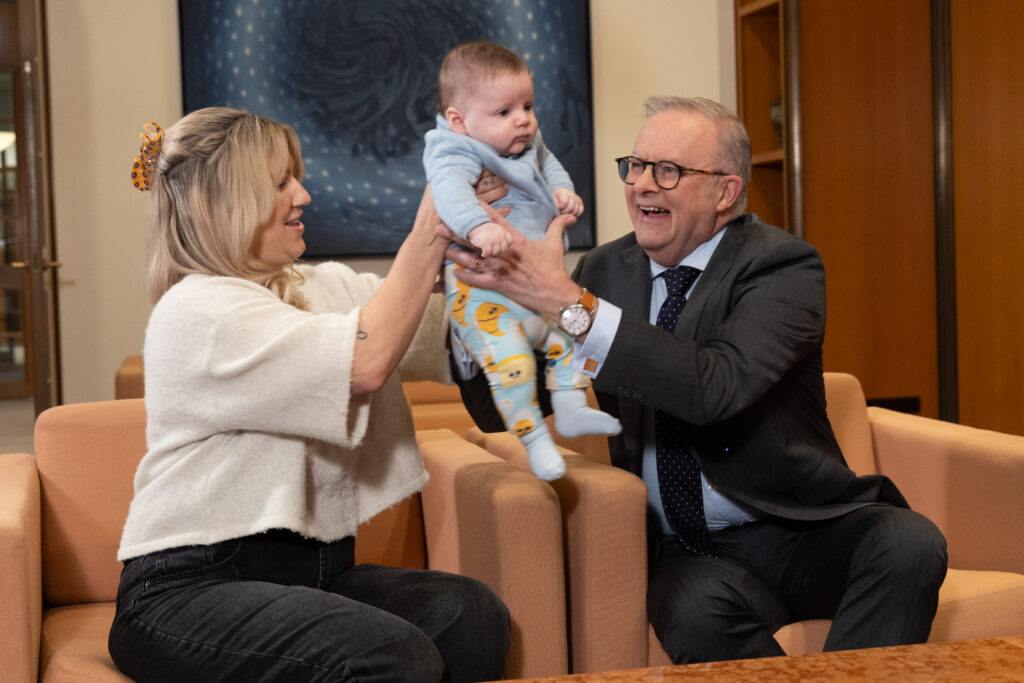
Babies back in the parliament (and also infants) They did this last week, but I guess if you are a politician there is no such thing as too many babies. Here is how... The Point Live
-
Richard
Wed, 01.07.26
10.49 AEST
-
SM
Wed, 01.07.26
10.36 AEST

Babies back in the parliament (and also infants) They did this last week, but I guess if you are a politician there is no such thing as too many babies. Here is how... The Point Live
-
Chris G
Wed, 01.07.26
10.10 AEST
-
Gregory Shearman
Wed, 01.07.26
11.46 AEST
-
Louise
Wed, 01.07.26
15.47 AEST
-
Sam
Wed, 01.07.26
09.52 AEST
Do as we say…not as we do We reported on this earlier in the week, but David Shoebridge is now also reminding people that the Albanese government has rejected 204 of the... The Point Live
-
Gregory Shearman
Wed, 01.07.26
09.40 AEST
Good morning! 'Half arsed', 'weak as', 'pointless' and 'almost worse than doing nothing' - all terms used to describe the government's coming gambling advertising reforms. The legislation... The Point Live
-
Eira
Wed, 01.07.26
08.24 AEST
-
Sam
Wed, 01.07.26
07.42 AEST
Join the conversation
Wow. I'm not sure which is more infuriating - the inane, repetitive questions from the LNP or the obfuscating talking point answers fromthe government. They should change the rules and allow only 1 question from each party, and one each from the independents (and no dixers, just hand out a press release).
Was watching the tennis and every add break there was a Liberal Commercial about how Labor was coming after your money in increased taxes on housing wages ect. Just following up on their constant same questioning every day in the parliament.Seems rather dumb to me what is it achieving, its not going to change anything the bill has passed.
Anyone asked the babies why they haven't learnt English yet?
While it is always amusing to see Cash make a lunge for the LNP 'ass de jour' prize (a sort of nostalgia, she's been there for SO long now..), it would save a lot of time and ground teeth if the LNP would just table its 'todays Bingo Word' as early as possible in the day and the government can table its 'blathering response' and we could then all actually progress with some sort of greater effectiveness with the day's business.
The pressure on Nathan Albanese to start delivering grandchildren must be off the charts!
Surely most people when buying a house is because they want to LIVE IN IT, maybe raise a family and be part of a community they don’t check week in week out on how much it is worth.
A house is worth the shelter it provides to a family and as a place for the family to grow and enjoy what life has to offer.
When you only own 1 house then its monetary value is irrelevant. If you sold it you'd have to buy another house in the same market you sold in and you would make no gain. If you sold it and rented then you'd be even further behind.
Some are concerned with cost rather than value.
Exactly, a house is a home, not an item in an investment portfolio
At the very least, in respect to LGBTQIA+ discrimination, anti-discrimination legislation should make clear that religious providers are prohibited from discriminating against consumers of Cth-funded services. They did it for Cth funded aged care, they can do it for all publicly-funded services (e.g.. job service providers, disability services etc)... in any event, contractually they are not supposed to be discriminating against any recipients anyway.
Easter Egg found at the back of a cupboard?
My grandmother was a nursing sister in our local hospital and often received gifts of chocolate from her patients, which she didn't eat and put them into a cupboard. Whenever we went there to stay, us kids got stuck in. We soon stopped when we discovered the weevils in the chocolate and the horrible stale taste. I still remember it 60 years later.
Beware the cupboard chocolate!
An easter egg! Amy you will be on fire from here. Thanks for being here. I am already sick of people whining about a correction in house prices. Houses are worth what someone pays for them.
Wild. I mean Taylor doesn't seem to realise that Australians are most likely to recall the most recent fires... guess who was in government then.