Tue 30 Jun

The Point Live: Government spruiks July 1 changes, Coalition still looking for a cohesive message. As it happened.

Amy Remeikis – Chief Political Analyst and Political Blogger

This blog is now closed.

16

Key Posts

The Day's News

See you tomorrow?

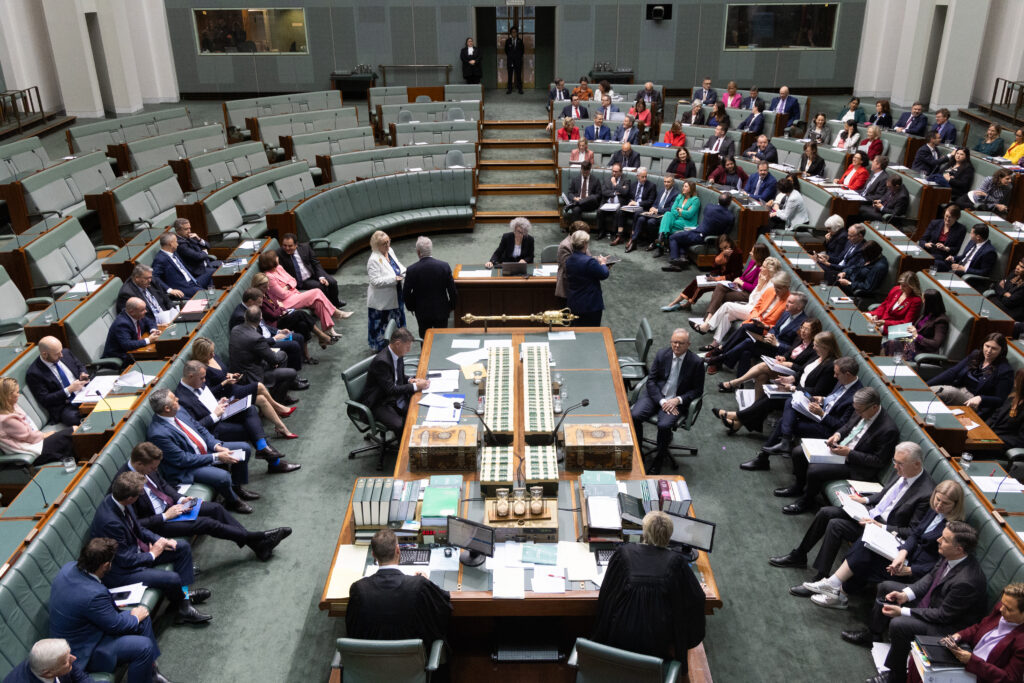
Opposition Leader Angus Taylor during question time in the house of representatives chamber of Parliament House in Canberra this afternoon. Photograph by Mike Bowers. Tuesday 30th June 2026.

It’s nice to see a defence of vulnerable communities in the senate for a moment and to see a Liberal senator defend the right for something to be put forward, even if they don’t agree with the bill itself. Nature is healing etc.

On that note, we are going to shut up the blog before things get too messy again (always a possibility on the late night Tuesday sitting).

Tomorrow is the midwinter ball, which means 1/4 of the press gallery will be in a tizz (they truly care about it) and the rest of us will be enduring the day (and if you’re really lucky like me, avoiding it all together).

Let’s see if the coalition has any more ideas that are not ‘everything I don’t like is socialism/communism’. Also unlikely.

Thank you for joining us today – it means the world. Until tomorrow (bright and early, I promise) take care of you. Ax

Nick McKim: ‘We have a name for that in this country: perversion. You are perverts’

Anna Chang

A fiery clash in the Senate just now. 

As I mentioned earlier, the Senate is much more collegiate than you’d expect from watching QT, and a lot of its machinations work on convention.

So it was a surprise (but also not?) to see One Nation Senators deny leave (‘leave’ = permission) for the introduction of Greens Senator Nick McKim’s Private Senators Bill: Anti-Discrimination Legislation Amendment (Sexual Orientation, Gender Identity and Sex Characteristics Discrimination Commissioner) Bill 2026 during formal motions, and a division was required.

You don’t have to take my word for it when I say this is unusual. Opposition Senator Duniam was quick to rise to his feet to clarify that the Coalition’s vote in the division [AYES 35, NOES 6]:

Senator Duniam: 

“The Coalition supports these normal procedures, as we have with many other Greens, Labor, and other cross-bench bills that we’ve had opposition to. 

“In substance, the normal process enables bills to be fairly considered and debated by the Senate before substantive decisions are taken, and it should only be deviated from in the most extreme of circumstances, lest we deny the right of Senators to even have matters debated in all cases. 

“A vote on the first reading should not be taken as a position on the substantive legislation, especially where a bill has not had the opportunity to be subject to a normal internal process. “

Nick McKim then moved to suspend standing orders, and absolutely let rip. At one point calling One Nation ‘perverts’, which — of course — he was forced to withdraw.

The most fiery parts of his remarks :

Senator Nick McKim:

“And I’ve got two questions for One Nation senators. Firstly, why are you so obsessed with other people’s genitals and reproductive organs? Why? What is wrong with you that you are so obsessed with other people’s genitals and reproductive organs. And you know what? We’ve got a name for that in this country: perversion. Perversion, you are perverts.”

Acting Deputy President: Okay, so it’s one thing to be enthusiastic about your argument, but can I direct you to make your comments to the chair? I think it might be appropriate for you to withdraw that last comment.”

McKim:

“I do withdraw that, but I do want to say that this fixation on other people’s genitals, this fixation about which toilet people go into to do the things that every single human being in this chamber does every day, is a perversion. And it is a fixation on genitals. And a fixation on other people’s reproductive organs that is at the foundation of so much that One Nation does and says. 

“The second question, the second question I have for One Nation senators, which I will ask through you, of course, Acting Deputy President, is what has Pauline Hanson’s One Nation got against transgender people? And why do they want to provide a platform for trans folk in this country to be harmed? To be hurt?

“People who just want to get on with their lives and be who they are, people who want to live their day to day lives free of harm, free of discrimination, like we all do as we go about our day to day lives. 

“People who simply want to embrace who they are as human beings, and why I ask — through you, Acting Deputy President — does Pauline Hanson’s One Nation want to throw trans people under a bus in the name of their incessant culture wars in this country purely for political purpose. 

“And I want to say to trans people in this country, and I know I say this on behalf of all of my colleagues in the Australian Greens. We have your back. We are your allies. We will fight to defend your rights to be who you are. 

“We acknowledge that as humans you deserve love and support for who you are, and we commit ourselves as a party and as a party room to being your allies and to giving you that love and support, and we will always be there for you to defend your rights and to aggressively push back against people like Pauline Hanson’s One Nation, and anyone else, and I know there are others in this place, the transphobic elements who seek to harm you, who seek to hurt you, who seek to demonise you, who seek to exploit you, and who seek to allow you to be deliberately harmed because they think it suits their political agenda, that is a despicable thing that you are doing to trans people, and we will always be here for trans folks, because trans rights are human rights.”

Betting apps to pay for gambling exclusion campaign

Andrew Brown for AAP

Wagering companies will be forced to pay a levy in order to fund an advertising campaign for a national self-exclusion register for problem gamblers.

The federal government will introduce laws on Wednesday to limit the number of gambling ads per hour, as well as scrap all ads during sports matches.

Among the measures are also plans to get gambling companies to fork out money for a campaign spruiking the exclusion register BetStop.

Communications Minister Anika Wells said the campaign would allow for more gamblers to be made aware of the tool.

“BetStop is the most effective thing to helping people suffering from the harms of gambling to reduce their practice,” she told reporters in Canberra.

“Only one in three people who made a punt in the last 12 months actually know about it, so that’s about building that awareness.”

The register allows for people who sign up to be blocked from licensed Australian betting services in a single location.

The latest figures from the communications watchdog showed just under 60,000 people have registered to self-exclude.

As of the end of March, 37,247 people still had exclusions in place.

Ms Wells said she hoped for consensus from parliament on the reforms in order for them to be in place by January.

“Part of the reform package also speaks to banning pocket pokies and addressing things that are being currently a bit unregulated, like online lotteries, overseas lotteries, where there are no consumer protections for Australian users,” she said.

Greens communication spokeswoman Sarah Hanson-Young said the government did not go far enough on gambling reform.

She said plans to limit gambling ads to specific times did not protect people, specifically children properly.

“It’s a half-arsed measure that will not protect families. We all know kids don’t go to bed at 8.30 while in the middle of watching their favourite football team,” she told reporters.

“The government needs to grow a spine here, stare down the gambling lobby. Stare down the big online media companies that are reaping the benefits of their advertising.”

National Gambling Helpline 1800 858 858

JSCEM releases interim election report, focused on behaviour at polling places

Bill Browne

The Joint Standing Committee on Electoral Matters (JSCEM) is partway through its review of last year’s federal election. This is an opportunity to learn from how the election went and reform things in time for the 2028 election.

The interim report is out now. It’s a bit late in the day to unpack in detail, so do tune in tomorrow for more.

What stands out is a proposal for a “mandatory code of conduct” for election participants (like canvassers handing out flyers and how-to-vote cards outside polling booths).  

That will be a response to reports of aggression and bad behaviour on polling booths.

There’s also a proposal to regulate the amount of signage outside polling booths. There’s been a similar proposal from the NSW JSCEM, for state elections – as you may have read on The Point.

There’s proposals for stricter authorisation requirements – but with the glaring omission of truth in political advertising laws. However strict the authorisation requirements, they still allow someone shameless to slap a compliant authorisation on a lie.

Monique Ryan responds to interim report

And here is Monique Ryan’s response to the interim report:

Independent Member for Kooyong, Dr Monique Ryan, has expressed support for the recommendations tabled today by the Joint Standing Committee on Electoral Matters (JSCEM), but warned that critical issues of fairness, integrity, and public confidence have not been addressed by the committee’s interim report into the 2025 federal election. 

“As a member of the Committee, I support the work undertaken to date and thank the many people who contributed their evidence, often after very challenging experiences during the 2025 election,” Dr Ryan said. 

“However, this interim report does not yet address several key issues within the Inquiry’s scope. These must be properly examined before final recommendations are made.” 

Safety risks at polling places must be addressed: 

Dr Ryan said evidence presented to the inquiry highlighted serious and growing safety risks during election campaigns. 

“Candidates, volunteers, voters and AEC staff experienced harassment, intimidation and threats of violence during the 2025 federal election. We are seeing a clear escalation in personal safety risk, and current arrangements are not adequate to protect people participating in our democratic process.” 

Dr Ryan called for stronger protocols, better resourcing for the Australian Electoral Commission, and clearer coordination with law enforcement. 

“It is only a matter of time before someone is seriously injured at a polling place if we do not act. At the moment, AEC workers are largely powerless to prevent such violence from happening.” 

Greater scrutiny of third-party campaigners:

Dr Ryan also highlighted gaps in oversight of third-party campaign organisations. 

“The involvement of significant third-parties like Advance and the Plymouth Brethren in the 2025 federal election has not yet been properly examined by this inquiry. The nature and extent of these groups’ involvement in the election remains unclear. 

“Other groups which appear to have received significant external funding for campaign activity, such as Repeal the Teal, have not filed returns with the AEC as legally required. This undermines transparency and accountability in our political system. The Committee must ensure all participants in the electoral process are subject to appropriate scrutiny.” 

Stronger response needed to disinformation and community harm:

Dr Ryan said the report’s treatment of electoral interference and misinformation was inadequate.  

“We saw during the election how unsubstantiated allegations targeting Chinese-Australian volunteers caused real harm. 

“Conflating ethnicity with disloyalty damages social cohesion and undermines participation in our politics. We must protect our democracy without discouraging Australians from diverse backgrounds from engaging in it.” 

Dr Ryan called for clearer, more transparent processes to deal with interference and disinformation, as well as urgent action on truth in political advertising laws and regulation of AI-generated content. 

“The rise of deepfakes, automated accounts, and targeted disinformation is happening now. It’s not acceptable to defer meaningful action in this area in favour of another review.” 

Unfair political finance reforms risk entrenching incumbency:

Dr Ryan expressed alarm that the Albanese Government’s electoral donation and expenditure reforms disadvantage independent candidates and smaller parties. 

“The current system risks entrenching incumbents by amplifying existing advantages held by major parties in name recognition, donor networks and party infrastructure. 

“Loopholes in donation caps allow major parties to receive significantly greater election campaign funding through their state branches, while independents remain subject to far tighter limits. At the same time, independents face materially worse tax treatment than party candidates, creating an uneven playing field.”  

Dr Ryan said these reforms should not be treated as settled. 

“Victoria’s comparable ‘nominated entity’ regime was recently struck down by the High Court. The Committee should not allow its final report to proceed as though these reforms are settled, uncontroversial, or immune from further legal and parliamentary scrutiny.” 

‘Assault on democracy’

The Electoral Matters committee has handed down its interim report into the 2025 election. Here is how the committee has officially framed it:

The Committee Chair, Mr Jerome Laxale MP said, ‘The interim report provides a response to the assault on democracy that many witnessed at the 2025 election.”

‘In target seats, the 2025 federal election saw the established norms for conduct at polling places shattered. Across the country certain polling places were flooded with participants who shook the foundations of our established free, fair and safe electoral processes. 

Polling places ceased to be models of civic cooperation, and instead saw a rise in intimidation and confrontation. Voters, seasoned campaigners, and AEC staff expressed shock at the change,’ Mr Laxale continued.

‘The Committee’s interim report makes a series of recommendations for the Government to safeguard our electoral process from this type of domestic interference. This includes measures to regulate behaviour, increase transparency and to provide for a safe environment for voters.’  Mr Laxale said.

The interim report also deals with the growth in pre-poll voting, and includes recommendations that recommend changes to authorisation requirements to ensure the public know who is funding and responsible for electoral matters.

Not all the inquiry terms of reference are addressed in this interim report and more evidence needs to be sought and considered in regards to the use of generative AI in electoral matter, the consideration of fixed and extended terms of parliament and on the size of the parliament as a whole.

The Committee will continue to hold public hearings, consider evidence, and address all terms of reference in its final report due in November 2026.

Why hasn’t Labor scraped the failed Jobs Ready Graduate program?

It makes degrees like arts more expensive but has not increased nurses or teachers in the regions, so Jason Clare is asked why he hasn’t scraped it and tells the ABC:

Yeah, it’s failed. That report, the universities accord, hich is big, it’s gonna take a bit of time to implement all of it. We’ve implemented about 36 of the 47 recommendations. I have a bill in the Parliament which is about helping more kids go to uni. In the years ahead more people are gonna need a TAFE qualification or a uni degree.

That bill in the Parliament invests an extra $3.5 billion in the sector so more kids get a crack at uni, in particular kids from poor families, the regions and the bush. I’m doing that for a region. 50% of people in their 30s have a uni degree but not where I live.

…Step two, ahead of this job ready graduates reform. Step two is trying to make it cheaper and quicker for people to do a uni degree. At some unis you – if you’ve done a TAFE qualification you can get a year off your degree, that will cut about 10 grand off your degree. I want more universities to do that. We’re working this year on trying to get more universities to do that. So that if you’ve done a nursing the diploma at uni, take a year off your degree, you do a teaching course at TAFE takes a year off your degree. That will save not just 10 grand potentially off your degree, depending course but you get into the workforce a year early and then there’s job ready graduates which I have said is unfair and failed.

NACC committee to consider all documents before approving commissioners and deputy commissioners

Bill Browne

The parliamentary oversight committee will have more documents to work with when deciding whether to approve the Government’s appointments to the powerful National Anti-Corruption Commission, thanks to a new Senate motion. 

Senator David Shoebridge has been successful in moving a ‘direction to committee’ motion (AYES 34, NOES 20), ordering that Parliamentary Joint Committee on the National Anti-Corruption Commission:

  • in its consideration of approval of the Minister’s proposed recommendation for the appointment of the Commissioner or a Deputy Commissioner, require from the Attorney-General:
    • all primary documentation relevant to applications for the position of Commissioner or Deputy Commissioner
    • any review of the applications by the AG department, any panel undertaking the assessments or conducting interviews, or the Attorney-General
  • directs the committee to conduct interviews with each recommended candidate during in camera hearings, where there is sufficient opportunity to question candidates and consider their responses

It’s no wonder, after the leadership of Commissioner Paul Brereton, in particular, drawing heavy criticism, and investigative piece Built to fail? NACC: the integrity body undermined from the start by Nick Feik, Michelle Fahy & Elizabeth Minter, revealed that the NACC’s then three deputy commissioners, as a group, represented “the least qualified combination of deputies permitted under the NACC Act”.

Parliament has an important oversight role over the NACC, although sadly the government has the numbers to overrule opposition and crossbencher concerns over appointments. At least this motion ensures that the committee will have the opportunity to scrutinise appointments more closely. 

Angus Taylor wants “the locals back in control” – but they supported culling feral horses too

Bill Browne

As you’ll have just read on the live blog, Opposition Leader Angus Taylor has insulted firefighters who did their best to protect life and property in the 2003 alpine bushfires. He falsely claimed that they let fires burn saying “we believe in wilderness”.

These bizarre claims came from Taylor’s speech at a protest against feral horse culls.

Apparently culling feral animals is un-Australian, the result of imported “ideology from the West Coast of the United States”.

“I want to see the locals back in control,” the Opposition Leader said.

But if Taylor had bothered to ask a representative sample of locals, he might have been surprised by the result.

Back in 2020, the Australia Institute and Invasive Species Council polled the Eden-Monaro electorate, which encompasses the eastern parts of the Snowy Mountains, on how horse numbers should be managed.

Over half of respondents (51%) supported a reduction in horse numbers and 29% supported managing horse numbers so they did not increase. Just 13% supported leaving horse numbers unmanaged.

“Brumbies” are a romantic image, but the reality is that the count of feral horses in Kosciuzsko National Park has about tripled since last year. They trample vegetation and waterways, which leaves native animals nowhere to live. Polling suggests most locals understand that – but that didn’t stop Taylor from criticising firefighters and park managers.

Reds under the bed or at least the super scheme, apparently.

The Coalition is now talking about superannuation being communism which – could someone please, please read a book in the Coalition party room? Just one? Because last week we had socialism and this week it is communism and honestly – please stop threatening us with good time?!

I can not even be bothered transcribing or even naming the bot because it is just getting so stupid at the moment.

Fifth bird flu case detected as authorities urge calm

Ethan James 

A fifth migratory bird in Australia has tested positive for deadly avian influenza.

A giant petrel found at Roses-Quallup Beach at Esperance in southwest Western Australia was confirmed on Tuesday as having the virus.

There’s still no signs of spread to local poultry or any evidence of mass mortalities in wildlife, Agriculture Minister Julie Collins said.

Four other dead petrels found near the positive case returned negative tests but Australian Chief Veterinary Officer Beth Cookson said it wasn’t possible to rule out whether they had actually been infected. 

“The detections so far have been in wild migratory seabirds, and there’s no evidence of spread to resident populations,” Dr Cookson told reporters in Canberra.

“These birds are active in southern waters during this period of year.

“Our activities will continue to assess the situation over the coming weeks and months, including through enhanced surveillance.” 

There were no additional suspected positive tests after a sick migratory bird found in Victoria tested negative, Ms Collins said.

Australia had been the only continent free of the highly contagious virus, which has wiped out millions of birds worldwide and also killed mammals. 

Four birds have returned positive results for the strain since it was first detected on the Australian mainland on June 14. 

They were a brown skua found in Esperance, WA, on June 14, a giant petrel on South Australia’s Fleurieu Peninsula on June 14 and a giant petrel in Esperance on June 18.

A positive case in a giant petrel from the WA southern coast was confirmed on Saturday. 

The risk to human health remains low, Dr Cookson said. 

A temporary ban on poultry products from Australia imposed by Papua New Guinea’s National Agriculture and Quarantine Inspection Authority was lifted on June 24. 

People are being urged to avoid contact with sick or dead wildlife but report any finds to an emergency hotline and record locations and take photos. 

What Angus Taylor said

Rob Harris at the SMH/Age reported a few hours ago on the comments Angus Taylor made which have upset rural firefighters (referenced by Kristy McBain in the parliament leading to Garth Hamilton having a tantrum and being kicked out of the parliament for 24 hours)

Recalling the 2003 fires, Taylor said authorities had refused to extinguish blazes that started in Kosciuszko National Park because they “believe in wilderness”. No transcript of his comments has been issued by his office.

They said we’re not going to put them out because we believe in wilderness,” he told the crowd, according to a video posted on social media. “We’re going to let it go, and we saw the most devastating fire we’ve ever seen come through this country.”

…Former NSW National Parks and Wildlife Service incident controller David Darlington, responsible for overseeing the fight against the 2003 fires, said he was surprised Taylor would make statements which were obviously designed to discredit the organisation.

“In doing so he has taken away from a massive fire suppression effort by over 1000 firefighters most of whom were volunteers doing their best,” Darlington, who lives in Jindabyne, told this masthead.

LNP MP suspended for 24 hours for disorderly behaviour

Just after QT, the house voted on naming Garth Hamilton for his disorderly behaviour (yelling “bullshit”) in response to Kristy McBain’s calling out of Angus Taylor and have voted for him to be named and suspended from the sitting.

Angus Taylor was not happy with this outcome. He tried to table a document explaining that he was being taken out of context by McBain, but Milton Dick did not allow it. All of this brings us closer to the Coalition complaining that they are being treated unfairly by the Speaker – start your clock, you know it’s coming.

Voting in the house on naming the member for Groom Garth Hamilton after question time in the house of representatives chamber of Parliament House in Canberra this afternoon. Photograph by Mike Bowers. Tuesday 30th June 2026.

Question time ends

This time QT ends on health.

As far as we can tell, the member for Groom is thought to have yelled out something like “bullshit” and took himself out of the chamber (self 94A?) but there has been a running theme of a lack of emotional regulation going on in the Coalition today.

Which is sort of the theme of this Coalition. All feelings, no facts. And certainly not a lot or resilience.

The view from Bowers

For reasons which escape me, Angus Taylor treats sitting at the Big Table like it is an audition for the chorus of a community musical. His mum is the director (obviously)

The member for Lindsay Melissa McIntosh has some feelings during question time in the house of representatives chamber of Parliament House in Canberra this afternoon. Photograph by Mike Bowers. Tuesday 30th June 2026.
The Opposition front bench during question time in the house of representatives chamber of Parliament House in Canberra this afternoon. Photograph by Mike Bowers. Tuesday 30th June 2026.
The Treasurer Jim Chalmers during question time in the house of representatives chamber of Parliament House in Canberra this afternoon. Photograph by Mike Bowers. Tuesday 30th June 2026.

Update on early childhood education safety standards

Jason Clare takes a dixer to give an update on where training is going for early childhood education services:

It turns out if you pay people more, more people want to do the job. That is why what we announced a couple of weeks ago locking that in is so important. It is good for workers, because they get paid more, but it is also for parents because for the centres to get the money they also have to cap their fees. For the average family for a child in child care, that will save them about $1,500 over the next two years. Good for workers, good for parents but it is also good for our kids because we have added a new condition, to get the funding the centre also has to meet the national safety standards.

This builds on the work that we have been doing over the last 12 months. The banning of personal mobile phones in centres. The CCTV trial. The mandatory safety training. I can tell the house that now 99% of workers have done that national mandatory safety training. 

That is the first phase.

The next stage of that training will start to roll out next month. Those reforms also include the legislation that we passed through this parliament last year, that mean if you don’t meet the standards then you can have your funding cut.

That wasn’t an idle threat. I can tell the house we have now issued notices against 115 centres, 47 centres have now suddenly fixed the problems they had refused to fix for more than five years.

Seven centres have voluntarily relinquished their licences. I can inform the house that today, my department has cut funding to a service in Victoria that has been warned and continued not to meet the standard.

This is not the end. This is just the start. The truth is that this work will never end and we will continue to take the steps we need to take to keep our kids safe.

More on Victoria corruption allegations

Albanese is asked:

What assurances was the Prime Minister given by the Victorian Premier on whether Commonwealth taxpayer funds directly or indirectly made it into the hands of convicted criminal and underworld figure Mick Gatto or any of his associated companies? —

I’ll take it back to where I was speaking before, before I was rudely interrupted. And I will make three points.

One I confirm the actions that this government has taken.

Two I, will make the point that that stands in stark contrast to the former government that had a royal commission into unions but it was about having a crack at the then Leader of the Opposition, using Commonwealth funds to have a crack at the then member for Maribyrnong and have a go at the former Prime Minister of Australia, Julia Gillard, with millions of dollars spent, which during that same period John Setka increased his influence in the CFMEU and expanded it from Victoria into South Australia and into Tasmania.

I will make two further points. In 2024, the Commonwealth put specific provisions in funding agreements with states and territories that place obligations on jurisdictions to report any allegations of unacceptable behaviour.

That was something that wasn’t there under the former government. And further than that, Victoria continues to keep the Commonwealth informed of the work that they have done to strengthen the integrity processes. 

Those measures include requirements within tenders to develop a management plan for fraught – it can’t be more relevant.

There is still an attempt to make a point of order and Milton Dick is not having it:

The Prime Minister was asked a specific question. He is reading about Commonwealth assurances that he was asked about. There cannot possibly be a point of order, member for Cowper. He specificed referenced 2024. Resume your seat. He was asked what assurance he was given? He was reading – resume your seat! There has been far too much disrespect in this chamber today. The Prime Minister in continuation.

Albanese:

These are the measures that the Victorian Government have put in place which include requirements within tenders to develop a management plan for fraught and integrity matters. Two, broaden conflict of interest in gifts and hospitality requirements. Three, a requirement for contractors to install robust security access arrangements at sites. Four, minimum requirements for time sheet systems. Five, requirements for contractors to provide a register of subcontractors and supplies engaged on a relevant project. Six, the establishment of a mandatory register of approved industrial relations consultance and mediators. That is the measures which have been put in place, the measures that have been put in place by this minister are substantive as well. Measures that were not in place under the former government.

Falls in funding for after-hour health services

Independent Indi MP Helen Haines asks Mark Butler:

Murray primary health network, which services most of the Indi recently had its after hours funding cut apparently because demand is now serviced by Medicare urgent care clinics. The government says four in five Australians who lives within 20 minutes of a Medicare urgent care clinic. If you live outside of Wodonga in Indi, it is zero. Can you guarantee that rural communities without a Medicare urgent care clinic will not lose access to after hours care?

Butler:

I think she and I have been corresponding about one particular after hours service, the Walwa bush nursing centre, I think it is called. I responded to the member last week about this.

It is true that we have adjusted the funding that has traditionally been paid to primary health networks to support after hours services across the country.

Let me give a sense about why because the member says apparently that’s because of the rollout of the urgent care clinics network. That is part of the reason but it is only part of the reason. As the member knows, given how familiar she is with the health area, there has been a transformation about the way in which people access health, particularly after hours since COVID. Particularly driven by the explosion of free health services. 

What has happened more significantly I think than the urgent care clinic network rollout, particularly for communities like the member’s is the rollout of 1800 Medicare which now gives all Australians 24/7 access to a high quality nurse, advice and triage services and after 6:00pm in that period of time that the after hours service pretelehealth was focused on, from 6:00pm to 8:00am, free of charge high quality telehealth services from a GP.

It is true so say the urgent care clinic network has also picked up a significant part of what used to be serviced through the after hours program and it is true also to say that is not covering every regional community, as the member knows far better than I do, coming from a city electorate as I do.

I am very convinced that the rollout of 1800 Medicare which since January has responded to 700,000 episodes of service plus the urgent care clinic network, plus the degree of support that our bulk billing incentive program has given to communities like the member’s, which has seen bulk billing practices triple since just November last year, that we are delivering a much stronger Medicare service.

As I said in my response to the member’s letter about that particular after hours service, the PHN, the primary health network, has provided some funding through the 26/27 financial year to that service. They have on my advice been experiencing quite low service volumes.

That around the country is seen as a reflection of these new services like 1800 Medicare and urgent care clinic networks. The funding that they will receive over the 26/27 financial year will reflect the significant reduction I understand this service has seen in their after hours volumes.

Pauline Hanson feels the heat on Paid Parental Leave

Anna Chang

After Pauline Hanson came under fire for her comments on paid parental leave in her Press Club Address, and already trying to walk back comments in the media last week, saying they had been “taken completely out of context”.

Today Hanson takes an opportunity in the Senate to walk her paid parental leave comments back completely:

Let’s be absolutely clear on the facts. I support paid parental leave, and I will not change it. I repeat, I will not change it. 

That Kos Samaras of Redbridge wrote yesterday: “turns out telling women and workers to get stuffed is bad politics”, with the latest Redbridge Accent poll showing Hanson’s net approval has fallen ten percentage points is surely just a coincidence.

New question line

The LNP moves on with this new question line to the PM:

Last night, Sarah Ferguson asked him whether he had sought assurances from the Victorian Premier that no Commonwealth funding would end up in the hands of organised crime. The Prime Minister responded “Of course”.

When did the Prime Minister seek these assurances and what form did they take?

Albanese:

I, like the Victorian Premier, was opposed to corruption in any form. It is up to authorities, wherever there is evidence, as I said last night, for action to be taken by those authorities, should there be any evidence of corrupt conduct.

After a dixer, Angus Taylor is back with:

Can the Prime Minister confirm that no Commonwealth taxpayer funds have directly, or indirectly been made into the hands of convicted criminal and underworld figure Mick Gatto or any associated companies?

Albanese:

This goes to the first question that I was asked after the 2022 election and at that time I pointed out the action that I took as leader of the Australian Labor Party within three weeks of my election. Within three weeks of my election as Leader of the Opposition I took on some people, such as John Setka, I expelled him from the Labor Party. He took action and took us to court. He appealed that court action and we defended that and John Setka remains outside the Labor Party. We also have excluded the CFMEU from being affiliates of the Labor Party. We also put the CFMEU into administration. That stands in stark contrast…

Dan Tehan gets up to give a point of order, but Albanese sits down deciding his answer is completed.

A bit touchy

Kristy McBain is asked this dixer:

How is the Albanese Labor Government supporting communities across Australia to prepare and respond to natural disasters? How does this compare to other approaches?

There are plenty of interjections as she criticises the former government’s response, particularly when she gets to this bit:

Those opposite ignored warnings from fire commissioners. They delayed and played politics with the recovery support. Now look at the comments from the Leader of the Opposition in the media today to know nothing has changed. If there was a Rhoad scholar amongst us who had learnt about bushfire management, they might be qualified to comment on how firefighters do their job but there is not.

Dan Tehan complains, and the Tony Burke fires back, with standing orders at seven paces.

McBain is told to continue but to be relevant and she says:

The Leader of the Opposition stood at a precipice in front of people, pointed the finger at rural firefighters saying that they let the 2003 Snowy Mountains bushfires run. That is absolutely shameful. I am disgusted and so are the first responders who have come into my office to complain about it. I have a message for first responders…

And then the chamber erupts.

Independent MP Zali Steggall calls for LNP MP Garth Hamilton to be “named for unparliamentary behaviour”

Milton Dick has not seen it, so he can’t do anything, but says he will review the footage and ‘see what happened’.

Everyone is told to simmer down.

McBain finishes with:

As I said, first responders have come into my office upset and unsure why someone in a leadership position has said that they didn’t do their job. I have spent a lot of time with first responders in my own community during the Black Summer, the Tathra fires, all the fires and my message to the first responders is our government has your back and the difficult decisions you have to make to keep us safe. The Leader of the Opposition should stand up, be a man and apologise now.

Coalition going in circles

They did this last week to Anthony Albanese and now it is the Treasurer’s turn according to the LNP tactics team:

The day after the Budget the Treasurer was asked by Peter Stefanovic if he negatively gears any properties and the Treasurer said “No, I don’t Pete, no. I did maybe a decade ago or something like that”. Can the Treasurer explain to Australians why it is fair for him to benefit from negative gearing and rip up the same opportunity for millions of aspirational Australians?

There is a back and forth over whether or not the question is in order. They have made a backbencher ask the question (probably because the front bench is trying to distance themselves from these sorts of questions, but wanting the shine

Milton Dick rules that it is (after some time and reluctantly at that) and gives Chalmers some leeway in how he wants to answer it.

Chalmers:

I would be surprised if the Leader of the Opposition wants to go down this path which I suspect is why nobody on the front bench asked that question. Just like the Leader of the Opposition, the questions from the Liberal and National Party are becoming desperate and more than a little bit pathetic. Our changes in the Budget that we announced less than two months ago are about making the housing market fairer for everyone.

They are about making sure that for the first time in a quarter of a century, that first home buyers and particularly young Australians get a fair go in a housing market which has locked them out for too long. We understand that those opposite, all three of the right wing parties over there with their divisive, anti-housing, anti-worker agenda, they would like to leave the housing market and the tax system exactly as it is.

They are entirely comfortable with this idea that for a quarter of a century, since Mr Howard and Mr Costello made a big policy mistake to distort the housing market and lock more young people out of the market, that is the status quo that they will go to any lengths to preserve.

We have a different view about the housing market. No objective observer of the housing market in this country would say it is working exactly as it should be. It is especially not working for first home buyers. Once you come to that realisation and once you acknowledge that truth you have got two choices.

One, to do nothing about it, which is their approach for a decade. Or secondly, to do something about this challenge to make it easier for first home buyers to get a toe-hold in a market which has been too difficult for too long. The Leader of the Opposition has been interjecting about the ladder. I will say once again to the Leader of the Opposition, not everybody fails upwards up the ladder like the Leader of the Opposition does.

Not everybody starts their life at the top of the ladder and there is not much point in a ladder if the first few rungs are missing. That is the case when it comes to the housing market in this country. We are making the housing market fairer for first home buyers. We are proud to be doing that. No amount of desperate, increasingly pathetic questions from those opposite will deter us.

The World Wild West: Albanese on Tech Giants

Anara Watson

For too long, tech giants have treated the internet like the Wild West, but Australian experience shows that governments can out-manoeuvre them.

Late last year, the Albanese government introduced its social media ban for anyone under the age of 16. Those social media platforms include “Facebook, Instagram, Snapchat, Threads, TikTok, Twitch, X, YouTube, Kick and Reddit”.

To give force to the ban, the Albanese Government introduced the Online Safety Amendment (Strengthening Enforcement for the Social Media Minimum Age) Bill 2026 to the House of

Representatives yesterday. That Bill is currently being debated.

According to the Bill’s explanatory statement, “The Bill expands the eSafety Commissioner’s information-gathering powers and increases civil penalties for non-compliance”. The fine for tech companies who fail to keep those under 16 off of their platforms could reach $99 million. Failure by tech companies to produce documents they’ve been compelled to hand over could result in a $1.65 million fine.

The social media ban is subject to legitimate criticism. No small part of that criticism has come from The Australia Institute. Lots of people say that the ban isn’t working, and a recent study found that 80% of under-16s in Australia said they were still using social media three months after the reforms came into effect.

But it is the law of the land, and the tech giants should follow Australian law or face the consequences.  

Australia has shown a willingness to take on the tech giants, after decades where countries have struggled to know whether, or how, to regulate. 

Australia’s tech reforms have inspired other countries to crack down on big tech. Those countries can learn from the tactics used by the tech industry to oppose Australian regulations, and from the strategies that have helped overcome industry resistance. This week, the Parliament may be adding another tool to the toolbox. 

David Pocock: ‘I believe we saw the Senate at its best’

Anna Chang

Senator David Pocock uses his two minute Senators’ statement time recognise some of the important work of the Senate and his fellow Senators..

While you might roll their eyes at politicians giving themselves and their colleagues a pat on the back, the examples of what Pocock describes as ’the Senate at its best’ demonstrate that the Senate is more collegiate than you’d expect from simply watching Question Time, and a lot of good work can be done.

On behalf of Canberrans, I would like to recognise some of the outstanding work that happens in this place and thank Senators for their important contribution. 

In March 2023 we saw the Finance and Public Administration References Committee begin an inquiry into the integrity of consulting services, and I believe we saw the Senate at its best. 

We saw Senator O’Neill, Senator Barbara Pocock, Senator Colbeck, and others forensically examining allegations and goings on at PwC, 10 days of public hearings, 61 submissions, 129 responses to questions on notice, a huge body of work. 

And we’ve seen them at it again, Senator O’Neill, Senator Barbara Pocock and Senator Scarr, looking at KPMG. 

This is what the Senate can do, and I really thank colleagues for their important work on this, holding these companies to account and shining light on what is happening. 

The other area I would like to mention is aged care, where we’ve seen Senator Allman-Payne and Senator Ruston do outstanding work to shine a light on what is happening to older Australians, to raise concerns about the Government’s assessment process for support at home, about the algorithm that really isn’t delivering for older Australians. 

And for me it reinforces just how important it is that on these sorts of issues we have a multi-partisan approach, and as a Senate, we use our powers and we use them well, to shine a light on these issues, and then to make sure that we are doing the work that headlines simply cannot do.

Democracy thrives on high expectations, and it is work like this that we should come to expect from our elected representatives. 

Because if you believe in democracy, you believe in politics. The less faith people have in our government and our parliament, and the more people shun the project of democracy the easier it is for those with power to extract more for themselves.

Second verse, same as the first

Tim Wilson asks basically the same question – but with even more pompousness, if that is possible. It’s as if the ‘berries and cream, berries and cream’ boy was given a seat in parliament.

Wilson:

Labor’s correction in house prices means the value of an Australian home could collapse by 10-20%, smashing Australia’s nest egg. Did the minister receive or review any advice from Treasury or APRA about how many first home buyers will be pushed into negative equity because of Labor’s deliberate correction?

Clare O’Neil:

I am being asked the same question that I was asked just before. I am going to come back to a bit of advice and referral to those opposite. The impact of the Budget changes on house prices is actually in the Budget documents and I would really encourage those opposite to have regard to those documents. I am going to refer to page 5 of the fact sheet on CGT and negative gearing and I am quoting directly from the Budget “Treasury modelling suggests the reforms will increase the owner/occupier share of housing, resulting in about 75,000 additional owner/occupiers over the next decade”. I continue “This is equivalent to reversing around 10 years of decline in Australia’s home ownership rate” and the document goes on to say “The reduction in investor demand is expected to lead to a small and temporary slowing of house price growth estimated to see prices grow by around 2% less over a couple of years relative to no tax policy change”. It is there in Budget documents and I would encourage those opposite to actually read them.

Question time begins

And the Coalition has not moved from the *tragedy* of house prices being slightly lower (which is not a historical one off, or even a disaster – they are just back at 2024 levels, which were already “impossibly unaffordable”)

Angus Taylor drones on about some stuff and then gets to:

How many first home buyers have fallen into negative equity since the Budget?

Clare O’Neil can probably do this in her sleep now:

We covered this matter in some detail yesterday but let me go through it again for those who are slower on the uptake. Legislation passed the parliament last week which does two important thing. It delivers a tax cut for every one of Australia’s 13 million workers and it delivers for the first time a level playing field for our nation’s first home buyers. That will get 75,000 Australians who are today stuck in renting into the home of their own that they deserve. House prices in Australia according to Treasury will continue to grow over time but more slowly than they otherwise would have. Those opposite have availed themselves of the information about the Treasury modelling, surely, which suggests a slower rate of growth of 2 percentage points. That ballpark figure is backed up by other major models, including that of the Commonwealth Bank and the Grattan Institute. We had this conversation in the parliament yesterday but it is clear where the Labor Party stands on this. We support first home buyers through the 5% deposit program, through help to buy and we support them by providing the fair go at winning an auction that they

Tony Pasin has a moment.

Tony Pasin at a press conference in the Mural Hall of Parliament House in Canberra this afternoon. Photograph by Mike Bowers. Tuesday 30th June 2026.

South Australian MP Tony Pasin has had a little moment at a press conference with Matt Canavan and some other LNP-ers over whether or not he stands by his comments that One Nation and the Coalition need to join together or come to a deal and not run in each other’s seats.

He was slapped down quickly when he floated the idea a few weeks ago, but it is a live conversation within the LNP. And Pasin is one of Angus Taylor’s numbers men, so he has a bit more sway in the party room these days (another example of failing up!) but he is feeling a bit sensitive over the whole thing it seems.


Tony Pasin at a press conference in the Mural Hall of Parliament House in Canberra this afternoon. Photograph by Mike Bowers. Tuesday 30th June 2026.

Asked repeatedly if he stands by his comments, Pasin just worked himself into a lather and could only come up with wanting to work hand in hand with One Nation to defeat Labor. Turns out someone needs to practice some emotional regulation. Could I suggest some deep breaths?

So it’s going really well then, it seems.

Queensland’s electoral redistribution: the case for an expanded parliament

Anara Watson

Queenslanders are set to lose two of their state electorates, after a review by the Queensland Redistribution Commission. One of these seats, Stretton, is in Brisbane’s south; the other, Hill, covers areas north of Townsville and to the west.

The review makes moderate to significant changes to 50 of the state’s electorates, while 41 electorates had minimal or no changes made.

Understandably, some Queenslanders are quite unhappy with this decision. During its consultation, the Redistribution Commission received 206 objections from the residents of Hill alone. Some of those objections raised just how huge their new electorate will be. 

For context, in Queensland, four electorates are larger than 100,000km² – that includes Flinders, which absorbed parts of the former district of Hill. To put that into scale, those electorates are larger than some countries, including Ireland, Portugal and South Korea.

People living within these newly-defined boundaries could have to travel hours to meet with their local representative – something that often isn’t feasible.

This is also frustrating for local MPs. The change will mean Queensland Katter’s Australian Party MP Shane Knuth, who currently represents Hill, will lose his seat for the third time. That issue was raised by federal MP Bob Katter in Parliament yesterday.

And while LNP Premier David Crisafulli has claimed that the redistribution will help Queensland Labor, Ben Raue explains that that isn’t true. The LNP stands to benefit. 

But what could be done about this?

According to the ABC, “Mr Knuth said more seats in north Queensland was overdue”. Research by The Australia Institute agrees that Australia needs more politicians.

Earlier this year, The Institute made the case for an expanded parliament. While that report focuses on Commonwealth electorates, its findings are also relevant to Queensland.

Especially for the massive Queensland districts like Cook, Flinders, Gregory and Warrego, which contain diverse communities and interests, an expanded parliament would improve access to MPs by limiting the size of their electorates.

Opposition to the proposal for an expanded parliament is often connected to concerns that the last thing Australia needs is more politicians. But you don’t have to like politicians to think it’d be good if it were easier to get hold of your local member.

June business conditions

EY chief economist Cherelle Murphy has had some thoughts about the ABS June business conditions, so here is her informed take:

The ABS June business conditions and sentiments survey showed that nearly half (46 per cent) of Australian businesses experienced an increase in operating costs over the last four weeks. Pressure from higher fuel prices was the leading reason for the increase in costs in June, accounting for 71 per cent of responses, followed by higher business overheads at 65 per cent.

Today’s data demonstrates that supply chain disruptions resulting from the Middle East conflict are continuing to significantly affect many Australian businesses. Transport, postal and warehousing was the industry most impacted by rising fuel costs, with 99 per cent of businesses impacted, followed by agriculture, forestry and fishing at 96 per cent and construction at 87 per cent.

Around 84 per cent of businesses in the professional, scientific and technical services industry reported higher business overheads as a reason for the increase in costs, which was significantly higher than 55 per cent last month. The construction industry also reported a large increase in business overheads, rising from 36 per cent in May to 60 per cent in June.

Around 15 per cent of businesses surveyed increased their prices in response to higher fuel prices or reduced fuel availability in June, which was higher than 12 per cent in May. Transport, postal and warehousing at 37 per cent, followed by wholesale trade at 35 per cent were the industries most likely to increase prices in response to fuel prices. This has flow on effects to prices more broadly.

The Reserve Bank’s June Monetary Policy Board meeting minutes noted that global oil supply issues may take some time to resolve, keeping upward pressure on global energy prices and inflation. Alongside resilient domestic demand, this means upside risks to inflation remain. As a result, we expect that there is a real possibility of a rate hike when the Board next meets in August.        

Because of how hawkish the RBA board has been, and not because any Australian consumer can do ANYTHING about inflation. It’s an insane state of affairs, where the RBA is considering raising rates so that it doesn’t get criticised for not raising rates – even though it won’t do a darn thing about inflation.

One Nation Canberra’s improbably sized branch meetings

Skye Predavec

This morning, the Canberra Times is reporting that One Nation held its first ever branch meeting in the ACT on Saturday 27 June, in the Labor-held seat of Bean – currently on a razor-thin 700 vote margin against independent Jessie Price*.

An eagle-eyed watcher of Pauline Hanson’s Press Club address may be a little confused. After all, at that event Hanson told the Canberra Times her party had “started a branch here and … the first meeting they had over 200 people there”.

Now, a party spokesperson told the paper that they’d held their first branch meeting last Saturday, and that “more than 250 people” had attended. This directly contradicts Hanson’s claim that there had already been an ACT branch meeting.

Those would be impressive numbers, if true. The Canberra Times did not say if One Nation provided any proof of its attendance claims, and the party has not released any details of the event.

In fact, only one of the party’s events in Canberra has been publicly advertised, a launch event in November – which only around 30 people showed up to.

To go from 30 to 250 attendees would mean One Nation’s Canberra branch has grown almost 1000% in just over half a year – a lot for any political party.

No photos have been released of the meeting, which despite not being publicly advertised, was supposedly large enough to exceed the capacity of most South Canberra event spaces. Without evidence, it’s all a little hard to believe.  

*Apologies – a previous version of this post incorrectly named the independent challenger in Bean as Jessie Smith instead of Jessie Price.

Wicked Problems report

Flinders University has released the findings from it’s latest Wicked Problems report, which measures how Australians are feeling. It’s a vibe check, but with research.

The 2026 report includes a national measure of happiness and optimism. These are the national results, but you won’t be surprised to find younger people are more worried about things like house prices.

You can find the whole report, here.

The national survey found that as top concerns:

  • 65% of Australians listed cost-of-living.
  • 40% worried about housing unaffordability.
  • 37% were concerned about crime and safety.
  • 26% pointed to access to quality healthcare and community care.
  • 21% worries about the environment, including climate change and environmental degradation.
  • 16% misinformation in the digital age as priority issues and 15% prioritised trust in government.

While many concerns were shared nationwide, the report highlights distinct regional patterns:

  • Crime and safety ranked as the top concern in the NT while rising in Victoria.
  • Concerns about housing affordability were prominent in WA, SA and NSW
  • Cost of living and access to healthcare was rated a higher concern for South Australians compared to the national average.
  • Queenslanders are more concerned about crime, infrastructure and transport than the national average.
  • ACT residents are more concerned about the environment than the national average.
  • Tasmanians cited access to healthcare as their top concern.
  • People living in rural areas are more worried about the quality of health and community care, compared to metro areas.

When it came to happiness levels:

  • 69% of Australians reported being happy.
  • Territorians report the highest happiness nationally at 75.3%, while Victorians record the lowest at 65.9%
  • 82% of the Interwar generation say they are happy compared to 63% of Gen Z.
  • 76% of the unhappy respondents selected cost of living as a key issue.

Generational and income trends emerged:

  • 45% of Gen Z and Gen Y report concern for housing affordability compared to 33% of Baby Boomers.
  • 34% of Baby Boomers and 31% of Interwar generations are worried about access to healthcare compared to 19% of Gen Z.

Differences between states and territories are reflected in newly measured optimism trends:

  • Territorians (23.3%), Tasmanians (23.7%) and Victorians (26.3%) report being optimistic about their state/territory’s future direction.
  • West Australians are the most optimistic about the direction of their state, with 47% expressing confidence compared to the national average.
  • 21% of Gen X are more pessimistic compared to 12% of Gen Z.
  • Those who feel unhappy or pessimistic also emphasise cost-of-living pressures, safety concerns and trust in government.
  • Optimistic Australians tend to focus on the environment, unemployment and global crises.

Gas-fired electricity dropping to near zero: Australian Energy Market Operator

Rod Campbell

posted earlier on the AFR’s piece about declining gas demand in Australia’s electricity market. The story is based on new estimates from the Australian Energy Market Operator that came out late last week.

An interesting point about the AEMO estimates is that it sees gas demand by electricity generators drop to basically zero from next year out to about 2035.

Here’s the key chart, marked up where gas demand disappears:

This should not only nix any claims of gas shortages in Australia…which were always nonsense anyway…but also see questions asked about the government’s line that new gas is needed to back up renewables.

To the extent that AEMO sees gas in this role, it is mostly after 2035.

Batteries killing gas demand

Rod Campbell

“Battery rush slashes gas power forecasts” says the front page of today’s Financial Review.

That sounds like good news, doesn’t it?

Furthermore, “An expected shutdown of the east coast’s biggest source of domestic gas power – the ExxonMobil-run Longford gas plant in Victoria – passed without any significant spike in energy prices or shortage risk.”

“Experts say the ability for the market to cope with the complete shutdown of the Longford plant is in stark contrast to what would have occurred had a similar breakdown taken place a couple of years ago.”

I guess all the gas industry reps who claimed the lights-will-go-out-something-gas-shortage will now admit they were wrong?

Ha! No way!

Australia using less gas just “boosts criticism of Labor’s plan to reserve gas exports”.

Maybe they have a point – a gas export tax is a much better idea!

‘Arenas of hate’

Labor MP Josh Burns has spoken about his desire to see social media platforms held to a duty of care, and has spoken about the abuse he has received as a Jewish man, but also the abuse his partner, Georgie Purcell who is a Victorian MP with the Animal Justice Party, receives online.

Well, right now, the social media platforms are the arenas of hate. And they are the platforms in which people can spread messages of dehumanisation and racism and vilification. And I would actually challenge the social media platforms to prove that they are not amplifying that. That they are not using the conflict and the vilification that is occurring from one group to another in order to attract people and keep people online. Because to me, that’s what it seems like they are doing. That they are designing their algorithms in a way that is sending content that is only being reacted by the most inflammatory and awful responses in order to keep people on their platforms. And I think that they have a lot of answering to do.

Does having private health insurance really give you choice? Probably not.

Hamdi Jama

Private health insurance is often sold on a simple promise: choice.

Your choice of doctor, your choice of hospital, and your choice of how care is delivered.

But recent developments in Australia’s private health sector raise an uncomfortable question: are private patients being steered towards decisions that benefit private hospital providers?

new Ramsay Health Care pilot program in Queensland will allow Ramsay-employed nurses working in public hospital emergency departments to identify and shuttle privately insured patients from public hospitals to Ramsay’s private hospitals.

This is part of a broader trend of private institutions exerting influence over sick and vulnerable Australians.

We know from childcare, aged care and NDIS that private markets are not a good way to deliver essential care.  The value of private health insurance is under increasing scrutiny, with ballooning out-of-pocket costs and a tendency for lower-value care.

Ramsay’s frames their pilot program as a way to ease demand on overstretched public hospitals. But whether these arrangements actually serve the broader health system or just the interests of private providers remains to be seen.

Ultimately, Australians paying for private cover should feel confident that decisions about health care are driven by their medical needs and personal circumstances, not by the interests of private providers.

RBA minutes released

The RBA has released its minutes from the last meeting (where it held rates) where it says the same thing it has been saying all year – things are restrictive, but they COULD get spendy!

Here are part of the minutes:

Turning to Australia, members noted that financial conditions had tightened since the start of the year following three increases in the cash rate target. However, financial market participants’ expectations for the future path of monetary policy had eased noticeably since May in response to lower global oil prices and weaker-than-expected data for both the labour market and headline inflation in Australia in April.

Members agreed that financial conditions were now probably somewhat restrictive. They discussed updates made by the staff to some models of the neutral rate, noting that these did not materially alter their assessment of financial conditions. The cash rate target sat at around the top of the range of these model estimates, and above the range of market economists’ estimates of the neutral rate. Members observed that estimates of the real neutral rate had risen over preceding years – consistent with a global trend, which probably reflected factors such as increased investment in the energy transition, defence and, more recently, data centres – and were a little higher than when the cash rate target was previously at its current level. Members nevertheless emphasised that assessments of the neutral rate are inherently uncertain and do not provide a direct guide for monetary policy.

Members continued their assessment of the tightness of financial conditions by considering evidence from a broader range of indicators. These generally showed that the tightening in monetary policy was starting to be transmitted to the economy through various channels. Conditions in the established housing market had softened and housing credit growth looked set to slow in the period ahead. This reflected the pass-through of monetary policy tightening and, more recently, tax changes for housing investors announced in the Australian Government budget. Business debt growth had remained relatively strong over prior months, some of which reflected syndicated lending for the construction of data centres.

Banks had passed the higher cash rate through to lending and deposit rates, and scheduled mortgage payments had risen. Compared with household disposable incomes, scheduled mortgage payments were a little lower than the previous episode when the cash rate was at current levels, reflecting the fact that growth in income had outpaced growth in credit in the intervening period. Members discussed how to assess the net impact on the economy of monetary policy easing in 2025 and tightening in 2026, noting the lags in the effect of monetary policy.

Members noted that the cash rate target was widely expected by market participants to remain on hold at the present meeting. Market pricing at the time implied a 50 per cent chance of a further 25 basis points increase in the cash rate by the end of 2026, having priced in about 40 basis points of increase immediately after the May meeting. Some market economists expected the cash rate to be increased again in 2026 because of ongoing inflationary pressures from both domestic and international factors. Others expected monetary policy to remain on hold in 2026 and then to be eased from around mid-2027, given restrictive financial conditions currently, signs of a slowing in aggregate demand and an anticipated decline in inflation.

Parliament sitting gets underway

So after that morning of a bit of this and a bit of that, the official sitting is now underway. Gambling and social media reform are the main games (as well as some regulation changes) with the Coalition basically trying to find a narrative.

Meanwhile One Nation is being deliberately quiet because the more you hear from them, the less people like them. So don’t expect to see too much of One Nation in these next few weeks. It is by design.

Koalas Covering for Coal? Dirty Forest Offset Plan Would Mean More Fossil Fuels

Noah Schultz-Byard


The Federal Government’s new carbon credits method for ‘protecting’ native forests will allow fossil fuel companies to greenwash their climate pollution and expand coal and gas production, according to the Australia Institute.

A new carbon accounting method, proposed to fund the creation of the Great Koala National Park in NSW, pits forest and biodiversity protection against acting on climate change, when those objectives are inseparable.

“Climate science makes clear that the Australian Government needs to stop approving new gas and coal projects while simultaneously stopping the destruction of enormous amounts of our native forests,” said Dr Richard Denniss, co-CEO of The Australia Institute.

“The science doesn’t say that it is okay for us to approve new gas and coal mines, as long as we save some trees at the same time. However, under this Great Koala National Park offsets scheme, that is exactly what is being proposed.”

Australia Institute research has shown that:

  • Half of Australians (48%) agree that so-called carbon offsets are greenwash.
  • Three in five Australians (62%) agree that so-called carbon offsets help polluters look like they are reducing emissions even when they aren’t.
  • Three in five Australians (61%) say that stopping new gas and coal projects is an effective way to reduce emissions.

“It is simply climate denial to pretend that saving a forest can ‘offset’ the harm of approving a new gas or coal mine and expanding fossil fuel pollution,” Dr Denniss said.

Australia institute research has shown there is no shortage of offsets boondoggles in Australia, but there is a shortage of the bravery required to confront the fossil fuel industry and their friends in the carbon offset industry. It is obscene to suggest that the only way we can save native forests is to allow the fossil fuel industry to use those forests to greenwash their growing emissions.”

“Australians want our governments to protect native forests, but not as a trade-off for big polluters to keep polluting,” said Jenny Weber, Campaigns Director at the Bob Brown Foundation.

“The radical proposal to generate offsets from public native forests for fossil fuel emissions fails the climate and fails nature.”

Artificial Intelligence is everywhere but in the productivity statistics

David Richardson

The Economist today is reporting on the artificial intelligence (AI) boom and says:

The AI industry is hoovering up capital and transforming financial markets in the process. Mammoth listings from SpaceX, Anthropic and OpenAI could add as much as $4trn to the value of America’s listed firms by the end of the year. Existing AI stocks have already powered an enormous stock-market boom and the industry is issuing increasing amounts of debt.

But it remains unclear exactly how much and how quickly AI will transform the economy—and who will win and lose when it does. Financial risks are building as investors make huge bets on an uncertain future. If the technology realises its potential, will those bets pay off? If it doesn’t, what would the fallout look like?

And more

The likelihood that AI may soon make lots of workers redundant is well known. What is much less discussed is the hope that AI can set the world on a path of explosive growth. That would have profound consequences. Markets not just for labour, but also for goods, services and financial assets would be upended.

If the evangelists of Silicon Valley are to be believed, this bang is about to get bigger. They maintain that artificial general intelligence (AGI), capable of outperforming most people at most desk jobs, will soon lift annual GDP growth to 20-30% a year, or more. 

Meanwhile the Australian Financial Review reports that

investors have spent the weekend fretting about whether the hyperscalers such as Microsoft, Meta Platforms, Amazon, Alphabet and Oracle can really afford to keep spending trillions of dollars to meet the growing costs of the AI infrastructure boom, while sustainable, meaningful returns remain a distant hope.

This seems to be very important since there are now important Chinese AI corporations with similar performance but lower prices than the US giants. So a possible scenario is that the American AI companies never make a profit but generate a huge collapse in sharemarkets while Chinese corporations clean up.

No matter what happens it seems AI is now ubiquitous. The Audit Office recently reported favourably on the Patent Office’s use of AI in examining patents in Australia.

Danielle Wood, the chair of the Productivity Commission gave a speech in which she claimed AI “could add about 0.4 per cent a year to labour productivity over the next decade”. So AI can save 0.4% of labour each year, which might not sound much but it is 13% less labour over the next 30 years, when the millennials’ children will be in the workforce.

Prediction in this area is problematic but we should note that if the “evangelists of Silicon Valley” are even slightly right we are in for massive episodes of labour shedding.

Another possible scenario is that the AI boom is overrated, much like the so-called “new economy” associated with the massive adoption of computing in the 1980s and 1990s. At the time Nobel Prize winning economist Robert Solow famously said “You can see the computer age everywhere but in the productivity statistics.” One thing seems certain though, AI seems to be here to stay.

Time for charity reforms

Alice Grundy

Three years ago the Albanese government welcomed a new blueprint for the not-for-profit sector beginning in 2026.

So where is it?

The legislation that would bring that blueprint into effect is still not before the parliament. 

According to Saffron Zomer, CEO of the Australian Democracy Network:

The proposed model bill, Promoting Certainty, Trust, and Independence Bill, would clarify that advocacy is a legitimate charitable activity, strengthen the independence of the Australian Charities and Not-for-profits Commission and help ensure funding arrangements cannot be used to discourage legitimate advocacy.

Appropriate protections for the charity sector ensure they can communicate well with the public and the government and better serve their communities. The increased certainty the bill would bring would strengthen the sector and protect one of the ways Australians participate in democracy. 

At a time when Australians’ trust in institutions is straining, legislative support for charities is long overdue. 

Greens to introduce legislation for a LGBTIQA+ Human Rights Commissioner

The Greens Nick McKim will introduce legislation for a dedicated human rights commissioner for LGBTIQA+ Australians, to handle discrimination claims under federal law.


This is about equality before the law in practice, not just on paper.

Discrimination against LGBTIQA+ people should be treated with the same seriousness as discrimination against other protected groups.

Anything less is a double standard.

The Greens’ legislation would establish a dedicated Commissioner and require a merit-based appointment process with meaningful involvement from LGBTIQA+ civil society organisations.
“For more than a decade, community organisations, legal experts and advocates have called for this reform. The Greens are turning that consensus into action.

“his reform is ready to go. It should not be buried in another inquiry.

LGBTIQA+ Australians deserve the same institutional protection, visibility and respect that Parliament already affords to others.”

Again, without the government support (again unlikely) it will go nowhere.

Unions back worker left with permanent vision loss

Cleanaway Worker Hine Constance Murphy and her family, backed by the the TWU’s Michael Kaine, Emily McMillian, Marija Marsic, the ACTU’s Sally McManus, the AWU’s Paul Farrow and the AMWU’s Steve Murphy, along with Labor senator Tony Sheldon, have just held a press conference at parliament house.

Hine Murphy a cleanaway worker who lost her sight at work after an industrial spill is consoled by her daughter Charis Hudson after emotionally telling her story during a press conference. Photograph by Mike Bowers. Tuesday 30th June 2026.

Murphy was left with permanent vision loss after industrial waste was spilled at her workplace. She is yet to receive an adequate response from Cleanaway, despite the life altering event.

The event has completely upturned her life and Murphy, her family and Australia’s unions are calling for it to be made right.

Sensible point in the silly gas panic

Rod Campbell

As noted earlier, it’s worth checking out today’s Energy News Bulletin to enjoy the gas industry’s panic over potentially having to sell gas to Australians.

But there’s an important fact in there too.

Many gas export projects don’t have pipelines that link to Australia’s main cities.

So how could they possibly supply gas to our domestic markets? Would they have to build thousands of kilometres of pipeline?

No!

Remember, gas is just methane. A cubic meter of methane off the WA coast is literally identical to a cubic meter of gas in Brisbane.

So, the gas companies could easily swap gas shipments, in order to satisfy domestic obligations. This is explained in the article:

“One way [exporters with no connection] could deliver the 20% to the Australian domestic market would be to “arrange for LNG swaps with other LNG projects which do have access to the domestic market,” Wilkinson said. 

“[For example], Prelude might provide an LNG cargo to a customer of one of the Gladstone LNG projects, and that project diverts the equivalent LNG feedstock gas into the domestic market.” 

Commodities traders do this kind of thing all the time. It is business as usual.

Hilariously, despite explaining how this would work, the same guy, in the same article says “if it all gets too hard” Prelude could “pull up anchor and move to another more accommodating country.”

Honestly, I had more sensible discussions at Gas Panic in Tokyo in the late 90s.

Freedom of Information: The Great Barrier Reef Marine Park Authority

Anara Watson

wrote yesterday about the power of Australia’s freedom of information laws – how they play an important role in Australian democracy.

Today, something on ABC caught my eye.

In 2022, the Great Barrier Reef Marine Park Authority, which manages the World Heritage–listed Great Barrier Reef, commissioned an independent review by consultancy group 35 South.

While a draft report was prepared, “A decision to not finalise the review, despite the findings, was made.”

Within the report, the Authority was accused of systemic racism.

According to the ABC, “In the review, a picture emerges of the Indigenous Compliance Team within the reef authority feeling disrespected, unsupported and overwhelmed with tasks beyond its responsibilities”. This was a team that had to take on more responsibility than it was funded for, because the Authority diverted any issue brought to them by traditional owners to it, regardless of whether it was in that team’s remit.

One person said: “Because I am Black, I am expected to deal with every time a Black person calls the phone.”

Another said: “I have worked in many different workplaces and environments and never considered the words racist/sexist until I started working here”.

The ABC has seen a copy of that review, but when the ABC tried to FOI the report in 2025, it was denied access. According to the ABC,

“The authority argued that the document was ‘never finalised’, ‘not publicly available’ and ‘time [had] elapsed since the information was gathered,’ adding there was ‘more up-to-date information publicly available’.”

But correspondence that was released under FOI also showed that that review had been paid for and 35 South had finalised it.

The Authority also claimed that the release of the report would not be in the public interest. To that end, it’s worth noting that, under Commonwealth FOI laws, it is irrelevant that access to the document could result in embarrassment, or that access to the document could result in a misinterpretation or misunderstanding.

And while the Authority says it stands behind the FOI decision-makers’ refusal to release the report, the Auditor-General notes that “Australian Government information is a national resource that should be available for community access and use” but that many government departments are behaving inconsistently with their pro-disclosure obligations under the FOI Act.

Australia Institute research confirms that government secrecy is the cause of problems in the FOI system.

Increase in paid parental leave should not be seen as ‘job done’

Advocacy group, The Parenthood, have welcomed the extra two weeks paid paternity leave parents will be eligible for from July 1, but are also reminding the government that the increase should be seen as a base, not the finish line.

The Parenthood CEO Georgie Dent said in a statement:

Today is an important milestone for Australian families and a welcome recognition that caring for a baby is essential nation-building work.

Paid parental leave gives parents time to care for their babies, recover from birth, establish feeding and adjust to life as a family without being forced straight back to work by financial pressure.

The increase to 26 weeks is real progress. But it does not mean Australia has reached the recommended minimum of six months’ paid leave for mothers. The scheme is shared between parents, with four weeks reserved for the Dad and partner paid parental leave, and it is still paid at the minimum wage.

That matters because paid leave is only meaningful if families can afford to use it.

More fathers want to take leave, but wanting to be an involved dad is not the same as being able to afford weeks away from work on the minimum wage.

Australia should build towards 52 weeks of paid parental leave at a replacement wage rate, with meaningful time reserved for each parent. Twenty-six weeks is an important foundation. Now we need the ambition to finish the job.”

Consultants in the spotlight again 

Alice Grundy

Another week, another consulting scandal.

This time two Ernst and Young graduates have been fired and are facing criminal charges according to the AFR. They had been seconded to the Commonwealth Bank where they allegedly accessed Prime Minister Anthony Albanese’s details — and the details of an EY partner. 

This is not all that long after a KPMG whistleblower went public with claims that some of KPMG’s partners were allegedly accessing and sharing private information to help win contracts

Perhaps it’s not a coincidence that support for whistleblower protection is at an all-time high: 87% of Australians support stronger legal protections for whistleblowers. 

Right now the government has $653 million in contracts with KPMG. With that money it could instead hire 2,200 public servants for two years according to Australia Institute research

Given not one but two parliamentary inquiries have identified the need for sweeping reform in the way the government uses consultants, the time for change is now. 

Gas panic continues

Rod Campbell

The gas industry’s panic over potentially having to sell gas to Australians continues, with Energy News Bulletin suggesting Shell, INPEX et al might literally pull up their stuff and go somewhere else!

Prelude’s Shell bosses could take the nuclear option and decide to pull up stumps and move to a more favourable jurisdiction if caught by the federal government’s incoming national domestic gas reservation policy.”

Hilarious!!! I will swim a lap of Prelude* in the nude if this happens.

Why am I so confident?

Shell and INPEX not only get gas for free at Prelude but, at one stage, expected to NEVER pay PRRT, attracting the headline “Shell predicts free gas forever for Gorgon and Prelude LNG”.

Furthermore, it isn’t Shell’s bosses saying this. It’s just a quote from a gas-industry consulting company, that will say anything for an industry-friendly headline.

It is the public pressure created by the ACTU’s call for a gas export tax that is driving this panic and these ambit claims. Keep up the pressure by signing our call for a gas tax plebiscite.

*or equivalent distance in Port Phillip Bay.

Committee to Protect Journalists reviews definition of ‘journalist’ after more than 200 media workers killed by Israel in Gaza.

So this is worth paying attention to, because it is indicative of what is happening around the world – don’t like the facts? Just change the definition!

The International Committee for the Protection of Journalists, which monitors journalist deaths around the world and has registered 209 media worker deaths in Gaza since 2023 as a result of Israel’s assaults on Palestine, is now ‘reviewing’ who is a journalist. The committee announced last week that it was conducting the review after ‘Hamas and Palestinian Islamic Jihad published obituaries “identifying as combatants” individuals previously listed by CPJ as journalists’.

The organisation says anyone “engaging in combat or inciting imminent violence” can not be included in its data base. So under that definition, George Orwell and Ernest Hemingway are no longer considered journalists.

The review is to be completed next month.

Palestinian writer Mohammed El-Kurd said the review was aimed at erasing Palestinian and Lebanon journalists, especially if they worked for government funded organisation:

This is a racist scandal of massive proportions for everyone involved, and it makes a mockery of the purported mission of the organisation. It is absolutely abhorrent that the organisation’s resources are wasted on this cowardly witch-hunt, at a moment in history that is the deadliest for journalists, especially in Palestine and Lebanon.”

More journalists have been killed in Gaza, during Israel’s genocide than any other modern conflict. Journalists and their families are alleged to have been targeted by Israeli forces, an allegation which has followed Israel into Lebanon after the deaths of journalists and media workers there.

Research by Brown University’s Costs of War project which found that Israel had killed more journalists in Gaza than were killed in the American Civil War, World Wars One and Two, the Korean War, the Vietnam War, the wars in Yugoslavia and the post-9/11 war in Afghanistan combined.  

Greens push for under-18s to be paid superannuation

Jim Chalmers has given a soft no on this (it was more of a ‘I am not engaging’) when asked on ABC Breakfast this morning, but the Greens are pushing to have under-18 workers paid superannuation.

The Greens have introduced a partial disallowance to have all workers included in the super changes coming into effect tomorrow (workers have to be paid super on pay day, instead of quarterly from tomorrow) but unless the government agrees (which it won’t) it is is a non-starter.

Barbara Pocock:

The kids are not alright. The cost of everything has gone up but wages haven’t kept up with inflation. Labor knows how hard it is for young people and yet they choose to prevent young people from accessing the money they’ve earned. 

This is deliberate exclusion of super for young people. Robbing 515,000 young workers an estimated $405 million in super contributions in 2025-26 alone.

A 16-year-old stacking shelves at Coles or Woolies or flipping burgers at McDonald’s earns every dollar of their wage the same way an adult worker does. Their labour has value.

The majority of young people (93 per cent) work fewer than 30 hours a week because of school and study commitments, meaning they miss out on super. That’s unfair. Young people shouldn’t be penalised for going to school or studying.

Labor is leaving under 18s underpaid and undercutting their futures. A party that leaves young workers out isn’t the party for workers.

Young people are working hard, paying tax, and doing the right thing. They deserve every dollar they’ve earned, including their super.”

Under 18s pay taxes and contribute to our economy, so why shouldn’t they receive super?  

Whether they’re 16 or 60-years-old, every worker deserves super, and should receive the same financial rights as everyone else whether part-time or full-time.

The Greens will continue to fight for young workers. We will fight Labor on these restrictions to ensure that every young person is paid super on every dollar they earn, no matter how many hours they work.”

What’s the Point of One Nation?

Angus Blackman

On the first episode of our new podcast seriesWhat’s the Point?, Richard Denniss examines the reasons behind One Nation grabbing the headlines.

Richard talks about why he thinks it’s highly unlikely Pauline Hanson will be Prime Minister after the next election and what Prime Minister Albanese can do to turn things around for Labor.

A short note from the Managing Editor of The Point

Anna Chang

Firstly, a big thank you to everyone who has already contributed to our EOFY appeal. Your support is truly what makes the work we do here at The Point possible.

Just a short note that today is the last day of the financial year, and your last day to donate to The Point EOFY appeal to help keep us going.

We know that it’s a tough time for a lot of people, but if you’re in a position to help support us to continue publishing quality research, analysis, explainers, and factchecks from experts you can trust, you can donate here. Best of all, donations are tax-deductible.

In fact, in less than a year, thanks to readers like you, The Point is reaching over two million people a week. We are providing our analysis free to republish via Creative Commons license and The Point’s expert explainers, analysis and factchecks are being syndicated to local and independent news.

But it takes a team. If you have a few dollars to spare to donate to The Point, you will be supporting our team to help improve public policy and public debate. 

Democracy thrives on high expectations, and it is our aim here at The Point to help readers see clearly how democratic choices impact the lives of everyday people. 

So, thank you for reading, for following The Point Live with Amy Remeikis and the team, for sharing our articles, and thank you to those of you who are in a position to donate to our EOFY appeal. Without you, none of this would be possible.

Senior Liberals reject ‘brain fart’ party rebrand call

Tess Ikonomou for AAP

Senior Liberals have rushed to dismiss a call from within their ranks to rebrand, as the frontbencher behind the push urged the party to listen to the people amid a surge in support for One Nation.

Opposition NDIS spokeswoman Melissa McIntosh said there was a perception among some voters that the Liberals remained stuck in the past, and that it would be a good time for the party to revisit its values.

The Liberal MP from western Sydney acknowledged she had been blunt with her calls for change, but said she wanted to see her party’s policies resonate with voters.

“We are pretty much the heartland of Australia,” she told Nine’s Today program on Tuesday.

“When the heartland of Australia tells you that you need to get more cut through to get more voters on your side, then you need to listen to the people.”

Former Liberal prime minister Tony Abbott described the comments as a “brain fart”, while current frontbencher Michaelia Cash said there was a while to go until the next federal election and an overhaul was not needed.

“Australians don’t want us to rebrand, they want us to change the country that is actually going backwards under Larissa Waters, the Australian Greens, and Anthony Albanese,” she told Nine’s Today.

As Pauline Hanson’s party has surged in popularity, at one point polling higher than Labor, the coalition hasn’t ruled out a potential preferencing deal in upcoming elections.

But a more recent poll shows that following the One Nation leader’s first ever National Press Club address earlier in June, her personal approval ratings have dipped.

Opposition Leader Angus Taylor has failed to reverse dire polling after ousting Sussan Ley in February, as the coalition’s primary vote dropped to a record low of 17 per cent in the latest Newspoll.

Labor sits at 33 per cent, while One Nation follows at 29 per cent.

Nationals Leader Matt Canavan has downplayed the chances of a deal with Senator Hanson, saying the coalition was best placed putting its own foot forward.

“We’re going to keep fighting, maintain the rage, and if you want that change, you’ve got to put the Labor Party last,” he told Sky News.

My Iran deal is better than yours [citation needed]

Angus Blackman

Trump’s “peace” “deal” with Iran is already falling apart.

On this episode of After America, Allan Behm joins Angus Blackman to discuss the negotiations between the United States and Iran, where it all went wrong for British Prime Minister Sir Keir Starmer, and European views of Trump’s America.

When the headlines and the voters diverge

Luke Slawomirski

Reading the recent mainstream media after the May Budget, one would be forgiven for thinking voters have turned on Anthony Albanese and the government, particularly over changes to CGT (not so much the NDIS, however).

For example: “They’ve royally f***ed this joint”: Dave Hughes unleashes over CGT and negative gearing changes or Anthony Albanese and Jim Chalmers try to fix their stuffed-up budget to fight off Pauline Hanson

But recent polling suggest that voters may have other ideas. The latest Newspoll has Labor “bouncing back” while Pauline Hanson’s personal approval has fallen. RedBridge reports a similar picture.

So how can the discrepancy between media reports of a ‘stuffed up’ budget and what voters are saying be understood?

Lots going on, but two things are worth noting.

First, the media – and the Canberra press gallery in particular – can report on policy change in a way that does not accurately reflect the consequences of reform, nor the proportion of voters directly affected. Patrick Commins put it well on a podcast with Peter Martin:

…if you have a room of 1,000 people and you tell them a new tax rule and it only affects 10 of those people, like 1% of those people, they will start screaming, and the way – we have a couple of national newspapers – the way they treat it is they won’t go and ask every single person “what do you think?” and then report on it. Instead, they go straight to those 10 people, and you end up with story after story after story, and it looks like this is a massive deal, but it’s only really affecting 1% of people.

Perhaps the latest ‘bounce back’ in support for Labour is evidence that people support the significant changes to the Australian housing and tax system that they have just passed through Parliament.

Second, more airtime for Pauline Hanson also means more scrutiny, which might explain the drop for One Nation. Her recent extended interview at the National Press Club gave Hanson over an hour to talk in detail about her policies, including the “monoculture” statement and cutting childcare subsidies. Barnaby Joyce, meanwhile, has speculated about permanent residents being required to sell their homes.

Perhaps exposing the policy detail is leading softer One Nation supporters to rethink?

It’s Tuesday…

Which means it is party room meeting day. So parliament won’t start until midday.

The two pieces of legislation the government is talking about is the gambling reforms – which don’t actually reform anything and certainly don’t reduce harm to Australians, and the social media ban increased penalties, which experts and research has said isn’t working, but plays well with the public.

So two pieces of legislation, which could be solved with the same solution – regulate the corporate giants behind the issue, and force them to be responsible for harm.

But we’re not doing that.

World Bank abandons goal to climate change projects

AAP

The World Bank Group says it will “retire” its previous goal ‌to devote 45 per cent of its annual lending resources to projects with climate co-benefits, but extend its longstanding Climate Change Action Plan.

The development lender, which had been under pressure from the Trump administration to abandon the climate lending target adopted during the Biden administration in 2023, said in a statement on Monday it would complete a shift to focusing on lending outcomes rather than input goals.

World Bank President Ajay Banga, who was initially charged with squeezing more climate lending resources from the bank’s balance sheet, has ‌shifted his focus ‌to “smart development,” which aims ⁠to boost job opportunities while still providing climate-related benefits such as drought-resistant agriculture or storm-resistant ​infrastructure and renewable energy where appropriate.

The World Bank said that at the request of its executive board, the lender’s Independent Evaluation Group would perform a review of the Climate Change Action Plan, which was first adopted in rolling five-year plans in 2016.

The bank’s previous target of devoting 35 per cent of lending resources to climate-related projects also was dropped, but bank officials have said that demand for projects with climate co-benefits ⁠remains strong from client countries.

Executive directors including France and 18 ‌other shareholding countries ​had signed a letter in October endorsing the bank’s continued work on climate change, but the largest shareholder, the United States, declined ​to sign, along with ‌executive directors representing Russia, Kuwait and Saudi Arabia, while India and Japan abstained.

US Treasury Secretary Scott Bessent in 2025 ​ordered the World Bank and the International Monetary Fund to return to their core missions of development and financial stability, arguing they had strayed too far into climate, gender and other areas opposed by the Trump administration. In April, ​he ​said the bank’s “myopic” focus on climate financing targets had ​to go.

French development minister Eleonore Caroit last week issued an eleventh-hour ‌plea for the World Bank to keep the climate finance target intact.

“Our framework has served its purpose well, embedding smart development in all we do in response to client needs and priorities. We will therefore extend the CCAP,” the World Bank said.

The bank said its management would continue to track its climate scorecard indicators on net global greenhouse gas emissions and on beneficiaries with enhanced resilience ​to climate risks under the CCAP. It will make such reports for all projects, as well as quarterly and annually ​for its lending portfolio.

“We will explore and ⁠discuss ways to better structure our engagement on adaptation, nature and pollution,” the bank ​said. 

On China

Penny Wong left the ABC studio and went into a doorstop (quick unscheduled press conference) where she was asked whether or not China had been informed of the new Pacific agreement or if she expected pushback.

Wong:

I’ve been upfront with Australians that we are in a permanent contest in our region, and China is seeking to project its power and influence further into our region. Australia wants the Pacific family to work together, and that is why we are focused on these transformational agreements. We’ve signed quite a number, and there will be more to come.

Around the world

Then there is a rapid fire question series about world issues.

On the Australian-Pacific agreement which Vanuatu signed yesterday after a 10-month delay:

First, I’d say this is a transformational agreement that Vanuatu wanted with Australia. It’s a transformational breakthrough in our relationships with the Pacific and there will be more to come. There will be more to come and that’s because we are determined to continue to engage and to formalise our arrangements and relationships with the countries of the Pacific. I’ve been very upfront with Australians – we are in a permanent contest in the Pacific, a permanent contest for influence. So we are very pleased that we have, after a lot of negotiation and discussion, signed the agreement yesterday between the two Prime Ministers that confirms Australia’s place as Vanuatu’s principal economic security and development partner.

On the horrific earthquake in Venezuela:

It has been utterly devastating. And I think authorities are still working through the scale of those who are lost and those who are still trapped. So, this is very, very distressing for all. And we extend our deepest sympathies to the people of Venezuela. We are providing some consular assistance to some seven individuals. We obviously will continue to engage with authorities to determine if any Australians need further assistance.

On the US/Israel and Iran:

think we can all safely say that this has been a very long process and one that hasn’t resulted in a ceasefire that appears stable and permanent. But that is what we want. We want a stable ceasefire because we understand that the whole world is being impacted by the impact on fuel markets, on energy markets. That’s refracting around the world. So, we want, and we’ve been calling for de-escalation for some time, we want the ceasefire to hold and we want, fuel, oil to flow through the Strait of Hormuz as it did previously because we know how it’s impacting on Australians here and how it’s impacting upon our broader region.

And also, one assumes, the human cost to all of this. That would probably be the priority, right?

Penny Wong on Tunchanok Donhomla murder – “horrified”

The foreign minister has been asked about what consular assistance has been provided to accused murderer Simon Peter Carman, who is alleged to have murdered 17-year-old Tunchanok Donhomla, a much loved daughter, in Thailand.

Wong:

I want to start by saying this is horrific and we will be horrified about what has been reported and extend our deepest sympathies to the family who have lost someone they love dearly.

In relation to consular matters, we provide consular assistance to people. I’m not able to provide details about because I’m bound by privacy requirements what all Australians have access to consular support around the world when necessary

Has the Australian government spoken to Thai authorities? Wong hasn’t but says there has been “engagement at official level”.

What is changing on July 1?

AAP

* About 2.7 million workers on award wages will get a 4.75 per cent pay bump, while workers on the minimum wage will get a six per cent pay rise, following a Fair Work Commission decision

* Workers will also receive super contributions on payday, rather than in quarterly instalments, which means they will accumulate larger super balances as a result of compound interest

* The lowest marginal tax rate for income between $18,201 and $45,000 will fall from 16 per cent to 15 per cent as part of changes announced in the 2025 federal budget, cutting up to $268 per year off an individual’s tax bill

* High-value super account holders will pay an extra 15 per cent tax on balances above $3 million and another 10 per cent tax on top of that for balances above $10 million

* An instant $1000 tax deduction on work-related expenses will begin to apply, although taxpayers will only begin to choose the deduction from July 2027

* Parents get an extra two weeks of paid parental leave, taking the total amount of government-funded leave to six months

* Family tax benefit payments will be indexed in line with inflation, while eligibility thresholds for other Centrelink benefits such as jobseeker and the disability support pension will also rise

* Text messages will look different, with SMS sender ID register rules set to kick in in a bid to help stop scams

* The fuel excise cut will be gradually reinstated, with an extra 16c a litre added to the cost of fuel from July 1

* Power bills will come down for most households in NSW, Victoria and southeast Queensland, while the majority of South Australians can expect a small increase

* Coles and Woolworths will need to comply with new price-gouging regulations that ban “significantly excessive” prices compared to the product’s cost

* Small businesses under $1 billion in turnover will be able to carry back tax losses to offset profits from earlier years

* The next tranche of anti-money laundering and counter-terror financing obligations will kick in, requiring lawyers, accountants, conveyancers, real estate agents and jewellery stores to upgrade record-keeping to verify their customer

* Restaurants must label seafood to say whether it came from Australia, overseas or a mix of domestic and imported suppliers

And then….

Over on the Seven network, the questions are even more ridiculous.

Q: Your budget will see Australians pay one of the highest capital gains tax rates in the world. What do you make of the claim that this is a tax on ambition?

Chalmers:

Well, I reject both of those assertions actually, Nat, but I understand that when you’re making difficult tax reforms, ambitious tax reforms, which are home buyers, there won’t be unanimous support for that.

There is still a discount after these changes come in. It’s just calculated differently. And what that’s designed to do is to better align the tax treatment of people who earn wages and salaries, versus people who earn their income legitimately from assets…

…If you look at that 20 year period that we analysed some kinds of share investments, for example, were under compensated. There was also a big difference between investing in medium density property in the regions versus detached housing in the major capital cities. And so there’s been a big distortion in the tax system. We’re addressing that. We know that some people would like us to leave things exactly as they are, but if we did that, more people, particularly young people, would be locked out of the housing market,

Q: Property values are going backwards in the big capital cities over the next year. We’re expecting falls of 120 grand in Sydney. More than 80 grand in Melbourne put first home buyers aside just for a second. For the 6.2 million home owners out there. Is the message just to suck it up.

Chalmers:

Well, first of all, I’m not going to put first home buyers to the side. That’s happened for too long in this country. We’ve put them front and centre. But on your question of house prices, we have seen some softness in house prices, actually since the beginning of the year. And that’s because the softening in house prices is about more than budget changes. It’s about interest rates added after the budget, economic conditions as well. But if you look at the national market, the national market overall in aggregate prices are continuing to grow but a bit more slowly after.

Superannuation: should under-18s get it?

Chalmers is then asked if people under 18 who are working should be receiving superannuation (they are not currently)

Chalmers:

Look, this is a really important issue. I actually met with a delegation of young workers about this last week. We are always looking for ways to strengthen the superannuation system to make is deliver for more workers.

That’s why we are, for example, extending the low income super tax offset to benefit more than one million workers.

But the big focus for this government right now, when it comes to superannuation, is actually the big changes that comes in tomorrow. 

And what that change will do tomorrow, to make sure that super is paid on wages when people get their wages. For too long, too many people have missed out, particularly younger workers, lower paid and vulnerable workers, and so, we’re addressing that.

Has everyone forgotten housing is meant to be a long term asset?

Meanwhile, most of the media appears to have forgotten that housing is meant to be something people own for a very long time, not an investment which is flipped in a few weeks. The commentary and media-fed panic about a slight dip in house prices (which is not even the first time this has happened – house prices have dipped for a variety of factors previously, but overall the growth in house prices has completely outstripped average incomes) shows an asset class out of touch with what life is like for most people.

On the ‘omg! Banks which have made a fortune from home loans and real estate companies say the sky is falling’ rhetoric, Chalmers says:

The treasury’s assumption is for house prices to continue to grow and a bit more slowly. But that’s a national aggregate number, and you’re referring to some of the more specific capital city markets. So overall we expect prices to continue to grow more slowly. There’s a bit of volatility in house prices. There’s a bit of volatility in auction clearance rates. These are long-term investments. But different market forecasts have said different things about this. The treasury assumptions are a national assumption rather than Sydney or Melbourne.

On the auction clearance rates..

Jim Chalmers says there is no need to panic (which is right, because why is there now a freak out that homes may drop to 2024 price levels, which were described as ‘impossibly unaffordable’ at the time?)

Q: Treasurer, when it comes to auction clearance rates and on housing, Sydney’s housing auction market hits the weakest point on the weekend in more than six years, Melbourne is the worst in five years, Brisbane wasn’t looking good either on the weekend. How much worse is it going to get?

Well, first of all, I don’t think that’s quite right about Brisbane. What we saw on the weekend was a bit of a tick up in auction clearance rates when you compare the relevant numbers to the week before, but you’re quite right to point out that Melbourne was a bit softer, Sydney was a tiny bit softer as well. We’ve been seeing this for most of the year.

There’s a number of factors playing out, whether it’s auction clearance rates or house prices more broadly. Interest rates are playing a role, broader economic conditions are playing a role as well. But overall, the market, whether it’s house prices or auction clearance rates, growing a bit more slowly, but in some markets like Sydney and Melbourne, those big markets, we’ve seen a bit of a moderation in clearance rates in the last few months.

So how does it work?

Will it kick in at midnight, or…..

Chalmers:

Well, this is one of theexpect?things that the ACCC monitors very closely to make sure it reflects changes be in the tax arrangements. But we’re extending this fuel excise relief for another month. At a tapered rate. And sometimes there is a bit of a lag when it comes to the pass through of those kind of changes.

What it means, an average motorist will save $11 a tank, all through the month of July, and that’s because we’re extending this cost of living help and it’s another important way that we are helping people who are under pressure, particularly with these new cost of living measures which come in from tomorrow.

Chalmers on July 1 sell

Treasurer Jim Chalmers is going to be EVERYWHERE this morning, talking about the new financial year changes and the cost of living relief the government says July 1 will bring.

Asked about the ACCC’s warning to petrol stations about the fuel excise cut (as in – we are watching, pass it on or there will be trouble) Chalmers tells the ABC:

Well, this is a really important warning from the ACCC because we want to make sure that every cent of the government’s fuel excise cut is passed onto motorists who need this extra bit of relief. It’s been really terrific to see petrol prices and diesel prices come down very substantially in recent months.

In fact, this week, we think for the first time, both petrol and diesel is cheaper than it was before the war in the Middle East began. But people are still under pressure. 

That’s why we’re extending this fuel price relief, this petrol and diesel tax cut for another month, at a tapered rate, to provide that cost of living help that people need and deserve. That will be extended from tomorrow.

But that’s not the only cost of living relief that kicks in from tomorrow. A very important day tomorrow, another tax cut, more wage increases, an extension to paid parental leave, paying super on pay day as well as this extension of petrol and diesel price relief.

Falling auction clearance rates are best sign yet of hope for ‘messed up’ housing market

Matt Grudnoff (First published in The New Daily)

When the price of things falls, people usually celebrate. Petrol prices have recently dropped back down to where they were before the US and Israel attacked Iran. That is considered a good thing.

But if house prices drop, some media pundits are deeply concerned.
As polling last week showed, that concern is not widely shared. A Resolve Political Monitor poll found that a majority (54 per cent) of people supported lower house prices, compared to just 11 per cent who were opposed. The remaining 35 per cent said they were unsure or neutral.

The public understand just how messed up the housing market has become. They understand how hard it is for people to buy a home of their own. They have been waiting for a government to come along to fix the problem.

While some are saying that Labor has made a terrible mistake that will dog it for the two years until the next election, the latest polling shows an increase in Labor and the Greens’ vote.

It also showed a fall in support for the Coalition and One Nation; the two parties opposed to the reform.

While there is a lot happening in Australian politics right now and drawing conclusions based on a couple of polls is not advisable, it does show that opposing these changes has not been the immediate vote-winner that some claim.

Read the whole piece, here.

Fuel excise reduction officially extended until 2 August.

Fuel prices have recently dropped to what they were before the US and Israel bombed Iran, and the government was able to chalk up another win when it extended its fuel excise cut (although at a lower rate) for another month. That all passed the parliament late yesterday and will mean 16 cents is cut from every litre of petrol and diesel for all July.

The government says that is about $11 on a 65-litre tank. It’s now legislated until 2 August. Same with the road user charge for truck drivers.

The ACCC has been alerted and asked to keep an eye on petrol stations.


Anthony Albanese on lessons from the UK

As you can expect, the lessons Anthony Albanese thinks he can take from the UK are not the ones a big chunk of the electorate want him to learn.

Albanese:

With respect, we didn’t wait for a by-election across the other side of the world to be engaged with people who are disaffected from mainstream politics.


Q: It’s a question of communication, Prime Minister.
 

Albanese:

It’s what my Government has been doing, and one of the reasons why I sit here as Leader of the Government, is because we have been concerned about those costs of living measures. That’s why I spoke about what’s coming in on 1 July, that’s why we went to an election last year and were successful, advocating for tax cuts opposed by the Coalition, advocating to cut student debt, opposed by the Coalition, strengthening Medicare, Free TAFE, all of these measures as well, to make a practical difference to people’s lives without being distracted by some of the issues that clearly are still distracting the Coalition and what my job is to do, is to bring the nation together, unite the nation and to have strong economic growth, but make sure as well we have an economy that works for people and that’s why we have taken on issues such as housing reform and tax reform that were put in the too hard basket for a long while.
 

Which is a strategy SMH/Age columnist Sean Kelly articulated as hoping voters will find faith with his government, if he just keeps going ‘brick by brick’.

Not sure that is going to be the winning strategy – or that all his MPs agree, but the most recent bump in the polls has given the party a little bit of breathing room.

Good morning!

Hello and welcome back to The Point Live.

The Albanese government is pretty stoked that it is coming up to July 1 where it can talk about all the new financial year changes (which were passed previously).

The minimum tax bracket moves from 16% to 15%, superannuation will have to be paid at the same time as wages (instead of quarterly) and the minimum wage will increase by 4.75% (for award linked wages) and just under 6% for those on minimum wage.

Parental wage will also be increased by two weeks to 26 weeks (the baby was kissed in the last parliament)

The Prime Minister Anthony Albanese cuddles baby Zoe Nugent in his offices in Parliament House last week.

The Coalition are still trying to find….something that isn’t just punching themselves in the face politically. So far they have come up with…not a lot. Andrew Hastie went out on Monday to talk about One Nation and the need to push back after his colleague Melissa McIntosh (never the greatest strategist) said on Sky News she thought the Liberal party needed a ‘rebrand”. Which went over like a lead balloon and gave Labor lots of fun in QT.

Hastie rejected that and made fun of Hanson’s monoculture craziness, but then got caught up when he said he believed multiculturalism was a ‘loaded term’. We covered that yesterday, but he was talking in the context of welcoming other cultures, but also assimilation, using the church he grew up in as an example of people uniting around a common set of values. Which, sure – but people don’t have to give up their culture to do that.

Meanwhile Albanese went on ABC’s 7.30 was asked (again) how he defined multiculturalism and said:

It’s who we are as Australians. And I thought that Paul Hogan nailed it today as well. We’ve never been a monocultural society. If you go back to First Nations people, there were 400 First Nations in Australia. The First Fleet had people of Catholic, Protestant, Jewish backgrounds.

You had people in chains and people in charge of people in chains as well. We are a modern country that are multicultural in our nature. That means we have respect for each other.

That means we’re loyal to Australia. And we also, though, respect that we’re made up of, with the exception of First Nations people, we’re all either migrants or descendants of migrants, in some way either directly or going back generations as well. And one of the great things about our nation is that I think we can be a microcosm for the world at our best, that shows that people of different ethnicities, different faiths, different backgrounds live overwhelmingly in harmony, and are enriched by our diversity as well as driven by our loyalty to the best country on earth, which is Australia. And the Socceroos, I think, exemplify that through their actions.

And I thought that their video that they did for SBS was Australia at its best, and we’re all proud to cheer on the Socceroos. As we will again this Saturday morning.
 

When asked while Hanson was so popular, Albanese said:

What my job is to do, is to represent the national interest. That’s what I do. To respect every voter, and I want to represent the interests of every voter. Every Australian is entitled to have a government that does their best for them and their best for the nation as we see it.

Pauline Hanson has had a long political career, but we have seen the rise of populist right-wing parties throughout the Western world. That’s something that reflects a range of changes, reflects a range of frustrations. What we need to do as a government and we are doing is address firstly and primarily cost-of-living pressures that are on people. They’re real, and that’s why in two days’ time every Australian will get a tax cut.

Minimum wage workers will get an increase in their pay of some 6 per cent and award wage workers 4.75 per cent. And what we’ll continue to do is have a laser-like focus on cost-of-living measures, because we recognise that people are doing it tough.

See? They are pretty stoked with it.

We’ll cover all of that and everything else which comes up as the day drones on. You’ll have the lend of Mike Bowers, as well as me, Amy Remeikis for most of the day. I’ve already had some work this morning, so it is a three coffee morning.

Ready?

Let’s get into it.


Read the previous day's news (Mon 29 Jun)

Comments (16)

Join the conversation

The biggest stories and the best analysis from the team at The Point, delivered to your inbox.

Past Coverage