Mon 19 Jan

The Point Live: Parliament returns early for Bondi condolence motions. As it happened.

Amy Remeikis – Chief Political Analyst and Political Blogger

Anthony Albanese has recalled parliament early for condolence motions to remember the 15 people killed at Bondi Beach terror attack, on 14 December. Tibor Weitzen, Matilda, Rabbi Yaakov Levitan, Marika Pogany, Rabbi Eli Schlanger, Dan Elkayam, Reuven Morrison, Alex Kleytman, Peter Meagher, Boris Gurman, Sofia Gurman, Edith Brutman, Boris Tetleroyd, Adam Smyth and Tania Tretiak. This blog is now closed.

9

Key Posts

The Day's News

See you tomorrow?

The parliament is still speaking on the condolence motion, and in the background, what remains of the hate speech laws is being negotiated between the government, the Coalition and the Greens.

Tomorrow will be the big day for that.

And so, we are going to leave you a little earlier than usual – thank you for those who joined us for this early day. We truly appreciate it. It will be back to normal programming tomorrow, so please come on by. And for those who are just perusing while still half on holidays – enjoy your break. It is going to be a very rough year, so the break is precious.


Take care of you


Ax

Allegra Spender: action not words on hate speech

Allegra Spender, the Federal Independent Member for Wentworth has released a statement on the hate speech bill:

Today was about Parliament gathering to hear condolences for the lives lost in the Bondi Beachattack and provide comfort to all those injured traumatised and affected by this terrible atrocity.
Tomorrow must be about Parliament taking action to address the scourge of hatred and
antisemitism in our community.
It is critical that Parliament passes legislation that substantively deals with antisemitism and
hatred.
Walking away with only stricter gun control measures would be a job half-done.
I am deeply disappointed that our parliamentarians have not been able to unite around antivilification legislation. We have heard a lot of speeches today about pushing out hatred and
extremism, but our MPs haven’t yet been able unite around a practical way of achieving that
vision.
It appears that Parliament will not deliver the action on this we need, but I will not give up. I will
continue to work on addressing this throughout this parliament.
Outside of this provision, the Government’s original bills may not have been perfect, but they
did include important measures that would help protect Jewish Australians – and all Australians
– from hate, violence, and extremism.
Appropriate amendments should be made, and these bills should pass the parliament this week.”

Dispatches from East Gippsland #3 – Zombie mine update

Rod Campbell
Research Director

This final blog dispatch from East Gippsland and the Bairnsdale Advertiser brings bad news.

A zombie mining project that locals have fought against for a decade has just taken a step forward:

What is now called the Gippsland Critical Minerals project would take place just across the Mitchell River from major horticulture operations and risk impacts on important water resources.

The Australia Institute provided expert evidence in hearings regarding this project in 2021. It seems unlikely that its economic benefits would compensate for the risks it imposes on local farms.

This evidence contributed to the Victorian Government’s rejection of the mine in 2021.

But like many bad mining projects, this one is very difficult to kill off, rising from the dead time after time.

Looks like we might be back looking at this one through 2026.

Dispatches from East Gippsland #2 – PALM scheme fishiness

Rod Campbell
Research Director

The farms of East Gippsland are a common destination for workers from Pacific Island countries and Timor Leste, who come to Australia to work through the Pacific-Australia Labour Mobility (PALM) scheme.

We’ve just published a great podcast series highlighting some of the problems with PALM and how aspects of it resemble modern slavery. Check out the 4-part series.

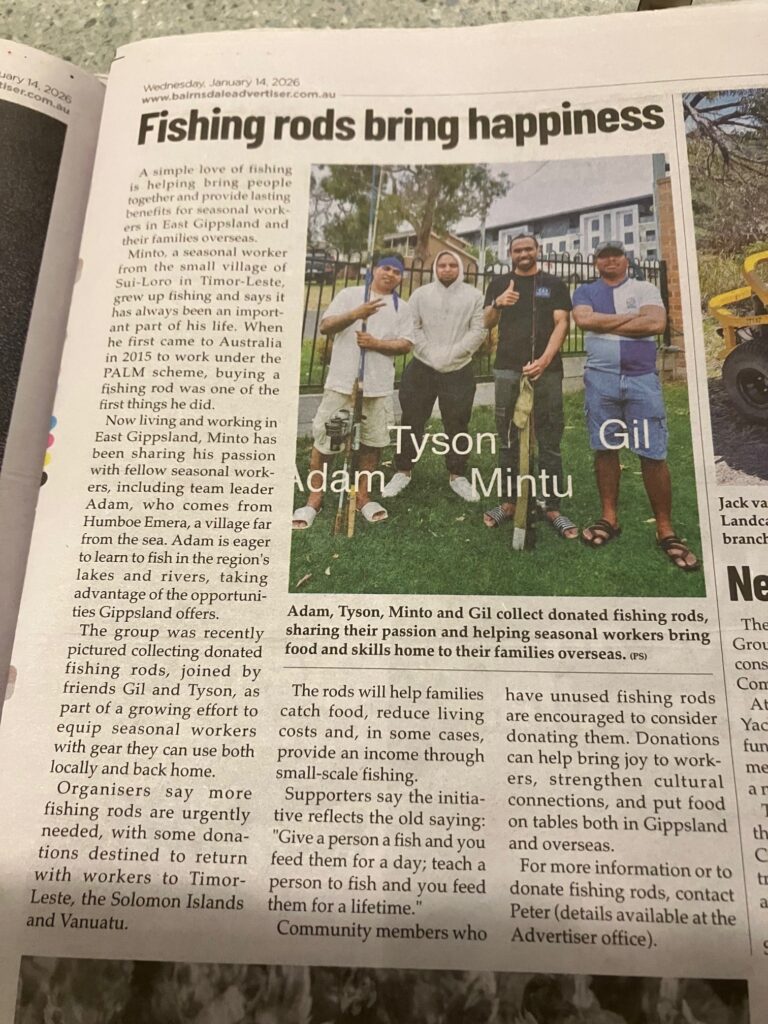
The Bairnsdale Advertiser has great news for PALM workers locally – free second hand fishing gear:

It’s great that East Gippsland locals are keen to help out PALM workers with fishing gear and there’s some great fishing to be done on the nearby Gippsland Lakes.

But this highlights how poorly PALM workers are treated, that they need to fish to “reduce living costs”.

PALM workers often underpaid, ripped off with accommodation and transport costs. They’re not eligible for Medicare, even though they pay tax, so much so that their tax payments are equivalent to a significant portion of Australia’s aid budget to their home countries.

This should come as no surprise in East Gippsland, as just last month one of its big horticulture operators was accused of massive underpayment. According to the ABC, Bulmers Farms is accused of underpaying 28 PALM workers more than $645,000.

Bulmers Farms is run by Bill Bulmer, who seems to get plenty of support from local MP Darren Chester in lobbying for keeping the PALM scheme the way it is.

I wonder if Mr Bulmer has taken any of his PALM workers out fishing lately.

Dispatches from East Gippsland #1 – Darren Chester wrong on guns

Rod Campbell
Research Director

I was in East Gippsland last week, basically the eastern chunk of Victoria. It’s a great place for holidays, boating and birdwatching.

And East Gippsland is home to that rarest of birds – an independent, hard copy local newspaper!

Reading the Bairnsdale Advertiser this week, really shows how important local news is. You get great insights into local events, and also how the local MP thinks national events will play out locally.

The Member for Gippsland is Darren Chester, a prominent National. His name is usually in the mix when Nats leadership dramas are happening. He’s seen as a moderate – supports marriage equality, pretty good on climate, a competent minister. There’s a good 2021 profile here.

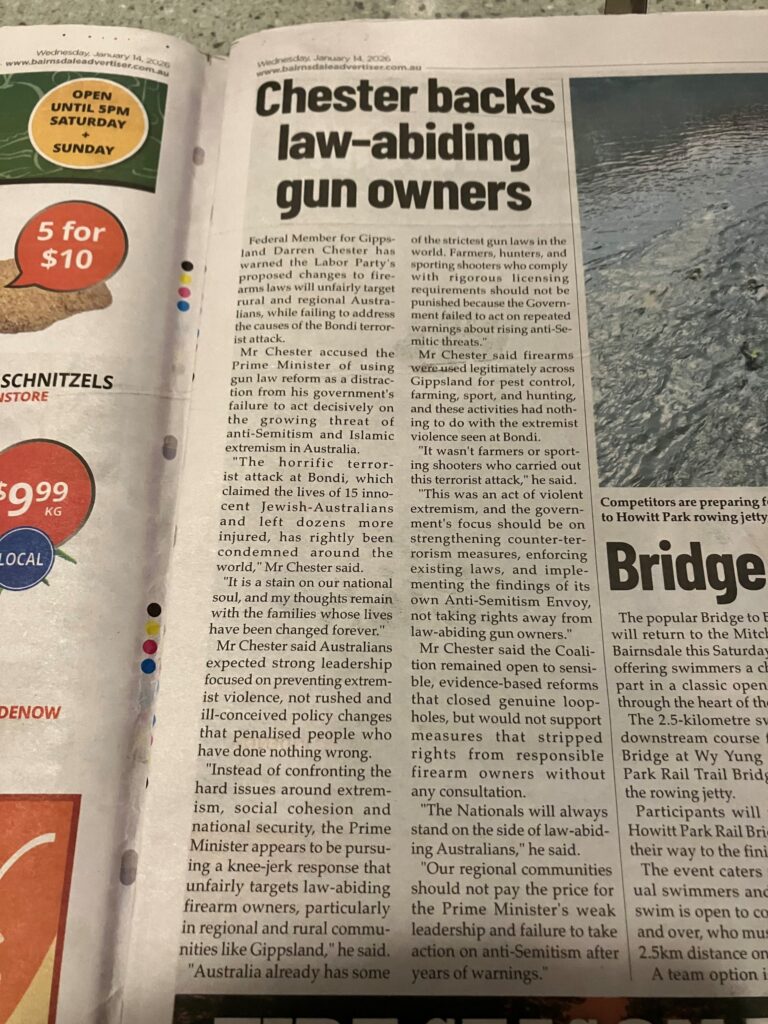
Which makes it all the more surprising that he would go so gung-ho on gun reform:

The headline is bad enough, but the real problem is late in the second column, when Chester will not support “stripping rights from responsible firearms owners”.

This is factually incorrect, and it’s hard to believe that Chester wouldn’t know it.

There is no right to own firearms in Australia and the National Firearms Agreement makes it clear that “firearms possession and use is a privilege that is conditional on the overriding need to ensure public safety”.

Nothing being proposed by the Federal Government removes any rights and reducing gun numbers is important for public safety.

If even Darren Chester is all the way with the NRA on gun “rights” then it seems likely that the Coalition as a whole will do the same.

Fortunately the Government has a clear path through Federal Parliament for gun reforms.

Thank you

Thank you to Glenn for taking over for that brief moment – let’s run through a little bit more before wrapping up for the day.

Major parties locked other voices out of the hate speech/gun control bill inquiry

Bill Browne
Director, Democracy & Accountability Program

A week is a long time in politics, but it is too short for a parliamentary inquiry.

We only saw the Albanese Government’s hate speech/gun control bill (now to be split) last Tuesday.  

The Parliamentary Joint Committee on Intelligence and Security (PJCIS) tried to fit an entire public consultation process and expert testimony into a couple of days. That is a mistake.

But it’s also a reminder of how unrepresentative some parliamentary processes are.

The Labor and Liberal–National parties kept a lock on privileged positions, even as the minor party/independent vote exceeded the vote for the Opposition.

Only Labor, Liberal and National MPs got to participate in the inquiry into the hate speech/gun control bill … even though it’s the Greens who have salvaged the Albanese Government’s agenda by agreeing to pass parts of it.

That’s because membership in the PJCIS is limited to major party MPs.

That’s not how it works in most of the other Five Eyes countries.

The PJCIS is responsible for reviewing Australia’s intelligence agencies and national security.

Three years ago, the Labor majority on the PJCIS recommended allowing crossbench MPs and senators to join the committee, just as independent MP Andrew Wilkie was between 2010 and 2013.  

With the major parties representing a smaller slice of the population, Parliament should allow for a diversity of viewpoints. 

Representatives of minor parties and independents should have had the opportunity to review the laws that they are now being asked to vote on.

The media doesn’t understand protests

Jack Thrower
Senior Economist

The Iranian government’s brutal crackdown on protestors has spawned a new series in the media commentariat’s favourite op-ed topic: bemoaning the ‘hypocrisy’ of activists. Newspapers across Australia are reprinting variations of the same argument: protestors are hypocrites for demonstrating against Israel’s actions in Gaza (found to be genocide by a UN inquiry and numerous human rights groups), but not the Iranian government’s current atrocities.

These articles are great at filling word counts and their authors’ sense of moral superiority, but they fundamentally misunderstand what protests are or why they happen.

A protest is not just an expression of opinion (unlike an op-ed): it is a political tactic aimed at achieving a political objective (a change to government policy). Protests are a mechanism of change in a democratic society, and they are resented by the already politically powerful. As Richard Denniss, co-CEO of the Australia Institute, likes to say, if protest didn’t work, they wouldn’t try and ban it.

Pro-Palestine protests have had a series of specific demands for changes to government policies, including sanctions and ending certain arms exports. Importantly, the potential effectiveness of these policy changes stems from Australia’s existing diplomatic, commercial, and military ties with Israel.

Meanwhile, Australia and Iran have far weaker ties, and the Australian government expelled the Iranian Ambassador in 2025. The Australian Government’s existing policy on Iran includes urging Iran to respect human rights directly and in a range of multilateral fora and sanctions against almost 300 Iran-linked individuals and entities. Recently, both the Prime Minister and Foreign Minister denounced the Iranian government’s crackdown in strong terms.

Put simply, Australian Government policy already targets human rights abuses by the Iranian government. Potentially more can be done, but it’s not fully clear what. Until it is, it’s unsurprising that Australia has not seen mass protests about this issue.

Author commences second defamation action against Premier

Author Randa Abdel-Fattah has launched a second defamation action against South Australian Premier Peter Malinauskas.

The ABC is reporting that Ms Abdel-Fattah’s lawyer has now served a second concerns notice on the premier. A concerns notice is the first step in defamation proceedings.

This apparently relates to comments Mr Malinauskas made on local radio station 5AA last Thursday.

The first concerns notice was sent after the premier made a string of wild remarks at a press conference the day after Ms Abdel-Fattah was kicked off the Adelaide Writers Week program.

Latest on hate speech negotiations

While the emotional condolence motions continue in parliament, Shadow Home Affairs Minister Jonathon Duniam has ducked out of the chamber for a couple of TV interviews.

He’s told the ABC that negotiations with the government on hate speech laws, which were separated from gun reforms at the weekend, are continuing … and there are signs of progress.

The government have made some significant concessions in dumping the racial vilification laws and religious attacks offence. That’s all gone. They were major problems for us.

We are in good faith looking at the balance of the legislation. We have identified some issues that require further work and we’re working in faith with the government.

Tassie Greens call on government to ban new Airbnb permits

The Tasmanian Greens want the Rockliff government to limit the number of homes being used for short-stay accommodation, specifically Airbnb.

It says rents have gone up 7.1% in Hobart over the past year – faster than any other capital city – and they’re rising even faster in other parts of the Apple Isle.

Tasmanians who wish to rent out properties for short-stay accommodation must get a permit to do so.

Greens deputy Tasmanian leader Vica Bayley says it’s time to “press pause” on the issuing of those permits.

The biggest thing the government could do to make more rentals available and to drive down prices is to take strong action on Airbnb.

There are thousands of whole houses across the state being used for short stay accommodation, rather than as homes for Tasmanians. That’s not good enough and we need to see the government change their approach to this issue.

The Liberals need to immediately press pause on all whole-home short stay permits and then introduce measures to bring the thousands of homes lost to platforms like Airbnb back into the rental market.

Big dumb utes still stupidly popular

Matt Saunders
Senior economist

Big dumb utes have again topped the charts of annual vehicle sales, according to official data recently released by the Federal Chamber of Automotive Industries (VFACTS) and the Electric Vehicle Council.

In 2025, the Ford Ranger took the top spot – 56,555 were sold. Two other big dumb utes were in the top five, with the Toyota Hilux in third spot (51,297 sales) and the Isuzu D-Max in fourth (26,839 sales).

2025 was the tenth year in a row that big dumb utes topped annual sales figures. The Ford Ranger has now held the title for three years straight, while the Toyota Hilux held top spot for the previous seven consecutive years.

Big dumb utes are also beginning to make their presence felt in the plug-in hybrid electric vehicles (PHEVs) segment. In 2025, the top selling PHEV was the BYD Shark 6, while the GWM Cannon Alpha came in fifth.

Interestingly, while the sales of the top selling big dumb utes were slightly down on previous years, sales of some large SUVs – which have the same design philosophies – are increasing. This includes the Ford Everest (26,161 sales) and the Toyota LandCruiser Prado (26,106 sales). These are just nicer looking big dumb utes with a bit more weather protection for the weekly grocery shop.

Among the top-10 selling vehicles in 2025, all but one were either big dumb utes or SUVs. The Telsa Model Y, in tenth spot, was the only regular passenger vehicle.

It is not too surprising that Australia’s fascination with big dumb utes continues. As noted on previous occasions, a range of tax incentives and loop-holes, including fringe benefits tax and luxury car tax exemptions, make them an attractive proposition, particularly for smaller businesses and tradies.

Happily, tax incentives can also work for good.

In 2025, a range of state and federal electric vehicle (EV) tax incentives helped push sales in this segment beyond 100,000 for the first time – this was a 13.1% increase on the previous year. There are now over 100 EV models available in Australia. Together with new vehicle efficiency standards, Australian governments have the tools to shape a much cleaner, safer, more fuel efficient, lower cost vehicle fleet –  if it so chooses.

Coming up:

For those asking – there is no question time today – that will come tomorrow.

Tony Burke has flagged the ‘watered down’ hate speech laws, which the Coalition, after becoming hoistered by its own populist petard, are now ‘looking at’.

Here is the whoosh-whoosh version from AAP about what is in the bill now:

* The draft laws proposed an aggravated hate speech offence for preachers and leaders who promote violence

* It would allow Australia’s intelligence agencies to provide information to AusCheck when they conduct assessments on prospective and current gun owners

* A hate group listing would be created, criminalising a person being a member, or recruiting, training and providing any support to a designated organisation

* A person found to have intentionally directed the activities of a designated hate group faces up to 15 years’ jail

* Expanded powers would be given to the home affairs minister to cancel or reject visas for those spreading hate and division in Australia

* Labor has dropped the controversial racial vilification and intimidation element of the bill following sustained pressure from both sides of politics

The number of billionaires worldwide continues to rise and their wealth is growing at an astounding pace.

AAP

A report published by Oxfam ahead of the start of the World Economic Forum in Davos on Monday said the world’s roughly 3000 billionaires held a combined fortune of $US18.3 trillion ($A27.4 trillion) in 2025. 

The anti-poverty and development organisation releases an annual report on global inequality ahead of the meeting in the Swiss alpine resort town of Davos.

Adjusted for inflation, the billionaires’ wealth has increased by more than 80 per cent since March 2020. At the same time, nearly half of the global population continues to live in poverty, Oxfam said. 

The report draws on data from multiple sources, including Forbes estimates of billionaire wealth, World Bank figures and the UBS Global Wealth Report. 

Billionaire wealth grew by about 16 per cent last year – three times faster than the average rate of growth in previous years.

The world’s 12 richest people now own more wealth than the poorest half of the global population, or more than four billion people. 

The world’s richest man, Elon Musk, earns in four seconds what an average person makes in a year, Oxfam said. 

Musk would need to give away more than $US4,500 ($A6,738) every second for his fortune to begin shrinking.  

Billionaires earn an average of $US6,000 ($A8,984) during a 20-minute power nap and $US145,000 ($A217,105) during an eight-hour night’s sleep.  

Some 65 world leaders are due to participate in this year’s forum in Davos, Switzerland – a record number – along with dozens of central bank chiefs and finance ministers, plus titans of the business world. 

Oxfam is one of the meeting’s most steadfast critics, arguing the gathering of global elite too often pays only lip service to the problems of the poor. 

Oxfam also warned that growing economic power among billionaires is increasingly translating into political influence, particularly in the United States, which it said is eroding democratic systems.  

Forbes recently wrote that US President Donald Trump has “presided over the most lucrative presidency in American history”, adding billions to his net worth, largely through cryptocurrency ventures. 

Trump is leading the largest-ever US delegation to Davos and is scheduled to address the conference on Wednesday.

Oxfam’s report said 100 billionaire families spent a record $US2.6 billion ($A3.9 billion) during the most recent US presidential election campaign. 

The report also raised concerns about global media concentration, writing that “over half of the world’s largest media companies have billionaire owners, and nine of the top 10 social media companies in the world are run by just six billionaires”. 

‘We belong here, and we must not dehumanise one another’ – Josh Burns

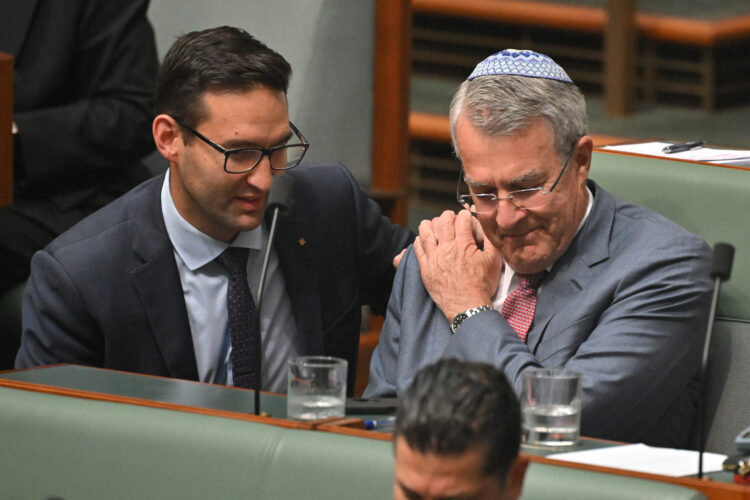
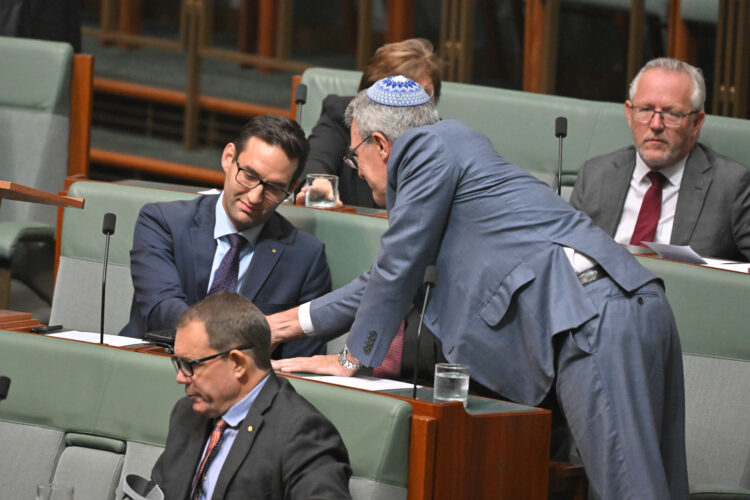
Labor member for Issacs Mark Dreyfus consoles Labor member for Macnamara Josh Burns after speaking on the condolence motion during a federal parliament sitting following the Bondi terror attack at Parliament House in Canberra, Monday, January 19, 2026. Photo: AAP

Labor MP Josh Burns has delivered an emotional speech as part of the condolence motions for the Bondi attack:

I tried to think about what must have been going through the gunman’s head, when they’re looking down upon the community, seeing innocent people. What are they looking at? What do they think of us? What do they think of me? What do people think of the Jewish people here in Australia?

…Well, I’m proud of my community, and our community are a proud people. We belong here, and we must not dehumanise one another.

Burns said the government needed to strengthen hate speech laws, something the Coalition is looking at, now that the ‘offend’ and villification parts have been taken out.

To every single Australian who has lit a candle, who has checked in on a Jewish community member, a friend, a colleague, I say thank you, because how a country responds matters. To all of the victims and to my community, this is our home. This is our country.

America’s gas export industry is killing affordability – just like Australia’s did

Ketan Joshi
Senior Research Associate

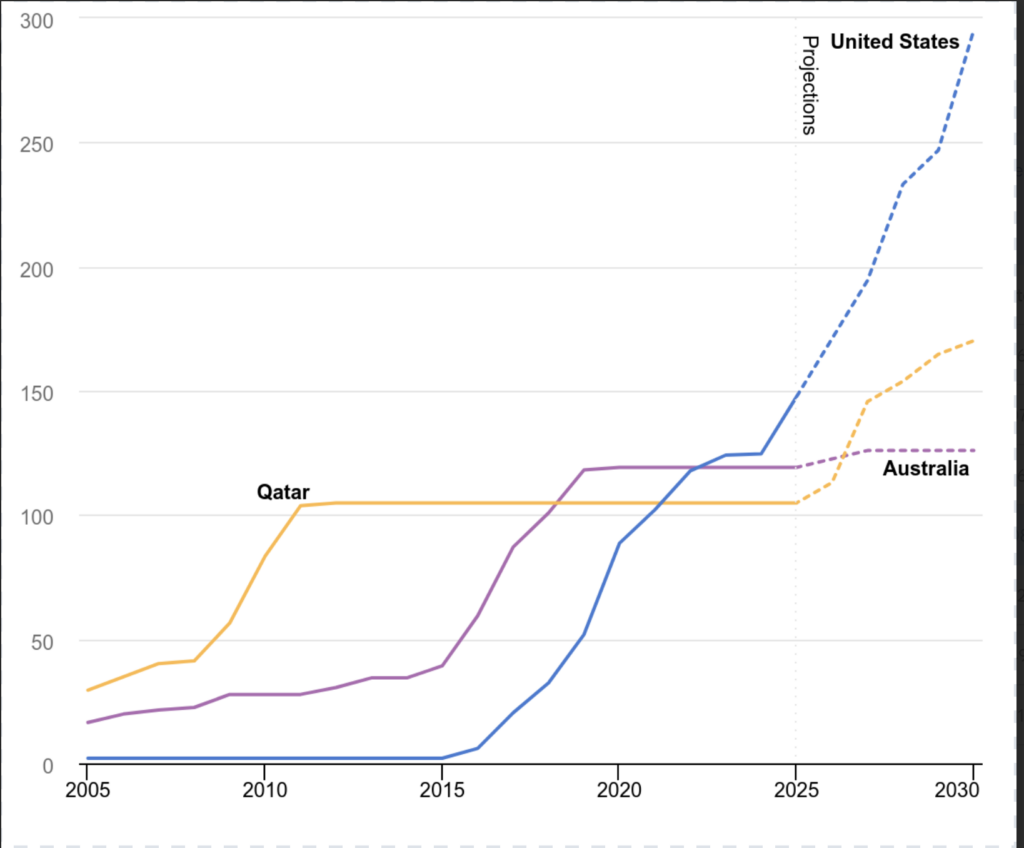
It is wild to spectate how America is stepping on exactly the same gas-powered rakes that Australia stepped on over the past decade or so. Specifically: the country’s massive LNG export boom is already screwing households by forcing up gas prices; not just nabbing gas to send away and connecting domestic prices to international, but also, in the words of the US government’s Energy Information Administration: 

“In 2027, we forecast demand growth will rise faster than supply growth, driven mainly by more feed gas demand from U.S. liquefied natural gas (LNG) export facilities, reducing the natural gas in storage. We forecast annual average spot prices will decrease by 2% in 2026 and then increase by 33% in 2027”

Image – International Energy Agency

Watt crowns Joyce ‘leader of the opposition’

Also this morning, Murray Watt was given the role of ‘debating’ One Nation convert Barnaby Joyce on Seven’s breakfast TV program, Sunrise.

Joyce tried being humble about One Nation’s surge in the polls at the expense of the Coalition he just left (One Nation has always been a receptacle of grievances, rather than a cohesive political outfit and that helps it in times like this when people are just over everything) but failed:

Well, I’m not here to comment on Susan’s leadership. I’ll leave that to the Liberal Party. It’s never been an attack on Sussan’s leadership. I think that what One Nation has done has given people license for an alternative.

We’re very humbled by the vote. We understand it’s just an indicator. It’s not a vote at an election, but it inspires us to continue the work, work very hard. And when you’ve got to make a choice between political correctness or looking after Australians, we’ll look after Australians first.It’s the highest it’s been.

Q: They’re calling it the Barnaby Bounce. Is this you, Barnaby?

Joyce:

No, I know, but I’m not surprised. Everywhere I go, quite frankly, I get overwhelmed with the support that One Nation is getting. I think it’s even stronger in regional areas. And it’s as I say, people have always sort of wanted a licence because they are concerned that politics these days is about looking after fringe groups at the expense of the population in general. They want a dynamic change, and their support for One Nation shows that dynamic change is, well, it’s here. It’s arrived.

Murray Watt though, saw some opportunity for some fun:

I think today is the day to congratulate Barnaby Joyce for becoming the opposition leader in Australia.

They’ve overtaken the Coalition. And I think this explains why you’re seeing so much division within the Coalition. We’ve seen over the last few months a large element of the federal Coalition who are terrified by the growth of One Nation.

It’s what’s drifting them further and further to the right and making it harder for them to reach decisions on important things, like the legislation we’ve got in front of us this week in Parliament. But from the government’s point of view, our focus is going to remain assisting Australians cost of living pressures, delivering more homes, delivering the cheaper Medicare, the cheaper medicines, all of those kind of things. And we want to remain really focused on that.

Q: So Murray, does the government now see One Nation as the second party in Australia?

Watt:

Well, I mean, that’s what the polls today indicate. We’ll see whether that lasts. But, you know, as I say, it’s been very clear for some time that One Nation has been growing, particularly the expense of the LNP. We’ve got One Nation led by former liberals or former Nationals. So they are effectively an arm of the Liberal and National parties. But as I say, what we’ll do as the Labor Party and the and the government is to continue focusing on helping with their very real cost of living pressures.

Is productivity your priority for government? Have your say.

Dave Richardson

Quietly in the background the Senate has established a select committee to examine productivity in Australia. Productivity seems to be on everyone’s lips and its almost as if Keating’s ‘pet shop galah’ is no longer talking micro economic reform but has moved on to productivity.

Productivity growth seems like it is Australia’s number one economic priority replacing full employment, equality of incomes and opportunities, industry policy, climate, the quality of government services, infrastructure and so on. However, some of the mechanisms being suggested to improve productivity raise other issues. Nobody really knows much about how to increase productivity so many of the proposals are guess work or reflect vested interests. For example, deregulating the labour market can be problematic if the specific measures affect pay and conditions of work. Deregulation of standards can affect the quality goods and services available to consumers.

If you have doubts about where productivity concerns are heading or you think there are other more important priorities then write to the Senate Committee and tell them. Here is where you can make a submission which need only be a couple of sentences.

Another reminder that we’re still pouring fuel on Australia’s fossil fuels fire

Matt Saunders
Senior Economist

While many of us were gearing up (or winding down) for the Christmas season, the Australian Government quietly slipped out the latest update to its mega-list of future fossil fuel projects, known as the Resources and Energy Major Project Report.

The data in the report confirms, once again, that even though the Government remains notionally committed to net zero emission by 2050 more money is being invested into fossil fuels.

The report covers all major mineral, resource, and energy projects at their various stages of progress – from announced, feasibility, committed, and completed projects. Among the mix, the predominance of fossil fuel is hard to miss.

Over half of the $62 billion in committed projects are fossil fuel projects. This includes $33 billion worth of oil and gas projects, and $1.9 billion worth of coal projects. The next biggest are of investment is iron and steel, but that accounts for a relatively minor 15% of committed projects, valued at $9.6 billion.

Across the full list of 432 projects at all stages of progress there are 45 oil and gas projects and 42 coal projects.

The oil and gas projects could increase in Australian production by 59%, which would consequently increase emissions from Australian and oil gas by 59%. The coal almost double Australia’s existing production, which would double global emissions from Australian coal.

The data highlights the hypocrisy of the Australian Government. In November, at the UN climate conference in Brazil, climate change minister Chris Bowen signed the Belem declaration, which commits Australia to a phase out of fossil fuels. Clearly, neither the mining companies nor the minister responsible for approving these projects (Murray Watt) got the memo.

Urgent Care Clinics are expensive, but point towards a better public health system

Hamdi Jama
Postdoctoral Research Fellow

On 15 January, Minister for Health Mark Butler announced the opening of a new Medicare Urgent Care Clinic (UCC) in Queensland. This expansion fulfils a key Labor campaign promise to ease pressure on emergency departments, committing $644 million to establish 50 additional clinics nationwide.

​Medicare UCCs are free to all Medicare-eligible Australians at the point of care. The public demand for free, accessible healthcare is clear: since the first site opened in June 2023, Medicare UCCs have recorded over 2.4 million visits.

​However, the financial efficiency of this model has been questioned. An interim report by the Department of Health and Aged Care revealed that each Medicare UCC visit costs the taxpayer $246.50. To put that in perspective, that is more than five times the cost of a standard GP visit (approx. $43).

​These high costs might reflect the outsourced delivery model of Medicare UCCs. These clinics are not directly run by the Federal or State Governments; instead, many operate through lucrative contracts to health providers backed by private equity firms. While these clinics address a gap in the system, outsourcing public services to private operators often puts corporate profits ahead of public interest.

​As shown in previous Australia Institute research, the outsourcing and privatisation of public services have repeatedly failed, both economically and socially. 

If these services were instead directly provided by the government (either State or Commonwealth), this could be much cheaper and would allow governments to better coordinate and integrate healthcare across Australia.

Even if these gun law reforms pass, it is not the end of the road.

Skye Predavec
Researcher

Since the government’s gun control reforms only implement the Commonwealth’s part of what was agreed at National Cabinet, there’s still much work to be done at a state level.

For example, while the Commonwealth can restrict the importation of the kind of rapidly reloading rifles and shotguns used in the Bondi massacre, it is the responsibility of the states to ban these weapons in each jurisdiction.

And while all Australian governments agreed to the measures approved by National Cabinet, that doesn’t mean everything is settled. The Northern Territory, Queensland, and Tasmanian governments have all begun expressing hesitancy over the cost of a new national buyback, raising concerns that state governments could split on party lines over the reforms.

But even if all states and territories implement the full suite of reforms, there are further issues to address.

In NSW, for example, while the state government passed what it labelled ‘the toughest [firearms] laws in the country’ last December, issues remain.

In NSW, the ‘genuine reason’ requirement needed to gain a firearms licence can be fulfilled by becoming a member of an Approved Hunting Organisations. But this list of Approved Hunting Organisations includes multiple groups with apparent far-right links, such as the Zastava Hunting Association.

According to an investigation by The Australian, several prominent Australian far-right nationalists are members of the Zastava Hunting Organisation, as was one of the perpetrators of the Bondi massacre. Also among the AHOs, almost three years after an investigation by The Age first raised concerns about its status, is the avowedly white nationalist ‘Australian Natives Association’.

This is just one place where state-level firearm laws don’t match up to community expectations.

It’s promising, then, that National Cabinet has also agreed to renegotiate the National Firearms Agreement, a process that would hopefully see Australia’s firearms laws strengthened further. But an even easier first step would be for all jurisdictions to fully comply with the provisions that already exist. Among other things, this would mean banning the use of firearms by under-18s and finally setting up a National Firearms Register. These provisions were both contained in the original NFA in 1996, but have gone unimplemented for almost 30 years.

What happened to Australia’s gun control laws after Port Arthur?

Skye Predavec
Researcher

After the Port Arthur massacre in 1996, the Howard government organised the National Firearms Agreement (NFA), which significantly strengthened Australia’s gun control laws.

The NFA introduced a ban on semiautomatic assault rifles like those used at Port Arthur, tightened licencing rules and created a temporary buyback program for weapons that the agreement made illegal. However, advocates have warned for years about the limitations of the NFA.

Some aspects of the NFA were never fully implemented – including a national firearm register and a ban on firearm licences for minors – while others have been slowly eroded through gun industry lobbying. Last year, the Australia Institute released research which found that there were more guns in Australia than before the Port Arthur Massacre. Almost 45,000 have been stolen since 2004, which is the equivalent of one every four hours. This creates large pools of both legal and illegal firearms in the Australian community.

What do the government’s proposed changes to gun control laws do? Following the Bondi massacre in December, National Cabinet agreed to the most significant reforms to Australia’s firearm laws since 1996. These included commitments to:

  • Limit the number of firearms to be held by any one individual
  • Limit open-ended firearms licencing and the types of guns that are legal
  • Make Australian citizenship a condition of holding a firearm license
  • Accelerate work on standing up the National Firearms Register
  • Allow additional use of criminal intelligence to underpin firearms licencing

Although most firearm laws are the responsibility of states and territories, this bill would fulfil the Commonwealth’s obligations under the agreement. It would see the Commonwealth introduce a restriction on the importation of the kind of rapidly reloading rifles and shotguns used at Bondi.

The federal provisions also sets up mechanisms for background checks, and establishes the infrastructure for a new national buyback program, in which newly prohibited weapons could be voluntarily surrendered to the AFP.

Gun Control Australia president Tim Quinn told last week’s snap Senate inquiry he believes the gun control aspects of the Albanese government’s legislation “would have significantly reduced the chances” of the Bondi massacre occurring.

Australia’s gas export boom might be past its peak – yet Albo still leads the race to be the fossil export king

Ketan Joshi
Senior Research Associate

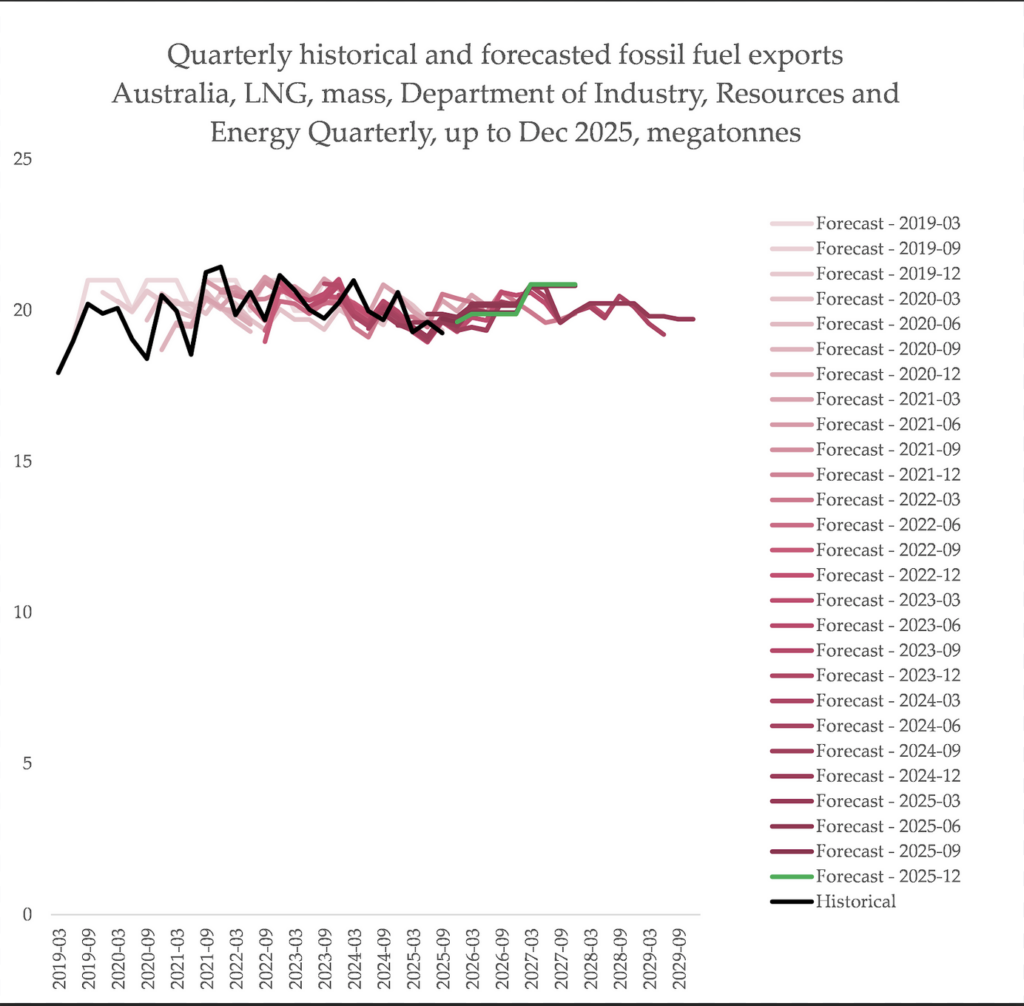
Breaking my rule here (never call a peak a ‘peak’ until you’re halfway down the mountain), but there is something interesting buried in Australia’s latest export data. Ever since I’ve been tracking it, forecasts of gas exports have always aligned with what actually happens. BUT: for the first time, the September quarter of 2025 saw a volume of gas exported BELOW every older forecast published for that quarter. 

Zoom out from the wobbles and you can see something that looks like the start of a decline, from 2021. Yet the government is doubling down on a magical eternal future for fossil gas.

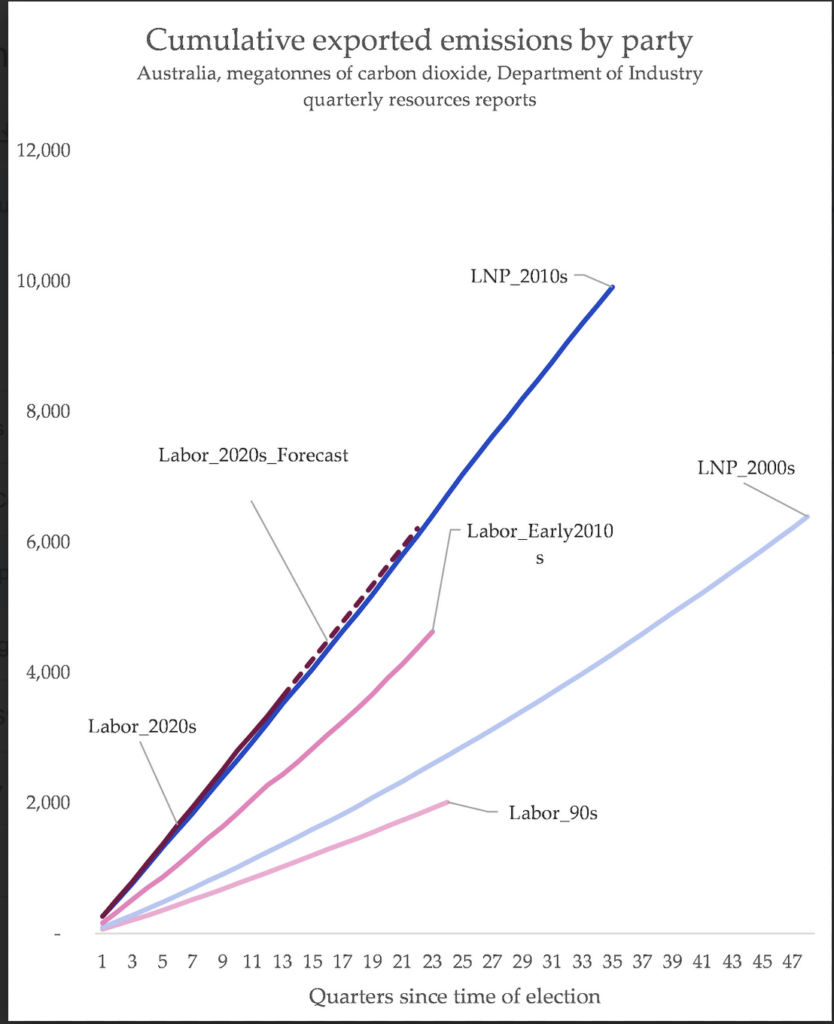
Did you know that in total, Australia has exported 3,632 megatonnes worth of eventual carbon pollution overseas, through the eventual burning of coal and gas sold? 13 quarters (3.25 years) into Albanese’s term as PM. The Coalition, by comparison, had only exported a measly 3,522 by the same time into their last run in the leadership. And all the forecasts put out by the government point to this lead being retained.

Since Albanese’s election in May 2022, Australia’s renewable growth has avoided ~10 megatonnes. That’s 0.3% of the emissions enabled through coal and gas exports. 

The view from The Point: Gun laws

Bill Browne argues that keeping the bills together may have made the Liberal–National Coalition squirm, but Anthony Albanese is wise to split the bill – and should start with the gun control part.  

Australian governments actually have a good record on acting quickly on gun control: it took John Howard less than a fortnight to strike the first National Firearms Agreement with states and territories after the Port Arthur Massacre. 

Unlike the hate speech components of the bill, Labor’s gun control reforms are limited, targeted and often based on precedent.

Australia has had several successful gun buybacks already. Safety testing and data sharing with the Criminal Intelligence Commission do not raise red flags.

And owning a gun is a privilege, while political speech is a human right – and one that is constitutionally protected in this country.

Trump versus central bankers

Dave Richardson

Recently there have been reports that Jerome H. Powell, chair of the Federal Reserve System (the Fed), the US central bank, has been bullied by President Trump for not lowering US interest rates. We learned that Powell was to be the subject of a criminal investigation into testimony he gave about recent renovations at Fed headquarters in Washington. The real reason for attacking Powell is the Fed’s reluctance to lower interest rates. This follows Trump’s attempts to fire one of the governors of the Fed, Lisa Cook.

A few days ago the Governor of the Reserve Bank of Australia, Michele Bullock, signed a statement declaring support for Jerome Powell. The statement was signed by a number of other heads of central banks around the world together with the chair and CEO of the Bank for International Settlements, a sort of central bank for central bankers. 

As far as we know the bullying of Powell is unprecedented and Trump is acting despicably. Nevertheless, there is a genuine issue that is raised by this incident.

Monetary policy impacts the fortunes of virtually all members of society and so there is a good case for saying that monetary policy should be part of the political process and that those who make decisions should be accountable to the people they affect. Rather, in most countries we have monetary policy run by elites who think they know better than us what is good for us. This panders to the financial markets who are quite happy to have monetary policy run by their peers rather than elected officials. The Australia Institute’s submission to the review of the Reserve Bank discussed these points.

Unfortunately Trump’s bull-in-a-china-shop approach is likely to stiffen the resolve of those who are inclined to keep monetary policy independent of politics.

What to make of One Nation’s polling numbers

Bill Browne
Director, Democracy & Accountability Program

One Nation has recorded some sensational polling numbers – matching the Liberal–National Coalition in a DemosAU poll last week and now ahead in Newspoll this week.

The DemosAU poll also included a head-to-head “two-party preferred” comparison between Labor and One Nation, something normally reserved for Labor and the Coalition only. It showed the parties at 50-50.

In other words, claiming half of Australians would prefer a One Nation MP to represent them over a Labor MP.

That number is highly suspect, as I explain in The Point today.

In summary, it depends on three different assumptions, none of which is based on how most Australians voted at the last election.

One Nation is polling very well, and that’s true across a variety of polling companies.

Most, but not all, of this gain has come at the expense of others on the right, most obviously the Coalition.

Whether One Nation can turn polling into actual votes remains to be seen. Nor is One Nation’s dream polling run guaranteed to continue. The next election isn’t due for another two years.

We can accept the legitimacy and usefulness of the polling, while being sceptical of the conclusions drawn from it.

Condolence motions continue

On the condolence motions, former attorney-general, Mark Dreyfus, helped put the focus back where it was meant to be – on those who lost their lives:

For every person murdered, there are families and friends left behind – a home left quieter… Clothes still hanging in wardrobes… Photos on walls that will never be updated, children asking when someone is coming home, a seat left empty at the dinner table, a laugh no longer heard, the longing for one more word, one moment, one more chance to say what was left unsaid.

On the hate speech laws…

This transcript of ABC Melbourne host Raf Epstein and Anthony Albanese is pretty informative of where we are heading and why. (It also makes this piece from Sunday stand up even stronger.)

EPSTEIN: I did, thank you. Do we need some hate speech laws?
 
PRIME MINISTER: I think we certainly do. And we are going to proceed with what we can get through tomorrow through the Parliament. Firstly, one bill dealing with gun reform and a second bill covering the remaining hate laws and migration controls. We’re not pursuing the racial vilification elements that were recommended by the Special Envoy on Antisemitism, Jillian Segal. We said we would try to implement the Segal Report in full. That does not have the support of the Coalition or the Greens.
 

EPSTEIN: And does not pursuing mean never pursuing?
 
PRIME MINISTER:

It means that we have tried to do that and it has not received support from the Coalition or the Greens party. It’s up to the Coalition in particular to explain why it is that they said they wanted the report implemented in full, and when they’ve had the opportunity of walked away from it, just like it’s up to them to explain why it is they call for Parliament to be resumed and pass all these laws before December, but when we’re actually doing what they asked us to do, have expressed that this is somehow rushing the process.
 

EPSTEIN: So, just to confirm, this is it like there’s no other attempt on hate speech laws? Like it’s tomorrow or nothing? You won’t pursue anything with the Greens or the Coalition in the next few weeks or months?
 
PRIME MINISTER: Correct.
 
EPSTEIN: That’s very convenient for you, though, isn’t it? Like, if you think they’re important and good, isn’t it worth pursuing them in the future?
 
PRIME MINISTER: It is. But if the Parliament changes, then the laws can change. But you deal with the Parliament that the Australian people voted for. It’s very clear that there’s not a majority in the Senate for it. So, we have a big agenda dealing with cost of living issues, dealing with housing, dealing with childcare, dealing with health. It’s a full suite of measures that we have to deal with. We’ll pursue what we can do, but where there is clear opposition – we took the Coalition at their word that they wanted this, the Segal Report implemented in full. We have tried to pursue that, and it hasn’t been successful. So, we accept the reality.
 
EPSTEIN: And so not in this term? No more? Not another attempt, even in this term of Parliament?
 
PRIME MINISTER: Well, we’re not going to – we’re not a government that puts things up over and over again to see them defeated. What we do –
 
EPSTEIN: It’s just that the Greens might be open to changes that are broader. You’re not talking about hate speech around things like sexuality or disability. You could.
 
PRIME MINISTER: No, we accept that there’s not a majority for the reforms that we were pursuing.
 
EPSTEIN: Are you prioritising Jewish Australians by narrowing it down to what you wanted to do with hate speech?
 
PRIME MINISTER:

On December 14, there were 15 Australians lost their lives. And it wasn’t random. It was the targeting of Jewish Australians. So, the legislative response to that, of course, needed to consider what we were dealing with, which was an antisemitic terrorist attack. And that is why we have particularly focused and met and consulted with members of the Jewish community. We sat down for two days before the draft legislation was released, and worked through those issues, just as we worked through the terms of reference for the Royal Commission. But of course, there as well, we spoke about, in the terms of reference, social cohesion as well. So that the overall functioning of our society needs to be examined. But of course, there needs to be a focus on antisemitism as well.

View from Richard Denniss

Last week, co-CEO Richard Denniss spoke on the Australia Institute’s Follow the Money podcast:

It’s important to remember that back when Tony Abbott was prime minister, the Coalition were opposed to restrictions on hate speech. …

Getting rid of guns isn’t going to take hate out of the community, but the fewer the guns in the community, the harder it is to turn hate into the kind of horror we saw at Bondi.

With a condolence motion the first order of business:

Hopefully they will use the condolence motions to show each other and Australia that our parliament can agree on important things and can stop the politicking that we’re so used to and remind everybody what we do have in common.

Beetroot shining

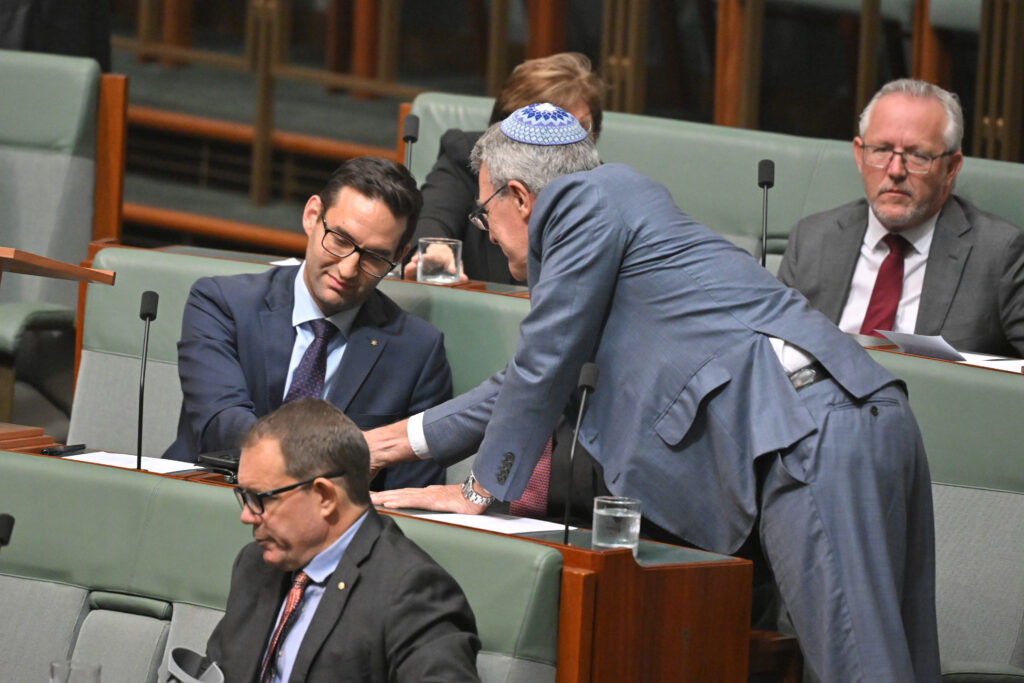
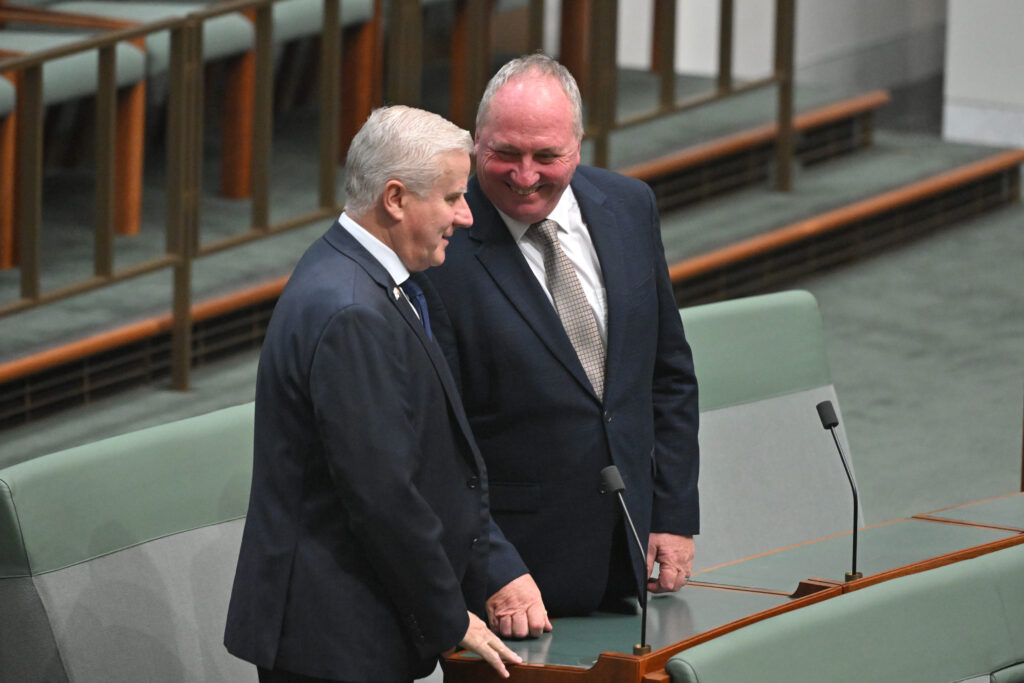
Also in the parliament this morning – just in case anyone was wondering – it really is just all politics to some people, isn’t it. This was taken this morning as the house was sitting – Barnaby Joyce has gone full beetroot with the polling showing One Nation is now ahead of the Coalition in first preferences in Newspoll. So all of that posturing, which Sussan Ley continued this morning in the condolence motion, and all it has done has give One Nation a leg up.

At least someone seems pleased with themselves.

Nationals member for Riverina Michael McCormack and One Nation member for New England Barnaby Joyce arrive for a condolence motion during a federal parliament sitting following the Bondi terror attack at Parliament House in Canberra, Monday, January 19, 2026. (AAP Image/Mick Tsikas) NO ARCHIVING

Labor issues ultimatum on hate speech laws

Jacob Shteyman and Tess Ikonomou
AAP

Anthony Albanese is warning proposed hate speech laws before the parliament will be the final attempt to enact change following the Bondi massacre.

Parliament resumed on Monday to pay respects to victims of the December 14 massacre, when 15 people were killed by gunmen targeting a Jewish celebration.

The government initially planned to introduce an omnibus bill criminalising hate speech and strengthening gun laws, before widespread opposition forced it to split the legislation into two.

The prime minister said Labor had tried to implement measures cracking down on anti-Semitism which has been demanded by the coalition.

Labor wants to pass hate speech reforms through the upper house on Tuesday evening.

Asked if Tuesday was the final chance to pass hate speech laws, Mr Albanese replied “correct”.

“We’re not a government that puts things up over and over again to see them defeated,” he told ABC radio Melbourne.

The Greens are opposed to the hate speech measures, concerned they will risk political freedoms such as the ability to protest Israel’s war in Gaza, as well as changes increasing the power of the home affairs minister to cancel visas.

Cabinet minister Murray Watt said the government was negotiating with the coalition on the hate reforms, after Opposition Leader Sussan Ley last week labelled them “unsalvageable”.

“We don’t think it serves the country’s interests to have an acrimonious debate about legislation if we know in advance that it’s not going to pass,” he told ABC’s RN on Monday.

“That’s why our focus, particularly over the next 24 hours, is going to be persuading the coalition to vote for the kind of things that they’ve been demanding that we act on.

“We are again very hopeful that they will support those laws.”

The parliament is being recalled as the first two major polls of the year show Mr Albanese’s personal standing with voters taking a hit since the Bondi tragedy.

The first Newspoll conducted for The Australian since November shows Mr Albanese’s personal approval rating down five points to 42 per cent and Opposition Leader Sussan Ley’s up two to 28 per cent.

The Resolve Political Monitor poll for Nine Newspapers, conducted in the aftermath of the Bondi massacre, shows Mr Albanese’s approval rating down five points to 35 per cent.

It has Labor’s primary vote down two points to 30 per cent, followed by the coalition (steady at 28 per cent), One Nation (up two to 18 per cent) and the Greens (down two to 10 per cent).

The firearms legislation will enable a promised gun buyback, which was agreed in a national cabinet deal with the states and territories to tighten gun laws following the attack.

Senator Watt said the Greens only supported the gun reform, leaving the hate speech reform up in the air.

Both bills will be introduced to the House of Representatives on Tuesday morning, when they will be quickly sent to the Senate afterwards.

Fresh figures from the Department of Home Affairs showed there were a record 4.1 million firearms in Australia, more than at the time of the Port Arthur massacre three decades earlier.

One of the gunmen, Sajid Akram, was a licensed holder.

Condolence motions continue

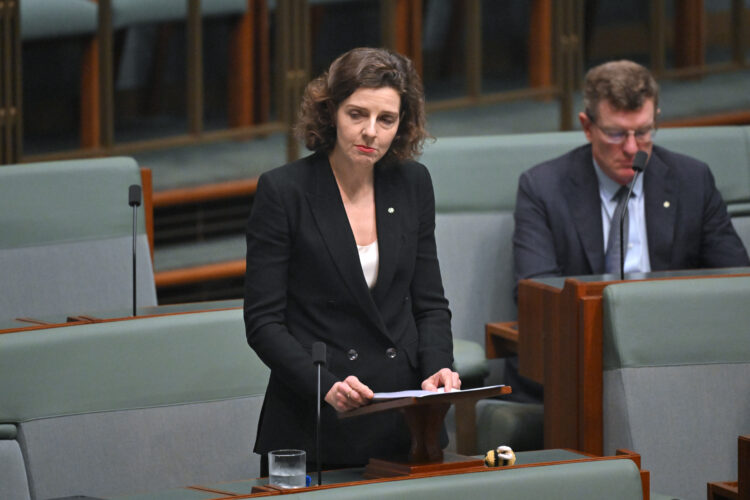
The member for Wentworth, Allegra Spender then spoke:

When Jewish Australians tell me they are thinking of leaving this country where they were born, it is a tragedy for all Australians. And as a parliament and as a country, we need to be both strong and soft right now. Strong in confronting the hater that drove the attack. Resolute against violent Islamic extremism and all types of violent extremism.

Clear eyed and fact-based about what it will take to keep the Jewish community safe. And soft, so that we do not lose our common humanity in our strength.

If we meet difference with suspicion rather than with curiosity, the terrorists will truly when. This work belongs to all of us, in all our workplaces, universities, school, home and online spaces. It is not the work of weeks but ideas and my commitment to the families of Bondi is that I won’t move on from this when other people do.

Australia is one of the most diverse societies in human history it is remarkable but it is not easy. Social cohesion must be consciously built. Each of us, including everyone in this house must personally reflect on how we contribute to that cohesion and each of us must do better. We will disagree passionately but we owe it to one another to disagree well

Followed by Richard Marles, speaking of those who risked and in some cases, lost, their lives trying to stop the gunmen, including Boris and Sofia Gurman, an elderly Jewish couple who immediately tried to stop the gunmen as they exited their car before their terrorist spree. Marles says:

And what these four people and others did in that moment was to change the equation in that moment all times.

Because whereas the gunmen might have expected to have it all their own way, for it to be a free for all, they found themselves instead on contested ground and we will never know the names of those who were saved as a result, nor how many.

But when you consider that there were 1000 people attending the community event on that busy summer Sunday evening at Bondi, those who might reasonably say but for their actions, death may also have become me, must surely be numbered in the hundreds.

So in the middle of this tragedy, their actions stand forth like a shining beacon.

Bondi is the moment that terrorism came to our shores, to an iconic landmark of our nation. But the Bondi massacre was a clear and calculated attack on Jewish Australians.

It was an horrific act of anti-Semitism which on the one hand, took the life of 87-year-old Alex Kleytman, a survivor of the Holocaust and on the other, the life of Matilda Bridgeman who at the joyful age of 10 was literally distilled potential.

So much has been said about anti-Semitism in the last month, in the last two years. It may be tempting for some to think that given anti-Semitism has existed for millennia, what on earth can we possibly do.

And yet in the very many conversations I’ve had with members of the Jewish community, what they have all consistently said to me is that for many and for most of their lives, anti-Semitism is far from having to find their experience as Jewish Australians, in fact quite the contrary world in which anti-Semitism exists, Australia had been a safe harbour.

And it is really against that backdrop of relative historic normality that the Jewish community today is so shocked and so traumatised, that their kids going to Jewish schools have to do so behind high walls and 24/7 guarded protection.

Sussan Ley doubles down on politics

Then Ley moves on to saying:

To all those who helped in those dark moments, we say thank you. The whole country is grateful for your selflessness.

This attack showed us the worst of humanity but in its wake, we have truly seen the best of Australia.

Anti-Semitic hate fuelled the terrorists on December 14th but it came out of the shadows in October 2023. It walked our streets. It marched over our bridges. It took over our landmarks. It camped in universities, it painted graffiti on our buildings. It fire bombed our places of worship. It sent children to school behind locked gates and armed guards. Like a slow creeping disease, it festered in plain sight.

Jewish Australians do not feel safe and if Jewish Australians do not feel safe, then no Australian feels safe. You warned of this menacing storm and you said you felt unheard. The Coalition heard you. We must unite as a parliament to confront and defeat this evil. To do so, we must face uncomfortable truths. Radical Islamist extremism caused this. I repeat – radical Islamic extremism caused this.

Leaders need to be able to express this clearly because, if you can’t name the problem, you can’t possibly defeat it.

For too long, many in our society, especially in positions of authority, have failed to act decisively. It shouldn’t have taken the murder of 15 people for us to open our eyes to the dangers of anti-Semitism in Australia.

As leaders, we have a sacred responsibility to protect our citizens from such hate-fuelled violence. We owe it to the memories of those we lost and more than anything, we owe it to the nation’s children who are born without hate in hair hearts.

Ley doesn’t go as far as to name anti-genocide protests and those who attended them, but she is drawing the bow here. Deliberately conflating protests against the actions of the nation state of Israel, which every major humanitarian and legal body globally has labelled genocide, whose leaders are wanted by the ICC on charges of genocide and war crimes, with the horrendous attack on 14 December. The men there were alleged to have followed ISIS. There is no evidence they were involved in the anti-genocide protests. This conflation is not only offensive, it is dangerous.

Sussan Ley immediately makes it political

Sussan Ley gets the call and immediately jumps to making it political – just as she did in the hours after the horrendous terror attack:

I acknowledge victim survivors and families in the gallery today. This deadly and deliberate attack on Jews on Australian soil was on the first night of Hanukkah, the festival of lights, a night that should have been filled with joy and hope, not darkness and hate.

Many never imagined such a horror could take place on our shores but it did.

People who were there told me their stories, covering their children with their bodies, running to safety, screaming and searching for loved ones.

While part of them felt no surprise, just the cold weight of expectation realised. We somehow knew it would come to this, they said. But how? Surely this is something that happens elsewhere, not in Australia, the land of the fair go.

The Australia that opened its arms to Jewish parents and grandparents as they fled the horrors of the Holocaust, where Jewish Australians have embodied our core values of service, duty, mateship and humanity.

We honour those we lost by answering this question – how did this happen and how can we make sure it never happens again? 15 precious lives.

Small acts of kindness to honour those killed encouraged.

Albanese continues:

On 14 December 2025, Bondi hosted hundreds of Jewish Australians for the first night of Hanukkah.

They gathered at the world famous spot, a beautiful place at the heart of their community. In coming together to celebrate the Hanukkah message of hope and victory, light over darkness, they reaffirmed their identity.

Proud Jews and proud Australians. From grandparents who had survived the horrors of the Holocaust and made a life and home here in Australia, to children playing in the summer Twilight. When the gunshots began, some people in the crowd looked up to the sky to see the fireworks. Others thought it was balloons popping.

Then the horrific reality descended. As we join in mourning for the 15 souls whose lives and futures were so cruelly stolen, our hearts also go out to everyone injured and traumatised.

People who will always carry scars from what they suffered and saw on that dark night for our nation. We say to all of you who have travelled here today and to those watching at home, on your long road to healing, Australia will be by your side.

Albanese goes on to speak of the National Day of Mourning which has been set for Thursday, which includes a call for people to embrace Mitzvah and carry out small acts of kindness as a memory for those lost.

Albanese:

Small acts of kindness and care that add up to a better world. That is central to the Jewish faith and it is at the heart of our Australian character too. Knowing that our strength comes from caring for each other, respecting each other, looking after each other, bringing light into other peoples’ lives and recognising that kind ness is an act of courage. The courage to listen, understand, learn and change. That is how all of us can help repair and strengthen the fabric of our nation. How we heal and move forward in a spirit of national unity, where light triumphs over darkness. It is how we honour the heroes of Bondi and how we ensure that the 15 people we remember and honour today are never forgotten. May their memories be a blessing.

Condolence motion for those killed at Bondi begins

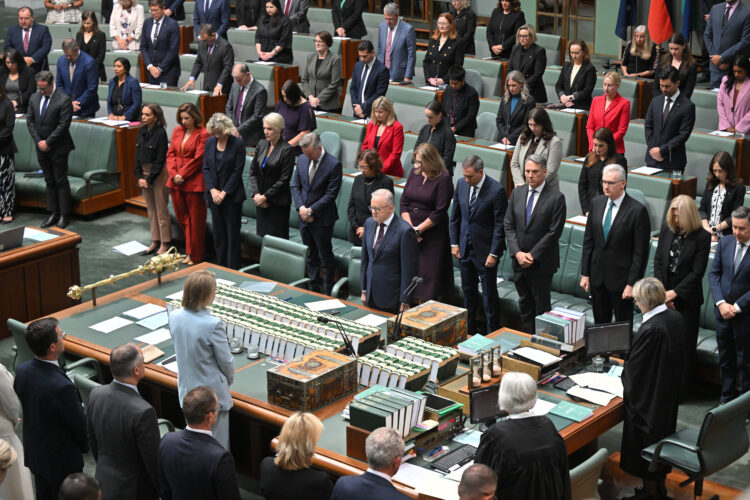
Anthony Albanese has started the condolence motion by listing the names of the 15 people killed on 14 December; Tibor Weitzen, Matilda, Rabbi Yaakov Levitan, Marika Pogany, Rabbi Eli Schlanger, Dan Elkayam, Reuven Morrison, Alex Kleytman, Peter Meagher, Boris Gurman, Sofia Gurman, Edith Brutman, Boris Tetleroyd, Adam Smyth and Tania Tretiak.

The minute of silence that we have just observed echoes with those 15 names. 15 innocent people for whom today should be just another Monday morning. Another day in this beautiful country they loved, in the embrace of the family and friends they adored. Another day in busy lives, reaching passion and purpose, defined by hard work and by humour. Another day devoted to others serving their community, nourishing their faith. Another day of school holidays. Instead, our parliament comes together in sorrow to offer our nation’s condolences to the people who knew and loved them best. We welcome all the family members and dear friends and spiritual leaders joining us here.

From the depth of grief, you have summoned remarkable strength. You have given us a glimpse of who your loved ones were, how much they meant and how brave they proved themselves to be. As rabbi put it, the light that each of those souls brought into the world. As we pause 234 silence to remember them, we recognise for you, an unbearable silence has fallen.

The silence of laughter forever stilled. Footsteps in the hallway that will never come. Of a voice that will never be heard again, except in memories held in broken hearts. The silence of futures unlived, the silence of a sorrow beyond words, inflicted by an atrocity beyond comprehension.

Parliament is officially underway

The parliament sitting has just begun.

We will start to pick up the pace of posts a little, as well as give you more of what is happening politically. We will also start to bring you more of the morning interviews (given the parliamentary agenda today, and why we are back earlier than planned, it is not a usual blog day, or parliament day).

America relies on Europe as a customer for fossil gas exports

Ketan Joshi
Senior Research Associate

I can confirm it’s not a cool time to live in Europe, considering America seems to be basing invasion desires on Trump’s random dying-battery-tone cognitive beeps rather than lucid awareness. Greenland is in Trump’s sights, and Europe is gearing up to mount a meaningful economic response to the unprecedented tariffs already imposed by Trump.

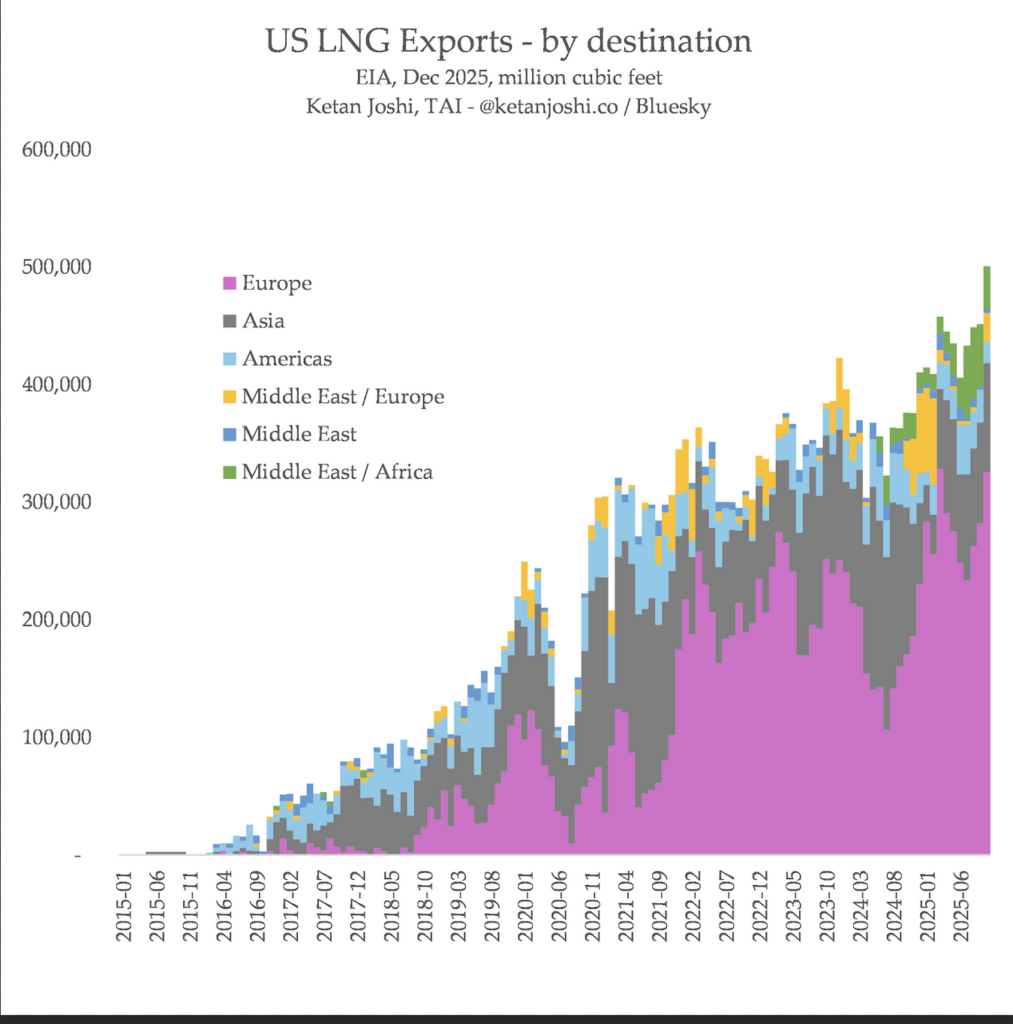
What I haven’t seen mentioned yet is the data that shows America relies VERY HEAVILY on Europe as a customer for its gas exports. Not just that: a MASSIVE speculative export build-out is underway in the US. If European demand decays even slightly, billions poured into that boom turn into a toxic bubble

Anthony Albanese doesn’t think Trump should get Greenland

Which he said on Sydney radio KISS FM show, Kyle and Jackie O. First let’s hear what he thinks of One Nation jumping up in the polls:

HENDERSON: What do you think of Pauline Hanson’s One Nation, now the second most popular party behind Labor?
 
PRIME MINISTER:

Oh, it’s a worry because they can appeal to grievance, but they’re a pretty divisive lot. And I think it’s a worry. I’m a believer in, here you go, I’ll say something nice about the other side of – I’m a believer in mainstream politics and that the parties of government, it’s important. Served this country pretty well. I look at overseas where you have a real fragmentation and, you know, you might have five or six parties in government and it’s unstable. Italy, of course, was famous for a while there, changing governments every year. And so, I mean, it’s a reality that the Coalition in particular have to deal with. I think that they need to stand for some positive things as well.
 

And then Australia would “look at” joining Trump’s attempt to usurp the UN, with his ‘Board of Peace’ which will cost simping countries $1bn for the pleasure of being shat on by Trump, in person.

SANDILANDS: Yeah, well, she’s over there, Pauline, and she’s got Barnaby there as well now. And by the way, I heard Donald Trump asked you directly to be a part of the Board of Peace for Gaza. Is that something you’re going to consider or is that?
 
PRIME MINISTER: Yes, look we’ll consider anything that is put forward. President Trump, of course, I’ve had a pretty good relationship with. But there are some areas of disagreement as well, obviously –
 
SANDILANDS: You’ve got to be careful when you disagree with Trump because, you know, you don’t want tariffs and all this. It’s quite the dance you’re doing there. But you’ve done quite well. Like you had a great successful meeting with the President and his team at the end of last year.

PRIME MINISTER: We did –

SANDILANDS: You couldn’t have had a better trip, I feel.
 
PRIME MINISTER:

No, it was terrific. And I deal with people respectfully. And where there’s area of disagreement, sometimes you just got to put them aside and work on what you agree on and your common interest. And with the United States, we have a common interest on security issues, on critical minerals –
 

And then we get to Greenmark.

SANDILANDS: What do you think of that Greenland thing? He wants Greenland. Should they, should they just give it, give it to him, or not?
 
PRIME MINISTER:

Well, no, I think our position is that it’s up – it is a sovereign state and we support, you know, that’s a matter for the people of Greenland and the people of Denmark.
 

‘Our’ Mary is coming back to Australia for a visit though, so the PR offensive from Denmark is in full swing.

The impossibly resilient hopium for Australia’s steelmaking coal exports

Ketan Joshi
Senior Research Associate

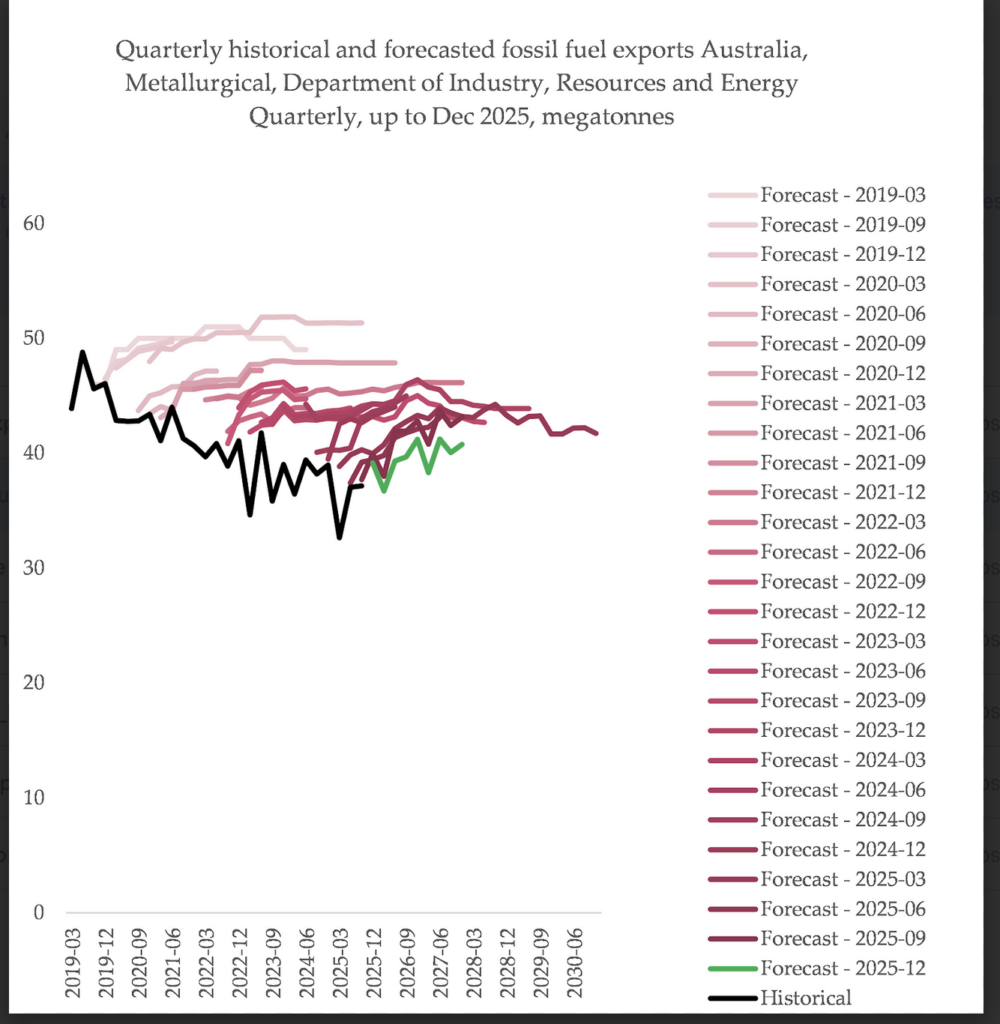
Last December, Australia’s industry department released the latest data on exported stuff. Each time they do this, they also include a forecast for the near future. For as long as I’ve been collecting data (about seven years), every single quarterly data point for the amount of steelmaking coal Australia has exported has been BELOW every single forecast for that quarter ever published beforehand. Steely optimism about coal demand; rust-free and unbreakable. Hashtag inspiring.  

What to expect

This sitting of parliament won’t be like your usual opening of parliament for a new year. The focus is to remain on the Bondi victims as much as possible. In the background though, is where you will find the politics.

The Greens have agreed to pass the gun reform legislation the government actually wanted passed. There have been meetings at a state and federal level between ministers and high level staff for the last two weeks finalising the legislation, which home affairs pulled into a bill. So that is a lock.

Now when it comes to the hate speech laws, Labor pretty much used that as a wedge for the Coalition, which Sussan Ley fell for. Ley’s political instincts have always centered around what she believes is best for her and her prospects at any one time and that is what happened here – Ley rushed in to demand hate speech laws, then when her party started fracturing over it, backed away and called them “unsalvageable” and now, that the blow back is starting up again, Ley is trying to salvage some credibility.

So that means that the parts of the bill around hate preachers and hate groups (like Nazis) are still under negotiation. Shadow cabinet met last night (that must have been a fun meeting) where the party tried to come to a position. This would be about its fifth position by my count, so let’s see.

So far this morning

The prime minister has been covering the radio stations this morning, while his ministers have been out on various other media and the breakfast TVs.

We’ll bring you some of that in a moment. There is no question time today – it is all meant to be about the condolence motions, at least as far as the parliament is concerned.

Good morning

Hello and welcome to 2026, and the first parliamentary sitting of the year.

We can not say it was a good summer. The worst of it is to be remembered today, with the parliament to hold a condolence motion for the 15 people killed in the Bondi terror attack; Tibor Weitzen, Matilda, Rabbi Yaakov Levitan, Marika Pogany, Rabbi Eli Schlanger; Dan Elkayam, Reuven Morrison, Alex Kleytman, Peter Meagher, Boris Gurman, Sofia Gurman, Edith Brutman, Boris Tetleroyd, Adam Smyth and Tania Tretiak.

Parliamentarians from both chambers will deliver speeches in memory of those lost. We will see how much of a role politics plays. The Coalition blamed the government for the attack in what was the first time we have seen an opposition politicise a mass casualty event in modern Australian history. That act may have got the Coalition through the summer with the same leadership, but the signs of fracture are already occurring.

The government will introduce its gun reform bill into the parliament, after the Greens made it clear it could not support the hate speech laws in its current form. That matched the government’s feelings on the matter – it had set up the bill as a wedge for the Coalition, which was pushing the government for the very same hate speech legislation it then refused to support.

So the politics has started early and in a way we have not seen in Australia for some time. That doesn’t bode well for any of us.

But we will do our best to call out as much of the political BS as possible, while keeping you up to date on what is happening – in the parliament and out.

It is going to be a very hard day. And for those who lost loved ones, or who have had their world completely rocked by the events of December 14, harder for all the politics being played.

We’ll do our best to navigate it with heart, honesty and clear eyes.

Ready? Me either. Let’s jump in together.


Read the previous day's news (Thu 27 Nov)

Comments (9)

Join the conversation

  • Gregory Shearman Mon, 19.01.26 15.07 AEDT

    "One of the greatest aspects of compulsory preferential voting is that it weeds out the worst of the worst."

    One of the poorest aspects is the fact that the Nationals with half the votes of the Greens get 10 seats, while the Greens get none in the HoR. If percentages were given on the primary vote then the Greens would win 15 seats in the HoR.

    The good with the bad.

  • Henry Bennett Mon, 19.01.26 14.18 AEDT

    That’s the issue, because it’s become political it’s all about optics. With Albanese he won’t put up with grandstanding and an opposition in disarray, so good on him to at least give ground to get a result, a true PM.

  • Gregory Shearman Mon, 19.01.26 14.12 AEDT

    A "small act of kindness" would be to stop cancelling advocates for the Palestinian people.

  • Fiona Mon, 19.01.26 10.34 AEDT

    "“We’re not a government that puts things up over and over again to see them defeated,” he told ABC radio Melbourne."

    wah maybe put up some good legislation, or WORK WITH PEOPLE ffs

  • Andrew Faith Mon, 19.01.26 09.45 AEDT

    Why does the PM go onto 'that' program and talk to 'those' people? Is it because he went to ones wedding?

    P.S. Lovely to have you back Amy. x

  • Fiona Mon, 19.01.26 08.35 AEDT

    oh I can comment! (there's not link one front page to comment)

    Yeah this will be a long day

    • Amy Remeikis Mon, 19.01.26 08.41 AEDT

      And the first comment in the new system! Welcome x

      • Fiona Mon, 19.01.26 08.45 AEDT

        oooh so it's a whole day of discussion at the bottom? Am I reading this right?

        • Amy Remeikis Mon, 19.01.26 09.05 AEDT

          You are and it is!

The biggest stories and the best analysis from the team at The Point, delivered to your inbox.

Past Coverage