Tue 4 Nov

The Point Live: Ley expected to follow Nationals on net zero to extend leadership, RBA holds rates. As it happened

Amy Remeikis – Chief Political Analyst and Chief Blogger

This blog is now closed.

Start the conversation

The Point Live: Ley expected to follow Nationals on net zero to extend leadership, RBA holds rates. As it happened

Key Posts

The Day's News

See you tomorrow?

It has been another loooooooong day, so we are going to show some mercy and pull up stumps.

But we will be back tomorrow for another round of ‘how long do we have to keep doing this?!’

A very big thank you to everyone who followed along today – we will be back early tomorrow (not bright, that is too much of an ask) to bring you the Wednesday mess.

Until then – take care of you. We mean it. Ax

What is the tea?!

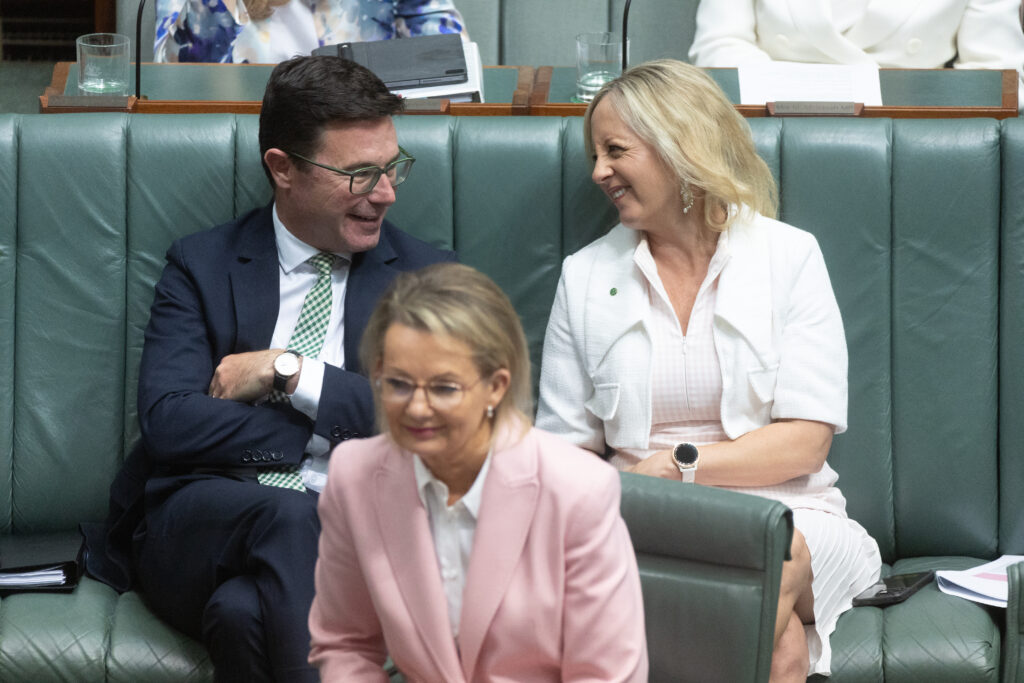
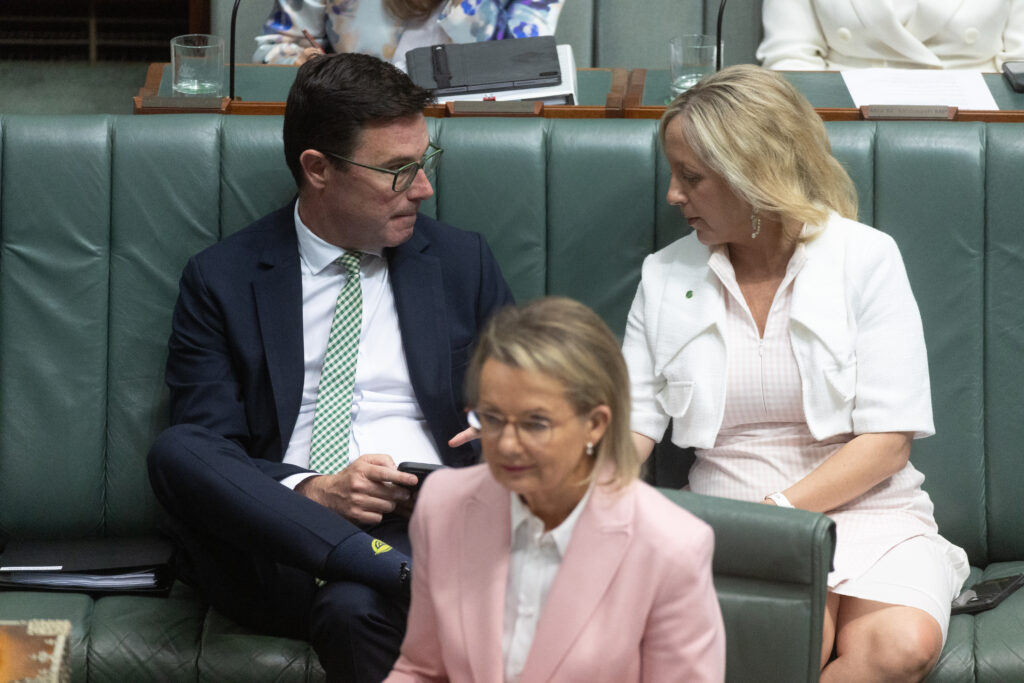
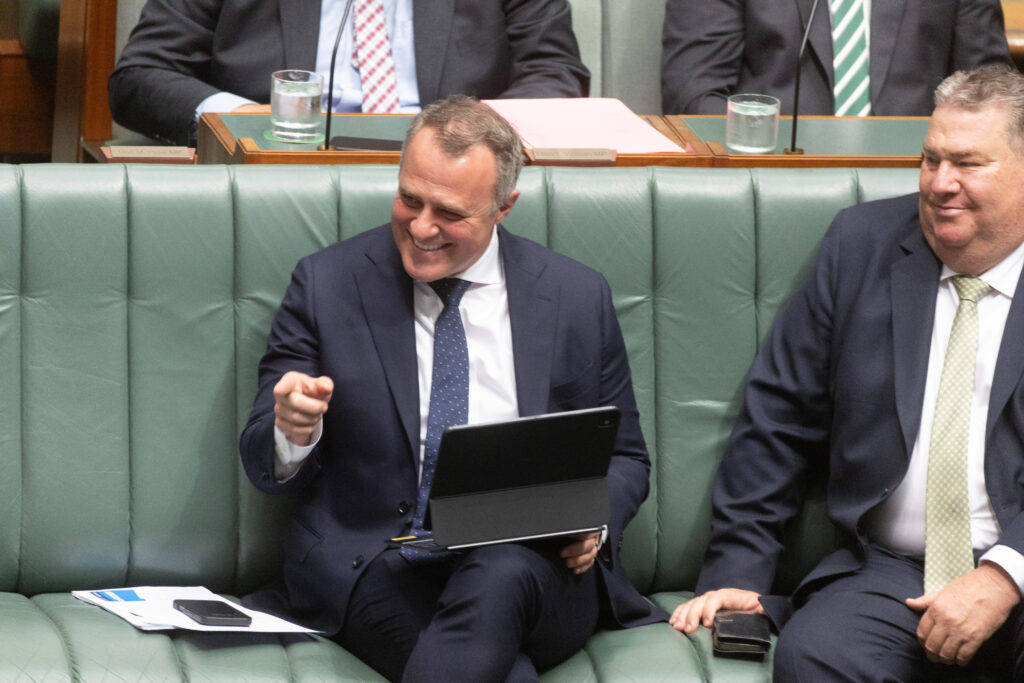
Someone needs to tell me what had David Littleproud and Melissa McIntosh so chatty:

Nationals Leader David Littleproud and the Shadow Minister for Communications and Western Sydney Melissa McIntosh during question time in the house of representatives in Parliament House, Canberra this afternoon.Tuesday 4th November 2025.Photograph by Mike Bowers

Still on the RBA

Greg Jericho

As Michele Bullock keeps answering questions and suggesting that “there is still a little excess demand in the economy than we thought”, there was this fun little line in the Statement on Monetary Policy:

“There are also uncertainties regarding the assessment that monetary policy remains a little restrictive, the lags in the effect of recent monetary easing, the balance between aggregate demand and potential supply for goods and services, conditions in the labour market and the outlook for productivity growth.”

So basically the RBA is uncertain about monetary policy impacts, how much demand is in the economy, the labour market and also productivity… but you know, apart from that they really are across everything!

RBA governor pushed on unemployment

Greg Jericho

The ABC’s Michael Janda asks a very good question about if their forecast for unemployment to stay at 4.4% is too optimistic given it is already at 4.5%

Bullock says, nah “Those forecasts suggest there is more stability in the labour market than you might think”.

He then asks if she is worried about stagflation – where unemployment and inflation are both rising together.

She says “No, I don’t think so. We’re still inflation will come down and we have employment at a pretty good place.”

Michele Bullock press conference

Greg Jericho

The Governor is asked about the RBA’s “technical” assumption of the cash rate cut in the Statement of Monetary Policy and whether the bank should be tempering expectations.

That assumption is purely put in to show what the market is expecting, it is NOT the RBA’s estimate. And yet every month she gets asked about this. Sigh

She then is asked a very good question about whether cutting rates was considered and were anyone worried about rising unemployment.

She says no – they only thought about keeping them steady. She says “Unemployment went up a little more than expected, but so did inflation. We are being a little cautious here as to what we read. We think there is a little information in both. Naturally, the board are concerned about employment as well because that is part of their mandate, but I would say at the moment we are a little more concerned about making sure we get inflation sustainably back in the band.”

So yes, as we noted in our media release, the RBA cares more about inflation than unemployment

Question Time ends

Anthony Albanese says he was taught mercy by the Christian Brothers and he will end QT “for all our sakes”.

So what did we learn.

Sussan Ley is on the outer. Not only did she not open QT, or even feature in it heavily, she was pretty much ignored by her front bench and her interactions with them were limited.

When it becomes that obvious, the situation is dire. The Liberals are unlikely to move until there is someone else there to clean up the mess, but you can start the clock.

We also learnt that Ted O’Brien either doesn’t read his briefs, or gets bad advice – because whether you like him or not, Jim Chalmers is ALWAYS prepared for QT and knows his portfolio inside out. You are not going to be able to back him into making a mistake.

Everything else? Independents asking about communities, Labor still tone deaf on housing costs, Coalition MIA.

The end of this parliament year can not come soon enough for 29% of the house.

View from Bowers

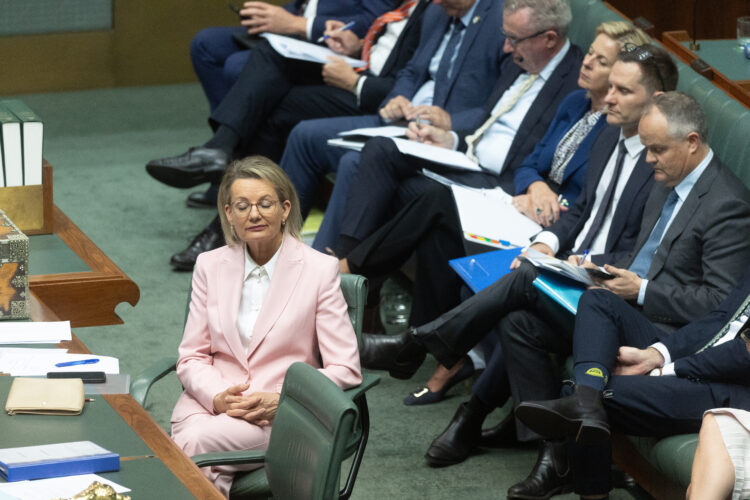
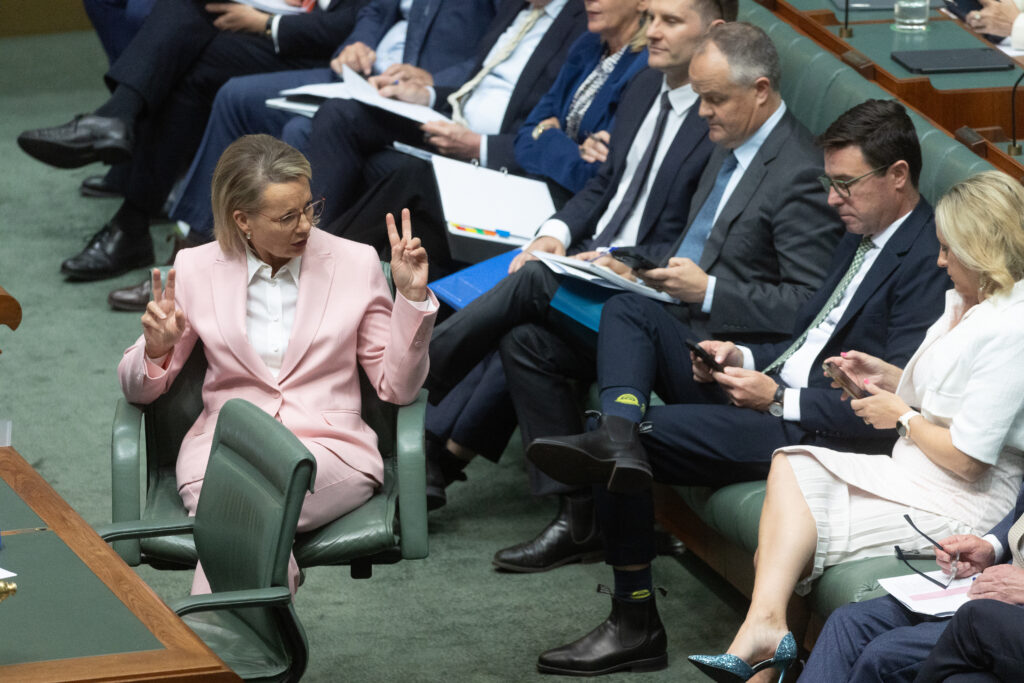
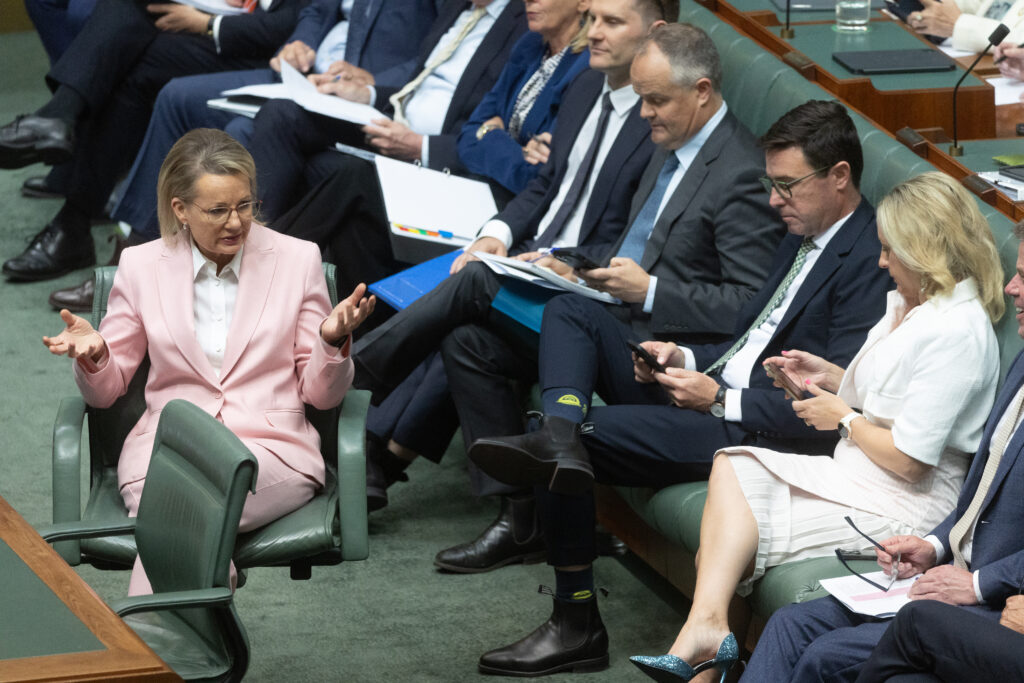
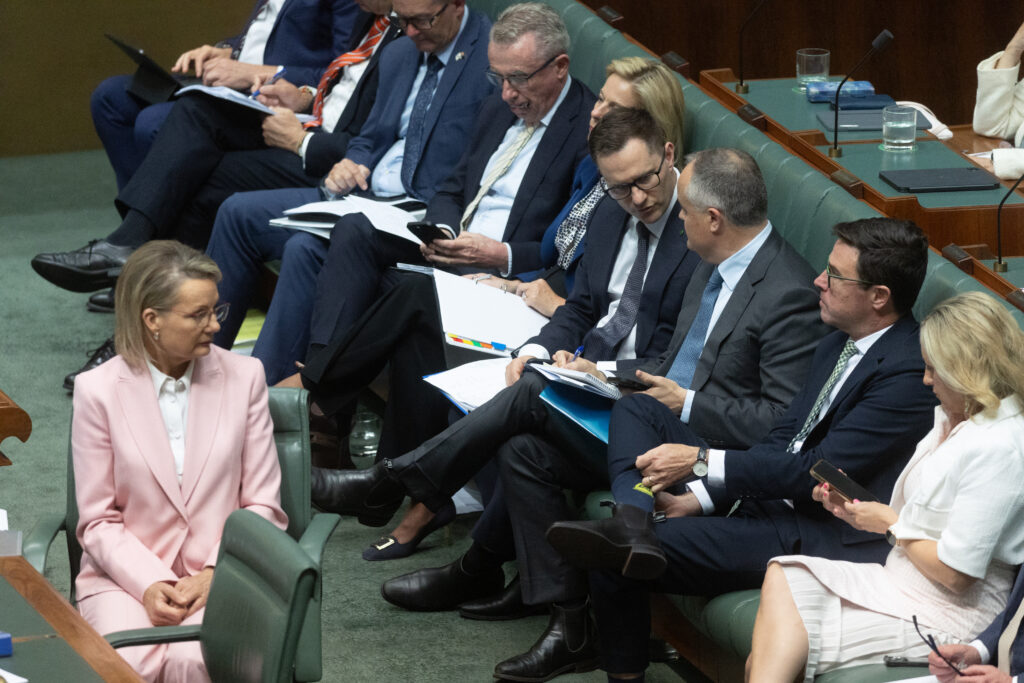
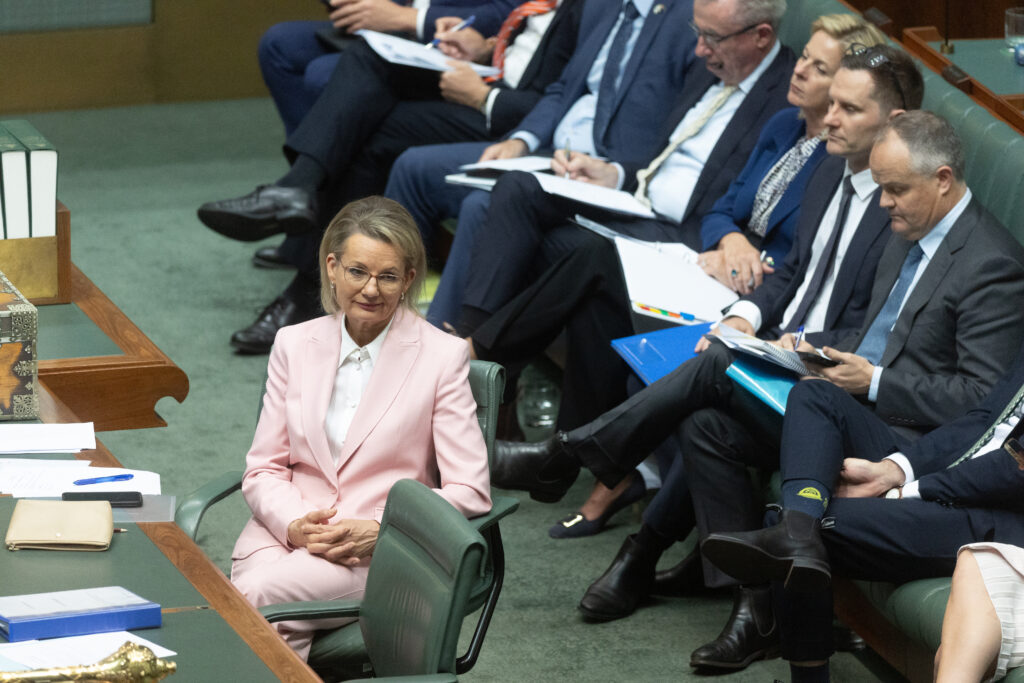
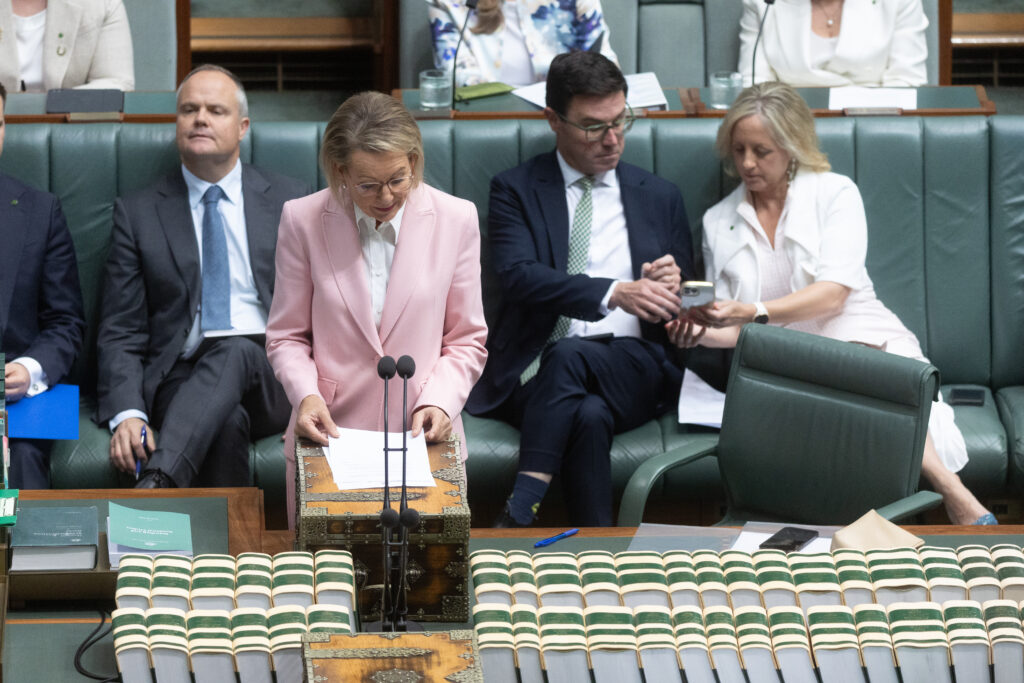
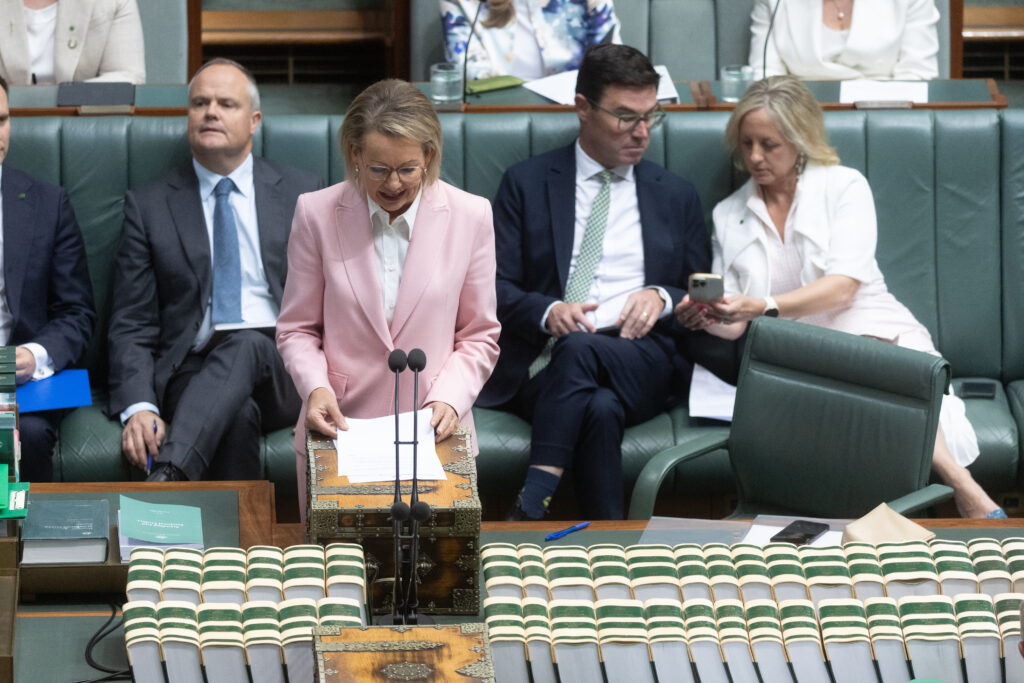
Here is some more of how Mike Bowers saw QT – Sussan Ley wasn’t receiving a lot of support from her front bench:

Opposition Leader Sussan Ley during question time in the house of representatives in Parliament House, Canberra this afternoon.Tuesday 4th November 2025.Photograph by Mike Bowers

View from Grogs (shakes head at Ted O’Brien)

The Shadow Treasurer, who you would think would have an easy day given the RBA decided not to cut interest rates, unfortunately keeps finding a rake to step on.

Ted O’Brien asked the PM (who flicked the question to Chalmers) that

“RBA’s forecast for headline inflation to peak at 3.7%. In the middle of next year, well above the target band and not to return to the band until 2027. My question to the Prime Minister is, given the government’s spending is running four times faster than the economy, isn’t it time to rein the Treasure inner to stop his spending spree?”

Fair enough I guess, except Chalmers had actually read the RBA’s statement on monetary policy which contains those forecasts, and alas for O’Brien, a few others.

While the CPI is not expected to get below 3% until June 2027, the RBA notes that

Year-ended headline inflation is expected to remain above 3 per cent for much of 2026, before returning to be a little above the midpoint of the target range by late 2027.

You can see this here:

So you might think case closed, O’Brien wins.

Problem is the RBA also noted that:

Changes in the timing of electricity rebates will cause additional volatility in headline inflation over the next couple of years.

So it is really due to a lot of erratic stuff, not underlying inflation. And while it did slightly revise up the underlying inflation measure – which the RBA actually targets, the revision was small, and we’ll be back under 3% soon – not in 2027 but next year:

And then we get to O’Brien’s point about “the government’s spending is running four times faster than the economy”

Firstly, that is a rather dopey point – if the economy is running slowly, the government should be assisting to stop the economy going into a recession. The RBA estimates that GDP will only grow around 2%. That is well below the long-term average of 2.75%-3%. Given public demand on average grows at around 3.3%, anything below that is actually below what the government probably should be spending.

As it is the RBA has revised down how much the public sector is contributing to the economy. The government is not only contributing less to the economy than usual, but probably less than it should be given rising unemployment.

But when you only care is attacking government spending, as is the case for Ted O’Brien, that logic does not register.

Tim Wilson butt of procedural joke

Tim Wilson stands up at the box and Milton Dick gives the call to Andrew Gee. Again.

Wilson is made to sit down.

Tim Wilson butt of Labor dixer joke

The Labor government continues to be tone deaf on house prices.

Then Anthony Albanese extends QT in order to smash up Tim Wilson.

Amanda Rishworth:

It has been nine weeks and four days since our legislation to protect penalty rates came into effect. This government took this action because if you work on weekends and public holidays you deserve penalty and overtime rates. And if you were one of the almost 6,000 award-reliant workers, working in Victoria today, our legislation has protected your penalty rates. Because the Albanese Labor government backs low-paid workers.

Now, Speaker, I’m asked how this compares to other approaches. Well, when our legislation was before the Parliament, the coalition used every excuse to stand in the way of action to protect penalty rates. The shadow minister nor employment did not miss an opportunity to criticise our protections of penalty rates. He claimed it does nothing for workers. Of course this is not a new position for the shadow minister.

In 2017 he voted against protecting Sunday penalty rates in the Parliament.

But it does seem, Mr Speaker, that in the past few days the shadow minister has had a change of heart. I noticed over the weekend that the shadow minister has a new-found love of public holidays. In fact, the shadow minister has declared on social media that a Wilson government, there will be a new public holiday on Melbourne Cup day.

Primarily it seems to get him out of coming to Parliament.

Now, I am not sure if this is official Liberal Party policy, but it has been enthusiastically backed by Senator Hume I note. But I hope a policy of this nature, of course, will include protection for all workers, not just politicians like he seems to advocate for.

Now, a word of caution, though, for work or so right across Australia. The workers probably shouldn’t put this public holiday in their diary just yet because according to a recent poll, even the independent member for Wentworth is a preferred Liberal leader than the member for Goldstein.

But you never know, Mr Speaker. He might just be a little slow to get out of the gate.

And we know we may see a Wilson government some time in the future. But, of course, in all seriousness, Mr Speaker, it is incredibly disappointing that we see the coalition completely talking about themselves, which days they’re gonna have off. Of course is it gonna be the member for Canning, the member for Hume or even the member for Goldstein that will lead this party? It’s only our Labor government that will back Aussie workers.

Lidia Thorpe asks about non-action on Aboriginal deaths in custody

Over in the senate and Lidia Thorpe has raised the issue of the inaction around deaths in custody:

She asked Malarndirri McCarthy:

Recently your Labor colleagues in the NT parliament, all of whom are Aboriginal people, voted in favour of a motion for an independent body at the Commonwealth levels, with powers to investigate and enforce change in relation to First Peoples deaths in custody. The motion was defeated by the racist CLP government. Do you agree with your Aboriginal NT Labor colleagues that his body is needed?

Thorpe asks if Labor will act, and use its powers to force change.

She does not get an answer.

Road funding

Andrew Gee asks:

In 2007 the National Party turned the first sod on the expressway, this could offer golden age of promises, delays and funding rates on a vast road over the Blue Mountains that all major fault party are guilty of. And the traffic jams from the Central West to Sydney are worse than ever. Will your government committed to turning the Great Western Highway into a genuine expressway to Sydney?

Catherine King:

I know this is a issue that he feels very strongly about. I understand that my officers engagement with the New South Wales Minister, Minister office that they are currently undertaking a white paper investigating options for upgrades to the Great Western Highway and that is currently well progressed. I understand that you have met with Mr to discuss this progress of this work in New South Wales. At the member would appreciate, with projects of this nature and the size that we cannot really proceed without the support of the New South Wales government. Their consideration of this project is still under way and then it is we do in the usual way through budget processes we consider any proposals to see whether the Commonwealth will go invest with those.

As you are aware, the proposed tunnel between Katoomba and Lithgow was committed to by the former LNP government with only $2 billion committed to folks that decided the tunnel and annexure $500 million committed by the New South Wales government.

The middle section alone of that tunnel would cost in the order of $11 million and would be the longest road tunnel in the country under the Blue Mountains, all of that of course was unfunded when we came to office and it is pretty emblematic frankly of the way in which those opposite our announcing projects are decided to stand up with their press releases, but could not deliver because it was all about the announcement and not about the delivery.

We have changed that, that is what we are focused on in delivering projects that in fact are not probably funded, properly planned, and that is important. That is what was from those opposite and I undertake that as we are not interested in the approach because it means simply cannot those projects.

Ted O’Brien is still Ted O’Brien-ing

Ted O’Brien is back. And we all hold our breathes at what genius will come through:

It follows the Treasurer’s earlier remarks about today’s RBA statement. What the Treasurer didn’t reveal about that statement is the RBA’s forecast for headline inflation to peak at 3.7% in the middle of next year, well above the target band and not to return to the band until 2027. My question to the Prime Minister is, given the government’s spending is running four times faster than the economy, isn’t it time to rein the Treasure inner to stop his spending spree?

It might be time for O’Brien to consider what advice he is being given. Even I know this is a dumb question, and I know nothing.

Albanese hands this to Chalmers who can barely contain his distaste for O’Brien

Chalmers:

I don’t think the Shadow Treasurer has thought through his question. Because if he had or if he understood the forecast released half an hour or so ago or if he was being honest with the House and therefore the Australian people, if he was talking about the forecasts he would point out that the Reserve Bank has revised down the contribution made by public spending to the economy.

Now, when it comes to the Reserve Bank’s forecasts of inflation, when it comes to the Reserve Bank’s forecast on inflation, the point that they have made in their statement on monetary policy today is that a number of the factors, which drove up the inflation number in the most recent data, they consider to be transitory.

They do acknowledge, as we do, that there’s still inflationary pressures in the economy but they say when you compare quarter on quarter they expect there to be a moderation in December.

That’s not necessarily my opinion, those are the words that the Reserve Bank put out in their statement of monetary policy about half an hour ago, Mr Speaker.

He should be honest about out. Similarly, Mr Speaker, when it comes to this idea, which is wrong, that government spending is the reason why we have seen an unwelcome tick up in inflation in the most recent data.

If he wants to say government spending on government budgets are the decisive factor in interest rate decision’s, he needs to explain those three interest rate cuts this year, Mr Speaker, including two after the March budget, Mr Speaker.

If you want to talk about what the Reserve Bank Governor thinks about the government ‘s fiscal position then perhaps he could read into the Hansard as I am about to do what governor Bullock said last week when she was asked about the fiscal position.

This is what she had to say it. We have relatively low debt compared to other countries, relatively low debt to GDP ratios stop at deficits as well we had a couple of surpluses and the most recent deficit in fact is quite small as well.

This view that the Reserve Bank Governor has shared by Fitch ratings agency last week when they reaffirmed our Triple-A credit rating.

I am happy to take as many questions as he could muster when it comes to the forecasts and when it comes to the fact that even with the revised forecast, the Reserve Bank is expecting under this government to be for inflation to be considerably lower than the higher and rising inflation left us by those opposite.

View from Bowers

Here is how Mike Bowers has seen QT so far:

Something has David Littleproud and Melissa McIntosh gagged:

The gentleman couldn’t speak
The Tea must be piping!
Tim Wilson again mistakes being mentioned for relevancy

The annual running of Tip Top’s mouth

Nats try tired gotcha on Tomago

Deputy Nationals leader Kevin Hogan asks a question of Chris Bowen on the Tomago situation (the smelter has announced it is no longer financially viable) and half quotes the Rio Tinto boss in his question to try and attack the government over energy costs.

It’s just lazy.

Hogan states the quote as “has said, quote, “unfortunately, all market proposals received show future energy prices are not commercially viable.” With a full stop (they did this last week as well)

Bowen:

I think it would have been better, however, if he’d not stopped mid sentence in that quote, because the Member for Page read out part of the quote. He said, unfortunately, all market proposals received so far show future energy prices are not commercially viable. But there is not a full stop in the quote. There’s a comma.

And he goes on to say, and there is significant uncertainty about when the renewable projects will be available at the scale we need now.

Back to QT

Just before the RBA announcement, Helen Haines asked:

Regional Australia is key to the success of the energy transition and we know 70% of regional Australians are on board [and in] support.

However poor committee consultation is eroding social licence.

The EPBC bill does not include a committee consultation standard that would build trust. Will the Minister commits to best practice community engagement standards under the new EPBC act?

This is something my Queensland peeps have been telling me for years – consultation has improved, but it is still not at the standard where all communities feel like they are part of the process.

Tony Burke, representing environment minister Murray Watt says:

I thank the member for Indi both for raising this legislation and also following what has been a theme for the member for her tight time and space of committee consultation involving the committee and decision-making. The environment legislation before the chamber is aimed quite squarely at being able to deliver better outcomes for the environment and also a faster decision-making process.

As part of that is people know, is based closely on the report, the summary report noted that the act as it is currently betrayed does not have the standards, just still have clear benchmarks and one of the areas that Samuel referred to with those benchmarks and standards could be established is with respect to community consultation. Raised directly there.

We have said soon we will be making draft standards available for matters of national environmental significance and for offsets. Also the first Nations engagement standard and data and compliance. None of these standards actually have force until they have legislation to bounce off effectively, to launch from.

And so the study review recommended standards including community consultation standard, my understanding is the Minister – I know the minister is looking into it and my understanding is the Minister spoke directly to the member for Indi about the community consultation standards as well.

As I say, to be clear, we cannot actually make any standards until the bill has become law. This is where we have had a long time with the report not becoming law for a long time, since this bill was commissioned in 2019 and headed to the previous, but then environment Minister now the Opposition Leader in 2020, we have had five years with the recommendations that have been there for a better outcome where the recommendations have been made for what the outcomes would be that would deliver a better outcome for the environment and a better outcome for business and we have not had a situation with the legislation’s been for the Parliament to be able – to make its way through the Parliament.

Right now, it is before us. We have an opportunity now to put the legislation through which we do among different things, provide the opportunity for the exact sorts of standards that the member for endive is putting in place and I just hope is all members on this side hope, that the Parliament takes the opportunity to finally follow through on recommendations that have been waiting too long and during that time environment has suffered, it is time to get this done.

(He doesn’t mention in there that one of the reasons the bill hasn’t been passed is because the government pulled it when it had a deal with the Greens last parliament that the mining industry and captured states like WA, didn’t like)

View from Grogs: So in a shock to no one, the RBA kept is at 3.6%, so why did they do it?

Back in October the statement said:

The decline in underlying inflation has slowed.

Inflation has fallen substantially since the peak in 2022, as higher interest rates have been working to bring aggregate demand and potential supply closer towards balance. Both headline and trimmed mean inflation were within the 2–3 per cent range in the June quarter. Recent data, while partial and volatile, suggest that inflation in the September quarter may be higher than expected at the time of the August Statement on Monetary Policy.

This month it starts the statement more definitively:

Inflation has recently picked up.

Inflation has fallen substantially since the peak in 2022, as higher interest rates have been working to bring aggregate demand and potential supply closer towards balance. [same as in October] More recently, however, inflation has picked up. Trimmed mean inflation was 1.0 per cent in the September quarter and 3.0 per cent over the year, up from 2.7 per cent over the year in the June quarter.

So basically, they’re saying there’s more inflation than they thought.

They still think the labour market is “tight” (ie not enough people unemployed in their view)

Last month they wrote:

Various indicators suggest that labour market conditions have been broadly steady in recent months and remain a little tight. Growth in employment has slowed by slightly more than expected, but the unemployment rate was unchanged at 4.2 per cent in August.

This month they go with

Various indicators suggest that labour market conditions remain a little tight, notwithstanding a recent easing. Growth in employment has slowed by slightly more than expected and the unemployment rate rose to 4.5 per cent in September from 4.3 per cent in August. 

So basically – there’s more unemployment than they expected, but they don’t care.

The statement concludes by saying:

“The recent data on inflation suggest that some inflationary pressure may remain in the economy. With private demand recovering and labour market conditions still appearing a little tight, the Board decided that it was appropriate to maintain the cash rate at its current level at this meeting.”

All this suggests probably no change either in December, even though unemployment is likely to rise.

Treasurer responds to rate hold

Jim Chalmers has responded to the rate hold in a dixer:

Now, it is the case that inflation is much lower than we inherited from those opposite and that has given the Reserve Bank the confidence to cut interest rates three times already this year. And those three interest rate cuts do reflect the very substantial progress we have made in our economy together.

When we came to office headline inflation was 6.1% and rising, it’s now around half of that. When we came to office trim mean inflation was almost 5% and rising. It’s now been within the target band for three consecutive quarters albeit at the top of the target band now.

If you look at around the world, inflation ticked up in September for every major advanced economy except the UK where it was flat, but much higher than it is here. Mr Speaker, once again, as I did in the answer a moment ago, I acknowledge, and we acknowledge, that even with this progress we have made, Australians are still under pressure.

Those three interest rate cuts are providing a bit of relief but we know that many Australians would have preferred to see more relief delivered today. We’ve got inflation down, we have kept unemployment low, the economy’s continues to grow, the private sector is recovering in welcome ways. We have got real wages growing and interest rates have fallen three times this year but we always know that there is more work to do.

Now, Mr Speaker, if you have a look at the forecasts, which are also released with the Reserve Bank’s decision today, you will see that when it comes to — comes to government spending in the Reserve Bank’s own forecast, they’ve actually downgraded the contribution made by public spending in our economy, and I think that does torpedo some of this dishonesty that comes from those opposite about the role of government spending.

So I point that out, Mr Speaker, acknowledging the usual politics will be played by those opposite, ut if those opposite want to claim that budgets are the decisive factor in interest rate decisions then they’ve got to explain those three interest rate cuts this year, including two interest rate — rate cuts which came after the budget in March. We will continue to work through the issues in our economy, the challenges in our economy, in the most responsible and considered and methodical way. We have made a lot of progress together in our economy. We know there’s more work to do. And we have acknowledged that throughout.

RBA holds interest rates at 3.6%

Let us all practice our shock face – the RBA did not move.

Grogs has thoughts:

Unsurprisingly the Reserve Bank has chosen to keep rates steady at 3.6% This reflects that yet again the RBA care more about inflation than maintaining full employment.

In the past month unemployment continued its steady rise to 4.5%, while the inflation had a surprisingly sharp increase due mostly to the end of state-based energy rebates.

In response the RBA has shown it is less worried about ongoing rising unemployment than reacting to a surprising blip in inflation.

The most recent household spending figures released yesterday showed households are slowing their spending and shifting towards spending on necessities.

In order to keep unemployment from rising further that RBA must care as much about the full employment part of its dual mandate as it does inflation.”

Coalition trying on energy

The member for Cook is up now (I also refuse to learn their name until it becomes necessary) and asks:

The Prime Minister promised Australians, and I quote, “Real, permanent, meaningful help with the cost of living.” However, in my home state of New South Wales, more than 4 in 10 people are concerned about going without food. More than a third have skipped meals to cover the essentials. More than 1 in 3 will need financial assistance in the lead-up to Christmas. In only three short years, this promise is neither real, permanent, nor meaningful. When will the government address the cost-of-living pressures facing Australian families.

Anthony Albanese:

I thank the member for Cook for his question and, indeed, I think the member for Cook has made some outstanding contributions from time to time. And I’ll quote him. I’ll quote him. When working at McKinsey, he was co-author of an article titled or “Carbon light: How Australia can power ahead in a net zero world.” You haven’t even heard the quote….

There is an immediate point of order on relevance, and the PM is told to stay relevant so Albanese says:

Mr Speaker, they will get the support they need from this government because that is what we do each and every day.

Indeed, the member for Cook, he went on to back in the policy that was established by the policy that was established by the former member for Cook, when they established the net zero target under the former Morrison government, had this to say. ‘McKenzie analysis estimates that these opportunities would add about, in Australian dollars, $75 billion to the Australian economy each year through to 2035 as well as an additional 130,000 direct jobs over the period. That would help them out, 130,000 direct jobs’.

He went on to say ‘Australia is facing a global economic transition that it cannot stop. Fortunately, the lucky country can make its own luck. Blessed with natural endowments that can ensure and adjust transition with abundant and employment opportunities in the same regions that will be affected by the inevitable decline in fossil fuel exports.”

There it is, Mr Speaker, there it is, Mr Speaker. There it is. I am asked about prices going down, let me just give a few facts.

In the 1 January the price of medicine goes down to $25. The lowest it has been since 2004. That will help people.

Pensioners and concession cardholders, the price of medicines frozen at $7.70 for the rest of the decade, that helps people.

For 108,000 families and small businesses, we have installed a cheaper battery the price of installing solar is down in the energy bills are down permanently, that helps people.

Something else that helps people, the tax cuts for all 14 million Australians that we implemented that were opposed by those opposite where the member for Cook went to an election saying that not only they voted against it, they introduced legislation into this chamber to increase income taxes for every single Australian taxpayer.

The fact is that we are focused on cost of living, those opposite I just focused on each other.

Question time begins

There is a little thing for science week and then we get to the questions – and it is the same one as yesterday:

It’s the member for McPherson. (I have no room to learn their name right now and also, it is currently irrelevant.)

According to the ABS, there are now 34,000 more unemployed Australians than a month ago. Inflation is soaring above the RBA’s target band, leading to concerns about stagflation and every month, the average household is paying $1,800 more on their mortgage under this Labor Government. Is this what the Prime Minister meant when he promised no-one will be left behind?

Anthony Albanese:

I thank the member for his question. But it was an interesting use of statistics, because I was waiting for him to mention the fact that 1.1 million jobs have been created under this Government. I was waiting for him – and I forgive him because he wasn’t here, of course. If he was here in May of 2022, he would have known that inflation had a 6 in front of it and it was double what it is now.

He would known also that interest rates started to increase under the former government and that there have been, in fact, three reductions in interest rates this year, under this Government. He would have known, when it comes to fiscal policy, that they sat there, promised a Budget surplus in their first year when they were elected in 2013 and every year thereafter, and, in fact, they delivered just zero when it comes to surpluses but this, Treasurer, delivered not one, but two budget surpluses, the first consecutive Budget surpluses in 20 years.

He would also know when it comes to cost of living that this government has progressed a range of changes from cheaper medicines, the rolling-out of urgent care clinics, the tripling of the bulk billing incentive to lower health costs.

He would know that difference we’ve made in paid parental leave, in the superannuation guarantee have made a difference.

He would know that the minimum wage has increased everyone and every year under this government, something that is the direct result of the deliberations of the Fair Work Commission, but with the advantage of having submissions from a government that supports real wage increases, not opposes them, because the former government had low wage growth as a key feature of their economic architecture. He would know that as well. So the member is forgiven in his first term.

I congratulate him on his election for being here.

(Tim Wilson interjects and is told to shut it. If there is one thing that unites the whole parliament it’s despising Wilson, so then Albanese takes it as an easy win.)

Albanese:

From a bloke who spoke about the Wilson government online… (LAUGHTER) You know, you know, talk about fantasies! I think you’re safe there, Leader of the Opposition. I don’t know about the others behind you, but I reckon you’re pretty safe from this bloke. I reckon you’re pretty safe from this bloke.

Gambling launders its reputation while destroying lives

Jack Thrower
Senior Economist

As highlighted by my colleague Dr Morgan Harrington, Australians are the biggest losers in the world when it comes to gambling.

Last year, Australians’ net losses from gambling (losses minus any winnings) were $34.8 billion. That’s more than households spent on electricity, gas and other fuel ($29.5 billion) and alcoholic beverages ($26.8 billion). Don’t let their slick advertising fool you; the gambling industry destroys lives year after year, and they are actively trying to target new demographics such as women.

The gambling industry regularly hides behind things like charitable donations and support for local sports teams to keep its social licence and resist regulation. However, just as we no longer allow tobacco companies to name our sports trophies, it’s time to stop letting gambling companies whitewash their reputations like this. Australia is a low-tax country with low levels of public spending; if we want to fund charitable causes, local sports clubs and communities, we can do so in a way that isn’t built on human misery.

Almost QT

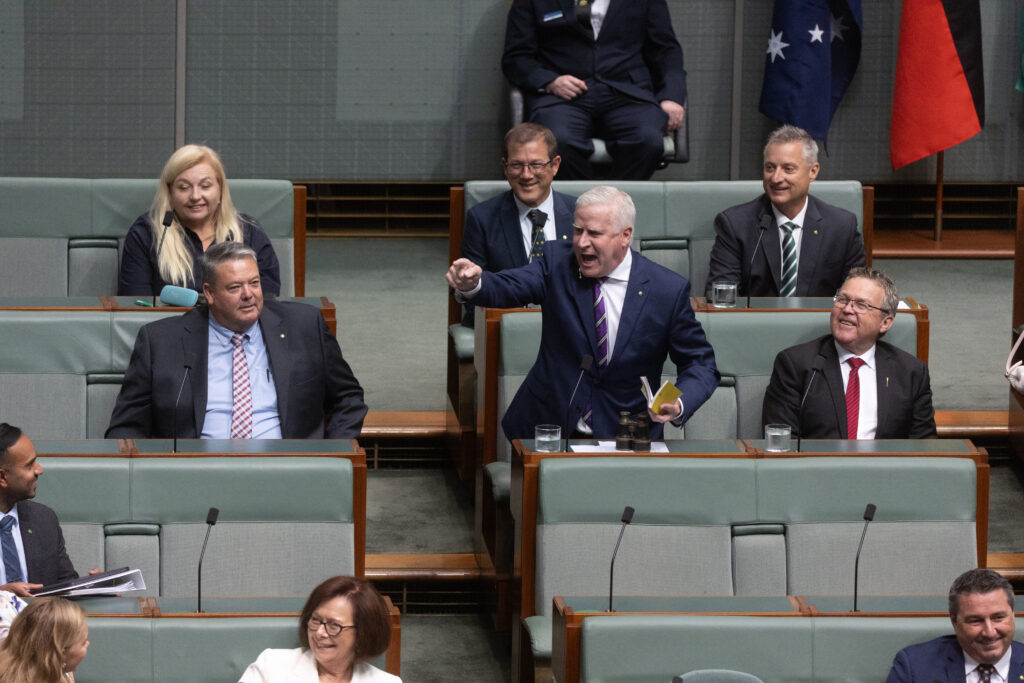
It is almost question time, so we are in the chamber and have to listen to the MP airing of the grievances (90 second statements) and Michael McCormack has written a whole thing comparing Labor MPs to a Melbourne Cup race, which he reads as a race caller.

OK, that’s enough now

Labor claims it accepts climate science, but….

On the Nationals self-destruction and the moderate Liberals attempts to justify the Liberals following suit when it comes to net zero Bowen says:

Net zero by 2050 isn’t a political construct. It’s a scientific requirement, agreed by 97% of the world’s scientists. The difference between the Government and the Opposition, we accept the views of 97% of the world’s scientists. The LNP appear to say they know people. If you want to heat the world 1.5 degrees warming, you need it by 2050. It’s essential. It used to be bipartisan in Australia. This is part of the, you know, reach back into science denialism that’s happening under the apparently modern Liberal Party. They are out of touch.

(If Labor accepted the views of 97% of the world’s scientists, it wouldn’t be opening new coal and gas mines)

More on solar sharer

Chris Bowen said it is about making power cheaper for consumers:

This is a reform in the best interests of consumers. I make no apologies for I work well with energy companies but they are not first. Consumers are put first. Energy companies will need to comply with these rules if they want to operate in default market operator states.

And then someone wants to know what the ‘catch’ is:

Bowen:

There is no catch. It’s up to people whether they take this offer up. They could look at this. We are requiring energy companies to make this an option. I think that’s a good thing. It’s not for everyone. If you can’t move your energy use to the middle of the day, it’s probably not for you. I understand and respect that. This was never claimed to be a one size fits all answer. As I said, someone working from home, who can put their washing machine on or the dish washer, pop downstairs while they’re working and say it’s 1:00 now. Power is free. I won’t do it tonight. I’ll do it now. Or somebody with an app. Or a retired couple who can match it from work or schedule EV charging while you’re at work. Maybe you went to work on the train, you can schedule the charging for 2:00 in the day where it will be precisely free. The only reason we can do that because Australians have gotten on with the job of harnessing the opportunities of renewable energy through roof top solar.

Bowen on Solar Sharer

Chris Bowen is holding a quick press conference on the solar sharer plan, which will give people in eligible jurisdictions, three hours of free energy in the middle of the day (if they sign up to an eligible plan and have a smart meter) when solar power is at its strongest point in the grid.

Energy retailers are sad over it, because they say they were not consulted.

Bowen says it will be regulated and it is something that some retailers already offer:

The Australian regulator will regulate this. AGL and a few others offer this service. That’s great. I welcome that. This gives consumers the peace of mind that the AER, our independent regulator, has put the offers through their paces. And ensure there’s no price gouging going on. It’s in the best interests of the consumers. The AER will today or tomorrow release a discussion paper about the next DMO, taking feedback about how it will be implemented in detail but the Australian Energy Regulator has made clear to me that they see this as a very positive step which helps them do their job to put consumers first.

Faruqi: ‘Let us end this carnival of cruelty’

Over in the senate, and Greens senator Mehreen Faruqi has called for the ‘carnival of cruelty’ to be cancelled.

Here is what she had to say a little earlier in a statement:

Things keep going from bad to worse for horses in the racing industry yet the media, politicians and their mates in toxic gambling companies continue to pretend everything is okay. This is a stain on our nation.

Horse racing is not a sport, it is legalised cruelty for profit. The industry not only sacrifices horses, it goes to great lengths to hide its cruel and disgusting underbelly. 

Today, federal parliamentarians will be toasting to this cruelty, lunching in the Speaker’s Courtyard while more and more horses suffer horrific deaths to feed the gambling industry’s profits.

It is time to stop treating animals as disposable commodities. Both the Liberals and Labor receive political donations from gambling companies, who profit off losses that are ripped from vulnerable communities. The Melbourne Cup spectacle comes at a deadly cost to both animals and communities.

Let us end this carnival of cruelty, rehabilitate and rehome the horses, and stop the corrosive influence of gambling donations on our politics by banning them outright.”

Nat zero

There have been a few economists tearing their hair out at some of the jokes being made at the Nationals net zero position will mean net zero seats, because to them that makes no sense (I know wayyyyy too many economists and it is a problem, but that’s for another time)

Net zero is not real zero. Net zero in this context just means that the our carbon emissions are off-set and cancelled out. So we will still be emitting, but those emissions will be mitigated by carbon capture/new tech etc. Real zero is when we don’t emit emissions.

So the joke that the Nats will have net zero seats makes no sense because you can’t cancel the Nats out with non-Nats.

You could try for ‘Nat zero seats’ if you wanted to make the joke and not cause an economist’s brain to explode.

No judgements – everyone has to deal with economists in their own way.

Pillay on Australian obligation to Genocide Convention

Emma Shortis

In the Q&A, Pillay is asked what states can do to enforce the Genocide Convention. Pillay replies that it is not a choice, but a legal obligation:

“I would say to the Australian parliament that they have the duty to step in now.” 

Judge Navi Pillay, the 2025 Sydney Peace Prize winner speaking at press club

Emma Shortis

Judge Navi Pillay, the 2025 Sydney Peace Prize winner, is speaking now at the Press Club. Judge Pillay is Chair of the United Nations Human Rights Council Independent International Commission of Inquiry on the Occupied Palestinian Territory, which determined that the Israeli government’s actions in Gaza constitute acts of genocide. Judge Pillay is speaking about her role in that commission, and women and security.

Judge Pillay noted that the United Nations and its member states have the responsibility to ensure that international law is fully respected and that those who violate it must be held to account. No one can say they did not know was happening in Gaza. Judge Pillay notes that the ceasefire agreement announced by the United States has nothing to say about international law or self-determination.

For more from Judge Pillay, you can listen to a recent episode of After America. Or, if you’re in Sydney, you can hear her speak this week. 

The Australia Institute is proud to partner with the Sydney Peace Foundation. 

Australia Last: Australia’s Resources Minister puts Japan ahead of Australians on gas and electricity prices.

Mark Ogge
Principle Advisor

Despite our enormous energy reserves, Australians households are paying higher prices for electricity than Japanese consumers according to new analysis released by the Australia Institute; Australia Last: The failure of Australian gas policy – The Australia Institute.

 “While it’s hard to believe our governments could have messed things up this badly, the fact is people living in the countries we export our gas to are getting cheaper electricity than we are,” said Dr Richard Denniss, co-CEO of the Australia Institute.

“For example, Australian consumers are already paying higher prices for electricity than households in Japan. Indeed, if the average Australian household could access the same electricity prices available in Tokyo, then they could save close to $550 a year.

But rather enquire into who caused this debacle and commit to fixing it, the Australian Minister for Resources, Madeleine King is actually reassuring the Japanese that she is determined to keep things the way they are. In 2024 she declared:

“LNG produced off the coast of Western Australia and shipped to … [Japan, China, South Korea and India] … ensures they can power their cities; their homes and their industry.”

“So, while Australians are warned of a ‘shortage of gas’ and told that we have no choice but to convert our farmlands into industrial fracking gas fields, the Minister for Australian resources is reassuring foreign countries that we have boundless gas to share, said Dr Denniss.”

“Australians are the victims of the most outrageous doublespeak when it comes to gas. In the last 10 years the wholesale price of gas has tripled, our electricity prices have surged and whole industries have been warned of gas shortages unless new gas projects are approved. And at the same time the Minister who is supposed to be managing our natural resources on our behalf is bragging to our export customers about how much gas we are giving them,” said Dr Denniss

In the same speech Minister King declared: 

“Australia is Japan’s single largest provider of energy. It is estimated our LNG and coal exports support around eight hours of power generation a day in Japan.

So that means that we, a country with a population of 25 million, provides vast energy resources for a country of 125 million people. Those figures of themselves demonstrate the responsibility Australia has to ensure that this energy security is maintained, not only for Japan, but for our other important regional neighbours.”

 “Australia doesn’t have a shortage of gas. It has a shortage of Ministers that are brave enough to put Australia first. It’s time Australia stopped approving more gas exports until Australians had cheap energy and Australia and our exports customers were on track to meet their climate commitments,” said Dr Denniss

R&D spending and tax concessions go to the wrong people.

Dave Richardson

The Financial Review today carried a report on the R&D tax breaks and who is getting them.

The Financial Review is especially concerned about Domino’s which received a $6.6 million in R&D support. It seems the support was for a new product with eight party pies embedded in pizza dough.

On top of the pizza R&D there was support for R&D in the gambling industry with some of the claimants mentioned here:


$43 million claim by gaming giant Tabcorp.
$18.9 million for poker machine behemoth Aristocrat.
$10.4 million for the Lottery Corporation.
$7.9 million for Austria’s slot machine maker Ainsworth Game Technology). and
$7.5 million for US-owned bookmaker PointsBet.


Some of these payments would have been hidden in manufacturing but tax office statistics reveal concessions of $18.8 million for gambling activities in 2022-23.


There were also a number of alcohol companies named in the Financial Review including:
$8.9 million for Asahi,
$3.4 million for Treasury Wine,
$2.5 million for Casella and
$0.2 million for Fellr.


It’s hard to imagine how any of the companies on this list are doing anything that warrants government support.

Meanwhile the Tax Office shows $0.5 million went to the industry described as “Pubs, Taverns and Bars”

Tax Office data also show the federal government spent $325.4 million on fossil fuel miners, coal and gas.
The productivity round table drew attention to the need for more innovation and investment in Australia. One place we should look is Australian spending on research and development (R&D).

ABS data showed that in 2023-24 businesses in Australia spent just 0.91% of GDP on R&D. When government is included Australia spends just two thirds of the OECD average and we rank 22nd out of the 38 OECD countries, behind Slovenia, Estonia, Iceland and Finland.
We could ignore Australia’s R&D position and argue we should leave it to the market. However, even the bastion of free marketeers, the Productivity Commission, has argued that Australia underinvests in R&D and so R&D needs government support.

A good deal of that support comes in the form of tax concessions for businesses undertaking R&D. The latest Tax Office data shows that in 2022-23 the government gave business R&D tax concessions worth $6.1 billion by way of $4.0 billion in refunds for R&D spending and non-refundable tax breaks of $2.2 billion that can be carried forward as tax losses in future years.

When the government spends so much to support R&D you would hope it is being well spent and moves us further up the OECD ladder. Unfortunately, that is not necessarily true.

It is quite apparent that a good deal of the spending and tax concessions for business R&D are going to the wrong industries.

The fact that Australia is so low on the R&D list and that much of the money goes to the wrong businesses suggests that the open slather approach to supporting any old R&D needs reviewing. While some action has been taken to stop some of the “sin” industries getting R&D grants it is apparent that more needs to be done.

Major parties vote down super for under 18s attempt

You will be shocked to learn that Labor defeated that motion.

Labor also defeated (with the help of the Coalition) a Greens attempt to force employers to pay super contributions regardless of how many hours they work. Under the current laws, if you are under 18 and work less than 30 hours, you are not eligible for superannuation. The Greens wanted to have them included, but the major parties voted it down.

Barbara Pocock said it was costing young workers thousands in their early career:

The majority of young people (92 per cent)  work fewer than 30 hours a week because of school and study commitments, meaning they miss out on super. That’s unfair. Young people shouldn’t be penalised for going to school or studying.

Under 18s pay taxes and contribute to our economy, so why shouldn’t they receive super?  

Excluding young people from super only makes it harder to get ahead — robbing them of thousands in retirement savings and financial security.


Gas companies have already taken the piss – the government needs to make sure rare earth companies don’t do the same.

Greg Jericho
Chief Economist

In The Australian Patrick Gibbons, a partner at Orizontas (a corporate advisory firm) and Angus Barker, chairman of Australian Rare Earths, make a case for dig baby dig  with critical minerals. They have been taking their double act around the media of late. A couple week’s ago in the AFR they also wrote about how vital was the critical minerals deal with the US for disrupting China, as they wrote “the just announced framework is a great first step in addressing what is now clearly a major threat posed by China. And while China may have gotten the jump in this sector, the Trump-Albanese meeting showed, western countries are now getting serious in how they respond, and Australia will be at the forefront.”

Critical/rare minerals policy, as we saw in last night’s 4 Corners episode, is basically catnip with those who dislike China and those who enjoy Australia snuggling up the USA. It also is a big one for those who salivate at the thought of more mining.

Gibbons and Barker argue in The Oz that Australia has to make sure we don’t miss out on the scramble to be part of the rare earths’ bonanza. And as ever it comes down to wanting faster approvals. They argue that “an option the federal government could consider is to reserve access to its national offtake agreements only to projects in those states where approval processes provide the required certainty. This is not about lowering our existing robust environmental standards; it’s about meeting legislated approval timelines.”

Now I don’t know about you, but describing our existing environmental standards as “robust” is not a great start for convincing me that the argument is about ensuring environmental considerations remains paramount.

At this point we should remember that the US-Australia deal on rare earths that Trump and Albanese signed is very specific about reducing regulatory approvals.

The agreement states:

Permitting:  The Participants are taking measures to accelerate, streamline, or deregulate permitting timelines and processes, including to obtain permits for critical minerals and rare earths mining, separation, and processing within their respective domestic regulatory systems, consistent with applicable law.

Now you might think that “consistent with applicable law” is a safeguard. Alas remember, the changes to the EPBC Act currently before parliament include the ability for the Environment Minister to override any environmental concerns due to “national security”. And remember as well the agreement Trump and Albanese signed says that “The Participants are intensifying their cooperative efforts to accelerate the secure supply of critical minerals and rare earths necessary to support manufacturing of defence and advanced technologies and their respective industrial bases”

Clearly we are about to fall into the same trap as we have with gas – where environmental and Indigenous cultural concerns are for nought, and taxing the production and exports will be minimized under the guise of it being important for national security.

The government needs to ensure the taxation and production of rare earths and other critical minerals is done in a way that benefits Australians; not companies and their profits – and certainly not the US defence industry.

LNP give Tony Burke suspension motion for his birthday

You can tell Andrew Wallace is a Queenslander, because he opens his seconding of this motion to keep the FOI bill in the House for debate (rather than the Federation chamber) because he says the “House of Representatives is the premier debate chamber in this country” which would be news to the University of Sydney debate union.

This motion is mostly just rabble raising – the government have the numbers in the house and nothing gets through that it doesn’t want. But it shows where the Coalition is trying to go given the bin fire that is their party room at the moment.

Wallace also wishes Burke a happy birthday. Makes sense that Burke is a Scorpio.

Meanwhile, Wallace was obviously not too prepared for this debate, because so far his main argument is that the House of Representatives has a sky light and the Federation chamber does not (his overall point is about sunlight getting in)

Burke gives thanks for his procedural motion birthday gift, tells Wallace he is allowed to sit down before the clock runs out and talking about sky lights is probably a good sign the speech is done, and then points out that there is still no one physically present in the press gallery, because they can monitor everything through the broadcast, which is also available for the federation chamber.

He’s only do this so he can have some fun.

Burke then makes the point that the Coalition has not actually put anyone on the speaking list (other than the shadow minister) for the FOI debate.

“We are now going to have to bring everybody in here, to vote on where the bill with no one listed to speak should be debated, because that’s the issue with transparency.”

He saved that little tid-bit til last. True Scorpio energy.

Coalition attempts to keep FOI debate in the House

Alex Hawke is suspending standing orders to debate the government’s transparency record – he doesn’t want the government to send the freedom of information bill to the federation chamber (where no one ever sees the debate)

He says the rest of the parliament is in lock-step with the Coalition on this.

And he wants to know where the press gallery is. He says that the media also agrees (which is true)

“This will weaken the quality of your government, so any backbencher who is concerned…I can see their faces start to waver,” Hawke says.

There are more pokies in areas of Australia with larger Indigenous population

Morgan Harrington
Research Manager

Australians lose more to gambling than anyone else in the world, but the harms of gambling aren’t evenly spread. Gambling has a devastating effects on Indigenous people, and new research from The Australia Institute shows that pokies are of particular concern. 

The analysis found that if you live in an area of Australia with a high Indigenous population you’re likely to see more poker machines, and lose more money to the pokies. Areas of Australia where at least 10 per cent of the population is Indigenous have 50% more poker machines than average. People in these areas also lose over $100 more a year to the pokies ($700 per year compared to “just” $581 in other areas). 

The only exception to this national pattern is Western Australia, where poker machines are limited to a single Casino. This natural experiment shows that the solution to the problem isn’t complicated: if we limited the availability of the machines, people would lose less to the pokies. 

Nationwide, 3.8% of Australians are Aboriginal and/or Torres Strait Islander, so these areas have twice the average Indigenous population. This means that Indigenous Australians are being disproportionately harmed by the pokies. But that also means that properly regulating poker machines would be hugely beneficial for Indigenous Australians.

Senate fight now tit for tat motions

Checking in on what is coming up in the senate (another punishment) and we see that Labor senator Marielle Smith has been tapped to deliver the next volley in the tit-for-tat senate motion contest currently being played out.

David Pocock and others have wanted the Briggs report into the public service job for mates controversy which was given to the government two years ago. The government has said no and has refused orders for the production of documents and avoided the issue at question time and estimates.

In a bid to force the government’s hand, Pocock won the support of the majority of the senate in moving a motion to extend senate question time for at least 30 minutes, with an additional five more non-government questions being added to the list.

Labor then tried to amend Pocock’s victory by having Smith move motions to suspend standing orders so she could ask a question in that time period to extend it even further.

It has basically been silly buggers ever since.

Pocock went to the bathroom during one of the sessions, which Labor’s Tim Ayres tried to parlay into a gotcha moment and now the two sides are locked in a battle of wills.

Smith has now given notice that she wants to keep all senators in the chamber for QT (attendance is optional) except to breastfeed or go to the bathroom.

This is what your government is up to, in case anyone was wondering:

Smith has given notice that she will move—That the following apply as a temporary order until the arrangements for question time adopted by the Senate on 29 October 2025 cease to apply:

  1. All senators be required to attend the Senate whilst questions without notice are asked and answered.
  2. Senators may be excused from the requirements of paragraph (1) if they have been granted leave of absence by the Senate, or with the agreement of all whips and independent senators.

Andrew Wilkie joins fight to stop police welfare powers

Independent MP Andrew Wilkie has joined independent senator Lidia Thorpe in a bid to bring more attention to the Labor government’s attempts to give police the power to recommend welfare cancellations:

Hook ’em while they’re young

Morgan Harrington
Research Manager

If gambling were a sport it’d be played by more Australian teenagers than anything else. 

That’s according to analysis by The Australia Institute, which shows that while 480,000 Australian teenagers play soccer, and about 440,000 play basketball, more than 900,000 gamble. Despite the 18+ restriction on gambling, almost one in three (30%) 12-17-year-olds gamble. This increases to almost half (46%) of 18- and 19-year-olds, a rate that doesn’t decline until people are at least in their mid-20s. This means that the gambling habits young Australians develop when they are teenagers persist into adulthood.

Parents are well aware of the societal shift that has taken place since their youth. Not long ago, online gambling simply wasn’t an option, which means there was little incentive for gambling companies to saturate footy matches with so many ads that kids are now just as likely to discuss the odds as their favourite player. Free-to-air TV shows more than a million gambling ads a year, so it’s not surprising that 85 per cent of 12-17 year olds have seen a gambling ad on TV in the past month. Teenagers are growing up in a country with a serious gambling addiction. When all age groups are combined, Australians gamble more than any country in the world. 

The Murphy Review was clear that “Australians do not like being flooded by messages and inducements to gamble online and worry about the effect this is having on children and young people.” Australia Institute polling research shows that initiatives to ban gambling advertising would be popular. But without this kind of policy change, gambling will continue to be normalised among young people.  

Queensland could adopt ready-made truth in political advertising laws, already tested in “laboratories” of democracy


Bill Browne
Director, Democracy & Accountability Program

A misleading attack ad against a candidate in an upcoming by-election has reminded everyone that Queensland does not have truth in political advertising laws, prompting the Courier-Mail to editorialise:

“Voters should not have to cop lies”

Ahead of the Queensland state election, now Premier David Crisafulli promised to look into such laws, saying “heaven knows we need it”. The Labor Government was less committal, although ironically in opposition they are now pursuing the issue.

Today Premier Crisafulli refused to commit to implementing truth in political advertising laws, saying:

“I don’t want robust debate to be shelved under the guise of preventing, particularly in opposition, from being able to challenge a government of the day.”

But why would it?

South Australia has had truth in political advertising laws for forty years. They are respected, popular on all sides of politics and have improved the political culture. They are specifically designed to protect robust debate.

The great strength of Australian federation is that a good idea can spread from one state to another.

Indeed, as I wrote last month in The Point, the SA Liberals are copying Queensland Labor’s fifty-cent public transport policy – so why shouldn’t the Queensland Liberal–Nationals copy South Australia’s truth in political advertising laws?

Australians are the biggest losers in the world

Morgan Harrington
Research Manager

A bet on the horses today is the only time many Australians will gamble. But this doesn’t change the reality that, collectively, Australians are the biggest gamblers in the world, wagering a total $254 billion in 2023-24. Australians also lose more to gambling than anyone else in the world – $32 billion in 2023-24, which is more than the $21 billion lost in all the casinos in Las Vegas put together. And the problem is getting worse. Since 2019, average losses to gambling in Australia have increased by 25%, and the average Aussie gambler now losses about $2500 a year. 

Thanks to the proliferation of gaming apps and the ubiquity of ads for sports betting, online gambling has become an area of particular concern. So much so that a 2023 Parliamentary inquiry into online gambling and gambling advertising (the Murphy Review) recommended a ban on all forms of advertising for online gambling. Australia Institute polling research shows widespread support for this kind of initiative. Three in four Australians (76%) support a total ban on gambling ads phased in over three years, and four in five support banning gambling ads on social media and online (81%) and in stadiums and on players’ uniforms (79%). But none of the recommendations of the Murphy Review have been taken up.

It wasn’t the laws that were too weak to stop those projects, it was the ministers

Richard Denniss

If one of your kids wants to go to the beach for summer holidays and the other wants to go bushwalking would a mountain biking holiday be proof that you got the balance right? Welcome to the topsy-turvy land of Labor logic, where legislation that disappoints everyone must be a step in the right direction.

Like a donut, there is nothing in the centre of Australian politics. The fact that the Greens want to stop native forest logging and the Nationals want to speed up land clearing by farmers is not proof that any legislation Labor drafts must fit in the “sensible centre.”

Back when Tanya Plibersek was an optimistic new Environment Minister in the Albanese Government’s first term she was full of big promises. When she launched her Threatened Species Action Plan she stated:

“The Action Plan has ambitious targets, which include preventing any new extinctions of plants and animals.”

And went on to declare:

“I will not shy away from difficult problems or accept environmental decline and extinction as inevitable.”

But while we will never know for sure if Plibersek was serious at the time, we do know for certain that her Cabinet and her Prime Minister had net-zero interest in putting the protection of endangered species ahead of the profits of polluters.

You can read the rest of Richard article, here.

Start your lettuces

Liberal MPs are now being asked what they would do in a leadership challenge, so that’s never a good sign for the Libs.

Might be time to put the lettuce out. The Liberal’s Liz Truss officially has a timer set on her leadership.

For the record, when asked, Andrew Bragg said:

Well, I support the Leader.

That’ll fix it.

Bad Barnaby rising

Not sure how many more times the Coalition is going to let this man rule their policy direction, despite the electoral, societal and moral cost. Guess the limit does not exist.

In case you were worried though, Barnaby says he is “much happier” with the Nats. Seems all those ‘questions’ he had yesterday have been answered.

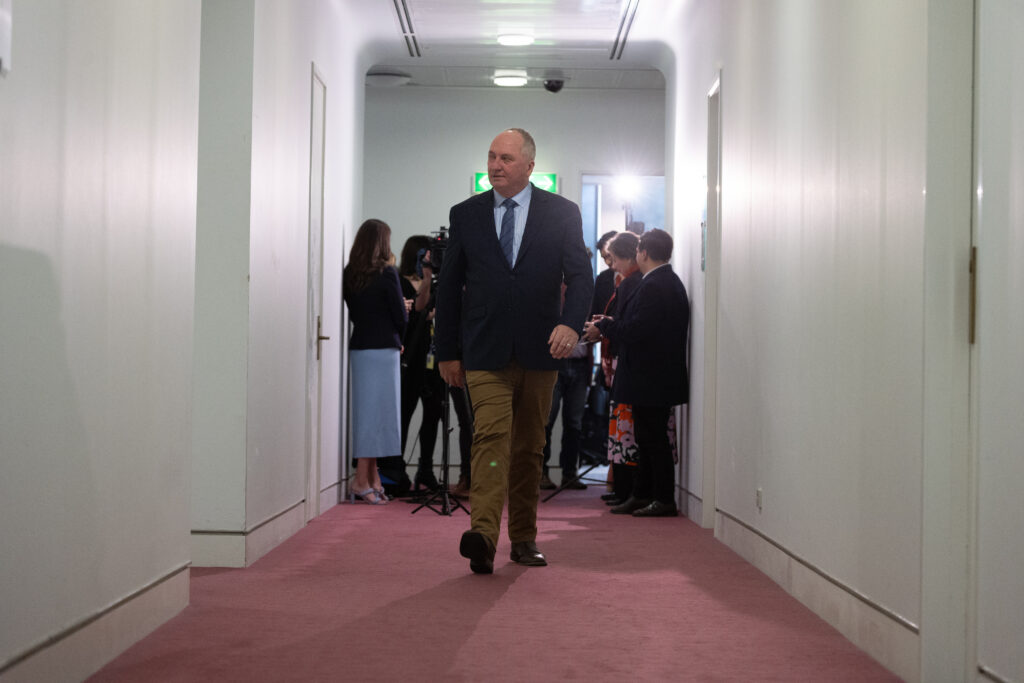
Barnaby Joyce in the press gallery of Parliament House, Canberra this morning.Tuesday 4th November 2025.Photograph by Mike Bowers

The Senate is more powerful than prime ministers like to admit, and last week we saw why that matters 

Bill Browne
Director, Democracy & Accountability Program

In their anger over a Senate “stunt”, Labor leaders revealed more than they might have intended about how the major parties work with each other.

For months the Senate has demanded that the Labor Government release a report into jobs-for-mates appointments. Last Thursday, the Senate decided that if the government wasn’t going to be transparent in this area, the Senate would demand transparency in other areas. Independent Senator David Pocock’s motion to add five “non-government” questions to Senate Question Time passed with Greens and Liberal–National support.

In response, Labor threatened to cut pay for some Liberal–National MPs in the House of Representativesby taking away their deputy chair positions.

What do deputy chairs in the lower house have to do with a motion in the upper house?

Only that Labor has control of the lower house, so that’s where it can make the Opposition feel pain.

The major parties divvy up positions and privileges between themselves. They might be in government today, but Labor expects that eventually the boot will be on the other foot. These positions come with power, but also higher pay. Each major party shares with the other.

Until one party breaks the arrangement – as Labor would be doing if they stripped Liberal–National MPs of deputy chair positions.

Regardless of whether Labor follows through, Coalition senators might already be asking what the Senate can do to make life harder for the government. After all, a National senator may not be too concerned that a few Liberals in the House are in danger of losing bonus pay. And the threat that “We’ll do the same to you in government” falls flat when government looks so far out of reach for the Coalition.

By inspiring Liberals, Nationals, Greens and independents to question Senate customs that benefit the government of the day, Labor may have opened Pandora’s box.

  • Imagine if the President of the Senate were from an independent or minor party, instead of being chosen from the governing party.
  • Imagine if the eight committees that scrutinise legislation were chaired by someone from the Opposition or the crossbench, instead of a government senator.The reports might be more collaborative and probing with a chair from another party.
  • Imagine if the Senate called ministers from the House of Representatives to give evidence at Senate Estimates, instead of letting them send a senator as delegate.
  • Imagine if the Senate refused to vote on government legislation until the government has produced all the information the Senate has ordered.
  • Imagine if the Senate sanctioned government ministers who ignored the Senate’s orders, as Labor has tried before.

The Constitution gives executive government (the prime minister and ministers) enormous leeway, but also gives Parliament the discretion to constrain that power. Last week the Senate made a small but meaningful correction against government secrecy.

If the government refuses to comply, there is much more the Senate could do.

Spooky inflation scares the RBA more than spooky unemployment

Greg Jericho
Chief Economist

As we know at 2:30 this afternoon the Reserve Bank will announce that it has kept interest rate on hold.

The more interesting thing will be its release of the November Statement on Monetary Policy. This is a statement the RBA puts out every three months and contains a summary of what is going on around the world and here in Australia as well as its forecasts for the next couple years.

So, we’ll be giving you the info on that as soon as it comes out.

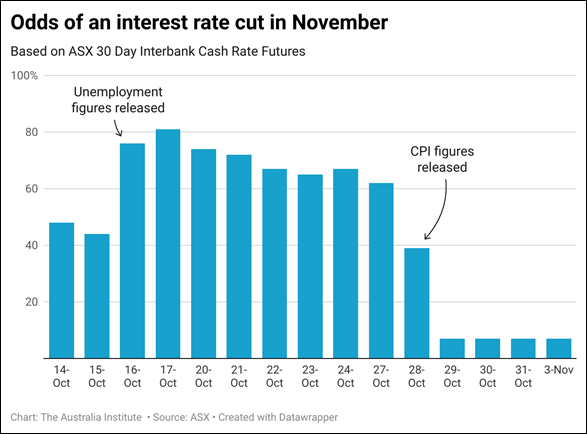
What is also interesting is how the market has changed its expectations of a rate cut.

On 15 October, the day before the September unemployment figures came out showing a rate of 4.5%, the market rated it about a 44% chance that the RBA would cut rates today. After the unemployment figures came out it jumped to a 76% chance.

As the days went on though, investors likely remembered the RBA hates cutting rates, and so the odds drifted down a bit. But then the September CPI figures were released and the chances sunk like a stone – down to 39% and then 7%.

It highlights that the market (and the RBA to be honest) gets more spooked by a surprise inflation figure than a surprise unemployment rate – and that the RBA will do everything it can to keep inflation below 3% and very little to keep unemployment from going above 4.5% (and nothing at all to stop it going above 4%)

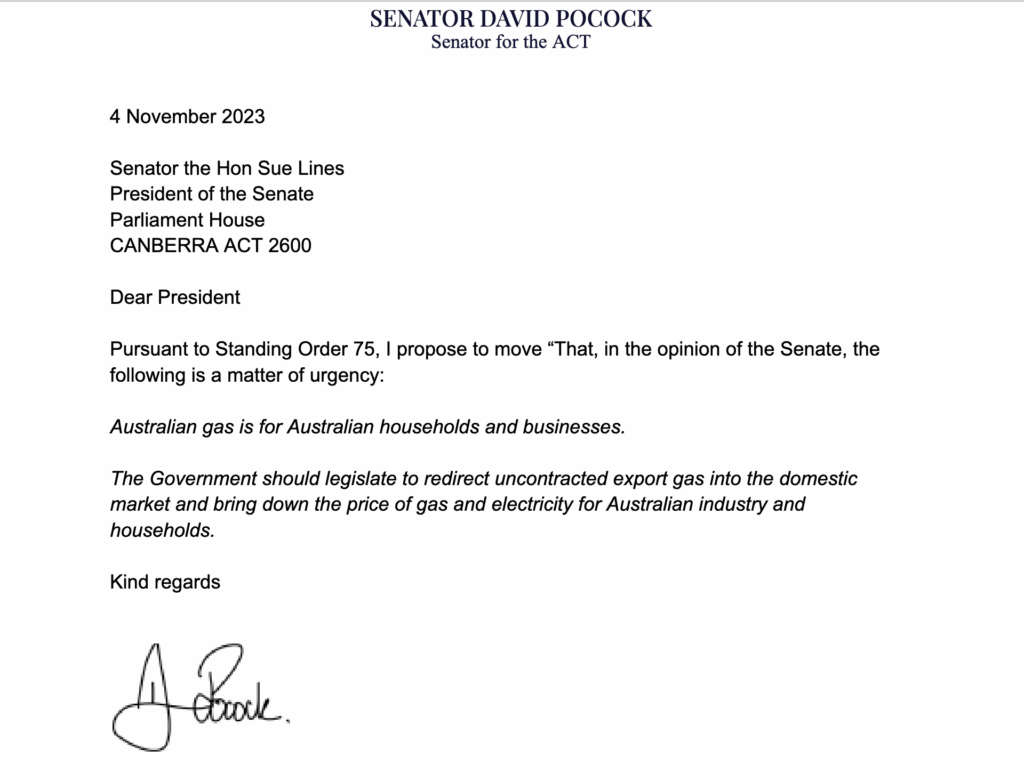
David Pocock to move urgency motion in senate on gas

Independent ACT senator David Pocock will move a motion to debate this in the senate:

Be prepared – Barnaby is laying the ground work for the next stage of the climate wars

Barnaby Joyce is still pretending he doesn’t know what solar panels are. He is taking a leaf out of a Reform UK politician who is making a name for himself at the moment by threatening to lay down in front of bulldozers and stop the UK’s biggest solar farm from being built. Joyce is using the same arguments, and pretending that you can only have one use for land – that a renewable project on a piece of land will mean that there is no way you can run animals on it. That is not true, but between his made up claims of ‘locking up land’ and his made up use of false numbers on the cost, this is the new battle ground.

Mike Bowers recorded some of this morning’s bonker’s doorstop

Chris Minns claims ignorance on reason for protest

AAP

Multiple people have been arrested as a protest outside a weapons expo erupts into chaos, with demonstrators forcing their way through a police barrier.

Hundreds gathered at Sydney’s Darling Harbour on Tuesday to protest the Indo Pacific International Maritime Exposition, a three-day event billed as the “premier forum connecting Australian and international defence, industry, government, academia, and technology leaders”.

The protest, organised by the Palestine Action Group, grew during the early morning before police began deploying pepper spray about 8am in an attempt to break up the surging crowd.

Eight people were arrested by mid-morning as police struggled to hold the crowd back.

“Police will have a presence at the assemblies and will work with protesters to ensure there are no breaches of the peace and there is minimal impact to the community,” a spokeswoman said.

Riot police have been deployed, protecting an entrance to the expo at the International Convention Centre Sydney, about 100 metres from where demonstrators had gathered.

Much of the protest focused on the NSW government’s role in hosting the convention amid the conflict in Gaza.

Exhibitors include Israeli weapons manufacturers and other firms supplying that nation’s military.

“Chris Minns, blood on your hands,” attendees chanted, referring to the NSW premier.

Mr Minns told ABC radio he was unaware of the circumstances surrounding the protests.

He added he was not responsible for invitations to the event and had no input into decisions regarding Australia’s relationships with foreign countries or arms manufacturers.

Protesters during an attempted blockade by the Palestine Action Group
Much of the protesters’ vitriol was directed at Premier Chris Minns. (Bianca De Marchi/AAP PHOTOS)

“That’s the Commonwealth government’s responsibility, it’s not mine,” he said.

“What I would say is that they’re not selling nuclear weapons down at Darling Harbor this weekend. It’s a maritime conference relating to the navy.”

The protest comes a year after similar scenes in Melbourne, when thousands of demonstrators clashed with police and attendees at a major defence and weapons expo.

Protesters lit multiple fires near the expo, blocked traffic and climbed on top of a truck.

Chris Bowen announces default market offer changes, energy retailers sad

Chris Bowen has announced the government will reform the energy default market offer from next year, to force energy companies to offer at least three hours of free solar energy to households, when solar power is at its peak (which is the middle of the day)

It won’t matter if you have solar panels or not – it’s about using the solar power those with panels provide to the grid and sharing it around to more households.

The government is calling it solar sharer and says it is about using Australia’s unique global position as a renewable energy super power and sharing the abundance of solar power now in the grid.

You will have to have a smart meter in order to be eligible though, which means renters, particularly those in low income rentals, will most likely miss out. And to actually save money, people will have to move their energy use to the middle of the day when the deal is in place. That works for people who are at home in the middle of the day, or have modern appliances which can be programmed ahead of time, but not for anyone else.

Still, it’s a tiny start.

The offer, which will be provided through energy retailers, will initially be available to all households in DMO-regulated states – NSW, South-East Queensland, and South Australia – from July next year. We will consult with other states to potentially extend the offer to other jurisdictions by 2027. The Australian Energy Regulator will regulate the Solar Sharer Offer to ensure customers also get a fair deal outside of the free power period.

But the Australian Energy Council’s Chief Executive Officer, Louisa Kinnear said the industry was not consulted before it was announced and that has made energy retailers sad:

Today’s announcement of a new regulated Solar Sharer Offer was a surprise to the industry and did not form part of the DMO Review consultation process. This lack of consultation risks damaging industry confidence, as well as creating the potential for unintended consequences. 

Electricity retailers have been actively participating in good faith with the Government’s DMO Review and had been seeking to support the Government’s intent to align the DMO to an efficient price framework. 

We have just spent the past 5 months engaging constructively with the Government on the DMO review, with the industry broadly comfortable with the anticipated review outcomes, but the lack of consultation on today’s announcement means the AEC can no longer offer its unqualified support.

Outside of the LNP’s bin fire, what else is happening?

Let’s take a look at some of the other things going on this morning:

Hundreds of people have turned up to protest the three-day major arms expo in Sydney. A major police presence has been deployed to face off against the protesters.

The Indo Pacific International Maritime Exposition is hosting “premier commercial maritime and naval defence exposition, connecting Australian and international defence, industry, government, academia and technology leaders, in the national interest” according to the NSW government website, but comes after the Nightly reported that the government has been quietly banning military exports to Israel.

So while the government will no doubt support a crack down on the protesters (which has been how the NSW government in particular has handled protests against genocide and military exports) Australia is also having to respond to their demands, because international law is pretty clear on this issue.

Malcolm Turnbull announced he wanted Australia to become a top-ten arms exporter and successive governments have supported this cause. This is an industry the Australian government is deliberately attempting to attract.

Delulu is not always the solulu.

So does Andrew Bragg think that Sussan Ley will face a leadership challenge in the next six months? Bragg is trying very hard to tell his colleagues not to do it here, while also mangling another idiom.

Obviously, I support Sussan Ley, and I think we need to show leadership now. We can’t backslide when the people of Australia relying on us to hold this terrible Government to account and deliver policies which are reasonable alternatives.

Now, Australians care about climate change. They also want lower power prices. I believe we can thread the needle on this.

It’s very important that Liberal Party develops its own policies and then we try to needle or thread the whole thing together.

Bragg ends the interview by saying that the Queensland and Tasmanian state LNP governments are not as big bin fires on climate, so it’s possible the Coalition can pull out of this terminal decline. He says it’s actually Chris Bowen who is to blame.

Delulu is not always, the solulu.

‘It’s walk and chew gum!’

Unless you like awkward comedy, this interview is a hard watch. Andrew Bragg, who has had to defend and sane wash a lot during his time in the Liberal party is now arguing that that the Nationals and Liberal party can come to an agreement on two very different policy positions, despite the Nationals literally blowing up the show.

He does realise he mangled the last idiom though as he talks about whether its time for the Coalition to divorce. Bragg is arguing that they are just in separate bedrooms at the moment, but it’s totally fine because mum and dad always do this and mum always takes dad back:

By the way, it’s walk and chew gum! I don’t think so. We’ve been married for a long time. There have been times where there have been marriage counselling session and I think before the next session, we certainly need to have our own position.

Because we represent in a main urban Australia. We also represent regional seats. But we need to make sure that we have a credible policy to present to the people who live in urban Australia. We’re a highly urbanised population and the expectation is, particularly with how many millennials and Gen Zs are on the voting rolls now, that we actually believe that this is a real risk to our future, and that we have a credible policy to address it.

So does Bragg think mum and dad should stay married?

Well, there’s a reason you have divorce laws, I guess. But we would be much better served to stay with the Nationals, because we have given Australia good government over this last 80 years. So that would be my strong preference. But it’s not at any cost. And this is a point about Labor’s net zero. They want to do their net zero at any cost. We want to do…

So he agrees – maybe mum and dad should divorce:

Well, the Liberal Party is its own party. And we need to deploy policies that allow us to maintain our status as a party of government. But we want to work with the Nats, because I don’t believe that the fragmentation of the centre-right is in Australia’s interests.

We want to have coherent, economic and national security policies, right. We’re living in a very dangerous age, so maintaining the Coalition is a high priority. But, I mean, you don’t do these things at any cost. And as I say, Labor want to do their net zero at any cost. We think that’s crazy and that’s hurting Australians.

It’s sometimes harder for adult children to deal with the inevitable truth that mum and dad should have divorced years ago.

‘I think that we should be able to chew more gum,’ says Liberal senator

Andrew Bragg, who is one of the last remaining Liberal moderates, has taken it upon himself to try and make the Liberal party seem less like the political party equivalent of a middle aged man going through a mid-life crisis and setting their dating age as 18-25 on the app, but he’s fighting the tide here.

He opens up to ABC News Breakfast with his prepared lines:

Australians are concerned about climate change. They see the impact on our climate and then want us to conserve the environment. People also want lower power prices, of course. And I think that this is a real moment for leadership now, not backsliding. Because our job here is not to worry about what people’s personal preferences might be, but setting out a long-term course for the nation, which protects and guards against climate change, which of course, we have to do, by working with other nations. So, we need to take the long-term view on the environment and the economy, not taking into account or focusing too heavily on short-term political issues.

So what is that detail for the man who last week, said net zero was a ‘non-negotiable’ for him?

I don’t see how we could walk away from the Paris Agreement. I don’t see how we could walk away from our commitment to reduce emissions. Virtually every country is in the Paris Agreement. Virtually every country has committed to net zero emissions. We would be a pariah state. And the reality is that countries like Canada and Japan, who are committing to net zero like Australia has, are also able to provide cheap power. So I don’t believe that it is net zero that is the enemy here. I believe that the enemy is Labor’s electricity policies and their aversion to using coal for longer*. Their aversion to using other things like nuclear*. I think that that is the real cause of our problems in Australia where we’re seeing higher power prices and losing industry offshore.

*You can see part of his soul shrivel up at these points as these words leave his mouth.

So what is the actual policy Bragg is supporting here?

Well, the Paris Agreement is the redline here. I mean, you’ve got to be in the Paris Agreement. Because if you weren’t, you would be in a group of countries like Iran and Libya and maybe two or three others. So you’ve got to be in the Paris Agreement. And the Paris Agreement requires you to get to net zero in this century. I think that that would be an important objective for Australia to maintain, as a serious country. And with a group of people in this country that actually do care about climate change.

You can tell he is under stress because he completely mangles an idiom while trying to pretend that everything he is saying makes complete sense.

The Nats have made points here where China is a world leader on energy, but also a world leader on opening up new coal fired power stations. Why should we penalise our own people? I think that we should be able to chew more gum.

Calls increasing for Labor to drop police welfare powers

Yesterday, there was more attention on Labor’s revival of a 2018 Coalition measure to allow police to recommend suspected criminals (not convicted, just suspected) have their welfare cancelled. Which is a reversal of the presumption of innocence.

Lidia Thorpe wants the amendment taken out of the unrelated bill the Labor government have tacked it on to, because the measure will more than likely be used against Indigenous people.

The Antipoverty Centre, which was one of the first civil society groups to raise the alarm, said that more groups have come together to scrap the proposal, which Labor officially got rid of in its first budget in October 2022, after it sat there for years following the Turnbull government attempt to bring it in, but decided to revive in 2025.

The legislation is due to be debated in the senate today where Thorpe will move to strike out the amendment and if that fails, David Pocock will attempt to split the bill to have the amendment (which does not have anything to do with the bill Labor is using as a Trojan horse) considered on its own in an inquiry.

Groups supporting the call for the government to abandon the amendment:

Anglicare Australia | Antipoverty Centre | Anti-Poverty Network SA  | Australian Council of Social Services | Australian Unemployed Workers’ Union | Council of Single Mothers and their Children | Disability Advocacy Network Australia | Economic Justice Australia | Everybody’s Home | Mental Health Lived Experience Peak Qld | National Aboriginal and Torres Strait Islander Legal Services (NATSILS) | NSW Council for Civil Liberties | Queensland Advocacy for Inclusion | Single Mother Families Australia | Wirringa Baiya Aboriginal Women’s Legal Centre

Monique Ryan on vested interests

Monique Ryan then explains what she thinks the difference between lobbying and raising concerns is:

Have I been lobbied? I speak every day to people who want to tell me about things that matter to them and that is lobbying and there’s nothing wrong with that.

But I think vested interests like sports companies, betting companies, have too much influence. I introduced my own bill earlier this week about lobbying activities, to regulate them better and have greater transparency who is meeting with ministers, where, when and why, to open ministerial diaries and enforce the lobbyist code of conduct we have here which is unenforced and has the effectiveness of a wet tissue.

It’s really important because Australians are asking why the Government hasn’t taken action on gambling advertising and the Prime Minister has never explained this to anyone’s satisfaction and it has to be because he’s listening to those people more than to those who voted him in and care about this issue.

Labor ‘listening more to vested interests than to the Australians who elected them into power’

It’s also Melbourne Cup day, so Australia is feeling Melbourne’s middle child syndrome more than usual today. What does Monique Ryan think about the Cup?

I generally do have a bet. People enjoy the Cup. I’m someone who has, in the past, attended it. I have some concerns about it. Y

esterday in Parliament I read a letter I’d received from primary school students in my electorate asking for stronger regulation around gambling advertising in Victoria. Primary school kids from Auburn South Primary say they want the Government to crack down on online gambling advertising. My own 17-year-old, many of his friends have gambling accounts.

I’m concerned about the impact of online gambling platforms and its effect on young people and people ask me to act on the Government’s failure to act on the failure to act on online gambling.

It’s more than two years since the report, 31 recommendations, not one of them act on yet and I’ll continue to push them on that.

Years ago I had to go to a bookmaker and or a racetrack and nowadays you can bet on the train, or lying in bed and many do and lose their life savings.

What is holding the Government back from action on this? There’s a blueprint ready to go and we could legislation within a week.

The problem is the Government is too close to the broadcasters, the sports companies and the betting companies and we’ve seen lots of evidence of that in the past. They’re listening more to vested interests than to the Australians who elected them into power.

‘I would hope that the Coalition pulls itself together’

Monique Ryan has had to understand Liberal party voters in order to be able to defeat it (twice) in Kooyong, so she has some insight when she’s asked what it is the Liberal party is doing:

I think people are asking what the Liberals care about, what their policies and principles are, and at the moment all they seem to care about is their own political prospects, which are heading to oblivion if they continue to behave this way.

Sussan Ley is the Liberals’ first female leader. She’s come to power ever a really disappointing campaign by Peter Dutton, where he didn’t lay out any significant policy framework. She hasn’t been given a chance to show whether or not she can do that.

I don’t think she’s been particularly impressive herself, to be honest, but, you know, people want the conservative side of politics to have a policy platform. We’ve seen in Victoria for many years what happens when you don’t have an effective Opposition. What you have is a poor government that can do what it likes and Australians deserve better. They need to have an effective Opposition. So I would hope that the Coalition can pull itself together in some shape or form so it can do that. Because, if it doesn’t, you know, electorates like Kooyong are not going to turn back to the Liberal Party.

‘Nats heading to net zero in terms of their own seats’

Independent MP Monique Ryan has spoken to ABC News Breakfast about the Coalition’s breakdown on net zero, with Sussan Ley and the Liberals most likely to follow the Nationals in dumping the net zero by 2050 goal.

Ryan, like most people who have spent the past 30 years watching this same fight play out, is over.

I think we’ve had two recent federal elections where the voters of electorates like Kooyong have expressed their desire for Australian politicians to commit to and act effectively on climate change and environmental protections, so they’ll be incredibly disappointed to see the Nationals walking away from that as they have in the last couple of days.

I think the Nats are heading to net zero in terms of their own seats in terms of any environmental protections and climate commitments.

It’s incredibly disappointing to see this. In front of Parliament this week is a really important bill about spacey protection and environment and we’re not talking about this incredibly important piece of legislation – which is not strong enough – we’re just looking at the Liberals and Nats turning on each other and examining their own entrails.

Electorates like mine expect better from the conservative side of politics.

Teal MP says Labor environment laws ‘may even weaken nature protections’

Independent MP Sophie Scamps has announced she can not support the government’s environmental protection legislation.

It doesn’t matter on the numbers, but it does matter when it comes to public perception of the bill. If the independents elected on a platform of climate action don’t like Labor’s landmark environmental reforms, well, that matters.

Scamps says:

I cannot in good conscience support these bills as there are so many loopholes, exemptions, omissions – and so much ministerial discretion – that there is no guarantee our nature will be protected. In fact, this bill may even weaken nature protections.”

For 25 years our weak environment laws have not been fit for purpose, and the result has been devastating. We now have 19 ecosystems on the brink of collapse and Australia leads the world in mammal extinctions and sits alongside Brazil and Bolivia as a global deforestation hotspot.”

I want urgent action to turn this around, but what’s on the table now has loopholes big enough to drive a giant heavy hauler through it. Whilst we do need greater certainty for business, we also need proper protections for nature, and these reforms catastrophically fail on the later.”

Australian nature is too precious to settle for environmental reforms that don’t address the carnage of our native forests, animals, waterways, coastlines and landscapes.”

Scamp lists her key concerns as:

  • A broad and poorly defined ‘national interest’ exemption 
  • Native forest logging and land clearing exemptions remain
  • Weakening of the water trigger, leaving rivers at risk from big developments 
  • No requirement to consider climate change impacts on nature
  • Excessive ministerial discretion
  • No independent appointment process for the new National Environmental Protection Agency
  • Devolution of decision making to the states and territories 

ICYMI – Fact Check: Will Net Zero cost $9 trillion to Australia?

We reported this yesterday, but it is worth re-visiting (again and again and again) because you are going to be hearing these lines from the Coalition A LOT and it is important to try and head these particular furphies off at the start:

Skye Predavec
Researcher

As the Nationals abandon their commitment to achieving net zero by 2050, leader David Littleproud has cited a stunning $9 trillion dollar price tag on the policy as a key reason for the move.

So, will net zero really cost $9 trillion to Australia?

In a word: no.

The figure, now commonly cited by right-wing outlets like the IPA, originally came from a 2023 report from Net Zero Australia, a partnership of three universities that conducts research into net zero pathways.

Their 2023 study did say that achieving net zero required Australia to “attract and invest $7-9 trillion of capital to 2060 from international and domestic sources”. But it is nonsensical to use this number in the way Littleproud has, for three main reasons:

1. This is total capital investment, not government spending

The $7-9 trillion is the total of all the money invested my private companies building wind farms, homeowners installing rooftop solar, and someone switching to an electric vehicle when they’re due for an upgrade.

This money is also an investment, so Australia will get trillions of dollars worth of assets out the other end.

It’s pretty misleading to pretend this will cost government budgets $9 trillion, so net zero will not, as Littleproud claimed, “put things like Medicare at risk”.

2. Net cost not gross cost

The $7-9 trillion figure is only the “cost” of net zero if the alternative is zero spending on energy infrastructure, by anyone. That would mean no spending on energy generation, power lines, or even cars (including petrol) – not a realistic scenario.

Perhaps realising that their $7-9 trillion figure was easy to use in bad faith by those opposed to renewable energy, Net Zero Australia updated the figure in their 2025 report. Accounting for the capital costs of doing nothing, they now estimate that “$1.6 trillion capital investment must be unlocked to achieve net zero by 2050”. This is a fraction of the number Littleproud has been using.

According to the 2025 figure, Australia would only need an additional $64 billion in investment per year – an eminently achievable task in a country with a $1.8 trillion GDP and $735 billion government revenue annually.

3. It does not account for the costs of unmitigated climate change

Even this price tag does not take into account the costs of inaction, such as managing climate disasters. The National Climate Risk Assessment released earlier this year estimated that increased natural disasters alone would cost the Government $40 billion dollars annually.

Verdict: Gross misrepresentation.

You can read the full fact-check here.

Most Australians think politicians’ secret cash-for-access payments are corrupt

Glenn Connley

New Australia Institute polling research shows most Australians, regardless of who they vote for, think cash-for access payments represent corrupt conduct. Cash-for-access describes exclusive fundraising events where companies and lobbyists pay to meet with senior party leaders.

The polling follows reporting of the Albanese Government’s Federal Labor Business Forum, where corporations pay up to $110,000 for privileged access to Government Ministers. Government ministers are also keeping details of the meetings secret by blocking access to ministerial diaries. The Liberal and National parties engage in similar activities, though their own business forums.

Key findings: 

  • Three in five Australians (63%) think that cash-for-access payments constitute corrupt conduct. Only 12% do not. 
  • Most Australians think cash-for-access constitutes corrupt conduct, regardless of voting intention. 
  • Four in five Australians (82%) agree that paying for exclusive access to politicians gives corporations and special interests unfair political influence. 
  • An overwhelming majority of Australians (78%) agree that politicians should refuse to participate in events where participants with a vested interest in government policies have paid for exclusive access.

“Politicians could improve public faith in democracy by ruling out taking money in a way that most Australians view as corrupt,” said Mark Ogge, Principal Advisor at The Australia Institute.

“It’s clear that cash-for-access payments completely fail the pub test.

“It’s not surprising that trust in our political system is low when the major parties are selling access to corporations vying for special treatment at the expense of ordinary Australians.”

New polling reveals only 8% of Australians genuinely convinced Australia “shares values” with Trump’s America

Glenn Connley

In May 2025, Deputy Prime Minister Richard Marles said that Australia and the United States “share values” including “democracy and the rule of law”.

However, new polling commissioned by The Australia Institute reveals that only 8% of Australians strongly agree with that statement.

Further, fewer than half of Australians think the AUKUS deal is in our best interest or makes us safer.

The polling also revealed half of Australians think the US is less democratic under Trump, and half would feel unsafe travelling there.

“Australians are deeply concerned about what is happening in the United States today – so concerned, in fact, that half of us would feel unsafe travelling there,” said Dr Emma Shortis, Director of the International & Security Affairs Program at The Australia Institute.

“Australians are often told that we “share values” with the United States. These numbers suggest that Australians are far from convinced that we share values with Donald Trump’s America.

“Only 16% of Australians believe that the United States is a “very reliable” security ally. Australia has promised to hand over $368 billion dollars in the belief that the United States will come through. The Australian people don’t appear to share that faith.

“The Labor government has failed to adequately explain the AUKUS agreement to the Australian people. 37% of Australians now don’t know or aren’t sure if AUKUS makes Australia safer – an increase of 6% from previous polling in July”.

Remember – it is feel sorry for Tim Wilson day, because he has to work

Just a reminder for everyone to put their franking credits out for Tim Wilson today, as the poor MP has to work even though it is Melbourne Cup day. Wilson had a tongue-in-cheek whinge about the unfairness of it all while at Derby day with half of his colleagues (all in different marques though, because it is not as if they actually like each other) which Patrick Gorman used yesterday to remind everyone how much they don’t like Tim Wilson.

So yes, it’s Melbourne Cup day and Mr Melbourne has to work. He was only able to swan around at Derby Day, which everyone knows is the Aldi Cup day.

Just another reason to always be kind, because you truly don’t know what secret battles someone else is facing.

Good morning

Hello and welcome back to another day of The Point Live. A very big thank you to Glenn Connley who took you through most of yesterday so I could finish a book project on deadline and save myself from being chained to a desk by my publisher and forced to watch non-stop dixers as punishment.

Speaking of punishment, Sussan Ley is still leader of the Liberal party and the Australian, the AFR and the Liberals who still talk to me were all saying the same thing last night – that she will most likely follow the Nationals and dump net zero to keep her leadership alive for a smidge longer.

But the party room is already starting to sniff in the direction of Angus Taylor. Ley is damned if she does or doesn’t here – if she stands up to the Nationals, it’s over and if she doesn’t stand up to the Nationals, she shows how weak she is, and it’s over. The Nationals have driven the Liberals into the ground and are now shoveling dirt on top, but their act of self-saucing destruction will also spell the end of their own party’s relevancy – they are just yet to see it. It does say everything about the current political climate that Labor is taking it fairly gentle on Ley and focusing their mirth on Barnaby Joyce and the Nationals, as it shows who Labor sees as the actual power. Ley is an after-thought, and a pitied one at that. You could feel some sympathy for her if she had ever stood for anything.

It is party room meeting day, so some of this will come to a head. Labor is going to take a back seat as much as possible and let all of this play out – but let’s all remember that Labor also made the decision to allow Barnaby Joyce’s private members’ bill to scrap net zero be debated in the house – and week, after week at that – which was all designed to create this very situation. They saw this playing out exactly as it has because at this point in time, all these people have sat across from each other for a lot of years now, and know exactly what makes them tick.

When they are writing the epitaph for the Coalition, tell Howard it was me (Albanese, probably)

We will be keeping an eye on that shit fight as well as debunking most of the ridiculous things they will no doubt say, so I hope you’ll stick around. I’ll be with you throughout the day, and you’ll have the lens and contacts of Mike Bowers as well, because he’s just lovely like that.

It is going to be a four coffee day. At least. Thanks for sharing your coffee routines with us yesterday – the next priority with the blog is to set up a more traditional comments system so everyone can have a chat under the blog, so thank you for sowing the seeds of that community now. We are loving hearing from all of you and hope to set things up so you can have a chat with each other, soon.

It is going to be a messy day, so make sure you bring your protective clothing. No one likes splashback.

Ready? Let’s get into it.


Read the previous day's news (Mon 3 Nov)

Comments

Start the conversation

The biggest stories and the best analysis from the team at The Point, delivered to your inbox.

Past Coverage