
← Home

Mon 27 Oct

The Point Live: Barnaby keeps the Nats guessing on his future. As it happened.

Amy Remeikis – Chief Political Analyst

This blog is now closed.

Key Posts

The Day's News

Sex workers from across the nation will rally in Sydney tomorrow in protest of Australian Border Force raids they say “target migrant and Asian sex workers under the guise of “immigration compliance.”

From the release:

The rally will held at Belmore Park, Sydney, on Tuesday 28 October from 4:00 to 6:00 pm and calls on the federal government to:

  • End racially targeted “compliance” operations and workplace raids;
  • Establish fair visa pathways for migrant workers;
  • End racial profiling at the border; and
  • Close offshore detention centres like Nauru, allowing people awaiting visa outcomes to live safely in the community.

Organised by Scarlet Alliance, the Asian Migrant Sex Worker Advisory Group, and SWOP NSW, the action responds to what organisers describe as an “ongoing campaign of intimidation and racialised policing” against Asian migrant sex workers.

This is not about compliance – it’s about power, racism, and the denial of basic human rights,” said Bee, a spokesperson for the Asian Migrant Sex Worker Advisory Group.

Armed officers storming our workplaces don’t protect anyone. They terrify workers and push our communities further underground.”

Scarlet Alliance, which advocates for sex workers in Australia, including by providing assistance and support when needed, says Border Force raids on sex industry workplaces have “intensified in recent years [and are] now occurring almost weekly”.

Bee says the community “has endured armed officers staking out our workplaces, confiscating phones, and even denying us translators during raids”,” said Bee.”.

These raids make us too scared to seek help from police when we experience violence. How can we trust authorities who treat us like criminals?”
Recap of the morning

Here’s what has happened so far today:

Labor is looking to pass its environment laws and wants the Coalition to come to the table to do that (so the laws remain the least they can do)

The Coalition remains a mess

Barnaby Joyce has skipped out of the Nationals party room meeting, but is still in the party

Joyce says this is because everyone knows he is against net zero so he shouldn’t be there when the discussions are had. David Littleproud says Joyce is welcome to remain in the party room, but the decision is his.

Anthony Albanese is in Malaysia where he has announced funding for two investment funds designed to help smooth the path for Australian businesses investing in south-east Asian infrastructure projects

Here is a message from the Australia Institute digital team:

While Labor forges ahead to make a deal with the Coalition to pass its environmental legislation, we can’t let them forget that the Australian public voted for a climate majority at the last election.  

That means strong new environment laws that can stop new coal and gas. Not new laws that will reportedly remove “red tape” to speed up approvals and fail to include a climate trigger – a crucial safeguard to stop catastrophic climate impacts. 

If you feel strongly about that, you can sign the petition, here.

Angus Taylor, who is the shadow minister for Defence (in case you were wondering what he was up to lately) did some of the morning round this morning, where he defended Sussan Ley, by not defending her.

For my pop culture lovers out there, Selena Gomez is an expert at this – Gomez often shades Hailey Bieber on social media (Gomez was on a very torrid on-again-off-again relationship with Justin Bieber, who married Hailey on an ‘off-again’ stage) by calling for kindness from her social media followers, in a way that makes it clear she is painting Bieber as needing some pity). Taylor isn’t as practiced, but he gives it his best shot.

This morning he told Sky News:

Sussan Ley is focused on what I think all of us are focused on, which is seeing more investment in our great nation. We desperately need it. Investment has fallen off a cliff under Labor, and that includes, of course, the mining industry and other resource-based industries. We need to make sure that we see investment increasing, and the key to that is making sure approvals aren’t endless. They are endless under Labor, we’re seeing 14 years, 16 years indeed, between…[finding and approving]

So not exactly a rousing defence.

As for Barnaby Joyce, Taylor says:

Well, it is a National Party issue, but I want to see Barnaby around the table. I’ve been around the table with Barnaby throughout my political career and spent a lot of time with him around the Cabinet and Shadow Cabinet table, and he has always been an extraordinary contributor and a contributor with great insight. We don’t always agree, but it doesn’t matter. That’s the point. He is a person you want to have as part of your team, and I strongly encourage him to remain part of that team

And on whether he thinks the Coalition should keep net zero as a policy (not that it matters) Taylor says:

Well, we’ll be talking about it this week. I don’t think it will be all resolved this week, but I think the starting principle here is that we shouldn’t ever accept any target which is destructive to the economy or unachievable, we’ve already rejected Labor’s bad plan for 2035 – a target of 62-70% – which is unachievable.

I mean, Labor’s barely moved emissions since they’ve come to government. Emissions are still at very close to the level they were at when I was Energy Minister, Pete, and to think that they’re going to get to suddenly, to 62 to 70% when they’re struggling at 28% I mean, it’s just not credible, and so we should reject targets that are unachievable, and we should reject targets that are economically destructive.

Make no mistake about it. I mean, Labor’s own plan, they’ve laid it out in their own documentation, requires a carbon tax of around $300 over time, and that’s about 13 times Julia Gillard’s carbon tax. That’s what they’re planning, Pete, we can’t accept that as Liberals, and we won’t accept that.

There is absolutely no evidence Labor is planning a carbon tax.

Queenslander sworn in as One Nation’s senator for NSW

Bill Browne

Sean Bell has been sworn in as Australia’s newest senator, following the sudden resignation of Warwick Stacey due to health reasons. Unusually, Senator Bell is a Queenslander – though in the process of moving to NSW, the state he will represent in Parliament as a member of One Nation.

Former One Nation state leader Mark Latham was unimpressed, but failed to get the nomination overturned.

Of course, parliamentarians moving about is not unusual. Barnaby Joyce was a National senator for Queensland before winning the NSW seat of New England, and Pauline Hanson herself ran for the NSW Legislative Council between bids to represent Queenslanders. That said, both Joyce and Hanson had moved to NSW before they ran.  

Much more common is the politician who already lives in the same state but comes from outside the electorate.

In 2022 the Labor Party attempted two high-profile “parachute” candidates: Andrew Charlton in Parramatta and Kristina Keneally in Fowler, both having moved to their respective electorates just months before the election. Only Charlton was successful.

I’m sympathetic to MPs who live a bit outside their electorates, provided they understand the local area. Urban electorates can be geographically very small, and the borders are liable to change. We all have connections to many parts of the cities or regions we live in, not just the suburb in which we live.

I knew someone who was criticised as an “out-of-electorate” candidate, but his work and community life were in the electorate – the border just happened to be drawn between his house and his local city centre.

You don’t necessarily need to be from a place to represent the community’s interests, values and priority commitments.

Whether you agree or disagree, his six-year Senate term Sean Bell and the people of NSW will be seeing a lot of each other.

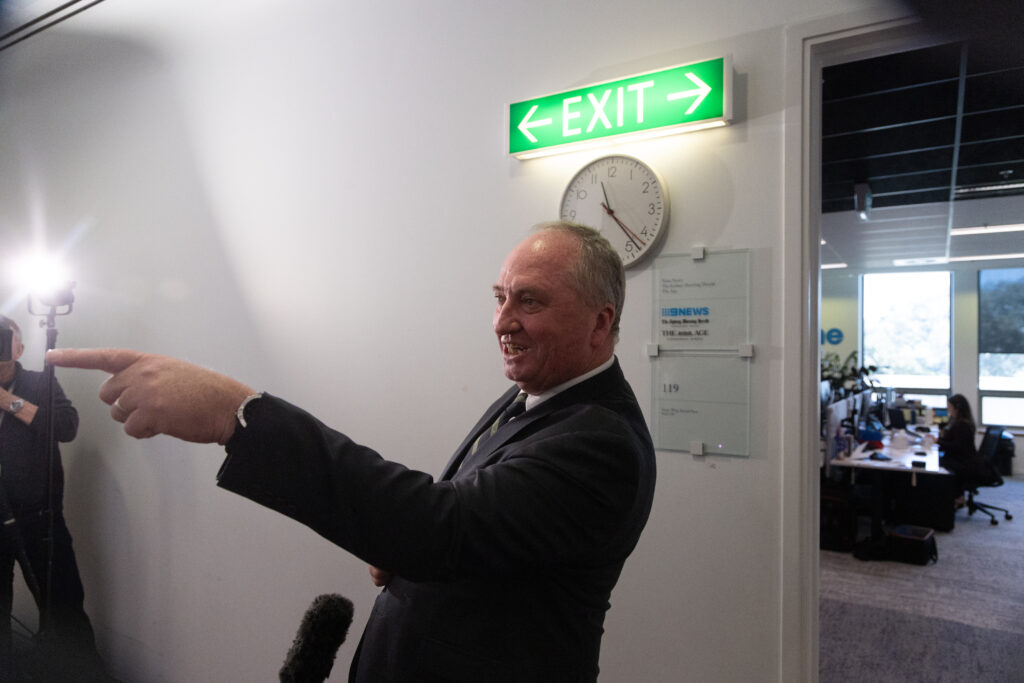
Barnaby Joyce has held a press conference in the press gallery to say….nothing. It’s all that we knew already. He is making up his mind, weighing up his options, yadda yadda yadda.

He chose to have the press conference under an exit sign.

Barnaby Joyce talks to the media in the Press Gallery of Parliament House in Canberra. Photo: Mike Bowers

Joyce:

It’s important for the National Party to – they know my position – to have the capacity to, in confidence, have the discussion as they wish. And I’ve made my point quite clear – I’m not going to attend any party room that in net zero, because I’m adamantly against net zero. I think it’s hurting poor people.

Meanwhile, David Littleproud has said that Joyce is welcome back into the Nationals party room meeting anytime he wishes – he just has to commit (not Joyce’s strong suit)

Sometimes, as leader, it doesn’t make you popular sometimes, but you’ve got to think about what’s to the long-term benefit of the party, and that’s the burden of being the leader of a political party,” Littleproud said a little earlier today while “encouraging” Joyce to come back.

It’d be great to see him in these key discussions, but it’s a decision he has to make,”

So Littleproud wants him back, but won’t beg.

Progressive independent wins Irish presidency, continuing Ireland’s embrace of independents

Bill Browne
Director Accountability & Democracy Program

Leaving Australia behind for a moment, independent candidate Catherine Connolly won Friday’s Irish presidential election after beingnominated by a progressive coalition including Sinn Féin, Labour, Social Democrats, and several other parties and independents.

The position of President of Ireland is largely ceremonial but, like Australia’s Governor-General, the President does wield some reserve powers. The election used preferential voting, like Australian elections, which means you cannot “waste” your vote by putting a less popular candidate first.

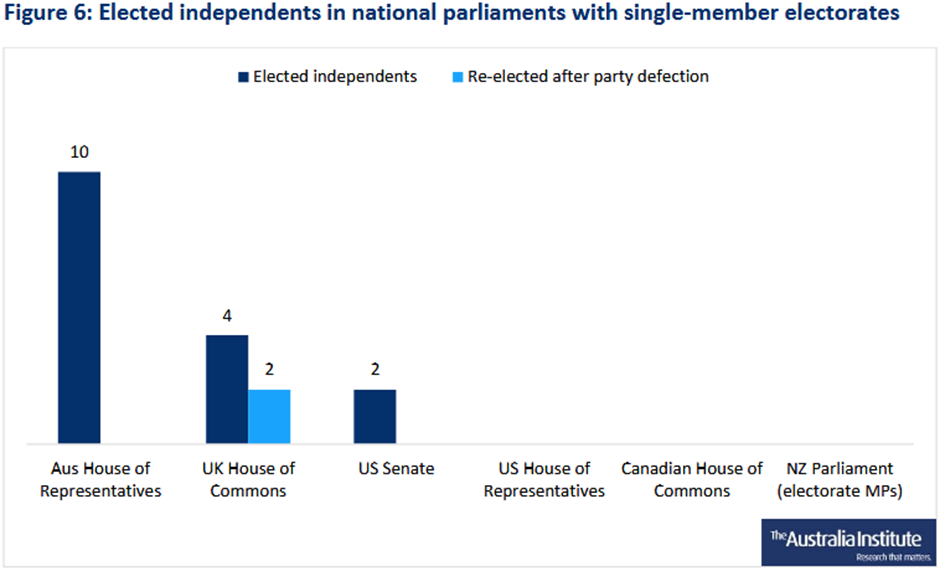
Last year, the Australia Institute looked at how likely independent candidates are to win elections.

Ireland and Australia are exceptions to the rule that independents are vanishingly rare in Western democracies. There are 16 independents in Ireland’s lower house, even more than Australia’s 10 in the House of Representatives (depending on how you count these things, you could add a couple more).   

But Irish independents benefit from their proportional representation style of electing local members. Australia is far ahead of other countries with just one local MP per electorate.

(Correct at time of publication in 2024 – numbers may have changed since then.)

And then we get to the announcement; funding for two investment funds:

The Government will invest AUD$175 million in IFM Investors’ Asia-Pacific Debt Fund and USD$50 million in a new Southeast Asia Public-Private Partnership (PPP) investment fund established by Australian infrastructure specialist Plenary. 

These funds are designed to make it easier for Australian firms to bid and spend on Asian infrastructure projects.

Anthony Albanese:

Today, I’m very pleased to announce we’re delivering on our commitments to the region. We will invest $175 million into IFM Investors’ Asia-Pacific Debt Fund, a leading global investment manager owned by Australia’s industry superannuation funds.

This is a cornerstone transaction which will boost IFM’s expansion here into South-East Asia. Our investment will open the door to South-East Asian markets for 15 Australian super funds, paving the way for these funds to deepen their engagement and investments across the region. We’ll also inUS$50 million to establish a new platform by leading Australian public-private partnership infrastructure company Plenary.

Plenary is an Australian infrastructure champion. With this new platform, we’re supporting the direct export of Australian expertise and know-how to deliver nation-building projects in South-East Asia through public-private partnerships.

This platform is expected to support much-needed infrastructure projects in Indonesia, the Philippines, and elsewhere. Together, these investments represent a major step forward in my government’s delivery of our South-East Asia Economic Strategy, to boost Australian exports and investments in the region, back the growth of Australian companies, and support the region’s infrastructure needs.

On to trade, and the prime minister says:

Last year, Australia’s two-way trade with South-East Asia reached a record high. Two-way trade has grown by nearly $6 billion, while Australian investment in the region has increased by around $2 billion. And that hasn’t happened by wishing and hoping.

It’s been shaped by the expert of and insights of our 10 business champions, including our Business Champion for Malaysia, Tony Lombardo, the CEO of Lendlease.

It’s been driven by our Deal teams, identifying potential projects across the region. This combination means that Australia’s making new investment in farming in Laos, energy in Thailand, infrastructure in Vietnam, and through Toll, transport and logistics across South-East Asia. From our government’s point of view, this is just the beginning. There is a $20 billion pipeline of projects where we see value for Australian capital and financing.

What’s more, we’re backing ideas and innovation too. The landing pads that we’ve established in Jakarta, Ho chi Min City and Singapore, have more than 160 Australian tech companies to scale up their presence in the region. And through to the ethos of ASEAN and the spirit of mutual benefit, we have worked to make it easier for the economies of South-East Asia to invest in Australia.

Anthony Albanese addresses ASEAN summit

The prime minister is speaking in Malaysia, where he landed late last night for the ASEAN summit:

In the best traditions of ASEAN, we gather here to seek ways of deepening our cooperation to our mutual benefit, recognising that the best way to enhance the security and resilience of our economies is not to turn inwards, it is to look outwards. To deepen and diversify our trade ties and economic cooperation, and to strengthen the bonds between our citizens. That requires more of us in signing an agreement or issuing a declaration. Instead, this is progress that we measure in acts of practical partnership, new businesses opening, new energy and infrastructure projects commencing, new investments in manufacturing, and new friendships being forged through education or through cultural exchanges.

That is how we can drive a step-change in our region’s economic integration and, indeed, our economic resilience.

As a pro-trading nation and an outward-looking economy engaged with the opportunities of our region, Australia is ready to play our part in shaping this change.

The biggest stories and the best analysis from the team at The Point, delivered to your inbox.