Tue 15 Sep

The Point Live: Red Lines legislation to be introduced in both houses, new Labor invite only grants scheme under microscope, Hanson under pressure. As it happened.

Amy Remeikis – Chief Political Analyst and Political Blogger

This blog is now closed.

11

Key Posts

The Day's News

See you tomorrow?

And after a brief rant on a stage, I am back on the blog…to close it down.

But only until tomorrow! Thank you to my editor Anna Chang and colleague Glenn Connley and the entire Point team for keeping everything up and running while your blogger wore a couple of different hats – this is a small but dedicated team who are very passionate about trying to inform you with what you need – as well as let you know what you don’t. It operates on passion and a fiery desire for justice and a better world – and we couldn’t do it without you. Thank you to everyone who joins us each day – and especially our small group of loyal commenters – we love you. (Even you Shoe).

Until tomorrow – take care of you. Ax

Human Rights Commissioners condemn Senator Hanson’s racist remarks targeting First Peoples 

Anna Chang

The Australian Human Rights Commission has also just released a statement on Senator Pauline Hanson’s racist remarks:

The Commissioners responsible for First Peoples social justice and combating race discrimination have rejected racist, dehumanising comments against First Peoples by Senator Pauline Hanson.

‘This country prides itself on shared values of fairness, dignity and respect. The Senator’s comments utterly contradict these values and have no place in the national conversation,’ said Aboriginal and Torres Strait Islander Social Justice Commissioner Katie Kiss.

‘Such commentary is a tactic to divide us at a time when we need to come together. In fact, people have come together over the past 24 hours, across the political spectrum, to criticise the Senator’s comments. For that, I am heartened. But the harm caused should not be underestimated.

‘Australia’s First Peoples are the custodians of the world’s oldest continuing cultures and are vital to shaping who we are as a nation. Their knowledge, leadership, creativity and continuing survival enrich us all, and have done so for tens of thousands of years.

‘Indigenous artists inspire generations and deepen how we view ourselves and the world around us. And Elders are the conduits of history, generously sharing their wisdom and lived experience so each of us can learn, reflect and grow.

‘First Peoples have endured generations of discrimination, exclusion and attempted erasure. Public discussion of Australia’s history and identity must be grounded in respect, truth-telling and a recognition of the enduring strength and contribution of First Peoples.’

Race Discrimination Commissioner Giridharan Sivaraman said: ‘Whether our ancestors arrived more than 200 years ago, or we are recent migrants, we all live on lands and waters that were maintained by and hold the cultures of First Peoples. Recognising that gives us strength and brings us together. Denigrating First Peoples does the opposite and lessens all of us.

‘When public figures use language that dehumanises entire groups of people, it causes real harm. History has shown that when people are portrayed as less deserving of dignity, respect or belonging, discrimination and exclusion are more likely to follow.

‘We must take meaningful steps to ensure racism is identified and prevented wherever it occurs, including in our institutions. That is why one of the recommendations of the National Anti-Racism Framework is for anti-racism training for all Parliamentarians.   

‘Public officials have a responsibility to lead with integrity and uphold the dignity of all Australians. The standard must be clear – racism has no place in Australia, least of all in our halls of power.’

Win for Susan Neill-Fraser as parole board gag order found unlawful

Anna Chang

The Human Rights Law Centre has just released this statement.

The Human Rights Law Centre welcomes today’s Supreme Court decision that the parole conditions imposed on Tasmanian grandmother Susan Neill-Fraser restricting her ability to speak publicly about her alleged wrongful conviction were unlawful. 

For almost two years, the conditions imposed by the Parole Board of Tasmania prevented Ms Neill-Fraser from speaking publicly about her claimed innocence and to advocate for reform on wrongful convictions. 

The Supreme Court declared that conditions imposed by the Parole Board of Tasmania in December 2024 and May 2025 were invalid and unlawful. 

The State of Tasmania conceded the conditions were unlawful, accepting that: 

  • Ms Neill-Fraser was denied procedural fairness before the conditions were imposed; 
  • the conditions were uncertain, ambiguous and legally unreasonable; 
  • the Board’s decision-making was affected by a document containing legal authorities that were likely AI-generated hallucinations and did not in fact exist; and 
  • the decisions involved jurisdictional error and should be quashed. 

This case has exposed serious deficiencies in Tasmania’s parole system, including the ability of parole boards to impose sweeping restrictions on fundamental rights without notice, without a hearing, and without access to legal representation. 

This decision has not only vindicated Susan’s fundamental right to speak out, but also supports others who may be subject to unjust parole conditions, particularly people from marginalised communities who are overrepresented in the criminal legal system. 

In August, ahead of today’s decision, the Tasmanian Parole Board removed the parole condition preventing Susan Neill-Fraser from speaking to third parties. 

Susan Neill-Fraser: 

“I am very pleased and relieved that the parole order preventing me from speaking about my case has been removed. 

“I would like to emphasise that in challenging the parole order it has never been my intention to cause anguish or distress to others. 

“I have always maintained my innocence. I am continuing in the quest to clear my name and to advocate for the broader issue of wrongful convictions in Australia. I cannot walk away from this. 

” I would like to express my heartfelt thanks to the Human Rights Law Centre and the barristers who have worked tirelessly on this matter. I am so grateful for all of the support that I have received from countless people.” 

Sarah Schwartz, Legal Director Human Rights Law Centre: 

“A healthy democracy depends on people being able to speak out about matters of public concern, including the justice system itself. No one should have their fundamental rights restricted by decisions made behind closed doors, without a fair hearing and without an opportunity to respond. This case is a reminder that people on parole should not lose their fundamental right to participate in public debate and advocate for change. 

“This case exposes serious deficiencies in parole decision-making in Tasmania and highlights the urgent need for greater transparency, accountability and procedural fairness. It is deeply troubling that an AI-generated document citing legal authorities that did not exist was used by a public authority to restrict a person’s fundamental freedoms in this way. 

“The parole system should support people’s re-entry into the community after being in prison. The State has now conceded that these onerous conditions, which have affected our client for years, were imposed unlawfully. That should prompt serious reflection about how parole boards exercise their powers and what safeguards are needed to prevent similar failures in the future.” 

At the Climate Integrity Summit, Amy is not holding back

Greg Jericho

I am following the panel featuring Mike Bowers doing a “Talking Pictures” segment with Amy and Oscar Kaspi-Crutchett, Senior Research Organiser, Victorian Trades Hall Council.

They are talking about lot about radicalism and centrism and the death of democracy in the face of a collapsing climate and inequality driven by far-right extremists.

I am not quite sure, but I think Amy’s count of “fucks” uttered is now getting close to Martin Scorsese Goodfellas level.

The far-right working to undermine trust in democracy

The final panel of the Climate Integrity Summit is underway.

Oscar Kaspi-Crutchett, Senior Research Organiser at the Victorian Trades Hall Council says far-right extermists “will target any group or any person… if it serves their ends.

“Fact-checking is no effective response because when they turn up… they are not offering a policy program. What they do is offer them participation in this mythical struggle,” he said.

Amy Remeikis (who’s ducked away from her laptop – and this blog – and onto the stage) says we are “in a post-fact world.” 

Albanese makes a virtue of being forced to disclose his diaries

Bill Browne
Director, Democracy & Accountability Program

Allegra Spender had a very reasonable question for Prime Minister Anthony Albanese about the state of government secrecy on the International Day of Democracy.

Albanese responds that when he goes to the United Nations next week, he’ll meet leaders who have never answered a question in parliament, never held a press conference and never answered questions from journalists.

It smacks of Scott Morrison saying it was a “triumph of democracy” that protesters were not “met with bullets” as they are in countries “not far from here”.

We are extremely lucky to live in Australia. Democracy is more common today than at almost any time in world history, and yet even today only a minority of people in the world live in democracies.

But democracy is something that has to be fought for and maintained, and it’s a pretty poor argument from the head of a liberal democracy that there are dictators elsewhere in the world. The Treasurer would never answer a question about wages with:

“Well, I’m going to the United Nations next week where there are countries where the national income is $5,000 a year.”

As for Anthony Albanese disclosing his diaries “through FOI proposals”, what he means is that he had to be compelled to hand over his diaries because he was defying the Freedom of Information Act by keeping them secret. And then he had the gall to complain about how slow and expensive the freedom of information system has become. At the state level, most governments willingly disclose their diaries on a regular basis. They don’t have to be made to do the right thing.

Urgency motions: super ‘wage theft’ and more Bill Kelty

Anna Chang

Today’s urgency motions are courtesy of Senator Fatima Payman (WA, IND) and Senator Jessica Collins (NSW, LP).

I thought all the Bill Kelty gear was yesterday, and today the Liberals were all doing Whyalla, but I guess we’ve got this as a throwback from Senator Collins.

Senator Payman picks up the baton on the issue of young Australians not being paid superannuation (unless they earn over $30k).

Senator Payman—Urgency motion—That, in the opinion of the Senate, the following is a matter of urgency—

The need for the Parliament to expand the criminalisation of wage theft to include the deliberate underpayment of superannuation and to guarantee that Australians aged under 18 are paid superannuation

Senator Collins—Urgency motion—That, in the opinion of the Senate, the following is a matter of urgency—

The need to expose the Albanese Government’s increasingly desperate attempts to convince Australians they are better off when real wages are falling, housing is becoming less affordable and, as Labor elder Bill Kelty has warned, Australians cannot pay their bills with the Treasurer’s economic spin

“Carbon offsets should be the last option”

"If we had started this transition 40 years ago, maybe there was room for these delaying, slower tactics to reduce emissions." "Carbon offsets should be the last option." The Hon Senator Rosa Galvez at today's #ClimateIntegrity Summit 2026@senrosagalvez.bsky.social

The Australia Institute (@australiainstitute.org.au) 2026-09-15T02:54:10.597Z

David Pocock moves to suspend standing orders in the Senate

Anna Chang

Senator David Pocock has moved to suspend standing orders (that is ‘pause the rules’) to table a document relating to AI consultation.

This isn’t a surprise given he was denied leave (that is, ‘permission’) to table a document last week as well.

Senator Chisholm is pointing out David Pocock isn’t following the proper procedure for tabling documents, and suggests he’s doing it for a social media video stunt, and urges Pocock to treat the Senate with respect, and follow the procedures of the Senate.

Update: For the record, the Senate voted 35-20 to suspend standing orders, and Pocock tables his document.

More on the Red Lines package

The Red Lines package has been introduced by independent and Greens members and senators.

If enacted, it would “ensure that Australia doesn’t fund, arm, or invest in illegal settlements, war crimes, or genocide
— anywhere in the world.

Which you know, is pretty relevant given Australia still doesn’t have an actual answer for why it’s not sanctioning Israel.

There are four parts to the package, which has been introduced by Dr Sophie Scamps MP and Senator David Pocock, with the legislation co-sponsored by Senators Lidia Thorpe, Mehreen Faruqi and Fatima Payman and Andrew Wilkie.

The Package consists of four Bills:

  • Defence Trade Controls Amendment (War Crimes, Crimes against Humanity and Genocide) Bill 2026 aims to strengthen Australia’s defence export controls to prevent Australian defence goods, technology and services from contributing to genocide, war crimes or crimes against humanity. It would close critical gaps in Australia’s existing controls and strengthen Australia’s implementation of its obligations under international law.
  • Treasury Laws Amendment (Divesting from Illegal Investments) Bill 2026 aims to prevent public funds, superannuation entities and charities from investing in companies involved in expanding illegal settlements, illegal settlement activity or activities carrying a risk of contributing to genocide.
  • Genocide Reporting, Prevention, and Restitution Bill 2026 aims to establish Australia’s first comprehensive genocide prevention framework, including stronger transparency and reporting requirements. The Bill seeks to move Australia from a reactive approach to genocide towards proactive prevention, including measures to ensure Australian institutions do not contribute to or benefit from genocide in their value chains or operations.
  • Occupied Territories Bill 2026 aims to prohibit the importation and trade of goods and services originating from occupied territories and strengthen Australia’s compliance with international law, including the duty of non-recognition of unlawful territorial acquisition. The Bill would also prevent economic activity that contributes to unlawful occupation, settlement expansion and resource exploitation.
Greens Senator Mehreen Faruqi and other crossbenchers at a press conference at Parliament House in Canberra, Tuesday, September 15, 2026. (AAP Image/Mick Tsikas) NO ARCHIVING

Question time ends

There is still no through line for the Coalition. It’s not like there are not things happening – but there is still only one question on Whyalla – something that is actually happening and dominating the media cycle – and the Coalition drop it after just one question.

You have to wonder what the strategy is here. Yes, One Nation is dominating the coverage, but the fact that the Coalition is just giving up any and all relevance is not going to end well for them there.

Labor still treating Farley with kid gloves

Jim Chalmers takes a dixer and Berries and Cream gets very excited about being able to heckle.

He is warned.

Then we move on David Farley who asks (in the way of One Nation members who always name a page)

Treasurer, reading and studying Page 259 of your budget – given the heightened global economic uncertainty, do you accept that the Commonwealth debt has a point beyond which it becomes unsustainable? Yes, or no? If yes – what gross debt-to-GDP ratio or what gross debt level would trigger that concern with you?

Farley has been treated with kid-gloves by Labor who are hoping to get him to move to the crossbench and leave PHON.

Let’s see what happens here.

Chalmers:

Thank you to the honourable member for his important question. I think, right around the world – and certainly in Australia – when you see what’s happening with bond yields on global debt markets, this issue is attracting a lot of attention. I think it’s fair to say, around the world, it’s also attracting its fair share of concern. What I was saying in my earlier answer to my colleague’s question, which was along similar lines, it’s really important right now that Australia’s debt position is much, much, much stronger than our peers.

We have lower gross debt-to-GDP than any major advanced economy – in fact, much lower. Less than half the US, UK, less than a quarter of Japan. That’s really important because, to go to the core of his question, there are other countries where debt is approaching unsustainable levels, but not in Australia.

Not in Australia. And even if you consider that $1 trillion of debt in our budget – the fact that almost two-thirds of it racked up by the former government – we’ve actually made a lot of progress together as a country in the last few years getting that gross debt-to-GDP trajectory down.

If you look in the budget papers, there is a graph that shows, if you compare the 2022 pre-election fiscal outlook with the debt position that we’re in now, we’re about $200 billion lower debt than the trajectory that we inherited. So that’s really important. But we also acknowledge that the task of responsible economic management, the task of budget repair, doing what we can to get that Liberal debt down where we can… ..is an ongoing…

Farley has a point of order:

I’d like to bring it back to relevance of my question, which was – what is your acceptable debt-to-GDP ratio, your forecast and what gross debt level would trigger your concerns?

Burke says that Chalmers is being relevant. Dick agrees and says he can’t force a number.

Chalmers:

Respectfully to the member for Farrer as well – I’ve gone to debt-to-GDP, I’ve gone to Australian levels, I’ve gone to other levels around the world. The reason that this is especially topical right now is, if you look at US bond yields, Treasury yields, for 10 years, they’ve breached 5% again today.

That is a source of considerable concern for policymakers and decision-makers, governments, and the private sector right around the world. And it reflects a number of things. It reflects the fact that the war in Iran is dragging on longer than anyone would like from an economic point of view. It’s reflecting the fact that a lot of countries – not Australia, but a lot of other countries – are carrying levels of debt which is approaching unsustainable levels. It reflects the fact that interest rate expectations have gone up around the world in every major advanced economy – they now expect a rate rise.

It reflects the fact that the private sector – including the hyperscalers in the AI and technology landscape – are competing more substantially to raise capital on these markets. And it reflects all of the uncertainty in our economy – geopolitical uncertainty and economic uncertainty as well. So the question that he asked is a really important one.

Australia’s position is better than it appears.

Addition from Greg

The latest IMF World Economic Outlook has the government net debt levels for all countries. Among the OECD Australia is very much down the bottom end

Albanese on sacked advisor

Anne Webster asks Anthony Albanese:

The Prime Minister embarrassed us all with his sexist remarks and gestures about the Japanese Prime Minister. Then, his government handed his close personal friend, Rhys Muldoon, a job asked have adders have in his government, an Mr Muldoon made a series of vile posts about Senator Jacinta Nampijinpa Price and Peta Credlin.

When did the Prime Minister first become aware of Muldoon’s vile tweets?

Albanese:

When they became public debate today – I wasn’t aware of those comments until they were raised in the media – and neither was Senator Dowling.

The comments are completely unacceptable, and Senator Dowling has taken immediate action – and that’s appropriate.

Milton Dick stops a prop –

The member for Casey will not use – I can see he’s got a photo. I’m going to ask him to fold that photograph up. Thank you. 

So they try to table it:

I seek leave to table the following documents – the Prime Minister, on election night, with his close personal friend Rhys Muldoon. The Prime Minister being kissed on the cheek by his close political ally Rhys Muldoon. And disgraced Labor adviser Rhys Muldoon with the Prime Minister. I seek leave to table these documents.

Dick gets cranky at how it has been handled:

I’ve asked the member not to do that. People are … entitled to state what the document is. But don’t take advantage of my goodwill or the House’s goodwill by using props to try and table things. I think everybody knows that is a boundary that I do not want crossed. OK.

‘Children aren’t born racist’

Josh Burns asks Jason Clare:

My question is to the Minister for Education: What is the Albanese Labor government doing to protect children from harmful content online, and combat anti-Semitism throughout the education system?

Clare:

Thanks very much, Mr Speaker. I thank my friend, the much-loved member for Macnamara, for his question.

Our children aren’t born racist. No-one’s born anti-Semitic. No-one is born with hate in their hearts. It’s something that’s learnt. Something that’s taught.

And I think we all know where that can end – the sort of wickedness that it can lead to.

There’s lots that we need to do to tackle anti-Semitism. Part of it is what we dine education. And that’s why we appointed David Gonski to chair the anti-Semitism Education Taskforce.

David is a towering Australian – somebody, I think, respected and admired by everybody in this chamber. He understands the education system inside and out, and he understands the power of education and what it can do. And the work that David has led has focused on all parts of the education system – what we do in teacher training, in teacher resources, as well as the changes we need to make to the curriculum.

All of that is important work. But that work can be undone when kids finish school and they get back on their phones and back on the internet. Anti-Semitism, I think, as we all know, has exploded online. To give you an example about how it’s affecting our kids, research shows that a teenage boy today only needs to spend about an hour on TikTok looking at lifestyle content for men before being served conspiracy theories about Jewish people.

It’s algorithms that do this, spewing all of that poison at our kids. Serving up hate on a plate. We need to do something about it. It’s not just the government saying this.

Today, the Special Envoy to Combat Antisemitism, Jillian Segal, made the same point. The special envoy told The Daily Telegraph today that, within hours of the Bondi attack, we saw social media platforms feeding users denials that it was real. Conspiracy theories that it was a false-flag operation.

And justifications for the murder of innocent people. My hope is that a Digital Duty of Care will make it harder for algorithms and recommend assistance to dish up this sort of content to Australians, particularly children. People should have a choice of what they see. But to the extent that what they see is from algorithms, there should be fewer anonymous trolls using anti-Semitism to drive engagement. It’s a powerful argument.

And it’s a reminder of what algorithms do and what they’re doing to our kids and the dangers that they pose. And a reminder to all of us here to work together and to come together and do something about it.

Fine democracy you’ve got there…

Allegra Spender has another of the crossbench questions and asks:

Today is the International Day of Democracy. Last year, Transparency International ranked the Commonwealth equal-last nationally on lobbying transparency, and in a time when many Australians are feeling that times are tough, a surray conducted by McKinnon found 72% of Australians think politicians serve ourselves and vested interests first, before we serve them.

Will the government commit to following the example of most states and territories in public ministerial diaries, or at least lists of who ministers have met, so Australians can see who really is in the room and increase that trust?

Anthony Albanese is on the defensive with this one:

My diary is regularly published through FOI proposals so, in response to the question – in response to the broader question raised by the member for Wentworth as well, we established the National Anti-Corruption Commission – that was promised by previous governments but never delivered.

We’ve strengthened the Ministerial Code of Conduct.

We’ve strengthened protections for whistleblowers. 

We’ve increased funding for the Australian National Audit Office. We’ve restored transparency to AAT appointments and re-established the ART. We’ve re-established the privacy and stand-alone commissioner. We’ve established an Independent Parliamentary Standards Commission.

I’m not familiar with the statement that the member referred to but can I say this – when I go to the UN next week, I’ll meet with leaders who have never answered a question in parliament. 

I’ll meet with leaders…(INTERJECTIONS)

I’ll meet with leaders who have never…(INTERJECTIONS)..held a press conference and answered questions from journalists. 

In most parts of the world, leaders do not go through the transparency that we have in this country. So I’m proud of our democracy. And when I go overseas, I’ll talk up our democracy, ’cause that’s what I will do.

Even in the UK based in the Westminster system, the Prime Minister’s Questions are held for one hour once a week. They are questions on the Notice Paper and then a follow-up question – nothing like what we have here.

I think we are a great democracy, and I’m proud of it.

There is still some good in the world

Mike Freelander asks this dixer (but we will allow it)

My question is to the Prime Minister: Today, Dusty Langby and representatives from the charity Little Wings are visiting Parliament House. What has Dusty been up to lately, and why is his work helping sick children from regional and remote Australia so important?

Prime Minister Anthony Albanese meets Dusty Langby at Parliament House in Canberra, Tuesday, September 15, 2026. Twelve-year-old Dusty Langby has today made it to Canberra, completing a 500-kilometre, 16-day walk from his hometown in western New South Wales and raising more than $400,000 to deliver paediatric care to bush communities. (AAP Image/Mick Tsikas) NO ARCHIVING

Albanese:

Thank you to the member for Macarthur – not just for his question, but for his extraordinary record as a paediatrician serving people in South West Sydney. There isn’t a child in his electorate who wasn’t delivered by the member for Macarthur, I think…!That explains one of the reasons why he sits there with a very good margin, Mr Speaker.

Today, I was absolutely delighted to meet with young Dusty Langby, his parents Sarah and Andrew, and his brother Angus. Nurses Christine Letton and Nicole Karen, and the CEO of Little Wings, Claire Pearson. Dusty is an extraordinary young Australian. I know the member for Parkes has very much welcomed the announcement that we made today.

He has walked 540km from Warren to Canberra, raising money for Little Wings.

And this morning, he was completely exhausted, and it’s not surprising. 

This young man has been getting up at 5:00am every morning and walking for hour after hour along the road, along with his mum, and along with members of his family and the support group which are there.

This has all been aimed at raising funds to help sick kids. For families in regional Australia, getting specialist care can mean travelling hundreds of kilometres.

Little Wings has helped to bridge that gap. It helps to get them to the big cities, the capital cities – particularly in Sydney and Brisbane – to make sure they get the care that they need. 

So, whether they live in Warren or whether they live in “the” warren in my electorate, they get the same access to great care. Last year, they helped over 5,000 children in rural, regional and remote areas. 

Dusty, on this walk, has raised almost $500,000. It came about while he was lying in the dam, him and his mum told us, and he had this idea. That he just wanted to do something to assist kids in need.

So, what a fine young man he is.

He has raised almost $500,000, and he asked us to match it, and the Australian government will match it, and I think that will be welcomed by every Australian.

In addition to that – in addition to the $1 million that he’s raised – we’re extending funding for Little Wings for a further two years – so that’s an additional $1 million to make sure Little Wings can keep flying. I want to congratulate Dusty.

I want to wish him all the best. He starts high school next year. I mean, just think about this. A 12-year-old boy still in Year 6 making this absolute commitment to his fellow Australians and, in particular, his fellow young Australians, from regional communities like Warren. What a cracking lad he is, and he’s an inspiration for our entire nation.

Aged care fight continues

Darren Chester, who represents the leader of the Nationals in the house, asks:

Joanne lives in my electorate and says she was shocked to learn her private health insurance rebate would be caught, saying, “This proposal feels like boomer bashing. I’m on a part Age Pension and will be unlikely to continue paying for private health insurance if the rebate is cut or removed.” The Parliamentary Budget Office forecasts that almost 1.5 million aged pensioners will be impacted by Labor’s policy to rip $3 billion from older Australians’ private health cover.

Prime Minister, in the midst of a cost-of-living crisis, why is your government making life harder for 1.5 million aged pensioners like Joanne?

This what the Greens have also said they are not happy with, so getting it through the senate is going to be a bit of a slog.

Mark Butler subs in:

The government is asked about $3 billion, which will be invested entirely into more aged care beds, more Support at Home packages, and better care for people receiving those Support at Home packages. In particular, our decision to reverse the co-contributions that were being charged for showering and other hygiene services.

The opposition continue to ask these questions, which are legitimate questions. But, as an alternative government… ..they still haven’t answered a question about whether they support these investments, or whether they have an alternative way of funding the billions and billions of dollars we need to continue to invest in every budget and every budget update.

The Leader of the Opposition says, “Don’t make the cuts.” Presumably, he has an alternative way of funding the additional aged care services that older Australians require, or he’s just not going to support them.

He’s just not going to support the additional beds or the additional packages.(INTERJECTIONS)That’s going to go into aged care? Are you making this up as you go along…? They’re making this up as they go along…

Butler then pauses for what he knows is going to be a point of order and says:

I can go to the question.

As I said yesterday, you can only spend it once, mate… As I said yesterday, this is a difficult decision we have taken after reflection about the degree to which we need to lean in heavily to provide more aged care services to a population that is ageing at unprecedented levels.

What this decision will do is return the private health insurance rebate to its original design, which did not discriminate based on age. It provided people living next door to each other with the same rebate, even if they were of different ages. 

I said we don’t take this decision lightly, but we have to make some hard choices if we are going to provide older Australians in unprecedented numbers with the sorts of care and dignity that they deserve.

Murray Watt not having it on packaging and recycling

Anna Chang

After a number of Whyalla questions in Senate QT, we have a different question from the Greens. So we’ll save you from the string of Whyalla (gotcha) and Whyalla (dixer) questions, and bring you this interchange.

You know when Labor Ministers are mad at the Greens because they start being referred to as TheGreensPoliticalParty (all one word).

Senator Hodgins-May:

My question is for the Minister for the Environment, Minister Watt. 

Minister, Labor has spent years promising stronger federal plastics packaging regulation. In 2023, Minister Plibersek conceded that voluntary targets are not working. Now this Labor government is walking away from the national packaging reforms that it promised. 

This Friday’s meeting of environment ministers is an opportunity for Labor to do what it said it would do. 

Minister, how many more rivers need to choke? How many more landfills need to overflow? How much more plastic needs to end up in our bodies before you finally do what industry, what environmental groups, and what Australians are calling for and mandate a national packaging scheme?

Minister Watt:

Thank you, Senator, for the question. I wasn’t really expecting a question from the Greens political party about the environment this week, and certainly not one about whether the Greens political party deliver on things for the environment. 

Because only a week ago we saw the Greens completely incapable of deciding whether they support native forests or not. 

[interjecting]

I am very proud of the record of this government when it comes to protecting the environment, including, including when it comes to matters of circular economy, recycling, and waste, because it was this government that has invested over $200 million in building over 70 new recycling facilities right across the country, including dozens of new plastic recycling facilities. It wasn’t the Greens’ political party who did that; it was the Australian Labor Party who did that, because it’s only the Australian Labor Party that has ever taken serious action on these issues. 

Now, you know, I don’t know whether Bob Brown is going to take up Senator Canavan’s invitation to join the National Party after Senator Bob Brown was encouraging Green senators to vote with the National Party only last week to stop protection of native forests. 

The idea that members of the Green political party would come in and try to lecture us about protecting the environment within days of getting in the way of the most significant step to protect native forests, you want to talk about being embarrassed, Senator Shoebridge. 

You want to talk about being embarrassed about failing to protect native forests. 

[more interjecting]

 And and we intend to build on our record regarding circular economy and the packaging issues at this week’s environment ministers’ meeting by taking a package of reform to that meeting, seeking greater harmonization of the rules and regulations that apply to packaging across states and territories. 

I would expect that we would have support for that from the Greens political party, but perhaps they’re too busy holding hands to work out what their position is on packaging at the moment as well. And I certainly expect to see support for that from the Liberal Party, given they claim to support the minister. 

Senator Hodgins-May, first supplementary: 

A complete insult to the intelligence of the industry and environmentalists and people who have been pushing for this: an insult. You’ve cited cost of living as the reason for Labor’s back—

[ interjecting argy-bargy]

You’ve cited cost of living as the reason for Labor’s backflip, but Australians are already paying for this broken system through higher council rates and waste charges. Minister, this reform would put the costs of plastic waste back onto producers instead of households. Sounds fair to me. Does that sound fair to you, Minister? 

Minister Watt: 

Again, it is only the Labor government that has ever taken action on these issues, including by significantly investing in dozens of new recycling facilities. 

It wasn’t a Greens political party government that was doing that. It was a Greens political party that was holding up a few signs while we were actually getting on with the job of making these investments and building the recycling industry in Australia. 

Now, if you want to have split into two groups and some of you hold hands and some of you refuse to hold hands around protecting native forests or taking action in plastic…

[interjecting, points of order]

Well, I know it’s a matter of profound embarrassment for the Greens political party, that last week they couldn’t decide if they if they wanted to save native forests or not. I know that they want to move on from that. 

[points of order]

And as I was saying, through our investments in waste and recycling, Australia’s recycling capacity is increasing by more than 1.3 million tons per year. So we’ll leave it to the Greens political party to disagree amongst themselves about whether they want to protect the environment, or protect native forests, or do something about packaging. We’re getting on with the job. 

Senator Hodgins-May, second supplementary: 

Minister, did the Prime Minister make a captain’s call to throw out federal packaging reform because one of Labor’s largest corporate donors opposes it? 

Minister Watt: 

Well, President, I’m not sure whether that question-I’m not sure whether that question was written by Duncan Turpie, because we know that the Greens like to talk about donations, but they don’t like to talk about donations that they receive. 

We know the Greens don’t like gambling, but they do like taking gambling donations. We know the Greens like talking about native forests, but then they split about whether they want to protect those native forests. 

And Labor, on the other hand, is actually taking the action that the Greens are calling for by actually investing in recycling facilities, increasing our amount of recycling capacity by 1.3 million tons per year. 

We are getting on with the job. We’re not sitting on the sidelines throwing stones, and we’re certainly not holding hands while we disagree amongst ourselves. 

Frontline campaigners against fossil fuels paint a harrowing picture of the impact of global warming

By Staff Writers 

The Climate Integrity Summit has heard from a number of frontline campiagners who are pushing back against fossil fuel expansion. 

James Sherley, Senior Climate Justice Campaigner at Jubilee Australia, has talked about Jubilee’s new report ‘Resisting the Gas Empire’, which exposes the true costs of gas expansion across the Asia-Pacific region.

It found people living near the gas industry report severe human health impacts, including increased rates of cancer and respiratory illness.

Dr Kate Wylie, Executive Director of Doctors for the Environment Australia, has spoken about health issues Australians face as a result of climate change. 

“You need to have a healthy planet to have healthy people,” Dr Wylie said. 

“Climate change… causes death and disease (and) is something that is happening now.”

Rowan Hanley, Ocean Campaigner and Activist at Surfrider Foundation Australia, talked about how the PEP11 project was cancelled due to community pressure on politicians. 

“We need to threaten their very survival with our advocacy,” she said.

One Labor MP delighted with WA’s GST deal

Anna Chang

Just before QT, Senator Ellie Whiteaker, Labor Senator for WA put on the record her delight with Fremantle’s finals success so far, and then goes on to put on the record her delight with WA’s GST deal.

Unsure how her colleagues from other states will feel about this.

Senator Whiteaker:

…And while I’m on the topic of WA success stories, I want to talk about the fight for WA’s fair share of the GST. 

For too many years, WA was getting less than 30 cents in the dollar. That simply doesn’t matter. Our economy is the engine room of the nation. We have the critical minerals the world is lining up for. Our exports help pay for the hospitals, the schools, and roads in states right across the country, and we’re building the defence manufacturing future the country needs. 

All we ask for is our fair share, and that’s why I am so proud to be part of the Albanese Labor Government that has backed in WA every single day since coming to government, whether it’s on making sure we get our fair share of the GST, whether it’s opening Medicare urgent care clinics right across the country, whether it’s delivering tax cuts for every taxpayer across Western Australia, whether it’s building the Henderson defence precinct just down the road in my local community for the shipbuilding jobs of the future. 

That’s what an Albanese Labor Government’s delivering for WA and the East Coast can’t beat us on the footy field and they’re not going to beat us on the GST either.

Sigh

We’re bringing out all the people we never see!

The Nationals MP for Parkes, Jamie Chaffey asks:

 My question is to the Minister for Housing: Is the minister aware of a Housing Industry Australia report released today that states, “Sales of new homes have been slashed by 20% in the past three months, and 1,700 construction businesses have gone bust in the three months since the budget”? Is the minister aware that this is the highest quarter of construction insolvencies on record? 

Where will Australians live if the Albanese Labor government keeps sending builders broke?

Clare O’Neil takes this one:

Thank you so much, Speaker. I actually really appreciate this question because it goes to the underlying reason why we have such chronic housing issues in our country.

And that is for 40 years, our country has not been building enough homes. And there’s one thing I think I probably agree with the honourable member on – and that is, if we want to fix the housing crisis, if we want to have more affordable housing for Australians, we’ve got to build, build, build.

And that’s going to improve the situation for everyone. 

So, Speaker, we have a pro-supply government, and we just delivered a pro-supply budget which will build an additional 30,000 homes for the country.

Speaker, I might just refresh your memory and the memory of the parliament about why it was by budget. Two simple reasons – first, remember we have made new lines in the budget but people continue to get access to those beneficial tax treatments.

There were important supply initiatives in that budget, secondly. I want to speak quickly to budget paper No. 1, which goes through the impacts of the budget changes.

That paper says, “Driven by reforms and investments that reduce barriers to housing supply, this budget will support up to 30,000 new homes over the next decade.”

There is a point of order which is not a point of order and Milton Dick thanks O’Neil for making his job easier and directly addressing the question.

So O’Neil continues:

Anything to make it easier for you, Speaker. Speaker, just coming back – again, I just reiterate to the House, I’m actually literally quoting from the federal budget, which is what the question was about.

The budget will support up to an additional 30,000 homes over the next decade and more, as the benefit of productivity-enhancing reforms flow through to the housing market. 

For honourable members opposite me who are evidently incredibly confused about this, I’d encourage them to come and have a look at the budget documents itself. I want to talk to them about some of the recent economic data that we have about new builds. Speaker, listen to this one. The ABS lending indicators…

The Coalition is yelling so loud Dick has to tell them to quiet down.

O’Neil comes back in:

The ABS lending indicators for the June quarter show that the number and value of new investor loans is the highest since records began.

They show a 27.5% increase on investor loans for new builds, and a 20% increase on construction loans. 

I mean, Speaker, honestly… We have got approvals started at 9.1% on last year – the third year in a row that we have seen this increase – and those opposite like to come in and talk a big game, and I want to remind them, approvals were falling 21% when they left office.

They were presiding over a 50-year high in the increase of construction costs that we have brought down to 3.8%. This is a good indicator for the parliament about where the politics of housing is up.

Those opposite are constantly coming in here and defending a broken housing market. We are for change, and we’re not afraid to say it. The Australian people want us to reform Australia’s housing system. That is exactly what our government is doing.

And on receipts

Chris Bowen continues:

The member for Wannon said it very well, very eloquently, did the shadow minister. But he was part of a team. Part of a team. Because what he was also doing was supporting his colleagues, because it is the case that he was referring to the announcement that the Morrison government is working to continue with international colleagues to establish Australia as a hydrogen export powerhouse. And that was a joint press release between the honourable members, the honourable gentleman, the member for Hume and the member for Wannon.

A joint press release – not even singular.

Tehan:

It was a very specific question – on relevance. You’ve said, last night, that you didn’t buy all the hype on green hydrogen. Sorry, the minister said last night that he didn’t buy all the hype on green hydrogen.

Well, why did you make the statement you did…

It’s not a point of order.

Bowen:

Promises have also been made to the people of Whyalla and Port Bonython. For example, it was said, “Hydrogen hubs such as this will consolidate Australia’s resource strengths to create a potential surge in industrial activity, with benefits to flow on to the regions and local communities,” Minister Taylor said.

Angus Taylor interjects with something I didn’t hear but it’s bad enough that Milton Dick makes him immediately withdraw, which he does.

Reminder: ‘Investment’ isn’t an end in itself

Jack Thrower

As Australia’s data centre boom ramps up, does the political discourse around it. Today there’s the Greens are criticising the rollout in the Senate, while Assistant Minister Charlton is raving about the potential of AI in today’s Oz.

It’s worth taking a step back from some of these big claims, though; the benefits of constructing data centres are usually assumed rather than actually stated. Politicians and corporate representatives announce large-sounding dollar values of ‘new investment’ in data centres without clarifying how this will benefit the Australian community. ‘Investment’ is not in itself a good thing for Australia. Instead, the benefits of investments stem from their potential flow-on impacts, such as creating high-quality jobs, generating additional tax revenues, or boosting productivity. Investments can also have flow-on negative impacts on communities, other economic sectors and the environment. Soberly assessing the potential benefits and costs of investments is the role of a democratic government that promotes the welfare of its constituents. Being bowled over by effective lobbying from multinational corporations leads to disasters like Australia’s history with gas companies: huge investments that led to few jobs, little tax paid, profits flowing offshore and massive damage to the environment and climate. If governments want people to start buying into the data centre boom, they should more clearly explain how the public will benefit and stop watering down safeguards against harms.

And more receipts

Greg Jericho also always has receipts:

Here was Dan Tehan in 2021:

The Morrison Government is continuing to work with international partners to establish Australia as a hydrogen export powerhouse.

A new report from a landmark Australian-German study has found great potential for Australian hydrogen to supply growing demand in Germany.

The Case for an Australian Hydrogen Export Market to Germany: State of Play report was released today by Australian consortia led by the University of New South Wales (UNSW), Deloitte Financial Advisory and Baringa Partners. The report is supported by $597,300 funding from the Morrison Government.

The report is the first from the HySupply project, a collaboration between Germany and Australia investigating the feasibility of a supply chain spanning the production, storage, transport and use of hydrogen produced from renewable energy.

It is being delivered under a bilateral hydrogen cooperation deal signed by Australian and German Governments in September 2020.

The report analyses the costs of producing hydrogen and hydrogen-based energy carriers (such as ammonia) using renewable energy, and shipping options for export to Germany.

The report shows that Australia will be competitive as a hydrogen exporter, even when compared to countries located closer to Germany, as the shipping distance between ports is a relatively minor component of overall supply chain costs.

It suggests shipping hydrogen in the form of ammonia and other energy-based carriers may be early options for viable export and  highlights the value of hydrogen export hubs  for Australian regional development.

Minister for Industry, Energy and Emissions Reduction Angus Taylor said the report shows Australia has great potential to supply hydrogen to support Germany’s hydrogen ambitions, and addresses key questions around exporting hydrogen.

“This report demonstrates the key role of international collaboration in achieving net zero ambitions and Australia’s ability to be a leader in the technological developments needed to reduce emissions across the world,” Minister Taylor said. 

“This study is the next step towards developing a future clean hydrogen supply chain with Germany, which could lead to billions of dollars in export earnings for Australia and investment in our regional communities.”

“Our $464 million Clean Hydrogen Industrial Hubs program will help to establish the scale of production needed to drive down costs that will not only benefit Australian consumers and industry, but also help Germany meet its future clean energy ambitions.”

Minister for Trade, Tourism and Investment Dan Tehan said ongoing hydrogen collaboration between Australia and Germany would provide significant trade and economic benefits which creates jobs.

“Australia is looking to be a major hydrogen exporter and Germany is already a leader in hydrogen technology,” Minister Tehan said.

“This study helps to identify the opportunities for both countries to accelerate the growth of a renewables-based hydrogen supply chain between Australia and Germany.

“In order to grow demand for Australian hydrogen and fast-track the growth of our domestic hydrogen industry, it’s critical that we continue to work in partnership with future importers such as Germany.

“Partnerships such as this one allows the free flow of technologies between countries which will drive down emissions far more effectively than protectionism and taxes.”

The new Australia-Germany Hydrogen Accord, signed by both countries in June this year, will leverage this significant preparatory work by HySupply.

The Government has now invested more than $1.2 billion dollars into accelerating the development of Australia’s hydrogen industry, with clean hydrogen a priority under the Technology Investment Roadmap.

The Government has also committed over $500 million to build new international technology partnerships, which are integral to realising the vision of the National Hydrogen Strategy for Australia to be a major global player in hydrogen by 2030.

Hydrogen exports could directly support 16,000 jobs by 2050 in Australia, plus an additional 13,000 jobs from the construction of related renewable energy infrastructure. Australian hydrogen production for export and domestic use could generate more than $50 billion in 2050.

We are back to the $275 promise from two elections ago

Dan Tehan asks Chris Bowen:

Last night, the minister said – with a straight face – “I never quite bought all the hype on green hydrogen.” Does the minister recall who said this on 17 November 2023: “Australia’s hydrogen industry is projected to generate $50 billion in additional GDP by 2050, creating tens of thousands of jobs in regional Australia, as Australia transforms to a renewable energy superpower”? Or has he wiped this statement from his mind, like his promise to lower power bills by $275?

Bowen (who always has receipts)

I thank the honourable member for the question about green hydrogen and Australia’s green hydrogen potential. It is the case that, a few years ago. It was suggested that green hydrogen could play a role in home heating… ..in car transport… Electric vehicles just overtook petrol vehicles in Australia.

You know how many hydrogen cars were sold in Australia last year? One vehicle, Mr Speaker. One vehicle.

So there was a lot of hype in previous years about green hydrogen.

.I had the view – and have the view – that green hydrogen will play a role in industrial de-carbonisation.

I said that on The 7.30 Report last night and, if the honourable member wanted to quote in full, he could is a have.

I went on to say that, “Equally, the reports of the death of green hydrogen are exaggerated.” 

It is the case that a lot of things have been said about Australia’s potential for green hydrogen over the years. That is absolutely the case. A lot’s been said about green hydrogin in Australia.

For example – and I do recall the quote that the honourable member just mentioned. It’s also been said – exporting green hiderogen will supply overseas processing, which will put Australia at the forefront of an emerging renewable energy market leading to new jobs and environmental dividends.

Well said, Dan. Well said.

Death to dixers (and offsets)

While we wait for this dixer to end, this may fill some of your time:

Bob Katter asks an actual question

Katter asks Albanese:

Prime Minister, you’re aware that American and Western Australian policy says no gas exports until all domestic demands are satisfied.

Australian gas exporters told the ACCC this year they have sufficient gas to supply Australia while meeting international contracts. Would you agree that a genuine reserve policy should reduce east coast gas prices from around $17 to below $7, comparable with West Australia and world prices?

Will you agree to a true reservation for Australia that mandates every gas exporter to supply Australian households and industry first, saving Mount Isa and other like industrial undertaking?

Albanese:

I would answer, then get the Minister for Resources to supplement my answer. Can I say, as I’ve stood with the member for Kennedy in Mount Isa a number of times, backing in industry and support there in that vital area of Queensland. I think the member is certainly right that, when it comes to gas reservation in this country, it needs to be an important part of the policy solution that is required. Our resources have provided us with enormous benefit and income from export. But we also need to make sure that gas is available for domestic manufacturing and that, particularly, that we learn the lessons for Western Australia, which has successfully had a gas reservation scheme on the east coast, which is what we have been working on, consulting with industry constructively, and I look forward to continuing to consult with the member for Kennedy on these issues. I’d ask the minister to add to my answer.

Resources minister:

We do agree, as the Prime Minister has said, we should have a gas reservation policy that mandates every gas exporter supplies Australian households and businesses first – and that is precisely what this government is doing through the development of the national gas reservation scheme.

I’m well aware of the Western Australian gas reservation policy, but I do note how difficult it was to pass at the time in 2008. But it was visionary Labor policy – and that vision remains. In 2022, this government inherited a gas policy binfire. Through the future gas strategy, we’ve methodically set out how gas will work with our net zero emissions targets that have been legislated and now, with the introduction of and the exposure draft of the national gas reservation scheme, we are continuing this further.

The member for Kennedy will know that the announcement of the gas reservation scheme was of great benefit in his electorate. It provided the commercial confidence required for the private purchase of phosphate hill fertiliser, and that would have closed without that scheme being introduced.

The member for Kennedy, for your benefit and for the benefit of others in this House, up until a few months ago, another party here supported a gas reservation scheme. The members for New England and for Farrer would be aware of this. The leader of One Nation, Senator Hanson, very much supported a gas reservation policy. Indeed, in March, she introduced legislation for it in the Senate. And in June, unfortunately for households around the country and for industry, she has backtracked on that, and is now not supporting a gas reservation policy. We’ve been very clear on this policy, which is more than can be said of the One Nation party.

Senate QT also kicks off with Whyalla

Anna Chang

Senator Kerrynne Liddle, Liberal Senator for SA kicks off Senate QT with a question on Whyalla also.

Senator Liddle:

The steelworks at Whyalla has been permanently shut down. Up to 500 workers will lose their jobs. This follows a $500 million commitment from the government’s Future Made in Australia Green Iron Investment Fund, part of a $2.4 billion package announced in February 2025. 

Minister, the Prime Minister said, “Future made in Australia would mean, in his words, we can secure the jobs of workers in energy, and mining and manufacturing. Yet under Labor, we have seen the closure or bailout of Guayala, Tomago, Nisar, Bell Bay, and Nickel West. 

Minister, is this government able to deliver anything more than a future of destroyed industry and job losses. 

Minister Wong: 

Thank you, and I thank the Senator for the question. I have some, obviously, a fair bit of personal knowledge about Whyalla. I recall being a young organiser there, when in fact it was BHP Long Products Division, which is some years ago, probably showing my age here. 

What I would also say is, I welcome a question on manufacturing from a South Australian Liberal. 

We all remember Joe Hockey on the floor of the other place, goading, goading the car industry to leave Australia, and they did, and they did, and we will not. We know, and our government will not make the same mistake as a Liberal treasurer standing on the floor of the House goading the car industry to leave, and they did. 

Oh, I’ll take the interjection, Senator Cash, what I would say to you is, we know who is on the side of blue-collar manufacturing jobs, and it ain’t you, it ain’t you, and it’s never been you. 

We are committed to a future made in Australia. That is why Senator Ayres is doing the work he is doing, including in relation to Tomago, including in relation to Tomago, and do I recall some of those opposite complaining about the bailout of Tomago, complaining about that we were saving jobs, we were saving jobs. 

Now we will work with the unions and the workers at Whyalla because we want a future for for Whyalla, and we will do so sensibly, and we will do it in consultation with working people, which is not what you have ever done..

‘Smears without notice’

Anthony Albanese finally gets round to answering that question:

I think it says it all about the state of the opposition that this is Question 2 in Question Time… Whyalla… ..the 600 workers who lost their jobs was worth one question, and then we go from questions without notice, to smears without notice.

And with regard to – there’s been a bit of activity in New South Wales about fundraisers, it must be said – something that the Leader of the Opposition – I’m sure he’s following it on a day-to-day basis. I’m sure he’s following it very, very closely indeed.

(He means ICAC)

On dinners and discussions

Simon Kennedy, the Liberal MP for Cook asks Anthony Albanese:

Reports in today’s Herald say Toorak businessman Kunal Shah attended an exclusive fundraising dinner with the Prime Minister and Daniel Andrews in November 2024. Mr Shah has now been charged with selling hundreds of swords and prohibited weapons, including one to a child. Be straight with Australians – what did the Prime Minister discuss with this weapons dealer over dinner?

Tony Burke is immediately on his feet on that:

There is a little difficulty with this question under practice in terms of fundraising, and those questions are party affairs. I’m going to ask the member to rephrase the question to allow it in order. The practice is clear about asking questions regarding fundraising and operations of parties.

Dan Tehan has done some homework:

The prohibition on questions asking about party activities noted on Page 5.3 of practice does not prohibit questions about the actions of a minister vis-a-vis their party. Put in another way, if this question had only asked about this secret Labor fundraising dinner, the question would rightly be ruled out of order. And I can point you to…

But Milton Dick says he is ‘on the same page’ with him and asks that part of the question be reworded by Kennedy so it can be in order.

My question is to the Prime Minister: Reports in today’s Herald say Toorak businessman Kunal Shah met with the Prime Minister and Daniel Andrews in November 2024. Mr Shah has been charged with selling hundreds of swords and prohibited weapons, including one to a child. Be straight with Australians – what did the Prime Minister discuss with Mr Shah over dinner?

Burke is back:

There’s still not – even after the rephrase – anything that’s connected to the Prime Minister’s official duties. Nothing. It’s – “What did somebody else say to him?”

So Dick gives Kennedy another chance (Dick believes in allowing questions through as much as possible)

You’ve got to make it reasonable and responsible about what the Prime Minister’s responsibility – it’s not an event or something that happened. I mean, the question we can get in order, because it’s referring to media reports today. So there’s no question with that, no problem with that. Just, if you can clean it up a little bit and make it short and sharp, then make it directly responsible for the Prime Minister – otherwise…

Kennedy:

Reports in today’s Herald say Toorak businessman Kunal Shah met with the Prime Minister and Daniel Andrews in November 2024. Mr Shah has now been charged with selling hundreds of swords and prohibited weapons including one to a child. Be straight with Australians – Prime Minister, how does this align with your agenda in keeping Australians safe, and what was discussed during this dinner?

Leaders pulling in different directions on AI

Alice Grundy

Earlier today I wrote about the calls from AI companies to look at slowdowns on their activities to prevent something like … the end of the world. 

Trump is not interested in calls for caution. He posted on Truth Social about how a high IQ president is all they need for keeping things in line. 

Nothing says high IQ like sporadic capitalisation and excess exclamation marks.

Meanwhile, the head of Chinese state security, Chen Yixin said that AI companies are waging “propaganda war and a cognitive war against us, directly threatening our political security, institutional security, and ideological security”. That the threat is so great it could weaken the government. 

Back in Australia, Abigail Bradshaw, the Director General of the Australian Signals Directorate — an agency founded after WWII which now looks after intelligence and cyber security — said that Australian companies could use AI for defence, developing an “early warning system” against attacks. Bradshaw’s comments were at The Sydney Dialogue (held in Canberra) — an event whose “Silver Partner” sponsor was none other than OpenAI

Fashion news: Australia Institute in Harpers Bazaar

Rod Campbell

Not all Australia Institute staff are known for their sense of style, but that hasn’t stopped us making it to Harpers Bazaar!

The legendary fashion magazine’s latest Australian edition features an opinion piece by fashion media executive Kirstie Clements, highlighting the decline of mid-range fashion brands. Luxe brands are getting luxer and fast fashion is getting trashier, contributing to a lot of textile waste, as we highlighted in our 2024 report.

Question time begins – and immediately fires up over Whyalla

After weirdly ignoring it yesterday, despite holding a press conference on it (without leader Angus Taylor) the opposition today have remembered they are supposed to care about the Whyalla steel works.

The baby faced MP who is now the member for Grey and who no one had even seen before yesterday asks:

My question is to the Prime Minister: In February last year, the Prime Minister came to Whyalla and promised workers that his government’s $2.4 billion bailout package would provide certainty for the future of the steelworks. Yesterday, the blast furnace permanently closed. More than 600 jobs were lost. After 19 months, there is still no buyer. Prime Minister, why is Labor spending $150 million on luxury beachside climate talk-fests for politicians, bureaucrats and activists in Fiji, but can only stump up $10 million for workers in Whyalla?

Which is a very stupid question and maybe explains why he hasn’t had any sort of starring role, despite how terrible the opposition benches are for talent.

Pat Conroy takes this one, because he loves a fight (and is also the minister representing the minister for industry)

I thank the member for his question about what is really distressing news for the people and workers at Whyalla. I’ll start by a simple, fundamental point. We won’t be lectured about support for manufacturers and workers by those over there.

We won’t be lectured by those over there and their support for workers.

…The Albanese government understands the serious operational challenges faced by administrators who’ve been working hard to restore operations of the blast furnace at Whyalla Steelworks.

The administrator, KordaMentha, have announced that efforts to restart the blast furnace over recent months have been unsuccessful.

And that’s really awful news for the community, and anyone passionate about steelmaking. The truth is that years of failure to invest in the steelworks by the previous owner have resulted in the blast furnace being beyond repair.

Those opposite would ask us to ignore the laws of physics and workplace safety. Let’s be very frank about this. Let me be very frank….The Gupta group had a Whip…responsibility to the workers of Whyalla Steelworks, and failed them. 

This is entirely Gupta’s fault, and a lack of maintenance under his ownership. This is the truth. This blast furnace had been neglected for almost a decade.

Anyone who understands steelmaking understands that blast furnaces require regular maintenance.

And it’s been very clear that, under the Gupta Group, this had not been occurred. We stepped in, with the Malinauskas government to try and save these steelworks.

That’s why we allocated almost $3 million to work hard to save the future of steelmaking in South Australia. The first stage around restarting the blast furnace was not successful because of the years of lack of maintenance. But we still have two bidders interested in continuing steelmaking at the facility, and we’re working very hard in conjunction with the South Australian government to secure this future.

We will continue to stick up for the workers and the community of Whyalla – rather than those on the opposite side dancing on the grave of the blast furnace, which is what they’re trying to do right now.

We won’t be lectured by those who’ve shut down the South Australian car operations, those who’ve sut down two naval shipyards in this country, those who allowed three oil refineries to be shut down.

We’ll continue to fight for the future of Whyalla. We’ll continue to fight for the future of those workers. We’ll continue to fight for the future of steel in this country.

We won’t be lectured by those who use workers as a hi-vis prop, rather than looking after them.

Interest rates set to rise twice; and do little to lower inflation

Greg Jericho

Less than a month ago the market was predicting that there was maybe a 50:50 chance of only one more rate rise in the next 18 months. Now they are pricing in two by March.

Nothing in the Australian economy has happening in the intervening period to deserved a rate rise, but we all know they are coming because the RBA has as good as told us.

Last week Deputy RBA governor, Andrew Hauser told the ABC 730 that there were three things causing rising inflation. On the most recent Dollars & Sense podcast episode I pointed out that a rate rise would not affect any of them. And on the ABC site today, Michael Janda has made similar points in an excellent article.

He notes that

So what exactly are these “upside risks” that could mean inflation is higher and more stubborn than the RBA’s existing forecasts? Hauser listed three.

“One is the Middle East and the ongoing crisis there, one is a really unexpected global boom driven by AI, and one is the weakness of the supply potential of the Australian economy,” he said.

Will higher Australian interest rates influence any of those things? No.

The US and Iran will not stop attacking each other because Australian mortgages have become more expensive.

The money behind the AI boom is mainly coming from US multinationals, so higher local rates are likely to make little difference to investment in that sector.

And higher rates are more likely to weigh on the supply capacity of the Australian economy rather than grow it, as they send some businesses broke (handing their surviving rivals more pricing power) and discourage firms from borrowing to increase capacity and productivity.

Very well put.

Meanwhile oil prices rise

And up go as well petrol prices:

In July petrol prices rose 7.5% in the month. When the August figures are released there will likely be a 15%-16% rise recorded, and so far in September we are seeing another 6.5% rise so far.

Is that due to Australians spending too much? Nope – all due to Donald Trump and the Iran War. But the RBA will still slap us with a rate rise.

“It is cheaper and cleaner to be using electricity” 

By Staff Writers 

Back to the Climate Integrity Summit in Sydney, where the Grattan Institute’s Energy and Climate Change Director Alison Reeve has pointed out that the gas industry is shrinking, and consumers know that gas is not the cheaper option. 

“It is cheaper and cleaner to be using electricity,” she said.

Policy? What policy?

Also in that doorstop with Pauline Hanson, she claimed that she “never spoke about a gas reservation policy”. That’s come up because the Guardian Australia’s Sarah Martin has a report that Hanson has quietly dropped the policy in favour of one that Gina Rinehart supports.

Q: Earlier in the year you made the case that an east coast gas reservation would be good for lowering prices. But I think you’ve changed your position now. Could you explain why you no longer support a gas reservation?

Hanson:

What do you mean, the east coast gas reservation? We never spoke about a gas reservation policy.

The PMO are absolutely on it – and have reminded journalists of a Spectator piece that has One Nation’s support for a gas reservation policy in it –

One Nation’s proposed reform, highlighted in the Offshore Petroleum and Greenhouse Gas Storage Amendment (Domestic Reserve) Bill, 2026, rests on three non-negotiable points:
The 15 per cent Domestic Gas Reserve (The ‘Carpenter Precedent’)

The second pillar is a mandate that 15 per cent of all Australian gas be reserved for the domestic market.

This is a proven success. In 2006, Premier Carpenter successfully faced down the multinational gas giants to secure a 15 per cent domestic reservation for the Gorgon and Pluto projects.”

https://www.spectator.com.au/2026/04/the-great-gas-give-away/

They have also sent around a James Ashby piece from last year on the same issue.

2 July, 2025
“On energy, [James] Ashby credited One Nation for championing a domestic gas reservation policy years before Labor adopted it.” – https://www.onenation.org.au/ashby-voice-gas-reform

Zali Steggall to push for debate and vote on her truth in political advertising laws

Bill Browne

Since she entered parliament in 2019, independent MP Zali Steggall has been a champion of truth in political advertising laws. South Australia has had such laws since the 1980s, so we know they work. Australia Institute polling research consistently shows that about nine in 10 Australians support these laws.

Steggall has made several attempts to get them legislated, and today she is moving to suspend standing orders to try to force Parliament to consider the Voter Protections in Political Advertising Bill.

Strength to her arm. But why does an independent MP need to “force” anything? Truth in political advertising laws are part of the Labor Party platform. That’s the party, as if anyone needs reminding, that runs the government and holds almost two in every three seats in the House of Representatives.

Perhaps Steggall’s particular bill is objectionable to the Albanese Government. But Labor has its own bill! Back in 2024, Special Minister of State Don Farrell proposed his own truth in political advertising laws. Labor let that bill lapse rather than pass it into law.

Labor’s excuses for fumbling truth in political advertising laws have never added up. Labor says all its advertising would “sail through” a truth in political advertising framework. Anthony Albanese claimed “we didn’t have support for [it] from the Coalition” – but they never needed that support. They had the numbers without the Coalition. Yet again, the Liberals were a convenient excuse for something Labor just didn’t want to do.

Let’s see if today an independent can convince the Labor Government to implement Labor policy, and lift the quality of Australian political debate. Otherwise, Australians can expect to see even more shameless misinformation and AI-generated deepfakes tainting our politics.

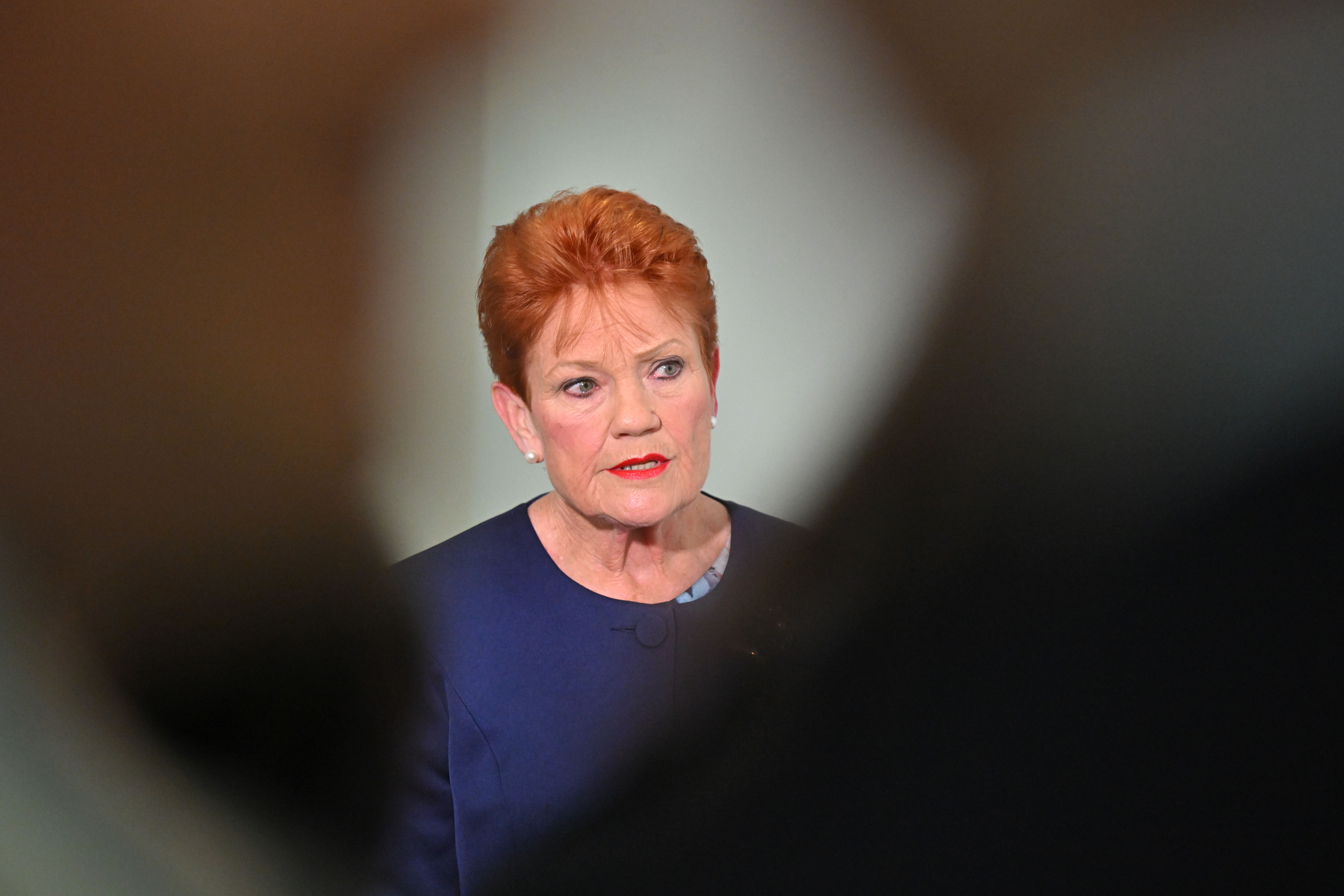
Pauline Hanson gives a non-apology apology for comments

Pauline Hanson has done a very quick doorstop (unscheduled press conference) where about half of the press gallery seemed to have appeared.

She was asked if she apologised about comments she made in a February podcast where she insulted Anthony Albanese’s deceased mother for living in public housing for her adult life (which was once very normal in Australia)

I don’t think my comments were derogatory towards his mother at all. I was referring to housing commission at that time. So if he’s taken offence to it, well, I’m sorry for that.

And then when the senator, who was found to have racially discriminated another senator in an Australian court (and lost an appeal against that conviction) was asked about her racist comments to a podcast about Indigenous people, Hanson said:

All I’ve asked is for accountability from our … governments and from our politicians to address these concerns and stop using it as a political football, and I will continue to talk about this.

If I’ve offended people by using that…, yes, I will apologise for that.

WHAT IN THE ACTUAL F*CK IS SHE TALKING ABOUT.

Using that ‘word’. Not for the racism. Who the hell accepts that?

Concern for AI in the Senate grows

Anna Chang

Both last week and this week, we have seen Senators take every opportunity to voice their concerns over AI, data centres, algorithms and digital duty of care.

In fact, three of the five adjournment speeches last night by Senators were on digital duty of care.

Senator Larissa Waters uses her 2 minute Senators’ statement time to add her voice to the growing concerns:

AI is bad for our neighborhoods, bad for our climate, and bad for our wallets. 

Today, in terrifying headlines, the world may end thanks to an AI takeover. 

But here’s the kicker: we also get to pay more for the energy that AI will use to power our demise. Data centers are on track to consume as much power as every home in New South Wales and Victoria does by 2036. 

Without proper regulation and a commitment to use renewable energy to power them, these data centers could raise your power bills by 25%. 

All this to power unchecked AI expansion that some experts say has a 10% chance of ending humanity. If we don’t take the time now to get this right, there will be serious consequences for our energy grid, for our water, for our environment, for our climate, and for us as a species. It’s clear this government hasn’t worked out how to regulate AI or data centers. 

Without regulation, AI has become a big tech free for all. 

The winners, the billionaires, as always. The losers, you, ordinary Australians. In the U.S. we’ve seen that Trump is rolling out the red carpet for AI and more fossil fuels to power them. There are plans for more than 70 gas-fired power plants just for new data centers. 

AI companies are desperately seeking new territory to build the data centers that they need to train and run their AI models, and now they’ve set their sights on Australia. We cannot follow Trump down another rabbit hole this time on AI. 

We need a moratorium on data centers right now. Without one, we are sleepwalking into an AI catastrophe. It is time for this government to stop folding to big tech, to stop folding to the fossil fuel industry, and to start acting in the interests of everyday Australians.

Greens want rethink of private health subsidy changes

The Greens have warned Labor not to take their support for granted when it comes to the private health amendments the government wants to get passed – Labor wants to change up the subsidy for over 65s, which Monique Ryan and other independents are against – for the government to get the support it needs in the senate, it needs the Greens to pass it (cos the Coalition have said no).

Well, Jordon Steele-John says the Greens are also saying no:


We are concerned about the impact of these changes on pensioners. Asking people already doing it tough to pay more feels deeply unfair and will place extra burden on people who are already struggling. 

There are plenty of other ways the government can raise money to pay for aged care. The government needs to fix this.

We are looking at the bill, actively engaging in the inquiry and discussing alternatives. We have no formal position on the bill at this stage.

We’re considering a range of options here to make sure that money goes into the public health system and aged care where it’s needed most, we need to get the balance right and to make sure that older Australians are able to afford the healthcare they need and deserve.”

Woolworths, Coles and wage theft

Greg Jericho

As Matt Grudnoff earlier reported suppliers are complaining that Woolworths is using its market power to cut the prices it pays them for the groceries it ends up selling to us.

He noted that this is one of the problems of monopsony – where you are in effect a monopoly buyer.

This also applies to labour – Woolworths and Coles are THE buyers of labour in the supermarket sector – as a result they hold a heck of a lot of sway over wages growth (the Fair Work Commission thankfully sets Award rates).

The problem is highlighted by the fact that while we often worry about whether or not Coles and Woolworths ae colluding on prices, perhaps we should be just as worried about what they are both doing on wages.

n the past months they both released their 2025-26 annual reports.

In Coles’ report there was this line about repayments of wages:

During the year, the Group received a judgment in relation to proceedings filed by the Fair Work Ombudsman (FWO) in 2021 and associated class action. These proceedings related to the remediation of salaried team members under the General Retail Industry Award (GRIA).

As a result of this judgment, which upheld a number of the FWO’s interpretations in respect of the GRIA and Fair Work Act provisions, the Group recognised an additional provision of $235 million, bringing the total amount recognised to $254 million at 28 June 2026.

While in Woolworth’s report there was this similar line:

In September 2025, the Federal Court of Australia delivered its decision regarding historical underpayments of salaried store team leaders covered by the General Retail Industry Award. The Group recognised an additional provision of $730 million (before tax) during the period to cover further potential remediation, interest, superannuation and payroll tax. Final declarations have not yet been made by the Court.

What a coincidence.

Climate policy “complete failure” – Tuvalu Minister

"The transition away from fossil fuels must remain firmly anchored in the best available science and strong political will."- Tuvalu Minister for Climate Change and Environment the Hon Dr Maina Vakafua Talia at today's #ClimateIntegrity Summit 2026

The Australia Institute (@australiainstitute.org.au) 2026-09-15T02:16:05.647Z

Australia’ two-tier healthcare system in two charts

Luke Slawomirski
Senior Postdoctoral Research Fellow

The debate continues over the federal government’s plan to remove the extra private health insurance (PHI) subsidy for over 65s.

The focus is on pensioners having to pay a little more for their premiums if – as proposed – the subsidy becomes solely based on income, not age.

A key justification for PHI is that it “takes pressure off public hospitals” – an assertion based on the belief that the private sector is “more efficient”.

But look at this chart.

Looking at who tends to have PHI, it’s easy to see why.

The charts illustrated that we have a two-tier healthcare system. One for the haves, one for the have nots.

But here’s the thing. Poorer people are more likely to use public hospitals, which means public hospitals treat more people who are  more likely to be sicker, and more likely to be afflicted with social problems related to housing, unemployment and challenging domestic circumstances.

And treating these patients is a lot more complicated and expensive than treating the more affluent.

This – along with the fact that that the bulk of emergencies like heart attack or stroke go to public hospitals (because PHI doesn’t cover private emergency care) – means that public hospitals deal with far more complicated cases than the private sector. 

Currently, the entire rebate costs taxpayers about $12 billion a year, once indirect costs are included.

Removing the age-based uplift would save the taxpayer about $3 billion over four years – with the money invested in purchasing additional aged care beds.

This will not only directly benefit pensioners (who are more likely to rely on public aged care). It will directly ease pressure on public hospitals, where thousands of elderly patients are ‘stranded’ due to a lack of aged care capacity.

Mind your banners ?

Anna Chang

You’d be forgiven for doing a double take visiting The Guardian and The Conversation this week and thinking that One Nation had done a total buy out of the banner ads on both publications.

But no, these are in fact banner ads by those very outlets.

One is advertising The Guardian’s four-part investigative podcast on Hanson, hosted by Sarah Martin (that’s what Pauline Hanson gets for ripping in to her at the National Press Club) and the other is spruiking The Conversation’s podcast on One Nation released back in April.

Safeguard Mechanism a “release valve” for fossil fuels – Dr Kirsty Howey

Dr Kirsty Howey, the new CEO of Wilderness Society, is speaking at the Climate Integrity Summit.

Dr Howey called the Safeguard Mechanism a release valve which allows major polluters to keep polluting. 

“The offset tap is being turned on delibertely to keep fossil fuel production going in this country,” Dr Howey said.

Leaders pulling in different directions on AI

Alice Grundy
Research Manager

Earlier today I wrote about the calls from AI companies to look at slowdowns on their activities to prevent something like … the end of the world. 

Trump is not interested in calls for caution. He posted on Truth Social about how a high IQ president is all they need for keeping things in line. 

Nothing says high IQ like sporadic capitalisation and excess exclamation marks.

Meanwhile, the head of Chinese state security, Chen Yixin said that AI companies are waging “propaganda war and a cognitive war against us, directly threatening our political security, institutional security, and ideological security”. That the threat is so great it could weaken the government. 

Back in Australia, Abigail Bradshaw, the Director General of the Australian Signals Directorate — an agency founded after WWII which now looks after intelligence and cyber security — said that Australian companies could use AI for defence, developing an “early warning system” against attacks. Bradshaw’s comments were at The Sydney Dialogue (held in Canberra) — an event whose “Silver Partner” sponsor was none other than OpenAI

Why is Australia propping up Nauru Airlines to keep offshore detention alive?

Nick Feik

Here’s a question you’ve probably never asked yourself: Why does Nauru Airlines exist? There’s a simple answer – Australia’s offshore detention regime.

Australia’s “resettlement” program in Naoero requires air transport, and Nauru Airlines is the only airline that flies to Naoero, so our government needs Nauru Airlines to keep the offshore regime up and running. But Nauru Airlines isn’t viable as a commercial airline. It needs support.

How much support? Here’s the problem: Australia will do anything to keep Nauru Airlines operational. Anything? Anything.

Read Nick Feik’s full investigation on The Point.

Greens to push for mandatory domestic roaming to prevent future Triple 0 outages

Anna Chang

The Triple 0 Senate inquiry report which we had reported on Monday as being due to be tabled tomorrow has been postponed until Friday. Hopefully this means that we see some strong recommendations from the committee, with the extra time they have to deliberate.

However, the Greens have today announced that they will move amendments to the Universal Outdoor Mobile Obligations Bill 2026, which is currently set for debate in the Senate this week, to:

  • Mandate domestic roaming for Australian phone users in the event of a network outage
  • Introduce strong performance and reliability standards for all telcos
  • Set up an automatic compensation scheme for consumers in the event of a network outage

The key amendment here is the push to make domestic roaming mandatory for all Australian telcos, following the recent Optus outages, and Triple 0 outages to customers.

Greens Communications Spokesperson, and Chair of the senate inquiry into Triple 0 outages, Senator Sarah Hanson-Young said in a statement:

“The era of self regulation in the telecommunications industry must come to an end. All three of the big telcos in Australia have let their customers and the Australian public down. It’s time for accountability.

“This week in the parliament, the Greens will move amendments that put in place stronger accountability for telcos and more choice and support for consumers.

“Mobile phone companies have had long enough to sort out roaming arrangements on their own and they have failed to do it. It’s time for the Government to step in and mandate it. This is such a common sense reform, it works overseas, it can work in Australia.

“Putting enforceable reliability standards into law is well overdue. Access to mobile phones and the internet is an essential in modern life. People rely on it to do everything from getting to work to paying the bills or calling their mum. Telecommunications is an essential service and it should be regulated like one. 

“Just last week Optus customers have once again been left without the essential service they rely upon every day. This is exactly why we can no longer continue to let these big Telcos mark their own homework.

“We have seen the life or death consequences of network outages, especially when it impacts Triple 0. It’s time for the parliament to act. We cannot pass the Universal Outdoor Mobile Obligations bill without significant steps forward to improve telecommunications regulation, and ultimately public safety.

“The Greens are willing to work with the Government on these reforms. This is not a partisan political issue. It is a matter of putting the interests of the Australian people above the profits of the big telcos.”

Macklemore shows cancel culture is driven by those with power and money

Greg Jericho

Overnight came the news that rapper Macklemore has been dumped as the support act for Ed Sheeran after his comments calling for “Free Palestine” .

In response he was criticized, by among others, singer Pink who also referenced how Macklemore in 2014 dressed in a pretty disgusting costume that basically hit every single antisemitic trope you could come up with.

The weird thing is he was not cancelled for that. It didn’t affect his career. There were no promoters or stadium owners banning him from performing. Even the Anti-Defamation League took him at his word that it was an ignorant mistake. (Although given the ADL gave Musk a pass for his Nazi salute, calling it “an awkward gesture in a moment of enthusiasm” you might want to watch caring too much about what they determine is antisemitic).

So no cancelation then, but now, for saying “Free Palestine” he is cancelled – because apparently that is hurtful to Jewish people.

Just as important though is who is doing the cancelling.

There is a very lazy trope put froward by conservatives and centrists that cancel culture is practiced by progressives and “the left” (Waleed Aly in his latest Quarterly Essay goes on and on about this, eg: “Woke activists abandon effete norms of free speech and persuasion, most famously via spontaneous, intimidatory online mobs enacting “cancel culture” “). But the reality is the cancelling for the most part is done not by angry progressive mobs, but by powerful companies and the wealthy who seek to conserve the status quo (ie their wealth and power).

Thus the cancelling of Macklemore was done by Robert Kraft – the billionaire owner of the Gillette Stadium in Boston. Yes Ed Sheeran supported it – but that is more cowardice about wanting to be “apolitical” than power. Kraft told NBC:

“Based on Macklemore’s recent actions, material shared from the stage during Ed Sheeran’s shows in New Jersey, and a broader history of antisemitic rhetoric and imagery that we believe has been deeply offensive and hurtful to the Jewish community, we determined that his participation in the September 25th and 26th concerts at Gillette Stadium would cross that line” 

So they only became aware of the 2014 costume now? Sure.

Kraft is the owner of the New England Patriots NFL team and also is a long time friend of Donald Trump, so about as powerful as it gets in the USA. He is also a very long-time supporter of Israel and puts all the blame on the deaths in Palestine at the feet of Hamas.

Macklemore posted on Instagram saying that Sheeran told him that “Kraft has rallied some of the other stadium owners and collectively they gave him [Sheeran] an ultimatum: if Macklemore stays on tour, you will not be allowed to play in any of our venues”

He also noted that:

One of the most effective ways to enforce that silence has been to weaponize the accusation of antisemitism. Antisemitism is real. And that is exactly why the word matters too much to be used as a shield against criticism of the Israeli state. When criticizing Israel, opposing Zionism or saying “Free Palestine” gets conflated with hatred of Jewish people, it doesn’t protect Jewish people. It protects Israel from accountability.

The Jewish Council of Australia (JCA) posted Macklemore’s statement on its social media and noted that “Macklemore spoke out. Now you can take action.”

The JCA has been campaigning strongly against the IHRA working definition of antisemitism which the JCA argues “has been used globally by Israel and its advocates to repress Palestinian human rights advocacy and political expression. It is an example of anti-Palestinian racism and dangerously conflates Jewish identity with the State of Israel.”

The JCA has a petition calling on governments and institutions to reject the defintion.

Meanwhile since 8 October 2023, 73,786 Palestinians have been killed according to the Gaza Health Ministry, including 1,372 and 4,659 injured since the 25 October 2025 “ceasefire”.

In June this year, the UN Human Rights Commission reported:

Israel continues to commit genocide and other atrocity crimes by deliberately targeting Palestinian children

“The evidence shows that Palestinian children have been deliberately targeted and killed by the Israeli security forces,” said Srinivasan Muralidhar, Chair of the Commission. “Even after the October 2025 ceasefire, children continue to be killed and seriously injured, with continued disregard by Israel for the ceasefire and for the protection owed to Palestinian children under international law.”

Turning point in demand for gas: Bruce Robertson

Energy finance analyst Bruce Robertson, who has spent decades analysing and forecasting global LNG trends, is speaking at the Climate Integrity Summit in Sydney. 

He has talked about the global move away from gas, pointing out that Japan actually onsells gas it gets from Australia for a profit.

He has also described the gas industry as a “cartel”, as it controls the price. 

“There is not a market for gas on the East Coast of Australia… it is like a unicorn it exists only in fairytales.”

No, young people are not worse off under housing tax changes

Matt Grudnoff
Senior Economist

The Australian is reporting on modelling that claims the housing tax changes in the last federal budget will mean it will take young people longer to save for a home deposit.

In one of the scenarios, the modelling claims that saving $150,000, which is a 20% deposit on a $750,000 home, will take 28 years rather than 20 years.

Firstly, when your “better” outcome is that it will take 20 years to save for a deposit, you probably haven’t properly diagnosed the problem. It shouldn’t take a young person 20 years to save for a deposit.

Why is it taking so long to save for a deposit?

Because house prices are too high.

The solution to this problem is not giving big tax breaks to investors that might also help young people save a little faster. The solution is to stop house prices increasing faster than incomes.

And this is the biggest flaw in the modelling. It assumes that the size of the deposit is the same with and without the budget changes.

That is a weird assumption given the whole point of the change is to slow house price growth and the Australian has been a prominent voice reporting the recent decline in prices is in part because of the budget changes.

So, what happens under the same modelling exercise if we assume that house prices had grown with incomes over the last 20 years?

Firstly that $750,000 home would only cost $500,000. That reduces the size of the 20% deposit from $150,000 to $100,000.

This means that even using all the various assumptions that the modellers use about the starting investment and how it is invested, saving for the deposit is still quicker than if the tax changes hadn’t been made. It would take 18 years rather than 20 years.

This means that even under these assumptions the reduction in home prices is worth more than the extra tax the young person would pay on their investments.

This all highlights the weird places this debate has gone to. We should be focused on fixing the problem of housing affordability, rather than trying to defend a tax concession that mainly goes to the wealthiest people.

Electricity “cheaper and cleaner” than gas – expert

The Grattan Institute’s Energy and Climate Change Director Alison Reeve is now speaking at the Climate Integrity Summit in Sydney.

Alison points out that the gas industry is shrinking, and consumers know that gas is not the cheaper option. 

“It is cheaper and cleaner to be using electricity,” she said.

Smoke one cigarette for every km you walk and, guess what … you’ll still die

Offsetting fossil fuel emissions is like thinking that going for a walk makes up for having a cigarette.That's the logic our governments use to justify fossil fuel expansion.📺co-CEO Richard Denniss delivers his keynote address at today's #ClimateIntegrity Summit 2026@richarddenniss.bsky.social

The Australia Institute (@australiainstitute.org.au) 2026-09-15T01:28:37.098Z

Digital Duty of Care should make Big Tech hunt down those harming kids

There’s a really powerful story by Joel Scanlan in The Conversation today about the proposed Digital Duty of Care laws.

It points out the significant difference between telling Big Tech companies, like Meta and X, to provide a safe platform … and actually making them do it.

Making them do it would involve actually searching their own platform for predators and perverts … and reporting them to authorities.

The statistics in this story are frightening.

According to the US centre, in 2025, Google made 1,461,378 reports, and Facebook 4,907,710. Apple made 296. The number of reports tells you how hard each company looks, not the level of harm occurring.

The point here is that if we are going to do this, we should do it right the first time.

It will save lives.

Just like the boiling frog parable, but self-inflicted

"Most people will know the story about the boiling frog."We're turning up the temperature of the pot that we're sitting in."- co-CEO Leanne Minshull opens today's #ClimateIntegritySummit26 @leanneminshull.bsky.social

The Australia Institute (@australiainstitute.org.au) 2026-09-15T00:36:26.594Z

Truth “champion” Steggall to push for debate and vote on her truth in political advertising laws

Bill Browne
Director, Democracy & Accountability Program

Since she entered parliament in 2019, independent MP Zali Steggall has been a champion of truth in political advertising laws.

South Australia has had such laws since the 1980s, so we know they work.

Australia Institute polling research consistently shows that about nine in 10 Australians support these laws.

Steggall has made several attempts to get them legislated, and today she is moving to suspend standing orders to try to force Parliament to consider the Voter Protections in Political Advertising Bill.

Strength to her arm. But why does an independent MP need to “force” anything? Truth in political advertising laws are part of the Labor Party platform. That’s the party, as if anyone needs reminding, that runs the government and holds almost two in every three seats in the House of Representatives.

Perhaps Steggall’s particular bill is objectionable to the Albanese Government. But Labor has its own bill! Back in 2024, Special Minister of State Don Farrell proposed his own truth in political advertising laws. Labor let that bill lapse rather than pass it into law.

Labor’s excuses for fumbling truth in political advertising laws have never added up. Labor says all its advertising would “sail through” a truth in political advertising framework. Anthony Albanese claimed “we didn’t have support for [it] from the Coalition” – but they never needed that support. They had the numbers without the Coalition. Yet again, the Liberals were a convenient excuse for something Labor just didn’t want to do.

Let’s see if today an independent can convince the Labor Government to implement Labor policy, and lift the quality of Australian political debate. Otherwise, Australians can expect to see even more shameless misinformation and AI-generated deepfakes tainting our politics.

Climate integrity – emissions need to come down, not offsets go up

Greg Jericho

As we hear from those at the Climate Integrity Summit, it is worth reminding ourselves of what is the current state of affairs.

The Climate Council has reported that for Australia to do its share to limit global temperatures rising by less than 2C above pre-industrial levels, we need to achieve net zero emissions by 2035. (Of course this would need to be even earlier to keep the temperature rise to less than 1.5C – and every part of a degree we can limit warming to is vital)

By contrast the Government’s best-case scenario is getting to 230MT CO2 by 2035, and hoping for net zero by 2050.

Alas we’re not even on that path. Emissions rose in the first 12 months of the Albanese government. I’ll be kind and suggest that their efforts to reduce emissions took a year to kick in. But even since June 2023, emissions have not come down anywhere fast enough:

And this is the issue.

The only way to limit global warming is to keep fossil fuels in the ground. Carbon offsets do nothing to lower actual emissions, they just pretend that somehow balance is being achieved.

It’s a con.

Canada and Australia stand at a similar crossroads: Canadian Senator Rosa Galvez

Canadian Senator for Québec The Hon Rosa Galvez is addressing the Climate Integrity Summit in Sydney. 

She is talking about how the world moves beyond fossil fuels without sacrificing prosperity or nature. 

“We think GDP is based on industries, but it is based in nature,” Senator Galvez said. 

“Infinite growth in a finite resource planet is illogical, it doesn’t work.”

Suppliers say Woolies uses market power to cut their prices

Matt Grudnoff
Senior Economist

Australia continues to have a competition problem. Big business and their boosters like to say that economists like markets but that is not exactly correct. Economists like competitive markets.

A market with little competition where a few large firms dominate produces terrible outcomes. Not just of customers, where the dominate firms can use their market power to gouge their customers, but also for suppliers.

Supermarkets are back in the news with reports from those supplying Woolworths that they are being forced to accept new terms that would keep prices lower or face having their products ditched.

A monopoly is a market with one seller, but a monopsony is a market with one buyer. A monopsony has the same kind of market power as a monopoly.

As these most recent claims show, if the big supermarket chains cut your product that can smash a business’s ability to sell to their customers.

What is the solution?

The best outcome would be to inject competition into the market. If there were many supermarkets all competing for customers that would mean lower prices for consumers but also better prices for producers.

If a supplier has many options on who they can supply to then threats from one of them to accept unfair terms wouldn’t hold much weight.

This could be achieved through divestment powers like they have in the US and the UK. This is where big companies are broken up into many smaller firms who then compete against each other.

If a competitive market can’t be created, then a super profits tax is also a solution. This taxes away the gains big firms make from using their market power and the government can then use that to compensate those most badly impacted by the anticompetitive behaviour.

The worst solution would be to just let the big firms continue to gouge their customers and suppliers.

Political donations and finance remain fraught areas for One Nation

Bill Browne
Director, Democracy & Accountability Program

Yesterday, Sarah Martin reported in The Guardian that Pauline Hanson and Barnaby Joyce stayed at Gina Rinehart’s $20 million Brisbane mansion without declaring the hospitality in their parliamentary registers. Hanson has also been provided personal security by one of Hanson’s long-term bodyguards. Hanson and Joyce’s flights in Rinehart’s luxury jet were declared this time, but earlier ones had not been.

Of course, receiving hospitality is not unusual. The AFR, after a detour to repeat Sky News personal attacks, reported last week that Labor Minister Chris Bowen had stayed at a hobby farm owned by Prudence MacLeod, Rupert Murdoch’s oldest daughter. But Di Stefano found out about the visit because Bowen had reported it, in line with the rules.

But One Nation is often in the news for its political finance and interests. Just last week, the Sydney Morning Herald reported that:

“One Nation publicly reported racking up $400,000 in debts to its leader and financial backer Pauline Hanson over the past decade without corresponding records to show she had lent the money in the first place.

One question is how much interest she received for her loans to the party she founded. 

Thanks to private donations and taxpayer funding, One Nation is likely to fight coming elections with a much larger war chest than it did previous elections. Another party in that position is Nigel Farage’s Reform Party in the UK, which has just received a record A$136 million (GBP 72 million) in donations in 48 hours from just two donors. Michael West Media reports: “The figure exceeds what either the governing Labour Party or the opposition Conservatives spent during last year’s election campaign”.

Of course, money isn’t everything in politics. Clive Palmer has spent “major party” levels of money in recent elections, for “micro party” results. But any money or gifts that do change hands should be disclosed in accordance with the rules. 

Fuel and utilities drive August spending – NAB Consumer Spend Trend

Greg Jericho

The latest NAB consumer spending survey is out. It shows that spending rose 1.1% in August, but that this was not really due to more buying of things, but higher prices.

Fuel and utilities drive August spending – NAB Consumer Spend Trend

Consumer spending rose 1.1% in August and 8.7% over the year.

Non-discretionary spending increased 2.2%, driven by a 12.0% jump in fuel and a 3.2% rise in utilities and telecoms.

Discretionary spending growth eased to 0.4%, with household goods broadly flat and personal goods down 0.2%.
Australians spent more in August, but the headline lift was driven by higher essential costs rather than a broad acceleration in demand, according to NAB’s Consumer Spend Trend.Total spending rose 1.1% over the month and 8.7% over the year. Excluding fuel, monthly growth was a more moderate 0.6%.

NAB Head of Australian Economics Gareth Spence said this month’s report showed the increasing pressure on households.
“The end of the temporary fuel excise discount, combined with higher fuel prices, was clearly reflected in this month’s spending,” Mr Spence said.

“Fuel spending jumped 12.0%, while utilities and telecoms spending rose 3.2%.
“Excluding fuel, the monthly increase was 0.6%, which provides a better guide to underlying consumer demand.”
Fuel spending was 20.9% higher than a year earlier, while utilities and telecoms spending increased 14.1%. Non-discretionary spending rose 2.2% in August and 9.3% over the year.

Mr Spence said discretionary spending was still growing, but momentum had slowed.

“Discretionary spending rose 0.4% in August, down from 1.2% in July. Services remained resilient, but goods spending softened, with household goods broadly flat and personal goods declining in the month,” Mr Spence said.
“That said, spending remains well up on a year ago across both discretionary and non-discretionary components – this has reflected some resilience in the consumer despite weak confidence and the cost-of-living challenge.”

The cost pressure evident in household spending is also flowing through to businesses. NAB’s August Monthly Business Survey showed purchase cost growth edged up to 2.3% at a quarterly rate, while final product price growth eased to 0.8%, widening the pressure on business margins.

“Consumers and businesses are confronting the same cost squeeze,” Mr Spence said.
“Households are paying more for essentials, while businesses are absorbing input costs they have not fully passed on. That combination points to continued pressure on demand and margins in the months ahead.”

Tuvalu Climate Minister asks what will happen to his tiny nation if the world doesn’t transition away from fossil fuels

Tuvalu’s Minister for Climate Change and Environment, The Hon Dr Maina Vakafua Talia, is speaking at the Climate Integrity Summit in Sydney.

In a sobering address, he’s highlighting the desperate situation facing Tuvalu as a result of climate change, with rising sea levels threatening to submerge much of the Pacific nation by the end of the century. 

“Transitioning away from fossil fuels… is more urgent than ever.”

He said countries need to be honest about the situation and talked about the “race to acculmate wealth for self gain.” 

“Countries must be open and able to speak honestly about their reliance on fossil fuels,” he said.

“Policy for social media clicks” – Ayres says One Nation immigration policy would have a real human cost

Industry Minister Tim Ayres was on RN this morning, joining the chorus of criticism of One Nation’s immigration policy:

This is what happens when you do policy for social media clicks. If implemented, this would be a wrecking ball through regional economies. It would hurt the agriculture sector, it would hurt the hospitality and the aged care sectors. In particular, it would be devastating for tourism in Northern Australia. What Pauline Hanson and One Nation have announced recently would devastate regional economies and there would be a real human cost to that.

America’s “shocking” access to Australian bases revealed

The United States controls or has access to more than 100 defence facilities on Australian soil, according to new research.

On this episode of After America, Dr Richard Tanter joins Dr Emma Shortis to discuss his new research on American access to Australian defence facilities, the long-term consequences of the war on terror for the Australia-US alliance, and whether Australia is the only American ally not seriously rethinking its relationship with the United States.

“We need to be honest about what we are doing” – Australia Institute co-CEO Dr Richard Denniss.

Australia Institute co-CEO Dr Richard Denniss is delivering some hard truths at the Climate Integrity Summit in Sydney.

In his keynote address, which is about Australia’s climate contradictions, Dr Dennnis pointed out the hypocrisy of the Australian Government, and how the government says it accepts the science of climate change and mocks other parties for their position, while expanding fossil fuels at the same time. 

“The number of solar panels of domestic roofs are irrelevant… I am not anti-solar power on people’s roofs,” Dr Denniss said. 

“(But) we are rapidly subsidising the expansion of fossil fuels in Australia… we are the third largest fossil fuel exporter in the world and we are not transitioning away from fossil fuels.”  

“We need to be honest about what we are doing”. 

One Nation knows its proposed migration cuts would cause economic pain

Matt Grudnoff
Senior Economist

Barnaby Joyce was on the ABC’s National Forum last night defending One Nation’s migration policy.

When challenged about the potential economic costs he declared that the party was simply about following the will of the people.

He then suggested that those who are warning about economic consequences didn’t know what they were talking about.

But this is all just political posturing. One Nation understands that there would be huge economic costs if it cut migration. That is why its policy doesn’t cut migration to those areas where One Nation’s support is strongest, rural and reginal Australia.

What are the two migration categories that One Nation is not cutting? PALM workers and working holidaymakers. Both groups flow mainly to rural and regional areas.

This is Pauline Hanson at the News Corp Bush Summit just last month.

Host:

So, it’s more than 130,000.

Hanson:

Correct. Because your PALM workers. Rural and regional Australia would die if they didn’t have the workers coming in. And especially the abattoirs and the farmers.

So, instead of hurting One Nation supporters, One Nation suggests cutting international students, who mainly go to cities.

If cutting immigration is good and won’t have economic costs, then why not cut in rural and regional areas?

“We are turning up the temperature of the pot we are sitting in” – Australia Institute co-CEO Leanne Minshull

In her opening remarks at the 2026 Climate Integrity Summit, Australia Institute co-CEO Leanne Minshull reflected on how Australians have changed their behaviour as a result of climate change. 

She talked about fewer people taking camping trips to the bush, and praised those who are fighting for the climate. 

“We’ve all seen the heatwaves ripping through Europe,” Ms Minshull said.

“If we were seeing those images 10-15 years ago we’d be horrified, but now we are used to them, and that’s not a good thing.

“All of these things are undeniably climate change.”

She pointed out that despite most people knowing and accepting the climate crisis, many in power are not taking the necessary steps needed.

“We’re turning up the tempreature of the pot that we are sitting in.” 

Tim Wilson blasts One Nation “back of a napkin” immigration policy, saying Pauline Hanson is “in witness protection”

Fresh from yet another Parliamentary ejection, Shadow Treasurer Tim Wilson has rocked up to the big house today, taking questions in the press gallery corridor.

Question:

Your thoughts in your capacity as Shadow Treasurer, Barnaby Joyce said last night that their migration policy is based on the will of the people as opposed to the economics?

Tim Wilson:

I look forward to seeing the costings of this back of a napkin policy, and particularly how much income taxes are going to rise to address One Nation’s policy. We know that it’s a policy by press release, they provide no economic detail, and now the leader of their party is in witness protection. We look forward to them coming out and explaining to the Australian people how much taxes are going to have to rise on average Australians to deliver on their back of an envelope back, or back of a napkin policy.

Independent MP Zali Steggall will try to force a vote on Truth in Political Advertising laws

The Member for Warringah, Zali Steggall, reminds us that today is International Democracy Day.

And, to celebrate, she’ll seek to suspend standing orders and force Parliament to consider her Bill to protect Australians from lies in political advertising.

In a statement, she says Australians have consumer protections against false and misleading commercial ads … but with the next federal election potentially just one year away, Australia still has no protections from false statements in a political advertisement.

Australians have lost faith in politics. Truth in political advertising laws are a way to rebuild trust.

This is a failure of government. Democracy depends on informed voters – and in this period of post-truth politics, the urgency for change is only increasing . AI and deepfakes now mean Australians can be exposed to video or audio of a politician or candidate saying something they never said. Our electoral laws must keep pace with technology – not remain stuck in a bygone era.

Steggall’s Bill proposes four key safeguards:

  • Mandatory AI content watermarking, so voters know when they are viewing AI-generated content
  • Compliance with an ethical advertising code which requires advertising to be truthful
  • An independent Political Advertising Standards Board to oversee compliance
  • Meaningful penalties of up to $330,000 for serious breaches.

The 2026 Climate Integrity Summit is underway

The 2026 Climate Integrity Summit is underway in at NSW Parliament.

It’s a packed house, which will hear from global political leaders, economists, advocates, artists, and musicians for a day of big ideas and bold conversations. 

Australia Institute co-CEO Leanne Minshull will open the day, followed by the keynote from ceo-CEO Richard Denniss.

From there, Tuvalu’s Minister for Climate Change The Hon Dr Maina Vakafua Talia and Canadian Senatopr for Québec The Hon Rosa Galvez will speak on a panel about the transtion away from fossil fuels. 

There are plenty more speakers, including The Point’s own Amy Remekis, and we’ll bring you updates from the day as well as each of the speakers.

The ‘ghost of the Senate’ speaks

Anna Chang

Yesterday we reported on Minister Katy Gallagher referring to Senator Ralph Babet (Vic, UAP — if you need reminding) as the ‘ghost of the Senate’ that ‘we never see any more’, after the Senate was advised during QT that he had passed his question to Senator Malcolm Roberts for the second time running.

So, it’s only fair that we give an update: the ghost speaks!

Senator Babet did in fact pop up yesterday to give his remarks on the Greens’ urgency motion (on the Vic Government looking to privatise Melbourne Water): and privatising water is where this ghost draws the line.

Here’s the substantive part of his remarks, before they got a bit too loopy for this liveblog.

Senator Ralph Babet:

Obviously, I’m no communist. I think you all know that. I believe in capitalism, competition, private enterprise and the right of people to make some money without asking a government bureaucrat holding a clipboard for some permission. But even I, the most committed free-market capitalist that you will meet in this place, understand that there are some things that you just do not sell, and Melbourne Water is one of them. You don’t even talk about selling it.

If the Victorian Labor Government is seriously considering this, and I think it is, then it should just stop. Stop right there in your tracks. Water is not just another commodity, and Melbourne Water is not just another business.

What is it? It’s a natural monopoly. You don’t sell the front door to your house and then act surprise when the new owner starts deciding who gets inside that house. And you do not sell control of your water, your electricity grid, your prime agricultural lands, your ports et cetera to a private company—and certainly not a foreign controlled one—and then congratulate yourself on the efficiency of the transaction…

As a Victorian, I do not want us to make the exact same mistakes that we’ve seen elsewhere in Australia—for example, in South Australia. They sold their power network. It is now foreign owned, and it was sold by a Liberal state government. 

“Do you know what? Some assets are different. 

“As I said, water is not just another commodity. Electricity is not just another business. Roads, ports and other critical infrastructure are arteries of a modern nation.

“Without water, there is no city, there is no agriculture, there is no industry—there is no economy, obviously. When those arteries are controlled by people whose first obligation could potentially be to shareholders—overseas shareholders perhaps, or maybe even interests outside the country—what are we doing? We’re creating a vulnerability that no accountant can put back on the balance sheet.

“There is also a basic difference between a competitive private market and an essential monopoly. 

“For example, if you don’t like a supermarket, shop at another one. If you don’t like an airline, choose another one; fly with them. But you cannot simply choose another water network. You can’t build yourself another electricity grid. These assets exist because generations of Australians built them, paid for them and also depend upon them. 

“Governments of today should not assume that they have the moral right just to sell off what previous generations built and what future generations are going to need…”

One Nation rubbishes budget costings on migration

Jacob Shteyman and Noah Secomb for AAP

One Nation has again defended its migration policy for not including the cost of slashing temporary visa holders as Labor continues working on its own policy behind closed doors.

As Labor prepares to announce sweeping migration reforms of its own, Pauline Hanson pipped the government with a plan to reduce the number of temporary visa holders and overstayers by more than 750,000 over three years.

International student visas bore the brunt of the cuts, with visa grants set to be reduced from more than 290,000 to 115,000 per year and secondary visas for family members eliminated.

The policy outline distributed on Monday did not include economic impact.

One Nation MP Barnaby Joyce dismissed further criticism for not modelling the economic impact of the policy or using the Parliamentary Budget Office to do so.

“They’re not elected. I am,” he told the ABC’s National Forum on Monday night, questioning the quality of the analysis provided by government agencies.

“I’ve never seen forward estimates in any budgetary paper being even close to the mark of what it’s supposed to do, and so the will of the Australian people is so pronounced. This has to be dealt with.”

When asked whether people with skills will come to Australia if they cannot bring their children or spouses, Mr Joyce said it’s a decision for an individual to make.

Experts warned One Nation’s pledge to deliver three years of negative migration has never happened except in times of severe economic stress or World War II.

Industry Minister Tim Ayres said if implemented, it would be a wrecking ball through regional economies.

“It would hurt the agriculture sector. It would hurt the hospitality and the aged care sectors in particular,” he said.

Coalition immigration spokesman Jonathon Duniam said he won’t be copying the homework of One Nation, promising an alternative policy in time 

“I would never copy a piece of work that has not been modelled, has not been costed. We don’t understand the impact,” he told News24.

One Nation’s plan to slash Australia’s international student intake could clear the massive backlog of temporary visa applicants clogging the appeals system, but it could also “decimate” the university sector.

Governments had forced universities into relying on foreign student fees to balance their books, International Education Association of Australia chief executive Phil Honeywood said.

“The types of changes proposed will decimate an industry that employs 250,000 Australians and crucially keeps our public universities afloat,” he told AAP.

Growing numbers of international students, and their families, remaining in Australia on bridging visas have been a major contributor to net overseas migration overshooting the government’s forecasts in recent years.

As the Home Affairs department has ramped up refusals for student visa applications, the number of students launching appeals in the Administrative Review Tribunal has exploded.

The total number of migration and refugee cases being assessed almost doubled from July 2024 to July 2026.

Labor earlier in 2026 passed legislation changing the way the tribunal conducts hearings for student visa appeals in a bid to speed up processing times and cut down the backlog.

Since the limit on in-person hearings for student visas took effect on June 1, it has shown some early promise.

Regardless, the student visa backlog still grew to 53,608 by the end of July.

Mr Honeywood said there was evidence that a minority of international students were gaming the system and changes made by the federal government in recent years have attempted to clamp down on it.

“Unfortunately that has developed a lawyers’ picnic that allows any number of appeals and the Albanese government are finding ways to reduce appeal rights for non-genuine students,” he said.

One Nation promised to end “visa-hopping” by preventing students from applying for repeat visas and requiring most visa applications to be made from overseas.

Greens unite with industry on need for federal packaging reform

From the statement:

Industry, the recycling sector, environmental groups and the Australian Greens are today uniting in calls for a mandatory federal extended producer responsibility (EPR) scheme, ahead of a meeting of federal, state and territory environment ministers this Friday.

The Labor Government has previously committed to reforming Australia’s packaging system through an EPR scheme that would make producers responsible for the end-of-life impacts of the packaging they put into the market, but has since walked back that commitment.

Representatives from industry, the recycling sector, environmental groups, the Greens and crossbench are calling on Labor to deliver a mandatory national scheme that puts responsibility where it belongs: on the companies that design, produce and profit from packaging.

Australia’s voluntary approach has comprehensively failed. The targets were supposed to deliver 100 per cent reusable, recyclable or compostable packaging and 70 per cent plastic packaging recycling by 2025. Instead, we’ve reached just 86 per cent and 20 per cent respectively.

The Greens have previously introduced legislation that would establish a national EPR scheme for packaging and make Australia’s National Packaging Targets mandatory and legally binding.

Senator Steph Hodgins-May:

We don’t always see eye to eye on everything, but industry, environmental groups and the Greens are united on this. Australia needs a mandatory federal packaging scheme.

The environmental ministers’ meeting is a chance for federal Labor to stop kicking this can down the road and finally make the companies producing the waste responsible for fixing it.

We’ve spent years setting voluntary targets, and we’ve fallen embarrassingly short. The voluntary approach has failed, and Australia is leading the world in plastic waste for all the wrong reasons.” 

Industry, environmental groups and the crossbench are calling for mandatory action and the certainty that comes with a nationally regulated scheme, so there are no more excuses for delay. 

Plastic waste is clogging our environment and our landfills, and it is now even turning up in our bodies. Labor cannot keep pretending this is a problem to be fixed with a patchwork of separate regulations. 

Successive governments have put the burden on households and councils while the companies producing and profiting from packaging walk away from the mess.

If you make the packaging, you should be responsible for what happens to it.

Labor’s cost-of-living excuse doesn’t stack up. Australians are already paying for this broken system through their council rates and waste charges. Making producers responsible would mean less of the cost is dumped on households and councils.

Labor’s own consultation found 65 per cent support for mandatory extended producer responsibility. The evidence is overwhelming but what’s missing is political will.

Industry wants certainty. Environmental groups want action. Australians want less waste and a recycling system that actually works.

We’re ready to work with Labor to get it done this term.”

Could One Nation’s Immigration plan actually work?

Fiona Katauskas

Could AI megacorps pick a lane please?

Alice Grundy

This morning the Oz is reporting that Open AI, the company behind ChatGPT, has declared “it will not even consider investing in domestic AI training or renewable energy if the government refuses to water down copyright laws”.

This is the same company that agreed with Anthropic boss Dario Amodei just yesterday that AI companies need greater oversight and slower development. Could they pick a lane?

The question remains how beneficial AI companies really are to Australia.

The Oz quotes Assistant Technology Minister Andrew Charlton as saying, “Australia has secured decades of economic advancement by embracing new sources of growth … The mining boom flowed mainly through two states and a few sectors. AI flows through every business in the country.”

But really, benefits for Australians are largely unrealised. The “investment” we’ve seen for AI companies so far is to build foreign owned data centres that use extraordinary amounts of electricity, create noise pollution and run off pillaged intellectual property. The increase to GDP doesn’t make Australians feel richer, in fact it helps push prices up for things like housing construction as workers move to building data centres instead of houses or apartment buildings. The gains in productivity are also untested with an early study showing decreased productivity. 

So, OpenAI, I’m not sure your ultimatum is as scary as you think it is. 

Price doesn’t ‘care what excuses are being made’

Jacinta Nampijinpa Price has just spoken to spoken to Sydney radio 2GB where she has had no truck with any claims Pauline Hanson, who has been found by a court to have racially discriminated against Mehreen Faruqi, was taken out of context over her most recent racist comments about Indigenous people. Price said Hanson’s “tone and inflection” in the September podcast were clear.

When you say ‘the most primitive race on earth’, you are speaking about a race of people. And I don’t care what excuses are being made.

She did absolutely demonstrate willful ignorance because there’s a hell of a lot more to Australia’s first people than simply what her remarks suggest.”

Hanson should apologise for racist comments about Indigenous people.

The minister for Indigenous Australians, Malarndirri McCarthy is speaking to ABC News Breakfast now about Pauline Hanson’s September podcast comments, which have come to light after a News24 (formally Sky) report.

A reminder that Pauline Hanson has previously had a court uphold a finding she racially discriminated against Greens senator Mehreen Faruqi. That should be part of every conversation on this. There is history – and it is not conjecture or a difference of opinion. A court has ruled and she has lost an appeal.

McCarthy:

As I said, it was totally outrageous to see and hear those comments. This isn’t the Australia that I know. We have young children. We have old people who are really struggling with their sense of place in Australia as First Nations people. We don’t need the leaders of political parties or any parliamentarians to talk them down. It was an absolute disgrace and I do call on Senator Hanson to apologise. 

I mean, she is the Senator for Queensland. Queensland does have First Nations people. All the way from the Torres Strait down to the Gold Coast, there are Aboriginal and Torres Strait Islander people in Queensland and I call on the Senator to apologise.

Q: Do you think you’ll get that apology?

McCarthy:

I think in the interests of the Australian people, and the fact she is there to serve all Queenslanders as Senator for Queensland, I would expect that she would. It would be the decent thing to do.

Q: In this podcast, she questioned why schoolchildren had to learn about Australian history. What do you say to that?

McCarthy:

I thought it was interesting that the Coalition senators, Senator Nampijinpa Price and Senator Lidl, also came out calling the comments appalling and I welcome that joint criticism from the Coalition and Senator Thorpe who stands fiercely against any racism in this country and the comments have been seen as incredibly hurtful. I want to put it on the record that for the first time you have seen all four Indigenous senators from across the aisles come together united on this and I think that speaks volumes as to why Senator Hanson should apologise.

Q: Should Pauline Hanson face any other consequences for this? For instance, a censure in the Senate?

McCarthy:

Well, look, let’s see if she does apologise, Emma. Clearly, the Senate can act but I am personally calling out to Senator Hanson saying this is important. What you said is deeply hurtful. It’s completely wrong. We have First Nations people right across Australia who have achieved tremendous skills, who have run for Australia, fought for Australia in the wars, who have excelled in the arts, in the music, in all sorts of spheres, in terms of fashion, you know, those comments were completely baseless. They harm. They dehumanise First Nations people in Australia and I do believe the senator can apologise and I think if that apology is done in the correct way, I’m sure it will be well received.

You can always count on the mining industry!

Ahhhhh – you can always count on the mining industry, huh?
Tania Constable from the Mining Council was asked about One Nation’s migration policy on ABC TV and is asked whether or not the mining industry will run a campaign against One Nation if it doesn’t like One Nation’s policies (like it did with the mining tax and the gas tax) and Constable says:

We will work constructively with every party on their policies. It is good to see One Nation have a policy out there and we will talk constructively to One Nation about what that looks like. We want to make sure there is balance. What we are seeing so far is everybody is still focused on having killed migrants coming into the country. That is really important through the schemes that we have got but making sure we understand what the skills needs are for Australia. That is the starting point. We need to make sure we are also growing those skills in Australia and that is what all the parts are arguing for that our university sectors are putting out the right people for Australia on education policies and not allowing it to be an alternate policy for permanent residency. That is not something that has worked for Australia.

Q: Just back to my question. If you get closer to an election and you don’t like where One Nation is headed, would you run a campaign against them?

Constable:

We are ready for campaigns at any stage. What we prefer to do is work constructively with all parties.

Sure, Jan.

Have to land the sale by the end of the year

That sale though, does have to go by the end of the year says Peter Malinauskas:

Put simply, the sale process to be completed by the end of the year. We need to land that by the end of the year and that’s on track. 

And then whoever becomes the new owner, we need them to do what they say they’re going to do.

Right now, we have two competitive bids from reputable outfits.

One of them is announced as the winner of that process and takes acquisition of the site and the facility. We just need them to do what they say they’re going to do.

If that happens, it’s going to be good. It’s going to be very good for Whyalla and that’s our focus right now, more than anything else. I’m grateful for the Prime Minister’s active engagement on this one.

Albo has been really, really good and we speak about it frequently and no doubt we’ll speak again later this week. We’ve got to land the sale before the end of the year.

‘Process to save Whyalla steel works on track’

Over on ABC TV News Breakfast, Peter Malinauskas has been asked about the long term viability of the Whyalla Steel Works and said:

It has the capacity to be a viable operation but it hasn’t been recapitalised. The blast furnace is over 60 years old. It was first built in 1965 and blast furnaces of this age not to be realigned on a frequent basis. This hasn’t been done in 20 years. The fact it’s still going is a miracle.

We need to have the plant recapitalised and that’s exactly the plan we have in conjunction with the Federal Government. The Prime Minister, to his great credit understands if we lose this capacity behind me, this country doesn’t have structual steelmaking capacity and we can’t afford that.

The process is on track. This is distinct from that effort and we hope to complete that by the end of the year, and that will set Whyalla up for the future.

And once the sale goes through (by Christmas is the plan) will the remaining workforce have jobs?

Malinauskas:

That’s certainly the plan, yes. All those workers will need to be retained to continue the work of making the country’s structural steel, making the country’s rail, making the type of beams that underpin major big construction projects around the country.

So we very much want those workers retained. To be honest, one of the risks with yesterday’s news is we lose workers outside of Whyalla that we might eventually need back.

That’s something we’re managing carefully and hence yesterday we announced a $10.2 million program, jointly funded between us and the Albanese Federal Government to try and make sure that that worker retention peace is considered, particularly when it comes to critical skills.

For more on how this all happened, I can recommend Paul Barry’s book, The Big Steal.

So what does business want?

Innes Wilcox:

Well, what we’ve been working towards is a number somewhere around 190 to 200,000 overall, but with about 75% of that being skilled migration. And our our focus is particularly around skilled migration, and this is where there’s two points of concern around this policy.

One is the overall number, and the second fact is that one nation is suggesting that partners or families of skilled migrants, you know, wouldn’t be able to come here without, at the very best, significant delays, and we would say that that would be a massive disincentive for skilled migrants to make their way to Australia.

You could very easily foresee that they would just, you know, reject that opportunity or wouldn’t even consider it if they weren’t able to bring a partner or family members who can also contribute to the economy. So, so we think the number and the settings are out are around now when it comes to skill migration are about right. The issue is, Sally, we need to make the system work more transparently.

That’s another problem.

‘Cause more harm than good’ – business on One Nation migration plan

Innes Wilcox from the Australian Industry Group has found something he can be in line with the government on – criticism of One Nation’s migration plan.

He tells the ABC:

Well, firstly, the migration program and migration settings aren’t set in stone. They should always be up for review and revision. But what’s been proposed here, particularly around skilled migration, would be particularly devastating for Australian businesses.

We’re already seeing real shortages when it comes to labor and skills in areas that we that we want to prosper in, in construction, in national security, in infrastructure building.

You know, we’re we’re short of labor right across the economy, everything from engineers through to welders, through to abattoir workers, through to cyber security experts, we have a real labor shortage, and that’s where skills are important, and bringing in the right skills are important.

And business would look upon this with a really sort of you know very warily because you know these are positions that are filling gaps in our economy, and that’s before we get into conversations around the right levels around temporary migration and the like, and how all of those people when they do come to Australia do contribute economically in one way or another.

So we would just say, Sally, you know, cutting cutting off the migration tap would cause a lot more harm than do any good.

Was there any consultation with AiG?

Wilcox:

No, they didn’t. But we’ve we’ve seen and heard a lot of the sort of the the rhetoric that’s been going around for some time now, and it was pretty inevitable that they would go down this path.

They, you know, they’ve made it very clear that they were going down a path of wanting to cut the migration intake, you know, in response to what they perceive to be sort of economic pressures.

But we would just we would just argue and have argued that that’s just the the wrong approach. That’s not to say that this shouldn’t be tested from time to time, but yeah, the way that they’ve gone about it, which is mimicking a Canadian plan, which is now you know with other factors involved, has now seen the Canadian economy go into a technical recession.

Probably isn’t a good augur for what for what this policy would do.

Migration race to the bottom ‘foolish approach’

South Australian premier Peter Malinauskas has been wading back into federal waters lately – he’s been all over the Whyalla steel works slow down (and 600 job losses) in a high vis orange jacket (which he is still wearing today) and also popping up on saying the migration focus is ‘madness’

Here he is on the Nine network this morning on migration:

So let’s be really clear about this. I mean, my interest, and I think every Australian’s interest is to make sure that we have a well calibrated, balanced migration program where we get to choose who comes in this country, who stays and works in a way that is in our national interest.

And what I argue is that rather than setting an arbitrary number when we’re all trying to work out after the fact, how we cut down to it without any reference to the impact of critical areas of our economy, that we need workers to be helping in rather than doing it that way, we should just say what is in our national interest.

What do we need? And then get those people into our country to help work.

And the reason why that is so important is only a few years from now, we are going to have more Australians over the age of 65 than under the age of the 15. For the first time in the history of our nation.

Never before has the country been so old.

So we need to make sure that we’ve got the right amount of people coming into the workforce because we’re just not having enough children.

And if we don’t do that and get that right, the economic consequence to every other Australian will be profound. So I just argue for balance.

And I think a race to the bottom, just trying to cut to an arbitrary number, set a number and then just work it backwards from there is a foolish approach that we may yet live to regret.

And, and I think you’ve seen the condemnation of One Nation’s policy accordingly.

He was then asked to rule out a tilt at federal politics which he said he was ‘happy to do’. We’ll see.

We’ll get an AI plan….eventually

Over on the Seven network, Richard Marles is also talking AI (oh don’t worry – we will get a plan….at some stage)

…Look, to be honest that they are saying we need to move down this path with care gives me a sense of comfort. Like any breakthrough technology, there are huge opportunities, but there are risks and I think they are they are speaking to that. But but they’re also they’re not stopping in their tracks.

…I mean, from an Australian perspective, this offers a huge opportunity to be a part of this, actually a historic economic opportunity, but also in terms of our national security and our sovereignty.

But we need to be doing it in a way which is very much in the interests of our country, which is, for example, protecting copyright. News organisations, creatives and the like.

And the Prime Minister made that really clear back in July that we need to be engaging with this technology. It is the future, but doing it on terms which is very much in the Australian interest, so that this is a technology which works for people and not the other way around.

Australian defence force at historic highs (and still couldn’t fill the MCG)

Richard Marles is celebrating this milestone though:

Well, we’ve got a growing Defence Force again. That’s the point to make here. 8100 people have joined the Defence Force in the last year. We’ve now got a Defence Force at its largest number in a quarter of a century at 64,000. And to be clear, when we came to government, the Defence Force was shrinking. So that’s what we inherited. We lost 1400 people in the last year of the Coalition government.

And the last year that we’ve just had, we’ve increased it by 8100.

We’re being smarter about it.

We’re recruiting people where they are focusing our advertising on online, where young people are. We are making sure that in in trades and areas where we really need people, we’re reducing the recruitment times.

We’ve had some really innovative practices in terms of pop up recruitment centres, which have made a big difference. 

You know all of this as well as our bringing the separation rate down. That’s encouraging people to stay in the Defence Force has led to what we now have, which is the biggest Defence Force that we’ve had in a quarter of a century.

And it’s very important, given the circumstances we face.

‘Detrimental to the Australian economy’

Richard Marles is up and about this morning. No idea why anyone would think the deputy prime minister is the one to listen to on anything, but here we are.

On One Nation’s migration policy he tells the Nine network:

Well, actually, I don’t think One Nation has said how they’re going to do it. And I think one issue that people need to be really clear about is that the kind of policies that One Nation is talking about would be utterly detrimental to the Australian economy, and particularly in regional Australia.

I mean, regional doctors, regional universities, farmers, having workers, aged care centres, having nurses, you know, all of that goes under the One Nation policy. And they’ve not been up front about all of that.

We have been clear in terms of what we’re doing. You’ve seen the steps that we’ve taken in respect of student numbers. For example, they have historically been a big component to the NUM, and we’ve brought them down dramatically in respect of the measures that we’ve taken there already.

And we continue to put in place policies which achieve the target that we are. We’ve said in the budget of 245 000. So so we are being clear. One Nation is definitely not being clear about the impact of their policies.

Does he like any of the ‘plan’:

No. I think the idea that you would be that that a party would be putting forward policies which would have the effect of closing regional universities, which would have the effect of closing aged care centres. When we have an ageing population. I mean, all of that.

They need to be very clear about, because that is the consequence of what they are saying. Now we you know, migration is is an issue which has to be managed carefully.

We have said it is too high. We need to be managing it down. And we have been managing it down. And we intend to do that further.

As I say, by taking the net overseas migration rate to 245,000 in the year that we’re in. 

Now, the financial year we’re in now, and then taking it down another 20,000 the year after that to 225,000. We’ve been really clear about that policy and we’re implementing it.

How common is it to get booted from the House of Representatives?

Bill Browne

Yesterday, the House Standing Committee on Procedure published its report into disrespectful behaviour towards other members in the chamber.

The committee recommends MPs receive refresher training on safe and respectful workplaces, for it to be public whether MPs have actually completed the training, and more training for presiding officers into how the Behaviour Code for Australian Parliaments applies to the House of Representatives.

The report has some stats on how often MPs are sanctioned. The last term of the Morrison Government (2019–22) and first term of the Albanese Government (2022–25) were low compared to the period 2013 to 2019, especially during Bronwyn Bishop’s two years as speaker. Bishop overwhelmingly directed her ire at Labor MPs

Since the 48th Parliament is less than halfway through, its numbers are necessarily incomplete. You can add at least 1 to the count of those directed to leave the chamber, after Tim Wilson was booted yesterday for his behaviour during Question Time.

Good Morning!

Hello and welcome to another day of the Point Live.

When we left you yesterday, comments Pauline Hanson made in a little known podcast released in September, where she described Indigenous people as “the most primitive race on Earth.” (Among others)

The comments are absolutely despicable, and racist. And now that both major parties have decided pushing back against Hanson is necessary after Andrew Hastie began a public campaign against the party, there is some actual pushback, including from those who have previously been friendly with Hason.

Country Liberal senator Jacinta Nampijinpa Price released a statement on her social media saying:

All decent Australians, I’m sure, would condemn such comments and would rightfully be shocked that they came from the leader of a political party.

Some of the issues raised by Pauline Hanson are serious debates, many of which I have been very vocal about, but yet again, Senator Hanson has dragged the conversation into appalling territory.”

Housing minister Clare O’Neil continued that this morning, telling the Nine network:

You know Pauline Hanson and One Nation say that they stand up for Australia being great, but they’re denigrating the things that are brilliant about our country.That’s not the approach that I take as a politician. We should celebrate what’s brilliant about Australia, and we shouldn’t resort to this kind of like ugly, divisive politics.”

Meanwhile, the Greens have secured an inquiry into another grants program, with another ‘invite only’ grant program, this time for community safety, hitting the headlines.

Steph Hodgins-May said in a statement:

Labor knows its hypocrisy is going to be in the spotlight, and that’s why it voted against this inquiry. In 2020, Labor rightly established a Senate select committee to scrutinise the Morrison Government’s sports rorts scandal. They thought it was right to scrutinise the allocation of public money then, so they should stand by those principles now. This inquiry will shine a light on how this grants program was administered, who was invited to apply, who was locked out, how recipients were selected and whether conflicts of interest were properly declared.”

Last night, there was another ABC national forum overnight, this time on migration, where Barnaby Joyce said he believed people were tired of economists modelling things, which is a bold statement from an accountant.

On the cost of what One Nation’s negative migration policy, which most people who know how migration works in this country figure would plunge the nation into recession, Barnaby Joyce said:

The issue of what it is going to cost I think is contentious, but I have no concern about following the will of the Australian people.I think the Australian people are sort of tired of the fact that you have to go to an economist to come up with public policy, to go to the Parliamentary Budget Office, and, to be quite frank, I have been around this game for a while and I have never seen a forward estimates in any budgetary paper be even close to the mark.”

So now we are at least being honest that this is all about vibes.

But Labor is going to respond. They too were looking at people who have over-stayed on their visas, as well as cutting family reunion and asylum seeker and refugee visas. No one is actually coming up with an actual reason for why any of this has to happen, other than it is a hot bottom political issue at the moment. You’ll notice that now that house prices are (slightly) dropping, migrants are no longer being blamed for house prices – now they are being blamed for rents. Which, like house prices, went up during the pandemic when there were closed borders. And no migration. And they didn’t go back down. So migrants are being blamed for a second wave of inflation which has been caused by Trump (who was elected on promising to crack down on migration) and Israel, and Australia is following suit because we always do. A SMH poll has shown people think migration is too high, but I can bet you my last coffee bag that that is because of all the media and political focus on it and people have no idea of the actual numbers behind it. But don’t expect any of this to go away any time soon.

And independent MPs in both houses will introduce the Red Lines legislation as private members bills into the house. This legislation is supposed to give Australia an actual red line when it comes to international and humanitarian law breaches. The government will push out any debate on this for as long as possible, so don’t expect anything to change, but there is at least some push in the parliament.

We’ll be covering all of that, and more, as well as bringing you some of the climate integrity summit as it happens. It will be a four coffee morning. And maybe a cinnamon donut. Or two.

Ready?


Read the previous day's news (Mon 14 Sep)

Comments (11)

Join the conversation

  • Sheila Tue, 15.09.26 16.25 AEST

    Amy, I have the misfortune to live in Grey. Mr Venning is even blander than his predecessor, if that's possible! The Electoral Commission plans to rename Grey after Lowitja O'Donoghue (great idea) and Mr Venning isn't happy about that - perhaps because he'll no longer be the grey Member for Grey!

    • Amy Remeikis Tue, 15.09.26 16.39 AEST

      Maybe he'll be happier if they call it Beige!

  • Richard Tue, 15.09.26 15.28 AEST

    Has anybody ever seen Dan Tehan and Blackadder's Lieutenant George together in the same room? The similarity in physiognomy and intellect seem eerily aligned.

  • shoe Tue, 15.09.26 14.46 AEST

    With First Dog on the Moon, Bob Brown AND Christine Milne on board, this is sure to be the biggest environmental campaign of 2008.

    • Amy Remeikis Tue, 15.09.26 15.10 AEST

      Welcome back Shoe. We have missed you.

  • Richard Tue, 15.09.26 09.53 AEST

    While it is undoubtedly true that waiting for Marles to say anything sensible makes the search for communication from deep space look like a Y6 class project, he's just one of the chorus of noddy clowns infesting the current Front Bench. But who left the gate open and Babet wandered in?

    If it was just the result of a carelessly abandoned plate of Tim Tams then Officers of the Parliament need to be given a stern lecture on civic responsibility.

  • Joan Tue, 15.09.26 09.12 AEST

    Fantastic to see Fiona's work here. Thank you 🙏 Hopefully it will be a regular event!?!

  • Cath Tue, 15.09.26 09.06 AEST

    How cruel and heartless this whole migration discussion is, and in the end won't Australian businesses lose by cutting migration and/or stopping their families from joining them? Not only by losing the workers, but also the money the entire family spends in local stores?
    Who does this cruelty benefit, apart from racists?

  • Robert Howard Tue, 15.09.26 08.14 AEST

    The picture of Joyce from behind is revealing, didnt know he was an Angel.....

  • Sam Tue, 15.09.26 07.59 AEST

    Invite-only grants are a joke. The only thing I can think of where it might be warranted is for something highly specific and technical which only a small number of organisations could provide. None of that applies to community grants in Marrickville.

  • Sam Tue, 15.09.26 07.43 AEST

    We already struggle to recruit enough doctors and nurses. If we start telling them they can't bring their partners and children, why on Earth would they bother? We are not the only country with a skills shortage.

The biggest stories and the best analysis from the team at The Point, delivered to your inbox.

Past Coverage