Mon 9 Feb

The Point Live: Mass protests planned in response to Israeli president visit, Codependent Coalition back together. As it happened.

Amy Remeikis – Chief Political Analyst and Political Blogger

This blog is now closed.

21

Key Posts

The Day's News

See you tomorrow?

Protests are getting underway all over the country.

Good turn up at Canberra protesting against Herzog and the genocide

Greg Jericho (@grogsgamut.bsky.social) 2026-02-09T06:40:16.278Z

We will follow up to see how everyone fared early tomorrow morning – if you’re out there, be careful, watch out for others, and know you’re rights. Keep an eye out for legal observers if you see someone who needs help.

We’ll be back very early tomorrow morning for what will be another mixed day of politics and protest. It’s been a bit of a flat day all round – the news of Jon’s loss hit everyone hard (understandably) and it’s not something you just move on from. So do some good in honour of Jon if you can.

Thank you to everyone who joined along today – it means the world. It can feel a bit like you are alone screaming into the abyss, so seeing you here really helps. Until tomorrow morning, take care of you. Ax

Australia calls for a stop to suppression of freedoms of expression, assembly, media and civil society…in China.

At the same time as Australian police crack down on protests in Australia (after Australian parliaments passed protest crack down laws and further restricted speech) foreign minister Penny Wong has released a statement on the sentencing of Jimmy Lai and his co-defendants who were arrested following pro-democracy protests in Hong Kong.

Wong:

The Australian Government is gravely concerned by the sentences handed down to Jimmy Lai and his co-defendants in Hong Kong today.

Our thoughts are with their family members and supporters at this difficult time.

The prosecution of Mr Lai and his co-defendants has had a chilling effect on free speech in Hong Kong.

We continue to call on China to cease suppression of freedoms of expression, assembly, media and civil society, consistent with UN Human Rights Committee recommendations, and to call for the repeal of the National Security Law in Hong Kong.

Australia has consistently raised human rights concerns directly with the Hong Kong and Chinese governments at the highest levels. We will continue to do so.

Protests to continue despite legal loss

AAP has more on the defeated legal challenge to the Sydney police powers for this afternoon’s protest:

Police will retain the power to bar people from the centre of Sydney during the visit of Israeli President Isaac Herzog after a court win.

Protest organisers Palestine Action Group were unsuccessful in their legal action against the NSW government on Monday after it declared Mr Herzog’s visit a major event.

The declaration grants police extra powers to bolster officer numbers, search anyone in the declared event area and prevent them from entering ahead of a rally at Sydney’s Town Hall planned for the evening.

Less than 45 minutes before the protest was due to begin, NSW Supreme Court Justice Robertson Wright announced the challenge to the declaration was dismissed.

“Submissions on both sides had … considerable force,” Justice Wright said.

“My conclusions have not been reached easily or lightly.”

Thousands of protesters will still show their opposition to Mr Herzog despite the ruling, Palestine Action Group spokesman Josh Lees said outside court.

“We’ve lost this case, but that does not affect what we’re doing tonight,” Mr Lees said.

Palestine Action Group is still seeking a compromise with NSW Police that would allow the activists to march from Town Hall to Parliament House, Mr Lees said.

Hundreds of protesters and about 200 police had descended on Town Hall more than half an hour before the planned protest.

Lawyers for the protesters told the court that the government’s declaration was too broad and did not meet legal requirements because no participants or geographic area were specified.

The scope of police powers was illustrated in a hypothetical constructed by barrister Peter Lange SC.

“A stereotypical barrister might happen to be searched without a warrant because he happens to be in the eastern suburbs,” he said.

“If he refuses to undergo a search … he may be excluded from the area in which he resides.”

However, the government’s barrister Brendan Lim SC argued the scenario was not useful for adjudicating whether protesters were the intended target of the declaration.

“(It is) a distorting hypothetical that is of no assistance … there is no attempt to focus on the consequences for the plaintiff,” Mr Lim said.

He argued the declaration was not made to suppress Monday evening’s protest but rather to relocate it to Hyde Park, where Palestine Action Group has conducted hundreds of rallies.

Evidence suggests that separating protesters from mourners and the Israeli president was the motivation, Justice Wright noted.

The NSW government passed laws following December’s Bondi Beach terror attack which restricted protections typically granted to authorised protests.

Those temporary powers – which can be extended for up to three months after a terror event – were fortified by the major event declaration announced on Saturday.

NSW Premier Chris Minns incorrectly claimed the major events powers had previously been used when Sydney hosted the Asia-Pacific Economic Cooperation summit in 2007.

The laws were not implemented until 2009, with separate specific legislation developed for the APEC event.

Mr Herzog’s role is largely ceremonial, but he has sparked outrage for being photographed signing an Israeli artillery shell.

A United Nations inquiry found his comments after the Hamas terror attack on Israel on October 7, 2023 – in which he described Palestinians as an “entire nation out there that is responsible” – to reasonably be interpreted as incitement for genocide.

Rallies against Mr Herzog’s visit are scheduled across Australia on Monday evening.

Anyone who fails to comply with NSW police directions will face penalties that include fines of up to $5500.

Legal challenge looms to Qld ban on Palestinian slogans

AAP

A Palestine supporters group is likely to mount a legal challenge to a state government’s Australia-first move to outlaw controversial slogans.

The Queensland government is set to introduce legislation banning phrases “from the river to the sea” and “globalise the intifada” as part of sweeping laws targeting anti-Semitism.

It is the first state to expressly outlaw the slogans that have been widely adopted by pro-Palestinian supporters, leaving anyone displaying or uttering the words liable for a maximum two-year prison sentence.

Brisbane-based Justice for Palestine Magan-djin rejected the Queensland government’s assertion the phrase “from the river to the sea” was offensive and incited hatred, indicating potential legal action.

“It is beyond me that a call for freedom and equality is interpreted as a call for something else,” spokeswoman Remah Naji told AAP.

“This is a call for equality of all people, regardless of their race, religion or ethnicity, who live in the geographical area of the Jordan River and the Mediterranean Sea.”

Ms Naji said the group was waiting to see the content of the legislation before taking action.

“Once we have a better understanding of what it is, we’ll have more clarity around the grounds upon which we will launch this legal challenge,” she said.

A state civil liberties watchdog said the new legislation was being rushed, contrary to Queensland Premier David Crisafulli’s earlier claim he would not be hurried into a response to the December 14 Bondi massacre.

The Queensland Council for Civil Liberties said it had not been consulted regarding the new laws, adding the phrase “from the river to the sea” was heavily contested.

“Many Jewish people would say it means wiping Israel from the map,” the watchdog’s president Terry O’Gorman told AAP.

“Other people would say it’s a criticism of the way Israel have conducted themselves in Gaza and in the West Bank well before October 2023, and after.”

He said there were already adequate laws in Queensland and in other states that criminalised incitement to violence.

Queensland Greens MP Michael Berkman said the state government had appointed itself the “thought police”.

“If they decide your words are offensive, you can go to jail for them. Is that the kind of democracy we want to live in?” he said in a statement.

Students for Palestine leader Ella Gutteridge said the group would protest the new laws on the steps of the Queensland parliament on Tuesday.

The legislation is set to be introduced to Queensland parliament this week.

“This new bill is a shockingly authoritarian attempt to silence opposition to the genocide in Gaza,” she said in a statement.

“It is not about stopping hatred, it is about clamping down on freedom of speech and other civil liberties”.

Supreme court rejects Palestine Action group challenge to police powers

The group had argued police were given too many powers to declare Isaac Herzog’s visit as a ‘major event’ but the court has rejected the argument. The police powers to stop the protest from moving remain in place.

Police response to protest already intense

If you want to know what the situation is like at Sydney’s Town Hall station this post seems to sum it up:

the police presence at Town Hall is unfuckingbelievable. They are deep inside the station, stopping and searching people at the top of the stairs from the platform. Absolutely off the charts I have never seen anything like it and I have protested for over 40 years.

Ingrid M (@ingridm.bsky.social) 2026-02-09T05:48:29.390Z

Farrell doubles down on “friendless” Freedom of Information reforms

Skye Predavec
Researcher

Earlier in Estimates, Don Farrell said he “wouldn’t call [the Government’s FOI bill] friendless”, even after an inquiry into the bill last year ended up with four dissenting reports from the Coalition, the Greens, David Pocock and Jacqui Lambie.

That came after Greens Senator David Shoebridge asked for an update on what he described as the government’s “friendless” Freedom of Information bill.

Maybe Minister Farrell knows something we don’t and the bill isn’t as friendless as the Liberals are letting on, but it certainly should be —  The Australia Institute’s submission to the FOI bill inquiry found that it would exacerbate existing problems in the system, making it harder and more expensive for Australians to get information from the government. The proposed changes include introducing fees for non-personal FOI requests, expanding exclusions on cabinet-related documents (contradicting a recommendation of the Robodebt Royal Commission), and allowing requests “likely to involve” more than 40 hours of work to be refused.

Attempting to justify the legislation, Farrell said “[t]he FOI process is currently being abused; it is not fit for purpose. There are some former senators in this place who are simply making a business out of writing [FOI] requests.”

Labor MPs and Senators have been prosecuting a similar argument since the bill was first introduced, pointing to a supposed swarm of AI-generated FOI requests that is tying up government departments. The problem? The evidence is flimsy at best, and non-existent at worst.

The FOI system is broken, just not in the way that Farrell claims. The problem isn’t in the requests, but in how they’re handled, and the heightened secrecy of the Albanese Government. In the first term of the Albanese Government, just 21% of FOI requests in full. That’s compared to 81% in 2007.

If the Government truly wanted to fix the FOI system, looking inward would be a good place to start.

Transport changes for Sydney commuters

NSW transport has just announced changes due to a ‘police operation’ (stopping the protests)

Today, Monday 9 February, road users and passengers should be aware that transport operations may change at short notice and traffic and transport may be delayed this afternoon. People are urged to defer non-essential travel in and around the Sydney CBD this afternoon.

During the police operation late this afternoon near Town Hall passenger services may be disrupted due to the movement of people through the CBD.

Light rail services may be paused to allow people to move safely through the area. Sydney Trains and Metro stations in and around Town Hall are expected to be busy.

Passengers are asked to look at passenger information boards and listen to the instructions of station staff.

Special event clearways continue to be in effect across the city and at various local council locations. Please check signs carefully before parking to avoid being towed.

Passengers are advised that some buses will be affected and will be diverting from their regular routes while road closures are in place. Signage is in place at closed bus stops.

From 12pm midday Sunday 8 February until 2pm Thursday 12 February, buses that usually run to and from Circular Quay will start and end trips at Martin Place. Passengers can catch light rail or trains to travel between Martin Place and Circular Quay during this time. Other routes in Bondi and Queens Park will be affected.

More Gas, More Furious

Anara Watson
Anne Kantor Fellow

Back at Estimates, Senator Sarah Henderson said that Labor and the Greens had “betrayed the gas industry” when they passed EPBC Act reforms late last year.

 But how accurate is that?

In fact, research by the Australia Institute estimates that some $170 billion worth of liquefied natural gas (LNG) exported over the last four years attracted no royalty and companies paid no Petroleum Resource Rent Tax (PRRT). Australia gave this gas away for free. Indeed, according to the Commonwealth Treasury, “not a single LNG project has paid any [PRRT] and many are not expected to pay significant amounts of PRRT until the 2030s.”

This is important. To export gas, the industry uses over 30 times more than all of the gas used by Australian households for heating and cooking. In 2023-24, the LNG export industry used over 80% of natural gas extracted in Australia.

Gas prices in Australia are several times higher than in most of the other major gas exporting countries, and fast approvals for new gas projects will not fix this.

Liberals prepare for leadership coup after ‘dire’ poll

Zac de Silva, Jacob Shteyman and Tess Ikonomou 
AAP
Shadow Minister for Defence Angus Taylor during question time in the House of Representatives chamber of Parliament House in Canberra this afternoon. Monday 9th February 2026. Photograph by Mike Bowers.

Opposition Leader Sussan Ley is facing a likely leadership challenge in coming days, with her opponents spurred on by grim opinion polling.

A spill could happen as soon as Tuesday morning when the Liberals hold their regular party room meeting, but is more likely later in the week, sources have told AAP.

Backbenchers Jane Hume and Sarah Henderson are among those who have questioned Ms Ley’s leadership during a day of hand-wringing and speculation.

“I’m really tired of gallows humour, because that’s all we’ve got left right now,” Senator Hume told reporters in Canberra.

“I don’t know what the solution is, and I don’t know who the solution is, but what I do know is that more of the same simply isn’t good enough.”

Senator Jane Hume at the Senate Finance and Public Administration legislation Committee in Parliament House in Canberra this morning. Monday 9th February 2026. Photograph by Mike Bowers.

The latest Newspoll, conducted during the most recent break-up between the Liberals and Nationals, puts the coalition’s first-preference vote at just 18 per cent, eclipsed by Pauline Hanson’s One Nation on 27 per cent.

More than 60 per cent of people surveyed were dissatisfied with Ms Ley’s performance, making her the most unpopular major party leader in at least two decades.

Senator Henderson said the low primary vote was a crisis which meant her party was no longer a viable opposition and change was needed this week.

“We are in a dire situation,” she told reporters in Canberra.

Liberal MPs will attend a party room meeting on Tuesday morning, where sources indicated a spill was possible.

But senators are stuck in committee hearings from Monday to Thursday, meaning a special meeting is likely to be called later in the week, allowing a challenge to take place with all members present.

It’s unclear whether Mr Taylor has the numbers to win a leadership challenge – while his camp insists he does, some moderates privately claim his victory is not a done deal.

Ms Ley remained defiant on Monday, insisting she would remain as leader.

“I’ve been elected by my party room. I’m up for the job, we’re up for the job, and we know that we have to hold this government to account,” she told Nine’s Today program.

Asked if his leader retained the support of her colleagues, one of Ms Ley’s key factional lieutenants, Alex Hawke, said “obviously she does” and dismissed talk of a spill as “feverish speculation”.

Shadow attorney-general Andrew Wallace called for cooler heads and warned his colleagues against overthrowing their first female leader.

“Were she to be deposed, I can almost guarantee you there’ll be people out there saying ‘you guys have just politically assassinated the first female leader of the Liberal Party’,” he told reporters.

“This is a time to rebuild the coalition. This is a time for sensible voices.”

Fellow Liberal senator James McGrath said he was angry at how far voter support had slipped.

“I’m not going to sprinkle gold dust on a cow pat,” he told ABC Radio.

 “The polling is dire. It is horrible. It is terrible.”

Recent opinion polling by Redbridge and DemosAU has shown similar results to Newspoll, with voters putting One Nation ahead or on par with the coalition.

Mr Taylor failed to put rumours of a spill to bed on Friday, telling Sydney radio 2GB he did have leadership ambitions.

Pressed on whether Ms Ley would still be leader in a week, he said a coup was not in the works but conceded he had been having conversations with his colleagues about the party’s future.

Protesters won’t know result of court case until just before protest is due to start

AAP

Protesters will receive only an hour’s notice about whether police will keep their expanded powers during Israeli President Isaac Herzog’s contentious visit.

Protest organisers Palestine Action Group launched urgent legal action against the NSW government on Monday after it declared Mr Herzog’s visit a major event.

The declaration granted police extra powers to bolster officer numbers, search anyone in the declared event area and prevent them from entering ahead of a planned rally at Sydney’s Town Hall at 5.30pm.

Lawyers for the protesters told the NSW Supreme Court that the government’s declaration was too broad and did not meet legal requirements because no participants or geographic area were specified.

The scope of police powers was illustrated in a hypothetical constructed by barrister Peter Lange SC.

“A stereotypical barrister might happen to be searched without a warrant because he happens to be in the eastern suburbs,” he said.

“If he refuses to undergo a search … he may be excluded from the area in which he resides.”

However, the government’s barrister Brendan Lim SC argued the scenario was not useful for adjudicating whether protesters were the intended target of the declaration.

“(It is) a distorting hypothetical that is of no assistance … there is no attempt to focus on the consequences for the plaintiff,” Mr Lim said.

He argued the declaration was not made to suppress Monday evening’s protest but rather to relocate it to Hyde Park, where Palestine Action Group has conducted hundreds of rallies.

Evidence suggests that separating protesters from mourners and the Israeli president was the motivation, Justice Robertson Wright noted.

He is expected to hand down his decision about the legality of the major event declaration before 5pm.

The NSW government passed laws following December’s Bondi Beach terror attack which restricted protections typically granted to authorised protests.

Those temporary powers – which can be extended for up to three months after a terror event – were fortified by the major event declaration announced on Saturday.

“The next time (NSW Premier) Chris Minns complains about protesters apparently being disruptive to our city, let’s look at the lengths the premier has gone to to roll out the red carpet for someone accused of genocide,” Palestine Action Group spokesperson Josh Lees said.

But Mr Minns said the declaration had been mischaracterised.

“The bottom line here is we’ve got an international visitor who’s been invited by the commonwealth government,” he said.

“Reasonable people expect us to keep him safe and to keep the community safe.”

The premier incorrectly claimed the major events powers had previously been used when Sydney hosted the Asia-Pacific Economic Cooperation summit in 2007.

The laws were not implemented until 2009, with separate specific legislation developed for the APEC event.

Mr Herzog’s role is largely ceremonial, but he has sparked outrage for being photographed signing an Israeli artillery shell.

A United Nations inquiry found his comments after the Hamas terror attack on Israel on October 7, 2023 – in which he described Palestinians as an “entire nation out there that is responsible” – to reasonably be interpreted as incitement for genocide.

Rallies against Mr Herzog’s visit are scheduled across Australia on Monday evening.

Anyone who fails to comply with NSW police directions will face penalties that include fines of up to $5500.

Meanwhile in estimates

Productivity figures are very rubbery

Dave Richardson

Last Friday the Australian Bureau of Statistics released figures for Australia’s multifactor productivity. These estimates are made once a year by the ABS. None of the media outlets seem to have reported this but it is bound to be quoted by employer groups in the next national wage case.

The results sound bad:

  • The ABS says market sector multifactor productivity fell 0.5% in 2024-25
  • On a quality adjusted labour input basis, labour productivity fell 0.7% while MFP declined by 0.8%.
  • Mining was a major contributor to the fall overall multifactor productivity.

The ABS says of mining:

  • multifactor productivity fell 3.3% in 2024-25, marking the fifth consecutive annual decline.

Other figures in the tables attached to the release show multifactor productivity fell 14% in mining between 2019-20 and 2024-25.

This strains credibility. Do we really think Australian producers are 14% worse at mining than they were 5 years ago?

In fact, if we go back further, the figures suggest that Australia’s miners are 28% worse today than they were in 2000-01. Really?!

These sorts of measures do not take account of the different deposits being mined, changes in the weather and a host of other qualitative factors.

It’s like comparing the open-heart surgeons with hip replacements and saying the latter are more productive because they perform more operations per surgeon than the hip doctors.

As we dig deeper we find more and more problems with the concept of multifactor productivity.

For example, you might think that improvements in capital equipment, better computers, better wind turbines, etc show up in the measures of multifactor productivity. But they don’t.

The ABS estimates that capital productivity fell by 6.4% in 2024-25. That means the ABS estimates that output is growing more slowly than the amount of new spending on  capital equipment.

That gives you negative productivity.

But then when the ABS adjusts the capital stock for quality so one machine now is equivalent to more than one old machine you are saying the capital stock is growing even faster and so bringing down productivity even more. But the capital stock is better now and, on its own, that means higher output!

The whole thing does your head in.

Question time ends (and a subtle shift in foreign relations revealed)

Really I should be telling you what we learnt… but we didn’t learn anything. EXCEPT for this bit from the prime minister where he was answering the dixer about his trip to Indonesia. Right at the end he said:

Those relationships are so important for Australia, because the more that work together, the work we fulfil our role as a middle power to drive consensus and respect for sovereignty, the more peaceful, secure and prosperous our nation and our region will be.”

This is, as someone else pointed out to me, quite interesting signalling. Albanese is echoing Mark Carney here in saying that middle powers need to work together “to drive consensus and respect for sovereignty” which is not the US approach. At all.

So that is something to keep an eye on.

For the people up the back

Greg Jericho
Chief Economist

Today aside from trying to win the 2025 election on the issue of electricity prices the LNP has been trying to suggest the RBA governor is blaming govt spending for inflation.

Firstly, she didn’t. She merely pointed out that all the demand in the economy is made up of private and public demand. If demand is too high (a debatable issue itself) the inflation will go up, and that right now private demand is the one the is “too high”. That doesn’t mean public demand should be going backwards, but it should be smaller and not overly adding to demand.

And right now that is exactly what is happening. In 2023 and 2024 the public sector was doing the big pushing of the economy – because the private sector was weak. Now that the private sector is improving, guess what? The impact of the public sector is shrinking.

And remember – the overall economy is still only bumping along. If the public sector started really cutting back spending in a massive way, unemployment would rise and the private sector would suffer

Gas and the EPBC Act reforms

Anara Watson
Anne Kantor Fellow

Gas was a hot topic at Senate Estimates this afternoon.

At the Environment and Communications Legislation Committee, the Minister for the Environment and Water, Murray Watt, defended Labor’s reforms to the Environment Protection and Biodiversity Conservation Act 1999 (Cth) (EPBC Act).

Senator Sarah Henderson, clearly exercised by Labor’s failure to strike a deal with the Coalition on EPBC Act reforms, claimed that Labor had made a “dirty deal … with the Greens to exclude gas” from streamlined approval processes under the EPBC Act. 

Assuaging her concerns, Minister Watt reassured her that all projects, regardless of industry, would benefit from faster approvals overall.

Senator Henderson claimed that gas would be an important source of energy to 2050 and beyond, asking:  

“How can the government reliably, credibly claim to support affordable energy, manufacturing, and grid reliability, while locking gas projects out of fast-tracked environmental approvals?”

Recent research by the Australia Institute shows that gas exports, not green tape, are undermining Australia’s energy security and driving up energy prices for Australians.

Chalmers is fed up

This question has been asked twice so we’ll just run it the once:

Last week the RBA governor confirmed that government spending is part of aggregate demand and quote, “Contributing to inflationary pressures and that’s why we’ve decided to raise interest rates.” Will the Treasurer now finally accept that his spending has contributed to inflationary pressures and the interest rate rise, or is the independent RBA governor wrong?

Chalmers:

I answered this question when the member for Cook asked it a moment ago, and the member for Casey is making the same mistake that the member for Cook made and the member for Fairfax made as well, and that is to conflate two very different things.

If the member for Casey was listening a moment ago in my answer to the member for Cook, he would have heard me say that public is part of aggregate demand is not contested by anyone.

The question is whether public spending is responsible for the higher-than-expected tick-up in inflation towards the end of last year, and here I refer the honourable member, as I referred the other member and the one up the front for the time being that this is what the governor of the Reserve Bank actually said, The Governor of the Reserve Bank quoting: “Public demand’s contribution has declined and we were surprised in the first half of 2025 that it declined as much as it did. We were surprised in the latter half of 2025 that private demand on the side. They are facts.”

“They made a similar point in the media release that they point out on the Tuesday. Governor bullock made that point a number of different ways on Friday as well. What those opposite are desperately trying to do is to verbal the Reserve Bank governor in an attempt to drag her into…in an attempt to drag her, I think, in an unedifying way into a political contest because they are desperate to deflect from the fact that they are hopelessly divided.

It is a shambolic opposition and more the divided they are, the more desperate they become in trying to verbal the Reserve Bank governor. It is possible to understand, as I do, as the Reserve Bank governor does, that public demand is part of aggregate demand, and also to again, as I have and as the governor of the Reserve Bank has, that the tick-up in inflation towards the end of last year, which was unwelcomed and led to the interest rate decision last week, was primarily because of the uptick in private demand that the governor has referenced herself on a number of occasions.

So I would encourage those opposite to be more respectful of the governor, to quote her accurately. I mean, last week the Opposition Leader tried to drag the Treasury Secretary into it and now they’re trying to drag the Reserve Bank governor into it as well. And they should understand that they are referring to two very different things. I think that they are deliberately conflating them to try and cover up for the fact those opposite are a three-ringed circus. This government won’t be distracted by them.

Sigh again

There has been a comment on this, so here is what they are referring to – Jane Hume who got all emotional on Sky News today about the Coalition’s lack of policies was in estimates earlier today asking why there were not condoms provided in the Mens’ room at parliament house, but were available in the womens’ room.

@news.com.au

“Men aren’t taking resposibility” says Senator Jane Hume, asking why the gym at Parliament has condoms in the women’s room, but not in the men’s #auspol #parliamenthouse

♬ original sound – News.com.au – News.com.au

Sorry RBA, we’re not spending “strongly”

Greg Jericho
Chief Economist

Last Tuesday when the RBA raised interest rates it suggested that household spending was a reason – they thought we were spending too much and as a result inflation was being driven up

In the Statement on Monetary Policy released on Tuesday it also said:

Timely indicators for the December quarter point to household consumption growth picking up much more than expected in November. The ABS Household Spending Indicator points to strong spending growth in October and November. Much of this is likely to reflect stronger fundamentals, as growth was broadly based by spending category and growth in household income and wealth have been stronger than expected

Well today we got the December Household Spending Indicator, which included the quarterly volume of spending. This is important because we want to know if we are buying a lot more stuff, or are we just spending more money because prices went up. In the December quarter, overall spending (when we exclude alcohol and tobacco, which is a bit wonky because of illegal cigarettes sales) rose 0.9%. Mostly it driven by spending on things that are associated with presents and end of year bargains.

The growth is hardly anything to get excited about, especially when the annual growth of total spending excl alcohol and tobacco went from 3.4% to 3.3%:

That growth is actually below what we had before the pandemic – a period we should remember when spending and the economy was rather weak.

Similarly, if you look at the total amount of spending being done compared to before the pandemic we are spending less than you would expect:

In effect the RBA decided the households spending slower than before the pandemic was too fast and needed to be curbed.

These figures suggest that RBA should have waited before raising rates.

Sophie Scamps asks about Israel’s latest illegal attempts to seize Palestinian land and likelihood of sanctions (don’t hold your breathe)

Independent MP Sophie Scamps has asked a question that is one the government should have already answered (and hasn’t)

Q: Overnight, Israel approved new measures that attempt to legalise settlement expansion and land confiscation in the occupied West Bank. Given Australia has recognised the state of Palestine, that these settlements are illegal under international law, and that Australia has used targeted sanctions elsewhere, will the Prime Minister sanction Israeli institutions and officials linked to the settlement expansion, and strongly reiterate Australia’s commitment to the two-state solution?

There is no question that the ‘expansion’ Israel is pushing into the West Bank is illegal. The West Bank is seperate from Gaza and governed (in part – because it is still under apartheid) by the Palestinian Authority, not Hamas. And Israelis are terrorising and killing Palestinians for land in the West Bank (as documented over decades). Now the Knesset is making it possible for people to buy illegally seized land and homes in the West Bank. Even if the barest international rights you uphold is over territory this is illegal. This land is meant to be part of a future Palestinian state and Israel is pressing forward with illegally annexing the land – which is exactly what the world is pushing back against Russia for doing, with Ukraine.

Richard Marles takes this and tries to pretend that it is not the right day to ask this question because the head of state of the nation responsible for this illegal activity is in Australia as a ‘honoured and welcomed guest’.

Marles:

I thank the member for her question. And in doing so, I note the timing of the question. The government has in place sanctions in respect of Israel. Which have been announced and well publicised. But underpinning that has fundamentally been a position which has been held by this government, which is consistent with governments of the past, from both political parties, of supporting a two-state solution. A two-state solution, which on the one hand provides for the legitimate aspirations of the Palestinian people, to have statehood, but which on the other hand also provides for the people of Israel to be able to live with security.

And that continues to be the position that our government has held. And in the face of the very complex situation which has evidently played out in the Middle East, every step that we’ve taken as a government has been underpinned by that very clear position.

Now, in saying that, it is also important for me to acknowledge on this day that we have in this country the head of state of one of those states, the state of Israel. And his visit to our country is an important visit. At the invitation of both the prime minister and the Governor-General, it’s an important visit on its own terms in respect of the bilateral relationship between Australia and Israel.

But obviously, in the context of the tragedy of the Bondi massacre, his presence in Australia today is very significant for our nation, and particularly for our nation’s Jewish community, and in that respect, the president of Israel is here today, and during this week, as an honoured and welcome guest. And he is so*, utterly consistent, with the position that this government holds in supporting a two-state solution.

*He has been accused of inciting the commission of genocide in a UN report.

Are compulsory voting and full preferential voting a “bulwark” against One Nation?

Bill Browne
Director, Democracy & Accountability Program

With One Nation polling as much as 27% in the latest polls, about double what the Liberal Party is polling, it’s common to hear the assumption that Australia’s excellent voting system – particularly compulsory voting and full preferential voting – protects against “extremism”.

The theory goes: when voting is voluntary, the most passionate turn out to vote. Political parties have an incentive to use inflammatory and exaggerated rhetoric, to excite their base – and if some people on the other side turn off politics altogether, all the better.

As for full preferential voting, it means it is not enough to win the single largest block of voters in your electorate: you have to win 50% plus one, and that is best done by tacking to the centre.

Macquarie University Murray Goot has written in Inside Story challenging these comforting assumptions.

The most recent polling research suggests those voting for One Nation would be about as likely to turn out under voluntary voting as those voting for Labor, the Coalition or the Greens.

And when One Nation achieved over 20% of the vote in Queensland in 1998, their MPs were propelled into their seats mostly by National voters who preferred “extreme” One Nation to “centrist” Labor.

The Australian electoral system is very good, and compulsory voting and full preferential voting are two reasons why it is so good. But the system is good because it delivers democratic and representative outcomes, not because it structurally favours one type of politics or another.

If the Labor, Liberal, National and Green parties want to defeat One Nation, they need to challenge the party head on and offer a competing vision for the country – not rely on the voting system.

The view from Grogs: Ley borrows from Latham

Greg Jericho
Chief Economist

I see Sussan Ley has decided “ease the squeeze” is a cool phrase.

Weird to see a Liberal leader recycle a former ALP leader’s phrase, and even more weird that the leader was Mark Latham.

Here he is in the 2004 ALP election launch

“Well, Labor hasn’t forgotten them. Our Tax and Family Plan will ease the squeeze on middle Australia. “

Employer arguments against junior rates reform don’t make sense

Jack Thrower
Senior economist

Earlier today, I wrote about a Fair Work Commission case that could reform Australia’s lower minimum wage for young people (known as junior rates). As you would expect, employer groups aren’t happy about this potential change.

One strange thing about reporting in this space is that journos are reluctant to point out the obvious: businesses prefer to pay people less, lower wages mean lower costs and potentially higher profits. Instead, we all have to pretend that businesses are only ever altruistically interested in the ‘health of the economy’, things like job growth and productivity.

For instance, Innes Willox from Ai Group (a business lobby group) says:

You can’t pay a 16-year-old the same that you pay a 21-year-old who has perhaps had five years in the workforce and is much more productive, much more skilled, much more capable and much more able,”

Let’s go through the many reasons this doesn’t make sense.

Firstly, the current application would only apply to people at least 18 years old, so a 16-year-old’s wages are irrelevant.

Secondly, this discussion is about minimum wages; it is open to the employer to pay workers above this minimum.

Thirdly, minimum wages are generally set by the relevant Award, the minimum pay and conditions for a specific sector. These Awards usually already include higher pay bands for higher skill level workers, ie it is already illegal to pay someone working in a higher-skilled job at the pay rate of a lower-skilled job.

Australians overwhelmingly support the right to peaceful protest

Anara Watson
Anne Kantor Fellow

There’s been a lot of talk about protests today. Some might argue that it’s a fringe phenomenon.

But across age groups and the political spectrum, most Australians agree that peaceful protest has a role to play in Australia.

According to research polling by the Australia Institute in 2024, 7 in 10 Australians think that it is so important that they would support it being enshrined in federal legislation. For those aged 18-29, that support is 8 in 10.

 A total of 79% of Labour voters, 75% of Coalition voters, 89% of Greens voters, and 73% of One Nation voters think that peaceful protest is important to Australian democracy.

It’s importance is clear from Australia’s history. It’s played a major role in helping women win the right to vote, ending Australia’s involvement in the Vietnam War, for example.

So, even where opinions differ on an individual protest, most Australians support protesters’ rights to do it peacefully. 

The talking bot is up

Speaking of sounding stupid, the human personification of a AI bot programmed by Milton Friedman, Tim Wilson is up. He’s not often allowed questions, but wants to be shadow treasurer in the Angus Taylor shadow cabinet, so is stepping up the Tim Wilson of it all.

He asks about something Sussan Ley’s press office tried to push to reporters last week in the press gallery WhatsApp chat (which I am not on) and then when that didn’t work, took to social media trying to make a giant scandal out of a heckle they deliberately took out of context.

Treasury has said the small business incentive has failed with a 23% take-up rate, meanwhile last year we had the highest number of small business insolvencies on record with 41,000 collapsing under your watch. The response to that from the Minister for small business mocked and ridiculed those losing livelihoods and called them quote, dodgy.

Does the Prime Minister support the Minister for Small Business and the disgraceful slur that insolvent small business owners are quote, dodgy?

Jim Chalmers:

The first point is – we have learned recently we had to tread very carefully when it comes to those opposite verbaling people ‘s comments, that is the first point. 

The second point is – the program that the Shadow Minister is referring to – was a Coalition program. That’s the second point. 

The third point about business insolvencies Mr Speaker, of course we under and, that businesses especially small businesses are under pressure. I want to provide for themselves because those opposite are quick to I think, use figures in a misleading way.

I wanted to point out following, Mr Speaker. Insolvencies as a proportion of companies under the Albanese Government have been the lowest for any Government on record. They are lower, business insolvencies are lower than they were under Prime Minister Howard. 

They are lower than the nine wasted years of prime ministers Abbott, Turnbull and Morrison. Insolvency rates as a proportion of businesses lowered under this Government, then under the Howard Government, and the three governments which preceded us, Mr Speaker.

They are currently almost half of the preCOVID-19 average, that is business insolvencies. If you want to use instead of using the percentages they want to use nominal the total amount of businesses, isn’t it strange they never mention that since the government came to office, we have averaged around 26,000 new companies each month according to Essex data.

This is more than 20% higher than average under the former Government. More businesses being created on our watch then, actually more than two and half times what was reported under the Howard Government.

That is an important piece of perspective I think when those opposite pedal partial numbers telling a partial story. Of course, we support small businesses.

The small business Minister is an extraordinarily dedicated Minister to the small businesses of this country. Because of her work, and Minister Collins before her, our Government is providing more than $2 billion in targeted support for small business, including in the program that was drawn up and implemented by those opposite which is currently underperforming.

Something stupid

The member for Hinkler who is not Keith Pitt also asks about the $275 energy policy and honestly this is so stupid I can literally feel my IQ dropping in real time.

The view from Bowers

Things are looking really relaxed and comfortable on the Coalition benches

Opposition leader Sussan Ley during question time in the House of Representatives chamber of Parliament House in Canberra this afternoon. Monday 9th February 2026. Photograph by Mike Bowers.
Shadow Minister for Defence Angus Taylor during question time in the House of Representatives chamber of Parliament House in Canberra this afternoon. Monday 9th February 2026. Photograph by Mike Bowers.

Sigggh

Sussan Ley is back (but not for long, boom tish)

Can the Prime Minister confirm that interest rates have gone up 13 times on his watch, and the average mortgage holder is now paying 23,000 more every year in repayments?

Albanese:

What I can confirm is that when we came to office, inflation had a six in front of it and was rising, it now has a 3 in front of it. One of the things we have managed to do through the responsible economic management we have put in place is to get inflation heading down, at the same time as we’ve kept unemployment low. At the same time as we have seen real wages increase over the last two years. So, that is what a responsible Labor government does, make sure that we understand cost of living pressures, make sure that we understand the need to get inflation down, which is why it led to that decrease in inflation, led to three interest rates decreases last year. And of course, we have seen an uptick in inflation, as we have acknowledged, the work continues to do, and the Reserve Bank governor made it clear…

Ley has a point of order that is not a point of order. Much like she has a leadership which is not an actual leadership.

Albanese:

After the last meeting of the Reserve Bank that independently sets interest rates, this is what the governor had to say. “What’s happened in the last six months or so, private demand has turned out to be much stronger than we’ve been forecasting.” But what we have done is to make sure, as well, that we have provided for cost of living support, something opposed to by those opposite. By those opposite. Who only have the same – whose energy for opposing our cost of living measures is only exceeded by their energy with fighting each other.

Meanwhile the Liberals have been busy using Canva to try and pretend they have policies. THIS’LL FIX IT

FFS

The Nationals are still asking about the $275 energy price decrease FROM TWO ELECTIONS AGO.

SERIOUSLY THERE HAS BEEN A WHOLE ARSE ELECTION BETWEEN WHEN THAT PROMISE WAS MADE AND NOW AND YOU WONDER WHY YOU ARE ON 3%

Coalition now quoting Kochie

Ted O’Brien is now quoting Kochie. TV’s David Koch.

Following last week’s interest rate rise, respected TV finance guru Kochie sent a direct message to the Treasurer saying, “Mate, you’ve got to tighten your belt. You’ve told all of us to tighten our belts to fight inflation. You didn’t and so you are responsible for this interest rate rise.” The Treasurer has dismissed the views of scores of economists and now even the Reserve Bank governor. Will he at least concede Kochie has a point?

Jim Chalmers is not in the mood for this.

The shadow treasurer is being deliberately dishonest. The only people in this Parliament verballing the governor of the Reserve Bank sit over there.

He is made to withdraw ‘deliberate’ as it is against standing orders and does.

Chalmers continues:

Once again, the Shadow is being dishonest, Mr Speaker and he interjects that I should apologise to the governor. The only people verballing the governor sit over there, Mr Speaker.They sit over there, Mr Speaker. I say this about the view that the Deputy leader has quoted from David Koch, so a by his logic and by the Shadow Treasurer’s logic if the budget position is the sole determinant of inflation and interest rates, then I assume the Shadow Treasurer and the person he quoted – acknowlege when inflation was coming down year and interest rates were cut three times, but no, they didn’t, Mr Speaker, and that exposes, I think, the hypocrisy of those opposite who pretend when inflation is coming down and interest rates are being cut it has nothing to do with the government, but when inflation ticks up in the second half of the year and interest rate go up, all of a sudden it is 100% driven by the government’s budget position.

Now, by the Shadow Treasurer’s own logic then, Mr Speaker, if we pick up and run with the Shadow Treasurer’s own logic, then the fact that they just took to the election a policy for bigger deficits and more debt means they are conceding that if they had won the election, inflation would be higher and interest rates would be higher and interest rates would be higher as well.

They can’t have it both ways, Mr Speaker in either respect. They can’t say one thing about last year and another thing about this year.

Ted O’Brien pretends he has enough charm to get away with a point of order and honestly – whoever gassed him up to that extent needs to go and touch some grass.

Milton Dick doesn’t even pretend to entertain him and tells him to sit.

Chalmers continues:

I was referring to the gentleman he quoted and referring to the Reserve Bank governor and that’s why I was being relevant to the question.

Now, Mr Speaker, as the Prime Minister reminded the House a moment ago this was the view of the Reserve Bank governor on Friday: “The public demand has declined and we were surprised in the first half of 2025 that it declined in the first as much as it did and we were surprised in the latter half that private demand was on the upside.” 

They are facts. That is what Governor Bullock said. The more divided they get, the more dishonest and desperate they get, over there. 

I saw Senator Hume say this morning that they had to reach for the rabbit in her words. There he is over there, Mr Speaker [Angus Taylor]. That three-ringed circus already has a clown and now it has a bunny as well and they are the two reasons why nobody takes them seriously on the economy anymore.

Tax cuts the answer (for all it seems)

Independent Fowler MP Dai Le asks:

UNSW research shows that Fowler has the highest level of rental stress in the country, with almost half the renters in housing stress. Working renters in my community are being smashed by higher rents and soaring bills, yet most are not eligible for rent assistance or other concessions, even though do the right thing and pay their taxes. What specific relief will your government deliver for renters south-west Sydney, above concession thresholds but still falling further behind?

Albanese (doesn’t really answer the question):

The first thing we’ll do of course that the member for Fowler I’m sure is quite conscious of, because I think she voted for the tax cuts and welcomed them.

Is that tax cuts for every taxpayer, including every single taxpayer in the electorate of Fowler, Fowler has 65,000 taxpayers, and I can inform the member, and the average tax cut will be $2,160.

Or $42 every week, every single week. And that will be followed up next year by the same. Another tax cut, again reducing that first marginal tax rate so that every taxpayer benefits not just some. A big difference between our approach on this side, and the approach that was taken by the former government. In addition to that, I can inform the member that 23,000 people in her electorate have got student debt relief. 23,000. Making an enormous difference.

In terms of in the Pharmaceutical Benefits Scheme co-payment reduction, over $5.5 million will be saved across 400,000 scripts in her electorate, making an enormous difference as well. In addition to that, something that was opposed by those opposite in various spots over there, was the 60-day scripts policy.

Over $2.5 million in savings has been made across 380,000 scripts. The Liverpool medical urgent care clinic that’s opened means that all people need is their Medicare card, those people who fronted up, not their credit card. I can inform the member as of 2 February, 14,900 of her constituents have been to that urgent care clinic, got the care they need, when they needed it, efficiently, taking pressure off the emergency departments of hospitals.

But of course, in addition to that, we have funded an upgrade at Fairfield hospital as well, even though it’s not our responsibility, it’s the New South Wales responsibility, we are rebuilding that hospital, making it better than ever, making an enormous difference. And as of – as of the changes that we made on 1 November, to have the tripling of the bulk billing incentive, 9 additional practices in that electorate have converted to fully bulk billing. Meaning a total of 83 practices have signed up to be Medicare bulk billing practices, making an enormous difference to cost of living in the member’s electorate.

The Liberals and Nationals’ Coalition renegotiations were in secret. Why?

Skye Predavec
Researcher

What was in the old Coalition Agreement between the Liberal and National parties that was so objectionable that the Nationals have quit the Coalition twice in the last year? And now that Opposition Leader Sussan Ley and Nationals leader David Littleproud have patched things up, what has changed?

Australians may never know, because the Coalition Agreement is a secret document.

Secret agreements are otherwise rare in power-sharing deals.

When Prime Minister Julia Gillard negotiated supply and confidence agreements with the Greens and crossbenchers in 2010, all Australians could see the outcomes. When Liberal Premier Nick Greiner negotiated with independents following the 1991 NSW election, their support was conditioned on a publicly released “Charter of Reform”. In the ACT, “Parliamentary and Governing Agreements” between Labor, Greens, and Independent MLAs have been published after every territory election for the last two decades. But the federal Liberals and Nationals renegotiated their Coalition agreement behind closed doors. Why?

Well, it’s not a new thing. As then-Nationals leader, now backbencher Michael McCormack put it in 2018, “no, no, we’ve never released it. It’s a decades-long decision not to release it.” He was responding to a campaign from the Labor Opposition for the agreement to be released because of its significant impact on government policy. That campaign failed after a series of unsuccessful freedom of information requests and legal challenges, but Labor’s core argument holds: such an important document should be available for public scrutiny.

While the exact content of the Coalition agreements have never been published, some details have come to light over the years. The 2015 Turnbull–Joyce edition, for example, required changes to marriage laws to be decided by a plebiscite rather than a vote of the parliament, significantly delaying the passage of marriage equality.

A 2021 deal on net-zero elevated Resources Minister Keith Pitt to Cabinet, a key detail in Scott Morrison’s secret ministries scandal a year later. After a brief post-election split in 2025, the agreement between Ley and Littleproud included keeping the policy of lifting Australia’s ban on nuclear power – even though the same policy was widely regarded as hurting the Liberals in the election held less than a month earlier.

Many, including former Liberal strategist Tony Barry, blame the Nationals’ influence on Coalition policies for the Liberal party’s decline in the city, describing the junior partner as “the tail wagging the dog”. It’s hardly surprising, then, that some in the Liberals are calling for a permanent split to avoid similar policy compromises.

But now that the Coalition is reunited, there’s a simple step they can take to avoid that perception and help restore the trust of their constituents: publish the agreement. For one thing, doing their negotiations in public could help distinguish them from the famously centralised and secretive One Nation.

Sunlight is the best disinfectant, and that could be exactly what the ailing Coalition needs.

On Indonesia…

The first dixer is on Albanese’s trip to Indonesia:

The treaty looks to our shared future, but it’s been shaped by three decades of shared history in defence co-operation dating back to the Keating Suharto governments. Australia and Indonesia know in 2026, just like in 1995, the way that we secure peace and stability in our region is by acting together.

And that’s why on Friday further to signing the treaty I announced a range of new defence co-operation measures between Australia and Indonesia. Offering to establish a new position to embed a senior Indonesian defence officer in the Australian Defence Force. Supporting the development of joint defence training facilities to increase Indonesia’s ability to conduct joint exercises, including with Australia. And expanding military education exchanges to build relationships and increase understanding between our next generation of military leaders. Mr Speaker, there’s no doubt that President Prabowo’s affection for Australia is due in part to the time he spent in Duntroon.

That’s why these person to person relations really matter and trust. They all strengthen our partnership based on trust, mutual respect and a commitment to sovereignty.

They build on our broader engagement with our partners in the region, with PNG – and I spoke with the Prime Minister Marape just last night, who very much welcomed the agreement between Australia and Indonesia. But also the agreements we’ve struck with Timor-Leste, with Nauru, Tuvalu, and ASEAN. Those relationships are so important for Australia, because the more that work together, the work we fulfil our role as a middle power to drive consensus and respect for sovereignty, the more peaceful, secure and prosperous our nation and our region will be.

Question time begins

But first there is the rah-rah for Australia’s Winter Olympians, which both parties are on a unity ticket for.

Then it is straight into the questions – this is probably the last week Sussan Ley will lead the Coalition’s QT, so looks like she wants to drag out every drop of this.

Q: Last week, the Treasurer said that government spending was “not a factor in last week’s interest rate rise.” On Friday, when asked, the Reserve Bank governor said “it’s factual, it’s not an opinion, it’s not a judgement, it is a fact, that’s all it is.” Can the Prime Minister confirm had the RBA governor is right, and that the Treasurer is wrong?

Albanese:

Let’s be very clear what – what about the Reserve Bank governor has said. Last Tuesday, she was asked directly about government spending and she said this “what has happened in last six months or so, private demand has turned out to be much stronger than we were forecasting.” Then on Friday, the RBA governor was asked about it again. And she said, “Public demand’s contribution has declined and we were surprised the first half of 2025 that it declined as much as it did.”

There are interjections but not because it should probably be a bigger story than it is that the RBA has admitted its forecasts were wrong, but because the Coalition is just sad that Albanese is not answering the question by throwing himself onto the ground and begging for forgiveness, while ordering Chalmers to be thrown into the parliament dungeons.

Albanese continues:

“And we [the RBA] were surprised in the latter half of 2025 that private demand on the upside”. Then the killer three words – ‘they are facts’. 

And indeed, they are facts. From the RBA governor. They are facts.

We’ll keep focused on easing cost of living pressures. The measures we have put in place, making medicines cheaper, investing in more bulk billing, investing in urgent care clinics, cutting student debt, paid prac, $10,000 cash incentives for construction workers. Income tax cuts, that gets themselves up set, Mr Speaker. That always gets them upset. They opposed them, they were going to roll back our income cuts. And now when the income tax cuts comes in on July 1, they’ll be very depressed about that, Mr Speaker. And then what happens next year, they’ll be even more depressed about that, Mr Speaker. us each and every day is making a positive difference to people’s lives, we’ll continue to do it, and no amount of verballing of the RBA governor will change that.

It’s on

Meanwhile, things are going really well

Ley keeps pushing buzzwords

As Liberal senator Jane Hume pointed out this morning – not a lot of policy here.

Slogans and buzzwords. That’s about it.

Sliding into the abyss (QT)

We are almost at question time. It will be another long one because the changes to the standing orders which were put in place last week after the Coalition’s split will remain in place for another six weeks or so (which is the same period of time until the Nats are allowed back into the shadow cabinet).

There were jokes about not being able to change the standing orders every time the Coalition changes its relationship status, but honestly, I can not be bothered today.

Go get yourself a treat.

Sigh

We are trying not to overload you with the blow by blow of EVERYTHING IS FINE which is sweating off the Coalition at the moment. Sussan Ley’s numbers man, Alex Hawke is running around telling anyone who will listen that there is no challenge. Andrew Wallace who has seen what is maybe the only promotion of his life under Ley claims it would be “political assassination” to change leaders.

Do these people have anything to lose do you think if there was a leadership challenge and therefore might not be overly straight thinking on this?

Do you think that might be something that should be mentioned in relation to their comments?

Big fall in spending eases Reserve Bank inflation fears (or it turns out nope, we’re not actually spending like drunken sailors)

Jacob Shteyman in Canberra
AAP

Higher bulk-billing rates and earlier sales have driven a sharp decline in spending, which will take some pressure off the Reserve Bank to raise interest rates again.

The RBA hiked the official cash rate for the first time in more than two years earlier in February, citing faster-than-expected growth in private demand pushing the economy out of kilter and causing a resurgence in inflation.

But a 0.4 per cent monthly dip in household spending in December, reported by the Australian Bureau of Statistics on Monday, will help allay fears consumption is gathering steam.

The contraction follows rises in spending of one per cent in November and 1.4 per cent in October.

ABS head of business statistics Tom Lay said the fall in December indicated households brought forward spending to take advantage of sales events such as Black Friday in the previous two months.

“We saw high spending in October and November, which had major sales and cultural events boost spending,” he said.

The falls in expenditure were felt across a range of categories including discretionary items such as electronics, clothing and furniture, as well as essential items like healthcare, Mr Lay said.

Clothing and footwear spending was down 2.4 per cent, while health spending declined 1.3 per cent, partly due to higher bulk-billing rates reducing out-of-pocket costs for households, he added.

Spending growth fell from six per cent in the year through November to five per cent over the 12 months to December.

Despite the monthly decline, Oxford Economics Australia lead economist Ben Udy said spending rises were still running at a solid 0.9 per cent quarter-on-quarter.

It would have been even higher, at one per cent, if not for the proliferation of black-market tobacco, which is not included in the official figures.

Looking ahead, the RBA’s rate hike last week will weigh on spending growth in 2026,” Mr Udy said.

However, we expect inflation to cool over the course of the year which, along with solid wage growth, should prevent consumers from turning too sour.”

While strong household spending underpinned the surprisingly rapid recovery in private demand, a spike in business investment also contributed.

That was largely attributed to a sharp rise in data centre capital expenditure, with a number of large scale projects coming through the pipeline in the December quarter.

However, developers were increasingly running into constraints, most notably around access to reliable electricity, Deloitte Access Economics director Sheraan Underwood said.

An extra $28 billion worth of data centre projects were added to Deloitte Access Economics’ investment monitor database in the past year, driving a 57 per cent rise in the value of projects in the finance, property and business services industries.

“The vast majority of these projects remain in the planning stages, meaning the pipeline has yet to translate into a sustained lift in construction activity,” Mr Underwood said.

“Progress will depend on continued growth in the use of AI, as well as access to a stable and cost-effective supply of electricity.”

It remained too early to tell whether AI would provide the sustained boost to productivity needed to lift Australia’s growth potential and living standards, the report said.

But investment in technology infrastructure would enable more data-intensive business models, greater automation and innovation across other industries.

Despite the challenges of the energy transition, Australia’s strategic location in the Asia-Pacific and relatively stable regulatory frameworks have made it the second-largest destination for data centre investment after the United States.

For Canberrans, a chance to tell your federal representatives what you prioritise

Bill Browne
Director, Democracy & Accountability Program

If you live in Canberra, there’s a chance to tell your federal representatives what you think they should be prioritising, first in an online poll and then at a Community Assembly in March.

The Canberra Alliance for Participatory Democracy calls their project an “experiment” in building relationships between Canberrans and their elected representatives: senators Katy Gallagher and David Pocock and MPs Alicia Payne, Andrew Leigh and David Smith.

The poll has two special features: you can submit your own questions (and come back later to answer new questions) and the website shows you where your answers place you compared to others who have filled out the poll.  

Canberrans can head to the CAPAD website to complete the poll.

The Community Assembly is on 8 March, starting 1:30pm at the Woden Valley Uniting Church. There, attendees will decide which actions to present to MPs and senators as priorities.

Just a reminder

As you are watching the coverage of Isaac Herzog’s visit (or Israel in general) and you are wondering how we got here, it might help to know it has always been thus. In Frank McDonough’s book Neville Chamberlain, Appeasement, and the British Road to War he talks about the push to ensure the BBC and other media outlets did not cover the dissent around the UK’s appeasement policy, in case it annoyed Hitler.

Everytime I see sanitised coverage of an event that history (and now) is obviously going to judge harshly, I am reminded of Frank McDonough's reporting on the press during the appeasement policy – where dissent of the policy was not covered, so as not to annoy Hitler

Amy Remeikis (@amyremeikis.bsky.social) 2026-02-09T02:09:20.948Z

(book: Neville Chamberlain, Appeasement, and the British Road to War)

Amy Remeikis (@amyremeikis.bsky.social) 2026-02-09T02:09:20.949Z

While the news of the election in Japan is not great given her far right views, the story is better in Portugal.

Greg Jericho
Chief Economist

Overnight the Portuguese had a run-off election for its President.

The President of Portugal is largely ceremonial (much like our Governor General, but weirdly they get to vote for their head of state).

There was a bit of focus on it because much like elsewhere around the world there has been a surge in support for a far-right candidate, former sports commentator, Andre Ventura.

In some good news, the Socialist Party’s candidate, António José Seguro won in a landslide. He got 67% of the vote.

The bad news is in 2021, Ventura only got 12% of the vote; now he has 33%.

The runoff occurred because no one got a majority in the first round

Marques MendesAntónio José SeguroAndré VenturaAntónio FilipeCatarina MartinsCotrim FigueiredoGouveia e MeloJorge Pinto
PSDPSCHCDUBEILInd.L
First round results11.331.123.51.62.116.012.30.7

But in the second round, Seguro not only more than doubled his first-round votes, Ventura 10% of the 45% of voters who had not voted for he or Seguro in the first round.

 António José SeguroAndré Ventura
PSCH
Second round results66.833.2

Much like here with One Nation, the rise of the far right mostly involves the cannibalisation of the “centre-right” parties.

Cartoonist, artist and all round great human Jon Kudelka has passed away

I know a lot of you here are fans of Jon. Our hearts are with his family and loved ones.

Cartoonist Jon Kudelka has passed away, his wife Margaret has confirmed. www.facebook.com/margaret.kud…

Leroy (@leroylynch.bsky.social) 2026-02-09T01:40:47.955Z

Supreme court challenge to police protest powers underway

AAP

A last-ditch court bid to stop police using extra powers curtailing protests against the Israeli president is underway.

Protest organisers Palestine Action Group launched legal action against the NSW government in the NSW Supreme Court after Isaac Herzog’s visit was declared a major event.

The declaration granted police extra powers to bolster the number of officers deployed during the visit in the interest of public safety.

But calling the visit a major event is too broad, protesters argue, as there are no specified participants or spectators and the geographic area is too large.

“(NSW Premier) Chris Minns is trying to interpret these laws to give (himself) incredible, undemocratic, draconian powers,” PAG spokesman Josh Lees said ahead of the hearing on Monday.

The state government passed laws in the wake of December’s Bondi Beach terror attack restricting protections typically granted to authorised protests.

Those temporary powers – which can be extended for up to three months after a terror event – were fortified by the recent major event declaration.

“The next time Chris Minns complains about protesters apparently being disruptive to our city, let’s look at the lengths the premier has gone to to roll out the red carpet for someone accused of genocide,” Mr Lees said.

“He has shut down an entire city, he is closing businesses, he is telling people to stay away from work … he’s giving police extraordinary powers.”

But Mr Minns said the declaration had been mischaracterised by those who wanted to topple the regulation as it applied to Sydney.

“The bottom line here is we’ve got an international visitor who’s been invited by the Commonwealth government. Reasonable people expect us to keep him safe and to keep the community safe,” the premier said.

In court, PAG’s barrister Peter Lange said the lack of specificity surrounding the designation could see people targeted by police in any circumstance.

“A stereotypical barrister might happen to be searched without a warrant because he happens to be in the eastern suburbs,” he said.

“If he refuses to undergo a search … he may be excluded from the area in which he resides.”

Lawyers for the state government are expected to defend the measures in court.

Mr Herzog’s role is largely ceremonial, but he has sparked outrage for being photographed signing an Israeli artillery shell.

A United Nations inquiry found his comments after the Hamas terror attack on Israel on October 7, 2023 – in which he described Palestinians as an “entire nation out there that is responsible” – to reasonably be interpreted as incitement for genocide.

Rallies against Mr Herzog’s visit are scheduled across Australia on Monday evening.

Anyone who fails to comply with NSW police directions will face penalties that include fines of up to $5500.

Young adults may get a major pay rise

Jack Thrower
Senior economist

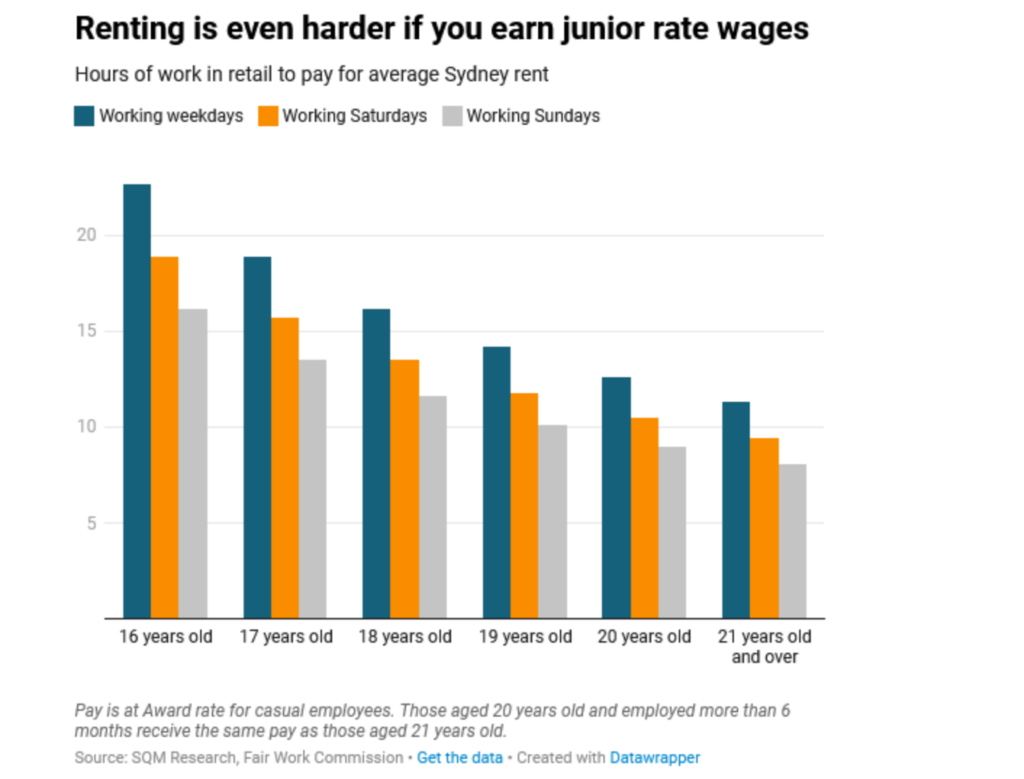
The Fair Work Commission is considering a case that may make ‘junior rates’ for adults a thing of the past.

What are junior rates?

Junior rates are a part of Australia’s industrial relations system that allows young people to be paid less. While Australia mandates minimum wages across the economy, many of these minimum wages include junior rates that allow for lower pay for staff under 21 years old. This means that even after a young person turns 18 and becomes an adult, legally allowed to vote, drink, smoke, serve on a jury and be deployed to fight in a war, they can still be paid less than other adults. Workers under the age of 18 are also not guaranteed superannuation contributions unless they work 30 hours a week.

9 in 10 workers under the age of 18 (91%) are on junior rates, and about one in three young adult workers (34% of 18-20-year-olds) are on junior rates. Despite getting paid less, young workers don’t get any discount on their grocery bills or rent. Last year, I ran the numbers and found that it would take an 18-year-old retail worker in Sydney almost five more hours of wages to pay an average asking rent.

On an economy-wide scale, junior rates result in significantly lower pay for younger workers. Research from the McKell Institute estimates that each year, young Australians collectively earn $3.5 billion less in wages compared to what they would have earned at adult rates.

What is happening now?

The Shop, Distributive and Allied Employees’ Association (SDA), a major union in the retail and hospitality industries, has applied to remove junior rates for employees 18 years old and older who work in retail, fast food, or pharmacies. If they are successful, a huge number of young workers would receive a pay rise and it may spark change in junior rates across other industries.

The Coalition don’t understand the housing crisis and can’t accept the solution

Matt Grudnoff
Senior Economist

Ted O’Brien, the Coalition Shadow Treasurer, thinks that the entire housing crisis is caused by just one thing, not building enough houses.

In the AFR he said

As my colleague, Senator Andrew Bragg, has so ably prosecuted, our housing crisis – which has brought such despair to the hearts of our young people – is the direct consequence of one thing and one thing alone: we are not building enough houses.

As a consequence, one thing and one thing alone will solve our housing crisis: we need to build more houses. It truly is a silver bullet.”

Ok. This is a fairly simple claim to check. If housing supply is the one cause and only solution to the housing crisis, then the population must be growing much faster than the number of homes.

The ABS says the population over the last 10 years increased by 16%. For us to have just maintained the number of homes per person then the number of homes must have grown by at least 16%. If it grew less than that then housing hasn’t been keeping up with population growth, there are less homes per person, and the Coalition might have a point.

But over those 10 years the number of homes increased by 19%. Faster than the population. We now have more homes per person. So, the idea that it is housing supply that has caused the housing crisis is simply not true according to the facts.

The reality is that it has been more investors rushing into the market that have been bidding up house prices, beating first home buyers at auction, and putting home ownership beyond the reach of so many Australians.

More people want to buy investment properties because of the huge tax concessions on offer, the most important of which is the capital gains tax discount. Scrapping it reduces the number of investors showing up to auctions and gives first home buyers a real chance to own a home of their own.

If the Coalition truly want to make housing more affordable, they would be pushing the government to scrap the capital gains tax discount.

In a shock, John Howard likes housing getting less affordable.

Greg Jericho
Chief Economist

Back in 2003 made the claim on radio talkback that “No one has come up to me in the street and complained about the increased value of their home” as Amy has noted however, people did – including in that same radio talkback show!

At the time Howard made the comment, house prices had risen sharply in the previous 3 years after the introduction of the 50% capital gains tax discount. Dwelling prices had risen 73% in 3 years – more than 3 times faster than household incomes.

The impact of the capital gains discount was undeniable. Being able to claim 50% tax free on the profit from selling an investment property made investors could treat the housing market like a casino where the odds are actually stacked in the players favour.

John Howard liked this because his core voters were homeowners. And he cared about people who owned a home getting wealthier – even though it was at the expense of others. He didn’t care about the others because, pffft they were not his voters.

25 years later and the impact is there for all to see.

In September 1999, the average dwelling price in Australia was $195,300 – roughly 9 times the average household disposable income per capita of $21,519. That was not that different from the 7.9 times the average dwelling price was in 1970.

Cut to now and the average dwelling price of $1.045m some 16 times the average household disposable income per capita.

And what is John Howard now saying about the moves to reduce the capital gains tax discount? He told the AFR “It would hurt the aspirational middle class.” As ever he keeps thinking about only those who already have a home (or more than 1) and not those who aspire to one day buy one.

John Howard can’t change how he thinks, but that is no reason why Australian housing policy should stick with his ignorant view of the world or his policy.  

One Nation’s rise another reminder there are no safe seats

Bill Browne
Director of the Democracy & Accountability Program

Back in 2024, the Australia Institute warned that there are “no more safe seats”. In fact, crossbenchers like independents and Greens were much more likely to win “fairly safe” or “safe” seats than they were the supposedly more vulnerable “marginal” seats. 

Seats are classified by looking backwards, measuring how safe or marginal they were at the last election. This approach cannot predict how a new candidate with a good campaign will fare.  

Alongside the decades-long rise in the minor party and independent vote, the major parties are now grappling with a One Nation surge. The right-wing minor party is polling higher than the Liberal and National parties put together.  

In response, Antony Green has assembled a list of 25 seats to watch – on the basis that they are the seats that One Nation did best in at last year’s election.  

Twenty of the 25 seats at risk to One Nation were classified “fairly safe” or “safe” after the last election. Eleven of those were National Party seats.  

The Nationals only won 15 seats at last year’s election and have already lost one of their “safe” seats to One Nation with New England backbencher Barnaby Joyce’s defection.  

The success of community independents at the 2022 election, mostly in “blue-ribbon” safe Liberal seats, was an early warning for sitting MPs that they cannot be complacent. One Nation’s rise in the polls is the latest reminder.  

The National Party has for many years held what were thought of as the safest starts in the country, with One Nation preferences helping to keep Nationals MPs ‘safe’ from Labor victory. But now that One Nation is cannibalising so much of the National Party first-preference vote, One Nation has stopped being an asset and become the main threat to Nationals candidates.  

Global Sanctions Coalition calls on Australia to uphold legal responsibilities

Members of the Global Sanctions Coalition have lodged two submissions “calling on the Australian Government to immediately impose targeted sanctions on individuals and entities directly complicit in grave human rights abuses and serious violations of international humanitarian law in the Occupied Palestinian Territory (OPT)” during Isaac Herzog’s visit.

From the statement:

These submissions are being lodged amid the Australian Government’s ongoing failure to respond meaningfully to the atrocities in Gaza. For more than two years, Gaza has been subjected to genocide, war crimes, deliberate devastation of civilian populations, infrastructure, and essential services, alongside the systematic engineering of famine. Israel continues to pursue its actions, with its Cabinet just approving rules to further enable illegal settlement expansion in the occupied West Bank. 

Despite this, Australia has continued to limit its response to diplomatic manoeuvring, and is currently hosting the President of Israel, complicit in grave human rights abuses, on an official visit. 

Australia-based GSC partners, including the Jewish Council of Australia, Amnesty International Australia, Australian Palestine Advocacy Network and Medical Association for Prevention of War are urging the Government to use its existing sanctions framework to hold accountable those directly responsible for the destruction of civilian infrastructure in Gaza, as well as those driving the dispossession and displacement of Palestinians through illegal settlement expansion.

In the absence of decisive measures against Israel to halt its ongoing genocide, Australia has the capability under its autonomous sanctions framework to exercise its moral and legal responsibility to impose targeted sanctions on actors complicit in the commission of grave human rights abuses. 

The second submission calls for targeted sanctions on the World Zionist Organization (WZO), an organisation that is being welcomed by the Australian Government this week as part of Herzog’s delegation, its Settlement Division, the leadership of its Settlement Division, including newly appointed Head Yishai Merling and Director General Hosha’aya Harari, as well as Minister Orit Strook of the Ministry of Settlements and National Missions. These actors are identified for their central role in the dispossession and displacement of Palestinian civilians, and the expansion of illegal and unauthorised Israeli settlements and outposts in the OPT. 

The first submission calls for the immediate imposition of Magnitsky-style sanctions against three individuals and their associated entities: Alon Elgali (Meshek Afar Ltd), Harel Libi (Libi Construction and Infrastructure Ltd), and Uria Loberbom (founder of the Uria Unit), for their direct involvement in the widescale destruction of civilian property in Gaza. All three are principals of companies that provide and operate heavy machinery, including bulldozers and excavators, used in these operations. 

The submissions form part of a broader, coordinated global effort, with parallel recommendations lodged with the Governments of Canada and the United Kingdom, and the European Union. Together, they reflect growing international recognition that impunity for atrocities in Gaza and the OPT cannot continue unchecked, particularly where diplomatic engagement and international accountability mechanisms have not delivered justice. Australia and other governments must establish a clear precedent that Israel’s violations of human rights and international law cannot be committed without the global community seeking justice and accountability. 

Crossbench serious about expanding paid-prac

Zali Steggall calls on MPs to watch their rhetoric when talking migration

Zali Steggall has just moved a motion in the house

Noting that:

(a) immigration has been, and continues to be, a fundamental contributor to Australia’s economic strength, social fabric, and national resilience; and

(b) migrants play a vital role in sustaining small businesses across Australia, including by filling skills and labour shortages, starting new enterprises, supporting regional economies and contributing to local employment growth; and

(2) calls on all Members of the House to engage in respectful, evidence-based debate on migration policy, and to reject rhetoric that inflames division or undermines the dignity and contribution of migrant communities.

Steggall is speaking on the normalisation of anti-migration rhetoric popping up in all sorts of places and said:

Australia has been a nation shaped by migration since the post-World War II era, with immigration driving population growth, workforce expansion, cultural diversity, and long-term economic resilience.

Migration delivers a measurable net economic benefit. It’s estimated that every additional 1,000 migrants contribute roughly $124 million in annual economic value through labour supply, taxation, entrepreneurship, innovation, and consumer demand.

One of the best parts of being a member of Parliament is attending citizenship ceremonies where we get to welcome people who have been in Australia for a long period of time, who have paid taxes, started small businesses, doing important jobs, and then have taken that extra step of responsibility to become a citizen.

It’s highly damaging when fringe right wing parties like One Nation– instead of having any form of rational policy – seek to instil hate and blame on other communities rather than taking responsibility on evidence-based policymaking.

Feedback from chambers of commerce and small businesses consistently highlights that accessible and efficient migration pathways are critical for keeping businesses open, sustaining regional communities, and supporting local job creation.

Complex challenges such as housing affordability, infrastructure pressure, and urban congestion stem primarily from planning and policy decisions and cannot be blamed on migration.

Claims that migration is “out of control” are inconsistent with evidence showing net overseas migration moderating from post-pandemic highs and remaining within expected volume.

Periods of economic uncertainty often see a rise in anti-migrant rhetoric, and social research shows such narratives can distort public understanding of our immigration system and weaken social cohesion.

Text from Zali’s motion:

(1) notes that:

(a) immigration has been, and continues to be, a fundamental contributor to Australia’s economic

strength, social fabric, and national resilience; and

(b) migrants play a vital role in sustaining small businesses across Australia, including by filling

skills and labour shortages, starting new enterprises, supporting regional economies and

contributing to local employment growth; and

(2) calls on all Members of the House to engage in respectful, evidence-based debate on migration

policy, and to reject rhetoric that inflames division or undermines the dignity and contribution of

migrant communities.

Excerpts from speech just given by Zali:

Australia has been a nation shaped by migration since the post-World War II era, with immigration driving population growth, workforce expansion, cultural diversity, and long-term economic resilience.

Migration delivers a measurable net economic benefit. It’s estimated that every additional 1,000 migrants contribute roughly $124 million in annual economic value through labour supply, taxation, entrepreneurship, innovation, and consumer demand.

One of the best parts of being a member of Parliament is attending citizenship ceremonies where we get to welcome people who have been in Australia for a long period of time, who have paid taxes, started small businesses, doing important jobs, and then have taken that extra step of responsibility to become a citizen.

It’s highly damaging when fringe right wing parties like One Nation– instead of having any form of rational policy – seek to instil hate and blame on other communities rather than taking responsibility on evidence-based policymaking.

Feedback from chambers of commerce and small businesses consistently highlights that accessible and efficient migration pathways are critical for keeping businesses open, sustaining regional communities, and supporting local job creation.

Complex challenges such as housing affordability, infrastructure pressure, and urban congestion stem primarily from planning and policy decisions and cannot be blamed on migration.

Claims that migration is “out of control” are inconsistent with evidence showing net overseas migration moderating from post-pandemic highs and remaining within expected volume.

Periods of economic uncertainty often see a rise in anti-migrant rhetoric, and social research shows such narratives can distort public understanding of our immigration system and weaken social cohesion.

It is particularly dangerous when far-right political actors, including One Nation, falsely blame migrants for government policy failures or planning shortcomings, as this stigmatises communities and risks repeating exclusionary chapters of Australia’s past.

Herzog claims protests against Palestinian genocide ‘undermine and delegitimises’ Israel’s right to exist

It is important to note that Israel does exist (so asking whether it has a right to exist or not is a moot point) and calling for the freedom of all people and to respect the dignity of all human life, is not undermining another nation.

Q: President Herzog, standing here at this solemn site where 15 people were killed indiscriminately, there are protests planned today in Sydney for people who are mourning 70,000 killed in Gaza including 20,000 children. Can you reflect on what is the message to protesters if you have one?

Herzog:

Sure. On personal, it is important for me to say that I have come here in goodwill and in a message that people of Australia – Australia and Israel are close friends and allies since the days of old. It was Australian soldiers who liberated the Holy Land as one of the greatest steps towards the creation of the homeland of the Jewish people. And it was Australia who was the first nation to declare and Israel at the United Nations, and Australia is a close ally for years and Israel was always a issue in Australia.

These demonstrations in most cases, what you hear and see, comes to undermine and delegitimise our right, my nation’s right, the nation which I am the head of state of – of its mere existence and it’s contradictory to whatever, ever said – was said and done by Australia. 

And we did not seek that war October 7. Our nation terribly and people were butchered, murdered, raped and burnt and abducted. We have here bereaved Israeli families who came from the Kibbutz, Kibbutz Nir Oz and from the war in order to express their condolences here at Bondi, but also to create – make a clear statement and a message – we should all fight together. Terror is what undermines all the availability of peace and the notion of peace in our region. It was always the case and is always the case and, therefore, terror is unacceptable by any means.

Herzog press conference continues

On Australia’s recognition of Palestine, Herzog says:

I differentiate between debate and argument between nations and between a clear understanding of one inherent element in the equation. Israel is the only nation state of the Jewish people. The international holocaust remembrance alliance definition of anti-semitism, which was adopted all over the world clearly attacks and undermining their whole notion of the nation state of the Jewish people and its right to self-determination and the right to defend itself is anti-semitism. I think this has to be disseminated. 

You can argue on policies, we argue on policies, but it’s a total different ball game when our ongoing attacks and criticism and agony pain of Jews while citizens of any country, including this country, and we see ourselves as the protectors of Jews all over the world, are attacked and harassed in other countries, and in Australia, which is a model democracy, it must not happen.

Isaac Herzog addresses selected media

Israeli president Isaac Herzog is laying a wreath in Bondi to honour those killed in the terrorist attack. He has given a short speech.

There is a press conference with media outlets which had their expression of interest in attending accepted and the first question is:

You had the chance to meet with families and victims today, first time. Many of them had spoken about their frustrations about the lead-up to this attack. Do you share those frustrations? Could more have been done to prevent such an attack on the Jewish community?

Herzog

These frustrations were shared by many, many of us, including myself where I alerted, as I have seen this wave surge all over the world, and I have seen it in many countries, including Canada, Great Britain, the United States, and Australia – all English-speaking countries. I have alerted way in advance as well as many others and that is why I understand this frustration and I hope the steps that were recently taken will bring change. This has to be a consistent ongoing effort to change reality.

Japanese prime minister’s party secures supermajority

By Mari Yamaguchi and Foster Klug in Tokyo
AAP

The governing party of Japanese Prime Minister Sanae Takaichi has secured a two-thirds supermajority in a key parliamentary election.

Japanese media reported preliminary results, earning Takaichi a landslide victory thanks to her popularity.

Takaichi, told public television network NHK she was now ready to pursue policies to make Japan strong and prosperous. 

NHK said Takaichi’s Liberal Democratic Party, or LDP, alone secured 316 seats by early Monday, comfortably surpassing a 261-seat absolute majority in the 465-member lower house, the more powerful of Japan’s two-chamber parliament. 

That marks a record since the party’s foundation in 1955 and surpasses the previous record of 300 seats won in 1986 by late prime minister Yasuhiro Nakasone. 

With 36 seats won by its new ally, Japan Innovation Party, Takaichi’s ruling coalition has won 352 seats.

Despite the lack of a majority in the other chamber, the upper house, the huge jump from the pre-election share in the superior lower house would allow Takaichi to make progress on a right-wing agenda that aims to boost Japan’s economy and military capabilities as tensions grow with China and she tries to nurture ties with the United States.

Takaichi is hugely popular, but the governing LDP, which has ruled Japan for most of the last seven decades, has struggled with funding and religious scandals in recent years. She called Sunday’s early election only after three months in office, hoping to turn that around while her popularity is high.

The ultraconservative Takaichi, who took office as Japan’s first female leader in October, pledged to “work, work, work,” and her style has resonated with younger fans who say they weren’t previously interested in politics.

The opposition, despite the formation of a new centrist alliance and a rising far-right, was too splintered to be a real challenger. 

The new opposition alliance of LDP’s former coalition partner, Buddhist-backed dovish Komeito, and the liberal-leaning Constitutional Democratic Party of Japan, is projected to sink to half of their combined pre-election share of 167 seats.

Takaichi was betting with this election that her LDP party, together with its new partner, the JIP, would secure a majority

Trump in a post on his Truth Social platform Sunday congratulated Takaichi “on a LANDSLIDE Victory in today’s very important Vote. She is a highly respected and very popular Leader. Sanae’s bold and wise decision to call for an Election paid off big time.”

The prime minister wants to push forward a significant shift to the right in Japan’s security, immigration and other policies.

The LDP’s right-wing partner, JIP leader Hirofumi Yoshimura, has said his party will serve as an “accelerator” for this push.

Japan has recently seen far-right populists gain ground, such as the anti-globalist and surging nationalist party Sanseito. Exit polls projected a big gain for Sanseito.

The first major task for Takaichi when the lower house reconvenes in mid-February is to work on a budget bill, delayed by the election, to fund economic measures that address rising costs and sluggish wages. 

Takaichi has pledged to revise security and defence policies by December to bolster Japan’s offensive military capabilities, lifting a ban on weapons exports and moving further away from the country’s postwar pacifist principles. 

She has been pushing for tougher policies on foreigners, anti-espionage and other measures that resonate with a far-right audience, but ones that experts say could undermine civil rights.

Takaichi also wants to increase defence spending in response to Trump’s pressure for Japan to loosen its purse strings.

She now has time to work on these policies, without an election until 2028.

Though Takaichi said that she’s seeking to win support for policies seen as divisive in Japan, she largely avoided discussing ways to fund soaring military spending, how to fix diplomatic tension with China and other issues.

Takaichi also wants to push tougher measures on immigration, including stricter requirements for foreign property owners and a cap on foreign residents. 

with Reuters

And then…

Asked about the protests planned for Israeli president Isaac Herzog’s visit, which are in response to the credible accusations Israel is carrying out a genocide against Palestinians (and coming as the Israeli parliament passes laws to allow people to buy stolen land in the West Bank, which has been taken by force from Palestinians by Israelis, which again – is illegal and outside of Gaza, for anyone who still thinks it is still about Hamas) Hume falls back to what we saw from the Liberal party over the summer:

The Jewish community* have asked President Herzog to come here to join with them to give them some comfort.

I think the Jewish community in Australia has been through enough in the last three years. How about we just allow them this time with such a senior figure from from Israel, without the activism that goes with it, without the protests, without that underlying anti-Semitic message**, it’s not a long visit. It’s only a couple of days.

Peaceful protest is fine, but let’s allow the Jewish community, who have been through so much, particularly in the wake of Bondi to just have a few days to themselves.

*Some in the Jewish community. There are also a lot of Jewish people who are against the visit because of what they say Israel is doing in their name and have called for the invitation to be rescinded.

**Protesting a genocide is not anti-Semitic. While anti-Semitism is real and some have exploited the protests against the actions of Israel to further their own anti-Semitism (just as people have used supporting Israel to further their own Islamophobia), protesting against a nation for its actions does not equal a hatred of an entire people or religion.

‘It’s time to step up and lead’

Jane Hume doesn’t bother to hide her bitterness that she was removed from the shadow cabinet when she is asked about what is it the leadership are talking about in the Liberal party (but that is also the reason she is able to speak so freely on this. Although, it has to be said, that while she has been making these comments privately, it has taken to today, when Newspoll don’t even bother with a 2PP for her to get brutally honest about the slide the party has been on for the last five years)

Hume:

Well, I’m afraid I’m not part of the shadow cabinet or the shadow ministry, and certainly not part of leadership, so these conversations are going on without me right now, but I’m concerned that the colleagues that I work with every single day that are really digging deep in their own electorates, that are trying to represent that their communities are doing it all for naught because we are being led astray. So it’s time to step up and lead.

If we talk about ourselves constantly, constantly, we are never going to get the attention of the people who we want to represent, let alone win an election.

‘People have stopped listening to us, because we are a rabble’

Jane Hume said she is not speaking about a leadership change – but a change in the party’s direction when she speaks about leadership needing to respond:

I do believe that it’s time for the leaders to take a look, a good, hard look, at themselves, and decide what it they’re going to do to get us out of this hole?

It’s more than just coming together, shaking hands and say ‘we’ve kissed and made up’.

What is it that we stand for as a Coalition? Who is it that we are fighting for? What are our policies? Because people have stopped listening to us, because we are a rabble.

And that doesn’t mean going to One Nation Hume says:

One Nation is their own party. I’m looking forward to seeing some detailed policy ideas from them, too, because, let’s face it, at this stage, they’re just slogans, but we have a proud history and a legacy to protect, but more importantly, we have generations of future Australians that our responsibility is to look after we’re not speaking to them right now. They’re not listening to us. So what is it that we are going to do for them? Because, quite frankly, if we haven’t got any ideas, what are we doing here?

Is Angus Taylor the answer, the host asks?

I can’t answer that question. What I can only say is that at some point we need to do a reset and say, what is it that we stand for, who is it that we’re fighting for, and what policies are we presenting? Because the more we talk about ourselves, the less people listen to us.

The government is getting away with murder on our watch. The economy is tanking. Growth has stalled. Inflation is going up. This poll was taken during a week when interest rates increases, interest rates increased, yeah, and we still can’t land a blow.

It’s simply not good enough. No wonder my colleagues are going back to their electorates each weekend and saying, ‘I’m embarrassed. I’m sorry’.

Something’s got to give

‘Who are we?” Jane Hume asks Liberal party

I’ve been talking about this since the summer – don’t be surprised if Anthony Albanese calls an early election to capitalise on the Coalition collapse. Jane Hume is a senator, which means she keeps an eye on the broader electoral situation – that is the job of senators. And she has worked out that Albanese will most likely call an election just over the two year mark of this term, to capture all those seats Labor now has its mind on:.

Hume:

Why would you not call an early election if you knew that the Coalition was in disarray, I would imagine that the next election will be in about 18 months time. we need to claw back a lot of favour with the electorate in just in order to survive.

What does Hume think has to give?

Well, that’s a good question. It’s a question for our leaders, our leaders of the Liberal Party, who have seen their primary vote fall to 15% and our leaders of the National Party, who, despite an awful lot of posturing, has a primary vote of 3% that is entirely unsustainable.

No wonder my colleagues are going back to their election electorates and saying, This is embarrassing.

We’ve been working on gallows humor and optimism, but that’s not good enough. Something more has to give I look at my colleagues like Zoe McKenzie in Flinders, or Mary Aldred in Monash or Aaron Violi in Casey, these are bright young people with enormous futures ahead of them who are working so hard in their electorates and are fantastic local members. But that’s not going to be enough to save them.

They will have their careers cut short unless something happens. I was thinking about the election review that is due out any day now. Now, Peter Dutton was an unpopular leader. That will be the message of the review, but his polling was at around negative 24% Susan Leigh, is now negative 35.

Something has to change quickly.

My message to my leaders is that if you have a rabbit in your hat, it’s time to reach for that bunny, because we cannot continue this way.

…I’m not calling for a spill. I want something to change. Do you know, six months into the last term of Parliament, Peter Dutton had said, ‘this is what we stand for.’

He had announced that we were going to allow all older Australians to continue to work without losing their pension. We had announced $400 million for Youth Mental Health.

We had announced policies to address domestic violence.

We had announced a nuclear energy policy. I’m not entirely sure what it is that we have announced in the last nine months, we’ve announced that we’re against Labor’s energy policy.

We’ve announced that we’re against Labor’s housing policy, we’re announced that we’re against Labor’s tax policy, and we’ve announced that we’re against Labor’s immigration policy. But what is it that we stand for?

I presented to the Young Liberals convention on the weekend, and I looked at these eager, enthusiastic, fresh faced young people who want to fight for something. What is it that we are fighting for? We are running out of time to deliver this message.

So my message to my leaders, both Liberal and National, is, please, time to express what it is that we’re fighting for.

Time to express who it is that we’re fighting for, because this News poll is so bad that we haven’t even been compared to Labor. They haven’t even bothered to do a two party preferred number.

‘Something has to give’ says Jane Hume to colleagues.

Going back through Sky News this morning and Jane Hume had a VERY early appearance where she became a bit emotional – not at the polling, although that would have to hurt, but at the Coalition’s inability for the last few years to actually face reality.

Which, I don’t think anyone can fault her for. Hume is actually talking a lot of sense here and she is usually someone who will back the leader in and keep on marching even when she thinks its in the wrong direction, while privately advocating for change. Well, she’s given up on the private entreaties.

This is disastrous for the Liberal Party. It’s disastrous for the Coalition. Unless something changes, we will be wiped out.

I’ve been looking at the numbers just running a ruler over the pendulum, and I don’t think that at this point there will be a single member of the House of Representatives from Victoria.

There won’t be a single member of the House of Representatives from New South Wales.

Something has to give we had our lowest primary vote ever at the last election, and it’s now nearly halved.

So something has to change, and it has to change quickly.

Barnaby Joyce spent the weekend in Victoria, speaking to the  Across Victoria Alliance conference, which has been billed as open to anyone, but has been slammed by Victorian premier Jacinta Allan as a ‘misinformation conference’ and look, maybe so – but people there are listening to what Joyce was putting down.

He told what looked to be a rapt audience that the only way for voters to change the political parties was to make them think they had lost the voters. Which is true – it is one of the only things that can motivate political parties into changing policies. But the issue can be in what direction the policies change. What Joyce and much of that room wanted, was One Nation style policies, which means there is a big shift in regional Victoria now too.

Hume is right to be worried.

Delusion continues

Sussan Ley expects everyone to move forward and for everyone to think that all is fine in the Coalition because they ‘made statements’ yesterday.

Lols.

Well, we made clear statements yesterday. We had a joint press conference. We talked about how we have indeed resolved those differences and that we are stronger moving forward and that we look forward to taking it up to the Prime Minister and his ministers and his awful government that does not have the answers for Australians. I hear that everywhere I go. People are struggling. I know that the Coalition has the answers, whether it be as I said, the migration policy to better reflect and respond to the real pressures and squeeze that Australians are facing in the suburbs and the cities especially, whether it be the affordable energy policy and plan that we talked about at the end of last year, which was very well received because it is about bringing relief to households and bringing manufacturing back to Australia, backing in our struggling small businesses drowning in red tape at the moment. As I am always focused on, because of my life experience, how do we help mums with children managing childcare, managing an escalating mortgage, managing two jobs to pay the bills? How do we back them in? We have plans for that and much to talk about going forward.

Coalition leadership Linkedin

OK, not too sure what is going on here, but the LinkedIn posts have started for the leadership challenge

Toto still barks at the PM’s security team and other important news

Anthony Albanese did his regular FM radio blitz this morning and on Sydney radio Nova FM, after a chat about wake up times, Toto (always Toto) and other very important things, he was asked about the Coalition and said:

I just sit back and watch with some incredulity, I’ve got to say at their carry on. They really don’t like each other and I think yesterday, having a look at them, you know, David Littleproud looked like a hostage at that press conference. And I’ll just, I’ll just let them – I’ll concentrate on doing my job, which is providing support for people and dealing with cost of living pressures. And dealing with international issues, the full bit that we’ve got to deal with –

Host: Do you reckon we’ll ever see Pauline Hanson as Prime Minister?

Albanese: No.

Other host: Good.

Albanese:

 No, Pauline Hanson and One Nation are all about grievance and identifying problems, not providing solutions and dividing people. So, I think it’s unfortunate the state of the traditional conservative parties in Australia at the moment. I hope they get their act together because I think that’s good for the country to have a strong government, and a strong Opposition, but I don’t think Pauline Hanson is the answer to anything. 

‘There are many people deeply worried about this’

Asked about Isaac Herzog’s visit and whether there has been any discussion among the crossbench about it, Helen Haines says:

Well, the crossbench comprises of independents and some minor parties, of course, so there hasn’t been a collective discussion about this.

But I could say, from my own perspective, as an independent representing the people of Indi I’m receiving significant amounts of correspondence from my constituents who are concerned about President Herzog’s visit, and they’re concerned because they see this as not a way of bringing our community together.

There are many people who are deeply worried about this, and I join them in their concern.

And on the fires which devastated her electorate, Haines says:

Well, they’re on the massive recovery build back, many people have lost their homes.

Over 300 homes lost across the electorate of Indi, countless numbers of farming structures, fences and livestock.

This is a long, long way back for many people, and many of them have experienced this kind of heartache previously in the 2019/2020, Black Summer fires.

So I’m working closely with government, with emergency services to ensure that we’ve got what we need, but frankly, what we truly need is long term redundancy and resilience in our telecommunications and power supplies.

They’re the kind of things that government can do to ensure that next time when a bushfire hits, we don’t lose communication in the way that we currently do. We need disaster roaming. We need emergency power backup to our telcos.

One Nation is ‘not a constructive place’ to put your vote says Haines

That interview continued:

Q: Do you think it’s a national trend when it comes to the rise of One Nation right now, or one that’s confined to Queensland and New South Wales?

Helen Haines:

Well, it appears from the polling that we’ve just seen come in overnight that it is more broad than isolated areas. But One Nation are leaning into real issues that people are feeling, and they’re leaning into them, not with solutions. They just they are really harboring discontent, and I don’t think that brings the nation forward. And ultimately, I think Australians are seeking solutions. They’re not seeking they’re not seeking protests. They’re not seeking disharmony. They are seeking solutions.

Q: Polls are showing that support is bleeding from both major parties. Why is it just One Nation seeming to benefit? Why aren’t community independents and other minor parties benefiting more from this dissatisfaction with the major parties?

Haines:

Well, I think it’s because One Nation are a political party. We see our community independents on the crossbench in the House of Representatives, and you’ve seen us grow in number. But in between elections, unless we have a community independent on the ground, people don’t see that there is that additional choice. That’s why it’s so critical that we have independents on the ticket when it comes to elections, because people are looking for somewhere constructive to put their vote, and frankly, One Nation is not a constructive place to put your vote.

‘They just think the Coalition is a joke’

Dr Helen Haines has spoken to ABC radio RN Breakfast, where she was asked about the Coalition and it’s latest relationship woes and said:

Let’s be honest here, out in the communities where I represent, where people are feeling the pain of inflation, where people are trying to recover from bushfires.

Look, they just think the Coalition is a joke. They’re disgusted by the games that have been played here in Parliament, and they’re really relying on people like me and the crossbench to get on and do the policy work and be an effective be an effective opposition.

Q: What are you seeing with support for One Nation in your part of the world?

Haines:

Well, it’s hard to tell, in the vacuum that’s been created by the National Party and they’re fighting with the Liberal Party. Of course, One Nation are out on the ground. We’re seeing…Barnaby Joyce, coming down into Victoria to do some kind of town hall soon. So Barnaby Joyce is certainly capitalising on that vacuum, but really, what I’m about is trying to find solutions for people’s problems. Thousands of allied health and medical students are signing the petition to ask the government to come to their support so they can get on and do the training that we need in places like urban and regional Australia.

I don’t see One Nation doing that kind of work, and I certainly don’t see the Coalition doing that kind of policy work either

Rinse and repeat

If you didn’t believe that Sussan Ley had lines prepared by her team which she is just repeating like a slightly panicked Energiser Bunny, here is what Ley opened her Nine network appearance with:

I think it’s a fair point that when Australians see us talking about ourselves, they mark us down. And those polls point to a time. And millions of Australians want the opposition to scrutinise the government, hold them to account. And we will give the backing Australians deserve, need and expect and we can deliver.

As you said, the Coalition we’ve strengthened and we are squarely focused on Australian people, their needs, their aspirations, their hopes. It’s a big week in Parliament. Every week is, but this in particular because we’ve just had such disastrous indicators of the cost of living and mums and dads who are sitting at the kitchen table opening their power bills, looking at the back to school costs, up to $23,000 (extra to find) and we are here to fight for them, just every single day.

And she is totally not worried about a leadership challenge, even though she is about as popular as a mosquito.

Ley:

I’ve been elected by my party room. I’m up for the job. We’re up for the job, and we know that we have to be because millions of Australians are being let down by a government that has got it all wrong.

…I don’t want my children and grandchildren to inherit a worse standard of living than I do. I don’t want the the children I meet in childcare centres and at home every day of the week, not to be able to afford a home, I don’t want pensioners battling now to struggle to pay their bills. This is a fight we need to have for and on behalf of the Australian people. And I want underscore it, I’m up for job.

And so on and so on and so on

Israeli president lands in Australia

Isaac Herzog has been taken from Sydney airport in a motorcade, marking the start of his expected three-day visit. He was escorted by armed police, in an armoured plated car, accompanied by NSW tactical police.

Sussan Ley is out and about pretending everything is hunky dory

Sussan Ley is really trying to pretend everything is just fine and dandy and despite recording the worst personal approval rating since Simon Crean and a new low for the Coalition, it’s Anthony Albanese that people are annoyed at.

She told the Seven network this morning she “indeed” will be the leader at the end of the week and the only reason people are voting her party down in the polls is because they haven’t seen “a clear united message coming out of Canberra, they mark us down.”

Which is a new level of delusion for her team, and that is saying something.

Ley:

I understand that, but as you’ve said, the Coalition is back most importantly, we’re squarely focused on millions of Australians who are counting on us for their needs, aspirations and their hopes. And they deserve no less. They expect no less, and they will receive no less.

Oh and she’s totally, not at all, not even a little bit concerned that Angus Taylor will challenge. She’s so unconcerned, the kitchen table is back!

Ley:

I am always looking outside the building to the people who are counting on us, as I said, and they are doing it tough, we see that writ large. And they are sitting around the kitchen table every morning looking at their electricity bills, wondering how they’re going to meet the back to school costs, wondering how they’re going to get through the interest rate rise government, $23,000 out of pocket, more find.

That makes me focused along with my team to scrutinise this government, to hold them to account, because Anthony Albanese does not have answers* to the pressing problems that are facing Australians.

*The Coalition have almost no policies. They have offered no answers.

Palestine Action Group launch supreme court challenge to NSW protest laws ahead of Herzog protest

The NSW police have said they will arrest anyone who breaks the protest ban boundaries which was put in place after Bondi, and extended to cover Israeli president Isaac Herzog’s visit to Australia. Mass protests are still planned, including in Sydney and the Palestine Action Group have announced a challenge to the NSW laws in the supreme court against the special powers police have been granted to break up assemblies. The group will argue the powers are excessive, unjustified and unlawful.

Late last week, the Greens, the Maritime Union of Australia, Labor Friends of Palestine, Palestine Action Group, Australia Palestine Advocacy Network (APAN), Jews Against the Occupation ‘48, Hunter Workers and the South Coast Labour Council came together to call on the Albanese Government and the Australian Federal Police (AFP) to investigate Herzog for war crimes, given the allegation he incited the commission of genocide.

Independents push for expansion of paid prac program

Independent MP Helen Haines and independent senator David Pocock have commissioned the Parliamentary Budget Office to cost expanding the Commonwealth Prac Payment Scheme to include medical and allied health students and found it would cost just $290m over four years (which in budget terms, is not a lot of money).

The pair will hold a press conference on the matter later this morning and say it is one of the ways the government could end placement poverty for the future health workforce. Work placement is a necessity for students wanting a variety of health and teaching degrees, but often means foregoing paid work. After crossbench advocacy, the goverment past paid prac for teaching, midwifery and social work students – but Haines and Pocock said it should also include health students and are pushing to see they are included in the next budget.

Health Students Alliance recently released a survey showing 42% of students couldn’t afford to eat three meals while on a placement, and were being pushed into financial hardship to complete their studies.

Haines said the costings “show that ending placement poverty is both achievable and affordable. Failing to act is a political choice, not a budget constraint.”

At a time of severe health workforce shortages – particularly in rural and regional areas – the Government can’t afford to let unpaid placements become the barrier that stops students from completing their degrees.”

Senator Pocock’s PBO costings also modelled the cost of lifting the payment rate from the current $338.60 per week benchmarked to the single Austudy per week rate while undertaking the placement.

Pocock:

Most Australians have experienced firsthand the impacts from the acute shortage of qualified professionals, from psychologists to dentists to speech pathologists. Extending Commonwealth Paid Prac to enable more Australians to qualify in the professions we so desperately need makes sense and will help ease that shortage.

Over the longer term it will cost the Federal Government more if they fail to support the pipeline of medical and allied health students Australians right around the country rely on. 

Investing some $80 million a year in expanding a means-tested payment to enable more people from all backgrounds – be they First Nations peoples, people with disability, single parents or single income households – will improve equity and make sure we are training and qualifying the medical and allied health professionals we need, not just the ones who can afford it.”

Dr Haines and Senator Pocock have partnered with peak body Allied Health Professions Australia to launch an online petition calling on the Federal Government to expand the Prac Payment Scheme.

New low for Sussan Ley, Coalition in Newspoll

This will set the Angus Taylor chickens a-running – the latest Newspoll, first published by the Australian has the Coalition on a primary vote of 18% and One Nation on 27%. That would mean a diabolical result for the Coalition in an election, with a mass loss in the senate as well.

Ley’s own personal rating is the lowest for any political leader in about 20 years with a net satisfaction level of -39.

Labor is sitting on 33 points and would win an election in an even bigger landslide.

Taylor told Sydney radio last week he had leadership ambitions but it would be up to the party. He is still a couple of numbers short as of last count but today’s poll may help tip the balance. A challenge by the end of the week is still on the cards, especially now that the Liberals and Nationals are officially back together (so it doesn’t look like the Libs bowed even further to the Nats and changed leaders to get the Nats back) but honestly, this mess has a long way to play out.

Ley has promised an immigration policy within the next couple of weeks, which is expected to out One Nation One Nation’s, so you know they are going to just keep digging down.

Oh, and according to Sky News, Tim Wilson still has leadership ambitions, but he’ll also settle for shadow treasurer. Like I said – there is still so much further to fall.

JCA pushes back against Herzog visit

The Jewish Council of Australia have stepped up their campaign to have Anthony Albanese rescind the invitation to Isaac Herzog:

The Jewish Council of Australia (JCA) has today launched a major advertising campaign in the Sydney Morning Herald and the Age, to voice widespread Jewish communal opposition to the official visit of Israeli President Isaac Herzog.

The full-page open letter, signed by over 1000 Jewish Australian academics, legal professionals, artists, and community leaders, calls on Prime Minister Anthony Albanese to rescind the invitation. High-profile signatories include Robert Richter QC, Alex Wodak AM, Louise Adler AM, Josh Bornstein and Professor Dennis Altman AM. 

The campaign argues that welcoming President Herzog, whose public statements suggesting the collective responsibility of all Gazans for October 7, have been cited in the International Court of Justice (ICJ) as evidence of genocidal intent, undermines Australia’s commitment to international law and risks further inflaming division in the wake of the Bondi tragedy.

Sarah Schwartz, Executive Officer, Jewish Council of Australia:

By framing this visit as providing support for Jewish Australians, the Prime Minister has politicised our grief and ignored the thousands of Jewish people who stand for Palestinian human rights and against Israel’s atrocities.”

This advertising campaign exists because Jewish Australians are being spoken for by our political leaders without our consent. Our identities have been flattened for political gain. Welcoming President Herzog in our name does not reflect our values, and it does not make our community safer.”

We refuse to let our collective grief be used to legitimise a leader whose rhetoric has been part of inciting a genocide against Palestinians in Gaza and has contributed to the illegal annexation of the West Bank.”

Australia’s recognition of the State of Palestine is a hollow gesture if we now welcome the head of the state that is actively destroying Palestinian sovereignty. We call on the Prime Minister to listen to the diverse range of Jewish voices and put human rights at the heart of our foreign policy.”

Good morning

Hello and welcome back to parliament where it is the House sitting and also the first week of estimates. We will of course be concentrating a lot on that, as well as answering your questions – MPs and senators read this blog, so send through questions you would want asked in senate estimate committees and we’ll let them know they are there – but the main event for the next couple of days is the response to the visit from Israeli president, Isaac Herzog.

Now readers and friends of this blog need don’t need a lot of context for why this visit is launching mass protests across the country (with some of the biggest events planned for this afternoon). Herzog is the ceremonial head of state for Israel (much like our governor-general) and has not had control over Israeli policy, in terms of he doesn’t direct it. But he has spoken of his support for it, has been filmed signing bombs which have been dropped on civilian populations in Gaza and a UN Commission of Inquiry last year named Herzog as one of the senior Israeli politicians and figures who had incited “the commission of genocide”. One of the reasons for that is his quote from October 2023 that the entire nation of Palestine was responsible for October 7.

The quote mentioned in the UN commission of inquiry is:

On 13 October 2023, President Isaac Herzog stated, “it’s an entire nation out there that is responsible. It is not true, this rhetoric about civilians who were not aware and not involved. It is absolutely not true.”

Herzog claims that this has been taken out of context because he later said Israel was not targeting civilians (which multiple humanitarian, legal and genocide groups and scholars have found not to be true, let alone what people are seeing with their own eyes from Palestinians reflecting their reality). You can read the whole UN report here (and I recommend you do, if you haven’t) with one of the findings:

On incitement to genocide, the Commission concludes that Israeli President Isaac Herzog, Prime Minister Benjamin Netanyahu and then Defence Minister Yoav Gallanthave incited the commission of genocide and that Israeli authorities have failed to take action against them to punish this The Commission has not fully assessed statements by other Israeli political and military leaders, including Minister for National Security Itamar Ben-Gvir and Minister for Finance Bezalel Smotrich, and considers that they too should be assessed to determine whether they constitute incitement to commit genocide.

There is not an arrest warrant out for Herzog, unlike Netanyahu, but Chris Sidoti a former Australian Human Rights Commissioner, current UN commissioner on the Independent International Commission of Inquiry on the Occupied Palestinian Territory and Israel, says Australia has obligations to human rights it is not meeting in going ahead with this visit.

You can hear Sidoti talk more about that, here.

There are a handful of NSW state Labor backbenchers who have spoken out against the visit, as well as federal Labor MP Ed Husic, but other than that, despite many MPs expressing private discomfort with the visit, the Labor caucus has been pretty much silent on all of it.

An excellent primer on how this visit marks a change in how the Albanese government has been handling Israeli-Australian relations since the horrendous Bondi terrorist attack, can be found from Laura Tingle, here.

Protests are planned, while Queensland has announced it will be the first jurisdiction to ban the phrase “from the river to the sea” under the new hate speech laws, while “globalise the intifada” has already been earmarked for banning by NSW. What this means is, anyone using these phrases at a protest can be charged under the new hate speech laws. Given how frequent both these phrases are used in protesting for Palestinian liberation (many Israeli organisations and supporters interpret the phrases as meaning the destruction of Jewish people, while anti-genocide protesters and historians speak on the more nuanced history of the phrases, which includes liberation and freedom for Palestinians living under oppression and for Palestine, while pointing out intifada is Arabic for ‘shaking off’ or ‘uprising’ and protesting for freedom is a human right) deeming the phrases hate speech lends itself to concerns Australia will follow the UK’s path with mass arrests.

Given this is a visit that was supposed to help Australia heal and promote social cohesion, it’s shaping up to create one of the biggest flashpoints for the nation – and none of the politicians responsible for the visit seem to be able to answer how they will handle that, or how indeed it is going to achieve the aims of either healing, or social cohesion.

We’ll bring you more on that as well as everything else happening in the parliament and beyond.

Oh, and the Coalition officially got back together. If you care about that, you might actually be reading the wrong blog, because we try to focus on actual issues of substance here. (That is not to say that we won’t be covering it, because the ridiculousness needs to be noted for history, but honestly – it means nothing, matters nothing, and changes nothing.)

So you have me, a slightly cranky and over it Amy Remeikis, expert contributors and access to Mike Bowers, which is probably the highlight, let’s be honest, taking you through the day.

Coffee number three is already on and I will be having cake for breakfast. It is one of those days.

Ready?

Let’s get into it.


Read the previous day's news (Thu 5 Feb)

Comments (21)

Join the conversation

  • Iain Davidson Mon, 09.02.26 16.59 AEDT
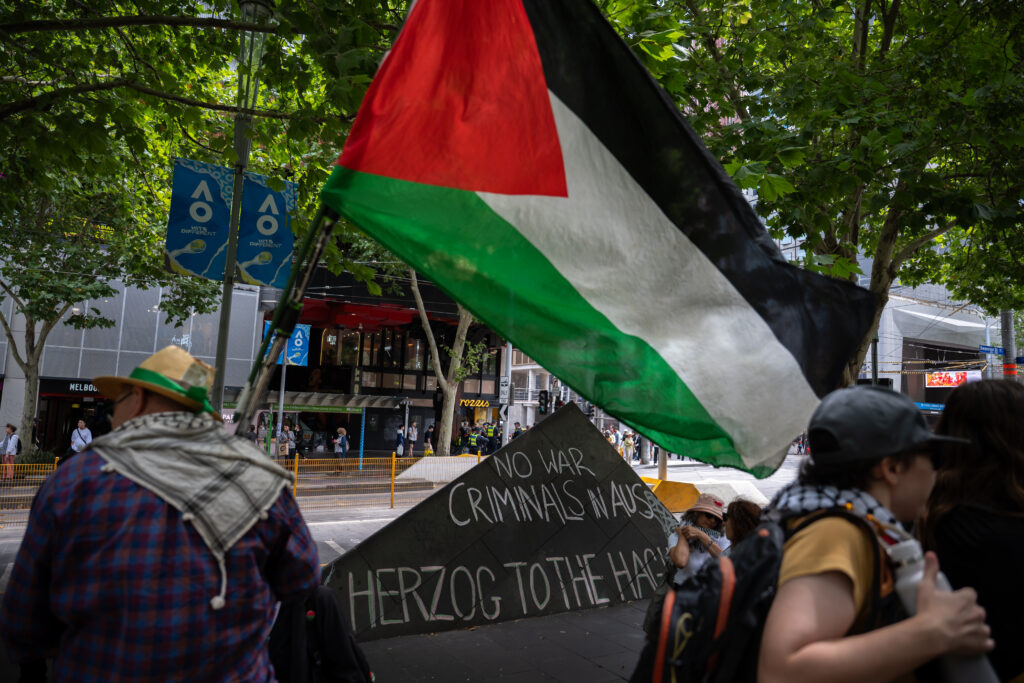
    https://live.thepoint.com.au/?post=9f5390eec0
    If he really said "A United Nations inquiry found his comments after the Hamas terror attack on Israel on October 7, 2023 – in which he described Palestinians as an “entire nation out there that is responsible” – to reasonably be interpreted as incitement for genocide." Then it is at last a real admission by an Israeli that Palestine is a nation.

  • Richard Llewellyn Mon, 09.02.26 16.29 AEDT

    Wasn't it nice of that lovely Mr Herzog to mention his appreciation of the effort (and sacrifice) of Australians to liberate the land now occupied / being invaded by the Israeli government way back in the 'Great War'.

    It would be even nicer if he would explain why bulldozers of his government's military have razed the graves of those Australian soldiers buried on that land in which they died. I suppose it was because they were obviously an underground network of HAMAS operatives?

    Yes indeed, Mr Herzog, you have an unending task of (as you stated earlier today): 'changing reality'

  • Fiona Mon, 09.02.26 16.28 AEDT

    https://live.thepoint.com.au/2026/02/the-point-live-mass-protests-planned-in-response-to-israeli-president-visit-codependent-coalition-back-together/?post=b9a1b33b17
    next youth allowance?

  • Iain Davidson Mon, 09.02.26 16.04 AEDT
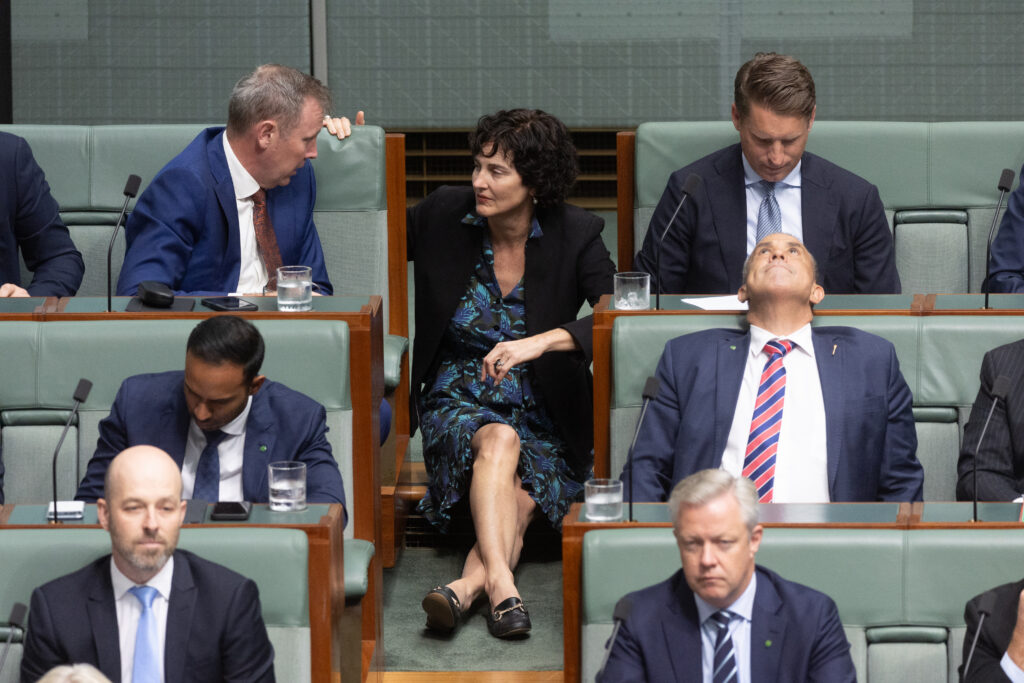
    https://live.thepoint.com.au/2026/02/the-point-live-mass-protests-planned-in-response-to-israeli-president-visit-codependent-coalition-back-together/?post=8ac0abff5c
    AND, of course, 'middle powers need to work together “to drive consensus and respect for sovereignty” ' is absolutely contrary to the approach of the government of the State that the government's current visitor comes from. Not consensus but "Our way or death"

  • Gregory Shearman Mon, 09.02.26 16.00 AEDT

    My sincere condolences for the loss of Jon Kudelka, and at such a young age. I really enjoyed his cartoons.

  • Sam Mon, 09.02.26 15.18 AEDT

    I'm far more concerned about the likely carnage now-collapsed dodgy small businesses have left in their wake- likely unpaid wages and unpaid super, let alone unpaid suppliers and unsecured creditors. Just because a business is small does not mean it is good. Some businesses will fail, that is literally how competition works.

  • Sam Mon, 09.02.26 15.07 AEDT

    Jane Hume may have been briefly sensible this morning but she then went to Senate Estimates. She was focused on, *checks notes* condoms on sale in women's bathroom at the gym and not the men's... this is the level of drivel she spending her parliamentary time on.

  • Michael Cowan Mon, 09.02.26 14.37 AEDT
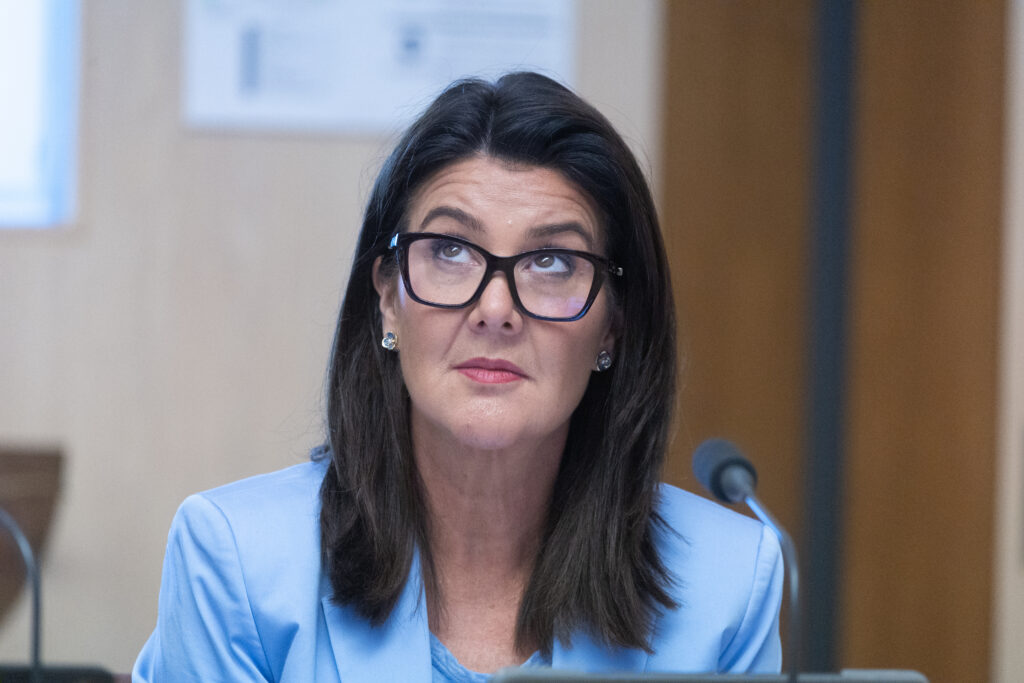
    https://live.thepoint.com.au/2026/02/the-point-live-mass-protests-planned-in-response-to-israeli-president-visit-codependent-coalition-back-together/?post=79fd30d160

    The Shadow Treasurer must have a bucket list of commentators to cite and could be reaching the bottom quoting Kochie.

    Meanwhile the Nationals rely on the $275 power reduction one trick pony question again.

  • Sam Mon, 09.02.26 12.50 AEDT

    Do people understand that eliminating or reducing the capital gains tax discount does not mean you pay 100% tax on your capital gain?

  • AB Mon, 09.02.26 12.38 AEDT

    Out of interest, do we know how many properties Johnny and his family own?

    https://live.thepoint.com.au/2026/02/the-point-live-mass-protests-planned-in-response-to-israeli-president-visit-codependent-coalition-back-together/?post=cc102ec6f7

  • Sam Mon, 09.02.26 12.36 AEDT

    https://live.thepoint.com.au/2026/02/the-point-live-mass-protests-planned-in-response-to-israeli-president-visit-codependent-coalition-back-together/?post=19fce69faf

    Israel has a right to exist. Palestine has a right to exist. Israel does not have a right to use mass starvation as a weapon of war.

  • Sam Mon, 09.02.26 11.37 AEDT

    https://live.thepoint.com.au/2026/02/the-point-live-mass-protests-planned-in-response-to-israeli-president-visit-codependent-coalition-back-together/?post=f8b77e2863

    What is the point of the Liberals? It's somewhat ironic that Jane Hume, who during the election infamously parroted the idea that Chinese-Australians handing out for Labor were spies from China, is pushing back against One Nation.

  • Meg Mon, 09.02.26 10.17 AEDT

    The entire block surrounding the in Intercontinental Hotel is blocked off, police everywhere, snipers on roofs. Staff here told to leave work early to ensure they get home safely and actually can get home. He is not welcome here.

  • Ben Mon, 09.02.26 10.07 AEDT

    https://live.thepoint.com.au/2026/02/the-point-live-mass-protests-planned-in-response-to-israeli-president-visit-codependent-coalition-back-together/?post=985366a4cf
    Thank you for highlighting other Jewish voices. It's pretty sickening when only the ECAJ is paraded by most news agencies as the only representative body for Jewish people who gets a say on what Jewish people want

  • Iain Davidson Mon, 09.02.26 10.03 AEDT

    Do you know if there is a protest planned for Armidale? Back in the day we had the largest demonstration per capita against the invasion of Iraq.

  • RobArt Mon, 09.02.26 09.34 AEDT

    It’s ironic that JNP talks about “always showing up even when it’s uncomfortable”
    Like she did when Angus lost the leadership vote and she didn’t nominate for deputy.

  • Richard Llewellyn Mon, 09.02.26 09.15 AEDT

    Minns has his nose firmly placed in an intimate position behind Albanese. He is evidently completely ignorant of the history of the Likud Party government, of which Herzog is the ultimate representative.

    And in a huge irony, the very first paragraph of the original Likud Party manifesto states:

    a. The right of the Jewish people to the land of Israel is eternal and indisputable and is linked with the right to security and peace; therefore, Judea and Samaria will not be handed to any foreign administration; between the Sea and the Jordan there will only be Israeli sovereignty.

    So, BY DFEFINITION, the phrase 'from the river to the sea' is hate speech - originated by the current Israeli ruling party.

    Yet it seems that it is NOT hate speech when it is root policy of the government Herzog represents and the Zionist movement he so vociferously supports. To allow Herzog entry into Australia denies the very law that is supposed to provide succor to Jews, yet in fact does nothingg but to further turn the Israeli government into international pariahs.

  • Fiona Mon, 09.02.26 07.57 AEDT

    https://live.thepoint.com.au/2026/02/the-point-live-mass-protests-planned-in-response-to-israeli-president-visit-codependent-coalition-back-together/?post=edff84fd37
    BOOOOOOOOOOOOOOOOOOOOO

  • Andrew Faith Mon, 09.02.26 07.33 AEDT

    And it's raining in Sydney today, which just makes everything so. much. better! On with the show!

    Oh, good morning Amy - the cake better have been chocolate.

    • Samantha Skinner Mon, 09.02.26 10.22 AEDT

      Armidale is 6pm at 225 Beardy Street.

The biggest stories and the best analysis from the team at The Point, delivered to your inbox.

Past Coverage