Wed 4 Feb

The Point Live: RBA decision to raise rates gives the Treasurer a headache, Liberals/Nationals still a mess. As it happened.

Amy Remeikis – Chief Political Analyst and Political Blogger

This blog is now closed.

10

Key Posts

The Day's News

Thank you – and see you tomorrow?

Well, now that more in the Liberal party are talking about ‘we just need to work some things out’ it might be time to call it a day because honestly – WHO CARES.

Honestly, this is worse than The Hills.

Just find the political relationship status equivalent to ‘it’s complicated’ and be done with it. Put us all out of our misery, because even when they get back together, it is not going to change anything.

UGH.

(This is why I am calling it a day. There is only so much bullshit one can be forced to consume.)

So a very big thank you to all those who endured today with us – we will be back tomorrow morning to do it all over again. Sigh.

Until then – take care of you. Ax

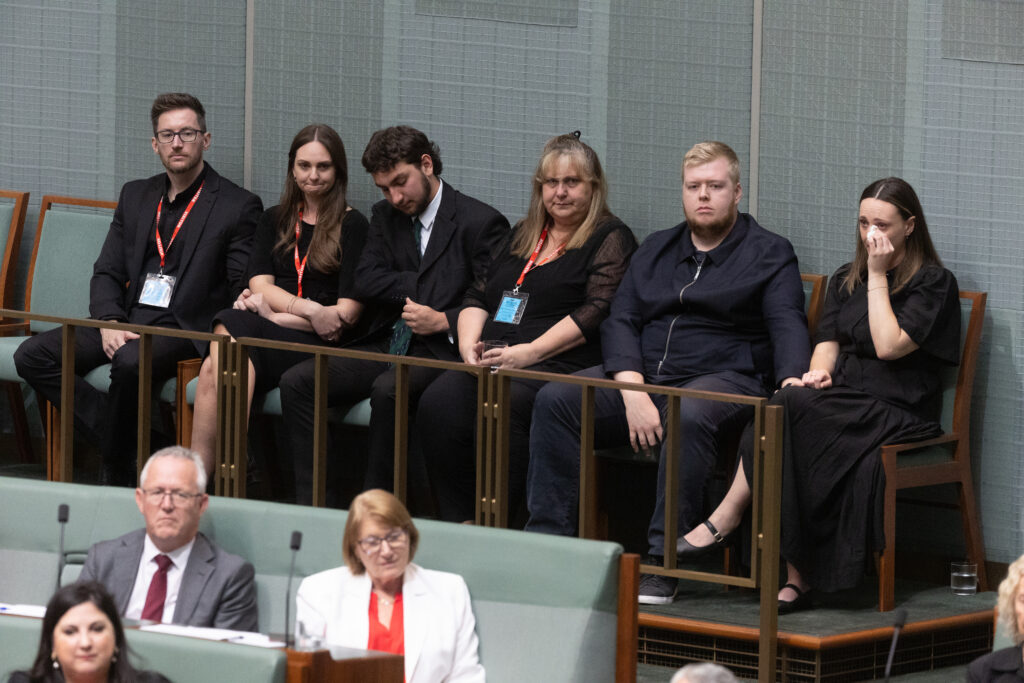
Farewell to Luch

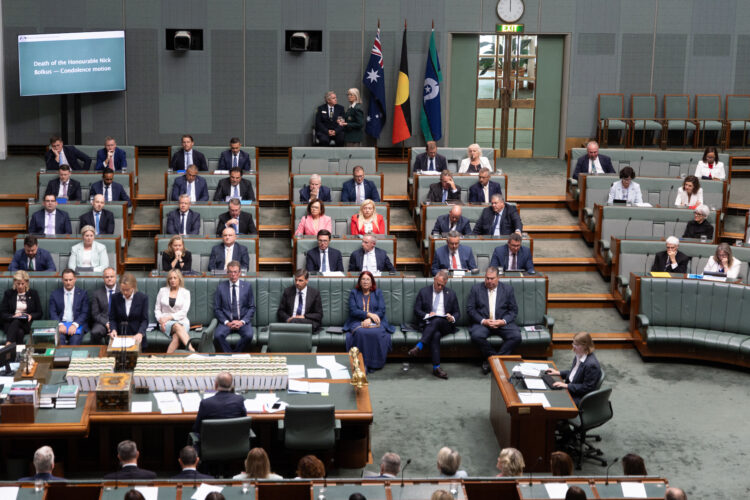
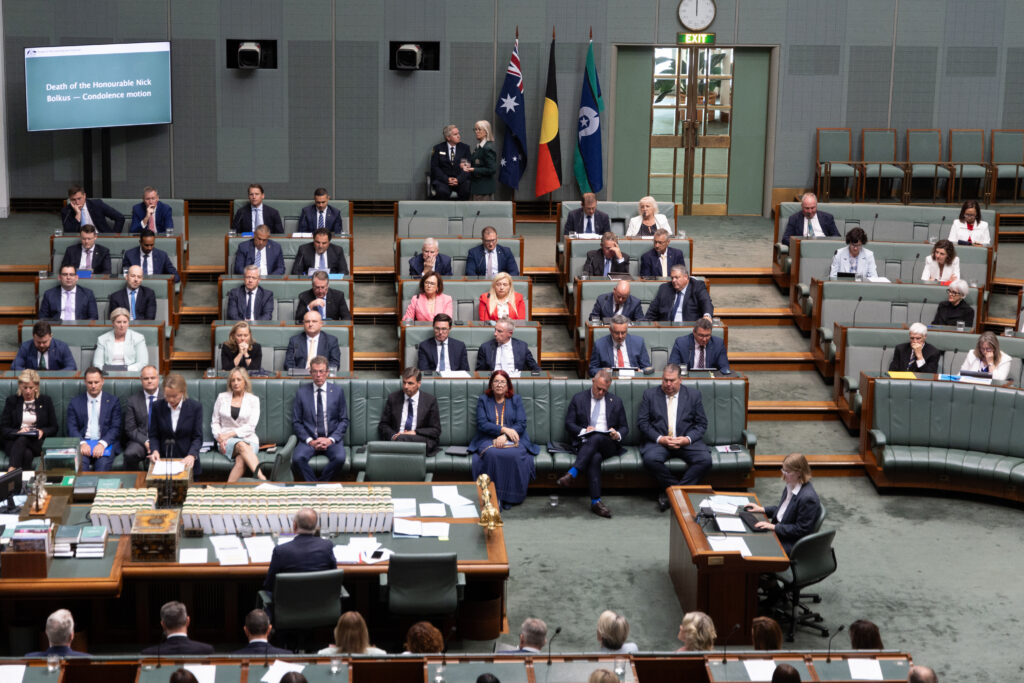
The family of long time Parliamentary Assistant, Ljupco (Luch) Jonceski were invited to the floor of parliament to hear the condolence motion for the much loved parliament staffer.

He will be missed.

The family of long service Parliamentary Assistant Ljupco (Luch) Jonceski who died recently listen to condolences after Question Time in the House of Representatives chamber of Parliament House in Canberra this afternoon. Wednesday 4th February 2026. Photograph by Mike Bowers.

The view from Bowers

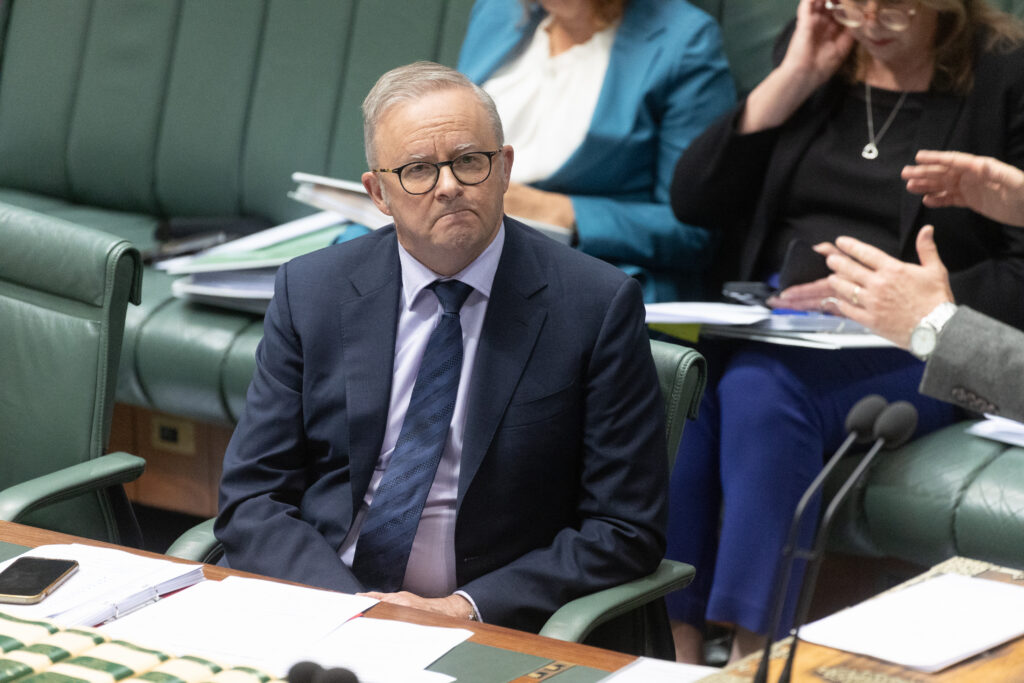
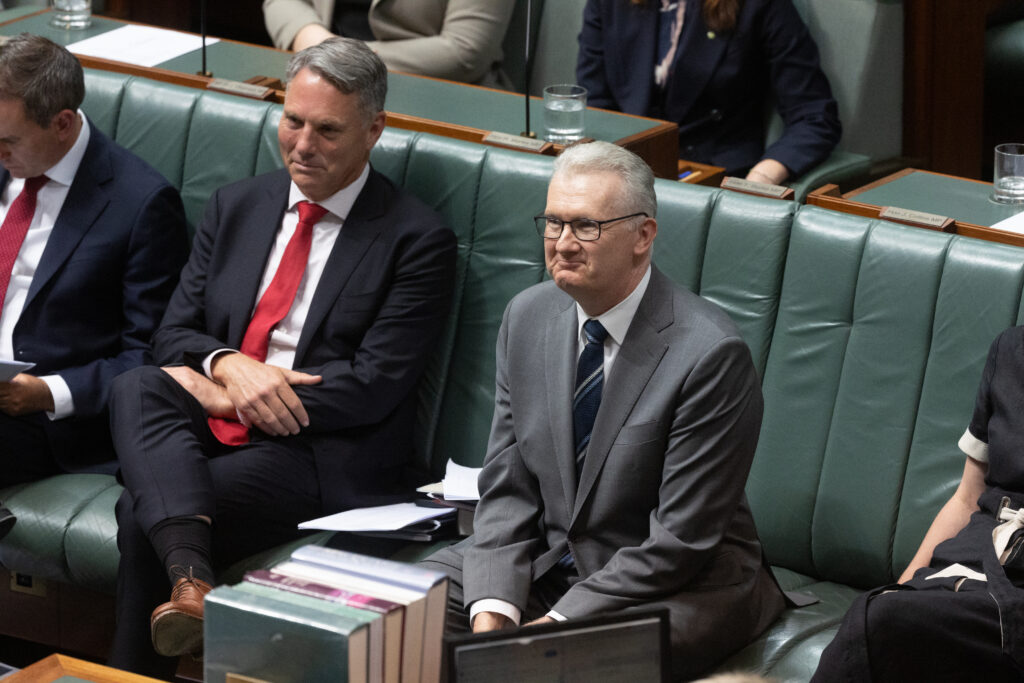
Here is how Mike Bowers saw some of QT

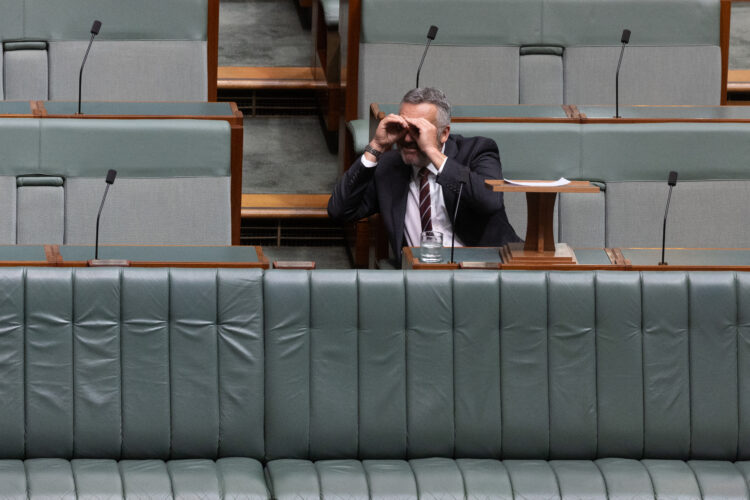
Mood whenever QT is on
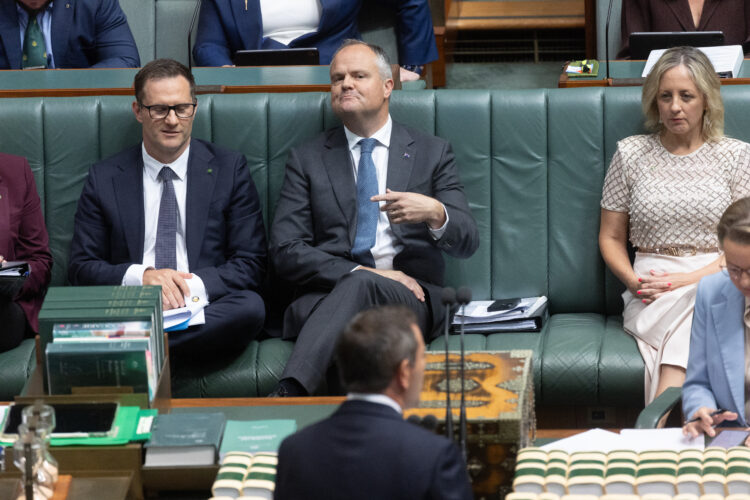
Tony Burke feeling pretty happy with himself
When your troll doesn’t go to plan

Question time ends

The government wins the division (that is how numbers work) and then Tony Burke finishes his trolling:

And so the number of people on the non government benches following the Shadow Cabinet position now is 23 that will follow the shadow cabinet and 33 that will not, that means for the Leader of the Opposition, who at the end of this week has to fill at end of this week has to fill 11 front bench vacancies.

There are only five back benches left to fill these 11 vacancies who follow the Shadow Cabinet position.

It’s a group of four across there now on the cross bench. – Cross, very cross, apoplectic and just plain weird.

And then QT ends.

Burke upsets the Liberals

Alex Hawke doesn’t like what Tony Burke is saying and has a point of order relevance, and so Milton Dick asks Burke to explain why he was talking about the amendment vote today. Burke says:

The dwindling members of the opposition has been consistent. The member for New England defied the shadow cabinet, then moved to the crossbench, knocking the opposition, who started the term with 42, down to 41. The opposition defied the and moved to the crossbench, knocking the opposition from 42 members to 28 yesterday.

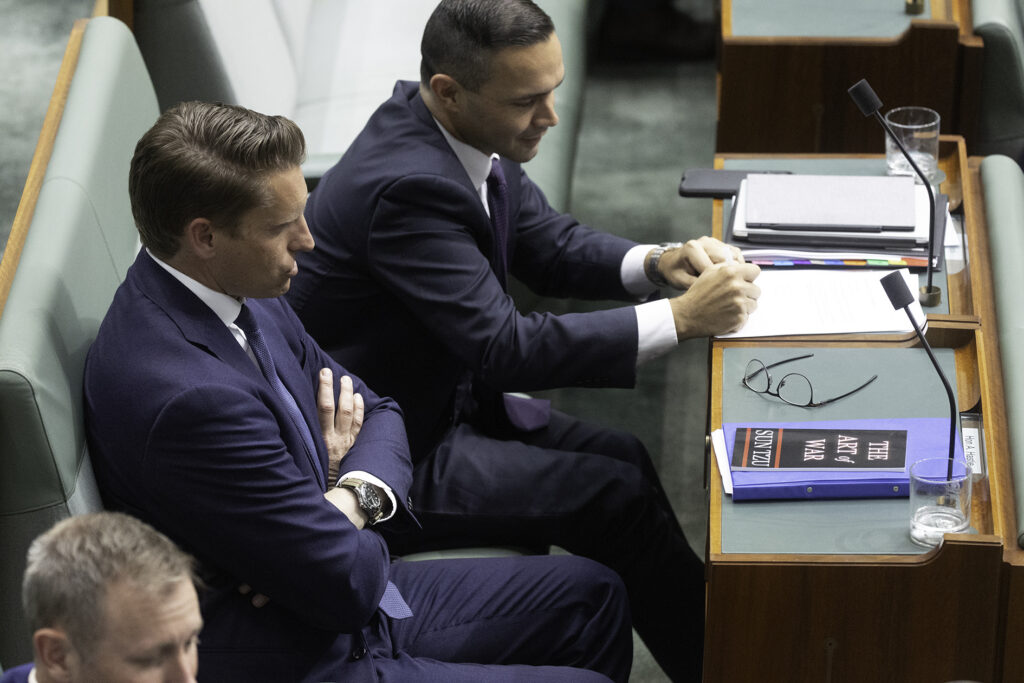
Today, we had the first step from the reader of the art of war and his four followers making sure they defied the decision of the shadow cabinet.

Hawke gets up and calls for a division so that Burke is no longer heard.

The house divides, but this is pointless, because the government has the numbers in the house. But Hawke wants to interrupt the momentum.

Angus Taylor has left the chamber.

Tony Burke trolls the Liberal party

Tony Burke has taken a dixer on why the house needed a new sessional order yesterday and whether a new one will be needed tomorrow.

This is just an opportunity for Burke to point out the dysfunction within the Liberal and National party.

Burke:

It’s well understood why we needed to adopt a new sessional order – because, for the first time in living memory, the crossbench became as big as the opposition.

And as a result of that new sessional order, we’ve been having more crossbench questions as a result of that new sessional order. I note yesterday we had a question from the member for Clark where he predicted, yesterday, that the crossbench was likely to “soon exceed the opposition, with more defections”.

I don’t know if he knew what was going to happen today, but it has turned out to be prophetic. What I would say, though, is – careful what you wish for.

You might not necessarily want the people who you’re about to get. But today – today, of all things, and of all the issues to decide your line in the sand is, we had another five members of the opposition decide to defy the shadow cabinet – another five.

Now, the issue – I’ve had a look at the actual amendments they were voting for, and it was the member for Canning, the member for Barker, the member for Longman, the member for Grey, and the member for Forest – all of them defying the shadow cabinet’s position.

If you want to know – one of the amendments that they decided was a matter of principle was to have a statutory review of customs and excise laws.

I really don’t think that was the reason they decided.

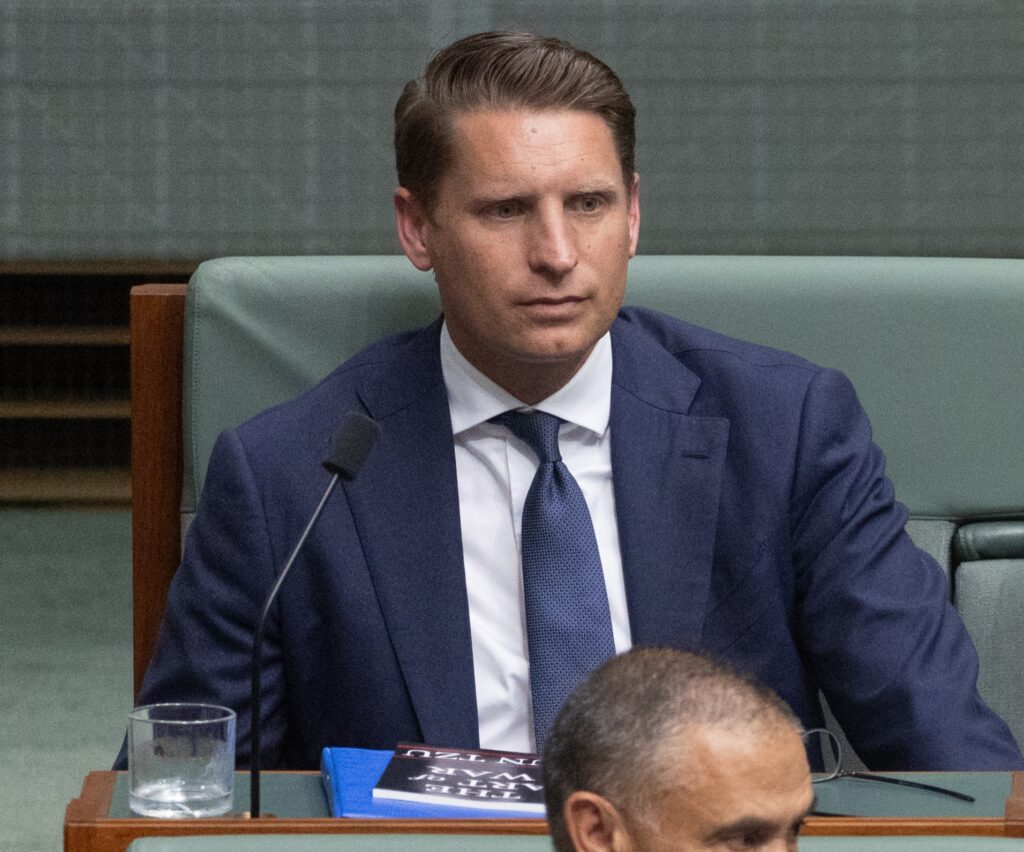
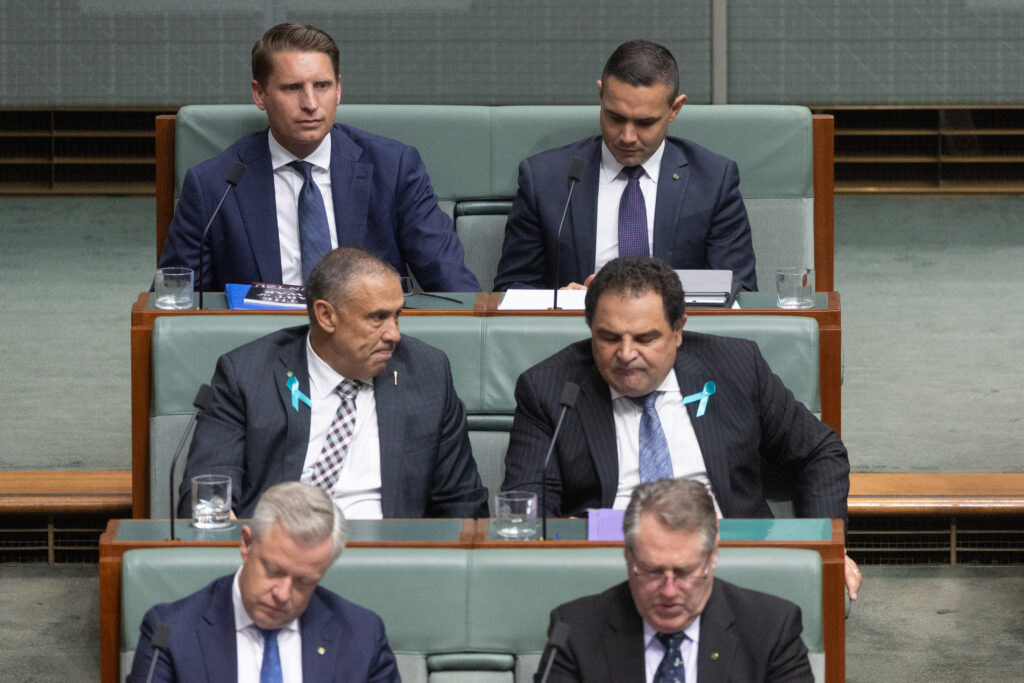
And if you want to know the reason, you might notice the member for Canning’s been reading a book during the course of Question Time today. Some people with better eyesight than me have noticed a copy of The Art Of War on his desk.

Yes, you might have noticed that if you were reading The Point:

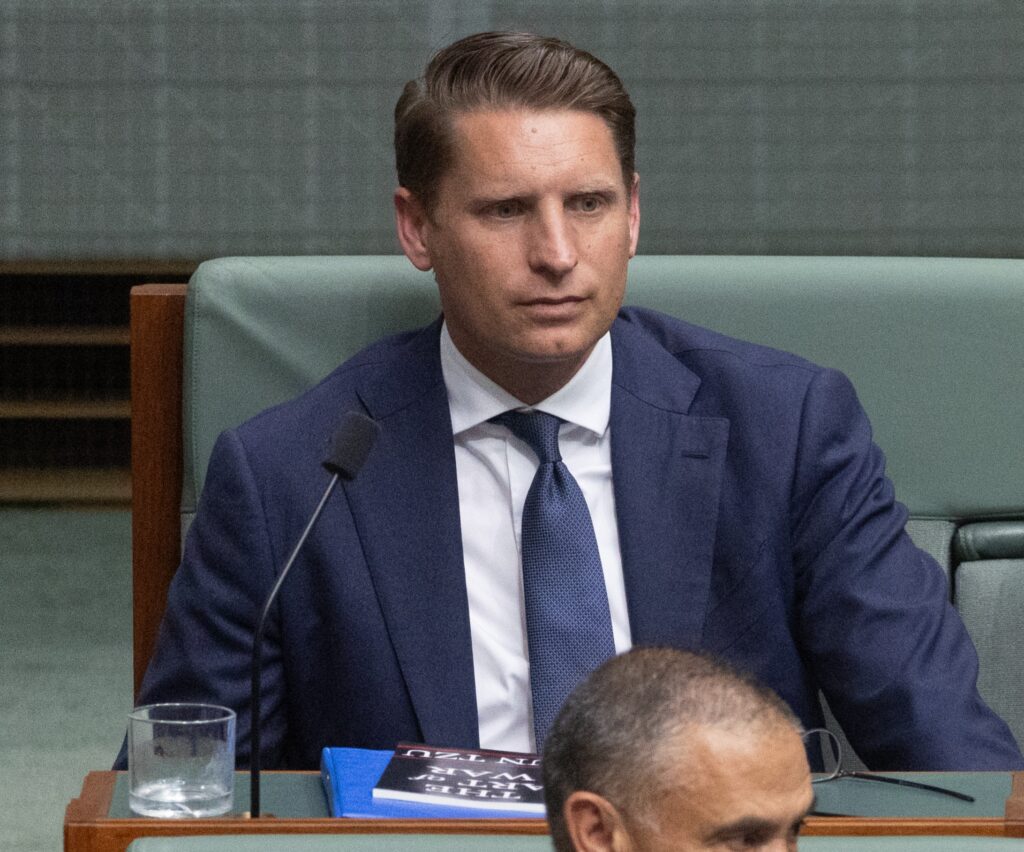
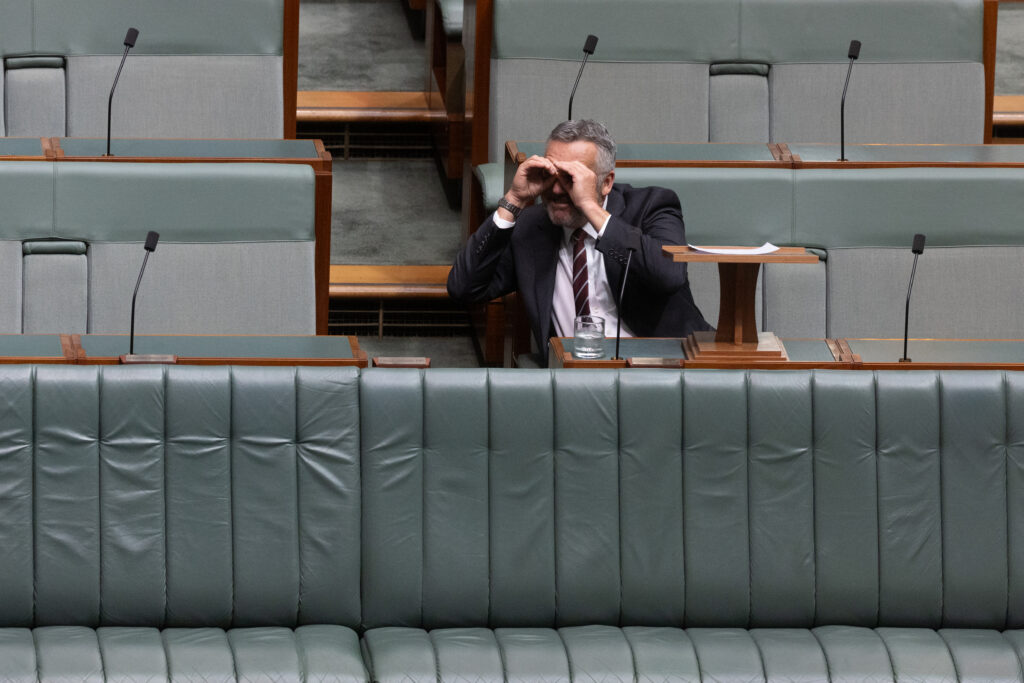
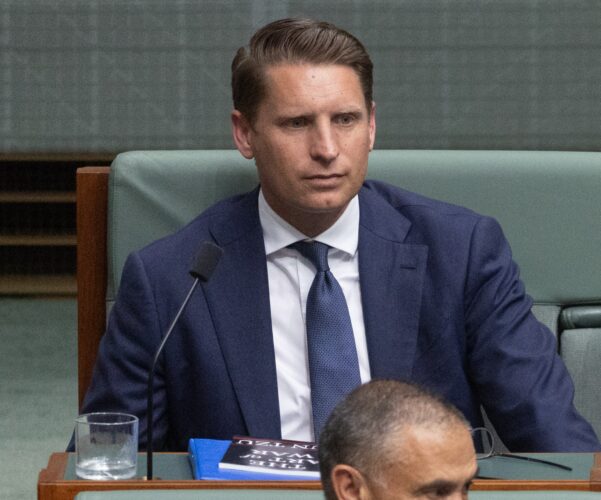
The member for Canning Andrew Hastie during Question Time in the House of Representatives chamber of Parliament House in Canberra this afternoon. Wednesday 4th February 2026. Photograph by Mike Bowers.

Welfare advocates urge Government to suspend Mutual Obligation requirements during extreme heatwaves

Tegan George
The Point

Welfare advocates are imploring the Australian Government to suspend mutual obligation requirements during dangerous heatwaves, arguing it is unnecessarily putting people’s lives at risk.

The country’s south-east endured more than a week of extreme temperatures in January, with Port Augusta, a coastal city in South Australia, recording a high of 50 degrees.

According to the ABC it’s the farthest south 50 degrees has been officially recorded in Australia.

“People are being forced to attend appointments, and Work for the Dole on 40+ degree days,” said Jay Coonan from the Antipoverty Centre.

“They’re being forced to get delayed public transport services to go to offices for 10-15mins to tick a box.

“Everyone is at serious risk during a heatwave, especially people with a disability, older people and those with health issues.”

Unlike fires, floods and cyclones, the Department of Employment and Workplace Relations (DEWR) does not recognise heatwaves as a natural disaster – leaving it up to the discretion of service providers to determine how they respond.

“If a job provider can physically open their doors on a 42 degree day, and a person in poverty can’t attend due to extreme heat, they can lose their payment,” said Mr Coonan.

Mutual obligation requirements are tasks and activities recipients must agree to complete to qualify for financial support while they receive help to find a job.

They also apply to Single Parenting Payment recipients with children aged six or older, who are typically required to complete 30 hours of work, study or approved activities per fortnight.

If the obligations aren’t met, demerits and financial penalties may apply.

One jobseeker said he was required to attend an appointment when the expected maximum temperature was 44 degrees.

He said his medication made heat exposure unsafe but “because of the national holiday, I can’t call my job provider about it which means I either risk heatstroke or lose my welfare.”

Department of Employment and Workplace Relations asserts it issued a reminder to providers in January “that they must consider the impact of current weather events” and alter mutual obligations accordingly.

“Providers have been asked to make adjustments that could include rescheduling appointments or conducting them by phone or video and adjusting points and job search targets,” it stated.

However, Mr Coonan points out the department has “no way of monitoring if this is happening” and without critical oversight “they are essentially telling providers to be nice and hoping for the best.”

The Department has been criticised over its poor oversight of private providers.

December 2025 Commonwealth Ombudsman report found the DEWR had high rates of overturned decisions, inadequate oversight of privatised providers, and misleading communications regarding mutual obligation penalties.

‘Stigmatisation of unsuccessful job seekers as people who are reluctant to accept employment may contribute to the limited oversight of providers and possible narrow administration of the program,” noted Commonwealth Ombudsman Iain Anderson.

His report also criticised private providers for using flawed and sometimes unlawful processes within the Targeted Compliance Framework (TCF), resulting in incorrect payment suspensions for thousands of vulnerable job seekers.

According to analysis from Economic Justice Australia approximately 310,000 people had their Centrelink payments unlawfully cancelled between 2020 and 2024.

The Antipoverty Centre is urging the department to start dealing “frank fearless advice” to the Government and advocate for a change in policy to include heatwaves as a genuine reason to pause mutual obligation requirements.

“Because at the moment it seems that both are in lockstep to ensure profits for provider CEOs, dividends to shareholders and brutal poverty for everyday people,” said Mr Coonan.

One Nation test coming for Vic Liberals

This will be a test for the Liberals in Nepean ahead of the Victorian state election – the Liberals hold the seat by 6% but One Nation will have an impact here.

Chris Bowen still annoys the Nationals

The Nationals are still asking about the $275 electricity cut promise as if there hasn’t been an election in between this and that no one in the public remembers this.

Chris Bowen gets up – mostly because he knows how much he annoys the Liberals/Nationals and says:

The government’s been very clear – wholesale prices are one of the inputs to retail prices. One of the inputs. There are other impacts on retail prices as well. But they are also the element of final retail prices that government policies have the most influence over.

And that’s a good thing, because we’re seeing them fall by 44% just in the last quarter. And we saw wholesale prices in Queensland in May…(INTERJECTIONS)

We saw wholesale prices in Queensland in May 2022 of $347 a megawatt hour. You know what they are the other day? $58 a megawatt hour.

What we’re going to see, Mr Speaker, is – increasingly – that sort of impact, if we keep the policy settings in place that sees more of the cheapest, most reliable form of energy penetrate our energy system, we will see it continue to flow through to wholesale prices and retail prices. And we’ll also see continued reforms like Solar Sharer, which will see three hours of free power to those Australians who choose to take it up as a right. 

That’s a good thing. We think that’s a good thing. We’ve also made other reforms to the default market offer to ensure that sneaky price rises are not made. Those opposite gave Australia 10 years of denial, delay and dysfunction. And they’re certainly keeping up, particularly the dysfunction side of it.

Andrew Hastie taking lessons from Sun Tzu

In the chamber, Mike Bowers has spotted a copy of ‘The Art of War’ on Andrew Hastie’s desk. There is no way this isn’t intentional.

The member for Canning Andrew Hastie during Question Time in the House of Representatives chamber of Parliament House in Canberra this afternoon. Wednesday 4th February 2026. Photograph by Mike Bowers.

2026 and Aus Gov still assessing new coal mine proposals

Rod Campbell
Research Director

Australia’s coal industry should be putting its time into designing new mascots, but instead they are working on opening new coal mines.

You might have heard that new coal mines are the last thing that a government serious about climate action would consider, but the Albanese Government seems unaware of this.

Federal Environment Minister Murray Watt will soon have to make decisions on not one but two new coal projects.

Last Friday tax-shy, tax haven-based Glencore’s application to extend the Hail Creek coal mine went up on the federal environment department’s website. According to Lock the Gate, this is possibly the most koala-killing coal mine in the country.

This followed on from the brand new, ‘greenfields’ coal mine proposed the week before, known as the Washpool project. As we blogged over on Coal Mine Tracker, this is the first step in a major new mine.

If the mining industry still believes it can receive Australian Government approval for greenfield coal mines in 2026, then it is a telling sign that the Government’s commitment to net zero is paper thin.

The view from Amy

Sussan Ley and her tactics team have one trick – asking WHEN WILL YOU APOLOGISE FOR (insert topic here).

Not only is it stupid, it’s played out. It applies to everything – no matter how trivial – and while it is meant to be building to a case that this is a government that doesn’t apologise for anything, it’s not working. They tried that last term and it didn’t work. That was back when they were trying to prove that Anthony Albanese bullied women (you may remember the ‘it stops with us’ Coalition women press conference surrounding Michelle Landry, when she wrongly thought comments ridiculing Peter Dutton had been aimed at her.

Then there was the ‘this arrogant, sneering’ prime minister era, which also failed to take off. None of this worked – the electorate punished the Coalition at the last election for the second time, but Ley is still not changing course.

And the thing that all of these attempts have in common are they are accusations which were made against Morrison and Dutton – and Ley and her team basically think if it worked on those guys, it will work on these guys.

The key difference there, is those accusations against Morrison and Dutton aligned with how the public felt about those men. It matched the vibe they gave off. So Labor continually using the phrases (like slippery – another accusation Ley has tried to make stick on Albanese) Labor focus groups highlighted against Morrison and Dutton, worked -because the public felt it to be true. But even though Ley has tried several adjectives (angry being another) none has caught on – because the public doesn’t feel that way. Mostly, it feels apathetic, which also isn’t good, but not furious at Albanese or Labor individually in the same way they were to Morrison and Dutton.

But Ley and her team do not have the wits, curiosity or even foresight to see why their tactics don’t work. They just see that it worked against them, so they’ll keep hitting that drum.

And then they wonder why no one takes them seriously.

FOR THE PEOPLE UP THE BACK; GOVERNMENT SPENDING IS NOT DRIVING INFLATION

Michele Landry gets a question for the Nats (as a crossbencher) and it is clear the two parties are still not co-ordinating on questions (not that it matters, their questions are always terrible)

Landry:

My question is for the treasurer. The Reserve Bank decision to increase interest rates and replace more cost of living pressure on Australian families. In August last year the treasurer put out a long statement taking credit for the cutting interest rates. What is the government take credit when interest rates go down but no one takes responsibility when the rates go up. Why do you not apologise to the Australian people?

Chalmers:

As I said yesterday and again today I take responsibility for aspects of my job including my part in the fight against inflation. And I dispute the characterisation of my comments last year. I think I have been saying for the last few years that budgets are not the primary determinant of prices in our economy and I have been saying that for some time now and that is because it is true.

I know that we have a job to do to rollout cost of living help in the most way that we can, to make the Budget even more sustainable.

I take responsibility for that as well.

Now when it comes to the point that those opposite have been making about yesterday’s decision by the Reserve Bank to increase interest rates I think it is really important to recognise that the points that I have been making yesterday and today are in lockstep with the points that were made by the Reserve Bank governor. 

And this is what the Reserve Bank governor said in the press release announcing the decision that growth in private demand has strengthen substantially more than expected. 

Private demand is growing more quickly than expected. In the statement on monetary policy they said private demand was much stronger than expected.

The near-term upward revision is driven by private demand. (Again because of data centres)

This is just the economic facts that the Reserve Bank governor and I have been pointing out and in the Reserve Bank governor’s press conference, in the press conference she said that private demand has turned out to be much stronger than we had been forecasting.

Perhaps most importantly when it comes to refuting some of the rubbish that has been peddled by those opposite, Mr Speaker, is that this is in the statement of monetary policy issued yesterday by the independent Reserve Bank and I quote here, the contribution of public demand to year ending GDP has continued to ease in recent quarters.

And that is because what has been happening in our economy is an important transition between over the course of the last year or so where the private sector, the public sector measured by final demand growth has been retreating, last year it was less than one third of what was the fourth and that’s like has been taken up by the private sector which is a good thing so long as the economy can accommodate it. And that is why the work that we’re doing on productivity and lifting the economy is such important work, Mr Speaker. 

So we’re seeing that transition in our economy, we have seen it over the course the last year or so so the points that I have been making and the point is that the RBA governor have been making. We know that there is more work to do on inflation and productivity against the backdrop of global economic uncertainty and that is the government ‘s focus.

Why the “bitch and fold” strategy could mean Liberals still vote for “dog” FOI bill

Bill Browne
Director, Democracy & Accountability Program

A colleague asked whether we can relax about the Government’s freedom of information bill – and I thought our blog readers might be interested in why I said no.

For context, the Greens, One Nation and independents wanted to withdraw the bill so the Senate did not even waste time debating it and the Liberals and Nationals have called it “unwarranted and undemocratic” and “not designed to address the issues identified”.

Labor needs either the Greens or Liberals, otherwise the bill is dead.

Time to pop the champagne?

Not just yet.

There is always room for a last-minute deal, where the Opposition convinces the Government to change some elements and then passes the rest – taking credit for “improving” the bill but blaming the Government for all the bad bits that remain.

This strategy is called, rather crudely, “bitch and fold”. This short video from our own Amy Remeikis explains the history.

Perhaps you think I’m being unfair. I should take the Liberals at their word.

I am.

Here’s Liberal shadow attorney-general Andrew Wallace on The Guardian podcast last week. Asked “do you see any chance that a deal could be made with Labor to get [the freedom of information bill] through”, he replied:

“The first rule of politics is you never say never but the bill, in its current form, was friendless. It was a dog.”

I don’t want to verbal Mr Wallace. He explained, in detail, what is wrong with the bill “in its current form”. He said if he “gets a sniff” the government is trying to make transparency harder, he’ll do what he can to ensure that the Liberal Party oppose it. But he still said:

“Time will tell whether they come back to us with some amendments or not.”

This is one of those cruel situations where whatever happens will be “obvious” after the fact.

If the bill fails, of course it was always going to fail. It was friendless, a dog, roundly criticised by crossbench and the Opposition, supported only by the Labor Party and government departments (and even they could not muster much enthusiasm).

If the bill passes with amendments, of course the Liberals were open to negotiations. The shadow attorney-general said as much. Even when they criticised the bill, Liberals and Nationals refrained from calling for the bill to be withdrawn – a clear signal they were more open to discussions than the Greens or independents.

I learned this during the Morrison Government, when the Liberal–National Coalition tried to limit charity advocacy. Labor and the crossbench condemned the bill … then Labor negotiated some scraps and passed it anyway.

That’s why the Australia Institute harps on about these things long after they seem to be decided. They usually are. But if attention slips, it is easier for politicians to fold. The Liberals are telling us “never say never”, and it would be foolish to ignore them.

The view from Bowers

The Liberal and National side of the house is being very grown up

The member for Gippsland Darren Chester before Question Time in the House of Representatives chamber of Parliament House in Canberra this afternoon. Wednesday 4th February 2026. Photograph by Mike Bowers.
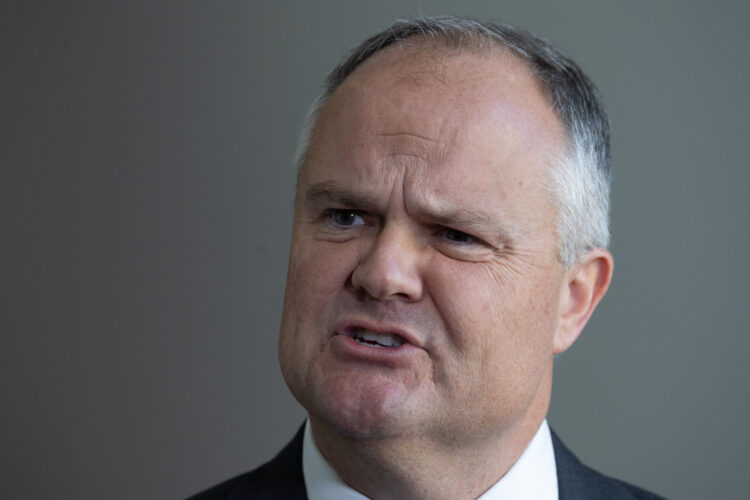
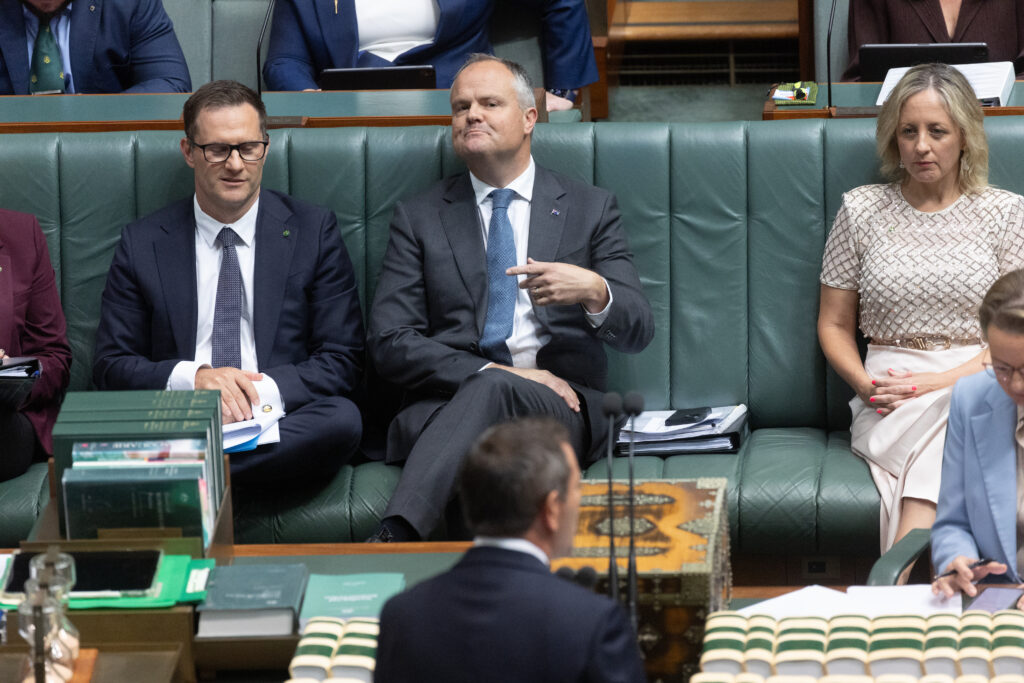
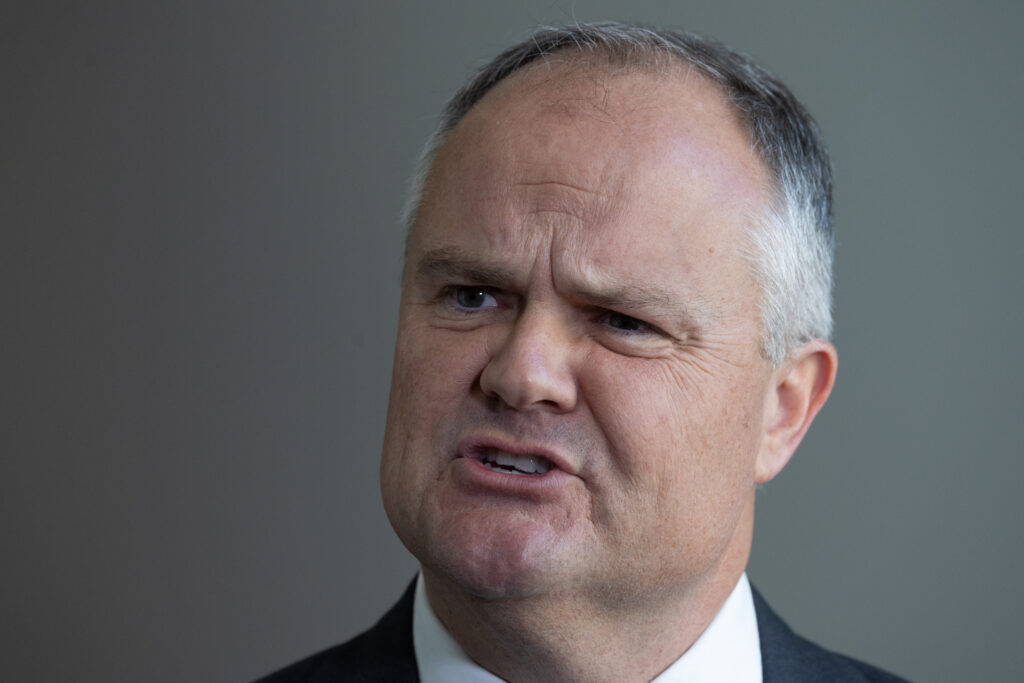
Shadow Treasurer Ted O’Brien during Question Time in the House of Representatives chamber of Parliament House in Canberra this afternoon. Wednesday 4th February 2026. Photograph by Mike Bowers.
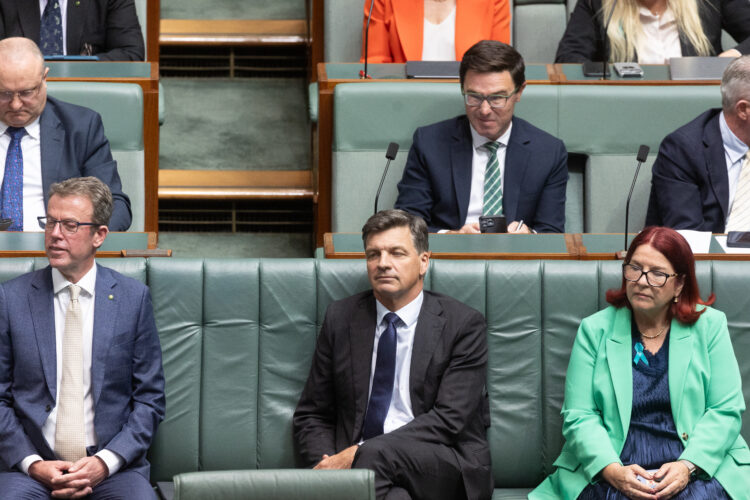
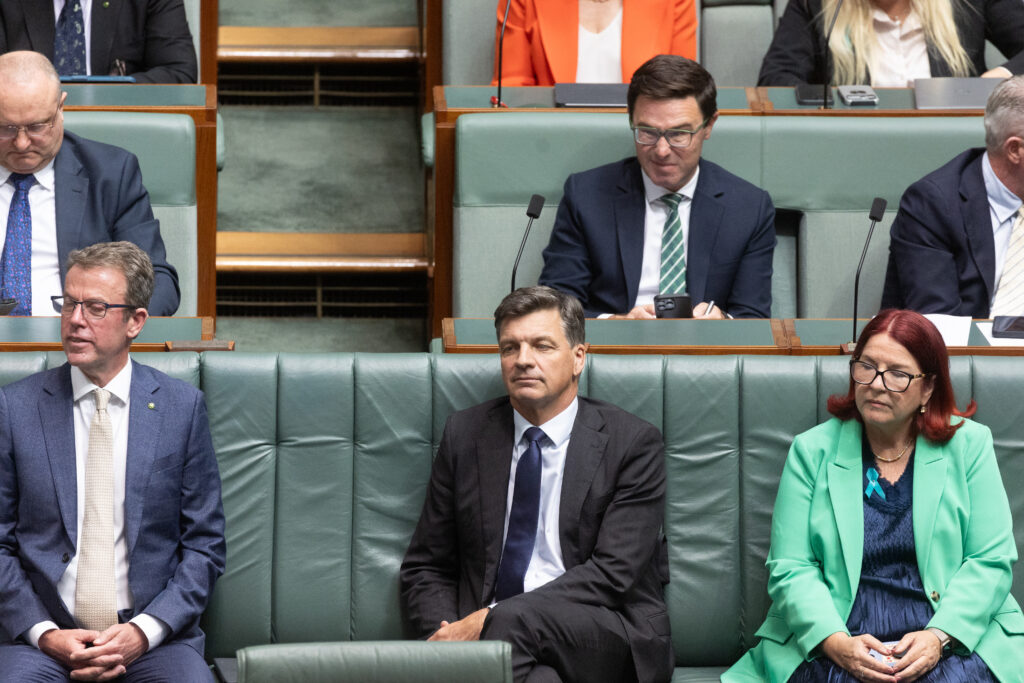
The Shadow defence Minister Angus Taylor and the leader of the Nationals David Littleproud during Question Time in the House of Representatives chamber of Parliament House in Canberra this afternoon. Wednesday 4th February 2026. Photograph by Mike Bowers.

Sigh

Case in point – we are now being punished with Ted O’Brien.

Shane Oliver AMP chief economist said, and I quote “The best thing Australian governments can do to help bring down inflation would be to cut government spending.” When will the treasurer finally admit that he must control the spending to prevent the 14th interest rate rise under Labor?

SIIIGGGGGHHHHHH

Jim Chalmers also seems to have enough:

Once again pointing out the interest rates started going up on their watch with three interest rate cuts last year but more broadly, more broadly, in terms of the points made by Shane Oliver, as I said yesterday in this place and on other occasions as well that is a view that is not unanimously shared amongst economists.

The AMP economist said government spending has peaked in the growth in government spending will add less to inflation, the Commonwealth bank economist says the public sector ‘s contribution to growth has eased significantly and another says that demand growth is slowing and was negative over the first half of 20 to his question is will the government, will the government be looking to make more savings in its fifth budget in May, the answer to that is yes.

And the fact is that we have made savings in all of our budgets and budget updates. That is why we found $114 billion in savings including $20 billion in savings in the midyear budget update less than two months ago and to give the shadow treasurer and Shadow assistant treasurer a sense of the magnitude, it took the previous government seven budget updates to find anything like $20 billion in savings so I will not be taking lectures from those opposite when it comes to responsible economic management.

This government has helped to engineer the biggest nominal improvement in the Budget in the history of this country. $233 billion improvement in the Budget. 

We paid down $176 billion in Liberal debt and that saves a $60 billion in interest costs. We have delivered two surpluses and they promised a surplus every year and went 949 so we will not be taking lectures from them, Mr Speaker.

I wanted to finish on this important point that was missed yesterday, Mr Speaker in the back and forth on this question.

By the shadow treasurer’s logic every extra dollar in government spending puts pressure on inflation. Those opposite talk to the election bigger deficits this year and next year and so the onus is on the shadow treasurer to inform the house if this is his logic about government spending and pressure on inflation. 

He should tell the house how much and fly higher inflation would be as a consequence of the member for Fairfax and the member for Hume taking to the last election a bigger deficit this year and the biggest deficit next year as well, as always they have set a little track for themselves, Mr Speaker, on this question.

We know that responsible economic management is paramount. We found savings today and there will be more in the May budget and that is consistent with the approach we have taken to managing the Budget in the most responsible way.

Why the rush?

For the second day in a row, the member for Bradfield, Nicolette Boele gets a crossbench question and asks:

My question is for the manager of Government business. Two weeks ago this parliament passed legislation to respond to the Bondi terror attack, the crossbench was required to vote on legislation hours after receiving it. That process disrespected the one out of three Australians who voted for strong crossbench integrates the democracy we fought so hard to nurture. What steps will the government take to ensure that lawmaking processes following future crises will not degrade democracy in this way?

We talk a lot about the need for a ‘strong opposition’ to help uphold a strong democracy – but we always seem to think about that in terms of the major parties. In this parliament, the independents have been the one fulfilling that role – asking nuanced questions about policy and following up when things are not happening or have happened in a way which has not been great for anyone involved – most particularly the people the parliament is meant to be serving.

That should be noted and more attention should be paid to what they are asking while the Liberals focus on political point storing.

Tony Burke:

I thank the member for Bradfield for the question and all member for the House with the cooperation and the settings we had not so long ago. Nothing degrades democracy more than a terror attack. Simple as that. As soon as the horrific anti-Semitic terror attack had happened at Bondi, a number of us assembled in Canberra, the prime minister made sure the National Security Committee was meeting daily.

Within the first week, the prime minister had stood up in the courtyard, to announce they would be a legislative response with prospective guns and take laws.

From that moment public servants worked every day, including daily briefings to myself and the Attorney-General, through the Christmas – New Year period, the moment we had legislation ready, two things happen.

The prime minister stood up in the courtyard and announced Parliament would be recalled and that day, the legislation appeared as an exposure draft.

To make sure people had an opportunity to get across the legislation as best they could, and various negotiations started but also a parliamentary inquiry started immediately as well. I… Would love to have a situation where all legislation can be dealt with in a staged manner like to do with most legislation in the House. Where we don’t commence debate in the week it is introduced that’s what we normally do. But if anybody wanted in piece of evidence, about why the timely nature of that going through quickly mattered, it is to think about what happened on the Sunday. After the legislation had been released but the Sunday before this Parliament returned, and the National Socialist Network neo-Nazi network of Australia disbanded, because we would say we would take our time but they knew it was going to go through that week. That’s what happened.

They made sure they had disbanded. There are many organisations engaged in anti-Semitism, there are many organisations engaged in a number of forms of bigotry that my intelligence and law enforcement agencies that I’m responsible for as Minister for Home Affairs have to deal with copy and the priority that we take without apology, as if something has to be done quickly, to keep people safe, that’s how we do it.

The Government considers reforming the capital gains tax discount. This could save billions, reduce inequality, and make houses cheaper.

Jack Thrower
Senior Economist

The AFR reports the Government is considering reforming the capital gains tax discount for property investors. Hopefully, this is true. For over a decade, Australia Institute research has found that the capital gains tax discount costs billions, worsens inequality, and makes houses more expensive.

What is the capital gains tax discount?

When you buy an asset and later sell it for a profit, the profit you make is taxed as income; this is called capital gains tax (CGT). The CGT discount means that if you buy an asset (often a house), hold it for 12 months and then sell it, you only pay tax on half the profit you made. For example, if you bought a property for $400,000 and a year later sold it for $500,000, you have made a capital gain of $100,000. The discount means you only have to pay tax on $50,000.

CGT discount makes inequality worse

Australia Institute research has long shown how the capital gains tax discount makes inequality worse, including that the highest 10% of income earners receive about five times as much benefit from this tax concession as the bottom 90% put together.

CGT discount is expensive

Just the benefit to the top 10% equates to more than the whole budget for vital programs such as Jobseeker and the childcare subsidy, as well as the cost of popular new policies such as putting dental into Medicare.

CGT discount makes houses more expensive

Australia Institute research has underlined how the capital gains tax discount and other tax settings, make housing more expensive. Essentially favourable tax treatment for investment in property allows investors to outbid first home buyers purchasing houses.

The view from Grogs

Greg Jericho
Chief Economist

Sussan Ley opened QT asking:

“Under Labor, Australians are living with higher prices, and increasing interest rates. While the Treasurer blames the private sector, Australia’s leading economists say the problem is government spending. Steven Smith, Deloitte Access Economics partner, said government spending was, “Historically high” and “a genuine driver of inflation”. We all know the Treasurer won’t, so will the Prime Minister accept responsibility for yesterday’s rate rise? Yes or no?”

Well let us refer to the Reserve Bank yesterday which put out the Statement on Monetary Policy (something that came out at the same time as the rates decision, so maybe some of these very smart economists missed it…)

It noted that private demand was fuelling inflation (I disagree that we need to be worried about it, as it looks a bit temporary, but that’s by the by).

It then followed up noting, “While private demand growth was stronger than expected in the September quarter, the collective contribution of other components of GDP declined and was weaker than expected.”

That the RBA put it in bold makes it rather odd the Liberal Party missed it.

It followed up noting “(again in bold) “The contribution of public demand to year-ended GDP growth has continued to ease in recent quarters, as expected.

What else? What about all those subsidies and spending on NDIS? Surely that out of control and firing up prices?? Yeah. Nah.

The RBA concluded “The level of spending on social benefits to households (which includes a range of payments to households, including relating to the NDIS, Medicare, the Pharmaceutical Benefits Scheme, aged care and childcare subsidies) has steadied in real terms in recent quarters after growing strongly in recent years.”

Ahh well. Best to ignore reality, when you’ve got a line worked out that apparently the PM needs to apologise.

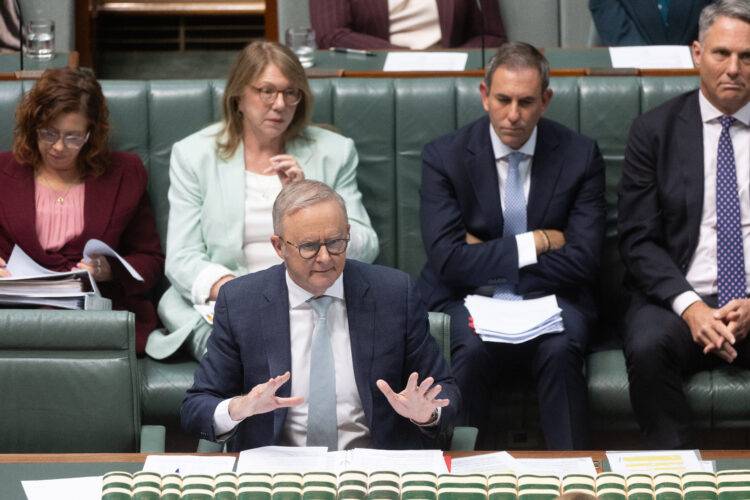
Question time begins

The mess started very early today, so brace yourself.

Sussan Ley is still pretending a stern face will work in place of actual authority but we all know how that is going, as she asks:

Under Labor Australians are living with higher prices and increasing interest rates, while the Treasurer blames the private sector Australia’s leading economists say the problem is Government spending. Steven Smith Deloitte Access Economics access partner said government spending was historically high” genuine drive of inflation. We all know the Treasurer will not so will the Prime Minister except responsibility for yesterday’s rate rise, yes or no.

Anthony Albanese:

This is what the RBA governor said yesterday when she was asked very directly about Government spending she said what has happened in the last six months or so. “Private demand has turned out to be much stronger than we have been forecasting”. (and that private demand is data centres, just FYI) That is what the RBA governor had to say. Very clearly.

We know that Australians are still doing it tough and we know cost-of-living pressures are real but that is why we have measures to actually address cost-of-living pressures.

To take pressure from family budgets in every way that we can. And we will keep focusing on easing cost-of-living pressures, on the making medicine cheaper which we did on one January, investing in mobile billing and urgent care clinics. 

Which we are doing, cutting student debt by 20% opposed by those opposite.

Paid $10,000 incentives for people to do apprenticeship in construction and energy. And of course free TAFE that has now had more than 700,000 people participate in it.

That is why we support real wage rises that’s why we supported a tax cut last year and why on July one, there will be another tax cut, next year there will be another one after that!

I note for…The Member for Goldstein, that will make it two from two.

I note we had a debate about the cost of living question before. Those opposite can’t even agree on cheaper beer.

Alex Hawke is up now:

The question wasn’t about the debate earlier today but about interest rates.He was talking about the price of an individual commodity. I invite him to return to the question.

Albanese:

I was, Mr Speaker I was asked about cost of living in the pressure people are under and I was talking about the measures which we are taken, one of them we are trying to legislate through the Parliament, that passed the House of Representatives earlier today, the Liberals split from the Nationals but more than that five of the Liberals voted with the Nationals against the government … can’t stop talking about themselves, each and every day.

Sky News does not have 30 seconds when there is not one of them sitting in the studio!

Dugald Dick (Milton Dick’s more serious persona) has to come out now and tell everyone to shush.

He has to tell Darren Chester to shut it. Alex Hawke has a lot of feelings. Dugald gives everyone a moment to take a breather and then brings it back to Albanese who stirs everyone up again.

I know the Manager of Opposition Business would be somewhat sensitive given he is now down to 23 members, who will follow a decision of the shadow Cabinet. 23 out of 150 (MPs)

He sits down.

Thriving Kids won’t fix the NDIS; reform will

Hamdi Jama
Postdoctoral Research Fellow

Yesterday, the Health Minister announced a $2 billion deal with State and Territory governments to launch the Thriving Kids initiative. Under the new framework, children eight and under with mild to moderate developmental delay or autism will no longer be eligible for the National Disability Insurance Scheme (NDIS). Instead, they will be redirected to state-run community support programs.

But Thriving Kids is only a band-aid for the NDIS cost overruns. Removing kids with mild disabilities from the NDIS leaves vulnerable families to bear the consequences when support services fall short.

Disability advocates warn that crucial parts of Thriving Kids are not prepared for a large-scale transition. Even then, it is unclear whether Thriving Kids will be delivered equally across jurisdictions and what impact it will have on kids and their families.

Let’s be clear: the strain on the NDIS didn’t emerge because of these kids.

The cost of the NDIS has skyrocketed to unsustainable levels because of years of unchecked outsourcing to private providers. This has attracted poorly regulated, profit-driven providers, hollowing out service quality.

Until Labor implements genuine reforms to the NDIS, the system will be exploited by dodgy providers focused on profit rather than supporting people with disabilities.

Go get yourself a treat

Well, that is it from Christopher Pyne (publicly) for the mean time and it is the downhill slide to question time, so go get yourself a little palette cleanser. I could make a gin and tonic joke, but this is honestly played out.

Also, here is Bill on why we really should be paying more attention to donation laws.

Loopholes in Victoria's political donation laws mean the major parties receive uncapped gifts from their fundraising arms while donation caps apply to everyone else.@browne90.bsky.social #auspol

The Australia Institute (@australiainstitute.org.au) 2026-02-04T00:11:13.901Z

And on One Nation…

Christopher Pyne says:

There’s no doubt at all that the ongoing drama involving the coalition and the leadership speculation is distracting the opposition from holding the government to account. 

It’s sort of plainly obvious. And that’s a big negative. And the Australian public are reacting by telling us how they feel about that through the polls.

I don’t believe the polls as they exist now will be the polls on election day in two and a half years’ time.

But, the polls are an interesting thing as a former politician, or practitioner of politics as I was for many years. 

They do tell us a snapshot of time of what people think. The doesn’t mean how they’re going to vote necessarily on election day.

And people use polls to express their displeasure or their pleasure. That’s why straight after elections the Prime Minister usually gets a bounce in the polls because people think we voted for him or her, so we hope they’ll do well, so we’ll say something nice about them when we are rung by a pollster.

People are telling the coalition, the non-Labor side of politics, they need to get their act together, and if they don’t, they are saying they may consider voting for One Nation.

So One Nation’s had an enormous boost in polls. Whether that follows through to election day remains to be seen. But, there’s no question that the ongoing endless discussion about internal dynamics is distracting from holding the government to account.

And, there’s lots of things the opposition should be holding the government to account for, and one them is policies for older Australians. And so COTA Australia, you know, is concerned about that. But, the ship will right itself and I’m certain by the election the ship will have righted itself. I speak to a lot of Labor people, because I’m a lobbyist now, among many other things.

And they also want a strong opposition. Because it’s good for government. Bad opposition is bad for government. It’s also bad for democracy. But in terms of the practitioners in government, they know that a poor opposition, or an opposition that’s distracted from holding them to account means they will get complacent and they may get lazy and make bad decisions.

It’s important the opposition does right the ship

The Liberals are ‘traumatised’ by losing the election, Pyne claims

What does Christopher Pyne think about the Liberal party leadership and also the Liberals in general?

I left politics when I was 51. Which is actually very young. But I was elected at 25, which is also very young. So I spent more than half my life in politics. Which seemed a bit weird. So I thought it was time to get out while I was still young enough to do something new.

It’s been great, I have to say. I keep an interest in politics behind the scenes. But I don’t interfere. I don’t hover. But I’m happy to support my former colleagues. In terms of leadership – so the answer is no, I have no intention to return to politics. I think my wife would have a lot to say about that. A lot. If she’s watching now. She would be thinking, no way. Expletive deleted.

In terms of leadership, it’s not so much what Sussan needs to do, who has been doing a perfectly good job as Leader of the Opposition since the election. It’s what my former colleagues really need to do, which is to give her clear air and an opportunity to be the leader.

Since May, there’s been an endless public dispute. My former colleagues probably need to stay off the television and the radio, unless they want to talk about the Labor Party and the government. Their job is to oppose the government, and to point out its deficiencies, praise them when they’re right. Criticise them when they’re wrong. It’s not to endlessly talk about the internal dynamics of either the Liberal Party, the leadership, or the coalition in the press.

So, I think that’s obvious. And I’m hoping they’ll start doing that. Letting Sussan be the leader with clear air to land blows on the government, which is what the public want her to do too, and I think the public want her to be given the clear air to do that.

That’s the first thing. But I can also say this is not unusual for the Liberal Party in opposition.

I was elected in 93, between 93 and 96 we had Brendan Nelson, Malcolm Turnbull and Tony Abbott, in 2010, we arguably won the election, the only reason we didn’t form government because the two former Nationals supported Julia Gillard.

Unity on election day is more important than any other time in the electoral cycle, we had 93, 96, we had John Hewson, Alexander Downer and John Howard. In 96 we won the election in a landslide, and then we had the other leaders we mentioned and we did win the election but we didn’t form a government. But three years later, we did, in 2013.

So, disunity is obviously bad and the public don’t like it. But at the end of the day, it’s not unusual. The Liberal Party is party, that’s how we see ourselves. Opposition is anathema to Liberals because they have nothing to do. They start to do other things because they have nothing to do.

So, I understand what my colleagues are going through. It’s very painful. And they just suffered the biggest defeat since 1943. So, let’s cut them some slack. Because they’re only understandably feeling quite traumatised. But, the best method to deal with this trauma is to keep it internally inside the party, and talk about it amongst your colleagues, but it’s not to endlessly talk about it on the ABC, or Sky, or Nine, or in the Australian.

South Australian election less than two months away

Bill Browne
Director, Democracy & Accountability Program

If you need a break from federal politics, I suggest a look at the South Australian election on 21 March this year.

Labor under Premier Peter Malinauskas has been polling very well, and unless something dramatic changes I would expect them to be re-elected.

However, it will still be worth a watch –

First test of South Australia’s dramatic changes to political finance. South Australia has banned most political donations, in exchange for entirely funding the election campaigns of sitting MPs and established parties. New entrants get a small loan ($5,000) and can accept donations below $5,000 to try to catch up.

Electoral changes in other states have disadvantaged independents – will the same be true in South Australia?

Do One Nation’s polling results translate to seat gains? Federal polls suggest One Nation is about as strong in South Australia as it is anywhere; does that extend to state politics and – if so – can One Nation turn polling numbers into votes?

This will be the first electoral test for the minor party since its remarkable surge last year.

Are there green shoots for the Liberal Party? The South Australian Liberals’ difficulties are mostly familiar ones for those following other branches of the party: leadership spills following long periods of poor polling; failure to stay in government even after winning office briefly; and a membership that is notably more right-wing than its voting base.  

If the Liberals can make progress in South Australia, that makes things more promising for them elsewhere too.

What does the upper house look like? The more likely a comprehensive Labor victory in the lower house, the more interesting the upper house becomes. What will the crossbench look like? Will it be one the Malinauskas Government finds easy to work with or hard?

Greens, independents, One Nation and minor parties – including Nick Xenophon’s old outfit SA-BEST – are all possibilities for upper house seats.

In this term, Labor has enjoyed a fairly biddable crossbench, but there is no guarantee that will remain the case.

If any of that whets your interest, election expert Ben Raue has just made his South Australian election guide free to access – as is Casey Briggs’ over on the ABC.

Pyne: it needs to be a ‘healthy’ Coalition

Do the Liberals need the Nationals?

Christopher Pyne:

I think a coalition is better than not a coalition. And we’ve been in coalition with the Nationals and before then the country party since 1922.

So, the last year of dropping out of coalition twice, to use a rather overused word during COVID, is unprecedented. Clearly I believe a healthy coalition, which is where we need to get back to, is where the National Party wins seats in the country, and represents their constituency, which is generally more conservative than the cities, and the Liberals win seats in the city, where most of the people live, and at the moment we have eight out of 89 seats in the city.

And the healthy coalition allows both parties to do that. So, an unhealthy coalition is one where one party tries to make the other party more like them, and therefore they can’t actually fulfil their mandate.

The mandate of the Liberal Party is to win seats in the city, in more progressive electorateses, like my old seat of Sturt, because that’s where the voters are, in terms of their political spectrum, they tend to be in the centre, roughly.

My old electorate was mostly centre right, and the Liberal Party needs to be free to do that. And the Nationals need to give them the freedom to do that. And that has been a healthy coalition for most of the last 100 years. And an unhealthy one is one where one party tries to exist the other party replicates them. That’s just not going to work, because people are in different parts of the political spectrum, it’s also electoral suicide, because it means the Liberal Party will never win seats in the city and we’ll have a permanent one party state.

And that’s bad for democracy. I don’t hate the Labor Party. I have lots of good friends in the Labor Party. But, um, we don’t want a one party state. It’s not good for democracy. So you need governments to change, you need opposition to be strong, and that’s best served by a coalition. I’m a traditionalist about that. But the coalition has to be a healthy one.

Christopher Pyne has thoughts on the Liberal party

As expected, no one is asking Christopher Pyne about aging, they are asking him about the Liberal party. Which he knew, because these answers are very thought out.

What’s gone wrong with the Liberal party?

Pyne:

Well, I’m still a Liberal, when you say I was a Liberal Party member for 26 years, I’ve been a Liberal Party member since I was 17 and remain a Liberal Party member. The last election was the worst election for the non-Labor side of politics since 1943. It was beyond a catastrophe. And… It got to that point because I think the, um, the non-Labor side of politics started to drift away from understanding that to win elections you need to win them from the centre, or the centre right and started believing you can move the people to your position rather than being where the people are.

I was a member of the Howard government, and we won a lot of elections. And John Howard, I think it’s fair to say, governed from the centre right, but won elections from just right of the centre and the public liked that. 

So, the idea that the Liberal Party on the National Party can move further to the right and win elections has been sort of disproved, and fundamentally disproved in the last three elections. But I’m very optimistic about the Liberal Party. I may be the only person in the room optimistic about the Liberal Party. We have done this sort of thing before. There’s nothing much new under the sun in politics. And the – we did spend a lot of time in opposition between 1983 and 1996. Which people forget. 13 years. And we had this debate back then too. 

There was quite a debate about the moderates versus the conservatives, Andrew Peacock versus John Howard. The names were different, but it’s the same debate. It’s the debate about where the Liberal Party lies on the political spectrum since the fusion of the protectionists and the free traders. This is the nature of a political spectrum.

So they’ll work themselves out. I’m certain of that. Because they have to. And they’ll do that when they do two things – when they start to dislike the Labor Party more than they dislike each other, which is very important. I don’t think I’m breaking news there. And secondly, when they really hate being in opposition.

Because opposition is really awful. You have no power. Either the devil makes work for idle hands, and we’ve been seeing that lately. But they’ll eventually hate being in opposition and when they do that, they will realise they have to be where the people are, and they’ll win elections again. And I will address leadership probably in other questions so I don’t keep going.

What’s going on with the HMAS Penguin?

There is a bit of a split within independents over whether the sale of defence land and assets is a good idea or not. Zali Steggall isn’t too thrilled that the HMAS Penguin (or at least part of it) is among the assets potentially up for grabs:

I am deeply concerned by reports the Albanese government is considering the partial sale of HMAS Penguin as part of a broader Defence estate divestment program.

HMAS Penguin, located in my Warringah electorate, is a significant Defence facility with deep historical, operational and community importance. Any proposal to dispose of part of the site raises serious questions about national security, heritage protection, environmental impacts and how public land on Sydney Harbour will be used in future.

I visited HMAS Penguin – along with HMAS Waterhen – in October last year. It was an incredible honour to see firsthand how, from these sites, the Royal Australian Navy makes a vital contribution to our national defence capability and to the science and technology that underpin it.

I have formally requested a detailed briefing from the Defence Minister to determine what is being proposed for this site, which part of the site will be affected and how the interests of my community and the broader public will be protected.

Public defence assets should not be quietly sold off without scrutiny. If changes to HMAS Penguin are being contemplated, they must be justified, transparent and subject to genuine community consultation.

I will continue to seek answers and will keep the community updated as further information comes to hand.

Pyne is back

Weapons and defence lobbyist Christopher Pyne is the guest at the National Press Club, where he is presenting the State of the Nation for Older Australians (one of his other hats is as the Chair of the Council of Aging).

But he will mostly be asked about the Liberal party, which is a topic he is very happy to wax lyrical upon. So we’ll keep an eye on it for you and then come back if he says anything of actual interest.

Bowen set for COP31 as Australia hits coal export record

Ketan Joshi

It feels like a long time ago, but late last year in Brazil, we learned that the Australian Government lost its bid to host the 2026 COP31 climate conference in Adelaide. Instead, the conference will be held in Turkey.

As a consolation prize, Australia’s energy minister Chris Bowen will play a big role in the event. As “President of Negotiations” Bowen will be in a central position and able to set a certain tone or focus for the event.

According to the Guardian, Bowen said “the fact Australia was itself a major exporter of fossil fuels meant it had “credibility” when it came to lobbying petrostates to do more”.

This doesn’t make a lot of sense: surely Australia would have more credibility in this space if it were actually reducing fossil fuel exports?

If you had to find a motivational speaker for a gambling addicts group, would you bring in:

(a) a reformed addict who gave it up or

(b) an active punter who is betting more than ever before?

If you answered (b) then Australia is the country for you.

The latest update from the department of industry shows that the September quarter in 2025 saw Australia’s highest volume of thermal coal exports: EVER.

While metallurgical coal has been on the decline, it is a remarkable comeback for thermal coal after China re-established imports. Increasing supply of coal into the market helps to prolong its use, bringing the price down and delaying climate action in other countries.

And in the longer term, it’s a pointless hill to die on. Both China and India, Australia’s core thermal coal export destinations, reported reductions in coal power use for the first time in 52 years, in 2025. Once this trend really kicks in, Australia’s fossil fuel subsidies will become bailouts for a collapsing fleet of coal mines that should’ve been shut a long time ago.

Somehow, there is still a massive pipeline of new coal mining projects in Australia – 42 of them, to be precise. We recently found that “The 42 new coal projects combined could extract 335 million tonnes per year”.

If Bowen wants credibility at COP31, he’s going to have to take the first steps towards a controlled wind down of coal exports, for the sake of the customers and the communities around these coal projects.

Good news for Chalmers – the growth in cost of living for employee households has fallen

Greg Jericho
Chief Economist

The latest cost-of-living figures have just been released. These always come out the week after the inflation figures, but always get much less attention. This is a bit weird because they much better reflect people’s reality than does the CPI.

The cost-of-living figures rather than just trying to work out the average rise in costs for all Australian households (which is what the CPI figures do), divide up Australia into different typers. There are employee households, age pensioner ones, those on other government transfers (like mostly Jobseeker, Disability support and Parenting payments) and “self-funded retirees” (ie those who have taken advantage of the massive super tax breaks).

They do this because depending on you spend money differently depending on your type of household. Age pensioner households for example don’t spend a lot of money on education expenses or garments for children.

Crucially while the official inflation measure does not count mortgage repayments, the cost-of-living figures do.

And in some good news for the Treasurer Jim Chalmers, after the interest rate rises and inflation figures of the past week, the growth in the cost of living for employee households fell from 2.6% to 2.3%.

If we look across all the types of households, we can see that some are suffering a bit than others. In the December quarter “self-funded” retirees saw the biggest increase in their cost-of-living. Why? Well remember how we pointed out that pretty much all of the inflation growth in December was due to holiday travel? Self-funded retirees spend a lot more of their income on holidays and travel than other households. So they were the ones who were most doing it tough (if you can call that doing it tough)

Since March 2022, though, employee households are the ones who have had it hardest. And why? Mortgage costs.

The cost of mortgage repayments since March 2022 has gone up around 140% for the average employee household. Yes they have comes down a bit of late – and that has helped bring down the cost of living growth, but those costs remain still well above what they have ever been:

That’s because while interest rates might be lower than they were in the 2000s, the total size of the mortgage is much, much higher.

And they are about to be more so. Happy days.

Clive Palmer denies Bannon/Epstein connection

Clive Palmer is in the parliament today (for unclear reasons) and he has been asked about his contact with Steve Bannon and mention in the Epstein files.

Palmer was mentioned in the Epstein documents which were released under pressure by the Trump administration, in the form of a text conversation alt-right Trump advisor and political strategist Bannon had with an unknown person (their name is redacted in the documents) where Bannon says he was behind the $60m advertising campaign Palmer launched against Bill Shorten and Labor over the 2019 election. The campaign involved lies and false claims about the impact of Labor’s policies and was noted for the impact it had on Labor’s campaign, even as it didn’t result in electoral success for Palmer and his party.

In the parliament Mural Hall, Palmer says Bannon never mentioned Epstein to him and denies Bannon was behind his advertising campaign.

Mike Bowers was there:

Chalmers made to respond to ‘economist’ Matt Canavan

Jim Chalmers spoke to ABC radio Brisbane earlier today to try and break up some of the narrative around inflation. It didn’t go overly well (mostly because journalists looooovvvve to be experts on everything even when they are not).

Asked why Ted O’Brien was wrong on what he said about inflation, Chalmers said:

The reason why in the Parliament and elsewhere people don’t make the full comparisons with the major advanced economies is because we’ve got faster jobs growth than all the major advanced economies; we’ve got less debt than all the major advanced economies; we’ve got lower unemployment than most of them; stronger growth than all of them except for the US when you compare to the major advanced economies.

And the reason people don’t make the full comparison, whether it’s Ted O’Brien or others, is because they want to talk the economy down. And so I’d encourage you to check out what Governor Bullock said about this yesterday. She said, and talking about the Australian economy, she said, and I’m quoting, “We’re actually in a really good position”.

Inflation is higher than we want it to be, we’ve got a productivity challenge, we’ve got all this global uncertainty, but we’ve also got very low unemployment, the lowest average unemployment of any government in the last 50 years, strong jobs growth, higher labour market participation, business investment is recovering strongly, and so we can’t forget that we come to this challenge with advantages as well. We’ve got things going for us, and we’ve got some difficult challenges as well, and the Government is focused on them.

Which was followed by the interviewer with:

Host 

I have Michelle Bullock’s statement in front of me, the statement of monetary policy, and she says, “Uncertainty in the global economy remains significant, but so far there has been little or no depressing effect on the Australian economy”. I’m quoting her, Jim.

Chalmers: 

I’m not sure of the point that you’re making, Steve.

Host: 

Well, the point is that global uncertainty, or the global situation, she’s saying there’s been little or no effect on the Australian economy.

Perhaps I should play you what the economist, Matt Canavan, said in the Senate yesterday, as you know he used to be with the Productivity Commission ‑

Chalmers:

Matt Canavan. He spends most of his time walking around, playing dress‑ups as a coal miner, Steve. Let’s not pretend he’s some kind of authority on these things.

Defence land sell off is a great opportunity to increase housing supply

Matt Grudnoff
Senior economist

The government has announced the sale of 35,000 hectares of surplus defence real estate. Many of the sites to be sold are in inner-cities and are likely to developed for housing. There has certainly been a lot of talk in recent times about surplus defence property being used to increase housing supply.

More housing supply is good but why is the government selling the land to property developers? Instead, this land could help overcome the chronic shortage of public housing. Too often in Australia, governments assume that the private sector holds all the answers. But in the case of housing property developers will build the kinds of housing that will make them the most profit rather than the housing that we most need.

Coincidently, the Defence Department has a model for how public housing could work. Defence housing Australia builds houses for defence personal. But what if we had Teacher Housing, or Nurse Housing, or just Australian Housing. Much of this defence property could be used by the government to help house Australians.

Here to help

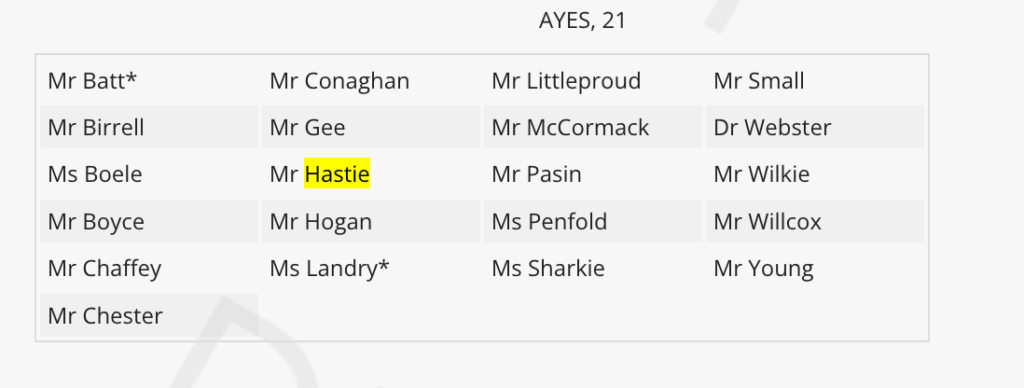
The government is very helpfully keeping track of where the Liberals and Nationals are voting on different bills and have just let everyone know that Andrew Hastie is voting with the Nationals on amendments on a bill (fuel excise pause) the Liberals are abstaining on (the Nationals put up the amendments). You should notice some other Liberal names in there as well which helps to show you where the Libs are at the moment.

New report on Aukus

Emma Shortis
International and Security Affairs Program

The US Congressional Research Service – which provides independent, policy and legal analysis to the US Congress – has released a new report on the Aukus nuclear-powered submarine deal. 

There’s a lot of detail in it. As former Senator Rex Patrick helpfully pointed out, the report outlines (again) that US submarine production rates just aren’t up to meeting the requirements of the Aukus deal. Put simply, the US can’t make enough subs for its own needs, so it seems unlikely it will hand any over to Australia (not that it has to).

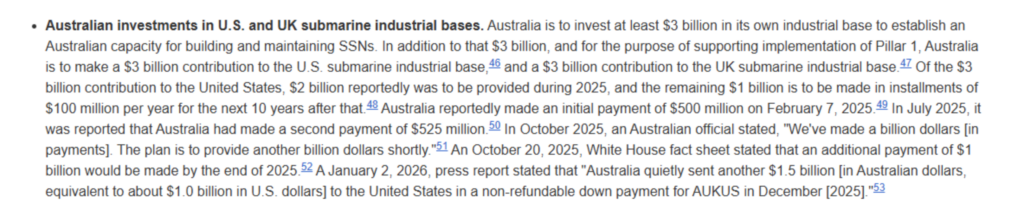
There’s also a pretty wild section on the money Australia has committed to the deal:

In summary, Australia has committed, in USD: 

  • $3 billion to our own sub industry
  • $3 billion to the US industry
  • $3 billion to the UK industry

And zero dollars of that US$9 billion is refundable. We don’t get our money back when the stuff we ordered doesn’t arrive. 

It also reads very much like the Congressional Research Service can’t actually confirm how much money Australia has handed over to the Trump administration, where it has gone, or how it is being used. 

Alliances are built on trust, after all. I’m sure it’s fine.

Pour one out for Katter

Bob Katter is focusing on the important things – the handling of the excise tariff amendment for beer.

He says it is ‘UnAustralian’ and that it is “clear Labor is drunk on power [and] was moving legislation that threatens the heart of Aussie culture – having a beer”.

The original Labor Party was born in the pubs of Australia. These fellas in those days would quite literally drag you out of a pub and punch you in the face if you didn’t take a union ticket out – yet here we are, debating a law that taxes beer. I cannot think of a better example of just how dangerous and drunk on power the Labor party have become. They are now threatening the very fabric of our social and community life.”

Why is he upset? Because the bill seeks to freeze the inflation linked increase on the excise for only two years and not forever. Barnaby Joyce moved an amendment to have the excise dropped all together and Katter seconded it, but the pair did not find support in the chamber.

Pour one out.

David Littleproud explains how his party works to the media

First Jane Hume explained how the Liberal party and National party conversations are going:

Well Sussan Ley and David Littleproud are in constructive talks right now. 

I am a committed Coalitionist, but I am a Liberal first. We want to make sure that the Coalition not only agrees on the way it’s going to operate internally, but focusses externally too because this government, this terrible Labor government, is getting away with murder while the Coalition is in flux*.

We want to make sure that we bring the coalition back together, but we do so in a way that it’s sustainable and that it’s going to work in the future to make sure that we can hold this Labor government to account every single day.  

Then David Littleproud came along and spoke to Sky News (and the hallway) that the Nationals are not a faction of the Liberal party.

We’re not a division of the Liberal Party. We’re not a faction of the Liberal Party. We’re the National Party. The Coalition is not one party. We have different values, different principles, at times, on different issues, to the Liberal Party, and we’re paid to come here and to express them.

…Now the commentariat can call me all they want. They can call the National Party all they want, but we are not a faction of the Liberal Party. We’re our own party, and we’ve been respectful in the process that we went through.”

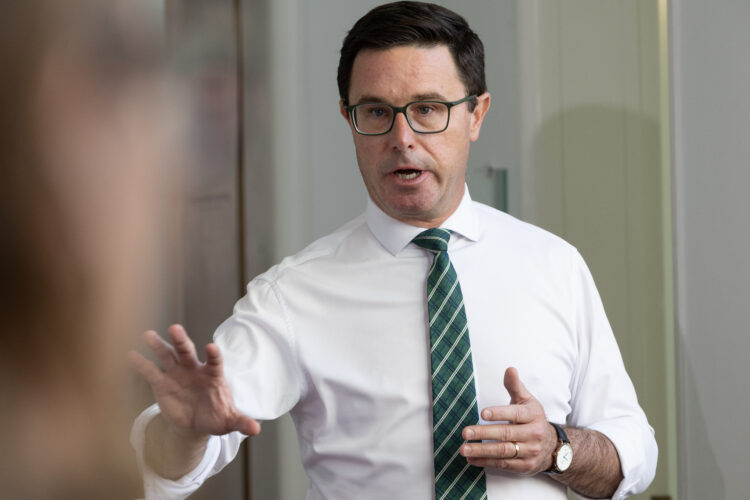
Nationals Leader David Littleproud talks to the media in the press gallery of Parliament House in Canberra this morning. Wednesday 4th February 2026. Photograph by Mike Bowers.

That ‘process’ included not taking Sussan Ley’s panicked phone calls or the phone calls of intermediaries as he announced the Nationals would be leaving the Coalition on the national day of mourning.

Ley and Littleproud are meeting this evening to discuss more of the mess and whether or not they can come to any sort of agreement. If Ley replaces the three Nationals in cabinet with Liberal shadow ministers (a threat which has been made) you know that this split is hardening.

In other news

While the commentary is all focused on how government spending is fuelling inflation (it isn’t) and how the government needs to reign it in (which is just fancy people talk for cutting infrastructure, services and welfare) this is the finance questions the nation’s newspapers are answering today.

One in the AFR – can we gift $250,000 for a home without fuelling a family fued while the SMH is answering whether or not it is possible to sell an investment property to your son, and not pay tax.

And the ABC spoke to a couple this morning for who the interest rate rise may delay which investment property they look at – whether it is a house or a unit.

But hey – the problem is care sector wages.

The lols continue

Zac de Silva and Tess Ikonomou 
AAP

Opposition Leader Sussan Ley has left the door open to softening her demands for a reunion with the Nationals, saying the coalition can end its messy political divorce this week.

Despite a number of MPs from the former allies expressing hope they will get back together, the two parties have been unable to agree on the terms of their reunion.

Ms Ley said she spoke with her Nationals counterpart David Littleproud on Monday night, and was expecting to meet again on Wednesday.

“The coalition can re-form this week with conditions that are supported by the overlying majority of my party room,” she told reporters in Canberra on Wednesday morning.

Ms Ley said the Nationals needed to agree that shadow cabinet solidarity is mandatory, that the joint opposition party room has primacy over any individual party room, and three senators who crossed the floor two weeks ago face ongoing consequences.

Asked if there was any room to negotiate on her demands, Ms Ley reiterated that they were supported by the overwhelming majority of Liberal MPs, but said she wouldn’t discuss any detail which could undermine negotiations with the Nationals.

The split, and Ms Ley’s requests, were prompted by a disagreement over the government’s hate speech laws in January.

While shadow cabinet – a group of the most senior Liberal and Nationals MPs – agreed to back the legislation, the Nationals subsequently decided to vote against it.

That led to three Nationals frontbenchers resigning from their portfolios for breaching shadow cabinet solidarity – a convention that requires all shadow ministers to support the coalition’s agreed stance, even if they personally disagree.

Ms Ley wants to ensure neither coalition party can breach the convention in the future.

She also wants the trio of frontbenchers to be suspended from their roles for six months.

It is understood Nationals leader David Littleproud is unlikely to accept the condition, and maintains the three senators need to be reinstated for the coalition to reconcile.

Ms Ley is threatening to replace the three former frontbenchers with Liberals, if the dispute isn’t resolved by Monday – a move which insiders believe would cement the coalition split.

The ongoing infighting also threatens to drive voters away from the Nationals and into the arms of Pauline Hanson’s One Nation, a leading pollster warns.

A number of recent surveys have shown support for One Nation surpassing the coalition.

Conservative working class voters who had experienced economic decline were flocking to the anti-immigration party out of disillusionment, Redbridge Group director and former Victorian Labor strategist Kos Samaras said.

“The point is revenge, cultural and political revenge,” Mr Samaras said.

“These individuals know One Nation might not have robust policies, but want to burn the house down.”

He said the Nationals risked losing all of their seats in regional NSW and Queensland, where One Nation was expected to perform particularly well.

The Liberals and Nationals were fighting to exist in the multi-party system, he said.

“They’re getting pressured from the left and the right and they don’t have an answer for one or the other,” Mr Samaras said.

A Redbridge Group/Accent Research poll, published on Sunday by The Australian Financial Review, showed support for One Nation had jumped to 26 per cent to make them the second-most popular party after Labor.

The polling has alarmed many within both the Liberals and Nationals, and is likely to spur conservatives to challenge Sussan Ley’s Liberal leadership.

The view from Mike Bowers

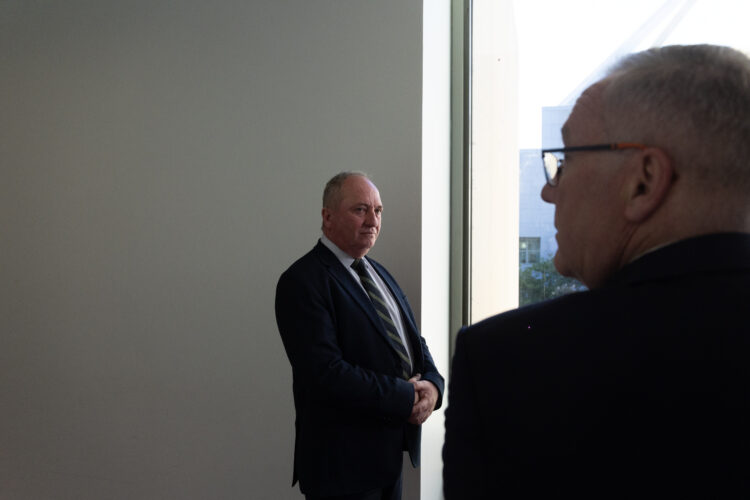
There were a couple of visitors to the press gallery hallway this morning.

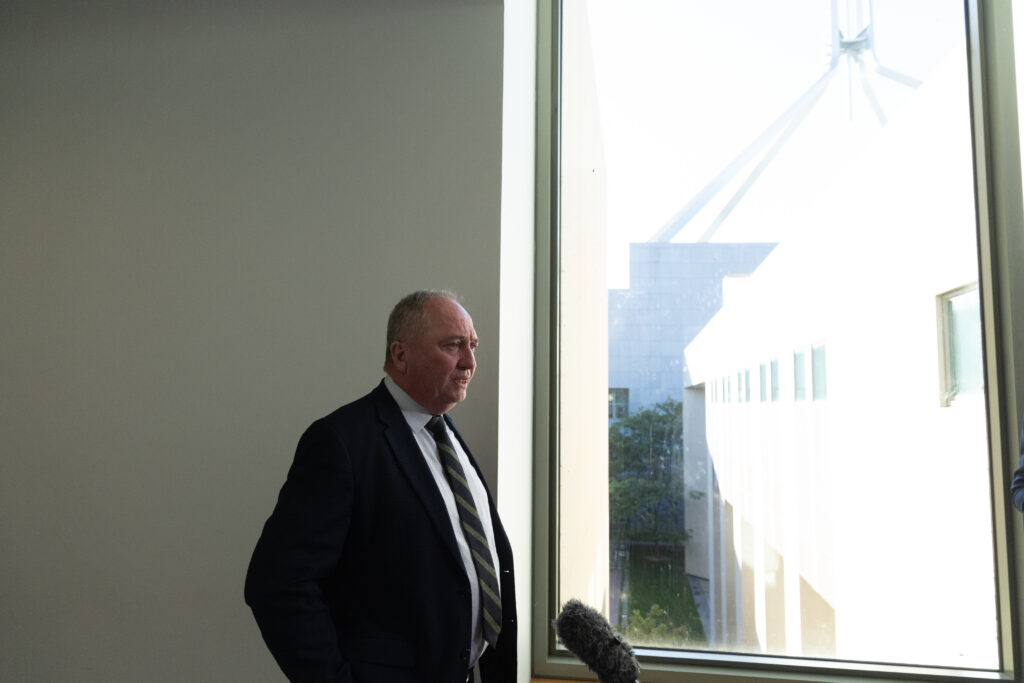
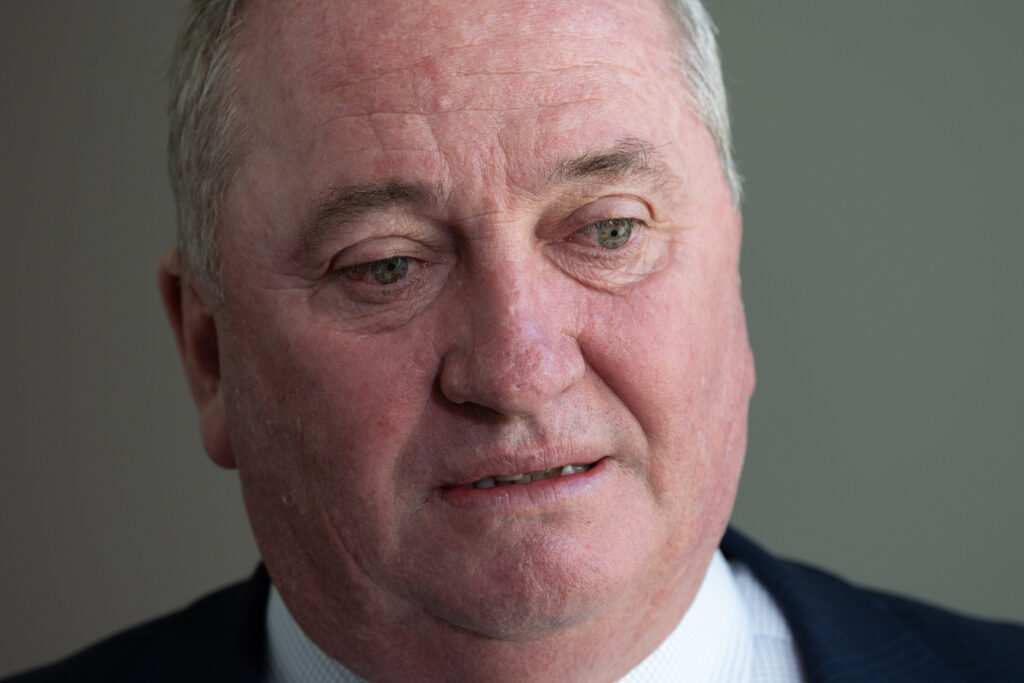
Barnaby Joyce talks to the media in the press gallery of Parliament House in Canberra this morning. Wednesday 4th February 2026. Photograph by Mike Bowers.
The Shadow Treasurer Ted O’Brien talks to the media in the press gallery of Parliament House in Canberra this morning. Wednesday 4th February 2026. Photograph by Mike Bowers.

Oh so Q….

Even though the parliament is going to sit in about 30 minutes, everything is a bit quieter this morning, with both major parties hoping to avoid the lime light. The rate rise, while expected (and the inflation bounce was because of holiday spending in December) is still not great for a government that is trying to get everyone to think of it as the ‘natural party of government’. So even though inflation has fallen, there are international factors at play, data centres are driving private demand, profits for businesses are increasing (these are apparently never bad things – it is only bad if care sector workers get a pay rise) and Australia needs its governments to spend money on things like infrastructure and services – the commentary is all one way.

And well, the Liberals are the Liberals. So they don’t want to say boo.

Anyway, the first order of the day is the bill to pause excise on beer.

Greens need a rethink: MCM

Over on Deepcut News (which full disclosure, I contribute to) former Greens MP Max Chandler-Mather has written an interesting piece on why he thinks the Greens 2025 campaign to ‘keep Dutton out” was a mistake – because it told voters “change comes through Labor”.

MCM’s argument is that One Nation is filling the void of voters who are angry at both the political system and those who uphold it – and the Greens are missing an opportunity to show people a different way:

Among One Nation voters today, 75% think the political system is completely broken. Unsurprisingly, One Nation voters are consistently found to report some of the highest rates of financial stress. In a November poll, One Nation outpolled everyone else among Gen X and Baby Boomers experiencing a great deal of financial stress. Alarmingly for the Greens, One Nation is also outpolling them among Millennials in this key demographic – 18% to 16% respectively.

This is why the Greens’ pivot in the last federal election towards a strategy to “keep Dutton out, and get Labor to act” was such a mistake. Rather than offering a hopeful break with the status quo in the middle of a historic housing and cost of living crisis, a vote for the Greens became a vote for a Labor government and a deeply unpopular political establishment.

In the end, the underlying political message of the Greens’ “keep Dutton out” was that change comes through Labor.

He says the Greens have to change their own thinking:

The Greens need to stop conceiving of change as something that is negotiated in parliament with Labor. People already disconnected from politics will never believe anything good can come through backroom deals with the political establishment.

And they’re right. Labor and the Liberals are part of the same political establishment, tied to the same corporate and billionaire donors. As long as either is in charge, nothing is going to meaningfully change for the better.

Katy Gallager’s turn on the media merry-go-round

Jim Chalmers had to front up to every breakfast show yesterday ahead of the expected rate rise, so now it is Katy Gallagher’s turn to front up now that the rate rise has come to pass.

She told ABC TV News Breakfast:

I think you heard the Treasurer say when we’re looking at the budget together, there’s a number of things we’re looking at, managing inflation, dealing with the productivity challenge. We’ve seen slight improvements in recent economic data but that’s a challenge. Productivity [hasn’t been] what we would like for the last two decades. We’ve got some effort going there, whether it be in clean energy, digital data, housing, that work is under way.

And then looking for the third component which the is what Treasurer talked about, reform. So we had the economic reform round table, some ideas have come through that. You budget considerations in May.

We’ve got quite a number – we’ve got tax cut – if you look at the tax system, we’ve got the tax cuts coming, we’ve got instant deductions we to at the election, better targeted super reforms that we’ll need to get through the Parliament. So we have some of that reform work under already. But, you know, we’ll look at some of the ideas that came out from that economic table in the considerations we have in May for the budget.

And scene

Why is One Nation outpolling the Liberals and Nationals at the moment? Sussan Ley doesn’t know (which is part of the problem, I would argue)

Polls are a point in time. I’m focused on a serious, credible, compelling agenda* to take to the Australian people along with my team that I’m very proud to lead by the next election. One Nation is a protest party. I haven’t heard from them a serious economic policy to address the circumstances that and I have just been talking about** and that every single Australian faces and it is, indeed, only the Liberal Party that has proposed the answers sensible economist, individual who runs their own household budget, commentator, dare I say***, James, has outlined the Government must cut spending and there must be a pathway to productivity and build growth in this country, because it’s growth that lifts incomes****, delivers services and gives hope.

*I will buy a coffee to ANYONE who can tell the class what this ‘serious, credible, compelling’ agenda is. The party has no policies.

**On that the Liberals and One Nation are on a unity ticket

***Only the people who agree with me are sensible is exactly how my toddler thinks

**** Wages did not grow for 10 years under the Coalition

Sussan Ley remains delusional, part two

Sussan Ley continues this interview with the same attitude she has presented most of her senior political career – just talking about what suits her.

Q: Last week, there was a funeral in Melbourne for [former Liberal MP] Katie Allen and before the funeral, members of the Liberal Party’s right faction were meeting, not so secretly, and it was well reported that they were discussing the future of your leadership and who might potentially challenge you. Have you spoken to Angus Taylor about what on earth he is up to?

Ley:

Angus is my leadership group, part of my shadow cabinet. We’ve had discussions about interest about the circumstances Australians face and about many are pertinent to the work we do here as the Opposition.

Q: Is he plotting to replace you as early as next week, though? That has been pretty widely reported?

Ley:

These are ridiculous suggestions and they’re made by people in the media*. These are not the conversations that I’m having with colleagues** and they’re not the focus of my team and I really mean that.

Because every minute that talking about these issues have just raised – and by that I mean somebody in the media don’t prosecute the really important case that we want to make. Now, for out-of-pocket payments have gone up $23,000 a year. And that is real pain. We’ve seen the Prime Minister take credit for interest rate cuts. Where is his responsibility for 13th rate rise under this Government.

Q: OK, I’ll just take you from…

Ley:

Everything going up, James…***

*The calls are coming from inside the house – you can not shut the Liberals up at the moment about how they want to replace her but just don’t know when or whether Angus Taylor will have enough numbers for now (common view is that Hastie is now going to wait until after Taylor crashes and burns at the next election and take what is left)

**That’s kinda the point, because OF COURSE the party that doesn’t respect you as leader isn’t having conversations with you about your future.

***Except Sussan Ley’s approval ratings in the public and her numbers in the party room.

Sussan Ley is still delusional (but now with media training)

What are people telling you to your face about your leadership Sussan Ley is asked on ABC TV Breakfast.

Ley:

Well, unsurprisingly, we are discussing the real elephant in Anthony Albanese’s room, which is the interest rate rise, and what that means for struggling Australians. Yesterday, there were many conversations about exactly that. When we come to Canberra to kick off a parliamentary year and we’ve got six sitting weeks out of the nine, it’s a very busy and important session. What we are focused on is the Australian people. Every minute of every day and anyone who tuned in to Question Time yesterday and saw the way that both the Prime Minister and with disdain the issue that really, as your program has illustrated, is hurting Australians, was a disgrace. That’s what people are telling me to my face and that’s what the conversations are about.

Lols.

Treat extreme heat as serious as asbestos and silica in the work place says ACTU

ACTU boss Michele O’Neil also wants attention drawn to extreme heat and its impact on workers.

The ACTU says the Commonwealth’s 2025 National Climate Risk Assessment projects heat-related deaths in major cities will more than quadruple without change – rising 444 per cent in Sydney, 423 per cent in Darwin, 312 per cent in Perth, and 259 per cent in Melbourne.

Safe Work Australia data shows workers currently carry 74 per cent of the financial burden of heat-related injuries and illnesses, while employers bear just 5 per cent.

O’Neil:

No worker should be told to push through the brutal heat and risk their own life. When it’s dangerously hot, your boss should either change your work or stop your work.

A rest break or work stoppage in extreme heat can be the difference between a worker going home safe or not going home at all.

We regulate asbestos and silica because they kill people and devastate families. It’s time we treat climate hazards like extreme heat in the same way. There is no excuse for Australia to leave workers exposed without clear, enforceable rules, especially when the government’s own reports project heat-related deaths to more than quadruple in our major cities.

No worker should have to live in a home that becomes unsafe every summer, especially renters who have the least power to demand improvements. Updating the construction code and setting minimum standards for rental homes is basic public safety.

The science tells us that heatwaves are getting worse, but our regulations haven’t caught up. If countries like Japan can introduce national heat standards, surely Australia can too.

If you get sick from working in extreme heat, it should be treated like any other workplace injury – and that means workers’ compensation coverage, so you can focus on getting better, instead of worrying about paying the bills.”

Cost of ‘tough on crime’

Not only does the ‘tough on crime’ obsession NOT solve crime problems and does nothing to help stop people from re-offending (particularly young offenders), it also costs an absolute motza in keeping people locked up (and we do it to children as young as 10).

AAP has this report on what the ‘crime crackdowns’ cost in dollar terms:

Sentencing and bail crackdowns may be costing billions of extra dollars in taxpayer funds as the cost of maintaining prisons spikes.

Australia’s average daily prison population is at its highest level in eight years, according to data released on Wednesday by the Productivity Commission.

More than 45,000 people on average were locked up each day in 2024-25, a rise of 5.9 per cent.

Driving the increase in prisoners is an uptick in recidivism with 44.5 per cent of inmates released returning to prison within two years, the highest level since 2019.

The growing price tag of the swelling prison population is more than $5 billion per year, or about $13.7 million a day.

The yearly sum has grown more than $1.5 billion in the last decade.

While prison numbers and costs may be escalating, many crime rates are coming down.

Household crimes like property damage, break-ins and car thefts have all dropped in the past 10 years, according to the Australian Bureau of Statistics crime victimisation database.

Most categories of physical crimes have also decreased, including assaults and robberies, while incidents of sexual assault have slightly risen.

With crime rates easing, tough-on-crime policies enacted by various state and territory governments may be behind the persistent swelling of prison numbers.

The Queensland coalition government enacted “adult time for adult crime” in 2024 after a 17-year-old fatally stabbed mother Emma Lovell during a Boxing Day home invasion in 2022.

Victoria followed suit late in 2025 and also introduced the “toughest bail laws in Australia” by removing the principle of detention as last resort for young offenders.

Former national children’s commissioner and now Justice Reform Initiative spokesperson Anne Hollonds said on Friday record funds are being poured into a system that fails to reduce crime.

“In Victoria, youth detention numbers were falling just two years ago,” she said.

“Now we are seeing a rapid reversal as punitive policies take hold. This is the same failed path we have already seen elsewhere.”

NSW tightened bail laws in 2024 by making more accused offenders prove why they should not be detained and strengthening the presumption against bail for domestic violence and youth matters.

Extreme heat awareness day

It is Extreme Heat Awareness Day, which given last week seems very timely. Independent Kooyong MP Monique Ryan and the independent crossbench will hold a press conference later today to try and raise awareness of the “growing health crisis and national communications failure”.

Ryan wants to name heatwaves in the same way cyclones are named, so people know to prepare for them.

Her petition calling for that has so far raised 2,000 signatures and there are polls on potential names (including those contributing to climate change)
We’ll find out the winner of the public poll later this morning, but Ryan says she is serious about changing how we think about extreme heat:

On Extreme Heat Awareness Day, the Albanese Government should seriously consider the proposal to formally name heatwaves. Over the past month alone, Melbourne has endured record-breaking temperatures exceeding 48 degrees, underscoring just how urgent this issue has become. 

The government has a clear opportunity to adopt lessons from 60 years of effective cyclone communication, applying them to Australia’s deadliest natural hazard. Heatwaves represent a health crisis. They kill more Australians than fires, floods and cyclones combined. 

A heatwave naming system, paired with severity categories and consistent public messaging, would improve risk awareness, support targeted health outreach like welfare checks, pop‑up cooling and emergency response resourcing, and focus accountability for climate change. 

Climate change is driving longer, hotter and more dangerous summers, while the urban heat island effect is pushing temperatures in major cities even higher. These overlapping trends make urgent action on heatwave communication essential. It will save lives.” 

Fun fact – the reason we name cyclones people names is because Clement Wragge, known as the father of naming cyclones, started naming storms after Pacific Island women (red flag) and then after politicians started passing on his projects, started adding politicians he didn’t like to the storm naming system. Then he died and it mostly didn’t happen, which made it all a bit chaotic, but during WWII it all picked up again, with alphabetised names, but turns out there only being 26 letters in the alphabet was an issue. Then it was mostly just women names (I think you can guess why) before the 1970s when there were rules put in place.

Freedom of Information Bill still a live issue

Bill Browne
Director, Democracy & Accountability Program

Late yesterday, there was an attempt by Senator Fatima Payman to get the Albanese Government’s FOI Bill “discharged” (removed from the list of bills the Senate will debate).

It failed – with Labor voting to keep the bill in play and independents, Greens, Jacqui Lambie and One Nation voting to discharge the bill (I may have missed some – just relying on what I could see).

Liberals and Nationals left the chamber to avoid voting either way.

“Where’s the Libs?” could be heard even over the broadcast

Rex Patrick explained the strategy behind discharging the bill versus keeping it “on the notice paper” earlier today. He thinks the bill is dead either way, but keeping it on the notice paper allows for a debate where the bill can be publicly criticised. 

If the bill survives this week, I will again become worried again that a Labor/Liberal deal on at least some aspects of the bill is possible. 

Good morning!

Hello and welcome back to parliament, where the big news is still the RBA’s ‘expected’ decision to increase interest rates.

That is going to set off the Liberal party who now feel they have something to talk about. And while that is true, what they don’t have is solutions. Just a vague ‘this must be the Treasurers’ fault’ for *reasons*. The Liberals keep harping on about government spending (state and federal) but that is not what the RBA pointed out yesterday. They pointed to demand in the private sector (largely thanks to data centres). Now the most recent inflation bump was, at least on the data, down to the holiday spending – given it was December, that makes sense. And we have a cautious RBA board, who love to raise at the first sign of sticking inflation, but are not as quick when it comes to cutting it. Because will this interest rate rise stop AI slop or the Ashes? No. No it will not. But it will slow the economy for most of us. And that is never a great thing.

But most of the experts having a little moment here have their little ideological battles to wage (how dare child care and aged care workers be paid a living wage! Outrageous!) so the focus is on government spending. Lots of ‘treasurer urged to ‘fix the budget’ which is hilarious because these same people don’t want to support the things that actually would get a lot more money into the budget – like I don’t know – taxing gas.

So, lots to talk about today, and none of it great. You’ll have me, a bunch of expert contributors, and the (borrowed) talents of Mike Bowers, to get you through the day. It is already coffee number three time. Ready?


Read the previous day's news (Tue 3 Feb)

Comments (10)

Join the conversation

  • John Carroll Wed, 04.02.26 16.02 AEDT

    https://live.thepoint.com.au/2026/02/the-point-live/?post=1aa6344752
    We all like cheap electricity, but how long can electricity be given away for free or cheaply during the day and still attract investment into its production? Surely the lower pricing of solar electricity will push the uptake of all scales of batteries to store cheap power for evening use and eventually push the daytime renewables prices back up. It's not necessarily a bad thing, but the rollout of renewable production, storage and transmission still seems very ad hoc and organic.

  • Richard Llewellyn Wed, 04.02.26 12.41 AEDT

    Diverging from commentary on the ridiculous rate rise for a moment, many thanks for the memories of Mike Bowers' photos. SuperTed somehow (unkindly) reminds me of the view of a departing Boxer dog, but hey - Barnaby - no wonder he's a Babe Magnet. OK, he may suffer from chronic Red Tides, but he brings gravity to PHON.

  • Matthew Wed, 04.02.26 12.11 AEDT

    By raising rates in line with an arbitrary inflation target RBA policy is upholding the 'real' rate of interest to the benefit of lenders (i.e. banks etc) at the expense of borrowers, and especially, households with high mortgage debt because of the circumstance of extraordinary high house prices (the latter a result of a 30-year policy failure). Inadvertently or not, the RBA are acting in the interest of wealth holders and against that of indebted households. The notion that the inflation is the result of demand pressures (rather than supply/cost pressures) is a complete nonsense; as is their justifying claim that potential growth in Australia has been exceeded at 2%. Indeed, interest rate increases in the long term add to costs of production and contribute to the inflation rate. The RBA is currently an institution which represents an obstacle to sustained growth and development of the Australian economy.

  • Adrian Wed, 04.02.26 11.50 AEDT

    Picking up on Andrew Hastie voting with the Nationals when the Liberals were abstaining on that vote, is it common for the major policital parties to abstain on a vote? I kind of think deciding which side of a vote to support is their job.

  • Rod Campbell Wed, 04.02.26 11.47 AEDT

    Remember that there are no professional standards for economists. Anyone can call themselves an economist. My test for it is that if you can look someone in the eye and say "Hi, I'm Rod. I'm an economist", then you are one. By that measure, I am one and Matt Canavan probably is too!!

    https://live.thepoint.com.au/2026/02/the-point-live/?post=947e9df440

  • Cath Wed, 04.02.26 11.17 AEDT

    Now I'm relieved I didn't post my comment this morning about how I don't want the government to cut spending (in relation to inflation), this is not the type of spending I meant!

    What are these payments, protection money? How generous we are to our friends in the US and UK.

    https://live.thepoint.com.au/2026/02/the-point-live/?post=2e1a2f087f

  • Ken Little Wed, 04.02.26 10.42 AEDT

    "The rate rise, while expected (and the inflation bounce was because of holiday spending in December) is still not great for a government that is trying to get everyone to think of it as the ‘natural party of government’. So even though inflation has fallen, there are international factors at play, data centres are driving private demand, profits for businesses are increasing" - thanks Amy for providing some context / perspective. "Rising profits" is a phrase rarely heard in an inflation analysis.
    Reporting on this inflation result is so over-hyped as a problem for the govt. MSM KNOWS the Reserve Bank has stated often their preferred indicator is the "Underlying Inflation" figure, not the "headline inflation" figure.

    Underlying inflation for the December quarter rose....wait here for the full horror... rose by 0.1%, from 3.2% to 3.3%.

  • Richard Llewellyn Wed, 04.02.26 07.42 AEDT

    Will we ever see ANY government actually reining in the power of the RBA to set interest rates according to where the dart ends up in their Board dartboard, rather than any actual depth of research and taking into account the obvious effects holistically? The RBA seems to operate on much the same lines as a pub trivia team - take a poll of its members, while under the influence of unknown substances, and blurt out an answer..

  • Andrew Faith Wed, 04.02.26 07.04 AEDT

    Good morning, Amy. I think this might be a five coffee day, but it could get worse… I'm off to have some toast.

The biggest stories and the best analysis from the team at The Point, delivered to your inbox.

Past Coverage