Thu 27 Nov

The Point Live: Australia missing emissions targets, Nationals pretend to care Barnaby Joyce's has left the Nationals. As it happened.

Amy Remeikis – Chief Political Analyst and Political Blogger

This blog, and the parliamentary year, are now closed.

Start the conversation

The Point Live: Australia missing emissions targets, Nationals pretend to care Barnaby Joyce's has left the Nationals. As it happened.

Key Posts

The Day's News

See you next year?

Parting is such sweet sorry. Photo: Mike Bowers.

And that is it. We are done for the parliamentary year.
And what a year it has been – an election, the demise of the Coalition, a new website and blog – but the same old Albanese government.

Will we see some bravery and reforms which work to address widening inequality, our emissions and the climate at large?

We have to hope so. It has been a rough year for a lot of people and there has been a lot of disappointment from people who were hoping for something better. That is completely fair and I think people should have as much space as they need to express that.

But there is a growing number of people – all over the place – who are turning that disappointment into action. The government can’t fool people like it might have once done. And it can’t count on having everyone who voted for it continue to vote for it. That doesn’t mean the Coalition will benefit, but there is room – and it seems, the determination – for a new politics to start emerging, where the two party stranglehold over policy is cracked.

Next year is the year Labor has to do anything it plans on doing – the year after that is election mode, and things rarely get done in election mode. So make sure you rest over the break because there is a big year coming – and you matter.

But that’s for next year. For right now – thank you. Thank you to the team at The Point and The Australia Institute – it’s a small team, but a mighty one. Thank you to our contributors and the researchers who take time out of their very busy days to explain the world a little better to you. Thank you to Mike Bowers – I could not do it without him. He is a super star and I am very lucky to have him walk the hallways with me.

But mostly, thank you to you dear reader. This little project was born out of a desire to see if we could do political journalism a little better, and a little bolder. To call a lie a lie, and reflect what was actually happening and not pretend facts don’t matter, or objectivity means running bullshit.

We want to explain what is behind the policies, and what isn’t being talked about, as well as what is and why – and have a bit of fun doing it. And that so many of you have joined us is honestly incredible. We don’t take your trust for granted and we will continue to build this blog with you in mind. You are all wonderful.

So have a break this summer. Have some fun. We’ll still be here when you get back. And the work continues even while the blog rests.

I hope you all have a loved filled holiday season and get some time to do what brings you joy.

Until February 3 when parliament, and The Point Live team returns – take care of you Ax
Thanks Glenn!

Fantastic. Great move. Well done Glenn!

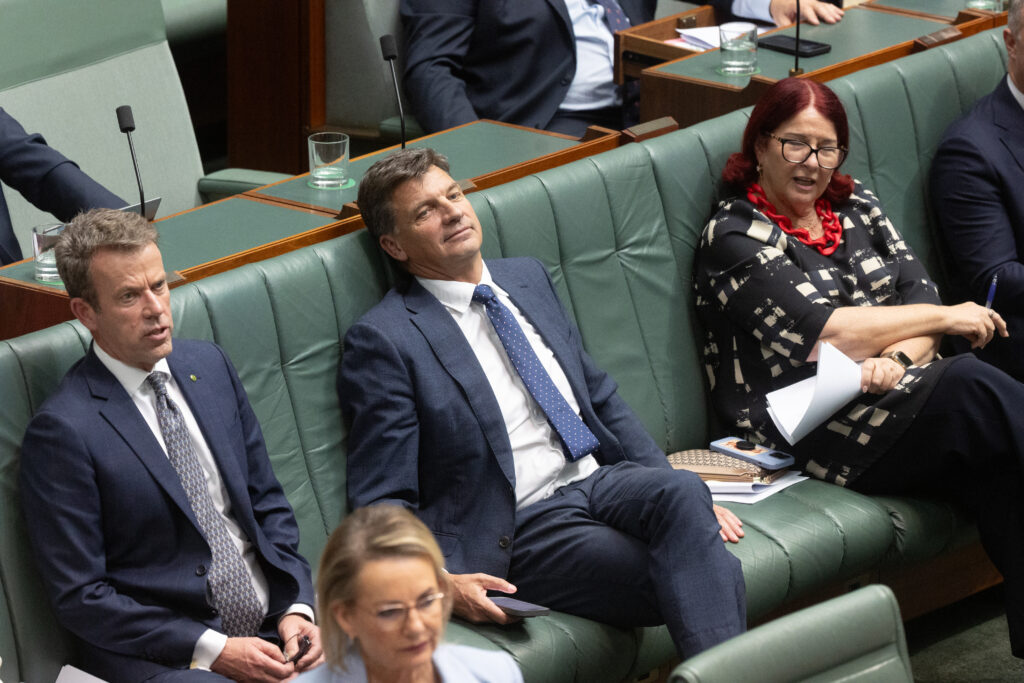
Angus Taylor during question time in the House of Representatives Chamber of Parliament House, Canberra this afternoon. Thursday 27th November 2025. Photograph by Mike Bowers

Chalmers welcomes investment

Jim Chalmers has responded to the increase in investment Grog’s reported on a little earlier (the AI boom is here).

Chalmers:

This big increase in business investment is much stronger than expected and very welcome.

These figures show not only is investment in priority areas like data centres and cleaner and cheaper energy growing, it’s growing even faster than anticipated.

Business investment was going backwards when we came to government, under Labor it’s growing again.

This investment will help make our economy stronger, more resilient and more productive over time.

It’s goodnight from me … and it’s goodnight from him …

In a (thankfully) brief reply, Sussan Ley has also said her goodbyes.

She’s survived “killing season” (for now) but February 3, 2026 is a long way away.

Now, throwing back to Amy, who has emerged from the studio feeling appropriately festive now both leaders have placed their Parliamentary cues into the rack for 2025.

Prime Minister delivering final address to the House for 2025

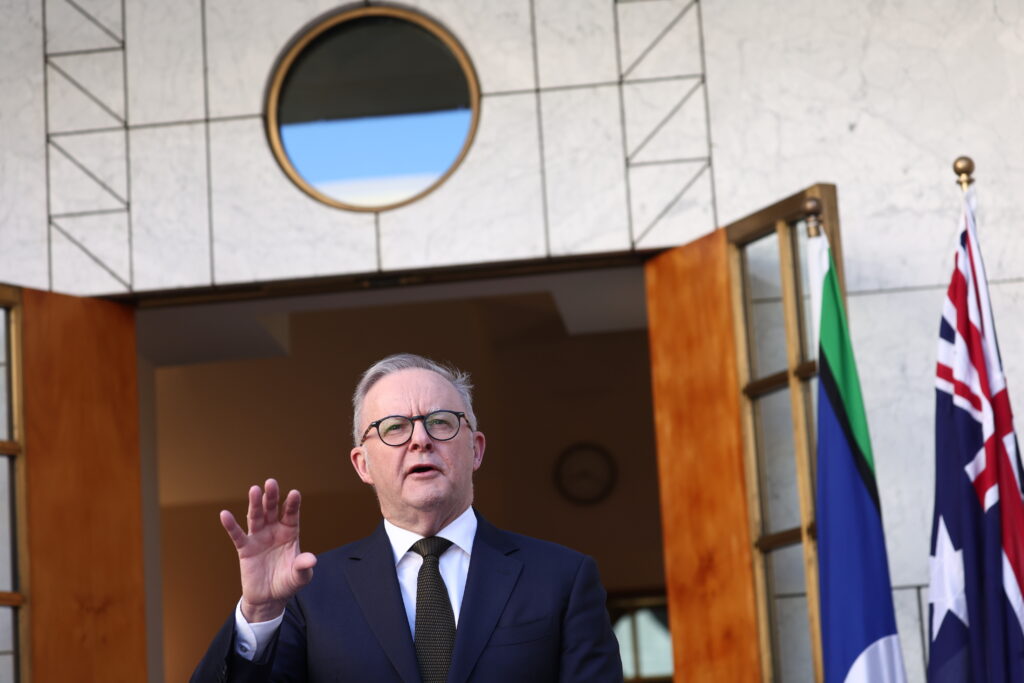
Anthony Albanese has just delivered his long goodbye to the 2025 Parliamentary year.

He made special mention of the Deputy PM, Leader of the House, Senate team, caucus, personal staff, security detail, wife-to-be, Jodie, and son, Nathan.

He made reference to Christmas being a particularly significant time for people of faith.

It is an important time where people can rekindle their faith, think about their place in the world, and remind ourselves that in the arc of history, we’re small.

He wrapped up with a reference to The Ashes.

I look forward to continuing to watch Australia humiliate the English cricket team, starting on Saturday with the PMs 11, sorting out, sorting out the English team at Manuka Oval

Popular cameraman retiring after 40 years

Lovely tributes are being delivered in the House for retiring Channel 7 cameraman, Steve Quick.

I worked for several years at Channel 7 and can personally attest to the fact that Quicky is one of the loveliest blokes in the Parliamentary Press Gallery.

He’s filmed and travelled with 9 different Prime Ministers in his 40 years during which, remarkably, he only served one employer – the Seven Network.

Steve is universally respected along the red carpet of Level 2, Senate building 2 … and right through Parliament.

Go well, Quicky.

Say hi to Glenn!

Glenn Connley is going to guide you through the afternoon so I can run and speak to 7AM for a podcast. But I will be back to say goodbye because I love you all!

OK, NOW Question time ends

This is a wider dixer, so if he doesn’t end on this, we will burn the house down. (Figuratively ASIO and parliament jail people. Don’t come for me)

What have we learned?

Nothing. Maybe that the Coalition is worse than it was even after the election, but that is about it. No new ideas, no direction. Just bitching and moaning.

And that allows the government to get away with whatever they want.

That’s not good for any of us.

Allegra Spender asks if question time can stop sucking so bad (basically)

Spender:

Many constituents complain to me that Question Time is Question Time and not Answer Time and that’s driven by the standing orders that don’t actually force real answers from the government. They say to me that it means that we don’t hold the government to account in the same way that they expect us to in this House. I ask the Prime Minister have you considered reforming Question Time to give a greater expectation of answers and in narrowing of relevance so we can better answers in this house?

Albanese: (No, is the short version)

I’ll see if the Leader of the House, that was a job I used to have, might want to add to the answer. But one of the things that has improved I think, the reforms that have been placed in the parliament, while I was leader of the House, is a limit on time.

That wasn’t always the case. In asking the question, and a time in answering the question as well. One of the things you might notice as the member for Wentworth, I draw your attention to the time on the clock, one of the things I have done is not shut down Question Time after an hour, and in deed, and indeed if those opposite want me to shut it down in an hour, I’ll take it onboard.

But what I have done is make on average questions every single day I’m here. Every single day all my ministers are here. And we are actually the most accountable parliament, we are the most accountable parliament in the world. In the world.

Most parliaments in the G20, President Prabowo has not answered a question. Prime Minister Modi has not answered a question. In the UK, the Westminster system upon which we’re based, there is Prime Minister’s Question Time for one hour once a week. And the questions are taken on notice

There’s no parliament in the world in which a government is more accountable than this government*. And Australian governments of both persuasions. That is just a fact. Just a fact across the board. And one of the things that we do as to make sure as well that we have ensured that standing orders have been amended so that the crossbenchers get a fair crack. That’s something that we have done and this question is an example of that.

*Well that is misleading the house.

NOOOOOOOOOOO

Ugh. He is still going. WHHHHHYYYYYYYYYYY

Question time ends (basically)

Well, Anthony Albanese is still talking on this dixer about how the environmental law reforms have been received. But it can’t be any worse than the dixer that Sussan Ley gifted him, so we are calling time.

Give yourself a special carb for getting through all of this.

The latest corrective services data was released today.

Greg Jericho
Chief Economist

It paints a growing horror story of systemic racism in our judicial and policing systems.

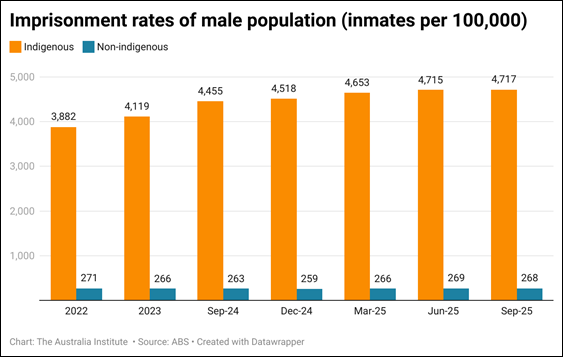
In the September quarter 403.7 men were imprisoned per 100,000 men in Australia, that was down on 405.9 in the June quarter but well above the 384 average across 2023.

But the real story is when we break down imprison rates by Indigenous and non-Indigenous persons. Since 2023 the rates of non-indigenous men imprisoned has remained steady while the rates for Indigenous men have risen substantially

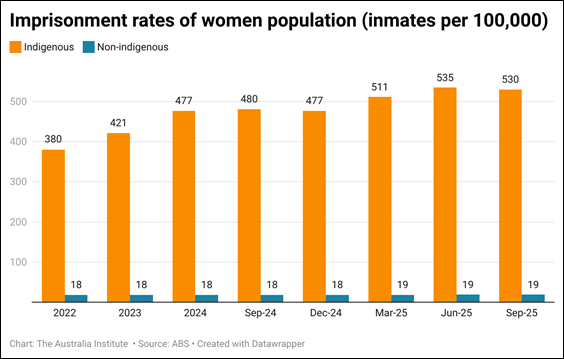
The story for women is much the same. While women are much less likely than men to be in prison, the rate for Indigenous women compared to non-Indigenous is just as bad and again has seen more Indigenous women imprisoned over the past 3 years compared to non-Indigenous

Indigenous men are 17 times more likely to be imprisoned than non-Indigenous men, while Indigenous women are a shocking 27 times more likely than their non-Indigenous counterparts.

Such a growing disparity is a true disgrace of Australian society. Indigenous people are much more likely to be given a custodial sentence than non-Indigenous.

But of course the problem does not only being with people’s interactions with the law – Indigenous people are much more likely to be unemployed, to live in poverty and to live further away from vital services and support.

These figures are just the end result of a society that remains riven with racism.

Tony Burke forgets Die Hard is a Christmas movie

Tony Burke takes a dixer to say:

We have in this 48th Parliament, since the election, because we have an Albanese Labor government, cut 20 per cent of student debt.

Because we have an Albanese Labor government having cheaper medicines.

Because we have an Albanese Labor government protecting penalty rates for Australian workers. Because we have an Albanese Labor government 5 per cent deposits for first home buyers.

And add to that today because we have an Albanese Labor government, long awaited environmental reforms… Hear, hear!

And I might say Australian content obligations for streamers. Hear, hear!

But that approach to delivery, which we see in the work of the Parliament, for other members of Parliament, the approach to delivery would be better represented at Christmas time by the movies that people watch at the end of the year.

Because the great Christmas story, the Christmas Carol, I suggest they all watch a version of it, probably the muppet version of the Christmas Carol, and in doing so don’t focus on the tragedy of tiny Tim.

…They should watch out for the ghosts of Christmas past because we had two of them today. The ghosts of Christmas past where their former Prime Minister referring to Liberals today as ‘Insane conversations about energy’, where he said, ‘Energy policy should be determined by engineering and economics not ideology and idiocy.”

The other ghost of Christmas past, the member for New England.

Who was the deputy to Malcolm Turnbull, has decided to declare today that he will refuse to join any political party that will have him as a leader.

Because it won’t be long before they do move on from that movie and with Love Actually we’ll have the member for New England turning up at a Queensland doorstep for a different party holding a sign saying ‘To me you are perfect’.

But the Leader of the Opposition, while those opposite are watching… The Leader of the Opposition can spend that time watching Home Alone.

This is so stupid

The member for Hinkler who is not Keith Pitt asks a very stupid question. One – do you think most Australians know or care what COP is? Two – do you think most Australians know or care what the National Security Committee is? Three – do you think most Australians knows or cares what Chris Bowen actually does?

Stupid.

My question is to the Minister for Climate Change and Energy. How many meetings of the National Security Committee of cabinet which deals with important energy security issues, does the minister, who works part-time, expect to miss while he’s overseas at his full-time job as president of COP negotiations?

Albanese takes this, as he says he is the head of the NSC:

It’s actually a breach of the law to talk about what happens at the National Security Committee.

Two more bits of dodgy news about Labor’s $2.5b secretive deal with Nauru

Jack Thrower
Senior Economist

In September, the Senate revealed that the Albanese Government had secretly agreed to pay Nauru up to $2.5 billion to resettle the NZYQ cohort (of about 350 people). This would involve about $400 million up front and up to $70 million annually, depending on how many people resettle there. Media coverage on this deal has highlighted concerns about its secrecy and high cost. These are exacerbated because the government refuses to release any details.

As a refresher, the NZYQ cohort is a group of over 300 people who have had their visa cancelled or been refused a visa but for whom there is “no real prospect of removal from Australia becoming practicable in the reasonably foreseeable future”. This could be because they are stateless, they are refugees or otherwise entitled to protection or there is a practical barrier (such as being physically or mentally unfit). Previously, this cohort was being kept in detention until they could be deported (effectively indefinite detention). In 2023, the High Court ruled that the government simply deciding to hold these people in effectively indefinite detention was unconstitutional, meaning these people would have to be released. As some of these people have committed serious crimes (though have served their sentence and would likely be released if they were citizens), there has been considerable media attention on the group.

This week, there is more concerning news about the Nauru deal. Most of it brought to you by Greens Senator David Shoebridge, who has used the powers and privileges of the Senate to bring some new information to light.

Firstly, there are allegations of Nauruan corruption, as reported in the Sydney Morning Herald:

Nauruan President David Adeang was suspected of money laundering and corruption by Australian authorities three years before he signed a fresh $2.5 billion deal with the Albanese government in exchange for taking in non-citizens Australia cannot detain. 

Adeang and Nauru’s former president, Lionel Aingimea, were implicated in more than $3 million worth of suspicious transactions in nine months, according to warnings from financial intelligence agency AUSTRAC. Many were linked to a company traced to Aingimea’s wife that was subcontracted by an Australian firm running the offshore detention regime.

 Secondly, there are concerns that Nauru may attempt to return this cohort (which includes refugees) to their home countries. As reported in the ABC:

Nauruan President David Adeang says members of the NZYQ cohort, many of whom are refugees, could be returned to their home countries before the 30-year-long agreement with Australia lapses, according to a translation of his comments.

Liberals tactics team give up

I thought this was a dixer, but nope it is just the worst tactics team in opposition history phoning it in.

Sussan Ley:

In his self-described year of delivery, and after 3.5 years of Labor, the Prime Minister has delivered the largest decline in living standards in the developed world, lower productivity, more debt, higher inflation and now, as many economists warn, the real prospect of higher interest rates. Prime Minister, on this final sitting day of 2025, will the Prime Minister finally take responsibility for all these failures?

Albanese takes this as a dixer, because of course you would:

We have, of course, reduced debt, reduced the interest that would have been paid on debt, because we turned their budget deficits into a budget surplus in our first year, we turned their budget deficit into a surplus in our second year, and produced a reduced deficit in our third year.

Our economy is growing. Very unusually, across the developed world, we have had zero quarters of negative growth. Inflation is down to half of what it was under those opposite. Interest rates have come down three times this year.

Wages have increased eight quarters in a row. They’re growing at the fastest face and pace since 2012.

Since 2012, last time Labor what is in government. We had the lowest average unemployment rate of any government in 50 years, 1.2 million additional jobs, three out of five full-time and four out of five in the private sector.

We have the small gender pay gap on record. We have fewer days lost to industrial disputes compared to those opposite. We have a record number of small businesses, we have solid business investment and we have delivered a tax cut for every taxpayer which combined with the wages growth means that people are earning more and keeping more of what they earn.

Those opposite want people to Order. work longer for less. If they had their way a wages would be going down, people would not be able to work from home.

Tax cuts would not have been delivered.

That was their platform that they went to the election on, and they managed to combine all of that with higher deficits. It’s what they proposed. We have rolled out cost of living relief for every single household in energy bill relief, cheaper childcare for 1.1 million families, cheaper medicines that have saved Australians more than $1.5 billion. Free TAFE for 725,000 enrolments, student debt relief for more than 3 million Australians, all of it opposed by those opposite.

All of it opposed by a Coalition that’s just too busy fighting each other fight for Australians.

Ted O’Brien booted from chamber in early Christmas gift to us all

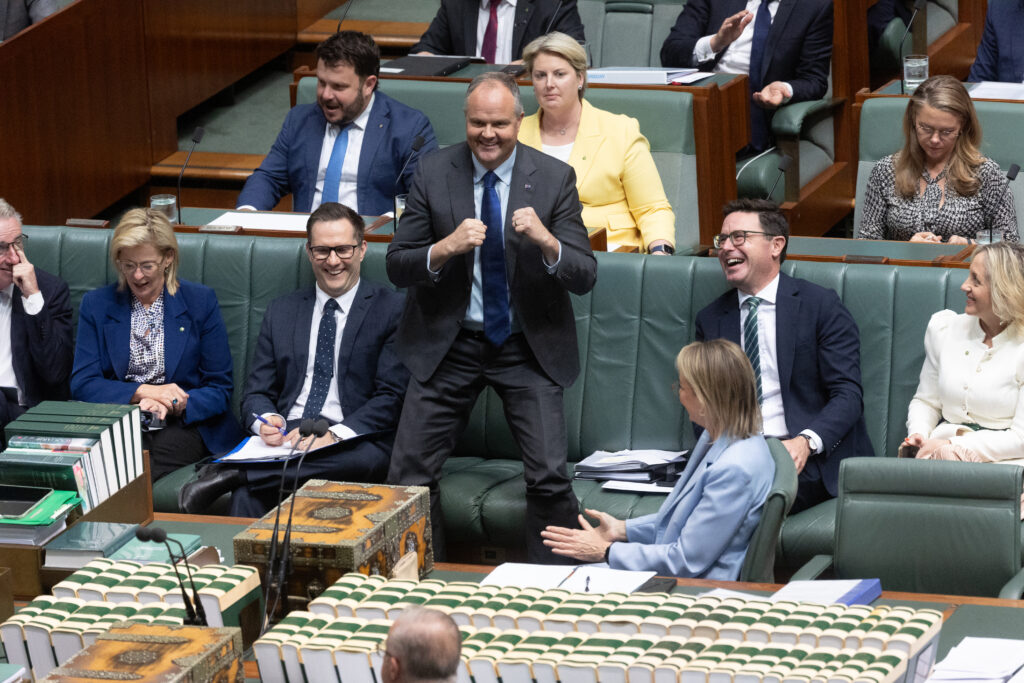
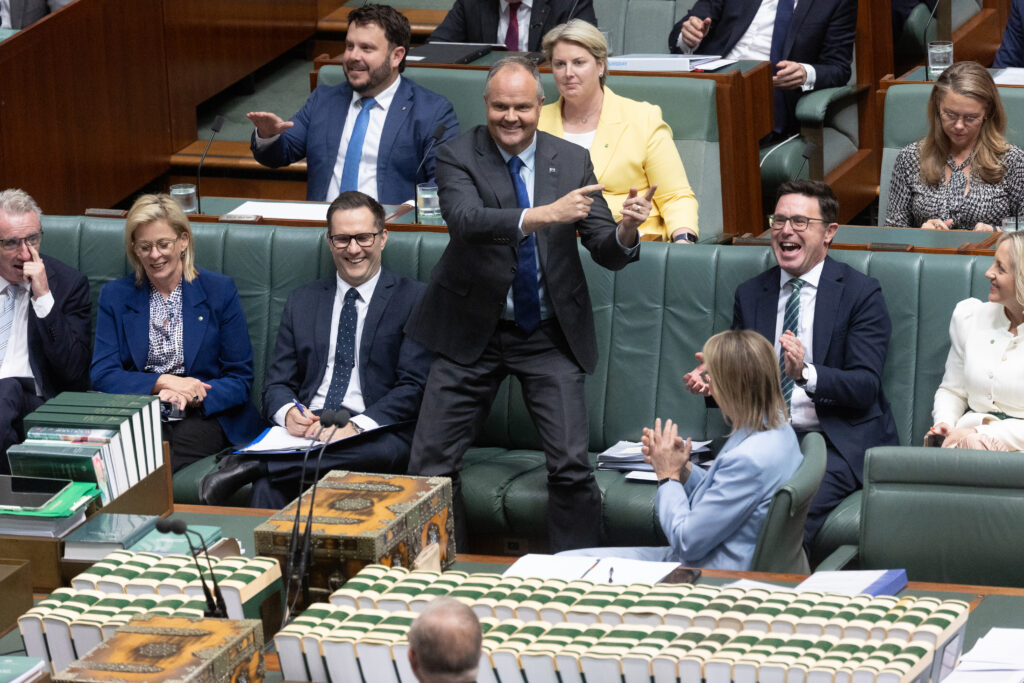
Ted O’Brien who honestly – just why? – just got booted from the chamber by Milton Dick for offering to punch on with Jim Chalmers.

We assume he was joking when he threw up his fists in response to Dick telling Chalmers and him to take their debate outside, because O’Brien is from the Sunshine Coast and Chalmers is from Logan. And as a Gold Coast girl, who grew up in the era of earrings off, rings up (IYKYK) Logan trumps Sunshine Coast in a brawl. Any day of the week. I mean I went to Nerang High and even I would have hesitated from wading into a Logan brawl.

Also O’Brien looks like someone molded Scott Morrison out of bread, so that man shouldn’t be trying to fight anyone.

Ted O’Brien puts his fists up to Jim Chalmers in the House of Representatives Chamber of Parliament House, Canberra this afternoon.Thursday 27th November 2025. Photograph by Mike Bowers
Ted O’Brien motions to go outside to Jim Chalmers in the House of Representatives Chamber of Parliament House, Canberra this afternoon. Thursday 27th November 2025. Photograph by Mike Bowers

The view from Mike Bowers

I can not be bothered going through the absolute bullshit that is the Coalition asking about a promise from two elections ago, on a day where it is revealed Australia experienced its hottest year to date – which is another way of saying that this summer will be the coolest you experience from now on – and that we are so far from meeting our energy targets we might as well be sticking our head in the sand.

So here is how Mike Bowers has seen the day:

See ya
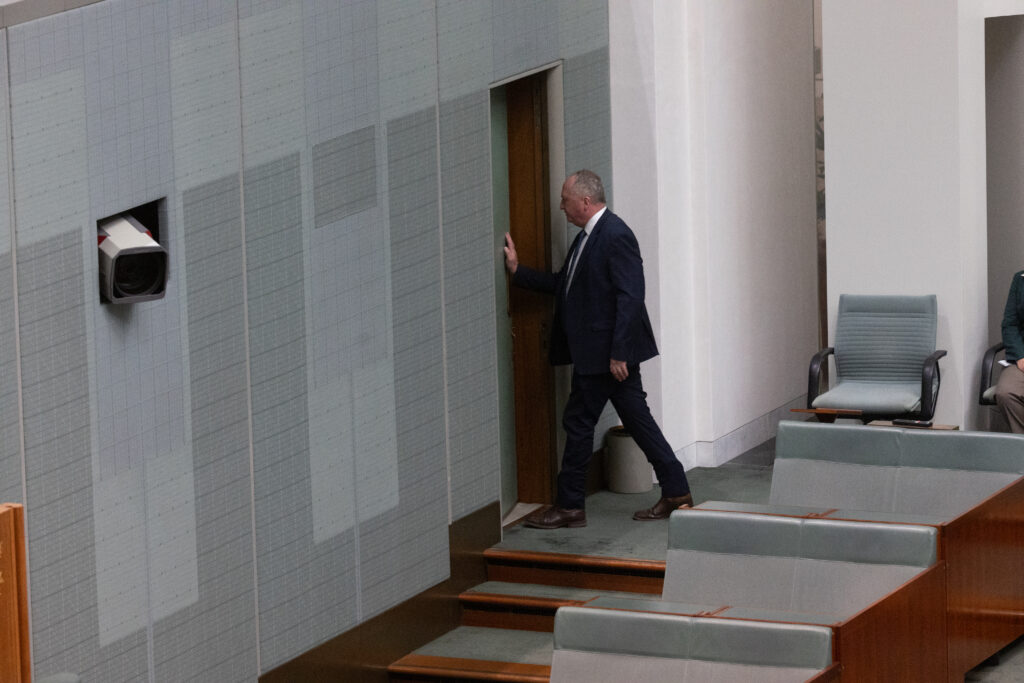
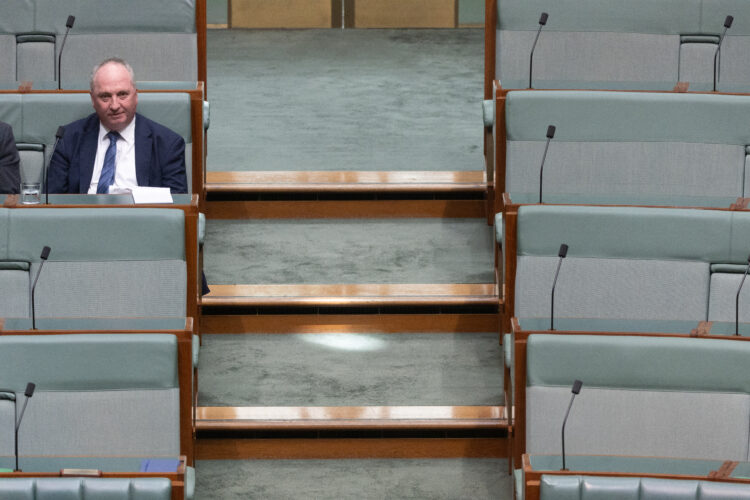
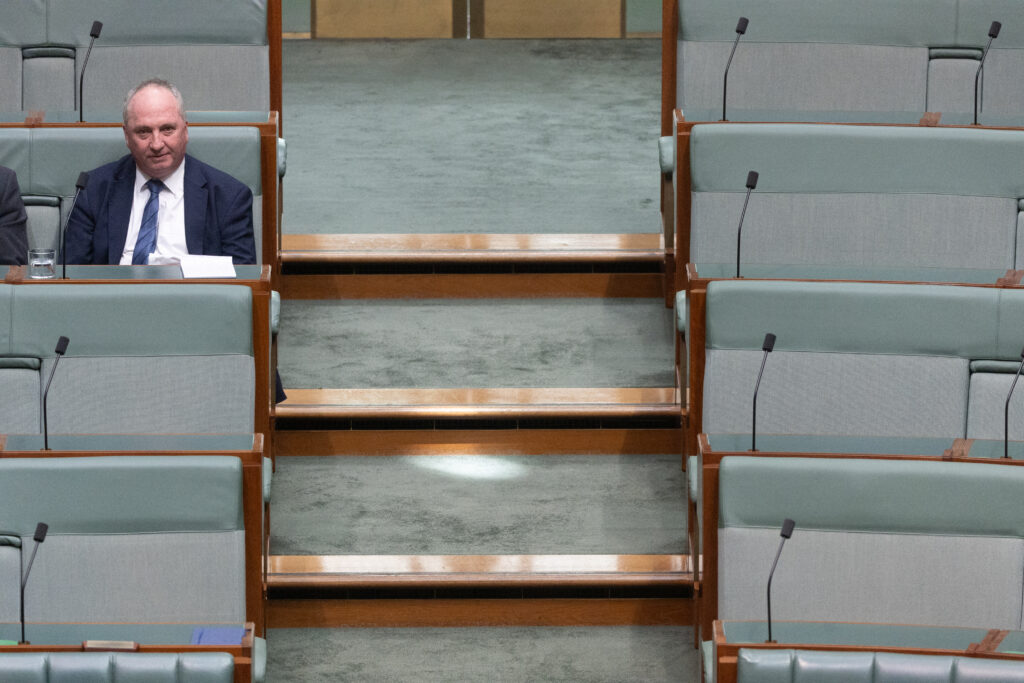
Barnaby Joyce and his exes

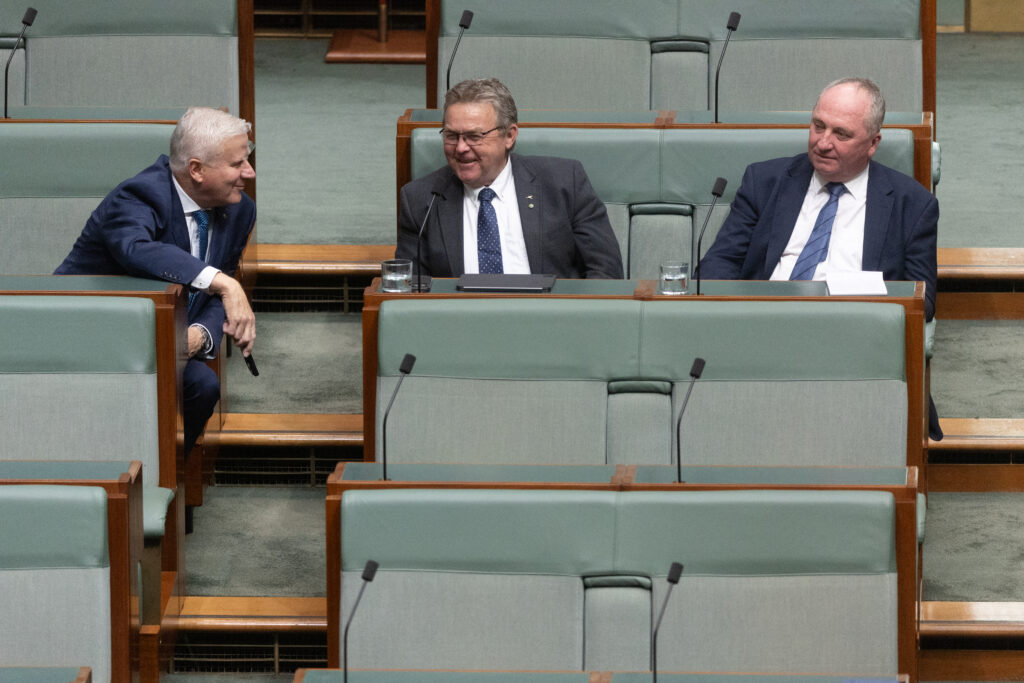
Barnaby’s new bench mates welcome him

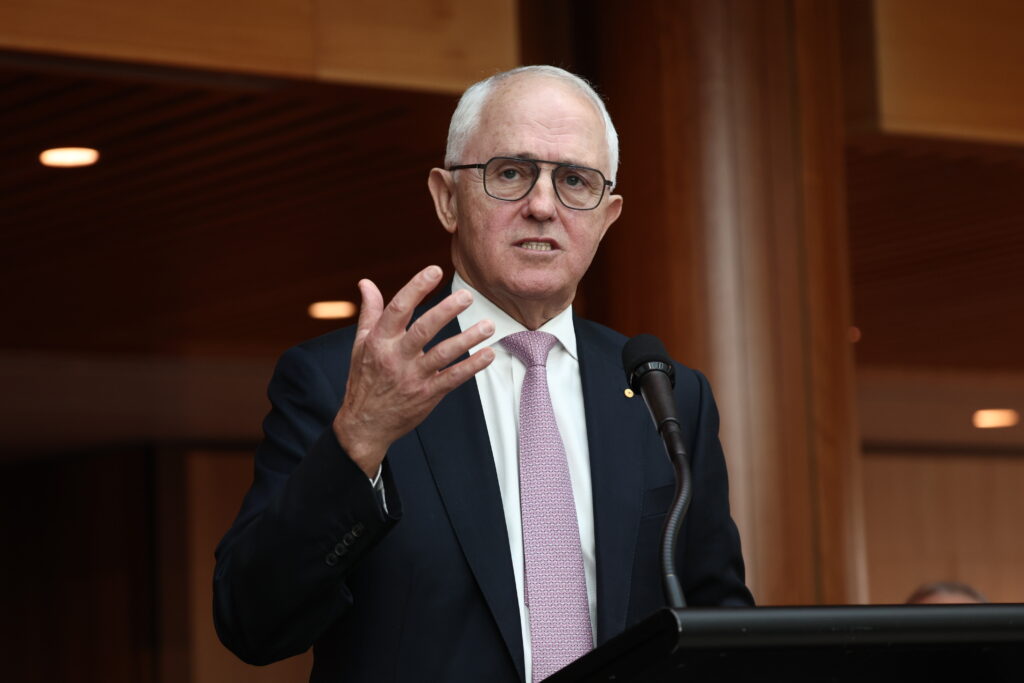
Malcolm Turnbull enjoys a captive audience

Coalition continues to show why it is so irrelevant

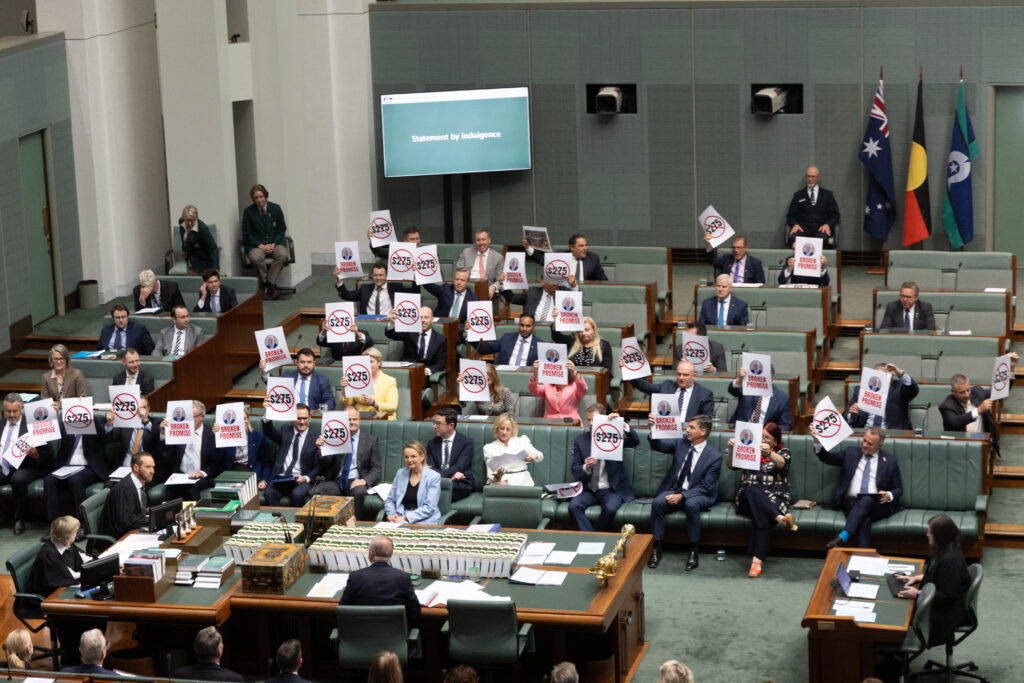
This is so dumb. My favourite part is Melissa McIntosh having to read it to make sure she has the right one.

The Opposition taunt the Prime Minister with signs during question time in the House of Representatives Chamber of Parliament House, Canberra this afternoon. Thursday 27th November 2025. Photograph by Mike Bowers

Jason Wood reminding people why he is often forgotten

Jason Wood – who we forgot existed – then gets a question.

It’s a dumb question.

Under Labor the number of Australian families on financial hardship claims has surged by nearly 50 per cent. Australians including families in my electorate of La Trobe are hurting. What is the message from this minister who works part-time to more than 200,000 Australian families struggling to pay their power bills and cutting back this Christmas because of Labor’s broken promise to bring down power prices.

Gee, if only Wood had been part of a government that didn’t screw us all over for more than a decade with stupid climate wars that derailed any attempt at an energy transition. Imagine if he had that power!

Bowen:

My message to his constituents and to the people of Victoria is that we will continue to work without reservation to put downward pressure on energy prices by introducing more of the cheapest and most reliable and lowest forms of energy. (INTERJECTIONS)

The fact is that in Victoria the wholesale price of electricity in May 2022 was $233 a megawatt hour. today $77 a megawatt hour over the last quarter.

The retail increase in Victoria that wasn’t known before the 2022 election which should have been known was $61 for households and $270 for small businesses.

Six coal-fired power stations in Victoria totalling 6.8 gigawatts announced their closure under the former government… the previous government’s big scheme the underwriting new energy generation investment program delivered exactly zero gigawatts for Victoria under (INTERJECTIONS) them.

By contrast, four gigawatts of renewables and 1.2 Meg watts have been in Victoria since May 2022. A further 2.8 gigawatts of renewables and 1.8 gigawatts of storage capacity in Victoria have been selected government’s capacity investment scheme.

Under that scheme 2.8 gigawatts of renewables and 1.8 gigawatts of storage for Victoria under their scheme zero for Victoria, to be fair zero for everyone but given the question was about Victoria zero. I’m pleased to report that as of today 139,629 Australians have installed a cheaper home battery. And 23,845 of those have been in Victoria.

With that state now having 500 Meg watt hours… since 1 July. What our government is doing is delivering for the people of Victoria and repairing the damage of 10 years of denial and delay the previous government inflicted on the people of Victoria.

Short and sharp from Burke

Independent MP for Fowler Dai Le then asks:

My question is to the Minister for Home Affairs. Minister, my community would like to know were you or any government minister at the airport when the ISIS affiliated women also known as ISIS brides arrived back in Sydney in September?

Tony Burke:

“No”

Ted O’Brien pretends he has authority

Ted O’Brien, the answer no on ever asked for, then tries to pretend he understands economics.

But Anthony Albanese is in too good a mood today. He got his political win, his opponents are still a ravel and one less in the numbers (without him having to do anything but put Barnaby Joyce’s private members bill scraping net zero up for debate) and it’s the last day of the sittings, which means he actually may get a weekend.

So when O’Brien asks about inflation, Albanese just plays with him for a bit, saying the man who helped bring the Coalition down to 42 seats with his nuclear policy, now has the economic policy.

And that gives him a lot of cheer.

Question time begins

The wet sock of political leaders, Sussan Ley, opens the last question time of the year with an issue that is from the last parliament – the $275 decrease in power bill promise from 2022 Labor.

It wasn’t mentioned in the 2025 election campaign, which Labor won with a historic majority. No one cares. Ley and her tactics team have zero original thoughts and so here we are. Stuck in the past with disgarded sopping wet socks.

Ley: My question is to the Prime Minister. Next Wednesday marks the four-year anniversary of the day that the Prime Minister promised to reduce power prices by $275 in 2025. A promise made almost 100 times. On the final sitting day of the year, can the Prime Minister finally give a straight answer and just admit that he misled the Australian people?

Albanese:

Mr Speaker, the once great party of the Liberal Party and the National Party… (INTERJECTIONS) Reduced… (INTERJECTIONS)

They’ve gone from either being a party of government… ..or the alternative party of government into play school, Mr Speaker, into Play School.

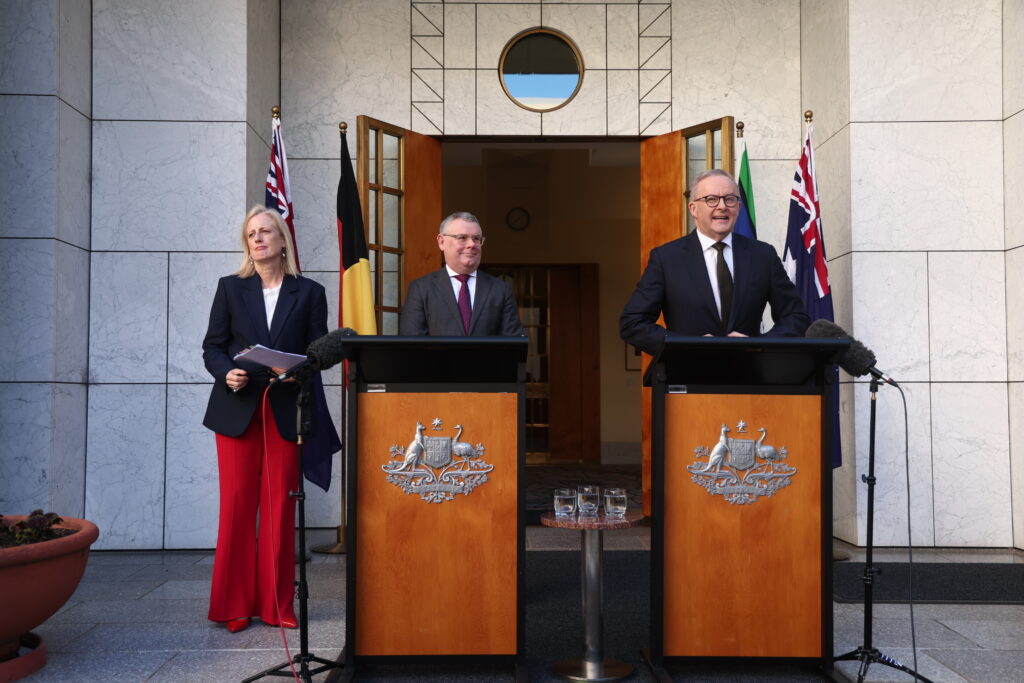
While the person who is Deputy Prime Minister, when nay committed to net zero, is outside doing a press conference reporting the defection conference reporting the defection — reporting his defection from the National Party.

But, of course, they’ve come a long way since those golden days of caring about energy policy and the environment under Scott Morrison and Barnaby Joyce.

Now, my learned colleague up there, Phil Coorey (political editor at the Fin), had this to say. ‘In reality the climate wars of the past two decades…” (INTERJECTIONS) – They’re all outside watching you go down to 42!

In really this is what Phil Coorey had to say. ‘In reality the climate wars of the past two decades, caused primarily by recalcitrants from the Conservatives, is the reason why the energy grid today is such a dysfunctional and costly mess as it tries to play catch up.”

(INTERJECTIONS)

That is – in that radical journal, the Australian Financial Review had to say.

But today instead of having tactics committee meetings in the morning member they are trying to paper over the cracks in the coalition

Where the Leader of the Opposition, who doesn’t support the policy that she’s been out there spruiking but supports net zero and said she did from the day that it was adopted, when half of those opposite there support net zero, half of them don’t, but when the National Party has proudly said that they are now leading and they follow… (INTERJECTIONS) ..this is what the leader… had to say – this isn’t the first time the Nationals have set the policy agenda and the Liberals have followed – indeed that is right.

Barnaby Joyce acting like that guy you regret dating in your 20s

So Barnaby Joyce held a press conference straight after that to moan a little more about how the Nationals didn’t try hard enough to keep him, even though he has done nothing but bitch and moan about how much he hates the leadership.

He is an independent for the moment because Joyce needs to be wooed and he needs as much attention as possible, so he will drag this out until One Nation offer him the leadership on a fool’s gold platter.

Barnaby Joyce joins One Nation. Moving on.

Barnaby Joyce has given everyone a Christmas present by announcing his move into irrelevancy. I don’t know if Joyce realises how much of his influence comes from being from a major party and not his sparkling personality.

If you’re here, this is the ejection seat. This is about a far away you can get from the dispatch box. And if you’re sitting here, they want you out there. Now, in the past, I’ve been asked to leave twice by Peter Dutton, and I suppose when they talk about generational change, it’s pretty clear what people want.

One of the biggest things – I announced this about five weeks ago, and a part from a 90 second phone conversation with the leader, I’ve had no communication with either leader of the National Party or the deputy leader of the National Party to try and resolve this, and that’s disappointing.

So after 30 years with the National party, I am resigning from the party. That really leaves me with a heavy heart, and I apologize for all the hurt that that will cause other people.

He then goes on with some bullshit about how this is not about him and then repeats his greatest bullshit hits.

And that’s it. He is out. And butthurt that the leader he openly undermined and couldn’t stand didn’t beg him to stay. Dolly save us from mediocre middle aged men and their superiority complexes.

Press gallery fills chamber to see Barnaby Joyce take 90 seconds to announce future

It is the airing of the grievances time in the chamber (90 second statements) which at this time of year contains a bunch of Christmas thank yous and poems (proving why politicians go into politics and not the more obvious creative fields)

We are all waiting for Barnaby Joyce to get up and announce his move to One Nation.

Much like he announced he was actually a New Zealand citizen and had to resign from parliament (a story Adam Gartrell and I were about to break for the SMH and his staff screwed us on when we waited for comment) he’s doing it for the Hansard.

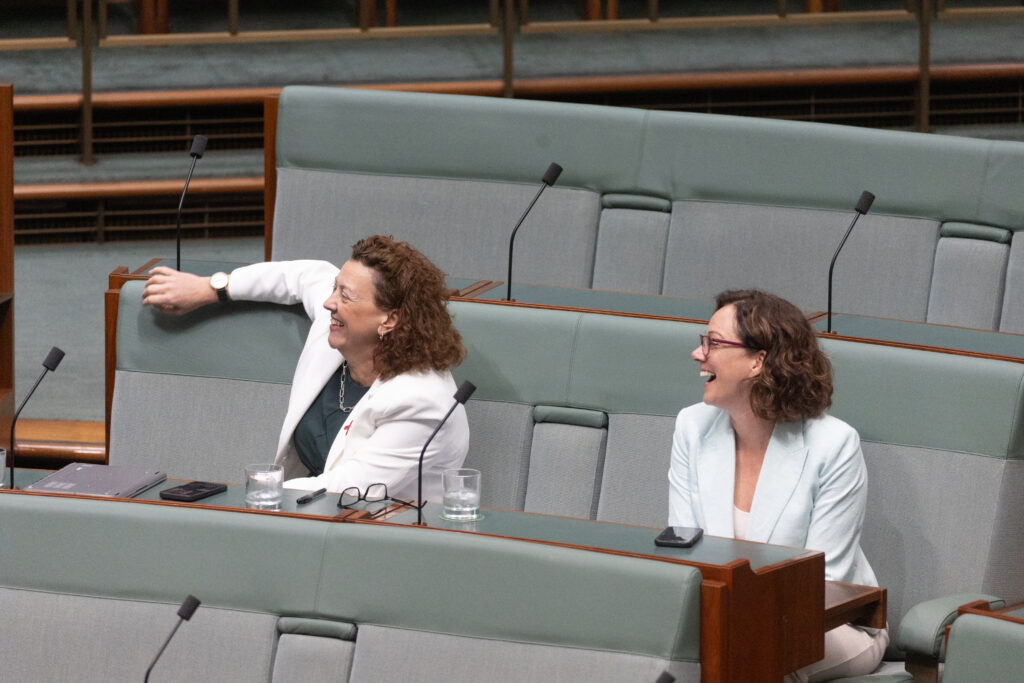
Monique Ryan and Sophie Scamps are laughing and pointing to Barnaby and patting the benches next to him, telling him to come on over.

The latest projection show we are not even close to meeting the 2035 emissions target

Greg Jericho
Chief Economist

Well the government really is feeling its oats because not only has it released the quarterly emissions figures, it has also released the annual greenhouse gas emissions projections.

These however are not so good.

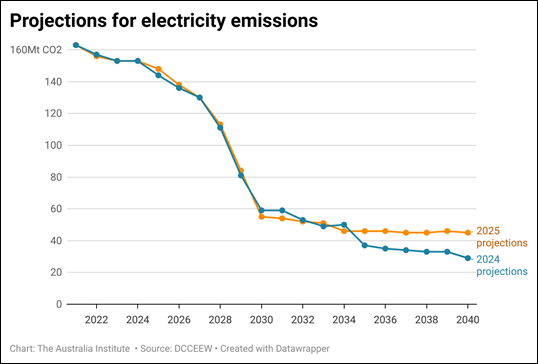
The projections ae less optimistic than last year about the projection of emissions out to 2040. The biggest issue is electricity, which is now project to produce 996mt CO2 from now till the end of 2040 compared to the estimate last year of 929mt CO2

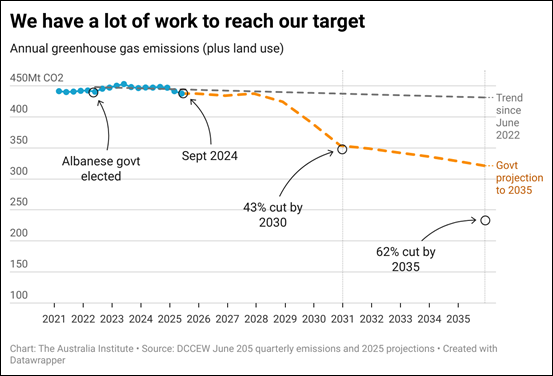
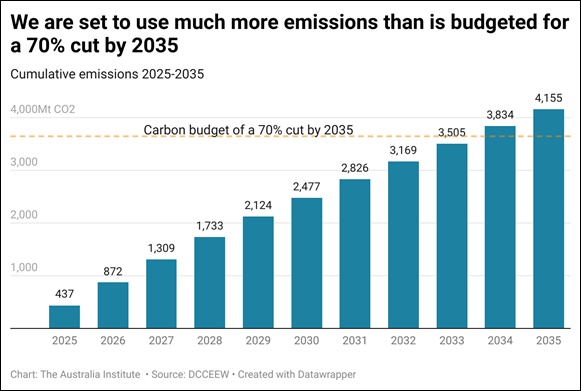
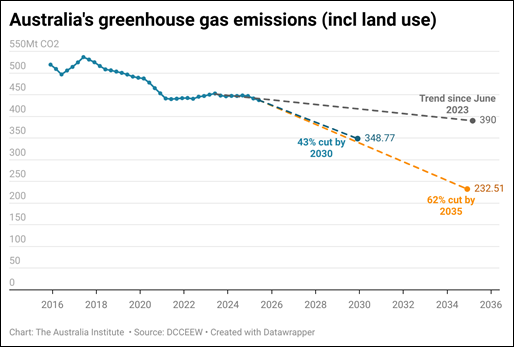
What this means ius that the government is set to miss its target for a 43% cut by 2030 and massively do so for its 2035 target range of 52%-70% cuts below 2005 levels:

The government is saying that it will only just miss out on the 43% cut target by 2030, but this is only the case if “by 2030” means “by the end of 2030”. In 2029 the govt estimates annual emissions will be 36% below 2005 levels. It does however project emissions in 2030 to be 42.2% below 2005 levels, so basically at the 43% target.

But no such semantics is of any use for the 2035 target. The government has a target of 62% to 70% cuts. At the moment they are on track to be just 47.5% below at the end of 2035.

Given that target remains far too weak it is pretty dire news, made worse so when you consider that the government set those targets by estimating the cumulative emissions that will be produced between now and 2035.

The government’s projections are such that we will blow through our carbon budget for a 70% cut in 20304.

In essence this means we are set to be 2 years worth of emissions more than is currently budgeted.

Not good, and just highlights how much faster the transition away from fossil fuels needs to happen.

Greens win inquiry into offshore detention deals

David Shoebridge has announced the Greens will lead a senate inquiry into offshore detention deals, going back to 2022:

Cruelty creates corruption, and corruption thrives in darkness, this inquiry is a chance to shed light on this toxic mess. 

We have seen scandalous evidence of Labor’s rotten Nauru deal this week. From bikie gangs to crooked politicians and contractors, this whole project of disappearing people offshore is offensive to basic decency. 

Billions of dollars have already been funnelled into some of the most brutal policies in modern Australian history, with billions more promised, we need to draw a line in the sand. 

It is about time the Australian public knows what our tax dollars are buying and who is raking them in. 

For over a decade people seeking asylum and refugees have faced torturous conditions in Nauru and PNG, funded by the Australian government. The whole system is not just morally corrupt but financially corrupt too, and it’s time we heard the full truth about it. 

The fact that the Albanese Labor Government explicitly opposed this inquiry speaks volumes. Imagine that, after all the scandals, all the corruption, all the abuse, to then oppose even a little bit of oversight.”

Andrew Wilkie welcomes review of forestry exemptions

Andrew Wilkie has welcomed the chance to address forestry exemptions in the environment bill the Greens negotiated on with the government:

I welcome the changes to the Federal Government’s environmental law reforms. I voted against the reforms in the House of Representatives because, as initially drafted, it was clear the Government had forgotten they were supposed to actually stop environmental destruction.

While the amended package is still far from perfect, there is now at least some greater protection for the environment and, of particular importance for Tasmania, for forests specifically.

I’ve long campaigned for the removal of the exemption in the Environmental Protection and Biodiversity Conservation Act for Regional Forest Agreements, as there was never a good excuse for forestry not to meet the same standards as elsewhere. Ruling out expedited approvals for fossil fuel projects is also a welcome step forward.

Of course, I’d much prefer the reforms included a genuinely independent Environmental Protection Authority, a proper recognition of climate impacts in the assessment and approval process, and better consultation and engagement standards for First Nations peoples and local communities.

Laws, of course, should not remain stagnant. They should be continually reviewed and improved. So I’ll keep advocating for improvements to ensure our national environmental laws consider climate impacts, provide strong protection for the environment and strong protections from vested interests.

Are you wearing your Aussie music shirt today?

Just a reminder that Australian music artists are struggling so badly they need a charity.

Are you wearing your Aussie band t-shirt today? 👕Australia Institute research shows the number of Aussie artists being streamed online has HALVED in recent years, and it's got a lot to do with the algorithms! 🎶#auspol #AusMusicTshirt@mhharrington.bsky.social

The Australia Institute (@australiainstitute.org.au) 2025-11-27T01:24:32.167Z

Climate Change Authority update released: Australia sees hottest year ever

They have to do this under legislation Labor passed, and it gives you an idea of where we are at with meeting our targets.

We are not meeting out targets.

Here is the statement from the CCA:

Australia has just seen its hottest ever year, with mean temperatures during the 12 months to June 2025 exceeding the previous record by more than 0.25 °C.
Globally, 2024 was also the hottest year on record and marked the first year with average temperatures topping 1.5 °C above pre-industrial levels – the threshold agreed under the Paris Climate Agreement. These milestones underscore the urgent need to cut greenhouse gas emissions.
The Climate Change Authority’s 4th Annual Progress Report, released today, called for faster emissions reductions and stronger adaptation measures to keep Australia on track for a safe and resilient future.
The pace of emission cuts must double to meet our legislated 2030 target of reducing 2005-level carbon pollution by 43%. To reach Australia’s newly set 2035 goal – a 62-70% reduction – the rate of cuts will need to triple by the early 2030s.

Our report found the electricity and energy sectors made the fastest gains, improving the prospects for other sectors of the economy to decarbonise as they electrify.

Australia’s emissions fell by 10 million tonnes of carbon-dioxide equivalent in the year to June 2025, faster than the average over the past 5 years of 8 Mt CO2 -e reductions,’ said Matt Kean, Chair of the Climate Change Authority.
No other year has had such a drop apart from the first year of the COVID-19 pandemic – 10 million tonnes – a promising development. However, to hit our goals, the reduction rate will have to accelerate to 18 MtCO2 -e per year between now and 2030, and between 20-25 Mt CO2 -e per year from now to 2035. That means speeding up approvals for clean energy projects and infrastructure to keep pace with the transition. The electricity and energy sector contributed half the nation’s emissions reductions over the past year. And that sector’s contribution will expand as more renewable energy sources are switched on when ageing coal-fired power plants bow out.

Fortunately, the ongoing plunge in the price of solar photovoltaics and lithium batteries –
combined with government policies like the Capacity Investment Scheme and measures
to strengthen electricity security – is driving fresh demand at the household, business and
utility scale. To lock in these gains and near-term targets, wind generation must grow rapidly,
supported by faster approvals and benefit-sharing with communities. The technological tide is overwhelming, with low-carbon generation contributing almost all the new energy generation added worldwide last year. With the growing competitiveness of heat pumps, induction cookers, electric vehicles and other energy efficient devices, we can expect sectors of the economy beyond the
power industry to lower their carbon emissions. And with Australia’s abundant sunshine, wind and rich mineral resources, few nations stand to benefit as much from this global transition we must all make. Now is to get on with it and work together to ensure a fair and fast transition for a cleaner,
more prosperous future.

The AI boom has arrived in Australia

Greg Jericho
Chief Economist

The latest “Private New Capital Expenditure” (Capex) figures released today are the first of a series of data out over the next week that leads up to the GDP figures next Wednesday.

These cover business investment in either building and structures or machinery and equipment.

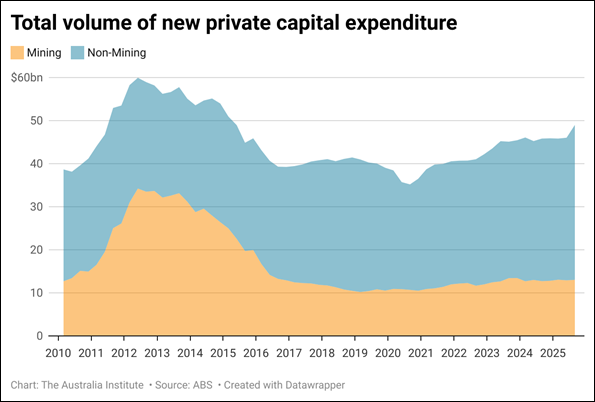
In the September quarter total new capex rose 6.4% in volume terms (ie accounting for inflation), and non-mining capex went up 8.6%. This meant overall new capita expenditure was at the highest level since March 2015, when the mining construction boom was about to end:

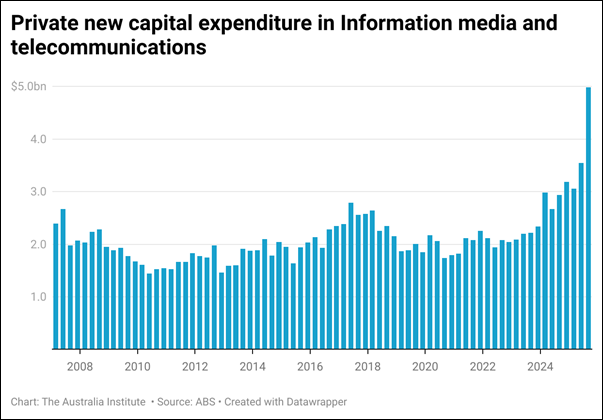
What we are seeing at the moment is not a boom in mining capex, but non-ming, and specifically Info media and IT, and even more specifically datacentres for AI. Over the past year new Capax in the Infor media and IT industry accounted for 64% of the total increase in capex across all industries. That’s pretty surprising given that industry is pretty small – usually accounting for about 6% of all investment.

But what is happening now is very unusual:= – a doubling on investment compared to 2 years ago

So anyone wondering if governments have time to wait before thinking about AI an the impact on energy supply and use and all other manner of issues, the answer is no.

Let’s catch you up

So there is a bit on. So far this morning:

The government announced it had agreed to a deal with the Greens to get its environmental laws through the parliament – fossil fuel mining gets the status quo approvals treatment, water trigger remains in, minister can still scuttle projects, forestry exemptions to be reviewed in 18 months, land clearing gets harder. Nothing really for climate, no big save for the environment, but not as bad as it could have been.

The Coalition, which refused to seriously negotiate on these laws are now very sad and bitching and sulking like it is an Olympic sport.

The fossil fuel industry is sad.

The farmers’ federation is sad.

These are not bad things – they were both too happy with the original laws.

The Greens have won concessions for local content with the government agreeing to regulate the big streaming platforms.

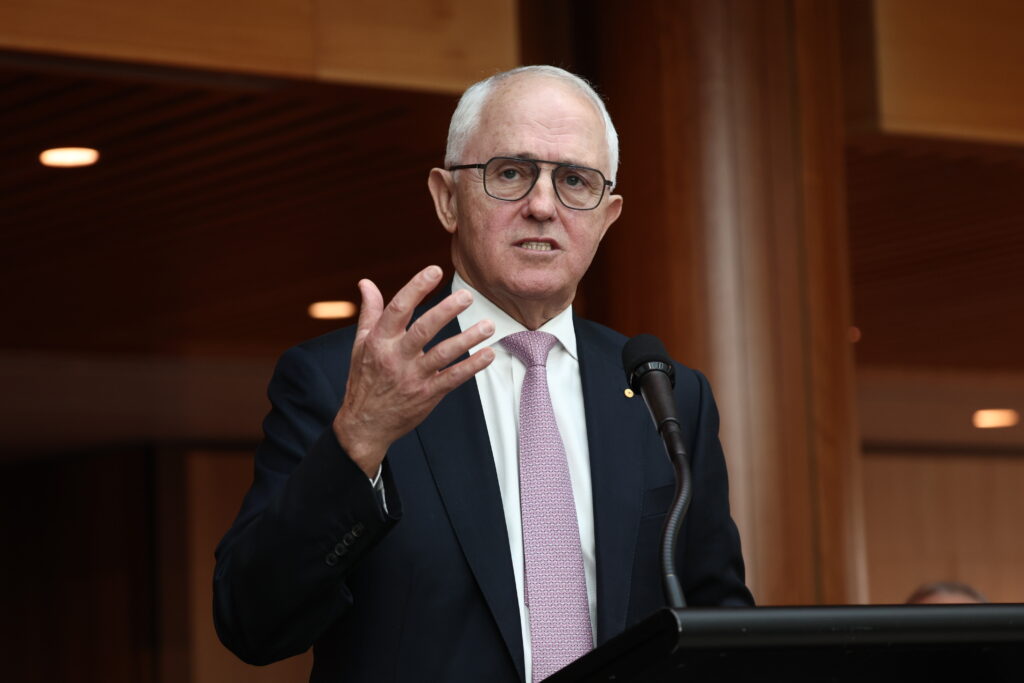
Malcolm Turnbull got a portrait and had a bit to say about the demise of the Liberal party (he’s not too fussed)

The banking regulator has changed the rules around lending to make it harder for property investors to get loans, with tightening around debt to income ratios.

This has been set to about six times debt to income, which is unlikely to impact first home buyers but will impact people buying their 20th house

Barnaby Joyce is about to announce he is leaving the Nationals for One Nation.

No one really cares

Emissions data for the June quarter is out and we are wayyyy off track for meeting our 2030 targets

Barnaby Joyce announcing his future at 1.30

Everyone is pretty sure he is going to One Nation and look, sure. Does it matter? No. Will it give Barnaby more attention? Yes. Are there bigger things in the world? Absolutely.

Sussan Ley ‘frosty’ with Turnbull. Turnbull doesn’t care

Sussan Ley and Malcolm Turnbull had a ‘very brief’ encounter at the portrait unveiling which observers described as “more frosty than the Arctic”. That would be on Ley’s side – Turnbull is at that happy place in post-political life where he’s been proved right on more than one occasion so he gets to just swan in with an erudite ‘told you so’ when the mood strikes him.

Turnbull was also the leader who sacked Ley from the frontbench after she charged tax payers for a work trip to the Gold Coast where she also finalised the sale of an investment property. She never quite got over that one.

For the record, Turnbull says they just said hi. He is the epitome of not fussed. Moisturised, in his lane, hydrated.

Explainer: June quarter emissions

Greg Jericho
Chief Economist

The June quarter greenhouse gas emissions have been released and you know they are good news because they were released on a Thursday morning, and not Friday afternoon.

One of the weird things about the greenhouse gas emission figures is that the government can release them when they want – so long as they do it within 5 months of the quarter being measured covered. Today’s release covers the June quarter, so they had till the end of November to release it. In the past this has meant releasing the bad news around 4pm Friday afternoon. 

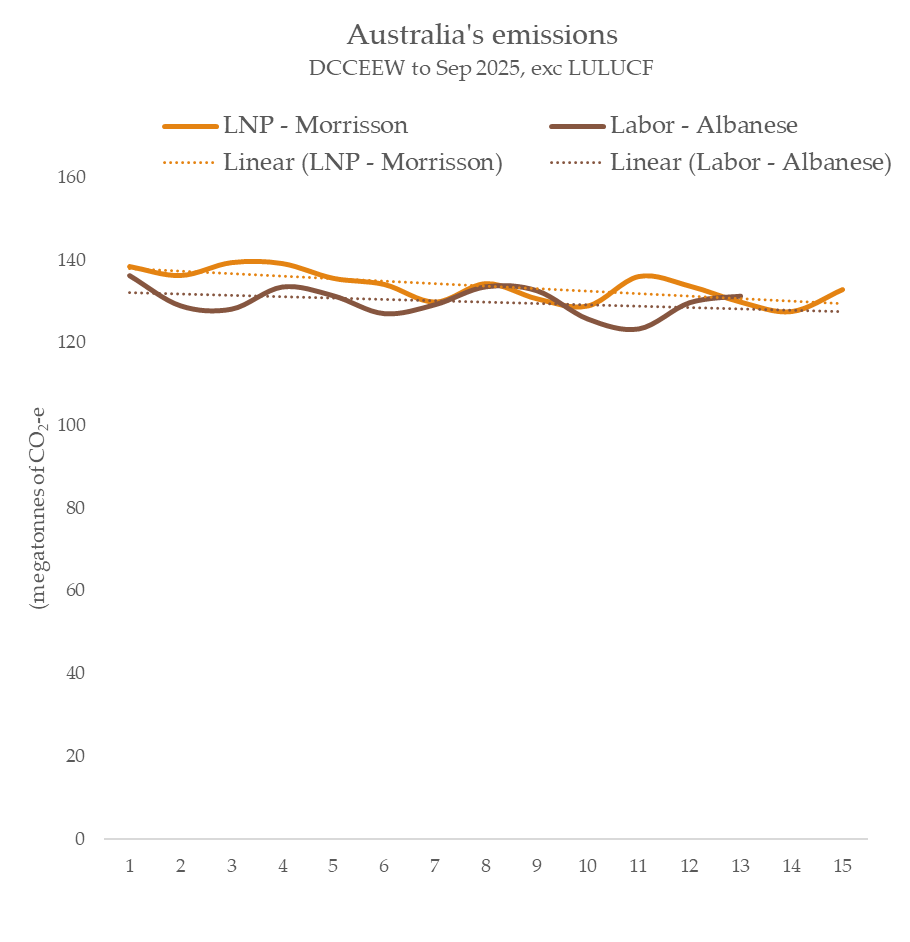
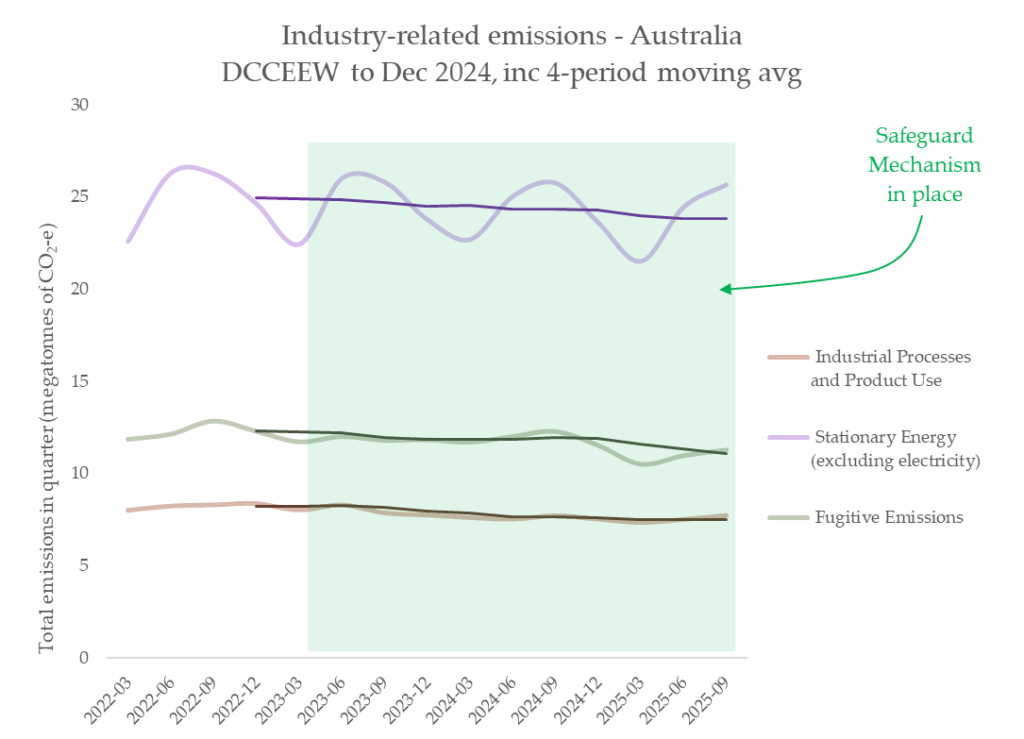
But good news cannot wait! And in the June quarter annual emissions fell 2.1% over the past year, and in the June quarter there was a nice 0.9% drop, driven mostly by falls in electricity and fugitive emissions.

The drop in fugitive emissions is mostly from “reductions in natural gas venting emissions from new carbon capture and storage activities and a decline in production from underground coal mining.”

So yeah – less gas and coal is good, who knew?

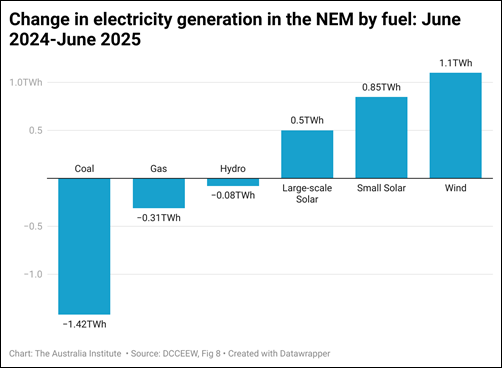
The drop in electricity emissions came off the back of less coal and gas emissions and more wind and solar. Again, who would’ve guessed less coal and gas is good?

The overall picture is nice, but as with all things climate change, we need a bit of a broader look.. Yes, the 2.1% fall emissions is to be celebrated, but even if we take the trend of emissions since June 2023 (which was when they peaked under the Albanese govt), the pace is still far too slow to reach any of the government’s (very weak) targets:

That said, if the pace of emissions falls over the past year keep up, they will at least be chance to get there.

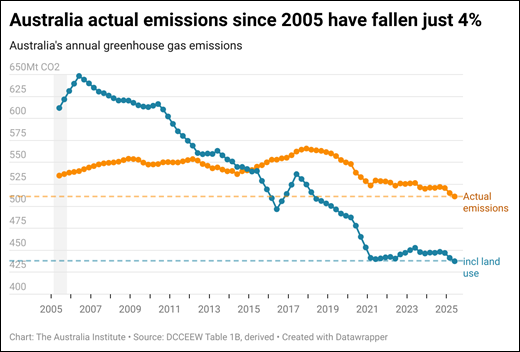
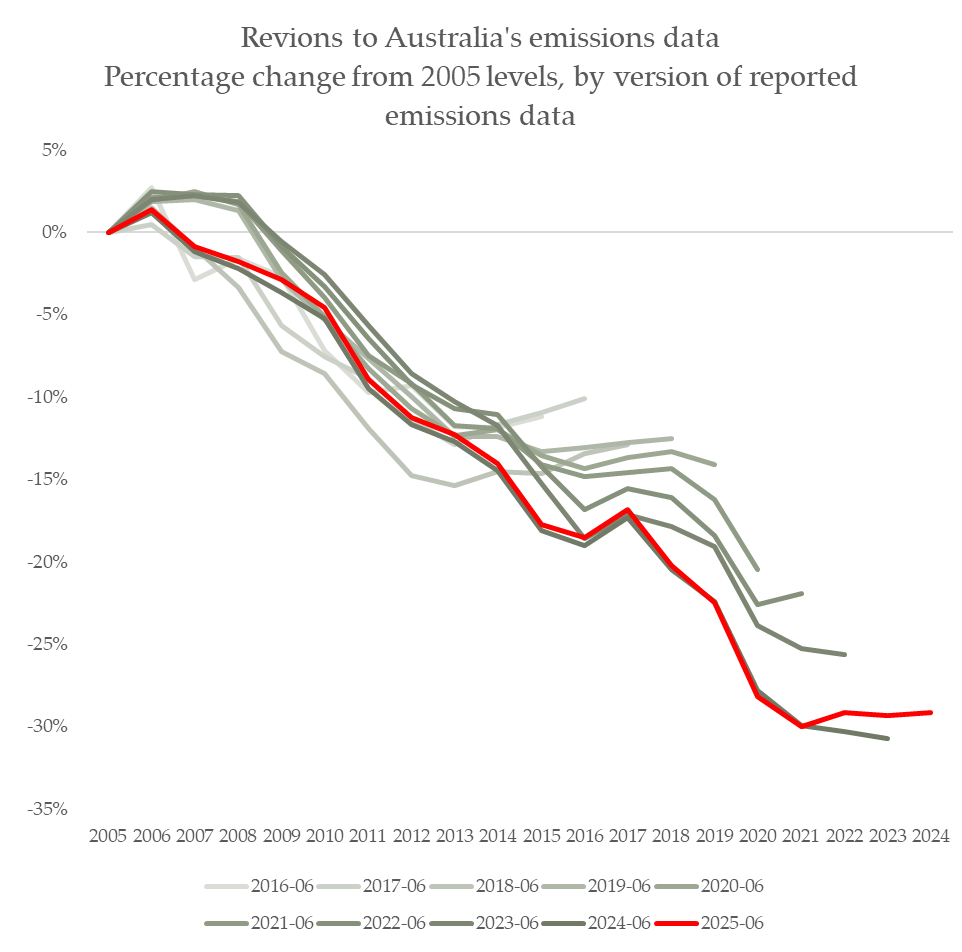
So yes, good news. But we should always remember to count the right things. The government will be saying that emissions are currently 28% below 2005 levels, but we should always remember that is because 2005 was a big year for land clearing, especially in Queensland. If we exclude land clearing (like every other nation does) our emissions falls since 2005 is just 4%

So good news, but long way to go, and while we keep approving new coal and gas mines, we need to also remember that while we might not be counting the emissions from gas and coal done overseas, they very much contribute to global emissions.  

More secrecy around AUKUS

Alice Grundy
Research Manager

A new secret committee will consider AUKUS and Australia’s military engagements according to the Guardian. This move is consistent with past AUKUS practices, shrouded in secrecy, even though this policy represents the biggest transfer of sovereign wealth in Australia’s history.

When Australia adopted AUKUS, there was no review from DFAT or Treasury, no parliamentary inquiry. It didn’t even go to cabinet.

Now the Labor Government has created a new committee consisting only of Labor and Coalition MPs, excluding the cross-bench and the Greens and continuing a culture of poor transparency.

Australia Institute polling research from November 2025, shows 37% of Australians don’t know if AUKUS makes Australia safer, an increase of 6% from polling just three months earlier.  

With so much uncertainty, Australia needs a real inquiry, not a rubber stamp from major party MPs.

You can join more than 30,000 people calling for a parliamentary inquiry into AUKUS here.

HAHAHAHAHAHA

Here is the Coalition refuse and bitch in full swing:

The Albanese Government’s deal with the Greens to force its flawed EPBC reforms through the Senate confirms the Labor-Greens alliance is back, locking Australia into a chaotic regime that will hurt jobs, productivity and investment.

At a time when project pipelines are tightening, productivity has fallen, and competition for global capital is fierce, Labor has chosen a model that makes it harder to approve major projects, harder to employ Australians and harder for regional communities to grow.

Under Labor and the Greens, gas and critical minerals projects that are essential to Australia’s energy security, industrial base and global competitiveness will be pushed into the approvals slow lane.

And it won’t stop there. The impacts of this deal will flow straight through to the construction industry, pushing up the cost of building materials and making it even harder for Australians to build and buy homes.

Labor’s EPBC package was already unworkable. By locking in a Greens-backed model, the Government has cemented uncertainty, entrenched excessive regulatory power in an unaccountable EPA, and guaranteed longer delays for project approvals across the economy. 

These reforms also ignore clear recommendations of the Samuel Review which called for clear rules, reduced duplication and faster, more certain approvals. 

The Coalition was constructive at every step, offering sensible amendments and a practical pathway to deliver genuine streamlining and improved environmental outcomes. 

Our approach would have fixed bad laws and turned them into genuine reforms that lifted productivity, supported jobs and attracted investment.

Industry, and business agreed substantial changes were vitally needed to make the legislation workable.

The Coalition will oppose the Labor Greens destructive deal and fight for an environmental system that protects our natural heritage while supporting jobs, investment and the communities that rely on a strong economy.

The view from Grogs

Greg Jericho
Chief Economist

My Guardian column has a look at the latest inflation figures that came out yesterday.  

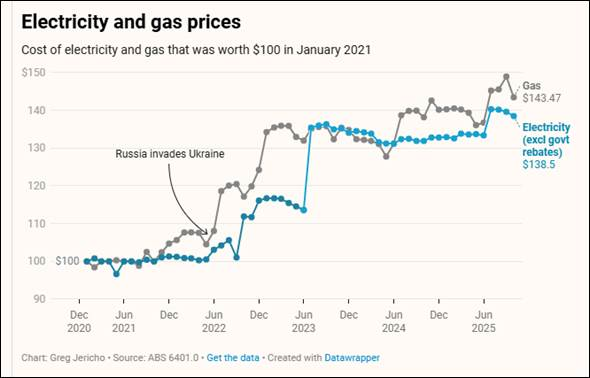
They showed a jump in the growth of average prices from 3.6% to 3.8%. But they also indicate just how much our economy is caught up in the ramifications of Russia’s illegal invasion of Ukraine, which sent gas prices higher – and with it our electricity prices.

Electricity was the biggest driver of inflation over the past year, but in October electricity prices fell 10.2%.

This confusion is due to the interaction of electricity rebates and inflation.

In July 2023, the Albanese government introduced rebates to protect against the increase in prices due to the Russian invasion of Ukraine. In July 2024, the states began to get involved as well. And October last year saw the largest impact of the federal and state government rebates on electricity prices. But these rebates did not last, and over the past 12 months they have begun to be unwound – and so prices began to rise. Then in August they were extended across a number of areas – and so electricity prices fell again.

But they remain well above where they were in October last year.

The problem for Australia is that since the opening of the Gladstone LNG terminal, gas prices on the eastern seaboard have been linked with the world price of gas. Because Russia is a major producer of gas, its invasion of Ukraine and subsequent sanctions of Russian gas and other trade sent world gas prices soaring – doubling from January 2022 to September that year.

And gas is an expensive way to generate electricity – much more so than renewables, but under the National Energy Market the most expensive generation determines the prices. And so electricity prices follow gas:

So have all those big gas prices that led to big gas exports and profits also led to a big jump in PRRT revenue? That would be the biggest “Yeah, nah” in history.

Read more about it here

“Real questions’ over whether the Liberal party survives

Malcolm Turnbull is at peace with the demise of his political party. He says:

People have said, ‘well, you know, it might be having a rough patch, but of course, it’ll be around forever’. I think there’s real questions about that now.

And I mean, it’s not just [me] – you guys [the media] are saying that, there are plenty of commentators saying that. I mean, Andrew Hastie has been making that point.

So they’re people, whether they’re left, right or in the middle, raising that question. I mean, they have got themselves into a into a real sort of a miasma, I think, of that is again focused on issues.

I mean, look, I was Allegra Spender is here, you know, the member for Wentworth, my local member and I mean, she has more to say as one crossbencher, about tax policy, economic policy, productivity, than the Coalition does.

That’s crazy, right?

The Liberal Party should be focused on economic growth, you know, driving the economy, promoting entrepreneurialism business, those are the things that should be talking about, not this cultural war stuff

Refuse and bitch: the Turnbull take

While Sussan Ley is having a sulk in the opposition press conference room that the government did a deal on a piece of legislation her party refused to seriously negotiate on and now she is bitching that it is a terrible deal for the stakeholders her party is aligned on, Turnbull is having the time of his life.

He says that Ley has to take responsibility here (not her strong suit)

Look, you look at the I mean, Albanese to get the EPBC legislation through has had to do it through a deal with the Greens. And, I mean, there’s no, absolutely no criticism in that. I mean, you know, that’s this parliament.

Parliaments are designed for compromise and deal doing, right?

That’s why that’s the whole purpose, people used to criticise me and say, ‘you’re doing deals in the Senate’. I’d say, ‘well, that’s, that’s what the Senate’s for’.

The Coalition could have, they could have played an active role, but they chose not to. I can tell you what few supporters they have left in the business community will just be horrified.

Malcolm Turnbull: “there is a major problem on what used to be called the right of politics”

Malcolm Turnbull is doing what he does best – pointing out where the Coalition has gone wrong. He says the fundamental problem with the party, in his view, is that it thinks that appealing to right wing media is the way to win elections. And well, look where that has got it (thanks to Mike Bowers for the video)

The Chief Executive of the NACC had to apologise for giving inaccurate testimony

Skye Predavec
Researcher


The chief executive of Australia’s National Anti-Corruption Commission (NACC), Philip Reed, has written a letter to parliament apologising for giving inaccurate testimony to Senate Estimates.

This follows a series of scandals in the NACC’s upper management, including September’s revelation that chief commissioner Paul Brereton had continued to consult for his previous employer (the Inspector-General of the Australian Defence Force). That’s despite his $800,000 a year salary from the NACC.

In October, the NACC’s inspector also found that Brereton had engaged in misconduct by not recusing himself from the decision-making process on an investigation into the Robodebt scheme, despite declaring a “close association” with a person involved.

Despite the NACC being established less than three years ago, a steady flow of questionable decisions and scandals has eroded public confidence in its operations.

The Australia Institute, which campaigned for a decade to introduce a federal integrity commission, recommends five changes to make the NACC more effective and rebuild public confidence:

  1. Bring forward the statutory review of the NACC
    1. A statutory review is scheduled to take place in three years. This review should be brought forward and initiated now.
  2. Allow public hearings whenever it is in the public interest to do so.
  3. Implement a Whistleblower Protection Authority.
  4. Ensure the Parliamentary Committee which oversees the NACC is not controlled by the government of the day.
  5. Broaden the powers of the NACC Inspector.

The NACC urgently needs to correct course, and implementing those recommendations would ensure it does so before going too far adrift.

In the meantime, Reed will face Senate Estimates again next week, and he’ll surely have to answer questions as to how and why he gave inaccurate testimony last time.

Coalition gets a reality check

Sussan Ley seems to be most upset that Murray Watt, who has been saying for months he wanted to get their bill through by Christmas and spent most of the early part of the week telling media he was going to get it through if it killed him, was seriously negotiating to get the bill through.

The Coalition would have made these laws so much worse and that Labor was seriously trying to engage it is a disgrace, given Labor’s promises to do better on the environment, but it is very, very funny to me that Watt followed through on his heavily foreground promised to do a deal but the Coalition just didn’t really think he would. Has someone informed the Coalition of its lack of political relevancy in this parliament?

It is only relevant when Labor makes it so. That is how the senate works. It does not just have legitimacy and say-so over bills if others in the parliament agrees.

This is like when a dropkick partner wants to ‘open’ a relationship and then gets mad because their partner is out every night and then they discover that no one actually wants to sleep with them and it wasn’t the relationship which was keeping their apps dry, but their own personality.

Party that refused to properly negotiate on laws now bitching about laws they refused to negotiate properly on

The refuse and bitch method is getting an incredible work out here from Sussan Ley.

She is so sad for the miners. So sad for the farmers. Just sad for Australia really. Because mining and farmers just pay for all of Australia to live (it doesn’t but she is milking the hyperbole cow extra hard this morning) and now they have to *sob* have the same approval processes for fossil fuel projects that are destroying the planet and *sobs harder* not clear as much land as they want *collapse on the floor sobbing*.

And my Dolly – will someone think of the loggers? All that native forestry that might end up *gasp* NOT LOGGED, because there will be a review into the industry’s exemptions in 18 months time?

OH THE HUMANITY! IF ONLY THERE HAD BEEN A WAY FOR THE COALITION TO HAVE INPUT INTO THESE LAWS WHICH IT REFUSED TO PROPERLY ENGAGE WITH BECAUSE ITS LEADER HAS THE AUTHORITY OF A WET SOCK FORGOTTEN IN THE SODDEN GRASS.

National Farmers Federation also sad – “bitterly disappointed”

The National Farmers Federation is very, very sad. It uses “bitterly” in its statement more than once and is butthurt (word of the day) about the land clearing restrictions and the reduced regrowth provisions.

GEE, IF ONLY FARMERS HAD A POLITICAL PARTY WHICH COULD ADVOCATE ON THEIR BEHALF

NFF President Hamish McIntyre

Farmers have been left bitterly disappointed by the deal between the Government and the Greens on environmental reform.

The Prime Minister has confirmed the Government has made a deal with the Greens on the Environment Protection and Biodiversity Conservation (EPBC) Act 1999, through the environment protection reform bill process.

As stewards of more than half of Australia’s environment, farmers understand the importance of doing the right thing by the land.

They’ve also historically borne the brunt of complex federal environmental laws, often at odds with state obligations.

That’s why the NFF has supported genuine reform, but not this deal.

Our key concern is the announcement of ‘closer controls’ of ‘high risk land clearing’. The specifics of this remain unclear, and we are urgently calling for clarity.

The introduction of reduced regrowth thresholds to the long-established ‘continuing use’ provision will promote poor environmental outcomes and increase bushfire risk.

It will interfere with routine vegetation management of regrowth to prevent bushfires, keep land productive, and manage weeds.

The misunderstanding of agricultural practices is bitterly disappointing.

The NFF will continue to try to make these reforms as workable for the farm sector as possible.

Mining industry very sad not everything going its way

Please, pour out some coal dust and a match for the planet – the Minerals Council is butthurt that the mining friendly environment laws are now mostly status quo for the mining industry and gas projects can’t be approved in just 30 days with no consultation from the community or ability to object.

Mining projects will be approved the same as they always have, which makes the mining industry very, very sad.

Poooor mining industry. Will probably have to go cry now in its billions of untaxed profits.

Here’s Tania Constable from the Minerals’ Council being very, very sad the Coalition is so useless it can’t even get it’s act together to negotiate on bills because Sussan Ley has zero authority in the party room and would struggle to get a morning tea order out the door, let alone agreement on a bill.

Constable:

The deal between the Federal Government and the Greens to pass the Environment Protection Reform Bill 2025 and related bills is an inferior and disappointing outcome which fails to strike the right balance between protecting Australia’s unique environment while enabling responsible and efficient project development.

Despite the industry’s disappointment, we are now firmly focused on encouraging the government to rapidly accredit all states for both assessments and approvals which would support a more competitive Australian minerals sector.

This would be a major step forward for Australian mining companies which currently face a laborious, lengthy and complex double-track assessment and approval process on issues which are mostly identical.

The MCA has been advocating with all parties in recent weeks on behalf of Australia’s world-leading mining industry for amendments which would have strengthened the bill and supported the objectives of the EPBC Act.

Some elements of the MCA’s submission have been adopted in the final bill. These include:

  • A simplified definition of unacceptable impacts – a critical new test where projects will either be rejected outright or move forward for detailed assessment
  • Environment Protection Orders will be limited to a maximum of 28 days
  • The retention of some key existing approval pathways in relation to preliminary documentation – the most used pathway for resources projects.

Other amendments which have not been accepted would have allowed our industry to deliver investment, jobs and regional benefits faster for the benefit of all Australians.

Faster approvals for mines means we can deliver the critical minerals and other commodities the world needs quicker, responsibly and more efficiently.

Yet the government’s deal with the Greens will increase red tape by requiring mining operations to make climate disclosures under the EPBC Act despite this already being a clear legal requirement under the Safeguard Mechanism, which could open new avenues for legal challenge.

The failure to restrict the Federal EPA to compliance, enforcement and assurance functions only creates more power for unelected officials when the agency should be accountable to the public through elected officials.

And the nuclear actions definition as drafted in the bill will capture commodities and activities unrelated to the nuclear fuel cycle – such as critical minerals, universities and medical facilities, when simple changes could have maintained the focus on radiological risk.

FINALLY

Matt Grudnoff
Senior Economist

We might have finally seen a change that will help make housing more affordable.

Sure, there have been plenty of announcements on housing affordability. Politicians like nothing more than announcing a new policy, regardless of whether it will actually work.

But the financial regulator has just said that it is going to start restricting lending, and these restrictions are likely to mainly impact investors. I wrote about this earlier in the week when there was talk that something might happen.

APRA, the financial regulator, is worried about risking borrowing and today announced that no more than 20% of new lending can go to borrowers with debt-to-income ratios of greater than 6 times. So, if your household income was $150,000 a year you could face restrictions if you wanted to borrow more than $900,000.

APRA is worried about too much risky lending and what that might mean for the whole financial system if we have downturn.

But why will this mainly impact investors and more importantly, why might it make housing more affordable?

Investors are far more likely to have high debt-to-income ratios. Most investors are already wealthy and can put up substantial amounts of collateral. This means banks are willing to offer them larger mortgages.

It will make housing more affordable because the insane house prices that we are seeing are mainly being driven by investor demand for housing. If investors find it harder to get mortgages, that means that less investors are going to buy, making room for first home buyers to get a place of their own.

It is important to note that the restrictions that APRA announced are very weak. Restricting debt to six times income for 20% of new mortgages is not much of a restriction, since it’s only 7% at the moment.

But with the latest data from the ABS showing investor lending is rapidly ramping up on the back of three interest rates cuts this year, it could put some important guardrails on this lending.

The government could do much more to make housing more affordable. As we have suggested previously, they could tell APRA to consider housing affordability when it is setting its lending rules.

They could also stop the main source of all these problems, the capital gains tax discount and negative gearing. These are the massive tax concessions that are drawing investors into the housing market. Cut them off and we get much closer to more affordable housing.

Malcolm Turnbull gets a portrait

As we previewed a bit earlier, Malcolm Turnbull is unveiling his official prime minister portrait.

Mike Bowers is there:

Some people seem to be enjoying themselves more than others

Angie Bell, Jono Duniham and Sussan Ley watch Malcolm Turnbull unveil his portrait – they were all too late to get seats it seems.

Insurance premiums driven higher by higher catastrophic risk

Dave Richardson

In a very detailed study the Brookings Institute in the US has shown that much of the average increase in homeowners’ insurance premiums is driven by higher disaster risk and that the increases were concentrated in highest risk areas. Moreover, the price differentials driven by disaster risk has been increasing over time. In other words if you lived in a high risk area and were paying double the average premium some years ago you might be paying triple the average premium today.

One of the mechanisms involved has been the higher cost of reinsurance for retail insurance companies.

This study shows some of the things the Australia Institute pointed to in our earlier work on the costs to homeowners of climate change. The rapid increases in home insurance costs have been due to the increasing incidence of natural disasters driven in turn by climate change. Apart from price increases, in many parts of Australia, home and business insurance is unavailable or prohibitively expensive.

In the capital cities we showed insurance costs outpaced the general price level by more than five to one in Brisbane and almost three to one in Melbourne, the lowest of the cities.

The Brookings Institute mention of reinsurance reminds us that there are only a few major reinsurers that operate world-wide. The Australia Institute earlier showed what that means; global reinsurers know that disaster risks are correlated throughout the world so events like California’s wildfires drive up prices throughout the world and that includes Australian insurance premiums. 

Even climate change deniers would be aware of the increase in their home insurance over recent years.

‘Refuse and bitch’ still going strong

Sussan Ley is feeling a little left out of all the things being done, so she has called a press conference for 10.40 – we assume so she can complain about all the things the Coalition refused to negotiate on.

Labor had bitch and fold – which is when Labor would bitch about the legislation, and then fold and pass it.

The Coalition has refuse and bitch – where it doesn’t seriously negotiate or rules itself out and then bitches when something is passed without them.

VEC corrects the record on truth in political advertising laws

Bill Browne
Director, Democracy & Accountability Program


We wrote yesterday about a quote in The Australian from the Victorian Electoral Commissioner that “We don’t have truth in political advertising in Victoria (or anywhere else in the country)”

That’s true of Victoria but not of Australia, since South Australia and the ACT have truth in political advertising laws. 

I’m pleased to say the article has been corrected to say “We don’t have truth in political advertising in Victoria. Most places in Australia don’t either”, as the Victorian Electoral Commission says the Commissioner was misquoted.

And local content rules secured

You can tell it is the last sitting because the government is just rushing things out the door. Including the Greens getting their win on local content rules.

From Sarah Hanson-Young:

Today we are delivering an important reform for our screen industry. Big tech companies like Netflix, Amazon and Disney will now be regulated and required to invest in local Australian stories. 

This is a win for our local screen industry and the incredible storytellers that we have in Australia. It is also a win for Australian audiences who deserve to see themselves and their communities reflected on our screens.

As part of our negotiations, the Greens have secured an extra $50 million for the ABC to invest in local Australian stories, including children’s programming.

This funding is about giving Australian kids the opportunity to see themselves and hear their own voices on their screens. 

For decades, the ABC has been the heart of Australian story telling. By strengthening its capacity to make more children’s and drama content, we’re ensuring that heart keeps beating strongly. 

Bluey, Bananas in Pyjamas, Playschool and many other successful shows have entertained and educated our kids for decades. This is the new chapter of quality kids content that parents can trust. 

Homegrown content matters. It shapes how kids understand the world, gives them stories grounded in Australian experience, and keeps our creative industries thriving. 

The Greens have long campaigned for local content quotas on streaming platforms to support Australian stories on our screen, and we’re happy to see this bill pass the Senate today. 

The Greens have secured a commitment from the Government that $50 million will be in MYEFO.”

Do MOAR APRA!

Greens senator Barbara Pocock thinks the Treasurer needs to make APRA go further in how it treats investors:

I’m pleased to see that APRA is listening to the Greens. This is an important first step in limiting runaway investor lending that outcompetes first-home buyers but it’s not enough. 

$40 billion has gone to investors in the last 3 months and APRA and Chalmers need to stop the tens of billions flowing to investors.

APRA must use all the tools in their toolbox to rein in investor lending that is exacerbating the housing affordability crisis.

Investor lending is growing at an unsustainable pace, outstripping loans to owner-occupiers. First-home buyers are being priced out by investors at weekend auctions, house prices are surging, and the banks are profiting handsomely.

This housing crisis is heading toward a point where it may be impossible to reverse without immediate, decisive action. We urgently need to cool the overheated credit market for property investors. The Treasurer has the authority to issue directions to APRA and he should do so immediately.

APRA has used its toolkit in the past to cool investor lending and it led to the greatest stabilisation of house prices in 30 years, they need to take that decisive action again. 

This market is rigged in favour of wealthy property investors, and you only need to look at the latest ABS data, which shows investor lending skyrocketing by 12.3% over the year compared to only a 0.9% increase for first-home buyer loan commitments for the same period. It’s out of control!

House prices are forecast to increase by 9 percent next year on top of more than 6% this year, which will only worsen unless more pre-emptive action by APRA is taken.” 

Parliament sits for less than half the year – what do politicians do the rest of the time?

Bill Browne
Director, Democracy & Accountability Program

If you were following yesterday’s live blog, you’d know that the proposed 2026 sitting calendar for Parliament has been released.

These calendars can change, but they give an indication of when and for how long parliament will sit next year.

I count 14 weeks where both houses are sitting, 4 where the House of Representatives is sitting as usual and the Senate is holding Estimates, and 1 where only the Senate is sitting. These are not full weeks, with sittings rarely scheduled for Fridays and sometimes not on Mondays either. Nonetheless, 18 sitting weeks is at the high mark for recent years.

What do parliamentarians do the rest of the time?

An awful lot, as it turns out.

Many of Australia’s 226 MPs and senators are ministers and shadow ministers. Ministers must determine government policy, make decisions, work with their departments, represent the country, conduct negotiations, meet stakeholders and do all the other work of government beyond debating and making laws. Shadow ministers are not responsible for governing, but they do need to debate policy, hold ministers accountable and convince the public that the Opposition would do a better job governing.

Backbenchers and crossbenchers sit on committees, which hold inquiries into issues of public importance. Committees consider mountains of both written evidence and oral evidence, and some will tour the country to hear from Australians outside the major cities. Their reports often run to the hundreds of pages of findings, with recommendations that governments are expected to respond to.

And, perhaps most importantly, parliamentarians are elected representatives. They attend community events, meet with stakeholders and constituents and help residents with their problems with government. When parliamentarians argue against more sitting weeks, they often point to the need to be in their community, interacting with the people they represent.

Should Parliament sit for more weeks?

I’ve argued in the past that more sitting weeks, but shorter sitting days, would improve working conditions in Parliament House. Parliament routinely sits for over 10 hours a day, sometimes much longer – which is not amenable to health, good deliberation or a safe workplace.

Fifty years ago, Parliament sat more often: 21 to 25 weeks a year instead of the 13 to 18 weeks of recent years

On the other hand, Australians already have trouble getting hold of their local member. Most Australians have never met, cannot name and would not feel comfortable approaching their local MP.

The reality is that there are too few politicians, leaving them stretched in both directions. The country has grown by 11 million people since the last increase in the size of Parliament. The result is that Parliament sits for fewer days so MPs can be in their communities more, but even so most people never meet their local member. An increase in the number of parliamentarians would tackle both horns of this dilemma.  

Chalmers on investor lending changes

Here is Jim Chalmers on that APRA change:

These are important changes that will help with financial resilience and housing affordability.

Australia has a strong and safe financial system but these are prudent steps to maintain responsible lending.

It’s about managing emerging risks in our financial system and will help people into the market. 

These rule changes are an important way for the regulator to reduce risk in our economy, but these efforts will also help when it comes to getting people into homes.

Whether it’s smaller deposits for first homebuyers, building thousands of more homes through the HAFF or working with our regulators to improve lending rules, we’re tackling this housing challenge from every possible angle.”

Banks made to tighten lending rules for investors

The bank regulator, APRA has announced new lending rules for “borrowers that are deemed to have a high income debt to income ratio” – which is banking code for investors.

The last time they did this, housing prices declined – it took the heat out of the market for about two years.

It’s dressed up as concern about lending defaults -but its to stop people using existing equity to borrow against property for more investment properties.

A high debt to income ratio is considered people taking on debt that is more than six times than annual income. That is unlikely to impact first home buyers, who usually have a much lower debt to income ratio.

Here is the nuts and bolts of it:

From 1 February 2026, APRA will require that banks limit lending to borrowers with high debt to income ratios to only 20 per cent of new loans.

The limit will apply separately to lending to owner-occupiers and investors. APRA will exempt from the debt to income limit lending for the purchase or construction of new homes and bridging loans for owner occupiers.

Indigenous legal peak body urges federal government to address state punitive policies against children

The National Aboriginal and Torres Strait Islander Legal Services (NATSILS) is “urging the Prime Minister to show leadership by putting an end to state and territory governments pursuing punitive policies that put more children behind bars”

The service wants the federal government to say SOMETHING about the growing number of states seeking to punish children in response to media headlines about non-existent crime ‘crises’ which don’t bare out against the research.

From the statement:

The call comes after the NSW Minns Government passed a bill this week that could make it easier to incarcerate children as young as 10 by weakening doli incapax. Doli incapax is an important and long-standing legal protection based on the scientific evidence that children under the age of 14 do not have the capacity to form criminal intent.

This change goes against the recommendations of the NSW Government’s own recent expert review, which recommended preserving doli incapax in its current state to make the community safer and protect children. 

Recently, the Victorian Allan Government announced changes to criminal sentencing in that jurisdiction, introducing adult jail sentences for children aged 14 and over.

“These recent moves from the Victorian and NSW governments are just the latest in a sweeping national trend where we are seeing state and territory governments pursuing punitive policies in the name of political point-scoring,” said Nerita Waight, Acting Chair of NATSILS.

“These policies not only hurt children and families, but they also make the community less safe. The evidence is clear that locking children up only increases the likelihood they will go on to cycles of future offending and incarceration,” Ms Waight said.

“We know what works; supporting children and families to address the root causes of offending, which include poverty, unaddressed health issues, unstable housing, and poor access to culturally safe services. Addressing these disadvantages is what sets children up to thrive,” said Ms Waight.

“The Prime Minister needs to address the human rights violations that our children are suffering as a result of state and territory government policies,” said Ms Waight.

“Not only does the Prime Minister have a moral obligation to protect children, he has the legal power to step in. Advice obtained from Senior Counsel makes clear that the Commonwealth has the Constitutional power to act on youth justice reform,” Ms Waight said.

“We urge the Prime Minister to show national leadership by calling a national emergency summit on youth justice, so that leaders from across the country can listen to the voices of Aboriginal and Torres Strait Islander legal experts and leaders in a setting where community-controlled organisations lead the discussion,” said Ms Waight. 

What have the scientists ever done for us?

Angus Blackman
Executive Producer

Australian scientific discoveries have improved people’s lives and made the economy more productive – so why is the CSIRO being forced to shed workers again?

On this episode of Follow the Money, Matt Grudnoff and Ebony Bennett discuss the latest job cuts at the CSIRO, why this is a missed opportunity as researchers leave the United States, and why science investment matters for productivity.

Government spin on the laws

And here is the official government take on the laws:

Key environmental measures in the Government’s amended Bill:

  • For the first time, Australia will have a National Environment Protection Agency (EPA) – a strong, independent regulator with a clear focus on ensuring better compliance with and stronger enforcement of Australia’s new environmental laws.
  • In another first, Australia will have National Environmental Standards, to ensure clear, strong guidelines to protect the environment.
  • Higher penalties for the most significant breaches of environmental law, as well as environment protection orders for use in urgent circumstances to prevent and respond to major contraventions of the law.
  • Removing and sunsetting the exemption from the EPBC Act for high-risk land clearing and regional forest agreements, so that they comply with the same rules and standards as other industries.
  • Requiring proponents of large emitting projects to disclose their greenhouse gas emissions and their emission reduction plans.
  • Maintaining federal approval of “water trigger” coal and gas projects.

Key measures to speed up decision-making for business and the community:

  • A new Streamlined Assessment Pathway, to significantly reduce the timeframe for proponents who provide sufficient information upfront, providing incentive to meet the standards upfront. This will deliver faster decisions, saving businesses time and money.
  • New and improved bilateral agreements with states to remove duplication for the assessment and approval of projects.
  • Regional planning, to deliver ‘go’ and ‘no go’ zones, delivering greater certainty to business, and future planning at a landscape scale, rather than project-by-project assessment.
  • Clarifying definitions of “unacceptable impacts” and “net gain” for the environment and restraining the operation of Environmental Protection Orders.

The only thing that can save the environment is stopping new gas and coal

Glenn Connley

The EPBC is a planning instrument and while this bill is stronger with the Greens’ amendments, it will not secure a safe climate and protect biodiversity. 

The most important contribution Australia can make to stabilising our climate is committing to no new gas and no new coal. It’s time for Resources Minister Madeleine King, Climate Change Minister Chris Bowen, and Prime Minister Anthony Albanese to plan for a fossil fuel phase out. 

Last week, in the Brazilian city of Belém, Australia and 23 other countries committed to a transition away from fossil fuels.

Our parliament’s work to live up to that commitment begins now. 

Australia Institute research shows that Australia is currently expanding fossil fuels, with 94 new coal and gas projects in the pipeline.

Around 130 environment groups also expressed their concern about Labor’s proposed national environment law reforms, in an open letter to the Federal Government published in several newspapers across the country.

“Nearly a fifth of Australia’s domestic emissions now come from exporting fossil fuels overseas, nothing in this new act will change that,” said Leanne Minshull, co-CEO of The Australia Institute.

“We know, through the National Climate Risk Assessment, Australia is facing devastating environmental and economic consequences as a result of climate change – and fossil fuels are the cause.” 

Just a small thing, but the prime minister and the most of the government when speaking on the environment laws always say it’s ‘a good deal for business and the environment’, or it ‘strikes the right balance for business and the environment’ – business is always first. Always.

That tends to tell you the order of importance in how someone is thinking of a subject. Business is more important than the environment. It has always been thus with governments – the only thing that trumps the economy is national security.

Explainer: what are these reforms?

So what are the reforms in a nutshell?

The legislation gives the federal government more control over state approvals for projects with environmental impacts, while also streamlining mining approval processes. Before the Greens got involved, this included ‘go and no go zones’ which could fast track projects, including coal and gas.

Coal and gas will now be in the same track they have always been – fossil fuel projects won’t be approved any faster than they are currently, but they also won’t be approved any slower (or stopped, which is what is really needed)

The water trigger remains in the legislation, which is something the mining industry wanted out. The water trigger means that if a project (in this case gas) significantly impacts a water supply or basin, then the project has to be rejected (in theory). So that trigger won’t be scraped, which means there are still ways to challenge gas projects. That’s a status quo situation.

Forestry is back on the agenda, with the first steps to ending it in Australia. That’s still a way off given how this government responds, but it will mean that there is something to fight for. With the exemptions now to end in 18 months, instead of three years, that comes before the election, which means there is something environment groups can fight for.

And the minister retains the power to step in to stop an approved project, which was important because ministers also have to way up public expectations in a way that statutory bodies don’t. But again, retaining a power that exists that Labor wanted to scrap.

That’s it in a nutshell. These laws are not for the environment and certainly not for the climate, but they are not as bad as they could have been, and that is a small win in 2025.

What comes next? The actual fight. Seems like environment groups, Labor members and the public know enough about what is actually going on to at least be willing to drag the government to have it. There is always hope, but hope without action is fruitless.

Improvement but so much more to be done, says Greenpeace

Greenpeace also agrees – environment laws are now done – but what will the government do about the climate

David Ritter, CEO at Greenpeace Australia Pacific said in a statement:

The agreement announced today secures a significant improvement on the broken laws that for too long failed to deliver credible environmental protection. There will be trees that will stand, wildlife that will survive and ecosystems that may flourish again because of this.

These reforms will remove exemptions that have allowed unchecked bulldozing of Australia’s forests. Australia is a global deforestation hotspot, and this is a big and important step forward in ending this rampant destruction. The Albanese Government now has the opportunity to model forest protection to the world by ending and reversing deforestation by 2030, a promise Australia made in 2022 as part of global climate talks in Glasgow.

Removing the risk of fast-tracking coal and gas projects is also welcome. But the big sting in the tail is that the legislation still fails to address the enormous climate harm to nature from these sorts of projects. It still leaves the door open for the heedless expansion of coal and gas—major drivers of worsening bushfires, floods, and other climate disasters that destroy ecosystems and harm species.

There will be lots of work to do to ensure these revised laws protect and restore nature. This includes making the proposed national environmental standards as strong as possible, funding and setting up the EPA to succeed, and ensuring the biodiversity offset system is not abused by big developers. Greenpeace also maintains the firm position that the Federal Government should be the final decision-maker on project approvals.

Environmental protection laws have one job: to protect the environment. Significant progress on nature protection signalled in the agreement today is very welcome, but must be followed up by strong implementation and ending the expansion of fossil fuels.”

Greens: so much more to be done on climate

The Greens have sent out their official lines on the environment law deal:

The Greens have negotiated significant wins to protect forests and stop Labor’s fast-track for coal and gas; and with the EPBC now better than the status quo, will support the passage of the package through the Senate this week.

Labor’s first draft was a wish list for corporate environmental destruction: it would have gutted Australia’s environment laws, given corporations the green light for new coal and gas projects in as little as 30 days, and introduced new loopholes to an already weak Act. 

While Labor had clearly hoped to pass a bill on behalf of big corporations, the Greens held firm during negotiations on protections for nature and the climate – boosted by community opposition to a bill that took us backwards. 

Holding firm with community support, the Greens negotiated wins that include:

  • Ending decades-long exemptions for forestry destruction in 18 months,
  • Removing the ability for coal and gas projects to use fast-tracked approvals or the ‘national interest loophole’,
  • Powers to stop illegal land clearing,
  • Saving the Water Trigger,
  • Ensuring the Federal Minister can always step in to protect the environment.

Despite significant wins for nature, the bill is still woefully short of what the climate needs – with Labor’s refusal to take meaningful climate action showing that the coal and gas lobby still runs both major parties. 

Labor has pointedly refused to support a climate trigger, despite majority public support and strong evidence in Inquiry, preventing the Environment Minister from considering climate damage when approving projects.

However, with three coal and gas fast-tracks removed, and the government clearly captured by corporations, this deal prevents fossil fuel giants from winding back these loopholes via agreement with the Coalition.

Australia way off the mark for meeting emissions reduction targets

Ketan Joshi
Senior Research Associate

The latest emissions data confirms that Australia is very much not on track for its weak 2030 targets – even after you include dodgy land-use data and accept the major historical adjustments that have been applied to get Australia much closer to its target.

To the extent real emissions reductions have occurred, much of it is linked to reductions in industrial output, including a noticeable decrease in coal and gas exports, which is not systemic or policy-driven and could be reversed easily.

The new 2035 target of a 62% reduction requires even steeper cuts, starting today.

Labor needs to accelerate coal-power phase-out, kill the loopholes in vehicle standards and cut offsets from the Safeguard mechanism, all as basic ground-level starters to get back on track to enact real, deep, socially beneficial cuts to carbon pollution.

https://datawrapper.dwcdn.net/BUb0r/1/

Emissions from their first quarter since elected onwards, for both Albanese and Morrison 

If you exclude land-use data, this is the first time Australia’s emissions are actually below 2005 levels. Hooray!!

There have been only very minor changes to the safeguard-related sectors since enacting the scheme…..if you squint really hard you can see a slight downwards trend that was in place prior to the scheme’s establishment 

An illustration of what a huge percentage of the progress to 43% so far comes entirely from revisions to data 

We don’t have to sit tomorrow

The laws will be passed today (head back to the house for amendments and then done) which means the proposed Friday sitting day is off the table. Huzzah. No one seems happier about that than Anthony Albanese.

Photo: Mike Bowers

Coal and gas taken out of ‘fast track’

Anthony Albanese is very happy (photo by Mike Bowers)

All of this means we won’t have to sit tomorrow which is a win for us all! But there are not too many wins in there for the environment.

Coal and gas mine approvals have been taken out of the fast track.

Which is great because it means that coal and gas won’t be approved any faster, but they also won’t be approved any slower.

It is also the first time that we have seen a bit of the business community carved out – everything else in the fast track remains, but coal and gas is out on its own (but will still be approved as normal)

Albanese spells out amendments

Anthony Albanese:

The key measures in the Government’s amended bill are: for the first time Australia will have a national Environment Protection Agency, a strong independent regulator with a clear focus on ensuring better compliance with and stronger enforcement of Australia’s new environmental laws. In another first, Australia will have national environmental standards to ensure clear, strong guidelines to protect the environment.

There will be higher penalties for the most significant breaches of environmental law, as well as environment protection orders for use in urgent circumstances to prevent and respond to major contraventions of the law.

We are removing and sunsetting the exemption from the EPBC Act for high-risk land-clearing and regional forestry agreements so they comply with the same rules and standards as other industries.

To complement this, today we are announcing that my government will establish a $300 million forestry growth fund to deliver a bigger forestry industry that supports more secure jobs, better pay and high-value output.

The timber fibre strategy developed with industry outlines how the forestry sector is increasingly relying on plantation timber which provides opportunities to improve the sustainability of the industry and move up the value chain for timber products. This is about using science and evidence to prove all forestry in Australia is undertaken at the highest standard.

The Government is backing forestry and timber workers through our Forest Growth Fund that will invest in new equipment and facilities to enable industry modernisation and reprocessing.

Things like re-tooling of timber mills that is so important for the industry going forward. We will require proponents of large emitting projects to disclose their greenhouse gas emissions and their emission reduction plans.

We will maintain federal approval of water trigger on coal and gas projects because the water table in areas like the Murray-Darling Basin obviously goes across state boundaries, and therefore the water trigger is absolutely essential.

We will respond to the business community’s main demand and that was we need to better define unacceptable impacts that were in the bill that passed the House of Representatives, to give more certainty to business and we will deliver that today.

We will clarify net gain as well to provide more certainty going forward. We will have stop-work orders limited to 14 days, with the potential for the minister to deliver an additional 14 days, should it be deemed to be appropriate. We will allow the extension as well of not controlled action decision decisions which has lapsed.

For example, if you had a not-controlled action such as a road to a particular project that hadn’t yet been approved because it was subject to assessment, then that could be extended so that a common-sense approach was taken. We will introduce all of these key measures to speed up decision-making for business and the community which Minister Watt will go through. This is a landmark day for the environment in this country. It is also a good day for business in this country by providing more certainty, reducing delays and making sure that we get better outcomes and improved productivity.

Government strikes deal with Greens for environment laws

As expected, Anthony Albanese is announcing a deal has been made with the Greens for the environment laws.

He says they are “good for the environment and business” which OK. But it’s not a climate bill. And it is not going to do enough for coal and gas. That’s not the fault of the Greens – there was a lot the government wouldn’t budge on, but it’s not as bad as when the Coalition was pretending to negotiate.

Katy Gallagher all but confirms deal done on environment laws

Finance minister Katy Gallagher has just spoken to ABC News Breakfast where she was asked about the environment laws and said:

We’ve made significant progress this week. Obviously, Murray Watt has been working on this since May. It’s been a key priority for the Prime Minister and the team to get these bills done. You know, they’ve been five years in the making, five years since Graeme Samuels, business and environment groups, and everyone acknowledge that is we need better fit for purpose environment laws. We’ve made substantial progress, including progress overnight and there will be more to say about that later this morning. We’re very keen to get these bills done and make sure that we’ve got them in place and got the right time to get them up and started.

Which is pretty much confirms what we have been reporting – the deal has been done with the Greens and will be announced very soon.

Keep an eye out for what is still in the fast track approval lane – and what isn’t.

Sarah Hanson-Young worried about social media ban

The Greens are one of the only groups in the parliament against the social media ban for under-16s. It will come into effect next month and Sarah Hanson-Young says it is going to have a pretty major impact on young people’s lives:

Look, I understand that governments wanting to do something. But this, I think, what will end up see something that it will work for some families, and parents will empowered to be able to say – no, you’re not allowed to have Snapchat or Instagram until you’re a bit older. But for a lot of kids, they will be able to get around those systems. They can have a fake account. They could use and access all of the information in a log out mode, use somebody else’s account. And for those kids, now, there’s going to be no way of keeping track of what they’re seeing and how dangerous that is. Because there’s no requirement on those platforms to keep their platforms in any way safe for young people. So I do think that we need restrictions and regulations – absolutely. But what I’m concerned about is prohibition in this way doesn’t look after the vulnerable at the very least, and I think certainly, there’s going to a lot of kids who are going to get around this pretty quickly. The other issue is, of course, we that school holidays is starting very soon. For some young people, this week is the last week, and others, it will be over the next couple. Kids are going to be school. They’re going to be going home, being out of that environment. And disconnected from their friends and I’m worried that over summer, without a requirement on these platforms to provide safe spaces for our children and young people, we are going to see Australian kids falling through the cracks and finding themselves in some pretty dark places over summer.

Victoria’s political donation laws are unconstitutional – so what comes next?

Bill Browne
Director, Democracy & Accountability Program

The Victorian Government has conceded that part of the state’s political donation laws is unconstitutional, but is defending the bulk of the scheme – despite its unfair treatment of independents and minor parties.

Annika Smethurst at The Age has acquired the Government’s submission in a High Court case.

The case was brought by two state independent candidates at the state level (Paul Hopper and Melissa Lowe), who argue that Victoria’s donation cap laws give the major parties an unfair advantage. The major parties are allowed “nominated entities” that can make contributions of any size. Everyone else is limited to about $4,850 over an electoral cycle.

The Victorian Government’s admission that the state’s laws are unconstitutional is damning.

There has already been one state election under those laws, and the next is exactly one year and one day away.

South Australia and the federal parliament have also adopted donation restrictions with a nominated entity loophole – raising concerns that their schemes are unconstitutional too.

Neither the Albanese Government federally nor the Malinauskas Government in South Australia allowed a parliamentary inquiry before rushing donation restrictions through – despite 35,000 Australians saying any major change to election law should go to a parliamentary inquiry.

A parliamentary inquiry could have made these laws fairer, instead of leaving it to expensive litigation in the courts.

What is a nominated entity?

A nominated entity is an organisation with a special relationship with a political party, that is allowed to donate to that party beyond the donation cap that applies to everyone else.

Three jurisdictions brought in nominated entities at the same time they brought in donation caps: Victoria (where they began), South Australia and the Commonwealth. So far, only Victoria’s have been challenged in court.

Victorian nominated entities contribute millions of dollars to Labor, the Liberal and the Nationals, while Victorian voters are capped at $4,850 each. 

Nominated entities are not the only problem with donation restrictions

Australia Institute research shows that nominated entities are only the tip of the iceberg when it comes to unfair donation restrictions – whether in Victoria, South Australia or federally.

Other examples include: the way federal parties with multiple branches can benefit from “donation splitting”, where each branch receives a donation just below the cap; the ability of Victorian parties to charge levies on staff and MPs beyond the cap; and the special admin funding in South Australia, some of which can be spent on electoral purposes.

The Victorian Government has only made a limited concession so far

Victoria’s nominated entity law allowed parties to keep benefiting from existing funds, but not establish any new ones. The effect is that only political parties that had special funds in 2020 (Labor, Liberals and Nationals) could set up a nominated entity.

The Victorian Government has so far only made a limited concession: it agrees that it is unconstitutional to stop parties from establishing new nominated entities.

Instead, it proposes:

  • Keep the ban on independents setting up nominated entities
  • Allow parties to set up new nominated entities, but keep contributions capped at $4,850.

This would be closer to how South Australia and the federal government have set up their nominated entity schemes.

As Annika Smethurst points out in her article:

“any new party would have to build a nominated entity from scratch using only donations subject to the $4850 cap. This means newer entrants start from nothing, while major parties would still have access to decades of accumulated wealth.”

Will the High Court be convinced that this is reasonable?

If not, the South Australian and Commonwealth parliaments may have to revisit their electoral laws too.

Anthony Albanese press conference for 8am

It is (maybe) the last sitting day, so Anthony Albanese calling a press conference for 8am could be to just talk about the student debt discount (20% cut by the end of next week) but – it could also be the environment laws because that deal looks done.

It’s unconfirmed at the moment, but it is unconfirmed in the ‘wait and see’ way, not in the ‘nothing to see way’. Which is different.

Malcolm Turnbull’s PM portrait to be unveiled

Last sitting Bob Katter’s official portrait was unveiled in the parliament (he gets one for chalking up 50 years as a parliamentarian) and this sitting it is Malcolm Turnbull’s turn.

Turnbull’s official prime minister portrait will be unveiled at a ceremony a little later today.

Ted O’Brien still delusional

Ted O’Brien is taking a leaf out of the Sussan Ley book of posting through a crisis and appearing on any media who will have him. He is speaking to the ABC this morning about all sorts of made up stuff, including that taxes are lower under the Coalition. That’s a furphy – the highest taxing government was the Howard government, followed by the Morrison government.

He is also defying reality by saying that even though the ANU/Griffith university electoral matters survey has found people see Labor as better economic managers for the first time in its 40-year-survey, “others say different things” which is a very Trump response.

Guess you sort of do have to be delulu to get through the days if you are Ted O’Brien

Streaming services bias American music, which is bad for Aussie artists

Morgan Harrington
Research Manager

November 27 is AusMusic T-Shirt Day, a day which raises money for SupportAct, because the popularity of Australian music is in such decline that it needs a charity to help

Ausmusic T-shirt Day is 27 November. You might not have heard of it, but the event encourages people to wear their favourite Aussie band tee as a way of showing support for our homegrown music. Last year it raised nearly a million dollars for Support Act, a music industry charity. But that’s the problem: the popularity of Australian music is in such decline that it needs a charity to help not just struggling musicians, but all the people behind the scenes who help make their careers possible.

The COVID-19 pandemic and the huge cost of touring are factors, but the main problem is global streaming services, which are now more likely to recommend American music to Australians. This puts our own songs and stories at a competitive disadvantage, which leaves music workers with an even longer way to the top if they wanna rock’n’roll.

New analysis from The Australia Institute shows that, in the past few years, revenue from Australian music increased by an impressive 25% — from USD$417.5m in 2021 to $534m in 2024. In this sense, it’s never been a better time for Australian music. However, the share going to local artists has shrunk by almost a third, which means it’s never been a worse time to try and make it in music. If you’re Royel Otis and you go viral, you’ve hit the international jackpot. But if you’re a hard-working band touring regionally, you’ll be lucky to break even.

The reality is that Australians are streaming less Australian music. Between 2021 and 2024, the number of Australian artists streamed within Australia has dropped by about 25%, and there’s been a decline of about 30% in the number of times Australians listen to Australian songs. And it’s not just the raw stats that are concerning. A quick look behind the numbers shows that many of Australia’s most streamed artists are ‘heritage’ acts like AC/DC; in 2024 Australia’s most streamed domestic artist was The Wiggles. That might be great for kids who like fruit salad, but not so great for new bands and artists.

The problem is that the algorithms that determine what music you hear on a streaming service filter for language, but not for geography or culture. This can work one of two ways. Research shows that bigger European countries like Italy, Germany, and France have each seen more domestic artists reach the top of the charts because of streaming. This is because algorithms give people listening to music in a particular language more of the same, and since most German speakers are in Germany, more German artists get heard. But Aussie artists get clumped together with everyone else who sings in English, which means they have to compete for an audience with the huge number of Americans listening to American artists.

There are things individual listeners can do to help, like following and sharing the content of Australian artists or, better yet, going to their gigs and buying their merch. But structural problems require structural solutions.

In March, a Commonwealth Government inquiry into live music in Australia recommended that streaming services increase the proportion of Australian content that algorithms and automated playlists generate for Australian users. The inquiry said that, if this doesn’t happen, the Commonwealth should consider a ‘mandate’ to ‘enforce’ Australian content requirements for music streaming services.

In contrast, if Australian radio stations don’t meet local content requirements they risk losing their broadcasting licence. It’s because of a goal to play 40% Australian music that Triple J, which turned 50 this year, has done more to foster the popularity of Australian music than just about anything else. But it’s easy to forget that Triple J would never have existed, save for the initiative of the Whitlam Government.

As former Prime Minister Malcolm Turnbull says in the foreword to the Australia Institute’s new paper, “creativity is a strategic asset. Just as we invest in technology, energy, and defence, we must invest in culture — because identity is the foundation of confidence. The streaming age does not have to erase national character; it can amplify it, and it should.” Australia is much wealthier than it was in the 1970s, when Whitlam first funded Triple J, yet we spend little on the arts, and do little to regulate online markets.

A handful of enormous multinational companies now decide the fate of Australian music. If a lack of regulation allows that to continue no one should be surprised when the only band left touring Australia is The Wiggles on their Tumbly Wumbly Wheely Walkers Tour 2050.

Good morning!

Hello and welcome to the Thursday The Point Live. We are still waiting for confirmation we will be sitting tomorrow as well – once it is clear whether the environment legislation is yay or nay, we will know for sure, but just prepare yourself. We may have another day.

It’s still all about how far the government will bend on its mining friendly environment laws – so far we know there is no climate trigger – that’s the red line that had the negotiations with the Greens scuttled by Anthony Albanese last time – but there are a few things on the table with the potential to make the mining industry sad and that hasn’t been something the government has wanted to do. So let’s see shall we?

And in the Nationals everyone is pretending to care about Barnaby Joyce’s potential defection to One Nation. ‘Ohhh nawwrrrr, don’t goooooo’ is the vibe, and Joyce is enjoying the ‘will he or won’t he game’ but there are whispers about that he is realising that with his defection comes the strong potential for irrelevancy. A lot of Joyce’s media roles come because he is part of the mainstream, and One Nation while it is up and down in the polls (and currently up) isn’t what you would call mainstream. Still, he can’t stand David Littleproud, Littleproud can’t stand him and there is no future for him in the Nationals, whereas he can become Pauline Hanson’s successor. And he started in the senate, so defecting and ending back there is probably quite attractive at this point in his career – he wouldn’t have to do much senate work (Hanson doesn’t) and could just travel around Australia speaking to people who agree with him – his favourite thing.

Does it matter to the nation? Ultimately, no. But we will all pretend it does.

So you’ve got me, Amy Remeikis with you for most of the day and also the incomparable Mike Bowers who is already up and about and making noises about finding a coffee. It is EASILY a four coffee morning. Andrew, if you are reading, all the chocolate is gone – and thank you. Like a truffle pig, I will need to hunt down more.

Ready?

Let’s get into it. Ax


Read the previous day's news (Wed 26 Nov)

Comments

Start the conversation

The biggest stories and the best analysis from the team at The Point, delivered to your inbox.

Past Coverage