Wed 30 Jul

Australia Institute Live: YouTube officially part of under 16s social media ban, climate still tricky. As it happened

Amy Remeikis – Chief Political Analyst

This blog is now closed.

Start the conversation

Australia Institute Live: YouTube officially part of under 16s social media ban, climate still tricky. As it happened

Key Posts

The Day's News

See you tomorrow?

Thank you to Glenn for picking up the blog for the dregs of question time there – it is same as it ever was at the moment, isn’t it?

We are going to close up the blog and get ready for the last big day tomorrow. We will no doubt be seeing the same debates, so please let me know if you have any questions – you can get me at amy.remeikis@australiainstitute.org.au and if I don’t have the answer, I will find someone who does. Or you can always leave a comment.

Thank you again to everyone who joined us today – we did it! We got through another day.

Oh – and the Greens have just managed to get an inquiry up through the senate to look into ‘information integrity’ when it comes to climate change. That will be looking at some of the coordinated disinformation campaigns which the UN have identified and how they are impacting Australia. Sound familiar?

Until tomorrow, as always, take care of you. Ax

Company tax cut?

Treasurer Jim Chalmers bolted from the House of Reps chamber to the ABC studio in the gallery.

He was asked if he’d consider changing the company tax rate to boost productivity.

Jim Chalmers:

I’m certainly up for considering changes that make us more attractive as an investment destination. I’m certainly interested in the more efficient attracting and deploying of capital in our economy. I think one of the reasons why we’ve had this productivity challenge for a couple of decades now is that we haven’t had what the economists call the appropriate amount of capital deepening. And we’re looking for ways to address that. There’s more than one way to do that, though. I know there will be views about the company rate, the headline company rate, but in the discussions I’ve been having with people who are either attending the round-table or interested in providing ideas to us, there are a whole range of ways to go about that, not just that one.

This is an area The Australia Institute has looked at a few times, concluding a corporate tax cut would boost corporate profits, but not productivity.

Ward jailed

Disgraced ex-NSW Liberal Minister Gareth Ward will spend his first night behind bars tonight.

He’d been on bail since he was last week found guilty of indecent assault and sexual intercourse without consent – involving two young, male victims in 2013 and 2015.

The prosecutor successfully argued in the District court today that Ward was likely to be jailed when he is eventually sentenced, so he should be taken into custody immediately.

A heartbreaking statistic on child poverty

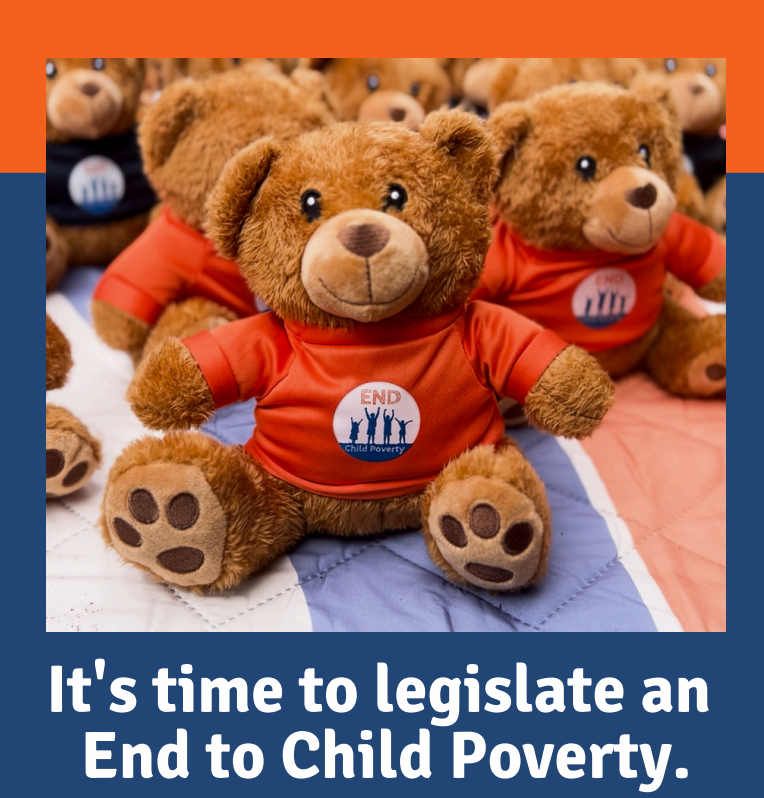
Teddy bears were given to every member of Parliament yesterday, as a reminder of the hundreds of thousands of Australians children living in poverty.

In fact, the End Child Poverty campaign, part of the Valuing Children initiative, predicts that by the end of this year, there will be a million Australian children living in poverty.

A million.

Tony Pietropiccolo AM, Chair of the End Child Poverty Leadership Committee:

“We are calling on all members of this 48th Federal Parliament to come together and enact legislation to end child poverty by 2030.”

Campaigners say the legislation should include a child-centred definition of poverty with measurable targets and actions.

When children are denied the basic conditions for growth, it is not only their immediate comfort that suffers—it is their dreams for the future, their sense of belonging, and the strength of our entire society.

Shadow Treasurer Ted O’Brien has put out a statement on today’s CPI data.

He reckons interest rates (which started going up under the Morrison government) have been too high for too long. Duh!

He comes dangerously close to saying the RBA should cut interest rates at its August chin-wag.

Naturally, Ted thinks the period of high inflation (which began under the Morrison government) is all Labor’s fault.

Ted O’Brien:

A rate cut would be welcome relief to the average Australian mortgage holder who is currently paying an additional $1,900 in interest every month compared to when Labor came to office.

The price of everything has gone up under Labor and, despite today’s announcement, it is never
coming down. The ABS data simply indicates prices are now increasing at a slower rate.

Interest rates have been too high for too long in Australia as a direct consequence of Labor’s homegrown inflation, fuelled by an increase in Government spending from 24% to 27% of GDP, the
highest level outside of recession since 1986.

Comparable jurisdictions saw interest rates cut far sooner than in Australia, with Labor’s addiction to spending keeping rates higher for longer locally.

How the government could save $11b a year

Greg Jericho
Chief Economist

Nationals MP, Jamie Chaffey asked the PM if he would rule out getting rid of the fuel tax credits. Chaffey made it sound like this great necessity for farmers, but in reality it’s a rort for miners.

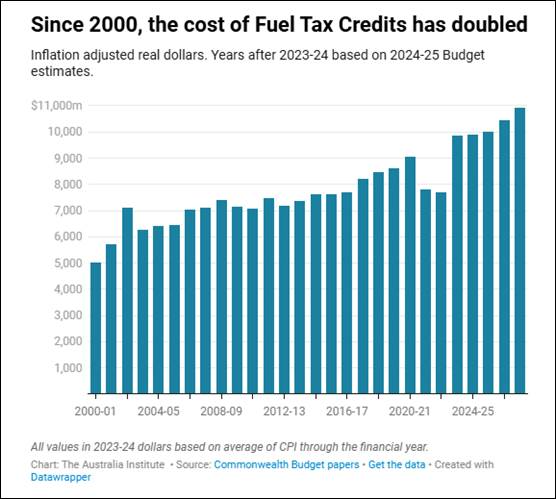
Our research has shown that the cost of the fuel tax credit, which notionally rebates the cost of fuel for those who don’t use roads, is growing each year and is now hitting $11bn

The OECD has called for the scheme to end because it just subsidies fossil fuels

The FTCS is the largest fossil fuel subsidy in Australia. In 2024-25 it is expected to cost the Australian Government $10.9 billion. Even worse the Budget Papers note that the expected increase in the fuel tax credit over the next 4 years “largely reflects an expected increase in the use of fuels that are eligible for the Fuel Tax Credit Scheme”.

In total, Australian state and federal governments provided $14.5 billion worth of subsidies to fossil fuel industries in 2023-24, a 31% increase on 2022-23.

The overwhelming beneficiary of the FTCS is Australia’s mining industry. The coal mining industry received refunds of over $1 billion through the FTCS in 2020-21. This means the FTCS not only subsidises consumption of fossil fuels but also provides subsidies to fossil-fuel producers.

Fossil-fuel subsidies undermine efforts to prevent the worst impacts of climate change.

Abolishing the FTCS would free up that money to be spent on domestic or international efforts to mitigate or adapt to climate change with no impact on the budget bottom line.

Question times wraps up …

Another day, another QT in which the opposition carried on like the election never happened.

How can they have run out of ideas six days into the new Parliament?

Jamie Chaffey, the new Nats MP for Parkes, asks the Prime Minister about the much-needed (my words, not his) change to the fuel tax credit scheme … you know, that scheme under which taxpayers give billions to huge multi-national mining companies to put diesel in their trucks.

Jamie Chaffey:

Will the Prime Minister rule out any change tax credit system?

Prime Minister Anthony Albanese:

The only people arguing for high taxes those opposite.

When it comes to the diesel tax rebate, the fact is, it has been in place for some time. We have not changed anything. Those opposite are the only people who stood for higher taxes and the question is: will they do what they said they will do?

I am just going to hand you over to Glenn Connley for the next little bit while I go rant about politics for a short while. Have fun!

We have more questions from the Coalition on older policies, with the tag line ‘why does the prime minister say things he knows are untrue’.

Repetition works, but only if people are listening. And people would not be listening to this.

So the target then, is the press gallery – it’s a way of influencing coverage, tone and to try and get the line into as many news stories and packages, without context. That’s the game – win the line of the day.

We will cover this dixer because it is being raised in parliament for a reason – it is dealing with legal matters, after Victorian police announced an arrest a little earlier today.

Josh Burns asks Tony Burke:

What actions has been taken today in respect of the investigation into the Adass Israel synagogue arson attack?

Burke:

I note that no member of Parliament wants to have the situation in the electorate where we see the sort of hatred that the member for Macnamara dealt with with the synagogue fire on Adass Israel synagogue.

Earlier today Australian Federal Police executed the seven different search warrants at locations across Melbourne as part of… the investigation into the arson attack.

Federal Police today have arrested a 21-year-old man who was alleged to be one of three people responsible for the attack on the AdassIsrael synagogue in December last year.

I want to acknowledge the patience of the Jewish community.

People, when there is an attack as reprehensible as this what to see someone be charged immediately. Understandably.

There is always a tension between wanting to see immediate action and making sure the investigation gets to every person involved.

While the attack happened last year, the winds from the attack are still raw.

…The investigation is not limited to Australia. The Federal Police are investigating criminals offshore who are suspected of working with criminal associates in Victoria to carry out the attack.

This follows the arrest two weeks ago of another individual who was charged over his alleged role into the back of a vehicle used by those involved in the attack.

I want to thank on behalf of the government and I think it is fair to say the Parliament and the nation the more than 200 members of the counter-terrorism team from across the Australian Federal Police of Victoria Police and AFP.

Together they have worked with more than 50,000 hours on this investigation and continue to do so. Following the horrific attack last year, the site was visited by the Prime Minister and the member for Macnamara, the government and myself into occasions, I remember going the second time with the member for Macnamara which would be been more than a week after the attack and you could still smell the smoke as though it was fresh.

And you could still see it at your feet the rubble of the building which had been burnt. The government committed to $250,000 almost immediately for the restoration and replacement of those and in this year budget further $30 million to rebuild the synagogue in the community centre.

Not widely known but in the week following the attack, I was with the Prime Minister who had raised with me that the Rabbi was on a temporary visa and his family which was soon to expire.

Given an act of hate where people had tried to say that the members of the Jewish community and that Rabbi in particular were not welcome in Australia, I took a behalf of the government the most deliberate action you can take which was that week to make him and every member of his family permanent residents of Australia to say they belong, the hatred does not.

This arrest cannot undo the pain and fear are caused that it does seem to be strongest message that this kind of hate and violence has no place in Australia. This attack was not simply an attack on Jewish Australians, an attack on the synagogue as an attack on Australia. It is treated as such. Jewish Australians like all Australians have the right to feel safe and to be safe.

And now the data

Greg Jericho

The opposition are playing the greatest hits of 2024, and talking about the ALP promise in the 2022 election campaign to deliver cheaper electricity prices.

That the LNP are still doing this after the 2025 election says a bit about where they are at the moment.

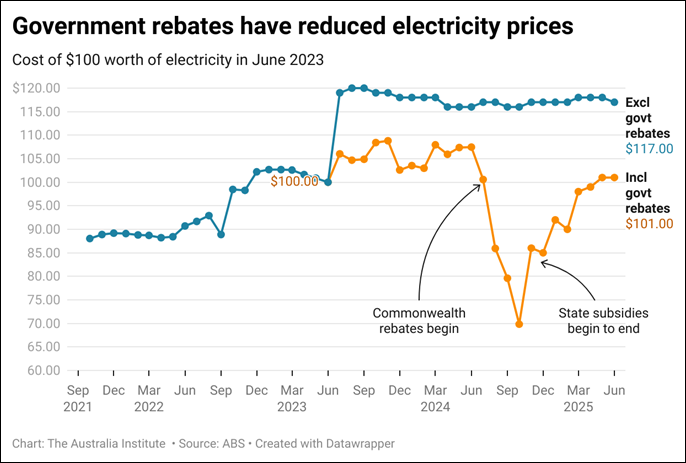
Today’s CPI figures showed that electricity prices actually jumped a fair bit in the  June quarter – but that was mostly due to the end of the Qld and WA state subsidies.

The govt’s decision to extend the federal subsidy means however that overall Australians are still paying about 14% less for electricity than they otherwise would be.

$100 worth of electricity in June 2023 now costs around $101. If we didn’t have the subsidies, it would cost $117.

Amy’s view

So the strategy here from the opposition, on a day that shows inflation has fallen under the RBA target band for a year now and that all the economic data is pointing the right way, is to try and remind people that their power bills are not as low as was promised three years ago.

Which I get as a strategy – except there has been an election in between and it wasn’t part of the last election and Labor won.

So it isn’t a big a deal as the Coalition would like it to be, and also the market intervention Labor made managed to keep power prices lower than it otherwise would be, and so people are not as mad as they might have been.

Which means it is a waste of time trying to make people mad about something most people outside of politics have already forgotten about (in terms of the number)

But given the Coalition don’t have an energy policy, relying on the same shiz as the last term is all they have.

In more evidence the Coalition have not moved on from the last election (or the last three years) the next question from Dan Tehan is….

Do you still stand by your governments commitment to cut power bills by $275 by the end of the year?

Chris Bowen:

The honourable member refers to model done in 2021.

Which we gave to the Australian people in 2022 and then the Australian people did have a chance to have their say in 2025 on the matter.

And we accept that judgement of the Australian people, we accepted modestly the Australian peoples judgement on 3 May and perhaps the people looked at the fact that energy prices have fallen as I just said by 6.2% in the year just gone and they would know that that was not inevitable, they would have been 16.6% higher if the honourable member had his way in energy bill relief not being applied, that was the key difference.

They also know the Opposition went to the election with a very significant plan, we have always recognised it as significant on energy, the people passed judgement on that and knew that the plan would lead to higher energy bills.

There is a point of order that is kinda a point of order. Bowen is told to stick to the topic.

Bowen:

I was asked if we can stand by things and we stand by a policy to reduce energy prices by introducing cheapest form of energies which is renewable and rejecting plans to introduce the most expensive form of energy. We stand by the election commitment we made on the election just gone to deliver cheaper home batteries to people and that is our policy which is being delivered and taken up by the people with great enthusiasm and the people rejected those and gave the Government amended to keep going.

The view from Grogs

Greg Jericho
Chief Economist

Sussan Ley decided that asking about inflation on a day when the official CPI was 2.1% was a good idea.

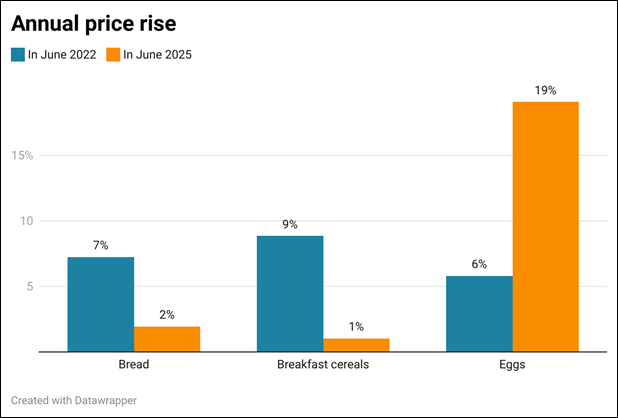
She picked out three items – bread, cereals and eggs as having risen in price since the Albanese government. Problem is in June 2022 quarter, when the ALP won the election bread prices were going up 7% now they going up just 2%, cereals were going up 9%, now 1%.

Eggs are the only thing where you can say prices are rising faster now – and that is as the world deals with the global bird flu ructions

The opposition will keep talking about price rises since June 2022 (or March 2022 – sometimes they fudge the starting point) because that makes things look worse. This is smart during the election campaign, but it is less powerful now, because well, the big price rises are in the past. Prices are not about to fall – that’s not how inflation works. If prices on average go down, that is actually a very bad thing – that is very much recession town.

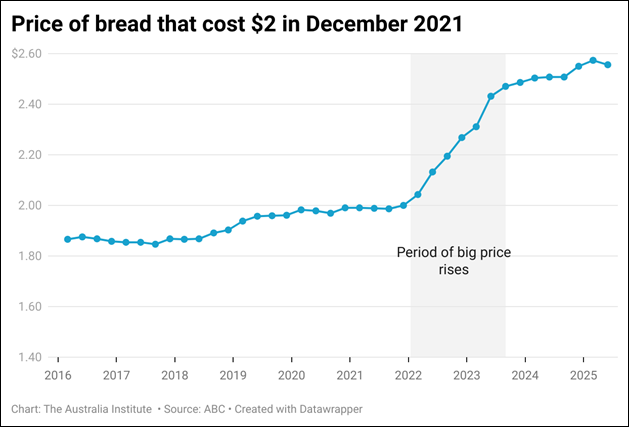
Bread price rose very quicky in 2022 And 2023, but since then have slowed

That is why you are going to keep hearing the opposition refer to prices since the middle of 2022, and the Government will talk about price rises over the past year

Dan Tehan gets a question! What a special treat for all of us.

My question is to the Minister for Climate Change and Energy. Electricity prices are now up 32% since Labor came to office. Some households are paying more than $1300 for the electricity. Do you still stand by the Prime Minister’s commitment to the Australian people of a $275 cut to power bills by the end of this year? Or is the Prime Minister saying things he knows are not true?

So that’s the new line – which is also the old line – trying to paint Albanese and senior government ministers as ‘saying things they know not to be true’. Which is something the Coalition tried out in the last term and well, it didn’t go particularly well. But maybe the next three years are the charm!

Chris Bowen

I thank the honourable member for the question and a little surprised he didn’t reference today’s CPI figures but perhaps I should because it shows energy prices are down 6.2%.

Perhaps that is an explanation or another explanation is that is in no small part due to the Government ‘s energy bill relief which the member opposed, that’s another possible explanation although he referenced $1300 which is roughly the amount you can save by installing a cheaper home battery under our policy.

I thank the honourable member for the plug.

Independent MP Dai Le asks Anthony Albanese:

Last time I introduced my fair study and opportunity bill to reverse the Morrison governments punitive fee highs and art students with salt cost double. Hitting students invalid the hardest. The 1-off reduction does not fix this. We support my bill when I reintroduce it or allow this 80% increase to unfairly burden many students.

Albanese:

Of course, she was not here when the Morrison government made those changes. That is what she’s talking about. She has been here in the chamber and I know supported the reduction in student debt that past this parliament today, it will pass the Senate as well if it has not already.

That will benefit 23,000 people in the electorate of Fowler 23,000 people will benefit by an average of 5.5 thousand dollars each.

Students who studied to get a better start in life at university, people training or retraining through TAFE making an enormous difference across the board. What is more is that people will benefit from the changes in the threshold that we have made.

The changes to indexation that we have made. The students who will benefit as well in her electorate and others from fee free TAFE, that we are making permanent. That has already benefited over half a million Australians and many of them would have been in the members electorate.

We will support good government legislation, we have come into this place in the first fortnight and have concentrated with the first introduction being things that make that practical difference to people’s lives that we were elected on or re-elected on.

Whether it be the changes to student debt and then reduction, the changes in the threshold, the changes to how much people have to pay back and when, which will put more dollars in people’s pockets. Or whether it be the support for cheaper medicines that we have also done in this parliament that will benefit 70 people in the elector of Fowler what we are determined to do it each and every day is to focus on the issues that people in her electorate and electorates like hers are most concerned about.

That is how do we make their lives better and increase opportunity, how do we support aspiration and how do we make sure that no-one gets left behind and no-one gets held back?

OK, there is the inflation question and the tactics team have thought it better to have Sussan Ley ask it instead of Ted O’Brien, probably because of the amount of gear in sledging O’Brien and his new chief of staff available to the government.

Part of the tactics of the Liberal party is to make it as difficult as possible for the senior men to launch political attacks – this is all about tone. A core difference between how the Labor party presents and the Coalition has presented though is that there isn’t the same level of gendered response. So it’s not as easy as it would be with a Scott Morrison type, for example.

Ley asks:

This afternoon on the news out of touch treasurer describes today’s inflation numbers as quote, absolutely outstanding. According to the ABS under three years of Labor the cost of eggs as increased by 34%, the cost of bread by 18%, and the cost of cereal by 17%. Prime Minister, what is the Treasurer say things he knows are untrue?

Milton Dick says to can it with the descriptors.

Chalmers:

Let me get this straight, on Monday they asked us about the unemployment rate and this government is presided over the last average unemployment in the last 50 years of any government. They asked us about Medicare when we have just been re-elected on a platform of strengthening Medicare and now on a date when we get absolutely outstanding inflation numbers, they would ask us about inflation.

I am asked in particular about food inflation stop I want to make it really clear for the member for Farrow. When we came to office that food inflation was running at 5.9%. And now it is about half of that. 3.0%.

If the member for Farrer is unhappy about food inflation, she must be absolutely livid at the under performance of her own government, the government she was a cabinet minister in. Because when when we came to office, inflation had a six in front of it and it was absolutely galloping.

Because of the work that we have done together, because of what Australians have been able to achieve together, we have got these absolutely outstanding and patient numbers today and they are outstanding because they are a powerful demonstration of the progress that Australians have made together in the fight against inflation.

I am asked about particular elements of the new numbers today. Read inflation has gone down. Housing construction costs inflation has gone down. Food and non-alcoholic beverages inflation has gone down. Fruit and vegetables inflation has gone down. Insurance and financial services inflation has gone down. That is why we have seen today, that is why we have seen today both underlying and headline inflation in the Reserve Bank ‘s target band, headline inflation at the very bottom of the band, monthly inflation is below the Reserve Bank ‘s target band and has a one in front of it.

So I hope they keep asking me about the inflation data today because the inflation data today was very, very encouraging.

We know from that question that nothing makes them grumpy that when Australians make progress in the economy together, whether it is the fact that how inflation is much lower than we inherited, real wages are growing again, unemployment is low, we got there debt down, we delivered to surpluses, interest rates have started to come down as well. We know there is more work to do because people are still under pressure and that is why we are rolling out more help this month for the cost of living much of which was opposed by those opposite.

This dixer is basically ‘tell us why this government is so amazing’ which is why we do not cover dixers unless we absolutely have to.

Question time begins

We are back to the Medicare card!

Sussan Ley asks Anthony Albanese:

The Prime Minister has said on at least 71 occasions that it is free to see a GP and all you need is your Medicare card, not your credit card. The Australian Institute of Health and Welfare has contradicted the Prime Minister with data showing Australians paid more than $166 million in out-of-pocket costs to see a GP in the month of May alone. What is the Prime Minister say things he knows are not true?

Albanese is straight to his pocket for his Medicare card.

We are strengthening Medicare, we are cementing quality bulk billed healthcare at its heart. Something we are absolutely committed to and something I announced in the electorate of bus with the $8.5 billion commitment that before I finished speaking the Coalition then packed in. That position. Back in 2023 in the budget we tripled the bulk billing incentive for pensioners and concession cardholders.

Those 11 million Australians go to the GP they are bulk billed 90% of the time. It is our plan for Medicare in action and it is working. That is why we took that principle and then made a decision to extend to all 26 million Australians for the very first time stop lifting bulk billing rates for every patient to 90% by 2030. This is an important part of the reform agenda where Labor not only created Medicare but we will always work to strengthen it. I know it annoys those opposite to see this little bit of green and gold. Green and gold the same colour…

There is a point of order which is not a point of order and then more of the same from yesterday from Albanese. Which, after the election campaign, you should all know by rote now.

Sussan Ley also acknowledged the Olympians, but made note of the political circumstances at the time, and also gives credit to the athletes who did support the boycott and placed their personal glory second:

The decision made by Prime Minister Malcolm Fraser to support the U.S.-led boycott was the right one and history has judged it so. We would not send athletes to an Olympics in Moscow today and the Australian government was right to support a boycott then.

That decision, correct as it was, takes nothing away from the Australians who did compete. They should not be personally attacked, they should never have been personally attacked. I repeat to you in the gallery today, you made Australia proud.

For every athlete who went to the Moscow games, there were other athletes who did not. One of our greatest sprinters, a 3-time medalist is not to compete stating it was one of the hardest decisions of their life.

I remember being so inspired by her. She is a hero. I also remember and acknowledge Tracy Wickham, who had broken multiple world records and was a favourite to win in Moscow, like 70 others she did not go.

For decades later the Cold War has ended but the memory of that time reminds us of the importance of standing up on the world stage for our values even in the cost is heavy. It is an enormous source of national pride that we will host the Brisbane Olympics in 2032. I know Team Australia will take inspiration from all those who competed as well as those whose did not. All those athletes in 1980 demonstrate their strength whether they went to Moscow or not. I say to those in the gallery today, every single athlete who competes for our country on the national stage is loved, admired, cherished, supported, celebrated. We look forward with pride and anticipation to the next chapter of Australia’s own big story.

Ahead of question time, there is recognition of the 1980 Australian olympians who broke the boycott call and attended the Moscow games.

They are being recognised in the parliament today and have filled the gallery as special guests. Australia did not join the 40 or so countries that did officially boycotted the games (which came after Russia invaded Afghanistan) but left it to the athletes themselves to make the decision. 121 athletes went to the games (out of about 204) and those who went faced massive public backlash for breaking the boycott.

Anthony Albanese:

On behalf of the Government and on behalf of the Government and on behalf of the people of Australia it is a privilege to welcome the members of the 1980 Australian Olympic team joining us here today in Parliament House.

Today is a parliament we honour your contribution to our nations of the big history. We recognise your participation but importantly as well we recognise your pain. And we extend that recognition to all those who cannot be with us today. To qualify for an Olympic Games demands exceptional talent and so much more. It requires character, courage and commitment.

Years of hard work, single-minded dedication and sacrifice. Athletes and their loved ones for countless hours into the pursuit at the Olympic dream.

The combination of that effort being selected to represent the greatest nation on earth, Australia. On the biggest sporting stage in the world, should be a moment of fierce and absolute pride. When you were chosen to wear the green and gold you should draw strength from knowing that the whole nation is with you. And on your return you should be welcomed home. And celebrated for the inspiration you have brought to the next generation of Australian athletes.

Yet 45 years ago, the Soviet Union’s invasion of Afghanistan cast a dark shadow over what should have been your shining moment. As nations around the world grappled with the boycott, Australia’s athletes, some still only teenagers were placed in an credit difficult position. 121 Australians chose to compete under the Olympic flag.

Others chose to join the boycott. Some who had one selection never even had the chance to choose because their sport made the decision for them. Those who went and those who withdrew were both subject to all manner vile abuse, death threats. Lisa Forrest was just 16 when she was made captain of the women swim team will stop she wrote of how a family kept a whistle next to the home phone to blast the constant crank callers.

And Chris who competed in the marathon at both Montreal and Moscow recalls back in 1976 a marching band had played Waltzing Matilda to farewell the athletes.

In 1980 the last question he was asked by a journalist at the airport was “Do you feel you are being traitors to Australia?” It’s a wonder many still bear the skies and trauma. It only makes the efforts of the team at those games all the more extraordinary.

We are now in the downhill slide to question time…..and if the last two weeks are any indication it is going to be lammmmmmeeeeeeee.

So take your time now to get your jolly’s.

As you would have expected, Jim Chalmers’ release on inflation is long – but he is keen to make the point that both headline and underlying inflation have fallen to their lowest level in almost four years.

You may note that ‘almost four years’ includes the last year of the Morrison government. That’s the point.

Chalmers:

Monthly headline inflation is just below the band at 1.9 per cent and at its lowest since early 2021. This is welcome and encouraging news.
It’s an outstanding result which confirms we are sustainably in the band with substantially lower inflation.

Under Labor, inflation is falling, unemployment is low, real wages and living standards are growing again, more than 1.1 million jobs have been created, debt is down, the economy is growing and interest rates are falling.

New numbers from the Australian Bureau of Statistics show headline inflation was 2.1 per cent through the year to the June quarter 2025, down from 2.4 per cent through the year to the March quarter 2025.

It means headline inflation has now been in the band for a full year.

This is a powerful demonstration of the progress we have made together.

Greens leader Larissa Waters is calling on the government to actually listen to climate scientists when setting the 2035 emissions reduction target:

With the government planning their 2035 climate targets, it’s vital that they listen to climate scientists, people in regional communities and our Pacific Island neighbours; and not take us backwards on climate.

Climate Targets aren’t just figures on a page. They’re life or death events for people in our region and people in regional communities and all Australians who are suffering from natural disasters that are turbo charged by the climate crisis.

We know the Government is thinking about what the targets should be for our country to do our bit globally to tackle the climate crisis and global warming. But thankfully, there’s been plenty of thinking already done, and the answer is quite clear.  

The government just needs to listen to scientists, listen to bushfire survivors, listen to our Pacific neighbors, the unions and businesses who are all saying the same thing – Australia  must settle on strong science based 2035 targets – and that means net zero. 

The first act of Labor after being re-elected was a tick off on Woodside’s massive North West shelf gas project out to 2070. That is inconsistent with strong climate action, and just like Pacifica leaders, the bushfire survivors, and scientists, the Greens say we need strong science based targets that tackle climate pollution and keep us all safe.

Australia has done too little for too long – and now science based targets that keep warming below 2 degrees requires a monumental effort of reaching net zero in the next ten years, not by 2050.

We can see that states and territories are doing some good work already in this space, and if you put all of their contributions together, that would already see us reduce emissions by 71%, so regardless of what the Business Council or the Nationals say, anything less than that is going backwards. And a safe climate is a mandate on which this Government was elected. They said to the voters before the election, and what Australians want is strong climate action to keep us safe, to keep nature safe, and to keep our Pacific neighbors safe.

It can be done and the economic modelling even shows that if the federal Government invests well and soon, a net zero climate target can even be a driver of economic growth, bringing with it cheaper, cleaner energy, new industries, lifelines for regional communities, more Australian manufacturing – as well as less suffering for Australia and our Pacific neighbours and fewer species sent to extinction.”

AAP

Anthony Albanese has downplayed the extension of the US review of its multi-billion dollar nuclear submarine deal with its long-term ally.

The Pentagon announced a review of the AUKUS security pact in June, which was originally slated to take 30 days.

It has sparked alarm Australia might not be sold the promised submarines, as US shipyards fall behind on production.

But the US has now flagged the review will take longer and is now expected to finish between September and November.

Asked if the delay was concerning, Prime Minister Anthony Albanese replied: “No, it’s not surprising that would be the case”.

“We expect that those things take longer than just 30 days,” he told reporters in Canberra on Wednesday.

Under the $368 billion agreement, Australia has been promised at least three Virginia-class submarines from the US in the early 2030s, before a new fleet of vessels is built for delivery from the 2040s.

“Its purpose will be to provide the president and his senior leadership team with a fact-based, rigorous assessment of the initiative,” the statement reads.

US under secretary of defence Elbridge Colby – a sceptic of the submarine deal under AUKUS – is leading the review.

A US statement said the review would be an empirical and “clear-eyed assessment” of the security pact’s alignment with US President Donald Trump’s “America First” objective.

“As part of this process, the department looks forward to continuing regular engagements on this matter with other parts of the US government, the US Congress, our allies Australia and the United Kingdom, and other key stakeholders,” it reads.

Defence analysts have flagged a likely outcome of the US review will be a request for more money from Australia to support its submarine industrial base.

Australia has since made its second $800 million payment to the US to help boost production of submarines, according to the Nine newspapers.

The hidden unemployed

Dave Richardson

The hidden unemployed Every month we get the official labour market statistics that now show unemployment is 4.3% (June 2025) having risen from a seasonally adjusted 3.4% before the RBA started increasing interest rates. To be defined as unemployed you have to

· Be 15 years and over, and

· Have actively looked for full-time or part-time work in the last 4 weeks, and

· Were available for work.

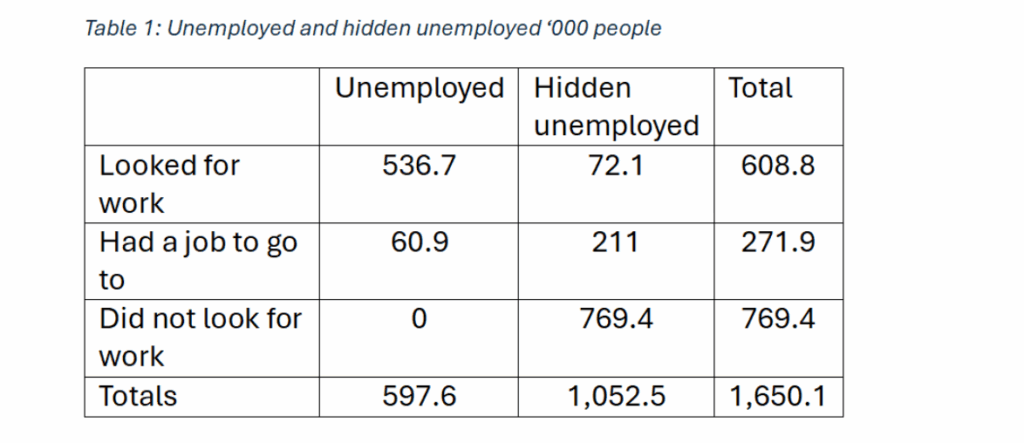
The definition includes people who were waiting to start a job within 4 weeks. Nevertheless the definition is fairly strict and it is not that easy to become an official unemployment statistic. Once a year the ABS also publishes the data that tells us about the unofficial unemployment. These are the people who do not satisfy the ABS questions about unemployment but may well meet the pub-test for being unemployed. The latest figures relate to the month of February 2025 and are summarised in Table 1 which examines the people who wanted to work but were not classified as unemployed.

Most of those who looked for work were classified as unemployed. Perhaps those who were not so classified could not begin immediately. Those who had a job to go to within 4 week are classified as unemployed but not those with a longer wait. But if you did not look for work you were automatically excluded from the unemployment figures.

Among those who did not look for work there were a number of reasons, including discouraged jobseekers, those attending classes, those with ill-health, injury or disability and, finally those with care responsibilities, children or other family. Women predominantly fall into the last category.

The large number of hidden unemployed explain why it is that the majority of people who start work each month come not from the ranks of the officially measured unemployed but from outside the workforce, the hidden unemployed. But what it

means also is that instead of the 4.0% official unemployment figure in February,1 the figure would be more like 10.3% if we included all of the hidden unemployment. The difference helps also in suggesting that the Australian labour market is nowhere near as tight as is suggested by the Reserve Bank in its regular monetary policy decisions.

Greg Jericho

In light of the inflation figures showing that the official CPI is now 2.1% and underlying inflation is at 2.7% and the monthly measure has inflation at just 1.9% – which is actually below the RBA’s target – I suspect the new Shadow Treasurer Ted O’Brien might wish to take back this little suggestion he put in a question to Jim Chalmers on Monday when he said:

Mr TED O’BRIEN (Fairfax—Deputy Leader of the Opposition) (14:30): My question goes to the Treasurer. Under Labor there have been 12 interest rate increases, inflation remains too high….

Oops. The Treasurer, might be noting that today should he be in the mood to be a tad mischievous.

The Greens have also responded to the prime minister’s press conference this morning. From their statement:

The Prime Minister today dismissed calls for sanctions and material action to stop the genocide in Gaza as “slogans”. This is deeply insulting to the millions of Australians calling for the Prime Minister to move from mere words to clear action to pressure Israel to end the bombing and killing of Palestinians and let aid flow into Gaza. 

The statement signed by Australia on July 21, 2025, made it very clear that “we are prepared to take further action to support an immediate ceasefire.” Israel rejected this statement in less than 24 hours, yet the Government has taken no steps. As the Prime Minister himself stated, his empty slogans, without action, will not feed starving children in Gaza. 

The Prime Minister’s position that we cannot put sanctions on Israel because, unlike Russia, it is a democracy, is a bizarre argument. It has no basis in international law that is concerned with the actions of governments, not their electoral system, and it gives Israel full license to continue what they are doing in Gaza. 

The precedent for action in response to an illegal war is clear. When a country illegally occupies another and commits war crimes, then comprehensive sanctions are needed. Australia responded clearly to Russia with a comprehensive sanctions regime, this can and must be replicated with Israel. 

Oh look – Michaelia Cash has more thoughts on how Australia should handle whether it recognises a Palestinian state or not.

The same Michaelia Cash who said she would proudly invite Benjamin Netanyahu to Australia, despite him being wanted for arrest by the ICC. Yup. That one.

From her statement:

The Coalition has serious concerns about the Albanese Government’s willingness to unilaterally recognise a Palestinian state outside of a proper two-state process.

The Albanese Government has signalled its support for a state of Palestine as a step towards a two-state solution rather than at the end of the peace negotiation process.

The question of recognising Palestinian statehood should come at the end of the peace negotiation process not at the start or during it.                                      

The Coalition has been consistently clear that there can be no recognition of a Palestinian state with Hamas still in control of Gaza, and Hamas can have no role in governing a Palestinian state.

We want a peaceful solution between Israel and the Palestinians, and a viable, peaceful Palestinian state. This can only come through negotiations.

The Albanese Government should explain to Australians why it is canvassing recognition of a Palestinian state while there are still hostages in tunnels under Gaza.

This is a moment for international leaders to be applying maximum pressure on the listed terrorist organisation Hamas to immediately and unconditionally release all remaining hostages and disarm.

Australia should not reward Hamas with a pathway to statehood while they remain in control of Gaza and continue to hold Israeli hostages.

The inflation dragon is slain – but the economy needs help

Matt Grudnoff
Senior Economist

With all the attention on the quarterly inflation rate, people may be overlooking that the inflation figures for the month of June also came out today. The monthly inflation figures are less accurate than the quarterly figures but they do give us a look at where inflation is heading.

The latest monthly figures show inflation for the year was just 1.9%. Yep, you read that right. This means that inflation has fallen outside the RBA band.

You might think this is good. After all, isn’t low inflation a good thing?

The problem is that when inflation get too low, it comes with a stagnating economy, and higher unemployment. You know… like what is happening in the Australian economy right now.

The most recent economic growth figures were just 0.2% for the March quarter. Unemployment jumped up to 4.3% for June. The highest since the economy was gripped by the pandemic.

These monthly figures highlight again that the risk is a stagnating economy. The inflation dragon is dead.

Greens senator David Shoebridge said yesterday he would keep his motion for an inquiry into the Aukus deal on the senate books until it had the numbers. He still doesn’t have the numbers but he is working on building more public support

The senate is making its way through the amendments on the cutting student debt bill; it is up to Liberal senator Sarah Henderson’s amendment to index the loans, which she is doing as her own amendment, rather than one coming from the Liberal party.

You can expect Henderson to do more of this stuff given she has been booted from the shadow front bench.

Jim Chalmers is obviously celebrating – he is about to head into the Sky News studios to talk inflation ahead of question time, where he will take a dixer on it.

One of the reasons the politicians choose Sky to talk to is because it is on in every parliament house office. So it is not a huge audience, but it is an influential one.

Cut interest rates you cowards!

Matt Grudnoff
Senior Economist

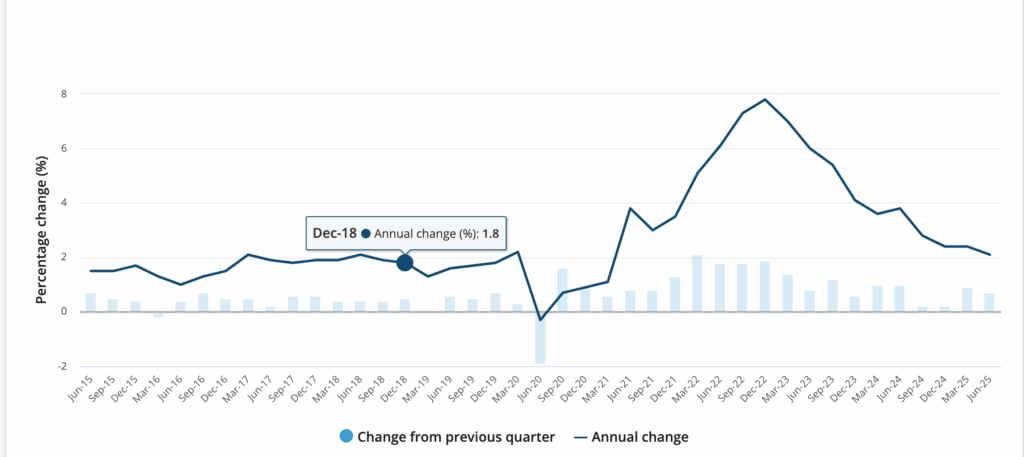
The inflation rate has fallen again. It is now at 2.1%, down from 2.4% last quarter. Inflation is now at the very bottom of the RBA’s target band of 2% to 3%.

The inflation rate is now at risk of falling outside the target band, but not because it’s too high, but because it’s too low.

This result shows the RBA made the wrong call earlier this month when it left interest rates on hold. The inflation rate has now been in the target band for a year. With the economy slowing and unemployment rising, now is the time to cut rates. The RBA’s failure to do this is becoming more and more obvious each day.

While the RBA’s targets the headline rate of inflation, which has fallen to 2.1%, it has increasingly been talking about the trimmed mean, or underlying rate of inflation. This is the inflation rate with the volatile bits stripped out. Because it has stripped out the volatile bits it tends to move more slowly than the headline rate. But it too has continued to fall. It has fallen every quarter for a year and now sits at 2.7%.

The RBA needs to admit that it’s continued concerns that low unemployment might lead to a wages breakout and higher inflation are a fantasy. Their outdated understanding of the economy needs to be thrown out. They should be taking an evidenced based view of what is actually happening. The evidence is clear. Interest rates need to be cut.

We will have more on the inflation data for you soon, but here is the ABS graph:

And here is the ABS take on the quarterly inflation data:

The main contributors to the quarterly rise were Housing (+1.2 per cent), Food and non-alcoholic beverages (+1.0 per cent), and Health (+1.5 per cent). Partially offsetting the rise was a fall in Transport (-0.7 per cent).

The quarterly growth in Housing was driven by Electricity (+8.1 per cent). The second instalments of both the Commonwealth Energy Bill Relief Fund and State government rebates in Perth were used up by households in the previous quarter. Rebates have the effect of reducing electricity costs for households. This has meant higher out-of-pocket electricity costs this quarter as rebates have been used up. 

Brisbane also contributed to the June quarter rise as households in Queensland continued to use up the $1,000 State government rebate.

‘While electricity was up this quarter, it’s down 6.2 per cent compared to 12 months ago as rebates remained in place for most capital cities,’ Ms Marquardt said.

The rise of 1.0 per cent in Food and non-alcoholic beverages was driven by fruit and vegetables (+4.3 per cent). Strawberries, blueberries, grapes, tomatoes and cucumbers saw price rises following reduced supply, which is typical at this time of year. 

Health costs were up 1.5 per cent this quarter driven by a rise in Medical and hospital services (+2.3 per cent) following the annual increase in private health insurance premiums on 1 April.

The fall of 0.7 per cent in Transport was driven by Automotive fuel (-3.4 per cent), reflecting lower global oil prices. ‘Prices for automotive fuel have fallen in three of the past four quarters and are 10.0 per cent lower compared to 12 months ago,’ Ms Marquardt said.

Inflation has officially been in the RBA target band for a year.

The ABS has just released the inflation for the last quarter – 2.1%

That sound you hear is the whoop from Jim Chalmer’s office

Fiona Macdonald
Acting Director, Centre for Future Work

Did the ex-PC boss miss the recent Aged Care Royal Commission? In an article in this morning’s Financial Review, Ryan Stokes  appears to be calling for “flexibility” of staff ratios in aged care and other care and support services. 

This is a recipe for poorer quality and safety, and neglect and abuse of vulnerable adults and children.

There is plenty of evidence underpinning the introduction and strengthening of  staff ratios in aged care and other services, such as early childhood education and care.

Capital investment, decent wages, staff training, and career paths that increase capability and reduce turnover can increase productivity in these sectors.

Playing around with minimum care requirements may cut  labour costs but the only benefit is likely to be increased profits – we know this from the 1000s of pages of evidence heard by the Royal Commission.

A bit more on wealth taxes

Dave Richardson
Senior Research Fellow

Further to Amy’s earlier post on wealth taxes.

Today the Financial Review reported on a new poll by SEC Newgate Research that showed almost two-thirds of voters would support income tax cuts funded by higher taxes on wealth. They also supported increased taxes on landlords with multiple investment properties.

Then distribution of private wealth in Australia is extremely skewed in favour of the rich, and it is getting worse. In August last year the Australia Institute published a report Wealth and inequality in Australia which outlined how wealth has grown in recent decades. It found the growing disparity between inequality of incomes and inequality of wealth is increasing the rich-poor divide in Australian society.

Capital gains on the wealth have been higher than wages, salaries and supplements for the whole economy. Those capital gains go towards increasing wealth inequality. The wealth of just the top 200 rich is now $668 billion or a quarter of annual GDP up from 8% two decades earlier.

Household wealth in Australia has increased from $4.4 trillion 20 years ago to $17.3 trillion now. Almost all of the increase was due to capital gains, very little out of household savings. So don’t let the rich try to say they got that way through hard work.

The rich could have achieved almost all of the incredible gain without getting out of bed yet they pay next to nothing by way of tax. That has to change.

A couple of things…

Greg Jericho
Chief Economist

Today in the AFR, the head of the private health insurance lobby group “PrivateHealth Australia” showed the industry is very worried by suggestions by The Australia Institute and others that private health insurance fees should be subject to GST.

When the GST was introduced, John Howard ensured private health insurance fees were not subject to GST, and at essentially the same time, he introduced the “Lifetime Health Cover”, which meant if you did not join private health insurance by the time you were 30 you would have to pay higher fees were you to join it later.

The problem is even with this virtual forcing of people onto health insurance, most people take out the minimum health insurance they need to qualify for the lifetime health cover, and usually this means lots of things are excluded from the cover and also you have to pay a lot of excess payments should you actually need to use it. It is not health insurance in any true sense, but it is wonderful for private health insurers.

Today PrivateHealth Insurance Australia’s CEO, Rachel David, is trying to argue that if we put a GST on private health, it would not only cause people to dump their insurance (which suggests that their product is not all that great, to be honest), but that it would hurt those on low incomes because as she writes:

“Contrary to assumptions, health insurance is not the domain of the wealthy. Australian Taxation Office data shows that only 14 per cent of people with health insurance have a taxable income over $150,000. Nearly two-thirds earn less than $90,000 – including many teachers, nurses and tradespeople. One-third earn under $50,000, including hundreds of thousands of pensioners.”

A couple of things: I’m not sure why she is using taxable income when the ATO tax stats that she cites also provide total income (ie how much you earn before all your deductions and negative gearing etc are counted). But also sorry, but her own figures actually demonstrate that private health insurance IS the domain of the wealthy.

It turns out that 15.6% of people with health insurance have a total income over $150,000. Now ok that still sounds like a small number, but the thing is, only 9.6% of all people earn more than $150,000.

And as for “nearly two-thirds” (actually 60%) of those with private health insurance earning less than $90,000, well that is less impressive when you consider that 71% of all people earn less than $90,000.

But these figures are all very confusing, so let’s just look at what percent of people in each income range have private health. Because that tells us who is actually taking out private health insurance. If it were not the domain of the wealthy, as David argues, you would expect to see about the same percentage of people having private health insurance regardless of how much they earn. Alas for David, that is not the case.

Not surprisingly, almost everyone earning more than $1m a year has private health. In fact, 90% of people earning more than $150,000 have private health insurance.

But at the other end? Most prefer to not have it. Less than half of the people who earn under $100,000 have private health insurance.

The reality is that private health insurance should be subject to GST. Right now, it means the richest get the benefit of avoiding paying GST and the public health system is denied the revenue that would come from the extra GST.

If private health insurers are worried about people not wanting their product, they should offer a better service – rather than offer a dud product that people would rather go without.
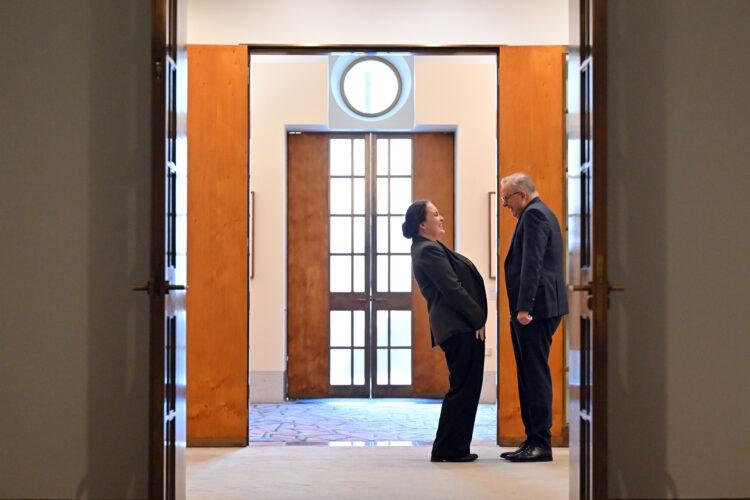
Albanese: media has a responsibility in how it reports on Israel and Palestine.

Anthony Albanese then says:

One of the things that I’ve said and there has been some reporting from the Caucus yesterday is that sometimes out of a crisis comes a moment of opportunity to actually advance forward, in a real way, advance forward for Israelis and Palestinians.

You know, when I visited a long time ago, before the Intifada, it struck me that walking around the historic streets of Jerusalem, you know, an important site for the three great monotheistic religions, people don’t feel secure when you see people’s whose guns are bigger than their height.

That is an insecurity. It has an impact on people and, you know, that is why I say for all of those as well – engaged, to engage in a respectful way, that is appropriate in a democracy.

The cause is not advanced because of some of the activities that has occurred – you know, there is no place for anti-Semitism, no place for Islamophobia, no place for hated in this country.

One of the things I’m trying to do and I wish everybody in the parliament was trying to do but I don’t need that has been the case is to have social inclusion here as well because if there is two things I’m confident of, it is one that most Australians who don’t follow this on a day-to-day basis, who don’t think this is like fighting for a team in a game, that what they want us for, innocent lives to not be lost.

For people to stop killing each other, that is what they just think when they think about the Middle East. A

nd the second thing they want is they don’t want conflict brought here. People are not responsible for the actions of either Hamas terrorist organisations or [the Israeli] government and my priority has been to try and navigate what is a very difficult situation but, you know, the young Jewish boy or girl going to the local school should not be harassed because of who they are.

They are not responsible for what is going on in Gaza. And Arab Australians or Muslims are not responsible for what Hamas did.

The media have a responsibility as well to support things that are not just backing a team in this. And I just ask you to do so.

The press conference ends.

Albanese again refers to ‘sloganeering’ when it comes to people who have been calling for accountability for Israel for its slaughter of Palestinian civilians in Gaza.

Albanese falls back on this a bit – that calling for accountability is somehow grandstanding for domestic political gain. It shows you how this conflict is viewed, because people protesting against the actions of the Russian government for instance, are not accused of grandstanding or sloganeering.

If you are going to have advanced genuinely a two state solution then you are going to need to have not just the legitimate aspirations of the Palestinians for their own state but Israel needs to be recognised by the states around the Middle East.

Israel needs to be able to be confident as part of that that they are able to exists without a threat to the security, so that is what we talk about in a mature way and that is where the discussion is actually at.

Not so much some of the sloganeering that does nothing to advance the cause – nothing. If people are serious, and I’ve been serious about the rights of Palestinians and them having justice since, you know, well before I came to this place. There hasn’t been an advance.

Why has Australia not sanctioned Israel?

Albanese tries the domestic political line – that he doesn’t go for slogans – but he is pulled into the question about how sanctions would actually make a statement, rather than just the words contained in a statement.

Albanese:

They don’t call for that, that is the point. What we have from some of the campaign that has taken place is slogans. And what we are about is meaningful action. … Just like the people who call my office – because my office to be shut down once again last Friday by throwing balloons full of fish oil and staff in an office that means my staff had to abandon it, a great cost to the Commonwealth, and means no constituents can get service – that doesn’t advance it.

We do not send arms to Israel. We do not. We have sanctioned ministers in a democratic government. Putin’s regime is not a democratic government. It is an authoritarian regime. There is considerable opposition in Israel as well to the actions of the Netanyahu government. They are a democracy and we have, I think, taken appropriate action and it has been, as I say, sanctioning ministers in a democratic government. If you can point to a comparison where that has occurred, I would be happy to hear it.

Does the UK statement overnight, where the UK says it will recognise a Palestinian state in September (at the UN general assembly) if Israel doesn’t stop with its genocidal acts and commit to a sustained peace (again, I am paraphrasing) influence Australia’s decision making?

Anthony Albanese:

Well, the world is continuing to engage with each other, both informally and formally as well, there have three statements.

The world was horrified by the terrorist act and the atrocities committed by Hamas on October seven.

The world looks on what is happening in Gaza and expresses that it is unjustified – that the ongoing loss of innocent life is a tragedy. we stand by the comments that we have made.

Anyone who looks at that is producing a response from the world as well, that as I’ve said, to the Israeli President Hergog in May that Israel increasingly is losing support. We are seeing people express their opposition to those actions.

What tariff is Australia expecting on August 1 from the United States?

Anthony Albanese:

Obviously there are statements on a basis, on these issues. We continue to argue our position which is that these tariffs are unjustified, they are an active economic self-harm and if we have reciprocal tariffs on Australia then that rate should be zero. The US administration obviously has an position of tariffs on every country. We’ll continue to advocate for Australia’s position.

We move on to other issues.

Is there a timeline for Australia to recognise a Palestinian state?

What I’ve said is that it is not the timeline, it is not what we’re looking at. What we’re looking is the circumstances where recognition will advance the objective of the creation of two states. I was in contact with Prime Minister Starmer overnight.

There are time issues, of course, where we are located in the world, that makes some of that one-on-one contact, I expect to be speaking with Sir Keir Starmer in the coming couple of days as well.

I’ve said for a long time, my entire political life I said I support two states, the right of Israel to exist within secure borders and the right of Palestinians to have their legitimate aspirations for their own state realised. That is my objective. Not making a statement, not winning a political point, but achieving that. That is very much my focus. We’ve signed another statement with many nations today.

That statement, I think, has a number of things in it are important. One is the statement by the Palestinian Authority that they made on June 10 that condemns the October seven terrorist attacks, that calls for the liberation of hostages and the disarmament of Hamas…that commits to schooling reform, commits to calling elections within a year to trigger generational renewal and accepts the principle of a demilitarised Palestinian state.

That is significant step forward.

What we will continue to do is to put forward a principled position, consistent with our own unwavering commitment to the vision of the two state solution.

In an immediate sense we continue to call for a ceasefire, we continue to call for hostages to be released, we continue to say that Hamas can have no role in a future Palestinian state and we continue to call for aid to be allowed to the people of Gaza.

Every innocent life matters and when I look at the statement that was carried by this parliament, the resolution after October seven on a bipartisan basis, I think it stands quite well, the work that went into producing that statement.

Anthony Albanese says it is too cold to keep people standing outside in the courtyard for too much longer (which is the point – nothing like weather to bring a hasty ending to a press conference) and asks if there are any other questions on the issue of the social media ban.

There is.

Anika Wells is asked about YouTube bringing in The Wiggles to lobby against the ban, and Wells says it was the backroom skivvies (the entertainment company) not the actual Wiggles themselves. Everyone loves the Wiggles

Anika Wells says platforms have other ways of satisfying themselves about the verifiable age of an account holder without needing all of us to upload our personal documents to prove it.

The platforms know with deadly accuracy who we are, what we do and when we do it. They know you have had a Facebook account since 2009, so they know you are over 16. There is lots of ways this could be done and we look forward to receiving the latest and latest research from the eSafety Commissioner.

Why are social media companies allowed to publish harmful things in the first place?

Anthony Albanese:

That is a great question. Ultimately one for the social media platforms to answer. We were saying earlier in our meeting with the parents, if you put all of the content on social media in a library, you would never let your child walk in. It is on the social media platforms to explain why any child will be able to see age-restrictive content on their platform. The eSafety Commissioner will work with the social media companies to try and stamp that out.

What about the legal challenges that are already being floated?

Anthony Albanese:

We want this to be cooperative. We make this point – social media does have a social responsibility and they also need a social license so there will be demand from the community for social media companies to engage constructively. We don’t do this easily. What we do though is respond to something that is needed here. We said, when I stood here with Minister Rowland last December – or November of last year – we acknowledged that this is not going to be simple or easy to go back to the previous question, some of this will be inevitably a work in progress, a response. If people are trying to get around it, how do we then respond?

But what we know is that social media does have more information about what [journalist] does than some people who are perhaps your close friends. They know where you go, who you talk to, what you’re interested in.

They do keep that information and during the election campaign, if they could identify for political parties in order to encourage us to invest on their platforms, on an issue like child care, identifying women between a particular age in a particular seat, in a particular demographic, with particular post codes, then they can help out here too. They can use the capacity which we know that they have.

Anika Wells says teachers can still use YouTube for educational purposes:

One of the reasons why that has been done (restricting who can hold a YouTube account) is to allow teachers in classrooms, if they want to show a YouTube video or what have you, or parents for that matter, something that is educational, we recognise that many of these – social media is not all bad. We aren’t saying that. We want to make sure that we restrict the harmful content.

Anika Wells says the tech giants can’t claim they didn’t know this was coming:

We are still waiting on the age assurance final recommendations to come back and we will publish those as soon as possible when we get those.

I make the distinction, there has been 12 months allowed for this to happen. Social media platforms have been on notice since December last year that this was coming. They have had 12 months to work with the eSafety Commissioner to determine what that looks like for the individual platforms.

There is technology and each platform works differently. They are all competitors. They need to work on a one on one basis with the eSafety Commissioner. Reasonable steps is reasonable. We are backing parents.

The platforms have a responsibility, a social responsibility as the PM has said. The onus here is on the platforms. Come 10 December, if your kid has a Facebook log-in, Facebook account, it is on Facebook to deactivate that account.

It is not on the parent to police that on behalf of Facebook. There are four reasonable steps that platforms have to take. They have to deactivate existing accounts.

They need to make sure, no new accounts are activated and take reasonable steps to make sure any workarounds or mitigations because kids will find a way around this and maybe they will arm swarm on LinkedIn, we don’t know. These are meant to be working rules and they need to correct errors as they arise. These aren’t set and forget rules. They are set and support rules. They are world-leading but this is manifestly too important for us not to have a crack.

Prime minister Anthony Albanese says Australia will be holding an event in New York (when he is at the UN in September) to gain more international support for the ban against the tech giants:

This is our position, it is up to other nations what they do, but I know from the discussions I have had with other leaders, that they are looking at this and they are considering what impact social media is having on young people in their respective nations and it is a common experience. This is not an Australian experience, this is a common experience which is seeing governments, including – I will be meeting with Prime Minister Luxon in a couple of weeks across the ditch. New Zealand, for example, is acting along pretty similar lines.

One of the things that gets missed in some reporting is that it won’t be kids who have to prove they are over 16 – it will be all of us.

One of the things that gets missed in some reporting is that it won’t be kids who have to prove they are over 16 – it will be all of us.

Official statement on social media ban

Here is the official statement on the social media ban:

The Albanese Labor Government is backing Australian families, parents and kids by announcing today YouTube will be included in its world-leading under-16 social media laws.
 
Delaying access to social media, including YouTube, until the age of 16 will protect young Australians at a critical stage of their development, giving them three more years to build real world connections and online resilience.
 
Following extensive consultation and advice, age-restricted social media platforms will face fines of up to $49.5 million for failing to take responsible steps to prevent underage account holders onto their services.
 
Age-restricted social media platforms will include Facebook, Instagram, Snapchat, TikTok, X and YouTube, amongst other platforms.
 
Informed by advice from the eSafety Commissioner, the Online Safety (Age-Restricted Social Media Platforms) Rules 2025 tabled today specify which types of online services will not be captured by the social media legislation, including online gaming, messaging apps, health and education services.
 
These types of online services have been excluded from the new minimum age obligations because they pose fewer social media harms to under 16s, or are regulated under different laws.
 
From 10 December 2025, all services that meet the definition of ‘age-restricted social media platform’ in the Act, and are not excluded in the rules, will be subject to the social media minimum age law.
 
Age restricted social media accounts are defined as services that allow users to interact and post material.
 
The Government is proud to be on the side of families.
 

You can tell the government is very excited about the social media ban – Anthony Albanese will be part of the official press conference with Anika Wells at 10am and it is being held in the prime minister’s courtyard – the most fancy of all press conference locations.

The proud Australian tradition of disruptive protest 

Bill Browne

Australia has a proud history of disruptive protest – although you might not realise it from the political reaction to protests over the last fortnight.  

In an article today I describe several defining moments of Australian political protest. At the time, many derided these protests but most Australians would endorse them today: campaigns for women’s rights, against apartheid, for Aboriginal and Torres Strait Islander sovereignty, and workers’ strikes to stop iron exports to Japan during World War 2.  

This week, NSW Labor Premier Chris Minns opposed a pro-Palestinian protest to march across the Sydney Harbour Bridge.  

Last week, the Australian Senate censured Greens Senator Mehreen Faruqi for her silent protest, holding up a sign that read:  

GAZA IS STARVING  

WORDS WON’T FEED THEM  

SANCTION ISRAEL  

Politicians are often critical of peaceful protest. State parliaments have legislated to make it harder to protest lawfully, or hit people with large fines for protesting.  

It is easy to forget that most Australians say peaceful protest has a role to play in Australian democracy, and support introducing a federal right to protest.  

There have also been protests in Parliament. Senators Bob Brown and Kerry Nettle protested the Iraq War when he disrupted US President George W Bush’s speech to the Australian Parliament.  

Bush said “I love free speech” after he was interrupted. The speaker ordered the serjeant-at-arms to remove the Greens senators from the chamber, but Brown and Nettle refused to go and were not forcibly removed.   

Sorry about the break in transmission there – my computer decided it just was going to NOT and obviously while we all have sympathy for that attitude, we must endure.

Back with normal transmission now.

Sorry about the break in transmission there – my computer decided it just was going to NOT and obviously while we all have sympathy for that attitude, we must endure.

Back with normal transmission now.

Here is that statement:

We, Ministers of Foreign Affairs of Andorra, Australia, Canada, Finland, France, Iceland, Ireland, Luxembourg, Malta, New Zealand, Norway, Portugal, San Marino, Slovenia and Spain,

Condemn the heinous and antisemitic terrorist attack of October 7th, 2023;

Demand an immediate ceasefire, the immediate and unconditional release of all hostages of Hamas, including the remains, as well as ensuring unhindered humanitarian access;

Reiterate our unwavering commitment to the vision of the two-State solution where two democratic States, Israel and Palestine, live side by side in peace within secure and recognized borders, consistent with international law and relevant UN resolutions, and in this regard stress the importance of unifying the Gaza Strip with the West Bank under the Palestinian Authority;

Express grave concern over the high number of civilian casualties and humanitarian situation in Gaza and emphasize the essential role of the United Nations and its agencies in facilitating humanitarian assistance;

Welcome the commitments made by the President of the Palestinian Authority on June 10th where he (i) condemns the October 7th terrorist attacks (ii) calls for the liberation of hostages and disarmament of Hamas (iii) commits to terminate the prisoner payment system (iv) commits to schooling reform, (v) commits to call for elections within a year to trigger generational renewal and (vi) accepts the principle of a demilitarized Palestinian State;

Ahead of the meeting of the Heads of State and Government that will take place during the high-level week of the 80th session of the United Nations General Assembly (UNGA 80) in September 2025, we, Ministers of Foreign Affairs of Andorra, Australia, Canada, Finland, France, Iceland, Ireland, Luxembourg, Malta, New Zealand, Norway, Portugal, San Marino, Slovenia and Spain,
Have already recognized, have expressed or express the willingness or the positive consideration of our countries to recognize the State of Palestine, as an essential step towards the two-State solution, and invite all countries that have not done so to join this call;

Urge countries who have not done so yet to establish normal relations with Israel, and to express their willingness to enter into discussions on the regional integration of the State of Israel;

Express our determination to work on an architecture for the “day after” in Gaza which guarantees the reconstruction of Gaza, the disarmament of Hamas and its exclusion from the Palestinian governance.

The bells are ringing – the parliament session is about to get underway.

It feels like we have already lived a lifetime, but let’s do this!

But first, more coffee.

Voters support wealth taxes, reports…the AFR

Buried in this story from the Fin, which seems to be Ryan Stokes complaining about the state of the world, including workers compensation for mental health is this little nugget about support for…a wealth tax.

From the story:

Almost two-thirds of voters would support income tax cuts funded by higher taxes on wealth, and increased taxes on landlords with multiple investment properties, according to a new poll by SEC Newgate Research.

Tax breaks for capital gains from property and shares, trusts and superannuation are too generous and should be dialled back to fund cuts to income tax to reward working-age people and improve the federal budget, tax experts told a roundtable hosted by independent MP Allegra Spender last Friday.

Ahead of Treasurer Jim Chalmers’ productivity roundtable from August 19 to 21, McKinsey released a report that sets five tests for the government’s agenda to be measured against.

AAP

Australia has lifted a 22-year-old ban on the import of Canadian beef and beef products, the Canadian Food Inspection Agency (CFIA) says.

Australia imposed import restrictions on Canadian beef in 2003, following the discovery of Canada’s first domestic case of mad cow disease.

The CIFA said Canada holds a negligible risk status for bovine spongiform encephalopathy, which means its beef production system is recognised internationally as safe.

“This regained access to the Australian market is a testament to the co-operation between the CFIA, the Canadian beef industry and our trading partners,” agency president Paul MacKinnon said in a statement.

The announcement follows Australia’s relaxation of import restrictions on American beef last week.

Canberra had restricted US beef imports since 2003 due to concerns about mad cow disease.

The ban was lifted in 2019, but restrictions remained on beef that was sourced from Canada or Mexico and slaughtered in the US, amid concerns it could carry the disease.

Australia’s agriculture ministry said US cattle traceability and control systems had improved enough that Australia could accept beef from cattle born in Canada or Mexico and slaughtered in the United States.

The questions move on to Gaza:

Q: The UK government says it is going to recognise a Palestinian state as early as September unless Israel agrees to a cease fire and two state solution. Is this a good move?

Anika Wells:

Yes, I think unlike what the Prime Minister was saying in the house yesterday, what is happening in Gaza has gone beyond the world’s worst fears. It is now a question of when, not if a two state solution happens. We are working with like-minded parties to ensure that happens as soon as possible.

Q: Rank and file members of the Labor Party have been pushing for a Palestinian state hood for many years now. Could that happen relatively soon?

Wells:

It is a question of when not if. There is things to work through. We need Hamas to release the hostages and we need to secure aid as quickly as possible. Everybody is working on that. Labor has long advocated for a two state solution.

Q: What will happen to the educational content?

Anika Wells:

That is the kind of content that you can see on YouTube Kids. It is also the content that teachers could send a YouTube link home. My kids have learnt number blocks on YouTube. Social media has a place and these laws aren’t infallible. That is the nature of humanity. Kids who are under 18 will find a way to smoke. There is kids who are under 16 who will find a way around this but it is about making a positive impact and it is about the chilling effect that it is the law, you aren’t meant to be on there and there is plenty of other things for you to do.

We would rather kids work out who they are before social media platforms assume who they are.

What does the government expect from YouTube?

Anika Wells:

If you are in a logged out state, YouTube says you don’t see age-restrictive content. That is a social responsibility upon YouTube to fix that in the general sense, I would argue. This is about the chilling effect – there is another survey that asks kids who are north of 16 do they wish they had gotten on social media later or had a delayed start? And they all say “Yes, we do” but when everybody is on it and you are not, that is isolating. You are not on it and it is the law and we would prefer you to be outside playing sport or something. Your friends aren’t on it so you aren’t missing out.

This is very vice-captain behaviour.

Social media ban well under way

Communications minister Anika Wells is speaking to ABC News Breakfast this morning about the government’s formal decision to include YouTube in the under-16s social media ban.

As aged care minister Wells was tasked with enacting parts of the aged care royal commission. Now she is being tested with implementing the ban in the face of pushback from the tech giants.

On the YouTube inclusion Wells says:

Fresh evidence from the eSafety Commissioner is that 37% of kids had their most recent or most impactful online harm at the hands of YouTube. That is evidence that I can’t ignore and they are joining the ban.

What about YouTube Kids?

No, that doesn’t qualify for the laws because it doesn’t have the ability to upload videos or make comments on videos. We can all agree, social media has its place. We use YouTube kids when you need to occupy your child while you are working but persuasive and predatory algorithms do not have a place and that is what we are cracking down on.

Q: How will kids be prevented from logging on? People don’t actually log onto YouTube and parents can’t watch their kids all the time.

I want parents to know we have your backs. The onus is on the platforms to uphold their social responsibility as a social media platform and come 10 December, social media accounts held by under 16s must be deactivated, platforms must take reasonable steps to make sure they don’t get reactivated or new accounts or work arounds. Kids will find work arounds. We know they will. Platforms must take reasonable steps to try and stop that from happening.

You may have seen some of the breathless reporting that has happened in response to Democratic New York mayoral candidate Zohran Mamdani’s political run (which is ongoing).

It’s an another example of how legacy media is out of step with what is happening on the ground. The voices who have been elevated in the political bun fight would give people who only receive their news from old-school sources the impression that Mamdani was only receiving support from ‘radical’ leftists, and somehow managed to hijack the race. And yet, here is the data – support across the board when it comes to young people, including young Jewish voters (which is relevant here because of how many in the media and political establishment tried to paint Mamdani as being out-of-step with Jewish voters (particularly since he said he would not visit Israel if elected mayor – that instead he would stay in New York City and deal with NYC issues – the only Democratic candidate to do so)

85% of young men support Zohran Mamdani.79% of young women support Zohran Mamdani.67% of Jewish people aged 18-44 support Zohran Mamdani.65% of Black people aged 18-44 support Zohran Mamdani.Would you have guessed *any* of that with how the media has covered all this?

Prem Thakker ツ (@premthakker.bsky.social) 2025-07-29T19:14:56.150Z

The Property Council has released a statement asking its traditional political allies, the Coalition, to not go ahead with its planned move to disallow regulations for the government’s build-to-rent program.

Liberal senator Andrew Bragg announced the move yesterday, saying the program would mean people would be driven to the “nightmare of lifelong renting” (which is just reality for a lot of people, and wouldn’t be a nightmare if we actually had proper rental protections for tenants, which included leases that meant you could make a property your life long home”.

It is unlikely the Coalition will get the numbers for the disallowance motion, which means this is more of a grandstanding move than a serious threat. But it is the Coalition’s first move on housing since the election loss. The Property Council says the Coalition should be supporting increasing supply:


Property Council Chief Executive Mike Zorbas:

This is wrecking ball policy,” Mr Zorbas said
…Threatening to knock out 80,000 new rental homes will directly raise the cost of new homes for
everyone in the market.
“We should have moved on from last year’s debate to new policies that reduce last-mile
infrastructure bottlenecks, revoke daft state taxes that target new buyers and improve broken
planning systems

Are there massive issues with build-to-rent? Yes. Will it fix the housing market? No. Are there more things that can be done? Absolutely. It is just interesting to see the Coalition start to make these moves and see the instant response from the vested interest groups.

You can read more about some of the problems, here.

For some reason, even after two leading Israeli human rights groups concluded, themselves, that Israel was committing genocidal acts in Gaza, after the world’s leading humanitarian and international law groups concluded the same months ago, and even after all the on-the-ground reporting we have seen from Palestinian journalists over the last 22 months, the ABC is STILL leading on Israeli Foreign Minister Gideon Sa’ar claiming Anthony Albanese is ‘lying’ about Israel withholding aid from Palestinians in Gaza.

Anyone who chooses to look can see that Israel has been withholding aid from Gaza, which includes medical supplies and baby formula and has been from the beginning – it has just now hit the point that we have been warned about for months and months – irreversible stage five malnutrition.

And the first people who die in a famine are children and the elderly, who do not have the same reserves as adults.

There is no reason to lead on that story at this point of time. Of course it should be reported as part of the response, but the response in this case should not be THE story. Not when we know what is happening.

If we are actually reaching a point where even the UK (even if it is in the most cooked way possible) is now saying it will recognise Palestine as a state in September if Israel doesn’t agree to a ceasefire (which is an implicit admission that it is not, as many have claimed, Hamas who have been holding up negotiations) and there is a push coming from Westminister to have more aid and supplies immediately enter Gaza, than surely the dial has shifted enough where Australian media outlets can start reporting on what is happening in a way that does not centre Israel.

AAP

Top sporting stars who competed in the 1980 Olympics in the face of intense pressure to boycott will be honoured in the nation’s capital.

About 50 members of the 1980 Australian Olympic team will be recognised by the prime minister and opposition leader in Parliament House on Wednesday, more than four decades after defying public pressure and taking part on the controversial Moscow Games.

Contemporary athletes including triple Olympic champion Jessica Fox and Australia’s most decorated Olympian Emma McKeon will also attend, with the latter supporting her father Ron McKeon, who swam in the Moscow event.

The boycott, which was the largest in Olympic history, was a protest against the Soviet Union’s invasion of Afghanistan in the late 1970s.

Though many countries, including the United States, Japan and West Germany took part in a full boycott, Australia opted to support the action but allowed athletes to make the final call over whether they would participate.

Many faced intense pressure from the government and commentators to snub the games, and only 121 out of the 204 possible athletes ended up attending.

The Australian Olympic team’s website states it was a “sad time, with the onus on young athletes to do the dirty work of politicians”.

Those in attendance did not march behind Australia’s national flag in the opening ceremony, with athletics competitor Denise Boyd and swimmer Max Metzker instead carrying the Olympic flag.

Australia won nine medals in Moscow: two gold, two silver and five bronze.

In total, more than 45 countries boycotted the games while 80 competed.

The Productivity Commission will release its annual Closing the Gap data tonight at 10.30pm.

I haven’t seen it, but don’t expect to see too many positive moves. And somehow, culturally, we have landed in an even worse place with One Nation senators openly turning their backs on the Acknowledgement of Country, the WA Liberals voting to cut down on the bare minimum acknowledgements as well as remove the Aboriginal and Torres Strait Islander flags from any future Liberal PM’s press conferences, the Queensland government making a big song and dance about removing flags and not engaging with traditional owners over sites marked for major infrastructure projects, the NT Liberal government announcing it is reinstating spit hoods in juvenile detention centres, and no moves on the other parts of the Uluru Statement from the Heart.

Well done Australia.

Meanwhile, the Integrated Phase Classification (IPC) has issued an alert saying that the worst-case scenario of famine in Gaza is already unfolding. 

Oxfam policy lead in the Occupied Palestinian Territory Bushra Khalil said in a statement:

Israel’s genocide has thrown Gaza into the final chaotic stages of a full-blown human catastrophe. Today’s warning of an unfolding famine – one created entirely by Israel’s murderous siege – must finally rouse the international community to act with a clarity and resolve that has so far been beyond it. World leaders have been variously divided, complicit, uncaring, and collectively ineffectual in stopping Israel’s campaign of erasure. In failing to protect the Palestinian people, they have no more excuses left. Ending Israel’s genocide of Gaza is a test not only of our world order but of our collective humanity.

ir drops, and brief pauses for relative crumbs of aid, is nowhere near enough to prevent human death at an unimaginable scale. We need urgent forceful diplomacy and whatever restrictive measures are necessary in order to achieve an immediate and unconditional ceasefire, break Israel’s siege and allow humanitarian aid to flow freely and safely throughout Gaza. The hostages and unlawfully detained prisoners must be released.”

Last night, Chris Bowen also gave a speech to the Investor Group on Climate Change where he said:

Twenty years ago the Australian Parliament was debating whether to take action on climate change and some were making outrageous claims that action on climate would cost jobs and energy bills!   

A situation unthinkable today!  

If only!  

Twenty years ago Barnaby Joyce was warning that it was technically impossible for our energy grid to get 5% renewable energy.  

Well here we are, despite all the progress we have made together some debates are circular and some people with an unquenchable prejudice against renewable energy refuse to accept the evidence, the science, the economics and the common sense of our transition.  

But that’s OK, their relentless drive against modernity sees them driven further and further to fringes of the debate and the depths of Opposition.  

In all seriousness, despite the desperate rear guard action of the desperate dinosaurs of the Opposition, we have made enormous progress.  

Twenty years ago, renewable energy was a tiny proportion of our grid, the Federal Government was talking about mythical “clean coal”, disavowing the Kyoto Protocol and disputing the science.  

This term it’s likely we will see renewable energy will surpass coal as our biggest source of electricity and then surpass 50% of our energy, Australia is a key leader of international climate discussions and we are working closely with Pacific partners.  

But there is so, so much more to do.  

Chris Bowen was also asked about the Australian government response to Israel’s non-stop killing of Palestinians in Gaza. (Again, much more passive language was used).

This morning, we have reached the insane place of where the UK is ‘threatening’ to follow France and recognise Palestine as a state, IF Israel doesn’t commit to a peace process.

I mean does anyone understand just how crazy that is? A colonial power, responsible for creating the situation Palestinians are living in today, is now threatening an ‘ally’ with recognition of a state (that has always existed) if that ‘ally’ doesn’t ‘commit to peace’. The same country that just prescribed Palestine Action – a group dedicated to elevating Palestinians – as a terrorist group. This is where the world is today.

Anyway, here is what Chris Bowen was asked:

Chris Bowen. There are reports this evening that the British Prime Minister Keir Starmer has convened an emergency cabinet to discuss his plan for peace in Gaza, but also for aid, further aid to get to Gaza. Would Australia as a middle power join a joint effort to ensure more aid gets into to Gaza, also ensuring that the Israelis are forced to open ports and borders to make that happen?

Bowen:

Well, I think the best thing I can do, is very warmly and strongly and positively point you to the Prime Minister’s comments.

One, his abhorrence at what has been happening in Gaza in recent times, his condemnation of that action and his statements about Australia’s role in a pathway going forward, a sensible pathway for Australia to work towards the recognition of Palestine at the right time. But also his abhorrence at the breaches of international law.

That’s a very strong statement. And to your question directly, he has made clear he has been in contact with his counterparts as the Foreign Minister has been in contact with hers.

And there is a high degree of coordination between Australia and like minded countries or middle powers, as you correctly put it. There is a very high degree of coordination there and you should expect that to continue.

Now I’m not going to comment on the details what Keir Starmer may or may not be doing because that’s a matter for the United Kingdom.

Obviously we would respond in due course. But I will point to the Prime Minister’s very, very strong comments which I wholeheartedly endorse obviously and his statements about the pathway going forward.

So is there a Plan B, if we don’t make it to 82% renewable generated power by 2032?

Chris Bowen:

It’s important that we achieve this, Sarah, as I said, not just for emissions reduction, as vital as that obviously is. But let me just make the point about reliability. I mean the biggest threat to reliability in our electricity system today is coal fired power.

Today there are, as we speak today, there are three separate coal fired power stations out, not working – not planned outage – just broken down.

This is a daily occurrence and that will happen more and more as they get older. This is not some sort of woke agenda as the Opposition would have you believe, and the Opposition is acting unbelievably recklessly here. This is vital investment for energy reliability for the future.

Again, that renewable energy backed by storage as we’re doing with the big batteries and the so far, four weeks into the programme, 16,304 home batteries all this is a very important investment in a more reliable energy grid as well as a much lower emissions one.

What does Chris Bowen think of all the predictions, including that of Ross Gaurnaut (of the Superpower Institute) that the Albanese government is going to fail in its bid to have 82% renewable generation power by 2032?

Bowen says he thinks the naysayers are wrong (in the broad) first and then says on Gaurnaut:

He has a different view about carbon taxes to me and the government. He’s never thought- he’s always thought that that was the right policy response. That’s not our view. It hasn’t been and won’t be. But what you asked me, Sarah, why do I think we’re dealing with strength? And again, I underline no complacency. We have to continue the effort, including on environmental approvals, working with the states, making sure that we’re all aligned and that’s an ongoing process and task. But why do I, why do I point to the strength again? Just in the last financial year, 4.4 gigawatts connected and a massive 15.7 gigawatts beginning the process, getting connection approval. That means they’re not built yet, but they are now approved to proceed. That’s a massive pipeline of investment that is coming. I’ve announced the expansion in the capacity investment scheme today because again, we’re dealing with strength. Every auction has been massively oversubscribed. We’re not dealing with weakness. We’re dealing with such a strong pipeline and an analysis of that pipeline to say these are good projects that, that stack up and can be built with the right policy environment. So, we are providing the right policy environment.

Gaurnaut believes in a carbon tax, and the Albanese government doesn’t, mostly because of old politics and it’s part of the ‘Australia can never have a serious discussion about this’ list because ‘Australia can never have a serious discussion about this’ so Labor won’t even look at it.

So does Simon Stiell want Australia to aim for an 80% reduction on 2005 emissions levels by 2035 as has been widely reported as the closed door figure, or no?

Chris Bowen:

Simon has made the same case privately as he’s made publicly, that a good target and good climate policy is good economics policy. He’s made the case for Australia that it’s good national security policy in our region. We’ve made that case ourselves, and made that point ourselves in the Pacific on a very regular basis. So, there’s a strong degree of alignment there in terms of objective. But we’ll be setting our target in terms of our national interest, what’s good for Australia, what comes out of the modelling as the right balance for us, of course, also as the Climate Change Act demands, which we put into place consideration of the science and all the evidence before us.

So don’t expect too much from the government then. It is, after all, the least they can do.

Energy minister Chris Bowen was on ABC’s 7.30 overnight where he was asked about the visit of the UN climate chief Simon Steill and Australia’s 2035 target.

Bowen:

Simon Stiell, the Executive Secretary, is a very welcome guest in Australia, of course, and he is visiting every G20 country, making the case that good climate policy is good economics, that a good target encourages investment and jobs, and we agree with that. So, that is the case that he is making and it’s a case that some others in the Australian political debate would do well to listen to.

Of course, in our case, we have a very rigorous process, world’s best practice for setting a climate target with advice, independent advice from the Climate Change Authority to come to the Government.

Full consideration of economic impacts, the science, all the evidence before us, which I then consider and take through the Cabinet and is in a very transparent way. So, we are well down the process, but I haven’t received that advice yet. But we agree a good strong target is good economic policy, but it’s also got to be achievable. It’s got to be a target which we can set out and achieve. Anybody can set a high target with no plan to get there. That’s not the approach our government has taken. It’s not the approach we’ll take in the future.

Good morning

Hello and welcome back to another day of Australia Institute Live.

The government is chomping at the bit to move forward with its social media ban for under-16s and this morning has announced that YouTube WILL be part of the ban, confirming what has been known pretty much from the beginning.

Facebook, Instagram, Snapchat, TikTok, X and YouTube are the major tech giants who will be subject to the ban, which puts the onus on parents and their children to uphold, rather than force the tech giants to create safe spaces and get rid of all the Nazis and other dangerous influences.

But this ban, which had its genesis in FM radio and News Corp campaigns plays REALLY well with parents, so it is all steam ahead from the same government which has dragged its feet when it comes to enacting gambling ad bans, despite all the evidence of harm prevention they have there too.

In a statement Albanese said of the social media ban:

Our Government is making it clear – we stand on the side of families.

Social media has a social responsibility and there is no doubt that Australian kids are being negatively impacted by online platforms so I’m calling time on it.

Social media is doing social harm to our children, and I want Australian parents to know that we have their backs.”

Which is the same thing three times.

YouTube have responded with a statement saying:

We share the Government’s goal of addressing and reducing online harms. Our position remains clear: YouTube is a video sharing platform with a library of free, high-quality content, increasingly viewed on TV screens. It’s not social media. 

The Government’s announcement today reverses a clear, public commitment to exclude YouTube from this ban. We will consider next steps and will continue to engage with the Government.”

I mean, I don’t know – all of this could probably be avoided if there was just someone concerned with keeping spaces safe for kids.

Anyways, that will be the big government news today, but there will be plenty more that pops up.

And that is where I and my four morning coffees come in. And I found the chocolate I had hidden from myself, but also that I have the ingredients for cupcakes, so looks like a stress bake is in my future!

Ready?

Let’s get into it.


Read the previous day's news (Tue 29 Jul)

Comments

Start the conversation

The biggest stories and the best analysis from the team at The Point, delivered to your inbox.

Past Coverage