Tue 29 Jul

Australia Institute Live: Climate woes continue for both major parties. As it happened.

Amy Remeikis – Chief Political Analyst

This blog is now closed.

Start the conversation

Australia Institute Live: Climate woes continue for both major parties. As it happened.

Key Posts

The Day's News

See you tomorrow?

There is still some juice in the day, but alas, there is none in me.

But don’t worry – we will be back early tomorrow morning to bring you all the events of the second last day of this sitting and all the insanity and disappointment that will come along with it.

Yay!

A very big thank you to everyone who came along and spent some time with us today – you are the reason we do it, and we don’t take your support for granted.

See you tomorrow for another day of the 48th parliament, and the continuing spiral into the abyss.

Until then – take care of you. Ax

Foreign minister Penny Wong will meet with the Prime Minister of Tuvalu, the Hon Feleti Penitala Teo a little bit later this afternoon.

This is the same day as members of Pacific Island nations and communities vulnerable to the more immediate impact of climate change have come to Canberra to try and lobby for more ambitious action from the Albanese government on climate. Or you know, to properly take note of the science and to stop opening up new fossil fuel sites.

A reminder that the 17,000 names of Palestinian children killed by Israel is massively understating the actual number of children who have been killed. These are just the names that were recorded before Gaza’s health and civil infrastructure services collapsed. There are still thousands of children and their family trapped under rubble, some suffocating to death as you read this, who have not been named.

Greg Jericho

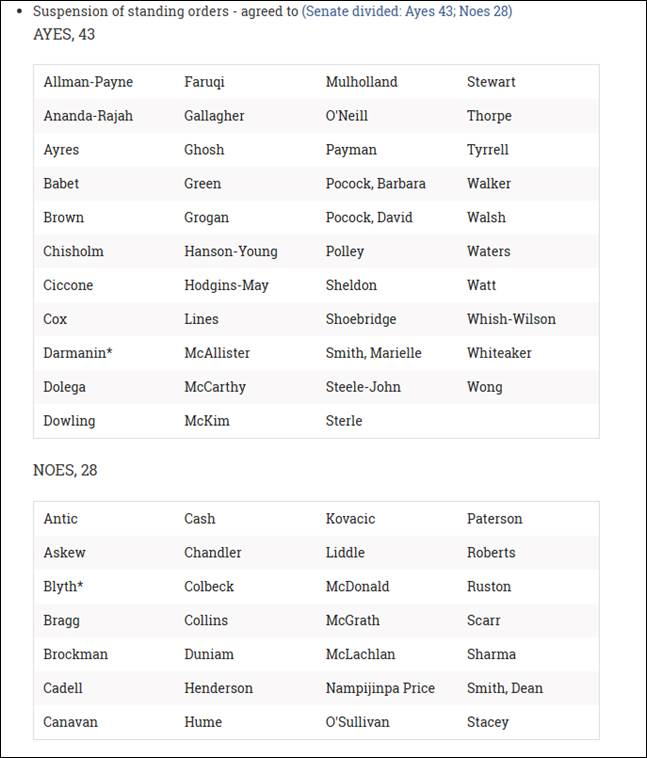
In the Senate Senator Payman just moved to suspend standing orders to table the names of the 17,000 children killed in Gaza.

The ALP and Greens supported the motions, the LNP opposed. Here are their names of the Senators and how they voted for posterity.

Question time ends – what did we learn?

And it ends.  Finally.

What did we learn there?

The Coalition still don’t know where they are going, so they are going through the back catalogue – aged care and Medicare.  Nothing wrong there, and there should be more focus on services people deal with every day, but there was no actual point to the Coalition’s question strategy and certainly no goal, so it didn’t go anywhere.

Once again the crossbench went for meaty issues -climate and sanctions on Israel, which the government doesn’t have answers for.  But there will be no cohesiveness there, because the Coalition are a bigger mess than me on a Sunday morning after a Saturday night at The Beat when it comes to climate policy, and couldn’t serve up a proper question on that if they were drafted.

And when it comes to Israel, well Michaelia Cash is still putting out statements claiming BUT HAMAS whenever someone points out one of Israel’s multitude of plausible war crimes, so good luck there.

That means that the government gets away with the least they can do.

Greg Jericho
Chief Economist

Madeline King replied to a question from Greens MP Elizabeth Watson-Brown, asking “Will the Government stand up to coal and gas corporations and phase-out these dangerous fossil fuels thatare supercharging the climate”

Madeliene King stood up for gas and coal and in her answer waffled on about how vital gas is for us, but that we will get to net zero easily due to our advantages of renewables but that “That is not the case for our friends in Japan and Korea and countries like them where they simply do not have those abundance renewable resources. So in the meantime we will support them through our export industry and that will be what is really important part of Australia’s participation in regional energy security.”

This however is total bunkum.

Earlier this year at the Climate Integrity Summit, Yuki Tanabe, a Program Co-ordinator from Japan Center for a Sustainable Environment and Society spoke on the topic and exposed the myth that Japan’s energy security depends on Australian LNG imports and reveals that the energy “security” narrative by policymakers serves commercial interests rather than reflecting genuine energy vulnerability or regional instability. Far from addressing regional concerns in good faith, Australia’s efforts to justify and perpetuate Australia’s fossil fuel exports, undermine regional decarbonisation and human security.

Elizabeth Watson-Brown asks whether Australia will sanction Israel like it has Russia:

Your government has placed over 14,000 sanctions against Russian individuals and entities. As well as sanctioning trade with Russia for the invasion of Ukraine. Netanyahu’s genocidal assault on Palestine now means that more than two people that 2 million people are at risk of starvation, will you commit to applying equivalent sanctions to Israel as you imposed on Russia?


Anthony Albanese takes a breath and then gets up:

I thank the member for her question and of course you do not sanction a state, you sanction individuals and my government has sanctioned individuals, we have sanctioned the Minister for national security and we have sanctioned the Minister for Finance.

We have done so in part to some of the comments that have been made by them as ministers, people who were on the fringes of the Israeli politics but are now a part of the Netanyahu government.

The Minister for national security said this on the 27 July: ‘The only thing that should be sending to Gaza shells to bomb, conquer, immigration and win the war’.

That is what they had to say. The range of comments that have been made including by a soldier who killed a young Palestinian boy are reprehensible, the comments of the Minister for Finance were, he said ‘Gaza will be totally destroyed, the  Palestinian population will leave in great numbers to third countries’.

On the 6 May he said… ‘We need to eliminate the problem of Gaza’. The 5 February he said,’ we have to work to promptly bury the dangerous idea of a Palestinian state’.

We do not take … these issues lightly. And what we do not do also is try to secure some domestic political advantage and damage social cohesion in this country. Through some of the actions which frankly some of the Greens political party actions have done.

What we do is act in principle why in a way is consistent.

We condemn Hamas for their actions and we condemn what is occurring in Gaza in breach of international law. (By who?  Who is breaching international law in Gaza? Is it Israel?!)

That is the way that responsible adult governments act, it is a way that middle powers can have influence. That is the way we can have a constructive role and what I want to see which is an and to killing whether it is of Israelis or Palestinians.

And I want to see the creation of a two state solution where both Israelis and Palestinians can live in peace and prosperity and security and will continue to work with other leaders around the world of like-minded countries with the objective of that.

I do say that Australians want to see, they want innocent people to stop losing their lives, the second thing they want and I say this directly to the member at her party, is they do not want conflict brought here in order to secure some sort of Potters and political advantage and they also do not want the agency of those people who are responsible for wrongdoing to be dismissed by suggestions which are said simply untrue and to gain a short-term domestic political advantage. (I think he is referring to the outrageous claim by Israel repeated in the Australian press that there is no starvation happening in Gaza)

I’m a friend of Israel and I’m a friend of the Palestinian people. That overwhelmingly has been the position of Australia for a long period of time. With our bipartisan support for a two state solution, I will continue to do what I can as Australia’s prime minister to achieve that.


OK, but we have all moved beyond the ‘political gain’ argument here.  There is nothing to gain from calling for action against a genocide.  There is something to gain from seeing your government properly stand up against one though. 

Sigh


Greg Jericho
Chief Economist

The Minister for Climate Change, Chris Bowen, was asked by Zali Steggall about the government’s emissions target.

She rightly asked “the ICJ has confirmed nations have a legal obligation to prevent climate harm and productivity and economy has been battered by success of climate fuelled events, despite this the government ‘s defining action so far as to recklessly accelerate warming by approving new gas extraction to 2070, this negates any other policy, minimum target of 75% by 2035 of methane abatement is urgently needed, will you be ambitious?”

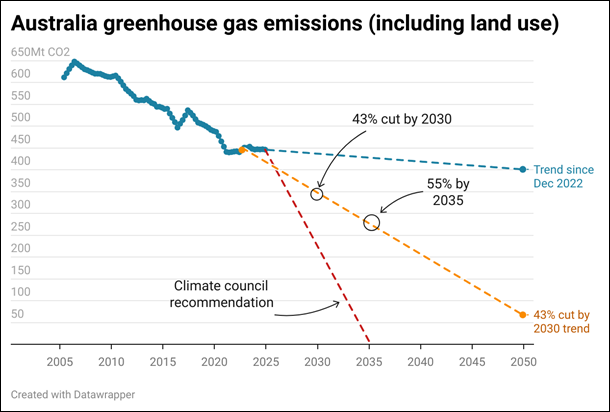
She is referring to the Climate Council, which has stated that “The science is clear. To do our fair share to hold global warming to well below 2°C, Australia needs to reduce climate pollution to 75% below 2005 levels by 2030, and reach net zero by 2035.” And that the CSIRO “pathway to reduce emissions by 75% on 2005 levels by 2035 and reach net zero by 2040. Under this scenario, average real GDP growth from 2020 to 2050 would only be 0.03 percentage points lower than the net zero by 2050 scenario, a cost significantly less than the economic, social and health benefits of cutting emissions.”

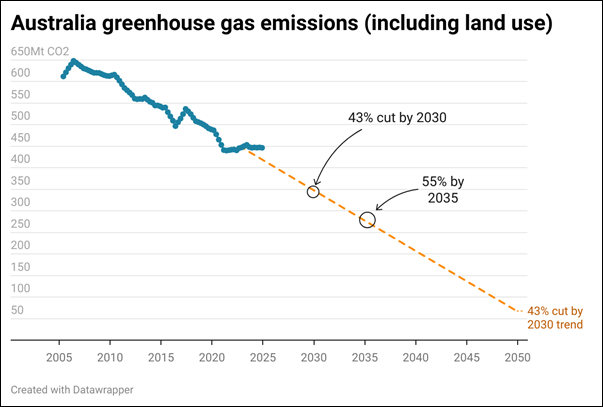
So the Climate Council says we should aim for net zero by 2035 but at least (AT LEAST!!!) net zero by 2040 and 75% cut below 2005 levels by 2035.

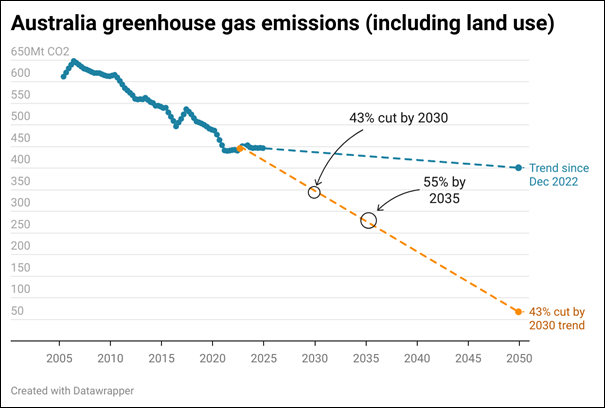
Back in September 2022 the government introduced a target of 47% cut by 2030 – if we continued that out to 2035 we get to a 55% cut target, and it almost would get us to net zero by 2050

The problem, as you can see is we are not on the way to even the 47% cut. Instead since the end of 2022 we are going the wrong way:

But even worse is that we are not even close to the 75% cut by 2035 and net zero by 2040 (let alone 2035)

In his answer Chris Bowen said “it is very important a target be able to be achieved, it is not a useful contribution to the debate to set a target without outlining how the country can actually achieve that target. Yes, ambition is very important but so is achievability”.

That suggests this government when it releases its 2035 target will not even be setting a target of the very least we can do given the science, but instead will be a target that will do very little to alter the current trend.

Greens MP Elizabeth Watson-Brown asks:

Australia is the world’s second biggest exporter of global emissions after Russia, last week the International Court of Justice made it clear that Australia has international legal responsibility for its fossil fuel production, regardless of where the coal or gas is ultimately burned. Will the Government stand up to coal and gas corporations and phase-out these dangerous fossil fuels that are supercharging the climate?

Madeleine King takes this one:

I would just like to point out the importance of Australia’s role in the regional energy security. This is something that is perhaps not as well understood as it could be or even should be. Australia-India does export gas and it does export coal, comment also exports iron ore, Exmouth Gulf, explores lithium, exports a great many things that are essential to our economy and, indeed, the three greatest exports of this country are iron ore, coal, and gas, which are to prosperity, support regional communities, which people on this side of the house do, as you do people on the other side. It will remain integral to the economy for many years to come and it will remain very important to hundreds of thousands of families around this country as the breadwinners and sometimes their partners go and participate in this industry, whether it be in fly-in fly-out communities or drive-in, drive out communities right around the country

Watson-Brown asks about relevance and Milton Dick says she is being relevant.

King continues:

In relation to gas, it will remain a very important part of Australia’s economy for some time to come. You will have seen and everyone in this house will have seen a future gas strategy which the Government will pursue. It’s an important part of our role in not only providing fuel and security to Australians and Australian industry, but equally for ensuring we play our role in helping to provide the energy security for the region* and, I might add, that countries in this region, Japan, Korea, and many others adopted net zero targets well before this country did, well before those opposite when they were in government eventually sort of got there and now of course they’re trying to move back from that, but nonetheless this government on this side is committed to net zero emissions, just like the Government of Japan, like the Government of Korea is and many others. And the ALbanese government feels that we export to those communities will be really important part of their transition. Transition pathways are going to be different for every country. In Australia we will be able to transition more quickly because of the natural resources available to us through wind and solar. The vast basis we have enable that. That is not the case for our friends in Japan and Korea and countries like them where they simply do not have those abundance renewable resources**. So in the meantime we will support them through our export industry and that will be what is really important part of Australia’s participation in regional energy security.

*And here is the great news – we can actually do that without opening up new gas fields! ISN’T THAT GREAT? We can meet our contracts, serve our domestic needs and actually uphold our responsibilities to emissions reduction – actual emissions reduction, rather than accounting tricks – if we just acted now.

**Lol. Japan is literally building a gas empire of its own from our gas. They are on-selling our gas to other Asian nations, because they take more than they need for their domestic needs and then on-sell enough to create a whole industry out of it. And South Korea is getting in on the action through ship building.

SIGGGGGHHHHHH

OMG this is soooooooooooooo boring.

How has the Coalition managed to run out of steam just four question times in?

There is PLENTY to criticise this government on (I mean I do it every day, and not even when I’m being paid) and yet the Coalition somehow has run out of actual issues to hit the government with after less than four hours of questions.

THIS IS WHY I MAINLINE SUGAR.

OOOOOOOOOoooooohhhh Dan Tehan pushes Dugald Dick too far with made up points of order and gets BOOTED under 94A

Zali Steggall has the question call:

Young people around the world want a say in the world the environment they will inherit, the ICJ has confirmed nations have a legal obligation to prevent climate harm and productivity and economy has been battered by success of climate fuelled events, despite this the government ‘s defining action so far as to recklessly accelerate warming by approving new gas extraction to 2070, this negates any other policy, minimum target of 75 by 35 of methane abatement is urgently needed, will you be ambitious?

Chris Bowen:

I thank the Honourable Member for question. And her position is very well-established in the crossbench have been strong with their views, and this Government we set our targets following a very rigourous process which is outlined by the Climate Change Act, to be fair, which members on the crossbench voted for, the act outlines the worlds best practice for setting a target, the government receives a price from the Climate Change Authority considers the economic impact and the science and how that target might be achieved, then announces the target.

We are together with the UK they are taking a very similar approach, the target the government sets will be two things – it will be importantly achievable, I say to honourable members as I have said elsewhere is very important a target be able to be achieved, it is not a useful contribution to the debate to set a target without outlining how the country can actually achieve that target.

Yes, ambition is very important but so is achievability, both those will be reflected in the target the government announces following the receipt of the Climate Change Authority advice we have not yet received and we will follow the rigourous process is outlined in the Climate Change Act.

Ooohhhhh that sound you hear is Grog’s fingers pounding the keyboard as he furiously types out a response to that guff.

In the absence of Ted O’Brien/Steven Hamilton (O’Brien’s chief of staff and one of those economists who always had a lot to say) asking him another question about unemployment (still shaking our heads at that one given the Coalition’s record) Jim Chalmers gets in with his own dixer ahead of tomorrow’s inflation figures:

This progress has given the Reserve Bank the confidence to cut interest rates twice already this year, and the Reserve Bank Governor has said more rate relief is a question of timing not a question of direction.

Underlying inflation in our economy is already half or almost half what we inherited. In headline inflation number tomorrow with a two in front of it will confirm that we have been in the Reserve Bank target band for a full year, Mr Speaker.

Unlike other countries, we have made this progress on inflation without paying for it substantially higher unemployment. In fact, this Government has been able to get inflation down while presiding over the lowest average unemployment rate in the last half-century.

No major advanced economy has achieved what Australia has, inflation in the low twos, unemployment and the no low fours and three years of continuous economic growth.

While inflation has been coming down in Australia, it has been going up in the US, Canada, and New Zealand. So inflation is down, real wages are growing again, unemployment is low, we have delivered two surpluses and got the debt down and interest rates have come down twice already this year. We know there is more work to do. We know the global environment is uncertain, and there are persistent structural issues in our economy, we know people are still under pressure. That’s why we are rolling out more cost-of-living relief this month, it is why we are legislating help the student debt this week, and it is why responsible economic management has been and will continue to be a defining feature of this Albanese Labor Government.

Still not addressing people living under the poverty line though, or increasing the Jobseeker rate to something people could live on with dignity.

Why are we seeing more small business insolvencies? Well covid support measures have been wound up

Matt Grudnoff
Senior Economist

The opposition have asked about the increase in small business insolvencies. They are saying that small business has been abandoned by the government.

But the Reserve Bank looked into this issue and found it had more to do with the winding back of pandemic era support measures. During the pandemic insolvencies were exceptionally low. The recent increase in insolvencies on a cumulative basis remain slightly below the pre-pandemic trend.

Basically, policies during the pandemic supported businesses and meant that very few of them went insolvent. Far less than you would expect during a recession, but even much less than would be expected in normal economic times. Some of the businesses that were protected by these policies would have gone insolvent with or without the pandemic. The support measures only delayed the inevitable.

Now that the support measures have been wound back, we’re seeing a catch up in insolvencies

Pat Congahan gets a question:

This governments economic mismanagement is delivered a record number of small business insolvencies that now doubled the levels seen since 2020 and 34,000 job losses in the last quarter alone. Will the Minister admit this government’s economic agenda has failed small business?

The minister for small business, Anne Aly is up and READY:

I thank you member opposite for his question because it gives me an opportunity to really talk about small business, something they are passionate about and something the members on this side of the chamber are passionate about as well.

As I said yesterday small businesses operate across the country. They are everyone from your Indian grocer, your local Indian grocer, your hairdresser, to the place you go to to get your lunch. And I’m pleased to report, Mr Speaker, that there are, since we took office, since Albanese led the Government took office in 2022, there are 800,000 more – 800,000 new small businesses operating right across Australia since we took office, Mr Speaker. 800,000 more.

And they comprise of a female lead businesses, 35, around 35% are female led. Around 40%, on average, are led by migrants, people who are aspirational, who come to this country, and Hersi starting a small business as a way of making a life for themselves and for their families. Small businesses employ more than 5 million Australians and they contribute more than $590 billion to our nation’s economy every single year. I’ll remind the member opposite that this is the Government that last term introduced the very first national small business strategy, which guides the ways in which we will work with state and local governments to address those issues for small business.

There is a point of order that is not a point of order and Aly continues on the same theme.

Sussan Ley is back: ‘Prime Minister, how many Australians today are using their credit card to see a GP?’

Anthony Albanese:

The answer to that, Mr Speaker, is because of those opposite and the undermining of the health system – too many is the answer, too many.

Which is why we want 90% by 2030 to just use this little card here.

This little card. This piece of Green and Gold plastic, Mr Speaker. Yes.

Dick tells Albanese to put his Medicare card away and look after it.

Albanese:

I will Mr Speaker, I will. Because it is valuable . It is valuable. And everyone of this house values their Medicare card and I’ll tell you what, Mr Speaker, every Australian values their Medicare card as well. Except perhaps some of those over there. Except perhaps some of them over there. Now, you can imagine the tactics committee meeting this morning, Mr Speaker, sitting around going I know where they are vulnerable – Medicare.

We think there is a bit out there in the community, Mr Speaker, about their attitude towards public healthcare, because they never want to talk about it, they never raise it, I mean, has the Prime Minister got a Medicare card? That’s why I brought it in, to confirm that that is the case, Mr Speaker. But I’d tell you, the 1.5 million Australians that have been to not 50 but 87 urgent care clinics, all they have needed is their Medicare card.

And one-third of those, one-third of those have been under the age of 15.

Factcheck: Bulkbilling rates

Matt Grudnoff

The Coalition have focused on the government’s election promise to lift bulk billing rates to 90% by 2030. This is not surprising. There have been a number of groups that have cast doubt on whether this is possible with the funding that the government has offered.

This is not to say that it won’t work. The doubts could be part of a negotiating tactic to try and convince the government to shell out more money.

The Coalition wants to keep the promise in the public eye in case rates don’t rise to 90% and the government falls short. Perhaps they’re hoping that this will turn into something similar to when Labor promised to reduce electricity bills by $275.

But Australians can at least be happy that parliament is focused on lifting bulk billing rates and the government has committed to a target.

Melissa McIntosh asks Anthony Albanese the same sort of question about whether someone going to the doctor only needs their Medicare card, asking “my question is to the Prime Minister, “on February 28 the Prime Minister promised Australians that to see a GP all they would need was their Medicare card, not to their credit card. Is that still the Prime Minister ‘s position?”

Albanese gives much the same answer and then McIntosh goes to ask a point of order and is warned by Milton Dick that the PM is being relevant, so to be careful in her point of order. She goes there anyway (which is her right) and Dick internalises a sigh that can be heard in Tasmania.

Dick:

You would like a direct answer to that, Member for Lindsay you would like a yes or no? Right? Well, well, order stop no. It’s the same thing I can’t help you with that because the Standing Orders don’t let me direct the Prime Minister to answer the question how you would like it to be answered. If the Prime Minister is reading the statement about that and not talk about anything else he is being relevant. I may follow I have a list of them, leader of opposition about all speakers who have refused to take points of order, we can go through that list at this point I’m giving everybody a fair warning unless it is about the person not being on topic, not because you don’t like the answer, I will start to not take the points of order. While the Prime Minister is giving direct answers I want everyone to be crystal clear moving forward.

Allegra Spender asks Richard Marles:

My question is for the Deputy Prime Minister, last week the US Navy told Congress that submarine production continues to be around half the level needed for the US to be able to supply Virginia class submarines to Australia by 2032. Given the real risk the US won’t be able to double its production in time, what is the government ‘s alternative plan to ensure Australia has the capability it needs, and if we don’t have an alternative plan, why not?

Marles:

When we signed the optimal pathway with the United States and the United Kingdom we were aware of the challenges of US production and sustainment of Virginia and the need to lift that production to see more Virginias in the water for the US Navy in order to create the space whereby Australian would be able to acquire Virginia class submarines from the US in early 2030s, as part of pathway to Australia acquiring a nuclear powered submarine capability.

To put that in context, what we saw going back and forth in terms of the way in which the Coalition were managing our Future Submarine acquisition in the decade that they were in power, left us with a capability gap, which is being filled by the acquisition of those Virginia class submarines, and the early 2030s.

It goes to the very question of what a former Member for Wentworth often talks about is whether or not there should be a plan B, the former Member was part of what was going on with the Coalition is one of the three prime ministers as part of that Government.

The issue with that Government then was they were completely focused and obsessed with the plan B, they were in and out of the deal with Japan, then in and out of a deal with France, and it was – the better part of the entirety of their Government, before they ended up settling on the arrangement that is Aukus.

As a challenge measured over the decades, if you are focused on a plan B, and there is always a chopping and changing, that is not a decision to walk down the path of plan B, that is a decision not to have a capability at all. Unless you stick to a plan for longer than a couple of years, which the Coalition were unable to do which the former Member for Wentworth was unable to do you don’t get a capability at all.

Before there can be a point of order, Richard Marles decides he has completed his answer.

We continue the death to dixers campaign.

Sussan Ley moves on to Medicare. It’s almost as if the Coalition has remembered there are public services they could be advocating for!

On 28 February the Prime Minister told Australians, “Under Labor all you’ll need to see a GP is your Medicare card, not your credit card.” But on TV this morning the Health Minister said, “We never said there would be 100% bowl willing.” Prime Minister, how many Australians have had to use their credit card to see a GP since the day you promised they wouldn’t need to.

Albanese:

I’m absolutely delighted to talk about Medicare, Mr Speaker. Because what the member opposite has said is to quote us at the Launceston launch in the electorate of Bass when we launched our tripling of the bolt billing incentive for all, for all Australians. Now, that followed our previous budget where we tripled the bulk billing incentive for concession cardholders that has resulted in 90% of those concession cardholders seeing a doctor for free with bulk billing.

There are many interjections from the Coalition. Milton Dick is still trying to pretend he can wrangle the chamber into some sort of decorum and tells everyone to shut it.

Albanese:

So, this a .5 billion-dollar investment in Medicare, which we said at the time would lift bulk billing rates for every patient to 90% by 2030, cutting costs for Australians, improving care, and supporting GPs. That’s the policy that we announced. And you might remember, Mr Speaker, that before I’d finished that speech in the electorate of Bass, within our member of us introducing us there

Ley has a point of order that is not a point of order and Dick reminds here again to stop abusing the point of orders. Honestly you can set a clock to this stuff.

Albanese continues:

You may well recall, Mr Speaker, the policy being matched almost before I’d finished my speech. And at the time, at the time we put our written documentation, we had costed policies, Mr Speaker, I’m not surprised that the Opposition don’t recognise this territory, but we had costed policies of a $.5 billion to deliver, to lift bulk billing rates to 90% by 2030.

The timeline hasn’t changed, the investment is unchanged, the modelling is the same. The question is has the Coalition change their position? Because when I made the announcement on the dates that the member suggested of course they said that they would back it and now it appears that they don’t back it.

Now it appears they don’t support it, which isn’t surprising given that when they came into office last time, as we reminded people once or twice during the election campaign, they tried to abolish bulk billing altogether by introducing a Medicare co-payments. In one of the big differences in this chamber is that we on the side value Medicare, those on that side are led by someone who said if you don’t pay for it you don’t value it.

If you don’t pay for it, you don’t value it. Well, we value Medicare, we will defend Medicare, and they will always undermine it.

Question time begins

We are straight into it today.

Sussan Ley opens on aged care:

In much 2022 there was 60,000 Australians on the homecare package waitlist. The now Health Minister said that waitlist was “a national disgrace”. But, Prime Minister, under Labor the homecare package waitlist has skyrocketed, with more than 87,000 Australians now waiting. If a waitlist of 60,000 was a national disgrace, what words describe Labor’s crisis of more than 87,000 today?

Anthony Albanese:

I will ask the Minister to supplement, but can I say this, we introduced and passed through this parliament on a bipartisan basis the most significant reforms to aged care this century. We did that just last year and we did that after a royal commission described aged care in one word in its interim report, and that one word was “Neglect”. In one word. When we went to the 2022 election than we would put the nurses back in to a nursing home we were mocked by those opposite. Today 99% of the time there is a nurse in an aged care facility.

Mark Butler then steps up:

Over the last five years we have as a country pretty much doubled the number of homecare packages in the system from about 150,000 to little more than 300,000 and we will need to continue increasing as homecare package numbers vary significantly for really as long as any of us are in this parliament.

Because the oldest of the baby boomers, we know, are hitting the age of entry to the homecare package system and will hit the average age of entry into the residential ecosystem, which is why we particularly under the leadership of former minister wills in this area had to compress pretty much a decade of reform into just three years. Not helped of course, by the budget cuts that the Opposition Leader initiated as the Minister for Aged Care hrough the 2016 MYEFO that actually took money out of aged care, didn’t reform but resounded to general revenue, obviously contributing to the situation that led to the royal commission in the first place

Power-sharing discussions continue in Tasmania with seat count soon to be settled 

Bill Browne

On the night of the Tasmanian election earlier this month, it was clear that Tasmanians had elected a parliament where no one party holds a majority of the seats. But the exact make-up of those seats is still not known. Today is the last day they are collecting postal votes, so the full count will soon begin.  

The ABC’s Casey Briggs has a personal blog where he’s explained what’s going on.  

In short: there’s two seats where a couple of different parties are in the running. 

There’s also seats where the winning party is known, but not which candidate from that party will win.  

That ability to choose between candidates is one of the great strengths of Tasmania’s “Hare-Clark” electoral system: candidates compete with others from the same party. Popular, outsider or moderate candidates can get elected over the top of whichever candidate the party machine might prefer. 

Negotiations in a power-sharing parliament 

But even before the seats are settled, there’s discussion about who will form government – and what they will negotiate. Both Liberal Premier Jeremy Rockliff and Labor Opposition Leader Dean Winter have a path to power.  

Psephologist Kevin Bonham spotted that the Liberals are now running ads attacking Labor for (in the Liberal Party’s words) “doing a deal with the Greens” that will “destroy our economy and cost jobs”.  

But as the Australia Institute’s polling research found, most Tasmanians agreed that if the Labor Party is not elected in its own right, Labor should seek to form a government by working with the Greens and independents.   

Kate Crowley writes in Inside Story about the national trends and local factors that form the context for negotiations. She quotes the Australia Institute’s research on the 25 power-sharing governments that have formed in Australia since 1989:  

Analysing the twenty-five power-sharing governments at the state and territory level since 1989, the Australia Institute finds that they vary markedly, take time to negotiate, and typically result in the crossbench pursuing resources, reforms and occasionally ministries.  

They are usually based on formal agreements, involve the crossbench sponsoring legislation, and run full term.  

Such governments may follow elections, or form after a government loses its majority. Just as we see in Europe, it may not be the party with the highest vote that is able to form government. 

Greg Barns, a former Liberal Party advisor, describes the reforms this research highlights as ‘sensible’, including on environment, evidence-based drug law reform, and human rights protections. His opinion piece in the Hobart Mercury goes on to say:  

A power-sharing arrangement in Tasmania must include a commitment to… reducing corporate welfare, and ending regulatory capture which is most evident in the case of the salmon industry. 

The full research is, as always, freely available on our website.  

Why are people discouraged from looking for work?

Greg Jericho
Chief Economist

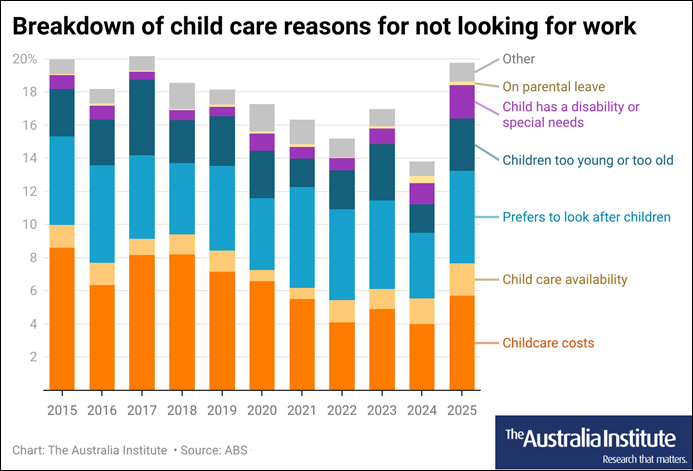
The ABS has surveyed discouraged job seekers since 2015, so we now have a decade of data on why people are not looking for work.

Overall childcare saw a big jump in the reason – up from 14% of the reason to 20% (this for both men and women)

Not surprisingly the biggest reasons for not looking for work due to caring for children is the cost of childcare. The good news is this is issue is much less of a concern than it used to be. In 2015,8.5% of people said the reason they were not looking for work was the cost of child care meant they had to stay home and take care of their child(ren); now it is just 5.7% of all people.

The problem though is that is a jump from 4% last year.

But that is not the only reason for the increase in child care being the reason that people are not looking for work. Last year, 4% of people said they were not looking for work because they preferred to stay home and care for their children (ie they chose not to send them to daycare); this year that rose to 5.6%.

Put Russian-style sanctions on Israel says David Shoebridge

Greens senator David Shoebridge said there is nothing stopping the Albanese government from putting the same sort of sanctions it has put on Russia, on Israel, for what it is doing to Palestine.

Shoebridge:

For too long, the Albanese Government has refused to act, and placed no pressure on the Israeli Government to end the genocide.  

We know what action looks like, we have seen it done before. We need to see it again. There is mass starvation in Gaza, and thousands of children are hours away from death. Inaction was never an option; it is not now.”

It is good that after two years of denial, the Albanese government is now acknowledging the horror occurring in front of our eyes. The Prime Minister must now impose sanctions, follow the words with action and end the two-way arms trade.

The Albanese Government’s position that there is nothing it can do to put pressure on the Israeli Government is a weak attempt to distract the public from its complicity. 

The Albanese Government will claim they are waiting for other countries to act so they can follow, but the Albanese Government has failed to impose sanctions on Israel to the level of other countries. 

Despite the spin from the Albanese Government, it is not in dispute that the Government has allowed weapons and weapon parts from Australia to be sent to Israel. Parts of the F-35 fighter jet were exported this month, and the Canberra-made R400 remote weapon system was used in Israel early this year. 

We stopped the arms trade with Russia. We can do the same with Israel,” Senator Shoebridge said. 
 

Meanwhile, Labor has wrapped up debate on the early childcare legislation in the house and passed it, meaning it is off to the senate where the negotiations will start.

First successful prosecution for National Anti-Corruption Commission

Bill Browne

The National Anti-Corruption Commission has had its first successful prosecution – a corrupt Western Sydney Airport official who attempted to solicit a $200,000 bribe was sentenced today to two years jail (served in the community).

There have been earlier successful prosecutions, but these were taken over from the NACC’s predecessor the Australian Commission for Law Enforcement Integrity (which was much more limited in scope).

While it’s good to see some corrupt conduct rooted out and punished, the NACC has not yet shone a light on some of the major scandals that helped spur its creation. It may be investigating these, but without public hearings we simply don’t know.

When the Albanese Labor Government set up the NACC in the last term of parliament, it watered down the NACC’s power to hold public hearings to only “in exceptional circumstances”.

Most Australians say that the NACC should be able to hold public hearings whenever they are in the public interest.

Israel’s claims there is no starvation in Gaza “beyond comprehension” – Albanese

AAP

Anthony Albanese has strongly rejected Israel’s claims that there’s no starvation in Gaza as “beyond comprehension”.

The prime minister was responding to statements made by his counterpart Benjamin Netanyahu, and Israel’s deputy ambassador to Australia, during a Labor caucus meeting on Tuesday.

“While there is a caveat on any health information which is provided by Hamas, it is Israel that has prevented journalists from getting in,” he told the meeting in Canberra.

It comes after Mr Albanese on Friday declared Israel’s retaliation in Gaza following the October 7 attack on the nation state by Hamas had “gone beyond the world’s worst fears”.

Then on Sunday, he warned Israel had “quite clearly” breached international law by limiting food deliveries to starving civilians in Gaza, escalating his criticism of the Jewish state.

The prime minister spoke of his emotional response to images of gaunt and dying children in the Palestinian territory, while acknowledging increased airdrops of aid by Israel was “a start”.

“It just breaks your heart,” he told ABC’s Insiders on Sunday. 

Overnight on Monday, US President Donald Trump contradicted the Israeli prime minister by stating many people were starving in the Gaza Strip and suggested more could be done to improve humanitarian access.

Mr Netanyahu has said “there is no starvation in Gaza, no policy of starvation in Gaza …”

Israel’s deputy ambassador to Australia Amir Meron told journalists on Monday “we don’t recognise any famine or any starvation in the Gaza Strip”.

The number of Palestinians believed to have been killed is nearing 60,000 people, according to local health authorities.

While air drops of aid have been carried out into Gaza, humanitarian agencies say they aren’t enough to deal with worsening levels of starvation in the area.

Naima Abu Ful poses with her 2-year-old malnourished child, Yazan
Anthony Albanese says images of starving children in Gaza were heartbreaking. (AP PHOTO)

At the caucus meeting, Mr Albanese was also asked about Palestinian statehood.

He referenced a Nelson Mandela quote, saying “it always seems impossible until it’s done”.

The prime minister has previously said any resolution on the issue would need to guarantee that Hamas, the de facto ruling authority in Gaza, which Australia has designated a terrorist group, plays no part in the future nation.

There would also need to be agreements on the rebuilding of Gaza and the West Bank, and a resolution of issues over the expansion of Israeli settlements.

Recognition of Palestinian statehood has been part of Labor’s national platform since 2018.

Labor is facing intensifying pressure to follow France in recognising a Palestinian state at a United Nations General Assembly meeting in September.

The Greens are calling on the government to impose the same sanctions on Israel as it had done so for Russia.

The minor party is also seeking a ban on buying items that can help fund the war, pointing to sanctions on pearls and truffles for Russia.

It has been a bit of a morning, so take a little bit of time to stare at a wall or have a little treat.

Bit of you time. We will be right back with what you need to know.

Discouraged jobseekers

Greg Jericho
Chief Economist

Today the ABS released its most recent survey of people outside the labour force.

To be in the labour force you have to be either employed or unemployed. Simple enough, but to be unemployed you have to be actively looking for work in the past 4 weeks. If you are not actively looking for work it means you are outside the labour force.

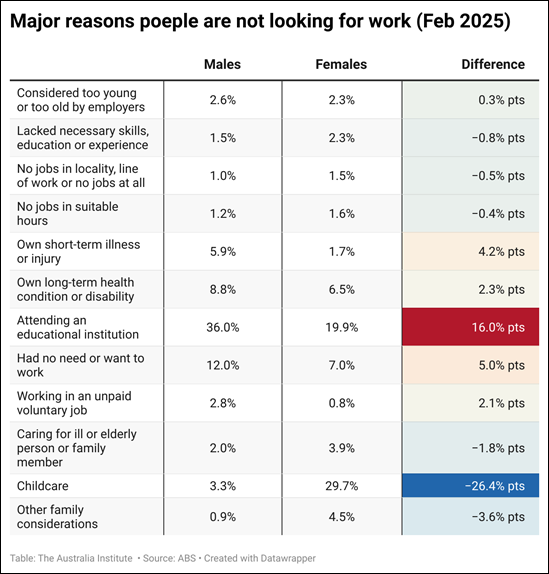
What the ABS has done is ask people what is their main reason for not looking for work. And thankfully they have divided the answer by men and women, which gives some pretty nice insight.

For men, the main reason they are not looking for work is education (either school or Uni/TAFE etc), and second is “had no need or want to work”. That is mostly retirees.

For women though the number 12 reason was Childcare. 30% of women gave that as the reason, compared to just 3% of men.

Plenty of people with a focus on climate today, as Chris Bowen meets with the UN climate chief, Simon Stiell to discuss Australia’s 2035 target. The Climate Change Authority, headed up by Matt Kean, is finalising its advice to the government on what the target should be as you read this.

The independents have a bit to say about it – from their joint release:

Independent MP for Wentworth. Allegra Spender

“Last week’s historic and unanimous ruling from the International Court of Justice confirms that all countries have a legal duty to slash climate pollution and do their utmost to reduce climate harm.

“For Australia, that starts with setting a credible 2035 target and backing it with real plans to limit warning to the Paris Agreement goal of 1.5 degrees, or at most 2 degrees.

“The Climate Change Authority has said that reducing emissions by up to 75% by 2035 is ambitious but achievable for Australia. This is the kind of ambition we need to see from the government.”

Independent MP for Warringah, Zali Steggall

“Australia must step up with a strong climate target of at least 75 per cent emissions reduction by 2035. It’s not just good climate policy, it’s smart economic policy and it is our responsibility to future generations.

“We have the resources and technology. What we need now is the political will. Every fraction of a degree matters, and any further delay in mitigating emissions will cost Australians more in responding to climate risks and lost economic opportunities.”

Independent MP for Indi, Helen Haines

“Disadvantaged Australians face greater health risks and cost-of-living pressures from climate change. We must be ambitious in reducing these impacts on our most vulnerable.”

Independent MP for Curtin, Kate Chaney

“This next decade is crucial for the planet and Australia needs to pull its weight.  We should be setting an ambitious 2035 target, to provide the certainty business needs to drive the required investment to set up our economy for decades to come.” 

Independent MP for Bradfield, Nicolette Boele

“A weak 2035 target sells Australia short – on jobs, on climate, and on global influence. After working in clean energy for over three decades, I know this: ambition isn’t a risk – it’s the safest move we can make.”

Independent MP for Kooyong, Monique Ryan

“Climate Council modelling released last week, and backed by the Academy of Sciences, showed that a target 65-75% emissions reduction by 2035 would have us on track to global warming of 2.3-2.4 degrees by 2035- which would have an enormous human and economic toll.

“We must immediately commit to emissions reduction of at least 75% by 2035. To achieve that, we have to stop subsidising fossil fuel industries and commit wholly to decarbonising our economy.”

Independent MP for Mackellar, Sophie Scamps

“The science is clear – net zero by 2035 is the only target that gives us a strong chance of keeping warming below 2°C. Every fraction of a degree of warming avoided means a safer, more liveable future for our kids.

“The Albanese Government has a clear choice: set the strongest possible 2035 target or fail future generations and fall short of the climate leadership Australians expect.”

ACT Independent Senator David Pocock. 

“I’m pushing for an ambitious but achievable minimum of 75% emissions reduction target by 2035 locked into law.

“The science is clear, and the Climate Change Authority says a 65-75% cut by 2035 is within reach. The UK has already committed to 81%.

“We need to aim high and plan for more. That’s why I support an aspirational target of net zero by 2035, with a legislated floor of 75%.”

Reinforcing the importance of penalty and overtime rates important but there’s more work to be done

Lisa Heap
Senior Researcher, Centre for Future Work at the Australia Institute

The Government’s Fair Work Amendment (Protecting Penalty and Overtime Rates) Bill 2025 (the Bill) introduced yesterday includes a modest but important amendment to our workplace laws. This Bill, if passed, would introduce into the Fair Work Act a principle that when making, varying or revoking Modern Awards, the Fair Work Commission must ensure that an employees’ entitlements to penalty rates and overtime payments are not substituted by provisions that would make employees worse off than if they received those penalty rates and/or overtime.

Modern Awards play an important role as they are a safety net in our industrial relations system setting out the minimum pay and conditions for workers. For some workers, particularly women employed in female dominated occupations, or younger workers, the award conditions are all they get.

They don’t have enterprise agreements or contracts that give them higher wages or better conditions. So it’s important to maintain and improve standards in Modern Awards not just as a safety net but also for all of the estimated over 2.6 million workers who are reliant on these awards. A principle in the Act that reinforces that penalty rates and overtime are important and not to be reduced is therefore a good move.

However, the Bill does not impact on how individual flexibility agreement (IFAs) in awards (and agreements) deal with penalty rates and overtime provisions. Awards (and agreements) include provisions that allow IFAs to be entered into that vary award or agreement terms. Recent research from the Fair Work Commission shows that 31% of IFA’s are initiated by the employer. This research also suggests that employers are likely to initiate IFAs at the point of an employee commencing employment (as part of their employment contract). Employer initiated IFAs are most likely to include changes to overtime rates, hours of work and penalty rates.

Now technically an employee is meant to have genuinely agreed to an IFA, and that worker is not meant to be worse off by entering into an IFA. An employee could also terminate an IFA if they wanted. However, given the power dynamics at work how many workers are going to be able to stand up to their employer if the employer initiated the IFA?

So, whilst the modest improvement introduced in the Bill should be supported there is more work to be done to ensure that employees aren’t being disadvantaged and penalty rates and overtime provisions eroded. 

The Coalition have landed on some policy positions. Sussan Ley says the opposition will ‘work constructively’ with the government on childcare and on the HECS/HELP legislation (so will the Greens, so there are a couple of pathways there)

Under the matter of the student debt will, we will not oppose the government ‘s proposal and I want to say this to students today, remember this moment, because Anthony Albanese says life will be easier under him, costs will come down, everything will get cheaper, remember this moment because, when I have spoken to young people across the country, they have talked about escalating costs, in red, electricity, any groceries, in everything a student needs to spend money on, it has been really tough.

I want to highlight underpinning this student debt relief bill has been a massive cost of living crisis for Australia’s students so we will be holding them to account on them without any shadow of a doubt.

But today, we agreed to not oppose the bill as it makes its way through the parliament. We do care about students who are struggling with the cost of living and said we would be positive where we can be an critical where we need to be and Dan Tehan will talk in a moment about the government’s continued train wreck of an energy policy and revelations today about further lack of transparency… I’m sure from the Australian people more and more questions about what is this going to cost.

Greg Jericho

Further to Matt’s note about Adani paying no company tax nor ever being likely to, you might be thinking that cripes, the coal market must have utterly gone to hell. And that would make sense right? After all, climate change is a thing and we should be buying less coal, so prices must be going through the floor? Right?

Yeah. Nah.

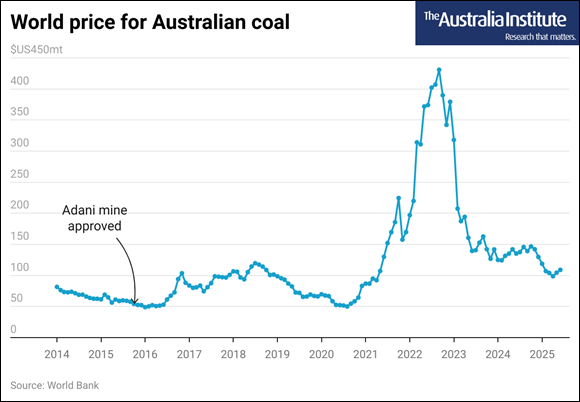
Adani was finally approved in October 2015.

At that time, the world price for Australian coal was US$63.

Since then, it has barely ever been below that price.

Since Dec 2021 when it started shipping coal from the mine, the price has averaged US$201

All those great prices and yet it is unable to turn a profit? Big gas might take the piss, but Big coal ain’t far behind.

The way we tax our resources is extremely stuffed.

Guess what Aukus also includes?

Emma Shortis and Greg Jericho

Last week on Thursday a little Bill was introduced to Parliament by the Minister for Veterans’ Affairs and Minister for Defence Personnel, Matt Keogh. It was the Defence Housing Australia Amendment Bill 2025. I know not a thrilling title, but given the housing crisis in Australia it deserves a bit of attention.

It got some coverage by The Canberra Times because Defence Housing is very much a big thing in Canberra with all the ADF people here.

The Bill expands the purpose of Defence Housing Australia. This should be a very good thing. As the Institute’s executive Director, Richard Denniss, has often said, we have Defence Housing Australia, why not Nurses Housing Australia, Teachers Housing Australia… or just Housing Australia?

So is DHA going to be expanded to give more Australians more housing? Nope.

Is it going to be expanded to give more Australian defence personnel more housing? Nope.

The Bill is actually designed to expand Defence Housing Australia to house defence personnel… from foreign countries, particularly those we are giving stonks of money to for AUKUS.

Yep, we are going to make sure we can house American and UK military personnel.

The Explanatory Memorandum of the Bill makes it all clear: DHA will now include:

  1. persons who provide goods or services or who facilitate engagement in activities with or for the Australian Defence Force and the Department of Defence
  2. members of a military organisation of a foreign country;
  3. officials and employees of a government body of a foreign country;
  4. contractors engaged by a military organisation of a foreign country or a government body of a foreign country, including their subcontractors

What is the purpose of these changes? The memorandum states that “this Bill will ensure that the US and UK personnel have an equivalent standard of housing and support while they are in Australia.”

How nice for them!

The changes just show that actually Defence Force Housing can be expanded. The government can play an active role in providing housing.

But it is all very much in keeping with the spirit of AUKUS that these changes will benefit those from the “UK” and the “US”, and not anyone associated with “A”.

Matt Grudnoff
Senior Researcher

Remember the Adani Carmichael coal mine and all the controversy that went with it? Remember how it was going to fund schools and hospitals with all the tax it was going to pay?

Well, it has been operating for 3 years and has paid no company tax and is unlikely to ever pay any.

In the year ending 30 March 2025, it made $1.3 billion in revenue but reported a loss. This was in large part because of annual payments to related parties for interest, lease expenses, as well as paying for services conducted by other Adani entitles.

Resource projects love to spruik all the economic benefits before they get approval. But there is nothing holding them to delivering those benefits.

LNP Senator Matt Canavan, one of the mine’s biggest proponents, is in the news today with claims about the high cost of net zero. Maybe the media should be asking him when Adani is going to start paying all that tax.

This mine is bad for the environment. It has now become clear that it is bad for government budgets and ultimately bad for the people of Queensland.

Monique Ryan also spoke at that press conference:

So many Australians in the last few months have opened their gas and electricity bills and just emitted a squeal of horror. We are paying far too much for electricity and gas in this country.

We’re repeatedly told by the government and by the gas industry that we need more gas facilities. It’s not true.

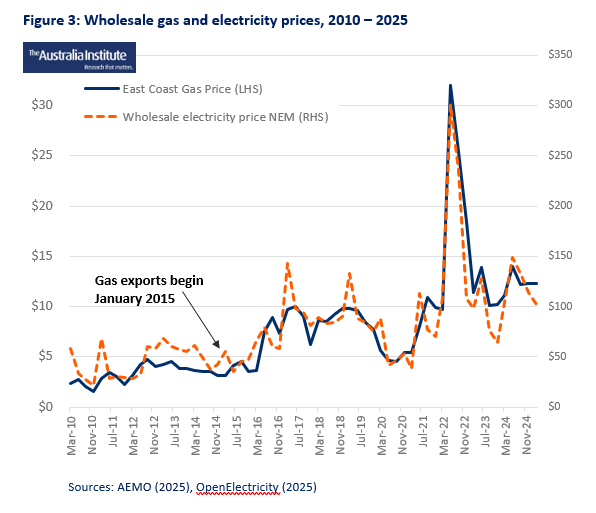
The east coast of Australia is swimming in gas. We use more gas preparing our gas for export than we do on the east coast of Australia. We are paying high prices for gas and electricity because of decades of policy failure by governments and by because of gouging by the gas industry. 

We need to take control of our own domestic gas production. We need to make sure that Australians can access that gas at affordable prices. It’s only reasonable, but we need the government to have the courage to act, to act against multinationals who are gouging us to protect Australians

‘The major parties have sold the Australian people out’ – David Pocock

Returning to the press conference that Mark Ogge, David Pocock, Monique Ryan and Geoff Crittenden, the CEO of Weld Australia, here is some of what Pocock said:

The major parties have sold the Australian people out. They’ve sold us out to big multinationals that are making an absolute fortune off our gas. This is a scam. What is happening is our natural resources are being sold off, given away, shipped off overseas. 

And we’re not seeing the benefit of that. We’re paying international prices for our own gas, and we’re not even getting a return through things like the party, which the latest forecasts show is actually going to decline. This has to stop.

We need a government with the courage to actually stand up to multinationals and say, we’re going to put Australians first. 

You don’t have to risk sovereign risk. You don’t have to create sovereign risk. You don’t have to, renege on contracts. All you have to do is say UN contracted gas is staying in Australia. It is going to manufacturers, to businesses and to households who are under a huge amount of pressure at the moment. This has to end.

Where the United States wants the AUKUS subs to go

Frank Yuan
Postdoctoral Research Fellow

The AUKUS submarines would tie Australia to a war against China.

As my colleague Dr Emma Shortis pointed out earlier this morning, the nuclear-powered submarines from America would likely come with conditions – if they get produced and sent to Australia at all.

Indeed, both the Trump and the previous Biden Administrations have told us as much. The Trump Administration’s defence official in charge of the AUKUS review, Elbridge Colby, pressured Australia to commit to a war over Taiwan – this came on the same day that Anthony Albanese landed in China. The Biden Administration’s Kurt Campbell, who was responsible for its Asia policy, said in 2023 that “when submarines are provided from the United States to Australia, it’s not like they’re lost”.

In other words, the US expects those submarines to be, effectively, still part of their fleet.

And what do they want to do with them? Those nuclear-powered submarines are they are particularly suitable for one task – sailing up close to a faraway adversary (*cough* China), patrolling near its coast, and hunting its submarines which carry nuclear-tipped ballistic missiles. That sort of mission requires the speed and endurance quintessential to nuclear propulsion, which is why the AUKUS submarines are so expensive.

So those “Australian” submarines would threaten China’s ballistic missile submarines. And why does China have them? Same reason why America, Russia, France, and Britain have them – submerged and mobile, they are a back-up nuclear arsenal should your adversary knock out your land-based nuclear weapons first.

China has reason to worry about that scenario, since their nuclear arsenal is still only one-fifth the size of America’s. The US also has 14 ballistic missile submarines, and China has only 7.

The AUKUS submarines would therefore threaten the survivability of China’s nuclear deterrence. The Royal Australian Navy would direct participate in a strategy posing an existential threat to China.

China would have the incentive – as any country would – to find aways to neutralise that threat. Australian ports hosting those nuclear-powered submarines would be considered among the priority targets in a hot conflict.

Is that what the Australian public want? Perhaps, but they have not been informed about the risks entailed. This is even before we get to the question about cost, or the availability of alternative ways to defend the seas around Australia. Australians deserve a chance to carefully consider all these before the government commits them to a war path.

Renewables subsidies boost as UN urges more ambition

AAP

The amount of renewable energy projects that the taxpayer will underwrite will be significantly expanded as Australia comes under pressure from the United Nations to step up its emissions reduction ambitions.

Australia’s Capacity Investment Scheme, which provides a guaranteed revenue floor for renewable generation and storage projects, will be increased by 25 per cent, Climate Change and Energy Minister Chris Bowen will announce on Tuesday.

That means an extra three gigawatts of guaranteed generation – enough to power more than one million households – and a further five gigawatts of dispatchable capacity or storage – equivalent to supplying 4.6 million households with energy at peak times.

The boost will take the total capacity of the scheme to 40 gigawatts.

“Our energy grid’s transition remains urgent. As our ageing coal-fired power stations only become more expensive and more unreliable, we need new generation now,” Mr Bowen will tell the Investor Group on Climate Change, a network of super funds and other investors focused on funding the transition to net zero.

“It remains the case that to rebuild Australia’s energy grid into the modern, reliable and fairer system, we need to get renewables and storage online, faster.

“It’s right that the sunniest and windiest continent remains at the forefront of solar and wind innovation – and this backing shows the government intends for it to stay that way.”

The scheme has unlocked record investment in Australia’s energy grid in its three years of operation and has put Australia on track to reach its target of 82 per cent renewable energy by 2030, Mr Bowen will say.

It has proved a hit with investors, with all six tenders being massively oversubscribed – the most recent tender for dispatchable capacity, such as batteries and hydroelectricity, received 135GWh of bids compared to the 16GWh target.

But while the government maintains it is on track to meet its 2030 clean energy and emissions reduction target, it has yet to release its target for 2035, which it is required to do by the UN in the coming months.

Mr Bowen will meet with UN climate chief Simon Stiell in Canberra on Tuesday.

Ahead of the meeting, Mr Stiell urged Australia to lead the way with an ambitious emissions reduction target for 2035.

“It’s a critical moment for all countries,” he told ABC Radio National. 

“But for Australia specifically, there’s an incredible opportunity to demonstrate what ambition looks like, to take full advantage of all of its natural resources in the green energy space, and to accelerate its transition away from its dependence on fossil fuels to new green technologies.”

Australia’s current target calls for a 43 per cent reduction in greenhouse gases by 2030, but a more challenging target between 65 and 75 per cent by 2035 is being considered by the Climate Change Authority, which will advise the government.

As a major exporter of coal and gas, Australia must also tackle exported carbon emissions as part of a global push to reduce reliance on fossil fuels, Mr Stiell said. 

The coalition is yet to announce its climate plan amid a sweeping post-election review of its entire policy suite.

Its support for a net zero emissions target is being challenged by Nationals backbenchers, including Barnaby Joyce, Michael McCormack and Matt Canavan.

Liberal frontbencher Tim Wilson, who’s a strong supporter of the previous coalition government’s plan to reach net zero by 2050, said the path to net zero must not compromise price and reliability.

“I see the basis of getting to net zero emissions is contingent on net zero price increases and net zero outages if you want to get net zero emissions,” he told Sky News.

“If you actually have prices rise, if you don’t have stability in our electricity grid and security in our electricity grid, unsurprisingly, support for emissions reduction declines with it.”

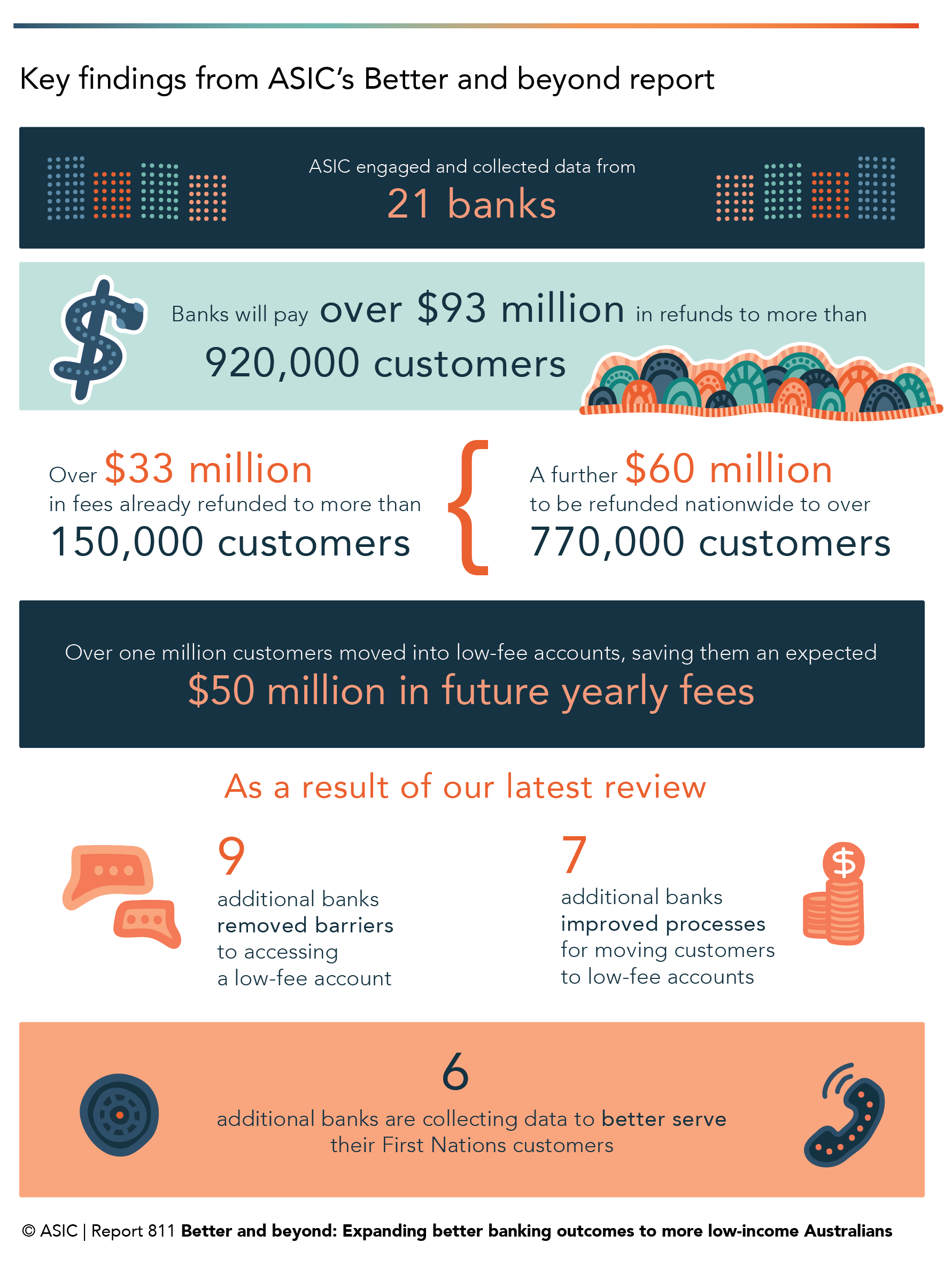
ASIC has conducted a bank fee review and found potentially millions of Australians are owed money by Australia’s banks, after they charged excessive fees on transaction accounts.

ASIC Chair Joe Longo:

Despite the improvements banks have made during our surveillance, there is clearly work to be done.

It should not take an ASIC review to force $93 million in refunds or make banks assess their processes to ensure the trust and expectations placed in them are justified.

Banks need to truly hear the messages in this report—read it, review it, and ask themselves some difficult questions about what led to this situation.

We expect banks to regularly assess product design and distribution to ensure customers have the most appropriate products and that they are given the support they need.’

A previous report found Australians receiving Centrelink payments had been put onto high-fee accounts. Casting the net a bit wider and they found even more low-income Australians being charged too much in bank fees.

ASIC Commissioner Alan Kirkland:

,What started as an initiative focussed on addressing avoidable bank fees for low-income customers in regional and remote locations, particularly First Nations consumers, revealed a much wider problem affecting customers nationwide.

Text version below

Let’s recap

It has been quite the morning, so let’s recap quickly:

The Greens are calling for the government to establish a national childcare watchdog, which is something advocacy group The Parenthood supports.

The Coalition is still blowing itself up over net zero and pretending it all matters. Late yesterday two Liberal senators voted against Pauline Hanson bringing on a motion to scrap net zero, and Liberal senator Alex Antic and LNP senator Matt Canavan (along with other Nats) voted for it. Sussan Ley had told the party room to abstain.

Labor is under pressure to set a 2035 climate target that is science backed and actually cuts emissions, rather than the least we can do state we are currently in. The UN climate chief, Simon Stiell told ABC radio national that fossil fuel expansions needed to stop.

The Greens are leaving a motion to set up a parliamentary review into Aukus on the Senate papers until they get the numbers.

There is a sickness at the centre of Australia’s childcare system. The profit motive.

Matt Grudnoff
Senior Economist

The profit motive is a great thing in the right industry.

But long ago we worked out that education wasn’t one of those industries. There is no profit motive driving school education in Australia.

Private schools in Australia are non-profit. They are run by school boards that are supposed to be focused on providing the best education for their students.

How does the government keep the for-profit sector out of school education? A for-profit school is ineligible for government funding.

We need to do the same for childcare.

The only priority of childcare providers should be the children in their care. They should not be distracted by the idea of keeping their shareholders happy.

Our youngest children deserve the best possible start in life, and that is not going to happen when providers are focused on making a profit.

Read more about how to fix the childcare system in my opinion piece in the New Daily

https://www.thenewdaily.com.au/opinion/2025/07/25/childcare-reform-profit

First Nations leaders, delegates from the Pacific Islands and climate impacted communities will be in parliament house a little later this morning, along with the Noqu Vanua Youth Initiative for a choir performance.

The group hope to get some attention from the Albanese government and commit to a science-backed 2035 climate plan.

Along with the choir performance, speakers will include:

  • Reverend Mata Hiliau: Moderator of the ACT/NSW Synod of the Uniting
    Church
  • Aunty McRose Elu from the Torres Strait, who has been a vocal supporter of the recent Australian Climate Case in Federal Court,
  • Malaemie Fruean: Chair of the NSW Council for Pacific Communities
  • Larissa Baldwin-Roberts: Co-founder of Common Threads
  • Jacynta Fa’amau: Pacific Regional Campaigner at 350.org

The senate can order ministers to produce documents as part of the accountability measures.

But more often than not, the minister comes up with all sorts of reasons as to why those documents can not be produced.

That’s what happened yesterday – you can read the list of excuses in each of these responses.

In case you missed it yesterday, Labor MP Marion Scrymgour became the first Indigenous MP to sit in the House of Representatives Speakers’ chair.

The Lingiari MP has been appointed a member of the Speakers’ panel, which is a group of MPs who act as the Speaker when the Speaker is away from the chamber.

NIT covered the historic moment, here.

Meanwhile the NSW Labor government continues to try and quell peaceful, lawful protest.

There is a planned march across the Sydney Harbour Bridge this Sunday calling for the Australian government to act against Israel for its ongoing genocidal acts against Palestinian civilians in Gaza. There have been plenty of marches across the bridge for big moments in history.

But Chris Minns is not budging on this one.

Tariffs, tariffs everywhere….

Greg Jericho
Chief Economist

Back on “Liberation Day” when Trump announced his tariffs one the planet, Australia got a 10% tariff – the lowest of anyone.

So why might this now increase?

Other than Trump seeming to think 15% is a better number (and truly there might not be anything more to it than that – maybe he shot 15 on one of the holes he played in Scotland the other day) the big issue is pharmaceuticals.

Pharmaceutical companies make an absolute killing (in every sense of the word) in America, because its health system is essentially privatised extorsion.

They would like to do this everywhere else. The problem being that the EU, UK, Japan and Australia have much better health systems and as a result we pay less for our medicines.

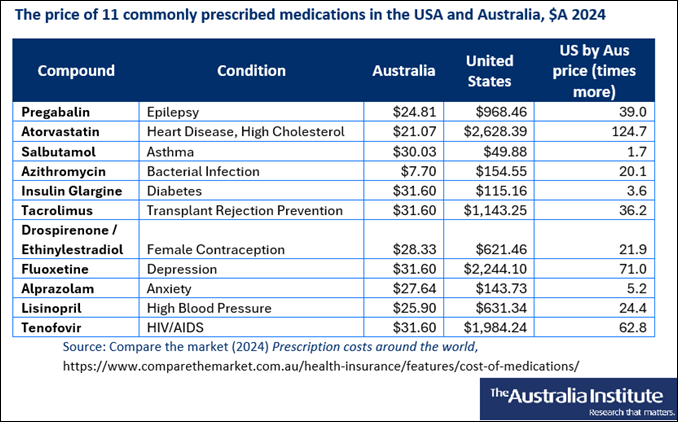
How much less do we pay? Matt Grudnoff did a great report earlier this year outlining the price differences – and they are massive:

As you can see, in some cases Americans pay more than 100 times more than we do. This is why their health insurance costs so much and also why they are effectively held hostage by their jobs because losing health coverage is the difference between living and dying or at best bankruptcy.

Now Trump knows that getting lower drug prices in the US would be a huge win.

So his solution?

He wants everywhere else – including Australia – to allow drug companies to charge more so that in return those same companies will promise to charge Americans less.

The way he is trying to make that happen is to threaten everywhere else with high tariffs on all things if they don’t change their systems (like the PBS) to allow higher drug prices.

Now if you can see some flaws in this plan, you are rather more intelligent than anyone in the White House right now.

There is absolutely NO WAY the govt will do anything to weaken the PBS.

About the only way the govt could lose the next election is to weaken the PBS. The ALP knows this. The LNP knows this.

Any political party that weakens the PBS could kiss goodbye to being in govt for a generation.

There are not many fights the ALP will take with Trump – certainly not on AUKUS. But on the PBS is will gladly do so, and if Trump goes through with his threat, expect a Canadian-style response here.

Most people don’t care too much about international trade policy (I mean, just think about The Phantom Menace), but Trump trying to destroy the PBS will get people boycotting USA goods very quickly.

For those who missed it yesterday, here is Nicolette Boele’s first speech to the parliament:

While we are on the US-EU trade deal, a friend of the blog just pointed out that it is already a giant mess with the US now contradicting everything the EU has said:

Believe it or not, the EU-US trade deal just got messier.The White House has published a fact-sheet about the agreement with claims that directly contradict the European Commission's version of events.Let's take a closer look.

Jorge Liboreiro (@jorgeliboreiro.bsky.social) 2025-07-28T21:35:07.362Z

This is why scrambling for a deal with Trump means nothing. The Trump administration will do what it wants for optics and there is no such thing as an ‘iron clad guarantee’ – Trump will change his mind as often as he wants. Read the whole thread – there is nothing to be gained by making concessions to the US.

Guys, chill on the tariffs

Greg Jericho
Chief Economist

There’s a few stories around the traps today that profession golf cheat (see video) and also President of the United States, Donald Trump might be about to increase tariffs on Australia from the current level of 10% to 15% or 20%.

The reason for this is in the past couple days when he was over in the UK promoting his private golf club he also did some “deals” with the UK and EU on tariffs.

The deal was for the tariffs on the EU to be 15% – down from the initial 30%. IN return the EU promises to buy more military stuff from the USA. This of course is the whole basis behind Trump wanting every other nation to lift its defence spending – it is also unsubtle code for “buy more4 American weapons”.

The problem for Australia is that while the US currently has a 10% tariff on our exports, because that was the baseline that he set for all nations including those with penguins living on them, now 15% or 20% seems to the be the bottom line. He told reporters that “We are going to be setting a tariff, for essentially the rest of the world and that’s what they’re going to pay if you want to do business in the United States… I would say in the range of 15 to 20 per cent. Probably one of those two numbers.”

So what does this mean?

Firstly, Trump is making it up as he goes. But you know that. What does it mean for you buying stuff from the shops?

NOTHING.

Remember, tariffs are basically a GST for imports – Trump is putting up the prices of thins American import. He is not changing at all the prices of things we pay. He is not even changing the price of things we sell to Americans – we still get the same price, and then the person who bought it from us has to pay the US govt a tax (tariff).

The problem is that because of that tariffs American will likely have to buy less stuff from us (and everywhere else) because it all costs them more now.

The other thing to remember though is the US is putting tariffs on everyone, which means there is no disadvantage to Australian companies compared to anywhere else. In fact, because we currently have a lower tariff than most places, it is in effect cheaper to buy the same thing from Australia than from somewhere else. So this means the impact even of our exports to the USA might be less than otherwise would be the case.

But just remember – this does not change the cost of anything we buy from the US, or anything else in the shops.

A US tariff is paid buy Americans.

Damned if it fails, damned even more if it succeeds

Dr Emma Shortis agreed:

Even IF the United States shipbuilding industry made it to the target that it needs to, the legislation is really clear that the President has final say, and has no obligation to handle submarines over to Australia and I think it’s incredibly unlikely that if a President were to do that, they wouldn’t come with conditions.

So that really means that, you know, as David has outlined, the Aukus deal is rife with risk of failure, but there are also significant risks if it succeeds, for Australian sovereignty and the ability of future Australian governments to make independent decisions.

Asked if he believed Australia would ever see even the Virginia Class submarines, David Shoebridge said:

The only Virginia class submarines we’re going to see coming from the US are going to have a shiny US flag on it at a at a nuclear submarine base built by Australian taxpayers of Fremantle.

You only have to listen to what the US Navy is telling Congress.

The US Navy is telling Congress they will not have any spare nuclear submarines.

Why is it that those messages have not been heard by Anthony Albanese and Richard Marles?

It’s not just the Greens who are saying that there won’t be any nuclear submarines.

The core, the core decision makers inside the United States Navy are saying the same thing.

Greens to keep Aukus inquiry on the senate books

David Shoebridge has held his press conference with Dr Emma Shortis about the need to have an inquiry into Aukus.

Australia is the only partner NOT reviewing Aukus. Which seems kinda insane?

Shoebridge says that the Greens will keep their motion for a review into Aukus on the senate books until they get the numbers:

Let’s have the inquiry. Let’s hear from the public. Let’s hear from the key stakeholders. Let’s hear from people who know that the creaks and the and the leakage that’s happening within the Defence Department – can finally come forward.

We know that if we put the blowtorch on Aukus, if we ask the submissions from the public, if we properly interrogate the Defence Department and Defence officials, that it’s likely to show that this is a $375 billion folly. So why don’t we get out before we waste tens more billions of dollars.

The Finance Sector Union has some choice words for the Commonwealth bank after it announced it was axing frontline roles in favour of automation and offshore labour.

What could go wrong?

90 jobs will be cut under the AI and offshore plan. For now.

This includes 45 roles in Direct Banking, cut due to the introduction of a new voice bot system on the bank’s inbound customer enquiries line in June this year.

Jobs cut also include local Customer Messaging Specialist roles – those who customers interact with through the bank’s online chat. This is also being done in CBA India, which is currently advertising more roles.

From the statement:

The FSU says workers affected by new technology should be retrained and supported into new roles, not discarded in the name of cost-cutting.

The union supports the use of new technology and AI in banking but say it must be done in partnership with workers, not at their expense.

These further sackings raise serious concerns about CEO Matt Comyn’s place on the federal productivity roundtable.

Finance Sector Union National Secretary Julia Angrisano said:

Just when we think CBA can’t sink any lower, they start cutting jobs because of AI on top of sneakily offshoring work to India.

Workers want a tech savvy bank, but they expect to be part of the change, not replaced by it.

Our members want to be trained and supported into better jobs that leverage AI. Yet rather than invest in its people the CBA are simply discarding Australians through ongoing redundancies and offshoring.

If this is what Matt Comyn calls productivity, we’re seriously concerned about his place at the national productivity roundtable. His carefully curated commitment to policy reform in Australia just looks like hollow PR when acts like this expose that his real agenda is just more profit for shareholders.

There is a human cost to this. You can’t just replace frontline jobs with a voice bot and expect the same service for customers.

Customers shouldn’t expect to speak to someone in Australia anymore, or even someone with a voice box.

CBA made $10 billion last year. It has no excuse for treating its workforce like this.”

The chambers won’t sit until midday, to make room for the party room meetings which are happening at the moment.

After the party room meeting there will be an off-the-record briefing where the minutes from the meeting are discussed, but nothing is attributed.

Going back to the ABC RN interview with the UN climate chief Simon Stiell this morning, you will notice that he is framing the need to cut emissions not just as what a country will lose – but what it can gain:

Well, first of all, it’s a defining moment for all countries. There are almost 200 countries within the Paris Agreement, and all have been asked to come back with new, more ambitious climate plans between now and 2035. So it’s a critical moment for all countries.

But for Australia specifically, there’s an incredible opportunity to demonstrate what ambition looks like, to take full advantage of all of its natural resources in the green energy space, and to accelerate its transition away from its dependence on fossil fuels to new green technologies. It’s already demonstrating that leadership, doubling renewable energy installations over the last few years. One in three rooftops have solar panels, incredible savings for homeowners. But this is a moment for it to reflect on where it is, where the world is, Australia’s position within that global system and the leadership it is going to take both domestically, in ensuring that Australia is able to take full advantage of the economic opportunities with the transition, but also in terms of its contribution to drastically cutting global emissions, to address the climate crisis.

National Farmers’ Federation looking for new CEO after Troy Williams quits

The NFF has announced its CEO, who was appointed in March this year, has resigned:

NFF President, David Jochinke said in a statement:

I wish to advise Troy Williams has tendered his resignation as CEO of the National Farmers’ Federation. The Board has accepted his decision, which was made for personal reasons. We thank Mr Williams for his contribution and wish him the very best for the future.

The Board will commence recruitment for the new CEO, mindful of the NFF AGM in October. In the meantime, we will appoint an interim CEO to ensure leadership and operational continuity.

While leadership transitions are significant, I am proud of our experienced and committed team. It’s business as usual in our work for members and the agricultural sector.

The NFF team remains committed to our policy priorities as well as delivering a suite of initiatives from our leadership programs and events, including our flagship AgXchange event, which is shaping up to become the industry’s pre-eminent forum for ideas, collaboration and innovation.

‘The prime minister needs to talk to me’ – Dr Mohammed Mustafa

Dr Mohammed Mustafa then directly addresses prime minister Anthony Albanese:

I want to talk directly to Prime Minister Anthony Albanese.

Ever since I sat on this couch when I came back from Gaza the first time, I asked to speak to Anthony Albanese, our Prime Minister. He’s still not spoken to me.

When there was an anti-Semitic attacks that were done in this city here, rightfully went out and spoke with the Jewish community. But we are witnessing Palestinian people, as he’s called it, indefensible crimes that are happening to them. He has still not met with me or members of the Palestinian community to talk about what’s going on.

It’s not that just that I want to talk – but to have a solution here. We’ve been travelling around the world to get governments to bring into the children’s hospital in Gaza, and a neonatal maternity hospital that would help alleviate the images coming in.

The Prime Minister needs to talk with me. He’s not doing that.

I want to ask him directly – please, please, for the sake of those children in Gaza, for the sake of the Palestinian people in this country as well, and many members of the community, the Indigenous community, the Muslim community, the students – all of us want to see actions.

And just come and talk to us. I promise I’m not going to bite. I’m not going to hurt him. I just want to talk to him. I know that he is a man that says that he is principled, and I want to believe him. And I do believe him. But I need him to talk to us so we can talk about a solution here. Because words are no longer enough. Words are not going to feed those children. And I need him to come and support us and help us to alleviate what’s going on, and also diffuse the tension in this country.

Dr Mohammed Mustafa said it is a very delicate process re-feeding people after they have been as starved as Palestinians in Gaza have been because of Israel’s deliberate starvation policy, and it is not just a case of sending in food:

Look, this starvation – when I was there last year in June, we had children coming in like the same images you’re seeing now, dying from starvation.

This hasn’t been something that’s happened over the last few months. This has been almost a – this has been what the war has been the whole time for the last two years, there has been this policy of starvation, of collective punishment, of the civilian population. Of the we’re seeing the full force of that live now, out in the open. We’ve reached Stage 5 famine in parts of Gaza.

25% of the population by IPC classification is in Stage 5, which means that 2 out of every 10,000 people a day die from starvation. That’s huge numbers. And that’s not been seen before like this.

And airdrops are not the solution.

Mustafa:

When you airdrop supplies in, the planes that they use have to be able to fly at a low altitude to drop supplies in. But there’s no coordination. What you’ll have is sometimes aid falling on top of people in tents and crushing children. Also as well, it’s ineffective. You know, you could have 12 of these cargo planes in and drop aid in, but it’s only the equivalent of one aid truck.

You could open up the borders and roads and bring in 1,000 aid trucks in a few hours. You would need hundreds of planes to do the same thing. It’s highly expensive and highly ineffective. It just masks the problem. It just tells us that we’re dropping aid in. But it’s not aid – it’s a drop in the ocean.

‘Rhetoric is not enough’

Dr Mohammed Mustafa, an Australian emergency room doctor who has been to Gaza twice to volunteer in what is left of its hospitals after Israel’s non-stop assaults, has spoken to ABC News Breakfast this morning about what is still happening to Palestinians:

Things are changing, but it’s only the rhetoric that’s changing. The action hasn’t changed. To starve a population doesn’t take a few days, it takes weeks and months. What’s happening now in Gaza – it’s not just that these people are starving – even if we were to get them food in now, it wouldn’t stop the problem.

Even if they were to feed right now and have food again, it wouldn’t solve the problem of starvation. If you gave them food right now, they would die from the food, from things like re-feeding syndrome. When the body is in starvation mode, the body is used to breaking down fat.

When you start giving them food, it gives them carbohydrates, a huge insulin spike. Salts in the bloodstream can cause things like seizures, arrhythmias, heart attacks.

What you need is not just food, but an influx of healthcare professionals to come in as well to combat the images that we’re seeing in Gaza. That’s why it’s not enough – rhetoric is not enough. And opening up aid distribution for a few trucks to come in with food is not going to save these children’s lives. We need a coordinated humanitarian response. That’s not what we’re seeing.

So what has been the response?

Steph Hodgins-May:

This is a sector-backed plan and we’re proud to stand with The Parenthood and other organisations who are calling for this to be initiated as a matter of urgency. We wrote to the Prime Minister several weeks ago now and, unfortunately, haven’t yet heard back.

We’re urging the Education Minister, the Prime Minister, to put politics to the side and to sit down with advocates, to sit down with the Greens, and work constructively towards a way to keep our children safe. Because, frankly, if we’re not in here to do that, it’s the most important job we’ve possibly got – what are we doing?

What would that watchdog look like?

Steph Hodgins-May:

Essentially what it will do is ensure that we don’t have that patchwork implementation of standards across the country. Australia does have some of the world’s leading national quality standards, but the truth is that they’re not enforced.

So that national watchdog will have teeth, and it will have the power to enforce the National Quality Framework, but it will also have important powers to be able to gather information and be able to lay the foundations for a childcare system that actually prioritises children over profit.

And, look, we know that’s the elephant in the room – in the last 10 years, more than 90% of childcare providers that have come through are running for profit. It’s the Greens’ view that, if a centre is running for profit, profit is the number one priority of that centre, rather than the education and safety and wellbeing of our children.

So that watchdog will crack down on national standards and ensure that they’re enforced, but essentially create a genuinely universal system of early childhood education and care that’s high-quality and really prioritising the needs of our children over the profit margins of, many times, offshore corporations that are running these outfits.

Advocacy group The Parenthood is also pushing for a national watchdog.

Greens senator Steph Hodgins-May has told the ABC that the Greens will not stand in the way of the government’s legislation to address concerns about child care safety, following reports into the sector led by the ABC, but that they want it to go further.

The government legislation will strip Commonwealth funding from centres that don’t meet the national minimum standards, but Hodgins-May said that is “bandaid solutions to much, much deeper structural issues”.

Whilst we might see some short-term improvements on safety, they aren’t going to go to the heart of the issue. They’re not going to lift national quality consistently across the country. Instead, they’ll crack down on individual providers and, really, sadly, it’s going to require harm to have occurred in order for the government to step in. The Greens are really pushing for more. We’ve written to the Prime Minister urging him to work with us on a national watchdog with teeth that can enforce our national quality standards in a way that hasn’t happened. At the moment, we’ve got this patchwork effect where multiple states have different regulations, but no national body to actually enforce and work towards raising national quality standards across the country.

Greens to push for Aukus review

The Greens senator David Shoebridge has announced a press conference for 8am this morning to talk about the Greens push for a review into Aukus.

Emma Shortis from the Australia Institute will be there.

There seems to be a few schools of thought within caucus as to what Labor is doing here (Australia is the only major partner NOT reviewing the pact). One is that Labor wants to wait until the new conditions the US review is working up are official, and review it then (keep the powder dry as it were) so as not to jump too early, or upset Trump doing the trade negotiations.

Another is that Labor can’t decide on terms of reference and another again is there is the usual Australian hesitancy to hold a review and annoy the bigger countries.

GOOD. TIMES.

Latest Gencost report released: renewables remain the lowest cost option

The latest Gencost report has been finalised. Prepared by the CSIRO and the Australian Energy Market Operator, it looks at the cost of power generation which can advise governments in where do invest etc.

This report has found:

  • Large-scale solar photovoltaics (PV) remains the strongest performer, falling 8 per cent for the second year in a row.
  • Battery costs recorded the biggest annual reduction, falling 20 per cent.
  • Onshore wind costs continue to increase, but at a slower rate.
  • Gas turbine costs increased the most.

Chris Bowen is doing a little dance:

Australia has the best wind and sun to power our future and we’re harnessing it to secure
the better, fairer energy system our nation deserves. The latest GenCost confirms what our energy experts have been saying for a long time: the most affordable path to deliver reliable energy in future is with new renewable generation and storage, firmed by gas and pumped hydro.
This is a test for the new Coalition – will they listen to the experts and embrace the cheapest form of energy or continue their anti-renewable expensive nuclear fixation?”

‘The potential is there’

Simon Stiell spoke of Australia’s potential to be a new energy powerhouse:

All countries are not in the same position, and the actions that need to be taken, the considerations that need to be factored in, are different for all, but we’re still governed by that underlying science that how we are consuming, how our industries are run, how we live our lives is generating excess of emissions, which are then causing the global climate impacts that we’re seeing, which are costing lives and also damaging the economy.

So if you like, it’s a ledger.

It is the benefits from business as usual, versus the cost of inaction, which for Australia, the predictions are by 2050, and climate change, there’ll be a loss of GDP, loss of somewhere in the $6.8 trillion to Australia based on the kind of impacts.

So yes, you have economic benefits from that business as usual, but you have the economic costs which far outstrip that.

And then in between that you have the opportunities associated with the transition. So whether it is new energy sources, green hydrogen. (Sally Sara points out that green hydrogen hasn’t delivered as yet)

….But the potential, the potential is there.

‘Science tells us we need to transition away from all fossil fuels as rapidly as possible’ – UN climate chief

As we mentioned a little earlier, Executive Secretary of the United Nations Framework Convention on Climate Change (UNFCCC) Simon Stiell is in Australia and will meet with Chris Bowen later today to discuss Australia’s climate targets.

You would have to imagine Australia’s lack of ambition will be the main talking point. We are doing the bare minimum and still looking to open up more fossil fuel sites, which is the exact opposite of what the science is telling us to do.

Stiell spoke to ABC radio’s Sally Sara this morning about the ‘challenge’:

Science tells us we need to transition away from all fossil fuels as rapidly as possible. So, yes, addressing your own domestic emissions is part of it, but exporting carbon emissions also needs to be addressed. And there we need to look at that global picture in terms of not just the supply of fossil fuels, but it is cutting our dependency demand for fossil fuels. And that requires, again, global effort.

Here is how some more of that interview went:

Andrew Clennell: Do you think net zero gets in the way or it’s not even relevant when it’s some 25 years away?

Sussan Ley:

Everything has to be considered and people have different views. But I want to look at this from the perspective of Australians. And Australian energy policy is clearly not what this government is about, because look at costs. I mean, we’re amassing already a list of their broken promises. I’m not going to let them off the hook for $275 reduction in energy prices. Meanwhile, I could not go into a factory floor as Shadow Minister for Industry in the last parliament without hearing a story about energy prices putting people out of business. So we’re here for Australians who want to have a crack and get ahead.

Clennell: Do you think that’s because of renewable energy?

Ley:

It’s because of an overreliance on renewables, the renewables only mantra that this government has been preaching for three years doesn’t work. Of course, now that I’ve realised they need to bring gas into the system, it’s all a bit light, it’s all a bit confusing, but the ultimate cost is being worn by businesses.

Clennell: Would you come up with your own 2050 target rather than net zero if you dumped the policy?

Ley:

Everything is on the table and I want to make that clear. It’s not about me landing on what this group might come up with. We’ve got an outstanding colleague in Dan Tehan leading a process. Everybody in both our party rooms has an opportunity to have their say.

Clennell: It sounds like the say is in and it’s get rid of zero.

Ley:

People have got different views, Andrew. And party organisations – as you’ve pointed out – have passed motions, they always have, they’ll continue to do that. We’re listening to them too.

Clennell: So you’ll go with what the party room tells you? Or do you have your own view?

Ley:

I’m the Leader and I’ll make the call when the time comes. But what I said at the beginning of my leadership was I would consult, I would listen. And when it comes to policy, we would do this with everyone playing their part and having their say. I’ve set up those processes, by the way, in areas not just energy, but across the board, so we can harness the talents and the experience – the life experience, and the ideas of every single one of our party room members.

Meanwhile, in Coalition land

Sussan Ley has been continuing to appear on as much media as possible (as a mark of difference to Peter Dutton who only appeared on friendly media) and yesterday, that included a one-on-one with Sky New’s political editor, Andrew Clennell.

Asked about the WA Liberals wanting to dump net zero (which includes Michaelia Cash and Andrew Hastie) and the Nationals revolt, Ley said:

Individuals in my party room and in the Nationals party room have passionate, well held views on this. And we’re going to bring all of those views together in a working group led by Dan Tehan. And it’s going to flesh out the different perspectives, the expert advice, and of course, focus on this government’s miserable failure when it comes to energy policy. But let’s just step back a moment, the election was not quite three months ago, the next election’s about three years away. I said, when I became leader, I would be consultative, collaborative and take the time to get this right. So we do have time. And of course, the important thing is we’re not actually holding the levers on this policy. The government owns current energy policy, and we will hold them to account for the absolute trainwreck that it’s become.

But again, it doesn’t matter what the Coalition decides on. It won’t have any impact on policy – but it is sucking up space. So why are we covering it? Because you need to know what is happening across all the parties to get a whole picture – and you need to know where the fights are coming from.

Remember when they promised low gas prices?


Mark Ogge
Principal Advisor

New Australia Institute research shows gas exports have caused wholesale gas prices for Australians to more than triple and electricity prices to double since exports began in 2015.

When they were trying to get their gas export terminals approved, the gas industry promised Australians abundant gas, low gas prices and endless economic benefits.

None of it was true.

Instead, we’ve had rolling gas shortages, skyrocketing gas and electricity prices, manufacturing closures and job losses, and a massive transfer of wealth from ordinary Australian households and businesses to foreign owned gas companies.

Successive federal governments have allowed the gas industry to export gas to the global sport market, instead of supplying Australians and let them price gouge for our own gas.

As of the latest published Australian Tax Office corporate tax transparency data, none of the big gas export projects exporting Australian gas form QLD have ever paid company tax despite making well over $100 bullion oncome exporting our gas.

Australians, you are being ripped off by foreign owned gas companies, aided and abetted by your governments.

There is a simple fix for this mess that the Australian Government can do any time: stop gas companies exporting our gas to the global spot market, and require them to supply Australians instead.

It’s that simple. It can be done tomorrow. It doesn’t need yet another inquiry or review, it doesn’t need another thousand pages of ACCC reports, and it definitely doesn’t need another consultation with the gas industry who seem to have completely captured our governments.

Approving new gas projects  will do nothing. Weve seen gas production triple over the last decade while gas demand in Australia has fallen, and we still have shortages and high prices, because additional supply just means additional exports. It’s a zero sum game for Australians.

The Australian government just needs the government to stop fawning to foreign owned gas corporations, and stick up for Australians.


Gas exports have tripled Australian gas prices and doubled electricity prices

Glenn Connley

New Australia Institute research reveals that gas exports have led to the tripling of wholesale east coast gas prices and doubling of electricity prices, since exports began in 2015.

The Australian and Queensland governments’ decisions in 2010 to allow large-scale exporting of Australian gas from Queensland exposed Australians to high global prices, ending decades of abundant low-cost gas for Australians, leading to higher energy bills, gas shortages and manufacturing closures.

Gas price increases due to excessive exports have also caused electricity prices to rise because gas power stations often set electricity prices.

“When you get your next energy bill, blame the gas industry and your governments for opening the gas export floodgates despite being warned it would drive up energy bills for Australians,” said Mark Ogge, Principal Adviser at The Australia Institute.

“Gas exports have meant Australian households and businesses have paid billions of dollars more for energy over the last decade, all of which went to the profits of a handful of predominantly foreign-owned gas corporations.

“The gas industry’s deliberate plan to increase domestic gas prices for Australians, by exposing us to global gas prices, has been a massive transfer of wealth from Australian households and businesses to Big Gas.

“Gas exports have led to manufacturing closures in Australia. Gas exporters manufacture nothing except gas shortages and higher energy bills for Australians.

“The kindest interpretation of the Australian and Queensland governments’ role in allowing gas export corporations to brutally price-gouge Australians over the last decade is that they are weak and gullible. Arguably, they are complicit.

“It is extraordinary that successive Australian governments have allowed LNG producers to export surplus uncontracted gas to the global spot market while Australian manufacturers struggle to secure affordable gas at reasonable prices.

“Allowing new gas projects doesn’t solve the problem. We have tripled gas production in a decade, and we still have rolling shortages and high prices. New gas projects just mean more gas is exported and result in net-zero additional gas for Australians, unless we cut exports.

“The only way to fix this mess and reduce Australian energy bills is to cut exports and divert the gas to Australians.”

 “Gas exports have exposed Australian manufacturers to high global gas prices and are also driving up electricity costs, hitting manufacturers with a double blow, making it almost impossible to compete with subsidised imports,” said Geoff Crittenden, CEO of Weld Australia.

“It beggars belief that for the last decade, Australian governments have allowed LNG producers to export surplus uncontracted gas to the global spot market while Australian manufacturers are unable to secure gas at reasonable terms and prices. It needs to be fixed now.”

Mark Ogge will be at parliament house this morning for a press conference, along with Monique Ryan Senator David Pocock and Geoff Crittenden, CEO of Weld Australia

We will bring you

Good morning

Hello and welcome to another day of the 48th parliament.

It’s Tuesday, which means it is party room meeting day, and that means another awkward get together for the Coalition.

Pauline Hanson has seen the first opportunity she has had in years to find some political relevancy and after losing out on the ‘worst position on the Voice’ competition, she is NOT letting this net zero mess the Coalition has gotten itself into pass.

Hanson tried to put through her own motion in the senate to get ahead of Barnaby Joyce’s private members’ bill (which is also not going anywhere) and despite Sussan Ley asking her party room to abstain from the vote, Jane Hume and Andrew McLachlan (SA Liberal senator) voted against Hanson.

If you look up the Dynamic Red, you may see Alex Antic and Matt Canavan there both voting with Hanson. Earlier in the day, Canavan told the Seven network he was there to make laws, not participate in ‘stunts’:

We’re here to make laws, not make statements or do stunts. A motion in the Senate today is nothing but a stunt. It’s not going to do anything.

To be fair, Canavan’s vote was to bring the motion on for debate (it failed so it never got there) not the actual motion itself, but still.

Hanson is using all of this to try and once again position herself as the ‘real’ voice of the people the Coalition have been trying to reach with their shift to the right. And while it has worked for One Nation in terms of getting them a couple more senate seats (at least for now, who knows how long that lasts with One Nation) it has been at the Coalition’s expense. And yet, the Coalition continues to try and get into bed with One Nation.

So that’s fun.

On the other hand, UN climate change executive secretary Simon Stiell is in Australia and will meet with energy minister Chris Bowen today, where he will be pushing for the Albanese government to do more on climate. You know, more than the bare minimum?

In a speech in Sydney yesterday Stiell told the crowd:

Don’t settle for what’s easy. Bog standard is beneath you. Go for what’s smart by going big. Go for what will build lasting wealth and national security. Go for what will change the game and stand the test of time.”

This is ahead of Australia finalising its 2035 climate targets.

So as the Coalition continues to be a policy trash fire, Labor continues to look better in comparison.

So that’s fun.

We’ll cover all of that and more as the day unfolds. Mike Bowers is away on assignment, so it is just Amy Remeikis guiding you through today. It is another three-coffee morning at least, with probably what chocolate I can ferret out of the cupboard where I hid it from myself.

Ready? Let’s do this.


Read the previous day's news (Mon 28 Jul)

Comments

Start the conversation

The biggest stories and the best analysis from the team at The Point, delivered to your inbox.

Past Coverage