Wed 16 Apr

Australia Institute Live: Day 19 of the 2025 election campaign. As it happened.

Amy Remeikis – Chief Political Analyst

This debate is now closed.

Start the conversation

Australia Institute Live: Day 19 of the 2025 election campaign. As it happened.

Key Posts

The Day's News

Good night – see you tomorrow?

The debate ends and again, there is no major win, no screw ups, and no inspiring moments.

So you would probably give it to Anthony Albanese (if that matters) but maybe this isn’t a format that serves us any longer?

There was also no questions on how Australia would treat Israel moving forward (which is something that a voter asked in the Sky debate), how either party would act on poverty (raising the rate has not been mentioned at all this campaign, what are the long term plans for the future and how we plan on dealing with a changing geopolitical world.

But that is indicative of this campaign isn’t it? Small targets, small ideas, big utes.

Thank you to everyone who joined us today – we truly appreciate it. We will be back early tomorrow morning before the easter break, so we hope you will join us. You are the one shining light of this campaign and we really, really are grateful.
Until then, take care of you. Ax

They are not asked to comment on something they like about each other, but they are asked if they kinda like each other.
Who cares.

I have no interest in what their private relationship is like, or whether or not they are personally great people, or funny, or remember your birthday.


WHAT DO THEY DO WITH POWER? It is the only question that matters.

Albanese:

Neither side of politics has done well enough for First Nations people. That’s just a fact. And that’s something that breaks my heart. But, what we did post referendum was I went to GARMA and spoke about economic empowerment of Indigenous people. We have a series of programs. Firstly, taking what was essentially a Work for the Dole scheme. Creating real jobs with real training and real outcomes. Something like 40,000 Indigenous people that have benefited from tree TAFE. We’re — free TAFE. We’re putting additional funds into Particularly areas like dialysis. We have a 10-year program on remote housing. On education. We are pumping record funding into schools and that particularly will benefit areas like Cape York and the Northern Territory, Indigenous schools as well.

It is pointed out that neither leader has been to an Indigenous community this campaign. The stark results of the Closing the Gap failures is shown.

Dutton, who boycott the National Apology to the Stolen Generations and also destroyed the voice campaign says:

I can point to many trips that we’ve made to East Arnhem Land, Alice Springs and many communities across the countries that campaign isn’t just made up of the last 15 days or whatever it’s been. It’s made up of our term over the last three years. We went to Alice Springs and we spoke to a lot of people after the Voice in particular where people were devastated because the ppractical assistance promised by the Prime Minister hasn’t been delivered and the attempt was made to divide our country on the Voice. I think the Government has done a lot of damage in relation to this area.

Everyone is on a unity ticket with Aukus.

Yippee

Matt Grudnoff:

Dutton talks about negotiating 11 free trade agreements.

One of those was with China. Then China cut trade in barley, crayfish, wine etc.

Another was with The US. Now the US has put at 10% tariff on all Australian exports.

Good job on the free trade agreements.

Q: Come back to Donald Trump. It’s a while since you’ve had a conversation and had a tariff put on us of 10% and steel and aluminium. You have suggested some deal around critical minerals is on the table. What is that, Mr Albanese? What exactly are you offering Donald Trump?

Albanese:

We’ll engage diplomatically, not through TV interview, but we have put forward a proposition to the US. The US have put forward publicly their complaints about Australia. We won’t budge on the Pharmaceutical Benefits Scheme. We won’t budge on biosecurity issues. We won’t budge on the media bargaining code. We will stand up for Australia’s national interests because that is important. So we’ll continue to engage with the US.

Q: You said critical minerals have been put on the table. So what is it?

Albanese:

A critical minerals reserve is just that. It’s a reserve of the critical minerals and rare earths which Australia has an abundance of critical minerals – we have the entire periodic table here.

Q: And what do you say? You can have it? At a discount?

Albanese:

No. We will negotiate.

Q: The US is very keen to get access to critical minerals and rare earths. The trade dispute with China is particularly concerning to many in the US economy. Will we reserve this for the US?

Albanese:

No. We’ll negotiate with the US rather than with you, David, with respect. I

Q: Mr Dutton, you’ve said you’ll get a deal very quickly with Donald Trump. He would drop these tariffs. No other leader has managed this. How do you plan to pull this one off?

Dutton:

We did in the 45th presidency when President Trump was first elected. We were able to negotiate as a government then an outcome where Australia was exempt.

Q: How would you do it now? It was Malcolm Turnbull at the time. It’s a lot harder now.

Dutton:

As we did last time, we were able to leverage relationships. Sadly for our country, ambassador Rudd can’t get into the West Wing and can’t get a meeting with the President.

Q: What does leverage mean?

Dutton:

We look at with whom we have a relationship and contacts and those external to the administration. We didn’t think Donald Trump was going to get elected and put nothing into the relationship. Unfortunately, for Australia, our beef producers and others are now facing this 10% tariff.

Q: You have closer ties with the Trump administration?

Dutton:

I think we have the ability, as we demonstrated before, to talk to the administration and again the mistruth that was spoken before by the Prime Minister about John Howard, the points I make which is accepted by most sensible people, is that as John Howard agrees with, we should be doing everything we can to enhance the relationship, to make our two countries stronger together.

We’ve been with the US for the last 100 years.

Q: Sounds like your answer to this is because you’ve got closer relationships with the Trump team, you’d be able to get a deal?

Dutton:

We have I think a capacity demonstrated. We’ve already done it, David. And we demonstrated it in the first presidency that we’re able to get an exemption when other countries weren’t. All I’m saying is…

Q: Everyone else in the world can’t get it. You would?

Dutton:

As you know, when other countries were slapped with the tariff last time, we were exempt from it under a Coalition government.

Speers: So were plenty of others. This time no-one has?

Dutton:

We have an ambassador who can’t get a phone call to the President. We had an ambassador who used to play golf with him. (Hockey played golf with Trump ONCE) People in Washington who have worked for Coalition governments, people who have worked for the Australian Government. I think there is the ability to do a deal. The point I was making in relation to defence is the Americans came to our aid in the Battle of the Coral Sea and stood with America through every battle. It’s an incredible relationship. You can look at off take agreements with critical minerals, supply chain surety so their weapons systems and their guided weapons can be constructed. And that is a critical part of what I think we can bring to the table. It’s not a threat. It’s about how you can enhance the relationship which seems to escape, have escaped this government.

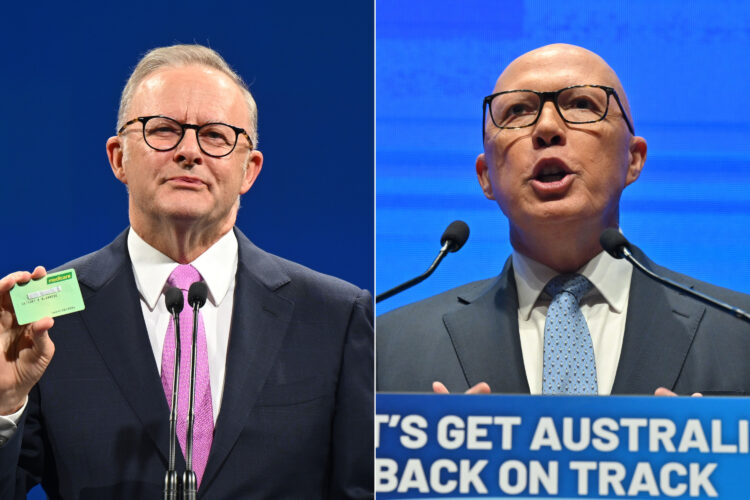
Q: Mr Albanese, do you trust Donald Trump?

Albanese:

Yeah. I have no reason not to. I’ve had a couple of discussions with him. And the last discussion we agreed on a series of words that he would give consideration. Great consideration was the words he used. And he did that. In the end he made a decision as part of the US administration to put these tariffs on every country. We got the lowest amount. But we made it very clear that was an act of self-harm by the US. The US enjoys a trade surplus with Australia. All this will do is put up costs for American consumers.

Q: Just while we’re at it, do you trust China’s President, Xi Jinping?

Albanese:

I have no reason not to either. In terms of the discussions we have had as one on one discussions have been important. China’s our major trading partner. One in four Australian jobs depends upon trade. It’s in Australia’s national interest to have a good economic relationship with China. We have different political systems. We do. That means different values and we have very different values with China. What I’ve said is we’ll cooperate where we can and disagree where we must but we’ll engage in our national interests.

Q: Mr Dutton, do you trust in Xi Jinping?

Dutton:

The relationship that we have with the President of China for the reasons the Prime Minister outlined. It’s important for our economic stability and sovereignty. We negotiated 11 free trade agreements and this Prime Minister has only delivered one. I want to see trust in the relationship and we have to stand up for our sovereignty and have a respectful relationship. I had a very good meeting with the Premier from China when he was out a couple of months ago.

Q: And you trust him?

Dutton:

Again, I spoke to him across the table. I haven’t done business with him and shaken hands and seen whether somebody has honoured that deal. I don’t have any reason to distrust.

Albanese:

Can I make a point in the agreements that I’ve reached with the Premier, they have all resulted in precisely what was agreed on both sides. And now as a result of that, $20 billion of trade with China has been restored. Because of the free trade agreement we signed. To be clear. It didn’t operate for the entire time in which your last term. There were no discussions. No phone calls, no meetings. No trade. There was a diplomatic freeze. In terms of the trade relationship it is something we established through the free trade agreement.

Dutton:

There were difficulties in relation to 5G. If you want to talk about that period. We took a decision as a government to exclude high risk vendors from 5G because we wanted to protect our telecommunication system. If the Prime Minister was suggesting – because it was bipartisan at the time – that wasn’t an appropriate step for us to take in our national interests, then he probably should say so.

Dutton on Trump: ‘I don’t know him’

Q: Do you trust this President, Mr Dutton?

Dutton is obviously very nervous about this question:

David, I said in relation to President Trump I thought the scenes we saw coming out of the White House, the treatment of President Zelenskyy, was a disgrace and appalling. I stand by those comments

Q: Do you trust him was the question?

Dutton:

We trust the US, and I don’t know the President. I’ve not met him. The Prime Minister obviously has been able to.

Q: You’re not willing to say you trust him?

Dutton:

I don’t know Donald Trump is my point. My point is who I trust is the Australian people. My job is to stand up for our country’s interests which is what I did when we negotiated the AUKUS deal with President Biden.

This is a very, very different Dutton to the one earlier this year who was saying he would get on better with Trump, because he was the sort of personality Trump liked.

Now he is all Mariah doesn’t Carey ‘I don’t know her’ about him? Sure, Jan. Sure.

Q: Clearly, Mr Albanese, there are expanding defence cooperations going on between Russia and Indonesia. They held some exercises in November. And just yesterday Russia’s Deputy Prime Minister met the Indonesian President in Jakarta. Does this concern you?

Albanese:

Well, that’s an extraordinary double down from the alternative Prime Minister of Australia who verballed the Indonesian President yesterday. Indonesia will be the fourth largest economy in the world. They are an important partner of Australia.

We have an important defence relationship with Indonesia as well. I regard the Indonesian President as a personal friend and we have good relations there. The idea you throw out these comments is just extraordinary. And the fact that we just saw a double down on it as if there’s nothing to see here, just shows there’s no understanding of the need for diplomacy. Diplomacy means engaging seriously in a calibrated, serious way. Treating Indonesia with respect, as we do other nations that we deal with.

Q: Quickly on that, you pointed out Indonesia is an important partner and President Subianto is a personal friend. Why haven’t you been to Indonesia since he became President? Because I’ve been here domestically but the President I have spoken with and the President was here just before his inauguration. When did you last speak?

Albanese:

He’s a regular visitor. We have discussions at the senior levels of government.

Dutton:

I think the Prime Minister is full of bluster because he knows he’s got it wrong again in relation to national security. This is a government that’s ripped $80 billion out of defence and we have seen the relationship in relation to Indonesia and Russia grow closer. Now Indonesia is an incredibly important partner. I met with the President-elect when he was out here and had a very good relationship with him as Defence Minister when we were both in that portfolio.

I had a lot to do with the previous President in Indonesia as well. So we have a stable solid relationship. But that means that if there is to be some change in the security settings in our region, that if there is respect for the Albanese government, of course there is not at the moment because they see this Prime Minister as weak.

Then why wouldn’t there be a response or why wouldn’t there be even to the Foreign Minister, to the Defence Minister to say this…

Albanese:

This is important. Peter is suggesting there should bow a response to something that isn’t happening. This is the second of the failures that we have seen of diplomacy and of mature responses to international issues just during this campaign. When President Trump made the announcement that every single country in the world will be hit with tariffs, the alternative Prime Minister suggested that we should put defence and our defence relationship with the US on the bargaining table. And it took John Howard to intervene to point out how that would be.

Q: I want to move on. Let’s turn to the global outlook. And an issue that’s flared in the last couple of days. Mr Dutton, you jumped on reports Russia had asked to base some of its military aircraft in Indonesia. You suggested this would represent a catastrophic failure of the Albanese government for not seeing this and not knowic it was coming. You said the Indonesian President had publicly announced this Russian request when he had not. Indonesia says there won’t be Russian planes based there. Do you admit you got that wrong?

Peter Dutton:

David, the reference I was making was should have been to the President and was in relation to resources from the Prabowa government. What we got from the Indonesian authorities in the reports and the Prime Minister commented on the reports yesterday as well, was the sources inside the government confirm that was the case.

What we have seen the last 12 hours or so is the Russian envoy to Indonesia has confirmed that there have been discussions and obviously there is a concerning closeness in that relationship. And I think the main point here is that the Prime Minister knew nothing of it. Nothing of the concerns. Nothing of the prospect. The found out about it through a news report, similarly to when the Chinese naval ship circumnavigates our country and he doesn’t know all the detail until a Virgin pilot provides the detail.

Richard Marles had said there had been talks. But also – is Australia suppose to know about every conversation countries have with each other?

Greg Jericho
Chief Economist

Peter Dutton is pretending that Australia has no role to play in limiting climate change. That is the most cowardly response. Australians should be proud of our environment and angry about what climate change is doing to it.

As Polly Hemming says loudly in her speech at our Climate Integrity summit, historical evidence demonstrates our nation’s outsized role in influencing international norms and policies.

Asked about insurance premiums (which are going up because of climate change) Albanese says:

Can I talk about the science? I will be a Prime Minister who backs it up. The science is very clear. It doesn’t mean that every single weather event is because of climate change. It does mean the science told us the events would be more extreme and they’d be more frequent.

That is what we are seeing playing out. Whether it be increased bushfires, flooding, extreme weather events that are having an impact. When we talk about the costs, this is one of the costs. The cost to our economy as well as the cost to our environment and not acting on climate change. Not being a part of the global solution are severe.

Not opening up fossil fuel projects would be one of the things that backs the science, but Labor is still doing that too.

Peter Dutton can’t say whether climate change is making weather disasters worse.

Peter Dutton then falls back on the classic Liberal leader answer when it comes to climate change “I am not a scientist”

Asked whether he believes climate is making natural disasters worse, Dutton says:

I think you can see there’s an impact. In my home state you made reference to floods and natural disasters and events and we were out in Thargomindah and that is part of the history of our state of this country.

Q: Is it getting worse?

Dutton:

I’ll leave others to…

Q: What do you think? You’re a Queenslander.

Dutton:

I’ll let scientists pass that judgement.

Q: You’re not willing to say this is climate change happening now?

Dutton:

The Prime Minister refused to make comment in this regard as well the other day, I don’t know because I’m not a scientist and I can’t tell you whether the temperature has risen in Thargomindah because of climate change or the water levels are up. I don’t know. Scientists can provide advice.

What I need to do as the alternate Prime Minister in this country is to put forward our plan about how we’re going to help families. We need to transition and we have spoken about that with our zero emissions technology. (Yet to be invented small modular nuclear reactors)

In relations to power cost, which is an important issue before we move on, the Prime Minister promised $275 reduction per year at the last election and mentions the figure and Chris Bowen was able to give you a straighter answer than what you heard before because power prices have gone up by $1300 and they are making no commitments in this election other than if you vote Labor your electricity and gas prices will go up.

Matt Grudnoff
Senior Economist

One thing that hasn’t been properly discussed in this campaign is that if we are going to wait decades for these nuclear power stations then we have to keep old coal fired power stations open for longer. This is really expensive. The NSW government has just entered into an agreement with Origin energy that will cost NSW up to $450 million to keep the Eraring power station open for just an additional 2 years.

There’s a reason Dutton isn’t really talking about nuclear

This debate has been one of the longest times Dutton has been forced to talk about the nuclear policy this campaign – as was pointed out by a reporter on the campaign recently, Dutton hasn’t taken them to any potential nuclear sites, hasn’t spoken about it and it hasn’t formed part of the campaign.

And there is one very simple reason for it.

Voters don’t like it.

It is tanking in the polls, and the research and focus groups. They don’t like it. Not in Victoria, not in WA, not in NSW, Victoria, South Australia, NT, the ACT or even Queensland.

What voters do like though – is the idea of an “energy mix” which you may have noticed Dutton talks about non-stop at the same time as saying that Labor has a “renewables only” plan (which is not true).

But that’s why you’re not hearing about nuclear – it is not popular. And they can’t drop it, because that would be too embarrassing (especially since the work from home policy was dropped) so they’ll stick with it, knowing it will never become a reality, but they also won’t go out of their way to make it a campaign issue.

A reminder – small modular reactors aren’t really a thing

Greg Jericho
Chief Economist

Peter Dutton suggesting small modular reactors are possible.

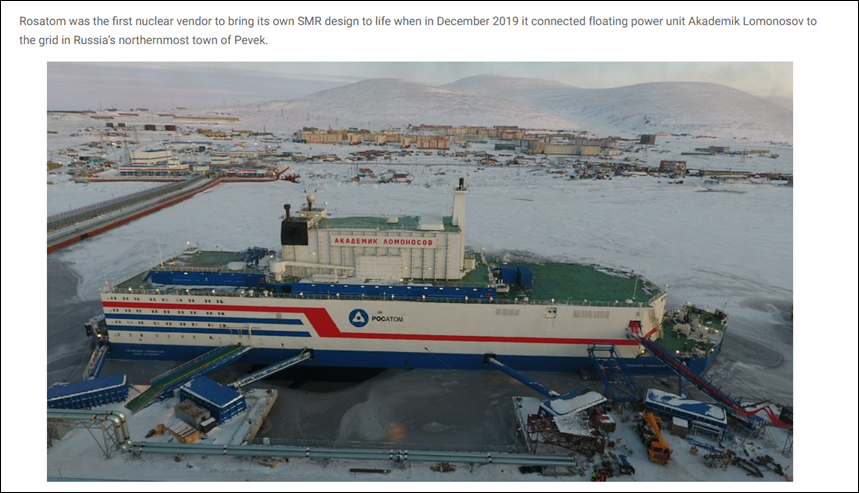
Yeah. Nah. Fortunately we do have a photo of the one that is working. It’s in Siberia – it’s an old nuclear-powered icebreaker hooked up to a small town’s power supply. Every other picture of a small nuclear reactor is a “designers rendition of proposed plant” because they don’t exist.

Oh Dolly. Dutton is trying to explain the nuclear policy

Peter Dutton says he wants to have this debate among adults, and yet he sounds like the conspiracy theorist everyone avoids at the party going from group to group talking at them while they stare at the wall and wonder how many of them can pretend to go to the bathroom at one time.

Dutton says he is comfortable there is enough water, and he’s not sure what tech it will be, but he’ll get to that and all these other countries are saying they need it, but he leaves out there is already nuclear there which is different to what he is proposing in Australia. He doesn’t address the cost, or the fact that the states don’t want it. Not just the Labor states, but all of them.

Fact Check: Do we have one of the highest per capita number of public servants?

Matt Grudnoff
Senior Economist

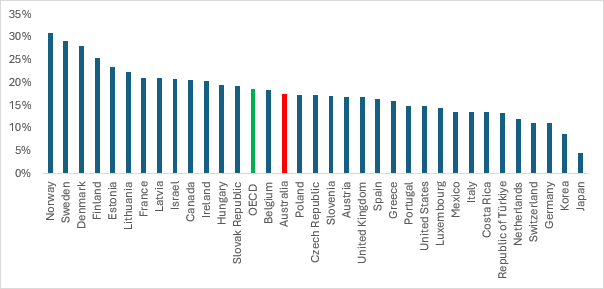
Peter Dutton has again claimed Australia has per capita one of the highest numbers of public servants in the world.

This is not true. Here are the other developed (OECD) countries. We are not one of the highest. We’re not even above average.

For GOD’S SAKE WE NOW HAVE THE NDIS

Greg Jericho
Chief Economist

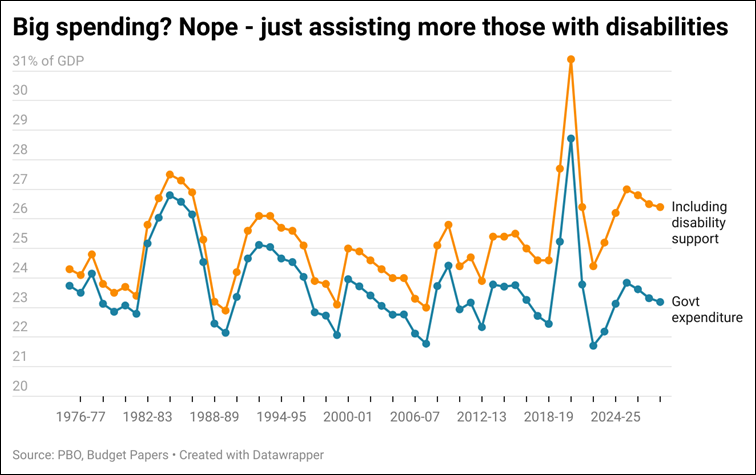
Big spending? Just to repeat ourselves form the last leaders debate and the Treasurer’s debate and well every other day.. the govt is not a big spending govt, it is just that we now have the NDIS!!

Also the suggestion that a surplus would be good right now is ludicrous – it would like mean unemployment would rise to near 5% and we would definitely be in a recession.

The economy is weak, the government needs to keep the economy afloat. This is uncontroversial, except when journalists think they are being economists

Matt Grudnoff
Senior Economist

The idea that it is unfair that young people will have to pay off the debt is incredibly silly concept. Think of the alternative. To have debt we cut spending on the hospitals that these young people are born in. We cut the schools that these young people will be educated in. The infrastructure they will use. Young people benefit from government services.

Greg Jericho
Chief Economist

Where’s the money going to come from?

We have a few ideas!

We get to the fight over the deficit and spending.

Everyone is spending, everyone is more serious about the deficit yadda, yadda, yadda – you have heard this all before.

I can hear Grogs screaming from my email, so I’ll check what he has to say.

Q: Would you put pressure on the states to give renters more certainty?

Albanese:

We delivered a renters’ rights program in agreement with states and territories that improved the rights of people renting and in addition increased maximum rental assistance by 45% in this term. In addition, Peter just raised super. If you give everyone super access to $50,000 and everyone at the auction will have $50,000 more, it will bid up prices as it did in New Zealand.

Again, it does nothing for supply. What we have is a reservation of 100,000 homes, just for first home buyers that will give them an opportunity because they won’t be competing with investors. We see that working in South Australia. We want to a place on Monday. 110 house-houses built, 40 will be just for first homeowners.

We get to rentals and it is maybe the first time Peter Dutton has had to consider the one-third of Australian voters who rent.

Q: Now, rent in capital cities has gone up a lot more than incomes over the last few years since COVID. Five times more than incomes have gone up. Many renters have been contacting us, raising concerns about what is in this election for them. They can’t afford a crippling mortgage in Sydney or Melbourne. Are either of you willing to give renters more rights? One of their concerns is the instability. That I can only get a 12-month tenancy.

Peter Dutton:

As you said, David, it’s an issue for the states. There’s a leadership role for the states. In terms of trying to protect the rights of renters and landlords, yes, you want a sensible position You would support longer rentals. I’m happy to support sensible reforms. As you pointed out, it’s for the states.

The focus on this election who is better to fix the housing crisis this Government created. Our policy is to allow young people to put money back to super when they sell the house but it gets them in the property market to start with. To do that we increase their overall net position. As people age and pay off mortgage and go into retirement, that I’re in a much stronger position if their mortgage is paid off completely, they have lost home hope of that under this government.

The idea that the housing crisis just emerged in the last three years is absolutely laughable.

Matt Grudnoff
Senior Economist

There is no policy at this election that will juice demand for housing than allowing people to access their super to buy a house. This policy will be the biggest gift for people who own houses and the worst thing for people trying to buy a house.

Albanese:

Can I make this point. Peter’s suggestion this has been a problem that developed in the last two years is a nonsense. Everyone watching this program knows that this has been developing for a long period of time. We have not had enough homes been built. The former government did not bother to have a housing minister for half the time they were in office. What we’ve done since we came to office, is look towards the big issue which is supply.

Q: Can I ask you to come to the question, which is about the tax breaks for investors. Negative gearing and the Capital Gains Tax discount. Why aren’t you willing to touch those?

Albanese:

The experts say that what that potentially do is is diminish supply, not increase it. That’s why the key to fixing the housing issues is supply. That is why Peter speaks about his infrastructure plan. We’ve already announced and are rolling out two rounds of our housing infrastructure fund, doing exactly that, making sure that sewerage and energy and that is fixed up, as well we work with states and territories to increase density where it is appropriate to make sure more homes can be built.

Q: Coming back to the tax treatment of housing investment, Mr Dutton, do you have any problem with investors using tax breaks to buy multiple properties, four, five, six?

Dutton:

Let me come to that. Anthony, your government modelled negative gearing changes and CGT. The Treasurer has done that.

Albanese:

That not right. It is Under our public service, we rigghtly value the public service, we value them coming up with ideas and various assessments, that is what happened. (There is an argument over whether it was commissioned or modelled)

I have been very clear of our position and why that is the case.

Speers:

Was it modelled?

Albanese:

It certainly wasn’t commissioned by us.

Dutton:

It was modelled by the Government. That’s publicly available. This Prime Minister has a problem with the truth. It’s not just in relation to this debate. There are many aspects that you could pick up in the course of this campaign. That’s where the Prime Minister misled the Australian people….

Speers ignores him:

Multiple properties, all these tax breaks no, problem with that?

Dutton:

I have stated very clearly, we want a sustainable housing market, which includes rental stock. Now, if you want to cut out negative gearing, as the Labor Party and the Greens would love to do, you will stop investment taking place for properties that are ultimately rented by young Australians. All of us started renting something, somewhere, and the dream was to buy a home but they lost that dream. If we stop negative gearing we will drive up the cost of rents they are already up 18% under this government. I want to make sure we have an investment class that is an asset class that is able to be invested in. The Greens, who likely could form a minority government with the Prime Minister if he is successful at this election, they have as a stated policy that they want to abolish negative gearing.

There is some argy bargy over negative gearing and capital gains tax discounts and both agree that they won’t be doing it because they don’t think it will solve any problems (sure, Jan) but they argue over who is more right about that.

Peter Dutton says it will increase rents.

As Grogs says:

In the 1980s negative gearing was removed for a couple years and in some cities rents went up in others they didn’t. Negative gearing has no real impact on rental prices. But it is a handy line to pretend it is anything other than a tax dodge

Every single thing Dutton says on housing makes me think of this.

Emily Mayo (@emilymayo.bsky.social) 2025-04-16T10:13:44.573Z

Matt Grudnoff
Senior Economist

Just a reminder that over the last 10 years the population (demand for housing) have increased by 16% but the number of dwellings (supply of housing) has increased by 19%. Supply is increasing faster than demand.

Peter Dutton:

Why do we find ourselves in a position in this country, it’s important to say. Over the past two years, the Government has brought in people all of who want homes and competing with younger Australians to purchase a home or a rental property. That’s a million people, 70% higher than any 2-year period in our country’s history.

The demand the Prime Minister generated has created a housing crisis, at the same time you have had the CFMEU and others who choked supply, stopped houses being built. It’s been this perfect storm that every Australian understands.

Q: Coming back to your plans that will boost demand even more.

Dutton:

We have five elements to our plan. The first element is a $5 billion fund where we work with councils and identify where they have land releases that are stalled at the moment, simply because they can’t afford the sewerage or the water or the road upgrade, so that will bring on 500,000 new home lots. That is on the supply side a very significant benefit.

The second part is we reduce migration by 25%, so that we can allow the housing stock to be built up again and by doing that, as well as stopping foreigners for two years from purchasing Australian homes, we give Australian, young Australians a go. The next part of our plan, which I think is incredibly important is to make sure that we can say to young Australians locked out of the housing market, under the government at the moment, that for the first $650,000 of your mortgage, that will be interest that you can claim against your income.

So for an average household, about $11-12,000 over five years.

Q: It is a lot more for higher income earners than low. This is regressive. It helps wealthier investors.

Dutton:

It provides for an average taxpayer $11,000 a year, $1,000 a month. More on high incomes. It serves two purposes. One is when you go to the bank you have a higher level of disposable income, so you are more likely to get a loan.

Secondly it helps you service a loa. David, in our country at the moment, young Australians are putting off having kids and parents and grand parents staying in the workforce longer because though they worked hard and saved for their retirement, they can’t afford to retire because they have to chip in for their kids to pay the mortgage.

Migrants are not driving up house prices. When the borders were closed house prices increased 20%.

We move on to the first question – housing.

Q: Can you honestly say your plans will make housing any more affordable in five or ten years or simply push prices higher?

Albanese:

Yes, we can. We have a plan not just for demand but for supply. A plan through the Building Australia Future Fund to build more public housing a plan for private rentals to get increased supply through the build-to-rent scheme. A plan as well to get first homeowners, to give them a fair crack, particularly young people. A 5% deposit, rather than 20, will mean that instead of paying off someone else’s mortgage, that I can pay off their own mortgage. That is important going forward. That will boost demand.

(Q) Can’t you just do the supply things? Why do you need to push up demand?

We need to do both. We need to particularly give young people a fair crack. We have a comprehensive $43 billion Homes for Australia plan, making sure whether it’s increased social housing or increased private rentals or increased homeownership through the help to buy scheme that will assist. The key is supply. That’s why only Labor is offering a plan at this election to increase supply of housing.

Matt Grudnoff:

Both major parties will not make housing more affordable. Both are just juicing demand. Both leaders should be asked to make a commitment to have house prices increase less than incomes.

Greg Jericho:

“Can you honestly say your plans will make housing any more affordable in five or ten years or simply push prices higher?”

The 100,000 new homes – will help.

5% deposit will push prices higher

$50,000 super will push prices higher

Mortgage tax deductions will push prices higher.

The $5bn on “infrastructure” by the Libs will do nothing except give property developers a leg up. Sukkar couldn’t even say the suggestion it would deliver 500,000 homes was based on modelling

Anthony Albanese:

Thanks to the ABC and thanks, Peter for agreeing to the second debate.

I’m really optimistic about Australia’s future, if we seize the opportunities that are right in front of us. Because of the hard work Australians have done over the last three years, we have turning the corner. We have inflation that is down, real wages that are up.

We have unemployment that is very low at just 4.1% and interest rates have started to fall. They started to rise before the last election. We know there is much more to do. That’s why we have a plan to cut taxes, not raise them.

A plan to make sure that we make things here in Australia through our Future Made in Australia plan. Strengthening Medicare through more urgent care clinics. Lifting the bulk billing rates and having cheaper medicines, making sure we cut 20 per cent off everyone’s HECS debts and give free TAFE to provide opportunities and a 5% deposit is what you will need for first home buyers. We know we live in difficult times.

I am very confident that with the right leadership we can see it through. I want to trust the Australian people. I want to back us and build Australia’s future.

Peter Dutton:

Thank you, Anthony for being here and thank you to every Australian who has taken an interest in what I think is an important election.

As we approach May 3, many Australian also ask are you better off today than you were three years ago? As I have spoken to thousands of Australians, young families, pensioners, people in small businesses, it’s obvious to me that people don’t feel better off. People have faced an existential cost-of-living crisis.

People have seen food prices go up by 30%. Their mortgages have gone up on 12 occasions. Our plan is to get our country back on track to help young Australians realise the dream of homeownership again, to make sure we can help manage the economy so we can get inflation down.

If we do that, that will lower interest rates. We want to help people with the cost-of-living crisis, make sure we can give $1200 back to Australians, money they worked hard for and reduce their petrol price by 25 cents a heart.

Matt Grudnoff says this is the wrong question: Who is best likely to make things better over the next 3 years is what people should be focused on.

Greg Jericho is already losing his mind over the ‘groceries prices have gone up by 30%’ line “lies, lies, lies” he says. He did the figures last week – it is 12%. Still bad, so why does Dutton need to over exaggerate it?

There is no stop clock, but David Speers will try and ensure there is equal time.

Peter Dutton won the toss and gets the first word.

In the meantime, the AFR has released its latest polling showing the parties are on 50-50 on the 2PP preferred measure,

Phil Coorey reports:

This represents a 1 percentage point improvement for Labor since the campaign started when the Coalition held a 51-49 lead, and the first time the Coalition has not led the two-party vote since July last year.

Dutton, who has had a chequered campaign so far, dropped 4 percentage points as preferred prime minister, affording Anthony Albanese a clear lead of 46 per cent to 41 per cent.

The campaign will go into abeyance over Easter before hostilities resume on Monday, ahead of pre-poll voting beginning Tuesday and the election on May 3.

Second leaders’ debate

The debate opens up with some voters’ questions.

Health, education, housing, energy, nuclear, helping the world, maintaining democracy, Trump and maintaining Australia’s standard of living were among the issues canvassed.

And with a very dramatic introduction from David Speers and some music that sounds like the Hobbits are about to take Helms’ Deep, the debate begins.

It’s nice to watch some great journalism ahead of one of these debates. Laura Tingle is one of the best political analyst minds in the country and we need to protect her at all costs.

Hello and welcome back

Hello! You have Greg Jericho, Matt Grudnoff and Amy Remeikis with you for the second leaders debate.

We are ready, if not willing.

I have the Krupnikas, candles and incense burning (and some salt by the doors, because you can never be too careful) and am as ready to do this as I’ll ever be. Thanks for joining us and hope we all make it through intact!

Liquored up and ready to live blog the debate with @amyremeikis.bsky.social live.australiainstitute.org.au

Greg Jericho (@grogsgamut.bsky.social) 2025-04-16T09:23:45.723Z

The Australian’s Ewin Hannan (perhaps the best industrial relations reporter in the country) has written on the Fair Work Commission’s review into wages for feminised industries, which was ordered by the Albanese government.

You can find the whole story here.

Hannan reports:

Releasing its historic review into the undervaluation of wages in feminised industries, a commission expert panel found workers covered by five awards had been the subject of gender-based undervaluation and should receive what unions representing early childhood employees are calling “life-changing” pay rises.

The recommended percentage increases are as high as 31 per cent for some health professionals; 27.8 per cent for early childhood workers and up to 10.9 per cent for pathology collectors.

The recommended increases of up to 27.8 per cent in early childhood are above the 15 per cent pay rise implemented through a recent ground-breaking multi-employer agreement in the sector, with the United Workers Union on Wednesday framing the deal as a “downpayment” to address gender undervaluation.

That’s going to be something the government needs to respond to.

On the housing policies being put forward, Jacqui Lambie says:

Well, first of all, what bothers me is the Liberal Party should have got this all done 12 months ago. They have been in opposition for three years, they don’t look like they’re in opposition at all. They’re really struggling with that. They should have had costings, they had plenty of time to get it ready and looking like a real smart outfit.

They failed to do the work to make them look like a credible opposition. That’s really worrying for me.

Either way, it doesn’t matter what policies you look at, we have a tradie constraint out there, we know that much.

Trying to – trying to get – the building products and things like that, that is going to be a strain, especially if we don’t know what is going on with the US, we know it’s straining, it will cause more strain.

And they’re not looking at the other things. We would have really liked for them to pick up negative gearing and have a look at that.

I don’t know what scared them in 2019, it’s very different circumstances now. It got through to people out there, 75% of those people have one house, 25% we have a problem with. We’re happy to grandfather that. What does it look like? We need to put more policies on the table, it will take courage.

And good luck, Lambie says, to either political party wanting to make an impact in Tasmania over the next two weeks:

There’s no Trump fans down here in Tasmania, I need to be honest with you.

…Other than that, they’re really just trying to get through the cost of living. I’ve seen a lot with the caravans, they’re not flying their kids away, they’re doing all they can in their caravans, the caravan parks are full, that’s what it looks like. I don’t know how they’re going to go in the next two weeks campaigning. How difficult is it, when no-one wants to see your face, let’s be honest. You’re on school holidays with your kids. It’s going to make it a little bit difficult out there.

‘It doesn’t matter if we upset them’ – Lambie on the US

Jacqui Lambie seems to be having a very fun time in this election campaign. She has just spoken to ABC’s Afternoon Briefing about the need for a parliamentary inquiry into Australia’s strategic arrangement with the United States (AUKUS) and why she isn’t worried if it would up set the US:

Why should we not have an inquiry? With all the stuff going on, it doesn’t matter if we upset them, quite frankly they don’t care about that. It’s a good way to – what does our friendship look like? What does mateship look like? These are broad terms of reference. I don’t want to miss anything out. For people to put their opinion forward and see – especially those experts, where they think – what do they think the relationship looks like in a year’s time?

Let’s have a shot at it.

Right now we’re going through quite a rough patch because of what’s happened with Trump, they’re not with the people themselves, of course. We need to put this under a magnifying glass and see where do we sit, where does it look like. We need to do something. Let’s have a good look at our relationship with the USA and get it out on the table.

Answering your questions

Jack Thrower
Research Economist

Sue asked:

What is missing from the campaign is any discussion about the urgency of climate change action (not just “yes, we are doing the bare minimum, and slowly’) and also funding of universities  and research (especially if overseas students will be reduced and funding support from the USA will be removed).

Sue points out that the campaign is missing discussion on:

  • the urgency of climate action, and
  • funding of universities and research (given overseas student numbers will be reduced and funding support from the USA may be removed).

Climate change

This is absolutely true. While the 2022 election has been dubbed ‘the climate election’, discussion of this global emergency has been muted this time around. Instead, the election has been dominated by the ‘cost-of-living’, failing to acknowledge that climate change is already driving up the cost-of-living and this is only likely to get worse. While Labor’s climate policies are better than the Coalition’s nuclear fantasies, even the Albanese Government’s own predictions don’t see emissions falling until 2028, “at which point they brilliantly drop at a constant rate to 43% below 2005 levels by 2030”. 

University funding

This is also true. The university sector continues to have a vacuum of responsibility. The federal government provides funding to universities, but most regulation is left to the states, which have mostly also not taken responsibility. This has created a general governance crisis in the sector, a crisis which is now being exacerbated by Trump and scaremongering about international students.

The Trump White House is threatening funding for important research in Australia by quizzing universities on whether projects accord with the administration’s extreme views on things such as climate change and DEI (Diversity, Equity and Inclusion), we’ve written more about this here. The Albanese Government is creating further financial issues for universities by trying to cap international student places, the Coalition promises an even harsher cap. This is a misguided attempt to fix the housing crisis, which is not caused by international students or migrants in general. However, it will also cause major financial issues for public universities as about a quarter of their revenue currently comes from international student fees.

The university sector is in desperate need of accountability and responsibility, it’s time for the federal government to take this role. It could start by implementing a range of reforms recommended by the Australia Institute, including measures to make university management more transparent and accountable, boosting public funding, and generally reorienting public universities towards the public good.

See you soon

We are going to just rest the blog for a little bit, although we will be covering the debate tonight, so we will be back before 8pm.

If you’re not – we understand! Greg Jericho and I will battle on for you.

We’ll pop in anything major that happens – but go and have some you time. Ax

Housing, housing, housing – today was all about housing.

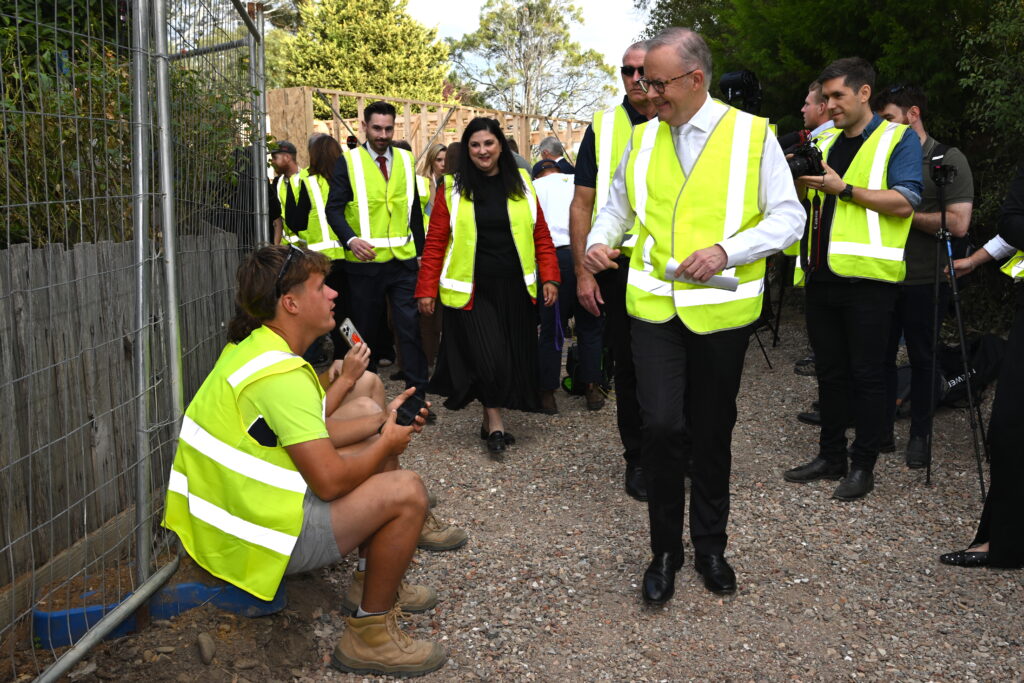
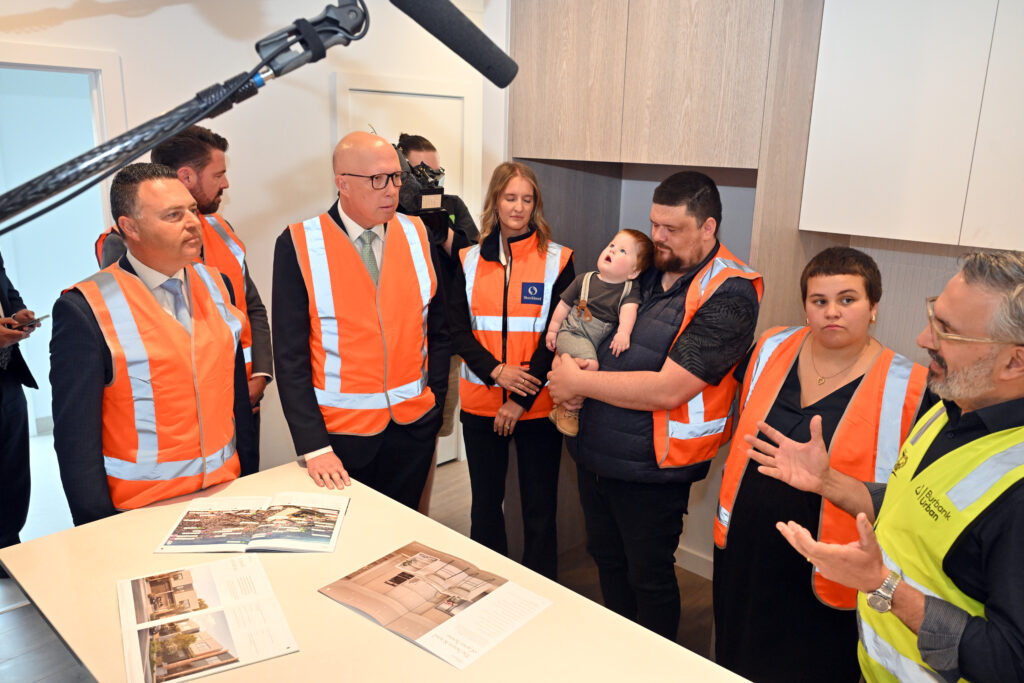
Australian Prime Minister Anthony Albanese speaks to carpenters as he leaves a construction site at Forest Hill in the electorate of Deakin (AAP)
About as broad as Australia’s policy debate
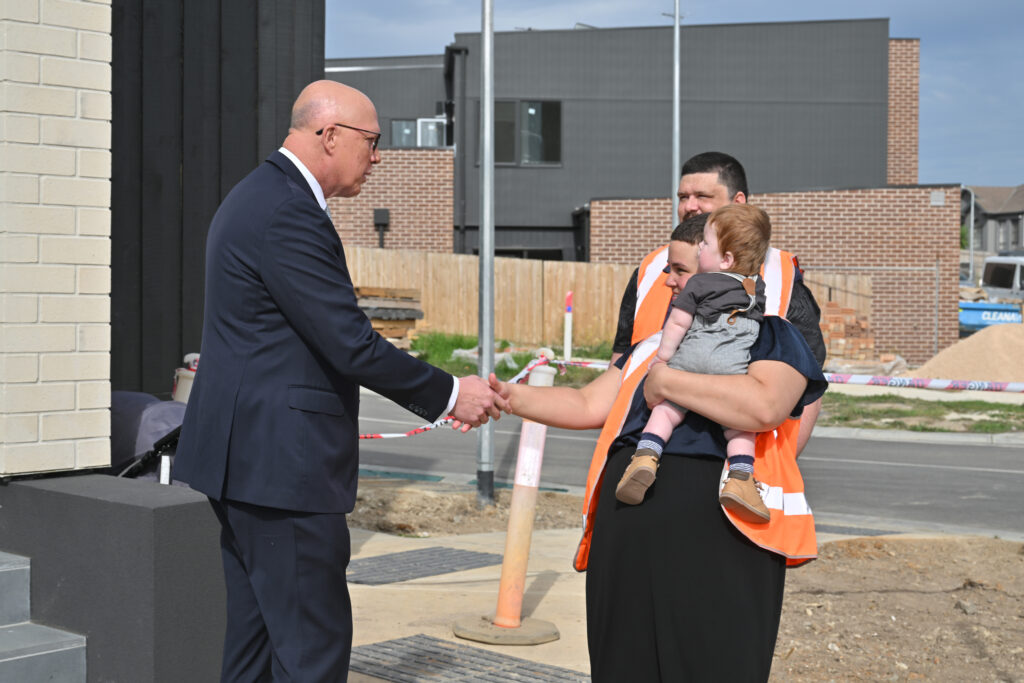
Leader of the Opposition Peter Dutton speaks to Corey Wilson-Glenister, Maxie Waaka and son Leo at a new housing development in Wantirna, east of Melbourne (AAP)
Leo has identified the real star in the room (AAP)

AAP has also covered Peter Dutton’s response to PNG Foreign Minister Justin Tkatchenko telling the ABC earlier today he would prefer to work with a Labor government:

The opposition leader says he’ll be able to work with the Papua New Guinea government despite its public preference for Labor.

Peter Dutton was asked about the rare foreign endorsement made during the  Australian election campaign from PNG Foreign Minister Justin Tkatchenko, who openly admitted he’d prefer to work with Anthony Albanese’s government after the May 3 poll.

“Our relationship with Australia has never been stronger,” he told the ABC.

“Why would you want to change something that is working well?

“I can clearly state that we would, I’m sure, love to see the current Australian government continue and to continue our good work.”

The comments are unusual for an overseas politician.

While foreign governments might have their preferences for which side of Australian politics they hope to work with, they are usually guarded about revealing it in public.

Asked by AAP for his response to the comments while campaigning in Melbourne on Wednesday, Mr Dutton downplayed the significance.

“I’ve known Justin for about 20 years and he’s doing a great job as foreign affairs minister in PNG,” he said.

So glad we are so heavily allied with the United States, with whom we are told we have so many “shared values”.

As AAP reports:

Wire services including Reuters and Bloomberg News will no longer hold a permanent slot in the small pool of reporters who cover President Donald Trump, the White House says as it moves to exert greater control over who gets to ask him questions and report on his statements in real time.

The decision announced on Tuesday comes after the Trump administration last week lost a court challenge brought by another wire service, the Associated Press, over its earlier exclusion from the press pool.

The pool typically consists of around 10 outlets that follow the president wherever he goes, whether it is a meeting in the Oval Office where he makes statements or answers questions, or trips at home or abroad.

Under the new policy, wire services will lose their customary spot in the pool and will instead be part of a larger rotation with about 30 other newspaper and print outlets.

Who votes with whom? Beware claims that use voting records to argue politicians have similar views 

Bill Browne 
Director, Democracy & Accountability Program.

Sky News says community independent MP Allegra Spender supports more Coalition motions than Greens motions

But They Vote for You says Spender votes with Greens MPs more often than Coalition MPs

That both those claims are made about the same person is proof that voting comparisons are fraught.  

It is just as confusing when it comes to the major parties.  

We know that most legislation is non-controversial and bipartisan, so how is it possible that Labor Prime Minister Anthony Albanese only votes with Opposition Leader Peter Dutton 1% of the time? 

And earlier this year the Liberal and Labor parties did a deal this year to change Australia’s election laws – so why are most Liberal senators not recorded as voting for the deal? And why on that bill are community independents recorded as voting against 61 Labor MPs but only against four Coalition MPs

The full story is more complicated 

Nick Evershed at The Guardian today has a very good article asking what the data shows about politicians’ voting records. For example, does the voting record of the community independents lean towards the Greens, towards Labor or towards the Coalition? And how often do the major parties vote together?  

The real story is that the answer depends on what question you are asking – and Evershed has made the data available so you can play around with it yourself.  

Voting comparisons are a poor measure of political position 

The broad problem with vote comparisons is that they don’t track what does matter, and do track what doesn’t matter.  

  • Most votes aren’t recorded. The majority of legislation passes “on the voices”, meaning no votes are recorded.  
  • Many party MPs skip votes – their colleagues represent the party position. Even when votes are recorded, only a few MPs may show up to represent their party’s position.  
  • If there are only a few crossbenchers on one side, the division isn’t fully recorded
  • MPs may vote the same way but for different reasons. How do you capture when two MPs vote the same way, but for different reasons? Are they really “voting together”? What if someone votes against legislation because it’s been rushed and poorly drafted, not because they disagree with the principle?  
  • A single vote may be on several things at once, like an omnibus bill covering several topics at once – an MP that opposes one part counts as opposing the lot. 
  • A principled stand – like never gagging debate – can look like supporting one party. Many votes are on questions like who gets to speak. An MP who votes against the government censoring debate on principle will vote “against Labor” during a Labor Government and “against Liberal” during a Liberal–National Coalition Government.  
  • “Who votes with whom” comparisons give equal weight to important and trivial votes. But sometimes, a vote is purely symbolic or procedural.  
  • Other times, a vote that looks procedural actually has a substantive effect. For years, same-sex marriage was blocked through procedural votes.  
  • An MP who takes a stand can stop legislation before it’s introduced, so their influence is never recorded in the Hansard voting record. 
  • Sometimes, an MP not turning up to vote at all has the same effect as voting for or against the topic. But they escape being recorded as voting one way or the other.  

For these reasons, I’d caution anyone against relying too heavily on supposed “voting records” – without looking at the context behind those votes and how the data has been interpreted.  

Well that was uninspiring in terms of a policy debate. The questions were around the narrow reflective strip Australia’s policy has been reduced to by the major parties, but there are no big ideas in there, no structural reforms.

There was a lot of talk about tinkering though. As an old neighbour used to say, it’s two cheeks of the same arse.

Campaign gaps: Child poverty – a question of priorities

Dave Richardson
Senior Research Fellow

As we reach the middle of the campaign there has been a decide lack of focus the most vulnerable in society – those children living in poverty.

The lack of debate on the topic does not reflect a lack of a problem. ACOSS has noted that “there are 3.3 million people (13.4%) living below the poverty line of 50% of median income, including 761,000 children (16.6%).”

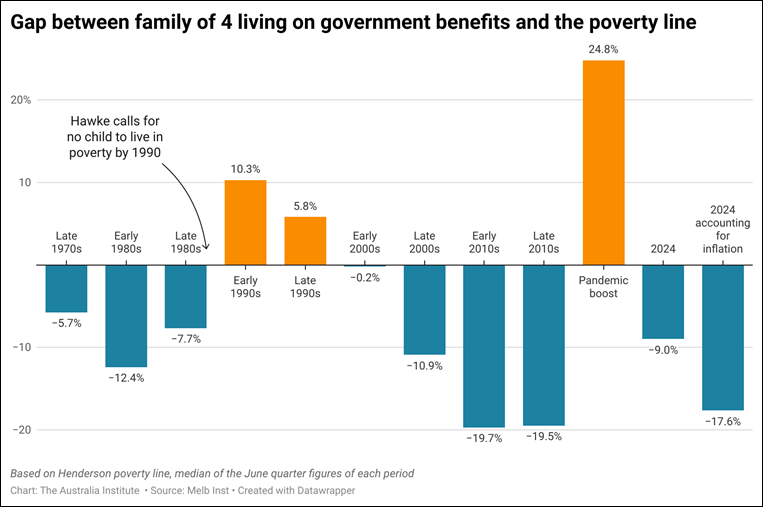
Back in the 1987 election campaign Prime Minister Bob Hawke rather famously set the goal: “By 1990 no Australian child will be living in poverty”. He was often ridiculed for that statement afterwards, and yet it is undeniable that his setting the goal did have an impact. IN the 1970s and 1980s a family of 4 living on government benefits was very much living below the poverty line. After Hawke set the ambition, that was reversed.

The Hawke Government achieved an increase in payments for an unemployed family that put it above the Henderson poverty line in 1990.

Alas it did not last for long, and from the peak of over 10% above the poverty line, that figure gradually declined until around 2002 when that family was back on the poverty line and it kept getting worse.  

That was dramatically changed during the pandemic when the Coalition Government doubled the single rate of Jobseeker. The income of our family of 4 did not increase quite as much as the payments for children and rent assistance were not changed so that a family’s income went up much less than a single beneficiary, but it still massively lifted families out of poverty.

And then the boost ended.

The most recent figures suggest poverty is again a major problem for a high proportion of the Australian population – with those families on government benefits living around 9% below the poverty line

Unfortunately, the problem in reality is likely worse than that. The Henderson poverty line uses GDP per capita as its base, but that has been falling of late, whereas inflation and cost of living has been rising. If we instead adjusted the poverty line to take into account the recent inflation, the family of 4 would be nearly 18% below the poverty line.

Can child poverty be addressed again?

Australia is a much wealthier nation than it was in 1987 when Bob Hawke set his anti-child poverty target. Real GDP per capital is now around 75% higher. Yet Australia has experienced a long period with the poverty gap much higher than in the lead up to the Hawke Government’s no-child-in-poverty target.

If we could do it by 1990 Australia can do it again in 2025. Unlike the pandemic measures, this time the emphasis should be on improving payments for parents with children – just like Bob Hawke did with the emphasis on payments called “Family Allowance Supplements” at the time. 

Unfortunately, in tonight’s leaders debate the problems of poverty will likely be brushed over. They should not be.

Q: The maths on the Labor side says that you’ll put forward $10 billion. It will build 100,000 homes. That’s basically $100,000 per home. On the Coalition side, the claim is that you’ll put $5 billion into infrastructure. That maginically unlocks 500,000 homes, which is $10,000 per home. I’ll leave it to voters to decide whether $100,000 per home or $10,000 per home is more convincing. But the key question is – for the sceptical journalists here. Will you put forward and tell us who told you the number of homes that you will build. And will you release the information, the treasury or PBO or somebody else so we can verify that you’ll build the homes that you claim?

Michael Sukkar:

It is a good question and good to be cynical about this. What we’re proposing with the housing infrastructure program, not that we’re building homes. And the important word you used quite rightly is “unlock”. We’re going to unlock those homes because at the moment, we have projects where the projects stack up. But there’s no funding for that. If you talk to the NBA, the Property Council, who are the real experts here, a rough figure of civil works of about $10,000 to unlock that is pretty well, I can assure you, without housing of the structural program which we think is going to unlock 500,000 homes, it is not modelling.

We have literally met with hundreds of councils. We have the projects, line by line, the number of houses that will be unlocked from that funding. Really well thought through projects. It is a very big spreadsheet, and can I say the 500,000 number we deliberately chose a conservative figure. It is actually higher than that but to deal with the cynicism and to building a little bit of leeway, we have been very conservative when we said 500,000.

Clare O’Neil:

The Coalition’s estimates are totally fanciful, absolutely ridiculous. If it was that easy to fix the problem we wouldn’t be in a crisis. We know that because this is something the Coalition tried last time they were in office and I would love for you to go back and have a look at what was achieved through that. They set up a fund of $1 billion that was supposed to fund investor exactly they described. It 5000 homes. There is no way these numbers will stack up. Our numbers come from Treasury. It is a policy we have been working on for a long time with Treasury officials. $10 million, you have talked about the 100,000. I want to explain this as clearly as I can. We are not paying for the entire cost of building a new home. What we are doing is assisting state development agencies and in some in answers private developers making projects that do not stack up today stack up and the reason that the government will intervene is because in exchange they will give us those homes for first home buyers at entry-level prices. I say to you again, this is something that is really working in South Australia. We want to build on it and make it national.

Greg Jericho
Chief Economist

Sukkar and O’Neil are arguing about social and public housing.

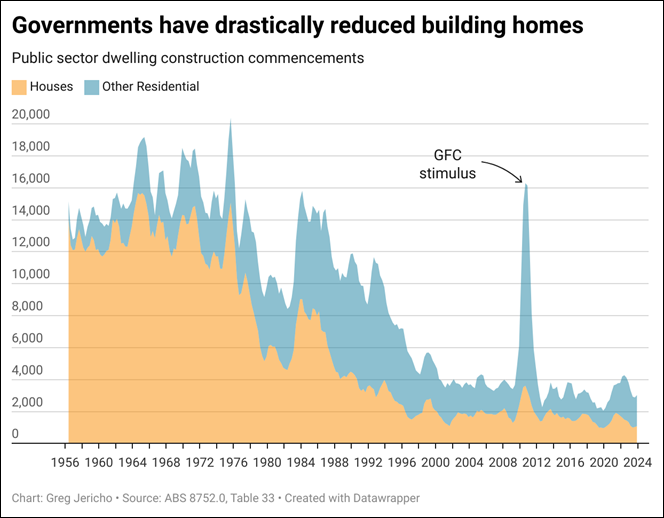
This is one area where no governments of the past 25 years should be boasting. Apart from the GFC stimulus public housing is in despair

Clare O’Neil:

You mentioned social and affordable housing. Thank God that is getting air time today because this is one of missing pieces of the debate. We have a chronic national shortage of social and affordable housing around the country. We have a growing homelessness problem around the country, which is directly related to this. We have people in severe housing distress. Well, our Government is stepping up and doing something about it.

We’re building 55,000 social and affordable housing homes. 28,000 of those homes are in construction or development right now.

Now, Michael may denigrate targets. In fact, the Liberals did almost nothing about social and affordable housing when they were in government. Well, you scoff but let me give you numbers. You’re criticising our government for what you say is not building enough homes. Do you know how many homes the Coalition built, social and affordable housing, over their almost a decade. More than you. 373. That is what they added to social and affordable housing stock. 373.

Sukkar:

Wrong. Wrong.

O’Neil:

As a minister, as a minister, as a politician, that doesn’t make me happy. Because it makes a political point. It makes me angry. There are people around our country who need the Government’s house to have stable housing and the Liberals built 373 of those homes over a decade. Now, we’ve got 28,000 homes in development right now.

That is a serious number of homes on the pathway to 55,000 around the country. And I just say to Michael – we’ve got to change the way that the Government engages with housing in this country. We’re not going to get anywhere in this debate if we put together a bunch of silly policies, written on the back of a napkin, that are going to build fewer homes for the country that will be more expensive for people that can’t get into them.

I can absolutely guarantee you, if the Coalition are elected, this concoction is going to make the housing crisis worse. We need to change the Government’s approach and that is what our Government is doing.

We are going to fact check that number for you .

Fact check: Liberal super for housing deposit policy

Greg Jericho
Chief Economist

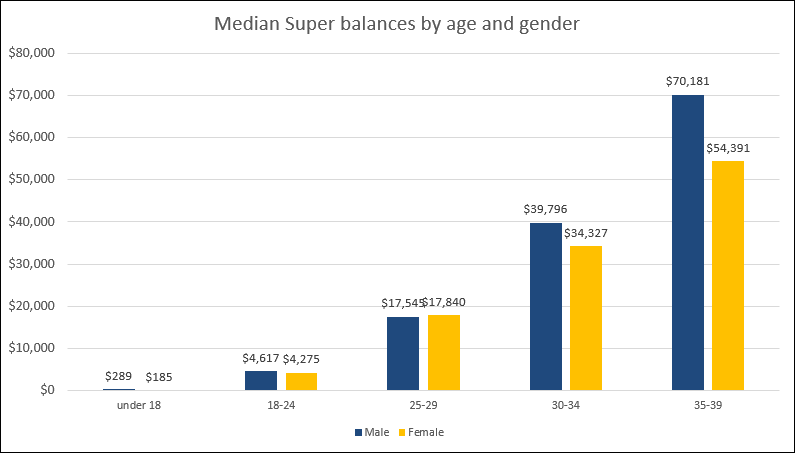
The Liberal Party love the idea of first-home buyer accessing up to $50,000 of their superannuation to use for a deposit. But how much do people in the 30s, who the policy is aimed at have in their super?

Well the median in 2021-22 was between $34,000 and $39,000 for their early 30s and $54,000 to $70,000 for those in their late 30s.

In essence for most people using $50,000 of you super would destroy your superannuation base.

It’s a great policy for those who have stonks in their super. But those people are also those more likely to already have the money or wealth to have saved for a deposit.

So this, much like the policy to deduct interest repayments, is something that will benefit those who already can afford to buy a home, and do so in a way that increases the ability to bid higher for homes – which will cause house prices to rise.

Greg Jericho
Chief Economist

A certain phrase seems rather lacking from the debate

Sukkar is asked the same question, given Peter Dutton said the same thing this week and says:

Look, I think Clare has copped some unfair criticism, because I think it is… It would be quite devastating for a young first home-buyer who has owned a home for one or two or three years to suddenly go into negative equity, which is the consequence of what some of the suggestions have been.

What I said very clearly is – you absolutely want wages growing more quickly than house prices. There’s no doubt about it.

But you can have a situation where you have modest house price growth, but you still have wages growth that outpaces it. And what we need to see is a period where wages growth sustainably outpaces housing growth. That’s house price growth.

That’s the only way that you’re going to end up in a situation where it’s more affordable to own a home. Let’s not forget the GFC in 2008 where we saw in the United States significant drops in house prices, and the devastating consequences that it had on that economy. To be wishing that on our economy, I think, would in the end, hurt young Australians more than anybody

Q: You spoke about distress, anger, rage, facing young people. But last year, when you went on youth radio station triple j, you said “We’re not trying to bring down house prices. That may be the view of young people but not the view of our government.”

Instead, you insisted that you wanted sustainable growth. Do you accept that ever increasing house prices is part of what is causing young people distress in trying to get into homeownership and define sustainable growth?

Clare O’Neil:

A very important question. I really appreciate you asking it. Firstly, I would just say, I genuinely and deeply understand and feel the pressure that young people are under. And I understand why, particularly young people, but not just young people, are looking at this problem and thinking that declining house prices is the answer. What I would just say is that we’ve also got a generation of pretty young people who have come into the market in the last ten years. Many of them have taken on incredibly large mortgages while interest rates were low. And we don’t want, nor is it good for the country, to see that generation go into negative equity.

So we do need to have is a balanced approach here. What we need to do is make sure that we build more housing in our country. And I don’t think that we’ve repeated it enough in this discussion. If there’s one thing for people to understand at home about what’s going on in housing at the moment is that for 40 years, we have not been building enough homes. So we need to build more homes, and the kind of sleeper issue in all of this is about wages growth. We’ve been through nine years of a Coalition government that told us that low wages growth was a design feature of their economy. And we are trying to change that. So the things that need to happen here for us to address this situation in the long-run are about building more homes and making sure that Australian workers are properly paid, and that’s the policy objective of our Government.

Q: What is sustainable house price growth? What is the number?

O’Neil:

I’m not going to put a number on it, but it’s really important that we see wages going up faster, and us building more homes, and especially at that affordable end of the market where we’re going to see most home-buyers come in.

Q: Your mortgage plan, shadow Minister – I’m go on the Coalition figures I’ve read here. 110,000 households will benefit over four years, the average benefit $111,000. Your document says it will cost $1.25 billion. In one year, it would be $1.21 billion. Is the cost more, or is the $11,000 wrong? Or is it fewer households?

Sukkar:

No, we never said that the 11,000 is the average. The $11,000 is for the typical couple.

Q: Which one is it?

Sukkar:

Let me just answer the question. So for a typical couple who are on average full-time earning, this will save $55,000 over the five years. That is a significant benefit for first home-buyers. It’s going to be, Tom, with respect to costings. It will be a demand driven scheme. This won’t be capped. We’re not going to cap it. We will be delighted if as many Australian as possible are able to avail themselves of the first home-buyer mortgage deductibility

…Well, we’ll announce all of our costings at the right time, Tom. But I can assure you, we want as many young Australians to take up the first home-buyer mortgage deductibility measure, because it is not a capped scheme. And importantly, importantly, Tom, it’s a policy that adds to housing supply. Because one thing that I don’t think that many Australians are aware of is that in Australia, we don’t typically have new homes built unless someone is willing to pre-commitment to that home. Whether it is an first home-buyer willing to buy off the plan or whether it is someone wanting to put a deposit down on a house and land package.

Often it is a young first home-buyer having confidence and having the financibility to purchase. So the reason we want as many Australians as possible to take this up is – yes, we want them to become first home-buyers, but they’re also going to add to the housing stock of this country, and the HIA expects it to be 30,000 a year.

O’Neil:

This is what happens in public poll sip when you do sloppy work that isn’t properly looked at. This is dressed up as a housing policy. How can it be housing policy when it won’t build a single new home or get a single person who is renting today into homeownership who wouldn’t otherwise be there. What the Liberals have cooked up with a generational triple whammy for young people in the country. Peter Dutton not only wants you to pay off your landlord’s mortgage.

Michael Sukkar is still continuing with the furphy that the CFMEU is the reason house prices are going up and why house builds are delayed, when we know that the CFMEU are primarily involved in commercial projects.

And then to Michael Sukkar:

Q: You have criticised the Labor target. You don’t appear to have one. Will you set a target? And will you keep in place the housing planning reform the states signed up to, whether that be to reform it in some way, keep it, or will you scrap it?

Sukkar:

The problem for Clare and the government is that, when you continually say to Australians – who I think have every right to take you at face value – that you’re going to deliver 1.2 million homes when you’re falling hundreds of thousands of homes short, you’re insulting their intelligence. When you tell Australians as Clare just did then in her remarks that the Labor government’s building more homes – well, that is against every single ABS statistic that every single person in this room could find very easily on their phone.

We’re building fewer homes after three years of a Labor government than the former Coalition government which Clare criticises.

If the former coalition government was so terrible, I wonder how Clare will judge this government. Because they’re building 30,000 homes a year less. So we’re building fewer homes and yet we have a government putting out a target that they now know they won’t meet. They now know they won’t meet. We will build more homes than the Labor Party. In the preceding five years before this government came to power, Australia built more than a million homes.

Routinely, in Australia, over 5-year periods, in about the last 25 years, we’ve built more than a million homes. We’re not on track to build a million homes after five years of the Labor government, so we’ve actually gone backwards.

We’re not even maintaining the status quo of what Australia was building previously. So we’re going backwards and, at the same time that we’re going backwards, we have a government that’s had this genius idea to run a world-record migration program, which has driven rents up by nearly 20%. Renters are the biggest casualty of the Big Australia policy from the Labor Party, with 20% increases.

So I can assure you, Tom, and I can assure Australians – just like we built more homes in the previous coalition government, we will build more homes than Labor…

(But there is no target)

To the questions. First one is to Clare O’Neil:

You spoke about ambition and that $1.2 million target. Your own or the independent national housing supply council says you’ll be about 300,000 short. Are you willing to say you’re not on track and explain why?

O’Neil:

We need a bold and ambitious target because boldness and ambition is exactly what is required here. Instead of washing our hands of the problem, as the former government did, the PM’s actually stepped up and engaged with the states to negotiate a shared target across the country of 1.2 million homes. How are we going against that target?

I said we’ve built half a million homes since we’ve been in government. We’ve got critical policies in train that are helping us get there – things like fee-free TAFE, which Michael and his colleagues want to scrap.

Things like the planning reform that’s occurring at a state level. Do we need to do more? Absolutely, we do. If this was a simple problem that could be fixed in a 3-year term of a government, it wouldn’t be a 40-year-old crisis that’s been building for our country. What I do want to say to you, Tom, is that we’re making real progress against these targets.

Michael’s used some numbers there that are a bit old. It’s true that, some time ago, when we first set this target, the industry said, if you continue on this current trajectory, you are going to fall significantly short.

The last Master Builders report that came out showed that we’ve made up 240,000 of the gap… . ..just on the work that we’ve done. This is something the government is going to need to continue to work on. But we’re seeing really positive improvement in the data and we’ll continue to work with states and territories to get there.

The Coalition’s latest housing announcement is that it will undermine regulations, including environment regulations to ‘turbo charge’ housing approvals on greenfield sites.

What. Could. Go. Wrong.

The official announcement is:

A Coalition Government will immediately take action to finalise existing residential development environmental approval applications. We will set a target of clearing Labor’s backlog within 12 months and any project already stuck in the approvals process for more than a year will be finalised within six months. 

We will establish Investment Australia to drive productivity reform across the economy, with a key focus on building and construction by:  

·       expediting hundreds of project approvals; 

·       setting firm timelines for each outstanding residential development project in collaboration with the relevant department; and 

·       simplifying environmental assessment processes, including clarifying the rules for environmental offsets. 

Housing debate begins

Michael Sukkar has won the toss and will open the debate. He is delivering his opening address which is as you would expect.

We’ll keep an eye on the debate and bring you anything of interest, as well as fact checks, throughout the next hour.

Answering your questions: how do leaders prep for debates?

Nicola has asked us how do the political leaders prepare for the big debates?

If you have done high school debating, you would be well across it – because it is not that different. Each campaign goes to ground a little early and locks themselves away to scrub up on all the potential policy questions, the trap questions and the curve balls (how much is a litre of milk etc) and then, the leaders get quizzed over and over on it, as if they were in the debate itself.

So that means someone on the campaign plays the role of journalist and another plays the role of the opposing leader. Daniel Andrews has been advising Anthony Albanese on how to handle debates (and communicating in general) and Tony Abbott/Peta Credlin and Scott Morrison have been giving Peter Dutton advice.

So the leaders are heckled as they speak, to prepare them for potential interruptions and how best to answer them. Which also means the campaigns have to be across the gaps in their own policies and the hypocrisies in their approaches and attacks. Which is interesting in itself.

The main part of the game is to not stuff up. It’s not so much about who wins the debate, it’s about the performance. And they are performing to the journalists who cover this (like me) because if there is a f*ck up, then that is what gets reported on for days and days and that is more likely to be what voters end up hearing about.

I

Fact check: Is the Liberal’s plan to boost housing just a $5bn gift to property developers?

Matt Grudnoff
Senior Economist

One housing policy that has got very little attention has been the Coalitions $5 billion housing infrastructure fund. This fund, the Coalition claims will “swiftly unlock up to 500,000 new homes by investing $5 billion to fund essential infrastructure like water, power, and sewerage at housing development sites.”

One of the reasons for the lack of attention might be because it comes with almost no details. This is strange because the claim that $5 billion of infrastructure can unlock 500,000 homes would be great, if true. The kindest way to describe the figure would be ‘optimistic’.

So, what evidence does the opposition have that it can unlock so many houses? The shadow housing minister Michael Sukkar has said “Our 500,000 figure is based on real costed projects and supported by industry analysis,”

The problem is that they refuse to release any evidence of this. All they say is that the policy details will be released in a normal fashion ahead of the election. But pre-poll voting starts next week. And also, the normal fashion is to release the detail when you announce the policy.

There are also concerns that this could just be a free $5 billion gift to property developers dressed up as housing policy. The money could end up paying for infrastructure that the developer would normally be expected to fund and just end up adding to their profits.

We also need to put this spending into context. If the $5 billion is over 5 years, then that is just a drop in the bucket for infrastructure spending.

Housing is one of the elections biggest issues. If the Coalition wants us to take its policies on this seriously, then it needs to be upfront about what it is doing and how it plans to achieve it.

Ask us anything

We are going to start writing up some information on what is NOT being discussed on the campaign, and we would also love to hear from you on what you would like answered.

So – what are your burning policy questions. And what is missing in this campaign for you?

amy.remeikis@australiainstitute.org.au or the socials (@amyremeikis)

So what is Dutton planning to do to help women dominated industries? Not a lot.

Dutton:

We will invest more each year. When we were in government we double the amount of money in education, helping teachers, females and males, helps when we put more money back in people’s pockets which is what we’re doing without $1200 give back of your money you have paid in taxes.

The 25 cent fuel excise reduction is targeted at women driving kids around or delivery truck drivers who are trying to make ends meet.

If we can manage the economy well, get inflation down… Interest rates go up under Labor government because they spend too much and that is why we have an inflation problem, a 5-point plan that we have the help young couples, singles into housing because for young professionals who feel locked out of the housing market, we will make the interest payments on the first $650,000 of their mortgage tax deductible.

That is a game changer. And for a young family or young professional woman who has given up on that, that will only benefit that house purchase and the serviceability of the loan and I want to make sure we can help Australians and that is exactly what we will do if we can win the election on May 3 and if people want a change of government if we want to improve lives, if we want to improve homeownership in our country, vote for your Liberal or National Party candidate at the election

Peter Dutton was asked a very good question about what he is offering women (you know, that pesky 50% of the population) given his campaign has focused on traditional male dominated areas of truck drivers, tradies, big utes and hi-vis.

Q: You talk about money, construction, agriculture and energy being the four pillars of the economy, in your own [campaign] speech you mentioned women twice and how you would protect them from domestic violence and crime. A lot of your campaign has been at petrol stations, you have been in trucks, when you speak about female dominated industries like education you talk about the woke agenda.

Dutton:

I am offering the chance for them to get a home. Homeless women are at a record level under this government, so let me say for homeless women who have suffered under this government we have a better pathway forward, we have said in relation to accessing super women who have had a messy relationship breakup, who haven’t had a home before or have no roof over the head with their kids, I want to provide that stability. I was a police officer for 10 years and I work hard every day in this job to keep women safe and young girls and children safe.

There is nothing in the Coalition policies that will help vulnerable women get access to secure homes easier (nothing in Labor’s most recent policy announcements either). There is nothing in the policies that will make it easier for vulnerable people, women or not, get cheaper housing. There are no policies to raise the rate of Jobseeker above the poverty line (for both major parties). The Coalition is not promising any rental breaks, any increased funding, no increases to social housing.

I was a police officer almost 30 years ago isn’t the answer here.

Housing is the real national security issue

Matt Grudnoff
Senior Economist

The issue of security has flared today with a story about the possibility of Russian planes being stationed in Indonesia. But the issue of national security should be about making Australians safe and one of the biggest things that is currently making Australians unsafe is housing.

It is hardly a hot take to say that inequality is getting worse. But Australian Institute research has shown that this rising inequality is being driven by the growing number of investment properties. Home ownership rates are falling as more people are being locked out of the housing market. Housing is being concentrated into the hands of fewer people as investors outbid first homebuyers in auctions across the country. This is increasingly driving wealth inequality.

New figures from AHURI show that half of all investment properties are being resold within two years of tenants living in them. How are people supposed to settle into a community and put down roots if they are constantly under threat of having the home they are renting being sold out from under them?

Rising inequality and housing insecurity are both issues that make Australians less safe. These are the issues that our political leaders should be focused on, not fake stories about planes being stationed in foreign countries.

Given the security breach that saw alt-right influencers surround the prime minister in the lobby of his hotel yesterday, does Peter Dutton have security concerns?

Dutton:

No, I don’t. The police do a fantastic job and there are protection packages as we move around the country and as the Prime Minister point out it is not a locked down area, he is in a public space, and I think the police do a great job and I’m sure that on that the Prime Minister and I could agree.

So is that a commitment to the 8% growth figure?

Dutton:

We are committed to the figures… but I think ultimately what this comes down to this election is who is best able to manage the economy so we can pay for these programs?

Who is best able to help Australians get in homes like the ones behind us? We have had an unbelievably bad period of government over the last three years.

People have lost their homes, I was talking to real estate agent, she texted me this morning from my electorate.(He speaks about foreclosure sales)

We have not seen that in big numbers since the Labor government was in in the 80s and 90s but there a lot of families sitting with an asset, a house worth less than the loan under this government. (I don’t think this is true?)

What we have said is we want to increase supply, want to stop the big Australia policy which has led to the demand for housing which has lot a lot of young Australians out, we are going to make sure we can cut migration so we can support Australian kids into homes and I want to be the prime minister to provide that dream again to young people. I don’t want a situation where, as we saw this morning, with the young couple working hard, paying rent, rent is up by 20% under this government, I don’t want them to lose the dream of home ownership which they have under Anthony Albanese so we have a lot of work to do to clean out the Labor’s mess. 34% more for gas, 32% more for electricity, this has been tough for Australian households and I want to make sure we can change the government so people do not have to suffer under the Albanese government.

He then won’t answer whether it was a mistake to verbal the Indonesian president, and refers to his previous answer (where he said that he was relying on a report which may have quoted sources from the Indonesian government)

Asked if the Coalition will guarantee 8% growth to the NDIS, Dutton says:

We want to see the NDIS grow and we were a strong supporter of it, and supported legislation in the last Parliament after I approached the Prime Minister saying we would support legislation to make the NDIS sustainable.

The program is about 48 billion dollars a year, it is significant growth but there are lots of concerns and Bill Shorten highlighted these around organised crime groups and there have been some arrests, excuse me, so much as before the court at the moment, so if there is waste, people are ripping off the Australian taxpayer and those participants in the NDIS, that is not expenditure we would support, but I want to see the NDIS sustainable and grow.

And the rate at which that grows I think you have to take that advice from the Department and central agencies about whether cost pressures are, but I strongly support the NDIS, but it is with taxpayers’ money growing at a significant rate and I want to make sure the priority remains those participants and those most in need, critically the disabled.

One thing I strongly supported in the formation of the NDIS where the arrangements for ageing parents worried about what would happen with their adult disabled children when they passed. I think that is a core feature of the NDIS and I want to make sure we support it into the future.

Peter Dutton, who once made a joke about Pacific Island nations going under water because of climate change, then says his relationship with the Pacific is cool beans:

I was part of the government who helped get vaccines to Pacific Island nations. They were unbelievably grateful for the support we provided. The logistics we provided came out of my departments and we worked very closely with our neighbours and met their need in a way China and know the country was able to and so I think if you have a look at the facts, they are when we were in government we were a great partner with many countries including some you have referred to.

Peter Dutton then pretends Australia has done worse on international relations in the region under Albanese than previous Coalition governments, which is kinda hilarious:

We[the coalition] have a strong relationship with Jakarta and I’ve known successive ministers and presidents, I have met the current president and his immediate predecessor, we have a number of ministers in the foreign affairs space as well as the national security space.

\There is a lot of damage the government has done in relation to our international standing. That is obvious when you have significant events that impact upon Australia and the Australian government having no clue about it, you know the Prime Minister is out of his depth.

We have said what our plans would be if we are successful at the election and that stands.

Given that precarious situation Peter Dutton talks about, isn’t it necessary to ensure leaders stick to the facts?

Dutton blames Penny Wong:

The foreign ministers out of her depth. The fact is when you have a Foreign Minister and a Defence Minister and a prime minister finding out about decisions from our friends and countries abroad, when they found out about that on CNN or Fox or whatever, you know this government is not up to it and that is why Australians realise we live in a precarious bed and want strong relationships we need open discussions and to make sure the government is given for warning.

That has not happened here, so there are a lot of details I hope we can get out of the briefing. The government has delayed it, obviously, and will hopefully get that briefing today, that you have a prime minister here as he has demonstrated.

How can the prime minister of our country only find out about these activities in relation to the naval ships circumnavigating the country from a Virgin pilot? How can the Foreign Minister not have had a phone call from her counterpart in the United States to say tariffs were coming? (Everyone knew they were? It was part of the election campaign of Trump’s and also he had a whole day he kept talking about when he would announce them?)

This is a government out of its depth in relation to international relations and I think they have demonstrated it in the defence space as well.

The relationship between Indonesia and Russia is closer, we know that and we want to continue that relationship because we don’t want Russian assets in our region. It would be difficult for us, difficult for other Asian nations and that is not something we should sit idly by and pretend is not part of a discussion.

Dutton then tries to reframe the claim he made yesterday that the Indonesian president announced something he did not announce:

The reference I made is to a credible military website and that talked about government sources and the Prabowo government sources.

It is obvious Indonesia, it is a matter of fact Indonesia has joined with Russia and Brazil and other countries including China, they are closer together now.

We don’t know from the government exactly what happened because the government does not know, the government has reacted as the Prime Minister did as I did yesterday very credible media reports and the Prime Minister and Defence Minister and the foreign affairs Minister found out about this from media reports as they did in relation to the advice about the Chinese naval ship, as they have done in relation to the tariffs.

Penny Wong talks a big game but I don’t think she is a Foreign Minister on top of her brief

Says the man who made up a comment from the Indonesian president.

Q: Mr Albanese he has suggested that you were wildly irresponsible with your comments yesterday with regard to the potential for Russia to base aircraft in Papua New Guinea, were you? And has the government outstanding questions on this issue?

Dutton:

The first answer is no. The Prime Minister talks about seeing the most precarious period since 1945. He doesn’t talk about it because he too weak to do so. The prospect of having Russia with the greatest presence in our region is very real and there are a lot of questions the government still has to answer.

We have asked for a briefing in relation to the matter that has not been forthcoming yet. We’ll get that today.

Dutton continues:

Indonesia is an incredibly important friend and neighbour but there are many questions that need to be answered. The relationship between Russia and Indonesia is close under this president and we want to make sure our relationship is respectful and I want to make sure the Australian people understand the risks in our region and over this period.

The Prime Minister wants to pretend it’s not reality but when he says we live in the most precarious period since 1945, these are the things he is talking about, but his leadership is too weak to go any further to explain it to the Australian people.

This doesn’t make any sense. And Russia and Indonesia engaged in formal talks in February, which was reported at the time and Dutton is also only bringing it up now.

Peter Dutton press conference

Peter Dutton is speaking at a housing construction site and spruiks the Harry’s tax cut policy:

We will increase supply and we will make sure as we said on the weekend and repeated this policy again, allow young Australians to access their super so that they can get the deposit together.

We’ll stop foreigners from purchasing homes for a 2-year period for young Australians don’t have to compete in that market with foreigners who are cashed up. I want to make sure that we can help young Australians achieve their dream through tax deductibility policy which we announced at the weekend.

This is a game changer for young families.

The reason it is is because when you go to the bank under our policy which allows you to deduct the interest for the first $650,000 of the mortgage, that means that you’re more likely to get the loan and it means you have greater means to service the loan.

This policy just helps people who can already afford to get into the housing market. It is just a tax cut for people who are already wealthy enough to get into the housing market – like his son, Harry. It does not increase supply. It will only make prices increase because you will have people able to borrow more money and that will drive up housing prices. Labor’s 5% deposit scheme is also bad policy because it does nothing to lower house prices.

The RBA has released its minutes from its last meeting (which was before the Trump tariffs were announced) and they have this to say about the global economic situation:

The extent to which these international developments would affect the Australian economy was a further source of uncertainty and depended on a range of factors. Assuming the global tariffs announced so far and that the Australian Government did not impose retaliatory tariffs, a model-based scenario showed that the effects on GDP growth and inflation in Australia could be relatively modest. This reflected Australia’s limited direct trade exposure to the United States, additional policy support in China and Australia’s flexible exchange rate. There were clear downside risks for Australian growth relative to this scenario, if tariffs and policy uncertainty have a greater effect on global growth than expected, if the spillovers to Australia are larger or if there were further material increases in tariffs in other economies, including those that are important for Australia. However, the risks to Australian inflation were more two-sided and would depend on the timing and relative size of the effects on aggregate demand and supply: weaker global demand and the possibility of trade diversion away from the United States could reduce inflation in Australia, but a larger exchange rate depreciation or more substantial global supply disruptions could increase inflation.

Members observed that concerns about US trade policy were already having a material influence on planning activities of some globally oriented Australian firms, but did not yet appear to be a widespread consideration for domestically focused firms. Similarly, trade measures were yet to have a significant effect on measured activity or inflation in Australia. Members nevertheless emphasised the importance of being alert to any signs of this changing.

I had forgotten about this (obviously need more coffee) but Clare O’Neil and Michael Sukkar will be debating housing policies at the National Press Club today.

Now last year, O’Neil said Labor wanted to see house prices continue to rise. And this week (at the same press conference where his 20-year-old son, who is a beneficiary to the multi-millionaire Dutton family’s trust said he was ‘struggling’ to save for a house deposit, Dutton said he wanted to see house prices continue to rise (twice).

So there is a unity ticket there.

But after appearing with Richard Denniss on Q&A on Monday night, Sukkar has since added a caveat not really heard from the Liberal party:

“In the long run … you want to see house prices steadily increase and ideally you’d like to see wages increase more quickly…I mean, that’s the reality. Because, for most people, the difficulty that we’ve seen in housing in recent years has been, clearly, the prices of homes outstripping wages. So that’s what you want to see.”

So given the Liberal policy was to freeze wage growth for the almost 10 years it was in power, perhaps it has worked out that’s not exactly great for workers? Will wonders never cease!

The shadow minister for western Sydney, Melissa McIntosh is the latest Coalition MP to bring their child on the campaign – her daughter Summer joined her and Peter Dutton at the Alannah and Madeline Foundation event this morning in Melbourne:

Shadow Minister for Western Sydney Melissa McIntosh, daughter Summer and Leader of the Opposition Peter Dutton at the Alannah and Madeline Foundation in South Melbourne (AAP)
(AAP)

Anthony Albanese also appeared on ABC radio Melbourne this morning to talk more about his favourite line this morning ‘that Peter Dutton is too reckless to be prime minister’.


Q: Why reckless?
 
Albanese:

Because it endangers, you cannot verbal the leader of one of our major friends in Indonesia. It’s an extraordinary thing to do.
 
Q: PM, can I interrupt? I just want everyone to know what we’re talking about. I’ve got, Peter Dutton was saying you should have known about this before the media did. If I can just play the statement you’re referring to.
 
(Plays Dutton speaking to Afternoon Briefing)
 
Peter Dutton:

Did the Prime Minister know about this before it was publicly announced by the President of Indonesia? And what is the Government’s response to it.
 
 
Q: So why, why is that reckless? He’s just trying to –
 
Albanese:

That’s the point. It wasn’t announced by the President of Indonesia. Indonesia are having nothing to do with such a plan. They have made it very clear. He has fabricated a statement by the President of Indonesia that simply did not happen, based upon goodness knows what, but based upon something that simply wasn’t fact. Now, when you deal with our international partners, what you need to do is to have a considered approach. Deal with them in a respectful way, not verbal the President of our nearest major power, just to the north of Australia, based upon some media report. One of Peter Dutton’s problems, just one of them, is that he always dials things up to 11. He always shoots from the hip. And when you are either the Prime Minister or the alternative prime minister of this country, what you need to do is to have a considered approach to our international relations. I have had to spend this term repairing relations with friends like France, friends in ASEAN, in the Pacific. And what Peter Dutton has reminded people of is just how reckless he can be.

Prolonging the retirement age of coal generators puts affordable power supply at risk – new report

The Institute for Energy Economics and Financial Analysis (IEEFA) has a new report out showing that prolonging the lifespan of coal fired gas power generators is only going to make things more expensive.

You can find the report here, but the key takeaways are:

  1. Operational coal power stations in the National Electricity Market (NEM) average 38
    years old, close to the average historical retirement age of 42 years.
  2. The reliability of coal power plants deteriorates as they near retirement – historical
    experience for plants that have closed indicates that leading into retirement 34% of their
    capacity is unavailable on average.
  3. Proposals to extend the life of ageing power plants often fail to plan for poor coal
    reliability, which could lead to electricity supply shortfalls. For example, analysis by
    Frontier Economics of a policy to delay coal closure assumed coal generation levels on
    average 9,300 gigawatt-hours per year (equivalent to power consumption of 2 million
    households) higher than one would expect based on the historical availability of retiring
    plants.
  4. To cover such a power supply shortfall using gas would strain the domestic supply of gas
    and lead to spikes in the price of electricity and gas.

Johanna Bowyer, Lead Analyst, Australian Electricity at IEEFA, “has reviewed the historical availability of coal-fired power stations as they approach retirement to understand how the Australian coal fleet might perform as it ages” and says:

Since 2000, 13 coal-fired power stations have closed in the NEM, totalling 8 gigawatts of capacity. Their average age upon closure was 42 years. The average availability of these power stations in the 10 years before they retired was quite poor, at 66% on average. That means that on average 34% of a plant’s capacity was unable to produce power.”

New research proves there is no safe forms of detention for children

As Australia’s ‘ally’ the US, begins to rip away legal representation from children arrested by immigration agencies – meaning you’ll see toddlers sitting across immigration judges and ICE lawyers in court, without legal representation (Australia also put children into immigration detention and locks up children in prisons domestically, with the age of legal responsibility as low as 10 in some jurisdictions) the University of Sydney has found there is NO SAFE FORMS OF DETENTION FOR CHILDREN.

From the release:

The study led by psychologists at the University of Sydney reviewed findings from 21 English- language studies involving 9620 children in eight countries. It reveals alarming levels of mental health issues, including depression and post-traumatic stress disorder (PTSD), among children held in all forms of immigration detention.
As global population displacement continues to rise, the review highlights an urgent need to consider alternatives to the detention of children and families seeking asylum.
The research has been published in The British Journal of Psychiatry. It is the first study to focus on the impact of a broad range of detention experiences on children’s mental health.
Senior author Professor Caroline Hunt, Head of Clinical Psychology at the University of Sydney, said: “The data shows any level of detention will put a child’s mental health at risk, with the lengthiest and most restrictive showing serious harms, including high levels of post-traumatic stress, self-harm and suicide attempts.
“Our findings are a clarion call for change. Immigration detention for children is not just an administrative issue; it’s an ongoing global public health crisis.”

The study showed 42.2 percent of children experienced depression and 32.0 percent displayed
symptoms consistent with PTSD

Election entrée: Things that are only milestones in the post-war era

Joshua Black

Postdoctoral Research Fellow

For many journalists, the past – specifically the past before 1945 – is a foreign country.

Election coverage is replete with references to “firsts” or “milestones” that assume that Australian history began in the post-war period.

But a longer view would help us better understand the political processes around us.

Journalists described the 2010 federal election result as “Australia’s first hung parliament in 70 years”.

You could alternatively say that the 2010 election produced Australia’s seventh hung parliament.

No party or existing coalition won majorities in 1901, 1903, 1906, 1919, 1922 or 1940.

Minority governments depended on negotiation and collaboration for success and, indeed, survival.

As with those earlier elections, the 2010 result ensured that parliament played a role in keeping governments accountable.

Similarly, journalists said that the 2022 election produced a “record crossbench of at least 16”. But it is only a record in the post-war era.

Large crossbenches in the lower house were a core feature of the early federal period.

In 1906, crossbenchers outnumbered the governing and opposition parties, and in 1934 the crossbench (comprised of MPs loyal to former NSW Labor leader Jack Lang) held 12% of lower house seats to Labor’s 24% (although since the House of Representatives was half as large, that 12% represents just 9 MPs).

In 2022, Antony Green remarked that “[w]e’ve never seen support for the major parties drop so low at a federal level before”.

That is true of current major parties. But minor parties can become major parties and vice versa.

In 1901, the Labor Party was a ‘balance of power’ crossbench party with weak claims to the status of major party, having spent a grand total of one week in power (in Queensland, two years earlier).

The major parties were the protectionists and the free traders, who won 79% of the primary vote between them at the first federal election. That fell to just 64% at the 1903 election, with Labor winning nearly a third of the vote on its own.

Labor would go on to briefly form the world’s first labour government in 1904, and by 1909 in the face of Labor’s success the free traders and protectionists merged to form the country’s first majority government.

The Country Party emerged at the 1919 election, and supported a minority government of the centre-right. While the government was only a few seats short of a majority in 1919, the gap was much bigger three years later, giving rise to a new power-sharing agreement that was quickly formalised as the Coalition.

The Coalition marked its centenary in 2023, and many times in the intervening 100 years it has only been thanks to the Country/National Party that the Liberals could form majority government.

On Indonesia’s relationship with Russia, Wong says:

Well, I think that the relationship between Russia and Indonesia is well known, and the reasons for Indonesia joining BRICS have, according to President Prabowo, have been very much about trade and the economy. That’s their standard position. But what matters is what we do, and what you’ve seen under this Government, the Albanese Labor Government, is a real focus on deepening relationships and trust with our region. We’ve worked very hard on those relationships, both at the Prime Minister’s level and at my level, and also at the defence level. And you might recall that the Deputy Prime Minister and Minister for Defence flew to Indonesia to ensure we had agreement for a Defence Cooperation Agreement between Australia and Indonesia. That’s the first time we’ve had that, and it’s example of our understanding that Australia’s security requires us to work in our region. And this is something that is lost on Mr Dutton. You know, he’s prepared to say something that is not true, to assert that it is out of President Prabowo’s own mouth in this pursuit of a political point. And I really think that shows he’s simply too reckless and too risky to be Australia’s Prime Minister.

The BRICS includes 10 countries – Brazil, China, Egypt, Ethiopia, India, Indonesia, Iran, Russian Federation, South Africa, United Arab Emirates. It started with Brazil, Russia, India and China and then South Africa came on board (hence BRICS) and its an informal intergovernment co-operation agreement between the member countries to work together on issues like global finance. It is seen as the foil to the G7 nations (and the reliance on the US dollar) and there are efforts to create a new global currency reserve. Which America is helping create the case for, through the Trump administration policies.

Penny Wong is VERY available today, which shows you just how excited Labor is over Peter Dutton’s latest over reach.

She was on Sky News this morning where she was asked:

Q: So what conversations have you had with your counterpart and what assurances have you been given?

Wong:

Good to be with you Pete. Well, we’ve learnt two things yesterday. One through the outreach of Richard and myself as well as our diplomats, it was confirmed by Indonesia that they are not contemplating any so-called Russian base or any Russian assets operating out of Indonesian territory. So that was made very clear to us. The second thing though that was confirmed is that Peter Dutton is really too aggro and too reckless to be Australia’s Prime Minister, because the most concerning thing about yesterday was the fact that he was willing to fabricate a statement by the President of Indonesia in order to make a domestic political point. Now, I think that is an extraordinarily reckless thing for a man who wants to be Prime Minister to do.

Q: When you say that Indonesia is not contemplating, does that mean a request was made or not by Russia?

Wong:

Well, I’ve made two points about that –first is, I’m obviously not going to go into all the discussions we have diplomatically. We don’t do that through the media. But I would say this to you, it is the case that there has been a longstanding relationship between Indonesia and Russia. It’s an historic relationship. They have had engagement. They’ve had engagement in terms of not just diplomatically, but also in terms of military equipment and hardware. So we’re well aware of the historic relationship. But what is important is to ensure we have a relationship with Indonesia where we can engage on issues, including the sorts of things that you saw yesterday. That’s what we’ve done. And it is so disappointing to see Mr Dutton prepared to be so reckless as to make the whole statement about what was said by the President of Indonesia.

Here is the official announcement on the Coalition’s $6m funding pledge for the Alannah & Madeline Foundation:

An elected Dutton Coalition Government will provide $6 million to the Alannah & Madeline Foundation to keep our children safe from online harm. 

The Foundation’s eLearning tools include a set of age-appropriate teaching and learning resources focussed on essential online safety, digital and media literacy skills for children aged 4 to 16. 

This commitment builds on the Coalition’s strong record of protecting children from online harm. We established the eSafety Commission and the Australian Centre to Counter Child Exploitation, which we will double in size. The Coalition has also led the national debate on restricting social media for children under the age of 16. 

Leader of the Opposition, the Hon Peter Dutton MP, said only the Coalition can provide the strong leadership needed to tackle the issue of online safety.   

“There is no more important matter for Australian society to consider than the protection of children. I know that many parents are desperate for help to limit the impacts of harmful content that’s re-wiring impressionable young minds in a bad way. We need to ensure parents and children are equipped with the knowledge and skills that will help them safely navigate the online world.     

“A Dutton Coalition Government proudly stands with parents, teachers and communities who want to see real action – not just words. Today’s funding announcement to continue the work of the Alannah and Madeline Foundation is an important part of our plan to keep children safe.” 

Labor’s main message today is based around Peter Dutton’s overstepping (again) on an issue where he could have still criticised the government by telling the truth:

State of Victoria: A basket case or wealth management star?

Dave Richardson
Senior Research Fellow

Both leaders are in Melbourne today, and whenever that happens there is generally commentary about how bad Victoria’s budgetary situation is. But is it really?

If you were to follow the press, you would be under the impression that Victoria is a basket case. People can point to the cash deficit of $12.2 billion in 2022-231 and total debt (liabilities) of $177.5 billion.

But that leaves out a rather large aspect.

There is very rarely any mention of the $412.9 billion worth of assets owned by the Victorian Government.

Taking liabilities away from the assets gives net worth of $235.4 billion.

Just like a household may take out a mortgage to purchase a home, so the Victorian Government has been borrowing to purchase the assets that provide critical facilities for the people of Victoria. The movement in Victoria’s net worth is illustrated in Figure 1. Victoria is like the prudent household whose home, super, and other investments are increasing relative to their debts.

Figure 1 clearly shows that Victoria’s net worth has been growing steadily. It has been compounding at 6.8% per annum. Victoria does not necessarily set itself commercial criteria, but if an investment fund demonstrated such a record it would be proud of its performance and would brag to its members.

At the same time, Peter Dutton was announcing a pledge to donate $6m to The Alannah & Madeline Foundation which was created in honour of Alannah and Madeline Mikac, who, along with their mother Nanette in the Port Arthur massacre in 1996.

The foundation works to prevent violence against children.

Dutton:

Every parent’s nightmare is the worry that your child will end up in a difficult or traumatic circumstance because of an interaction online, which is just devastating for a family. There are many examples of this. I want to say that very much a thank you to Walter as well for his amazing life story, the tragedy that no family should have have to go through, with the loss of his wife and two daughters, and what this foundation has turned into now, in honour of Alannah and Madeline. It is quite phenomenal.

To see what you are doing here and the beautiful people we have just spoken to, it really says to me we have made exactly the right decision.

Albanese says he has faith in the Australian Federal Police (who were created after an anti-conscription campaigner threw an egg at prime minister Billy Hughes (who was pro-conscription) in 1917, knocking off his hat. Hughes famously went for his gun (which he wasn’t carrying) and had to be told “pull yourself together, remember you are the prime minister!” A Queensland police officer found the egg thrower in the crowd, but refused to arrest him, claiming it was a commonwealth matter and he only dealt in Queensland affairs. Hughes was so angry, he created a national police force to arrest future egg throwers)

Asked if he would like to be able to interact with the public more, like in previous campaigns, Albanese said he hasn’t changed the way he goes about things and laughs with Jim Chalmers about an interaction he had on the first day of the campaign in Brisbane.

I’ve engaged with people. While some of the transport stuff was happening, I went for a walk around Adelaide. Adelaide Mall was terrific. I went for a walk around Perth as well. And I think it’s really important, and it’s something that I’ve done. I go into uncontrolled environments.

You’ve seen it happen time and time again, and now I’m going to go into a controlled environment and go to Sydney for the second debate.

Q: Last night, you were confronted by a couple of people in the lobby of your hotel. Do those sort of interactions make you rethink, I guess, the exposure that you have to the public and these sort of they weren’t quite protesters yesterday, but these sort of interactions have been sort of a common theme of this campaign on both sides. Do you have any idea or intelligence of how people are actually finding where you and Peter Dutton were popping up at events?

That’s the Guardian’s Josh Butler, and he’s talking about how Albanese was ambushed by alt-right content creators at his hotel in Melbourne yesterday. The group managed to get to Albanese in the lobby of the hotel, which is obviously a security breach.

Both campaign, as Josh said in his question there, have been the targets of protesters. Rising Tide have been asking questions at press conferences, while other protesters have interrupted press conferences. Protest is a right within a democracy. And the protesters have chosen public spaces to make their points.

Yesterday in the lobby was different, which is why it has unsettled people. It wasn’t protesters, it was alt-right influencers who managed to bypass security. That’s why people are starting to get nervous.

Q: You won the last debate. Does that give you confidence ahead of tonight’s debate, and there’s a significant pro Palestinian protest planned outside that event. Does that concern you? Do you think that your government has done enough when it comes to the Israel-Palestine issue?

Albanese:

I’m certain of one thing, which is that you have to take any campaign day by day. And I don’t think the outcome of the last debate affects tonight’s debate at all. It’s very different.

The last debate was a People’s Choice, if you like, and I was grateful for those people who put their little bit of paper in in the red box, rather than the blue box. And that was a good thing for me.

But I don’t take anything for granted.

I say this about the Middle East Australia has had a consistent position to overwhelmingly, if you go on your door knock around here, you know what Australians want. They want people to have peace and security, but they also don’t want conflict to be brought here in

Albanese is about the talks that Indonesia and Russia had in February (welcome to the party!) and what he has done to counter it.

Albanese:

There won’t be joint exercises between Australia and Russia, I assure you of that, but our relationship with Indonesia has never been stronger, including our defence relationship.

Indonesia is a sovereign nation. Indonesia is a sovereign nation, so we continue to put our argument about our own case and our own relationship with Indonesia. Indonesia and Russia have historically had relations that are different from Australia’s and Russia.

That’s how you deal with things. This isn’t a sort of team thing where it’s like you have to just go for South on every week, and you don’t worry about any other teams, and what they’re doing.

Indonesia is a sovereign, powerful nation. We respect President Prabowo. We continue to put our argument and our job, our task is to develop good relationships with Indonesia. That’s what we’re doing,

Some of the journalists here seem to think that Australia can dictate to Indonesia how it conducts its affairs.

Q: Do you have evidence that the urgent care clinics are actually reducing waiting times in hospitals? Clear evidence.

Albanese:

Yeah, I do.

He says reporters should talk to people at urgent care clinics he will visit over the rest of the campaign. There is another question about evidence and Jim Chalmers jumps in:

If you take my neck of the woods, if you’ll forgive some shameless Queensland parochialism for a moment, the difference it’s made to emergency departments in Logan hospital and in the Ipswich catchment is between 10 and 20 per cent.

Now that is a very material difference when it comes to the pressure on public hospitals in South East Queensland.

We’re seeing that in other parts of Australia as well. When you go to these emergency departments, they notice the difference that urgent care clinics are making so many parents in particular when they’re trying to make a decision, do I take my youngster to the emergency department? Do I take them to an urgent care clinic?

The extraordinary numbers, the extraordinary amount of people that we’re seeing through these urgent care clinics, these are frequently people who would otherwise show up to the emergency department at Logan or Ipswich in communities like mine, the urgent care clinics are an absolutely stunning success.

They are worth every cent that we’re investing in them. That’s why we’re building 50 more of them, because we know that more bulk billing means less pressure on families. That’s a cost of living benefit as well as a health benefit, and you can see the benefit as well when it comes to emergency departments.

Q: The initial review into the urgent care clinics show there’s no proof they produce hospital ED wait times. Isn’t it the case then that you can’t stack up the assertion UCCS take pressure off EDS, and is the rapid expansion of the program justified before we have solid proof that they’re working as intended?

Albanese:

You bet they are justified.

We support urgent care clinics. And I note that even though the Coalition are going to ditch them, no doubt, as part of the cuts that they have to make to pay for their $600 billion nuclear plan, I note one of their local members is out there holding up his Medicare card, claiming that they’ll build another Urgent Care Clinic in their electorate up there in Bonner. It is pretty interesting.

You know what my evidence is, talking to people talking to the punters, 1.3 million of them, whether it is in this campaign, Bridgewater yesterday.

You have two reports today about urgent care clinics and about our bulk billing incentive that are completely contradicted by what’s talking to people on the ground yesterday, we were there talking about the pressure that’s been been taken off the emergency departments. I’ve heard the same in urgent care clinics right around Australia, whether it’s here in Melbourne or right around the country, as have you when you’ve attended in during the last three weeks or most of this campaign, one in three is under the age of 15.

Parents telling us that instead of taking their kid and waiting in the emergency department of a hospital for sometimes seven or eight hours. They’re getting their kids fixed up in 15 or 20 minutes. It’s taking pressure off the those EDS, every state health minister is saying the same thing, Labor and Liberal, I’ve got to add as well, and same as our bulk billing incentive, we heard yesterday from a doctor who stood up at that rather large clinic there at Bridgewater, who said, as a result of our policies, that clinic will be 100% bulk billed.

Q: Do you accept responsibility for the housing price given you allowed in a million people net migration in, in two years. And the minister who was responsible for that mess, who you got your mate, Tony Burke filling for you’ve now put in the housing portfolio, ironically, do you accept any responsibility for the housing price?

(A reminder that when borders were closed because of Covid, and there was no migration, house prices in Australia shot up.)

Albanese:

Well, it would be hard for the Housing Minister during the period of the former government to take responsibility because they didn’t have one, they because they didn’t have one, and they invested $5 billion over a decade.

Over a decade, there were periods and budgets where there was $0 going out into public and social housing. What we have are doing is digging Australia out of the hole that the Liberals have dug over a decade of inaction.

So what we are doing is responding, and when it comes to migration, the gold and silver medal winners are the same bloke, Peter Dutton.

He granted more visas to people to come to Australia than any other minister. He also runs second gold and silver and and that is just a fact.

Q: Prime Minister before the Janes report, did Australia know that Russia had made a request to station planes in Indonesia? And my second question is, on the weekend, [WA premier] Roger Cook said that Australia’s the Liberals’ aggressive diplomacy led to the economic coercion. Is that true? Was the Australian government of the time responsible for China’s economic coercion, or was China responsible for that?

Albanese:

On the first issue I don’t intend to run a complete running commentary, but what we what we do know, what we do know is what the Indonesian government have said themselves, which is that this is not being….

Q: My question about the request

Albanese:

You’re assuming the Janes report is correct, and there is no basis for you assuming that secondly…

Q: Are you saying a request was never made?

Albanese:

I’m saying, I’ll act diplomatically with our friends in Indonesia. That’s what I’m saying. I on the second issue.

China is, of course, responsible for actions which China took. China is responsible.

But I make this point as well that some of the rhetoric that was given by the Australian government was not conducive towards having a constructive relationship and the 20 per cent of or $20 billion of trade impediments hurt Australian jobs. It hurt the lobster industry, for example, in Geraldton.

It hurt the barley industry in South Australia and in the other eastern states as well. It hurts so many industries, in the wine industry, in Tasmania, the Hunter Valley, South Australia, Margaret River, we have engaged in a way diplomatically, where, when our approach to China is to co operate where we can, to deal respectfully, to not dial things up to 11 at every opportunity, to disagree where we must, and we do so disagree on a range of issues.

We have different political systems, but we deal like adults in our international relations. This isn’t and we don’t.

We don’t ever try to seek domestic political points through our international diplomacy, which is one of the reasons why we don’t go into relations between other countries, including Russia and Indonesia have had, of course, a different relationship from the relationship between Australia and Russia over a long period of time.

We understand that. We don’t comment on all of that detail.

What we do is we act in Australia’s national interest, which is also, might I say, at this uncertain time in the world, Australia has an opportunity to play a role as adults in the room at a time where there is uncertainty, in global markets, in our economy, in International Relations, in so many areas as well. We’re respected around the world as a middle power.

That is how I have acted, and that is how I will continue to act.

Anthony Albanese press conference

He is in the Melbourne seat of Deakin, with Jim Chalmers. Michael Sukkar holds this seat, but Labor think there is a chance the marginal seat could fall its way.

Q: Do you think the commentary out of Russia on Indonesia was an act of misinformation by Russia to interfere in this election.

Albanese:

What I know is that there’s no statement from the Indonesian President, and what Peter Dutton said was not true

Other than the Greens, we haven’t seen policies to help renters this election, despite the fact that more people will rent for longer.

AAP reports on the rental situation (and imagine how impossible this would be for someone on Jobseeker, living 38% under the poverty line)

With rents rising nearly 40 per cent in the past five years cities are becoming hubs for larger households as international students lead the charge of living together.

Housing has become a battleground for the major political parties jockeying to appeal to first-time homebuyers in particular, but renters continue to do it tough.

Advertised rental listings remain well below average, property data firm CoreLogic says in its Quarterly Rental Review released on Wednesday. 

About 99,000 rental properties were listed nationally over four weeks, more than 22 per cent less than normal for this time of year.

“With affordability stretched, many renters are adjusting by staying in shared accommodation or delaying independent living, which in turn reduces net rental demand,” CoreLogic senior economist Kaytlin Ezzy said.

Since March 2020, national rents have climbed 38.4 per cent or the equivalent of an extra $182 per week, averaging $9442 annually.

Vacancy rates have tightened to 1.6 per cent in March, down from 2.0 per cent in December.

“The renewed growth in unit rents is likely linked to the seasonal lift in demand from international students who typically favour higher-density housing,” Ms Ezzy said.

Sydney remains the most unaffordable city to live in as a renter with a median weekly rental value of $781 while in Hobart it is more than $200 less at $574, making it the cheapest capital city to sign a lease in.

Labor and the coalition say their housing policies, worth a combined $24 billion, would solve the lack of supply of homes in the market which would drive down prices.

The Greens have slammed both major parties for “burning the dreams of renters” by driving house prices up.  The party has promised to implement a cap on rent increases and limit them to every two years if voted into minority government.

The coalition has vowed to slash the number of international students by 80,000 which it claims are fuelling a housing crisis.

The Property Council of Australia has disputed that characterisation noting foreign students made up only four per cent of Australia’s rental market.

Jane Hume is then given the job of defending Peter Dutton, who once again went too far in criticising something when there was already ample criticisms available and verballed the Indonesian administration by making up they had commented on an issue they had not – while slamming Labor for not doing enough to cement the Indonesian relationship.

Q: Let’s talk about the international story that broke yesterday, which got a lot of attention during the campaign, regarding the reports that Indonesia was considering allowing Russian aircraft to be based in its territory, which later it was found out was false, what the Indonesian government told the Australian government. Penny Wong had a said this morning on ABC News Breakfast that Peter Dutton is too aggressive ask too reckless to be prime minister as a result of his comments yesterday. How do you respond toot too that?

Jane Hume:

That was a bizarre comment. It sounds very defensive from a Foreign Minister. Clearly, she was blindsided by this report and has been on the back foot since. We’re not going to apologise for having a strong leader that will stand up for national interests, particularly with a track record in national security, as opposed to Anthony Albanese, who’s been very weak on this issue.

But see, that’s not what happened? Dutton could have just said ‘questions to answer here don’t you think’ and that would have been enough. But he once again couldn’t help himself and dialed everything up to 11 and then ended up with diplomatic egg all over his face.

Q: Don’t you think Peter Dutton jumped the gun? He criticised the relationship between Australia and Indonesia. [Wong is] saying that he fabricated a statement by the Indonesian president. Did he go too far?

Hume:

We’ve actually asked for a briefing from the Foreign Minister and from the Defence Minister on this issue, what it was that they knew and when they knew it. Let’s face it – there are some serious national security implications in this report. If Penny Wong didn’t know about it before yesterday, we want to understand why.

Not the question though, was it.

Coalition won’t continue fee-free TAFE program

So it looks like, yes, the Coalition would get rid of the fee-free tafe. Not all Tafe is free under Labor’s policy. It depends on the course and the subject and how many places there are. But there are some people who are receiving short course qualification for free in certain areas, which have helped in other ways. Sometimes its confidence, which in this world – is crucial. But looks like you can add it to the list of things the Coalition would scrap if in government, judging from this answer to the ABC”s question:

Q: To be clear, does that mean you will definitely reverse the fee-free TAFE policy?

Jane Hume:

We don’t believe that fee-free TAFE is delivering on its promise. People are starting courses. They’re not finishing courses. If you’ve got an unsuccessful policy, why would you continue it?

Q: Would you continue the government’s policy of many fee-free places for TAFE? Because there’s been a video going around of [shadow education minister] Sarah Henderson saying that perhaps you’re not that supportive of the policy. What is your clear policy on TAFE funding?

(That’s being very generous to what Henderson says in the video leaked by TikTok and Instagram creator toiletpaperau)

Hume:

The problem is with fee-free TAFE is that plenty of people start their TAFE courses but they don’t finish it.

The completion rates are so extraordinarily low.

We’ve said we want to see more young Australians get into trades, particularly construction. And that’s why we’re going to support an additional 400,000 places into apprenticeships.

We’re going to support businesses to take on apprentices to build that capability, particularly in the construction industry, but also others, into the future.

SIGGGGHHHHHHHHHHHHHHH

Q: We’ve seen a survey in Nine newspapers this morning saying Labor’s housing policy is getting more cut-through with voters. Why isn’t yours?

Jane Hume:

I’m actually surprised about this, because at the last election, Labor committed to building more houses. Their signature housing policy built zero houses – doughnuts. Now, they’re pledging $10 billion – 100,000 homes, at $100,000 per house. You can’t build a granny flat for $100,000. The coalition are offering a comprehensive housing policy to deal with Australia’s housing crisis. We want to make sure we reduce net migration to sustainable levels, to reduce the demand on housing. We want to make sure that we build enabling infrastructure to boost supply. That could unlock 500,000 homes over the next few years. We want to make sure that we incent haves have new home-buyers with deductible interest on new builds, and also allowing young Australians to access their superannuation to help with their deposit. And we want to reform the industry by making sure we de-register the CFMEU which has pushed building costs up so high particularly over the last term.

Labor’s policy has converted existing homes into liveable homes, or into more homes as the first part. There are more homes under construction. Not defending Labor’s housing policy here – of course more could be done, but it took Curtin and Chiefley years to get the post-war building going as well. At one point, they kept Australian soldiers overseas for longer because they needed to have the jobs and projects ready for them on their return, so they kept men in the defence forces, stationed overseas after the war, until they had stuff ready for them back home.

Shadow finance minister Jane Hume has been sent out this morning to spruik the Liberal party campaign message. How is she feeling at the midway point?

Hume tells the ABC:

Well, we’re not interested in the polls. We’re interested in what it is we’re hearing around the ground. Right around the country, we’re hearing people crying out for change. The cost-of-living crisis that’s occurred under Labor has seen Australians go backwards. They’re actually poorer than they were three years ago.

That’s certainly playing out in the feedback that we hear. Which is why it’s been so important that the coalition has committed to a 50% reduction in the fuel tax – that’s 25 cents per litre every time people fill up – that will give them about an additional $14 every time they go to the bowser.

That will make a real difference to people’s hip pockets every single week – not just families, but also businesses, also the cost of freight to supermarkets or businesses that need to travel around. It will make a difference immediately. That will happen the moment the coalition comes to office.

We have had a few questions about why politicians answer questions like this. And there are a couple of reasons. One, training – media training is bip bap bop when it comes to the formula – address the question in your answer if it works, whoosh whoosh it if it doesn’t and then pivot to what you do want to talk about. Two, repetition works. You may be rolling your eyes all the way to Tasmania at the constant campaign messages, but they are not aimed at you – they are aimed the people not paying that much attention, who will get to the voting booth still undecided, but might remember that the blue guys are offering something on petrol and then put a one in front of their candidate.

That’s what they are aiming for.

Chris Bowen was then asked about the prime minister’s announcement he would like to see the UN climate conference, COP, held in Adelaide. Australia is bidding to host COP31, in conjunction with the Pacific (were they told Labor wanted it in Adelaide ahead of the announcement?) and is going against Turkiye which has refused to back down from its own bid, despite some diplomatic nudges

Well, the Conference of the Parties, the COP, which we are bidding to host in 2026, COP 31, which the Prime Minister has confirmed Adelaide would be the primary host, is the world’s most important climate conversation. There’s a few other things. It’s a chance to elevate the issues of the Pacific. We’re a Pacific country that hasn’t been a Southern Hemisphere COP in many, many years. That’s very important. It’s also an opportunity. It’s the world’s largest trades fair. We can take our renewable energy industry and show the world.

And I think Australia, as a traditional fossil fuel economy, which is well advanced on its transition, can say to the rest of the world, look, here’s our journey. It’s not easy. It’s not uncontroversial. There are bumps along the road, but if we can do it, others can do it too. That’s been a great opportunity for our country, a great opportunity for Adelaide.

And I do want to just pay tribute to Peter Malinauskas’ leadership in bidding to host COP31 to us. We are hoping to have this bid resolved, obviously, this year. There’s two countries bidding at the moment, but we’re getting lots of support from around the world, and I’m hopeful and confident that we can host it successfully in Adelaide.
 

Bowen also defended the conference.

Q: And I take your point about raising awareness about what’s happening in this part of the world and particularly what’s happening in Australia and making that point on a global stage. But there are a lot of people out there, Minister, who are very sceptical about these sorts of events and the value of them. What do you say to that sort of criticism?
 
Bowen

Yeah, I get it. But what’s the alternative? Countries don’t work together? Countries don’t push each other for more action? I mean, when this COP process started, you know, the world was on course for more than four degrees of warming. You know, are we down to 1.5 yet? No, we’re not. But we have made progress. And I can tell you, having been to these conferences, they do change behaviour. And they do send a signal to the companies of the world when the parties, the countries agree, for example, to transition away from fossil fuels, as we did at the COP before last. That sends a very clear signal to economies and to investors about the direction of travel of the world’s governments. So I completely get if people are sceptical, stroke cynical, I understand that.

But the alternative is to give up. So this is all too hard. We’re not going to bother. No point talking about it. Well, I don’t agree with that course of action.

This is a massive opportunity for Australia to restore international leadership, as we’ve been doing over the last few years, tell South Australia’s story as much as any. I mean, South Australia has the highest rooftop solar penetration in Australia and Australia has the highest rooftop solar penetration in the world. So South Australia leads the world in many instances. So the sort of COP I’d want to host and run here in Adelaide would be a very practical outcomes-focused COP. I would agree with those people who say we don’t need a talk fest. We need outcomes-focused implementation COP and that’s certainly the sort of COP that I’d be hoping to put on here in Adelaide.

That continued:

Q: People generally seem very concerned about it, Minister, and even more concerned about the fact that, yes, as you’re saying this afternoon, things are changing. We’re talking about it a lot, but what are we actually doing about it? Where’s the rubber on the road?
 
Bowen:

Well, what we’re doing is reducing our emissions. Now, it’s hard work. It’s easier said than done. And, you know, you can have slogans to say, stop this or stop that. Actually getting emissions down is hard work. That’s what we’re doing. We’re moving to an 82% renewable energy grid by 2030. It was 33% on the day we came to office in 2022. I’ve got to tell you Lee, that’s a big lift. It doesn’t happen easily or quickly. At the last quarter of last year, we were at 46. So from 33 to 46, well on the road to 82. Now, that changes seasonally and quarterly, but the trend is very, very clear. We’re adding more renewable energy and we’re storing the renewable energy so that we’re reducing our emissions at night. We’re reducing emissions from industry. Our Safeguard Reforms are having an impact. There’s figures out today showing that that’s the case. We’ve introduced the first vehicle efficiency standards in Australian history. Our opponents would rip them up, but Australia and Russia were the only two advanced economies without them. We fixed that situation so that we have more choice to more efficient vehicles. All of this has been highly controversial, contested, opposed by the federal opposition, but has been absolutely vital in reducing emissions. And now, Lee, I’m not here to suggest that all these policies have yet had their full impact because they haven’t. I mean, some of them have only just starting by the time we get them through the parliament and get them implemented and fully designed. For example, our new vehicle efficiency standards started on the 1st of January. Their impact is in years to come, but that impact is very, very important.

But Labor is still opening up new fossil fuel mines, the one thing we know we have to stop. We can’t even get a major politician to say when they will stop opening up or expanding fossil fuel projects.

On ABC radio Adelaide late yesterday, Chris Bowen was pushed on climate change – which both major parties are largely avoiding talking about.

Q: We are experiencing record dry across most of South Australia in the last 12 months, Chris Bowen. What do you make of that?
 
Bowen:

Well, look, I think, Lee, that increasingly climate change is not a forecast or a projection. It is a lived reality. Now, of course, droughts have been part of our landscape forever, but it’s a statement of fact that natural phenomenon, whether they be fast-moving disasters like floods, cyclones and bushfires or slower impact disasters like droughts, are getting worse and more extreme across the board. There’s absolutely no doubt about that. And we’re seeing temperature records tumble, you know, hottest year until next year, which will replace this year as the hottest year and the same could be said for months. So obviously this has a huge impact and is having an impact and climate change will go in and out of fashion in political commentary but it remains real and urgent and remains something that we are, that action on is important as well.
 

Q: But it does appear that we are very much living that in South Australia at the moment.
 
Bowen:

That’s my point, I agree.
 

Q: And the irony is that we’ve got flooding in the far northeast of the state and quite the opposite for the rest.
 
Bowen:

And look, some people look at climate change and just think well only bushfires will be made worse by that for example even if they accept that. Well that’s not true. Cyclones are impacted. They’re not necessarily more frequent, but they are more severe. We’ve got drought, obviously a big impact. And it’s not just natural disasters. It’s also impacts more broadly. You’ve got mosquito habitats changing and tropical diseases spreading into areas they hadn’t been before. We’re adding a day of heatwave every five years. You know, if you live in the suburbs without much tree cover, without air conditioning, that has a huge impact on your heart health, particularly if you’re elderly and vulnerable. So it really doesn’t matter where you look. Climate change is having an impact.
 

Australian gas for Australians first a big winner for Dutton – especially among conservative voters

Peter Dutton’s insistence that Australia does not have a shortage of gas and that the Coalition is “not here to line the pockets of big gas companies” is a big hit with voters, particularly conservative voters, according to new polling released by The Australia Institute.

“Conservative voters get it,” said Dr Richard Denniss, Executive Director of The Australia Institute

“Older voters and voters in regional areas were the most likely to believe Australians should be getting a fairer share of the proceeds of our gas exports.

“Conservative voters also strongly support the introduction of a tax on gas exports. They understand that Australian governments need to put the interests of Australian businesses and households ahead of the interest of the export gas industry.”

The Survey of 1089 people by YouGov, conducted on 8-10 April, shows that  71 percent of Coalition voters agree with Peter Dutton that Australia does not have a gas shortage and that high gas prices in Australia are caused by the fact that Australia exports too much gas. 

The polling also found:

  • 71% of Coalition voters and 73% of Trumpet of Patriot voters support a gas export tax.
  • Support for an export tax is strongest among men (66%), voters over the age of 65 (69%) and voters who live in regional areas (66%).
  • Across the community as a whole, 56% of voters agree with Peter Dutton that Australia exports too much gas and 61% support his call for a gas export tax. 
  • 13% of people disagree that Australia exports too much gas and 12% oppose the introduction of a gas export tax.

“This polling shows why Peter Dutton has been so strong in his support for putting the interests of Australians ahead of the gas exports tax industry. At a time when Donald Trump is declaring his determination to put the interests of America first, it should come as no surprise that Australians want their representatives to put Australians first as well,” said Dr Richard Denniss.

 “Australians aren’t stupid. They know Australia has plenty of gas and that exports are the problem, and can see through the gas industry’s self-serving propaganda. 

“The only question now is whether Labor will risk the wrath of the gas industry and join the Coalition in calling for a gas exports tax of its own.”

Labor’s Mark Butler has announced $16.7m for another eight perinatal mental health centres, which offer free mental health support to parents from pregnancy to when a child turns one.

The additional eight centres would bring the program to 20 across the country.

From the release:


This is a time when up to one in five women and one in ten men experience anxiety and/or depression

GPs will be able to refer parents to Perinatal Mental Health Centres with a mental health care plan, which will provide psychological services with no out-of-pocket costs.
 

The Greens have also announced a plan to boost paid parental leave.

Senator Larrissa Waters and Ryan MP Elizabeth Watson-Brown said the plan would:

  • Double the length of paid parental leave from 26 weeks to 52 weeks by 2030
  • Increase the rate of pay to replacement wage, with the government funding up to $100,000 and employers topping up to replacement wage for those earning above $100,000
  • Increase the ‘use it or lose it’ component for secondary carers from 4 to 12 weeks
  • Expand parental leave eligibility to all PhD students (irrespective of employment status)
  • Pay superannuation on 52 weeks of paid parental leave

Waters

In this cost of living crisis, trying to balance the household budget with a newborn has never been harder.

It’s time parents are rewarded, not penalised, for dedicating themselves to the precious first year of a baby’s life.

26 weeks at minimum wage is not enough. Families are being forced to make decisions that keep the bills paid rather than being supported to choose what’s right for them and their kids.

Hard working new parents are sacrificing precious time with their family, while big corporations make record profits and 1 in 3 of them pay no tax. 

Greens MP Stephen Bates launches an OnlyFans to make policy announcement

Brisbane is one of the races that has the three biggest parties in Australia really pitted against each other and Stephen Bates, who won the seat on preferences from third at the last election – surprising most political pundits – is continuing his tradition of campaigning in off-the-beat ways.

Last election he utiilised the dating site, Grindr. This year, it’s OnlyFans, a subscription site for adult content.

It’s been used by activists in the past to spread messages – because with 28m visits a month just in Australia, it gets the eyeballs.

Bates has used his first video on the platform to announce the Greens plan to make PrEP and PEP prescriptions free, for anyone who has a script.

As Bates says:

PrEP and PEP significantly reduce the risk of HIV transmission. Nearly 100,000 Australians use it to protect themselves and others. While PrEP and PEP have been on the PBS since 2018, the growing gap payment means users are out of pocket hundreds of dollars a year. 

Prevention and early intervention saves our healthcare system money in the long run. This announcement goes hand in hand with the Green’s transformative election policy to make contraceptives free, removing the financial barrier to sexual healthcare. 

Bates said that people shouldn’t have to choose between their health and rent:

In a cost of living crisis, that’s just too much. You shouldn’t have to pay a fortune to be sexually responsible. 

Ending HIV is too important to fly under the radar. I campaign on OnlyFans and Grindr because it gets attention. Sometimes you have to make a splash to make people pay attention to the things that matter.

Penny Wong’s senate term expires in 2028 – will she run again?

She says yes.

Will she serve a full term?

Yes, and I’ve already said that. But I would make this point – unlike Mr Dutton, who’s already measuring up the curtains at Kirribilli by his own admission, thinking about where he’s going to live – we know we have a very big hill to climb. It is many, many years – I think 2004 – since a prime minister was re-elected. We know how tight this election is. So that’s what I’m focused on.

Penny Wong won’t go into the Australian efforts to secure the release of Oscar Jenkins who is being held by the Russians after he was captured while fighting for Ukraine.

On China’s efforts to build support across the south-east to counter the American tariffs, Wong says:

Wong:

I’ve said previously two things about tariffs – the tariffs that the Trump administration has put into place. The first is that we don’t agree with them. We think they are an act of economic self-harm. But the second point that has been made is obviously that this does alter American America’s relationships with countries around the world. You’ve seen that in Australia. And you are seeing that in our region. What we have to keep doing is to keep engaging and keep working at those relationships because, ultimately, Australia’s security and prosperity lie in our region.

Q: It is a bipartisan position that Vladimir Putin’s forces would not be welcome in our neighbourhood. Are Russia and also China – of course, they’re friends – increasingly interested in Australia because of the growing presence of US troops in the Northern Territory?

Penny Wong:

Well, hang on. First, we know that Russia has been active in our region for many years. And you know the very clear position of the government – the Albanese government – on Ukraine. It is disappointing that we see some in the coalition who don’t share that position. But we do live in an era of more competition in our region. We have been saying that for years. And we’ve been doing something about it. In part, it is the additional investment in defence.

But you know what it also is? It’s building relationships with our region. It’s making sure we can engage, pick up the phone, deal with an issue that we have in the last 24 hours with individuals and governments with whom we have built stronger and deeper relationships.

What do we see from Mr Dutton? This is a man who has no relationship with the senior leaders in our region.

This is a man who was prepared to – we saw – play the China relationship for domestic political purposes.

We’ve seen what he said to the Pacific when he made a joke about climate change when Pacific leaders were in Australia. And then we have him fabricating a statement from the president of Indonesia in order to make a political point. It is an extraordinary thing for a man who wants to be prime minister to do. It shows how reckless he is. National security is not a political game. And yet Peter Dutton treats it as such.

Dutton ‘too aggro and too reckless to be PM’ – Wong

The Foreign Minister Penny Wong is doing a bit of a I TOLD YOU SO tour this morning, starting with ABC News Breakfast.

Q: Indonesia says it won’t allow Russian planes to be based in Papua, just a short distance from Australia. Do you know whether the Kremlin formally made a request to have planes there? And whether Indonesia seriously considered it at any point?

Wong;

Well, there were two things which were confirmed yesterday. The first is that Indonesia made very clear to us they are not contemplating any Russian base operating out of Indonesian soil. The second thing that was confirmed was that Peter Dutton is too aggro and too reckless to be Australia’s prime minister.

So, what happened was, we saw this report that has been reported, we engaged through the appropriate channels – that is, me to the Foreign Minister, the Defence Minister to the Defence Minister, as well as at diplomatic levels, and very quickly we gained the confirmation that you have described.

What did Peter Dutton do? Peter Dutton fabricated – fabricated – a statement by the Indonesian president. Now, this is an extraordinary thing for a man who wants to be the prime minister to do – to actually try and verbal the president of Indonesia in order to make a domestic political point. He is simply too reckless and too aggro to be the prime minister.

Good morning

Hello and welcome to the mid-point of the campaign. What an achievement! Well done to all of you for getting to this point and, we hope, keeping some of your sanity.

The campaigns are both in Melbourne this morning. It’s the city that is going to have a lot of say over how the major parties look, with Aston all but already in the Liberal’s ledger, Dunkley, McEwen and Chisholm considered line ball, the Greens looking to take Wills and maybe Macnamara and Zoe Daniel, and Monique Ryan fighting to maintain their independent seats.

From there, we’ll head to western Sydney for the second leaders’ debate.

Peter Dutton will be mopping up after once again overplaying his hand – he told Afternoon Briefing the Indonesians had commented on a report the Russians had asked to store military aircraft on an Indonesian military base, which was not the case. So he either got confused or made it up to try and bolster his claim the Albanese government had failed in its relationship with Indonesia. The Indonesians say it isn’t true, and it was all a bit of a storm in a tea cup (Dutton’s specialty) but it does speak to his constant habit of completely overstepping into dululu land, when he has enough to criticise the government with what’s actually happening.

The SMH also has Resolve polling showing voters (forced to choose) prefer Labor’s housing and tax plans to the Coalition’s housing and tax plans.

So the plan for Anthony Albanese is – don’t stuff it up. Which includes tonight, at the debate.

We’ll be covering that, and everything else as the day goes by. You have Amy Remeikis, two coffees and the entire Australia Institute’s brains trust at your disposal. Send us your questions at amy.remeikis@australiainstitute.org.au and we will answer any burning election, policy or economic questions you may have.

It’s going to be a looooonnnnng day. Ready?

Let’s get into it.


Read the previous day's news (Tue 15 Apr)

Comments

Start the conversation

The biggest stories and the best analysis from the team at The Point, delivered to your inbox.

Past Coverage