Wed 11 Mar

The Point Live: Canavan elected Nationals leader; Two more members of the Iranian football delegation granted asylum; True cost of war for Australian households

Glenn Connley – Political Blogger

The blog is now closed

4

Key Posts

The Day's News

That’s it for today …

I’ll be back tomorrow to take you through the final parliamentary sitting day for the fortnight.

Thanks for being part of the chat today.

We have a few things to look out for tomorrow.

David Pocock’s call for an inquiry into why Big Gas pays less tax than Australia’s beer drinkers is being debated again.

There’s some amazing new data out in the morning about the extent to which taxpayers are subsidising fossil fuels companies. Essentially, you’re paying fossil fuel companies a fortune so they can cause climate disasters, which cost you even more, for things like insurance.

Fuel prices remain in the spotlight. In the past few minutes the ACCC has put out a statement saying it will meet with fuel market participants to understand how and why the war in the Middle East is impacting prices.

The fun never stops.

See you tomorrow.

More images from Question Time

Mike Bowers was in fine form during Question Time today.

David Littleproud in his new seat in Parliament. Photograph by Mike Bowers.
Tim Wilson struggles to understand the rules of Question Time. Photograph by Mike Bowers.
Member for Kennedy Bob Katter asks about ethanol during Question Time. Photograph by Mike Bowers.
Opposition Leader Angus Taylor grateful a different conservative leader was copping the heat today. Photograph by Mike Bowers.
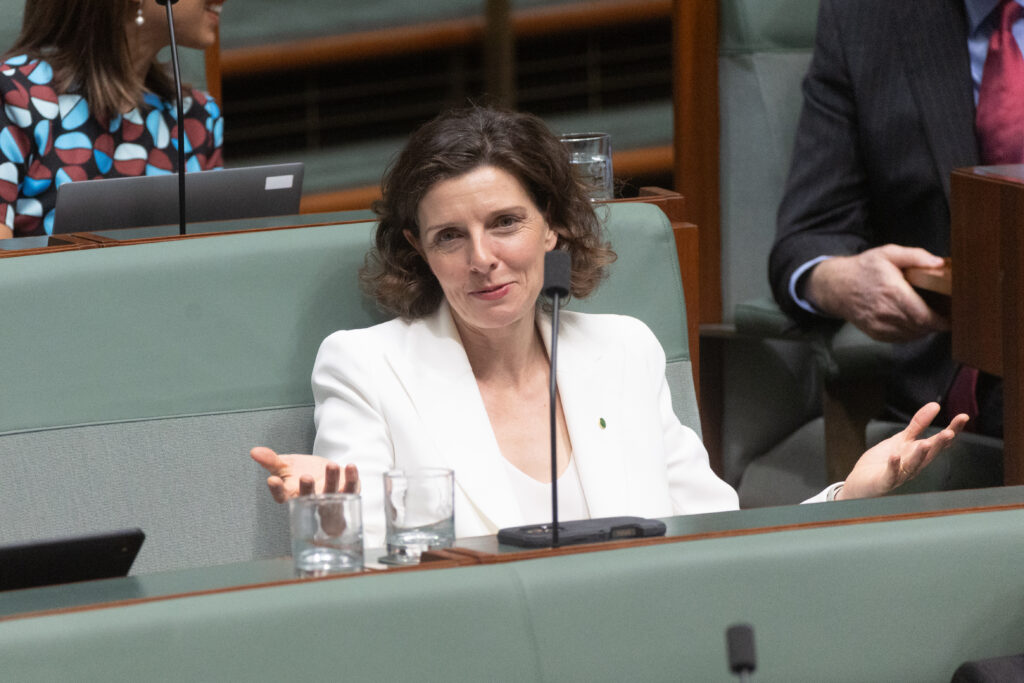
The Member for Wentworth Allegra Spender in Question Time after presenting her tax vision at the National Press Club today. Photograph by Mike Bowers.
Home Affairs Minister Tony Burke. Photograph by Mike Bowers.
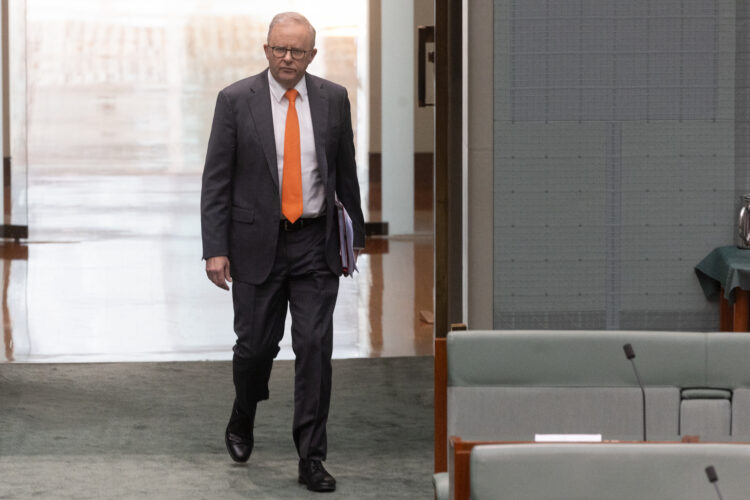
Prime Minister Anthony Albanese. Photograph by Mike Bowers.
Photograph by Mike Bowers.

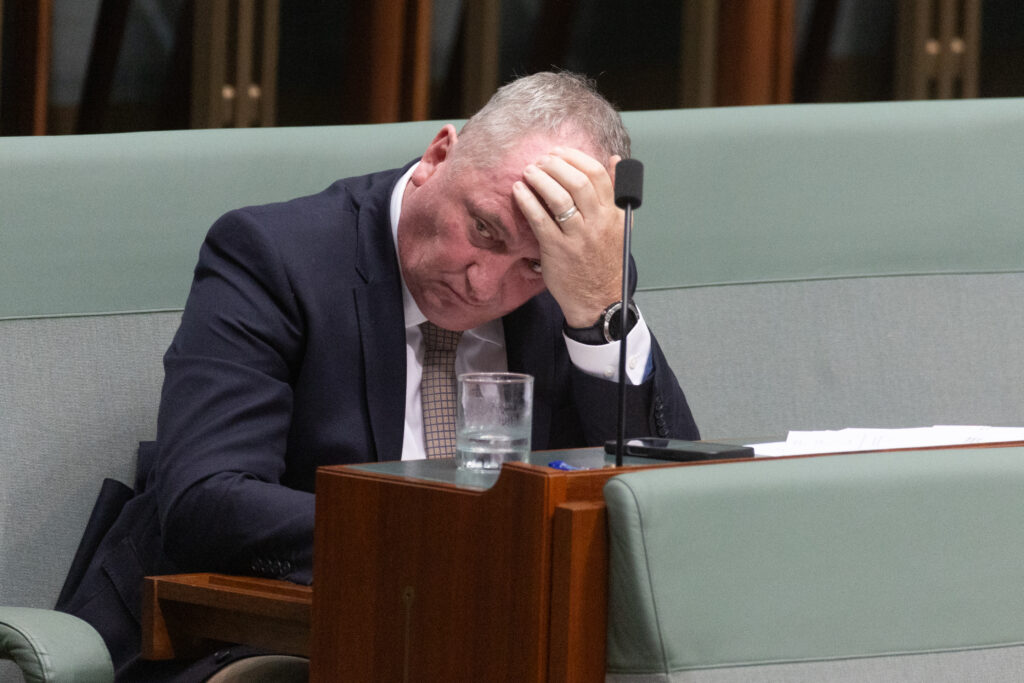
Barnaby’s big day in the big house

Epic day for Barnaby Joyce.

The New England backbencher and recent defector from the Nationals asked a question.

You know, like a real politician, he stood up and asked a question to a government minister in Question Time.

It was the same question about a dozen others had asked over the previous 48 hours.

But his question came with a twist. He added a request for a meeting.

It was slapped down by the Treasurer, Jim Chalmers.

Blink and you’d miss it.

But Mike Bowers didn’t miss. Mike never misses.

There are Dixers … and then there’s this. QT ends with a MAFS reference

Meryl Swanson, Member for Paterson:

How is the Albanese Labor government supporting Australians, and how does the government’s leadership differ from that of others and Prime Minister, why is consistency of leadership so important?

I won’t bore you with the whole, self-indulgent answer.

But here’s the bit where the Prime Minister of Australia, Anthony Albanese, compares the Coalition to an episode of Married at First Sight.

Tonight, Australians will be focused on a certain dinner party, Married at First Sight, and they’ll experience a bit of deja vu.

The fights are explosive. The relationships can be toxic. It’s typically maintained a certain level of drama that feels catastrophic.

And my favorite, it is a bit of a mystery in some ways, as to why people are so open and honest on such a public platform, but we’re very grateful they are.

We see them on Sky News talking about themselves. Then they come in here and they try to engage in political opportunism, no matter what the crisis is that Australians are facing.

Same old Liberals, same old Nats, same old One Nation. Just three right wing parties not standing up for Australia.

Bob Katter asks about ethanol (I think)

Independent Member for Kennedy, Bob Katter:

One tenth of our entire export earnings, 62,000 million (yes, he said “sixty two thousand million) dollars boomerangs offshore to buy fuel. Since our question to the prime minister last week, truckies, tourism operators, farmers, families are now paying 25 cents a litre more at the bowser. Since 2005, we’ve repeatedly moved that 32% of our fuel requirements be met from our own offshore oil reserves, just without even tapping our oil cars. Brazil, America, Europe, all have ethanol, whilst China and India have announced ethanol. Will the government continue to say no to ethanol for another 30 years?

Treasurer, Jim Chalmers:

For as long as long as I’ve known the member for Kennedy he’s had an interest in fuel security, in particular biofuels. And so I wanted to acknowledge that at the outset, Mr. Speaker, I also wanted to assure him that we’re not waiting for the next budget to take action on fuel security. The government’s taken a number of important steps, including when it comes to our cleaner fuels program, to address some of the issues that he raises in his question.

It isn’t a labour mobility scheme if workers can’t move

Morgan Harrington
Research Manager

Stakeholders from across Australia are uniting in their call for PALM visa holders to be given the right to change employers. The roughly 30,000 people from Pacific Islands and Timor Leste employed under the temporary worker scheme can only work for the employer who sponsors their visa. If problems arise, vulnerable people can be left with little choice but to ‘disengage’ from the scheme, which leaves them stuck in Australia without a visa. This is in no one’s best interest.

At a forum at Parliament House today, calls came from diverse interest groups including mayors from regional councils who host PALM workers, sometimes for years at a time; researchers who have interviewed hundreds of people employed under the scheme; representatives from the AWU and ACTU, who are concerned that unscrupulous employers are undermining what they say is an otherwise valuable scheme; and the employers who depend on PALM scheme workers to pick the fruit and vegetables that end up on Australian dinner tables.

The right to change jobs, which really shouldn’t be controversial, is one of ten key recommendations of a recent report by the Scanlon Foundation, which also calls for PALM workers to be given access to Medicare while they are in Australia, as well as some chance of one day obtaining permanent residency – one researcher who spoke at the forum cited cases of people who have been in Australia for over a decade on a string on nine-month PALM visas.

Oh, look who it is! Barnaby wants … a meeting about fuel

I refer to my previous post.

Member for New England, Barnaby Joyce:

It’s ridiculous to say that there is not an issue out there. It’s patently absurd. So what has been asked of me to ask you is … how quickly can we organise a meeting between the independent distributors, the ACCC, and yourself?

Treasurer, Jim Chalmers:

I don’t need the member for New England’s invitation to consult with the ACCC. We’ve been doing it through the course of today, Mr. Speaker, and the government has made it very clear through the good work of ministers right across our front bench that we are prepared to engage with industry, with regulators and with everyone who has an interest in making sure that we can continue to supply petrol at fair and diesel at fair prices right around the country

And so the point that I’m making, Mr. Speaker, and I say this respectfully to the member for New England, is that we don’t need his invitation to engage with the industry. We’ve been doing that all along, and we’ve been engaging with the ACCC as well, and that’s why we’ve been able to make this announcement in the last hour or so.

We are putting the petrol companies on notice. We won’t cop big corporates treating Australian consumers like mugs.

Every regional MP is getting the same questions about fuel from voters. It doesn’t mean they have to repeat every single one in Question Time.

This is so tedious.

Sure, it must be incredibly frustrating for anyone who needs fuel and can’t get it, especially farmers and business operators whose livelihoods depend on it.

Their concerns, fears and anger are absolutely justified.

And they have every right to contact their local member.

But the MPs don’t have to repeat every single question and case study in parliament.

Sure, it gives them the opportunity to tell voters “I asked the Minister about it in Parliament”.

But they’ll still get exactly the same answer.

Is asking the same question over and over and over … and getting the same answer over and over and over … achieving anything?

Do they really care about getting an answer/solution … or is it all about just being seen to ask the question?

More questions on fuel security. Chris Bowen says just asking them undermines the national interest.

Chris Bowen was asked about the nation’s fuel security about half a dozen times yesterday.

He – and others – are getting more of the same today, including from their own side.

The most recent came from WA Liberal Melissa Price.

Chris Bowen, Minister for Climate Change and Energy:

Not only did I say – and do I say – that Australia’s fuel supply is secure, every Honorable Member should say that, Mr. Speaker, because that’s the truth. That’s the truth. That’s the responsible truth to tell the Australian people.

The point they keep making over and over is that fuel is arriving in Australia, but panic buying is creating shortages, particularly in regional areas.

Tim v Jim … “he’s got a lot of nerve”

Shadow Treasurer, Tim Wilson:

My question is to the Treasurer. After 13 interest rate rises under Labor, the average Australian mortgage holder is paying more than $23,000 a year in interest than when the Coalition left office. With National Australia Bank now predicting the 14th rate rise under Labor next week and the 15th when they meet again in May, will the Treasurer apologise to struggling mortgage holders for the pressures he is imposing on them?

Treasurer, Jim Chalmers:

I wondered if he was still here, Mr. Speaker. I’m pleased to learn that he is. He’s got a lot of nerve asking about interest rates when only a couple of days into his pretty disastrous stint as Shadow Treasurer, he called for the end of the Reserve Bank’s dual mandate. And when he called for the end of the Reserve Bank’s dual mandate, what he was calling for was higher interest rates and higher unemployment.

Canavan’s first test … reversing the Farrer flop

According to polling conducted for The Australia Institute, the Nationals are polling 5.2% in the seat of Farrer.

5.2%!

In Tim Fischer’s old seat!

New Nats leader Matt Canavan wheeled his candidate into the Mural Hall at Parliament House just before Question Time.

He’s no Tom Cruise, but Brad Robertson does appear to be facing Mission:Impossible, even with his new hyper leader at his side. Or, perhaps, especially with new new hyper leader at his side.

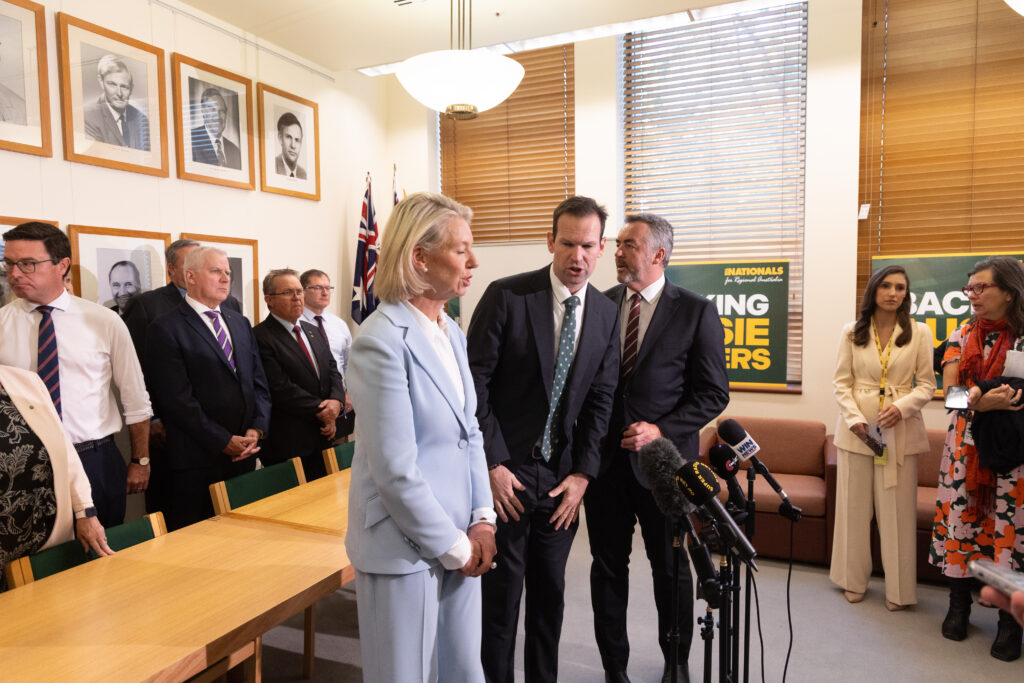
Newly elected Nationals leader Matt Canavan with the candidate for the seat of Farrer Brad Robertson in the mural hall of Parliament House Canberra. Wednesday 11th March 2026. Photograph by Mike Bowers.

Question Time begins … Chalmers calls Taylor a fool

Angus Taylor, Opposition Leader:

Will Prime Minister confirm that Australia’s living standards have fallen?

Anthony Albanese, Prime Minister:

The Leader of the Opposition appears to want to just completely dismiss the fact that there is a war going on.

So, a predictable question and, to be fair, answer to get the ball rolling.

The highlight, after a bunch of interjections, was the PM’s mic picking up Treasurer Jim Chalmers calling Angus Taylor a fool.

“More Australia”, “hyper Australia” … what is Matt Canavan on about?

It was a strange first press conference from new Nationals leader Matt Canavan, full of meaningless ocker slogans and talk of more/hyper Australia, whatever that means.

I’ll have what he’s having.

Here’s how Mike Bowers saw things in the Nationals Party Room.

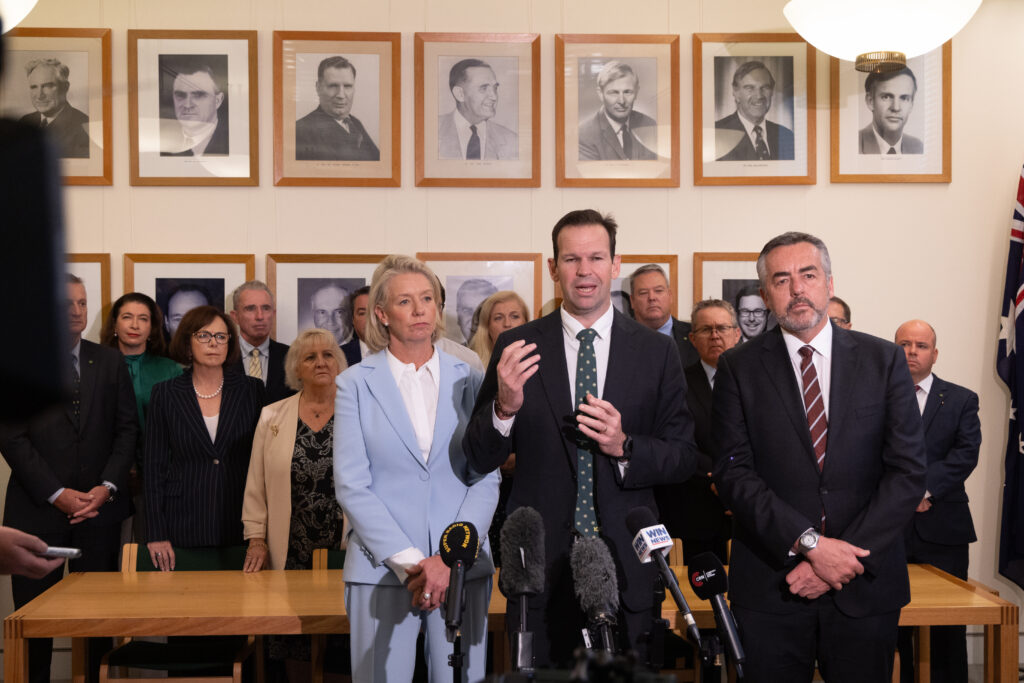
Newly elected Nationals leader Matt Canavan with Deputy Darren Chester and Senate Leader Bridget McKenzie in the Nationals Party room. Photograph by Mike Bowers.
Newly elected Nationals leader Matt Canavan and Deputy Darren Chester enter the Nationals Party room to speak with the media. Photograph by Mike Bowers.
Photograph by Mike Bowers.

Photograph by Mike Bowers.

Profits are driving inflation, not the war in Iran

Matt Grudnoff
Senior Economist

The high inflation we saw in 2022 and 2023 was set off by Russia’s illegal war in Ukraine and supply bottlenecks caused by the economy opening up after COVID shutdowns, but it was sustained by big business profit gouging. Australia is at real risk of this happening again.

Before 2022 inflation had been very low for a long time. In the lead up to 2022 everyone was talking about how prices were going to increase across the globe. Consumers were primed to expect rising prices, and big business took full advantage.

As their costs increased, they lifted their prices by more than their costs. This increase their profits, but it also meant that inflation was higher than it otherwise would have been.

With the war in Iran, all the talk is again that prices are about to rise. The stage is set for another round of profit gouging.

But will it happen again?

The bad news is it has already started happening. Australia Institute research showed the recent uptick in inflation has not been caused by wages and the recent National Accounts data showed that it is profit that is driving inflation.

How much business can get away with increasing prices will depend on how long the war lasts. If it is short and sharp, then it is less likely that businesses will be able to justify large increases in prices. But if it drags on, we can expect it to be used as justification for big price increases.

How can businesses get away with this?

In part it is because consumers don’t know how much businesses costs have increased and so they can’t judge what a fair increase in price is. My colleague David Richardson had a great example of this. Ukraine was a big supplier of wheat and after the Russian invasion, much of that supply was cut off. Wheat prices increased 31% and in Australia bread prices rose 24%.

That seems to make sense. After all bread is made of wheat. But wheat is only a tiny part of the total value of bread. From the final price of bread, only 2.4% goes to purchasing wheat. There are many other costs that are much larger like grinding the wheat, making the dough, baking the bread, the wages to do all this, and importantly the profit earned from selling the bread. This means that the increased cost of wheat only justified a less than 1% increase in price.

But mostly businesses can get away with this because of a lack of competition in Australia. Many markets are dominated by just a few big businesses who have the market power that allows them to set prices.

If the RBA decides to increase interest rates, remember that the driving force for the increase in prices that the RBA is so concerned about, is profit gouging big business.

Scott Morrison cleared over Robodebt shame as NACC finds two bureaucrats engaged in corrupt conduct

Andrew Brown
AAP

A watchdog’s probe into officials involved in the Robodebt scheme found two people carried out corrupt conduct, but it cleared former Prime Minister Scott Morrison.

A National Anti-Corruption Commission inquiry on Wednesday found two of six people referred to it for investigation engaged in corrupt conduct, while it cleared the remaining four.

Those cleared included Morrison, who initiated the scheme while in the role of social services minister.

The watchdog found ex-departmental general manager of business integrity Mark Withnail carried out corrupt conduct by intentionally misleading the Department of Social Services during the preparation of a cabinet submission in 2015.

It also found department deputy secretary Serena Wilson carried out corrupt conduct by misleading the Commonwealth Ombudsman during an investigation in 2017.

Morrison was not found to be corrupt, with his failure to realise that bureaucratic advice was misleading put down to shortcomings by federal departments.

The corruption watchdog did not make recommendations in its final report, which followed referrals from the royal commission into the Robodebt scheme.

The watchdog initially chose not to investigate the referrals before the controversial decision was overturned.

The over-ruling came after National Anti-Corruption Commission inspector Gail Furness found commission head Paul Brereton engaged in misconduct as he had ties with one of the six officials but did not adequately recuse himself from decisions.

Between 2016 and 2019, the former coalition government’s Robodebt scheme recovered more than $750 million from almost 400,000 people.

Many welfare recipients were falsely accused of owing the government money and the program was linked to several suicides.

The Albanese government has promised it will release a sealed section of the Robodebt royal commission’s final report after the conclusion of the investigation.

“The illegal Robodebt scheme was a betrayal of everyday Australians, resulting in human tragedy and untold misery,” Attorney-General Michelle Rowland said.

“The royal commission was clear in its findings and we must work to ensure this can never occur again.”

Since when did ‘homeowners’ include landlords?

Jack Thrower
Senior Economist

According to new reporting from the Age and Sydney Morning Herald:

More home owners have been deciding to sell their properties over the past month than at the same time last year, and the increase in supply could dampen property price growth.

Hopefully, it’s true. Australia’s housing market is out-of-control and could do with settling down a bit. But probably more interesting is the unexamined assumption here is that when we say ‘home owner’, we aren’t just talking about owner-occupiers, we’re also talking about property investors and landlords.

How do we know this?

Firstly, it’s clear from the data they have used (new property listings) that it’s not just limited to owner-occupiers, so it necessarily includes property investors.

Secondly, if it were just people who own their own homes, then it basically couldn’t slow down price growth: any increase in supply would be pretty much equally matched by an increase in demand. Most people selling their own home will want to buy a new one, unless they’re all moving overseas or to a new city, then this shouldn’t shift housing prices.

Why does this matter?

This is just another sign of Australia’s broken housing market and how its purpose has transformed from providing people with shelter to a focus on tax minimisation and ‘investment opportunities’ for rich people. This transformation has occurred because of government policies, such as the decline of public housing, and policies such as the Capital Gains Tax (CGT) discount, negative gearing, and the tax treatment of trusts that give investors tax advantages and push up prices at the expense of first-home buyers.

The government is currently considering changes to the CGT discount. Hopefully, this is the start, not the end, of efforts to shift the market back to its original focus.

No more “Maverick Matt” – but will “More of the same Matt” move the dial for the Nats?

Bill Browne
Director, Democracy & Accountability Program

Matt Canavan‘s first appearance as leader of the National Party is a reminder that while he may be an effective communicator, he is not going to resolve the policy issues that have led the Coalition to record low poll numbers.

Senator Canavan says: “I think we are losing our country” – standard of living, confidence, relaxed and larrikin nature.

“The good news is that everything we need to solve the problems … are here in this country right now.”

In case you missed the nationalist emphasis that Senator Canavan is going to take, he says “Australia” or “Australian” seven times in one sentence, and shoe-horns fossil fuels in as well.

“More Australia – more Australian farming, more Australian manufacturing, more Australian jobs, more Australian babies, more Australian jokes, more Australian barbeques – sometimes, often fuelled by fossil fuels.

“We don’t need to look overseas for our solutions.”

He criticises the Albanese government for the “inexplicable fuel crisis unable to deliver basic essentials.”

Journalist asks – Senator Canavan has based his image on being a maverick, how is he going to balance that as leader?

Senator Canavan points out he has dragged the Nationals to his point of view, especially the commitment to dump a net-zero emissions target.

Senator Canavan is asked if plans to move to the House of Representatives – he doesn’t answer directly but says he’s focused on the leader role.

A journalist asks if Senator Canavan will be obstinate, and whether he will moderate.

Senator Canavan says he will “fight for what is right”. The energy system should be run to deliver the lowest possible prices. The government’s goal is instead “to meet arbitrary targets”.

A journalist asks if there is a distinction between Senator Canavan and One Nation.

He says firstly, the Nationals are a grassroots organisation.

He says secondly, “identity politics” has crept into One Nation – points to Pauline Hanson’s divisive comments, “I worry about where Pauline would take this country, to a place of more division”.

“I struggle to point to a single dam, road, hospital” that Senator Hanson has delivered.

A journalist points to Senator Canavan’s position on abortion. He says his focus is on providing care to babies born alive. “Is anyone against that?”

A journalist asks about Farrer by-election, with One Nation well ahead of the Nationals in opinion polling.

“I’m going to get out on the ground and fight like hell.”

Unions, councils, workers call for changes to PALM scheme

Morgan Harrington
Research Manager

A forum at Parliament House is today calling on the Commonwealth Government to reform conditions for the Pacific Australia Labour Mobility (PALM) scheme. Around 30,000 people from Pacific Island nations and Timor Leste hold PALM visas, which allow them to work in Australia on a temporary basis, but widespread “disengagement” means thousands are left to survive in Australia without a formal visa. But exploitation and poor living conditions have led an estimated 7000 people to walk away from the scheme.

The forum seeks to shift the “Pacific Family” rhetoric into action and ensure that Pacific workers can access the same rights as their Australian colleagues. This includes the right to freely change employer, which PALM workers do not have.

The Mayoral Alliance for the Pacific has brought together 20 Mayors and regional councils who are grappling with the everyday benefits and challenges of the PALM Scheme.

“Together, we are urging the Federal Government to modernise visa conditions so workers have genuine mobility, better healthcare access, and stronger pathways for family inclusion,” said Aleem Ali, CEO of Welcoming Australia, which is convening the event.

You can hear stories from the Pacific Islanders who have worked in Australia under the scheme in the four-part Australia Institute podcast PALMed Off.

Gary Banks again pushing markets and anti-social policies

David Richardson
Senior Research Fellow

Gary Banks preaches competition and free markets and, as such, he fitted well into his appointment to head the Productivity Commission from 1998 to 2013. The Productivity Commission almost invariably pushed market solutions and getting rid of government activity no matter where it looked.

In today’s Financial Review Banks writes a piece in which he tries to include all the things in Australia that upset his view of what we should be doing. This is a good piece to read if you want to see an example of right-wing pro-market ideology dressed up as economic commentary.

Some choice bits:

“Welfare programs are increasingly about universal benefits unrelated to need.”

This makes a superficially appealing sound grab but is he really suggesting treatment in hospitals is unrelated to the need for treatment? Or that more poverty traps should be built into the system so that childcare costs would once again prevent women returning to work after having children?

“Public infrastructure projects are “nation building”, although most would fail a proper cost-benefit test, and few come in even close to budget.”

Some of the Productivity Commission’s own work has shown high social and economic returns to infrastructure and the Australia Institute has cited similar evidence. If the Productivity Commission had its way there would be less infrastructure which would harm economic activity throughout the economy.

Banks stresses the urgency of productivity growth, but it is never clear why we need ever more goods and services. Be that as it may, he says “the ‘care economy’ component of this is highly labour-intensive with inherently low and stable productivity.” it may be true, productivity may not have improved that much in aged care since the job was left to the monks in monasteries hundreds of years ago. It is easy to cite the care economy in rhetorical pieces but no one seriously thinks we should abandon the sector. By comparison, no one says we should get rid of mining just because mining productivity has slumped.

Banks complains there is no taste for reform anymore. If by reform he means privatisation, corporatisation and marketisation of government services then the fact is that it has mostly been done already and with disastrous consequences. Indeed, leaving it to the market eventually meant Royal Commissions into banking, aged care, disability care, home insulation, the Murray basin, and Victorian mental health services while privatisations in electricity, communications, ports and elsewhere meant higher prices, angry customers and fraud against the public.

Australia has had enough of leaving it to the market in circumstances where pure markets do not fit the criteria needed for a successful outcome. This will be shown in the Australia Institute’s submission to the Senate Inquiry into Productivity when the Senate Committee publishes the submission.   

Clive Palmer is running again …

Fresh from backing a 25% tax on gas exports, Clive Palmer has announced he’ll have another crack at federal politics.

It’s a familiar story. This time around he’ll stand for the seat of Fadden and says the United Australia Party will contest every lower house seat in 2028. He held the seat of Fairfax for one term from 2013.

Since then, his main contributions to politics have been to inflict Ralph Babet on the Parliament and spending hundreds of millions of dollars, which have largely gone to media outlets on advertising.

As someone who once ran regional television newsrooms, I can assure you there are plenty of media sales bosses rubbing their hands together today.

Mike Bowers was at his launch a short time ago.

Photograph by Mike Bowers.

Higher economic growth good for productivity but not much in it for workers

David Richardson
Senior Research Fellow

Almost a fortnight ago we published a paper saying the Reserve Bank of Australia was wrong to punish workers for rising inflation. Rather than wages contributing to the increase in inflation, it was non-wage factors that were responsible – ie mainly profits.

The December quarter 2026 national accounts showed that that profit push accounted for 71% of price increases.

That means that without this profit push price, inflation would have been below the RBA’s inflation target of 3%, and that would have meant no need for the RBA to worry about raising interest rates.

The Treasurer, Jim Chalmers, has been talking up the economy and when the national accounts were released, he said  

The Australian economy grew 0.8 per cent in the December quarter, to be 2.6 per cent higher through the year [adding] the Australian economy outperformed in 2025, with faster growth than every major advanced economy.

So it seems that economic growth has been higher and a lot of that has disappeared into higher profits. These higher profits in turn feed into worsening inequality as the increase in income and wealth goes evermore to the already rich and the higher income earners.

But what about productivity?

The conventional wisdom in Australia is that higher productivity feeds into higher living standards all round.

The Productivity Commission’ s submission to the Senate inquiry into productivity noted that over the past 59 years, productivity grew 1.6% each year on average, but that had fallen to 0.4% for the period 2015-2024. (The PC submission can be downloaded here.)

However, in the December quarter, productivity increases in the market sector (Table 1 here) was much closer to the 59 year average at 1.5% for 2025.

This also meant that labour costs fell in real terms – down 0.6% in December.

But the workers did not get the benefits of higher productivity since wages increased by just 3.4% in the year to December 2025 compared with the 3.6% rise in inflation, meaning real wage actually declined.

The Treasurer is right about higher economic growth and, as it happens, higher economic growth is generally consistent with higher productivity growth, something I noted with Phil Toner in my submission to the inquiry (here).

But, the problem is that there is no mechanism in our industrial relations system that gives productivity gains to workers – they are fought over in wage negotiations. And unfortunately, as we are seeing (and have for a long while, the rich and the corporate sector are again the ones getting the benefits of economic growth.

Zali Steggall statement on proposed changes to visa laws, which are being debated today

The Independent MP for Warringah, Zali Steggall, has issued a strong statement about the government’s proposed changes to visa laws, specifically the power they would give the Home Affairs Minister to suspend temporary visas for groups arriving from certain regions.

The visa laws are being debated today.

Zali Steggall:

The government’s attempt to downplay this legislation by saying it only affects people such as tourists or those travelling here on business on temporary visas is an attempt to conceal the true effect of these changes.

In reality, many people who later seek humanitarian protection in Australia first arrive on temporary visas. That is simply how the system works. People fleeing conflict or sudden instability often can’t access humanitarian pathways from overseas and instead travel on whatever lawful visa they can obtain.

By giving the Minister the power to suspend valid temporary visas for entire groups of people, the government risks shutting off one of the few practical pathways vulnerable people have to reach safety and have their claims properly assessed.

If someone has gone through Australia’s visa process and been granted a valid visa, they should be able to rely on that decision. Retrospectively suspending those visas creates uncertainty, undermines confidence in our migration system, and could have serious humanitarian consequences.

It is very disappointing that Labor backbench MPs representing multicultural communities voted today to support these unfair visa changes.

Many of these backbenchers represent electorates with large migrant communities – families with deep ties to regions that could be directly affected by this legislation. Yet these political representatives blindly backed the changes and refused to speak up for the communities they represent.

Multicultural communities across Australia expect their representatives to ask hard questions and stand up when legislation risks affecting them directly. Simply voting it through without speaking out falls well short of that responsibility.

Plan for Farrer?

Just fight like hell. I better get out in the ground and fight. Fight for what we believe in. We’ve got an excellent candidate in Brad Robertson. I’m going to be going to see him very soon. He’s got an amazing record of services, country, and so all I’ll be doing with with our team here.

And I’ll just make this one more point about One Nation. I mean, Pauline has been in politics for more than double the time I’ve been and I struggle to point to a single dam, single road, single hospital that Pauline has delivered in Australia.

Move left to win city voters, or right to win back One Nation voters?

Matt Canavan, Nationals Leader:

I’m very concerned that the the identity politics of division that we’ve seen on the left is creeping into the right now. And I was very critical of Pauline’s comments dividing Australians to different groups, saying that suggesting that are no good for in certain groups of Australians. I totally reject that. I totally reject that we are all Australians, what unites us as a country is more than what divides us even when we have these robust debates. We have a wonderful country with wonderful people from all different backgrounds, religions and, I’m sorry, I worry about where Pauline, is it would take this country to an area of more division

“We need to go hyper”

Canavan continues:

The good news is we have everything we need to solve the problems in front of us right now are here in this country. Everything we need to make Australia the country it was in the past is here in our nation. We have the resources. We have the people. We have the land. We’ve got the rain … so all we need to revive our great nation is to have ‘more Australia’. We need Australian farming. We need to have more everything. We need hyper-Australia here. We need to hyper-Australia for our country. We need more Australian humour, more Australian jokes, we need Australian barbecues, sometimes often fuelled by fossil fuels. We need more Australian.

Canavan’s first press conference as Nationals leader

Matt Canavan, National Party Leader:

It is extremely humbling to be elected the leader of this great party – second-oldest party in our nation’s history. I want to thank David Littleproud for service to our party, to our nation.

I also want to congratulate Darren (Chester, his new deputy) a mate of mine – we go back a long way. We’ve been at this for a while. And it’s great to have you next to me, leader. I’m very confident Darren, as our newly elected deputy, going to make an excellent team for our country.

Statement from Nats MP, Pat Conaghan

I would like to congratulate newly elected leader Matt Canavan and deputy leader Darren Chester on their appointments.

I know that they will lead with passion and conviction and will drive our Party forward, fighting for a fair go for every regional Australian.

Both have the experience and tenacity required for the role, both are exceptional speakers and negotiators and both will represent our Party and the nation with pride.

It’s now finally time for every member of the Coalition to work as a cohesive and unified team, holding Labor effectively to account and providing Australians not only with a viable alternative to the current regime, but with some hope that our Nation can once again be brought back around into strength and prosperity.

It hasn’t been easy under (Prime Minister Anthony) Albanese, and we are ready to roll up our collective sleeves and reset the trajectory of our nation with Matt and Darren at the helm.

Make it make sense: Pay to see the Twelve Apostles, but gas companies drill for gas and dump right beside them tax free?

Louise Morris
Advocate

Visitors to the Twelve Apostles along Victoria’s Great Ocean Road will soon be asked to pay an entry fee, with the Vic State Government arguing it’s ‘only fair’ that visitors contribute to maintaining one of Australia’s most visited natural landmarks.

Read the full story, here.

Matt Canavan and Darren Chester to speak to the media shortly

We’ll have live coverage. Stand by.

Allegra Spender to outline tax plan at National Press Club

Statement from the office of Independent Member for Wentworth, Allegra Spender MP:

Allegra Spender has set out a plan to rebalance Australia’s personal tax system so that Australians have a meaningful opportunity to get ahead through their own hard work.

Today she will launch her Personal Tax White Paper at the National Press Club, the first in a series of white papers she will release over the next few months.

“Our tax system needs rebalancing to deliver reward for effort, to encourage productivity, and ensure that taxpayers aren’t facing the heaviest burden when they can least afford to pay.

“We haven’t had substantial tax reform for 25 years and the current system is no longer fit for purpose,” Ms Spender said.

“Consider someone earning $100,000 a year – just over the median wage. Earned as a salary you pay $23,000 in tax, split through a family trust you pay $13,000, earn it as capital gain you pay $7,000, and earn it from your super balance in retirement, you pay no tax at all.”

“Does it really make sense that the tax burden falls most heavily on younger people struggling to get established – who are likely also paying rent, saving for a deposit, raising children, and paying down HELP debts?

“The current tax system is exacerbating intergenerational inequity. Our tax system setting needs to be rebalanced towards effort and ingenuity,” she said.

“That will not only assist younger Australians, it will also improve productivity and address the long-term demographic challenges facing our tax system.

“Any tax measures the Government takes should be revenue neutral and put money back in the pockets of people trying to get ahead.”

Ms Spender said Australia faces a demographic challenge, with fewer working-age Australians supporting a growing older population.

“In the 1980s there were about six working-age Australians for every person over 65. Today there are fewer than four, and within a generation it will be fewer than three,” she said.

“We cannot continue funding rising spending on health and aged care by placing a heavier burden on younger workers.”

“We cannot rely on fantasy tax reform where politicians promise tax cuts without showing how they will fund them. Every dollar returned to working Australians through my proposed income tax cuts is raised by reducing concessions on investment income,” she said.

Ms Spender said the coming budget represents the best opportunity in a generation to rebalance the tax system and restore what she calls “the Australian covenant” — the promise that hard work leads to a decent life.

The White Paper has been costed by the Parliamentary Budget Office and is budget neutral, with tax cuts fully funded by tax increases. It would deliver income tax cuts for workers by reducing the lowest marginal tax rate on wages to 13 per cent and cutting all other marginal rates by 2.5 percentage points.

Someone earning $100,000 would receive more than $1,640 per year in tax relief. Someone earning $200,000 would receive about $4,000 per year.

These tax cuts would be funded through four changes to investment concessions:

  • Reducing the capital gains tax discount from 50 per cent to 30 per cent on future gains.
  • Ring-fencing negative gearing so investment losses can only be offset against investment income, not wages and salaries.
  • Introducing a minimum tax rate of 27.5 per cent on investment income to reduce incentives for income splitting.
  • Aligning superannuation earnings thresholds more closely with income tax thresholds to create a more stable and principled system.

Ms Spender said the reforms are designed with transition arrangements to protect people who made decisions under existing rules.

  • Capital gains changes would apply only to future gains.
  • Negative gearing changes would be phased in over five to ten years.
  • Superannuation changes would include a 10 year transition period and flexibility for high-balance accounts.

Ms Spender said tax reform has been avoided for decades but Australians understand the need for fairness.

“Many people have told me these reforms might mean they personally pay more tax — but they still support them because they are right for the country,” she said.

“When Australians see that a nurse and a property investor on the same income can pay very different amounts of tax, they understand something isn’t right.”

Ms Spender warned that growing frustration among younger Australians risks eroding trust in institutions and fuelling populist politics.

“When people feel the system is not on their side, they stop believing in the system altogether,” she said.

Matt Canavan replaces David Littleproud. Darren Chester elected Nationals’ Deputy Leader.

The result of the vote was announced by Nats whip, Michelle Landry.

I’d like to announce that Matt Canavan is the new leader and Darren Chester is deputy leader. I think it’s important we’ve got strong leadership in our party and we thank David Littleproud for the amazing job that he’s done. A mighty battle coming up ahead of us, we’ve got two years to get ourselves up in the polls.

Canavan elected Nats leader

More to come

First pictures of leadership candidates arriving for Nationals party room meeting

Mike Bowers captures the arrival of Nationals MPs and Senators as they gather to choose a new leader.

Nationals MP’s Pat Conaghan, Kevin Hogan and Anne Webster enter the Nationals Party room. Photograph by Mike Bowers.
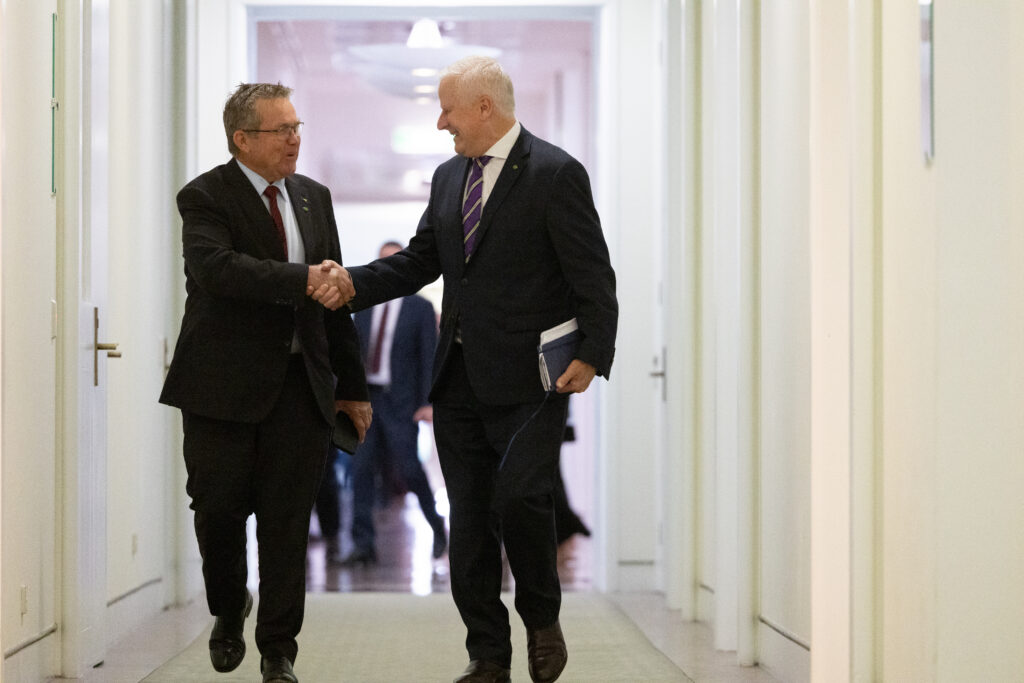
Nationals MP’s Colin Boyce and Michael McCormack. Photograph by Mike Bowers.
Senator Matt Canavan. Photograph by Mike Bowers.
Senator Bridget McKenzie. Photograph by Mike Bowers.

Alleged right-wing hate attack on Muslim community dinner in Ballarat

Bill Browne
Director, Democracy & Accountability Program

On Sunday night a self-declared “far right” man allegedly attacked a Muslim community dinner in Ballarat, with the man reportedly “throwing punches” and yelling racial slurs.

The man was “moved on” by Victorian Police instead of being arrested.  

This year has seen other apparently hate-based violence and threats, including a man allegedly throwing homemade fragment bomb into an Invasion Day protest and the arrest of a man charged with planning a “mass casualty” attack on WA Parliament House, police headquarters and Muslim places of worship.

Local member Catherine King said of the most recent attack:

“Every Australian Muslim has the right to feel safe in their community, just like every other Australian has a right to be safe and feel safe.

“Leaders and elected officials who care about social cohesion and national security have a responsibility to tone down the rhetoric and call out behaviour like this.”

Ms King’s reference to leaders and elected officials brings to mind politicians who have recently used Islamophobic language. Most notably, One Nation leader Pauline Hanson has only partially walked back her comment that there are “no good Muslims”. Her deputy Barnaby Joyce refused to reject her remarks when given the opportunity.

Only two Liberal parliamentarians, senators Paul Scarr and Andrew McLachlan, voted with Labor, the Greens and other senators to censure Ms Hanson for her comments.

Nationals party room meeting underway

Nationals MPs and Senators are locked away where they’re expected to choose a new leader, following David Littleproud‘s resignation.

It’s widely seen as a four horse race. Each candidate has significant strengths and weaknesses.

Matt Canavan is probably the favourite, given his high profile and the fact that he’s been doing his pitching out in public.

Kevin Hogan is more low-key and has been hitting the phones quietly. His best hope might be as a compromise candidate, if the vote is split between, say, Canavan and Senator Bridget McKenzie. The old Scott Morrison route to power.

Senator McKenzie has long been touted as a future leader, given her high profile. But she’s gaffe prone and very Sky News. A bit like Canavan, come to think of it.

The other candidate is Michael McCormack, the Wagga-based Riverina MP. He’s had the job before. He was crucified by Sydney shock jocks like the awful Alan Jones when he was leader. He has, from time to time, expressed an interest in returning to the leadership but has apparently been quiet over the past 16 hours.

Whoever they choose has the job ahead of them, first and foremost to stem the bleeding of votes to One Nation. That’s only hypothetical at the moment but if One Nation wins Farrer (albeit off the Liberals), in 2028 every Nats MP will have a fight on their hands.

The more important issue, of course, is about policy. Where do they stand on everything from energy to climate, immigration to tax? They’ve been a dog’s breakfast on so many issues for so long.

David Littleproud says one of his great legacies is his opposition to an Indigenous Voice to Parliament. Setting aside all the misinformation involved in that murky business, what does it say about a party when their supposed great achievement was to oppose something?

Debugging the Productivity Commission’s claim that AI will boost Australia’s GDP by $116 Billion

Matt Saunders
Senior Economist

Whether it is commenting on job losses,  figuring the costs or benefits of enormous data centres, or musing about dreams of future productivity gains, it seems everyone has an opinion about AI.

But the Productivity Commission’s (PC) views on the subject are worth paying attention to, given that they are the Australian Government’s primary researcher in ways to increase… productivity. 

According to recent commentary from PC head honcho Danielle Wood, “the Productivity Commission’s modelling suggests AI could deliver a $116 billion boost to Australia’s GDP over the next decade, worth about $4400 per person.”

But a deep-dive into this modelling reveals the likelihood of each Australian receiving a $4,400 ‘economic boost’ from AI is about as likely as Makybe Diva winning another Melbourne Cup. The finding was part of a 204-page report that examined various aspects of AI, only half a page of which was devoted to assessing the economic impacts of AI, which isn’t a lot of room for serious number crunching.

The PC’s quick guesstimations of the economic benefits of AI ranged from a high of $116 billion, to as little as $2.6 billion. And that’s over a 10-year period, which means annual benefits of somewhere between $0.26 billion and $11.6 billion.

While a billion dollars would be a lot of money in anyone’s bank account, in an Australian economy that produces $2,600 billion a year in GDP the PC’s guesses about the impacts of AI don’t amount to much. $11.6 billion a year is about the same amount of money that Australian households spend in just three days. And $2.6 billion is less than what households spend in just 17 hours. So much for the much-hyped productivity dividend.

It seems that in claiming that “artificial intelligence will be the biggest project” the PC have fallen for the hype just like many others.

The King of the red carpet

Anyone who’s worked in the parliamentary press gallery over the past few years will know that few politicians spend more time on the red carpet of that hallowed hallway along the second floor of the Senate wing building than David Littleproud.

He was also one of the first MPs to get a live unit which enabled him to do live crosses from his home when Parliament is not sitting. To say he’s accessible is an understatement.

He’s also one of the most likeable MPs wandering in and out of the media offices.

He chats to the young producers as they put his radio mic on. He jokes with the cameraman before and after the red light goes on. He’s happy to background a young journalist who may not quite understand the issue at hand.

Moving to the back bench doesn’t mean he’ll stop speaking to the media, but one of the most familiar faces in those cramped media offices will surely be spending less time in the gallery.

Mike Bowers bumped into him there a short time ago, in the final hour of his time as National Party leader.

Photograph by Mike Bowers.

Liberals still far behind on women’s representation

Skye Predavec
Researcher

Last Sunday marked the eleventh International Women’s Day since the Liberals set their target of 50% female MPs in their party room, and the party has still made little progress towards it.

In the leaked Liberal review into their disastrous 2025 election campaign, the authors pointedly refused to endorse quotas as the solution to the party’s gender woes.

Just 32% of the party’s candidates for the House of Representatives were women, with that number dropping to just 13% in Queensland. It is perhaps unsurprising in that context that just 42% of female voters preferred the Coalition to Labor (according to the party’s internal polling), compared to almost 47% of men.

It wasn’t always this way.

Historically, the Liberal Party led its competitors on women’s representation. Eight of the first 10 female federal MPs and Senators were Liberals. Women were more likely to vote for the Liberal Party than men until the 2000s.

But eleven years ago, Labor and Liberal set the same target for women’s representation: they would have 50% of their parliamentarians be women by 2025, last year.

Labor first met that target in 2022, and now 53% of its MPs across Australian state, territory, and federal parliaments are women. The Coalition didn’t even get close – over two-thirds of their MPs are men.

It is no secret what works to improve gender representation. Labor brought in a pre-selection quota for women in 1994 (to be fully realised by 2002), followed by seat quotas in 2012.

But it is not all about quotas. Margaret Fitzherbert, Liberal parliamentarian and author of Liberal womenalso attributes Labor’s success in women’s representation to (a) having highly visible champions of women in parliaments; (b) the Emily’s List group which gives financial and political support to pro-choice candidates; and (c) the party’s rank-and-file culture.

The Liberal Party used to lead on women’s representation. And some in the party may have been hopeful that the election of Sussan Ley as their first female leader would put them back on track. But Ley is now not only out as leader, but out of the Parliament altogether, pushing the Liberals even further from gender parity.

Parliament forum calls for urgent PALM visa reform as 7,000 workers disengage

MEDIA RELEASE

Exploitation and poor living conditions have led an estimated 7000 people to walk away from the Pacific Australia Labour Mobility (PALM) scheme. Around 30,000 people from Pacific Island nations and Timor Leste hold PALM visas, which allow them to work in Australia on a temporary basis, but widespread “disengagement” means thousands are left to survive in Australia without a formal visa.

Today, Welcoming Communities and the Mayoral Alliance for the Pacific will convene a forum at Australian Parliament House to call on the Commonwealth government to reform visa conditions to give workers genuine freedom to change employers, improve access to healthcare, and expand family-inclusion to build fairer, stronger communities.

Title: PALM Futures Forum: Community-centred Visa Reform

Time: 11:00am – 1:00pm

Location: Parliament House Canberra

Australia Institute research shows that the PALM scheme generates almost $1 billion in economic value, but less than $200 million ends up being remitted to the Pacific.

Quotes attributable to Aleem Ali, CEO of Welcoming Communities.

“Fair work should mean exactly that. Yet the PALM Scheme falls short for people from the Pacific working in our farms, factories and aged care homes.

“The PALM Futures Forum brings together workers, unions, employers, community members, researchers and policymakers to deliver better outcomes for everyone. The Forum seeks to shift the “Pacific Family” rhetoric into action and ensure that Pacific workers can access the same rights as their Australian colleagues.

“Through the Mayoral Alliance for the Pacific, we’ve brought together 20 Mayors and regional councils who are grappling with the everyday benefits and challenges of the PALM Scheme. Together, we are urging the Federal Government to modernise visa conditions so workers have genuine mobility, better healthcare access, and stronger pathways for family inclusion.”

Quotes attributable to Morgan Harrington, Research Manager at The Australia Institute

“Most Australians would be appalled to learn of the conditions enabled by this guestworker scheme, which ties participants to a single employer. The control that employers have over wages, conditions, accommodation, and transportation creates a power imbalance that has left thousands of people with little other choice than to try their luck in Australia in breach of their visa conditions. In the land of the fair go, this is unacceptable.

“Disengagement is a problem for Australia and it’s a problem for the Pacific. One way or the other, Australia is going to have to reckon with the thousands of people who came into the country legally but have since been left to slip into the shadows. Meanwhile, people in the Pacific are missing loved ones who might find themselves stuck in Australia even if they have done nothing wrong. This problem, and the people caught up in it, cannot be left to rot.”

Mounting job losses from AI? Productivity Commission says “no”

Matt Saunders
Senior Economist

Reports on the job losses from AI continue to pile-up. In past two weeks, logistics software company Wisetech cut 2000 jobs (30% of its staff) and fintech giant Block cut its staff by 40% – both companies pointed the finger at AI. This might make economists at the Productivity Commission (PC) reevaluate their bug-ridden prediction that AI will boost the economy by $116 billion and cause no job losses.

In their recent research into the economic impacts of AI, the PC has assumed there will be zero job losses from AI. None.

In their words, they applied their best guess of the “productivity dividend from AI” to the “current levels of population, working hours and employment” to predict that AI will boost Australia’s GDP by $116 billion. They assumed that there would be no changes at all form AI, in total working hours or employment levels.

The more evidence piles up that AI is changing the jobs market, the sillier their assumptions and economic predictions for AI look. In February Telstra announced it would axe more than 200 jobs as it looks to deliver its AI roadmap more quickly, and the Commonwealth Bank confirmed 300 job losses. We continue to be told that the “productivity dividend” from AI is always just around the corner, but as The Economist has pointed out  “there is scarce evidence the technology is driving real productivity gains.”

To be fair, the PC devoted just half a page, in a 204-page report about AI, to estimating  the economic impacts, so we shouldn’t expect forecasting miracles from such a tiny amount of work. But when everyone agrees that AI will impact the job market, their prediction of a $116 billion boost to GDP with no job losses can be taken with a grain of salt the size of a 1970s mainframe computer.

VIDEO: Iranian players taken aside, one-by-one, and offered asylum – Burke

Video by Mike Bowers.

Home Affairs Minister Tony Burke confirms two more Iranians have accepted offers of asylum

The Minister is speaking at a press conference in Canberra.

Tony Burke, Home Affairs Minister:

Two members of the group that was part of the Iranian women’s soccer delegation had indicated that they wanted to take up an offer from Australia. One was a player. One was a support person. With the assistance of the Australian Federal Police, they were separated from the rest of the group and taken to a safe location.

When I met with them, I made them the same offer that I had made the five players the night before, and that was that if they wanted to receive a humanitarian visa for Australia, which would have a pathway to a permanent visa. I had the paperwork ready to execute that immediately. They both said that they did. I signed off on that.

ACTU calls for Climate Safety Plan which would create 90,000 jobs

The ACTU is calling for the government to implement a new Climate Safety Plan which would see the establishment of a National Emergency Response Brigade.

The Plan also includes measures to climate-proof schools and aged care centres, expand home energy
upgrades for tenants, and strengthen the adaptive capacity of the nation’s health services, local
councils, and the farm sector.

A report from the University of Technology Sydney (UTS) concludes a Climate Safety Plan would create more than 90,000 jobs.

ACTU Assistant Secretary, Liam O’Brien:


All Australian workers are affected by climate change, and it’s getting worse. But as a country we face a large gap in investment and policy commitments at the national level needed to keep people safe amid rising temperatures.

If we invest in climate adaptation at scale, not only will we be protecting Australian workers and communities, we’ll be driving a massive jobs program, with the potential to create tens of thousands of good new jobs.

The Australian government’s own National Climate Risk Assessment warns that it is now prudent to plan for a scenario where heat deaths in Sydney will spike 444%, where 1.5 million Australians will be exposed to coastal flooding, and where we’ll see up to 45 days every year where it’ll be too hot to safely perform outdoor manual labour.

That Assessment found we lag behind in preparing for the heat waves, coastal flooding and extreme weather events that are happening more often and in places once considered safe. Extreme heat driven by climate change is already taking the lives of 980 Australians every year.

Without sustained investment in climate adaptation, the economic costs of climate change will be experienced through inflated grocery prices, higher insurance premiums, damage to homes, infrastructure and farms, lost working hours due to heat—all of it producing a growing drain on government budgets.

The balance of public funding needs to shift from reactive disaster response to proactive investments in adaptation to avoid spiralling economic loss and realise the productivity gains.

If implemented, the Climate Safety Plan would see significant investment in climate adaptation each year through to 2035. If we don’t move quickly to invest in adaptation at scale, climate change is going to deliver a body blow to our way of life, not to mention our national budget.

NSW Health’s apology to senior doctors highlights the importance of a Whistleblower Protection Authority

Hamdi Jama
Postdoctoral Research Fellow

In 2024, three senior doctors working at the Royal Prince Alfred Hospital raised concerns about missing or incomplete data, serious complications and dysfunctional work conditions that could compromise patient safety in a high‑risk cardiac program. Instead of taking their complaints seriously, these whistleblowers spent eight months under internal investigation without being told what, exactly, they were accused of.

The NSW Ombudsman called the case against the doctors “unreasonable” and said the investigation was unfair. NSW Health ultimately apologised and dropped the case.

In this case the people who raised concerned about our public institutions were vindicated. But not all whistleblowers are that lucky, and Australia’s broken whistleblower-protection laws don’t help.

Under the current laws, Australians whistleblowers can and have been prosecuted. For example, in 2025, David McBride— who leaked defence documents about the involvement of Australian soldiers in war crimes in Afghanistan—was sentenced to five years and eight months in prison.

Whistleblowers are integral to integrity and accountability. They disclose human rights abuses, fraud, corruption, threats to health and environmental wrongdoing. But whistleblowers risk retaliation simply for speaking up.

Australia Institute polling shows that the majority of the Australian public (84%) supports safeguarding whistleblowers by establishing a Whistleblower Protection Authority.

A Whistleblower Protection Authority is a crucial missing piece in Australia’s anti-corruption laws. Without robust whistleblower protections, even the most respected institutions – i.e., our hospitals – can drift into cultures of silence in the face of serious wrongdoing and misconduct.

Today “most intense day of strikes in Iran” – US

AAP

Iran is fighting back but is no tougher than the US military expected before the war, the leading US general says, as ‌the Pentagon promises its most intense day of strikes in the 10-day-old conflict.

As Iran’s Revolutionary Guards threaten to block oil shipments from the Gulf, the Pentagon renewed threats ‌to hit Iran harder unless shipments can flow through the Strait of Hormuz off Iran’s coast.

It said it was striking Iranian mine-laying vessels and mine storage facilities.

“Today will be yet again, our most intense day of strikes inside Iran: the most fighters, the most bombers, the most strikes, intelligence more refined and better than ever,” US Defence Secretary Pete Hegseth told a Pentagon briefing.

He said the US would not relent until “the enemy is totally and decisively defeated,” and President Donald Trump “gets to control the throttle”.

The Pentagon said the number of Iranian strikes had fallen sharply from the start of the war, as the US bombed weapons inventories and targets the country’s more limited number of missile launchers.

Asked if Iran was a stronger adversary than he expected when the US military drew up its war plans, General Dan Caine, chairman of the Joint Chiefs of ⁠Staff, said the fight was no harder than forecast.

“I think they’re fighting, and ‌I respect ​that, but I don’t think they are more formidable than what we thought,” Caine said.

“[US Central Command] continues today to hunt and strike mine-laying vessels and mine storage facilities.”

Trump said on ‌March 3 that the US would protect oil tankers sailing through the strait. However, the Pentagon has yet to announce any plan for that.

Caine said the US military had started looking at ways to potentially escort ships through the Strait of Hormuz, should it be ordered to do so.

Nats to choose new leader at 10am

The Nationals’ party room is scheduled to meet at 10am to choose a new leader, following David Littleproud‘s shock resignation after Question Time yesterday.

Interesting that the Prime Minister said Mr Littleproud gave him a heads-up before QT, but the outgoing leader’s coalition colleagues said they were taken by surprise.

Matt Canavan is the only one publicly talking himself up. The other candidates are understood to be current Deputy Leader Kevin Hogan and Senator Bridget McKenzie. Michael McCormack could be a late entrant. It’s a chook raffle and pundits are talking up Canavan (so expect Hogan to win!)

The call for 100 more MPs coming from the Institute of Public Affairs and the Herald Sun

Bill Browne
Director, Democracy & Accountability Program

I thought The Australia Institute was audacious in calling for a 50% increase in the size of Parliament, which would add 75 local members and about 40 senators to the existing 150 MPs and 76 senators.

Recently, conservative voices have put me to shame for my lack of ambition. 

Last year, the Institute of Public Affairs published Twelve ideas for reinvigorating Australian democracy by academic William Coleman.

One of Dr Coleman’s ideas is to increase the House of Representatives to about 250 MPs, adding 100 local members across the country. As Dr Coleman puts it rather poetically:

A seat is ‘meaningful’ to the extent it constitutes a specific ‘voice’; a certain note in the musical scale of politics; a particular tile in the political mosaic. Large electorates tend to be more conglomerate and heterogenous; their voters make for a ‘cacophony’, or ‘noise’. Thus an expansion in seats will permit a more meaningful representation of electors.

Last weekend, veteran political editor James Campbell made the case for an expansion of Parliament in the Herald Sun.

He has three main points: fairness (some electorates are double the population of others), “consumer” arguments (MPs are too stretched to give good constituent assistance) and to deepen the talent pool.

He says:

From time to time watching TV, you have probably idly wondered how it is that some obvious numpty has managed to survive on the frontbench when it has been clear for years, sometimes decades, that they just are not up to it.

Dear reader, the size of the parliament is almost certainly the real explanation.

Like Dr Coleman, Mr Campbell lands on an extra 100 MPs, which would bring the total to about 250 – still “almost 100 short of the 343 in the Canadian parliament.”

My call for +75 MPs looks downright timid against the +100 increase recommended by Dr Coleman and Mr Campbell, but both are much greater than the +25 floated last week by the Albanese government.

While any increase would be a welcome improvement, it is the larger increases that have the best chance of deepening the political talent pool and making electorates more equal and representative.

I am concerned for footballers’ safety: Wong

Foreign Minister Penny Wong has been doing the media rounds this morning.

There are reports two – possible more – Iranian footballers have sought asylum in Australia. Senator Wong won’t confirm this.

But she does say she fears for those who were bundled onto a flight out of Sydney last night.

I’m concerned for their safety. We know this regime has engaged in brutal treatment of women and girls but of its citizens, and we’ve seen that over the years, which is why the government put so much effort into making sure that people did get given the choice, and as I said, they were offered an opportunity, and had the opportunity, I should say, to talk to Australian officials alone.

What a choice these young athletes had to make.

New Analysis: Mid-East war’s hit to Australian economy, how to reduce its impact

MEDIA RELEASE

New analysis by The Australia Institute reveals the impact the war in the Middle East is likely to have on Australian households – and recommends policies to limit the hardship.

It finds domestic diesel, petrol, gas and electricity prices will all rise, which will push up the prices of a broad range of products and services almost immediately.

From a diplomatic point of view – as Canadian Prime Minister Mark Carney reminded us last week – Australia could use its influence as a ‘middle power’, with global influence and a close relationship to the US.

Key findings:

·         Global energy prices will increase.

·         Gas, electricity and petrol prices paid by Australian households will rise.

·         Multinational gas companies exporting Australian gas will profit.

·         Australian governments will raise very little extra revenue.

While Australia is not a major oil producer, it is the second biggest liquefied natural gas exporter in the world. Unlike other energy superpowers, Australia does not receive a significant tax or royalty benefit when prices rise. The situation is worse for Australian consumers, who will pay surging world prices for Australia’s own resources.

Key recommendations:

·         Divert ‘uncontracted’ gas away from the export market and towards Australian domestic use.

·         Ensure none of Australia’s gas is given away for free by imposing a 25% export tax on all gas exported from Commonwealth waters, as proposed by the ACTU.

“Like all wars, what’s unfolding in the Middle East is a humanitarian disaster,” said Richard Dennis, co-CEO of The Australia Institute.

“It is also an economic disaster, which will impact Australian households.

“Australians could and should be shielded from the worst economic consequences of this war.

“While the largely foreign-owned gas companies exporting Australian gas will make billions, Australian families will suffer.

“Australian nurses pay more tax than gas exporters. Australian beer drinkers pay more than gas exporters. Australian students pay more in HECS repayments than the gas industry super profits tax raises.  If ever there was a time to stop Australia’s enormous gas giveaway, it is now. 

“Australia has significant diplomatic and economic power and a close relationship to the US. For decades, Australia has played a role in creating and upholding the international rules-based order.

“Rather than meekly supporting the US and Israel’s military action in the Middle East, Australia could use its influence to help bring peace.”

Good morning

There were chaotic scenes at Sydney Airport as the Iranian women’s football team departed Australia. What are they flying back into? At least two more players are understood to have accepted an offer of asylum in Australia.

The Nationals’ party room will meet this morning in the wake of David Littleproud’s resignation. The battle for the top job is a four-horse race between Matt Canavan, Deputy Leader Kevin Hogan, former leader Michael McCormack and Senator Bridget McKenzie.

The true cost of the conflict in the Middle East on Australian households has been laid bare. But there are ways the government could limit the hardship.

Another Parliamentary sitting week – another leadership change.

Let’s go!


Read the previous day's news (Tue 10 Mar)

Past Coverage

Comments (4)

Join the conversation

The biggest stories and the best analysis from the team at The Point, delivered to your inbox.

Past Coverage