← Home

Tue 25 Nov

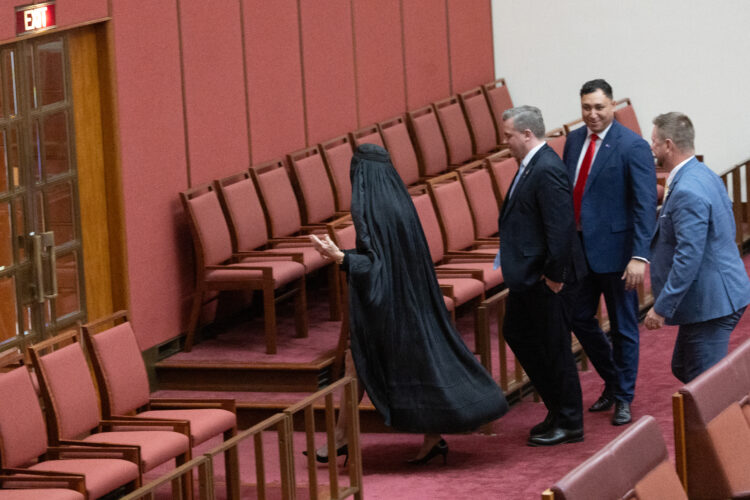
The Point Live: Nationals push for Coalition to delay mining friendly environment laws, while the fallout from Hanson's Islamophobic burqa stunt continues. As it happened

Amy Remeikis – Chief Political Analyst and Blogger

This blog is now closed

Key Posts

The Day's News

Fact check: Blood Oil is bad, but let’s not forget gas companies profiteering from the war

Greg Jericho
Chief Economist

The Nine newspapers series of reports on “Blood Oil” on petrol that has been reportedly refined from Russian Oil being imported to Australia should horrify Australians. Australians should not be delivering profits to Putin, or indeed any regime conducting an illegal war or genocide.

However, it should serve to remind people that ever since Russia’s invasion of Ukraine in February 2022, Australian gas companies, and those fearing ones operating in Australia have effectively been garnering massive profits due to the illegal war.

No, they have not been supplying gas to Russia, but Russia’s invasion caused world gas prices to soar – including in the Japanese market, which determines the price of much of LNG from Australia. In the nine months from January 2022 to September that year, the price of LNG in Japan rose 61%. And with it went Australia’s exports of LNG – up 70% in the same period.

Did this boom in exports and prices lead to a boom in tax revenue? Nope.

It was the purest example of “windfall profits” you could get. Nothing the gas companies did caused this to happen. There was no special marketing going on or new way of refining or exclusive development that saw gas prices and their profits rise.

And yet that windfall did not lead to one for Australian taxpayers.

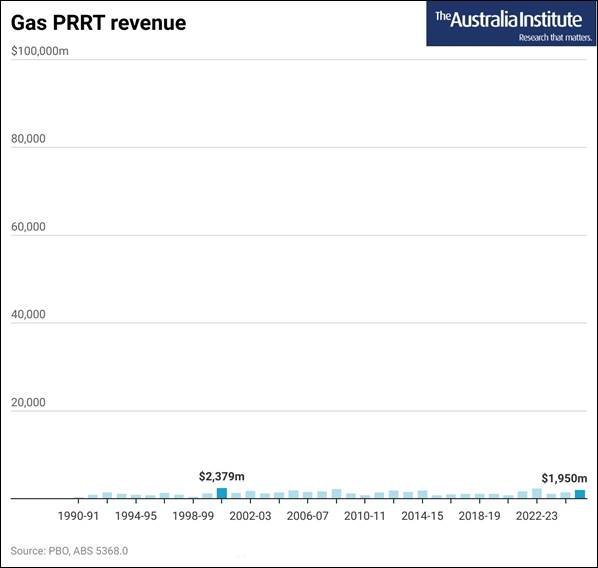
Australia’s notional tax on the super profits of gas companies is the Petroleum Resources Rent Tax (PRRT). And yet as the exports of LNG from Australia boomed, PRRT revenue actually fell:

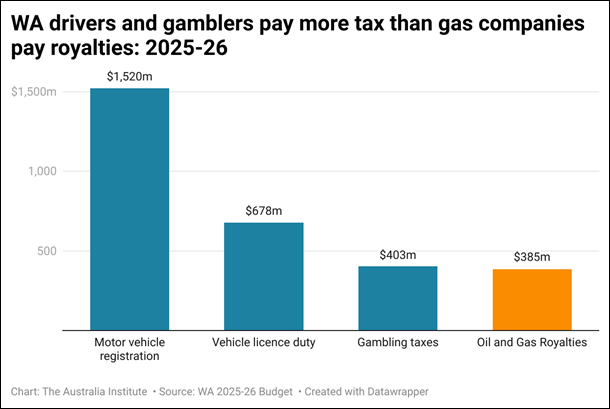
I guess the gas companies would boast about how much they pay in royalties. Well sorry, but over in WA the small amount the gas companies pay is so pathetic that they now contribute less to the WA budget than do gamblers in the state

That’s pretty amazing given WA, unlike every other state, does not have pokies in pubs.

That’s be real – gas companies in Australia have made massive profits purely due to Russia’s invasion of Ukraine. Nothing they did caused gas prices to rise – Putin committing and illegal act did that.

But those same gas companies have taken the money and also shouted loudly that they should not have to pay anymore tax.

Profiteering off of a war used to be condemned, we should not let these gas companies off the hook now.

It’s why the government should introduce a 25% tax of LNG exports that would raise around $17bn a year and no longer let gas companies take the absolute piss.  

ABS releases new census topics

That sound you hear is the culture war clarion – because the ABS has announced the new census topics for 2026 – and the date. You may remember the government pre-emptively scraped some question proposals on LGBTIQ issues because it was worried about a pushback THAT HADN’T EVEN HAPPENED. That decision was reversed.

We’ll all be making it count on 11 August 2026 and among the topics will be (from the ABS website)

The 2026 Census will include new questions on gender and sexual orientation. These updates will provide valuable insights into the experiences of LGBTIQ+ Australians and support the development and delivery of targeted health and social programs and services.

Changes have also been made to existing questions to improve data quality and ensure inclusivity.

These include:

  • allowing respondents to report up to four ancestries
  • enhancing the third response option on the sex recorded at birth question
  • updating the wording of the Country of birth of parents questions.

More information on these updates can be found under each topic group heading.

The question on number of children a woman has given birth to will return to a once-per-decade collection and will not be included in the 2026 Census. 

‘Strengthening gas market regulation isn’t optional’

Nicolette Boele welcomed the bravery (and rationality) from a government MP:

It’s great to see former senior Cabinet minister Ed Husic MP break ranks to publicly back my Private Members’ Motion on effective gas market regulation. 

his shows a growing recognition that it makes no sense for people in Japan to pay less for Australian gas than we do here in Australia – and the Government should heed this warning. 

We have enough gas in this country. We do not have a gas supply problem; we have a gas export problem. 

It’s time the Government understood that strengthening gas market regulation isn’t optional – it’s essential to our energy security, our economic competitiveness, and the credibility of our pathway to net zero. 

Nicolette Boele MP welcomes Ed Husic’s support on gas market regulation

We covered this yesterday when Ed Husic spoke on Nicolette Boele’s private members’ motion on the need for effective gas regulation.

As a refresher, here is some of what he said:

In this country, it’s almost like we’re embarrassed about possessing so many resources and are so timid we feel we just have to cop what overseas companies and buyers tell us—what rot. Or we are spooked by this argument: if we demand too much these companies won’t invest in new fields—lame. Former WA premier Alan Carpenter stared down that threat and established a west coast reservation system. Our generation trades on the courage of past generations without displaying the spine to do the same today.

This timidity has allowed a structural flaw to fester, with domestic prices influenced by export prices and Australian users competing with Tokyo, Seoul and Singapore for Australian gas. We beg for the scraps—forced to cop globally indexed pricing that has absolutely no relationship with the cost of production. Our gas, our prices—that should be the bedrock, the cornerstone, of our thinking. The cost of doing business in this country, for multinational gas firms, is that they must provide a gas price in line with
historic pre-pandemic levels.

This should apply to any new field that’s open, too. We absolutely need to establish a gas reservation policy to meet our local needs in this decade, not in the next. We must stand firm on another issue. We cannot tolerate being lectured to by overseas buyers telling us what we can do with our gas when they on-sell the gas they get from us to make a massive profit. Last year, Japan resold a
third of the LNG it had purchased from Australia, making over $1 billion in profit and in quantities large enough to supply our domestic industry for a year. We should reshape the Australian Domestic Gas Security Mechanism to allow the government to intervene, adjusting future supply based on past resold volumes. This nation should not be reduced to pauper status. We should be an energy superpower, and that should translate to economic strength. That’s the ambition we should have no hesitation in pursuing. We may also need to prevent the sale of uncontracted gas offshore and ensure companies don’t sidestep this by ramping up sales of uncontracted gas to drain what’s available for locals.
We cannot wait for a better deal for this country. We should have the ambition to pursue better for this nation, and we should reject the naysaying and the fearmongering by those who want to tell us that we should cop something that we all in this place know we should not

Continued in next post

Who or what are the noisy watermelons bothering Gina Rinehart?

Rod Campbell
Research Director

Australia’s favourite mining heiress is in the AFR today putting a “blowtorch” on BHP, Rio Tinto and ‘watermelons’:

“If government truly cared about its duty to Australians, they would stand up to the noisy watermelons and the far-left,” Rinehart wrote. “We need to help them, don’t we?

“Be prolific in online comments, including supporting those who do stand up against the watermelons.

Several people online and in The Australia Institute office were confused as to what Gina was talking about, and so to the extent that I can translate Gina’s thoughts and poetry into standard Australian English, here is a brief explanation.

While the watermelon has become a symbol of opposition to Israel’s genocide in Gaza and support for Palestinian causes, Gina probably means someone who is “green on the outside and red in the middle”.

The suggestion is that people who express concern about the environment, perhaps the Greens/greenies, are actually “reds”, people secretly plotting to spread communism.

This seems a bit ridiculous decades after the Cold War and in the face of the obvious links between environmental justice and social justice, but that’s not even the weirdest bit of Gina’s rant.

The really weird bit is that she takes a crack at BHP and Rio Tinto for “sacrificing…on the green altar” profits and dividends to shareholders.

If she was taking a crack at Fortescue, I would understand. Fortescue is actively pushing other mining companies and the government to decarbonise and to phase out fossil fuel subsidies.

BHP and Rio Tinto, by contrast bankroll the campaign to keep Australia’s biggest fossil fuel subsidy in place. BHP are pushing for cheaper coal (for themselves) while Rio Tinto weirdly won’t criticise the gas industry that is harming them.

If you’d like to hear more of Gina’s thoughts, there’s a whole weird video here.

Austerity back in fashion? Or just the Department of Finance doing its job?

Dave Richardson

It looks like austerity is back in fashion as we read reports that Katy Gallagher, the Minister for Finance, has ordered Commonwealth government departments and agencies to outline sweeping spending cuts worth up to 5 per cent of annual budgets, in a move intended to rein in ballooning public service costs.

Between the lines the Financial Review is gloating that its reports of excessive staffing and wage costs seem to have been validated by the government.

Critics of the public sector like to suggest that the work of the bureaucracy is unnecessary anyway. Arbitrary cuts like those proposed seem to concede the point by suggesting any cuts are as good as any other cuts.

Prior to the election then Opposition Leader, Peter Dutton, promised to cut Caberra staff by 41,000 positions. Senator Jane Hume wanted to put an end to work-from-home arrangements.  The Labor Government resisted those calls at the time, so what do we make of the present reports?

Now it is also reported that the Finance Department has written to cabinet ministers and public service heads asking them to detail how they would meet the 5% cost savings target.

One possibility is that there is nothing in this story. Treasury has just called for budget submissions to assist in preparing the next budget. Around this time it is standard practice for the Finance Department to prepare savings options for consideration by the Expenditure Review Committee of Cabinet.

Finance might suggest it is just doing its job by getting Cabinet to review the spending priorities, but people always get nervous when leaks put their jobs or budget priorities in the firing line. It may turn out to be nothing more than the usual speculations about budget deliberations fuelled by the occasional government leak.  

AI slop announced as Macquarie Dictionary’s word of the year

Skye Predavec
Researcher


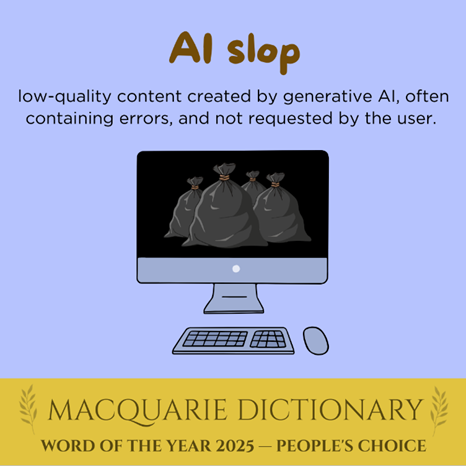
“AI slop” is the Macquarie Dictionary’s 2025 word of the year, after claiming victory in both the committee and people’s choice votes.

The Macquarie Dictionary defines the term as “low-quality content created by generative AI, often containing errors, and not requested by the user.”

To claim the prize, it beat out 14 other nominees, including “six-seven”, “Ozempic face”, “attention economy, “medical misogyny”, and “clanker”. The latter three received honourable mentions.

AI slop has strong continuity with last year’s winner, “enshittification” – both have made the experience of browsing the internet worse.

Generative AI has been the source of many controversies this year. From instances of AI psychosis, to the Albanian government’s bizarre decision to appoint “the world’s first AI government minister” in September, or the Productivity Commission recommending effectively disposing of copyright on Australian work to help AI train.

The time when AI was a fun oddity is long past, and it’s begun to threaten our democracy. In 2024, a “deepfake” video of Queensland’s then-Premier Steven Miles became a campaign controversy, with The Australia Institute re-upping its call for truth in political advertising laws in the state.

The growth of deepfakes also prompted Senator David Pocock to introduce his My Face, My Rights Bill to Parliament yesterday, which would mean Australians who share deepfakes of another person without that person’s consent could be sued or face steep fines.

The 2025 word of the year is a timely reminder that generative AI isn’t going away. AI slop is one of the more mundane consequences, but it’s still damaging. More and more of the internet is being replaced with ersatz pages, text, and images – they’re almost, but not quite, right.

But if AI continues to grow without regulation, slop may be the least of our worries.

Who told the president of Nauru there were no refugees in the NZYQ cohort?

Of the interview, Shoebridge said:

I want to thank my colleague Senator Pocock and I want to thank the ASRC for joining with me tonight to tell the truth about this interview, because this is the interview that the government has refused to produce. This is an accredited interpretation of the interview that President Adeang gave when the announcement leaked out from Nauru—it did not come from our own minister—about a $2½ billion secret deal.

This government have been trying to keep this secret from the Australian people, refusing to produce their own interpretation and refusing to tell the Australian people what the Nauruan president said.
I know that Senator Pocock and I read the transcript out in somewhat of a rush, but we did it because we weren’t certain that we would get it on the record in the time that we had available. It should have been the government that told the Australian people about this. It should have been the government that had the decency to step forward and be honest with the Australian people about what the Nauruan president said.

No doubt there are reasons why the government wanted to hide this, because President Adeang wrongly makes the statement, no doubt on advice from the Australian government, that none of the NZYQ cohort are refugees, which is plainly wrong. Did the government tell them that? Did our government mislead the Nauruan government? Do they adhere to what the Nauruan president
said about these people not being refugees—none of them? They’re probably also embarrassed about the fact that President Adeang made it very clear that he wants these people to return to the country they came from.

We know that they have fled from persecution, by and large. Does the Australian government join with Nauruan president in wanting to send people back to persecution in Iran, in Iraq, in Russia and in Sudan?
Finally, we get to read the truth onto the record. I want to again thank the ASRC for the work they’ve done on this.

David Shoebridge continued:

I’ll continue reading from the same transcript read out by Senator David Pocock.
Question: Because of the background of these people, that you are saying have committed crimes.
The safety concerns of the people of Nauru, what does the government have to say to ease their gut about the fact and the shock that they are living within their community?
Answer: The first thing we have to remember is that these people have their time in jail. They have a history yes, but they also have a present. And the present of this people now is that they are living within the people of Australia and are not committing crimes, some of them are just enjoying their lives and continuing their lives but they are not from there and Australia does not want them.
And for some reason, some legal reasons, they cannot be deported. So, we are the solution to them being moved from there. I did wanna provide a solution. But to address our own, its not that different from how we protected our community back when the refugees first came and after
we allowed them out of detention to settle within our community, they also had a history and we also have a history, there are some that come out of jail here with their own histories.
We weren’t harmed and we wont be harmed. Of course, there are extra community safety arrangements that we will bring out to look after our community, maybe, for example, and help them (NZYQ) a little with their movements and to ease the shock of the community.
Because the biggest thing I see now is that there will be surprised people and we have to remember that this is not the first time we have let foreigners come to our home and it will not be the first time we have accepted foreigners with backgrounds that are not 100% pristine.
and we know how to handle arrangements like this and we also know how to empower the lives of these people and we know to take care of them.

And we all get along just fine. We hold that we will be fine.
We will bring out a lot of things for this and we welcome the input of the community if they want to give us their feedback on how to make them feel safer/more secure.
They can make contact with their relevant members of parliament and ministers to let us know.
I have also sat with the Opposition recently to give them all of the facts of this thing that we have entered. So that they know what is true and what isn’t true.
The Australian media will have their own spin on it but what I have given you is what is true to all of my knowledge. There are three people that will come first, within days, maybe less than a week. We know their profile, what their names are, their backgrounds and their ages.
And we have already prepared them a space and we have prepared the safety protocols to protect them and to protect us. And we are not overwhelmed, because we have already gone through these things. This is not new here. The only new thing is that they are not refugees.
Question:
If the 30 years ends and we have not resettled them in another country, what is Nauru and Australia’s Plan?
Answer:
Well I guess in 30 years time, there will have to be meetings between the Government of Nauru and the Government of Australia and what we’re going to do about these people.
But there’s a long way into the future I do trust however, that maybe before then, we will little by little be able to return these people home if they want that. I also anticipate that these people will have family from Australia that will want to visit them here and we are not closed off to
that, just like when the refugees were here, we allowed their families to visit them here, we opened our arms to them and we will do that with these people also.

Pocock and Shoebridge read asylum seeker interview into Hansard

Late yesterday in the senate, Greens senator David Shoebridge and independent senator David Pocock read an interview into the senate they say the Australian government tried to keep secret.

Pocock:

I’m going to read out the transcript of an interview between President Adeang of Nauru and Joanna Olsson of the Nauru Government Information Office. This interview was posted to Facebook on 17 February 2025 and has been translated by an iindependent translator. My thanks to the Asylum Seeker Resource Centre for providing this copy.
Question: Good Afternoon Your Excellency, this news that Nauru has entered a new agreement with Australia where it states that we will be accepting non-citizens from Australia known as the NZYQ. Who are these NZYQ?
Answer: Um, It does not matter as much what they are called, what does matter is what type of people they are. The particular group Australia is asking us to take are not people of Australia.
They are in Australia, they have committed a crime, served their time in jail and are now out and living within the communities of Australia. Now leading their lives not unlike any other person living in Australia. Now, Australia has been trying to return them to their home countries and have been unable to for multiple reasons. Because they are unable to, Nauru and Australia have joined into a partnership, due to our history where we have been able to home people on our land; like people who sought asylum or those that are refugees.
To clarify, these people are not refugees. They are regular people but their background or their history is that they have been to jail. These days, they are free to roam around Australia and while they are no longer under penalties but they are not of that place
and despite Australia’s preference to send them home, they are unable to.
So that is what we have entered into, we will help Australia and take these people and allow them to live among us.
Question: Regarding this agreement, this is great for Australia as far as protecting their communities. We in Nauru, have we reached a point where we can take care of people like this?
Answer: We have looked at every corner of this arrangement. This has been going on since last year. It is not like we slept and woke up and got asked something big.
We have thought about it since last year that it is not unlike the RPC arrangement that we are still undergoing here at home.If we remember, the people that have come here under the RPC arrangement are not without their own history, they have come from war-torn areas.
Some have taken lives, some have abused people and when they have come here, they have not interfered with anything. They have just come here, they live their way.
They want to just continue their lives because we are a country and a people that are peaceful.
That is also our attitude at the moment, we say that these people that are coming, there are some that are just going to want to continue their lives and will want to build their lives up in a peaceful way, just like each and every one of us.
Question: The visa they have, how is it different to the one we are offering to the RPC cohort? How long are they going to be in Nauru and what are the rules of their visa?
Answer:
When they are given the visa, it is clear to all of us that we have given them a place here. 35 If we say 30 years, then 30 years is what they are given. Unless of course, we, your government, find a way for them to move around, for example; they get to go home. The problem now is, Australia cannot return them home, these people are what you would refer to as stateless.
Their homelands do not want them and they do not have a way to go home.
And if over time we find a way to return them home then of course they will not reach the 30 years. But the Visa we are providing them to start is 30 years.
It’s the same as everyone we brought in during RPC, they can work, we also encourage them to work, so they can feel like they contribute to our community, nothing will be stopping them.
But they will have a 30 year Visa rather than the shorter visas and that’s the only difference. Otherwise, they are also subject to the laws of Nauru.
If they break the laws of our home, they will follow our normal legal process. Taking them to court, sending them to jail if needed, fining them if needed.
We are anticipating that now that we are talking, it is not like they are breaking the laws in Australia but Australia does not want them because they are not from there.
So we will take them for the time being, We are not anticipating that they are wanting to come here and break laws, they just want to continue their lives.

The biggest stories and the best analysis from the team at The Point, delivered to your inbox.