Mon 27 Oct

The Point Live: Barnaby keeps the Nats guessing on his future. As it happened.

Amy Remeikis – Chief Political Analyst

This blog is now closed.

Start the conversation

The Point Live: Barnaby keeps the Nats guessing on his future. As it happened.

Key Posts

The Day's News

See you tomorrow?

It’s going to be a long, loooong sitting, so we are going to call it a day now, and get ready for some of what is coming up tomorrow.

Tuesday is party room meeting day, which means there will be a dew pointed questions regarding Matt Canavan’s net zero report in the Coalition joint party room meeting. And more of Barnaby Joyce enjoying being Barnaby Joyce.

We will bring you all of that, and more, so we hope you’ll join us?

Thank you to the thousands of you who turned out today – it meant the world to see so many people here for our first blog on the new site, The Point – we hope to continue to grow in ways that serve all of your needs, and help you understand the world a little more.

We’ll be back very early tomorrow morning. Until then, as always – take care of you. Ax

Anthony Albanese addressed this in his press conference a little earlier today, but here is the official statement welcoming Timor-Leste to ASEAN:

Australia warmly congratulates Timor-Leste on its accession as the 11th member of the Association of Southeast Asian Nations (ASEAN).

Prime Minister Anthony Albanese marked the occasion with Prime Minister Xanana Gusmão and ASEAN leaders at the 47th ASEAN Summit in Kuala Lumpur. 
 
This is an important milestone for ASEAN and a significant step for Timor-Leste’s regional integration and economic development. It is a credit to both ASEAN’s and Timor Leste’s sustained efforts over many years.
 
We acknowledge the leadership of Prime Minister Xanana Gusmão in achieving what he has described as a ‘historic goal’ for the nation and people of Timor-Leste.

Australia is proud to have supported Timor-Leste’s ASEAN journey from the beginning, including through our $11.8 million technical assistance and capacity building package.

Australia is ASEAN’s first Dialogue Partner, and we strongly support ASEAN’s role in shaping a peaceful, stable and prosperous Indo-Pacific. 

ASEAN is central to regional stability; it guards against conflict, drives regional economic growth, and reinforces the rules and norms that protect us all.
  
As a close friend, partner and neighbour, we look forward to continuing to work closely with Timor-Leste and ASEAN to ensure membership delivers real benefits for the Timorese people and our shared region.

Liberal senator Sarah Henderson has announced she will be moving to establish a senate inquiry into the triple 0 failure tomorrow:

This inquiry is vital to uncovering the truth about went wrong with this critical service.

After misleading Australians about when her office first knew about the outage, Labor’s hapless Minister for Communications, Anika Wells, must also appear before the inquiry. It is incumbent on the minister to do the right thing in the national interest and give evidence. 

The role of the minister in safeguarding the integrity, resilience and public confidence in the triple-0 system is central to our inquiry.

The government’s inquiry by its own regulator, the Australian Communications and Media Authority, is woefully inadequate and riddled with conflicts of interest. At the behest of the minister, ACMA delayed tougher emergency call service rules on carriers by six months and this has had serious consequences.

The Australian people deserve much better than this.

The CDC bill has been read for a third time and will be on its way to the senate.

There have also been a buttload (the technical term) of reports tabled.

You can find those, here.

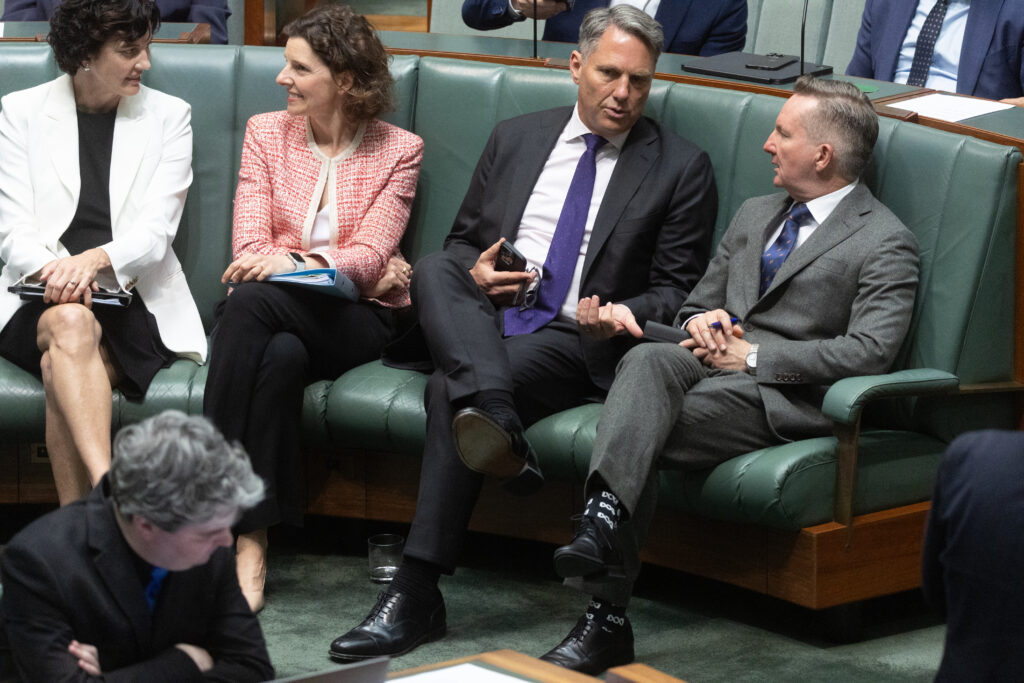
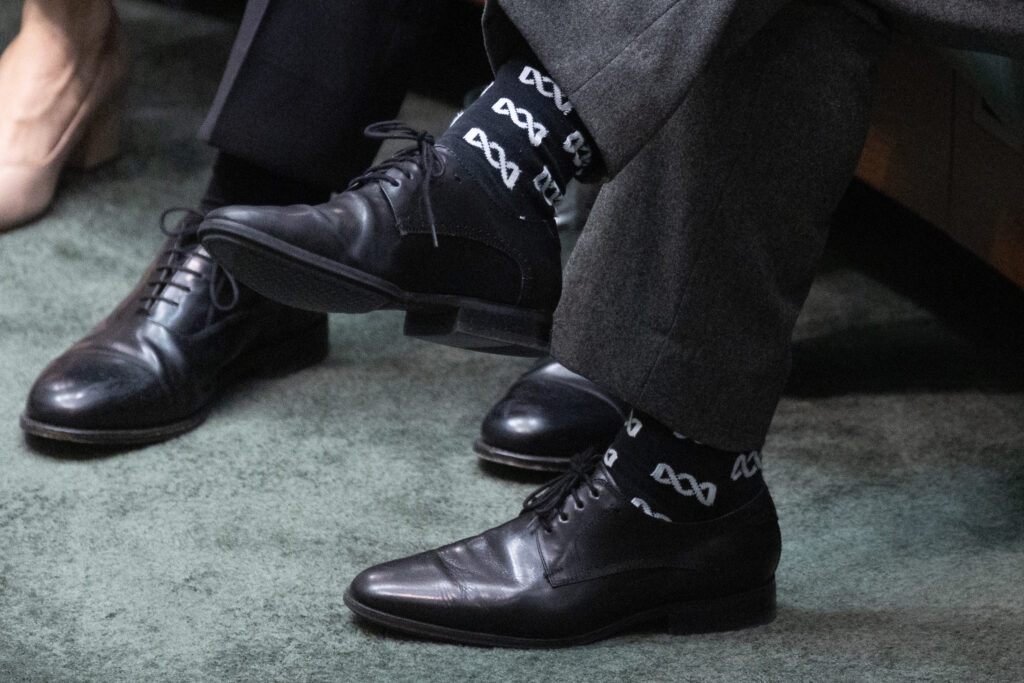
Ahhh, thanks Mike Bowers: he has confirmed Chris Bowen’s sartorial choice.

Socking it to them
Letting the socks do the talking

I am reliably informed by spies in the house of representatives, that Chris Bowen made a choice to wear ABC socks today.

We are sure the ABC is very happy with non-advertising advertising.

‘Not a luxury’: cheaper contraception offers choice

Maeve Bannister
AAP

Hundreds of thousands of Australian women will have access to another affordable contraception option as a vaginal ring is added to the government’s medication subsidy scheme for the first time.

The NuvaRing is a prescription contraceptive method which is inserted into the vagina by the user and distributes hormones to stop ovulation. 

It can be used for three weeks in a row before being removed for a week, and a new one is then inserted.

Used correctly, the ring is is 99.5 per cent effective, which is similar to other hormonal contraceptive options.

The NuvaRing is available in a three-pack as a private script for $130.

From November 1, when it will be added to the Pharmaceutical Benefits Scheme (PBS), it will cost general patients $31.60 and concessional patients $7.70. 

From January 1, the maximum women will pay per script will be $25.

Within the contraceptive landscape, the ring falls in between a daily pill and a long-acting reversible such as an IUD, Sexual Health Victoria medical director Sara Whitburn told AAP. 

“Contraception is about choice and what works for people and their lifestyle, but one of the biggest barriers to people choosing the NuvaRing has been cost,” she said.

“When people make a decision around contraception, cost is one of the things that influence their choice the most.” 

Side effects of the ring are similar to the contraceptive pill, including acne, bloating, weight gain and reduced libido. 

But Dr Whitburn said it could be a good option for people who had stomach upsets from taking the pill. 

“For someone who wants to have something they are in control of inserting and removing, or they have had side effects from taking a tablet, the ring could be something to consider,” she said.

In February, the federal government announced a $573 million women’s health package to increase bulk billing for IUDs and birth control implants as well as add new oral contraceptive pills to the PBS.

The PBS listing of the NuvaRing is part of this package.

The changes linked to long-acting reversible contraceptives are expected to benefit about 300,000 women each year and save them up to $400 in out-of-pocket costs.

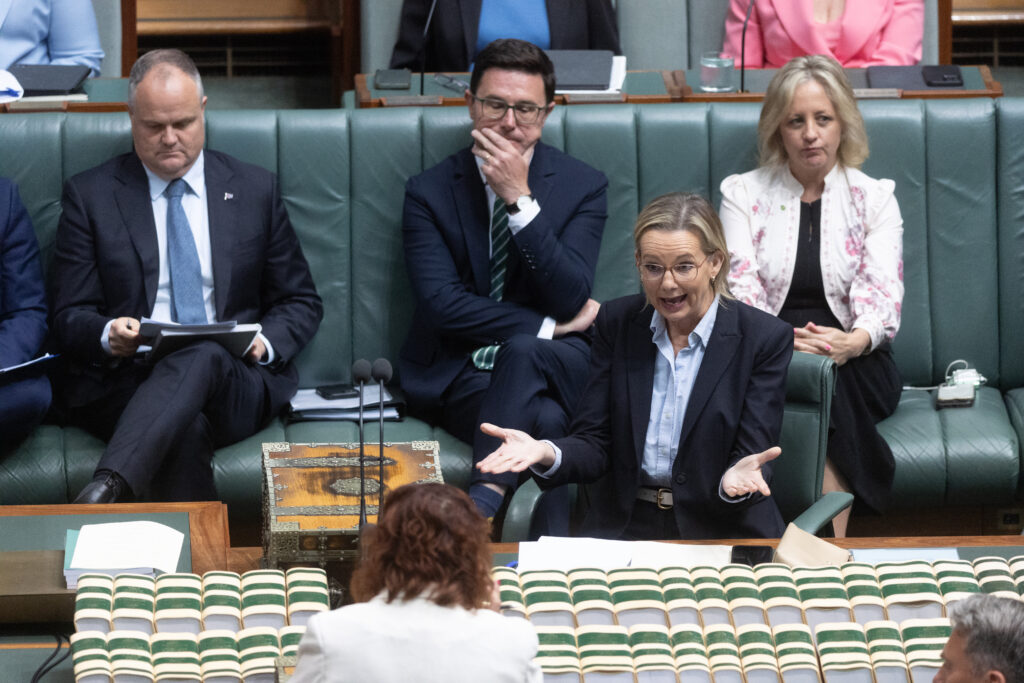
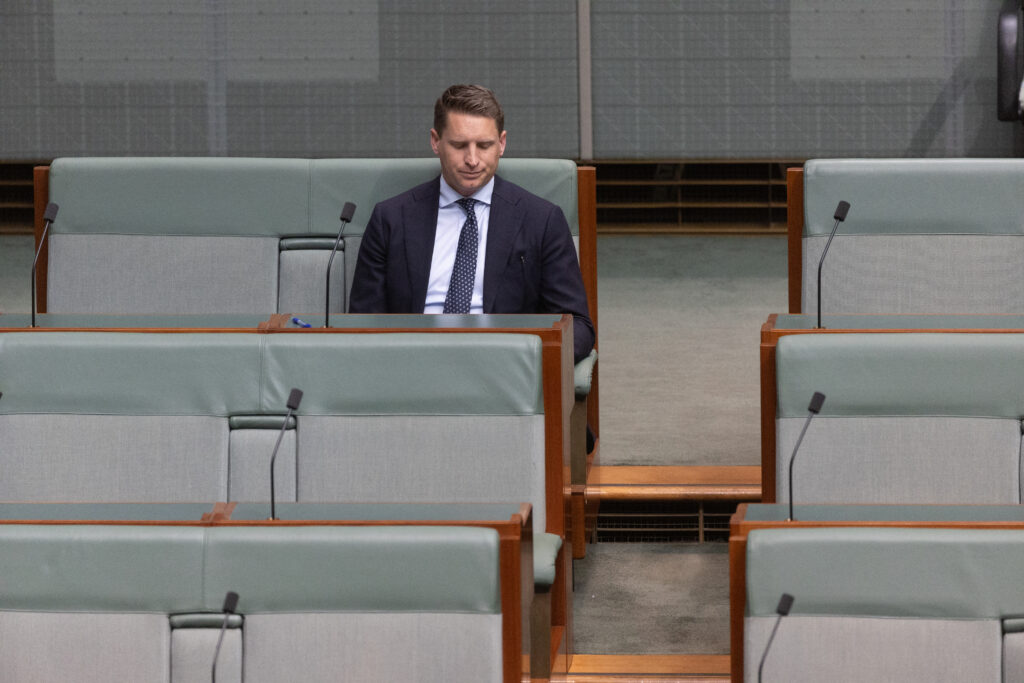
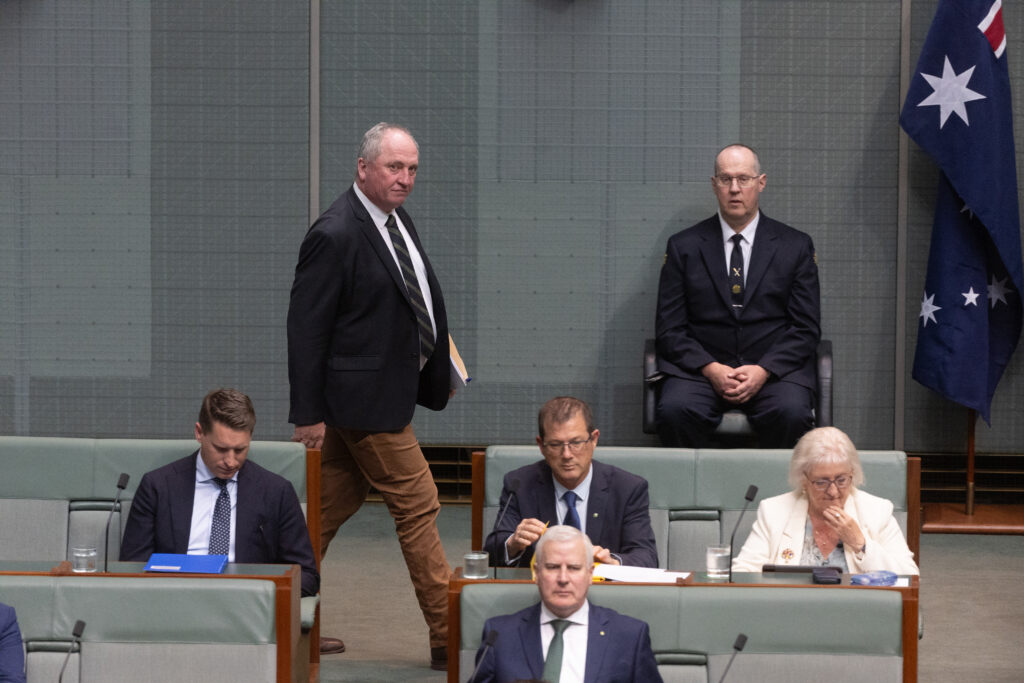
The view from Mike Bowers

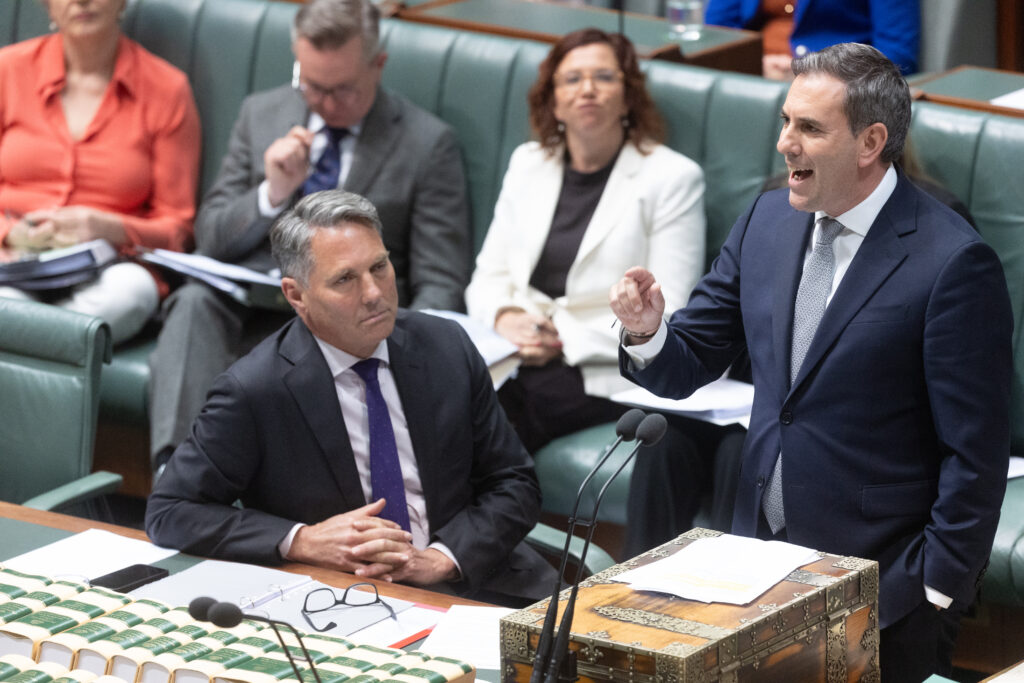
Here is how Mike Bowers (courtesy of The New Daily) saw question time in the House:

The Treasurer Jim Chalmers and Acting PM Richard Marles during question time
We are all wondering too, Sussan.

Andrew Hastie and all his friends

Barnaby Joyce and all his friends

Question time ends.

So what did we learn in that first QT back?

The Coalition are still a question looking for an answer.

It serves ideological purposes to zero in on CFMEU corruption allegations, but does nothing to actually win over any voters, or inject themselves into relevant conversations. It is a very safe area for the Coalition to dance around, because it keeps the base happy, but doesn’t delve into any of the areas which are currently tearing it apart.

Does it do anything to further it’s cause? No.

As has become habit, it was the crossbench who asked the questions that matter to Australian voters – health, housing and what on earth is in the critical minerals deal we have just signed with the US.

It is also interesting that the Coalition, which has made a bit of a meal of this in the past, did not go for the low hanging fruit that is Albanese’s travel.

Have they learned their lessons? Unlikely -there is a lot of sitting left, so let’s wait and see before answering that one.

The independent MP for Bradfield, Nicollette Boele asks:

Last week Australia and the United States signed a critical minerals framework agreement, responsibly exploiting our national resources and securing offtake and diversifying trade partnerships were the aims but the owners of these resources, the Australian people, are left in the dark about how they will benefit. If the PRT for other resources is anything to go by, this deal will not be making much from royalties we collect. What we do know so far is the two companies will receive significant Australian government investment. When cannot the taxpayers expect more detail about how the deal works for them?

Richard Marles takes this one:

I thank the Member for her question. She is right in articulating that the landmark critical minerals framework agreement signed by the Prime Minister and the president last week is genuinely in Australia’s national interest, is worthy in the terms of the Member and will absolutely have a huge impact on the Australian industry and through that the Australian people. Critical minerals is one of the great opportunities that our nation has.

We are one of the five largest – we have one of the five largest resources of critical minerals and rare earths in the world. And the opportunity not only to mine those critical minerals but to process them represents one of the great opportunities for our manufacturing and our country this century. It’s because of the particular items which are used by critical minerals and rare earths which are simply fundamental to the modern economy. What we have faced globally is that while we have been engaging in the mining and extraction of critical minerals and rare earths, the processing of them – a sector that would involve significant employment and significant industrial development in this country – has proven much more difficult, given the structure of the global market.

And that’s why we have put in place a number of measures, such as the Critical Minerals Production Tax Incentive, and the Critical Minerals Facility, to demonstrate that the Australian government is there, supporting the critical minerals sector to engage in that kind of work. And that represents a $28 billion investment in this sector by our government since 2022. In saying that, I would add that when it comes to the Critical Minerals Production Tax Incentive, we did that in the face of the opposition of the Coalition, who talked about that is billions for billionaires.

Completely failing to understand what this represented for Australian Order.

But it is difficult industry. to do this on our own, and that is why the agreement that we signed with the United States last week between the Prime Minister and the President was so important because what this does is bring together the might of the US government, along with our own, in terms of being able to genuinely support these industries going forward. And the benefit for the Australian people is manifest because what this will see is significant numbers of downstream processing jobs in this sector which currently are not being met in the Australian economy and that will be an enormous advantage.

Un-intelligent plan scrapped

Alice Grundy
Research Manager

Artists around Australia welcomed the Federal Government’s decision to reject a data-mining exception proposed by the Productivity Commission in their interim report on artificial intelligence in Australia.

This isn’t the first time that the Productivity Commission (PC) has come for Australian artists. The PC called for an end to territorial importation restrictions – which stop foreign publishers from making cheap versions of local books and flooding the market – in 2008. Industry outcry at the time meant the recommendation was binned.

Last time, the PC suggested one option for managing copyright in the age of AI was to allow an exception for local AI companies, in order to promote local AI business. Artist after artist testified before a Senate inquiry saying that the exception was outrageous.

Musician Adam Briggs said, “We’re just saying if you want to use it, you have to pay for it… It’s like any other industry in Australia. If you want to build a building, you have to pay for the bricks and concrete and steel.”

The decision not to adopt this exception is a good first step. The next is to force the big companies exploiting Australian artists’ work to train their large language models to pay their fair share.

Lol – One Nation to drop Pauline Hanson’s name and revert back to One Nation in latest troll of Nationals

Never let a crisis (manufactured or not) go to waste huh?

Pauline Hanson has announced that One Nation will officially drop Pauline Hanson from the official party name ‘Pauline Hanson’s One Nation (which they put in place while re-registering the party after a small kerfuffle over who actually had the name ‘One Nation’) and revert back to being One Nation, officially.

Here is the statement on the party website:

The decision marks a defining moment for the movement, reaffirming its identity as a voice for ordinary Australians who value fairness, sovereignty, and unity.

Senator Hanson said the change symbolises a renewed focus on the principles that first inspired millions of Australians to join the movement: putting the nation and its people first.

The rebranding reinforces One Nation’s commitment to restoring trust in politics, protecting Australian values, and continuing the fight for everyday Australians across every state and territory.

With this announcement, Senator Pauline Hanson is once again reminding the country that One Nation stands stronger than ever: one voice, one people, one nation.

But make no mistake – it is to troll the Nationals and keep the story that Barnaby Joyce may be joining the party, going.

It’s also, no doubt, booked her a slot on some media, so that is always a win, right?

Super Ted is then allowed to ask a question, which is always a fun time for all involved.

It’s for Jim Chalmers:

My question goes to the Treasurer: It follows the Treasurer’s humiliating backflip on his super tax proposal. Can the Treasurer advise the House whose rejection most influenced his decision to dump his tax? Was it (a) the coalition? (b) industry experts and economists? (c) the Prime Minister? Order! The member will pause. The member will pause.

Labor’s Josh Burns is booted for interjecting and Dugald is NOT having it today:

Look, I don’t know why this is so difficult. When people are asking questions, don’t interject. There’s a lot of intelligent people here… [there is laughter at this] well, in the gallery, there are… Order!

Super Ted asks his question again and Chalmers adopts his ‘sigh-I-have-to-deal-with-Ted-O’Brien-again-why-am-I-being-punished-pose’ which is when he leans again the despatch box and faces the speaker, because he can barely bring himself to acknowledge Super Ted across from him.

I get it.

Chalmers:

I’ll make it really clear to the House that I didn’t take the advice of those opposite. I didn’t take the advice of those opposite. And that’s because the question comes from the same people who took to this year’s election a policy to increase income taxes on every single one of the 14 million taxpaying workers in this country. The same people – the same people – who object to smaller tax concessions for 0.5% of people in super wanted to jack up income taxes for 100% of the 14 million taxpaying workers. That’s because what they really object to, as I said before, is they really object to more super for more workers. They don’t like super. They don’t like workers. We know that from their almost decade in office. They are always trying to undermine and diminish and come after the superannuation that the working people of this country need and deserve for a decent retirement. Also, don’t forget that the question comes from the same guy who wanted to borrow hundreds of billions of dollars to build nuclear reactors to push power prices up, not down. So he asks he who I take my advice from.

I don’t take my advice from the Shadow Treasurer, Mr Speaker. I really couldn’t be clearer about that. He can trouble himself all he likes with the political scuttlebutt and the internal far-right politics practised by those opposite. The difference between the Shadow Treasurer and myself as Treasurer is the outcomes. I’m here to deliver for the working people of this country. I’m here to deliver an increase in real wages. I’m here to deliver income tax cuts. I’m here to deliver more super for more workers so they get the decent retirement that this guy would deny them.

Super Ted has a whinge that Chalmers isn’t being relevant, but Dugald is like – ask play stupid games, win stupid prizes (also the name of my dating memoir) but Chalmers decides to play along:

The point I’m making is this side of the House works through issues in a collegiate, in a considered, in a methodical way, and we do what we can to find the best way through and, overwhelmingly, to deliver for the working people of this country, who send us here to represent them and their interests. The Shadow Treasurer’s here for a little pat on the head on Sky After Dark or a little tickle on the tummy on Page 13 of The Australian. We are here for the outcomes. Because it’s the outcomes that really matter. The outcomes really matter.

We’re here to deliver for working people, and that’s what we’re doing. And because of our efforts – and this is what really offends them – because of our efforts, more Australians are working, more Australians are earning more, more Australians are keeping more of what they earn, and more Australians will retire with more. And that’s because we are delivering – they are divided, they are divisive, they are in disarray. And that’s the difference.

Independent MP Andrew Wilkie then asks Mark Butler:

Minister, Australia’s hospitals system is in crisis. Establishes aren’t big enough to properly fund public hospitals, and the health insurance isn’t working for the private sector. People are suffering needlessly and far too often dying prematurely. Only the Commonwealth has the financial and policy heft to turn things around. Minister, when will the federal government finally act to fix things? Because, let’s face it, just negotiating another funding agreement is hardly bold reform.

Butler:

I thank the member for his question and recognise his passion over many years in this place for better services in his part of Tasmania, in particular, but the country more broadly. He knows there’s a lot of pressure on our health and aged care systems.

After a decade of cuts and neglect, after a once in a century pandemic, and with very significant demographic pressures on our system. Like the member, we’re feeling the pressures in our state very much, but it’s right across the system. I respect the member’s passion in this area. But I don’t agree with a lot of the suggestions in his question. I have to say, this week is a particularly weird week for the member to suggest this is not a government focused on bold reform.

This is the week where we are debating a bill to introduce a Centre for Disease Control. This is the week where the Assistant Minister for Health is rolling out a whole range of new measures to deal with the neglect that has been there for so long around women’s health. This is the week when we are introducing an entirely new aged care system under the leadership of the Aged Care Minister. Mr Speaker, at the end of this week, we will be introducing and rolling out the biggest-ever investment in bulk-billing in the history of Medicare.

The member for Clark knows, more than anyone else in this chamber, the benefit of investment in bulk-billing. Because, since we first tripled the bulk-billing incentive two years ago, the member for Clark’s electorate has seen the biggest increase in bulk-billing of any electorate in this chamber – a 14% increase. And more will come after Saturday. In Tasmania, we’ve seen the benefit of our policies to get more doctors and nurses into the system. The member for Clark has two Urgent Care clinics in his electorate, taking pressure off the hospitals that his question talks about.

There is a back and forth about relevance. Butler comes back with:

I think, in his heart of hearts, the member for Clark knows our health and aged care system is an integrated system. Bulk-billing is not working. When people don’t fill their medicines, they don’t need to go to their GP when they need to go to their GP. The member for Clark knows that means they end up in hospital far more regularly than they should. That’s why addressing pressure in primary care, making medicines cheaper, is not just good for the hip pocket – it’s good for the health of millions of Australians who get the healthcare when and where they need it in the community.

And there is no better example of our reform and its connection to the hospital system than our 90 Urgent Care clinics, two of which are located in the member for Clark’s electorate, which have already seen more than 2 million Australians, most of whom say, if they weren’t able to go to that clinic, they would end up at the emergency department. I know the member for Clark is passionate about this. I agree there are pressures. I entirely reject the idea, that we’re not a government of bold reform.

The LNP MP for Flynn, Col Boyce, who I always forget exists except on the rare occasions he asks a question in QT, asks how many jobs will be lost with the possible early closure of the Gladstone power station.

It was meant to shut down in 2035, but Rio Tinto have told workers it may close as early as 2029. That’s because it costs a hell of a lot to keep running and is becoming financially unviable.

Chris Bowen gets to this one and says:

I’m glad he has not been sharing his views about man-made climate change for a change but in honour of all there about 200 direct employees of the Gladstone power station who are employed on a contracted basement and indirectly and it is a significant number for the people of Gladstone but also this is a decision taken by the owners of the Gladstone power station, they have announced, and it is in keeping with the normal protocols and I would make his point Mr Speaker – those opposite our strongly supporting having coal-fired power stations open for longer and sweating assets to see them live longer

That is is the biggest liability in our energy system today. Do you know why? Because today, we had two units of the Callide Power Station which the honorable member would know well out, out and non-operating.

And we have a total unplanned outage across the national energy system of 3.4 gigawatts of coal-fired power. Not planned, not maintenance, coal-fired power stations that were working and all of a sudden break down.

It’s the biggest threat to the reliability of our energy system and that in turn is a threat to energy prices because that sees prices spiked and that is in turn biggest threat to industrial jobs in Australia, those opposite who do not understand the opportunities of our energy system and the need to modernise it now, not a decades time when nuclei may become available.

Michelle Rowland then takes a dixer on the government’s AI decision – LLM models won’t be able to train on Australian content for free. Which sounds like a win for artists and creatives, but most giant AI models have already scraped the internet without paying for it, and they’ll find ways to continue doing that.

Still, it’s a small win. Rowland says:

A core Labor value is supporting Australian voices, Australian culture and Australian stories and, of course, this government has two great champions for the arts in our prime minister and also in the Leader of the House and the Minister for the Arts. Artificial intelligence presents a significant opportunities for Australia and our economy. However, it is important that Australian creatives benefit from the opportunities too. Australian creatives are not only world-class but also the lifeblood of Australian culture.

We must ensure that the right legal protections are in place. The Albanese government has consistently said there are no plans to weaken copyright protections comes to AI. Some in the technology sector have called for the introduction of a broad text and data mining exception. Under such a proposal, artificial intelligence developers would be able to use the works of Australian creators for free and without permission to train AI systems.

The government stands by Australia’s creative industries and that is why we have ruled out a text and data mining exception, and that is to provide certainty for Australian creators. And we welcome the support that has been expressed right across the creative industries. Annabelle Herd the CEO of Aria said it is absolutely a critical step in the right direction. And it is a win for creativity and Australian culture, including first nations culture, but is also a win for common sense.

The Australian society of authors CEO Lucy Hayward so people deserve to be paid for their work. It’s as simple as that. That’s what the government has confirmed with this announcement. Australian singer-songwriter Holly Rankin, better known as Jack River, said we are on the right side of history on this. People should be paid for their work.

And the great Kate Ceberano said it is a day to celebrate. Mr Speaker, I could not agree more. Work is under way to ensure that Australia is prepared for future copyright challenges emerging from AI. That’s why I’ve made the decision to reconvene the copyright and AI reference group over the next two days, and it will have a renewed focus on three priority areas. Firstly, encouraging fair legal avenues for using copyright material in AI, secondly exploring opportunities to clarify how copyright law applies to material generated through the use of AI, and examining avenues for the enforcement of copyright infringement. We encourage the tech industry and creative sector to now come together and find a sensible and workable solutions to support innovation while ensuring creators are fairly compensated.

Tim Wilson and his best smarmy facial expression then asks:

Journalist Nick McKenzie, who was uncovering the truth about corruption in the CFMEU, and its links to organised crime and gangland figures, has endured home intrusions in a chilling act of intimidation that has no place in this country. Australians deserve to know the truth. What specific action has the government taken to protect journalists who are just doing their job is to expose CFMEU corruption?

Milton Dick makes the point that it is probably not part of Rishworth’s portfolio, but she takes the question anyway:

Firstly I thank the Member for his question and I think every member of this house would have absolutely no tolerance for intimidation of journalists or indeed anyone in this country. I’m going to speak to whistle-blowing, the people coming forward about the CFMEU, because it falls into my responsibilities. Not only are there protections in the registered organisations act but our government specifically in whistle-blower protections in the administration. And of course, I was asked about whistle-blowers and protections for Australians and so I am answering that question. There are specific provisions in the administration that attacked people coming forward. I would make one point though – in my conversations with the administrator, the action that he has taken ensures first and foremost the safety of his staff.

That’s the seriousness that he is undertaking with his work, that the safety of his staff and in the course extends to all Australians. We take this job seriously. We are taking this with a level of attention that those opposite have not done. There is no place for violence in this country. There is no place for intimidation of anyone, journalist or any Australian worker. We are committed, as I said on numerous occasions, of getting the job done, stamping out violence, criminality and corruption from the building industry and we I are committed to doing just that.

Treasurer Jim Chalmers then takes a dixer on the legislation which will ensure employers pay superannuation at the same time they pay wages.

But it is mostly an excuse to lay into the opposition, and it feels like he is using it as a bit of a therapy session:

It’s about making sure that workers’ super is paid, and paid on time. It’s another proud Labor reform which will mean more super for workers. That’s our goal, and that’s what we are delivering. It’s not the only important change we’re making to strengthen our super system.

We legislated the objective, we increased the super guarantee four times to reach 12%. We expanded the coverage of the performance test. We’ve aligned the financial reporting with public companies. We’ve got new mandatory service standards, reforming the retirement phase. We’re paying superannuation on Paid Parental Leave for the first time. And now, our changes to better target superannuation concessions and the Low Income Superannuation Tax Offset, which will mean that 1.3 million Australians will get more super when they retire.

These changes will make the superannuation system fairer from top to bottom. They mean a better deal and more super for low-income workers, and that’s what those opposite are really objecting to. Because when they apply their narrow, extreme, right-wing ideology in government, workers in this country don’t get a look-in. And we saw that for the best part of a decade. They are always looking to undermine and diminish and attack superannuation because they know that super is a proud creation of this side of the House.

Under this government, this Labor government, Australians are earning more because we got real wages growing again. They are keeping more of what they earn because we are cutting taxes three times and they will retire with more as well because of these changes. Those opposite wants the workers of this country to earn less, to keep less and to retire with less.

They have not learned a thing from the last election. They have not changed a bit. They are divided, they are divisive and they are in disarray. At this side of the house is delivering for the working people of this country and that’s the difference. And nowhere is that clearer than in our efforts to make our super system stronger and fairer and more sustainable and because of those efforts, more workers will have more super when they retire and the system will be fairer from top to bottom.

Tim Wilson, who is suffering from his own relevancy deprivation syndrome (it is not as serious as Barnaby Joyce’s, but give it time) asks another question about the CFMEU allegations, but tacks on a bit about donations to Labor at the end which sparks a parliamentary back and forth over whether or not it is in order.

He withdraws the final bit and there is still a back and forth over whether it is in order, but Amanda Rishworth then answers:

I thank the shadow minister for his question, and probably from the outset reject the assertions that were in that question.

What might help him is for me to go through some of the action that both the administrator and the regulators have taken during the 16 months that the administration has been in place.

First, I would note that, as I previously said, the administrator’s difficult has been, to date, to remove or accept the resignations of 60 staff, over two-thirds of whom were in leadership positions. Of course, the made it absolutely clear where the union stands on expectations of staff, a new code of conduct, been very clear about what the consequences will be.

Of course, the administration has received over 500 complaints under its anonymous whistleblowing process and has been working very closely with the joint agency working group that consists of the Fair Work Ombudsman, Fair Work Commission, various police forces, and other regulators in various jurisdictions.

The administrator has also made specific referrals of criminal conduct to the Victorian and New South Wales police forces, as well as contraventions of the industrial legislation to the regulatory agencies. The administration has established an integrity unit. It engages investigations and barristers to conduct inquiries into defined matters.

The administration has commissioned leading independent corruption expert Jeffrey Watson to undertake multiple detailed investigations, and has taken appropriate action based on those reports, referring many matters to regulators and law enforcements.

Of course, in addition to the work that the administrator’s taking, of course, our regulators and law enforcement agencies are doing their job as well. The Fair Work Ombudsman is undertaking significant compliance and enforcement action in relation to misconduct in the construction industry by both unions and employers.

As of 12 September 2025, the Fair Work Ombudsman is progressing 19 investigations in relation to multiple branches of the construction and general division of the CFMEU. Of course, there’s Operation Ryan, which was established to assess information and coordinate investigation of allegations related into the criminal offending of the construction, forestry and maritime employees union. And the AFP is the chair of the joint agency working group.

So, quite frankly, to suggest that our government is not doing anything when it comes to crime and corruption in the building industry, I can reassure this House that we have done more in our term in government than those on the other side. We are taking this seriously. The shadow minister might want to pretend he’s in university politics, throwing around accusations, while we’re the adults in the room – and we’ll continue to be so.

Greens MP for Ryan, Elizabeth Watson-Brown asks the first relevant question we have heard this QT:

The median house price in capital cities across Australia has increased by $35,000 in the last three months. As a result of the government’s 5% house deposit scheme. Modelling suggests this policy could increase house prices by 10% in the first year alone. Will you admit that the Labor government is driving unsustainable house price growth for the benefit of big banks and at the expense of everyday Australians?

Clare O’Neil takes it and she is not happy:

Speaker, we’ve got a housing crisis in our country that’s been cooking for 40 years. The simple problem is that, for that entire period of time, our country has not been building enough homes.

And Speaker, that’s why the $43 billion package, the historic package that our government is implementing, is focused primarily on building more homes for Australians.

Speaker, we’re doing that by building 55,000 social and affordable homes – something the Greens political party did everything to stop us doing. Speaker, we’re building 100,000 homes for first-home buyers and, Speaker, we’re trying to push towards this national aspiration of building 1.2 million homes over a 5-year period. Speaker, this is the main game – building homes for Australians.

But what the Greens political party are really saying to us here is that, while we are doing that hard work of addressing the fundamental issues facing our country on housing, that we are not going to do anything to help the young people of today – and that is a position that our government fundamentally disagrees with.

One of the main issues that young people talk to all of us as parliamentarians about is the challenges that they face getting into the housing market. Speaker, we’ve got lots of people in this parliament representing Sydney seats.

In your electorates, the average young couple is saving for 11 years to get into the property market for the first time. Because of our expansion of the 5% deposit program, we are bringing that back to 2 or 3 years. This is really meaningful support for people.

The Greens have got a lot to say about this program, but I want them to look the people who use it in the eye and talk to them about their issues. Because we now have 190,000 Australians who have been supported into their first home because of our government’s program. 190,000 Australians that the Greens political party are saying should never have got government support to buy their first home. The Greens played a disgraceful act of politics over the last three years.

They came into this parliament day after day after day saying that they were advocating for people who need housing support and, at the same time, doing everything they could to work with the Liberal Party to block housing, to block more housing, to block housing support for first-home owners – even to provide better support for renters, which is one of the things that they talked about most, Speaker.

I hope that, in this new term of parliament, the Greens have got the opportunity to turn over a new leaf. We want to work across the political parties to get better action for Australians. That is exactly what the Australian people expect us to be doing.

We are back on the biggest issue facing Australians in this day and age – the CFMEU administration.

Is corruption something that should be addressed? Of course. Are the allegations worthy of investigation? Of course, no one is arguing otherwise.

Does the issue deserve being the dominant issue in the first question time in weeks given everything else that is going on? That is very questionable and I would suspect the answer lies on which side of the political divide you sit on.

Is this very safe ground for a Coalition which, much like season four of Riverdale, has completely lost the plot and relevancy?

Yes. Yes it is.

Sussan Ley:

Last year when asked whether he would deregister the corrupt and criminal CFMEU the Prime Minister said “Nothing would be taken off the table”. Under Labor’s hand-picked administrator CFMEU officials have been caught taking bribes and running around with bikies and gangland figures. Will the minister finally deregister the CFMEU is the coalition has called for, or is the only thing off the table this government’s courage to stand up to corrupt criminal unions that bankroll the Labor Party?

One of the reasons given at the time for not de-registering the CFMEU is because the government can lose the ability to regulate it – a lesson which was learned following the de-registration of the BLF under Bob Hawke.

Amanda Rishworth:

Of course, if she had been following the debate while we were putting the CFMEU into administration, she would know the strongest possible action you can take in terms of transparency and in terms of ensuring that there is accountability is to put the CFMEU into administration.

Of course, we compare that to what the Coalition did, which was stand and ABCC which really was a toothless tiger. And if we look at some of the incidents and allegations that are being exposed at the moment, they happened under the ABCC and indeed the Coalition’s watch.

So quite frankly, we on this side of the house are taking this issue of stamping out corruption in the construction industry with the seriousness and the dedication it deserves. It is about getting the regulators to work together, it is about getting the police to work together. It is putting an administration that is so transparent that reports twice to the parliament every single year. Appoints investigations and tables those investigations or puts them on their website. Puts their financial records out to the world to see.

This is the type of transparency that we need. But if those opposite think that this is an easy task, if those opposite think that this is an easy task, then they are naive and it has been demonstrated by the shadow minister, today made some absolutely baseless claims about the administrator which actually, really, for a barrister with the standing of Mark Irving was absolutely a disgrace. They on the other side may want to play politics with this issue. We take it seriously. We want to see a construction industry free from corruption. We are dedicated to the task and we will work until the task is done.

Question time begins

The benches are looking a little more empty than usual today, so we will see if there is something going on, or whether with Anthony Albanese not being around, some non-government MPs have decided to skip the Richard Marles hour.

Maybe Rob Mitchell, the Labor MP for McEwen has decided to join them – he is booted out in the FIRST question, which tells us that Milton Dick has his alter ego, Dugald out and about today.

Sussan Ley asks about the issue at the forefront of every Australian’s mind – the CFMEU.

It is based on this story from Nick McKenzie and Ashleigh McMillian at The Age and SMH

The crux of the issue is – does the minister still have faith in administrator, Mark Irving.

Amanda Rishworth says:

I would like to thank the leader of the opposition for her question and I want to make a statement really clearly – the government has absolutely no tolerance for criminal conduct or misbehaviour in the building industry and that is why our government took the strongest possible action to put the CFMEU into administration.

Let me just talk about – business will be difficult work. This is difficult work and I have spoken with the administrator on numerous occasions about just how difficult this work is, and for him, he is absolutely committed to clean out this union and I just want to go through some of the work that he has already been doing.

He has taken significant steps to either remove or accept the resignation of over 60 staff. Over two-thirds who were in leadership positions or organisers.

He has developed a national code of conduct and a statement of expectations for all staff. He has made it absolutely clear, where the union stands when it comes to, organised crime, menacing behaviour and what the consequences will be.

He has also acted on over 500 complaints under the anonymous whistle-blowing website which triages complaints which some adults with internally and many referred to authorities. He is working with, of course, the joint agency working group that consists of the AFP, the flow, the Fair Work Commission, police forces across all jurisdictions and he is doing his job.

He is working very, very hard and has achieved more – has achieved more in the 16 months than the ABCC see did in its whole time.

Question time is just about to begin.

Richard Marles will be playing the role of Anthony Albanese today, so grab something extra strong to get you through the coming hour.

Barnaby likens political tantrum to ‘punching a journalist’ in the nose

Zac de Silva
AAP

Barnaby Joyce has compared his drawn-out divorce from the Nationals to punching a journalist in the nose.

The former deputy prime minister chose not to attend Nationals party room meetings because of a dispute over climate policy, as parliament resumes for a fortnight.

Barnaby Joyce talks to the media in the Press Gallery of Parliament House in Canberra this morning. Monday 27th October 2025.Photograph by Mike Bowers

The regional party is reviewing its commitment to net zero emissions by 2050 but Mr Joyce believes his colleagues must abandon the policy without compromise.

Asked by one reporter whether his position on net zero was all or nothing, he said it was a matter of aspiration and target

If I was to say … I have a target to punch you in the nose, but now I’ve just got an aspiration, would you feel more comfortable about it?” Mr Joyce asked the journalist.

By the way, I’m not a violent man,” he added.

That was a metaphor, not a promise.”

Mr Joyce also refused to rule out rejoining the Nationals and said he’d make that decision “down the track.”

Speculation has been running rampant that the New England MP could defect to One Nation, possibly to take over as leader when Pauline Hanson retires.

Pressed at an earlier media conference on whether he would meet with Senator Hanson while parliament sits over the next fortnight, Mr Joyce said it was “a free country.”

“I’ll meet with Pauline Hanson, I’ve met with Pauline Hanson before,” he told reporters in Canberra on Monday.

“You’re allowed to actually meet other people. I talk to people from the Greens … I actually do talk to other people away from my own party.”

Although he won’t attend the Nationals party room this week, Mr Joyce said he would still sit with the regional party in parliament.

He said he’d had a brief and courteous discussion with Nationals leader David Littleproud, which went for about three minutes but declined to give further details about the conversation.

Mr Littleproud described the discussion in similar terms.

Mr Joyce’s defection was prompted by a dispute over climate policy, with the former leader urging the coalition to abandon its commitment to net zero emissions by 2050.

On Monday morning, Nationals MPs received an update on an internal review of net zero, led by outspoken climate sceptic Matt Canavan and his colleague Ross Cadell.

Mr Littleproud said the review was about coming up with serious policies, not just opposing the government’s plan.

“It’s great to sit there and beat your chest and say ‘no’, that’s the easiest thing to do in politics,” he told reporters in Canberra before the meeting.

“The hardest thing is to say, ‘what’s the alternative?'”

He said Mr Joyce was welcome to rejoin the Nationals at any point, and encouraged his predecessor to come back and make a contribution.

And the last question in that press conference was on….China and critical minerals:

The Chinese Premier on critical minerals expressed a sentiment he wants the status quo to remain and doesn’t welcome Australia shaking up the markets. On the QUAD, did you speak with President Trump in DC about the QUAD directly and what is his view?

Albanese:

I refer to previous comments I made about the QUAD. It is important. It’s a busy period. You can only be in one place at one time. Although, sometimes I think that I managed to almost be in two places at once, if you look at my schedule over the last little period. So we will try to, I think it’s important that we engage with regard to the issue of the US and the agreement that we made with the US is a very positive one for investment as we go forward. It’s a really good outcome that we had in the US. Because these critical minerals and rare earths are what will power the global economy in the 21st century. I will see you all at a number of events over the coming little period. But thank you to the journalists as well who have made the effort to come and for locally based journalists as well. Thanks for engaging with us while we’re here.

Nice little deflection there.

Q: Have you been briefed on the two US aircraft that have gone down in the South China Sea? They’re not blaming anyone at the moment, but does it add to your level of concern about possible catastrophe, if there’s a miscalculation or something of that sort?

Anthony Albanese:

I have a been briefed. And the positive news that I’ve received in my briefing, these are developing issues, is that the crew on both the helicopter and the aircraft are safe. There hasn’t been a loss of life and that is a very positive thing that has occurred. Obviously the US will undertake an investigation as it occurs, when issues arise from the military. That will be up to – I have been briefed – but it will be up to the US obviously to make statements about that.

Q: Did Premier Li raise any questions with you about Australia’s critical minerals cooperation with the US?

Albanese:

We talked about the relationship with the US. I clearly have indicated the success of my visit to the US and we talked in a common way about that it was a good thing that President Trump and President Xi having a meeting over the next little period.

Q: You were talking about the importance of ASEAN but I understand you’re cutting your visit here short by one day. Can you just explain what you’re leaving out of your trip here? And what you’re going to get out of the extra day in Korea?

Albanese:

I’m not leaving out anything. Our program has been truncated because I note that the journalists who are here, as I said on the plane, aren’t the same as the journalists who were there on the trip to the US. As I say to my friends and colleagues here, just try and keep up with me. It’s a busy period. And we are engaged with Prime Ministers. We will have our bilateral tomorrow afternoon rather than Wednesday morning. It will enable me to be in Korea in time for the dinner which is Wednesday night. Programs at events like this change. That’s what happens. I don’t have other … ministers here. I’m doing the lot. As I say, just try and keep up.

So no Quad this year? (That’s Japan, India, Australia and the US, which comes together to discuss China. But a meeting hasn’t happened since Trump was elected.

Albanese:

The QUAD is important for us to engage. Australia, the US, Japan and India. I’m hopeful that there will be a meeting in the first quarter. I would hope of next year. Prime Minister Modi is due to host the QUAD meeting. This is a busy summit season. President Trump has a busy period. He is travelling to Japan, but also having the meeting in Korea with President Xi. We welcome the fact that the leaders of the two largest economies in the world are having that direct engagement.

On those disagreements with China, what about when flares are being fired at Australian fighter jets?

The back story here is a dispute over which plane was over which line in the South China Sea. Australia has already complained.

Albanese:

We have disagreements and friends are able to discuss issues. That’s what we’re able to do. It’s important that we engage and that we engage diplomatically and we make clear our position which I did directly, which we did when the incident occurred. He heard the message very directly.

I’m not here to report in on what meetings that, on what people say when I have meetings. I’m accountable for what I say. I made the position directly clear. That this was an incident of concern for Australia.

Q: You’ve said Xi Jinping has given you no reason not to trust him. When there’s an incident which is dangerous and unprofessional, does that not make it harder to trust?

Albanese:

That’s a nation to nation issue which we raised very directly. What I said very clearly in that context, very clearly and explicitly, is that anything that President Xi has said to me, has occurred. That is just a fact, that’s how you deal with these things. This isn’t, this is engagement internationally. I engage directly. I’m a straight guy. I talk to leaders the way that I talk to the Australians. Straight, clear, unambiguous but in a positive so that where there are differences, I talk about that, but always bearing in mind what is in Australia’s national interest? Clearly it is in Australia’s national interest to have relations with nations in our region.

Anthony Albanese press conference (from KL)

The prime minister is in Kuala Lumpur where he is speaking from the ASEAN summit. It is summit season, which means that Anthony Albanese will be travelling a bit over the next week or so, but the time difference isn’t so extreme that he can’t still pick his moment to break in on the domestic cycle.

As a general rule, Albanese has made it a point not to talk about domestic politics while he is overseas. Let’s see if that holds, given the Coalition mess and Barnaby Joyce’s freelancing.

(Fun fact – free lance comes from Sir Walter Scott’s 1819 book Ivanhoe, where he used it to describe medieval knights who served no lord – so basically, their lance was footloose and fancy free)

Albanese:

Last night I had the opportunity to meet Japan’s new Prime Minister, Sanae Takaichi, for the very first time.

We had a very warm first engagement.

And it was terrific to be one of the first international leaders to meet the new Prime Minister, the first woman to be Prime Minister of Japan.

And Japan is such an important relationship for us. We engage in defence and issues but importantly as an economic partsner, we’re a reliable supplier of energy for Japan.

Japan of course has recently with the Magami frigates as well which is where we will source them and manufacture in Western Australia as that relationship goes forward. This morning I met with China’s Premier Li.

Not our first meeting n deed, our seventh meeting. That says something about the engagement which is there. It was a positive meeting. Dialogue is about advancing our interests, matching our differences but dealing with each other in a frank and clear way.

China is our largest trading partner. One in four of Australian jobs depends upon trade. And China represents almost arn about 30% of the destination of our exports. So this is a relationship that has improved.

That is stabilising. It’s a relationship that’s important for Australian jobs. It’s as simple as that. I’ve said repeatedly we must cooperate where we can. Disagree where we must. But engage in our national interests. And that’s the spirit in which we entered the discussion today. Later today, I will attend event shortly, the next event I attend will be to welcome Timor-Leste’s ascension in to full ASEAN membership.

We welcome this. Timor-Leste is an important relationship for Australia. I very much congratulate them on their joining the ASEAN group of nations as well. So the next period is going to be very busy. We have a dinner tonight that is hosted by the Malaysian Prime Minister who welcomed me here this morning. I have other bilaterals with a range of nations but last night as well I was able to engage informally with the leaders of Singapore, Vietnam, the Philippines, Laos and other nations as well, just to reinforce the work that we’re doing on engaging in our region

We have popped into the senate where the chamber is debating the Triple 0 legislation Anika Wells introduced in response to the Optus failure.

This one is a no-brainer and will get through (after a bit of political grandstanding)

Sex workers from across the nation will rally in Sydney tomorrow in protest of Australian Border Force raids they say “target migrant and Asian sex workers under the guise of “immigration compliance.”

From the release:

The rally will held at Belmore Park, Sydney, on Tuesday 28 October from 4:00 to 6:00 pm and calls on the federal government to:

  • End racially targeted “compliance” operations and workplace raids;
  • Establish fair visa pathways for migrant workers;
  • End racial profiling at the border; and
  • Close offshore detention centres like Nauru, allowing people awaiting visa outcomes to live safely in the community.

Organised by Scarlet Alliance, the Asian Migrant Sex Worker Advisory Group, and SWOP NSW, the action responds to what organisers describe as an “ongoing campaign of intimidation and racialised policing” against Asian migrant sex workers.

This is not about compliance – it’s about power, racism, and the denial of basic human rights,” said Bee, a spokesperson for the Asian Migrant Sex Worker Advisory Group.

Armed officers storming our workplaces don’t protect anyone. They terrify workers and push our communities further underground.”

Scarlet Alliance, which advocates for sex workers in Australia, including by providing assistance and support when needed, says Border Force raids on sex industry workplaces have “intensified in recent years [and are] now occurring almost weekly”.

Bee says the community “has endured armed officers staking out our workplaces, confiscating phones, and even denying us translators during raids”,” said Bee.”.

These raids make us too scared to seek help from police when we experience violence. How can we trust authorities who treat us like criminals?”

Recap of the morning

Here’s what has happened so far today:

Labor is looking to pass its environment laws and wants the Coalition to come to the table to do that (so the laws remain the least they can do)

The Coalition remains a mess

Barnaby Joyce has skipped out of the Nationals party room meeting, but is still in the party

Joyce says this is because everyone knows he is against net zero so he shouldn’t be there when the discussions are had. David Littleproud says Joyce is welcome to remain in the party room, but the decision is his.

Anthony Albanese is in Malaysia where he has announced funding for two investment funds designed to help smooth the path for Australian businesses investing in south-east Asian infrastructure projects

Here is a message from the Australia Institute digital team:

While Labor forges ahead to make a deal with the Coalition to pass its environmental legislation, we can’t let them forget that the Australian public voted for a climate majority at the last election.  

That means strong new environment laws that can stop new coal and gas. Not new laws that will reportedly remove “red tape” to speed up approvals and fail to include a climate trigger – a crucial safeguard to stop catastrophic climate impacts. 

If you feel strongly about that, you can sign the petition, here.

Angus Taylor, who is the shadow minister for Defence (in case you were wondering what he was up to lately) did some of the morning round this morning, where he defended Sussan Ley, by not defending her.

For my pop culture lovers out there, Selena Gomez is an expert at this – Gomez often shades Hailey Bieber on social media (Gomez was on a very torrid on-again-off-again relationship with Justin Bieber, who married Hailey on an ‘off-again’ stage) by calling for kindness from her social media followers, in a way that makes it clear she is painting Bieber as needing some pity). Taylor isn’t as practiced, but he gives it his best shot.

This morning he told Sky News:

Sussan Ley is focused on what I think all of us are focused on, which is seeing more investment in our great nation. We desperately need it. Investment has fallen off a cliff under Labor, and that includes, of course, the mining industry and other resource-based industries. We need to make sure that we see investment increasing, and the key to that is making sure approvals aren’t endless. They are endless under Labor, we’re seeing 14 years, 16 years indeed, between…[finding and approving]

So not exactly a rousing defence.

As for Barnaby Joyce, Taylor says:

Well, it is a National Party issue, but I want to see Barnaby around the table. I’ve been around the table with Barnaby throughout my political career and spent a lot of time with him around the Cabinet and Shadow Cabinet table, and he has always been an extraordinary contributor and a contributor with great insight. We don’t always agree, but it doesn’t matter. That’s the point. He is a person you want to have as part of your team, and I strongly encourage him to remain part of that team

And on whether he thinks the Coalition should keep net zero as a policy (not that it matters) Taylor says:

Well, we’ll be talking about it this week. I don’t think it will be all resolved this week, but I think the starting principle here is that we shouldn’t ever accept any target which is destructive to the economy or unachievable, we’ve already rejected Labor’s bad plan for 2035 – a target of 62-70% – which is unachievable.

I mean, Labor’s barely moved emissions since they’ve come to government. Emissions are still at very close to the level they were at when I was Energy Minister, Pete, and to think that they’re going to get to suddenly, to 62 to 70% when they’re struggling at 28% I mean, it’s just not credible, and so we should reject targets that are unachievable, and we should reject targets that are economically destructive.

Make no mistake about it. I mean, Labor’s own plan, they’ve laid it out in their own documentation, requires a carbon tax of around $300 over time, and that’s about 13 times Julia Gillard’s carbon tax. That’s what they’re planning, Pete, we can’t accept that as Liberals, and we won’t accept that.

There is absolutely no evidence Labor is planning a carbon tax.

Queenslander sworn in as One Nation’s senator for NSW

Bill Browne

Sean Bell has been sworn in as Australia’s newest senator, following the sudden resignation of Warwick Stacey due to health reasons. Unusually, Senator Bell is a Queenslander – though in the process of moving to NSW, the state he will represent in Parliament as a member of One Nation.

Former One Nation state leader Mark Latham was unimpressed, but failed to get the nomination overturned.

Of course, parliamentarians moving about is not unusual. Barnaby Joyce was a National senator for Queensland before winning the NSW seat of New England, and Pauline Hanson herself ran for the NSW Legislative Council between bids to represent Queenslanders. That said, both Joyce and Hanson had moved to NSW before they ran.  

Much more common is the politician who already lives in the same state but comes from outside the electorate.

In 2022 the Labor Party attempted two high-profile “parachute” candidates: Andrew Charlton in Parramatta and Kristina Keneally in Fowler, both having moved to their respective electorates just months before the election. Only Charlton was successful.

I’m sympathetic to MPs who live a bit outside their electorates, provided they understand the local area. Urban electorates can be geographically very small, and the borders are liable to change. We all have connections to many parts of the cities or regions we live in, not just the suburb in which we live.

I knew someone who was criticised as an “out-of-electorate” candidate, but his work and community life were in the electorate – the border just happened to be drawn between his house and his local city centre.

You don’t necessarily need to be from a place to represent the community’s interests, values and priority commitments.

Whether you agree or disagree, his six-year Senate term Sean Bell and the people of NSW will be seeing a lot of each other.

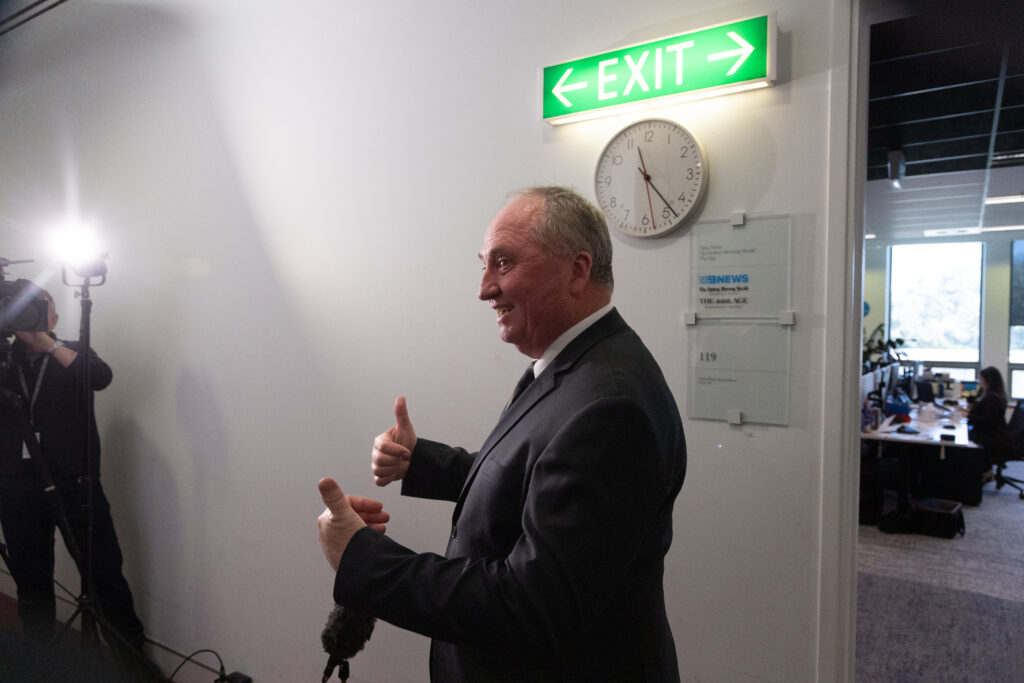
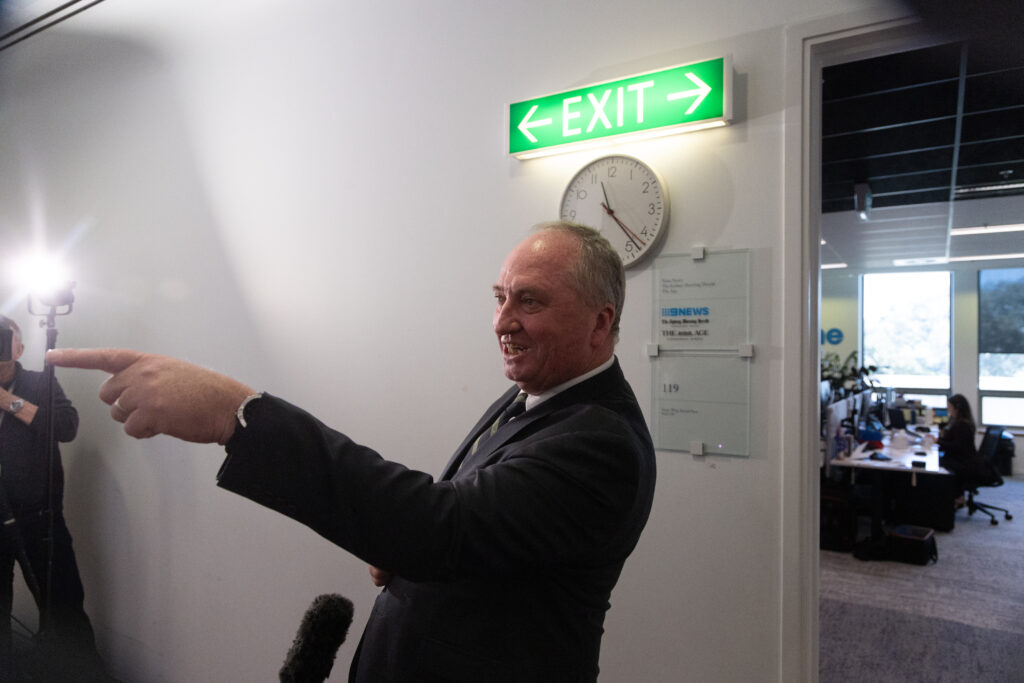
Barnaby Joyce has held a press conference in the press gallery to say….nothing. It’s all that we knew already. He is making up his mind, weighing up his options, yadda yadda yadda.

He chose to have the press conference under an exit sign.

Barnaby Joyce talks to the media in the Press Gallery of Parliament House in Canberra. Photo: Mike Bowers

Joyce:

It’s important for the National Party to – they know my position – to have the capacity to, in confidence, have the discussion as they wish. And I’ve made my point quite clear – I’m not going to attend any party room that in net zero, because I’m adamantly against net zero. I think it’s hurting poor people.

Meanwhile, David Littleproud has said that Joyce is welcome back into the Nationals party room meeting anytime he wishes – he just has to commit (not Joyce’s strong suit)

Sometimes, as leader, it doesn’t make you popular sometimes, but you’ve got to think about what’s to the long-term benefit of the party, and that’s the burden of being the leader of a political party,” Littleproud said a little earlier today while “encouraging” Joyce to come back.

It’d be great to see him in these key discussions, but it’s a decision he has to make,”

So Littleproud wants him back, but won’t beg.

Progressive independent wins Irish presidency, continuing Ireland’s embrace of independents

Bill Browne
Director Accountability & Democracy Program

Leaving Australia behind for a moment, independent candidate Catherine Connolly won Friday’s Irish presidential election after beingnominated by a progressive coalition including Sinn Féin, Labour, Social Democrats, and several other parties and independents.

The position of President of Ireland is largely ceremonial but, like Australia’s Governor-General, the President does wield some reserve powers. The election used preferential voting, like Australian elections, which means you cannot “waste” your vote by putting a less popular candidate first.

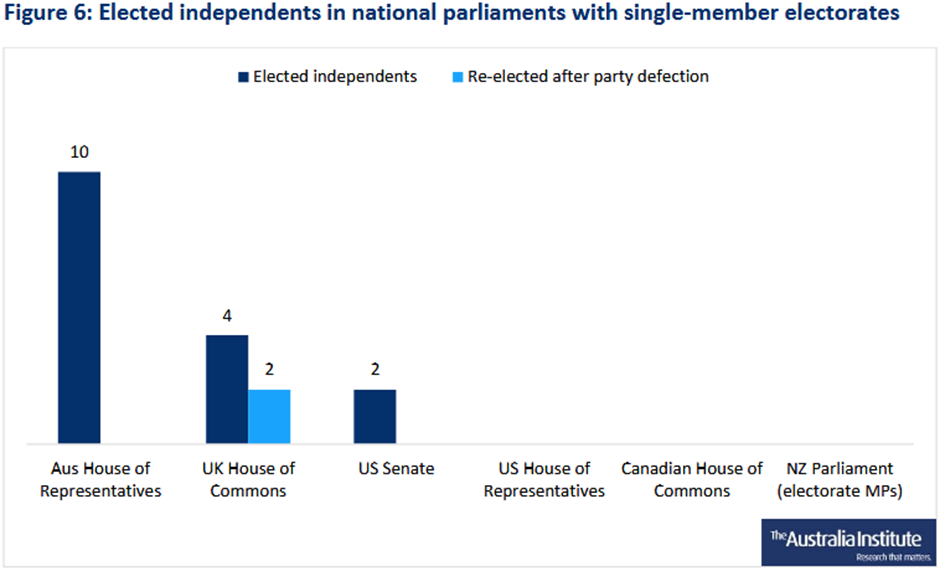
Last year, the Australia Institute looked at how likely independent candidates are to win elections.

Ireland and Australia are exceptions to the rule that independents are vanishingly rare in Western democracies. There are 16 independents in Ireland’s lower house, even more than Australia’s 10 in the House of Representatives (depending on how you count these things, you could add a couple more).   

But Irish independents benefit from their proportional representation style of electing local members. Australia is far ahead of other countries with just one local MP per electorate.

(Correct at time of publication in 2024 – numbers may have changed since then.)

And then we get to the announcement; funding for two investment funds:

The Government will invest AUD$175 million in IFM Investors’ Asia-Pacific Debt Fund and USD$50 million in a new Southeast Asia Public-Private Partnership (PPP) investment fund established by Australian infrastructure specialist Plenary. 

These funds are designed to make it easier for Australian firms to bid and spend on Asian infrastructure projects.

Anthony Albanese:

Today, I’m very pleased to announce we’re delivering on our commitments to the region. We will invest $175 million into IFM Investors’ Asia-Pacific Debt Fund, a leading global investment manager owned by Australia’s industry superannuation funds.

This is a cornerstone transaction which will boost IFM’s expansion here into South-East Asia. Our investment will open the door to South-East Asian markets for 15 Australian super funds, paving the way for these funds to deepen their engagement and investments across the region. We’ll also inUS$50 million to establish a new platform by leading Australian public-private partnership infrastructure company Plenary.

Plenary is an Australian infrastructure champion. With this new platform, we’re supporting the direct export of Australian expertise and know-how to deliver nation-building projects in South-East Asia through public-private partnerships.

This platform is expected to support much-needed infrastructure projects in Indonesia, the Philippines, and elsewhere. Together, these investments represent a major step forward in my government’s delivery of our South-East Asia Economic Strategy, to boost Australian exports and investments in the region, back the growth of Australian companies, and support the region’s infrastructure needs.

On to trade, and the prime minister says:

Last year, Australia’s two-way trade with South-East Asia reached a record high. Two-way trade has grown by nearly $6 billion, while Australian investment in the region has increased by around $2 billion. And that hasn’t happened by wishing and hoping.

It’s been shaped by the expert of and insights of our 10 business champions, including our Business Champion for Malaysia, Tony Lombardo, the CEO of Lendlease.

It’s been driven by our Deal teams, identifying potential projects across the region. This combination means that Australia’s making new investment in farming in Laos, energy in Thailand, infrastructure in Vietnam, and through Toll, transport and logistics across South-East Asia. From our government’s point of view, this is just the beginning. There is a $20 billion pipeline of projects where we see value for Australian capital and financing.

What’s more, we’re backing ideas and innovation too. The landing pads that we’ve established in Jakarta, Ho chi Min City and Singapore, have more than 160 Australian tech companies to scale up their presence in the region. And through to the ethos of ASEAN and the spirit of mutual benefit, we have worked to make it easier for the economies of South-East Asia to invest in Australia.

Anthony Albanese addresses ASEAN summit

The prime minister is speaking in Malaysia, where he landed late last night for the ASEAN summit:

In the best traditions of ASEAN, we gather here to seek ways of deepening our cooperation to our mutual benefit, recognising that the best way to enhance the security and resilience of our economies is not to turn inwards, it is to look outwards. To deepen and diversify our trade ties and economic cooperation, and to strengthen the bonds between our citizens. That requires more of us in signing an agreement or issuing a declaration. Instead, this is progress that we measure in acts of practical partnership, new businesses opening, new energy and infrastructure projects commencing, new investments in manufacturing, and new friendships being forged through education or through cultural exchanges.

That is how we can drive a step-change in our region’s economic integration and, indeed, our economic resilience.

As a pro-trading nation and an outward-looking economy engaged with the opportunities of our region, Australia is ready to play our part in shaping this change.

Former ADF Chief says Australia’s expansion of fossil fuels a “failure of national duty.” 

Former Chief of the Australian Defence Force, Admiral Chris Barrie, says inaction has left Australia “dangerously exposed” to  climate change.

Speaking at the Climate Crisis Summit, Admiral Barrie called allowing the expansion of fossil fuels a “failure of national duty.” 

He pointed to the Climate Risk Assessment Plan, which he said shows “how unprepared we are to face the climate shocks that are already in motion.” 

Security analysts are blunt, cascading climate impacts will drive instability, insecurity and conflict,” he said. 

Admiral Barrie painted a bleak picture of what climate change means globally. 

He said hundreds of millions of people will be “displaced”. 

(Climate change has) fueled civil wars, government collapse and mass migration,” he said. 

Hundreds and millions of people will be displaced due to food security.

The consequences will be profound.”

The view from Mike Bowers

Here is some more of how Mike Bowers has seen the morning:

Barnaby, Barnaby-ing:

Barnaby Joyce talks with the member for Moncrieff Angie Bell as he sits in the House of Representatives chamber after parliament resumed sitting this morning. Monday 27th October 2025.Photograph by Mike Bowers
Barnaby Joyce sits in the House of Representatives chamber after parliament resumed sitting this morning. Monday 27th October 2025.Photograph by Mike Bowers

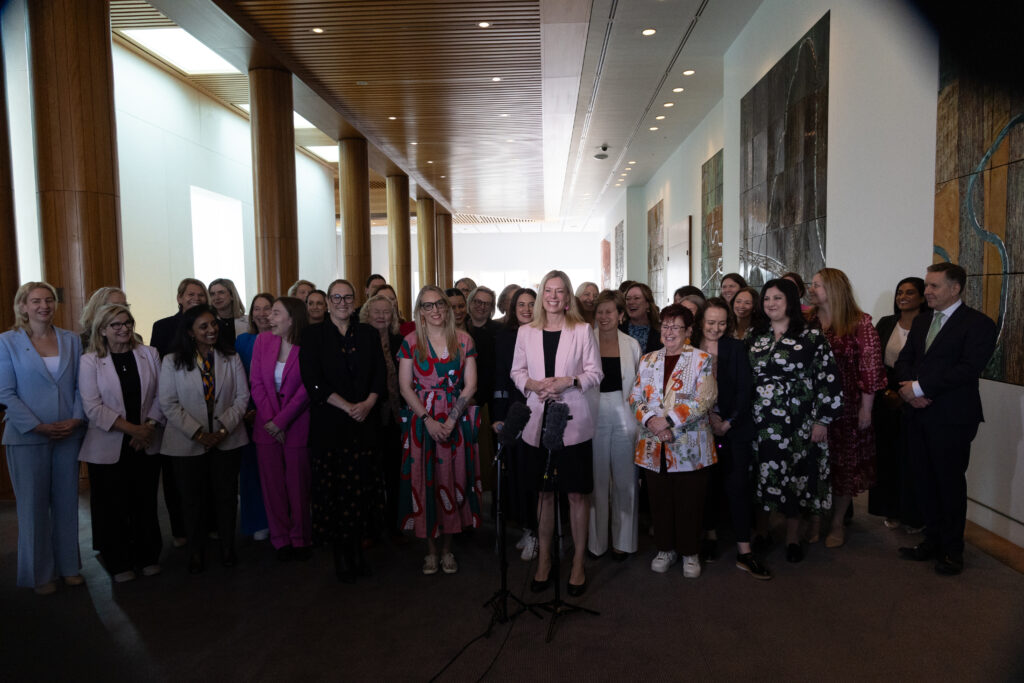
Labor women behind Rebecca White to announce a new contraceptive for the PBS and the new bulk billing funds from 1 November

The Assistant Minister for Health and Aged Care Rebecca White was joined by many Labor front and back bench MP’s including Health Minister Mark Butler to announce that from 1 November 2025, a new contraceptive option will be listed on the Pharmaceutical Benefits Scheme (PBS) Monday 27th October 2025.Photograph by Mike Bowers

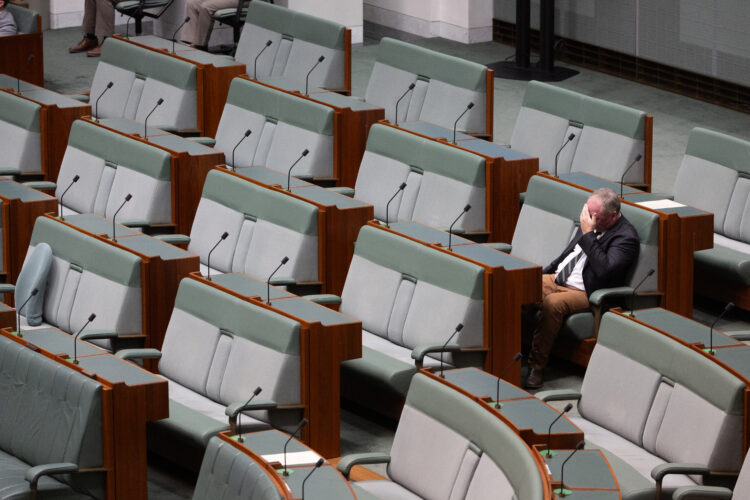
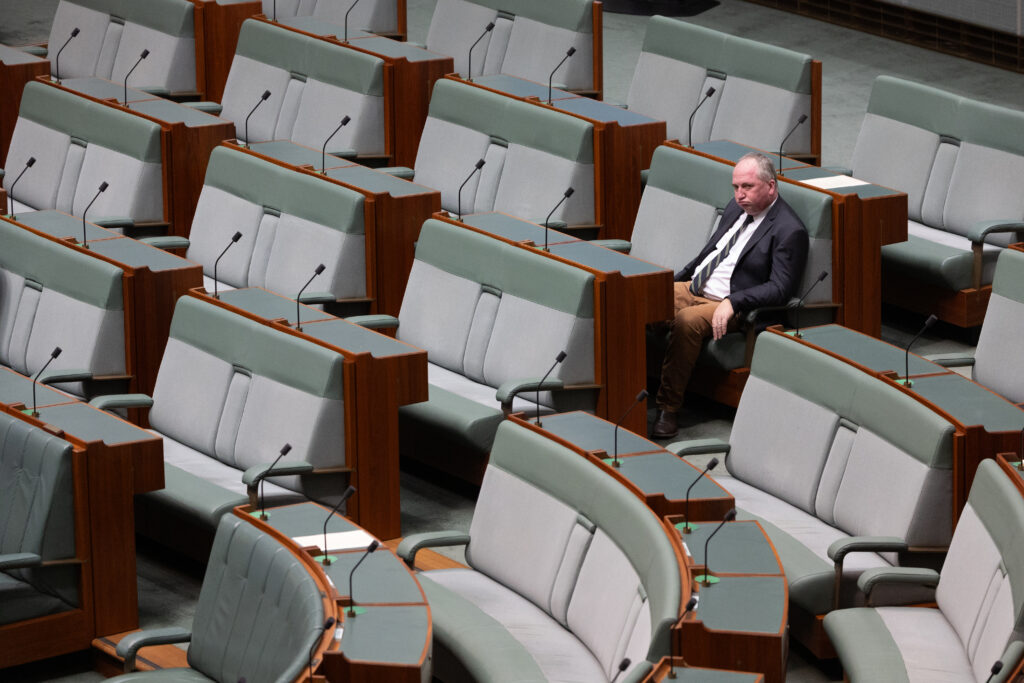
Barnaby Joyce has made the choice to go and sit all alone in the house of representatives.

Mike Bowers was there to capture it:

Barnaby Joyce sits in the House of Representatives chamber after parliament resumed sitting this morning.

Meanwhile at the Climate Crisis Summit, we are hearing more and more about the impacts of climate change – including some things that people may not have considered before. 

“Droughts constrain the availability for water for fire-fighting,” said National Secretary of the United Firefighters Union of Australia, Greg McConville. 

That means there is more of a reliance on chemical fire retardance in large landscape fires. 

He said there have been calls for more firefighters for more than a decade, and the same calls are being made today. 

Serena Joyner, CEO of Bushfire Survivors for Climate Action, has addressed the Climate Crisis Summit, sharing stories of those who have been on the front line of extreme weather events caused by climate change. 

We don’t need an imagination to know how bad it can get,” she said. 

I hoped (the Black Summer bushfires) would be a wake up call for Australia”. 

She spoke about the ongoing effects from extreme weather events, such as being unable to insure your home, or rebuild. 

As co-CEO of the Australia Institute, Dr Richard Denniss, wrote in July: 

The scientific reality is that sea level rise and increased storm damage will make heavily populated parts of Australia uninhabitable, and the economic reality is that houses in those areas will be uninsurable.”

Ms Joyner said her organsiation has a list of five asks: 

  1. Unite behind 1.5 aligned climate target and put the policitcation of the climate crisis behind us 
  2. Stay the course on the renewable rollout and ensure the community benefits
  3. Commit to a total phase out of fossil fuels and make a plan to do so 
  4. Invest deeply in communities and be guided by them so they can plan for and recover from future disasters (which we know are going to happen) 
  5. Raise the money required by making big corporations pay for the damage they are causing for their climate 

If you’re interested in that last point, here is a link to a petition for a levy on fossil fuel producers: https://nb.australiainstitute.org.au/climatedisasterlevy

Rapid and unpredictable” extreme weather events to increase

Back at the Climate Crisis Summit:

Climate Scientist, Dr Sophie Lewis has highlighted a “catalogue of climate change impacts” and says that things are only set to get worse unless there is urgent action. 

Speaking to the Climate Crisis Summit in Canberra, Dr Lewis said what seems like a small increase in temperatues as a result of global warming, has in fact led to: 

  • Black summer bushires
  • Repeated flooding in New South Wales and Queensland
  • The algal bloom in South Australia 

Just to name a few… 

Dr Lewis says as tempeatures rise, extreme events will “change in timing, distribution and severity,” Dr Lewis said.

“Time between events will decrease… concurrent events will occur.” 

Dr Lewis also pointed out, terrifyingly, that these events will occur in other places. 

One Nation, ACL listed as Australian ‘hate groups’ by international think tank

Over at Crikey and Cam Wilson has a story about One Nation and the ACL being listed as Australian ‘hate groups” on the Global Project Against Hate and Extremism, created by the Southern Poverty Law Center.

From the story:

Pauline Hanson’s One Nation and the Australian Christian Lobby are among 20 groups identified as Australian far-right hate and extremism groups in a new report by a global anti-hate think tank.

The Global Project Against Hate and Extremism (GPAHE) is an international group created by veterans of the civil rights group Southern Poverty Law Center, which seeks to identify and chronicle transnational hate groups.

On Wednesday, the group published the report “Far-right Hate and Extremist Groups“, which includes research on the major groups operating in Australia, their history and beliefs. 

The Greens plan on using the parliament sitting to try and get debate going on housing – the party wants the housing affordability crisis to be treated as a matter of public urgency.

It is putting forward a motion to have the senate recognise the dire straits of the housing market – this comes after house prices rose at the fastest rate in four years, while home ownership rates continue to decline.

From Barbara Pocock’s statement:

One in three property markets across Australia now have a median value of $1 million plus, a new record-high, according to Cotality. While Domain data shows Sydney house prices jumped by $58,148 (3.4 per cent) in just 90 days, the fastest quarterly growth in more than two years.

The Greens say Labor is making the crisis worse as their policies, such as the $180 billion tax breaks for landlords and the 5% deposit scheme, are spiking prices and putting home ownership further out of reach for renters and first home buyers.

With 89% of voters agreeing that Australia is in a housing crisis, the Greens are calling on the government to listen to voters and address the root causes rather than turbocharge our housing and homelessness crises through minor interventions.

Pocock says the Australian dream of home ownership is “dead” for younger generations:

This government needs to start treating housing as a human right instead of a game of monopoly. 

Australia is in a housing crisis that is spiralling out of control. House prices are soaring and Labor’s $180 billion tax perks for rich property investors are pouring fuel on the fire, locking renters and first-home buyers out.

The Australian dream of home ownership is dead. Rates of home ownership are falling especially among those under 35, with 25-29 year olds dropping from 50% in 1971 to 36% in 2021. 

Home ownership is out of reach for so many Australians. Thirty years ago it took 4 years of average weekly earnings to buy a house, now it’s on track to be more than 8 times the average. How do first-home buyers stand a chance?

We mentioned a little earlier today that the SDA was in the Fair Work Commission arguing for an end for fast food and retail employers paying over-18s the junior rates of pay.

ACTU president Michele O’Neil said the whole union movement was backing the SDA in the case:

If you’re 18, you’re legally an adult. You can vote. You can drive. You can work the late shift. But in retail and fast food, you’re still paid like a kid.

Right now, 18-year-olds earn 70% of the adult rate. At 19, it’s 80%. At 20, 90%. You only get full pay at 21 – even when the job you are doing is still exactly the same.

That pay gap isn’t small. An 18-year-old needs 50 plus hours a week to earn what an adult makes in 38. The bills don’t get reduced because you’re younger. The rent doesn’t care about your birthday.

The SDA – the union for retail and fast-food workers – has asked the Fair Work Commission to fix this. Once you’re legally an adult, you should be paid the adult wage. It’s straightforward and fair.

Employers argue adult pay for 18-year-olds will kill jobs. We’ve heard it before. They said equal pay for women would kill jobs. It didn’t.

They said cutting penalty rates would create jobs. It didn’t. Fair pay doesn’t kill jobs, but ill-founded employer scare campaigns can and do.

O’Neil also said the world didn’t end when this change was made in other nations:

Other countries have fixed this already. In New Zealand, young workers move to full pay after six months. In most Canadian provinces, youth rates don’t exist. Australia is behind, and young workers are paying for it in every shift.

Most 18-year-olds in these sectors aren’t new to their jobs. They often started at 15 or 16. By 18, they know the systems, the customers, the weekend rush. Many can run a close. They often supervise older workers. Paying them less just because they’re younger doesn’t reward work. It unfairly discounts it.

Employers may say now isn’t the time, but for them it’s never the time. Meanwhile, young workers choose between topping up their phones or topping up their travel cards.

They skip dinner to cover rent and bills. They take extra shifts and fall behind in their studies because of the need to put in more hours at work. That’s not a fair start to adult life.

This simple change won’t fix everything young people face. But it would send a clear message – your time is worth what the job is worth. Adult responsibility should come with adult pay.

The ACTU supports the SDA’s case to end junior rates for 18–20-year-olds. When you turn 18, you’re an adult. You should be paid like one.”

At the Climate Crisis Summit, Aunty Barb Ibuai from the Western Islands for the Torres Strait, has painted a harrowing picture for what climate change looks like on the pacific islands. 

“Our planet is dying,” she said. 

“The impacts are being felt right now, we are not waiting for the disaster.” 

Aunty Barb said climate change is having a profound impact on the physical health of her island and the mental health of her people.

She said that her people are running out of time. 

Less than 30 years to go until we have to cut the cord,” she said.  

Imagine being told you had to leave your home, because it will drown. This is the reality that many pacific are facing right now.”

The parliament bells are ringing, which means the sitting is about to get underway.

A reminder that Anthony Albanese is at the ASEAN summit, so this will be Richard Marles’ week in the big chair.

Labor has held its first major press conference of the day – Mark Butler and the assistant minister for health Rebecca White were up and about early talking about the November 1 increase in bulk billing funds.

We will bring you some of the day from Mike Bowers very soon.

David Pocock and Monique Ryan also held a doorstop about the mess that has been the Parliamentary Sports sponsorship fiasco (which has seen some very good reporting from Henry Belot at the Guardian and Daanyal Saeed at Crikey)

The Climate Crisis Summit is underway at Old Parliament House in Canberra.

This summit brings together First Nation leaders who are at the forefront of the impacts of climate change – and comes as the Albanese government has returned to parliament determined to do a deal to pass its environmental legislation.

It wants to do that deal with the Coalition, who as we well know, are passionate defenders of the environment (yes that is sarcasm).

The summit brings together speakers from across several sectors who are seeing the devastating effects of climate change on their communities.

The conversation is about what will it take to shift Australia beyond fossil fuels and ensure workers, communities and land are protected. We’ll bring you updates from the summit as the day rolls on.

Over on the 7am podcast, journalist Nick Feik has had a chat about the national anti-corruption commission and whether it is redeemable in the eyes of the public:

Spoke to 7am about the missteps and mismanagement of the NACC, and whether it has any hope of regaining public trust.

Nick Feik (@nickfeik.bsky.social) 2025-10-26T22:17:27.807Z

Bowen gets to have some fun

Chris Bowen delivered a speech to the Centre for Independent Studies Consilium on Friday (which is meant to be one of the salons of yore, where people get together to talk about a bunch of different issues and have a debate) which was published in News Corp papers this morning and then sent out as a press release just now (this is how media works now).

Bowen got to speak about his favourite topic – how much the Coalition sucks when it comes to nuclear. This is getting ahead of Matt Canavan’s net zero review, which is being handed to the party now and is expected to recommend scraping it, but not any sort of cost analysis on what that would actually cost the nation (which is weird, because Canavan is an economist, but also deliberate because this isn’t about reality, but ideology, and also doesn’t matter because it won’t be policy)

Bowen:

The Coalition’s shadow minister was almost purring with excitement when he told his colleagues about the potential for small modular nuclear reactors to play a role in Australia’s energy future.

“You would know that new generation reactors …are now coming into use. They are small (from 250-400MW) and fully automated and overcome many of the safety problems associated with large scale reactors of the past”.

Was this Dan Tehan in 2025? Or Ted O’Brien in 2024?
 

No, it was then Shadow Minister for the Environment Peter McGauran in 1989, in a memo to his Liberal and National colleagues.

You see the LNP has been promoting SMRs as “the next big thing” in nuclear energy for the better part of 40 years.

Four decades on, nothing has changed. SMRs are still being promoted as the answer to our problems.  And it’s still the case that not one has been built in the Western World.

The Liberals talk wistfully of a “nuclear renaissance”, telling us the rest of the world is going nuclear, and Australia will miss out unless we act.  This renaissance is a chimera.  It exists only in the minds of nuclear boosters.

In 1989 of course renewable energy was vanishingly small in the global energy mix. Nuclear energy was responsible for 17% of the world’s generation.

Now, renewable energy is responsible for more electricity generation than coal, and nuclear power has fallen to 9% of the world’s generation.  Renewable generation already far surpasses nuclear generation and over the course of the next twelve months wind and solar will separately surpass nuclear generation in importance.
 

To hear LNP spokespeople and others boosting the nuclear renaissance, you’d think that the number of countries with nuclear in the mix is growing.  It isn’t. In 2025, the number of economies that include nuclear generation in their system has fallen by one, with Taiwan having closed the last of its nuclear power stations.

And when it comes to SMRs the story is also not encouraging. According to the World Nuclear Association there are two in operation in the world: one in China, one in Russia.  None operates commercially in comparable countries to Australia.

Argentina did start construction of an SMR in 2014.  In 2024, construction was halted, work incomplete with the head of Argentina’s National Atomic Energy Commission saying: “This reactor is not economically competitive”.

Even in China, which is building some large nuclear reactors, their role pales into insignificance compared to renewables. The importance of nuclear in the overall Chinese energy mix is falling as China’s massive renewable rollout leaves nuclear in its wake.

Having had its plan for taxpayer funded nuclear power stations comprehensively rejected by the Australian people a few months ago, the LNP is now hinting they will go to the people with a watered-down plan instead of scrapping it all together. They signal that they would simply lift the nuclear moratorium applied by John Howard and “let the market decide”.

This is also false hope, for two key reasons.

Firstly, for nuclear investors to look at Australia, it would take more than John Howard’s moratorium being lifted. There would need to be a comprehensive nuclear regulation regime in place. The Australian Energy Regulator told Australia’s most recent parliamentary inquiry into nuclear that it would take 10 years to set up regulatory regime. 

(I say most recent, because nuclear has been examined in at least four parliament-run inquiries at a state and federal level in the last decade alone – the issue has been well considered.)

As our existing thermal infrastructure ages, these are not years Australia has.  Only once the regulatory regime was in place could investment decisions be made and then proposals would need to wind their way through the Australian planning system.  Nuclear power plant developers need to navigate the same community acceptance and planning approvals our renewable energy proposals do.

Secondly, the fact is that nuclear power stations hinge on big government subsidies to be viable. There is no nuclear construction anywhere in the world being undertaken solely by the private sector.  You can look to the United Kingdom for example to see how the taxpayer has been on the hook for the eye-wateringly expensive Hinkley and Sizewell new reactors.

Angus Taylor, when he was Shadow Treasurer acknowledged the fact that Government expenditure is necessary to make nuclear work.  Nothing has changed in the intervening period. There is no Australian exceptionalism when it comes to nuclear: the market simply will not deliver it.

Australia’s renewable energy transformation is well underway, with renewable records tumbling on almost weekly basis. We are now past halfway on the journey to 82% renewable energy.

By 2030 I imagine nuclear boosters will still be waxing lyrical about SMRS despite the fact that none will have been built.  Australia on the other hand will have harnessed the opportunities of a form of energy much cheaper and quicker to build: renewables.

 

Over in the Australian, former editor (and now columnist) Chris Mitchell has responded to criticisms of how the media handles debates in his latest piece for the Oz.

We have linked to both pieces, so you can decide for yourself (also, I enjoy how many photos the Oz uses of me with my mouth opened, usually captured mid-rant)

Deepcut News has an exclusive on the government’s Gaza talking points, which were sent to a Palestinian advocacy group by mistake:

Alex McKinnon reports:

The federal government’s talking points on Israel-Palestine were mistakenly shared with the Australia Palestine Advocacy Organisation, disclosing its opposition to a proposed children’s hospital in Gaza championed by prominent humanitarian, Dr Mohammed Mustafa.

You can find the whole story here.

(Full disclosure, Deepcut is an independent media organisation I contribute to)

LLMs should pay to use Australian content

On the government decision to not allow large language model companies (LLMs) to take Australian content to train their AI’s on for free (how this was ever under discussion is kinda crazy) Murray Watt says:

We’ve taken our time and Minister Michelle Rowland, in particular, as the responsible minister, has had a very good look and spoken to many stakeholders about this issue.

The Albanese government are strong supporters of our arts community, and we recognise that they deserve their fair share for their efforts in producing product, as do media organisations.

One of the things that we know about AI is that, while it can produce enormous productivity gains and many benefits for us on a personal level, we also need to have proper safeguards in place to make sure that, in this case, artists, media organisations, creatives, get their fair share from their work.

And that’s why we will not be providing an exemption for what’s known as text- and data-mining for AI companies.

We think that’s a fair approach. Again, when it comes time to legislating, we’d be looking for support from the parliament for this.

Environment minister Murray Watt has just had a chat to the ABC, where he was asked about the negotiations for the environmental protection legislation. He is working overtime to have the government presented as striving for that ‘sensible centre’:

I don’t think anyone’s really surprised, that at this stage of negotiations, the Coalition are taking a position that business has got to give it everything they want and that the Greens are taking a position saying that the environment’s got to get everything it wants.

The reality is that Graeme Samuel put forward a package of reforms that were about balancing those issues and delivering real gains for both the environment and for business. That’s the way our package has been designed. If that’s the way the bill will be reflecting. And that’s why we think it deserves support in this parliament.

Remember the Great Barrier Reef Foundation? Me either, until today, when I saw it had released a new report (this was the foundation that Malcolm Turnbull gave about $443m in funding – by the time Labor was in government, just over $5m had not already been committed, which given the time difference between the two governments, makes sense)

It has released two new research reports – “that quantify the economic and social value in protecting the Great Barrier Reef”

Deloitte was commissioned to find the economic and social value of the reef and found:

  • The Great Barrier Reef represents $124 billion in benefits to the Australian economy over the next 50 years if it’s suitably protected.
  • The GBR contributed $9 billion in value added to the Australian economy in 2023–24 and supported about 77,000 full-time equivalent jobs.
  • If the GBR were a business, the scale of direct annual employment it supports would make it the 5th largest employer in the country.
  • A step up in the scale and pace of public and private funding is needed in the next 10 years to create a resilient Great Barrier Reef.

Well, not to be all millennial about it, but yeah – we know.

Polling commissioned by the Great Barrier Reef Foundation also found we quite like the reef:

  • 98 per cent of Australians believe losing the Reef would be a national tragedy, with nearly three-quarters calling that loss “significant” or “irreplaceable”.
  • Nine in ten are concerned about climate risks, and 78 per cent say protecting the Reef for future generations is very or extremely important.

Again, we know. Which is what makes the LNP’s recent climate policy (scrapping the targets and backing in coal and gas all the way) even more batshit crazy.

Barnaby Joyce is still a Nationals MP

Barnaby Joyce is dragging out the world’s most annoying relationship breakdown (guess he has practice) and has confirmed he won’t go to the Nationals party room meeting today (joint party room is tomorrow) but will sit with them in parliament (which just means he hasn’t quit the party yet)

The man knows how to play the media cycle and will keep this up for as long as it benefits him.

Meanwhile, Nationals senator and Joyce backer, Matt Canavan is presenting his review of the Coalition’s net zero plan to the party room today. Huzzah.

The SDA (Shop, Distributive and Allied employees association) is in the Fair Work Commission today – it is arguing for junior rates to be removed from employees who are 18 years of older and covered by the retail, fast food and pharmacy industry awards.

Some employers apply the junior rates to older employees. The SDA is arguing for that to stop.

The first day of hearings before a full bench of the Fair Work Commission kick off in Melbourne today.

The Business Council of Australia have released its latest roadmap – this one is on what it wants government to do on infrastructure.

That also includes changes to the environmental protection act to “streamline and speed up decisons on projects”.

Building Australia’s Tomorrow is the latest call from the BCA to cut regulations so projects – from housing to mining – can be sped up. It’s all under the guise of productivity though, of course. These things always are.

BCA chief executive Bran Black will be out and about quite a bit today. His main argument?

Quality infrastructure is the foundation of a modern economy because it connects people and markets, underpins housing supply, delivers services people need, supports new industries and secures Australia’s energy and digital future.

Our report makes clear, we need to harness private investment, fix the EPBC Act, cut red tape, and make every infrastructure dollar go further. That’s how we build the foundations for the next generation of growth.”

From the release:

The report sets out four priority areas for reform and investment, which include:

Well planned, long-term investment

  • Governments must maintain a steady and sustainable pipeline of infrastructure to avoid boom-bust cycles.
  • Investment decisions should be guided by independent, evidence-based business cases reviewed by Infrastructure Australia or state and territory equivalents.

Stronger private sector partnerships

  • Governments should leverage private capital through proven models such as asset recycling and public–private partnerships.
  • We must prioritise appropriate risk allocation, with a more collaborative approach to contracting.

Improving industry productivity 

  • Reform planning and environmental permitting processes, like the EPBC Act, with the aim of more efficient and streamlined approvals.
  • Government and industry must adopt new technology, including building information modelling and new methods of construction such as prefabrication.
  • Government must also address skills shortages and stamp out unlawful activity, particularly by the CFMEU. 

Unleashing innovation 

  • Modernisation must occur in road funding and health service delivery.
  • There should be a refresh of the unsolicited proposal processes to make sure they are encouraging investment.  

Independents launch ‘parliamentary pass register’

After the government refused to make it public who has access to parliament house through the sponsored pass register (which includes lobbyists) independents have decided to start doing it themselves.

ACT David Pocock has had the lobbyist register as one of his goals since his election to parliament in 2022 – the Labor government won’t budge, so he has created the parliamentary pass register (which you can find at https://passregister.com.au/) and asked parliamentarians to join him. So far, only independents and One Nation’s Tyron Whitten have joined up – the Greens, Labor and the Coalition have not made any moves.

Pocock:

Parliament House is the people’s house, yet there’s a tragic lack of transparency around who has access to it. Worryingly Labor, the Coalition and the Greens think that’s acceptable,” Senator Pocock said.

Australians deserve to know who can walk in here and lobby their elected representatives. A strong democracy depends on transparency and accountability. Refusing to say who you’ve given access to isn’t in line with what Australians want.

A pass sponsored by a parliamentarian provides privileged access. Access that potentially allows certain perspectives to reach decision-makers ahead of others. The public has the right to know who’s being given that privilege.”

You can also use the website to lobby parliamentarians to join it and there is a section for people who have a sponsored pass to disclose who gave it to them.

Pocock said it was modelled on international best practice:

This isn’t radical – it’s routine in democracies like the UK, US and New Zealand. What’s radical is continuing to keep it secret and pretending that’s somehow good for democracy.

Transparency is the lowest of low bars. I encourage my colleagues to step over it.”

Parliamentarians who have disclosed those they sponsor passes for include:

  1. ⁠Allegra Spender MP
  2. ⁠Andrew Wilkie MP
  3. Senator David Pocock
  4. Dr Monique Ryan MP
  5. ⁠Dr Helen Haines MP
  6. ⁠Senator Jacqui Lambie
  7. ⁠⁠Kate Chaney MP
  8. ⁠Senator ⁠Lidia Thorpe
  9. ⁠Nicolette Boele MP 
  10. ⁠Dr ⁠Sophie Scamps MP
  11. Senator Tyron Whitten
  12. ⁠ ⁠Zali Steggall OAM MP
  13.  Andrew Gee MP


Does Hanson-Young think the government will continue attempting to negotiate with the Coalition on these laws, rather than the Greens?

(some history is important here – last term, Tanya Plibersek (then environment minister) negotiated with Hanson-Young on the laws, which included a climate trigger. Industry and premiers like Roger Cook lost their minds, so Albanese pulled the legislation and then pretended it was because no one wanted to negotiate on it. The government claims that by having ‘bipartisan support’ the Coalition will be less likely to change them later, which is simply not true (also, who knows if the Coalition will even exist much longer) You may also note that when the government wanted to pass the IR laws last term, it did not care about bipartisanship.)

Hanson-Young:

I have said very clearly to the Government that I’m open to talks and to negotiating. I want an outcome that delivers genuine and real protection for nature and for the environment. But what we’re seeing so far from the Government is they’re trying to have it both ways and talk out of both sides of their mouth.

The problem there is when you’re delivering reforms that the business and industry groups, the business polluters, the miners and the loggers want, there’s very little left over for really delivering on what we need for environmental protection. So the Government’s got to choose – the current draft has business and industries fingerprints all over it. T

here’s a reason that big mining companies and the big fossil fuel companies like Chevron and BHP want what the Government’s proposing – because it’s good for them.

But I want to make sure our environment laws do what they say on the tin and that is meant to protect the environment, protect our forests and protect our climate. There’s no point a set of laws passing this Parliament if they don’t protect our forests and protect our climate. They’re not worth the paper they’re printed on if they go through that

Environment minister Murray Watt has ruled out a climate trigger (but nothing is actually in or out until it is) as part of the laws, and Sarah Hanson-Young says the Greens will be focused on loopholes:

Well, the current laws, as they stand, allow all these loopholes. They allow logging in native forests, they allowed rampant clearing of land even where there’s threatened species, everyone where there’s wildlife that needs that bushland and forests as home.

If we’re going to have forest protection laws, it needs to protect that critical habitat.

But on the climate trigger, this is the Government’s decision to take the climate trigger off the table while at the same time, allowing coal and gas companies to have their projects fast-tracked. We think that is the wrong way. Emissions in this country, that’s pollution, is going up, not down.

So we clearly need to be doing more.

And just the Government saying, “We’ll deal with this somewhere else”, but they’re not a dealing with it somewhere else, that’s the problem. Emissions are going up, pollution is getting worse and the climate crisis is here and making it – making a huge impact on people’s lives. I mean, my home state in South Australia, we have got the algal bloom, the toxic algal bloom that’s devastated our coastline, our coastal communities, our fishing industry, our tourism industry, people can’t even swim at the metro beaches most days because it’s so bad. This is because our oceans have warmed, because of climate change. It is having a huge impact. We can’t just say, “Oh, well, the settings the Government has are right.”

They’re clearly not. We need to be doing more.

It is interesting that Hanson-Young is saying ’emissions – that comes after a bit of a push in the environment movement to have things explained a little better. We talk about things like emissions, without actually explaining to people what we mean by that. There is a lot of assumed knowledge in politics, and its reporting, and it seems like Hanson-Young has some of that message. It might also mean that the Greens election review is starting to filter through the party.

Greens senator Sarah Hanson-Young is up and about early this morning on the government’s environmental legislation. She’s speaking to the ABC about the Greens’ wants:

Well, we want laws that protect the environment and don’t just make life easier for big business and the mining and the logging companies, and this – these are meant to be environment-protection laws, not, you know, business-approval laws.

We shouldn’t just be making things cheaper and faster for big business to get their damaging projects and pollution-pumping projects through.

But to do that, we want to make sure these laws protect our forests and protect our climate. A lot of people would be surprised that our existing environment laws don’t even cover native forests. So you can go into a native forest, it can get logged, even if there is endangered species there – koalas or the swift parrot, gliders – those forests can be logged. We want to fix that.

We want to make sure that can’t happen and we also want to make sure we take action on the climate crisis.

What these – the proposed changes that the Government has – put forward and is talking of tabling this week will fast-track coal and gas projects. We think that’s the last thing we should be doing in an environmental crisis and climate crisis that we’re in today.

Independent MPs Dr Sophie Scamps, Dr Monique Ryan and Dr Helen Haines have come out early on the government’s CDC legislation (that’s the centre for disease control for those who haven’t watched Hollywood for a while), saying if it is not fit for purpose and independent, it isn’t worth doing.

The health professionals say establishing a body to lead in the times of pandemic, outbreaks etc as well as focus on public health is a “long overdue and vital reform” but it’s one the government has to get right the first time.

The MPs have put forward amendments to address concerns about the lack of legislated integrity
safeguards and the exclusion of prevention of chronic disease from the CDC’s foundational scope,
but to date, these have been ignored by the Government.

The MPs are calling for:

  • A transparent and quality appointments process for both the Director-General and Advisory
    Council members.
  • A clear separation of governance and executive leadership, with the Chair of the Advisory
    Council being independent from the Director-General.
  • Prevention of chronic disease in the CDC’s remit from the beginning.
    Getting this legislation right is critical to ensuring the CDC can deliver on its mission to protect
    public health – now and in the future.

Anthony Albanese is already anticipating attacks from the ‘opposition’ over his latest summit season.

Here is a statement he released late last night:

One in four Australian jobs rely on trade and we will be focussed on continuing to grow our key economic and trade relationships during ASEAN and APEC.

Australia is working with regional leaders, including through ASEAN, the East Asia Summit and APEC to support economic growth, security, and stability in the region.

For more than 50 years, Australia has worked with ASEAN – to ensure it remains at the centre of a dynamic region, where stability is secured through collective responsibility and prosperity is built by shared opportunity.

Strengthening economic collaboration with our global partners at APEC maximises opportunities for Australian business and workers, reducing trade barriers and enlivening competition.

These forums come at a critical time. I look forward to engaging with our partners on trade, security and global challenges.”

Good morning and welcome to The Point Live

We have a new home and we are very excited to share it with you! We hope The Point will become part of your daily habit of information gathering – you’ll find explainers, fact checks, pre-bunking, research, data driven journalism and analysis on the issues that really matter.

And when parliament is sitting, or the politics world demands it, you’ll also find The Point Live, your one stop for all your political news of the day. We are still in soft-launch mode, but you’ll see more interaction and opportunity to build community, as we start to roll out more and more features.

Thanks so much for joining us for the first one.

We start the parliament week with Labor focused on getting its environmental laws through – with the help of the Coalition. That in itself should be a lot more of the story – there is another path there (through the Greens) that Labor is ignoring. Why? Well, the Greens want some actual environmental protections in there, while Labor is hoping to get these laws passed in a way that keeps industry happy as well as state premiers who are also invested in keeping industry happy.

Now Labor is tying these laws to national security (the grand pumbah of political arguments) in a bid to pressure Sussan Ley into accepting their legislation, which wedges Ley who is pretending to be tough over the legislation (and weaken it even further) in a bid to keep her party together (for however long it has left).

The Albanese government has tied the environmental protection reform bill so comprehensively to the deal Albanese just signed with Trump, it is heralding this week as the “next step” in delivering the deal.

Here is how the government is selling them:

These laws are a targeted and balanced package of reforms to the 1999 EPBC Act and are centred on three key pillars:

o Stronger environmental protection and restoration.
o Quicker and robust project approvals.
o Greater accountability and transparency in environmental decision making.

You’ll notice the ‘quicker and robust project approvals’ in there, along with ‘greater accountability and transparency in environmental decision making’. That’s because the laws aim to set up ‘go’ and ‘no go’ zones for projects, which, if you care about the environment, isn’t the win it sounds like. These laws aim to make approving projects faster, which again, isn’t necessarily a win. Especially for the environment.

The good thing is pressure has worked in some respects and Murray Watt has announced the minister will retain final-decision making when it comes to approvals.

The new laws will include the establishment of a National Environmental Protection Agency with the Minister for Environment retaining final decision-making on approvals. That is important because ministers can be swayed by public opinion, and it is important to have someone in government hold responsibility for these decisions.

In a statement released last night, Watt said of the laws:

It’s been nearly five years since Graeme Samuel tabled his report to then Environment Minister, Sussan Ley, and our laws remain broken.

They aren’t working for the environment or for industry.

We have been working tirelessly for a long time with environmental groups and industry to make sure the Environmental Protection Reform Bill gets the balance right.

This is a significant piece of work, and an important one.

We remain open to working with all members of the Parliament to deliver these much-needed law reforms.

Will the Coalition refuse to back a Bill that will deliver faster approvals that industry has been screaming for?

Will the Greens seriously vote against this legislation knowing it will deliver new National Environmental Standards, higher penalties for environmental wrong-doers and an Environment Protection Agency?

The message from business, industry and environmental groups has been very clear – they want the Parliament to get on with the job of reforming Australia’s environmental laws, and we intend to deliver.”

When it comes to industry and the environment, the environment will always come off second best.

Among the other legislation getting a bit of attention this sitting (which is one of the last of the year, although rumours there will be one more week added in December aren’t going away) are the Payday Super laws (which make it law to have super paid in full, on your payday, following a bunch of cases where employers were withholding superannuation payments).

The bulk billing money promised at the election will start flowing from 1 November (although its not going to solve the issues within the health system) and the Australian Centre for Disease Control will also get a bit of attention.

You have Richard Marles as acting PM until Friday, with Albanese at ASEAN and APEC this week, which follows his whirlwind trip to the US for the Trump meeting last week. The Marles is off and Penny Wong will be acting prime minister from Friday evening.

Which means, it is going to be a bit of a quiet week from the government, as it keeps its head down while daddy is away. Which is not that difficult these days, given the Coalition is a mess. You can read more about that here.

We’ll keep you abreast of all the day’s parliamentary events and whatever else pops up. You have Amy Remeikis with you as well as the lens of Mike Bowers, on lend from The New Daily.

Ready? It’s a three coffee morning. And maybe a cookie. Go grab what you need for a Monday and I will see you back here soon.

Let’s get into it. Ax


Read the previous day's news (Thu 9 Oct)

Comments

Start the conversation

The biggest stories and the best analysis from the team at The Point, delivered to your inbox.

Past Coverage