Mon 25 Aug

Australia Institute Live: Labor sets stage for Coalition's climate folly; the day in parliament, as it happened.

Amy Remeikis – Chief Political Analyst

This blog is now closed.

Start the conversation

Australia Institute Live: Labor sets stage for Coalition's climate folly; the day in parliament, as it happened.

Key Posts

The Day's News

See you tomorrow?

OK, I am out. Dan Tehan was just announced as the MP guest on Afternoon Briefing and there must be LIMITS to what we are forced to endure this early in the week.

But don’t worry – we will be back tomorrow for more punishment, I mean, parliament and will bring you all the day’s events and more. It is party room meeting time tomorrow, so brace yourself.

Thank you to everyone who followed along today – I am constantly humbled by how many of you decide to spend your day here. It means the world.

Until tomorrow – take care of you. Ax

OK, well there is some life left in this day, but not in me, so let’s track down what Mike Bowers has been doing for The New Daily today.

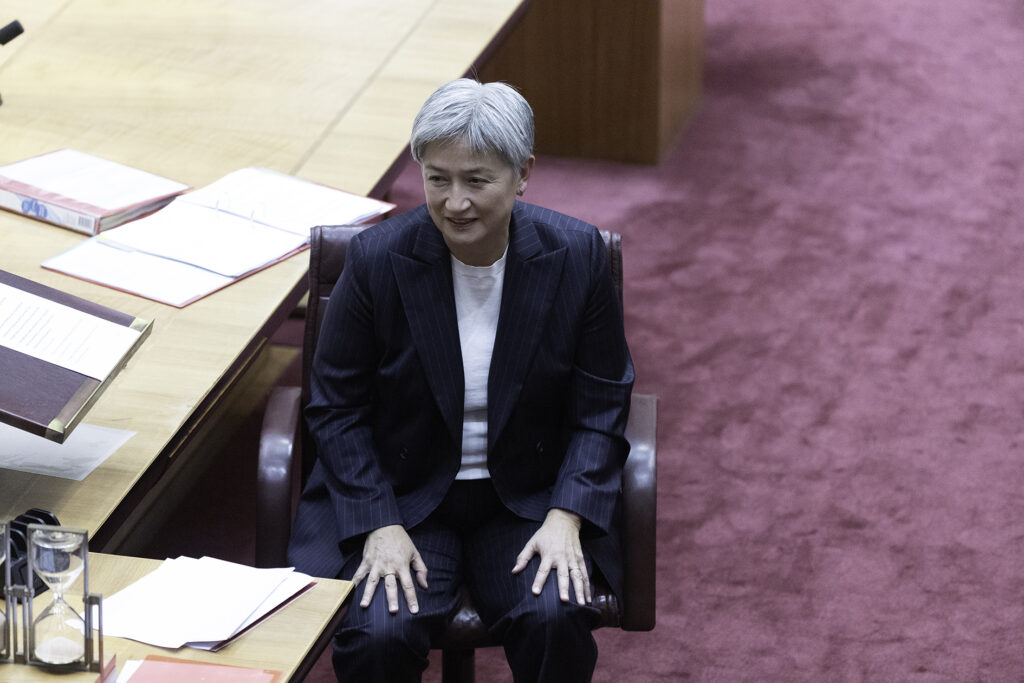
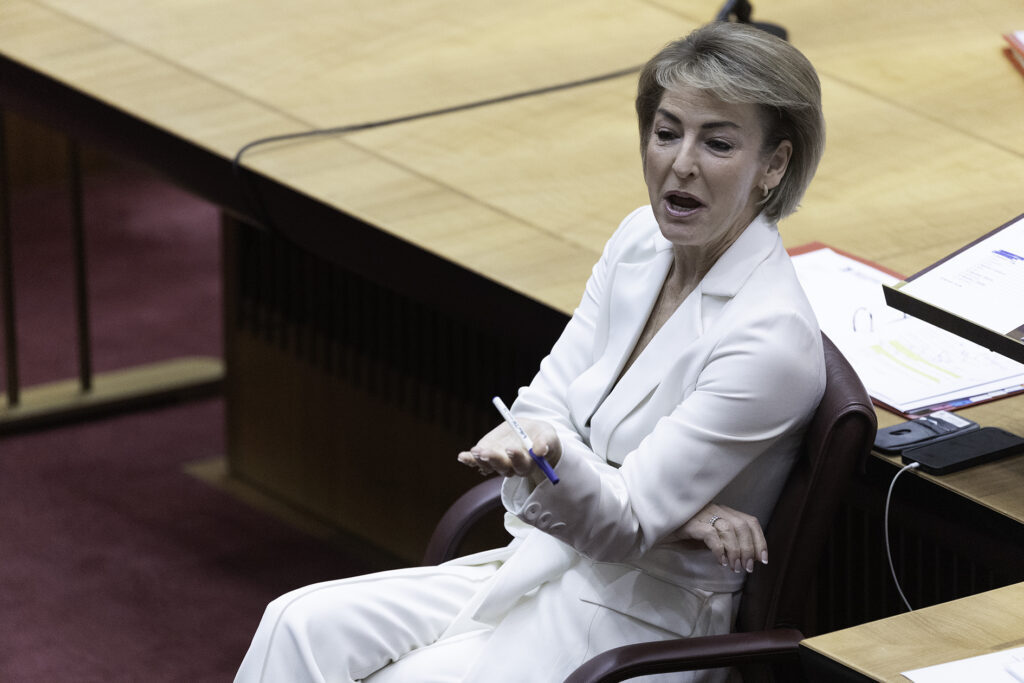
Looks like he went to the senate. Condolences.

Seems like the theme today was: Senators do things with their hands.

Hands on legs
Hands in the air

Wave them around

Like you just don’t care.

Question time ends

FINALLY.

The chamber moves on, but the MPs are mostly excited for 6pm when Pat Cummins and some other sports stars will hold an event in the parliament, as they call for funding to help future proof community sport clubs and grounds from climate change.

Ahhh Ok, Jason Clare is now up on the child care safety changes following last week’s meeting with the state and territory education ministers, which I imagine is the reason for the prolonged question time.

Again, it is nothing new, but hopefully it means we will all be free from this very soon.

LNP MP Andrew Wilcox (the member for Dawson for those playing at home) asks Pat Conroy:

Can the minister confirm that Whyalla, Mount Isa and Tasmania are all either under administration, in crisis talks or are seeking government bailouts and the cost of energy is the reason for this.

Conroy says:

I thank them member to his question which is about the future of manufacturing in his country and the future of smelters. As we’ve said in this place many times, the sustainability of our domestic minerals and minerals processing capability is vital to our national interest and that is why we are backing jobs, backing manufacturing and backing heavy industry. Now, the member also talked about energy. Obviously energy is a critical part of the mix and that is why we are investing records amounts in renewing our energy grid, backing renewable energy which is the cheapest form of new energy as well as improving reliability. I stood with the Prime Minister and other ministers when we backed Aussie industry with new investment in energy. The truth is, Mr Speaker, the Coalition had a chance to fix these issues but they left us with a graveyard of discarded energy policies, by my last count, 23. We are getting on with fixing the job by taking a considered approach and ministers as in the other place is working very hard in at this. We’ve put aside funding for smelters, we’ve put aside hunting for the Green Iron Fund, we have put aside $300 million for aluminium to help with their energy transition. There is more to do, Mr Speaker, but the truth is, we’re not going to cop attacks from the other side who sat on their hands for nine long years and did nothing about it.

NO! We are back with another one.

WHHHHHHYYYYYYYYYYYYYYYYYY.

This dixer on the child care safety reforms (nothing new here so we will leave it) has the smell of the end of question time to it.

I would expect Anthony Albanese to stand up and end this before Michelle Rowland sits back down

Zali Steggall is up next with a non-government question. It is on her bill (although doesn’t name it)

Every $1 spent on disaster preparation saves up to $11 and disaster recovery costs yet less than 30 per cent of the National Emergency Management Agency’s budget is spent on preparation and resilience. Disasters are now costing 38 billion per year to Australians. Will you take this opportunity to re-evaluate funding priorities and ensure greater investment in resilience?

Anthony Albanese says he will ask the minister to add to his answer, but first says:

…We are certainly very conscious about the cost of climate change. It is real for. It is real, and in recent months I have cause have been to regional South Australia visiting drought communities. I have been to the Mid North Coast where there have been floods I have been to South Australia as well, Kangaroo Island just last week. Seeing the impact of climate change.

There is no question that while you can’t say every single weather event in Australia is because of climate change, what you can say is the science told us that there would be more events and they would be more intense and that is what we are seeing playing out.

Now with a range of funds including the announcement that I made last week was about changes to the RIC program being made available so that the issue of resilience and investment can be made to that program for issues which are unprecedented of course. In South Australia at the moment what you have is a combination of events.

You have the flood waters flowing down through the Murray Darling Basin, impacting and washed out and nutrients into the water there, but the thing that is really having impact is the water is about 2 degrees higher than it normally would be at this time of the year.

That is having an impact on the environment which is having an impact therefore on our economy, so I think the member is quite right to point towards investing upfront. That is something my government is looking at in a range of areas as well, as well as providing for local infrastructure programs that the minister might want to talk about as well.

Kristy McBain does want to talk about this:

It is because of this Prime Minister that there is actually investment in disaster response and readiness. We’ve created a disaster response fund, a $1 billion fund over five years with projects already being rolled out in rounds one, two and three just announced. Projects like levies as well as small projects like lifting up the capability of culverts to two lane concrete bridges. But not only is it important to invest in hard infrastructure, the soft infrastructure is incredibly important. Investing in preparedness programs in local communities across the country just like communities in Lismore that I visited last week or south-west Queensland which I visited the week before. Working with those local councils on priority projects in disaster readiness.

Anthony Albanese is cranky (a different cranky to his normal cranky – this is disappointed cranky):

I support the Palestinian bid for statehood, in part because it will give heart to the ordinary people of the West bank and Gaza.

We in the international community must stand in solidarity with those seeking the non-violent path to a secure Israel and an independent Palestine.

After two generations of war, are we going to admit to our children their parents could not even find a path to peace or, worse still, that we did not even try.

They’re not my words. They’re the words of your leader.

And the fact that we take international policy seriously. And the fact that the Manager of Opposition Business asked such a flippant question about the relationship between Australia and the US or about Middle East peace.

It shows how unworthy they are those opposite.

We continue to engage with the US constructively and indeed the Deputy Prime Minister is in the US as we speak, meeting with counterparts as we announced.

We continue to engage constructively. I’ve had three constructive discussions with President Trump. We’ll continue to engage in international politics in a way that protects our sovereignty, in a way that stands up for our national interest, in a way in which Australia plays a positive role in the world as we have historically.

One of the other things that’s defined Australia’s international engagement is the overwhelmingly it has been bipartisan.

If you compare the response and the childish nature of that question, with what the Labor Opposition, with how the Labor Opposition responded to the announcement by Prime Minister Morrison, to the AUKUS arrangements, I think that is all clear to see.

We on this side of the House responded in a constructive, positive way. We always stood up for Australia’s interests and I note and wanted to thank the member for Canning for his remarks where he said recently, just last week in an interview, that when the Australian Prime Minister is up against any criticism, which can be seen to be criticism of Australia, he will stand up for Australia. That is something that we consistently have done and we’ll continue to stand up to the national interest and they’ll continue and they’ll continue to show just how irrelevant they are.

As we come to the end of this question time we get a question from Alex Hawke and…sigh.

This morning the Prime Minister snapped at a journalist saying he had given, “5,324 answers as to why he has failed to secure a meeting with the President of the US. Can the Prime Minister table these 5,324 answers and could the Prime Minister explain to the Australian public whether his decision to recognise the State of Palestine means he is more likely to get a meeting with President Trump or less likely to get a meeting with President Trump?

Why is the Coalition so desperate to get a meeting with Donald Trump? What do they think it would even achieve? What is with this obsession with kowtowing to the United States at all times? That Australia be in lockstep with the United States, even when it is wrong? Does anyone every question what is the point of that sort of diplomacy does for Australia and its people?

Independent MP Sophie Scamps asks Jim Chalmers:

In February 2023, the Government commissioned a review of public sector board appointments. At the time the Minister for public service stated in line with the government’s commitment to transparency, a report will be published after the review is finalised in mid 2023. The final report was handed to government over 18 months ago and yet last sitting week the government opposed a motion in the Senate for an order of production of documents to make the report public. Treasurer, why has the government reneged on the self-declared commitment to transparency?

Chalmers:

I begin by saying that the Government has a broad and ambitious public service reform agenda. It is about transparency. It is about making sure that we make the best appointments that we can as a government as well. And the Briggs report is an important part of that work but not the only part of that work.

We improved and reformed the public service to boost its capability, integrity and performance under a wasted decade under the Coalition, defined by robodebt.

We established a national anti-corruption commission. We strengthened protection for whistleblowers, we embedded stewardship as a core value of the public service into law. And we provided critically needed resources to underfunded areas of the public service like processing the backlog of veterans claims as well. I pay tribute to the Minister for that.

All of this is part of our ambitious agenda and we did as the honourable member said and ask Lynelle Briggs to review the public service board appoint wants and provide advice on clarifying the role of public sector boards and the skills we need on those boards. How board members should be identified and recruited and how we improve the diversity of board membership. And here we have been making very substantial progress. We’ve improved public sector board diversity since coming to office.

The most recent data showed us much more than half of government board positions are now held by women. The highest level since reporting began in 2009. And I know that the member for McKellar cares deeply about diversify when it comes to government appointments I wanted to say it’s a source of considerable pride. To me as Treasurer and this government in the Treasury portfolio, a woman as the head of the Reserve Bank. For the first time as the head of the PC, for the first time as the head of Treasury.

OK, cool, but when will the government actually release the report.

Chalmers says “in due course”.

OK, I think I might actually be having a stroke now because I think David Littleproud just asked a decent question?

Treasurer, a single US private company owned by a US church was able to purchase almost $500 million worth of Australian prime agricultural land in around six months without the requirement of oversight from the Treasurer or the Foreign Investment Review Board. Will the Treasurer commit to review of the thresholds that were put into effect 20 years ago to give farming families an opportunity to compete in buying Australian farms?

Does he know that this is question time? And not the place for actual questions?

And Jim Chalmers is giving what seems like an actual answer? Have I traveled to a different universe in my disassociation?

Chalmers:

I think as he knows, the House knows, Australia welcomes foreign investment but it has to be in our national economic interest.

There are strict rules and thresholds that apply to people purchasing agricultural or commercial land in Australia.

These are enforced again as he knows by the foreign investment decision of the Treasury.

We allocated almost another $16 million in the 24 budget to enhance this kind of monitoring and enforcement and also to strengthen and streamline the system.

The settings and thresholds in this case are applicable to private investors from the US.

They were established by our free trade agreement which was entered in to by the Coalition. 20 odd years ago and that remains the case today.

And what we are doing, Mr Speaker, is we’re making sure that our foreign investment arrangements keep pace. Obviously we see these sorts of cases pop up from time to time. We spend time analysing those cases and work out whether a change is necessary.

The system is robust overall. We’ve made recent changes. They’ve been about quickening the pace of approvals.

There are some historical cases like one which pique our interest but not inconsistent with the arrangements set up by those opposite.

My commitment to the House and more broadly is to continue to make sure the cases are the right ones to protect our national interest. We do have a robust foreign investment screening regime that’s very important. That’s very important and the way we build trust in attracting the foreign investment our economy needs. When cases like this pop up, from time to time we make sure we take that into consideration to make sure the system remains as good as it can be.

Sorry – I thought I was having a stroke, but was just disassociating from watching yet another question time.

Monique Ryan has a question:

The Medical Research Future Fund was set up to be a $20 billion fund which was to disperse a billion dollars a year. It’s now worth $24 billion but you’re spending only $650 million a year. While our researchers are struggling with cost pressures and geopolitical uncertainties. Will you release this funding? Will you help our medical researchers achieve their potential and work for the benefit of all Australians?

After a bit of political whiffle woffle, Mark Butler gets to the question:

The member asked about the addition of capability for research. I was trying to address the fact not only is there 2.5 times as much money, there is a priority driven stream of research funding now that I think is a real addition to what we’ve had for decades. The member is right. There’s been a policy decision in government going back to the former government to cap allocations from in MRFF at $650 million a year which is added to the $850 million budget of the NHMRC adds up to the $1.5 billion. There’s debate in the research community about that. That will play out as part of the development of a national strategy for health and medical research. A draft of that strategy is due to be published very shortly and I’m sure there will be a discussion about the maximum allocation and the Treasurer and finance minister have just conducted their 10-year statutory review and it will be published shortly as well.

Oh Ted O’Brien is back. YAY.

He adjusts his tie before asking this question, which is a Ted O’Brien tell for ‘I am being very serious and I think this is a very important thing I am saying’.

I refer to the Treasurer’s claim in his previous answer he has a fiscal rule to control spend is to bank most of the upward revision in revenue. According to his own pre-election budget, the upward revision in revenue was $8 billion. He plans to blow the lot. Plus, another $26 billion. Will the Prime Minister insist his Treasurer introduce quant fiable fiscal rules to stop his spending spree?

While Sussan Ley is placeholder as leader, Ted O’Brien will have a very large role to play. Probably why so many of their colleagues are sounding out other leadership options already.

Ted O’Brien, fresh off his attempt pretending he was a big deal at the Economic Roundtable (the man has spent DAYS talking up a two minute staged interjection at the roundtable, which was strategically leaked, despite being owned two minutes later, and is now acting like he solved the Cambridge capital controversy) now pretends to care about fiscal rules.

New 5% deposit scheme is the newest in a series of non-solutions to the housing crisis

Jack Thrower
Senior Economist

As Matt Grudnoff pointed out earlier today, the Government’s new 5% deposit scheme will do little to help new buyers access the market and may push house prices even higher.

This new scheme is in effect a new First Home Owner Grant (FHOG), though this time the government will be paying for the buyer’s mortgage lenders insurance rather than providing a direct grant. FHOGs are nothing new, as Lilia Anderson noted in 2023:

the efficacy of the FHOG in practice is widely disputed – and with over $20 billion going to FHB assistance over the past decade alone, it is critical that such schemes actually deliver what governments say it will, rather than simply giving the appearance of action on Australia’s much-maligned housing crisis.

For one, the FHBG does not appear to significantly increase housing accessibility for new entrants into the market. Instead, research has found that the scheme more commonly tends to accelerate the purchase of a home for those already planning to do so. So, rather than broadening access, the scheme simply tends to hasten purchase for those already about to buy a home.

Second, the FHBG tends to increase the purchasing power of first homebuyers, but in doing so it tends to further inflate house prices. This is because demand-side policies that give people more money to spend on housing tend to just end up increasing prices more. This suggests that the scheme may actually reduce housing accessibility in the long term – the very problem that such measures are designed to address. In turn, it suggests that the FHBG tends to benefit existing homeowners who will profit from their property prices increasing – and disadvantage future first home buyers, who will be forced to pay more for a home.

If the Government is serious about the housing crisis it could crack down on the tax concessions to property investors that encourage and enable investors to outbid others who want to buy a home to live in. These property investor tax concessions will cost the budget around $13 billion just this year, with this figure set to rise each year after, overwhelmingly benefiting high-income earners; over half (56%) of the benefit goes to the top 10% of income earners, while the bottom half get only 13%. This money could be redirected to building new public housing to help bridge Australia’s shortfall of about 640,000 social homes.

A MP I have never seen before stands up and even before they call him you can tell he is a LNP MP just from the look. Something about the soft white face and the blue suit. He asks the same question – why are you stealing our policies – and Tim Watts gets booted for interjecting.

Milton Dick has his Dugald mask on very firmly today. The man is in a MOOD

Andrew Wilkie has the first independent questions and it is on:

The insurance industry is failing Australians. For instance, health insurance premiums are sky high but returns to policy holders are at rock bottom. While payments to private hospitals are in fact still so bad that many are in financial distress or closing. Meanwhile, for property insurance, premiums are going through the roof and vast areas are being declared uninsurable. What exactly is the government doing about this?

A reminder – that is also thanks to climate change.

Daniel Mulino the assistant treasurer says:

I thank the member for his question and I commend his long-term advocacy for the people of Clark and his thoughtful contribution on a wide range of policy issues. I do acknowledge that a number of households across our community are feeling cost of living pressures in insurance, whether it be property insurance or health insurance.

I’ll deal with property insurance first. And can I say this is a longstanding and complex issue.

I do wants to acknowledge the member for Calare and my predecessor for having initiated or promoted an inquiry into flood insurance which I chaired in the previous term. That was an inquiry which dealt with a range of issues which were much broader than flood insurance and went to systemic issues of risk across a number of communities.

Can I say out of that inquiry, there were 86 recommendations, most of which were unanimous across members of the government, members of the opposition and the crossbench. There are already a range of things that are occurring as a results of those recommendations. For example, the general insurance code of conduct is now going to be approved by ASIC, a measure which the industry has accepted and I say is at least in part a result of that inquiry. In addition the general insurance code of conduct will be enforceable going forward once it is redesigned by the industry in consultation with other stakeholders.

They are measures which make a real, which will make a real difference to consumers. In addition, work is under way to standardised certain terms which the industry is undertaking. And which I am engaging with industry and consumer groups in relation to.

Again, that will make insurance policies easier for consumers to digest. There’s a range of other processes under way to make sure the actual clauses in the insurance code of conduct provide protections, appropriate protections around cash settlement, temporary accommodation and other issues.

Can I also say the work of my colleague, the Minister for Emergency Services, continues the disaster ready fund and the has partnership are key measures and informing those projects through the hazards insurance partnership.

Those projects as they roll out will significantly reduce risk in high risk areas and those projects will see premiums come down in those communities that benefit. Those are practical things occurring and in terms of consumer protections but also dealing with the underlying risk. The member raises health insurance.

While it’s not directly in my portfolio, can I say the Minister for Health and ageing is working closely with the sector on this issue? He has established a CEO forum by which CEOs across both health insurers and hospitals are working collaboratively on very complex issues. The government presented a package of reforms to the private health CEO forum to make maternity, mental health and hospital in the home services more available and affordable. Across both those areas, general insurance on property but health, the government has a range of short-term and long-term measures for the benefit of consumers.

Sussan Ley is back with another ridiculous question:

Labor’s 3-day Canberra talk fest delivered no real relief for Australians. There was nothing to cut power bills, lower grocery prices, nor reverse the biggest fall in living standards in the developed world. Instead, Labor has left the door open to higher taxes on people’s savings, their super, their businesses, their homes, and even their spare rooms. Why is it always the case when Labor runs outs of money they come after hard working Australians?

The political discourse in this country is as wide as a thumbtack and about as deep.

Question time begins

And as expected we start with…nothing good.

Sussan Ley, who spent the weekend pretending the Queensland LNP was behind her and David Littleproud isn’t dragging the Coalition further into electoral irrelevancy starts the questions off with:

Q: The biggest announcement out of last week’s Canberra Talk Fest was Labor’s partial adoption of a Coalition policy to freeze the construction code, which we developed to make it cheaper to build homes. And today Labor announced a revised Morrison Government policy which we developed to help Australians get into their first home with a smaller deposit. Prime Minister, why did it take a 3-day talk fest for you to realise Coalition policies work and Labor policies fail?

OKKKKKKKAAAAAYYYYYY Sussan.

Albanese says what you would expect, but for the first question of the new sitting week, this is pretty desperate.

Here is the start of Albanese’s answer (but then I had to resume rocking under my desk)

It’s very bold to say Coalition policies work when it comes to housing. Because most of the time they were in office they didn’t even bother to have a Housing Minister*.

We on this side of the House have a $43 billion Homes for Australia plan, almost every element of which wasn’t just opposed by those opposite, and the Greens’ members for a period of time in what I dubbed the Noalition.

They continued to oppose it and continue to oppose the announcements we made and this morning again today. Continue to oppose them.

Now, tonight indeed, in the Senate they’re debating a Coalition motion to abolish the Build to Rent program. Now that is a program to support increased private rentals, some 80,000 being built. That’s been developed with the Property Council. Those opposite hate it so much they’re moving a disallowance motion on it.

*This is actually a silly attack line and they really should drop it.

Ok, so the morning has been pretty low energy. That is becoming a bit of a pattern.

Let us see what QT bowls up (nothing good, I can guarantee that)

Could anti protest laws put the kibosh on anti-war protests?

Morgan Harrington
Postdoctoral Research Manager

This weekend, hundreds of thousands of Australians filled the streets of cities and towns across the nation to protests again the war in Gaza. But anti-protest laws passed in the past few years could curb similar outpourings of public support.

A 2024 report by the Human Rights Law Centre found there had been 49 laws passed over the last two decades eroding Australians’ right to protest.

To give one example, in 2023 the South Australian Government introduced laws that mean people can be fined up to $50,000, or sentenced to three months jail for “intentionally or recklessly obstructing the free passage of a public place.”

Just this weekend, people in Brisbane were forced to take an alternative route after a court put an end to their plans to walk across the Story Bridge.

But from women’s suffrage to better working conditions, protest is how Australians have won change, and research polling from The Australia Institute shows that more than two thirds (71%) of Australians say that the right to protest should be protected by federal legislation.

Recent anti-protest laws are primarily aimed at climate action protestors, but if protests against the war in Gaza continue to grow, their limits could be tested in unexpected ways.

Holy Moly it is almost question time.

Time really does fly when you are in the depths of an on-going existential crisis, huh?

Go grab what you need – we will have you covered for the main event

Over in the senate and Labor and the Coalition have voted for the legislation that allows the Australian government to expand its defence housing scheme to build homes for US soldiers working on the Aukus contracts.

Greens senator David Shoebridge says it is ridiculous:

The Greens have for years been campaigning for more public housing. The Albanese Government has attacked these calls, labelling public housing as unrealistic. Turns out it wasn’t. 

Today we learned if you want to live in public housing built by Labor you’d better join the US military and get Donald Trump on your side. 

AUKUS is draining public funding into the pockets of the US military and foreign arms companies. 

This Bill will not just allow for the Albanese Government to build houses for US troops but also for foreign arms companies and contractors. That means public housing for contractors from Lockheed Martin, Boeing, Northrop Grumman, Elbit Systems, Rafael and others. 

It is a sick joke that Labor will be taking money from critical social programs, including funding to build houses for Australians in desperate need, and instead spend it on housing US troops in Fremantle.

The first major housing bill that this government passes will be about paying tribute to Donald Trump and the US military. That’s a disturbing message about the priorities of this government.”

AWU demands immediate gas reservation

The Australian Workers’ Union wants an immediate gas reservation and more intervention in the gas market from the federal government.

This is a pretty big deal. For a long time, there was the belief that the gas companies needed to be babied to ensure that manufacturing would receive its due. But that is obviously not the case and the unions are now making sure their voice (and case) are heard.

The AWU has submitted a proposal to the gas market review the federal government has set up “demanding an immediate east coast gas reservation scheme that would apply to all three Queensland LNG exporters from day one”

And that includes EXISTING has fields.


AWU National Secretary Paul Farrow said the time for half-measures was over:

Because of a series of weak and stupid decisions by Australian governments during the
late 2000s and early 2010s foreign gas giants operating here have been gifted the sweetest
deal out of anywhere in the world,” Mr Farrow said.

“They’ve been able to pump our gas out of the ground and simply flog it to the highest
foreign bidder without restriction. These multinationals should be kissing the boots of
every Australian taxpayer for the run they’ve had over the last ten years. But it’s time for a
fairer deal.”

“The idea [gas companies] will pack up and leave if we tighten the rules is a bluff. Why would they walk away from billions in profits? Of course they’ll cry wolf – I’d cry wolf too if I was dealing with
a patsy like Australia who has fallen for it every time,” he said.

“The government’s job is to stand firm and make sure Australians get a fair return, not cave
to empty threats. I represent workers in the gas extraction industry and I unashamedly
support the industry’s future in Australia. These workers are my members. I don’t want
them to lose their jobs, and I know they won’t.”

Among the AWU’s submission is:

  • A requirement for LNG exporters to supply a fair portion of domestic demand
  • Rules deducting third-party gas purchases from LNG exporters’ local supply
    commitments – ensuring they don’t rob Peter to pay Paul
  • A ‘baseline-credit’ system, allowing producers who exceed their domestic supply
    obligation to trade credits with those that fall behind
  • Powers for government to set prices for industrial users if market dynamics threaten
    manufacturing viability

EV user charge misses the point

Rod Campbell
Research Manager

It’s a shame Friday’s energy statistics weren’t available for last week’s Economic Roundtable.

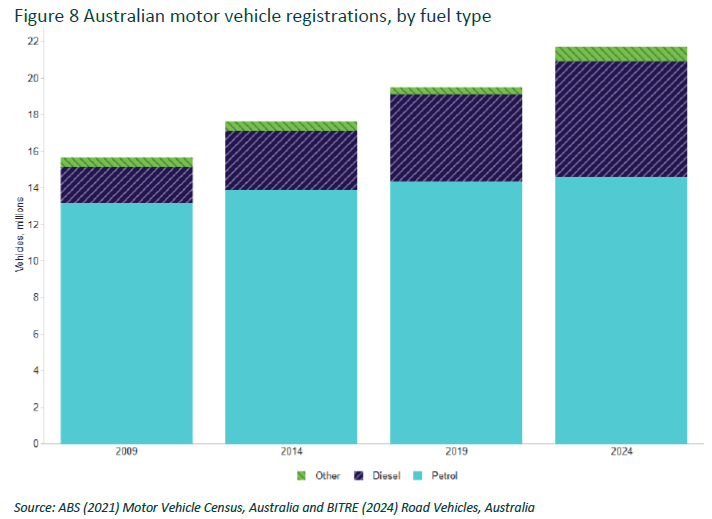
The roundtable agreed that EVs users should be charged because of the claim that because EVs don’t pay fuel tax, somehow Australia won’t be able to pay for roads.

Then came the stats on car registrations:

This shows that EVs are still less than 5% of vehicles, petrol vehicles are still increasing and diesel vehicles are booming.

If the Government is serious about raising more fuel tax revenue, they could always make the mining industry pay some. The mining industry pays nothing in fuel tax, despite being one of the biggest diesel using sectors.

At least the stock market is ok!

As AAP reports:

Australia’s share market has pierced yet another record after a pivot from the world’s largest central bank reinvigorated risk-on investor sentiment.

The S&P/ASX200 spiked to a new intraday peak of 9,054.5, but by midday was up just 11.5 points, or 0.13 per cent, to 8,978.9, while the broader All Ordinaries gained 17.5 points, or 0.19 per cent, to 9,251.8.

The wave of buying followed a Wall Street rally on Friday after US Federal Reserve chair Jerome Powell hinted at incoming interest rate cuts for the world’s largest economy.

“While emphasising the balance of risks between heating inflation and cooling employment, his observation that interest rates remain above neutral was enough to set investors buying stocks,” Moomoo market strategist Michael McCarthy said.

Despite the fresh record, only five of 11 local sectors were trading higher by Monday lunchtime, with raw materials stocks (+2.6 per cent) and the energy sector (+1.4 per cent) lifting the bourse.

Large-cap miners BHP, Fortescue and Rio Tinto each surged two per cent or more, tracking with a lift in iron ore prices.

On the energy front, Woodside and Santos were up more than 1.2 per cent each, despite oil and gas prices contributing to a 22 per cent drop in first-half profits for Santos.

Financials weighed on the bourse, slipping 0.9 per cent after opening the day at a new high, with all big four banks sliding into the red shortly after the opening bell.

Westpac was the worst performer, slipping 1.6 per cent to $38.36, while CBA fell 1.3 per cent to $170.56 a share.

Bendigo and Adelaide Bank gained 2.4 per cent to $13.31, despite posting a full-year net loss of $97.1 million, due mainly to a goodwill impairment announced the week before.

Retail stocks are having a rough day with consumer staples down one per cent and consumer discretionary stocks losing 0.9 per cent, tracking with downticks in Coles, Woolworths, Wesfarmers and JB Hi-Fi.

Dan Murphy’s and BWS owner Endeavour Group was also down after its full-year profits slipped more than 16 per cent amid supply chain issues and weaker alcohol sales.

Real estate stocks were performing well, up 0.4 per cent, tracking with a similar gain for sector giant Goodman Group.

Also riding on the back of a sector behemoth were healthcare stocks, up 0.8 per cent as CSL clawed back some of its post-earnings price plunge from the week before.

The Australian dollar shot ahead after the Fed’s comments sent yields higher and weighed on the greenback. The Aussie is buying 64.73 US cents, up from 64.19 US cents on Friday afternoon.

Parliament fiddles while Australia burns…fossil fuels

Rod Campbell
Research Manager

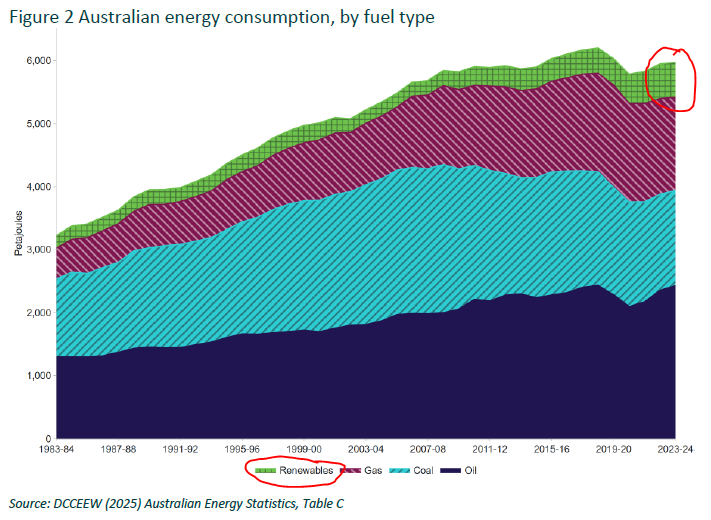
The Barnaby net-zero thing is a sick joke, and so are government claims that they’ve got climate action under control.

Last Friday’s new stats show that renewables made up less than 10% of Australia’s energy consumption in 2023-24:

There is still a VERY long way to go to phase out gas, oil and coal. This can only be done by electrifying things and expanding renewables. No amount of dodgy carbon offsets will fix this.

Australians understand that taxes are necessary for government services

Bill Browne
Bill Browne

Grattan Institute head Dr Aruna Sathanapally made the common-sensical but important observation that “Australians will have to expect a lower service delivery from the government if taxes don’t go up” (as reported by ABC News).

Prime Minister Anthony Albanese brushed off her concerns saying:

“Academics talk in academic words. What I do is live in the real world, and in the real world, my government’s focused on delivering for people.”

It’s a strange deflection. You don’t have to have worked for NSW Treasury, though Dr Sathanapally has, to realise that taxes are necessary for government services.

In fact, Australia Institute polling research back in 2021 showed that Australians understand perfectly how taxes work “in the real world”:

  • Seven in ten (69%) Australians agree with Oliver Wendell Holmes’ quote that ‘taxes are what we pay for a civilised society.’
  • Six in ten (61%) agree with the broader statement that “tax is good”.

When asked what they wanted the government to prioritise in the next budget, Australians preferred spending on government services like health, education, infrastructure and income support for people looking for work over tax cuts.

This is not about academics. This is about how Australians access important services, including healthcare, education and infrastructure.

New figures on Aus gas exports – and no surprises, they are still massive

Rod Campbell
Research Manager

New data dropped last Friday – the 2025 Australian Energy Statistics came out.

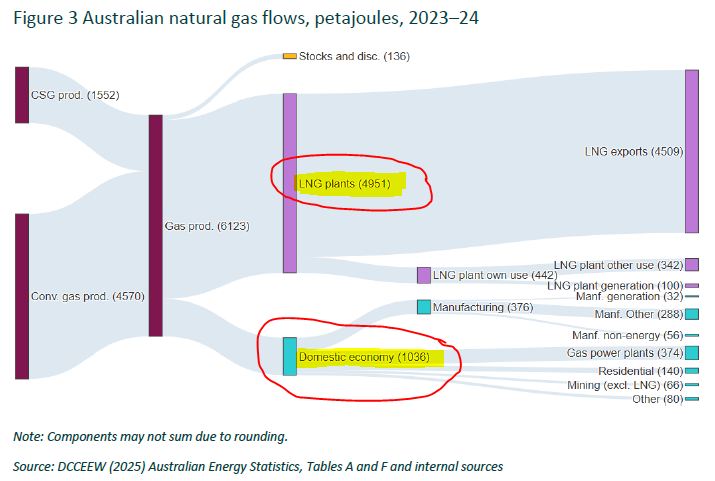
This publication always has an interesting diagram on Australian gas production and use. Here it is, showing that exports (LNG plants) are FIVE TIMES bigger than the entire “domestic economy” usage:

This shows that gas exporters sold 4,951 petajoules (PJ), while the entire domestic economy used 1,036 PJ.

For context, your home bbq gas bottle contains around 417 megajoules, so gas exports were about 12 million bbq gas bottles, one for every person in Melbourne, Sydney and Adelaide.

Also interesting in that diagram is “LNG plant own use (442)” and “Manufacturing (376)”. This shows that gas exporters use 20% more gas to run the freezers to liquify and export gas than Australia’s entire manufacturing sector uses.

Australia doesn’t have a gas shortage, we have a gas export problem.

The Greens plan on setting up an inquiry into why Labor is being so secretive around its climate risk assessment (something Zali Steggall mentioned today as well), wanting to know what is so “shocking” about it, that the government feels the need to hide it.

Larissa Waters said in a statement:

Labor’s climate risk cover up has to end – and the Greens will force them to be transparent through a Senate Inquiry.

Labor must make the Climate Risk Assessment public so Australians can see how global warming is making our country less safe, destroying the environment, and supercharging climate disasters that are already costing communities dearly.

We are extremely concerned about Labor’s decision to hide this Assessment for over nine months, and to today disregard the Senate’s orders to release it. The only reason the government would be trying to hide this report is that they don’t want you to see it before they announce inadequate 2035 climate targets.

It is set to be a damning report which reportedly shows how continued coal and gas approvals are setting our country on a path to climate ruin – with homes within 5 kilometres of the coast set to be regularly flooded, major drought risks for much of the country, and all coral reefs dead.”

The Coalition would need to support the move, but they tend to like making life difficult for the government so don’t be surprised if this gets up.

In case you were wondering what Nationals leader David Littleproud has been up to – he has been trying to reinvigorate nuclear power. He spoke to Brisbane radio 4BC this morning where he claims that the issue with nuclear was the Coalition didn’t sell it properly.

Now this is all ridiculous because by the time the Coalition is anywhere near power it will be the 2030s when all of this debate is done and dusted. None of this matters. At all. But it is keeping the Coalition at the beck and call of its junior party the Nationals who are pretty much at the capacity of the seats they could ever win (there are maybe two more – Calare and Bendigo if the circumstances were right) which is so far from government it is not worth talking about.

Yet here we are.

What will keep the Nationals in the Coalition?

Littleproud:

Well they have got on board because they accepted our terms. The four policy positions that
we weren’t prepared to walk away from which was nuclear, the Regional Australia Future Fund,
reform to the Universal Service Obligation to protect our mobile phone towers so that we can
use them in an hour of need in the bush, and divestiture powers on supermarkets.

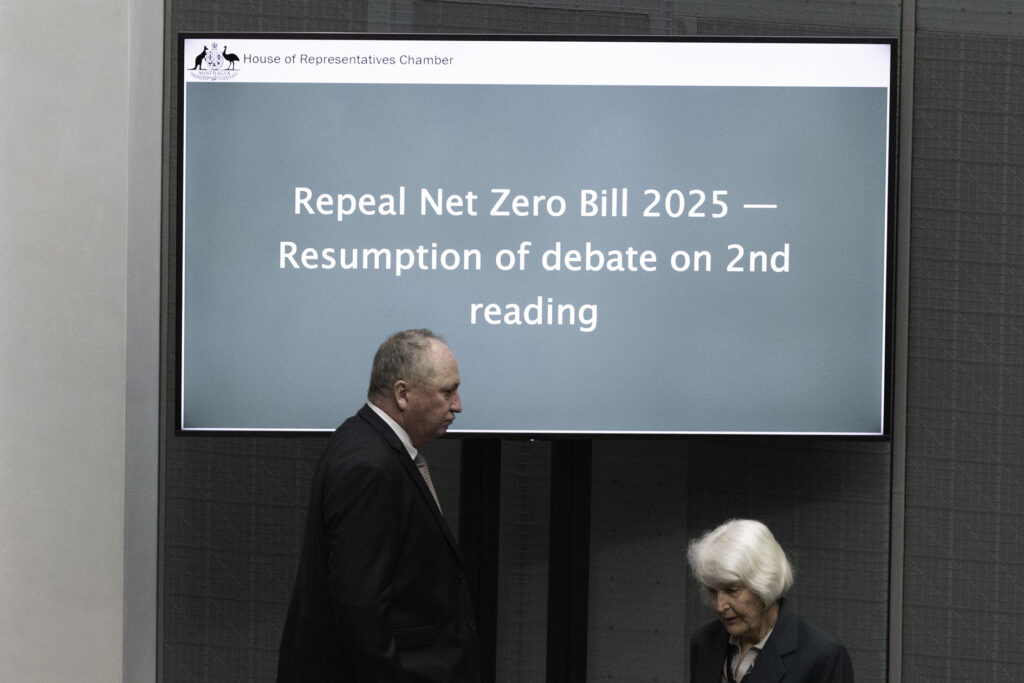
Mike Bowers was in the chamber this morning when the LNP began debating Barnaby Joyce’s bill to scrap net zero. The chamber looked exactly as you would expect:

Barnaby Joyce and all his friends:

Chilling (Mike Bowers)
The member for New England Barnaby Joyce during the 2nd reading of his Repeal net zero bill 2025 in the House of Representatives Chamber of Parliament House in Canberra this morning. (Mike Bowers)
Very serious times with Llew O’Brien (Mike Bowers)

That feeling when you are helping to bring the Coalition to it’s endpoint:

Lol (Mike Bowers)

Phil Thompson got a bit of media over this stance over the weekend. He said that while his politician’s head said the NDIS changes, which will move children on the spectrum off the NDIS into a new system managed by the states, make sense, his father’s heart disagrees.

Why? Because his young child has autism and has benefited from the NDIS supports.

So once again, we are celebrating politicians who are standing for something because they have empathy born of personal experience of what the policy would mean.

It’s the whole ‘father of daughters’ issue again – where men don’t see any issues with women safety until they have daughters. It’s also what we saw in the marriage equality debate – where MPs supported the bill because it would have impacted their loved ones.

You should not have to rely on having personal experience in order to identify good or bad policy. The counter factual is that Thompson would have been in support of the bill if not for his child – but what about everyone else’s child then? Would the testimonies from them not have counted?

LNP MP Phil Thompson has moved a motion against the Labor government changes to the NDIS:

That this House:

(1)notes:

(a)National Disability Insurance Scheme (NDIS) providers and participants will be significantly impacted and hold grave concern regarding changes to the transport allowance arrangements that have been announced in the recent annual price review, at very short notice without consultation by the Government; and

(b)the feasibility for NDIS providers and participants to make the necessary adjustments to service delivery arrangements in such a short time period is not achievable and will be at the detriment of the participant;

(2)condemns the Government for failing to consult with the NDIS sector and failing to understand the needs of participants and providers; and

(3)calls on the Government to:

(a)defer these changes for at least three months to allow for consultation and planning around the changes to service delivery that may result from these changes; and

(b)explain how it expects community-based service providers in particular to adapt to these new pricing arrangements.

Independent MP Dai Le is speaking on her private members bill to scrap the Morrison government Jobs’ Ready graduate scheme which increased the cost of arts and humanities degrees, in a bid to get people to study what the Morrison government wanted. The scheme has failed, but the Labor government has not done anything to address the financial burdens.

Zali Steggall has also introduced her bill, calling for climate change adaption to be made a budget priority:

This bill is about certainty, independence and preparation, ensuring future governments take climate risk seriously, regardless of who is in power.

Last week, we saw the treasurer fail to address or include in his round table the impacts of climate change and rising risk. We cannot insure our way out of the climate crisis. We must have visibility on that national risk framework.

Australia can’t afford to keep just reacting after disasters strike. Planning for climate impacts is crucial. It’s how we protect our economy, our communities and our way of life.

This bill is common sense. It’s fiscally responsible and is future focused. It’s time for a reality check. Climate change is here. It’s costly and it’s accelerating.

The Nationals, the LNP, they don’t want targets or to reduce emissions, but they’re always keen for handouts when disasters strike, we need to start preparing.

Other jurisdictions and other countries have the tools, the knowledge, the ability to adapt, prepare and thrive.

The question now for the Albanese government, what will they do? Will they be brave and honest enough for the Australian people and actually address these risks or remain shackled to the fossil fuel interests and outdated policies?

This 48th parliament is an opportunity to protect Australia. Will the government be reckless and ignore this responsibility? So I urge the government and all the new MPs that have come into this place to urge for the debate and the support of this climate change national framework and adaptation Bill 2025,

Gun lobby thinks it’s winning in Aus…it’s definitely winning in NSW

Rod Campbell
Research Director

Australia’s gun lobby thinks it’s “winning” according to a report in the Guardian today.

And fair enough. There are now over 4 million guns in Australia, that’s more than before the Port Arthur massacre, according to recent Australia Institute research.

The gun lobby seems particularly powerful in NSW, where the state government is looking to establish a “right to hunt”.

We pointed out in our submission to NSW Parliament that this would undermine gun policy in Australia, which is based an agreement that “firearms possession and use is a privilege that is conditional on the overriding need to ensure public safety.”

If the NSW Government and the Shooters, Fishers and Farmers party succeed in flipping guns from being a privilege and into a USA-style right, then they really will be winning.

The independent member for Indi, Helen Haines, seconds Andrew Wilkie’s bill:

This bill represents unfinished business when it comes to Robo debt, more than two years after the final report from the robodebt Royal Commission was handed down, it implements or complements some of the outstanding recommendation from the rec from the Royal Commission’s final report.

It sets out new positive duties that require the government to emphasize and prioritize the needs of Social Security recipients when administering Social Security law and designing systems and policies.

It mandates human oversight of debts raised above $2,000 before the decisions come into effect, or decisions which would cause the cancelation of a payment or benefit. It also mandates notifying recipients if a debt has been raised against them as a result of ultimate automation.

It places a six year time limit on debt recovery actions, among other measures.

Robodebt cannot be allowed to be forgotten or to be repeated. We cannot allow the most vulnerable in our community to come up against the might of the government of automated systems without compassion or compromise.

Yet I worry bills like this and the ethos behind them are more needed than ever.

The Commonwealth ombudsman found this month that 964 jobseeker recipients had their social security payments unlawfully terminated between April 2022 and July 2024 due to it glitches in the targeted compliance framework, which automatically canceled payments without oversight.

We can see automated automation without oversight, is still a barrier to vulnerable Australians getting the help they need.

It’s clear we have a long way to go before the lessons of Robodebt are learned and implemented. We need a true turnaround in attitudes to guard against the demonisation of welfare recipients.

Andrew Wilkie, in introducing the bill says:

I was among the first to raise the alarm with the media, with the ombudsman and with the government.

But while the media was slow to pick it up, and the then government didn’t want to hear it, my office continued to hear countless shocking stories from my electorate in Tasmania and indeed right across the country.

In one memorable case, a person presented to my office so distressed that they curled up into a ball on the floor in my waiting room and broke down in tears having a panic attack.

Of course, all now agree that Robodebt was a shameful chapter in Australia’s history. Well, maybe not all, seeing as many members of the former LNP government don’t seem to have any or many regrets about the whole sorry saga. It’s also now better understood that while the core of the scheme was found to be unlawful, many legitimate aspects of social security legislation did also encourage the situation to arise and supported it continuing unexamined for so long now, one of the core of the Royal commission’s findings was the simple fact that government services need to return to providing Australians access to an effective income support system and to ensure that they are treated with respect and dignity when they do so.

So that’s what this bill aims to do; to improve and expand the principles and duties contained in Social Security law in line with the Royal Commission recommendation relating to the effects of Robodebt on individuals, and make other changes to the Social Security law to align with recommendations on compliance activities and vulnerability automated decision making and debt recovery and collection practices in particular.

And the debate on Barnaby Joyce’s bill has been adjourned! Andrew Wilkie is now up putting up the bill to try and stop robodebt from happening again.

The Barnaby bill isn’t over though – the debate will pick up again (the government will let as many speakers on it as the LNP can muster because it wants that point of difference. That being said, there are not too many speaker in the LNP which is it own self limit.)

First up to speak on Barnaby Joyce’s scrap net zero bill is LNP MP Llew O’Brien. He says on the outset that “climate change is real” but he doesn’t think the settings are right under net zero and the rest of the world isn’t doing its bit.

This is going to be a long debate.

Government 5% house deposit scheme won’t make housing more affordable

Matt Grudnoff
Senior Economist

The government is keen to talk about housing affordability… hooray.

This is one of the most important issues Australia faces at the moment.

So, let’s take a look at the policies they have on offer.

They are bringing forward their 5% deposit scheme where a first home buyers and single parents who can’t put together a full deposit, won’t have to pay for mortgage lenders insurance as the government will go guarantor. It will now start in October.

This will mean more people will show up to the auction as demand for houses will go up. Higher demand means higher prices.

This scheme will not make housing more affordable. It will just push up prices. And it will come at a time when interest rates are coming down, which will also push up house prices.

After an election where one of the main battlegrounds was housing affordability, it looks like we’re about to enter a period with rapidly increasing house prices. You can see why the Housing Minister Claire O’Neill has declined to suggest that by the next election housing will be more affordable.

Coming out of the productivity roundtable, they have also frozen the National Construction Code. The code sets out all the building standards. The government is claiming that it has become too bloated and full of red tape.

Of course nothing reduces red tape like freezing the code so you can’t remove red tape.

But the construction code includes minimum standards on housing builds. Things that determine how easy it will be to keep your home warm in the winter and cool in the summer. You might think that if your main concern was productivity, building a home right the first time was more productive than pouring energy into keeping in warm and cool year after year. But apparently that’s not what the round table thought.

Regulation is something that all governments should always be reviewing. But that’s not the same as freezing any new changes to regulations.

So, how can the federal government make housing more affordable?

They need to get speculators out of the market by reforms to negative gearing and the capital gains tax discount. Housing should be about a safe and secure place to live, not about building an investment nest egg.

The federal government has a real opportunity to make a big difference to housing affordability, but only if they have the courage to act.

The bells are ringing, meaning the parliament session is just about to begin.

First bit of business: allowing the Coalition to tear itself apart over scraping net zero.

I am going to make a prediction that there will be a lot of misinformation put forward in that debate. We won’t amplify it – and I’ll do my best to fact check what is absolutely necessary.

Stepping outside parliament for a moment to look at what research is happening more widely and Dr Blair Williams, a lecturer in Australian politics at Monash University has taken a look at the Liberal party’s ‘woman problem’ and found the culprit:

John Howard.

Shock. Me. Shock. Me. Shock. Me. I mean smash me down and call me avocado that John Howard of all people would be responsible for a generational screw up!

Williams said of her research:

Howard completely remodelled the Liberal Party in his own image, abandoning many socially-liberal traditions of former leaders Robert Menzies and Malcolm Fraser,” Dr Williams said. 

In doing so, he sidelined many of the party’s moderates, especially its liberal feminists like Dame Beryl Beaurepaire who had lamented the Party’s increasing conservatism and the exclusion of women from policy input. 

More recent leaders, like Abbott, Morrison and Dutton, have channelled Howard’s leadership style and approach to gender equality policy, women voters and women in the party, to its detriment.”

You can read the doctor’s research, here.

Maiy Azize from Everybody’s Home has spoken to ABC News Breakfast about the changes to the 5% deposit scheme (bringing it forward three months, lifting the house price threshold and changing some of the eligibility requirements to broaden it slightly) and said without actual government action on affordability, the scheme won’t make much difference:

The issue is, you know, there’s still limits on how much you can spend on the home, you know, depending on the city where you live, that could be quite a big deal. The issue is, though, that housing is extremely expensive. That’s why we’re seeing people are struggling to get together deposits. What we really need to see is action to make affordability better. Not just action to get people into mortgages.

…The big thing that we would make a big difference to people trying to buy their first home is actually tax reform. We’ve got a system at the moment where people who are investing in housing, people buying their third, fourth, or fist home, are getting a lot more support from the government than people buying their first home. If you’re going out to an auction or trying to bid for a home, there’s investors competing with you and they’re being subsidised by the government, by the taxpayer, and that’s pushing up the cost of housing. If we want to make housing more affordable, we would be winding back the tax breaks.

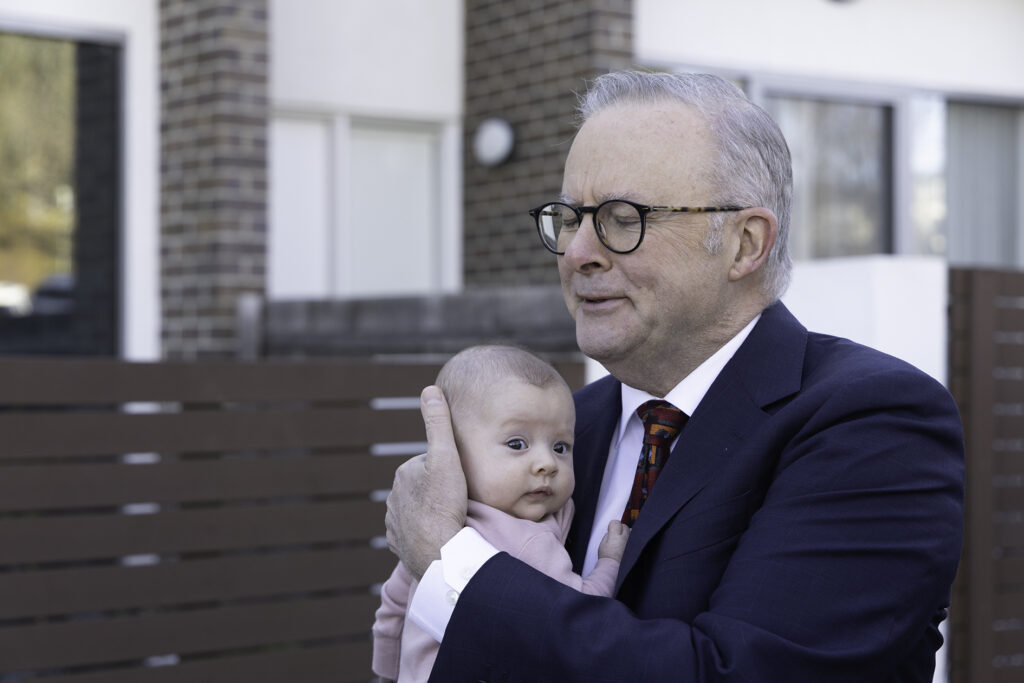
Anthony Albanese was in the Canberra suburb of Lawson this morning announcing the changes. Mike Bowers from The New Daily was there where Albanese was given every politician’s dream – the chance to hold a baby in front of the cameras:

The Prime Minister Anthony Albanese meets 11 week old Charlotte Chi-Tan and her mum Yvette Wooff in the Canberra suburb of Lawson while visiting first home owners this morning. Monday 25th August 2025. Photograph by Mike Bowers.

A reminder for everyone who wants sport stars to stay out of politics, sport IS politics.

And Australian cricket captain Pat Cummins is in Canberra today to speak to Anthony Albanese about the government providing $100m in funding to help local sporting teams and grounds future proof against climate change.

Because what do you know – climate change impacts everything. Including your local grounds. Cummins is part of an all-star athlete push to help sporting clubs survive – the call is for help with lowering energy costs by helping clubs transition to renewable power, help with protection against flooding, as well as other climate measures. Because even if you’re uncle who voted for John Howard doesn’t believe in climate change, your insurance company sure does, and that is putting the local games in doubt.

On private members’ bills that might actually make a difference, independent MP Andrew Wilkie has announced he will be introducing legislation to address elements of the Robodebt Royal Commission, to ensure it doesn’t happen again:

The Bill proposes higher standards and duties which must be adhered to in the provision of social security services to ensure policies and processes are designed and administered with an emphasis on service, rather than punishment. It also introduces changes to the social security law relating to oversight of automated decision making, as well as more compassionate debt recovery and collection practices, and compliance activities.

Which is not just the right thing to do, it is legally necessary. As the Antipoverty Centre reported last week:

Late yesterday the Department of Employment and Workplace Relations quietly released an independent report triggered in 2024 by revelations of unlawful Centrelink payment cancellations. This comes just a week after the Commonwealth Ombudsman released the first report of his investigation into administration of the compulsory activities known as “mutual” obligations.

There was also a second Deloitte report in the same area, which the AFR’s Paul Karp reported was ‘littered with citation errors’. That report claimed there were not grounds to stop the use of mutual obligation penalties, which the Antipoverty Centre has argued is incoherent, given the penalties are unlawful.

Wilkie says it is time to legislate to ensure that the government responds before even more harm is done:

Robodebt was a catastrophic failure of government administration that destroyed the lives of thousands of Australians,” Mr Wilkie said in a statement.

“It’s been two years since the Royal Commission and, shamefully, we are yet to see any meaningful legislative change from this Federal Government. Well, I’ve now done the work for them, and so I urge them to come to the table on these legislative reforms to ensure such catastrophic failures of social services administration can never occur again.”

Here is the official announcement from the government on the changes to the 5% deposit scheme:

Through the expanded 5 per cent deposit scheme, the Albanese Government will guarantee a portion of a first home buyer’s home loan, so they can purchase with a lower deposit and not pay Lenders Mortgage Insurance.
 
Under the changes, all first home buyers will have access, with no caps on places or income limits. Property price caps will also be set higher in line with average house prices, providing access to a greater variety of homes.
 
For the average first home buyer, access to the scheme cuts years off the time it takes to save for a deposit and saves tens of thousands of dollars on Lenders Mortgage Insurance. In just the first year alone, first home buyers using the scheme are expected to avoid around $1.5 billion in potential mortgage insurance costs.
 
The median home price in Australia today is $844,000 and 5 per cent of that is $42,200. The last time $42,200 covered the 20 per cent deposit for a median home was 2002, which shows the generational scale of this change.


Which again – will do nothing for housing affordability. As senior economist Matt Grudnoff wrote for the New Daily last week:

To be very clear, increasing supply will make housing more affordable, but that is not the easiest and simplest way to fix the housing crisis.

House prices have rapidly increased. They have increased by 75% over the last 10 years.

Over those 10 years, the population has increased by 16%. To house all those extra people, we would need to increase the number of dwellings by 16%. But over that same 10 years, the number of dwellings has increased by 19%. We have been building dwellings at a faster rate than the growth in population.

The massive growth in house prices has not been caused by a lack of housing supply.

If it’s not a supply problem, then what has caused the increase in house prices? It has been caused by a big increase in demand. Specifically, an increase in investor demand. Lots of investors have flooded into the market, outbidding owner occupiers, particularly first home buyers, and pushing up prices.

Anthony Albanese would prefer to concentrate on this:

Anthony Albanese tries to pretend that Labor bringing on Barnaby Joyce’s private members’ bill to scrap net zero isn’t about politics.

For context, the government sets the agenda in the house (where it holds the numbers) so it sets what comes up for debate. And there are a whole host of private members’ bills it could choose (including Zali Steggall’s climate resilience bill) and instead it has jumped straight to Joyce’s bill. Which has exactly ZERO chance of going any further, because the government will not be voting for it.

So why is it running the bill? Well, because it shows just how little the Coalition has moved on climate, and by comparison it makes the little Labor is doing (which doesn’t even make the bare minimum on the science) seem like it is golden by comparison.

Does Anthony Albanese want more Pacific Island nations to join Australia in recognising Palestinian statehood? (Most Pacific nations, including New Zealand, have not shifted on the issue of Palestinian statehood as yet and Israel’s deputy foreign minister is planning a Pacific tour to clamp down on any moves in that direction)

Albanese says:

They’re sovereign states, and I welcome their sovereignty, that is what I do, and I respect it. And they’ll make their own decisions. Australia will make our decisions without without concern for anything other than our national interest and for doing the right thing. So I believe it’s very firmly doing the right thing to be a part of what the UK, Canada, France and other nations are doing, which is to try to break the cycle of violence that’s been there for far too long, and to find a path to peace.

Following the marches for Palestine across the nation yesterday, Anthony Albanese is asked on ABC radio RN Breakfast about Australia’s plans to recognise Palestine and get more aid into Gaza. he says:

Australia is, of course, not a major power in the Middle East, and in spite of some of the rhetoric which is out there, Australia, for example, does not provide arms to Israel*. We have consistently advocated both directly to the Israeli government, but also through our vote in international forums for aid to be allowed to get into Gaza, we’ve consistently advocated for a cease fire and for the hostages to be released and Hamas to be disarmed. We will continue to use our voice in international forums and continue to be a strong advocate for the long term solution as well, which, of course, is the state of Israel and the state of Palestine living side by side in peace and security

*Australia does not directly provide arms, true. Australia however, does provide components of weapons which are assembled off-shore (like the US) and then shipped to Israel, where they are deployed against Palestinian citizens.

And on the calls to look at negative gearing and capital gains tax after the economic roundtable, Anthony Albanese says it’s not all about the immediate future:

The economic roundtable wasn’t about just this year or this term, it was about future issues, enabling them to be raised in a way that wasn’t playing the old rule in real out game.

What we are focused on, in the immediate sense, is the reforms that we took to the election that includes a tax cut for every taxpayer next year and the year after, the big tax fight at the election campaign was between Labor promising lower income taxes and the Coalition extraordinarily promising, having opposed those tax decreases, actually proposing to increase income taxes for all 14 million Australians

Albanese has been very careful to keep all his tax reform comments in the present tense, using phrases like ‘immediate sense’ which is not ruling out changes, but does narrow down what will be discussed this term. Labor MPs who like to tell me to calm down on criticising Labor for doing the very least it can, say that come the second half of the term, there will be more talk on tax reform, but it will take time for the government to work up suggestions. Let’s see shall we.

The Productivity Commission recommended further regulations when it came to housing, to ensure they met climate requirements. That was earlier this year.

Now the government has announced it will be “pausing” the national construction code for the rest of the decade. Huzzah! That’s to speed up housing approvals apparently. I mean, what. could. go. wrong.

The Coalition announced its plan to do that during the election campaign and were rightly criticised for it, but now that Labor is doing it, it is different apparently.

Anthony Albanese:

We’re pausing it for the rest of this decade. They had a plan that was for longer, but at the same time, they were slashing support for housing. We have a $43 billion homes for Australia plan. It is comprehensive. It’s about more social housing, something that they opposed and said they’d abolish the housing Australia Future Fund. We have the build to rent scheme that they also oppose. It’s about more private rentals. And in addition to that, of course, we have these home ownership schemes as well, also where they opposed our Shared Equity scheme that’s been so successful in Western Australia for many decades.

The prime minister will phone into ABC radio News Breakfast ahead of his first press conference this morning, where he is going to announce the changes to the 5% deposit scheme. It will be brought forward by three months and some of the requirements to access the scheme will be loosened (including earning caps) while the government will also increase the price of properties eligible under the scheme.


Which all sounds great in theory, but as Maiy Azize, the spokesperson from Everybody’s Home says, it will only help 80,000 people.

And economists have said it will most likely just lead to house prices increasing. Huzzah.

Anthony Albanese will hold an early press conference with Clare O’Neil this morning to announce the government will be bringing forward the start date of its policy for home buyers to purchase a property with a 5% deposit. The scheme basically means the government will guarantee the rest of the deposit, which means buyers won’t need mortgage insurance.

It won’t do anything for housing affordability though and in fact, could make it worse.

Zali Steggall wants the government to start adding resilience spending into the budget. She has a private members’ bill on that subject and says:

Everyone knows we have to do more to prepare Australia for the impacts that are coming. The question is – is anyone willing to be courageous and ambitious and do what is needed? I asked the Treasurer to put resilience and risk assessments on the table for the productivity round table. That was ignored. You cannot invest in productivity without underpinning that with risk assessments and insurance. The insurance council wasn’t even consulted on the productivity round table. It is like the government is going ahead blinkered into the future, shackled to old policies still without preparing Australia for what is coming.

On the push to wind back negative gearing and capital gains tax discounts, after the economic roundtable, Zali Steggall says:

We have to have that conversation. This idea that just building ad nauseam more supply. We have to think about what kind of Australia do we want it to look like?

We have to think about more regional centres and other cities. You can’t just indefinitely condense and expand Sydney. He we have to rethink from a town planning point of view.

We have to talk about the demand-side pressures. I have proposed from second investment properties, the capital gains exemptions for investors be wound back.

The same with negative gearing. We can start to move that dial when it comes to the demand pressures and bring back more inter-generational equity when it comes to the housing dream. We also have to talk about renters. Many people won’t own, they will rent. How can we make renting a more viable long term solution as well?

Independent MP Zali Steggall is talking to ABC News Breakfast this morning about housing and the focus on apartments in areas like her electorate. Steggall says the bid to increase housing should not be a one size fits all approach:

Increasing density is one thing, imposing tens of thousands of apartment dwellings is entirely another. The difficulty, we are seeing in an area like Mosman in my electorate, developers will be given the right to increase and build medium density but this won’t go to first home owners or essential skilled workers. It will be high level luxury apartments. If are you going to build housing, we have to talk about the demand side levers. We have to talk about the investor pricing out first home buyers in the housing market. We also have to build smart. The Federal Government has announced a freeze on the national building codes which is a terrible decision. We cannot build cheap and fast. We have to build resilient and well. If not you are kicking the can down the road. Developers will make money but households will be left with substandard homes that will not be fit for the climate and environment in which they will be lived in.

Good morning

Hello and welcome back to parliament for another sitting!

Feels like we never left, huh?

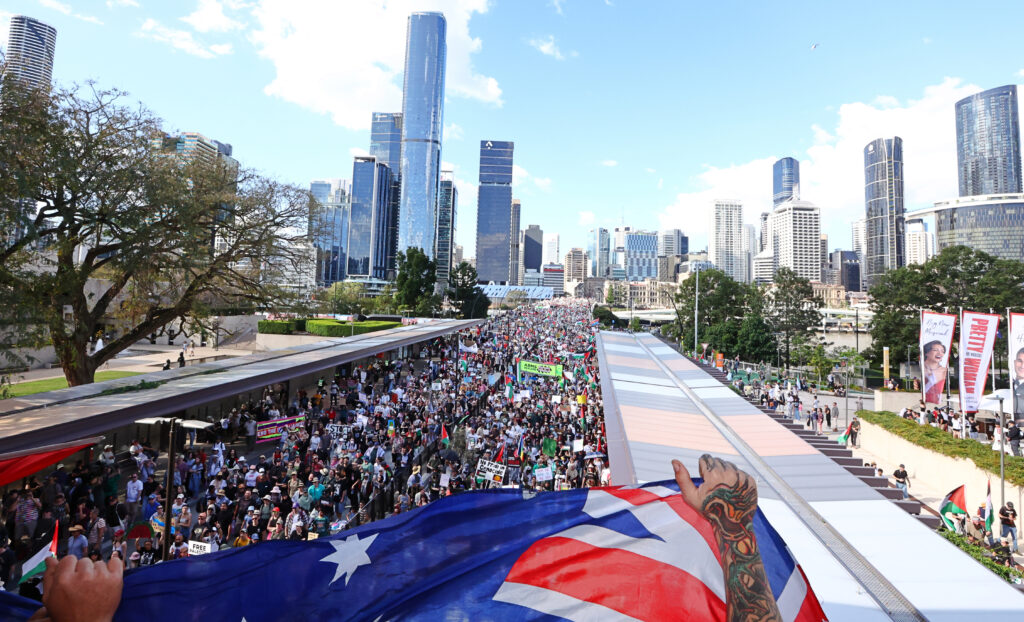
Yesterday, marches were held across the nation calling on the government to apply sanctions to Israel. The size of the turnout, especially in places like Brisbane and Canberra, appeared to once again take some commentators by surprise. The government began shifting its rhetoric (and even announced the largely symbolic move of recognition of Palestine) after the Sydney Harbour Bridge march, which attracted up to 300,000 people in the rain. Yesterday, tens of thousands of people shut down roads across the nation marching for the same reason. It’s not an issue which is going away and it will be interesting, from the political viewpoint, whether the obvious support in the community gives the government more space to do more than what is has so far being offering up.

Protesters participate in pro Palestinian rally in Brisbane, Sunday, August 24, 2025. (AAP Image/Jason O’Brien)

Domestically, there is also housing, the NDIS changes (more on that as the day plays out) and the increasingly louder calls for tax reform. But while that plays out, Labor is more than happy to let the Coalition continue to soak up as much of the press as possible – and so, it is letting Barnaby Joyce’s scrap net zero bill come up for debate. And as predicted as soon as Joyce started talking about it, not only will Labor let the bill run, they will let it run for as long as they can. And the Coalition’s climate wreckers are going to take that baton and run as long and as hard as they can with it.

Good times!

So join us as we cover the day – you have Amy Remeikis (fueled by three coffees and Haigh’s chocolate) and experts ready to guide you through it. Please grab what you think you need – and sit back and let us wade through the muck.

Ready? Let’s get into it.


Read the previous day's news (Thu 31 Jul)

Past Coverage

Comments

Start the conversation

The biggest stories and the best analysis from the team at The Point, delivered to your inbox.

Past Coverage