Wed 30 Apr

Australia Institute Live: Day 33 of the 2025 election campaign. As it happened.

Amy Remeikis – Chief Political Analyst

This blog is now closed.

Start the conversation

Australia Institute Live: Day 33 of the 2025 election campaign. As it happened.

Key Posts

The Day's News

See you tomorrow?

We are going to close the blog a little early today in anticipation of the next 48 hours. It is going to be a whirlwind, so strap in!

Thank you to everyone who turned in and followed along with us today – and for all your notes and messages! We don’t put the all in, but I do read them all and I am so appreciative to you all for giving this little project a chance.

We will hopefully catch you tomorrow?

Until then, take care of you Ax

(continued from previous posts)

Jahin Tanvir 24, is the CEO of the Australian School of Entrepreneurship and a multicultural youth advocate. He lives in Fowler and works in Parramatta.

In Parramatta and Fowler (and broader multicultural communities in the West), HECS debt isn’t just a number, it’s the quiet pressure young Australians carry every day as they try to build their lives. With the cost of living pressures already depleting the hopes of young Aussies, there needs to be a head-on approach by the elected government to provide some level of relief,” he said.

Politicians need to provide real solutions to the housing affordability crisis instead of pinning blame on international students and inflaming racism.

Young voters want decisive action on housing: More social and affordable housing, especially in growth corridors like Western Sydney; reform to tax policies that fuel investor-driven demand; and infrastructure investment to make the outer suburbs more liveable and connected.

Des Cai 27, is the national director of Tomorrow Movement and lives in the electorate of Wills.

Dutton’s comments this week about renters being less politically mature shows how out of touch he is. One third of all people in Australia are renters – instead of making condescending comments, we need real action to improve secure housing for everyone,” the said.

Young people are not being heard by the major parties: jumping on the latest TikTok trend doesn’t address the fact that we’re living in mouldy rentals and they’re approving new coal mines. 

The top four priorities for young people that we’ve identified since we started Tomorrow Movement’s National Youth Voter Bloc last September are housing, cost of living, great public services and a safe climate for all.

The Economic Media Centre, which seeks to have different voices injected in our national conversations, particularly when it comes to economics (which in the main tends to be white, middle aged, conservative/centrist tinged men) has asked some Gen Z/Zoomers how they are feeling about the election and issues covered in the campaign. Here are some of those findings:

Imo Kuah 23, is an organiser with Tomorrow Movement and lives in Maribyrnong.

Labor and Liberal are spending billions on submarines and developer handouts while young people struggle to afford housing, find secure jobs, and face a climate crisis,” they said.

We’re here to tell them: the piecemeal solutions they’re offering to the cost of living, housing and climate crises that we face are not good enough.”

Max Stella 26, is a lawyer in Wentworth and tax policy researcher with ThinkForward. 

This election campaign has been deeply disappointing. We have a serious problem of intergenerational inequality in this country. Younger Australians are being denied fair access to the wealth of this country by a tax, housing and superannuation system geared towards the interests of older wealth-holders,” he said.

For too long our leaders have treated us as an afterthought. Now, both parties will have you believe they are finally answering our calls for economic justice. But they’re not. Instead, they’re treating us like mugs. The ALP tells us that 5% deposits will restore our home ownership dreams; but that’s just a recipe for more debt and higher house prices. The Coalition tells us that depleting our super is the answer; yet, this does nothing for the average young Australian who has very little super. 

I’m tired of the gaslighting from the major parties. And I’m worried that our politicians aren’t following the evidence and the expertise. Instead, they seem too scared about what the other will say if they dare propose anything that would actually change our situation. In that sense, despite their bravado, I think both parties are operating from a position of weakness. They are timid. It’s hard to find anyone my age who is inspired by either of the major parties right now. 

If you are not following Ketan on BlueSky, you should be

A short monologue from me, on why we have really badly failed to hold centre / centre-right governments to account on climate, out of fear of angering them or losing privliged access. With some numbers on Labor's climate record, and thoughts on the feedback loop created when we mute criticism

Ketan Joshi (@ketanjoshi.co) 2025-04-29T22:45:25.506Z

And the ACT is not alone in this.

In the ACT region there's not a single rental listing that's affordable for a person on youth allowance or single retiree according to Anglicare's Rental Affordability Snapshot.We urgently need more action from govt to stop this crisis getting even worse.au.news.yahoo.com/worst-housin…

David Pocock (@davidpocock.bsky.social) 2025-04-29T21:28:59.128Z

Thoughts with everyone in in-secure housing, or having to face a move with no where to go.

Everyone is now in turbo charged campaign mode, with the focus on the final 48 hours well and truly the vibe.

So the Albanese bus is about to start its travel for the blitz (from experience, they will most likely head to WA and then make their way back over to the east coast, although it could go Queensland-WA-SA etc) and the Dutton camp are in sandbagging mode, so they’ll be popping up where they need to hold as well as where they could, if all goes right, win.

Answering your questions: higher education review

Joshua Black
Postdoctoral Research Fellow

Sophie asks: Wasn’t there or is there going to be a paper released on the state of higher education? I have a vague memory of Labor doing an enquiry and then not releasing the findings before we started the election.

It’s a great question, and one that’s made quite complicated by the sheer number of reviews on higher education matters during this parliamentary term.

We’ve had the Australian Universities Accord. That was the really big inquiry, and it reported in Feb 2024. The final report had 47 recommendations in it, and some of these have been taken up. But there’s plenty more to do, and after a year on the shelf, many measures are still need urgent action.

Early this year, the Senate Standing Committee on Education and Employment launched an inquiry into the quality of governance at Australian higher education providers. This was partly in response to claims of bad governance and lack of transparency, complaints about the exorbitant salaries of Vice-Chancellors, and concerns about antisemitism on campuses. The sector’s regulator, the Tertiary Education Quality Standards Agency (TEQSA, for short), has been repeatedly chastised for its failure to handle the first point and the third. (It claims to have nothing to do with the second.)

We’ve also seen more targeted reviews into things like Research and Development funding in Australia, the National Competitive Grants Program and more. Neither of these have been finalised just yet, and we wait to see what will happen with these, but both are extremely important for the future of research funding in Australia’s higher education sector.

The debate on defence ignores that Australia already spends more than it should.

Matt Grudnoff
Senior Economist

During this election campaign, both major parties have tried to make it very clear that concerned about our spending on defence.

Labor plan to increase spending to 2.3% of GDP by mid-2030 with the Coalition wanting it increased to 3%.

With all this concern about defence spending, you would think Australia was either at risk of imminent invasion or was spending far less than our peers. But the evidence shows that neither of these is true.

Australia has an outsized spending on defence. In dollar terms, Australia is the 12th biggest spender on defence. We spend more dollars on defence than Canada, Israel, Spain, or the Netherlands.

If Australia were to increase its defence spending to 2.3% of GDP (as Labor wants) then we would be the nineth biggest spender, devoting more of its economy than France or Taiwan, and on a par with the UK.

If Australia went to 3% of GDP (as the Coalition wants) we would pass India, South Korea, and be closing in on the United States.

Do we really believe as a nation that our security needs are more urgent than South Korea, a country that is still at war with North Korea?

It is important to remember that the more resources we devote to defence, the fewer resources we have to spend on our other priorities. As former US President Dwight D. Eisenhower said in 1953:

“Every gun that is made, every warship launched, every rocket fired signifies, in the final sense, a theft from those who hunger and are not fed, those who are cold and are not clothed. This world in arms is not spending money alone. It is spending the sweat of its labourers, the genius of its scientists, the hopes of its children.”

https://australiainstitute.org.au/post/australia-already-spends-a-huge-amount-on-defence/

It’s like the LNP’s social media campaign is being run by edge lords in their early 30s who haven’t touched grass since they were 13 and who snigger when someone shows them the DOGE dog (they spell it dawg) and feel compelled to say TO THE MOOOONNNNNNNNN without quite remembering why.

(Continued from previous post)

What happens on Sunday?

  • There is unlikely to be significant movement in the tally room figures on the Sunday after election day. This is not because the AEC is not working – rather, it’s a day or sorting and transport to setup for fresh counts.
  • Votes cast away from a person’s home division need to be transported in order to be entered into the count. In addition, these votes also undergo a process called ‘preliminary scrutiny’ – an enrolment validation – prior to being admitted to the count.

What happens with close seats?

  • Close seats will be prioritised wherever possible as the counting period progresses.
  • On most days throughout the voting period all votes that are available to be counted for a particular electoral division, are counted. Transport takes time – interstate and overseas votes are transported back to central counting facilities progressively. Postal votes have up until 13 days after election day to arrive back to the AEC.

When will official seat declarations occur?

  • The AEC must count each ballot paper at least twice in a process called ‘fresh scrutiny’ – this occurs in the days after election night in order to double check the numbers.
  • The AEC cannot declare a House of Representatives seat unless it is mathematically certain. This means that the potential number of votes still to be counted must be smaller than the margin in the seat.

How does the full Senate count work?

  • Senate results can only be calculated and declared after the process of scanning and verifying of Senate ballot papers is completed.
  • Each Senate ballot paper, and every preference marked by a voter, is verified by a staff member. This will take a number of weeks to occur as Senate ballot papers contains hundreds of millions of preferences.
  • Further information about the Senate count

AEC answers your election count questions

The AEC has released this lovely little resource – how does election night work.

Federal election counting 101: How does it work?

“Right, not rushed” is the AEC’s counting motto. Part of the reason that Australian elections have been highly valued and admired for so long is the ability for political participants and voters to have patience with the process.  

Counting will start on election night at 6pm local time. It’ll occur in polling places around Australia and in the AEC’s central counting centres. Key information about that process is available below. 

Where can the results be seen?

  • Results will be updated progressively on the AEC’s Tally Room from after 6pm AEST. A link to the Tally Room will be available on the AEC website’s homepage on election night.
  • Some media participants (mostly broadcast outlets) are receiving the media feed of raw election results. This data is the same as what appears on the AEC tally room but in a different format, able to be digested in specially built software for display.
  • The tally room automatically refreshes every 90 seconds on election night and every fifteen minutes in the days afterwards. Each refresh will pick up the latest results available to be displayed at that time.

What is counted on Saturday night?

  • All House of Representatives and Senate votes cast near a voter’s home division on election day will be counted that night.
  • The majority of pre-poll votes cast for the House of Representatives (again, those cast near a voter’s home division) will also be counted on the night.
  • Approximately 2,000 postal votes will also be counted in most electoral divisions on election night.
    • This has been done previously at by-elections but is a first for this federal election. It provides a trendline for postal votes that analysts can use to assist in predicting results.
    • The majority of postal vote counting commences in the days following a federal election. The AEC can receive completed postal vote packs up until 13 days after election day.
  • House of Representatives votes are counted first. This includes a first preference count followed by a two-candidate preferred (TCP) count.

What is a two-candidate preferred count?

  • On election night, the AEC is legally required to conduct an indicative preference count in each House of Representatives contest. After first preference votes are allocated and counted, votes are re-sorted into two piles – these piles are for the candidates deemed by the AEC as most likely to be the final two candidates in the count.
  • This does not in any way discount preferences for other candidates but rather is just a mechanism to provide as early an indication of a potential result in each seat as possible.
  • TCP counts, and the process for resetting TCP selections, is explained in more detail on the AEC’s website.

What time on election night will counts be reported?

  • The short answer is that each count – from polling places, pre-poll centres and initial postal vote counts – will be published once they’re finalised. There is no hard and fast timing.
  • It is reasonable to expect that some of the smaller polling places will have results posted from around 7pm local time with a steadier flow of mid-large sized polling places from around 8-8:30pm local time onwards.
  • Pre-poll counts can be quite large. Generally, pre-poll counts start being displayed from around9:30pm local time through until quite late in the night. Results for postal counts will also start being displayed from around 9:30pm.
  • All activities occur in the relevant time zones, so results from central and western time zones come in later than eastern states.

Will there be an overall result on election night?

  • The first indications of results in individual House of Representatives divisions, and who will form government, are always made by electoral analysts and commentators.
  • Whether or not a clear indication of a result is available on election night depends entirely on how close the margin in particular seats is, and how close the margin is in the number of seats in the House of Representatives.
  • The AEC never officially declares results of a federal election on election night.

Your comments

Kim says:

I wonder what tough questions the press will ask Mr Dutton at the NPC……oh…. wait….

Exactly. It used to be a tradition that both leaders did a NPC in the final week of the campaign, but Morrison kinda put an end to that and Dutton has avoided the press club like its a morning tea with rainbow cupcakes.

Michael has an update on the Kooyong signage drama:

The Kooyong signage drama at pre-poll booths escalates today with the Booroonda Council confiscating Amelia Hamer’s signs.

The media reports through the campaign that she wasn’t prepared to participate in candidate forums. Relying on these signs looks to be the epitome of Howard’s “fattening the pig on market day” strategy.

You can read that story, here

And Sandra says:

Libs complain about ‘Chinese Spies’ volunteering for Labor while accepting volunteers from a religious sect which doesn’t allow its members to vote. Hmmm, yay for hypocrisy.
loving the blog & now the opportunity to comment as well. Thanks to all at the Australia Institute for providing this.
(Thanks for reading!)

It’s occurred so many times this campaign people might be used to it, but that doesn’t make it right.

The Jewish Council of Australia have once again called out Peter Dutton’s claim that he is standing against antisemitism, while repeating lines from the far right and doing preference deals with One Nation.

​’Peter Dutton cannot claim to stand against antisemitism while giving cover to neo-Nazis and aligning himself with racists. If he truly cared about Jewish safety, he wouldn’t be doing preference deals with One Nation and repeating lines that embolden the far right.’ — Sarah Schwartz, Jewish Council

Jewish Council of Australia (@jewishcouncilau.bsky.social) 2025-04-30T03:53:42.564Z

Recap – would a second term Labor goverment actually do something with power?

So amongst the Joe Exotic, NO RAGRETS and other ridiculousness (upside down face emoji) there was also some questions on tax reform, the direction of Australia and also, sovereignty.

The strongest answer came when he was asked by Laura Tingle about the possibility of refreshing Australia’s defence review, in light of Donald Trump’s presidency.

Albanese said:

You don’t need a refresh to tell any Labor Prime Minister, the party of John Curtin, that we need to defend ourselves. I think it was a Labor prime minister who understood that the kowtowing to the UK as it was then, wasn’t going to defend Australia and I’m very proud to be part of the same party that defended Australia. Importantly, they turned to Curtin, not with an election – because the existing UAP government, conservative government, toppled out of office because people thought they needed the national interest defended and it was Labor who did it then and it’s Labor that will do it now.

That’s the strongest answer Albanese has given about building self-reliance within Australia and comes on top of what he sees as his bigger reforms of Made in Australia (essentially reinstating manufacturing capabilities) and critical minerals.

Does this indicate that a second term Labor government would actually do something with power? The history of this government wouldn’t point to it. But if Labor doesn’t do something with a second chance (if they are handed one) then they might find themselves pushed aside for a disruptor who will.

Q: I have another question about the possibility of a hung parliament, which is that several Independent MPs have called for a review of the AUKUS agreement. Would AUKUS, and indeed foreign policy in general, be up for discussion with minor parties and Independent MPs in any negotiations that might have to happen to achieve a minority government?

Albanese:

No.

And that is it. The NPC address is over and Anthony Albanese is about to take off for a six state blitz in the last 48 hours of the campaign. Thoughts and prayers to the journalists, photographers and camera operators on that bus.

University is expensive, especially so for humanities students

Joshua Black and Jack Thrower

The PM and the education minister have made big noises about easing cost of living pressures for Australians with large HECS/HELP debts. But they’ve been very slow to do anything about the high cost of getting a degree in the first place. Students of communications, humanities and the arts are particularly bad off since the Morrison government came up with the controversial Job-ready Graduates package (JRG) in 2020. JRG increased the cost of law and commerce courses by 28% and saw the cost of humanities subjects more than double. At the time, ministers argued that price incentives would redirect students to STEM, nursing, teaching and other areas.

Before JRG, fees for degrees were justified by some combination of the cost of teaching (for example, teaching dentistry is more expensive than history) or the graduate’s expected earnings (for example law and business graduates tend to earn more than those in creative arts and social sciences). JRG tossed away these justifications. Arts subjects are cheap to teach, and graduates have relatively lower earnings. JRG even failed on its own terms. One analysis found that less than one in fifty (1.5%) students swapped their field of study because of the change. Students are still enrolling in courses targeted by the Morrison government but face astronomical debt for doing so. Perversely, JRG universities now get less overall funding than they need to deliver STEM courses.

JRG compounded what was already a dire situation for graduates. Between 2006 and 2024, the average HECS/HELP debt for people in their 20s grew from $12,600 to $31,500. The time it takes to repay that debt has also blown out, from an average of 7.3 years in 2006 to almost a decade in 2023.

Repealing JRG would make a real difference to the cost of living for arts, communications and law students and graduates over the long term. It would also remind Australians that universities are not just factories for pumping out skilled workers.

Commonwealth parliamentarians shouldn’t need to look far for justification of the value of an arts degree — a third of MPs in the 47th Parliament were arts graduates. For them, higher education was either free or significantly more affordable than it is today. If the next parliament wants to show that it is serious about helping graduates with the cost of living, it would scrap the unfair Job-ready Graduates package.

ANOTHER record-breaking voting day

Skye Predavec
Anne Kantor Fellow

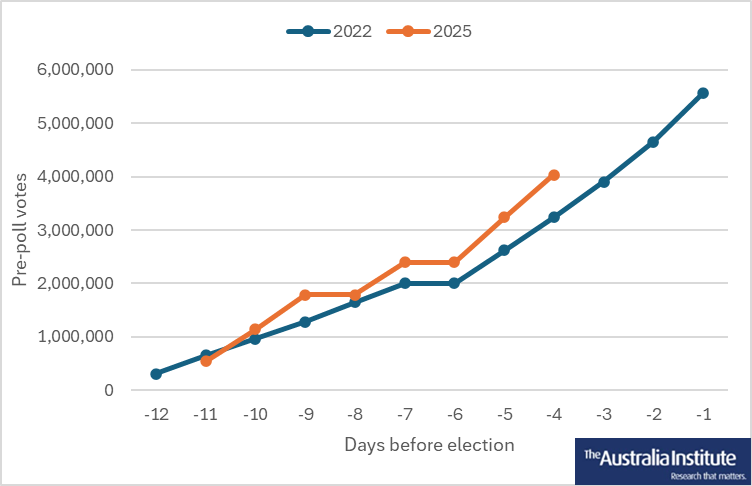
Yesterday saw another 800,000 Australians vote early, continuing this year’s trend of record high early voting. That’s slightly down from yesterday when about 840,000 voted, but still almost 200,000 more than the same point last year. In total four million Australians, 22% of registered voters, have now cast a pre-poll vote – at this point last election only 3.2 million had.

So far postal voting is slightly lower than the last election, but with pre-polling numbers remaining sky-high it seems increasingly likely that this election will either match or beat 2022’s record for early voting.

Wondering how pre-polling has evolved over time, and what the implications are of so many early votes? You can read more about that here.

Now Anthony Albanese is being asked whether he would accept supply and confidence in a minority parliament and just SIIIIIGGGGGHHHHHHHHHHHHHH

Apparently the Joe Exotic from Tiger King (does anyone remember that time during the pandemic lock downs when that insane show had a chokehold on the world?) who is in jail for murder and animal abuse has endorsed Anthony Albanese on Instagram. (I am not checking this. My social algo is cooked enough as it is with all the politics)

A journalist seems to very seriously be asking whether anyone from Labor may have paid Joe Exotic, convicted murderer and animal abuser, for a social media endorsement.

Albanese:

He’s in jail. Isn’t that the question? I wasn’t even aware of it – I think the point of that question was to ask the question rather than to get a serious answer, I hope.

Albanese says that isn’t a criticism and he thinks it is good to have “a bit of levity” in which case, his idea of humour and mine are very different.

Asked if he has any SPECIFIC regrets (honestly – wtf to this question), Albanese says:

I don’t pretend to be perfect. You know, I work hard each and every day, and my motivation is really simple and clear, which is – what is in the national interest? How do we strengthen our country? What’s important is that, as prime minister, you make decisions – every day, you make decisions. And what’s important is that you continue to learn every day, and continue to grow every day as well, as a person. T

hat’s what my mentor Tom Uren taught me – to learn each and every day, and to try and learn every day. That’s my approach towards leadership. The other approach that I have towards leadership that I’m really proud of is that Cabinet government is back.

We actually have proper processes. You know, the former government didn’t have coordinated processes for a whole lot of submissions. I assure you, we don’t have an overhead projector with PowerPoint presentations. We actually sit around. We have proper processes. And I trust my ministers to do their jobs as well, and to bring things forward to us.

And I think the capacity of the team is one of the big differences in this campaign as well. You’ve got senior people – but also you’ve got a backbencher and an assistant minister here as well, and people who have a capacity out there – don’t have to be hidden. The other mob have shadow cabinet ministers who haven’t been sightened. They’ve got people who aren’t allowed to leave their electorate, let alone talk to anyone. I’m really proud of my leadership style. I think my leadership style is one that has brought us unity – not unity by doing nothing. Unity by doing something.

SO NO REGRETS? NOOOOOOO RAGRETS?

Albanese:

I’m not saying that at all. I’m saying that what’s important is that you learn. You learn each and every day. And that is what I do.

Q: As you’re aware, the Coalition is planning a whole lot of cuts. One of the things that it proposed was slashing the EV tax break. This is something that was designed by Treasury. It was meant to cost $55 million a year. It’s costing more than $500 million a year. That’s a shocking blow-out. And a lot of these very-well-fed, … lovely people in this room would probably be getting that tax break. So, what justification is there for such a generous tax bnreak to go to the well-healed, and will you pledge now to at least look at revising it?

Albanese:

One of the reasons why it costs more is that it’s been very successful. Is that more people are participating in it. And it was designed to support lowering our emissions by addressing a change which is occurring. We’re having – I was Transport Minister a long time ago, and I remember going to a conference in Tokyo, of all the big manufacturers and transport ministers around the world. At that time, 2008 I think it was – might have been 2009 – the manufacturers – whether it be Japanese, American, European – all were saying there wasn’t any research being done into an internal combustion engine vehicle. And what we’ve seen is Australia move beyond the sort of nonsense that the Coalition did of having – saying that you can’t – you know, you can’t have a ute, you can’t tow your boat, you can’t… all that nonsense. We do have a shift in technology when it comes to transport around the world. We were one of two nations – the other one being Russia – that didn’t have any fuel standards.

We’re the only ones. It meant we were only getting the really expensive vehicles. What’s happening now is that Australians are getting access to cheaper vehicles – that’s a good thing.

Q: Yes, but if your Medicare increase was not costing $8.5 billion but $85 billion, you would revise it, wouldn’t you?

Albanese:

Well, we have costed policies, and we are…

Q: Clearly not very well, when it comes to this one.

Albanese:

No – what’s happened, and what often does happen with technology, is that Australians are great uptakers of new technology. It’s actually one of the things that will lead us to success, is the fact that my government makes no apologies for being involved in things like the quantum issue and a whole lot of other issues. We need to shape it as we go forward. This is one of the ways that we have done that. And it is in place.

Q: My question is… ..why you have to exaggerate in this campaign. Why can’t you win this election by telling the truth?

Albanese:

We are absolutely telling Australians – as Peter Dutton did on Sunday night in the Channel Seven debate, to give them a free ad to match Channel Nine’s ad – that, when asked about Medicare, he said the reason why he tried to abolish bulk-billing and introduce a GP tax every time people visited the doctor was he wanted it to be sustainable. He belled the cat. That’s still his view. In saying that, just days ago, he was saying that Medicare is not sustainable. Sussan Ley has stood up in the parliament and spoken about the Liberal Party doesn’t value things which are free. Medicare’s free. Free TAFE. A whole lot of things are free that are important, that Australians value.

Q: So he’s going to abolish Medicare?

Albanese:

He tried to abolish bulk-billing. He tried. He tried, and then he tried, also, to introduce a tax – a payment – every time people visited a hospital: He tried to increase the costs of pharmaceuticals by $5. When he couldn’t get his way, he froze the Medicare rebate for six years. He ripped $50 billion out of hospitals. This is a matter of record. And Peter Dutton said that, if you want to look at future performance, look at past performance. Look at past performance. What I did on income taxes was to come here, front up, say, “I have changed our position.” Why? Because there are cost-of-living pressures on people, and it wasn’t sustainable to, on 1 July last year, to say that you and I get $9,000 and the people who’ve served this meal, the people who’ve cooked it out the back, the people who’ll clean up after us in this room when we leave, get a big duck egg. That is not the Labor way. I fronted up. I had the argument. I won the argument. And they voted for it.

The Labor people in the room give him applause for htis.

Q: I want to come back to Michelle’s point about revenue raising or lack of restraint to get the budget back out of the red. I know you’ve ruled out a lot of things, but it’s a pretty known secret around Canberra that Treasury wants to go after trusts – it’s something that Labor looked at back in 2019 and there is support in your ranks for it in the past. Is it something that you would look at after the election in terms of the tax treatment of trusts?

Albanese:

What we’re looking at is what we’re putting forward at this election campaign. We want Australians to get lower income taxes – that’s what we’re looking at. And we have a comprehensive plan that we’re putting to the Australian people.

Q: What about making money?

Albanese:

Well, what we have done, also – I mean, you’re speaking to – there’s a Finance Minister and Treasurer just here who, two days ago, put out our fully costed plan. Where is the Coalition’s? We are now just three sleeps away from the election date – but, importantly as well, many millions of Australians – 1 in 4 – have probably voted already. Already, either through postals or in pre-poll. And people have no idea about what their cuts are.

And Peter Dutton, in the debates that have been held, has actually said and quoted John Howard as an example that you can’t actually come forward – it was in the Channel Nine debate, where you were part of the panel – you chose wisely [in your question] at that time, he said, “Oh, well, you can’t do anything because you don’t know the state of the books.” I mean, if I had have stood here at the last election and just … said, “Oh, we won’t tell you what cuts we’ll make. We won’t tell you how things add up. Just trust us – we’ll tell you after the election.” ..I would have had an interesting and appropriate response, I reckon.

And Peter Dutton deserves the same.

Back to the question of defence reviews – does Australia need a refresh given the last one was before Donald Trump was back in power?

Albanese:

You don’t need a refresh to tell any Labor prime minister, the party of John Curtin, that we need to defend ourselves. I think it was a Labor prime minister who understood that the kowtowing to the UK, as it was then, wasn’t going to defend Australia. And I’m very proud to be part of the same party that defended Australia – importantly, turned to Curtin not with an election, because the existing UAP government – conservative government – toppled out of office because people thought they needed the national interest defended, and it was Labor who did it then, and it’s Labor that’ll do it now.

Well, that’s great and all – but are we going to see any of that? Because so far, courage in politics on defence policy has been pretty impossible to spot.

Federal government still reviewing salmon farming in Tasmania’s Macquarie Harbour, FOI reveals

Eloise Carr
Director, Tasmania

A new Freedom of Information decision shows the federal government is still reviewing salmon farming in Tasmania’s Macquarie Harbour. The Australia Institute led the work that triggered the review, along with two other organisations. Federal government scientists and the environment department find salmon farming is the primary threat to the Maugean skate and that it remains on the brink of extinction. Despite this, the government and opposition united to gut Australia’s environment laws to protect the salmon industry – not the skate – in the final week of Parliament.

The FOI decision, which refuses to release the department’s latest advice to the Minister, shows the department is making the right call by following due process and listening to the science, while the minister is playing politics. Refusing to release the documents is based on the decision being under active assessment. In other words, the minister – whoever that is after the election – will have to make a finding on the impacts of fish farming in Macquarie Harbour.

Either the department has it wrong, or the minister does, but they can’t have it both ways. If the Minister insists the reconsideration no longer has to be dealt with,  then they are improperly exempting the documents and should instruct the department to release them, before any more people cast a vote at this election.

The department’s advice has been saying for 18 months now that fish farming in Macquarie Harbour is the primary threat to the skate and should be more comprehensively assessed under national nature laws. The salmon industry has never been subjected to comprehensive environmental assessment, despite operating in a World Heritage harbour and threatening the extinction of a world heritage recognised species, the Maugean skate.

Fact check: tax

Greg Jericho
Chief Economist

Q: Prime Minister, given the increasing demand for government services, and the softening of some aspects of the revenue base, will whoever is in government over the next 10 years have to take some action to increase the taxation base?

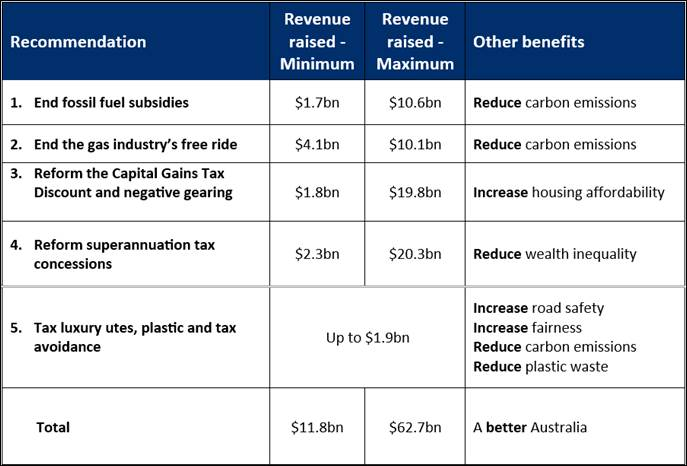
A very good question from Michele Grattan and she is quite right. Australia is a low-taxing nation and yet we demand and deserve good and appropriate public services. If we only raised as much revenue as the average of advanced economies we would raised $135bn more a year. That might be more than is likely, but our Raising Revenue Right report suggests a number of areas that could raise more revenue and make a fairer economy and ensure we have enough revenue to deliver better services

Q: Thanks for observing the tradition, Prime Minister, of being here today. You mentioned a lot of times in your speech today the backdrop of global uncertainty and, while the US President has featured in our campaign, there hasn’t actually been a discussion about exactly where that leads us. So, I suppose what I would like to hear from you is – do you believe that, given these new uncertain elements in the global outlook, we need to tweak our defence posture towards one that’s more focused on the defence of Australia – aside from what we’re doing with AUKUS – and does it also mean, given that you’ve responded to the US position on tariffs by reaffirming our view of free trade, that we should perhaps be joining a regional free trade bloc?

Albanese:

Well, we have very strong trade relationships in our region. And we’ve built on them as well through the work that we’ve done with ASEAN, hosting every ASEAN leader in March last year in Melbourne. What was important about that was the fact that every leader came. There were no deputies. There were no vice-presidents. Every leader of those important nations came to Australia. I’ve hosted Prime Minister Modi here. I’ve hosted the Premier of China here as well, our most important trading partner. We have built up really significant economic relationships, and what will be the third-largest economy in the world as well. We’ve improved our economic partnership with India.

I think there’s a great deal in which that can grow. The US tariffs need to be put into perspective. Exports to the United States are under 5% of our total exports. Just to give one example – in the meat sector, what’s happened because of the disruption between the US and China is that Australian producers are opening up greater opportunities of exporting even more to China. So, out of some of these trade disruptions, what will emerge, I think, is – yes, some challenges, but also some opportunities for us.

And that is what I’m optimistic about, and that is what I mean by “serving our national interests”. On defence policy, let me tell you – the Defence Strategic Review was about defending Australia. That was what it was about. And that’s why things such as the production of missiles will happen. Manufacturing will happen here this year. So, not just purchasing, not just procurement from somewhere else, but how do we become more resilient as a nation in terms of our defence policy? And that’s why our $57 billion increase in defence investment is so important. But it’s very much targeted to what are Australia’s national needs as a result of our strategic review.

Q: Prime Minister, given the increasing demand for government services, and the softening of some aspects of the revenue base, will whoever is in government over the next 10 years have to take some action to increase the taxation base?

Albanese:

Michelle, we’re taking our plans that we intend to implement to this election. What it will do – and it is a big distinction – we’ll have not one, but two income tax cuts taking that bottom first rate, the $18,200 to $45,000 rate from 16 down to 15 and then down to 14.

We think one of the things that that will do, and the modelling when we changed the former government’s legislated tax cuts to make them Labor tax cuts – which, by definition, were fairer and delivered for everybody – part of the modelling there showed that it increased workforce participation, that it would actually have a benefit for the economy as well. We know that the Coalition is saying that they’ll jack up income taxes and they’ll undo that and ledges late for higher income taxes at the election.

Q: You mentioned it there in a big part of your campaign obviously has been the bulk billing incentives which you say your modelling says it will get bulk billing rates to 90% by 2030. The AMA and the RACGP say they don’t see that sort of uplift. So that voters can actually test this claim of yours in the modelling, what does your modelling say bulk billing rates will get to by 2028?

Albanese:

The AMA haven’t always been great fans of the whole concept of Medicare. That’s the truth. So we’re not shocked that occasionally not every doctor comes on board there. But the reason why we are so confident is because this is not some academic exercise. In last year’s Budget, we tripled the bulk billing incentive for concession card-holders and what that has done is lift bulk billing rates up to well above 90%.

Doctors under our scheme will go from getting – if they’re in a fully bulk-billed clinic, will go from earning around about $280,000 to above $400,000. The modelling that we’ve done shows that it will be in their interests to have fully bulk-billed service and throughout the country, I’ve got to say I’ve spoken to doctors from Bridgewater in Tasmania to regional Queensland, Perth, Adelaide, who’ve said exactly that, that that is their intention, is that this change will make that difference.

Q: Your modelling must have a 2028 figure, though? A percentage improvement?

Albanese:

What we’ve got is a 2030 target of achieving that and it will go up between now, 2025, we’ll, of course, this is a measure that was in our Budget, that was funded and that is our objective by 2030.

Albanese:

There is a real choice before the Australian people this Saturday. The Liberals and Nationals have spent three years raging about problems that their decade in office created, with not a word to say about solutions, no proposals of their own, just militant opposition to our cost-of-living measures and mindless negativity. The Coalition have spent three years trying to make life harder for Australians because they thought it would make politics easier for them. Talking Australia down to try to build themselves up.

The Liberals have not changed and they have not learned. It is very clear to all that they have simply not done the work that you need to do if you are to present as a credible alternative government.

Now, I can tell them this – the Australian people have worked hard in the face of unprecedented challenges – the worst global inflation since the 1980s, the biggest international energy crisis since the 1970s, conflict overseas, and natural disasters at home.

Australians have worked hard and today underlines the real progress that we have made together. When we came to government less than three years ago, inflation was over 6% and it was rising. Today, it’s down to 2.4%.

Real wages have grown five quarters in a row. Interest rates have started to come down, and more jobs have been created in the last three years than during any term of government since federation.

Anthony Albanese press club speech

Anthony Albanese is delivering his press club address. It is very normal areas at the moment, so we will come back when the question and answer part and bring you anything which is new.

Consultants are neither frank nor fearless, but they are very expensive 

Pritika Kumar

The Coalition’s election pledge to cut between 36,000 and 41,000 jobs from the Australian Public Service raises a lot of questions, like who would do the work that keeps the Australian government going? The answer, most likely, is a swarm of private consultants. In 2021–22, the last year the Coalition was in power, the Australian Government’s contracts with the five biggest consulting firms totalled $2 billion – an amount that could have funded 14,700 additional public servants for a year. Australia Institute research shows that capping or cutting the public service is counter productive – departments and agencies more efficiently use public money when they are able to spend it employing public servants as needed.

But this isn’t just about money. The Australia Institute has highlighted that an overreliance on private consultants undermines the public service and weakens Australian democracy. PricewaterhouseCoopers (PwC) were banned from bidding for government contracts because they shared confidential government information with clients looking to game Australia’s tax avoidance laws. And don’t forget that PwC also had its fingers in the Robodebt pie. In testimony before the Royal Commission into the Robodebt Scheme, PwC disclosed that it did not document why it stopped working on a 70-page report, which was critical of the scheme, even though it was paid nearly $1 million to work on it. 

Would the illegal and cruel scheme have ended sooner but for the complicit silence of consultants and senior public servants?

The elusive ‘Chinese spy’

Frank Yuan
Postdoctoral Research Fellow

Folks, a second Chinese spy allegation has hit the campaign, as reported by Amy earlier.

Yesterday it was Teal MP Monique Ryan, today it’s Labor’s Clare O’Neil who was accused by her opponent to have allied with some organisation with links to the Chinese Communist Party to help out her campaign. Never mind that both Ryan and O’Neil have said that they have not, ultimately, declining the assistance.

Interestingly, the spooky organisation in question in both instances is the Hubei Association (you can find a Chinese language profile of their president here). From what I can tell, it’s an Australia-wide community association for those from the Hubei province, whose capital city is Wuhan… the very place where COVID-19 started. How deep does that rabbit hole go?! Somebody please get our best pundits on the case!

In all seriousness, it’s facile to suggest that the Chinese Australian members of the Hubei Association are spies. All of these sizable diaspora organisations are in touch with various semi-official and official organs in China, including the Chinese Communist Party’s United Front Works department. The department has such a wide purview that it’s unlikely to have espionage as a core function – China has an intelligence agency in its own right.

So, are we supposed to believe that these would-be Chinese Australian volunteers (whose involvement in that form was declined by the candidates anyway), somehow exist in a multi-level hive-mind, connected all the way to the Chinese leadership compound in Beijing?

If that’s the case, the whoever in charge of China’s espionage operation in Australia should fire the president of the Hubei Association for his indiscretion, since his ‘operatives’ volunterily revealed to social media that he asked/demanded (‘要求’) that people support Monique Ryan.

Or perhaps an over-enthused community leader just acted out of line to promoted his own political preference?

More on inflation

Matt Grudnoff
Senior Economist

At 2.4%, inflation continues to be firmly within the RBA target band. This represents the third quarter in a row that inflation has been below 3%.

The trimmed mean, which is the measure used as an indicator of where inflation is headed, is also falling rapidly and is now below 3%.

The RBA has no excuse not to cut interest rates. Add to this the fact that monetary policy (changing interest rates) takes a long time to impact on the economy, and these figures show the RBA should have been cutting interest rates months ago.

Some of the previous big drivers of inflation are no longer rising at an elevated rate. For example, the cost of building new houses has increased only 1.4% over the last year.

In other areas there has been improvement, but price increases are still too high. One of the biggest pain points has been rents. While the annual increase has come down significantly from it’s high of 7.8%, it is still too high at 5.5%.

Before the release of the latest figures the markets were predicting a 100% chance of a rate cut at the next RBA meeting and a small chance of a double cut. There is nothing in these figures that should change that.

Jim Chalmers is doing a press conference on the inflation figures, and he notes that there is no one in the room because everyone is either on the campaign, or at the press club for Albanese’s speech.

Let me be relatively brief given the PM is up shortly at the National Press Club. We’re really pleased to see headline inflation in the bottom half the reserve banks target range again. At 2.4 %. And especially encouraged to see trimmed mean underlying inflation within the reserve banks target and as well. At 2.9%. This means underlying inflation is now at its lowest level in three years. This is a powerful demonstration of the progress that Australians have made together in the economy. This is proof of the responsible economic management which has been a defining feature of this Albanese Labor covenant. Underlying inflation has fallen again and as I said, this means both headline and underlying inflation is within the reserve banks target band for the first time since 2021.

Under Labor inflation is low. Real wages are growing, unemployment is low. We’ve got the debt down, growth is rebounding solidly in our economy and interest rates have started to come down as well. So this is a powerful demonstration. Of the progress Australians have made together under Labor on inflation and on the economy more broadly as well. Inflation was much higher and rising very sharply when we came to office.

And now it is lower, much lower, and underlying inflation has fallen once again in these numbers that we are seeing today. Monthly inflation is also below the midpoint of the Reserve Bank’s target band and in that case for the fourth consecutive month.

So if you think about the economy we inherited and the economy that we finished the term with, headline inflation was 6.1 % and rising now 2.4. Trimmed mean inflation was 4.9 %. It is now 2.9%. That shows progress we have made together.

ABS has an update on what Australia’s population looks like:

The ABS has released the annual update to Australia’s population by country of birth, with data
for 2024 now available.
Here are 9 facts about Australia’s overseas-born population.

  1. In 2024, 31.5 per cent of Australia’s estimated resident population were born overseas, up
    from 30.7 per cent in 2023 (an increase of 396,000 people).
  2. The overseas-born population in Australia has grown for the third year in a row, following a
    decrease in 2021 due to the COVID-19 pandemic and associated international border closures.
  3. In 2024, almost every country in the world was represented in Australia’s overseas-born
    population.
  4. The top five most common countries of birth for those not born in Australia were England,
    India, China, New Zealand and the Philippines
  5. The largest increases in Australia’s overseas-born population over the 10 years to 2024, were
    people born in India, China, the Philippines and Nepal.
  6. Italy has dropped out of Australia’s top 10 countries of birth for the first time since 1901.
  7. The median age for Australia’s overseas-born population decreased from 46 years of age in
    2004 to 43 in 2024. The median age for the Australian-born population increased from 32
    years of age in 2004 to 35 in 2024.
  8. In 2024, those born in Latvia had the highest median age in Australia’s population, at 80 years
    of age.
    Those born in Qatar had the lowest (14 years of age). (The beautiful Balts!)
  9. Australia’s population ranked eighth in the world for the number of overseas-born (with 8.6
    million in 2024 based on data published by the ABS and the United Nations
    (https://www.un.org/development/desa/pd/content/international-migrant-stock) ). The USA
    had the largest population of international migrants (52.4 million people born outside the
    USA

CPI figures – trimmed mean falls to 2.9%

Greg Jericho
Chief Economist

Key statistics

  • The Consumer Price Index (CPI) rose 0.9% this quarter.
  • Over the twelve months to the March 2025 quarter, the CPI rose 2.4%. – this is steady from December
  • The most significant price rises this quarter were Housing (+1.7%), Education (+5.2%) and Food and non-alcoholic beverages (+1.2%).
  • Partially offsetting the rise were Recreation and culture (-1.6%) and Furnishings, household equipment and services (-0.9%).

Importantly for anyone wondering if the RBA could find any reason not to cut rates is that the trimmed mean (which is the underlying measure) fell from 3.3% to 2.9%.

Peter Dutton has been banging on about the underlying inflation because it was been above 3% unlike the CPI, but now… well even that line is gone.

OK, I can not do anymore on this. It’s non-answers to every question and we all only have one life to live.

Dutton dodges questions on value similarities with One Nation

Q: Mr Dutton, Pauline Hanson says you’ll be a great Prime Minister as long as you keep adopting One Nation policies. Given the preference deal that’s been done if the Coalition does form Government, will she have a seat at your Cabinet table?

Dutton:

Of course not. We said right at the start that if you want to change government and want to get the country back on track, vet for your Liberal or National Party candidate. I wouldn’t be mucking around with Independents and third parties at this election. I really wouldn’t. We don’t want to see a European situation where university got a handful of Greens and left-leaning teal candidates holding the Government to ran some. That won’t be good for us. There could be a global recession. There could be conflict across the world somewhere. We need a strong government and a competent government. We need a Prime Minister capable of making the decisions in our country’s best interests and the best way to do that is to change government, to get rid of this bat government and to support the Liberal and National candidate at this election. If you do that, there’s immediate relief of 25 cents a litre off fuel, $1200 back by way of tax rebate. That’s money you’ve worked for. You’re going to cut the ute tax which adds about $14,000 to a Ford Ranger. We’re going to make home ownership a reality for young Australians and we’ll keep our communities and countries safe as well.

Q: Does the Coalition share values with One Nation?

Dutton does not answer.

Q: On mental health in your view, how can we reverse the scourge of mental ill health in young men? Do you think masculinity of social media influencers should come under closer scrutiny for some of the messages they’re spreading to young men?

Dutton:

I think it’s a really good question and I think there’s many parts to it. There is certainly an influence online. There’s certainly an influence through gaming and the violence and the sexualised nature of some of that content, algorithms in big media companies have a lot to answer for in relation to this as well and I’ve been, you know, I’ve spent a big part of my career fighting back against Facebook and others for the content that they allow kids to consume online, both young boys and young girls, the sharing of images and the lack of responsibility from those companies.

I think everybody has a responsibility here. Parents certainly do. We need to educate our children to deal with online. There’s a lot that happens online that none of us would accept our kids being exposed to in the real world at school or the local park or in houses or when they went to sist family or next door neighbours so why would we allow this zoo to operate online? We have to make sure there’s property guidelines and people should have responsibility, particularly those with influence and it’s a huge issue.

Dutton then dodges the follow up questions on how much nuclear would actually cost, where the water would come from, what the tech is planning to use…

Again, there is a habit within the media to claim that Dutton is more approachable and faces more questions in his (campaign) press conferences but the truth is, he has just been better at dodging them. It is day 33 now, things aren’t going his way, so he’s no longer even pretending.

Q: On nuclear energy, with your criticism of Anthony Albanese’s $600 billion claim for your nuclear program, you said in fact it will cost around $116 billion, just to build the plants… (That’s a CSIRO based figure of the upper level of the plan)

On Frontier modelling with the specification of using A P1,000 reactors made by Westinghouse, relatively cheap compared to other models. Your frontbenchers David Littleproud and Ted O’Brien have said repeatedly the Coalition will not build those types of reactors in locations where there is no water. They’ll use dry-cooled reactors perhaps and they cost up to four times more according to the World Nuclear Association. How can you say that you know the specific cost of your nuclear plant when you haven’t finalised the models you’ll you use?

Dutton:

Frontier Economics, as you know, is the most accomplished and most credible economist in the country when it comes to modelling the energy market. They’re a firm used by Labor, including Premier Malinauskas in South Australia. What does their analysis say about the offerings of two parties? Firstly, they say that Labor’s renewables-only policy will cost an additional $263 billion on top of what our policy will cost.

They conclude that our policy will be 44% cheaper than Labor’s. So that means electricity costs will go down. And in relation to our east-coast gas reservation, they say the whole sail price of gas will come down by 23%. Now, Frontier has assumed costings, as you made reference to the CSIRO, as they have, in relation to the cost, which will be averaged out. So you’ll have a look at the different sites and the point in relation to the policy is that we’ll take expert advice on the best fit for those seven sites.

Q: This is a sect which treats women as second-class citizens and doesn’t tolerate homosexuality at all. Surely you don’t think those are shared values with the government?

Dutton:

The point I make is people will support parties for different reasons and people of Islamic faith are involved in this election. People of no faith, people of the Jewish faith obviously feel particularly aggrieved, as they should, by the anti-Semitism that we’ve seen in our society over the course of the last couple of years and they’ve seen anti-Semitic Jew-hating Greens party (this is a lie and frankly grossly irresponsible. Opposing genocide and the actions of a nation state is not anti-Semitism. Israel is currently in front of the ICC on allegations of collective punishment over its denial of food, aid and medical supplies into Gaza, which has been ignored by the Coalition) and the conduct of that party, but some people will be out supporting the Greens and that’s the reality. For our party, the plan that we’ve got as we go into the election is to cut fuel by 25 cents a litre, to give $1200 back by the way of tax rebate, to help people deal with the cost-of-living pressures they’re under and to make sure that we can get our economy back on track so we can deal with the cost-of-living crisis, bring inflation down, bring interest rates down and cut Labor’s taxes.

Dutton again defends the Exclusive Bretheren sect coming out in droves to hand out for the Liberal party as freedom of religion.

He then attacks Clare O’Neil and Monique Ryan over their volunteers. It’s all going very well.

Dutton avoids another question on consultant spend, falling back on the nonsensical ‘we’ll manage the economy better’ line.

Public servants are workers. They are people. It is cruel to pretend they don’t have families, or bills, or financial constraints like everyone else. And you want to know why public service employees find consultancy work so attractive? It’s the same work, with less responsibility and more money.

Dutton also avoids questions about action against his candidate in Fowler for the second day in a row:

Q: I asked you yesterday whether keeping a candidate who would blame someone’s mother for their daughter experiencing domestic violence squares with your plan to tackle the issue. I want to check again while we’re at a charity if you still think an apology is enough for someone to stay on as a candidate. When the Liberals are not likely to win Fowler, why not dump that candidate?

Dutton:

I’ve made it clear that I don’t endorse or accept the comments.

Q: You do endorse the candidate. He’s apologised for it. Would you call the Prime Minister weak if he did the same thing?

Dutton:

There’s a question at the back.

Q: Will the consultant spend be higher under the Coalition than it is under Labor, given the plan to cut the public service?

Dutton sidesteps this one too:

What we’re going to do is spend taxpayers’ money wisely and that’s exactly the approach that the Howard Government had. We want to make sure that we respect people’s money. At the moment, people are working second and third jobs. You’ve heard the stories as we’ve moved around the country. People who are working full-time but taking an extra shift at the servo or the bottleo on a Saturday night.

The number of people who care about the ‘Howard’ approach to things is rapidly diminishing in Australia. Not sure if the Coalition have worked that out yet.

Peter Dutton has walked away from recession claims though

Q: Mr Dutton, CPI figures are out today. If inflation falls, is that a vindication of Labor’s economic success?

Dutton:

Let’s hope that CPI comes down because interest rates have risen on 12 occasions under the Government. They’ve only come back once. And a big-taxing Labor-Greens government will be a disaster for the economy. I want to deliver our positive plan which will bring interest rates down because we’ll be able to bring inflation down because the Liberal Party is always a better economic manager and interest rates have been higher for longer under Labor. They’ve come down in the US and the UK and Canada and New Zealand before they’ve come down in Australia and that’s because the Government here has spent more than they have in 40 years and that’s kept up inflation. A Liberal Government will be better for the economy, better for inflation and better to help you with the cost-of-living pressures you’re feeling.

Peter Dutton press conference

Dutton is back in the big dumb utes! We are in sandbagging, protect what’s left territory for the rest of the Coalition campaign, as the AFR’s Paul Karp observed this morning:

To me one of the most telling signs is a very late Coalition campaign pivot away from courting independent/swinging voters back to consolidating right wing base (welcome to country).Feels they've shifted into save the furniture, win PHON preferences, save Dutton territory, not win govt mode.

Paul Karp (@paulkarp.bsky.social) 2025-04-29T21:31:47.217Z

Q: Anthony Albanese told News.com.au that voters see you as aligned with Donald Trump and that’s not something they want in this country. What’s your response to that? And do you think Mr Trump has hurt conservative candidates in this country the same way he did in Canada?

Dutton sidesteps the question:

This is an election between three more years of Labor under Mr Albanese, which I don’t think Australians can afford, or our plan – which is to cut petrol by 25 cents a litre, to give $1200 back by way of tax rebate, to help families with the cost-of-living pressures now, axe the ute tax and make sure we can help families, young families, young home-owners get a home sooner. And Mr Albanese doesn’t want to talk about the last three years because he can’t tell people that they’re better off. He can’t talk about the achievements of the government, which is why the negative stuff continues to flow. But there’s a positive plan that we have and that’s what we intend to implement.

There is a lot of independent new media who are doing excellent work this election campaign, looking into issues which legacy media isn’t looking at.

Alex McKinnon has done an incredible deep dive into the Minority Impact Coalition, which is running astro-turf (a polite way of saying propaganda) campaigns in inner-city electorates which you can find on his newsletter.

Anthony Klan at The Klaxton has been looking into some of Advance’s funding, including that the Liberals donate more to the group than the nation spends on Welcome to Country funding

Declassified Australia has been examining exactly what has been happening with some of Australia’s defence spending and also the weapon ‘parts’ supply chain that ends up in weapons for Israel

and Cam Wilson has been looking at some of the tech companies and how tech has been playing a role in the campaign at The Sizzle

That’s just a few – but there is a great emerging trend of journalists doing incredible work outside of the mainstream – it’s what we have been seeing in the US and Europe (Dropsite News is an amazing outlet for anyone looking for US stuff) and it is really good to see good journalists start to break away and do the same thing here.

At uni do you get what you pay for? (Spoiler, no. Students are getting screwed)

Skye Predavec
Anne Kantor Fellow

Chart: The Australia Institute Source: Department of Education, Parliament of Australia and Australian Bureau of Statistics; Staff-Student ratios: Department of Education (for 2009-2023), ABC (2013) National Tertiary Education Union correct on university class sizes (for 1990-2008, ABC analysis of figures from Universities Australia) Get the data Created with Datawrapper

35 years after the HECS/HELP system began, university students now pay much more for much less.

Getting a university education in Australia has gone from being a modest expense to something that is now much more costly than was envisioned when HECS was introduced in 1989. Fees for degrees such as Law and Society and Culture are over 700% higher than they were in 1990 – far more expensive than if fees had risen with inflation.

While you might expect to get a better education for more money, that isn’t the case.  Across the sector, staff-student ratios – a key measure of quality – have gone from under 1:13 in 1990 to over 1:22 today – a 42% decrease in the number of academic staff per student.

The changes that started the upwards trajectory of university fees were justified in part by the idea that teaching costs were increasing. Since then, the actual number of staff that universities employ to teach students has shrunk.

Under the original 1989 HECS system, student contributions were modest: only $1,800 per year, no matter what the student was studying. These contributions increased annually in line with rising costs for the university. The system was partially deregulated in 1996 by the Howard Government and different courses were priced differently, a decision justified on the basis of:

  • The cost of teaching (for example, teaching dentistry is more expensive than teaching history).
  • The graduate’s expected earnings (for example, graduates in fields such as law and business tend to earn more than those in creative arts and social sciences).

Continued deregulation and price-hikes, most recently the Morrison government’s Job-Ready Graduates scheme which lowered contributions for some courses while raising them in many others, have seen the cost of university education skyrocket. The current degree structure has little to do with either the cost of teaching of the graduates expected earnings. Worse while fees have risen the number of teaching staff per student has fallen

Fewer staff means larger tutorials, fewer contact hours and much less feedback provided on assignments.

The high price of higher education means that Australians who want to study have to be willing to take on  potentially life-long debts, all for a worsening university experience.

Election entrée: Longest wait for results

Skye Predavec

Anne Kantor Fellow

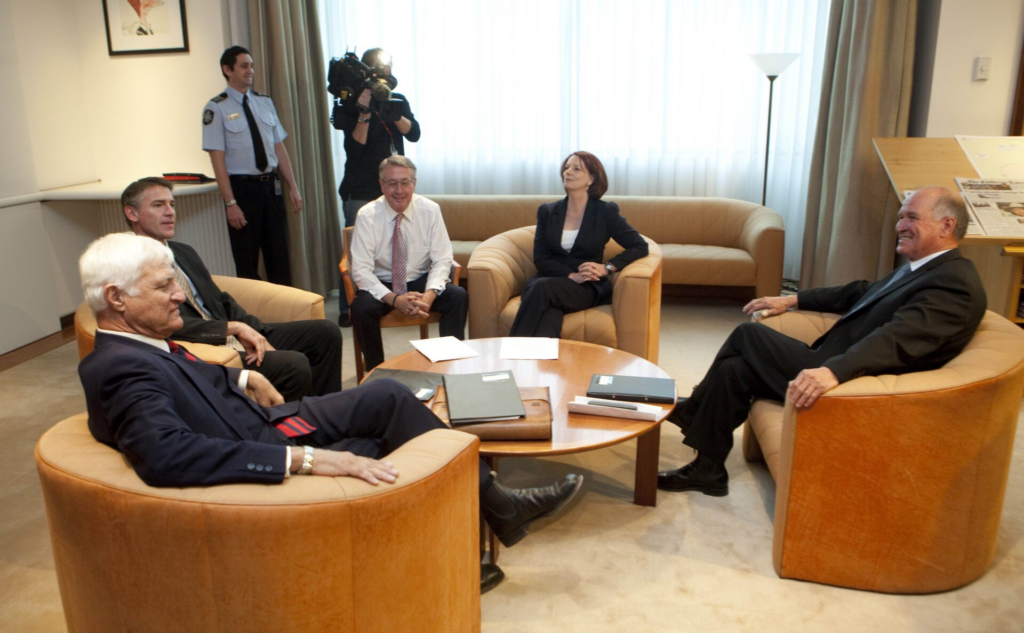
After the 2010 election, independent crossbenchers negotiated for 17 days with Prime Minister Julia Gillard and Opposition Leader Tony Abbott to decide who to support.

The careful deliberation would pay off: despite the slow start, the Gillard minority government would go on to pass legislation at a higher daily rate than any other Australian government.

17 days is far from the longest wait: after the 1922 election, it took 53 days of negotiations for the Nationalist and Country parties to agree to form coalition government.

The deal proved enduring; the coalition between these parties, or their respective iterations, has survived for over 100 years with only brief interruptions.

In fact, a wait of a couple of weeks or more is typical even in modern times.

The Australia Institute has compiled details of the 25 power sharing parliaments elected since 1989 at the federal, state and territory levels.

Most negotiations took 15 days or more. Last year, the Tasmanian Liberal Government took 32 days to strike an agreement with independents.

Australia’s post-election negotiations are short compared to many other countries. While Gillard and Abbott were negotiating back in 2010, Belgium was on its third month of a record 541 days of government negotiations. This is unusually long, but months-long government formations are the norm in many developed countries.

The last Spanish government negotiations took almost four months.

In 2021 it took 71 days from the German election for parties to strike a coalition agreement, and negotiations following the election in February of this year took 45 days, concluding only a few weeks ago.

AAP did what I just couldn’t bring myself to do this morning – listen to Michaelia Cash.

Here is their latest report on Schrodinger’s Trump phone calls:

The US president has confirmed he’s aware the federal government has been trying to get in touch to reach a trade deal, after Australia was slapped with 10 per cent tariffs on goods exports to America.

“They are calling and I will be talking to (Mr Albanese), yes,” Mr Trump told reporters at the White House overnight.

The prime minister said Mr Trump’s remark was a “throwaway comment” but indicated he would aim for a phone conversation, depending on the outcome of the federal vote.

“I’m not staying up at night trying to ring anyone at the moment, I’m in an election campaign,” he told ABC Radio on Wednesday.

“I’m sure if we are successful we will have a discussion after Saturday.”

“We have a relationship. We’ve already had a couple of phone calls, but I assure you that my campaign is front and centre.”

Mr Albanese said while a phone call with Mr Trump was not a guarantee, a conversation with world leaders such as the US president was likely after the election, should he win a second term.

At the final leaders’ debate of the campaign on Sunday, Mr Albanese said he wasn’t sure if the US president had a mobile when asked if he had his number, before adding that such matters were usually conducted on a more official basis.

Liberal senator Michaelia Cash said the fact that Mr Albanese hadn’t been able to get another one-on-one call with Mr Trump showed there was no relationship with the Australian ally under Labor.

“The previous coalition government – which, because of the nature of the relationship that we had – we were successful in getting the exemption from the steel and aluminium tariffs (under the previous Trump administration).

“So after this election we look forward – if we are elected – to speaking with our greatest ally, the United States of America.”

Time to shake up Australia’s university sector

Australia’s bloated universities are plagued with scandal and struggling under the weight of their own poor governance and financial mismanagement. 

A new Discussion Paper by The Australia Institute concludes it’s time for a major shake-up in the way they are run.

Australian universities are overseen by Vice-Chancellors who are paid vast sums of money, yet they are presiding over a sector which is failing staff, students and the broader community.

Australian uni students are paying more than ever for degrees while staff-to-student ratios are soaring.

For example, degrees in areas like Law, Society and Culture are 700% more expensive than they were in 1990 (the year after the HECS/HELP scheme was introduced), while staff-to-student ratios have gone from 1-to13 in 1990 to more than 1-to-22 today.

Professor John Quiggin, Professor of Economics at the University of Queensland, suggests seven key reforms:

  • Creating a national system of university education managed by the federal government
  • Ending the corporate model of governance and refocusing on education/research
  • Guaranteeing access to university education
  • Promoting co-operation, not competition
  • Federal control over international student admissions
  • Returning to the collegial model of academic governance
  • Creating a central system of sector-wide bargaining for the university sector

“Australia’s universities are plagued with scandal and failing dismally,” said Professor John Quiggin, Professor of Economics at The University of Queensland and author of the report. 

“Under the current governance structure, neither the federal nor state governments are properly accountable for Australia’s tertiary sector.

“Universities are treated as a disjointed set of quasi-private enterprises expected to compete against one another in a ‘market’ for higher education. Universities are not businesses and should not be treated as such. 

“The entire sector is in a governance crisis, fuelled by a lack of accountability to staff, students and government. 

“But, taking the right lessons from international experience, Australia can build an equitable university sector that treats education and research as a public good.”

Your comments

We are working on a different comment solution, but we just wanted to have some direct contact with you all and we are truly appreciating everyone who is writing in (and thank you for the compliments – I love being back with you all and will be also blogging parliament, so don’t worry about that!) This blog has only been alive for about 50 days or so all up, so to have so many of you already regularly tuning in to us is absolutely humbling and I promise you, I do not take a single one of you for granted.

Here is some of what you have had to say so far.

Greg says:

About Trump not answering the calls being made from Australia, I wonder whether Trump was caught on the hop about the calls from Australia that didn’t end with “Call me, call me now.” (lol)

The thought bubble about nuclear came from the Nationals who then got Ted O’Brien on board. That nuclear bubble was blown up and now is exploding in the face of Dutton. What a clever way to organise a coup, and a coup de grâce for Peter Dutton. (Actually O’Brien has been pushing for this since the Morrison years and was actually involved in an inquiry the Morrison government undertook looking at its feasibility. It was shelved under Morrison because it came back as you guess it – not feasible economically. It’s also, at least according to policy polling I’ve seen, the least popular policy of this election (of the ones people know about)

Angus Taylor is quick to claim friendship with the re-elected PM of Canada, Mark Carney (a progressive) saying they studied economics together. Will Carney ring Naomi Wolf asking how to get this no name to stop claiming friendship? (We love a long memory. IFKYK)

On that topic, Peter says:

So if Ted has aspirations to be Opposition Leader do we need to start the #TemuScoMo hashtag? I mean he has the same overinflated air of confidence not backed up by actual capability

As the originator of the Temu Trump label (it was a social media post that kinda took off with a life of its own) I say apply what fits, where it fits. (Ted O’Brien has always looked like someone drew Scott Morrison from memory to me)

Oliver says:

We’ve heard a lot about the ‘key seats’ this election, but given current polling indicates there is a drop in the Coalition’s primary vote (YouGov last reported they’re national primary vote was at 31% down from 35.70% at the last election), does this have the potential to put other seats in play?

Anecdotal as it might be, my mother received a call yesterday from a staff member for the Liberal MP for Banks, David Coleman, asking if she’d be willing to help out on a polling booth for a few hours on election day handing out how-to-votes. She’s never been involved in the Liberal Party or been a party member, so it’s made me curious if they feel other seats might be in danger if they’re now calling on random members of the public to volunteer for their campaign?

It does, because truly – there is no such thing as a safe seat. And maybe the majors are working that out. It will depend on how strong the preference flow is in some of those seats (Hunter for instance is a (very) slim chance of a One Nation pick up if the Nats vote is on the floor, and there are others, like Flinders, McPherson and yes, Banks and Deakin which have the Coalition nervous. But there would need to be a swing not just in primary, but in preferences)

James says:

Either Trumpet ignores replies, or they have real people reading the messages. If the latter, have Trumpet put them in an unsafe work environment due to all the abuse they will be seeing?

The replies to these messages don’t send, so no one other than you will be viewing them. It’s not often I agree with Angus Taylor, but he is right – try and block the number or at the very least, delete and ignore if they are bothering you.


CPI and interest rates

Greg Jericho
Chief Economist

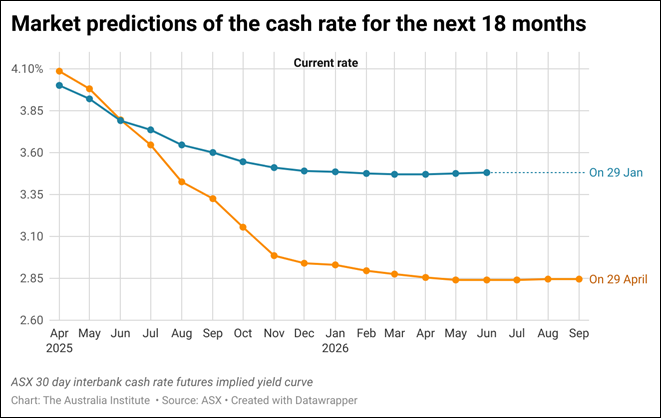
As we wait for the latest inflation figures to come out at 11:30, it is worth noting that a fair bit has changed since the last quarterly figures came out on 29 January.

Back then we were yet to see the RBA cut rates as they were still enjoying their 2 month Christmas holiday. After the December quarter figures showed CPI at 2.4% (ahh Peter Dutton, you won’t forget that number), investors were predicting a rate cut in the February meeting (they got that right) and then another two cuts by the end of the year.

Well since then, not only have we seen more monthly inflation figures and wages data, we have also seen the idiocy of Donald Trump in full force.

Now the market is estimating at least four cuts before the end of the year, and a very real chance of five.

We of course still have to wait till 20 May to find out what the RBA will do.

Jane Hume makes ‘Chinese spy’ allegation over volunteers because it’s always the 1950s in Australian politics

It wouldn’t be a modern Australian election (or indeed Australian politics) without allegations of Chinese spy involvement.

This time, it is aimed at Clare O’Neil. The Australian reported that a Chinese-Australian Labor party member ‘used an intermediary’ to gather volunteers for O’Neil’s campaign on election day. The ten volunteers allegedly have links to the Hubei Association which is in the news for its own alleged links to the Chinese Communist Party (which honestly, at this stage of the game, come on. Everything in China has links to the Chinese Communist Party. It is how they run government in China. Does that make every organisation a spy organisation? In Australia’s political climate yes, but in reality?)

O’Neil said that an offer was made to help on election day and it was ‘politely declined’. Jane Hume very much enjoyed it in her ‘debate’ with O’Neil on the Seven Network this morning.

The pair were discussing Peter Dutton’s (outdated) belief that as Australians “mature” they become a Liberal. Which is old fashion thinking from someone who grew up with something to conserve – the old theory going that people get more conservative as they age because they have individual assets and wealth they want to hold on to, and therefore become less about the collective, which younger voters promote because they don’t have that same asset wealth. But that was at at time when housing was fkn affordable and people had wage growth and public services actually took care of you. In reality, more Australians are turning to disruptors outside of the major parties with major parties lucky to have a primary vote with a 3 in front of it, while more people look to minor parties and independents.

Hume said of Dutton’s outdated characterisation: 

There is no doubt that as you get older and you have a family, for instance, that you start looking forward to what’s better economic management opportunities, what’s the future going to hold for the prosperity of our nation, not just for you, but for your kids as well. 

I’m sorry – who are these people? When I think about the future I don’t think about fricking economic management. I think about what the planet we are leaving kids is going to look like. What sort of country we are leaving them. I think about the prospect of a nuclear exchange and how we are sleepwalking towards a complete societal breakdown. I do not think who is going to get more fkn surpluses in a budget.

O’Neil says:

I just…you know, it’s Peter Dutton’s “it’s not me, its you” moment. In my experience, that doesn’t work romantically and it’s certainly not going to work politically. Fancy coming in days away from an election and pointing at at entire generation of people and saying “You’re not voting for me because you’re not mature enough.” It’s offensive and ridiculous. The truth is that the Liberals have nothing to offer young people this election. They say massive HECS aren’t a problem. Labor will cut them on 1 June. This is a party that doesn’t support penalty rates or pay increases for low-paid workers. Peter Dutton can’t even acknowledge that climate change is real…

The pair have a back and forth over who is coping harder and then Hume says:

There might be Chinese spies handing out for you, but for us, there’s dozens, thousands, hundreds of young people handing out how-to- vote cards for the Liberal Party.

O’Neil says:

I think they’re getting a bit desperate. If I was in their position, perhaps I would be too.

Your questions: the count and pre-poll

Lisa asks:

With the high number of pre-polling and postal votes happening, is there a chance we won’t have a clear result on Saturday night?
ps… Im loving the blog and the incredible work you are all doing to make sure we are hearing the truth and know the facts – not like some of the half-arsed crap that’s coming out of politicians’ mouths!!
(Thank you – and we will be doing the same when the parliament resumes)

In regards to your question, the count will start on the night as soon as booths close at 6pm and that will include pre-poll as well. The postal vote always is a bit delayed (because postals have longer to come in) and so whether or not there is a result depends on how many seats come down to the vote. So unlikely, but will depend on the night!

Angus Taylor sidesteps leadership question

What does Angus Taylor think about the non-stop Crumpet of TinFoil Hat text messages voters are receiving?

(It truly says something about this election that the one thing that has managed to unite Australia is how pissed off we all are at being bombarded with TRUMPET! messages at all hours of the day. How to stop them is even the number one story on the Fin this morning. (Spoiler, you can’t there is no opt-out with these messages which will no doubt become an issue after the election)

Taylor tells ABC News Breakfast:

I understand people’s concerns. I would say – and I’ve seems those texts too, James! – do what I do if you’re not interested in them, just delete them. I don’t see them again.

Look, if political parties want to do this, the great thing about our democracy is you can just completely ignore it. Don’t ignore our messages or course, James. They are very important. That’s what we stand I must admit… Ultimately people get to choose. I went pre-poll and the message was block them all.

Q: Since you came into Parliament, people have branded you Liberal Party leadership material. If the polls are right and the Coalition doesn’t form government after Saturday, is – would you put up your hand to be the leader ever the Liberal Party?

Taylor:

You know, James, I’ve gone after one job, which is to be Treasurer of this great nation and that would be a great privilege. I want to see a stronger economy, more prosperity, Australians getting ahead, buying homes, starting small businesses. That’s what I stand for and that’s the job I’m going after. I think our Treasurer has been out of his depth and out of touch and I think we can do better.

That’s not a no. Deliberately so.

We are getting inflation data today (around 11.30 as with all ABS releases) and that has economists thinking about the next RBA meeting where another interest rate cut is predicted. (Depending on how much of a wave Trump’s chaos creates, the market is predicting up to five interest rate cuts over current months, as central banks look to starve off recession threats from the blow back)

Taylor doesn’t want to talk about the RBA CUTTING interest rates. And he also doesn’t want to talk about inflation being in the target band of 2-3% (which is the rate of acceptable inflation, according to the RBA)

Taylor:

I don’t get into commentary on the RBA, unlike some of my opponents. What I will say is that it’s a widespread view that inflation is going to go back up. The IMF, for instance, is predicting it will go up to 3%, well outside the target range, over the next little while. We have to be ready for the prospect of rising inflation, not falling.

If we look at history, very often a surge of inflation, if it fades away, you see another surge not long afterwards. We have to be on alert for this. We’re deeply concerned that we’re going into an era where not only will we see sluggish economic growth but we could see a resurgence of inflation, and that’s why boosting growth and investment and cutting red tape is so essential to making sure we finally beat inflation and get the growth we need after 21 consecutive months of GDP per capita going backwards.

Coalition still coy on when costings will be released

So given that focus on budget management, when will the Coalition be releasing its costings?

“In the next day or so,” says Angus Taylor. Which is obvious, because there is only a next day or so left in this election campaign.

Taylor:

As did Labor and it at the last election. As is the convention. I won’t tell you here. You won’t need to wait long but I’ll give you a sneak preview. You’ll see a stronger economic position, a stronger Budget position than Labor’s and that’s because over three years we’ve been doing the hard work to find the savings that can ensure that we have a stronger budget. There’s two budgets we’ve got to fix here, James, the household Budget and the Government Budget and you’ll see a stronger position from us on both of those and that’s what Australians need.

There are questions over the savings Labor says it can make by cutting down on consultants, but there are even bigger questions over the savings the Coalition is claiming will come from cutting 41,000 public servants from Canberra (they have said they would all be coming from Canberra, which would destroy the local community, but also impact on national security staff)

Cutting the public service to save money, is like saying you are going to save money by cutting down on groceries and then going out to dinner every night. Because sure, you’re grocery bill has gone from $400 a week to $150 a week, but you’re spending $600 dining out.

Why? Because the work still has to get done and that means hiring short term labour and consultants. Which cost more. That figure though can be hidden in various ways in the budget (as part of particular projects for example) which means that it LOOKS like money is being saved, when in reality, costs have gone out – they have just been spread across different line items.

Angus Taylor very quickly claims Mark Carney friendship

Angus Taylor, who has been making his own pitch to his colleagues as a potential next leader of the Liberal party, leaning on his ‘dry’ Liberal qualities (which is basically just saying strict budget management’) was just asked about his thoughts on Mark Carney winning the unwinnable election in Canada and dropped this little line:

Can I first congratulate Mark Carney. He’s an old friend. This might surprise you. We studied economics together in the UK for two years and we’ve stayed in touch since and I think it highlights the importance of strong economic management. He ran on that above all and, of course, we want open access to markets, as do the Canadians. We want a strong economy, as do the Canadians. We want to see strong investment as I know Mark Carney talks about a lot and I think there are similarities on those things and he and I share a very strong view that a strong economy is the key to prosperity

And then of course, Taylor brings that back to the Liberals at THIS election (which is obviously different to the Liberals in Canada)

Taylor:

That’s what we’re running on, what I’m running on and what I’ll continue to run on. We see today numbers showing that if productivity had been what it used to be – it’s dropped by 5.7% under Labor, which we haven’t seen before – the economy would be $250 billion bigger, $60 billion more of government revenue. That’s what a strong economy gives you – stronger household budget, stronger government budget, greater prosperity. That’s what we want to do.

Trump tariffs and phone calls

There is still a lot of commentary over the Trump tariffs and whether or not the Albanese government could have done more to change the 10% tariff which was applied to Australian goods being imported into the US.

The SMH’s US corro Michael Koziol reported Trump was asked about Australia and told reporters:

They are calling, and I will be talking to him, yes.

Chalmers told ABC radio RN Breakfast that he would leave it to his colleagues (he means the prime minister) to work out when that might be but added:

Obviously, Australia, like every country around the world, is engaging with the Americans right now. We’re no different. We are not uniquely impacted by these tariffs, but we are uniquely well-placed and well-prepared.

Now, there has been a bit of commentary around Albanese’s comment about not being sure if Trump had a mobile phone (made during the last leaders’ debate on Sunday night) (Trump has a phone) and that under the Coalition, Australia managed to secure an exemption from the last round of Trump tariffs.

That’s a fundamental misunderstanding of THIS Trump administration. No country in the world has escaped tariffs this time round (cept for Russia and Trump says this is because the US and Russia ‘do no business) and tariffs were also one of the underpinnings of Trump 2.0s election platform. He, and those around him, are obsessed with tariffs as a general rule. It is only now, after massive domestic backlash and the market acting exactly as a scholar of Marxism would expect the market to react, that Trump is starting to backdown on some of the more outlandish tariffs. But so far, there has been no movement on the 10% tariff floor which applies to all countries as a baseline.

So the Coalition achieving an exemption in the last Trump administration is completely irrelevant because THIS round of tariffs apply to everyone, when the last time Trump was in office, they did not.

Now on the issue of the phone, it was a pretty stupid thing to say. Obviously Trump has a phone. The man is terminally on-line. What Albanese was trying to say is that it is not the relationship where you just ring up and say ‘hey, wyd?’ and that conversations between Australia and US leaders are always a formal affair.

Your comments – a One Nation resurgence and Ted O’Brien as Liberal leader?

Chris has responded to the chatter about One Nation maybe getting a boost in the senate from the Coalition preference deals:

Good help Australia if this is the case. Chaos will reign supreme with more nutters in the Senate,surely Pauline and Roberts is more than enough.
So glad you are back with a great blog Amy missed reading you.
(Thank you! I missed being with you all!)

While Chris has thoughts about Ted O’Brien’s thoughts he could be leader of the Liberal party:

On Ted O’Brien’s aspirations, and with all due respect to the broader Queensland population, doesn’t he realise that whilst the Qld branch of the LNP may dominate the LNP party room, it fails to resonate with the broader population in other states.

Still though Chris, the LNP has held a lot of sway in the joint-party room for years and if Dutton does fall as leader, there will be a power gap there and it is unclear who fills it – both nationally and at a state level.

Jim Chalmers has also been out, pretty much everywhere this morning.

He has done the breakfast TV shows, as well as ABC radio this morning.

His main job has been trying to cement the message that Labor’s costings are legit, that the Coalition haven’t released theirs yet and that ratings agencies like S&P have nothing to fear from the election promises.

Which is true. Australia is doing very well when it comes to 10 year bond yields, so Australia is considered a very safe place to invest.

Peter Dutton is starting the day with FM radio interviews, calling into Melbourne radio The Fox where he was asked for his election party tips.

I think alcohol is the first essential ingredient, I’m sure of that -responsible drinking as well,” Dutton said.

But not watching the ABC would be a good start. For any young ones at home, forget the ABC.”

Well, looks like our election night live pre-game makes Dutton’s list of requirements then:

On Clive Palmers’ never ending unsolicited text messages (which have no opt-out option) Lambie says:

All the parties do it, the only thing is that Clive has more money. The only time you see majors come together, doing electoral reform, when it suits themselves, and they want to get the independents out. It’s filth. That’s where we’re at. They won’t change those laws because they do the same thing. The only reason you’re not seeing them coming thick and fast, they’re not throwing quite as much money behind it. But they’re just bad.

Lambie then confirms that this is her last federal election campaign asking for a senate spot (she is going for another six year term)

That’s it for me, mate. I’ll be 60 then. I tell you what, I have done 16 years. You need fresh blood. But 16 years in a job – I think, it’s time for those young guns to come in. Take positions like mine and get us into a new era and see what they’ve got. Enough is enough. Sixteen years of Jacqui Lambie, people say that’s enough.

‘Both major parties are going to lose votes over salmon farming’ says Jacqui Lambie

Jacqui Lambie then speaks on salmon farming, which she says is a much bigger issue in Tasmania than people on the mainland realise:

I can tell you that salmon farming is a huge issue down here, and you will find that 65% of Tasmanians are against both of them. I would have thought they would have learned from a state election, when they thought these topics weren’t a hot potato, they’re very, very warm down here. All people are asking in Tasmania, those people who do – who do not want salmon farming, we’re asking those big corporations to push your nets out further in the sea, and get them out of Macquarie harbour.

Now, you know, that means they’ve got to take a hit, with their profits, so be it. But I tell you what – when you’re doing this at the expense of clean green Tasmania and its brand, I have a problem with that. So get those bloody nets and get them out in deep sea properly, so get them off the island, and also, um, get them, obviously, get them out of Macquarie harbour.

All they care about is making profits. They’re making those profits, on brand Tasmania. It’s not good enough. They’re not getting away with this any more. The people of Tasmania will win this argument. And yes, there will be votes that they will lose out there. Both those major parties. I tell you what, they’re not flying on the winds of the angels when it comes to salmon.

They take these donations from those salmon companies and have done for years. So you can’t believe a word they’re saying when it comes to salmon in Tasmania.

What we know, I’ve seen that sludge on our beaches. I’m seeing it in Macquarie harbour and so are the tourists. It’s time for the multinationals to make less profits and gets those god damn stinky fish out in deeper waters. That’s all we’re asking for.

On the absolutely ridiculous ‘debate’ over Welcome to Country, something that only became an issue after LITERAL NAZIS gatecrashed an Anzac dawn service to protest the Welcome, Jacqui Lambie says:

I will leave that for the associations right across, whether it’s on Anzac Day or any other time. If you’re having a meeting, you know, I think that’s your decision whether – that’s your association, whether you decide whether you want that, whether you want to sing a national anthem, that’s for people in charge of running whatever is going on that day. That’s for them to discuss with those people who do those ceremonies, and also with the national anthem. I thought this was going to become a problem in years to come. I can see it’s starting to, you know, rear its ugly head. I think this will be very interesting over the next months just to see whether that sort of evaporates.

Q: I was curious of your views. You have spoken of Indigenous issues in the past. Do you fear this topic is becoming a political football, because we’re in the final spotlight of an election campaign?

Lambie:

I think that, yeah, I’m surprised this is becoming a hot topic in the last few days, going into the election. It just goes to show how bored people are with policies out there, there’s no doubt about it. I would hope that, you know, I would just hope this doesn’t get vicious over the next few days or anything like this. That people aren’t carrying on about this at polling booths. There’s much bigger issues on the table. One for housing out there, and the cost of living, which is absolutely killing people and trying to keep our small to medium businesses open, really, really difficult. And they’re not getting a fair go from state or federal government at all.

Jacqui Lambie is asked about why she thinks people are early voting on the ABC and says:

I think they’ve been on Easter holidays. While they’re going past the polling booths, they’re taking their vote. We’ve seen bigger increases over the years for pre-polling, rather than people having to go out on Saturday morning. It suits parents who have young kids with sport on Saturdays. I think it’s really good. We’ve gone from three weeks to two weeks, that I think is great as well. Trying to get volunteers over the Easter period has been quite difficult. I’m sure not just for me, but the major parties are struggling as well.

It’s predicted half of Australia’s registered voters will vote ahead of Saturday.

Australian universities slash costs, staff and courses, while lavishing hundreds of millions on themselves

Australia’s universities spend hundreds of millions of dollars on travel, marketing and consultants, while cutting costs, staff and courses, according to new research by The Australia Institute. 

The report, Elective Spending at Australian Universities, exposes the enormous sums university executives spend on themselves, with little oversight or transparency.

The boom in discretionary spending comes at a time when Australian universities are plummeting down international rankings, largely due to sweeping cuts in core areas of their business, like employing teachers and providing high-quality courses for students.

The report finds there is no reason for our uni’s to cry poor, with most holding vast reserves of assets. The Australian National University’s own annual report states it has net assets worth $3.65 billion.

Key findings:

  • In 2023, Australia’s public universities spent at least $363 million on advertising, marketing and promotion.
  • Ten universities spent $390 million on travel in 2023. ANU spent $42 million on travel, including $11 million on executive travel.
  • In 2023, 27 of Australia’s public universities spent $410 million on consultants, or roughly $15 million each.

“Instead of crying poor, university leaders need to show their staff and students how the enormous wealth they already have is being used,” said Joshua Black, Postdoctoral Research Fellow at The Australia Institute and author of the report

“Universities are knowledge-making institutions. They don’t need to spend up to $50 million on external advice to be capable of making strategic decisions.

“Instead of spending millions of dollars competing with one another using advertising campaigns that no longer work, universities could improve their reputations by investing properly in staff and lifting the quality of their courses.

“Improved disclosure rules would allow the public to see how much universities spend on their overseas travel, and how fairly that money is distributed among ordinary and executive staff.”

Rental market the worst its ever been

Anglicare have released its latest Rental Affordability Snapshot, and the rental market is the worst its ever been.

As Max Chandler-Mather and the Greens point out, the Snapshot surveyed 51,238 rental listings across Australia and found that:

  • 352 rentals (0.7%) were affordable for a person earning a full-time minimum wage
  • 165 rentals (0.3%) were affordable for a person on the Age Pension
  • 28 rentals (0.1%) were affordable for a person on the Disability Support Pension
  • 3 rentals (0%), all rooms in sharehouses, were affordable for a person on JobSeeker
  • No rentals were affordable for a person on Youth Allowance.

While Labor and the Liberals housing proposals have been widely panned by economists as even further driving up demand and prices, the Greens have made real action on the housing crisis a top issue in the election.

Under both Labor and the Coalition, property investors will receive $180 billion over the next decade in the form of negative gearing and the capital gains tax discount, which for decades have driven up house prices and locked first home buyers out of the market.

The Greens have urgently called for action to stop the housing crisis getting worse, including grandfathering negative gearing and the capital gains tax discount handouts to one property only, capping rent increases and a massive investment in genuinely affordable housing through the creation of a government property developer. 

The Greens have identified action on negative gearing and the capital gains tax discount as a priority in the next Parliament, including in minority government.

The Greens have also proposed introducing caps on rent increases, and using the money saved from changes to negative gearing and the capital gains tax discount to fund a public property developer, which would build 610,000 homes over the next decade, to be rent and sold at capped prices.

Good morning!

Good morning and welcome to day 33!

Anthony Albanese is appearing at the national press club today, mostly to make the point that Peter Dutton won’t (as Niki Savva has often pointed out).

After his NPC address, Albanese plans on doing a blitz of the nation, with all six states on the agenda.

Peter Dutton hasn’t had the week he had hoped, after messing up the inflation rate yesterday (2.7% instead of 2.4%) and cutting a press conference short after more questions about his attacks on the media and what he actually meant by it.
That’s because the Trump comparisons have been hurting, and Mark Carney’s win (and the Canadian Conservative leader on track to losing his own rider (seat) hasn’t helped this week, but Dutton’s and the Liberals’ decision to fully embrace One Nation may help sandbag some outer suburban seats the Liberals are trying to win from Labor.

It’s a very, very narrow pathway to anything approaching competitiveness, but the AFR is reporting on polls showing a higher swing than usual to One Nation and other right parties, like Clive Palmers’ latest.

But that also comes with dangers.  As we reported yesterday, the Coalition is at risk of losing senate seats (to One Nation, among others) in NSW and South Australia, with Queensland, Tasmania  and Victoria also being watched by fretful eyes.

And while wooing One Nation voters (and Hanson herself) might help sandbag that outer suburban, inner regional path Howard started the Coalition on and Morrison turbo charged, before Dutton made the sole hope of the party, it also makes winning back those city seats that once served as heartland very difficult.

And puts current seats, like Sturt, in jeopardy.  And that’s before you even consider the seats independents are threatening, not just in Bradfield, but also Cowper, Calare, Monash, Wannon and Flinders.

We’re all going to find out how this ends in a few short days, but it’s not going to make for an easy end to the campaign.

So coffee number three is on the stove, but brace yourself for a rough couple of days.

You have Amy Remeikis with you and the Australia Institute brains trust.

Ready?  Let’s get into it.


Read the previous day's news (Tue 29 Apr)

Comments

Start the conversation

The biggest stories and the best analysis from the team at The Point, delivered to your inbox.

Past Coverage