Thu 17 Apr

Australia Institute Live: Day 20 of the 2025 election campaign. As it happened.

Amy Remeikis – Chief Political Analyst

This blog is now closed.

Start the conversation

Australia Institute Live: Day 20 of the 2025 election campaign. As it happened.

Key Posts

The Day's News

See you Tuesday!

There was a joke I could have made there, and I didn’t. You’re welcome.

We are going to have a small break and come back on Tuesday bright and early, because let’s be blunt – we all need a bit of a break from this. That won’t mean that there won’t be campaigning, but it will be campaigning without the national focus. For the most part.

But please keep sending through your questions! And your thoughts! Our brilliant site designer is working on comment functionability for you, so we should be able to get a bit of a conversation going as well. This blog has been alive for about 25 days all up and you are the reason it is all happening at all.

So thank you.

We will keep an eye on things, but will bring you all you need to know from Tuesday. You can catch me in The New Daily on Monday morning this week, and if you have any burning questions – email me or find me on the socials.

Eat some sweets, feel some sunshine, find some small delights, switch off your brains.

We’ll see you Tuesday. Until then, do good and take care of you. Ax

Answering your questions

Why are we suddenly talking about nuclear power?

We have had a few people ask about this – Matt Grudnoff has answered you with a bit of history, here:

The Coalition’s proposal on nuclear power started out as a troll that has spectacularly backfired.

In the early debates on climate change, some on the right who were virulently against even the idea that the earth might be getting warmer, thought that all those who were concerned about climate change were crazy environmental lefties.

The troll was that such people were against nuclear power but if Australia’s power generation was switched from fossil fuel to nuclear then carbon emissions would go down. By suggesting nuclear they could show what hypocrites those environmentalists were.

For some reason, elements from within the coalition believed their own trolling. It was decided that it would be a brilliant political and strategic move if they went to the election with a proposal to build seven nuclear reactors. When the coalition announced the policy, the glee within the Labor party was obvious.

Given the policy offering we have seen so far from the coalition, this was the policy that they put the most work into. It is also a policy that is (unsurprisingly) deeply unpopular with the pubic. So unpopular that the coalition has largely stopped talking about it during the campaign.

Compounding these problems, the coalition was largely preparing for a debate around the safety of nuclear power. They were expecting a fight about Blinky the Simpson’s three eyed fish.

You could see Dutton’s frustration when during the debate he said, “When the Prime Minister sneakily says to an audience when he thinks he’s not being watched nuclear is unsafe,” but the PM and Labor haven’t been talking about nuclear safety. Rather they’ve been talking about its economics.

This is because nuclear power is the most expensive form of power. Adding nuclear will push up power prices and/or cost the budget a fortune. It will also be decades before we get any power from the first reactor. This means running old and increasingly unreliable coal fired power stations for longer and this will come at significant cost. Either that or having to build lots of new gas fired power stations, also very costly.

What started out as trolling people who were concerned about climate change has ended up as stone weighing the coalition’s campaign down.

Dutton’s appeal problem

Former Morrison spinner turned Minerals Council spinner Andrew Carswell has been building a nice media career for himself as a commentator this election, based on his PMO experience.

He is mostly impossible to listen to (hi Andrew *waves) but he did make an interesting point on the ABC yesterday, which points to a lot of the issues that the Coalition is having with Peter Dutton at the helm.

Dutton has been criticised for being focused on big dumb utes (The ABC’s Annabel Crabb recently coined it ‘Ute Man, our homo electus’) and men in general, with the campaign centered around men – manly men – and women get the benefit that all families get (like the housing policy)

But Carswell said that one of the issues for Dutton was everytime the party tried to soften his image, he lost support – from men. And we can assume that it doesn’t win over enough women to make up for the shortfall.

So unlike his hero John Howard who somehow managed to appeal to everyone, and Scott Morrison who appealed to Bunnings’ regulars, Dutton can only appeal to one group – men who are attracted to the strong man costume.

Peter Dutton is also claiming again that he would get on better with the Trump administration. Is anyone seeing this as a potential positive at this point?

I will work with whoever is in the Oval Office and I demonstrated my capacity to work with the Obama administration, we worked closely with the Biden administration, could achieve good outcomes, a lot of work in online child safety with the Obama administration and the Trump Administration and also with the Biden administration, a lot we have done in the defence and security space as I did as Defence Minister when negotiating the AUKUS deal underpinning the security for the next century and we will work with the Trump Administration.

The captain’s call the Prime Minister made in appointing Mr Rudd, Mr Rudd is persona non grata with the Trump Administration (this is not true) , cannot get a phone call or meeting with the President and how could you hope to solve the issues that exist, how can you hope to exempt Australia from tariffs if the Prime Minister cannot get a phone call or meeting with Mr Trump?

I suspect in that relationship there is very little trust and a Coalition government will always manage the economy more effectively, manage national domestic security effectively and manage our international relations including with the United States more effectively.

Let’s revisit what Peter Dutton had to say about climate change in his press conference a little earlier, after he said in the debate he could not be sure the worsening weather we were seeing was the result of climate change because he is “not a scientist”.

Which has been a fallback line for some time in the LNP, both at a state and federal level.

Q: You are not a dentist or engineer but I suspect you take their advice on the subject of expertise but last night when you asked about climate scientists is that you accept it is happening but you couldn’t bring yourself to say you trusted planet scientists.

Dutton:

It is not what I said last night, I believe in climate change and that is a reality, it is widely adopted our position in relation to net zero by 2050. (Which has no detail attached to it, other than the target. There is no plan)

If people are concerned and interested in the topic of climate change and what real action, but for the collision because wheeled on the party our energy policy that is capable of delivering low-cost lectures in an gas, reliable energy. It’s been a threefold increase in the number of manufacturing businesses closed in our country over the last three years. They have gone to Malaysia or to Wyoming or somewhere else in the world, we lost those jobs and the economic multiplier, Labor wants to close down mining here in the Hunter. We are a party that wants to deliver reliable power a cheaper power and meet our emission reductions. And that is demonstrated in our policy around nuclear

Uh huh.

Zali Steggall on Dutton’s inability to accept climate change impacts; ‘that’s not leadership’

Warringah independent Zali Steggall wants to know how Peter Dutton can say he will be able to lead Australia through unseen risks, when he can’t even say what those risks are. Which is a good point.

Steggall:

Peter Dutton still can’t say with conviction that climate change is getting worse — yet somehow believes he can lead a country facing escalating climate risks.

He says he’ll turn to the science, but the science is already unequivocal: it’s getting worse, and Australians are living with the consequences – and it’s costing us.

That’s not leadership. You can’t claim to want to keep Australians safe or prosperous if you won’t accept the reality of growing climate risks — let alone act on them.

While ignoring the growing risks might be politically convenient, both scientists and national security experts warn that climate change is the greatest threat to our safety and stability.


Australia needs a multipartisan commitment to cut emissions, and help communities adapt to the climate impacts already underway.

Yup, we told you

Readers of this blog would be aware of this given how much I bang on about it (and also write about in The New Daily) but a Redbridge poll published by News Corp shows that yup, Calare and Cowper are likely to go independent at this election, with Monash also a big independent possibility.

There is also Wannon to keep an eye on while we are on this line of thought.

Labor needs to keep an eye on Franklin – a big chance that goes independent, and Labor is also facing challenges in Dunkley, McEwen, the Greens are very confident in Wills, Macnamara is difficult and Gilmore is lineball.

It’s not just the nation polls – it is the vibe. There are going to be some upsets on 3 May. We’ll keep telling you what we learn.

Fact check: housing policies

Matt Grudnoff
Senior Economist

What we learned from the leaders’ debate – housing policy

In the leaders’ debate both sides spruiked their housing policies, almost all of which will increase demand and push up housing prices. When challenged on this they then both denied that their policies would push up demand and increase housing prices. This is despite all the experts saying they will.

Housing is one of the issues that people across Australia are genuinely concerned about. Yet both major parties continue to put up policies that will at best make no real difference and at worse make housing less affordable.

In the long term this is going to be bad for both major parties. If people don’t think that either side has a credible plan, and if they keep seeing housing affordability get worse, they are going to look elsewhere (and perhaps already are).

When asked about changes to negative gearing and the capital gains tax (CGT) discount, Dutton claims that these changes reduce the number of rental properties and push up rents. This is false.

The reason reforms to negative gearing and the CGT discount work is because they push out investors. But these investors are replaced by first home buyers, who currently rent. So, it is true that these reforms will reduce the number of investor properties, but they will also reduce the number of renters. It will turn renters into homeowners.

Homeownership rates have been falling for the last 25 years. At the same time rates of renting have increased. Changes the negative gearing and the CGT discount are designed to reverse this. That is how you make housing more affordable. That is how you give people hope that they will be able to afford their own home.

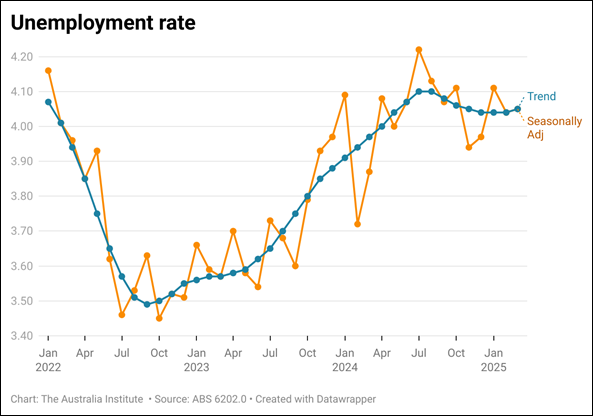
The March labour force figures have come out showing that unemployment has risen from 4.0% to 4.1%.

Greg Jericho
Chief Economist

If you’re a bit confused by that because you thought unemployment in February was 4.1% then you are right.

Last month when the ABS released the unemployment figures it said that in February the unemployment rate was 4.1% (or 4.05% to be precise)

This month, the formula they use to get the “seasonally adjusted” figure which slightly changes everything as a new month gets counted now has the ABS estimating that there were 2,000 fewer people unemployed in February than they previously thought. So now the February unemployment figures is 4.0% (or 4.04% to be precise). It really is just a rounding error. No need to worry – essentially unemployment is flat.

In this instance the trend is your friend, and the trend rate of unemployment suggests 4.0% or 4.1% of the labour force has been unemployed for the past 13 straight months – ie no real change at all

Liberals ACT Senate woes

Glenn Connley

Returning to ACT politics and the Liberals Senate candidate Jacob Vadakkedathu also appears to be struggling.

He spoke to the ABC’s Greg Jennett and had a bet each way on public service cuts.

Mr Vadakkedathu – who survived a vote to be disendorsed following allegations of branch stacking only a matter of weeks ago – talked up his record as a 15-year public servant in Finance.

But then went on to suggest that more than 13,000 public service jobs in Canberra needed to go, which would decimate the very community he seeks to represent.

While it is broadly accepted the Liberals have next-to-no chance of knocking off Alicia Payne (12.2%) in Canberra, Andrew Leigh (15.7%) in Fenner or David Smith (12.9%) in Bean, it was expected/hoped they’d wheel out a decent Senate candidate to try to win back the spot they lost in 2022.

After all, the Libs had a Senate seat in the capital from the time the ACT was awarded two seats in 1975, right up until the last election when David Pocock knocked off Zed Seselja.

Labor’s Katy Gallagher won 33% of the primary vote in 2022, but pundits are suggesting the popular former Wallaby, Senator Pocock, might be the first to reach a quota this year. 

Answering your questions: economic rent

Simon asked:

Housing, housing … yes

A spin off side effect is that there is so much debt .. in mortgages … im reading the term “economic rent”

… add the number of bills that are recurring rents … multiple insurances, mobile phone, electricity …

My reading (and admittedly a lot of listening on youtube) on this leads me to believe that this is not the way the early fan boys of capitalism wanted it (eg Adam Smith)

So, with all these rents sucking money out of the economy … Is this a good version of our economic system? 

Who has policies for privatising yet more of our state infrastructure?

Dave Richardson, our senior research fellow answered this one for you:

Dear Simon

You raise interesting points about economic rent and privatisation.

In the sort of economy Adam Smith seems to have had in mind competition was supposed to keep profits down to modest levels. If a business is just making normal returns economists say there are no “economic rents”. However, if a business is making huge profits due to some special attribute, say the best location on high street, we say they are making economic rents due to some scarcity factor.

While Smith thought the market would work for the benefit of consumers, the so-called “invisible hand”, he also warned that two or more businessmen (his word) in the same industry would rarely meet without discussing ways of jointly ripping off their customers. Fast forward around 250 years and most countries have actually outlawed those businesspeople from meeting and colluding against the public. Nevertheless, Australia’s industrial landscape is now dominated by uncompetitive markets.

Supermarkets are a duopoly, energy is dominated by 3 retailers, telecommunications has 3 players, the miners each have their own exclusive claims and monopolise the use of the resources, we have 2 main airlines, each capital city has a monopoly airport, there are only a few main importers of motor vehicles, drugs, books and other products are protected by patents, copyrights etc that gives the producer monopoly rights, the wharves are monopolized…. We could go on for a long time.  But a lot of the industries on this list are utilities; electricity, gas, transport and so on, that have been privatised.

There are lots of strict conditions that have to be met before we can be assured that a privatised business will end up in a market environment that fits the Smith model. We published some work on those conditions here.

You also could argue public housing has been privatised. The stock of public housing has fallen while some of those on government income support are now offered rental subsidies to assist them in the private market. 

You mentioned banking which we have long argued is an industry generating huge economic rents. This is now recognized with the tax on the big five banks in Australia (ANZ, Commonwealth Bank, Macquarie Bank, National Australia Bank, and Westpac). The Commonwealth Bank was originally established as a publicly-owned bank to offer a choice to customers and trustworthy alternative to keep the rapacious private banks in check.

All of this means the Australian economy is riddled with uncompetitive industries.

Privatization was once popular among some economists and politicians but that seems to have changed following the Queensland people rejecting the Campbell Newman Government’s privatization agenda and voting it out of office. It is also worth noting that at the Commonwealth level there is little left to sell. 

You asked if what we have is a good version of our economic system. Our system is a mixed economy with a combination of goods and services provided by the private sector and that is buttressed with the government provision of some goods and services. Some argue that the market is best so we should continue to privatise. Others suggest the market has failed in many respects and needs either stiff regulation or a return to public ownership. Better competition is advocated for many sectors that tend to be privately owned and operated. Banking policy has involved governments fostering more competition from publicly-owned alternatives, building societies, credit unions and foreign banks. 

Another aspect of our society is the apparent random allocation of incomes generated in the process of producing goods and services. Gina Rinehart might be mentioned. Many people miss out altogether and that has to be addressed by government. There are literally millions of comparisons we could make about the fairness of the different rewards people get for their efforts. Nurses versus film stars, footballers versus teachers etc. 

Fact check: Free trade agreements

Matt Grudnoff
Senior Economist

In the discussion of foreign relations Dutton pointed out that previous Coalition governments had negotiated 11 free trade agreements.

In previous election campaigns, the Coalition has talked a lot more about this achievement. This election they haven’t been mentioned nearly as much. This might be because the 2 biggest free trade agreements that they signed was the Abbott government’s free trade agreement with China and the Howard government’s free trade agreement with the US.

Recent history shows how worthless these agreements are. When China became upset with Australia over what they thought were claims by the Morrison government that China was responsible for COVID-19, they put up lots of trade restrictions. This included banning Australian exports of barley, wine, and crayfish. This was in violation of the free trade agreement. Yet there seemed to be no consequences for doing so.

More recently the US has imposed 10% tariffs on Australian exports to the US, and 25% tariffs on exports of steel and aluminum. There are talks of further tariffs on pharmaceutical goods. These are also in violation of the free trade agreement. Again, there seems to be no consequences for this.

Free trade agreements are only useful if both sides want to stick to them. This seemingly makes them little more than fancy informal agreements.

Sorry for the delay there – bit of a confluence of events. Let’s catch you up!

The Cruel Housing Hoax

Our very own Richard Denniss was on Q&A this week.

Responding to a question from a young would-be home buyer, he talked about the cruel hoax of property prices rising much faster than wages … thus exposing the dishonesty of politicians who promise to restore the dream of home ownership.

In the latest edition of Follow The Money, we take a deeper look at the housing hoax with Bill Browne and Stephen Long.

We also discuss the Australian electoral system and the need for truth in political advertising laws.

ACT Liberal candidate says he doesn’t understand why DVA new hires are ‘ongoing’

The ACT candidates are being largely ignored because the ACT is pretty much a lock – but that doesn’t mean it’s not interesting to tune in to see what some of the Liberal candidates are saying (mostly because there is not much attention on them)

Cutting the public service is obviously a big issue in Canberra, which is why the ACT candidates are always asked about the Liberals plan. And despite Peter Dutton and Barnaby Joyce saying there would be no cuts to front line services, or the department of Veteran Affairs (the example used by Labor of how cuts led to terrible service outcomes) the ACT candidate for Bean, David Lamerton says he would consider DVA was up for staff cuts.


Lamerton told ABC Canberra:

I don’t have the specifics on which departments. The example that was used earlier this year was DVA. I have gone through the DVA process myself and I know how hard those workers do and what they go through but there was a backlog that they willingly brought staff in to clear which by most accounts has now been cleared. And those positions have gone onto an ongoing basis. I don’t understand why that is the case. There is an example of that sort of 41,000 – it’s the highest per capita in the western world and we need to spend money appropriately.

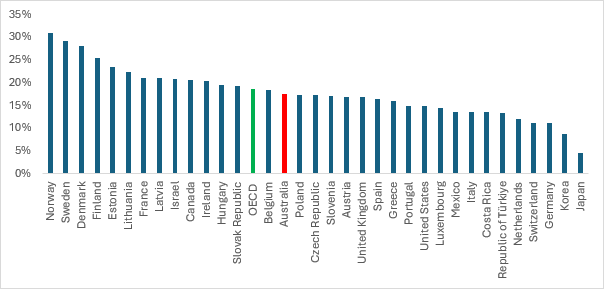
Also, it is not the highest per capita. As Matt Grudnoff shows:

Fact Check: Do we have one of the highest per capita number of public servants?

Here are the other developed (OECD) countries. We are not one of the highest. We’re not even above average.

You can hear Richard Denniss speak more on the gas industry here:

"For years, we have been told that exports are good, just wait for the benefits to trickle down,""It’s a big change to hear Dutton say, 'We’ve got plenty of gas, we’re exporting too much, & locals are copping high prices. Why don’t we put Aus first?'"@richarddenniss.bsky.social via Ngaarda Media

The Australia Institute (@australiainstitute.org.au) 2025-04-17T01:42:19.109Z

ABS releases unemployment figures

The ABS has released the March unemployment figures:

The seasonally adjusted unemployment rate increased slightly to 4.1 per cent in March, according to data released today by the Australian Bureau of Statistics (ABS).

Sean Crick, ABS head of labour statistics, said: ‘With employment increasing by 32,000 people and the number of unemployed increasing by 3,000 people, the unemployment rate rose slightly to 4.1 per cent for March.’

Employment has grown by 308,000 people, or 2.2 per cent, over the last 12 months. This annual growth rate is slightly higher than the 20-year pre-pandemic average of 2.0 per cent.

‘The employment-to-population ratio remained at 64.1 per cent in March, while the participation rate increased slightly to 66.8 per cent,’ Mr Crick said.

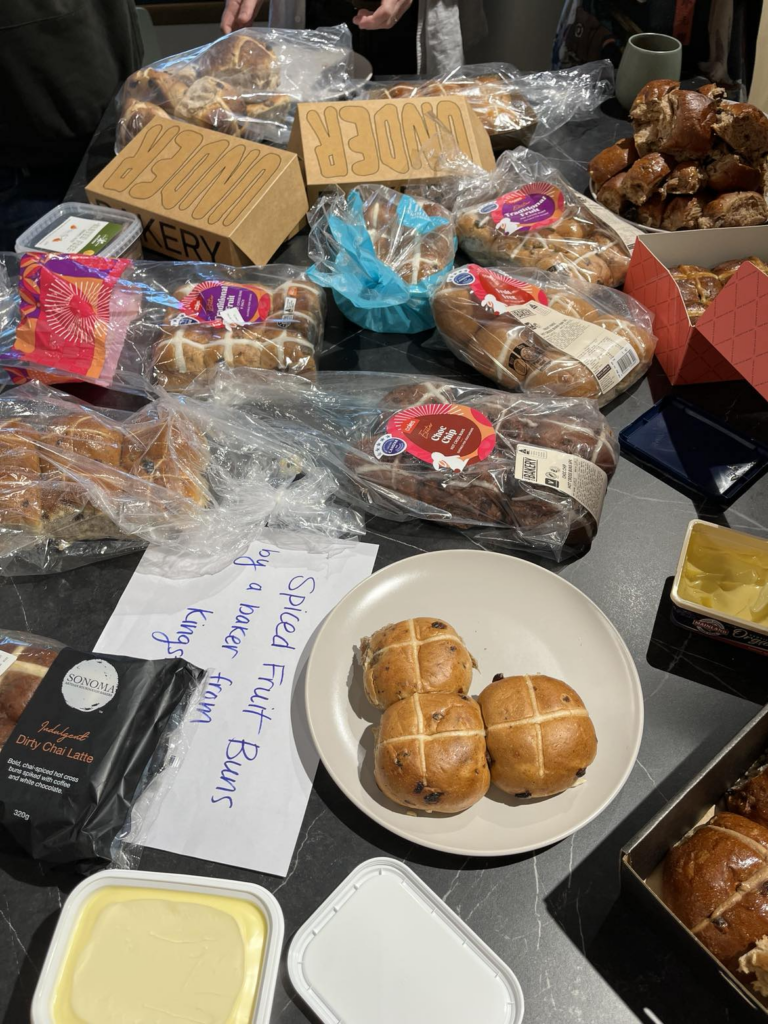
Thank you to Glenn for his stewardship – you have Amy Remeikis back with you. The Australia Institute is enjoying its first ever ‘Bun off’ – everyone brings in their favourite hot cross bun and then we eat a lot of hot cross buns and decide what is our favourite.

Brought the Bun Off tradition to the Australia Institute (everyone brings in their fave HCB and then we eat many HCB)

Amy Remeikis (@amyremeikis.bsky.social) 2025-04-17T01:31:31.230Z

Amy is back, but it’s time for our hot cross bun off, so sit tight for a few minutes.

No sign of Peter Dutton yet.

When he does finally emerge, Amy will take you through it.

Will he pop up in a rainforest, declaring his deep belief in climate change and the need for stronger environmental laws?

Will he be in a hard hat and high viz?

I’ll bet a choc-filled hot cross bun he’s back at a servo – making it 11 in less than a fortnight.

Happy Easter to all.

Election entrée: Speakers from other parties

Skye Predavec

Every Australian parliament – federal, state and territory – has had a speaker from a party other than the one in government at some point.

ABC News reports that both the Government and Opposition have sounded out independent MP Andrew Wilkie and Centre Alliance MP Rebekha Sharkie as potential speakers in the next parliament.

If it is a minority government, losing a government MP to the speaker position could hurt – giving a crossbencher the role helps the government numbers.

But it would also be consistent with longstanding practice in the UK, and more recently in South Australia.

Every Australian parliament – federal, state and territory – has had a speaker from a party other than the one in government at some point.

The speaker is responsible for keeping order in the lower house and defending the house’s rights and privileges. They also share responsibility for the security, upkeep and functioning of the parliament.

The first speaker of the House of Representatives, Sir Frederick Holder, resigned his party membership upon election to the role in 1901, following the British tradition of an independent speakership.

After he died in office, that tradition was abandoned until 2011 when the Gillard government elected Coalition MP Peter Slipper to the speaker’s chair.

Intending to revive the independent tradition, he resigned his party membership – but was replaced as speaker by Labor’s Anna Burke a year later.

Independent and minor party speakers are more common in the states and territories. The ACT’s first speaker was from the “No Self Government” party, and Shane Rattenbury became the world’s first speaker from a green party in 2008. In South Australia the constitution was changed in 2021 to require the speaker to be independent.

Just as the House has a speaker and deputy speaker, the Senate has a president and deputy president.

Normally, the deputy president is chosen from and by the Opposition but, in 1996, Prime Minister John Howard offered the position to Senator Mal Colston, who was not favoured by the Labor Party for the role, as an inducement for him to defect from Labor. Senator Colston became the first and so far the only independent deputy president of the Senate.

Sometimes speakers are chosen from the opposition party, such as the incumbent Mark Parton in the ACT, a Liberal MLA in a territory with a Labor government. After the 2018 election in Tasmania, the Liberal Government’s preferred choice for speaker was defeated by another Liberal, Sue Hickey, with support from the opposition.

Since the speaker makes a variety of decisions on how the parliament conducts its business, having them not be aligned with the government can make things fairer for the opposition and crossbench.

FWC decision on gender-based undervaluation

Fiona Macdonald

Director, The Australia Institute’s Center For Future Work

In a historic decision, yesterday the Fair Work Commission recommended increases in minimum wage rates to address gender-based undervaluation of work.

Dental assistants, pathology collectors, disability, crisis accommodation and other community services workers, children’s services workers and dental therapists and assistants in Aboriginal Health Services are among those who would benefit from the recommended increases.

The Coalition must commit to backing any final increases awarded by the industrial tribunal. Minimum wage increases for these workers are a critical step towards stopping the perpetuation of unequal pay and address workforce shortages in essential health, community and children’s services.

Centre for Future Work research has highlighted the problems of undervaluation of work female-dominated sectors.

https://futurework.org.au/report/going-backwards/

Federal Reserve comments on US economy

Matt Grudnoff

Senior Economist

Federal Reserve chair Jerome Powell has spoken overnight. The Federal Reserve is the US central bank. Powell has come out and said that they’re worried that the Trump tariffs will push up inflation and slow economic growth (which in turn pushes up unemployment).

This combination of events, high inflation and high unemployment, is very tricky for central banks. When inflation is high, a central bank will increase interest rates to slow the economy and reduce inflation. When unemployment is high, they cut interest rates to stimulate economic growth and lower unemployment.

But what do they do when both inflation and unemployment are high?

The Federal Reserve chair said overnight that they were going to make no change to interest rates and wait and see what happens as more economic data comes in.

The Fed is hoping that Trump will pull back from his policy on tariffs, otherwise they will have to make some difficult decisions.

The media conference ends with the Prime Minister wishing Australians a happy easter, hoping they get some time off with their families.

He could probably afford to take a few days off himself.

QUESTION: Is Peter Dutton a climate change denier?

ANTHONY ALBANESE:

Peter Dutton’s comments speak for itself last night. He was asked and David Speers re-asked a couple of times, gave him the opportunity to say that the science on climate change was real. You know, all of the hottest years on record have been this century. We’re seeing more extreme weather events in greater intensity, and he said, “I’m not a scientist and there’s different views.” You know, does he believe in gravity? I mean, what else is there that is a scientific fact that he needs assurance of or a science degree to understand? You know what – there was a bit of discussion last night about young people and I say this to young people who are concerned about housing, about social media and social inclusion, they’re concerned about the economy and their place in it, they’re concerned about intergenerational equity which is why we’re putting in place the 20% cut in student debt. But you know what they’re all concerned about? Climate change. Because this is something that will have by definition a greater impact on the kids who are here today than it will on myself or Jim or Kara or the journalists who are here. This guy says, “Oh, well, I didn’t really know, there’s different views about climate change.” Climate change is real. We need to have a real response.

How has the PM “flipped the polls”?

Question: At the start of this campaign you were written off. Why did people underestimate you so much, given you have flipped the polls in a couple of weeks, you’re in the lead and your Opposition Leader is being caught seemingly woefully unprepared?

Anthony Albanese:

I have said before a number of times – I have been underestimated from time to time … I am captain of an extraordinary team. We’re putting forward our record which we’re proud of, but also our proposals that we have taken forward, that we started to announce many, many months ago. We were waiting for the Coalition to announce some policies. All they have now is a $600 billion nuclear plan, free lunches for bosses, and cuts to pay for it all. That’s really all they have. And now this – as the Treasurer described it – laughable plan, aspiration, to do something about tax that they’re increasing during this campaign. But the truth is that it’s hard to win a second term. You know, we’re trying to climb a mountain. We’re a few steps up that mountain, it’s a long way to get to the peak.

ACF brands Dutton a climate change denier

The Australian Conservation Foundation has released a strongly-worded statement on Peter Dutton’s fence-sitting on climate change:

Mr Dutton, denying climate change puts people and nature in harm’s way

Peter Dutton’s responses on climate change in last night’s leaders’ debate, along with a string
of climate damaging policies, reveal the Coalition is out of touch on a major issue affecting
voters’ lives, the Australian Conservation Foundation said.

“It’s a serious concern that one of the candidates vying to be Australia’s prime minister is
unwilling to stand up and say climate change is real, is happening and is affecting Australia,”
said ACF CEO Kelly O’Shanassy.
“For Mr Dutton to fall back on the old climate deniers’ line – I’m not a scientist – in last night’s
leaders’ debate was deeply disturbing at a time when Australia desperately needs to get
serious about tackling the climate crisis.

“If Mr Dutton harbours any doubts about climate change’s impact on Australia, he only needs
to look at his home state of Queensland where the Great Barrier Reef has suffered its sixth
mass coral bleaching event in a decade, the west of the state has been hit by its worst flooding
in 50 years and Queenslanders are still mopping up after Cyclone Alfred.

“The Coalition is offering voters nothing on climate change.

“In fact, its policies would be worse than doing nothing. It intends to slow and reduce the
rollout of renewables, weaken the safeguard mechanism, effectively scrap vehicle emissions
standards, increase expensive gas for domestic use and export, keep coal-fired power stations
open longer, go wobbly on the Paris Agreement, offer no 2030 or 2035 emissions reduction
target and no pathway to get Australia to net zero by 2050.

“ACF’s comprehensive assessment of parties’ and candidates’ climate and nature policies had
to give the Coalition a score of 1 out of 100.

“While Labor scored a bare pass (54/100), the Coalition’s 1/100 is the lowest mark for the
Liberal and National parties’ environment policies in two decades of ACF election scorecards.
“The next parliament is the last parliament that can get Australia’s massive contribution to
climate change under control. If you are not up for the task, you don’t deserve the job of
Prime Minister.

“We urge all Australians to look their family members in the eye before heading to the polls
and use their vote to elect a parliament that will protect our climate, wildlife and kids.”

The next question is on unemployment and whether it will be impacted by the Trump Trade War. If it is, would that impact the government’s ability to deliver on its spending commitments?

Look, the impact of tariffs is something that we’re considering, but as you would be aware, like everyone else looking at what’s occurred in the United States. There have been a range of changes made on a day-to-day basis. What we’ll do is work those issues through. In some cases, some of the tariff changes, just choose one, for example, I have spoken to some meat producers here in Queensland, some of them, yes, there might be issues with the United States, but there are pluses on the other side with exports to China because of the relationship between China and the United States and what’s happening on trade there. So we’ll work those issues through. The budget was only handed down in March 25, so a short time ago, the budget was handed down. But we’ll work through those issues. We’re confident and I’m very optimistic about where Australia’s positioned.

And the attacks begin

First, the Prime Minister rips into Peter Dutton’s weakness on climate change in last night’s ABC debate.

If there’s one thing that stunned me about last night, it was Peter Dutton being asked not a very difficult question about whether he agreed with the science on climate change. Effectively, he said he’s not a scientist and couldn’t say … the science is very clear on climate change. The fact that in 2025 you have someone running for Prime Minister who can’t say that the science is clear that climate change is real and it is happening.

Next up, Jim Chalmers, rips into Mr Dutton’s comments to a Murdoch newspaper supporting the indexation of income tax brackets.

I see Peter Dutton had expressed some views this morning in The Australian newspaper about income taxes. Peter Dutton must think Australians are stupid. I mean, he is the only major political party leader that has taken to an election a policy to legislate higher income taxes on every single Australian taxpayer. I mean, this stuff is laughable. He has a policy to return less bracket creep, not to return more bracket creep. And so to see these views expressed on the front of one of the newspapers today is frankly ridiculous. If Peter Dutton wins this election, your income taxes will be higher, not lower. A vote for Peter Dutton is a vote for lower wages, higher taxes and secret cuts to pay for his nuclear reactors.

Prime Minister’s morning media conference is underway

Prime Minister Anthony Albanese is in Queensland this morning, in the seat of Bonner, held by the LNP on a margin of 3.4%. Standing beside him, nodding dutifully, is Labor candidate Kara Cook and Treasurer Jim Chalmers.

They’re at a childcare centre, talking about pay rises for childcare workers and yesterday’s Fair Work Commission decision on the gender pay gap.

The Coalition have made it clear that free TAFE is gone if they are elected. This comes after they have ripped money out of TAFE the last time they were in office and shut down trade training centres when they were in office during that 10 wasted years. My focus as well is on the pay of child care workers. We had an outcome yesterday from the Fair Work Commission, an interim decision, that spoke about the need to do more about gender pay equality. One of the things that my government did as part of our IR reforms was to put gender pay equity in as an objective of the Fair Work Act, something that had to be taken into account. I’m really proud that 62,000 workers in this sector have already benefited from the 15% pay increase that we legislated and that, as well, importantly, as part of that child care centres have a cap on the price increases as well. So good for workers, good for families. We know that feminised industries, like child care and aged care, have been undervalued. They were heroes during the pandemic. They deserve more than our thanks, they deserve decent pay and conditions.

Free tickets for politicians during gambling debate

Morgan Harrington

Australia’s parliamentarians accepted $245,000 in free tickets to sporting events at the same time they were supposedly considering a ban on ads for online gambling, according to a new report by Reuters.

The Prime Minister alone got $29,000 in tickets.

In 2023, the government released the results of an inquiry (the Murphy review) which recommended a ban on ads for online gambling.

TV stations and football codes directly profit from these ads, though they drive most sports fans up the wall.

Australia Institute polling confirms that three in four Australians would support this kind of a ban, but no legislation has been introduced and, until today, Australia’s gambling problem has not been an election issue.

Australians are the largest gamblers in the world, and they begin gambling well before the legal age of 18.

Australia Institute analysis shows that almost one in three 12-17-year-old Australians gambled in the past year, which means they are more likely to have gambled than to have actually played any of the most popular sports.

Without a ban on the advertising that has come to tarnish our major sporting leagues, Australians will continue to be the biggest losers in the world.

Classy, Dai Le

Fresh from being attacked by Jason Clare, Independent MP Dai Le has paid tribute to her Labor rival for the seat of Fowler, Tu Le.

Labor’s Ms Le gave birth to a beautiful baby girl, Matilda, less than a month ago.

Now, she’s on the campaign trail juggling a newborn as she attempts to unseat the popular independent.

But, speaking on Sky, Dai Le refused to hit back after the attack from Labor’s campaign spokesman, Mr Clare, who said a vote for Dai Le was a vote for Peter Dutton.

But the Independent wasn’t playing along, instead paying tribute to her rival.

Ms Le has just given birth and is out there campaigning. I take my hat off to her. Continue campaigning, because we all are … we all have to fight for our community.

$9.50 for hot cross buns – what the actual?

Morning everyone, thanks Amy.

My first big gripe for the day is the price of hot cross buns.

In preparation for the great Australia Institute bun off … I ducked into my local shopping centre on the way home from work last night.

Ok, I confess … I bolted in and grabbed the first buns I saw.

$9.50 for six fruit buns from Bakers Delight.

$9.50!

Naturally, when I got home, my wife informed me they were $3.50 at the supermarket if I’d been willing to walk an extra 50 metres into Woolies or Coles.

But, screw them. They rip us off for everything else.

So … $9.50 Bakers Delight buns it is. They better be good!

I am going to hand you over to Glenn Connley for a little bit while I go be a talking monkey.

Glenn will keep you up to date on any news while I’m gone. I have promised him hot cross buns, so don’t take any guff from him.

Jane Hume says she believes Peter Dutton believes in climate change.

And earlier on RN Breakfast, shadow finance minister Jane Hume had to do some mopping up of Peter Dutton’s comments on climate change in last night’s debate.

Dutton couldn’t say whether or not he believed climate change was making weather events worse because “I am not a scientist”.

Which is EXTRAORDINARY in 2025 for any political leader to claim.

Hume though, says she believes Dutton does believe in climate change:

“I personally believe in climate change. I know that Peter Dutton does,” she said.

So does the Coalition accept the science that climate change is making weather disasters worse?

“If that’s what scientists are telling us, then that’s what we should believe,” Hume said.

What do you mean IF?

Peter Dutton has spoken to the Australian newspaper where he says he will:

“Increase defence spending significantly” – so yay! More than the $380bn we are already spending on Aukus!

Reform income tax brackets: “I want to see us move as quickly as we can as a country to changes around personal income tax, including indexation, because bracket creep, as we know, is a killer in the economy.” (Which is not what the original stage three tax cuts would have done. AT ALL)

But he can’t do tax indexation now. Although he would like to do it at some point, so that’s the main point of the article.

The Labor campaign is back in Brisbane, where three seats are in play – Brisbane, Ryan and Griffith, all of which are held by the Greens.

The Greens are putting up a fight and Max Chandler-Mather is thought to have done enough to hold on to Griffith. The other two are anyone’s guess.

Given Labor is about to announce the details of its critical minerals reserve policy and it’s come up in the Trump tariff discussion, this update from AAP might be of interest:

Ukraine and the United States have made “substantial progress” in their talks on a minerals deal and will sign a memorandum in the near future, Kyiv says.

US President Donald Trump is seeking a bilateral minerals deal as part of his push to end Ukraine’s war against the Russian invasion. Trump also sees it as a way to recover billions of dollars the US has spent on military assistance to Ukraine. President Volodymyr Zelenskiy has said that Ukraine would not recognise past US military aid as loans.

“Our technical teams have worked very thoroughly together on the agreement, and there is significant progress. Our legal staff has adjusted several items within the draft agreement,” First Deputy Prime Minister Yulia Svyrydenko said on Wednesday on X.

What would a re-elected Labor government do for Indigenous students?

Jason Clare:

First I’ve got to say we’re not getting ahead of ourselves. We’re putting all of our efforts into the election campaign and hope we win the support and the trust and the votes of the Australian people. But, you know, the terrible truth is that if you’re a young Indigenous male today, then you’re more likely to go to jail than you are to go to university.

That’s why these reforms that I’m talking about are so important. If we invest properly in our schools in the right sort of things that help kids who fall behind to catch up and keep up, then more people will finish school.

That’s why we’re setting those targets in the new national agreement. That’s why I’m doubling the funding that the Commonwealth will put into public schools in places like the Northern Territory. The sad fact is that when I became the Minister for Education, the funding for students in schools in the Northern Territory was abysmal, effectively 1-in-5 students weren’t being funded at all. The agreement that itch struck means that we will get every public school in the Northern Territory to that full funding level 20 years earlier than would have happened under the Liberals instead of 2050, it will now happen by 2029.

And that investment targeted in the right way we think will help to increase the number of young people finishing high school both Indigenous and non-indigenous.

And on the Liberals claim that fee-free tafe is “just not working” Clare says:

Well, people are still doing the courses. This is the great line that the Liberal Party is peddling that people aren’t completing the courses. Courses take more than a year to do. We want more people to get more skills. The Liberal Party seem to think that education is a cost. I think, we think, education is an investment. Education is the most powerful course for good in this country and I want more young people, particularly from the western suburbs where I grew up and where I represent, the outer suburbs of our big cities and the regions, to get the same crack at education that other kids across the country do. That’s why we have got to make sure child care cheaper and fund our schools properly, make TAFE free for more Aussies, as well as cutting that HECS debt. And the Libs are against all of that.

What does education minister Jason Clare think of the Liberal idea to bring back tech colleges?

Clare:

What we need is more young people to finish school and then be able to go on to TAFE or to go on to university. We know that more and more jobs require those sort of skills that you get at TAFE or you get at university.

But remember the form of this Liberal Party – they ripped the guts out of schools. When they were last elected under Tony Abbott, they ripped $30 billion out of our schools and we oar still paying for that now. We have seen the number of kids in public school, finishing high school, drop from 83% down to 73%, and not satisfied with that, now they’re threatening to rip the guts out of TAFE as well. They have said they’ll get rid of fee-free TAFE.

What we need to do is not just build one or two technical colleges in a state, there’s kids in every single high school that wasn’t to get the skills they need to get a trade and that means that we need to provide them with that support in every high school and help them to get the skills they need through these fee-free courses at TAFE. The Liberals’ record is rip money out of schools and now they want to rip money out of TAFE that shows they have got no credibility when it comes to education.

Why won’t Labor be brave enough to look at scrapping or at least changing negative gearing?

Jason Clare:

Well, because I don’t think it’s the right solution. It’s not going to help increase supply. It a might even do the reverse for young people in my community that are struggling with renting, that increase in rental support is important – 45% increase there.

So is the Build To Rent policy. So we get the companies that rental accommodation that can give you a five-year tenancy so you don’t get kicked out on a Saturday emergency with the owner wanting to sell it but you got that security making it easier for young people to buy a house with a smaller deposit.

That’s what that 5% deposit is all about. But in the just there, Bridget, as you know, I’m the Education Minister of Australia.

One of the big policies that’s on the ballot on May 3 is our proposal to cut HECS debt by 20%. Now, there are three million Aussies with a HECS debt at the moment. The average HECS debt would be cut by more than 5,000 bucks if Labor wins on May 3. The Liberals have said they won’t do a damn thing when it comes to HECS debt. If Albo wins, if Labor wins, we’ll cut the HECS debt of every Australian by 20%. That will help a lot of Australians that have that debt and are struggling to get into the housing market.

Sigh.

And on the negative gearing modelling that was or wasn’t commissioned, Jason Clare says:

Well, first, we’re in the making any changes to negative gearing. I think the Treasurer asked – was asked this question last year and said that he sought advice in his department but he haven’t commissioned modelling from Treasury.

The fact is that ministers, people like me, ask our department questions about issues that are in the media all the time.

You would hope if Peter Dutton ever became Prime Minister of Australia that he would do the same, that he would ask for advice, but it seems the position of the Liberal Party is just to sack public servants. Our approach is to seek advice.

Did Jason Clare, official spokesperson for the Labor campaign, watch the leaders’ debate? (If he didn’t, he’d be in a bit of trouble me thinks)

I thought the contrast between the two leaders was pretty clear. You saw in the Prime Minister a calm and responsible leader and in Peter Dutton you saw somebody who was just agro and reckless.

What was it – in the space of an hour he confessed he lied about the foreign leader? He couldn’t give a straight answer on climate change, and he couldn’t give a straight answer on cuts. He said he eat cut more but wouldn’t say what he would cut to pay for these $600 billion worth of nuclear reactors. So I suspect most people who saw the debate would say, “Look this bloke is not ready to be Prime Minister, not fit to be Prime Minister of Australia and not the right person at this time to be the Prime Minister of Australia.”

TAFE policy a value-free zone for the Liberal Party

Joshua Black
Postdoctoral Research Fellow

On Tuesday, shadow education minister Sarah Henderson let the cat out of the bag on fee-free TAFE. Speaking to a room full of voters in Geelong, Henderson complained that the government’s expenses on fee-free TAFE had cost the budget $1.5 billion.
“I am sorry”, she told the crowd. “It’s just not working”.

It’s not the first sign that the Coalition would make cuts in this area. Back in November, deputy Liberal leader Sussan Ley spoke on behalf of private vocational education providers who may not love having to compete with the Commonwealth.

Couching her remarks in the garb of Liberal Party values, Ley said “if you don’t pay for something, you don’t value it.”
It fell to Coalition spokesperson Jane Hume to hold the line yesterday, telling reporters that she doesn’t believe fee-free TAFE is “delivering on its promise”.

Here are a few key facts to clear things up on this matter.

In its first budget, the government allocated $871.7 million over 5 years for fee-free TAFE places in “industries and regions with skill shortages”. The commitment was for 480,000 places in the areas with the most acute skills bottlenecks.

Last year, the government promised in its budget a further $88.8 million to provide for 20,000 fee-free places in housing-related TAFE courses. Their promise at this election is to make 100,000 fee-free places a permanent part of the vocational training landscape.

Total Commonwealth spending on vocational education has risen during this parliament, but final budget outcomes have shown that the government spent $28 million less than budgeted for in 2022-23, and $114 million less than planned in 2023-24. Hardly a sign of fiscal recklessness.

Even if the Coalition were right about its $1.5 billion figure, that pales in comparison with other key tax concessions in the federal budget. Treasury has estimated that the capital gains tax discount (for individuals and trusts) cost the budget $19 billion in 2023-24.

So fee-free TAFE is not unaffordable. It’s also working, with more than 568,000 enrolments in the right skills areas so far.

Everyone deserves the chance to get a good education. $260 million for a few technical colleges for high school students is nice but isn’t enough to unclog Australia’s skills bottlenecks.

Bridget McKenzie might want to stay away from foreign affairs commentary for a while

Bridget McKenzie is not having a great couple of days.

Yesterday, she was forced to apologise for saying this on the ABC:

The defence minister of Russia [Andrey Belousov] and the Chinese leader [Xi Jinping] both have made very public comments that they do not want to see Peter Dutton as the prime minister of our country.

There’s two world leaders who don’t want to see Peter Dutton become prime minister of our country. That’s all I’m saying. That’s Russia and China.”

The SMH’s Matthew Knott reports McKenzie had to say sorry shortly after:

“I made a mistake, I was wrong with what I said about the Russian defence minister and Chinese leader. I can’t verify it.”

Watching McKenzie on the Nine Network this morning, it seems McKenzie still needs to brush up on her foreign affairs. Asked by a Nine reporter why she made the comments in the first place, McKenzie said:

Well, I think it’s pretty clear from President Xi’s public commentary that he finds Albo a very handsome boy. He’s been very complimentary about the prime minister, and Russia has made it very, very clear. Russia’s made it very clear. They think the AUKUS … pact between Australia, the UK and the USA is a security risk for them in this region. And they’ve been very public about those comments. Now Peter Dutton drove that significant agreement when we were in government.

Except that wasn’t Xi who made the “handsome boy” comments. It was China’s premier, Li Qiang, who made those comments during Albanese’s visit to Beijing.

“People were saying that we have a handsome boy coming from Australia,” Li said in 2023.

Sussan Ley moves on to what she wants to talk about – the Coalition’s first education policy this campaign; $260 million to build 12 new technical colleges for students in years 10 to 12.

Ley says tech colleges are a missing link in education:

They are a thing of the past. I think that we had the policy right in the Howard era. It was trashed by Rudd when he came into government, and replaced with something that didn’t work at all. What we want to see is skills back in schools.

We will always reject the notion that if you haven’t made it to university – you haven’t made it in life. And the rates of attendance of students going to university is going up with respect to going to a vocational course.

What that means is that careers advisor, schools, the system, is pushing kids to an ATAR, to a university qualification, that many of them are not suited to. Our Australian technical college will have kids in Year 10, 11 and 12 starting work on the tools, and this is critical – connected to a school-based apprenticeship. So they’ve got an employer.

They’ve got work. They’ve got a pathway. And I visited some of the schools, because they’re still survived the Labor cuts all those years ago and they are doing incredible work. And I want to see excellence in skills. I don’t want to see kids getting in a bus and going to TAFE on Thursday afternoon and struggling to do something called VET in schools. I want to see schools that deliver this in a first class way.

Would it undercut TAFE?

This policy sits alongside TAFE. This is a policy inside schools. But sometimes, we’re pushing our school kids out of the school setting to attend a TAFE course, often some suburbs away. So, this policy is dedicated to Years 10, 11 and 12. As I said, we want more skills – not less. We want high-quality training, whether it is in TAFE for older Australians, or whether it is in school for students.

What about Peter Dutton having to apologise and admit he made a mistake about verballing the Indonesian president?

Sussan Ley:

Peter addressed that in the debate last night. What I would say is that the Prime Minister needs to be on top of the briefings that he gets, in the position that he is in in order to know exactly what is going on in our region and the world.

And we always have the strength when it comes to national security and foreign policy that I didn’t see in this government. And I certainly haven’t seen in recent weeks.

LOLOLOLOLOLOL. Dutton overstepped and that’s Anthony Albanese’s problem? LOLOLOLOLOLOL

Did Sussan Ley catch the debate?

Yes, I did.

You’ll be shocked by her take. SHOCKED I tell you.

Ley:

I saw a very weak, indecisive Prime Minister and a very strong Opposition Leader. And I was particularly blown away, Bridget, by the Prime Minister not fessing up that his own Government modelled changes to negative gearing and capital gains tax with respect to homeownership.

And I just want to contrast that with our policy to really get young Australians into that dream first home and started on the ladder of aspiration that I know they’re missing out on under this Government.

So I think that a lot of Australians watching that debate would agree with me. This election is a clear choice between who can better manage the economy and help all Australians to get ahead. And who is, in fact, overseeing the biggest decline in living standards that we have ever had in our country’s history in this Labor government.

But very excited to be here talking about a subject so close to my heart and I know many Australian families, parents and schools, and that is how we skill the next generation.

Jim Chalmers had a quick press conference after last night’s debate, where he cleaned up some of the lingering questions Anthony Albanese had stumbled over.

One was over whether or not the government commissioned modelling from Treasury on scrapping negative gearing:

First of all, I want to remind you, I think, as you know, we have been very, very clear. We are not proposing changes to negative gearing. We’ve got a plan for housing, we’ve got a plan for tax, and that’s not in it. We’ve made that clear. And what I’ve said before is entirely consistent with what the Prime Minister said tonight. From time to time, the public service provides us with views on matters that are in the public domain, and that’s what the Prime Minister said tonight.

And when will Australians start to see their energy bills come down?

What we’ve seen in the last year, according to the OECD, is the lowest energy inflation in the developed world, and that’s because of the $300, partly because of the $300 energy bill rebate, that Peter Dutton didn’t support. Energy bills would have been $300 higher last year, if Peter Dutton had his way.

Now we’ve made it really clear that when it comes to getting energy bills down, electricity bills down, we’re providing energy bill rebates at the front end, and we’re introducing more cleaner and cheaper energy into the system. The alternative is these nuclear reactors, which will cost more and take longer and push electricity prices up.

I thought the Prime Minister did a terrific job setting out the choice for Australians, nuclear reactors paid for by secret cuts to Medicare under Peter Dutton, or more renewables, more cleaner and cheaper energy, and energy bill rebates for the Australian people. Because we recognise that even though we’ve got the lowest energy inflation in the developed world over the last year, we still know that Australians are under pressure. That’s why our cost-of-living relief is immediate and ongoing. Peter Dutton is offering no ongoing help.

Independent MP Monique Ryan, who is fighting to retain her seat of Kooyong against the Liberal party is speaking to ABC News Breakfast and gave her opinion on last night’s debate:

I was definitely up taking notes. Look, I thought a bit concerning. Looking – the media people seemed to say it was pretty boring and no-one scored any points but I thought there was some interesting and important things that came out of it. For me, the Leader of the Opposition saying he wouldn’t commit the existence or the reality of climate change is…

Host: I think he’d leave it to the scientists to make that assessment.

Ryan:

Don’t you think he should have had opinion on that as the Leader of the Opposition of the country and a potential Prime Minister? I think it’s a pretty important point. But I also felt that it was a bit concerning that neither of the leaders was able to take a position on AUKUS and the fact that many people in electorates like mine are expressing concerns about our relationship with the US at the moment.

There’s uncertainty around it from an economic and defence point of view. People are saying that they want us to look at that relationship a bit more critically.

Neither the political leaders parties were willing to do that which I think – is an ongoing source of concern within my community.

Good morning

Hello and welcome to Day 20! We are almost at the three week mark of this campaign, and the easter break is about to begin, which means campaigning will continue, but in a more muted way until Tuesday.

Tuesday is also when early voting begins and the past tells us there are plenty of people already who have made up their minds and just want to get their votes in so they can switch off for the rest of the campaign.

So today is the last day the leaders have to make an impression on some people and either win that first vote, or jump ahead in the preference flow of their opponent.

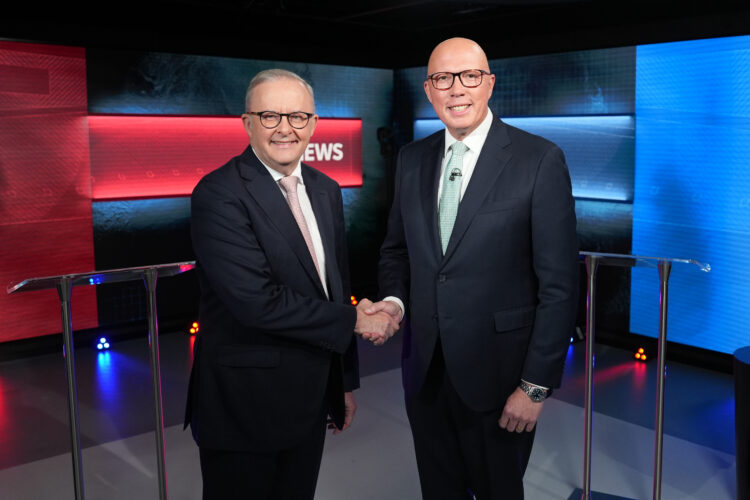
It follows last night second leaders’ debate (there is one more during the final week of the campaign) where both Anthony Albanese and Peter Dutton made it through without messing up, or delivering any major blows.

Dutton stumbled on questions of foreign policy including overstepping on the Russian request to Indonesia story, (entirely his own fault), as well as struggling on questions regarding Donald Trump, because he was more worried about letting people know he had never met the man (again, a problem of his own creation – he linked himself and campaign to Trump in the first place) than with answering the question asked. There was also the moment where he couldn’t say if climate change was making natural disasters worse. “I’m not a scientist”. OK, but he’s not an expert on a lot of things and that hasn’t stopped him from commenting. Albanese had a few stumbles of his own, but nothing particularly memorable. (When will power prices come down will be the one everyone focuses on)

Both campaigns will be pleased their leaders made it through unscathed. But it also didn’t shift the dial of this election.

We’ll continue to cover the day, with more fact checks and some details about what is being missed. You have Amy Remeikis – it’s at least a four coffee day – with you and the Australia Institute’s brains trust, so if you have some questions – send em through!

Ready?

Let’s get into it.


Read the previous day's news (Wed 16 Apr)

Past Coverage

Comments

Start the conversation

The biggest stories and the best analysis from the team at The Point, delivered to your inbox.

Past Coverage