Mon 14 Apr

Australia Institute Live: Day 17 of the 2025 election campaign. As it happened.

Amy Remeikis – Chief Political Analyst

This blog is now closed.

Start the conversation

Australia Institute Live: Day 17 of the 2025 election campaign. As it happened.

Key Posts

The Day's News

See you tomorrow?

On that very stupid note, we will leave you because tomorrow is going to be one of those very long days that no one needs, or wants – but we will cover it all off for you.

The second debate is tomorrow (a third has been set down for the last week of the campaign which the Seven network will host) which means that the campaigns will be back in Western Sydney tomorrow for the debate at the ABC’s Parramatta studios.

We will cover off the day’s events (as well as bring you some of Richard Denniss’s appearance on Q&A – we will also watch that for you, so you don’t have to sit through the whole show if it all gets a bit much)

Big thank you to everyone who came by – honestly, we are so humbled and grateful for your support. So until tomorrow, take care of you. Ax

Have we heard the stupidest question of this campaign? Maybe.

The analysis that Albanese was referencing there was this one from Steven Hamilton which had the headline: Dutton is pursuing a housing subsidy so bad, even Trump killed it. The policy is highly regressive, and will simply boost house prices and blow a huge hole in the personal income tax base that will never be recovered.

Then comes maybe one of the stupidest questions of this campaign:

You point out the headline about Peter Dutton’s policy being abandoned by Donald Trump, but doesn’t that actually prove that Peter Dutton is not the Trump lookalike that you and your ministers have been trying to paint him as this entire campaign?

Albanese manages to hold back a laugh:

Oh, people will make their own conclusion, but people can have a look at the caps that my team wear and the caps that the other team wear and draw their own conclusions.

(The caps in question being the ‘Make America Great Again’ that Jacinta Price was wearing in a social media post)

Q: The Liberals rap diss track. Have you heard it? Do you have any response?

(The diss track takes inspiration from Drake, which is….problematic for a number of reasons. But Drake also famously LOST his battle against Kendrick Lamar so again – wtf is the message here?)

Anthony Albanese:

Look, the Liberal Party can explain their own campaign. Some of it’s way beyond my comprehension. Some of the things they’re doing in this campaign, I’ve got to say, you know, there’s lots of really good Australian music around.

We heard one of those at my campaign launch yesterday.

Sounds of then by the Great Ganggajang. We can all sing This is Australia. We are a different country. I’m running as an Australian Prime Minister on Australian values. I’ll leave it to others to see why they consistently just borrow cultures and ideas and policies from other places as well.

Albanese was also asked about the Liberal’s housing policy and said:

On housing, can I say that you know, this is a policy that was in the Fin review. I read today in the paper. I read the analysis. I read the paper, which is much preferable from my perspective, maybe showing my age, perhaps, but the analysis, speaking about how even that policy was abandoned under the Trump administration the first time around.

This is a policy that has never been supported, wasn’t supported by them the entire time that they were in government. They did nothing about housing.

They helped create the problem for a decade. And you saw the people who created the problem all lined up at Peter Dutton’s launch yesterday, all clapping, someone saying, we need to do something about housing, but nothing about housing supply. If you don’t do something about housing supply, you’re not serious and they’re not serious.

Where are the builders going to come from?

Greg Jericho
Chief Economist

The Labor Party’s plan to build 100,000 new homes in 10 years has had some wondering if we have the capacity – after all where are the builders to do all that work?

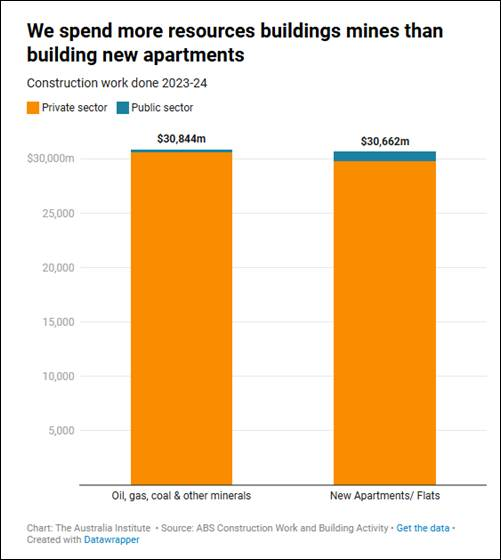
Well one place to look is new coal and gas mines. The government keeps approving new (sorry extensions) gas and coal mines and that takes construction workers away from the building homes and commercial buildings.

In the last financial year as much was spent constructing new mines than was on new apartments and flats.

This is a poor use of our resources. Not only is it taking workers away from the residential construction sector and thus causing supply constraints and increasing the cost of building new homes, but coal and gas contribute to climate change.

So we’re heating up the planet and the housing market. Dumb, both ways.

Q: Prime Minister three years ago. You said that you felt the weight of removing the Morrison government this time around, you don’t have the Morrison factor working in Labor’s favour. What weighs you down now? You know, why is Peter Dutton still so competitive with you?

Anthony Albanese:

Well, what weighs me down is that the Morrison government, I think, was a bad government. I think the fact that they replaced Tony Abbott with Malcolm Turnbull and then replaced Malcolm Turnbull with Tony Abbott and then wanted to replace Morrison with Josh Frydenberg, says a lot about the wasted ten years, ten years where they had 23 different energy policies and didn’t deliver.

One, didn’t deliver one. And so you had that uncertainty for business.

What weighs me down now is I feel a responsibility to ensure that we’re able to continue to govern, that you continue to have the investment that we’re seeing from companies like this, that you have a government that strengthens Medicare, that looks after people, doesn’t leave people behind, and that creates opportunity. I want that to continue to occur.

And what we’re left with now is the leftovers of the Morrison government.

Some of the best people have all gone. They’ve left and the remaining moderates, one by one. Karen Andrews, are you have Paul Fletcher, you have had Senator Birmingham, Christopher Pyne’s gone. You’re now left with a more and more right wing rump in the Liberal Party. And when you look at their candidates, some of the views that they have are just not consistent, you know, not consistent with Australian values that we have that we hold dear here.

We look after each other in Australia, we don’t have a dog eat dog attitude towards the economy. We look after people, we make sure that we have a culture here of the fair go. That’s what my government represents and that’s what I want to continue with.

And Penny Wong on how to handle Trump:

Well, I think it’s pretty clear that Mr Dutton and certainly Senator Jacinta Nampijinpa Price have looked to the US for a lot of inspiration for their policies and even some of their slogans. But I think this is a challenging time internationally. We know there’s a lot of change, a lot of strategic competition and economic competition and one of the reasons that I would say to people, it’s important to vote for a majority Labor government is because that will give us the stability and certainty to navigate uncertain times.

Here was Penny Wong on the costings of Labor policies (speaking to Sky News)

Look, these policies have been worked through, and I think they are really sound policies, and that’s adding to the strength of the offer that we’re putting to the Australian people. In addition, we’ve got really good candidates like Claire Clutterham here in Sturt. What I would say is I think people are waking up to Peter Dutton and understanding that he’s negative, he’s aggro, and he has $600 billion of secret cuts he won’t talk about to fund his nuclear reactors.

Dutton’s gas plan made a mistake: Retailers do not pay the wholesale spot price. 

Dave Richardson
Senior Research Fellow


While today has been dominated by housing policy, it is worth remembering that the Liberal Party’s gas policy has a few holes in it due to our extremely uncompetitive gas retail sector. It’s not just gas miners who are taking the piss.

Dutton’s plan for a gas reservation is finally a recognition that Australia does not have a gas shortage problem—it’s a gas export problem. More gas should be allocated to domestic users.

But Dutton’s estimate that retail consumers will benefit is problematic.

Under the Dutton policy, gas is reserved domestic consumption until “the price of wholesale gas out of Queensland” falls from $14/GJ to $10/GJ. He claims that will save residential customers 7% of their retail gas bill.

Here is the problem, Dutton assumes Australia’s retailers pay the price of wholesale gas. But AGL, the biggest retailer, pays just $8.20/GJ for the gas it supplies its 4 million gas customers. Dutton’s plan to lower gas prices to $10GJ won’t matter a hoot.

That’s too bad because AGL’s gas customers have been paying an average of $38.8/GJ plus GST. But 7% would represent a saving of around $3/GJ were it to materialise.

Origin’s figures are roughly similar.

In the 6 months to 31 Dec 2024 AGL’s wholesale gas costs were $11.5/GJ of which $8.2/GJ was AGL’s cost for gas purchases. The rest ($3.3/GJ) was “haulage, storage and other.”

AGL’s rip offs need addressing. AGL charges consumer customers $38.8/GJ (before GST) which is more than three times what it charges big business at $12.4/GJ. The difference cannot be justified.

TheCoalition’s ‘big’ policy announcement will make inequality worse

Jack Thrower
Researcher


The Coalition has a new ‘First Home Buyer Mortgage Deductibility Scheme’ that will allow interest paid on mortgages for ‘first home buyers’ to be tax deductible up to certain limits. This will only add fuel to the fire of the housing crisis, pushing up house prices even further while diverting money away from public purposes and toward high-income earners, entrenching inequality.
Firstly, the policy only applies to newly built dwellings, these are generally more expensive and more likely to be bought by the already well-off. Secondly, tax deductions are more valuable to people on higher incomes, while the Coalition has announced a ‘means-test’ which limits the system only to “earning up to $175,000 for individuals, and $250,000 for joint applicants”, this likely won’t stop the system from mainly benefiting high-income earners. The Coalition announcement gives the example of someone with “taxable income of $120,000 [an interesting choice of example as it’s more than most Australians earn] with a $650,000 mortgage at 6.1 per cent will receive a benefit of around $12,000 a year” (this benefit is about $60,000 over five years). Using the Coalition’s assumptions, someone with an income of $175,000 will receive about $15,000 in benefits each year or $74,000 over five years (about $13,000 more).
To make matters worse, this system appears to be easily ‘gamed’ by high-income earners because the means-testing only applies for the first year to be eligible. For instance, self-employed high-income people could manipulate their income to be lower in one year, thus making themselves eligible for the scheme, and then higher in the next (to take advantage of the tax deduction). This could lead to a maximum benefit for these households of about $88,000, or $28,000 more than the Coalition’s example.
Rather than providing high-income households with a tax giveaway and costing the budget $1.25 billion, Australia could choose solutions that would stop housing speculation and raise billions, such as clamping down on the Capital Gains Tax discount and negative gearing.

Fact check: Peter Dutton on tax

Greg Jericho
Chief Economist

Well, what a difference the desperation comes from polls so bad that you are worried you will not only lose an election, but lose your leadership as well.

Here’s was Peter Dutton on ABC730 after delivering his Budget Reply speech less than 3 weeks ago:

“I would love to introduce tax reform and tax cuts, but the Labor Party has racked up what we now see in the Budget papers of about $1.2 trillion of debt. Our plan is to reduce tax in another part of the family budget and that, of course, is in relation to the halving of the fuel excise.”

Ahhh gotta love those plans and worries about debt now.

On the weekend, the Liberal Party announced that it was resurrecting the old Low-Middle Income Tax Offset rebadged as the Cost-of-Living Tax Offset. It would be worth up to $1,200 a year and would cost $10bn.

This is more than the government’s proposed tax cuts, but crucially the LNP’s tax cut are only for one year, and then it is gone.  

This is the weird part because up till 2 days ago, the LNP was nagging on about the government’s spending causing interest rates to rise. Would not the LNP’s tax offset do that even more so? Well apparently, according the Liberal Party’s website no:

“Why is it a temporary measure? 

The Cost of Living Tax Offset will provide targeted and timely support for household budgets while we implement our positive plan to get inflation down and our economy back on track.”

Huh? Apparently because the new offset is temporary it won’t drive inflation. Sorry but this is not how inflation works. People don’t not spend more money now because they know a $1,200 tax cut is only for one year. At best they can say it won’t cause inflation now, however this gets us to the next part – the “targeted and timely support” bit. Because it is an offset, taxpayers will only get it at the end of next financial year – at which point the market is expecting there will have been 5 more interest rate cuts. Is that all that timely?

There is nothing wrong with the offset. It is targeted. The biggest tax cut in percentage terms goes to someone on $48,000. That is good. But why only temporary? Is the Liberal Party going to try the trick it did with the LMITO and cut it thus handing everyone a tax increase? And is it going to do that at the same time is end its “temporary” fuel excise cut?

In his budget in reply speech Peter Dutton said “Tuesday’s budget was one for the next five weeks, not one for the next five years.” Alas, the further the LNP seems to be looking is 12 months.

Anyway, here was Dutton’s answer to some of those questions:

Multi-millionaire Peter Dutton pretends his son can’t get into the property market.

Now that we are through some of the fact checks, let’s revisit Peter Dutton’s press conference, where he was joined by his son, Harry.
Harry was asked what it was like campaigning with his dad and said:

It’s been great being on the campaign trail with him.  Going all over and seeing all  different people and all different industries. I am saving up for a  house and so is my sister, Beck, and a lot of my mates, but as you  probably heard, it’s almost  impossible to get in – in the current state. So I mean we’re  saving like mad, but it doesn’t look like we’ll get there in the near  future. But we’d love that to  change.

His family are multi-millionaires. The SMH and Age reported just before the election that Dutton was involved in $30m across 26 property transactions.

Do you think Harry, who seems like a smart lad, might be able to work out why housing is so expensive? Does Peter Dutton really want us to believe that his children won’t be able to afford a property, despite his own personal immense wealth?

Does anyone want to point out the giant elephant in the room here?

The Greens are broadly in support of Anthony Albanese slipping in the announcement that he wants Adelaide to host the UN Climate Conference (COP) if Australia wins its (co) hosting bid (it is meant to be in conjunction with Pacific island nations)

Sarah Hanson-Young said:


It’s great to see the Prime Minister recognise what South Australians have always felt —
Adelaide is the city of clean, green power and climate action.

Adelaide and Australia have the opportunity to lead on the next crucial steps of combating dangerous climate change, but we must stop making climate pollution worse. We can’t put the fire out, if we keep pouring fuel on it. Australia can lead the way on getting rid of fossil fuel subsidies and opening new polluting mines.
After a jam packed few months with the Fringe, WOMADelaide, the Adelaide Festival and Gather
Round, it seems only right that Adelaide is put forward as Australia’s host city for COP31.

South Australia has led the country on investment and transition to renewable energy. Now we
should lead on pushing for an end to new coal and gas projects.

AAP has an update on China’s official response to Trump’s tariffs:

Chinese President Xi Jinping has called for stronger industrial and supply chain co-operation with Vietnam and wider collaboration in emerging fields, amid heightened trade tensions prompted by hefty US tariffs.

Xi starts a three-nation tour of Southeast Asia this week, beginning with Vietnam on Monday and Tuesday, and Malaysia and Cambodia from Tuesday to Friday.

The trip aims to consolidate economic ties with some of China’s closest neighbours at a time when the world’s top two economies are locked in a tariff tussle.

The visit comes as Beijing faces 145 per cent US duties and after China hiked its levies on imports of US goods to 125 per cent on Friday, hitting back at US President Donald Trump’s decision to single out the world’s number two economy for higher duties.

Xi also urged strengthening co-ordination and co-operation through regional initiatives such as the East Asia Co-operation and the Lancang-Mekong Cooperation, the Chinese foreign ministry said, citing an article by the Chinese leader published in Vietnam media.

He called such efforts necessary to “inject more stability and positive energy into a chaotic and intertwined world”.

“There are no winners in trade wars and tariff wars, and protectionism has no way out,” Xi said, without mentioning the US specifically.

“We must firmly safeguard the multilateral trading system, maintain the stability of the global industrial and supply chains, and maintain the international environment for open co-operation,” he said.

Last week, China sought to get ahead of US negotiators, holding video calls with the EU and Malaysia, which is chairing ASEAN this year, as well as Saudi Arabia and South Africa, by way of reaching out to Gulf countries and the Group of 20 and BRICS nations.

In hope of avoiding punishing US tariffs, Vietnam is prepared to crack down on Chinese goods being shipped to the US via its territory and will tighten controls on sensitive exports to China, according to a person familiar with the matter and a government document seen by Reuters.

In the article, Xi said China welcomes more high-quality imports from Vietnam and encourages more Chinese enterprises to invest and start businesses in the Southeast Asian country.

Both countries should expand co-operation in emerging fields such as 5G, artificial intelligence and green development, the article said. 

Fact check: Housing affordability

Matt Grudnoff
Senior Economist

One of biggest issues at this election is housing affordability. When it comes to housing affordability, both major parties have been guilty of juicing demand for housing with past policies. This started all the way back in the year 2000 with first homeowner’s grants. Study after study has shown that giving one group of home buyers more money or access to more borrowing just pushes up house prices.

Policies that both major parties have that is this category include:

  • Access to super for first home buyers (LNP)
  • 5% deposit without mortgage insurance for first home buyers (ALP)
  • Tax deductibility for interest payments for first home buyers buying new homes (LNP)
  • Govt taking up to a 40% equity stake in buying a home (ALP)
  • Lowering borrowing standards to make it easier to get a larger mortgage (LNP)

These make for nice announceables but they will drive up house prices and make housing less affordable.

Fact check: Labor’s 100,000 new homes plan

Greg Jericho
Chief Economist

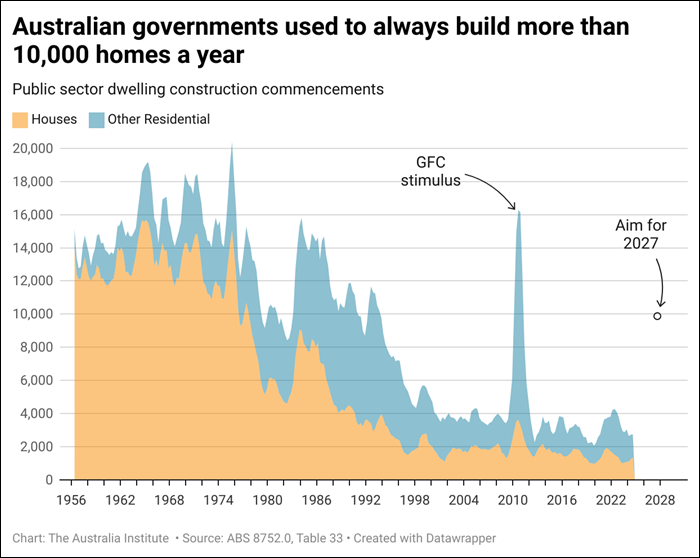
The ALP’s announcement yesterday that it will build 100,000 new homes over 10 years from 2026-27 for first-home buyers is something we at The Australia Institute have been arguing in favour of for a long while. Everyone in Australia knows that housing is a good investment… except it seems most governments, who instead have put in a myriad of policies to help private-sector investors.

The Australian Government can currently borrow money at an interest rate of 4.4%; by comparison home loans are around 6.2%. It makes sense for the government to borrow at a lower rate, build homes for people who need them – either to rent, rent to buy or to sell.

And governments used to this. If the ALP’s plan succeeds it would average 10,000 new homes each year. Up to the early 1990s that was the lower limit of public housing construction. Unfortunately for the past 30 years, government have departed the field and left housing construction to the private sector. Not surprisingly this has led to higher house prices – especially when combined with the tax incentives of negative gearing and the 50% capital gains tax discount.

10,000 homes a year is not radical, nor should it be beyond the capacity of our construction sector. We used to do it all the time. In fact, it was so common a certain Prime Minister grew up in public housing. It should be as common again.

After Anthony Albanese went to the not-for-profit ‘Nonna’s Cucina’ this morning, Peter Dutton has turned up at a Food Bank.

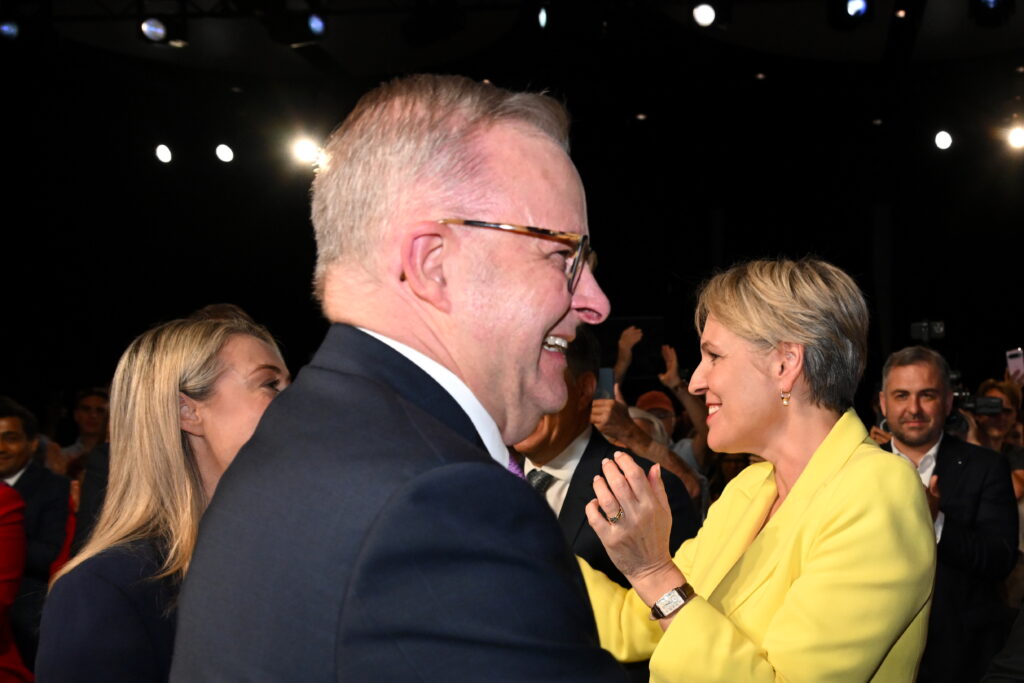
Why is everyone talking about Anthony Albanese and Tanya Plibersek and does it matter (spoiler: it doesn’t matter)

Australian Anthony Albanese and Australian Environment Minister Tanya Plibersek are seen during the Labor party campaign launch on Day 15 (AAP)

OK, so right before this moment shown in this photo, it looked like Plibersek was going in for a hug or a social kiss and Albanese grabbed both her arms and kinda shook them instead and continued down the line of Labor frontbenchers and the media lost its mind at the SNUB SEEN AROUND THE NATION.

It is no secret that Albanese and Plibersek have been rivals throughout their time in the Labor party, with both fighting it out for dominance within the Left faction. Albanese obviously emerged victorious in that battle (for now) but that doesn’t mean the rivalry stopped.

He gave Plibersek the environment portfolio instead of what she wanted – the education portfolio – because one) it is a difficult portfolio for any Labor MP to hold because Labor policy doesn’t address climate change like it should and still supports fossil fuels and so you need someone you know won’t mess up what is a very difficult line to walk (Labor’s own doing it is a difficult line, but that’s the political reality of it) and two) because it is such a hard line to walk, it usually does damage to the standing of the Labor politician who holds it and that wouldn’t be unattractive to Albanese either.

So Plibersek is one of their best performers, so she gets one of the hardest jobs, and it has the added bonus for Albanese that he can also annoy Plibersek and cut down her leadership ambitions.

None of this is new. And it is equally true that there are no leadership rumblings in Labor. It’s a pretty committed team, despite some of the internal relationship politics.

However, the kiss thing is a bit of a non-event. It’s an election campaign – Albanese didn’t actually kiss anyone and not wanting to get sick is part of that, also anyone who has ever gone in for a social kiss when someone is going in for a handshake and seen that awkwardness play out and also – there are bigger issues in the world? There is a genocide happening people. Let’s keep things in perspective.

Ugh.

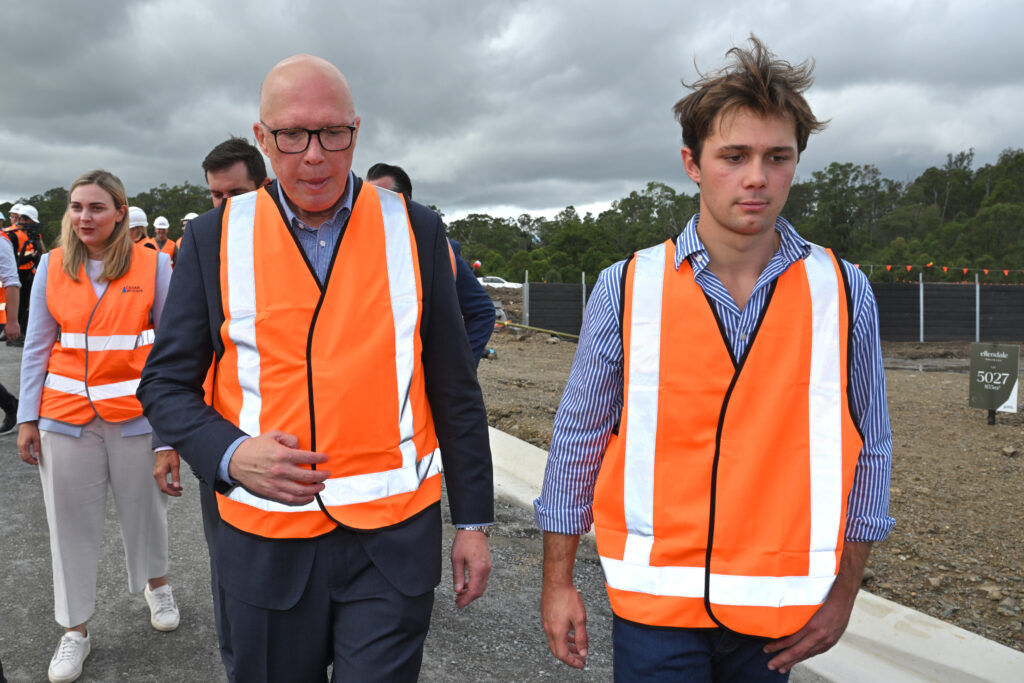
Peter Dutton was once again in high-vis.

Leader of the Opposition Peter Dutton and son Harry at a new housing estate in Upper Kendron, north western Brisbane (AAP)

So Peter Dutton was in Brisbane and Anthony Albanese was in Adelaide, let’s see how those campaigns looked:

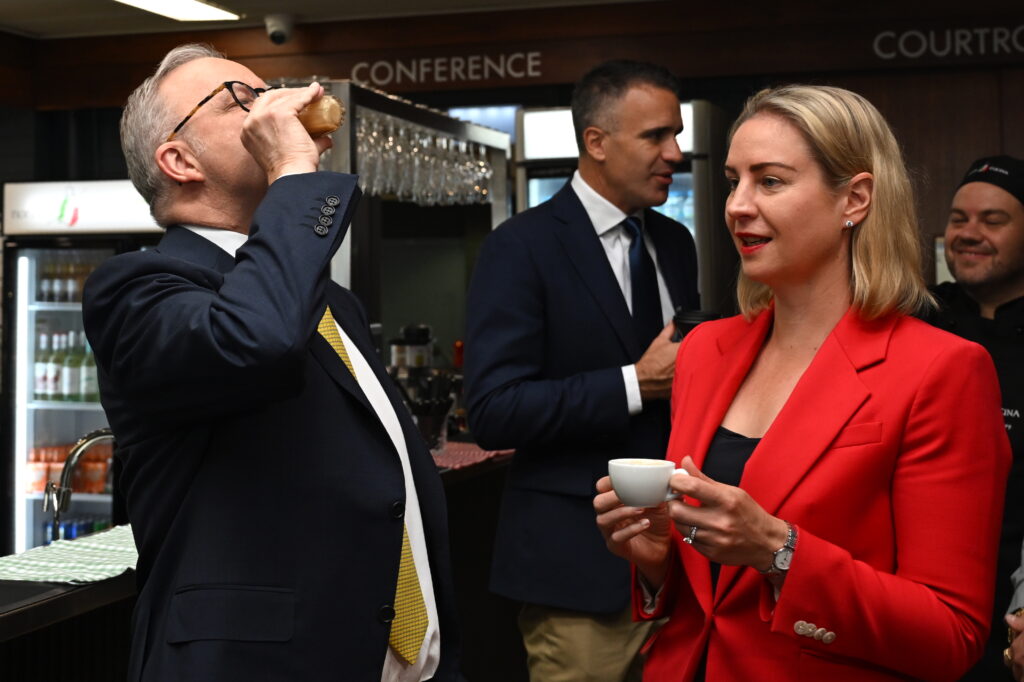
Albanese made the mistake of consuming food/drink in front of cameras:

Australian Prime Minister Anthony Albanese and Labor candidate for Sturt Claire Clutterham drink a coffee during a visit to local non-for-profit organization ‘Nonna’s Cucina’ (AAP)

What are the major spending promises?

Praise be to Andrew Brown at AAP who has pulled together the major spending policies (so far)

LABOR:

* Tax cuts – $17.1 billion over four years.

All taxpayers will get a $5 per week tax cut from July 2026, which will then increase to about $10 per week from July 2027.

* Health – $8.5 billion

Increased funding for GPs to allow for almost all clinics to bulk bill by the end of the decade.

* Housing – $10 billion

All first home buyers would be able to put down a five per cent deposit to purchase a property in an expansion of the help-to-buy scheme. A further 100,000 homes would be built exclusively for first-time buyers.

* Tax deductions – $2.4 billion over four years

Taxpayers would be offered an instant tax deduction of $1000, which would automatically cover work expenses.

* Mental health – $1 billion

More free mental health centres and youth specialist care centres would be opened across the country.

COALITION

* Fuel excise – $6 billion over one year

The fuel excise would be halved for one year, which would shave 25 cents a litre off the price of petrol.

* Tax offsets – $10 billion over one year

A one-off $1200 tax offset would be paid to those earning between $48,000 and $104,000 in July 2026. Those earning between $104,000 and $144,000 would receive a smaller offset.

* Housing – $1.25 billion over four years

First-home buyers would be able to deduct interest on their mortgage from their taxes for the first five years of their loan.

* Health – $9 billion

The coalition matched Labor funding to bolster bulk billing rates to 90 per cent by the end of the decade.

* Nuclear energy – $331 billion over the course of construction

The coalition have flagged plans to build seven nuclear reactors across five states, which would start to come online from the mid-2030s.

GREENS

* Education – $46.5 billion over four years

University courses and TAFE would be made free for undergraduate and postgraduate students.

* Environment – $17 billion over four years

The Greens have called for an extra $17 billion set aside to push environment spending to one per cent of the federal budget.

Housing cash splash – two out of three ain’t good enough

(The Australia Institute View)

There were three significant housing reforms announced yesterday – just one will increase supply and bring down prices. The other two will make things worse.

Labor’s announcement that a returned Albanese government would build 100,000 houses for first home buyers is hardly radical. Who’d have thought that actually building houses for people to live in might work? It would.

The Prime Minister’s other housing announcement – to allow people to buy a home with a deposit of just 5%, to avoid mortgage insurance – would give more buyers the chance to bid against each other and push prices up.

The Liberal policy, to allow first home buyers of new homes to claim the interest as a tax deduction, would do the same. Enabling them to dip into their super would make things worse and risk making them poor in retirement.

Neither Anthony Albanese nor Peter Dutton mentioned the two obvious reforms that would help to solve the housing crisis: scrapping or reducing negative gearing and removing the capital gains tax discount for investors.

“We welcome the government’s plan to build 100,000 homes,” said Matt Grudnoff, Senior Economist at The Australia Institute.

“The Australia Institute has long argued the best way for the government to improve housing affordability is to build and own more homes for people to live in – much as it does for Defence Housing Australia.

“This plan is not radical and should become standard for all governments. 

“But the plan to guarantee a 5% deposit for first-home buyers will put pressure on prices.

“The Liberal Party’s policy to deduct interest payments on the first $650,000 of a mortgage against your taxable income is adding yet another tax distortion that will cause prices to rise.

“It would mostly benefit the wealthy in a housing market already distorted with the 50% capital gains tax discount and negative gearing. 

“Coupled with the ability to access superannuation, the Liberal’s policies would only serve to increase house prices and make housing affordability worse.

“Both parties’ policies fail to remove the 50% capital gains tax discount and negative gearing, which have turned the housing market into a speculators’ delight and been the overriding cause of the decline in housing affordability over the past 25 years.”

Pushed on the fact that international students aren’t taking up as many rentals as Dutton claims (which is a fact) Dutton says:

Of course they are. I mean, where are these people living?* If people are coming here through the migration program, understandably they want a place to live but I’m not going to see Australians displaced from housing**.

There’s only so much housing stock and if you have got a 65% increase in the number of international students coming in, and you have brought in 2 million people over a – a million people over two years, 70% increase on any 2-year period in our country’s history, of course you’re creating a housing crisis. Why would the Prime Minister be surprised at that?

Jim Chalmers has no idea what’s coming next.*** What they have done is fuel inflation that’s driven up the cost of – the price of interest rates. This is a typical Labor Government. And if you put them in for a second term you’ll end up with Victoria is at the moment or where we were after the Keating years or where we were after the Hawke – after the Rudd-Gillard years, we can’t afford three more years of this. We can manage the economy, we can get our country back on track but Australians just can’t afford three more years of Labor particularly a Labor-Greens Government. You have a look in Ryan and Brisbane, the damage that those Labor members have already done. And Trevor Evans and Maggie Forrest, they’re two exceptional local candidates who will be great members of our Government and they’re going to work hard for their local communities because they want to see young renters being able to afford accommodation and to have some head-room in their budget. At the moment people aren’t insuring their cars or houses because they’re just trying to find every dollar of savings in their budget under a bad government****.

*Purpose built student accommodation, mostly.

**Many also live with families already in Australia

***No one does. That’s what Trump has done. The RBA says these are ‘uncertain times’

****Insurance has increased as a result of climate change

The Coalition’s sole answer to the rental affordability crisis is to cut international students, which take up about 4% of private rentals. COOOOOOLLLLLLLL

Dutton:

Rents are up by 18% under this Government. Let’s be clear about it. For every 42 international students who have come into Australia, one student accommodation place has been planned and approved but not built. So if we wonder why Aussie kids are 20 deep in a queue to try to rent a unit, or to try to find a place to, you know, to sleep, that’s part of the reason.

Now, we reduce the number of international students, we reduce the number of people coming through the migration program, and we massively increase the supply of housing – that’s how we can help young Australians who are renting or those who are seeking to buy. Labor has people on a treadmill at the moment and you’re going backwards.

People are going backwards as the figures demonstrate. Almost two years of household recession in this country under Labor – now, the Prime Minister wants to talk about everything but his record. He’ll throw mud and he’s negative and he’s out there with his scare campaigns because he doesn’t want you to believe that the next three years will be the same as the last three years but they will. What he’s promising is more of the same which is a disaster for people who are renting, for pensioners, for small businesses, for families, and we’re not going to have that situation. I want to be a Prime Minister who can fix the economy that Labor has damaged. I want to be a Prime Minister who can fix the cost-of-living crisis that Labor’s created.

I want to be a Prime Minister who can fix the housing dilemma that has been created over many budgets now and over many intakes through the migration program and Australians aren’t silly, they can see through the lies of the Prime Minister and the Labor Party. As we go to the next election, I believe Australians will make a decision about their future, what is in their best interest and in their best interests is to have a Coalition Government cleaning up Labor’s mess and putting in place good policies.

Oh hey economists, everything is fine because everything the Coalition is offering is just short term, so you don’t have to worry – Peter Dutton.

Just in relation to the announcements that we have made, we haven’t locked in a recurrent spend. So for, you know, the economists-minded people, we haven’t locked in recurrent spend like Labor has. They spent over $17 billion under their tax cut which is 70 cents a day starting in 15 months’ time. Australians need help now which is why we have done the 25 cent a litre tax cut on petrol. We don’t lock that in. We provide support now. As we did during COVID. I mean, Australians will remember JobKeeper* and JobSeeker and the support that we provided to keep the economy going to help families pay their mortgages and their bills, to keep businesses alight. We didn’t lock that into legislation that now is being spent every year. We put it in place to deal with the difficult circumstances before us.

And the difficult circumstance before us now is not COVID, not a GFC, it’s something much worse than that – it’s a Labor Government**. What we’re doing is we’re putting immediate support by way of the 25 cent a litre cut to fuel. Now, that costs about $6 billion.

*which included giving companies who didn’t need it billions of dollars, which they just kept. Oh and then it helped contribute to inflation. Huzzah.

**WTF is he talking about?

Peter Dutton again ignores questions about any of the detail of his own policy, including cost, which he is being asked about because he is obsessed with what Labor is spending, and instead pretends that it’s totally normal to not have any detail on the policy you are releasing and every one should just trust him.

Dutton is a multi-millionaire, who wants housing prices to continue to rise, but somehow become more affordable for first home buyers, who was calling tax cuts “an election bribe” until he decided he needed to do them too (short term) who has voted against the little bit of cost of living relief offered by the Labor government, who has no climate policies, who is cutting the fuel excise for one year because he is obsessed with fuel guzzling big utes, while also vowing to cut the cost of those fuel guzzling big utes so that more people buy that instead of an efficient vehicle, who wants to cut migration to free up housing (which no one says will work) but somehow also bring in skilled labourers to build extra housing, who has not mentioned renting or poverty once in this election, who has changed policies mid campaign, can’t actually tell you the detail of policies, or is just silent on them, who also was also a part of the Howard government that gave us these messed up housing tax and climate policies and then a member of the Abbott-Turnbull-Morrison governments that baked it all in – now he just wants you to trust him. Give me a break.

Both parties will release their costings in due course. That’s how the elections operate. What’s important now is people go into the Easter break and as they go into discussions with their families, it’s about who is better off to manage this economy and to keep our country safe.

It’s who is better able to restore the dream of home ownership. Who can give you $1,200 back of your own money to help you through Labor’s cost-of-living crisis. Who can cut petrol by 25 cents a litre on day one so that local tradies and families and delivery truck drivers and farmers and others receive that benefit, pensioners, people across the economy can benefit from that and as we have said, we’re not supporting Labor’s wasteful spending because its drives up inflation and when the Reserve Bank Governor in our country says that there is a hem-grown inflation problem from Labor’s spending she’s right. Interest rates came down much more quickly than they did in this part of the world in comparable economies and as we know in this country, Australians feel it in their hip pocket, they have been ripped off by Labor.

That’s what Labor’s legacy is and I don’t think Australians can afford three more years of Labor and I want to make sure that we can help manage the economy so we can deal with Labor’s cost-of-living crisis. We can fix up Labor’s energy crisis which is jacking up the cost of everything. We can restore the dream of ownership, and we can deliver excellent first-class health services in a way that Labor just can’t.

Honestly – wtf is this?

Dutton:

As we have said, I want to see house prices go up, but we need more supply into the market which is exactly what we’re doing. We’re bringing on 500,000 more homes than Labor is proposing. Bringing on through to the cut of the migration program – 100,000 existing homes which we free up for renters and for first home buyers. Rents have gone up by 18% under Labor and people are losing faith in this Government and so they should.

How does this help with housing affordability?

Fact check: Dutton on housing

Greg Jericho
Chief economist

Dutton: “In relation to our policy, we are creating 500,000 new homes through our $5 billion fund to help councils with critical infrastructure.”

This is an old policy by the Liberal Party the figures are rather on the dodgy side. But helping “council with critical infrastructure” is a nice way of saying helping property developers.

Rather than spend $5bn building new homes over 5 years (which would almost be double what is currently spent building residential homes by the public sector across Australia), instead the Liberal Party proposes spending $5bn over 5 years to allow property developers to build infrastructure so that they can then sell land for a greater profit.

And what infrastructure? Well, the announcement is wide-ranging – “the roads… the water, the sewerage, the power, the telecommunications”. But while you might think this shows how large the announcement is, actually it just reveals how laughable it is to suggest this will unlock the construction of 500,000 homes over 5 years.

In the last financial year, $43.2bn was spent on infrastructure building roads, water storage and supply, sewerage and drainage, electricity generation transmission and distribution, pipeline and telecommunications.

Does anyone really believe an extra $1bn a year is going to “revive the home ownership dream and boost building across Australia.”

Good Dolly.

Every question Peter Dutton is asked about his big spending agenda – tax cuts, interest on mortgage tax cuts, the fuel excises – all of it is foregone revenue, while Dutton has also committed to matching Labor spending on health and other major policies – Dutton just talks about Labor’s ‘big spending agenda’.

It’s as transparent as the underwear in your dad’s drawers growing up.

It is obvious that the focus groups have told the Liberals to link Labor and Greens together as much as possible, because he can not utter a sentence without saying Labor-Greens government.

Honestly. It is all so stupid.

Peter Dutton wants to see house prices ‘steadily increase’

Oh good. Now we have our latest unity ticket from our major parties – who both want house prices to keep going up.

Clare O’Neil said this last year. Now Dutton is saying it.

I want to see them (house prices) steadily increase. I don’t want to see a situation where Labor crashes the economy and somebody who’s paid $750,000 for a house today is worth 600,000 in 18 months time under an Albanese-Bandt Government.

That would be a disaster. People would be sitting on a house that is wotht less than what their mortgage is. That’s what happened frankly in the ’80s and ’90s when Labor last presided over a recession. Now, Jim Chalmers is talking about a recession in our country and he’s panicking at the moment.(He is not talking about a recession and Dutton is being incredibly irresponsible here)

Labor can’t manage the economy. That much they have proven. (Inflation is down in the target band and the nation did not enter a recession) And I want to make sure that house prices steadily increase and we’ll do that if we get the supply-demand equation right. But if you flood the market with a million people over two years, which is a 70% increase on any 2-year period in our history, of course all those people want houses as well and that’s why we’re cutting migration, so we can deal with Labor’s housing crisis.

Anyone else want to join me in screaming into the abyss?

Peter Dutton says the detail on his policy is still coming while continuing to criticise Labor spending. Sigh.

How can the Coalition keep talking about the ‘$100bn’ of ‘wasteful spending’ it says Labor is carrying out this election, when it now has tax cuts and a housing policy tax cut that there is no detail for?

Peter Dutton:

As I say, all that detail is provided in due course in the run-up to the election. What we have said is we’re not supporting Labor’s wasteful spending because I don’t want inflation to go up. A big spending Labor-Greens Government is going to drive up the cost of inflation and the cost of interest rates are higher always under Labor. Now this is the biggest spending Government in 40 years. They’re the biggest spending Government because Labor can’t help themselves. They always tax, they spend.(Labor had legislated tax cuts the opposition has vowed to repeal ahead of the election campaign) Look at what the Victorian Labor Party has done to the economy there. Look at what Annastacia Palaszczuk and Steven Miles have done in damaging the Queensland economy. We will always be better economic managers and we’ll always provide support to families. 30% more people is what are paying for groceries at the moment (it’s 12%)

We are going to provide more of people’s own money back to them through the $1200 tax cut. Going to provide a 25 cent a litre cut on fuel and going to provide an opportunity for young Australians to realise the dream of home ownership again.

Peter Dutton press conference

I love election campaigns where leaders act like everything in the campaign is a bubble, untouched from any previous decision, or indeed time – like here, where Peter Dutton pretends housing affordability is a new problem and not one created by the policies of his party, which he supported for the past 20 years:

We’re providing $5 billion for 500,000 new homes. We’re cutting the migration program by 25% because Labor’s had it at a record high.(you already know that won’t help housing costs and also why its at a high) And that’s increased the demand for housing. So we create 100,000 homes in that policy, we now provide another 30,000 homes a year being built – and the Labor Government’s got demand side pressures that they’re not addressing through supply side. (sigh, Labor also has a supply side promise)

That is extra homes being built. We are the only party that is addressing the supply side and by providing an opportunity to young Australians – look, I moved around the country over the course of the last three years, there were many messages of people under pain under the Labor’s cost-of-living crisis. (Sigh, it was global inflation)

It kills me to hear young Australians saying I’m working hard, we’re both working hard, we’re putting money aside, we just can’t afford – we don’t think we’ll ever be able to afford a home. That’s the common story. Now, I’m not going to accept that as Prime Minister of this country. I want to make sure that we can do everything we can if we’re fortunate enough to win the election to restore that dream of home ownership and this is the way we can do it. A Generation ago, you didn’t require the same amount of disposal income because housing was cheaper, units were cheaper, and we have to deal with the reality for this generation. (The Coalition have been in charge for the majority of tht period) That’s exactly what we do through our policy. We hope that Australians can see some light past this dark period of the Albanese Government. Help is coming. People need to vote for the Coalition at the next election and we can deliver that.

This is one of those questions where a little economic history WOULD actually help.

Q: One of those elections that you spoke about that Labor one in 2007 when the Labor leader went to the election promising far less spending than the Coalition at the time, in fact less spending [more in every] single policy you announced yesterday, isn’t it time [that] this reckless spending has to stop?

OK. Now in 2007, it was the tail end of the mining boom. The economy was awash in money. Inflation was rising. And so what happens when governments follow neo-liberal economic policies when inflation is rising and there is too much money in the economy – say it with me guys – governments cut down on their spending. Yes! Correct – gold stars for all of you. And let’s say there is a global financial crisis and suddenly all the money drains out of the economy and inflation isn’t a problem, but recession could be – what do governments following those same policies do? Anyone? Anyone? Yes! Gold star to Grogs who is yelling very loudly in the office – governments INCREASE spending to stimulate the economy.

So do you see how different economic circumstances have different policies? If someone was to go to an election promising to cut spending all over the place in a time of mass global economic uncertainty – for example if a batshit crazy dictator was elected by the world’s largest economy and he started wrecking havoc with the world’s markets, then you wouldn’t want to cut, because people would panic and you would create – what? Anyone? Anyone? Yes – a recession. Snaps all round.

Albanese:

What we’re doing is putting out responsible policies and that’s why if you look at our $10 billion program that we are now desperate that we announced its four grants match, $8 billion is for loans and equity, that will produce income back in be able to be reinvested.

That is the difference here. Between that and a one off cash payment for one year that disappears then and then higher income taxes so that is what the alternative policy is and the housing policy that doesn’t do anything about supply.

What we’ve done is very carefully calibrated the cost of living measures that were put in place in a way that have continued to put downward pressure on inflation. Inflation had a six in front of it, it is now at 2.4. Interest rates started to climb before the last election. Now they’ve started to fall that’s because of our responsible economic management that we will continue to pursue.

Anthony Albanese is then asked to comment on Trump’s trade strategy and says:

We live in an era of strategic competition. The United States elected President Trump on a platform. We respect democratic processes. What we will continue to do is engage constructively not just with the US but importantly as well engage in our region.

One of the things we’ve done under this Foreign Minister and under our trade Minister Don Farrell, two great South Australians, South Australia does punch above its weight in this show, that’s the truth – we have improved relations not just the obvious of restoring trade with our major trading partner in China, we even got the pandas back here in Adelaide, we have the pandas back in Adelaide.

…I sat down with the wine industry in Australia because they had a number of good years, they were pretty keen on getting wind back into China now it’s going back in premium wines going into higher levels than they were beforehand.

We have restored our relationship with the Pacific, our Pacific relationship is important. Our COP bid is important for battle to our relationship with Indonesia had never been stronger and a relationship with India, India grew to be our fourth major export destination just in recent times. They are our fifth-largest trading partner. We can build on the relationship even more.

The Adelaide Zoo pandas would like to be excused from this narrative (AAP)

Asked about Labor’s bid to host the next UN climate conference, Albanese says:

We do have the bid in, it will be determined as the climate change conference later this year. If we are re-elected.

If Peter Dutton is elected, you can see him copying policies from other jurisdictions and pulling out of Paris. We know a whole lot of their mob are still in climate denial, they’ve been unequivocal about it. But we will put forward our bid to host a climate change conference and I can’t think of anywhere better than Adelaide to host that event.

…One of the things that are climate change conference would do is showcase this beautiful city of Adelaide to the entire world. And when you look at the work that their premier is doing in renewables, leading Australia as South Australia has for a long period of time then I can’t think of anywhere better than South Australia was a bit like the election, we are not getting ahead of ourselves.

Albanese adds:

Can I make one more point about that which is our bid is in partnership with the Pacific so it’s a joint bid. It’s one of the ways that we’ve repaired the relationship with the Pacific. Australia was in the naughty corner with a couple of other countries only a couple, when it came to climate action and our response. And that is why it is so important. Every Pacific leader remembers what my opponent said about water lapping at their doors and that is our credibility in the region is really important. And that’s why this joint bid overwhelmingly has the support of the Pacific.

Yeah, not so sure Pacific leaders are exactly thrilled with how climate has been treated under the Labor government either. Being better than the other guys doesn’t make the policies good.

Lol. Anthony Albanese is then asked if he will keep Tanya Plibersek in the environment portfolio if he wins the election and says:

I will commit to trying to win this election. I don’t assume, you might. Tanya Plibersek has been a friend of mine for a long period of time. We live in neighbouring seats and we good mates and she is doing a fantastic job.

Asked about the median house prices in capital cities being over $1m Albanese says:

Historically in Australia, prices tend to rise. What we want to do is to make sure that people have accessibility for homeownership. What we want to do is to take away the disincentive which is there were people just can’t get a deposit. When I bought my first home he didn’t need a 20% deposit. What has happened is a range of changes particularly rising out of the GFC that occurred to have that 20% deposit and what we’re doing in allowing for a 5% deposit with the government going guarantee is making sure people don’t have to wait so it means they get into that homeownership earlier.

AGAIN – WHY ARE THEY RISING? WHAT COULD HAVE CHANGED THAT MEANT HOUSING WENT FROM BEING ABOUT 0.3% HIGHER YEAR ON YEAR THAN THE AVERAGE HOUSEHOLD WAGE IN THE 1990S TO ALMOST 9% HIGHER YEAR ON YEAR FROM 2000?

What else happened in 2000? Oh, the introduction of the capital gains tax discount? Which turbo charged the negative gearing loophole that was meant to be for business investment but canny accountants showed people how to use it for housing? And then no one changed it and just let it take off? Could that maybe have contributed?

Q: We have spoken with homeless women about some of the stucco government is doing about housing and they said that this is all well and good these 5% programs but they can’t even put together 5% for a deposit. What they really need is emergency housing specifically for them fleeing domestic violence and the need to be able to live with their teenage sons. What is your government going to do about that?

Albanese:

The Housing Australia Future Fund [included funding for ] emergency accommodation women and children escaping domestic violence.

They were saying that we pointed out when the Greens and the Liberals and the Nationals in the Senate held it up for month after month after month, they held up that funding.

That is just one element in addition to the work that Claire and Amanda Rishworth, another great South Australian Cabinet minister that is not here, has done in getting agreement for increased funding for emergency funding for women and children escaping domestic violence as well. We know there is more need to be done.

That is why we have attempted to put in place programs earlier to make sure that we address those issues on top of the additional community workers that we have put in place as well.

Q: There will be a lot of people this morning saying that I don’t qualify for this. They are not first-time buyers looking at buying a home and saying what does this mean for us? The majority of the people in the housing market, what this mean?

Albanese:

It means if you increase supply, you assist everyone because you have an impact on affordability. Across the board whether it is Housing Australia Future Fund, the Social Housing Accelerator that we put in, the immediate fund we were able to do, with what they did there are now people living in homes that were left derelict.

They basically were not being fixed up. I remember under the former government here in South Australia going to homes that were unlivable here.

They are now being fixed up because there is a specific fund for them. We are about Housing Australia Future Fund, looking after social housing, emergency housing and by helping people into homeownership through shared equity.

Our housing Australia fund is as well. Peter Dutton speaks about housing infrastructure to help with electricity, water supply and those measures. We have announced two rounds of that program, ensuring private developers to be able to have that increasing housing supply. The board, we know supply is the key. Only Labor is looking at supply as well as demand.

Anthony Albanese press conference

Right, on the issue of the 100,000 houses the government has committed to building for first home buyers, Clare O’Neil, the housing minister says:

We don’t just have a commitment to build 100,000 homes for first-time buyers. The government has been working on building more homes for three years now and it is working. Let me just canvass some numbers with you. We have a commitment to build 1.2 million homes with estates over the coming five years. We are making real progress on that. We have got 500,000 homes across this country since we came to government and that has been assisted by the policies we have put in place, fee free tape has trained 500,000 people around our country, 40,000 of them in construction professions and don’t forget that is one of the myriad things that Peter Dutton wants to slash and burn if he is elected.

The PM has led the states undertake significant planning reform and traffic that we have a generational investment under way in the government actually rolling up its sleeves and building more homes we are adding 100,000 homes to what is already a massive homebuilding program that we have across the states and territories.

Let me add one more thing. I wanted to look at what is going on in construction today. If you look at the approval numbers that came out just a couple of days ago, approvals have gone up 25% of the previous year.

The Coalition ‘s approach to this is we can’t do anything about this, it is the private sector, nothing to do with us. We take a fundamentally different view. A government is stepping in to support first-time buyers and we will build more homes around the country and I not possible because it is already happening.

Now, as most of the economists at the Australia Institute know, I tend to treat economists like a packet of Arnott’s Favourites – there are a couple of good ones, and wayyy too many orange creams (the worst of all the biscuits). And just like Orange Creams, the neo-liberal economists tend to stink up the whole place with their neo-liberal views and every economist smells a little like Orange Cream, even when they’re at the other end of the packet.

And that’s kinda what has happened here.

But the problem is, economists (even the annoying ones) do know what they are talking about on certain issues. So by politicians attacking economists for populist reasons, then it just contributes to the undermining of experts, which isn’t a great thing overall.

So criticise economists – Dolly knows I do it on a daily basis – they don’t have all the answers and a lot of the time they are so blinded by their own ideologies and the economic school they favour, they can’t actually see when they have absolutely no idea about what’s actually happening in the real world (profit gouging anyone?) Economics is a social science. But criticise them for the right reasons.

Seems like poor old economists are everyone’s punching bag today. There has been criticism from economists who prescribe to all different schools of economics (even Steven Hamilton has had a crack at the Coalition’s housing policies in the Fin) because I dunno, I know I only did high school economics, but even I know that giving people access to more money only increases the demand and therefore makes houses more expensive. But apparently, our major parties, who refuse to actually do the things that would make a material difference (reform the tax system, tackle distribution of houses) just want to continue tinkering.

Albanese has singled out Chris Richardson in his press conference:

I’m happy to bring Chris Richardson here, to have a look at the construction and have a look at the jobs that are being created here, and have a look at the economic activity that’s right here.

And then I’m happy to bring him back and meet the people who are living here in a home as well.”

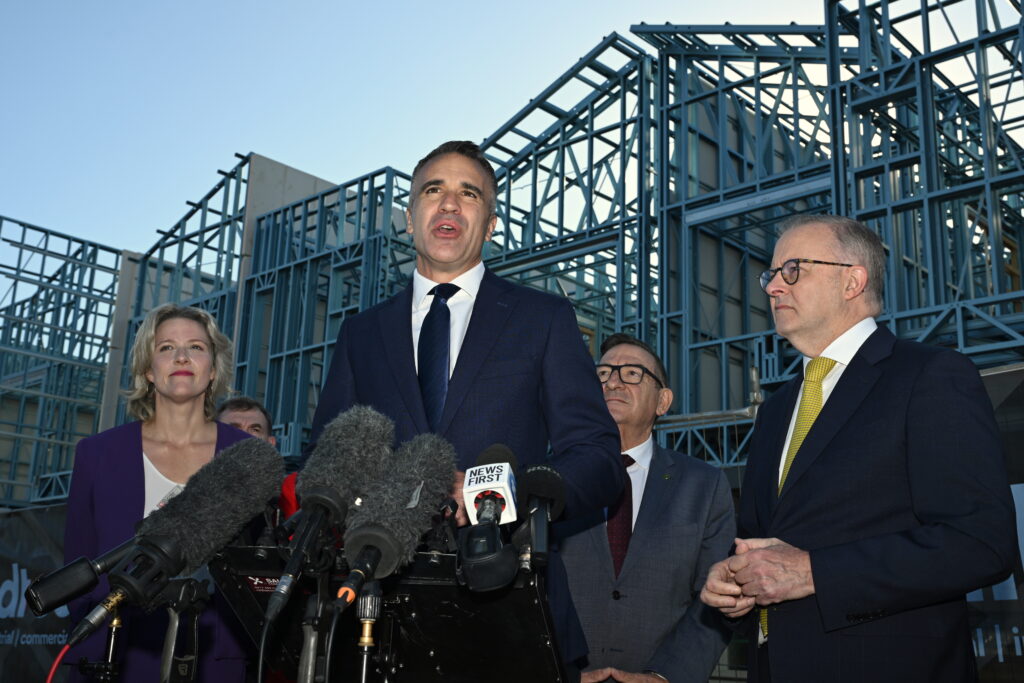
Anthony Albanese is back in Adelaide, walking alongside Labor’s most popular politician, Peter Malinauskas AND standing in front of a housing development, so you can see what Labor really wants to push today.

South Australian Premier Peter Malinauskas speaks to the media during a visit to Prospect Corner housing development together with Australian Prime Minister Anthony Albanese and Australian Housing Minister Clare O’Neil

Election entrée: Surprising preference flows

Skye Predavec

In the 2022 election, the count in the seat of Brisbane was on a knife edge.

The LNP came first on 38%, Labor second with 27%, and the Greens third also with 27% – just 11 votes behind Labor.

A surprising trend emerged: when right-wing minor party candidates were eliminated their preferences favoured the Greens over Labor.

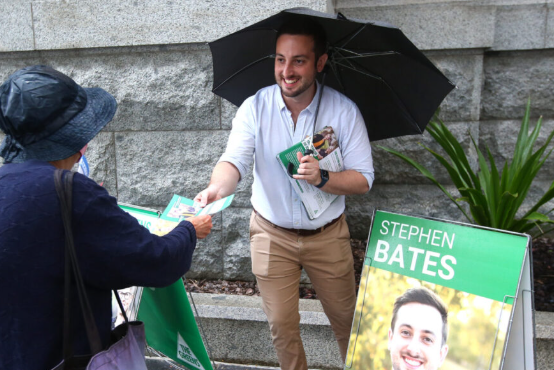
Preferences from United Australia and One Nation voters, as well as Animal Justice voters, propelled Greens candidate Stephen Bates ahead of Labor, at which point Labor preferences won the seat for Bates at the expense of sitting LNP MP Trevor Evans.

Elsewhere in Queensland, in the seat of Groom, independent Suzie Holt went from fourth place with 8% of the vote to finish second with 43% on preferences.

This improbable result occurred because she was favoured above the Liberal National candidate by voters across the political spectrum: Greens, One Nation and Labor voters.

These unexpected results are a reminder that you, the voter, decide your preferences, not the political parties – and those preferences could decide an election.

Given Peter Dutton is promising to cut the public service by 41,000 people, which has been one of the foundational policies of his election campaign (even if the Coalition is yet to actually explain it, because they keep confusing themselves) it was interesting that it didn’t get much of a mention in his campaign launch on Sunday.

It didn’t seem to be mentioned at all. The only utterance of ‘public’ was in relation to hospitals.

Nuclear, a policy which is also on the nose, was at least mentioned three times.

The Liberal campaign has started the day in Brisbane, where the Liberal and Labor party are both trying to take the seat of Brisbane away from the Greens. There has also been commentary that Peter Dutton could be in danger in his seat of Dickson – which is always the case when the Liberal party is looking a little shaky. It falls over the line for the Liberals and has for the last couple of decades that Dutton has held it, so don’t get your hopes up about those stories.

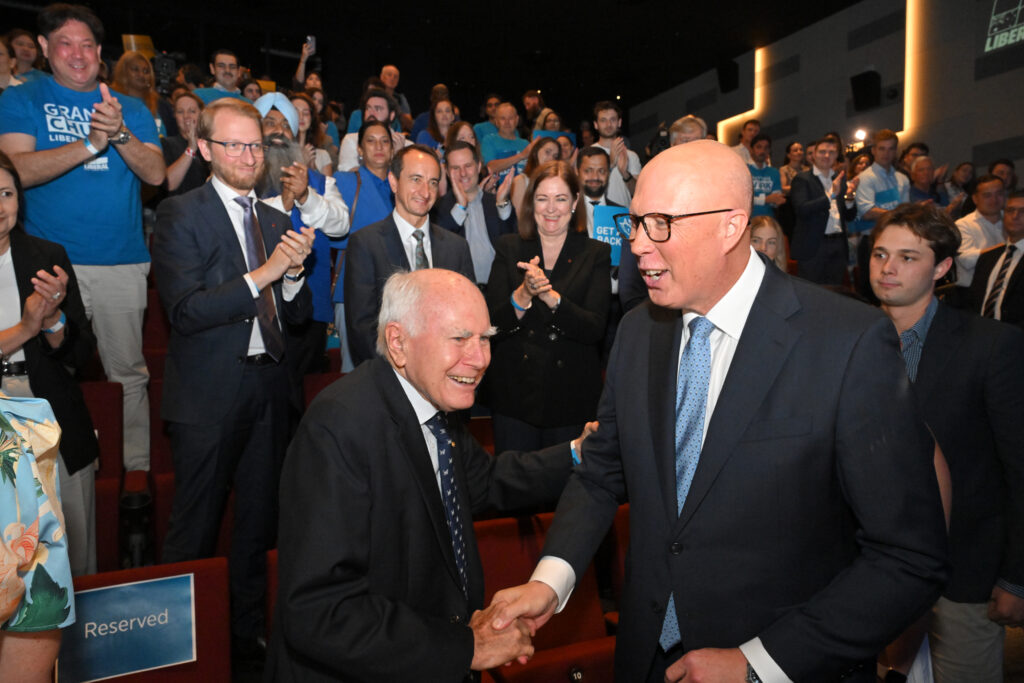
Former prime minister John Howard and Leader of the Opposition Peter Dutton after the Liberal Party Campaign Launch
Former prime minister Tony Abbott and Leader of the Opposition Peter Dutton after the Liberal Party Campaign Launch

Jacqui Lambie also had opinions about a hung parliament.

All the action seems to be happening in the Senate. So, they can have the hung parliament down there, but quite frankly, it’s still got to get through that house of review. I obviously sit in that. I’m very comfortable with that. I’ve been part of that balance of power off and on for 10 years, so it doesn’t bother me. I’m just getting on with the job and what Australians need me to do.

Over on the Nine network, Jacqui Lambie gave her opinion on the major party campaign launches:

I mean, these two leaders, both Anthony Albanese and Peter Dutton this morning become as loose as a bloody goose. I mean, you’ve got to be kidding me. How about you turn the first lot of soil on the first 50 or 60,000 homes that you’ve promised and do not talk to me about those TAFEs. The reasons we have RTOs in the unions running them is because the TAFES have been depleted year in, year out.

Now, I’m not having a go at the unions for picking up, um, for picking that up because nobody else bloody did.

But quite frankly, I mean, I’ve got a TAFE down here that’s got Cold War equipment in it from the 1950s, full of asbestos. And you’re training them? Oh, please.

Here’s a good idea. How about you go to the root cause of the problem and you go to our TAFEs? I’ve got Australian TAFE who can’t even tell me what every one of their TAFE is doing, what equipment that they need. I mean, it’s an absolute mess.

So, seriously, looses as gooses today. And it’s going to get worse the next 20 days.

There was some chatter following Labor’s launch yesterday, that Albanese and Tanya Plibersek had an ‘awkward moment’ where it looked like Plibersek was going in to give Albanese the social kiss (the cheek-to-cheek kiss among friends) but Albanese grabbed both her hands and it was just a bit awkward. The subtext is that Plibersek and Albanese are at odds, because not only did Albanese side line her at the beginning of the government by giving Plibersek the shit-sandwich of environment instead of education as she wanted, he has then come over the top (nature positive laws, Macquarie Harbour ) and over-ruled her decisions.

Plibersek has an actual laugh about it this morning on Seven:

I reckon we should  still all be elbow-bumping. During an election campaign, the last thing you want is to catch a cold from  someone. So that’s on me. I  should’ve done the elbow-bump, I reckon. 

Q: You two still getting along? 

Plibersek:

Yeah, of course! Oh yes!

 Q: Friends, buddies? Just checking. 

Plibersek:

We’re buddies! 

Very convincing.

Barnaby Joyce has been sidelined by his own party so he hasn’t played much of a role in this campaign (a point he will no doubt make if the Nationals vote falls/lose seats, which it is on track to do) but he is still allowed to do Seven’s breakfast show.

This morning he is asked about Angus Taylor’s criticisms of Labor’s tax policy as being a “cruel hoax” and an election bribe and how the Coalition’s promise to temporarily bring back the LMITO is any different.

Joyce:

We want to make sure that we too acknowledge  there is a cost-of-living crisis.  The way we’re going about it is  different. We’re helping people  right now, in fact, we’re helping  people every time they go to the  fuel bowser, because they don’t pay the excise they used to pay, so that’s more money in their pocket. It’s a very, very, very clear  difference. (well, not yet – the policy is not in place)

Now, on the repayment  said, we’ve got to make sure that we have an economy, an economy that’s driving ahead and gives us the  capacity to increase the tax-free  fees to increase our capacity to service the debt.

The way you do  that – hate to say it – go back to issues such as energy. You make sure the energy prices, nobody wants a  reduction in wage rates, there is  only one advantage, it’s energy. So you can’t go forward with 82% of  power, you won’t have a manufacturing economy, then you will have a part-time administrative  economy, and that is how there is a fundamental difference, because what underpins it at the end is the  fundamentals of economics, cheaper energy.

Sigh Banaby. Sigh.

On the neo-Nazi protest outside his office over the weekend, James Paterson says:

I don’t know what their motivation was but, if it was to intimidate, it’s not going to work on me. I’m more determined than ever before to stand up for Australians, to protect them against extremists like these and any other extremists in our community. I particularly resent the attempt by these people to portray themselves as patriots.

There is nothing patriotic about worshipping a failed foreign regime of one of history’s greatest losers, Adolf Hitler. The real patriots are the Australian men and women who went and fought and defeated Nazism. Whenever it rears its ugly head in Australia, it must be fought and combated. I will always stand against it.

Given that a lot of people actually know what they are talking about when it comes to house prices and those people say doing things like this will actually only make house prices more expensive, because there would be more people able to borrow more, therefore increasing demand for houses, which INCREASES THE PRICE, doesn’t James Paterson see something in their criticisms?

Paterson:

We have a comprehensive plan that includes $5 billion for infrastructure to unlock 500,000 homes – that’s building the water and sewage and roads and electricity that allows housing developments to be commenced and bring those houses onto the market. (This is a subsidy for property developers)

We’re also reducing demand by cutting migration. We believe we’ll reduce migration by 100,000 a year in net overseas terms compared to Labor. And over the next few years, that will free up 100,000 homes.(this is a bit of a fantasy) We’re also going to reform the building industry to bring down costs of construction, because the CFMEU has been out of control, and that’s added to the cost of construction.(this has mostly been a commercial property site issue, not a private housing issue)

And we’re going to help deliver the skills we need to industry so they’ve got more workers who can help build homes with a $12,000 payment to small businesses who take on apprentices and trainees. (this will not lower house prices) It’s a comprehensive plan. Taken together, it reduces the pressure on demand – particularly from international visitors – it increases supply, and it backs first-home buyers, giving them a real advantage in the market.

You know what actually would work? Reforming the tax system so that housing wasn’t treated like an investment. The Greens have a policy which would grandfather negative gearing (on one property) for investors but would scrap the tax breaks moving forward.

On housing, James Paterson is asked:

Q: For first-home buyers, you’re promising to allow them to deduct interest akin to negative gearing. Do you know what this policy would do to house prices? Because a number of economists have some pretty serious concerns about this.

Paterson:

I have seen some of the commentary from economists and others, and I have to say when it comes from someone who owns their own home and probably bought it many years ago, it’s going to come across to many Australians as, frankly, pretty out of touch and tone-deaf.

I think people underestimate the generational despair among young Australians who’ve lost hope that they’ll ever be able to buy a home. Some polls show that up to three-quarters of young people believe they will never be able to buy a home.

That’s a disaster for our country.

Frankly, there is quite a lot of intergenerational resentment from young people. This is a really important point, I want to finish quickly. There is intergenerational resentment from young Australians who believe the cards have been stacked against them, and we want to fix that.

Q: But only a couple of weeks ago, your leader and Shadow Treasurer were pretty solid saying, “No, there’ll be no tax cuts. You wanted to be the party of fiscal responsibility.” Have you been influenced at all by the coalition’s declining position in some opinion polls that you’ve decided this is a lever you had to pull?

James Paterson tries to sell this:

The difference between what Labor is proposing and what we’re proposing is ours is timely, it is targeted, and it is meaningful. It’s not baked into the budget forever, costing billions and billions and billions over many years. But it’s going to give people much more when they actually need it. So the same week that they’d be receiving a 70 cent-a-day tax cut under a re-elected Albanese Labor government, they could be receiving up to $1,200 from the Dutton Coalition government in a way that will really assist them when they really need it, but doesn’t bake in a structural spend in the budget.

Liberal party spokesperson James Paterson is next up on the media carousel. He seems a little cranky this morning.

He is asked by the ABC hosts:

Because we are in WA, I wanted to start off with a very WA-specific question. Why do you think that this used to be a Liberal Party stronghold – why do you think that Western Australians have turned away and that this is now a stronghold for the Labor Party?

Paterson:

Well, I wouldn’t get too ahead of myself if I was the prime minister and the government. Not a single vote has been cast yet, let alone counted. And it’s presumptuous to assume how Western Australians are going to vote before they have the opportunity to do so. But speaking more generally over the last couple of years, it’s certainly the case that state Labor governments in WA have been popular, particularly during the pandemic period. We know that the former premier was well-regarded because he closed Western Australia’s border and kept COVID out of the state for some period of time. That’s certainly lifted the Labor brand in WA.

Q: Let’s go to some WA. policies. Maybe let’s start with tax. Your party was pretty clear on this a couple of weeks ago, saying that Labor’s tax cuts in the budget were a blatant bribe. How then would you describe your tax offset, or tax payment, for low- and middle-income earners which was announced yesterday?

Paterson:

We describe it as a cost-of-living tax offset, and it’s desperately needed by many Australians because they’ve suffered so much from rising cost of living under the Labor Party’s watch, under the Prime Minister. I mean, grocery prices are up 30% over the last three years. Electricity prices are up 32%. Gas prices are up 34%. The Prime Minister promised Australians before the last election that they would be better off.

He even said that they would have cheaper mortgages. But that’s not Australians’ experience. They need help to try and restore their standard of living. We’ve got a comprehensive plan to do that. It includes immediate up-front relief with a reduction in petrol and diesel tax that will save people $14 every time they fill up. And ongoing assistance with reduced energy prices through our gas plan. But it also includes this one-off cost-of-living tax offset, because a lot of Australians have racked up big credit card bills on Labor’s watch over the last three years, and they need help.

What the Coalition is offering is a temporary return to the low and middle income tax offset, which the Morrison government set to phase out, and then Labor just continued on that path. It was created when the stage three tax cuts were originally laid out (because the Morrison government’s stage three tax cuts overwhelmingly favoured the wealthy) so the $1,500 for low and middle income workers was a little short term cushion for the permanent and terribly distributed stage three tax cuts. Labor changed the distribution of the stage three tax cuts, and then at the last budget (delivered last month) announced a modest ‘top up’ tax cut for most tax payers, which the Coalition called a “cruel hoax” and an “election bribe”.

Greens announce free uni policy

The Greens will announce their latest policy – free university. They plan on increasing the tax for big corporations to pay for the $46.5bn plan.

Adam Bandt said its not only fair, it will also help even the playing field once a student has finished their degree.

(As a reminder, in 2023-2024, the Australian Government collected almost five times more from students ($5.1b) than from petroleum companies through the  Petroleum Resources Rent Tax (PRRT) ($1.1b).

Bandt said

Young people are being crushed by increasing student debt while they struggle with paying rent or affording the basics, in a housing and cost of living crisis.

IIn a wealthy country like ours, everyone should be able to have a good quality education. One in three big corporations pay zero tax. We should tax big corporations and billionaires to fund what we all need, like free tertiary education.

Experts predict we’re headed for a minority Parliament. This election, the Greens will keep Dutton out and get Labor to act on cost of living relief for young people, including by wiping all student debt and making university and TAFE free.”

Does Jim Chalmers expect house prices to increase with the 5% deposit idea? (The government is expanding the scheme where it will guarantee the rest of a (limited number) home buyer’s deposit, and lowering what is needed under the scheme from 10% to 5%)

Chalmers says:

On our advice, we’re not expecting there to be a substantial impact on demand or on prices. But also, you’ve got to recognise, James, that this is not the first step we’re taking in housing. We’ve got a $43 billion agenda, and the primary focus of that agenda is to build more homes. And again, that’s what goes to the difference here. We’re talking about smaller deposits and more homes. Our opponents are talking about fewer homes and higher prices. That’s because they will cut the Housing Australia Future Fund. That will mean fewer homes. And so, again, I think yesterday was a really important opportunity for the two sides to lay out their agenda. If you vote for Labor on the 3rd of May, you will get more homes and you’ll get smaller deposits. If you vote for Peter Dutton and the coalition, you’ll get fewer homes and high prices. That’s the difference.

Q: On the 5% – to stay on your policy for a minute – if we see a whole lot more first-home buyers rush into the market and then there’s a market downturn, will that mean that the government could be on the hook if people default on their loans?

Chalmers;

First of all, it’s very unusual in Australia to see that outcome. Secondly, we know from the existing program that there has been an absolutely miniscule amount of defaults on these debts. So we are extremely confident that this is a very responsible way to get more first-home buyers into the market – and not in isolation, but by building more home for first-home buyers as well. So we’re dealing with the supply issues, which are the most important issues. We’re dealing with the issues around the deposits. Because those are the two biggest obstacles, to young Australians in particular – first-home buyers right around the country getting a toehold in the market. So we’re dealing with deposits and supply. Again, our opponents are dealing with – they want to propose fewer homes and higher prices for younger people, and that will make it harder for them, not easier.

Given independent candidates like Allegra Spender have wanted to see more on tax reform and a return to the Henry review, will a Labor government be looking at it for inspiration?

Jim Chalmers:

I understand, and I engage respectfully with the crossbench on some of the issues that they’ve raised with us in the tax system.

The Henry tax review is about 15 years old now. This was – the announcement that we made yesterday – was one of the recommendations of the Henry tax review.

But we have also made progress on tax reform in a number of other areas – production tax credits in our Future Made in Australia agenda, tax breaks for small business, three income tax cuts, changes to the PRRT, multinational tax reform, and so there’s been more tax reform in the first term than I think people have acknowledged.

And the tax reform that we proposed yesterday is important for all the reasons I’ve talked about – a simpler system, more cost-of-living relief going hand in hand with our tax cuts for every taxpayer, remembering – as I said before, and the coalition can’t dispute this – they’re going to the election with a policy to legislate high income taxes for all 14 million taxpayers. So that’s an important difference.

One of Labor’s announcements – the $1,000 tax deduction for work expenses, came from the review Kevin Rudd ordered of the tax system in 2008 (it was published in 2010). It was chaired by the then secretary of Treasury Ken Henry, which is why it’s known as the Henry review.

Labor didn’t do much with the review at the time (bit going on in 2010 as you may remember) and it’s just sort of sat there, being picked over from time to time for piece meal announcements.

Asked why he returned to it, Chalmers said:

I think this is an important tax reform because it simplifies the system, it makes it easier for people to interact with the tax system at tax time, and it also provides some additional cost-of-living relief as well.

If you think about our three rounds of tax cuts for every taxpayer, another $6 million or so stand to benefit from these standard deductions to help with the cost of living. If you’re on the average full-time wage up to a bit more than $300 a year on top of that $2,500 we’re providing with our tax cuts – so it’s another way to reform the tax system, to make it simpler, to make it easier for people, and also to provide a bit more cost-of-living help.

Jim Chalmers is out and about early while the Labor campaign gets ready to leave WA (it has been there since Friday).

Chalmers tells the ABC:

I think this election is going to be incredibly close. I think it will tighten up between now and election day. We’ve still got a few weeks until Australians will be asked to make a really important decision. And the choice that we’re asking Australians to make is between stability and responsibility from Labor in an uncertain world, or cuts and chaos under Peter Dutton and the Coalition. I think what we saw in the launches yesterday was that really important choice laid bare.

Labor helping with the cost of living, higher wages, lower taxes, making our economy more resilient amidst all of this global economic volatility, versus Peter Dutton and the Coalition, who are all about lower wages, higher taxes, no ongoing help with the cost of living, and these secret cuts to pay for their nuclear reactors.

So that’s what the choice will be between now and May 3. We are not complacent about the outcome. We take no outcome for granted. We think it’s going to be very close.

Good morning

Hello and welcome to the third week of this five week election campaign. This week is the last chance Anthony Albanese and Peter Dutton have to convince voters of their plans before the easter break, and early voting begins, so the pressure is on.

We will examine the big housing and tax promises made at the Sunday campaign launches – as we reported when Peter Dutton was doing his budget reply speech, the Liberal party was considering making mortgage repayments tax deductible and well, they have hit the panic button and done it.

Labor meanwhile is looking to expand government’s role in building houses – but it doesn’t look like it will actually be going all the way and have the government directly involved in the building.

But, as we have been banging on about in this little blog, it seems that a vibe has taken hold this election and voters know the lay of the land.

As AAP reports:

When asked to predict the outcome of the May 3 election, 64 per cent of [Newspoll] respondents said they expected a Labor government while 36 per cent said they thought the coalition would win.

A Labor minority government – being backed up with the support of minor parties or independents – was thought the mostly likely result by 43 per cent.

The survey of 1271 voters was conducted online between April 7 and April 10, before the formal campaign launches of Labor and the coalition on Sunday.

Newspoll remains on 52-48 to Labor, but the Coalition’s primary vote has slipped again (I think this is the third Newspoll it has gone backwards)

We’ll cover all the day’s events with a little bit extra – we have some fact checks and explainers to drop out across the day.

Second coffee is on. It will not be the last.

Ready?

Let’s get into it.


Read the previous day's news (Fri 11 Apr)

Comments

Start the conversation

The biggest stories and the best analysis from the team at The Point, delivered to your inbox.

Past Coverage