Fri 11 Apr

Australia Institute Live: Day 14 of the 2025 election campaign. As it happened.

Amy Remeikis – Chief Political Analyst

This blog is now closed.

Start the conversation

Australia Institute Live: Day 14 of the 2025 election campaign. As it happened.

Key Posts

The Day's News

Good evening – see you next week?

We are going to close off the blog, having learned a lot about early marks, chain saws, POETS and other things that divide this supposed nation, and not a lot from the campaign.

Thank you so much for spending your time with us – you can catch my musings in the New Daily this weekend (I am just finishing the column, I promise you’ll have it soon Neil!) and of course we will have more fact checks for you on Monday.

The economists are currently arguing over data sets, so that bodes well for what’s coming.

Make sure you take those moments to yourself this weekend. We are coming into the dark times of the campaign – things will only get worse. The ballot draw means there will be wheelbarrows of shit about to be hurled in all directions (that sound you hear is the dirt units winding up) and that tends to make things even more insane.

So take some of that joy where you can.

We’ll see you back on Monday – until then, take care of you. Ax

Answering your questions: Is there a benefit to coming first on the ballot?

Bill Browne
Director, Democracy & Accountability Program.

Vaughan asked: is there a benefit to coming first on the ballot?

Today the AEC promised “bingo cages, blindfolds and balls” – in other words, they finalised the candidates for the upcoming federal election, and randomly decided which order they will be displayed on the ballot paper.

Randomising is an improvement on how we did it before 1984 – which was by alphabetical order of surname. Parties preferred “Andersons” and “Brownes” in those days!  

When someone numbers 1, 2, 3, etc all the way down the ballot, that’s called a “donkey vote”. It is a valid vote – but not a very thoughtful one.

So do donkey voters give candidates at the top of the ballot an advantage?

Yes – topping the ballot is worth about 1 percentage point. Maybe a little more in electorates with younger voters and where fluency in English is lower.

That’s according to research by academics Amy King and Andrew Leigh – the same Andrew Leigh who is now a federal Labor MP.

If you think this is unfair, there is an alternative – called “Robson rotation”. In Robson rotation, the order of candidates rotates so a random ballot paper could have any candidate at the top of the paper. Liberal Senator James McGrath has pushed unsuccessfully for Robson rotation to be used in House of Representatives elections.

When there is a risk of confusion, the advantage of coming at the top of the ballot may be greater than 1 percentage point. In 2013, there were 45 columns on the NSW Senate voting paper – and the “Liberal Democrats” minor party drew first place. They won 9.5% of the vote, and a Senate seat for Senator David Leyonhjelm. Some of those voters likely saw “Liberal” and assumed it was the Liberal Party.

Unfortunately, the major parties responded with heavy-handed restrictions on party names, including a ban on ‘frivolous’ party names, instead of finding a middle ground. As I said at the time: “Words like ‘liberal’, ‘labour’ and ‘green’ describe ideologies and interests found across multiple parties, not just the parties that got there first. Australia has a long history of splinter parties, like the Democratic Labor Party and the Liberal Movement, whose names represent their background and concerns.”

Fact check: Coalition mining policy

Rod Campbell
Research Director

Considering Peter Dutton’s promise to be the mining industry’s “best friend”, the Coalition’s mining policy is a bit…I dunno, unremarkable.

I mean, there’s some big contenders for ‘mining’s best friend’. Julia Gillard gutted the mining tax. Tony Abbott axed the carbon tax. Bob Hawke and Hu Yaobang are probably up there too.

Anyway, I read/skimmed all 3,738 words, and also checked the Minerals Council press release, and here’s what I got out of it.

The most interesting big was how much is framed around security alliances – “The Coalition will commission a taskforce to design a FIRB Fast-Track process for trusted investors from our Quad, Five Eyes, and AUKUS partners”. The Quad includes Japan and India – so is Adani a trusted investor?. This all sounds a bit China-not-welcome to me, without mentioning China.

The rest is pretty standard, or had already been released.

  • Lots of emotion – “stand unwaveringly”, “pump wages directly into families pockets”, “unique blessings”, “our nation is a global envy [sic]”.
  • Subsidies for exploration. The $3.4 billion program sounds big…but it’s over 35 years. Under $100m per year for exploration programs over the entire continent isn’t that much. The bigger problem is that we tend to give that valuable information away later.
  • They keep talking about ‘windfalls’ – “Labor has blown almost $400 billion in extra windfall revenue”. I have no idea where this number could come from. It’s out of all proportion with tax windfalls from mining in recent years….because we axed the mining windfall tax, didn’t we!!? Whoops.
  • The usual talk about making approvals faster, but no real detail other than “Never revive Labor’s destructive ‘nature positive’ environmental regulations”. This is actually kind of funny seeing Labor not only failed to do anything to strengthen environmental laws, but the Coalition supported Labor’s only change to federal env laws – weakening them for the salmon industry.
  • I wonder if the landholders of New England and Parkes are excited that the Coalition will “unleash investment in new gas – like [Santos’ controversial] Narrabri project”

Senator Sarah Hanson-Young was in Wills today to launch live performances policy, but she also had a bit to say about the Coalition plan to add to our emissions by scraping the vehicle emissions standard.

Neither major party is addressing climate change in this campaign, but the Coalition do want to make things even worse, by scraping some of the small, bare minimum actions we are taking, so that’s nice.

Hanson-Young:

What a train wreck of a policy this will be for Australia’s climate, and for households who want cheaper forms of transport and want to find each and every way to reduce their household bills.

“This policy slams the brakes on clean, efficient cars and is going to push prices up, increase pollution, and is nothing more than a Trump-light policy.

“It’s a culture war election for Peter Dutton, that’s all he’s got. He’s copying Donald Trump. He’s copying Elon Musk. He’s copying the oligarchs in the US. And he thinks that that type of politics will work here in Australia? Well, it just won’t. Australians are smarter than that.”

How is it the term ‘early mark’ is not universal

I have just learned that not everyone knows the term ‘early mark’ means and honestly, my mind is blown.

It means finish up early. I assume (I am not looking this up) it dates back to when we used to have to punch out of work with time cards and you were literally allowed to get an early mark on your time card.

I had no idea this is not a commonly used phrase!

Fact check: Unrealised gains in superannuation

Dave Richardson
Senior Research Fellow

In Perth today Dutton said

Anthony Albanese has already introduced a tax to tax an unrealised capital gain in superannuation. They’re proposing to tax an asset in your self-managed super fund, even though you haven’t sold it, if the value has gone up. It doesn’t make any sense. It gives an indication of how anti-business and how anti-people who are working hard, the Labor Party has become.”

What he’s talking about is the bill that has now lapsed that would have increased the tax on earnings in a super fund for those with $3 million or more in super funds – around 80,000 people (or about 0.5% of everyone who has a super balance). This bill not been introduced, and the ALP seem to have actually dumped the policy.

The tax would have reduced the tax concession by 15% and that only would apply to increases in the fund above $3 million. So you still would get a tax break, just a 15% lower tax break than for all your super earnings coming from your first $3m of your fund.

It does not matter what investments those increases came from – most of which would be dividends, interest and the like.

Why is Dutton saying this is “Anti-business”? Super is meant to provide money for retirement. You would only run a business through the super fund in order to get a tax advantage. Super should not be for tax avoiders.

He also says it is “Anti-people who are working hard” The measure Dutton refers to only applies to super funds after they exceed $3 million. Surely Dutton is not suggesting that only those who can amass $3 million are those who are “working hard”. And surely Dutton does not think the government should continue to heavily subsidise retirement vehicles for those with $3 million or more in super.

Superannuation in Australia is broken. Governments have made small inroads into the rorts but super remains a tax avoidance vehicle for many people outside the compulsory super system who use it for succession planning rather than meeting their genuine needs in retirement.

Super lurks for the rich should be addressed with the proceeds going to those with genuine need in Australia. 

Take an early mark!

The campaigns are starting to wind down from their official business today – and it is Friday and life is too short to spend watching the Australian election campaign.

We are going to keep the blog open, but only post if something happens, so feel free to switch off and go do something fun. It looks like a glorious day in most of Australia, so I hope you have felt some sunshine on your face.

For those leaving us now – thank you for coming by for another week and helping us get through the mess of the second campaign week – you kept us all going. Please send some love to Grogs who watched all three debates.

The campaigns are both having their official launches this Sunday – Labor will be in Perth and the Liberals will be in Sydney. No one is quite sure why the Liberal party thought it would be a good idea to have their campaign on the same day as Labor, when they could probably do with having some space, but I guess that’s just another example of the “crack campaign team” former Morrison advisor turned fossil fuels shill Andrew Carswell wrote about a few short weeks ago.

We’ll pop in a post if anything happens this afternoon, but otherwise – enjoy your peace!

Take care of you, Ax.

Anyone still confused as to why Dutton is running a mile from any Trump comparisons, this might help.

Coalition mining policy

Here is the official mining policy from the Coalition:

Today, the Coalition has released its detailed and fully costed “Plan for a Strong Resources Industry”, including the expansion of the official critical minerals list to include uranium along with zinc, bauxite, alumina, aluminium, potash, phosphate and tin. 

The Coalition will also refocus our critical minerals strategy to better align with the defence and strategic needs of Australia and its allies.  

This follows the release of the Coalition’s National Gas Plan with independent economic analysis confirming it will deliver more Australian gas for Australians. Our balanced energy plan with more gas, more renewables and zero-emissions nuclear will bring down prices for families and industries.  

Over the last three years, the Albanese Labor Government has demonised and neglected the mining and resources sector by slowing approvals and wrapping the industry in excessive red and green tape in an attempt to please inner-city Greens voters. In fact, around $120 billion in coal, iron ore and gas projects have been stalled or cancelled in the last year alone putting 48,000 Australian jobs, and the nation’s prosperity, at risk.  

A Dutton Coalition Government will unlock exploration and drive a new wave of investment in the mining and resources sector. That’s why we will:  

·                Unlock exploration and the next wave of investment in our resources sector 

·                Invest $3.4 billion in a 35 year exploration program to map all of Australia 

·                Invest $100 million in the Junior Minerals Exploration Incentive 

·                Preserve our commodity windfalls as a national asset to invest in nation building initiatives and drive growth in the regions 

·                Fix the broken approvals process for projects and cut red and green tape 

·                Attract new investment and rebuild business settings through Investment Australia 

·                Encourage growth of new opportunities in critical minerals and uranium 

·                Expand the Critical Minerals List and Strategy 

·                Accelerate investment through ‘FIRB Fast-Track’ 

·                Deliver more gas for Australians 

·                Upgrade mining roads to get resources to market faster and safer. 

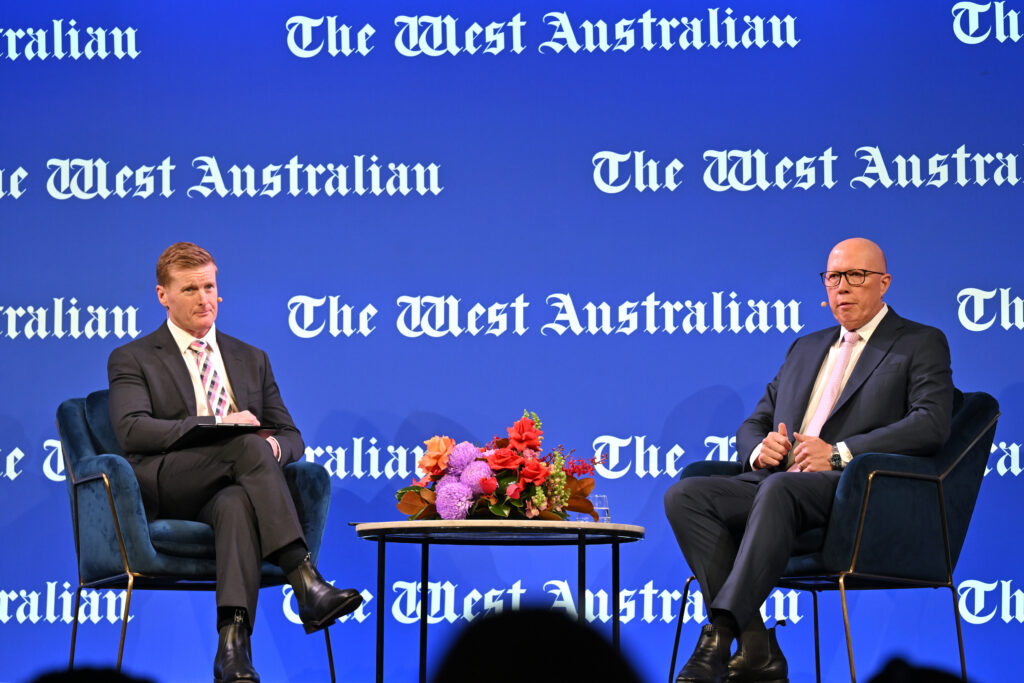
AAP has a little more on Peter Dutton’s appearance at the West Australian newspaper campaign event he attended this morning:

Mr Dutton was courting voters at an event hosted by The West Australian on Friday when the paper’s editor-in-chief Chris Dore delivered an unconventional introduction that contrasted a “match-fit, super confident” prime minister against a “punch-drunk” opposition leader.

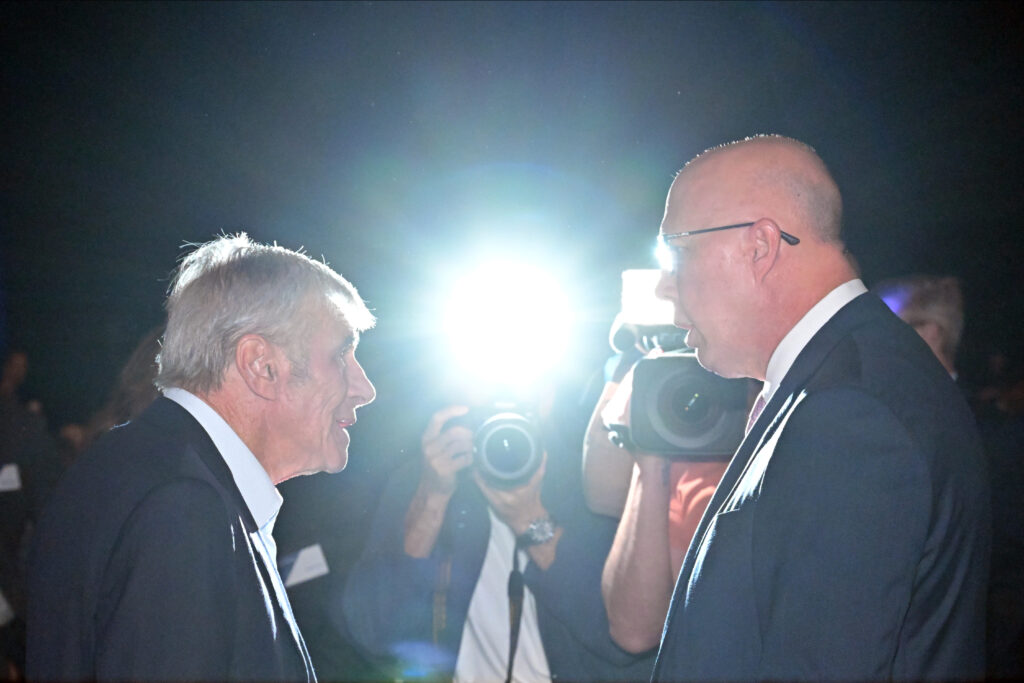
But Mr Dutton did not take that lying down and used the comments from the Perth gathering – which included the West’s owner billionaire businessman Kerry Stokes, 84 – to show he could handle challenges.

“You’ll deal with all the slings and arrows and the derogatory comments and editors trying to be funny and not succeeding,” he told reporters in Perth on Friday.

“That has steeled me for anything this job has thrown at me – or what could be thrown at me if I’m given the immense pleasure of being prime minister.

“I don’t need to attack the character of the prime minister to win the next election … what I want to offer the Australian people is a much more positive future.”

Mr Dutton started the year with the wind at his back, driven by Australia’s cost-of-living crisis amid a worldwide turn against incumbent governments.

But since the May 3 election was announced, the coalition has been bleeding support.

YouGov polling
Labor’s primary vote has risen to 32 per cent while support for the coalition has fallen. (Aap Image/AAP PHOTOS)

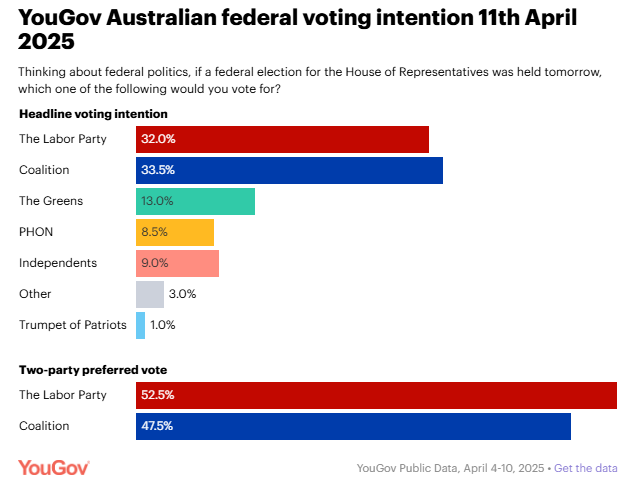
Fresh YouGov polling released to AAP reveals Labor has forged ahead, 52.5 per cent to 47.5 over the coalition in the two-party preferred vote.

The result is Labor’s best in months and slightly higher than its polling of 52.1 per cent at the 2022 election, putting the party in pole position for a majority government rather than a widely forecast minority.

By contrast, the coalition’s primary vote is now down to 33.5 per cent – lower than at the 2022 election.

Mr Dutton’s work-from-home policy had sparked the fall and taken his party from “being in the box seat to win the federal election in February to struggling to hold onto the seats they won in 2022”, YouGov director of public data Paul Smith said.

“The coalition’s support has fallen so far that they now risk losing seats,” he said.

While Mr Dutton walked back his work-from-home stance, Mr Smith said it had done “enormous damage” because voters now believed the coalition failed to understand their working lives or support people’s workplace rights.

FACT CHECK: Will vehicle efficiency standards push up car prices?

Matt Grudnoff
Senior Economist

The opposition leader is out today claiming that car prices are going rise under the new vehicle efficiency standards that are due to come into effect in July.

Every other advanced country except Russia has these kinds of standards, some of them for many decades. This means we have plenty of evidence about what their effect might be.

A US study of prices between 2003 and 2021 found “no systemic, statistically significant increase in inflation-adjusted vehicle prices across either vehicle classes or vehicle nameplates.” But it did find that over that same period average fuel economy improved by 30%.

So, no prices won’t increase. But yes, you will save money because new cars will use less fuel.

Q: Back on the alleged terror plot against you – does the experience raise concerns about the growing radicalisation of youth online? Can more be done to protect politicians?

Dutton:

I’ve been, again, I think consistent in my comments about trying to keep, particularly, young adults and children safe online. It doesn’t matter – I remember being told years ago when we were looking at the ISIS threat here in Australia, which obviously is still extant now – it’s still current as a threat now – that it would take a very short period of time for young people online to become radicalised if they’re watching videos constantly. And so, yeah, it’s tough for families, because your kids are spending so much time online.

I want to make sure that we can keep our kids safe online, and that’s why wive pushed through the parliament legislation to provide an extra layer of security for kids under the age of 16. But as a society, as a community, we should be doing everything we can to take down hate comments and all of that which might inspire or incite violence. I’m sure that every reasonable Australian thinks exactly that.

Q: Mr Dutton, just looking at the campaign more broadly, we’ve barely seen you sort of undertake streetwalks and have those sort of unscripted moments with voters. Is that due to sort of an increased security concerns that are on yourself and other politicians? And do you have a concern that that limits your ability to interact with voters in a more authentic environment?

Dutton:

No, I think I dealt with that before. I haven’t had any advice to that effect. We’ll visit many parts of the country. It’s a wonderful opportunity to be in this job. To be able to meet Australians – and it’s not just in this campaign, but to stand up to the threats that might come our way as a country. A lot of Australians really expressed that concern about whether the Prime Minister’s just out of his depth and too weak to deal with the threats that face our country now and in a very uncertain decade ahead. So I think this is an opportunity to speak to the Australian people, to see as many people as humanly possible, and we’ll continue that over the course of the campaign.

Ok, but the question was about how he is NOT doing that. So if it is not about security concerns, then the campaign strategists don’t think it’s a good idea. And why could that be? Anyone? Anyone?

Q: Andrew Greene has reported an Australian-designed weapons system has been tested by Israel. What’s your view on the sale of Australian arms to Israel?

Dutton:

There’s been a bipartisan position for a period of time in relation to the export of arms and that’s not a process that we propose to change. It’s been adhered to as far as I can understand by the current government, if the Prime Minister’s changed that then it’s not something [I know about]

Q: [The parts reportedly went to Israel via the Unites States] – is that appropriate?

Dutton:

Not that I’m aware of, in terms of where the government’s made changes to. I will make this statement in relation to Israel, though – when we stopped a terrorist attack from taking place on an A380 here in Australia where literally hundreds of Australians would have died, that intelligence came from Israel.

Israel is the only democracy in the Middle East* that are a key partner and, when we were evacuating people out of Kabul and when we have had our people in the Middle East – and I recall this very specifically as Defence Minister – we relied on Israel for intelligence that saved the lives of Australians, including in uniform. So I’m not going to speak in a disparaging way about Israel.

*This is not true. Iraq and Lebanon are parliamentary republic democracies. Palestinians in Gaza have been banned from holding an election by Israel since 2006.

‘I’ve never felt unsafe one day in this job’ – Dutton

Q: You’ve long had a security detail out of necessity. Does it disappoint you that, under current circumstances and some news that we’ve heard in the last 24 hours, that you might not get to meet as many members of the public as you would like?

Dutton:

No, I haven’t had that advice at all. We have the same security package as the Prime Minister does. And as the Governor-General does. And that’s been the case for some time. Obviously since I cancelled the visas of a lot of bikies and rapists and organised crime figures.

I wouldn’t change that. I mean, there’s been an impact on my family. They’ve been stoic and never complained about the security that’s been around me and my family. Federal Police at home and the AFP have been absolutely amazing. But that’s what started the need for security.

And I wouldn’t change any of that. Because I know the decisions I took actually stopped further women from becoming victims of rapists. And I know that the murderers that I deported from our country are no longer a threat to Australian people. And I’ve always fought for what I believe in. I’m incredibly grateful to the AFP that my family are kept safe. I’ve never felt unsafe one day in this job, particularly with the protection from the AFP. It hasn’t stopped me from doing anything, and it won’t on this campaign.

I take the advice of the Federal Police but, ultimately, I think this job is about a test of character – do you have the strength of character regardless of what’s thrown at you to deal with the issues and to act in our country’s best interests? I think I’ve demonstrated that as a police officer, and I can tell you there’s no job that I’ve had in my time in parliament – not as Defence Minister or Home Affairs Minister or Immigration Minister or Health Minister or Assistant Treasurer or now, as Leader of the Opposition, which has been harder than the days that I’ve seen as a police officer where people have gone through losing a child, a life event where they could never recover from it and they’re impacted for the rest of their life.

And so for me, I’m incredibly fortunate to be in this job, because I’m passionate about our country. I want to do everything I can to make our country better for every Australian, and that’s what this election is about.

When will Peter Dutton start giving voters something to get excited about? (Other than big utes)

Q: In your preamble, you noted that you hope that people connect with the election campaign, the remaining three weeks. I think it’s fair to say we’re two weeks in and hardly have captivated the national attention.

(Dutton laughs, which is very gallows humour.)

I’m just wondering what you have to inspire or excite voters to change their vote.

Dutton:

I think, to be honest, most families at the moment, most Australians, are just working out around their kitchen table tonight, “How the hell am I going to pay the electricity bill? How am I going to pay the insurance bill which has gone up under this government?” If they’ve been to the supermarket this week, they’re paying 30% more for groceries under Mr Albanese.

Our plan is to fix Labor’s cost-of-living crisis by reducing the cost of petrol and diesel by 25 cents a litre. That will drive down the cost of filling up your tank by $14 every week – every car.

The government doesn’t speak anything about it but, to buy a new Ford Ranger under this government, it’ll go up by $14,400 by 2029.

A RAV4 hybrid goes up by almost $10,000 under Mr Albanese and Mr Bowen. I think, once Australians start to hear that message, they’ll realise that they can’t afford three more years of Labor.

It would be a disaster for WA and for the economy for Mr Albanese to be in partnership with Mr Bandt – but that’s exactly what will happen in a minority government for the Labor Party. I will never form government with a minority government that is racist, as is the case with the Greens, that is so anti-mining, anti-business, anti-defence, pro-hard-core drugs.

But Mr Albanese will do a deal with the Greens in a heartbeat. And that would be a disaster for our country. So I think, as Australians look at that choice, more of them, as they tune in – they’re busy running their kids around to school and sport and going to work doing bookwork at the night-time – when they get closer to the election, they’ll look very sharply oat the two options before them. They’ll realise, as I’m sure increasingly many millions of Australians do, that we can’t afford three more years of Anthony

MAKE IT MAKE SENSE

Q: Can you categorically rule out any changes to capital gains tax or negative gearing, including capital gains tax if you form government?

This question is just a waste of time because no major party is suggesting tax reform in these areas, no matter how desperately needed it is.

Dutton:

You should be assured the coalition government will not tax the family home, you can be assured we’re not going to change the arrangements into the capital gains discount arrangements, and similarly in relation to negative gearing. I want young Australians to get into housing. And I don’t want rents to be driven up, which is exactly the model that Adam Bandt is promising. And in a Labor Greens government, which is the only option if the Labor Party is to form government after the election, it’s a disaster for WA. It will stop mining projects from going ahead. It will stop investment into different asset classes, including housing.

If you abolish negative gearing, people will just move their money into equities or somewhere else. And that’s going to make the cost of housing more expensive and it will create a less certain environment for people as they approach their retirement, when they have worked hard all their lives to pay off a rental property and they’re relying on the rent to help them support their own kids and grandkids, why Labor would want to affect it is beyond me.

OK, well this isn’t the winning answer he thinks it is. It might be a winner if this was still John Howard’s Australia, when Howard could literally say to an ABC radio host that ‘no one is coming up to me in the street complaining about their house prices’. The Greens have created that policy in RESPONSE to what voters are telling them. It’s a grandfathered negative gearing policy and then beyond that, if you want an investment property you can have one, but not get a tax break from the government for it. That’s it.

And the idea that this will make housing more expensive became people will move their equity into something else? Well won’t that just put more houses onto the market, therefore increasingly supply, which Dutton says is the reason that he is cutting migration – to increase supply (even if his numbers are dodgy) and that will make houses and rentals cheaper.

So apparently cutting migration will make housing cheaper because it will increase supply, but people selling investment properties to put their equity elsewhere, increasing supply, will make housing more expensive. Make. It. Make. Sense.

Coalition now ‘looking at where’ voluntary redundancies can be offered in the public service in third or fourth change to hallmark policy

On to the public service workers cut policy that the Coalition just can’t seem to get the details straight on:

Q: Prime Minister, James Paterson said voluntary redundancies have always been part of the coalition’s public service plan. Why wasn’t this included in your policy statement on Monday, and how many redundancies do you plan to offer?

Dutton:

We have spoken about that a lot. The point I would make in relation to the issue is that Australians are working harder than ever. There’s Australians now who are working second and third jobs, paying taxes, can’t keep their heads above water with Mr Albanese’s increasing costs. They’re paying 30% more than for groceries [not true, it is 12% which is still not great, so why lie about the number?], 34% more for gas (the Coalition voted against the energy rebates, which has brought the cost of energy down). Australians want their taxpayer dollars to be spent efficiently.

Q:But voluntary redundancies… What’s the modelling for the voluntary redundancies. It’s a new element. Are you going to offer people money to leave their jobs in the public service?

Dutton:

We are looking at where we can have an employment freeze and the natural attrition. That helps us achieve the 41,000. It allows us to invest into important areas, including the fuel tax reduction. Under us, there’s a 25 cent fuel tax reduction, so young families, pensioners, tradies, across the economy, get a 25 cent cut to fuel tax because of our careful economic management. Under Labor, you get a 70 cent per week, per day tax cut.

Ok, so now that’s another change confirmed – looking at where the cuts can be made and then offering voluntary redundancies.

This policy was originally:

41,000 cuts from Canberra based public servants

then it was

41,000 people to be sacked with the detail to be worked out after the election

and then:

No one would be sacked, but 41,000 people who left from the Canberra based public service, but not in front line positions, or defence, would not be replaced over five years (which would be impossible)

to

41,000 people would not be replaced in the public service, and we’ll offer voluntary redundancies to help get there, but we’ll work out where to offer those redundancies after the election, if we win.

Q: Mr Dutton, you said US President Joe Biden was initially opposed to the AUKUS deal. Are you suggesting the talks on this deal pre-date the Biden administration, was that remark to try to protect AUKUS from Elon Musk and his DOGE razor gang?

Dutton:

I think the prime minister has taken $80 billion out of defence,(Dutton is using the same measure that he rejects from Labor when they talk about cuts to education and health funding – funding increased under Labor, but the rate of funding forecast by the previous Coalition government was cut. So funding went up, but not by as much as the Coalition wanted it to. And Labor says that $80bn in funding growth was re-directed into other areas, like AUKUS, which is why this line from Dutton is getting no traction – it is hard to say defence funding has been cut when we all know that $360bn is being spent on the AUKUS deal)

Dutton:

I want to make sure we can invest into defence because as the prime minister says, we live in the most precarious period since 1949, and he doesn’t do anything about it. He is not bolstering our defence and investing into keeping us safe. I want to make sure I lead a government to provide certainty and security. And I – I will work very hard, day and night, with my colleagues to ensure that we do whatever it takes to keep our country safe and I think we’ve been very clear, the Labor Party always takes money out of defence. It happened in the Rudd Gillard years, it happened in administrations before, that and it’s happening again now.

Q: With Elon Musk potentially (cutting Aukus does Dutton have any concerns) [Aukus is an incredible deal for the Americans – we pay to help subsidise their submarine building and in return we might get a submarine down the track (although they are so far behind in domestic production, it is basically into the never-never now, because they are not giving Australia submarines when they are missing their own) as well as the fact that no one really knows who has sovereignty over these American submarines, because it kinda remains their tech, even under the deal]

Dutton:

I have huge concerns about AUKUS under Anthony Albanese. In relation to President Biden, he had a long standing and consistent view in relation to non-proliferation (of nuclear). He had that his whole career. He was consistent in his views and position. Ultimately the United States is a very important security partner with Australia. And I will do whatever I can, if I’m given the great honour of being prime minister of this country, to protect and defend our people and our country and we’ll invest to do that, exactly that.

Peter Dutton press conference

Peter Dutton is again doing the ‘sliding doors’ moment for the country – which I guess you could say about any election? But it does beg the question – which Gwyneth Paltrow is he?

To the questions:

Q: Police removed two homophobic banners targeting a Labor MP from the highway. What do you think should happen to the people behind these sort of stunts?

Dutton:

I’ve seen the image, I condemn them. Our families are off-limits. I thought it was disgraceful and that’s the response I would give.

Fact check: Public service cuts, again

Greg Jericho
Chief Economist

Given the Opposition for some reason still wants to keep hitting themselves in the face by raising the prospect of cuts to the public service let’s give some context to the numbers.

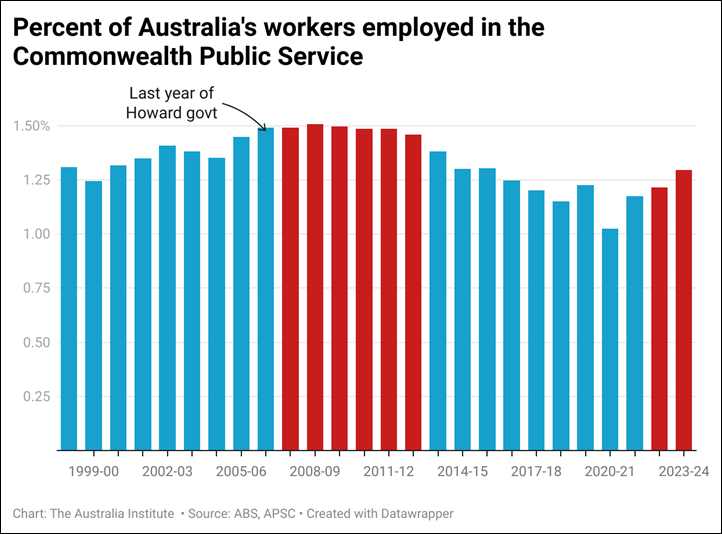
As Amy pointed out this morning, there are more public servants than there used to be because Australia has more people. But while comparing the size of the APS to population is useful, another way to gauge the size of the APS is to compare it to Australia workforce. After all if the share of Australia’s workers are employed in the APS is high that would be a good sign that the ASP is growing massively out of step with the rest of the economy.

And well.. nope. The increase in the size of the APS relative to total employment has only undone some of the ruination of the APS over the years from 2013 to 2021.

1.3% of all of Australia’s employed in June 2024 were working in the APS – lower than was the case in June 2016, and well below the 1.5% in the last year of the Howard government.

If 1.5% of Australia’s employed were now working in the public service as was the case when Howard was PM, that would mean an extra 28,000 people working the public service than is the case now. That’s an interesting stat given Peter Dutton said he wants his government’s “Department of Government Efficiency” to be more like Howard than Trump…

Latest visitor arrivals numbers released

Greg Jericho
Chief Economist

The latest visitor arrivals numbers came out today.

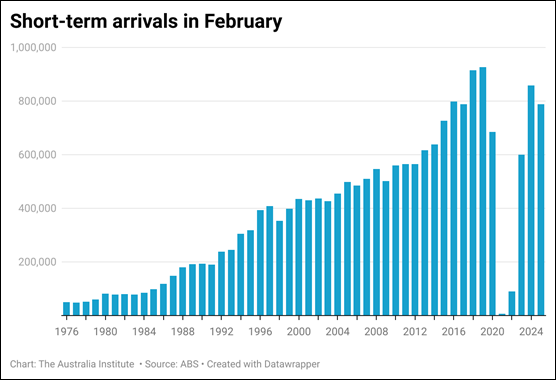
And while media love to focus on the long-term arrival numbers – because MIGRANTS TAKING OUR JERBS – I think the short-term arrival numbers (ie tourists) are perhaps one of the biggest indicators of just how much the pandemic changed things.

Prior to the pandemic the tourist numbers were growing strongly and consistently. Then the borders were shut.

They have now been opened and supposedly everything is back to normal. But normal ain’t normal anymore.

We have never got back to the same level of tourists we had in 2018 and 2019. And in February this year, there was an 8.2% drop in tourist arrivals compared to February last year. That is the second ever biggest February drop excluding the pandemic period.

Not great for tourism operators, hotels, hospitality workers.

Calls for AUKUS review gaining momentum

Frank Yuan
Postdoctoral Research Fellow

Three independent candidates for the House of Representatives (including two serving MPs) have now called for inquiry into AUKUS. Last night, Zoe Daniel, Independent member for Goldstein and former foreign correspondent, posted on social media calling for an independent review into AUKUS.

“AUKUS isn’t just about submarines — it’s about trust, leadership, and protecting Australia’s future. We’ve spent $800M with no plan, no guarantees, and no Plan B. I’m calling for a full, independent review. Good allies ask — and answer — hard questions.”

Another independent Monique Ryan had called for a parliamentary review into AUKUS earlier yesterday, and Nicolette Boele, independent candidate for the Liberal stronghold Bradfield in Sydney, called made a similar call yesterday, stating that ‘We need a Plan B’.

The UK parliament has launched an inquiry into AUKUS last week – it will “examine whether the partnership is on track and will consider the impact of geopolitical shifts since the initial agreement in 2021”. No doubt the British had in mind the disruptions caused by Donald Trump in the realm of geopolitics and now, spectacularly, global trade.

Allen Behm
Advisor, International & Security Affairs Program

Returning to another part of the Albanese press conference this morning: some journo thinks there’s a gotcha moment because the PM hasn’t read a Reuters report

The PM needs to repeat ad nauseam that the arms dealers and their advisors have a vested interest in war and the equipment that allows people to kill each other.

The role of government is to provide for the personal security and safety of every citizen, which is what education, health, NDIS, infrastructure investment, pensions, aged care all do.

ABC report on Australian firm trialing a weapon with the Israel Occupying Forces

The ABC’s Andrew Greene has a story about weapons from an Australian defence firm ending up in the hands of the Israeli military.

The Albanese government has spent the last 18 months since the genocide in Gaza began saying that Australia is not supplying weapons to Israel.

Australia DOES supply a part in the F-35s global supply chain, which the United States builds and sends to Israel, who use those planes to kill Palestinian civilians.

Greene reports:

Israel’s military has completed trials of an advanced weapon made by a Canberra-based defence supplier which boasts its “high precision” and “lethal” product can strike targets up to two kilometres away. 

The ABC can reveal the remote weapon system (RWS), designed and built by Australian company Electro Optic Systems (EOS), was one of dozens of counter drone technologies tested by the Israel Defense Forces earlier this year.

A defence industry source claims the Australian-made components were first sent to an EOS entity in the United States for assembly, before being shipped to Israel without an Australian export approval.

Albanese was asked about this at his Darwin press conference and said:

We do not sell arms to Israel. I’m aware of the report you referred to. We looked into this matter. The company has confirmed with the Department of Defence in particular system was not exported from Australia. Australia does not export arms to Israel.

Greene has more information and tells the ABC:

Well, it’s becoming a little bit clearer. Defence industry sources tell me that it was almost certainly assembled in the United States, this remote weapons system. It’s a bit of uncertainty about where the components themselves were made, it’s assumed here in Canberra, and then it was sent to Israel for this testing event earlier this year.

Now, for that to happen, it did not require an Australian defence export licence and the Greens Senator David Shoebridge is very critical of this.

Shoebridge told the ABC:

What we might be seeing here is the impact of what is called AUKUS pillar 2, the removal of any controls for the passage of weapons between Australia and the United States and then Australia permitting the United States to send Australian weapons anywhere they choose.

The company has released a statement saying it complies with regulations.

But yup, this is how it happens. Australia might not be sending weapons directly to Israel, but we are sending parts of weapons which are built somewhere else and then end up killing Palestinian civilians (and others in the Middle East given Israel and the United States have also attacked Lebanon, Yemen and Syria). That is why people say Australia is complicit. A part of a weapon is still a weapon part.

Recap of the morning

Enough has happened that we can do one of these today.

Liberal senator and official campaign spokesperson James Paterson has now added ‘voluntary redundancies’ to the opposition’s plan to cut 41,000 public servants. Previously the Coalition was saying it was just natural attrition (before that they were going to work out where they cut after the election) and that it would just be Canberra based, with no front line services impacted. Which is impossible. So now – voluntary redundancies are part of the plan

The Coalition is going to wind back the vehicle efficiency standards Labor passed (which are the bare minimum as it is) because they make the giant utes the Coalition have made their entire personality, more expensive.

Labor is promising $60m fot 120 aged care beds in Darwin, but there is no immediate plan to help with the overburdened system and waiting list.

You can now add ‘underwater bushfire’ to your climate change fears

While the major parties are doing their best to ignore climate change this election – although to be fair, the Coalition are promising to make things a little worse by basically ditching the bare minimum vehicle efficiency standards we have, and also re-assess our bare minimum emissions reduction targets – AAP has a report on how our reef system is, effectively, burning:

Australian corals reefs have been pummelled by unprecedented heat stress up to two times worse than has ever been recorded.

Roughly half of Western Australia’s coastline, including the UNESCO World Heritage-listed Ningaloo, has been enduring a reef-threatening marine heatwave and molecular ecologist Dr Kate Quigley warns higher temperatures are yet to subside.

“The amount of warming so far dwarfs the warming that had previously been seen on places like the Great Barrier Reef, which led to catastrophic bleaching and mortality in 2016 and 2017,” she said.

Providing an update on WA’s troubled reefs at the Indian Ocean Forum in Perth, Minderoo’s principal research scientist said the “underwater bushfire” was causing widespread bleaching.

The ghostly colouring is a recognisable sign of heat stress but corals can recover, though the likelihood of mortality increases the longer temperatures stay elevated.

Dr Quigley said in some extreme cases, corals were skipping the adaptive bleaching response to go “straight to death”.

“Instead of actually bleaching, the tissue just comes off the skeleton,” she said.

The scientist stressed stopping “the disease of climate change” was the answer to the world’s coral reef woes, rather than trying to address the symptoms.

The two-day event hosted by the French Embassy in Australia and the Minderoo Foundation is designed to gather perspectives from the Indian Ocean ahead of the Third United Nations Ocean Conference, to be held in Nice in June.

Peter Dutton has addressed the alleged terror plot which was aimed at him, currently in the Queensland courts. (An arrest was made in August)

The person charged is a child – 16-years-old – so there are no details legally allowed about their identity. The reporting says they went to a “prestigious private school” which doesn’t seem to be relevant at all, except to maybe challenge some people’s beliefs about who might think of allegedly committing this sort of act.

Dutton told the West Australian event:

Well, it’s been a brutal business, no question about that. It’s the reason my three children have been cured any interest in politics whatever, that we see as a small blessing. I feel an immense sense of pride, being able to work in the job that I work in, and – it takes a decision at some point in your life you want to abandon your anonymity and you want to contribute to a country you love very much. And that’s a decision that I took probably off my policing career, obviously, and seeing some of the injustices there, but also off my small business career and I believe very strongly that the Liberal Party has the ability to keep our country strong and I think we face significant head winds.

Meanwhile, well done to all of you – this is an absolute outstanding result.

Would a Coalition government mean an undoing of recent improvements to Aged Care?

Fiona Macdonald
Acting director, Centre For Future Work

The Labor government has fully funded all of the much-needed pay increases for aged care workers awarded by the Fair Work Commission. And they have made a commitment to fully funding the most recently awarded increases for aged care nurses to be finalised by August 2026.

Would a Dutton government walk back from this commitment? When in government the Coalition refused to commit to supporting aged care pay increases, depsite the Aged Care Royal Commission recommendation they do.

Would a Coalition government downsize the Aged Care Quality and Safety Commission as part of its public sector cuts? This agency, along with it’s counterpart in the NDIS, is critical to eliminating the neglect and abuse of vulnerable people that was exposed by the Royal Commission.

A staff freeze affecting “back-office” staff in care quality and safety agencies would also mean fewer resources to stamp out unethical practices and rorting in care and support markets

We are so back bb!

And Dutton is in WA at a West Australian newspaper event:

West Australian chief reporter Ben Harvey and Leader of the Opposition Peter Dutton at the West Australian Leadership Matters breakfast

And of course – gotta keep that billionaire quota up:

Leader of the Opposition Peter Dutton meets with billionaire Kerry Stokes at the West Australian Leadership Matters breakfast (Stokes owns the paper)

Here is how the campaigns have played out this morning – Albanese in Darwin:

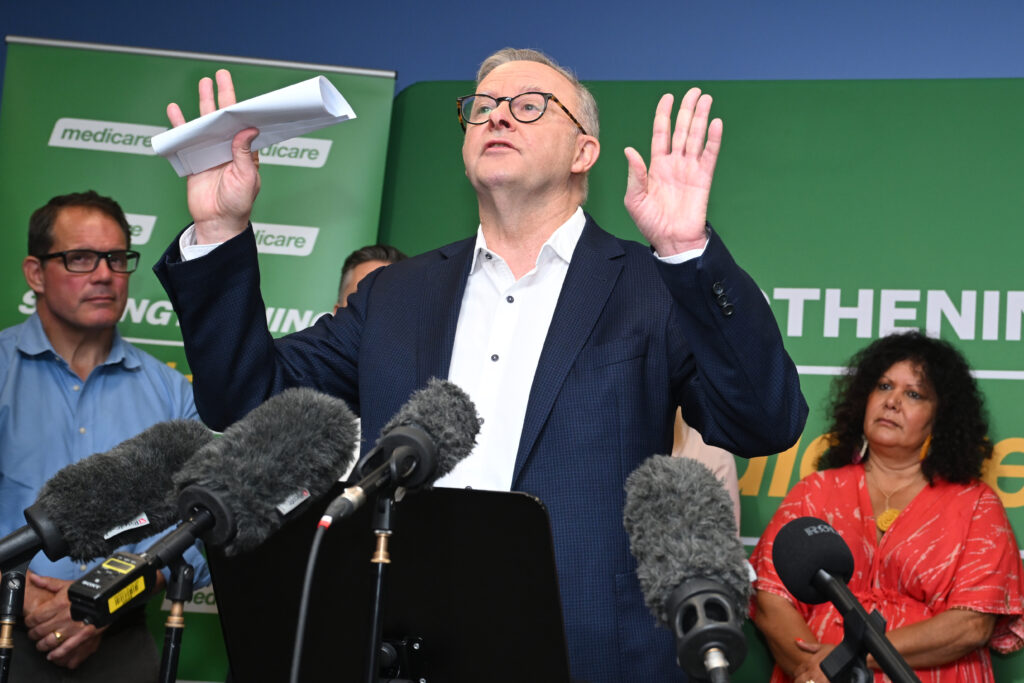
Australian Prime Minister Anthony Albanese speaks to the media during a visit to Palmerston Medicare Urgent Care Clinic in the electorate of Solomon
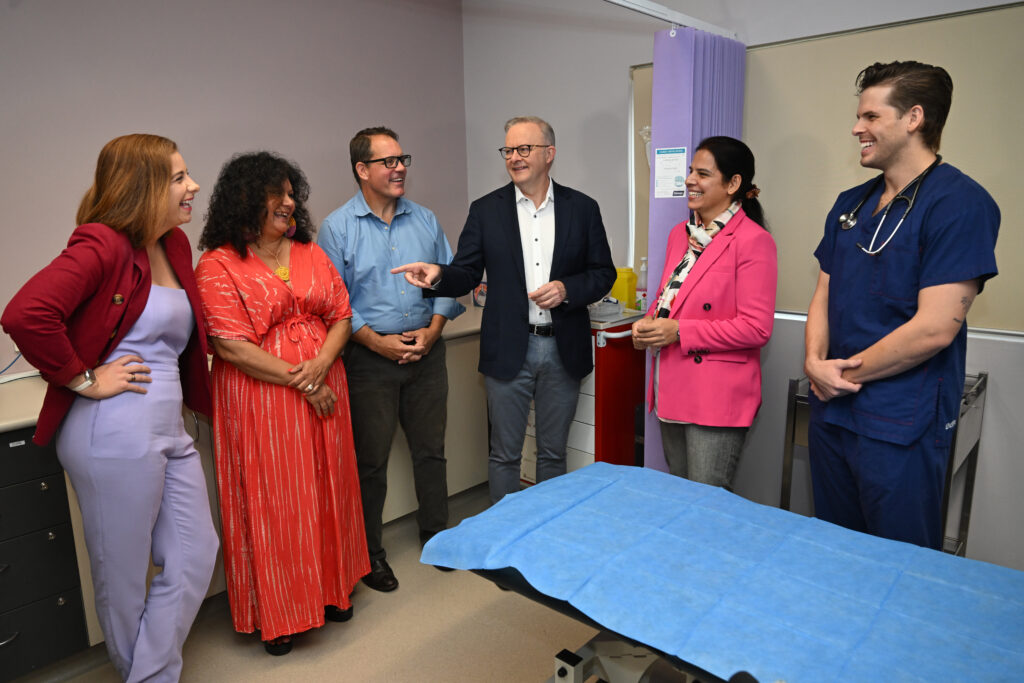
Australian Prime Minister Anthony Albanese, Australian Aged Care Minister Anika Wells and Labor member for Solomon Luke Gosling speak to clinicians

Actually though, what the hell is going on in the economy?

Angus Blackman
Podcast Producer

It’s chaos out there, friends.

On this episode of Dollars & Sense, Greg and Elinor discuss Trump’s tariff turmoil, the dodgy numbers doing the rounds in the election campaign, and the Coalition’s big fund boondoggle.

Your questions answered: mental health responses

Peter has asked us: My question relates to mental health – both parties throwing wads of cash at the issue but neither seemingly addressing the underlying problem – an escalation in demand for services but no increase in the number of trained psychologists- what is the point of announcing $00s of millions extra cash if people needing help cannot get an appointment? Why not make the degree free for the next 5 years to encourage people to study and train? 

It’s a really good question. Part of Labor’s response is that they are not increasing the number of subsidised mental health appointments from 10 to 20 is there is not enough speciality doctors for the demand and there would be more people missing out.

So Mark Butler would tell you they are investing in all the things you have asked about to try and address this issue into the future. The problem is the now – and the states (just look at NSW) and federal Labor are still not putting in the necessary funds to get doctors now, to pay the ones they have better (and attract more into the public system) and address the backlog. As for making the degree free (like some TAFE courses are to address skill shortages) is a great idea – but so far, we are not seeing anyone take it up.

Never mind Liberal v Labor – Right now, it’s Big Gas v the rest

Joshua Black
Postdoctoral Research Fellow


Australia is one of the world’s largest gas exporters. We send around 80% of our gas overseas. More than half of the gas we export doesn’t even earn royalties or resources rent tax. We are literally giving away our gas resources.

None of that has stopped the gas industry from trying to convince us for the past few years that a gas shortage is imminent. Instead of taking responsibility for the problem they are causing for they’ve relentlessly attacked the Victorian Labor Government, characterizing the banning of gas connections to new homes they see as “the demonisation of gas”, when in fact the government’s attempt to reduce the state’s dependence on gas is exactly the right response to gas industry engineered scarcity and price gouging.

All of the major political candidates at this election have acknowledged that there’s “no gas supply shortage in Australia”.

Labor’s energy minister Chris Bowen, who admitted at the National Press Club today that “a lot gets exported”, was the last to arrive at the party.

Gas producers and their industry associations try to get their voices heard in multiple ways. One approach is to contribute to major parties’ finances. In 2023-24, Australian Energy Producers disclosed almost $95,000 in contributions to the Labor Party, and a further $77,000 to the Coalition.

Hedging is a good investment approach but hasn’t worked as a political strategy, which is why they’ve resorted to outright criticism of the Coalition over its proposed gas reservation plan. AEP boss Samantha McCulloch says it would be “another heavy-handed intervention” that leaves gas companies “no incentive” for boosting domestic supply.

Asked about the gas industry’s criticism of his new gas reservation policy yesterday, Peter Dutton bluntly retorted: “Are we here to line the pockets of the gas companies? No.”
AEP has also been conducting polling in support of gas to apply pressure on independent MPs in Kooyong and Goldstein. To be fair, neither Monique Ryan nor Zoe Daniel are likely to lose sleep over this.

It’s not just the political parties who are hardening up in the face of the gas industry propaganda.
Every year, the Australian Energy Market Operator comes out with a Gas Statement of Opportunities. That document forecasts gas usage in the coming years, and although it consistently shows declining demand for gas, it also warns of potential peak-day shortfalls in the southeast. It is usually followed by plenty of scaremongering about a “looming gas crisis”.

This year, the report itself was subdued and the media coverage less gullible. The Sydney Morning Herald said that gas substitution policies were making a difference, and even the AFR conceded that the prospect of a “gas crisis” had “slightly eased” in the short term.
Many Australians seem to be turning on gas (figuratively speaking). It’s one of the only interesting things about this election so far.

Saying the quiet bit out loud

Matt Grudnoff and Jack Thrower

Jane Hume yesterday said the quiet part out loud. She was defending putting money into the LNP’s new investment funds – saying that it was being used to pay down debt.

The ABC host fairly reasonably asked why wouldn’t the government just use the money to directly pay down debt? She responded by saying “if you put money into a Future Fund, it actually earns more money than it cost to repay the debt”.

I mean… wow!

Following this logic, you could ask why don’t we borrow a lot more – Why not $100bn?? Why not $200bn!!!?? – we could earn more interest on investments and pay down even more debt?! Woohoo! Debt solved!

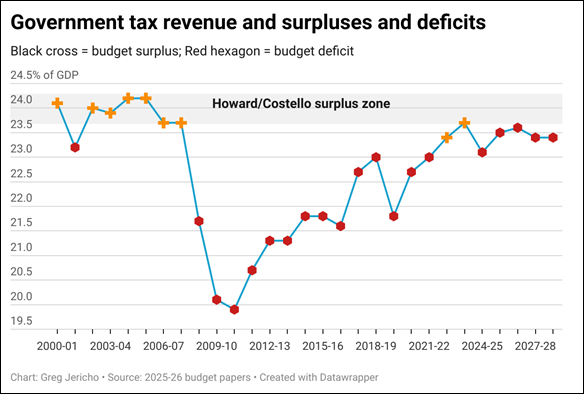
If the Coalition were serious about running a surplus, then they could always raise more tax revenue to fund it. If we look at all the budgets over the past 25 years, every deficit has occurred when the tax to GDP ratio was below 23.6%, and every surplus, except one, has been when the tax to GDP ratio was above 23.6%.

Australia is a low tax nation. If we collected just the average amount of tax collected by other developed (OECD) nations, we would collect an extra $135 billion each year.

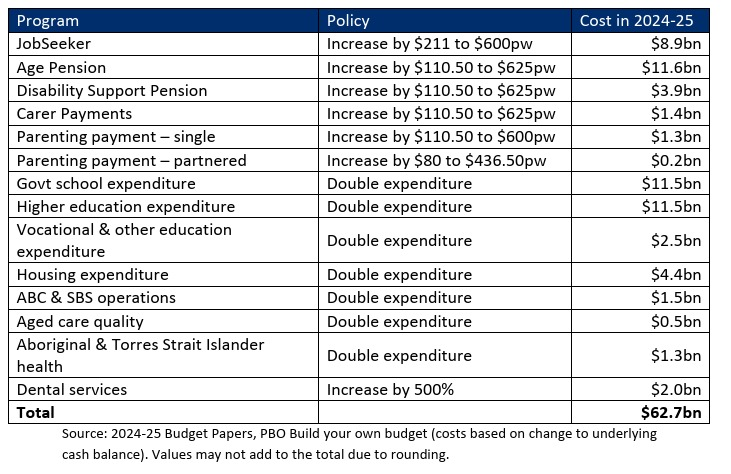
We put together a list of simple tax ideas that could raise up to $62.7 billion each year while cracking down on inequality and other social harms. For instance, we currently exempt many huge, expensive, dangerous, and emitting vehicles from luxury car tax (think about those giant RAM utes you’re seeing more and more). This cost $250 million in 2023 and encourages people to buy these vehicles.

And that $65.7bn? What could we spend that on? Try this for starters:

This post from the AEC appeared to get deleted almost as soon as it was out up, which is a shame. We love some nerd humour.

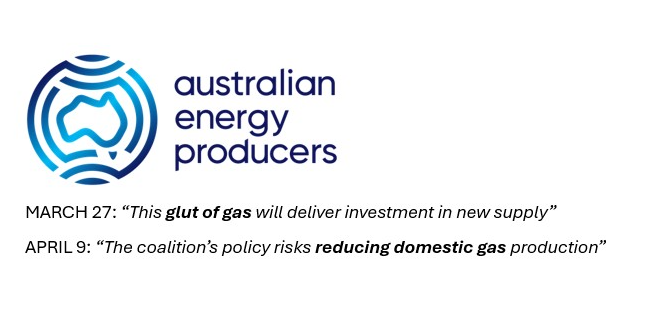
Desperate gas lobby flip-flops on impact of Dutton’s gas plan – simultaneously claiming it will create a glut and a shortage 

When Peter Dutton’s gas plan was announced two weeks ago, the gas industry claimed the policy would create a “glut” of gas on the east coast.

Now, in a complete reversal, the gas lobby is trying to argue that the coalition policy “risks reducing domestic gas production and supply.”

Both claims are untrue.

It is a simple matter for a government to ensure additional gas is supplied to Australians by imposing a tax on exports, as Peter Dutton has proposed.

“Labor, Liberal, the Nationals, Greens, One Nation and Independents all rightfully agree that there is no gas shortage in Australia,” said Dr Richard Denniss, Executive Director at The Australia Institute.

“The gas industry has been deliberately diverting Australian gas away from Australian industry and households towards the export market to boost their profits. 

“This is a simple problem to solve, and Peter Dutton has already proposed a simple solution that would work.

“Now that everyone agrees that there is no gas shortage, the gas industry is trying to muddy the waters by making policy solutions sound complicated while simultaneously making contradictory and absurd claims to mislead Australians during an election campaign.

“While it is good news that virtually all political parties agree that there is no gas shortage in Australia, the Labor government is yet to announce any new plans to ensure that Australian households and businesses are prioritised over export customers.”

Primary position. Expanding on that YouGov poll

Glenn Connley

Just to dig a little deeper into that YouGov polling, which Amy mentioned in her opening post this morning.

Apart from the obvious, which is Labor’s growing two-party preferred lead, the most interesting figure is the extraordinary closing of the gap in primary vote between the ALP and the coalition.

As recently as February 14, 37.4% of those polled were preparing to put a 1 beside the Liberal or National candidate on their ballot paper.

Just 29.1% were planning to give their first preference to the Australian Labor Party.

Here’s the headline from the YouGov website on February 14:

Fast forward 56 days, and this is the new headline on the YouGov website.

That 2PP figure is based on a primary voting intention which has Labor closing the gap the coalition in a big way.

32% of voters now say they’ll put a 1 beside their Labor candidate on May 3.

33.5% of voters now say they’ll put a 1 beside their coalition candidate. That’s a staggering collapse in those intending to vote for their Liberal or National candidate.

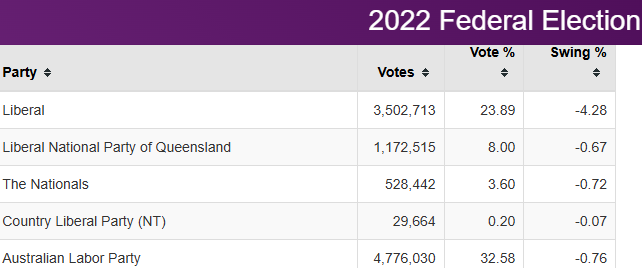
In the May 2022 Federal Election, the coalition’s primary vote was 35.69%. That was made up of 23.89 for the Liberals, 8% for the Queensland LNP, 0.2% to the Northern Territory CLP 0.2% and 3.5% for the Liberals’ coalition partner, The Nationals.

As the Australian Electoral Commission website shows, below, Labor’s primary vote in 2022 was 32.58%.

Of course, we have a preferential voting system in Australia, and the overall swing is never even across all electorates.

Many of those turning their backs on the coalition are not switching support back to Labor, they’re intending to vote for an independent or minor party.

Momentum is everything in politics. Sure, it can change quickly these days. But if this trajectory continues, Labor’s primary vote will be similar to the vote it achieved in 2022.

Obviously, that suggests a similar end result which, in May 2022, was a one-seat majority to Labor.

The difference – according to this poll – would be an even lower coalition vote, which would give us a Labor government, but not necessarily one holding 76 seats or more in the House of Representatives.

Oops

Greg Jericho
Chief Economist

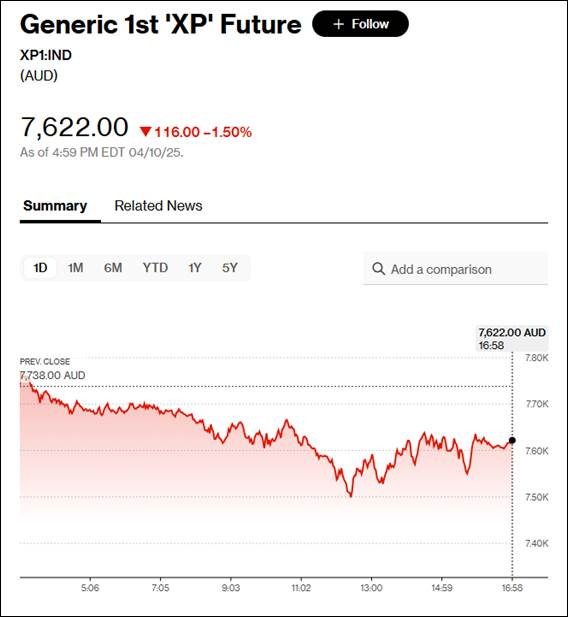
So the Australian stock market has lost more than 2% of its value in the first 15 minutes.

This is investors remembering that “oh yeah, we do export a lot of stuff to China and Trump is still a lunatic”

Climate change is MIA this election

Matt Grudnoff
Senior Economist

Both major parties have largely avoided the topic of climate change at this election. This might be surprising given the number of climate disasters that have hit Australia over the last 3 years. This included having to change the PMs preferred date of the election because of a cyclone striking southeast Queensland.

But the lack of direct discussion doesn’t mean their policy announcements don’t touch on the issue. Dutton has today announced that he will neuter the recently passed vehicle efficiency standards. These standards would bring us in line with almost every other developed country in the world.

Dutton has claimed that it is a car tax, but this isn’t true. It will lower the price of more fuel-efficient cars, while increasing the price of less fuel-efficient cars, like giant utes. Given Dutton has been running around the country professing concern about the cost of petrol and diesel, you might think he would be in favour of Australians being able to travel more using less fuel.

As part of the Coalition’s nuclear energy plan, they have previously said they will run Australia’s aging coal fired power stations for longer. Nuclear plants will take decades to deliver (assuming they can be built at all) and they plan to use coal to fill the gap.

But Labor do not have a stella record over the last 3 years to run on. Emissions should be going down but instead they have largely gone sideways.

For a campaign that started with a climate disaster, it has been strangely absent from discussion by the main two parties.

Postal vote applications – the number 1 source of complaints during election campaigns

Bill Browne
Director, Democracy & Accountability Program.

Have you received a postal vote application form in the mail? 

Did you wonder why it was bundled with material promoting a political party? 

Or why the return address was a political party HQ, not the Australian Electoral Commission (AEC)?

If you were confused, don’t be embarrassed: the AEC says the way political parties use postal vote applications is the number 1 source of complaints during election campaigns.

Alexandra Koster at SBS News has written a detailed explanation of the strange and somewhat sketchy world of postal vote applications.

Postal vote application forms, packaged with information about a political party, are “reportedly used by political parties to collect data about voters before forwarding to the AEC”.

“At first glance, the material could be mistaken for official AEC communications as there is no party branding, aside from the use of red and blue party colours.”

A multi-party parliamentary inquiry recommended cleaning up the postal vote application practice:

  • Postal vote applications no longer allowed to be bundled with other materials (like party promotional materials)
  • Postal vote applications to be sent straight to the AEC, not routed through a party HQ for data harvesting.

The Albanese Government neglected these reforms in favour of an unfair and rushed deal with the Liberal Party to change the laws around Australian elections. Hopefully they are revisited after this election.

Fact check: APS cuts

Greg Jericho
Chief Economist

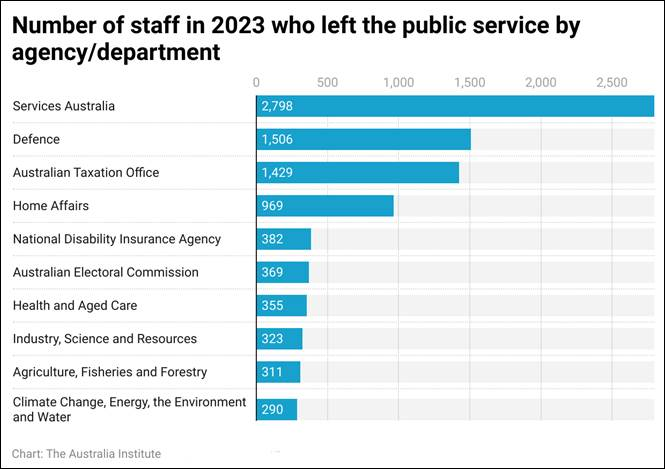
Given James Patterson has decided to make the APS cuts a story again (masterful gambit, sir!), let’s just think about who will likely be cut or be likely to take a voluntary redundancy. Looking at the figures that are available for 2023, by FAR the biggest number of people leaving where from Services Australia. Which means CENTERLINK. Then comes Defence, the ATO, Home Affairs and the NDIA.

These are not the agencies/departments the Liberal Party like to portray as the fact lazy bureaucrats in Canberra.

And given the LNP have been pretty damn sketchy about what are a front-line services, those 41,000 cuts start hitting a lot of areas that are, let’s just say, pretty essential

Election entrée: Australia is a world leader in electing Independent MPs

Joshua Black

Independent MPs are not new to Australian politics.

There were two in the first federal parliament, and between 1980 and 2004, 56 Independent MPs were elected to parliaments across Australia.

At times, they have held the balance of power and decided the fate of governments.

Of the 151 lower house MPs elected in 2022, 10 were independent candidates, and a further 6 represented minor or micro-parties.

Recent elections in comparable democracies have returned fewer, if any, Independents.

The UK’s 2019 election returned no Independents to the House of Commons, and the 2024 election only six (out of 650 members).

Neither Canada nor New Zealand elected any Independents in their most recent elections, nor did the US House of Representatives in 2022 or 2024.

Australia’s uniqueness has several causes.

Compulsory voting means that even disaffected or apathetic citizens show up to vote.

Preferential voting benefits independent candidates because major party voters usually preference independents ahead of the other major party.

In the Senate, proportional representation increases the chances of a well-organised independent or micro-party, and at double dissolution election the reduced quota gives them even better odds, as we saw in 2016.

Local candidates with existing name recognition (or the patience to build a public profile over successive campaigns) can be highly competitive in these circumstances.

There is a bit of a kerfuffle with an Australian reporter at the end there, when someone wanted another question, Albanese tried to move on, the reporter wanted another question, Albanese asked where he was from and when told the Australian, Albanese smirked a little, but then asked the reporter (which was just for the cameras)

Why are you laughing

Q: Your key national security team, Penny Wong, Richard Marles, can you guarantee them they’ll serve a new term in their current roles?

Albanese:

Yes.

(An earlier version of this post mixed up who asked ‘why are you laughing – apologies, my feed dropped out and the transcription was confused!)

‘Talking up war’ is “not a responsible thing for the prime minister of Australia to do” says Albanese

Q: Prime Minister, there’s concern in Washington about your reluctance to talk about using an attack submarines against China. I quote one of the expert there ‘ if you want to deter conflict in peacetime you need to talk about it using it in wartime and we haven’t seen a willingness on the part of the Australians’. Why won’t you talk about it?

Albanese:

I have no idea who you’re quoting.

Reporter:

I’ll tell you. It’s US Navy strategist Bryan Clark and he’s advising the Australian Defence Force on the design of the submarines.

Albanese:

We want – if people think that it’s a good idea to want anything other than security in our region, one of the things that we’re doing is investing in our assets, we’re investing in our assets so we’re more secure.

Obviously, you have assets there as deterrence. The great benefit of nuclear-powered submarines, as I have spoken about many times, the reason why the Government supports them is because of their stealth capacity, because they can stay under water for longer, they don’t have to snort, they don’t have to come up as often, they are a strategic asset of which everyone is aware. So the idea that it is in everyone’s interests to talk up war which is what you’re inviting me to do is, in my view, not the responsible thing for the Prime Minister of Australia to do.

Q: Prime Minister, on electric vehicles – Peter Dutton claimed this morning that scrapping the fines for emissions caps under the scheme that Labor proposes will reduce future price rises that you baked in for car buyers. What is your response to that?

Albanese:

This is another change in policy. He said he’d get rid of it. Now, he said that he’ll change something that is essentially the incentive for the policy to be implemented so there’s no incentive. But it’s another change in policy.

Let’s be clear – there were before this legislation was passed only two countries in the world that did not have fuel standards – Australia and Russia under Vladimir Putin.

The only countries in the world. We have not put an allocation of an expectation of any revenue from this measure in so-called fines because we expect that the conditions the way it’s been designed and we designed it, you might recall, in partnership, we sat down and went through the legislation with companies, we expect them to comply.

What it is doing is making sure that Australians get cheaper vehicles. I find it extraordinary that Peter Dutton who says he cares about the price of fuel doesn’t want people to have more fuel efficient cars which reduces the costs of filling up their car.

It’s a nonsensical policy that Mr Dutton came up with, but I await a couple of days time. He’ll probably have another one on the same thing.

Q: Prime Minister, some members of the cross bench and also the Greens believe that they can corner the Government in a minority, maybe even in the Senate in changes like capital gains tax and negative gearing. Despite the pressure they put on, will you budge?

Albanese:

No. And our position is very clear – let me make this clear – I want people to get that pencil in the ballot-paper and put a one next to their Labor candidate. That is the way that you elect a majority Labor Government. That’s my objective. That’s what we’re aiming for. That’s what I have said consistently. That’s what I have done consistently.

Labor already negotiates with the Greens – that’s the senate. The Coalition do it too. That’s how parliament works.

Q: Prime Minister, an Australian designed weapons system has been trialed by Israel’s Defence Force. Will your Government move to prevent the sale of any lethal EOS product to Israel?

Albanese:

We do not sell arms to Israel.

Q: But you sold parts to…

Albanese:

We do not sell arms to Israel. I’m aware of the report that you refer to. We looked into this matter. The company’s confirmed with the Department of Defence the particular system was not exported from Australia. Australia does not export arms to Israel.

I think what the reporter was trying to say there is Australia does sell parts to the US as part of the F-35 global supply chain and those warplanes are on-sold to Israel, who have used them to drop bombs and missiles and test weapons on Palestinian civilians.

Q: The Port of Darwin – you said you’d have more information for us. So what is your plan? How will you do that? And where will you get the money from?

Albanese:

Well, we certainly are looking for a private buyer, as I have said, and there is interest.

…We won’t go through commercial negotiations and who the interested parties are but there are interested parties here in the Port of Darwin. If we can secure an arrangement and a transfer of ownership back to Australian control in an orderly way without Commonwealth intervention and compulsory acquisition, we will do that, but we are prepared to use compulsory acquisition powers.

Q: We see in the Oz today where Peter Dutton was [the planned victim of an alleged terror plot]. We know we know harassment [against MPs] has doubled since 2021. You have been in Parliament since 1996, do you feel more anxious about your personal safety now than ever before?

Albanese:

I have reached out to Peter Dutton this morning and it is a fact that the number of threats that have been made to Parliamentarians has increased in recent times and that has been reported on by the appropriate authorities.

I myself have been the subject of a range of issues, at least one of which is before legal processes at the moment. There was a pretty serious incident. So what I have confidence in, though, is the Australian Federal Police and the authorities to do what they can to keep us safe, but that is one of the reasons why you have seen an increase number of security measures put in place because we do live in times that unfortunately we have seen around the world as well, but here as well, these threats be made.

They shouldn’t be – there’s no place whatsoever in politics for any of this, and I have ensured that any time any member of Parliament, regardless of who they are, have asked for support, they have received it.

Q: Here in the NT, our most at-risk populations in aged care are First Nations people in remote communities. Why aren’t we investing there?

Albanese:

Good news. We are. Last time I was here, we were in Darwin and then in Maningrida where we announced I think it was $12.6 million to build new beds for residential aged care residents out in Maningrida. That town in particular, I think, is a greatest testiment to the work that we have done in the urgent care clinics to integrate that with other primary health measures that we fund federally because as a health hub there in Maningrida, they have two nurses on call overnight, they found a way to use the urgent care clinic funding to boost access there.

It’s over the road from the residential aged care facility and we’re now investing as part of, I think it’s $800 million, nearly a billion dollars in total in First Nations investment in aged care this term.

But particularly here in the NT. We’re up to hundreds of millions of dollars in investment and in building new beds in particular.

So I think we’re at Pearl because we’re building new beds out there. We’re in Maningrida, Nhulunbuy for the same thing.

Anthony Albanese is asked a question about whether him knocking back a request for infrastructure funding for the Darwin Port in 2013 is one of the reasons the NT Country Liberal government sold the port to a Chinese owned entity. (Both parties are now committed to buying it back)

The NT Liberals sold the port to raise money for its own budget, under a program that the Liberal party put in place federally, where Tony Abbott encouraged privatisation from the states and territories in exchange to access a federal infrastructure funding pool, so not sure how the logic flows here, but here is what Albanese has to say:

No is the short answer. When I was the Infrastructure Minister, we delivered record infrastructure funding for the Northern Territory including at the Port.

When I was the Minister, the railway line didn’t go to the Port. We delivered that. And on the way here, I went along this little road called Tiger Brennan Drive. Do you know what Tiger Brennann Drive was before I was Minister? It was a goat track.

What I did is converted it to the road that everyone here at the press conference has just driven on. Not only did we promise it, we funded it and I opened some of it while I was the Minister.

That was the most important road project for connecting up Darwin and Palmerston. That’s my record as a minister. And I don’t, with respect to Mr Styles, I actually don’t remember him.

There’s a lot of people ([I have spoken to] through ministerial positions.

Can I say this about the Port of Darwin – what a long bow that is. I, as infrastructure shadow Minister in 2015, and then in 2016, when the Port of Darwin was flogged off, 2016, April 2016 is when the incentive payment of $19.5 million was forwarded to the NTCLP Government as an incentive payment to flog off the port, the key date wasn’t any meetings in 2013, the key date for the privatisation of that asset was the Joe Hockey budget of 2014 that put in place an asset recycling program that provided an incentive to state and territory governments to flog off public assets.

That was the key date for that. We responded appropriately for – for ports around the country. I have addressed the National Ports Conference here and if you speak to the people who run the National Ports, they will say that I, as minister, was one of the first – I was the first Infrastructure Minister Australia’s had with that title, but I also attended all of those National Ports meetings, we delivered infrastructure including the road networks to upgrade which were important for productivity-lifting at those ports.

The CLP made a decision to flog off that port, we opposed it at the time. The Commonwealth government provided an incentive. We opposed the asset recycling program was one of the key elements that led to the flogging off of the Port of Darwin

Q: Is the Federal Government prepared to use nuclear subs against China.

Albanese:

We are building and are going to have nuclear-powered conventional-armed submarines. We don’t want to use weapons against any country. We want peace…

…We want peace and security. We don’t have – Australia does not have, nor are we accessing nuclear weapons.

Q: Elon Musk has been put in charge of running the ruler over the submarine production in the US and the AUKUS deal. How concerned should Australia be? And is the US really still reliable national security partner?

Anthony Albanese:

I’m confident about AUKUS because I had those firsthand discussions with the President of the United States and also with more than 100 members of Congress and the Senate during my state visit to the United States.

I’m also confident that people when they make an assessment know that this is in Australia’s national interest but also the national interest of the United States.

Q: Are you concerned it will cost more with these tariffs in place?

Albanese:

I support the existing arrangements we have with the United States.

Q: The President said countries on the 10% baseline tariff can negotiate a better deal. Difficult times for Australia given the election care-taker period. How will the Government manage that between now and the 3 May?

Albanese:

That of course is a factor, that’s just a reality, but it doesn’t mean that we can’t continue to engage and we are continuing to engage with the United States on a daily basis. I welcome the President’s comments overnight. I have seen them. He has spoken about, of course, the change that was made, the – a day ago when he made the 10% change. This is – this is a new statement by the President. We welcome it. We believe that reciprocal tariffs on Australia should be zero. Very clear.

Anthony Albanese press conference

Anthony Albanese and Anika Wells are in Darwin making their aged care announcement which we previewed a bit earlier ($60m for 120 aged care beds) and Anika is again talking about how she made a promise to Jan, an aged care worker, last time she was in Darwin to do something about Jan’s 100 person waiting list.

Wells:

I promised Jan we would go away and do some more work and see if we could help her and today we return with $60 million worth of good news to build 120 new aged care beds here in Darwin. That will be on top of the $40 million we have already invested in building more residential aged care facilities here in Darwin this term.

What that process looks like now is we will open EOIs, we have already been talking to providers who have the kind of experience and capability to be able to deliver this facility. We have had significant interest and we’ll continue to work through that. It is part of the agenda that the Albanese Government has had for aged care this term. It was the very first bill that we put through the 47th Parliament.

We have now invested more than $35 billion in fixing the aged care crisis this term.

That looks like $17.7 billion in wage rises for our aged care workers who have long been undervalued and we need those people back in the sector and like the PM said, because he keeps a close eye on this and I appreciate his support, they are flooding back to the sector.

Not sure what that will do for the immediate waiting list, but let’s see.

No this is not 2008 says the RBA Governor…but what is it?

Greg Jericho
Chief Economist

Last night the RBA Governor Michele Bullock gave a speech at the Chief Executive Women Annual Dinner.

Unlike usual speeches by the RBA governor it was not really about the economic picture, but more about her journey as a woman in economics (which tbh is far too rare).

But she did open by adding in some things about the economy:

“Inevitably, there will be a period of uncertainty and adjustment as countries respond to the ongoing tariff announcements by the United States administration. It will take some time to see how all of this plays out and the added unpredictability means we need to be patient as we work through how all of this could affect demand and supply globally. [ie no I will not listen to The Australia Institute and convene an emergency meeting of the board even though right now the market is pricing in a 73% chance to 2 interest rate cuts, 50 basis points, in May – and it will likely rise today]

Financial market and economic volatility can be expected as this process unfolds. But there are two points I want to make on this. First, we’re not currently seeing the same degree of impact as previous market events like in 2008 for example. [Well, that is good, things are not as bad as when the entire financial system in the northern hemisphere went to hell in a hand basket. Phew.] And second, the Australian financial system is strong and well placed to absorb shocks from abroad. [No one is suggesting our banking system is about to collapse it’s the economy we are worrying about]

We are closely monitoring financial market conditions here and overseas – as we always do. We continue to engage closely with our fellow financial regulators in Australia, and our central bank counterparts overseas, sharing information and working together. We are carefully considering several factors including the response of our trading partners, additional counter-responses from the US, the response of our exchange rate, and adjustments in other financial markets. [But you’ll have to wait till two weeks after the election to find out]

A key focus for us is how all this uncertainty is affecting decisions made by households and businesses in Australia.[One would hope so]

All of this – together with our usual detailed analytical work and scenarios – is helping us build a fuller picture of the possible impacts as we prepare for the next Monetary Policy Board meeting on 19-20 May. There are a lot of moving parts. We are bringing all this together to form an objective assessment of what it means for the outlook for domestic activity and inflation here at home. [Be patient, we’ll get around to it]

We are mindful of not adding to the uncertainty, [their entire statement last week was about how uncertain they were of everything and so they did nothing] and to that end, it’s too early for us to determine what the path will be for interest rates. [lulz, the market is pricing in a 100% chance of at least one rate cut.] Our focus remains on our dual mandate for price stability and full employment. [in which they believe full employment is a situation where there are more people unemployed than is currently the case – have fun explaining that one to your friends]

Welcome back to the roller coaster that is the stockmarket under Trump

Greg Jericho
Chief Economist

After yesterday’s big gains today expect things to fall. Why? Well as a suggested yesterday, mostly traders are sheep and things only went up yesterday because when Trump announced the 90 pause everyone just assumed that was amazing great news and forgot that putting a 125% tariff on the second biggest economy in the world, which is China, is the type of thing that would normally have sent the stock market crashing.

Today they all remembered that and also got the added bonus that actually the tariff is 145%.

So the ASX is expected to fall – down 1.5% on future trading

And if you are wondering what Futures trading is, just think “bet”. So gamble responsibly.

The Coalition are still vowing to cut the public service to where it was three years ago, despite population grown as well as the fact that review after review (and experience) showed how bad the public service cap was for services.

(Things are still not great when it comes to services, particularly Services Australia – so imagine how much worse it could get)

James Paterson told RN this morning:

We will cap the size of the Australian Public Service and reduce the numbers back to the levels they were three years ago through natural attrition and voluntary redundancies

Meanwhile, the United States is giving up one of its most effective soft power tools – Hollywood – under Trump.

AAP reports China is putting a ban on US movies:

China says it will immediately restrict imports of Hollywood films in retaliation for President Donald Trump’s escalation of US tariffs on imported Chinese goods, targeting one of the most high-profile American exports.

Industry analysts said the financial impact was likely to be minimal, however, because Hollywood’s box office returns in China have declined significantly in recent years.

After three decades during which China imported 10 Hollywood movies per year, Beijing’s National Film Administration said Trump’s tariff actions would further sour domestic demand for US cinema in China.

“We will follow market rules, respect the audience’s choices, and moderately reduce the number of American films imported,” the NFA said on its website on Thursday.

Hollywood studios once looked to China, the world’s second-largest film market, to help boost box office performance of movies. But domestic movies increasingly have outperformed Hollywood’s fare in China, with Ne Zha 2 this year eclipsing Pixar’s Inside Out 2 to become the highest-grossing animated film of all time.

Chris Fenton, author of “Feeding the Dragon: Inside the Trillion Dollar Dilemma Facing Hollywood, the NBA, and American Business,” said limiting US-made films was a “super high-profile way to make a statement of retaliation with almost zero downside for China”.

Hollywood films account for only five per cent of overall box office receipts in China’s market. And Hollywood studios receive only 25 per cent of ticket sales in China, compared with double that in other markets, Fenton said.

Trump did not jump to Hollywood’s defence. 

“… I’ve heard of worse things,” the president said when asked about China’s restrictions.

Many Hollywood celebrities supported Trump’s Democratic opponent in the 2024 election.

One entertainment industry source predicted that big Hollywood blockbusters, which continue to attract moviegoers in China, may still reach the big screen. Walt Disney’s Marvel superhero movie Thunderbolts, which kicks off the summer blockbuster season, recently received permission to debut in China on April 30.

It was not clear if China would approve the entry of other major releases this summer, such as Paramount’s Mission Impossible — The Final Reckoning, which may mark Tom Cruise’s last appearance in the long-running franchise, Warner Bros’ new Superman movie from filmmaker James Gunn, and Marvel’s new take on The Fantastic Four.

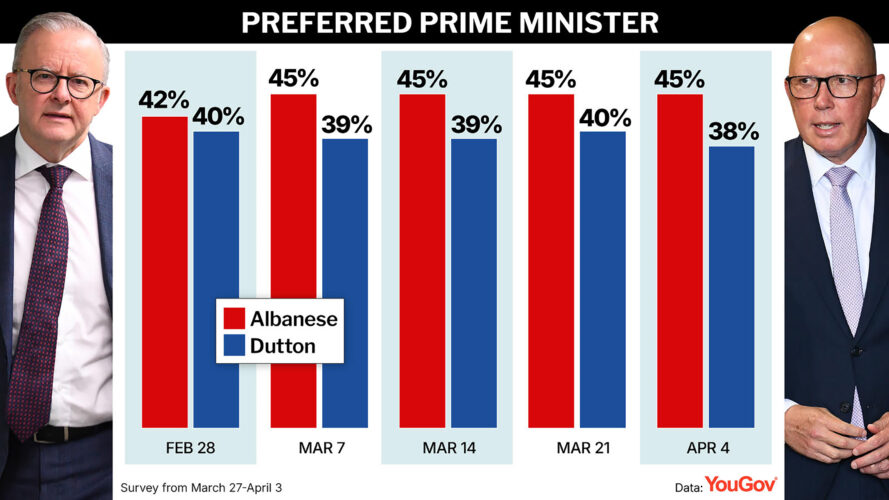
The Greens have announced a policy for a $700m boost to help live performances stay alive over the next four years.

Sarah Hanson-Young gave these key points to the policy:

  • Live music venues – 10 per cent tax offsets for the costs of hosting live music 
  • Touring artists– 50 per cent tax offset for travel expenses
  • Theatre productions– 40 per cent tax offset for the costs of live theatre production (similar to screen producer offset).

Hanson-Young said someone needed to act to keep live music and theatre alive:

Art matters, live shows matter and our live music venues matter. Live music and theatre bring our cities and towns alive. Gigs, concerts and festivals inject money and enthusiasm into our local communities from the cities to the regions. 

This policy is good for small businesses and the hospitality and tourism industries as well as the artists and local performers we all love to watch and enjoy.   

Our live performance sector is struggling. Amidst ongoing cost of living pressures and piecemeal funding programs from the government, more and more venues are being forced to close their doors.

The Greens plan to introduce a Live Performance Tax Offset for venues, touring artists and theatre productions will boost our arts sector and provide a tax incentive for Aussie pubs and clubs to host local artists and provide the platform for emerging talent.”

The arts play a critical role in telling the stories of Australia and our people – we must do whatever we can to keep these venues open and support the rise of local creatives.”

Investing in live events and performance is an investment into our local communities, small businesses and our tourism industry. 

Send in your election questions to amy.remeikis@australiainstitute.org.au with ‘questions for blog’ in the subject line – if I can’t answer it, I will find someone who can

Answering your questions: what seats could the Coalition lose?

Sam has just asked me what seats the Coalition could lose.

And there are a few in the defend list the Coalition are worried about – but it doesn’t mean the seats are going to Labor.

Cowper and Wannon are facing very strong independent challenges.

Bradfield is considered a loss

The Liberals are fighting to retain Leichhardt, but think they will win back Ryan from the Greens

Gilmore is a potential win, as is Lyons, but Calare is still up in the air (the Nationals were including that in their win pile, but now are having to fight) and Monash is surprisingly still considered an open field.

Keep an eye on seats like McPherson on the Gold Coast – which is part of a two election strategy by community independents to turn that seat from Liberal heartland to independent and what happens to the LNP vote in Hinkler and Capricornia.

On the Coalition’s plans to scrape the vehicle efficiency standards, Anika Wells says:

The Coalition have had more backflips than Simone Biles in the energy space. It’s hard to keep up, to be honest. I say that as Sports Minister, I’m an expert in Simone Biles and her work.

What I hear on the ground about this is people are so sick of these ideological fights, this to me suggests that those people in the party room who aren’t happy with toeing a moderate line on this, starting to get anxious about it when actually when you knock on someone’s door all they want to know is there’s money coming off their power bills because they have got lots of bills that they’re worried about and that’s why the tangible, measurable steps of relief we have taken this term offer them more certainty and relief than anything the Coalition throws up here today or tomorrow.

Anika Wells is in Darwin with the prime minister because the announcement is in aged care (her ministry):

We’re announcing $60 million to build up to 120 new beds. Like you say, Darwin has the least amount of aged care beds in the country and this is my fourth trip here as the Aged Care Minister. I was just here a couple of weeks ago, a place called Pearl, supportive care, Jen told me she’s got a wait list of 100 people. I said to Jen we’re coming back with answers. We’re coming back with $60 million to build 120 new beds

The Australian has reported Peter Dutton was the target of an alleged terror plot, with a 16-year-old boy facing charges in the Supreme Court, after being arrested in August last year.

The child can not be named for legal reasons.

Labor minister Anika Wells is doing media this morning and she was asked about the story on ABC News Breakfast:

To the exact story you’re talking about obviously it’s before the courts so I can’t say too much about it but you would have seen the AFP Commissioner speak earlier in estimates this year about the rise in threats against politicians, certainly that’s – we have notice that locally.

It is concerning. You think about your family, I guess, who are the unwitting con scripts to your work or the impact and the threats that might be on them in particular, so my heart goes out to that family and we praise the AFP for their good work.

In yesterday’s energy minister debate, Ted O’Brien refused to commit the Coalition to the Paris agreement, saying that a Coalition government would set targets once it was in government, and not make commitments before (Ted still believes the Coalition could win government from here. Cute. I hope he’s also looking forward to his visit from the Easter Bunny!)

After the debate, (and we imagine a very stern expletive heavy phone call from campaign HQ) O’Brien put out a statement ‘clarifying’ that the Coalition remained committed to the Paris Agreement.

That statement probably came because the Coalition have been burned by comparisons to the Trump administration and the Temu Trump label has set it, meaning the Coalition are now desperately trying to divorce themselves from any potential culture war over Trump areas – like the Paris Agreement.

David Ritter, the Greenpeace Australia Pacific CEO picked up on the Trump-like comparisons:


Abandoning the Paris Agreement is a terrible idea, straight out of Donald Trump’s playbook, that would harm our economy, our global standing, and our relationship with our Pacific neighbours.

Australia is the world’s third-largest fossil fuel exporter, and a major polluter with an outsize responsibility to cut our emissions at emergency speed and scale. As the cost of back-to-back
climate disasters grows, we are also paying a heavy price for climate change.

Shrinking our climate targets and walking away from international cooperation on reducing
emissions and climate finance will harm our economy as the world moves to decarbonise and
alienate our Pacific neighbours on the frontlines of climate change. It would not be in our national
interest to leave the Paris Agreement.

It is shocking that the Coalition is even entertaining the possibility of abandoning this important
global climate accord, which is our best chance at averting catastrophic climate change. Peter
Dutton should distance his party from this Trumpian tactic and commit to keeping Australia in the
Paris Agreement in no uncertain terms.”

Peter Dutton’s announcement today is that a Coalition government would abolish the fuel efficiency standards Labor introduced, because it makes those big utes the Coalition is obsessed with too expensive.
When you’re all about big utes, and not big ideas, than this is the sort of policy you get.

It took Australia so long to adopt fuel efficiency standards (the Coalition made an attempt when Paul Fletcher was a minister, but very quickly shelved it because – big utes) that our passenger vehicles emit at least 50% more CO2 than the global average. Yay us! Winning! And even though the fuel efficiency standards Labor passed are weaker than they should have been, (you’ll be shocked to know that the standards changed after consultation with the car industry) the Coalition still hates them because they make the big, giant utes they have formed their entire personality around, more expensive.

The whole idea of a fuel efficiency standard is the more fuel efficient your car is, the cheaper it is. So it’s an incentive to buy more fuel efficient cars. Which you think that the Coalition would want given it has identified fuel costs as one of the major imposts on the cost of living and is offering a one year fuel excise cut of 25c a litre as a result.

But apparently, it makes sense to cut the revenue that government makes from petrol for a year to help with the cost of living, but not to encourage people to buy more fuel efficient cars, which will help break their dependence on fuel and also lower emissions.

Got it. Big utes for all, while wallets and the planet, burns.

Jim Chalmers and Angus Taylor have agreed to a second debate (who would want this) at a Business Council of Australia event on April 23 – which is the day after the polls open.

From the release:

The event will be the first time during the campaign a debate is held directly with representatives from both small and large businesses

Well, it can’t be worse than what we saw on Wednesday.

Good morning

Hello and welcome to the second Friday of the campaign, which will see Peter Dutton begin the day in Perth for a breakfast hosted by a media company and Anthony Albanese start in the Northern Territory to try and defend Lingiari.

AAP reports the latest YouGov polling shows the Coalition is still trying to find some footing this campaign:

Latest YouGov polling, released to AAP, reveals Labor has gained ground to forge ahead 52.5 per cent to 47.5 per cent over the coalition in the two-party preferred vote.

The result is the best for Labor in months and slightly higher than its polling of 52.1 per cent at the 2022 election.

The coalition’s primary vote is now down to 33.5 per cent – lower than at the 2022 election.

And while privately Coalition MPs have conceded they will not win enough seats this election to come close to government (based on the trend, their own polling and that the vibe for change isn’t there) that doesn’t mean Labor is a shoo-in for majority government either.

Lingiari is one of the seat’s Labor needs to defend, but Franklin, Wills, Dunkley, McEwen, Gilmore and Patterson are among those on the bubble (it’s thought Aston will go). And while there are some Labor believe themselves to be a chance of winning – like Brisbane, Leichhardt and Bullwinkle, it’s still a hard path to majority.

And we have four weeks to go. Names on the ballot papers will be set in stone after today and early voting begins on April 22, right after the easter break – voters will make up their minds in a lot of places next week so they can switch off.

The next two weeks are short weeks – campaigning will continue, but it will be in holiday mode, and most voters won’t be paying attention.

Which is why there is growing anger in the Coalition camp over how this campaign has been handled, the decisions which were made and why the policy cupboard is so bare. Anyone paying attention could probably point to that, but anyways.

You have Amy Remeikis and at least three coffees this morning, with the big brains at the Australia Institute at your disposal.

Ready? Let’s get into it.


Read the previous day's news (Thu 10 Apr)

Comments

Start the conversation

The biggest stories and the best analysis from the team at The Point, delivered to your inbox.

Past Coverage