Tue 8 Apr

Australia Institute Live: Day 11 of the 2025 election campaign. As it happened.

Amy Remeikis – Chief Political Analyst

This blog is now closed.

Start the conversation

Australia Institute Live: Day 11 of the 2025 election campaign. As it happened.

Key Posts

The Day's News

Good night – see you tomorrow? (The undecided voters gave the debate to Albanese 44 to 35, with 21 still undecided)

Sky is yet to post who the winner of the debate was, according to the audience. I don’t think I have it in me to listen to Ray Hadley and Bronwyn Bishop and now Sky is saying that the result will be on the Paul Murray show and no one deserves that punishment. (We came back and updated this for you. Because we love you.)

I am going to take a punt and say that it might have narrowly gone to Dutton, who seemed to have his messages (even if they weren’t all true) refined more than he has this campaign. (Update – the Sky viewers gave it to Albanese. Albanese 44, Dutton 35 and undecided, 21)

But also it doesn’t matter. The world was not set on fire by either leader there. What was interesting was the questions the undecided voters went with – many of which fell outside of the Coalition’s campaign. Australia is having an entirely different conversation than its leaders at the moment and that is worth noting.

The Daily Telegraph is reporting Peter Dutton’s father suffered a heart attack and is in hospital, and that the Coalition campaign are not giving out any further details. No doubt it will be a long night for the whole Dutton family, so we hope they are OK.

We will bring you all the events of Day 12 early tomorrow morning, so we hope you get some rest!

Thank you to all of you – and until we see you again, take care of you. Ax

Coalition energy plan targets existing gas fields, proving we don’t have a shortage of gas

AFR Political editor Phil Coorey has the gas modelling the Coalition are using for their new gas plan.

You can read that story here.

Coorey reports:

Announced as the centrepiece of Dutton’s budget reply, the plan would effectively create a domestic gas reserve by forcing exporters operating out of Queensland to divert more of their uncontracted gas to the domestic market and away from the Asian spot markets.

Their foundational export contracts to countries such as Japan and South Korea would be quarantined from the plan.

Currently, about 450 to 500 petajoules of gas are directed to domestic use. Under the change, that will have to increase by 50 to 100 petajoules, or up to 10 per cent to 20 per cent, depending on seasonal demand. One petajoule can power about 45,725 homes for a year.

The aim is to decouple the domestic price from the international price by creating a glut of domestic gas and forcing down the price from $14 a gigajoule to $10 per gigajoule or less.

The policy was controversially altered to target existing gas fields because Dutton wants to be able to deliver price relief from as soon as the end of this year. If it depended on the development of new gas fields, that would be years away.

The modelling, prepared by Frontier Economics, confirms that gas exporters will be hit with a “gas security charge” to ensure they direct the requisite amount of extra gas into the domestic market to drive down the price.

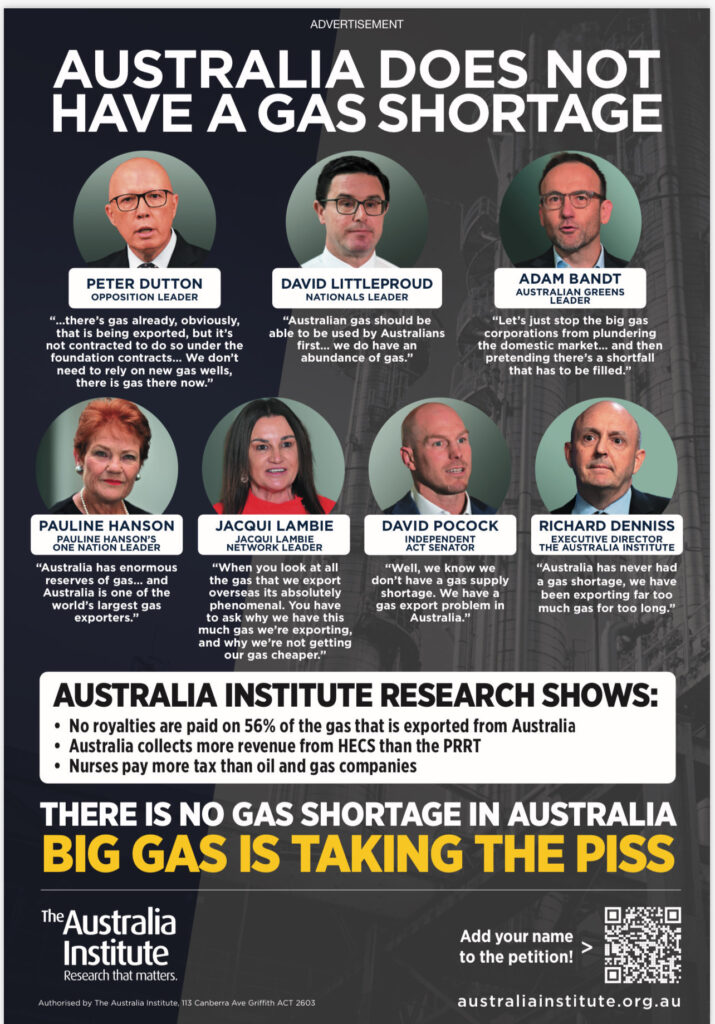
So yes, it is agreed – we don’t have a gas shortage, because as the Coalition has worked out, we can target the gas in existing fields.

Peter Dutton probably got the most time in that debate there, and both were allowed to run off with their answers.

But these questions were from undecided voters who live in western Sydney. And the questions were mostly in areas that are weak for the Coalition. Migration. Gaza. Energy. Health.

Listening to the News Corp commentators break this down, and they seem a little shocked at the questions, with the Daily Telegraph editor (the newspaper which is co-hosting this with Sky) was wondering about the slant of the undecided voters.

Or, could it be, that these are just major issues for voters that News Corp, particularly Sky and the Daily Telegraph, has ignored.

They all agree that Dutton won the debate and it was the best performance they have seen from them.

The debate wins. And the winner is – anyone who didn’t watch.

The closing statements were exactly as you would expect and Dutton is now repeating his lie that Jim Chalmers was saying we might go into recession next month.

Which is just another dire level of this election campaign.

Chalmers was talking about some economic commentators saying that the RBA might have to cut by .50 points because of the global impact of the Trump tariffs. Dutton is trying to spin that as you will go into recession under Labor.

Just absolute bullshit really.

Some quickfire questions from Kieran Gilbert.

No cuts to health care?

Dutton:

No cuts and we’ll legislate it. We’ve been very clear about it

Will the AUKUS alliance continue?

Albanese:

Absolutely, I have never said that we should link our defense arrangements, which are in our national interest, with the tariff issue

(The implication here, is that Dutton has. Which he has. Except it was to buy even more in the second pillar of Aukus)

Dutton won’t change his mind (again) on work from home.

Albanese won’t go in to a coalition with the Greens.

Greg Jericho
Chief economist

As both leaders sort of ignore talking about rural and regional areas, it is worth remembering that the further you live from the city centre, the worse your life expectancy is and the more disadvantaged you will be

Winston wants to know why the tax cuts were for everyone and not just those who really need it?

Albanese:

To put really clearly, there were tax cuts legislated under the former government. They went primarily to high income earners. I would have got $9,000 so would Peter instead, we got four and a half, and we gave it to everyone by lowering that bottom marginal tax rate.

Now what we’ve done is we’ll lower it by a cent and then a further cent over the next over the next term of government.

Of course, we wanted to make sure that every Australian got a tax cut. And the way that you make sure that low and middle income earners benefit is to target that first marginal tax rate that kicks in, of course, $18,200 and goes up to $45,000

Anthony Albanese on the public service says:

Well Peter hasn’t been able to stand up for his own policy, so I don’t know how he can stand up for Australia. Working from home is a really important component in modern families.

I was in [I missed it] just the day before yesterday, which is a similar distance from Tarmore, but outside of Melbourne, that family four days an IT consultant goes into the office on a Friday, and the mum stays at home on the Friday. She’s a TAFE teacher. She works for the public sector, and the truth is that public sector work conditions often then flow through to the private sector. And the truth is as well that every public servant isn’t in Canberra. They’re all around Australia, helping people in Centrelink offices, around here, helping people with assistance right around the entire country

On the public service cuts, Dutton says:

our policy applied to public servants in Canberra, the Prime Minister wanted people to believe that it was applying across the economy and it was going to affect every workplace, which was never the policy at all. So what we’ve said is that if there is an arrangement that you’ve got in your workplace, your boss, and you could work from home, or whatever the flexible arrangement. So that’s fantastic. That’s a decision between you and your employer in your workplace, and there’s no issue. We’ve never had any issue with that whatsoever.

Our argument in relation to Canberra was that we wanted to make sure, and we do want to make sure, that taxpayers who are working hard providing their taxes to the Commonwealth Government, that that money is being spent in the most efficient way. The government’s increased the public service in Canberra by about 20% and we want to make sure that we have flexible arrangements in place. That’s fine, and we’ve made that clear. Hopefully that stops the lies from being told,

It is not a lie to say that the public service influences the conditions for the private sector as well, and that Dutton can not just cut 41,000 public services, through natural attrition, with no frontline cuts, within five years. It can’t happen. One of those parts of the commitment has to be broken.

Yes, Greg Jericho. Peter Dutton just suggested that people put solar panels on their roof because they couldn’t afford their electricity bills.

And not for the feed-in-tariffs, which in places like Queensland, were, at one point, actually giving people a lot of money back. And then governments changed the feed-in-tariff rate.

Everyone supports solar. And Anthony Albanese supports batteries.

Peter Dutton then turns to power prices. People got solar because they couldn’t afford the price of electricity.

Why would that be? IS IT BECAUSE COAL AND GAS ARE TOO EXPENSIVE?

Dutton won’t support a policy that subsidises batteries.

Anthony Albanese asks about the woman’s grandkids and thanks her for her service to Australia (not just for the grandkids, but living her life)

He says that Labor is pretty much doing the same thing:

We have the same policy is already in place. Effectively, we have put in place a two year ban on foreign ownership of homes. We think that’s appropriate at the moment. In order to ensure that homes are available for Australians, we’re going to increase the supply of homes. That’s absolutely central to a range of policies that we’ve put in place, whether it be private rentals, whether it be public and social housing where I grew up, or whether it be home ownership as well.

This question…goes places. Let’s stick with she wants to know whether or not any political party will stop people who live overseas buying homes and then leaving them empty.

Peter Dutton:

…What I’d say in relation to housing is that we have announced as part of our housing policy, not just the $5 billion to create the 500,000 new homes, not just to cut to migration so we can get Australian kids into housing, but also a two year ban on foreign buyers from purchasing existing housing stock here, and that’s because I don’t want foreign buyers competing against young Australians at auctions or at the sale you know of the house that they thought they’re buying.

Why just existing?

Dutton:

So the reason that it’s a fair question, the reason that we’ve asked, the reason that we’ve stated that we’re talking about existing homes is that if you look at unit developments, there is a certain number of pre sales that need to take place before that unit development can be completed.

So if they don’t get the pre sales, they don’t get the finance, and the apartment block of 200 units doesn’t get built. So what we didn’t want to do was cut out some of those pre sales, and a portion of some of those pre sales will be to foreign students, for example, but it allows that project to get up and running, and it allows those 200 units to come onto the market.

Rhea has a question for Peter Dutton:

How will cutting migration affect industries like healthcare and construction, and what will you do to ensure migration discussions remain respectful and avoid demonising migrants?

Dutton:

Well, the point I made before was that I think we are a greater country because of our migrant story, and I think we should celebrate it more as a country, people who came here with nothing, people who have worked hard. The same story of migrants today, but we have to have a well managed program. And when you bring in a million people over the course of two years, that is going to have an impact on health services, on infrastructure, on education, right across the economy. So if we’ve had a 65% increase.

And if the government’s going to bring in a population bigger than Adelaide over a five year period, and take money out of infrastructure at the same time, it’s going to have an impact. So we have to have a managed migration program, and our argument is that you can reduce it from the record level of data at the moment down by 25% for two years, which will create about 100,000 homes, and that will help young Australians get into housing.

This is not borne out by any research.

Greg Jericho
Chief Economist

Sorry Peter Dutton, but bulk billing rates were falling at the time of the last election and since 2023 have begun to recover

Anthony Albanese seems to have found his stride in rebutting Dutton here:

But Peter, you tried, when you were the Health Minister, you tried to abolish bulk billing by having a fee every time people visit a doctor or every time people visit an emergency department. That’s what you did as health minister, and when you couldn’t get that through, you froze the Medicare rebate, which stayed frozen for six years. That’s why we are having to deal with this. That’s why my government has had to find the eight and a half billion dollars that you’ve matched. To be fair, you have said you agree with our policy there, but we’re repairing what we inherited, which was bulk billing in freefall while the coalition was in government.

Dutton is prepared to answer this, but sounds like he is on the backfoot:

…Our desire in relation to the whole health system was to make sure that we had a strong general practice, because it’s the experience of all of us. When you have young kids, or you’ve got aged parents, you need to be able to have a relationship with the general practice or a doctor that you can go to regularly. You need to be able to make sure that you can get an appointment, which is difficult at the moment.

And we were we were trying, and we were always supported, the funding now to build general practice, I want to see a strong primary care network, because if we do that, we can stop presentations at emergency departments. We can detect earlier cancers, and that’s the whole idea of having a strong network of general practice. And under our watch, the bulk billing rate increased under this watch, under the Prime Minister’s watch, it has gone down.

Now the leaders are being asked what they are doing about bulk billing.

Anthony Albanese goes through the policy to triple the incentive to bulkbilling for GPs and the urgent care clinics.

What he doesn’t mention is that the bulk billing rate itself has not been increased. Just the incentive. Which relies on doctors meeting certain measures in order to get the incentive, but the rate itself isn’t increasing.

Dutoon says much the same thing.

Both talk about lifting the bulkbilling rate. but not the actual rate itself.

I have no idea why Anthony Albanese never says that the modelling was for 44% less energy!!!

That is why it is cheaper! It’s for less energy.

A final thing on the government being the biggest spending govt – well, yeah we have the NDIS no. We did not use to have that. Take out spending on disability support and this govt is not big spending at all

Greg Jericho
Chief Economist

See?

SIIIGGHHHHHH

There is an argument over who spent more as a government.

Then Albanese asks Dutton about nuclear. Dutton repeats the usual half truths, including that his plan is cheaper – but it was modelled for 44% LESS energy!

Here is what Peter Dutton had to say there:

I do think fuel and the tax that’s applied to fuel is a huge impulse across the economy, which is why we’ve taken the decision. Because a cut in the fuel excise, the fuel tax, it means a 25 cent a liter reduction, not just for families and small businesses, but also for pensioners and other people across the economy. And as you rightly point out, it takes some pressure off the supply chain. So it means, you know, when you have a look at the fuel bill you’re paying, think about the tradie as well, who might have three or four youths running around and the cost each week being paid, or delivery truck drivers farmers on delivering produce to supermarkets, etc.

That’s where the real benefit is in the economy. I just make this point in terms of whether you make a decision about making it permanent good governments respond to the circumstances in front of them.

And as I pointed out before, when we approached the COVID period, we looked at what economic things and decisions that we could make to make it easier for families and businesses to survive through that period.

We didn’t bake them in permanently. We provided them on an ongoing basis.

We renewed them if we thought that the economy still required that and people still needed that support, which is exactly the approach that I want to take. So it costs $6 billion a year. It’s a lot of money. The Prime Minister’s tax cuts cost about $17.4 billion over four years, and then over seven and a half billion dollars a year ongoing. Now my argument is that there are many ways in which we can provide support, including tax cuts, and we would reassess where we are as an economy, as a people, as a nation, in 12 months time, and if we needed to extend it, then we could do that. But I would just say that if you bake it in and you put it as a continuing cost, that continues to compound, because every dollar that Anthony Albanese is spending at the moment is borrowed money, and that has to be paid for.

So we just have to get the balance right.

Greg Jericho
Chief Economist

Peter Dutton saying that the Morrison govt left a budget in balance is just flat out wrong and the March 2022 budget shows that:

The debate moves on to Ian who is a truck driver who wants to know why Albanese won’t take up the fuel excise cut and why Dutton won’t take up the tax cuts and why is the fuel excise only for a year?

Greg Jericho:

Oh a question from an “undecided” truck driver wanting cheaper petrol

He makes the good point though to Dutton – if he is only going to have it in place for 12 months, that means in a year’s time he would be saying he is about to increase petrol prices. Will that happen? Doubt it.

Key thing is a cut to the petrol rebate is for a start not going to deliver benefits anywhere near like the LNP says it will for most, and it encourages more greenhouse gas use.

Albanese:

Thank you for what you do. As an owner, driver, truckies, do it really tough. It’s a tough job that you do to keep the country moving. And one of the things that happened during the COVID pandemic, of course, was that you did keep the country going along with our people in our hospitals and retail and in aged care. It was magnificent the way that Australians got through what was a very difficult period. Look, we have to make decisions, and we were concerned that just a temporary measure, just like it happened prior to the 2022 election.

It then just disappeared, something that is temporary, that will, of course, because of the nature of it as well, kick in for a period of time, increase the deficit in the short term. What we have looked to do to target cost of living measures as cost of living measures that put downward pressure on inflation, which is why we have been successful in getting inflation down to 2.4% there’s more work to do.

Peter Dutton looks like he wants to be anywhere else and of course – BUT HAMAS

I’m sure like every Australian, I want to see peace in the Middle East as well. But what we saw when Hamas took hostages and took people into the tunnel network, that was an action which, if it had happened to Australians, there would have been an expectation of our government to react, to send in the SAS to make sure that we recovered those people as quickly as possible.(Israel did not do this. And it has rejected deals to have the hostages returned. Multiple times)

And I want to make sure that in our country, people can celebrate their heritage, can celebrate their connections to a country of origin or to a country which is important to them. But when you come to our country, it’s about celebrating being Australian, always respecting heritage and culture, but also abiding by our laws. And I think what we’ve seen in our society over the course of the last couple of years with fire bombings, with attacks on individuals. It’s completely unAustralian, and it’s not something that I think any of us would accept.

Dutton does not mention there the attacks on people who have been anti-genocide, or are Muslim.

The host wants to move on and Dutton’s mouth doesn’t seem to have ever been drier.

The leaders are then asked about Gaza. And both look instantly uncomfortable.

I miss the young woman’s name because my cats decided to make it known they needed fourth dinner, but she asks:

I direct my question to both of you. I have many loved ones affected by the current genocide in Gaza. Israeli government. At the moment, our taxes are going towards the funding of weaponry aiding the onslaught and the innocent people of Gaza. What are you doing to stop this? Prime Minister and opposition leader, what will you do about this?

Albanese takes a breath and says:

I certainly understand that for many Australians, particularly those with families or relatives, either in Israel or in Gaza or indeed in Lebanon, this has been a very traumatic period. My government’s approach is every innocent life matters, and we want to see a cease fire. We want to see hostages released. We want to see aid get through to Gaza. I must say that there are no Australian weaponry involved in what is going on in Gaza. That is just not the case. We have made sure as well that Australia has taken, I think, a responsible position of continuing to call for not just the short term issues in terms of cease fire, aid to people in Gaza, the release of hostages, but also our principled stance of a two state solution. I want to see both Israelis and Palestinians live in peace and security, side by side.

Kieran Gilbert gave a small prompt about universities being soft power which neither picked up on. But as Emma Shortis says:

It’s a little disappointing that Dutton didn’t really respond to Gilbert’s prompt there around Australia’s university education system as a tool of “soft power”. As the Trump administration attacks universities at home and abroad – including by unilaterally cancelling long running, high impact programs like the Fulbright scholarships program, and even interfering in Australian research independence – there’s a real opportunity for Australia to step up and have a positive impact in the world by supporting higher education and the way it connects us to the rest of the world. 

Anthony Albanese:

Everyone here knows that after COVID finished, when the borders were up, when Australians, including Australians from the community around here in Wentworthville, couldn’t actually come home because So apart from that, you’re going to get an uplift. Truth is, the population today is lower than what was anticipated in 2019 it was going to be the migration levels fell in the last year by 31% in one level. We introduced legislation to put a cap on student numbers. The Coalition and the Greens voted against it in the Senate so it couldn’t get through. We want a reasonable cap that protects the universities because their funding levels is connected with this. That makes sure, though, that we get that balance right and on housing. We’ve got a $33 billion homes for Australia plan that has seen in part, we have 28,000 social housing units, either under construction or in planning. As we speak, right today, there’s been 400,000 homes built, homes or units built since we came to office. We’ve got a target of 1.2 billion million. We do need to do more to build housing, but that is what we are doing.

Greg Jericho:

When the PM talks up the govt’s housing plan and the Housing Australia Future Fund let’s just remember it is hardly going to set fire to supply

Or as Grogs says:

Yes Peter Dutton, international students have increased by over 65% over the past few years… because we stopped them during the pandemic!!!

Jason has another question:

Just in regards to part of Australia, our way of life is sharing our way of life with the rest of the world. So part of our humanity is doing good. And so us training other people from all around the world gives them an open opportunity to witness our Australianism and so by not allowing those students to come to Australia, it actually hurts our brand worldwide.

Good for you Jason.

Peter Dutton:

I think we are not only the best country in the world, but I think we’ve been made better because of our migration story. When you look at the migration story to our country, particularly since the Second World War, people have come out of war torn Europe. People have come out of Asia, all parts of the world. We’re an incredibly lucky country for it, but the numbers of international students have increased by 65% over the course of the last couple of years. Now that is a dramatic increase. So I’m all in favor of a well managed migration program, but I’m not in favor of what the Prime Minister has done by flooding the market. And a person is coming in every 44 seconds into our country, and we haven’t got the housing to accommodate that, we need to get the sequencing right, and it’s why we’re putting $5 billion into a program to create 500,000 new homes.

Next question is from Jason who has a child at university.

My concern is with the Liberal party’s position on immigration and students, students from overseas, how will those universities pick up the shortfall, and will my son’s uni fees increase?

The answer, from the university sector is – yes.

Peter Dutton:

The short answer is no, because what we do as a government is we provide that funding to universities.(Our model of funding universities has meant universities have come to rely on international students as cash cows) And obviously there’s a HELP scheme where students are paying for part of their own education as well. (Students have to pay this back)

What we’ve done, though, is that we’ve said, under the Government’s program, they’ve brought in about a million people over the last two years. Now that’s a higher number, in fact, by 70% higher than any two year period in our country’s history. The government will bring in other migration programs.

So this big Australia policy that Anthony never spoke anything about before the last election, that will be about 2 million people over five years, a population bigger than Adelaide. So if we ask why we’ve got a housing crisis and why it’s difficult, we can point to that because there’s massive demand for housing, and Australian kids are missing out, and rents are up by about 18% I want desperately to make sure that we get an opportunity for young people to believe in and achieve again, the dream of home ownership. (Cutting international students will not get more people into housing. Housing costs skyrocketed when the borders were shut and no one was coming in)

There are about 42 international students coming into our country for every one student accommodation unit that’s been approved, and that has had a big impact so it doesn’t impact on the cost of a domestic student going to university, but it will change the dynamic within many universities, because, for example, at the Sydney University, you’ve now got a much higher mix in terms of international students to domestic students, which changes the dynamic on campus. But I want to make sure that we can get Australian kids into housing as quickly as possible.

We can’t do that because obviously, if a million people come here over two years, they want a house for themselves and their family as well, and the government just hasn’t been building the housing. (The increase to international students was because of the backlog following the border closures)

Greg Jericho has the budget paper here:

“Dutton says there were no cuts to Health, Albanese says look at the 2014 Budget… and yep here it is”

Peter Dutton:

Well, I think it’s an incredibly important question, and it’s important because parents have a choice to make, and whether that’s for the public system or for the private system, we have supported both, and we support increased funding going into this election as well, and there’s a position which is identical between the two parties in relation to funding for public schools and for private schools as well.

I think it is important that parents are able to have that choice, and that we can fund the infrastructure, and that we can support teacher development and make sure that we’ve got an education system which is fit for purpose. We live in an incredibly competitive environment, and we need to make sure that the outcomes in our schools are meeting the standards and expectations of students and parents and teachers and educators more generally. And that requires money. It requires commitment. And I thank you very much for the great work you do.

Anthony Albanese:

I admire anyone who’s a public school teacher, you do incredible work. And one of the things we’ve had to deal with is the last time government changed in Australia in 2013 in the 2014 budget, $30 billion was ripped out of public schools. In that budget, $50 billion was ripped out of hospitals, and we’ve had to deal with that for a long time. You’d be aware way back now, more than a decade ago, there was the gods key reforms, which were about giving, put simply, every child, to get free, fair funding so they if they fall behind, they can get that assistance. Now we’ve delivered that in a deal negotiated with every single state and territory in the country, $14.6 billion of additional dollars so that every student, whether they’re going to a public school or a private school, can get the funding that they deserve. And that includes the deal so that they get proper, proper support.

So if a child falls behind, at the moment, NAPLAN is a bit too late. We want to do testing in year one, so if a child falls behind, they can get that specialist, one on one, tutoring or small group to make sure that they don’t fall behind, because if you address that really early, then every child can have the opportunity to fulfill their aspirations.

Dutton is not happy:

Kieran, I just want to follow up, yes, sure, if I could just very quickly. The fact is that there were no cuts. The Prime Minister goes out with this Medicare campaign and education scare campaign. It is not a truthful statement. Now what the Prime Minister is saying is that the funding didn’t go up by as much as he would want each year, but there was no year where funding was cut from hospitals or from education. When I was health minister, we increased hospital funding by 16% now the prime minister might say it should have gone up by more. That’s fine for him to say that, but to say that the funding was cut, and you can go and have a look at the Budget papers. That is not a factually correct statement. It’s misleading. It’s designed to scare people, and I think it’s dishonest from a man who wants to be re elected as the prime minister of our country.

Albanese isn’t backing away:

Well, Kieran, it is a fact. It is in the 2014 Budget papers, there’s line items really explicitly, $50 billion savings in health, $30 billion savings in education go down each year, Prime Minister or not, $30 billion from the funding that was in the budget before the change of government occurred

The ‘Trump pandemic’ line from the questioner is a good one.

On to the next question, which is from Monica who works for the department of education.

I’ve seen that there’s quite a big difference between public versus private and I was wondering if we’re getting any sort of funding towards public education in the near future

Peter Dutton:

Well, Michael, thank you for your question. I sat around the Cabinet table when we negotiated with Trump mark one presidency, and we negotiated an outcome for Australia which is much better than what we had today, and it meant that Australia was excluded from the first round of tariffs imposed by President Trump. (That was a very different time – these are global tariffs, which the last ones were not)

I also sat around the table, Cabinet table and the National Security Committee when we went through COVID and the support that we provided to families, to employees, to employers, kept our economy going through a very rough period, and I know that we can deal with whatever comes our way.

One of the great things about living in the greatest country in the world is that whatever is thrown at us, the Prime Minister of the day should have the ability and the strength of character to be able to stand up against bullies, against those that would seek to do us harm, to keep our country safe and to make sure that we can make the right economic decisions for our country as well. And that’s exactly what I would seek to do as prime minister.

Anthony Albanese:

Indeed, Australians did show extraordinary resilience during the global pandemic, and we came through that – that had a long tail, that’s still having an impact today, and straight up to us, followed by inflation. Now President Trump has made a decision that I’ve called that an act of economic self harm for the United States, when you impose tariffs, it’s a tax on the country that is imposing it, so Americans will pay more for the goods that they purchase from overseas, and that will have an impact here, because we know that as the world’s largest economy, it’s expected to dampen global economic growth, so it does present a challenge.

But last Thursday, we were prepared.

Australia got the best deal of any country on the planet. 10% is 10% more than we would like. But no one got a better deal than us, in part, because of the representations that we’ve made, but we’re prepared as well.

No country is better positioned to take advantage of the trade opportunities. And it’s important to remember this, 80% of global trade doesn’t involve the United States, so in our region in particular, there will be opportunities for Australia that we want to seize.

We will have more global trade missions, following the missions that I’ve led to Indonesia, to India and China, looking for opportunities for businesses. We’ll create a fund, through our national reconstruction fund of a billion dollars to help businesses adjust here. We’ll continue to negotiate, of course, with the United States looking for a better deal for Australia, because reciprocal tariffs would, of course, be zero, because we don’t impose tariffs on US goods.

The first question comes from Michael.

Michael wants to know from both Albanese and Dutton:

We came out of COVID, and the economy did really well after that, we’re still going well at the moment. How are we going to cope with the Trump pandemic that we’re going through right now? And what? What’s your strategy around getting Australia on the right foot going forward?

Peter Dutton then gets to give his statement:

I think your stories tonight will reflect the realities and the stories of millions of Australians, and it has been a tough year, a tough three years, in fact, for Australians.

People have seen the government make mistakes, starting with the voice and priorities, but just haven’t accorded with your own priorities.

Almost 30,000 small businesses have gone broke and behind each one of those stories, there is somebody who’s lost their house or lost their life savings, people have gone backwards, because when you go to the supermarket now, you’re now paying 30% more for groceries, paying about 32% more for your electricity.

And the prime minister promised at one of these debates at the last election that your power bills would go down by $275 instead, they’re up by $1,300.

I want to provide support to Australians from the first day that we’re elected, and that is through a 25 cent a liter cut to fuel, both diesel and unleaded. It’ll help families, it’ll help businesses, it’ll help pensioners, and it will help the economy.

In addition to that, we want to make sure that we can get gas for Australians, so that we can fix up the energy system, which is driving up the cost of everything, and if we can do that, we can get our country back on track. That’s a positive plan that I want to talk about.

First leaders’ debate begins

Anthony Albanese gets the opening statement.

The world has thrown a lot of challenges at Australia. In the last few years, we’ve had the COVID pandemic, followed by the biggest inflation spike since the 1980s and the biggest energy crisis since the 1970s but what matters is how you respond, and we’ve responded the Australian way.

What is the Australian way?

Thanks to the hard work of Australians, including the people in this room, inflation is down to 2.4%, wages, real wages are up. They’ve been up five quarters in a row. Unemployment is low at 4.1% we’ve created 1 million jobs, and importantly, interest rates have started to fall.

What this election is about, though, is what happens next, whether we continue to build on those foundations with a tax cut for all 14 million Australians, strengthen Medicare, including those bulk billing rates getting up to 90% and making sure we have urgent care clinics free TAFE, the 20% of student debt and making more things here in Australia through a future major in Australia.

Now, you can’t control everything that happens, and we know in the world it’s uncertain, but I’m absolutely certain of this, now is not the time to cut now is not the time to look backwards. Now is the time to look forward and seize the opportunities and build Australia’s future.

Meanwhile, the Australian’s Ben Packham is reporting that Andrew Hastie, the shadow defence minister “has refused to walk away from past comments in which he said women should not serve in combat roles in the Australian Defence Force”.

As we reported earlier, in 2018 Hastie, a former SAS officer, said that his personal view was that women should not be in the ADF as “the fighting DNA of a close combat unit is best preserved when it’s exclusively male”.

The Liberals dumped their Whitlam candidate Ben Britton after the Guardian’s Sarah Basford Canales exposed similar comments Britton had made in a podcast interview. Dutton told media today that Hastie had the same view as himself – that women should be allowed to serve in the ADF, but the Australia is reporting that’s not exactly the case.

It’s all going fine.

Peter Dutton’s father suffers ‘medical episode’

News Corp is reporting that Peter Dutton’s father, Bruce, suffered a “medical episode” a short while ago.

He has been rushed to hospital, but there is no more information.

We know that when things like this happen, politics doesn’t matter. We hope there is good news.

We have all received a psychic shock from seeing Andrew Bolt on our screens.

Apparently Peta Credlin was before this.

Bolt was described as the “perfect” lead in for this debate by some poor Sky hack who must know the secret to remaining on the payroll is to just reflect back what Bolt says to himself in the mirror every afternoon.

Hello and welcome to the first leaders’ debate

We are coming online again to get ready for the first leaders’ debate. This one is hosted by News Corp, where 100 undecided voters will judge the winner – and punters will also ask the questions.

These debates tend to be the ones where the leaders are on their best behaviour – they might not care about running over journalists (for anyone who remembers 2022 – you might remember how the Nine network debate completely ran away from the host) but they do care what voters think – especially if the voters are in the room with them.

See you at 7ish for the first debate!

We are going to rest the blog for a little bit – she has been working hard and needs a Bex and a lie down.

But we will be back at 7ish to get ready for the first leaders’ debate. You’ll have me and Greg Jericho to help fact check your way through that, so huzzah!

Go stare at a wall, or at least have a little chat. See you soon Ax

Cam Wilson is one of the best in the business when it comes to watching this sort of thing:

On top of lobby group ADVANCE's faux news page and two anti-Greens pages, it has now launched 2 other pages for Facebook ads: – Anthony is Weak, Woke and Sending Us Broke" featuring the Yes campaign photo- "Immigration Crisis", rebranded from being a "Save Australia Day" page

CAMERON WILSON (@cameronwilson.bsky.social) 2025-04-08T05:30:33.000Z

This is about to become an even bigger and nation defining issue:

"In the middle of a cost of living crisis, if there's ever been a time for Australia’s Parliament to stand up to the foreign gas industry, it's now."- Executive Director Richard Denniss@richarddenniss.bsky.social #auspol

The Australia Institute (@australiainstitute.org.au) 2025-04-08T05:16:32.734Z

Is the Coalition looking in the right directions for nuclear examples?

Frank Yuan
Postdoctoral Fellow

Peter Dutton has again touted nuclear power, a centrepiece for the Coalition’s agenda:

“We [will] bring in the best technology in the world, which is being embraced by the Labour Party in the United Kingdom, China is building 29 nuclear power stations as we speak.”

Regardless of how quickly Australia could establish a regulatory framework for nuclear energy, the two examples are misleadingly optimistic.

Currently nearly half of all the nuclear power reactors under construction are in China, and their companies have extensive expertise in constructing and safely operating in this field. On the other hand, the UK has not commissioned a new nuclear power station since the 1990s, and the ones currently being built have significant financial and technical involvement from the Chinese state-owned corporation. It’s an understandable and rational choice for the British to bring in resources from the largest civilian nuclear construction industry in the world.

Incidentally, the US has no nuclear power plant either under construction or even in the planning stage – so the alliance won’t helps us there…

But there is a whole industry behind China’s ability to build nuclear power plants so quickly, especially over the past decade, as illuminated by this interesting case study. It enjoys a vast, skilled, and often specialised labour pool; its companies have access to highly advanced and sometimes enormous machinery; its comprehensive manufacturing supply chain is geographically concentrated and highly responsive.

Can we really replicate all these in Australia, in the next few years? Or perhaps get some Chinese state-owned enterprises to help us out?

Surely we can just buy more solar panels, wind turbines, and batteries which Chinese companies are competing against each other to sell to the rest of the world.

Uni Canberra is spending big on things not needed, while cutting staff to save money

Joshua Black
Postdoctoral Research Fellow

Uni Canberra is in the news today about cutting more staff. But @joshuablackjb.bsky.social looked at their budget and sees a lot of spending on things they don't need #OffTheChartsaustraliainstitute.org.au/post/uni-can…

The Australia Institute (@australiainstitute.org.au) 2025-04-08T05:10:44.470Z

Australia’s beleaguered university sector is never far from the headlines these days. Former Labor leader and current University of Canberra Vice-Chancellor Bill Shorten probably doesn’t envy his former ministerial colleagues who are currently on the campaign trail, but nonetheless, he’s in the news today.

The Canberra Times reports that Shorten is announcing a new voluntary redundancy program for UC’s professional staff. “We are not looking to achieve certain targets nor have we identified further positions as excess to requirements,” he told reporters.

UC has saved about $30 million by letting go of 150 staff to date. But why were these cuts necessary in the first place? Like most universities, UC has spent big on discretionary things that aren’t education or research.

Its 2023 annual report shows that the university spent $16.7 million on consultants’ fees, $9 million on ‘outsource management fees’, $697,000 on ‘sponsorships’, nearly $4.4 million on travel and just shy of $3 million on advertising.

The above graph shows that those items cost more in total than the 150 jobs that UC has since cut to repair its deficit.

UC is far from the worst offender. Australia’s public universities spend hundreds of millions each year on things like consultants, promotions and sponsorships, outsourced management and travel. In some institutions, business class flights amount to a quarter of total travel costs.

All of this is to say nothing of the salaries of Australian Vice-Chancellors, who are “among the highest paid in the world” according to Australia Institute research. Shorten, who until early this year was a senior minister in Cabinet, more than doubled his salary when he commenced at UC. (And that was him negotiating downwards!)

You can read more, here.

The debate tonight will be in front of 100 undecided voters in western Sydney. At the end of the debate, those voters are asked to say who they think won the debate.

As Josh Black wrote earlier today:

But they aren’t the crucial campaign events they used to be. Whether they are worthwhile depends on the format – a scrappy and personal debate turns politics into a blood sport, and alienates voters from the political process itself.

Prime minister Robert Menzies abstained from the first ever televised election debate back in 1958, but his deputy Harold Holt and senior minister Billy McMahon faced off against Labor’s leader H. V. Evatt and deputy Arthur Calwell. Barely 18% of TV viewers bothered tuning in, according to one historian.

Prime ministers and opposition leaders didn’t start debating during elections until 1984. A lacklustre PM Bob Hawke faced off against opposition leader Andrew Peacock, who managed to win the debate but not the election. Hawke chose not to debate John Howard in 1987 but performed spectacularly in a rematch against Peacock in 1990. It was, by Hawke’s own account, the ‘highlight of the campaign’.

Since then, debates have been a fixture of election campaigns but they are by no means decisive. In 2004 John Howard was roundly bested in his TV debate against Labor’s Mark Latham in September 2004, with 67% of the audience favouring the latter. The following month Howard pulled off an historic win in both houses of parliament, and Latham was soon gone from federal parliament. More recently, Bill Shorten won most of his debates against Malcolm Turnbull and Scott Morrison but lost both elections. The first debate in 2016 ranked 10th in the ratings (for a national broadcast, not good), and barely 93,000 people bothered watching to the end of the broadcast. The debates between the current PM and his predecessor last time round were pretty ugly, with the second debate especially full of “fraught and shouty exchanges” and plenty of yelling over the top of the moderator, Nine’s Sarah Abo. Nine won the ratings, Albanese narrowly won the debate, but the public were the losers.

Election debates need to be about more than winning ratings. They need to be contests of ideas and visions, not shouting matches between posturing men.

The Australian Energy Regulator has published its list of proposed electricity prices.

You can find that here.

The Conversation has published an article from Deborah Gleeson, an Associate Professor in Public Health, La Trobe University who points out that the Trump administration has Australia’s access to generic medicines (the off brand version of medicines) in its sights:

While Australia was busy defending the Pharmaceutical Benefits Scheme against threats from the United States in recent weeks, another issue related to the supply and trade of medicines was flying under the radar.

Buried on page 19 of the Trump’s administration’s allegations of barriers to trade was a single paragraph related to Australia’s access to generic medicines. These are cheaper alternatives to branded medicines that are no longer under patent.

The US is concerned about how much notice their drug companies have that Australia will introduce a generic version of their product. Once a single generic version of a medicine is listed on the PBS, the price drops. The US argues that lack of advance notice is a barrier to trade.

There is pressure for Australia to emulate aspects of the US system, where drug companies can delay generic copies of their medicines by 30 months.

If the US plays hardball on this issue, perhaps in return for other concessions, this could delay Australia’s access to cheaper generic drugs.

It would also mean significant pressure on Australia’s drug budget, as the government could be forced to pay for the more expensive branded versions to ensure supply.

Gleeson writes more about that, and why it matters, here.

Sarah Hanson-Young is also calling on the RBA to reconvene and deal with the impact of the Trump tariffs:

My point is do not let the election get in the way of the RBA doing it job. The RBA has the opportunity to call a meeting this week and to cut interest rates at this week. We don’t have to wait till next month and that is why I agree with Bernie Fraser.

The RBA should get off its hands and do its job. I am suggesting they should get off their hands today and cut interest rates this week and give families the relief they need and give our economy the support it needs.

Greens senator Sarah Hanson-Young is responding to the day’s events and says:

If the leaders really want about things that are going to cut the cost-of-living pressures for families and to deliver genuine structural reform in terms of cost-of-living pressures, putting dental into Medicare is one of the best things they can do. That should be on the table for debate between the Leader of the Opposition and the prime minister tonight. And of course, so should claim action and the environment.

This debate was really about the future of this country, the future of the planet, and what type of community and society we are going to have next election, the Greens leader Adam Bandt should be on the podium being able to debate these topics toe to toe with the leaders of the other parties. I fear that there will be very little said about club action or the environment or indeed putting dental into Medicare tonight but we will wait with baited breath. Back on the issue of recession for one moment. In the midst of this looming global crisis, the last thing we want to see is cuts to public services. This is not the time to cut public services and to take the chainsaw to public services. The only thing that should be cut is interest rates. That is why we need RBA to do its job and we need to be very, very fearful of trusting anything that Peter Dutton says when it comes to services and public service jobs. I think that is it.

Of course the first question is ‘is it affordable?”

Everything is affordable if a government chooses to make it a priority.

Factcheck: Dutton lies about recession

Greg Jericho
Chief economist

At some point in every electoral campaign that is going badly, the leader reaches for the idiocy switch and starts predicting horrors should the other side be elected.

In 1983, Malcolm Fraser told reporters that were a Labor government be elected, “people would be better off keeping their money under the bed”. It pretty much alerted everyone to the fact that Fraser was lost to rationality and so too were his election hopes.

Well today Peter Dutton decided to step up to the plate and take his place in Australian electoral idiocy by claiming that there would be a recession “under Labor” and that the reason the Treasurer Jim Chalmers was saying that the market is now anticipating a 50 basis points rate cut in May is because “he’s telling Australians that there are difficult times ahead under Labor. That’s exactly what he’s doing.”

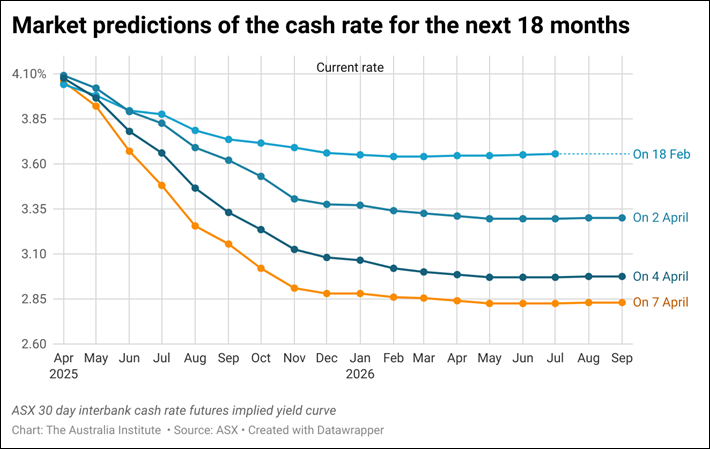
Every sentient being knows that the reason we now are likely to have a stack of rates cuts (possibly 5 by the end of the year) is because of Donald Trump raising tariffs everywhere and freaking everyone out that there might be a GLOBAL recession coming.

Dutton trying to blame the ALP for a GLOBAL slowdown is beyond stupid. Stupid economically – because clearly it is wrong; and stupid politically, because everyone – even those who do not understand economics – know it is wrong.

Everyone knows what Trump is doing is hurting the world economy. Dutton seems rather unhinged because Australia did not get higher tariffs than other countries such as the UK or New Zealand, and his hopes of being able to spend the 5 weeks talking about high interest rates are now dissolved before his eyes.

But even still, political leaders should not be going around saying a recession is coming – the last thing any leader should do is be saying things that might have people thinking they should panic. And recessions are very much panic stations events. It’s why serous politicians never suggest they are coming.

Anthony Albanese when asked much the same question only had to say of the opposition that “I’m absolutely certain this is not the time to cut. This is not the time for what the coalition are going to have to do to pay for their $600 billion of nuclear power plants as we go forward. Now is the time to

continue to manage the economy responsibly whilst we make sure we build Australia’s future by building up our education system.”

He might be trying to draw your attention to what the LNP’s policies might be, but he’s not saying under Dutton we will have a recession.

But here’s the other point – the real issue is what would the ALP or LNP do if the global economy does slow due to Trump.

Peter Dutton, in between blaming Labor said he would respond “As a Coalition I will always and Angus will always adhere to the principles of a Coalition government. That is to live within our means and make sure we can provide support to families and make sure we’re not continuing to build on the pressure that families are under by pushing prices up all the time.”

Ok, but in a recession, prices are not going up all the time, and living within your means is not possible unless you think austerity is the way to go. Is that what he is saying?

Back during the Global Financial Criss, the then Rudd Govt undertook a massive stimulus plan to keep Australia out of a recession. It worked. It’s why we refer to it as the GFC and everywhere else it is called The Great Recession.

So what was Peter Dutton saying back in 2009 that might give us a sense of his “principles of a Coalition government”?

In parliament on the stimulus bill, Peter Dutton said “today is the day that the Labor Party put into debt the future generation of Australian children.” And he further argued that “This government has taken a reckless course.”

It would seem Peter Dutton would therefore be unlikely or hesitant to deliver appropriate support should the rest of the world go under – preferring instead – as he said in 2009 to treat the budget like a household budget and “to consider whether, if it were their own household budget, they would plunge themselves into considerable debt”.

These questions should be front and centre of the campaign. Because if your policy is austerity, Australians need to know now.

And finally, back in 1983 Bob Hawke responded to the line that Australians would hide their money under theirs beds by responding with contempt and mirth, “But you can’t put your money under the bed… that’s where the commies are.”

In tonight’s debate I doubt Albanese will have such a witty rejoinder, but he will not doubt be taking Dutton to task for speaking of a recession.
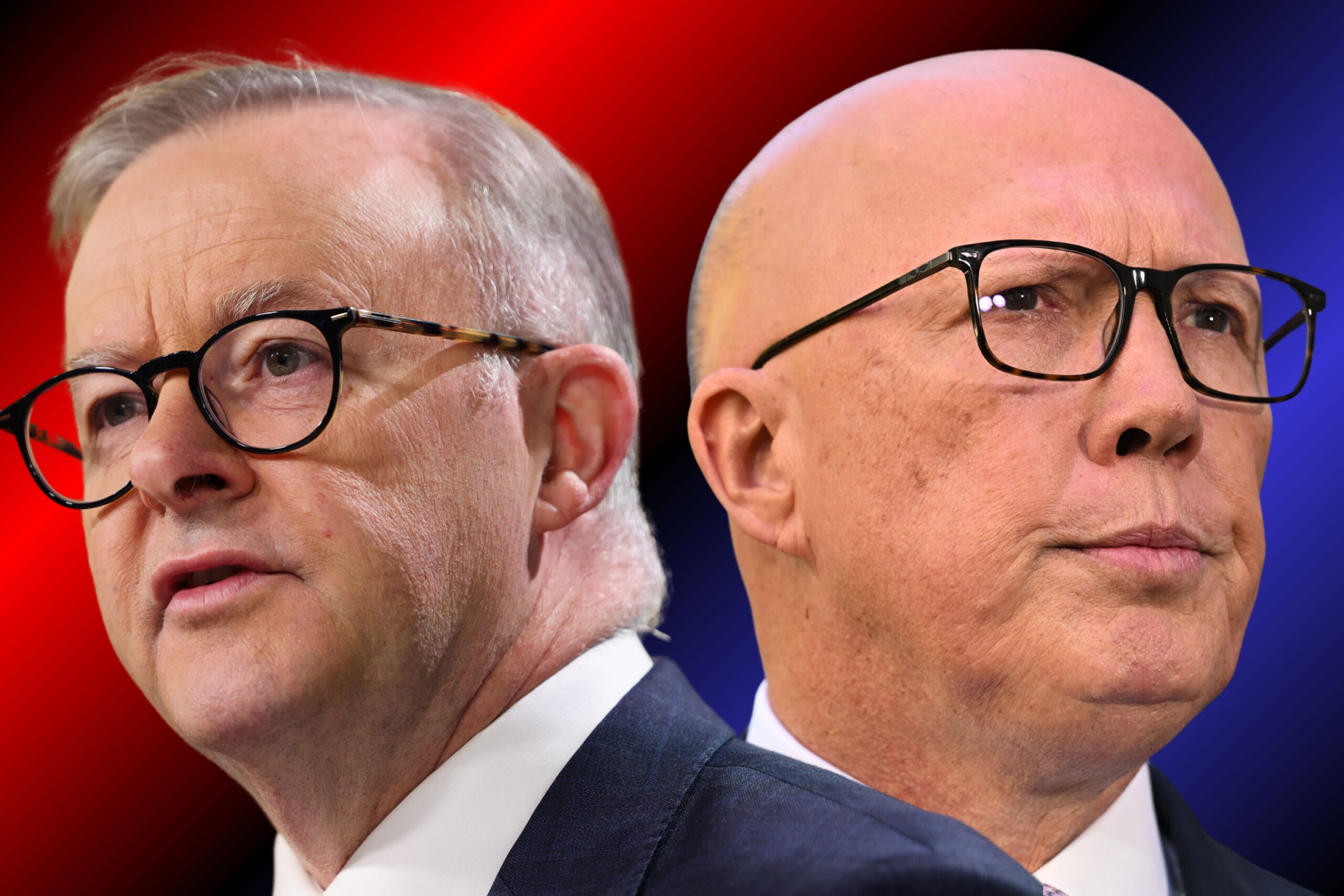
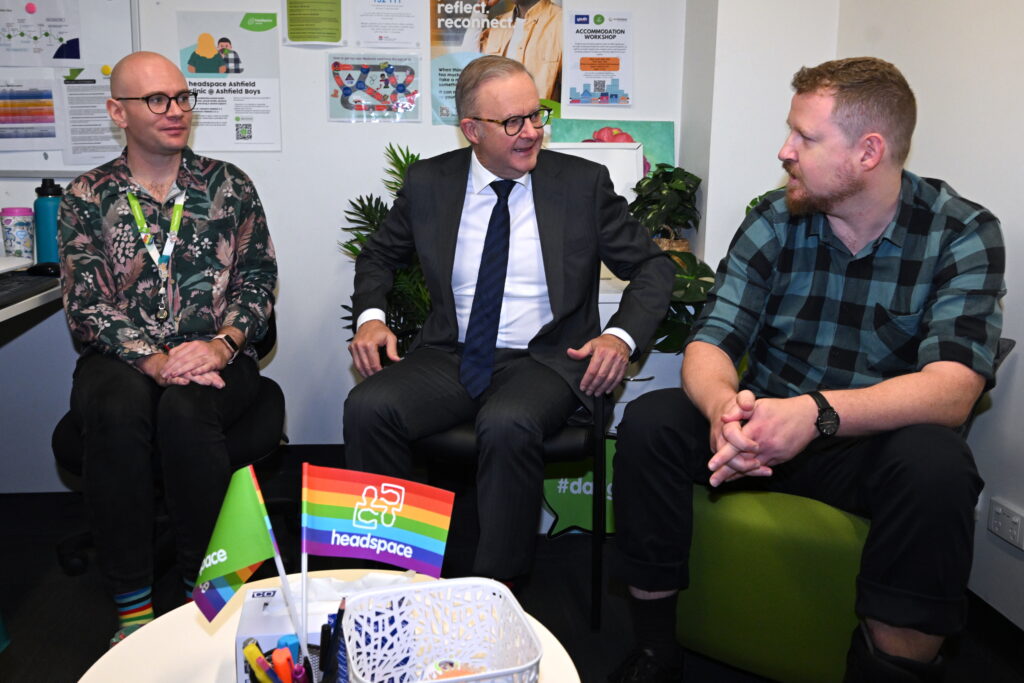
Anthony Albanese did an event at Headspace – you may notice the Pride flag front and centre here – that’s because of a viral Reddit post where a Redditor reported that Coalition advancers stripped a Headspace last week of LGBTIQ flags and references ahead of Peter Dutton’s visit.

Australian Prime Minister Anthony Albanese speaks to clinicians during a visit to headspace Ashfield

Both the campaigns are going to go to ground now, to prepare for the first of the leaders’ debates.

So let’s take a look at the day, in photos:

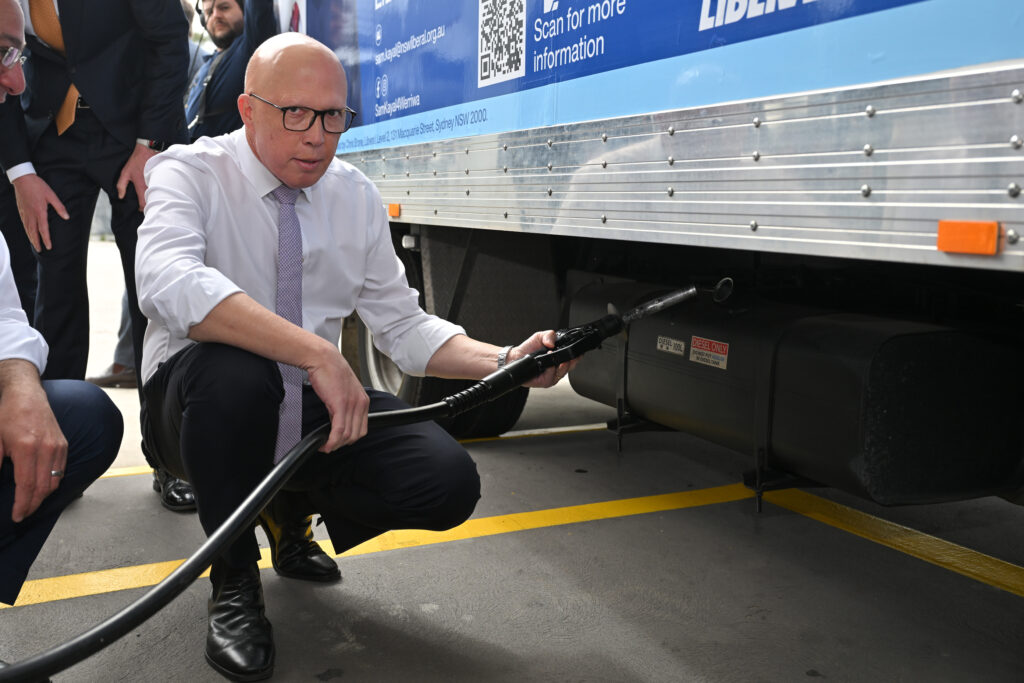
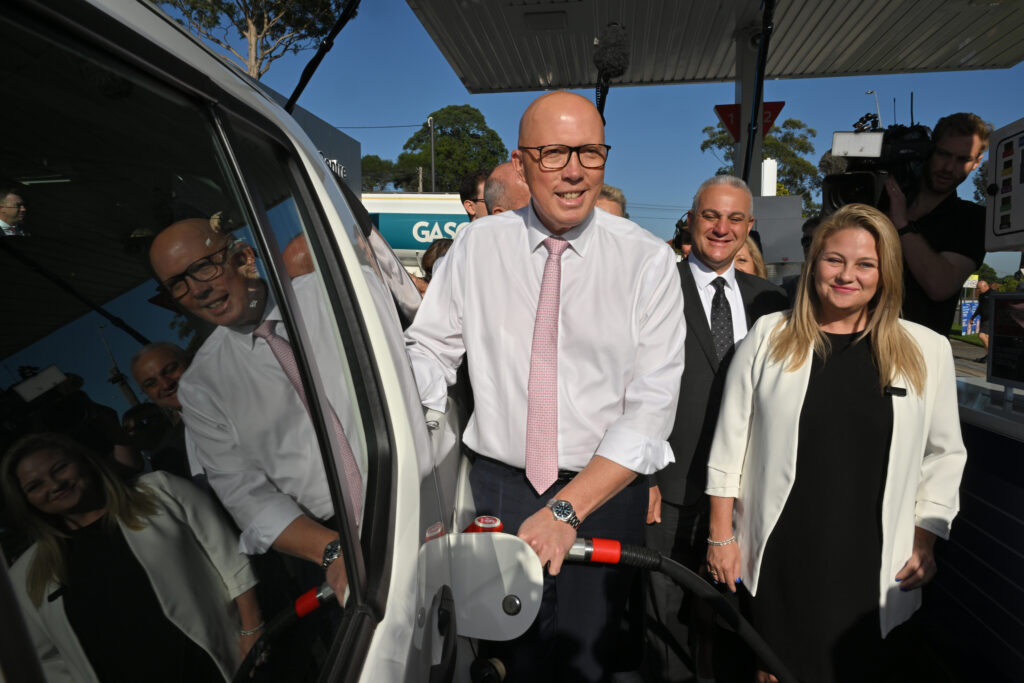
Peter Dutton visited his FIFTH petrol station.

This only came after Phil Coorey wrote in the Fin last week that it was crazy the Opposition wasn’t at petrol stations, given the fuel excise policy. They visited one the next day and then every day since.

Leader of the Opposition Peter Dutton at a petrol station in Hoxton Park in Sydney

Sometimes a picture really does say a thousand words

Leader of the Opposition Peter Dutton meets the public

In that press conference, when Dutton was asked about the dumped Liberal candidate for Whitlam, Ben Britton (who was dumped following reporting from Sarah Basford Canales at the Guardian about his previous comments, including that women shouldn’t be in the ADF)

Britton is now running as an independent.

And he still believes women shouldn’t be in the ADF, telling Sydney radio 2GB:

My position is the same as Andrew Hastie, the Shadow Minister for Defence and the great Jim Molan that women should not serve specifically in combat roles, specifically in the Army itself.

Now this is a little awkward because in that press conference when Dutton was asked whether women should serve in the ADF, he said: “I think you saw my record as Defence Minister in relation to women serving in any role they want to serving in the Australian Defence Force”.

He then Andrew Hastie agreed with his (Dutton’s) position.

Which is not the position Hastie held in 2018 (with thanks to a friend of the blog for pointing this out)

Hastie told Sky News in 2018:

My personal view since you’ve asked me is that close combat roles are incredibly exacting that’s why we have rigorous selection courses. And my personal view is the fighting DNA of a close combat unit is best preserved when it’s exclusively male. Now that’s not a popular view. You know, we’ve changed it five years ago, but you asked my personal view. There it is.

What if the government offered early childhood education in the same way it offered school education? 

Ebony Bennett
Deputy Director

Last night on ABC730, Adele Ferguson revealed more disturbing incidents exposed inside for-profit NSW childcare centres

“New evidence has come to light about what’s happening in some centres and it’s far worse than anyone thought.”

But what if the government offered early childhood education in the same way it offered school education? 

Australia Institute research shows reforming Australia’s approach to early childhood education would increase the size of the economy by $168 billion and allow the government to collect an additional $48 billion in revenue.

And higher prices don’t translate to better care: The Australian Government’s National Quality Framework shows that for-profit providers on average do worse than not-for-profit and state-owned providers when it comes to metrics like educational practice, children’s health and safety and staffing arrangements. Something confirmed by ABC’s investigative journalism into the sector.

“Not only is free childcare a form of fiscal stimulus, boosting consumer demand by increasing the disposable income of families with young children, but in the long run, it will significantly grow GDP and make Australia a far more equitable country,” said Matt Grudnoff, Australia Institute senior economist.

Of course, Australia already experimented with a Nordic model of providing free childcare during the pandemic, and it proved a big hit with families and for the economy. Naturally, the Morrison government put a stop to it almost immediately. Sigh.

Peter Dutton did find himself under pressure trying to answer whether he still believes that working from home was impacting productivity.

Q: When you announced your work from home policy you said it would increase productivity, do you still believe getting public servants back into the office would have an economic benefit?

Dutton:

I think we dealt with the issue yesterday.

Q: Does it still have an economic effect?

Dutton:

We dealt with at issue yesterday. And the arrangements apply now apply prospectively.

Q: Do they have an economic benefit?

Dutton:

It will have the economic benefit it does now.

The Antipoverty Centre has criticised Labor’s mental health spend by making the point that people’s mental health is made worse by living in poverty – and the government has not done anything to change that.

Budgets are about choices. And the government has made the choice not to lift Australians living on welfare out of poverty. The Antipoverty Centre says that makes any announcements about mental health, hollow.

Antipoverty Centre spokesperson and DSP recipient Kristin O’Connell said:

We know that the welfare system – through appallingly low Centrelink payments, abusive “mutual” obligations and compulsory income control – is causing widespread mental ill health, and fuelling suicide. We know this because of the extraordinary number of people in distress who seek help from the Antipoverty Centre, and because the statistics tell us so.

It is no surprise that mental health services are under increasing strain as the government utterly fails in its response to spiralling living costs.

There is not enough funding on the planet to improve the mental health of people experiencing distress because they are in poverty, homeless, in debt, because Centrelink payments are too low and exclude too many.

There is no denying mental health services are under strain. That is because people whose health issues are caused by factors that are easily fixed are trying to get care.

If people were not in such enormous financial distress, services would have more capacity for those of us who have complex psychosocial conditions – conditions that are also exacerbated by the fact that we are trying to survive without enough money to live.

We need Centrelink payments above the poverty line. We need “mutual” obligations and parasitic (un)employment services providers abolished. And we need the government to support our mental wellbeing by acting instead of forcing us to tell them this over and over and over.

Dutton lies and says Australia is in recession

This is so dangerous. Dutton is basically weaponising the chances of a recession for political gain. The ‘tsunami’ wave he has spoken about is not something Australia has control over, to the extent that it has been proven time and time again that Trump can’t be appealed to on a rational basis. And Dutton has said that they would have the same no go areas as the government in terms of negotiations – he has just said that he would tie Australia even closer to the US and buy even more from them in terms of AUKUS defence contracts.

That is what he has said he would do. And now he is saying that a recession would happen under Labor, just as a political point in an election campaign. This is a massive departure from the unspoken rule that you don’t talk up the prospect of recessions unless it is actually happening because you can talk your way into it. Labor danced on this line during the Frydenberg years, but didn’t cross it. Seems like all of that is now out of the window.

Q: When you say Australia’s heading into recession under Labor, you can you promise there will be no recession under you?

Dutton:

What I can tell you for almost two years families have lived in a recession already in the country, they’ve gone backwards under this prime minister so when you say who’s delivered a recession, the Prime Minister has. The treasurer has. They’ve delivered budget after budget, completely stuffed around for the first 16 months with the voice. They wasted $425 million. The Prime Minister has never apologised for that. Has never apologised.

And I can say to you now if you have a look at the track record of the Coalition when we were in government, we provided support to people, grew the economy, help people through the period of COVID, the economy will always be better managed under a Coalition government and what you’ll seen from a panic treasurer at the moment saying there will be a 50 point reduction in interest rates next month, is broadcasting to the Australian people he believes under his watch there will be a recession. After May 3 we will clean up Labor’s mess. Help families, get electricity and gas prices down, manage the economy so we can lower inflation, help young Australians achieve the dream of home ownership again which has been lost under the government, we will make sure health services are first-class properly funded and provide support families missing out of the moment. Bulk billing has plummeted under Mr Albanese. That’s what will take to the next election. That can give Australians every assurance better days will be ahead because a Labor-Greens government will see higher inflation and higher and not lower interest rates.

Dutton again pushes detail out until ‘further in the campaign’, won’t detail who he considers to be a frontline worker

Q: On your public service cuts can I get clarity on a couple of things, you said yesterday you worked with the PBO and that’s how you got the assumption natural attrition would deliver at 41,000 person decline, given that’s well above the natural attrition rate now, and you said you will be keeping frontline roles, what assumptions are you making or how are you confident you will get those cuts and could you give explanation about what you consider a frontline public servant, is it someone who answers phones for Services Australia for example?

Dutton:

I’ll leave the PBO question to the appropriate time and that will be further in the campaign. This election is about how we treat Australians with the dignity they deserve and that includes making sure we spend wisely and efficiently and not in a wasteful way, the taxes they earn and pay. I think readers of the daily tally would be more interested in how we can take different help them with their problems because at the moment they are struggling to keep head above water. What I want to do and I don’t make any apology for this… Is it there is waste within the budget, and Labor has built up wasteful spending, I want to make sure the money can get back to families, to frontline services, to supporting doctors, supporting nurses, to make sure we can spot the Australian Defence Force and we can achieve that through a measured approach as was evidenced in the Howard years. And that’s exactly what we’ll do.

Does Dutton have any wider issue with how the candidates for his party have been selected? Dutton turns from the issues with some of the selections to…Labor.

The dumped candidate is now out being helpful, running as an indie and alleging an internal left-right plot to throw the election so Dutton can be removed as leader. How did this guy get preselected? www.skynews.com.au/australia-ne…

Kevin Bonham (@kevinbonham.bsky.social) 2025-04-08T02:03:33.518Z

Dutton:

I think if you have a look at the candidates we’ve selected across many seats I believe they are unbelievable [contributers].

The Labor Party has had people who have been union secretaries, other positions in the union, CFMEU and others, there are Labor sitting members supported and endorsed and have been only able to come into parliament because of the CFMEU support.

Even to this day the financial support provided by the CFMEU through proxies to sitting Labor members. The CFMEU is an organised crime gang. They are involved in arrangements with outlaw motorcycle gang members. Am I going to take a moral lecture from Anthony Albanese when it comes to these matters? No I’m not. The Labor Party has ties with the CFMEU, $12 billion worth of donations from the CFMEU so were not taking any moral [lectures].

Asked about the comments about women in the ADF specifically, Dutton says:

I think you saw my record as Defence Minister in relation to women serving in any role they want to serving in the Australian Defence Force and that would be the position under any government I lead and I think I demonstrated when I was in the defence portfolio* and again I think this is a real consideration for people at this election.

The circumstances we live in the most precarious since 1945.

…I want to make sure we invest in defence. We need a leader of country to make decisions to keep our country say. I think the Prime Minister is out of his depth when it comes to economics and national security. I think he has demonstrated that in relation to funding profile in defence which I think is an outrage under this government.

*While Defence minister, Dutton took time out of his busy schedule to ban the ADF from having “woke” special events. He banned events which celebrated diverse and cultural causes and had particular issue with rainbow cupcakes which had been served as part of a morning tea recognising LGBTIQ+ ADF personnel;.

Sorry – just had to take a few moments to scream into the abyss there.

There was a question on the disendorsement of the Liberal candidate for Whitlam, which followed the Guardian’s Sarah Basford Canales excellent reporting on exactly who he was as a human.

Dutton says:

There were a number of issues not just those made public in relation to the candidate and we took a decision to replace the candidate, it’s the decision was taken. I wish him well and the only public commentary I have in relation to that.

Back to Dutton and he is asked:

Q: How are you feeling ahead of their interesting map and is it true the Prime Minister has Daniel Andrews helping him run lines?

How would Peter Dutton know who is on the Labor campaign? That’s like asking Anthony Albanese is it true that Scott Morrison and Tony Abbott/Peta Credlin are advising Peter Dutton? (they are.)

Dutton:

I’m looking forward to the debate tonight. We wrote to the PM months ago or two months ago I think it was, asking for four debate, so far he’s only committed to to formally and I hope you can commit to the other two. I’m looking forward to tonight. I hope that Daniel Andrews is out publicly with the Prime Minister if it’s good enough for him to tell the Prime Minister how he should run the debate on how we should run the economy and how good he did in Victoria. I’d love to see Daniel Andrews out with a premise every day between now and the election. If there is a spare seat, why not Jacinta Allan, Jacinta Allan, because if you want a snapshot of what economic management looks like under Labor, go no further than looking at what’s happening in Victoria, what happened under Daniel Andrews, under Jacinta Allan, and economic train wreck. Victorians know it. They are angry about it and if you think a second term of Labor is going to be any different to what we’ve seen in Victoria, then you don’t understand political history in the country. Reparation is good stop I’m looking forward to tonight.

Your regular reminder that President Donald Trump is not anti-war.

Emma Shortis
Director, International and Security Affairs

Bloomberg is reporting that the Trump administration has just approved a trillion dollar – yep, with a t – defense budget. Far from being isolationist, or anti-war, it looks like the Trump administration is embarking on a major military buildup. Trump has stacked his cabinet with a bunch of senior officials, like Defence Secretary Pete Hegseth, who view China as an existential threat to American primacy that must be countered. That’s the kind of ideology we’re dealing with, and it’s about time our leaders recognized just how dangerous it is. 

What the utter hell?!!!

Greg Jericho
Chief economist

In his press conference just now, Peter Dutton said this

JOURNALIST: Just on the potential of a looming recession, what sort of approach would the Coalition take? Would you rule out a large stimulus we saw during COVID under the Coalition and under Labor the GFC which people have attributed to avoiding a recession?

DUTTON: The Treasurer of our country is talking about the prospect of a recession or recession coming very quickly. That’s why he’s talking about 50 points reduction in interest rates. Unless he’s doing it for political reasons. But if he believes that it’s necessary to drop interest rates by 50 points in a month’s time, he’s telling Australians that there are difficult times ahead under Labor. That’s exactly what he’s doing.

Can I get a serious “what the utter hell??” First of all, these things are changing fast. On Friday the market was pricing in 4 rate cuts by the end of the year; by yesterday it was 5 cuts.

Chalmers yesterday talked about the prospect of rate cuts because that it what THE MARKET is anticipating. And why is it anticipating this? Because of Donald Trump. Blaming the ALP (or any political party) for what Donald Trump is doing to the entire global economy is rather incoherent.

Also does this mean a recession is coming? No – it means investors think Donald Trump is doing his best to kill the global economy and so as a result the RBA will cut rates to keep Australia’s economy from flatlining.

Suggesting a recession is coming is very foolish for any leader of a political party to suggest.

What would Dutton do differently when it came to the economy?

No answer here, but plenty of ‘not Labor’.

It’s been a long time where I have seen the prospect of a recession used for political gain. A long, long time.

The Treasurer of our country is talking about the prospect of a recession or recession coming very quickly. That’s why he’s talking about 50 points reduction in interest rates. Unless he’s doing it for political reasons. But if he believes that it’s necessary to drop interest rates by 50 points in a month’s time, he’s telling Australians that there are difficult times ahead under Labor. That’s exactly what he’s doing. As a Coalition I will always and Angus will always adhere to the principles of a Coalition government. That is to live within our means and make sure we can provide support to families and make sure we’re not continuing to build on the pressure that families are under by pushing prices up all the time. It’s what the economic decisions have ended up doing under this government as well

Peter Dutton then goes back to the nine years he spent as a police officer, which is the version of him he wants everyone to remember. He spent much longer as a property developer (about three decades) and he has been a politician for twice as long as he was a cop.

This would be like me claiming I understand everything there is to know about hospitality because I spent 10 years in the industry while going to uni years and years ago.

You can read more about who Dutton is, here – Lech Blaine’s excellent Quarterly Essay from a bit ago, Good Cop, Bad Cop

Dutton:

I think I demonstrated as a police officer I was always very serious about protecting the community and I did it for 10 years and very proud of my service as a police officer and you deal with some of the most difficult circumstances. For me, seeing women in domestic violence situations or seeing children having been sexually abused or taking a statement from somebody who had been sexually assaulted, that had a huge impact on me and it does to this day. I have always been influenced by how I can use the position that I’ve had to make our community safer. As home affairs and immigration minister, I brought in a lot of people, good people into our country. From all parts of the world, from war torn parts of the world. I cancelled the visas of over 6,000 people who had committed serious domestic violence offences, sexual offences against and children who had been involved in the importation of drugs and hard-core drugs that lead to kids breaking into houses and stealing cars to fuel the drug habit. I’m proud of that outcome. I’m not going to step back from it. Those numbers of doportations have fallen under a cliff. They don’t see it as a priority. Would I do everything I could within my power to keep Australians safe? Absolutely.

OK, what is with these questions – not on what a Dutton government would do differently, but a dixer on what the Coalition think has gone wrong?

Q: What danger is there for you that voters stick with the devil they know?

Dutton:

How can we help families and how can we help businesses get through this really difficult period under Labor? This is three years that people want to forget. It’s a 3-year lost period for our country. If you’re a family with an average mortgage you’ve gone back $50,000 under this government.

The Prime Minister is promising 70 cents a day by way of tax cut in 15 months time which shows he’s completely out of touch with Australians and where they’re at at the moment. Our plan is to provide immediate assistance from day one with a 25 per litre reduction in unleaded and diesel. That will have a positive impact not just for families, to help them out if they’re a 2-car family, probably about $30 a week.(This has already been shown to be overstated)

With our other policies, we can help business bring their costs down as well so we don’t see further increases in electricity costs, gas prices and groceries. Families are putting items out of their trolley, back on to the shelves under this government because they can’t afford the bill when they get to the checkout. People are stopping going to the doctor’s under the Albanese government because they can’t afford the out of pocket expense.

That’s the economy that Labor has created. And if we see further actions out of the US, or retaliatory action from China or other countries, then there is a very significant chance of a recession in the US, of a global recession otherwise. And those waves, huge tsunami waves will hit our shores in no time at all.

We need a government able to deal with it. That’s what Angus and I and Jane and our team offer to the Australian people at the next election.

Coalition blames Labor for Trump

Angus Taylor is at this press conference as well. WHAT JOY.

Peter Dutton is then asked if Australia is headed into recession and says:

It is under Labor. The government hasn’t prepared our economy. Labor has made decisions in subsequent budgets now which make it harder for the economy to function with international head winds. As we’ve seen with Labor governments at a state level but previous Labor governments as well, there is always a desire to spend and then to tax and inflation goes up and prices go up across the economy. (The Coalition are against Labor’s latest tax cuts and say they will repeal them, which means that they are vowing to tax more in this instance)

That’s exactly what’s happened again under this Labor government. I think there are real concerns. What is best for the Australian economy. and we have strong managers of the Australian economy ..and we can achieve that after the election with a change of government.

We have done it before and as you know during the course of COVID, and I sat around the table for all of these decisions in relation to COVID about how we should help families and small businesses and people retain their jobs, and their connection with employers and we provided that support to get us through the period of COVID.

We have made decisions in the Budget which put us in a much better position going into COVID than what this government has created over the last three years going into what is a period of uncertainty. Australians do know the Coalition is a better economic manager than the Labor Party and we’ll demonstrate that after the election but this is a big decision for Australians. We need to make sure we don’t have a Green-Labor government in Canberra because it would be a disaster for families and for the economy more broadly.

The government gave billions of dollars to companies who did not need it as part of jobkeeper

Peter Dutton press conference

And we have a new line – Peter Dutton is now blaming Labor for the global economic shocks that the Trump tariffs are having.

WHAT POWER THE ALBANESE GOVERNMENT MUST HAVE!

DUTTON:

The Treasurer is talking about a 50 point reduction in interest rates which means obviously he sees a recession coming for our economy. He wouldn’t be talking about 50 points as a reduction next month if he didn’t believe there was going to be a significant souring of the Australian economy on his watch. (It is the result of the tariffs Trump has imposed on the WORLD)

He is completely out of his depth when it comes to economics and how to manage the economy. Australian families have paid the price for it. We have seen Australian families suffer because of electricity prices going up. Gas prices go up. Groceries are up by 30% in this country under our government’s watch. Not just families. Also small businesses. 29,000 have gone broke under the Albanese government over the course of the last 2.5, three years. That’s the legacy of this government. This election is about who has a better plan to manage our economy in very difficult and uncertain times? Who has the ability to keep our country safe in a very uncertain period in history? And we get closer to the election and I think Australians will continue to focus on who is better able to manage the economy and to manage the cost of living crisis Labor has created?

Labor didn’t create the cost of living crisis, it inherited it. Grogs has already given an explanation on inflation, but it might bare repeating here:

Don’t you just love it when a politician starts talking about a specific metric that they now would have you believe is the absolute most important and best way to measure something.

So, it is with Peter Dutton who is now fixated on “core inflation”, saying this morning “We have the highest core inflation rate of any of the G7 nations”.

What is core inflation?

Well, it’s basically just a way of measuring inflation that gets rid of the big rises and big falls – to measure more of the “middle”. Why do that? The RBA likes to use it because it helps then not get too worried if in a certain period something weird happens (like a cyclone sending the price of bananas sky high) that sees the official measure of inflation, the Consumer Price Index (CPI) rise or fall. In such times the “core” inflation probably won’t move much.

But the main reason Dutton is using it is it generally is slower to go up or down – and while the official CPI measure (the one that measures all prices) is 2.4%, the “core” inflation for the December 2024 quarter is 3.2%. Why is it higher, well have a look at all the price changes not counted in the core inflation:

If you are looking at that table and wondering why we would bother caring about a measure of prices that does not count electricity prices, childcare fees, petrol prices, fruit and milk prices, etc etc etc then I agree with.

The core inflation measure is purely of interest to the RBA and economists. But you pay all price rises, all price falls. The CPI is what matters for people – so care about that – and it is also why the government has done energy rebates.

So don’t worry about core inflation – it is also coming down, and in the next March quarter figures it will likely also be below 3%.

But what about the line that Australia has the highest core inflation among all G7 nations? Well, here’s the problem – countries measure core inflation in different ways. In the USA they use the “Consumer Price Index for All Urban Consumers: All Items Less Food & Energy” which is an aggregate of prices paid by urban consumers for a typical basket of goods, excluding food and energy.

They also measure it each month, and in February it was 3.1%.

Here in Australia the ABS has also started to measure inflation each month. And as a result, it also now measures core inflation each month. So, what was it in February? 2.7%.

Peter Dutton might need to find another measure.

If business groups had their way, workers on the minimum wage would now be $160 a week worse off

Greg Jericho
Chief Economist

I decided to calculate what the minimum wage would be if the FWC did what ACCI wanted each year. And well… eeeeek.

Greg Jericho (@grogsgamut.bsky.social) 2025-04-08T02:34:45.990Z

Each year the Fair Work Commission (FWC) sets the new minimum wage and also how much the award wages should rise. Although these are Australia’s lowest-paid workers, each year various business groups seek to blame them for inflation and any business difficulties.  Year after year business groups submit recommendations to the FWC arguing to limit the increase in wages to no more than inflation – and often even lower – because they say higher wage rises will cause inflation.

However, such fears are totally overblown.

Last week, our research on the minimum wage showed that over the past 35 years, increases in both award wages and the minimum wage have had no impact on inflation. We did this research in part to rebut these ongoing claims by business groups that increases in the minimum wage should not be above inflation for fear of causing a wage-price spiral.

That no wage-price spiral ever occurs is oddly never an impediment to business groups continuing to warn that it will happen should the FWC grant an increase in the minimum wage of more than inflation.

You can read more, here

Just to come back to David Littleproud’s comments because honestly – I am still absolutely flabbergasted that the man applying to be the nation’s deputy prime minister can openly say he doesn’t think some kids deserve civil rights, that those rights should be “put aside” doesn’t make more than a little ripple in the Auspol space.

Report after report from people who know their stuff point out the role governments have to play in reducing poverty and how that can have a direct and positive impact in lowering crime rates.

Give people money to live, and breathe and think and actually plan their future – and what do you know? Crime rates reduce. And even more noticeably, juvenile crime rates reduce. Because kids have what they need.

It is not just, hey we did this one program and not enough changed. It has to be a lifelong commitment to reducing poverty, addressing systemic issues of injustice, violence and racism, housing overcrowding, substance abuse and generational trauma and it can not be bouncing around from one program to the next based on political ideology.

We have a massive problem in this country of not listening to the experts and instead being guided by feelpinions and it is to all of our detriment.

Coalition public service cuts policy still doesn’t make sense

You have to hunt for it, but the APS policy is now on the Coalition website. You can find it here.

It has obviously been retooled, but there is one line that jumps out immediately if you have been following this closely (like I have)

“We will achieve reductions by focusing on Canberra roles that are not frontline”

OK, but how? It doesn’t actually make sense. Because if you are relying in natural attrition to do your cuts over five years, than you can’t just wait for people in Canberra to quit their jobs. Because looking at the data, the separation rates – which is a fancy way of saying people quitting – is HIGHER outside of Canberra. So there are more people working in the public service who quit the public service outside of the ACT as a general rule. And if you are not touching national security, which is based in Canberra, HOW EXACTLY ARE YOU DOING THIS?

The Coalition are also trying to pretend that it wasn’t their original policy to cut the public service by 41,000 positions and that it was always going to be through natural attrition. Which is not what Bridget McKenzie said when she was asked about this last week – McKenzie said that they would decide where the cuts would happen after they won the election.

Hume is now trying to pretend that nothing has gone before the ‘natural attrition’ policy:

We actually never said that there were going to be forced redundancies. That was a Labor lie. It was a
Labor lie from the beginning. We had always planned to sensibly reduce the size of the public service over time. Now, at the end of that period of time, five years, there will be a savings of around $7 billion a year to the taxpayer. We think that’s really important to get the public service back to its right size, but
ensure that it’s also delivering the effective and efficient services that Australians rely on. We won’t’ be touching frontline services, and that’s why we won’t be touching national security portfolios.

Jane Hume said the Coalition will be releasing its “full public service policy” today, which is essentially the ‘on second thoughts…’ policy, although Hume, who spearheaded the doomed ‘get your patooties back into an office’ policy doesn’t think there was anything wrong with the wider point.

She told the ABC earlier this morning:

Today we will be releasing our full public service policy, and Peter Dutton and the Coalition have said that we will guarantee the delivery of the high quality, essential services that we know that Australians rely on.

But we’ll also reduce the cost and the size of the public service to reflect the most effective and efficient delivery approach possible. So part of this is about ending waste, Labor’s very wasteful spending within the public service and restoring a sense of respect for taxpayers money.

Now, part of that is that we will reduce the size of the public service by 41,000, and we’ll do that over five years.

Now, clearly this excludes military and reserves and will also protect the front line service delivery and the national security positions. But it will be done methodically.

It will be done through a hiring freeze and also through natural attrition. There will be no forced redundancies.

That’s really important and finally, we’ve also said that we will continue to support flexible working arrangements for the public service.

That has always been our position, but now it will also include opportunities to work from home. We very much respect those existing flexible working arrangements and we’ve said that we will enshrine them in future agreements so we’re not changing the current flexible working arrangements and that includes work from home policies.

Not sure how you can ‘methodically’ cut the public service by 41,000 people if you are doing it through natural attrition and a hiring freeze. Because you have no control over the cuts then. It’s just when they happen. Which is not methodical.

Westpac has released its consumer sentiment data – and no surprises, we aren’t feeling too good about spending at the moment.

Turns out having an ego-maniac in charge of the world’s biggest economy is kinda a bummer? And yes, it is directly related to Trump, because that was the week the group were polling sentiment and what do you know – batshit crazy tariff decisions meant people went from being ‘yeah, about the same’ to “OH MY GOD WHAT IS HAPPENING’ in the same week.

From the statement:

The Westpac-Melbourne Institute Consumer Sentiment Index fell 6% in April, to 90.1 from 95.9 in March.

Matthew Hassan, Westpac Head of Australian Macro-Forecasting, said: “Consumers are showing deepening unease about developments abroad:

Sentiment weakened sharply over the course of the survey week, with steep falls following the ‘reciprocal tariffs’ announced by US President Trump on April 2. Those surveyed before the announcement reported an index read of 93.9 down only slightly from March’s 95.9. Those surveyed after the announcement reported an index read of just 86.6, down nearly 10% compared to March.
The scale and breadth of tariff increases, which included a 10% tariff on Australian goods, came as a major surprise, triggering a sell-off in global financial markets.With the situation still deteriorating, there is a clear risk of more significant sentiment declines in the months ahead.”

What happened to media diversity?

Skye Predavec
Anne Kantor Fellow

If you’re watching the election campaign, you may have noticed something: you’re more likely to spot a swift parrot, Maugean skate, or Tasmanian tiger than you are to see a journo from a local paper at an Albo or Dutton press conference.  

That’s because the Australian local newspaper is now an endangered species. 

New Australia Institute research shows that News Corp has gone from publishing over 200 unique publications in 2016, to just 19 living, breathing papers today. The other 100 that it still lists with the Press Council are more like zombies – staffed by a skeleton crew of journalists and supplemented with auto-generated articles, without their own websites or print editions. 

The report also shows that: 

  • 10 million Australians live in a city without comparable print media competition 
  • A quarter of Local Government Areas have no independently owned local news outlet. Twenty-nine have no local news at all
  • Australian Community Media has gone from publishing 170 outlets to just 62 today. 

Full report here: https://australiainstitute.org.au/report/newspaper-competition-in-australia/  

Katy Gallagher and Jason Clare held a press conference where there didn’t seem to be any questions, which makes it seem like perhaps there were no journalists there. (makes sense there are a million people talking and this was just a press conference to say the same things we are already hearing)

So the pair gave a statement.

Clare’s ended with the main message from Labor:

A couple of weeks ago, Peter Dutton said this. He said, ‘look at what politicians do more than what they say.’ Well, that should be a red light, flashing, warning the Australian people, he says, ‘look at what politicians do more than what they say.’ Well have a look at what he’s done. When he’s had the chance before, he’s cut funding to health, $50 billion worth. It shows that you just can’t trust Peter Dutton, whether it’s cuts to health or whether it’s cutting your rights to work from home. He doesn’t understand modern families, and he hasn’t changed. He’s just trying to con the Australian people a couple of weeks before they vote. The truth is, as sure as night follows day, he’ll cut and you’ll pay

David Littleproud then falls back to the debunked idea that this is just about a ‘lack of respect’ and not systemic issues within our justice system, how our governments deal with intervention programs, a lack of committed on-going funding, and not listening to experts, including First Nations experts with lived experience, on what works for their communities and children.

Littleproud:

Respect. There’s no consequence or deterrent. In society, you need to have a deterrent and a consequence for doing the wrong thing. No-one fears, I have the same problem in my areas. They come back better criminals. They don’t fear detention and don’t see it as anything to be worried about. You need to change up that deterrent and consequence. It’s not about a boot camp. It’s about rebuilding people as human beings and young people who do have a worth. They’ve never been given it because of the home structure around them and we have to rebuild that and sometimes that’s about doing something different than sending them in behind barbed wire. Sending them out and showing these young people that they are worthy. The one out West of Longreach, a 94% success rate. Great young human beings that came out of that and they’re contributing right across Queensland now because someone made an investment of doing something different. Showing them they did have value and that’s something that I think is money well spent. It might be a bit more expensive but it’s money well spent.

Nationals leader says children who commit crimes don’t deserve civil rights.

Oh wow. Nationals leader David Littleproud is openly saying that children who commit crimes don’t deserve civil rights.

This is the message that conservative talk back loves, but it is not borne out by the evidence, which shows that early intervention is key. And it’s not just a one-and-done approach – it has to be a whole of society approach. Former Queensland premier Steven Miles told me that midwives he spoke to in the Queensland Health system could identify which babies would run into trouble with the law, because they saw the signs of Fetal Alcohol Syndrome up close in newborns. So it’s about early intervention with children and family support from the very first developmental stages – which the evidence bears out – not just bootcamps and detention centres. And what Littleproud is not saying here, is that he is talking about Indigenous children, who are over-represented in our justice systems.

We have got to a point in society where I get all the criminologists and everybody talking about civil rights. We have hit a tipping point where the civil rights of an individual need to be put aside for the civil rights of a community.

When a community doesn’t feel safe, you have to act and you have to make sure there’s a deterrent and a consequence.

Unfortunately at the moment there’s not. In my home state again, I would encourage every state to do this, we’re going back to outback camps where we are rebuilding these young people with a life skill.

Not putting them behind barbed wire but sending them to remote places, giving them a skill and purpose in life.

They get up in the morning and they know they can achieve something. It was ripped away because of the advice from criminologists and what we have done is put them all into detention centres.

If you talk to police they’ll tell you they’re criminals. We need to give them a purpose in life and worth. Know they are valued and they can contribute to our society because we’ll invest in their skills and take them away and put them in an environment where they can be a better human being and come back to society without society worried about them.

That’s what every government should aim to do and you should have the courage to say you’ve got it wrong. What’s happening at the moment, people don’t feel safe. And our primary responsibilities, all levels of government, is to keep their citizens safe.

The Coalition is trying to walk the line that it scraped the work from home policy, that it maintains was good policy, because people didn’t like it. And they are saying that people didn’t like it not because it wasn’t good policy, but because Labor managed to snowball people about it.

Which is a bit of a an odd line to take. The Liberals official spokesperson James Paterson was asked about this on Canberra radio 2CC today and said:

Q: You’ve had to walk back a couple of policies that I actually think were good policies. But you’ve been unable to sell them. I mean, is that the answer, or do you need to get the messaging right?

Paterson:

Well, I think it’s really important, when it came to flexible working arrangements, particularly in Canberra, for the public service, that we listened and heard what people had to say. And what they told us was that in a modern economy, many families make their lives work by having that
flexibility.

It is really important for them to be able to work from home occasionally, not all the time. And they value that flexibility. And we didn’t want to take that away from people. We know how much they’ve suffered under Labor’s cost of living crisis, and we don’t want to make it any harder for
them. And that’s why we’ve listened, we heard, we’ve acted, and we’ve changed the policy.

Which then begs the question – why was the policy created in the first place? Did the Coalition just learn about the modern labour market? Or did it ignore what it was previously told? And if it were in government when it came up with this and not trying to win an election, would it have just pushed through even if the same voices were speaking up with how much they hated it?

What does the Coalition consider to be a ‘frontline’ worker?

Given the Coalition has pledged to cut 41,000 positions ( by natural attrition now, which is when you don’t replace people as they leave – but also means you can not judge the impact to service delivery, especially since the highest turn over in the public service is frontline roles in Services Australia etc) what does the Coalition consider to be a frontline service worker?

Angus Taylor:

If someone’s serving veterans, for instance, that’s a frontline position. If someone’s working in the military, that’s a frontline position.

Q: So does that mean that a worker can’t be doing a useful job if they’re not sitting in a booth or on the phone, dealing directly with the public? That is the only threshold for a valuable job in the public service?

Taylor doesn’t answer it:

Not at all and we haven’t said that. What we’ve said is we need to get the public service to the size it was when we were last in government. We need to repair budget deficits that are costing Australians dearly. We’re going to see around $125,000 of debt for every family and interest payments for every family in Australiain the next couple of years and so a responsible government would be doing everything it can to make sure the public service isn’t bigger but is better. Look, there’s incredible people working in our public service. I want to enable them to be their very, very best.

Angus Taylor spoke to ABC’s 7.30 last night where he also raised the ‘uncertain times’ Australia was facing. Asked whether he thought the RBA should be cutting the cash rate he said:

Well, I don’t get into predicting what the Reserve Bank does but I will say we are living in a deeply uncertain time. I think there’s huge challenges for the economy globally and locally. I have asked the Treasury Secretary for daily updates to the Coalition because of the gravity of the crisis we’re facing. I think there’s a real prospect of a broader global trade war and what we know is that this will, in combination, put downward pressure on the growth of the economy, which has been
sluggish at the best of times – seven consecutive quarters of negative GDP per capita – and also has the prospect of being inflationary, particularly because of our low exchange rate and this is a very dangerous time for our economy, for Australians, self-managed retirees, pensioners, people who have been saving a nest egg for their retirement, it’s clear that they’ve seen a free fall in their asset values and young Australians who are saving up for a home, for instance, a very tough time
for them. We need strong economic management at this time, a steady hand.

That is the key as we look forward

Leaders’ debates can be useful, but no debate is better than a scrappy one

Joshua Black
Postdoctoral Research Fellow

As we’ve said, tonight is the first televised debate between Albanese and Dutton. It will go out live on Sky News at 7.30pm.

Robust debate is better than mealy-mouthed bipartisanship. (Aukus anyone?) Televised leaders’ debates can be a good thing if they illustrate the choices facing voters.

But they aren’t the crucial campaign events they used to be. Whether they are worthwhile depends on the format – a scrappy and personal debate turns politics into a blood sport, and alienates voters from the political process itself.

Prime minister Robert Menzies abstained from the first ever televised election debate back in 1958, but his deputy Harold Holt and senior minister Billy McMahon faced off against Labor’s leader H. V. Evatt and deputy Arthur Calwell. Barely 18% of TV viewers bothered tuning in, according to one historian.

Prime ministers and opposition leaders didn’t start debating during elections until 1984. A lacklustre PM Bob Hawke faced off against opposition leader Andrew Peacock, who managed to win the debate but not the election. Hawke chose not to debate John Howard in 1987 but performed spectacularly in a rematch against Peacock in 1990. It was, by Hawke’s own account, the ‘highlight of the campaign’.

Since then, debates have been a fixture of election campaigns but they are by no means decisive. In 2004 John Howard was roundly bested in his TV debate against Labor’s Mark Latham in September 2004, with 67% of the audience favouring the latter. The following month Howard pulled off an historic win in both houses of parliament, and Latham was soon gone from federal parliament. More recently, Bill Shorten won most of his debates against Malcolm Turnbull and Scott Morrison but lost both elections. The first debate in 2016 ranked 10th in the ratings (for a national broadcast, not good), and barely 93,000 people bothered watching to the end of the broadcast. The debates between the current PM and his predecessor last time round were pretty ugly, with the second debate especially full of “fraught and shouty exchanges” and plenty of yelling over the top of the moderator, Nine’s Sarah Abo. Nine won the ratings, Albanese narrowly won the debate, but the public were the losers.

Election debates need to be about more than winning ratings. They need to be contests of ideas and visions, not shouting matches between posturing men.

Guess who never pays fuel tax?

Rod Campbell
Research Director

Peter Dutton is spending more time in petrol stations now, talking up his idea of a fuel tax cut from 51c per litre to 26c.

While your average driver might like the idea of paying less fuel tax, you know who NEVER pays fuel tax?

Gina. Clive. BHP. The rest of the mining industry.

The tax break for miners costs over $3.5 billion per year, as we pointed out in our recent report on Fossil Fuel Subsidies 2025:

Worst, this is a billion dollar per year subsidy for coal mining! Bad economics, bad climate policy.

Would be interesting to know how a Dutton minority government would negotiate fuel tax cuts with a crossbench that is keen to wind back fuel tax exemptions.

Why are we punching down on international students?

Joshua Black
Postdoctoral Research Fellow

Politicians have claimed that students who come to Australia to study in person are exacerbating the housing affordability crisis. The Coalition claims that its newly-announced policy to reduce new international student enrolments will ease housing costs in “major metropolitan markets”. Having voted against Labor’s own proposal to cap student numbers last year, the Coalition is now promising to limit the number of international students to 25% of all new commencements. It claims this will reduce the number of international students by about 30,000 more than Labor’s current settings, which give the minister powers to deprioritise student visa processing and impose what higher education experts have called “a de facto cap”.

The idea that international students are responsible for rent hikes in the capital cities is nonsense. Everyone from the Business Council of Australia to the National Union of Students are on record as saying that international students make up a small proportion of the rental market (around 4% last year by most accounts).

When a Senate committee asked Treasury officials whether they had modelled the effect of international student caps on rent costs in capital cities, they acknowledged that they “haven’t specifically done any modelling on that, no”.

If political leaders were serious about improving housing affordability, they would tackle supply constraints as well as housing-related tax concessions, which exacerbate demand. Australia Institute research shows that the 50% discount on the Capital Gains Tax, as well as Australia’s generous negative gearing tax deductions, have “tilted Australia’s housing market away from homeowners and towards investors”.

Can the Coalition point to any modelling showing that international student caps would lower house prices more significantly than reforms to negative gearing and capital gains discounts? If not, they should stop punching down on a group of people who can’t punch back with their vote.

Election entrée: what happens when it is too late to drop a candidate?

Bill Browne and Joshua Black

Welcome to a new series of articles from the Australia Institute, which we’re calling election entrées! Over the next few weeks, we’ll be sharing fun facts about Australian politics and elections – as a way of explaining how our political system works.

Over the weekend, the Liberal Party dropped one of its candidates, and replaced him with a different one. But what happens when a party disendorses a candidate when it’s too late to replace them?

https://australiainstitute.org.au/post/election-entree-not-all-party-candidates-make-it-to-election-day/

Post-Doc Fellow Joshua Black has the details:

Election entrée: Not all party candidates make it to election day

Sometimes parties part ways with their candidates. This leads to messy disendorsements and a flurry of bad press. When these disendorsements happen late (after the “close of nominations”, after which no new candidates are accepted), the candidate still appears on the ballot as a member of the party that disendorsed them.

Such was the case for Pauline Hanson, who won election in 1996 while listed as a Liberal candidate. The Queensland Liberals expelled her only after nominations had closed, in response to highly controversial comments she made to local journalists about Aboriginal issues. Hanson was one of five independents elected in 1996, including others who quit or were expelled from their political party.

Other times, candidates are disendorsed before the close of nominations – which means the party can choose a replacement candidate. In 2016, the seat of Fremantle lost both its Liberal and its Labor candidates, the former for controversial statements about Indigenous politics and same-sex marriage, and the latter for failing to disclose previous criminal convictions concerning drink driving and assaulting a police officer. The replacement Labor candidate, Josh Wilson, won the seat and holds it to this day.

At the upcoming election, three former party MPs are defending their seats: Andrew Gee, who left the Nationals in protest over their opposition to the Voice; and Russell Broadbent and Ian Goodenough who quit the Liberal Party after losing pre-selection.

While a regrettably large number of disendorsements occur for racist, sexist or homophobic comments, Murray Angus has the distinction of losing his Liberal candidacy for the seat of Corio for speaking too warmly of his opponent, Labor’s Richard Marles.

Here is how AAP photographers caught the Rising Tide protesters at Albanese’s morning press conference:

A protester is escorted away after interrupting Australian Prime Minister Anthony Albanese at a press conference
Rising Tide have been a feature at both Coalition and Labor press conferences and events
Australian Prime Minister Anthony Albanese

Chief economist Greg Jericho spoke to ABC 24 about Donald Trump and the Australian economy, where he was asked – was Trump all bluff?

Jericho:

Normally he’s all bluff. He likes threatening these things and then someone gives him a deal that’s no deal at all and he claims victory and everything goes back to normal. That’s kind of what we are expecting here, the fact he keeps saying about trade deficits with the US rather than tariffs makes it seems like he thinks the end goal is everywhere in the world buying more stuff from America than America buys from it.

And that’s just not something that iis going to happen.

Certainly not with China or Europe or any of these other nations. If that’s his end goal, then I don’t know if he is going to sort of declare victory and pull out. Certainly the EU has already started calling his bluff and saying, OK, you want a deal, let’s have zero tariffs.

And that’s kind of not what he wants because he knows if that happens America is certainly going to not have a trade surplus with Europe.

So, they’re kind of saying if you want a deal, we’ll ready to deal. And so, I’m a bit worried at the moment because I think he’s fixated on these trade deficits and believe they’re a bad thing be, they’re not, they just mean that Americans and American companies like buying things from other places that are better quality and cheaper. Like our beef.

And that’s not a bad thing. That should be seen as a good thing for a place like America, but Trump doesn’t seem it that way. It sees it as a loss. If he keeps thinking that, maybe we’ll be stuck with these tariffs and it won’t be the usual bluff and bluster and then he declares victory and everyone just carries on as it was before.

The Coalition have touched on this in their response – but not in any way which would make housing more affordable (by giving people access to $50,000 in their super for deposits and loosening the lending restrictions, that just means more people have deposits at once, which just increases house prices).

But it is a major undercurrent to this campaign as well, as one blog reader points out:

Housing. Any day of the week that any party wants power. Housing is the way.I see the thousands that are permanently camping and dressing in their tents for their full time jobs.Nobody in Canberra does.Someone will use that anger, someone like MAGA, it's already happening.

Jakob G. (@jakobgamertsfelder.bsky.social) 2025-04-07T23:45:42.469Z

Greens agree; the RBA needs to reconvene

Greens senator Nick McKim has echoed calls from Chief Economist Greg Jericho for the RBA to urgently reconvene in the face of the impact Trump’s tariffs are having on the world economy.

McKim said in a statement:

The RBA will cut interest rates at their next meeting, but they should not sit on their hands for another six weeks while the crisis unfolds.

CPI is already in the RBA’s target band and trending down, and economists are debating the size of the upcoming interest rate cut, not whether or not it will happen. There is no justification for the RBA to delay.

People are hurting already, and every week of delay increases the risk of a recession which will hurt Australians even more.

People are getting smashed everywhere – the supermarket checkout, power bills, health and transport costs. A bit of mortgage relief would ease the pressure on millions of Australians.

We also need structural cost of living relief like putting dental into Medicare, which we could easily afford to do if we made big corporations pay their fair share of tax.”

If Labor had been prepared to work with the Greens we could have already made this massive legacy change to Medicare.”

Factcheck: Peter Dutton on inflation

Greg Jericho
Chief Economist

Don’t you just love it when a politician starts talking about a specific metric that they now would have you believe is the absolute most important and best way to measure something.

So, it is with Peter Dutton who is now fixated on “core inflation”, saying this morning “We have the highest core inflation rate of any of the G7 nations”.

What is core inflation?

Well, it’s basically just a way of measuring inflation that gets rid of the big rises and big falls – to measure more of the “middle”. Why do that? The RBA likes to use it because it helps then not get too worried if in a certain period something weird happens (like a cyclone sending the price of bananas sky high) that sees the official measure of inflation, the Consumer Price Index (CPI) rise or fall. In such times the “core” inflation probably won’t move much.

But the main reason Dutton is using it is it generally is slower to go up or down – and while the official CPI measure (the one that measures all prices) is 2.4%, the “core” inflation for the December 2024 quarter is 3.2%. Why is it higher, well have a look at all the price changes not counted in the core inflation:

If you are looking at that table and wondering why we would bother caring about a measure of prices that does not count electricity prices, childcare fees, petrol prices, fruit and milk prices, etc etc etc then I agree with.

The core inflation measure is purely of interest to the RBA and economists. But you pay all price rises, all price falls. The CPI is what matters for people – so care about that – and it is also why the government has done energy rebates.

So don’t worry about core inflation – it is also coming down, and in the next March quarter figures it will likely also be below 3%.

But what about the line that Australia has the highest core inflation among all G7 nations? Well, here’s the problem – countries measure core inflation in different ways. In the USA they use the “Consumer Price Index for All Urban Consumers: All Items Less Food & Energy” which is an aggregate of prices paid by urban consumers for a typical basket of goods, excluding food and energy.

They also measure it each month, and in February it was 3.1%.

Here in Australia the ABS has also started to measure inflation each month. And as a result, it also now measures core inflation each month. So, what was it in February? 2.7%.

Peter Dutton might need to find another measure.

A journalist asked Anthony Albanese if he wanted to address what the protester was asking. Albanese completely avoided the issue and went back to prepared lines:

It just encourages, I think… Security people should be allowed to do their job. But that’s up to you. Hang on. Hang on. Can I make this point?

Yesterday, Peter Dutton tried to pretend that he no longer supported sacking 41,000 public servants, and also – and also – that they now were walking away from their plan to oppose working from home. This was after, on working from home, they opposed our legislation that had that as a bargaining provision, along with opposing same-job, same-pay and the other fairness in the workplace provisions that we had put in place.

When it comes to these issues in terms of sacking public servants, Peter Dutton would now pretend that he can do this just through attrition.

The people who leave the Public Service most frequently are those front-line people delivering services. If you go into DFAT, it’s not a rotation. You tend to stay there as a life career. The people in Services Australia, the people in Centrelink, the people delivering those front-line services, have the most frequency of changes. So this is a pretence of a policy that simply cannot be believed

The protesters were yelling:

Since getting elected, your government has approved 33 new coal and gas projects…

Which is true. You can follow the approvals, here.

https://australiainstitute.org.au/initiative/coal-mine-tracker/

Protesters have interrupted this press conference, which has been a recurring, yet largely unacknowledged theme of the campaigns. Protesters who are yelling for more climate action from both the major parties are being seen as an annoyance, rather than a movement, which is very telling.

The Guardian recently addressed some of this with an excellent look at the extinction crisis which is going largely ignored by the major parties and other media. You can find the series here and I recommend you read it as it is an excellent example of looking at what is important in the big picture, that small target campaigns ignore.

Q: Do we have fiscal room to deal with a global recession, Prime Minister?

Albanese:

We’re not immune from impacts of the global economy. But what we have shown, consistently, is a preparedness to act for the times, to provide support that is needed for people. And it stands in stark contrast – and I go back to – you know, we are in uncertain times, but I’m absolutely certain this is not the time to cut.

This is not the time for what the coalition are going to have to do to pay for their $600 billion of nuclear power plants as we go forward. Now is the time to continue to manage the economy responsibly whilst we make sure we build Australia’s future by building up our education system. By making sure that people’s health is looked after.

By making sure, as well, that people have rights in the workplace. And yesterday, we saw an extraordinary turnaround from the coalition when it came to working from home and the sacking of 41,000 public servants.

This question sounds very similar to what Peter Dutton was saying this morning on ABC TV and other interviews.

Q: Last election, you promised that electricity bills would go down by $275. They didn’t. Why should we trust you on the economy this election when you made promises that you couldn’t keep and probably shouldn’t have made? Will real living standards go up in the term? Can we avoid global recession? And have you left yourself fiscal room for a stimulus package if we do, indeed, go into a global recession?

Albanese:

What we have done is continue to have responsible economic management.

I said before – we had the biggest energy crisis since the 1970s. That’s just a fact. And you would have recognised that, in the United Kingdom, the energy bills in Europe and in the UK were impacted, indeed – some nations hit double-digit inflation. We didn’t do that.

We took on responsible economic management. And I note, as well, that as well as economic growth occurring, unemployment being low, wages going up, inflation going down, and interest rates starting to fall, in addition to all of that, what we saw in the latest figures the last quarter was per-capita incomes, as well, are growing in real terms. We have turned a corner. There are, of course, global headwinds that we are seeing. We have to deal with that.

Q: You and Minister Wong have for years talked about the need to deepen ties in the ASEAN region. Do you believe that Trump’s tariff regime will push ASEAN countries further into China’s orbit?

Albanese:

What I want to see is us strengthen our relationship further with ASEAN countries. I was very proud to host every leader of ASEAN in Melbourne in March of last year. That was really significant. I don’t think, with respect, it got, perhaps, the coverage and the acknowledgement that it should have. I was really proud that every single leader came. No deputies. No representatives. Every single leader. And that’s a direct result of the hard work that my government has done to turn those relationships around. …Our relationship with Indonesia has never been stronger. Never been stronger. And the work that we’ve done there, but with other nations in ASEAN as well. And one of our responses to the decision of last Thursday will be to build on that.

I will convene – won’t necessarily go tell all of them – but the idea of missions, business missions – we’ve had business missions to Indonesia, to India, to Lao, to the region to China as well – that have been important in terms of those economic relationships.

Q: Prime Minister, government spending as a share of the economy is at a near-record high, at levels not too dissimilar from the COVID pandemic when the economy was in crisis. Have you left the budget in a position where government will be able to adequately respond in an event that there is a global recession?

Albanese:

Well, thanks for the question, which is very similar to a question that I got over here. Look, we have turned a – what we inherited – which was deficits each and every year – into other surpluses or a lower deficit.

Q: PM, Queensland today is extending the use of coal-fired power, pushing their plants out by three years and more. Are you concerned about that? Will that undermine efforts to bring down carbon emissions in Australia?

Albanese:

Look, they’re decisions of the Queensland government – they’re just that, a matter for the Queensland government. Of course, the Queensland government own their internally network and, of course, that has provided a significant benefit that I’ve seen during the flood events that have occurred. The fact that they are government-owned has meant that people have been able to reconnect with power, whoever was in government – Labor and now the LNP – and that’s been positive.

Q: Just back on the economy – from the briefings you’ve received, can you explicitly rule out a recession?

Albanese:

Look, we have – as a government – continued to see the economy grow. We’ve continued to see now, over the last five quarters, wages grow five quarters in a row. We have, in addition to that, seen tax cuts for every taxpayer dealing with cost-of-living relief. And we’ve seen inflation, importantly, brought down to 2.4%.

It had a “6” in front of it before we were elected. It peaked at 7.8% in 2022. And what happened in 2022? In the lead-up to that election was a March budget which saw a massive spike in the deficit – up to $78 billion.

Not a single dollar of savings in that budget. When we came to office, we had to repair that. And we turned that around.

At a time where we’ve had the largest global inflation issue to deal with since the 1980s and the biggest energy crisis since the 1970s. Higher wages, lower inflation, lower taxes, increased cost-of-living support, economic growth – and, by the way, more than a million jobs created on our watch.

That hard work that we have done, if we had not have done that, we would not have been as prepared for what is happening in the global economy. We’ll continue – we’ll continue to engage. But I’ll tell you what – it’s not the time for cuts in order to pay for a $600 billion nuclear plan.

Q: Prime Minister, the leaders’ debate is tonight, your a first chance to debate Peter Dutton. How’s the prep going? Is it true that Dan Andrews is being used to prep as Peter Dutton?

Albanese:

I look forward to discussing not just with Peter Dutton, but as well to the people who come along to ask questions. I agreed to this, and we put this forward as the first debate, because I believe that Sky – particularly during the day – plays a role in informing the Australian public and certainly it’s something that’s watched around and is important.

And so I look forward to talking with the people of Wentworthville. I’m very familiar with the Wenty Magpies, and I look forward to being back at Wenty Leagues Club tonight and talk about the issues raised by people there.

(You’ll notice he didn’t deny the Dan Andrews part of that question.)

Q: Prime Minister, you mentioned being a responsible economic manager. Treasury is saying now that GDP will contract, revenue will fall. How can you continue to claim to be responsible unless you revisit at least some of your agenda to trim spending?

Albanese:

This election is about a government that has a plan to deal with cost-of-living relief and to assist families at the same time as building Australia’s future, and an opposition that has an agenda for cuts. It’s very clear that they will – if they are successful – rip the guts out of Medicare, like they did last time, with $50 billion of health cuts, take away funding for schools with $30 billion of education cuts.

Across the board, they did all of that and then produced not a surplus first year and a surplus every year, which is what they promised – they delivered, every year, a deficit that just grew and grew and grew. And included in that enormous waste. During a pandemic, governments around the world, of course, would go into deficit, but you didn’t have to give $20 billion to companies that were actually increasing their profits, not being affected adversely.

Q: Prime Minister, in 2022, you said Labor can’t repair all the damage done in the first term. You lamented the state of the books you inherited. Considering the recent budget shows 10 years of deficit and increasing debt-to-GDP ratios and there hasn’t currently been a structural release, have you ruled out structural repair in the next term as well?

Albanese:

I didn’t rule it out in the first term. We turned a $78 billion deficit into a $22 billion surplus under Labor. We then moved it to a $15 billion surplus. We’ve improved the budget bottom line by $207 billion. $207 billion in improvement in our first term. We have been a responsible economic come management government. And we’ll continue to be so if we are fortunate enough to receive a second term.

Labor seeks to make ‘uncertain times’ a major part of its campaign message

I am sensing a theme here. “Uncertain times” which was first pushed by Jim Chalmers is very quickly becoming the underpinning of the Albanese campaign. Why? Well, the next message from Labor is – don’t risk change in these ‘uncertain times’.

Albanese:

These are uncertain times. And we know that that is the case. The decision of the US administration, as I said last Thursday, is an act of self-harm.

But it’s also because it’s the world’s largest economy.

It has implications for the global economy. What we are doing is preparing for that. We were the first country in the world to respond to the US decision.

The first in the world.

Because we had prepared, because we are a considered government. Because we want to make sure that Australians – their impact of this is minimised.

That’s why we have, in advance, done the work that we did over the last three years. But that’s why, in particular, we did the work in the not unsurprising announcement – although some elements of it were surprising, I’ve got to say; the Heard Island decision and Norfolk Island – some of it was strange.

But we are dealing with this in a considered, organised way, because that is what a considered government does

To the questions outside health now, what contact has the Albanese government had with the Trump administration?

Albanese:

Well, we live in uncertain times. We know that that’s the case. But I’m absolutely certain that, in these uncertain times, now is not a time for cutting. Now is not a time for the sort of retreat from policies that we’ve seen from the coalition.

We’ll continue to engage constructively with the US administration. It’s what we’ve done up to now, and it’s what we’ll continue to do.

Professor Pat McGorry, one of the nation’s leading youth mental health experts is at this press conference. He welcomes that this is a bipartisan achievement for the nation – that both major parties are committing to increasing their youth mental health spend.

McGorry:

I’m very proud of our country that we’ve been built this system to the extant that we have already. Today, this announcement is very strong.

This announcement is very strong from the government. It’s not just covering youth, it’s extending, as you heard from the Prime Minister, the Medicare mental health services, which is in a way an analogue of Headspace for older people.

That’s something that we really needed and the government is building on that too. And also, it’s got a more complex package around workforce and also, as I just mentioned, the research platform aspect too.

….The Yarn Safe program [which is specifically for First Nations People] has operated for years. This investment today takes that to another level. I’m sure we’ll give much better support to that population at that critical age of adolescence in their early 20s.

The official announcement is:

  • $225 million for 31 new and upgraded Medicare Mental Health Centres
  • More than $200 million for 58 new, upgraded or expanded headspace services
  • $500 million for 20 Youth Specialist Care Centres for young people with complex needs
  • $90 million for more than 1,200 training places for mental health professionals and peer workers.

Anthony Albanese press conference

Because the first leaders’ debate is this evening, both Anthony Albanese and Peter Dutton are out and about earlier than usual, before they go to ground for debate preparation.

Albanese is making the $1bn in spending for mental health announcement (the Coalition had previously outstripped the government in mental health spending so this is a case of Labor following the Coalition’s lead – obviously because it is a policy that resonates well with people)

Labor plans on growing and expanding the Medicare mental health clinics, which are the first stop for people needing access to the mental health system (and emergencies) but there is no on-going care at these centres. It is also giving a funding boost to Headspace and creating youth mental health specialist centres.

The ‘bellwether’ era is over – there are no safe seats

Wondering why you never hear about ‘bellwether seats’ any more? Well Josh Black and Bill Browne have you covered:

https://australiainstitute.org.au/post/now-that-there-are-no-safe-seats-the-bellwether-seat-is-no-more/

Media analysis shows that the decade from 2007 was the bellwether era, but that era has now passed

In 2016, ABC election analyst Antony Green ruefully remarked that it ‘seems impossible to cover an election without referring to bellwether seats’.

A ‘bellwether’ seat is one that predicts the overall election result. For forty years, whichever party won the regional NSW seat of Eden-Monaro also won government as a whole.

But elections – and journalistic fads – change quickly, and 2016 would prove to be the bellwether’s last hurrah. As Green explained, a seat can end up as a bellwether by pure coincidence, not any underlying property of the seat itself. And by the time the bellwether seat is decided, the overall election has usually already been called.

The end of the bellwether seat’s time in the sun is a reminder that what matters are the dynamics in individual electorates, not political cliches or outdated rules of thumb.

‘Bellwether seats’ are so last decade. According to the media database NewsBank, the proportion of metropolitan commercial newspapers using the term ‘bellwether’ to describe political processes during federal election campaigns grew more than threefold between 2001 and 2007. The number of articles was relatively high in 2010, followed by a modest decline in 2013.

References to ‘bellwether seats’ nearly doubled again in 2016.

The turning point seems to be the 2016 election, when Labor’s Mike Kelly won Eden-Monaro while Liberal Prime Minister Malcolm Turnbull won a narrow majority in the overall House of Representatives. Over the years journalists have identified other electorates as bellwethers – Robertson (NSW central coast), Lindsay (Western Sydney), Brisbane (Queensland), Makin (South Australia), and Aston (in Melbourne) – but none have held on to the title.

By 2019, the proportion of articles using the word ‘bellwether’ had fallen to its lowest rate since 2004. A brief interest in ‘bellwether booths’ in 2022 did little to improve the overall numbers.
The political decline of the bellwether couldn’t happen soon enough. Even the term is patronising, referring to a flock of sheep following their leader. As the old certainties of bellwethers faded away, so too is the traditional ‘pendulum’ showing which seats are likely to change hands between Labor and the Coalition giving way to a new realisation that two-party contests are not the only game in town.

That’s a good thing. This means that there are no safe seats, and every vote in every seat matters. Just as no ‘bellwether’ seat actually decided a 150-seat election, no ‘national swing’ can decide the seats that matter for the formation of government.  Indeed, the formation of the Gillard minority government in September 2010 shows that seats that return independent candidates can decide governments.

The debate tonight looks set to all be around who will manage Trump better. The way the debates work, the campaigns usually go quiet in the afternoon so they can prepare.

Dutton is trying to set up a few things; one that he would manage a Trump led world better, and two that he would manage the domestic economy better.

But the problem with that, is that given how in flux the world is, people are looking to boring. Boring is looking stable and dependable. If you speak to some people in Labor, they feel like their ‘boring’ approach (they would call it steady) has been under appreciated and that the times may actually see more voters swinging back to Labor.

Labor is using that to push for a majority government. At this point in the game, minority is still the most likely outcome, but Labor is feeling better about some of its Victorian and outer suburban seats, which may see it come across the line.

As George Megalogenis says in his most recent Quarterly Essay, Victoria and NSW will decide the election – but not just the outer seats, the teal ones that the Liberal party is not working to capture.

If you open a paper today, you might find yourself seeing a very broad group of leaders and thinkers in agreement on something we haven’t seen agreement on in Australia previously.

Coalition’s proposed gas levy could raise billions of dollars

The Coalition’s proposal to introduce a new tax on gas exports, designed to divert gas production away from exports and towards Australian households and industries, could raise billions of dollars, according to Dr Richard Denniss, Executive Director of The Australia Institute.

“Australia is one of the world’s largest exporters of Liquified Natural Gas but, despite this fact, the largely foreign-owned gas industry has been making the bizarre claim that there is a shortage of gas in Australia,” said Dr Denniss.

“Peter Dutton’s rejection of that silly claim, and his proposal to tax gas exports to encourage greater local supply, is a watershed in Australian energy policy debate.” 

Research by The Australia Institute shows that more than 80 percent of gas produced in Australia has been used for exports, and more than half of those gas exports were given away, royalty-free, to the gas exporters. 

“Putting a tax on gas exports is an easy way to ensure that more of Australia’s gas flows to Australians and that they pay less for it,” said Dr Denniss.

“Introducing a cap on gas exports as well would be an even better way to both protect Australians from cost-of-living pressures and protect the climate from increased emissions from burning gas.

“The opportunity for Labor to expand on the Coalition’s policy is enormous. 

“For decades, the major parties in Australia have seemed afraid to put the interests of Australian taxpayers ahead of the profits of the fossil fuel industry.

“But now that Peter Dutton has made the first step, the opportunities for the new parliament are unprecedented.

“Norway taxes fossil fuel companies and gives young Norwegians a free university education while in Australia we subsidise the fossil fuel extractors and charge our kids a fortune to go to university. 

“It is time for Australian leaders to be brave enough to put the interests of the Australian people ahead of the interests of the fossil fuel polluters.” 

The Coalition want to cap international students (which Labor does as well, but the Coalition want to go further with the caps) and Peter Dutton claims it is to ‘help young Australians get into housing’.

International students overwhelming stay in student accommodation. They are not competing with people to buy houses.

Dutton:

Just to put this into perspective, this is part of our housing policy because I want to make sure that young Australians can get into housing. And I want to make sure that young Australians can afford their rents as well. At the moment, that’s not the case. So, for every 42 students that have arrived as part of the international student program – and we’re fully supportive of international students coming to our country, but the numbers increased by 65%. For every 42 international students who have arrived, there’s been one rental unit built to provide accommodation.

So, of course every one of those students wants to find safe accommodation, but the trouble is that they’re competing with Australians who can’t get into housing. So what we’ve said is that we want to reduce the number and reduce the migration program so that we can get the balance right. We’ve got a $5 billion program to work with councils to pay for infrastructure like water and road and sewage upgrades so that we can build 500,000 new homes.

And there are other things that we’re putting in place as well around housing so that we can get that housing outcome. I understand the Retailers Association and other employers as well who look to that workforce, but we’ve got a very significant number of people who have arrived over the last two years. In fact, a million people have been brought into our country over the last two years. That’s a 70% increase than any 2-year period in our country’s history, which in part is what’s created this housing crisis. And many of those people have work rights and the ability to work in retail stores and across hospitality and tourism and right across the

This will also form much of the Coalition’s debate this evening:

Dutton:

We have the highest core inflation rate of any of the G7 nations. So, interest rates have gone higher faster here than in other areas of the world. And, as you know, we’ve had seven consecutive quarters in this country of negative household growth. So, households have gone backwards.

That hasn’t been the case in other parts of the world, including in comparable economies. And the home-grown inflation that the Reserve Bank has spoken about here is a big part of why we’ve had a 30% increase in grocery prices. But it doesn’t stop there.

It’s 32% increase in electricity prices. 34% for gas. Rents are up by 17%. I just don’t think Australians can afford three more years of a bad Labor government, and particularly if it’s a Labor-Greens government – that will see inflation come back into the system, which will force interest rates higher again. And that’s why interest rates will always be lower under a coalition government.

OK, inflation came LATER to Australia. And the RBA began increasing interest rates LATER than the nations that Dutton is talking about. So inflation began to come off those other nations earlier – because inflation had come to them earlier. Economists are beginning to speak about the need for the RBA to cut rates four more times, so the situation that Dutton is describing is rapidly changing.

Peter Dutton is still doing the mea culpa on the public servant work from home reverse ferret, but now adding the sting (which was always coming); Albanese has never apologised, and it’s Labor’s fault for getting people upset at the policy.

(The policy only ever applied to the public sector, yes – but the public sector often sets the conditions for the private sector, which follows. So while the government can only order public servants back to work, it would have set the scene for private companies to reverse their own flexible work arrangements.)

Dutton:

Our policy applied to public servants in Canberra. But this whole series of lies where Labor had made people believe that somehow it was going to apply economy-wide – it was just deceptive and, frankly, dishonest. So, we’ve clarified our position. I’ve apologised for the mistake that we’ve made. And I think, frankly, it’s a very necessary part of leadership to demonstrate where you have got it wrong to apologise.

The Prime Minister’s never apologised in relation to the broken promise around the $275 cut to electricity prices. People have experienced big cost rises in their electricity prices.

Never apologised for it.

So I do think it’s important that, where you make a mistake, you apologise, you explain what you got wrong, and we’ve done that.

And we have been very clear about it.

So I think it allows us now to concentrate on what issues are important at this election and I think helping families, helping small businesses, helping our economy grow – I think all of that’s important.

The core inflation rate in our country is twice what it was under the coalition*, which is why people are paying more for groceries and paying more for their everyday items that they’re having to find money for out of an ever-shrinking budget. And I want to make sure that we can help families find some headspace, some breathing space, and I want to make sure that we can help families get through what’s been a really tough three years.

It began rising under the Coalition – Labor inherited it.

What would Peter Dutton do differently with Donald Trump?

Well, he tells the ABC, not a lot really. He’ll do the same things and also just beg a little more.

Firstly, when Donald Trump was president a few years ago, we were able to negotiate with the administration for Australia to be exempt from the tariffs. And that was a very significant outcome. But it didn’t happen by chance. We had identified Joe Hockey’s work as ambassador was crucial in doing this – identifying people who could have an influence in the decision in and around the administration. That’s exactly what we did.

This Prime Minister just hasn’t got any of that connection. There’s been no work done in the run-up to what was obviously being announced. And I think for us, the question at this election is – who is best able to manage the relationship? Who is best able to manage the economy so that we can deal with Labor’s cost-of-living crisis? And who is best able to deal with national security in a very uncertain time? We have the ability, as a coalition, not just to clean up a bad period of economic management after a Labor period in government, but also to make the decisions to help families and help promote that investment into our economy, which is necessary to create the jobs and economic activity.

Dutton is asking Australians who will be able to ‘connect’ better with Trump, which is essentially just asking Australians, who will Trump like more – and is being liked by Trump something Australians want this time around?

Meanwhile, Donald Trump is promising more tariffs on China. As AAP reports:

US President Donald Trump has threatened to further increase tariffs on China, raising the possibility of further escalation in a global trade war.

Undeterred by a slide in stock markets, Trump on Monday said he would impose an additional 50 per cent duty on US imports from China on Wednesday if the world’s No. 2 economy did not withdraw the 34 per cent tariffs it had imposed on US products last week. 

Those Chinese tariffs had come in response to 34 per cent “reciprocal” duties announced by Trump.

“All talks with China concerning their requested meetings with us will be terminated!” he wrote on social media.

The announcement injected further turbulence into global financial markets, which have fallen steadily since Trump’s announcement. 

A 10 per cent tariff took effect on all imports into the world’s largest consumer market on Saturday, and targeted duties of up to 50 per cent are due to snap into place on Wednesday.

Labor boosts mental health spend in response to the Coalition’s promises

One of the areas where the Coalition had outflanked Labor was on mental health.

Mark Butler was tasked with addressing that and today Labor is announcing a $1 billion package mental health spend, with more Medicare mental health centres and additional specialist services for young patients. Butler announced a mental health service in Ryde yesterday as a bit of a teaser to the whole package.

The Coalition had promised $400m for youth mental health and increasing the number of Medicare-subsidised psychology sessions from 10 to 20.

Labor is promising $225m to upgrade or build new Medicare mental health centres (which don’t offer on-going care, but can help people into the system to find longer care and deal with emergencies), $200m for Headspace and $500m for 20 specialist youth mental health centres.

Does Australia need to diversify its trade?

Mark Butler:

We’ve got to diversify our trade, we have focused on South-East Asia, a big strategy put in place over the last year or so. We focus heavily on India, where frankly we could lift our economic partnership. Diversification, not relying on any single market is critically important. We learned that from the tariffs put on by China that we were able to lift. We can’t have eggs in any single basket, whatever basket that is.

Health minister Mark Butler has been a huge part of this Labor campaign. He is in Sydney doing early media and is asked how a future Albanese government would handle Trump.

He tells the ABC:

We’ll continue to press the national interest that Australia has. Our exporters, our households, or businesses. But we’ve got a better deal than any other country in the world, so I’m not sure what Peter Dutton says he could have done differently.

We had meetings at very high levels and no country on the planet got a better deal. What we’re dealing with now is the global reverberations from that.

That’s why this is the worst time to think about shifting to a Peter Dutton prime ministership that would raise your taxes, cut your services, and spend $600 billion precious dollars of taxpayers’ money on a nuclear power plant.

Good morning

Hello and welcome to day 11. Both the campaigns will be hanging close to Sydney ahead of the first debate, which is hosted by News Corp. So expect a lot of Sydney areas today.

The Wombat trail (a shorter Nationals campaign trail) is underway and is in Cowper, where the Nationals are in a lot of trouble against the community independent, Caz Heise. It’s one of the unseen electoral battles of this campaign, but the Nats are worried about it (as they should be)

Also unseen this election campaign is the amount of work that the Greens have been putting in. It’s not as big a campaign, but it is very targeted – Adam Bandt has been spending time in Perth, Melbourne and Brisbane (as well as other spots here and there) where the message has been on the bigger picture issues a minority parliament may face. Labor is working on winning majority government and it is not out of the question, but a hung parliament is still very likely. That doesn’t mean that there will be a coalition between Labor and the Greens, but that the Greens will be among the negotiations needed – not just in the House, but also the Senate.

And of course, the world continues to make itself known in the Australian campaign, despite the leaders best attempts to ignore it. The damage inflicted by Trump’s tariffs are still sending shock waves through financial markets, and Israel’s continued slaughter of Palestinian civilians is still going unanswered by most Australian leaders. But none of these issues are going away.

We’ll take you through all the major events of the day, and the debate, so get your coffees, or your matchas ready. You have Amy Remeikis with you for most of the day – send any questions through to amy.remeikis@australiainstitute.org.au and I’ll do my best to get them answered for you.

Ready? Let’s get into it.


Read the previous day's news (Mon 7 Apr)

Comments

Start the conversation

The biggest stories and the best analysis from the team at The Point, delivered to your inbox.

Past Coverage