Thu 24 Jul

Australia Institute Live: ICJ rules countries must tackle fossil fuels as Nationals try and restart Australian climate wars. As it happened.

Amy Remeikis – Chief Political Analyst

This blog is now closed.

Start the conversation

Australia Institute Live: ICJ rules countries must tackle fossil fuels as Nationals try and restart Australian climate wars. As it happened.

Key Posts

The Day's News

See you next week?

And on that note, we are going to put the blog to sleep for a couple of days, until parliament resumes on Monday.

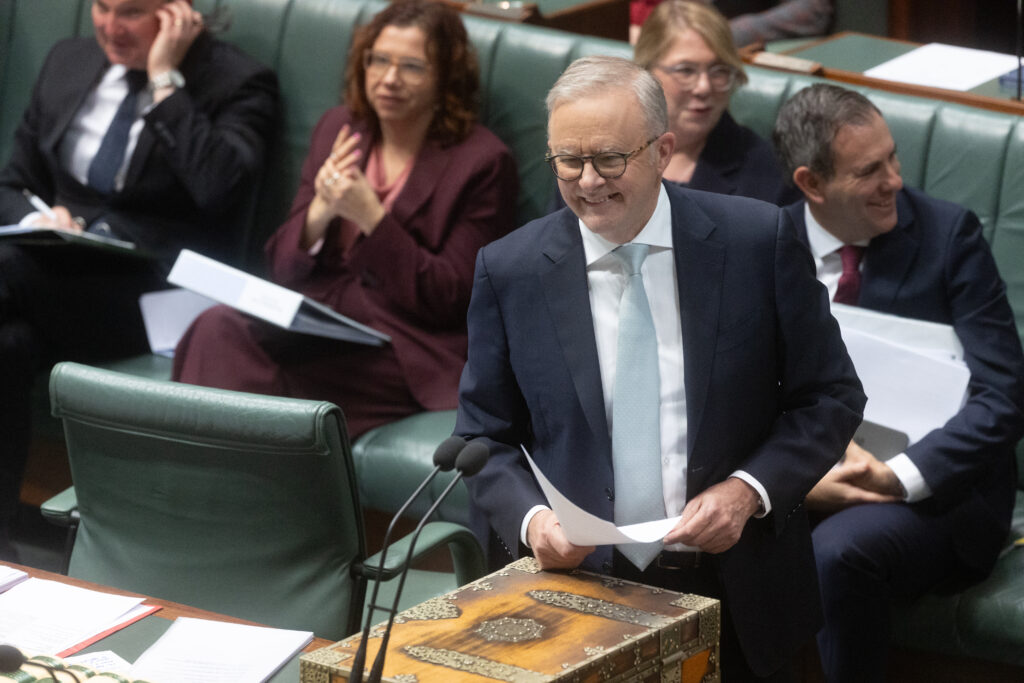
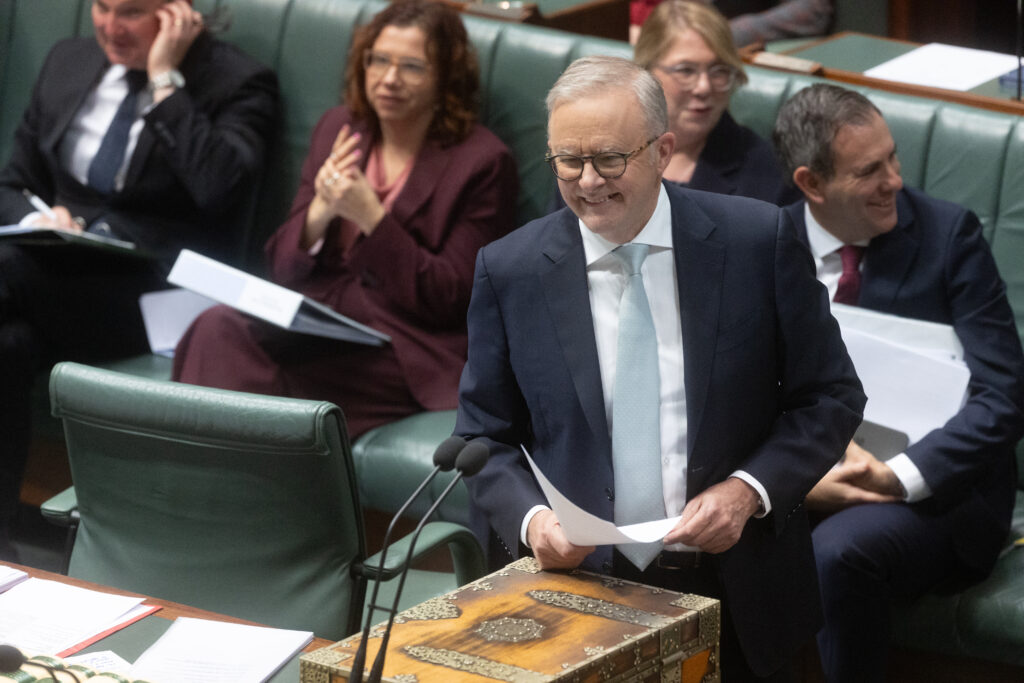
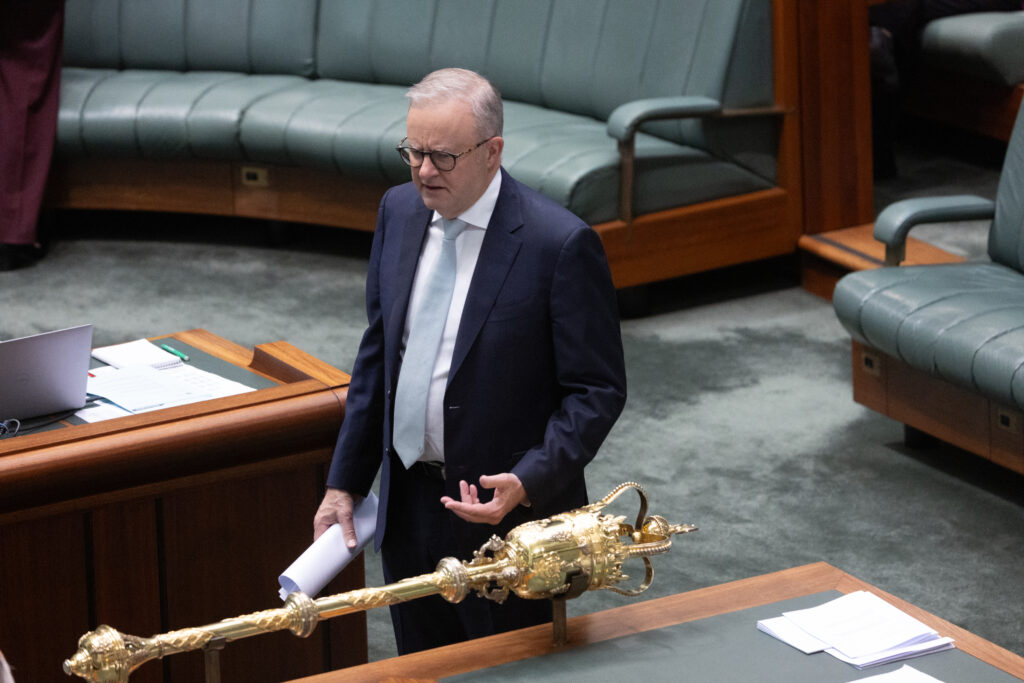
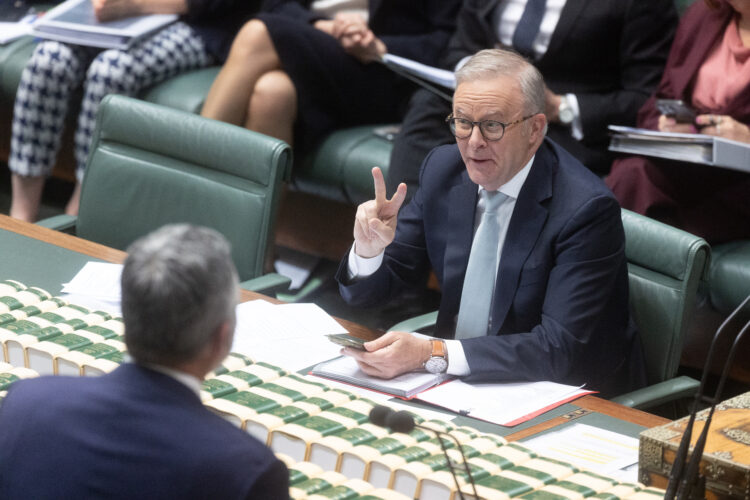
The Prime Minister Anthony Albanese during question time (photo by Mike Bowers for The New Daily)

Thank you so much to everyone who came by and read this week – we are truly humbled by your support and interest. A very big thank you to Mike Bowers and The New Daily for taking us into the chamber and to all the researchers and experts who turned pulling their hair out into explanations and factchecks for us.

But as always, thank you so much to you for reading. It truly does mean the world. You can catch me with my other hat on in The New Daily on Sunday where I will take a look at some of the week, and on the socials or email if you have any questions.

Until Monday, please – get outside and breathe. There is a lot going on in the world at the moment and constant images of death and genocide and it is a lot to witness. If you are, thank you. It matters. Truly, it does. We can not fall victim to defeat because we must use that energy to force focus and change. And you’re not alone.

Take care of you Ax

Greens senator Larissa Waters (on behalf of Sarah Hanson-Young) has also used the senate production of documents powers to order Murray Watt to present the approval conditions, including draft versions, for the provisional approval of Woodside’s North West Shelf extension.

That’s for the ‘conditions’ the government keeps talking about but won’t make public.

We haven’t spent too much time in the senate today, but here is a bit of a catch up.

The minister for Indigenous Australians, Malarndirri McCarthy addressed the One Nation act of turning their back on the Acknowledgement of Country ceremony in the new parliament. PHON claims it was standing up for the Australians who voted against the Voice, but the problem with that (apart from you know – everything) is that acknowledging country had nothing to do with the Voice referendum. It’s a tiny mark of respect, just acknowledging the Indigenous land we are standing on. One Nation are also doing it on purpose – much like prayers, senators don’t have to be in the chamber when it happens.

You can read more on what McCarthy had to say, here.

Tony Burke and Anne Aly have made a statement on the recent racist vandalism attack on a Hindu temple and two nearby Asian restaurants in Melbourne:

The racist attacks on Asian restaurants and a Hindu temple in Melbourne are an attack on Australia and our core values.
They come on the back of a sickening string of racist and homophobic graffiti attacks in Melbourne in recent weeks.
When bigoted graffiti tells people to “go home” our response is clear: they already
are. Our government has taken the strongest possible line against hate speech and hate
crimes. We are committed to defending the right of all Australians to feel safe and be safe in
their communities. We stand with all Australians against anyone who would seek to make them feel
unwelcome or unsafe.

After winning the state of origin, Queensland also won the title of ‘first MP booted from the 48th parliament QT’ with the LNP MP for Wright, Scott Buchholz given his marching orders by Milton Dick.

That was after he interjected during a point of order debate raised while Jim Chalmers was answering a question.

After getting the boot, Chalmers quipped of the retreating member:

Nobody knew he was on the frontbench until you asked him to leave it.

Which is fair, actually. (He’s the shadow minister for skills and training. I also had to look that up)

The Speaker now has the power to eject someone from the chamber for up to three hours, but Dugald will stick to the traditional one hour escape, unless it is particularly annoying.

How did Mike Bowers see question time?

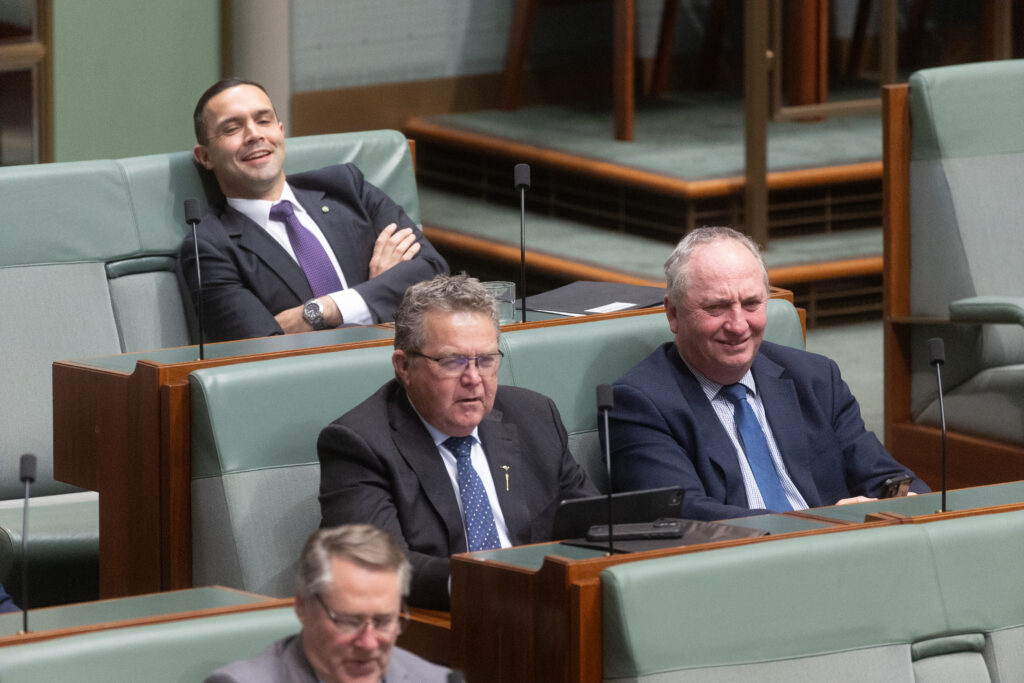
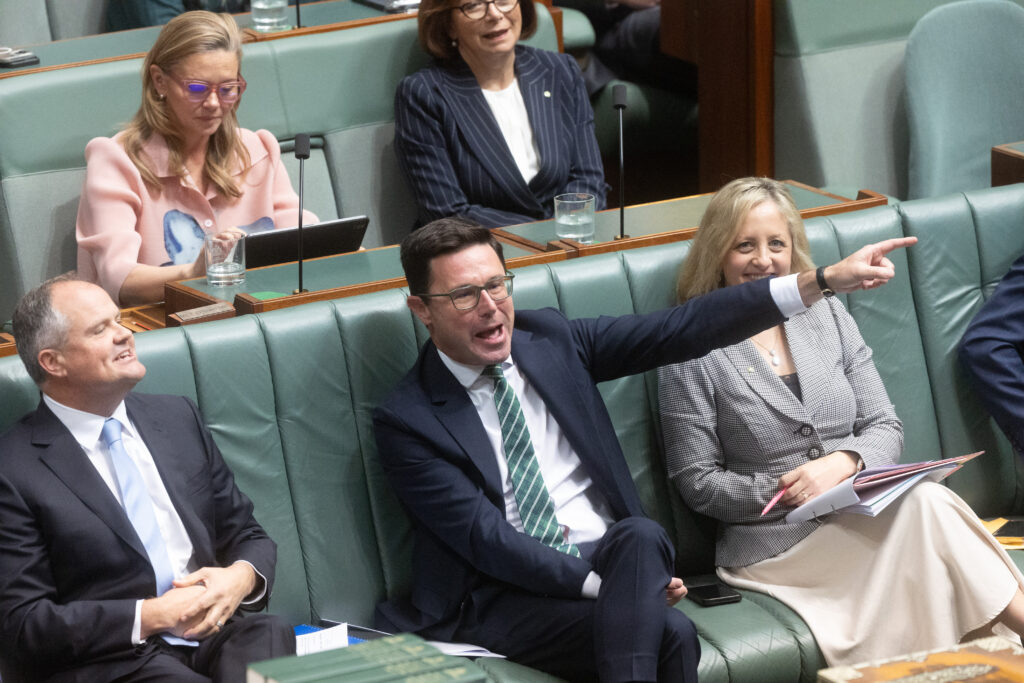
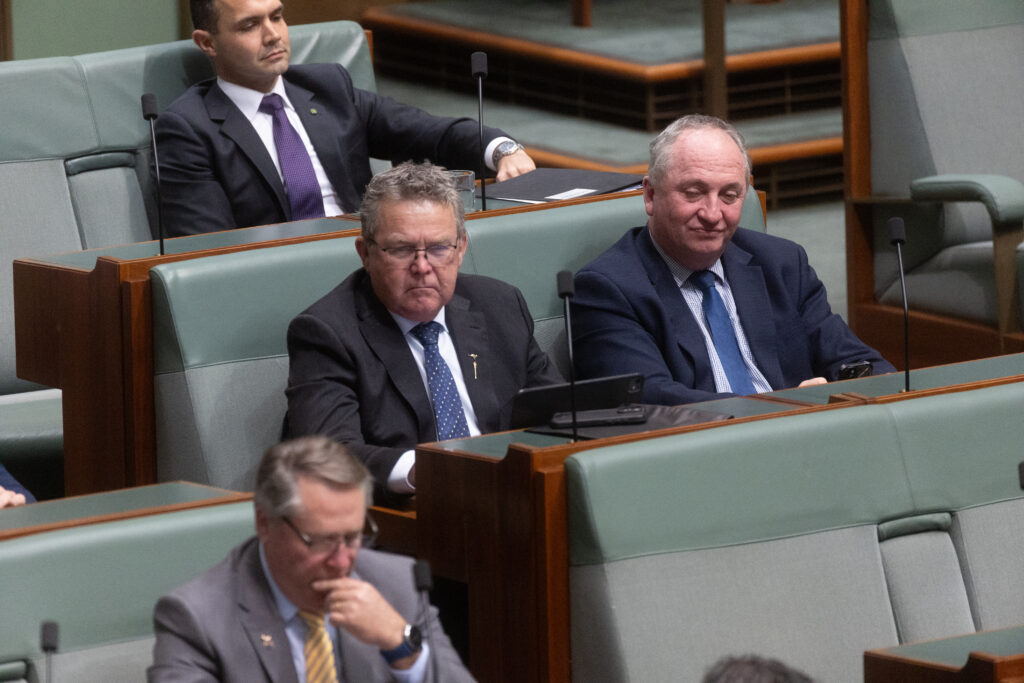
Well there were a lot of middle aged white guys in suits with a lot to say:

Barnaby Joyce during question time in the House of Representatives chamber of Parliament House, Canberra. Thursday 24th July 2025.
Nationals Leader David Littleproud during question time in the House of Representatives chamber of Parliament House, Canberra. Thursday 24th July 2025.
Barnaby Joyce during question time in the House of Representatives chamber of Parliament House, Canberra. Thursday 24th July 2025.
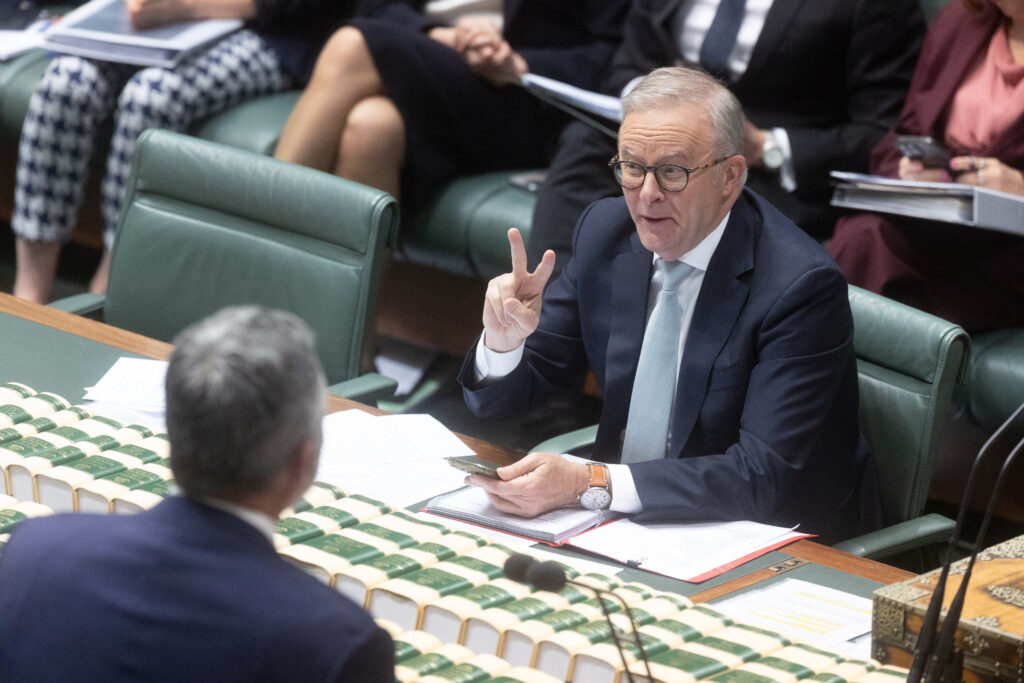
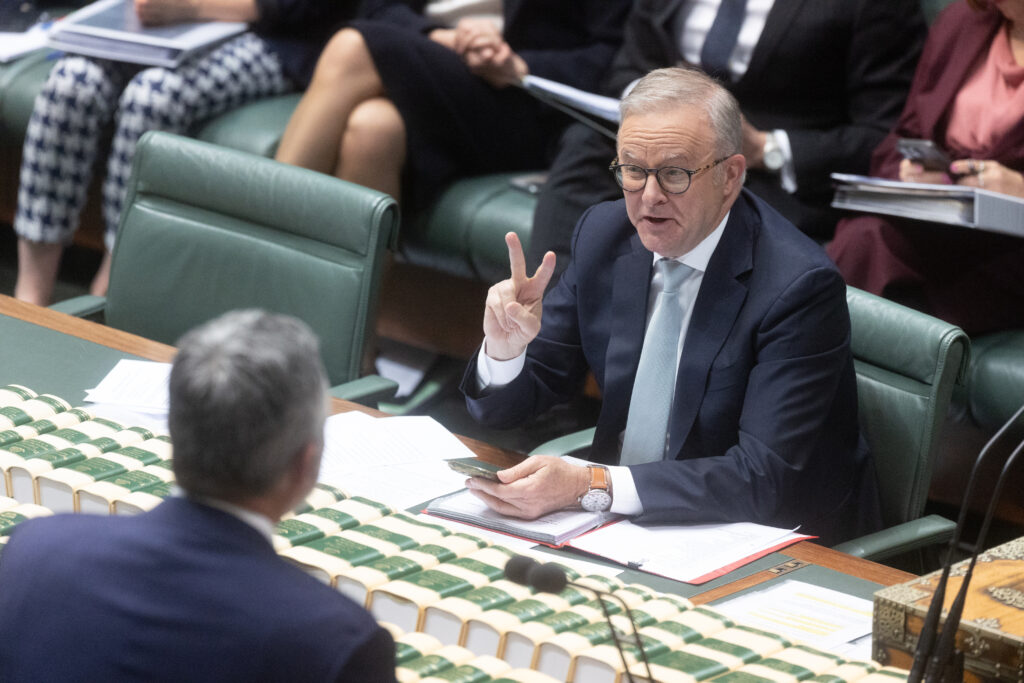
The Prime Minister Anthony Albanese during question time in the House of Representatives chamber of Parliament House, Canberra. Thursday 24th July 2025.

Thank you very much to Glenn for steering (get it) us all through QT – specialist appointments can be very pesky timing!

You have Amy Remeikis back with you for the last bit of this afternoon x

Barnaby gives us a steer on complete bull ….

The Nationals might be yesterday’s story (figuratively and literally), but former leader Barnaby Joyce‘s response to Dan Tehan‘s suggestion he and Michael McCormack were like a pair of old steers in a paddock was … well … pure Barnaby.

“Steers don’t fight,’ he explained to a bemused Sky News Chief Anchor Kieran Gilbert.

“We castrate them so they don’t. Steers have their testicles removed and they sit happily in the paddock and they eat grass.”

As if that wasn’t bizarre enough, the Member for New England added a bit of vaudeville to his performance, with an impersonation of a fighting bull.

Now, KG is one of the coolest customers in the Gallery but even he nearly lost it as the twice dumped Nats leader showed us why a third tilt at the leadership would be, um, colourful, to say the least.

In defence of multi-millionaires …

Deputy Liberal Leader Ted O’Brien leaps to the defence of the lucky few Australians with $3 million or more in their superannuation … asking Assistant Treasurer Dan Mulino if he said tax changes would affect 10% of Australians.

Daniel Mulino, Assistant Treasurer, Minister for Financial Services:

This is a policy, as I stated yesterday, on a number of occasions, that is a well-designed, applies to around half a percent of members and applies to funds that are $3 million or larger.

Moving to beef …

David Littleproud, Nationals Leader:

My question as to the Minister for Agriculture and Water. Can the Minister confirm whether Australia’s bio security requirements from today’s announcement to import US beef will be at least the equivalent of bio security requirements Australian beef must be to be imported into the US?

Julie Collins, Minister for Agriculture, Fisheries and Forestry:

This decision has been made by my department and is through the usual processes that these decisions are made. As he would be well aware and has been an ongoing process now for over a decade in terms of US beef coming into Australia and US beef has been able to come into Australia since 2019 and in 2020 we asked for expanded access to allow some of the other beef from the supply chain sorted in the US to come from Canada and Mexico.

I would say to the member opposite that it has been done in the usual way, the department has published the review on website today in the usual way, the input details required for importers will be published on the website and provided on Monday in the usual way. 

As the member opposite would know the protocols in relation to the areas he is asking has actually already been provided to his office today on his email. So the member opposite needs to be very careful about trying to undermine Australia’s bio security system. Our biosecurity system is the strongest in the world for a good reason … you should not be undermining our scientific approach.

Greg Jericho
Chief Economist

The Head of the RBA Michele Bullock has given a speech today on the topic of “The RBA’s Dual Mandate – Inflation and Employment’

This is important because the RBA is not only about maintaining steady inflation. The functions of the Monetary Policy Board are set out in Section 9B of the RBA Act. They include:

Determining the monetary policy of the RBA, in a manner that it believes best contributes to both price stability and the maintenance of full employment in Australia.

But just what is full employment? The RBA believe that full employment is the level of employment (or conversely unemployment) where inflation is increasing.

Is this govt policy? Sort of.

When the govt did its Employment White Paper it came to the conclusion that “The Government’s objective is sustained and inclusive full employment.”

So what are the difference?

“Sustained full employment is about minimising volatility in economic cycles and keeping employment as close as possible to the current maximum level consistent with low and stable inflation.”

This is effectively the RBA definition.

“Inclusive full employment is about broadening opportunities, lowering barriers to work including discrimination, and reducing structural underutilisation over time to increase the level of employment in our economy.”

So this is a mor elong-term thing.

The problem is the short-term RBA version of full employment is what really affects people right now.

And right now the RBA thinks we are not at full employment – we have too many people employed! We are over-employed!

Michele Bullock makes this clear in her speech where she says:

“Last week brought us the latest labour market data, which confirmed that the unemployment rate increased in the June quarter. Some of the coverage of the latest data suggested this was a shock – but the outcome for the June quarter was in line with the forecast we released in May. That on its own suggests that the labour market moved a little further towards balance, as we were anticipating.” 

“A little further towards balance” is RBA speak for we are getting closer to there being enough people unemployed so that we will be happy.

The coalition makes it three from three on foreign policy.

Shadow Defence Minister Angus Taylor:

Is the Prime Minister seriously suggesting because Australia engages with allies in the South China Sea that the Chinese Communist Party is free to conduct live fire exercises without warnings of the South Coast of New South Wales?

Defence Minister Richard Marles:

I always understood that the maintenance and support of the global rules based order has been a matter of bipartisanship between the parties of government in this country. It underpins our national interest as a global trading nation which relies on things such as the UN Convention on the law of the sea, freedom of navigation on the high seas in international waters as being the basis upon which this country does its exports and imports and bases upon so much of the prosperity of our nation, so much of our national income. By virtue of that the Royal Australian Navy does so much of its work in the South China Sea and East China Sea. It is to assert freedom of navigation the UN Convention on the law of the seas, on the high seas. So those trading routes which are fundamental.

First crossbench question comes from Helen Haines – directed to Defence Minister Richard Marles. After a preamble about transparency, the Member for Indi gets straight to the point.

Helen Haines:

Minister, can you guarantee Australia is not complicit in war crimes in Gaza?

Richard Marles:

I can absolutely guarantee that Australia is not complicit in the way in which you describe. I can also say that Australia is not making weapons in this country and supplying them to Israel. We have made that clear on multiple occasions. I also reject the proposition that we are not transparent in the way in which all of this is reported. I think we have been incredibly transparent in terms of the way in which we engage in all of our controlled exports around the world and the role that our Defence industry plays around the world. We are not making weapons for Israel.

As a little treat, here is some Mike Bowers magic:

Little bit of fun before the QT crazy starts (photo by Mike Bowers for The New Daily)
The Prime Minister Anthony Albanese reacts to the member for Gippsland Darren Chester during a condolence motion for former Minister Peter Nixon

I am going to hand you over to Glenn Connley for a little bit while I go to an appointment I couldn’t shift.

Be good and have fun!

There are a million interjections and then Albanese finishes with:

The question they might like to ask themselves is which country has a better arrangement than 10%, which country, because the answer to that – the answer to that is none. Is none.

What they do because people do watch what is going on, the debate within our country is watched outside our country and in most other countries what we are seeing in the UK for example is that both sides of politics are putting the national interest first arguing the case for their nation.

We will continue to put the case but we will also, as I have two president Trump, we will also do so in the full recognition that the America first policy and ideology which has been promoted by the Trump Administration is clear he regards tariffs as the most beautiful word in the English language to quote president Trump.

We have a different position and will continue to put it.

Death to dixers!

Moving on to the next Sussan Ley question which is basically why haven’t we bent down and kissed the ring of Donald Trump yet (it’s implied)

Ley:

The United States is our closest ally and 261 days ago they elected a new president. Over that period the Prime Minister has spent more time making excuses for unacceptable live firing exercises on Australia’s coastline then he has spent in person with the US President. Following the Prime Minister’s recent overseas travels, has he had a conversation with the US President?

Sigh.

Anthony Albanese is in NO mood for this line of questioning, which is fair actually. It is absolutely nuts in this climate to be asking why we haven’t rushed to meet Trump – because as Emma Shortis regularly points out, what will it actually achieve?

Albanese:

Members of this Parliament have a choice sometimes of whether they will back Australia or seek to undermine Australia. A very simple proposition, very simple proposition those opposite have chosen rather than support a position which they did in government to be fair supporting free trade including the free trade agreement with the United States including the free trade agreement that they sign up to with China as well. Those opposite, those opposite have chosen to rather than put the case along with member for the Government that tariffs are a cause of economic self-harm by the United States and that those countries that impose tariffs are imposing a cost on the purchases of goods and services. In this case – in this case they are putting the United States is putting a cost on goods being exported from Australia into the United States.

Question time begins

It is straight into the issue of the day (at least in this place) – the United States.

Sussan Ley:

The Coalition is the proud architect of AUKUS, Landmark national security agreements that will make Australia safer, stronger and more secure. The Coalition cabinet I served in delivered AUKUS because we understand the US is our most important ally. 261 days ago the American people elected a new president. In that same more than 30 world leaders have met with the US President. Why has the Australian Prime Minister failed to meet with the US President?

Albanese:

Last time I looked, just to fact check, AUKUS was not actually delivered during the former government. The concept, to give credit where credit is due, did come from the Morrison government but the AUKUS agreement was signed by myself, president Biden and Prime Minister Rishi Sunak. In San Diego. That is a fact. The US President was elected and took office in January. Since then we have had three conversations. They also make the point that there is no country including the announcement today of an arrangement with Japan and the United States in which the previous tariff level of 25% across the board has been reduced to 15% is still higher than the tariff rate of 10% which Australia has. And that Australia has a lower tariff rate or equal to every other country on earth. Australia used to on a bipartisan basis support free and fair trade. Both sides. I find it extraordinary the Coalition seemed to have made a decision that the decision by the US administration to, contrary to our free trade agreement with the United States, apply from across the board a tariff on Australian exports into the United States has brought with it not a criticism of the issue of the imposition of tariffs but a criticism rather than choosing to support Australia has chosen the opposite.

Not sure we should be getting into a p*ssing competition over who actually ‘delivered’ Aukus, given how terrible a deal it is.

NSW court blocking largest coalmine expansion in state a big win for the environment

Glenn Connley

The Australia Institute welcomes reports that the New South Wales Court of Appeal has overturned the approval of one of the largest coal mine expansions in the state.

The court found the Independent Planning Commission failed to take into account the impact of all the carbon pollution associated with the project, including pollution from the exported emissions when the coal is sold and burned overseas.

Mach Energy’s Mount Pleasant coal mine expansion near Muswellbrook is one of the most polluting coal projects that was seeking approval in Australia.

The project is so big it covers an area which would almost cover the entire electorates of Sydney and Grayndler.

The decision comes after a challenge from the Denman, Aberdeen, Muswellbrook, Scone Healthy Environment Group.

While this is a welcome result, the NSW Land and Environment Court will have to consider whether conditions can be imposed that would validate the approval, or whether the project must return to the planning commission.

“There are two other coal mines that were granted extension by the federal government in the Hunter Valley,” said Richard Denniss, Executive Director of The Australia Institute.

“While it is welcome news that one may not go ahead, these approvals are inconsistent with Australia’s climate goals and reinforces the country’s reputation as one of the world’s major fossil fuel exporters.

“To approve huge new coal mines while bidding to host COP31 is a slap in the face to our Pacific neighbors, who have clearly and repeatedly requested that Australia stop expanding fossil fuel production.

“Meanwhile, the International Court of Justice has confirmed that states have binding legal obligations under international law to prevent climate harm and protect present and future generations.

“The science is clear – the best way to do this is to stop approving coal and gas mines.”

All the MPs are in the chamber for QT, but the questions won’t start for a bit – there are some condolence motions to get through. The chamber is honouring former Nationals MP for Gippsland, Peter Nixon.

On the topic of the private members bill that Barnaby Joyce wants to introduce, calling to scrap net zero, which is just designed to put pressure on Littleproud’s leadership and cause a ruckus, Littleproud says he is feeling quite relaxed over it all.

Joyce’s bill will go nowhere, but the government probably will get it to run to get all the Nationals (and any Liberals) on the record complaining about climate action, because that works for them politically. They’ll draggggg that bill on for as long as possible, but there is zero chance of it getting through, or having any impact.

What Joyce’s bill WILL do is keep all the leadership tensions running strong and help build the case to change leaders. Which is a pincer movement he is starting with the help of his former rival, Michael McCormack. The enemy of my enemy, you know?

Littleproud said he’s not bothered (which means he is bothered)

That’s the entitlement of every member. As a backbencher you can do it at your will. Is that a bad thing that we have a democracy that you come to this place and you put in a private members’ bill? We’ve got a process that our party room has agreed to.

We’re going to stick to that.

Individuals have every right and I celebrate diversity of ideas and those that want to take up the parliamentary processes that are here.

I have nothing to fear. I’m very comfortable in my own skin in terms of what I’ve achieved.

I tell you what, over the last three years, let me tell you, who set the national agenda and the first political party to say no to The Voice? The political party that finally got divestiture in Coalition party? Who got nuclear energy as part of the Coalition policy? Who was the party that stood up when those were going to be eroded and taken away from us to say we’re out of the Coalition? Who stood up to it and made the Liberal Party agree to those conditions? Who got an extra Treasury portfolio for the first type for the National Party? *

I think the Nats bat highly above their weight. When we say we’ll negotiate, we mean it. I’m comfortable of putting faith in the party room. Individuals that are on the backbench have the right to go and be able to put private members’ bills. But I lead a party room and I work on the collective and the majority of the collective. The majority of the collective have got it right. The Coalition got it right on nuclear and The Voice. Our track record as a party room over the last three years is far superior to any other political party in this House whatsoever.

*All of these are reasons the Coalition have lost more seats and will lose more seats in the coming election.

Embrace power sharing, says Andrew Wilkie

Independent Tasmanian MP Andrew Wilkie is appealing for the major parties in his home state to embrace power sharing to form government. Both parties are having conniptions over making deals with the crossbench. Labor is further behind on seats (nine to 14 I think) and hasn’t conceded, but is also making it clear it doesn’t want to govern with the Greens or crossbench, so probably should concede.

Wilkie says the major parties need to accept that voters are exploring new ways of forming government and they should get with the program:

“Last Saturday Tasmanians returned to the polls for the second time in 16 months. It was an election nobody wanted, and an outcome nobody thinks was worth the disruption and cost.

“Hanging over the fiasco was of course the State’s dire financial situation, because there are less than 600,000 people in Tasmania and we’re facing a debt of roughly $13 billion by 2028. And that’s despite the chronic underinvestment in our busted health and education systems, not to mention the appalling housing crisis and choking traffic congestion.

“But at least one thing’s clear after the poll, where the independents enjoyed a surge in their vote and no major party secured even close to a majority. And that’s that the community expects all of those elected to grow up and this time make the Parliament work.

“So Liberal and Labor must stop insisting that only majority government is OK, and that the crossbenchers are just wreckers and road blocks. It’s simply not the case. Indeed it’s a lie, because the crossbench vote shows they are not fringe players, but central to the operation of the Parliament.

“In other words it’s time for Liberal and Labor to pull their heads out of the sand and face the reality of power-sharing. Anything less will show contempt for the Tasmanian community.”

Why does David Littleproud want an industry approved independent panel to look at the US beef imports decision and not the scientists and experts in the department of agriculture (which he used to lead as minister?)

Littleproud:

They won’t be transparent and they won’t provide the protocols on which the scientific basis of their decision has been made and would give us the mitt to protect the Australian industry and consumers. What we’ve said and as a precedent I undertook as agriculture minister, if you wanted to make sure you could provide that certainty. In prawns we couldn’t. I backed the industry to have an independent scientific panel formed to actually review that science that was, that gave me that advice for that decision. That’s a sensible thing to do.

When you see that this decision has been made, and yet none of the details are put out, it raises suspicion. It raises suspicion because of the fact that Anthony Albanese is trying to get a meeting with Donald Trump and trying to trade away our commodities, potentially for a deal on aluminium worth $400 million. The cattle exports to the US are worth $4 billion. I want to make sure we got it right. It’s beholdant on the government to provide that information and they should be transparent and upfront about it. If they’re getting to make such a monumental announcement to the industry and this country, wouldn’t you have thought good governance meant you provided those scientific reasonings and protocols that show scientific rigour has taken place?

They haven’t been able to do that. We think we understand it potentially could be some time next week. That says to me the department is scrambling to catch up to a political decision made in Washington.

It is always interesting when former ministers are in opposition. Because suddenly, all the things they relied upon to keep decisions opaque and shift responsibility on (and deny was happening) are suddenly just facts which can be spoken openly about.

Meanwhile, the house has moved to statements, which means we are in the downhill slide into question time.

It’s the last one of the week, so brace yourself.

Nationals respond to US beef ban lift

Nationals leader David Littleproud is using the decision to drop restrictions on US beef imports to try and claw back a little bit of authority over his party room. He is holding a press conference in the Mural Hall to discuss the Nationals response – which is, ‘not happy, Albanese’.

Littleproud:

Look, earlier today I was given a briefing on the changes of protocols with respect to importing US beef. Unfortunately, that has raised more questions than provided answers. It has raised my suspicion about the speed and timing of this decision.

A decision that apparently was one that has been taken over a long period of time, yet the government has not provided or released the protocols on which the beef from the US could be imported into this country.

Those are the legal requirements that an importer would have to meet to bring beef from the US into Australia. That was from Mexico or Canada.

The fact they haven’t done that raises serious concerns to me around how this decision has been made and the timing of it. If it was well planned, the department would be able to provide me with those details. They have not.

I think the prudent way forward is to have an independent scientific panel review the department’s decision and the protocols when they come out. There is a precedent for this and that precedent was one that I put in place when I was agriculture minister, around importing of prawns back into Australia, after the white spot outbreak.

I think it would be prudent for this government to have an independent panel that industry could hand select the scientific rigour that is required and the personnel on that panel to review the decision. We need to give confidence to the Australian public, not just the agricultural sector.

The government says this decision is the result of a review which was started before all the trade tariff stuff, but it seems very sus on its timing.

Australia’s environment groups are taking a very long look at the ICJ ruling on states having responsibilities to cut emissions or face reparations – and that includes the Environment Centre of the Northern Territory.

That group says the ruling “casts doubt over the $1.5bn federal subsidy for a toxic gas and petrochemical hub planned for the Darwin Harbour”.

You might know it as Middle Arm.

From the group’s statement:

The Court held that states could be liable under international law for failing to address “fossil fuel production, fossil fuel consumption, the granting of fossil fuel exploration licences or theprovision of fossil fuel subsidies”, which could include the Albanese Government’s $1.5 billion subsidy for the Middle Arm gas and petrochemical hub.

Middle Arm will use gas from fracking in the Beetaloo Basin (which could increase Australia’s national emissions by up to 20%) and will establish a range of high-risk and high-emission industries right on the banks of our great Darwin Harbour.

These developments directly contradict urgent warnings from the Intergovernmental Panel on Climate Change and the International Energy Agency that no new fossil fuel projects can proceed if the world is to avoid dangerous climate change.

A leaked government report from last year forecast that fracking in the Beetaloo Basin and LNG expansions could potentially increase emissions by up to 150%.

Miles Franklin to be announced today! (and taxed on their prize)

Alice Grundy

Over in literature land, the Miles Franklin winner will be announced tonight. On the shortlist are Brian Castro, Winnie Dunn, Michelle de Kretser, Fiona McFarlane, Siang Lu and Julie Janson. If one of those authors bet they would win and received the prize, they wouldn’t pay tax on the windfall – but they would pay tax on the prize itself. Unlike the winner of The Block or a TV game show, a literary prize  is taxed by the ATO.

And this doesn’t just affect writers. If you win the Archibald or the Wynne prize for painting, if you win a prize for a play or for music, you pay tax.

The Federal Government seems to see this problem with this state of affairs: The only literary prize in Australia that is tax free is the Prime Minister’s Literary Award.

Artists around Australia are having a rough time. Funding bodies are policing artists’ speech, living standards are falling and the median income for an Australian writer is below the poverty line.

As 2019 Miles Franklin winner, Melissa Lucashenko says,

“I’m very happy to pay tax – to contribute to a decent society – but at the same time, I belong to an extremely impoverished community. I am regularly called on to give money to people who buy their food on credit. Who can’t bury their dead, or who need petrol to get to funerals, or who can’t get out of jail to attend the funeral of a parent because that means paying the prison system the astronomical cost of guards to accompany them. $15,000 fills a lot of grocery carts, and a lot of petrol tanks.”

Meanwhile Australia continues to provide fossil fuel subsidies, the latest calculation from the Australia Institute is this amounts to $14.9 billion. Basic economics holds that you subsidise things you want more of and tax things you want less of. So, we’re making the choice to have less art and more fossil fuels in Australia.

There is an easy fix. The Federal Government can choose to make art prizes tax free, and that would mean artists can spend more time making the work we love.

More secretive than Morrison?

AAP

The Albanese government has been branded more secretive than the administration led by Scott Morrison, who infamously hid his five ministries.

Labor came to power on the back of a promise to be a more accountable and transparent government.

But fewer Freedom of Information applications, through which people can request access to documents held by ministers and departments, are being fully granted and refusals have double

“The Albanese government is more secretive than a government where the prime minister had five secret ministries,” independent senator David Pocock told reporters in Canberra on Thursday.

Only a quarter of requests were fully granted in 2023/24, down significantly from 59 per cent in 2011/12, and refusals jumped from 12 to 23 per cent during the same time frame, research by the Centre for Public Transparency showed.

The average processing time for Office of the Australian Information Commissioner reviews nearly tripled from six months in 2016/17 to 15.5 months in 2023/24.

“We don’t have a pro-disclosure culture within the federal parliament, within the federal government, and that overall is what we really need to see happen,” the centre’s research director Catherine Williams said.

Independent MP Helen Haines branded more secrecy “deeply suspicious”, while her crossbench colleague Monique Ryan questioned why a request for one brief to government on health and disability was redacted.

“This is what the government wants us to know about its reform agenda for a really important issue like health, we are struggling to understand what the government is planning,” Dr Ryan said, holding up blank pages of redactions.

“We’re looking for transparency, we’re looking for integrity in government, it shouldn’t be too much to ask.”

The Albanese government complied with less than a third of orders to produce documents, compared to nearly half under the Morrison government, the centre found.

That represents the second-worst rate of compliance with Senate orders since 1993, and contrasts starkly with a 92 per cent compliance rate in the 1993-96 period.

Greens senator Steph Hodgins-May said the production orders weren’t a political stunt but a key tool for accountability to understand why decisions were made, who impacted decisions and how public money was spent.

The centre recommended improving transparency by establishing independent oversight of Senate rejections to contest when governments make a public interest immunity claim.

It also called for an emphasis on transparency from departments and reduced processing times.

A spokesperson for Attorney-General Michelle Rowland said more than $100 million has been put towards resourcing the information commissioner.

Today is very quiet – for a reason. After yesterday, the government would like a bit of a quiet time.

It is also going to be a bit of an indication of the term – international issues are going to dominate anything happening domestically for some time and we have all been trained to see anything happening in America as global news anyway – which will provide some cover for the government as well.

We are STILL in the address-in-reply stage, with MPs responding to the Governor-general’s speech.

This is going to dominate the next week as well.

Over in the senate there is a motion to try and have the finance and public administration committee look into MP staffing arrangements and whether it is appropriate for the prime minister to determine how many staff parliamentarians get.

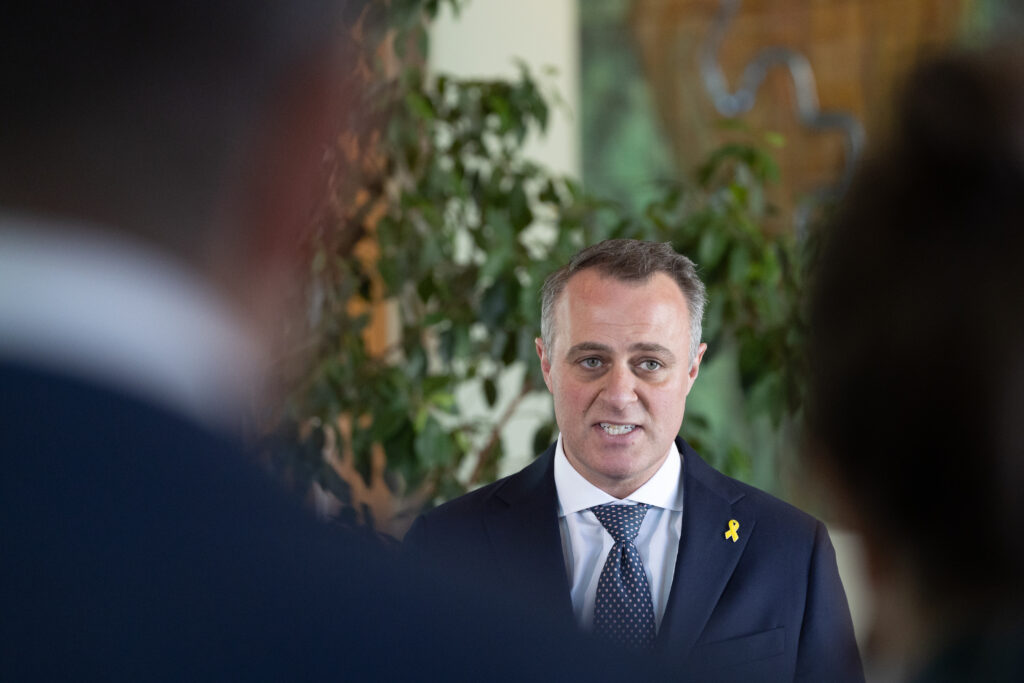
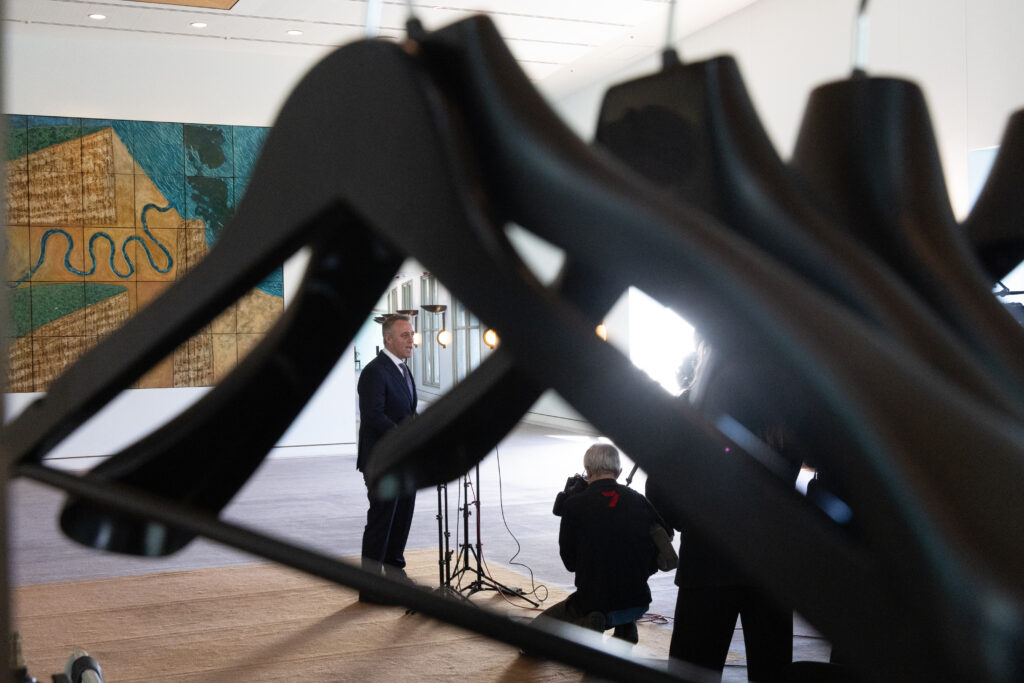
Tim Wilson is baacccckkkkk and in the Mural Hall.

The Shadow Minister for Small Business and Shadow Minister for Industrial Relations and Employment Tim Wilson at a press conference in the mural Hall of Parliament House, Canberra. (Photo by Mike Bowers for The New Daily)

The Miles Franklin literary prize will be awarded this evening.

Which is great – but the winner will have to pay tax on the prize for…reasons.

Looking forward to seeing who wins the Miles Franklin tonight. A shame that they pay tax on their winnings but if you win the Block or a TV game show you don't pay tax. Past time for change!australiainstitute.org.au/post/heres-s…

Alice Grundy (@alicektg.bsky.social) 2025-07-24T01:39:15.730Z

AAP

Worrying sick about loved ones under bombardment in Gaza induces acute anxiety and stress for Arab-Australian women trying to make it through the day.

Research published in The Lancet journal has examined the mental health impacts of ongoing wars in the Middle East and how they affect women connected to the region living in Australia.

University of NSW researchers found panic disorder symptoms, poorer quality of life and other psychosocial stress indicators only increased for the women affected by the current carnage, compared to other Australian-born and migrant women.

Symptoms appeared suddenly in multiple ways including rapid heart rate, dizziness, trembling, sweating and nausea.

“It’s like a panic attack, but it’s very much tied to a particular event,” lead author Susan Rees told AAP.

“In this case, the prevailing mass deaths, injuries and starvation.”

The events were prompting direct, visceral reminders for the women of their own experiences.

“Such as having their house bombed, fleeing for safety, having family members injured or killed, which was the most extreme,” Professor Rees said.

About 17,000 children are among almost 60,000 people killed in Israel’s retaliatory military assault on Gaza since October 7, 2023, the United Nations said.

It followed militant group Hamas attacking Israel, killing about 1200 people and capturing some 250 hostages.

The longitudinal study assessed 410 women living in Australia about 12-18 months before and during the ongoing war on Gaza, extending from October 2023 until December 2024.

The women were directly connected by birth or family to Gaza, the occupied Palestinian Territories and Lebanon, as well as migrant women from other non-Middle East countries and Australian-born women with no connection to the region.

One participant from the Middle East-connected group, which made up one-fifth of the total study, told researchers she felt like a robot: functioning but not fully engaging with her surroundings.

“This experience indicates that the person may be emotionally alienated and disconnected from daily life and routines,” Prof Rees explained.

“You’re just thinking all the time about your family and what’s going on, and you’re trying not to communicate it to children because you don’t want them to get upset.”

Another woman said she spent many sleepless nights telling her family in southern Lebanon to evacuate, after hearing radio reports saying Israeli forces were attacking their particular area.

“They can’t protect them directly on the ground and are trying to do it from thousands of kilometres away,” Prof Rees said.

The dire mental health consequences for such a large population in Australia could be prolonged unless there were targeted clinical interventions as well as political ones, she said.

Lifeline 13 11 14

beyondblue 1300 22 4636

The government has announced a ‘refresh’ to the membership of the Northern Australia Indigenous Reference Group, which is a key advisory body on boosting economic and social prosperity for First Nations people across the north.

From the statement:

Deputy Vice-Chancellor of James Cook University, Professor Martin Nakata, has been appointed the new IRG chair. Professor Nakata has more than 30 years of experience in Indigenous education, research and community engagement.

Other new appointments are:

  • Mr Damien Djerrkura (NT), CEO of the North East Arnhem Land Aboriginal Corporation
  • Ms Alinta McGuire (NT), Director of Impact & Innovation at Impact North

They will serve on the IRG alongside returning members:

  • Mr Troy Fraser (Qld), CEO of Doomadgee Aboriginal Corporation
  • Ms Nini Mills (WA), CEO of Nyamba Buru Yawuru
  • Ms Flora Warrior (Qld), Principal Consultant of Saltwater Blue Consultancy Services

The IRG reports directly to the Minister for Northern Australia Madeleine King and Minister for Indigenous Australians Senator Malarndirri McCarthy and “provides practical advice to support the Government’s refreshed northern Australia agenda”.

What has gone wrong with the Liberal Party?

Bill Browne
Democracy & Accountability Director

Earlier this week, LaTrobe University hosted a public lecture: “The Australian Liberal Party: What has gone wrong? What is to be done?” with Professor Andrea Carson, former Attorney-General Professor George Brandis, Tom Switzer (executive director of the Centre for Independent Studies), former MP Cathy McGowan and columnist Sean Kelly.

Interesting reflections, of which I’ve picked out a few that struck me. You can watch the lecture yourself on the university’s website.

George Brandis and Tom Switzer, while identifying weaknesses in the modern Liberal Party, did not see it as facing an existential threat.

George Brandis identified five things that reduced the Liberal Party vote, of which the first two were most significant:

  • Really terrible campaign
  • President Trump factor – a prevailing anxiety which encouraged an incumbent vote
  • Liberal Party allowed itself to drift to the right
  • Character assassination of Opposition Leader Peter Dutton.
  • Labor only in government for one term

That doesn’t suggest a deep seated, profound, structural change or shift in the electorate (he believes)

Tom Switzer said (paraphrased)

Donald Trump, cost of living and interest rate cuts all cost the Liberals.

The Liberal Party has lost its free market roots.

Liberals face very real challenges: preselecting women, raising more money and stopping the haemorrhaging of metropolitan voters to the teals.

But the Liberals and Nationals will survive. Australia is essentially a 50-50 country. Circumstances can change very quickly in politics. What explains the ups and downs is “Events, dear boy, events”.

Cathy McGowan argued that the rusted-on two-party system is no longer serving people. The crossbench are delivering, they’re powerful, they use media well:

The conservative parties are swinging right. I’m from Victoria – it’s so clear that’s happening.

Australian people want to be much more engaged: “It’s my democracy and I care about it, I’m going to invest in it”.

Independent Zoe Daniel losing the seat of Goldstein because Tim Wilson ran a local, very strong campaign proves that when the major parties get their act together, when we get the competition that we need, they can win. There is “no such thing as a safe seat”.

Sean Kelly argued that the 30-year long shift away from the two major parties is a structural problem. In this election, it hurt the Liberals far more than the Labor party.

Ideological confusion from the major parties comes from inability to answer the question, “what should society look like?”

At a time the world was in enormous flux, Peter Dutton zigged and zagged.

The speakers generally agreed that Sussan Ley was a good choice for Opposition Leader and had done well so far; and that the Liberal Party needed to increase women’s representation:

Sean Kelly shocked at what a difference Sussan Ley has made already. Remarkable to see conservative positions without bully boy rhetoric.

The Liberal Party is mad to not adopt quotas for women. Every other approach has failed.

Cathy McGowan pointed out that the community independents without quotas got mostly women. The community wanted someone very clever who could represent them, it’s not just the gender.

The Liberal Party in my area is not representative, the Labor Party not at all. We can bring out 1,000 people to campaign. The majors can’t do that.

Politics is a service job, to represent. The parties have forgotten that.

George Brandis said the community independents won because they mobilised the community. The Liberal and Labor parties have much shallower roots in the community than they did a couple of decades ago.

Sussan Ley is a much more modern style of politician than Albanese, who has only ever worked for the party.

Tom Switzer argued that people say there’s no moderate wing of the Liberal Party in 2025 – but Sussan Ley is a moderate.

Every Liberal Party leader who has won from Opposition – Menzies, Fraser, Howard and Abbott – all hail from the right of the party, so being a conservative is not an albatross.

The one Liberal who won a teal seat was a bloke.

Finally, Sean Kelly said we should all break out of our habits of referring to the two-party preferred result. A more accurate way of looking at the landscape is 33-33-33. Parties need to work out how to reach people at the grassroots and figure out what sort of a society they want to offer voters.

Looking over the senate hansard from yesterday (yes, I know) I see that Greens leader Larissa Waters asked environment minister Murray Watt about his gas approvals:

My question is to the new Minister for the Environment and Water, Senator Watt. Peter Dutton promised to approve Woodside’s mega gas plant in the Burrup Peninsula within 30 days of the election. Not to be outdone in delivering for major political donor Woodside, the Labor government gave draft approval in just 15 days, conditionally approving a carbon bomb that emits more than all of the coal-fired power stations in Australia all the way out to 2070. Minister, will you cancel the conditional approval?

Watt:

I congratulate you on your election as Leader of the Australian Greens. I do look forward to you delivering on your commitment to work more constructively with the government in this term. I very much welcome those remarks you made. I assume the Greens heard the message of the last election—that is, being obstructive to progress on environmental matters is not the route to electoral success.

On the question you’ve asked, Senator Waters, as you say I have made a proposed decision to approve an extension to the existing onshore Karratha gas-processing plant on the Burrup Peninsula, made subject to strict conditions (which the government have not released. So no one knows what these ‘strict’ conditions are)

It hasn’t suited the Greens’ narrative around this topic, but the decision that I was required to make under the act related to the potential impact of that project on the incredible 50,000-year-old Indigenous rock art present on the peninsula.

What I said in the statement I issued on the day of my proposed decision was that the strict conditions that I had applied to the proposed decision (which have been kept secret) are particularly related to air emission levels and their potential impact on the rock art. The Greens have tried to conflate the issue of climate change with this decision, which was about the potential impact of this project on the rock art. (It’s all connected though isn’t it?)

The conditions that I have applied to the proposed decision are all geared towards the potential impact of this project on the rock art, and that impact has been central to my decision.

One other thing that the Greens have not wanted to acknowledge as it relates to this project and my proposed decision is that the government, in its first term, legislated the safeguard mechanism and strengthened the safeguard mechanism. I might point out that the Greens voted for those changes, so the Greens were comfortable with the safeguard mechanism, which requires this project to reduce its emissions by five per cent a year and become net zero by 2050

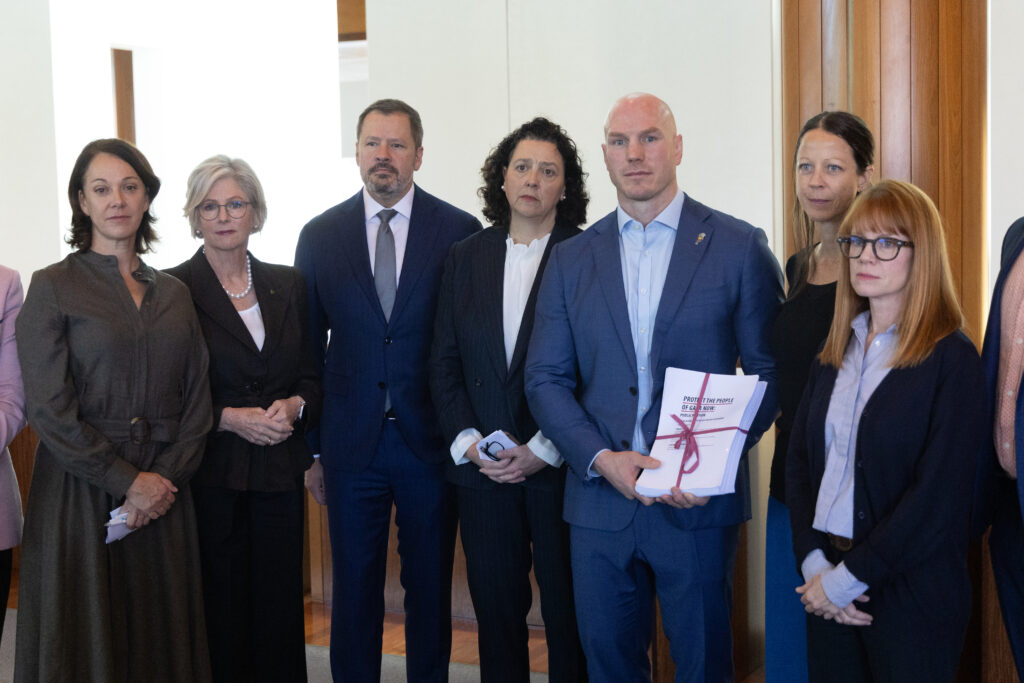
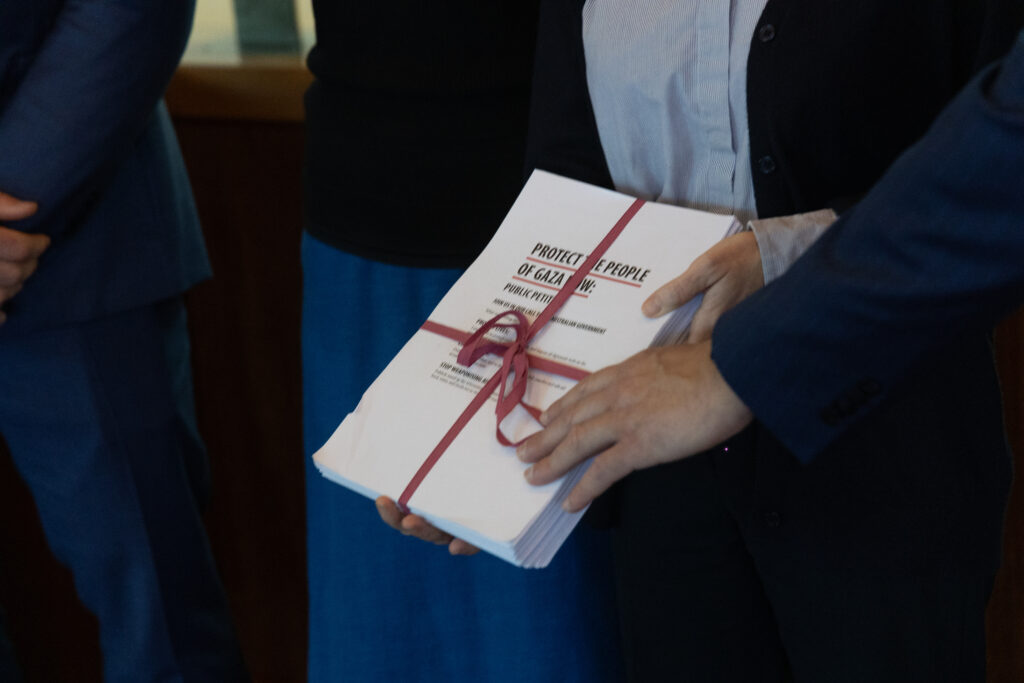
Independent Senator David Pocock, Member for Kooyong Dr Monique Ryan, Member for Mackellar Dr Sophie Scamps, Member for Indi Dr Helen Haines, Member for Curtin Kate Chaney, Jennifer Tierney MSF Australia Executive Director, Claire Manera, Former Emergency Coordinator Gaza who has recently returned from the frontline and Member for Chifley the Hon Ed Husic have accepted the petition calling to protect the people of Gaza to be tabled in the Senate.

Mike Bowers was there:

Senator David Pocock with a petition supporting the protection of the people of Gaza in Parliament House in Canberra with other cross bench members and Ed Husic. (Photo by Mike Bowers for The New Daily)
The petition (Photo by Mike Bowers for The New Daily)

Despite the Australian government signing up to the statement calling for an immediate ceasefire and for the slaughter to stop, Husic was the only government member to attend. Just as he was the only government MP to attend the Vigil for Gaza

Beef backflip nothing to do with tariffs – Ag Minister

Agriculture Minister Julie Collins insists the decision to ease biosecurity restrictions on beef from the US has nothing to do with tariff negotiations.

It’s just a co-incidence that Donald Trump singled out Australia’s beef restrictions when he announced his “Liberation Day” tariffs in April.

Julie Collins, Minister for Agriculture, Fisheries and Forestry:

This has been the culmination of what has been a 10-year process. The US has been able to bring beef into Australia since 2019. In 2020 they asked to be expanded access. This process is at conclusion now and has taken around five years to conclude. The decision is purely based on science and a rigorous assessment by my department. Biosecurity risk assessment processes are very robust and I have faith in the officials in my department to do this appropriately. These are experts in the field. Australia’s biosecurity system is world renowned for a reason and this assessment has now been completed.

Just on that beef ban …

Emma Shortis
Director, International & Security Affairs Program
Greg Jericho
Chief Economist

If you remember, Trump cracked it at Australia a little while back because we had import controls on American beef due to biosecurity concerns. Trump used that to threaten tariffs on Australian beef exports. That was mostly another act, as our own government has described it, of “self-harm” because all that would do was make beef more expensive for Americans, plus the Australian beef industry has no trouble finding other markets. Supply and demand, if you will.

Anyway, today the Australian government lifted the ban.

The general argument for this seems to be that this is a low-stakes way to give Trump want he wants and get him to back off. The Australian government seems convinced that biosecurity is now a non-issue, and it’s not like we would import heaps of American beef anyway. Then, presumably, when he makes other demands, Australian diplomats can point to other concessions and try to get him to make nice.

The other way to look at it is that such an approach completely misunderstands who Trump is and how he operates. It’s pretty likely he’s already forgotten about it and moved on (he does, uh, seem to have other things on his mind). We also already know that it doesn’t matter how much you give him, it will never be enough. Remember how we gave him $800 million for Aukus and then he didn’t exempt Australia from steel and aluminium tariffs? And then put Aukus to review? And then said he’d hit us with pharma tariffs and threaten the PBS? He doesn’t care.

There are some big risks here. If Trump thinks the Australian government will cave, that’s what he’ll expect next time, and the time after that. Once you’ve done it, it becomes harder not to do it again.

Plus, biosecurity isn’t exactly a non-issue. American industrial agricultural practises are, to put it in technical terms, pretty suss. And the Trump administration is busy rendering an already inadequate regulatory system virtually non-existent. Not to mention deporting everyone who works in the industry.

Everything is fine!

On the economic front though, the good news is that well… Australia has plenty of beef and so this probably won’t actually mean much.

We are pretty parochial about our food – especially our meat and vegetables – we generally only eat imported food if it has a sense of being “high quality” – which US beef is decidedly not.

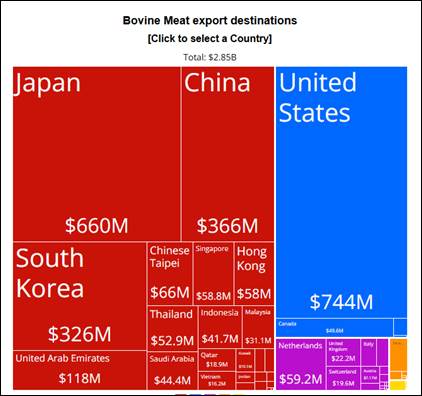
In 2023 Australia exported around US$2.8bn worth of “bovine meat”, with a big chunk going to the USA. The reason is that the USA actually needs more beef than it produces itself and also (humble brag) Australia’s beef is better and cheaper, which is why McDonalds loves it.

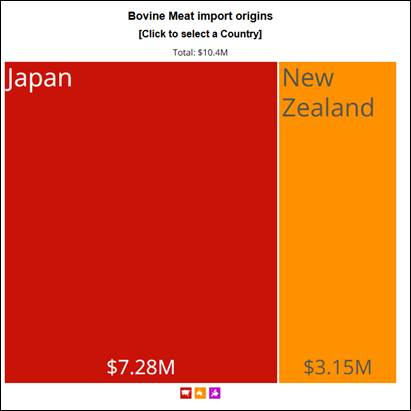
So how much beef do we import? Try just $10.4m (note that is Million, not Billion). We mostly import some beef from Japan – think Wagyu/Kobe beef.

We export more beef to Kuwait alone than we import from the entire world.

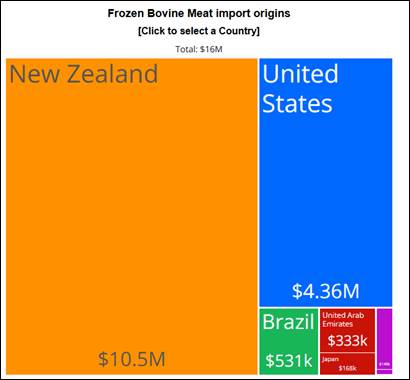
The one area that it might affect things is the “frozen bovine” market where we imported US$16m (again million) all up and US$4.36m from the US in 2023

But again some context, in 2023 we exported US$4.73 BILLION worth of the stuff.

So while this will likely not sate Trump for long, and we need to keep a very close watch on how he is gutting the biosecurity service, economically it likely will not mean much.

Beef producers probably would prefer not to let the US import beef here, but I very much doubt you will be seeing US beef in any supermarket meat sections.

Podcast – Australians aren’t afraid of power-sharing parliaments

Angus Blackman
Podcast Producer

Last weekend, Tasmanians returned another power-sharing parliament.

It’s now up to the major parties to make it work.

In this week’s episode of Follow the Money, Leanne Minshull and Eloise Carr join Ebony Bennett to discuss why collaborative parliaments are popular and how our elected officials can make them work.

Reaction to ICJ decision from Vanuatu

More reaction from the Pacific Islands on the International Court of Justice ruling from Save the Children Vanuatu.

This case was led by young people in Vanuatu.

An extraordinary 16-year-old, Vepaiamele, has told the ABC that – more than anything – the overnight decision delivers hope for future generations in the Pacific.

I went to The Hague last year in December and I was sent by the voices because we are affected by the common crisis and it is an amazing experience but this advisory opinion is so important because it clarifies what we need to be doing against climate change and it can pave the way for climate justice for our future of all children around the world.

We are one of the most vulnerable nations of climate change, we experience cyclones and natural disasters every year and they keep on getting more intense and increasing in number. We can see the effects of climate change everywhere whether it is our economy, our communities, whether in is in schools and citizens have to go to schools intense and hospitals are damaged from cyclones that happened years ago. Even yesterday I was at one of the outer islands off the coast of our main island and I was there where there a under sea level because of rising sea levels and it is sad to see the effects of climate change.

How’s that for wisdom and perspective from a teenager on the front line of the climate catastrophe?

The committees which will be examining the parliament have been determined.

But before we get to that, here is Anthony Albanese in his standard mode – kinda cranky. You do have to give him credit for being the same off camera as he is on camera.

The Prime Minister Anthony Albanese in the House of Representatives Chamber of Parliament House in Canberra this morning. (photo by Mike Bowers for The New Daily)

Here are your parliamentary committees:

The House was informed that the Chief Government Whip had nominated Members to be members of certain committees.

Mr Burke (Leader of the House), by leave, moved—That Members be appointed as members of certain committees in accordance with the following list:

CommitteeMembership
Standing Committee on Appropriations and AdministrationMr Burns, Ms Chesters, Ms Clutterham, Mr Soon
Standing Committee on Climate Change, Energy, Environment and WaterMs Berry, Ms Byrnes, Ms Comer, Mr French, Mr Repacholi, Ms Urquhart
Standing Committee on Communications, the Arts and SportMs Doyle, Mrs Elliot, Mr Moncrieff, Mr M Smith, Ms J Ryan, Ms Templeman
Standing Committee on EconomicsMs Campbell, Mr Gregg, Mr Husic, Ms Jarrett, Mr Laxale, Ms Sitou
Standing Committee on EducationMs Coffey, Dr Garland, Ms Roberts, Ms J Ryan, Mr Soon, Mr Watts
Standing Committee on Employment, Workplace Relations, Skills and TrainingMs Ambihaipahar, Ms Coker, Ms Fernando, Dr Garland, Ms Lawrence, Ms Roberts
Standing Committee on Health, Aged Care and DisabilityMs Belyea, Ms France, Dr Freelander, Ms Jordan-Baird, Dr Reid, Ms Stanley
Standing Committee on Industry, Innovation and ScienceMr Abdo, Ms Byrnes, Ms Mascarenhas, Mr Mitchell, Mr Repacholi, Ms Teesdale
Standing Committee on PetitionsMs Belyea, Ms Comer, Ms T Cook, Mr Holzberger, Ms Roberts
Committee of Privileges and Members’ InterestsMs Claydon, Mrs Elliot, Mr Laxale, Mr Mitchell, Ms J Ryan, Mr D Smith
Standing Committee on ProcedureMs Claydon, Ms K Cook, Mr Gregg, Mr Neumann
Publications CommitteeMs Doyle, Ms Fernando, Mr Moncrieff, Mr Ng
Standing Committee on Regional Development, Infrastructure and TransportMs Briskey, Mr Burnell, Ms Jordan-Baird, Mr Neumann, Mrs Phillips, Ms Urquhart
Selection CommitteeMs Byrnes, Ms Chesters, Ms Mascarenhas, Ms Roberts, Ms Sitou, Ms Urquhart
Standing Committee on Social Policy and Legal AffairsMs Clutterham, Mr Gregg, Ms Miller-Frost, Mr Ng, Mr D Smith, Ms Witty
Joint Committee on the Broadcasting of Parliamentary ProceedingsMs Swanson, Ms Teesdale, Ms Witty
Joint Committee of Public Accounts and AuditMs Berry, Mr Burns, Ms France, Mr Husic, Ms Miller-Frost, Ms Sitou
Parliamentary Standing Committee on Public WorksMs Ambihaipahar, Mr Burns, Mr D Smith, Mr Zappia

The response to the world’s highest court’s opinion that countries do have have a responsibility to limit climate harm are still coming in.

Dr Dean Bialek, a leading international lawyer and former climate diplomat who worked for nearly ten years as a lead negotiator with the world’s island nations on the Paris Agreement said the ICJ’s advisory opinion was “an unusually robust statement clarifying the legal obligations of states on climate change and the regulation of the greenhouse gas emissions that are causing it”

The Court has confirmed the primacy of the 1.5C temperature goal enshrined in the Paris Agreement as the north star for the international response to climate change, and the obligation on states to pitch their emissions targets well within its guardrails.

This is hugely significant at a time when the Australian Government is in final deliberations on its emissions target for 2035, which the best science says needs to be in the mid-to-high 70’s per cent reduction below 2005 levels to be 1.5C-aligned  

For the first time, the ICJ opinion says countries can be held internationally liable for failing to do their bit on climate, focusing most intently on the failures implicit in any new approvals for fossil fuel projects or subsidies to make them cheaper.  

To me, this makes inescapable the need to embed a climate trigger within efforts to reform Australia’s environmental laws

The Coalition is still trying to find what it actually stands for. So in lieu of a policy platform, it is falling back on old favourites. Like ‘regulations are bad’.

Grog’s blog

Greg Jericho
Chief Economist

In the run up to Jim Chalmer’s Productivity-Tax Roundtable next month there’s been a lot of talk about what should be in/out etc.

We will be putting in our submission on Friday, but today I wrote in my Guardian column on a report ACOSS will put out today titled “Taxing income less and consumption more: The case against”

The report nicely slaps around some of the dumb myths that get pt out about tax. I wrote is up in the form of 3 things that need to be agreed to before you should be able to participate in any discussion on tax:

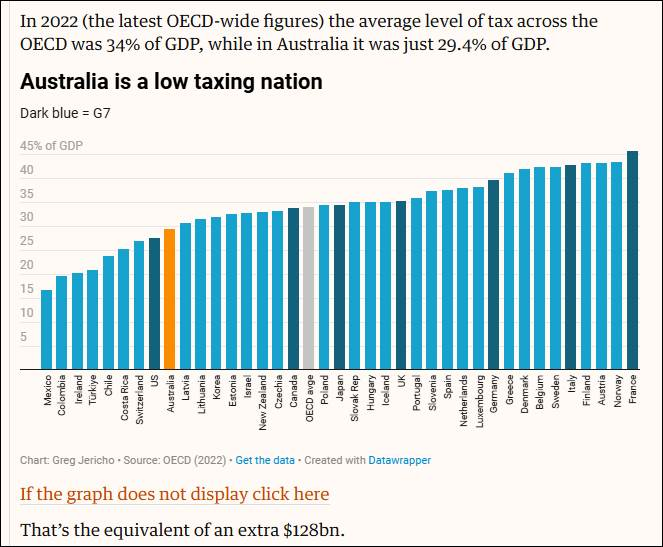
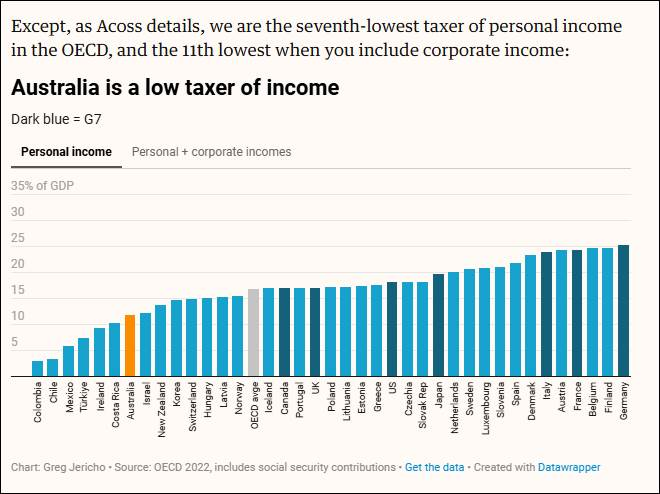
  1. Australia is a low-taxing nation

We hear at the Aus Institute like to preach this line, but as the ACOSS report shows it’s not because we are making stuff up – it IS THE REALITY

Right now we raise less tax than every nation in the G7 except for the US, and they are only just below us

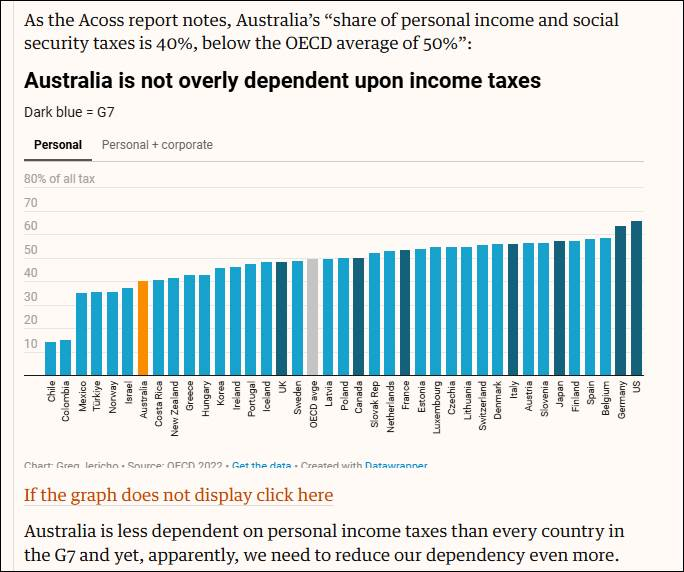
  1. We are not overly dependent on income tax.

Cripes I get this a lot in interview. It is taken as given they we tax income too much and worse we do it a lot more than other nations.

Sorry, as ACOSS notes, that utter bull

Not only do we tax income much less than most other advanced economises we are all LESS RELIANT ON IT:

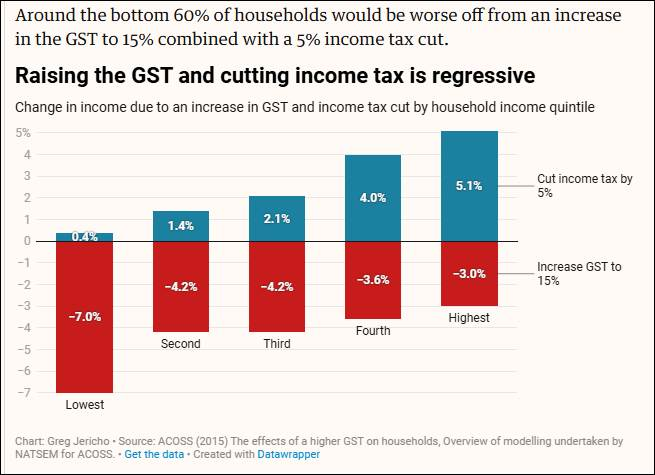
  1. Increasing the GST will hurt low-middle income earners

Look, this should be pretty obvious, but it is amazing how many economists love the GST because they think it is oh so gloriously efficient.

Well as the ACOSS report show it really isn’t all that much more efficient than income tax, but it is much more regressive.

ACOSS used some Treasury modelling that found if you raised the GST to 15% and cut income tax by 5% the bottom 60% of households would be worse off, and the top 20% would be significantly better off.

So if we are talking GST we need to talk about broadening it – eg including it on private health insurance or private school fees. If all we are doing is raising it, then we are just dumping on poor people for now good reason at all.

The full article is here – have a read there’s a lot more graphs to play with!

Oxfam has also commented on the ICJ ruling.

Oxfam climate change policy lead Nafkote Dabi said

Oxfam is proud to have supported young climate defenders from the Pacific and elsewhere who bravely took their fight for justice from a classroom in Vanuatu to the world’s highest court. They won the world a tremendous victory today.  

This ruling elevates national climate commitments everywhere by confirming that countries must reduce emissions enough to protect the universal rights to life, food, health and a clean environment. All countries, particularly rich ones, now have to cut their emissions faster and phase out fossil fuels. Rich countries have to increase their financing to Global South countries to help them reduce emissions and protect their people from past and future harm. This is not a wish-list – it is international law. 

We now have a powerful tool for holding countries to account for their obligations, especially in protecting the world’s most marginalized people and future generations of humanity. The ICJ rejected arguments by the likes of the US and UK that governments are bound only by climate treaties such as the Paris Agreement and did not have stronger obligations under international law. This ruling will inject new impetus into negotiations at the COP30 Summit in Brazil this November.”

ICJ ruling confirms states have a legal duty to act on climate — Australia now faces a clear choice

Glenn Connley

The International Court of Justice (ICJ) has confirmed that states have binding legal obligations under international law to prevent climate harm and protect present and future generations.

The Australia Institute notes this historic ruling as a major step forward in global climate accountability.

Australia supported the United Nations resolution to seek this advisory opinion but argued before the court that states have no legal obligations on climate change beyond those contained in existing agreements like the Paris Agreement.

In its submission, the Australian government claimed it holds no historical responsibility for climate change and rejected the application of broader customary international law — such as the no-harm principle — to greenhouse gas emissions.

“Australia cannot have it both ways — claiming leadership in international forums while undermining it in others,” said Polly Hemming, Director of the Climate & Energy Program at the Australia Institute.

“This ruling puts countries like Australia on notice. We have legal obligations — not just moral ones — to stop fueling the climate crisis.

“The ICJ’s opinion reinforces the principle that climate inaction is not just a political failure, but a breach of international law — with consequences. As global courts, legislatures and communities move to hold governments accountable, Australian governments and senior public servants are advised to prepare for the rising tide of legal, diplomatic and economic repercussions.

“In many ways, it’s clear our governments are already aware of this.

“Whether it’s fossil fuel expansion, greenwashing, or targeting whistleblowers and protestors — these actions aren’t about national security. They’re about fear. If the government weren’t scared of scrutiny, it wouldn’t be trying to suppress it,” Polly Hemming said.

“The ICJ has spoken. The question is whether Australia will act.”

Workplace relations minister Amanda Rishworth is doing the media rounds this morning as she spruiks the penalty rates legislation.

But she has obviously been well briefed on the US beef change. Asked about it on the ABC, Rishworth said:

Well, there has been a decade-long review process of the US import restrictions on beef and that has been underpinned by scientific and rigorous risk assessment, not done by the politicians, but done by the Department of Agriculture, fisheries and forestries.

They have been looking at this for a long time and they now have assessed that the right controls are in place to ensure that our biosecurity is not under any threat. We need to be really clear, we will never compromise on biosecurity and it must be underpinned by scientific and risk assessment evidence. That is what the department has done.

They have made this assessment that the right controls are in place to protect our biosecurity.

Asked about the ‘curious timing’ and whether it is an olive branch, Rishworth says:

Well, firstly, I would say that this process has been going on for a decade and a decision by the department. If we actually look at trade, our beef producers, our agricultural producers at large benefit from having free and fair trade around the world. 70% of our agricultural products are exported and having access to markets is really critical.

Our farmers do an amazing job, they make a world class product. When it comes to beef, there is still significant demand, even with the tariffs on Australian beef. This is an important issue that we will keep prosecuting with the United States about having free and fair trade, but our agricultural producers export to the world with their world class product and we want to support them with that.

Speaking of the US and Aukus, Scott Morrison popped up in a US Congress hearing, sharing his experience of dealing with China’s trade punishments with Australia during his term of government.

Morrison said it was in response to his call for an independent inquiry into the origins of Covid (remember that?) but there was quite a few flashpoints on both sides over the years. Now Morrison, who is traveling the world pretending he was a successful leader on a number of fronts, has told the US Congress that the US and its allies have to strengthen their relationships to push back against China.

As AAP reports Morrison said:

This is as true in the economic sphere as it is in the security sphere,” Morrison said in a rare appearance by a country’s former leader before Congress.

Morrison wants a “strong core” to those relationships and he says that means a “strong America”.

After losing the 2022 election, Morrison hung around on the opposition backbench until he secured another job (it took a bit) and now he is the vice chair of ‘American Global Strategies’ an advisory firm founded by Donald Trump’s former national security advisor Robert O’Brien, where they advise and consult on all sorts of fun things, like defence.

Australia to lift US beef import ban: AFR reports

As first reported in the SMH yesterday, Australia quietly sent the second $800m installment to the US for Aukus. That brings our contribution to the US’s shipyards and associated production to $1.6b. This money is supposed to help the US ramp up it’s production, but as Emma Shortis pointed out yesterday, it would need to increase its production fourfold in order to meet its own production needs, and ours. Which is as unlikely as me resisting chocolate.

So are we potentially just giving that money to the US for nothing? Well, thanks for asking – of course we are! The US can turn around at anytime and say no submarines for you, but thanks for your money in helping to build ours. Huzzah!

Now the AFR reports, citing a government source, that Australia is about to lift the restrictions on US beef to try and get some movement on the tariffs. Which were applied for no reason.

As the Fin reports:

A government source, speaking on condition of anonymity, insisted the move, which was communicated to the US government overnight Wednesday (AEST), was based on scientific advice following a review of the restrictions initiated more than 18 months ago, before Donald Trump was elected president for a second term.

So cool beans then. Have we considered just making Australia the 51st state officially?

The big item on the government’s agenda today is the Fair Work Amendment (Protecting Penalty and Overtime Rates) Bill. That’s the one that enshrines the new penalty rates. You’ll be seeing a lot of Amanda Rishworth this morning.

Oh, and you can’t just withdraw from the UN climate framework (looking at you America) and be like – we’re untouchable now! Because unfortunately, you remain a country of the world, impacting other countries. So the court’s opinion is that the customary obligations apply to ALL states, not just those in the UNFCC.

And as Polly also says, the ICJ’s advisory opinion is that “it is the sum of all emissions that contribute to climate change not any specific emissions” which means Australia can’t keep running around arguing, at least with any authority, that it has no responsibility for historical emissions and that our exported fossil fuel emissions ‘don’t count’ towards our climate impact.

ICJ ruling awkward for Australia

As Polly Hemming points out, this ruling is particularly awkward for Australia. We have been merrily exporting fossil fuels, and skipping along claiming we need to open MOAR (gas is a fossil fuel, we don’t need more of it, there is enough to meet our needs (and yes, even for manufacturing) in the uncontracted stuff gas companies make a motza out of on the spot market and we don’t even get anything back from the gas companies in return)

As Polly explains, the ICJ has said “fossil fuel production, fossil fuel consumption, granting of exploration licences and fossil fuel subsidies may constitute an “internationally wrongful” act. States are also obliged to regulate private actors in the context of climate change.”

Why is that particularly awks for Australia?

Polly:

“Australia argued to the #ICJ that it has no historical responsibility for its emissions. But the ICJ says actually each state’s historic and current emissions contribution and the harm caused can be attributed to them.”

Back to the ICJ ruling; Polly Hemming was up until sparrows making sense of it all

The #ICJ's ruling on the obligation of states in regard to climate change is now up. Unanimous ruling that states have a legal obligation to protect the environment (and human rights) and that there are legal consequences for breaching that obligation #climate #auspolwww.icj-cij.org/sites/defaul…

Polly Hemming (@pollyjhemming.bsky.social) 2025-07-23T15:05:23.132Z

After reading names at the Vigil for Gaza on the parliament house lawns yesterday, independent senator David Pocock will jointly host a press conference with Médecins Sans Frontières (MSF)/Doctors Without Borders and parliamentarians ahead of an MSF petition with nearly  64,000  signatures being tabled in the senate a little later this morning.

Pocock will be joined by:

Labor MP Ed Husic.

Independents Dr Monique Ryan, Dr Sophie Scamps, Dr Helen Haines and Kate Chaney

Jennifer Tierney MSF Australia Executive Director and Claire Manera, Former Emergency Coordinator Gaza who has recently returned from the frontline

(Full disclosure: I attended and read names at the Voices for Gaza vigil)

You may remember an independent review was ordered into events at the National Symposium on Unifying Anti-Racist Research after the Australian newspaper ran stories essentially accusing Sarah Schwartz of the Australian Jewish Council of using anti-Semitic tropes in a debate.

For those needing a refresher, here is how the Australian Jewish Council explained it at the time:

Sarah’s speech critiqued and challenged racist stereotypes of Jewish people, pushed by Peter Dutton, Donald Trump and the far-right, which are used to promote division, attack diversity, and push an anti-immigration agenda. In her presentation, she used an image of ‘Dutton’s Jew’ as a visual representation of Dutton’s racist and reductive conception of Jewish people as the defenders of “Western civilisation” against other racialised groups.

Sarah’s reference in her presentation to ‘Dutton’s Jew’ was about Peter Dutton’s racist conception of Jewish people, not actual Jewish people. Against this conception, Sarah spoke about how the Jewish community is diverse and not a monolith. Sarah has worked tirelessly as part of the Jewish Council to open up space for these diverse voices in the beautiful Jewish communities we are a part of and aim to support.

A single image and parts of Sarah’s presentation were leaked to the Murdoch press by a bad-faith actor, who, in his own words, has “co-supported … suppression of” our voices at the Jewish Council of Australia. The sharing of a single image of Sarah’s speech, devoid of any of the context of her presentation, has resulted in a gross misrepresentation of the content and intention of her presentation.

Well the independent review came back yesterday and the Honourable John Middleton AM KC found NO racist or anti-Semitic content was present at the Symposium, NO breaches of the code of conduct and NO racist conduct by any of the presenters or organisers.

The Review found:

11. Ms Schwartz intended to critique what she perceives as the political weaponisation of Jewish identity and antisemitism by certain political leaders. She was not critical of Jewish people themselves.

12.13 While some controversy emerged following the media reporting of Ms Schwartz’s and Ms Munro’s Debate slides, it is important to consider the full context of the event and the presentations of both Ms Schwartz and Ms Munro (as set out above). The slides, when considered with the accompanying spoken words, were not antisemitic in nature nor were they found to be offensive to those actually present at the Debate. The intent of the presentations remained aligned with the University’s standards and the purpose of the Debate.

12.14 In the context of the Debate, expectations of its content were evident from its promotion. Just focusing on the audience in attendance, whilst undoubtedly the content was not respectful to the targets of the criticism, and would be unwelcome to them, no breach of the Code of Conduct was apparent. The real issues arose once the content of various slides was disclosed (out of context) to the media.

A full version of the review is available here.

The first speeches of the new parliamentarians continued into the night last night, which included new Queensland senator Corinne Mulholland who gave her first speech while holding her young child, Augie. Augie was born not long before Mulholland hit the campaign trail, and so experienced his first political campaign at just three months old. He will be six before he does it again.

I stand here tonight holding my young son, as you can see, with his bedtime fast approaching. I am praying that Augie and I make it through this speech unscathed, so godspeed!

Augie is here not as a symbol but as a powerful reminder of why I am here. I’m a wife and a mum from the outer suburbs of Queensland. I’ve come to this place to fight for other Queensland families.

Senate establishes inquiry into South Australian toxic algal bloom

Speaking of climate change….

The senate has set up a committee to investigate the toxic algal bloom which has devastated marine life in South Australia. (spoiler: it’s climate change)

Some journalists, including those at the Adelaide Advertiser and the Fin’s Phil Coorey have been pushing for more national action for weeks – environment minister Murray Watt went and had a look and committed $14m in funding, but didn’t declare it a natural disaster.

That was mostly a definitional thing – our legislative definitions for the natural disaster trigger, which when pulled sets off a whole heap of federal responses, including more payments, helps to industry and local government assistance as well as access to federal agencies, aren’t equipped to handle algal blooms, even though it is obvious it IS a natural disaster. Just one more impact of climate change we will have to adjust to.

Greens senator and South Australian Sarah Hanson-Young said the inquiry was “an important step in ensuring South Australians aren’t left to manage the algal disaster on our own” as they waited for the natural disaster declaration.

We are facing an environmental, economic and community disaster, and South Australians are crying out for answers.

In this first week of parliament, my top priority has been to raise the concerns of those affected in South Australia’s tourism and fishing industries, and our coastal communities who have been left shocked for months on end. 

As Chair of the inquiry, I will focus on making sure that we use this inquiry to amplify the voices of scientists, affected industries and the local South Australian community.

We need governments at all levels that will act to take climate change mitigation and adaptation seriously. This is not a far off future problem, the crisis is here and now.”

Good morning

Hello and welcome to Australia Institute Live – give yourself a pat on the back because you have made it to the end of the first week of parliament sittings.

Huzzah. I am proud of you.

Today we have the International Court of Justice ruling on states and their obligations to protect present and future generations from harmful climate change. The ruling was handed down around midnight eastern Australia time and it’s a bit complicated, but the low down is: countries MUST meet their climate obligations (cutting emissions for reals) and if they don’t they could violate international law, leaving open the potential for affected nations (in this case the Pacific) to see financial reparations in future cases.

It’s kind of a big deal, in terms of international law.

Bit of background to that: in March 2023 the UN adopted a resolution asking the ICJ to issue its advisory opinion on two questions:

  • What are states’ obligations under international law to protect the climate system for present and future generations?
  • What are the legal consequences for states whose actions or omissions have caused significant harm to the climate—particularly for vulnerable nations and affected communities?

Sounds timely right? Especially since the federal court ruling in the Pabai case? Well, it was Pacific Islands law students who pushed the UN for the opinion, helped along by the government of Vanuatu, so it’s all connected. Pacific Island nations are already seeing the impact of climate change and they want the world to not only notice, but act. That includes Australia.

Speaking of our grand nation, we didn’t exactly cover ourselves in glory in this process. In December last year, the ICJ held public oral hearings and in news I am sure will just SHOCK you, the Australian government was on the other side of the issue to the Pacific nations. Australia argued for a limited interpretation of the legal obligations of major emitters. Basically we said that we had no obligations beyond the international agreements we had signed, like Paris. (The court said that didn’t exclude us from having other responsibilities)

Australia supported asking the ICJ for a climate ruling—then argued states have no legal duty beyond the Paris Agreement, claimed no historical responsibility, and rejected applying the no-harm principle to emissions. In short: backing the process, but blocking the outcome. #auspol #climate

Polly Hemming (@pollyjhemming.bsky.social) 2025-07-23T13:50:12.888Z

Don’t expect this decision to dominate – it’s not like the planet is on fire or anything or that we are running out of time to act, and therefore this should be the number one issue, gosh no – but it IS important and it should be getting more coverage. This is all happening as the Nationals, led by Barnaby Joyce (at least in spirit) think that trashing net zero is the way forward by the way. It’s all so stupid, and doesn’t matter or impact on Australia’s climate policy (and will just hasten their own demise) but it is sucking up oxygen. And don’t expect the government to quash it completely – it serves them politically to let the Nats battle this out with the Liberals for as long as possible. Dolly help us all.

We’ll also cover the fallout from the decision to officially chastise Greens senator Mehreen Faruqi by the senate, for holding up a sign saying ‘Gaza is starving, words won’t feed them, sanction Israel’ in the senate during the parliament opening (oh it is VERY serious – the Governor-general was there and that is the representative of the KING and so it’s all very disrespectful you see) and for calling out to the prime minister as he left the senate about Gaza – but not acting against One Nation senators who turned their back to the Welcome to Country ceremony on the same day, in the same parliament.

Disrespect you see, is not always equal.

And then there is everything else to come. You have Mike Bowers, thanks to The New Daily, to take you into the parliament, all the fact checks and experts you could want watching the parliament and answering your questions, and me, Amy Remeikis to guide you through the day.

It is at least a four coffee one. Ready? Let’s jump in.


Read the previous day's news (Wed 23 Jul)

Comments

Start the conversation

The biggest stories and the best analysis from the team at The Point, delivered to your inbox.

Past Coverage