LIVE

Thu 5 Mar

The Point Live: Government pulls bungled FOI changes; Rockstar reception for Carney after calling out Trump; Treasurer's war warning; Calls for military repatriation flights for stranded Australians

Glenn Connley – Political Blogger

The federal government pulls its bungled FOI reforms; Canadian PM gets a rockstar reception at Parliament House, after calling out Trump and Netanyahu's military action as "inconsistent with international law"; Treasurer warns about the cost of war; Calls for repatriation flights as Turkiye drawn into fight.

5

Key Posts

The Day's News

Canadian PM won’t rule out getting involved in Middle East war. Australia may already be involved.

As Emma Shortis has revealed, it’s possible Australian military personnel are already involved in the war.

The government must urgently clarify whether Australians were part of a US submarine crew which sunk an Iranian warship overnight.

Meanwhile, in the join press conference with Prime Minister Anthony Albanese at Parliament House, Canadian PM Mark Carney says he can’t rule out Canada becoming involved.

One can never categorically rule out participation. We will stand by our allies, but it makes sense there’s a distinction between the offensive actions that were taken and are being taken by the United States and Israel, that were taken by them without consultation with Canada, with other allies, and we’re not party to those actions, but we will always defend Canadians. We will always stand by and defend our allies when called.

Allegra Spender calls for tax on wartime profiteering – names Woodside

The Independent MP for Wentworth, Allegra Spender, has called for the government to urgently apply a special tax on gas and oil companies set to land windfall profits as a result of the war in the Middle East.

The human costs of this conflict are devastating, and impact extends around the world. Disrupted supply chains create price volatility, hurting consumers everywhere, while generating extraordinary profits for a handful of companies.

The war in Ukraine caused oil prices to double and gas prices to quadruple pushing up Australian electricity prices, and less than a week after the war in Iran began, Australian motorists are queuing at petrol stations.

The Middle East produces 30% of global oil and 17% of gas. LNG shipments from Qatar and the United Arab Emirates, accounting for 20% of global supply, are now off market.

The supernormal profits made by a few companies during this time is not a reward for effort or ingenuity, or a driver of investment, it is the windfall from war. Woodside’s profit for example more than tripled in 2022 .

These are Australian resources and the Australian public deserve to share in these gains from war driven price spikes. When Australian consumers pay the price Australians should share the profits.

I’m proposing an immediate tax of at least 50% which would only apply to the extra supernormal revenue that companies receive because of the war driven price spikes. Existing tax settings will remain for normal revenue.

This extra revenue should be used to pay down government debt.

This tax on supernormal revenue will not affect investment since companies make such decisions on price expectations, not on the risk of war. Investing in a project that would destroy value unless prices turn out to be far above forecasts would be irresponsible of any board.

This windfall tax will, of course, be an unpredictable revenue stream for government, which is why it should only be used to pay down debt, rather than regarded as a part of general revenue.

Young people, struggling to get ahead, are inheriting high rates of government debt and fewer natural resources to pay for it.

Australians need to be getting a fair share for our finite natural resources. Changes to Petroleum Resource Rent Tax in 2024 have not delivered a fair share. We need broader reform, but what’s urgent now is a windfall tax on the supernormal revenue from current conflict.

As part of my white paper series, I will be putting forward my own proposed changes to our tax system to ensure our resources are taxed fairly and sustainably and in a way that aligns with our climate commitments.

BREAKING: Were Australians aboard the submarine which sunk an Iranian warship? Is Australia already involved in this conflict?

Emma Shortis
Director, International & Security Affairs

This morning Australian time, US Secretary of Defense Pete Hegseth announced that a US submarine had sunk an Iranian ship in international waters off the coast of Sri Lanka. 

This attack occurred a long way from Iran, in the Indian Ocean. It spreads this war – which is, by every measure, illegal – further around the globe.

This attack also raises questions for Australia.

As part of the Aukus nuclear-powered submarine deal, Australian crew are now embedded on US-flagged Virginia-class submarines. One defence report from November 2025 noted that “one in 10 crew members” on US nuclear-powered attack submarines “is Australian”. In Senate Estimates in October, the Chief of the Australian Navy said:

“At present there are more than 50 Australians serving on US fast-attack submarines based out of Pearl Harbor. We won’t go into precise numbers, but, suffice to say, that number is growing.”

So – was the submarine that sunk the Iranian warship a Virginia class? Did it visit the Australian Navy base HMAS Stirling in WA on its way to its Indian Ocean deployment? If so, did any Australian crew join the submarine? Was Australia involved in the operation off Sri Lanka?

Put more simply: were there any Australians on the US submarine that just attacked and sunk an Iranian ship in international waters? Does the Australian government know the answer?

VIDEO: Joint press conference between PMs Albanese and Carney

Video by Mike Bowers.

Video by Mike Bowers.

Different takes on war

The first question relates to the war in the Middle East.

Prime Minister Anthony Albanese says he wants “to see the possibility of Iran getting a nuclear weapon removed once and for all.”

Prime Minister Mark Carney calls for “a broader de-escalation of these hostilities with a broader group of countries than just the direct belligerence involved.”

Albanese-Carney joint press conference

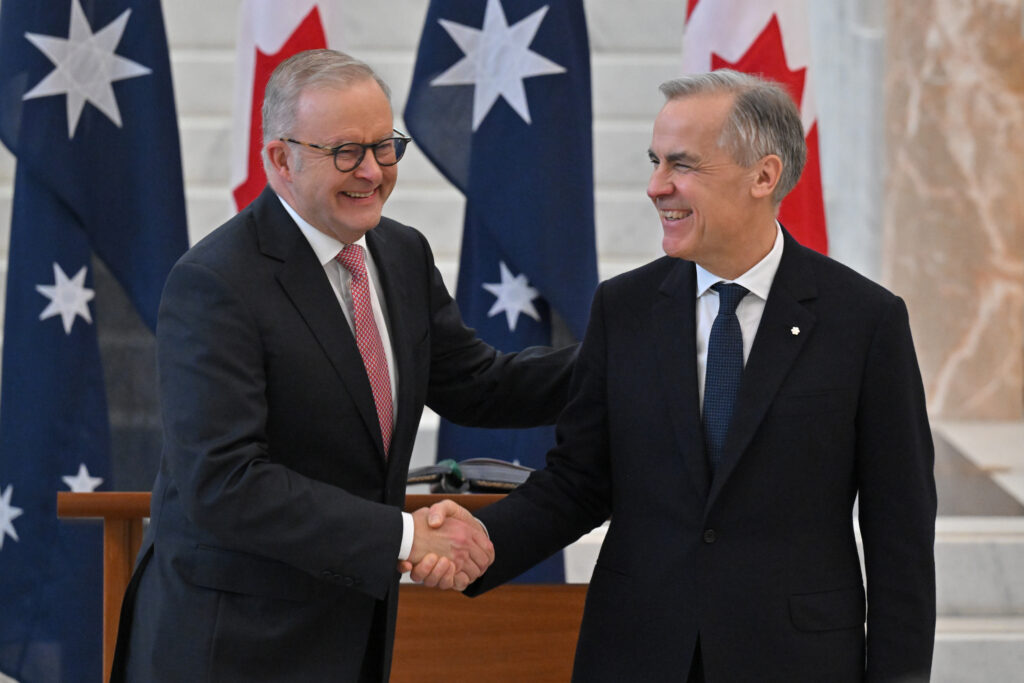
The press conference following the bi-lateral meeting between Prime Minister Anthony Albanese and Canadian Prime Minister Mark Carney is underway, following Mr Carney’s address to Parliament.

These are tight affairs, usually with between two and four journalists from each nation having registered to ask questions.

The PM reveals he and wife Jodie will host a dinner with the Carneys tonight. Naturally, there was a mention of Toto, the First Dog.

I wonder if they’ll watch a few minutes of the opening game of the AFL season?

Republicans vote down legislation to halt Iran war

AAP

Republicans in the US Senate have voted down an effort to halt President Donald Trump’s war against Iran, demonstrating early support for a conflict that has rapidly spread across the Middle East.

The legislation, known as a war powers resolution, failed on a 47-53 vote tally. The vote fell mostly along party lines, though Republican Senator Rand Paul of Kentucky voted in favour and Democratic Senator John Fetterman of Pennsylvania voted against.

The war powers resolution gave lawmakers an opportunity to demand congressional approval before any further attacks are carried out. 

The vote on Wednesday, US time, forced them to take a stand on a war shaping the fate of US military members, countless other lives and the future of the region.

Underscoring the gravity of the moment, Democratic senators filled the Senate chamber and sat at their desks as the voting got under way. Typically, senators step into the chamber to cast their vote, then leave.

“Today every senator – every single one – will pick a side,” Senate Democratic Leader Chuck Schumer said before the vote. 

“Do you stand with the American people who are exhausted with forever wars in the Middle East or stand with Donald Trump and Pete Hegseth as they bumble us headfirst into another war?”

Senator John Barrasso, second in Senate Republican leadership, said during the debate that Republican senators would send a message that Democrats are wrong for forcing a vote on the war powers resolution.

“Democrats would rather obstruct Donald Trump than obliterate Iran’s national nuclear program,” he added.

Defence Secretary Pete Hegseth said on Wednesday the war could extend eight weeks, a longer time frame than has previously been floated by the Trump administration. 

He also acknowledged that Iran is still able to carry out missile attacks even as the US tries to control the nation’s airspace.

US service members “remain in harm’s way, and we must be clear-eyed that the risk is still high”, General Dan Caine, chairman of the Joint Chiefs of Staff, said at the same press conference.

Six US military members were killed over the weekend in a drone strike in Kuwait.

Republican Senator Joni Ernst of Iowa acknowledged the human costs of the war in her floor speech. 

One of the soldiers killed on Sunday was from Iowa and a National Guard unit from her state was also attacked in Syria in December, resulting in the deaths of two other soldiers.

“But now is our opportunity to bring an end to the decades of chaos,” said Ernst, who herself served as an officer in the Iowa National Guard for two decades. 

“The sooner the better,” she added.

The view from Mike Bowers

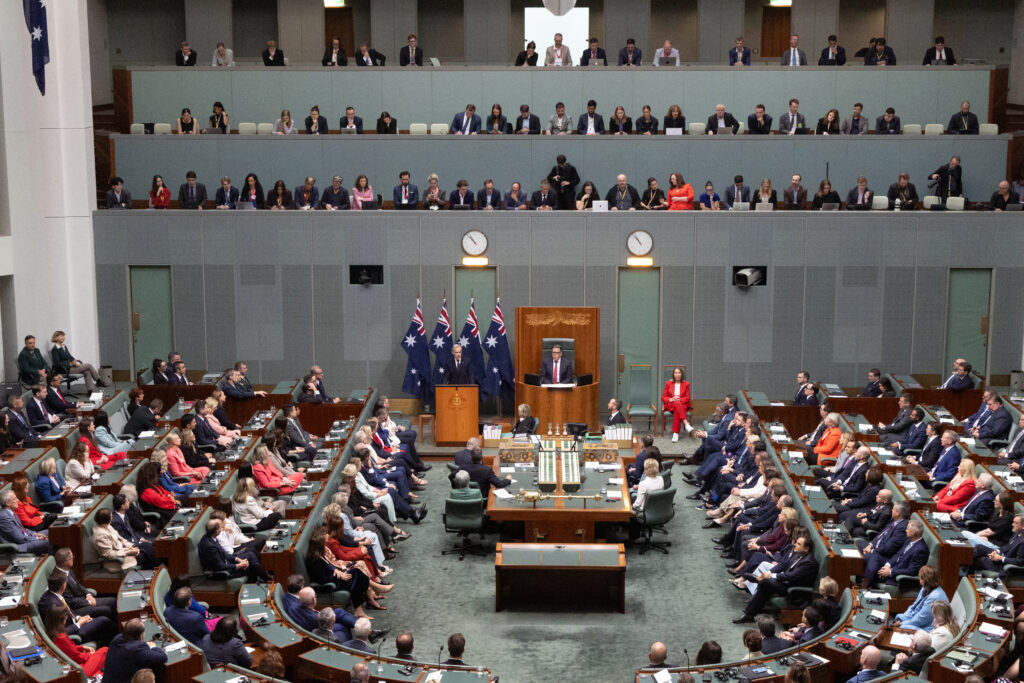
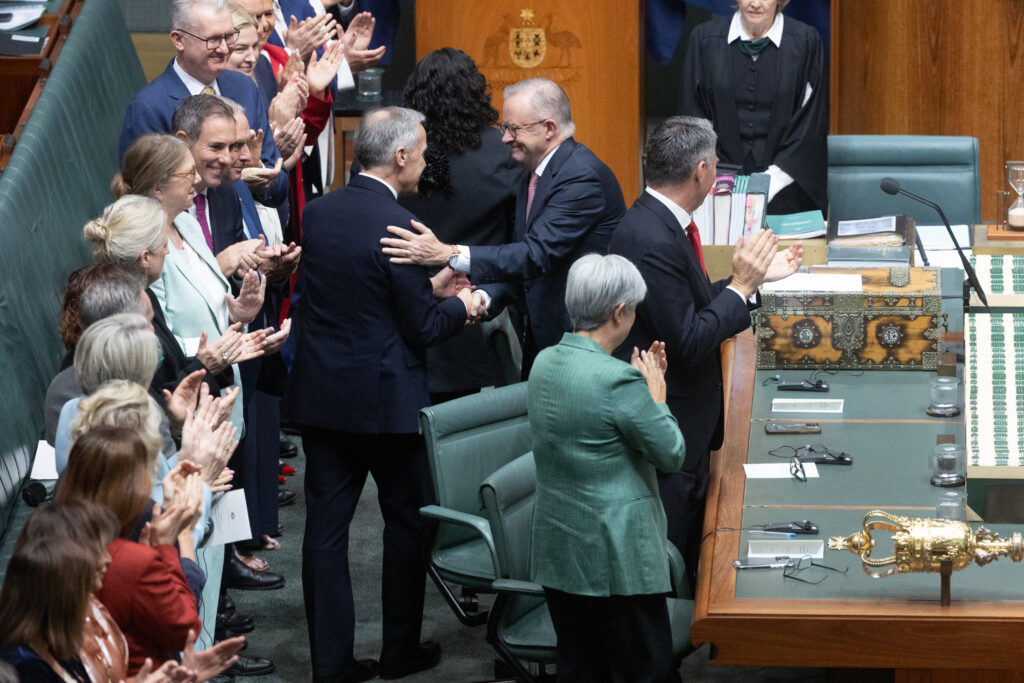
Canadian PM Mark Carney in the House of Representatives Chamber during a special joint sitting of Parliament. Photograph by Mike Bowers.
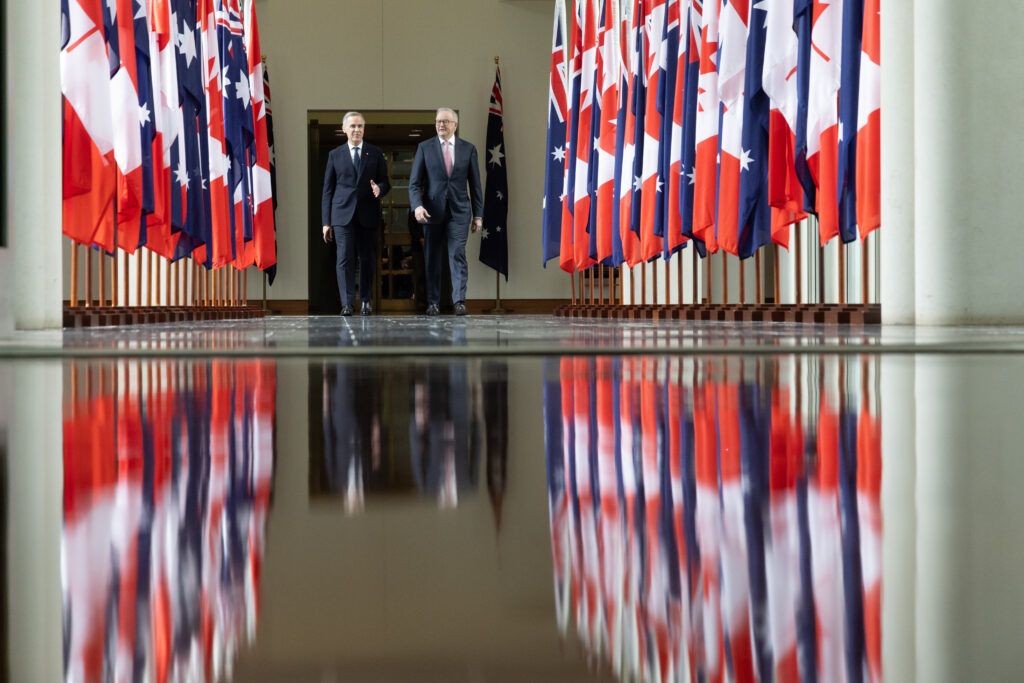
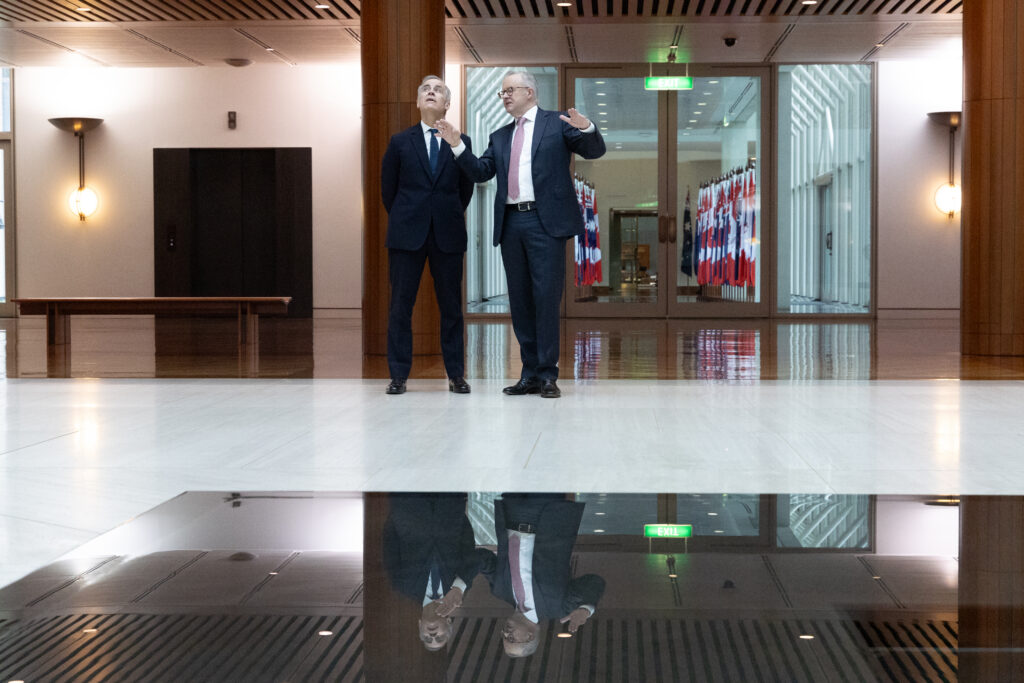
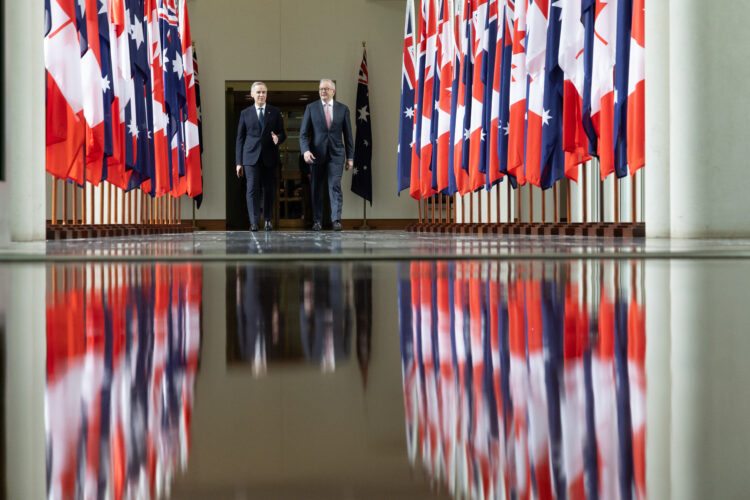
Australian PM Anthony Albanese and Canadian PM Mark Carney leave the House of Representatives. Photograph by Mike Bowers.
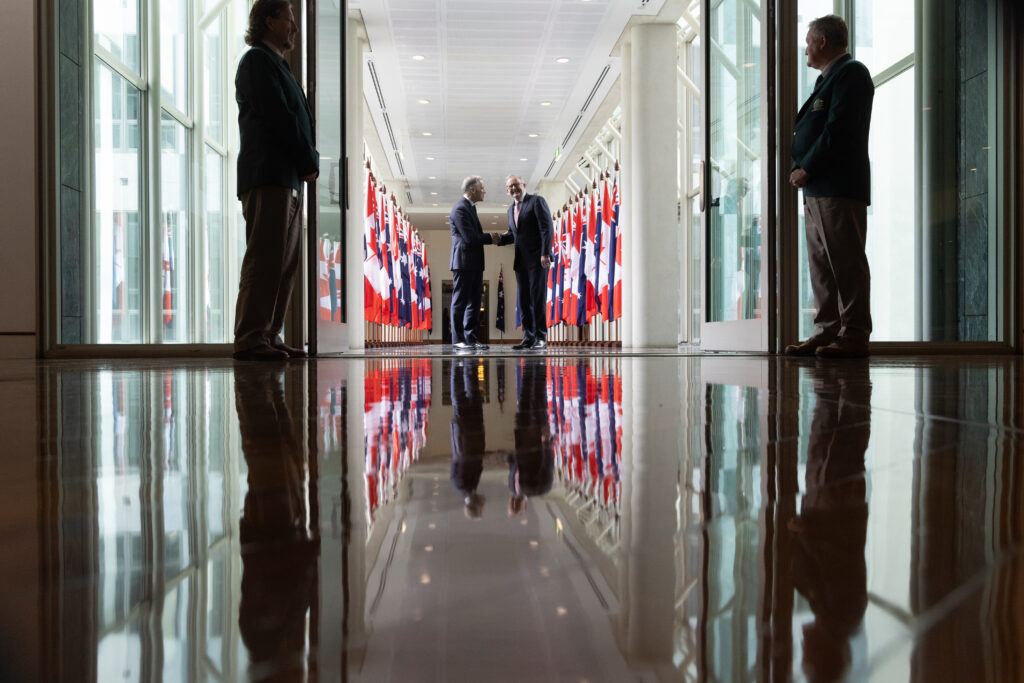
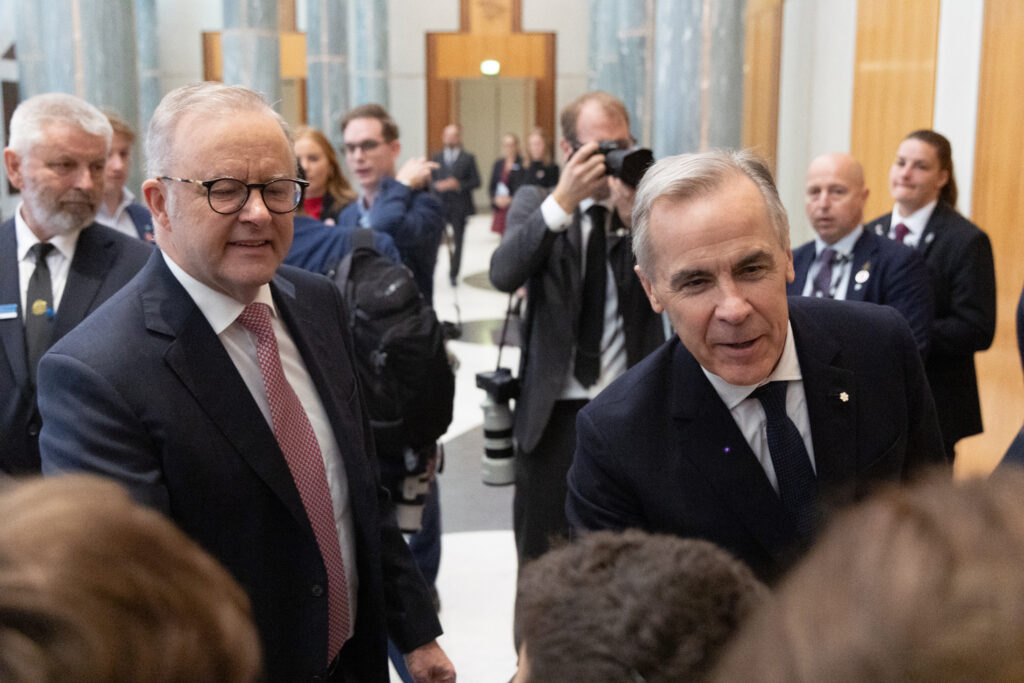
Photograph by Mike Bowers.

Fuel uncertainty caused by war highlights need for more EVs: peak leasing body

The National Automotive Leasing and Salary Packaging Association (NALSPA) says the war in the Middle East highlights the need to get more electric vehicles onto Australia’s roads.

NALSPA Chief Executive Rohan Martin says more EVs is good for drivers and good for Australia.

With petrol prices unfortunately set to rise amid global conflict, helping more Australians afford cleaner, cheaper-to-run cars makes sense for households and the nation.

The hundreds of thousands of Australians who have made the switch are saving thousands of dollars every year on fuel and maintenance costs which is super helpful to them especially now as cost-of-living pressures further mount.

More EVs on our roads means lower emissions, which is good for our climate, and less dependence on foreign oil, which strengthens our energy and fuel security. More EVs are in the national and household interest.

Rising fuel prices will achieve a similar outcome to an interest rate rise. There should be no rise in the March RBA meeting.

Greg Jericho
Chief Economist

One sign that yesterday’s GDP figures that while good were not actually a sign that the economy is powering away.

I noted yesterday that on Tuesday the market was pricing in a zero percent chance of a rate rise in a couple of weeks. Then Michele Bullock the AFR summit said the March meeting was live, and off went the speculators chasing after squirrels.

And then on Wednesday the GDP figures came out showing the economy grew at 2.6% – well above the prediction of 2.2%.

You might have thought this would have people thinking inflation is about to take off because the economy is running hot.

Well no. After the GDP figures the market reduced its expectations of a rate rise in two weeks:

And out further, while the likelihood of a rate rise in May remains very strong – essentially full priced in – the likelihood of another rate rise this year after that also went down:

What lies ahead given the Iran War is hard to say. Oil prices are up around 15% since the bombing began that will see petrol prices go up around 10 cent a litre, but if the attacks keep going, that price will likely keep rising.

But nothing the RBA does will affect that – indeed the cost will slow the economy because people will have to cut back on other spending in order to pay their fuel.

Interst rates are raised in order to slow spending – petrol price rises do that. Raising interest rates would only exacerbate it for no good reason. Here’s hoping the RBA is smart enough to know what is going on.

Three reasons to be glad the Senate blocked Albanese’s Freedom of Information changes

Skye Predavec
Researcher

Today, the Albanese government pulled its “friendless” Freedom of Information Amendment Bill.

The bill saw widespread opposition, with a Senate Inquiry into the bill attracting dissenting reports from the Liberal–National Coalition, the Greens, David Pocock, and Jacqui Lambie. Every non-government submission to that inquiry, including the Australia Institute’s, recommended against passing the bill in its current form.

What made the bill so bad?

The reforms would hurt freedom of information, not help

There’s widespread agreement that the freedom of information (FOI) system is broken. But the government’s changes would have exacerbated those problems, making it harder and more expensive for Australians to get information from the government.

The bill would have introduced a fee for non-personal FOI requests, expanded exclusions on cabinet-related documents, and allowed requests “likely to involve” more than 40 hours of work to be refused.

The Robodebt Royal Commission recommended that section 34 of the FOI Act (regarding Cabinet documents) be repealed because it thwarted efforts to investigate Robodebt. Instead, the Bill would have made section 34 even more limiting, expanding its scope and betraying the Robodebt Royal Commission.

The changes were justified on a fantasy

Not only would the bill have made FOI worse, but the Government’s justification for the changes was flimsy at best.

When the reforms were announced, cabinet minister Mark Butler said the Government was “being inundated by anonymous requests”, “many of them we’re sure are AI bot generated requests” that “may be linked to foreign actors, foreign powers, criminal gangs”.

What evidence did the Government provide for this? In a word: none.

In fact, the system deals with about the same number offreedom of information requests as it did 20 years ago.

The government also argued that the eSafety Commission had been tied up by FOI requests for months – but there is no reason to believe they were particularly burdensome to process.

The eSafety Commission didn’t feature on the OAIC’s list of 18 agencies with particularly high processing costs (over $10,000 per request decided), and 550 requests would represent just 2% of all FOIs received by the government in a given year.

The Albanese government is among the most secretive

The government’s justifications for the bill may have been unproven and overblown, but that doesn’t mean there aren’t issues with the FOI system. In fact, the call is coming from inside the house.

As Leader of the Opposition, Anthony Albanese spoke in no uncertain terms about the shortcomings of then-Prime Minister Scott Morrison when it came to transparency. Mr Morrison, Mr Albanese said, led a “shadow government that preferred to operate in darkness” with a motto of “nothing to see here”.

But when it comes to FOI, Mr Albanese risks replicating what he once criticised. The share of FOI requests granted in full has almost halved since he took office, and sits at just a quarter of what it did in 2006-07 – the last year of the Howard government.

So while the FOI system needs reform, the Government’s proposed changes were not it. Now that they have been blocked, there is an opening for cultural and legal changes that will help Australians get access to the government information that they are entitled to.

Summary: Two nations under different skies, yet never closer

Mark Carney concludes his address by emphasising the similarities, closeness and reliability of Australia and Canada, to the world and to each other.

He wins a standing ovation from the joint sitting in the House of Representative chamber.

Photograph by Mike Bowers.

Canada and Australia have never waited for others to write our futures.

We have written it ourselves through a century of choices, standing together in the darkest hours, building the postwar order with optimism and purpose, and now helping to create what comes next.

The world will always be shaped by great powers. But it can also be shaped by middle powers that trust each other enough to act with speed and purpose.

Canada and Australia have demonstrated that trust again this week. Every agreement signed, every coalition deepened, every commitment made is variable geometry in practice. Rather than lamenting the fall of the old order, let us redouble our efforts to build the new one.

We understand the scale of the task ahead because we have traveled this road together. As Canadian Prime Minister Pierre Elliot Trudeau said in the 1970s, Australia is “self-possessed and confident about the future, believing in the future of mankind.”

Two nations under different skies, with the same orientation. A friendship built over a century that is ready to build the century that awaits. Thank you very much for this honour.

Opportunities to invest more in each other’s economies

Canada and Australia retain the advantages of sound banking systems and sophisticated and reliable financial infrastructure. We have the solid foundations to maintain openness to cross-border capital flows.

Our pension funds and your Supers constitute one of the largest pools of capital in the world with nearly $7 trillion under management and growing. This is a strategic asset for our citizens and future generations in a riskier world where it will increasingly matter who owes who, and who owns.

As we are underinvested in each other’s economies, it is pressing to modernise our bilateral tax and investment treaty to make it easier to invest and grow good jobs in both of our countries. I welcome today’s agreement to do just that.

These new connections between Australia and Canada are greater than the sum of their parts. This is alliance reaffirmed, a friendship strengthened, and a partnership to build greater prosperity and security in the Indo-Pacific and beyond.

Shared trade advantages

Our two nations are championing efforts to build a bridge between the Trans-Pacific Partnership and the European Union. Canada is already a member of both trading blocs, and will not directly benefit from these efforts, but we see the public good in creating a new trading bloc of 1.5 billion people, grounded in common standards and shared values, capable of anchoring a rules-based trading system even as the old one falters.

This ad hoc trading coalition of middle powers has a larger GDP than the United States, three times the trade flows of China, the largest combined central bank balance sheet in the world, 62 of the top 100 universities, and is the largest source of cultural exports globally.

Shared defence objectives

Both our countries are building up our capabilities, so the next generation of drones, surveillance aircraft, cyber, and AI are created in Adelaide and Alberta.

Canada’s first ever Defence Industrial Strategy is catalysing half a trillion dollars of investment in our defence and resilience over the next decade, creating enormous opportunities for cooperation. We are already cooperating with Australia on their world-leading Over the Horizon Radar and will explore new opportunities to protect our vast territories together.

Australia and Canada are core members of the Coalition of the Willing. This provides vital military and humanitarian aid to Ukraine in response to Russia’s illegal war. The outcome of this war is not in doubt, although its duration is uncertain. When peace comes the Coalition will provide robust security guarantees to support a just and lasting peace in Ukraine and Europe.

Satellite communications are now a fundamental requirement for security and strategic autonomy. As we have seen in Ukraine, turning off these networks can cripple a nation fighting for its existence. Middle powers must have choices – and Canada does.

A Canadian-based constellation of LEO satellites will launch next year to provide reliable and secure global communications. We are working with other like-minded partners who possess similar capabilities to build out a deep and resilient system we can all share and control in our own territories.

The power of critical minerals

Canada and Australia are the world’s two most reliable and like-minded mining giants. We are both committed to sustainability. We have each developed the most advanced extractive ecosystems from prospecting to engineering, logistics, and capital markets.

We are both blessed in the abundant foundational metals that power the batteries, EVs, smartphones, fighter jets, and AI systems of this century. We are the world’s critical mineral superpowers.

In the old world and even to a degree today, the temptation has been to see ourselves as competitors. In this new world, we should be strategic collaborators. To boost investments, accelerate technical cooperation, enhance supply chain resilience, expand our domestic processing abilities, while boosting our strategic autonomy.

Which is why, earlier today, we signed a series of new agreements on critical minerals, including Australia joining the G7 minerals alliance – the largest grouping of trusted democratic mineral reserves in the world.

Together, we produce 34% of global lithium, 32% of uranium supply, 41% of iron ore, and a combined $25 billion war chest to fast-track projects. Globally, we are #1 and #2 as the most attractive mining investment jurisdictions in the world.

The role of middle powers like Australia and Canada

Mark Carney:

In a world of great power rivalry, middle powers have a choice: compete for favour or combine
for strength. Isolation is not sovereignty. When middle powers negotiate bilaterally with a hegemon, we negotiate from weakness. We compete to be the most accommodating. We accept what is offered. This is the performance of sovereignty.

Canada, instead, is choosing to create a dense web of connections to build our resilience and strategic autonomy. We have adopted a new framework for engaging the world: variable geometry — creating different coalitions for different issues, based on common values and interests. Variable geometry is not a retreat from multilateralism. It is its evolution.

Right now, many countries are concluding that they must develop greater strategic autonomy. That impulse is understandable. When the rules no longer protect you, you must protect yourself. A country that cannot feed itself, fuel itself or defend itself has few options.

In the 21st century, the requirements for economic security and prosperity of our countries extend far beyond food, conventional energy, and defense, as important as these are.

Today, sovereignty requires reliable access to space-based communications and storage. It requires vaccines, semi-conductors, payment systems, and capital. Because governments and businesses have long prioritized efficiency over resilience, we have developed supply chains and trading relationships that mean middle powers depend on great powers, and sometimes even individual corporations, for essential elements of their sovereignty.

Two nations with much in common

Mark Carney continues:

It is often observed that our countries have much in common. The Westminster system, federalism, common law, the Crown. Yet the foundations of our relationship go much deeper. We intuitively understand how each other’s system works, how power is constrained, how our institutions function, and the values that underpin them.

This is the product of centuries of parallel development, common inheritance, and continuous exchange. It is not something that can be replicated by treaty or sustained by rhetoric. On this common foundation, we have built civic nations: societies held together not by blood or soil, not by a single faith or culture, but by something more demanding and durable — a shared commitment to live together, to accommodate our differences, and to pursue the common good.

Canada’s founding insight is that unity does not require uniformity. That we can share a country without conforming to a single identity. That our differences, honestly acknowledged and respectfully navigated, are a source of strength.

Australia arrived at the same destination by its own path. Let us remember that Australia was the first nation in the world to give women the right to vote and to stand for parliament. Your example has inspired the world ever since. That act of democratic extension — choosing to widen the circle rather than guard its edges — is the fundamental instinct that defines our common civic nationalism.

Our two nations were built by voyageurs and by drovers — adventurers, risk-takers, and families who left everything behind to start again. They crossed oceans with uncertain prospects to bet on themselves and on each other. That commitment to building something together, rather than resting on something inherited, is bred in the bone of our national characters.

Canadian PM Mark Carney addressing joint sitting of Australian Parliament

He begins:

The last time a Canadian Prime Minister stood here, it was a different era with different challenges. 2007 was the eve of the global financial crisis – a storm that would test every country. Australia and Canada sailed through it because of the soundness of our banks, the probity of our public finances, and the resourcefulness of our people. While much has changed since then, these qualities endure, as does the friendship between our nations.

Though we could not be physically farther apart, Canada and Australia are “strategic cousins.” We may look to different skies – the North Star in our hemisphere, the Southern Cross in yours – but we have the same orientation. We share a common heritage, have developed a common perspective, and can build a common future.

Two sovereign nations. Two proud democracies: the True North and the Land Down Under,
navigating with the same values.

Australia’s carbon markets risk penalising Indigenous stewardship

RMIT University

Carbon markets rewarding the recovery of degraded environments risk penalising long-term Indigenous stewardship, according to a coalition of experts writing in Nature Climate Change.

The article by RMIT University environmental science and legal experts working with a Yirrganydji Aboriginal Bama (Person) highlights growing frustration among traditional owners who often find their lands ineligible for carbon credits because they remain intact.

In contrast, landholders whose predecessors degraded ecosystems have opportunities to generate credits by restoring them.

Lead author and Director of RMIT’s Centre for Nature Positive Solutions Professor Peter Macreadie said this unintended consequence risked entrenching inequity and undermining the credibility of climate markets.

“Carbon markets were designed to reward climate action, but our research shows they may be producing a perverse outcome: rewarding those who damaged land in the past while excluding Indigenous custodians who for generations have cared for country,” he said.

The issue revolves around the definition of ‘additionality’, which is a core integrity requirement in carbon markets, intended to ensure credits are only issued for climate benefits that wouldn’t have occurred otherwise.

In practice, this often means restoration on degraded land is rewarded, while long-protected ecosystems are treated as the baseline and assumed to continue without support.

Brian Singleton, a Yirrganydji Aboriginal Bama and Land Manger, said his people have overseen stewardship of the Cairns area for thousands of years, long before there were conservation and ranger programs.

He said Indigenous people have largely been left out of the conversation when it comes to carbon markets.

“We need to be included so we can see the other value and opportunities in protecting what mangrove systems we still have. No matter how remote, we’re still facing climate challenges with dieback, erosion, wash off and pollution,” Singleton said.

“The real issue with the system is that proper consultation with traditional owners was not done when setting it up, and so now the work being done on country can’t be counted. It’s hard work and should be recognised by creating financial opportunities for it to continue.”

Singleton said it was also important to engage and incentivise young people to ensure ongoing care.

“Otherwise, if it’s not done, it will be bad news not just for people but for the environment,” he said.

Legal and policy pathways exist RMIT legal scholar Dr Vanessa Johnston said aligning carbon markets with Indigenous custodianship could create pathways to broaden participation, improve climate outcomes and support ecosystems that underpin long-term mitigation.

“Achieving this requires integrity frameworks that recognise stewardship, not just restoration, as a legitimate form of climate action,” she said.

The team’s research outlines several recommendations to support fairer and more effective environmental outcomes, including:

  • recognition that maintaining intact ecosystems often requires active, under-funded
    governance, particularly where altered fire regimes, feral animals and changing water
    flows create threats
  • allowing conservative recognition of avoided degradation where such risks exist
  • ensuring Indigenous custodians can participate as project owners or equal partners,
    rather than peripheral stakeholders.

Johnston, an expert in carbon rights, property law and land use, said recognising stewardship within additionality was not a call for weaker standards, but an overdue correction to a framework designed without Indigenous governance in mind.

“It also aligns with a growing body of research that recognises land ownership as involving obligations of conservation and protection, not just entitlements,” she said.

Macreadie said bringing together legal perspectives, Indigenous experience and environmental science helped highlight tensions in how carbon market integrity rules were currently applied, and to explain why existing approaches are struggling.

“What we are seeing is climate finance systems built on good intentions backfiring because they fail to recognise stewardship, care and long-term ecosystem protection as legitimate climate action,” Macreadie said. “Clearly, something needs to change.”

A “victory for Australia’s right to know”

As Bill Browne just explained, forcing the government to abandon its changes to the FOI system is a victory for the Senate – with the Greens, crossbenchers and Liberals all being highly critical of the proposed amendments.

The first to claim victory is the opposition, with Senator Michaelia Cash putting out a gleeful statement just moments ago:

This Bill had not a single friend outside the public service. It was opposed by the Coalition, all other parties and the crossbench, every major media organisation, every integrity body, and civil society groups across the country.

When everyone is telling you you’re wrong, you’re wrong. This was a comprehensive defeat for a government so addicted to secrecy that it tried to legislate its way out of accountability, and the Coalition is proud to have led the fight against it.

Freedom of Information is not a privilege granted by government at its discretion. It is a democratic safeguard, the mechanism through which citizens hold power to account. This Government tried to take that safeguard away, and it has been stopped. The Freedom of Information framework needs to be overhauled but in the right way not the Labor secretive way.

Labor’s failed FOI restrictions have no friends in the Senate

Bill Browne
Director, Democracy & Accountability Program

And just like that, half an hour later, the FOI Bill that wasted so much time has been pulled.

What comes next?

Hopefully the Government listens to the Australian public — 25,000 of whom have so far joined the Australia Institute’s petition calling for a more open government, including fixing the FOI scheme, protecting whistleblowers and disclosing Cabinet documents in days not years.

There is general agreement among Senators that the FOI system needs reform, but that the government wasn’t interested in real reform to make government more open and efficient – only in secrecy.  

Senators were generous in their praise: Liberals, Nationals, Greens and other crossbenchers got a mention. This was really a combined effort (as it must be in the Senate, where no one party has total control).

Liberal Senator Michaelia Cash agrees that the FOI system needs to be modernised – “delays, backlogs and bad-faith behaviour” are clogging the system. “What we will never support … the Albanese Labor Government seeking by legislation to entrench secrecy and price you out from being able to access information.”

“This is a bill that was all about making it harder for the Australian people to access information.”

Independent Senator Fatima Payman: “Can I remind the chamber this is the second bill that the Government has discharged on their own accord – after the Misinformation and Disinformation Bill that failed miserably.”

“How many hours of precious time did public servants spend on this bill?” – only for those efforts to be wasted.

“If you rush something through, if you don’t consult, if you don’t talk to the Australian public” then it’s no surprise the bill failed.

Senator Payman also mentions former senator Rex Patrick, the Transparency Warrior, for working the halls of Parliament House making the case against the bill.

Greens Senator David Shoebridge says it’s remarkable that the Government has taken so long to listen to the Australian people.

“There is no evidence” for the bill. “The number of lies that the Albanese Government told” about this bill reached Trumpian levels.

“If you really want an answer to FOI back logs, read the first five provisions of the act” – which say the Government should be proactively publishing information. If the Government prioritised disclosure, there wouldn’t need to be so many FOI requests.

“This was always a tax on truth.”

You can watch Senator Shoebridge use the Australia Institute’s research on FOI to question the Albanese Government in Senate Estimates.

Independent Senator David Pocock says “The tragedy of this bill is that there is a recognition that the FOI system is out of date … but there’s been nothing from the government to actually consult, to bring forward reforms that do that, that modernise it, that make sure Australians get access to information in a more timely way. That we have a government that’s default is openness, not secrecy.”

“If there was a default to openness”, public servants could save hundreds of thousands of hours of work.

ACF reveals text exchange which exposes gas giant Woodside’s extraordinary access to government

The Australian Conservation Foundation, now led by former Greens leader Adam Bandt, has just released this statement:

A barrage of almost 200 text messages between Woodside and senior officials from the federal Department of Climate Change, Energy & Water reveals the extent of high-level access gas giants expect – and get.

The heavily-redacted text exchange took place between 21 May and 7 October 2025 in the crucial period when conditions for the controversial North West Shelf extension were being decided.

During this period, Woodside claimed stronger environmental conditions would make its not-yet-approved Browse offshore gas project – gas from which the company proposes to pipe 1000km to the North West Shelf export plant – unviable.

As revealed in documents obtained using Freedom of Information laws, there was relentless, persistent and at times after-hours communication on mobile devices between Woodside and senior government officials about the approval process and public communications.

After the negotiation period, the government weakened the environmental requirements it had initially proposed for the North West Shelf extension.

“What we’re seeing here is a gas giant having unfiltered, casual access – at all hours – to senior departmental officials, who are bending over backwards to respond to demands and requests,” said ACF CEO Adam Bandt.

“This raises serious questions about inappropriate access and state capture at a critical time in the North West Shelf assessment process.

“Big corporations have too much power over governments. Governments should make decisions for the public interest, not for vested interests.

“When Woodside sends the government ‘you up’ texts, the public and nature gets screwed.”

ACF’s court case challenging Minister Murray Watt’s approval of Woodside’s North West Shelf gas export hub out to 2070 is scheduled to be heard in July.

Here we go again

Alice Grundy
Research Manager

Francesca Albanese’s scheduled appearance as part of “Constellations: Not Writers’ Week”, the grassroots replacement for Adelaide Writers’ Week, at a venue in Adelaide University has been changed at the last minute.

The event was due to take place at Adelaide University but the University said the venue booking “did not go through the required review and approval process in accordance with the required policy and procedure” and so cancelled the booking.

Francesca Albanese is the Special Rapporteur to the United Nations Human Rights Council, following and report on the human rights situation in the Occupied Palestinian Territory. She has been sharing Israeli actions in Gaza and the West Bank with the world with increasing urgency.

Her new book, When the World Sleeps: Stories, word and wounds of Palestine reflects on her time in Jerusalem, the genocide of Palestinians and the ongoing consequences of occupation. 

Organisers have secured a new venue and if you’re going to be in Adelaide you can get a ticket here.

Victory for democracy as Albanese government pulls its attempt to limit Freedom of Information rights

Bill Browne
Director, Democracy & Accountability Program

In the Senate as we speak – the Albanese government, represented by Finance Minister Katy Gallagher, is moving to discharge (pull) its Freedom of Information (FOI) amendments.

The government made false and exaggerated claims to justify the changes, which would have made FOIs more limited and more costly – in direct contradiction of the recommendations of the Robodebt Royal Commission.

Senator Gallagher says

This is an important reform, and the government remains committed to it” – but they admit that they do not have the numbers to get it through Parliament.  

She says that the government made amendments in the House of Representatives to try to accommodate concerns.

Shadow Attorney-General Michaelia Cash:

The Liberal Party, the National Party, all of the crossbenchers, we worked together to make sure that the Australian people knew that, guess what, we would never let the Albanese government bring in a bill that was going to silence you.

Senator Cash points out the hypocrisy of Prime Minister Anthony Albanese, when he was in opposition, saying that his government would be the “most transparent”.

They are closing the door every chance they get.

More to come over the half an hour allowed for debate, but good news to start the morning.

Liberal shadow ministers are not equipped to develop policy, but donors and interest groups are keen to help

Bill Browne
Director, Democracy & Accountability Program

The Liberal review of the last election includes this remarkable comment:

“The campaign also had the benefit of the vast experience of many campaign professionals and significant financial support from generous donors, many especially keen to assist with policy development. (emphasis added)

Political donors were especially keen to “assist” Liberal policy development.

I’ll bet.

It will only reinforce the worst suspicions Australians have about political donations, that they are intended to buy not just access but influence as well.

Why couldn’t policy development come from the party, instead of donors?

Because branch members don’t consider how their policies will affect “key demographics”; because the party room was silenced; because the party’s think tank was ignored and because the shadow ministers weren’t up to it.

MPs “consistently admitted” that they did not challenge policy directions and did not seek party room debate on contentious issues. Dissent and debate were “actively discouraged” by then Opposition Leader Peter Dutton with one MP told he could “leave the party” if he didn’t agree with a policy position.

The party’s taxpayer-funded think tank, the Menzies Research Centre, “had no formal role in policy development” and the work it did do “was not adopted”.

What about the Opposition front bench, the shadow ministers who presented themselves as the alternative government?

The review says “not every shadow minister is equipped to write and develop policy”.

That’s a damning assessment of the people who want to run the country.

What is a shadow minister’s job if not to develop policy? Well:

“The main task of any shadow minister is to develop relationships with relevant interest groups, who are mostly keen to assist in policy development”.

Let donors and “relevant” interest groups “assist” in policy development that the party’s best and brightest are incapable of doing.

It’s a remarkable admission of where the Liberal Party is at.

To be clear, dependence on interest groups and donors to do policy work is not a flaw that the reviewers identified in the Liberal Party. The reviewers think that’s the solution to the Liberal Party’s woes.

Even from a self-interested point of view, letting outside groups direct party policy is a trap.

The review points out that there was “strong and active support in some business and commercial circles for a nuclear power program” – but that support did not convert into “strong third-party campaigning”.

In other words, following certain businesses on nuclear led the Liberals to step on a rake, and their fairweather friends disappeared when it was time to sell the disastrous and unpopular policy to the public.

So why should the party give business interests even more influence over policy in the future?

Mark Carney is in the building. Rockstar reception for Canadian PM ahead of Parliamentary address

Fresh from calling out Donald Trump and Benjamin Netanyahu on the legality of their military operation in Iran, Canadian Prime Minister Mark Carney has arrived at Parliament House.

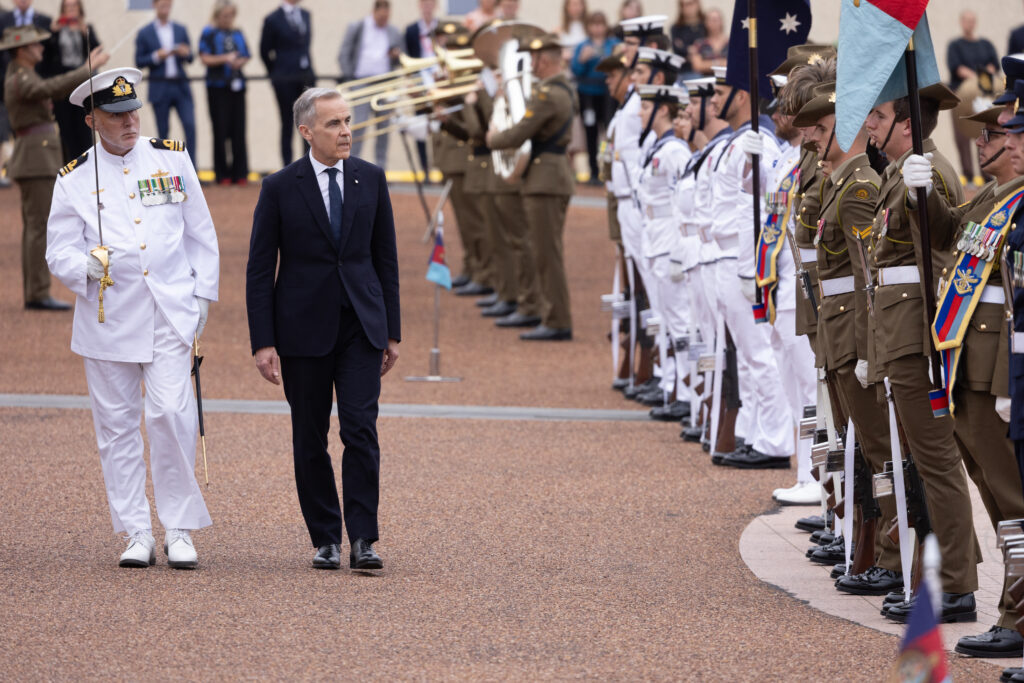
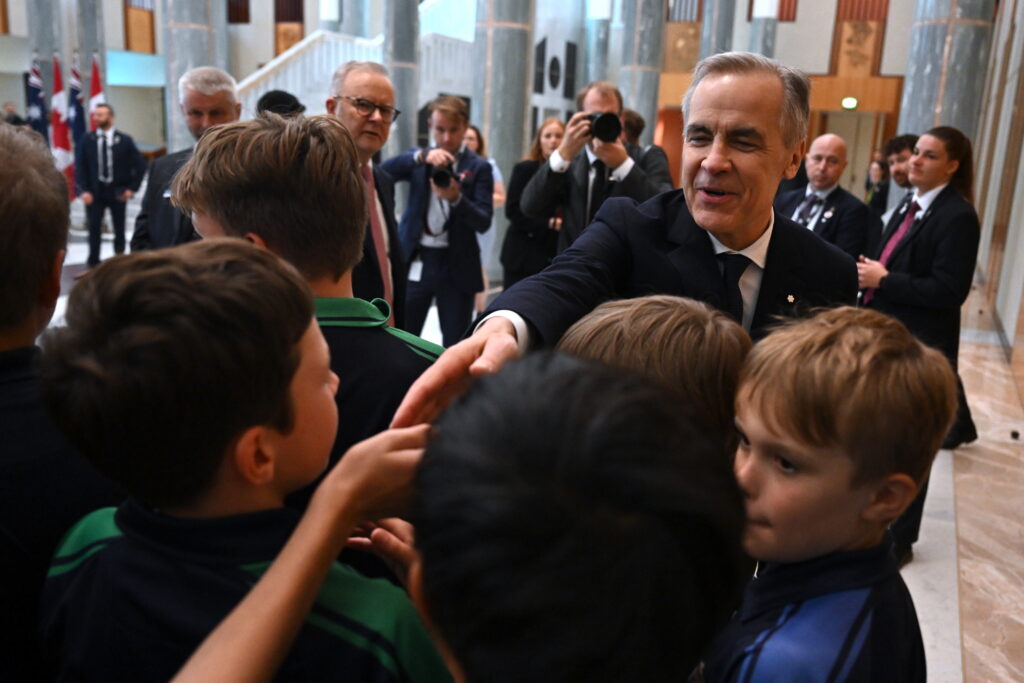
After a ceremonial welcome in the forecourt, there was a lovely moment with students on a school visit once he was inside the four walls.

Carney gave an extraordinary address to the World Economic Forum in January about the important role middle powers like Canada and Australia play as the like of Trump and Netanyahu trash the international rules based order.

It’s predominantly a trade visit to Australia, but it’s expected several aspects of Trump’s behaviour will be on the agenda when Carney sits down with Prime Minister Anthony Albanese.

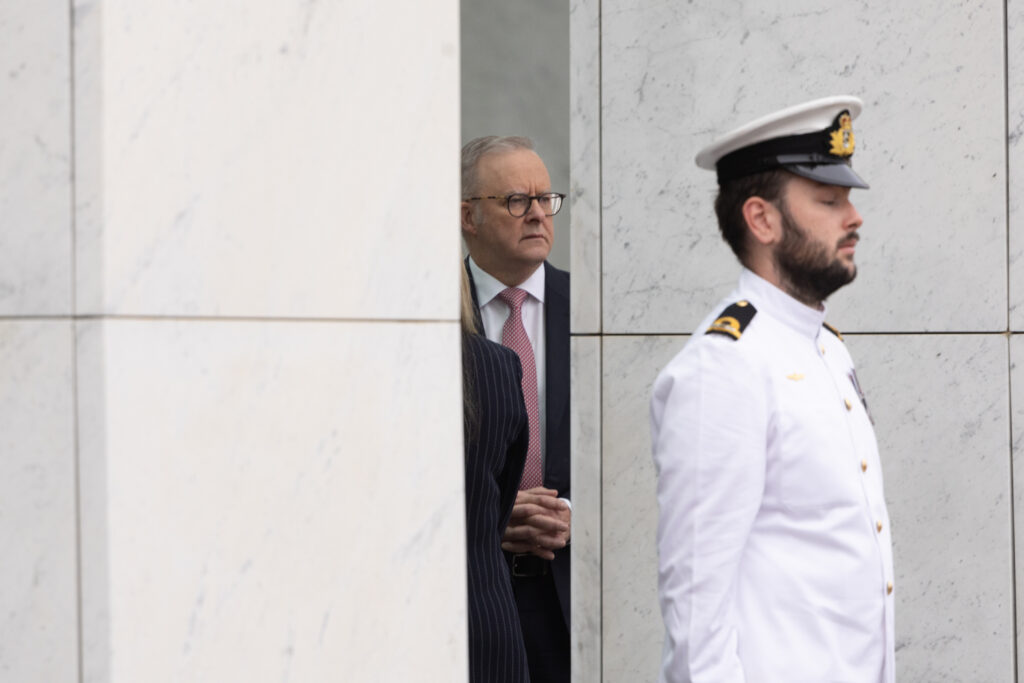
Here’s how Mike Bowers, AAP’s Mick Tsikas and Lukas Coch captured the arrival.

Photograph by Mike Bowers.
Photograph by Lukas Coch, AAP.
Photograph by Mick Tsikas, AAP.
Photograph by Mike Bowers.

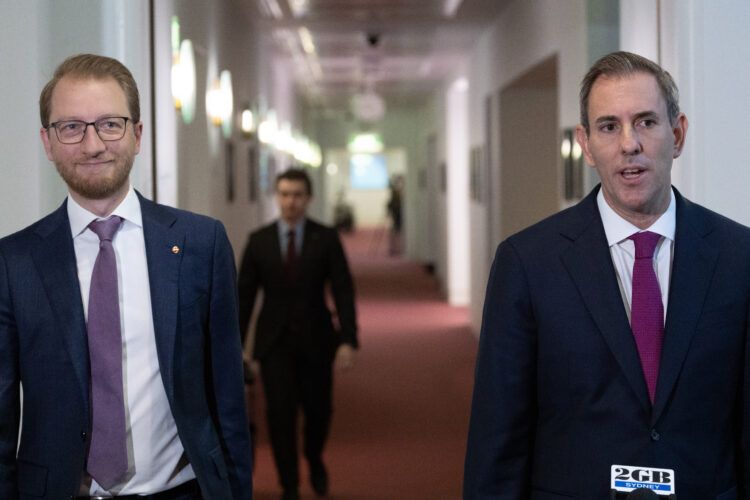
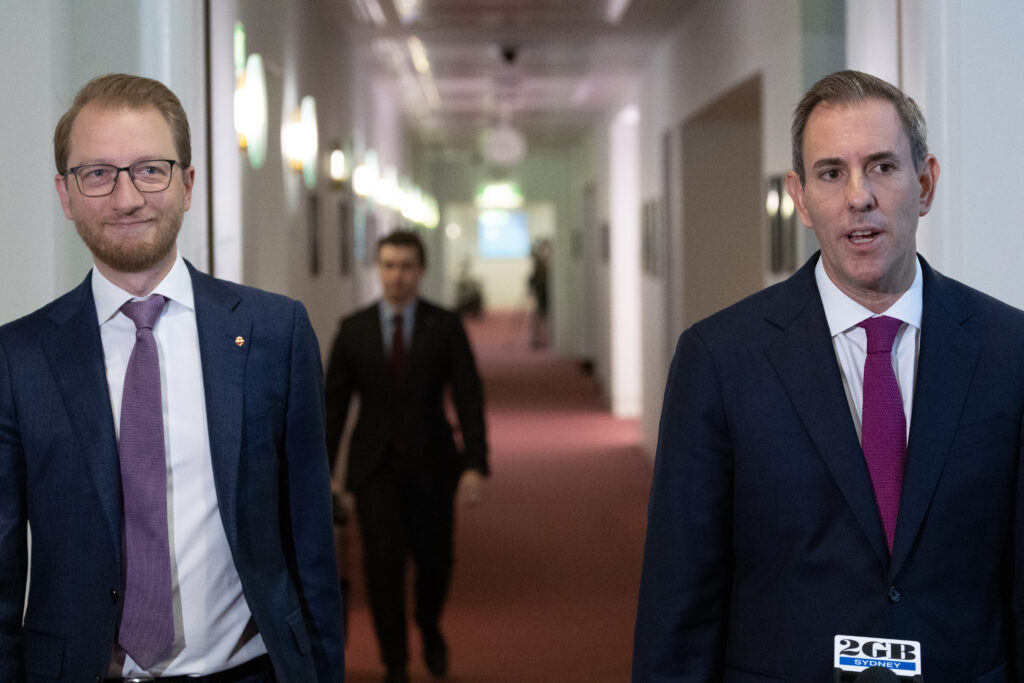
Paterson and Chalmers have “a moment” in the press gallery corridor

There was an awkward moment in the press gallery this morning, as Senior Liberal and Labor figures bumped into each other in the corridor … between personal attacks on live television.

Treasurer Jim Chalmers was speaking to journalists in a corridor doorstop, about the impact of the Middle East war on the economy:

What we’re seeing in the Middle East, will put additional pressure on the economy, on Australians, and it will be a big feature of our thinking as we put the government’s fifth budget together.

James Paterson had just been on a rival network, accusing the Treasurer of using the war as an excuse for sticky inflation.

Which made this moment, captured by Mike Bowers, a tad tricky.

Photograph by Mike Bowers.

DFAT crisis response teams headed to Middle East

Foreign Minister Penny Wong says she’s dispatching six consular crisis support teams to the Middle East to help stranded Australians get out of the region.

DFAT says around 115,000 Australians are in the region, with more than 20,000 in the United Arab Emirates.

Senator Wong:

This is additional consular support to help the people who are still there on the ground. And I thank them all for their work. We are conscious of how distressed many people are. I want to assure you that we will continue to do all that we can to get Australians home and to keep Australians safe.

Opposition would support military repatriation flights out of Middle East

Shadow Defence Minister James Paterson says the opposition would support the use of military planes to get Australians out of the war torn Middle East.

One Australia-bound commercial flight left Dubai yesterday. Three more are set to leave the region today.

Foreign Minister Penny Wong insists, given the likelihood of airports opening – even for short periods – commercial flights are still the quickest option to bring Austrlaians home.

Senator James Paterson:

If commercial options are not available, then every other option needs to be considered, including using ADF assets to repatriate Australians if that’s necessary. We have used military planes to evacuate Australians from conflict zones. And if that’s necessary in this instance, if it’s possible in this instance, then obviously the government will have our bipartisan support.

Inquiry to explore racism faced by First Nations people

Allanah Sciberras
AAP

First Nations people are set to be heard in a parliamentary inquiry aimed at ending racism, hate and violence within the community.

The inquiry will investigate the nature and prevalence of racism experienced by Aboriginal and Torres Strait Islander people, while also considering the threat posed by ideologically motivated extremism.

Leaders have been demanding a stronger response from government officials following the alleged attempted bombing of an Invasion Day protest in Perth on January 26.

More than 2500 people were evacuated from the protest after a 31-year-old man allegedly threw an object containing volatile chemicals, nails and metal ball bearings into the crowd. 

The devise did not detonate despite a fuse allegedly being lit.

Just months earlier, a large group of men dressed in black stormed Camp Sovereignty, an Aboriginal protest camp at Kings Domain in Melbourne after attending an anti-immigration protest.

Multiple men, including self-confessed white nationalist Thomas Sewell, allegedly lashed out at people at the camp, the site of remains of Indigenous people from 38 clans.

Indigenous Australians Minister Malarndirri McCarthy said First Nations people are feeling scared and angry following the alleged attacks. 

“I know this has been a difficult time for families and communities. This inquiry ensures they can have their say and their experiences will be heard by the parliament,” the NT senator said. 

“I regularly hear from Aboriginal and Torres Strait Islander people that they are facing increasing hate and racism, especially online. We must stand up against racism in all its forms.”

The inquiry will examine ways to reduce harm from racism, hatred and violence, including systemic racism, the role of online platforms, and efforts to combat discrimination.

Committee chairwoman and Senator Jana Stewart said Aboriginal and Torres Strait Islander people deserved to live free from racism, hate and violence.

“This inquiry is an important opportunity to understand the nature, prevalence and impact of racism in our communities and to identify practical actions for combatting racism and reducing individual and collective harm,” the Mutthi Mutthi and Wamba Wamba woman said.

“If we are serious about community safety, we must confront the environment in which hatred grows.”

Community members, including Aboriginal and Torres Strait Islander peoples, are invited to make submissions on ways to create safer and more respectful environments until May 1.

The inquiry is set to deliver its report in September.

Good morning

TV news services are showing, on repeat, images of a US torpedo striking and sinking an Iranian warship in the Indian ocean, reportedly killing 87.

Turkiye has been drawn into the war, with an Iranian missile, apparently shot down en route to a US base on Turkish soil.

The federal opposition says Australia should consider military repatriation flights to get citizens out of the Middle East. Three more commercial plane loads are due to take off today.

The Prime Minister of Canada, Mark Carney, will address Parliament today, fresh from softening his support for the US-Israel assault on Iran. In fact, he’s called out Donald Trump and Benjamin Netanyau, saying – in Sydney – “It would appear, prima facie, to be inconsistent with international law.”

A big day ahead to wrap up the Parliamentary week.


Read the day's news from yesterday

Comments (5)

Join the conversation

The biggest stories and the best analysis from the team at The Point, delivered to your inbox.

Past Coverage