LIVE

Wed 16 Sep

The Point Live: Grant programs still in the spotlight, economy dominating everything. As it happened.

Amy Remeikis – Chief Political Analyst and Political Blogger

This blog is now closed.

6

Key Posts

The Day's News

See you tomorrow?

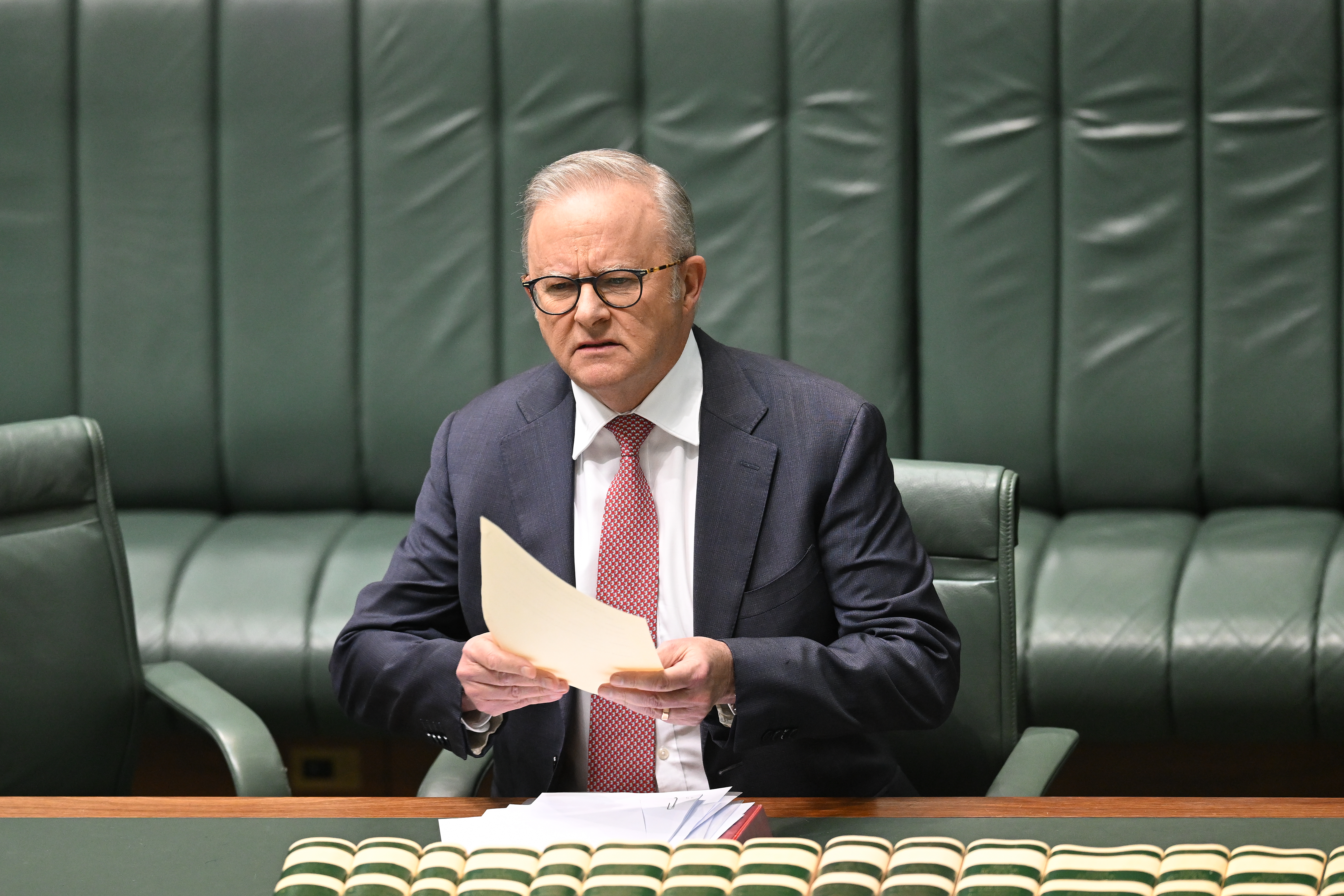
The Member for New England Barnaby Joyce during question time in the House of Representatives chamber of Parliament House in Canberra this afternoon.Photograph by Mike Bowers. Wednesday 16th September 2026. Photograph by Mike Bowers.

OK, after sitting through the afternoon session of the house and also what passes for political questioning this late in the day, I’m about ready to run into a wall.

So instead, I will put the blog to sleep and save us all from this misery.

Really looking forward to seeing you tomorrow morning where we will (unfortunately) be doing it all again. But this will be the last day for three weeks! So huzzah for that.

We’ll be covering off all the migration ‘debate’ tomorrow with Burke’s speech – a lot of it will be dropped out to the media in the morning so you won’t have to wait too long – but we’ll be there with fact checks and the vital question no one seems to be asking – what actual problem are we solving here?

Until then – take care of you.

Australia has an illness system, not a health system

Angus Blackman

Soaring specialist costs, an increasingly complex system, and Australians getting sicker for longer suggest all is not well in Australian health care.

On this episode of Follow the Money, Dr Luke Slawomirski and Matt Grudnoff join Ebony Bennett to discuss the soaring cost of specialists, why pushing people towards the private health system doesn’t take pressure off public hospitals, the government’s proposed changes to private health rebates, and how to ensure Australia doesn’t backslide towards US-style health care.

Don’t give billionaires more free stuff

Ed Husic is speaking to the ABC, where he is asked if he has any issues with AI not paying for copyright on Australian content it trains on, after the Coalition was like – maybe we should cos of national security (everything is national security these days – easiest way to ram something through the parliament)

Husic says:

We have billionaires on their way to become trillionaires wanting a free lunch paid for by people that deliver or produce copyrighted material, no free lunch, pay up, simple, bottom line. From my point of view, I cannot reconcile the very definitive position and the Prime Minister took in July in that AI speech he gave is very important you have national leaders focus on this issue, AI, he was very clear we would not undermine the position of creatives through any watering down of copyright and we have this proposal which I believe very clearly undermines what the Prime Minister said. Because this whole thing of having to work back as the creative to block and work out what is there, what you can protect or whatever is not very good for the creator.

The QT view from Bowers

Bit of confusion in the house today.

The Shadow Minister for Industry and Sovereign Capability Andrew Hastie during question time in the House of Representatives chamber of Parliament House in Canberra this afternoon.Photograph by Mike Bowers. Wednesday 16th September 2026. Photograph by Mike Bowers.
The Member for Curtin Kate Chaney during question time in the House of Representatives chamber of Parliament House in Canberra this afternoon.Photograph by Mike Bowers. Wednesday 16th September 2026. Photograph by Mike Bowers.

This man gets paid more than $200,000 a year to basically turn up and talk to whatever media outlet will have him (including a spot so regular on the ABC’s Afternoon Briefing show, it’s become a bit of a gallery joke)

The Member for New England Barnaby Joyce during question time in the House of Representatives chamber of Parliament House in Canberra this afternoon.Photograph by Mike Bowers. Wednesday 16th September 2026. Photograph by Mike Bowers.
The Minister for Small Business Anne Aly, Minister for Communications Anika Wells, and Minister for Housing Clare O’Neil during question time in the House of Representatives chamber of Parliament House in Canberra this afternoon.Photograph by Mike Bowers. Wednesday 16th September 2026. Photograph by Mike Bowers.

ACT Labor Government more vulnerable after censure motion, confidence and supply agreement not renewed

Bill Browne

ACT Attorney-General Tara Cheyne has become the third Labor minister to be censured after the ACT Government has proceeded with closing some libraries on weekends. Transport Minister Chris Steel was censured last year for the “disastrous” roll out of the MyWay+ ticketing system and Education and Housing Minister Yvette Berry three months ago for a “sustained record of failure” in her portfolios.

The censure motions are possible because no one party has a majority in the ACT Legislative Assembly. Greens, Liberals and an independent voting together have the numbers. Whereas in earlier parliaments Greens had used their position to negotiate ministries and therefore were part of the government, in this term the Greens are a crossbench party focused on scrutinising the government.

Quite apart from the censure motion, today the position of the Labor Government became more perilous because the Greens have decided not to renew their confidence and supply agreement. It had expired after Shane Rattenbury stepped down as party leader, and new leader Jo Clay and Chief Minister Andrew Barr have not been able to agree on a new one. A confidence and supply agreement is a promise to not bring down a government, either directly or by cutting off its funding.

Governments do not need a confidence and supply agreement to survive – Australia Institute research last year found a couple of examples of governments without an agreement, one of which ended on the government’s terms. But it is a sign of worsening relations: Labor has gone from governing in coalition with the Greens to governing with an agreement to governing with no agreement. 

In these days of miracles and wonders, you can watch the full censure debate yourself if you want to see the arguments of each party. We think of a large crossbench as bad for the government, but here it was two independents – Thomas Emerson and Leanne Castley – who came to the (qualified) defence of the minister. A diverse, broad crossbench can actually help a government by giving it different avenues to appeal to. 

More on Sue Neill-Fraser

Anna Chang

Earlier today, Senator Jacqui Lambie also made this contribution on the Sue Neill-Fraser Supreme Court case, brought on by the Human Rights Law Centre, which we also reported on in yesterday’s liveblog.

That the Parole Board of Tasmania is instituting parole conditions using AI and containing fictitious case law is shocking, and the public is rightly concerned. 

Worrying is that Senator Lambie suggests that’s just the start, and points to an upcoming inquiry into the Tasmanian police.

Senator Jacqui Lambie:

Sue Neill-Fraser was found guilty of murdering her partner Bob Chappell aboard their yacht in Hobart in 2009. Ms Neil-Fraser has always protested her innocence, and no body has ever been found, no murder weapon either. 

But she was convicted and sentenced 26 years in prison. Sue was released on parole in 2022, thank God. But when in late 2024 she was approached by 60 Minutes. 

Ms Neill-Fraser did the right thing and advised the parole board about a possible upcoming story. The parole board of Tasmania added a condition that she not that she not speak and I quote “directly or indirectly with any media outlet to claim her alleged innocence or wrongful conviction.” End quote. 

But then in May 2025, they made the condition even more restrictive, which meant she couldn’t even talk about her case with her family, her friends, and her supporters. 

Yesterday, the Supreme Court in Hobart, Justice Stephen Estcourt, ruled the condition was invalid because it denied Sue Neill-Fraser procedural fairness, was legally unreasonable, and created uncertainty. 

But wait, that’s not the shocking part. 

Neill-Fraser’s barrister Patrick Coleridge told the court the parole board secretary used artificial intelligence to prepare a rationale justifying the parole condition, citing case law that was fictitious and likely AI hallucinations. 

Sarah Schwartz from the Human Rights Law Centre said yesterday, and I quote, “It’s really concerning that the Parole Board of Tasmania, a public authority, used AI in generating this document, so that severely has restricted our clients’ fundamental freedoms.” End quote. 

Well, I hope the Human Rights Law Centre and others will be watching the upcoming parliamentary inquiry into Tasmanian police, because let me tell you, there is a lot more to be concerned about.

Question time ends

So after all that hype from the Coailiton – again, nothing. And as always, it was left to the independents to ask actual questions (same story in the senate as Anna has been reporting – she really takes one for the team watching the senate as she does and I am so grateful to her for it!)

So we got a hodge podge of questions that also show where the masters are – that was the fourth question in two days on an advisor who was sacked after their tweets about conservative Sky/News24 commentator Peta Credlin became known – but Coalition conservatives have to be shown to be defending their team.

Then we had a bunch of…nothing.

It again shows you how little the Coalition matters in all of this – the political cycle is not being driven by them in the slightest. One Nation, with one lower house MP and a conspiracy of senators is dictating everything and that’s what the mainstream political and media class are responding to.

If only someone could have predicted this. (Oh wait, I did, BEFORE the last election).

Indigenous Australians are 18 times more likely to be imprisoned

Greg Jericho

Today the latest corrective services figures were released by the ABS. They generally get ignored. But they not only should not be, they should provoke horror.

In June, 18,369 Aboriginal and Torres Strait Islanders were in incarceration. That works out at 2,719.3 per 100,000 people some 18 times larger than the 149 people per 100,000 among the non-Indigenous population.

It highlights the horrific and systemic inequality in the justice system and society in general. Indigenous Australians have higher rates of unemployment, poverty and lower life expectancy.

It is rather telling that Indigenous Australians are only 12 times more likely to be placed in community-based correction then non-Indigenous Australians

That suggests that Indigenous Australians are more likely to be placed in prison rather than community-based correction.

While we don’t have the breakdowns per crime type, it does suggest Indigenous Australians receive harsher penalties.

Albanese condescends on actual other solutions to budget holes

After Tony Burke tabled the document about the former Dutton staffer and key Brethren contact now working for Angus Taylor, the Coalition tries to table a document about “multiple acts of intimidation by the CFMEU on polling booths around Australia and donations made by the CFMEU to the Labor Party”.

Leave is denied.

Monique Ryan (in her second question for this QT – that’s some quick footwork!) then asks:

My question is for the Prime Minister. Prime Minister, the health minister’s looking for some budget savings to pay for aged care. Might it be better to perhaps tax oil or gas properly to cut the $11 billion a year diesel full rebate or considering the $368 billion we have sunk into the AUKUS agreement rather than looking for savings in the pockets of pensioners?

Anthony Albanese (rather condescendingly it has to be said)

I thank the member for her question. And I note the Leader of the Opposition saying ‘Hear, hear’ To all of that. Urn like the Leader of the Opposition, we support AUKUS.

Unlike the member for Kooyong, we think AUKUS is an investment in Australia’s safety and security.

We think that it’s about jobs, it’s about making sure that we’re resilient and, yesterday, of course, we commemorated five years since the AUKUS agreement, something that I supported until that moment and the comment of the Leader of the Opposition had bipartisan support. 

But yesterday at the Australia-America Chamber of Commerce, I was proud to speak about the five years since the AUKUS announcement.

And also, to acknowledge the 250 years since, of course, the United States was formed and to wish the American business people investing in Australia as well as Australian businesses investing in the United States the very best.

We think this is worth while investment. We think, also, it comes to the other issues that the member has raised, we think they’re worth while investments as well. We think that the investment and support of the resources sector do contribute taxation to Australia, and do contribute to Australia’s wealth, and have done so in particularly in the postwar period. 

Now, we always acknowledge the work that’s done, but to be clear about, as the Minister for Health has made clear as well, this was a change that was made. A change that was made by the Howard government.

We are making sure, as part of aged care reforms, that we have proper funding available to make sure whether it is aged care residential, or whether it be care at home as well. And that’s why we’re putting in place these measures.

We’re a government as well that you can’t say that what we need is responsible fiscal policy, and every time the government comes up with a responsible fiscal policy, say that you’re opposed to it.

That’s what those opposite do.

I expect the Independents don’t have to come up with a budget, and that’s fine. All care – no responsibility. But as a government, we have to… The alternative government’s opinion is that they don’t understand that they should as well.

The Coalition tries to table that same document. Leave is denied.

One Nation doesn’t know what it is talking about – on any issue.

It is not often that I will point you to News24 – but for anyone following the trainwreck that is the One Nation state leaders and the way they handle any issue – you should read this

News Corp doesn’t really know where it stands on One Nation, but occasionally its reporters prove they are capable of actual, contextual and factual journalism.

Here is a taste of the absolute trainwreck of an interview:

Asked about how many late-term or sex-selective abortions there were in NSW, Mr Newman was unable to cite any figures.

“Sorry, there are some late-term that are being … I don’t have the exact numbers off the top of my head. I’ll be brutally honest with you there,” he said.

“I think there are something like, well, there are 73 million abortions worldwide and we come into an Australian context, the numbers are lower.”

And again

Tony Pasin gets another question about Rhys Muldoon:

Did the Prime Minister provide Rhys Muldoon with a reference for his Australia Day Ambassadorial role? Or indeed for any other roles?

Albanese:

I’m asked about Mr Muldoon. And about his comments. And about the roles – and about to roles that he has played. And about the roles that heOrder.has played. Let me say this.

There are two roles in which action has been taken. One was he was a relief staff casual employee for [Tasmanian] Senator Dowling, and the comments, when people became aware of them and the Senator became aware of them, he took immediate action and that’s appropriate.

With regard to his role as an Ambassador, which my understanding – I’m advised he’s been an Ambassador since 2014. I’m advised that he was not an Ambassador this year, in 2026, and the assistant minister has taken action today, who has responsibility for those issues, to clearly say that it is not appropriate for him to be an Ambassador.

I find his comments outrageous and completely unacceptable.

Tony Burke then gets up:

I table a document which states that parliamentary records show former Peter Dutton staffer Jackson Hope, who was previously named by Liberal sources as a key point source for the Brethren during the campaign within the Opposition’s election campaign for coordinating the Brethren’s involvement is now working in Opposition Leader office…

Dan Tehan then says there has been an unparliamentary remark. Albanese says there wasn’t. The chamber moves on.

Lidia Thorpe: Has a genocide occurred on this continent?

Anna Chang

It is unusual for Minister to have to ‘wing it’ on answers in QT but we saw it today in the Senate, with Senator Lidia Thorpe asking Minister Penny Wong (representing the Prime Minister) ‘whether a genocide had occurred on this continent.’ And Minister Wong gives the most carefully worded and respectful answer she can muster.

Senator Thorpe: 

My question is to the Minister representing the Prime Minister, Minister Wong. 

Does your government agree that a genocide has occurred on this continent? 

[barely picked up on the mic, Minister Wong looks at her folder and says under her breath ‘I don’t have anything on this’ before rising to her feet to answer]

Minister Wong: 

Senator, I understand that is a word that is used as a political point. There’s also a legal definition, and what I would say to you… 

[ Minister Wong turns to others in the chamber and says: I’m sorry, we don’t need that. ]

No, no, I actually.. What I was going to say is I dont— I think different Senators, including in our party, would have used different words. 

But what I would say to you is I think the history of First Nations people in this country is a history that involves not only hardship but also brutality and death and murders and disproportion, and we are very aware of that, and I don’t want… — I appreciate the point you’re making — but I don’t want the sort of definitional argument to suggest that in any way that my or the Government’s views detracts from that. 

Senator Thorpe, first supplementary:

Groundbreaking peer-reviewed research published in Nature Journal yesterday shows 2.2 million First Peoples lived on this continent before invasion. 2.2 million, not 250,000 as previously thought. Over 2 million people were wiped out in the first years of invasion. What would you call wiping out up to 2 million people, if not genocide? 

Minister Wong: 

Senator, and I’m grateful to my colleagues who have provided me with some additional information, in particular in relation to the Europe Justice Commission finding. 

What I would again say to you is this: First, we know that Aboriginal and Torres Strait Islander peoples have lived and thrived for over 60,000 years, and we know we  and it is important, that we, as a country, know and understand what has happened in Australia, including history that has not been spoken of and history which has not been taught. And part of that history is other painful truths, which some of which you have alluded to-that there was, as I said, brutality and killing and dispossession-and I am one that does believe that we should talk about that and understand that more. And if more Australians did, we might be passage 

Senator Thorpe, second supplementary: 

Thank you. Have you, or any former Federal Government ever investigated whether a genocide has occurred on this continent? 

Minister Wong: 

Well, Senator. I think what I am saying to you, and what the Government’s view is, is that we should have more telling of the truth of our history. And different people will have different words to describe that, but we should have more truth-telling. 

And if I may say, you asked this question of me in a week where great disrespect has been shown to First Nations people. If we understood better as a country our history, as painful as it is, then it might be that there would be more respect and understanding shown to our First Nations peoples.

Security threats to MPs almost doubled over last five years

Tony Burke then takes a dixer on the same topic. And he is mad. (He gets a certain tone in his voice which is how you can tell):

Security threats to members of Parliament have increased and almost doubled over the last five years. From 583 five years ago to more than a thousand in the last financial year. 

There are roles that everybody has during campaign time in making sure that if volunteers behave in an unacceptable way we get them off buttes and get them off polling areas but it is of a different order, of a completely different order, when we hear the allegations that are happening at the moment na are being made into the Joint Standing Committee on Electoral Matters because I have not previously heard of situations where individuals had been paid to stalk, paid to disrupt, paid to intimidate.

Paid to intimidate.

Wouldn’t you think the Leader of the Opposition, on hearing something like that, might join together and simply react with, ‘That is unacceptable.’

But that’s not the reaction from that man.

That man, he has been hearing me saying the words paid to stalk, paid to disrupt and paid to intimidate, and nothing in his character gives him pause for thought.

Nothing in his character gives him a moment where he says those things might be unacceptable.

The member for Blair, the member for Blair harassed, stalked, followed to his car, the member for Calare, candidates coming up in large numbers, booth to booth to follow and physically intimidate.

The member for Corangamite physically blocked from being able to conduct conversations with constituents.

Recent media reports have said the following, a crew of far-right agitators paid to harass the Prime Minister and his ministers as well as Greens and teal independent candidates.

They use guns for hire outside the church, Neo-Nazi associates, pro-Putin conspirators and even an ex-Liberal staffer among them. One of the people involved earlier pictured alongside Neo-Nazis at a white supremacist gathering in Melbourne, and chat logs revealed he also appeared in private Neo-Nazi groups on Telegram.

Every Member of Parliament should hear that and condemn it.

Every Member of Parliament who hears that should say, ‘This is not what Australian democracy is meant to be about.’

Many members of this House, on each side, have had calls from me where there have been threats to your security. And without exception I want everyone to be able to participate in our democracy and do so safely and when they hear allegations like this to fearlessly condemn them.

Christian Brethren and far right under the spotlight (finally)

Amanda Rishworth, representing Don Farrell as the special minister of state, gets a dixer on democracy (a day late) but speaks on the need to protect it:

Yesterday was the international day of democracy, a reminder that our democratic system is something that we all, as Australians, must work together to build and maintain.

Because our democracy is about more than getting out and casting your vote every three years. It’s about being able to speak up and advocate for your communities.

It’s about promoting facts over misinformation.

It’s about being able to participate free from intimidation.

Recently, through the important work of the Joint Standing Committee on Electoral Matters, we have seen the anti-democratic and intimidatory behaviour of some groups of the last election exposed.

This includes the Christian Brethren with their ties to far-right extremists who they use to try to influence the last election. Make no mistake, the goal of the Brethren was to elect the Liberal Party.

As the Sydney Morning Herald reported, the stunts were just one arm of the Bretheren church’s multimillion-dollar undisclosed efforts to help elect Peter Dutton as Prime Minister.

Leaked internal Bretheren material exposed in the Age and Sydney morning herald showed coordinated plots by the Bretheren and their far right wing extremist friends to harass and intimidate political participants.

As the Sydney Morning Herald reported, chats on encrypted apps show Brethren figures tailed politicians and fed private intel on their locations to far-right activists with a history of white supremacist association. I note of particular concern in the media reports the allegation that senior Brethren business leaders used a duffel back of cash to Faye and pay far-right extremists and Neo-Nazis to ambush campaign events.

These allegations are disturbing and disgrateful and have no place in our society. The Opposition needs to come out and condemn these actions of the Bretheren and they need to answer questions about what they knew about these alleged arrangements.

On the ground, I heard from too many Australians that they were intimidated, and overwhelmed by the hostility of behaviour at polling booths. I think we can all agree that threats and intimidate and indication have no place in our democracy.

They are utterly disgrateful.

Policy should be about a contest of ideas, about how to make our country better. We need to be able to have a respectful debate in this country. No matter what side of politics you’re on, it’s important that all those participating in our elections are able to do so free from physical intimidation and harassment.

Back on sacked advisors

Q: Yesterday in question time the Prime Minister described a series of vile posts about conservative women by his close friend Rhys Muldoon as completely unacceptable. Today the Prime Minister was forced to sack his grubby mate as an official Australia Day Ambassador.

Can the Prime Minister give us a straight answer. What involvement did he have in Mr Muldoon’s appointment as a Labor advisor and did he provide Mr Muldoon with a reference for his Australia Day role?

Albanese:

On the first part of that question, none. On the second part, he’s — his Australia Day role began under the former Coalition government. And in [another] state, and his appointment had zero to do with me.

An actual sensible question about migration

Helen Haines asks a sensible question (timeless statement):

Recent changes to visa processing including the removal of regional priority for skilled visas and a go slow on working holiday visas are having dire consequences for regional Australia. Agriculture employers in my electorate are desperately waiting to refill shortages in nursing, fruit picking, meat processing and even bushfire recovery. Minister,will you urgently reverse your direction and update the go slow?

Tony Burke:

I thank the member for Indi for the issues she’s raised. I have had these issues raise me by a number of members around the chamber, the member for Indi has written to me on this.

None of the regional members on my – on the government side, including in particular I’d single out the Minister for Agriculture being – raising to work through these issues.

We do need to get net overseas migration down, we do. And while some – I noticed a motion – a private members’ motion from a member of the National Party this week. Some people seem to feel you can get net overseas migration down while having the same number of migrants.

To be able to work through this, we need to be able to make sure that we deal with the numbers – we need to make sure that we deal with the numbers overall and do so in a sensible, targeted way that provides the easiest pathway through for the Australian economy.

People would be aware that I’ve been working through these issues and people would also be aware that there’s further to be a – further issues to be announced tomorrow.

But let me say this.

The more – basically since the Hawke in part and largely the Howard years a whole lot of our immigration system has been demand driven – a whole lot of our immigration system simply functions by virtue of applications being made and processing speed is the one of the only things with planning lefts that we currently have available. The more tools that are available the better we can target the system. The best form of outcome there will be if we are able to sort our way through for a legislative option. In the absence of that, there are still more levers the government will be able to use and I’ll be making those announcements tomorrow.

Brace yourself for the coming economic shitstorm

Jim Chalmers takes a dixer to talk more about the economic shitstorm heading across the globe (largely thanks to our ‘allies’ the United States and Israel, which he doesn’t say – but is true) and says:

It is the case that the global economy is increasingly uncertain, we have seen more evidence of that in the last few days. The Brent oil price is up around US $108 per barrel now, that’s up 55 per cent higher since the war in Iran started. We can see how markets are worried about the impact of this, and inflation by looking at how they’re pricing in around the world interest rate hikes and longer term bond yields.

If you look at the markets around the world, Mr Speaker, they are now pricing in three interest rate hikes in the US, four in Canada and the UK, and another three in Europe.

The US Federal Reserve will meet early tomorrow Australian time and we’ll be watching that closely, just like everybody else. Higher interest rates and higher Iran nation globally is pushing up borrowing costs right around the world. That is a source of concern to us and to other countries.

Yesterday the US 10-year yield reached its highest rate since 2007. Since the conflict started, the 10-year yield is up 105 basis points in the US, 115 in the UK, 80 in Canada, 90 in Germany and around 75 basis points here in Australia. In the case of so much global volatility, responsible economic management is as important as it has ever been. The good news, Mr Speaker, is because of our responsible economic management, we have got much lower to gross debt to GDP than every single major advanced economy.

We have one of the three strongest budgets in the G20 according to the IMF. Australia’s one of only nine countries with a triple A sovereign credit rating from all three major ratings agencies, reaffirmed by two of them in the last few weeks. SNP said Australia’s fiscal performance is sound and Australia has modest public debt by international standards. Moodies said debt ratios at the level remain low and the government’s fiscal strategy is…..top objecting.Mr Speaker n contrast, those opposite have already racked up more than half a in unfunded commitments. $110 billion or so over the forward estimates on their own, Mr Speaker.

Sensible people know developments in the Middle East are pushing up inflation and weighing on growth. And weighing on markets around the world. Those opposite want to pretend that government spending is the primary determinant of inflation around the world right now. By their own logic, their own half a in higher definite fits and more debt would push up inflation and push up interest rates. Our responsible economic management is helping to shield Australians from intense global economic uncertainty.

It is also historical fact that Labor tends to come to power just as the world economy goes to absolute shit. Almost as if the biggest defenders of neoliberalism (historically conservatives, but more and more ‘centre left’ parties – fuck it all up, and then others take the blame for it)

On economic risks

Berries and Cream gets a go – and he is very proud of this one.

There are media reports this morning of Labor backbenchers mocking the Treasurer’s inflation excuses. One MP is reported confessing, ‘A lot of what we have done is for cost of living relief for voters which has an inflationary impact’ –‘. Another is reported to have expressed doubt that it was appreciated how markets functioned. Another said, “People are getting quite worried.’ Treasurer, what do you have to say to the member for Parramatta now? (That’s a riff that Andrew Charlton wants Chalmers’ job and is leaking – of which there is no proof, but Wilson assumes it will get to Chalmers)

Chalmers:

I take my colleagues much more seriously than his colleagues take him. That’s the first point. That’s the first point that I would make, Mr Speaker. Of all the people to ask a question like this, I don’t think the karaoke clown over there…

Chalmers is made to withdraw (it’s a reference to when Wilson sang in the chamber, really, really badly)

Chalmers:

The specific matters raised in the honourable member’s question did not come up in the briefing that we did earlier in the week on…but as I said at the start of my answer, I do take my colleagues seriously and I take our economic challenges seriously as well. It’s why I make myself available to discussions with the parliamentary party, it’s a very informed and very engaged group, and I will continue to engage with them in good faith about the most important issues.

It’s also true that people are under pressure, and that’s why this whole government, from the backbench to the frontbench is focused on inflation and productivity and the global environment and where that’s coming together right now is in the fallout the war in Iran which is playing out in higher cost of living and also higher borrowing costs as well.

Because we take these issues seriously, we’re managing the budget in the most responsible way na we can, a much more responsible way predecessors.

It’s why we have the broadest productivity package of any government in decades 6789. It’s why we have an ambitious tax reform package which is about cutting tack tax — income taxes for workers and giving the first home buyers a government it’s why we have a big emphasis on fuel security and the energy transition.

It’s why we’re providing cost of living help via the tax system, bulk-billing, higher wages, and because we take our economic challenges seriously, the intergenerational report we release on Monday will be really important that. Here’s what this briefing that I did with my colleagues was all about earlier in the week, Mr Speaker – This country does face serious economic risks….

(Henry Pike is booted under 94A)

Chalmers:

…like every country right now, does face serious economic risks. But we are unique in the world in that we also have very substantial opportunities as well. The intergenerational report will show we are focused on both of those things, the — things, the risks and opportunities n a global environment write is only becoming more volatile and more uncertain as we go. As we work through these issues, in the serious way that this moment demands Hoff us, I will always do my best to include all of the colleagues in that as we work through, whether inflation, productivity or the global environment. We will take these things more seriously than those opposite take them.

Lambie rips into Open AI, backs Ed Husic AI safety bill

Anna Chang

Senator Jacqui Lambie has given a speech ripping into AI, highlighting that non-retrospective laws won’t be in place until mid-next year, while data centres are being approved now.

Senator Lambie also gives a shout-out to former Minister, Ed Husic and his work on an AI safety bill before he was dumped from the ministry, and his draft bill was scrapped.

Senator Lambie:

Every time big corporations get a sniff of any regulation, they threaten to leave the country. Now, big tech is jumping on the bandwagon. 

Open AI, that’s ChatGPT, by the way, has issued an ultimatum to our own government, telling the Prime Minister that if he doesn’t walk away from his promise to the Australian people to protect our copyright laws, then it won’t even consider investing in training in this country, basically, let AI suck up all the Aussie music, books, movies, and art, or we won’t be investing in this country. That’s their ultimatum. 

They tried this on in the UK, but the British Government told them they weren’t changing their copyright laws. They are trying it on here. Big tech is trying this on all over the world. They’re like dinosaurs from Jurassic Park. They’re testing the fences. They tried it on in Europe, and Europe also said no. In Denmark, they have gone one further. They’ve been bigger. They are passing laws that give people control over their voices and their images. With other Western countries standing up for their copyright laws, we are next. 

As the Australian Open AI CEO told the Australian newspaper, and I quote, “We are a good target.” End quote. 

AI are doing nothing but bullying the Australian government into letting AI steal Australian stories in exchange for AI training. This is such rubbish. It’s not hard to pay for copyright. Australia already has a copyright system that protects its artists and makes sure they are paid for the work that they do, and that is the way it should be. 

Big tech just doesn’t want to pay; they want it for free because they’re greedy and have no moral compass. And it’s not like they don’t have the money, eh? Some of these companies are valued in trillions of dollars. Some of them have more money than nation states. 

It’s not that they can’t pay; it’s that they. don’t. want. to. pay. It’s that simple. 

The Government needs to stand their ground. The Prime Minister has said that no company should use Australian creative work to train artificial intelligence without permission, because that is simply theft. 

The Labor Government says it’s bringing on laws to deal with AI and data centres in January. That’s good, but we really need to get going on this stuff. 

The Government says these new laws will make data centres limit their water use and pay for their energy. That’s all good, but we won’t see these laws until January. We don’t sit until February, and it will be very unlikely they will be in place and working for the before July 2027. 

Meanwhile, the data centres they already have approved won’t be touched by these laws, because these laws won’t be retrospective. That’s the first stupid move you’ve made. 

You know what the problem is here: AI data centres, copyright laws, big tech is moving off the speed of light, speed of light, and our laws aren’t keeping up. 

So, we are playing catch up as usual, and we didn’t need to be. Former Minister Husic worked on an AI safety bill for three years. Three years, he put his heart and soul into it. Then the Government moved him to the backbench and scrapped the bill. 

If you go back over comments from Labor Ministers after that happened, all we heard that Australia was a great place to invest, and Australia is a great place to invest, but that doesn’t mean we give trillion-dollar companies a free reign or a free ride.

Still pretending rate rises are the fault of government.

Julian Leeser asks Anthony Albanese:

On the Prime Minister’s watch interest rates have risen 15 times, economists now predict two more rate rises this year. This would see the average new mortgage holder paying nearly $33,000 more per year under Labor. When will the Prime Minister take responsibility for Labor’s 15 interest rate rises?

Do we need to fact check this for you, or are you across it?

Albanese:

We understand that Australians are under cost of living pressure. That includes the impact of decisions that are made by the independent Reserve Bank. That is why we are focused on delivering real, lasting cost of living relief.

We want to help Australians under pressure here and now while building our economy and our resilience for the future. That is why we have taken action.

That is why we have introduced free TAFE with 850,000 people enrolling. That’s why we have the policies of cheaper medicines. That’s why we did the support for student debt as well.

That’s why we have supported the increases, as I have just said, in the minimum wage. That’s why we have supported penalty rates and enshrining them in law as well as the right to disconnect. That’s why we are giving young Australians a fair crack at getting into their own home.

All of that is about acting on the cost of living. All of that is about delivering real change. And all of that is and that was…

There is a point of order that is not a point of order.

Albanese:

That’s why, Mr Speaker, we have put in place those measures to assist people. The Liberals and The Nationals and One Nation have a different view. They want to decimate Australia’s superannuation, they want to make it easier tore back and sack workers and cut wages. They want to scrap paid parental leave, they want to gut Medicare.

There is another point of order that is not a point of order.

Albanese:

Of course the fight against inflation is a priority for this government. It’s a fight we inherited, it’s been made harder by current international events all around the world are dealing with this. That is just a fact. You know what, there is someone who doesn’t want low interest rates in this House.

That’s someone who is on the record saying, ‘Nobody wins from low interest rates.’ someone who also said, ‘A different time in Hansard, “I deliberately communicated my concern about the Reserve Bank continuing to cut interest rates.’ And we had another quote, ‘We need to create the policy settings to progressively increase interest rates.’ You know what? The Leader of the Opposition made him Shadow Treasurer. That’s the member for Goldstein.

Everything is totally fine

Zali Steggall asks this question just after Milton Dick welcomes Dr Maina Vakafua Talia the Minister for Climate Change and Environment for the Government of Tuvalu and Honourable Senator Rosa Galvez, Canadian senator for Quebec to question time.

Here they are at an earlier press conference on the need for climate action.

Dr Maina Vakafua Talia the Minister for Climate Change and Environment for the Government of Tuvalu at a press conference in the Mural Hall of Parliament House in Canberra this morning.Photograph by Mike Bowers. Wednesday 16th September 2026. Photograph by Mike Bowers.
Canadian Senator for Quebec Rosa Galvez at a press conference in the Mural Hall of Parliament House in Canberra this morning.Photograph by Mike Bowers. Wednesday 16th September 2026. Photograph by Mike Bowers.

Steggall:

Last year Australia signed a declaration supporting a just and orderly transition away from fossil fuels. Today Tuvalu’s climate change minister and a Canadian senator are here asking for stronger global action. Yet last week the Prime Minister pledged in Palu and law to work with tour Pacific family on climate action while his resources minister celebrated the expansion of fossil fuels with the Beetaloo Basin. How can Australians and the Pacific trust this government’s commitment when it continues to support and expand fossil fuels?

Chris Bowen takes this one:

I can assure the honourable member that the Pacific family and the Albanese government are working together in the closest possible fashion, and the Pacific Islands Forum in Palau, two weeks ago, was one in which the Prime Minister was working with his counterparts in the closest possible fashion, and the Palau declaration made clear that the Pacific leaders and the Pacific and Pacific family regard climate change as the single biggest threat to their livelihoods and security and we agree, we agree wholeheartedly.

That’s why Australia is taking such action as we are domestically, to show the rollout of renewable energy across our country with having passed 50 per cent in the last quarter of last year and every quarter since has exceeded the record for the relevant quarter. That’s a good thing but we have a lot more work to do.

We’re also working closely with the Pacific family internationally, and I recognise my friend Dr Talia, the climate change of Tuvalu, who I’ll be spending time with in the next few weeks, as the Prime Minister will be, to elevate the issues of the Pacific on the global stage. 

That’s a good thing.

We certainly on this side of the House think is very important. I know the crossbench does as well. I wish it was a more unanimous view across the Parliament that that was a good thing. We will continue to work so closely with the Pacific because it is such a vital issue but I’d say this to the honourable member. The way that you build renewable energy is the pathway for transition.

You’ve got to build the new energy before you replace the old energy. That’s what we’re doing domestically and it’s a conversation we’re involved in a very serious way internationally as well.

Sure, Jan.

Anika Wells has talked about deepfake material

Greg Jericho

She noted that

“The Albanese Labor government is committed to working with the tech industry to ensure that Australia can capture the opportunities and spread the benefits of AI. But on behalf of Australian parents, one issue we are not willing to negotiate on is online safety and particularly that for young people. If tech companies want to do business in Australia they must obey Australian laws. Australia’s state and Federal laws prohibit the publishing and distributing of sexualised non-consensual deep fake material and AI generated child sexual abuse material”

Perhaps she might want to talk to the rest of the government including the Departments about continuing to use Twitter.

This week the New York Times reported

Despite Pledges From Musk, Child Sexual Abuse Material Persists on X

Reviews by the Canadian Center for Child Protection and The New York Times found that explicit images of children remain on the social media site owned by Elon Musk.

And that:

“A review by the Canadian Center for Child Protection found that the site’s own artificial intelligence chatbot, Grok, responded to requests from users by creating dozens of sexualized and sometimes sexually explicit photos of children, including victims previously known to law enforcement, at the beginning of the year. The images included children in sexualized poses with partially exposed genitals, in states of undress and with fluid on their faces.

A separate analysis by The New York Times found that during the first half of the year, users on X posted child sexual abuse material previously flagged by authorities, including some of the most egregious content that the site attempts to block using automated filters.”

There was a time that would have been red line, that no government would have want to be associated with.  No longer.

Labor very keen to focus on digital duty of care – which tells you their focus groups think it is a winner

We get another dixer about protecting kids from social media feeds from Tanya Plibersek, which tells you where the government’s head is at:

…We know that rates of sexual violence in this country have been exploding, particularly amongst young people. We know that rates of sexual violence have increased by 70 per cent. Teenage boys are now the most likely perpetrators of sexual violence towards children and other teenagers, and increasingly concerning, almost 60 per cent of young Australians say that they have experienced sexual strangulation. 

There is no safe way to strangle someone. Mr Speaker, all the experts I speak to – the parents, teachers, the police – will tell you that there is a link between what young Australians are being fed online and the harms that are spilling over into the real world. Teachers in particular and teenage girls are telling us that this behaviour’s turning up in classrooms and it’s affecting their education.

We know that it takes just 23 minutes for an account – a social media account mimicking a young boy to be fed misogynistic content online. A young man sets up a social media account, he’s checking out the cars, the footy scores. Within 23 minutes he is being fed misogynistic trash, whether he has gone looking for it or not. What our young people are being fed online is seeping into the real world. The tech giants do not care. We have to make them care about this.

Creeping war on abortion rights continues

Jack Thrower

Addressing an anti-abortion protest yesterday, the NSW One Nation leader Mike Newman said “We want to support people who want to make sure that abortion rights — we want to stop them”. He has since backpedalled, claiming that it was a “foot-in-mouth moment” and he was only referring to sex-selective and late-term abortions. Regardless of intention, obliviousness of the implications of these statements is concerning in itself.

More worrying than words are actions. One Nation is likely to support a bill before the NSW Parliament that would ban ‘sex-selective’ abortions, despite a 2020 review by NSW Health finding essentially zero evidence of sex selective abortions in NSW. The Royal Australian and New Zealand College of Obstetricians and Gynaecologists has described the bill as “predicated on misinformation” and that the “underlying aim is to restrict access to abortion”. Meanwhile One Nation Senator Malcolm Roberts is seeking make a blanket ban on abortion the official party policy.

Australia already has problems with access to abortion services. Legislation that made abortion legal in all states has improved access on paper, actual access is often limited, particularly for those living outside of major cities.

Restricting abortion access is also highly unpopular, including among One Nation voters. Polling from March showed that three in five (62%) of Australians support access to abortion services, one in four (25%) support access in limited circumstances, and only one in twenty (5%) do not support access.

Ed Sheeran left without supporting acts over Macklemore censorship

Skye Predavec

Ed Sheeran’s “Loop” Tour has been left without supporting acts after the removal of American rapper Macklemore prompted the remaining acts to pull out in protest.

How did we get here?

Macklemore is an artist known for his statements in solidarity with Palestine, something he did not shrink from when performing before Sheeran at two concerts in New Jersey earlier this month.

He played his protest song ‘Hind’s Hall’, which references pro-Palestine activists at Columbia University renaming a building in honour of Hind Rajab, a five-year-old Palestinian girl killed by Israeli forces in Gaza in 2024.

Between songs, he also told the crowd that

“A big part of the reason why I wanted to do this tour in the first place is so I could stand up in stadiums like this and say two words that are very near and dear to my heart: Free Palestine,”

“I want those words to be loud and clear, so that people all the way in Gaza, to the occupied West Bank know that we have not forgotten about them,” Macklemore had said during the concert.

These comments caught the eye of Robert Kraft, an American billionaire who owns one of the stadiums Sheeran will appear in, who coordinated with some other stadium owners to deliver an ultimatum: either Macklemore goes, or we’re cancelling your shows.

Ed Sheeran and his team took option 1.

Now the remaining support acts, Aaron Rowe, Lukas Graham and Finneas, alongside Sheeran’s backup band Beoga, have all pulled out of the tour in solidarity.

Sheeran blamed his promoter for the decision, expressing regret that he was “unable to build bridges” between the stadium owners and “activists on both sides”.

The $10 billion question on GLP-1 drugs

Luke Slawomirski

Australia has a weight problem. Roughly two-thirds of adults are overweight or obese, and around 6.5 million Australians are estimated to meet the clinical criteria for obesity.

So the imminent arrival of cheaper, easier-to-take GLP-1 drugs could have big public health benefits.

But what would it do to the health budget?

Currently, GLP-1 drugs are subsidised for diabetics. Subsidising them for all Australians who meet the criteria for obesity could cost taxpayers about $10 billion a year. That’s over half the current cost of the entire Pharmaceutical Benefits Scheme (PBS).

Australians would pay a discounted amount for the drug – as demonstrated by Australia Institute analysis comparing our drug prices to those paid by Americans.

Nevertheless, a $10 billion bill would be considerable.

However, it is only one side of the ledger.

Obesity drives diabetes, cardiovascular disease, joint replacements and plenty of other expensive healthcare. If these drugs produce sustained weight loss across millions of Australians, they could reduce hospital admissions, prescriptions and other medical treatment, while also improving people’s ability to work and stay healthy for longer.

The savings – plus the positive impact on economic productivity – could be considerable.

That doesn’t mean governments should pay whatever pharmaceutical companies ask. Price matters enormously, particularly if these drugs become lifelong treatments.

So would it be worth it to subsidise these drugs via the PBS?

Well, the answer comes down to whether we can afford not to reduce obesity, and if GLP-1s are now a cost-effective way to do that.

JSCEM to recall Plymouth Brethren Christian Church

This seems worth putting on the record:

The Joint Standing Committee on Electoral Matters will hold a further public hearing in October with members of the Plymouth Brethren Christian Church (PBCC).

The Committee has today resolved to invite Mr Bruce Hales and Mr Gareth Hales to a public hearing. The Committee has also resolved to issue a summons to compel their attendance should they refuse to attend.

The Committee will also invite the authors of submissions 312, 332 and 333, along with Mr Lester Sharples, named in recent media reporting, to attend the hearing.

‘Recent media reports about PBCC members paying known agitators and Nazi-associates to disrupt our democracy are deeply disturbing.’

‘Our democracy is more important than the outcome of any one election. Interference of this nature needs to be investigated and condemned by all sides of politics.’

‘Bruce and Gareth Hales are known to be the most senior members of the organisation in Australia. For the Committee to accurately report on the 2025 election, they need to show up and fess up.’

The program for the hearing will be available on the Committee’s public hearings webpage closer to the date. The hearing will be broadcast live at aph.gov.au/live.

Further information on the 2025 election inquiry can be found at the inquiry webpage. Committee details can be found at the Committee’s webpage.

On AI nudes

Anika Wells takes a dixer on the digital duty of care and brings in AI nudes:

The Albanese Labor government is committed to working with the tech industry to ensure that Australia can capture the opportunities and spread the benefits of AI. But on behalf of Australian parents, one issue we are not willing to negotiate on is online safety and particularly that for young people. If tech companies want to do business in Australia they must obey Australian laws. 

Australia’s state and Federal laws prohibit the publishing and distributing of sexualised non-consensual deep fake material and AI generated child sexual abuse material and I commend the Attorney-General for that work. But an ongoing issue is the heavy reliance on victims reporting the deep fakes after the harm has already occurred.

We must move the burden from reporting online harm from the shoulders of victims and stop that harm at the source. We must hold big tech accountable for the tools they are creating and putting out to market including to children. We must create basic, safety standards for big tech just like every other industry in this country – like cars, foods or toys. Under our draft duty of care, the Albanese government will create basic safety and ban so-called nude apps.

The digital duty of care will require all online service providers to ensure that there are systemic and pre-emptive measures in place to restrict the use of nude services and the bill will give the eSafety Commissioner the power to issue take down notices to search engines and app stores that house these nude apps. These apps are solely designed to abuse, bully, harass and intimidate.

The Albanese government is determined to restrict them because whilst the image might be fake, the abuse and the harm is real. Parents know this all too well. One child in every classroom in Australia has now been the victim of deep fake material.

Four out of five of those reported cases are young girls. One Melbourne case, investigators found 50 female students at a single high school were the victims of sexually explicit deep fakes.

The scale of this harm is escalating. The eSafety Commissioner has found a 550 per cent increase year on year in this conduct since 2019. While AI has the power to move Australia forward, there is no place in our country for apps and technologies that are sole lie used to abuse, humiliate and harm people, especially our young people. Australian parents are desperate for help against this surge, which hides in phones, bedrooms and in school yards and the Albanese government hears their calls and that is why the draft digital duty of care legislation will force big tech to listen as well.

And it begins

Angus Taylor has decided he wants some buy in on all of this:

Q:New parliamentary budget officer analysis shows Labor’s budget assumed the humanitarian immigration intake would fall from 20,000 to 13,750. But on 27 August, the Prime Minister texted an ABC journalist to reverse that position back to 20,000, costing over $7 billion. Prime Minister, did the Treasurer or cabinet approve this $7 billion decision before the text was sent and where is the money coming from?

Tony Burke subs in:

This government is proud to be part of a generous humanitarian program. We’re proud of that as a country. It’s one of the things we have had for a long time and can I say the Howard government used to be boast of having a generous humanitarian program.

It’s something that those opposite once saw to be proud of in Australia. It is also the case that it was one the situation where those opposite had someone understanding of terminating programs in the budget and how that works, where some things are budgeted for four years and then they automatically come back for consideration and get renewed. I remember when I first became agriculture minister, something like two-thirds of the biosecurity budget was listed as terminating programs. 

The concept that is in question from the Leader of the Opposition that somehow every terminating program is never intended to be renewed would be the end of portfolio after portfolio. It is a ridiculous assertion, and just shows how far they are from being an alternative government.

Q: My question is to the Prime Minister. Did the Treasurer or cabinet approve the $7 billion humanitarian intake increase? Does the Prime Minister rule out any cut to the humanitarian immigration intake?

Burke again:

I refer specifically to the last part of the question about ruling out a cut. The concept of make it clear that there would not be a cut is exactly the decision that is being referred to in this question.

This government, when we came to office, this government…This government when we came to office made it clear we would be boosting the humanitarian program to 20,000 places. It remains at 20,000 places.

The health risks of gas

Anara Watson

Doctors for the Environment Australia (DEA) launched its Gas and its overlooked health risks report at Parliament House this morning.

The report shows that gas damages health throughout its lifecycle – from extraction to combustion, and as a potent greenhouse gas.

If we needed more reasons to get off fossil fuels, DEA says getting gas out of Australian homes and workplaces will improve health. In the home, gas exposure is linked to asthma and other breathing problems; kids are the most vulnerable to its impacts.

DEA has called on the Australian Government to act:

“gas is accelerating the climate crisis and its immense threats to public health. It contributes to more severe heatwaves, bushfires, droughts and storms that worsen air quality, increases heat-related mortality, and overwhelms emergency departments, while threatening food and water security, changing patterns of infectious disease and placing increasing pressure on Australia’s health system.

It is indefensible that Australia continues to approve new gas developments and invest in infrastructure that risks locking communities into avoidable health harms, higher long-term costs and escalating climate risks. Australia has successfully acted to reduce exposure to other major public health hazards when evidence demonstrated unacceptable risks. Fossil gas should be no different. 

We urge you to exercise your responsibility to protect the health of the Australian people by

·         Providing targeted support to the community to replace gas appliances and disconnect from the gas network

·         Establishing a clear timeline for phasing out fossil gas and rule out approving new gas projects

·         Making the gas industry bear the costs of the health and environmental harms of their product.”

Question time begins

You can expect a focus on migration, despite the fact that no one has identified what structural problem we are actually addressing here.

There is also the drops about the grant issues which will also be brought up, because the Coalition is loving that sick.

Let’s pretend to care about this!

Aussie shares not wavering? Gas companies’

Greg Jericho

As Amy reported, the local share market is having slight conniption as it waits to find out what the US Federal Reserve will do.

But it always worth noting that two companies continue to not have to worry about such trivialities. Gas giants, Santos and Woodside are seeing their share prices continue to rise.

Since the beginning of the Iran War, Santos’ share price has gone up a lazy 29% while Woodside has had a 19% jump. The overall stock market meanwhile has fallen 5% in value.

Even since the Budget and the announcement of a gas reservation policy has had little impact. Santos share prices since the budget s up 11%, Woodside has had a 5% increase while the overall share market is down 1%

It’s pretty obvious the gas reservation policy is not going to hurt the gas company profits at all, and while they can avoid paying PRRT for onshore gas (Santos) or paying royalties for offshore gas and bugger all PRRT (Woodside) things will continue to look rosy.

For them, not the Australian public.

Aussie shares waver ahead of key US interest rate call

Adrian Black for AAP

Australia’s share market has quickly handed back a modest morning gain ahead of a key US interest rate decision, with confidence still shaky in the face of multiple market risks.

The benchmark S&P/ASX200 index rose 3.7 points by midday on Wednesday, up 0.4 per cent, to 8,876.2, while the broader All Ordinaries gained 3.6 points, or 0.04 per cent, to 8,852.9.

The shaky start echoed a nervy session for global market overnight, as Brent crude edged higher to $US108.40 as traders mulled an extended closure of a key Saudi oil pipeline and surging US bond yields.

“This comes ahead of the (US Federal Reserve) policy decision later tonight, where markets and analysts are widely expecting a 25 basis point rate hike,” Westpac economist Ryan Wells said.

“Westpac sees a hike in September and a follow-up in the fourth quarter, as allowing for enough time for the underlying disinflation evident above to be reflected in other measures.”

The energy sector again led the bourse with a 2.7 per cent rally as Woodside, Santos, and refinery operators Ampol and Viva Energy surged on higher crude prices.

The recent plunge in raw materials stocks slowed, the sector dipping slightly as BHP rebounded alongside copper prices as OpenAI’s Sam Altman made a case for industry self-regulation on artificial intelligence-related risks.

Gold stocks sold off sharply despite the precious metal trading relatively steady at $US4,289, ($A6,021) an ounce.

Still, Australian gold miners’ profitability has surged and related exchange-traded funds attracted $115.6 million in net inflows in August, on top of $95.3 million in July.

Those were the two strongest consecutive months in two years, according to Betashares investment strategist Tom Wickenden.

“Return on equity across the gold miner sector was 8.7 per cent at the start of 2026 and has reached 20.6 per cent by August, an improvement of more than 130 per cent in eight months,” he said.

“With structural support to the gold price  … global gold miners could be poised to see significant returns if they maintain their earnings and re-rate higher.”

Battery minerals miners were still under selling pressure, with Liontown and PLS each dropping more than 2.5 per cent as reduced demand continued to weigh on lithium prices.

The sell-down in financials slowed, the segment easing slightly as the big four banks traded either side of break-even.

Consumer-facing stocks retreated from Tuesday’s advance, with staples and cyclicals each losing at least 0.3 per cent.

Bitcoin fell below $US75,000 ($A105,290) for the first time since August after a US cryptocurrency bill failed to pass the American Senate.

In company news, James Hardie shares tumbled more than five per cent after its investor day presentation predicted strong future cash flows but held earnings guidance steady.

The Australian dollar was buying 71.20 US cents, about on par with on Tuesday at 5pm’s 71.19 US cents.

AI training centres ‘no benefit’ to national security

Noah Secomb for AAP

Refusing to water down copyright laws won’t scare investment away as experts urge the government to hold firm against lobbying from artificial intelligence companies.

A leaked attorney-general document tabled in the Senate on Tuesday showed Labor is considering giving rights holders the choice to opt-out control to stop their content being used to train AI.

It follows comments from an OpenAI executive who warned the company could not invest in training centres in Australia under the current copyright laws.

Australia’s recent string of world-leading tech reform in social media spaces has made it a prime target for companies to lobby for relaxed copyright laws, according to AI expert Tony Walsh from the University of NSW.

“We’re quite a cheap place to lobby for change,” he told AAP.

“Not because they’re particularly going to put much time or effort or money into training models here, but because it will set a very important precedent, as our laws have in the digital space elsewhere.”

Professor Walsh said data centre investments have given the companies leverage to get favourable outcomes on copyright law.

Liberal frontbencher James Paterson said Australia must move fast on regulation or risk the national security benefits of hosting training centres. 

“If we hold out for what we think is a better deal, if we wait too long, we risk missing that investment window entirely, and this sovereign AI training never coming to Australia at all in any meaningful way,” he told the ABC.

But Prof Walsh said he sees “absolutely no benefit” to national security by allowing an overseas company to train their models in Australia.

He said Australia maintained a strong bargaining position as the United States faces a moratorium against new data centres in many states.

“The alternative is to build them in space, which last time I looked was a lot further away and a lot more expensive than Australia.”

While the horse has bolted on AI models scraping existing content, Prof Walsh said regulation should be pursued to protect future intellectual property.

Copyright Agency chief Josephine Johnston said the increasing pressure from the likes of OpenAI reinforces the need for the government to stand strong against “unreasonable demands”.

“Tech needs creative output every bit as much as it needs a favourable environment for training,” she told AAP.

“It can’t seek to turn Australia into the ‘data laundering’ centre of the world by demanding that the Government waters down our protections for creators.”

Greens arts spokeswoman Sarah Hanson-Young has called for a complete pause to AI developments.

“If AI companies want to use Australian content, they need to pay for it just like everyone else,” the senator said in a statement.

‘Entirely proper’: Labor defends grants for council

Lucinda Garbutt-Young for AAP

Direct contact between the office of a senior cabinet minister and a local council about a multi-million dollar grant application was entirely legitimate, a Labor MP claims.

Health Minister Mark Butler encouraged City of Charles Sturt council, partially in his South Australian electorate, to apply for funding in an invitation-only grant program before proper costing was completed, documents obtained by the ABC showed.

His office reportedly urged the mayor to submit a proposal for the redevelopment of Jubilee Reserve, valued at around $6 million.

Federal Labor then pledged $5 million for the project in the lead-up to the 2025 election.

The council had originally requested $1.2 million for lighting and development of a master plan for the reserve, but requested more after being approached by Mr Butler’s staff, ABC first reported.

The revelation came after a Centre for Public Integrity report found 45 electorates were not invited to apply for a $560 million community and sport infrastructure program and did not receive any funding.

A golf club in the prime minister’s electorate, where he was made an honorary member, was also awarded a grant.

It was designed to fulfil election promises made by successful candidates in the 2025 election and to provide a one-off, invite-only grants round the following year.

Labor backbencher and long-time audit committee chair Julian Hill said the grants were well within appropriate bounds.

“The auditor general has said repeatedly in public inquiries that the proper way to deliver election commitments is exactly, precisely, as the government has done,” he told News24 on Wednesday.

“This project went through a full value-for-money assessment by the public service and was recommended for funding,” he said, suggesting it was entirely proper and even best practice for MPs to contact local councils.

Competitive programs, where guidelines are agreed on and eligible parties apply, and closed grant programs are both legal and legitimate ways of funding election commitments.

Key to the funding revelations is a question of whether the Albanese government has misused a funding system to win favour with constituents, as its coalition counterpart did six years ago.

In 2020, a report found Nationals Senator Bridget McKenzie had breached ministerial standards in not disclosing her membership of a gun club that received funding. She quit the Morrison cabinet as a result.

Mr Hill defended the Charles Sturt grant, saying it was completely different to the actions of Senator McKenzie and the then-coalition government.

But deputy Liberal leader Jane Hume told News24 the grant “stinks” and called into question Labor’s integrity.

“The idea that you would have invitation-only grant programs, but then encourage people to ask for more, – you would push a council, push a golf club committee in a particular way when you know that you are responsible for the levers of these grants programs – that stinks,” she said.

The Senate on Monday voted to launch an inquiry into the grants program, which was used to fund election promises in marginal Labor seats.

Mr Butler’s office has been contacted for comment.

Migration plan to be revealed

After fighting about whether or not to do it for months, Tony Burke has won the legitimacy he needs to push forward with Labor’s migration ‘plan’ – because once again, One Nation has set the agenda.

He will announce it at the press club tomorrow. Still waiting to hear what the actual problem is we are fixing here amongst all this breathless reporting – much like the NDIS ‘we need to do this’ there is no problem other than a political narrative.

This is what has been said. This is what is true. The government now HAS TO respond.

And we wonder why people are losing faith in politics in general

Parliament used to promote corporate brands – including a senator’s new clothing line

Bill Browne

Readers of The Point live blog will already know that senator Ralph Babet has launched a new clothing line, thanks to Minister Katy Gallagher’s comments yesterday about the “ghost of the Senate”.

The ABC reports that Senator Babet uses clips from his Senate appearances “to promote his brand on social media”, although he does not attend the Senate as often as he might. He has the second-most unexplained absences after Pauline Hanson.

The United Australia Party senator’s clothing line is manufactured overseas. “These days, everything is made in China.”

It’s not just senators. Multi-level marketing (pyramid selling) company MONAT is accused of using a recent visit to Parliament House to “tout its legitimacy”. They were there as part of an industry event that hired rooms on commercial terms, with MPs including Industry Minister Tim Ayres attending.

In general, I like to see Parliament House get used by the public – even if that means the occasional industry function. Attending a conference, roundtable or luncheon might be a person’s first time inside the seat of Australian democracy. I think the pyramid selling example sticks in the craw because this is a potentially predatory industry that depends on the appearance of legitimacy – like the illusion of political endorsement or the glamour of Parliament House’s marble foyer.

There have been moves to stop people profiting off Parliament’s esteem and significance. It is only last term that political parties were barred from holding party-political, cash-for-access fundraising events in Parliament House, thanks to pressure from independents and the good judgement of Labor’s presiding officers.

Gottliebsen’s critique of IR policy – a fact check by the Centre for Future Work

Fiona Macdonald
Policy Director (Industrial and Social), Centre for Future Work

According to Robert Gottliebsen, in The Australian, Anthony Albanese has it wrong on IR, and ‘has to admit that Julia Gillard was right and he was wrong on industrial relations…  because a sharp fall in labour productivity is mainly driven by the abandonment of the ‘Gillard doctrine’,

Gottliebsen has a list of amendments made by the Albanese government’s to the Fair Work Act (FWA) to back up these assertions.

Allowing multi-employer bargaining and strike action by workers employed in multiple enterprises are his first concerns, with Gottliebsen declaring: 

‘Under the Gillard legislation, employers and unions could only take strike action business by business. Today, the Commission can herd unrelated employers into one bargaining table and let workers strike across all of them at once’.

‘The Gillard doctrine required employers’ agreement to bargain together. Today, a union can ask the Commission to do it for them, whether those employers want to combine or not. The inevitable lower productivity is now gathering pace’.

Gottliebsen doesn’t say how the amendments are leading to lower productivity. He also fails to mention that single enterprise bargaining is still the preferred option under the amended Fair Work Act.

It is worth noting that most multi-employer agreements made under the changes cover low-paid workers in female-dominated sectors, sectors that have been in crisis due to workforce shortages. None of the 300+ employers signing up to the biggest multi-employer agreement, an agreement that has led to pay increases for over 12,000 early childhood education and care workers, was opposed to the union’s bargaining application.

Next Gottleibsen laments FWA changes providing clarity on a worker’s employment status and preventing sham contracting, saying:

‘Businesses used to be able to rely on a signed contract to know where they stood. Today, the Commission can look beyond that contract at how the arrangement actually played out in practice.’

Well, that was exactly the purpose of the changes to the FWA: to ensure correct characterisation of a worker’s status based on the reality of the situation. This was generally accepted to be a good idea by business groups in feedback given to the recent review of the FWA changes.

Similarly, Gottliebsen is unhappy that a worker’s casual employment status cannot be set in stone on day one, regardless of the reality of the person’s employment. 

‘Casual status previously could be locked in on the day someone was hired. Today, it can shift over time, based on how the roster actually ends up looking’.

 Labour hire changes are another apparent culprit in lowering productivity according to Gottleibsen: 

Labour hire: It used to be its own category, priced separately from the host company’s workforce. Today, the Commission can force a labour hire firm to match the host’s in-house enterprise agreement rates.

The labour hire measure referred to here was introduced by the Albanes Government to prevent undercutting of bargained wages through the use of labour hire arrangements, as businesses were found to be using labour hire to undercut employee conditions.

The Gillard government introduced the FWA to make the IR system fairer and to get bargaining moving. The Albanese government’s changes address the shortcomings of the FWA in achieving these aims, including the encouragement of collective bargaining and getting stagnating wages moving.

I don’t imagine Julia Gillard would agree with Gottliebsen’s assessment that Albanese has it wrong. 

Holding a gun to koalas’ heads

Was honoured to join Hon Dr Maina Talia, Tuvalu’s Climate Minister, and Canadian Senator Hon Rosa Galvez today to remind the Aus Gov that transitioning away from fossil fuels is a global existential necessity, and we can't keep hiding behind dodgy accounting and offsets #auspol

Andrew Wilkie MP (@andrewwilkiemp.bsky.social) 2026-09-16T00:56:58.766Z

Chris Bowen did an AMA last night – a recap

Greg Jericho

Last night at 6pm Chris Bowen did an AMA on reddit.

Let’s have a recap

Electricity prices

If my reduced electricity rates are eaten up by higher daily supply charges, how do you see the path to electricity bills becoming cheaper?

Bowen replied with a very public service style reply (I know because when I was in the public service I wrote a few replies to correspondence that sounded like this):

First thing I need to say is to make sure you’ve checked your bill on energymadeeasy.gov.au. Some retailers increased supply chargers, some didn’t. Important to make sure you know you’re on the best deal. But I know some people are on the only deal they can get (e.g. embedded networks). We’ve also asked the energy regulator to put in place a range of rule changes that protect consumers. These are in force (as of July 1 this year).  

So I have written to the Australian Energy Regulator and ACCC to look at how retailers are packaging costs to consumers and make sure they’re not breaking the rules. Ultimately though, we are seeing big reductions in wholesale prices which I know consumers aren’t seeing in full yet. But they will flow through to retail prices in future market offers.

Wholesale prices are about 40% of retail prices. Australia is one of the very few countries in the world where wholesale prices are coming down at the moment and that’s because of our good progress with renewables and batteries. For example, we’ve just seen our gas use at night crash to new low records because batteries are filling more and more of the grid at night. That’s good news for prices because batteries discharge so much cheaper than gas.

But I have to be honest with you, it will take some time before all that flows through fully to all retail bills

AI

Mate, why are we bending over backwards for AI data centres to be built here? I work in technology, so have a good understanding of what is going on in that space.

It feels like the government is racing to sell out the population before we realise what is happening.

Can you provide details on: who is advising the government that this is a positive thing FOR THE PEOPLE? How/why is this work moving so quickly? Once they’re here, the populace is going to pay more for water and power, what’s the government’s plans on ensuring this doesn’t happen?

Bowen replied with the standard, we hear you, and renewables line, but you’ll notice he doesn’t really answer the question on who is advising them that datacenters are a positive thing for the people:

I understand where you’re coming from. But we’ve made it clear that while we welcome data centre investment, it has to genuinely be in our national interest, otherwise they won’t be able to go ahead. 

From my point of view the key thing that we want is for them to bring their own new renewable energy. If we don’t do that, you’re right, these things could push up energy prices for everyone else. 

It’s a similar story with water that Murray Watt is working on. So, I guess I’m saying I agree, we should not and are not rushing to accept these data centres at any cost. While we welcome their investment, there have to be clear rules and we’ll enforce these rules. We’re working on legislation to do that right now.  

Nationalise resources?

Hi Chris, is there ever going to be a future in which we nationalise our resources so that we can fund our health and education systems to really high levels? Like Northern Europe and Saudi Arabia?

The answer, unsurprisingly is no:

I understand where you’re coming from, but I don’t think that’s the solution.  

The cost of exploration and developing resources is very high and pretty hard to justify using taxpayer’s money to take those risks.  

There is certainly a role for Government to play, particularly around critical minerals, and we have programs to see Government and the private sector working together to ensure our country benefits.

But ultimately the private sector should develop projects, and the country should benefit from royalties, taxes, and obviously general employment.*  

  • * yes it SHOULD. Is it?????

AI and copyright protections

Bowen replies with the government line:

Obviously, this is outside of my portfolio, but I do know as a member of Cabinet, the PM and the relevant ministers have all been very, very clear – we won’t be watering down protections for artists and creatives.

As the PM’s speech at Sydney Uni a couple of months ago said – while we welcome data centre investment, Australian artists must retain ownership and control of their work. That remains the case.

Sussan Ley being appointed to the Snowy Hydro board

Can you provide some context as to how Sussan Ley was selected for the board of Snowy Hydro?

Bowen replies with the centrist mantra:

Sussan is a former environment minister, and she used to have Snowy 2.0 in her electorate- so she knows the project and the company well. 

She expressed interest and was assessed as a suitable candidate. I then recommended her to Cabinet alongside energy expert Merryn York, who was also appointed. 

Generally, my approach to these things is this – I don’t care how people vote, and I don’t care what they’ve said about me in the past. If they want to serve their country and they have something to offer then I want them on the team and that’s the view I took about Ms Ley.*  

  • *Sure she had “things to offer” but was she really the best candidate going around? And I am sure plenty of people would like to “serve the country” and get the $128,590 allowance for being a board member…

Energy infrastructure

Hi Minister Bowen, I keep hearing that the wind and solar farms are on track, but the poles and wires to actually connect them are stuck in approvals and fights with landholders. I’ve also got a family to think about, so I guess my question is simple. If those poles and wires aren’t built in time, what actually happens to my bill and the reliability of my power? Do we keep coal running longer, burn more gas, or just cop higher prices while it sorts itself out? I just want to know what Plan B looks like, because right now it feels like everyone’s talking about the target and nobody’s talking about what happens if we miss it.

Bowen gives an update of sorts:

Thanks, that’s a great question. It’s certainly true, we need to upgrade our energy grid, and we have a Rewiring the Nation fund to get that done. It’s a big job.  

We need the new transmission lines not just because of renewables but because, frankly, there hasn’t been much investment in new transmission lines in Australia over the last 50 years so.  

But obviously the population has grown and so has electricity use. While it’s true that some of the projects are contentious, and big, nevertheless we are making good progress.  

For example – the new line between SA and NSW called PEC is effectively finished, and Hume Link (the big link through Southern NSW) is well under construction.  

Supply capacity and whether we’ll get to 82% renewables by 2030

Australia is making impressive progress on batteries and solar, but AEMO’s 2026 ISP says we need around 18 GW of additional wind capacity by 2030, while only about 9 GW is currently in the pipeline. Given wind projects can take around four years to progress from connection application to full output, how confident are you that Australia can still reach 82% renewables by 2030? And if you’re confident, where is the additional wind investment going to come from?

His reply

You’re certainly right about batteries and solar. We have always led the world in solar and now we are in batteries as well. We’ve added 15 Gigawatt hours in home batteries since 1 July 2025 when the program started, which is more than the entire battery capacity ever added in the United States. Pretty good!

You’re also right that wind faces challenges. Because the wholesale price of energy is coming down and the cost of steel is going up, the economics of wind around the world have gotten harder. However, we saw a big wind farm reach final investment just last week. Hopefully there’s more not too far away.

Wind is also perfect for data centres and our policy, which will require data centres to bring their own new renewable energy – we think include offtake agreements with proposed wind farms.

So to answer your question – it’s not inevitable we’ll hit 82% but I’m confident we can do it if we keep the policy momentum up.  

Good ole policy momentum. Will datacenters really bring their own renewable energy? Not in Qld or NT, and will it be a net addition of renewable energy to the system? Probably not. Datacenters are energy hungry – even if they are supplied by renewables that is a level of energy that was not needed beforehand, so it is not improving the share of energy supplied by renewables, and it also makes it harder for other renewable projects because we do not have an infinite supply of labour to build them.

Anyway that’s the AMA.

Ross Gittins gives Greg Jericho a shout out

Matt Grudnoff
Senior Economist

Ross Gittinsarticle in the SMH today thanks Greg Jericho for blowing the whistle on the real cause of the cost-of-living crisis, wages.

Greg has been pointing out that while prices and profits have been going up, wages have not been keeping up. The amount of stuff that workers can buy is going backwards.

Ross wrote:

So I’m indebted to the Australia Institute’s Greg Jericho for being the country’s first economist to blow the whistle. He’s actually looked up the numbers and seen that, though businesses kept increasing their prices in the first two years following the COVID pandemic – March 2021 to March 2023 – the workers weren’t game to ask for a pay rise.

Ross also points out that when bosses say give us an improvement in productivity and we’ll give you a pay rise, they have it backwards. Higher wages now will encourage businesses to improve the productivity of there now more expensive workers.

The solution to the cost-of-living crisis is higher wages.

Can a right-wing libertarian idea, “the Overton Window”, help explain Australian politics?

Bill Browne

Historian Joshua Black (a former colleague of ours at The Australia Institute) has written for The Conversation on the “Overton window”, or how unthinkable policy can become inevitable.

I’ll let Joshua explain:

To borrow a concise definition from foreign policy expert Thomas Wright, the Overton window is the idea that there is an “acceptable range of political discourse in a society” at a given time.

In democratic systems, leaders and parties tend to stick within these boundaries to remain popular and legitimate.

The worked example is the Emissions Trading Scheme, which had bipartisan support in 2007, but Labor failed to get through the Senate until 2011. An ETS was so thoroughly monstered by its former supporter Tony Abbott that it is still not part of the day-to-day climate debate today some 12 years after the price on carbon was repealed.  

I will quibble with Joshua’s claim that the Overton Window’s appeal is that “impactful think tanks, landmark reports and leading advocates are the real change agents”. I would say rather that it is voters’ sense of what is possible that shifts the Window. Think tanks, reports and advocates can at best persuade the public that something is more or less feasible.

Hopefully I can persuade you to read the full article. 

The Weaponisation of Space

Allan Behm
Advisor, International & Security Affairs Program

Fifty years ago next month, the UN General Assembly addressed the Outer Space Treaty. It had been under negotiation for four years, and finally the Depository Powers — the Soviet Union, the UK and the US — opened the treaty up for signature. It entered into force a year later.

In the great heap of rules that has been constructed as “the rules-based international order”, here is another useless initiative, better recollected for being ignored than for being honoured.

As we’re now informed, the pace-setter is once again the US, which has added space as yet another theatre for armed conflict. If anything can be militarised or securitised, the US will surely do it, it seems.

The Outer Space Treaty was always full of holes, and in the fifty years it has been around, little has been done to reinforce the treaty and broaden its scope of application. The nuclear powers —  well, at least the three that matter — are at one in their dogged refusal to strengthen the non-proliferation and arms control regime, hunkering down waiting for one of them to make the first move.

For its part, Australia just goes along with this, refusing to shoulder any of the moral or strategic responsibility for the safety and security of the human race.

Let’s make no mistake about what the US Air Force Secretary meant when he said that the US has fielded “on orbit space control weapons capable of defending against hostile adversaries”. In this instance, “defending” means “attacking”. Here again, we have the Trump administration forfeiting any pretence it might have to leadership in the protection of humanity against wilful destruction.

With the Prime Minister heading to the UNGA at the end of this week, Australia has another opportunity to call for the demilitarisation of space and the denuclearisation of the world. But given our form over the past twenty-five years, we don’t seem to care: who remains silent, consents.

Datacentre company uses AI to clumsily lobby Government; Parole Board uses it to restrict freedoms

Bill Browne

The ASX-listed datacentre company NextDC asked Victorian Jobs Minister Melissa Horne to intercede in a planning decision for their “M3” datacentre. The request was apparently AI-generated and contained basic factual errors. Horne wrote back saying it would be inappropriate for her to interfere in another minister’s decision.

Large Language Models like ChatGPT and Claude have made it much cheaper (in both money and time) to churn out content, some of it nonsense. Media Watch reported on “pink slime”, which is fake news websites re-writing (and mangling) journalism to get the ad revenue that would otherwise go to the journalists doing the actual work.

It is not the first time over-dependence on AI has embarrassed tech lobbyists. Back in 2024, Google director of government affairs Lucinda Longcroft was busted using AI in a Senate hearing when it suddenly started speaking to her. Longcroft quickly switched it off, saying: “I can assure you that it’s not helping with the answers to these questions.”

“I can vouch for that,” replied the committee chair Tony Sheldon.

It’s rather more sinister down in Tasmania where the Parole Board cited apparently AI-fabricated case law to justify restricting the free speech of convicted murderer Susan Neill-Fraser. Neill-Fraser maintains her innocence. Who knows how many other people’s rights on parole have been tainted by AI fabrications?

Brace yourself

The US Congress has had a budget update on the cost of the US and Israel’s assault on Iran. Or you know, F*ck around and find out. Via AAP:

The six-month-old US war against Iran has cost $US38 billion so far ‌and that amount is projected to rise by $US3 billion a month, Congress’ nonpartisan bookkeeper reported.

The war is expected to increase US inflation by 0.5 per cent in the first three months of 2027, according to the Congressional Budget Office accounting, which totalled expenses through to August 1.

The mounting costs have strained US munitions ‌stockpiles and driven up energy prices, raising concerns about America’s ability to respond to other potential conflicts and adding pressure on an already stretched federal budget.

The cost was close to the $US37.5 billion that Defense Secretary Pete Hegseth reported at a Senate hearing on July 21.

The budget office said the majority of the costs stem from the rapid drawdown of munitions, estimating that it could take five years to replenish US stockpiles. Reuters reported in August that the US had used “virtually all” of its long-range precision missiles during the war.

The Department of Defence did not co-operate with congressional financial auditors, CBO ‌reported.

White House spokeswoman Anna ‌Kelly described President Donald Trump’s attacks ⁠on Iran as “decisive action” to prevent Tehran from harming US personnel or interests.

She said in a statement the US ​military has “more than enough munitions, ammo, and stockpiles to serve all of the Commander-in-Chief’s strategic goals and beyond.”

Chief Pentagon spokesperson Sean Parnell disputed the report’s findings of munitions shortages and said: “We have everything required to strike at the time and place of the president’s choosing.”

The cost inquiry was conducted at the request of the top Democrat on the US House of Representatives Budget Committee, Brendan Boyle of Pennsylvania.

“Donald Trump’s disastrous war in Iran has already taken the lives of brave American service members and left others wounded,” Boyle said in a statement.

“Beyond that human toll, this nonpartisan CBO report makes clear that the war has ⁠also cost American taxpayers tens of billions of dollars and counting, while continuing to drive up costs.”

Eighteen US ‌military service members have ​died in the Iran war.

The report did not include costs of recent strikes on commercial vessels in the Strait of Hormuz and attacks on US military installations in the region. It also ​did not factor in the ‌borrowing expenses associated with financing the war, which could add tens of billions of dollars to the total cost.

The CBO accounting found the war could have ​sprawling consequences for the US defence posture and the US economy.

The deficit in critical munitions, including missile interceptors, risks hampering the Pentagon’s response in the event of another major conflict, such as potential hostilities involving China and Taiwan, CBO said.

At the July hearing in the Senate, Hegseth pleaded for nearly $US90 billion in emergency funding to restock munitions supplies.

“Without these funds, we ​face ​critical shortfalls,” Hegseth said.

More scaremongering over house prices

Alice Grundy

You may have seen reports about selling properties at a loss on the ABC and elsewhere. The figure that might seem the most worrying, at first glance, is that in Melbourne “20.8 per cent of units were sold at a loss, and about one in 10 Sydney units went for less than their purchase price”.

But if you pause for a second, it’s not quite so scary.

For anyone who is selling a unit to buy another unit, then the fall in prices will come out in the wash. If you’re an investor, you may still be coming out ahead, depending on how long you’ve owned the property. Remember, as recently as the last quarter of 2025, unit prices rose 2%. That’s 2% in three months. 

And the apartment market varies across states. Over the 2 years to June, apartment prices rose 4% in Sydney, fell 6% in Melbourne but soared 15% in Adelaide, 36% in Brisbane and 43% in Perth!

Turns out it’s not time to panic. 

International climate leaders call for transition away from fossil fuels

Anna Chang

Hon. Dr Maina Talia Tuvalu’s Minister for Climate Change and Environment, Hon. Maina Talia, and Canadian Senator Hon. Rosa Galvez, have joined independent MPs Andrew Wilkie, Monique Ryan, Sophie Scamps, Nicolette Boele, plus new Greens Senator Vanessa Bleyer for a press conference to launch a new Australia Institute report: Transition Away from Fossil Fuels: A Roadmap for Australia

The roadmap sets out how Australia can meet its commitment, made at COP28, to transition away from fossil fuels in line with keeping global warming to 1.5°C, and warns against false solutions such as carbon offsets that allow fossil fuel expansion to continue unchecked.

Hon Dr Maina Talia has been a relentless advocate for global action on climate change, with his low-lying nation on the frontline of the crisis. 

Senator Galvez is an Independent Senator for Québec (Bedford) and has represented Canada at UN climate conferences since 2016. She is an environmental engineer with more than 30 years’ experience and is recognised internationally for her expertise in pollution control, water and soil decontamination, and evidence-based environmental policy. 

Senator Hon. Rosa Galvez said:
“Global experience has demonstrated that carbon offsets are a false solution for climate action, and that is why carbon offsets have been identified as a ‘false solution’ and distracts  from real climate action, and not part of a Transition Away from Fossil Fuels process that is aligned with the science of 1.5 degrees.” 

The roadmap outlines a five-point plan for Australia to fulfil its commitment to transition away from fossil fuels, consistent with the 1.5°C goal and free of false solutions like so-called carbon offsetting. It finds that, in principle, Australia champions the global move to phase out fossil fuels, having signed the Belém Declaration alongside repeated commitments to support its Pacific neighbours. In practice, Australia is far from a climate champion.

Tuvalu will host the Second Conference on Transition Away from Fossil Fuels in April 2027, together with Ireland, building on the momentum of the Belém Declaration that Australia has signed onto.

Since signing the Paris Agreement in 2015:

  • Australia’s gas exports have more than doubled and coal exports have increased, locking in decades of emissions shipped overseas. 
  • The Albanese Government has approved 37 new coal and gas projects since coming into office and has yet to put a 25% tax on gas exports. 
  • Australian governments have provided $62 billion in fossil fuels subsidies from 2020 – 2025, yet only $11 billion in aid to our Pacific neighbours – just 1.3 billion of that for climate-specific aid.

Who does AI “investment” benefit?

Alice Grundy

There’s lots of talk about the potential of a mining boom 2.0 with AI investment, but it’s worth remembering that big increases in gross domestic product (GDP) do not guarantee benefits for most Australians. 

Richard  Denniss explained it well in his recent Vantage Point essay on gas in Australia. Here’s how GDP works:

“Now, how would you feel if a stranger who earnt $200,000 per year moved into your spare room without asking, didn’t pay any rent or board, and left a mess in the kitchen they never cleaned up?

I can guess how that would make you feel, but I can assure you it would not make me feel any richer or better off. But from the ABS’s point of view, when your uninvited guest moved into your spare room, your household income doubled to $400,000 per year.

You might not have thought much about the difference between your sense of your family income and the ABS record of your household income but hopefully you can now see the importance of what is included in a definition.

Which brings me to GDP.

When a 100% foreign-owned company exports $10 billion worth of gas we gave them for free, having paid no royalties, no PRRT, and no company tax, the ABS still includes that $10 billion in Australia’s GDP because the “D” in “GDP” stands for “Domestic”. It does not matter who gets the profit, it only matters if the production occurred on Australian soil.”

You can grab a copy of the essay here

On migration

Asked what he thinks about the migration ‘debate’ David Pocock says:

The big thing I would love to see is a plan. There’s this constant talk about numbers, about classes of visas, rather than actually having the conversation as a country, what is our 10-year plan for migration? What are the skills that we need? What are the trade-offs when it comes to housing impact or the environment? How big do we want to be as a country? How is it that as a country that is as wealthy as Australia, we rely on half of our new doctors to come from overseas, from countries that undoubtedly also desperately need doctors. What are we doing in terms of training? To me, that’s how you solve this issue: is you actually have these hard conversations, then you say, right, this is what it’s going to look like over the next 10 years, rather than having this ridiculous fight over a number that raises all sorts of concerns for aged care, for healthcare, for farmers who are relying on on backpackers, it just seems so unproductive. And I don’t understand how you get out of a problem like the housing crisis, like this ongoing conversation and fight over migration without actually laying out a really coherent plan,

On ‘pulling out the national security card’

On the point that Liberal senator James Paterson and others have made about AI capability being needed for national security, David Pocock says:

Well, I think there may be some truth in that, [but] I’m very wary. I’ve seen time and time again in the Senate that when things get really tough for the major parties and they can’t win an argument on its merits, they pull out the national security card, and that means that we’re not actually allowed to know the details.

And it’s kind of this trumpet card that says, “Well, we have to do this because of national security”.

I think they should really be making the case to the Australian people, and if it is the case that we want this technology here, then it should be a fair negotiation for copyright holders, and the government should actually be able to tell us how they’re going to use that leverage.

Because at the moment, it seems like there’s not many things where we’re willing to take on big U.S. companies, and particularly ones that Trump doesn’t want touched.

What is the plan here?

On the ‘threats’ from AI companies that they won’t invest here if they are made to pay for people’s content to train their models, David Pocock rightly calls the bluff:

Well, we’ve seen these sorts of talking points and bluffs from companies around the world, whether it’s oil and gas investment in countries that say, “Well, you’re going to have to actually pay us if you come here, and I think we should just stare them down.

We have something that they desperately want-a stable democracy, you know, geostrategic location, land, water, electricity. This should be a negotiation, and we should not be just, I guess, throwing creatives copyright away because we’re desperate for investment to somehow prop up GDP at a time where the government thinks they need it, and not actually thinking through.

Well, what is the long-term plan here? What’s the long-term benefit, and what does it say about our values as a country if we’re willing to say to the people who have given us so much and give us so much?

They’ve told our story of where we’ve come from, who we are, where we’re going, and just say, “Well, this is your life’s work, but actually, we desperately need this technology that we’re really unsure what the end game is here, but we want it.

Force AI companies to negotiate with copyright agencies says Pocock

Independent senator David Pocock says he believes the federal government should force AI companies to negotiate with the established copyright agencies for artists. He tells ABC radio RN Breakfast:

I think they should force these big AI companies who tell us that they’re heading for trillion-dollar valuations, that it’s the most valuable thing that the world has ever seen, to actually sit down and negotiate with copyright holders.

…You think of when you when you stream something on on Spotify. Spotify has not done a deal with every single artist. They are going through collecting institutions, so it’s all set up for that. We just have AI companies who refuse to actually sit down with them and negotiate to use their works.

They want to steal them, they want to use them, and they want to then you know who knows – on the one hand, replace a whole bunch of jobs. On the other hand, potentially end the world as we know it.

The truth behind the lines

You can see that the lines about ‘government spending’ are just that – lines, because the moment Hastie is asked about solutions and what should be done to save manufacturing, he says governments should spend whatever they need to, to keep it afloat, because we need sovereign capability.

So the question then, is what he thinks the ‘high spending’ he trots out as a line almost without prompt, is about. Because most of the government spending that gets highlighted whenever the RBA meets and people start looking at that – is infrastructure. So it’s really just a line, that gets trotted out because people are conditioned to hear it, but whenever these same people start actually talking solutions, they too turn to what is needed – which, inevitably, is government spending.

Q: We’re seeing state and governments intervene to keep manufacturing alive. Given the amounts of money involved and the importance to national security, should governments be taking an equity state or even offering low interest loans so there is some sort of return on investment for taxpayers.

Hastie:

Sure and it’s a really good question because we are pouring a lot of taxpayer money into heavy industry to keep it alive in the country. We need sovereign capability, we need to be able to make structural aluminium and other things that are critical to our construction sector. The problem is at the moment is we’re bailing them because about the Labor government has created the conditions where heavy industry is no longer cost competitive. They’ve got carbon taxes they have to deal with and they can’t deal with other countries*. The net impact is we send those businesses and the jobs offshore and we’ll end up being an IKEA nation, a flat pack nation if we can’t build things ourselves. I’m open to those sorts of things but at the moment we need to get the cost of energy down**.

*Again, not true. The cost of gas has been one of the biggest issues with manufacturing in Australia. Because the cost of gas has been inflated by gas companies who export most of Australia’s gas and then get Australians to buy it back at the international market price.

**This is true – it is energy costs, and you can’t get fossil fuel energy costs down, unless you actively intervene. Which the Coalition opposes. And then there is renewables. Which the Coalition opposes.

Q: Should we be owning steel mills, we should be owning aluminium production plants?

Hastie:

Absolutely and the lesson from Ukraine is if you go to war you need to be able to make things yourself and stand on your own two feet for a period before your allies come and help you. I think we need to have a level of sovereign capability and sometimes the government has to step in and say, “Yes, this is what we need adds the Australian people and we’re going to invest in it to make and make sure it stays.”*

*Absolutely, yes. Which is why the ‘government spending’ attacks are so short sighted and ultimately self-defeating.

‘Fighting for our survival’

And then we are back to what Hastie thinks about One Nation and whether the Coalition could govern with the party in what we are calling a throup-o-lition.

These are hypothetical questions. I think the thing we need to focus on when we’re – our primary vote is still very low compared to what it’s been in historic therms, we have to focus on being number one in terms of primary votes. Whatever happens after the election I don’t know. We’re fighting for our survival and we should be focused on that.

Hastie continues to grow his media profile

Andrew Hastie continues to build his media profile – he is back on the morning rounds, this time as shadow industry minister, not for just being Hastie and his fight against One Nation – but it still comes up on ABC News Breakfast when he is asked about feedback from his electorate:

I haven’t been home for about 10 days but I know I love my community and they’ve always been very respectful and good to me and it’s a pleasure representing them in Canning but the national tone has take an real dip of late and become quite personal, US-style MAGA politics have been run by One Nation, and I have decided to push back. We want to win the next election as the coalition and it’s a three-cornered contest and the Liberal Party should be striving to be number one on the ballot. That’s what I’ve been arguing for.

Q: Pauline Hanson was offering some apologies of sorts yesterday.* Have you had any conversations with her directly about One Nation – why One Nation has decided to target you so directly? There was this cartoon where you were labelled a traitor but is it broader than that.

*She did the non-apology apology

Hastie:

It is broader than that and I put the gauntlet down last week to Pauline Hanson, I said own to words traitor yourself and say them publicly or take the cartoon down. As a weak leader she did neither. She tried to minimise it as merely satire and I think that shows she’s not fit fob Prime Minister of our country and I that’s why I went head to head with her. James Ashby has her in witness protection this week, she can’t explain her immigration policy and can’t address what I asked on her show.

Q: We asked her again – she hasn’t been on the show since March. The building where you are is small, people run into each other. Have you had a conversation with Pauline Hanson

Hastie:

No, I haven’t, I haven’t seen her.

Q: We have seen some members of your party tip toe around One Nation and seen some members of your party try to imitate parts of what they do and not criticise them- is that an approach you think is going to work if you’re going to win the next election?

Hastie:

I think we are in a three cornered contest. I think politic has fundamentally changed. There’s in such thing as a safe seat which is red or blue. I think all seats are in play. If the Coalition’s going to win the next election we have to win 34 seats, we need to be striving to win every seat and vote we can. I think the two big issues the sort of forgotten people of Australia are concerned about are high inflation and high immigration* and we’ve got to get the cost of living down for regular ‘Australian’s, they’re getting hit with it in power bills, groceries and this has largely been caused by Labor’s reckless spending and high immigration**, Labor has lost control of our borders***. We have grown over the last four years in terms of population by 1.9 million people, 1.5 million have been through temporary visas. That’s the size of the city of Adelaide which is why we have a housing shortage**** which is why our essential services and infrastructure are under incredible strain. We’re working on those two issues – cost of living and immigration. We’ll take our own path. We’re not going to be led by Pauline Hanson… We’re waiting for the government, they’re yet to say anything in terms of policy about immigration and I think that shows the government’s flat footed at the moment.

*Immigration is not high.

**Nope – immigration has not increased costs (nobody gets asked for evidence when they say things like this, but seriously – where is the evidence) and it’s not high spending which is causing inflation – it’s supply shocks overseas. And Hastie and co are against things that would insulate Australia from that – like controlling our own energy supply, and taxing gas, and becoming less reliant on fossil fuels in general (although to be fair, Labor isn’t exactly leading the way on that either)

***Again, no – and this is an old line, but there has been no change in border controls and immigration numbers have been cut since the pandemic.

****This is not why housing is expensive – or indeed a ‘shortage’ – it’s a distribution issue.

Shut up and sing? Not anymore 

Morgan Harrington

Macklemore has been kicked off a US tour with Ed Sheeran for giving a Free Palestine speech from stage. Yesterday on this blog, Greg Jerico followed the money to find out who was really behind the cancellation but, while stadium owners might want to silence political speech, artists are finding out just how much power their on-stage messages can carry.

In recent years massive artists – including Billie Eilish and Tame Impala – have worked with climate action organisation Amplify to turn live music moments into opportunities for meaningful civic action around climate change. Their results show that fans are significantly more likely to engage in climate-related actions if their favourite artist asks them to while they are at a concert, and polling suggests it could work in Australia too.

Live music has always brought people together, but now artists are showing that fans actually want them to do more than shut up and sing.

AI payday for creators?

Alice Grundy

While the headline for an ABC exclusive yesterday afternoon said “AI companies could use creators’ work without paying them under leaked government copyright proposal”, some of the details look a bit more promising.

The article quotes slides from a leaked presentation called “AI on Australian Terms” which outlines two options that the Australian government is apparently floating in a potential deal with AI companies.

One would involve AI companies paying groups that represent rights holders for using the work to train large language models (LLMs). This system has something in common with the current Australia copyright system where organisations such as schools and universities pay the Copyright Agency (CA) for material they copy that the CA then distributes to rights holders.

Another proposal was to “require AI companies to strike deals with a minimum number of companies for a minimum period before receiving legal permission to train on unprotected material online”. I’m not so sure what that model would involve.

Promising comments on the slides were that there would be protections for First Nations intellectual and cultural property and transparency and audit requirements.

So far, masses of Australian content have been taken without permission to train large language models overseas. The report made no comment about remuneration for intellectual property that has already fed LLMs.

Good morning!

Hello and welcome to the Wednesday sitting day. We are almost there. Almost, but still not close enough to celebrate.

And neither is Labor who have had, frankly, a nightmare sitting – mostly because they can’t manage to steer the political conversation through their own issues around how grants have been awarded, Pauline Hanson’s complete domination over all politics at the moment, and the economy. The Coalition haven’t even needed a through line – and frankly, have been pretty ridiculous in pursuing anything of any note, but things are fraught enough that Labor is still managing to trip over itself.

Part of it is hubris, part of it is out of their control – like hits to the economy, and part of it is Labor being held back by its own incrementalism at a time when it needs to be brave and reassuring.

So today looks like being one of vibes.

We’ll cover all of those off for you, and the issues as they pop up, so we hope you’ll join us. It will be a five coffee morning. And a sweet treat.

Join us?


Read the day's news from yesterday

Past Coverage

Comments (6)

Join the conversation

  • Richard Wed, 16.09.26 15.57 AEST

    I remember that there was quite a kerfuffle some time ago about removing concessions to charities that 'engaged in political action'.

    Why is there no action to remove all concessions to any religious group that indulges openly in political action ( especially one that, from memory also, used to state explicitly that its members were not required to vote because they were citizens of their Church, not Australia - or some similar rubbish.

  • Gregory Shearman Wed, 16.09.26 11.26 AEST

    "It's important to know you're on the best deal"

    Bowen reckons it's all the fault of the consumer.

    Yep... we have to spend our lives in a fruitless hunt for the "best deal" on all our formerly government supplied utilities. I remember back in the days before neo-liberalism, you paid the electricity company (owned by the council or the government) what the electricity costs... you bought your electricity from the actual generator.

    Now, the government decided to put a new line of ticket clippers between consumers and generators. No wonder electricity costs have gone through the roof. All those billing companies need to maintain a margin for their own profit.

    It's an insult to put this on consumers to maintain the best deal. If you cannot rely on your retailer to give you the best deal available from their offerings then why bother with this whole neo-liberal s**tfight? Why the "loyalty tax"?

  • Richard Wed, 16.09.26 09.56 AEST

    Second last day of a sitting that has exposed all of the 'established' political parties as being too putrid, pusillanimous or pathetic (or any selection from all three of these descriptors) to deserve our vote.

    There should be an award created by the Independents that recognises the wonderful effort put in by the 'majors' to promote voting for anyone who is NOT allied to a major party. Perhaps a giant economy-sized carton of doggy-poo bags so they can clean up after every QT?

  • Andrew Faith Wed, 16.09.26 08.11 AEST
  • Angelika Wed, 16.09.26 07.35 AEST

    Morning all. Look forward to the (bumpy?) ride through the day with you and the team, Amy. Thanks for being our guide and making all things #auspol a tad easier to bear. xx

The biggest stories and the best analysis from the team at The Point, delivered to your inbox.

Past Coverage