LIVE

Tue 3 Mar

The Point Live: No request to join military action: PM; Canadian PM visits Australia; calls for gas tax inquiry

Glenn Connley – Political Blogger

The PM and Deputy PM say there's been no request for Australia to join military action in the Middle East; Canadian Prime Minister Mark Carney begins an official visit to Australia; David Pocock calls for a parliamentary inquiry into the great gas piss take.

3

Key Posts

The Day's News

More proof government spending is not driving inflation. Sorry Angus.

Greg Jericho
Chief Economist

This morning the ABS released the last of its pre-GDP data (the big numbers all come out tomorrow – so send me coffee and oxygen at 11:30am)

The figures on government spending and investment are bad news for those in the opposition who have been blaming the government for fueling inflation.

In December, all government consumption (ie spending on things like pensions and public service wages totalled $159.576bn – up 0.9% from $158.122bn in the September quarter

And public sector “capital expenditure” (ie spending on infrastructure) was $38.511bn, also up 0.9% up from $38.157bn.

So spending is increasing, that must mean once against the government (and note this includes state governments) is out there fueling economic activity and with it inflation?

Well no.

We can use these numbers to calculate the impact on GDP growth in each quarter.

The ABS estimates that the total of this spending will contribute 0.3%pts to GDP growth in the December quarter.  That is less than in the September quarter

So a reduced impact on economic activity (or demand) does not really fit with causing increased inflation.

Little wonder the on Insiders on Sunday Tim Wilson changed his line from public demand is fuelling inflation to government spending is fuelling private demand which is fuelling inflation. (and yes, that is as dumb as it sounds)

The quarterly figures jump around a bit but if we look at annual contributions, it’s clear the impact of the government on economic activity is below where it has been for most of the past decade (even if you exclude the pandemic)
Higher oil and gas prices shouldn’t increase interest rates

Matt Grudnoff
Senior Economist

Before we have a massive outbreak of stupid opinions on oil price shocks, inflation, and interest rates, let’s explain some basic economics on why this supply shock shouldn’t push up interest rates.

One of the consequences of the US and Isreal attacking Iran is an increase in prices, particularly oil and gas prices, but also many other things from fertilizer to plastic. This will obviously impact inflation, and the talk has rapidly move to what this might mean for the RBA and interest rates.

There are two types of inflation. Demand side inflation and supply-side inflation. Interest rates are effective on the demand side but not on the supply side. Fortunately for the RBA, whose only tool for combating inflation is interest rates, most inflation is on the demand side.

But the inflation caused by a sudden increase in oil and gas prices, because of a war in the Middle East, is supply side inflation. Interest rates are simply not effective on this type of inflation.

It doesn’t matter how high the RBA pushes up interest rates, that is not going to have any effect on the world price of oil.

If you wanted more proof, here is former RBA Governor Philip Lowe talking about what should happen during a supply shock:

“On monetary policy and supply shocks, there is very little that monetary policy can do to offset supply shocks. Sometimes you will want to respond to the higher inflation that comes from a supply shock to stop inflation expectations rising and staying high. But if that doesn’t happen, you can let the supply shocks wash through the system.”

Keep this in mind when you hear people confidently declaring that rising oil and gas prices are going to push up interest rates.

A more sophisticated, but equally wrong, argument is that the RBA might look through supply shocks, but higher oil prices might bleed into the broader economy. After all most goods require oil, even if it is just to transport them to market.

But this is exactly what Lowe meant by “you can let the supply shocks wash through the system.” The RBA is worried about things that cause an ongoing increase in prices. Supply shocks have a one-off impact which can then have knock on effects, but these are also one-off impacts.

If there is no persistent inflation, then the RBA is not going to be concerned.

So, before everyone rushers out with their hot takes, remember, supply shocks have one off impacts and interest rates do virtually nothing to bring these kinds of price increases down.

Plant-based milk is as deserving of the name “milk” as dairy milk

Bill Browne
Director, Democracy & Accountability Program

ABC News reports today that a dairy farmers’ lobby group wants “tighter” labelling laws to stop milk substitutes like soy milk, almond milk and oat milk from being called “milk”.

As always, coconuts – with their milk, cream and meat – are let off the hook. They’re not even nuts!

More seriously, this is the latest anti-competitive attempt to use government power to control how language is used and evolves naturally. You cannot “steal” a word.

All languages change over time, with words picking up new meanings and shedding old ones. When people find something unfamiliar, they describe it based on a resemblance – in appearance or function – with familiar things.

This is not a modern fad; the Ancient Romans give us the word “lettuce” because the vegetable’s sap is translucent white, like milk (via lac, Latin for milk – the same origin for lactose and lactating today). Nobody then and nobody now thinks there’s any dairy in it. The word “milk” has been used in English to describe “milk-like plant juices or saps” since around 1200 AD, before the signing of the Magna Carta.

As for the word “meat”, it meant “food” long before it meant “animal flesh” – and some people now use it to mean only mammal flesh. If plant-based protein cannot be described as “meat”, then there is every risk “chicken meat” will meet the same fate.

Similarly, although people typically think of ground meat when the word “mince” is used, it originally described the process of cutting something up finely. We still use the term “mince pies” today to describe desserts containing no meat. In the European Union, regulators julienne the dictionary to determine what is and is not correct use of language: nut butters are on the list of permitted words but nut milks are not, though coconut milk is. Horseradish cream is on the list but vegan cream is not, though peppermint creams are. No mention of milk of magnesia or the milk of human kindness.

The last thing Australia needs is the same pedantic protectionism. Let people use English naturally, as they have done for centuries.

Government spruiks (slight) improvement in gender pay gap

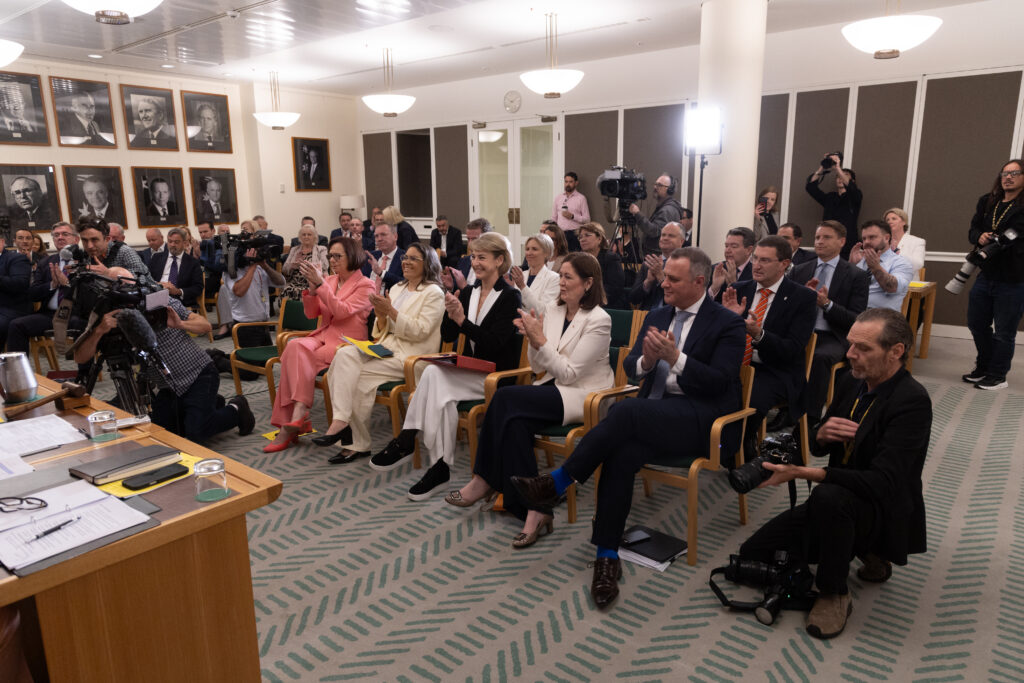
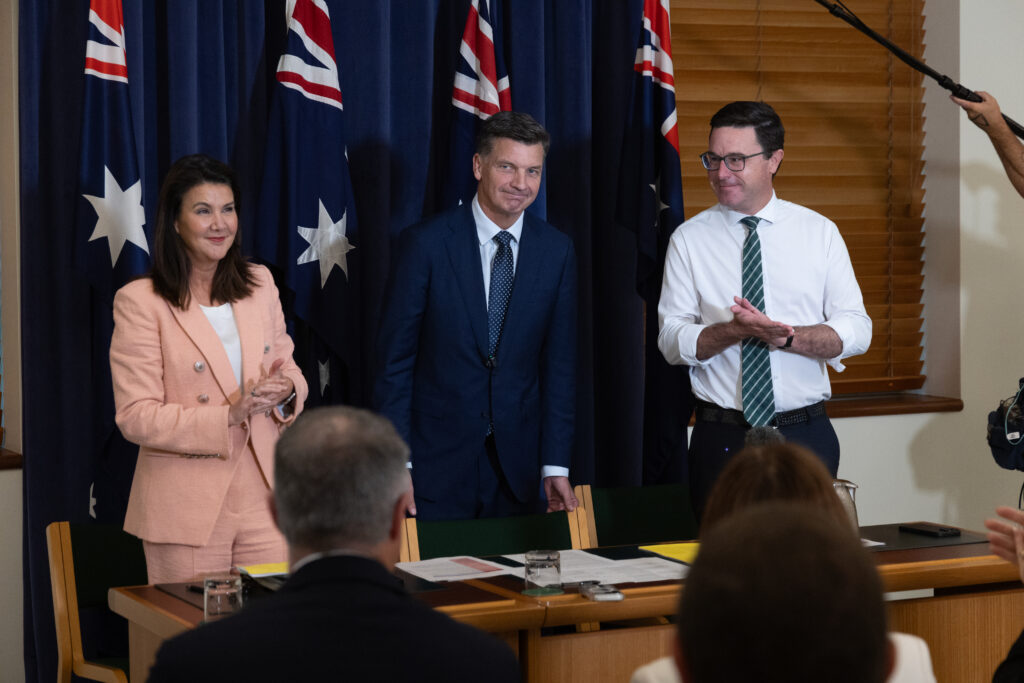
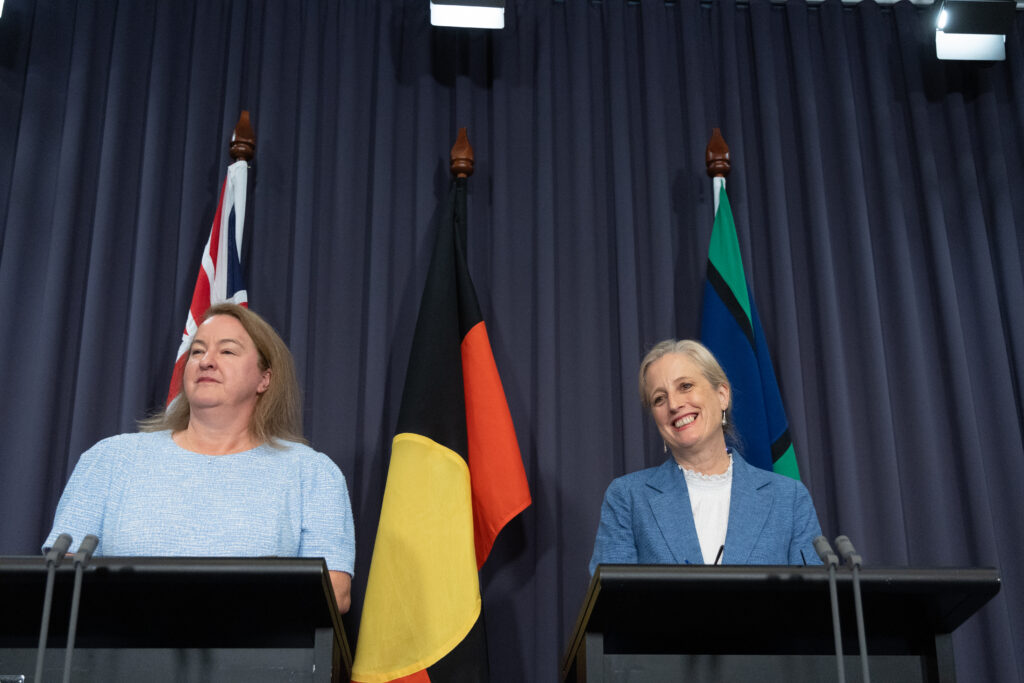
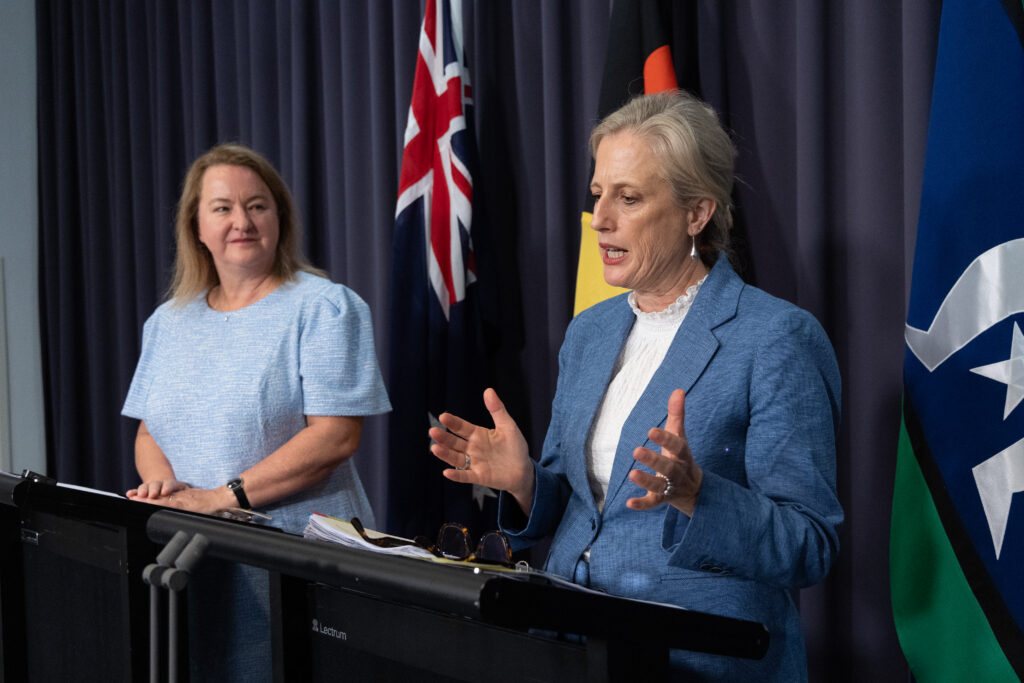
Minister For Women Katy Gallagher joined the CEO of the Workplace Gender Equality Agency Mary Wooldridge to announce an improvement in the gender pay gap, with new data out today.

In short, the gap between male and female salaries in Australia is down to 11.2 per cent, down 0.9 percent in the past year. For every dollar earned by a man, a woman earns 88.8 cents.

Mike Bowers was at the press conference in the Blue Room of Parliament House a short time ago.

Photograph by Mike Bowers.

Government announces homeopathic dose of funding for chronic disease

Luke Slawomirski
Senior Postdoctoral Research Fellow

The federal government this week announced an investment of $110 million over three years to prevent chronic conditions and improve care.

The Chronic Conditions Prevention and Integrated Care Program is part of the new 10-year National Strategic Framework for Chronic Conditions, which comprises five areas

  • promoting health and education
  • detecting illness early
  • providing coordinated care
  • managing multiple conditions,
  • more support for priority populations.

The program will fund projects to  “support these priorities.” The initial 3-year investment will to be followed by $38.3 million per year from 2029-30.

One could be forgiven for thinking that the announcement mistakenly contains ‘million’ instead of ‘billion’. That’s because $38 million is 0.04% of what the country spends on primary care, and 0.03% of what we spend on hospital care.

While funding to help prevent and manage chronic disease early is always welcome in a healthcare system that’s too hospital-centric, it’s hard to see how this amount will achieve much. Calling it a pilot would have been more accurate.

Chronic diseases cost the Australian health system approximately $98 billion in 2023-24 in healthcare expenditure alone, accounting for 54% of all disease-related health spending. If you include broader economic impacts like lost productivity are included, the annual bill rises to about $160 billion.

Ministers sure love an announcement – even if it’s for a homeopathic remedy meant to treat a big problem.

Angus Taylor’s party room rev up

Here’s Mike Bowers‘ video of Angus Taylor first coalition party room address as leader.

Shadow Treasurer slapped down by RBA

Greg Jericho
Chief Economist

The shadow Treasury spokesperson Tim Wilson rates himself very highly. The RBA seems rather less enamoured of his economic talent.

Upon being appointed to his current role by Angus Taylor, Wilson came out and told Nine newspapers that “I think it’s [the RBA] confused about what its core purpose is to do, and it should be to focus on reducing inflation. It’s something we’ll review … but the focus has to be on addressing the problems of inflation.”

Given the RBA is mandated to “to contribute to the stability of the currency, full employment, and the economic prosperity and welfare of the Australian people” this very much seemed like Wilson saying it should ditch worrying about full employment so much and just go hard on inflation.

Needless to say, the government hit him hard on this and Wilson had to state that he did actually believe in the dual mandate but you know … errr… they would review… something…

Overnight the RBA’s Assistant Governor (Economic) Sarah Hunter gave a speech in Oslo titled Recent Refinements to the Dual Mandate and Navigating Back to Target, which is more polite than calling it “Tim Wilson is a dill and here’s why”

It is also a big slap to those, like the AFR’s favourite opinion writing economist, Richard Holden, who suggested the RBA should actually have raised rates more back in 2022 like the USA federal reserve did.

Hunter notes that had they done that sure inflation might have come down earlier (she uses some modelling here) but that:

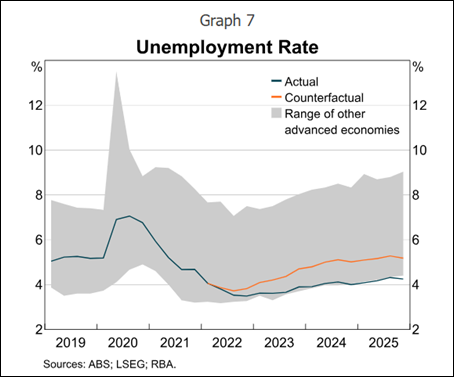
“the more contractionary policy path would have caused higher unemployment (Graph 7). We estimate that the counterfactual strategy would have caused unemployment to overshoot the level consistent with full employment in 2023. From then, the labour market would have continued to weaken through 2024 and 2025, peaking at 5.3 per cent in late 2025.”

Ok so what does that mean? In late 2025, the unemployment rate fell to 4.1%

What is the difference between 4.1% and 5.3% unemployment? Just a lazy 185,000 more people out of a job.

I have certainly been critical of the RBA, but those suggesting the bank has been too weak on inflation have been living in a fantasy land of wealthy comfort. Those economists with such little care for those who would lose their jobs display a ghoulishness that is why the profession is held in such contempt by many.

As I noted a couple years ago, the reason the RBA did not need to raise rates as high as other nations is because most home loans here ae variable rates, so the impact of a rate rise is much greater than say in the USA which has a lot of fixed rate mortgages.

It would be nice if those economists who think higher rates are better because it will raise unemployment and slow inflation would volunteer to be the first ones to lose their jobs. Think of it as laying down their livelihood for the good of the nation.

‘All safe’: Aussie troop base hit in Iran drone strikes

Grace Crivellaro
AAP

Australian personnel at a United Arab Emirates air base are all accounted for after it was hit by a drone strike as the war in the Middle East escalates.

Iran has retaliated with attacks across the region after it was hit by US-Israeli bombardments that have killed the Islamic regime’s leader, Ayatollah Ali Khamenei, and dozens of senior officials. Among the areas hit over the weekend by Iran were the Al Minhad air base, near Dubai in the United Arab Emirates and a logistics hub for the Australian Defence Force.

Defence Minister Richard Marles said all Australian troops were safe and none were injured in the strike.

“We have a number of Australians who operate from a headquarters that we’ve had at Al Minhad now for many, many years,” he said.

“They are all accounted for, they are all safe. We’ve got north of 100 serving personnel actually across the Middle East in a range of countries, but most are in the UAE and that base is very important for us.”

If you live in Sydney, do you know how many guns are being stockpiled just down the road? 

Skye Predavec
Researcher

Somewhere in Sydney’s south-east, nestled between Malabar Beach, Port Botany and Little Bay, one person has been amassing a private arsenal with enough guns to supply some small countries’ entire armies. Why does someone in inner-Sydney need 294 guns?  

The answer is unclear. But this isn’t the only person with such a massive collection. 

In Cremorne, a wealthy suburb on Sydney’s Lower North Shore, someone holds the record for the most guns owned by any individual in the entirety of NSW, with a staggering 371 firearms. Cremorne is not a large suburb. That’s enough guns to arm a full theatre of movie-goers at the local cinema – all owned by one person. 

At the upper end of the Northern Beaches, there are at least three collections of around 200 guns in somewhere around Narrabeen, Cottage Point, and Belrose. 

Read the full article about these inner-city gun stockpiles, and how NSW’s gun control reforms might affect them, here: https://thepoint.com.au/off-the-charts/260302-mapped-the-private-gun-stockpiles-of-inner-sydney

Why nobody should care about the BCA’s “Global Investment Competitiveness Index”

Greg Jericho
Chief Economist

The Business Council of Australia has put out a Global Investment Competitiveness Index. Isn’t that sweet.

I don’t want to be too cynical. Oh bugger it, yes I do.

This index, which the AFR is treating with great seriousness (“Reliance on big government hurting the nation globally: BCA”) is just a hodge podge of different measures from different organisation that it combines together and, huzzah, every nation is ranked.

Australia is ranked 21st, but who cares – you certainly shouldn’t, and neither should the government.

Consider that its measure of industrial relations comes from the “Heritage Foundation Labor Market Freedom Index”. The Heritage Foundation is a right-wing crank organisation that pushes climate change denial and hates to its core any regulations that might over comes systemic racism.   

It also includes “World Economic Forum Labour‑Employer Cooperation – an Executive Opinion Survey question that assesses relations between labour and employers in a jurisdiction. Data are available biennially” So nice that they asked business leaders what they like.

The dumb thing with the list though is it really doesn’t correlate with anything. If you compare the ranking of the list with GDP per capita growth (which is a loose measure of productivity and living standards growth), there really is no link between the two measures.

If anything, when you compare GDP per capita growth over the past 3 years of all the OECD nations and their ranking in the BCA’s competitiveness it would seem being less competitive leads to more growth!

But still if the BCA suddenly thinks Norway (which ranks 7th on the list) is better than Australia then let’s tax our oil and gas the way they do. Maybe we could also have free university? Good to see the BCA is on board.

ABC finds another loophole in South Australia’s new election laws

Bill Browne
Director, Democracy & Accountability Program

With South Australia’s election less than three weeks away, you might expect the state’s strict new donation ban would stop the political parties from fundraising.

No chance.

As the ABC’s Will Hunter reports today, Labor, Liberal and the Greens are still using the attention and excitement of the election campaign to collect private money. They’re just going to put it towards federal purposes instead of state ones.

In other words, South Australian taxpayers are spending $18 million to compensate the political parties for lost private donations – but instead of giving up those donations, the parties are spending them on federal election campaigns instead.

South Australians are effectively subsidising not just the parties’ state election campaigns, but now their federal campaigns as well.

As I told Mr Hunter, if a political donation creates the risk of undue influence, that is true regardless of where the donation is spent. 

The election hasn’t even happened yet, and this is the second loophole the ABC has found in the new laws.

And as I wrote in The Point last week, the laws could hold the Liberal Party back from rebuilding but also stop any party from replacing them.

(As for One Nation, it is enthusiastically fundraising for the state elections – but it is within its right to do so. That sets it apart from the Labor, Liberal and Green parties which took public money as compensation.)  

The Malinauskas Government rushed these changes to election law through because they knew the changes would not hold up to scrutiny. They have never published the submissions they received – but we know from other reporting that a majority did not support the changes.

The laws are unfair, undemocratic and poor value for money.

Hegseth’s bizarre whine about “stupid rules”

Australia’s most important security ally, on how “good partners” don’t bother with “stupid rules of engagement”:

Hegseth: "Israel has clear missions as well for which we are grateful. Capable partners are good partners, unlike so many of our traditional allies who wring their hands and clutch their pearls, hemming and hawing about the use of force … no stupid rules of engagement."

Aaron Rupar (@atrupar.com) 2026-03-02T13:14:21.080Z

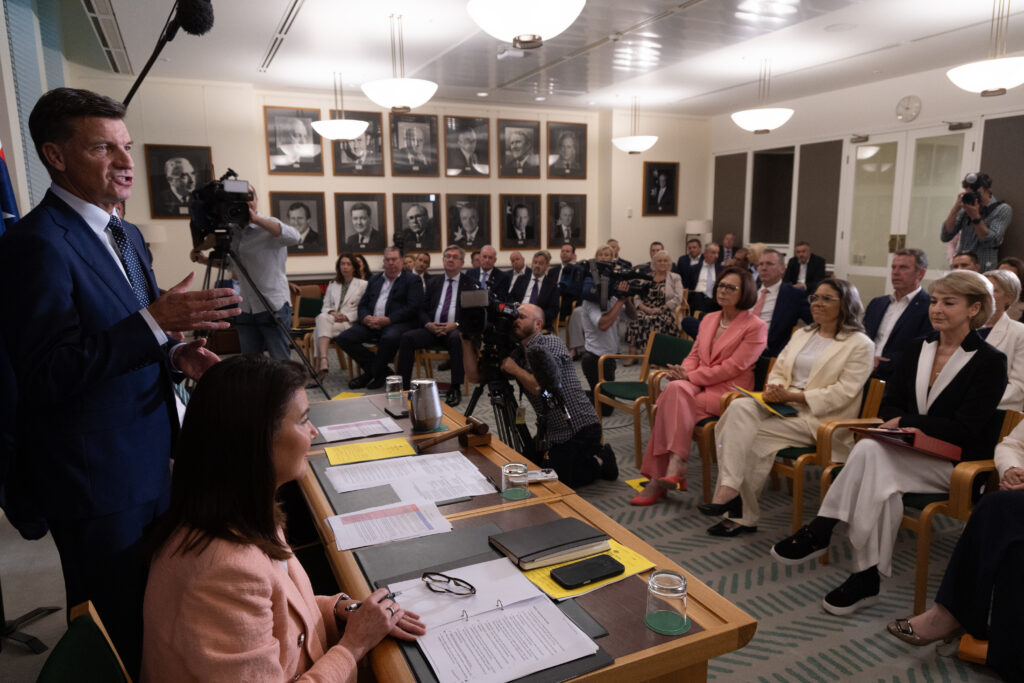
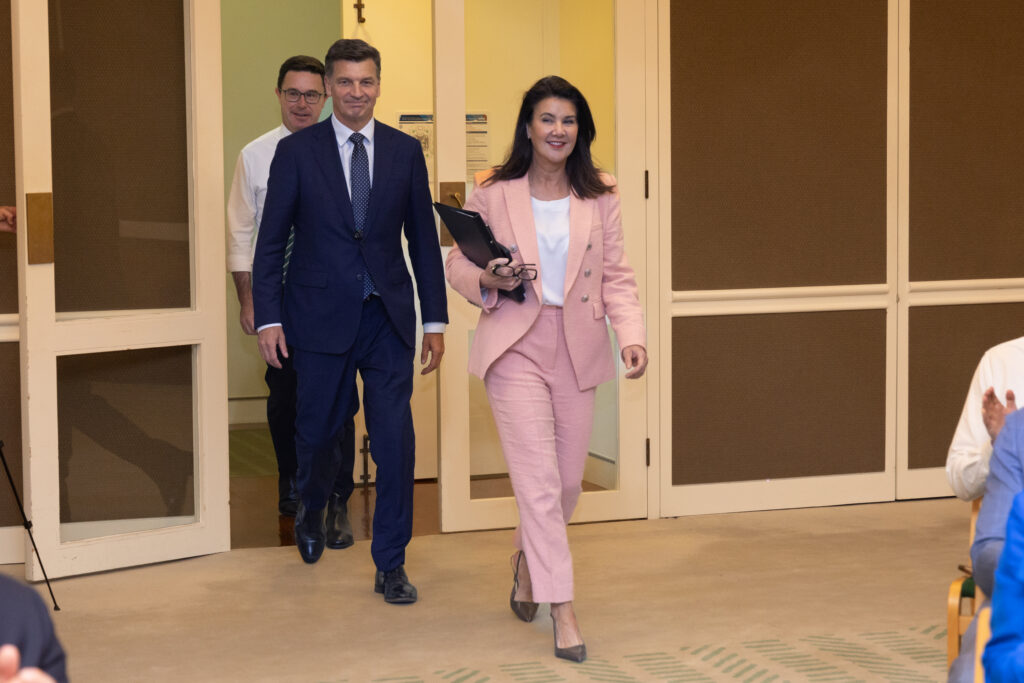
Angus Taylor addresses party room. Lots of “here, here’s” and “shame’s”.

It’s that time of the sitting week when the parties lock themselves away to thrash out the issues and come up with talking points.

This was Angus Taylor‘s first address to the coalition party room as leader.

As always, an occasion like this is celebrated by letting cameras into the room for a short rev up to the team.

Mike Bowers was there.

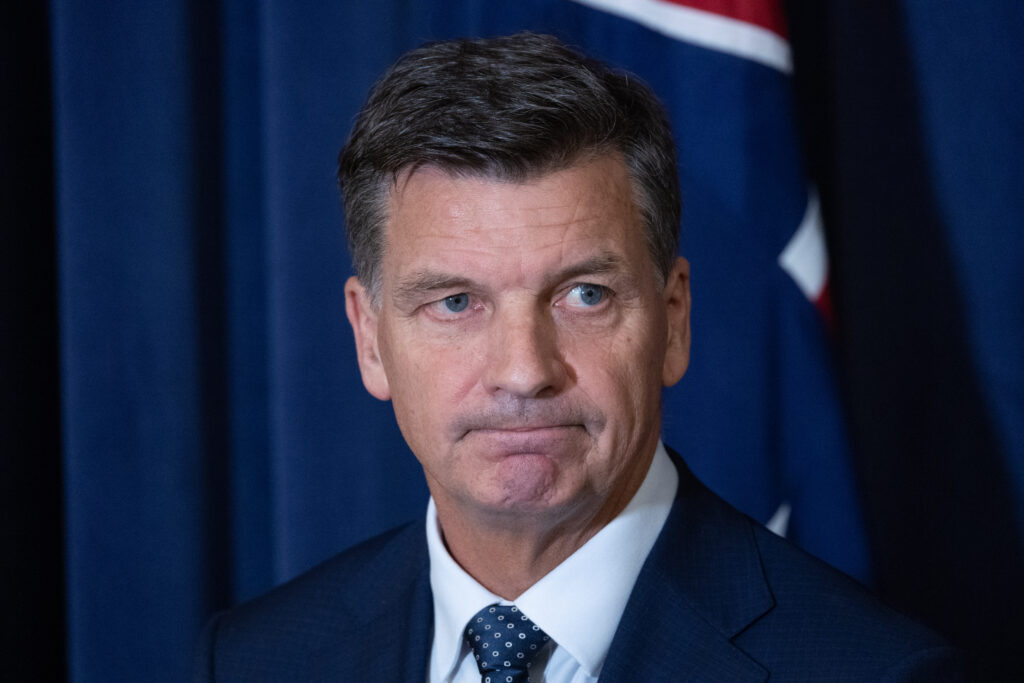
The Leader of the Opposition Angus Taylor addresses the coalition joint party room meeting in Parliament House Canberra. Tuesday 3rd March 2026. Photograph by Mike Bowers.
Photograph by Mike Bowers.

Health workforce crisis threatens the success of Medicare Urgent Care Clinics

Hamdi Jama
Postdoctoral Research Fellow

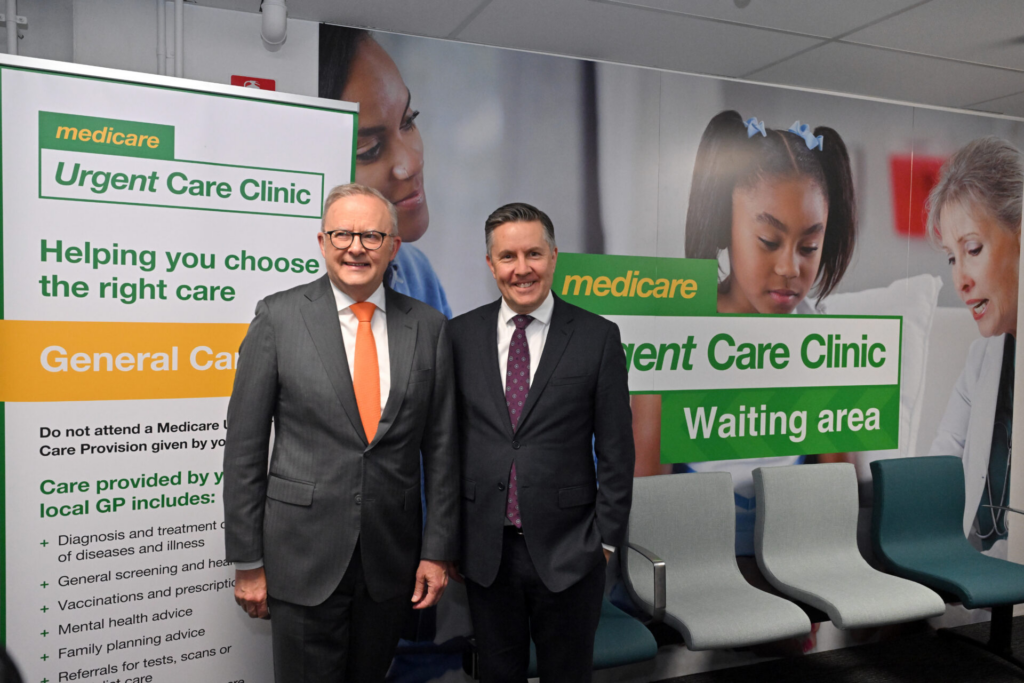
Labor’s Medicare Urgent Care Clinics (UCC) have racked up more than 2.5 million visits,  taking people out of emergency waiting rooms. However, the clinics face a staffing crisis that threatens to undermine their success.

Because there aren’t enough nurses and doctors, 44% of clinics aren’t meeting the promised hours under the Albanese government’s plan.  To make matters worse, the second interim report on the UCC program revealed that access to crucial diagnostics such as X-rays and pathology is severely limited, with some patients still needing to go to the emergency room.

In the run-up to the last election, Labor pledged to establish 50 new urgent care clinics around Australia. However, the interim report expressed concerns about whether there are enough staff to support these additional clinics.

Even with the UCCs, emergency department waiting times are still long. In 2025, the AMA estimated that only 45% of Australians were seen within the recommended times. Coupled with aged care bottlenecks—where elderly patients can’t be discharged from hospitals because there aren’t enough places in aged care facilities to take them—and ambulance ramping, emergency departments aren’t experiencing the relief UCC were meant to bring.

UCCs are fast, free and very popular. These clinics have the potential to fill a gap in the Australian healthcare system.

But without enough nurses and doctors, consistent opening hours and access to after-hours X-ray and pathology, Australians will be left with a solution as strained as the emergency departments UCCs are supposed to relieve.

ATO reveals how self-managed super funds rort the system with no penalty

David Richardson
Senior Research Fellow

Last week saw the latest superannuation data was released by APRA showing the total amount of funds in superannuation accounts was $4,485.5 billion or 1.6 times Australia’s annual GDP. The total in self-managed super funds (SMSFs) was $1,061 billion (ie just over a$1 trillion!).  

SMSFs tend to be used by wealthy people to manage their own funds rather than place them in a retail or industry super fund. Many of these schemes will be affected by recent changes to how super is taxed.

Those changes impose a new Division 296 tax on individuals which has the effect of increasing the super tax to 30% on earnings relating to an individual’s balance in excess of $3 million and 40% on balances above $10 million.  

There has been a flurry of articles in the press and elsewhere talking about what it means in terms of how much extra tax such-and-such an individual will have to pay.

The idea that we can calculate what it means for certain individuals was blown away by a recent article in the Financial Review following a speech by Tax Office Deputy Commissioner, Ben Kelly,  who reported expressed concern about the current high levels of non-lodgement and late lodgement of self-managed annual returns. It is reported that “one in seven self-managed superannuation funds fail to lodge tax returns on time, or at all, leaving the regulator in the dark about the risks in the booming $1 trillion industry, which is growing by more than 220 funds per day.”

What this means is that even the minimal tax obligations on SMSFs are not being met.

But let’s pull on this string to think about just how differently the wealthy are treated compared to the poorest in society.  

Imagine the problems you might have if, as a recipient of government benefits, you failed to report your income to Centrelink. Punishment and debt collectors follow.

Yet you can get the benefit of super tax concessions even if you are slack about paying tax and not declaring your income to the tax office.

Mr Kelly also “warned the industry about the growth in illegal loans and withdrawals”.

This is important. The tax concessions for super are based on them being earmarked for support in retirement and so the rules about issues like access to the funds are very strict. Yet the report continues “$650 million was withdrawn or lent illegally from self-managed funds in the year ended June 30, 2023 – the most recent period that data is published.”

This is extraordinary and suggests people are taking advantage of the tax concessions in super but ignoring all the rules that prescribe what super funds should be used for.

Greg Jericho has discussed the way super tax concessions are being exploited to provide for inheritance. The latest remarks from the Australian Tax Office shows that the problems with super go even deeper. Now that the Tax Office has issued the warning you would think it would be time for a major compliance operation and stiffer penalties to ensure the integrity of the tax system.

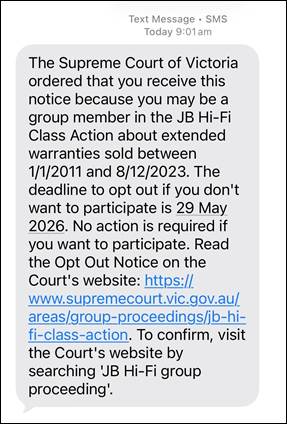
JB Hi-Fi class action messages have gone out

Greg Jericho
Chief Economist

Some readers might have received this text message.

As we all should be rightly concerned about spam/phishing texts, you might be worried about what this is.

Maurice Blackman Lawyers are currently pursuing a class action against JB Hi-Fi.

They note that

“Don’t worry, that was from us. Emails from noreply@classaction.mauriceblackburn.com.au and text messages from ClassAction regarding the JB Hi-Fi Class Action are legitimate. It’s important that you read the notice carefully. If you have any questions, everything you need to know can be found on this website.”

This case – as often happens with class actions – has been going for a while. It began back in December 2023 and was reported as coming off the back of excellent work by Choice:

“In 2022, consumer advocacy group Choice conducted a mystery shop at 80 Harvey Norman, JB Hi-Fi, and The Good Guys stores, which sell extended warranties, and asked what rights the mystery shopper would have if their TV broke down outside the typical one-year manufacturer’s warranty period. It claimed about 70 per cent of those stores misrepresented consumer rights.”

The crux of the matter is that if you bought an extended warranty for something you got from JB Hi-Fi, Maurice Blackburn allege you were essentially paying for something worthless because the warranty just gave you the same rights you already had by law.

The case will continue and given it covers roughly 8million customers, JB Hi-Fi seems likely to fight it all the way and the case is scheduled to begin in the Victorian Supreme Court on 5 October this year.

The Canaries in the Coal Mine: House prices and increasing inequality

Alice Grundy
Research Manager

“Tax wealth”. That was the message economist, former trader and YouTuber Gary Stevenson brought to a crowd of 1600 people at Sydney Town Hall in an event hosted by Australia Institute Deputy Director Ebony Bennett on Sunday night.

Gary said that Australia has been lucky – this is a country with a relatively small population and masses of natural resources, which has meant that living standards have been high while there have been huge declines in the living standards for working English people.

He noted that asset prizes are rising in all categories – including housing – and that when asset prices drastically rise across the board it spells increasing inequality. For him, house prices are the canary in the coal mine. Without taking serious action and properly taxing wealth, living standards are going to get a lot worse for most Australians.

Keen to ensure that this isn’t a generational battle, Gary said that it’s important not to fall into a boomer versus gen Y or gen Z antagonism. Instead he suggests talking to older people about the kinds of lives they want for their grandchildren. Do they want their grandchildren to be able to own homes?

Change is possible. Stevenson told the Town Hall audience that governments created social safety nets that changed the lives of working people after World War II, and that governments have the power to act again.

The most common questions put to Stevenson were whether an inheritance tax or a tax on unrealised capital gains are good options for Australia. Gary was clear in his answer: this is a tough fight and the first thing is helping people understand the problem. The second step is putting pressure on politicians to make change and the next step is making changes to policy. The specifics of this or that particular tax are not the most urgent questions. What is urgent is building a coalition of people who see and understand the problems and ask for change.

You can read Gary’s highly entertaining book about his career at Citibank, The Trading Game or catch up on his YouTube videos. There are still tickets for his upcoming Perth show and if you’re in Adelaide you’ll have to join the waitlist. 

The US and Israel attack Iran, foment chaos

For the best analysis of the crisis in the Middle East, don’t miss the latest (special edition) of After America.

The ‘President of peace’ has started another war with Iran, with no apparent regard for the consequences.

On this episode of After America, Allan Behm and Dr Emma Shortis discuss the US-Israeli attacks on Iran and the assassination of its leader, Trump and Netanyahu’s cynical messages for the Iranian people, what this war means for nuclear proliferation, and the Australian government’s “deeply disappointing” response.

Paterson’s weasel words as Libs cosy up to disgraced Hanson

Shadow Defence Minister James Paterson has fumbled and bumbled his way around a question about the Liberals voting against Pauline Hanson‘s censure for her repulsive remarks about Muslims.

He was asked on radio why his party voted against the motion, when coalition Senators had previously voted to censure Lydia Thorpe and Ralph Babet.

Senator Paterson’s position seems to be that Hanson’s comments met the threshold for condemnation, but not censure.

We moved an amendment which suggested that Senator Hanson should be condemned rather than censured for her comments. We have previously voted to censure Senator Hanson. The reason why we think she should be condemned for those comments is that they were appalling and they were wrong. There are many good and decent Muslim Australians, including those in my portfolio, who serve our nation in uniform, patriotically and with distinction. But censuring someone in the Senate is usually reserved for the worst conduct and particularly relates to their behaviour as a Senator in the Senate or as a minister represented in the Senate. We don’t think it should be routinely used just to condemn people for making statements that we may profoundly disagree with.

Especially when One Nation preferences could be the difference between another electoral battering and a complete wipeout in 2028.

Tax gas, fix hospitals

Hamdi Jama
Postdoctoral Research Fellow

NSW Health Minister Ryan Park has launched a snap review into the deteriorating state of NSW hospitals, after the discovery of mould at Royal Prince Alfred Hospital and infestation of pigeons at Tamworth, Royal Prince Alfred and Wollongong hospitals. The mould led to the deaths of two patients.

These are the true consequences of the underfunding that has undermined our healthcare system over many years. From persistent mould to leaking roofs and the hazardous presence of asbestos, hospital infrastructure appears to be buckling under the weight of chronic underfunding.

But it wouldn’t be this way if the states had got the GST money that the Commonwealth originally promised.

In 2000, when the Howard government introduced the Goods and Services Tax (GST), the then Treasurer Peter Costello said the GST would provide the states with “a revenue base that grows in line with the economy” and said it would “provide a secure base to fund their services.” The GST was supposed to provide states with a stable source of revenue to fund high-ticket items like healthcare.

But this didn’t happen.

GST revenue has failed to grow at the same rate as the overall economy (GDP) which means that the states haven’t got the money they were promised. Australia Institute research shows that, as a result, NSW is $7.1 million worse off in this budget year alone.

It’s hard to think of a more disgusting sign that hospitals are underfunded than an infestation of maggots so large that they rained down on patients in Calvary Mater Newcastle Hospital.  There are many ways that the Commonwealth could increase funding to the states without taxing working Australians. For example, a 25% tax on gas could raise the revenue needed to fund vital services like healthcare.

The NSW government’s “snap review” might be able to offer temporary fixes, but the deeper structural crisis is inextricable from Commonwealth funding.

Other Services are becoming more dominated by companies and the profit margin is rising

Greg Jericho
Chief Economist

The biggest increase in profits in the December quarter came in the “Other Services” industry. Profits in the industry rose 15.7% compared to 5.5% for other non-mining industries.

“Other services” sounds pretty mundane, but it really comprises just about every service we buy. It includes car mechanics and other car services such as panel beating etc, and also electrical repairs of household items like washing machines, and then personal services like cleaners, hairdressing, pet grooming, nail care services, and on and on.  

So when their profits soar it very much has an impact on inflation and the prices we pay.

What is rather curious is that when we look at the profit margin of the industry – which is profits as a percent of income (ie how much of the cost of what we spend on these services is profit)

Prior to the pandemic the Other Services industry routinely had a profit margin around 8%-9%. But since then it has been around 14%,. IN the December quarter it hit 15.4% – the highest it has been since the September 2023 quarter.

Now you might think that these services would be made up of a lot of small businesses. And yes there are many of these, but it is quite striking just how much of the industry’s profits are now held by companies.

20 years ago companies accounted for around 73% of the industry’s profits, and this fell to below half in 2016. During that period the profits margin also dropped – in 2016 the profit margin in the industry fell to 6.3%.

But since the pandemic companies have taken over the industry – they now account for 86% of all profits in the industry.

Readers might thin k about how many hairdressers/barbers/cleaners/mechanics/nail carers etc etc are all now done by major brands rather than some small business operator.

And as we can see, as companies take over an industry, the profit margins take off. And given the cost of those things greatly affects inflation, once again we much note that wage growth is not driving inflation, but profits very much are.

Japan’s rise as an LNG trader driven by resale of cheap Australian gas, reigniting calls for gas export tax

Tegan George
The Point

New analysis shows Japan is emerging as a major player in global gas trading, despite producing no liquefied natural gas of its own – and it’s all thanks to Australia.

Research by the Institute for Energy Economics and Financial Analysis (IEEFA) has revealed Japan resold a record volume of LNG in the 2024 financial year, rather than consuming it domestically.

“When overseas buyers can on-sell Australian gas at a profit while those same corporations pay almost no tax for our gas, you know something needs to be fixed,” said Louise Morris, an advocate at the Australia Institute.

A survey by the Japan Organization for Metals and Energy Security (JOGMEC) found that 40 per cent, or four in every ten cargoes, of LNG managed by Japanese companies are now sold overseas – up sharply from just 16 per cent in FY2018.

Read the full story here.

Australia is a low spending country

Jack Thrower
Senior Economist

There’s a growing drumbeat from the media and the Opposition claiming that public spending is out of control and that cuts are necessary. This is not true. To be clear, Australia is a low-spending country compared to similar countries in the OECD.

Why has spending risen?

You might have seen statistics showing Australia’s spending as a percentage of the economy (GDP) is currently at historically high levels. This is true, but it’s nothing nefarious.

Higher spending is the unsurprising outcome of population ageing, the expansion of Australia’s safety net to better cover people with disabilities (through the National Disability Insurance Scheme), and ‘cost-disease’, which basically means that things like childcare, healthcare and education stay expensive because they need a lot of people (you can’t automate away a doctor).

This doesn’t mean current spending is perfect. As Australia Institute research has shown, Australia’s current model of outsourcing public services, from childcare to aged care to disability services, repeatedly fails economically and socially. However, transitioning to a better public system will take time and a lot of work, not blunt cuts to the current system.

There are also things that should be cut, such as the fossil fuel subsidy Fuel Tax Credit Scheme, which costs over $10 billion each year, or the multi-billion-dollar WA GST deal, which shovels extra money to Australia’s richest state and economist Saul Eslake calls “the worst public policy decision of the 21st century thus far”.

Raising more revenue

More importantly, Australia needs to raise more revenue. Australia is a low-tax country, ranking about 10th lowest in the 38 country OECD. If Australia raised revenue at a similar level as the OECD average—a level similar to Canada or New Zealand—Australia would raise more than $100 billion extra each year. There are plenty of options for how to do, supported by Australia Institute research, including:

  • increasing taxes on the gas industry, particularly through a 25% tax on gas exports;
  • a climate disaster levy on carbon emissions from fossil fuel exports;
  • reducing or removing tax concessions for property investors, such as the Capital Gains Tax Discount and negative gearing;
  • reforming tax concessions for superannuation, which currently predominantly benefit the wealthy; and
  • taxes on wealth and inheritances.

‘Reality check’ for workplaces on gender pay gaps

Maeve Bannister
AAP

Australian employers are being urged to address gender pay gaps at senior levels of their companies to ensure workplace equality becomes a reality.

Almost 5.9 million workers will have access to pay gap information as the Workplace Gender Equality Agency publishes results for 10,500 employers.

While more workplace pay gaps have shrunk than during the same reporting period in 2025, more than half of employers have a gender pay gap larger than 11.2 per cent in favour of men.

High-paying and male-dominated industries are more likely to have large gaps.

Men are nearly twice as likely as women to be in the highest-paid roles, while women dominate lower-paid jobs.

This should offer a reality check for people who believe Australia had achieved equality in the workplace, the agency’s chief executive Mary Wooldridge said.

“Employers should treat gender equality like their other business goals,” she said.

“Women and men want a fair and equal opportunity to use their full range of skills and capabilities, hold the most senior and highest paying roles, feel safe at work and have some flexibility to manage other responsibilities, such as caring, outside of work.”

Gender pay gaps measure the difference between the average pay for men and women within an organisation, and can be used to gauge the differences in how their work is valued.

The construction sector has the average gender pay gap of 23.8 per cent, followed by financial services.

“(Construction) is a highly masculinised industry, while (financial services) is a balanced industry in terms of their composition, but quite unbalanced in relation to the proportion of men in high-paying roles versus women in lower-paying roles,” Ms Wooldridge said.

“We need vigilance on employers … so no one gets a particular gold star and can rest on their laurels, they will need to continue to be working to narrow their gender pay gaps and improve their employee experience.”

Large differences in discretionary payments, like performance bonuses and overtime hours, remain a key driver of many employer gender pay gaps.

Stephanie Mediero chairs the women’s network at medical-technology company Medtronic, building leadership opportunities and promoting career advancement.

She said the playing field was particularly uneven between men and women in STEM fields.

“Gender targets alone are not sufficient to close the pay gap, to move the needle we have to work on building the confidence of women in the workplace,” she told AAP.

“When women have confidence in their skills and what they can offer, they are more likely to go for those leadership opportunities.”

It is the third year the agency has released pay gap data as an increasing number of employers conduct analyses and put in place strategies to close the divide.

Flexible work was a key part of shifting the dial towards more equal workplaces, Women’s Minister Katy Gallagher said.

“When workplaces genuinely support flexibility, women are more likely to stay connected to work, progress into senior roles and build their lifetime earnings,” she said.

Where’s the Liberal Party’s election review?

Bill Browne
Director, Democracy & Accountability Program

Federal Treasurer Jim Chalmers claims to have seen a copy of the Liberal Party’s internal review into their performance at last year’s federal election.

It’s a privilege not extended to you and me, because this time the party has decided not to publish the review.  

That’s a break from convention. You can read the 2022 review (prepared by Brian Loughnane and Senator Jane Hume, the latter being the new Liberal deputy leader) on the party’s website.

In fact, the 2022 review cites the Australia Institute’s research.

Not only is the 2025 report going to be kept secret, its recommendations will be as well. New Opposition Leader Angus Taylor will be “blamed for wanting to cover up” the report, claims report co-author Pru Goward.  

I can understand delaying the report’s release until after the Farrer by-election, but it sounds like the report will never see the light of day.

Ms Goward says, “the thousands of supporters and donors who had given so generously of their time and money deserved to understand what went wrong and what should change.”

It’s not just the private donors that we should be thinking of.

Due to taxpayer funding of political parties, it is public money – not any one donor – that is the single biggest contributor to political parties’ election campaigns. Despite this, political parties are much more opaque than other taxpayer funded institutions like utilities, art galleries and museums. The Liberals’ decision to keep their election review secret is another example.  

Bank chief’s big watch on inflation cost of Iran action

Jacob Shteyman
AAP

It’s unclear whether the US-Israeli attacks on Iran will amplify or dampen inflation, the head of Australia’s central bank says.

Reserve Bank governor Michele Bullock said the bank was closely watching events in the Middle East but it would take some time to make sense of their impact on domestic inflation.

“It’s too early to say what the impact will be. Events are moving rapidly and there are different ways this can play out,” she told the Australian Financial Review Business Summit on Tuesday.

“A supply shock could, for example, add to inflation pressures. And the potential implications for inflation expectations are something we are very alert to.

“But at the same time, a prolonged impact on energy markets could have adverse effects on global economic activity and result in downward pressure on inflation. It is not obvious how this might play out.”

Crude prices spiked by up to 13 per cent on Monday after conflict in Iran – one of the world’s largest oil producers – also threatened to shut off supplies from other Middle Eastern nations.

Given oil’s role as an economy-wide input, a price surge threatens to have an outsized impact on global inflation, which is already running well above the Reserve Bank’s target.

In the worst-case scenario – in which the US becomes mired in a prolonged conflict with Iran and oil supplies are disrupted for longer – oil prices could double to about $US150 a barrel, AMP chief economist Shane Oliver said in a research note.

He ascribed a 40 per cent probability to such a scenario.

Ms Bullock admitted the bank got it wrong when it assessed supply and demand in the economy were coming back to balance in 2025, prompting it to cut interest rates.

It misjudged how strong private demand would be in the second half of 2025 and overestimated the economy’s supply potential, she said.

But data released since the Reserve Bank hiked interest rates in February had supported that decision, Ms Bullock said.

Jobs market indicators remained tight and it was uncertain whether financial conditions were restrictive enough to bring inflation back to target in a reasonable time, she said.

“We think a large part of the unexpected increase in inflation since the middle of last year was due to sector-specific demand and price pressures that we expect to ease in coming quarters,” she said.

“But economy-wide capacity pressures in the economy are also playing a role and, overall, we think underlying demand in the economy is further from its supply potential than we had assessed six months ago.”

The Reserve Bank’s forecast showed modelling the direction of the economy was hard enough without geopolitical flashpoints.

Data can send mixed signals.

Hard-to-foresee shocks such as the COVID-19 pandemic and global conflict made it important for the bank to supplement its models by listening directly to households and businesses, Ms Bullock said, highlighting how murky setting monetary policy could be.

Tariffs blow up in Trumps face

Matt Grudnoff
Senior Economist

The latest round of tariff chaos is largely hot air and certainly not something that Australia should worry about. The current changes are likely to have little to no impact, and we should treat them in the same way you should treat a toddler chucking a tantrum – largely ignore it.

The whole tariff issue has been upended again because Donald Trump’s 10% across the board tariffs have been ruled unconstitutional by the Supreme Court. This was not unexpected. But in response Trump has reimposed the 10% tariffs using a different law.

The problem for Trump is that these tariffs can only be imposed for 150 days.

But in the style of classic Trumpian chaos he then announced on social media that he was increasing them to 15%. But when they were enacted, it turned out they were only at 10%.

The response from Australia’s political class has been more subdued than it was after they were originally imposed in April last year.  People are clearly learning.

Trump has a pathological need to be the centre of attention and a weird love of making deals. For him tariffs scratched both those itches. But there are a couple of reasons why these tariffs mean very little.

Firstly, because they are across the board, Australia is not at any disadvantage to other countries trying to sell stuff into the US. In fact, because many countries face a higher rate, we might actually be enjoying a relative advantage.

It is possible that producers in the US might get an advantage, after all that’s what tariffs are supposed to do, but a CEO would have to be insanely optimistic to invest in the US on the basis of these tariffs that should only last 150 days.

Secondly these tariffs are so small that movements in exchange rates can easily be bigger than the tariff rates.

For example, the day before the original tariffs were announced, it what Trump dubbed ‘liberation day’, the exchange rate between the Australian dollar and US dollar was 62.8 cents US to the $AUS. Today its 71.3 cents. The Australian dollar has gone up 13.5%.

That means that Australians selling produce to the US are getting 13.5% more in Australian dollar terms today than they were getting before the 10% tariffs were introduced. So, the exchange rate movement has completely wiped out the impact of the tariffs and then some.

Movements of this size in exchange rates are not that uncommon.

But for Trump the worst aspect of this latest round of craziness is that his government is going to have to refund the tariff revenue back to the importers. This is one of the biggest own goals and a great example of why ill thought through policy can blow up spectacularly.

Remember, it was not importers who ultimately paid these tariffs. As research from the US Fed showed, 90% of the tariffs were passed onto and paid by US consumers. But the refunds won’t go back to those consumers. They go back to the companies’ who imported the goods into the US.

The very companies that Trump wanted to punish are going to get paid twice. Once when they increased their prices to cover 90% of the tariffs and then again when they get the tariff refund.

I’m sure there will be plenty of schadenfreude to go around.

Deputy Prime Minister Richard Marles says Australia has not been asked to join US-Israel military action

Deputy Prime Minister Richard Marles is doing the media rounds at Parliament House this morning.

While the media focus continues to be largely about flights (he’s ruled out repatriation flights), he’s also been asked about whether Australia would join the conflict if asked to do so by the US.

It’s a fair question given Australia’s history of blindly following the US into war, however illegal or unjustified.

He’s told ABC radio:

We have not been asked to participate. This is an action which is being undertaken by the United States and by Israel.

Our focus now is on the consular side of it and making sure keeping Australians who are in the region, who are affected by this, informed as possible.

Some limited number of flights have started to leave of the airports in the Middle East. That is good news. As air space reopens, our expectation is that is the most expeditious way (to get out of the region).

Big Gas pissed away $20 million worth of free gas in Darwin

Rod Campbell
Research Director
Matt Saunders
Senior Economist

Yesterday’s ABC News report on gas exporter INPEX under-reporting its pollution in Darwin reminded us of the similarly shocking 20-year gas leak from a storage tank at the neighbouring Darwin LNG project, exposed by the ABC last year.

Aside from the impact on the climate – one tonne of methane has 80 times the climate warming damage as one tonne of carbon dioxide – this was Australian gas that was given to the gas exporters for free and just wasted. How much was it worth?

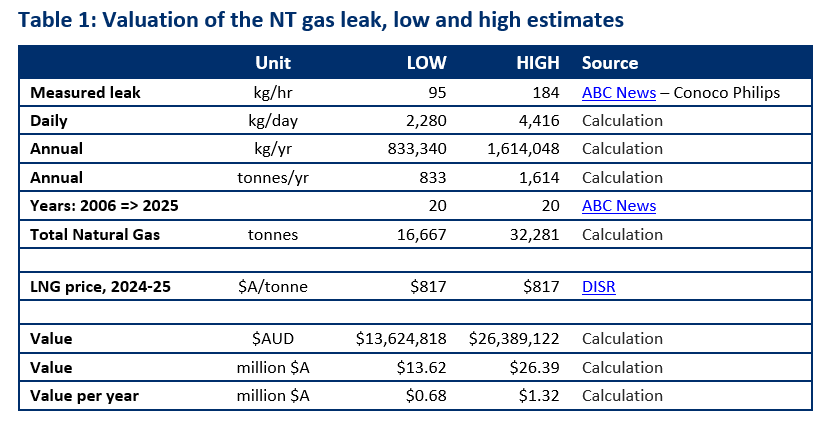
According to an ABC News report the leak was between 95 and 184 kilograms of methane per hour, or between 17,000 and 32,000 tonnes over the lifetime of the tank. At current LNG export prices of $A 817/tonne the gas has a market value of between $13.6 million and $26.4 million over 20 years.

$20 million worth of gas just wasted. No penalties, no angry ministers, no Robodebt letters. Just an ABC report and outrage from Darwin locals.

Big Gas taking the piss and our governments are letting them.

Calculations below.

Security, minerals top of agenda in Canadian PM’s visit

Grace Crivellaro
AAP

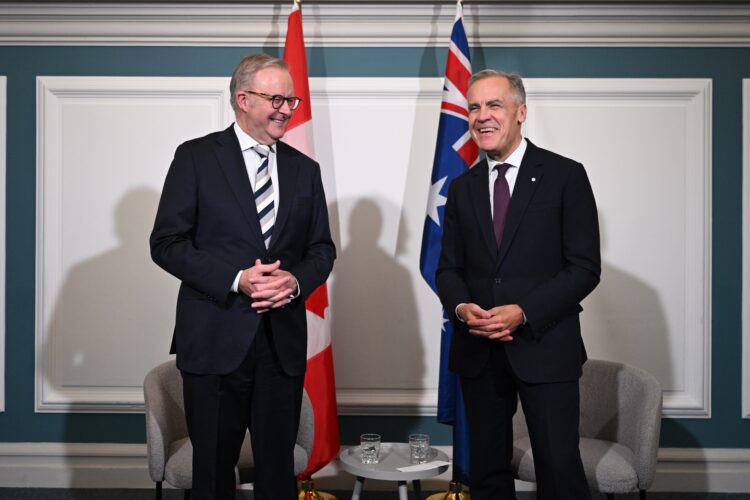
Anthony Albanese hopes to deepen security and defence ties with Canadian leader Mark Carney, who is visiting Australia for the first time as prime minister. 

Mr Carney’s three-day trip to Australia comes after a series of engagements between the two leaders, who have met nine times, most recently on the sidelines of the G20 summit in South Africa in November. 

The Canadian leader will land in Sydney on Tuesday and travel to Canberra to address Parliament House on Thursday. 

Mr Carney will deliver opening remarks at the Lowy Institute in Sydney on Wednesday night about shifts in the global order and the opportunities they present for middle powers.

He may speak on themes touched on at his widely heralded World Economic Forum speech in January, when he called for middle powers to work together to build a more co-operative, resilient world.

In that speech, Mr Carney sought to move beyond US President Donald Trump’s claims on Greenland and urged smaller countries to band together to not to be overpowered by larger players.

“Middle powers must act together because if you are not at the table, you are on the menu,” he told the forum. 

Mr Albanese said the visit will be an opportunity to further strengthen Australia and Canada’s co-operation on investment, economic security and critical minerals.

“I am pleased to welcome my friend Prime Minister Carney to Australia and look forward to his address to the Australian Parliament,” he said in a statement.

“Canada is one of Australia’s closest friends, built on generations of trust, with a shared commitment to supporting stability across the Indo-Pacific and beyond.

“As our countries face new challenges and opportunities, we must deepen our co-operation with partners to promote our national interests.”

Defence and intelligence co-operation is also expected to feature prominently, with both countries being longstanding partners through the Five Eyes network.

The Five Eyes is an intelligence-sharing alliance comprising Australia, Canada, New Zealand, the United Kingdom and the United States.

Good morning

The Prime Minister and Deputy Prime Minister have done the rounds over the past 12 hours, insisting Australia hasn’t been asked – and is is unlikely to be asked – to join the conflict in the Middle East, despite Donald Trump loosely nominating a timeline of four to five weeks for the military action in Iran.

Independent Senator for the ACT, David Pocock, will introduce a motion to Parliament to establish an inquiry into the lack of tax paid by the gas industry. He continues to draw attention to the great gas piss take, with voters becoming increasingly aware – and angry – about the fact that beer drinkers contribute more to the economy than gas exporters. The gas industry has our politicians either captured or fooled. The Prime Minister defended the industry last night.

Canadian Prime Minister Mark Carney touches down in Sydney today as part of a three-day official visit which will conclude with an address to Parliament on Thursday.

Pauline Hanson was once again censured for her racist comments about Muslims in Australia. But, instead of showing even a hint of remorse, she branded the censure a “stunt” then promptly delivered a stunt of her own, slapping her own wrist and storming out of the chamber.

All of this put Angus Taylor’s luke warm performance in his first Question Time as Opposition Leader into the shadows. He gets another chance today. Yesterday, coalition MPs only asked about the Australian women and children stranded in Syria and didn’t land a punch on the government.

Let’s go!


Read the day's news from yesterday

Comments (3)

Join the conversation

The biggest stories and the best analysis from the team at The Point, delivered to your inbox.

Past Coverage