Mon 23 Mar

The Point Live: Federal government facing reality on fuel rationing, Liberals deal with SA fall out. As it happened.

Amy Remeikis – Chief Political Analyst and Political Blogger

This blog is now closed.

7

Key Posts

The Day's News

See you tomorrow?

And on that note, we will close up the Point Live for today. After all – we have all of this week to talk about this stuff.

Thank you to the thousands who joined us today – it is so humbling to see so much support for this little project. We do not take it for granted. Tell your friends – we are growing and would love to hear from you, as well as build something with community – which means we value your input. It’s nice to have a bit of diversity in this space, huh?

Until tomorrow – take care of you and those around you.

Hold gas giants accountable for devastating sea life

Victorian Greens senator Steph Hodgins-May holds up a string of weedy sea dragons from South Australia in the Senate Chamber of Parliament House, Canberra this afternoon. Photograph by Mike Bowers.

Greens senator Steph Hodgins-May has raised a string of dead weedy seadragons in the senate, while calling for gas giants like Santos to be held accountable for their environmental disasters.

While the media may have moved on, the toxic algal bloom which devastated South Australian marine life is still having an impact. Citizens had collected the sea dragons as part of their recording of the disaster.

Hodgins-May says gas giants need to pay for what they do (while being held to account) and called for a 25% flat tax on gas exports:

Over the past twelve months, South Australian communities have witnessed the destruction of this climate-driven algal bloom firsthand, fuelled by pollution from oil and gas.

These morning walks have become a grim routine with people documenting dead marine life washing up on their beaches day after day.

Meanwhile, as war drives up global gas prices, companies like Santos are set to rake in windfall profits instead of paying their fair share.

This is one of Australia’s worst climate disasters, and Santos is one of the country’s biggest polluters, it’s only fair they pay up for a fraction of the mess they’ve made. 

A 25% gas export tax now could raise $17 billion a year to cut energy bills, fund recovery, and help get households off volatile gas prices tied to global conflict.”

Hundreds of the sea creatures have died. Photograph by Mike Bowers.

Joel Fitzgibbon’s old lines on gas taxes 

Alice Grundy 
Research Manager 

On Saturday, the Weekend Australian quoted former Labor minister Joel Fitzgibbon as saying:  

“This is just crazy to further tax an industry that’s one of the biggest taxpayers already, one of the biggest employers, one of the biggest foreign exchange earners. 

“If you keep taxing something you become internationally uncompetitive, investment is driven away, and they pivot out of Australia and go somewhere else.” 

Let’s take these one by one. 

“The gas industry is one of the biggest taxpayers already” 

The Petroleum Resource Rent Tax (or PRRT) has thus far not collected anything from the LNG industry, and all the LNG exported from Gladstone is exempt from PRRT. In fact, the PRRT is so ineffective at collecting tax from Australia’s natural resources that the Australian Government collected more from people repaying their HECS debts than from PRRT in the past few years.  

Australia has a habit of giving gas away for free, over half of the gas exported in 2024 was tax-free.  

“The gas industry is one of the biggest employers” 

The oil and gas industry combined employs around 0.3% of the total workforce, less than 39,000 people in Australia. That’s fewer people than work at Bunnings. To put it in perspective, there are over 400,000 nurses and midwives and over 320,000 teachers.  

“The gas industry is one of the biggest foreign exchange earners” 

“One of the biggest foreign exchange earners” basically just means that gas is one of Australia’s biggest exports (companies buy Australian dollars to buy Australian gas). While this is technically true, whether it’s a good thing is debatable.  

Australia Institute research has shown that Australia’s huge gas exports have led to higher gas and electricity prices for Australians. In terms of exchange rates, these exports strengthen the Australian dollar, which has mixed impacts; it does make imports cheaper, but at the cost of making other Australian exporters less competitive – and this is dire for our manufacturing industry (which employs 873,000 people). 

“If you keep taxing gas, they will pivot out of Australia and go somewhere else” 

The gas is in Australia and in Australian territorial waters. It is not possible to “pivot” somewhere else since this is where the gas is. Norway has high taxes on gas but that has not led to a complete exodus of the fossil fuel industry; instead it has facilitated the creation of a massive sovereign wealth fund.   

This is a reminder to watch out for these old lines. People are only going to shout them more loudly as a 25% export tax on gas becomes more likely.

Group chat must be lit it seems

Here is a bit more from Mike Bowers – seems the opposition need to set some screen time limits. Lucky there is nothing going on which would require attention at the moment, huh

Opposition Leader Angus Taylor and his front bench during question time. Photograph by Mike Bowers.

In other news

I get the feeling that Andrew Giles has been wanting to say this for a little bit:

Doctors say the health system needs reform, gas could pay for it

Luke Slawomirski
Senior Postdoctoral Research Fellow

Today the Australian Medical Association convened a major meeting of the nation’s medical organisations to discuss the issues facing the nation’s healthcare sector.

It’s no secret that most aspects of the Australian system – from public hospitals to the private sector, general practice and aged care – are facing serious challenges. Lack of funding is a common problem – especially in aged care, where a lack of services creates ‘stranded patients’ contributing to ambulance ramping.

“Governments continue to view healthcare as a cost to be managed, rather than an investment to be made in Australia’s future — and this mentality is hurting our economy.” Australian Medical Association President Dr Danielle McMullen said.

Australia has an illness system, not a health system, where health care increasingly seems go not to those who need it but to those who can afford it.

But it doesn’t have to be this way.

If the Albanese government had introduced a 25% gas export tax after Russia’s invasion of Ukraine, it would have already raised more than $63 billion, which could be used to fund a range of public health services. Polling shows that Australians support a 25% tax on gas exports, and want the money to be spent on health/aged care.

Dr Fatih Birol meets directly with Bowen and Albanese

Executive Director of the International Energy Agency, Dr Fatih Birol who addressed the press club today, has met with Albanese and Bowen to talk the world energy mess:

View from Mike Bowers

We haven’t heard a lot from Angus Taylor today.
Doesn’t seem like things are going too great for the opposition leader:

Opposition Leader Angus Taylor during question time in the house of representatives chamber of Parliament House in Canberra this afternoon. Monday 23rd March 2026. Photograph by Mike Bowers.

NSW bans new coal mines – background

Rod Campbell
Research Director

Last week, NSW announced that it would no longer consider applications for new coal mines. Extensions would still be considered.

This is a major step forward. Aside from the ACT, no state or territory in Australia has done this, and none of the others have as much coal as NSW, aside from Queensland.

The Australia Institute started pushing for a ban on new coal mines in 2015. Richard took this idea to the Paris Climate talks with friends like Anote Tong, former President of Kiribati and Kumi Naidoo, former Greenpeace boss.

Looking back at 2015, there were quite a few new coal mines proposed in NSW. This is from the federal government’s Resources and Energy Major Projects list 2015, still available on Trove.

Most of these were stopped by local opposition, helped by organisations like The Australia Institute, Lock the Gate and Environmental Defenders Office:

  • Caroona and Watermark, both on the Liverpool Plains, were stopped by heavy landholder opposition.
  • Hume coal in the Southern Highlands and Wallarah on the Central Coast were two of the three Korean mines stopped, bringing forward Korea’s coal phase out (not sure why Bylong isn’t on this list).
  • Maules Creek and Vickery went ahead.
  • Mount Pleasant is still being opposed by locals.
  • Spur Hill hasn’t started and is perhaps killed off by the new policy.

Well done to everyone who helped keep this carbon in the ground.

Make it fair

We mentioned earlier that Andrew Wilkie tabled the disaster levy petition – here is how that went down:

Climate disasters are getting worse and costing more. The question isn’t if we can afford to act, but why Govs allow the biggest climate vandals to avoid paying their fair share. Today I tabled @TheAusInstitute petition calling for a Climate Disaster Levy now. #auspol #politas

Andrew Wilkie MP (@andrewwilkiemp.bsky.social) 2026-03-23T01:37:14.983Z

What about the now for food security?

The National Farmers’ Federation has responded to the government decision to commission a national food supply chain assessment as part of its national food security strategy – but wants ‘immediate action’ for the now.

Which I don’t know, seems like something the Nationals could have asked about?!

From the press statement:

Minister for Agriculture, Fisheries and Forestry, Julie Collins, has set a one-month deadline for an interim report and the end of the year for the final report. While the assessment will initially focus on diesel supply chains, it will expand to other critical agricultural inputs, including crop protection products and fertilisers.

“This work is critical and, frankly, it can’t come soon enough given the pressures we’re seeing across the system. Andrew Henderson is a respected industry expert on these issues and we will work with him as he undertakes his review on behalf of AgriFutures,” NFF President Hamish McIntyre said.

“However, farmers cannot wait for this report alone. We are continuing to ask for a clear, actionable ag-specific plan from Government to address the issues faced by farmers now and into the coming months ahead.

 “This plan needs to clearly outline specific government actions, regulatory responses and associated trigger points to provide confidence to the nation’s food producers.

“Fuel and fertiliser are fundamental to producing and moving Australia’s food and fibre. Without reliable and affordable access, farmers simply can’t plant, harvest or get food to markets.

“We’re continuing to hear reports from our members about tight supply, delays and rising costs, and we are feeding that information directly to Government to ensure real-time decision-making reflects what’s happening on the ground.

 “That’s why we need immediate, practical action so farmers have the inputs and confidence to plant over the coming weeks and months.

“We have appreciated the open and clear way in which the Government, led by Ministers Bowen and Collins have engaged with the NFF over the past fortnight and we look forward to continuing this on behalf of the sector.

“At the end of the day, this is about maintaining production and keeping food moving.”

For Dolly’s sake

Simon Kennedy, who has taken over from Scott Morrison as the member for Cook (and also for , making mistakes, but with confidence) asks Chris Bowen:

I refer to a report in The Daily Telegraph titled New South Wales fuel crisis sparks men’s government to war game emergency powers to ration and divert petrol and diesel? Has the minister been briefed by the New South Wales government, or any other state government or territory governments on fuel rationing?

I mean – there is national cabinet? And the energy ministers council? Both of which have been publicly referenced today and other days when the meetings happened? And also – we know? I mean for god sake – is Google Gemini writing these questions?

Bowen:

I thank the honorable member for his question, and as I indicated in previous answers, literally, there was a meeting of State and Territory ministers with me on Friday, literally.

And as I indicated, on Friday, we compared notes on contingency planning, Mr. Speaker and our respective powers. There is no Watergate here, Mr. Speaker, that is, that is, that is what I announced on Friday.

And as I indicated to the member for Monash before there is the national liquid emergency plan, which was agreed by all governments in 2006 and endorsed by all governments since then as a gradation of changes and in this environment.

Mr. Speaker, I would also remind all honorable members of the need for factual information when communicating with the public. I will remind the member for Cook, Mr. Speaker, of the need for factual information when communicating with members of the public, I remind the member for Cook that when he went on social media yesterday and said, the Australian Government is forcing diesel and petrol to be exported, that is a lie.

Constitutional expert Anne Twomey weighs in on federal, Victorian election laws

Bill Browne
Director, Democracy & Accountability Program

On the Sunday Shot, Jo Dyer talked to constitutional expert Anne Twomey about whether Australia’s strict donation laws are constitutional – as they face at least two challenges on the grounds that they infringe Australians’ freedom of political communication.

Check out the full interview for yourselves (intro around the 41 minute mark on YouTube), but here are some details:

Professor Twomey says at the federal level the major parties did a deal to favour their particular interests – including donation thresholds that still allow a single donor to give up to $1.6 million per year.

“Yeah, you can buy influence for $1.6 million annually, frankly”.

That’s potentially fatal for the Government’s argument that its restrictions are to “achieve a legitimate interest”.

Professor Twomey identifies three major problems with the federal legislation:

1/ Spending caps sound like a good idea, “But one of the problems here is that the main political parties are able to spread their money across electorates” and “flood” a particular electorate.   

2/ Unlike major parties, “Independents – particularly if you’re running for the first time – or your new parties, you don’t get advanced funding.”

3/ “Political parties have their own what are known as nominated entities. So they are basically big funds of money that they can use and spend on things and they can again use those and transfer money around without having any cap on that as a political donation.”

There are similar problems with the Victorian legislation. Professor Twomey says:

“I was speaking to someone recently about that legislation and the challenge and they said it’s absolutely inevitable that Victoria is going to lose that challenge, and lawyers are usually pretty reluctant to say that.”

Then Guardian journalist Tory Shepherd described the new South Australian laws:

“What people who are not in the major parties would say is that just locks in a lot more funding for the majors, whatever their share of the vote.”

(Or at least for Labor, she clarifies, given the Liberals are no longer a major party in the state.)

Among the other loopholes are levies that are outside the donation ban and the option to register as a third party and campaign that way.

Across the country, governments have passed potentially unconstitutional laws that make elections less fair. Thankfully, before the High Court they will receive the scrutiny that they deserve. 

Thanks to Gavin Miller for letting me know about the interview. 

View from Mike Bowers

Here is a little from the chamber and surrounds:

Anne Aly, Anika Wells, Clare O’Neil and Tanya Plibersek during question time
Nationals Leader Matt Canavan and Shadow minister for Water Michael McCormack with bottles of tap water from the town of Nerrandera
The Prime Minister Anthony Albanese during question time

Contingency planning underway for fuel rationing (but government still thinks ‘long way from that’)

Liberal Monash MP Mary Aldred asks if the government is seeking any advice on fuel rationing, which is a reasonable question. Says heaps about the opposition tactics team that it has been left almost to the end of QT to be asked.

Chris Bowen:

Of course, I have engaged with my department in prudent contingency planning, Mr. Speaker, as I indicated again on the weekend, the establishment of a national fuel emergency would be a very significant step. It’s never been done.

That’s what would be required. However, states have considerable powers.

That’s why that’s outlined in the national liquid fuel emergency response plan, which was agreed by COAG in 2006 that indicates that voluntary restraint, a public information campaign is requesting people to say fuel would be the first step, and that only after that would any further actions be considered.

I made clear, Mr. Speaker yesterday, I think we’re a long way from that. But of course, the Commonwealth and the States will work together for prudent contingency planning in a very challenged international environment.

Energy investors are like—checks notes—butterflies?

Noah Schultz-Byard

Earlier today, International Energy Agency chief Fatih Birol was asked about the prospect of Australia introducing a gas export tax — a policy supported by an overwhelming majority of Australians.

He began by assuring any nervous members of the National Press Club audience: “I don’t believe that the companies will move in a greedy manner.”

Phew. What a relief.

Here I was, foolishly worrying that the multinational gas corporations might behave greedily. Imagine my embarrassment.

Birol then went on to caution Australia against suddenly implementing such a tax.

It’s up to governments to decide what they’re going to do. But for the countries like Australia, which has a AAA reputation for predictability for investments, I would be very careful to implement sudden, abrupt changes to the tax regime…

Energy investors are like butterflies: when they’re scared, they fly away. So we should be careful, in a country like Australia.”

So, there you have it: multinational gas companies aren’t greedy, they’re actually delicate little butterflies!

I suppose that means it’s Australians (the ones who think we deserve a fair share of the profits being made from our gas exports, to fund the hospitals and schools our communities rely on) who are the greedy ones.

Ugh

Greg Jericho

Senator Roberts asks a pretty gross question about the PM’s visit to the Lakemba mosque. He notes that Albanese took a security detail and asks that doesn’t this prove Senator Hanson was right when 3 weeks earlier  said that “Lakemba wasn’t safe for everyday Australians”

Senator Wong opens by noting “It is telling that the two questions I get on Lakemba on this come from One Nation and the Greens and perhaps the Greens political party could reflect on their politicization of this debate”.

Senator Faruqui is not impressed with this line. Wong continues by calling for the temperature to be brought down.

Roberts then comes up with a shite supplementary talking about “everyday Australians” and asks “Is it true that social cohesion in the hands of the Albanese government merely mean surrendering to radical Islam?”

Wong replies by hoping that the Liberal Senators listened to the question and realise that they are fuelling their (One Nations’) support given in the South Australian election the Liberal Party preferenced One Nation.

The Liberal senators don’t like being told this, but Wong lets rip, and to be honest, she ain’t wrong.   

Wong then continues that everyday Australians come from all walks of life and religion etc.

It’s pretty gross that in 2026 this needs to be noted.

Crossbench continues to be the de facto opposition

Independent MP Monique Ryan shows why it is the crossbench which is essentially the de facto opposition in this parliament, asking Chalmers:

Treasurer, your Government has a productivity problem and a worsening cost of living crisis. Every dollar invested in Australian health and medical research yields close Australian economy. Without giving this place a shopping list of other economic data, does the Government in the forthcoming budget plan to invest more in medical and scientific research, recognising both the positive dividend for productivity and the nation’s health?

Chalmers:

Thanks to the Honourable Member for Kooyong for her question. This government is very enthusiastic, very substantial investors in research, including medical research.

I pay tribute to my colleague here, and thank him for a number of conversations that we’ve had in the lead up to the budget in May about this really important question, because we do understand, we do appreciate the link between good research and better outcomes when it comes to productivity and a stronger economy more broadly.

And our colleague in the other place, Minister Ayres, has received and now released some good work that we had done when it comes to the future of research and development, and obviously the Medical Research Fund is part of our thinking in that regard, we’re going to work through the recommendations of that report and make our views known in due course.

But I assure the member, as I have on other occasions as well, that we’re enthusiastic supporters and investors in medical research.

Now, when it comes to productivity, the beginning of her question, it’s important to remember that we’ve had a productivity challenge in our economy for the last couple of decades now, not the last, just the last couple of years. In fact, over the last year, productivity was 1% through the year annual, and that’s above the 20 year average, but it’s still not good enough.

It’s still not good enough. And market sector productivity was one and a half in the most recent data. It means it’s grown for five quarters in a row.

But again, we need to do much better to deliver the higher living standards that our people need and deserve.

And so I assure the member, the Honorable Member, that as we work through these issues with productivity, we work through the report on research and development, that that will continue to play an important role in the productivity agenda that we already have, rolling out our ambitious agenda, but also in the additional steps that we’re considering, between now and the May budget.

Liberal party continuing to live up to damp squib expectations

Melissa McIntosh wants to know WHEN did Chris Bowen first receive information on the first shipment of fuel being cancelled.

Which, honestly, apart from a few journalists, who the f*ck actually cares? What does it do to know the exact date? How about, I don’t know – what are you doing to ensure further supply? Are you talking to China about accessing their refineries? Do you regret your support for US/Israel’s bombing of Iran, given the Trumpflation being spread across the globe? (And of course the countless civilian deaths)

Or more on the gas tax, since that seems to be a touchy subject for the government and is also a voter winner? There are so many things to ask about here and the opposition is stuck on WHENNNNNNNNN which NO ONE in the real world cares about.

‘Will you admit you got it wrong?’ Steggall pushes back on PRRT narrative

Zali Steggall also takes on the government on gas tax in the house:

I refer to your previous answer. Treasury has downgraded predicted revenue from the PRT at successive budgets. Will you admit that the government got it wrong and properly secure revenue for Australians from its gas at a time when Australians primary producers and small businesses need targeted support to meet rapidly increasing costs?

Jim Chalmers is still very softly-softly here, but doesn’t go any further than he did with Allegra Spender’s answer:

As the Honourable Member says, I answered part of this question a moment ago. In regards to the additional part of it, what we’ve been able to ensure is that there is more tax paid sooner than would otherwise have been the case.

And obviously, when you’re dealing with a volatile commodity that we’re talking about now, then sometimes the numbers come in lower, sometimes they come in higher than is forecast.

Now, on the broader point that the Honourable Member is making a bit like the point that her colleague near her was making a moment ago – I do understand that there are a range of views about this. We do believe that Australians deserve a fair return on the resources they own, and that’s what motivated our efforts with our PRRT reforms, to get more tax paid sooner than would otherwise have been the case

Government senators very sensitive over Gaza response criticism

Greg Jericho

Senator Faruqi asks Senator Wong about the PM’s and Tony Burke’s visit to the Lakemba mosque during which they were booed.

She asks about the government’s support for the ongoing genocide in Palestine and why did the PM mislead (she first said lied) by saying those who booed were linked with support for extremism.

Senator Wong adopts her very “grown up and mature and calm” mode and calls for unity and to lower the temperature. When Senator Faruqui calls out, Senator Wong quickly replies “The outrage machine that the Greens engage in because they want to raise the temperature because you see political benefits in raising the political temperature”

Senator Allman-Payne also interjects, and cripes the President of the Senate Senator Sue Lines gets really angry and threatens naming her (Senators rarely get kicked out of the Senate, because the rules are different to the House of Reps).

After a couple supplementary questions nothing is advanced other than the government stands against racism, is not about to stand against Israel’s genocide and Senators Wong and Faruqui really cannot hide their dislike of the other.

What about fertiliser?

Darren Chester, the Nationals shadow minister for agriculture asks Julie Collins (the minister) about fertiliser:

Fertilizer Australia has written to the government warning that further shipment disruptions will, and I quote, have ‘catastrophic impacts on domestic agricultural output in the 2026 season’, given that the price of fertilizer has doubled, what is the government’s plan to secure fertilizer for Australian farmers?

Collins takes the question seriously (this is how you know we are in ‘worried territory’ – the games that are usually played in QT have been largely shelved by the government. This is partly because the government wants the ‘steady hand’ appearance and QT showmanship doesn’t fit there, but also because there are genuine worries about the period we are entering)

Collins:

I do want to thank the member opposite for that question. And obviously fertilizer, as I said last week, is a significant import into agriculture sector, and it is very important. And I’ve certainly been working with the Minister of Industry to see what we can do in relation to fertilizer in Australia.

As I said last week, we have enough fertilizer either in Australia on ships in terms of the initial cropping season, and certainly we’re getting a lot of input from farmers about fertilizer prices, and we have been working with the ACCC about how we work with them, as we have in relation to fuel for fertilizer and what needs to be done there so that we can ensure that fertilizer is getting to the people that need it most.

As a government, we are aware that some cargoes booked for Australia are delayed in the Persian Gulf, and we continue to monitor it.

We do source urea fertilizer from other regions, and we’re working with industry to seek alternative supplies in the same way, as I said, that we are working with the ACCC and industry for fuel. We are working with them in relation to fertilizer.

We do continue to monitor this situation, and I’m having weekly meetings with the agriculture sector in relation to fertilizer, and we’re in regular contact with fertilizer Australia on how we might first source more fertilizer as Australian farmers need it, and we have been doing the work to make sure that Australian farmers can have certainty when it comes to future crops.

Can’t take ‘expectations’ to the bank – Pocock takes on data centres

Over in the senate and David Pocock has given a speech on data centres:

I don’t care if you’re making money off data centres, gas, solar, wind, groceries, social media or AI, I don’t care if you’re making money off selling Pokémon cards – if you make money here in Australia you should pay tax here in Australia.

Not content with having given big gas a free ride for the past few decades, it looks like the government is now proposing to do the same for big tech.

Rather than regulating the explosive growth of artificial intelligence and data centres in our country, the government has released a new “national interest framework” with five “national expectations” relating to national security, resilience and maintaining social licence.

“Expectations”

Not laws, not regulations, not guardrails… just “expectations”

It’s clear to me that when it comes to big tech, expectations are not going to cut it.

We expect petrol companies not to jack up the price unnecessarily – but they do.

We expect big supermarkets not to price gouge Australians – but they do.

If we’re just going to expect big tech to do the right thing, I can almost guarantee you that they won’t.

While there are clear economic and sovereign capability benefits that AI offer we need to be equally clear-eyed about the risks as well and actually regulate to protect Australians against them.

AI data centres in Sydney alone are forecast to need more water than the whole of Canberra’s drinking supply within the next decade.

8 days ago we saw that Google is threatening to withhold $20bn in data centre investment because they were worried it would “expose” them to paying tax in this country – that says everything we need to know.

Keep an ear on this changing language from the government on resources taxes

Independent Wentworth MP Allegra Spender is now asking on gas and says:

The war in the Middle East is driving gas price spikes, which is a great for resource company revenue, but Australians are hurting.

This boosted revenue is not a reward for wise investment decisions, it is a by product of an unexpected war. Will you impose a windfall tax, as other nations did in 2022* to ensure Australians get a fair share of this wartime windfall from their natural resources?

(*a reminder that if we did you’d have more than $60bn in the Australian treasury coffers by now)

Jim Chalmers takes the question:

Thank you, Mr. Speaker, and thanks to the member for Wentworth for her question, I wanted to acknowledge the substantial amount of work that the member for Wentworth does when it comes to thinking through options for tax reform.

And I also wanted to acknowledge that on the specific question that the member for Wentworth has asked, there are a range of views about the best way forward on that front, from the government’s point of view, we haven’t changed our policy on that.

Our big focus, as you can tell from answers from the PM, the energy minister and others, is fuel security.

That’s our big focus and our big priority, releasing more fuel, securing more fuel in international markets, working with the ACCC and the like.

Now, of course, more than believe that it’s necessary that Australians receive a fair return from the natural resources that they own, we have taken some steps in the course of the life of this government to make sure that offshore gas companies, for example, pay more tax sooner.

That was the motivation behind the changes to the PRRT that we landed in the course of the last parliament. And what that meant was the number of entities paying that PRRT went from 11 to 16 in the most recent data, and you can see that the combination of company tax and PRRT paid by the oil and gas sector has gone up compared to the pre covid average.

Once again, though, I acknowledge that there are a range of views about it. For our part, when it comes to tax, the big focus is on those tax cuts that we’re rolling out in July and next year in July as well opposed by those opposite but voted for by the member for Wentworth and any further steps on tax reform would be a matter for cabinet in the usual way.

Chalmers has always been more circumspect in his answers than some of his colleagues (unless he was answering something from Tim Wilson or Ted O’Brien) and everyone is always a bit more gentle with the crossbench. But this language is still a shift – there is no rousing defence, no this is all we need to do – it is more ‘tax reform will be dealt with in cabinet’, which is political speak for the fight is happening.

Wong on gas tax

Greg Jericho

Senator Wong was asked by the Leader of the Greens, Larrisa Waters if the Govt will finally put a tax on gas exports, given 61% of voters are in favour of it.

Senator Wong replies that the idea of getting a fair return on resources is a good one, and the govt has reformed the PRRT (it was a bad reform, and the gas companies cheered it).

After talking broadly about the PRRT she ended her answer. No emotion, no smacking of the Greens (which Senator Wong LOVES to do)

This is VERY different from Senator Wong back when the government was trying to pass environmental laws that favoured the gas industry in 2023

This time she was all very measured, almost like there may be discussions on policy happening and she doesn’t want to go on the record attacking such moves….

The sound you heard just now is a lot of men in suits in the HQ of Woodside screaming.

And for the rest of the jurisdictions….

Back to QT and Col Boyce wants to know about fuel supplies in Tasmania, South Australia and the NT which were not included in the last answer.

Bowen says:

Mr. Speaker, we’ll continue to work with the states cooperatively through the through the National cabinet and through energy ministers council, which convened on Friday national cabinet earlier in the week, and both will convene again soon and will continue to share information.

I am participating in a Tasmanian roundtable at the request of the Liberal energy minister in Tasmania, which I’m very happy to participate in. I can report to the house Mr Speaker, in terms of flow of fuel to regional Australia, the release of the minimum stock obligation, which I approved a little over a week ago, was conditional on fuel flowing to regional Australia.

There is almost a point of order, but Bowen has concluded his answer.

Beware big tech bearing data centres

Matt Grudnoff
Senior Economist

Data centres are used by big tech companies for cloud computing and AI. There has been a boom in their construction in Australia. The problem is they used large amounts of power and water.

The problem is that if a new large electricity consumer comes along, then this is likely to push up demand and the price of electricity.

Minister Tim Ayres has announced some guidelines that include that data centres should build their own renewable infrastructure. On the surface this seems like a good idea. It would mean that they would add additional electricity supply to offset their extra demand.

The problem is that there is no shortage of renewable energy projects with funding. The problem is the slow process getting them approved. Adding more data centre renewable energy projects is not going to mean we get more power any faster. It might just add to the backlog.

Even worse, some of the projects that are getting through the process might rebrand themselves as data centre projects. This would mean additional electricity generation might be siphoned off leaving households and other businesses worse off.

The process of getting renewable energy projects up and running needs to be sped up. Until it is, big techs claim of increasing generation are likely just a mirage.

Fuel update

Zoe McKenzie, one of the only rational Liberal MPs left, then asks Chris Bowen how many petrol stations have run out of fuel.

Bowen:

I have these figures state by state. In New South Wales at the moment, it’s 37 out of a total of 2444 service stations. In Queensland, it’s 47 outlets with no diesel, 32 with no regular unlended out of just over 1800 service stations. In Victoria, at the end of last week, we saw 109 outlets with one or more grades of fuel unavailable.

Today’s update is around 50 stations are out of diesel.

Further updates for Western Australia, more by supplier than service station but I am pleased to say and I’ve been speaking to some Western Australia, members opposite about this that we are seeing more fuel flow in Western Australia and those numbers come down.

GIVE ME A DATE cries Tehan

Dan Tehan is back and wanting to know WHEN EXACTLY DID THE GOVERNMENT LEARN OF THE SIX DELAYED FUEL SHIPS (which Sth Korea and Japan are filling the gap for, mostly)

Chris Bowen has officially lost patience now:

I refer the honourable member to my previous answer. Which was that we have every day, usually more than once a day, been speaking with the chief executives of the refineries. They have been telling that there was uncertainty mid-April onwards, which is what I have said publicly. And yesterday, Mr Speaker, yesterday we went out and confirmed that six cancellations, which are not for now… they are scheduled for April, have been cancelled or delayed and largely have been replaced, Mr Speaker.

This is not good enough for Tehan, whose sole role now seems to be complaining that answers are as he would give them. Dick tells him to get over it (in so many words)

Bowen:

I’ll have another go at explaining it to the opposition. These orders were not all canceled on the same day at the same time. Mr. Speaker, it’s an iterative process where some are canceled. Mr. Speaker, they weren’t all canceled at the same time. It’s not like the chief executive rings up and says, hey, we just had six cancelations. Six canceled.

Mr. Speaker, yesterday, I provided a factual summary to the Australian people on the total number that had been canceled over the recent period.

Mr. Speaker, that is what transparency looks like.

The alternative is the approach to learning the opposition, who went to social media on Saturday and said that Australian refineries are exporting diesel and petrol, which is just simply untrue, Mr. Speaker, untrue. And a former Energy Minister should know better than that.

Minister shifts on gas language

Greens MP Elizabeth Watson-Brown asks:

Corporate profiteering by big gas corporations sky rocketed after the invasion of Ukraine causing rising power bills and it’s happening again thanks to Trump and Netanyahu’s war on Iran, which you support. These corporations literally take Australian gas for free and make obscene profits from it. [Will you put a resources export tax as part of the budget in May].

Now this is very interesting – this is a very big language shift from Madeleine King here. Usually she defends the gas industry and then rubbishes the Greens. There is still a defence here, but it is very subdued.

Just to clarify, the budget will be delivered in May, and I’m not going to comment on any processes in the meantime, I would just clarify that the oil and gas industry contribute almost $12 billion in taxes in 2020/2023*

In 2024 we reformed the petroleum resources rent tax to deliver a fair return to the Australian community from their natural resources.

Those changes to the PRRT ensure that offshore gas companies pay more tax sooner, as I said, deliver a greater return to the Australian people. These changes provide industry and investors policy certainty to allow sufficient supply of domestic gas and ensure Australia remains a reliable international energy supplier and investment partner.

And as everyone would imagine, everyone knows here that’s very important and important now more than ever, we are working to ensure multinationals, including gas companies, pay their fair share of tax in Australia. Obviously, the PRT only applies to offshore tax exporters, as opposed to those onshore in Queensland, which is a different matter.

But nonetheless, all of the gas companies do pay a significant amount of tax in this country. They also employ about 80,000** Australians and contribute quite heartily to the regions right around the country, and I thank the member for her question.

*This is largely due to company tax after all the money they made following the Ukraine war

**It’s actually 27,400 people, but this is better from the ‘hundreds of thousands’ which was being bandied around in the senate last sitting.

Speaker in a mood

Dugald Dick (Milton’s alter ego for when he is particularly cranky) is on a roll today.

He has booted Labor’s Rebecca White for her “constant” interjections because he is NOT HAVING IT today.

Which means Tim Wilson has to behave or he will be out before he gets to ask his question.

Coalition focuses on fuel security

Albanese didn’t directly address the substance of the question – when did the government learn of the delays, exactly – which has Dan Tehan all in a tither (timeless statement) but it is ruled as being an in order answer (standing orders say you can’t dictate how the minister answers, just that they are relevant.

So Andrew Hastie tries again with Chris Bowen:

My question Minister for the minister advised shipments of vital fuel supply bound for Australia were cancelled? And how many ships were cancelled to date?

Bowen:

There has been uncertainty from mid to late April onwards that has been made clear. As the Prime Minister has indicated, we’re communication with the chief executives of Ampol and BP every day. In effect, sometimes several times a day. Sometimes several times a day with the chief executives of the two refineries in Australia. They have been advising me of the uncertainty, they have also been advising me more recently of the ships which is still the current number. And several of those replaced with new sources, as I said very yesterday in an interview on the ABC! That six out of the 81 expected deliveries cancelled or deferred. And have now to at least some degree been replaced with new supply.

Question time begins

Angus Taylor is straight into it:

When was Government advised that six shipments of vital fuel supply for Australia was cancelled? And as of today, how many ships have been cancelled?

Anthony Albanese takes it by referring to this statement which has just been released:

JOINT STATEMENT ON ENERGY SECURITY
Singapore and Australia are longstanding friends and Comprehensive Strategic Partners. Our prosperity, security, stability and economic future are intertwined – including with our region.  

We share a long-standing and deep relationship grounded in strategic trust, open markets, and rules-based trade which underpin the prosperity and security of our people and our region. Reaffirming these shared principles is essential at this time.

Australia and Singapore share deep concern over the situation in the Middle East and its consequences for our region, such as the impact on energy supply chains and prices.

We are committed to working together to strengthen energy supply chain resilience, including by deepening regional cooperation, accelerating renewable energy transition, addressing unjustified import and export restrictions, and maintaining open trade flows. 

In this context, we reaffirm our commitment to strengthen energy security, to support the flow of essential goods including petroleum oils, such as diesel, and liquefied natural gas between our two countries, and to notify and consult each other on any disruptions with ramifications on the trade of energy.

Consistent with our Comprehensive Strategic Partnership 2.0 joint declaration agreed in October 2025, Australia and Singapore will accelerate negotiations on an arrangement on trade in essential supplies, and will explore options for a future legally-binding commitment involving bilateral arrangements, such as consultation and early notification in case of potential disruptions. 

We call on other trading partners to join us in ensuring global energy supply chains are kept open, for the benefit of the security and prosperity of our peoples.

Question time is almost upon us

You can feel the excitement (sacasm)

Grab what you need and we will be back with you with all of the QT mess very shortly

Meanwhile in America

Meanwhile, America has now shifted it’s Iran war objectives to prioritising…undoing the damage it’s war on Iran has created. That’s the goal now.

Astonishing. The goal of our war is now to undo the effect of the war we started. Gosh, if only we could rewind to, say, four weeks ago when the Strait of Hormuz was open and normal!

Garrett M. Graff (@vermontgmg.bsky.social) 2026-03-22T23:43:29.077Z

Aussie shares dive as Trump and Tehran trade threats

AAP

Australia’s share market has fallen sharply, after Iran responded to a US ultimatum to reopen the Strait of Hormuz with threats to attack its gulf neighbours’ water and energy infrastructure.

The benchmark S&P/ASX200 tumbled 131.1 points by noon on Monday, down 1.56 per cent, to 8,297.3, as the broader All Ordinaries slumped 147.7 points, or 1.70 per cent, to 8,484.7.

The All Ordinaries, which comprises Australia’s 500 most valuable listed companies, has dropped 10 per cent from recent all-time highs, wiping $322 billion from the index since the war began on February 28.

US President Donald Trump has now issued an ultimatum to Iran to re-open the Strait of Hormuz – a choke point for a fifth of global oil supplies – within 48 hours, or face US attacks on its power plants.

Victorian teachers also eyeing off strike

It is not just the ABC which has voted to strike (the first time in 20 years they have agreed to take that action) – it is also Victorian teachers. The Australian Education Union says its members are ready to walk off the job if the Allan Labor government doesn’t respond to pay negotiations:

For the first time in over 13 years public school teachers, principals, and education support staff are stopping work for 24 hours following the inability of the Allan Labor Government to put a fair and decent pay and conditions offer on the table.

Victorian Branch President Justin Mullaly said there are significant and ongoing staffing shortages affecting schools across the state, as Victorian public school staff continue to be the lowest paid in the country and increasingly overworked.

This is occurring at the same time as Victorian public schools are the lowest funded in Australia, with schools funded in 2026 to the same level they received in 2023, as well as missing out on $2.4 billion through to 2031 as a result of Premier Allan’s decision to delay a full funding deal with the federal government.

“Victorian public schools have a serious workforce shortage because excessive workloads and uncompetitive pay are driving experienced staff out of the profession and making it difficult to attract the next generation.” Mr Mullaly said.

“This should be completely unacceptable in any state or territory, let alone for a Labor state government which prides itself on calling Victoria the ‘education state’.”

After more than 9 months of waiting for a reasonable offer from the Allan Government and rejecting a “completely unacceptable” deal last week that did not do enough to properly and fairly deliver pay increases and address excessive workloads – teachers, principals, and support staff have been forced to take stopwork action.

“Victorian teachers, principals, and support staff would much rather be in the classroom teaching Victorian students today, but because of the disrespect from the Allan Government, they are having to stop work for 24 hours.” Mr Mullaly said.

“If the Allan Labor Government really values the work of Victorian teachers, principals, and education support staff, they must come forward with an offer that addresses their real concerns.”

A recent survey showed only 30% of staff plan to stay working in public schools long-term, while more than 80% say their workloads have increased due to inadequate support.

By October 2026 experienced teachers will be earning as much as $15,359 a year ($295 per week) less than their NSW counterparts, a classroom based education support employee starting out would be 10.5% behind, and a Victorian school principal new to the role would start $27,841 or 18% behind a similar principal in NSW.

World oil supplies— a case of bad news outweighing the good for Australia

David Richardson

Today’s press is reporting that Australia may use its LNG “leverage” to secure shipments of refined petrol for retail use. The Energy Minister, Chris Bowen, said on ABC’s Insiders that 6 of the usual 81 monthly tanker deliveries had been cancelled or deferred. Government to government discussions have apparently used Australia’s energy exports as “a position of leverage”.

This is starting to look like a breakdown in the world oil market as the government tries to barter petrol for gas.

But it also reminds of us just how badly governments in Australia have handled energy policy – because we are one of the biggest LNG exporters in the world – surely it should be good news?

Australia is a “net energy exporter” – we export more than we import.

The following table shows how all this works using data from the Australian Bureau of Statistics.

Australia’s energy production (mostly gas) is $131bn, most of which, $106bn, is exported. Together with some imports gives domestic supply of $34bn.

Australian production of “petroleum and coal product manufacturing” is relatively small at $19bn but imports of $60bn puts the domestic supply of $76bn (minus the small $4bn export).

All in all, Australian production is $150bn and supply within Australia is $110bn and net exports are $40bn.

The fact that Australia is a net energy exporter should mean that overall Australia should not be worse off from an international oil price increase.

In effect the “winners” from the price rises going to exports should offset the “loses” of paying more for petrol, gas etc.

But what actually happens?

It’s a case of bad news/good news

The bad news is that Australian consumers are much worse off as they pay more for petrol.

The good news is the cost to consumers should be more than balanced by mainly gas producers who are getting higher prices. 

So, it evens out?

Well no.

The bad news is that those gas producers are mainly living overseas so it is not Australians who benefit.

But surely the good news is that there is a lot more gas profit for the government to tax?

Well, alas….

The bad news is that the tax supposedly designed to collect windfall gas profits, the petroleum resource rent tax, fails to collect more tax (as we saw when Russia invaded Ukraine) and most gas companies pay little or no company tax.

This is why the ACTU has proposed a 25% tax on gas exports, which would encourage gas producers to supply more domestically while raising a lot more tax revenue for the benefit of all Australians.

And hopefully that leads to more goods news than bad.

Concerns grow over Solomon Islands political impasse

Ben McKay
AAP

An emboldened Solomon Islands opposition is demanding parliament be recalled as it looks for a chance to oust Jeremiah Manele’s government.

Mr Manele’s coalition fell apart a week ago when 12 ministers quit, leaving him without a parliamentary majority.

Rather than test his numbers in parliament, the prime minister appointed new ministers – among them four-time prime minister Manasseh Sogavare as his deputy – and continued on.

There are fears that the political impasse could also produce public disorder.

The opposition wants parliament recalled, saying the nation is facing a constitional crisis.

Local outlet In Depth Solomons reports that an opposition MP’s home was attacked on the weekend, which the opposition has blamed on supporters of the government.

The opposition force includes ex-prime minister Darcy Gordon Lilo, Opposition Leader Matthew Wale and Peter Shanel Agovaka, who walked out as Mr Manele’s foreign minister last week.

They claim the support of 28 MPs in the 50-seat parliament, and have called Mr Manele’s decision not to recall parliament “intolerable and unacceptable”.

“From past experience, the current political crisis, if not resolved quickly, has the potential to have very serious social and economic effects, including a constitutional crisis,” they wrote in a letter to Mr Manele, as reported by In Depth Solomons.

Mr Manele dismissed those concerns at a press conference on Sunday.

“All ministries are fully covered. Cabinet remains functional and continues to meet and take decisions necessary for the effective administration of government,” he said.

It’s the third time Mr Manele has faced a serious political crisis in his two years as prime minister, with the Isabel-based leader surviving previous pushes.

One previous notice of no confidence failed to materialise, and last year, he defeated a second motion by recruiting opposition MPs.

This time around, the 28-strong grouping appears firm – as evidenced by a number of group photos they have distributed.

The Island Sun reports that Mr Manele’s political situation is made worse by two government MPs with serious medical conditions, meaning they would only be able to summon 20 votes.

Should the no-confidence vote pass, the opposition will likely be invited to form a government without elections, or it could dissolve parliament and send the 850,0000-strong country to the polls.

The Melanesian nation is no stranger to political instability.

Major unrest meant Australian and New Zealand peacekeepers and police were stationed in the country for more than a decade to 2017.

In 2021, riots again broke out following the country’s decision to recognise Beijing rather than Taiwan, producing three deaths, scores of arrests and millions worth of damage.

The Solomon Star also reports that 600 workers at Honiara’s port are set to go on strike on Tuesday, which could inflame the situation further.

Gas exporters are worried they won’t get to keep all their war-driven super profits

Jack Thrower
Senior Economist

Reporting indicates the government is considering new or reformed taxes on the gas industry.

This is very good news. The gas industry continues to pay limited taxes despite booming in recent years, including war-driven super profits from Russia’s invasion of Ukraine.

Australia Institute research shows that a 25% tax on natural gas exports could already have raised $63.8 billion if it had been introduced when the Albanese Government was first elected in 2022.

The current war in the Middle East will likely increase global energy prices, leading to higher bills for Australians and bigger super profits for gas companies. A gas exports tax is a sensible way of redistributing these profits to protect Australian households, while potentially also diverting gas exports to the domestic market and keeping down prices in Australia.

However, as detailed by Rex Patrick in a recent op-ed, gas companies are already handwringing about potential new taxes, the Chief Executive of Australian Energy Producers (the peak lobby group for gas companies) has claimed that “[i]mposing higher taxes on Australian gas producers would stop investment in new gas supply, leading to gas shortfalls, higher energy prices, and the closure of Australian industries that rely on reliable and affordable gas.”

This is complete nonsense.

Firstly, it will not stop new investment. Gas currently makes huge super profits that aren’t effectively taxed, and increased taxes will capture some of these. Because super profits are above the normal rate of profit (hence why they’re ‘super’) they will still attract investment even when heavily taxed (this is what Norway does).

Secondly, gas exports are the cause, not the solution, of Australia’s current and projected ‘gas shortages’. Around 80% of Australia’s gas production is exported; these exports have also linked gas prices for Australian consumers with much higher international prices. In turn, this has increased Australia’s electricity prices, as, in the current system, the gas price heavily impacts Australia’s electricity prices.

A gas exports tax is the solution to these problems. The gas industry simply wants to pay less tax.

What happened to different petrol prices?

Greg Jericho
Chief Economist

Last week the ACCC announced that it would be looking into uncompetitive behaviour by petrol companies in the rural areas.

And while it is good to know that they have their eyes on illegal behaviour, they really should not just be limiting it to the rural areas.

Most people who have family members in different parts of Australia or who have done a few road trips will know that petrol prices usually a quite different depending on the state, city you are in.

No more.

As our work researching petrol prices rises and comparisons with the interest rate rise has shown, up to yesterday petrol prices had risen on average around 27% across the nation.

But the price rises have been very different across the capital cities.

In Melbourne prices have gone up around 43 cents a litre, while in Perth they have gone up 83 cents.

What is weird however is that prior to the invasion prices for petrol across the nations varied widely. On 28 Feb the cheapest petrol was in Perth at $1.62/l while in Melbourne it was $2.02/l – a difference of 39.6 cents or 24%.

Now however the difference between the highest and lowest price is just 6 cents or about 2.5%

Where once capital cities had different prices, where Perth especially had big shifts during the week with cheap days, now petrol basically costs the same across the country.

It’s almost like there really is no competition between the oil companies and they can use this crisis to increase prices to an amount that suit them.

Who do you choose gets the fuel?

Allan Fels, the former ACCC chair has written an op-ed for the SMH warning that fuel rationing is coming.

Yes. Day ends in Y.

Rationing always occurs – we usually just do it with price. The poor always lose out when it comes to rationing because we just raise the price when we want to cut down on what we think people are allowed to have. But now we are looking at supply rationing, which is a whole new kettle of fish. And then you have to ask those who are refusing to face reality – do we prioritise mining or agriculture in that sort of rationing world.

Alex Turnbull was talking about this last week, here on his substack.

Here is Fels:

The choice of essential users will be controversial, much more than the COVID selections of essential industries and workers.

These allocations will mean that less fuel will be available for non-prioritised users, including the public, which will experience disproportionately high cutbacks, shortages, queues and high prices.

The higher prices stemming from the shortages themselves play a role in rationing demand, but the effect is modest. The demand for essential fuels is insensitive to price, with a 10 per cent price rise, say, likely to lead to limited cutbacks of perhaps 1 to 2 per cent. A 100 per cent price rise might reduce demand by 10 to 15 per cent. This suggests that very difficult, potentially nightmarish, decisions lie ahead for the government on rationing.

But also, whatever form rationing takes, it will require associated price regulation. As motorists already know, they will not be shielded from a painful pass-on of high world fuel prices, but the public will want constant reassurance that the increases do not constitute price-gouging.

Australia’s rich list illustrates how wealth is generated in Australia 

Luke Slawomirski
Senior Postdoctoral Research Fellow

The Australian’s annual ranking of the country’s ‘Richest 250’ are out, and two things stand out:

1. How many of these people either directly inherited their wealth, or at least the means to generate it. Look no further than Australia’s richest person – Gina Rinehart ($42 billion) – who inherited from her father Lang Hancock highly valuable mining tenements in the Pilbara (not to mention the contacts and networks to develop these). While Gina had to do some work to convert these assets into a fortune, the same can’t be said of her daughters Bianca and Ginia –who come in at 54th with a cool $3.26 billion each. Other heirs on the list included Anthony Pratt (3rd with $30 billion) and Agela Bennett (21st with $6.6 billion).

2. Asset-based fortunes dominate the list. This wealth is primarily contained in things like property, shares and businesses – whose appreciation is not realised in any given year (in many cases not for decades) and therefore remains untaxed as it accrues.

An ever-increasing amount of wealth is concentrated in these kinds of assets, which also includes superannuation.

For a moment last year, Australia flirted with the idea of taxing superannuation wealth. But the government buckled under pressure from the superannuation industry and financial press and the watered-down legislation that finally passed explicitly removed taxation of “unrealised” gains. As a result, an estimated $21 billion will flow to the richest 10% of Australians.

Advisers are already noting that high-wealth investors can avoid the super changes and minimise tax exposure simply by holding assets that grow in value but don’t generate taxable income.

Australia’s tax system is built around taxing income and realised gains even though wealth is increasingly driven by assets. The gap between the two is where inequality lives. The capital gains tax discount, is another example of how wealth can be accumulated through asset holding. If you have the money to buy an investment property you pay less tax when you sell it than you would if you worked to earn the same money. Australia prefers to tax workers rather than investors with profound social consequences.

As long as Australia maintains a system designed to tax wages and transactions, the Super balances of millionaires will continue to accumulate, housing wealth will continue to expand, and billionaire rankings will continue to be dominated by asset-based fortunes.tem designed for wages and transactions continue to ignore how wealth is actually created? 

South Australian election a triumph for SA Labor, sees collapse of Liberal Party

Bill Browne
Director, Democracy & Accountability Program

On Saturday, South Australians voted decisively to re-elect the first-term Malinauskas Labor Government. While we don’t know exactly how the 47 lower house seats will fall, Labor will have a super-majority having won about 35 seats.

The Liberals’ primary vote was lower than One Nation’s, but it looks like the once-major party will win a hair more seats than One Nation and therefore hold onto official Opposition status.  

At the time of writing, the ABC gives Labor 32, Liberal 4, One Nation 1 and independents 1, with another 9 seats in doubt. William Bowe of Poll Bludger is more adventurous, giving 2 of the in-doubt seats to One Nation and 1 to an independent, leaving just 6 in doubt. The Greens are a chance in one seat, with a modest swing to the party compared to last election.

The result is a remarkable success for One Nation, mostly at the expense of the Liberal Party. It is their best vote share since the 1998 Queensland state election.

Despite their record seat haul, Labor’s primary vote is down on last election. Added together, the major party primary vote is just 57%; more voters voted for a minor party or independent than voted for Labor or Liberal.  

As is often the case with Australia’s “winner takes all” seat elections, Labor’s seat haul is out of proportion with its vote share. There is nothing illegitimate about this; it’s how single-member electorates work – and as is clear from the two-party preferred vote, South Australians overwhelmingly preferred Labor to either the Liberals or One Nation.

That said, proportional representation would better reflect the will of voters. 

The end of “put One Nation last”

The seats One Nation does win will be with the benefit of Liberal Party preferences. The Liberals broke from the Howard-era policy of putting One Nation last, instead recommending their voters preference One Nation above the Labor Government.

In terms of whether the Liberal or One Nation brand is more toxic, it’s worth noting that One Nation did not return the favour – instead declining to recommend preferences at all.

How did the Liberals plan to convince voters that One Nation are extreme and unelectable when the Liberals themselves were saying One Nation was preferable to the popular and proudly “centrist” Labor Government?

Legislative Council will decide whether Malinauskas Government is constrained

Quite unjustly, the lower house of the South Australian parliament receives far more attention than the upper house, the Legislative Council. But there has been little doubt that Labor would win the lower house handily, meaning it is the numbers in the Legislative Council that will decide whether the Government must compromise and account for itself.

Half of the 22 Legislative Council members are ongoing and half will be chosen at this election. Labor has won 4 seats, One Nation 2 (and is likely in a third), the Liberals 2 and the Greens 1, with Labor or the Greens in the hunt for another.

It means Labor will not have majority control of the upper house but will have a couple of options for getting its legislation through.

A bad interest rate decision will be made worse by a prolonged war

Matt Grudnoff
Senior Economist

Last week’s decision by the central bank to increase interest rates might age like milk in the sun. As we pointed out at the time, this represented a double hit on households. An increase in how much they spend on their mortgages, on top of a hit at the bowser.

How bad the hit will be from high oil and gas prices will depend on how long the war in Iran lasts. While many (including the US President) were hopeful of a quick and decisive military strike, this seems less and less likely. We now begin the fourth week of the US and Isreal’s attacks and neither side look ready to stop.

The longer this goes on the worse the supply squeeze will be, and the higher oil and gas prices will go. While the big hit for households so far has been from petrol and diesel prices, if the war drags on it will spread to other areas.

While only generating a relatively small amount of electricity, gas is regularly the price setter in the market. A prolonged war will likely see a substantial increase in electricity prices.

Energy makes up part of the costs of many goods, even if it is just transporting them to market. The longer the conflict goes on the more likely these will begin to flow through to prices households pay.

Fertilizer is also made from petroleum products. This will likely take longer to flow through, but we could be facing higher grocery prices.

And if the last inflationary spike in 2022 taught us anything it’s that big businesses are more than happy to increase their prices by more than their costs in order to increase their profit margins. Now is the time to enact stronger powers of the ACCC to crack down on price gouging.

All this will impact households and weigh on economic growth. Last weeks increase in interest rates will just add to this. If the war continues the next interest rate movement might be a cut, as the RBA finds out too late that the economy has stalled and needs stimulus.

In the meantime, the government should be doing all it can to tax these war profits the gas industry is making.

The RBA really stuffed up.

Greg Jericho

It is almost hard to credit that it was just last week that the Reserve Bank raised the cash rate from 3.85% to 4.10%.

At the time we criticised the move because, not only had the RBA misread what was happening in the economy – at the end of 2025 there wasn’t a big spike in spending, there was a big spike in people chasing bargains and also there was an Ashes test series. There also was not a big spike in investment that would generate work, there was just a lot of money being spent on datacentre investment which will mostly mean profits fricking off overseas and leaving us with bugger all.

But the decision also came when petrol prices were clearly rising due to the Iran War. The RBA governor acknowledged this but didn’t think the impact was big enough to mean they shouldn’t raise rates.

The ABC’s Alan Kohler noted after the decision on Tuesday that the impact of petrol price rises at that point was roughly about 80% of the impact of a rate rise. This conformed with our research. But later on in the week as petrol prices rose, so too did the impact.

David Richardson and I estimated that the interest rate rise costs households about $494m a month in extra payments needed (ie $494m that is not spent elsewhere).

We estimated on Friday that the cost of the petrol price rises was around $535m.

So, while on Tuesday petrol price rises were equal to around 80% of the rate rise, by Friday it was slightly bigger than the rate rise.

But that was Friday. Now it is much worse. Back then we were calculating the impact of a 21.2% rise in petrol prices. As of yesterday we are at 27.1%

That makes the cost of the Australian economy in extra petrol at around $685m – or 1.4 times the impact of the rate cut.

So congratulations RBA, you hit households at the very moment they were about to smashed by an every bigger hit from petrol prices.  

And remember this is just about the cost of buying petrol – it is not considering the cost on food, electricity and gas etc that will inevitably rise.

From the press conference

Here is Richard Denniss on why the tax makes sense

View from Mike Bowers

Bob Katter dropped by for that tax press conference, but didn’t partake.

Member for Kennedy Bob Katter in the Mural Hall of Parliament House in Canberra this morning. M Photograph by Mike Bowers.

The Liberal Party defends the CGT Discount by departing from reality

Greg Jericho

Further to Matt’s post about the claims about removing the capital Gains tax discount, last week the CGT Senate inquiry handed down its findings. The report (which you can read about here) found the CGT discount distorts the housing market and leads to higher house prices and lower housing affordability, while also massively benefitting the richest (I know, shock!)

But the Liberal Party’s dissenting report had some absolute pearlers from Senators Andrew Bragg and Dave Sharma.

A couple really stood out:

Firstly, they suggested that the problem with housing in Australia was supply:

1.3.  The Chair’s report is a simplistic and one dimensional analysis of Australian housing policy which sidesteps the biggest factor in the housing system—supply.

1.4. Supply of housing has collapsed in Australia as the population has surged. Supply is at the heart of the housing crisis, as repeatedly stated by representatives from the housing sector during the hearings.

So ok… then 4 paragraphs later they state:

1.8. The Coalition believes the current CGT discount is working as intended and should not be changed. It supports more investment, provides an incentive for new construction, and helps boost housing supply.

So apparently supply is the problem, but we need to keep the CGT discount which has been in place since 1999 because it boosts supply! Always good to know we need to keep in place something that is failing to do what its boosters say it is doing.

Then there was this really odd one.

One of the issues of the CGT discount is it encourages investors to just buy houses. Houses are not a productive investment. Me buying as house then flipping it 3 years later for a profit has not improved the productive capacity of the economy, it has not added to housing supply, it has just made me a profit.

Australia devotes far too much of our capital (ie investment money) to housing because our tax system encourages it!

The value of Australia’s housing stock is about 4 times that of annual GDP, whereas in the USA it is just 1.5 times its GDP

This is not good. As Alex Joiner, Chief Economist at IMF Investors tweeted last year, this is “An enormous amount of capital devoted to a very low productivity asset. This is a handbrake on our economy.”

Senators Bragg and Sharma disagree, they noted:

1.49. A concerning theme in evidence from union organisations such as the Australian Manufacturing Workers’ Union (AMWU) and the ACTU was the claim that investment in housing is somehow ‘non-productive’ and diverts capital from ‘more productive’ sectors.[24]

1.50. Apparently there is “good” investment and “bad” investment. The AMWU argues in their submission that ‘there are already enough houses available’ and ‘capital investment into housing means there is less capital available to invest in more productive sectors of Australia’s economy’.[25]

I will have to keep this point bookmarked, for when Bragg or Sharma complain about an investment decision of the government’s or complains about the lack of productivity. Apparently, there is no good or bad investment! Just a truly bizarre thing to suggest. But when you are defending the indefensible, that is usually the result.

The Iran War winners

Greg Jericho

In a war it’s always tough especially given the whole fog of war to talk about winners and losers. It’s also rather unseemly. When you have thousands of civilians being murdered in Iran and Lebanon who really gives a damn about Donald Trump declaring victory or some other crud.

Similarly, we know most people around the world are not winning from this because the oil shock that has occurred is hurting everyone – both in terms of prices we are now paying, the likely increased prices of food and other goods, and also the likely rise in unemployment that will result.

But in these dark times it is good to know that someone is definitely winning – gas companies.

This morning all the talk was about the share market likely to have a tough day given Donald Trump’s brain fart of a 48 hour deadline for Iran.

And yes, the share market has struggled – it’s down 1.3% as we speak. But worry not, Santos is up 0.9% and so too is Woodside.

It all follows what has happened since Israel and the USA began their illegal war against Iran.

Santos and Woodside shares has absolutely surged, while the rest of the share market has tanked.

It’s almost like investors know an oil crisis is great for gas companies who don’t have to worry about paying for their gas or paying a PRRT…

Brave men shoot at unarmed birds in Victoria

Rod Campbell
Research Director

The weekend was the start of Victoria’s duck hunting season.

Our friends over at Regional Victorians Opposed to Duck Shooting are monitoring the situation with vids and pics of brave men armed with nothing but enormous guns taking on vicious ducks.

The group makes the point that hunting numbers in Vic are at record lows “now representing less than a third of one percent of the population” and the Game Management Authorities estimate half of these don’t actually go hunting.

This supports Australia Institute research out last week showing hunting is used as a reason to get a gun in NSW by far more people than actually participate in gun sports/recreation. Guns that people don’t need puts the whole community at risk.

I’ll leave you with this pic from the weekend showing how our native birds are treated by law-abiding gun owners:

Fact checking the HIA

Matt Grudnoff
Senior Economist

Housing Industry Australia has been out pushing back on reform to the capital gains tax (CGT) discount.

We thought it would be fun to fact check some of their claims.

Claim one

“Investors finance up to two in every five new homes built – private rental investment is part of the solution to our housing crisis, not part of the problem.”

The problem with the CGT discount is that it is encouraging investors to come in and bid up house prices, pushing out owner-occupiers. Reducing the incentives for investors is not going to mean the new homes don’t sell. But instead of selling to investors to rent out, they will instead sell to owner-occupiers who want to live in them.

Claim two

“Australia is in the midst of a housing and rental crisis, with rental vacancy rates across the country barely above 1 per cent. Taxing investors who fund the development of more housing only worsens affordability for the renters that depend on these properties.”

Discouraging investors will reduce the number of rental properties but it will also reduce the number of renters. First home buyers are usually renting before they buy. If more first home buyers win at auction they will go from being renters to owner-occupiers. This reduces the number of renters and the number of rental properties in equal number. It should have little to no impact on the availability of rental properties.

Claim three

“Not every renter is in a position to become an owner – they may not have the finances yet, may be temporarily relocating for work or study or may never wish to buy a home. The unintended consequences of well-meaning policies to grow the ownership pool by shrinking the rental pool are likely to fall disproportionately on the shoulders of the most vulnerable.”

There may be a point way off in the distant future where most renters would prefer to be renters. But we are a long way from there. A large proportion of current renters are renting because they have been priced out of buying a home of their own. They are the ones who are going to buy from investors who choose to leave the market. At the moment we have too many rental properties and not enough owner-occupiers.

Three in five Australians support a gas export tax

Glenn Connley
The Australia Institute

Five news polls conducted for The Australia Institute reveal an overwhelming majority of Australians want a gas export tax to fund improvements in services like health and aged care.

A national poll of 1502 voters, conducted by YouGov, found more than three in five Australians support a flat 25% tax on gas exports.

Separate polls in the seats of Kooyong, Mackellar, Wentworth and Farrer, conducted by uComms, found that more than two out of three voters support a flat 25% tax on gas exports.

Voters were told such a tax could raise around $17 billion a year. An overwhelming majority said that money should be spent improving health and aged care services.

In the national poll, a gas export tax was most popular among One Nation and Greens voters.

Key points:

  • In the national poll, 61% of voters agreed gas export companies should pay a 25% gas export tax. 5% disagreed.
  • In the seats of Kooyong, Mackellar, Wentworth and Farrer, between 68% and 75% of voters agree gas export corporations should pay a 25% gas export tax. Between 7% and 16% disagree.
  • In all polls, the most popular choice for where revenue from a gas export tax should be spent was health/aged care.

“It’s clear Australians think that making foreign owned gas companies pay for our gas isn’t an issue of left or right, but a simple issue of fairness,” said Dr Richard Denniss, co-CEO of The Australia Institute.

“As petrol and electricity prices rise, the idea that gas export companies will make enormous windfall profits while Australians struggle with higher energy prices and interest rates is as untenable as it is unnecessary.

“Australians have cottoned onto the face that beer drinkers pay more in excise than gas exporters pay in Petroleum Resources Rent Tax. They know students pay more in HECS repayments than gas exporters pay in tax. 

“A gas export tax would also give gas export companies a big incentive to divert gas to Australians, as the easiest way to avoid an export tax would be to sell the gas domestically. This would lead to increased supply and lower prices for Australians. 

“Last week we learned that Labor is exploring ways to tax gas exports. But if the Liberal and National parties aren’t willing to listen to voters on policy ideas like a gas export tax, then it’s unlikely they’ll ever regain the support they’ve been shedding in recent years. Putting the interests of Australian taxpayers ahead of gas export companies is not just good for the budget, it will almost inevitably be good at the ballot box as well.” 

Pauline Hanson also has to respond to voters desires for change

What does Pauline Hanson do given the support of fossil fuel giants like Gina Rinehart for her party?

Richard Denniss says it’s unclear but there is enough support for the measure in the crossbench for Labor to do it:

I do know that she’s been critical of Australians getting ripped off, and I do know that her whole political identity is around putting Australians first. So I’m not sure where one nation will land. I can’t figure out why the National Party has been putting the gas industry and their fracking ahead of funds.

So I don’t know what they’re going to do, but I know that any party that wants to win votes and win trust in Australia is going to need to take on to the gas industry.

…That’s a question for her [what she does], but again, it would be a giant risk for her to tell her voters that she thinks it’s a good idea that we pay more tax on beer than we do on our gas exports.

Labor and Coalition risk falling further behind public will.

Asked why Labor and the Coalition won’t support this, given voter support, Richard Denniss says:

The parties against taxing gas are the parties whose primary votes are falling fast.

Now, if they want to continue to suggest to Australians that exporting more than half of our gas, giving more than half our gas away for free, is good policy, I expect their primary votes will continue to fall.

Now that said, we just saw on Friday, the Prime Minister’s Office has reached out to his department to look for costings of new ways to tax export gas.

So that suggests that if we’re still going to use the terminology of major parties for the Liberals and the Nationals, if we’re going to use that terminology, they would be the last ones to avoid this.

So Labor’s looking at it. The crossbench are fully supportive of it, whether or not the Liberal and National Party in their death throes can actually listen to the public or keep listening to the gas industry, that’s a that’s a question for them, but I think parties that ignore the will of the majority, voters, and something is important and obvious is this are parties that risk seeing their primary voters, continue to fall.

Andrew Wilkie says as someone who was in parliament when Labor was brought down by the fossil fuel gaslighting against the carbon price, he thinks they are running scared. But he also thinks that time has moved on and Labor risks a massive public backlash if they don’t respond to what people want.

Now the population has wised up to what’s been happening for decades now, and so with a 75% support for a 25% gas export Levy, that is huge support, the population is behind it.

They know what this is about now, and there’s huge support out there for this debate.

Productivity boost would be ‘massive’

Independent Kooyong MP Monique Ryan says the benefits to Australians would be enormous:

Now, if we had a better return on our industries, which will increase our productivity tomorrow, we could put into health. It’s not inflationary spending, but it does increase productivity massively.

If we invest in the healthcare of Australians, we could put it into the aged care and childcare sector and help people be in the workforce, contributing to productivity.

And if we were to do that, what we would see is that Australians would be able to have more confidence in the ability of their government to take command of a circle, a difficult situation, and to get for us all to benefit from unnatural and extraordinary advantages in this circumstance. What we’re seeing instead is a government which is running scared, which is [refusing] to take full advantage of a situation in which Australia is incredibly well placed to benefit

Gas tax press conference

Here is a bit from that press conference, as captured by the tireless Mike Bowers:

‘Very definition of an abuse relationship”

Helen Haines says she is happy to “put the cross into the crossbench” because it is now beyond time for the government to act on gas company taxes.

The first question, is, as you would expect – BUT WHAT ABOUT INDUSTRY? and whether now, given that we are having to leverage our exports to get fuel, this is now the time to tax the industry.

Which, OH MY GOD. Not sure why Australia’s default is to simp to power, but it’s as strong as ever.

Richard Denniss says:

Are we really being threatened now? if Australia has any sovereignty, if Australia has any power in these relationships, we should be saying to those countries, you owe us.

We have been supplying you enormous amounts of gas for decades, the idea that unless we export even more that they might do harm to us is an insult and an outrage, and it shows how little Australia has got out of this. So if we, at this point in world history, are vulnerable rather than strong, it highlights everything that’s wrong with the way we’ve been treating the gas industry.

Andrew Wilkie is a bit more direct:

We are one of the biggest gas exporters in the world, with enormous capacity, including, if we so choose, and the company so choose, to rapidly ramp up our exports.

We can do both.

You know, we can be a good international citizen and help countries like Korea, Japan, countries through South Asia, we can help them out with extra gas at the same time as making the gas companies pay their fair share back to the community.

It’s not their gas, it’s not the government’s gas, not the opposition’s gas, it’s our gas.

And to think that these companies make tens of millions of dollars of profit each year, and collectively, the whole lot of them only pay about one and a half billion in the PRRT, that is scandals, maybe they’ll take a bit of a bit of a hit for their to their bottom line to their pocket, but so be it that will be the cost of them doing business, and that’ll be the cost of them of using our gas.

Zali Steggall also has no patience for the simping to power argument:

The way you posed that question, I would argue, that is the very definition of an abusive relationship. We an abusive relationship, the suggestion that we cannot get proper revenue return for our own resources in it, because the purchaser would then turn around and say, we’ve appreciated your relationship, but we won’t support you getting a fair proportion of fuel of oil to your refinery. I think that is the very definition of an abusive relationship.

Crossbenchers unite on 25% export tax

It’s a full media press court for the crossbench (and Australia Institute) press conference calling for a 25% flat tax on gas exports.

The issue isn’t new – but the interest is. There has been a growing desire from Australian voters for a tax on gas exports, but when One Nation jumped on board (after their own supporters started calling for it) it has really pushed the issue onto the national stage (amazing that it is still the voices calling for something which determine media interest, but here we are). It has also been part of the union priority list for this term since the government’s re-election. This hasn’t happened overnight.

The crossbench has been on board for sometime – and now they are uniting to make those calls louder. And as someone who has covered quite a few crossbench press conferences, it is unusual to see the entire media pack in front of them, taking it seriously.

Andrew Wilkie says if the government had put on a gas tax when Russia’s invasion of Ukraine sent energy prices skyrocketing a few years ago, it would have collected more than $60bn in revenue since then.

That is what is driving this – how to solve the cost of living crisis.

Zali Steggall says it is one of the ways they solve it, and that Australia needs to stop letting gas companies walk away from profit that belongs to Australians.

Wilkie tables climate disaster levy petition

Independent MP Andrew Wilkie has tabled the petition on the climate disaster levy; 35,171 Australians signed asking for a fossil fuel exports levy. Wilkie says:

Right across the country communities are being forced to come to terms with the rapidly escalating frequency, intensity and cost of climate disasters. Indeed bushfires, floods, storms, droughts and marine heatwaves are inflicting growing damage on fisheries, farms, homes, critical infrastructure and local economies.

In fact, climate-related disasters are already estimated to cost around $38bn a year in Australia, or about two per cent of GDP, and that figure is only expected to grow. Moreover insurance claims from extreme weather in the 2020s have averaged $4.5bn annually, about triple the levels of the 1990s. Bushfire in particular is an increasing risk in my home-state of Tasmania, with the Fire Service estimating that 98 per cent of the State is now bushfire prone, with projections suggesting a 40 per cent increase in extreme fire danger days in Tassie by 2050.

No wonder insurers are sounding the alarm. No wonder taxpayers and ratepayers are increasingly lumbered with the cost of mitigation measures and cleaning up. And no wonder households more and more simply can’t afford cover.

But at the same time, the fossil fuel companies, whose products are driving the climate crisis, pay a pittance in tax. We’ve seen this just in recent weeks, amid global energy shock and geopolitical instability, how many fossil fuel producers are recording record windfall profits.

This levy could raise up to $100 billion each year; money that could be invested in preparedness, mitigation, response and recovery. And it’s money Australians won’t be forced to fork out to cover the damage caused by multinational companies.”

‘Work from home if you can’

Here is Patrick Gorman on the day’s news, including the fuel rationing (which is absolutely on the cards even if they are not saying the words yet)

We have looked at what our fuel supplies are. And we are confident that people can continue to go about their business as they normally would. We will continue to use the measures that I have outlined around making sure that we crack down on price gouging.

Making sure we release some part, but not a large part, of our strategic reserves. And we will continue to focus on supply into Australia. But what we know when it comes to work from home, work from home is already part of the Australian story.

It is already something that exists where it helps employers and employees to get the best workplace possible.

That is what we see every day. I know some in other parties have tried to end work from home. Some in other parties have wanted to say that it should be illegal to work from home.

What we want is to make sure that employers and employees can come to arrangements that work for them, and in some circumstances, that means work from home. But it is nothing new for Australia.

Review celebrates the Parliamentary Budget Office, a crossbench victory “to the benefit of all Australians”

Skye Predavec
Researcher

Recently, the Parliamentary Joint Committee of Public Accounts and Audit handed down the Independent post-election review of the Parliamentary Budget Office. 

While that may sound dry, the review vindicates an agency crucial to transparently costing the election promises of Australian political parties, one that only exists thanks to Greens and independent crossbenchers using their power in 2010. 

That year, Australians elected a Parliament evenly divided between the major parties — 72 seats for Labor, 73 seats for the Coalition, and five seats for independents and the Greens. 

Labor’s Julia Gillard negotiated with the five crossbenchers to gain their support in continuing her government. The most high-profile policy from these negotiations was placing a price on carbon emissions, but there was also free dental care for millions of children, and the creation of the Parliamentary Budget Office. 

The Parliamentary Budget Office is an independent agency that works out the cost of parties’ policy proposals, including those in government, opposition, and the crossbench. 

This means that all parties are working with the same framework for their election costings, evening the playing field for crossbench and opposition parties, which previously had to compete against the “boffins of the treasury and finance departments” on their own. 

Importantly, the PBO also publicly releases its policy costings, and the working used to reach them, ensuring election promises can be scrutinised by the public. 

As Labor MP Josh Burns, Chair of the Public Accounts and Audit Committee, has said: “The Review makes it clear that 13 years after it was established, the PBO continues to be a highly regarded institution in the public policy landscape, and its work is considered to be insightful and highly credible.” 

Without the crossbench using its leverage in a hung parliament, the PBO may never have seen the light of day. Now, as the review notes, “the contribution the PBO has made, and can continue to make, to the better operation of Australia’s democracy … is to the benefit of all Australians.” 

Allegra Spender on fuel security

Wentworth independent Allegra Spender has some thoughts in energy policy:

The fact that we are concerned about energy insecurity in a country with Australia’s resources is a consequence of years of energy policy failure.  

The Liberal National obstruction of the energy transition over the last quarter century is an obvious factor the government is happy to highlight, and it beggars belief that the Coalition is now in lock step with One Nation advocating increasing our dependence on oil and gas as the path to future security. 

The families who are the most fuel secure right now are those with solar, batteries and electric vehicles. But the Coalition and One Nation want more Australians exposed to price shocks. 

Australia’s energy security must be built on energy independence and that means a transition to renewables. We are in a stronger position now than in 2022 because the Labor Government has rightly acted to progress electrification. But the latest crisis highlights that the Government’s policies have not delivered the energy security and transition speed we need. 

Here are her proposals:

  1. Increase stockpiles, aligned with an assessment of energy system supply chain risks.  
  2. Reform the fuel tax credit to ensure users share the cost of stockpiles and have price signals to electrify. 
  3. Accelerate electrification to reduce dependence on imported liquid fuels.  

So fertiliser yes, fossil fuels not really.

Spender:

In the short term we must do three things: implement a windfall tax on war profits; undertake scenario planning to inform fuel prioritisation; and leverage our bargaining position as an energy exporter. 

Since the first week of this conflict, I’ve been calling for an urgent levy on supernormal revenue resulting from war driven price spikes, so I am pleased to see reports that the government is now modelling a windfall tax. 

We know that the Ukraine war boosted gas export profits but cost Australian consumers and taxpayers billions. A windfall tax would put the budget in a stronger position to respond to the crisis and prepare for the next. 

In the long term, we must structurally reform how we tax resources, including gas, to ensure the public receives a fair share. I’ll be releasing a second tax White Paper with a proposal in the coming months. 

I welcome Minister King meeting with ministerial counterparts in Japan last week. Many of the nations who depend on Australian exports of gas are major suppliers of Australian petroleum products and we need to use that interdependence to ensure that Australia continues to receive the petroleum and diesel we need.  

I also welcome the Prime Minister’s announcement of a Fuel Supply Taskforce led by Anthea Harris. This taskforce must undertake scenario planning and prepare to make tough decisions about where supply should be directed. Fuel for farming and food transport cannot be compromised. 

In the long term, we must invest in greater energy resilience. This can take many forms: insurance; electrification; and sovereign capability. 

The Australian government has committed to hold 90 days of fuel in reserve, but no government has met that target. The Minister for Resources said stockholding is very expensive, but skimping on a critical insurance measure provides little comfort to households now paying 50 cents more on every litre at the bowser. 

If the Government can’t afford their stockholding obligation, it makes little sense to return $10 billion per year to fuel dependent users through the fuel tax credits scheme. This scheme dampens the price signal to fuel switch to cleaner domestic fuels, extending our reliance on the insecurity of imported liquid fuels. 

Australia’s electricity grid is 100% powered by Australian fuels. Electrification is energy sovereignty.  

Some will say we can drill our way out of the crisis. Energy security is not a treasure hunt. Australia has less than 0.1 per cent of global oil reserves. Geoscience Australia estimates the life of Australia’s crude oil reserves is 7 years. Fuel substitution, leveraging our strengths, friendshoring supply and storing adequate buffers must be the priority.” 

Pauline Hanson takes a bow

Mike Bowers was in the senate for Pauline Hanson’s latest victory lap.

Liberal SA senator Alex Antic, who is openly flirting with joining One Nation (although it would mean giving up the only power he has among the SA branches), made a very big show of shaking her hand in front of the cameras. Ralph Babet also kissed the ring.

Senator Ralph Babet congratulates One Nation Leader Pauline Hanson. Photograph by Mike Bowers.
One Nation Leader Pauline Hanson in the senate Chamber of Parliament House. Photograph by Mike Bowers.
Liberal Senator Alex Antic congratulates One Nation Leader Pauline Hanson. Photograph by Mike Bowers.

Bring on the gas tax

Greg Jericho
Chief Economist, The Australia Institute

At 11am we are hosting a press conference at Parliament House on polling support for a tax on gas exports. Richard Denniss and a few crossbenchers will be talking on an issue that independents MP know is red hot in the electorate.  

We’ll put up the polling numbers at 11am but the broad aspects are that a large majority of Australians are in favour of a 25% tax on gas exports.

Just as crucial though is that we also polled some Teal seats and guess what – voters there are also massively in favour of the tax.

This is quite political vital, because as we has seen in South Australia over the weekend and in the polls all around the country, the Liberal Party is currently stuffed. The only way they can return to power is winning back its once very safe metropolitan seats that are now held by independents.

These polls show that this path requires delivering a fair deal on our gas exports.

Our polling has shown voters across all parties are almost equally in favour of a tax on gas.

It’s a weird occasion where we have a policy on tax, that is actually a good policy that is also extremely popular. That doesn’t happen very often, and the polling shows that if the major parties continue to tell voters to get stuffed, voters will go elsewhere.

The polls show the Liberal Party needs to grasp reality, if it wants to return to power, but the Labor Party needs to also see these polls and realise thumbing its nose at voters can also cost them just as it did the Liberal Party.

Tim Ayres: ‘we are not complacent’

Here is Tim Ayres from a little bit ago, talking about the fuel issues

Parliament begins

The parliament started sitting about 10 minutes ago, and Pauline Hanson has done her victory lap in the senate.

In the house, Andrew Gee is tabling a private members bill to ‘protect agricultural land’ saying the Nationals have failed in their duty to protect farming land.

Which is true. Because they switched to protecting mining above all else.

Delusion still rife in the Nationals

Just in case anyone was still thinking the Coalition might get serious about the energy transition, which as countries like France and Spain and Germany and the UK have now been pointing out is a national security issue as it is the one way to ensure independence from fossil fuel nations in the event of, I don’t know – a US/Israel led bombing of Iran and the obvious retaliation – Matt Canavan last week was saying we need to drill more.

He told Sky News:

Now, we should have done this years ago, and I’m not going to cop lectures from the ABC or other left-wing media outlets who are now asking me and others: ‘Well why didn’t you do more before?’” he said.

These groups have been working as a cabal of Labor environmental groups, offshore funded, overseas funded activist groups and left-wing media outlets to stop all types of oil and gas production.

I’ve been banging the drum for the last decade that we need more fossil fuels.

We need more coal, we need more oil, we need more gas. I wanted to drill the Australian Bight, to open up the Beetaloo Basin, to explore the Canning Basin and every step of the way the left-wing activists are saying: ‘No, no, we can ban fossil fuels’.

Well now they are asking the question: ‘How come I can’t fill up my Range Rover?’”

The answer is not more fossil fuels. That will do nothing. That we are still here, having this as a debate is one of the reasons we are in the position we are in.

Make war profiteering gas companies pay their fair share to Australians

Glenn Connley

Later this morning, The Australia Institute will release new polling which reveals Australians want gas companies, which are making huge profits from the war in the Middle East, to pay a fair share for the Australian resources they export.

A 25% gas export tax would raise tens of billions of dollars. Voters want this money invested in crucial services like health and aged care.

Support for a gas export tax is most popular among One Nation and Greens voters.

“It’s clear Australians think that making foreign owned gas companies pay for our gas isn’t an issue of left or right, but a simple issue of fairness,” said Dr Richard Denniss, co-CEO of The Australia Institute.

“As petrol and electricity prices rise, the idea that gas export companies will make enormous windfall profits while Australians struggle with higher energy prices and interest rates is as untenable as it is unnecessary.

“A gas export tax would also give gas export companies a big incentive to divert gas to Australians, as the easiest way to avoid an export tax would be to sell the gas domestically. This would lead to increased supply and lower prices for Australians. 

“Last week we learned that Labor is exploring ways to tax gas exports. But if the Liberal and National parties aren’t willing to listen to voters on policy ideas like a gas export tax, then it’s unlikely they’ll ever regain the support they’ve been shedding in recent years. Putting the interests of Australian taxpayers ahead of gas export companies is not just good for the budget, it will almost inevitably be good at the ballot box as well.” 

Restore fairness with a climate disaster levy

Andrew Wilkie will be tabling a petition for a climate disaster levy a little later this morning:

In an op-ed for The PointAndrew Wilkie writes

“Right now, right across the country, communities are being forced to come to terms with the rapidly escalating frequency, intensity and cost of climate disasters…

“At a time when most Australians are struggling with the cost of living, it’s pretty difficult to justify allowing enormously profitable fossil fuel corporations to walk away from the consequences of the damage associated with their products.

“Now, I’m not saying a Climate Disaster Levy would solve the climate crisis on its own. But it would restore a measure of fairness to the system.

“Because as climate disasters intensify, the question isn’t whether we can afford to act. The real question is why Governments continue to allow the biggest climate vandals to avoid paying their fair share.”

Housing industry fights CGT changes (shocking)

You are going to hear this argument a lot from the housing industry – that doing anything to lower house prices through changes to negative gearing and more importantly, the capital gains tax discount will blow up the rental market.

That sound you hear is Greg Jericho and Matt Grudnoff screaming, but so you know what is being said, here is Jocelyn Martin from the Housing Industry Association (HAI) (fact check incoming)


Tinkering with Capital Gains Tax or negative gearing on housing will have disastrous effects for renters.

Removing the CGT discount, with minimal grandfathering, would lead to a 33,000 reduction in homes built, a loss of over 3,000 construction jobs and a fall in GDP of $3 billion

Removing negative gearing, with minimal grandfathering, would lead to a 46,000 reduction in homes built, a loss of over 4,300 construction jobs and a fall in GDP of $2.3 billion.”

Halving the CGT discount to 25 per cent and restricting negative gearing to a single existing property would lead to a fall in GDP of more than $3 billion, the loss of 4,300 construction jobs and reduce housing starts by 46,000 over five years.”

Investors finance up to two in every five new homes built – private rental investment is part of the solution to our housing crisis, not part of the problem.”

We know from independent modelling that a significant proportion of the cost of a new home is tax. It follows that if the government has a budgetary problem, there is a simple solution – build more homes.”

Australia is in the midst of a housing and rental crisis, with rental vacancy rates across the country barely above 1 per cent. Taxing investors who fund the development of more housing only worsens affordability for the renters that depend on these properties.”

The priority for governments must be to pull out all stops to support new home building. This means reducing on the cost of development and reducing taxes on home building – not increasing them.”

If there was one thing that was clear from evidence in the recent Senate inquiry into Capital Gains Tax, it was that addressing the structural barriers to housing supply is the real issue.”

With a fresh interest rate rise, increasing global uncertainty and an emerging fuel and energy crisis, governments must consider how they can help reduce the cost of home building and increase supply, not look to tax it more.”

Not every renter is in a position to become an owner – they may not have the finances yet, may be temporarily relocating for work or study or may never wish to buy a home. The unintended consequences of well-meaning policies to grow the ownership pool by shrinking the rental pool are likely to fall disproportionately on the shoulders of the most vulnerable.”

Back to the flow

Sorry for the slight delay there – had some other media commitments.

It is pretty much where we left it – fuel and South Australia.

The ministers have been a little quiet today – to be honest, there is a bit of ‘batten down the hatches’ mentality in the building today.

It’s not panic, but there is worry. And for all the chat and drama, there hasn’t been legitimate worry since the early days of covid in this place.

Take note.

Lines drawn on data centres’ energy and water use

Poppy Johnston
AAP

Adding to clean energy supply and minimising water footprints will become national expectations for new data centres built on Australian soil.

Operators that further invest in worker training and supply affordable computing power to local startups and researchers can also expect priority treatment.

The keenly anticipated data centre national principles are not legal requirements, but development proposals that meet expectations will be prioritised under federal regulatory assessments.

Australia has the second-largest pipeline of data centre construction in the world,  after the US, with investment booming globally to accommodate the computing needs of artificial intelligence. 

The federal government has welcomed the economic uplift and job creation but the massive energy and water needs of the facilities have given policymakers pause.

Unions, environmental groups and clean energy industry bodies joined forces in February to demand an energy and water-self-sufficient sector committed to upskilling workers.

Energy has been a particular focus as the nation struggles to roll out renewable sources fast enough to meet climate goals and supply fledgling green export industries.

Data centres consume about two per cent of grid-supplied electricity, but that share is expected to triple by 2030 due to the AI surge. 

In addition to bringing their own clean energy or storage to offset demand on the grid, operators will be expected to cover the full share of power connection costs and support network stability.

Energy Minister Chris Bowen said it was important to get the investment settings right to keep the electricity system secure and prices low.

“Data centres have great potential to support our grid and expand new renewable investment,” he said.

Sustainable water use will also be viewed favourably to protect local drinking supplies, with recycled and non-potable water use encouraged where possible. 

Assistant minister Andrew Charlton said the national expectations would maintain community confidence in the fast-growing sector. 

“We will do what is necessary to ensure the growth of AI is sustainable and underpinned by a strong social license,” he said.

Work to implement the principles is under way with state and territory governments and industry.

The federal opposition has been critical of the government’s response to the AI infrastructure boom, saying Australia risks losing investment to competitors without faster planning processes and ready access to affordable and reliable energy.

Opposition industry spokesman Andrew Hastie favours using Australia’s abundant fossil fuels and uranium to power data centres and high-tech manufacturing.

Fuel ‘still getting through to Australia’

Assistant foreign minister Matt Thistlethwaite had a chat to Sky News this morning about fuel shipments:

Fuel is still getting through to Australia. I’ve met with some executives of Vopac last week, one of the big fuel distributors in Australia, their ships are still getting through. There have been some cancellations, which no doubt is concerning, but I think the important fact is that the majority of fuel is still getting through.

We’ve appointed a National Fuel Coordinator who’s going to work with the States and Territories to ensure that the fuel gets to the areas where it’s needed as quickly as possible. Well, there’s no doubt, that this conflict is having an effect and the longer that it goes on, the more destabilising it could be, unfortunately.

More Australians return from West Asia

Four more flights are scheduled to arrive in Australia today from Dubai and Abu Dhabi, with the number of Australian passport holders who have returned to Australia since March 4 now at 7514.

Online passport applications remain open for Australians in Israel, Iraq, Kuwait, Lebanon, Qatar, Saudi Arabia and the UAE as a temporary service with no need to attend the Embassy.

*(I am making an effort to place places where they actually sit on the map (the middle east was named in relation to its position to the UK, not reality) and while I might slip up, it seems the least I can do is to try and retrain my brain. And to the critics reading this, it is not a bad thing to deal in facts. Try it sometime.)

Meanwhile, in Sky land

They are not being at all subtle about it, are they?

Wars cause spike in security fears among young people

Zac de Silva 
AAP

The number of young people concerned about national security has more than doubled during a worsening global backdrop driven by war in the Middle East, Russia’s invasion of Ukraine and US intervention in Venezuela.

Australians are increasingly worried about the threat of cyberattacks, terrorism and foreign interference, and want the government to be more transparent about its handling of national security, a report shows.

Almost half of all Australians believe the country will be attacked by a foreign military in the next five years, while 85 per cent think a severe economic crisis is possible.

In three surveys of 20,000 people between late 2024 and early 2026, the ANU’s National Security College found voters were becoming more concerned about the nation’s defence position and felt the government was unprepared.

People who live in regional areas, older Australians and those at socio-economic disadvantage have been consistently concerned about the issue, but there has also been a dramatic rise in the number of younger people worried about national security.

The rate has risen from 22 per cent of 18- to 24-year-olds in November 2024 to 55 per cent in February 2026.

Figures were higher among other age groups, with 63 per cent of all people surveyed in February saying they were worried about national security.

“I don’t think we’re prepared at all. I don’t think we know half of it, to be honest, what’s coming,” one NSW respondent told a focus group.

A majority of people surveyed said they believed the government shared too little information about national security.

However, some argued more transparency could cause national panic, while others were deeply distrustful of information shared by governments and mainstream media.

No single issue or event was driving the uptick in concern, the report said, but global disruption, including the US-Israeli war against Iran, the years-long conflict between Russia and Ukraine, US President Donald Trump’s threats to acquire Greenland and a summer of extreme weather in Australia likely all played a role.

Two of the three surveys were taken before the latest flare-up in the Middle East, which has caused chaos in global supply chains and sent fuel prices skyrocketing.

Australia has sent a spy plane and missiles to the region to help protect Gulf nations from Iranian attacks.

The study also reveals a divide between men’s and women’s confidence to discuss national security.

While 46 per cent of men considered themselves knowledgeable about national security, only 23 per cent of women did.

The gap reflected people’s perceptions of their knowledge, not actual competence.

“Women in our focus groups tended to underestimate their own national security knowledge before demonstrating grounded understanding of security issues and how they affected communities, families and the nation,” the report said.

Less teal, more, *checks notes*, Menzies

Let’s check in with SA Liberal senator Alex Antic, who has been quoted in a Sky News article after the collapse of the Liberal vote in South Australia.

Antic sits to the right of Hanson on a lot of issues, and yet, despite the right having smashed the Liberal party into submission, and winning the policy debates for much of the last few decades, it is not enough for Antic who thinks the Liberal party needs to go further to the right to win voters.

“We had a dismal result, frankly. It wasn’t a surprise. It was very much expected,” he said.

“The Liberal Party will not succeed when it continues to offer up, you know, sort of Teal-like, you know, policies and it will resonate with voters when it returns to being the party of Menzies.

“If this isn’t a wake-up call for the Liberal Party, then I don’t know what is.”

The thing is, Menzies would be considered a teal by these modern standards. Robert Menzies used to argue he would have a bigger deficit than Labor to build even more homes than the Curtin-Chiefley government. He was traditional in values, but did not askew science. He moved with the times. There would be no room for Menzies in this Liberal party and as much as they want to invoke his name, the party has moved so far away from what Menzies offered, it created the Teal movement.

Antic is flirting with telling people he might go to One Nation, which is cute, because his power sits in having control over SA Liberal branches, and to give up that little fiefdom to go and join One Nation where he will be second to Cory Bernardi, who is better at the right wing grift (not by much but the bar is somewhere neat the earth’s core at this stage) is a level of delusion I don’t think he has quite reached yet. But I guess you never know.

Good morning

Hello and welcome back to another sitting week. The world has once again changed since we last ran this blog – One Nation is continuing to surge in the polls and had a good showing in the South Australian election, although it didn’t manage to translate that into two many seats (about 10 are still being counted and One Nation was ahead in about four of those last I checked).

The Liberals are going to have another come to Dolly moment as they try and reckon with what Alexander Downer is calling the worst election result in 50 years. Angus Taylor is already signalling that the party will now try and point out One Nation’s hypocrisy, which would be a sound strategy, if the Coalition hadn’t spent 30 years normalising One Nation and giving it legitimacy, often by supporting or trying to out flank, it’s worst impulses.

That won’t save the party. The Liberals are in more trouble than they know and are still not recognising just how dire it is.

But let’s look at where power is – with Labor, who in SA saw the same thing we saw federally – a wide, but thin landslide. And what we mean by that (Richard Denniss has often made that observation) is that while the two-party preferred landed in Labor’s direction, it won a whole heap of seats off a lower primary vote. So if Labor mistakes being better than the Liberals as endorsement of the status quo, then it is in for the same shock as the Liberals. Scott Morrison won in 2019 and the Liberals ignored the warning signs of what was coming. Labor had warning signs at the federal election (almost losing Bean, Fremantle and Franklin when the swing was too them) so ignoring the lessons of South Australia – where 20% of voters went to One Nation and it and other independents took primary votes from Labor too, would be a very, very stupid move.

While that is happening in political land, in reality things are about to get more serious on the domestic energy front. Don’t forget that Anthony Albanese rushed out of the blocks to support the US and Israel’s illegal bombing of Iran (which has led to hundreds of civilian deaths, including that of children – and that’s before you look at the civilian deaths, injuries and loss of homes in Lebanon and Palestine) but has since been trying to back peddle that support. Australia is a participant in that Richard Marles has confirmed that intelligence from the Wedgetail aircraft we sent will be made available to the US (and what do you think the US will do with that intelligence?) and while Albanese is trying to claim that Trump’s ‘objectives’ (if Trump even knows what that means) of dismantling Iran’s nuclear capability have been achieved, US intelligence has confirmed that happened in June last year during the last strikes.

So we have supported an illegal action, without seeing any of the justifications, legal or otherwise, which has no clear objectives, and which has added to the human misery and cruelty of people who have already been made to endure more than most of us could imagine – and has also put the economic disaster which is stagflation into the mix and in the short term created panic amid surging fuel prices. The first round of fuel shortages we have seen have been the result of panic buying after fuel prices increased almost overnight. Now Chris Bowen has confirmed that scheduled shipments of new fuel will be delayed/blocked, which means the diplomatic entreaties to South Korea and Japan are now in overdrive.

But as Alex Turnbull, a market analysts in Singapore wrote on Friday, that won’t be enough. He is among analysts who think Australia will have to negotiate with China. Which will be a bit of a reworking of our world view.

So there is a bit going on. Also the president of the EU, Ursula von der Leyen is in Australia. Good times.

You have Amy Remeikis back with you – a very big thank you to Glenn for taking us through the last sitting. Mike Bowers is also available to us and of course, you will have a variety of experts and others to explain what is happening as we take you through the parliament sitting.

It’s the last one until the easter break. So it’s going to be a bit of a punish. Everyone is stressed, everyone has made terrible decisions and none of them seem to know what to do. What could go wrong?

I’m on coffee number two. It will not be enough.
Ready? Let’s do it. x


Read the previous day's news (Thu 12 Mar)

Past Coverage

Comments (7)

Join the conversation

  • Chris Gibson Mon, 23.03.26 15.58 AEDT

    Nothing like our politicians of all persuasions pulling together for the good of the country. Honestly if this is the best some can offer then why the hell are we paying them.Some of the questions in the House and Senate today are embarrassing and just plain lazy and stupid. What did they achieve in answering them Sweet FA.

  • Richard Mon, 23.03.26 15.54 AEDT

    Minister Wong, you repeatedly dismiss genuine concerns about the genocide - YES, it is Genocide, most of the rest of the world accepts and calls it that, including the ICJ, so stop with the dissembling bullshit, please - by asking that people ' turn down the temperature'.

    Minister Wong, you must know, even if you pretend to be ignorant of the matter, that Israel is using (USA supplied, naturally) thermobaric weapons that vapourise people. Burn them in a flash, to nothing that can be recognised, let alone counted. It is estimated that many, many thousands of missing Palestinians - children, women and men - have vanished from the face of the earth due to use of these weapons.

    If you refuse to be honest with us, then perhaps you will go to and stay for a while in Gaza, or Lebanon, or Iran, or... several other sites where Zionist activity is murdering in mass quantities - to show us how low the real temperature of this disgraceful war truly is?.

    No? Thought so..

  • Cath Mon, 23.03.26 14.51 AEDT

    The tech companies are constantly showing us that they cannot be trusted to do the right thing, why would anyone think they would willingly follow some 'expectations'?

  • Michael Mon, 23.03.26 13.53 AEDT

    I'm grateful to live in Qld and have the option of WFH or catching pretty reliable and very cheap public transport to my place of work when I do have to go in office. But nearly every other part of my life and household has to rely on private vehicle to perform their chosen careers. Even if we do avoid topping up or find a way to pass that charge on in our invoices, how do we control the shock to literally every other part of our lives in a nation which runs on the back of Diesel Guzzling Trucks. As we learned via great pain during the Covid era, any excuse to jack up prices by the duopoly will be seized upon, and they're not gonna go back to historic lows if there's no pressures.

  • Damian Williams Mon, 23.03.26 11.06 AEDT
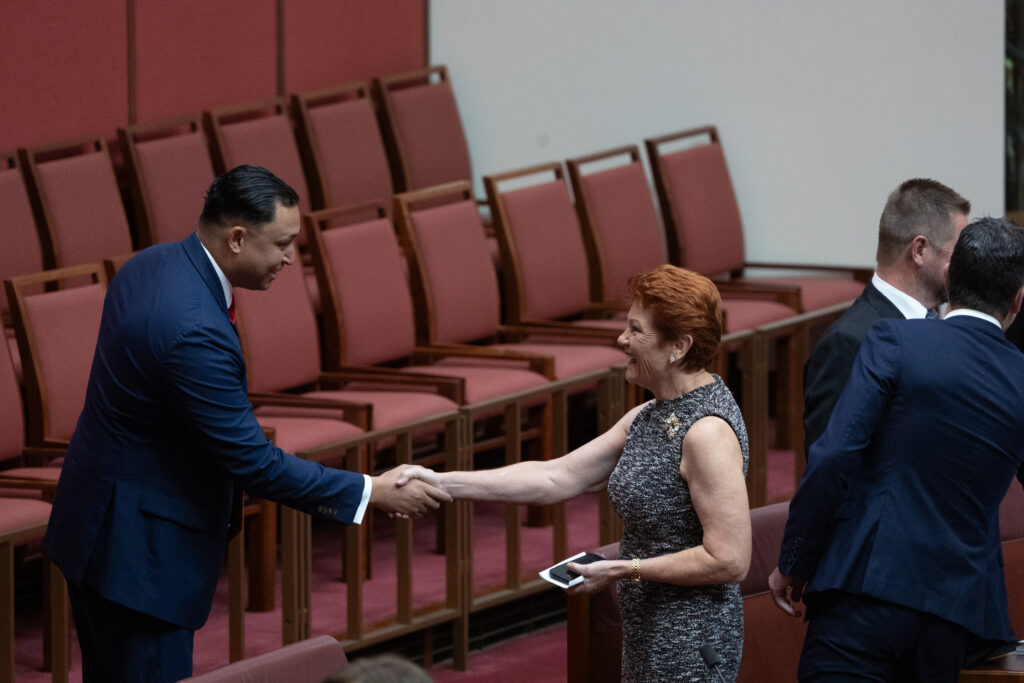
    The Liberal Party has allowed the right to be horribly splintered into small quite unsavoury portions. Media seems to be enjoying amplifying the spectacle.

  • Richard Mon, 23.03.26 10.55 AEDT

    Qelcome back, Amy - we missed you.

    So CosplayMiner Matty can't fill his Range Rover? Don't mention the war...

    Maybe it was intended as a joke - Matty is a wit, isn't he? Or at least a fraction of one.

    • Andrew Faith Mon, 23.03.26 12.15 AEDT

      Matty is several other types of wit, but I'm far too polite to say which ones…

The biggest stories and the best analysis from the team at The Point, delivered to your inbox.

Past Coverage