Peak manufacturing body Weld Australia has released a comprehensive response to the federal Liberals’ decision to abandon Australia’s commitment to net zero, saying it “should concern every Australian”:
What Net Zero Actually Means
Net zero is not a slogan. It is not a vague vision for “going green”. And it certainly does not
mean eliminating every last tonne of carbon emissions.
Net zero simply means balancing the amount of greenhouse gas we emit with the amount we
remove from the atmosphere. If Australia emits 450 million tonnes of carbon dioxide equivalent
today, we must remove 450 million tonnes to be net zero.
Of course, the goal is to shrink that 450-million-tonne figure as far as technologically possible
(down to perhaps 100 million tonnes) without destroying the industries that underpin our
economy. But whatever emissions remain must be counterbalanced through sequestration:
soils, forests, technological capture, or other verified removal methods.
Net zero is a pragmatic target grounded in physics, not ideology. Nations across the world have
recognised that failing to achieve it will be vastly more expensive than the transition required to
get there.
The Myths That Are Derailing Australia
Myth 1: We need more gas to keep the lights on
This is perhaps the most persistent, and the most misleading, claim in Australian energy politics.
Gas-fired generators supply just 17% of Australia’s electricity, less than half the contribution of
rooftop solar, which now delivers around 34% on some networks.
Despite endless claims from lobbyists, only one new gas-fired power station has been
commissioned in the past five years. Why? Because the economics simply do not stack up. Gas is
too expensive to serve as a transition fuel. Its role in firming the grid is shrinking, not
expanding.
And crucially, as The Australia Institute has shown, 83% of all gas extracted in Australia is not
used by Australians at all. It is exported.
Myth 2: Australia is running out of gas
The idea of a domestic gas shortage is pure fiction. In just five years, Australia has exported 22
years’ worth of domestic gas demand. The LNG export industry uses:
9 times more gas than our electricity sector
13 times more than manufacturing
30 times more than Australian households
There is no shortage. There is only an export industry that has been allowed to cannibalise
Australia’s energy security.
Myth 3: High energy prices are unavoidable
Domestic gas prices are high because they are tied to the international spot market; a market
designed to maximise exporter profits, not protect Australian industry. Australians now pay four
to seven times more for gas than consumers in the US, Russia, Qatar or Canada.
Wholesale gas prices in Australia are closer to those of major importers like Japan and China
than to fellow exporters. That is an absurd situation for a nation that is the world’s second�largest exporter of LNG.
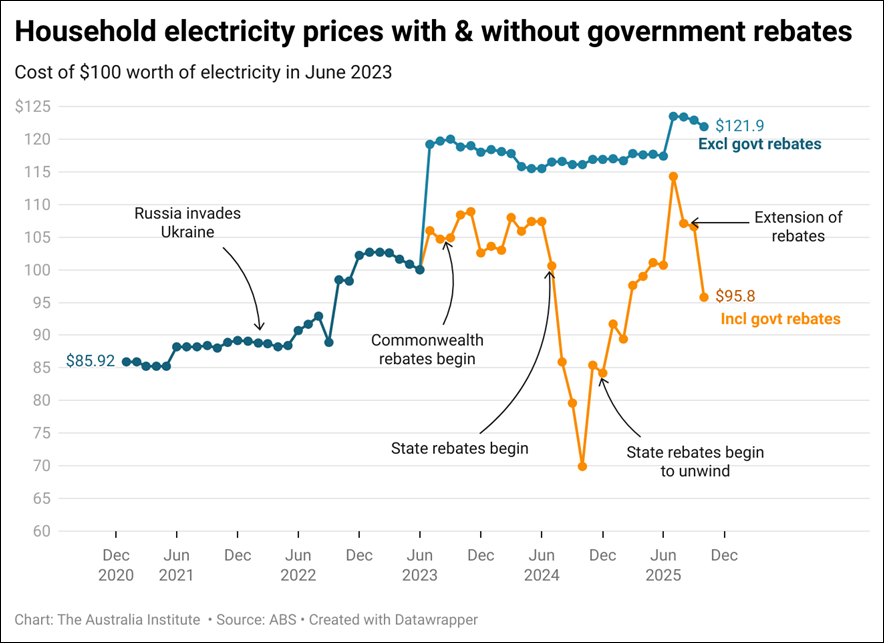
Worse still, high gas prices translate directly into higher electricity prices, even though gas
supplies only a sliver of our power. This system is irrational, economically damaging, and
entirely fixable.
The Real Consequences: Industry Decline and Sovereign Risk
Manufacturing is already under extreme pressure. High gas and electricity prices inflate the
costs of essential goods from steel to water heaters. This is a huge burden on industry and a
substantial additional impost on Australian families.
We risk losing sovereign capability in industries vital to national security (like shipbuilding,
defence, manufacturing, and fabrication) because of energy policies that favour foreign-owned
fossil fuel companies over Australian businesses and households.
This is not abstract. It is happening now.
The Path to Net Zero: Clear, Achievable, Economically Sensible
- Decouple domestic gas prices from the international spot market. There is no reason
Australians should be paying importer-level prices for Australian gas. Gas reservation, domestic
pricing mechanisms and export controls are implemented by every major resource-exporting
nation except us.
- Decouple electricity prices from gas. Allowing 13% of generation (gas) to set the price for
100% of electricity is indefensible. Technology-neutral reform and strategic investment in
storage will break this distortion.
- Accelerate renewables and firming, fast. Wind, large-scale solar, rooftop solar and batteries
are booming despite policy uncertainty. With bipartisan support, Australia could not only
decarbonise rapidly but become a global renewable energy superpower.
- Establish a bipartisan National Energy Strategy. Since the mid-1990s, Australia has lurched between policies, reversals and ideological battles. Energy markets need certainty. Investors need clarity. Industry needs predictability. A bipartisan strategy is the only path to that stability.
- Ensure Australians benefit from Australian resources. Qatar earns around $50 billion per
year in taxes and royalties on gas exports. Australia earns around $1.6 billion on roughly the
same exported volume.


Comments
Start the conversation