← Home

Tue 28 Oct

The Point Live: Coalition net zero fight looming. As it happened.

Amy Remeikis – Chief Political Analyst and blogger

This blog is now closed.

Key Posts

The Day's News

Minister pays respects to killed miners

Madeleine King takes a dixer on mining, but opens up with giving her condolences to the families and loved ones of those injured and killed in the Cobar mine tragedy today. A man and a woman were killed and another was hospitalised after an incident in a mine, which is currently under investigation.

King:

I want to take this brief moment to express my deepest sympathies to the families and workmates of the two workers who have died in a mining accident in Cobar earlier today. It’s a reminder to each of us here and around the country that mining is dangerous work and that every person who works in this industry deserves to come home safely at the end of a swing or at the end of a shift.

Question time begins

I didn’t cover this story off this morning, because, well, I thought we already knew it. It’s been covered in stories on the incoming brief and I am pretty sure has made a question time appearance previously (Amazing that this story popped up in the Australian just as the Coalition have lost the plot on net zero too. DEIDRE CHAMBERS)

But what Chris Bowen knew about the forecast increase in retail power prices opens up the questions today.

Sussan Ley:

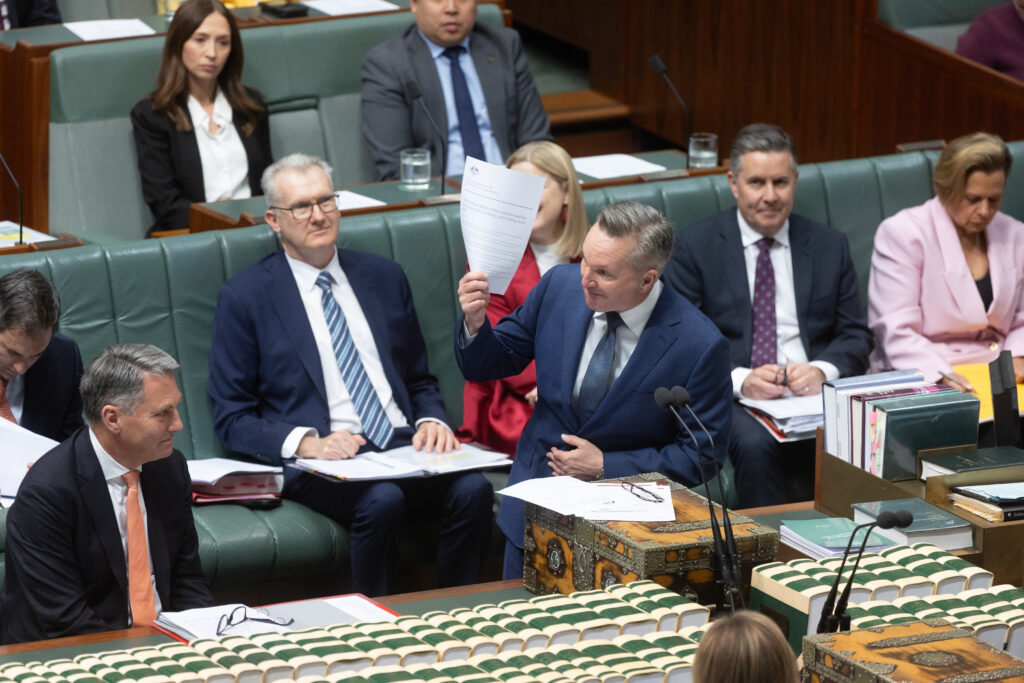
I refer to the front page of today’s Australian: Under pressure from Senator Dean Smith in the other place [the senate] Labor has finally released a secret government document which warns of a “further significant increase in retail electricity prices”. It was also revealed that the clerk of the Senate called Labor’s obfuscation “not acceptable”. Why did this minister do everything he could to hide this document from the Australian public instead of doing everything he could to reduce power prices by $275?

Bowen:

I’m deeply grateful to the Leader of the Opposition for the question. Although I think it might have been better if she had been more transparent with the House. The Leader of the Opposition has asserted that the incoming government brief said one thing and didn’t read the full quote from the incoming government brief. I will. It says…

“The draft default market left. offer points to further significant increase in retail electricity prices in the next financial year.”

Now, the important thing about the incoming government brief referring to the default market offer is that that market offer was already public.

Not only when I received the incoming government brief – so it was hardly a revelation – but before the election. Because the default market offer increase was released by the Australian Energy Regulator before the 2025 election.

That is not uncommon for a minister to receive a default market offer just before an election. And the minister has an opportunity, has a decision point, before them at that point.

The minister can say, “Well, it should be released in a transparent fashion.” The minister can do that. That’s what I did. Here’s the press release from me, referring to the release of the default market offer, this “secret briefing” that the Leader of the Opposition is so concerned to read about in the front page of The Australian today.

I table my press release from 11 March 2025, which was before the federal election. The alternative option available to a minister when receiving a default market offer that is high before an election is to change the law to keep it secret.

That is the alternative option before a minister. An option I declined to take. An option one of my predecessors did take.

The Minister for Industry, energy and emissions reduction [Angus Taylor] on 31 March 2022, almost three years before, changed the law by regulations to keep it secret until after the election. I table that as well. The Leader of the Opposition quotes the incoming government brief – if the Leader of the Opposition had read on, she might have further quoted that brief, “De-carbonising the electricity and energy system is foundational to achieving a whole of Economy transformation maintaining energy affordability and reliability.”

There’s a whole lot more. There’s a whole lot more where that came from, Mr Deputy Speaker. I hope I get more questions from the opposition on the incoming government brief.

No JAUKUS yet, but maybe in the remix

Q:There are growing prospects that China may back off what’s on its rare earths export controls as part of a US deal on Thursday. Do you anticipate they’ll change anything about the critical minerals deal we signed to the White House last week?

Albanese:

Our deal is a good deal for Australia and for the United States. Critical minerals and rare earths as an opportunity for Australians to benefit Australians to have more jobs, to have more, not just resource extraction, but value adding as well with processing. This is all important for Australia as we go forward, and we will engage, and I think, continue to see more investment, which is about setting ourselves up for success in coming years and decades. These rare earths and critical minerals are what will power the global economy this century, and just as Australia has benefited from resources in the last century, such as iron ore, that will continue, but we need to diversify our trade and where we get that economic growth and activity from, and that’s why we’re doing this. 

Q:President Trump is in Tokyo, and he’s meeting with the new Prime Minister. You met her the other day. What did she have to say about AUKUS? And are we looking at the possibility of JAUKUS?


Albanese:

AUKUS is an arrangement between Australia, the United Kingdom, and the United States, and we’re very much focused on delivering that and getting that right. And significant advances have been made in that, as President Trump made clear. The meeting I had with the new Japanese Prime Minister was very positive and constructive. I’ll see her again. She will be at APEC. She has invited me to come to Japan. Of course, some Mogami frigates that we are purchasing from Japan are going to be very important. And that process, as well, is a separate one, where we not only will be purchasing frigates, we’ll be producing frigates as well in Western Australia, with the support and know how as well of our friends in Japan. All of this is very positive going forward.

‘We need to uphold international rules and norms’ Albanese says. About Asia.

Let’s take a look at what Anthony Albanese has had to say today at his press conference in Malaysia:

Albanese:

I’ve just had the enormous pleasure of meeting young people from throughout the ASEAN region who are receiving support with the Australian Leaders Dialogue Program that we have with ASEAN, bringing together people from all of the countries of ASEAN to engage with each other, and importantly, as well, to engage with Australia. They visited Parliament House just a few weeks ago, and I got to see them there when they were walking around Parliament and engaging in Canberra. At the end of the day, what the world needs is more interaction, more cooperation, more engagement on peace and security, dealing with the challenge but also the opportunity of climate change. And these are young people who are optimistic about the world’s future and who are helping to create that better future for the entire region.

Q: Prime Minister, what will your message be to ASEAN this afternoon, particularly about responsibility for regional security?

Albanese:

My message this afternoon to ASEAN leaders is that we need to uphold the international rules and norms. We need to as well, engage with each other. This is the fastest growing region of the world in human history. If we have more cooperation, more engagement, more free and fair trade, then that represents an opportunity for the entire region. From Australia’s perspective, what we want to do is to be more engaged in this region. In recent years, we’ve doubled our trade with this region, that means more jobs for Australians, more economic activity in Australia, as well as a more prosperous and secure region. We have three pillars of our foreign policy – our engagement and alliance with the United States, our engagement with our region, but also our support for multilateral forums – and that’s why this positive engagement is so important. The fifth Australia-ASEAN Summit this afternoon will be an opportunity for that. It will also build on the bilateral meetings I have this morning with the leaders of the Philippines and Thailand, and last night as well, there was an opportunity for me to engage with the leaders in our region. We have a new Prime Minister of Thailand who I was able to meet informally with last night. These relations are all important for Australia as we go forward.

And further to social media bans…

Further to the social media ban, Grogs has pointed this out from the UK – which saw VPN sign ups skyrocket.

Bryan Brown takes charge

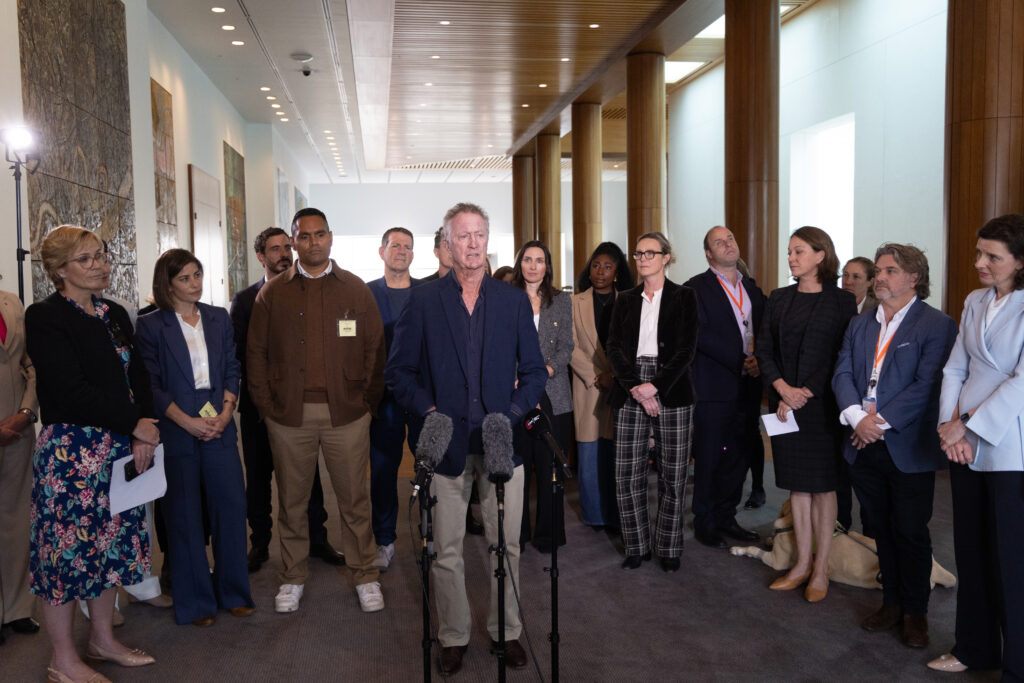
Australian actor Bryan Brown took control of another press conference (he has a way of doing that and the MPs are usually so star struck they let him.

The MPs and Australian creatives were there to talk about the next steps in protecting Australia’s creative industries.

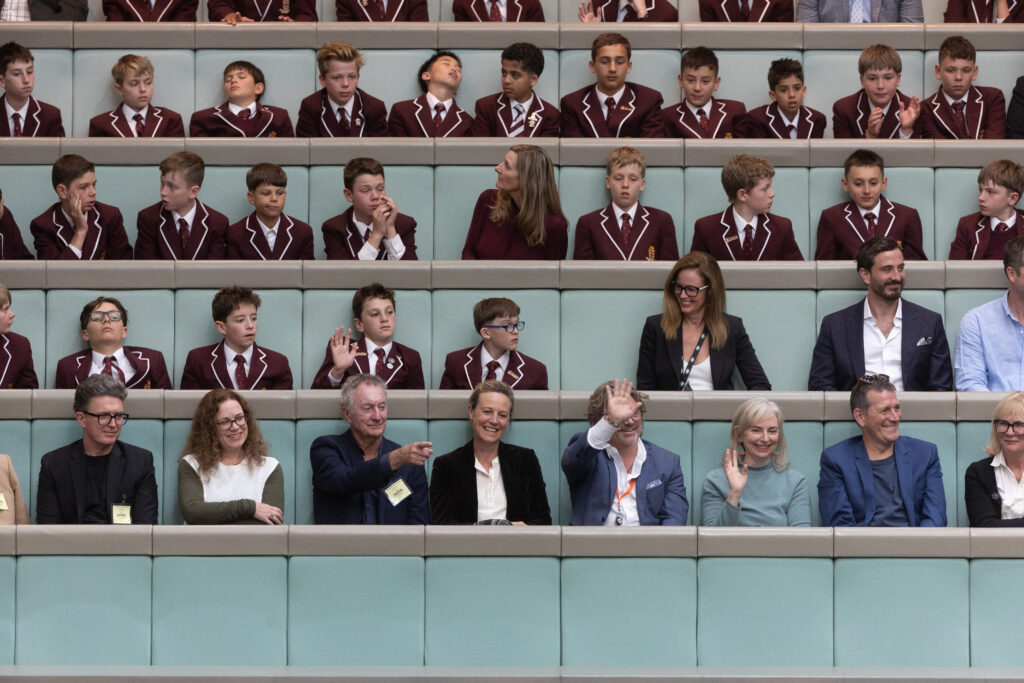
Cross Bench and Teal members Zali Steggall, Kate Chaney, Monique Ryan, Nicolette Boele, Sophie Scamps and Alegra Spender hosted screen industry actors, producers and workers calling for the government to honour their election commitments on Australian streaming content. Actor Bryan Brown, Rob Collins, Brooke Satchwell, Marta Dusseldorp and Rhys Muldoon talk to the media in the Mural Hall of Parliament House in Canberra. Tuesday 28th October 2025. Photograph by Mike Bowers

The man knows how to command a room.

Don Farrell wants peace in our world

Given we are in the downhill slide into question time, let’s take a look at some of the transcripts from today.

Here is some more of Don Farrell from this morning’s ABC News Breakfast interview, where he was asked about China:

Q: How do we see Australia’s position in the region in the event of any escalating conflict between different nations, and some of the tension between the US and China? What is Australia’s role? Is that something that’s being discussed this week at ASEAN?

Farrell:

Look, we want a peaceful region. We’ve seen the conflict in the Middle East, we’ve seen the conflict in Europe. We don’t want conflict in our region. And one way to avoid conflict is to increase the prosperity of our region. How do we do that? Well, free and fair trade does that precisely. And so, we want to build those strong links, build those trading opportunities. Part of my job, is to try and push Australian companies out the door and into the region to take advantage of this growing prosperity in Southeast Asia.

If you’re an outward-facing Australian business, then your profits are likely to be higher, but also the wages of your staff are likely to be higher. So, there’s great opportunities there to take advantage of this improving prosperity. And, I think the more we can engage economically with the region then the more peaceful our region is going to be. And that’s the way the Albanese Government would like to see it.

Social media giants say ban will send teens into ‘darker corners’ of the internet

Tom Wark, Melissa Meehan and Tess Ikonomou
AAP

Snapchat, Facebook, Instagram and TikTok will comply with Australia’s looming social media ban for children under the age of 16 but claim the restrictions will push young people into “darker corners” of the internet.

Kids who do not meet the age requirement will be booted off social media platforms from December 10, but there will be exceptions for health and education services including WhatsApp and Meta’s Messenger Kids.

Tech executives were grilled during a parliamentary inquiry hearing on Tuesday, saying although they did not agree with the age restrictions they would implement the ban.

TikTok public policy lead Ella Woods-Joyce said the company shared the concerns of experts that the “blunt” age bans won’t work or resolve the concerns the laws aim to address.

“We support evidence-based sensible legislation that improves safety standards for all internet users … a ban will push younger people into darker corners of the internet where rules, safety, tools and protections don’t exist,” she said.

Jennifer Stout, a representative from Snapchat’s parent company Snap Inc, said the platform believed the ban had been applied unevenly and risked undermining community confidence in the new rules.

“For teens, connection and communication are strong drivers of happiness and well being, taking that away does not necessarily make them safer and it may instead push them towards other messaging services that lack Snapchat safety and privacy protections,” she said.

Meta regional director of policy Mia Garlick said compliance presented challenges because 16 was a “globally novel age boundary” as existing technologies were built to identify the age milestones of 13 and 18 years.

“Distinguishing 13 from 16 is inherently less reliable and it also found greater challenges at the 16 age boundary with age estimation technologies,” she said.

Platforms face fines of up to $50 million if they do not take reasonable steps to comply with the ban, but there won’t be penalties for young people or their families if they gain access to the platforms.

Greens senator Sarah Hanson-Young previously threatened to force executives from TikTok, Snapchat and Meta – the parent company of Facebook and Instagram – to appear at the inquiry into online safety after they were no-shows at an earlier hearing.

The law puts the onus for compliance on the companies to “detect and deactivate or remove” accounts from underage users.

This will mean about 1.5 million accounts on Facebook, Instagram, YouTube, TikTok, Threads and X will be deactivated in less than two months.

Tech giants Apple and Google removed OmeTV from their app stores this week after being alerted to concerns predators were using it to groom and sexually exploit  Australian children. 

OmeTV instantly connects individuals with random strangers for a video chat. 

The app’s Portugal-based parent company Bad Kitty’s Dad, LDA did not comply with requests sent by eSafety Commissioner Julie Inman Grant in August to introduce protections for Australian children. 

The tech giants have since banned the app and are expected to review all others available in their Australian stores. 

“This is an app that randomly pairs young children – with pedophiles,” Ms Inman Grant told ABC News on Tuesday.

“This app will no longer be able to reach Australians and they will no longer be able to make money off children’s misery.”

Subsidising gas has failed; it’s time Australia tried something else

Frank Yuan
Postdoctoral Fellow

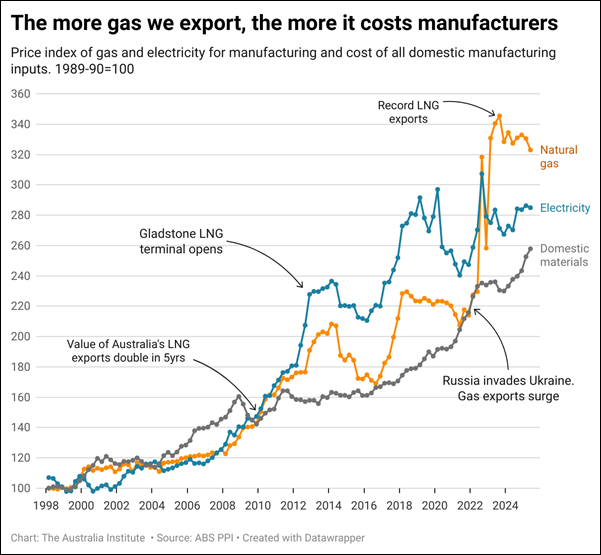
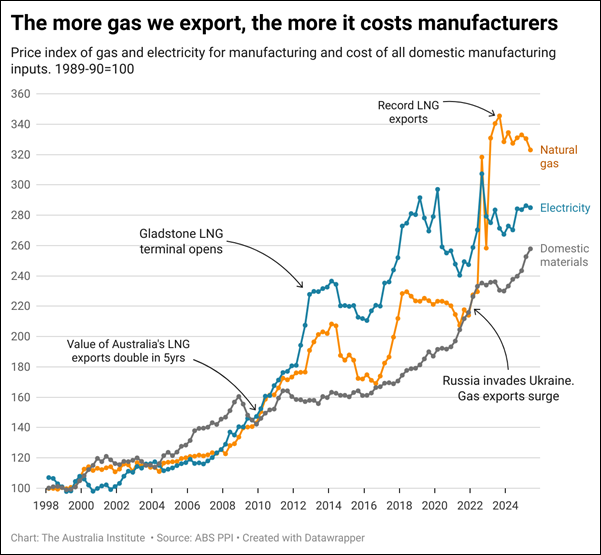
My colleague Greg Jericho has pointed out earlier today how gas was the culprit in the potential closure of Australia’s largest aluminium smelter, Tomago.

More precisely, Australia’s gas giveaway is responsible for the high gas prices and the consequently high electricity prices.

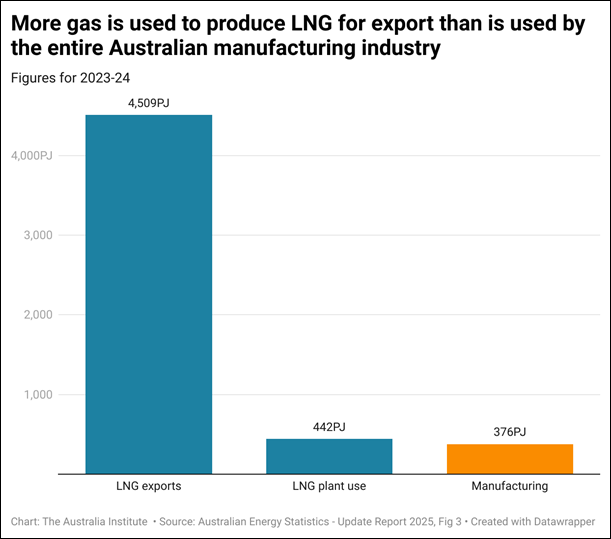
It’s worth reminding ourselves again: Australia gives away so much gas that, it uses more gas to process gas for export, than it uses gas for manufacturing or domestic electricity generation. The closure of Tomago would see that balance tip even further into ridiculousness.

And why wouldn’t gas companies chase profits by selling it overseas? The government doesn’t charge them royalty (or likely any petroleum tax) on over half of the gas exported. Australia is effectively subsidising its gas exporters (and other fossil fuels). This has manifestly not helped Australian manufacturers.

Why not channel that subsidy money to renewable energy instead? The aluminium smelter doesn’t care whether the electrical power comes from a gas turbine or a wind turbine, so long as it’s there. And it’d be better of we can source the electricity without further polluting the atmosphere.

In fact, this would not even need to be a hand-out. Tomago could have benefited from a rapid build-out of renewable power generation and storage capacities. Targeted government financing, such as credit support and concessional loans, can stimulate private sector investment in renewables. The additional electricity could then be contracted for the smelter at a stable and sustainable price.

The loss of Tomago would be devastating for their workers in Newcastle; but if Australia does not act soon, its three other remaining smelters could be in danger, as would its other electricity-hungry industries.

Tech giants reluctantly agree to social media ban

I haven’t had eyes on the senate inquiry into the social media ban, but the SMH’s Nick Newling has.

He reports the major tech companies have agreed to comply with the government’s under-16 ban. Reluctantly.

You can read that, here.

The biggest stories and the best analysis from the team at The Point, delivered to your inbox.