← Home

Mon 27 Oct

The Point Live: Barnaby keeps the Nats guessing on his future. As it happened.

Amy Remeikis – Chief Political Analyst

This blog is now closed.

Key Posts

The Day's News

Un-intelligent plan scrapped

Alice Grundy
Research Manager

Artists around Australia welcomed the Federal Government’s decision to reject a data-mining exception proposed by the Productivity Commission in their interim report on artificial intelligence in Australia.

This isn’t the first time that the Productivity Commission (PC) has come for Australian artists. The PC called for an end to territorial importation restrictions – which stop foreign publishers from making cheap versions of local books and flooding the market – in 2008. Industry outcry at the time meant the recommendation was binned.

Last time, the PC suggested one option for managing copyright in the age of AI was to allow an exception for local AI companies, in order to promote local AI business. Artist after artist testified before a Senate inquiry saying that the exception was outrageous.

Musician Adam Briggs said, “We’re just saying if you want to use it, you have to pay for it… It’s like any other industry in Australia. If you want to build a building, you have to pay for the bricks and concrete and steel.”

The decision not to adopt this exception is a good first step. The next is to force the big companies exploiting Australian artists’ work to train their large language models to pay their fair share.

Lol – One Nation to drop Pauline Hanson’s name and revert back to One Nation in latest troll of Nationals

Never let a crisis (manufactured or not) go to waste huh?

Pauline Hanson has announced that One Nation will officially drop Pauline Hanson from the official party name ‘Pauline Hanson’s One Nation (which they put in place while re-registering the party after a small kerfuffle over who actually had the name ‘One Nation’) and revert back to being One Nation, officially.

Here is the statement on the party website:

The decision marks a defining moment for the movement, reaffirming its identity as a voice for ordinary Australians who value fairness, sovereignty, and unity.

Senator Hanson said the change symbolises a renewed focus on the principles that first inspired millions of Australians to join the movement: putting the nation and its people first.

The rebranding reinforces One Nation’s commitment to restoring trust in politics, protecting Australian values, and continuing the fight for everyday Australians across every state and territory.

With this announcement, Senator Pauline Hanson is once again reminding the country that One Nation stands stronger than ever: one voice, one people, one nation.

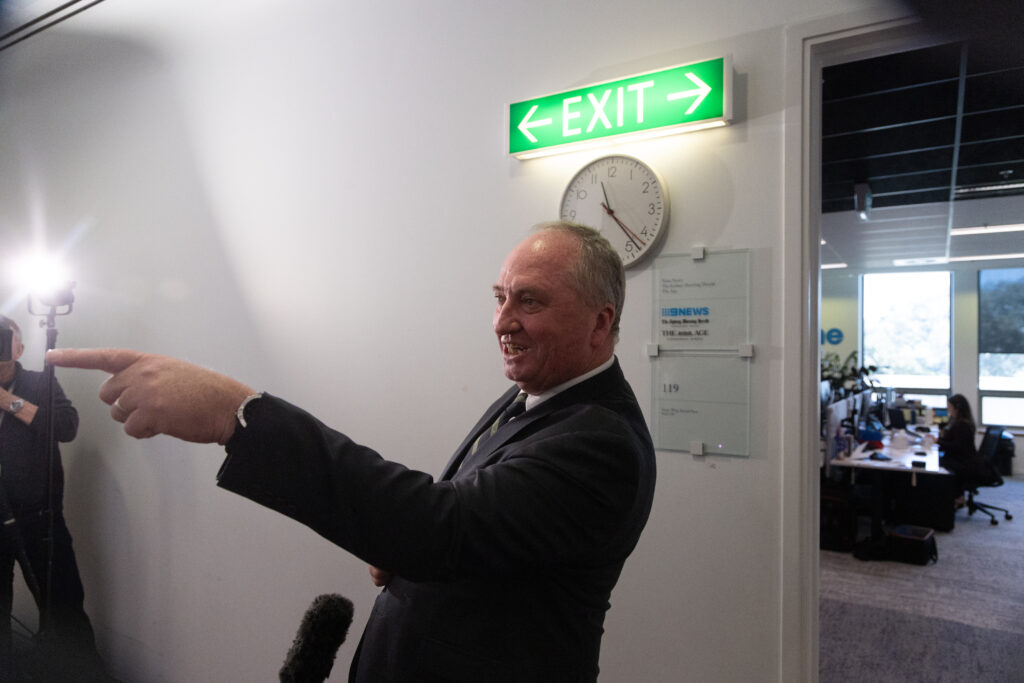
But make no mistake – it is to troll the Nationals and keep the story that Barnaby Joyce may be joining the party, going.

It’s also, no doubt, booked her a slot on some media, so that is always a win, right?

Super Ted is then allowed to ask a question, which is always a fun time for all involved.

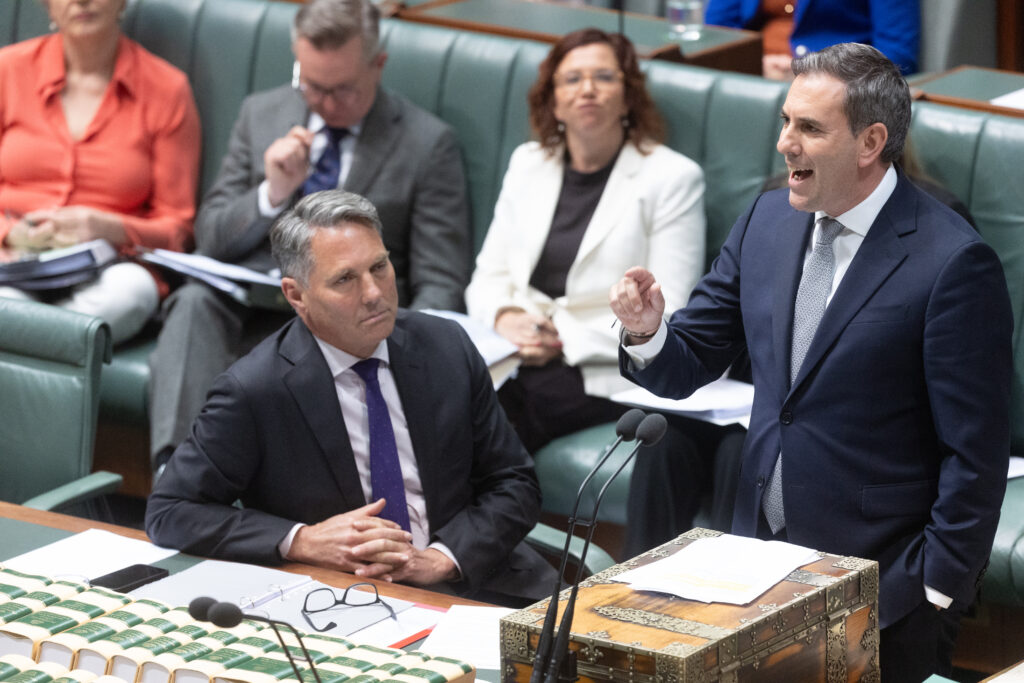
It’s for Jim Chalmers:

My question goes to the Treasurer: It follows the Treasurer’s humiliating backflip on his super tax proposal. Can the Treasurer advise the House whose rejection most influenced his decision to dump his tax? Was it (a) the coalition? (b) industry experts and economists? (c) the Prime Minister? Order! The member will pause. The member will pause.

Labor’s Josh Burns is booted for interjecting and Dugald is NOT having it today:

Look, I don’t know why this is so difficult. When people are asking questions, don’t interject. There’s a lot of intelligent people here… [there is laughter at this] well, in the gallery, there are… Order!

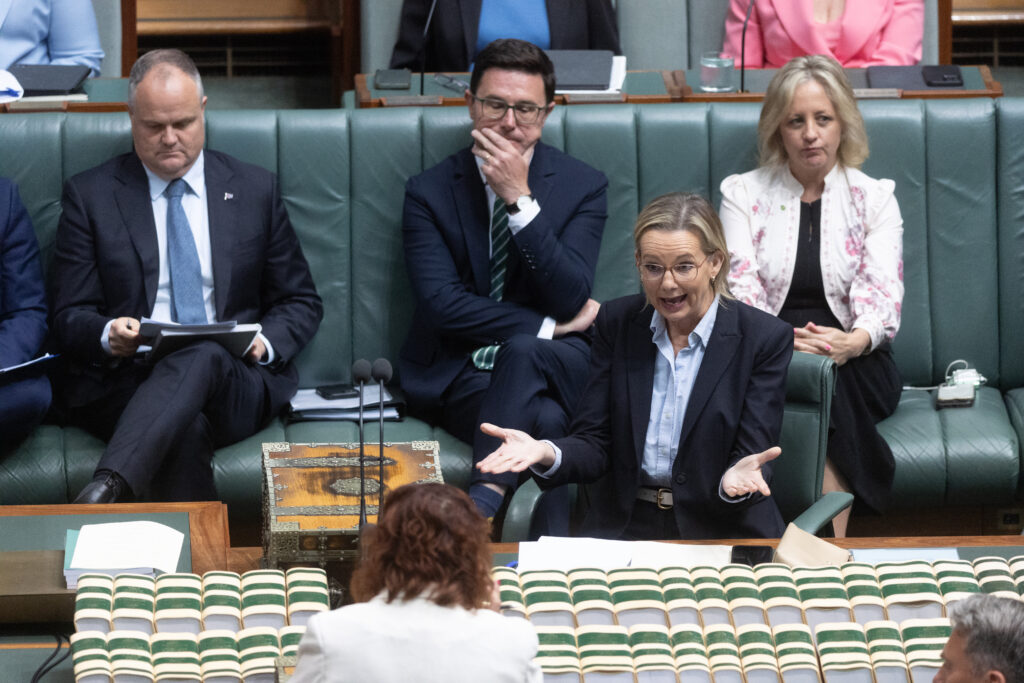
Super Ted asks his question again and Chalmers adopts his ‘sigh-I-have-to-deal-with-Ted-O’Brien-again-why-am-I-being-punished-pose’ which is when he leans again the despatch box and faces the speaker, because he can barely bring himself to acknowledge Super Ted across from him.

I get it.

Chalmers:

I’ll make it really clear to the House that I didn’t take the advice of those opposite. I didn’t take the advice of those opposite. And that’s because the question comes from the same people who took to this year’s election a policy to increase income taxes on every single one of the 14 million taxpaying workers in this country. The same people – the same people – who object to smaller tax concessions for 0.5% of people in super wanted to jack up income taxes for 100% of the 14 million taxpaying workers. That’s because what they really object to, as I said before, is they really object to more super for more workers. They don’t like super. They don’t like workers. We know that from their almost decade in office. They are always trying to undermine and diminish and come after the superannuation that the working people of this country need and deserve for a decent retirement. Also, don’t forget that the question comes from the same guy who wanted to borrow hundreds of billions of dollars to build nuclear reactors to push power prices up, not down. So he asks he who I take my advice from.

I don’t take my advice from the Shadow Treasurer, Mr Speaker. I really couldn’t be clearer about that. He can trouble himself all he likes with the political scuttlebutt and the internal far-right politics practised by those opposite. The difference between the Shadow Treasurer and myself as Treasurer is the outcomes. I’m here to deliver for the working people of this country. I’m here to deliver an increase in real wages. I’m here to deliver income tax cuts. I’m here to deliver more super for more workers so they get the decent retirement that this guy would deny them.

Super Ted has a whinge that Chalmers isn’t being relevant, but Dugald is like – ask play stupid games, win stupid prizes (also the name of my dating memoir) but Chalmers decides to play along:

The point I’m making is this side of the House works through issues in a collegiate, in a considered, in a methodical way, and we do what we can to find the best way through and, overwhelmingly, to deliver for the working people of this country, who send us here to represent them and their interests. The Shadow Treasurer’s here for a little pat on the head on Sky After Dark or a little tickle on the tummy on Page 13 of The Australian. We are here for the outcomes. Because it’s the outcomes that really matter. The outcomes really matter.

We’re here to deliver for working people, and that’s what we’re doing. And because of our efforts – and this is what really offends them – because of our efforts, more Australians are working, more Australians are earning more, more Australians are keeping more of what they earn, and more Australians will retire with more. And that’s because we are delivering – they are divided, they are divisive, they are in disarray. And that’s the difference.

Independent MP Andrew Wilkie then asks Mark Butler:

Minister, Australia’s hospitals system is in crisis. Establishes aren’t big enough to properly fund public hospitals, and the health insurance isn’t working for the private sector. People are suffering needlessly and far too often dying prematurely. Only the Commonwealth has the financial and policy heft to turn things around. Minister, when will the federal government finally act to fix things? Because, let’s face it, just negotiating another funding agreement is hardly bold reform.

Butler:

I thank the member for his question and recognise his passion over many years in this place for better services in his part of Tasmania, in particular, but the country more broadly. He knows there’s a lot of pressure on our health and aged care systems.

After a decade of cuts and neglect, after a once in a century pandemic, and with very significant demographic pressures on our system. Like the member, we’re feeling the pressures in our state very much, but it’s right across the system. I respect the member’s passion in this area. But I don’t agree with a lot of the suggestions in his question. I have to say, this week is a particularly weird week for the member to suggest this is not a government focused on bold reform.

This is the week where we are debating a bill to introduce a Centre for Disease Control. This is the week where the Assistant Minister for Health is rolling out a whole range of new measures to deal with the neglect that has been there for so long around women’s health. This is the week when we are introducing an entirely new aged care system under the leadership of the Aged Care Minister. Mr Speaker, at the end of this week, we will be introducing and rolling out the biggest-ever investment in bulk-billing in the history of Medicare.

The member for Clark knows, more than anyone else in this chamber, the benefit of investment in bulk-billing. Because, since we first tripled the bulk-billing incentive two years ago, the member for Clark’s electorate has seen the biggest increase in bulk-billing of any electorate in this chamber – a 14% increase. And more will come after Saturday. In Tasmania, we’ve seen the benefit of our policies to get more doctors and nurses into the system. The member for Clark has two Urgent Care clinics in his electorate, taking pressure off the hospitals that his question talks about.

There is a back and forth about relevance. Butler comes back with:

I think, in his heart of hearts, the member for Clark knows our health and aged care system is an integrated system. Bulk-billing is not working. When people don’t fill their medicines, they don’t need to go to their GP when they need to go to their GP. The member for Clark knows that means they end up in hospital far more regularly than they should. That’s why addressing pressure in primary care, making medicines cheaper, is not just good for the hip pocket – it’s good for the health of millions of Australians who get the healthcare when and where they need it in the community.

And there is no better example of our reform and its connection to the hospital system than our 90 Urgent Care clinics, two of which are located in the member for Clark’s electorate, which have already seen more than 2 million Australians, most of whom say, if they weren’t able to go to that clinic, they would end up at the emergency department. I know the member for Clark is passionate about this. I agree there are pressures. I entirely reject the idea, that we’re not a government of bold reform.

The LNP MP for Flynn, Col Boyce, who I always forget exists except on the rare occasions he asks a question in QT, asks how many jobs will be lost with the possible early closure of the Gladstone power station.

It was meant to shut down in 2035, but Rio Tinto have told workers it may close as early as 2029. That’s because it costs a hell of a lot to keep running and is becoming financially unviable.

Chris Bowen gets to this one and says:

I’m glad he has not been sharing his views about man-made climate change for a change but in honour of all there about 200 direct employees of the Gladstone power station who are employed on a contracted basement and indirectly and it is a significant number for the people of Gladstone but also this is a decision taken by the owners of the Gladstone power station, they have announced, and it is in keeping with the normal protocols and I would make his point Mr Speaker – those opposite our strongly supporting having coal-fired power stations open for longer and sweating assets to see them live longer

That is is the biggest liability in our energy system today. Do you know why? Because today, we had two units of the Callide Power Station which the honorable member would know well out, out and non-operating.

And we have a total unplanned outage across the national energy system of 3.4 gigawatts of coal-fired power. Not planned, not maintenance, coal-fired power stations that were working and all of a sudden break down.

It’s the biggest threat to the reliability of our energy system and that in turn is a threat to energy prices because that sees prices spiked and that is in turn biggest threat to industrial jobs in Australia, those opposite who do not understand the opportunities of our energy system and the need to modernise it now, not a decades time when nuclei may become available.

Michelle Rowland then takes a dixer on the government’s AI decision – LLM models won’t be able to train on Australian content for free. Which sounds like a win for artists and creatives, but most giant AI models have already scraped the internet without paying for it, and they’ll find ways to continue doing that.

Still, it’s a small win. Rowland says:

A core Labor value is supporting Australian voices, Australian culture and Australian stories and, of course, this government has two great champions for the arts in our prime minister and also in the Leader of the House and the Minister for the Arts. Artificial intelligence presents a significant opportunities for Australia and our economy. However, it is important that Australian creatives benefit from the opportunities too. Australian creatives are not only world-class but also the lifeblood of Australian culture.

We must ensure that the right legal protections are in place. The Albanese government has consistently said there are no plans to weaken copyright protections comes to AI. Some in the technology sector have called for the introduction of a broad text and data mining exception. Under such a proposal, artificial intelligence developers would be able to use the works of Australian creators for free and without permission to train AI systems.

The government stands by Australia’s creative industries and that is why we have ruled out a text and data mining exception, and that is to provide certainty for Australian creators. And we welcome the support that has been expressed right across the creative industries. Annabelle Herd the CEO of Aria said it is absolutely a critical step in the right direction. And it is a win for creativity and Australian culture, including first nations culture, but is also a win for common sense.

The Australian society of authors CEO Lucy Hayward so people deserve to be paid for their work. It’s as simple as that. That’s what the government has confirmed with this announcement. Australian singer-songwriter Holly Rankin, better known as Jack River, said we are on the right side of history on this. People should be paid for their work.

And the great Kate Ceberano said it is a day to celebrate. Mr Speaker, I could not agree more. Work is under way to ensure that Australia is prepared for future copyright challenges emerging from AI. That’s why I’ve made the decision to reconvene the copyright and AI reference group over the next two days, and it will have a renewed focus on three priority areas. Firstly, encouraging fair legal avenues for using copyright material in AI, secondly exploring opportunities to clarify how copyright law applies to material generated through the use of AI, and examining avenues for the enforcement of copyright infringement. We encourage the tech industry and creative sector to now come together and find a sensible and workable solutions to support innovation while ensuring creators are fairly compensated.

Tim Wilson and his best smarmy facial expression then asks:

Journalist Nick McKenzie, who was uncovering the truth about corruption in the CFMEU, and its links to organised crime and gangland figures, has endured home intrusions in a chilling act of intimidation that has no place in this country. Australians deserve to know the truth. What specific action has the government taken to protect journalists who are just doing their job is to expose CFMEU corruption?

Milton Dick makes the point that it is probably not part of Rishworth’s portfolio, but she takes the question anyway:

Firstly I thank the Member for his question and I think every member of this house would have absolutely no tolerance for intimidation of journalists or indeed anyone in this country. I’m going to speak to whistle-blowing, the people coming forward about the CFMEU, because it falls into my responsibilities. Not only are there protections in the registered organisations act but our government specifically in whistle-blower protections in the administration. And of course, I was asked about whistle-blowers and protections for Australians and so I am answering that question. There are specific provisions in the administration that attacked people coming forward. I would make one point though – in my conversations with the administrator, the action that he has taken ensures first and foremost the safety of his staff.

That’s the seriousness that he is undertaking with his work, that the safety of his staff and in the course extends to all Australians. We take this job seriously. We are taking this with a level of attention that those opposite have not done. There is no place for violence in this country. There is no place for intimidation of anyone, journalist or any Australian worker. We are committed, as I said on numerous occasions, of getting the job done, stamping out violence, criminality and corruption from the building industry and we I are committed to doing just that.

Treasurer Jim Chalmers then takes a dixer on the legislation which will ensure employers pay superannuation at the same time they pay wages.

But it is mostly an excuse to lay into the opposition, and it feels like he is using it as a bit of a therapy session:

It’s about making sure that workers’ super is paid, and paid on time. It’s another proud Labor reform which will mean more super for workers. That’s our goal, and that’s what we are delivering. It’s not the only important change we’re making to strengthen our super system.

We legislated the objective, we increased the super guarantee four times to reach 12%. We expanded the coverage of the performance test. We’ve aligned the financial reporting with public companies. We’ve got new mandatory service standards, reforming the retirement phase. We’re paying superannuation on Paid Parental Leave for the first time. And now, our changes to better target superannuation concessions and the Low Income Superannuation Tax Offset, which will mean that 1.3 million Australians will get more super when they retire.

These changes will make the superannuation system fairer from top to bottom. They mean a better deal and more super for low-income workers, and that’s what those opposite are really objecting to. Because when they apply their narrow, extreme, right-wing ideology in government, workers in this country don’t get a look-in. And we saw that for the best part of a decade. They are always looking to undermine and diminish and attack superannuation because they know that super is a proud creation of this side of the House.

Under this government, this Labor government, Australians are earning more because we got real wages growing again. They are keeping more of what they earn because we are cutting taxes three times and they will retire with more as well because of these changes. Those opposite wants the workers of this country to earn less, to keep less and to retire with less.

They have not learned a thing from the last election. They have not changed a bit. They are divided, they are divisive and they are in disarray. At this side of the house is delivering for the working people of this country and that’s the difference. And nowhere is that clearer than in our efforts to make our super system stronger and fairer and more sustainable and because of those efforts, more workers will have more super when they retire and the system will be fairer from top to bottom.

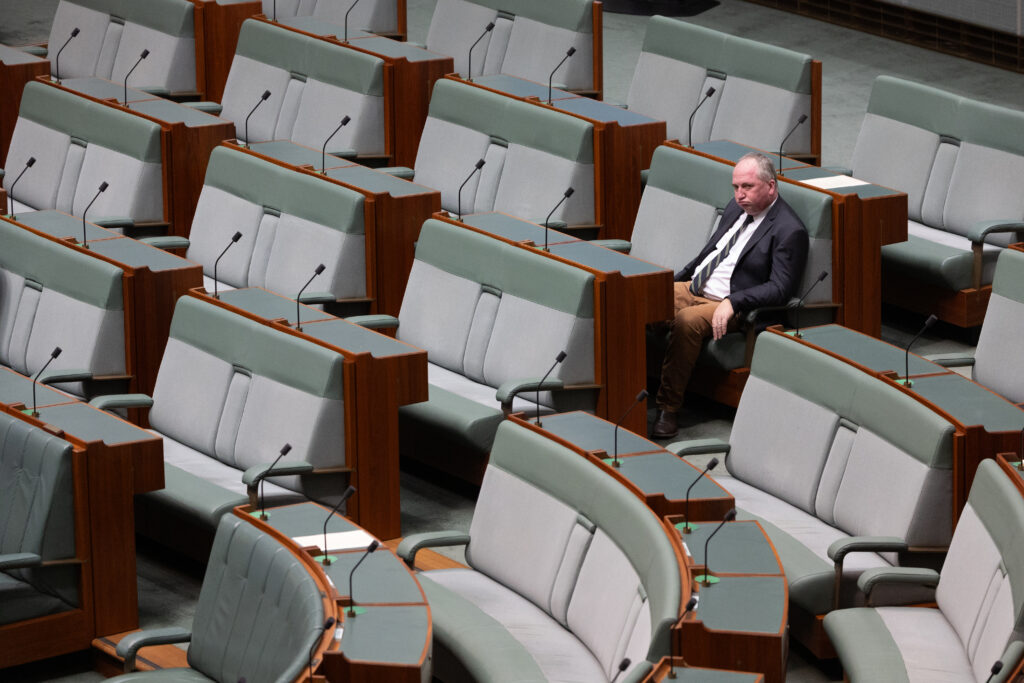
Tim Wilson, who is suffering from his own relevancy deprivation syndrome (it is not as serious as Barnaby Joyce’s, but give it time) asks another question about the CFMEU allegations, but tacks on a bit about donations to Labor at the end which sparks a parliamentary back and forth over whether or not it is in order.

He withdraws the final bit and there is still a back and forth over whether it is in order, but Amanda Rishworth then answers:

I thank the shadow minister for his question, and probably from the outset reject the assertions that were in that question.

What might help him is for me to go through some of the action that both the administrator and the regulators have taken during the 16 months that the administration has been in place.

First, I would note that, as I previously said, the administrator’s difficult has been, to date, to remove or accept the resignations of 60 staff, over two-thirds of whom were in leadership positions. Of course, the made it absolutely clear where the union stands on expectations of staff, a new code of conduct, been very clear about what the consequences will be.

Of course, the administration has received over 500 complaints under its anonymous whistleblowing process and has been working very closely with the joint agency working group that consists of the Fair Work Ombudsman, Fair Work Commission, various police forces, and other regulators in various jurisdictions.

The administrator has also made specific referrals of criminal conduct to the Victorian and New South Wales police forces, as well as contraventions of the industrial legislation to the regulatory agencies. The administration has established an integrity unit. It engages investigations and barristers to conduct inquiries into defined matters.

The administration has commissioned leading independent corruption expert Jeffrey Watson to undertake multiple detailed investigations, and has taken appropriate action based on those reports, referring many matters to regulators and law enforcements.

Of course, in addition to the work that the administrator’s taking, of course, our regulators and law enforcement agencies are doing their job as well. The Fair Work Ombudsman is undertaking significant compliance and enforcement action in relation to misconduct in the construction industry by both unions and employers.

As of 12 September 2025, the Fair Work Ombudsman is progressing 19 investigations in relation to multiple branches of the construction and general division of the CFMEU. Of course, there’s Operation Ryan, which was established to assess information and coordinate investigation of allegations related into the criminal offending of the construction, forestry and maritime employees union. And the AFP is the chair of the joint agency working group.

So, quite frankly, to suggest that our government is not doing anything when it comes to crime and corruption in the building industry, I can reassure this House that we have done more in our term in government than those on the other side. We are taking this seriously. The shadow minister might want to pretend he’s in university politics, throwing around accusations, while we’re the adults in the room – and we’ll continue to be so.

Greens MP for Ryan, Elizabeth Watson-Brown asks the first relevant question we have heard this QT:

The median house price in capital cities across Australia has increased by $35,000 in the last three months. As a result of the government’s 5% house deposit scheme. Modelling suggests this policy could increase house prices by 10% in the first year alone. Will you admit that the Labor government is driving unsustainable house price growth for the benefit of big banks and at the expense of everyday Australians?

Clare O’Neil takes it and she is not happy:

Speaker, we’ve got a housing crisis in our country that’s been cooking for 40 years. The simple problem is that, for that entire period of time, our country has not been building enough homes.

And Speaker, that’s why the $43 billion package, the historic package that our government is implementing, is focused primarily on building more homes for Australians.

Speaker, we’re doing that by building 55,000 social and affordable homes – something the Greens political party did everything to stop us doing. Speaker, we’re building 100,000 homes for first-home buyers and, Speaker, we’re trying to push towards this national aspiration of building 1.2 million homes over a 5-year period. Speaker, this is the main game – building homes for Australians.

But what the Greens political party are really saying to us here is that, while we are doing that hard work of addressing the fundamental issues facing our country on housing, that we are not going to do anything to help the young people of today – and that is a position that our government fundamentally disagrees with.

One of the main issues that young people talk to all of us as parliamentarians about is the challenges that they face getting into the housing market. Speaker, we’ve got lots of people in this parliament representing Sydney seats.

In your electorates, the average young couple is saving for 11 years to get into the property market for the first time. Because of our expansion of the 5% deposit program, we are bringing that back to 2 or 3 years. This is really meaningful support for people.

The Greens have got a lot to say about this program, but I want them to look the people who use it in the eye and talk to them about their issues. Because we now have 190,000 Australians who have been supported into their first home because of our government’s program. 190,000 Australians that the Greens political party are saying should never have got government support to buy their first home. The Greens played a disgraceful act of politics over the last three years.

They came into this parliament day after day after day saying that they were advocating for people who need housing support and, at the same time, doing everything they could to work with the Liberal Party to block housing, to block more housing, to block housing support for first-home owners – even to provide better support for renters, which is one of the things that they talked about most, Speaker.

I hope that, in this new term of parliament, the Greens have got the opportunity to turn over a new leaf. We want to work across the political parties to get better action for Australians. That is exactly what the Australian people expect us to be doing.

The biggest stories and the best analysis from the team at The Point, delivered to your inbox.