Mon 1 Sep

Australia Institute Live: Sussan Ley conflates anti-genocide protests with the weekend neo-Nazi supported rallies. As it happened.

Amy Remeikis – Chief Political Analyst

This blog is now closed.

Start the conversation

Australia Institute Live: Sussan Ley conflates anti-genocide protests with the weekend neo-Nazi supported rallies. As it happened.

Key Posts

The Day's News

See you tomorrow?

And on that note, we will call it a day. Not because the parliament has stopped – it hasn’t – but because we can not go on.

Here is how Mike Bowers saw some of the day:

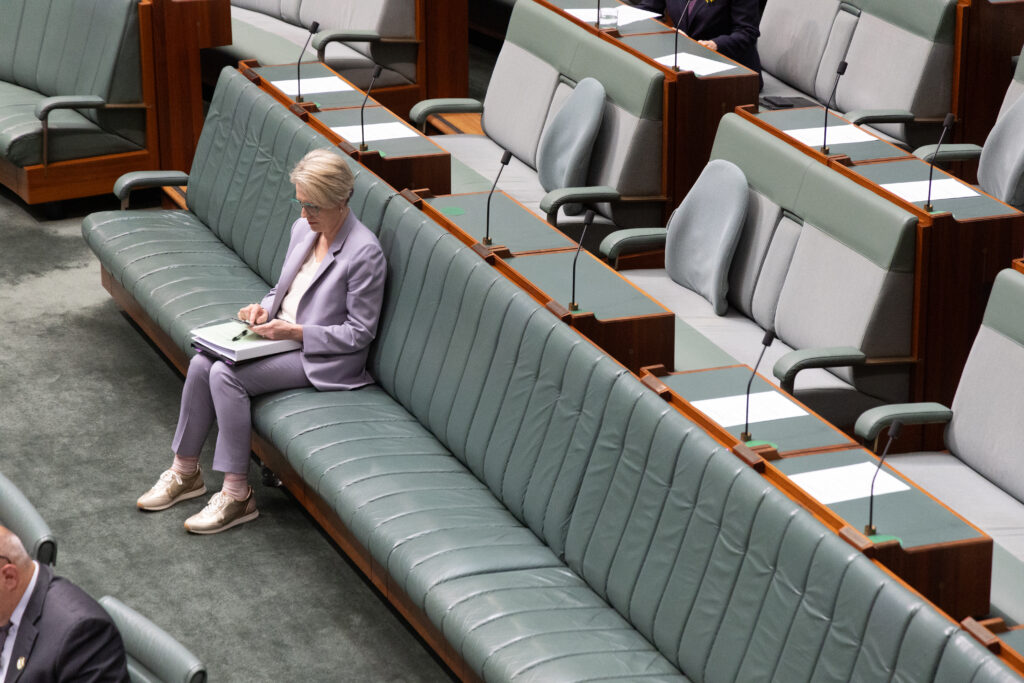
The Minister for Social Services Tanya Plibersek before Question Time in the House of Representatives chamber of Parliament House Monday 1st September 2025. Photograph by Mike Bowers.
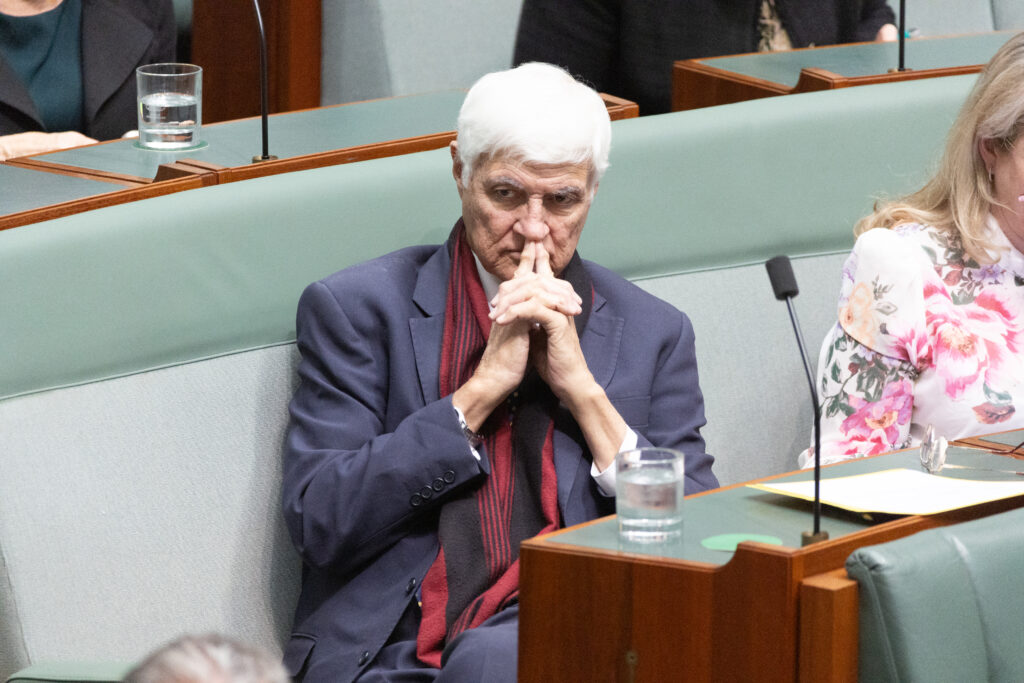
The Member for Kennedy Bob Katter during Question Time in the House of Representatives chamber of Parliament House in Canberra this afternoon. Photograph by Mike Bowers.
Hmmmmmm (Photograph by Mike Bowers)
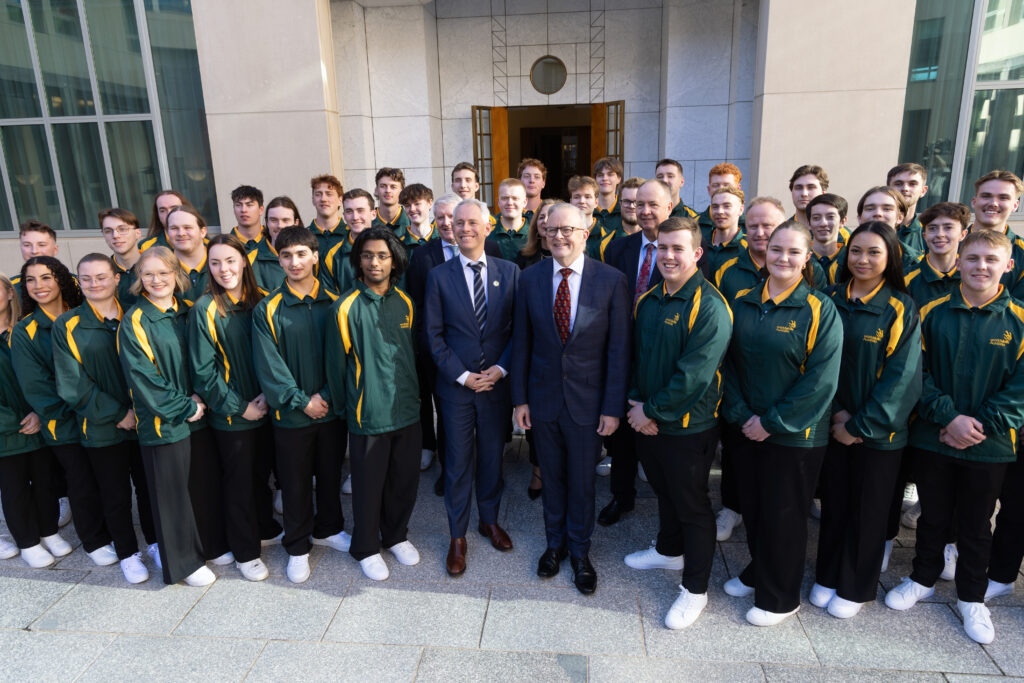
The Prime Minister Anthony Albanese meets the “Skillaroos,” talented apprentices and trainees who are representing Australia on the world stage at WorldSkills in the PM’s courtyard of Parliament House in Canberra. Monday 1st September 2025. Photograph by Mike Bowers.

We will be back tomorrow bright and early for another day of parliament/punishment – hope to see you there? Until then, take care of you Ax

Larissa Waters is next up on the ABC and she is asked about the weekend rallies and says:

I share the concerns of so many people who watched the tenor of those rallies on the weekend. It was quite frightening. The footage of black-clad men stomping around on camp sovereignty in Melbourne was really scary. So, I think many of those folk attending have serious questions to answer. Our concern is that the government is not addressing the housing or cost of living crises that’s leading to people blaming migrants for their legitimate financial issues. For the actual Neo-Nazis I’m not sure we can reason with them, but for other people, the system is not working for them, it’s not working for them, it’s not the fault of migrants, it’s a government that is prioritising the needs of big business and billionaires over ordinary people. That bit the government can fix. The Neo-Nazism, it’s a growing trend of far-right extremism and we’ve seen the government crack down on what they say is anti-Semitism, when merely there’s support for a free Palestine, and do a bit less on far-right extremism.

Q: You say, yes, there were Neo-Nazis there. It’s indisputable, they had a platform. But do you think other people who attended the rallies were all racists? Or do you think they were expressing, you know, fair enough grievances about levels of immigration?

Waters:

Look, I just don’t think it’s the fault of migrants that financial problems that people are legitimately facing. But the people that were there…

Q: Do you – do you think some of them were there for legitimate reasons?

Waters:

I can’t speculate how many people were there, there weren’t that many there compared to the weekend before in support of ending the genocide in Palestine, I may add, but the government needs to address the legitimate cost of living and housing issues. They’ve been quite selective in how they have tackled extremism. What they should do, is take an anti-racist framework across the board.

There is a back and forth about the Nauru deal, but there is no real outcome to it.

Q: For how long they get $70 million a year. It’s an arrangement between the Australian government and the Nauruan government.

Albanese:

There’s complexities and detail here, including the number of people who go, there’s a range of provisions as part of it.

Q: So, do they get the $400 million even if they take no asylum seekers?

Albanese:

There are arrangements in place, we have an arrangement between our government and the Nauruan government.

And so forth.

Q: Let me ask you about this – yesterday Julian Leeser said there was a direct line between your government’s voting record and the arson attack on the Adass Israel synagogue. ASIO says that Iran is responsible. Julian Leeser says you have de-legitimised Jewish people through that voting record and actions. Are Jewish people de-legitimised?

Albanese:

I think they’re unfortunate comments from Julian Leeser. I understand this has been a difficult time for Jewish people, as well as it’s been a difficult time for people with relatives in Gaza, or the West Bank as well. We have been very clear and unequivocal about our opposition to the events of October 7. The contradiction in what Julian says of course, perhaps the best one, I will make two points – one, there are hundreds of thousands of Israeli citizens who have demonstrated on the streets against actions of the Israeli government. They’re not questioning the legitimacy of Israel. They are speaking out about legitimate concerns.

The two tap incident that occurred on – at the hospital, at Khan Younis that led to the death of journalists, the death of medical workers, it is legitimate to express a view about that, ot being acceptable. And…

Q: You don’t accept were you too slow in taking action to support Jews? That’s the argument they make?

Albanese:

I have called out – I have called out anti-Semitism on each and every occasion. And it seems to me that I find it unfortunate that the argument which is put there somehow provides for the Iranian regime that was responsible for commencing through people, the criminal elements to commit these crimes, they need to be given agency for what they have done, and not seek to transfer that agency to someone else.

Q: Do you think there’s growing resentment towards migration and does it worry you?

Albanese:

There has always been elements – I ran for president of the Sydney uni SRC, against a leader of national action, about anti-Asians being kept out… It’s always been with us, it’s rising again.

Q: Does that worry you?

Albanese:

What we need to do is to be vigilant about it. What has occurred now, it’s much easier to organise through social media, through platforms, and easier as well for people who have their views reinforced. Often are which based upon things that aren’t just fact, like our net overseas migration is falling.

It fell substantially in 2024. Of course there were going to be an increase number after the lockdown of our entire continent that occurred during COVID.

Q: Is your message to these people, we’re getting the numbers down?

Albanese:

Well, we are getting the numbers down, but migration is also important and multiculturalism is a part of who we are as a modern nation, and I just say to people – I have no doubt there would’ve been good people who went along, heard about a rally, concerned… I have seen them talk about long housing queues for rentals. They’re concerned about their access to housing. Of course. You should have a look at who you’re with on Sunday, I think, and the motivation they have, which isn’t actually about housing or our economy or anything else, it’s about sowing division. And Neo-Nazis have, you know, no role. The fact that people are openly…

Q: What did you think of what they did to camp sovereignty in Melbourne?

Albanese:

Well, it’s just – exactly. Here you have people who are saying they’re against migration, well… The first Australians were here before any migrant or descendant of migrants, and that just has no place. That sort of violence has no place.

Q: Do you think it’s based on economic grievance?

Anthony Albanese:

The numbers we saw, they weren’t big numbers in the scheme of things, in a nation of almost 27 million people, let’s be clear here.

…There has always been an element of people who would appeal to anti-immigration as a platform, but migration has of course brought a great deal of benefit to our nation.

With the exception of First Nations people, we’re all either migrants or the descendants of migrants. This is an interview between someone called Karvelas and something called Albanese, not Smith or Jones, left alone First Nations names.

So we have in this country, three great traditions, of course First Nations people, the great privilege we have, we have then the arrival of the British colony and when they brought, the Westminster system, a lot of those British-based traditions, and then, throughout our history as well, we have had waves of migrants coming in, enriching our nation through their contribution to Australia.

Anthony Albanese ABC interview

Q: Do you think there were good people with legitimate concerns at these anti-immigration rallies this weekend?

Albanese:

There’s always good people who will turn up to their demonstrate their views about particular issues. What we have here is Neo-Nazis being given a platform. That’s what we saw on the weekend and the tone of course of much of the rallies was unfortunate, the best way you can put it, but hateful in some of the extreme examples. And the idea that an open Neo-Nazi was able to give a speech from the steps of the Victorian Parliament is something that isn’t Australian

Q: Liberal frontbencher Jacinta Nampijinpa Price says she wants to congratulate the marchers and the vast majority were people who love this country. Is that how you saw her comments?

Albanese:

They don’t reflect my view of the rallies. We need to cherish who we are and social cohesion. And as public office holders, we have an important role to play in promoting national unity, and modern Australia is different, as I said in Question Time today, from the days of the White Australia Policy.

We’re a modern nation that’s benefited from our multiculturalism, that overwhelmingly people live in harmony, of different ethnicities, different religions, different backgrounds, and we’re enriched by the diversity in this country.

We need to show respect for each other, and there will always be people who seek to say, look, your lot in life could be better and it’s because of people who don’t look like you.”

Now, a whole range of people, think it’s legitimate of course to have a debate.

Coalition continues to try and conflate peaceful Palestinian protests with violence of neo-Nazi supported rallies over the weekend

Over in the senate, the Greens put up a motion condemning the weekend rallies, which were supported by neo-Nazis.

Of course the Coalition tried to alter it so it also condemned the anti-genocide marches, which they are desperately trying to claim is the same thing. The Coalition are treating it as two sides of the one coin, instead of anti-genocide protesters calling for the literal liberation of a people who are currently being exterminated by an occupying force and for the government to follow international law obligations and a group of white supremacists wanting to impose a hierarchy based on race in a democratic nation, by violence if necessary. And the Palestinian protests have been PEACEFUL.

Conflating the two is not just irresponsible, it is part of the reason the Coalition is becoming increasingly irrelevant.

Michaelia Cash put out this statement:

The Albanese Government has today blocked a clear and reasonable motion from the Coalition which sought to condemn extremism in all its forms.

The Coalition’s motion reaffirmed Australia’s commitment to free speech and lawful assembly, while condemning extremist activity that undermines public safety and social cohesion. Specifically, it:

  • condemned the recent disruption of public rallies by neo-Nazis, pro-Iranian regime extremists, and those supporting terrorist organisations; and
  • condemned the public display of symbols, slogans or imagery that glorify or support proscribed terrorist organisations, urging the strict enforcement of laws against glorification of terrorism and incitement to violence.

Despite the clarity of this motion, the Albanese Government voted against it.

Shadow Attorney-General Senator Michaelia Cash said the Government’s decision was weak and indefensible.

“The Coalition made a simple and consistent point – we oppose extremism whether it comes from neo-Nazis, pro-Iranian regime supporters, or those who glorify terrorism. Yet Labor could not bring itself to agree,” Senator Cash said.

“This is about moral clarity. Labor had a chance to stand up against hate and intimidation. Instead, his Government blocked the motion.”

The Coalition moved its amendment in response to a motion brought forward by Greens Senator Mehreen Faruqi, which sought to target only one side of the extremist spectrum while ignoring others.

Senator Cash said this revealed extraordinary hypocrisy.

“Senator Faruqi wanted the Senate to condemn extremist elements on the far right, but at the same time she has been silent when pro-Iranian regime groups and supporters of terrorist organisations like Hamas and Hezbollah have marched on our streets waving flags and chanting hateful slogans. That is double standards of the worst kind,” Senator Cash said.

“The Coalition believes extremism should be condemned consistently – whether it comes dressed in black shirts or cloaked in the banners of terrorist groups. But instead of supporting that balanced approach, the Albanese Government joined the Greens in blocking it.”

The Coalition motion made clear that it is possible to defend the right of Australians to protest peacefully while also rejecting those who cross the line into intimidation, hate, or glorification of terrorism.

Senator Cash said Australians deserve to know why the Albanese Government refuses to apply one standard.

“Why is it so difficult for Anthony Albanese and his ministers to simply say that neo-Nazis are wrong, pro-Iranian extremists are wrong, and those who support terrorist organisations are wrong? It should not be hard,” she said.

The Coalition will continue to call for strong enforcement of existing laws against extremism and will not allow double standards to go unchallenged.

“The Prime Minister’s weakness on this issue is dangerous. The community is looking for leadership and consistency. Instead, they are getting division and hypocrisy from a Government too afraid to upset the Greens,” Senator Cash said.

Amendment to Senator Faruqi’s motion regarding social cohesion moved by Senator Cash

I move — That the motion be amended as follows:

Omit all words after “That the Senate”, substitute:

“(a)        reaffirms Australia’s commitment to free speech and lawful assembly, and condemns all forms of extremism, intimidation, and violence, regardless of the cause;

(b)          condemns the recent disruption of public rallies by Neo-Nazis, pro-Iranian Government extremists and those supporting terrorist organisations; and

(c)           condemns the public display of symbols, slogans, or imagery that glorify or support proscribed terrorist organisations and urges the strict enforcement of existing laws against the glorification of terrorism and incitement to violence”.


What did we learn from question time?

Well, the Coalition, in line with the Greens and independents, has found an issue with legs – the wait for aged care packages.

Is this entirely Labor’s fault? No. Is it something it could have addressed before now? Absolutely.

Is there actual policy points the Coalition can make on social issues – yes. So much yes. And it has taken them months (and most of the last term if you really want to get down to it) but it seems that they have found an issue that meets the needs of needing further examination, is something the community expects more from the government from, and crossbench support.

Let’s see how long that lasts.

Independent MP for Mayo, Rebekha Sharkie also asks about aged care:

My question is to the Minister for Aged Care and seniors. The department informed the Senate 120,000 older Australians are waiting tore assessed for aged care, some as long as 12 months. This is in addition to the estimated 100,000 waiting for up to 12 months for their approved package to materialise. Is the government deliberately slowing the aged care process so the reality of approximately 200,000 older Australians waiting up to two years for care isn’t revealed?

Sam Rae:

The Albanese Labor government is delivering very ambitious reforms to the in home aged care system to make sure every older person can get the care they need in the comfort of their own home for as long as possible. Recommendation 28 of the Aged Care Royal Commission called for one single assessment process and that’s what the government is currently delivering we’re rolling out a new aged care assessment system, one will will be quicker, reduce wait times and improve the experience for older people and their loved ones, rather than needing separate assessments as their needs changed it’s designed to make them easier to access the care they need.

We acknowledge that wait times for aged care assessment are longer than we would like and we’re working on that. A record level of Australians are seeking home care services. Last year alone over 521,000 home support and assessments were completed. This is an incredibly complex system and the waitlist contains those seeking lower level care along with cover over and duplication of numbers on the NPS. The systems can’t be jammed together to create a bigger example. For example 99 per cent of home waiting for a home care package at their approved level are receiving a care at a level level or are approved for service was and maybe and may already be receiving a level of care.

These matters we have discussed today are why we’re reforming this system from the ground up. Big reforms don’t happen overnight. But we’re working hand in hand with the assessment organisations including the states and territories who provide the majority of assessments to ensure a smooth transition to minimise impact older Australians and importantly to get them the very best care that we can as quickly as possible.

The former member for Hinkler, Keith Pitt gets a shout out in the parliament – hi Keith! We know he still pays attention to QT from his office in the Holy See (where he is ambassador) and will be THRILLED to know he is not forgotten. (How could we ever forget Keith!)

Chris Bowen, in a dixer mentions:

The member nor New England was recently asked why he’s proposing to abolish net zero. He went on for the tough interview on the Bolt report. He said, number one it’s about our nation. But for me personally it’s incredibly I have to deal with it at the epicentre of New England. ‘I have no interest in the sort of oh, yes, it might be this, it might be nothing. It’s about net zero.” That response is clever. This is not the first rodeo for him. There’s other headlines.

Resources minister Keith Pitt has been elevated in cabinet under a deal between Scott Morrison and Nationals leader Barnaby Joyce that sees The Nationals sign up to a 2050 net zero target.

What principles? What great commitment for what they stand for?

There is a point of order about referring to members by their proper titles, to which Milton Dick has to point out…that it doesn’t apply to former members.

In terms of correct title, they don’t refer to people not in the Parliament. (INTERJECTIONS) Order! No. (INTERJECTIONS) No. I remind everyone, I remind members to refer to people, correct titles, members of the diplomatic corp respect in that category. Order. The minister will return for 18 seconds.

Chris Bowen then refers to the article itself: Nationals win cabinet position as they sign up to a net zero deal and says

It’s about internal politics for those opposite, the leadership of his party, The Nationals interest is not the national interest. We will get on with the helping Australians the choices they want to make.

Dai Le gets a question:

Prime Minister, Western Sydney Airport was promised a gateway for our community. Delivering jobs and opportunities.

Instead it looks more like a freight hub dressed up as an airport. Without a metro rail link which face more trucks on the roads, gridlocked motorways or freeways and a missed chance to build more affordable housing near where people live and work.

You promised under your government no-one will be left behind. Will we finally see a metro for Western Sydney and real and not just a cargo airport?

Anthony Albanese:

I’m delighted to get a question about the Western Sydney Airport and hy it will deliver and is delivering already jobs in Western Sydney, in particular jobs in south-western Sydney including literally hundreds and hundreds of apprenticeships which are taking place as part of the construction there. Part of the arrangements that we have put in place for the Western Sydney Airport construction is about local employment. Local contractors, over 50 per cent of people live in that local community. Local contractors are prioritised for the work that’s taking place there. And already when you look at the airport there, and I have had the opportunity to visit with the Minister for Infrastructure, you have what will be undoubtedly when it opens the most modern airport in Australia by a long way.

The best facilities in terms of the entries into the best experience for passengers going through. The deals that have been signed, the latest one when I was there was a deal signed with Air New Zealand.

…The airport when it is operating there will provide a massive boost for passenger aircraft. But it will also – we make no apologies for the fact that there will be a lot of freight through that airport as well. What it will do isn’t just to provide for higher productivity and more efficiency, it will take trucks off the Western Sydney roads, which currently go right through Sydney to get to Mascot. That makes no sense whatsoever.

Together with the other major piece of infrastructure, in south-western Sydney, the Moorebank intermodal, those two things combined will transform Western Sydney.

In addition to that, the air less there will see a range of high-value industries creating high-value jobs there for locals in south-western Sydney. This is about, for the first time, instead of Sydney always turning towards the harbour, always turning towards the CBD, this is about Sydney looking towards where most people live in Western Sydney. And will provide significant benefit in addition to that the public transport links to Western Sydney Airport as well as the road upgrades are creating jobs in the short term but creating economic activity and efficiency in the medium term as well.

Alex Hawke asks the next aged care question:
The minister justified the government’s decision to delay home care package rollouts from 1 July to 1 November by saying, ‘The legislative frame work didn’t allow for that start date.” If the government knew its own legislation didn’t allow for a 1 July start date this year, why did the Labor government mislead Australians and promise to deliver 83,000 home care packages in November last year for 1 July this year on a time line that it knew was impossible?

Sam Rae:

What I said was that the implementation of the new act provided the legislative framework for the support at home program. The implementation of the new act was scheduled for 1 July. On the basis of feedback from older people across our country and the sector themselves we made the decision to briefly defer the implement aches of the new act to 1 November.

From 1 November [we are] introducing an 83,000 packages in the first 12 months of support at home which will be the growth component of the more than 300,000 Australians who are currently receiving care under the Home Care Packages Program.

Albanese tells Bob Katter ‘our diversity is our strength’

Bob Katter gets one of the independent questions this time. He is not greeted with the usual level of enthusiasm from the chamber or the prime minister:

Q:

Prime Minister you’d be aware that three Appropriation Bills the House require a00 billion in funding, appropriation 10 years ago required only $50 billion. Another $50 billion is required to House the 400,000 people coming from overseas each year particularly 92 per cent of them that go to Sydney and Melbourne. When the urgent demand of 80 per cent Australians to stop migration save $50 billion this year plus a reserve policy on gas would provide another $32 billion a year. And green lighting the Galilee coal and its rail line providing yet another $17 billion. Shouldn’t the government be about carrying out the will of the people and creating economic development?

Anthony Albanese:

I’d just make two points to the member for Kennedy before I ask the Minister for Resources to comment on the issues in which he raises regarding resource policy. First regarding the will of the people. That’s called elections. We have a proud democracy in this country. And I defend it. People in this country voted for a government that would under that modern Australia was, as the minister has just reflected, a different nation than it was under the White Australia policy some time ago.

And they voted for a government that would understand that our diversity is a strength in modern Australia as well, and provides us as well with incredible economic opportunity due to the diaspora here and their connections with every country on the planet.

With regard to the figures [he mentioned] I don’t accept some of the figures that’s raised. I’m not sure what the basis of them are.

But I can refer to the latest net overseas migration which was down 37 per cent on an annual figure in the last figures that were raised in 2024.

Madeleine King adds to the answer:

The member for Kennedy referred to a resources reserve and reservation policy. Happy to discuss that briefly. There is a mini pause across many parts of the community for reservations of gas in particular. This is something brought on by industrial users and manufacturers, indeed even those opposite have announced a reservation policy of their own which is a great change from when they failed to support the Western Australian reservation policy which proved enormously successful for the price of gas and access of gas if Western Australia.

At the moment the government has a review into gas market regulations, there was a consultation paper that is out. There have been many submissions to that.

One of the concepts we put forward as a government was around a framework to ensure that domestic supply is secured for the east coast.

Another part of our reservation resources policy goes around the critical minerals strategic reserve which is about building up a national asset to make sure we have a supply of critical minerals but also that we’re a reliable supplier of critical minerals and rare earths to our partners around the world.

It allow us to work with our partners together against disruptions from a position of real strength.

I look forward to the member for Kennedy’s support nor that reserve. Those opposite were quick to oppose it, they support a gas reserve but not critical minerals. They and that might go to confusion between gas and critical minerals. They’ve named gas as a critical mineral in the past. I hope they won’t do it again.

Lindsay McIntosh asks:

Q: When the government was asked in August about delays to the rollout of home care packages, the minister said of the aged care sector that, ‘They weren’t ready.”

However, as part of an aged care Senate inquiry, every provider that appeared that the hearing, including uniting care’s representative said, ‘We have capacity to take on people now.” Why is Labor blaming the hard working sector for its own incompetence and failures?

Sam Rae answers:

As I said in the last Parliament, the minister for communication passed the new Aged Care Act with the support of those opposite and cooperation across the Parliament. The new Aged Care Act brings along with it the support at home program to which the member’s question relates. While it’s encouraging to hear there are providers who are enthusiast at this point about delivering additional packages we want these reforms to be delivered in a which that minimises disruption for older people.

This is a system-wide reform that changes the way that care is delivered. We’re spending each and everyday until 1 November making sure that this system works for older people.

Nationals MP Sam Birrell is thrown out for interjecting.

LNP MP Llew O’Brien asks

I refer to the government’s decision to delay home care package rollouts from the 1 July to 1 November, and almost 5,000 elderly Australians have died in the past year while on a waiting list for a home care package the minister apologise to these 5,000 families who have faced this tragedy and lost a loved one?

Minister, how many more elderly Australians will have to die waiting for to government to stop delays and commence the rollout?

Sam Rae:

I’m always saddened when we hear of older Australians, whether they are in care or waiting for care, passing away, as it is always distressing for people across the Parliament and from any political party or crossbench group to hear of those stories.

I offer my condolences to those families. It’s the greatest example of why our reform process is so very important. Now, the deferral to which the member’s question refers is essentially arising from the nature of the legislation that had bipartisan support and was passed through the last Parliament. The legislative framework for the support at home program is enshrined within the legislation.

The support at home program cannot begin before the legislation comes into effect. That will happen on 1 November, and from 1 November we will deliver an additional 83,000 packages under the support at home program as well as continuing to support the more than 300,000 Australians who are currently cared for under our record Home Care Packages Program.

The Liberal MP for Gray, Tom Venning asks Sam Rae:

My question’s to the Minister for Aged Care in my electorate a 90-year-old constituent who suffers from Parkinson’s disease has been told it will be up for 12 months before he receives a home care package. His daughter has to give up her permanent job as a teacher to care for him. As a result of Labor deferring the commencement of home care packages from 1 a vulnerable 90-year-old Australian is suffer forget too long.

Will the minister expediate as an immediate priority the delivery of this man’s package before it is too late?

Rae:

This is clearly an important case to the member and to the community.

I acknowledge the difficulties being experienced by people such as the member’s question refers to, and if you can provide me with – the member can provide me with the details I’ll personally follow up as a matter of urgency to see what can be done.

Stories like this remind us exactly why our reform program is so important. Our general reforms will deliver aged care of the highest quality for older generations, the people who have given so much to our country and who deserve nothing less than the very best care

Central to this is the support at home program which will make it possible for older people to live independently at home for longer with higher levels of care available close to family and in their communities.

With an ageing population demand for home care packages has been growing very fast. Today we have more than 300,000 Australians receiving a home care package, that’s double the number from about five years ago.

As I have said before, we are delivering more care to more Australians than ever before. From 1 November, support at home begins we will make available more than 80 new home care places in the first 12 months of support at home.

Until then, my number one priority is making sure that older Australians continue to receive services with why packages are being released every single week to people who need them the most. Right now more than 2,000 new packages are being allocated each and every single week.

And I can assure the House that anyone and everyone assessed as high priority for the clinical assessment process will continue to receive their package within a month. Mr Speaker, this short deliver and delay to commencing the new Aged Care Act is about ensuring the program’s like support at home are fully ready for older Australians and their families.

Now, from 1 November we will deliver the extra packages. We will ensure that those people who are currently receiving home care continue to receive that home care and we will continue to work across the parliament to make sure older oftens receive the very best care they point can.

Here is how question time looked walking in:

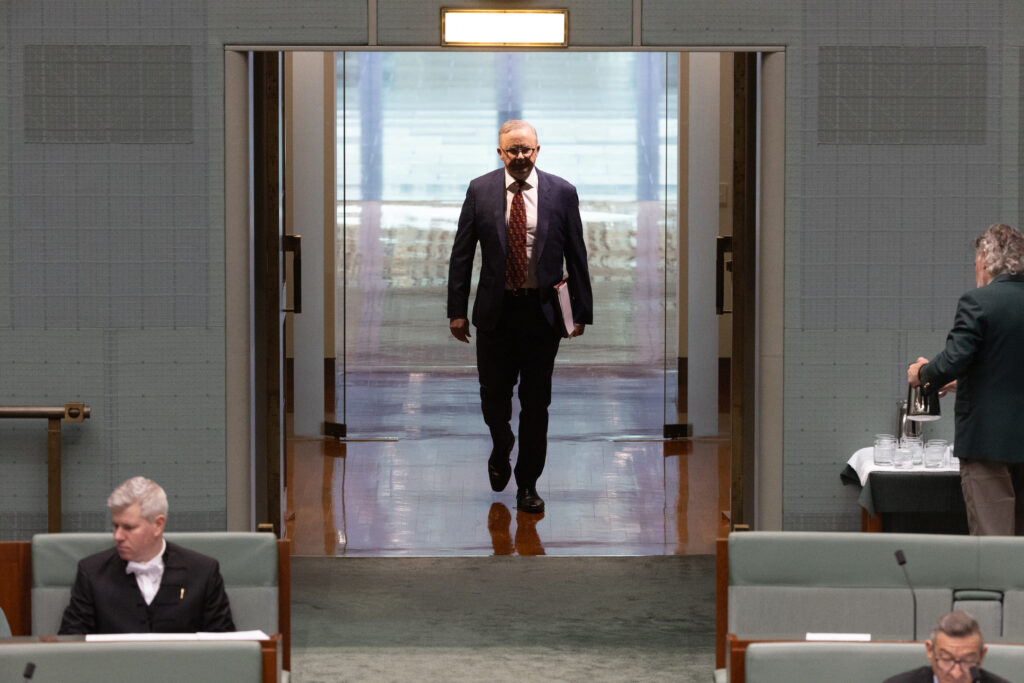
The Prime Minister Anthony Albanese arrives for Question Time. Photograph by Mike Bowers.
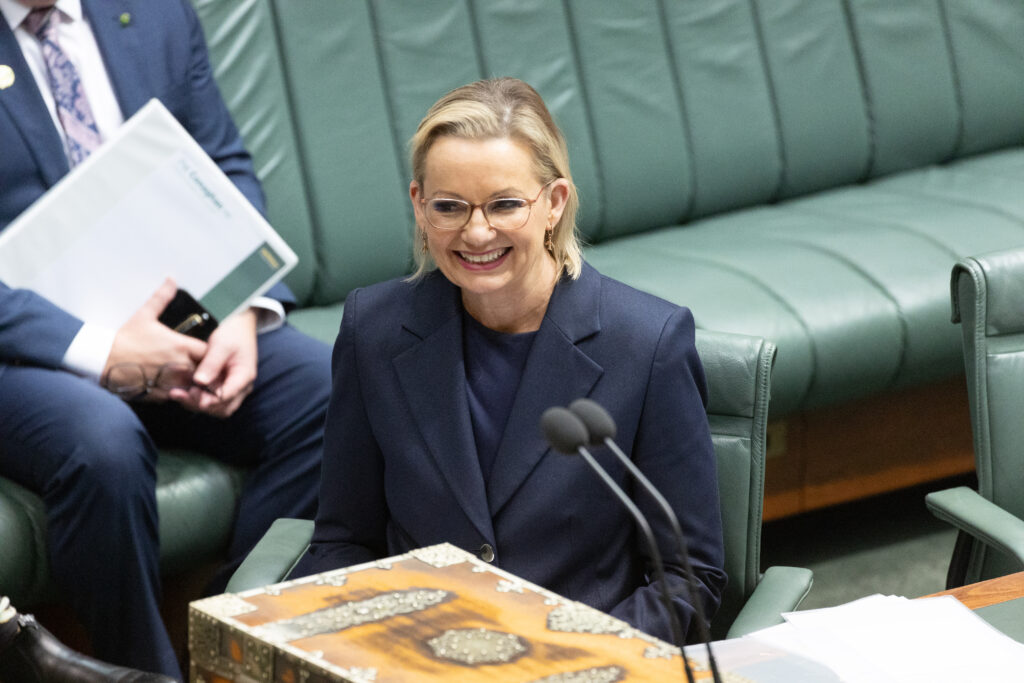
Opposition Leader Sussan Ley before Question Time in the House of Representatives chamber of Parliament House in Canberra this afternoon. Photograph by Mike Bowers.

Independent MP Helen Haines asks Sam Rae:

Last week the Department of Health and aged care confirmed that there are more than 120,000 people waiting for a home care assessment on top of the 87,000 people waiting for a package. The department also confirmed that no additional plans have been released beyond the attrition rate.

Will the government release 20,000 new home care places now to stop the waitlist growing longer?

Sam Rae:

In the last term of Parliament, as I said, the Minister for Communications along with support from across the Parliament passed the new Aged Care Act and we’re preparing to implement it on 1 November which is just two months from today along with the support at home program to which the member’s question pertains.

At 31 March, this year, the quarterly national priority system waitlist showed 87,597 people who have been approved for a home care package through the clinical assessment process.

As I have said earlier, we continue to allocate an average of more than 2,000 home care packages to people on the NPS every week and those assessed as high priority will continue to receive their packages within a month. I’ll say it again.

Those assessed as high priority will continue to receive their packages within a single month. Assessment for broader aged care services forms a different process, a related one but a different one. We acknowledge that wait times for aged care assessments are longer than we would like and we are working to address this.

Record levels of Australians are both seeking and receiving home care services, more care to more Australians than ever before. Last year alone, over 521,000 home support and comprehensive assessments were completed and we currently are more than 300,000 older Australians receiving home care packages.

Only some people waiting for an assessment will ever end up on the national priority. The assessment list contains those seeking lower level care along with significant crossover and duplication of numbers on the national priority system.

For example, 99 per cent of people waiting for a home care package at their approved level are already receiving home care through a lower level home care package or approved for Commonwealth home package support services and so are already receiving some level of care. Median wait time for an aged care needs assessment from when a referral is issued to when the support plan is completed a currently 25 days and continues to reduce under our new single assessment system. There are a number of reasons why home care packages are freed up.

But the important thing here is that every allocation of a package means another older Australian gets the care that they need. Mr Speaker, we know the system is not fit for purpose and that’s exactly why we’re reforming this system from the ground up.

These reforms don’t happen overnight but we’re working to deliver a smooth transition just two months from today, one that minimises impacts to older Australians and gets them the care that they need quicker than it has been done before.

Sussan Ley: Of Labor’s promised 83,000 new home care packages zero have been delivered. Meanwhile, more than 200,000 Australians are still waiting for either a home care package or an assessment of a package. Will the minister apologise to these 200,000 elderly Australians and their families for this betrayal?

Sam Rae:

I can perhaps assist the Leader of the Opposition to better understand some of the matters to which she refers to. Firstly, the support at home program to which the Opposition have been supportive in moving the initial legislation provides the legislative framework for support at home. So the members opposite will understand that the legislation they voted for is a requirement for support at home packages to be delivered.

So those 83,000 can begin to be delivered from the time that the legislation comes into effect.

Secondly, as I mentioned before, in the mean thyme, we continue to deliver packages each and every single week, the average being above 2000 packages per week to ensure that in the meantime Australians continue to receive the care that they need.

We will ensure that every single Australian who is assessed as high priority will continue to receive their package within a month. And from 1 November, we will continue to invest in the support at home program as the key mechanism for delivering the in home care that older Australians tell us that they want.

After trying not to answer the question (on why so many Australians are waiting for a home care package) Sam Rae eventually gets to:

As I was saying, support at home will come into effect from 1 alongside the new Aged Care Act which provides the legislate imframework for the new hope care approach we are taking — 1 November. We will deliver an 83,000 packages from 1 November in 12 months. That’s on top of the more than 300,000 Australians that are currently receiving home care packages who will be transitioned into to support at home program.

Between now and November, we will continue to allocate packages every single week, to older Australians who are in need of care. We will continue to allocate them at an average of above 2,000 packages per week, and every single Australian who is assessed with the clinical assessment process as high priority will receive their package within a month.

Mr Speaker, the Albanese Labor government is absolutely committed to ensuring that older people all across Australia receive the care that they need and that they deserve.

(As a sidenote, Rae’s hair, which used to be used as a pressure indicator by his Labor colleagues – the higher the hair, the more stressed the government, has now taken a good few inches off his front wave. We have been told this is because he is on the front bench now, and has to take a more serious approach)

Question time begins

Because there is not enough punishment in the world, question time has begun.

As expected, the first questions are on…aged care. Which is fair actually.

Sam Rae is called up to answer on the lack of aged care home care packages. Has the opposition actually stumbled across a proper issue? The Greens are also on board with this as well – have the Coalition worked out that they can make proper, serious points on social policy? Will wonders actually never cease?

Victorian firearm debate

Skye Predavec
Anne Kantor Fellow

While reporters are talking about firearms in Victoria and around the country, there is a bill before an inquiry in NSW that would enshrine a “right to hunt” in legislation.  

Walter Mikac, who lost his wife and daughters in the Port Arthur massacre has spoken out against the proposed Hunting Conservation Bill currently before a NSW government inquiry. In response, Shooters Fishers and Farmers leader Robert Borsak has labelled him “very badly misled by the Greens political party propaganda talk sheet”. 

This morning Borsak went on the radio to promote the Bill, which would establish a right to hunt in NSW and open up at least 23 crown land areas of greater than 400 hectares to recreational shooting. 

The Australia Institute submission to the inquiry found that the bill would erode National Firearms Agreement, which was agreed by all states and territories to strengthen Australian gun control laws following the Port Arthur massacre. 

When arguing for the Bill, Borsak claims it is necessary to protect his “cultural right to hunt” so that he can “go out and get food for [his] family and himself”. 

But most people with recreational hunting licences in NSW don’t actually use them to go hunting. There are just over 10,000 people in NSW who participated in recreational hunting with a firearm in 2024 according to the Australian Government’s Ausplay survey, but over 200 thousand people with hunting firearms licences. If they aren’t using their licence for its stated purpose, what are they using their firearm for? 

Ok, we are re-locating for question time. Go save yourself for the next 15 minutes or so

Maria Ressa CEO of Rappler is the guest at the National Press Club today. She was asked about whether: we need more law makers, MPs actually talking about trust in Australia and why it’s so important?

Ressa:

The short answer is absolutely. I think that’s what makes a democracy a democracy. The shared reality grows out of a trust that is anchored on facts. It has been almost a decade that we have been under attack so I have simplified a lot of these things in my head for what we work at. If you don’t have trust – so what’s the figures that you cited are second and third degree repercussions of the design of our public information ecosystem.

I co-lead the international fund for public interest media and we are giving grants to news organisations for operational expenses because they need to keep doing their work but content creation alone is not enough.

Creating the journalism isn’t enough. You have to actually collect these news organisations in a distribution system. And one that doesn’t get you hooked on dopamine. Let me answer your question directly because I know there is one more question.

Trust is everything. Democracy functions on trust. What we have seen outside, because of the public information ecosystem is the us against them.

Actually one of the countries where I feel like the gap between the right and the left is still – they can still listen to each other and they are still in the same shared reality, Norway is interesting. But you are seeing this go like this because a friends of friends algorithm, and this is on every social media platform, I watch this in the Philippines.

If you were pro Duterte in 2016 we didn’t debate the facts. The way the platforms grow their networks to get to you click to grow yours, it moved further right F you are anti-Duterte you move further left and over time this chasm grew. That is what we are seeing, the filter bubbles. The law makers themselves have to pull this together and return to a time when leaders healed divides, not exploited it for power because that is what we are seeing now.

There is a new website to help parents wanting more information on what is happening in child cares – starting blocks.

From today, the Starting Blocks website, which provides information on child care services, will be upgraded to include:

•    when a state or territory regulator last visited a service, 
•    conditions placed on a provider or service by the state or territory regulator, and
•    clearer information on the links between services and the providers that run them.

Upgrading the Starting Blocks website is one of several targeted safety measures announced just over a week ago by Education Ministers, including:

•    A national educator register,
•    Mandatory national child safety training for ECEC workers,
•    A national trial of CCTV in up to 300 services,
•    A ban on the use of personal mobile phones in centres,
•    More unannounced spot checks,
•    Tripling of penalties under the National Law and National Regulations,
•    A rapid assessment by ACECQA of child supervision practices, and
•    More regular assessment and rating visits.

Penny Wong has welcomed the review findings Rosemary Huxtable has handed in on the Foreign Arrangements Scheme:

The Government has accepted all 23 recommendations of the review. We are taking action to strengthen, clarify and streamline the Scheme in line with the review’s recommendations.

The Foreign Arrangements Scheme is a key part of the Government’s broader resilience strategy, protecting critical sectors of Australian society from foreign interference.

The Scheme has been successfully deployed to raise foreign policy awareness with state and territory governments, local governments and universities, and to ensure arrangements between them and foreign entities support Australia’s national interest.

The Government is committed to reforming the Scheme to ensure it remains effective and responsive to an increasingly complex international environment. These reforms will:

  • sharpen the Scheme’s focus on arrangements that pose higher foreign policy or national security risks, and
  • reduce the regulatory and compliance burden for low-risk engagements.

Changes to the Foreign Arrangements Scheme will help ensure Australia can continue to engage globally while safeguarding our national interests, and will support the creation of economic and cultural links that are consistent with our foreign policy.

The report of the independent review of the Scheme and the Government response can be found on the Foreign Arrangements Scheme website

You can expect quite a bit of this during question time today. From Richard Colbeck, the shadow minister for aged care:

The Albanese Government has abandoned older Australians who need support to stay independent in their own homes for longer.

The wait list for Home Care Packages has almost tripled in the past two years under Labor! The Albanese Government promised to deliver an additional 83,000 packages from 1 July 2025, but as with most of their promises, they have broken it, and left more than 87,000 older Australians waiting in limbo.

“This of course wasn’t revealed until after the election, and represents a massive breach of trust by the Albanese Government,” Liberal Senator for Tasmania, Richard Colbeck said.

“Many older Australians are waiting more than a year for the care they have been assessed as needing.

“The Coalition’s strong investment in the Home Care system following the Royal Commission into Aged Care drove the wait list times down to 30-90 days by 2022, and reduced the wait list by almost 100,000 to 28,000.

“This effort has been completely squandered by the Albanese Government, with wait times blowing out to 15 months.”

The astonishing revelation that over 120,000 older Australians were languishing on a waiting list just to get an assessment for a Home Care Package blows the number waiting out to over 200,000. This demonstrates the complete and epic failure of the Albanese Government. 

Families waiting for more than 16 weeks for an assessment shows a complete failure of the reform of the assessment process, as well as the failure to allocate enough packages to support senior Australians.

The Aged Care Royal Commission called the home care system a “cruel lottery”. The fact that is now worse than it has ever been shows the level of failure of the Labor Government in implementing the reforms from the Royal Commission which were handed down over 4 years ago.

The attached graph shows quite simply the scale of Labor’s failure, noting that it does not include the 120,000 waiting to be assessed. 

“Anthony Albanese promised to put the care back into aged care, all he has put back is the waiting lists and then some,” Senator Colbeck said. 

It hasn’t been getting a huge amount of coverage but there has been a lot of anger at politician perks in Indonesia – and the increasingly authoritarian crack down against protesters. As AAP reports:

Indonesian students and civil society groups have called off protests after a week of escalating anger over MPs’ pay and the police response, citing fears of heightened security measures after deadly riots over the weekend.

The protests began in Jakarta a week ago and spread nationwide, escalating in size and intensity after a police vehicle hit and killed a motorcycle taxi driver on Thursday night.

President Prabowo Subianto said on Sunday political parties had agreed to cut MPs’ benefits, including a controversial $US3,000 ($A4,587) monthly housing allowance, in a bid to ease public fury after nationwide protests left six people dead.

He also ordered the military and police to take stern action against rioters and looters after homes of political party members and state buildings were ransacked or set ablaze.

The Alliance of Indonesian Women, a coalition of women-led civil society groups, said on Monday it had delayed planned protests at the parliament to avoid any crackdown by authorities.

“The delay is done to avoid increased violent escalation by authorities … the delay takes place until the situations calm down,” the group said in an Instagram post on Sunday.

Student groups also delayed a protest on Monday, with one umbrella group saying the decision was “due to very impossible conditions”.

The protests and violence unsettled financial markets, with the stock market falling more than three per cent in opening trades on Monday.

Flanked by leaders of eight Indonesian political parties, Subianto told a televised news conference in Jakarta on Sunday, they had agreed to cut the housing allowance and suspend overseas trips for MPs. 

It was a rare concession in response to mounting public anger.

As nationwide protests escalated across the world’s third-largest democracy last week, Subianto summoned the country’s prominent figures and cancelled a high-profile trip to China. 

Critics argue the MPs’ allowance is not only excessive but also insensitive at a time when most people are grappling with soaring living costs, taxes and rising unemployment.

Short stay rentals costing the budget as well as communities; new report

Housing advocacy group, Everybody’s Home has looked at the tax breaks for short-stays and well –if you have been paying attention, it’s as you would expect:


The Short-Stay Subsidy report estimates that this financial year the budget could be losing between
$111 million and $556 million in forgone revenue through negative gearing deductions claimed on
short-stay rental properties.
Across Australia 167,955 entire homes are estimated to be operating as short-stay accommodation
instead of long-term rentals, yet owners can still claim negative gearing and the Capital Gains Tax
(CGT) discount.
The report found:

  • If just 10% of short-stay rentals were negatively geared, the annual cost to the budget is
    estimated to exceed $111 million
  • This figure jumps to $556 million in estimated annual lost revenue if half of all short-stay
    investors claim negative gearing deductions
  • Tax reform on short-stay accommodation has the potential to reclaim billions in revenue over
    the next decade
  • Renters say they are being affected by the magnitude of short-stay accommodation,
    including facing soaring rents, evictions, and in some regions, limited long-term rental supply.

Everybody’s Home spokesperson Maiy Azize said:

Everyday people are footing the bill for property
investors to write off losses from holiday homes, all while families are being priced out of their
communities because they can’t find affordable rentals.


Renters across the country are being squeezed by soaring rents and a shrinking number of
affordable homes – and in many parts of the country, short-stay accommodation is only making it
worse. Generous tax breaks for investors, including for short-stay accommodation, are driving
wealth inequality and pushing up house prices for everyone else.


While governments claim to be serious about the housing crisis, they’re doing little to show it. At a 
time when government funding for public and community housing is falling far short of need, we 
shouldn’t be subsidising investments in holiday homes and short-stay rentals.


Curbing investor tax breaks for holiday lets is one of the fastest and fairest ways to free up funding
for the homes we need. If we close these loopholes, the savings could help build more desperately
needed low-cost, long-term rentals

AAP has some more reactions from this morning’s interviews to the neo-Nazi supported rallies held across the nation over the weekend:

Federal Multicultural Affairs Minister Anne Aly said people had legitimate concerns around the strains immigration was placing on housing and infrastructure.

But the protests were clearly targeted at migrants from “countries that have brown people”, not white Western countries.

It’s very clear from the conduct, that was observed at these marches, that these marches were a con by the far right neo-Nazis to prey on some legitimate concerns around housing and around cost of living in order to propagate their anti-immigration, racist agenda,” she told ABC radio on Monday.

One of the very clear calls to action that was listed there was anti-Indian immigration, against people coming from India,” she added.

Now that, to me, is clearly racist when you target a specific ethnicity, that is clearly racism.”

Prior to the protests, organisers frequently repeated a claim that 1500 migrants were entering Australia each day, based on Australian Bureau of Statistics overseas arrivals and departures data.

But the bureau has said the figures are not a reliable measure of migration or population change, but rather represent self-declared traveller intentions.

Former Immigration Department deputy secretary Abul Rizvi said successive governments had failed to communicate their immigration plans to the public, leaving a void to be filled by conspiracy theories and “bizarre ideas”.

The Labor government is yet to release its planning levels for its 2025/26 migration program, which Mr Rizvi labelled an “unprecedented delay”.

Opposition immigration spokesman Paul Scarr said it was important that fringe elements don’t get a foothold in the immigration debate.

Gas leak cover-up shows Australian governments are captured by the gas industry

Glenn Connley
Senior Media Advisor

It‘s been revealed that Santos’ Darwin LNG gas export terminal has been leaking large amounts of climate-destroying methane gas for 20 years – and gas companies and governments have failed to act.

This confirms The Australia Institute’s long-held concern that methane emissions are grossly underestimated and Australia’s regulators have been captured by the gas industry.

The reporting confirms that despite all relevant regulators and governments knowing about the leaks, the emissions will continue to go unreported and will not be included in Australia’s greenhouse gas reporting. Incredibly, Santos will be allowed to use the leaking tank until 2050 without fixing it.

It further confirms that the Northern Territory EPA (NTEPA), the CSIRO, the Clean Energy Regulator (CER), the National Offshore Petroleum Safety and Environmental Management Authority (NOPSEMA), and NT WorkSafe all knew about the leak – and did nothing.

Santos will receive all the gas from the Barossa gas field that will feed its leaking Darwin LNG export terminal for free, as the Australian government will not charge it royalties. It is also very unlikely to pay Petroleum Resource Rent Tax and, according to the most recent AT0 Corporate Tax Transparency data, Santos LTD has paid virtually no company tax since 2016.

“This cover-up is a national scandal. It confirms that Australia’s key regulators are either grossly incompetent or have been captured by the gas industry, or both,” said Mark Ogge, Principal Advisor at The Australia Institute.

“That there are no consequences for gas companies failing to act on a major leak of methane for 20 years, and the Australian and NT governments are allowing Santos to keep using the leaking tank without fixing it, or even monitoring it properly, is a disgrace. The system is utterly broken.

“Santos will get all the gas they export from Darwin LNG free, and probably pay no PRRT or company tax either. The idea that it can’t afford to fix the leak is laughable.”

Sussan Ley conflates anti-genocide protests with neo-Nazi supported rallies

Sussan Ley has just released this statement where she conflates the anti-genocide protests with what happened on the weekend and calls both ‘extremism’. Which is a trick centrists and those on the right excel at. These things must be ‘equally bad’ because they are on opposite ends of the political spectrum. When in reality, one is calling for the liberation of people and the adherence to international law and the other is calling for an enforced white supremacist hierarchy, through violence if necessary.

And yet, Ley and many across politics and the media will claim that ‘these are the same’ like we see below. They are not. And it is important to push back against that distinction.

Ley’s statement:

Australia’s way of life is built on respect, on community, and on the belief that every person deserves to feel safe, valued, and at home here. We are a migrant nation. Our strength has been forged by generations of people who chose this country, worked hard, and came together around the values of fairness, tolerance, respect, and reward for effort.

That strength is now being tested. Since Hamas’ barbarism on 7 October 2023, new pressures have been placed on our social cohesion, and there have been multiple failures of government to keep our community safe and to keep it together. Synagogues have been firebombed with our Jewish community under siege.

Week after week, protests have taken place across our cities.  

We have seen cherished landmarks like the Sydney Harbour Bridge and the Opera House turned into backdrops for division, with people supporting terrorist organisations and holding up images of the Ayatollah Ali Khamenei the leader of the Iranian regime who has sponsored global terror and on Australian soil, and supports Hezbollah, Hamas, and Islamic Jihad. People of goodwill have been present at recent demonstrations, but their voices were hijacked by those seeking to glorify terrorism. That can never be accepted.

This past weekend rallies occurred across Australia, attended by people of goodwill, but hijacked by neo-Nazis spouting hate, racism and resorting to politically motivated violence. That can never be accepted.

Extremism has no place in Australia. We must never import the bitterness of overseas conflicts into our communities. What unites us as Australians will always be stronger than those who seek to divide us. But we cannot take that unity for granted.

This is a moment that demands leadership. Our society is resilient, but its fabric is being steadily eroded by extremism. Australians expect their leaders to rise to the challenge, to call out hate in all its forms, and to bring the country together. The Prime Minister must show that leadership now.

The Coalition stands ready to work with the government to repair our social cohesion, to strengthen what binds us, and to ensure that every Australian, no matter their background or faith, can feel safe, respected, and proud of the country we share.

Woodside has entered the chat when it comes to its tax record:

Not a binary choice between Murdoch and big tech

You will be shocked to learn there are some serious concerns over the viability of the government’s proposed age verification plan for social media. Among the risks identified by the age assurance trial report are “mass surveillance, biometric data collection, increased Big Tech control and systematic bias against vulnerable groups that may very well outweigh any potential benefits of the policy”.

I mean, what could go wrong?!

Greens senator David Shoebridge said:

The age assurance trial report makes the case against a social media age ban. The risks it identifies including mass surveillance, biometric data collection, Big Tech control, and systematic bias against girls and People of Colour, which clearly outweigh any potential benefit.

The government’s report on age assurance tech admits ‘implementation depends on the willingness of a small number of dominant tech companies’ meaning we’d be handing even more power to Big Tech to decide who gets online access. Labor surely understands this is bad!

The age assurance trial findings accidentally prove the social media age ban is unworkable and it is time to rethink this flawed approach.

The Australian newspaper has come out hard today against our inquiry into age verification and the social media age ban and got it completely backwards. 

The inquiry isn’t about helping Big Tech, it’s exposing how Labor’s rushed age ban will hand power to the very companies that are exploiting kids.

The Greens don’t agree the choice is between Big Tech or Murdoch controlling our public spaces and debate, it is the community who should have both control and rights including privacy.  

The real question is why Labor and the Murdoch media are so afraid of parliamentary oversight of this ban?.

AAP

Far-right demonstrators have been condemned and could face punishment after storming an Aboriginal protest site.

A group of men dressed in black violently clashed with people at Camp Sovereignty in King’s Domain on Sunday afternoon following the March for Australia rally in Melbourne’s CBD.

The camp, first created in 2006 to coincide with the Commonwealth Games and re-established in 2024, is a burial site with the remains of Indigenous people from 38 clans. % buffer

Neo-Nazi Thomas Sewell was among the black-clad men, who lashed out at Camp Sovereignty members with kicks and verbal abuse.

Footage showed some of the men stepping on an Aboriginal flag, prompting the other group to chant “always was, always will be, Aboriginal land”.

In a statement, Camp Sovereignty organisers accused the men of targeting women “completely unprovoked”.

“They came armed with poles to attack a group of predominantly women at a peace camp,” the camp’s co-founder Keiran Stewart-Assheton said.

Organisers said four people required medical attention, including two hospitalised with severe head injuries.

The group said police did not arrive until the men had already moved on, with no arrests made.

However, police claimed they moved the men on after they formed a line and assaulted various members of the other group with sticks and flag poles.

A man and woman received medical assistance at the scene, with police launching an investigation into what it described as an affray.

“The investigation remains ongoing,” Victoria Police said.

It was an appalling attack on Victoria’s First Nations people, Deputy Premier Ben Carroll said.

“Do these people even understand the definition of Indigenous? It means first, it means native,” Mr Carroll told reporters.

“Our Aboriginal people have been here for 65,000 years.

“We’re all immigrants. This was their land and we need to respect that.”

Police Minister Anthony Carbines said the men went to the camp with the intent to cause trouble and described their behaviour as disgraceful.

“Police will be investigating those matters and will also be in contact with members of Camp Sovereignty as well as other First Nations people who are deeply upset and distressed with that activity yesterday,” he told ABC Radio Melbourne on Monday.

“This is what happens … when you have bullies in the community who roam in packs to intimidate others.

“It’s gutless and it needs to be called out.”

Independent Senator Lidia Thorpe, whose uncle Robbie Thorpe established the camp, wants the attack to be investigated as a hate crime.

“The aim of this attack was to cause fear and terror in the hearts and minds of our people,” the Gunai and Gunditjmara and Djab Wurrung woman said.

Net zero back on the agenda

The government also allowed Barnaby Joyce’s repeal net zero bill to have another debate outing in the house – and it isn’t over yet – it has been adjourned for another sitting day.

Again, the government is doing this to show how much better it looks compared to the ‘opposition’ who want no climate action. Just like the heckling Anthony Albanese received at the News Corp bush summits helps to remind the media that there is only ‘so far’ the government can do on climate before facing opposition (even if that opposition is not rooted in anything other than feelpinions). The heckling is the point – it gives the government an excuse not to go further. Albanese, who is one of the smarter and most cunning political creatures in the parliament, would have counted on the heckling, to help bolster the government’s cause to the do the least amount possible, as it prepares to announce its 2035 target.

A little earlier today, Sophie Scamps introduced her bill to classify e-scooters as road vehicles, which would bring them into line with national standards and mean there was some sort of national regulations which applied to them, regardless of which jurisdiction had them installed.

You can read more about the bill, here.

The ACCC has started civil proceedings in the federal court against four suppliers and three senior executives for alleged price fixing while supplying fresh produce to ALDI.

From the ACCC:


The alleged cartel conduct involved price fixing in the supply of fresh produce, including broccoli, cauliflower, iceberg lettuce, cucumber, Brussels sprouts and zucchini, to ALDI stores in New South Wales, Victoria and Queensland between 2018 and 2024.

  • The ACCC alleges cartel conduct by each of:
  • Perfection Fresh Australia
  • Hydro Produce (Aust)
  • Veli Velisha Fresh Produce and Velisha National Farms, its Director and Chief Executive Catherine Velisha, and its Senior Sales Manager
  • Kaushik Vora
  • M. Fragapane & Sons, and its General Sales Manager Roberto Nave.

Cartel conduct, whether by coordinating prices or agreeing on terms of bids with competitors, is anti-competitive, and is illegal,” ACCC Chair Gina Cass-Gottlieb said.

Businesses acting together instead of competing can drive up prices and harm consumers, while disadvantaging other businesses that are seeking to compete fairly. In this instance, we allege that price fixing conduct involving some essential household vegetables took place across three states.

The ACCC alleges that on 28 occasions, two or more of the suppliers made, or attempted to make, arrangements or understandings that had the purpose, effect or likely effect of fixing, controlling or maintaining the price of broccoli, cauliflower, iceberg lettuce, cucumber, Brussels sprouts or zucchini.

The ACCC also alleges that on 48 occasions, one or more of the suppliers then submitted prices to ALDI in accordance with these arrangements or understandings.

The ACCC is seeking declarations, civil penalties, compliance orders and costs against the businesses, and declarations, civil penalties, disqualification orders, non-indemnification orders and costs against the individuals.

How to see the benefits of lower interest rates flow only to owner occupiers

Matt Grudnoff
Senior economist

Lower interest rates are pushing up house prices with the latest monthly increase of 0.7% and 4.1% for the year. As interest rates continue to fall, house prices are set to grow even faster.

But we can do something about it. The Commonwealth Government could tell APRA (Australian Prudential Regulation Authority) to instruct the banks to restrict mortgages to investors. The result would be higher interest rates for investors. This would mean that the interest rate cuts we are seeing would only flow to owner occupiers and not investors.

The result would be that first home buyers would get the advantage of lower rates while investors would not.

This happened in 2017 when APRA instructed banks to restrict loans to investors. It was one of the few times when house prices slowed and actually fell a bit.

The best long-term solution is to reform negative gearing and the capital gains tax discount, but in the short-term adding housing affordability to APRA’s mandate could help young people trying to break into the housing market.

For more information on how the Commonwealth Government could do this and how it has worked in the past see the Australia Institutes Research.

At his earlier doorstop to talk about the shrinkflation consultation, Andrew Leigh was also asked about the neo-Nazi supported rallies on the weekend and said:

The last thing we need in Australia is Neo-Nazis taking the platforms to demonise immigrants. Apart from Indigenous Australians, all of us are migrants or the children of migrants. Migration has greatly strengthened Australia.

Migrants aren’t just mouths to feed, they are muscles to build and minds to inspire. The story of migration is a proud story for Australia, as is the strong story of multiculturalism and the way in which we’ve managed to show the world how we can build a peaceful and tolerant democracy. I was really
troubled by some of the scenes yesterday, including some of the attacks on police. There’s no place for that kind of hate mongering in Australia this and I’m troubled by the fact that some politicians seem to think that it’s okay to fuel fear for direct partisan gain.

Australian Tibet Council asks Australian government to support calls for Dali Lama to appoint his own successor, not China

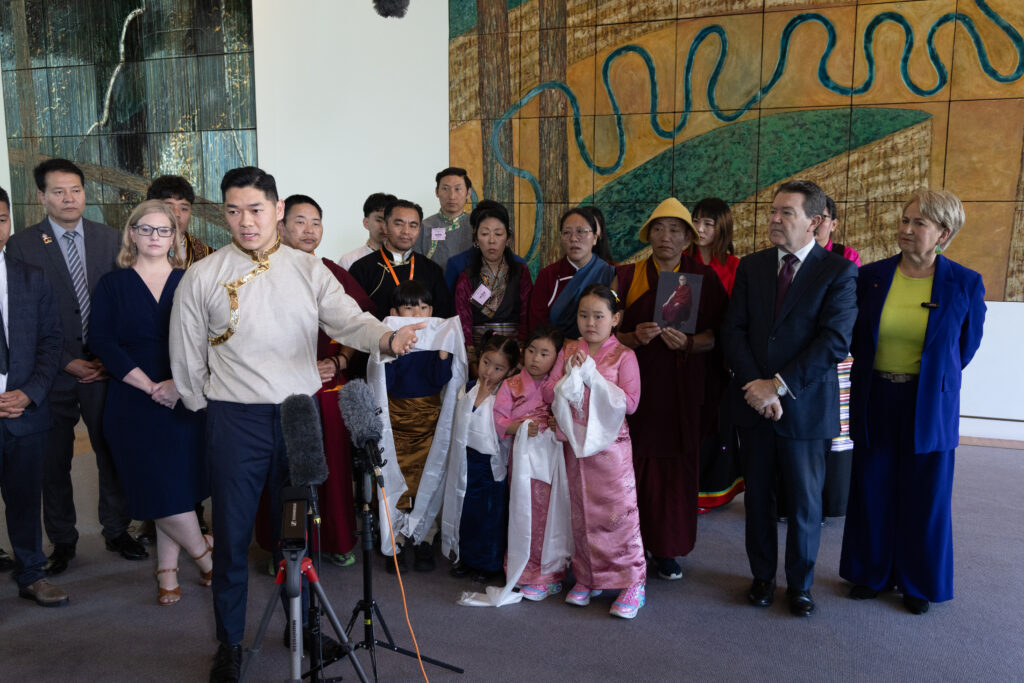
The Australian Tibet Council has attended parliament, asking for support on the issue of the Dalai Lama’s succession. Tibet (and the Dali Lama, 90) want the Dali Lama to choose his successor, not the Chinese government.

Samdon Phuntsok holds a picture of the Dalai Lama while Tenzin Nyima looks on at the Australia Tibet Council’s (ATC) annual Tibet Lobby Day during a press conference in the Mural Hall of Parliament House in Canberra. Photograph by Mike Bowers.

The ATC urges the Australian Government to adopt a clear policy: only recognize a Dalai Lama chosen through Tibetan Buddhist practices and traditions, without Chinese Communist Party (CCP) interference.

In their meetings with federal parliamentarians on Monday delegates will highlight urgent concerns for Tibet’s future and global human rights.

Delegates will also press for an end to China’s repressive policies and transnational repression against Tibetans, including those living in Australia. The CCP continues to monitor, intimidate, and weaponize relatives in Tibet against exiled Tibetans in Australia, denying them true freedom.

The Australia Tibet Council’s (ATC) annual Tibet Lobby Day holding a press conference in the Mural Hall Photograph by Mike Bowers.

Jim Chalmers has announced the pilot ‘Investor Front Door’ program which is designed to “make it quicker and easier for investors to back big projects that create jobs and opportunities for Australians”.

(The name is designed to look like action and be politically appealing)

Chalmers says it is “streamlining how investors and business interact with the government” which means – cutting regulations usually. And in this age of ‘Abundance bros’ that is exactly what will happen. What could go wrong?!

Chamers:

Whether it’s homes, energy or essential infrastructure, this will mean more projects get off the ground more quickly.

The pilot phase will support a select number of projects of national significance. These projects will need to demonstrate they:

•       Have the potential to deliver transformational opportunities to Australia.

•       Will generate benefits for Australia.

•       Can benefit from the Investor Front Door’s services.

•       Have reasonable prospect of success.

Projects selected for the pilot phase will have a dedicated engagement manager who will provide a faster way to navigate regulatory and approval requirements and identify suitable government financing opportunities from existing specialist investment vehicles. 

By participating in the pilot phase, these projects will be part of testing and refining of the Investor Front Door’s services.

The pilot phase will also be used to gather evidence on overlaps and gaps in Australia’s regulatory environment and project financing arrangements and inform the government of areas for improvement.

The Seven Network had Tanya Plibersek and Barnaby Joyce on for its weekly ‘debate’ and focused on the collapse of two for-profit superannuation funds, Shield Master Fund and First Guardian, which has cost members billions in retirement savings – which means they may have lost all of their superannuation.

People want the government to cover the losses from the for-profit funds. Plibersek says:

This is a devastating situation for the people who’ve lost their money. And of course ASIC, the Australian Securities and Investment Commission, is looking very closely at the people involved. They’ve had their assets frozen. The people who are thought to be responsible for this had their assets frozen. They’re prohibited from travelling overseas. They’re being investigated very closely by ASIC and the matters are before the Federal Court.

So, we’re a little bit limited in what we can say. What I would say is that the Assistant Treasurer, Daniel Mulino, is guiding this very closely to make sure that it is properly investigated and people are held to account if they’ve done the wrong thing.

And can I advise that ASIC has a Moneysmart website. It is a great idea now for people to have a look at that Moneysmart website if they’re thinking about changing where their superannuation is, please check before you do, rather than go into to these higher risk, higher return areas, it is really important to get good, unbiased, unbiased financial advice.

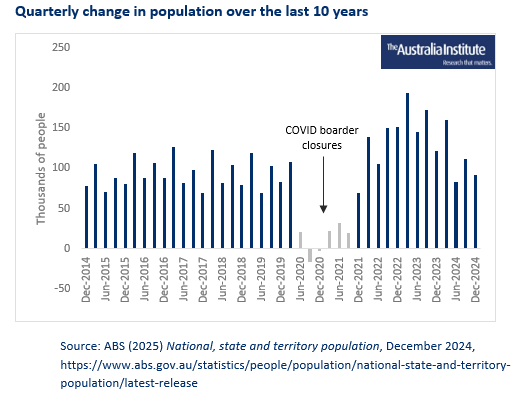
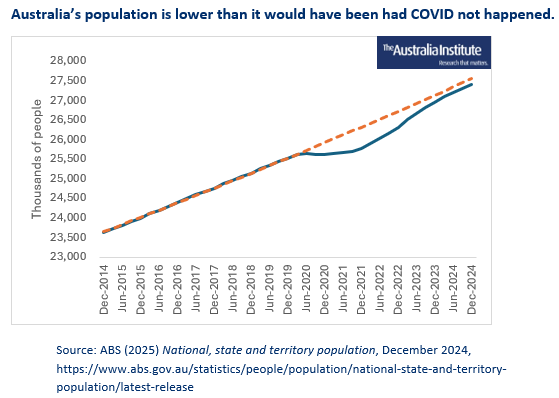
The recent increase in immigration is just the bounce back from borders being closed during the pandemic.

Matt Grudnoff
Senior Economist

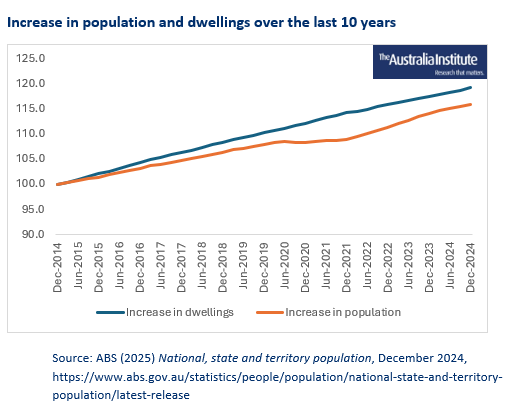
Yes, the population increase in recent years is higher than the long run average, but it comes after immigration was halted during the pandemic.

The net outcome of the two? Australia’s population is actually ever so slightly below where it would have been if the pandemic hadn’t happened.

One of the biggest concerns has been house prices. It is claimed that we are not building enough homes to meet the increase in population.

The data shows that the population has increased by 16% in the last 10 years. That means we need to build 16% more dwellings just to meet that increase. But we have actually built 19% more houses. We are building homes at a faster rate than the population is increasing.

More housing supply would help make housing more affordable. But a lack of supply is not the problem. It is an increase in demand from the capital gains tax discount and negative gearing that is driving house prices higher. Cashed up investors are outbidding first home buyers and locking people out of home ownership rates. If we tackle these two tax concessions we can make housing more affordable and raise tens of billions of dollars.

As a reminder – the issues with the export gas industry are not new. This is from 2023:

https://australiainstitute.org.au/post/how-labor-out-loved-the-coalition-in-its-embrace-of-big-oil-and-gas/

Greens to write to Chris Bowen, Tim Ayres and auditor-general after reports of a 20-year methane leak from a Santos export hub in Darwin.

The ABC’s Investigation unit has the story, which is based on FOI documents released to the Environment Centre NT, which revealed that Santos’ gas export hub in Darwin has been leaking methane gas for almost twenty years. In case you need a reminder – that is not great.

The Greens are writing to the environment minister and the minister responsible for the CSIRO, Tim Ayres to ask what’s up.

They will also write to the auditor-general requesting “a review of how federal regulators conducted themselves in investigating this leak, so the public better understands why no actions were taken against a politically protected gas corporation”.

The Greens will also use the Senate this week to order the production of relevant documents from regulators overseen by federal Ministers.

Waters:

These revelations are very disturbing. I commend the Environment Centre NT for uncovering what is either a spectacular failure of regulators or a deliberate cover up by successive governments to protect a gas corporation’s profit margin. 

The responsible Ministers must urgently explain why their regulators knowingly allowed Santos to leak methane, an extremely potent heat-trapping gas that has a higher global warming potential than carbon dioxide, for almost two decades. 

Ministers Bowen, Ayres and King must also explain if they were aware of what their regulators knew. Their climate credentials are on the line.

The International Energy Agency has already revealed that Australia is underreporting methane emissions by at least 64% because coal and gas corporations are allowed to guess their methane emissions instead of actually measuring them. The Climate Minister agreed to fix this absurd loophole in negotiations with the Greens in the last parliament, but no progress has occurred. Methane is more than 80 times more damaging to the atmosphere over 20 years than carbon dioxide.

Furthermore, Minister Bowen must immediately assure the public that Santos will be compelled to repair the leak. Anything less would be unacceptable for the Darwin community and the climate.”

Here is some more of that interview on the Nine Network with Anika Wells where she was asked about the weekend events:

Oh, awful. They were awful scenes. And there were also known racists who were trying spread division and hatred. And I think it is particularly appalling the people that were aggressive and violent towards our police officers. Australia police are having a very hard week at the moment. They’re just trying to keep our community safe. I think that was particularly egregious.

Q: Well, particularly in Melbourne, right where we saw the resources so stretched. I mean, you’ve got people, neo-Nazis who were given a mic. They were given a platform to espouse their beliefs. Those interviewed proudly said they were neo-Nazis and proud racists. At a time when the government is trying to lower tensions around anti-Semitism. These people are openly admitting to being neo-Nazis.

Wells:

That’s right. And in my federal Minister, I can make clear to your viewers this morning there is no place for hatred in this country. And the vast majority of people were not at these protests, are horrified by these protests, and want to work together with other people in their community to make sure these people are the vast minority and cannot demonstrate their hate.

Q: Anika, I’m not sure whether you saw the image. I think it was in Adelaide where was Dezi Freeman’s picture was held up right. He is wanted fugitive at the moment, accused of gunning down two police officers. That is alarming. Are you worried that these kinds of movements are actually gaining strength in parts of Australia?

Wells:

I certainly am, and you would have seen Anne Aly who’s one of our experts and federal ministers, speak to that across the past few days. And as Minister for communications, my concern is how we are, how we stop this from spreading online. I think everybody in Australia has uptick in in seeing this kind behaviour because people are able to organise online and part of what drives us is the [challenge of making] online spaces safer, prevalence of this kind of thing and doing what we can, where we can.

Q: One of the key challenges face as that they are finding legitimate cause of grievance in this country, right, and hijacking talking about an issue like housing, which is a legitimate so many Australians. But it’s because you lot haven’t built enough houses, both parties, not just the Labor Party in government. Now, the previous government as well. It feels hopeless for so many out there.

Wells:

Well, Sarah, I would not for one second give any credence to the grievances of these people as legitimate.

Q: The point is, they’re finding legitimate issues in Australia, and they’re hijacking it. That’s the concern here because you’re not facing it. Mostly sovereign citizens based themselves off one conspiracy theory, and then it grows from there and being able to navigate and organise online where previously [it was more difficult] So is there a housing concern?

Wells:

I think we’re two different issues here, and I’m at pains not to conflate that. Of course, the Albanese government you would have seen all last week Parliament we were doing announcing our new scheme to get first home, first home buyers into homeownership more quickly, you know, reducing the the 20% down to 5% so that people can actually consider this to be a realistic goal.

Minister Clare O’Neil has full shoulders to the wheel, trying to get as much done as we can at a federal level and working with our state It’s absolutely a problem. Housing affordability is absolutely something that comes up across the board. Let’s not conflate that with this very separate, serious issue.

OK, now that we have spent the morning looking at all the silly buggers being played, let’s take a look at some of the interviews from this morning.

Communications minister Anika Wells has seemingly suggested that liking K-Pop Demon Hunters, which has been in at the top of the most watched Netflix shows since its launch, could help prove that you are 13. Perhaps Wells is unaware of the absolute obsessed K-Pop Idols fandom out there, which is mostly made up of…adults (Huntrix forever).

Australia isn’t going down the road of making you show your ID to access social media sites under its age verification legislation, and instead will make the social media sites cross-reference your posting habits to see how old you are.

Which makes my brain-candy guilty pleasures of My Little Pony, K-Pop Demon Hunters and Care Bears suddenly look very confusing.

Wells told the Nine Network:

The trial has found that age assurance can be private, efficient and effective, and that there is no excuse for social media platforms in this country not to have age verification methods ready for 10th December, when our social media minimum age restrictions come into place.

And I don’t know if your viewers are keen age policy experts, but effectively it comes in three forms age verification, like when you show your driver’s license at the Bottle-o.

If you look less than 25 years old, age estimation where you get your face scanned like you might do with face ID when you’re logging on to a new phone, and age inference where by the data that you give social media platforms, if they’re seeing you talk to 65 year olds about caravanning, they might infer that you are 65.

If they see that you’re talking to 13 year about K-Pop Demon Hunters, they might infer that you are 13. Those are the three different methods in the broad and in the in the in the tech ecosystem in Australia. There are many effective ways that platforms can use to assure themselves of age come December.

LNP MP LNP-ing over Australia Day date. Again.

The parliament will start at 10am this morning and the first order of business in the House is….LNP Bowman MP Henry Pike’s private members bill to stop anyone from moving Australia Day from January 26. Pike is re-introducing the bill which he first introduced in 2023 (it went nowhere).

You can find details on the previous bill, here.

This of course, comes after neo-Nazis supported marches across the country yesterday. Some of those marchers stormed into the Indigenous Camp Sovereignty site and attacked the people peacefully occupying the camp, in a completely unprovoked attack that left four people injured and one woman taken to hospital. The footage of the men, clad in black, running towards the camp is horrific and terrifying. They ripped down and stomped on the Aboriginal flag as well as attacking people at the camp.

Pike claims the bill is to ‘protect Australia Day’ because the date ‘can be changed at the whim of Australian politicians’.

IT WAS ESTABLISHED AT THE WHIM OF POLITICIANS. It wasn’t even a national holiday until 1994, when it became a legislated public holiday across all jurisdictions (before then it usually moved around as the last Friday/Monday of January to make a long weekend). And even that wasn’t a thing until 1988 when it was part of the 200 years of settlement celebrations. It was literally created at the whim of politicians.

Pike is older than the Australia Day public holiday. Let that sink in.

Millions of Australians are abandoning the federal Coalition new research shows

AAP

Millions of Australians are abandoning the federal coalition as the Liberals continue to review its election drubbing and rebuild a fractured party.

More than half of voters who previously voted for the coalition, approximately five million people, wouldn’t consider voting for them if a federal election were held now, according to think tank Blueprint Institute.

More than two-thirds of people said they wouldn’t consider giving their first preference to the coalition, which included 44 per cent of former coalition voters, according to the commissioned YouGov poll of 5000 people in July.

“If the coalition is to regain government through an improvement in the primary vote, it will need to do more than appeal to its base or convince undecided voters,” the Blueprint Institute’s report, Winning Back the Coalition’s Missing Middle, found. 

“It must expand the number of people who are willing to consider its candidates as an option.”

Half of those who  had voted for the coalition but not at the 2025 election were critical of climate change, renewable energy and housing affordability policy offerings.

Only 16 per cent of former supporters believed the conservative alliance was serious about addressing climate change.

The research presented more dire news, finding that there was an “extremely limited opportunity to increase its primary vote among those who would currently consider voting for one of its candidates”.

Four in five ex-coalition voters and just over 70 per cent of independent voters agreed the Liberals and Nationals needed a more comprehensive policy suite before they stood a chance to pick up their vote.

Climate change policies were identified as a key area to address a disconnect with voters, as more than half of ex-voters wanted them to keep their commitment to a net-zero emissions target.

The Liberals and Nationals are split on the net-zero by 2050 target, with more conservative and firebrand members wanting the commitment scrapped.

But inner city and moderate Liberals who have called for stronger climate action policies have been largely eradicated from metropolitan areas across the country.

The coalition fared well on economic management, national security and foreign affairs, which overlapped with the priorities of their former supporters.

Those who left the conservative parties were predominantly parents with young children and full-time workers in their twenties to forties, the survey found.

Blueprint Institute co-founder Lachlan Crombie said the coalition would need to gain a broad appeal to voters rather than just a narrow sliver.

“That means appealing to young families who are not particularly ideological, but have turned away from the coalition because it’s drifted away from representing the values of modern Australia,” he said.

Just a few reminders…

That some of the groups seeking to make as much political hay out of the anti-immigration sentiment as possible are – brace yourself – contradicting some of their previous held positions! I. Know. Smash me down and call me avocado – but there are hypocrites among us.

Among those, are the IPA which recently made Media Watch for its use of overseas arrivals and departures (people coming and leaving on planes) and conflated that with overseas migration statistics (different data, and measurement, which the ABS had to make clear after the IPA attributed its OAD numbers to migration)

Matt Grudnoff had a look at some of the actual numbers here:

https://australiainstitute.org.au/post/is-population-growth-driving-the-housing-crisis-heres-the-reality/

But let’s take a look at history – including this 2008 IPA report, which SHOCKINGLY reveals the history of Australia’s political parties on migration:

Two of the most fundamental liberal freedoms are the free movement of people and goods across
borders. In Australian politics, individuals
of liberal persuasion have always struggled
to find one side of politics that has reliably
supported both increased immigration and
lower tariffs at the same time.

However, our 
two major political parties have had such a 
remarkably consistent record that one can
confidently say: 
immigration will always be higher under a Liberal government and;
 tariffs will always be lower under a Labor government.


This may seem counter-intuitive, but the
lesson of history is clear. When it comes
 to the movement of people and goods the
 Liberal Party is the party of social liberalism and the Labor Party is the party of eco
nomic liberalism.

Of course there have been 
exceptions—most notably the post-war migration expansion commenced under the 
Chifley Labor government, but this was
 certainly an exception to the general rule.

And what else did the IPA know to be true in 2008?

The Howard government, like all its Liberal predecessors, was a high immigration government, particularly in its latter years, topping 140,000 [permanent migrants] in its final full year 2006-07.

It was under John Howard that, for the first time since federation, the overseas-born proportion of the population exceeded 24 per cent, and it was also under Howard that the non-European component of the overseas born went above 50 per cent for the first time.

And as well as increasing overall numbers, the Howard government progressively increased the refugee intake from 3,802 in 1999-2000 to 6,022 in 2005-06.”

Fancy. That.

Penny Wong has announced new diplomatic missions:

I am pleased to confirm the following appointments:

  • Mr Tim Kane as Australia’s next High Commissioner to Pakistan (He was the former ambassador to Brazil)
  • Dr Helen Cheney as Australia’s next Ambassador to Portugal (former high commissioner to Nauru)
  • Ms Greta Whyte as Australia’s next Consul-General in French Polynesia (formerly acting in the position)

Australia’s diplomatic network enables us to promote our interests in peace, security, trade, investment and other areas of cooperation.

Australia takes the world as it is and seeks to shape it for the better – these diplomatic appointments will deepen Australia’s connections abroad and increase our ability to influence where it matters.

I thank the outgoing High Commissioner, Ambassador, and Consul-General for their important contributions.

Was your house freezing over winter? A bit more red tape could have kept you warm

Glenn Connley

After a chilly winter, Australians are about to be hit with their winter heating bills. New analysis by The Australia Institute has found that a bit of red tape might have kept us warmer and kept our power bills down.

Red tape is often blamed for the housing crisis, like at the recent Economic Reform Roundtable, which vowed to reduce regulation in housing construction.

In 2005, the Productivity Commission warned about over-regulating energy efficiency in housing. Two decades on, Australian homes are built to a much lower energy efficiency standard than overseas, despite our more extreme climate.

The new analysis finds that poor regulation leads to poor outcomes, such as forcing families to shiver through winter in poorly insulated homes and pay higher heating bills. 

The analysis also suggests the removal of lucrative tax concessions for property investors, which gives them a huge advantage over first-home buyers, and recommends that governments directly build more homes for Australians. 

“Regulatory reform is not inherently bad. Regulations are simply laws. They can be good. They can be bad,” said Jack Thrower, Senior Economist at The Australia Institute and author of the analysis.

“A well-resourced planning agency, capable of making swift, well-considered decisions, would likely help get things built more speedily.

“But ‘cutting red tape’ is too often code for watering down laws which keep Australians safe from businesses abusing their power. Indeed, there are parts of the housing industry where the problem is not too much regulation; it’s not enough.

“Instead of blaming regulations for the housing crisis, the government could look to tax concessions for property investors, which cost over $10 billion a year, make inequality worse, and help landlords outbid first-home buyers.

“The government could tackle the housing crisis by cracking down on these giveaways and directly building any additional housing Australia might need, all while regulating to make sure properties are energy efficient, safe, and durable.”

Make neo-Nazi’s ashamed again

Ebony Bennett wrote this for the Canberra Times:

A “March for Australia” rally sounds benign, but people who plan to attend the “March for Australia” rallies around the country on Sunday will almost certainly be marching alongside white supremacists and neo-Nazis.

The march is advertised as being about ending mass immigration. Of course, there is no “correct” level of immigration to Australia – this will always be a democratic question that’s up for debate. But it’s equally clear that’s not what these protests are really about.

The media and anti-fascism activists have revealed that some of the organisers of the marches have posted white nationalist ideas like “remigration”, including pro-Nazi and pro-Hitler memes, and threatened violence. March for Australia has denied links to some prominent neo-Nazis.

While Australians firmly rejected the Coalition’s harsh anti-immigration rhetoric and policies under Peter Dutton’s leadership, scapegoating immigrants is a sadly effective tactic in politics and in the media.

More than one politician has voiced support for the March for Australia, including independent MP Bob Katter, who threatened to punch a journalist for mentioning his Lebanese heritage when questioning him about his support for the anti-immigration rallies.

These marches can be seen as part of a pattern of neo-Nazis and fascists becoming more and more emboldened in Australia and overseas, using anti-immigrant sentiment to bring heinous and extremist ideas like the mass deportation of non-white people into the mainstream.

The hateful, white supremacist language, the calls for violence, and talk of mass deportation Australians make it clear the March for Australia has a much more sinister agenda at its heart, and we only need look to the United States to see where this path leads.

It’s just eight years ago that neo-Nazis marched through Charlottesville in the United States with torches chanting “Jews will not replace us”, and where one white supremacist killed a counter-protestor by driving his car into a crowd of people.

President Donald Trump, then in his first term, responded by saying there were “very fine people on both sides“.

Now, Trump is using his second term to deploy masked secret police to disappear people from their homes, workplaces, schools and courthouses to deport people en masse without due process. There’s no doubt the far right is trying to take Australia down a similar path.

It was just a few years ago, ABC Background briefing uncovered a covert plot by Australia’s far-right movement to join major political parties to influence them from within, including a branch-stacking effort that saw dozens of alleged neo-Nazis and white supremacists join the Young Nationals in NSW.

Neo-Nazis felt comfortable enough to publicly boo the welcome to country at this year’s ANZAC Day dawn service.

They have marched through the streets of regional towns in Victoria and NSW, and down the CBD of Melbourne in masks at midnight, assaulting a counter-protestor.

After the Melbourne march, the neo-Nazi group NSN boasted a surge in membership, meaning it was on track to overtake the Liberal Party membership within 18 months.

And of course, we cannot forget it is just six years since an Australian white supremacist massacred 51 people and injured 80 others during Friday prayers at mosques in Christchurch.

Australia never bothered with much public introspection into how it produced this terrorist.

You can read the rest here.

Meanwhile the NT Country Liberal government has announced it has approved two projects to “unlock” the Beetaloo gas field. This will do nothing to expand the NT’s economy, but will increase emissions. So Huzzah. What a celebration.

From the release:

Work begins this month on the Territory’s first-ever Beetaloo pipeline, with APA Group investing $70 million to deliver the 37-kilometre Sturt Plateau Pipeline. The pipeline will connect Tambor Resources’ Shenandoah South Project to the Amadeus Gas Pipeline – the backbone of the Territory’s gas network stretching from Alice Springs to Darwin.

Separately, Tamboran has secured approval from Traditional Owners, the Northern Land Council and the NT Government to recover appraisal gas for sale from Exploration Permit 98 under the Petroleum Act 1984 (NT), paving the way for construction of the $140 million Sturt Plateau Compression Facility.

Together, these projects establish the first clear pathway to market for Beetaloo gas – unlocking royalties, powering Territory homes and businesses, and cementing the NT’s place as an energy powerhouse.

Not sure how many more times we have to see that the ‘positives’ never actually come off until we learn our lesson, but this is Australia and we just love giving gas away and pretending there is nothing we can actually do about it.

HAHAHAHAHAHAHAHA

Well this did give me a tickle. After not winning the battle since 2019, Hume is now appealing to her colleagues – the leftover, Leftovers – who are all fighting to scrap net zero – to be sensible.
When has that happened? She does admit that without net zero, there will be no return to the government benches.

Just wait until they start having to face ‘real zero’.

Q: State Liberal parties are voting against net zero. A huge number of your colleagues are campaigning internally and also even publicly against net zero as well. Does that make any sense to you?

Jane Hume:

Do you know what Liberal Party members really want? Liberal Party members really want to return to government. They want to make sure that we have a sensible, fiscally responsible Liberal government in charge.

Q: Can you return to the government benches, if you don’t adopt net zero?

Hume:

That’s exactly right. The way to get there is that we reflect what a modern Australia wants. And a modern Australia have told us they want a zero-emissions future. The way to get there is through a sensible energy policy, a transparent energy policy – not one that’s based on ideology, but one that’s based on economic sense.

Why does Jane Hume, who previously went along with whatever her party leader said and defended it, despite the Liberals priding themselves on being able to cross the floor and speak in support of their own convictions rather than the party position, now think that the Coalition should embrace net zero and the energy transition?

Well, there’s a few reasons. The most obvious is an electoral imperative.

For election after election, the voters have told us that they want to see a low-emissions future.

So I think that that ship really has sailed. When we build our policy platform, it’s going to be fundamental that Liberals don’t just work for the voters that put us here now, but for the 33 seats that we need to win in order to form government. They have made it very clear that they want to see a low-emissions future. But the other is economic.

This is really important. We are a capital-dependent nation. We need capital inflows from overseas. We know that overseas financiers require policy certainty. That policy certainty can come from a commitment to a net zero future. Net zero is 25 years away. I have absolutely no doubt that the technology will be there to be able to deliver a zero-emissions future.

This is something that we should be embracing. We know that, when other countries have uncertain policy settings – like we’ve seen in the US – that capital moves. Over $1 billion was invested from a Dutch pension fund into Octopus Investments, an oasis fund, an Australian renewable energy fund, weeks ago, in response largely to the uncertain policy settings occurring in the US right now. This is a great opportunity for us to attract private-sector capital so that we can start lifting the subsidies that taxpayers are paying for.

Liberal senator Jane Hume, who was part of the Dutton Coalition who opposed Australia hosting the UN climate conference COP, and said they would withdraw if elected as government, is now arguing her party SHOULD support the conference. The Coalition (and the Liberal party) are tearing themselves apart over net zero. Hume has found herself on the moderate side and having been booted off the front bench, is now freelancing on behalf of the moderates pushing for the Coalition to embrace a low emissions future. Which maybe would mean more, if she wasn’t the person the Dutton Coalition rolled out to be ‘sensible’ in opposing these sorts of things, less than one year ago.

Hume now tells the ABC:

I think this is low-hanging fruit. Let’s face it – COP, while it does bringing in world leaders to make some pretty serious decisions about a low-emissions future – most importantly, it’s a giant trade fair.

It’s a trade fair that attracts financiers, tech companies, energy companies from right around the world to show off their wares, and it allows innovators in Australia to do the same. That’s really important economically for a country like Australia.

Why wouldn’t we want the world’s financiers to come to Australia? We’re a capital-inflow-dependent nation. Why wouldn’t we want those companies that, for instance, are setting up nuclear power generation right around the world to show off their wares here in Australia and, more importantly, in South Australia, where there’s a $1.5 billion nuclear export industry ready and waiting?

Why wouldn’t we want an opportunity to show off our critical minerals capabilities to the world? This is a great opportunity for Australia. It’s something that we should be wholeheartedly embracing.

Because, let’s face it – the world has moved on. They want a low-emissions future. It’s time that the Liberal Party gets behind COP so that we can talk about it in a sensible way, rather than the reckless way that Labor is going about its Renewable Energy Targets, which clearly it’s going to fail to deliver.

David Pocock said he is frustrated there is no population plan for Australia (there isn’t – there is no thought given to what size Australia’s population should be as a cohesive plan, which means infrastructure doesn’t keep pace, which is not the fault of migrants, but of successive governments)

Pocock:

We saw a catch-up over COVID. My concern is that there really isn’t a plan. We’re not taking into account the required infrastructure, things like impacts on the environment, and when you don’t have a plan, you open yourselves up to the kind of things we saw on the weekend. So I would love to see a sensible conversation about it. And for the government – rather than Treasury just setting some sort of arbitrary number every year – to actually say, “OK, THIS is how valuable migrants are to this country. These are the skill areas that we need. This is how we’re going to do it over time. This is how we’re going to ensure that we’re building enough housing, schools, other infrastructure that is required for a growing population.”

Independent senator David Pocock spoke to the ABC about the marches and said:

Well, as a first-generation migrant, you know, I think Australia has benefited so much from migration over the years. And I think this is really damaging when it comes to the message it’s sending to migrants across the country.

And some of the slogans and behaviour we saw are totally unacceptable. I think, on the broader point, one of my frustrations has been that there is a real lack of appetite from the parliament to actually have a debate about this in a sensible way, and then come up with a plan when it comes to migration and population that actually wards off some of the, I guess, feelings of “Well, there is no plan.”

So I think there should be room for a sensible conversation amongst leaders so that, when people do raise these things, we can actually say, “Yes, we have a plan that takes into account infrastructure, skills, and all these things.” But currently, there really isn’t one.

Nazis and white supremacists join marches held across the country

They are being called ‘anti-immigration’ rallies in most media and there is reports of ‘clashes’ between those on same side as Nazis and the anti-genocide protesters who formed the bulk of the anti-fascist movement standing against them (which is predictable, but I think we can work out where the violence originated) But neo-Nazis turned out in support of the so-called ‘March for Australia’ , had claimed to have come up with the concept ahead of them being held and helped spread the message among their networks. In Melbourne, one of the leaders of the neo-Nazi movement was given a speaking platform to recruit people to his cause.

It is a depressing, but must be acknowledged reality – Australia has a problem with its far right movement, and so far the response as been to conflate it with legitimate democratic protests against genocide, climate change inaction and other existential threats as if ‘all sides are to blame’. It is not the same thing. We know it isn’t. Our leaders should too.

Anti-Immigration Rally on the front lawns of Parliament House after marching from Regatta Point in Canberra today. Sunday 31st August 2025 Photograph by Mike Bowers.
One Nation Leader Pauline Hanson arrives at an anti-Immigration Rally to a heroic welcome from the crowd. at Regatta Point in Canberra today, later they marched across Commonwealth Avenue Bridge to Parliament House. Sunday 31st August 2025 Photograph by Mike Bowers.
Anti-Immigration Rally on the front lawns of Parliament House after marching from Regatta Point in Canberra today. Sunday 31st August 2025 Photograph by Mike Bowers.

Supermarket shrinkflation back on the government agenda

The Albanese government has launched a public consultation on the introduction of a shrinkflation regime to name and shame brands who keep their prices the same, but shrink the product size, as AAP reports:

Shoppers could get the chance to dob in grocery retailers charging top dollar for shrinking products.

The federal government is exploring ways to ensure consumers get value for their money at the checkout, by strengthening the unit pricing code.

A public consultation kicks off on Monday seeking consumer feedback on the introduction of a new “shrinkflation” notification regime to name and shame brands, as well as a proposal to make unit price displays more readable and impose fines for non-compliant retailers.

Assistant Minister for Treasury Andrew Leigh said clearer information means Australians will be able to spot changes to product sizes and decide if it’s value for money.

“If a chocolate bar loses two squares but keeps the same price, that’s not magic – it’s shrinkflation,” Mr Leigh said.

“We want feedback on what steps we can take next to crack down on diminishing sizes.”

An Australian Competition and Consumer Commission supermarket inquiry report, released in February, recommended that supermarkets publish notifications when product sizes change, but prices remain the same.

Last year, independent consumer advocacy group Choice identified 15 supermarket products that had reduced in size, with the price remaining the same or increasing.

The examples included Coles’ Mighty Grain cereal, which was being sold in 560g packets in October 2022, but by March 2024 was being sold in 495g packages, yet the price remained the same at $4.50. It now sells for $5.

“Consumers deserve more information when shrinkflation occurs,” Choice chief executive Ashley de Silva said.

Mr de Silva noted that major Australian supermarkets appeared to be among the most profitable in the world despite a cost-of-living crisis.

“We need to fix the power imbalance between supermarkets and consumers and price transparency will help us do that,” Mr de Silva said.

Thank you

I know it is a little bit strange to see a blackout message on the site (if you are reading this after it is changed, the blog opened with a message drawing attention to how many journalists Israel has killed in Gaza, and no picture), – it is part of a worldwide action Reporters Without Borders is hosting across the globe, in support of Palestinian journalists in Gaza.

Thank you for caring enough to read about it and to help keep the focus on one of the most horrific events of our time.

We’ll head to domestic news now. x

Good morning

“At the rate journalists are being killed in Gaza by the Israeli army, there will soon be no one left to keep you informed.”

#ProtectJournalistsInGaza
#LetReportersIntoGaza


Read the previous day's news (Thu 28 Aug)

Past Coverage

Comments

Start the conversation

The biggest stories and the best analysis from the team at The Point, delivered to your inbox.

Past Coverage