Tue 2 Sep

Australia Institute Live: Albanese government facing questions on aged care, Nauru deal, climate targets and population, as domestic issues return to the fore. As it happened.

Amy Remeikis – Chief Political Analyst

This blog is now closed.

Start the conversation

Australia Institute Live: Albanese government facing questions on aged care, Nauru deal, climate targets and population, as domestic issues return to the fore. As it happened.

Key Posts

The Day's News

See you tomorrow?

The parliament is still going, but we are tired and sometimes, you just have to choose life.

We will be back bright and early tomorrow though, where we will bring you the day’s events. There is also the brewing situation in Indonesia, which is getting almost radio silence in response in Australia, despite it being quite a big deal. Let’s see if we hear anything from the government on that tomorrow.

Until then, take a break, look after others, make good trouble – and take care of you. Ax

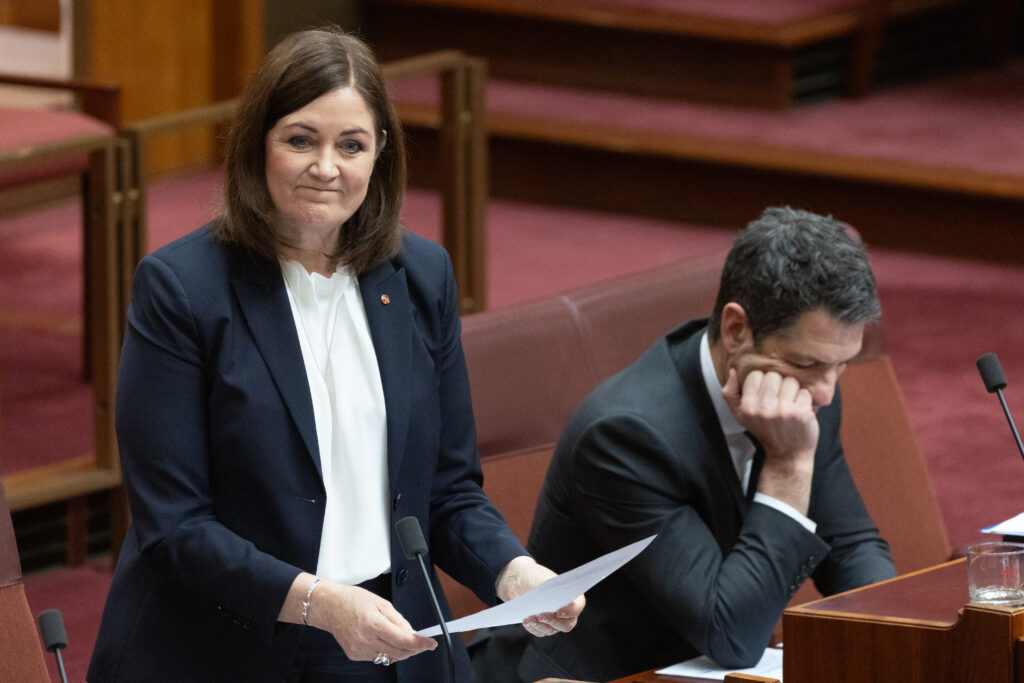
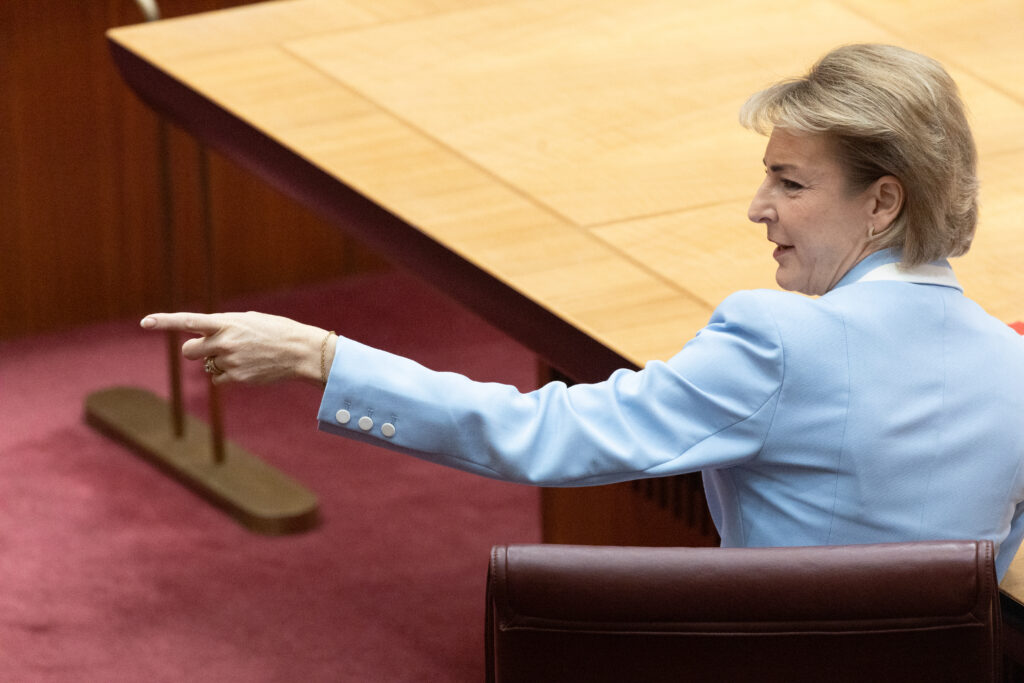
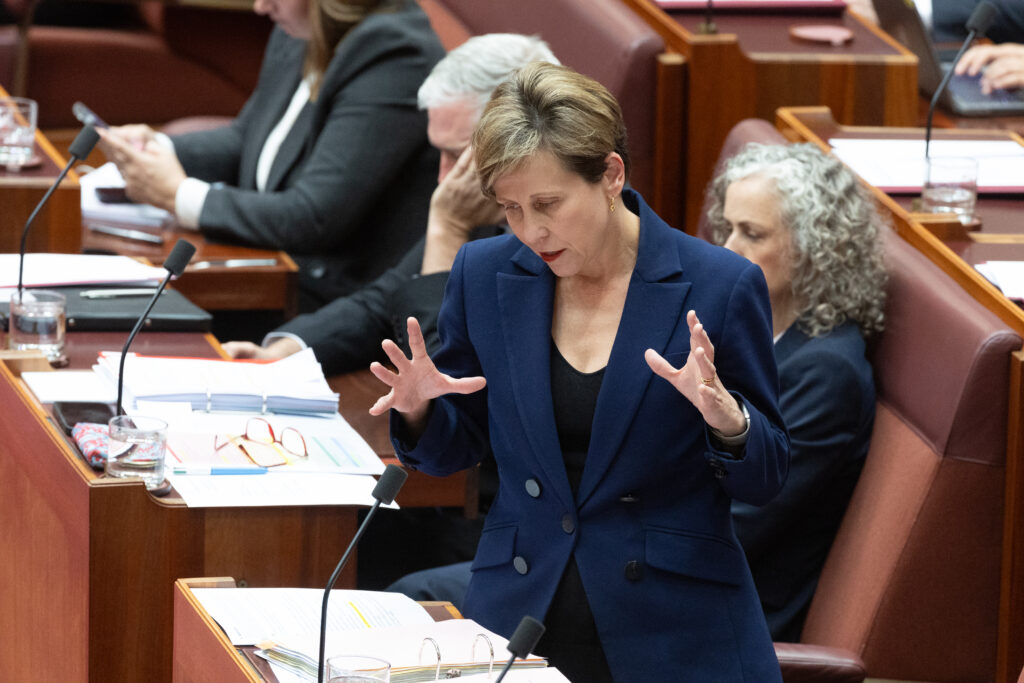
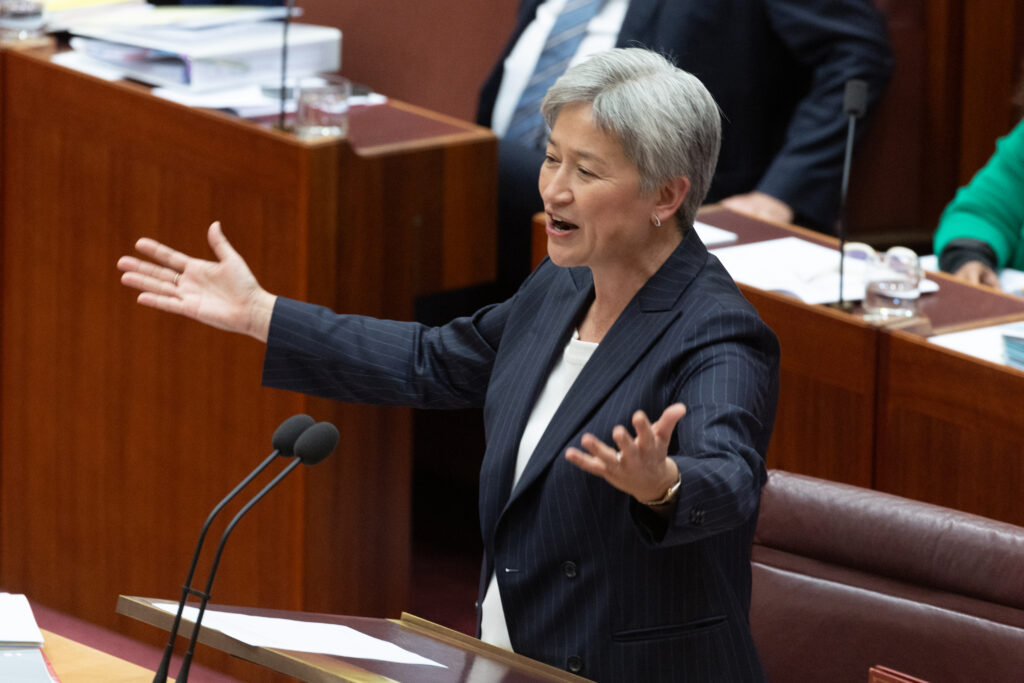
(oh and here is some of how Mike Bowers saw some of the senate QT, just as a treat)

Victorian Liberal Senator Sarah Henderson during QT. Photograph by Mike Bowers.
The Leader of the Opposition in the Senate Michaelia Cash during Question time in the senate chamber of Parliament House, Canberra this afternoon. Photograph by Mike Bowers.
The Minister for the National Disability Insurance Scheme Jenny McAllister during Question time (Mike Bowers)
The Leader of the Government in the Senate Penny Wong during question time gets underway Photograph by Mike Bowers.
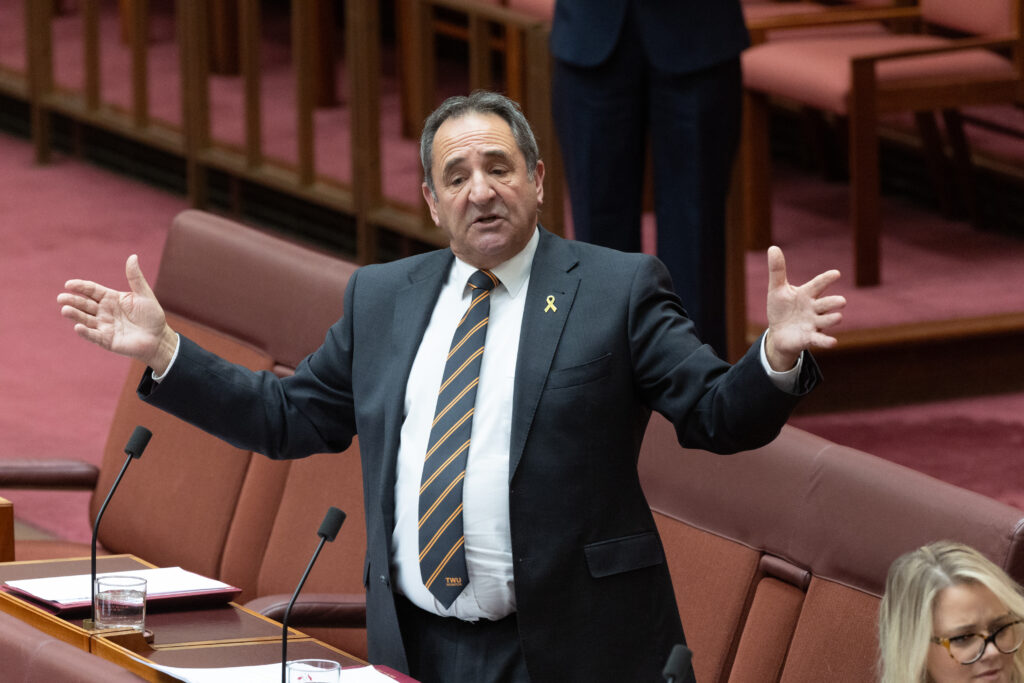
WA Labor senator Glenn Sterle before Question time gets underway in the senate chamber of Parliament House, Canberra this afternoon. Photograph by Mike Bowers.

And just for the ‘WHATABOUTHAMASSSSS’ crowd:

Q: The Israeli foreign ministry says the report is based on poor research. It’s regularly denied its actions in Gaza amount to genocide and says they are justified as a means of self-defence. What’s your response to that?

Dr Melanie O’Brien, President of the International Association of Genocide Scholars (IAGS) and Associate Professor of International Law at the University of Western Australia Law School:

Self-defence is permitted in international law. There is no justification for committing war crimes, crimes against humanity or genocide. And in the current case that we’re talking about, you could have been talking about self-defence on October 8 or 9, 2023. But at this point that’s not what we’re seeing on the ground. Self-defence still needs to be carried out within the laws of war. And that includes the requirement that actions must be proportionate and they must be carried out according to military necessity. Israel’s actions are no longer proportionate. They are extraordinarily disproportionate and certainly not carried out with military necessity, given that we are seeing the now almost complete destruction of the territory of Gaza and the killing of so many civilians on the ground.

Q: What action do you want the Australian Government and the international community to take in light of your conclusions?

O’Brien:

The Australian Government and the international community more broadly but really thinking about Australia, we would like to see more sanctions brought against Israeli figures in the leadership but also any Israeli entities, any companies that are engaged in supplying to this.

There has been a report issued by a former UN repertoire about companies and business of what is going on in the ground in Gaza. Those should be sanctioned. And I would also like to see our government speak out actively in support of the International Criminal Court.

And its arrest warrants. Australia is a party to the International Criminal Court. So it should be supporting the work of the court by actively speaking out and saying that it will arrest anyone under an arrest warrant and also condemning the sanctions that the US has brought against officials of the International Criminal Court and anyone connected with it.

By publicly announcing its support, the Australian Government would demonstrate that it holds accountability for international crimes as an important thing to the Australian Government and the Australian people.

Israel is committing genocide in Gaza: IAGS

Dr Melanie O’Brien, President of the International Association of Genocide Scholars (IAGS) and Associate Professor of International Law at the University of Western Australia Law School has been interviewed by the ABC about the IAGS conclusion Israel is committing genocide against Palestinians in Gaza.

Asked about the conclusion, O’Brien says:

I will say to separate my personal opinion, I do believe that as well. In this case we’re talking about the resolution that was passed by the International Association of Genocide Scholars and voted on passing the vote with almost 90% of people who voted, agreeing it was genocide. From a personal standpoint, I can say that it’s certainly a process to, looking at a process to come to the conclusion that genocide was formed. We are witnessing four of the five (war) crimes being committed on the ground. And we are seeing those committed with that intent to destroy a particular group, in this case, the Palestinian group.

Q: So you say 90% of the people who took part agreed that Israel all thought Israel was conducting genocide in Gaza but it was a minority of scholars in your organisation who took part in the vote itself. Only 28% expressed their views. So why so few participants and why did the other, the majority decide not to take part? Did they hold an opposing view?

O’Brien:

So at the quorum for a vote is 20% plus one which we passed. And I would say this falls in the standard range of voting and it’s at the higher end of the range. With 500 members that’s a lot. And essentially people are members of scholarly associations of all different kines and all different disciplines. Not everyone is active in that sense. So it’s quite standard and our quorum of 20% plus one is fairly standard across other types of associations for this kind of voting. Because we understand that when you have hundreds of members, not everyone is going to vote.

Q: So what sources then did you use to declare that genocide was taking place, given the very limited access to information out of Gaza by the international media and by academics like yourself?

O’Brien:

So the drafters of the resolution, which went to a rigorous peer review process through actually three different committees, included many, many links to a wide range of evidence reports from NGOs, reports from the UN, media reports, so a wide range of what are considered to be reliable reporting of what is going on, on the ground in Gaza, to the best of our ability, knowing that Israel has prevented Western journalists and also prevented many NGOs and the UN from being on the ground. But we know there are still NGOs reporting from what’s on the ground such as those who can access the territory of Gaza.

Q: Part of the definition of genocide was to prove there was an intention behind actions. How do you prove intent in this situation?

O’Brien:

This is a great question because it’s the hardest thing to prove, when you go into court, if you’re prosecuting someone for genocide. There are two main ways that we would look at that. The first one is thinking about expressed statements by leadership of the perpetrator regime. Usually civilian and military leadership. And there has been a track record essentially since October 8, 2023, and ongoing until today, statements made by the Israeli and military leadership, with an intent to destroy Palestinians, talking about how there are no innocent Palestinians and they intend to starve them and destroy Palestine and Palestinians.

The second way to prove intent is to look at a pattern of conduct. When we look at the pattern of conduct that’s going on on the ground we see killings through for example bombings and shootings, we see well over 150,000 people have been injured on the ground. We see the imposition of conditions designed to bring about physical destruction and so the denial of food, water, healthcare, medicines, all of this resulting in malnutrition, starvation and the spread of communicable diseases. And we also see other offences such as arbitrary detention, torture, reproductive violence, and many other forms of violence that when you put it altogether indicates a pattern of intent to destroy the group in whole or in part.

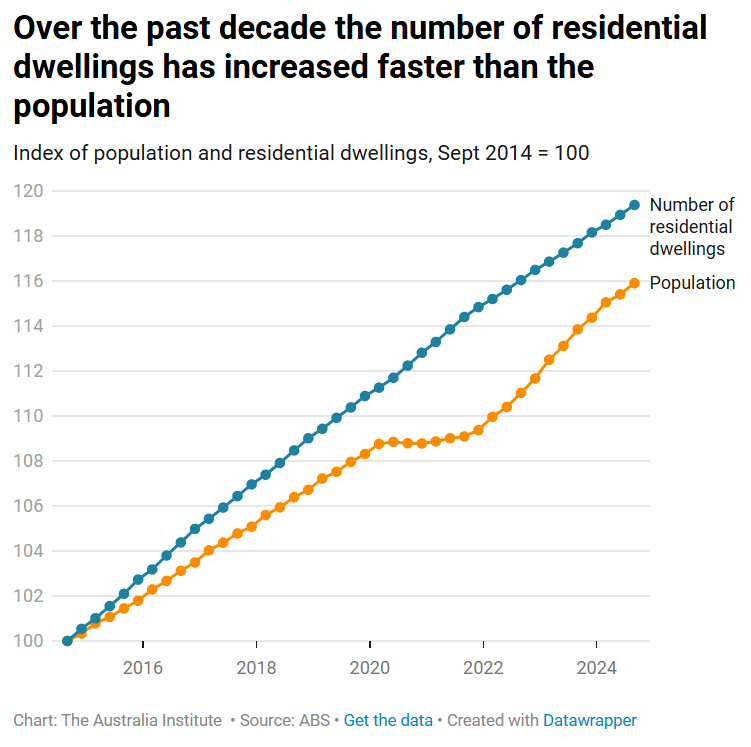
In question time, the Minister for Housing said there’s a housing shortage and that we need to “build, build, build”.

But as Australia Institute research shows, supply has risen more quickly than population. The important thing is dealing with the tax concessions that have made housing highly inequitable.

Matt Grudnoff
Senior Economist

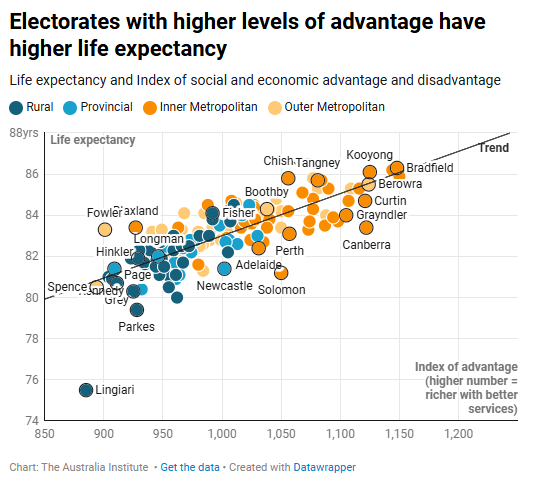
Rebekha Sharkie, the independent member for Mayo asked about health inequality in regional Australia.

This is an important issue that literally shortens the lives of those who live far from our capital cities.

Australians with the longest life expectancies are those who live in inner metropolitan electorates. They live almost a year (0.8) longer than those who live in outer metropolitan electorates.

Life expectancy falls even further for those who live in major regional cities. People in these electorates live almost 2 years (1.9) less than inner metro electorates. While those living in rural electorates live 2.3 years less than inner metro electorates.

In Australia we like to think that Medicare means that all Australians have access to the same healthcare, but unfortunately the reality is that where you live has a big impact on the healthcare that you get.

Skye Predavec
Anne Kantor Research Fellow

In the Senate, Don Farrell and David Pocock just sparred over FOI reforms. 

Attorney-General Michelle Rowland announced this morning that the government will introduce legislation to weaken Freedom of Information (FOI) laws. 

Farrell justified the proposed changes saying that dealing with “frivolous requests” was wasting public servants’ time, and claimed “we are an open and transparent government”. 

Pocock then noted that “the stats show your government is actually the second most secretive government on record”: the number of FOI requests granted in full under the Gillard government was 59% and just 25% under the Albanese government. 

Transparency is important, and Freedom of Information requests are a key part of ensuring the Australian public know what their government is up to. These changes would put an already strained system under even more pressure. 

Question time ends

Anthony Albanese calls time on QT in the House.

Thank Dolly.

Back in the House and there have been a couple more questions on aged care that canvass many of the same issues previously raised, so Sam Rae is now referring to his previous answers.

Allegra Spender then asks about former defence force chief Chris Barrie’s comments from earlier today that the government is not doing enough to prepare for the coming climate security issues.

Spender:

Today former defence force chief Chris Barrie reiterated the declaration warning that climate change is the single greatest threat to security for Australia and for our immediate region, including our Pacific neighbours. You’re attending the Pacific Island Forum next week. What assurances will you be providing to your Pacific counterparts that Australia’s climate ambition will meet the threat level to the region and be consistent with keeping temperature increases to 1.5 degrees? Prime Minister.

Albanese:

I thank the member for your question. And more importantly, I thank her for her commitment to acting on climate change. And participating in this parliament as the representative for Wentworth on behalf of her constituents.

For the people of Wentworth or Grayndler, this can make an enormous difference. But for people in the Pacific as she correctly identifies, for people of Tuvalu, Kiribati, this is an existential threat to the very existence of their nations.

When I attend the Pacific Island Forum…next week, I’ll be attending as a participant, not as a block to climate action.

That is one of the distinctions that’s occurred. The entry fee for credibility in our region, the Pacific, in ASEAN, is action on climate change. And we indeed will be pursuing our hosting of the conference of the parties to be held we hope in Australia, in partnership with our Pacific Island neighbours and family as well.

I welcome the support for that from at least one person in the Liberal Party, Senator Hume. We have funding for climate … change infrastructure, resilience and preparation as well. As well as with agreement such as an agreement with Tuvalu. We have a specific program allowing, recognising that sea levels are rising. They are having an impact and allowing a number of Tuvalu citizens to be able to come to Australia each year. That has been welcomed. In the lead-up to the Pacific Island Forum, I’ve had discussions with a range of our neighbours, including Vanuatu that I will visit on the way to the Solomon Islands next week. About our joint commitments which are there.

The member quite rightly quotes Admiral Barrie and the fact this is a national security issue and it is. Because these issues do raise our relationships with our neighbours. They also raise the issue of security and the very survival of those island states. And they raise also how we participate and how we’re seen by our neighbours. And that is important. I’ve said that our defence relationships are also about divesting in our relationships, not just our capability. This is just one way in which we do so.

Over in the senate, Liberal senator Sarah Henderson is pretending to be INCENSED over the non-existent spare bedroom tax, which was an idea put forward by the analytics firm Cotility at the economic roundtable. It is not government policy. It was part of a forum where all ideas were put on the table and it was one of those ideas.

The government is not going to put a spare bedroom tax in place. But it won’t rule it out for two reasons – one if it rules it out, it will then have to rule out every other idea that has ever been floated at a forum and it doesn’t want to do this. The other is that it doesn’t mind if the Coalition and others take this seriously – because they will suck up oxygen over something that will never happen (therefore not concentrating on what is happening) and then it will casually dismiss it in a later media interview, where the coalition will look ridiculous.

Good times, serious politics.

Penny Wong:

You talked about what was a laughing matter. Well, the Coalition’s economic policy and tax policy is a laughing matter. The Coalition’s health policy is a not as a laughing matter. The Coalition’s climate policy is laughably back where they were 20 years ago, and 23 policies behind. And of course, their nuclear policy remains a laughing matter because some still support it.

I mean, you are not a serious party of government, and you are not listening to your voters. You are not listening to where Australians are, and on that note, I ask that further questions be placed on notice board.

Anika Wells takes a dixer to address the concern over deepfake AI sexual exploitation.

Minister for Communications Anika Wells on her way to a press conference about deep fakes in the Mural Hall of Parliament House. Tuesday 2nd September 2025. Photograph by Mike Bowers.

The Albanese government is taking world leading action to reduce online harms experienced by young Australians, including passing historic legislation to delay access to until 16. Today I announced the next step in that mission; t restrict access to nudifcation and undetectable online stalking tools. There is place for AI and legitimate tracking technology.

But the problem is technology has no moral compass. The capacity for good or bad depends on who is using it. The rockets that launched the Apollo missions the moon were the same that designed a nuclear weapon.

While AI can move Australia forward there is no place in our country for apps and technologies that are used solely to abuse, humiliate and harm people, especially our children. Mr Speaker, one in every classroom in Australia has been the victim of deep fakes

Four out of five of reported cases involve young girls. In one Melbourne case, investigators found 50 female students at a single High School were the victims of sexually explicit deepfakes.

The scale of harm is escalating, with reports to e-safety from people under 18 doubling in the past 18 months. Today I heard from a mum, Emma, whose daughter Tilly had a fake naked photo shared by schoolkids on the bus. Between 3:10 and 6:00pm Emma’s mum estimates almost 3,000 kids had seen this fake naked video, photo, and that night, Tilly attempted to take her own life.

These harmless are too great and too urgent for us not to act. While there are federal and state laws against the publishing and distributing of sexualised non-consensual deepfakes and AI generated child sex abuse material, slimy predators are slipping through the cracks.

The current landscape relies too heavily on victims reporting the issues once the harm occurred. We have to move the burden of reporting from the shoulders of victims, and stop the harm at the source. We have to hold big tech accountable for the technology they are delivering. These apps are only designed to abuse, bully, humiliate and harass. We are determined to restrict them. While the image might be fake, the abuse is real.

Independent MP Sophie Scamps asks Catherine King about the e-bike legislation she and others on the crossbench have put forward, calling for them to classified as road vehicles, which would put them under national regulations.

Currently e-bikes don’t have to meet quality or safety standards, minimum, on import. The result is the proliferation of e-bikes modified to go on speeds well over 150km/h without a single push of the pedal. Yesterday I introduced a bill to ensure e-bikes imported meet international best standards and multiple state transport ministers where to you seeking federal leadership. Minister, will you act to ensure imported e-bikes are safe before there are further tragedies including in my electorate of Mackellar.

King:

The member is right, that e-scooters and e-bikes bring a range of benefits to our communities, through encouraging more active transport and reducing our reliance on cars, and we particularly have seen an increase of families in inner cities and suburbs using these devices to help kids get to school. But however, these devices do also bring risks and I know we have seen recently a number of tragic incidents involving e-bikes and scooters.

They are the subject of inquiries in both Queensland, I acknowledge the Queensland Members of Parliament who are here and in WA at the moment.

Because it has largely been states and territories’ regulatory systems that have seen these allowed in a range of settings across our local communities. As I understand the member’s private member’s bill, it focuses on listing specific types of personal mobility devices as road vehicles, dun ear is that is largely designed for cars and trucks on roads. It is clear that a broader and co-ordinated national system is needed, for both the safer use and regulation of these devices. It is why at the meeting of state and territory transport ministers last month, I placed this issue on the agenda.

At the meeting, state and territory ministers agreed to develop an integrated regulatory framework for these devices to improve rider and pedestrian safety. That work is being led by the West Australian government with support from the National Transport Commission.

It will consider, including issues, issues including compliance, regulation, rules for use and the development and monitoring of standards. This work will report back to infrastructure and transport ministers later this year. Additionally, there have been concerns raised around fires caused by poor quality lithium ion batteries and work is currently under way through the consumer minister’s network on a national approach to the safe use of lithium ion batteries on these devices under Australian consumer law.

The defence minister Richard Marles is asked a dixer about ADF numbers and reports that the social media and video game ads are ‘working’.

We are finding young Australians where they are, advertising on gaming apps and social media and in the last 12 months, there’s been 75,000 applications to join the ADF, the largest in years. Why there is still more work to do, we are processing those applications faster and that has meant that in the last financial year, more than 7,000 Australians have enlisted in the full time defence force, the largest number in 15 years.

Today the full time force stands at 61,494. That represents an increase of 2,100 in the last 12 months. What it shows is that when you value people’s service, you meet young Australians on their own terms, when you improve your processes, young Australians are willing to serve our nation by wearing the Australia’s uniform and given the world today, that is fundamentally important to our national interest.

Angie Bell asks Sam Rae the question he didn’t want to answer a little earlier- how many Australians have died before receiving their home care package.

He tries to dance around the issue, but it was a tight question and eventually says:

Sadly we have lost a number Order! of older Australians in care or waiting for care in. In the last FY that number was 4812 as provided by the department to the Senate in the hearings last week

EXPLAINER: Howard government puts Albanese government to shame on freedom of information

Bill Browne
Director, Democracy & Accountability Program

The Albanese Government announced today it wants to charge people a fee for putting in a Freedom Of Information request. Australians use FOI requests to find out what the government is doing in their name.

Attorney-General Michelle Rowland claims the changes are because modern technology allows for a high volume of FOI requests to be made. But the data shows the Albanese Government is processing fewer FOI requests than the Howard Government did two decades ago.

What has changed is that each FOI decision costs the taxpayer much more: over $4,000 per FOI request in 2023–24 versus just $730 per request in the last year of the Howard Government.

Accounting for inflation, the FOI system has gotten three and a half times more expensive per FOI request.

To be honest, I don’t care about the extra cost.

If the quality of our FOI system were three and a half times better, then an extra $61 million a year would be a small price to pay.

Sadly, the opposite is true. If we compare the last year of the Howard Government to the Albanese Government in 2023–24:

  • The Howard Government granted 81% of requests in full, versus 25% in full for the Albanese Government
  • The Howard Government decided an extra 13,000 requests (34,000 vs just 21,000)

The FOI system isn’t expensive because the government is working hard processing an ever-growing number of requests. Quite the opposite: FOI is expensive and the volume is shrinking because the government delays and denies legitimate requests.

Nationals MP Anne Webster asks Anthony Albanese why he was “chased out of Ballarat by tractors”.

If you haven’t seen it, this happened after Albanese spoke at News Corp’s bush summits. He was heckled at the summit, and then when he left, people in tractors literally chased his car down the road. Trying to imagine what would happen if pro-Palestinian protesters did ANYTHING like this and I think we all know it would have ended a lot worse. For the protesters.

The whole chamber erupts.

Albanese:

Possibly because the member for Hume wasn’t there, because the member for Hume had this to say on 7 April 2022. “We are investing in V&I West because it is expected to generate $1.9 billion in net market fits benefits and will be a key part of an efficient electricity back bone for the electricity market”.

The protester in Ballarat on Friday were protesting against a program that was initiated and given regulatory approval by the former government, something that I pointed out at the time. The member for Hume went on, “Our investment in this project will support reliable electricity supply, deliver substantial cost savings and help keep the lights on four Australian families, business and industries”. Well done, Angus. Well done, Angus.

The whole chamber is in uproar.

Albanese continues:

As I said, this was a protest against a project in which the member for Hume also said, “The development of interconnectors and transmission is critical to bringing new generation capacity into the energy system. Thousands of kilometres of new transmission is likely to be needed to connect new generation.” That is what the member for Hume said when he was the minister responsible. What I did in Ballarat was front up, be honest, tell people…

Dan Tehan gets booted. He goes to argue and Milton threatens to ‘name’ him – which brings about further time out of the chamber than the 94A and Tehan walks.

After some back and forth and some jokes from the opposition, Albanese finishes with:

I will make two points at a time when security is an issue, making those sort of comments, I would ask them to reflect on, seriously, given what has occurred with the Victorian Premier today and other incidents.

That is the first point, Mr Speaker.

The Australian Federal Police have enough of a job without it being added to. That’s the first point. The second point is, I front up and talk with people one on one as well as at an event. I don’t lie to them. I don’t lie to them, Mr Speaker. (INTERJECTIONS) The truth is coal-fired power stations, 24 and 28 of them closed on their watch and they pretend something different as an example of just political opportunism.

Sound the Klaxton – we have had a CPRS mention in the senate!!!! (That sound you hear is everyone with a Jon Kudelka tea towel crossing out the CPRS box)

Greens senator Peter Whish-Wilson asked environment minister Murray Watt if the government’s comig 2035 emissions reduction target would be ambitious enough to address the concerns of climate scientists, watching catastrophic changes to Antarctica.

Watt follows the Labor rules of reminding every Greens MP ever about the CPRS.

I think everyone is well aware that it won’t be too much longer now before the government releases its intentions around 2035 emissions targets, and they will be more ambitious than the ones that we have in place at the moment.

But the reality is that even the targets we currently have of a 43% reduction by 2030 are far in advance of what we saw by the former government or any previous Australian Government. I could remember, I could remind Senator Whish-Wilson that there was another Australian government here once that tried to put in place a carbon pollution reduction scheme, but there was a party at the time who blocked that from happening. I’ve forgotten temporarily which party that was. Was it, was it the Liberals, but there was another party. Oh, it was the Greens. I forgot. Imagine where we would be. Yes.

Sussan Ley is back:
My question is to the Minister for Aged Care. In March 2021, the now Prime Minister said, “We cannot be satisfied with a situation where older Australians are dying while waiting for their home care packages”. The minister was sworn in on May 13 this year. Since that date, how many elderly Australians have died waiting for a home care package?

Milton Dick has to warn the chamber after that one, including Tanya Plibersek.

Sam Rae:

It is always saddening to hear of older Australians, whether they are in care or awaiting care passing away. I extend my deepest condolences to any family who faces that affliction. The decision to briefly defer the aged care act was a difficult one that I made in consultation along with my colleagues and the Minister Butler and I announced that brief deferral. We did it after an extensive consultation. When I first became the minister, I spent many days, weeks, speaking to older people across our country, speaking to the workers who care for them, speaking to the providers who provide the care. The overwhelming feedback that was provided was there needed to be a brief deferral to ensure the continuity and quality of care for older Australians. Now, some months have passed since then, but it would perhaps be helpful if I were to refresh the parliament’s memory about how that were received.

There is a point of order on relevance from Ley.

Rae follows that up with:

I think I want to provide one of these most important quotes from the period where the decision was made. “The decision to delay the start date for the new aged care reforms is the right decision for older Australians, aged care providers and home care operators”.
This is a quote that I think concisely and clearly summarises that decision and its impact on older people and the sector across Australia and it’s a quote from the media release published by the Shadow Minister for Health and Aged Care, Senator Ruston.

Rae has decided he has concluded his answer.

Chris Bowen says review ordered into Darwin LNG export hub two-decade methane leak

Independent MP Monique Ryan asks about the methane leak in Darwin (which has been going on for 20 years but apparently is no one’s responsibility to address)

Ryan:
My question is for the minister for climate change and energy. Minister, Santos Darwin LNG facility has been leaking massive methane for almost 20 years. Three federal bodies – NOPSEMA, Christchurch and the Clean Energy Regularor have known and done nothing. Under-reporting like this makes a mockery of the safeguard mechanism and your claims of decreased emissions. Will you deny Santos any further approvals under it acts to rectify this long standing act of environmental activism?

Chris Bowen:

I thank the honourable member for her question. I share her concerns but I can’t share the premise to her question in relation to the safeguard reforms. The safeguard reforms have successfully delivered on-site emissions reduction equivalent to two-thirds of Australian domestic aviation in their first year. That is no small thing.

These were difficult reforms supported through the parliament but they are working to reduce emissions in our 215 biggest emitters. That should not be, with respect, discounted by the honourable member or anyone. That emissions row duction achieved by this government, which is reflected in the last quarter, the figures showing that industrial and stationary emissions coming downs is a good thing.

That is what we think on this side, a good thing, not everyone agrees.

Now in relation to the particular incident, I am concerned to read about that. I asked my department to ensure the expert review of methane emission management which I commissioned, the Government commissioned, led by the former chief scientist Dr Kathy Foley, examines the matters, ensures it is considered and I will update the honourable member and the House when I have received the report from the former chief scientist.

Zoe McKenzie asks Sam Rae:

85-year-old Kevin lives by himself and now needs assistance to remain at home. He registered for an assessment for an aged care package in March 2025 but his provider was told by the department that the department couldn’t even get an assessment until “early next year.” Minister, this is despite Kevin being told he’s on the urgent list. Is it really the minister’s position that Australians like Kevin were the ones asking him to de lay the delivery of 83,000 home care packages?

Rae:

I also thank her for raising the matters relating to Kevin. As I extended to a colleague yesterday this this House, if she’s able to provide me with Kevin’s details after Question Time, I will personally follow up and see where Kevin’s matter is at. (INTERJECTIONS) Kevin’s story is a great example of why our reforms are so very important. Our government is driving landmark reforms to in-home care, ensuring older Australians get the care they need in the comfort of their home for as long as as possible. In line with recommendation 28 of the Aged Care Royal Commission, we are delivering a single streamlined assessment process that will help people just like the question refers to.

The new aged care assessment system we’re rolling out is designed to be faster, reduce wait times and improve the experience for older people and… (INTERJECTIONS)

Instead The Leader of The Nationals. of different providers, the new system will make it simpler for older Australians to access the right level of care when and where they need it, especially as their needs change over time.

We recognise, I said this before, that current wait times for aged care assessments are longer than they should be and we’re working hard to address this in every corner of Australia. Median wait time for an aged care needs assessment from when a referral is issued to when a support plan is completed is currently 25 days and these wait times are continuing to reduce under our single assessment system.

…As our population ages the demand for assessments continues to grow. Last year alone, more than 521,000 home support and comprehensive assessments were completed. This is a complex system. The national priority system and assessment lists are related, but different. They can’t be conflated. The assessment wait list contains those seeking lower level care along with…(there is a point of order and then Rae continues)

…The member’s question refers contains those seeking lower level care along with cross-over and duplication of numbers on the national priority system with many waiting for assessment at a high ever level while already receiving home care. Mr Speaker, these stories are exactly why we are reforming this system from the ground up. Big reforms don’t happen overnight but we are working hand in hand with assessment organisations, including states an territories, to minimise impacts to older Australians and get them the care they deserve.

David Littleproud is also warned in this answer. Dugald Dick is NOT playing today.

Anthony Albanese gets a dixer on renewable energy, just so he can say this”

Australians don’t want to go back. Business doesn’t want to go back. And their old friend, the former minister here, Mathias Cormann, now the Secretary-General of the OECD – we congratulate him on his re-election – he doesn’t want to go back either. Those opposite are having a review, but today we know that Senator Canavan, the person in charge of reviewing net zero for the Nats, announced he’s introducing a bill in the Senate to abolish it.

He’s reviewing it but he will already legislate to abolish it, to mirror the member for New England. Spoiler alert. I reckon the review will stay it will go. Spoiler alert. That’s what we will see, the Liberals fighting with the Nats and they’re fighting each other. What we will do is fight for Australia.

Over in the House, Milton Dick is trying to keep people calm and decorum at a level that would at least mirror the drunk uncles table at the start of the wedding feast, but he is fighting a losing battle.

Sussan Ley opens questions with:

My question is to the Minister for Aged Care. Yesterday the minister gave three different explanations for why Labor is breaking its promise to deliver an additional 83,000 home care packages. First he blamed the sector. Then he blamed elderly Australians. By the end he seemingly blamed the now Minister for Communications and her legislation. Minister, was the home care package rollout delay a decision of the minister, a decision of the Health Minister, or was it endorsed by Cabinet?

Sam Rae:

Australians expect us to get aged care right. Through our reforms we’re making sure older people get the safe, dignified care that they deserve. Hear, hear. Now, the decisions of the new aged care act and the support at home that accompanies it were made by this parliament or rather the last parliament but here in the last term. They were led by my wonderful predecessor, the now Minister for Communications. They were supported by the Opposition on a bipartisan basis, by the crossbench.

There was a once-in-a-generation co-operation to ensure a once-in-a-generation reforms. The Albanese government’s reforms will deliver aged care of the highest quality for older Australians. Those who have contributed so much to our nation and who deserve nothing less than the very best care. The heart of this is the support at home program is that it enables Australians to live independently in their homes for longer, with access to higher levels of care while staying close to their loved ones, and connected to their communities.

As the Australian population ages, demand for in-home care has been growing rapidly. There are currently more than 300,000 Australians receiving care under the Home Care Packages Program and this is roughly double the number than five years ago. I have said before and I will say it again.

Right now, we are delivering more care to more people than ever before. Hear, hear. When the support at home program commences from 1 November this year, the Albanese government will release more than 80,000 additional new home care places in the first 12 months of the program.

In the meantime, my priority, as I said before, is ensuring that every older person across our country continues to receive the services they need.

Every single week older Australians waiting for in-home care. At present we’re releasing more than 2,000 packages a week, ensuring the support continues to flow to those who need it most. As I said, we will continue to ensure that those assessed with a clinical assessment process as high priority receive their home care packages within a month. Mr Speaker, the short deferral to the commencement of the new act is about ensuring that workers providers, advocates and importantly, older people, are fully paired for these generational reforms that Len sure older Australians get the care they need and deserve.

Question time begins

We have an eye on the senate, as well as the other on the house, because it is all happening today.

Aged care packages is still the main game – but in the senate, it is also about the Future Fund investment in Israeli defence firms, which was most recently covered, here.

But the government is having a little bit of fun with LNP Senator Matt Canavan introducing the same scrap net zero legislation Barnaby Joyce has introduced in the House (and is now trying to talk Andrew Hastie out of supporting publicly, because it would mean he would have to resign from the Liberal frontbench, sparking a fight the party is not ready to have). Canavan is meant to be reviewing the Coalition’s position on net zero, but has kinda belled the cat by introducing the scrap it bill.

So all round, it is a mess.

The devastating impact of racism

The Australian Human Rights Commission has released a new report making clear “the devastating
impact of racism on health outcomes for Aboriginal and Torres Strait Islander Peoples and other communities impacted by racism in Australia”.


Health inequities in Australia: A scoping review on the impact of racism on health outcomes and
healthcare
access finds that racism—both systemic and interpersonal—is a critical driver of poor
health, chronic illness, and premature death.

From the release:

Race Discrimination Commissioner Giridharan Sivaraman said the findings are a wake-up call for
the nation.

This report confirms what communities have been saying for decades: racism in the health system
is not just unfair—it can kill,’ Commissioner Sivaraman said.

When people are denied care, misdiagnosed or treated with suspicion because of their race, the
consequences are not theoretical. They can be fatal.

The scoping review, conducted by researchers, including First Nations researchers in the School of Public Health at the University of Technology Sydney, synthesises evidence from 100 studies and highlights how racism contributes to mental illness, chronic disease and reduced life expectancy.

It also documents widespread mistrust of healthcare systems due to repeated experiences of discrimination, neglect and stereotyping.

We cannot close the gap in health outcomes without confronting the racism that underpins it,’
Commissioner Sivaraman said.
This is not about isolated incidents. It’s about a system that too often fails people because of who
they are. That must change.

The report calls for urgent reforms, such as:

  • Embedding cultural safety standards in healthcare.
  • Provide accessible anti-racism training for health professionals.
  • Expanding interpreter services to ensure equitable access.
  • Supporting Indigenous and culturally and linguistically diverse-led health initiatives through
  • community-led programs.
  • Recognition of historical trauma in health strategies.
  • Embedding anti-racist policies in schools and universities.
  • Strengthening anti-discrimination laws and introducing a federal Human Rights Act.
  • Promoting job security and workplace protections.
  • Ensuring diverse voices in policymaking and governance.
  • Longitudinal studies on racism and health, including intersectional impacts of racism.
  • Mental health effects of workplace discrimination and culturally tailored mental health
  • interventions.

Non-government senators push government on aged care

The non-government senators have all teamed up in the Senate to try and force the government to add thousands more immediate home care places to its home care bill and to expand the bill into following recommendations from the aged care royal commission, as well as ensure better care for younger people

Anne Ruston has moved this motion:

At the end of the motion, add “, but the Senate calls on the Government to: (Senator Blyth, in continuation, 1 September 2025).

  1. immediately register the Aged Care Rules upon Royal Assent of these bills;
  2. immediately publish a release schedule for Support at Home places to ensure the aged care sector can adequately plan and scale up the workforce;
  3. immediately release the final Support at Home Manual to ensure sector readiness for 1 November 2025;
  4. undertake further consultation on care management fee caps and service delivery, including with clinicians, to ensure no older Australian sees a reduction in the quality of care as a result of the Government’s decision to halve the value of care management;
  5. expedite the design of the program to replace the Commonwealth Home Support Program to prevent the challenges associated with rushed policy implementation as seen with the Aged Care Act 2024; and
  6. acknowledge the regulatory and financial burden placed on the sector as a result of the Government’s decision to delay the implementation of the Aged Care Act”

Every non-government senator has added an amendment to the bill. David Pocock wants an additional 20,000 places as soon as the bill reaches royal assent.

The biggest geopolitical summit you probably haven’t heard of

Frank Yuan
Postdoctoral Fellow

A major international summit just concluded in China—the Shanghai Cooperation Organisation summit—and it’s a Who’s Who among non-Western major powers: Russia, Türkiye, India, Pakistan, Iran, Vietnam, and Indonesia—Australia’s most consequential neighbour. Many other leaders of ASEAN and central Asian countries were present too. The only NATO member there was Türkiye—yes, they are a NATO member too.

The Shanghai Cooperation Organisation is a much looser group than the NATO alliance. It was established by Russia, China, and four central Asian countries in 2001 as a political, economic, and security cooperation platform. It has since incorporated countries who hold deep suspicions against each other, such as India and Pakistan.

But it’s precisely by being loose that it helps build mutual confidence between members. It facilitates pragmatic cooperation without directly adding to military competition, which undermines everyone’s security.

On the sideline of the summit, India’s prime minister Narendra Modi conspicuously tweeted a photo of himself getting into a car with Vladimir Putin. They were on their way to a formal bilateral meeting.

Is Modi cuddling up to Putin? Their meeting built on years of cooperation. Since Russia launched a full-scale invasion against Ukraine in 2022, India has become a major importer of Russian oil. India’s view of the war and its origins is quite different from the prevailing view in the West, and it doesn’t see its interest in sanctioning Russia.

With its amiable relations with both Beijing and Moscow, India is clearly not signing up to a containment strategy against China, as enthusiasts of the Quad had hoped (the Quad being a dialogue between Australia, Japan, the US, and India). Should anyone be surprised that India has relations with “both sides” when India help to found the non-aligned movement in the Cold War?

The world is getting more complex, and choosing “sides”—especially the side of the US—is increasingly an outdated way of operating in it. That’s especially true when the US is posing unprecedented threats to its allies: taking over Greenland, making Canada its 51st state, or getting Australia to commit to fighting alongside it against China. It’s time Australia acted accordingly to a clear, dispassionate assessment of its interests in this new reality.

Prove FOI restrictions are to limit bots and foreign actors before targeting truth seekers, say Greens

Greens senator David Shoebridge has also lashed the government over its plan to introduce up front fees and new barriers to accessing government documents through FOI in what is one of the biggest attacks on FOI access.

In 2024, the crossbench accused the Albanese government of being more secretive than the Morrison government. Shoebridge said this latest restriction was making it even worse:

Instead of addressing the fundamental secrecy problems inside the government, Labor has instead decided the issue is with the people trying to access information. That says so much about the Albanese government’s arrogance and contempt for the public’s right to know.

The changes propose a fundamental shift away from the principle that government information belongs to the public and should be freely accessible. It’s a dark day for democracy that this is even on the table. 

I’ve lodged many requests for Government information that should have been public in the first place and had to fight for months, if not years, to get anything provided in response. 

Labor is hiding more information than ever from Parliament and the public, and is now seeking to shut down the one system that allowed them to be challenged in an independent tribunal. 

Multiple government-commissioned reports have identified that the FOI system needs proper funding and stronger rules to force agencies to release information. 

Making information only accessible to those who can pay sells us all out. 

If you want to target AI bots and foreign actors then first, show us the evidence and second, target them specifically, not the many regular users of this system including whistleblowers, journalists and politicians.

‘Huge gap’ in protecting children from AI sexual exploitation

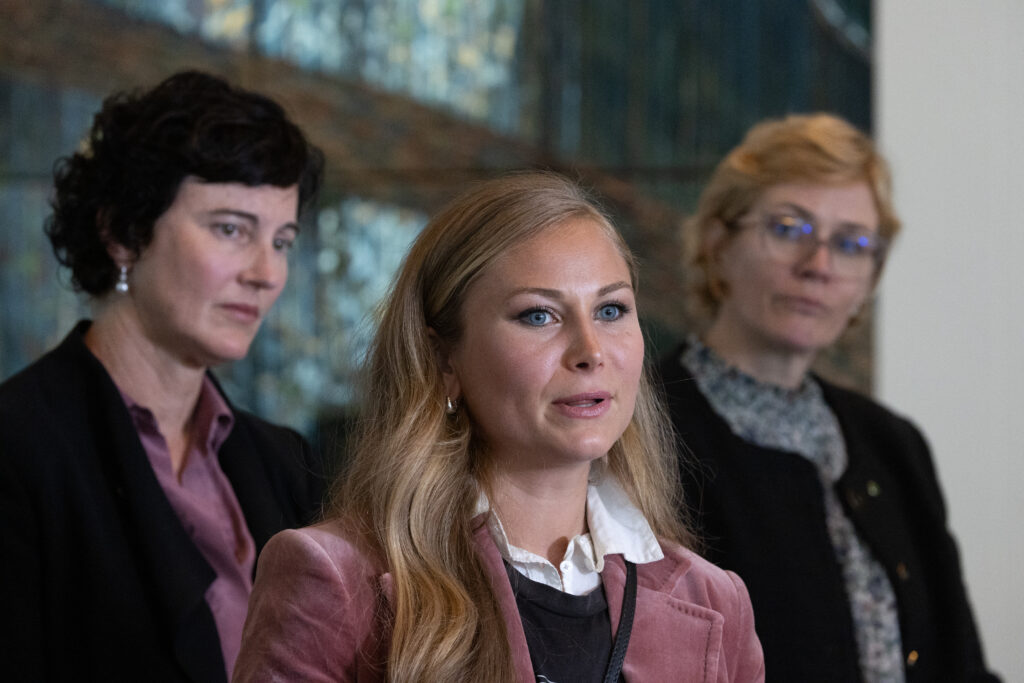
Former Australian of the Year and tireless advocate for survivors, Grace Tame spoke at a press conference earlier today with Kate Chaney and Zali Steggall after a roundtable to fast check protections on AI enabled child sexual exploitation material, hosted by the International Centre for Missing and Exploited Children.

Tame said there was a “huge gap in prevention of child sexual abuse, specifically in how offenders are able to groom children”

In recent years, we’ve had a lot of focus on peer on peer abuse, whether that’s adults harming other adults or children harming other children, but the offenders who commit the worst offenses against children are most likely to be highly sophisticated, specialized adults who use methods of grooming and coercion to not just abuse their victims, but also ruin the rest of the community, and whilst programs like respectful relationships and consent education are useful in dealing with situations where all parties have equal rights and the ability to opt in or out of the situation, When we’re talking about adults harming children and using methods like grooming, it is a completely different framework that is required to empower not just children, but all adults who work with children to actually detect their methods. So I’m advocating for grooming prevention and. Education as a stand alone measure of prevention for child sexual abuse.

Former Australian of the Year Grace Tame and Teal Independents Kate Chaney and Zali Steggall speak at the press conference. Photo by Mike Bowers.

Chaney said AI was changing sexual exploitation and we were being too slow to react:

AI is changing Child Sexual Abuse material and the landscape in Australia, it’s making it easier to generate this material, but it can also be used as a tool to support law enforcement. And we’ve heard today some asks from ICMEC on what we need to do in this area.

I think it’s really important that government listens, regulating AI is challenging because the technology keeps changing, but we need to be able to react nimbly and fill the gaps in legislation as they occur, rather than waiting for some big AI act that will cover everything.

So I urge the government to really look at and implement the private members bill that I introduced a few weeks ago that makes it an offense to download these tools that are designed to generate Child Sexual Abuse material.

And we need to look at how AI can be used to support law enforcement to keep our kids safe.

Sarah Napier, from the Australian Institute of Criminology said everyone needed to be more aware of the dangers:

I’ve seen offenders on the Dark Net talking about how they are taking non sexual pictures of real children from their social media profiles and from their parents’ social media profiles and turning them into child sexual abuse material.

So even if a child hasn’t been a contact victim of child sexual abuse, they are still being victimized without their parents knowing, without them knowing, and their photos are circulating around on the internet. So we’re here today to do something about that and look at prevention and reporting and legislation. We also need to equip law enforcement tools to actually investigate offenders and identify children, and that in that case, AI can actually be used in a positive sense for actually giving law enforcement the tools to speed up their investigations and rescue children

Nazis shaking hands

Skye Predavec
Anne Kantor Fellow

Neo-Nazi Thomas Sewell, who gatecrashed Victorian Premier Jacinta Allan’s press conference this morning, shouted at Allan and claimed that he’d “never seen anyone shake [Allan’s] hand” but that he “had 500 people shake [his] hand on the weekend”.  

He was a speaker at Melbourne’s “March for Australia” protest on Sunday and claimed that 50,000 people joined the protest on the weekend: Victorian Police estimated attendance in Melbourne at 5,000. 

After the anti-immigration rally on the weekend, a group of neo-Nazis including Sewell violently attacked Camp Sovereignty, a First Nations protest camp in Melbourne.  

It’s clear that the far-right, including neo-Nazis, are feeling emboldened, as Ebony Bennett highlighted in the Canberra Times on the Friday. How many more attacks and threats from fascists will we put up with before people stand up and make Nazis ashamed again? 

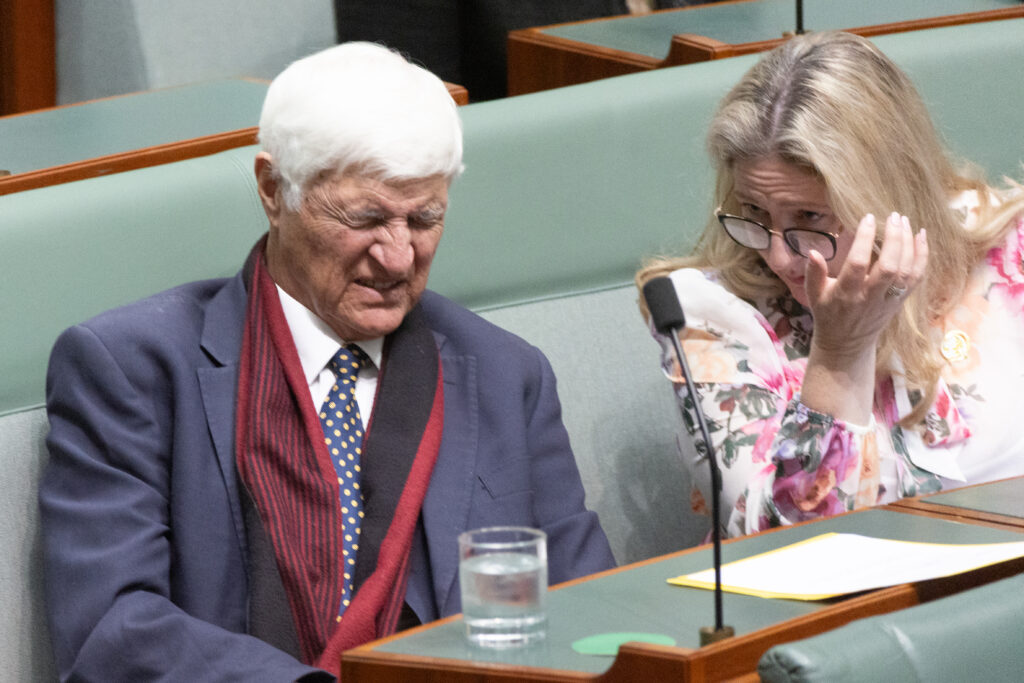
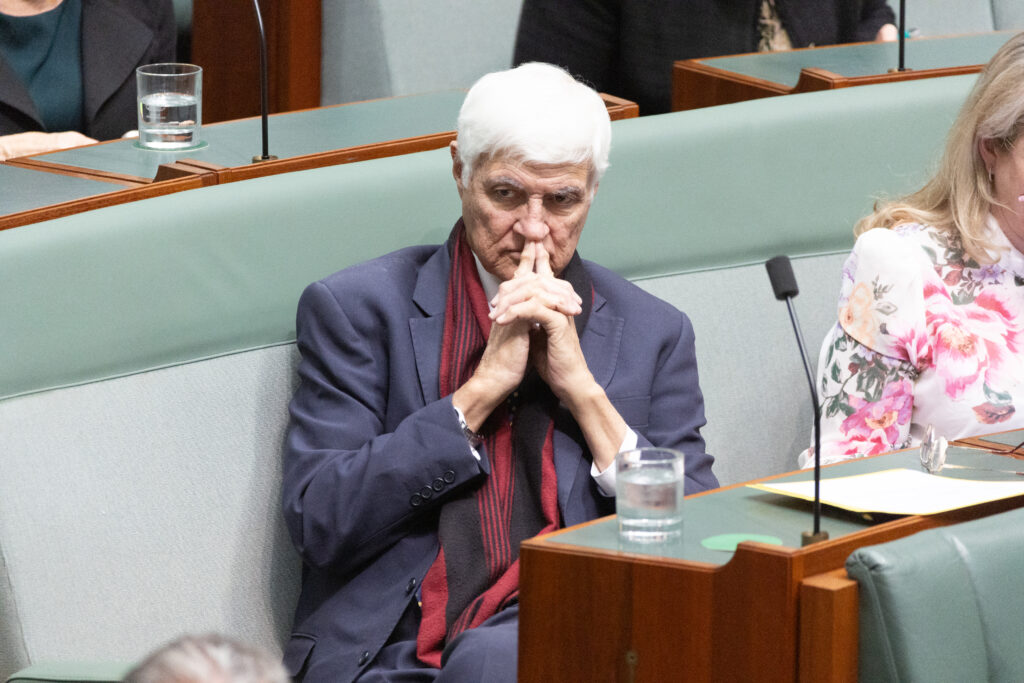
Sarah Hanson-Young calls for Bob Katter to ‘apologise or resign’ after threatening Queensland journalist

Greens senator Sarah Hanson-Young says independent Queensland MP Bob Katter’s threats against journalist Josh Bavas, after Bavas asked Katter about his Lebanese ancestry in the context of Katter’s support of anti-immigration marches held around the country on Sunday.

Katter has not only refused to apologise, he has since doubled down and said he thinks he should have been “more aggressive”.

Hanson-Young said it is “unthinkable” for someone in public life to threaten another person publicly over a question and Katter should be held accountable:

Mr Katter has doubled down because he hasn’t received any sanction. He seems to think that the normal rules of respectful engagement don’t apply to him. This is not ok.

Mr Katter should unreservedly apologise to Josh Bavas or resign from parliament. 

The standard you walk past is the standard you accept. The parliament has an important role to play in setting the standards of behaviour and this is clearly unacceptable conduct. 

Across the world we are seeing journalists targeted by violence and threats in order to suppress freedom of speech and freedom of information. Freedom of the press is a cornerstone of any democracy, without it we cannot have an informed public and open debate.

Members of parliament from all sides of the political spectrum must stand together in holding Mr Katter to account. I have written to the Independent Parliamentary Standards Commission to ask them to investigate this matter.”

Proposed changes to Freedom Of Information scheme don’t add up

Glenn Connley

New Australia Institute research reveals that the failures in Australia’s freedom of information (FOI) scheme lie with the government, not with applicants. The government’s proposal to limit FOI requests by charging fees instead of fixing the broken system misdiagnoses the problem.  

The latest FOI annual report from the government shows that:  

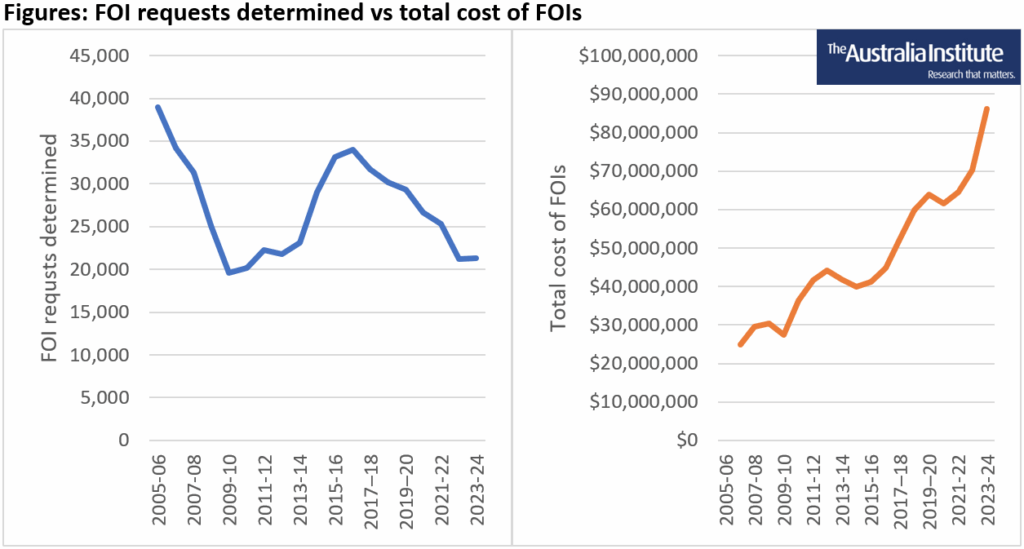
  • During the first two years of the Albanese government, there were about 21,000 requests determined per year – the lowest since the Gillard government (20,000 requests in 2010–11).  
  • But in 2010–11, the total cost of administering the FOI system was $36 million – compared to $70 million in 2022–23 and $86 million in 2023–24.  
  • Determining half again as many FOI requests (34,000) only cost the Howard Government $25 million to administer in 2006–07.  

Australia Institute research into freedom of information laws found: 

  • There were considerable delays with the FOI system, both in the processing of requests and the review of FOI complaints. 
  • The FOI system did not meet community expectations. 
  • Government ministers and officials were delaying and obfuscating releasing FOI information. 

Polling research from the first term of the Albanese government found that:  

  • Only one in five Australians (21%) were very confident that Australia’s FOI system gives Australians access to all the government information they are entitled to. A further 29% are somewhat confident 
  • Three in five Australians (62%) said 30 days should be the maximum anyone should have to wait before their FOI request is decided 
  • Four in five Australians (79%) said three months should be the maximum anyone should have to wait before their FOI request is decided 

“Access to government information is the right of every Australian citizen, but ministers and senior public servants have abused the process to deny and delay freedom of information requests,” said Bill Browne, Director of the Australia Institute’s Democracy & Accountability Program.  

“Contrary to the government’s claims about ‘FOI generators’ and ‘thousands of requests’, public servants 20 years ago dealt with many more FOI requests than under the Albanese government. 

“The amount governments spend processing a single FOI request has more than doubled since John Howard was Prime Minister. Successive governments have made the FOI process slow and arbitrary, and now are blaming applicants for the fact that the process is expensive.  

“When FOI decisions are reviewed, it’s often the government that got it wrong. Why should citizens pay when it is the government that is keeping information from them? If the Albanese Government is serious about improving productivity, it can start with its own freedom of information scheme, which is half as efficient as it used to be.”

“It’s already hard enough for Australians to pry information out of the hands of the government, with people having to wade through years of bureaucratic rejections, appeals, extremely long delays, and even taking cases to court,” said Isabelle Reinecke, Executive Director and Founder of the Grata Fund.

“The Albanese Government said before it was elected that it was committed to transparency, but it has introduced yet another barrier to scrutiny on top of on pre-existing structural delays within our FOI system.

“No government can deliver on the public good without proper scrutiny. One has to critically question why the Albanese government is no longer as committed to transparency now as it was in opposition.”

“Transparency is integral to improving Australia’s democracy, but right now Australia’s freedom of information system is not working,” said Kieran Pender, Associate Legal Director at The Human Rights Law Centre.

“Any steps to limit access to the FOI regime must be carefully scrutinised. The Albanese government should prioritise fixing whistleblowing laws and winding back draconian secrecy offences, rather than making government information less accessible and more expensive.”

New research: FOI requests are lower than in past 13 years, only the costs are increasing

Figures: FOI requests determined vs total cost of FOIs
Chart 1, Chart elementChart 1, Chart element

Source: OAIC (2024) Annual report 2023–24, p 159; Cabinet Secretary and Special Minister of State (2008) FOI annual report 2007–08, pp 5, 19 

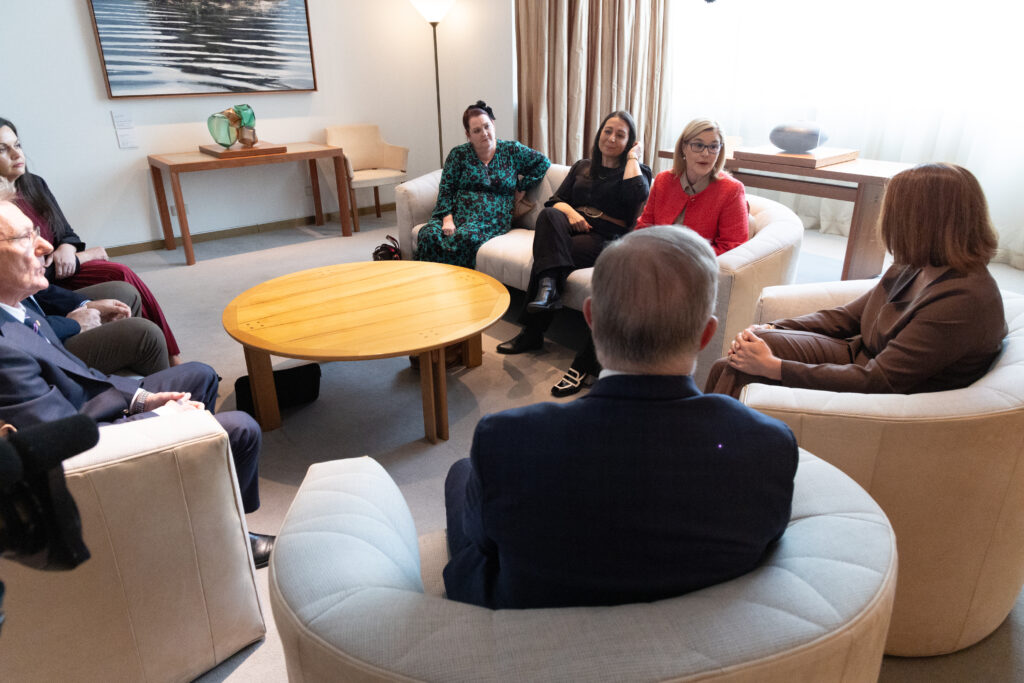
The prime minister and communications minister Anika Wells have opened up a meeting with ‘Let Them Be Kids’ campaign, which has been championed by News Corp and was one of the main drivers of the social media ban for under 16s.

Bernard Keane from Crikey wrote about some of the News involvement in the campaign here, last year.

Albanese and Wells met with Wayne Holsworth from Victoria, a father of two, who kick started the campaign after his son Mac took his life when he was 17. Mac was a victim of sextortion.

Wayne started “Smacktalk” after his son’s death, which raises awareness of suicide amongst teens, educating parents in what to look for.

Wells has now called a press conference.

The Prime Minister Anthony Albanese and Minister for Communications Anika Wells at a meeting of “Let Them Be Kids”.

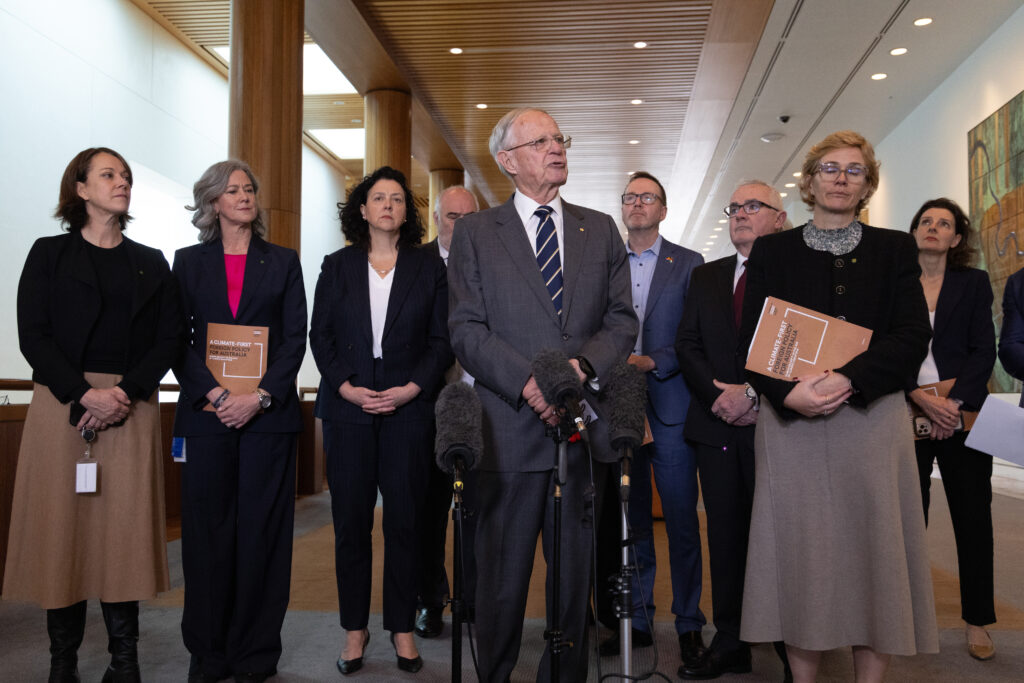
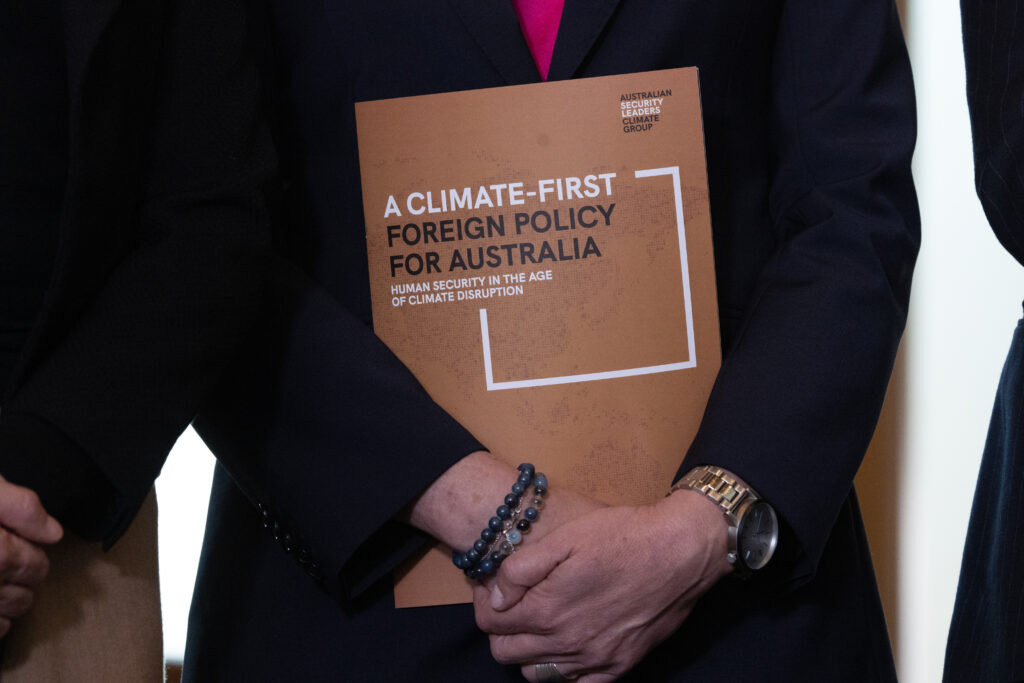
As we previewed a little earlier, you can add former defence force chief Chris Barrie to the list of people concerned about how climate insecurity is going to impact national security. You can not separate the two at this point, and Barrie, who appeared at a press conference with members of the crossbench who feel the same, want the government to start recognising it.

Chris Barrie at today’s press conference (photo Mike Bowers)

AAP has more here:

Australia is ill-prepared for sea level rise, human displacement and other security risks posed by climate change, warns a group of former national security leaders.

The Australian Security Leaders Climate Group is urging the federal government to recognise the scale of the security risks at a time of rapid warming.

Former Defence chief Chris Barrie said Australia needed to reorder its foreign policy priorities, with traditional geopolitical risks set to be displaced by climate change. 

“Australia has put all its eggs in the AUKUS basket, risking entanglement in a war with China, while the far greater threat to Australians’ security is being ignored,” he said. 

The year 2024 was the first that exceeded pre-industrial temperatures by more than 1.5C, the ceiling set by the Paris agreement.

Global climate goals have not been breached, as average temperatures must have stayed above that level for 20 years, but the World Meteorological Organization estimates there’s a 70 per cent chance average temperatures over the next five years will exceed 1.5C.

If average global temperatures exceed 3C, which is possible by the end of the century under existing policies, large parts of the tropics will be “near-unlivable” due to extreme heat.

“Three degrees will very likely mean widespread social conflict, large-scale people displacement, war, failed states and social collapse,” the report said.

Recent research from Australian universities and Antarctic agencies confirmed the West Antarctic Ice Sheet was at “severe” risk of collapse, an event that would raise sea levels by three metres, damaging coastal communities in Australia and around the world. 

The former national security leaders want foreign policy to reflect the threat posed by climate change, recommending the pursuit of climate-conditioned trade and investment linked to promises to phase out fossil fuel subsidies and similar commitments.

Reforming laws to prepare for climate migration and boosting finance for climate-vulnerable regions were also suggested by the security leaders.

“Security is not just about submarines and fighter jets — it’s about food, water, homes, and health,” said Cheryl Durrant, former director of preparedness and mobilisation at the Department of Defence.

“Without climate security, there is no national security.”

The federal government is presently preparing its contribution to world temperature goals, a requirement every five years under the global pact and due before the next climate talks in Brazil.

It’s also preparing a national climate risk assessment, a document that’s now overdue.

The group of security leaders have been among the voices calling for its release, along with several federal crossbenchers, environmental organisations and climate-exposed industry groups.

The bells are ringing – the parliament session is about to begin

Sigh. Brace yourself.

Here is some footage of the incident (and if you are not following Aaron Smith, you should – he is very good)

In case you didn’t see it earlier this morning, a neo-Nazi gatecrashed Jacinta Allan press conference. She did not challenge what he was saying, she just left (which given the circumstances, is what you do) She has now released a statement.

Government to maintain 2024-25 Permanent Migration Program levels for 2025-26

This announcement is late, but given all the questions Tony Burke has announced the next year’s migration levels:

The Albanese Labor Government will maintain the 2025-26 Permanent Migration
Program at the same level and settings as the 2024-2025 Program, 185,000.

It follows consultation with the states and territories, which recommended maintaining the size and composition of the Program, with a focus on skilled migration.

The Department of Home Affairs has been processing visas based on last year’s
level, so there has been no disruption to the delivery of the Program

And on the protests, this is how it went:

Q: Just in light of the protests this weekend, do you think we’ve given the Nazis too much notoriety, which is what they crave?

Butler: There’s always that balance that we all need to strike, whether we’re politicians or media organisations. Every time we report on this sort of hate and intolerance, we give people who are spouting it a bit of a platform. That’s why it’s so important that an alternative voice is put in place, that we counter that hate, counter that attempt to divide the country with a message of social cohesion and
tolerance. That’s what I think so many Australians have been trying to do since those weekend rallies.

Q: And just on that as well, we’ve managed to outlaw teens posting their crimes online. Why isn’t this something that we could apply to this group as well?


Butler:

What we’ve done at a federal level in our first term is to pass some pretty landmark hate speech laws and done things like ban the Nazi salute. I’ve read that the New South Wales Police are looking at whether some of the rallies have breached the hate speech laws in New South Wales. There are investigations going on in Victoria as well. We should constantly be looking at all of those laws at
the federal and state and making sure they keep up with technology.

Mark Butler held a doorstop to talk about the government passing it’s cheaper medicine bill and instead, as expected, faced questions on what the government was doing on aged care home packages. Here is how some of that played out:

Butler:

We’re releasing about 2,000 packages into the system every single week.
We were going to stop that at 30 June and move to an entirely new system of Support at Home, but we heard a message from providers and from importantly older people themselves that they wanted a short delay in order to ensure that they are ready for an entirely new aged care system. As part of that decision, over the period between 1 July and 1 November, which is when the new system takes effect, we’ve been putting those 2,000 packages or thereabouts into the system every single week as well.

Q: Those packages aren’t new though. They’re from people who’ve either died or moved into residential aged care. So are you ruling out supporting this push from the Coalition and Crossbench to have extra packages to help people so they don’t have to wait another eight weeks?

Butler:

We’ve been delivering additional packages, not just the packages as you say that become free because people have moved out of them for some reason. We’ve been delivering additional packages pretty much every budget or budget update. We did it again in the budget update in December, just before Christmas.

Q: I’m talking about in this period from now until –

Butler:

And we committed to a very big increase in packages to take effect when the new aged care system comes into operation, and that will now be on 1 November.

Q: So there will be no extra packages before November?

Butler:

As I said, this was part of a very big funding package, additional Support at Home packages as well as a range of changes to the residential aged care system to take effect with the introduction of the new aged care system, and that will now take effect on 1 November.

Q: Minister, not everyone in the sector, I know that you’re saying that some people in the sector asked for the delay, but this morning people like Ageing Australia, they’re saying that they can deal with more home care services now as we speak, and we need those home care services in the system to avoid a massive backlog.
Butler:

I understand what they’ve been saying over the last little while. But if you have a look at their media commentary in the lead in and after the decision was taken to delay the aged care system’s commencement date from 1 November, their message was very clear. They didn’t feel that we were ready as a country to move to an entirely new aged care system. They knew what that would mean,
which is that the introduction of a new Support at Home system would also be delayed by four months. We recognised that by continuing to put the vacant packages back into the system in the interim period.

Factcheck: the Nauru deal in numbers – reported Australian payment 1.67 times Nauru’s annual GDP

Matt Grudnoff
Senior Economist

There has been a lot of discussion about the payments that the government has announced for Nauru to resettle refugees.

The Government will spend $408 million initially and then $70 million each year after that.

Now that is a lot of money but let’s put these figures into context for the tiny nation of about 12,000 people.

Nauru’s GDP, the value of all the goods and services they produce in a year, is $245 million. This means that the initial payment of $408 million is well in excess of there annual GDP. In fact, it is 1.67 times their annual GDP.

And the ongoing payments of $70 million represents 29% of their GDP. As a proportion of GDP, that represents more than the Australian federal government spends every year.

The former chief of the ADF Chris Barrie has appeared at a press conference with independent MPs and the Greens calling for serious action to climate change. Barrie said it was obvious that America has deserted the field and so Australia needs to step up – not just for Australia, but the world.

(Photo by Mike Bowers)
Teal Independent Zali Steggall at a press conference with former CDF Chris Barrie, Teals, Independents and Greens on Climate Change in the Mural Hall. Photograph by Mike Bowers.

After the devastating earthquake in Afghanistan yesterday, which has left at least 800 people dead, AAP reports another tragedy in Sudan:

More than 1000 people have been killed in a landslide that destroyed a village in the Marra Mountains area of western Sudan, leaving only one survivor.

The landslide took place on August 31 following heavy rains, the Sudan Liberation Movement/Army reported.

The group, led by Abdelwahid Nour, added that the deadly disaster underscored the urgent need for attention to communities in the affected area.

The landslide comes as West Africa has experienced record flooding, displacing hundreds of thousands across the region.

‘Emperor Trump’

Angus Blackman
Podcast Producer

Trump is behaving like “an emperor”, enabled by insufficient checks and balances on the power of the Oval Office.

On this episode of After America, Professor Elizabeth Saunders from Columbia University joins Dr Emma Shortis to discuss the extreme volatility of this administration’s foreign policy and how Trump is breaking down the guardrails of American democracy.

More big names and fossil fuel subsidies

Rod Campbell
Research Manager

Last week saw big news on fossil fuel subsidies, with Fortescue Metals and the Australian Academy of Technological Sciences and Engineering (ATSE) calling for reform to the Fuel Tax Credit Scheme (FTCS) and co-publishing a report.

The FTCS is Australia’s biggest fossil fuel subsidy, costing the public $11 billion per year. It is a refund of fuel tax paid on diesel in certain industries, particularly mining.

Wait!? A mining company complaining about subsidies to mining? Well yes, because Fortescue sees Australia as having an advantage in switching the mining industry to electrified, renewable energy-based equipment, and subsidised diesel makes this harder.

We highlighted last week that lots of names associated with the report and the ATSE are Very Important People, and also not the kind of people who would usually campaign against diesel subsidies. Fellows of the ATSE that caught our eye glancing at their website last week include Labor and Coalition politicians, corporate executives and industry lobbyists.

Some more ATSE Fellows that caught our eye since last week:

  • Sam Walsh, former Rio Tinto CEO.
  • Marius Kloppers, former BHP CEO.
  • Vanessa Guthrie, former Chair of Minerals Council of Australia
  • David Knox, former Santos CEO.
  • Vanessa Torres, Chief Operating Officer at South32, formerly at BHP and Minerals Council.
  • Andrew Liveris, chemicals and fossil fuel executive, advisor to Morrison Government’s ‘gas-led recovery’.
  • Ian Plimer, climate-sceptic geologist, executive of oil and gas company Senex.
  • Hugh Morgan, mining executive and Howard-era Auspol villain.

It’s important to note that these Fellows did not contribute to the ATSE report, probably haven’t read it and may not agree with it.

What is significant is that an academy that counts senior mining industry figures among its fellows has taken a strong position on reforming fuel tax credits. Such an organisation cannot easily be dismissed.

Over on the ABC, Mark Butler has been asked whether he would be potentially open to a national regulatory system for IVF clinics. He answers:

I definitely am. I’m very keen to look at proposals to take over regulation from the industry itself. I think self-regulation isn’t working, and I don’t think it’s inspiring the confidence that parents need. But also because of the nature of IVF, it really cropped up in state children’s hospitals. We’ve got eight different systems of regulation around the country, and I think there’s a very strong argument to consider a single national scheme of regulation that obviously regulates the operators themselves, some of which have come under a spotlight for very good reason over recent months, but also things like sperm donor laws which have been the subject of more recent stories.

The question comes following more stories like this, from the ABC.

Bob Carr has released a statement on why he will be attending the 80th anniversary of China’s victory over Japan, in Beijing – and also takes aim at people who criticised China for welcoming Putin, but who didn’t complain when Trump ‘rolled out the red carpet for him’.

Tony Abbott has launched a substack.

He is using a photo of John Howard looking adoringly as his profile photo and his first piece is about how ‘Donald Trump is awesome, actually, but also he is being played by Putin, and also the world is a little dangerous with America going mask off rogue but surely that is not the fault of Trump, who despite looking up to fascist dictators, probably won’t go down that route himself, surely?’

Like most conservatives, I was elated when Donald Trump returned to the US presidency. I thought he’d been a pretty good president the first time round, at least until the pandemic struck; and that, second time, he’d be more thoughtful and more considered having learnt from experience.

In fact, Trump 2.0 has been Trump unleashed. I still think it’s better to have Donald Trump than Kamala Harris as “leader of the free world”; but, if anything, this Trump presidency is even more transactional and unpredictable than the first.

I’m not saying he’d emulate them (and even if he wanted to, the American system is proof against it) but Donald Trump does seem genuinely fascinated by dictators who can murder their opponents, invade their enemies, and stay in office forever. He wants to exercise power, usually for good ends – like building a wall, “drill, baby, drill”, ending woke, declaring there are only two genders, making government more efficient, restoring America’s industrial base, and getting allies to do more for their own defence – but he’s not bothering with the usual courtesies about shared values, common interests, historical ties, and how America has no better friend than, well, pick a country…

Debate started on the government’s Nauru resettlement plan for denied asylum seekers and people who have had their visas cancelled. The issue started with the NZYQ cohort – a group of people placed in indefinite detention because their visa had been cancelled and they could not be returned to their home countries.

Australia does not deport people to countries where they could face torture or death. But Nauru hasn’t signed up to the same conventions, so can, if it decides, to deport people it has ‘accepted’ in Australia’s re-settlement deal (for which it will receive up to $400m, according to the SMH). The visas were cancelled because they may have committed a crime, or be accused of a crime (and not convicted) or were judged not to be of good character, or suspected of a crime, or never granted. Unlike Australians, who when they commit crimes, and have served any custodial sentence, are free to resume life in the community, there is another standard for visa holders, who often find themselves deported at the end of their sentence. If Australia couldn’t deport people, it locked them up in detention with no end date. The high court found that to be unconstitutional and ordered the government (Labor) to release them. The Coalition – which helped create the problem – then turned that into a ‘government releasing “hardened criminals” into the community’ scare campaign, which Sussan Ley amplified by telling women in Frankston to send a message to the government in byelection. That scare campaign was amplified by the media, with some journalists STILL saying its a problem because people are uncomfortable living with people like this in the community, as if it is only migrants who ever commit crimes. (And we wonder where the far right is getting the grist for its mill)

The government is now trying to move the problem on, by extending the resettlement deal with Nauru and is creating law to allow them to do it.

Kate Chaney spoke on the bill in parliament yesterday and said:

I understand the government’s concern. The NZYQ decision has left us with a group of people in the community who have serious criminal histories, and the government needs tools to deal with them quickly. I support the intention to manage that group in a way that protects the community, but there are serious question marks about whether this bill is the best way to do that. It retrospectively validates an unknown number of decisions that were based on an incorrect interpretation of the law. It also provides that procedural fairness doesn’t apply at key steps in the removal process, without a proper assessment of whether this is appropriate, and it applies to a much broader group than the up to 300 individuals commonly described as the NZYQ cohort. It could also apply to many who have not committed any criminal offence and who may not have finished exercising their review rights.

Some estimates suggest the practical reach could extend to around 80,000 people—well beyond what the public has been led to believe.
The fundamental problem is that parliament does not currently have a clear understanding of the true impact of this bill. We do not know how many people this bill could affect or in which circumstances. For that reason, I do not believe this bill should be rushed through the chamber. That’s why I’m moving this motion to refer the bill to the Parliamentary Joint Committee on Human Rights for detailed scrutiny. Before parliament passes a law relating to the application of procedural fairness for large classes of people, we should understand exactly who will be affected, how the powers will operate in practice, and what safeguards are needed to avoid serious error.

That then leads to this questioning and…sigh.

Q: So Tony Burke says that he’ll release the permanent number for migration. I don’t know why that would be held back. Why would that be held back?

Mark Butler:

Well, that that number is a decision of government. It’s made as a decision of government and reported in the usual way. But obviously it’s impacted by the number of people leaving as well. So the key figure is the net figure that the, the, the difference between the number of people who come in as skilled migrants, usually family reunions, the humanitarian intake minus the number of people who leave.

Q: Isn’t the key figure, the number of people who are coming here?

Butler: Well, no, it’s the it’s the number of people coming in, minus the number of people leaving, because the number of people leaving are obviously leaving houses, leaving apartments, leaving bedrooms, creating less pressure.

Q: How many are leaving?

Butler:

Well, we’re back down to a more ordinary level of people leaving the system. I mean, the big, the big…

Q: This is a bit like an episode of frontline.

Butler:

The big, the big traffic though is actually international students. They’re the big numbers. They come in, then they leave.

Q: You can understand this is not your portfolio. But I think in government it’s pretty hot in the news right now and knowing the numbers would be good. And also I think that you are empowering extremist views by by doing and saying nothing about it and not doing anything about it. (I’m sorry, what? Doing nothing about what? What does this mean – that by giving in to the extremist delusions, than the government disempowers extremists? Do people like Karl Stefanovic ever look at themselves in the mirror and think ‘hmmm, maybe I do need to read more before opening my mouth?!)

Butler:

No, we’ve got that figure down, I think, off the top of my head by about 40% from the peak that we saw after Covid. The peak was unsurprising given the number of people who had left gone back home, particularly those international students who are a big part of our university sector. They did come back, but we’re getting those numbers back down to a more ordinary level of immigration. We’re a big immigration country, have been really forever.

Q: So more cuts to come

Butler:

Well, I think we’re still getting that that number down. It started to come down substantially over the last few years since we’ve been in government. But we recognise that that we need to do this to relieve some pressure. But Karl, I also know that as I talk to hospital operators, aged care operators, people wanting to build new houses, they are desperately short of labor. Our unemployment rate is is just a bit over 4%. Our participation rate is as high as it’s ever been, so we don’t have a lot of unused labor here in Australia. This this is a balance. As a government, we need to to strike quite responsibly.

A reminder that immigrants are people and valuable for their personhood – not just because of the work they do, or the food they make. It tends to get lost in this debate, because of conversations like this.

Mark Butler has walked down the press gallery hallway from the Seven studio to the Nine studio, where he is being asked what the migration number is.

He doesn’t know, as it is not his portfolio, but says:

Well, the overseas migration figure is published regularly by Treasury. It’s been coming down substantially since it peaked. Unsurprisingly, after Covid, there was an influx of people back in the number last year. 

As I recall, it was still lower than the migration predictions that the former government had made before Covid.

So we’re getting back down to more normal levels, and it’s really a balance between making sure that we’ve got the workforce we need. I know as the minister responsible for our health system, our aged care system, our disability care system, also construction industry, all of those sectors of the economy are desperate for workers at a time of very low unemployment, while also managing some of the constraints I know your viewers worry about on housing, on infrastructure, on transport as well, and we’re working really hard to get that balance right.

Q: So the target was 185. What’s the actual number?

Butler:

…It’s substantially less than 500,000. I mean, there was there was a big spike after Covid as people returned from overseas, particularly international students who who’d left and gone back home during that once in a century pandemic.

But we’re through that spike. We’re starting to see the rate come down to more normal levels. But as I said, you know, I think there is a real tension between recognising that there are real pressures on our housing system and other parts of the economy, while also, I know, intimately recognising we’re really struggling to get the workers we need to deliver the hospital services, the aged care services and build the houses.

Farmers care about climate change, also day ends in Y

AAP has this story which shows that if you actually speak to farmers, rather than look at facebook polls, you’ll find that they care about climate change. Which makes sense – it’s their living, and in many cases their family land, and they can trace the changes better than most of us.

Beef and wool producer Marcus James says agriculture is more exposed to climate change than just about any other industry, and farmers are feeling it.

“Our seasons are changing,” the Tasmanian farmer told AAP.

“We’re having to adapt our pastures, we’re having to make changes into our animal breeding.

“That variability is really challenging.”

Mr James has been in Canberra for a two-day conference held by Farmers for Climate Action, a farmer-led advocacy organisation.

His views were shared by the majority of the 618 farmers surveyed ahead of the Farming Forever event, with 57 per cent pinpointing climate change as the greatest threat to agriculture.

This was up from 55 per cent in 2023, according to the report from the advocacy group and NAB, with the rates of farmers reporting unpredictable growing seasons and unusual rainfall patterns also ticking higher.  

The polling also revealed broad support for renewables, with 65 per cent looking to produce and store clean energy on their farms and 80 per cent supportive of local infrastructure upgrades to allow them to participate more easily in the transition.

The rollout of large-scale wind, solar and transmission infrastructure in pursuit of renewables targets has become a fractious issue in some regions.

Last week, the prime minister was pushed on the costs borne by the regions from big clean energy projects by hecklers at the News Corp Bush Summit, prompting Anthony Albanese to concede community consultation had fallen short. 

Farmers for Climate Action chief executive officer Natalie Collard said Tuesday’s survey and other polling of farmers consistently pointed to broad support for renewables and climate action.

“We see a lot of media telling us what farmers are thinking – well here’s some actual data,” she said.

“We listen to farmers, not Facebook comments.”

Mr James has already installed solar to power the irrigation system on his north Tasmanian property, an investment that paid itself off after four years and is now saving the farm more than $10,000 in bills annually. 

He and his wife Eleanor want to go further and have been looking into a big solar array to power the fast-expanding suburban development neighbouring their property, but regulatory barriers have so far made it too difficult.

The pair take a holistic view to operating a low-emissions and sustainable property that supports the economic viability of the farm and maximises co-benefits.

By participating in a soil carbon program, for example, their arable land becomes more productive and resilient to seasonal changes.

Eventually, Mr James is hopeful the soil project can generate carbon credits to offset the property’s diesel tractors and other hard-to-avoid emissions, with the view to producing carbon-neutral beef down the track.

Most farmers care about climate change and “want to do better”, he said. 

“Sometimes the challenge is not that they don’t want to do anything – it’s that it’s really hard to do some of the things that you want to do.”

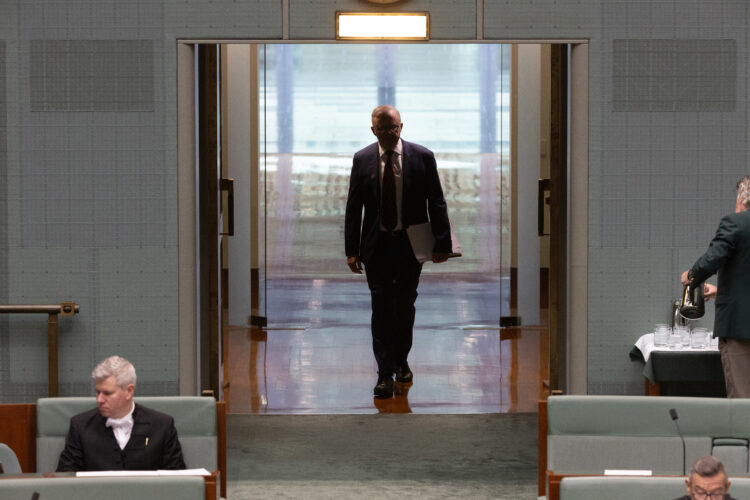
Workplace relations minister Amanda Rishworth is on the Nine network, where she is asked about the weekend rallies. There is a bit of a move on within some of the media to reframe the marches as ‘good people who were snowed by Nazis’ which discounts the amount of information available before the march about who was helping to organise it and support it. As well as the themes of the march. Which was not just ‘good people want to support Australia’. The grace given to protesters at these marches, where neo-Nazis were platformed (and we are yet to hear condemnation from the anti-semitism envoy Jillian Segal, who was very quick to criticise anti-genocide protests) compared to those who attended Palestinian marches is very, very clear.

The debate has turned to ‘when will you release the next migration target’ rather than ‘how do we counter growing white supremacy and fascism in our community’.

Rishworth:

Well, firstly, I would say that there should be no excuses for people behaving badly like we saw on the weekend, making people feel uncomfortable in their own communities.

So I think we all need to stand up and say that there is a no place to be calling for people, particular groups of people, if they don’t look like you, to be excluded from this country. So I’ll just make that point.

When it comes to migration policy, we’ve been doing a lot of work when it comes to migration policy. And for example, we have seen a reduction in the net overseas migration from the peak of Covid levels, down 37%, particularly as a result of a number of things, but including sustainability around student visas. 

So, look, we continue to work on this. Obviously, we’re working with states and territories on the permanent migration figures, but we do need to recognise there was a large bump as we came out of Covid, but we are working on a sustainable migration system across the board.

The government’s bill for cheaper medicines, which lowers medicines on the PBS from $31.60 to a maximum $25 passed both houses late yesterday.

Health Minister Mark Butler was up early doing the media rounds. He told the Seven network:

This will make a huge difference. It follows four waves of cheaper medicine policies in our first term of government that have already saved people about 1.5 billion dollars at the pharmacy counter in payment. This is on top of that. It will save another 200 million dollars every year for patients and make it easier to ensure they are actually able to fill the scripts that their doctors have said are important for their health.

We’re hearing far too many stories of people going into pharmacies and asking for advice – if they had a number of different scripts in their hand which did they have to really fill and which could they go without because they couldn’t afford to fill all of them. That’s why we’re so focused on delivering cheaper medicines. It’s good for the hip pocket, which is important. But it’s also good for your health. It maximises the chance that people can afford the medicines that are important for their health.

The fallout continues after the weekend’s neo-Nazi supported marches. Independent senator Lidia Thorpe spoke directly to Indigenous Australians following the (unprovoked) attacks on Melbourne’s Camp Sovereignty.

Thorpe said she will not let “a far right, white extremist group…take away who we are, take away what we are about. And we are about love and we are about bringing people together.”

Anthony Albanese is also drawing criticism (and some comparisons to ‘good people on both sides’ Trump) for saying there were some “good people” at the weekend marches. Here is the context:

Q: Do you think there were good people with legitimate concerns at these anti-immigration rallies this weekend?
 
Albanese:

Of course, there’s always good people will turn up to demonstrate their views about particular issues. But what we have here is neo-Nazis being given a platform. That’s what we saw on the weekend. And the tone of course of much of the rallies was – unfortunate is the best way that you could put it, but hateful in some of the extreme examples. And the idea that an open neo-Nazi was able to give a speech from the steps of the Victorian Parliament is something that isn’t the Australian way.

And later in the same interview:

Q: So, is your message to these people, we are getting the numbers down?
 
Albanese:

Well, we are getting the numbers down. But migration also is important and multiculturalism is a part of who we are as a modern nation. And I just say to people of – and I have no doubt that there would have been good people who went along, heard about a rally, are concerned, have views
 

Q: I’ve seen them talk about long housing queues for rentals. They’re concerned about their access to housing.
 
Albanese:

Of course. But you should have a look at who you were with on Sunday, I think, and the motivation that they have. Which isn’t actually about housing or our economy or anything else, it’s about sowing division. And neo-Nazis have no role. The fact that people are openly identifying that way –
 

Q: What did you think of what they did in Camp Sovereignty in Melbourne, where they went and destroyed that?
 
Albanese:

Well, it’s just – exactly. Here you have people who are saying they’re against migration. Well, the first Australians were here before any migrant or descendant of migrants. And that just has no place, that sort of violence has no place.

Good morning

Hello and welcome to another day of parliament.

We’ll let Bob Katter sum up the feelings for all of us:

(Photo by Mike Bowers)

After yesterday, which was a bit of a mess if we are honest, there seems to be some actual domestic issues taking precedent over the international stories which have dominated for the last few months (years if you also take into account the Gaza genocide, which is continuing as you read this).

The calls for some sort of population plan, or at least more information on what the government expects to happen with the population and what is being planned, are getting louder. In an interview with the ABC on Monday afternoon, Anthony Albanese said:

Well, we are getting the numbers down. But migration also is important and multiculturalism is a part of who we are as a modern nation. And I just say to people of – and I have no doubt that there would have been good people who went along, heard about a rally, are concerned, have views –

… But you should have a look at who you were with on Sunday, I think, and the motivation that they have. Which isn’t actually about housing or our economy or anything else, it’s about sowing division. And neo-Nazis have no role.
 

Australia’s migration intake is not out of control and anyone describing it as ‘mass’ is either deliberately misleading people to inflame tensions, or is repeating terms unthinkingly. Population growth is actually slightly under when it was predicted by the Morrison government before the pandemic. The intake numbers have slowed following the re-opening of the borders after the pandemic closures. The issue is not one of migration, but if a lack of planning on behalf of successive governments, and an out of control housing market, where prices, artificially inflated by tax subsidies such as negative gearing and the capital gains discount have been turbo charged beyond affordability. And with enough vested interests trying to deflect attention from their culpability to migrants, combined with a few doses of racism and boom. Tinder box set.

(Photo by Mike Bowers)

Meanwhile, the government is still dancing around its 2035 climate target, setting up the circumstances to do the least amount possible. It has delayed releasing the national climate risk assessment report, which was described to me as “really, really confronting” by someone who has knowledge of it, with speculation it doesn’t want to release the report until after it has set the target. Meanwhile the Coalition continue to tear themselves apart over what they want to do with the literal bare minimum – net zero, with the fallout continuing from Barnaby Joyce’s warning to Liberal shadow frontbencher Andrew Hastie not to speak in support of his private members’ bill to end net zero. Hastie would have to resign from the shadow bench to do so, and that would set off the fight over Ley’s leadership (already without much authority) and potentially lead to out and out in-fighting among the Liberals. The story was one of Labor’s favourite’s yesterday, but Labor is facing its own pressure to put a number on it.

Meanwhile Tony Burke and other senior government ministers are being asked more about the Nauru resettlement deal (which may be up to $400m to resettle no one if the courts strike out the new legislation Burke has introduced to the parliament – but the details are secret, so no one knows, let alone the human cost of sending people to a third party nation they have no connection to, limited prospects of building a life, and also face the threat of potential deportation to a country of origin which could result in their torture or death.)

And Sam Rae, the aged care minister, is getting a first hand experience as to what it was like being Andrew Giles last year, as the aged care home care wait list unites the Greens, the Coalition and the independents in demanding answers. The Coalition actually seem to have stumbled on to a social policy issue that matters and needs answers, and the rest of the parliament are doing their job in ensuring the issue stays on track (which the Coalition need help with)

So we enter this Tuesday with the party room meetings about to happen, on-going tension in the Coalition, Labor facing some of their first actual tests, and the independents and Greens really starting to find their own on how to get issues that need it, airtime.

So grab your coffee – it is a three coffee morning over here. Ready? Let’s get into it.


Read the previous day's news (Mon 1 Sep)

Past Coverage

Comments

Start the conversation

The biggest stories and the best analysis from the team at The Point, delivered to your inbox.

Past Coverage