The Canberra press pack is outside the Iranian embassy, where there is not a lot of movement, other than the journalists looking for some sort of movement.
The Embassy of Iran in the Canberra suburb of O’Malley this afternoon. (Photo by Mike Bowers) You’ll be seeing a lot of stand ups from here this evening (Mike Bowers)
So we are going to wrap it up for today and come back ready to go tomorrow morning. Tomorrow is going to be a weird day – if they aren’t already there, there will be a lot of media bosses floating around ahead of the Midwinter Ball being held Wednesday night. I would rather spend an evening stabbing myself with a rusty spoon than attend the ball, but each to their own I suppose.
Thank you to everyone who joined along for today – it went places didn’t it? No doubt there will be more fall out tomorrow, so I hope to see you back here. Thank you so much for joining us. We know you have choices, so it truly does mean the world.
Until then, take care of you. Ax
16.18 AEST
The Australian Jewish Council has responded to the announcement the Australia government was blaming Iran for some high profile anti-Semitic attacks:
— Jewish Council of Australia (@jewishcouncilAU) August 26, 2025
16.15 AEST
Greens senator David Shoebridge says the home affairs amendment Tony Burke tabled this morning (without any fanfare, as you would expect) is a “cruel attack on refugees and migrants” aimed at stripping people of “the right to natural justice”.
This law is designed so that people can be forcibly removed to Nauru without having any right to even see the application the government is making. It also removes their right to make representations about why their removal would be unsafe, or explain to the Nauru government why they should not be deported there.
When rights of natural justice are removed, critical matters like health concerns, family connections and basic human decency get overridden, while damaging mistakes of fact are not identified.
This legislation is even being made retrospective to address likely failures of natural justice that have been raised in two separate court challenges to Labor’s efforts to forcibly remove people to Nauru.
Shoebridge said Australia knows how dangerous this is for people because while Australia won’t deport someone back to a country where they could face torture or death, Nauru will:
Everyone should be equal under the law, no matter where they are born, but that can only happen if people are given the right to be heard before decisions are made about them. We know there are active court cases on this issue and by making this law retrospective Labor is trying to validate past illegal practices by Home Affairs and defeat these cases with another legislative deal with the Coalition.
Nauruan President Adeang made it clear last year that he intends to send anyone Australia deports there back to the country from which they originally fled.
People rightfully don’t want to go to Nauru because they know they will face the very real risk of being forcibly returned to danger, and they surely have the right to be heard before that happens to them.”
16.07 AEST
Women whistleblowers pay an enormous cost for speaking out – a Whistleblower Protection Authority could fix that
Angela Xu
Anne Kantor Fellow
The Human Rights Law Centre’s Whistleblower Project has just released a new report showing the distinct challenges women face when speaking out, and called for a Whistleblower Protection Authority to protect women whistleblowers.
The research analyses a year of client data from the Whistleblower Project, Australia’s first specialist legal service for whistleblowers. It finds women whistleblowers expose wrongdoing from across the public and private sectors, but speak up most commonly in healthcare, government, and education. In comparison to their men counterparts, they are more likely to speak up about the endangerment and mistreatment of others, making their voices critical in safeguarding against human rights abuses, sexual misconduct, and discrimination.
The majority of whistleblowers experienced retaliation for their actions, with women being more likely than men to report being bullied and harassed. In the healthcare sector, every single whistleblower — all of them women — faced retaliation for speaking up.
A Whistleblower Protection Authority is critical for supporting, empowering and protecting women whistleblowers, and all who dare who speak up. From the public who depend on ethical and accessible healthcare, to parents who entrust educational institutions with their children, a Whistleblower Protection Authority stands not only to protect our women whistleblowers, but also those who benefit from the wrongdoing they expose.
15.47 AEST
The Coalition’s party room climate spat has been covered by Kat Wong from AAP here:
A coalition quarrel over emissions reduction has been labelled a “collegiate discussion” by the opposition leader, while the party’s climate stance continues to unravel.
During a partyroom meeting on Tuesday, a group of coalition MPs called for a position on a 2035 emissions reduction target, a day after a Nationals push to scrap Australia’s net zero emissions goal returned to parliament.
The development highlights the deepening schisms between the coalition’s more conservative members, who back efforts to repeal the target, and moderate Liberals, who believe it must be retained to show the opposition is taking climate change seriously.
But Opposition Leader Sussan Ley insisted she would continue to welcome a “diversity of views”.
“I can 100 per cent guarantee that it was a collegiate discussion,” she told reporters in Canberra.
“We do need to take the time to get our energy policy right.
“I acknowledge that there is a diversity of views, and I respect them all – we will bring them all together.”
Asked if the opposition would hold a partyroom debate on emissions reduction targets, similar to that held on same-sex marriage in the 2010s, Ms Ley said she was “sure the opportunity and circumstances will deliver exactly that”.
The coalition has set up an energy working group that will decide on its policy, but the opposition leader said it must guarantee affordable power for households and families and ensure Australia plays its role in reducing emissions.
Liberal backbencher Simon Kennedy dismissed Labor’s net zero commitment as a “slogan” and not a policy.
But Prime Minister Anthony Albanese hit back during his own partyroom meeting.
“You only reject net zero if you think climate change isn’t real,” he told the caucus.
The Climate Change Authority, which advises the government, is preparing advice on a 2035 emissions target between 65 and 75 per cent as Labor prepares to set its goal.
Analysis from Deloitte Access Economics has revealed a stronger 75 per cent target would offer comparatively “huge” benefits.
“Australia is in a race to secure the global capital required to establish green industries,” Deloitte Access Economics lead partner Pradeep Philip said.
“Setting a lower target today comes at the cost of lower business investment.
“Achieving a strong target creates the foundation for Australia’s economy to grow and compete in a decarbonised world.”
Under a 75 per cent emissions reduction goal, Australia’s GDP would be $370 billion greater by 2035 compared to current projections.
About 69,000 additional jobs would be supported each year over the next decade through the 75 per cent target, and it would drive $190 billion more in export revenue.
More than 350 businesses including Atlassian, IKEA, Ben & Jerry’s and Canva have signed an open letter urging the government to commit to at least a 75 per cent goal.
Data released by Climate Change Minister Chris Bowen found Australia is tracking well to meet its 2030 goal to reduce greenhouse gas emissions by 43 per cent from 2005 levels.
Emissions have fallen by 1.4 per cent in the year to March 2025, meaning about 440.2 million tonnes were released in that period – about 28 per cent below 2005 levels
Labor is expected to set its 2035 target in the coming months, with more information to be revealed in September.
“We do want to have ambitious targets to make sure that we secure that energy transition that will deliver the cheaper and cleaner energy that our industry needs and that all Australians need,” Environment Minister Murray Watt told Sky News.
“Having those targets is a really key.”
The Greens have urged Labor to go further and implement a net zero by 2035 target.
“Net zero by 2035 is what the science tells us we need to keep warming at manageable levels … anything above that will be a green light for yet more damage to our communities and to nature,” Greens leader Larissa Waters told reporters.
15.35 AEST
Anika Wells said a little earlier that she hopes that Australia Post is able to work out “a solution with US authorities” so packages can once again be sent from Australia to the US.
But then, Australia is not alone here.
Japan Post just announced they will no longer deliver mail to the United States, joining Germany, Austria, Denmark, Italy, France, and Sweden.
Over in the senate and independent senator David Pocock has some things to say about ANU’s statement to the education regulator and the man is not impressed:
Having read the self assurance report the ANU Vice-Chancellor has provided to the higher education regulator TEQSA it is more clear to me than ever how manifestly inadequate the response is given the extraordinarily serious allegations that have been made.
I find particularly offensive the attempt to gaslight staff by citing letters and votes of no confidence as evidence of staff not being afraid to voice their concerns.
The report acknowledges that the ANU does not have sufficient or appropriate processes for complaints made against senior leadership.
I fail to see how a process overseen by Council can in any way be construed as independent given the clear conflicts of interest.
I maintain that following not one but two resignations from Council and corroborated testimony to a senate committee inquiry, it is not only appropriate but the responsibility of Council to require the Chancellor to step aside while these matters are investigated by a truly independent third party.
15.25 AEST
Trust the process on trusts
Matt Grudnoff
Senior Economist
Question time saw the issue of trusts raised, with the opposition trying to paint the government as about to crack down on trusts in order to raise more revenue.
First, lets hope this is the case. There has been a rapid increase in discretionary trusts. Outside of reducing tax, discretionary trusts have no real purpose.
They are complicated tax structures used by high income earners to avoid paying tax. But even if you don’t think the government should be raising more revenue, as the opposition does, there are still very good reasons why you would want to get rid of them.
The opposition could agree that we get rid of discretionary trusts and use the additional revenue to cut income taxes. At the moment it is the wealthy who take the biggest advantage of discretionary trusts. Most people can’t use them. Why set up a tax system where only a small group can avoid tax. It would be better, even if you didn’t want to raise more revenue, to have a simpler tax system with lower tax rates.
Both sides of politics talk about simpler taxation. Trusts are the very opposite of simple.
The opposition often call for taxes to be lower, simpler, and fairer. You could achieve all three if you scrapped discretionary trusts.
15.23 AEST
How Mike Bowers saw QT
Mike Bowers has been busy running around for The New Daily, and I have liberated some of his work for you, here:
Former AFL footballer and Coach and current Australian of the Year Neale Daniher gets a standing ovation at the start of question time (Photograph by Mike Bowers)The Prime Minister Anthony Albanese and his pointer (Photo by Mike Bowers)FRANDS (Photo by Mike Bowers) Uh huh (photo by Mike Bowers)
15.13 AEST
Question time ends
We are not made to endure as much as yesterday, which was just an OUTRAGEOUS ask from all of us.
Thank Dolly.
15.06 AEST
The Liberal Member for Forrest has a question (I refuse to learn his name this early in the piece) keeps up the stupid questions from the Coalition, this time with one to Clare O’Neil:
Will the government failed to deliver its commitment to build 1.8 2 million new homes, new taxes on the family home were raised and the government ‘s 3-day talkfest. Will the Minister rule out flooding Australians with new taxes on their spare bedrooms?
O’Neil:
I do not know what bizarre fantasy land those opposite have been living in, what on earth are they talking about? I heard these questions are getting asked over and the other place today and I thought the Housing Minister, the shadow Housing Minister has not had a sweet for breakfast this morning, I do not know what he is going on about the fact that we have got people in the House of Representatives of the ridiculous questions like this, get a clue.
Let me talk about our governments tax policies because they are absolutely clear.
The member for Forrest, who looks like ChatGPT was asked to create a 3D Liberal MP tries to interject, but Milton Dick is NOT having it and tells him to show some respect.
O’Neil:
Our tax policies are absolutely clear, twisty stand for lower taxes, lower taxes that we have delivered to the Australian people and lower taxes that were opposed by those opposite, speaker. Not only did they go to an election thing they did not want lower taxes for every Australian taxpayer, but they said they would come into the Parliament to legislate for higher taxes for every Australian taxpayer. Let me come to the matter of housing taxation.
3D Lib tries again and Dick tells him to sit down.
O’Neil:
Let me come to the question of housing taxation. What a day to ask a question about housing taxation when our party has lowered taxes on it newbuild to rent locations and you are in the Senate today trying to raise taxes on new housing our country. I wish I could say that I was surprised by the unbelievable incompetence. I don’t believe – I do not know what the opposition is doing on housing this this term or any other. The very last people that Australians should listen to when it comes to housing policy are those who sit opposite. Remember for almost a decade they sat on these treasury benches and did nothing about a housing crisis building before their very eyes. They then spent three years being housing hypocrites, complaining about things going wrong in housing and coming into the Parliament and voting against measures that would fix the problem. Now they’re asking nonsensical questions about policies that don’t even exist. Get a clue, people.
14.58 AEST
Allegra Spender then asks Anthony Albanese:
The last summer was one of the hardest in memory for my Jewish community was terrorised by anti-Semitic attacks including on Lewis’s Continental Kitchen. Today we learned the Iranian government was behind that attack, Adass Israel Synagogue and potentially more.
The security concerns of my community are real and justified, will the government work with the community to keep them safe?
Albanese:
I think all Australians have been concerned about the rise in anti-Semitism and the rise of social division that has occurred and I have visited the synagogue in Bondi Junction there and spoken directly with the community. I have visited the Jewish Museum in the members electorate where we announced additional funding for an expansion and indeed met some wonderful survivors of the Holocaust who went through their personal experiences as well.
The information that ASIO has determined is quite shocking.
This is a perpetrated attack on behalf of a foreign government on Australian soil. The fact that the intelligence agencies as well as the Australian Federal Police have undertaken this work. They worked very closely with the Jewish community and with other communities as well. We informed the Jewish community leaders prior to the one o’clock press conference that was held this afternoon as well. So they could watch what the director-general of ASIO in particular Mr Burgess had to say because that was so important.
The attack on the Lewis continental kitchen of course occurred on October 20. There was another attack that we saw on a restaurant in Melbourne in more recent times as well. People can have different views about the Middle East and it is absolutely legitimate for people to put forward those views.
What is not right is to blame Jewish citizens or to blame Muslim Australians for the actions of Hamas. Or other people. What we need to do is to make sure we advance peace and security for people in Israel and Palestine.
What we certainly can have control over here is making sure that we do not bring conflict here, that we keep social cohesion and I congratulate them member because that is something I know she has been doing, undertaking as the local member for Wentworth.
We have a range of programs including increased security arrangements around schools, around synagogues, the increased support that we have put forward will continue to have dialogue with the community and to work with them in order to ensure that like other Australians, every Australian should feel safe and yesterday, I spoke with the Australian union of Jewish students who are here somewhere here again it, as I have every year for a long period of time.
They tell stories about harassment on campuses just like students in your area have been impacted and there is no identifiable because of their school uniform. It is not the Australian way.
The Australian way is to respect each other, regardless of people’s faith, regardless of their origin and to engage in constructive dialogue about issues not to engage in the sort of activity which we have seen. We have taken strong action against Iran as a result of this by government stands by, I know it received the support of the opposition and I’m sure the member for Wentworth as well and I would hope every member of this Parliament supports a strong action which we have taken which is entirely appropriate given the revelations and findings that the ASIO director-general and the Australian Federal police have found.
14.54 AEST
We then get a bunch of questions on all the very poor, mistreated people with family trusts, who have only been doing the right thing by minimising their tax through the creation of a trust to do just that and do not deserve to have to pay the same tax as the rest of us.
This includes a question on ‘Australia’s farming families’ which is a very emotional invoking of a cohort of people who we are never supposed to consider millionaires who might also want to minimise their tax. Obviously not all farmers are millionaires, but there are some very, very wealthy people who are ‘farmers’ and ‘work the land’ and are also exceptionally wealthy and have their tax affairs set up to avoid paying what they usually would without some of these trusts.
14.50 AEST
Anti-Semitism envoy blamed ‘hate left unchecked’ for attacks Australian government now blames on Iran
It is also worth pointing out that Jillian Segal also blamed ‘hate left unchecked’ for anti-Semitic attacks in her report to the government on anti-Semitism:
From the report:
From hate-filled chants outside the Sydney Opera House, preventing others attending the site, to the firebombing of a Melbourne synagogue, we are shown what happens when hate is left unchecked.”
From October 2023 to September 2024, antisemitic incidents surged by 316%, with over 2,000 cases reported – threats, assaults, vandalism and intimidation. In October and November 2023 alone, episodes increased over 700% compared to the previous year, reflecting incitement by those with extremist views and misinformation in the media and online. These figures exclude much of the hate online, where antisemitism has exploded.
Notable incidents include the firebombing of Melbourne’s Adass Israel Synagogue, firebombing of a childcare centre adjacent to a Synagogue and school, firebombing of cars in residential areas and the repeated targeting with graffiti of Jewish schools and places of worship. …”
14.44 AEST
Sussan Ley, Julian Leeser, Andrew Hastie and Michaelia Cash have released a statement on the Iran decision:
Today we have learnt of one of the most egregious acts of foreign interference against our nation since the darkest days of the Cold War.
All Australians are shocked to learn of the serious and chilling foreign interference which has been perpetrated by the Islamic Republic of Iran on Australian soil.
The Coalition supports the expulsion of the Iranian Ambassador and the listing of the Islamic Revolutionary Guard Corps as a terrorist organisation.
As the Director General of Security has explained today, the Iranian government has been confirmed as having directed at least two attacks against Australia’s Jewish community, including the fire-bombing of the Addas Israel Synagogue.
Australians rightly expect zero tolerance for foreign-backed terror and antisemitic violence on our soil. These revelations lay bare just how severe Australia’s antisemitism crisis has become.
The Coalition called for the expulsion of the Iranian Ambassador last year, when he praised the Hezbollah terrorist leader, Hassan Nasrallah.
The Coalition has been urging the Government to list the Islamic Revolutionary Guard Corps as a terrorist organisation for more than two years — and we will back any legislative changes needed to get it done.
Our Jewish community deserves safety, not excuses; this must be the start of a broader crackdown on Iranian regime proxies, foreign interference and intimidation in Australia.
14.40 AEST
Sussan Ley asks Anthony Albanese:
The Prime Minister said “The only tax policy that we implement is the one that we took to the election. ‘ however, when asked about possible tax changes, the treasure was open-minded, saying it is a metaphor cabinet. Can the Prime Minister confirm that having successfully eliminated the member for Chifley and Isaacs from cabinet, the Treasurer is now working on eliminating Australian savings with a fresh round of taxes?
I implore Ley’s team to stop with the attempts at dra-mah. It is very boring and it doesn’t do what you think it is doing.
Albanese:
Credit where credit is due. It takes guts to talk about division in the party room from people who have just come from a room over there where they were queueing up…the leader of the Liberal Party in the Senate… in the Senate led the charge to abolish net zero in the party room today… and they were queueing up, one after the other, one after the other. They are all over the shop, Mr Speaker. All over the shop. We now have two former deputy prime ministers getting together.
One of the great romances we have ever seen in this place, Mr Speaker. The member for Riverina and the member for New England…
Above all the interjections, Alex Hawke has another point of order.
Unsurprisingly this is on relevance. Every question the Prime Minister is not addressing anywhere near the subject matter of the question, he seems obsessed with the coalition he has asked about matters affecting the government and its policy and he refuses to answer. The last and so he didn’t even get to the question. This time he is following the same pattern.
Milton Dick says he agrees, but the question was broad so he asks the prime minister to get to the point.
Albanese:
I missed the question. I just heard the sledge. I am responding to it as I responded to sledges across the chamber. But what it boils down to, it’s hard to follow the plots over there, the Liberals fighting each other, the Nationals fighting each other, Liberals fighting the Nationals. When they go to their party conferences, it is everyone fighting the leadership of the Liberal Party and the National Party. I mean, they go to a party conference up in Queensland, they say that you should argue in favour of modernisation and we should support net zero and we need to learn the lessons of the past by what we see, what we see is just division, no policy being put forward, and now we are reduced to just sledging.
Hawke jumps up to say the prime minister is DEFYING the speaker’s order, but Albanese has decided he has finished answering and sits down.
14.32 AEST
Rebekha Sharkie asks Sam Rae:
85,000 older Australians were assessed and waiting for home care. Today, the figure is estimated to be over 100,000. Older Australians are dying while waiting for aged care. What justification does the government have for delaying the promised home care packages from July to November this I give the call to the year?
Rae:
I thank the member for her question. I acknowledge her legitimate interests and commitment to ensuring that all older people across her community can access safe, dignified and high quality aged care. In the last term of Parliament, my predecessor, the now Minister for Communications, worked across the Parliament to pass the new aged care act.
With bipartisan support from the opposition and constructive contributions from the crossbench. We’re prepping to implement that new act on 1 November, along with the supportive home program, the updated program replacing the current Home Care Packages Program. These are once in a generation reforms.
And they will deliver world class aged care services to the older people who work so hard to build our country and to whom we owe the very best care. Support at home will deliver a system that helps older people to stay at home for longer, by making a higher level of care available in the home. This is an entirely reformed program, it’s not an extension of the current program, it is an adapted model of care in the home. As our population ages, we have seen demand for in-home care grow very, very fast.
There are now more than 300,000 people accessing home care packages today, compared to just 150,000 people back in 2020. Mr Speaker, as I said before, we’re currently delivering more care to more people than ever before.
When support at home starts on 1 November, we’ll roll out an additional 80,000 home care places in the first 12 months. Until then, my number one priority is ensuring that older people continue to have receive care and services, and until November, we’ll continue to assign packages every single week. The average since September last year is – the weekly average is 2700 packages a week.
I can assure the member people who are assessed as high priority will continue to receive their packages within a month. Mr Speaker, the brief deferral of the commencement of the new aged care act is to ensure that programs like support at home are ready for older Australians and their families. The Labor government continues to deliver more care for more Australians, and we have given aged care providers more time to prepare their clients, support their workers and get their systems ready for these historic changes.
14.29 AEST
The Coalition are now moving on to tax. Sussan Ley:
My question is to the Prime Minister: During the government’s 3-day talk fest, the introduction of a new housing tax, new death tax, new wealth tax, new tradie tax, and new levies on Australian businesses were floated. Is the Prime Minister aware of any work the Treasurer has commissioned on these proposals?
There are heaps of interjections about this question and Milton Dick has to call for calm before Anthony Albanese gets up.
I thank the member for her question and for a question about tax policy, not from the government, but by people who attended a roundtable, maybe it was the Shadow Treasurer who was raising these things. (The Coalition objects to this)
Because there were people that the Shadow Treasurer, I heard him actually say, that everything was up for review. And they had an open mind. I do know this – that two days before the last election, the member for Hume (Angus Taylor), former shadow treasury minister, snuck out the Coalition costings.
And they revealed a $75 billion higher figure in personal income taxes. They went to the election on, including the former Deputy Leader of the Opposition, vote for us, you get $75…
Dick has to ask Taylor to withdraw a heckle and there are more interjections.
Albanese continues:
So, they had $75 billion in personal income tax increases over there, they had higher taxes on the resources sector, and on the manufacturing sector, because they wanted to abolish production tax credits which reduced taxes for the resources sector, they had higher taxes on motorists through their abolition of the EV concession that was put in place. This will be good….
Alex Hawke, the manager of opposition business gets up to do a point of order
He’s heckling me. I take a point of order in relevance. In no way was he asked about coalition policy. The only thing he has answered his question about, the Prime Minister, is Coalition policy. So he was asked about modelling. Is he aware of any modelling the Treasurer has done on socialist policies, yes I wasn’t invited. You’re correct.
Milton Dick then has to tell people it is not an open mic session and then says the prime minister has to be relevant.
Albanese:
I’m being directly relevant to what I was asked about, which was policies from non-government members raised last week. Now, I know that after their party room things are a bit difficult there, but we saw – we saw the Manager of Opposition Business just say he didn’t want to go to the roundtable. Well, talk to the bloke next to you. He was there. He was there. He got an invite. And he was keen, Mr Speaker. He even came to drinks at the Lodge and he was very welcome. He was very welcome. He was very welcome. He was… He was very (INTERJECTIONS) welcome. He was very welcome. And the – they also had of course a policy that they’re trying to implement tonight. The higher taxes on the housing construction industry by abolishing build to rent. We want to assist the building of more homes, they want to abolish those concessions. They also of course went through with higher student debts for more than 3 million Australians….
He is out of time.
14.19 AEST
Mike Burgess has released the statement he made at this afternoon’s press conference. In case you missed it, here it is in its entirety:
In this year’s Annual Threat Assessment I warned Australia’s complex, challenging and changing security environment is becoming more dynamic, diverse and degraded.
Dynamic, because we are confronting an increasing number of threats.
Diverse, because some nation states are using criminal proxies to undertake acts of foreign interference, espionage and politically motivated violence. Degraded, because authoritarian regimes are more willing to engage in reckless, high- harm activities. Unfortunately all three of those characteristics apply to this case.
For the past ten months, anti-Semitism has been one of ASIO’s most pressing priorities, involving the full use of our capabilities and powers. We have investigated dozens of incidents targeting Jewish communities, places of worship, businesses and prominent individuals. ASIO now assesses the Iranian Government directed at least two and likely more attacks on Jewish interests in Australia. Our painstaking investigation uncovered and unpicked the links between the alleged crimes and commanders in Iran’s Islamic Revolutionary Guard Corps, the IRGC. The IRGC used a complex web of proxies to hide its involvement.
This is the sort of obfuscation and boundary-blurring I warned about earlier this year. It’s important to understand that ASIO is both a collector of intelligence and an assessor of intelligence. Formal assessments such as this one are not done quickly or taken lightly. Our analysts carefully weigh and weight every piece of intelligence.
In this case, their conclusions are clear. ASIO is still investigating possible Iranian involvement in a number of other attacks, but I want to stress we do not believe the regime is responsible for every act of anti-Semitism in Australia. It goes without saying that Iran’s actions are utterly unacceptable. They put lives at risk.
They terrified the community. They tore at our social fabric. Iran and its proxies literally and figuratively lit the matches and fanned the flames.
I want to assure all Australians that ASIO and our law enforcement partners take these matters extremely seriously; you do not just have the right to be safe, you have the right to feel safe.
14.17 AEST
Tony Burke then takes a dixer on the same topic so he can say:
I want to pay tribute to the work first of all of ASIO, the Australian Federal Police, and to all the state and territory police forces. In particular, all members of Parliament are thinking of the Victorian state police force today as well.
I know the significant amount of work and there’s analytical rigor that goes into ASIO assessments, they do not reach these conclusions lightly. This is an unprecedented attack on our society, it is aimed at creating fear. It’s stoking internal divisions and eroding our social cohesion. And while after the attacks it was described in the media that no-one was injured, that’s true, but people were harmed.
The people who are part of that community at the Adass Israel synagogue were harmed. The owners of the Lewis continental kitchen and all their customers were harmed. The local communities around were harmed, the Jewish community was harmed, and we as a nation were harmed. There is anti-Semitism in Australia, it is real, it is ugly, it is debilitating. And while this particular attack commenced with anti-Semitism originating in Iran, nothing changes the fact that these were anti-Semitic attacks.
And the impact was identical. The impact on our communities, the impact on our nation. For some anti-Semitic elements in Australia, as a result of these attacks they felt emboldened, but any anti-Semitic attack, any attack that relies on any form of dehumanaising bigotry is an attack on Australia.
This extraordinary attack that occurred on our soil means we have to adapt our response to a changing threat. That’s why, as the Prime Minister said earlier, the government intends on changing the criminal code so that we can list the Iranian Revolutionary Guard Corps. This sends the strongest possible signal that this conduct has reached a new and totally unacceptable low. The existing criminal code clauses that were designed decades ago were intended to deal with different threats to what we’re now facing.
The anti-Semitism that drove this attack as I said began in Iran, not Australia, but importantly we must not allow the blame to fall on Australians of Iranian descent. That’s exactly the kind of disunity and division these attacks were designed to create. Instead, Australia stands together, these attempts at division will fail, they already have. We stand together as a nation in unity and strength.
14.16 AEST
Sussan Ley adds her support to those comments on indulgence (when the house allows you to speak off-schedule)
Ley:
I rise on indulgence to associate the opposition with the prime minister’s remarks. We are all disgusted to learn of the serious and chilling foreign interference which has been perpetrated by the Islamic Republic of Iran on Australian soil.
As the Director-General of security explained today, the Iranian government has been confirmed as having directed at least two attacks against Australia’s Jewish community, including the fire bombing of the Adass Israel synagogue.
To Australia’s Jewish community, our message has been abundantly clear through this period of heightened anti-Semitism, all Australians have a right to practise their faith free from persecution, free from violence and free from fear.
These acts of egregious foreign interference are brazen attempts to cleaver apart our social cohesion, to turn neighbour against neighbour and Australian against Australian. I therefore want to make itabundantly clear from the opposition, while we sit opposite the government in this chamber, we’re entirely united on the measures announced today to expel the Iranian ambassador and list the Iranian Revolutionary Guard Corps has a terrorist organisation.
14.14 AEST
Question time begins
Brace yourself. Question time has begun. I think we all know what the topic is going to be.
Sussan Ley:
Moments ago, Australians learned the most egregious acts of foreign interference against our nation. The expulsion of the Iranian ambassador from our country and the listing of the IRGC as a terrorist organisation are entirely necessary actions the Coalition has previously called for, and supports. Can the Prime Minister update the House on these developments and the actions the government is taking in the national interest?
Albanese:
I thank the member for her question. And for the parliamentary bipartisan support for the actions that we have taken. We know that since those terrible events by the Hamas terrorists on October 7 we have witnessed a number of appalling anti-Semitic attacks against Australia’s Jewish community.
We have been clear that these attacks have no place in Australia. And the government asked ASIO and the AFP to investigate as a priority, and I do want to thank the extraordinary work that has been done to get – to get to the bottom of what is – has been quite a complex issue.
ASIO has now gathered enough credible intelligence to reach a deeply disturbing conclusion, that the Iranian government directed at least two of these attacks. Iran has sought to disguise its involvement through the use of criminal elements being paid here in Australia. ASIO assesses that apart from these two attacks, it is likely there are more as well.
These were extraordinary and dangerous acts of aggression orchestrated by a foreign nation on Australian soil. They were attempts to undermine social cohesion and sow Discord in our community. And it’s totally unacceptable and the Australian government is taking strong and decisive action in response. The Iranian ambassador is being expelled. We were briefed by ASIO yesterday.
We went through our appropriate processes and ensured that the Australian diplomats who are based in Tehran were able to get safely to a third country before these revelations became public because of concern for their safety and I confirm that that has occurred and we have suspended operations at the embassy in Tehran.
The government will legislate so that we can list Iran’s Islamic Revolutionary Guard Corps, the IRGC, has a terrorist organisation. The actions of my government send a very clear message to nations like Iran, who seek to interfere in our re, that — in our country, that your aggression will not be tolerated. As we face those who seek to do us harm, Australia must stand together. We briefed the premiers of Victoria and New South Wales, as well as I spoke with Rabbi Khanh of the Adass Israel synagogue. We also spoke with the restaurant in the member for Wentworth’s electorate as well that was impacted by this.
There is more investigations going on, I must say. So there will be a limit to what the information that the ASIO Director-General and the officials will give. Obviously our priority is making sure that the perpetrators of this direct and indirect are brought to justice and we don’t want to engage in any talk that potentially disrupts the investigations which are ongoing. As I said, ASIO is very clear, the Director-General, there’s at least two accounts the government has been briefed and certainly the – I would hope that the Leader of the Opposition and appropriate people take advantage of a briefing as well. This – this is the case that this is the most serious response that any Australian government has given.
We don’t expel an ambassador lightly because of the consequences of that. But we do think that it is an appropriate response given the extraordinary behaviour and the direct link they’ve been able to draw through a direct chain to individuals and to the IRGC.
14.11 AEST
Before question time, Anthony Albanese and Sussan Ley welcomed the Australian of the Year Neale Daniher to the parliament.
Mike Bowers caught a meeting between the pair earlier in the day:
The Prime Minister Anthony Albanese meets Australian of the Year Neal Daniher in his offices in Parliament House, Canberra this morning. Photograph by Mike Bowers
Albanese:
It’s a great honour to welcome our 2025 Australian of the Year, Neale Daniher. I was able to meet with Neale, a wonderful evening at the arboretum, where Neale was designated as a very worthy Australian of the Year.
Since Neale was diagnosed with MND in 2013, he has inspired all Australians with his battle against what he calls ‘the beast’. Neale, I know you are fond of saying when all is said and done, more is said than done.” What you have done is truly extraordinary.
Through fight MND, those iconic beanies and the famous big freeze slide on the King’s Birthday at the ‘G, $117 million has been raised to fund research into a cure.
I know this whole Parliament is proud to support those efforts as governments from both sides have over many years. Neale, yours is a message of hope, a message of courage and a message of determination. It’s touched the lives of so many Australians. You lift us all up, welcome to our Parliament and thank you, mate, for what you do.
14.08 AEST
Spare a thought for skills minister Andrew Giles who was giving a speech at the National Press Club at the exact time the government announced it was expelling the Iranian ambassador after accusing Iran of direct involvement in anti-Semitic attacks in Australia.
Just a bit of overshadowing there.
14.02 AEST
Pressure on Marles to commit Australia to US wars
Frank Yuan
Postdoctoral Fellow
When Defence Minister Richard Marles arrives in Washington for meetings with Trump administration officials this week, he is likely to face pressure from both sides of America’s political isle to commit to joining the US in any potential war against China. The AUKUS deal is again being used as a bargaining chip.
Yesterday, the Center for Strategic and International Studies, a bipartisan US think tank, released a report co-authored by Abraham Denmark, who was an AUKUS advisor in the Biden Administration. It calls for “a robust contingency planning process that incorporates Australian SSNs [nuclear-powered attack submarines]” to give Washington “more concrete reassurances that submarines sold to Australia would not disappear if and when needed”.
In plain terms, the authors want to ensure that, in the even of a war, Australia’s nuclear submarines would be functionally part of the American fleet.
Of course, Trump has already effectively made this official policy. In July, his defence official in charge of the ongoing AUKUS review, Elbridge Colby, pressed Australia and Japan to commit to sending their forces to fight China over Taiwan.
To its credit, the Albanese Government stuck to its guns (or in this case, its refusal to brandish the guns) and maintained the long-standing Australian policy that any decision to dispatch forces would be made by the government of the day. But the new report suggests that Australia will continue to face this pressure from the USA, regardless of which party is in government.
Losing the sovereignty to make decisions about going to war is a high price to pay for a few submarines, and that’s in addition to the eye-watering $368 billion price tag. That’s if the submarines are delivered at all.
Importantly, the ANZUS pact—the document enshrining Australia’s alliance with the US—does not compel either country to automatically come to the military aid of the other.
That means Australia can say “no” to joining a war that it does not see as in its interests. When John Howard signed Australia up to the US-led “War on Terror”, it was not because of any treaty obligation, and we know how well that ended. If Australian Government is going to commit to even closer ties with the US military through the AUKUS deal, the Australian public at least deserves a chance to properly scrutinise this arrangement, though a parliamentary inquiry.
13.45 AEST
Just a reminder that in December, Benjamin Netanyahu blamed the Albanese government for the Melbourne synagogue attack (which has now been linked by ASIO to Iran).
Netanyahu said that it was “impossible to separate this reprehensible act from the extreme anti-Israeli position of the Labor government in Australia, including the scandalous decision to support the UN resolution calling on Israel ‘to bring an end to its unlawful presence in the Occupied Palestinian Territory, as rapidly as possible’, and preventing a former Israeli minister from entering the country” in remarks which were widely reported.
Just as a reminder.
13.42 AEST
Recap: What the hell just happened?
Well, that was a lot to take in.
Here is what we know.
Yesterday, the prime minister and cabinet received a report from ASIO that alleged concrete links between Iran’s Islamic Revolutionary Guard Corps and recent anti-Semitic attacks in Australia, including the Adass Israel synagogue in Melbourne and a foiled alleged attack in Sydney.
Foreign affairs staff were immediately activated in pulling out Australian diplomatic staff from Iran and relocating them to third countries.
Once that had happened, Australia informed Iran’s ambassador to Australia that their diplomatic status had been revoked (known as persona non grata in diplomatic speak) and they had seven days to leave the country. That all happened just after midday.
Australia will now take steps to register the IRGC as a terrorist group under Australia’s terrorism register.
There are more cases being investigated, and while criminal elements are suspected of having been involved, ASIO boss Mike Burgess says he does not think organised crime is involved in the attacks, and instead some people have been paid to carry them out.
The allegation (some of this is still in front of a court or may end up in a court, so it is all alleged at this point) is that Iran paid some Australian based people to carry out the plans.
So yeah. Bit on.
13.23 AEST
Q: Just stepping back a bit, your government has faced calls in the past from the opposition to list the IRGC as a terrorist outfit and to expel the ambassador, and you have resisted it on the grounds it’s important to have diplomatic relations with Iran, if only for the intelligence benefits through the five eyes. Is now the case what happened has outweighed that imperative, no more diplomatic relations as long as the IRGC remains in power in Iran?
Anthony Albanese:
It’s the case that having received this information yesterday, we went through our formal channels and made decisions that were in Australia’s national interest. Based upon this changed information.
13.22 AEST
Q: Is Iran the major player when it comes to the anti-Semitic attacks?
Mike Burgess:
If you go back to the 7 October 2023, we saw the rise in tension and emotion and we saw protest, most of that our great country was peaceful, but some threatening intimidating actions at that time. But it was on October 24 that we saw that transition. I’m on the record as saying this, from threatening and intimidating behaviours to direct targeting of people, businesses and places of worship. Iran started the first of those. But not all of those are directed by Iran in our view.
Q: Is the government in any way considering this to be an attack from the nation of Iran on the nation of Australia? Or is it more considered to be an attack on the Jewish community, an act of terrorism?
Anthony Albanese:
Any attack on our social cohesion is an attack on Australia. We are proud of the country that we’ve built. A country where people can live overwhelmingly side by side of different faith, of different background, in harmony. We cherish it. We protect it. We defend it. And that’s what we’re doing here today.
Is it criminal gangs?
Mike Burgess:
Not in my view. These are cut-outs all the way through. That was offshore. But they have connections to Australia, obviously.
13.19 AEST
Does Israeli leader Benjamin Netanyahu owe Anthony Albanese an apology for claiming that Australia was not doing enough to combat anti-Semitism?
Albanese:
I’m not interested in personal issues. What I’m interested in is making a difference. Making a difference for Australia’s social cohesion, adopting a position which is principled. Which is in line with what Australians want to see.
The Iranian ambassador was informed half an hour ago that they were being expelled.
13.16 AEST
Mike Burgess says he can’t comment too far as some matters are either in front of the courts or may get there
What we’ve said is there’s a direct connection – the IRGC are directing through a series of cut-outs for people in Australia to undertake the crimes.
….The embassy was not involved. No Iranian diplomats here in Australia were involved in this. It’s directed by the IRGC through a series of overseas cut-outs to falters to coordinators.
13.15 AEST
Tony Burke is now up:
I want to thank ASIO, the Australian Federal Police and all the state and territory police forces for the work that led to today’s announcement. I know the significant amount of work and analytical rigor that goes into ASIO assessments.
This is an unprecedented attack on our society, it’s aimed at creating fear, stoking internal divisions, and eroding social cohesion. It’s true that no-one was injured in these attacks, it is not true that no-one was harmed. The community of the Adass Israel synagogue was harmed, the community that shopped at the Lewis continental kitchen was harmed, the Jewish community was harmed, other communities that were blamed were harmed, and simply Australia was attacked and Australia was harmed.
There’s anti-Semitism in Australia. It’s real, it’s debilitating, yet this attack was driven by anti-Semitism that originated in Iran, that said, nothing changes the fact that it was an anti-Semitic attack and nothing changes the fact the impact is identical.
For some anti-Semitic elements in Australia, the attack has emboldened them. Any anti-Semitic attack, in fact, any attack based in any dehumanising bigotry is an attack on Australia.
This extraordinary attack that occurred on our soil means we have to adapt our response to the changing threat. That’s why the government intends to introduce a new regime under the criminal code, so that we can list the Iranian Revolutionary Guard Corps.
This sends the strongest possible signal that this conduct has reached a new and totally unacceptable low. The existing regime designed decades ago was not intended to deal with the threats we are now facing. Australia stands together, these attempts at division will fail, and they already have.
We stand together in unity and strength. The anti-Semitism that drove this attack cannot be allowed to fall blame to Australians of Iranian heritage. That is exactly the kind of disunity and division that these attacks were designed to create, and we reject that. And stand together.
13.12 AEST
Penny Wong is now speaking:
Even before today, the Albanese government had taken stronger action on Iran than any previous Australian government and we have long known that Iran and its proxies try to destabilise countries in our region and beyond.
The Director-General has outlined the conclusions of ASIO. Iran has sought to undermine the cohesion of our community, they have tried to divide the Australian community, and they have done so with acts of aggression that not only sought to terrify Australians, but put Australia’s – Australian lives in danger. Keeping Australians safe is our number one priority.
There is no doubt that these extraordinary and dangerous acts of aggression orchestrated by a foreign nation on Australian soil have crossed a line. And that’s why we have declared Iran’s ambassador to Australia persona non grata, as well as three other Iranian officials and they’ll have seven days to leave the country.
This is the first time in the postwar period that Australia has expelled an ambassador. Iran’s actions are completely unacceptable.
We’ll continue to maintain some diplomatic lines to advance the interests of Australians. In relation to our embassy in Iran, Australia had an embassy in Iran since 1968. At that time and since that time it’s never been an endorsement of the regime, it’s been a channel to advocate for our interests and for our people.
However, the government has now taken the step to withdraw our ambassador to Iran and we have suspended the operations of our embassy in Iran for the safety of our officials and Australians’ broader security.
Our officials are in a third country. I thank the DFAT officers and their families for their service and for their fortitude.
Since 2020, Australians have been advised not to travel to Iran, our limited ability to provide consular assistance is limited. I know many Australians have family connections in Iran, but I urge any Australian who may be considering travelling to Iran please do not do so. If you’re an Australian in Iran, leave now if it is safe to do so.
This has been a distressing time for many Australians. I again thank ASIO and AFP for their efforts. The Albanese government has been so determined through this period to keep our community united. We have sought to lower the temperature in Australia, and to not reproduce the conflict in the Middle East in Australia.
I again urge others to consider whether their actions help those who want to divide our nation. We all want the killing in the Middle East to stop, and we want to retain our character as a nation that welcomes people of different race, religion, views, united by respect for each other’s humanity and our collective desire to live in peace. We will always safeguard our communities and protect Australians from all forms of hate.
13.08 AEST
ASIO director-general Mike Burgess:
In this year’s annual threat assessment, I warned Australia’s complex, challenging and changing security environment is becoming more dynamic, diverse and degraded.
Dynamic because we’re confronting an increasing number of threats. Diverse because some nation states are using criminal proxies are using politically motivated violence.
Degraded because authoritarian regimes are more willing to engage in reckless actions. All three of these characteristics apply in this case.
For the past 10 months, anti-Semitism has been one of ASIO’s most pressing priorities, involving the full use of its capabilities and powers. We have investigate dozens of incidents. ASIO now assesses the Iranian government directed at least two and likely more attacks on Jewish interests in Australia. Our painstaking investigation uncovered and unpicked the links between the alleged crimes and the commanders in Iran’s Revolutionary Guard Corps, the IRGC.
The IRGC used a complex web of proxies to hide its involvement. This is the kind of boundary blurring I warned about earlier this year. It’s important to understand that ASIO is both a collecting of intelligence and an assessor of intelligence. Form assessments are not done quickly or taken lightly. Our analysts carefully weight and wait every piece of intelligence.
Their conclusions are clear. ASIO is still investigating possible Iranian involvement in a number of other attacks, but I want to stress we do not believe the regime is responsible for every act of anti-Semitism in Australia.
It goes without saying that Iran’s actions are unacceptable. They put lives at risk, they terrified the community and they tore at our social fabric. Iran and its proxies lit the matches and fanned the flames. I want to assure all Australians that ASIO and our law enforcement partners take these matters extremely seriously. We do not just have the right to be safe, you have the right to feel safe.
13.06 AEST
Australia points finger at Iran for anti-Semitic attacks in Australia, expels Iranian ambassador
Anthony Albanese has now turned to why the press conference was called.
Since the terrible events of October 7 2023, we have witnessed a number of appalling anti-Semitic attacks against Australia’s Jewish community.
I made it clear these sorts of incidents have no place in Australia. And I wanted ASIO and the AFP to investigate as a priority. ASIO has gathered enough credible intelligence to reach a deeply disturbing conclusion, the Iranian government directed at least two of these attacks. Iran has sought to disguise its involvement but ASIO assesses it was behind the attacks on the Lewis continental kitchen in Sydney on October 20 last year, and the Adass Israel synagogue in Melbourne.
ASIO assesses it’s likely Iran directed further attacks as well. These were extraordinary and dangerous acts of aggression orchestrated by a foreign nation on Australian soil.
They were attempts to undermine social cohesion and sow discord in our community. The Australian government is taking strong and decisive action in response. We informed the Iranian ambassador to Australia he would be expelled.
We have suspended operations at our embassy in Tehran, and all our diplomats are now safe in a third country. I can also announce the government will legislate to list Iran’s Islamic Revolutionary Guard Corps, the IRGC, as a terrorist organisation.
The Australian people want two things, they want killing in the Middle East to stop, and they don’t want conflict in the Middle East brought here. Iran has sought to do just that.
They have sought to harm and terrorise Jewish Australians and sow hatred and division in our community. The actions of my government send a clear message, a message to all Australians we stand against anti-Semitism, and we stand against violence. And a message to nations like Iran who seek to interfere in our country, that your aggression will not be tolerated.
13.04 AEST
Anthony Albanese press conference
Anthony Albanese opens with the concerns for police officers in Victoria:
Very concerned for some of the police officers who are involved. Our thoughts are with the police for the work they do, each and every day. The men and women who wear our uniform, wear the uniform of the police take risks each and every day. The Victorian police commissioner will be providing updates during the afternoon as more facts that are – that are able to be released become clear.
Oh goody – Murray Watt wants to work with the Coalition to pass the environmental protection laws, so that is sure to be both amazing for the environment and protection.
Will Sussan Ley work with Murray Watt? Why yes!
We are willing to work with the government on sensible forms to environmental approvals because we know the dead weight loss and the drain this is having with projects being an average of 500 days for some gas projects only heard of this morning. It is interesting and again an example of the failure of this productivity roundtable. What has come up with a report that I commissioned as environment minister and delivered by Graham Samuel and following that report I went to the then opposition and talked about how we may constructively use that report, the Samuel report, as a basis for improving and streamlining our environmental laws so that businesses could have certainty and the environment could be protected and they say no, they have reheated it for the Roundtable and are talking about again as if it is a big new thing.
They need to do is get their act together and actually get the department working effectively now and doing the job that it should which is to approve projects within the statutory time frames.
That is not happening from what I’m told but I am prepared to continue to talk with the government about anything that will help solve the delays and bring back certainty and investment.
12.50 AEST
And on the fight in the Coalition party room over the push for a debate to settle the net zero position, Sussan Ley says:
Let me remind everyone about the energy working group which is working through everything with respect to energy policy. Energy policy will be underpinned by two fundamentals. We will have reliable, affordable power for households and families. We have to get that right. And we will play our role in reducing emissions internationally.
Both fundamentals is something every Australian would agree with.
Two things the government has not got right. The energy working group led by Dan Tehan has made remarks about that today in the media, it is important because it is bringing together experts, bringing together the party room and it is discussing issues that are incredibly important to Australians. He mentioned too, the 2035 targets and legislation that may be coming before the Parliament. We look forward to that. That will give us an opportunity to say to the government to demonstrate what these targets will cost, how you will actually deliver on promises and what it will mean Australia’s manufacturing businesses and Australian households, I mentioned the energy costs are going up by 30%. I did not mention something that business and industry knows well and that is that small and medium businesses are closing down because of the cost of energy. That point in time will give us that opportunity to highlight to Australians and demand from this government what is actually costing? Phil? One at a time.
12.49 AEST
Here is what Sussan Ley has to say on the home affairs bill:
Is this legislation posting loopholes in a previous bills that were also supposed to close loopholes, what on earth is going on. Right now my Shadow Minister for Home Affairs and shadow Attorney-General are receiving their appropriate briefing that almost simultaneously the legislation is being introduced into the Parliament. This is not the way that the Prime Minister and his ministers should conduct policy around critical issues of national security. What it certainly tells me is that they have not got it right, they are not going to get it right unless they actually consult us and do this properly. Rushed secretive and chaotic.
12.46 AEST
There’s a bit of a vibe in the parliament today..
There is a bit of a vibe to the parliament today. The Caucus briefing seemed to finish a lot earlier than usual.
Sussan Ley is holding a press conference on the legislation that Tony Burke introduced today and she is not happy that there was not an earlier briefing. That is apparently happening now.
Mike Burgess, the ASIO director has been spotted in the building and now Anthony Albanese has called a press conference for the next 15 minutes.
My waters are watering.
12.38 AEST
Government moves to remove procedural fairness in Migration Act for asylum seekers and visa cancellations
The amendment to the Home Affairs act aims to give the government more leeway in dealing with the cohort of people the High Court ordered be freed from indefinite detention.
The High Court ruled that the government could not act as the judiciary and impose indefinite detention sentences on people who either had their visas cancelled, or who were unable to be returned to their home countries after having an asylum claim rejected (or the people Australia refused to process because of how they arrived in Australia – but a reminder, it is not illegal to seek asylum under international law conventions Australia is a party to). This wasn’t a new problem – it has been an issue successive governments ignored until the high court ruling meant that Labor was forced to comply.
Attempts to set up two different sets of law also failed – turns out you can’t just write laws for one cohort of people. WHO KNEW (anyone with a working understanding of the law is the answer).
The new amendments Burke has put up seek to make it easier for the government to deport people who fall into this cohort. Australia doesn’t deport people back to countries where they may face death (although this has to be proven) which means third countries tend to be the answer. That’s been tricky under existing protections, so this amendment seeks to remove those:
The amendments in Division 1 of Part 1 of the Schedule to the Bill will insert new section 198AHAA into the Migration Act to provide that the rules of natural justice do not apply to:
an exercise of executive power of the Commonwealth to:
enter into a third country reception arrangement with a foreign country; or
do anything preparatory to entering a third country reception arrangement with a foreign country; and
the doing of a thing in relation to a third country reception arrangement with a foreign country, including in relation to the third country reception functions of a foreign country. The Migration Act will also be amended to provide that the rules of natural justice do not apply to the following:
the exercise of a power under section 198AAA of the Migration Act to collect, use, or disclose to the government of a foreign country information (including personal information) about a removal pathway non-citizen or certain former removal pathway non-citizens; and
the giving of removal pathway directions under section 199C of the Migration Act; and
the collection, use or disclosure of criminal history information under 501M of the Migration Act
12.25 AEST
I’ll bring you some of Anika Wells short doorstop on Australia Post suspending parcel deliveries to the US in just a moment.
Anika Wells speaks on the Australia Post decision to suspend US deliveries (Photo by Mike Bowers)
(Short version; we are keeping an eye on it, this is about protecting Australians from unintended consequences etc)
But let’s take a look at some more of the unhinged demands from the US president today, again thanks to AAP:
US President Donald Trump has threatened countries that have digital taxes with “subsequent additional tariffs” on their goods if those nations do not remove such legislation.
Sources said earlier on Monday that the Trump administration was considering imposing sanctions on European Union or member state officials responsible for implementing the bloc’s landmark Digital Services Act.
Many countries, particularly in Europe, have levied taxes on the sales revenue of digital service providers, including Alphabet’s Google, Meta’s Facebook, Apple and Amazon. The issue has been a longstanding trade irritant for multiple US administrations.
“With this TRUTH, I put all Countries with Digital Taxes, Legislation, Rules, or Regulations, on notice that unless these discriminatory actions are removed, I, as President of the United States, will impose substantial additional Tariffs on that Country’s Exports to the USA., and institute Export restrictions on our Highly Protected Technology and Chips,” Trump said in a social media post.
In the post, Trump claimed that such legislation was “designed to harm, or discriminate against, American Technology” and that it gave a pass to firms from US tech rival China.
Trump has also previously threatened to impose tariffs on countries like Canada and France over differences related to the digital services taxes.
Trump in February ordered his trade chief to revive investigations aimed at imposing tariffs on imports from countries that levy digital service taxes on US technology companies.
It is allegedly under review, but I think we all know what direction it is heading in.
Andrew Clennell reports that Alex Antic, Matt Canavan, Tony Pasin, Rick Wilson and Simon Kennedy all pushed for the issue to be resolved through a debate,
Michaelia Cash, who is firming up her position as one of the WA hard right conservatives, also demanded the matter be settled.
Sussan Ley is still trying to pretend she has any authority over the partyroom and that the backbench review of the policy positions needs to play out.
But you have to wonder why, at this point. The party is already making its views known, those views don’t matter in terms of the national debate and it has no bearing on actual policy – all it does is make it increasingly likely the Coalition will lose more seats at the next election.
So, ok, go off.
12.04 AEST
The Australian Conservation Foundation says Coles has become the last of the big three supermarkets to commit to stop bulldozing forest for the beef its uses in its supermarkets – but slowly.
Releasing its 2025 sustainability report on Tuesday, the supermarket said it will stop sourcing beef linked to deforestation for all the beef it directly sources, up to 85% of its own‐ branded product, by the end of 2025, in accordance with the Science‐based Targets Initiative.
But they will take the partial commitment because of the size of the supermarket industry. But the ACF says the same can’t be said of Hungry Jacks which is yet to commit to a deforestation policy, and McDonalds permits it in its supply chain until 2030.
ACF’s nature and business lead Nathaniel Pelle said part of the reason Coles hasn’t done a 100% commitment is “due to Australia’s flawed traceability system and recalcitrant processors”.
Privately, the supermarkets say Australia’s big meat processors, dominated by controversial Brazilian giant JBS and US‐based Cargill, are the main barrier to traceability, as they withhold data. It shows why the Albanese government needs to take steps to ensure public funding of the national traceability system (NLIS) is conditional on the system being transparent
11.49 AEST
The bells are ringing which means the business of the day is about to get underway.
An imperial revival is occurring under the second Trump presidency.
On this episode of After America, Allan Behm joins Dr Emma Shortis to discuss Trump’s deployment of the National Guard to Democrat-voting cities, what the Trump-Putin talks mean for Netanyahu, and how a collapse of American democracy might impact Australia.
11.13 AEST
Sussan Ley has addressed the AI Group where she continued her pattern of saying a lot of words without actually adding any meaning to the debate (for context productivity was an issue under the Coalition which also had a deliberate policy of stamping down on wage growth. So what exactly does Ley mean by any of this?
Over the past week, the Treasurer convened a national Economic Reform Roundtable.
It was a welcome conversation.
But let’s be clear: after three years in office, Labor has only just started talking about the importance of productivity and meanwhile, much damage has already been done.
Australia’s productivity has gone backwards.
In fact, in just the last three years our productivity under this government has fallen by more than 5 per cent.
Why does that matter?
Because productivity is not just a line on a graph, it is the foundation of rising incomes, better services, and a stronger future.
When productivity stalls, living standards fall.
Since the Coalition left office living standards have plummeted by around 6 per cent.
Australians are working harder, but getting less in return.
The cost of living is rising and home ownership is slipping out of reach.
Too many people feel like they’re running harder just to stand still.
That Australian promise – if you work hard, play by the rules and do your best for your family, you can build a better life – feels distant for many.
We must do better, and we can do better.
Under my leadership the Coalition will be constructive where we can and critical where we must.
We will back genuine reforms that lift national productivity and prosperity.
But we will not accept empty gestures or policy drift.
10.49 AEST
Where has Murray Watt landed on whether it should be the minister making the final decision when it comes to environmental protections/approvals or an independent body?
Watt told the ABC earlier today:
Well, I’m still consulting, so I guess once we’ve landed that position I’ll ensure that you and the rest of the world know. But there’s a small number of issues, including this one, where there are still some issues to work through with stakeholders.
But I’ve now undertaken more than 40 different meetings, roundtables, forums with everyone from mining groups to business groups to environment groups to the states and territories. We’ll keep consulting until we land these reforms because I think we need to remember, you know, it’s one thing to say that Graeme [Samuel’s] report came down nearly five years ago, but it’s been nearly 20 years since there’s been any proper overhaul of these laws. They’re not working for business. They’re not working for environment. If we don’t fix these laws we won’t get the housing we need. We won’t get the renewables we need and we certainly will continue to see the environment suffer.
10.34 AEST
Oh yes, but bipartisanship is important.
"We subsidise the destruction of native forests. Do both major parties support that? Yes."Does the public support that? No."But because both major parties agree, bipartisanship means it's very hard to have a democratic debate."@richarddenniss.bsky.social #auspol
Explainer: What could power-sharing look like in Tasmania after Labor’s failed no-confidence motion?
Bill Browne
Director of the Democracy and Accountability Program
For the second time in as many years, Tasmanians elected a parliament in which no one party holds a majority of seats. The numbers are: 14 Liberal, 10 Labor, 5 Greens, 5 independents and 1 Shooter Party parliamentarian.
This gave either Labor or Liberal the opportunity to govern. Labor needed the Greens and three other crossbenchers. The Liberals needed either the Greens or any four others.
Negotiations ran for about a month after the 19 July election, concluding last week when the Labor Opposition’s no-confidence motion in the Rockliff Liberal Government failed. Not one crossbencher voted for Labor’s motion, nor have any made formal confidence and supply agreements with the Government.
What happens now?
Jeremy Rockliff remains Liberal Premier of Tasmania.
The Government does not need a formal agreement with crossbenchers. They have the confidence of the Parliament unless they lose it.
Nor are formal agreements any guarantee of stability; Rockliff made formal agreements with some crossbenchers after the 2024 state election, but that did not save him from a motion of no confidence in June 2025.
In other words, agreements are neither necessary nor sufficient for stable government.
How did negotiations play out?
Labor were the favourites to form government, particularly after Rockliff rushed decisions on the TT-Line (a ferry operator seeking bigger loans) and the Marinus Link (an underwater power cable) – in possible breach of caretaker conventions.
But Rockliff was prepared to compromise on environmental and animal welfare issues:
By contrast, Labor Opposition Leader Dean Winter let the perfect be the enemy of the good. He needed the Greens’ support to form government, but refused to do a deal and called them “the enemy of working people”. After Labor’s no-confidence motion failed, the party claimed “Tasmanians have just witnessed the coronation of a Liberal–Green government”, even though the motion would have failed regardless of how the Greens voted.
A suite of election and integrity reforms, described as a “framework” rather than a formal deal, including fixed four-year terms, truth in political advertising, right to information reform and replacement of the Tasmanian Integrity Commission with an anti-corruption commission. These were only published at the last minute, with an earlier preliminary version criticised as “integrity-lite”.
Not only did the opposition fail to gain the support of the Greens, who until recently appeared almost desperate to work with Labor, it could not convince a single other member of the crossbench that it was worthy of government.
Could Labor take government by winning over the crossbench?
Labor has since changed leaders. It is possible that if the Tasmanian Parliament subsequently loses confidence in the Rockliff Government, they could get behind an alternative premier – including a Labor premier.
This happened in 1941, during World War 2. The United Australia Party (precursor to the Liberal Party) was in power, with Robert Menzies as Prime Minister. Menzies lost the confidence of independent crossbenchers, and ultimately Labor’s John Curtin became Prime Minister.
However, such a change in Tasmania seems unlikely in the short-term.
What are the opportunities?
Labor, the Greens and progressive independents have a majority in the Tasmanian House of Assembly, and the independent-dominated Legislative Council has proven amenable to reform.
There have been examples of Opposition- or crossbench-led reform in the past, including industrial manslaughter laws, voluntary assisted dying and transgender rights.
So even under Liberal Government, Parliament can legislate Labor and crossbench priorities. This term, those could include truth in political advertising laws, an anti-corruption watchdog with teeth and right to information laws that actually work.
Voting for these laws would prove that Labor supports reform, something it asked the crossbench to accept on faith.
This term of government could prove the best of both worlds: a progressive Parliament that legislates for integrity and transparency, with government ministers on notice on environment and budget issues.
10.18 AEST
In a housing affordability crisis, the first housing bill the government passed this term is…. for foreign military personnel
Skye Predavec
Anne Kantor Fellow
Last night, Labor and the Coalition voted together to pass the Defence Housing Australia Amendment Bill2025 through the Senate, with the Greens and Fatima Payman voting against.
The bill allows the Australian Government to expand Defence Housing Australia, a 100% government-owned agency that buys land, builds houses and rents them to defence force personnel, to do so for American and British forces here as part of the AUKUS agreement.
In a housing crisis, you might think that the government’s efforts to expand housing would focus on ending negative gearing and the capital gains tax discount, tax breaks that attract investors and drive up the cost of homes. The combination of those two incentives has ensured house prices rose twice as fast as incomes since the turn of the century, and they keep going up.
Instead, at a time when two thirds of Australians want a parliamentary inquiry into AUKUS, it’s public homes for submariners but not for Australians.
While Opposition and Greens amendments were voted down, Jacqui Lambie successfully added on a call for the Government to prioritise ADF personnel, ensure that the housing is paid for by the US and UK governments, and improve the transparency of Defence Housing Australia.
AUKUS has swallowed whole areas of Australian public policy, including defence, education, and foreign affairs, and housing is the latest victim.
10.13 AEST
So Swiss Post have also announced that they will pause shipping to the US because of confusion over the tariffs. This won’t be the last postal service to take this decision (Australia Post made its own suspension announcement this morning)
So far we haven’t heard anything from Don Farrell about the pause in sending goods to the US, which seems like a mistake given the amount of small businesses who do send their products to the US.
No one in government will admit this, but there is a hesitancy to criticise the US, or even speak about what is happening, because one – Australia is still trying to work out its own tariff deal with the US and two, Aukus looms over everything.
Which – think about it. If we can’t criticise an ally because we are worried about a strategic agreement, then our sovereignty is already threatened.
There is nothing to be gained from being this close to the US. If it is not Trump, it is Vance. How do we think that is going to work out for us?
09.41 AEST
In case you missed this report from earlier this morning (we have been up for a while), here it is again:
NEW REPORT: Federal MPs and Senators are entitled to over $3 million in pay, resources and perks over a three-year election cycle.Combined with unfair changes to electoral laws coming into force next year, these threaten to make Australian elections less competitive than ever.
Let’s check back with Australia’s greatest ally and ‘freedom’ defender, via AAP:
US President Donald Trump has reiterated a long-running push for the Federal Communications Commission to revoke station licences of two major US broadcasters and charge them for using the public airwaves, as he criticised their news programming.
He said as a result, should, “according to many, have their licences revoked by the FCC. I would be totally in favour of that because they are so biased and untruthful.”
The FCC, an independent federal agency, issues eight-year licences to individual broadcast stations, not networks.
Disney declined to comment. Comcast did not immediately respond to a request for comment.
Trump also suggested broadcasters should be required to pay millions of dollars in licence fees for the broadcast spectrum they use. David Sacks, who is now a White House adviser, said in October spectrum used by the networks “should be auctioned off, with the proceeds used to pay down the national debt.”
FCC Chair Brendan Carr did not immediately respond to a request for comment, but has taken a series of steps to investigate broadcasters.
“The media industry across this country needs a course correction,” he said in July.
In July, the FCC voted 2-1 to approve the $US8.4 billion ($A12.9 billion) merger between CBS parent Paramount Global and Skydance Media after Skydance agreed to ensure CBS news and entertainment programming is free of bias and hire an ombudsman for at least two years to review complaints, a factor Carr cited in his decision to approve the deal.
Democratic FCC Commissioner Anna Gomez said the FCC was imposing “never-before-seen controls over newsroom decisions and editorial judgment, in direct violation of the First Amendment and the law”.
Soon after being designated chair by Trump in January, Carr reinstated a complaint about a CBS 60 Minutes interview with Vice President Kamala Harris, as well as complaints about how ABC News moderated the pre-election televised debate between then-president Joe Biden and Trump and against NBC for allowing Harris to appear on Saturday Night Live shortly before the election.
During Trump’s first term, then FCC Chair Ajit Pai rejected Trump’s repeated suggestions he go after broadcasters.
“Under the law, the FCC does not have the authority to revoke a licence of a broadcast station based on the content,” Pai said in 2017.
“The FCC under my leadership will stand for the First Amendment.”
08.49 AEST
Australia Post announces pause in US shipping
Australia Post has announced it will be pausing shipping parcels to the United States.
In a statement on its website, the postal service said the Trump administrations customs and tariffs changes had forced it to act:
Australia Post has taken this action in response to recent significant changes the US Government has made to customs and import tariff rules for parcels sent to the US. Changes include the US suspending the De Minimis exemption for inbound goods (below USD$800) and requiring the pre-payment of tariffs prior to an item’s arrival in the US.
The temporary suspension will impact Business Contract, MyPost Business and Retail customers sending goods through the postal network. Gifts under USD$100, letters and documents are unaffected by this change. This response is in-line with action taken by numerous other postal operators globally.
Australia Post is working with Zonos, an authorised US Customs and Border Protection (CBP) third-party provider, to offer a solution that will, once launched, allow services to resume for Business Contract and My Post Business customers. These customers will receive communications from Australia Post on what they need to do next to be ready for when this solution goes live.
Australia Post Executive General Manager, Parcel, Post & eCommerce Services, Gary Starr said: “Australia Post is focused on providing a reliable and competitive postal service for customers sending parcels internationally. Guidance from CBP has only recently been issued and, like more than 190 other postal providers, we’ve been working at pace to find a solution.
“We are disappointed we have had to take this action, however, due to the complex and rapidly evolving situation, a temporary partial suspension has been necessary to allow us to develop and implement a workable solution for our customers.
“Australia Post continues to work with US and Australian authorities and international postal partners to resume postal service to the US as a priority.”
The temporary partial suspension also includes postal sending to Puerto Rico, as it is under US Customs territory and has also been impacted by these tariff changes.
Postal goods sent to the US and Puerto Rico lodged on or after 26 August 2025 will not be accepted by Australia Post until further notice.
08.38 AEST
Greenpeace have responded to the news the government will be re-introducing the environmental protection laws it shelved after getting a deal with the Greens that upset the WA government and resource companies.
Glenn Walker, Head of Nature Program at Greenpeace Australia Pacific said:
These reforms cannot merely be a big rubber stamp for the big end of town. They need to genuinely protect and restore nature in Australia for decades to come. The government cannot lose sight of what these laws were meant to do, which is to protect nature.”
Greenpeace Australia Pacific wants:
Stronger upfront nature protection to guide better decisions on big projects, including National Environmental Standards.
An independent Environmental Protection Agency (EPA) to enforce the laws and make decisions about controversial projects at arm’s length from politics.
Closing deforestation loopholes that allow for harmful industries to carry out mass bulldozing across Australia.
Consideration of the climate impacts on nature from coal and gas mines when assessing projects for approvals.
08.36 AEST
While Richard Marles is in the United States having talks about how far Australia is willing to go to protect the Aukus deal (having said that, Anthony Albanese has been making a lot of mentions of ‘sovereignty’ lately, which is not necessarily aimed at the domestic audience) here is what is happening in the ‘freedom’ loving United States, as reported by AAP:
US President Donald Trump has signed an executive order requiring the Justice Department to investigate and prosecute people for burning the American flag, an activity the Supreme Court has ruled is legitimate political expression protected by the Constitution.
The order the Republican president signed on Monday in the Oval Office acknowledged the court’s 5-4 ruling in a case from Texas in 1989, but said there is still room to prosecute flag burning if it “is likely to incite imminent lawless action” or amounts to “fighting words”.
In that case, the justices ruled 5-4 that the First Amendment protects flag burning as legitimate political expression. The late Justice Antonin Scalia, the conservative icon who Trump has repeatedly praised, was in the majority.
Trump Monday said burning the US flag “incites riots at levels we’ve never seen before,” with some people “going crazy” over burning it and others expressing anger at people for burning it.
He did not offer examples.
08.30 AEST
Advocacy group The Parenthood are happy to see a senate inquiry into the safety and quality of early childhood education. The Greens established the inquiry yesterday, which will look into some of the recent controversies and breaches in safety (horrendous breaches at that) while also looking at the quality of the curriculum and care being offered.
Georgie Dent of the Parenthood said investment and innovation had not kept pace with the growth of the sector and that it was important to get right:
That gap has led to some shocking failures that have shaken parents’ trust. We cannot allow safety and quality to be left behind while the system grows.”
Right now, there are workforce shortages, childcare deserts in regional, rural and remote communities, and a funding model that simply isn’t fit-for-purpose. Parents are struggling to access the care they need — and children are missing out.”
Early childhood education and care is not a ‘nice to have’. It’s an essential service that delivers enormous benefits.”
“For children, high-quality early learning is life-changing. It sets them up for school, boosts their long-term education outcomes, and reduces their risk of unemployment or contact with the justice system. It’s one of the smartest investments we can make.”
08.23 AEST
Yesterday, David Pocock tried to demand the production of documents in the senate regarding some of the mess surrounding ANU but turns out that having a former senior member of the Coalition as your university leadership is a bonus when pesky senators start using their powers to hunt around for documents, because both parties blocked the move.
As Pocock said:
The major parties in the senate teamed up to protect one of their own and senior ANU leadership rather than representing people in the Canberra community.
This feels very much like protection of the university leadership rather than acting in the best interests of the staff and students who are crying out for support.
There is nothing in the orders for production of documents that would have interfered with any investigation by the regulator or natural justice processes.
Hundreds of people have lost their jobs as a result of the Renew ANU process and enormous harm continues to be caused to staff and students.
All I’m asking is for some more transparency from our national university.
The Chief People Officer likes to say that the ANU is ‘data-driven’ and I want to see them release that data including financial information and the results of the latest staff survey.
07.58 AEST
But don’t worry people – we have Richard Marles!
None of these people understand the Trump administration.
It is party room meeting day today, which means the parliament won’t sit until midday. So the morning will be a bit of a flurry of activity (there are more interviews I will bring you soon) and then a bit of a ghost town as the party MPs go to their respective meetings. Then the message will come out that the meetings are done, the off-the-record briefings will be held, and then badda boom, badda bing, the parliament will sit.
07.52 AEST
Climate trigger? I don’t know her.
Q: Are you inclined to include a climate trigger? So effectively taking into account the impact of climate change in these environmental laws?
Murray Watt:
Look, we haven’t settled a position on that point yet. But what I would point out, Graham Samuel in his review did not recommend a climate trigger. He expressly ruled that out. What he recommended is companies when they’re putting forward projects for approval, should disclose their emissions and what their plans are to reduce their emissions going forward.
We’ve a range of other legislation and measures in place to require companies to reduce the emissions of their projects.
We’ve got our net zero targets, we’ve got the safeguards mechanism, that requires the largest emitting projects in Australia to reduce their greenhouse gas emissions by 5% every year and be net zero by 2050. So it’s not as if we’re not dealing with these issues, but the point Graham Samuel was making, there’s no need to duplicate them in the environmental laws as well as having the climate laws in place.
07.51 AEST
Sorry for the delay – the grief can be overwhelming at times.
In terms of domestic politics, Murray Watt is asked about what progress he has made on the environmental laws, in terms of getting all the different sectors on board (for reasons unclear to me, we still have to check in with people whose companies wreck the environment, to see if it is OK if they don’t wreck it quite as terribly)
Watt says:
I wouldn’t say we have reached a deal yet. But we’re certainly a lot closer than we were and have been for many years. (This isn’t exactly true, given that Plibersek DID make a deal to pass the legislation with the Greens. But the resources industry wasn’t happy, and the WA government wasn’t happy, so it was scraped)
Graham Samuel handed down his report to the then environment minister, Sussan Ley, calling the laws broken and pointing out they’re not working for the environment or for business, he handed that report down nearly five years.
It’s been 20 years since there’s been any significant environment law reforms. What we know is that we simply will not achieve our national priorities like building more homes, delivering more renewable energy, and of course protecting the environment, unless we see significant reform. So that’s why we have committed today to bring forward by several months the introduction of this legislation, we’ll be introducing it to the Parliament this side of Christmas, and we certainly will be seeking the support from both the coalition and the Greens to deliver these reforms.
There was a very clear consensus at last week’s economic roundtable we need to get moving on this reforms. The current laws are not working for business or the environment. We want to build more homes, we want to build more renewable energy, we want to not just protect but restore our natural environment, and the only way to do that is to get moving with the reforms.
07.41 AEST
Here is The New Daily report on Israel’s attack on a hospital, which killed at least 20 civilians, including five journalists. One of the journalists was live streaming events at the time (I will never unsee that footage suddenly cutting out as the missile struck, instantly killing Hussam al-Masri.) As other journalists and rescue workers rushed to help the wounded, a second missile struck, killing them as well.
Israel has come under widespread condemnation for a deadly double strike on a hospital in Gaza that Prime Minister Benjamin Netanyahu said was a “tragic mishap”.
Israel’s attack on Nasser Hospital killed 20 people, including five journalists who worked for major news organisations.
Netanyahu said in a statement Monday (local time) that Israel “deeply regrets” the mistake.
He said Israel “values the work of journalists, medical staff and all civilians,” and that the military was investigating.
Among the dead were five journalists who worked for Reuters, the Associated Press, Al Jazeera and others.
The Israeli military is refusing to provide a public explanation for the incident.
The UN secretary-general, along with the UK, France and others, condemned the attack.
The Foreign Press Association said it was “outraged and in shock”.
“This is among the deadliest Israeli attacks on journalists working for international media since the Gaza war began,” it said.
“These strikes hit the exterior staircase of the hospital where journalists frequently stationed themselves with their camera.”
A photojournalist with Reuters News Agency, Hussam Al-Masri, was killed. Photo: AAP
Cameraman Hussam al-Masri, a Reuters contractor, was killed near a live broadcasting position operated by Reuters on an upper floor just below the roof of the hospital in Khan Younis in an initial strike, according to Palestinian health officials.
Officials at the hospital and witnesses said Israel then struck the site a second time, killing other journalists, as well as rescue workers and medics, who had rushed to the scene to help.
The journalists killed included Mariam Abu Dagga, who freelanced for the Associated Press and other outlets, Mohammed Salama, who worked for Qatar-based broadcaster Al Jazeera, Moaz Abu Taha, a freelance journalist who worked with several news organisations, including occasionally contributing to Reuters, and Ahmed Abu Aziz.
Photographer Hatem Khaled, also a Reuters contractor, was wounded.
Among the casualties was NBC News Gaza correspondent Moaz Abu Taha. Photo: AAP
Israel’s military, the Israel Defence Forces, acknowledged striking the area of Nasser hospital.
The IDF “regrets any harm to uninvolved individuals and does not target journalists as such. The IDF acts to mitigate harm to uninvolved individuals as much as possible while maintaining the safety of IDF troops,” it said.
A Reuters spokesperson said in a statement: “We are devastated to learn that cameraman Hussam al-Masri, a contractor for Reuters, was killed this morning in Israeli strikes on Nasser hospital in Khan Younis in Gaza.
Moaz Abu Taha, a freelance journalist whose work had been occasionally published by Reuters, was also killed, and photographer Hatem Khaled, a Reuters contractor, was wounded.”
“We are urgently seeking more information and have asked authorities in Gaza and Israel to help us get urgent medical assistance for Hatem,” the spokesperson added.
The AP said it was “shocked and saddened” to learn of the deaths of Abu Dagga and other journalists, adding that Abu Dagga had often based herself at the hospital for coverage, which recently included stories on starving and malnourished children.
The Palestinian Journalists Syndicate condemned Israel for the strikes, saying it represented “an open war against free media, with the aim of terrorising journalists and preventing them from fulfilling their professional duty of exposing its crimes to the world”.
More than 240 Palestinian journalists have been killed by Israeli fire in Gaza since the war started on October 7, 2023, according to the Palestinian Journalists Syndicate.
Two weeks ago, Israel killed prominent Al Jazeera correspondent Anas Al-Sharif and four other journalists in a strike.
Israel has barred all foreign journalists from entering the Gaza Strip since the start of the war in 2023.
Reporting from the territory throughout the war has been produced by Palestinian journalists, many of whom have worked for many years for international media organisations, including wire services such as Reuters and the Associated Press.
-with AAP/AP
07.26 AEST
Q: Where do you think the Australian community sits on this issue at the moment? Are Australians at the point where they want to see greater action, maybe sanctions, if not against Israel, maybe against individual members of the Israeli government?
Murray Watt:
We of course have applied sanctions to some individuals within that government. But I do think the Australian community more than anything wants peace in the Middle East. They are not only sick and tired of seeing these sort of images on their TV screens, but they’re distressed by them, as they rightly should be, as human beings. We don’t want to see the continued loss of life with the continued intransigence from some of the parties involved and that’s why we’ve working with the international community to drive that peace, not just in the short term but in the long term.
More than 300,000 people across the nation marched with the explicit call for sanctions against Israel and for Australia to stop sending weapons parts.
07.25 AEST
Q: The Israeli Prime Minister Benjamin Netanyahu has called this a tragic mishap, they’re his words. Will the Albanese government do anything apart from using words to condemn it. Will you take more concrete steps to send a message to Israel? (This is textbook by the way – Israel has a long habit of calling war crimes ‘accidents’.)
Murray Watt:
This is not the first time we’ve seen Netanyahu apologise or accept what he calls innocent mistakes or mishaps. Every time something like this happens, it costs people’s lives. It’s not acceptable. What we’ll do is continue to work with the rest of the international community to demand a ceasefire, to demand hostages be released, and to demand peace in the Middle East and that requires some change from Mr Netanyahu.
07.23 AEST
Murray Watt ‘utterly condemns’ Israel’s latest war crime
Murray Watt is speaking to ABC News Breakfast, where he is first asked about Israel’s double strike on a Gaza hospital which has killed at least 20 civilians, including another five journalists.
That is a compounding of war crimes. I remember when Israel first started attacking hospitals and denying it (despite the evidence Palestinians were showing us) and politicians and news editors wanting to ‘wait for more evidence’. For a while, Israel pretended the hospitals were Hamas headquarters. And then Israel launched attacks against every hospital and make shift hospital in Gaza, shutting down most of the health system, kidnapping doctors, killing health care workers – and it all became so normalised. It should NEVER be normal. What is happening in Gaza is genocide, and there is no way that should ever be considered normalised.
Watt is asked about the latest war crime (my language, obviously) and says:
We utterly condemn this action and it’s yet another outrage in a war that’s gone on too long and cost too many innocent lives. It’s very clear that targeting or hitting hospitals, health workers and civilians is a breach of international law.
We join with the rest of the international community in condemning this action.
We can’t speak for Israel’s intent in this, but it appears to be a clear breach of international law and these sort of incidents have got to stop as we find a ceasefire and peace in the Middle East.
07.18 AEST
Massive round of a applause for the Albanese government spinners who have media outlets reporting that Murray Watt will be ‘fast tracking’ environmental laws which were floated by the Labor opposition during covid, shut down when an agreement had been reached between Tanya Plibersek and Sarah Hanson-Young, shelved by Anthony Albanese and now three and a bit years after taking power, will be re-introduced into the parliament before the year ends. What. A. Fast. Track,
That’s like me saying I am ‘fast tracking’ the diet I committed to in 2021 in 2025. Brilliant. Snaps all round for the government comms team.
Apparently it is ‘fast tracked’ because the re-introduction is coming before the end of the year (the last parliament sitting is in November, but the reports all say before December) which is earlier than the allegedly planned re-introduction date of June next year.
Hokay. Sure.
A reminder that the government had a deal, but it was with the Greens, which Tanya Plibersek wasn’t supposed to negotiate, but did, which then made the WA Labor government have an absolute tantrum, because it would apply to some of their resource projects, which they didn’t want. Can’t have that pesky environmental trigger actually triggering when the environment is at risk! So Anthony Albanese came in over the top and scrapped the whole thing. But now we are pretending this is all being fast tracked. Brilliant, five stars, no notes.
07.07 AEST
In case you were wondering where Richard Marles is – I know that personally, it consumes my every waking hour – he has just arrived in the US. He’ll be having ALL the Aukus meetings with the Trump administration and US defence hawks, where he’ll be asked lots of fun things like, ‘what would you do with these submarines that we have already agreed to sell you but don’t think you should control on your own, and in fact think we should have agency over, despite your ‘ownership’ of them’.
Australia has sent at least $1.6bn to the states to help with its own ship building, the idea being that if the US can meet its own capability needs, it will get around to ours. But fun fact; the US don’t have to give us the submarines, or the money back, if it decides it doesn’t want to! And increasingly, the Trump administration is saying all the quiet bits out loud, including that the US wants to be able to deploy the Australian subs in the event the US decides to go to war with China.
Fun! Lucky we have Richard Marles though.
06.58 AEST
Skills minister Andrew Giles is at the press club today. As AAP reports:
Australians have been urged to value vocational training the same as university degrees in the face of a massive skills shortfall.
The challenge will be thrown down by Skills Minister Andrew Giles in a speech at the National Press Club on Tuesday, where he will also unveil a $30 million boost to grow the number of vocational teachers.
The money will be used to increase the number of electrical and construction teachers as well as those from Indigenous backgrounds.
Mr Giles will also use the speech to call for vocational education and training to be equally valued as universities for career opportunities.
“I am concerned that in Australia we don’t have … parity of esteem between the tertiary pathways,” Mr Giles will say.
“Right now, we aren’t on track to match qualifications to job requirements. We need to change this.”
He will say nine out of 10 new jobs are expected to require some form of tertiary education, with half of those from VET courses and the other half from university.
Vocational training cannot be treated as a “plan B” option by society, Mr Giles will argue.
“VET is a key driver of national productivity and of individual opportunity,” he says.
For every new qualified tradie, an additional 2.4 houses can be built each year, according to research from Master Builders Australia.
Mr Giles says Australia will only achieve the national goal of four in five Australians holding a TAFE qualification or a university degree if the “artificial barrier” between vocational and higher education is broken down.
He says the nation must also ensure migrants are recognised for their skills through effective regulation and enforcement.
“Too many have been held back from making their contributions to this country,” he will say.
Fee-free TAFE has resulted in more than 650,000 enrolments across the country, with 170,000 of those courses already completed.
Job seekers and people living with disability comprised 200,000 enrolments while more than six in 10 are women.
06.54 AEST
Charlotte Walker:
Just in case you missed it, those internet trolls won’t stop me from demanding that we act on climate change.
Young people today are more informed, more passionate and more determined than ever. We care deeply about our future, and we demand a seat at the table where decisions are made. In parliament,
I sit alongside colleagues who are dedicated and experienced, but they weren’t born in this millennium.
They didn’t learn in digital classrooms.
They didn’t grow up with social media. They didn’t come of age during a COVID lockdown or a climate crisis.
And they can’t fully understand what it means to be a young person right now—and that’s okay; no one generation can fully understand another.
But what we can do is listen to each other. The voices of young people are not a threat to experience; they are the next step forward
The Prime Minister Anthony Albanese and Labor senate colleagues congratulate the yougest ever senator Charlotte Walker (Mike Bowers)
06.52 AEST
The Prime Minister Anthony Albanese and Labor senate colleagues congratulate the yougest ever senator Charlotte Walker from South Australia after she delivered her first speech in the Senate Chamber (Mike Bowers)
Charlotte Walker gave her first speech in the senate last night, and being Australia’s youngest ever senator, her age played a very big role:
As the youngest ever Senator, I have received a lot of media attention about what I have said and what others have said about me, including some who really haven’t liked what I’ve said. They say I don’t have enough life experience.
I replied that I have 21 years of life experience. What I bring to this parliament is the experience of young people today, and I know what a privilege it is to do so.
Young Australians aren’t a side issue. We aren’t a future issue. We are Australians now. It’s hard to explain what it feels like to be a young person today, not because we lack the words or the insight but because so often, when we speak, we’re told we’re too sensitive, too entitled or too distracted by our screens.
We are told we spend too much time looking at our phones—although sometimes the person saying it has only just stopped looking at their own phone!
We’re told that we’re too young to understand how the world really works. But we do understand, because we’re the ones living in this world others built and we’re facing a very different set of challenges than any generation before us.
Homeownership, for instance, is increasingly out of reach. A dream once seen as an expected milestone of adulthood is now something many of us feel we may never achieve. And renting is now a lottery. I have friends who still struggle to find properties they can afford and others who have submitted over 50 applications before being accepted to just get a home.
We’re told the solution is to cut out smashed avocado toast or skip a daily coffee—or, in my case, a daily hot chocolate. But no amount of budgeting advice will fix a system where the price of a home has completely outstripped wage growth.
The uncomfortable truth is that we live in a wealthy country but that that wealth is not being evenly shared between generations.
06.44 AEST
The right to disconnect laws which have applied to employees of large and medium business for the last 12 months will now also apply to small business employees.
Despite claims of the end of work (and the world in some quarters) being able to finish work and have the right to not check your email or respond to late work calls has not ended the world.
Now people working for businesses with 15 or less employees will have the same rights – they can negotiate terms over out of hours contact expectations and boundaries, without those boundaries being used as a reason to sack someone.
When the laws were passed the Coalition said they would repeal them, but who knows where they have landed now.
06.36 AEST
Labor gives anti-net zero bill a rare privilege
Bill Browne
Director of the Democracy and Accountability Program
In just the third sitting week of the Albanese Government’s second term, the Parliament is spending a fair chunk of time debating climate change.
Not a bold new plan from the government. Not ambitious new targets.
But rather, a private member’s bill from a backbencher from the Opposition’s junior party, the Nationals, that would abandon Australia’s already inadequate climate target.
So why is the Parliament spending precious time debating the bill? Because the Labor Government sees political advantage in doing so – to further divide the Liberal–National Coalition and accelerate its slide into irrelevancy.
What are private members’ bills?
A bill is a proposal for a new or changed law. Most bills are introduced by the government. That doesn’t guarantee that they will be supported by Parliament and become law, but it certainly helps.
A private member’s bill comes from someone else: from the Opposition, from a government backbencher, or from a crossbencher.
Often, these bills do not even get debated, let alone voted on. In the House of Representatives, the Government controls the debate schedule – and it is rare that they choose to hear other politicians’ proposals for anti-corruption watchdogs, truth in political advertising laws or fairer elections.
Should the Parliament spend its time debating private members’ bills?
Yes. Private members’ bills often include good ideas that have been neglected by the government.
And while it’s rare that the specific bill becomes law, it can spur change. For example, after independent MPs Cathy McGowan and Helen Haines and the Greens put forward private members’ bills for an anti-corruption commission, Labor committed to a similar model.
The issue with the anti-net zero bill is that it’s been chosen for debate by the Government for party-political reasons, not because of the quality of ideas it contains. The Australia Institute’s Democracy Agenda for the 48th Parliament instead recommends a regular slot for private members’ bills to be debated and voted on.
If that were implemented, then the anti-net zero bill could get in line behind bills that would achieve truth in political advertising, “no jobs for mates”, stopping political spam and lower university fees, some of which have been waiting years to be debated.
06.34 AEST
A six-figure head start. How Australia’s political system is stacked in favour of incumbents – and getting worse.
Glenn Connley
New research by The Australia Institute has found that federal MPs and Senators are entitled to over $3 million in pay, resources and perks over a three-year election cycle.
Combined with unfair changes to electoral laws coming into force next year, these threaten to make Australian elections less competitive than ever.
Key findings include:
Each election cycle, parliamentarians can receive at least $400,000 for office expenses, including for communications and constituent outreach, $351,000 for travel and transport, and at least $2.4 million for staff salaries and allowances, including their own annual wages starting at $234,000.
At the last federal election, only 16 re-contesting MPs were defeated (12% of all recontesting MPs).
During the current election cycle, government MPs and Senators will be eligible for collective entitlements worth at least $430 million, and opposition MPs and Senators $241 million.
Meanwhile, collective entitlement eligibility for minor party and independent MPs and Senators will amount to $111 million.
“While elected representatives should be adequately resourced to do their jobs, it’s important to ensure a fair fight between incumbents and challengers come election time,” said Bill Browne, Director of The Australia Institute’s Democracy and Accountability Program.
“Competition is always healthy for democracy, and we cannot afford to make it even more difficult for new entrants to challenge incumbents.
“Sitting parliamentarians rarely lose elections. This is at least in part because of the enormous financial advantages of incumbency, including offices, staff, travel and communications budgets.
“Earlier this year, the major parties united to rush through changes to Australian democracy and increase taxpayer funding of political parties by tens of millions of dollars. A parliamentary inquiry would allow these laws to be tested for fairness, and reformed where needed.”
06.33 AEST
Good morning
Hello and welcome to your second day of parliament sittings.
Yesterday was a bit of a buzzkill, with not a lot happening in the corridors of power. That is by design. Labor is sticking to its incremental softly softly approach, and very happy to keep the focus on the Coalition’s inability to find a policy it agrees on as a party room.
Like net zero. Barnaby Joyce has been running around telling anyone who will listen that the Coalition’s ‘rank and file’ are against net zero targets, which OK, sure, but the rank and file are not going to win you an election. Pauline Hanson is now ramping up her opposition to renewable energy, so it’s a nice little circle jerk of electoral irrelevancy happening at the moment.
Meanwhile the NDIS growth spending cuts are still under the spotlight, with independent MP Allegra Spender entering the chat.
“Any part of government that grows as fast as (the NDIS) has, and is so much larger, to be honest, than it was expected to be, is going to get social license pushback,” she said.
“I think actually working out how to pull back NDIS spending, ideally, much more in line with how GDP is growing rather than the 22 per cent and the 8 per cent that we have had—that is where it needs to go.”
Which sounds fine on paper, but for anyone who is on the NDIS or has a child on the NDIS, sounds terrifying. And isn’t it strange that these spending rules never apply to defence? We need to always worry about spending, except when it comes to defence apparently, despite the constant cost blow outs of projects and he lack of deliverables. But helping people – well then, must think of that social license!
We’ll cover all the day’s events, as well as dip into last night after Labor senator Charlotte Walker delivered her first speech to the parliament. Walker is Australia’s youngest senator and spoke of some of the mental health and bullying battles she had already faced. Anthony Albanese visited the senate to watch the speech from the sidelines.
It’s a four coffee morning, so strap in. You have Amy Remeikis with you for most of the day, plus Australia’s experts on the economy, environment, and good things, as well as Mike Bowers who is already walking the hallways for The New Daily.

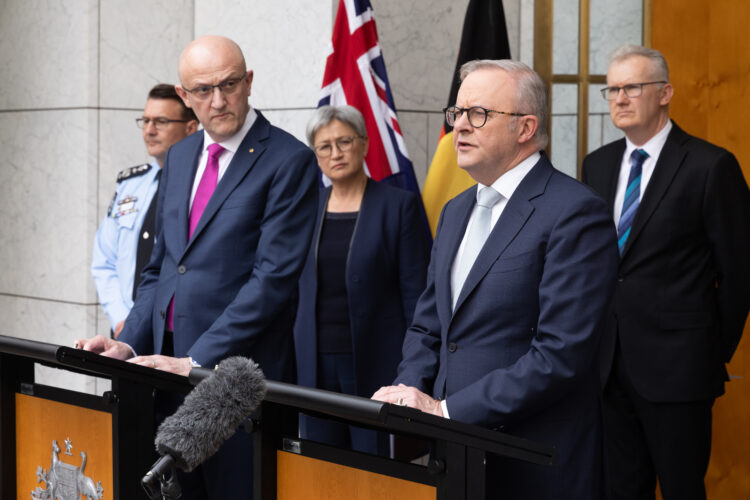


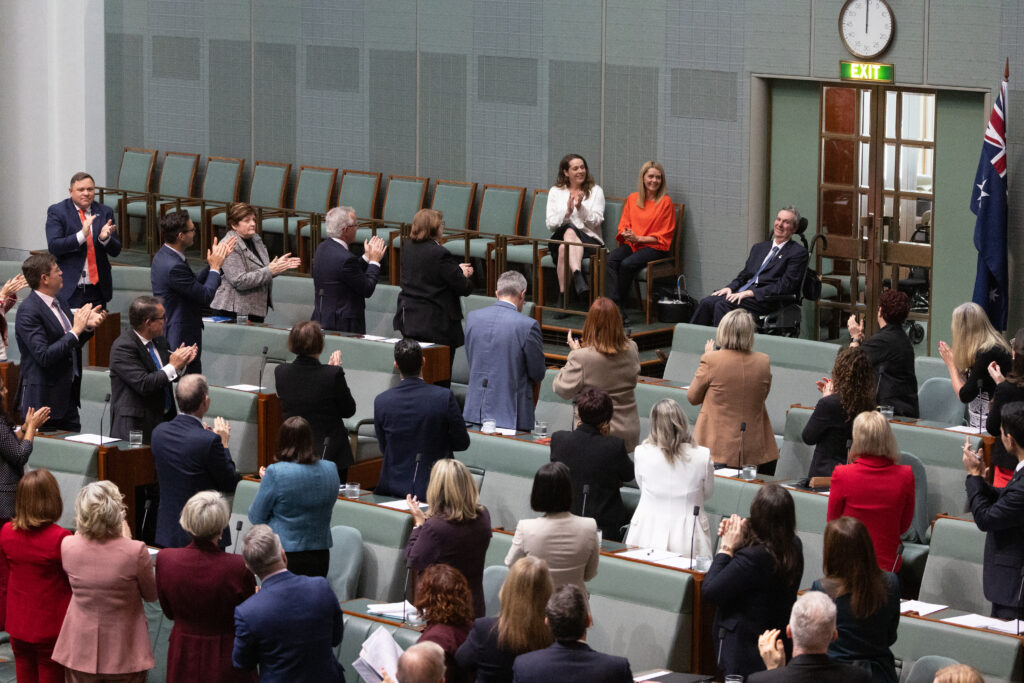
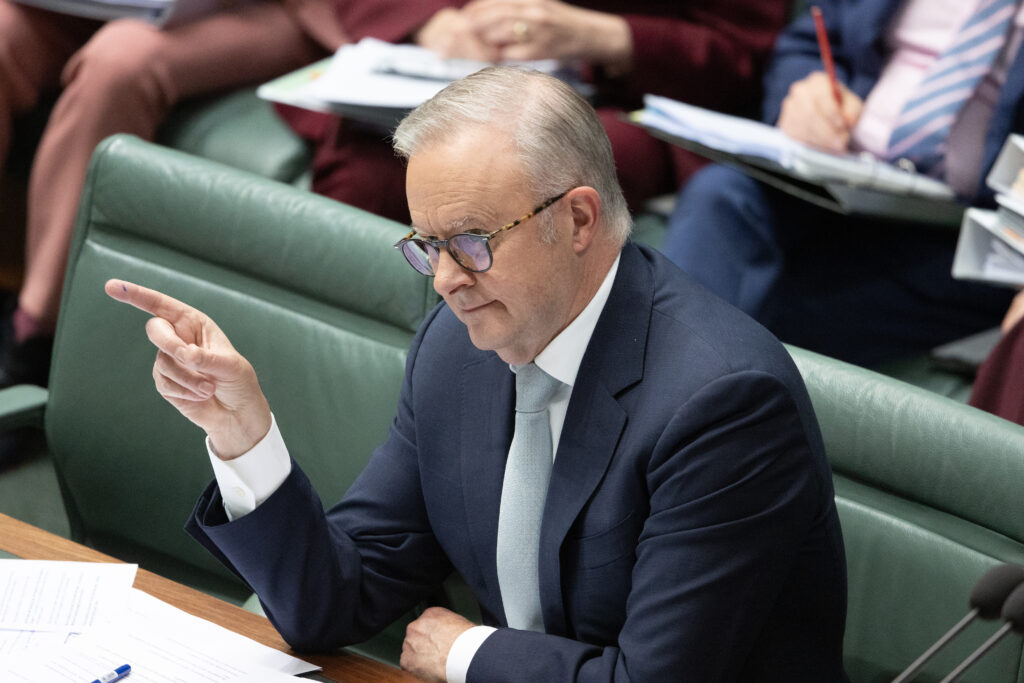
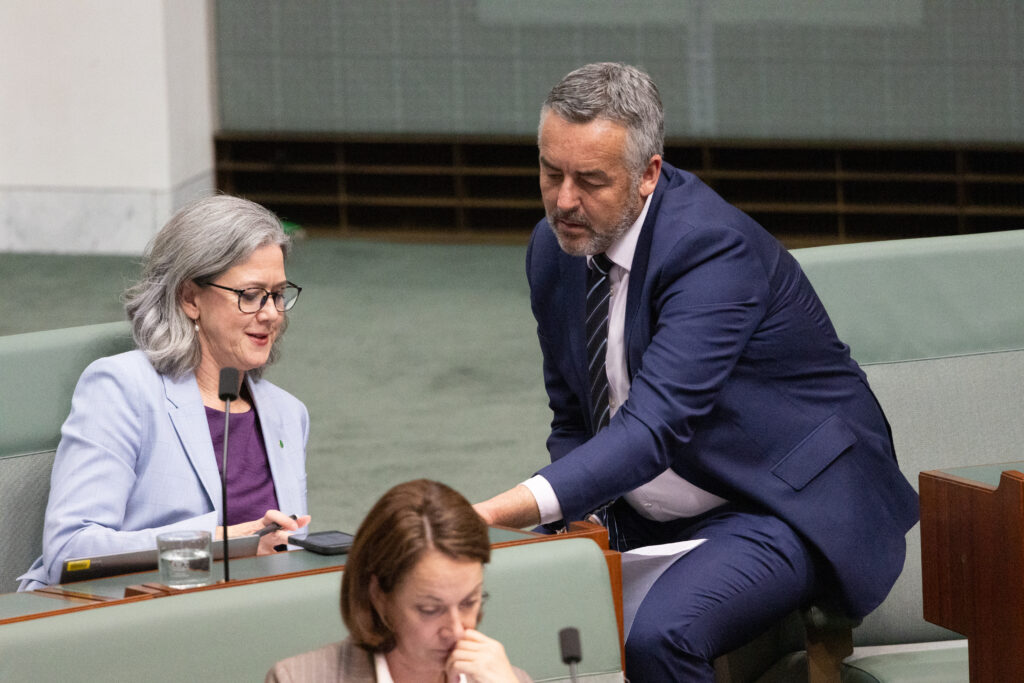
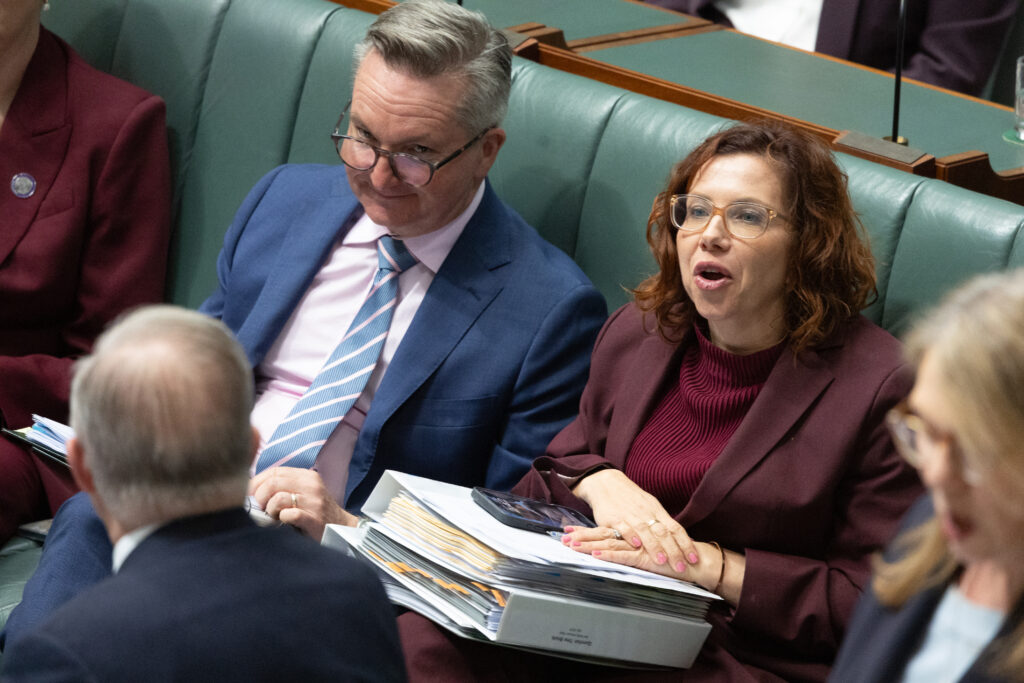



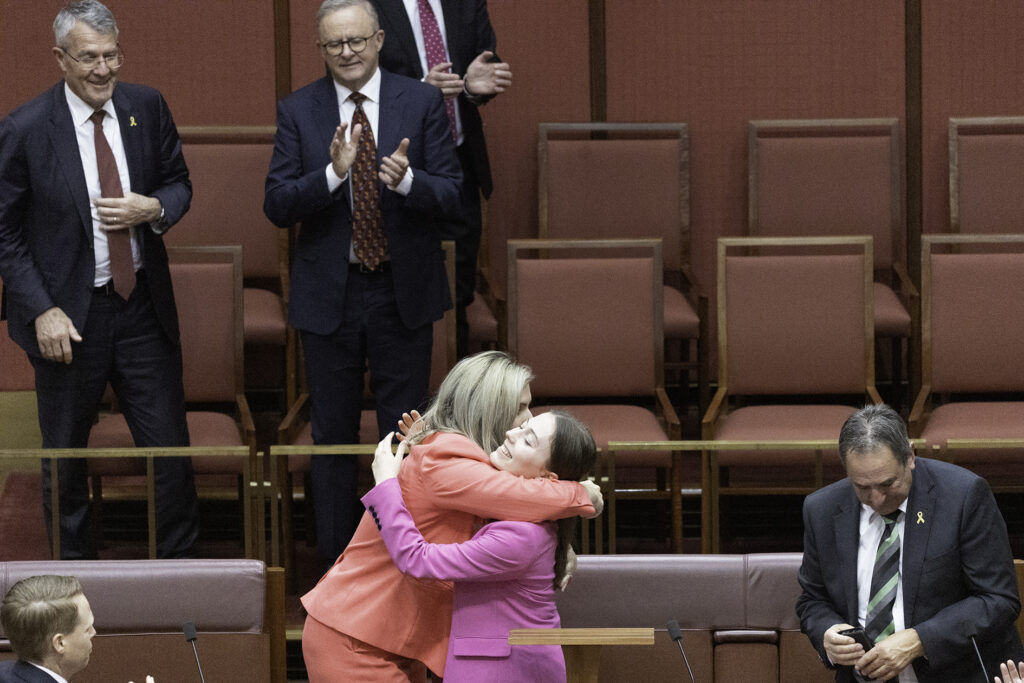
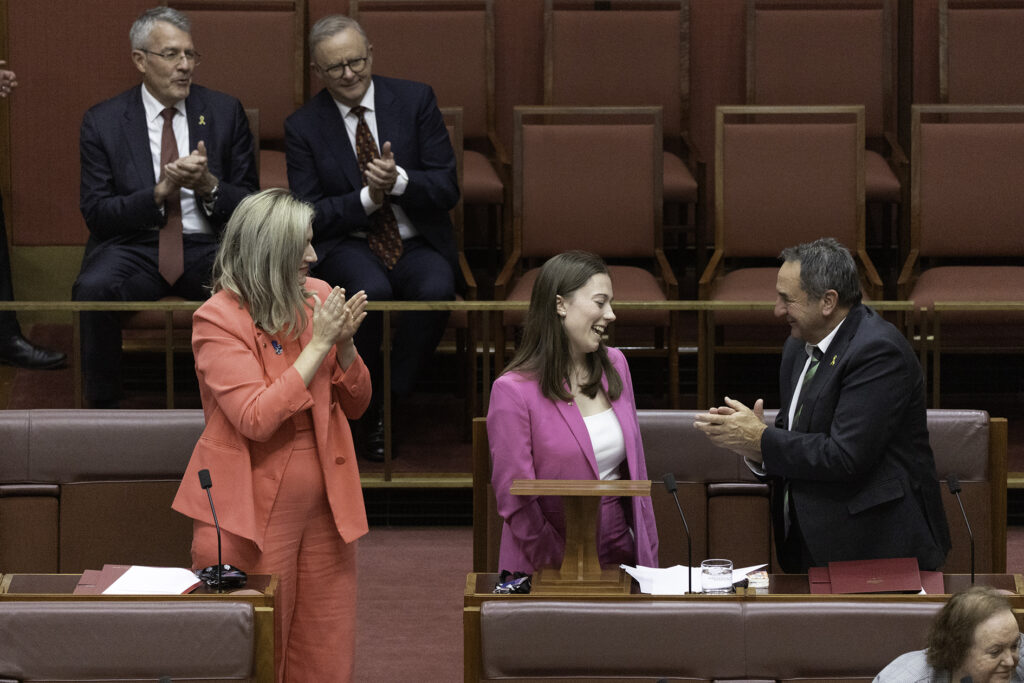
Comments
Start the conversation