Tue 22 Jul

Australia Institute Live: First sitting of the 48th parliament, Australia officially calls for end to war on Gaza. As it happened.

Amy Remeikis – Chief Political Analyst

This blog is now closed.

Start the conversation

Australia Institute Live: First sitting of the 48th parliament, Australia officially calls for end to war on Gaza. As it happened.

Key Posts

The Day's News

See you tomorrow?

And on that note, we are going to close the blog and get ready for the big first day tomorrow. There will be a lot of first speeches, including Ali France – who is being honoured with one of the first speeches not just because she toppled Peter Dutton, but because she has also been through more personal tragedy than most people could imagine enduring, including the loss of her young son to cancer, and still wants to serve.

There is a soft spot for France in a lot of Labor areas.

We will bring you some of her speech tomorrow, as well as some of the others ahead of the first day of business tomorrow.

In other news, the Voices of Gaza vigil continues outside the parliament and will continue until 3pm tomorrow. I plan on reading some of the names of the 17,000 children who have been killed (that are recorded before the Gaza systems all collapsed)

It is a lot, all of the time. But you are not alone. Thank you for everyone who joined us today – we truly appreciate you supporting this little project. A very big thank you to Mike Bowers for, as always, being the heart of the operation. And of course, to you – who are the reason we are able to do anything. Thank you.

Until tomorrow, take care of you. Ax

The parliament is about to resume its sitting.

Milton Dick will be presented to the Governor-General Sam Mostyn – it’s a bit of a ceremony with Dick being led by the Serjeant-at-Arms (with Mace) to the Members’ Hall, with the Clerks of the parliament, party leaders and members following behind.

Dick does his “Your Excellency — I have the honour to present myself as the Speaker
chosen by the House of Representatives” bit and then he heads back to the members, and announces he is the speaker. No cap.

I have to report that, accompanied by honourable Members, I proceeded to the Members’ Hall and presented myself to Her Excellency the Governor-General as the choice of the House as its Speaker, and that Her Excellency was kind enough to congratulate me.
Her Excellency also presented to me an authority to administer to Members the oath or affirmation of allegiance. I now lay the authority on the Table”.

Everyone then looks at the authority in a little show and tell and then boom. The House is ready to start doing house business.

A little treat for you

You all deserve a little treat, so enjoy: Alex Hawke, who managed the business of the NSW Liberal party so well it is under the leadership of a committee after it failed to nominate about 140 candidates for local government elections in time (and just the general messiness of the branch) is now the leader of opposition business in the house.

You. Love. To. See. It.

There are a bunch of former politicians and state pollies here for the opening of the parliament – the first speeches will begin in the afternoon session and a lot of the people who have traveled here either helped get them elected or preselected, or go way back.

So it is wack-a-mole even more than usual in the capital today.

There is a big Queensland contingent – former Moreton MP Graham Perrett is around, as is Queensland Labor opposition leader Steven Miles.

I have hunted Mike Bowers down and have some more photos to share with you:

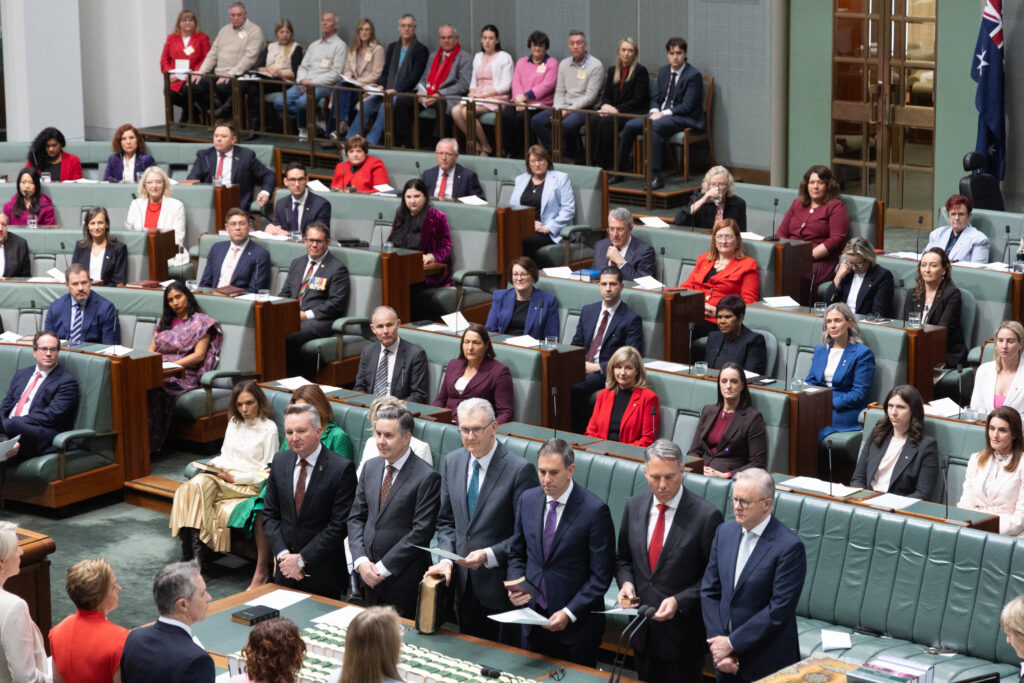
Here is Tony Burke and his giant bible, which is part of the front bench swearing in:

The Prime Minister Anthony Albanese, deputy Richard Marles, Treasurer Jim Chalmers and other front bench ministers are sworn in in the House of Representatives as it sits for the first time in the 48th Parliament this morning in Canberra. Tuesday 22nd July 2025.

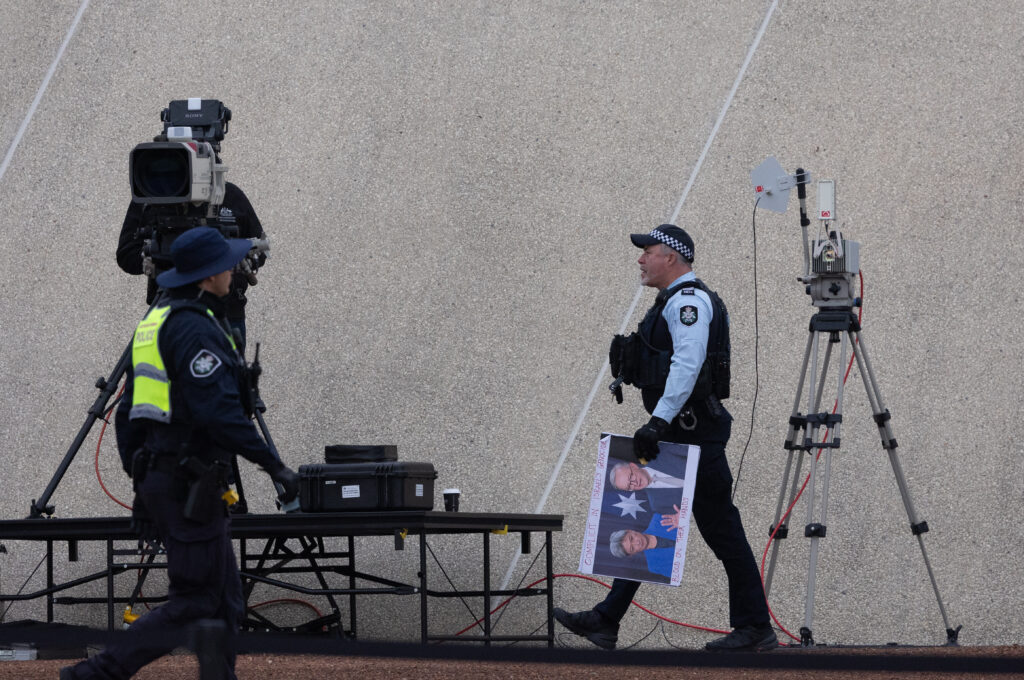
A protester calling for the end of the Gaza genocide had their sign taken by police while they were out the front of parliament before the smoking ceremony:

AFP officer confiscates a Gaza protest sign at a smoking ceremony on the forecourt of Parliament House to mark the start of Parliament this morning in Canberra. Tuesday 22nd July 2025.
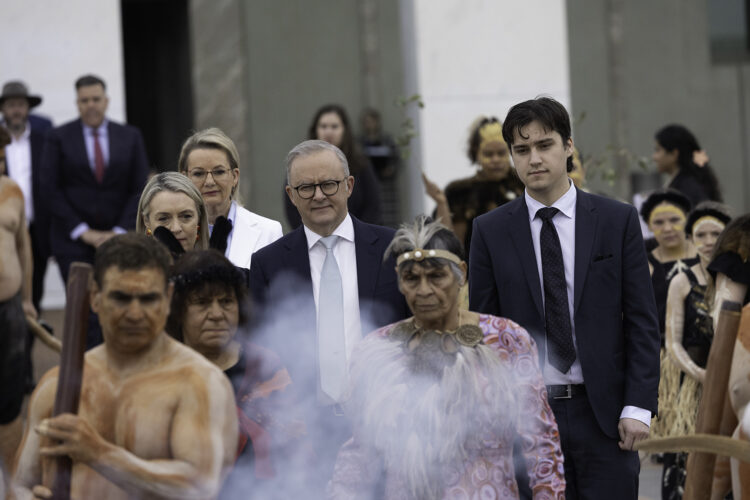
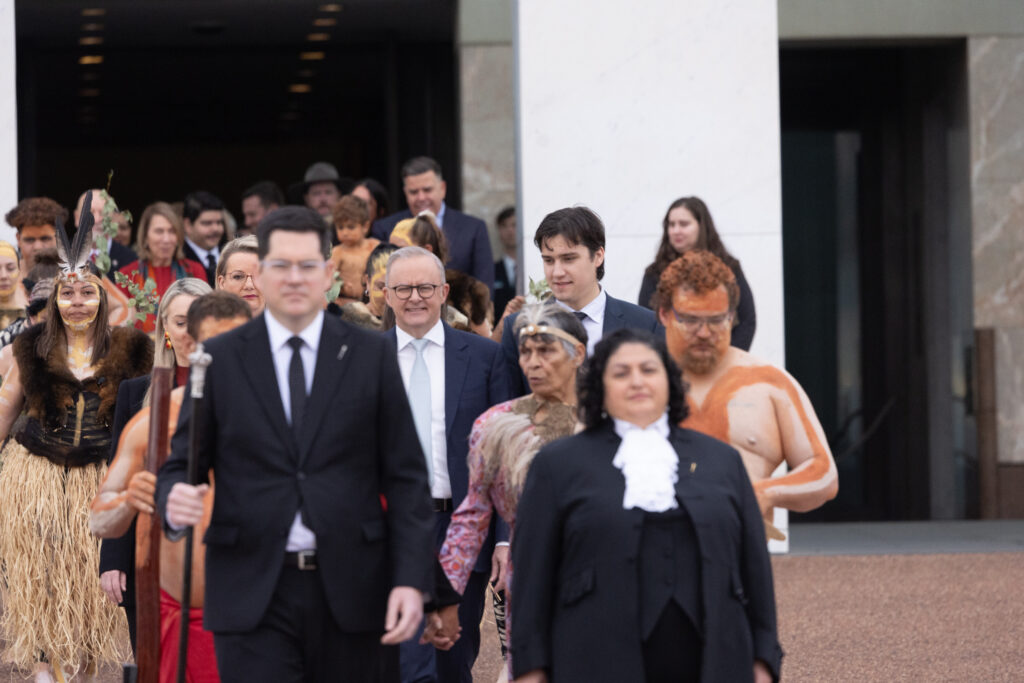
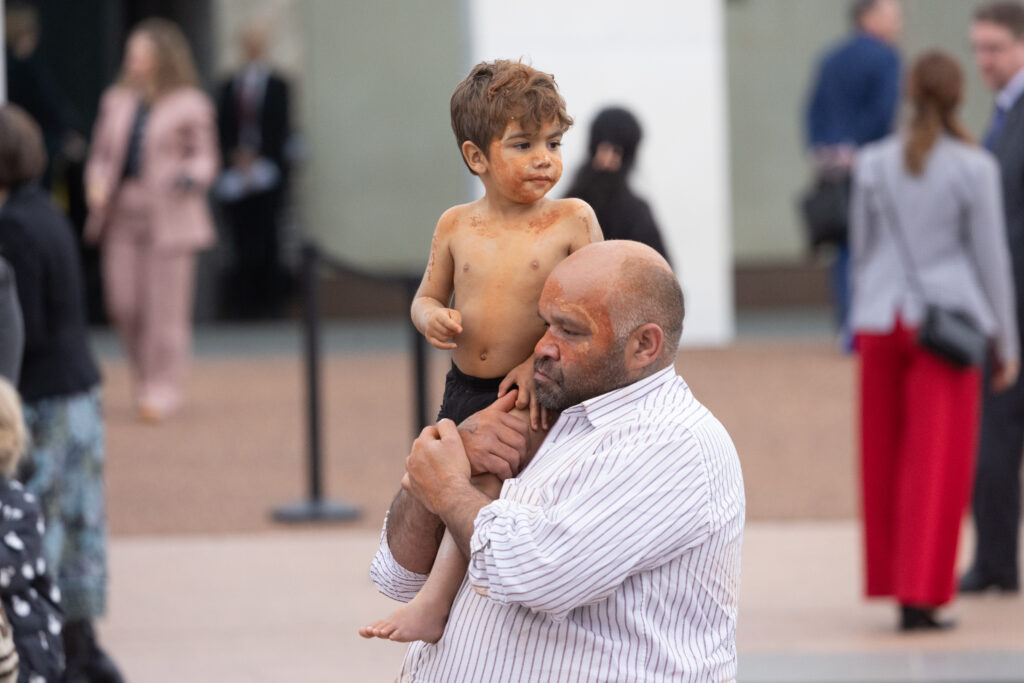
The Prime Minister Anthony Albanese, Nathan Albanese and Jodie Haydon at a smoking ceremony on the forecourt of Parliament House to mark the start of Parliament this morning in Canberra. Tuesday 22nd July 2025.
A quiet moment during the smoking ceremony on the forecourt of Parliament House to mark the start of Parliament this morning in Canberra. Tuesday 22nd July 2025.

A bit louder for those at the back

It really didn’t take long for it to all be business as usua.

Sussan Ley has told the AFR there will be ‘no rubber stamp’ from the Coalition on any tax rise suggestions that emerge from the coming Productivity round table.

Can we say it louder for the people at the back – IT DOESN’T MATTER WHAT THE COALITION SAYS.

Literally the only power it has is the power Labor gives it. If Labor pretends that it can only get legislation through the senate with the Coalition, than that is on Labor. There is another pathway it can take. There is also another pathway the Coalition can take – where it actually looks at policy on merit.

Bipartisanship is not watering down policy until it finally gets the approval of your sworn enemies. It is not approving something out of fear, or because you’ll ‘fix’ it when you’re in power next (which is how Labor passed most of the terrible national security laws we have)

It is winning the argument so comprehensively with the public that there is only one rational course of action – to join with it.

Parliament can pass laws in a day when motivated (does anyone remember the needles in strawberries affair? Or the NZYQ laws?). Pretending any of this is complicated, or indeed that the Coalition is still calling the shots is as big a fantasy as thinking Drake got those new abs organically.

Why didn’t the RBA drop rates? Because the economy was running too well and too many people are employed (they thought)

Greg Jericho
Chief Economist

The Minutes of the RBA Monetary Policy Board Meeting of 7-8 July are out (you know, the one where they went against all expectations and kept the cash rate at 3.85%).

So what do they say?

The minutes have a very interesting economics chat about the “neutral rate” – this is the point at which they believe the cash rate is neither stimulating growth nor slowing down the economy. I won’t bother with all the nerdy stuff, but suffice to say the board notes that “the current setting of monetary policy was modestly restrictive”. So yes, the RBA decided Australia economy was running so well that is should be slowed down.

What does slow down mean? Well mostly, increasing the number of people unemployed.

There was a bit of discussion about the international economy, but most of it involved wondering about what Trump might do, and realising no one has a bloody clue – including the fact that a fair bit of investors pricing in markets was due to complacency because where tariffs currently are (especially with China) is not as bad as they were threatened to be, and people are forgetting that they are still terrible. Look, it’s a mess – some members then took the view of hey it’s not as bad as we thought, while others were like, yeah but it is still bad!

Their discussion on the domestic economy shows just how absurd was the decision to keep rates steady.

The board noted that while household incomes was up a bit but:

“even with this recovery per capita consumption had been little changed over the prior year. Available indicators for the June quarter suggested that growth in household consumption had been slightly below the staff’s expectations.”

This translates as them acknowledging that people were still doing it tough and not spending as much as the RBA thought they would (and we know when spending falls, employment growth slows and unemployment rises).

The minutes then also reveal how they really got it wrong on unemployment. The RBA board was sure employment would be fine. They knew that non-market (ie the care sector and education) jobs were slowing but that the market sector would take up the slack,

“They observed that the unemployment rate could hold steady even if this transition occurs with somewhat lower overall employment growth, depending on developments in labour force participation.”

Well, a week later the unemployment rate rose 0.2%pts, so no, it was not steady.

The RBA also decided to skylark about productivity: “Members discussed the broad-based slowdown in productivity growth in Australia and other advanced economies.” This is quite dumb, to be honest. Productivity growth is a LONG-TERM issue – it moves slowly and due to many different structural factors. It really should not have anything to do with the RBA deciding whether or not to cut interest rates. If they want to be on the Productivity Commission, I am sure they can apply for a job, but the RBA’s jobs is to deal with monetary policy.  

They tried to finagle it into a discussion of rates because they tried to argue that if productivity is so low then maybe the current level of GDP growth is as good as we can do. This is all pretty spurious and lacking any really understanding of the issues of productivity and instead was just being used by the RBA as a reason to not cut rates,

So why did they decide not to cut? Well, the minutes suggest it was all about timing.

“All members agreed that, based on the information currently available, the outlook was for underlying inflation to decline further in year-ended terms, warranting some additional reduction in interest rates over time. The focus at this meeting was on the appropriate timing and extent of further easing, against the backdrop of heightened uncertainty.”

So they agreed rates should be cut, it’s just that the majority decide now was not the right time (presumably they wanted to wait until unemployment increased by 0.2%pts like it did in June?

They then noted that actually when it comes to the “neutral rate” they really don’t know:

“it was difficult to determine with precision how far interest rates needed to fall before monetary policy was no longer restrictive, and so members observed that it might be prudent to lower interest rates cautiously as the required degree of policy restrictiveness declines.”

If this reads like they are basically doing monetary policy based on “the vibe”, then yeah, you are pretty much on the money.

Then comes the conclusion:

“They believed that lowering the cash rate a third time within the space of four meetings would be unlikely to be consistent with the strategy of easing monetary policy in a cautious and gradual manner to achieve the Board’s inflation and full employment objectives.”

A key part is the bit about “full employment objectives” – always remember the RBA believe full employment is a situation where unemployment is around 4.5% – that is their goal. They believe that the number of people employed right now is more than “full employment” – ie we’re “over-full”. And so as a result they want the economy to slow so more people will lose their jobs and thus workers will be less eager to argue for a better wage rise.

A minority of the board (ie 3 people) wanted to cut rates – they “placed more weight on downside risks to the economic outlook – stemming from a likely slowing in growth abroad and from the subdued pace of GDP growth in Australia”. 

So 6 thought things were not all that bad, and 3 were like, err have you read the news? Have you looked outside?

And thus by a vote of 6-3 the cash rate was kept at 3.85%.

From Mike Bowers’ lens to your eyeballs

Let’s take a look at how Mike Bowers (with thanks to The New Daily) has seen the day.

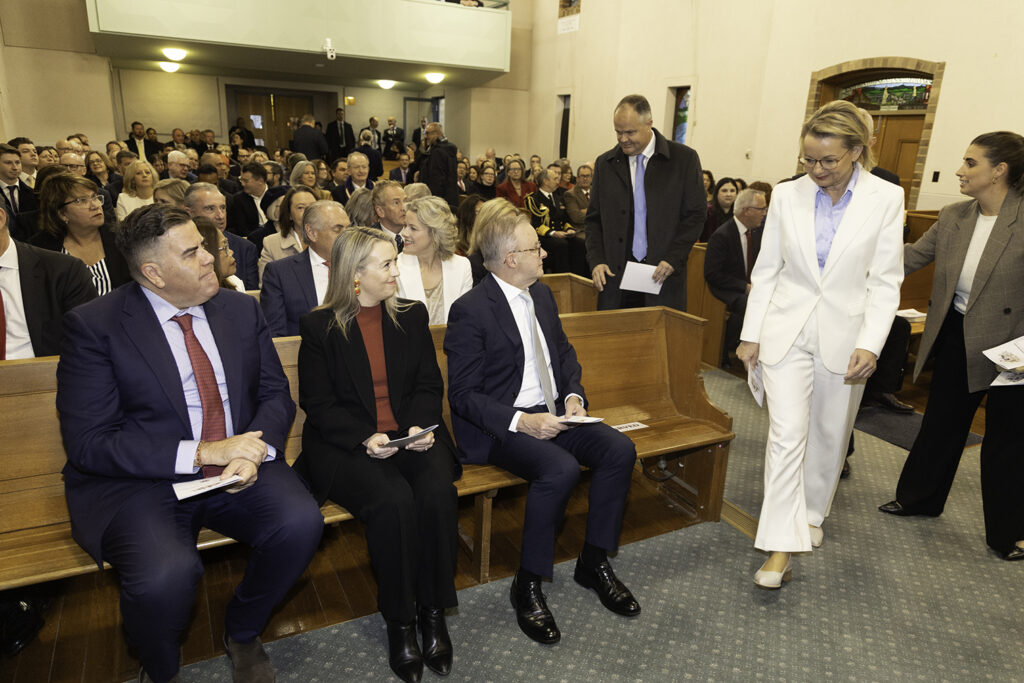
Like divorced parents at their kid’s wedding: Albanese and Ley at the Ecumenical service this morning:

The Prime Minister Anthony Albanese, Jodie Haydon, Milton Dick watch Opposition Leader Sussan Ley arrive at a Parliamentary Ecumenical service to mark the start of Parliament this morning in Canberra. Tuesday 22nd July 2025.

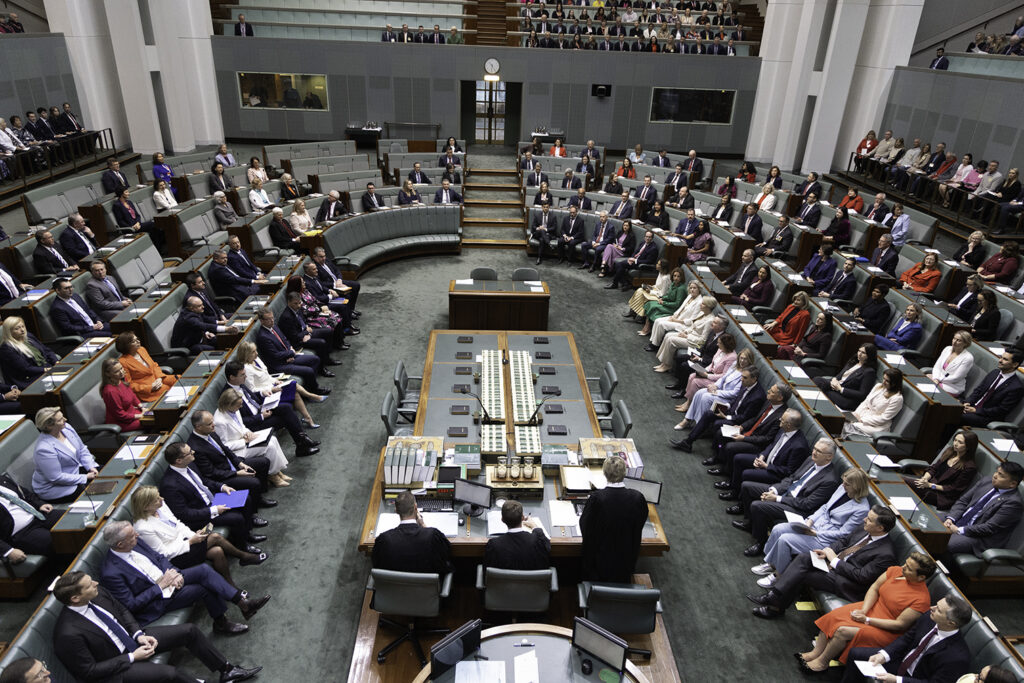
Your new parliament:

The House of Representatives sits for the first time in the 48th Parliament this morning in Canberra. Tuesday 22nd July 2025.

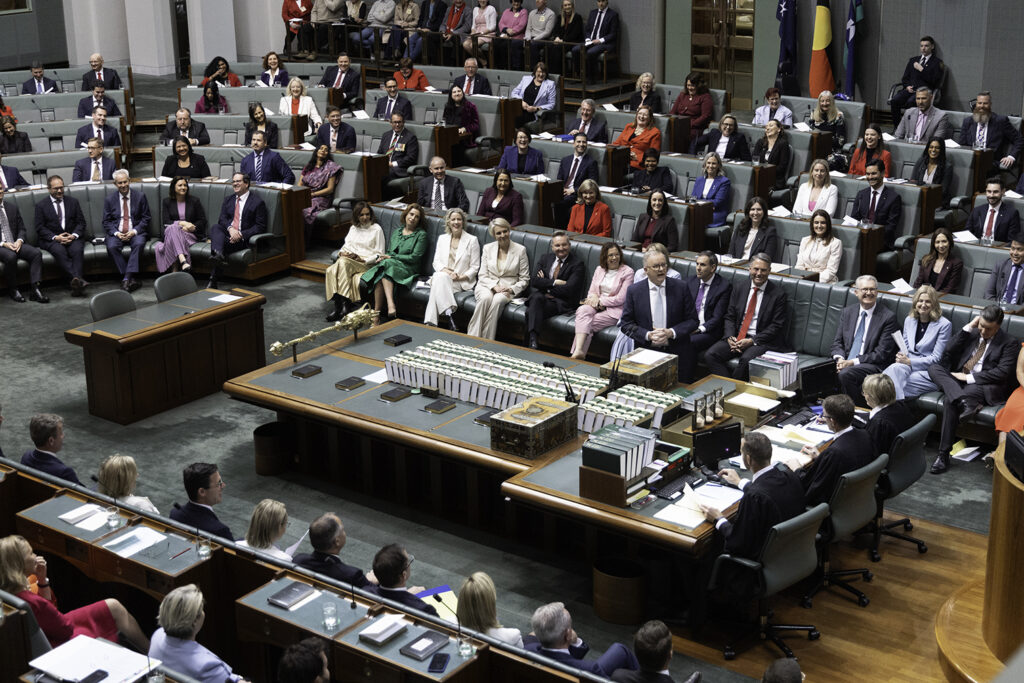
Oh and here is your new giant Labor caucus in the house:

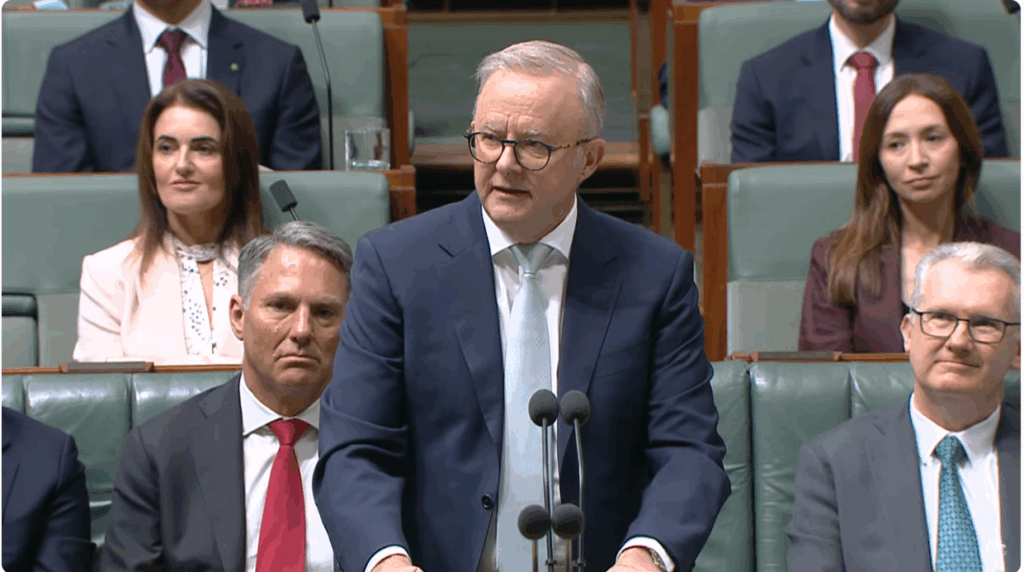
The Prime Minister Anthony Albanese speaks for the first time in the House of Representatives as it sits for the first time in the 48th Parliament this morning in Canberra. (Mike Bowers for The New Daily)

Oh no, don’t make me sit in the big chair with the nice office and the ability to walk away from all things political! Nooooooooo

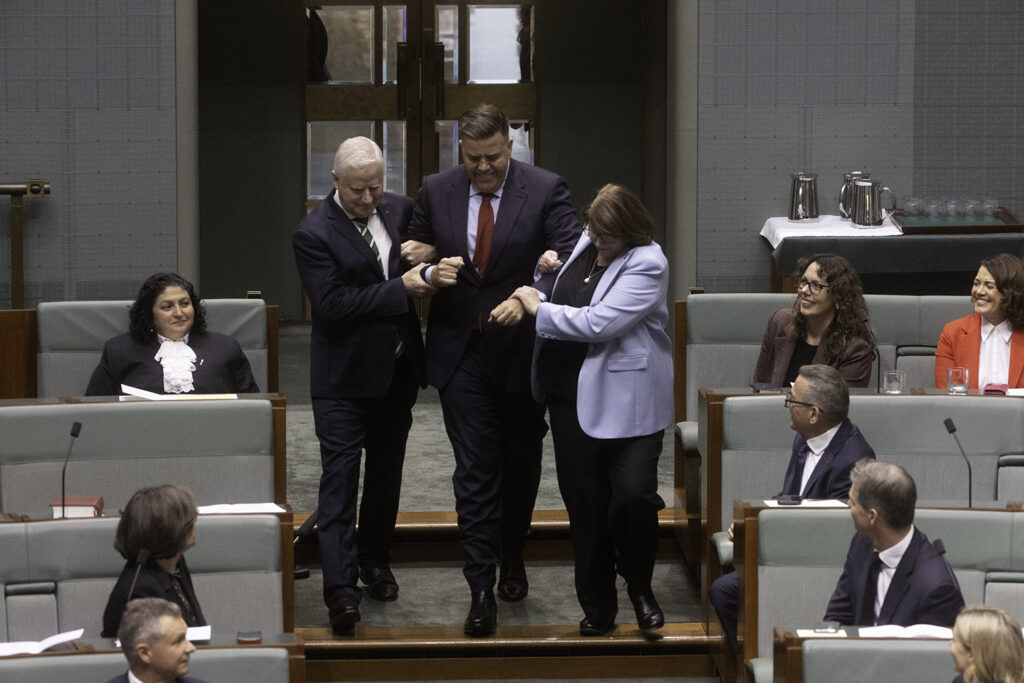
Mike Bowers captured Milton Dick’s pretend reluctance to sit as speaker (for those who missed the earlier post, the tradition of dragging the speaker to the chair is a throw back to when people literally had to be dragged to the position in the House of Commons, because monarchs liked to kill the messenger back in the day. Sooooooo charming)

Milton Dick is assisted to the chair by the member for Riverina Michael McCormack and the member for Lalor Jonne Ryan after being elected un-opposed as speaker of the House of Representatives as it sits for the first time in the 48th Parliament this morning in Canberra. Tuesday 22nd July 2025. (Mike Bowers)

But first Grogs wants you to see those prime TV spots with the new seating plan:

Ok, that is pretty much it for most of the formalities.  We will take a very short break while we re-group ahead of the afternoon and the official start of parliament.  I’ll also bring you some of Mike Bowers work (thanks to the New Daily) looking at what it was all like this morning.

Nationals MP Michael McCormack is seconding Labor MP Joanne Ryan’s nomination for Milton Dick to the be the speaker of the house. Which is the first bit of actual bipartisanship in this house for the new parliamentary term.

It’s more of a testament to Dick’s reputation among colleagues in the parliament. Dick is one of the more popular members across the chamber, no matter what political party you belong to.

Why do we drag MPs to the speaker’s chair?

The never ending swearing in continues.

Milton Dick will soon pretend to be dragged to the Speakers’ chair (it’s an old tradition that dates back to when monarchs used to literally kill the messenger, the messenger being the person nominated to be the speaker for the house of commons, so the person nominated was usually pretty reluctant to take up the role and had to be physically dragged to the chair and in some cases, held there)

Now it comes with a pretty flash office and the perks of not having to indulge in too much politics/kick MPs out of the house.

Pauline Hanson nominates David Pocock as senate president (for the lols we assume)

Over in the senate, Pauline Hanson has nominated ACT independent David Pocock as the president of the Senate. He has respectfully declined the nomination (Labor’s Sue Lines will get the spot, just as Milton Dick will retain the Speaker spot in the House)

Grogs has pointed out that the ACT Labor reps, Andrew Leigh and Alicia Payne have also been relegated outback spots in the new house of representatives seating plan. David Smith is at the other end of the outback.

But both Leigh and Payne can console themselves that they are near one of the prime minister’s favourites, Patrick ‘Possum’ Gorman, so it’s not a punishment.

News Corp have added up Anthony Albanese’s travel costs with the headline ‘our $7 million man’ and so of course that came up in the breakfast TV slots this morning.

Tony Burke was asked about it and told the Nine network:

I’ve got to say. If you do no work, you run up no bills. That’s the nature of it. And if you have a look, if you have a look at the costs that are referred to, a whole lot of them, for example, are the overseas travel that has protected a whole lot of Australian jobs that were previously, previously gone. Like the, the changes in our trade with China compared to where we were at in 2022. You work in the wine industry, the barley industry, the beef industry. There’s a whole lot of industries there, where Australian jobs were being lost, where the Australian economy was taking a huge hit. That doesn’t change by accident. Changes by, you know, by visiting other countries, building relationships and delivering for Australia. I can tell you every time, I reckon most Prime Ministers would rather be at home and rather be with the Australian people. But the reality is, as a nation, you know, people are in work and are being better paid and the economy’s going more strongly because a whole lot of those things have been done. And, yeah, they run up bills, but it’s completely, completely in the national interest.

The very next questions? WHEN WILL ALBANESE MEET TRUMP. So travel is fine if its approved by that particular media outlet, we suppose.

The swearing ins are underway.

So far Tony Burke has had the biggest bible. MPs and senators can choose either a religious book, or an affirmation for their swearing in, where they must repeat the words, which include an oath of allegiance to the King. If you don’t say the words, you are not legally sworn in (Senator Lidia Thorpe had to come back and repeat her oath after protesting against the monarch in a swearing in, and while Bob Katter claims he doesn’t swear allegiance to the monarch and crosses it out in his official swearing in paper work, there is no evidence of that. (I’ve checked with the Speakers’ office on a few occasions).

So yes, Katter also does the oath.

Labor, Labor everywhere…

The new seating plan for the house of representatives has been published and as expected, it is mostly Labor as far as the eye can see. There are more women on Labor’s front bench than the entire Liberal party. Good times.

Also worth noting, Ali France, who toppled Peter Dutton, has been given the prime TV space behind the despatch box. That is a place of honour for MPs, because it is one of the most visible slots. Petrie MP Emma Comer joins France in the prime position. The Coalition liked to crowd their few women backbenchers around the despatch box to try and make it look like they had more women then they did. Labor liked to do it to prove to the Coalition that they had more women.

At this point of the game though, it is about reward. France and Comer have been anointed.

Former minister Ed Husic gets a spot on the benches immediately behind the front bench, but he has been relegated to near where the Hansard sits. That’s still in front of the press gallery, but well away from the main action. Former attorney-general Mark Dreyfus is a few rows back, but more in the centre.

Seating plans are ALWAYS political, so none of this just ‘happened’.

Sussan Ley has Anne Webster and Zoe McKenzie behind her, so she is keeping up the Coalition tradition of crowding women around where the cameras will spot them, but it is slim pickings. Barnaby Joyce is out in the sticks.

The crossbench are closer to Labor. Bob Katter, Rebekha Sharkie and Andrew Wilkie have been given the prime spots there, befitting their time in parliament.

You can see where everyone ended up, here.

Coalition accuses Albanese government of ‘attacking Israel’

You truly have to wonder what is behind the Coalition’s full throated support of Israel’s actions in Palestine at this point. Every major humanitarian organisation has concluded it is a genocide. International law experts have concluded it is in breach of international law and humanitarian law. Its leaders are wanted for arrest by the International Court of Justice after it found there were “reasonable grounds” of criminal responsibility by Benjamin Netanyahu and former defense minister Yoav Gallant for alleged war crimes.

What Palestinians are showing us every single day and have been showing us for almost two years is some of the worst footage to ever be shown, and it has been proven that starving Palestinians are being slaughtered at Israeli-US controlled ‘aid’ sites. The population is entering stage five malnutrition – which causes irreversible damage – because of Israel’s refusal to allow in food, water, fuel and baby formula, let alone medical supplies. Every hospital has been bombed to almost closure. There are no safe spaces for civilians. Civilians, who have been displaced multiple times in 22 months are told to go into areas which are then bombed by Israel. Doctors are reporting children are being deliberately shot by Israeli snipers. Israeli ministers and MPs openly make genocidal statements.

There is so much evidence this is a genocide. And yet this is what we have from the Coalition’s Michaelia Cash:

It is disappointing that once again the Albanese Government is supporting a statement attacking Israel. First and foremost, any moral outrage about the situation in Gaza should be directed at Hamas.

Hamas are a listed terrorist organisation who have made it clear they do not believe Israel has the right to exist.

It is disturbing but not surprising that Hamas has welcomed the statement signed by the Albanese Government.

Hamas could end the suffering of the people of Gaza by freeing the remaining Israeli hostages and laying down their weapons.

This war began because of Hamas’s abhorrent attack on Israeli civilians and they bear responsibility for the continuation of this conflict.

It is important that aid flows into Gaza, but unfortunately Hamas has not a been allowing this aid to flow freely. Proper quantities of food and other aid must be provided to the people of Gaza.

However, the right system must be in place so that it can be distributed without Hamas intervening in the process.

The Albanese Government’s decision to blame Israel for Hamas’s disruption of the flow of aid is appalling.

There is no justification for genocide. No act which makes allowances for it. And as has been reported multiple times, Hamas has offered to release the hostages at all stages of Israel’s assault, including the early days, but Israel has rejected the offer. There is no evidence Hamas has been stopping the flow of aid, but there is all the evidence that Israel (and the US) have turned humanitarian aid deliveries into killing zones. This statement is not based in evidence.

International news agency AFP warns the last Palestinian reporters in Gaza will die without immediate intervention

While Sussan Ley and the Coalition can’t bring themselves to support the bare minimum – a call for Israel to end its war on Palestine and allow the free flowing of aid, the AFP journalists’ association has released a statement that journalists in Palestine employed by the agency may die from starvation.

It is the first time they have ever had to issue this sort of statement.

Journalist Catherine Norris Trent translated the statement, published by the Société des Journalistes, or SDJ (Editorial Committee) of AFP and backed by AFP management, from French to English.

Without immediate intervention, the last reporters in Gaza will die.
AFP has been working with one writer, three photographers and six videographers, all freelance, in the Gaza Strip since its staff journalists left in 2024.

Along with a few others, they are now the only ones left to report what is happening in the Gaza Strip. The international press has been banned from entering the territory for nearly two years.

We refuse to watch them die.

One of them, Bashar, has been working with AFP since 2010, first as a fixer, then freelance photographer, and since 2024, as lead photographer. On July 19th he managed to post a message on Facebook: “I no longer have the strength to work for the media. My body is thin and I can’t work anymore.”

Bashar, 30, works & lives in the same conditions as all Gazans, moving from one refugee camp to another under Israeli bombings. For more than a year he’s lived in utter destitution, working at extreme risk to his life. Hygiene is a major issue for him, with recurring bouts of severe intestinal illness.
Since February, Bashar’s been living in the ruins of his home in Gaza City with his mother, four brothers & sisters and the family of one of his brothers. Their house is devoid of any furnishings, except a few cushions. On Sunday morning, he reported that one of his brothers had “fallen, due to hunger.”

Even though these journalists receive a monthly salary from AFP, it’s no longer enough to buy food, or they have to pay completely exorbitant prices. The banking system has collapsed, and those who exchange money via online bank accounts charge a commission of up to 40%.

AFP no longer has the ability to provide them with a vehicle and there is not enough fuel to allow these journalists to travel for their reporting. Driving a car means becoming a target for Israeli airstrikes. AFP reporters therefore travel on foot or by donkey cart.

Ahlam, located in the south of the enclave, is holding on “to testify” as long as she can. “Every time I leave the tent to cover an event, do an interview or document a story, I don’t know if I’ll come back alive.”

Her biggest issue, she confirms, is the lack of food and water.

We are watching their situation get worse. They’re young but their strength is leaving them. Most are no longer physically able to get around the enclave to do their work. Their heartbreaking cries for help are now daily.

For the past few days, we have only received very brief messages from them, when they have the strength to send any. Their courage, considered heroic by the rest of the world, is now their only hope of survival.

We may hear about their deaths at any moment, and this is unbearable.

Sussan Ley can’t bring herself to support statement calling for an end to Israel’s war on Gaza

Ley was also asked whether she supports “the government’s statement on ending the conflict in Gaza that Penny Wong’s released with other countries. Do you support that statement?”

Ley:

The first and most important thing to say about this issue is that there are still hostages in Gaza, there are still hostages hidden in tunnels, and a way to end the situation is for those hostages to be released by the terrorists, Hamas, who control so much of the activity there.

Of course we want to see aid reach those who deserve it, but it is so important that Hamas, that has control, often over the flow of that aid, but certainly over the ongoing, completely unacceptable detention of those hostages, act in the interests of the people of Gaza.

Q: But do you support signing that letter? Was it [inaudible] of the Foreign Minister to sign that letter?

Ley:

I’ve just answered that question…

Journalist: You didn’t…

Ley:

…Well, it’s very important that we understand where this conflict started and who has the opportunity and responsibility for ending it, and that is, Hamas.

Q: Opposition Leader, what about the revelations that we’ve seen a large number of civilians killed while waiting for aid. What do you make of that?

Ley:

It’s important that we recognise the responsibility of Hamas and the opportunity they have to end this conflict by releasing the hostages that are still there

Hamas have offered, multiple times, and at very early stages of Israel’s assault, to release all hostages. Israel has not accepted terms. Multiple reports say it is Israel which won’t agree to negotiations, or give ground, while Hamas have agreed to multiple concessions.

There is NO evidence Hamas has control over the flow of aid, or indeed is responsible for seizing it, as often claimed by Israel. There is no basis in evidence for Ley’s position here.

Ahhhh, I knew it couldn’t last. The whole transcript of Sussan Ley’s remarks on the steps of the church has lobbed and of course, it includes polticking. It is obviously what God would want.

Ley:

So in the last Parliament, you would remember that Australians were promised a $275 cut to their power bill, which never eventuated. Now, leading into this Parliament, we saw the Prime Minister make promises about the number of homes that would be built and in the lead up to the election, he also promised Australians would pay less tax. But clearly there is work going on to increase the taxes on hardworking Australians, and we know this because of leaked Treasury advice that demonstrates that there will be a plan coming forward to tax Australians more. Now that’s a broken promise if that happens and we will hold them to account.

Similarly, that Treasury advice says that there’s no way the government could build 1.2 million homes and that too presents as a broken promise.

Now Australians are doing it tough out there, and I was alarmed to see this morning that access to homelessness services has increased by 10 per cent for Australians since Labor came to government in 2022. But for women it’s actually higher than that – It’s 14 per cent. That’s not good enough.

Similarly, we see this morning that about a quarter of GP clinics are saying they won’t be accessing the government’s bulk billing incentives. So what that means is that it will continue to cost Australians more to go and see a doctor. But we all saw the Prime Minister stand there with his Medicare card saying Australians would not be paying. Well, today it looks like Australians will be paying more to see a doctor. So that is not good enough.

We stand ready to work hard for the Australian people every single day, and I look forward to holding the government to account very strongly and with great determination where we need to on these matters.

The ceremony opening the new parliament is rolling on.

In response to the Welcome to Country, Anthony Albanese gave thanks – but did not make any commitments to treaty or truth telling, as requested by the Uluru Statement from the Heart:

I begin by acknowledging the traditional owners of the land on which we meet, and I pay my respects to Elders past, present and emerging.

And I thank you, Aunty Violet, for your wonderful words of welcome. And thank you to Aunty Lillian as well. As well as thanking Serena Williams and the wonderful cultural performance which we have just witnessed here this morning.

I also want to acknowledge every First Nations member and senator taking their place in the 48th Parliament.

As well as everyone who is back here, and pleased to be back here, both new and re-elected members and senators, and their guests here this morning.

The Welcome to Country is such a powerful way to begin a new Parliament. Like a lot of the most positive things about our nation, we shouldn’t take it for granted. This ceremony did not take place until 2007. And was controversial in 2007. It is not controversial today, nor should it be. It is a respectful way of us beginning our deliberations here in Canberra, which of course, means meeting place.

What a Welcome to Country does, is holds out, like a hand warmly and graciously extended. An opportunity for us to embrace, and to show a profound love of home and country.

It is a reminder as well, of why we all belong here together. That we are stronger together.

And we belong, if I may return to Aunty Violet’s wonderful words, in a spirit of understanding, respect, and shared purpose.

Guided by Minister Malarndirri McCarthy, and following in the footsteps of her two great predecessors, Linda Burney and Ken Wyatt, we keep walking together.

And with every step, we feel the echoes through history.

The footsteps – nearly a century distant from us now – of every First Nations person who trekked to the opening of the first Parliament House down the hill.

The footsteps of the members of the Stolen Generations who came to this place 17 years ago now to hear the words that they needed to hear: ‘I’m sorry’. Uttered by an Australian Prime Minister on behalf of the Australian nation.

That was a day of catharsis built on courage and grace. Ultimately, it was a day of togetherness, and a reminder of our great potential and promise as a nation.

Consider the beautiful set of contradictions that make up who we are.

A youthful nation, yet one of the world’s oldest democracies.

An ancient continent – one we share with the world’s oldest continuous living culture. What an extraordinary privilege. What a source of pride for all Australians.

We have so many facets – and they come together to make a unique whole.

They come together here on the ground, and they come together in the sky above us.

Look up on a clear night when you’re far from city lights and you’ll see the Dark Emu, with the Southern Cross shining on its head.

And when you’re looking at the Southern Cross, look at the star that twinkles most softly. It’s the part of the Southern Cross that features on the Australian flag, but not on the flag of New Zealand.

Several years ago now, the International Astronomical Union formally recognised that star as Ginan, the name given to it by the Wardaman people in the Northern Territory.

To the Wardaman, it represents a red dillybag filled with special songs of knowledge.

It is an Australian star, a piece of ourselves reflected back at us from our great Southern sky.

And it flies above us now, on that giant flag pole on the top of this building. One more reminder that this country – and this Parliament – is our great diversity of chapters coming together.

And the Welcome to Country lets us touch the very beginning of the story – our story. The Australian story.

In the 48th Parliament, we write the next chapter. Let us do it, with the same sense of grace and courage that First Nations people show us with their leadership.

‘Action, not words’ needed to stop Israel’s genocide in Gaza says Greens

Greens senator David Shoebridge has responded on behalf of the party to the government co-signing a statement with 24 other countries and the EU calling for the immediate end to the war on Gaza:

For nearly two years, the Greens have been demanding the Government call for an immediate ceasefire. During this time, they have not only refused to do so but attacked those calling for peace.

We welcome the recent statement, but it is clear that the Albanese Government has been on the wrong side of history for the past two years. They need to take action now. 

Just this month, the Government was facilitating weapons exports to Israel. You cannot, on the one hand, call for peace while fuelling war with the other.

Words and strong statements will not stop the bombing, shelling and shooting of Palestinians. Australia and the rest of the world need to match these words with action, starting with an urgent ban on sending weapons and weapons parts to Israel.

Now Australia has recognised the obscenity of Israel’s ongoing Gaza campaign, we must also cancel the billions of dollars in contracts with Israeli weapons manufacturers who sell their products as “battle tested” in a genocide.

International law, common decency and the wishes of billions of people across the world for a Free Palestine all demand the same thing. Action, justice and a world that acts for peace.”
 

Six months down, 42 to go (maybe…)

Angus Blackman
Podcast producer

It’s only been SIX FREAKING MONTHS.

On this episode of After America, Dr Emma Shortis reflects on the extraordinary period since Trump was inaugurated and considers what could come next.

Tl;dr: it’s pretty grim.

Greens make climate trigger their first order of business

Greens leader Larissa Waters has announced that a climate trigger will be the first order of business for the Greens in the new parliament.

The Greens will introduce the Environment Protection and Biodiversity Conservation Amendment (Climate Trigger) Bill as their first private senators bill. (Without support from the government, it goes nowhere).

This legislation will be the first bill debated in either chamber of the 48th parliament.

Waters:

The Labor government has a choice this term to either work with the Greens in the Senate to legislate a climate trigger, or to continue approving toxic coal and gas that is sending our planet to collapse.

Our Bill would force the climate impacts of projects to be considered by the Minister, and it would also ensure mega-polluting projects can’t get environmental approval at all.

While Australian communities are living through once-in-a-decade weather events almost every year, our environmental laws remain unchanged since the Howard government wrote them. 

These laws allowed the Albanese Labor government to sign off on Woodside’s North West Shelf gas extension to 2070, meaning more intense floods, fires, and species extinctions, plus more pollution each year than all of Australia’s coal stations combined. 

After decades of fossil fuel acquiescence from the major parties the moment for real action is now.

Dirty fossil fuel projects need to be properly assessed for their impacts and rejected, so our kids, and all the precious species we share this beautiful planet with, have a safe climate future.

The 48th parliament could achieve real progress, the Greens will keep fighting for climate and the environment, a transition to clean energy, an end to native forest logging, protection for our biodiversity, and no more coal and gas.

We just need Labor to show courage in getting off the payroll of big gas corporations and to work with the Greens to bring our environmental laws into this century with a legislated climate trigger.”

Voices for Gaza: 24 hour vigil continues outside parliament

There is a 24-hour vigil outside the parliament, which includes members of parliament, doctors, journalists, academics, actors, writers, and community members reading the names of more than 17,000 Palestinian children who have been killed by Israel over the last 22 months in Gaza.

(Full disclosure, I plan on attending the vigil and also reading some of the names).

The action is jointly hosted by seven Australian civil society organisations – Action Aid Australia, Amnesty International Australia, Caritas Australia, ChildFund Australia, MAA International, Oxfam Australia, Plan International Australia, Save the Children and Médecins Sans Frontières / Doctors Without Borders (MSF) to demand immediate and concrete action from the Australian Government to end the humanitarian catastrophe in Gaza. 

From the statement:

Israel’s brutal campaign has claimed over 58,000 lives to date, with tens of thousands more wounded or missing under rubble. The event will honour the children killed in Gaza, reading their names and ages aloud continuously over 24 hours.

We welcome the strong statement signed overnight by the Foreign Minister on Australia’s behalf, calling for an immediate end to the war on Gaza and for the full flow of aid. But without urgent and concrete action, these words ring hollow. The Australian Government must now take concrete action to pressure Israel to end the illegal siege, uphold the rights of civilians, and demand accountability after months of injustice faced by Palestinians in Gaza. 
 
The vigil will be a time for mourning and commemoration. The Voices For Gaza group will also make the following demands on the Australian government:

  1. Apply pressure on Israel for an immediate and permanent ceasefire to end the ongoing killing of civilians;
  2. Use its power in international forums to demand Israel abide international law and to support international accountability mechanisms, including those of the International Court of Justice;
  3. Immediately suspend the export of weapons parts, munitions and military support to Israel, directly and via intermediate countries, to ensure Australia is not complicit in crimes committed in the illegally occupied Palestinian Territory;
  4. Apply full diplomatic pressure to restore safe, unimpeded, and sustained access for humanitarian relief in Gaza, led by United Nations aid delivery mechanisms and grounded in international humanitarian law;
  5. Advocate for a political solution that ends Israel’s decades-long illegal occupation, lifts the blockade on Gaza and upholds the Palestinian right to self-determination.

On the statement Australia has co-signed calling for Israel’s war on Gaza to end (the language in the statement is much more passive, but it is the strongest one we have to date, even if it doesn’t actually include any sanctions or action) Gorman says:

The war in Gaza must end. The fact that we are not seeing vital aid, food and humanitarian supplies get to civilians in Gaza is unacceptable, and it’s been unacceptable for a long time. We joined with like-minded partners to say very clearly that we believe that the war in Gaza must end. Since the atrocities of October 7 we’ve been calling for the return of hostages, and we continued even this statement where we joined with like-minded countries, including the United Kingdom, New Zealand, Canada, Japan. We joined with them in saying that we want to see an end to this conflict. It’s a clear statement from us and a range of partners, and we hope that this will get that outcome that we’ve been seeking for for a long time. 

Ahead of the ceremony, the assistant minister to the prime minister Patrick Gorman was sent out to do doors – which is when MPs/Ministers go through the main doors where they know journalists are waiting in order to deliver the message of the day. Gorman was asked about Sussan Ley’s comments yesterday that the opposition would not ‘get out of the way’ (while also saying that she believes Australians want the government to get out of the way)

Gorman said:

I respect the parliament. I respect the role of each individual member of the parliament to do the job that their community or their state or their territory sent them here to do, and we’ll continue to show that respect.

But equally, some of these things that we’re talking about, these are not new propositions. It was last year that the Prime Minister was very clear that we want to cut student debt, and we want to make it so that people don’t have to pay back that debt as early on in their career at those lower income levels.

We want to get that done.

If the Coalition are still unsure about where they stand on that, then they should probably explain that to the Australian people, because it’s been on the agenda for so long. And of course, the Coalition will continue to pass judgement on the Government’s agenda. They’re obviously still trying to sort out what it is they stand for.

One thing that I can say, though, is I won’t be voting for the Coalition bill to abandon net zero. I don’t know if all the members of the Coalition will be voting for the Coalition bill to abandon net zero. We believe that we can act on climate change. We believe that the path we are walking on, which is to grab the opportunities of a renewable energy future is the right path for Australia. 

(There was no suggestion the government would vote for the bill to abandon net zero and the private members bill has no power, so everyone is just signalling here)

Politicians welcomed to Country

The Welcome to Country ceremony is underway at Parliament House.

Ngunnawal elder Aunty Violet Sheridan is delivering the welcome:

To walk on Ngunnawal country is to accept responsibilities. It is not just about being here. It is about caring for this land. The waters and all living things as my ancestors have done for thousands of generations.

When we care for country, we pay respect for those who came before us and ensure that their legacy continues. Ngunnawal country is alive. It lives in our stories, our ceremonies, our language and our connections to this land.

It carries forward by our elders. Our young ones and all who walk with us. It is a culture of strength, of resilience and of deep wisdom. As part of this welcome I offer you spiritual protection and safe passage.

May you all walk gently, listen and carry the spirit of this country with you. May your journey on Ngunnawal country be of understanding, respect and shared purpose.

Guided by the values of care, connection and community, I would like to pay my respects to elders past and present and emerging and extend that respect to all First Nations people here this morning. I would also like to acknowledge all the non-indigenous people here as well. In keeping in the spirit of friendship and reconciliation, it gives me great pleasure to welcome you all here once again to Ngunnawal country.

New analysis reveals the devastating truth behind Australians’ poker machine losses

Glenn Connley

New analysis by The Australia Institute reveals that the vast majority of the money Australians lose on poker machines each year is money they simply cannot afford to lose.

According to the Australian Institute of Health and Welfare, one-third of Australian adults use poker machines at least once a year. Excluding Western Australia, where pokies are banned outside of Perth Casino, that equates to 6.6 million people who, between them, lose around $13 billion a year, at an average of more than $1,950 each. 

Based on an updated version of the most detailed study of gambling in Australia, the amount an average gambler can afford to lose on poker machines is $301 per year, known as their “low-risk gambling limit”.

For every dollar a gambler loses over that low-risk limit, the risk increases.

Losing more means people who use the pokies have less to spend on other recreational or social activities. But for those who gamble much more, the losses can be devastating. 

“Poker machines are making a killing from problem gamblers,” said Skye Predavec, Anne Kantor Fellow at The Australia Institute and author of the analysis. 

“If the vast majority of poker machine profits come from risky gambling rather than those who gamble responsibly, it’s time politicians treated the industry in line with the harm it causes.

“The data does not lie. There are Australians who are losing vast sums of money on poker machines who cannot afford to.

“This can have a terrible impact on their personal finances, health, work and wellbeing, which, in turn, impacts families and relationships.”

In shocking news, rushing to meet Trump to address trade tariffs has not yielded results. In other news, day ends in ‘y’

AAP

The Trump administration is more concerned with the quality of trade agreements than their timing, US Treasury Secretary Scott Bessent has said ahead of an August 1 deadline for nations to secure trade deals or face steep tariffs.

“We’re not going to rush for the sake of doing deals,” Bessent told US broadcaster CNBC.

Asked whether the deadline could be extended for countries engaged in productive talks with Washington, Bessent said US President Donald Trump would decide.

“We’ll see what the president wants to do. But again, if we somehow boomerang back to the August 1 tariff, I would think that a higher tariff level will put more pressure on those countries to come with better agreements,” he said.

Trump has upended the global economy with a trade war that has targeted most US trading partners, but his administration has fallen far short of its plan to clinch deals with dozens of countries. 

Negotiations with India, the European Union, Japan, and others have proven more trying than expected. 

White House press secretary Karoline Leavitt told reporters Trump could discuss trade when he meets with Philippine President Ferdinand Marcos Jr at the White House on Tuesday.

She said the Trump administration remained engaged with nations around the world and could announce more trade deals or send more letters notifying countries of the tariff rate they faced before August 1, but gave no details.

Leavitt’s comments came as European Union diplomats said they were exploring a broader set of possible counter-measures against the US, given fading prospects for an acceptable trade agreement with Washington.

An increasing number of EU members, including Germany, are now considering using “anti-coercion” measures that would let the bloc target US services or curb access to public tenders in the absence of a deal, diplomats said.

“The negotiations over the level of tariffs are currently very intense,” German Chancellor Friedrich Merz told a press conference. “The Americans are quite clearly not willing to agree to a symmetrical tariff arrangement.”

On China, Bessent said there would be “talks in the very near future”.

“I think trade is in a good place, and I think, now we can start talking about other things. The Chinese, unfortunately … are very large purchasers of sanctioned Iranian oil, sanctioned Russian oil,” he said.

“We could also discuss the elephant in the room, which is this great rebalancing that the Chinese need to do.” US officials have long complained about China’s overcapacity in various manufacturing sectors, including steel.

Bessent told CNBC he would encourage Europe to follow the United States if it implements secondary tariffs on Russia.

The Treasury chief, who returned from a visit to Japan on Sunday, said the administration was less concerned with the Asian nation’s domestic politics than with getting the best deal for Americans. 

Japan’s chief tariff negotiator departed for trade talks in Washington on Monday morning, his eighth visit in three months, after the ruling coalition of Japanese Premier Shigeru Ishiba suffered a bruising defeat in upper house elections shaped in part by voter frustration over US tariffs.

Indian trade negotiators returned to New Delhi after almost a week of talks in Washington, but officials were losing hope of signing an interim trade deal before the August 1 deadline, government sources said. 

You can also follow along with the house proceedings with the good folk who keep the house of reps running. Official deets are below:

Brace yourself – Jim Chalmers has fallen victim to the treasurer’s curse of walking social media videos.

Unlike Josh Frydenberg, who walked in these videos like an AI trying to pass it off as human (and failing – apparently walking and talking in front of a camera is very hard) Chalmers at least manages to pass as a person. Then again, the bar is very low.

Parliament sitting to begin shortly

So the 48th parliament will get underway at 9am. There will be the usual canons welcoming the parliament’s return and then a smoking ceremony as part of the Welcome to Country.

The house of representatives chamber won’t open until 10.30am.

The traditional church service ahead of parliament sitting has concluded and Anthony Albanese is sticking to the message on the church steps:

Every day is an opportunity to deliver for Australians and this week, we will have legislation to do that but, of course, already on July 1, so many of our commitments were met – the increase in people’s wages, the increased support for energy bill relief, or the range of measures that came in on July 1 that will make a practical difference to people’s lives. We’ll continue to work hard each and every day in the interests of Australians.

Sussan Ley also had her lines:

It’s an opportunity for us to reflect, with humility, on the task we have as representatives, sent here to Canberra to work hard for the people in communities across this country who are counting on us. Now, I and my team will always put the interests of the Australian people, hard-working Australians, front and centre, as we get very busy in the building just over here in just a few short hours. We will be constructive where we can.

The Government presents legislation that we can agree with and that we can work with them on, that’s what we will do and I want to use the upcoming legislation on childcare that will prevent criminals accessing childcare services across Australia. I’m determined that it does that. We’re happy to be constructive with the Government. But I and my team will be critical where we need to be and we won’t hesitate to hold the government to account.

We will also get the RBA board meeting minutes today which means we will see what they discussed when they decided not to cut interest rates at the last meeting.

It mostly seems because the board is worried about how many Australians have jobs. Which seems insane, except when you remember that there are a large cohort of economists who believe that tackling inflation relies on a certain cohort of Australians not having jobs. (They are literally taking one for Team Australia and we reward them with below the poverty line payments and mutual obligations which give billions to private job agencies for very little return – but at great cost for those forced to undertake what can be very demeaning tasks).

The thing is, Australia has managed to lower inflation while also having lower unemployment. And there has been no wage-price spiral (where lower unemployment drives wages so high inflation increases and then wages increase to match inflation etc etc etc) despite the never ending warnings from the RBA that there COULD be an issue.

So the economy is slowing down, unemployment in the last ABS update increased but the RBA is waiting for…..something. The minutes will give some insight into what.

South Australian premier Peter Malinauskas has spoken to the Nine network this morning about the federal government’s $14m to address the algal bloom (which will be matched by the state) and says:

I think it’s important for people to realise this is genuinely an unprecedented event. We’ve never seen anything like this in our country before. We’ve never seen an algal bloom of this scale doing this much damage, particularly close to a metropolitan coastline. So it’s a big deal, and I’m very grateful the federal government came to the fore. 

I mean, from the state government’s perspective, I think it is important that we do acknowledge this is a natural disaster. I don’t think we should be getting caught up in weasel words. It’s a it’s a natural disaster. It’s no different to when we see a flood or a fire.

Except, of course, that this isn’t something we’ve seen before, and I think it’s important we remain vigilant and continue to respond. Certainly as the science evolves. And we seem to learn more about this every single day that goes by.

Environment minister Murray Watt has committed $14m in funding to help South Australia address the algal bloom that has devastated marine life and beaches. The algae is most likely a direct result of climate change – scientists were hoping the colder water that comes with winter would be enough to kill off the bloom which flourishes in warmer water, but that didn’t eventuate and the bloom spread, suffocating marine animals big and small. That’s not just impacted the environment, but also the local economy which has built up around the sea.

Watt hasn’t triggered the national disaster response though – that is mostly for technical reasons – the legislation has particular definitions around it and the bloom doesn’t meet the definition.

That’s another issue we will have to face with climate change – our existing definitions don’t really apply for what is coming.

With parliament about to get underway for the new term, housing advocates Everybody’s Home has a list of solutions for Australia’s housing crisis that a willing government could actually implement.

One of the strange things about the housing crisis is that you have the federal housing minister saying that it’s the state’s fault/responsibility. And while it is right that housing is not the immediate responsibility of the federal government, the well being of Australians is. And the power of being in the federal government is the ability to be able to make national laws. That doesn’t require reading Abundance (if you haven’t heard of that book, protect your peace) or mean that property developers are the ones who will save us. It means, as Everybody’s Home points out, actually taking action.

Everybody’s Home’s new report, Out of Reach, shows that “once-affordable cities are now suffering from some of the worst rental pressures in the country”.

With rents surging 57% across capital cities over the past decade, and social housing declining to around 4% of all homes, the housing crisis has reached unprecedented levels that demand urgent government action.

As parliament starts for this new term, Everybody’s Home is calling on the government to:

  • Build more social housing (940,000 new homes within 20 years to meet demand) 
  • Phase out unfair tax handouts to property investors that fuel property speculation
  • Coordinate nationally consistent protections for renters
  • Boost income support to help keep people housed and out of poverty.

Everybody’s Home spokesperson Maiy Azize said: 

Labor has the mandate but they won’t have this opportunity forever. This term is their moment to leave a lasting legacy on housing or they can be remembered for letting it slip through their fingers.

This is a defining opportunity for the Labor government to show they’re serious about fixing the housing crisis. They must seize this second term to deliver housing policies that will create lasting, generational change.

Australians expect this new Parliament to show up with ambition and drive bold, visionary housing reforms that match the enormity of the crisis. Our leaders cannot afford to waste this second chance to deliver lasting, transformative change for millions of Australians.

The government mustn’t take for granted the Australians who voted them in with the hope of making housing more affordable. The government can’t ignore the increasing number of Australians who are sleeping on streets and couches, forgoing food and medicine to pay rent, and living in unsafe and makeshift housing.

Warnings that the government is unlikely to meet its 1.2 million housing target is further proof that relying on the private market alone won’t work. The government must step up and directly deliver the rentals that are guaranteed to be affordable and meet demand.

If Labor is serious about fixing the housing crisis, it must return to the business of building. This requires a big and long-term commitment to delivering hundreds of thousands of social and affordable housing.”

All the MPs are filing into the Church. We will be able to bring you some of that soon. Essentially the politicians all sit together and hear about love, peace and working in unison and then step outside the church and start poiticking on the steps. That was worse in the Abbott/Morrison/Dutton years, so let’s see how Sussan Ley handles it.

Given this is Australia’s strongest statement to date on Gaza, the government has sent out Tony Burke for the main media appearances. He’s an established player who won’t stumble or go further than the government intends, while also speaking plainly. He’s appeared on all the major networks to give the response to the statement, and parliament starting in beginning.

And why did it take the government so long to act on the South Australian algae bloom which is devastating local marine life? (Phil Coorey at the AFR has been one of the loudest journalist voices in covering the disaster, and made the point early and often that if the dead marine life had been washing up at Bondi beach, it would have been national news from the beginning)

Environment minister Murray Watt recently went to look at the devastation himself, and has now led to a stronger government response.

Tony Burke says:

Look, the wording of national disaster applies to very specific events. There’s a legislated, formalised list of events that this is not in.

That doesn’t change the fact that it’s an environmental disaster. It doesn’t change the fact that all eyes of the nation are on it. It doesn’t change the fact that for the people of South Australia, what they are seeing, you know, carcasses washing up onto their beaches, is absolutely horrific. It’s appropriate there’s a national response.

There are particular words that don’t fit a legal definition that’s there but that doesn’t change the fact that we’re treating it as something that matters to the whole nation, that is a disaster and that warrants our response.

Would it have received a quicker response if it were happening in Sydney or Melbourne?

Burke:

Murray Watt, the Environment Minister, was there on the ground yesterday. The Premier made statements as well yesterday. We’re working cooperatively. This is a new event. You know, we’ve had algal blooms before but of this particular scale. It’s affected by climate change. It’s something that is a slow-moving, but having a horrific impact. You know, I’ve spoken to people who live in some of the coastal areas in South Australia, who have just spoken about the horror of, you know, going for what’s meant to be, you know… they love, absolutely love the concept of going for a walk on the beach and what’s been one of their great joys in life has now just become this horrifically depressing moment. It’s not something that governments, state or federal, can immediately, you know, fix. We don’t have a method of immediately stopping an algal bloom, but we need to be able to work together in dealing with a response and that’s what we’re doing.

The first day of a new parliament begins at church with a mixed-dominational service. Tony Burke is speaking from outside this year’s chosen church (it moves around) and when asked about what the new parliament will look like, Burke says:

Well, obviously the House of Representatives on the floor will feel different this time, just because the numbers, the nature of it is very different. Every Parliament feels different in that way. But the expectations on us, I’ve got to say, I don’t feel that different. When we were first elected, people wanted us to get wages moving, they wanted us to be defending Medicare. They wanted us to make sure that people would earn more and keep more of what they earn. Those themes carried us through the campaign and those themes are what we need to get down to this term. Tomorrow, Jason Clare will introduce legislation, big cost-of-living measure, to reduce every student debt by 20%.

There’s people who went to uni and TAFE who carry student debts. For a lot of them, it’s a problem in them trying to get a home loan and to be able to cut that by 20%, that’s one of the things we committed to in that legislation and that will be introduced tomorrow. Immediately following that, there’ll be legislation about early chidehood education centres in making sure that that we’ve got the laws in place to make sure that we are really lifting the standards in every centre, but the horrific stories that we’ve seen in a number of centres, every parent needs to be able to have the confidence that we’ve put the laws in place to be able to address that.

Q: Has it taken too long to get to this point, Tony Burke? Because there’s been many, many months of evidence of mass atrocities, allegations of war crimes. Why has it taken us this long to issue a statement of this kind?

Burke:

Well, some of what this statement refers to is referring to recent events as well, with the shifts that have happened in how aid’s being managed into the area, and also, you know, the increasing sight of people being killed on their way simply to get food and water. So it deals with the most recent events. But let’s not lose sight of the fact that, you know, we’re in 2025, we’re going back to October of 2023 when this started and even in 2023, we were calling for ceasefire, we were voting for ceasefire. It’s… Yes, this is a very strong statement, but we should not pretend that it’s only begun today.

Q: Israel has responded immediately, refuting the statement, and given Israel appears increasingly hostile to the calls from its allies, what’s our next step from here? Because the statement foreshadows what it calls further action. What would that be?

Burke:

Look, I think at the moment, you let the statement speak for itself. It’s been worked out with other countries to be precisely in the terms that it is. And I don’t think it’s helpful for me to be clarifying or adding to the words. It’s a powerful statement. It’s got countries, powerful countries, from all around the world, saying the same thing. The slaughter has to end.

Tony Burke: ‘…The images that we’ve seen have been pretty clear that so much of this is indefensible’

Q: Tony Burke, is this Australia’s strongest statement we’ve issued since the beginning of the conflict?

Burke tells the ABC:

It would be. There’s been a series of very strong statements that we’ve made. What we’ve been making sure of is that whenever we make a statement of this nature that we’re bringing as many other countries along with us at the same time. On our own, Australia’s not a loud voice or a decisive voice on the other side of the world. But when you can make a statement together with so many other significant powers, then, you know, we’re all hoping that there’ll be something that will break this.

We’ve seen too many images of children being killed, of horrific slaughter, of churches being bombed, the images that we’ve seen have been pretty clear that so much of this is indefensible and as that statement referred to, you know, aid being drip-fed in. None of this changes the fact that the hostages need to be released. Of course that needs to happen. But what we are watching on the other side of the world is indefensible. The hostages still need to be released, but the war needs to end.

Australia: ‘the war in Gaza must end now’, government joins statement condemning ‘inhumane’ killing of civilians seeking aid, threatens ‘further action’ (but doesn’t say what)

Well would you look at that. Australia has just joined the UK and the foreign ministers of Austria, Belgium, Canada, Denmark, Estonia, Finland, France, Iceland, Ireland, Italy, Japan, Latvia, Lithuania, Luxembourg, The Netherlands, New Zealand, Norway, Poland, Portugal, Slovenia, Spain, Sweden, Switzerland and the EU commissioner for Equality, Preparedness and Crisis Management is calling for an end to Israel’s war on Palestine (they specify Gaza in the statement).

This is the strongest statement Australia has signed up for to date. Australia has now officially called for an end to the war, condemned Israel’s aid delivery system and “inhumane killing of civilians, including children, seeking to meet their most basic needs of water and food”.

It is horrifying that over 800 Palestinians have been killed while seeking aid. The Israeli Government’s denial of essential humanitarian assistance to the civilian population is unacceptable. Israel must comply with its obligations under international humanitarian law.

The statement also condemns Israel’s “humanitarian city” (concentration camp) as “completely unacceptable” and opposes Israel’s proposed take over of territory within Gaza. The statement ends by saying it supports the efforts for a permanent ceasefire (which have gone nowhere, with multiple reports Israel refuses to negotiate) and threatens “further action” to support a ceasefire, but doesn’t say what.

The whole statement is as follows (passive language warning):

We, the signatories listed below, come together with a simple, urgent message: the war in Gaza must end now.

The suffering of civilians in Gaza has reached new depths. The Israeli government’s aid delivery model is dangerous, fuels instability and deprives Gazans of human dignity. We condemn the drip feeding of aid and the inhumane killing of civilians, including children, seeking to meet their most basic needs of water and food. It is horrifying that over 800 Palestinians have been killed while seeking aid. The Israeli Government’s denial of essential humanitarian assistance to the civilian population is unacceptable. Israel must comply with its obligations under international humanitarian law.

The hostages cruelly held captive by Hamas since 7 October 2023 continue to suffer terribly. We condemn their continued detention and call for their immediate and unconditional release. A negotiated ceasefire offers the best hope of bringing them home and ending the agony of their families.

We call on the Israeli government to immediately lift restrictions on the flow of aid and to urgently enable the UN and humanitarian NGOs to do their life saving work safely and effectively.

We call on all parties to protect civilians and uphold the obligations of international humanitarian law. Proposals to remove the Palestinian population into a “humanitarian city” are completely unacceptable. Permanent forced displacement is a violation of international humanitarian law.

We strongly oppose any steps towards territorial or demographic change in the Occupied Palestinian Territories. The E1 settlement plan announced by Israel’s Civil Administration, if implemented, would divide a Palestinian state in two, marking a flagrant breach of international law and critically undermine the two-state solution. Meanwhile, settlement building across the West Bank including East Jerusalem has accelerated while settler violence against Palestinians has soared. This must stop.

We urge the parties and the international community to unite in a common effort to bring this terrible conflict to an end, through an immediate, unconditional and permanent ceasefire. Further bloodshed serves no purpose.  We reaffirm our complete support to the efforts of the US, Qatar and Egypt to achieve this.

We are prepared to take further action to support an immediate ceasefire and a political pathway to security and peace for Israelis, Palestinians and the entire region.

Meanwhile, Albanese’s assistant minister Patrick Gorman has decided to start the 48th parliament as he means to go on – treating the subject lines in media transcripts as an Olympic sport.

For those unfamiliar with this particular game, MPs release transcripts of their interviews and press conferences with a list of topics which were discussed as the subject line. Over the last few years, some savvy media advisors have realised the potential for the subject line to set the tone for how journalists should read the transcript. Sussan Ley’s office liked to push the boundaries, and James Paterson’s office also indulges in a bit of subject line gaming.

But Gorman remains the gold medal holder and his first transcript for this week showed it’s a title he intends on holding:

Subjects: Returning to Canberra for the opening of the 48th Parliament; the Albanese Government is cutting 20% off HECS debt and providing cost of living relief; the Coalition’s record on education policy has failed Australians; Barnaby Joyce was Deputy Prime Minister when Australia signed up to the Paris Agreements – and now he is criticising net zero; internal Coalition uncertainty on emissions reduction policy; the new crossbench in the 48th Parliament.

Interestingly, both the Sky News program and Gorman’s transcript refer to Gorman’s co-panelist in the segment Jason Falinski, as the former member for Mackellar – which he is – but make no mention of his role in establishing and authorising Australians for Prosperity – a pro-Coalition lobby group which campaigns on anti-superannuation reform, cutting regulations and free market propaganda (sound familiar?)

No reason not to trust Xi Jinping – Albanese

In terms of more serious issues, Albanese was also pressed on the why of it all in regards to his six-day visit to China, and in particular, his relationship with leader Xi Jinping.

Albanese had a private lunch with Xi, which is a rarity for a western world leader. He says it was “personal” and he will not discuss what the pair spoke about, other than it gave him a better insight into who Xi is:

Albanese:

We raised a whole range of issues. Because it was personal, I’m not going to go into the detail. But it wasn’t so much discussing the affairs of state that we did in our formal bilateral meeting as President of China and Prime Minister of Australia. It was more talking about personal issues, our history, our backgrounds.
 

Ferguson : What did you learn about his history and background?
 
Albanese:

I learned a fair bit, but again, they’re personal. He’s, I think, quite a private person. And it’s important that you are able to have those conversations, but in order to understand where people are coming from, you’ve got to know their background and you’ve got to know some of their views about personal things. And I feel as though we got to know each other much more.
 

Ferguson: You said that there were jokes. What were the jokes about?
 
Albanese:

The jokes were about all sorts of things, but once again, I’m going to keep that private. But he had showed a real sense of humour and it was a very warm conversation that we had. He, of course, has visited all six states and territories in Australia. Now, most Australians have not done that.
 

He says Taiwan and other “heavy” policy issues were not discussed but again said he would not go into detail because he will not break the Xi’s trust that private conversations will be private. What is that trust worth?

Albanese:

Well, what it’s worth is not coming on the program and talking about the personal issues. For example, that shows a level of engagement there and building personal relations. It’s no different from building personal relations around this building or at a Labor party conference, engaging internationally…

So would Xi take a phone call from him over Taiwan if that issue boiled over?

Albanese:

That’s a hypothetical which I’m not going to go into. But I have said before that anything that he has said to me has been fulfilled. There hasn’t been any breaches of personal commitments that he has given to me. That doesn’t mean he’s agreed with everything that I’ve put forward, far from it. But I’d rather that than someone on an international level saying, ‘yep, we can do all that’, and then doing the opposite.
 

Ferguson: So, you trust him that when he says something, he’s going to keep his word?
 
Albanese:

I have no reason to point to any breach that has occurred up to this point.
 

Ferguson: That’s about the past. What about the future?
 
Albanese:

Well, all I can do is talk about the past, because I can just talk about facts rather than – going forward we don’t know what it will bring. We know there are significant differences. China and Australia have different political systems, we have different values. We have our alliance with the United States, which is very important. We’re a democratic nation and tomorrow will be the expression of that democracy.

Mark Latham’s portrait to remain in Labor caucus room

Ok, to quickly cover some of last night off, after going to the traditional Last Post ceremony (which is where Mike Bowers snapped the main blog photo you can see) Anthony Albanese headed to the ABC studios for an interview with Sarah Ferguson and 7.30.

Albanese is making a point of making himself available to all media – which includes content creators and podcasters – as he enters this new term, building on his approach to the leadership in the last parliamentary term. He’ll go where the audience is, which is something the Coalition is only just attempting now (hello to Ley’s media team who continue to refuse to put me on their media list 🙂 )

At the end of the interview, Albanese was asked about the future of Latham’s portrait – which hangs with the other leaders of the Labor party – after a push to have it removed. It won’t be – instead there will be a little sign added explaining that he was banned from the Labor party for life, and that his actions and values do not accord with the party.

Albanese said it for better or worse, Latham is a part of Labor’s history and therefore the portrait will stay:

Well, it’s a historical fact. It’s a bit like statues and a range of things. History is there. The way to deal with that is to point out the changes that have occurred. Mark Latham has views which I find repulsive across a range of areas. He is someone who I regret ever being elected leader of the Labor Party. That’s not something I do in retrospect, that’s something I fought very hard on when I was one of the people doing the numbers for Kim Beazley in that ballot. And so, I think that history has proven that judgement to be correct. Mark Latham since, though, has certainly under any circumstances, has gone further and further and further away from any values that represent mainstream Australia.
 

Good morning

Hello and welcome to the first sitting of the 48th parliament.

You have Amy Remeikis with you to guide you through the day, along with the photo excellence of Mike Bowers (with thanks to The New Daily) and all the fact checks and context you could possibly need to make sense of Auspol.

Not that you will need too much of it today. it is a lot of pomp and ceremony as the new parliament is opened. There are the salutes and the bangs on the door and the Governor-General reading things in the third person (think of it as democracy-affirming care).

Labor has already said it’s first legislation priorities will be lowering the HECS debt for those with an existing HECS/HELP debt (a good policy, but it does nothing to lower the cost of a university degree after the Coalition hiked the price of degrees they didn’t value (including Arts) to ridiculous levels), cement the new penalty rate structure, and address safety concerns with childcare workers.

The Coalition are…there? Pretending they remain relevant (the only people who can make the Coalition relevant this term are those in the Labor party, choosing a legislation path through the senate) and that their internal fights mean something (spoiler: they don’t. The Coalition are having fights over issues they have already lost. Bless.)

The Greens are working out who they are after losing Adam Bandt and Max Chandler-Mather and are now under the leadership of Larissa Waters, who has always been a little more cautious about the fights she wades into it. Keep an eye on that as senate negotiations start to heat up.

The crossbench will be working out their role in this parliament (you can expect them to each adopt a special interest area in lieu of having much influence over policy direction in the parliament, so instead the smart ones will choose to influence policy from outside the parliament, through winning public opinion). For reasons known only to crossroads spirits, Liberal candidate Giselle Kapterian is so desperate to be a part of the leftover leftover Liberals she has asked the Court of Disputed Returns to hear her challenge to Nicolette Boele’s Bradfield win (she wants the court to decide on 151 ‘lineball’ ballots) so we can’t say for sure what the crossbench will look like yet, but we can remain confident that it doesn’t matter one iota to the outcome of policy direction coming from the house of reps.

So the main question (I am sure I am boring you with this already) will be over what Labor does with power and whether it still pretends it doesn’t have any. That’s what we will be watching for, as well as doing what we can to help explain the Auspol situation to you, along with the context of legislation, where it sits, and what is needed: hint – reform. And a lot of it.

So thank you for choosing to spend some time with us today – we hope to keep you entertained. I spent wayyyyy too long last night (and into the early hours of this morning) reading news stories, previous hansard speeches, and annoying people in my contact lists, so the coffee can not come fast enough today. I’ll also keep you updated on the 24 hour protest occurring outside the parliament, as people try and get the government to stand up for international law and humanity and sanction Israel for it’s crimes in Palestine. It’s important. All too often we can feel powerless and like we’re screaming into an abyss, but I can tell you – you’re not.

Caring is rough. But it matters. And it matters that you care enough to not just pay attention, but to try and create something better. You’re not alone.

That’s what will guide me through this parliamentary term – refusing to give into despair, while pushing for courage from those who can create change. Hope is nothing without action. So thank you for your arm, and heart, in this battle.

Ready to start a new parliamentary term? Let’s do it.


Read the previous day's news (Mon 21 Jul)

Comments

Start the conversation

The biggest stories and the best analysis from the team at The Point, delivered to your inbox.

Past Coverage