Thu 31 Jul

Australia Institute Live: Final day of first sitting brings challenges on Gaza, climate and what the Coalition stands for. As it happened

Amy Remeikis – Chief Political Analyst

This blog is now closed

Start the conversation

Australia Institute Live: Final day of first sitting brings challenges on Gaza, climate and what the Coalition stands for. As it happened

Key Posts

The Day's News

See you next month?

I could do a what did we learn in question time post, but let’s be honest, we didn’t really learn anything new. Or at least, we learned the same things we did yesterday and the day before and honestly, we all deserve a bit of a break from this mess.

So I am going to be cheeky and shut the blog down early. Not because I don’t love you – obviously I do – but because I DO love you. And I want to free you from having to even pretend to care about parliament for a moment longer.

There is lots more to care about. Namely, how to push the government into doing more than the LEAST possible. On all sorts of things. Palestine. Climate. Inequality. Poverty. University fees. Housing. Tax.

You name it – it needs big, brave thinking. And so far, – well, we are getting the least they can do.

You deserve better. Australia deserves better.

So that’s where our focus is going to be for the next term. Thank you for joining us for the first sitting weeks – we have three joint sessions left in this year (and a house and estimates sitting) so we will be spending a bit more time together.

But until then, take care of you. Ax

Question time ends

And so too does my will to live.

Anthony Albanese gets to sledge Alex Hawke a little after a point of order that is not a point of order, and that makes him chipper:

Every time the new Manager of Opposition Business gets up you feel a little nostalgic for Paul Fletcher. Joni Mitchell was right, you don’t know what you’ve got until it’s gone.

After more of the best of 2022, we get a dixer to the prime minister to talk about how amazing his government’s agenda has been this last two weeks.

This smells like the end of QT to me. FINGERS CROSSED

Bob Katter wants a gas reservation policy

Bob Katter is up and gets a question while his son, Robbie is in the chamber (Robbie Katter, a Queensland MP is here with a delegation advocating for the government to bail out the Glencore’s copper smelter at Mt Isa)

Katter Snr:

After Newcastle and Gladstone, Mt Isa is the biggest industrial centre.

Most of Mount Isa is to vanish.

….That essential service could be owned by an entity answerable to the Australian people. Further that a gas reserve resource policy be initiated to forestall the closure of this and the thousand million dollar a year Mount Isa fertilising plant.

Albanese:

The member for Kennedy is a fierce advocate for his community, his electorate and for North Queensland.

And I do want to acknowledge firstly the workers affected by Glencore’s decision to close the mountain Isa copper smelter. The Member is right for calling it out. Workers are losing their jobs and the community is hurting. I also want to acknowledge the keep our copper delegation that are here. You’re fighting hard for your industry.

Mount Isa which I have visited with the member for Kennedy on at least five occasions I think now, is too important to Queensland and for the nation for there not to be Commonwealth involvement and that is why the minister has been speaking with Glencore and the Government almost daily. Let’s be clear about Glencore.

They paid $2.2 million in dividends this year. Australia has been good to Glencore and the need to be good back to Australia.

They should back the town that has backed them and has helped build the wealth of their shareholders. Our plan for a Future Made in Australia is about keeping smelting and processing capability here in Australia and the good blue-collar engineering jobs that go with it. We back this with transformative policy. The production tax credit, the investing is the Green Line investment fund, the $2 billion for Australia aluminium smelter to transition to clean energy and we are getting on with their jobs, supporting North Queensland and Australian industry.

The critical mineral facility will be extended by another billion dollars taking it to $5 billion to finance a critical minerals projects. Queensland has provided $160 million for the purity alumina project and has been delivering money to Queensland through the program.

This is not a government only solution. Companies must step up and invest in transforming they facility to meet future opportunities.

I assure the Member I will continue to work constructively with him, as I always have, and that the industry minister is very engaged in this issue along with a whole of government response because we understand how critical this industry is for his electorate but also for the nation.

Helen Haines asks the minister for aged care Sam Rae:

I thank the Member for the question and I acknowledge her genuine interest in ensuring that every old Australian can access safe, dignified high-quality aged care. In the last term of parliament, my predecessor the Minister for Communications asked for a new Aged Care Act with support from the Opposition and constructive contributions from the crossbench and parliament was able to come together on this work because of older people should be above politics.

These once in a generation reforms will deliver world-class aged care services to the older Australians who worked hard to build our country and whom we owe the very best care. Alongside these reforms, supported home which the members question refers, which is simplify in-home care arrangements and deliver a system that will help all the people to stay-at-home for longer.

Our population ages, demand for home care packages has grown fast. It is operating at record levels, we have more than 300,000 Australians accessing home care packages as compared with just about 100 and 50,000 people accessing them five years ago. Last financial year, the federal government spent over eight William dollars on home care packages programs as compared with just a billion 10 years ago.

We are delivering more care to more people than before and we will do it better. Minister Butler and I announced in consultation with older people, providers, that we will defer the act to the 1 November and that includes the introduction of support at home program. To make sure operational digital and legislative paces are in waste so that the new system is a genuine success. When support at home comes into effect, we will roll out an additional 80,000 packages in the first 12 months.

…As I said from the 1 November will roll out an additional 80,000 packages in the first 12 months. Until then, over the course of the period between now and November my number one priority is ensuring that older people continue receive the care and services that they need, and until November we continue to assign the packages each and every week in accordance with the National priority system.

I can assure the house that all the people who are assessed as being high priority will continue to receive the packages within a month. Mr Speaker, our government continues to deliver more care for more Australians and this brief deferral will give aged care providers more time to prepare the clients, support the workers and get the system is ready for these historic changes.

Ted O’Brien is back and he has a very Steven Hamilton question (those who know, know)

Treasurer, former Labor Prime Minister Paul Keating has reportedly described Labor’s unfair super tax as” unconscionable”, Mr Keating said that young people entering the workforce today stop they will see their super balances rise, the same threshold in which the unfair tax kicks in, are these views of Mr Keating wrong?

Jim Chalmers who did his PhD on Keating and is on the record as seeing Keating as a bit of a hero internally appears to roll his eyes somewhere up near Cairns, and answers:

I was beginning to wonder where the shadow treasurer had gotten to, so I welcome his question today about these changes.

His question has a number of important elements.

First of all, I want to remind the house that when it comes to the changes that we are proposing to superannuation, this side of the house is cutting taxes for 100% of the 14 million Australian workers in income tax system, that side of the house wants to go to the wall for half a percent of people who already have $3 million in superannuation so there is a difference here Mr Speaker between this side of the house on that side of the house they want to jack up taxes on every single Australian taxpaying worker but they will go to the wall for some of whom have hundreds of million dollars already in superannuation and what that tells us is they have not listened, they have not learned and they have not changed, they were not listening to what the Australian people told them on the 3 May and when it comes to Paul Keating, as the Minister for energy reminds her, she should hear about what Paul Keating thinks about you lot.

That is the first point.

The second point is, it is a matter of public record that I value my relationship with Paul Keating, someone I have known for a long time and somebody who I continue to admire. It is possible to admire Paul Keating and respect him and to occasionally have a different view to Paul Keating and this is what has happened on this occasion and I have said that publicly on a number of occasions, no disrespect to Paul when I say it, we speak about this matter from time to time and we speak about a whole range of matters from time to time and I value the engagement and the reason that this is so important, the reason why this wreck question from the shadow treasurer is so unfortunate, is because the reason that Paul put out a statement talking about the balance that people have in their superannuation is because he was rightly celebrating the fact that this side of the house is delivering 12% superannuation guarantees and the reason that is so important Mr Speaker is because at every single term those opposite have tried to diminish and undermine superannuation and it is one of the great public policy triumphs of this country and we are very proud of it, Mr Speaker, it took three Labor governments to get superannuation to deny to 12. — from nine to 12.

I pay tribute to former Treasurer Swan and former Assistant Treasurer Bowen for legislating the increase in superannuation guarantees and this government oversaw 12% superannuation guarantee, that is what Paul was talking about when he put that statement out Mr Speaker. I will not be taking lectures on superannuation from those opposite, they hate superannuation, from John Howard on, we believe in superannuation and that includes making sure that the concessions are sustainable.

I’m sorry – I might be hallucinating here – but we did have an election right?

There was a whole campaign, and a vote and a bunch of Liberals including the leader lost their seats?

That did happen right?

SO WHY ARE WE ASKING THE SAME QUESTIONS FROM THE LAST TERM OF PARLIAMENT WHEN PEOPLE HAVE OTHER ISSUES AND THEY ALREADY VOTED ON HOW THEY FELT ABOUT THIS?

WHHHYYYYYYYYYYY

The new Keith Pitt asks:

Christine is a resident in my electorate. She 74 years old and due to rising electricity prices and rents has been forced to return to work at a local supermarket just to get by. The minister explain weight electricity bill has not been reduced by $275 as promised 97 times

Christine’s power generators are owned by the Queensland state government, so maybe not Keith Pitt should also be leveling some of these concerns to his state party room?

Chris Bowen:

I think it is his first question in the house but he should be well advised to let Christine know why he is party voted against energy relief three times.

That would be good to communicate that to her.

We say to Christine, we know that her energy bill is high and that is why we have worked so hard to bring it down and three rounds of energy bill relief and energy market reform so that Christine and everyone like a gas affair ago at the energy system.

These are all policies that we work done in the first term of the Albanese government…

He goes on, Ben Small got booted out, and everyone moves on.

Meanwhile,

I wonder how many countries will announce they will recognise Palestine statehood before Australia shows some ‘leadership’.Doing it late is better than not doing it, but must we always expect the least from our governments? Bravery is contagious. Would be good if Australia could help spread some

Dr Richard Denniss (@richarddenniss.bsky.social) 2025-07-31T03:41:58.247Z

Maybe Ben Small has an early flight back to WA? Because the member for Forrest just did all he could to get booted out under 94A.

We are back in gotcha land with Dan Tehan asking Chris Bowen:

Will the Minister confirm that the government will meet each renewable energy target of 82% by 2030?

Will the minister confirm a target will be met in the future, right now, at 2.25pm on Thursday 31 July 2025? Will the minister get in his time machine and confirm that target was met? Will the minister fall into this very obvious trap?

Of course not. It is Bowen, one of the best people Labor have for twisting a question to the one he wants to answer, rather than the one he was asked. That’s not a sledge, it’s a political skill, and it isn’t as if anyone actually expects to get answers here, or that the Coalition even know what they are doing asking these questions.

Bowen:

I can absolutely confirm that it is this government’s intention to continue to work towards that target, 2030, absolutely and I am pleased to tell the honourable member that we making good progress towards it. It is 2025 and we are working towards that 2030 and we are making good progress. In the last financial year, 4.4 gigawatts of their renewable energy was added to the grid. Up and running. But the pipeline was 15.6 gigawatts which is a massive amount of renewable energy, I know it upsets those opposite to hear those points, just this week there was $1 billion announced to be invested in Australia’s renewable energy system by a very large international investor, this is good news, at least we think it is on this side of the house. Just today, AGL announced a multihundred million dollar investment in energy storage in our country, Mr Speaker, which is a good thing stop all of this leads to an addition to a renewable energy pipeline for our country, we think it is a good thing and they think it is a bad thing.

There are a bunch of points of order and interjections but really, who has the energy?

Bowen finishes with:

In addition to that big battery that has been announced today I can confirm what the Prime Minister told the House a few moments ago, in the last four weeks 18,000 336 Australian households have added a battery to the household under the cheaper homes battery policy. Asking will we meet our targets, I believe we will.

But we know whether target is believe me it takes temerity from those opposite to ask this side of the house about meeting our targets when they can’t agree on whether they have a target, Mr Speaker. Just before Question Time the house voted on the new England members Bill, do not have voted to on the bill? Side of the house plus the Member for new England. Everybody else over there voted against the house getting the chance to vote for the bill, even the bromance, the member for New England and the member fore Riverina, they don’t even know what their target is.

Matt Keogh says in response:

I thank the member for, is very important question, I very much recognise the place it comes from as an experienced member dealing with veteran issues, a former Minister for Veterans’ Affairs who very much put himself on the line and making sure he was standing up for getting services for veterans.

As the member pointed out the Royal Commission into Defence and Veteran Suicide, went to and spoke about the importance of dealing with more holistic well being and care for a veteran community.

Certainly we went to the 2022 election we made a commitment to rolling out 10 veterans and families hubs across the country, we made sure that we selected locations based on the highest concentrations of veterans and families around the country is the priority area to focus on rolling out those hubs and it means that we are now in the process of having opened and a rolling out some 17 veterans and families hubs.

I would like to emphasise the point that these are hubs to support services for veterans and families as well. In the final report of the royal commission, there were a number of recommendations that go to veteran and family well being and in particular, recommendations going to the ongoing operation of veterans and families hubs, tying them into the work of one of the other recommendations, which was to establish a specialist well being agency within the Department of Veterans’ Affairs.

Government has accepted that recommendation and funded DVA to adapt codesign work with the veteran community to ensure that there is proper consultation across the veteran community with what that well being agency will look like, and how it will interface with the veteran and family have network across Australia to make sure that veterans, no matter where they are located, are able to access the support that they need to have improved well being. I am certainly very happy to meet with a Member for Calare and come out to Bathurst and Orange RSL is to make sure that we are delivering the sorts of well being benefits services and supports for veterans in your area just as we want to have the entire country, veterans and families get the support that they need and deserve and look forward to coming out to your community to meet with your veteran community as well.

Andrew Gee, the former Nationals MP turned independent, who was re-elected to Calare as an independent even though the Nationals were telling everyone it was a lay down win for them ahead of the election, and if people want to be technical, no the Nats did not win every seat they held, because at the 2022 election they held Calare, and now it is independent, asks:

The royal commission into defence and veteran suicide highlighted a tragic human cost of the country failing to care for our ADF personnel veterans and their families, veterans and families.

Well being hubs are a step in setting things right. We have thousands of veterans in the Calare electorate but no hubs in the Central West of New South Wales. The Bathurst and Orange RSL subbranches want to establish a hub in Bathurst and Orange with outreach hubs in smaller communities, will you meet with our local veterans and consider this proposal?

Sorry, just needed a little break to rock under my desk for a little bit.

Sussan Ley to Chris Bowen with a nice little gotcha:

But this is Bowen, who is the closest the parliament has to someone using Jedi mind powers on the daily.

‘This is not the question you are asking for’.

Bowen says:

In New South Wales the average price of these $127 it was $123. The Queensland one is 139 dollars and the average election day was $347 and 28 cents. In South Australia the average today is $125 and the average on election day was $312.30.

SO that is wholesale, obvs, and not household and Ley gets up to be like “ARE YOU HEARING THIS?’ and Milton Dick is like, ‘yes, but it’s not that deep’.

Bowen continues:

In Victoria the average household wholesale price is $126 – $183 and on election day ws $233.

…Perhaps I could say, Mr Speaker, we on the side of the house agree that Australians have looked and will continue to look to the government to do more to assist on household energy bills. The work is far from done, we delivered three rounds of energy bill relief but we recognise that around the world, including in Australia, our prices hit higher than anyone would like.

But is why we have taken such action. That is why for example I announced a very significant change to the default market offer, review to effectively change the way that the default market offer works to put Australian household at the centre to prioritise Australian households, to stop speaking price hikes by retailers so they could only be one place right here to prevent customers from because more than standard offer price at their initial low-cost offer changes.

That is what – the sort of thing we did last term and will continue to do this term. It is true the Australian people knew what we took to the 2022 election and they knew what we did in the last term and the challenges we face with global headlines, they knew that they cost judgement on May 3.

The Leader of the Opposition said at the last election and I quote, I am very happy for the election to be a referendum on energy, nuclear power prices, on who has a sustainable pathway for our country going forward, that is what the band Leader of the Opposition called for.

It got paid across the country including several occasions in my own electorate, I campaigned in his electorate to be fair and I was satisfied with the result of both. I was satisfied with the resultant both because the people had a choice, in fact, we expect that result, we accept it with humility and I encourage those opposite to do the same.

Sigh.

The Coalition still don’t know where to go. So they are going back to the top hits of 2022.

Sussan Ley:

Can the Prime Minister explain why 63,000 more Australian families are on hardship assistance arrangements for their power bills today than on the day Labor took office three years ago?

That is not to say that people are not experiencing hardship – of course they are. But what is the Coalition proposing as a solution here? Because they have no energy policy, and the vibes of the energy policy they are pushing (also known as Barnaby Joyce: the redux) would INCREASE power prices.

I feel like Selena Meyer.

Question time begins

The stampede to the Canberra airport will begin as soon as question time ends, so we will probably see them get straight into it today.

Let’s see.

EV owners don’t need an additional toll burden


Frank Yuan
Postdoctoral Research Fellow

Former Productivity Commissioner, Peter Harris, suggested in the AFR that we implement a fee on electrical vehicles. He argues this would make the system fairer. Currently, the fuel excise, which applies to petrol and diesel, generates the revenue that supposedly goes to the upkeep and upgrading of roads, while EV owners don’t pay that excise.

Although Harris recognises that this linkage is actually weak; and that earmarking a particular revenue stream for a specific purpose is generally not a good idea, he declares such a linkage is necessary in this case to give “confidence among those paying that they will get what they are paying for.”

Why is road use so different? Harris doesn’t explain. There are many things that the government provides which aren’t charged to a member of the public according to usage, if at all: take public parks, emergency services, police, consular services, and footpaths (not to mention Australia’s iconic beeping pedestrian crossing buttons).

But Australians don’t seem to worry about fairness or funding there, and rightly so.

If we were talking about fairness, it’s worth remembering that petrol cars produce emissions, which the fuel excise was never equipped to address (since it all goes to roads, as Harris would have it). However fuel-efficient a petrol or diesel engine vehicle is, it produces greenhouse gas, as well as harmful chemicals from its exhaust, such as carbon monoxide, nitrogen oxides, and particulate matter. Would Harris recommend a “childrens’ breathing fund levy”?

Certainly, as EVs increasingly replace internal combustion engine vehicles, revenue from the fuel excise will decline. But the government can find the money from plenty of other revenue sources to maintain roads. In general, we should tax what we want less of, and subsidise what we want more of.

As Australia Institute research shows, the public is generally quite open to buying EVs, but cost remains the greatest concern. This would not be helped by imposing additional burdens on EV users for driving these zero-emission vehicles, especially as the cost-of-living crisis continues.

Given the urgency of climate action, the desirability of reducing air pollution, and the security that would come from reducing our reliance on oil imports, the government can further encourage people to adopt EV. Australia Institute research has outlined ways the government increase EVs’ affordability and accessibility.

We are now in the downhill slide into QT for the last time this sitting.

HAHAHAHHAHAHAHAHA – that is me already sliding into the abyss.

Go and live life for me.

The Property Council is kinda happy with the slight uptick in dwelling approvals:

Australia has approved 54,156 fewer homes than needed in the first year of the Housing Accord target of 1.2 million new homes by 2029, but new Australian Bureau of Statistics (ABS) approvals data released today shows signs of solid improvements.

According to ABS data, a total of 185,844 homes were approved across FY24/25, in original terms. This is fewer than the 240,000 homes we need to approve at a minimum each financial year to hit our targets.

However, this is 22,152 higher than the previous financial year, a 13.5 per cent increase.

There has also been a rise in the number of apartment approvals, with 42,387 new apartment dwellings approved in the FY24/25. This is a 42.1 per cent rise from 29,826 in 2023-24.

Reading through the senate hansard I see that Tasmanian Labor senator Josh Dolega gave his first speech to the chamber late yesterday:

It’s not lost upon me—the sense of responsibility of being Labor’s first openly gay senator for Tasmania. I hope me being here today can give hope to young queer people that you, too, can come to this great place. But, more importantly, I hope you know that you’re already seen, you’re understood and you are represented.

I acknowledge other LGBTQI+ MPs and senators and the contributions that they have made to progress for our community.
As a young person I experienced some tough times for being who I am. There were some dangerous times when I was faced with violence and hatred. There were times when I wondered if I’d ever find someone to love and to love me back. I don’t bring all this up as a sign of weakness but to give a sense of hope and as a shining light to young queer people. If you are going through a tough time, if you’re wondering if someone will love you, if you’re wondering if things will get better, I want you to know that, yes, you can find love and that you are loved and that things will be okay.

Find your safety net and latch on to what makes you happy.

Well actually….

Greg Jericho
Chief Economist

As Amy reporter just now

Opposition frontbencher Michaelia Cash said it was a good thing inflation was falling, but Australians were still doing it tough because prices had grown faster and for longer than elsewhere in the world.

“So Jim, take all the credit you like. But the bad news is you’re the architect of the cost-of-living crisis that Australians live under your government,” she told Nine’s Sunrise program.

I don’t want to do a “Well Actually”, but WELL ACTUALLY!!!!

Australia’s inflation did not grow faster or higher or was up for longer than elsewhere in the world.

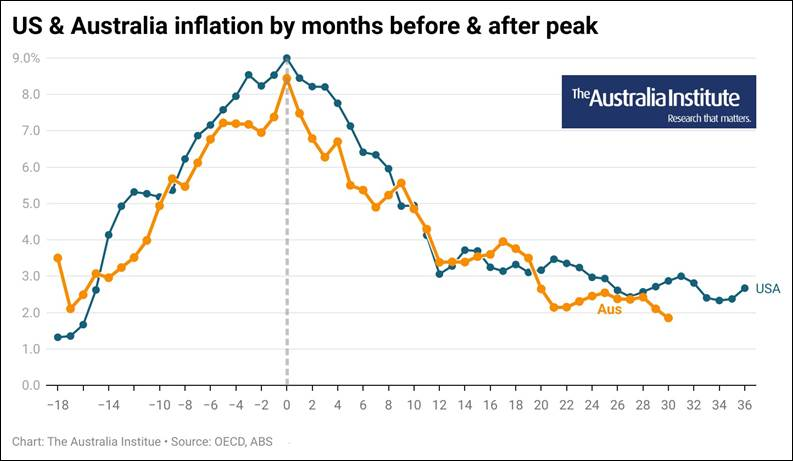
Take the USA. If we use the monthly figures – inflation went up at about the same pace, peak higher, but Australia inflation came down faster! It took 25 months for the US’s inflation to get below 3% after its peak; in Australia it took 20

So maybe Jim should take all the credit he likes…

RBA failing on inflation

Matt Grudnoff
Senior Economist

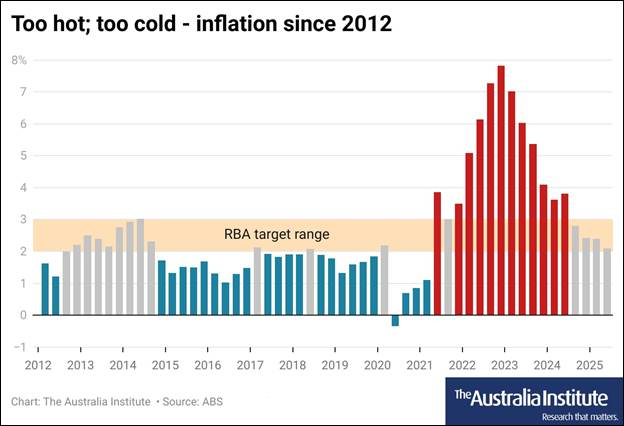
The Reserve Bank of Australia (RBA) has a target to keep headline inflation between 2% and 3%. By any reasonable measure it has completely failed on this over the last decade.

The June quarter released this week shows that inflation has been within the band for the last four consecutive quarters. This is the first time we have seen four consecutive quarters in the RBA target band since 2014.

Since the end of 2014 there have been just eight quarters where inflation has been in the target band and those eight quarters include the four most recent ones. That means just eight of the last 43 quarters have been in the band. How can that be judged as anything but a complete failure?

Most recently the inflation rate has been higher than 3%, but for most of the past decade it has been outside the band because it has been below 2%.

In the 43 quarters since December 2014 inflation has been too high for 12 quarters but too low for 23 quarters.

You might think that inflation is bad and so having inflation below 2% is a good thing. But there is a reason that the RBA inflation target has a lower limit.

Low inflation comes with sluggish economic growth and higher unemployment. The RBA review actually rebuked the RBA for not doing enough to increase inflation in the years before the pandemic. They said that the RBA had kept interest rates too high for too long when inflation was below 2% which resulted in more people being unemployed.

Remember the RBA is not just supposed to keep inflation within the band, they also have an objective to maintain full employment.

Throughout the inflationary spike following the pandemic the RBA has talked tough on getting inflation back to target. He frequently said “The Board remains resolute in its determination to return inflation to target and will do what is necessary to achieve that outcome.”

The fact that inflation spiked and was outside the target band is not the fault of the RBA. This spike in inflation was worldwide and was caused by factors far beyond their control.

But actions speak louder than words and the last 10 years have highlighted that they show a lot of concern when inflation is above the band and too little concern when the inflation is below the band. This means they have not shown enough attention to the employment side of their mandate.

This history is important because there is now a real risk that the RBA will fall back into bad habits. The most recent quarterly inflation data in June 2025 shows inflation has fallen to just 2.1%, the very bottom of the target band. The monthly inflation for June was just 1.9%. It is important to note that the monthly inflation figures are not a complete read on inflation like the quarterly figures.

Despite this the RBA seems more concerned about a sudden outbreak of inflation that might push inflation back up above 3%, than the risk that unemployment might rise. Has the RBA failed to heed the review? Will it allow inflation to fall below 2% and for unemployment to continue to rise?

If the RBA lets inflation fall too low, then people will lose their jobs and those with mortgages will continue to be squeezed. We can’t go back to the failure of the pre-pandemic period.

The new defence housing bill we were speaking about earlier this week and which the Canberra Times reported on last week has drawn the ire of the Greens – and understandably.

The bill opens up defence housing (so public housing) for overseas defence personnel here as part of the Aukus deal. So the government will now build new defence housing for US troops. In the middle of a housing crisis where we are told time and time again the government can not get into the housing market because that is not the role of government anymore.

Yup!

Here is what David Shoebridge had to say on it:

You cannot make this up. The Albanese Government spent the last Parliament attacking the Greens for wanting more public housing, saying this call was unrealistic. Now, in Labor’s first big move in the housing space, it is building public housing not for people doing it rough, but for Trump.

There is no financial impact statement in this Bill, as if there is no cost to building hundreds of homes. It is another secret deal to put Australian public funds into the pockets of the US military, another bottomless pit of money for AUKUS.

What this government is doing by passing this Bill in the first sitting period is sending a clear message that their priority is to keep Donald Trump happy, even if that means building the Mar-a-Lago of Perth paid for by the Australian public.”

Barbara Pocock also weighed in:

The Government’s priorities are clear – US troops are deemed more worthy of public housing than people in Australia desperately needing a roof over their heads.

In our current housing crisis, the Government is choosing to play politics. Labor says it wants to solve the housing crisis but all they’re doing is pandering to US interests.

Labor is proving they can deliver on public housing. So if the Government can provide public housing for US troops, why can’t they do it for vulnerable Australians desperately needing a roof over their head? 

Housing is a human right. The Greens call on Labor to take the housing crisis seriously by delivering public housing for Australians.” 

Time to face the music

Skye Predavec
Anne Kantor Research Fellow

As the Australian National University faces ongoing resistance to its planned across-the-board cuts as part of its “Renew ANU” plan, their rebuttals to criticism are getting increasingly flimsy. 

One of the latest proposals is to merge the School of Music into another school and halt individual lessons.

The ABC is quoting Dean of the College of Arts and Social Sciences, Professor Bronwyn Parry as saying:

“Music is not under threat, we are investing in its future through a revitalised structure and a renewed curriculum that reflects more than two years of planning, research and consultation.”

Anyone who takes a look at what the ANU has planned for music would have difficulty squaring Professor Parry’s statement with reality. The Renew ANU plan to merge the school of music has faced criticism from the Canberra Symphony Orchestra, and prompted students opposed to the move to put on an overnight concert in protest. It’s difficult to see how folding the school of music into another school can be interpreted as “investing in its future”, but this kind of doublespeak is unsurprising from a university that faces an ever-worsening crisis of governance.

While its vice-chancellor rakes in almost a million dollars a year, and its chancellor spends hundreds of thousands on speechwriting and travel, Australia’s national university has taken a slash-and-burn approach to cutting costs. In 2023, the ANU spent around $54 million on consultants, but now staff and students are bearing the costs of dealing with the budget.

The ANU isn’t the only Australian university plagued by financial and governance problems. The higher education sector needs urgent reform, and Australia Institute research shows what the path forward could look like.

The submission “A Higher Purpose” recommended:

  • A focus on education and public research, rather than commercial performance
  • Requiring universities to provide an itemised disclosure report for spending on consultants (as is currently the case in Victoria)
  • Real-time disclosure of conflicts of interest
  • A cap on vice-chancellor salaries and a ban on vice chancellors taking on other paid work
  • Funding increased to 1% of GDP
  • Empowering the Australian Tertiary Education Commission to scrutinise universities whose governance, course quality and health and safety standards are inadequate
  • Amending the establishing acts of universities to ensure the majority of those on governing bodies are democratically elected
  • Requiring the councils or governing bodies of universities to hold public meetings

Staff and students deserve better than endless workshopped statements that aim to hide severe cuts to their university. It’s time for the ANU to fix up its act, and for our university sector to return to its focus on research and education.

ABC releases new statement on Gaza

This has just been sent out by the ABC:

ABC Director, News Justin Stevens: 

The ABC is the only Australian media organisation with a permanent presence in the region and we have repeatedly tried to get reporters back into Gaza. We had reporters in Gaza prior to the 7 October terrorist attack, but since then Israeli authorities have blocked access to international media to operate independently.  

In order to keep Australians fully informed, we rely on a network of freelance journalists and individuals on the ground to tell the story of what they are witnessing. We are deeply concerned about their health and safety.  

According to the Committee to Protect Journalists, at least 186 journalists and media workers, mostly Palestinian, have been killed while gathering evidence of the war inside Gaza since 7 October. That number includes journalists who have done work for the ABC. 

We’re now seeing the effects of food shortages on journalists we work with, which our correspondents have reported on: The hunger crisis inside Gaza will affect the news you see about the war

The ABC calls on Israel to again allow international journalists to report independently from Gaza, to allow all journalists to move in and out of Gaza and to ensure journalists in Gaza are safe.  

AAP

A promising fall in inflation has been heralded by a top Reserve Bank of Australia official, whose dovish comments will reinforce expectations of another rate cut.

The central bank’s deputy governor, Andrew Hauser, said data released by the Australian Bureau of Statistics a day earlier was “very welcome”.

The RBA’s preferred measure of inflation, the trimmed mean, fell from 2.9 per cent to 2.7 per cent in the June quarter.

Mr Hauser said the central bank had been looking for more evidence that inflation was moving sustainably back to the midpoint of its two to three per cent target band.

“And we’ve had another piece of that jigsaw yesterday,” he told an economic forum hosted by investment bank Barrenjoey on Thursday.

The central bank official reiterated the RBA’s strategy of ensuring interest rates brought inflation back to 2.5 per cent sustainably while keeping unemployment low.

“And to do that through a policy that is gradual, considered, measured. There’s lots of words – predictable,” he said.

The RBA stunned analysts by leaving rates on hold in July, with governor Michele Bullock telling a recent event its board preferred a “measured and gradual” approach to easing interest rates.

Money markets and economists widely expect the central bank board to lower the cash rate to 3.6 per cent, from a current 3.85 per cent, at its meeting in August.

Another interest rate cut would be “welcome relief” for mortgage holders, Treasurer Jim Chalmers said.

It reflected the “remarkable progress” Australia had made in cutting inflation in the last three years.

“But it’s never mission accomplished because the global environment is uncertain – we’ve got some persistent structural issues in our economy, growth in our economy is soft, and people are under pressure,” Dr Chalmers told ABC TV.

Opposition frontbencher Michaelia Cash said it was a good thing inflation was falling, but Australians were still doing it tough because prices had grown faster and for longer than elsewhere in the world.

“So Jim, take all the credit you like. But the bad news is you’re the architect of the cost-of-living crisis that Australians live under your government,” she told Nine’s Sunrise program.

In a bid to address structural issues in the economy, Dr Chalmers has convened a roundtable of experts, business and unions to discuss Australia’s productivity woes. They will gather in late August.

Building more homes sooner will be a central focus of the roundtable, the treasurer hopes.

“The primary focus there, I think, at the roundtable will be around how we speed up approvals and get the zoning for housing right, because we desperately need more homes,” he said.

But fault lines have opened up between businesses and unions on issues like the use of artificial intelligence.

Peak union body, the ACTU, has called for tougher regulations to ensure AI does not lead to job losses, while business groups have warned against regulation that could stifle the adoption of the technology.

Independent MP Zali Steggall called for the government to appoint a special envoy for AI and the future of work to drive adoption of the technology while addressing growing public distrust.

“I am concerned it’s going to be unions trying to put a lid on it,” Ms Steggall told AAP.

“Look, I am supportive of guardrails. It has to be done safely, but to suggest that you can put the genie back in the bottle is unrealistic.”

The former Winter Olympian on Thursday launched her economic plan to re-energise the economy while speeding the transition to net zero, by encouraging clean energy investment and reducing the cost of housing.

Representation counts

Skye Predavec
Anne Kantor Research Fellow

Australia has a politician problem: not too many, but too few.

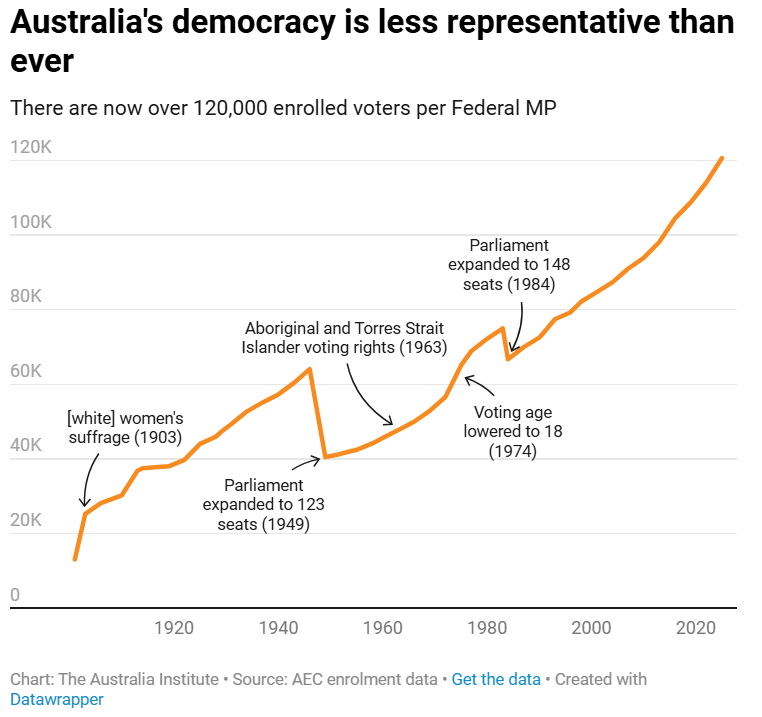
Each of Australia’s 150 members of Parliament (MPs) must split their attention between more constituents than ever before: 120,659 voters per MP, over 6000 more than in 2022.

But while there are nine times as many registered voters today as in 1903 (the first election where women could vote), the number of electorates has only doubled.

Since then, Australia’s population, and voting rights, have expanded significantly: Aboriginal and Torres Strait Islander voting rights took until 1963, and the voting age was lowered from 21 to 18 in 1974.

As the number of voters per MP grows, the access any individual voter will have to their member necessarily decreases – Australia Institute polling research in 2022 found that only 15% of Australians had ever spoken to their local MP (and only 36% knew their name).

The more voters there are in an electorate, the larger a campaign needs to be to make any difference to the result, giving communities less power to kick out an unrepresentative or under-performing MP.

Australia is a lot bigger and more complicated than it was fifty or a hundred years ago. Australia’s first government, headed up by Edmund Barton, had 10 ministers while Albanese’s first ministry had 30 (plus 12 assistant ministers). That leaves fewer backbenchers to do important committee work and means a smaller talent pool from which to choose government ministers.

Expanding the lower house by 50% – to 225 seats – would bring Australia’s representation more in line with comparable democracies, as well as the states and territories.

It’s time for our representative democracy to get a bit more representative.

Greg Jericho

The Fair Work Amendment Bill also included an amendment by the Member for Wentworth, Allegra Spender

Her amendment stated that the following be included (also worth noting she is not seeking to have the bill defeated)

1             (a) Australia has just had the worst decade for productivity in the past 60 years;

(b) boosting productivity is the only way Australia can sustainably increase wages over time;

(c) the Government’s agenda to lift Australia’s productivity is not comprehensive without considering the role of Australia’s industrial relations system; and

(d) in 2023, the Productivity Commission’s report Advancing Prosperity recommended that the Fair Work Act be amended to explicitly include productivity as an objective of modern awards; and

(2)  calls on the Government to amend subsection 134(1) of the Fair Work Act such that Productivity is an objective of modern awards, as per Recommendation 7.13 of the Productivity Commission’s report Advancing Prosperity”—

Now that is all nice a well, but penalty rates don’t actually affect productivity.

Remember that Labour productivity is the amount of output a worker does in the time they do it.

The amount they are paid does not come into it. That might affect profits, but not productivity.

And as former director of the Centre for Future Work, Jim Stanford wrote in his excellent paper on productivity  better wages can actually lead to better productivity.

As Jim writes, “improved compensation can motivate workers to perform better, and also reduces labour turnover (which hurts productivity due to the time and cost of replacing departing workers).” Essentially if you are well paid, you are motivated, if not, you turn up and do a half-arse job (as Homer Simpson would say).

Also if workers are well paid that actually creates and incentive for employers to invest in new and more productive equipment because they need to get as much value as they can out of the workers. With low paid workers, profits are good and companies can actually become lazy and low productive.

So all up – higher wages are good, penalty and overtime rates are fair, and we should not suggest they need to be cut at all to fix productivity.

In news that will shock absolutely no one, the Coalition is not budging on recognising a Palestinian state, even as Australian allies move in that direction because it is now seen as the only way to start a sustained peace process. Which in this case means – an end to the Israeli slaughter of Palestinian civilians in Gaza.

Here was James Paterson this morning at a doorstop:

I don’t, I don’t think the Australian government should recognise a Palestinian state until and unless there has been a successful negotiation of peace between Israel and Palestine as consistent with our long-standing bipartisan position on the resolution of this conflict. We support a two-state solution. We do not support recognising a state which is right now, today, governed in part, by a listed terrorist organisation that is holding 50 hostages, that swears the destruction of the Israeli state, and that’s just Hamas in Gaza.

There are profound problems with the governing authority in the West Bank as well, the Palestinian Authority, which hasn’t held an election for 20 years, which is deeply corrupt, which has paid money to the families of suicide bombers who have blown up Israelis, and which promotes hatred against the State of Israel and the Jewish people, and has not accepted their right to exist. So it is extraordinary that the Australian government would contemplate recognising such a state.

Members of Israel’s leadership are currently wanted by the ICC on allegations of war crimes. And yet that doesn’t seem to enter into Paterson’s concerns here at all.

Weekend work remains the exception

Greg Jericho
Chief Economist

The House is currently debating the government’s “Fair Work Amendments (Protecting Penalty and Overtime Rates) Bill.

The key point of the bill is (as the Explanatory Memorandum relates):

Penalty rates and overtime rates compensate employees for working weekends, public holidays, late nights, early mornings or overtime.

This Bill would uphold and enhance the integrity of the modern awards safety net by:

• ensuring the specified penalty or overtime rates in modern awards cannot be reduced

• closing loopholes in the modern awards safety net that allow employers to ‘roll up’ penalty and overtime rates into a single pay rate, that do not fairly compensate award-reliant employees for the penalty rates and overtime they would have otherwise received.

Now opponents of the bill (employers) hate penalty rates because they have to pay staff more for working on the weekends or public holidays. Their argument is that penalty rates are a relic of the old days when shops were shut on Sundays and after noon on Saturdays and now working on the weekends is common.

And we, yes… it is common, but most of us still don’t do it.

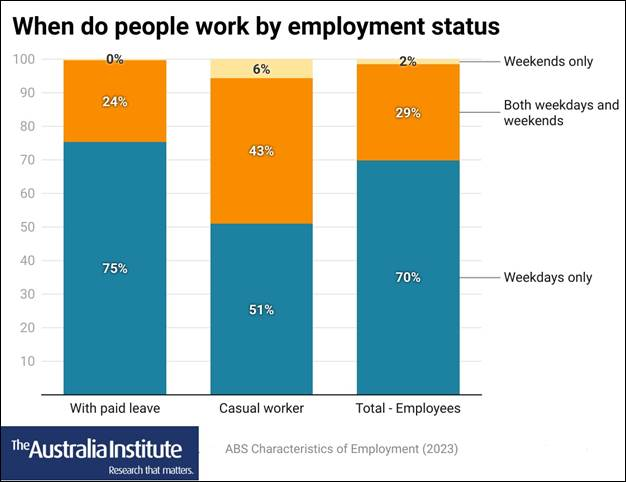
The latest ABS survey of when people worked was in 2023 and it found that 75% with a job with leave entitlements (ie either ongoing or a contract) ONLY worked Monday-Friday.

Casual workers are much more likely to work on the weekends, but even there only 6% worked only on the weekend.

This is why weekend work should get penalty raters – it remains the exception. And sure Monday-Friday workers like me might like that the shops and cafes are open on Sundays, but as someone who did his stint in hospitality working night shifts, every public holiday etc, the people serving you are not doing it for fun – they too would love to be able to have the weekend off because that is when kids sport is on, most other activities are scheduled for the weekend – even things as obvious as the Hottest 100 last Saturday, There’s a reason they didn’t do that on a Thursday.

Asked how co-operation was going when it came to the childcare bill Jason Clare said:

I want to thank the Coalition. I want to thank Sussan Ley. Yeah, this is a different Parliament and a different Opposition Leader. Australians, I think, want us to work together on the big things that matter to help Australians. And particularly on the child care matter where it could have been very different. The decision of Sussan and Jono [Duniam], the Shadow Minister, to work constructively with us, I take my hat off to them. This is what Australians want of us. This is what they expect of us. To be honest, it’s what they should demand of us. And the fact we can work together on these big and important things is a good thing. We’re here to represent our community and to make Australia a better and a fairer place and to make our child care centres safer. That’s what we’re doing this.

Jason Clare is also hopeful the bill to cut funding to child care centres that don’t meet national safety standards will also pass the senate today

Clare:

I’ve directed my department to be ready to act swiftly when that legislation passes and receives royal assent.

Is it the only thing we need to do? No. Not by a long shot.

This is the start. Not the finish.

The truth is, there is no end to the work that we need to do, the Commonwealth Government and state governments, to help to make sure that our children are safe in early education and care. There is a mountain of work to do to rebuild the trust and the confidence in the system that parents need to have confidence in.

The Attorney-General spoke about this earlier this week, talked about the hotchpotch of different Working with Children Check systems in different states and territories, and said this would be the first item on the agenda when attorney-generals meet in just over two weeks’ time. And I’ve also spoken about the need for a system to track workers from centre to centre and from state to state, a National Educator Register.

That’s something ministers have agreed to and our departments are working on right now. But not just that. Also having mandatory child safety training, so that the fantastic people who work in our centres, who are just as gutted and angry and upset by the revelations out of Victoria and other parts of the country as everybody else is, have the sort of skills and information they need to be able to identify somebody who might be up to no good in clear sight, working in their centres. They’re the best asset that we’ve got here, and Queensland is doing some work on what that training might look like.

They’ll be in a position to take that to the meeting of education ministers when we meet next month.

It’s just an example of the fact that this legislation, whilst it’s important, is not everything, it’s the start, not the end.

The Greens want the government to now turn to scraping the Morrison-era job-ready graduate program, which has been a spectacular failure, but also raised the cost of arts degrees to over $50,000.

Mehreen Faruqi:

Labor’s one-off 7.9% student debt cut won’t make a dent when students are graduating with $50,000 arts degrees and debts that grow every year and take a lifetime to pay off. 

The Greens want to deliver long-lasting student debt relief, so we invite the Albanese government to work with the Greens in the Senate rather than choose the lazy, uninspired path of tinkering around the edges with the help of the Coalition. 

The Greens are ready to work with Labor. The Albanese Government should show some ambition and work with us to wipe all student debt and make TAFE and uni free again, like it was for the Prime Minister.

At the bare minimum, Labor should work with us to undo Morrison’s disastrous fee hikes and end indexation, which keeps people on the hamster wheel of trying to keep up with ever swelling debts.

Labor should have dumped Morrison’s job-ready graduates fee hikes the second they came into power. The scheme is a cruel, punitive mess that does nothing except punish students with high fees.” 

Jason Clare was celebrating:

We promised it and we’ve delivered. This will cut the debt of millions of Aussies by thousands of dollars. The average HECS debt today is about 27 grand.

This will cut that debt by about $5,500. That’s a lot of money, and that’s a lot of help for a lot of Australians. It will help take a weight off their back. In particular, a lot of young Australians. Young Australians don’t always see something for them on the ballot paper, but they did this year and they voted for it in their millions.

And we’re repaying now the trust that these young Australians have placed in us. The next step is for the tax office to do the work they need to do. Now that the bill has passed, they’ve got the certainty they need to make the changes to their systems to pass this on to 3 million Australians. That will take a bit of time.

They’ve got to write about 50,000 lines of code to implement this and make sure that they get it right. But this is now going to happen. It’s guaranteed.

And it will be backdated to 1 June this year, before indexation happened. We’re doing that for a reason – to make sure that we honour the promise we made to the Australian people in full, that we would cut their student debt by 20%.

HECS debt cut legislation first bill to pass the parliament

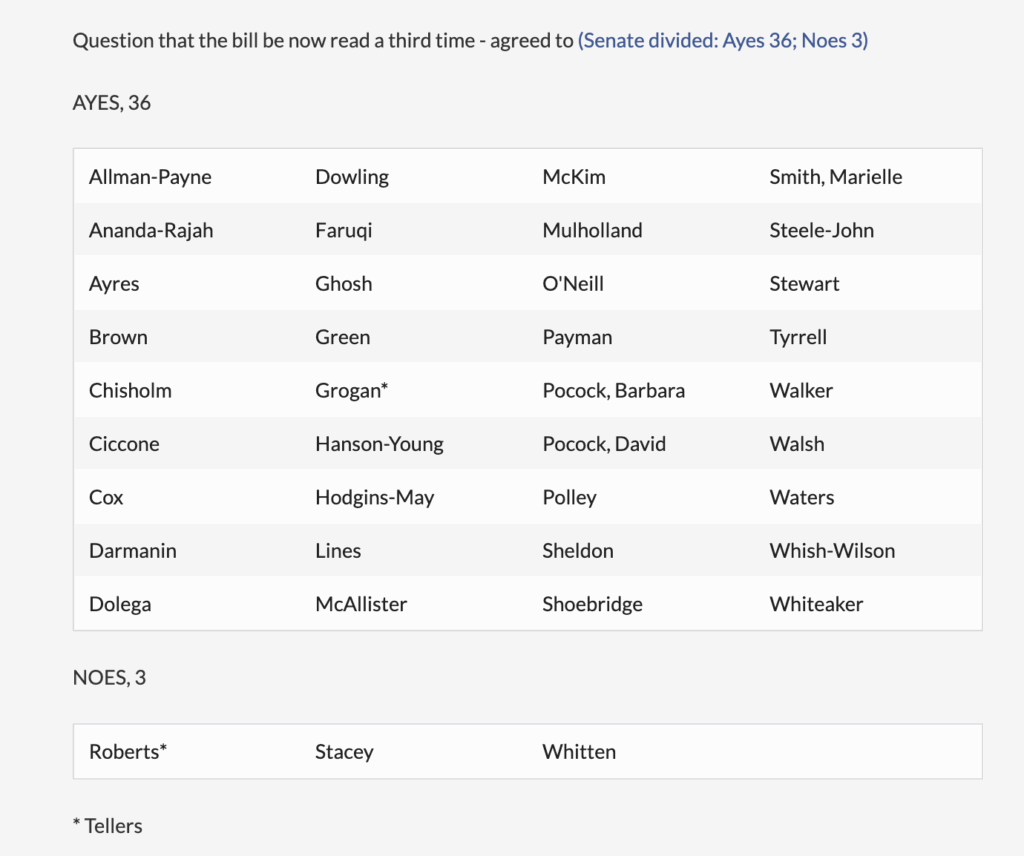
The HECS/Help legislation has passed through the senate with no amendments. The Greens and independents voted for it, the Coalition abstained and One Nation voted against it.

One of the big challenges the government will have to face this term is how to regulate AI.

Scott Farquhar, who co-founded Atlassian and is a member of the Tech Council delivered an address to the National Press Club yesterday which was basically – AI is coming, let it do good. Which seems to ignore the fact that AI has been created by humans, and more than that – Silicon Valley humans – who are not known for their love of humanity. Especially lately. And with just a few tech billionaires in control, the potential for harm – to humanity, the environment, creativity, you name it – is high.

Jim Chalmers told the Seven Network this morning he thinks it is a balancing act:

I think there’s a whole range of views about artificial intelligence. I’m optimistic that it will be transformational in a good way in our economy but only if we manage the risks right.

And so our government is doing a heap of work, including with Scott Farquhar and others who will be part of our Economic Reform Roundtable, to make sure that we maximise the opportunities of AI at the same time as we manage the risks.

The risks can be substantial in our labour market and more broadly as well. We need to manage those. But overwhelmingly, I think AI will be transformational in our economy and in our society, and we need to make it work for us, not against us

Andrew Leigh held a quick doorstop this morning (very quick press conference) where he was sent out to give the latest lines on the productivity round table:

Productivity is not a switch we can flip, but we know that there’s a serious to- do list: competition reforms, clean energy, investing in education, getting infrastructure right. All of those topics and more will be part of the discussion in the Cabinet rooms.

And in the lead-up to that discussion, I’ll be part of a range of roundtables which are looking at particular sectors, including the charity sector. This is vital as we work together to find the solutions to Australia’s productivity challenges.

Building on the work of the last term, the historic merger reforms, national competition policy, setting Net Zero targets and investing in education through measures such as free TAFE.

The Albanese Government has looked to tackle inflation while keeping unemployment low. And now, we’re looking to tackle productivity while ensuring that we have the gains from growth equitably shared across the population

Grog’s view

Greg Jericho
Chief Economist

My weekly column in the Guardian covers all the inflation figures.

And while obviously you should go read it all, here’s the tl;dr version

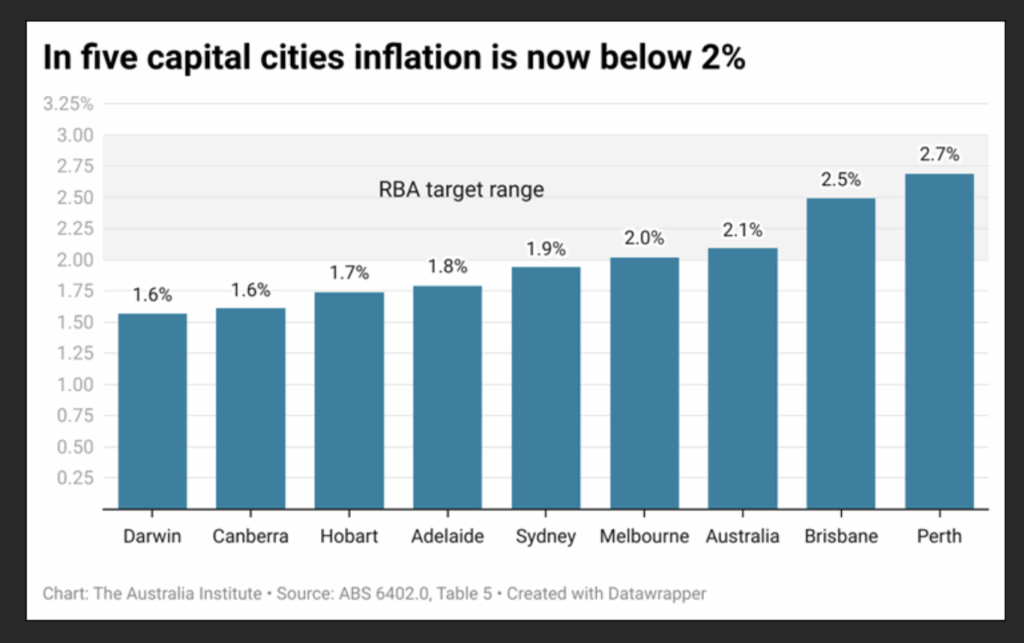
The RBA targets inflation between 2% and 3%, and Australia’s inflation in the year to June was just 2.1%.

So clearly that is low – well below even the mid-point that the RBA also says it “aims for”. But the big problem is even that overstates what is going on.

In FIVE of Australia’s capital cities inflation was BELOW 2%. In Melbourne it was exactly 2%:

The only two places where inflation was above 2% were Brisbane and Perth.

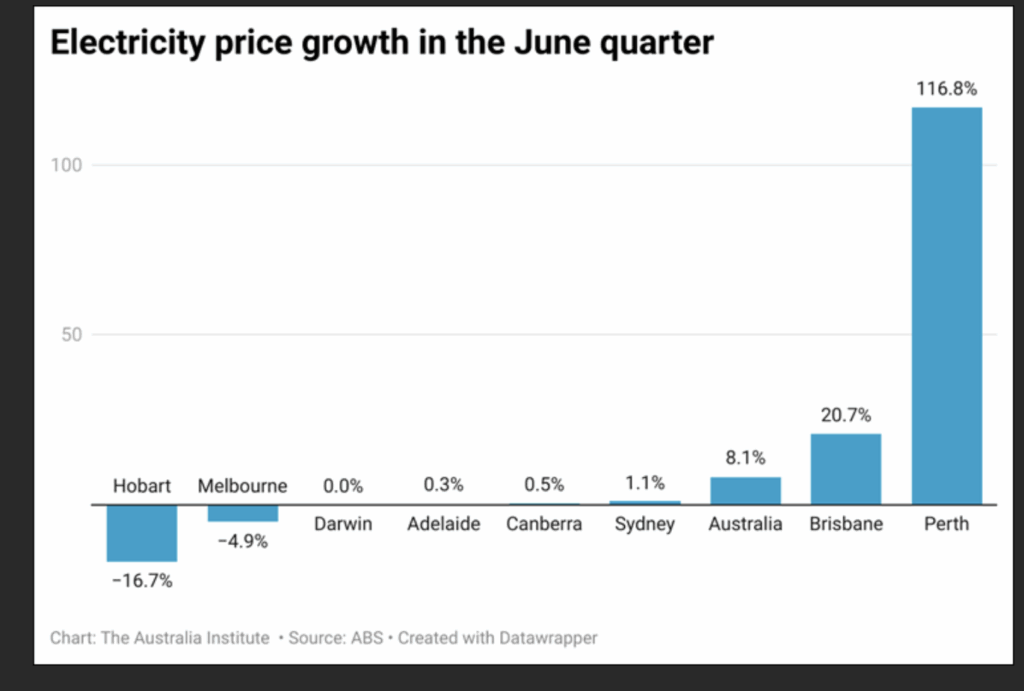
But the only reason they were that “high” was because their state-based energy rebates ended so electricity prices jumped abnormally.

In Brisbane electricity prices accounted for 37% of all the inflation in the June quarter, in Perth they made up 66%. Were it not for the end of those rebates, their inflation would have been much lower, and Australia’s CPI would have been below 2%.

And yet, 3 weeks ago the RBA decided they were still a bit unsure of whether or not inflation was under control and so did not cut rates.

Cripes.

Anyway, lots more graphs over at Guardian so go have a read and impress your friends with how much you know about the CPI!

Emma Shortis has been speaking extensively on this – that the US may have elections in 2026, but the gerrymandering means the votes will not mean as much. As a Queenslander, I know exactly how this works. People think the Joh Bjelke-Petersen government was wildly popular the whole time it was in government because of how many seats it held. It wasn’t. In 1972, Joh received just 20% of the vote, and the Liberal party just 22% of the vote – while Labor won 46% of the vote – but the Bjelkemander gave the Coalition 47 seats to Labor’s 33. That only continued to get worse as Joh kept remapping the boundaries to ensure his support.

The Republicans are no stranger to gerrymandering. The Trumpmander is going to make everything so much worse.

We should be very, very grateful for our independent electoral authority.

Trump’s Texas gerrymander would give Republicans nearly 80% of seats in state where he got 56% of vote This is direct result of John Roberts & conservative SCOTUS majority gutting Voting Rights Act & refusing to stop blatant partisan gerrymandering www.motherjones.com/politics/202…

Ari Berman (@ariberman.bsky.social) 2025-07-30T19:18:43.292Z

What does recognition of a Palestinian state mean in practice?

The move is largely symbolic – and it is not going to do anything to end the slaughter of Palestinians or ensure the basics of life are suddenly available in Gaza, or that Israel change any of its policies in regards to Palestine or Palestinians.

But there are some small changes that come with statehood.

One is better diplomatic representation. Instead of being an occupied territory, or having Palestinian ‘missions’ around the globe, countries can formalise their diplomatic relations with Palestine, with the nation able to open embassies. That goes two ways – nations could open embassies in Palestine (most likely the West Bank) and have a diplomatic presence that is separate to the Israeli presence.

It could also lead to countries reviewing their trade/agreements with Israel, again most likely with the settler colonies in the West Bank, where Israeli’s have forcibly displaced Palestinians from their home and land, with the backing of the Israeli government.

But until the UN Security Council says yes, Palestine won’t be granted full member status of the UN. And it’s consistently been the United States, mostly under the Biden administration, but continued under the Trump administration, which has vetoed the vote, even when their has been a majority.

Canadian prime minister Mark Carney has released his government’s official statement on recognising Palestine at the September meeting of the UN general assembly.

Canada has long been committed to a two-state solution — an independent, viable, and sovereign Palestinian state living side by side with the State of Israel in peace and security. My statement on Canada’s recognition of a Palestinian state:

Mark Carney (@mark-carney.bsky.social) 2025-07-30T22:21:24.947Z

The read out (the official minutes from an official phone call between leaders) between Anthony Albanese and UK Labour premier Keir Starmer has been released:

Overnight Prime Minister Albanese spoke to the Prime Minister of the United Kingdom Keir Starmer to discuss the situation in Gaza.

Prime Minister Albanese updated Prime Minister Starmer on Australia’s aid contribution and commitment to continue increasing aid to Gazans. He reiterated Australia’s long standing and strong support for a two state solution.

Prime Minister Starmer laid out the UK’s framework for taking forward recognition of Palestine as a driver for peace and the latest on the UK’s involvement in delivering aid.

The leaders agreed on the importance of using the international momentum to secure a ceasefire, the release of all hostages and the acceleration of aid, as well as ensuring Hamas did not play a role in a future state.

The leaders also discussed AUKUS and welcomed the progress being made by all partners on the program.

Both looked forward to speaking again soon at the earliest opportunity.

FYI NSW Labor premier – peaceful assembly is a democratic right. Even when it’s ‘inconvenient’

You may have seen Bill Browne’s post yesterday on Australia’s history of protest – you can find it by following his bluesky link if you missed it.

Australia has a proud tradition of disruptive protests — for @australiainstitute.org.au I look at eight protest movements that were controversial in their day but celebrated now. australiainstitute.org.au/post/the-pro…

Bill Browne (@browne90.bsky.social) 2025-07-30T00:56:31.841Z

Today, 47 organisations, including Human Rights Watch, have written an open letter to NSW Labor premier Chris Minns about his intervention in the Palestine Action Group’s planned March for Humanity protest across the Sydney Harbour Bridge. Minns opposition to the protest has caused dissent even among his own ranks, with NSW Labor MPs pointing out it his not his decision to make.

The letter released to the premier today, is below:

Dear Premier,

We write concerning your stated opposition to Palestine Action Group’s planned protest “March for Humanity” across the Sydney Harbour Bridge, calling for greater action by the Australian government in the face of Israel’s blockade and starvation crisis in Gaza. We strongly urge you to reconsider opposing the march and instead work with assembly organisers to facilitate the exercise of the democratic right of protest under the protections in the Summary Offences Act and in line with the government’s international human rights obligations.

Article 21 of the International Covenant on Civil and Political Rights (ICCPR), to which Australia is a party, requires all state parties to guarantee and respect the right to peaceful assembly and to create an enabling environment within their jurisdictions for the exercise and enjoyment of that right. Governments and their agencies are required to protect all forms of peaceful protest regardless of where protest happens or what form it takes. These protections are owed to all people and must be provided to everyone free from discrimination of any kind. Australia has an obligation to comply with international human rights treaties to which it is party and to realise these principles in legislation.

Over 150 community organisations, including the Australian Council of Social Service, Community Legal Centres NSW, Australian Services Union NSW ACT, and NSW Council for Civil Liberties, have called for Australian governments to respect these fundamental protest rights through the Declaration of our Right to Protest.

Per the United Nations Human Rights Committee (UNHRC) in a general comment, restrictions on peaceful assembly must be “necessary and proportionate in the context of a society based on democracy, the rule of law, political pluralism and human rights, as opposed to them being merely reasonable or expedient.” The government’s opposition to the Palestine Action Group’s proposed rally, with the Premier stating “the NSW government cannot support a protest of this scale and nature taking place on the Sydney Harbour Bridge”, does not appear to be necessary and proportionate.

The Sydney Harbour Bridge has a rich history of democratic community action, including the 2000 Walk for Reconciliation and the 2023 World Pride march. Government agencies have previously facilitated the shutdown of the Sydney Harbour Bridge for other community and industry purposes, including a half-day closure for the filming of The Fall Guy in January 2023 and a seven-hour closure for the World Pride march. Both of these closures covered peak hour commuting times, requiring the diversion of significant traffic, while the proposed rally on Sunday takes place in the middle of the day during a significantly shorter time period. The organisers have also offered to hold the rally at a later date to allow for traffic planning.

Seeking to shut down this rally would be a serious departure from the NSW State and Police’s responsibility to uphold the democratic right of protest. We urge your government to facilitate the exercise of democratic freedoms in collaboration with community groups and support the holding of this protest.

“The New South Wales authorities have an obligation to uphold the right to peaceful assembly,” said Annabel Hennessy, Australia researcher at Human Rights Watch. “International law recognizes that protests by their nature may cause some disruption to ordinary life, but authorities need to accommodate them unless they impose a disproportionate burden.”

Catherine Liddle, CEO of SNAICC – National Voice for our Children, said the latest Closing the Gap results ‘point to a lack of government follow-through, not a lack of solutions’.

The update makes it clear that these results are not the failings of our children, families or communities.  They are the failings of governments who continue to fall short on their obligations under the National Agreement on Closing the Gap,” Liddle said.

Early childhood education and care is a foundational building block for lifelong outcomes but we’re seeing a decline in children being developmentally on track which tells us that access alone isn’t enough.

The update shows that when governments work in true partnership with Aboriginal and Torres Strait Islander communities, we see real change. Progress in areas like land rights and employment shows what’s possible when communities are empowered and governments step up.

These improvements haven’t happened by chance but have been driven through governments working directly with our communities and backing Aboriginal-led solutions.”

Here is some more about the latest Closing the Gap report from the Productivity Commission:


The 2025 report shows several areas of progress:

  • 94.2% of Aboriginal and Torres Strait Islander children were enrolled in preschool in 2024 – up from just 61.3% in 2016
  • Employment rates for Aboriginal and Torres Strait Islander people aged 15–64 rose to 55.7%, up from 51% in 2016
  • Land and sea rights continue to grow, with more than 4.3 million square kilometres now subject to recognised Indigenous rights and interests

See the Productivity Commission’s latest annual Closing the Gap data report

Pat Turner AM, the Lead Convenor of the Coalition of Peaks, which represents Aboriginal community-controlled organisations, said the results show that ‘when Aboriginal community-controlled organisations are treated as partners and properly resourced, they deliver real results’.

Governments need to stop, take stock, and change their approach,” Turner said.
We now have two independent reports telling us the same thing: where our organisations lead and are properly supported, we see progress.

But when governments fail to meet their commitments, the gap doesn’t just remain, it widens.

Turner said no one was asking for special treatment – just for it to be equitable.

What’s important for Australians to understand is that Aboriginal community-controlled organisations are not fringe services.

They are trusted, place-based service providers — just like any other government-funded organisations — but designed by and for our people. They succeed because they are grounded in culture, local knowledge and accountability to our communities.

We’re not asking for special treatment. We’re asking for a fair share. When we get that, we deliver.”

The parliament will sit at 9am today. The order of business has been published for the House and the Senate which you can find at those links.

Australians want to kick political parties out of postal voting – poll

Glenn Connley

Australians overwhelmingly want to keep political parties out of the postal voting process, according to new polling conducted for The Australia Institute. 

Currently, political parties are allowed to send postal vote application forms bundled with information about a candidate. The forms are then returned to the political party, which forwards them to the Australian Electoral Commission.

The new poll has found that a vast majority of Australians would rather voters send their voting paper directly to the AEC. 

Key findings:  

  • Three in four Australians (75%) support requiring postal vote applications to be sent directly to the Australian Electoral Commission.  
  • A majority of voters across all voting intentions support requiring postal vote applications to be sent directly to the Australian Electoral Commission.  
  • The Australian Electoral Commission has to warn Australians to “think twice” before filling in postal vote applications from political parties
  • The multi-party Joint Standing Committee on Electoral Matters has recommended stopping this practice by:
    • banning postal vote forms from being bundled with other material and 
    • requiring that forms go straight to the AEC, not routed through a political party’s headquarters. 

“Political parties have inserted themselves into the postal voting process, circulating materials that appear official but actually harvest the person’s information for the party,” said Bill Browne, Director of the Australia Institute’s Democracy & Accountability Program.  

“Australia has one of the best electoral systems in the world, but it depends on trust in the integrity of the electoral process. When voters receive seemingly official postal vote forms bundled with party-political material, it risks confusion and distrust. 

“Political parties’ involvement in the postal vote process is the number one source of complaints during election campaigns, according to the Australian Electoral Commission. The Electoral Commission has warned Australians to ‘think twice’ before filling in these forms. 

“The Parliament should follow the recommendations of the multi-party Electoral Matters Committee and remove political party involvement in the postal vote process.”   

Canada to recognise Palestine as a state

Canadian prime minister Mark Carney has just announced that Canada will move to recognising Palestine as a state as he does not believe a negotiated settlement as part of a peace process is possible.

The deepening suffering of civilians leaves no room for delay – [what is needed is a] coordinated international action to support peace, security and the dignity of human life. Preserving a two-state solution means standing with all people who choose peace over violence or terrorism, it means honouring their innate desire for peaceful coexistence, peace coexistence of Israeli and Palestinian states as the only roadmap for a secure and prosperous long-term future.

ABC News Breakfast has had a little side conversation going on about theme music this morning – the best theme songs accompanying art, movies etc.

Chalmers is asked about his and you know he wants to say something US hip hop. But this week, politically, is about AUSTRALIAN music, given the Hottest 100 Australian songs Triple J played on the weekend and also, Chalmers is a Queenslander.

So there are only two right answers. He gets one of them:

.

I think the best theme song now that you put me on the spot, I think the best theme song I can remember is when Powderfinger, These Days kicks in during that wonderful Australian movie Two Hands. I think These Days by Powderfinger came in number 14 on the weekend in the triple j Hottest 100 Australian songs. Like everyone who loves Powderfinger, I think that should have been higher, but that’s an amazing theme song and incredible movie, Two Hands it is, Heath Ledger, Brian Brown, all wonderful Australian actors and a wonderful song by an Australian group, Powderfinger.

The other right answer is Untouched by the Veronicas. FIGHT ME.

On Trump’s tariffs and the threat of more for Australia, Jim Chalmers says:

We haven’t heard different from the 10% baseline that’s been levied on Australia.

Obviously, we continue to engage with the Americans on this. It’s one of the main issued playing out in the global economy. It’s a major source of uncertainty in the economy whether it’s what’s been said overnight about India, whether it’s the back and forth between the US and China, or the tariffs levied directly on Australia.

We have got the baseline rate as far as we are aware and as we understand it which is 10%.

)That’s diplomatic speak for – have you see how the US keep moving the goal posts with the other countries he is ‘negotiating’ with? Do you see how it means nothing?)

Q: Does the government expect that to move?

Chalmers:

Well, I think it would be a brave person to assume that there won’t be – whether it’s with other countries or – there will always be more announcements about this. These tariff announcements are a moving feast. But our expectation is we get the baseline. We think that the best outcome is zero because these tariffs are an act of economic self-harm. We see inflation is going up in the US. Earlier in the year they had slowing growth, interest rates on hold again in the US overnight. They have got higher interest rates than we do in Australia. So we think these tariffs are bad for the American economy, certainly bad for the global economy. We’re better placed and better prepared than most countries to deal with that but we won’t be immune. We’ll continue to engage with the Americans on it.

This interview is racing through topics. Next, the treasurer is asked if Australia could recognise a Palestinian state in September when the UN meeting is held. Chalmers says:

I don’t want to put a time frame on it. It’s been a longstanding bipartisan policy that we see a two-state solution in that part of the Middle East. From my point of view, that progress that has been made, that momentum that we are seeing in the international community is welcome but it’s also conditional. T

here are a number of obstacles still in the way to recognition of a Palestinian state. For example, the treatment, the release, of the hostages, making sure that there’s absolutely no role for Hamas. These are the sorts of things that the international community is working through.

But that statement that came out yesterday that we signed as Australians via our Foreign Minister, Penny Wong, is a really important one. It condemns the terrorist act on 7 October. It demands a ceasefire, the release of hostages, and access for humanitarian aid and it encourages countries to work towards recognition as a really important part of that two-state solution. The reason we want to see it a two-state solution is because Israeli families and Palestinian families need and deserve to be able to raise their kids in peace and that’s what this is all about.

On the Closing the Gap targets, the treasurer says:

We need to do much better. I think from memory, 10 of the 15 measures we have seen a little bit of progress in the report released overnight. Some have gone backwards in worrying ways. I think every member of the government, I think many Australians, would acknowledge that we need to do better and the reason why these reports are so important is because they make sure that we keep governments and the community more broadly up to the mark. With eneed to do better when it comes to closing the gap. Minister Malarndirri McCarthy is working in her characteristically diligent way with all of the stakeholders, all of the communities to try to turn these numbers around. There has been progress in 10 of the 15. There has been some worrying outcomes in the rest, but overall, we need to do more and we need to do better.

Housing to be the primary focus of the productivity round table

Moving on to the productivity round table in a couple of weeks – is Jim Chalmers looking at changing the capital gains tax discount?

That’s not why we have put this economic reform round-table together. It’s all about making our economy more resilient and more productive and our budget more sustainable. I expect and I hope that building more homes is one of the central considerations of the economic reform round-table.

I have been working very closely with Minister Clare O’Neil, with a number of people who will be at the round-table and with a whole range of people around the country. We have all got an interest in building more homes sooner.

That’s the Government’s priority.

The primary focus there I think at the round-table will be around how we speed up approvals and get the zoning for housing right because we desperately need more homes. The Commonwealth government has come to the table with tens of billions of dollars in investment. Our political opponents want to cut funding for housing but overwhelmingly, people want to see where there’s common ground to build more homes and that will be the focus

Rate cut? Oh I couldn’t possibly comment

After yesterday’s inflation figures, everyone has turned a sharper eye to the reserve bank and its decision to hold rates, which on economic indicators seemed like the wrong decision then and after the latest inflation figures, well, seems even more wrong.

Jim Chalmers isn’t going to say that out loud – as the Treasurer there is that whole thing about government interference with an independent body – but he is making his view clear regardless. He told ABC News Breakfast this morning:

I’m not going to pre-empt decisions that the Reserve Bank takes independently. I think rate relief is welcome, certainly when interest rates were cut twice already this year, that provided some very, very welcome rate relief for millions of Australians with a mortgage.

So that’s how we see it.

But I don’t want to make predictions or pre-empt the decisions that the Reserve Bank will take. What yesterday’s numbers showed when it comes to those inflation numbers is really quite remarkable progress. The progress that Australians have made together over the course of the last three years on inflation has been outstanding because we have been able to get inflation down at the same time as we keep unemployment low, we have got real wages growing again, but it’s never mission accomplished because the global environment is uncertain. We have got some persistent structural issues in our economy growth, our economy is soft and people are under pressure. That’s why the primary goal, the main priority of the first two weeks of the Parliament sitting, has been to roll out more cost of living help.

The Northern Territory CLP government has said it wants to reintroduce spit hoods to youth detention centres, eight years after they were banned. The hoods have been associated with deaths in custody, and their banning was recommended by a 2017 royal commission. The use of the hoods, which can be used on children as young as 10, also go against Australia’s human rights obligations.

You can read more on advocate and expert warnings, here

Child and forensic psychiatrist, associate professor John Kasinathan told the ABC the hoods were like torture for those who have been forced to wear them:

Anyone that’s spoken to a young person that’s had one of these spit hoods on – they will tell you – and I have spoken to young people that have had this experience – and it is horrible. They can’t see anything. It gets into their mouth, into their nose. They find it difficult to breathe – some of them actually – it can trigger an asthma attack – and it’s incredibly harmful.

…it’s really dangerous. That’s why it’s been banned and, as per the United Nations’ guidance on these instruments, a person would need to be restrained quite significantly for a hood to be put on. If someone came up to you or me and wanted to put a hood on, you know, your head or my head, I would protest, and I’m sure you would too.

And our audience needs to really have some empathy for the young people that are in this situation.

The young people that were subjected to spit hoods in the Northern Territory previously were often restrained in restraint chairs, which are, again, inhumane and considered a form of torture. If the government was really serious about protecting youth justice staff and workers from people spitting at them, the most sensible way to manage that is by making sure your staff are wearing protective gear, which can include gloves, gowns, and a face mask with a visor that protects from spitting. That is a far more effective way of dealing with young people potentially spitting.

One of the fears after the Voice referendum was that Indigenous people and organisations would find it even harder to work with government to address issues impacting their community – given that story there and what Aboriginal and Torres Strait Islander people have been saying since the referendum campaign, their fears were well founded (and of course they were).

One of the things Indigenous leaders have made clear, at least to me, is that since the Voice referendum, there has been a real ‘hands off’ approach from the Labor government, which has made their job harder.

The Closing the Gap targets that are seeing improvement are areas where there is a lot of Indigenous leadership, working with community, instead of imposing on top of it. That is what the Voice was meant to do on a much more national scale – give First Nations people input on the legislation and programs which impact their community. Just input and advice.

The loss of the referendum didn’t just create a status quo situation. It’s made it even harder for Indigenous leaders and groups to be heard.

Closing the gaps targets worsen

AAP

Without changing the approach to Closing the Gap, Aboriginal and Torres Strait Islander people will continue to “pay the price”, Indigenous organisations say. 

Just four of the 19 Closing the Gap targets are on track to be met, according to the latest data from the Productivity Commission. 

But key targets, including adult imprisonment rates, children in out-of-home care, suicide and childhood development are continuing to worsen.

While there have been improvements in Year 12 attainment, tertiary education and housing access, these are not on track to meet deadlines.

“It’s not enough to hope the gap will close, governments must hold themselves to account for the commitments they’ve made under the National Agreement,” Coalition of Peaks lead convener Pat Turner said.

“That requires smart investment, longer-term flexible funding, and full implementation of the four Priority Reforms – shifting power, not just policy

“Without real power shift, we’ll keep seeing the same patterns repeat, and our people will continue to pay the price.”

Queensland Aboriginal and Islander Health Council chief executive Paula Arnol said the latest Closing the Gap report card is disappointing. 

“It’s 2025 and Aboriginal and Torres Strait Islander people are still not experiencing the health outcomes that non-Indigenous Australians enjoy. This is unacceptable,” she said.

The data follows a recent review of the Closing the Gap Agreement, commissioned by the Coalition of Peaks. 

The review found Indigenous community-controlled organisations are key to progress, and governments must listen to First Nations people and share decision-making power to create positive change. 

Productivity commissioner Selwyn Button said the review shows the outcomes of the agreement are falling well short of what governments have committed to. 

“What the outcomes in the Agreement reflect most of all is the limited progress of governments in collectively acting on the Priority Reforms: sharing decision making and data with communities; strengthening the Aboriginal Community Controlled sector and changing the way governments operate,” he said.

Ms Turner said improvements in early education enrolments, employment and land and sea rights show what’s possible when government partner with Indigenous organisations “in the right way”.

But she said, when governments fail to meet their commitments to work with community-controlled organisations, the gap widens. 

“What’s important for Australians to understand is that Aboriginal community-controlled organisations are not fringe services,” Ms Turner said.

“We’re not asking for special treatment. We’re asking for a fair share. When we get that, we deliver.”

13YARN 13 92 76

Lifeline 13 11 14

1800 RESPECT (1800 737 732)

Men’s Referral Service 1300 766 491

AAP

Some of the most popular vehicles in Australia are consuming significantly more petrol than advertised, tests have shown, and hybrid cars rank amongst the most unexpectedly thirsty models. 

Twenty-five of 30 vehicles tested on Australian roads failed to meet their laboratory test results, and 11 of the cars consumed 10 per cent or more fuel than expected. 

The Australian Automobile Association revealed the findings in its latest round of on-road vehicle testing, which also found six models produced more noxious emissions than allowed in Australia. 

The results come amid a greater focus on vehicle emissions, following the introduction of the New Vehicle Efficiency Standard in 2025 and after rising sales of hybrid cars. 

The association tested a wide range of vehicles in the latest round of its $14 million Real-World Testing Program, ranging from large SUVs and vans to small cars, a ute and people-mover. 

The vehicles are tested on a 93km route around Geelong in Victoria, with tailpipe emissions captured on urban streets, rural roads and motorways and compared to lab test results. 

Surprisingly, a small SUV registered the greatest gap in fuel consumption during recent tests, with the Hyundai Kona Hybrid using 33 per cent more fuel on the road than in the lab. 

Another small SUV, the Kia Stonic, used 26 per cent more fuel than expected, followed by the Hyundai i30 Hybrid (17 per cent), the Toyota Fortuner (16 per cent), and the Kia Sportage Hybrid (14 per cent). 

Findings that one-third of the vehicles consumed more fuel on the road than in the lab indicated a widespread issue in the automotive industry, association managing director Michael Bradley said.

“It’s becoming clear that carmakers continue to optimise their vehicles’ performance for lab testing, meaning new cars are too often overstating their improvements in fuel use and environmental performance,” he said. 

“Some vehicles perform as advertised but most do not, and our program is seeking to reward carmakers that deliver genuine financial and environmental savings.”

In addition to fuel consumption, six of the 30 vehicles tested produced more noxious emissions than allowed under the Australian standard, including the Ford Ranger ute, Toyota Hi-Ace, and Toyota Fortuner. 

Five vehicles did buck the trend and use less fuel than expected, however, such as the Ford Transit van (nine per cent less), Lexus NX350h SUV (seven per cent less), and Mercedes-Benz GLC250 SUV (three per cent less). 

The program, funded by the federal government, has examined emissions from 114 vehicles since 2023 and found 88 models failed to meet their promised fuel consumption. 

The association will expand its tests to electric vehicles shortly, Mr Bradley said, and compare their on-road range to what consumers are promised. 

“Range anxiety continues to be a significant barrier to EV uptake,” he said. 

Greens senator Mehreen Faruqi said there was a legal obligation to prevent genocide and Labor couldn’t rely on words alone:

Words won’t feed people, but with this motion, Labor’s hand will be forced to implement sanctions. The parliament’s support for this Greens motion puts it on the record that Israel is breaching international law and that the Australian Government must act. 

There is a legal obligation to prevent genocide, and from today’s vote, Labor can no longer pretend that they did not know.

This is a direct result of community and Greens pressure. For almost two years, voices for peace including the Greens have been attacked and maligned by the Government but today is vindication that they are starting to open their eyes to stopping the genocide and the forced starvation of Palestinians.

Finally, Parliament is starting to pressure Israel to stop its genocide. After 21 months, Parliament is finding its heart, but Labor’s courage on sanctions is still missing. 

This is just a start. The Greens will continue to hold the Government to account to ensure that their support for this motion today translates to genuine action – including the economic sanctions needed to end the blockade. 

The only blocker to sanctioning Israel is Labor. The Greens will continue our pressure, continue to hold Labor to account, and to ensure that Parliament’s vote for this motion today translates into genuine action.” 

If you want to know how much the government position on Palestine has shifted, late yesterday just before the senate rose, it passed an amended motion (the Greens put up a motion, the government changed some words and then passed it) which said

That, in the opinion of the Senate, the following is a matter of urgency:

Good morning

Hello and welcome to the final day of this first sitting fortnight.

We. Made. It.

Almost.

There is still lots to get through – not in terms of legislation – that has stuck to a fairly manageable pace – but in terms of the politics.

We know that Australia is preparing to recognise Palestine as it’s own state. That has been confirmed. It is not a question of if, but when. And as with everything in this cautious government, Albanese is positioning Australia to not be among the first, but not the last either. So not boldness or bravery, but not dragged to the inevitable. Somewhere in the middle. Some would say it is the least they can do (it’s me, I’m saying it).

The Coalition meanwhile are stuck somewhere in an imaginary land where they think they can dictate terms, claiming recognising Palestine shouldn’t happen until the end of a peace process.

Well, OK Michaelia, but if even the UK government are saying they will recognise Palestine IF the Israeli government refuses to commit to an immediate ceasefire, sustained peace and the free flow of aid with UN and accredited agencies in control of distribution, then maybe they know something the Coalition doesn’t or can no longer pretend to ignore. The UK’s statement yesterday is an implicit admission of Israel’s role in delaying a ceasefire, aid and an end to the slaughter we have been seeing and you can bet your bottom dollar that it’s not just the horrendous images we are (still, two years on) seeing coming from Gaza, because of brave Palestinians who continue to show us what is happening, it’s also because the political situation in the UK has shifted. Former UK Labour leader Jeremy Corbyn and former Labour MP Zarah Sultana have announced a new party and initial independent polling shows they could pick up 10% of the vote – and that is after just announcing the party.

So if you don’t think that has Keir Starmer and his colleagues in Labour worried, then well, I’d love to see your doctor for whatever script that is. And if you don’t think Australian Labor, with all its links to labour movements across the world aren’t seeing the shift, then well, perhaps it might also be time to reveal Santa Claus isn’t real.

So that’s the politics of what we are dealing with in Australia – seeing the inevitable wave start to crash down, and not wanting to be at the bottom of it. I grew up at the Gold Coast and I know that if you can’t push over a wave, or duck under it, then you need to learn how to either ride it, or keep enough of your wits about you to get out of the wash. That’s what is happening here.

So stay with us as we unpick the continuing wash of Australian politics before the stampede to the Canberra airport gets underway.

You have Amy Remeikis with you again (and her five coffees) and two very sleepy cats (cranky because I woke them up again) for most of the day.

Ready? I am not. But still, let’s get into it.


Read the previous day's news (Wed 30 Jul)

Comments

Start the conversation

The biggest stories and the best analysis from the team at The Point, delivered to your inbox.

Past Coverage