And that is where we are going to leave you, because we all have better things to do than watch the final gasps of one of the most uninspiring election campaigns in modern history match up against one of the worst election campaigns in modern history.
Now we just wait and see how the numbers fall, who will take over the Liberal and National parties and what sort of negotiation pathway Labor has in the senate.
It will also be fun to see the finger pointing (which has already begun)
Prediction; Peta Credlin and co start arguing that the loss was because Peter Dutton didn’t go hard enough, that he wasn’t allowed to be himself etc (they always say it’s because the Coalition just didn’t shift far enough to the right – but a reminder Dutton picked up questions from literal neo-Nazis and tried to make a culture war out of it)
Also keep in mind that Peta Credlin, Tony Abbott and Scott Morrison advised on this campaign. So take all they have to say with a grain of salt.
Peter Dutton is in WA for *reasons* which seems like a cruel and unnecessary punishment at this stage of things for people on his bus. But whatevs!
We will be back tomorrow, live on the Australia Institute’s Facebook and YouTube channels from 5.30pm with election analysis, fact checks on issues and policies and a some drinks – so come pre-game with us before turning over for Antony Green’s swan song (we are not going all night because we know where your heart lies)
And of course, we will also be liveblogging. So hopefully we will see you tomorrow?
Until then, take care of you. Fingers crossed we can start making Australia brave again.
13.55 AEST
Polling: Majority of Australians support power-sharing parliament
Most Independent / Other voters support crossbench to negotiate for best outcomes for nation and electorate
New Australia Institute polling shows that more than twice as many Australians support a power-sharing arrangement in the next term of parliament as oppose one (41.7% vs 19.7%).
And, among Independent and Other voters, more say that independent and minor party MPs holding the balance of power should support the party they believe can negotiate the best policy outcomes for Australia (47.8% and 49.8% respectively) than any other option.
An overwhelming majority (70%) of Australians think that the Senate should review and scrutinise every government policy on its merits, while just 12.2% think that the Senate should support every policy the government took to the election.
Twice as many Australians support an arrangement in the new parliament where the major party shares power and responsibility with crossbench parliamentarians as oppose it (41.7% vs 19.7%). 38.6% don’t know/not sure.
ALP voters (47.5% support, 11.8% oppose), Greens voters (62.2% support, 5.0% oppose), Independent voters (47.9% support, 10.4% oppose), and Other voters (48.2% support, 14.0% oppose) all strongly support a powersharing Parliament
Conversely, Coalition (29.6% support, 34.7% oppose) and One Nation voters (28.4% support, 31.4% oppose) oppose power-sharing arrangements more often than they support them
If independent and minor party MPs hold the balance of power after the federal election:
Most Independent voters and Other voters think they should support the party they believe can negotiate the best policy outcomes, either for Australia or for the MP’s local electorate (total 58.9% and 67.9% respectively).
17.9% of Independent voters and 14.4% of Other voters think crossbench MPs should support ALP to form government; 4.0% Independent voters and 6.7% Other voters think they should support LNP to form government
Unsurprisingly, 60.6% of ALP voters believe they should support the Labor Party to form government, while 65.4% of Coalition voters believe they should support the Coalition to form government.
As a whole, 28.6% of Australians think they should support the Labor Party to form government with Anthony Albanese as Prime Minister, while 25.5% of Australians think they should support the Liberal / National Coalition to form government with Peter Dutton as Prime Minister
27.0% of Australians think they should support whichever party the MP believes they can negotiate the best policy outcomes for Australia, and a further 7.2% think they should support the party negotiating the best policy outcomes for their electorate
Seven in 10 Australians (70%) thinkthat the Senate should review and scrutinise every government policy on its merits, just 12.2% think the Senate should support every policy that the government took to the election.
The vast majority of Australians (72.0%) did not think talk of a possible ‘hung parliament’ or ‘minority government’ influenced they way they voted, or intended to vote. 13.7% said it did influence the way they voted.
“The Australia Institute’s polling research shows that voters aren’t buying dark talk of ‘coalitions of chaos’ or ‘hung parliaments’. Most states and territories have experienced power-sharing parliaments in the last 20 years, so Australians have real-world experience that these parliaments can be popular and effective,” said Bill Browne, Democracy & Accountability Program Director at The Australia Institute.
“Over the past four decades, Australians have voted for minor parties and independents in greater numbers. No major party or coalition has won a majority of the popular vote since the 1970s. A parliament where no one party has a majority of seats is a natural consequence of the declining major party vote.
“Power-sharing has been a feature of parliaments for as long as they have existed. Power-sharing parliaments are common in Australia, particularly at the state and territory level, and they can be very successful.
“Political commentators and strategists who focus on the two-party ‘horse race’, neglecting the growing minor party and independent vote, will increasingly be caught out by seat upsets.
“It is under power-sharing parliaments that the ACT adopted truth in political advertising laws, whistleblower protections were achieved in NSW, the Royalties for Regions package distributed mining and petroleum royalties to WA regional communities, the ACT achieved 100% renewable energy and Tasmania passed one of the most progressive freedom of information acts in the country.
“At the federal level, the 2010–2013 power-sharing parliament and Gillard Labor government passed legislation at a higher rate than any other, including ambitious legislation like the NDIS, Clean Energy Future Package, cigarette plain packaging and expanding Medicare to dental for children.”
YouGov was commissioned to conduct a national survey of 1,500 voters on behalf of The Australia Institute between 24 and 29 April 2025, using an online survey polling methodology. Full details are provided in the methodology statement attached to this media release. The poll is compliant with the Australian Polling Council’s requirements. The margin of error on the effective sample size is 3.27%.
13.51 AEST
Keep an eye on this one tomorrow.
They’ve called me every name under the sun for saying what most Aussies are thinking. But here’s the truth: everything I’ve fought for, I’ve done with the next generation in mind.
If you’re under 35 and trying to save for a home, I don’t need to tell you how bad things are. You… pic.twitter.com/nWeoDUbkxx
— Pauline Hanson 🇦🇺 (@PaulineHansonOz) May 2, 2025
13.08 AEST
I forgot this, because – tired, but the retail trade figures came out and showed a slight growth of 0.3% (just under the economist prediction of 0.4%) for an annual growth figure of 4.3%
13.01 AEST
Your election questions answered
On this episode of Dollars & Sense, Greg and Elinor discuss bracket creep, tariffs and the Aussie dollar, and the great silence about revenue in the federal election campaign.
12.49 AEST
What we might see from power sharing negotiations if no one party wins a majority of seats
Bill Browne
Director, Democracy & Accountability program
If no one party wins a majority in the House of Representatives, the next government will share power with minor parties and independents.
New research from the Australia Institute asks what power sharing negotiations might look like, based on 25 power sharing parliaments elected by Australians since 1989.
Firstly, negotiations take time – usually two weeks or more.
Crossbenchers often have decades of parliamentary experience between them.
Agreements take many forms – some are formal, some are not – and they can be with both major parties, not just the one that forms government. And to be clear, crossbenchers can support either major party, regardless of which won more seats or more votes.
Many agreements reform parliamentary process, like allowing dedicated time for private members’ bills to be debated and voted upon; more productive Question Times; greater committee scrutiny of the government and fixed parliamentary terms.
In a power sharing parliament, crossbenchers can be the deciding vote on any law so they often negotiate more staff and fairer rules for how staff are distributed.
Policy commitments are common too. Power sharing parliaments have adopted truth in political advertising laws, whistleblower protections, Royalties for Regions, 100% renewable energy and new freedom of information laws.
Finally, crossbenchers are often appointed to the speakership or take ministries in the government.
There’s one power sharing agreement we don’t hear much about: the Coalition Agreement between the Liberals and the Nationals. We know less about how the Liberal and National parties share power than we do about how crossbenchers share power with minority and coalition governments.
Parliaments were designed to share power, but when no one party or coalition wins a majority of the seats, it shines a light on how power is shared.
12.20 AEST
Crikey looks at the Coalition’s ‘independent’ nuclear modelling and….
Also in question – when and if the Coalition will declare this ‘gift’ as a donation-in-kind with the AEC. (I have asked around and modelling isn’t cheap)
The Coalition’s much-vaunted nuclear modelling was — despite Opposition Leader Peter Dutton’s insistence it was “independent” analysis — created by a… think tank that has a cosy relationship with Nuclear for Australia, a lobby group with its own links to the Liberal Party.
Frontier Economics was the economic advisory firm responsible for the Coalition’s nuclear modelling and projected that the policy would cost an estimated $331 billion and involve the commissioning of seven nuclear reactors.
While Dutton said that Frontier “refused to take any money” when asked to model the plan by the Coalition, and Frontier in the report states that it was funded and directed solely by Frontier Economics, the issue of whether the work constitutes a “gift”, and the actual independence of the work, is still live.
In January this year, Frontier managing director Danny Price gave an extended interview to pro-nuclear lobby group Nuclear for Australia, where Frontier is described as a “non-partisan” and “pro-nuclear” organisation.
Nuclear for Australia has recently been reminded by the Australian Electoral Commission (AEC) of its legal obligations to authorise its electoral material after running thousands of dollars worth of online advertising in support of policies promoted by the Coalition. Teenage founder Will Shackel has previously denied that the Liberal Party is backing the group, despite a number of reported links to the organisation.
Crikey contacted the Coalition, Frontier Economics and the AEC about the status of the work as a gift and whether the work had been disclosed.
Really good to see journalists take a look behind some of these claims. While it is not necessarily Watergate, this sort of thing SHOULD be on the public record.
12.14 AEST
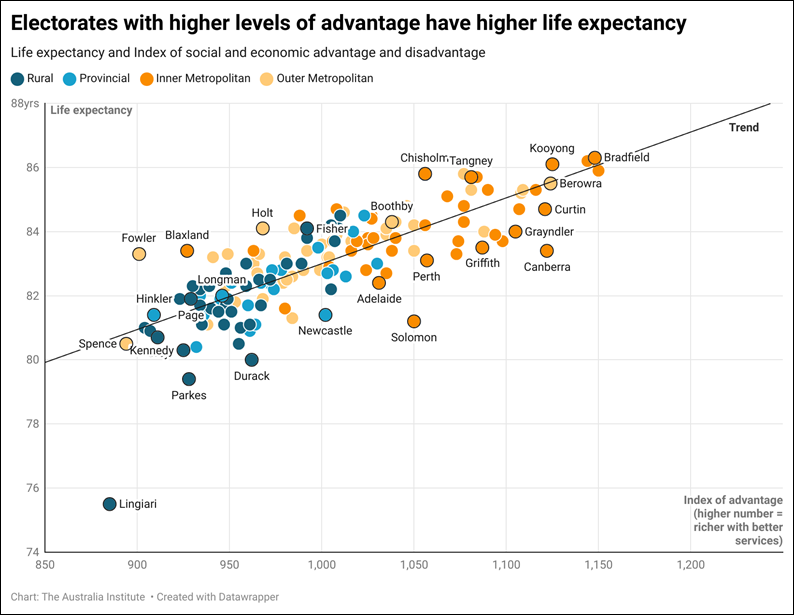
Where you live effects how long you live
Matt Grudnoff and Greg Jericho
The election campaign mostly stays away from rural areas – there aren’t many votes there and fewer seats that the major parties believe are in play. About the best you can hope for is a cross to David Littleproud talking about how he really is in charge of things and that’s why he is in Alice Springs and not Peter Dutton.
It’s a sad state of affairs because it often leaves voters with little choice except the National Party unless a good, local independent crops up. And there should be much more pressure put on all parties to talk about how badly those in the regions are treated relative to the big focus on even specific areas of capital cities (hello western Sydney!)
Even within our capital cities there are differences. People living in the inner parts of our capital cities live almost a year longer (0.8) than those living in outer metropolitan areas.
But life expectancy falls even more for people who live in areas outside the capital cities. In areas where the majority of people live in major regional cities life expectancy falls by more than a year (-1.1) compared with outer metro areas. In rural areas the results are even worse. Almost half a year (0.4) lower than provincial areas.
That means that people in rural areas die almost two and half years sooner (-2.3) than Australians living in inner cities.
The lack of services, and worse healthcare are things given briefest of mentions during election campaign – mostly we might get the occasional pork barrelling talk of a GP clinic for one area.
But this is an issue that is not just isolated to specific areas or electorates. It is (dare I say it) at national problem…
12.14 AEST
FM radio hosts love love, Albanese loves FM radio hosts
Albanese did Melbourne radio Nova FM this morning where he was asked about Jodie’s letter (spoiler, she is voting Labor)
Look, she’s just fantastic. And this morning, she’s still in the hotel room, I’ve got to say, at the moment, rather than going to the early events this morning. But she’s fantastic I mean, just great when you go through really long days, having someone to talk to at the end of the day and just to be there and be supportive. She’s also really smart and does particularly well. Make sure as well she has a different perspective.
As a woman, she’s very clear about issues like working from home. Like when that came up, she was just on to us every day saying, “this is a big issue, these people don’t understand what modern situations are like and what impact this will have on women in particular,” and I said to her every day, “yep, I know, we’re campaigning against it.” She was like, “go harder,” basically, she was very passionate –
PHILLIPS: Oh, good. I’m glad that she lays the law down for you.
PRIME MINISTER: Oh, yeah. She’s a tough Central Coastie from New South Wales –
PHILLIPS: Who’s the boss in your house? –
PRIME MINISTER: They make them tough. I think the truth is that there’s a little fluffy four pawed –
PHILLIPS: Oh, yeah.
HAWKINS: Oh, the dog.
PHILLIPS: Yeah, the dog runs my house, too.
PRIME MINISTER: She gets whatever she wants, Toto.
HAWKINS: In a way, we are voting in the couple. You know what I mean? Yeah, You go home, you talk to your partner. So, I think that’s great that she putting her input in. I remember when the Obamas were running for their spot in the Oval. They promised the kids a dog at the end of the campaign just because it’s so much work. Have you promised Jodie a cheeky little holiday, a bit of jewellery?
STANAWAY: Doesn’t she get a wedding?
PRIME MINISTER: Oh look, well, she gets a wedding regardless. And it might be a little bit more private if we have a bad outcome tomorrow. So, we did have to delay it, effectively, because of just concentrating on the job.
PHILLIPS: Running the country.
PRIME MINISTER: Yeah, all of that. She certainly understood that. We did have a cheeky idea of, because we got engaged on Valentine’s Day last year, of just doing it, just a really quiet official thing in Valentine’s Day this year and seeing how long it would take before people get asked, “is that a wedding ring on your finger?”
PHILLIPS: Oh, I love that.
HAWKINS: Oh, that’s cool.
PRIME MINISTER: Yeah, we didn’t, but we just thought, “no, her parents wouldn’t be happy with that.”
PHILLIPS: No, we want a big wedding. We want the big wedding, Cinderella wedding.
PRIME MINISTER: No, we will have a small wedding, but it will be really nice.
12.09 AEST
This is a good point – schools and local organisations rely on the democracy day fundraisers, and the early voting would be having an impact on bottom lines. (Public schools wouldn’t need to fundraise if they were funded properly, but hey – those private school castles aren’t going to pay for themselves.
As someone who helped run/ worked on democracy sausage sizzles for many years, I'd just like to say that even if you've already pre polled, PLEASE drop by your local public school tomorrow and treat yourself to something from the BBQ or cake stall. Your money goes to a good cause.
Ok, so yesterday they said there would be no voluntary redundancies and there was no costings for VRs, so that is yet another change to this mess of a policy.
And then this morning, in the Canberra Times, Angus Taylor, in his latest audition for Dutton’s job as the ‘dry Howard Liberal’ turns back to an old Coalition idea that has already failed – moving public service positions OUT of Canberra.
(I am old enough to remember when Barnaby Joyce made this idea his whole personality and public servants were forced to work out of Maccas’ and other cafes for the free wifi, because the infrastructure had not been set up for them to do their job)
But it wasn’t just Joyce’s APVMA obsession. The 2019 estimates also revealed that the decentralisation policy was a complete failure, for reasons including:
Overall, 1,700 had been moved from inner Sydney, inner Melbourne and Canberra but the majority happened before the decentralisation agenda was announced. Only 430 roles from 13 agencies have been moved. The list of the 13 agencies is on notice.
The phrasing is ‘new and relocated’ jobs.
The Department of Infrastructure was not keeping track on whether decentralisation is actually happening.
No overarching review of decentralisation occurred.
Could not answer if any other decentralisation “opportunities” were being considered.
Questions were asked about the impact of the ASL cap and efficiency dividend on regional APS jobs.
I think Senator Watt raises a really interesting point. A lot of people ask how shifting jobs to Parramatta, for instance, is decentralisation. If you are working in somewhere like Parramatta, you can actually be further west of Sydney than—
Senator WATT:It’s not really regions at the ready, though, is it, Parramatta? Regions.
Well, you can catch a train from a whole raft of regional communities to work in Parramatta. So that’s where you’re living, raising your family, contributing to community in regional New South Wales. You would work in Parramatta at the same time. To answer Senator Sterle’s question, the relocation of 10 positions from Canberra to Darwin in the Office of the Registrar of Indigenous Corporations is underway. The relocation of the indigenous affairs group’s regional network, moving seven positions from Melbourne to Shepparton, is underway. And 25 positions from Sydney CBD office to Parramatta have been completed. I hope a lot of them have taken the opportunity, given they’ve changed their workplace to set up camp out in regional New South Wales. In the office of the National Rural Health Commissioner, four new positions were to be located in Adelaide. That’s actually completed
11.33 AEST
Curtin is the latest in a string of million-dollar contests
Joshua Black and Bill Browne
Earlier this year, the two major parties joined forces to “stitch-up” Australia’s federal electoral laws. These included donations caps, spending caps and a lower threshold for disclosing donations to the AEC. In practice, those caps will be much more restrictive for independents and minor parties than for the major parties. The supposedly large campaigns run by community independents have been used to justify the Albanese Government’s rushed changes to electoral laws.
But a story in the AFR this morning reminds us how hollow these claims were. WA political correspondent Tom Rabe says that independent MP and candidate for Curtin, Kate Chaney, and her opponents in the Liberal Party, have spent $1 million each in their fight for the seat.
There’s nothing shocking about this. We’ve seen million-dollar campaigns from both of the major parties in recent years. Former Senator Kim Carr claimed that Labor spent $1 million on the 2018 Batman by-election campaign in the hope of preventing a once-safe seat from falling to the Greens. In the same year, the Liberal Party reportedly spent $1 million on its Wentworth by-election campaign, which was won by independent Dr Kerryn Phelps.
AEC returns show that her campaign cost $145,265. During the most recent parliamentary term, the Labor Party spent $1 million on its campaign for the competitive Dunkley by-election in March 2024, and national secretary Paul Erikson predicted the Coalition had ‘easily matched this’. In fact, at the last election the Australia Institute estimates that Labor and the Coalition spent on average $112,000 and $189,000 respectively more per candidate than the community independents.
It is the major parties who most successfully bring big money to bear, and will be least restricted by the changes to election laws.
11.24 AEST
Make Australia Brave Again
Let’s see if we can have a parliament with some courage, huh?
We’re calling on the next Parliament to be brave, to put climate science back into climate policy, & stop digging new gas & coal mines in Australia.
Our research shows that Australia is the world's 3rd largest fossil fuel exporter.
— Australia Institute (@TheAusInstitute) May 2, 2025
11.23 AEST
Stop framing hung parliaments as automatically ‘bad’
There is also a habit of journalists framing questions along the lines of ‘how bad would a hung parliament be’.
Now, the whole ‘chaos and confusion’ thing in 2010-13 was a Tony Abbott creation, that was picked up and run with by mainstream media, which assumes that negotiation on legislation and power sharing in a parliament is automatically a bad thing.
But it is also not born out by the facts. Minority governments are very common in the states/territories. NSW has a minority government right now. But also, governments rarely have control of the upper chamber and so, there is constant negotiation and power sharing with legislation occurring in the chambers of review.
You know, the pesky little thing known as the senate? You need that to pass federal law in Australia. And you never hear the same narrative as you do in the house of reps when it comes to negotiations.
Australia could be entering a new era in its politics. Which means that the major parties can’t count on automatically winning a majority. That is not something to be treated as ‘bad’. It’s something to be respected and studied and understood. Because it seems to me that if the major parties aren’t offering voters what they want, they will go looking somewhere else.
11.16 AEST
We just couldn’t bring ourselves to watch another press conference before 8am, so here are some questions from Anthony Albanese’s Brisbane presser this morning:
Q: Multiple Intergenerational Reports have warned about the growing fiscal gap. Given the implications on future generations of workers, why isn’t structural budget reform on your agenda?
Albanese doesn’t answer the question:
What we’ve done is to produce two budget surpluses and I find it rather strange that people have questioned Josh Frydenberg’s budget speech of 2022 in March, just before the election was called, where he outlined what their plan was, which was a $78 billion deficit. We turned that into a surplus. We turned the next year’s deficit into a surplus, into a surplus. And we’ve halved, and we’ve halved this year’s deficit.
The advertising material i got (Bradfield) from the libs had how to vote and a flyer from one of the local real estate agencies … in what world does this not scream “conflict of interests!!!
My decoding of the free-marketeers is in line with: Taxing addictive substances is great for company profits. If you also make health care more expensive its a win-win. For example, realise that curing diabetes would cause GDP to fall because it wipes out the treatment industry.
On Adam Bandt voting early and his line about “iconic behaviour” Jay said:
Lordy lou that’s a cringe line “iconic behaviour”
Adam Bandt is probably also voting today to try and get more coverage and maybe even get his photo in the paper tomorrow…(although it seems like the Greens media strategy has been focused elsewhere, just like the voters they are trying to attract)
Oliver notes the PM may have been trying to appeal to one particular voter in Tasmania with his ice coffee photo op:
The PM seen here campaigning to that one particular voter in Launceston TAS shown on ABC’s ‘The Weekly with Charlie Pickering’ for whom the cost of an iced coffee was the main issue this Federal Election.
And Robert asks:
Hi Amy. Dutton is still going on about some kind of “miracle” tomorrow which might enable the Coalition to win, despite all the polls showing Labor on track to form government. Maybe he is just trying to reassure his supporters despite the mounting evidence that he will fail.
Remembering what happened in 2019, is there any rational reason to believe that the Coalition could win, helped by One Nation preferencing them in certain seats? Or is it just delusional to believe in “the silent millions” coming to his rescue?
It’s a good question. And nothing should ever be ruled out. It is unlikely that the polls will be as wrong as Peter Dutton is claiming. One Nation doesn’t run in enough seats to flip the election result alone, and the Coalition doesn’t appear to be on track to win back those inner city seats it would need for a feasible pathway. And the idea that ‘quiet Australians’ or silent Australians will be turning out in their millions also relies on the fact that they are apparently so quiet, they are never picked up by pollsters. So, it is very unlikely that Dutton will achieve his ‘miracle’.
(And Hattie – it is indeed the great Dolly Parton I am invoking when I say ‘Oh Dolly’, and I will not hear a word against her)
10.37 AEST
Women? Some of my best friends are women.
Greg Jericho and Jack Thrower
So we’re at the last day and wow, haven’t we just been overloaded with policies aimed at assisting women…
Sigh. Other than some (much needed) policies and small funding on domestic and family violence, policies which treated women as anything other than those who will benefit from things that the man in the household will get were few and far between.
Gender inequality remains a major problem across the Australian economy and society. The most famous measure of this inequality, the gender pay gap remains significant, though there has been slow progress.
As soon as this is uttered people (men) will jump up and say that much of this is driven by part-time work; women are far more likely to be in part-time work than men, predominantly due to caring responsibilities such as for children and aged relatives.
And great. Well done on grasping the numbers but missing the point.
Firstly of course much more work done by women – regardless of employment situation – that is essential for society to function, it is unpaid.
Even in situation where both the man and the woman in a household work full-time, women will do more unpaid work. Heck even in situations where the woman is the main breadwinner, women are still more likely to do more unpaid work!
And all this time doing essential, but unpaid work, has a big impact on earnings.
Another commonly cited measure of the gender pay gap just looks at full-time adult earnings (excluding overtime and bonuses), under this measure the gap is 11.9%.
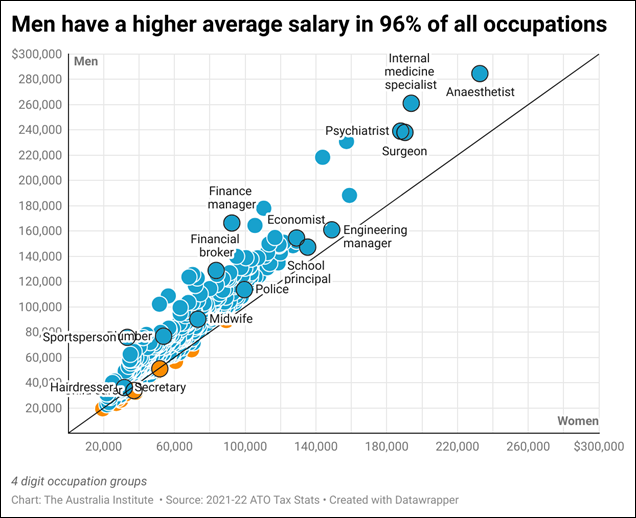
This gap is generated by various factors including that women tend to be paid less in most occupations and female-dominated industries are generally paid less. Australia Institute research shows that in 2021-22, men had a higher average salary in 96% of all occupations – including midwives!
The figures also show that higher-paid occupations are more likely to be male-dominated. Among the 77 highest-paid occupations, where the average salary was above $100,000, only 2 were jobs where women make up more than 60% of the workforce.
By contrast 40 of the 70 lowest-paid occupations, where the average salary was less than $45,000, were jobs where women make up more than 60% of the workforce. Importantly, many female-dominated industries are in the public sector or largely government funded, meaning that the government could easily boost these wages if it chose to.
These differences add up over time, contributing to substantial wealth differences between men and women. Additionally, as Australia’s superannuation system ties retirement with lifetime wage earnings we see the gender wage gap mirrored in retirement. The average super balance for 60 to 64-year-olds in June 2021 was $402,838 for men and $318,203 for women – a gap of 21.0%.
So was any of this a focus in the election? No. Not really. The closest we got was the fight over work from home, which has been one of the few policies of the past decade that has truly helped women stay in work while also caring for children or elderly/sick relatives.
But much more needs to be done – including at the societal level to make unpaid care work much less of a women-dominated responsibility.
10.20 AEST
What a power-sharing parliament may hold
Over the course of the election campaign, there’s been a lot of fear-mongering around the prospect of a “hung parliament” or “minority government”.
Some would have us believe that if Australian voters do not give one party a majority tomorrow, the nation faces a period of instability, even chaos.
But history tells us there is nothing to be afraid of.
In fact, power-sharing parliaments can be effective and successful.
New research from The Australia Institute analyses 25 Australian elections where no one party won a majority.
What would the negotiations to form government look like? Who would be in the cabinet? Who would be speaker? Who would introduce legislation? How would it be scrutinised?
The report, Forming Power Sharing Government, (attached) examines all these issues and many more.
Key findings:
The paper identifies five things to expect from power-sharing negotiations:
Negotiations may take time
Negotiations usually draw on many years of parliamentary experience
Agreements take a variety of forms
Agreements may be with the unsuccessful major party, too
Crossbenchers do not have to go with the party that wins more seats
Across power-sharing parliaments, crossbenchers have negotiated for:
Reforms to parliamentary process and procedure: These include dedicated time for private members’ bills to be debated and voted upon; more productive Question Times; greater committee scrutiny of the government; fixed parliamentary terms; and Parliamentary Library expansions.
Staff: In a power-sharing parliament, crossbenchers are a potential deciding vote on every motion and every piece of legislation. Crossbench negotiations often include new staffing arrangements, either on an ad hoc basis or by setting consistent rules.
Policy reforms: Policy reform areas include elections, integrity, civil rights, support for the regions and environmental and climate policy, among many others.
Positions: Speaker or ministerial positions are often allocated to crossbenchers.
And what can be expected of the power-sharing parliament that results?
The parliament is likely to see out the full term
Power-sharing parliaments help enforce ministerial responsibility
Opportunities for crossbencher bills and amendments
Negotiations may continue through the Parliament
Power-sharing governments are competitive at the next election
“With about one in three Australians voting for a minor party or independent, it is a live possibility that Australians will elect a power-sharing parliament tomorrow,” said Bill Browne, Director of the Australia Institute’s Democracy & Accountability Program.
“The Australia Institute has looked at 25 previous power-sharing parliaments, elected federally and in states and territories, to see what we might expect from negotiations with minor parties and independents.
“There is no strict rule for how power-sharing parliaments must conduct themselves, but it is common for crossbenchers to negotiate parliamentary reforms, policy commitments, more staff and resources and for crossbenchers to hold ministries or the speakership.
“It is under power sharing parliaments that the ACT adopted truth in political advertising laws, whistleblower protections were achieved in NSW, the Royalties for Regions package distributed mining and petroleum royalties to WA regional communities, the ACT achieved 100% renewable energy and Tasmania passed one of the most progressive freedom of information acts in the country.
“At the federal level, the 2010–2013 power sharing parliament and Gillard Labor Government passed legislation at a higher rate than any other, including ambitious legislation like the NDIS, Clean Energy Future Package, cigarette plain packaging and expanding Medicare to dental for children.”
10.20 AEST
Affordable childcare would actually boost the economy
Matt Grudnoff
Senior Economist
Childcare has barely rated a mention from the two major parties this election campaign. That’s a shame because childcare doesn’t just improve children’s educational and development outcomes, it can also grow the economy.
Australia Institute research shows that affordable access to high quality early childhood education and care could increase the size of the economy by $168 billion and allow the government to collect an additional $48 billion in revenue.
But the Australian childcare system needs more than just extra funding. We also need to change how it is delivered. Currently more than half of Australia’s childcare is delivered by for profit providers.
Parents have seen government subsidies, that are designed to make childcare more affordable, gobbled up by increased fees. And the higher prices don’t translate to better care.
For-profit providers on average do worse than not-for-profit and state-owned providers when it comes to metrics like educational practice, children’s health and safety and staffing arrangements.
Imagine if government run childcare centres were as common as primary schools. Any parent, if they wanted to, could send their child to the local childcare centre. These centres, where practical, could be co-located with primary schools.
Australia deserves a better childcare system and it’s a shame that the major parties have largely ignored the issue this campaign.
10.07 AEST
It’s official: The most pre-poll votes ever
Skye Predavec
Anne Kantor Fellow
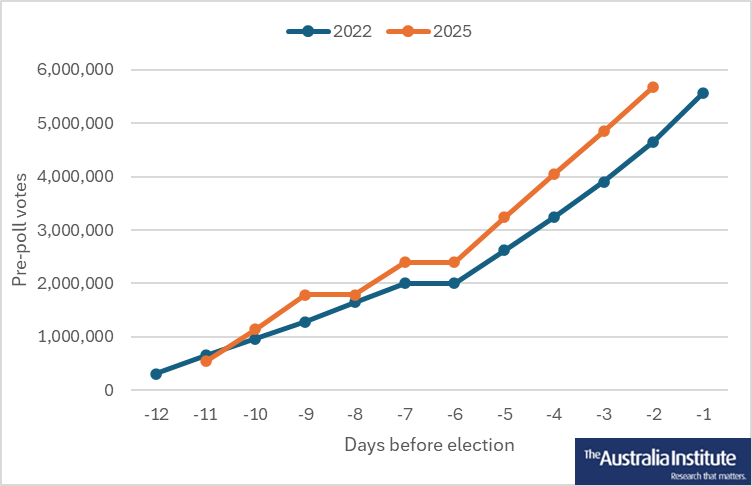
5,679,443 Australians cast their ballot at a pre-poll booth by the end of Thursday, around 100,000 more than the total last election- and we still have one more day of pre-poll to go.
Those five and a half million votes amount to over 31% of people on the electoral roll. By the end of the Thursday before polling day in 2022 only it was only 27%.
Notable, however, is the last-minute surge in pre-poll votes that we saw in 2022 hasn’t happened. Last election over 100,000 more votes were cast on the Thursday before election than the Monday; this time there’s been 5,000 fewer votes cast on Thursday than on Monday.
While 2022 may retain the crown of the most pre-poll votes cast in a single day (922,000 on 20/05/2022, the day before the election), 2025 is galloping to the highest rate of pre-polling ever overall.
Wondering how pre-polling has evolved over time, and what the implications are of so many early votes? You can read more about that here.
AAP has a story on disinformation bots on social media you may find interesting:
The culprit behind a disinformation campaign targeting coalition leaders could be someone local, one expert believes.
A sophisticated influence effort from an account on social media platform X, formerly known as Twitter, has been uncovered during the federal election via analysis conducted for AAP by online disinformation tracking company Cyabra.
The account has almost 30,000 followers including Australian politicians, journalists and political commentators.
Only publicly available data was analysed, meaning attribution is tricky without internet addresses being tracked.
But the behaviour of the account – the handle of which AAP knows but has opted not to publish – is suspicious.
A substantial volume of posts have spread negative content targeting Opposition Leader Peter Dutton while other fake accounts have amplified their reach.
Almost one in three of more than 2600 X profiles commenting on the posts, sampled by Cyabra between April 21 and 28, were identified as fake.
“The fake profiles flooded the comment sections with harmful remarks against Dutton and, at times, (Nationals Leader) David Littleproud, portraying them as untrustworthy and ridiculing their credibility,” Cyabra said in its report.
The fake profiles also promote positive content about Prime Minister Anthony Albanese “further reinforcing the account’s narrative strategy”, it added.
This was done by using co-ordinated posting schedules, fake accounts impersonating locals, emotionally charged attacks on politicians and inserting a flood of comments to make it look like there was community support.
These behaviours align with tactics historically observed in influence operations, especially those involving mid-sized bot networks used to sway political discourse during high-stakes moments.
Disinformation and misinformation had been “flowing thick and fast” during the 2025 federal election campaign, communications expert Andrew Hughes told AAP.
“It starts at the top of course with the leaders misrepresenting each other,” he said.
Disinformation and misinformation is used by both state actors and locals.
The example provided to AAP “strikes me as local political actors, people with strong opinions seeking to influence voters using misinformation and disinformation,” Dr Hughes said.
While democracies were being targeted by state actors, such as Russia seeking to “exacerbate divisions in society”, there was no evidence it was happening during Australia’s election, he said.
Mr Albanese on Thursday flagged another attempt at truth in political advertising laws, as independents vow to leverage power in a minority government to ban inaccurate or misleading ads during election campaigns.
Voters go to the polls on Saturday.
09.43 AEST
NSW to move to stop political parties circulating postal vote applications
Bill Browne
Director, Democracy & Accountability Program
A hot topic this election campaign has been political parties sending postal vote applications.
The concern is that the parties harvest data from these applications before sending them on to the Electoral Commission, and that it’s confusing to have seemingly official voting materials attached to party political matter.
Yesterday, the NSW Labor Government committed to stop this practice in state elections:
Unfortunately, we’ve seen no equivalent commitment from the federal government. A multi-party parliamentary inquiry recommended cleaning up the postal vote application practice:
· Postal vote applications no longer allowed to be bundled with other materials (like party promotional materials)
· Postal vote applications to be sent straight to the AEC, not routed through a party HQ for data harvesting.
The Albanese Government neglected these reforms in favour of an unfair and rushed deal with the Liberal Party to change the laws around Australian elections. Hopefully they are revisited after this election.
09.42 AEST
This election, Peter Dutton has been repeatedly very, very clear
Over the course of an election campaign punctuated by about-faces and flip flops, one constant has been Peter Dutton’s use of “clear” and “very clear” in his press conferences.
Based just on the transcripts on his website, he says he’s been clear or very clear on average 3 times per day.
On electric vehicles: “there’s no change in the policy and no, we’ve been very clear.”…“We’ve been clear about that and we’ve been clear in relation to the policies on the EVs.”
On Trump: “We’ve been very clear about what this election is about and it’s about who has the strength of leadership to stand up for our interests.”
On AUKUS: “I think I made clear what I was saying about it.” When prompted further, he said “Well, we can clear it up later, but I’ve gone through it a few times.”
If you’re still not clear on the Coalition’s policies, it seems you’ve only got yourself to blame!
09.39 AEST
One Nation’s election prospects
Bill Browne
Director, Democracy & Accountability
The Liberal Party’s break with its Howard-era policy of not doing preference deals with One Nation has revived interest in the right-wing minor party’s prospects at this Saturday’s election.
Even before the deal, polls were looking relatively good for One Nation at about 7 or 8% – up from 5% in 2022 and 3% in 2019. Some of that may be a result of Trumpet of Patriots not polling as well as its predecessor, the United Australia Party, did last time.
Liberal politicians have also softened their rhetoric about One Nation – with candidate Benson Saulo saying “One Nation is a centre-right party” like the Liberals. Former MP Tim Wilson, who in 2019 professed “a longstanding view that we should put One Nation and their despicable acolytes last”, has preferenced One Nation ahead of independent MP Zoe Daniel and the Greens candidate.
This realignment on the right of Australian politics could have long-term consequences for the country, regardless of the specific electoral outcomes on Saturday.
And while much commentary has focused on the House of Representatives, it is actually in the Senate (where One Nation already has two senators) where Liberal preferences could make the greatest difference one way or the other.
A weakness of the new Senate voting system is that many Australians stop preferencing after just 6 parties. That means that a share of the vote is exhausted before it decides the final senators elected in a state. Back in 2019, Richard Denniss wrote about the importance of numbering every box if you want your vote to count at full strength.
Senate
It is in the Senate where One Nation’s prospects are better, and where Liberal Party preferences could make the difference. Senator Malcolm Roberts is defending his seat in Queensland, and the party claims it could win in other states as well.
Ben Oquist (the Australia Institute’s former Executive Director) has conducted Senate analysis showing “One Nation is the story” with the party polling well enough to potentially win in NSW, WA and SA as well as Queensland – though he notes that the party often underperforms its polling.
Success in more than one state would increase One Nation’s relative numbers, and success in all four would represent a high point for One Nation in the Senate.
House of Representatives
For minor parties running in the House of Representatives, seat gains depend on how well they do in target seats, not how many votes they get nationally. Seats to look out for include Hunter and Paterson (Hunter Valley in northern NSW) and Flynn (around Gladstone in Queensland), all seats where One Nation did well in 2019.
One Nation is running the same candidate in Hunter this year as they did in 2019. At that election, One Nation won 22% of the primary vote, just behind the Nationals on 23%. Labor’s Joel Fitzgibbon won 45% of the primary vote and ended up on 53% in two-party preferred terms (after preferences are distributed).
For One Nation to be competitive for the seat this time, they would have to stay in the count longer than the Nationals candidate – and then receive most of that candidate’s preferences. That most likely would require a higher primary vote than the Coalition candidate, which they’ve so far failed to
achieve in the seat. Even then, Labor’s Dan Repacholi would have to do a fair bit worse than the party did in 2019 for the seat to fall (he won 54% of the two-party preferred in 2022).
Do Coalition voters tend to preference One Nation or Labor higher? Unfortunately, the data is patchy. The limited data we could find suggests more Coalition voters preference One Nation than Labor, but it’s not consistent between elections or seats. That’s because political parties are free to recommend preferences via how-to-vote cards, but each voter decides how they allocate their preferences.
08.55 AEST
Sally Sara then asks one of the crucial missing questions this campaign – why has there been nothing on raising welfare and addressing poverty and growing inequality?
Katy Gallagher says:
Well, we’ve made it clear that every budget, we look at the pensions and payments to see what can be done there. (And then they decide it is not a priority. Because there is always money for priorities) And of course, we’ve seen significant increases including in the unemployment payment through our time in government. We’ve seen increases to the single parenting payment. We’ve seen increases to rent assistance. But you also have to look at other ways to help people. And that’s why our programs in housing that the Opposition announced yesterday they would cut, all of those other investments in Medicare and cheaper medicines, in Urgent Care Clinics. All of those are about helping people, particularly those on fixed and low incomes.
Q: But even your own advisory committee prior to the election as it’s required to do, advised and recommended that there should be increases in those income support payments. Why ignore those please?
Gallagher:
Well, we don’t ignore them. We look at those reports seriously, and we look at payments every and each budget and budget update. And I think if you go back and have a look at what we’ve done in three years compared to what the former government did in ten years, you’ll see that we have, where we’ve been able to afford it, been able to invest in those payments and pensions. But more importantly, we are also building in and investing in all of those other services that people on fixed and low incomes rely on, including in housing, including in health, which are very, very important to people on those payments.
Except Labor DOES ignore them. It has not lifted people out of poverty. And doing better than the terrible guys only makes you slightly less terrible. And that doesn’t make you good.
08.51 AEST
Katy Gallagher continues:
We accept that more needs to be done in compliance and definitely that is why we have put that money into the Budget. But from a public health point of view, I think it would be a dreadful outcome to say, we are going to put the white flag up on vapes and it’s going to be a free for all and we’ll deal with the problems down the track. I mean, that is not the country we want and it’s not what we want for our children. I mean, there is a real contrast here between trying to get kids off vapes, keep them away from vapes and the Opposition who wants to raise revenue of it to balance their — well, to try and balance their budget to pay for nuclear. I mean, it’s ridiculous.
08.51 AEST
As we pointed out yesterday, the Coalition’s plans to raise more tax from vapes means that they would scrape Labor’s policy of having vapes available only with a doctor’s prescription, and put them back for sale in shops.
They say that the rise in organised crime in selling tobacco and vape products prove that the government’s policy has failed and something else needs to be done.
Katy Gallagher told ABC radio RN Breakfast Labor’s policy was based in health research and was aimed at protecting kids from Big Tobacco:
We’ve been very strong on this. We want kids off vapes and Peter Dutton wants to make money off them, off kids using vapes. I mean, that’s what we saw yesterday with that part of their costings. It sounds like they’ve put the white flag up. We’ve had a generation of dealing with the problems of tobacco addiction, and it sounds like Peter Dutton doesn’t want to worry about another generation being addicted to vapes. Yes, there’s issues around enforcement and compliance, which is why we put extra money in the budget. And there’s also opportunity for people who do want to come off tobacco to go through the chemists, the pharmacy, to get access to vaping products. But it should not ever go back to just this free-for-all of these companies targeting young people to get them addicted to nicotine and other chemicals.
08.37 AEST
Would Peter Dutton try and stay on as leader if he loses tomorrow?
Dutton:
I look much older. I’m only 54, so I feel okay. And I’ve got a lot of fire in my belly and I want to, I want to win this election because I really care deeply for our country. I’m a patriotic person. I love this country, and I really believe it’s under bad management at the moment.
And it can be a better future for our country. And that’s what this is about. This vote is about making sure we can manage the economy well and keep our country safe. And that’s what I pledge to do.
Not sure that is up to him though.
08.35 AEST
Peter Dutton believes in miracles (do ya, do ya, do ya)
Peter Dutton is really holding on to that hope for a 2019 ‘miracle’, which is something his colleagues do not share.
And it’s a misplace analogy. Because 2019 was a status quo result. Scott Morrison was expected to lose, but voters pretty much repeated their vote from 2016, which meant he maintained government. And while the polls were wrong on the two-party preferred measure, they were RIGHT on the primary vote and that was (mistakenly) ignored by most. And the polls were RIGHT on the unpopularity/popularity of the two leaders. Since then, a lot of work has been done by polling companies to ensure a better preference flow.
So for Peter Dutton to be right and everyone else to be wrong, everything about the polling has to be wrong – the primary, the trend, the 2PP, the preferences, the popularity/unpopularity and the track polling all has to be wrong. And that’s just not statistically possible.
But still. It’s what Dutton is clinging to and he tells the Nine Network:
I think this is really got the echoes of 2019 where the published polling was very different than what we’ve seen in the marginal seats. The response that we’ve had at pre-poll has been pretty remarkable. And that, frankly, is across the board with our marginal seat members. We’ve got incredibly hard working local members who have knocked on doors. They’ve got higher name ID than their Labor candidates. (He has made this point repeatedly and its also something you can say about the independent challengers in some Coalition seats) And the point that I make is that I think there are some really big surprises that you’ll see on Saturday night and seats that probably haven’t been in play for a while, that I think we have a real chance of picking up. So
I’ve got a very different view of how I think Saturday night’s going to turn out, but ultimately it’s a decision for Australians about, you know, who is best able to manage our economy.
08.23 AEST
Anthony Albanese held a press conference a short time ago (when the blitz is on, it’s on) where he presented a jovial front to the press pack in Brisbane.
He is a man who knows he has won – he just doesn’t quite know if he has won in his own right just yet (a Labor led minority still seems like the most likely option, but we’ll know soon enough)
He stopped at an Urgent Care Clinic in Longman (which Labor have on their win back list, but it won’t be this election) where he had a dig at Peter Dutton’s “hate media” comments.
I’m always me. I’m not the commentator. That’s a discussion maybe for the bus trip to the airport for you to all have with each other, and you can assess the nature of media coverage and commentary and all of that.
…You know, I love the media.
I think there is no hate media in this country. I engage with people. I’m just who I am.
Not sure that there is NO hate media in this country, but it’s certainly not the ABC or the Guardian.
08.17 AEST
The ABS will release its retail trade data a little bit later this morning, which is basically an insight into how we are all feeling about spending.
Economists think we are still all a bit scarred with predictions low – an increase of only 0.4% or so seems to be the consensus.
08.12 AEST
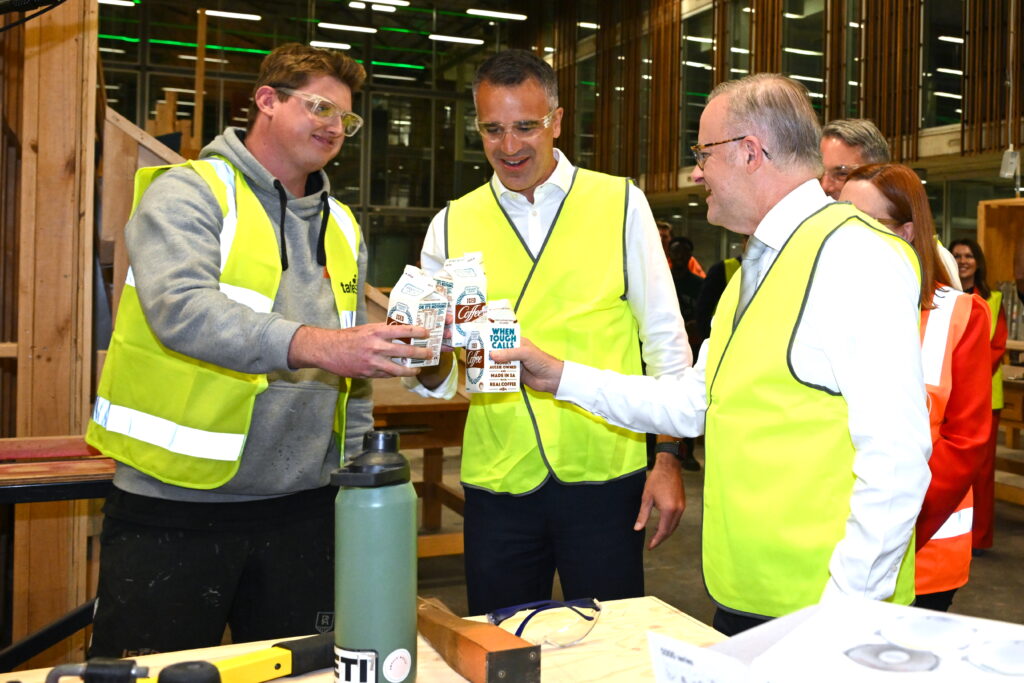
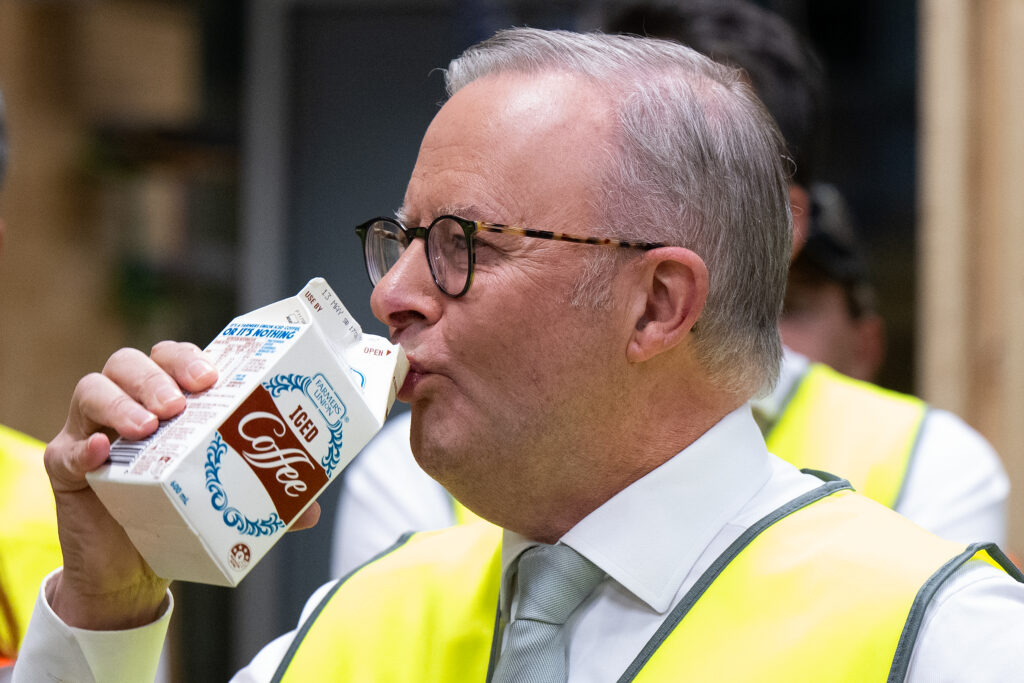
For those who don’t know, Farmers Union Iced Coffee is an absolute ICON of South Australia and Albanese took advantage of it yesterday to push his fee free TAFE policy.
South Australian icons. And the prime minister. (AAP)
Albanese told a radio station about three years ago that he quite likes a sip of milk in between pieces of salami. He called it a “taste cleanser” in between different varieties of salami. (Anyone who is terminally online may remember ‘a cat can have a little piece of salami has a treat’ from a few years ago, which is all I can think of right now’.
Anyway, this image may have won him some votes in SA. It is nice to see a politician drink something that isn’t a beer on an election campaign (Albanese is off the beers apparently, which is probably the only way you get through an election campaign. Or it would be if you are smart. Which I am not)
Australian Prime Minister Anthony Albanese drinks Iced Coffee while visiting TAFE Tonsley campus in the electorate of Boothby (AAP)
07.43 AEST
Also, no
Jane Hume finishes with:
Democracy sausages are my favourite meal. If I was on death row and they asked me what my last meal would be? A sausage in bread with onion and tomato sauce.
07.42 AEST
Jane Hume apparently a fan of haruspicy
Would Jane Hume support Angus Taylor as leader?
It is too early to have those conversations. You don’t read the entrails til you’ve gutted the chicken. We will be working for every vote up until 6:00 on election day. We cannot afford three more years of Labor.
Haruspicy is the reading of entrails of sacrificed animals. Big in ancient Rome. The Babylonians loved themselves some entrails reading. Crops dying? What does the sheep’s liver have to say about it all? Not sure who the chicken is in this situation, but maybe Peter Dutton should sleep with one eye open.
07.33 AEST
More ugh
Jane Hume is asked if she can be positive about Anthony Albanese and says:
I will be honest with you, I don’t really know Anthony Albanese. We are in different houses and I have never worked in a portfolio that he has. I don’t really speak to him in the corridors, that friendly image is not something that I have seen. I will give a compliment to Richard Marles who is a very good friend and a good fellow. He is a fellow Victorian, I have a lot to do with him. He and I are co-conveners of the Parliamentary Friendship Group of AFL and we have footy in common. I will compliment him.
07.25 AEST
Ugh.
If Peter Dutton loses tomorrow, he also effectively loses his career, so does Richard Marles have anything nice to say about him?
(Why is everyone so obsessed with making politicians be nice to each other? Keep the hits on the policy and the direction and not the personal and it shouldn’t matter!)
Marles isn’t falling for it:
I have been asked this question before and what will happen here is the Liberal Party will chop this up and it will be broadcast everywhere over the next 24 hours. You will forgive me for not going into it fulsomely. What I would say is there is a lot more friendships and fraternity across the aisle than what people perhaps expect.
We all experience politics together. I genuinely do think the vast bulk of people who enter parliament, irrespective of their party do so with a sincerity about the national interest and that is the fundamental thing we all have in common and it is possible to build relationships and to build friendships across the aisle.
I personally value that and I think it is important for the Australian people to know that their elected officials, even though they come from different parties, have those relationships and that is important in terms of critical moments, national security being an obvious one, where we are able to work together to maintain confidences and to act very much with the sincerity of pursuing the national interest. That’s how I feel. I know that is how Peter feels too.
07.23 AEST
Does Richard Marles agree that there needs to be rules put in place that costings are released much earlier in the campaign?
Marles:
I think people can make their own judgement about the confidence of the Coalition in respect of their costings, that they left it until a moment when five million Australians are already voted. One in four Australians had already voted. That says everything about how they saw their own costings. What we got, ultimately, was a complete joke.
There is barely any detail. They are talking – despite the fact that they have made clear their intent to engage in wholesale cuts to front line public services, to health, to pensions and the like, that is what they will need to do. They haven’t been able to explain how they are going to pay for things like the tax breaks for business lunches.
They haven’t been able to explain where their $350 billion of cuts are coming from before you get to a point of explaining the $600 billion that they will need to provide for in order to do a nuclear-powered scheme.
None of that is there and, despite all of that, the one thing they did tell us is for two of the three years of the next term in government, they will be worse off in terms of the Budget bottom line than Labor. It is a joke and it is not surprising that they left it so late.
07.21 AEST
Does Richard Marles think that this Labor government could be the first to be re-elected with a majority since Paul Keating? He tells ABC News Breakfast:
I think – that is in the interests of the Australian people, having majority government really contributes to having much more stable government going forward and so that is certainly what we have sought to achieve in this campaign. If you look at the seats we have been targeting and how we have been going about this campaign, we are seeking majority government, we are seeking to hold all the seats that we currently hold and win more seats off the Coalition.
I am very mindful that this is ultimately a matter for the Australian people and I have gone into elections before where I thought there was going to be one outcome and there ends up being another, so I won’t give any predictions about it.
07.16 AEST
Media outlets will begin rolling out their editorials on who they believe should win the election – gotta say, this one came as a huge shock.
Greens leader Adam Bandt is breaking from tradition and will cast his ballot today, as part of the early vote, to make his points that a) people want this election over with and b) Gen Z and millennials are voting on the climate and rental crises and can’t keep being overlooked.
Bandt:
There are seven million renters across the country who are tired of being overlooked by Labor and the Liberals. They know that we can’t keep voting for the same two parties and expecting a different result.
Young people face a future of being worse off than previous generations after years of Labor and the Liberals tinkering around the edges of the housing, rental, cost of living and climate crises.
With Gen Z and millennial voters outnumbering baby boomers for the first time, they are incredibly powerful this election and are raring to make their voice heard.
Young people know that voting Greens is iconic behaviour (No. Stop this) and they can use their numbers to outvote the wealthy property investors and climate deniers.
With a minority Parliament on the cards, a vote for the Greens this election will keep Dutton out and get Labor to act by putting dental into Medicare, capping rents, helping first home buyers by winding back tax handouts to wealthy property investors and stopping new coal and gas.”
07.07 AEST
Where are the leaders?
Peter Dutton is in Adelaide where he is hoping to defend the seat of Sturt from the Labor surge in that state – and also starve off a potential senate seat loss to One Nation.
Anthony Albanese is back east after his whirlwind west coast visit yesterday and is starting the last day of the campaign where he began it – Brisbane.
Labor is hoping it has a chance in one or more of the Greens seats – Brisbane, Griffith and Ryan, as well as the LNP held Bonner and Leichardt. The Coalition are hoping to pick up Ryan and Brisbane as well, but Dutton is unlikely to spend too much time in those seats in these final hours as he is a drag on the inner city vote.
07.01 AEST
Coalition’s foreign aid funding cut plans criticised
We raised this yesterday – the Coalition’s planned $800m cut over four years to foreign aid and international development, which was buried in the costings document.
This is something, as Bill Browne also noted yesterday, the Coalition’s own charities spokesperson, Dean Smith, thought would seem “counterintuitive or counterproductive” when he was asked about the potential for the Coalition cutting aid at a press club event, just last week.
As Bill reported yesterday:
Australian aid is already low, by international standards and by historical standards in Australia.
The cuts are also a blow to the authority of Senator Dean Smith, the Coalition’s charities spokesperson.
One week ago he was asked at the National Press Club whether he could rule out cuts to foreign aid.
He demurred, pointing out that he does not have the authority to make that commitment (the charities sector employs over a million Australians, but doesn’t get a minister or shadow minister).
“I think, having made a $21 billion defence commitment like the one that’s been made [by the Liberal Party] today, it would seem counterintuitive or counterproductive to then remove foreign aid funding at a time when a vacuum is clearly emerging…
“Where vacuums get created in the international order, people fill them, and more often than not at the moment they are filled by our opponents.”
The Coalition has said funding for the Pacific will be kept separate from any cuts and has promised $2bn in infrastructure funding if it wins government, mostly through grants and loans.
That policy has been criticised by those in the know who say most Pacific nations do not have the funds to repay loans like the ones the Coalition is proposing and those nations will look to other nations to help fund their needs.
As AAP reports, since taking office in 2022, Anthony Albanese’s Labor government has increased foreign aid each year, but at a slower rate than Australian prosperity has grown.
As a share of gross national income (GNI), Australia spends 0.19 per cent on aid – ranking it 28th of 32 developed nations. On that measure, just four nations spend less: Czech Republic, Greece, Slovakia and Hungary.
A decade earlier, Australia spent 0.31 per cent of GNI, and was ranked 13th.
06.49 AEST
Trashing a treasure. 28 days after the election, the Australian government faces a critical test of its priorities
Just 28 days after tomorrow’s federal election, the government faces a critical decision, which will send a message to the world about its priorities.
The stakes could not be higher. The very existence of one of the world’s most important artworks is at risk.
The Murujuga Rock Art is a unique 40,000-year-old collection of rock engravings on the Dampier Archipelago in the Pilbara region of Western Australia.
These irreplaceable petroglyphs are twice as old as France’s Lascaux cave paintings and eight times older than the pyramids.
Murujuga is nationally heritage-listed and could soon be recognised by UNESCO for its world heritage value.
But it is facing destruction from acid rain caused by nearby gas processing.
On May 31, the Australian government will decide whether to approve another 50 years of acid gas emissions from the gas hub, which would signal the death knell for Murujuga.
Most of this gas is exported, and pollution from the largest and most destructive project, the North West Shelf gas export terminal, produces close to 8,000 tonnes of acid gas emissions annually.
“Without intervention, our cultural heritage could be lost forever,” said Mark Ogge, Principal Advisor at The Australia Institute.
“No other nation on earth would stand by and let this happen.
“This is one of the most important decisions facing the government after the election – and it will send a signal to the world about its priorities.
“Some great Australians have already had their say on this issue. I would urge anyone who cares about Murujuga to join them.”
06.47 AEST
Good morning and welcome to the last full day of campaigning!
We have made it.
Everyone take a moment for reflection, and some snaps.
You are almost at the finish line. Or at least at the finish line of having to listen to the same talking points every single day.
I’m proud of you. This campaign has gone places, and not many of them good, but you have made it all bearable.
Albanese is on his six state blitz, which means he’ll be bouncing around electorates like a determined little pin ball today.
Dutton will be trying to shore up as much of the furniture as possible, so he’ll also be bouncing around, but he’ll be more like an angry little terrier at the dog park.
Now that the joke of the costings is out of the way for both parties, it is just bare bones stuff. Talking points until you see colours all round.
We’ll be there to take you all through it, answer any questions you might still have and try and do the real time fact checks, but my Dolly are we running out of patience with them all, so goodness knows how you feel.
Grab your coffee – I am on my third already having gotten up even earlier to talk the Brits through our election (I left out Albanese being called a “sick c*nt” by a passer-by making national news, because after all they are British but did help spread ‘Temu Trump’ internationally.


Comments
Start the conversation