Tue 20 May

Australia Institute Live: May RBA Interest Rates Decision and Coalition splits! As it happened.

Amy Remeikis – Chief Political Analyst

This blog is now closed.

Start the conversation

Australia Institute Live: May RBA Interest Rates Decision and Coalition splits! As it happened.

Key Posts

The Day's News

Thank you and see you when parliament is back (probably last week of July)

Well that was fun!

We should also point out that David Littleproud was going to have to lose two shadow ministers which was not good for his numbers in the party room so pulling the nuclear cord (in more ways than one) has saved him from some internal issues as well.

As more than one Nat has said to me in the last couple of hours “this is beyond stupid and also we will do absolutely nothing but probably expose who our weakest members are” so that is something!

Thank you to all who joined us for what ended up being a very lol-worthy afternoon. We will be back with you soon. Until then, you can find me in the New Daily tomorrow on this issue and as always – take care of you. Ax

Can the Liberals win without the Nationals?

Sussan Ley:

We are always strong when we work together. In 1996, the Liberals could have governed without the Nationals, and John Howard took a strong and principled approach that the Coalition mattered in the long-term more than one term in government where the Liberals effectively could have given without the Nationals. That is exactly the approach I will take.

And she is outty.

What about the Nationals wanting to be able to freelance on Coalition policy even if they were part of the shadow cabinet?

Sussan Ley:

Cabinet solidarity is very important and unless I, as leader of the Liberals, could be sure about that, it was important that we didn’t take those next steps. And as I’ve said, I wasn’t assured of that with issues that may divide both members of their party room and members of our party room in the future.

So it is not a new set of arrangements that fierce debates are had both within party rooms and within and around the shadow cabinet table and the cabinet table. Having participated in many myself over the years, I know this.

But then you come out as a united front and you present a united agenda to the Australian people. And it’s important that when we do that, people know that we’re acting as a team in their interests because while today is a lot about internal processes, we must never forget that we are here for the people who voted for us and those who did not, to present a very strong, positive alternative agenda that meets them where they are, and to continue to work incredibly hard for the Australian people every day.

Sussan Ley says her door is always open (the Coalition is looking more and more like a couple that breaks up and then has to keep living in the same house but in different rooms)

It was important for me to have a full party room meeting. Obviously that was via teams. There’s so much is these days. But just to inform, very frankly what the steps I took were the approach that I had and that was supported by my leadership group that’s in place now of Senator Ruston, Senator Cash and Deputy Ted O’Brien.

So we were as if you like the four of us working through the different iterations and suggestions and discussions between David, I and obviously his party room.

So it was important for me to transmit to my party room what happened. And I had, you know, strong messages of affirmation, but I did want to explain that this was not something that I did peremptorily or with any sense of satisfaction. It really wasn’t. It really isn’t. I am disappointed, I do want the Coalition to come together, and obviously this means for the Liberal Party that the shadow ministerial positions will be filled by liberals. And I have much talent in my party room. But that, if you like, is secondary to the fact that we won’t be forming a coalition, but we want to and we remain open to it.

Sussan Ley:

I don’t actually see the Coalition as a way of the two parties being shackled together. I really believe that the Coalition is stronger together. I am a committed coalitionist. When I came into that party room in 2001, the Coalition consisted of John Howard as Prime Minister and John Anderson as deputy Prime Minister. And I saw how well it worked when it worked together.

But I do pay tribute to my Liberal Party colleagues in this room now, and their intention to work constructively for the future with new and different policies, but never stepping away from our timeless values.

Our policies may change our values never will. But we need to give that process due diligence. And I, as leader, want to harness the real initiative, interest, talent and the smarts of so many.

In my party room we want to contribute to a strong public policy agenda that meets the Australian people, where they are recognising the enormous loss that we suffered

Sussan Ley responds to the Coalition split

Sussan Ley is now out

The Liberal Party must respect modern Australia, reflect modern Australia and represent modern Australia, and Australians sent us a clear message at the last election and we are listening. We will take the time to get this right.

We’ll listen, we’ll step up, we’ll modernise and we will rebuild. And it is with that undertaking from my party room and with my conviction and determination to get it right with respect to policies that I had front and centre with my conversations with David.

And while I have enormous respect for David and his team, it is disappointing that the National Party has decided today to leave the Coalition. But the most important thing I want to say is this the nationals door remains open and our door remains open and we look forward with optimism to rejoining at some point in the future.

And as David and I left today, we agreed that he and I would continue to meet regularly and to talk because we have much in common. We both have a big job to do to take the fight up to Labor. Now, as liberals, we do respect the decision that the nationals have made and our door remains open. Now the nationals sought specific commitments on certain policies, and they’ve talked about that this morning and our perspective is not about the individual policies themselves, but the approach that we said we would take to our party room about policies. Nothing adopted and nothing abandoned.

So at this point in time, I asked the Nationals to respect those party room processes. And similarly, I would respect their attachment to the policies that they announced as very important to them. But our approach, nothing adopted and nothing abandoned.

So we offered to work constructively with the Nationals, and we asked for that respect in return, in good faith, I proposed that we stand up a joint shadow ministry consisting of Liberal Party shadow ministers and National Party shadow ministers, and that we go forward in a united way and that we then work separately on policies, as we should, in our separate party rooms and come together articulating what those policies are at the right time, over the course of the next term.

The National party did not agree with that approach.

Is Michele Bullock confident this is the right move?

I think we what we can say is directionally, we’re confident that was the right thing to do. How confident are we that we know what’s going to come and what we might have to do in the future? That’s, I think, where the uncertainty comes in. And also, as I said earlier, the unpredictability. But it is hard to be confident.

We do have to try and look into the future forecasts, figure out where we think things are going to go. But it’s difficult means we have to be agile and it means it means we have to be alert to the risks. And these days, and, you know, my central bank counterparts are the same. Everyone’s talking about. We need to be thinking about how we’re using what we call the soft data. So this is like surveys, liaison things that might give us a bit of a handle on how businesses are thinking, how consumers are thinking, you know, overseas, we’ve seen quite a quite a lot of uncertainty finding its way into businesses and consumers.

Not so much here at the moment. I have to say. So these are the sorts of things we’ll need to be alert to. But yes, more uncertainty than usual. But I still think in those circumstances we can say we’re confident we did the right thing

Does RBA Governor Michele Bullock think there will be a recession? Maybe. If everything internationally (that means Trump) goes to absolute sh*t.

Bullock:

If you look at our scenario analysis, it does suggest that in a really bad outcome, there would there could possibly be a recession. Yes. But that’s in the very extreme circumstance. And again, it was to try and give ourselves some sort of spectrum of outcomes that we might be looking at at the moment. We’re not looking at that, but we need to be alert.

Today’s interest rate cut won’t flow through the economy until 2026

Matt Grudnoff
Senior Economist

Monetary policy is a tool that takes a long time to work. Economists like to say it has “long and variable lags”. This means that rather than setting interest rates for today’s economy, the RBA needs to set them for what the economy is going to be next year.

This of course makes conducting monetary policy really difficult. But it has been obvious for more than a year that inflation had been controlled.

The big spike in inflation has largely been caused by international supply side impacts and inflation across the globe has gone up and come down at roughly the same rate.

But today’s interest rate cuts won’t fully impact the economy until next year. This is why we have been so hard on the RBA. They have been too slow to cut rates.

Interest rates are currently at levels that are call ‘restrictive’. This is more central bank talk that means interest rates are high enough that they are slowing the economy.

With inflation under control, the RBA needs to move interest rates to a neutral rate as soon as possible. Neutral means rates are neither slowing nor expanding the economy.

Back to Jim Chalmers now where he is asked about how long he thinks the Coalition split will last and says:

I think it remains to be seen how long this lasts. It is a seismic event in our political history. I think that’s really clear. And I think it shows that the most basic elementary test here has been failed and failed and fallen at the first hurdle. And so, as I said before, I mean, it is rare.

But as I said before, it’s consequential because the divisions in the Coalition were unable to be reconciled. And I think it does show that the former coalition parties learned nothing from the election result. They’ve learned nothing from the last three years. They’re focused inwardly on themselves while the Albanese government is focused on governing. So it’s a nuclear meltdown. They are a smoking ruin. And I think developments today made that really clear.

Low unemployment to RBA: why are you so obsessed with me?

Matt Grudnoff
Senior economist

I wrote earlier that the RBA is weirdly obsessed with unemployment being too low. They’re worried that low unemployment will suddenly set off higher wages and more inflation.

Well, the latest Statement on Monetary Policy shows that their obsession has not gone away.

Here is some central bank speak:

“Model-based estimates also suggest that the labour market remains tighter than full employment”

Translation: Our model thinks an unemployment rate of 4.1% should set wages racing up and cause inflation.

The problem with that is unemployment has been at or below 4.1% for years and wages have not shot up. In fact, wages have weakened.

Rather than relying on their failing models the RBA should look out the window and see what is actually happening in the economy.

Jim Chalmers is finally given an opportunity to deliver his lines on the Coalition split:

This is a nuclear meltdown. And the Coalition now is nothing more than a smoking ruin. They are hopelessly divided on personalities and on policy. It shows that the new leadership has failed its first test. It shows that they’ve learned absolutely nothing from the last few weeks or indeed, the last few years. This is a nuclear meltdown in the Coalition.

And it’s hard to see how Australians can take them seriously when they don’t even take each other seriously. So the Coalition is now little more than a smoking ruin. I think that that is really clear. Also clear is the contrast between a government getting on with the job, managing the economy responsibly, here to talk with you today about the second interest rate cut in three months. And a Coalition, or a former Coalition, completely and entirely focused on themselves.

They tried to divide the Australian community in the election campaign and they ended up dividing themselves. And the consequence of that is that the Liberal Party is now barely bigger than the crossbench in the Parliament. We’ll go – you three and then back here and then we’re done.

Interest rates are restricting the economy

Matt Grudnoff
Senior Economist

In the RBA’s Statement on Monetary Policy, they have downgraded economic growth, downgraded inflation, and upgraded unemployment.

This means that interest rates are restricting the economy and inflation is not a concern.

Given this you might have expected a bigger cut than just 25 basis points. But the RBA says that the global economy is uncertain. This is code for they don’t have any idea what Trump is going to do.

But Trump uncertainty is only on the downside. This means that Trump messing around is not going to increase Australian inflation. So, there is no reason not to cut further.

Really the RBA should have cut in April. Having failed to do that they should have cut more than 0.25% today.

Does the government claim any influence over the RBA’s board’s decision here?

Chalmers:

I don’t see today’s decision in political terms. I see it in economic terms. It is the right decision made for the right reasons. And the right reasons to make an interest rate cut like we’re seeing today is the fact that together, as Australian, we’ve made a heap of progress on inflation. The global environment is uncertain. And for reasons outlined in the independent Reserve Bank’s statement today, they felt the conditions warranted this cut.

The other thing which is a very good development is the Governor, herself, will be out shortly and will be able to speak through the rationale and the reasons for the decision that they’ve taken today.

Politics do not play a role in decisions taken independently by the Reserve Bank. They weigh up the economic conditions as they have in this case, and they have the opportunity to talk through their reasons.

On the future of the energy rebates, Chalmers says:

What we’ve made clear over the course of recent months, certainly since the recent weeks since the budget, is that this energy bill relief is an important way that we are helping Australians with the cost of living.

We only extended it for six months rather than 12 months, because we know that at some point, this electricity bill relief will taper away and will have to end. We made that clear publicly on a number of occasions.

The point that I made on Friday, which I think is what you’re referring to, and that strange story today was referring to, is that when I was asked on Friday about cost of living help – in this case, energy bill rebates – I made the point that I make before and after every single budget we’ve handed down, which is that we evaluate the economic conditions, we evaluate the budget constraints and the pressures that people are under, and we do what we can to help. The final point that I would make about that is that I thought that it was very unusual in a story which was about energy bill rebates compared with ongoing help with energy efficiency or renewable energy, not to mention the hundreds of millions of dollars, extra dollars, that we’re investing when it comes to renewables for social housing in particular.

We announced that towards the end of last year. It’s a very substantial investment. And what it shows is that we’ve been able to find room in our budget to help people with bills at the same time as we help people grasp the opportunities of renewable energy, including when it comes to people in social housing.

Your comments

Eira asks:

Now that the RBA has done the right thing on interest rates, does it give the government any room to bring Newstart and other welfare payments up? No worries about the inflationary pressures?

They already had that space – but they are out of excuses now you would think

Jim Chalmers gets to do two victory laps

One on inflation and one on the Coalition collapse.

On inflation, Chalmers says:

This is very welcome relief for millions of Australians. We are really pleased to see more help is on the way. And that’s what this decision today is all about. It reflects what we’ve made in the economy and recognises the uncertain global environment as well.

When it comes to inflation, both headline inn and underlying inflation are now both in the Reserve Bank’s target band for the first time in almost four years. And this is the first time since records began that we’ve got the unemployment rate in the low fours at the same time as we’ve got both measures of inflation in the target ban at the same time.

I was really pleased to see in the statement released by the Reserve Bank, the three main points that the monetary policy board has made.

First of all, inflation has fallen substantially since its peak, and the upside risks to inflation have diminished.

Secondly, it does recognise, I think, in ways that the government recognises, that global uncertainty has increaseded in recent times. It also points out, though, that the household incomes have picked up in our economy as well. And that’s a good thing, too.

Today’s interest rate cut doesn’t mean that the job is finished when it comes to the cost of living, but it will help millions of Australians with a mortgage.

And it’s worth remembering that three years ago this week, this government came to office. When we came to office, inflation and interest rates were both going up, and now, both are going down, and that’s a good thing

RBA Monetary Statement (with Grogs)

At its meeting today, the Board decided to lower the cash rate target by 25 basis points to 3.85 per cent. Thank frick.

Inflation continues to moderate. This has been the case for a long while now.

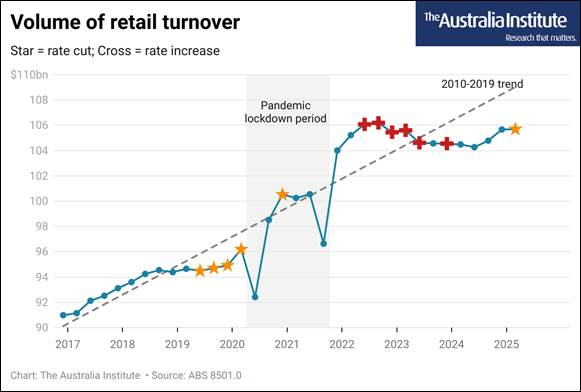
Inflation has fallen substantially since the peak in 2022, as higher interest rates have been working to bring aggregate demand and supply closer towards balance. The RBA loves to talk about an aggregate demand/supply imbalance – as though the total amount of spending and investment in the economy is much greater than the supply of things. And yet household consumption and retail trade is lower than pre-pandemic trend levels IN ABSOLUTE TERMS so no idea why they keep on about this.

Data on inflation for the March quarter provided further evidence that inflation continues to ease. At 2.9 per cent, annual trimmed mean inflation was below 3 per cent for the first time since 2021 and headline inflation, at 2.4 per cent, remained within the target band of 2–3 per cent. Staff forecasts released today project that while headline inflation is likely to rise over the coming year to around the top of the band as temporary factors unwind, underlying inflation is now expected to be around the midpoint of the 2–3 per cent range throughout much of the forecast period. The February Statement on Monetary Policy forecast trimmed mean inflation (the CPI with the top 15% rises and falls trimmed off) settling at 2.7%. Now it estimates it will be 2.6%

The outlook remains uncertain. As opposed to those previous times in history when the outlook was certain.

Uncertainty in the world economy has increased over the past three months and volatility in financial markets rose sharply for a time. While recent announcements on tariffs have resulted in a rebound in financial market prices, there is still considerable uncertainty about the final scope of the tariffs and policy responses in other countries. Geopolitical uncertainties also remain pronounced. These developments are expected to have an adverse effect on global economic activity, particularly if households and firms delay expenditure pending greater clarity on the outlook. This has also contributed to a weaker outlook for growth, employment and inflation in Australia. That said, world trade policy is changing rapidly, thereby making the central forecasts subject to considerable uncertainty. All of this could have been summaries as “Donald Trump”

Setting aside overseas developments, private domestic demand appears to have been recovering, real household incomes have picked up and there has been an easing in some measures of financial stress. However, businesses in some sectors continue to report that weakness in demand makes it difficult to pass on cost increases to final prices. This is a fancy way of saying if business do try to increase prices people won’t buy their stuff because people cannot afford to pay the higher prices.

At the same time, a range of indicators suggest that labour market conditions remain tight. Employment is continuing to grow, measures of labour underutilisation are at relatively low rates and business surveys and liaison suggest that availability of labour is still a constraint for a range of employers. Looking through quarterly volatility, wages growth has softened over the past year or so but productivity growth has not picked up and growth in unit labour costs remains high. Productivity is a LONG TERM issue. The RBA thinking about productivity when it makes a shift in the cash rate is rather silly. Also unemployment has remained at 4.1% for about a year, and in that times wage growth and inflation has fallen, so going on a bout a tight labour market is getting rather desperate.

There are uncertainties about the outlook for domestic economic activity and inflation stemming from both domestic and international developments. While the central projection is for growth in household consumption to continue to increase as real incomes rise, recent data suggest that the pick-up will be a little slower than was expected three months ago. This is them trying to explain that they were not wrong in April to keep rates steady, it was the data’s fault!

There is a risk that any pick-up in consumption is even slower than this, resulting in continued subdued growth in aggregate demand and a sharper deterioration in the labour market than currently expected. Alternatively, labour market outcomes may prove stronger than expected, given the signal from a range of leading indicators. Why not just say: things could be worse than we think, or maybe better.

More broadly, there are uncertainties regarding the lags in the effect of monetary policy and how firms’ pricing decisions and wages will respond to the demand environment and weak productivity outcomes while conditions in the labour market remain tight. The RBA pointing out that they don’t know how long it will take for rate cuts to have an impact. (another reason why they should have cut rates in April)

Maintaining low and stable inflation is the priority. Ok… but how about low unemployment?

The Board judged that the risks to inflation have become more balanced. Inflation is in the target band and upside risks appear to have diminished as international developments are expected to weigh on the economy. With inflation expected to remain around target, the Board therefore judged that an easing in monetary policy at this meeting was appropriate. The Board assesses that this move will make monetary policy somewhat less restrictive. This means that the RBA still thinks that the current cash rate is slowing the economy. Yep – they believe it is best that the economy be less strong than it is now!

It nevertheless remains cautious about the outlook, particularly given the heightened level of uncertainty about both aggregate demand and supply. The Board considered a severe downside scenario and noted that monetary policy is well placed to respond decisively to international developments if they were to have material implications for activity and inflation in Australia. ie more rate cuts are coming.

The Board will be attentive to the data and the evolving assessment of risks to guide its decisions. In doing so, it will pay close attention to developments in the global economy and financial markets, trends in domestic demand, and the outlook for inflation and the labour market. The Board is focused on its mandate to deliver price stability and full employment and will do what it considers necessary to achieve that outcome. They have gone from talking only about inflation and now mention full employment – ie the worry is about rising unemployment now rather than rising inflation.

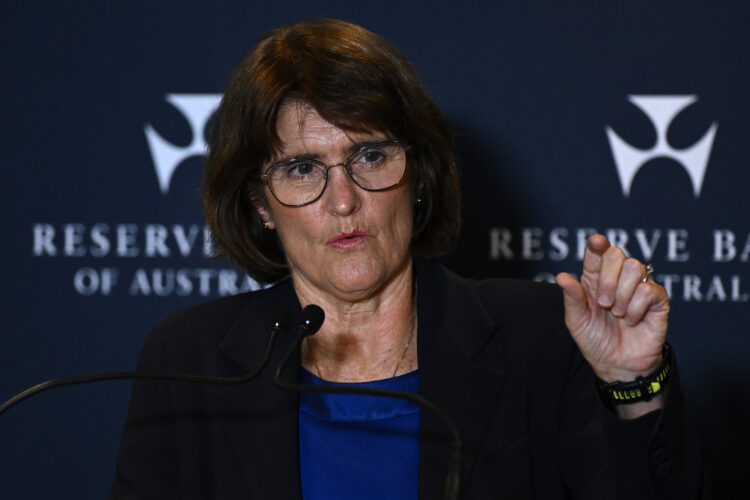
Today’s decision to cut interest rates by 25 basis points is long-overdue good news for struggling home buyers. 

Borrowers have endured two full years of pain, as rates shot up quickly but started coming down slowly.

People are still hurting, and there’s no need to keep inflicting unnecessary additional pain.

“The Australia Institute welcomes the news that the RBA has finally acted by reducing the cash rate by 25 basis points,” said Greg Jericho, Chief Economist at The Australia Institute

“This cut goes some small way to redressing the failure to cut rates at its April meeting.

 “Households have been smashed by the rate rises which began in May 2022. Almost half of the increase in cost-of-living pressure on employee households is attributable to interest rate rises.

 “The pain of these rate rises continues. In the first three months of this year, spending on retail was flat as households continued to cut back on spending to pay mortgage bills.

 “The Reserve Bank should not end here. Over the past year, unemployment has remained at around 4.1%, and yet in that time, inflation has fallen from 3.8% to 2.4%, and private-sector wage growth has fallen from 4.1% to 3.3%. 

“There is no wage price spiral. There is no need for unemployment to rise. The Reserve Bank should focus on achieving full employment.”

Inflation dragon is back in its box – RBA

Matt Grudnoff
Senior Economist

The RBA admit that inflation dragon has been slain.

In its statement on the interest rate cut it said:

“Staff forecasts released today project that while headline inflation is likely to rise over the coming year to around the top of the band as temporary factors unwind, underlying inflation is now expected to be around the midpoint of the 2–3 per cent range throughout much of the forecast period.”

RBA Board Decision – 25 pt cut

And there we go – 25 points down (a quarter of a per cent)

That brings the cash rate down to 3.85%

Rod Campbell
Research Manager

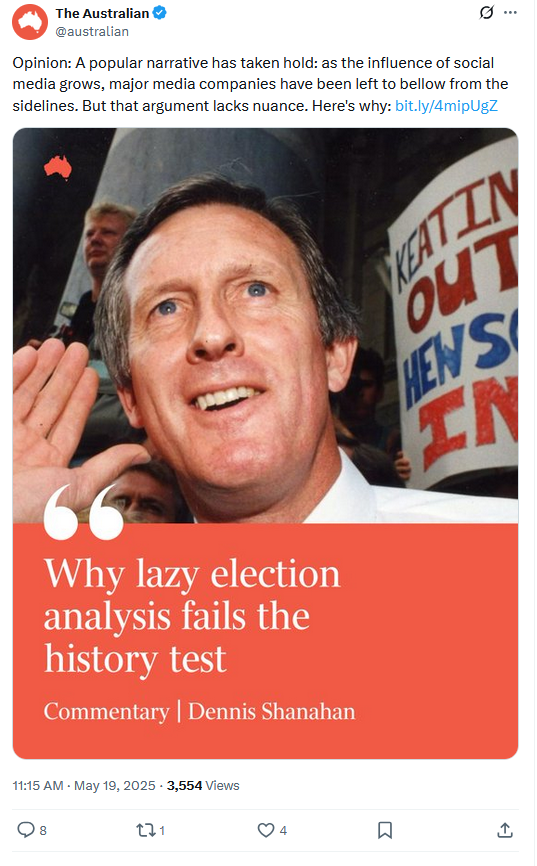
Last week we put out a report showing that News Corp and Nine can’t sway elections anymore, because people just don’t read their stuff.

This means, the Albanese Gov can do things that Australians want (reduce emissions, tax the gas industry, etc) without worrying about what The Australian or the AFR might say.

The Australian’s Dennis Shanahan wrote a column saying we were wrong.

As if to make our point, The Aus has tweeted Dennis’ column and a day later, at time of writing, it has just 1 retweet, 4 likes and 8 comments (including spam and abuse).

And who do the Liberals represent now?

Of the 27 remaining Liberals in the House of Reps (assuming they don't win Bradfield), just 9 are from Metro seats:-Cook-Goldstein-Berowra-Canning-Hume-Lindsay-Mitchell-Bowman-FaddenPlus 2 others in the Gold Coast, and La Trobe on the outer fringe of Melbourne.

Ben Raue (@benraue.com) 2025-05-20T03:05:56.450Z

So in the LNP there are already a split between the Liberals and the Nationals (they sit in separate party rooms and then come together for joint party room – although not anymore!)

The current crop are:

Nats:

David Littleproud

Michelle Landry

Andrew Willcox

Colin Boyce

David Batt

Llew O’Brien

Matt Canavan

Susan McDonald

And the Liberals:

Ted O’Brien

Henry Pike

Andrew Wallace

Garth Hamilton

Phil Thompson

Terry Young

Leon Rebello

Angie Bell

Scott Buchholz

James McGrath

Paul Scarr

Official statement from David Littleproud

Littleproud has released a statement:

After careful consideration, The Nationals have agreed that now is not the right time to
enter a federal Coalition Agreement with the Liberal Party.

During the last term of Parliament, The Nationals fought hard for a package of sensible and important policies that will benefit regional Australia and the future of our nation. These were adopted as Coalition policies and were strongly supported by local communities.

Following discussions with the Leader of the Liberal Party, we do not have the assurance we need that these policies will be honoured in a future Coalition Agreement.

The Nationals cannot in good conscience walk away from our commitments to regional
Australia. We will not walk away from the $20 billion Regional Australia Future Fund, which would provide up to $1 billion extra funding every year for regional projects, from improving access
to better health, child and aged care, through to fixing local roads and building new sporting facilities.

We will not walk away from ‘big stick’ divestiture competition laws that keep the big supermarkets honest and deliver fairer prices for farmers at the farmgate and families at the checkout.

We will not walk away from an improved Universal Service Obligation for communications, forcing a better minimum standard for regional mobile and internet access.

We will not walk away from the potential of nuclear power as a necessary element of a balanced energy mix that secures Australia’s energy security.
The Nationals’ Party Room does not take this decision lightly.

It is made without malice. When the Liberal Party is ready, our door will be open. We will always stand up for regional Australians and the policies that will take our nation forward.

The Queensland LNP president Lawrence Springborg has released a statement:

Under existing parliamentary arrangements, the National and Liberal Party rooms retain the discretion and autonomy to negotiate their own policy positions and working arrangements.

This is not a matter that is determined by the organisational wing of the Liberal National Party, or the federal equivalent of either the Nationals or Liberal Party.

The current discussions between the respective federal party rooms have no bearing or impact on the organisational arrangements within the Queensland LNP, which has recently won the Brisbane City Council Election, State Election and was the only state or territory to secure the majority of seats and the majority of votes in the recent Federal Election.

If the former Liberal National Coalition had achieved the same proportion of seats in other states and territories as the LNP in Queensland at the Federal Election, Peter Dutton and David Littleproud would be Prime Minister and Deputy Prime Minister respectively, with a four-seat working majority.

The LNP remains optimistic that the federal party rooms will continue discussions around negotiating a future Coalition agreement.

The positive benefit that comes from the single united LNP in Queensland is there will be no Nationals, or Liberals contesting against each other in a futile waste of critical resources.

We hope that as a part of the ongoing federal discussions this can also be avoided in other places around our nation.

Ongoing positive, pragmatic and outcomes-focused discussions aimed at achieving a new Coalition are crucial going forward.

Millions of LNP supporters nationwide expect this of us.

In the meantime, Queensland’s singular LNP organisation will remain focused on servicing the needs of its united membership and supporters.

30 minutes to destroy 102 years

So we have had a few chats and this is what we have learned.

Some in the Nationals have been on this for some time – the marriage has not been happy since the Turnbull days (and earlier, but that is the main split).

Sheer force of rightwing will kept it together under Scott Morrison and Peter Dutton. But with the 2025 election result, the Nationals have had a head full of steam.

There wasn’t a lot of togetherness during the election campaign, as you may have noticed. David Littleproud pretty much decided that if the election went pearshaped, this is what would happen.

The more sensible Nats saw the writing on the wall and decided not to fight it – because it would be like fighting a gust of smoke. So they just figured the Liberals are “a shitshow” and at least this way there would be a “bit of fun” with no chance of any actual results at the end of it.

Some of the more sensible Nats hope this will also bring renewal for themselves – that they will finally manage to bring an end to some of the more batshit ideas in the party now that the party is in charge of its own destiny.

So Sussan Ley never really had a chance of making an agreement here – Littleproud walked into the meeting set on divorcing the Nationals from the Coalition and walked out 30 minutes later. That included the sit down pleasantries.

So 102 years wham, bam, shang-a-lang over in less time than it takes to cook a lamb roast.

Just back on the Coalition split because it’s a bit delicious

So with 28 Liberals in the house, there is going to be quite a bit of double up in shadow ministries. Maybe Scott Morrison was just ahead of his time.

And the Nats will now only have electoral staff. They will have ‘spokespeople’ like the Greens, but they won’t have the opposition staffing allocation.

So good times all round!

Back on April Fools Day the RBA monetary policy board decided to keep rates steady after having cut them in February.

Greg Jericho
Chief Economist

Why? Well mostly because they misread the economy, and they were also possibly afraid of doing anything that might be classed as “political”.

In its statement the board noted that

“Household consumption growth had started to recover in the December quarter, underpinned by the ongoing pick-up in real household incomes. While some of this recovery in consumption appeared to reflect price-sensitive consumers concentrating spending in promotional periods during the December quarter, the pick-up in spending growth among components not affected by sales events suggested there had been a genuine improvement in underlying momentum. More recent indicators signalled that some of this pick-up had been sustained.” [our emphasis]

Essentially the RBA thought people going out shopping in October, November and December during the Black Friday and Christmas sales was not a sign that people were looking for bargains but that we were all doing well and just wanted to buy a lot of stuff. Seriously.

Shockingly when the retail figures for the March quarter of this year came out, it showed what anyone who lives in the real world knew – that people were actually chasing bargains at the end of the year. Because in the March quarter, retail trade was flat – it didn’t increase at all in volume terms. ie we didn’t buy more stuff in January, February and March than we did in the last three months of 2024.  That is not only unusual it is a very bad sign for the economy. It revealed that there was no “genuine improvement”, and the RBA instead should have cut rates in April because (breaking news) households were still struggling!

One way we can show this is to look at the total amount of stuff we buy in shops.

Because of population growth and rises in real wages we should buy more than we used to, and the amount we buy should increase at a nice rate.

But right now it is not rising, and worse the total amount of stuff we are buying is much less than is expected given the pre-pandemic trend.

We came out of the lockdowns of the pandemic, and not surprisingly we went shopping. And you can understand the RBA raising interest rates because the amount we were buying was pretty big.

The problem though is the RBA kept raising rates even as we all stopped shopping in a big way. It kept raising rates even when we were buying less stuff than was expected.

Not cutting rates in April was a massive misread of the economy by the RBA.

The market is predicting a cut in interest rates, but should the RBA cut?

Matt Grudnoff
Senior Economist

The answer to this is an emphatic yes. Not only should they cut, but if they were doing their job, they would have already cut multiple times.

The main reason they haven’t is because of their weird obsession with the idea that low unemployment might set off a spike in wages that could drive more inflation.

The RBA believes that Australia’s unemployment rate of 4.1% means we might be experiencing a shortage of workers. Any increase in demand (caused by a decrease in interest rates) could mean that in order to get workers, businesses might be forced to pay them more. The rise in wages would then ‘force’ businesses increasing prices.

To be clear there is zero real world evidence that this is even a remote chance of happening. Unemployment has not been higher than 4.2% for over 3 years and there has been no wages outbreak.

In fact, unemployment has been as low as 3.5% with no massive increase in wages.

The reality is that workers lack the bargaining power to demand higher wages. But this weird obsession the RBA has is why people with mortgages are paying more than they really need to.

OK, let’s take a look at what we were here for originally – the RBA meeting!

Greg Jericho
Chief Economist

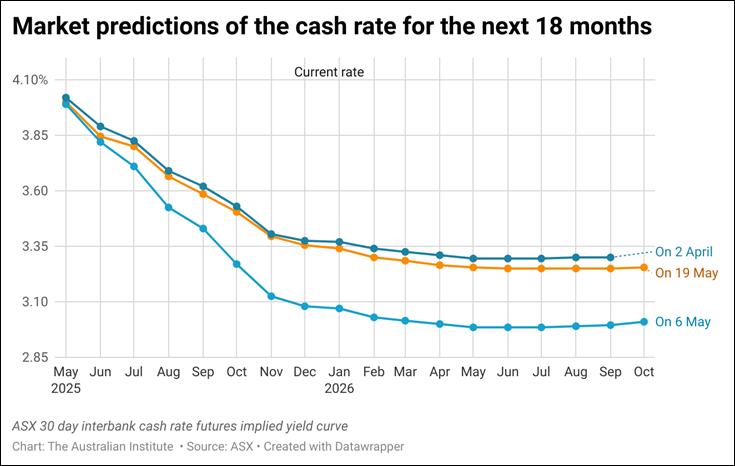
Ahead of today’s decision, the market is pricing in a 100% chance of a 25 basis point cut from 4.1% to 3.85% and a 50% chance of a 50 basis point cut to 2.65%. Because of my love of easy numbers to remember I would actually appreciate the RBA cutting the rate by 35 basis points to 2.75% so that we can get back to the old .25%, .50%, .75% rate figures (this would also make life easier for politicians getting gotcha questions from journalists!)

Essentially the market expectations for rates cuts are where they were after the last meeting at the beginning of April. In between then and now we have had Donald Trump’s tariff insanity which had economists and investors worrying about a global recession and the need to cut rate even more drastically – for a while, some investors were betting there would need to be 4 rates cuts by the end of the year and maybe 5 by this time next year. Those fears have subsided for now, but the market still anticipates 3 rate cuts by December.

Thoughts on the Nationals’ split from the Coalition

Bill Browne
Director, Democracy & Accountability

When Ali Moore asked me onto ABC Drive earlier this month to make the case for the Coalition splitting up, it was framed as a hypothetical.

You can listen to that interview here, where political analyst Dr Gregory Melleuish made the contrary case for the Coalition to stay together.

Some thoughts on the Coalition split now it is reality:

The Coalition Agreement has always been somewhat mutable. In Western Australia, the Nationals are not in formal coalition with the Liberals. They used that to great effect during the Barnett Government, when they won the Royalties for Regions scheme.

In South Australia, a National became a minister in the Labor Government. That would not be possible under a Liberal–National Coalition. And while the Albanese Government is not short of Labor MPs in this term, it leaves an opportunity for next term if a power-sharing parliament is elected.

The Nationals’ strength relative to the Liberals has grown since the Howard Government. Historically, the non-Labor parties have suffered when the junior partner has dominated – look at the damage done by the 1987 “Joh for Canberra” campaign, or in 1943 when the Country Party led the Coalition’s election campaign. Their disastrous performance in 1943 led to the United Australia Party’s dissolution and the rise of the Liberal Party.

Regional and rural voters have lost out from the Coalition.

When the Liberal–National government cut taxes mostly for the rich, the top 10 electorates who got a tax cut were mostly Liberal electorates. The bottom 10? Mostly Nationals electorates. The Coalition Agreement forced Nationals to vote for and defend tax cuts that benefited people in Liberal seats the most and people in National seats the least. And when Labor got into power and changed those tax cuts, it wasn’t people in Labor seats who benefited the most – it was people in Nationals seats.

With the Nationals outside the Coalition, they could argue more forcefully for greater government spending on health, education, public transport and infrastructure – all of which would benefit the regions.

Leaving the Coalition gives the Nationals some Senate influence this term.

The Albanese Government is heading into a Senate with just two options: work with the Liberal Party or work with the Greens. But now, with the Nationals quitting the Coalition, a third option opens up: the Nationals senators plus independent and minor party crossbenchers like One Nation, Jacqui Lambie, Tammie Tyrell and David Pocock. It will be a difficult route, but the Nationals may have dealt themselves into Senate relevancy in this term.

Leaving the Coalition could also go poorly for the Nationals.

The Nationals have enjoyed a quota system, receiving a set number of ministries regardless of merit. That’s something never afforded Liberal and National women in the Cabinet. There is no guarantee that if or when the Coalition reforms, the Nationals will receive as many Cabinet positions.

The Coalition has also ensured that the Nationals are treated as a major party despite having the vote share of a minor party. Will the media be able to justify featuring Nationals’ talking heads on as often as they do, relative to movements like the Greens, community independents and micro parties that have had electoral success federally and in the states?

Ultimately, if the Nationals reorient around meeting the needs of workers and residents in the regions, this split could be very good not just for the party but for the people they represent. But are National politicians interested in taking that opportunity?  

The question for Labor

So the question for Labor now is – who do they legitimise? Who does the government do the deals with in the senate?

At the moment, they just need the Greens. But they could go to the Liberals legitimising the party Australia rejected, as the ‘centre’ or they could go to an unholy alliance of Nationals and breakaways/minors like One Nation and Alex Antic.

So what Labor does is even more important now.

It’s now the government and a whole bunch of minor parties (and independents)

People always forget, but the Coalition is actually four minor parties.

It’s the Liberals, the Nationals, the LNP and the Country Liberal Party.

So the Liberals have 28 seats in the House of Representatives. The Nationals have 15. (And four in the senate after June)

The senate numbers are still being worked out, but it basically means the government can negotiate with the Greens, or the Liberals, or the Nationals.

WHAT COULD GO WRONG.

We have been talking a bit about this in the Institute quite a bit and Bill Browne spoke to the ABC’s ALi Moore about this when it was a ‘hypothetical’.

You can listen to his thoughts, here.

If you want to read more on how the Coalition didn’t celebrate their anniversary, here is something Bill Browne wrote at the time:

https://australiainstitute.org.au/post/one-hundred-years-of-the-coalition-will-nationals-and-liberals-be-celebrating/

David Littleproud says this is not personal, it is on principle.

The main issue is over net zero, nuclear and climate.

Is it possible the Coalition never reforms?

Littleproud:

Everything is possible. When you have commitment and leadership from both Susan and I committed to one another, about how we can move forward and how we can get to a position where we come back together. That commitment is the foundation stone for us to rebuild from. This will give the air to the space the Liberals need. If they don’t have that, if they don’t identify who they are, none of us went. This is a great thing for our democracy we can do this. This is not anything personal. This is on principle.

David Littleproud says the Nationals will be leaving and the Liberals can build without them:

What we have done before is respect the institutions. Why wouldn’t we respect that? We have been pragmatic. This is a principled position. It may be foreign to some of you but we are making this on principles about how we actually deliver for the people you represent and allow the Liberal Party to be able to create an environment for them to get to the junction of the people they want to represent.

A short history of unhappiness

The unhappiness among the Coalition has been there for awhile. The first agreement was in 1923, but the two parties were very different then (the Nationalists and the Country Party).

Both parties celebrated their own anniversaries, but did nothing to mark the 100 years of the Coalition in 2023.

There have been other splits – Joh for Canberra was one – and in WA, there is no agreement. And the Nationals have won the royalties for regions package which has distributed $7bn. So they can work apart.

But still. This break is coming just as the parties are trying to rebuild electoral relevancy – both were bruised by the last election (the Nats lost a senator in NSW, but held their lower house seats).

The Nats are feeling bolshy because they have more lower house seats now than they did in the Howard years. Which is better than the Liberals.

National party to go it alone

We said this might happen – and it has. The Nationals are leaving the Coalition.

Deputy leader Kevin Hogan announced in an interview with Stephanie Dalzell on Afternoon Briefing yesterday that the Nationals may pull out of the Coalition agreement.

And they have done it. David Littleproud said the Nationals have not been able to come to an agreement with the Liberals under Sussan Ley – so they are ‘having a break’.

Littleproud:

We have got to a position that the National Party will sit alone on a principle basis,” he said.

So 80 years of Coalition agreements are DONE. For now.

Hello and welcome!

Hello and top of (what is left) of the morning to you.

With the RBA board about to hand down its latest interest rate decision, we decided we would fire up the good ship Australia Institute Live to bring you what you need to know – not just about the expected rate cut, but also what the economy is doing, what is happening in the broad, and what you can expect in the near term.

You have Greg Jericho, Matt Grudnoff and the Australia Institute Brains trust, and me, Amy Remeikis, the dumbest person in this room to guide you through it.

Ready? I’m just going to make up some avocado on toast (I am a millennial after all) and then we’ll get into it proper. Ax


Read the previous day's news (Sat 3 May)

Comments

Start the conversation

The biggest stories and the best analysis from the team at The Point, delivered to your inbox.

Past Coverage