Mon 28 Apr

Australia Institute Live: Day 31 of the 2025 election campaign. As it happened.

Amy Remeikis – Chief Political Analyst

This blog is now closed.

Start the conversation

Australia Institute Live: Day 31 of the 2025 election campaign. As it happened.

Key Posts

The Day's News

Good evening – see you tomorrow?

And on that note, we are going to leave you, although we will be back with you bright and tomorrow morning for the fifth last day of the election campaign (we count Saturday here)

In answer to Kim:

Does your site, fact checking and evidence based as it is, qualify to be a part of the “hate” media stable?

We couldn’t possibly comment.

And to Lewis:

Seems like there’s a lot more three/four candidate battles around the country this election than before. With all the parties having their preferences on HTVs and most independents not having preferences listed on their HTVs, how well people follow them will make it very interesting!

P S – Hope the Russian Caravan and coffee stocks are full!

Hello! And yes – I think you are right on the HTV cards – and something to watch for is how One Nation does, particularly in areas where the Coalition’s vote is tanking. You could see some surprises come election night – and that’s the democracy – but don’t think anything is set in stone until the votes are counted. Particularly in areas where One Nation has always held a bit of sway. Coming from behind to win is not unusual in these situations – so will we see One Nation back in the House of Reps? (You can read more on the Coalition’s relationship with One Nation in my column for the New Daily, here)

(And I ran out of Russian Caravan and it was a tragedy)

Looking forward to more of your comments tomorrow, and as we said, the Australia Institute will be going live from 5.30 (on Facebook and YouTube) on election day, so you’ll get to see some of our responses live on air (I promise to limit the swears)

Until tomorrow, take care of you. Ax
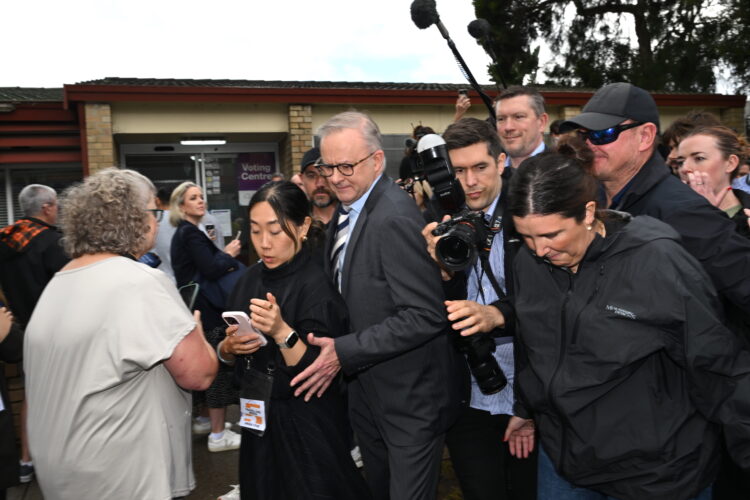
AAP has an update on how some of Anthony Albanese’s appearances have gone:

The prime minister has been heckled by another candidate on his whistle-stop tour of early voting booths.

Emanie Darwiche, who is the NSW Senate candidate for the Australia’s Voice party, headed by ex-Labor senator Fatima Payman, berated Anthony Albanese on Monday as he visited a pre-polling centre in the western Sydney suburb of Padstow.

“You are complicit in genocide,” she said.

“You are complicit in every Australian struggling to make ends meet.”

Many locals have become frustrated with both the federal government and the opposition over their response to Israel’s violence in Gaza, prompting them to turn against the major parties in favour of a candidate who advocates for the rights of Palestinians.

Corflutes of independent candidates like Ziad Basyouny dotted the nearby streets as one driver yelled “free Palestine”.

The issue prompted Senator Payman to leave Labor in July and later form Australia’s Voice.

Its policies are broadly progressive, with its candidates calling for action on property investors’ tax incentives, supermarket divestiture and action to “end the genocide” in Gaza.

“I wanted to hold the big man accountable for his complicity in genocide,” Ms Darwiche later said in a video on her social media.

The prime minister was met with a friendlier reception when he toured a pre-polling booth in Eastwood, with locals lining up to catch a glimpse.

But even there, in the hotly contested marginal seat of Bennelong, the Liberal Party signs were unavoidable.

Earlier in the day he announced a $20 million commitment to establish a women and children’s trauma recovery centre in the NSW Central Coast seat of Robertson, held by Labor on a 2.2 per cent margin.

The electorate has been a bellwether since 1983, having voted for the government for the past 15 elections.

This is a very important story from Renew Economy

New research identifies electorate of New England as the most valuable patch of land in Australia for solar and wind. But it doesn’t have the backing of the local MP

Renew Economy (@reneweconomy.com.au) 2025-04-28T05:46:26.721Z

Your comments

R Brown says:

Pre polled today and actually had a wide choice. Easy and not treated like a 74 year old.
But still know that the sad case fringe parties will get tax money just for putting in a “candidate”.
Democracy here has some dodgy sides.

That’s democracy for you. It certainly isn’t perfect x

Acknowledging that costings are lol as a general rule, Jim Chalmers has had a fun day:

Your comments

Jordan says:

I know the overwhelming message from the polls is Dutton can’t win, but I remember 2019 and how wrong they were so I remain nervous, 🙏 for a Labor green minority.

And we are hearing that a lot – a comparison with the 2019 poll. It is important to remember that in 2019 it was expectations which were sky high and that there has been a lot of work done by Australian Polling Council members since then. And also, the primary vote in 2019 was predicted by the polls (it was 2PP where it fell down). In the 2019 polls, Bill Shorten’s unpopularity was also shown, but largely ignored (although it turned out to be bang on)

I don’t know how people will vote, and I can’t say for sure the polls are accurate (they are, after all, just a guide) but in 2019, it was pretty much a repeat of the 2016 result – but the expectations were for more.

Join us for a (digital) election party

Because we just don’t know when is enough when it comes to punishing us with this campaign, we will be pre-gaming the election coverage. Join us for some pre-game fun, serious questions and discussions, and also to see how it looks from the blog side (I’ll be making some appearances on the show while blogging) ahead of the serious vote count (because yes, we know, you’ll be turning to Antony Green then)

Your comments

You can now send us comments! Huzzah and a big thank you to Andrij Stachurski for working through the weekend to set this up.

Comment through the blog and I will throw them up here (for now) to make sure we are all protected in all the ways.

Thank you to Renee for this lovely message

Amy I couldn’t have gotten through this election campaign without your humour and this blog (and the rest of the team) so a big thank you to you all! On an unrelated note I have squares left for election bingo on Sunday if anyone has anything hilarious I can put in a square let me know 😉

We have some squares left too so hopefully we can cross some more off on Saturday night x

The Great Wall of Hamer. Dirty tricks in Kooyong.

How’s Amelia Hamer going?

First, she goes from battling renter to slumlord (ok, international property investor), in one headline.

Then there was the small matter of the $20 million trust fund, of which she’s a beneficiary.

Now, she’s been accused of dirty tricks at an early voting centre in Malvern.

Rob Baillieu, Independent Councillor at the City of Boroondara and son of former Liberal Premier Ted, has posted an intriguing video of the Great Wall of Hamer.

Democracy is a lovely thing

Dorinda Cox: Dutton’s Trump like politics on Welcome to country shows why truth telling is needed

Greens senator Dorinda Cox has responded to the current culture war Peter Dutton is stoking with Welcome to country ceremonies:

Dutton’s attempt to re-stoke the culture wars and import Trump-like politics to Australia through attacking Welcome to country ceremonies is exactly why we need truth telling processes.

Terranullius was legally disproven, ongoing cultural and spiritual connection to this land and water continues today and First Nations people continue to fight to practice their culture.   

Welcome to country ceremonies are sacred and ground everyone in the understanding of place, people and connection. They invite people travelling, living and working on the lands of First People in Australia to be educated on its ancient history and to participate in the healing process by listening and respecting.  

First Nations people are not a political football for leaders in this country to punch down on when they are trying to lean into a racially charged far right approach. Australia has been on the reconciliation journey for 30 years, striving for healing, peace and justice. 

Dutton can’t erase our interconnected past, but recognition of differing experiences is critical to the advancement of social justice and human rights.  This includes their rights to perform ancient ceremonies grounded in respect, truth and reciprocity.  

A vote for a Dutton led Coalition Government is a dead end in race relations in Australia, his only path to the Lodge is now a cobbled together series of cultural attacks on First Peoples and their rights. The Greens will reintroduce the Federal Truth and Justice Commission Bill in the next parliament to ensure we move forward to achieve First Nations justice.

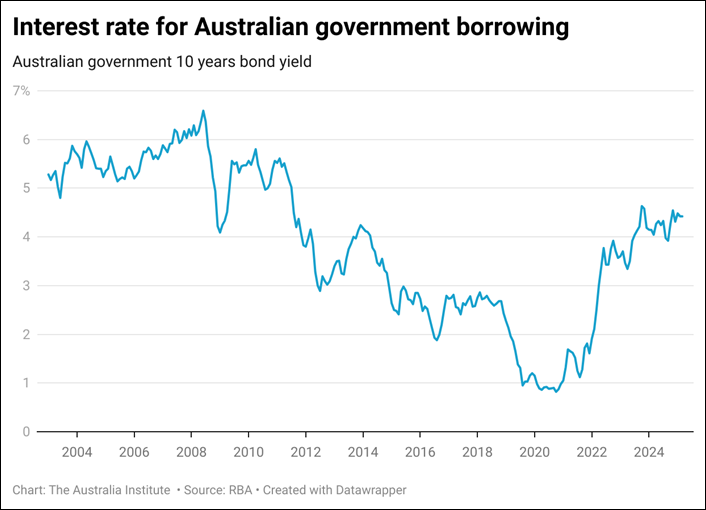
Stop worrying about ratings agencies – investors see Australia as a safe bet

Greg Jericho
Chief Economist

A lot is being made about S&P warning that big spending may make Australia’s AAA rating at risk.

I’ll just overlook that S&P was one of the ratings agencies that help cause the Global Financial Crisis and just note that ratings agencies always say this and then well… not much happens.

The reality is the best way to gauge the risk of Australia’s debt is to look at the 10 year bond yield on Australian government bonds. In effect this is the interest rate the government pays when it borrows money. At the moment the rate is around 4.4%. Back when S&P gave Australia a AAA rating and back when Australia had budget surpluses due to the mining boom, the rate was around 5.5%.

Australia is seen as less risky now to lend money to than it was when we had no net debt.

Chalmers’ cheeky plea to Dickson voters:

Labor probably doesn’t really think it can win Peter Dutton’s marginal seat of Dickson, but forcing the Opposition Leader to spend some time at home this week would be a win.

Jim Chalmers couldn’t resist finishing his media conference (outlining Labor’s election costings) without a nuclear dig at Mr Dutton.

Peter Dutton was asked last night would he be happy to have a nuclear power plant in his suburb? In his local community? Dickson? His answer was “Yeah, I would”. To all of those people in that wonderful part of South East Queensland, in the electorate of Dickson, you all need to know that your local member wants to build a nuclear reactor in your suburb. (Labor candidate) Ali France is not going to build a nuclear reactor in your local community but Peter Dutton wants to. I would encourage you to think about that as you choose your local member. Peter Dutton wants to build a nuclear reactor in the suburbs of Dickson and Ms France never would.

Jim Chalmers expands on that claim a Dutton government would endanger the nation’s triple A credit rating:

The biggest risk to our AAA credit rating is Peter Dutton and the coalition. They won’t come clean on their cuts. They’ve got more than $60 billion of commitments. They won’t say where the money’s coming from. They’ve got a $600 billion off-budget fund on the way which is their nuclear reactors. So, what we’ve shown and what the ratings agencies will know now that we’ve released our costings is the budget, under us, is in a stronger position at the end of the election campaign than it was at the beginning. And that is a powerful demonstration of our responsible economic management. It also sets up a pretty clear choice. Peter Dutton’s got secret costs and secret cuts. He won’t come clean on those cuts because Australians will be worse off. When Peter Dutton cuts, Australians will pay. And so, if the ratings agencies are worried about spending, we’ve been able to put their concerns to rest by releasing our costings today. It is long past time for Peter Dutton to do the same.

Chalmers: Coalition would threaten Australia’s triple A credit rating

Treasurer, Jim Chalmers:

Labor is the only party going to this election on Saturday with a costed, coherent, and credible plan for our economy to build on the progress that we’ve made together as Australians. We are providing the stability and the responsibility Peter Dutton proposes an unacceptable risk to household budgets, to the national budget, to our economy, and also to our AAA credit rating as well. In uncertain times, in volatile times, we don’t need a volatile leader like Peter Dutton, who lashes out when he’s under pressure. We need to see the stability, the responsibility, that only Anthony Albanese can provide – which I think is highlighted by the costings that we release today.

I’ve shown you mine, now you show me yours.

Jim Chalmers challenges Peter Dutton and Angus Taylor to release their costings “immediately”.

We’ve made it very clear what our costs are and how we will pay for the commitments that we have made in this election campaign. This continues a record of responsible economic management. It is long past time for the coalition to come clean on their secret cuts to pay for their nuclear reactors. They need to come clean on what their secret cuts for nuclear reactors means for Medicare, for pensions and payments, for skills and housing, and other essential investments in the budget. We have put our costings out on the Monday of the final week of the election campaign. We call on the coalition to release their costs and their cuts immediately. By our count, they have committed more than $60 billion in this election campaign and in their policy commitments, and that’s before we get to their $600 billion of nuclear reactors.

Treasurer and Finance Minister Media Conference on Labor’s costings

Jim Chalmers and Katy Gallagher are speaking Brisbane, releasing Labor’s policy costings for its election commitments.

Jim Chalmers:

The costings that we release today show that we will more than offset our election campaign commitments in every year of the forward estimates. We will finish this election campaign with the budget in a stronger position than at the start of the election campaign. We have improved the budget position by more than $1 billion comparing the pre-election outlook to the costings that we release today.

Katy Gallagher:

We will find a whole-of-government save in the order of $6.4 billion. This will be focused on non-wage expenses, so not on people or on programs, but on all of the other expenses and resourcing that whole of government has. We’ve managed in the first term to find about $5.3 billion in savings in those areas. So this is really a continuation of that effort.

Truth in political advertising in the last week of the campaign

Bill Browne
Director, Democracy & Accountability Program

An interesting about-face today from former Liberal MP Jason Falinski, now head of right-wing campaign group Australians for Prosperity. He wrote in a fundraising email:

“Extremism has always benefited from an under-informed people, which is precisely why Anthony Albanese, Adam Bandt, and Simon Holmes a Court’s Teals are carrying out the most sweeping assault program of propaganda in Australian electoral history.

“Albanese is proposing to introduce Orwellian “truth in political advertising” laws that will severely limit Australians’ free speech rights.

“He is backed by Zali Steggall.

When he was in Parliament, Falinski was a champion of truth in political advertising laws. Ahead of the 2019 election, he said:

“We definitely need rules in political advertising to make sure that people are not misleading the voters when it comes to making a decision about who to vote for. We have truth in advertising across the board. It just doesn’t apply to political campaigns.” After the election, he collaborated with independent MP Zali Steggall on a submission which used Australia Institute research to make the case for truth in political advertising laws, concluding:

“In order for Australia to keep up with international best practice and build confidence in our democratic systems we strongly urge that the Joint Standing Committee on Electoral Matters investigates options to ensure truth in political advertising.” Truth in political advertising laws are overwhelmingly popular among Australians of all political persuasions. They have existed in South Australia for forty years, where academic research shows they are supported by most political participants, “have had no ‘chilling’ effect on freedom of speech” and “have undoubtedly changed the face of electoral campaigning” because party directors closely scrutinise all political ads for accuracy.

As Falinski pointed out in 2019, truth in advertising is no less than we already expect of for-profit corporations.

The ACT adopted truth in political advertising laws in 2020, with the unanimous support of Labor, Liberal and Greens parliamentarians, and last year Liberal Opposition Leader described them as “probably welcome”.

Australians for Prosperity has reportedly failed to authorise its social media advertising and run paid ads that feature people who did not consent to have their interviews used in that way.

Does material like this further strengthen the case for clear, nationally consistent and constitutional truth in political advertising laws?

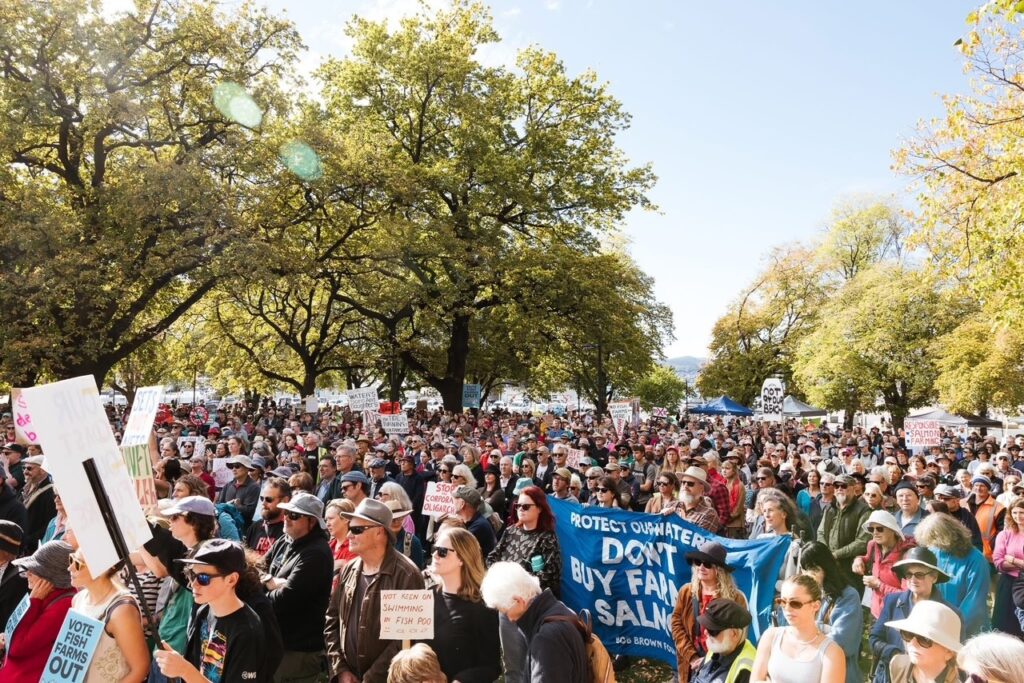
6,000 people rally to ‘vote salmon out’ in Tasmania

Eloise Carr
Director, Tasmania

Yesterday in Hobart over 6,000 people rallied to protest against the harmful impacts of the foreign owned salmon industry in Tasmania. The Australia Institute’s Tasmanian director, Eloise Carr, spoke to rally participants about recent changes to national nature laws and how we are taking this issue to the UN.

Seventeen civil society organisations have written to UNESCO and the IUCN asking for World Heritage Centre officials to visit Tasmania and assess the damage the salmon industry is doing to Tasmania’s Wilderness World Heritage Area.  This would be a huge international embarrassment, but it needs to happen. Macquarie Harbour and the endangered Maugean Skate are running out of time and options.

The Australian government has weakened the nation’s environmental laws for its own cheap, domestic political purposes. It was rushed, mismanaged, completely devoid of scrutiny, and rammed through parliament in the dead of night, with the support of the opposition, while Members of Parliament were focused on the federal budget. 

The world is watching in horror as a supposedly progressive government puts World Heritage wilderness and a globally renowned native species – also recognised for its World Heritage value – at risk of extinction. It is shameful, and the world must hold the Australian government to account.

Wanning Sun, a professor of media and cultural studies at the University of Technology, Sydney has written an interesting piece for Crikey on how some Chinese voters are viewing the Coalition’s election promises:

Many voters today likely associate Pezzullo with this misconduct, but to most Chinese Australians, his name is synonymous with war-mongering. The former public servant is a long-term staunch national security hawk who wants the US-Australia alliance to “go on a war footing”, and has speculated that a conflict with China may be “only 33 months away”. Mere days ago, on ANZAC Day, Pezzullo again sounded the alarm that “the drums are beating once again”

The prospect of Dutton bringing back Pezzullo is a source of disquiet for many Chinese Australians. Curiously, it was only last month that Pezzullo appeared to serve no value to the Coalition except as a scapegoat. Speaking to a large crowd of Chinese Australians in downtown Sydney, Liberal MP and candidate for Menzies Keith Wolahan was keen to disabuse his audience of the notion that the opposition leader was a war-monger, clarifying that “Peter Dutton never said ‘drums of war’. It was Mike Pezzullo.”

You can read the whole piece, here.

Peter Dutton and Jane Hume have both come out today to say the Coalition is not thinking of a road user charge, but it is the latest round of confusion to emerge out of the LNP campaign.

Given the upcoming Four Corners on the election and the story on family trusts, it might be worth revisiting this from Research Manager, Rod Campbell from earlier this year.

Politics and property – how our leaders are among the privileged using legal loopholes to build their wealth

Tax loopholes for some

The first thing to understand is that there are far fewer tax loopholes for avoiding tax on wages. If you work for a living, like most Australians, there are not many tax tricks for you.

If you own assets and earn income from investments, however, things are a little different. How you own the assets is also important. Simply owning your own home is nice, but not as good as owning assets through a discretionary trust, a self-managed super fund, or a family company.

Financial vehicles

A discretionary trust is a way of holding income earning assets where the income stream can be split between beneficiaries. This means money can be directed to the people in the trust who face the lowest marginal tax rates, such as adult children, rather than a higher-earning parent, who faces a higher tax rate.

The income earned from trusts overwhelmingly goes to high income earners. Treasury estimates (page 47) that the top 10% of income earners receive 63% of the income from trusts, while the bottom half of income earners get just 11% of the income.

A self-managed super fund helps reduces taxation because of the various tax breaks for superannuation. For example, an owner might have their business in their self-managed super fund, with the income to the fund being taxed at a lower rate than it would have if it was owned in the business owner’s name.

A family company, like trusts and self-managed super funds, is a vehicle for owning assets. If the assets are owned by a family company, then profits are subject to company tax rates. This can be as low as 25% if the company turnover is less than $50 million per year.

All three of these asset-owning vehicles are entirely legal. And they can have legitimate uses. But they also provide tax loopholes that can be used to reduce the amount of tax someone has to pay and to obscure who actually owns the assets.

Level the playing field

This is fundamentally unfair. These structures for reducing tax are mostly only available to the wealthy. The average wage earner cannot structure their income through such complex tax structures.

U-turn on truth in political advertising

Bill Browne
Director, Democracy & Accountability Program

In a fundraising email for Australians for Prosperity, Jason Falinski has U-turned on truth in political advertising laws and is talking darkly about an Albanese “regime”.

Jason Falinski called for truth in political advertising laws in the 2019 campaign and after the election joined Zali Steggall in making a joint submission to JSCEM on the topic (based on our research).

Now:

“Albanese is proposing to introduce Orwellian “truth in political advertising” laws that will severely limit Australians’ free speech rights. He is backed by Zali Steggall.”

“I believe the Albanese-Holmes a Court-Bandt regime will ultimately fail, because tyranny normally does. But we must ensure they fail now, not after years of ruling with an iron fist.”

Not just a U-turn from his own views of six years ago, but calling the position “tyranny”!

Labor costings to be announced at 2.15

And Jim Chalmers and Katy Gallagher have called a press conference for the next hour – which means Labor is about to announce its costings.

Four Corners is taking a look at the election campaign and the people who want to be prime minister.

Here is an early taster from ABC NewsRory Callinan of ABC Investigations, Louise Milligan, Ben Schneiders, Ben Butler, Alex McDonald, and Neil Chenoweth

Opposition Leader Peter Dutton failed to declare for two years his interest in a family trust that operated lucrative childcare businesses when he was a cabinet minister, a Four Corners investigation has found.

Documents obtained by Four Corners and ABC Investigations show that while Mr Dutton’s register of interests disclosed his wife Kirilly’s interests in childcare operations at the time, he did not declare between 2014 and 2016 that he was a beneficiary of the RHT Family Trust that owned the businesses, as required by parliamentary rules.

The investigation also analysed more than 20 years of property records tied up in complicated and opaque trust structures and found that the Dutton family, with Peter Dutton’s father Bruce, made almost $15 million in profit from buying and selling private childcare businesses as well as dozens of residential property deals.

You can read the story here

Liberals Against Nuclear have released some polling showing that the Liberal held seat of Deakin is at risk because of the nuclear policy, and it is not helping Trevor Evans bid for Brisbane. Single seat polling is hard, and it’s also hard to say there is any one issue impacting voters, but here is the group’s statement:

A new uComms poll shows leading Liberal frontbencher Michael Sukkar could lose his seat at the coming election if the Party persists with its unpopular nuclear plan.

The poll, commissioned by Liberals Against Nuclear, shows Labor and the Coalition tied at 50-50 in two-party preferred terms in Deakin. However, the same polling reveals that if the Liberals dumped their nuclear policy, they would surge to a commanding 53-47 lead.

The polling follows a broader survey across 12 marginal seats that showed the Liberal Party would gain 2.8 percentage points in primary vote if it abandoned the nuclear energy policy.

An earlier poll in the seat of Brisbane found the nuclear policy was a significant drag on Liberal candidate Trevor Evans’ support.

The Deakin polling showed women voters are particularly opposed to the nuclear policy, with 53.2% of women saying it makes them less likely to vote Liberal compared to 41.3% of men. Overall, 47.5% of Deakin voters are less likely to support the Coalition because of the nuclear policy.

The data also revealed that 56.1% of respondents don’t support nuclear power at all, with concerns about renewable energy investment reductions (19.0%), nuclear waste management (15.9%), and high build costs (13.0%) being the primary objections.

In the crucial 35-50 age demographic that makes up many families in Deakin, 48.4% are less likely to vote Liberal due to the nuclear policy.

It’s impossible to be single and save for a deposit in Sydney – no matter how good your job is

Greg Jericho
Chief Economist
https://australiainstitute.org.au/post/its-impossible-to-be-single-and-save-for-a-deposit-in-sydney-no-matter-how-good-your-job-is/

For most people in Sydney – if you had started saving for a house a decade ago, you would be further away from your goal.

In 2015 Joe Hockey told people that if they wanted to own a house the first thing they needed to do was “get a good job that pays good money“. New research by The Australia Institute has shown just how out of touch that statement was then, and how even worse it remains now.

We looked at the median salary of a range of occupations from surgeon to principal, electrician down to the low-paying checkout operator to test Joe Hockey’s claim that they would be able to save for 20% of the median established house in Sydney. We estimated them saving 15% of their after tax income and also earning the average interest on those savings.

The result is that no one – not even surgeons would have been able to save 20% of a deposit in the past 10 years. Even worse, most occupations would actually be further away from the goal.

In June 2015 the target deposit was $159,925 representing 20% of the median house price in Sydney of $799,625. By December last year they would have saved $96,069 and yet because the price of houses has risen so fast, they would now be $187,871 short of the goal of a $283,940 deposit on the median house price of $1.4m.

This was not the case in earlier times. In the 1980s, someone on median male full-time earnings would have been able to save for a median-sized deposit in Sydney in well under 10 years.

But we know that many people save for a deposit as a couple, so we investigated how couple of various occupations would be doing.

Shockingly even a couple of a school principal and a teacher, or an accountant and a nurse, or an electrician and a bank worker and many other couples would be still waiting to afford a deposit a decade after starting to save.

The crisis of housing affordability did not just start in the past few years – it has been an issue for more than a decade now. The old lines and advice about saving and working hard and cutting back on luxuries no longer make sense – if even a surgeon cannot save for a hose in Sydney, then what hope does anyone?

This research just shows how urgent is the need for significant changes to housing policy – the need to end taxation breaks for investors that have set fire to the house prices and for the government to increase the number of public-sector housing construction to supply low-priced housing and more rental properties.

Governing from Sydney doesn’t save costs – it increases them

Dave Richardson
Senior Research Fellow

Peter Dutton keeps making the threat to cut 41,000 public service jobs in Canberra. That of course ignores, as the Minister for Finance, Sen Katy Gallagher, said that when in government the Coalition “quietly employed a shadow workforce of 54,000 – costing taxpayers $20 billion in just one year.”

On top of that Dutton wants to work-from-home out of Kirribilli just like Donald Trump often operates out of Mar-a-Lago – Canberra staff would have to re-locate there.

What will that mean?

If Dutton moved into Kirribilli it would mean lots of business for the airlines, the VIP fleet and taxis, moving public servants from Canberra for briefings.

It will also mean more security around Kirribilli. Lots of travel allowance for his personal staff whether they are based in Sydney or Canberra.

It also probably means he would have most Cabinet meetings in Sydney including Expenditure Review, National Security and other cabinet sub-committees  – again lots more public servants travelling Canberra to Sydney and back again.

More travel allowances – this time for public servants. Cabinet room facilities would have to be duplicated in Sydney etc.

This happened under Howard and Morrison. It doesn’t reduce costs – it increases them.

Nearly 40 years of efficiency dividends, and what have we got to show for it?

Joshua Black
Postdoctoral Research Fellow

The size of the public service has been one of the sharper issues in this election campaign. But so far, the debate has been about “cuts” or “no cuts”, “working from home” or “back to the office you go”.

The Coalition is doggedly promising to cut 41,000 public servants in Canberra. Yesterday, public service minister and Labor’s ACT Senate candidate Katy Gallagher said the number of public servants was “about right”, but as the ABC pointed out, she “did not rule out cuts altogether”.  

Her exact words were: “there may be some changes across departments and agencies as programs finish and other priorities ramp up”.

There’s an obvious question here: if there’s still room for greater efficiency in the public service, what good does the annual efficiency dividend on the public service do?

The efficiency dividend was brought in by the Hawke Government in 1987. It forces government departments and agencies to find enough savings and efficiencies in their operations to accommodate a 1% cut in their budget each year.

It’s been around for nearly forty years now, and governments dial it up or down depending on whether they think there’s political advantage in it. But whichever way you look at it, they haven’t worked as intended.

As the head of PM&C Glynn Davis remarked a few years ago, the efficiency dividend puts a handbrake on the public service’s capacity to learn from the past and rebuild after crises.

Many smaller agencies, including Canberra’s cultural institutions, are barely able to function anymore without emergency funding top-ups to mitigate the effects of the efficiency dividend on their budget. Their job is to grow and collect, while also cutting their operational costs each year. A pretty difficult balancing act for anybody to manage.

Efficiency dividends are supposed to make the public service more streamlined and responsive to the needs of the public. It hasn’t worked as intended. The largest agencies (cough: “defence”) benefit from the benevolence of governments who want to look tough, and the smallest agencies on the frontlines of public engagement tend to suffer from the same attitudes on high.

Independent ACT Senator, David Pocock has been a critic of unfair efficiency dividends in the recent past. The minister may be unmoved by arguments about public service capacity and institutional fairness, but surely the politics are obvious.

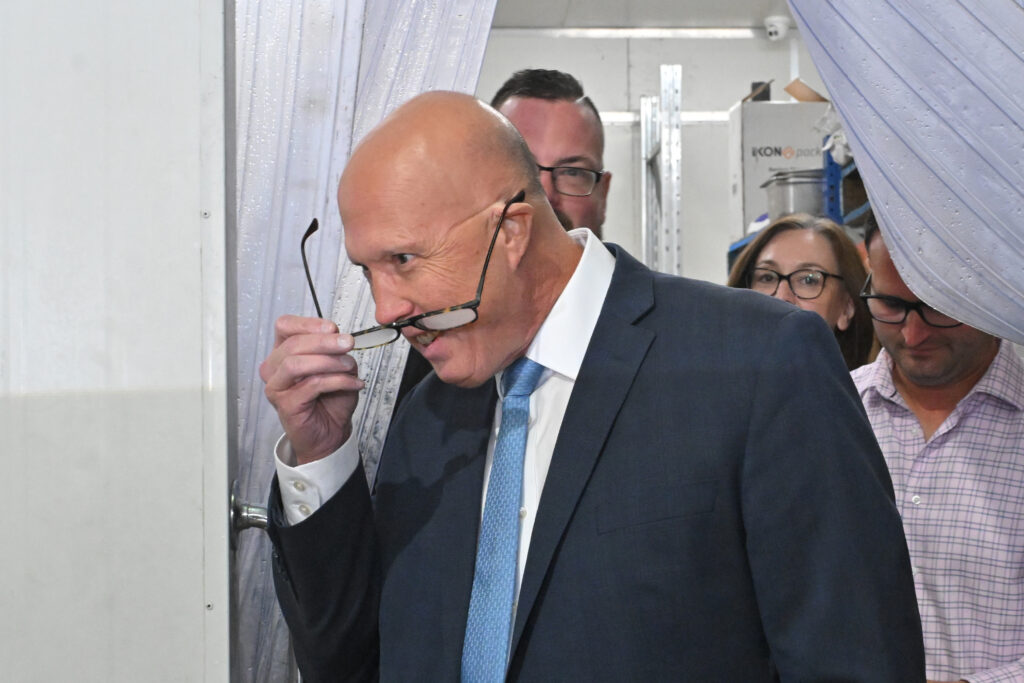
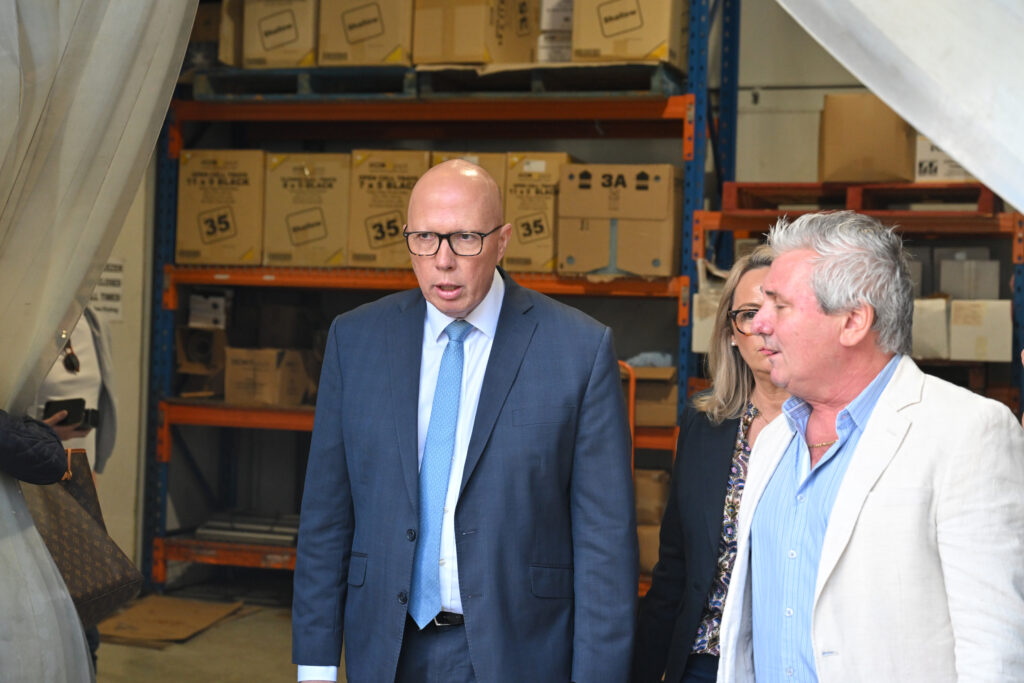
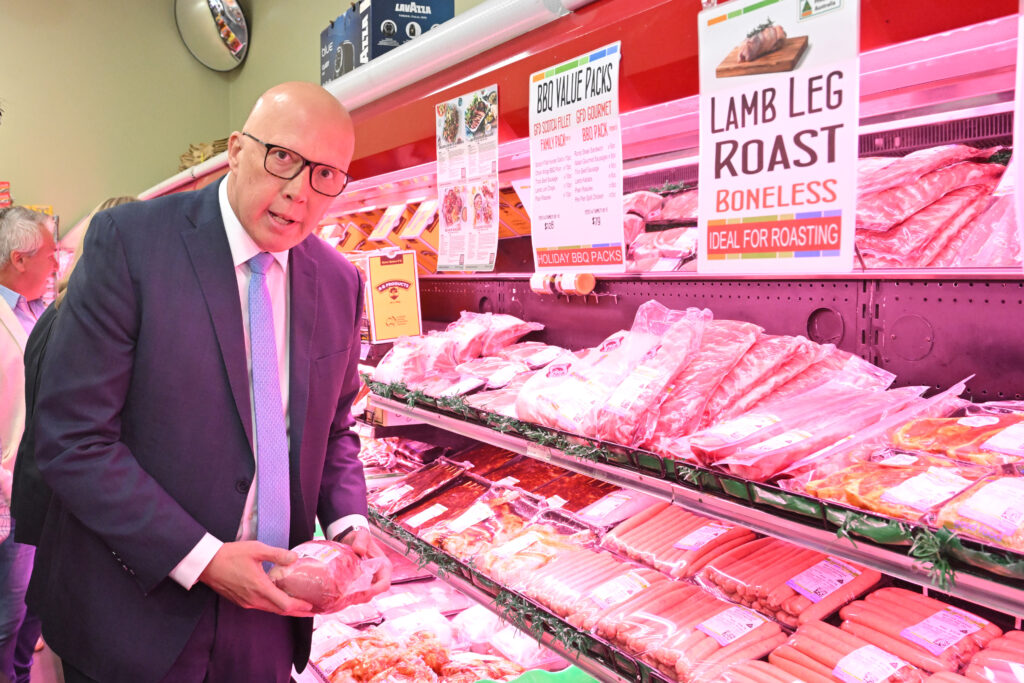
And here is AAP photographer Mick Tsikas with Peter Dutton’s campaign:

Leader of the Opposition Peter Dutton at a food distribution centre in Salamander Bay, Port Stephens on day 31 of his 2025 Federal Election Campaign in the seat of Paterson
Leader of the Opposition Peter Dutton at a food distribution centre in Salamander Bay

Let’s take a look at how AAP photographer Lukas Coch has seen Anthony Albanese’s campaign trips to some pre-poll booths this morning:

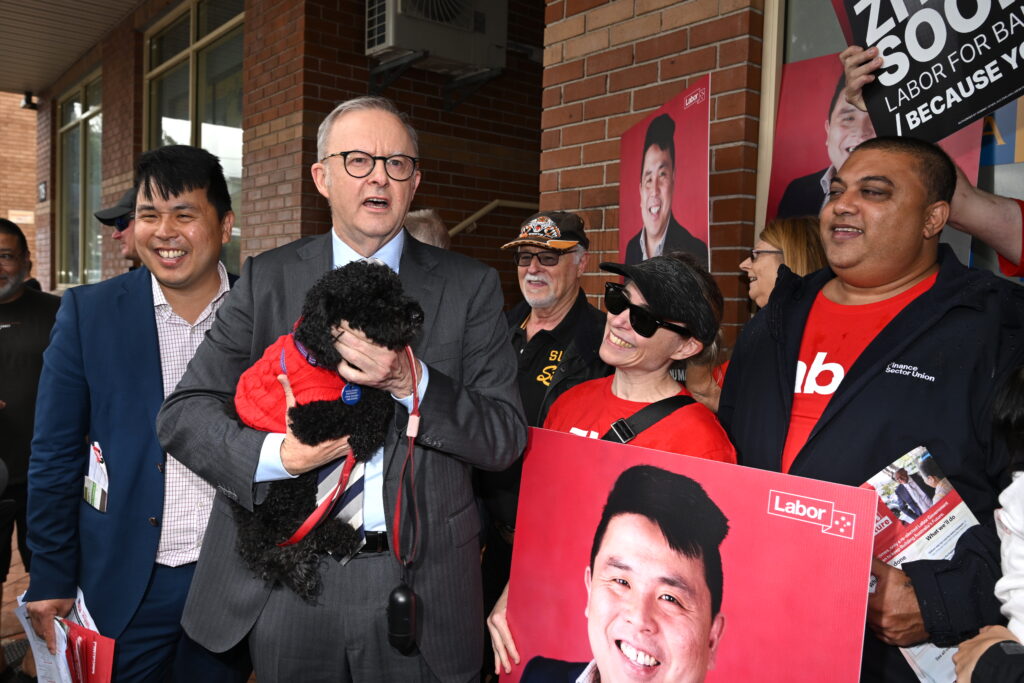
Australian Prime Minister Anthony Albanese holds a dog while handing out how-to-vote cards with Labor candidate for Banks Zhi Soon at an early voting polling place in Padstow in the electorate of Banks
Australian Prime Minister Anthony Albanese and Labor member for Bennelong Jerome Laxale visit an early voting polling place in the electorate of Bennelong
Australian Prime Minister Anthony Albanese squeezes past journalists while visiting an early voting polling place in Padstow

Migration is not out of control and the figures show it is not to blame for the housing crisis

Matt Grudnoff
Senior Economist

Chart: The Australia Institute Source: ABS Get the data Created with Datawrapper

Chart: The Australia Institute Source: ABS Get the data Created with Datawrapper

Migration is not to blame for house prices rising. And neither are Australia’s borders out of control.

Immigration has been an issue at this year’s election. The Coalition is linking it to house prices with opposition leader Mr Dutton saying: “We’re going to cut immigration because Labor’s brought in a million people over two years and that has created the housing crisis”.

Last night in the final leaders’ debate Peter Dutton doubled down saying:

“This government hasn’t had control of our borders. They’ve released people from immigration detention who have gone on to commit very serious crimes against Australians. The whole, every aspect of the migration program has been mismanaged by this Government. And if you bring in a million people over two years, over a five year period, it’ll be about 2 million people, a population bigger than the size of Adelaide.”

However, the Coalition linking immigration to the housing crisis makes little sense. The housing crisis has not just appeared in the last 2 years, it has been getting worse for more than two decades.

But what about the claim that immigration and the population have been rapidly growing? It is certainly true that net migration has been higher in the last few years. But that was after an extraordinary period where the boarders were shut, we saw more people leaving the country and entering it, and the Australian population went down. Even more extraordinary – during that period of border closures, house prices rose 25% in little over a year.

Looking at the quarterly change in population over the last 10 years we can see the huge impact COVID had and the bounce back after the borders had reopened.

But what about the overall impact this has had on Australia’s population? Has the bounce back been bigger than the slump?

No. In fact Australia’s population is still lower that it would have been expected to be had it grown at the same rate as it had been before COVD.

We don’t have a “big Australia” and migrants aren’t taking our homes or our jobs.

The problem of housing affordability is due to a lack of supply from the public sector of low-cost housing and rental properties, mixed with tax breaks for investors that has turned ustralia’s housing market into a speculators paradise.

We have pointed it out a few times as well, but Andrew Carswell, who was Scott Morrison’s chief spinner in his PMO (and treasurer’s office) has also had a pretty big role in this campaign as a media commentator. He is often introduced as a former Liberal party advisor and ‘consultant’.

Consultant is doing a lot of heavy lifting here. Carswell’s Headline Advisory has the Minerals Council as a client, which doesn’t get declared, and should, given the Minerals Council support of Coalition policies such as nuclear.

You can guarantee that if a former Labor party advisor turned consultant had green groups as clients, that these same hosts that have Carswell on to talk the campaign, would make a point of declaring those clients.

Why is the Minerals Council so directly involved with the Coalition’s campaign?

Roderick Campbell
Research Manager

Amy has already highlighted the AFR piece on the mining industry’s involvement with the Liberal campaign.

So what is it that the Minerals Council might be hoping to achieve? The Minerals Council press release on the Liberal mining ‘policy’ has a clue in the very last line:

The MCA also welcomes the Coalition’s commitment to retain the Fuel Tax Credits scheme – a critical initiative for mining, agriculture, tourism and seafood industries – building on the Federal Government’s existing commitment.

The Fuel Tax Credit Scheme is Australia’s biggest fossil fuel subsidy. This is main game for the big coal and iron ore miners because it refunds around $3.5 billion in fuel tax to them every. single. year.

The miners are very worried that independent politicians are going to push a minority Labor government to wind back this tax break.

To be clear, independents and minor parties want to take BILLIONS from BHP, Gina Rinehart and Clive Palmer and spend it on health and education.

That is why, IMO, the Minerals Council are so embedded in the Liberal campaign.

Asked about the very real concern that sacking 41,000 public servants from Canberra’s 68,000 public servants would have a massive impact on the ACT economy (and economies are made up of people, don’t forget – which public servants are. We are talking about people here) Dutton complains about Andrew Barr.

Peter Dutton, who some journalists have made the point has been more available in answering questions this campaign, compared to Anthony Albanese (he hasn’t been, he’s just better at deflecting) is now not answering questions he finds uncomfortable (something he has been doing all campaign, but there are just more of them now)

Q: Regarding your candidate for Fowler, you played a game of ‘what about’ when asked about it. Isn’t it true that if a Labor candidate had made discrimatory remarks about Indigenous Australians, you would be calling for that candidate to stand down or be disendorsed?

Dutton:

I answered that question earlier.

Q: Mr Dutton, I am being tricky but you are not answering today – you do have a go at Anthony Albanese for not being transparent, for lying. Are you being tricky with your own truth at the moment?

Dutton:

No. I have answered the questions before. The red herrings and all the rest of the distractions that people want to throw out there, they are dealing with the reality of the week. This week is about cost of living, about what will decide the election. And what will decide the election is whether or not Australians will decide they can afford three more years of Labor and I don’t think they will.

I mean, just because the Coalition campaign has decided that cost of living is its theme this week, doesn’t make it what the week is about.

To be clear, there is no universe where the national conversation should be dominated by questions literal Nazis are asking. And yet, here we are.

Q: When is it appropriate to have a welcome to country ceremony?

Peter Dutton:

[When there] is a significant event like the opening of parliament. The Prime Minister divided this country with The Voice. It was $450 million and he tried to divide us on the basis of heritage and race and I didn’t agree with it and the majority of Australians didn’t agree with it. Australians are respectful towards Indigenous Australians. We are all equal Australians. It is why I believe we should stand behind one flag united to help Indigenous Australians deal with disparity around health outcomes, around education outcomes, around housing, around safety as you have seen up in Darwin. We were only there a couple of days ago, the stabbings that have taken place, the attacks are commonplace. It wouldn’t be accepted in any other part of the country. I want to provide support to practical reconciliation. The Prime Minister’s policy is to please inner city greens which is not something we signed up to.

Dutton’s version of ‘practical reconciliation’ is ‘assimilation’ dressed up in centrist language. It is the exact sort of language used to justify things like the Stolen Generation.

Q: A bit over five days to go in the campaign. You have been on the road for four weeks. Whatever happens on Saturday nigh, how much of that result is on your shoulders? How much personal responsibility do you take for the outcome on Saturday night?

Peter Dutton:

The focus we have between now and election day is to make sure we can save Australians from three more years of this Labor Government. That is the focus. It will be fought on cost of living pressures in seats like Paterson, in seats like Shortland, in Werriwa around the country where Australian families in the suburbs are being smashed by this government.

Our opportunity is to make sure that we fix the economy, that we bring inflation down. We give the 25 cents a litre cut to fuel so help families now, giving them $1200 back through their tax rebate so we can help families deal with Labor’s cost of living crisis.

Keeping you safe as a country by investing into defence and into our law and order policy which will reduce crime in suburbs and towns across the country.

Peter Dutton hints that the Coalition will release their costings on Thursday.

The Labor Party released their costings on the Thursday before the election in the last campaign and we will release them in due course.

We are expecting Labor to release their costings today.

Q: Last year 206,000 working holiday-makers came to Australia. Yesterday Bridget McKenzie said no cuts to working holiday makers. At this point do you concede it is now mathematically impossible for you to reach your migration cuts or will you reduce working holiday makers?

Peter Dutton:

No, we have been clear in relation to migration. We have had a population boom under the Prime Minister and that is why the young Australians are locked out of the housing market. The Prime Minister lied about it before the election. He brought in a million people over two years. Bear that in mind, when has ha happened in our country’s history before? It hasn’t. It is a 70% increase on any 2-year period in our country’s history. Understandably, those people want homes when they get here. The supply of housing has been crunched because of the CFMEU.

Q: I am not disputing the numbers. I am interesting you about your planned cuts to migration. Will you cut working holiday makers or can you not reach the targets?

Dutton:

We are going to reduce permanent migration by 25%. We are going to reduce the figure by 100 thought relative to where Labor’s is. We will take advice from the department of Treasury and finance and the central agencies about the settings within the economy and what we need to do.

One of the things we have done to increase labour supply into the market is to allow pensioners and veterans who are on a pension, if they chose to do so, to work for hours without it effecting their pension.

That will replace some of the international labour that people are relying on at the moment. We have thought it through carefully. Our policy is to cut migration and stop foreigners from buying Australian homes so we can get young Australians into homes more quickly.

I have said, and I am serious about the fact I want to be the Prime Minister for home ownership.

The Prime Minister has crushed the dreams of millions of young Australians. Young Australians are putting off having kids and older Australians are putting off retirement because they need to stay in the work force longer to help their kids save a deposit or make their repayments. We will have more to say in relation to the settings.

Cutting migration is not going to make houses more affordable, or increase supply to the point of lowering rents. It is a fantasy.

Q: The Liberal candidate for Fowler has had to apologise for social media posts where he repeatedly used derogatory terms to refers to Indigenous Australians. He made insensitive and offensive remarks about Tanya Plibersek’s family also. Is this the standard you will accept for Liberal candidates running in this election and indeed if elected for your government and do you not have a better candidate?

Peter Dutton:

A couple of points. He has apologised for the comments and so he should have. They were inappropriate and shouldn’t have been made. He has apologised for them.

I won’t take a lecture from the Prime Minister who has a relationship with the Greens, is accepting preferences from the Greens in his own seat, he is preferencing a Green number 2. This is an anti-Semitic Jew-hating party. (This is absolutely not true, and is irresponsibly factually incorrect) They have been involved in all sorts of horrible doxing and comments online that are repugnant but not repudiated by the Prime Minister.

The Prime Minister has a candidate in Dickson, one in Flynn and elsewhere, where they have conducted themselves appallingly. The Labor candidate in Fowler has been referred to the integrity – the corruption commission. I am not going to take a lecture from the Prime Minister.

Dutton refuses to take a second question on this, pointing out that this is his candidate.

Q: Under your leadership the Liberal Party has shifted away from its traditional base at the big end of town and towards lower and middle income earners. Polls suggest this strategy is paying off with big potentially in Werriwa, Whitlam and Melton. Has the Liberal Party now become the true party of working Australians and is this a permanent realignment do you think, or is it just a reaction to the cost of living crisis?

Peter Dutton:

I made this point when I first became Liberal leader that we weren’t the party of the big end of town. That is for the Labor Party, that is the relationship between the big unions and big business. We are the party of small and medium enterprise.

We are the champion of a local small micro business that wants to become a medium size business and list one day or sell out to a bigger company.

We are the party of not just small businesses but also battling Australians and for the millions of forgotten Australians living in the suburbs and regions, they see a Prime Minister who is obsessed with pleasing green voters in inner city Sydney and Melbourne.

This Prime Minister hasn’t blinked when that claim has been made against him. He has deliberately sided with green voters in inner city Sydney and Melbourne to hang these people out to dry in regional areas. He didn’t introduce the cut to fuel tax.

We are proposing that because it will help families who are driving long distances to work or to school and running kids around on the weekend.

We are the party giving $1200 back by way of tax rebate to help those families in outer metropolitan areas. I don’t know how many years it would have been since a Liberal leader has been to Melton? Quite a few, I would have thought.

For us and if you look at the work Laurence has done here, these regions are naturally swinging to the Liberal Party because people know that the Labor Party is for inner city green trendies, not for outer suburb hard workers. That is what the Liberal Party is about and that is the choice people have at this election.

Q: You have campaigned heavily on cost of living. Is it a bad look you don’t know the price of a dozen eggs?

Peter Dutton:

The point that most families have made to us is the cost of everything has gone up. The cost of everything has gone up in the household budget. I was talking to people in Far North Queensland this morning, their insurance bill has doubled. We are talking about it going up by 35%, their lived experience is it is doubling. It is not just food and it is not just electricity, it is insurance, it is the cost of everything under this government that continues to rise.

Peter Dutton press conference

Peter Dutton is in the electorate of Paterson he starts off with the cost of living spiel, which is what the Coalition is back on as an issue (having detoured into hate media, welcome to country ‘debate’ and other One Nation wooing topics’.

There is a chance where if the Coalition’s primary vote is in the doldrums, One Nation could pick up seats like Hunter. And maybe Paterson. Which is something to think about and so far seems to be missed in all of this One Nation preference talk. In three cornered contests, it is possible for the minor party to win from behind – the Greens did it in Brisbane and Ryan – and One Nation can do it from behind in these seats, with Coalition AND Labor preferences.

The ACF (Australian Conservation Foundation) has joined in with the Greens demand for no new coal and gas as part of any negotiations in a minority government.

ACF CEO Kelly O’Shanassy said:

Approving new coal and gas projects is the opposite of climate action, so we commend the
Greens for identifying a halt to new climate-wrecking fossil fuel mines as a negotiating priority.

In an era of escalating climate change, when global scientists and the International Energy Agency have called for no new fossil fuel projects, it is grossly irresponsible to keep approving
new coal and gas mines.
It was shocking to witness the offshore regulator’s approval last week of Santos’ Barossa gas
project, which will spew out more than 270 million tonnes of climate pollution over its lifetime.
No matter where it’s burned, Santos’ gas will turbocharge heatwaves, bushfires and other
extreme weather here in Australia.
We call on the next federal government to comprehensively assess the climate and nature
impacts of Santos’ Barossa gas project.
The next parliament must champion a safe climate – starting with a determination to end the
approval of new coal and gas projects.

Australia’s export of fossil fuels is responsible for three times of the emissions we create at home – we are responsible for 4.5% of global emissions, with 3.5% a result of exports.

Coalition desperate for you to believe ‘hate media’ was just a joke

It is obvious that the ‘break in case of emergency’ comms strategy of ‘ha, it was a joke!’ has been cracked open in regards to Peter Dutton calling the Guardian and the ABC “hate media” at a campaign rally in Melbourne on Sunday.

Not only is it not a joke, and actually part of an on-going campaign of demonising good reporting, it is also dangerous in this climate, given how many people are going to the extremes, emboldened by Trump rhetoric.

Nazi’s feel comfortable to gatecrash Anzac Day ceremonies and ‘just ask questions’ about Indigenous inclusion in Australia. Which is then picked up by mainstream media as ‘just asking questions’. If you are asking the same questions as Nazis, you might need to take a look at yourself and what you are doing.

Paterson says:

Oh, look, I hope no one took that too personally. I thought that was said in jest. I think it’s pretty fair to say that both the Guardian and the ABC have taken some tough editorial stances and applied a lot of scrutiny to Peter and the campaign. And they can certainly dish it out. I’m certainly sure they won’t be offended in return.

Q: But it is the public broadcaster, with a many billion dollar budget. Hate mediais quite a strong comment from an aspiring Prime Minister, is it not?

Paterson:

I thought it was a tongue in cheek comment. I think you will know, as you’ve seen on this campaign trail, Peter engages very well and very respectfully with all media outlets. You’ve had great access to him on the campaign trail.
Everybody gets a question every day. He doesn’t hide from that scrutiny. And I think it’s a fair exchange of ideas and sometimes a little bit of cheeky exchanges too, and I don’t think that’s a harmful thing in a healthy democracy

Which brings me to another point. There are a lot of commentators who speak about the difference between Peter Dutton camera and Peter Dutton away from the cameras and how he’s actually a very ‘good sort’. But it doesn’t matter. It truly does not matter if Dutton is a good sort in person. It matters what he does with power. How he treats it. What he signals with it. And Dutton, despite from all accounts being much more jovial on the campaign with journalists than Anthony Albanese (who is always cranky, on or off the cameras – he’s a cranky person in general) when he has power, uses it in way to try and hold others down. That’s not ‘a cheeky exchange’. That’s dictatorship.

James Paterson who is supposed to be the official campaign spokesperson for the Coalition (but who has been largely usurped by Jane Hume) held a doorstop this morning where he was asked whether or not Peter Dutton will visit any of the sites the Coalition has earmarked for nuclear sites:

Q: Senator, Peter Dutton was also asked a pretty straightforward question. Will you visit a nuclear power site during this campaign? He didn’t say yes or no. So what’s going to happen there?

Paterson:

Well, he gave a very clear answer to that question, which is he already has visited…

Q: Outside the election campaign, he was asked about the election campaign.

Paterson:

Your time as Opposition Leader is more than just what you do in an election campaign. And Peter Dutton has visited, as Opposition Leader, three sites of nuclear power facilities

Q: There are seven, though, Senator.

Paterson:


That’s right. And the truth is that wherever the sites are, all Australians will benefit from our energy plan. They’ll benefit immediately from the cut to petrol and diesel tax. They’ll benefit over time from reduced gas prices from our east coast gas reserve. And in the long term, they’ll benefit from an emissions free, reliable, affordable energy system under nuclear power. And what we’re focused on is all of the Australians who will benefit from that plan

Why have wages stayed comparatively low, despite a tight labour market?

Ross Gittins at the SMH looks at some research:

We can learn a lot from a new research paper by one of the nation’s top labour-market economists, Professor David Peetz, of Griffith University and the Australia Institute’s Centre for Future Work.

Peetz finds that, despite a fall in “real” wages (that is, after allowing for price rises) during the COVID pandemic and the subsequent surge in prices, by December 2024, real wages had recovered to be equal to what they were at the end of 2011.

Whether voters know it or not, the federal government does influence the size of wage rises via its regulation of the wage-fixing rules.

Two things to note. First, this is wages before taking account of income tax. Real after-tax wages would not have recovered to their level 13 years earlier, because of the bracket creep made greater by the price surge.

Second, over those 13 years, the productivity of labour improved by 15 per cent. So none of the benefit of that improvement was shared with workers – contrary to the assurances of businesspeople, politicians and economists that, by some magic process, productivity automatically increases real wages.

Sorry, there’s nothing automatic about it. If workers don’t have the bargaining power to insist on their fair share of the spoils, employers don’t pass it on.

Peter Dutton is about to hold his first press conference of the day – he is in the electorate of Paterson, which is one of the Coalition’s target seats

The Anti-Poverty Centre has responded to Anthony Albanese’s cranky response to Guardian journalist Dan Jervis-Brady asking him about Jobseeker (which has been one of the missing elements of this campaign, along with the farce that is mutual obligations.)

The Antipoverty Centre is calling on the prime minister to at least be honest about the failure of his government to support people in poverty instead of insulting our intelligence. Welfare recipients do not accept the pathetic excuse that “fiscal parameters” are a reason to keep Centrelink payments below the poverty line.

Earlier today Albanese accused a Guardian journalist of verballing him, saying that he “deserves respect” and leads a “compassionate” government, when they asked what it would take for a Labor government to increase JobSeeker to the amount called for by advocates and if his advice to unemployed people is to “just get a job”.

He had the audacity to make these comments when announcing a trauma recovery centre for women leaving violent relationships, while he chooses to keep women living in poverty with inadequate Centrelink payments and the partner income test, which trap them in violent homes. The Sex Discrimination Commissioner has called for these policies to change because she knows services are just a band-aid if root causes are not addressed.

As Australia Institute chief economist Greg Jericho commented, “When political parties talk about ‘fiscal parameters’ in regards to help for those living in poverty, they are not being up front about all the costs to the budget that go to the richest and the most profitable.”

Quotes attributable to Antipoverty Centre spokesperson and JobSeeker recipient Jay Coonan

The prime minister hasn’t earned the respect of anyone who cares about people in poverty.

A lot of poor people believed Labor when they said “no one left behind”, and that broken promise has caused a lot of pain. Many of us are feeling worse off financially now than we did three years ago and the government has shown no signs that they care to address that.

Albanese refuses to acknowledge the obscene reality that it is government policy to maintain 4% unemployment, while at the same time forcing those of us who don’t have paid work, or don’t have enough of it, to survive hundreds of dollars a week below the poverty line. There is no compassion in that, or the endless gaslighting about how good we have it.

The reality is we’re not in a cost of living crisis, we’re in a greed crisis that has been enabled by policy choices made by this government and supported by the Coalition.

The government can afford to lift all Centrelink payments to ensure no one is in poverty, it just prefers not to. No one talks about the budget constraints when it comes to more weapons or tax handouts to the wealthy, only when it comes to helping those of us who need it most urgently.

We need all Centrelink payments above the Henderson poverty line urgently, and then the government must work with welfare recipients to develop a sophisticated poverty measure that is fit for purpose in the 21st century.

Joshua Black has written a brilliant piece for The Conversation on independents and minor parties and their roles in our parliaments:

Major parties used to easily dismiss the rare politician who stood alone in parliament. These MPs could be written off as isolated idealists, and the press could condescend to them as noble, naïve and unlikely to succeed.

In November 1930, when independent country MP Harold Glowrey chose to sit on the crossbench of the Victorian parliament while his few peers joined the new United Country Party, the local newspapers emphasised that he could not “become a cabinet minister” or “have a say” in making policy from the sidelines. (As if he wasn’t aware.) Australia was a place where, according to the scribes at The Ouyen Mail, “very few constituencies were prepared to elect independent men”.

Things are rather different now. Lifelong loyalty to a single party has become a rarer thing among voters, with the Australian Election Study showing fewer than four in ten voters give their first preference vote to the same party at each election. It was more than seven in ten back in 1967.

Voters have gravitated towards alternatives to the two major parties. A new interactive data tool from the ABC shows just how much more competitive federal elections have become. Australians are now world leaders in sending independents to represent them in state and federal parliaments.

And who could call the independents of the recent past naïve? Independent MPs held the balance of power in New South Wales in the early 1990s, and in Victoria later that decade. Both parliaments saw substantive reforms and improved parliamentary processes.

Noam Chomsky wrote about always reading the business papers because it is where power speaks to itself and tells the truth.

It also means that power is a little less wary of those reporting on it. Joe Aston used that to his advantage in Rear Window and Mark Di Stefano is carrying on that legacy – revealing things you won’t see anywhere else, because he uses his access to people with power wisely – but doesn’t get caught up in it.

Labor costings to come out today?

Given that this is the final week of the campaign, it is costings week – when the parties give a mini budget on how they would pay for their campaign promises.

This website, hosted by Treasury, gives details on the costing proposals submitted so far – there is a couple more than there was last week.

There are rumours Labor will drop their costings today, to better capitalise on the Coalition’s mess of a policy platform, especially since the Coalition isn’t expected to hand down its costings until Wednesday or Thursday (cue more days of ‘we know how we will pay for it, but they can’t say)

We’ll keep you updated.

Election entrée: Preference pile-ons

Skye Predavec

Last election, independent Kylea Tink won the seat of North Sydney on a primary vote of 25%.

This was the lowest for a winning candidate in 2022, closely followed by the winning candidate in Nicholls, National MP Sam Birrell, who won with 26% of the primary vote.

In Groom, independent Suzie Holt received 8% of the vote on first preferences, putting her in fourth. She finished in second place with 43% after leapfrogging One Nation and Labor on preferences.

The only candidate to win from third place in 2022 was the Greens’ Stephen Bates in Brisbane.

It is relatively recent that Independents and minor parties benefited most from Australia’s voting system.

Until the 1980s, it was the Coalition who mainly benefited from preferential voting. From 1949 to 1987 Coalition candidates won 106 races where they were behind on first preferences, with Labor taking only seven.

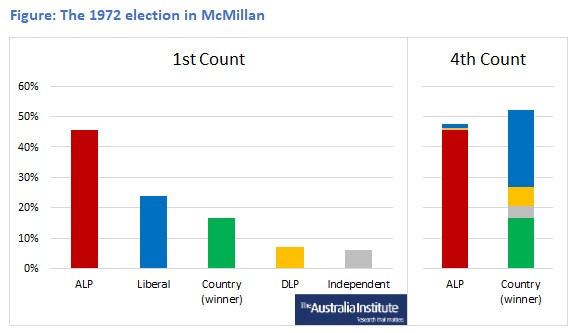
The lowest ever primary vote for a winning candidate in a federal election was received by the National (then Country) party’s Arthur Hewson in 1972, who won McMillan from third place with just 17%. Preferences from independent, Democratic Labour Party, and Liberal voters allowed him to beat Labor on the final count with 52%.

It took until 1990 for Labor to win more electorates from behind than the Coalition, winning seven to their three. This was due to the high vote share for Democrats and Greens, whose preferences mostly flowed to Labor.

Since then, Labor candidates have won on preferences more often than Coalition ones, but as alternatives develop across the political spectrum it is far from certain that will continue in the future.

The great benefit of preferential voting is that it ensures that Australians cannot “waste” their vote. Under full preferential voting, Australians number every candidate according to their preference.

The full distribution of preferences confirms that between the last two candidates remaining, the majority prefer the ultimate winner. Unlike in first past the post, an elected representative can be confident that they are preferred by the majority over the runner up – even if they started with a lower primary vote.

Given that there is now a focus on domestic and family violence prevention (and a little bit of money with it) where was this focus at the beginning of the campaign?

Today’s mini-campaign announcement is: A re-elected Albanese Labor Government will provide $20 million to establish The Coast Women’s and Children’s Trauma Recovery Centre in East Gosford.
 
The new frontline domestic, family and sexual violence service will help up to 500 women and children to recover from violence and abuse and will provide much needed crisis and transitional accommodation.
 
The community-led initiative will offer a wrap around, trauma-sensitive approach to support recovery from domestic, family and sexual violence trauma – with a focus on working with children to help break the cycle of violence.
 
This election commitment builds on our major investments of over $1.2 billion in crisis and transitional accommodation.

Albanese:

We have been, focused on this for three years. We have announcements in every Budget. Our Housing Australia Future Fund announced probably five years ago – or at least four years ago. We haven’t waited on this, we haven’t waited on this. I announced the 500 community service workers to deal with the issues on violence against women and children. I announced that in Queanbeyan. You can look up your files with Linda Burney. I am sure it was at least in 2021 four years ago.

Q: For all of us in the media when we ask viewers and our readers about the cost of living, some would say have you seen the price of eggs recently? It is the great topic in kitchens and in the shopping aisles of Australia. What does it say about your opponent do you think that he doesn’t know the price of eggs?

(Last night Dutton said they were $4.20. Albanese said $7. The hosts quoted about $8-9 across the majors)

Albanese:

I think importantly he doesn’t know the price of Australian values right across the board. Those sorts of things can happen, that is the truth. They can happen.(Albanese is referring to Dutton getting the price of eggs wrong, but also to his own mistake last campaign in not having the inflation number, so he is giving Dutton a bit of grace)

I am not going to – he had an explanation for that, I guess. (Dutton said he buys a half dozen of eggs) The thing about eggs that I know because I hear it, is people are struggling to find eggs on the supermarket shelves.

We know inflation is a real issue, the cost of living. The difference in this election is that Peter Dutton has spent three years identifying problems and saying somehow that the government is responsible as if global inflation has not occurred, as if we haven’t had the biggest energy crisis since the 1970s. As if the High Court don’t make decisions independent of government. The truth is, this election campaign has exposed that he has no solutions. Dare I say it, that has come through during this campaign.

Albanese is asked about scare campaigns and says:

I am proud of our achievements and part of that is strengthening Medicare, not just what we have done but what we will do. We promised 50 urgent care clinics. We have delivered 87. We will deliver another 50. The 1800 Medicare promised we made yesterday stands in stark contrast. There were two rally yesterday – or three if you count in McKellar. Ours in Parramatta had a key policy component at its heart that will make a difference to peoples’ lives. Enabling people to have 24 hour access to health advice, which would then be connected up potentially with a doctor or, if it’s the case that people should then go to hospital, then that would occur.

Making a difference for families if a young child overnight has a fever, they are not sure how to respond, knowing that there is a phone that they can pick up, ring that number and get advice, or people with an elderly relative who goes “No, I am OK” because that is what a lot of people do who are resilient…

Q: It is insulting to Australians, isn’t it?

Albanese:

No, let’s be clear. There is a choice between our positive agenda, Peter Dutton yesterday – his rally – there were no policy announcements, nothing positive going forward and he went to Channel Seven last night and belled the cat.

He went and said he needed to abolish bulk billing to make primary care sustainable.

He belled the cat last night. He can’t say where his $600 billion for the nuclear plan is coming from. There will be cuts. We know that is what happened last time. He was voted the worst Health Minister in history by doctors. He did try to introduce an abolition of bulk billing. He tried to introduce a payment every time people visited an emergency department. He did freeze the Medicare rebate for six years. He has said repeatedly that people don’t value Medicare if it’s free. Things that are free, that is why they are against free TAFE and against all these measures.

There is a real choice and Australians when they vote, whether it is today, tomorrow or right up to Saturday, know that they put a number 1 next to their Labor candidate, their candidate will defend and strengthen Medicare, not the least of which is the doctor and pharmacist behind me and they know that they also said they oppose the 60-day dispensing to give Emma a crack here as well. They said that would be disastrous and pharmacies would close. Where are the pharmacies that closed as a result of that reform? That has made a difference to peoples’ lives. There is a choice and it is important that not only have I put forward a positive coherent agenda, we have also put forward legitimately a critique of the other side.

Anthony Albanese is referring to the Netflix show Adolescence which is a British psychological drama about a young teenage boy who murders a female classmate. (That’s not a spoiler, it’s the set up)

The question the show asks is why he did it. It has raised a lot of uncomfortable questions and formed a large part of the British political debate (although not all child psychologists are thrilled with it) over the so called ‘red pilled mansosphere’ (which is just toxic masculinity dressed up as Andrew Tate) and the role it has played on young boys and men.

It seems to have had a pretty big impact on Albanese:

It took me quite a while [to watch] I’ve got to say. in bits but I have got to say, for people who – just to give an ad here again, it is captivating and I was looking forward – that is probably the wrong word but I was very keen to see the next episode each time that I saw one. I think it is five or six episodes.

Fact check: Jobseeker – everything is affordable if it’s a priority

Greg Jericho
Chief Economist

Journalist: You are here to announce funding for a vulnerable cohort. Another vulnerable cohort are those on the JobSeeker payment. Your government has been provided with respect after report that shows the rate is inadequate and leading to poor health outcomes among other things. What will it take for your government, if you are re-elected, to increase the rate to the level that advocates have been calling for…

Albanese: We did increase…

Journalist: To the level they have been calling for?

Albanese: We did increase the rate. One of the things we have done is to provide opportunities for career paths into jobs. Free TAFE is making an enormous difference in opening up those opportunities. We have created over one million jobs in our first term, more than any government in history. We have, in addition to that, had the lowest unemployment rate of any government in 50 years.

Journalists: Is the message to those on JobSeeker just get a job?

Albanese: No. That, frankly, that deserves a bit better than that. I deserve better in treating you with respect without being verballed. Very clearly, I have concern about people but I do want people to get into employment, yes, I do. I don’t want people to have a life time of unemployment but I understand as well that people need to be looked after. My government is a compassionate government, that has provided support. We do so within the fiscal parameters as well of budgetary policy. I reject the characterisation that you put forward. I don’t think that is fair and I don’t think it relates to the answer that I gave.

Amazing how fiscal parameters comes up with relation to Jobseeker in the way it never does for defence and other issues.

Nor do we get told that we can’t afford the $22bn in superannuation tax breaks that go to the richest 10%, or the $11bn on fuel tax credits, or the $7.5bn that goes to the richest 10% through the capital gains tax discount on properties and negative gearing.

By contrast,  raising Jobseeker to 90% of the Age Pension – an increase of $173 a fortnight – would cost $3.6bn.

When political parties talk about “fiscal parameters” in regards to help for those living in poverty, they are not being up front about all the costs to the budget that go to the richest and the most profitable.

Q: On domestic violence and this view not enough has been done. You commissioned a rapid review last year to learn what governments could do quickly and the levers they could pull. Some of the recommendations were that you should restrict access to alcohol and gambling. What is your view on that recommendation and are you committed to doing those two things to take quick action as a government in your next term?

Albanese:

We are committed to making a difference. We do have a $4 billion national plan. We are working through a range of issues with state and territory governments as well. One of the issues that a commitment that we made before the election was for 500 community service workers. Of those, we stepped up, we were unhappy with how slow that was to be implemented. We have to find the staff to do so. 480 of those are in place today.

Q: On gambling and alcohol specifically?

Albanese:

We will work through all of the issues. It is not – there’s not a single issue that you can say if you do this you will solve these problems. In some cases, we need to work through changing attitudes of young Australians as well, the education – the thing we were speaking about before, of changing attitudes.

Q: ACT Chief Minister Andrew Barr says the Coalition’s plan to cut 41,000 public servants from Canberra would mean a prolonged depression for the area and surrounding suburbs. Do you agree with that assessment or is it overblown?

Albanese gets an opportunity to give the answer he has been waiting for:

No, you bet it would. It would have more – I won’t say more importantly, but it would have a devastating impact on Canberra.

I tell you what I’m more worried about, the impact it would have on Australians. The impact it would have on Australian veterans who would go back to waiting and in some cases the men and women in uniform who have served our country, not getting their entitlements. The impact it would have on our defence and national security, because there are around 68,000 public servants in Canberra. 41,000, you get rid of them, where does he think Services Australia runs its central offices from to provide support for Australians in emergency funding after there has been a natural disaster? Where does he think the people who run our pension system work?

Where does he think on national security, ASIO, the Australian security intelligence service, ASIS, the Department of Defence, the Department of Foreign Affairs and Trade, the Australian Signals Directorate that work on cyber security issues, where does he think these people are?

I will give him a hint. When he goes from Parliament House to go off to the airport where he wants to be able to fly to his home in Kirribilli House, the building that is in front of him in Russell is full of Canberra public servants. The buildings to the left, not breaking secrets here, ASIO.

I have been to all of them. I would suspect he has been perhaps to some of them. I am not sure where he thinks Operation Sovereign Borders runs from, but it doesn’t run from Gosford, with respect to Gosford, it runs from Canberra.

This would have a devastating impact on gutting the capacity of the Australian government to serve the Australian people and it’s just one example of how they are just unfit.

He has had three years to prepare for an election. What I did, as Opposition Leader for three years, was during the first Budget Reply, child care fully costed and we have now implemented that. The Housing Australia Future Fund announced in a Budget Reply – funded, a plan to go forward. This mob change their minds on a day to day basis.

I will make this point – we do live in an uncertain world. In an uncertain world where there is volatility, the last thing you need is a volatile government that can’t agree on its own positions on a day to day basis, that thinks that getting angry and muscling up is the way that you engage in diplomacy. He is prepared to verbal leaders of other countries, or the head of the Reserve Bank. This mob are just not ready for government and I hope that that is seen by Australians in the lead-up to Saturday’s election.

Is it a failure that Anthony Albanese can’t just WhatsApp Donald Trump and says ‘yo, what gives?’ (I am paraphrasing here)

Albanese:

Not at all. I don’t have Donald Trump’s number. I didn’t have Joe Biden’s number. It is not the way it works between the Australian Prime Minister and the US President. There are formal processes that take place. I have had two very warm conversations with President Trump.

Asked about the rally in honour of Audrey Griffin, a 19-year-old who was found dead in March (53-year-old Adrian Noel Torren has been charged with her murder) which was held yesterday, Albanese said:

This is a tragic and horrific death and my heart goes out to the family and the friends and loved ones of Audrey Griffin. This announcement wouldn’t have impacted on that. One death from violence against women is one too many and this is just an enormous tragedy and we continue to work through these issues. As I said before, this needs a whole of society response.

Anthony Albanese press conference

In his morning press conference, Albanese has also been asked about the debate and its outcome and said:

Truth is, if you look historically, it is hard for Prime Ministers to win debates. The natural advantage is there for opposition leaders. I chose scrutiny, transparency. I agreed to four debates. No Prime Minister in Australia’s history has had four debates as far as I’m aware. I might be wrong. Could be something in the 30s perhaps but they wouldn’t have been televised live and they wouldn’t have had devices. I chose to do that. Some people said, including some people here said “Why are you doing that?” I did that because I think the more people see of Peter Dutton, the more they know that this is an Opposition that were in government less than three years ago. This is the leftovers from the Morrison Government, they are just not ready for government.

There were two key issues last night that showed that. One was on Medicare, where he made the extraordinary comment on Medicare, about the reason why he wanted to abolish bulk billing was because he wanted to make primary health care sustainable.

What that shows is that they haven’t changed their view. That is their view and people will go back to their view.

He also, similar to what they have said about working from home, it is not the right time now to abolish working from home. When it comes to nuclear power, Peter Dutton is putting all his eggs in one basket and he has no idea what the cost is. That’s very clear.

The voters in the debate room overnight gave the debate to Anthony Albanese. Peter Dutton wasn’t too happy with that (just like he’s not happy with the public polls) and asked about it, Albanese said:

Look, I have seen Peter Dutton’s comments and I find it extraordinary, that there were 60 voters chosen independently by an agency and they voted double, two to one in favour of myself. And I was very grateful for that outcome. And Peter Dutton blamed the voters, the 60 people who were in that room listening to the debate.

Anthony Albanese has done the morning FM radio rounds.

Asked on Sydney radio GoldFM about the polls, Albanese said:

Well, there’s a lot at stake over the next week. What’s at stake is whether students will get 20 per cent off their debt, whether Australians get a tax cut or, under Peter Dutton, they actually get an increase in their income taxes, every single taxpayer. Whether first home buyers will get access to a five per cent deposit is important. Whether we make more things here in Australia, whether we continue to act on climate change and whether we continue to build positive relationships in the world, all of that is at stake. But what is front and centre after our announcement yesterday about Medicare 1800, where people will be able to ring and get access to health advice 24 hours a day, on top of our Urgent Care Clinics and our greater access for bulk billing – we know that’s on one side of the equation, on the other side, Peter Dutton last night, in response to saying that he wanted to abolish bulk billing, which he did when he was Health Minister, said that he wanted to make primary care sustainable. Well, he’s belled the cat that he doesn’t think it’s sustainable to get a free trip to the doctor, which was his view then, it clearly is still his view and that is an enormous setback for the country if that occurs.

Dutton campaign bus stuck on woke bike path barrier – probably Labor’s fault.

So now that Jane Hume is blaming Labor for Peter Dutton saying “hate media” for…reasons still to be explained, it might be worth reminding you all that Dutton is heading to the teal seats for what seems the first time this campaign.

After spending the campaign at petrol stations, talking big dumb utes, construction sites and factories (his first week was basically all high-vis) Dutton is now heading to the inner-city, seemingly remembering they exist.

At this point, it seems like much of the Coalition campaign is centered around deflecting criticism in the wash up that they didn’t do something – so to the teal seats Dutton goes. Even though the Coalition didn’t send a representative to the Women’s Agenda forum last week on women’s issues. It’s so pesky that women are 50% of the voting population. Just very annoying for the Coalition to plan for.

Meanwhile, the Dutton media bus has become stuck on a bike lane barrier on Martin Place. Dutton isn’t on the bus (the leaders’ usually travel in different cars/buses) but still – the metaphors for the campaign are all there. DAMN THOSE WOKE BIKE PATH BARRIERS

Members of the media stand on the sidewalk after the bus they were travelling in became stuck on a bike lane barrier at Martin Place in Sydney

Jane Hume claims Dutton’s ‘hate media’ comment was “tongue-in-cheek, then blames Labor

Would Jane Hume call the ABC (and the Guardian) “hate media” as Peter Dutton did?

Oh no, says Hume. It was all a great joke!

Hume:

I have appeared on the ABC so many times. I doubt you would hear that from me. However, you can safely say that was a tongue-in-cheek comment by Peter Dutton yesterday.

Except it is one he has (and other leaders of the Coalition) have made multiple times.

Tony Abbott blacklisted the Guardian in 2014 (Lenore Taylor was the political editor then and she and the team not only continued to do their job, they broke multiple stories about issues with Coalition policy)

Dutton declared that the Guardian and ABC was “dead to me” in 2018, after he faced sustained criticism for his plan to ‘fast track’ visas for white South African farmers.

And then on Sunday, Dutton turned to calling the Guardian and ABC “hate media” for….it seems doing their jobs? Which is very Temu Trump of him.

Hume thinks it is all “a Labor beat up”

Look, that is entirely irrelevant. I think this is quite, frankly, a Labor beat-up. This idea that you can somehow align Peter Dutton with Donald Trump is a nonsense. Peter Dutton will always stand up in the national interest and you saw that in the debate last night.

Except Dutton (who also declared we can trust “whoever” is in the Oval Office last night) said hate media from his own mouth. Labor didn’t make that up. We all saw and heard it.

Hume says it is still Labor’s fault:

Labor, we know, have tried to dish the dirt on Peter Dutton from the very beginning of this campaign. They have questioned his integrity, they have questioned his appearance, they have questioned his background, they have questioned his attitude. And yet what we really want in Australia right now is a strong leader that will step up and stand up for Australia’s national interest that will step up and stand up for those Australians that have been left behind by this bad Labor Government.

Are the Coalition looking at introducing road user charges for electric vehicle drivers if you win the election?

Jane Hume:

No, that is not our position*. Our position, of course, is that at the moment, emission standards should remain, but the problem is the penalties that are being placed on retailers of all vehicles. That’s going to push up the price of electric vehicles** and, indeed, other vehicles for – sorry, it will push up the price of non-electric vehicles, and we know that Australians, there are many Australians who simply can’t have electric vehicles because they’re too expensive or whether because they’re inappropriate for their lifestyle. We don’t think that’s fair.

*For now, given recent history on policy positions.

**This is actually her being honest

Cool, but does Jane Hume think that Welcome to Country ceremonies are ‘overdone’.

Hume:

I have been to events where the Welcome to Country ceremony has been beautiful and extremely moving and they are very important at official ceremonies.

However, I think we have all been at meetings where you sit around a table with a dozen people and each person has to do an Acknowledgment to Country before the meeting begins. When it comes performative, I think it loses its meaning. But a Welcome to Country ceremony at an appropriate event is entirely appropriate and extremely respectful.

Welcome to Country’s and Acknowledgement of Country are too separate things. A Welcome to Country is where you are being welcomed to the land by someone from that country, who tells you about the significance of the country you are on and why it is so important to care for country and those who dwell on it. An Acknowledgement of Country can be done by anyone and acknowledges the country you are on, as well as any Aboriginal and Torres Strait Islander people in the room.

The only meetings I have been in where there are multiple Acknowledgements of Country are zoom meetings where people are in different places.

It is Jane Hume who has been sent out early for the Coalition campaign (remember when this was James Paterson’s job?) Does she think that Welcome to Country ceremonies are going to be used as a political football after her leader said he thought they were “overdone”?

Hume:

I think the real issue that Australians are talking about is the cost of living and their standard of living has gone backwards so far in the last three years. Backwards by about 8%. So it’s not as if you’re – all in your head, you know, you’re not just feeling poorer, you, in fact, are poorer. That’s what’s playing out at the polling booths that I have been going to in the last week. People know that they need cost-of-living relief right now.

That’s why we have offered 25% – sorry, 25 cent cut in fuel excise for the next 12 months, that will kick in immediately if a Dutton Coalition Government is elected. At the end of that 12 months, there’ll be $1200 back for around 85% of workers. We get the budget under control, sustain inflation at a lower rate and then, of course, make sure we bring down the cost of energy. That’s how you manage an economy effectively. Manage it so that a cost of living is not an ongoing issue. It shouldn’t be part of a feature offer Government as it has been under Anthony Albanese.

How does the PM forget 13 million Australians?

Joshua Black
Postdoctoral Research Fellow

In the fourth and (thank God) final leaders’ debate last night, Albanese and Dutton both made surprising slip-ups that tell us something about which Australians they think really matter at this election.

Dutton’s clangers (on housing, Indigenous affairs and so on) were all pretty familiar. But Albanese has gotten away with one doozy a few too many times.

Albanese, not for the first time, said that his government would ensure that all 14 million Australians get a tax cut.

That’s nice. Except, there are actually 27 million Australians. So how does the PM forget 13 million Australians?

Answer: he means taxpayers. The government says there are around 14 million income taxpayers in Australia. The PM conflated “taxpayers” with “Australians”.

This wouldn’t matter so much, except he has made this error in nearly all of the TV debates during this election. It’s an almost Freudian slip, giving the impression that only those who earn above the tax-free threshold really count in our economy and society.

Citizenship is about more than just the economy and taxes. When we start defining citizenship in these ways, we immediately begin to discount other citizens – pensioners, people receiving income support, young people, students and plenty more – as less than full citizens.

The PM shouldn’t forget about the other 13 million Australians. Especially when he needs more than a handful of them to vote for him on 3 May.

The AEC says that 2.4m people have already applied for a postal vote, with more expected before postal voting applications close on Wednesday.

(Get a wriggle on if you need a postal vote)

About 2.3m people have already visited a pre-polling booth, which is 25% up from this time last election.

People want to switch off and we can not blame them.

Greens announce climate demands in event of minority parliament

The Greens have announced they plan on “circumvent[ing] the coal-approving Environment Minister in minority Parliament negotiations and demand the Climate Minister exercise as yet unused powers to stop new coal and gas mines”.

From the release:

The Greens will announce their climate demand for minority government negotiations in the electorate of the Environment Minister, who has approved many of the over 30 new coal and gas projects backed by the Labor government since coming to power.

Bandt said:


In the middle of a climate crisis, Tanya Plibersek has approved new coal mines that will release 2.5 billion tonnes of climate pollution. If the Environment Minister won’t act, the Greens will get the Climate Minister to do it

The Greens will keep Dutton out and get Labor to stop approving new coal and gas mines, because you can’t put the fire out while pouring petrol on it.

Australia is being hit with fires and floods, but Labor has approved over 30 new coal and gas projects and Peter Dutton wants even more. They talk up renewables but open up coal and gas. Labor are climate charlatans and the Liberals climate criminals. 

If you’re worried about climate change, you can’t keep voting for the same two parties and expecting a different result. 

If you want climate action, you have to vote for it, because it’s clear Labor won’t act on climate unless pushed. 

The Greens gave the Climate Minister the power to stop new coal and gas mines with the stroke of a pen, and with more Greens in minority Parliament we’ll get him to use it.”

Circuit breaker needed as fossil fuel export surge risks further climate harm

New Australia Institute research shows coal exports have reached record highs and new coal and gas projects continue to be approved. 

Australia exported more thermal coal in the last quarter of 2024 than it ever has before.  (See chart below)

Just last week, Santos’ Barossa gas project was approved, despite it being the most emissions-intensive gas export project in Australia and possibly the world.  

Meanwhile, the Minister is yet to make a decision on Woodside’s proposed North West Shelf gas expansion, which would have devastating consequences for the environment and the Murujuga Rock Art. 

“This record expansion of fossil fuels has been facilitated by an ALP government that was elected to take action on climate change – not accelerate it,” said Rod Campbell, Research Director at The Australia Institute

“Australia needs fewer coal and gas mines, not more.  

“Today’s proposal from the Greens to prevent new fossil fuel projects demonstrates how the next Parliament could act immediately. 

“No new laws are needed. The Minister has the power to stop new fossil fuel projects right now.”

Australia Institute research shows coal and gas emissions are still rising, wiping out progress from renewables. Any further approvals will lock in climate damage for decades.

Source: Department of Industry, Resources and Energy Quarterly, March 2025

The NRL’s Magic Round is at the end of this week, which will also cover the election date.

The AEC wants you to “vote before you go”.

For a full list of early voting locations available across the country, visit aec.gov.au or search the where to vote tool.

For the record, here is that exchange from last night:

Albanese: You wanted to abolish bulk billing altogether by having a charge –
 
Dutton: I wanted to make primary care sustainable.
 
Albanese: – By having a charge every time people visit the doctor, would have been no bulk billing.
 
Dutton: No but your charge now is $43
 
Albanese: That was what you did.
 
Dutton: Your charge is $43.
 
Albanese: That’s what you did. We’re repairing your mess.

What does Jason Clare expect from the election?

This is going to be a razor thin election result. It will be very tight. Most Federal elections are and every single vote will count but I think the more people see Peter Dutton, the less they like and one of the big issues that will be on peoples’ minds as they go to vote, whether it is today or on Saturday is whether they want a bigger investment in Medicare to make it easier to see a doctor for free.

One of the things that was revealed last night was Peter Dutton defending his decision to try and put a tax on you every time you go to the doctor. He argued that was necessary for him to do. The mask was taken off last night, Peter Dutton revealing he doesn’t believe people should be able to see the doctor for free

Hilariously, the Coalition, which has matched Labor’s spending on big ticket items and has $21bn for defence over five years, and its own promises of short term tax breaks and fuel excise cuts, has accused Labor of a “spendathon” this election.

Every accusation is a confession, I suppose.

Clare says:

We will release our costings shortly which I think will put the lie to what the Liberals are saying on that. What Australia needs, what we are focused on is making sure we provide the support that Australians need right now with the challenges with cost of living. That is why we have delivered tax cuts, made child care cheaper and medicine cheaper, helping Australians where they need it most. The Liberals voted against that or opposed that. Develop a plan for the long term also. That is what free TAFE is about, that is what making going to the doctor free is all about, that is what cutting HECS debt by 20% is all about. We have a plan for the future. The Liberal Party has a plan that lasts five minutes. As the Prime Minister outlined last night, most of their changes, most of what they are offering only lasts 12 months or less. It is why Peter Dutton doesn’t have a positive plan for the future of Australia.

Jason Clare has been rolled out this morning for early media. He is asked about the ‘it doesn’t work that way’ comment from last night’s debate, over why Anthony Albanese just didn’t call Trump’s mobile.

Asked about some of the chat groups between world leaders, Clare says:

That happens with a number of leaders but when you are talking about the most powerful country in the world, when you are talking about the leader of the United States, it is unsurprising and appropriate that that sort of conversation, that interaction is done at a formal level. It is not just a secure room, a secure line but you have note takers who take a formal record that is published afterwards of that conversation.

Good morning

CAN YOU BELIEVE IT?

We have made it to the final week.

Mostly intact.

Not sure if we can say the same for the nation though.

The last debate (we could not bring ourselves to cover another one) went down much as the others – sticking to lines, false fights and ridiculous calls to the margins – in this case, Peter Dutton doing all he can to dog whistle about Welcome to Country ceremonies.

Shockingly, the man who boycotted the National Apology to the Stolen Generations and destroyed the Voice referendum with a bunch of lies, Welcome to Country ceremonies are “overdone”.

Dutton’s final week will be a full mask-off moment, where he will do all he can to woo One Nation voters in the outer rim seats and he’ll do it relentlessly.

So prepare yourself for that. The other stand out moment was over whether or not Donald Trump owns a mobile phone. So yeah. It went places.

We’ll cover the day as it happens. You have Amy Remeikis with you, and the brains of the Australia Institute at your disposal.

I will need three coffees to get through these next few hours.

Ready? Let’s get into it.


Read the previous day's news (Thu 24 Apr)

Comments

Start the conversation

The biggest stories and the best analysis from the team at The Point, delivered to your inbox.

Past Coverage