Wed 23 Apr

Australia Institute Live: Day 26 of the 2025 election campaign. As it happened.

Amy Remeikis – Chief Political Analyst

This blog is now closed

Start the conversation

Australia Institute Live: Day 26 of the 2025 election campaign. As it happened.

Key Posts

The Day's News

Good evening – see you tomorrow?

And on that note, we are going to wind down the blog for the day.

We have another big day of campaigning to cover tomorrow, with the major parties keen to try and appeal to as many voters as possible before they head to the polls – in their millions.

We would love to know from you what you think has been missing from the campaign – send us a message at amy.remeikis@australiainstitute.org.au and let us know what has mattered to you, that you are not seeing this election.

Thank you for all your messages, thoughts, questions – and yes, even the occasional complaints. We take everything you say to us seriously and we really value you taking the time to not only visit the blog, but also let us know your thoughts.

We have a pretty intense time ahead of us, so we will be doing more recaps, more analysis and more fact checks – and trying to help you as much as possible ahead of you casting your vote.

But we are also looking towards the next term and what Australia will look like. We are here to try and shape it to some of your desires, guided by the principle of – imagine if Australia was brave?

What does that mean to you?

We hope you think big. As always, take care of you Ax

Patricia Karvelas has asked Ed Husic about Donald Trump’s latest reverse ferret on the tariffs, this time saying that while the number ‘won’t be zero’ the tariff on goods coming from China will be ‘substantially’ lower.

Q: Do you see that as promising or should we not hold our breath?

Husic:

I am very careful about not reading too much into an announcement made one day, then something else changes, we will get another announcement. I think you have to be able to deal with the actual, what decision is actually being made and put into effect, is important.

Australians do not want to have in particular announcement is made and then backtracked and then we are not going to a decision, sounds familiar and the Australian context, but effectively Peter Dutton has mimicked a lot of that in terms of taking plans, changing them and I don’t think that serves the public well so in the US context, it has caused obviously a lot of instability in terms of global trade, absolutely, that has played through, not just about the instability it has caused, the way it has translated, for example, predictions about what that I to growth here and overseas, the way it will inhibit trade, the way it has inhibited, has an economic impact, and by extension, jobs, is concerning and we need to be in a stronger footing. If there is headway, if, for example, what has been suggested materialises it will be good and keep it rolling but let’s wait and see.

And there you go:

What will charities forum offer for this neglected but vital sector?  

Bill Browne 
Director, Democracy & Accountability Program

I’m writing from the National Press Club, where Assistant Minister for Charities Andrew Leigh (Labor MP) and Shadow Assistant Minister for Charities Dean Smith (Liberal Senator) are discussing the charities sector. (It is very pointedly not a “debate”.) 

As the Press Club description notes, “Charities employ over 1.4 million Australians and contribute over 8% to our GDP. Beyond their economic impact, charities and community organisation are at the heart of our communities, our connectedness, our wellbeing and resilience.” 

Australia Institute research finds that the charity sector is about as large as Australia’s retail sector or its education and training sector. Charities employ many times more Australians than the fossil fuel industry does.   

But despite its size and importance, the charity sector is neglected and mistreated by politicians.  

Charity advocacy is muzzled indirectly, including by the threat of withdrawing funding, and directly, including through legal pressure like non-disclosure agreements.  

When the Labor and Liberal parties did a deal to change election laws earlier this year, they made it very difficult for charities to continue to advocate for political reform. But for-profit corporations got special treatment: the political parties scrambled to provide business lobby groups with a higher donation cap to allow them to continue to run multi-million-dollar political campaigns.  

These restrictions on charities are on top of earlier limits on charity advocacy passed during the Morrison Government with the support of the Labor Party. At the time, Andrew Leigh promised to “revisit this framework” in government – which did not happen.  

For an excellent story on what is happening in Gaza, read Nour Haydar’s report on her interview with Mohammed Mustafa for the Guardian’s Full Story podcast (which Nour hosts)

From the story:

When Israel shattered the ceasefire in Gaza last month and resumed its large-scale bombardment, the British-Australian doctor Mohammed Mustafa had just clocked off at the emergency department of what was the last fully functioning hospital in Gaza City.

“It was so intense that the windows blew off their hinges and I had fallen out of my bed,” he tells Guardian Australia’s Full Story podcast.

The 35-year-old emergency physician from Perth was on his second medical mission in the besieged territory volunteering for the Palestinian Australian New Zealand Medical Association at al-Ahli Arab hospital, also known as the Baptist hospital.

Children and women began arriving at the hospital with extreme injuries, including burns and missing limbs. Mustafa knew many would not survive the night.

“The department was so full that it spilled out on to the streets and we were cutting people’s chests open to put in chest drains in the streets,” he says.

“Because I am 6’2” and about 18 stone I ended up just carrying two or three people at a time on my back, on my chest, carrying them and just running to the CT scanner to get people in.”

Back to the final question in the PM’s press conference, Albanese is asked:

On the Smart Energy Council report [when it comes to nuclear] at the top end it says that Coalition’s nuclear plan could cost $600bn and in a best case scenario it could cost as little as $116 billion so do you accept if the Coalition gets it right, that cost could be below 600 billion?

Albanese:

I noticed Peter Dutton not only got nasty with the Prime Minister but with the Smart Energy Council. When ever anyone disagrees, he gets nasty. He said he would smile more but we have seen the opposite.

Taking a group like the Smart Energy Council because they dare to disagree with him and point out the holes in his policy… What the council has done is look at the work for the Liberal Party [offering] and found massive holes in it, for example…they assume a 40% smaller economy.

They have assumed no aluminum, no steel making, no heavy industry because that is what a 40% smaller economy looks like, there are holes all through their costings, you could make the case Smart Energy Council has been conservative because when you look at the cost blowout around the world, with a Hinckley or wherever, there are massive cost blowouts in nuclear and Peter Dutton and Ted O’Brien have no answers.

Coalition WOULD recognise West Jerusalem as Israeli capital.

In case you missed it – a Coalition spokesperson has been forced to clarify some of Peter Dutton’s earlier comments about whether the Coalition would recognise West Jerusalem as the capital of Israel. That is in Palestine but Israel has attempted to claim it as part of its own territory for years. The Morrison government made plans to recognise the illegal claim, which was reversed by Labor in 2022. Dutton said he would go back.

As SBS reports:

Also on Wednesday, Dutton suggested he had no plans to reinstate a decision by former prime minister Scott Morrison that recognised West Jerusalem as the capital of Israel — a move that was reversed when Labor came to power in 2022

“We don’t have any plans to change the current arrangements,” he said.

But a spokesperson for the Opposition leader clarified he meant the Coalition had no plans to change its current position, which is to recognise West Jerusalem.

The spokesperson said this was outlined in a speech by Opposition foreign affairs spokesman David Coleman in a speech to The Sydney Institute in March.

“When Labor announced its shambolic decision in 2022, the Coalition expressed its strong opposition and affirmed that our position remained that West Jerusalem is the capital of Israel,” Coleman said at the time. “This continues to be our position.”

The journalists who’ve obviously spent much of the day on a plane, are shouting over the top of each other, much to the PM’s amusement.

So non-Canberra press gallery people, if you yell out, you go back down the queue.

Maybe they’re on a sugar high after loading up on easter eggs.

The presser returns to policy and the coalition’s defence spending announcement today.

Peter Dutton hasn’t been able to defend his defence policy today. This is once again a media release in search of a policy, a media release in search of some detail. He is unable to say where the money would come from, except for saying, confirming, that they will put up income taxes this election campaign is a choice between Labor that will lower your income tax and the Coalition that will increase your income taxes, but that doesn’t cover the amount that they’ve announced as well. So, on top of that, there’ll be more cuts needed. He also hasn’t been able to say what the money would be used for. It’s extraordinary that you make this announcement with a very large figure in the tens of billions of dollars. You can’t say what you will use the money for. You can’t say where all the money will come from. This is an opposition that have not done the hard work, whether it’s defence policy, whether it’s nuclear policy, they can’t explain any of how it would actually roll out. And then they have a team that for most of the campaign are in hiding and haven’t been able to come forward at all. And Mr (Shadown Defence Minister Andrew) Hastie is just one example of that.

The Prime Minister is asked about comments made by Labor’s candidate for the Queensland seat of Flynn, Helen Madell.

Ms Madell, a clinical psychologist who counselled child sexual abuse victims, reportedly criticised the late Pope Frances for his “ongoing support for paedos” in an old social media post.

She made a mistake that shouldn’t have happened and people, if they go back through their history on social media, I’m sure there’s lots of people have said things they regret. She has said she regrets it and that’s entirely appropriate.

Prime Minister Anthony Albanese takes a swipe at a journalist from The Australian, who asks him about placing the Green second on the how-to-vote card in his seat of Grayndler.

The organisational wing do the how to vote cards. The Australian are really obsessed with promoting the Greens in Grayndler. And I congratulate you on your determination to get them known. But I’ll make this point – people should vote number one for the Australian Labor Party, and I know what the name of the Labor candidate is in Grayndler and he’s run a number of times. The last time round I won on primary votes, my preferences didn’t get counted. That’s what happens in Grayndler, and we’ll be continuing to advocate for a number one vote, not just for myself in Grayndler, but for my friend Chris Bowen in McMahon, and for Labor candidates everywhere. That’s our determination, and I’m not about promoting the Greens candidates, whatever their name is.

Western Australia Premier Roger Cook is talking up the battery project in Collie:

It’s so great to see the exciting progress here at Synergy’s battery energy storage system. A local company has been providing the construction for this for this project. Where, along with 500 workers and all up it’s 640 batteries, 160 inverters that are now in place. And it looks amazing. And we’ll be ready to see this. This site (will be) fully commissioned by October this year. And this is an important part of what we’re doing as a nation. This is the energy transition that you can see right in front of you. When we started this project, we said it was the biggest in Australia. By the time we finish it, it won’t even be the biggest in Collie. But in Collie and the Neoen project just down the road will have two of the biggest energy storage systems in the country. Through these big battery installations. And this battery is now on track to make sure that this summer and every summer going forward, we have strong, reliable, renewable and gas-fired energy sources which will continue to power this state into the future. It’s part of my government’s $3.8 billion investment into renewable energy and energy storage infrastructure.

“Not fair dinkum”

Prime Minister Anthony Albanese repeats a line which obviously went down well in last night’s debate:

Peter Dutton last night refused, had an opportunity to talk about where the cuts would be, and once again has said that you have to wait till after the election. He’s saying vote for Peter Dutton and vote for a Liberal national government, and you will get cuts. But he won’t tell you until after the election. That’s not a fair dinkum way of dealing with the Australian people.

Prime Minister’s press conference is underway

Anthony Albanese is speaking in Collie, Western Australia, alongside recently re-elected WA Premier Roger Cook and Energy Minister Chris Bowen.

He’s at the sight of a soon-to-close coal fired power station.

It has been earmarked as a clean energy site (for large batteries) by the current government.

It’s also one of the seven sights earmarked by Peter Dutton for a nuclear power station.

The PM begins his attacks on Mr Dutton’s failure to visit any of the nuclear sites – including Collie – during the campaign.

Anthony Albanese did a press conference earlier today which we missed – it was VERY short.

It looks like he stayed in his electorate and only took a couple of questions.

One of them was on the line the Coalition have been pushing all day – which was picked up by some of the breakfast TV presenters, following the release of Albanese’s preferences:

Q: Prime Minister, we’re in your seat today, just on preferences in your seat. Hannah Thomas, the Greens candidate has said, you’re complicit in genocide, you should expel Israel’s Ambassador, and you should sanction Israel, and also says you should arrest Benjamin Netanyahu if he ever chooses to come to Australia. Why are you telling your supporters in Grayndler to put her second? (none of these things are false?)
 
Albanese:

Why is The Australian determined to give the Greens such profile? It’s rather strange, I’ve got to say. I wouldn’t have been able to tell you if you’d have asked me who the candidate was. Last time around in this seat, I won on primaries. I won on primaries. That’s the way the system works. I got more than 50% of the vote. I look forward to people voting number one for me and then filling in all the numbers, just as they do, to make sure it’s a formal vote. And I don’t intend to promote the name or the candidate – of the Greens Party candidate, and I’m surprised that The Australian are determined to promote them.

Last night’s debate, sorry if I can. Just last night, Peter Dutton confirmed that there are secret cuts. He had an opportunity to say where those cuts will come. Will they come to health? Will they come to education? Housing – we know that the Housing Australia Future Fund will be abolished. We know that they will make cuts across the board, because they not only have to call waste the expenditure, such as the increase in people’s wages, in the increase in pensions, they’re going to abolish the Housing Australia Future Fund. They’re going to get rid of support for manufacturing through the National Reconstruction Fund, they are going to get rid of the activity test, which will hurt disadvantaged women, in particular with children. Peter Dutton needs to come clean about where the cuts will be. He has a $600 billion nuclear energy plan. He needs to tell Australians, before the election, not afterwards, where the cuts will be made, otherwise, all of his promises that he is making, all of which, of course, disappear in a short period of time. Those short-term hits that will disappear. We know he will increase income taxes, because he has said that, that will cover $17 billion. But he needs to find further information, further details about where the cuts will be. We’re now just 11 days from polling day on May 3. The Australian people deserve better. We handed down a Budget in March, and then we had the Pre-election Fiscal Outlook. We have outlined the costs of all of our policies.

He needs to come up and explain to Australians how he pays for his nuclear plan. We know that he won’t go anywhere near any of the sites for a nuclear reactor. It’s radioactive for him going near them. He just won’t go anywhere near them. Well, he does need to explain this, because the Australian people deserve the information before they cast their vote. Half a million Australians have already done so, I expect another half a million will today. But he needs to, as a matter of urgency, come out with where the cuts will be. He’s got another big spending announcement today. We’ll see if that actually results in anything. The last time they were in government on defence, of course, what they did was make more than $40 billion of announcements with no money attached. This time around, of course, as well, we know he’ll sack 41,000 public servants. The last time around, there was a queue when we came to office of 42,000 Veterans, men and women who have served our country in uniform, who are awaiting their entitlements. So, you can’t, on the one hand, say you care about defence, and at the same time, be treating our Veterans in such a callous way by denying them their entitlements.

Answering your questions: One Nation preferences – will they have an impact?

Bill Browne
Director, Democracy & Accountability Program

Jaishree asks:  

I have a question about the mutual preferencing of LNP and ONP this election, reported in the news today and how much it will affect or improve the 2PP for the Coalition? Will it be a significant factor? 

Annabel Crabb reports today that the Liberal Party has decisively broken with its long-standing policy of not preferencing One Nation, which dates back to Prime Minister John Howard.

“In 139 of the 147 seats where One Nation is running a candidate, the Coalition will recommend that its voters put One Nation second.” 

In return, One Nation is recommending preferencing Coalition candidates number 2 in several seats – even going to the extent of pulping earlier HTV cards that had the Coalition lower.  

How-to-vote cards (HTV cards) are handed out by political parties and candidates to prompt their supporters to vote a particular way. It is up to every voter whether they follow a how-to-vote card or not.  

There is also a question of whether voters see a HTV card at all. While the major parties cover most polling booths, a smaller party like One Nation will not be staffing every booth.  

“Concordance” is the term that describes a voter following their party’s HTV card. Antony Green’s analysis of Senate data suggests few One Nation voters faithfully follow One Nation HTV cards.  

Of course, One Nation voters may still get the message about the Coalition even if they do not number every box exactly according to the One Nation HTV card.  

But it’s already the case that the Coalition can expect most One Nation preferences. At the 2022 election, 64% of One Nation voters preferenced the Coalition ahead of Labor; the rate was 65% in 2019. Ben Raue has more data on his excellent blog The Tally Room.  

And even before the HTV announcement, some pollsters were expecting even stronger Coalition preferences from One Nation at this election – based on the results at last year’s Queensland state election and federal polling data.  

And thinking about preferences more generally, it is true that these HTV recommendations can make a difference in some seats: William Bowe identifies Labor’s open ticket in Macnamara and the Liberals preferencing Labor ahead of independent Peter George in Franklin as having the potential to affect the final result.   

In short, preference deals can make a difference and I expect the preferencing deal with One Nation will help the Coalition two-party preferred vote – but it is difficult to say by how much.

Most One Nation voters do not follow HTV cards exactly and may not get to see a One Nation HTV card, and most were already expected to preference the Coalition ahead of Labor.  

Greg Jericho
Chief Economist

Angus Taylor is now blowing a heck of a lot of kisses to big business and it really just highlights how divorced this room and debate is from voters.

The underlying pretence is that making businesses more profitable through lower taxes, weaker IR laws will result in a better economy.

When you think the economy is profits it’s very easy to produce a strong “economy” Is that a fair one? Is that one with decent services for all people? Is that one with low levels of poverty?

None of these questions are being asked.

It’s an echo chamber debate held for business owners who think they are the only thing that matters in the economy.

It’s quite gross.

Greg Jericho
Chief Economist

Debate host Laura Jayes has asked about penalty rates and why the ALP will not let the Productivity Commission look at those.

The thing is that penalty rates do not affect productivity, they affect profits.

Productivity is how much you produce with the hours you work and the tools you use.

How much you are paid to do that does not affect productivity. If you are paid less to do your job on a Sunday or public holiday that does not improve productivity – it just cuts wages and increases profits

Australia does not have an uncompetitive tax regime

Greg Jericho
Chief Economist

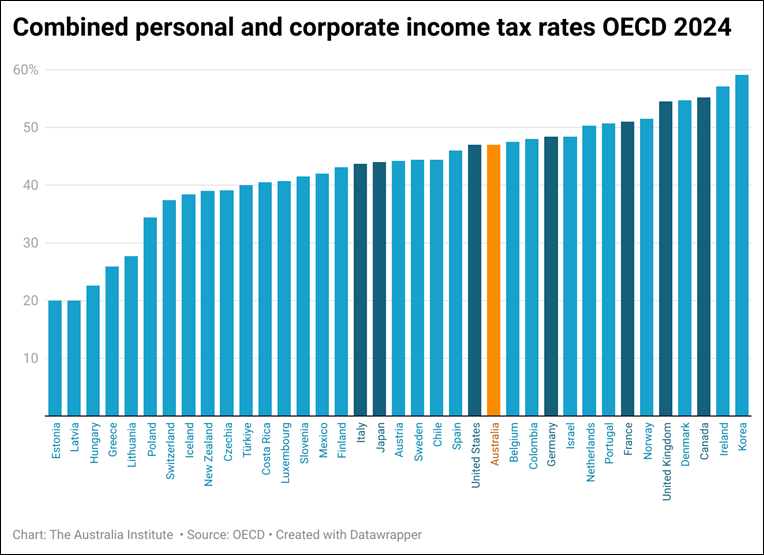
The first question in the debate was about our 3rd least competitive company tax rates and how company and business taxes need to be cut to restore our competitiveness.

Well, sorry but we do not have an uncompetitive tax regime. The best way is to compare – as the OECD does – the combination of personal income tax and company tax rates, and when you do that we are pretty much equal with the USA and lower than 4 of the G7 nations.

Also businesses don’t invest here because of out tax rate -0 they invest here because we have an educated workforce, good infrastructure, stable government, proximity with Asia, AND WE HAVE IRON ORE, COAL, GAS, AND A TONNE OF OTHER MINERALS HERE!!!!!

Greg Jericho
Chief Economist

A small business owner not surprisingly wants the instant asset write-off made permanent. Amazing how the people in the room all want to pay less tax. Weirdly there is not talk about government services, benefits or infrastructure.

Talk turns to bracket creep.

Sigh. Angus Taylor is wheeling out his line that people are paying $3,500 more in tax on average than they were 3 years ago.

Yep – because people earn more than they did 3 years ago!

Also the changes to Stage 3 made sure that more people would be better off than they would have been under the old Stage 3 measures.

Weirdly Taylor is not mentioning his return of the Low-middle income tax offset, which would be a pretty nice tax cut for most people. Probably because it is only for a year, which means the LNP is going to the election with a policy of cutting tax in 2025-26 and then raising it in 2026-27

Good Dolly this ‘debate’ is so stupid

Greg Jericho
Chief Economist

A question in this treasurers’ ‘debate’ suggests we have the 3rd least competitive company tax rate in the OECD and wants to know if either party will introduce any new taxes on business?

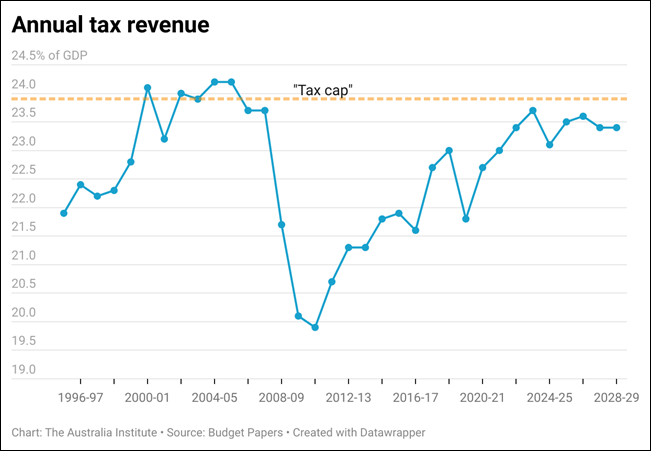
And well. My god. The answers from Angus Taylor go to the ALP getting rid of the Tax to GDP guardrail (or cap) of 23.9% of GDP.

Cripes that just shows how dumb this debate is.

As Jim Chalmers points out the ONLY government that has ever raised more tax than 23.9% of GDP is the Howard government. Cripes we’d love to get them much revenue

Charge royalties on all gas extraction

Greg Jericho
Chief Economist

As Jim Chalmers and Angus Taylor talk to business leaders and a couple Sky News viewers, there will be absolutely zero mention or suggestion that we should be taxing our gas companies more.

Right now we are giving away much of Australia’s gas FOR FREE

Unlike mining, no royalty is paid on most Australian gas exports. The PRRT was supposed to replace earlier royalty arrangements, but it has failed to deliver a return to the community. Some gas producers do pay a royalty and there is no reason that royalties could not be charged on all gas extraction.

We should extend the royalty regime to cover off-shore gas fields and actually increase the level they pay.

Because boy ho boy, are Australians owed some back-pay for all the gas that has been shipped off overseas.

ReformRevenueDescription
Extend royalties to all gas extraction $3.6 bnBased on current royalties charged to gas exporters, extending similar arrangements to all gas extraction.[1]
Increase royalties by 50% and extend to all producers in Commonwealth Waters$6.9 bnAs above but with the price of gas royalties increased by 50% to reflect the changed nature of the market with the introduction of LNG exports.

Greg Jericho
Chief Economist

Both Angus Taylor and Jim Chalmers are in Melbourne as guests of Sky News and the Business Council of Australia and the Small Business Organisations of Australia for a debate.

This is as home field advantage as Taylor could get – not surprisingly he has declined any opportunity to debate at the Press Club.

Angus Taylor led off talking about the decline in living standards, Chalmers responded by talking up the low unemployment rates, rising real wages and decrying those “talking down” the economy.

Both thanked those in the room for their efforts and work etc. So no I don’t think we are about to hear any talk of the need to tax company profits more.

OK, so we have gone from the health debate to the treasury debate.

We don’t think we have it in us, but will monitor. Just. There is no wine – and that is a problem.

On early voting

Skye Predavec and Joshua Black

The campaign rolls on for another 10 days, but high levels of early voting means more voters will stop following

The AEC reported on X this morning that over half a million people cast their ballot yesterday, a record for the first day of pre-polling. The roughly 542,000 people who have already cast their vote represent the equivalent of about four electorates out of 150.

At the same point in the 2022 election roughly 660,000 people had voted, but that was after two days of pre-polling compared to just one thus far.

If yesterday’s trend holds, we would expect over half of Australians to have cast a vote before election day on 3 May.

Australians are no longer voting together having watched an election campaign in full.

In last year’s Queensland election Labor lost government on a 7.0% swing against them, taking only 46.2% of the two-party-preferred vote. However, they suffered a much smaller swing from votes cast on election day, actually winning them with 50.6%. To some extent, this reflects a tendency for early voters to be more conservative. It’s also the case that voters on polling day saw more of the election campaign, particularly on the issue of abortion rights which heated up in the last week of Queensland’s poll.

It is difficult to imagine some transformative event in the final strait of this campaign, but ten days is a long time in politics. Next week Albanese and Dutton are lined up for their fourth debate, and last-minute policy announcements are still on the cards. Australians who vote early lose the opportunity to take these into account.

Tax is not a bad thing

Jack Thrower
Research Economist

As Richard Denniss likes to the remind us “Economics 101 says we should tax things we want less of and subsidise things we want more of.” Unfortunately, Australia hasn’t learnt this lesson well enough. The current tax system too often encourages behaviour that is detrimental to Australia’s society and economy.

Tax big dumb utes
Utility vehicles (utes) are necessary to a range of occupations but their proliferation – particularly of larger, heavier models – damages the environment and roads and makes roads more dangerous.

Australia’s taxes and regulations actually encourage people to buy these utes. From 2001 to 2021, the number of passenger vehicles grew by half, while the number of light commercial vehicles (a category that overwhelmingly represents utes) doubled.

Essentially every ute is exempt from Luxury Car Tax due to a tax loophole, which encourages people to buy expensive utes instead of expensive smaller cars, including fuel-efficient and electric cars.

This loophole benefits buyers of the most expensive utes, such as Ram and Chevrolet models, but does not affect buyers of cheaper vehicles. Australia Institute analysis estimated this loophole cost $250 million in foregone revenue in 2023, mostly from expensive Ram and Chevrolet vehicles.

Limiting this exemption to vehicles that are for commercial rather than personal use could raise millions while reducing the number of these vehicles on Australian roads.

Other reforms that would raise revenue while increasing road safety and reducing emissions include reforming the Fringe Benefits Tax so that exemptions require proof that vehicles are strictly used for business purposes, and improved pricing mechanisms for road damage and carbon emissions.

Tax plastic packaging
By 2050, the amount of plastic consumed in Australia will more than double. Despite policies aimed at a ‘circular economy’, just 14% of plastic waste is kept out of landfill. Recycling plastic is expensive and hazardous, with little demand for recycled plastics.

Taxing plastic packaging is not a revolutionary thing. It is already being implimented in the European Union. A plastic packaging tax like that in the EU could raise around $1.5bn.

Stop subsidising tax avoidance
Many Australians employ an accountant to do their taxes and can deduct this expense from their tax. However, a very wealthy few spend tens of thousands of dollars to reduce their taxable income and avoid paying tax. In effect, the government is subsidising people avoiding tax. According to the Australian Treasury’s most recent figures, this tax concession cost $1.4 billion in 2021-22 of which about half (49%) flowed to the top 10%.

In 2017, the Labor party proposed limiting the amount that could be claimed for managing tax affairs at $3,000. This reform would allow high-income earners to still use the services of high-priced tax accountants and lawyers to reduce their taxable income, but they would no longer be able to deduct the total cost of doing so. Implementing this policy today would likely raise at least $130 million per annum.

More than half a million Australians have already run to cast their vote.

You know how the AEC thinks that half of Australian voters will vote before May 3? Well Australians are rushing to prove them right.

According to the AEC, more than 540,000 voters ran to pre-polling booths as soon as they opened yesterday. That is up by about 70% from the 2022 opening day.

Waiting for housing to become affordable? How does seven decades sound?

After both major parties said they wanted to see house prices to continue to grow, the Greens asked for some analysis on what that might mean.

They also had a look at the very good analysis the Guardian’s economics editor, Patrick Commins did looking at how long Australians could be waiting for housing to become affordable under the major party policies.

Spoiler – it is all bad:

New Greens analysis has shown that average house prices could grow by up to $121,500 nationally this year, under the major parties’ unity ticket to further turbocharge house prices.

In Sydney, the projected increase would mean a median house price rise of $112,800 under Labor or $211,500 under the Coalition.

A typical house in Brisbane would increase by $72,000 this year under Labor, or by $135,000 under the Coalition.

The changes would mean house prices would rise 2.5 times faster than wages under Labor, or 4.6 times faster under the Coalition.

The analysis utilises estimates from SQM economist Louis Christopher that house prices will rise by 8% this year under Labor’s recently announced policies, or 15% under the Coalition, and utilises CoreLogic median house price data and pre-election economic and fiscal outlook wage projections.

In comes as analysis from the Guardian shows Australians could be waiting more than 70 years for affordable housing following the paths of the major parties.

Answering your questions: Will your vote still count if you write something on the ballot?

Bill Browne
Director, Democracy & Accountability Program

A reader asks: If you fill out the ballot correctly in terms of numbering, but write a message on the ballot (a la The Franklin Dam campaign) is the ballot then treated as informal? An “informal vote” is one that does not follow the rules, and therefore is not counted.

1. The most common source of informality is voters failing to number every box.

In the House of Representatives, you must number every box sequentially for your vote to be valid.

For example, if there are four candidates, you must put “1” next to the candidate you most prefer, “2” next to your second preference, “3” next to your third preference and “4” next to your least-preferred candidate.

In the Senate it is similar, although you can stop numbering after six boxes above the line or 12 boxes below the line. (I still recommend numbering every box either above or below the line.)

Don’t write in a new candidate or rename an old one, or your vote could be invalid.

If there is any risk of confusion, ask for a new ballot. Maybe you wrote “4” twice. Maybe your “1” looks like a “7”. Better to be safe than sorry.

2. A vote is also informal if you identify yourself

Do not autograph your ballot. Do not write “I voted for Joe Bloggs because he’s my cousin” or “Bill B approves this message”. If your ballot could uniquely identify you, it will be thrown out.

So can you write something on your ballot?

If you number every box, do not interfere with the printed list of candidates, and do not identify yourself, your vote will count – even if you write something on the ballot.

However, I strongly recommend against writing on the ballot.

It serves no purpose – the only people who will see your message are Electoral Commission staff and election scrutineers.

And you do not want to take the risk that you write something identifying, or otherwise invalidate your vote.

It makes everyone’s life easier if your ballot looks exactly like it is supposed to.

Why did the Franklin Dam campaign encourage people to write on their ballot?

There were very good reasons for environmentalists to encourage people to write “No dams” on their ballots – but it was a unique circumstance.

In the 1980s, the Tasmanian Government was planning to build a hydroelectric dam despite consequences for the natural environment, jeopardising in particular the Franklin River.

Premier Doug Lowe took the question of where to build the dam to a state-wide referendum. Voters were forced to choose between two locations for the dam; they could not choose “no dam”.

Almost half of voters (45%) either wrote “No dams” or cast invalid or blank votes, showing the strength of community opposition. Even so, if you wrote “No dams” but still cast a valid vote, then your vote still counted towards the question of where to build the dam.

In this case, the invalid vote was the point. Tasmanians had been “allowed” to choose between the Devil and the deep blue sea, and the only way to win was to reject the premise of the question. In the end, the proposed dam was cancelled by a federal government elected with a clear anti-Franklin Dam policy.

This election is very different to the Franklin Dam referendum. I don’t think voters have anything to gain by writing messages on their ballot paper.

Fact check: Housing prices

Matt Grudnoff
Senior Economist

Housing is rightly one of the major issues of the campaign. The housing crisis sees an increasingly large number of people locked out of buying their own home. It also sees those that can buy their own home saddled with enormous mortgages.

Over the course of this century, housing affordability has declined at rates not experienced at any point since WWII. Since 1999 to the present, the cost of residential property prices has risen in real terms by 149% – nearly 4 times faster than the 38% increase that occurred over the 25 years from 1974–1999.

This increase has caused a significant and unprecedented drop in home ownership. The Australian Bureau of Statistics’ (ABS) Survey of Income and Housing has shown a steady decline in home ownership from 70% in 1999–2000 to 66% in 2019–20. If the rates of home ownership had stayed the same between 1999–00 and 2019–20, an additional 430,000 households would now own their own home.

This drop however is not due to some societal shift in desires of home ownership or a steep fall in supply but is greatly due to the implementation of taxation policies that are designed to distort the housing market such that investors are given an advantage over owner-occupiers.

One of the easiest and fastest reforms that will increase home ownership is reforming negative gearing and the capital gains tax (CGT) discount. This will help squeeze out those buying multiple houses as investments. This will see more first home buyers being able to get into their own home.

These reforms will also raise up to $14.8 billion. This could be used to build more housing, expanding supply and helping to make housing even more affordable.

Most of the policy offering from both major parties are likely to increase demand for housing, increasing house prices and making the housing crisis worse. While Labor has some policies to increase supply, just focusing on supply is the slowest and most expensive way to make housing more affordable.

Reforming negative gearing and the CGT discount is the lowest of low hanging fruit. Raising money for the budget and making housing more affordable.

Fact check: Peter Dutton’s US diplomacy

Skye Predavec
Anne Kantor Fellow

Michael has asked us:

I have had an issue bugging me on Dutton’s repeated claims that his ministerial record would assist in achieving a better outcome for the country internationally, particularly with the USA.  I watched part of the last night’s debate and Dutton made mention of having a strong connection with the Obama Administration that further piqued my interest to look at his ministerial history as follows:

Minister for:

  • Workforce Participation 2004-2006 (1 year 93 days)
  • Sport 2013-2014 (1 year 96 days)
  • Health & Aged Care 2013-2014 (1 year 96 days)
  • Immigration 2014-2018 (3 years 241 days)
  • Home Affairs 20/12/2017-2021 (3 years 100 days)
  • Defence 2021-2022 (1 year 54 days)
  • Opposition Leader 2022- (3 years 337 days) 

The first thing I note is that aside from Defence and possibly Immigration, the rest of the ministries he held had a heavy domestic focus.

On his claim that he had dealings with the Obama Administration (20/1/2009-20/1/2017), Dutton’s ministries that may have even had any level of foreign relation interactions were:

  •  Immigration – I don’t recall that we had significant interactions with the USA on this matter under the LNP Government at the time.
  • Home Affairs – with his ministerial responsibilities commencing in the last days of the Obama Administration, I don’t see how he could validate his claim..

I don’t know if this is an issue worth some form of follow up, but I am tired of politicians making claims that can be ascertained as to whether they “meet the pub test”, let alone a cursory glance.

Fact check: True(ish)

Dutton has made the claim that he has “work[ed] with four US administrations, back to the Obama Administration” repeatedly, including here and in the debate last night. 

Dutton worked (in some capacity) with all 3 of the Obama, Trump 1, and Biden admins. He was immigration minister during Obama’s second term, during which Australia negotiated a refugee resettlement deal with the US, Home affairs minister during Trump 1 where he met with US officials several times, and defence minister during AUKUS negotiations with the Biden admin. However, that only adds up to 3, making it a bit unclear what he’s counting as number four.

While Dutton’s career as immigration minister was perhaps most notable for derogatory comments about climate change and pacific island nations (Peter Dutton overheard joking about rising sea levels in Pacific Island nations – ABC News), he and Turnbull did negotiate a refugee deal with the Obama administration in its final months (Australia and US asylum seeker resettlement deal | news.com.au — Australia’s leading news site). The arrangement was one that incoming president Trump was notably unhappy with, becoming the subject of a heated phone call between him and Turnbull (Donald Trump and Malcolm Turnbull’s phone call: The full transcript – ABC News)

As Home Affairs minister during the Trump administration he made several visits to the United States (including in 2017 Visit to the United States), including one where he potentially gave Covid to Ivanka Trump (Ivanka Trump is working from home after meeting Peter Dutton | SBS News)

He was notably defence minister during AUKUS negotiations with the Biden administration, bringing him up to 3 (AUKUS is the most significant step of our time, says Defence Minister Peter Dutton)

The first time I can see that he said he’d worked with 4 US administrations was January 13, which was before Trump’s (second) inauguration. Considering he said that the count started with the Obama administration, he either made a little gaffe, is really bad at Maths or knows something we don’t (maybe he’s counting Joe Biden’s body double separately).

Wanna deal with Trump? Show strength

Frank Yuan
Postdoctoral Research Fellow

China has held firm in the trade war and the effort is bearing early fruit. A few hours ago, Trump indicated that a deal with China was now in the works, so that both sides would retreat from their egregiously high tariffs and return to some normalcy. He even promised to be ‘very nice’ in the negotiations (read it with your inner Trump voice).

Remember, Beijing has responded to every step of Trump’s escalation with its own proportional retaliation, including measures which could really hurt, such as restricting rare-earth exports. Washington is shown to have a limited tool-kit – mostly raising tariffs on everything that American consumers and even manufacturers need. Masterful gambit.

Beijing has always maintained it’s open to negotiations, and Trump seems to have now steered towards that off-ramp. Crucially, though, Beijing has refused to make pre-emptively compromises. It seems that a ‘strongman’ like Trump does, after all, respect strength.

There is no sign that China would eagerly return to the previous ‘normal’ – it has already moved to boost its trade links with its regional neighbours, all of whom having been in Trump’s firing line as well; it is intensifying diplomacy with Europe, too, whose leaders now also seem more receptive to cooperation with Beijing. Additionally, it has been ramping up domestic economic stimulus so its producers can further move away from relying on export markets. After all, why keep subsidising the lifestyle of the superpower who wants to contain you?

There is much to be learned from their disciplined, wide-ranging, and coordinated approach to statecraft on display here, based on a firm grasp of their own interest and even those of other countries.

Peter Dutton still plans on introducing questions on ‘anti semitism’ (which his view includes criticism of Israel and its policies) to Australian citizenship tests.

Q: Just on national security more broadly, is it still your plan to introduce questions about anti-Semitism into the citizenship test? Would you re-vet the 2,000-odd people who have come from Gaza who you said didn’t have proper security checks and would you move to recognise the capital of Israel as West Jerusalem?

Dutton:

On the first two yes, in relation to the last one, we don’t have any plans to change the current arrangements. What is interesting at the moment is you have got the Prime Minister who is pretending again and if you believe this, you will believe anything, that he had no idea who this anti-Semitic candidate was that he is now preferencing. (To be clear, the Greens candidate has been critical of the genocide Israel is carrying out in Gaza, where at least 50,000 people have been killed, mostly women and children, as a result of Israel’s on-going bombardment of the Gaza strip, where people can not leave. Israel has also stopped all aid and food and water from entering Gaza, with famine and disease the direct result)

Dutton:

The Prime Minister owes an explanation to the public about exactly why they are preferencing anti-Semitic – the Jewish community, anti-Semitic candidates, the Jewish community is alarmed at what Labor is doing. (Many in the Jewish community have echoed similar concerns at Israel’s policies and would be considered anti-Semitic under Dutton’s definition) We won’t compromise on border security. We have been clear about that. Our nation is the greatest in the world. We welcome migrants coming to our country. We have the most successful migration program but we won’t compromise on those settings which provide screening of people who are coming in from a war zone.

Q: The people were vetted when they exited the Rafah border crossing by Israel, they were vetted. Don’t you trust our security agencies or allies?

Dutton:

We will take advice and conduct proper security checks.

Those checks have been done. There is no population on earth who have as much information held about them by security agencies, than Palestinians. In order to leave Gaza (and we are talking about the beginning of Israel’s assault on the civilian population, which began 18 months ago) people had to be able to pass Israel’s checks, as well as Australia’s. Everyone who has arrived in Australia has gone thorugh the proper vetting. The only people claiming checks were not done is the Coalition who has repeatedly tried to raise racist and xenophobic fears, even as security agencies called for calm heads and for leaders to watch what they say.

The Coalition still won’t say where any of the spending is coming from – this matters because they keep saying they will put the budget ‘guardrails’ back up and also restore structural surpluses to the budget. So the spending matters.

Peter Dutton says they are not baking in the spending – the fuel excise and low and middle income tax offset have expiry dates on them.
But that doesn’t make them free. It just means there is an end date to the spending.

So that spending gets taken away from people, but at the same time, other things will still need to be paid for, while the spending is in place. And the other spending promises the Coalition have made at this election – to match Labor policies on health – as well as the housing policies and now defence – will need to be paid for.

So what is not going to be paid for?

This press conference is not going the way that Peter Dutton thought it would.

Andrew Hastie is looking decidedly annoyed. Michaelia Cash keeps looking up as if she is hoping for some divine intervention and Peter Dutton is trying to explain what his position is when it comes to assisting Ukraine in its fight against Russia.

Dutton sides with Ukraine, but doesn’t think Australia should send peace keeping troops.

He has also brought his children who are not Harry – Rebecca and Tom to this press conference, which seems another odd choice – but guess he is hoping the photos of him with his kids will help soften his image while he still talks tough.

Q: You have previously said Australia should not contribute to the Coalition of the Willing because there is a US no security presence or blanket. Australia’s contributed to heaps of peace-keeping missions that haven’t involved a US presence. There is Israel, which is ongoing and Cyprus and Mozambique are two other examples. Why is it a deal breaker when it comes to Ukraine if you are not siding with them together?

Dutton:

I stood with the Ukrainian ambassador and sent off the bush masters. We said we would strongly support and back Ukraine. It is something that all Australians should be proud of. We saved lives with the bush masters and the capability we were building at the time. I am opposed to us sending in, in an ill-defined way to an ill-defined mission our troops on the border with a nuclear powered country like Russia with a lunatic in charge of Russia, not knowing what would happen next.

The Prime Minister hadn’t thought about, it he hadn’t discussed it with the CDF, he hadn’t discussed it with the Minister for Defence.

The next day the Minister for Defence and the Assistant Minister for Defence walked it back.

Q: The question is about showing up. As your own shadows defence minister said, the lesson of Ukraine is about being able to stand on your own two foot until your allies come to help. What kind of ally are we if we don’t come

Dutton:

The reason we’re not supplying at the levels we did when the Coalition was in government is because this government has required defence to pay for what they contribute to Ukraine… We are talking about being a friend and being there for Ukraine, our contribution. I take it seriously, we are a great friend of Ukraine. I am not putting the lives of Australian soldiers at risk without understanding anything of what is being asked and the Prime Minister has nothing before him which indicates what it is that is being asked of our troops.

Q: While that is being negotiated, is nothing on the table?

Dutton:

We are told that we live in the most dangerous period since 1945 by the Prime Minister. He is talking about sending hundreds of thousands of troops into Europe when we should be working with our allies in the Pacific and we should be working on building up our capabilities.

We have a record low investment in defence under Labor and we are talking about diverting what would be billions of dollars from the defence budget into sustaining our effort in Europe.

That is not the approach of a prudent Prime Minister who understands national security.

Q: If you get some of those questions answered, would you – from Keir Starmer, would you be willing to change your mind…

Dutton:

I have dealt with that.

Q: Respectfully, I don’t think you have. Would you be willing to change your mind?

Dutton:

I have stated our position.

Andrew Hastie indicates he believes women are not physically capable of combat roles, without saying it.

Andrew Hastie is now being asked the question he refused to answer a couple of weeks ago – should women be allowed to serve in combat roles in the ADF.

In 2018 he said:

My personal view, since you’ve asked me, is that close combat roles are incredibly exacting. “That’s why we have rigorous selection courses. And my personal view is that the fighting DNA of a close combat unit is best preserved when it’s exclusively male. Now, that’s not a popular view.”

Today he says:

Yes. The Coalition policy is that all combat roles are open to women. It’s been our long-standing position. I’ve been in this role for almost five years, 18 months as the Assistant Minister for Defence, three years now as the Shadow Minister for Defence and our Coalition policy is that all combat roles are open to women.

There is no points for second place that we need to win every fight we go into, that is why we will uphold that.

Q: Are you saying women have lower standards? Is that what you are saying?

Hastie:

It is hardly what I am saying. We have one standard. All Australians, regardless of your background, race, sexuality, gender, religion, every single role in the ADF is open to you, and we want more Australians to join.

I signaled this last week to the Secretary of Defence and the chief of the Defence Force, so I made it very clear about our policy going forward.

This is the thing about Richard Marles. He talks a big game. Talks about the most dangerous strategic circumstances since the end of the Second World War and he uses women in the ADF as a political prop, as a political prop, and I think it is a shame for scare campaign that is running and I stand by my record. Like I said yesterday on ABC Radio, I worked in the ADF for 12 years, eight months and I worked with women all the time. It is the first close quarter battle integrated course with females at the end of 2011, counter-terrorism drills at Swanbourne. I was taught surveillance and counter surveillance by women, very good at what they do. I was an instructor on the first integrated SAS selection course where we had females come through. To take a lecture from Richard Marles is below the belt, really is what I am saying.

Q: Has he changed his view from seven years ago – that women weaken the fighting DNA of a combat unit?

Hastie is now trying to say that he doesn’t think women are up to the physicality of what he did in the SAS, without saying that:

I did say it. In my personal experience, when I think about some of the things I had to do in a closed combat unit… not far from here, live fire drills where you practice a man down, very aerobically intensive. You are firing live rounds. I remember picking up an 85kg man and I did that with men under fire in combat for a fallen mate.

I am not going to resile from what I have said in the past. You want honesty and integrity from politicians, I said what I said but the thing that the Australian people need to know, under a Dutton-led Coalition government, we will have a policy that is open to all Australians for combat roles. Nothing is changing. This is Richard Marles playing politics with the ADF, with women in the ADF and using them as political props and it is shameful.

Q: It sounds like from that answer you still think women aren’t strong enough – is that right, women aren’t strong enough to deal with that combat you have described, is that what you are saying?

Hastie:

I didn’t say that at all. I got asked a question and I referred to my personal experience. Never once have I indicated that the policy should change and, as I have said, judge me by my record for the last five years.

Q: Do you not believe in your own policy if that is your personal belief and the Coalition policy is something different?

Hastie then declares the questioning over:

No, I am standing here saying there is one policy. This is student politics stuff. I am ready to be the Minister for Defence of this country. We have the most dangerous circumstances since the end of the Second World War. Peter takes that seriously, I take it seriously and Linda and Michaelia take it seriously. We are focusing on bringing lethal capabilities to deter our enemies and you are getting caught up on a comment from 7 years ago which doesn’t have any bearing on the current policy settings. I have dealt with it, I have answered the question. We are going to move on.

The Coalition still can’t say where the money is coming from – or what it would cut.

Peter Dutton still can’t say how he would pay for anything, other than saying that the spending is not “baked in” – so it is not ongoing.

But that doesn’t make it free. It just means that it is not an ongoing spend. And given that the Coalition keeps harping on about returning the budget to a structural surplus – that means it is either going to tax more (and that could be multinational corporations) or it is going to cut services and funding.

The Coalition has said it will not be taxing more. So that leaves cuts. Which is another way of saying ‘austerity’.

If you cut government services and funding, you are putting the burden on the lower and middle classes to pay more for things the government used to pay for, or miss out.

It is one of the worst things you can do (at anytime) but particularly when economic conditions appear uncertain and people start to hold on to their money because of that uncertainty. It can send economies into recession.

This press conference just has me yelling at the TV, so I will save you from the bullshit.

Just remember that the “ripped $80bn” out of defence argument that the Coalition uses is EXACTLY THE SAME as the one Labor uses to say the Coalition “ripped” money out of health and education funding in 2014. Funding increased, but the rate at which it had been forecast to increase by the previous government was cut.

The Coalition has had a massive cry over Labor “lying” about health and education funding cuts, with Dutton admitting last night that it would be a cut in forecast funding growth. That is what the $80bn figure it uses here is. It was diverted from the forecast growth.

PLUS THE LABOR GOVERNMENT SIGNED THE AUKUS AGREEMENT WHICH IS HUNDREDS OF BILLIONS OF DOLLARS FOR DEFENCE.

Peter Dutton press conference

Peter Dutton is holding his press conference – he is in WA and has Andrew Hastie, his shadow defence minister with him.

Hastie is standing in front of Liberal branding which is quite rare for Hastie this campaign – he has been standing in front of his own branding which just has his name and his seat. It’s not even Liberal blue – he has chosen a darker blue for his events and signage.

He doesn’t look comfortable as he listens to Dutton talk about how happy he is to stand up with him. Hastie hasn’t been backing in Dutton when needed in this campaign – he refused to back away from his previous comments that he didn’t believe women should be in combat units – and has been notably quiet for someone with such a high profile Coalition portfolio.

According to Liberal sources, Hastie has been supporting Angus Taylor in his bid to take over the leadership in the event that Dutton falls short of the 65-68 seats the party has set as an internal target for Dutton to continue as leader in the event he loses the election. There are those who believe he would be deputy to Dutton and then take over the leadership before the next election.

Anyways, this is an uncomfortable press conference and for once, it is not just because Michaelia Cash is there.

ACTU boss Sally McManus has responded to the Australian’s report that the Coalition will reinstate the activity test in order for parents to access subsidised child care:

The Coalition’s only real policy for women so far is to take away guaranteed subsidised childcare from them.
In addition, they are scrapping free TAFE, which is essential for workers in the early childhood sector.
This decision will not only have a big financial impact on the care workforce, it will also make accessing childcare harder for all families, as centres will struggle to employ qualified workers.
Bringing back the activity test for parents is poor policy and will hurt parents by cutting this important cost-of-living relief measure.
The Coalition’s approach to taking this away will hurt thousands of women – because the reality is that women still shoulder most of the caregiving load while families seek more flexible work arrangements.
Peter Dutton owns three childcare centres. He wanted to keep those who work in them on extremely low pay as he opposed the long overdue pay rises for early educators, calling it ‘a sugar hit.’

Now he wants to stop childcare fee relief from reaching families.”

SIIIGGHHHHHH

It is that time in the election cycle where journalists pretend they understand minority government.

Take this example from the Nine Network this morning:

Host: Just finally, despite repeatedly denying a deal with the Greens, Albo is preferencing them in his own seat. This Greens candidate in Grayndler claims Israel is guilty of genocide. Do you know anything about that preferencing? Do you have a problem with it? Do you think that’s a good look? Especially given how many times he said that he won’t do a deal with the Greens.
 
Richard Marles: Well, we’re not doing a deal with the Greens. And what we’re encouraging Australians to do is to put one next to the Labor box. And in that event, you know, wherever we’re preferencing won’t be relevant. But we are definitely not doing a deal with the Greens and the Prime Minister–
 
Host : It’s relevant. If you’re saying vote Greens second, it’s hardly saying let’s not do a deal with the Greens ever.
 
Marles: Karl, I am very, very confident that in the seat of Grayndler, the Prime Minister’s preferences will not be distributed.
 
Host: That’s probably right.
 
Marles: What will happen there is that people will be voting one for Anthony Albanese–
 
Host: It’s the principle though!
 
Marles: There is not going to be a deal with the Greens–
 
Host: It’s about the optics.
 
Marles: Okay, well, here’s the principle. No deal, no deal with the Greens. No deal with the Greens. No deal with the Greens. No ifs, no buts and Anthony could not have been clearer. And I could not be any clearer right now.


What ‘deal’ are they talking about? What do they think happens? Do we talk about doing a ‘deal’ when governments fall short in the senate (which is most of the time?)

No. We don’t.

The government will be the party with the most seats who can negotiate among the crossbench support for legislation. No one will stand in the way of supply – that’s an understanding, but it is a case by case basis for legislation. In terms of confidence – will that is only an issue if someone brings a no confidence motion in the government, which is supported by most of the chamber. That again is a hypothetical.

There is a minority government in NSW right now. The NSW Labor government, has the confidence of three crossbenchers, which is how it holds the lower house. And then it negotiates on legislation.

Defence minister Richard Marles responded to the Coalition’s $21bn over five years defence spending boost on Sky News this mornign:

I just don’t think you can trust anything that the Liberals put forward. And I think Australians have an absolute right to look at this with a great degree of scepticism. I mean, this is coming from the people who gave you $42 billion worth of announcements without putting a single dollar behind them- a full quarter of what defence was expected to procure under the Liberals, there was literally no money for.

And when they did spend money, we saw 28 different projects running a combined 97 years over time. Now, what we’ve seen reported in the papers today is thin at best. There is no explanation of how the money is being raised.

There’s no explanation of where the money is being spent. Some reports describe this as a target. I mean, that just doesn’t pass muster. At the end of the day, what we’ve engaged in is the biggest increase in peacetime defence spending in our nation’s history.

That is in the budget. It is money accounted for. We know exactly where it’s going, what capability we’re spending it on, and that is a total difference to the kind of vaudeville act that you see on the part of the Coalition.

This interview with Liberal Kooyong candidate, Amelia Harmer is noteworthy for two reasons – she chose to be interviewed with her former boss, Jane Hume ready to jump in (and ended up asking Hume to do just that) and also she already has not answering questions down pat.

The circular argument here is that the polls are wrong because they are small samples “like a thumb in the wind” Sharri Markson says. But she says they are wrong because the Coalition’s internal polling is showing something different.

So how is the internal polling, which uses the same methodology, different to being a ‘thumb in the wind? Is it a middle finger in the wind?

Polls show you the vibe. And yes, in 2019, the polls were wrong in terms of 2PP – but they were right on the primary vote. That was an election where the expectation was that Labor would win, but the primary vote showed that was a pipe dream. And Bill Shorten was an unpopular leader – which was also reflected in the polls.
Since then, there has been a lot of work done on polling and reputable pollsters publish their methodology through the Australian Polling Council. You can see how they poll, the questions they ask and whether there was any potential leading questions.

The most likely outcome at this point shows that a Labor led minority government is still the most likely outcome. But ultimately, it is up to you.

“Self-funded” retirees are really “tax-break” funded.

Dave Richardson
Senior Research Fellows


One of the biggest reasons for Australia’s low tax revenue is that the government provides many tax concessions that benefit the wealthy.
The top 6 tax concessions for super cost the government $58.5 billion, just short of the $62.0 billion in income support for seniors.
The two biggest of these are:
The lower rate of tax charged on contributions, which is a flat 15% for most taxpayers. A 30% tax rate applies for individuals whose combined income and super contributions is more than $250,000 per year.
Earnings in the ‘accumulation’ phase are taxed at a flat rate of 15%.

These two give around $22bn in tax breaks to the richest 10 per cent of Australians.

This makes no sense given the only reason for these tax breaks is to encourage people to put money into super so they will not be reliant on the age pension.

But those in the top 10% were never going to be eligible for the pension – so the government is spending $22bn a year for no reason at all.
The government attempted to reign in some of this by reducing the tax break for superannuation accounts with more than $3 million in assets. Treasury estimated 80,000 people or 0.5% of people with superannuation accounts would be affected.

The proposal was controversial in that it would have included capital gains on an accruals basis for the additional 15% tax to the extent that capital gains increased the total super balance above $3 million. In the first full year of receipts it was expected to raise $2.3 billion. The adverse reaction to that feature of the proposal ignored Ken Henry’s tax report that had recommended that capital gains should be treated as income for tax purposes.

Even if something like the lapsed legislation eventually passes it will still fall a long way short of addressing the rorts in the super system which has become a popular vehicle for tax avoidance and estate planning, but it is a vital start.

Coalition wants to reinstate the child care activity test, reports the Australian

The Australian has reported that the Coalition wants to reinstate the activity test for child care – the activity test has been found to be one of the more regressive policies for parents trying to access care for their children. To qualify for the subsidy, you have to prove your ‘activity’ – work or volunteering – which can be severely limiting for parents and carers looking after younger children or babies while wanting care for their children. It can be particularly limiting for people with health challenges or who are unemployed and unable to access subsidised care to either help them have a break, or find the space to re-enter the workforce, if that is what they wish.

It has been raised time and time again as one of the biggest barriers for women and serves no purpose other than to punish parents and carers by not valuing care responsibilities or the labour involved in child raising.

Labor finally announced it would scrap it as part of its childcare reforms, but according to the Australian, the Coalition wants to bring it back:

Peter Dutton would reinstate the activity test for parents wishing to access childcare if he wins the election, reversing Labor’s decision to give parents the ability to access taxpayer-funded subsidies for three days of care a week regardless of whether they are seeking employment, working or studying.

The Australian can reveal an elected Coalition government would not scrap the $1bn Building Early Education Fund announced by Anthony Albanese last year to set up more than 160 new childcare centres, instead committing to keep the fund in place to “be invested into early childhood education around Australia”.

As part of its childcare policy platform, announced a week before the election, the Coalition will set up a $100m grant program to be offered to providers setting up “flexible and innovative alternatives” to the long daycare model. This could include the ­delivery of mobile daycare, ­employer-supported models of care or bush kindy, delivered outdoors and in nature.

Trump and the Australian election

Angus Blackman
Podcast Producer

The United States is disappearing down an authoritarian rabbit hole and Australian leaders are struggling to respond.

On this crossover episode of After America and Follow the Money, Ebony Bennett and Dr Emma Shortis discuss the US administration’s mass deportations, the scandals surrounding the Departments of Defense and State, and why Australian democratic institutions are worth defending.

End the Gas Industry’s Free Ride

Greg Jericho
Chief Economist

Australia is one of the world’s largest exporters of liquified natural gas (LNG), but little public revenue is raised from the gas industry. Australia exports a similar volume of gas to Qatar, yet Qatar raises six times more revenue from its industry. Reforming the royalty and tax systems could raise significant revenue for and assist with climate action.

Reform the Petroleum Resource Rent Tax

No gas export project has ever paid the Petroleum Resources Rent Tax (PRRT). Despite gas corporations earning tens of billions from LNG exports each year, PRRT rarely raises much more than $1 billion per year, all of which is paid by domestic-oriented oil and gas producers.

So bad is the situation that even while gas companies are enjoying a boom in prices Australian beer drinkers pay more in tax than do gas companies in the PRRT

Heck some of the biggest producers of LNG pay NO PRRT

Treasury has estimated the revenue that could be raised from various reforms, such as to transfer pricing (the price that companies “sell” the gas to themselves for tax purposes), and capping the PRRT deductions by gas companies each year. Three options are summarised in the table below:

It’s time Australians got a fair share for our gas and stop gas companies taking the piss.

Tax tinkering a missed opportunity by both major parties

With less than two weeks to go in the election campaign, both major parties have done little to address the deficiencies in our tax system, which distort the housing market, worsen inequality, promote the use of fossil fuels and encourage damaging behavior.

Australia is a low tax nation, and this has left Australians with higher rates of poverty, poorer services and crumbling infrastructure.

If the government raised as much revenue as the average tax take of advanced nations in the OECD, it would have an extra $135 billion a year.

That could be used to improve infrastructure, deliver better education and health services and fast-track the shift to a low-emissions economy.

The Australia Institute proposes a range of changes to the tax system that are already at the centre of policy debate. Some are supported by current members of parliament, while others have been major party policy in the past. They are well-known by policy practitioners and popular with voters.

Such changes would not mean higher taxes for the vast majority of Australians, but would instead be done in ways which will make Australia fairer and safer.

We could:

  • Cut fossil fuel subsidies and end the gas industry’s free ride.
  • Reform negative gearing and the capital gains tax discount.
  • Close the tax loopholes for superannuation and luxury utes.

Such reforms to the tax system could raise between $12 billion and $63 billion a year:

  • $12 billion could fund 70,000 extra jobs to improve education, health and a host of other public services.
  • $63 billion would enable the government to raise support payments above the poverty line and double spending on education and housing.

“A proud nation requires policies that promote a better and fairer Australia,” said Greg Jericho, Chief Economist at The Australia Institute.

“Elections are an opportunity to take bold, popular reforms to the people.

“Not only would that improve their chances in the election, it would give them a mandate to make the country a better place.

“Instead, we get not just small targets, but tiny targets from Anthony Albanese and Peter Dutton.

“For three years, the opposition has gone on and on and on about the Prime Minister’s pledge to cut power bills at the last election.

“Now, both leaders are so terrified of promising reforms they can’t deliver, they just tinker around the edges. It’s a massive missed opportunity.”

Election entrée: think three-year terms are too short? Spare a thought for generations past.

Bill Browne

Joshua Black

Complaints about the brevity of three-year parliamentary terms are common in Australia.

Earlier this year, Business Council of Australia president Geoff Culbert told the AFR that Australia is “permanently in election mode” and our three-year term limits are “too short”. The prime minister and opposition leader both say they support four-year terms, though they’re not willing to chance their arm on a constitutional referendum to make it happen.

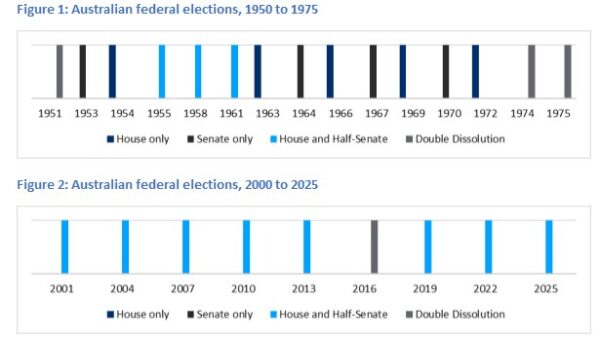
In the last 25 years, Australia has had eight (soon to be nine) federal elections. If that sounds like heavy going, spare a thought for generations past. From 1950 to 1975, Australians voted in 15 federal elections, including four separate half-Senate elections.

This is to say nothing of the four separate referendums held between 1950 and 1975, compared with just one in the period from 2000 to 2025.

When Gough Whitlam joked that he was enjoying a rare “non-election year” back in 1985, he had a point.

The Constitution requires elections for the House of Representatives at least every three years, or more specifically, no more than three years after Parliament first meets. By convention, elections are called at a time of the prime minister’s choosing. Strictly speaking, the Constitution actually gives the Governor-General that power, and they need to be persuaded before a prime minister can race off to the polls.

The Senate is a different beast altogether. Inspired by the staggered terms of the US Senate, Australia’s constitutional drafters chose to put only half of the Senate up for election every three years. As a result, senators enjoy six-year terms. This was to give it a more “perpetual existence” than the lower house with its short-term majorities.

Senators’ terms normally begin on 1 July after an election is held. At a double dissolution, when the whole Senate is dissolved alongside the House to solve deadlocks between the two houses, senators’ terms are backdated to 1 July of the previous year. Governors-General rely on careful legal advice before agreeing to double dissolution elections, not least because the Constitution sets careful criteria for when they can and can’t be held.

There’s nothing in the Constitution that requires House and Senate elections to be ‘in sync’. If a double dissolution is awkwardly timed, it can mean that a half-Senate election is required more than a year earlier than the next House election.

For example, a double dissolution election in April 1951 knocked the two houses off kilter, prompting a half-Senate election before 30 June 1953. An early House of Representatives election in November 1963 did the same. Half-Senate elections in 1953, 1964, 1967 and 1970 seemed to be, in the words of one Governor-General, a “major public opinion poll” on the government of the day.

In 1963 prime minister Robert Menzies asked the Governor-General to dissolve the House roughly eight months early. He offered a combination of strategic and policy justifications (the global fight against Communism was heating up in Asia) and expedient justifications (the previous election had left his government vulnerable in the lower house, and the times now suited him). His decision initiated a decade of un-synchronised elections for the two houses.

There’s no right or wrong answer about how often Australians should vote. But election timing matters. Unlike most of Australia’s states, the federal parliament does not have fixed terms. This means prime ministers get to pick the date that best advantages them. Few of us stop to think how unusual it is that a competitor also enjoys control over the starter’s gun.

Prime ministerial prerogative is also one of the reasons that three-year terms feel so much shorter. Thanks to early elections, the average term is closer to two and a half years rather than three. Journalists play a part by turning the last year of any parliament into an election-predicting contest. The Australia Institute’s Democracy Agenda for the 48th Parliament recommends fixed terms as for election timing. Parliamentarians could start by agreeing at the beginning of the 48th parliament to run full-term. This would remove an unfair incumbency privilege and create a more level playing field for new candidates and parties preparing to contest elections.

Elections are important. Their timing should be fixed. This would make the playing field more level for all candidates. It would also make those three-year terms feel a little less short.

Both major parties are promising more and more gas this election – but a new poll has shown that Australians actually want more renewables.

As AAP reports:

Most Australians would prefer more renewable energy, but the two major parties have made years-long commitments to gas expansion.

About three in five people believe adding renewables – such as wind and solar with battery storage – is a better solution to meet Australia’s energy needs than increased gas production.

More than half believe fracking brings more problems than benefits to local communities, according to a YouGov survey commissioned by environmental financing advocacy group Market Forces.

With Australians set to take to the ballot boxes for the May 3 election, gas could shift votes.

Labor has committed to opening new gas fields as part of Australia’s transition to net-zero emissions, while the coalition has promised to increase gas supply to try to lower energy prices.

Market Forces does not take positions on political parties as it focuses on the private sector, but analyst Kyle Robertson said expanding new gas fields was incompatible with the goals of the Paris Agreement, an international treaty on climate change which Australia has backed.

“We’re still a massive exporter of fossil fuels and both major political parties support that,” he told AAP.

“We need to walk away from our expansion plans, not just domestically, but also for projects that will be exported overseas.”

Australia was the world’s seventh-largest gas producer in 2020, but about 70 per cent was exported in 2019/20, according to government figures.

As a result, a majority of people think expanding gas does not benefit them or the nation, the YouGov survey found.

Fracking in particular is a sore spot for many Australians, with two in three believing it is harmful for the environment and just under half opposing the practice, which is banned in Tasmania, Victoria and 15 countries due to environmental and health risks.

Even those who support the expansion of gas fracking harboured concerns, the survey revealed.

Almost half of them believe expanding renewable energy is a better option, while 42 per cent believe it is harmful for the environment.

Sheep graze near solar panels (file image)
The majority of Australians want more renewable energy, a survey shows. (Mick Tsikas/AAP PHOTOS)

This could be because Australia’s industry says there are looming gas shortages that can only be addressed by opening new gas fields.

“In an ideal world, Australians want more renewable energy, but they’ve been sold a narrative by the gas industry that gas is absolutely essential for the energy transition,” Mr Robertson said.

“So, there’s certainly work to do there around public perceptions.”

In March, the Australian Energy Market Operator – which has long predicted gas shortfalls for the southern states – downgraded its forecast as high prices, mild winters and electrification pushed back gas shortages until 2028.

This could indicate electrification through renewables, alongside battery storage, was the “way of the future”, Mr Robertson said.

e

Planning on postal voting this election? The AEC says you need to get a wriggle on:

The AEC is asking anyone who needs a postal vote, but has not yet applied, to do so this week.

The latest urging from the AEC follows earlier advice for people to plan their vote early and, if needed, apply for a postal vote early in the election period.

Australia has some of the best in-person voting options in the world. If a voter can turn up to a voting centre, then that is what they must do.

While the legislated deadline for postal vote applications is next Wednesday 30 April, anyone who leaves it until the final week risks their postal vote pack not arriving in time.

–          People can apply for a postal vote on the AEC website.

Voters who do not receive their postal vote pack by Friday 2 May should, if at all possible, make arrangements to vote in-person on election day. Voters who fail to cast a vote will be contacted by the AEC and asked to explain why they did not vote.

Here is the official government release on the latest tradies announcement:

A re-elected Albanese Labor Government will invest $78 million to fast track the qualification of 6,000 tradies to help build more homes across Australia.

This election commitment will establish the Advanced Entry Trades Training program to help experienced but unqualified workers get the qualifications and recognition they deserve for their work.

The program will assess a participants’ existing skills via a recognition of prior learning process and then fill in any gaps with individualised training delivered by TAFEs and other high quality Registered Training Organisations. Any extra training needed will be free.

It is based on the successful NSW Government Trade Pathways for Experienced Workers program, which has seen more than 1,200 students gain their trade qualification in an average time of 7 months, rather than several years.

Research from Master Builders Australia shows that for every new qualified tradie, an extra 2.4 houses will be built each year.

Recognising the skills of these 6,000 workers and helping them to become qualified tradies will help reach the Albanese Labor Government’s goal to build 1.2 million new homes in 5 years.

We are mid-way through the election and yet all the talk about tax is the easy tax cut or temporary 1-year offset.

Greg Jericho
Chief Economist

We have had some lip service about inequality, poverty, sustainability, health and education challenges., but nothing about how to pay for things – including the opposition $21bn defence policy out today.

The default is always cuts or efficiencies rather than more revenue.

Fortunately, there is wide range of opportunities to raise more revenue in Australia, in ways that will also make the Australian community fairer and safer.

Australia is a low-tax country, raising just 30% in tax revenue as a share of the economy, well below the average of 34.9% across developed countries.

If Australia raise just the average amount of tax in the OECD we would raise around $135bn more a year. That would put us in line with Canada and New Zealand and still below the UK, let alone the Nordic countries of Sweden, Denmark, Norway and Finland.

But here’s the thing – countries that raise more tax and spend more on public services tend to have communities that are healthier, happier and have higher incomes.

Tax is the price we pay to live in a good society. Currently Australia is underpaying and as a result the country has higher levels of poverty, and insufficient funding for education, healthcare and other services.

Today we will be putting forward the ideas contained in our Raising Revenue Right report. It is a blueprint for ways to raise extra revenue that delivers not just the ability to pay for more and better services and infrastructure and benefits, but also will deliver a fairer society and a cleaner economy.

These sums are not unrealistic. The ideas proposed here are not radical. They are already at the centre of policy debate. Some are supported by current members of parliament, while others have been major party policy. They are well-known by policy practitioners and are popular with voters.

And the benefits are immense. An extra $11.8bn per year could fund over 70,000 extra jobs in education and health, delivering significantly better services to the community.

An extra $62.7bn per year could transform Australia for the better, without increasing the deficit by a dollar. Government payments could be increased above poverty line levels while also doubling spending on education, housing and the ABC.

What IS going on with defence spending?

Dave Richardson had a look at this earlier in the month and found:

The budget papers explain just how much is being spent on both the ongoing military spending, as well as the capital investment.

For the capital investment, the budget papers give both “net capital investment” as well as “purchases of non-financial assets”. The main difference is that the former is adjusted for depreciation and amortisation, while purchases of non-financial assets are not adjusted. There really is no good reason for deducting depreciation and amortisation. They are both rather meaningless concepts when it comes to military assets – is anyone really caring about the decline in the commercial value of the tanks the army has? Moreover, almost all discussions of the budget balance etc are based on cash accounting, which excludes depreciation.

The table above presents the military expenditure and investment.

It clearly shows that total military spending has hit 2.3% of GDP (rounded) in 2024-25, and yet in his Budget speech, the Treasurer said “defence funding will grow beyond 2.3 per cent of GDP by the early 2030s.”

That suggests the Government is using the depreciation adjustment to estimate its spending. In reality, the Treasurer should already be saying that Australia is already at 2.3% of GDP and headed for 2.5%.

Importantly, however, this has all happened with very little debate.

Just a decade ago the 2015 Intergenerational Report mentioned that defence had been 1.6% of GDP in 2012-13 and was expected to be 1.8% of GDP in 2014-15 and, “consistent with government policy, [military spending] is projected to increase gradually to 2 per cent of GDP by 2023-24… [and constant] at 2 per cent of GDP from 2023-24 onwards …”

That goal of reaching 2% has been superseded, and now the discussion seems to be around 2.5 to 3% – all of which has occurred without any real debate with or approval from voters.

We should be clear about what going from 1.6% of GDP to 2.5 to 3% of GDP means. It has already meant that other options for spending around $20 billion in 2025-26 have been ruled out. No increase in Jobseeker, less spending on public schools, and hospitals and vital infrastructure needed to shift Asutralia to a low emissions economy.

Other options will be ruled out in the future.

Even in its own terms, the target of spending 2.5% or even 3% on the military is nonsensical. Obviously, the military bureaucracy will find a way to spend any amount of money. But that is a far cry from asking them to make plans that reflect careful risk management, reflecting clear priorities and taking into account the true opportunity costs of the foregone alternatives.

This election deserves a true debate about how much should be spent on the military.

Labor’s major announcement today is about $80m to ‘fast track’ training building apprentices.

So Labor is focusing on housing (adjacent) policy today, while the Coalition is putting its bets on defence spending.

Australian doctor Mohammed Mustafa has returned from his second volunteer mission in Gaza, where he worked where he could to try and save lives amongst Israel’s bombardment of civilians.

He received a heroes welcome from supporters when he arrived back in Australia and has spent the days since trying to get Australian politicians to act.

He tells the ABC:

There was a particular incident that happened that night. I was covered in blood. We have to carry IDs with us 24 hours, and when I pulled out my Australian passport it was covered in blood and I couldn’t help but remember Zomi [Frankcom], the Australian aid worker who was killed and when they found her, her passport was covered in blood as well.

She hasn’t had any justice for what’s happened to her.

I reached out to her family and they’ve given me their blessing to carry that cross forward and go out there and fight for Zomi and Zomi died trying to feed children in Gaza and not just Gaza. She fed children all around the world and I want to do something in honour of Zomi and I want the government to help me, not just Zomi, but her family, to do something for her and honour her legacy. She died feeding those kids in Gaza and I feel like I let down those kids and I want to do this for her.

Jane Hume also believes that the attitude towards women in the Liberal party is better than ever:

I’ve worked as a member of Parliament under four leaders now, under Anthony… Under Tony Abbott I was pre-selected, a member of Parliament under Malcolm Turnbull, a minister under Scott Morrison and now I’m a shadow cabinet minister under Peter Dutton and under Peter Dutton, I think that the attitude towards women in the Liberal Party has changed so profoundly, so dramatically. He has more women in his shadow cabinet than ever before. His Deputy leader is female. His leader of the Senate and Deputy leader of the Senate are female. In fact, Peter Dutton wants to keep Australians strong and keep Australians safe.

This should be profoundly important to women around the country. We want to see Australian women empowered and given the opportunity to have the best lives they possibly can. You’ll see that in the offering we have at this election.

There are no policies offerings for women under the Coalition this election. It has been notable in its absence and brought up numerous times, just how much the Coalition’s campaign has skewed to men.

That’s because that is Dutton’s biggest voting base is men. And when they have tried to soften his image, he loses the male voters, but doesn’t win women.

Coalition hints at austerity measures in order to prioritise on defence.

How will the Coalition pay for its increase in defence funding?

Or, the better question, what will the Coalition de-prioritise in order to meet its funding priorities?

Hume says that’s coming:

You’ll see the Coalition’s costings prior to the election. They will be released, as they traditionally are, by both sides of government… before the election. You’ll see them in great detail.

This is a very considered approach to doing what is the most important for Australia. We want to make sure that we deliver strong economic management and the IMF have said we need to increase the fiscal buffers, the economic buffers, that is something we are conscious of and will actively do – bring our budget back to structural surplus, inject that objective back into our budgetary system, put guardrails around our budget.

That’s something that Labor have removed. At the same time, we need to understand that we need to invest more in Australia’s national security. When we have Chinese warships off our shores, firing in the vicinity of civilian aircraft, when we have our own service men and women being put at risk by lasers, by sonars, and yet this Prime Minister has done so little. His response has been so weak in the face of that.

Putting aside the Coalition’s continued attack that Albanese is “weak” (which is coming up in focus groups as a line with some cut through) let’s look at Hume’s answer. She is saying that the Coalition will cut – meaning austerity – in order to bring about it’s chosen priorities – in this case, defence.

Hume is saying things like ‘structural surplus’ which is when the structure of the economy itself is such that you are generating more revenue than you are spending. So it is the government taking more money from you, than it is spending on you.

If the Coalition wants to increase defence funding, within an environment where it is generating a structural surplus, than it has to make big cuts elsewhere – unless it is suddenly going to decide to tax fossil fuel companies or billionaires. But in the absence of wealth tax, this plan sounds like a poor tax – where the Coalition will be cutting services and welfare for the lower and middle classes, in order to meet its own priorities.

Jane Hume is up early this morning, talking about the Coalition’s new defence policy.

Now in the beginning of this answer, she uses the same method Labor uses when criticising the Coalition for cuts to health and education funding.

Peter Dutton had a bit of a moment about that last night, where he admitted that it was the funding growth that was cut in 2014.

It’s the same when it comes to defence. Labor says it has repurposed about $80bn in funding growth – so defence funding grew, but not by as much as the previous Coalition government had forecast it to grow.

Hume:

There’s no more important goal for a Government than to keep its citizens safe and yet this government has failed to do so. (How is Australia any less safe than it was under the Coaliiton?) They ripped $80 billion out of the defence budget.(This is in reference to projected funding growth) This is despite the fact that Anthony Albanese says we’ve never lived in more uncertain times since World War II. (The Albanese government signed AUKUS which is, according to the Coaliiton, supposed to save us all) The Coalition wants to fix that. (How is the Coalition making the world less uncertain?)

We want to make sure that our men and women in uniform have the capability they need to defend the country. That’s why we’re investing an additional $21 billion into our Defence Forces. (Which means not investing in other services)

That will take our defence spending up to 2.5% of GDP. At the moment, it’s just tipping around 2%. Labor won’t even meet its own target of 2.3%. Its wound that back.

Now, we think that is irresponsible in these uncertain times. This will make sure that those men and women of the Defence Force have the ability they need, the capability they need and the defence industry behind them to deliver what it is that Australians deserve, which is a well-defended nation.

Sigh.

Acting director of the Centre for Future Work, Fiona Macdonald, has written a piece for the Conversation about the Fair Work Commission review of five industries which are dominated by women workers, which was released last week.

When it comes to the response, Macdonald says:

The Labor government supported the Fair Work Commission’s gender undervaluation review when it was announced in 2024. At the time the government also made clear it was their view any large pay increases would need to be phased in.

The government did fully fund increases for aged care workers, which it said came to a total investment of A$17.7 billion.

The government has also funded a 15% pay increases for early childhood workers gained through a multi-enterprise agreement covering hundreds of centres. The first increase of 10% came into effect in December, with a further 5% increase due in December 2025.

Better pay in care and support occupations was identified by the Labor government as essential to the sustainability and growth of the care and support economy.

The Coalition has not made any commitments regarding funding for any pay increases awarded in the gender undervaluation proceedings. The Coalition spokeswoman on workplace relations, Michaelia Cash, said the Coalition would examine the decision and its implications.

The Coalition did not support the larger Same Job Same Pay legislation that included the gender equality changes.

Thanks, but no thanks. Why many Japanese people no longer want free gas from Australia.

The huge volume of free Australian gas given to Japan may be making gas companies rich, but not all Japanese are grateful for the gift.

Official Japanese government statistics reveal that Japan bought around 100 million tonnes of LNG in 2023, including 30 million from Australia, but on-sold 40 million – for profit – to neighbouring countries.

Japanese gas giant INPEX, which is 23% owned by the Japanese Government, ships 9 million tonnes of LNG out of Darwin each year. INPEX pays no gas royalties and, according to Australian Treasury data, neither INPEX nor any other gas exporter has ever paid Australia’s Petroleum Resource Rent Tax.

Japan is Asia’s gas powerhouse, dominating industries like gas shipbuilding and manufacturing components for gas-fired power stations.

Apart from being a terrible deal for Australia, our great gas giveaway is slowing Japan’s transition to renewable energy and the transition of those countries that buy our gas from Japan, like Thailand and Taiwan.

“Japan, like all countries, is being affected by climate change,” said Yuki Tanabe, Program Director at the Japan Center for a Sustainable Environment and Society.

“We have over 1,000 years of data on when cherry blossoms bloom, and they have never bloomed as early as they have in recent years. Some studies suggest that in much of Japan, cherry blossoms might not happen at all by the end of this century.

“Avoiding dangerous climate change means no new fossil fuel projects. No new gas projects should be developed in Australia, or anywhere else, no matter what Japanese gas company executives might say.

“It is pleasing that all sides of Australian politics now acknowledge some of the problems caused by your gas exports to us. The cherry blossoms will be over by 3 May when you eat your democracy sausages, but these issues will remain, and your next parliament has a real chance to address them.”

AAP has covered the coming defence announcement from the Coalition and some other bits and pieces of the campaign this morning:

Australia will sink billions of dollars more into defence under a future coalition government, as Peter Dutton looks to bolster the country’s armed forces.

Fresh off the third leaders’ debate, the opposition leader pledged to spend $21 billion over the next five years on defence, which would take its share of Australia’s gross domestic product to 2.5 per cent.

The level of defence spending as a percentage of Australia’s economy would then rise further to three per cent within the decade.

While the coalition said it would use the money to reinstate a fourth joint strike fighter squadron, it did not say where else the funding would go.

Mr Dutton said the extra spending on defence was needed in uncertain times globally.

“The prime minister and the deputy prime minister regularly tell Australians that we live in the most precarious period since the end of the Second World War. Yet, over the last three years, Labor has done nothing about it,” he said.

“The coalition will strengthen the Australian Defence Force and support our servicemen and women to keep us safe today and into generations ahead morale.”

The announcement comes after Mr Dutton and Prime Minister Anthony Albanese clashed at the third leaders’ debate in Sydney, with the opposition leader narrowly declared the winner.

As both leaders slung accusations of lying to each other during the hour-long debate, Mr Albanese emphasised a need for stability following uncertainty from US President Donald Trump.

“Peter puts forward this complete nonsense that the whole of the world, including every US ally, has not been able to get an exemption, but he’s going to be able to achieve it,” he said during the debate.

“Complacency and the uncertain world that we inherit … it’s the last time where you’d want to take a risk.”

Mr Dutton also warned of worsening economic conditions should Labor be re-elected, while also not committing to where spending cuts would be made.

“We will look at the budget, we’ll see where the government’s wasting money,” he said.

“(Interest rates are) not looking like they’re coming back any time soon unless they unless they throw us into a recession. So we will look at government expenditure”

It comes as Labor unveiled $78 million will be set aside to fast track training for 6000 tradies to build homes.

The funding will set up an advanced entry trades training program to help those training for work get qualifications they need faster.

Treasurer Jim Chalmers said the scheme would make sure more homes are built across the country.

“We are tackling the housing shortage from every responsible angle to build more homes, more quickly and in all parts of Australia,” Dr Chalmers said.

Mr Albanese will begin Wednesday campaigning in Sydney, while Mr Dutton will be in Perth.

Good morning

Congrats on getting through the third leaders’ debate. Last night’s panel gave it to Peter Dutton, but it was a solid performance from both, so both campaigns would be happy.

And Labor is pretty happy that Dutton gave its campaign more grist for the ‘he cuts, you pay’ advertising campaign, when he said that he wouldn’t know what he would do with the budget until he was in government.,

When John Howard came into power, there was $96 billion of debt from Labor at that point. John Howard didn’t outline the budget from opposition and it is not something you can do from opposition,”

Albanese jumped on that:

“There will be cuts afterwards – he’s just confirmed that – but they won’t tell you what they are.”

Labor is already planning more election ads that target the unknown Coalition cuts it says Dutton is planning, while the Coalition has told the AFR it will start its own election blitz in these final days of the campaign.

The AEC anticipates about half of the record number of Australians registered to vote at next week’s election will do so ahead of 3 May, with pre poll centres about to be swamped.

That doesn’t leave a lot of time for Dutton to find the momentum he says is coming. The Coalition is champing at the bit to release its defence policy, which will outspend Labor’s and offer more to the US through pillar two of Aukus. But with Newspoll showing that women and younger people are already turning away from the Coalition, defence spending is unlikely to win them back.

We’ll cover all the day’s events, with some fact checks and will answer more of your questions. Coffee number two is on and coffee number three will be right behind it.

Ready? Let’s get into it.


Read the previous day's news (Tue 22 Apr)

Comments

Start the conversation

The biggest stories and the best analysis from the team at The Point, delivered to your inbox.

Past Coverage