Tue 22 Apr

Australia Institute Live: Day 25 of the 2025 election campaign. As it happened.

Amy Remeikis – Chief Political Analyst

This blog is now closed.

Start the conversation

Australia Institute Live: Day 25 of the 2025 election campaign. As it happened.

Key Posts

The Day's News

Good evening – see you tomorrow?

So there is one more leaders’ debate to go (now that no one wants to annoy any media company, every media company gets their own debate, which makes us all the losers) which will be held by Seven and is in the final week of the campaign.

Tomorrow, day 26 of this never ending campaign, will see a return to normal campaigning from both camps, with today pretty much a write-off.

You can see how the campaign is narrowing. Peter Dutton – cost of living and the prime minister is a liar, and Anthony Albanese – Dutton’s temperament isn’t fit for the job, and the Coalition will cut to pay for it’s policies.

On that last point, Dutton still not saying how he will pay for anything – and claiming that the Coalition will have to go through the budget ‘line by line’ if in government, will just give anyone with any Auspol memory flashes of 2014. Combined with Dutton losing his cool a little early on in the debate, that’s plenty for Labor to run off with. Meanwhile, Dutton will be on a mission. Bringing Harry on the campaign hasn’t worked, visiting scores of fuel stations may not have worked, but hammering the cost of living line? Well, it’s an easy sell to the undecided voter.

Voting is now open and there are predictions about 50% of voters will cast their ballot before 3 May, so we are all about to get a better idea of where the nation is really going, very soon.

And as one reader pointed out, the Crumpets of Tin Foil Hats want the Chinese to pay off Australia’s debt. So now we all know one policy. Maybe the Chinese can also buy me a pony.

Thanks for joining us tonight – we will be back with you tomorrow for a proper day of campaigning. Probably with a headache after three glasses of New Zealand’s cheapest Pinot Noir. But honestly – it was absolutely necessary.

Until then, take care of you. Ax
The panel says…Peter Dutton

According to the panel, the winner is…

Phil Coorey: Anthony Albanese

Deb Knight: Peter Dutton

Charles Croucher: Peter Dutton

There are more ads – and David Koch is doing insurance ads now?

I have seen the Crumpets of Tin Foil Hats ad about eleventy billion times now, and still can’t tell you the leaders’ name, or the policies they are banging on about.

OK, the winner is…..

First there is an attempt to create some spiciness from within the debate, which is one of the major issues with televised debates – they are so ordered and artificial and the leaders are so overly prepared, there is no real human emotion.

It’s not Nerang High vs Brisbane Boys College, I’ll tell you that much.

And on this never ending talking point:

Albanese won't do a deal with the Greens. He doesn't need to. Minority govt just means having to negotiate on every bit of legislation. It doesn't mean you need to have some deal in place. Some of the independents might try to get something for their support. Big whoop. So they should.

Greg Jericho (@grogsgamut.bsky.social) 2025-04-22T10:52:10.917Z

So who won? Again, people who chose life.

And maybe my local bottle shop.

The Nine Panel of Deb Knight, Charles Croucher and Phil Coorey are going to declare a winner to the debate.

We wait.

It is talking points to wrap it up.

What did we learn there?

Not a lot. Peter Dutton and the Coalition’s research has obviously shown that calling Albanese a liar is a cut through line, along with focusing on building kids’ futures. He is trying to walk the line between being a tough guy and also one who has multiple dimensions.

Anthony Albanese has narrowed his message down to ‘the Coalition will have to cut to meet their promises’ which gives you an insight into Labor’s research.

There was no Medicare card in this debate, so Albanese wanted to avoid that trap (GP visits won’t be free for a lot of people even if Labor wins) and Dutton wants you to think of the future, not the past.

Interestingly, Dutton has again pointed to his belief that the polling is wrong and he could pull off a surprise on 3 May. Which would take quite a bit of polling to be wrong. The trend hasn’t been with the Coalition since the election campaign began and Dutton remains the more unpopular leader.

But who knows where the independent and minor party voters will go with their preferences. The one thing the major parties can bank on, is not knowing where the voters they have lost are going to put their number two and three preferences – and that is worrying both major party campaigns.

Would you do a deal with minor parties?

Albanese: No

Dutton: Not with the Greens, but with the independents.

Dutton: You won’t form a government with the Greens.

Albanese: No

Four year terms?

Both yes. But no referendum.

First legislation:

Albanese: Cuts to student debt

Dutton: Talking points

Three things you admire about Dutton:

Albanese: “Three?”

He bats way above his average with with Kirilly, he has a terrific family. He clearly cares about them, and that’s a terrific thing. Longevity in politics, he’s been working in parliament for basically the same amount of time, almost both been there for more than 20 years. That’s an achievement. And Peter in that time as well, has had a tough seat that he’s contested consistently over a long period of time.

Three things you like about Albanese:

Dutton:

Well, I’ll start with family as well, and I admire the Prime Minister’s fathership, and Nathan’s a great young bloke. And similarly, with with Jody, I’ve come to know Jody and meet her at different events, and have a great deal of respect for them both, and I wish them well we’re both our way as well and truly the case.

I again acknowledge the Prime Minister’s support of Aukus from opposition, and it wasn’t an easy outcome, as he pointed out, he was satisfied that nuclear energy was safe, but he got that through the caucus, which was a difficult thing, and Aukus when we negotiated it, it was about underpinning our security for the next century.

And that’s three isn’t it?

They agree that they are both ‘punching above our weight’ with their partners.

Analysis: Coalition nuclear policy

Matt Grudnoff
Senior Economist

The Coalition’s proposal on nuclear power started out as a troll that has spectacularly backfired.

In the early debates on climate change, some on the right who were virulently against even the idea that the earth might be getting warmer, thought that all those who were concerned about climate change were crazy environmental lefties.

The troll was that such people were against nuclear power but if Australia’s power generation was switched from fossil fuel to nuclear then carbon emissions would go down. By suggesting nuclear they could show what hypocrites those environmentalists were.

For some reason, elements from within the coalition believed their own trolling. It was decided that it would be a brilliant political and strategic move if they went to the election with a proposal to build seven nuclear reactors. When the coalition announced the policy, the glee within the Labor party was obvious.

Given the policy offering we have seen so far from the coalition, this was the policy that they put the most work into. It is also a policy that is (unsurprisingly) deeply unpopular with the pubic. So unpopular that the coalition has largely stopped talking about it during the campaign.

Compounding these problems, the coalition was largely preparing for a debate around the safety of nuclear power. They were expecting a fight about Blinky the Simpson’s three eyed fish.

You could see Dutton’s frustration when during the debate he said, “When the Prime Minister sneakily says to an audience when he thinks he’s not being watched nuclear is unsafe,” but the PM and Labor haven’t been talking about nuclear safety. Rather they’ve been talking about its economics.

This is because nuclear power is the most expensive form of power. Adding nuclear will push up power prices and/or cost the budget a fortune. It will also be decades before we get any power from the first reactor. This means running old and increasingly unreliable coal fired power stations for longer and this will come at significant cost. Either that or having to build lots of new gas fired power stations, also very costly.

What started out as trolling people who were concerned about climate change has ended up as stone weighing the coalition’s campaign down.

Greg Jericho
Chief Economy

Host:

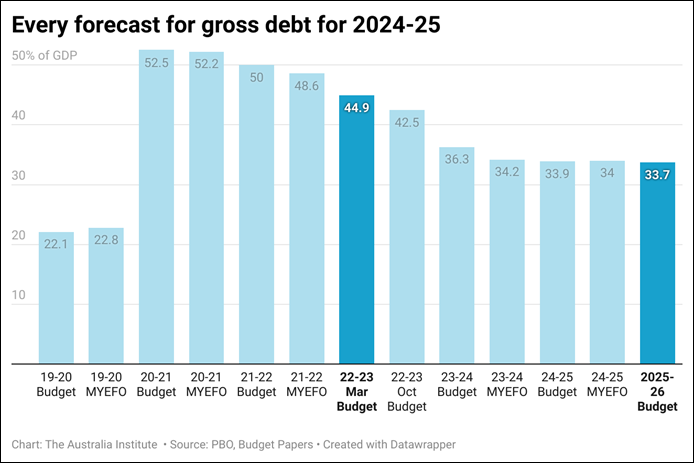
“I just want to say there that I’m not sure that anyone at home is feeling that like either of you are being fiscally responsible at the moment, and we’re really concerned about the level of debt we’re going to be leaving our grandkids.”

Well actually they should not be worried at all. Remember that even though we have a lot more govt debt than we did back when Peter Costello was treasury, the interest rate the government pays when it borrows money is lower now.

All investors around the world, think Australia’s debt levels are not only manageable but less risky than they were 20 years ago when there was no debt!

Greg Jericho
Chief Economist

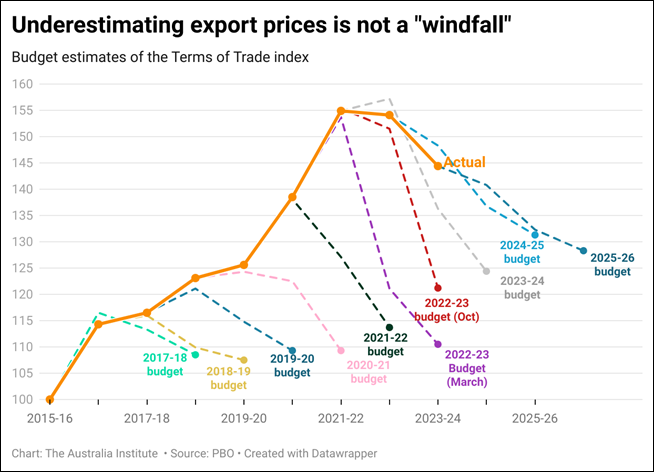
Peter Dutton talking about export prices being higher than expected was something the ALP was lucky with… well actually it happens all the time! As Matt showed the budget always is conservative on these forecasts

Peter Dutton also mentioned in there that he didn’t think that interest rates would be coming down “anytime soon”.

Which might be news to the market. Which is predicting another five cuts. At least.

Fact check: is debt ‘inter generational theft’? (no)

Matt Grudnoff
Senior Economist

Is more debt inter generational theft?

A common argument we hear is that increasing debt is unfair on younger people. The argument that Peter Dutton is making is that higher debt today means that younger people will have less in the future.

Dutton is against increasing taxes to pay for government services. He is effectively saying that we should cut spending on services to help the next generation. But how will it help young people if we cut spending on the hospitals they will be born into or the schools they will be educated in?

A smarter way would be to tax enough to supply the services that Australians demand. Cutting spending will not make the next generation better off. It will just make the poorer and less able to access the government services that the generation before them took for granted.

Fact check: debt

Greg Jericho
Chief Economist

Anthony Albanese is right – debt is lower now than was forecast in the last budget by Josh Frydenberg. But that says absolutely nothing about being a good “economic manager”

Peter Dutton is suggesting that all been due to higher iron ore prices etc… well given that was the case during the 2000s mining boom, not sure he should say that too loudly

Matt Grudnoff
Senior Economist

People are now voting, and the Coalition has still not shown all their policies or how they are paying for them. Do they expect people to vote for them without this? If so, does that mean they think that policies costings are pointless?

Greg Jericho
Chief Economist

Dutton:

Fortunately, none of our kids have decided that politics is a good pursuit for them. So that is a relief to all of us. Thank you. I’m sure I speak for the Prime Minister.

That actually demonstrate just how bad things are. Politics is good – it should be something people look to aspire to, and not be viewed as a horror show of megalomania (and other horrors that women especially have to endure)

So is Anthony Albanese too soft?

Albanese then proves he is a Lana Del Rey fan, by paraphrasing Mariners’ Apartment Complex. (He is more of a Born to Die fan apparently, but seems he knows the Sad Girl catalogue)

Kindness isn’t weakness. Kindness is something that I was raised with. We’ve we raised our children to be compassionate with each other, but I’ve been capable of making tough decisions.

But HOW CAN YOU DEAL WITH WORLD LEADERS WITHOUT BEING A MONSTER?

I’ve managed to be firm about Australia’s position, and we’ve managed to, for example, on China. We have repaired the relationship without compromising any of Australia’s values. That has been very important. We’ve continued to deal with all this, for example, putting it in place. Some people don’t like that. That’s Australia’s position. It’s in our national interest on issues like nuclear powered submarines. Not everyone in the Labor Party was convinced by that. At the beginning, I took the argument to the ALP national conference, put it through. We’re putting it in place. I’ve been in public life like Peter for a long period of time, and you don’t get to be Prime Minister and to lead the Labor Party without a toughness.

Dutton says thankfully neither of their children has shown an interest in politics. Which – of course not? They already have houses.

Sigh.

We are now at the ‘I am not a monster’ part of the debate.

Peter Dutton is talking about being a police officer. Which he hasn’t been since 1999.

He has been a property developer for longer. A politician for longer. Peter Dutton as a police officer is as relevant as me being a barister.

The leaders are now being asked about character.

You know what is actually important in being prime minister?

What they do with power. What. Do. They. Do. With. Power.

That’s what’s important.

Greg Jericho
Chief Economist

Allan Behm wrote last week in Guardian: “US president Donald Trump has created a massive opportunity for America’s adversaries to capitalise on his rare facility for ceding economic, political and strategic ground to China and Russia. China’s president is now making hay in the sunshine of Vietnam, Cambodia and Malaysia, while his trade minister was recently in discussion with his Japanese and South Korean counterparts on a joint approach to tariff imposts – three ancient enemies joined at last in common purpose”

“The starting point for our brave new world is to understand that the opportunity of a lifetime lasts only as long as the lifetime of the opportunity. We need to get cracking. We need the leadership that recognises good luck rather than looks backwards at a lost world or, even worse, cries over spilt milk. We need the confidence to engage with our neighbours and to reinvest in the diplomatic tools that are critical to creating the geopolitical capital that is now so much in demand.

And least of all do we need to start at shadows and indulge in the fear of unknown non-events and “agreements” from over-excited politicians who are making heavy weather of an election campaign.”

Dolly help us.

OK. We are onto our second glass of wine over here.

Goodness me. This is painful.

Peter Dutton goes into more detail about why he would be so amazing as a leader in terms of diplomacy.

I bring more experience to this job than any predecessor. I’ve been the defence minister in our country. I’ve been the home affairs minister, the Immigration Minister. I’ve been on the front bench of the Liberal party and government opposition since 2004 as I said earlier, I’ve worked with four prime ministers, and I’ve watched them very closely, the good and the bad, and I’ve learned from each and I believe very strongly that we have the runs on the board.

I’ve got a good friendship and relationship with the PNG Prime Minister. I met the current President of Indonesia when he was defence minister. I had a meeting with him in Canberra when he was the president elect. I put good relationships in the United States, in the United Kingdom, in Canada, in Japan, and that has built up over a period of time. And I’m very proud of the connections globally that I have, and I believe not just me, but our team is highly experienced and has the ability to bring together the best opportunity for us to stand proud on the world stage, the problems that Australia has seen at the moment with a week leader, not just from Australians, but also from our international counterparts, who see a weak leader In the Lodge.

So the man who has denigrated other nations why in senior leadership positions, who said that bringing in Lebanese people to Australia was a mistake, made up an African gang problem to try and win a state election, the man who accused asylum seekers of faking rape claims to come to Australia for medical treatment, who was a senior minister when Border Force launched an operation to randomly check people on the streets of Melbourne for their visas, who made up that white South African farmers needed fast tracked visas because of the danger they apparently faced in their own country, who joked about climate change causing water to lap at the feet of Pacific Islanders, who said that he would get along better with Trump because he had the sort of personality that Trump liked and who just last week verbaled the Indonesian president (and I know I am missing things here) – HE thinks that he will do better on foreign affairs.

OK. Third glass of wine coming up.

Peter Dutton then says he would give more to the US with defence.

More than the $360bn than the Aukus agreement. Which Trump is already watering down in terms of what allies can expect to get. The US is behind in its own domestic manufacture of submarines and it is not going to give us any why it is behind in its own fleet.

Basically what Dutton is saying is – I will just beg more. I’ll give into the bully.

Greg Jericho:

Dutton:

The fact is that what I said, Prime Minister, which you’ve completely missed, is the opportunity for us to leverage in the relationship. We’ve got an enormous defence industry in this country.

Dutton is suggesting that one way to get lower tariffs is to offer to give the US MORE for defence.

So the response to a bully is to give in!!!

We move on to Trump, which is pretty much the story of this election.

Peter Dutton says he will be able to get a better deal with Trump, because….not sure why? His sparkling personality?

One is that I dealt with the Obama administration as a senior minister. I dealt with the Trump mark one administration…I also dealt, obviously, intimately with the with the Biden administration, we negotiated the Aukus submarine deal, which no no other country been able to do since the 1950s we negotiated an arrangement with President Biden’s administration, a Liberal government working with the Democrat government to broker a deal for the United States to share their nuclear powered secrets.

To the Prime Minister’s credit, he was then opposition leader, supported the position that we took. That’s the first point I’d make in terms of my experience in relation to international affairs.

Secondly, when we were in government during the Trump mark one period, we were able to negotiate an exemption for Australia in a way that other countries hadn’t been able to do it.

Our ambassador, at the moment, captain’s pick from the Prime Minister, Mr Kevin Rudd, is in there. Can’t get a phone call with the with the with with the President, cannot even get into the West Wing, and so no wonder the government’s had no hope of putting Australia’s case. The prime minister himself can’t get a phone call or meeting

Peter Dutton says he wants to see Australians save up for an investment property.

ARE YOU QUITE RIGHT IN THE HEAD, OPPOSITION LEADER?

This is a debate about how people can not afford to buy the average family home for their average family – and he is talking about people buying AN INVESTMENT PROPERTY?

WHAT WORLD IS HE IN?

Dutton:

I want to make sure that we can have the tax the tax settings in place so that we can encourage investment, because young Australians have to rent for a period of time until they can afford to get into their own home.

And if we don’t have investors in the market that we don’t have that rental accommodation, and we reduce the stock of housing, so we need to get that balance right, but the Prime Minister is already committed to taxing an unrealised capital gain.

So this will give an insight into faster for people who are saving for a rental property to try and support themselves in retirement or to have a house that they might give to one of their kids when they pass away. I think we have an enormous opportunity if we can change government the next election to fix up the housing crisis that Labor’s created (Labor has not created this, but also hasn’t done anything to make it better).

Matt Grudnoff
Senior Economist

The problem of housing affordability is not too many migrants, but too many tax breaks for investors.

https://australiainstitute.org.au/post/migrants-are-not-to-blame-for-soaring-house-prices/

Will Labor’s policies make housing more affordable for people trying to get into the market.

Albanese says yes. But as Matt has just shown, it will be making housing more expensive.

Would Peter Dutton encourage his 20-year-old son Harry to dip into his super and take $50,000 out of his super for his house deposit (if Harry has more than $50,000 in his super, which most people in their 30s would be lucky to have, it is only because he has access to a trust fund, because his parents are multi-millionaires).

Dutton said he would tell Harry to take money out of his super.

Dutton is not doing anything on the capital gains tax discount.

Fact check: Housing policies

Matt Grudnoff
Senior Economist

Both major parties’ policies on housing are bad.

Both major parties have been guilty of juicing demand with previous policies. This started all the way back in the year 2000 with first homeowner’s grants. Study after study has shown that giving one group of home buyers more money or access to more borrowing just pushes up house prices.

Policies that both major parties have that is this category include:

  • Access to super for first home buyers (LNP)
  • 5% deposit without mortgage insurance for first home buyers (ALP)
  • Tax deductibility for interest payments for first home buyers buying new homes (LNP)
  • Govt taking up to a 40% equity stake in buying a home (ALP)
  • Lowering borrowing standards to make it easier to get a larger mortgage (LNP)

These make for nice announceables but they will drive up house prices and make housing less affordable.

Climate change is increasing your insurance costs

Greg Jericho
Chief Economist

Around the world, climate change is increasing the costs of insurance and Australia is no exception.

Between 2022 and 2023, the average home insurance premium in Australia rose by 14%, the biggest rise in a decade.

Major floods in eastern Australia pushed insured losses in 2022 to a record $7 billion, almost double previous records. Perhaps more alarmingly, since 2013, insured losses in each year have exceeded the combined losses of the five years from 2000 to 2004.

Modelling from The McKell Institute estimated that the direct cost of natural disasters in Australia could reach $35 billion per year (in 2022 dollars) by mid-century, an average of more than $2,500 per household per year. 

Fact check: all of the talking points

My Dolly this is boring.

There really just needs to be one debate. Just one. We don’t need fifty versions of the same stuff.

Grocery prices have not gone up by 30%. It is 12%. Still bad, so I am not sure why Dutton has to keep overstating it.

Immigration is not the reason you can’t afford a house.

Stopping foreign buyers from purchasing existing homes will not do anything to make housing more affordable.

Climate change is a major reason insurance is going up

Savings from the fuel excise cut are vastly over stated.

Labor does not have a ‘renewables only’ energy policy.

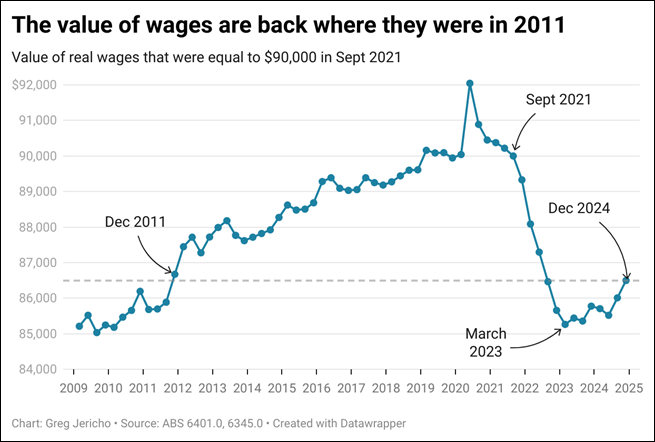
Albanese: “Real wages have increased five quarters in a row under us. They went down five quarters in a row the last five quarters at the former government was in office.”

Yes true, but they are still about 3.9% below where there were in Sept 2021. So we have a long way to go to recover

Albanese is correct – you can’t means test a rebate. You either limit it to concession card holders or to everyone, or you wait until everyone fills in their tax return and you give it as a tax cut, which would not achieve the aim of actually reducing inflation, that occurs by the rebate

Why should people trust Anthony Albanese that they will be better off at the end of a second Labor term?

Albanese:

We understand that many people are doing it tough, which is why we’ve provided significant cost of living relief, but we’ve had to do it in a way that put that downward pressure on inflation. As a result, inflation has a two in front of it, 2.4 but at the same time, we’ve created a million jobs. We have provided cost of living relief, whether it be cheaper, childcare, free take for 600,000 people, energy bill relief, importantly, as well, tax cuts, one of the big decisions that we made was to change what I did. Say we would do. We said we wouldn’t take such the tax cuts. We intervened to make sure that everyone got a tax cut, and that’s why, going forward as well, we’ll make sure that there are further tax cuts. Two occasions, the coalition are promising to put income taxes up. If they’re successful, we will as well. The final point I’ll make is what goes in matters as well. Real wages have increased five quarters in a row. They went down five quarters in a row under the last government,.

What does Peter Dutton say to the Temu Trump criticism?

Dutton:

Well, I’ve been in Parliament since 2001 I served under four prime ministers, and I watched seven Prime Ministers in total. I believe that I’ve got the experience to bring to this job. My biggest influence in my political life was John Howard and Peter Costello. I worked as assistant treasurer, and I have taken inspiration from them both in terms of how to keep our economy strong and how to keep our country safe.

This election is between the Prime Minister and I, and the reason that you get all the negative ads and the lies and the mud slinging and the rest of it to Ali’s point before is that the government doesn’t have a good story to tell.

Over the last three years, if families were better off, childcare was spoken about before, childcare has gone up by 22% under this government out of pocket, expenses up by 13% so this election is about how as a party, and what I’m saying to the Australian people is that we want support at the election with your Liberal National candidates to provide support straight away, to help you with the cost of living crisis and our reforms beyond that, fix up The energy system, which has caused the cost of everything, including groceries, to go up by 30% okay,

Fact check: the 2014 Coalition health budget

Greg Jericho
Chief Economist

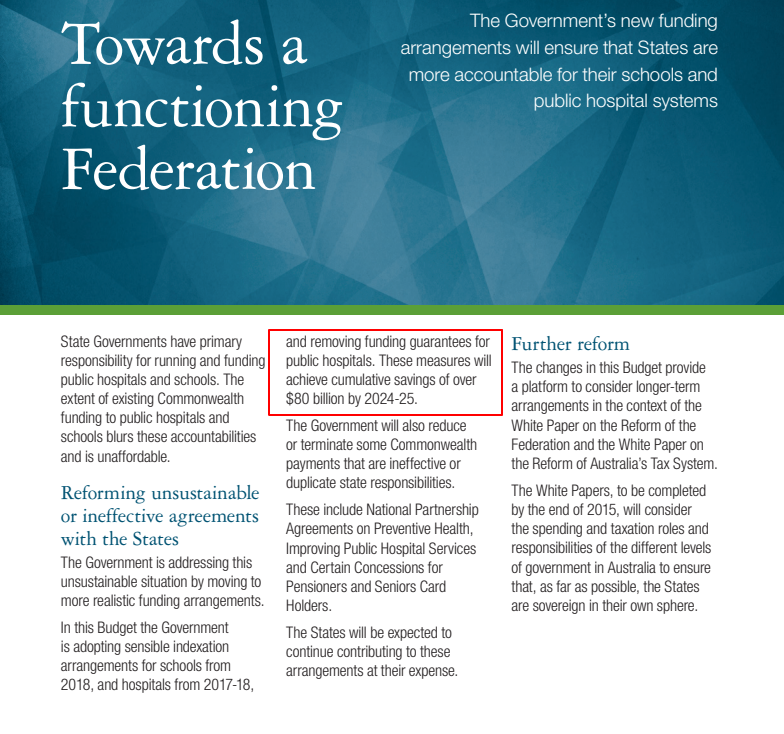
Anthony Albanese talks about $80bn in cuts to health and education in the 2014-15 budget, and yep it is there. Rather weirdly it was included in the glossy overview – which usually is the place where govts put of the marketing stuff. Oddly Joe Hockey put in the fact that they were going to cut $80bn from health and education.

I remember being in the budget lockup and finding it and we all were rather stunned that it was there

There is then argy bargy over whether Anthony Albanese is lying about Peter Dutton cutting funding in Medicare when he was health minister in 2014.

It then ends with Dutton saying that Labor is pointing to a cut in funding growth (which is true). But that is the same measure Dutton uses to say Labor “ripped out” funding from defence.

So funding increased, but it didn’t increase by what it had been forecast to increase by, which meant that things were cut.

Anthony Albanese says he will stake his prime ministership on bulk billing rates going up if he wins another term.

“Absolutely,” he says.

His lies and rebuttal:

Medicare is at the center of this campaign, and we will strengthen Medicare. Peter uses a figure about bulk billing that takes into account the fact that Australians had to get COVID shots during the pandemic, and that boosted artificially the numbers.

But the truth is, bulk billing was in free fall because the incoming Liberal government, the last time they won, ripped $50 billion out of the hospital system. This Minister, when Peter was the health minister, tried to introduce a GP tax, which would have abolished bulk billing altogether. And when he couldn’t do that, what happened was that there was a six year freeze on the Medicare rebate, which sent bulk billing into free fall.

Now during this campaign, Peter has not said where the money is coming from for his nuclear power stations, he won’t go anywhere near them.

He was in Orange today just near Lithgow. Won’t go near them. And he won’t go near them because he knows that it just doesn’t stack up, which is why the private sector won’t fund them.

Each leader is asked to address the biggest lie they think their opponent is using against them.

Peter Dutton can’t choose one:

The $600 billion figure comes from a company that is a donor to the Labor Party, full of donors, labor staffers discredited, and it is at odds with the 100 and $20 billion figure for the construction of nuclear power sites. So which is the CSIRO figure.

That’s one the $275 obviously, is another broken promise in relation to Medicare, the whole Medicare scare campaign, which has been going on at subsequent elections for a long period of time. The fact is that Bob billing has plummeted under this prime minister. People can’t afford to go to the doctors because the out of pocket expense now is about $43 per person when you’re going to the doctor. That’s a lot of money, and it’s why people are putting off going to the doctor. So there have been a lot of lies told by labor over the course of this campaign, but I don’t think Australians are stupid.

I think they see through it. And I think increasingly, as people test some of the claims being made by the Prime Minister, they realize that at best, your best description of him could be that he’s loose with the truth, and he says it with a straight face, which is the most remarkable thing.

Matt Grudnoff:

Dutton says the Smart Energy Council estimate of $600bn for nuclear power comes from a company that is a donor to the Labor Party, full of donors. Labor staffers, discredited. He is talking about the Smart Energy Council

Fact check: Voters turning against the major parties

Greg Jericho
Chief Economist

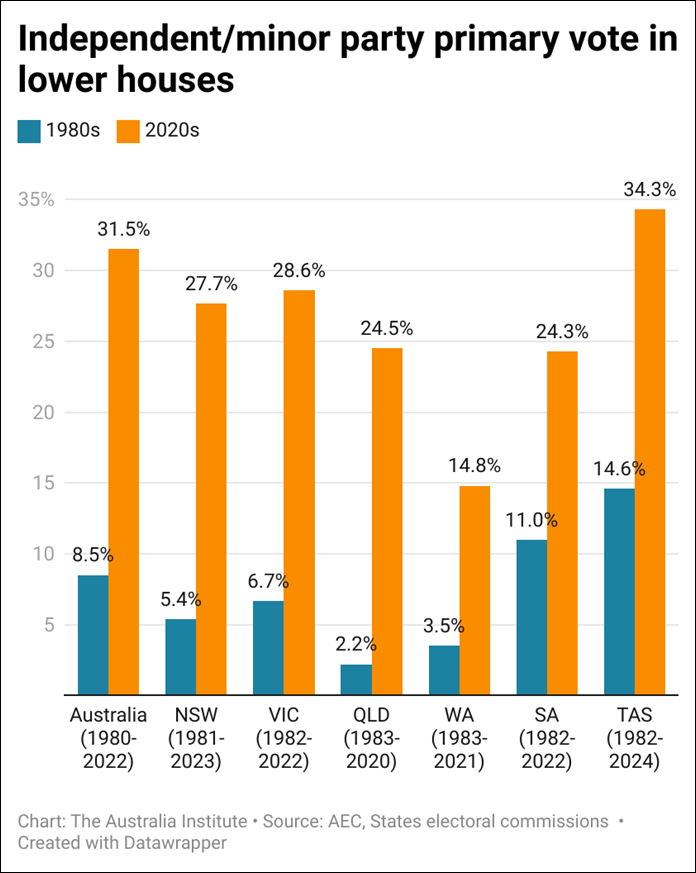
The switch to non-LAP non-LNP candidates is not a federal issue – it is across Australia in both federal and state elections

If people don’t love Labor, why is Peter Dutton and the Coalition going backwards?

Dutton blames Labor’s lies again.

Well, early the Labor Party spent $20 million throwing mud at us with negative ads, and that has an impact, (so Labor campaigned better and were more prepared?) and I get that, but for a lot of Australian families, over the course of the next few days, they’re going to have to make a decision about what’s in their best interests and what’s in our country’s best interests. How can they get their family finances sorted out?

This government’s brought in a million people over the course of the last two years, which is a 70% increase in the migration program of any two year period in our country’s history, it’s created a housing crisis.

So Australians feel tension because their kids are staying at home longer. Young families are putting off having kids. Mums and dads and grandparents are staying in the workforce longer because they’re trying to help their kids with mortgages or with a deposit.

And I can get that people are disillusioned in that environment, people are living in very uncertain times when you have a look at what’s happening in the world, in our own region, people are unsettled by what they see on the world stage, and they need a prime minister with strength and the ability to stand up for our country and to deal with the issues, whatever they might be that come our way.

Once again, it is not the fault of migrants or immigration that house prices are too expensive and it didn’t happen in the last three years. This has been a failure across decades.

First question – how is it not a failure that people are not inspired to vote for a major party.

The question was phrased around ‘one in three are undecided’ – because they don’t want to vote for either the Coalition or Labor. But that doesn’t mean they are undecided.

Anthony Albanese:

We live in times where the old rules of 40% of people voting labor, 40% of people voting for the coalition and 20% being up for grabs, they’ve gone that reflects the changes in our economy, the changes in our society, and we recognise that. But what we have managed to do is, in very difficult global times, with the biggest inflation shock since the 1980s and the biggest energy crisis since the 1970s is get inflation down to 2.4 per cent, make sure we deliver cost of living relief that have made a difference to families on average of $7,200 whilst making sure that we put in place reforms that help build the future, like better schools, fund strengthening Medicare and cheaper childcare.

The opening statements are as you would expect.

Peter Dutton has stumbled a bit – which is unusual compared to his previous debate performances.

Anthony Albanese is distinctly low energy in his opening statement as well.

So far, it seems like neither leader is loving this.

Third leaders’ debate

It’s the debate no one asked for, at the time no one needed it.

And we have one more after this!

Huzzah!

This one is Network Nine’s with Charles Croucher, Deb Knight and Phil Coorey asking the questions. Ali Langdon is the mediator.

She wants “honest to the point answers”.

Peter Dutton has won the coin toss and will go first.

Roderick Campbell
Research Director

The reason that today’s export gas approval is such an opportunity for Peter Dutton and the LNP is that they could, in one fell swoop, fix the Northern Territory’s gas problems and win both its lower house seats.

As Peter Dutton has explained, ending claimed gas “shortages” in Australia is a matter of limiting gas exports. This is true in the NT as it is on the east coast.

Darwin has two huge liquified natural gas terminals. Just one of them exports more gas than NSW, Victoria and SA use in a year. Diverting just a fraction of Santos’ capacity to the NT, something that is already done in emergencies, would eliminate the need for any other supply.

And yet, you guessed it, apparently the NT has a gas shortage!!

To address this “shortage”, in 2024, the NT Labor Government delivered a massive subsidy for fracking in the NT via a commitment to purchase fracked gas.

The important thing to realise is that fracking is very, very unpopular in the NT because of its potential impacts on groundwater. South of Darwin, everyone and everything relies on groundwater for at least some of the year. Everyone drinks groundwater, showers in it, goes fishing in it, and they know it.

And so a policy that would eliminate the need for fracking without expressly banning it would be a big deal in the NT. It could tip a lot of swinging voters both in the tight outback seat of Lingiari and in Darwin’s Solomon, where Dutton thinks he can win.

Taking on the gas industry on the east coast has worked for Peter Dutton. It could work in the NT.

Big gass is taking the piss

We will revisit this tomorrow as well, but research director Rod Campbell made some more excellent points about the latest gas project approval:

The export gas project that was just approved is Santos’ Barossa project. If it sounds familiar, that’s because of Barossa’s many, many scandals:

  • Longrunning legal battles with Tiwi Islands traditional owners.
  • It is particularly polluting. Barossa has more CO2 in its gas than any other gas field in Australia, 6x worse than Woodside’s North West Shelf.

Because of its battles with traditional owners and massive pollution, international investors have been pulling out of it, notably South Korea’s government-backed bank. The legends over at Market Forces keep a tally on which banks have ruled out lending money to Barossa.

Here’s the most pathetic bit – in order to help Barossa look a little bit cleaner to foreign banks, the Australian Government changed environmental rules as a favour for Santos (here’s our sub). The change meant Santos can send Barossa’s pollution to the Timor Sea for dumping, aka “Carbon Capture and Storage” (CCS).

CCS is, of course, a scam that has failed for decades.

As usual, this gas will be given to Santos for free. Barossa will pay no royalties and no gas exporter has ever paid petroleum resource rent tax.

Free gas, massive pollution, conflict with TOs.

Big Gas is taking the piss, particularly Santos.

Hello and welcome back

We have Greg Jericho and Matt Grudnoff at the ready, with Amy Remeikis at the helm.

Ready for the third leaders’ debate?

Nope, me either. Let’s suffer through this together then,

New gas mine approved

Roderick Campbell
Research Manager

Gadzooks, in the middle of an election campaign featuring a major focus on gas exports, Australia has just…approved a new massive gas export project!

NOPSEMA, the offshore oil and gas regulator posted today its acceptance of Santos’ proposal for the super-polluting Barossa Project.

If Peter Dutton is serious about Australian gas for Australians first, Barossa should be made to supply the Northern Territory first. This would mean there was no need to frack the NT, something that could win a lot of votes in Solomon and Lingiari.  

Barossa would be entirely for export, pay zero royalties and would be unlikely to pay petroleum resource rent tax anytime soon. It’s the project that Labor bent over backwards to support.

Sound familiar? Big Gas is taking the piss.

See you soon

Given that both campaigns are on pause out of respect for the Pope, we are going to put the blog on pause.

So we will do some work on the back end and a bit of research (and some other work that has banked up) but we will let you know of anything major.

And we will be covering the third leaders’ debate (which still seems to be on)

See you soon x

One of the unseen issues of this election is thanks to social media algorithms, we don’t see all the ads and posts that candidates and campaigns are putting out across the different social media platforms. But one of the things the Liberals have liked, is using…muppets.

Which seems a call back to Scott Morrison in 2018, when he said “the curtain has come down on the muppet show” in response to the leadership spill where he toppled Malcolm Turnbull as Liberal leader and prime minister.

Much like Tony Abbott’s ‘good government starts today’ the description eventually came back to haunt Morrison. Not sure why the Liberal campaign would want to remind people of the muppet show that was the Liberal leadership mess, but here we are.

Why are the Libs trying make Albanese look nice??

Greg Jericho (@grogsgamut.bsky.social) 2025-04-22T01:07:37.590Z

AAP has covered some of the Pacific Island tributes for Pope Francis:

Papua New Guinea Prime Minister James Marape says the death of Pope Francis is a loss for “all humanity” as the deeply faithful Pacific mourns.

The pope leaves a meaningful legacy to the region, visiting in 2024 and canonising the first Papua New Guinean to become a saint, Peter To Rot.

Christianity is the dominant religion in PNG, and Catholicism is the largest denomination, with more than two million followers.

Tens of thousands of people turned out to see Francis in September on the first papal visit to PNG for three decades, and the longest trip he took from the Vatican during his 12-year tenure.

“Pope Francis led with grace and courage, and his voice for the voiceless resonated around the world,” Mr Marape said.

“The death of Pope Francis is not only a loss to the Catholic faithful, but to all humanity.

“His legacy will endure in the hearts of millions, including the people of Papua New Guinea.”

Pope Francis celebrated mass in the capital, Port Moresby, and the tony Sandaun town of Vanimo, close to the border with Indonesia’s West Papua region, in September.

He told worshippers that despite the 800 languages spoken in PNG, they “share a common language, that of love and service”.

After his visit, he approved the historic canonisation of To Rot, now known as Blessed Peter, who led a Catholic mission in East New Britain during the World War II occupation by Japan.

According to the Vatican, Blessed Peter continued his religious leadership, including marrying couples, against the occupying forces’ orders, before he died in custody from poisoning.

Blessed Peter was beatified by St John Paul II in Port Moresby in 1995, the previous papal visit to Melanesia.

PNG bishop Rozario Menezes told the ABC he was distraught by Pope Francis’ death.

“We are very much saddened, because just a few months ago, he visited us here. But we are very thankful to God for giving us a leader who led from his heart,” he said.

“It’s not only that Pope Francis appointed the first Cardinal of Papua New Guinea, but also he has given the church of Papua New Guinea (and) he has given us a saint in the person of Blessed Peter To Rot.” 

Mr Marape met Pope Francis before the three-hour mass at Sir John Guise Stadium, where he told the prime minister his impressions of locals were they were “a smiling people”. 

Christianity is the dominant religion across all three of Oceania’s regions – Melanesia, Micronesia and Polynesia – following the arrival of missionaries in the 19th and 20th centuries.

So who is representing Australia at the Pope’s funeral?

The Governor-General, Sam Mostyn, was on her way to Türkiye for Anzac Day commemorations, but is considered to be “an appropriate representative”.

Former LNP MP Keith Pitt, who is the new ambassador to the Holy See, hasn’t been able to present his credentials to the Vatican because of the Pope’s illness, but he is helping with logistics.

Details are still being finalised by DFAT.

Fact check: gambling action

Morgan Harrington
Postdoctoral Research Manager

Government ministers are saying that Labor has done more than any other government to break Australia’s addiction to gambling after a story in the SMH alleged that Prime Minister Albanese intervened to stop a restriction on gambling ads.

That’s not saying much, and Australia Institute polling shows that the public is hungry for ambitious reforms. According to the SMH article, the Labor party had a proposal for policies that would have blocked gambling ads online, limited TV ads for gambling to two per hour until 10pm, and banned ads for gambling an hour before and after live sport.

Australia Institute polling shows that three in four Australians (76%) support a total ban on gambling ads phased in over three years.

Given the public’s appetite, and the fact that Australian teenagers are more likely to gamble than to play any of the most popular sports, introducing meaningful reforms should be a no-brainer.

Fact check: Negative gearing modelling

Matt Grudnoff
Senior Economist

The Australian has published the results of modelling on the Green’s policy of phasing out negative gearing and the capital gains tax (CGT) discount. The modelling claims that rents will increase because the tax changes will lead to many landlords selling their properties, reducing the number of rental properties.

But a reduction in rental properties is not going to push up rents. Why? Because those houses are not being destroyed or abandoned, they’re being sold.

Who is buying those properties? They are not being sold to landlords because the tax changes are driving them to sell. If they are not selling to people who already own properties (landlords), then they must be selling to people wanting a property to live in (first home buyers).

Landlords are selling their properties to people who currently rent. After this happens there will be fewer rental properties but their will also be fewer people wanting to rent. Supply may fall but so will demand, which will not material impact rental prices.

The result of cracking down on these tax concessions will be higher home ownership rates, as renters who are currently trying to break into home ownership buy rental properties being sold by landlords.

Election entrée: Early voting in Australia

Sky Predavec

A cornerstone of the Australian election experience is tucking into a democracy sausage after casting your ballot on election day.

But in recent years more and more Australians have abandoned voting on polling day, missing out on sausage sandwiches and – more importantly – the final days of the election campaign.

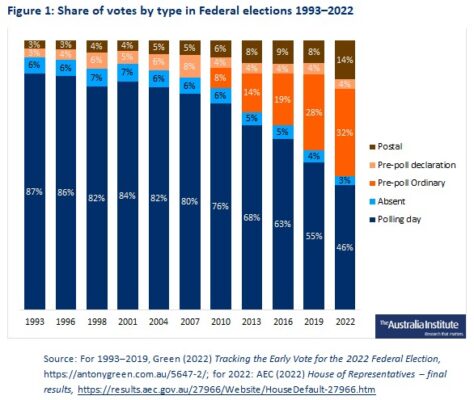
There are six categories of voting in Australian elections:

  • Ordinary polling day: a vote cast in the voter’s home electorate on the day
  • Absent: a vote cast outside of the voter’s home electorate (but in the same state or territory) on the day
  • Ordinary pre-poll: a vote cast in the weeks leading up to polling day, and without a specific reason for doing so.
  • Declaration pre-poll votes: a vote cast in the weeks leading up to polling day, and with the voter having a specific reason for doing so (such as being unable to vote on polling day, serious illness, or religious reasons).
  • Postal votes: a vote issued, and generally returned, by mail (requires a reason like declaration pre-poll votes).
  • Provisional: a vote cast where a voter’s name cannot be found on the roll, is already marked off, or by a silent elector. They make up a very small share of the vote (0.3% in 2022), so have not been included in Figure 1.

Prior to 2010, pre-poll votes all required a declaration with a specific reason that the voter could not cast their ballot on polling day. From 2010 onwards pre-poll voters have not needed to provide a reason. That has coincided with a dramatic rise in early voting: half of all votes cast at the 2022 election were filled in before polling day.

Pre-poll voting opens a little later in the 2025 election than it did in 2022 – 11 days rather than 12. In 2019, Pre-poll voting was open a full 19 days before election day. While pre-poll voting increased despite the shorter window in 2022, time will tell if that will happen again.

It can be more convenient for someone to vote according to their own schedule rather than on a specific Saturday. However, individual convenience may be hampering Australians’ collective democracy.

A key aspect of an election campaign is hearing the parties’ full list of policies, seeing how their leaders perform under the stresses of a long campaign, and then coming together as a country to make a choice about who should represent Australians in the next parliament. As more and more Australians vote early, are they really coming together?

Early voting can have real political consequences too, when issues surface late in an election cycle. At last year’s Queensland election, Labor lost government with a 7.0% swing against them – taking only 46.2% of the two-party-preferred vote. However, Labor narrowly won votes cast on election day itself with 50.6% two-party-preferred. To some extent, this reflects that early voters are generally more conservative than the electorate as a whole. However, it is also the case that those who voted on the day would have seen more of the election campaign than other voters – particularly on the question of abortion rights in the case of the recent Queensland election.

When voters go into the polling booth, they should do so with the knowledge that they’re making a choice, part of a decision that all Australians are making. Is that really the case if most of that choice has already been made?

Truth is the first casualty in an election campaign

Given Peter Dutton’s complaints there, let’s take a look at this research from Bill Browne, Director of The Australia Institute’s Democracy & Accountability Program:

Almost nine out of 10 Australians (89%) support  Truth in Political Advertising laws, according to new research released by The Australia Institute today.

As early voting for the federal election opens today, rival claims of misleading advertising from both sides of politics are the inevitable consequence of the absence of Truth in Political Advertising laws – because, in this election, it is still perfectly legal to lie in a political ad at a federal level. 

Key Points:

  • Nine in 10 Australians (89%) support Truth in Political Advertising laws, including two in three who strongly support such laws (64%).
  • There is overwhelming and consistent support for Truth in Political Advertising laws from Labor (93%), Coalition (88%), Greens (87%), One Nation (92%) and Independent/Other voters (79%).
  • Truth in political advertising laws have operated successfully in South Australia for 40 years.
  • At the end of 2024, the Albanese Government introduced legislation to Parliament to implement Truth in Political Advertising laws federally – but this legislation was not passed.
  • Independent MP Zali Steggall introduced a private member’s bill for truth in political advertising laws.
  • South Australia has had truth in political advertising laws since the 1980s; the ACT Legislative Assembly passed similar laws prior to the 2020 ACT election with tri-partisan support.

“At a federal level, it is perfectly legal to lie in a political ad, and it shouldn’t be,” Browne.

“Political advertisements that are deceptive and misleading interfere with the public’s ability to make informed decisions. Without action, we risk election campaigns sliding into a free-fall of fake news.

“Earlier this year, Labor and Liberal politicians voted to give political parties tens of millions of dollars more in public funding. Without Truth in Political Advertising laws, there is every danger that taxpayer money will be spent lying to the public.

“Corporations are already prohibited from making misleading or deceptive claims – Australians should be able to expect the same or higher standard of honesty in politics as in trade and commerce.

“Truth in Political Advertising laws have transformed campaigning in South Australia, leading political party directors to scrutinise all political ads for accuracy. Australians are entitled to the same rigour and honesty in national political advertising, but currently there is no guarantee they will get it.

“With trust in government distressingly low across Australia, all sides of politics should take the opportunity to restore some public faith in politics and the representatives they elect to Parliament.”

Peter Dutton thinks polls are wrong, invokes ‘Quiet Australians’

Asked about the polls which show that Peter Dutton himself, the person, is the reason that people don’t like the Coalition, Dutton says:

I won’t go into the priority polling, but you will see where the  government is spending money at the moment in their defending seats at the moment. They are not on the offence.

…Australians are hurting.  That is the reality. People are  going backwards and we’ve what a  household recession for nearly two years for families. The question is how can we help people after three years of this government?

…We have a chance to course correct to get the country back on track and that is what we  are concentrating on. 

Q: Are you saying that your internal polling is saying that your internal polling is saying something like you can win here? 

Dutton:

No question about, that Nat. I suspect the internal polling in the Labor Party is doing the same. Look at ‘The Australian’ today where they are spending money, they are  defending seats and that is the  reality. In Victoria, people have  had enough of Labor at a state and federal level. The government has  pulled money out of infrastructure, brought in 1 million people which  created a housing crisis. 29-30,000 small businesses have gone broke and tragically sadly behind every one of those businesses is a story where someone has lost their home or their life savings.

I think there are a lot of quiet Australians who are not that  interested in politics, but no the reality of their own lives the past few years or their neighbour or  sister or brother or someone in  their family and they know it is not been an easy time.

It is not a beauty contest.

Peter Dutton blames Coalition campaign woes on ‘Labor lies’

Peter Dutton spoke to Channel Seven’s breakfast program a little earlier this morning, where he blamed the poll results (which have him behind) on ‘Labor lies’.

Today is not the day for big politicking, but obviously, the government has threaten mud and they have spent $20 million of  negativity over the course of the last few months.

Most based on a  lie, frankly, in relation to the  Medicare campaigning. The bulk- billing rates have dropped under  this government. A complete  fabrication. I think people realise what the government is saying is  built on a lie. But if you throw mud in the game and put $20 million  behind it, it has an impact. For me, I am a truthful, independent person. I am the truthful, independent person I have always been, during the course of this campaign and the course of my career Ike will stand up for what I believe in.

Sometimes you can make some people unhappy, but I truly  believe, as we said yesterday, that crime and law and order is a serious issue and I want to do more to keep our country safe and help families  who are really struggling at the  moment and our 25 cent a litre cut to fuel will help families straight away and young people in  particular get in homes.

So that is what the election will be contested on, not the  personalities and mud being thrown by Labor. 

That’s it for the morning campaigning – both sides are now reducing their campaign events today.

We will go through some of the morning interviews and bring you some snippets.

Asked if the Pope’s death will have any impact on the campaign, Anthony Albanese says:

Oh, people will, I think, separate these things and can make their decisions about the election on 3 May. I think it’s very important that we have a secular democracy in Australia and… But people will, of course, for particularly people of Catholic faith, they will take time to reflect over coming days, coming so soon after Easter commemorations. And the commemoration of the resurrection just the day before. It’s a very significant time.

Asked to speak about his own faith, Albanese says:

Look, I try not to talk about my faith in public. I say I was raised with three great faiths, I’ve said that a number of times. And at times like this, I think what people do is to, they draw on who they are. And certainly my Catholicism is just a part of me. And one of the things about the Holy Father is that he, for so many Catholics, I think his humility for the way that he embraced the poor, the way that he embraced the social justice message that I see as the message of Jesus Christ, is really important for so many Catholics. And he was someone who I personally admired as well, as someone who his values that he put forward, he had a great deal of courage as well. He was very much a modern leader in the way that he conducted himself.

Anthony Albanese press conference

Anthony Albanese is speaking in Melbourne:

The Holy Father Pope Francis’ compassion embraced all humanity. His kindness, humility and devotion were admired by people of all faiths and people of none. That’s why his loss is being mourned not by just over one billion Catholics around the world, but people from all walks of life. He was the first Jesuit Pope and the first to take the name of that great champion of the poor, St. Francis of Assisi. In the truest sense of the words he practised what he preached. The Holy Father was one of the most consequential leaders of this century and of our lifetime. He was indeed the people’s Pope. He was tireless in advocating for the powerless, campaigning against poverty, for the rights of working people and for protecting our natural environment.
 
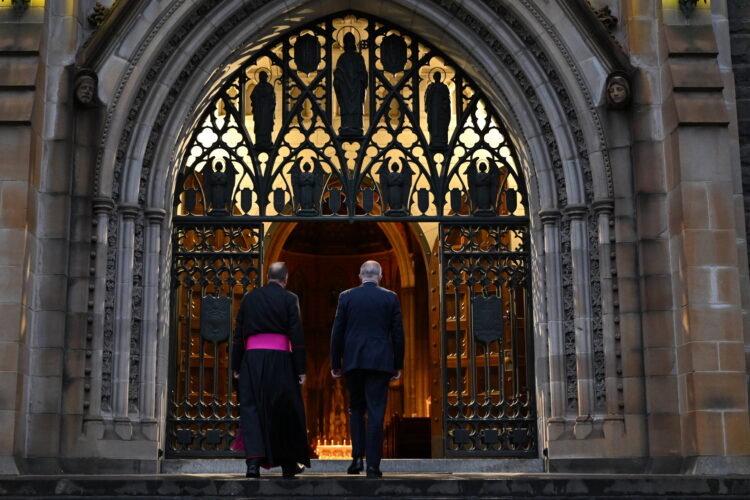
Pope Francis stayed true to his origins. As Pontiff he never rose above small acts of kindness and compassion. What we saw in him was an abiding spirit of humility. There was a gentleness about him, but it was a gentleness that contained such inner strength. The Holy Father was devoted to his faith and found expression of that through his devotion to humanity. Tributes we have seen from all over the world speak for people’s genuine sense of connection to Pope Francis, the qualities they recognised and admired in him. When I attended St Patrick’s Cathedral last night and then attending mass this morning, speaking to parishioners who have been deeply moved by the life and the legacy of the Holy Father.
 
I will pause my other campaign related events this morning. Today, flags will fly at half mast on Commonwealth buildings right around Australia as a mark of respect to the Holy Father

Looks like both major party leaders will be suspending official campaigning today, out of respect for the Pope.

We are still waiting to hear if tonight’s scheduled debate will go ahead.

Anthony Albanese is expected to speak very soon.

Demonstrating Australia’s gas export problem: INPEX vs Aus states

Roderick Campbell
Research Director

When one company exports more than is consumed in NSW, Victoria and South Australia combined, there is clearly no gas shortage.

A lot of gas is exported from Australia. To demonstrate this, the chart above compares the amount of gas that is used in all of NSW, Victoria and South Australia with the gas that is exported by just one company, the Japanese giant INPEX.

INPEX’s gas terminal in Darwin exports around 9 million tonnes of liquified natural gas (LNG) each year, which in energy terms is approximately 441 petajoules (PJ).

The Australian Energy Statistics estimate the gas consumption of each state – Victoria 215 PJ, NSW 134 PJ and South Australia 75 PJ, a total of 424 in 2022-23.

INPEX is just one of many multinational companies that export Australian gas. The fact that INPEX alone exports more gas than is used by all households and businesses (including electricity generators) in three states demonstrates that there is no gas shortage in Australia. Instead, Australia has a gas export problem.

As acknowledged by all sides of politics, any problem with Australian gas supply or price could be fixed rapidly by diverting some gas for exports. The next Australian Parliament has a great opportunity to fix Australia’s gas export problems.

Adam Bandt will hold a short press conference at a pre-polling booth in the electorate of Wills, which the Greens look like taking from Labor (at this point).

He’ll also talk about the passing of Pope Francis.

(And Will, we forgive you for the pre-coffee errors this morning – goodness knows I make a million a day, no matter how many coffees I have had)

It is still up in the air who will attend the funeral of Pope Francis in Rome this Saturday, given that an election is on. Keith Pitt, who is Australia’s ambassador to the Holy See will be there, but in terms of others from Australia, that is an on-going conversation.

But one person who will be attending is US President Donald Trump who posted to his social media platform Truth Social:

Melania and I will be going to the funeral of Pope Francis, in Rome.

We look forward to being there!” 

Australia is taking part in military ‘exercises’ with the Philippines and the United States.

The Defence statement says:

Around 150 members of the Australian Defence Force (ADF) are taking part in the 40th iteration of the largest bilateral exercise conducted between the Philippines and the United States.

Exercise Balikatan is an annual training exercise conducted between the Armed Forces of the Philippines (AFP) and United States military forces, aimed at maintaining a high level of military readiness to enhance the nations’ bilateral response capabilities.

Australia’s participation provides a key training opportunity for deployed personnel and supporting defence cooperation between all participating nations.

Exercise Balikatan 2025 includes more than 16,000 personnel from the Philippines, United States and Australia, as well as three nations involved in the AFP-hosted international observer program.

Australia’s contribution consists of land forces, medics, tactical air force components and, command and support personnel.

During Balikatan 2025, personnel will take part in a range of scenarios in maritime security, air and missile defence, offensive missile strikes, cyber defence, information warfare and humanitarian assistance.

This is the 40th iteration of Exercise Balikatan with the ADF having been a full participant since 2014.

Worth recognising that Australia takes part in these exercises with a variety of partners, in areas that annoy China. When we do it, it is just an ‘exercise’ and part of normal engagement, within international waters, or waters controlled by a consenting nation. But when China does it, we usually then have about two weeks of HOW DARE THEY media coverage, including and not limited to, is this research vessel trying to sabotage underwater cables.

There is a leaders’ debate is scheduled to be held tonight, but given the Pope’s death and the agreement to calm down campaigning, everyone is still waiting to see if it will go ahead.

Does Peter Dutton still want to hold a royal commission into allegations of sexual abuse in Indigenous communities?

Q: I guess it’s a question about the evidence you’d rely on to press ahead with a royal commission, isn’t it? You’ve got Indigenous organisations saying there is not a higher prevalence of sexual abuse in Indigenous communities.

Dutton:

That’s just not the case. That’s not the reality. As we know, there is certainly well documented cases and tragic cases and we need to accept there is a problem, which there is, and I want to make sure that those kids in remote communities, in a town camp, wherever it is, are treated equally to our kids in, you know, areas closer to capital cities.

We need to make sure we take care of every Australian child, Indigenous or not. We need to make sure they can enjoy their childhood, to do it peacefully and to do it in a way that is conducive to them leading the most productive life later on.

One of the things that always struck me as a detective in this area was that these issues lagged for years and years to come.

People who suffer sexual abuse at a young age bear those scars for a long time. In some cases, people never get over it. We need to do everything we can to defeat this crime type and I’m very serious about it and that’s why we made the announcement we did yesterday of $750 million to make our communities safer.

What would a Peter Dutton led government do about domestic, family and intimate partner violence?

Dutton:

[I] feel strongly that as a society we need to do more to protect women more generally in domestic situations but the sanctity of children is something important and we need to do everything we can to turn those numbers around.

There’s a big piece of online influence here, the normalisation of conduct that nobody would accept in real life becomes normalised online. It’s a very complex issue but our commitment yesterday was to make sure we can invest into keeping women and young girls safer in our community.

It’s noteworthy that the Liberal leader is campaigning in the seat of Calare which the Nationals are targeting. Sam Farraway is trying to win the seat back from party defector Andrew Gee, but what was supposed to be a walk in the park (ahead of the election every Coalition strategist had the seat in the ‘hold’ pile) is turning out to be a giant fight, with the seat, at this point, looking like staying independent.

So enter Peter Dutton, who has been sent in as a bit of a Hail Mary, because Nationals leader, David Littleproud is pretty unpopular in Nationals electorates (an issue, you would have to think)

So what does the Liberal leader think of the Nationals chances?

It’s certainly a critical electorate and Sam is doing a great job here. We need to make sure that we retain this seat and there’s been a huge campaign. There’s obviously a lot of teal money coming out of Sydney into the campaign here. But it’s an important expression also of a tight coalition with our National Party colleagues and the relationship that David Littleproud and I have is, you know a very strong one and I think we’ve demonstrated that over the last few years. I think the Coalition has demonstrated that we’re an alternative government and we’ve also said to people, not just here in Calare, but around the country, that we want to provide support for communities.

A 25 cent a litre reduction in fuel and getting young kids into housing as quickly as possible, making sure we can provide a safe community. We made an announcement yesterday to keep communities safe and a $750 million investment about tackling organised crime and making our suburbs, communities, towns, our country, a safer place as well.

Dutton also agrees that it is not a day for campaigning:

I don’t think it’s a day for overt politicking at all. I think the day is best spent reflecting. Obviously, pre-polling, etc, opens today and all of that will continue on but I don’t think there’s a place for the body blows of politics today.

I think it’s a very different day from that and we made commitments to do television this morning but I think the rest of the day really is probably best left in reflection as opposed to being out there overt politicking and I think that’s something most people would respect.

Peter Dutton is in Orange and is speaking about the death of the Pope:

Obviously our condolences go out to all Catholics and the Christian community more generally. A man who has dedicated his life to his God and helping those, particularly those much less fortunate than most others, the impoverished and people that he supported throughout his life.

To dedicate your life to a thaws that you believe in so passionately and to help save lives and lift people up from incredibly difficult circumstances is something that should be greatly admired and he should be an inspiration for all human beings to be better people and to take from his example his mercy and the sacrifices he made during the course of his life it’s quarterfinal phenomenal and to we commemorate that and celebrate his life.

Obviously it’s a period of mourning but we celebrate a life that was dedicated to his God, to his Church, and he obviously sacrificed so much and I really think that’s the reflection that I would make this morning.

Where are the leaders?

Anthony Albanese and Peter Dutton started the day in Melbourne.

Dutton has headed to the electorate of Calare, where the Nationals are losing against independent candidates, despite entering the election thinking taking it back from defector Andrew Gee would be “a given”.

Big Gas taking the piss: new research on Japanese gas giant, INPEX

New research by The Australia Institute highlights that Australia has a gas export problem, reinforcing the cross-party consensus that has emerged during the election campaign.

The research into the operations of Japanese gas exporter INPEX comes as both Labor and Coalition representatives have stated that Australia’s gas supply issues are caused by gas exports and the lack of restrictions placed on them.

The new research focuses on INPEX, which operates a large gas export terminal in Darwin. 

INPEX:

  • Exports more gas each year than is used in New South Wales, Victoria and South Australia combined.
  • Sells no gas to Australians, outside of emergencies
  • Pays no royalties, effectively getting the gas for free
  • Pays no Petroleum Resource Rent Tax (PRRT)
  • Has paid no corporate tax on $21 billion in gas exports since 2015

“INPEX is emblematic of Australia’s gas export problem,” said Mark Ogge, Principal Advisor at The Australia Institute.

“The Australian government is giving vast amounts of Australia’s gas to INPEX for free.

“To add insult to injury, INPEX has paid no company tax on billions of dollars’ worth of gas exports.

“While INPEX exports huge volumes of free gas, the Northern Territory Government is subsidising risky fracking projects to supply Territorians.

“With all sides of politics finally recognising Australia’s gas export problems, the next parliament will be in a good position to do something about it.”

What about the national plan as it stands? Is there a 25% reduction in women victims of intimate partner homicide?

Gallagher:

Well, that is the overall aim of the National Plan – one is to see the rates fall, the homicide rates fall. But also that we end violence against women and children in a generation. That is what all governments around Australia have signed up to.

And we, of course, we want to see less women murder. It breaks my heart and I know so many others around the country when we go online or open a newspaper and see yet another report of a woman who has lost her life to violence – often from an intimate partner or former partner. So yes, we want to see that continue to fall and we absolutely will do everything that we can to make sure that we are responding – not just through resources for the police, new ways of assessing high-risk perpetrators, but also making sure that women have the supports that they need if they need to leave a violent relationship.

And when they do that, that they are protected.

So what exactly does that mean? What would a second term Albanese government do?

Katy Gallagher:

Well, it’s about bringing all of our policies together for a focus on women.

And this is, I think, something that separates us from the Coalition. I mean, we have funded more money into front-line services, more money into community legal services so that they actually have continuity of funding.

But it’s also making sure that our housing policy is delivering house for women. That our wages policy is making sure that women are earning more.

That our health policy is dealing with all of the barriers to healthcare that women face. Because all of these are interconnected, and if we can make sure that women are able to live healthy lives and work in good jobs and earn good incomes and have a home over their head, then that also impacts on the level – you know, their own safety and their own independence.

So, for us, this is a whole of government effort. But you’ll expect that we would have more to say about the next steps that we think we can take that will change things for women and keep them safer in our community.

Sherele Moody, who runs the Red Heart Campaign, a memorial to women and children lost to violence in Australia, as well as Australian Femicide Watch, reports 22 women and five children have been killed in Australia in 2025. In 2024, 103 women and 16 children were killed.

Katy Gallagher is the minister for women, and is asked about the lack of focus on domestic and family violence in this campaign, despite the deaths of at least three women.

Gallagher:

Well, I think that for me, it’s a big feature of all of the work that I do and all of the work that the Labor Government has done. But I am giving a speech today and we are launching Labor’s Women’s Policy of which you would expect a large part of that will have a focus on women’s safety. And I mean, it remains the biggest barrier to gender equality in this country is the number of women who are murdered or beaten up or hospitalised or traumatised from men’s violence against women. And you know, we’ve lent into this this term.

We’re going to continue in a second term to make sure that we can do everything we can to change that. But it is complex and it requires a whole of community effort.

This isn’t something that the Government can solve on its own, although we are absolutely committed to continuing to drive for change and to make sure that women and girls that come after me and you don’t live in a world where they fear for their safety.

Will Anthony Albanese go to the Pope’s funeral?

Katy Gallagher:

Look, I think that those arrangements obviously will be worked out. I mean, the immediate response has been to pause and to pay respect to the passing of Pope Francis. But those, as you would expect, those arrangements will be made and it is appropriate that an Australian representative attend. But that will be, I guess, decisions down the track a little later today.

Anthony Albanese is Catholic and yesterday, after learning of the death of the Pope, he went to St Patrick’s Cathedral to pay his respects and speak with other mourners.

Katy Gallagher told ABC News Breakfast this morning:

I had the opportunity to speak with the PM last night. And as you say, he was deeply affected by the Pope’s passing. He attended the Cathedral last night after making some comments to the media, and he is attending mass as we speak.

You know, as someone who was born as a Catholic and raised and went to school with a Catholic school, it’s been a deep part of his upbringing. So as you would expect, he’s affected just like many millions of others are. Look, today, his plans have change. He won’t be doing the events that he had originally planned. But some events will go on, but obviously, it will be, I think, toned down, I guess, and respectful of the fact that we have lost a significant world leader overnight.

Good morning

Hello and welcome back to Australia Institute Live. A bit has happened since we last came together on Friday. The Pope died, which will overshadow the campaign in what was already a week bookended by public holidays – and yes, the campaign continues, but people pay a lot less attention to it, which means the campaigns tend to pull back on the pace a little.

A truck branded with signage for Liberal Greenway candidate Rattan Virk crashed into a pre-polling centre in Sydney’s north-west which makes for some delicious symbolism for the Coalition’s campaign.

Newspoll continues to show the Coalition vote going backwards – Peter Dutton has fallen back on old favourites, like crime is stopping Victorians from going out – and Anthony Albanese and the Labor campaign have largely continued to coast.

We’ll cover all the day’s events, with some fact checks where necessary, and answering your questions as the day goes on. Coffee number two is on the stove (I drink Greek coffee for those who were asking) and there is probably going to be a sneaky easter egg involved in breakfast this morning.

Ready? Let’s get into it.


Read the previous day's news (Thu 17 Apr)

Comments

Start the conversation

The biggest stories and the best analysis from the team at The Point, delivered to your inbox.

Past Coverage