Thu 10 Apr

Australia Institute Live: Day 13 of the 2025 election campaign. As it happened.

Amy Remeikis – Chief Political Analyst

This blog is now closed.

Start the conversation

Australia Institute Live: Day 13 of the 2025 election campaign. As it happened.

Key Posts

The Day's News

See you tomorrow?

Well that was a bit of a weird day, which was a bit all over the place wasn’t it?

The Coalition are still struggling to find a narrative (it seems very unlikely the Coalition can find enough momentum to even be competitive this campaign, given what we have seen so far) and Labor is pretty much coasting, taking more risks on winning seats rather than just defending them (Leichhardt).

It wasn’t an accident that Dutton was in Aston today – the Libs think that is a rare win. But if its offset by a loss in Bradfield, than the Liberals are still back at square one. And now the conversation has switched from how many seats can the Coalition win, to how many seats Dutton needs to win to ensure his leadership is safe. That number is about 65 at the moment. And that, on these current vibes, will be tough.

So join us tomorrow as we cover the end of the second week of this campaign – nominations close tomorrow, so whatever candidate the parties have is the candidate on their ballot paper, and I can guarantee you there are people just waiting to dump some shiz on some candidates when those names can’t be replaced.

And for reasons unknown to anyone but the “crack team” at the Liberal campaign HQ, the Liberals have decided to hold their campaign launch on Sunday – the same day as Labor. Which, if you are wanting some clear air is a pretty dumb decision. But hey – what would I know?

But there is still a whole Friday to get through before then – and I hope you will join us.

So thank you to Glen for filling in today and the whole Australia Institute team for fact checking all this guff on the run. But also to you for caring enough about your democracy to be this engaged. It matters and we are grateful.

We’ll be back tomorrow – until then, take care of you. Ax

Tasmanian Labor leader still confused over salmon job numbers

Independent Tasmanian senator Jacqui Lambie must be making waves in Tasmania – the state Labor leader Dean Winter has felt compelled to put out a statement defending the foreign-owned salmon industry against Lambie’s calls for a boycott.

To do so, Winter is relying on the old half-truths and lies the salmon industry has convinced people are true – including that it supports “5,000” people. Nope. Sorry. It’s 60. But why let the truth get in the way of some EMOSHUN.

Winter:

Jacqui Lambie’s smear campaign against Tasmanian salmon workers is nothing short of disgraceful.
Her recent attacks are not only reckless, but completely devoid of understanding for the 5,000 hard- working people in the industry.
Senator Lambie is trying to undermine the efforts of thousands who rely on the salmon industry to
support their families, for political purposes during her election campaign. She has effectively attacked the independent scientists who regulate the industry.
It’s clear her words are driven by a desire for headlines.
Tasmanian salmon workers deserve respect, not baseless attacks from a Senator who should know
better.

Asked what the Coalition will be doing for renters this election, (you know, that pesky one-third of us), shadow housing minister Michael Sukkar said…cutting migration:

Well, the centrepiece of our budget in reply was for renters. The centrepiece was a major reduction in migrations to this country. We know whether it’s international students, whether it’s the permanent migration programme, whether it’s other visa classes, bringing more than a million people over the last two years, has driven rents up by nearly 20% at the heart of a reduction to the
big Australia policy that Labor’s trying to progress is ultimately a policy to support renters, because the only way you can help them is to reduce the demand on the rental market. And we’ve been we’ve been in the midst of a perfect labour storm on housing, fewer homes, particularly here in Victoria, fewer rentals available because of the huge taxes that Labor has imposed on
housing.

So we know there are fewer rentals in the market, and then more than a million people in two years who are fighting for a dwindling number of rentals.

So our policy, again, we’ve spoken about it on Sunday, we spoke about it in the budget in reply. Peter Dutton will speak about it between now and Election Day, we have to get our migration programme back to a sustainable level. If we do that, I think one of the biggest beneficiaries will be younger renters

Not sure if I need to tap the sign, but cutting migration is not going to suddenly make rentals affordable.

Let’s ask our leaders more in-depth questions on foreign policy

Frank Yuan
Postdoctoral Fellow

At Peter Dutton’s press conference at around mid-day, he was asked, “which is more important – preserving Australia’s military history with the US or the economic relationship with China”. We reported his response in a post below.

Dutton gave a rather diplomatic response, talking up both aspects of Australian foreign relations – it is therefore somewhat of a nothing-burger. But it could hardly have been otherwise given the line of questioning. Dutton cannot afford to be seen dismissing the received wisdom about either Australian security or prosperity.

The question makes it as though economic relationship with China is fundamentally at odds with alliance with the US. In truth, the alliance in its current form has its own problems, not least by tying Australia to American military’s ventures around the world, and potentially a large-scale military conflict with China. In that scenario, whether Australia can still make some money from the Chinese would be the least of our problems.

It’s also not clear that China could or would simply turn off Australian exports because they’re unhappy with Australia’s alliance with the US. China needs the raw commodities from Australia to fuel its economy – and before anyone asks, it is always cheaper and more reliable to buy them on the market than trying to conquer and control the resources yourself. It’s no surprise that Australia was still making good profits in its trade with China between 2020 and 2022 despite Beijing’s trade sanctions, and most producers who lost access to China found other markets.

So, we should try to get more interesting stuff from our political leaders on these issues – and better questions help ourselves to think more clearly as well. What do we want from the alliance with the US, and we are getting those results? How can we influence the US to make sure we get those results? How will Australia approach Southeast Asian countries, whose attitudes and policies to both China and the US differ from ours? If we were to diversify away from China, what are the alternative markets which can realistically replace China’s buying power?

Reflections on the Rundle minority government in Tasmania

Bill Browne and Joshua Black

Former Tasmanian premier Tony Rundle passed away over the weekend. Ellen Coulter on ABC News has reflected on the Liberal minority government he led from 1996 to 1998.  

After the Port Arthur massacre, “with then-prime minister John Howard, Mr Rundle’s government led the push for tighter gun laws and was instrumental in securing the 1996 National Firearms Agreement.” 

“Homosexual activity was finally decriminalised in Tasmania in 1997, after Mr Rundle granted the Liberals a free vote, and under his leadership in 1997, Tasmania became the first state to make a public apology to the Stolen Generations.” 

Rundle governed with the support of the Tasmanian Greens on the crossbench. A Liberal–Greens minority government is unusual, but minority governments in general are not. Australia has had almost 20 minority governments over the last 20 years, and most states and territories have had at least one in that time.  

In her memoir, former Greens leader Christine Milne recalls that Rundle was “[t]rue to his word” on negotiations over the decriminalisation of homosexuality. The Tasmanian parliament’s apology to the stolen generations was “one of the most dignified and significant” days of her political life. 

This power sharing parliament ended unhappily, with the major parties teaming up to reduce the number of seats in the Tasmanian Parliament and minimise the Greens as a parliamentary force.  

But parliaments should be judged by the reforms they are able to facilitate as much as the manner in which they end. As Milne points out, her political relationship with Rundle was, until the end of the parliamentary term, one of “trust”.  

The Liberal Party’s proposed funds are just boondoggles of budgetary make believe

Matt Grudnoff and Greg Jericho

The announced funds are an exercise in dodgy budgeting and do nothing to properly tax Australia’s mining and gas companies.

Imagine if next week you predicted that you would earn 20% less than your actual salary. When you earned your actual salary, would you have just earned a windfall!? No, but that is what the LNP is saying would be the case with their new funds announced today.

Today, the Liberal and National Party announced that they will set up two news funds that will be part of the Future Fund. They are the “Future Generations Fund and the Regional Australia Future Fund”. It all sounds quite nice – who wouldn’t love future generations and regional Australia! Alas, as with the ALP government’s Housing Australia Future Fund (HAFF) the best parts of these funds are their names.

These funds, like the HAFF, use meaningless figures to make them sound big, but are purely set up to put off doing things.

Rather than spend money on vital infrastructure, health care, and education services now, these funds instead put money into an account and will only spend money once the funds earn a return on their investments.

But by the time these funds have made a return, the infrastructure needs will be much greater, and Australians will have gone without vital improvements in health, education and other services.

Even worse, both of these funds proposed by the Coalition are based on smoke and mirrors. They propose to funnel revenue windfalls from commodity receipts into the funds. But it is important to note that these are not funds based on the taxation of windfall profits by mining companies, as is the case with the Norway sovereign wealth fund.

This “windfall” revenue that will go into the new funds is just the difference between what the Treasury predicts the government will collect in tax from mining companies and what is actually collected in tax. In essence, the windfall is just the error in the budget. If Treasury were good at these predictions, then there would be no windfalls.

You can read more, here:

https://australiainstitute.org.au/post/the-liberal-partys-proposed-funds-are-just-boondoggles-of-budgetary-make-believe/

Just revisiting the debate

Alice Grundy
Research Manager, Anne Kantor Fellowship

Just a reminder of the three reasons that CSIRO recommends against nuclear as a solution for energy production in Australia: [these dot points are a direct quote]

  • Nuclear power does not currently provide the most cost competitive solution for low emission electricity in Australia.
  • Long development lead times mean nuclear won’t be able to make a significant contribution to achieving net zero emissions by 2050.
  • While nuclear technologies have a long operational life, this factor provides no unique cost advantage over shorter-lived technologies.

In other words: it costs more than renewables, it takes ages and the long life of reactors has no special advantages. 

Alice Grundy
Research Manager, Anne Kantor Fellowship

This week Sydney private school Scots College unveiled its $60m castle. Initially costed at $29m, the costs have blown out over the years of construction for the “baronial architecture“.  Go have a look at the photos, it’s Hogwarts meets Bridgerton, suit of armour and all.

As Australia Institute has shown, private schools are eligible for tax concessions on any money donated to their building funds. This means that most of the construction private schools do is tax-deductible – as long as the building can be considered educational. Our polling says Australians wouldn’t mind this so much if those buildings were open for the general community to use. But somehow I don’t see Scots opening up their castle for a local mothers’ group.

The Albanese Government promised earlier this year that all Australian public schools would be fully funded in the next decade, but that doesn’t help much of the current generation of students who will have finished high school by then. 

One way to find more funding for public schools is to stop tax deductibility for private school boondoggles. 

Thank you Glenn for taking over for those hours (and taking the hit that was that debate).

You have Amy Remeikis with you again for what’s left of the day. Which is not a lot.

Thanks everyone. It’s been a blast.

Amy is back from her Hollywood duties and ready to rip back in.

All sides of politics agree – there is no gas shortage

Chris Bowen’s acknowledgement that Australia exports a lot of gas brings Labor into line with what everyone has long known – Australia does not have a gas shortage.

It means none of the Liberals, Labor, Nationals, Greens, One Nation and Independents believe the multi-national gas exporters’ claim that there is a shortage of gas in Australia.

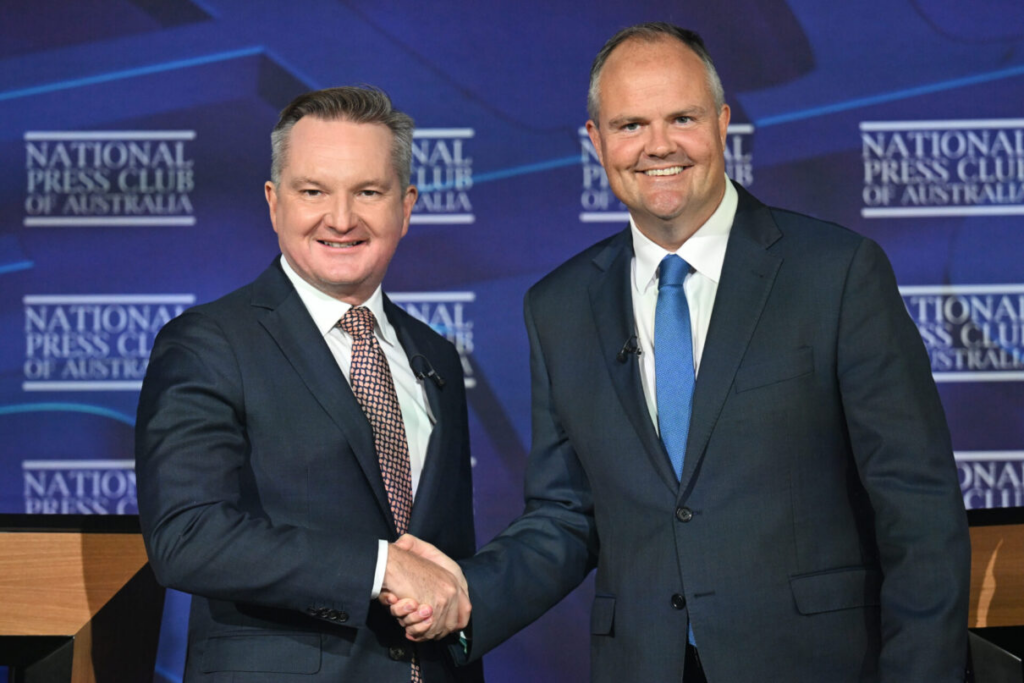
“People say we have plenty of gas in Australia and that is true, a lot gets exported,” said Chris Bowen, Federal Energy Minister during a debate at the National Press Club.

Peter Dutton has already acknowledged Australia has an abundance of gas, and his idea to tax gas exports to ensure our gas flows first to Australian businesses and households is a good idea.

“It is ridiculous to say we have a gas shortage in Australia when we export so much of it,” said Richard Denniss, Executive Director of The Australia Institute.

“Our research shows we are giving away more than half the gas we export for free, with zero royalties paid on 56 per cent of all the gas we sell overseas.

“It is good to see agreement across the political spectrum on this issue.

“There is also no need for new gas or coal projects in Australia, there is gas there now.”

Back on the Wombat Trail

Nationals Leader David Littleproud is in Bathurst, NSW, with more on the Regional Australia Future Fund policy, announced this morning:

Finally there will be no more funding gaps for regional Australia. When not going to have to fight over the scraps year after year to get the bit extra to make sure that we have the amenity of life that people in capital cities take for granted. We produce around $350 million worth of Australian exports, and what I’m saying today is we want a bit of that back. We want a bit of that back to give a legacy and a continual investment in regional Australia so we continue to do that for Australia. I don’t think we are asking for a lot but this is transformational. This is a legacy piece that I’m proud to have worked with Peter Dutton on to make sure that regional Australia is no longer left behind.

Nuclear death

Tod O’Brien is asked if the coalition loses the election “would you and your advocacy for nuclear power take that as a rejection by the Australian people of nuclear energy? “

O’BRIEN:

We’re looking at pouring more gas in the short term and introducing nuclear in the near term not because we are driven by polls but because, hand on heart, that’s in our national interest. It’s the right thing to do. It is why other countries all around the world are now introducing nuclear energy. It’s in Australia’s interest. And, therefore, we have no intention of changing our view on that.

FOLLOW-UP:

If everything gets kicked back for three years. Would it be too late at that point?

O’BRIEN:

I don’t want to attempt the suggestion that we should be delaying action here. Australia is already behind the eight ball when it comes to zero emissions nuclear energy. The sooner we get going, the better. We have to remember, even though nuclear will take a good decade before it comes online, even so, it has proven around the world to be the fastest way to decarbonise electricity grids, faster than any other form of technology through the historical examples. So we can’t delay, we need to get on with it.

Question to Chris Bowen from the ABC’s Tom Lowery.

QUESTION:

The idea of an east coast gas reservation scheme does have a few friends on the progressive side of politics. The Australian Institute has backed the Coalition’s idea, surprising friends for Mr O’Brien. Mr (Senator David) Pocock has advocated for something similar. The Greens have made similar noises. Can you rule out considering an east coast reservation scheme should you be re-elected?

BOWEN:

Thanks Tom, because what we’ve done is I think the closest thing we have to reservation is our policy. The gas code of conduct the opposition oppose. That’s what seen 640 petajoules of gas supply added domestically. The closest thing we have to reservation, not technically a reservation. I think it’s a close thing. My view of Mr O’Brien is offering, based on evidence on the document he released yesterday, an incentive, (is that it is) not a reservation at all. I think the principle there should be enough Australian gas for Australian users is sound. That’s why have taken the decision to introduce the gas code of conduct. It wasn’t easy. It was controversial. Opposition opposef it and Greens are opposed. But we managed to get it through and it has seen 640 petajoules. I think that’s appropriate. But we do need to ensure the right amount of gas for Australian industrial users, in particular, as well as electricity. Industry is what really drives the need and that’s a good thing. So my answer to that would be, in effect, we have tackled that problem with the gas code of conduct.

Bowen question to O’Brien:

It’s a long one, too.

BOWEN:

My question to you, Ted, you and I, I think we would both agree that there are people who know plenty about the energy system in Australia and you and I have learnt a lot but there are plenty of people who have devoted their lives to the economics of the energy system, whether that is the CSIRO, the people who keep our lights on at AEMO or even people like will go to promote nuclear overseas potatoes not the right answer for Australia. All the executive director of the International Energy Agency who says nuclear hazard is in the world but not in Australia all of them agree that renewable energy backed by gas and arteries is the cheapest option for Australia’s unique reads and our opportunities. Nuclear is too expensive. My question is why do you know better? If you are in government would you only talk to people you agree with and what will you do with the experts to tell you that you are wrong?

O’BRIEN:

What I would do is different from how you have managed the energy system is I would be led by the engineering and the economics approach you’ve taken. We would actually do the work and do the economics. We wouldn’t have Peter Dutton out there trying to say we want to have an industrial revolution, we would have Angus Taylor as a treasurer saying he is obsessed with a particular technology, and I can assure you, unlike you, I wouldn’t be saying I’m making decisions on my gut. In terms of who knows best, there are a lot of people who know a lot of things about energy and those who are prepared to do the work to the sums are the ones to whom we listen. A total system cost analysis has been done comparing Labor’s plan to the Coalition’s plan. That comparison shows the Coalition’s plan is 44% cheaper than Labor’s plan. When it comes to what we should look at and consider, you see the engineering and the economics. When it comes to Chris’s comments, you talk about why do you know better? Well, the conclusion Frontier Economics reached on looking at nuclear working with renewable and gas being 44% cheaper, that is comparable to the United States Department of Energy, 37% put nuclear end. When I sat down with a Japanese department, looking at their details, they say nuclear in the mix brings prices down. Ontario Canada brings prices down. What is it that Anthony Albanese and you know that the United States doesn’t know, Canada doesn’t know, Japan doesn’t know, the United Arab Emirates doesn’t know, India, China, seriously. We have 32 countries in the world today using nuclear energy, another 50 looking at adopting it for the very first time, why? It can work in a complementary way with renewables and with gas and get prices down.

O’Brien question to Bowen:

Well, it starts with a sermon.

O’BRIEN:

Why don’t I ask that question. So it is even clear to the Australian people. We know, Minister, that you committed to reduce power bills by $275 and I think we both know that has been a failure. You now say, by bringing out a whole bunch of folders that you have done the work, or at least the market operator has done the work but no matter how many times I have asked you in this debate so far, you still cannot tell us the real cost through to 2050. Not the MPV, the real cost. Now, if you look at the spreadsheets and do the calculation, it is well over 600 million dollars. My question to you there for, again, is can you please tell the Australian people the total system cost of your plan to get the national electricity market to net zero by 2050. In real terms?

BOWEN:

You mentioned that I refer to holding the documents and I have and I make no apologies for that because that is the framework we are basing our policies on. And I make no apologies for pointing out that AEMO says the most accurate way and the best way of describing the least cost path way to net zero and particularly in our electricity system is in that 122 billion value. You can dismiss that. You cherry pick the figures as you wish to promote them and that is your choice. The experts say it is the best way.

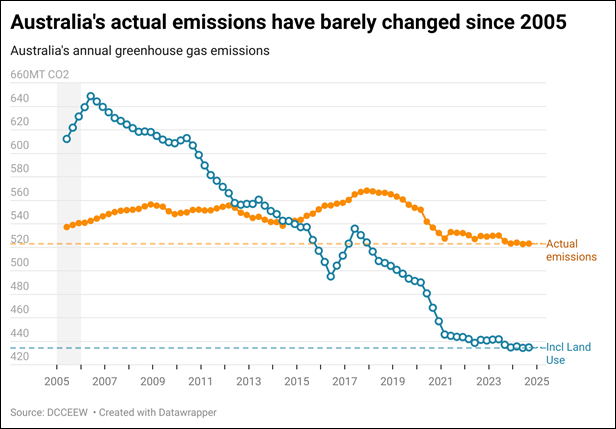
Actual emissions

Greg Jericho

Ted O’Brien rightly says emissions have not fallen since the 2022 election.

But he keeps saying that emission have fallen 29% since 2005 levels.

Alas that counts land use – with is exaggerated because of massive land clearing in 2005.

If we count actual emissions, bugger all has happened since 2005.

The real price of nuclear. Oink.

It’s just been debated for five minutes and, I’m sorry, I can only conclude it’s something between 100 billion and 600 billion. Give or take half a trillion or so.

I’ve listened back. And re-read the transcript.

Thank God it’s an imaginary policy with no chance of getting up anyway.

If you were hoping this debate would deliver clear answers to the big questions, may I suggest switching over to Peppa Pig?

Fact check

Greg Jericho

Chris Bowen is suggesting that the LNP’s gas reservation policy is not a reservation but merely an incentive to provide gas for domestic users.

Well yes, but the whole point is the LNP’s policy will tax gas exports at such a price that would not make it worthwhile to export the gas until the volume for the reservation has been met.

So it is an incentive, but an incentive that ensures there is no incentive to export until the gas reservation has been met.

THERE IS NO GAS SHORTAGE

How many times do we have to say this?

Australia doesn’t have a gas shortage. We have more than enough to supply our needs over and over and over …

The trouble is, we let foreign gas companies export 80% of our gas – more than half of it royalty-free.

QUESTION:

If you’re going to fix a problem you have to diagnose it. Do we have a gas shortage in your view?

CHRIS BOWEN:

We have an issue with domestic gas supply, yes. People say we have plenty of gas in Australia and that is true. A lot gets exported. Those contracts were written 20 years ago, foundational contracts, I’m not going to, I imagine Mr O’Brien work rip them up. That would be unconstitutional for a start and highly irresponsible, what we do need to do is work with the gas companies to get more gas flowing drastically. I think we would agree with that. That’s what we’ve done. That’s why I don’t understand Mr O’Brien’s point that somehow 100 Peta Jules would fix the problem when we, working together have got 640 extra gas supply guaranteed to domestic market your policy focuses on the three exporters in Queensland.

First fact checks of Energy Debate

Greg Jericho:

(1) Ted O’Brien, not surprisingly, is talking up the need for “baseload power”. This is a phrase often used, and almost always abused.

Baseload power is a term made up to explain why coal-fired power stations run flat out for 24 hours. It is not about being able to meet peak energy use, rather baseload is about having a level of power being generated all the time – even when it is not needed. This is why governments came up with “off peak” electricity – because electricity was being generated in the middle of the night when it was not needed, nor being used.

What we need is dispatchable power – the ability to supply electricity when it is needed, not have it going flat out all the time.

Renewable energy is highly dispatchable.

(2) Ted O’Brien once again says the coalition’s nuclear power policy will be 44% cheaper than Labor’s comparable policy.

Well duh, it is based on assuming that 45% less energy will be used!

Who knew that if you estimate you will use less electricity it will cost less!

Bowen v O’Brien: National Press Club debate

After opening statements, moderator Tom Connell asks the first questions.

QUESTION:

Mr Bowen, before the last election you pledged energy bills to be $235 cheaper by the end of the term. What price pledge can you offer for this election, not compared to any coalition policies are compared to the latest forecast prices, will they go up or down?

CHRIS BOWEN:

The pledge I give is that energy prices will be cheaper underwriters than under Mr O’Brien. That is the pledge. That is what we can state categorically based on the two plans. Anybody who predicts energy prices in this complicated geopolitical environment, I think, is making a punt so I will not do that.

QUESTION:

You have made a price pledge, 7% reduction on household gas bills, 3-person electricity, to be clear on measure, is that cheaper than the latest forecast prices and when do we measure it by, is it by the final year of a term in office if the Coalition wins power?

TED O’BRIEN:

Tom, the analysis done independently by Frontier economics looks at the 25, 26 year. That is the basis upon which those estimates are made. 50% lower gas prices for industry, seven December household. — 15% top. It is notable that I can actually give you those figures because unlike Chris’s answer to you just then, they don’t have anything. They’ve done no modelling. His decision-making is based on gut.

“Proceed and ignore”. O’Brien’s opening statement interrupted.

Ted O’Brien had barely finished the opening line of his opening statement in his Press Club debate with Chris Bowen when he was interrupted by a protester.

Looking a little bewildered, Mr O’Brien stopped and looked to moderator Tom Connell, asking him if was ok to “proceed and ignore”!!!!

Proceed and ignore!!!! How’s that for a coalition climate motto?

Fact check: ripping $80b out of Defence.

In his press conference, Peter Dutton said:

“We don’t achieve a position of strength if we rip $80 billion out of Defence. That’s what Labor has done.”

It’s not the first time the Coalition has made this $80bn cut claim:

Media Release: Labor’s $80 billion defence cuts and delays to come under scrutiny – Phillip Thompson OAM MP

But Defence spending IS INCREASING. Dutton is very miffed and calls it misleading when Labor talks about $80b cut from health and education in the 2014 budget. That was trimming the rate of growth from what was previously expected. 

But he uses the same sort of whoosh whoosh to make this defence claim against Labor

Here’s the April 2024 announcement from Defence Minister Richard Marleshttps://www.theguardian.com/australia-news/2024/apr/17/labor-government-defence-military-budget-increase-spending-adf

Yes, some programs got cut, trimmed, deferred – but as part of an overall net increase in defence funding:

From that story:

“Plans for Australia to acquire new F-35 fighter jets have been put on the back burner as part of a major funding overhaul that the government says will deliver an overall increase in defence spending.

The Albanese government is pouring an extra $50bn into defence spending over the next 10 years and pledging toensure the military can project power further from Australia’s shores.

While the funding is going up overall, the government says it is freeing up about $73bn over 10 years by cutting, delaying or changing the scope of some defence projects.

Even after these cuts are taken into account, however, the government says it has committed an extra $50.3b for Defence over the next 10 years, which includes a net increase of $5.7b over the immediate four-year budget cycle.

Treasurer Jim Chalmers and Finance Minister Katy Gallagher have released a joint statement on the coalition’s plan for two new future funds:

The Coalition’s announcement of two off-budget funds will mean bigger deficits, more debt
and more rorts under Dutton.
This is a recipe for bigger deficits and more gross debt, not less.
These new funds will mean that future revenue won’t be used to directly improve the
bottom line or pay down debt.
Instead, taxpayers money will be parked in new funds that we know will be rorted.
As Angus Taylor and Peter Dutton have said, “the best indicator of future performance is
past performance”.
When they were last in Government, Peter Dutton and the Liberals racked up bigger
deficits and more debt and today’s announcement is more proof they will do it again.
The Coalition had a shameful record of treating public funds as political slush funds, and
this is exactly what they would do again.
Nothing the Liberals say about the budget means anything until they come clean on what
they’ll cut to pay for their $600b nuclear reactors.
The Liberals need to explain how much they will push up gross debt, what this will cost
Australians and whether this means even harsher cuts.
Our Government has brought debt down, restrained real spending growth and unlike our
predecessors banked the vast majority of revenue upgrades.
Since coming to Government, around 70 per cent of tax upgrades have been returned to
the budget, compared to only around 40 per cent under the previous government and the
Howard Government who returned only around 30 per cent.
We’ve lowered the Liberal debt by $177 billion this year, saving $60 billion in interest costs
in the process.
The choice at the election is between Labor’s plans to help with the cost of living,
strengthen the economy and budget, and build Australia’s future, or more debt, waste and
rorts under the Liberals.

The Opposition Leader has concluded his press conference in Melbourne.

Now we’re counting down to the debate between Chris Bowen and Ted O’Brien, which fires up at 12:30pm.

Imagine being stuck between that pair on a flight to London!

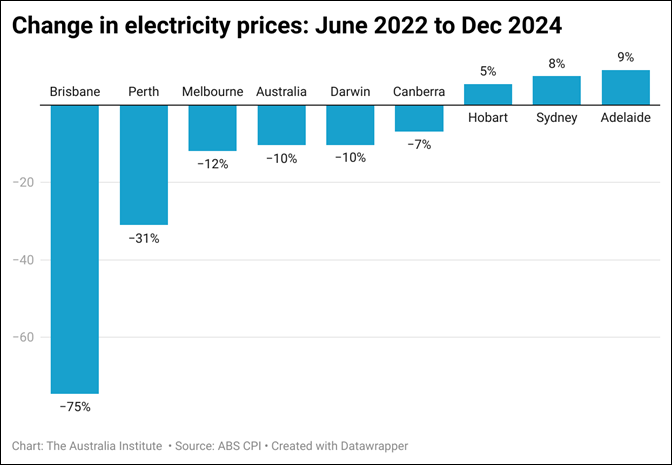
Fact check: “Electricity is up”

Greg Jericho

In his press conference, Peter Dutton said “ electricity is up by 32%”.

Is it though?

Well, no.

Let’s look at the CPI numbers. The energy rebates have actually made electricity cheaper in most cities than it was in the June 2022 quarter.

Apparently these don’t count?

Pick a side

Peter Dutton is asked which is more important – preserving Australia’s military history with the US or the economic relationship with China.

We can have a strong trading relationship with China, and that is in our economic best interests and I’ve always been strongly supportive of enhancing and advancing that trading relationship. And I was part of a government that negotiated a free trade agreement with China. It’s good for Australian jobs and for our industry and we should be doing everything we can to provide encouragement to expand that relationship. At the same time, we can have a rock solid relationship with the United States when it comes to our security pacts, in relation to ANZUS and AUKUS – we live in the most precarious period since the Second World War. That is a direct quote from the Prime Minister. If that is the case, we need to invest in Defence.

Kissing Trump’s backside

Channel 7’s Tim Lester asks if Peter Dutton could really deliver a better tariff deal for Australia if he met with Supreme Leader Trump in Washington … or would he just kiss his backside?

Tim, my job as Prime Minister will be to stand up for our country. I demonstrated as Defence Minister, Home Affairs Minister, Immigration Minister, I demonstrated as a Health Minister and as a police officer. I want to make sure that we can negotiate the best possible outcome for our country. Whatever comes at our country, whether it is a global shock from decisions made in relation to tariffs, whether it’s a horrible terrorist incident somewhere in the world, whether it’s another pandemic, whatever it is – the Prime Minister of our country needs to have the strength of leadership to stand up for our interests and what we know about Anthony Albanese is that he’s weak, he’s slow to issues, and he’s out of his depth. A Labor-Greens government would be a disaster for our country. I will stand up for our best interests in negotiations with the US, in negotiations with any other world leader, and when we negotiated with President Biden, the arrangement to share the nuclear secrets for the submarines, that had not been done with other country since the 50s. We were able to negotiate that out come, a Liberal government and a Democrat administration. I will work with the American president, whoever it is, I will deal with whatever comes at our country and make the right and tough decisions to keep us safe and to make sure we’re a strong economy.

It’s all starting blow up …

Peter Dutton is being peppered with questions about the Liberal candidate for the seat of Wills, in Melbourne’s north.

The Age has just dropped a report that candidate Jeffrey Kidney, who lives on the other side of Melbourne, pleaded guilty to a charge of obtaining financial advantage by deception in March 2024 and “was ordered to pay $10,640 in compensation to the Victorian Work Cover authority. Kidney’s breach occurred between May and October 2019.”

Peter Dutton refuses to say if Mr Kidney has his support but insists Liberal candidates across the board are “amazing people”.

Peter Dutton media conference

The Opposition Leader is asked how his plan for a domestic gas reserve would get gas to Victoria:

We want to see more gas coming into the system, increasing the supply mystically. We have got $1 billion as part of our package to increase capacity. There is a business case for many of these pipelines to be built or, indeed, to be expanded. If we can create greater capacity, we can get it to market. There are storage issues here in Victoria at the moment. The Labor Party has done here in Victoria with the Prime Minister and Jacinta Allan is create a gas crisis. Drawings of the biggest users of gas in the country, many people have heating systems in their own homes. There is a vibrant manufacturing industry in the state, or there was double the Labor Party it. I want to rebuild manufacturing in Victoria. I want to grow jobs in factories like this … I will make sure we can provide support with a gas policy to bring the cost of things down across the economy.

Australia Institute View: Australians have never received their fair share of mining export profits, but Peter Dutton’s sovereign wealth fund won’t work

Australia is one of the largest exporters of mineral resources in the world, but Australians have never received their fair share of the profits from selling those resources.

Peter Dutton is right to say Australia needs to bank the windfall profits the mining industry makes when global commodity prices soar.

However, Australia cannot build a sovereign wealth fund like Norway, unless Australia taxes resources the way Norway does.

Australia Institute research shows Australia currently gives away more than half the gas we export for free, with zero royalties paid on 56 per cent of all the gas we sell overseas.

Peter Dutton has rightfully acknowledged Australia has an abundance of gas, and his idea to tax gas exports to ensure our gas flows first to Australian businesses and households is a good idea and big shift in the debate.

“The offshore gas industry has never paid a cent of Petroleum Resource Rent Tax. Imagine if Australia started charging foreign companies for the resources we give them and spent that money looking after Australians,” said Richard Denniss, Executive Director of The Australia Institute.

“In Norway they tax their fossil fuel industries and give their kids free university education, while in Australia we give our gas away for free and charge our kids a fortune to go to universities.

“Australians do need a better deal from all the resources we export, but we won’t get a good deal until we have a good tax system”.

Peter Dutton press conference

Glen Connley is the one who will guide you through this one – Sussan Ley is there with the campaign in Aston (which the Liberals have all but won back).

We haven’t seen anything from AAP about Dutton’s campaign today, but Albanese is on a boat in far north Queensland living his best life it seems.

He is being interviewed by a Sky reporter who asks him if he will keep his hat given the winds “it’s a vibe,” the PM says.

The boat is tossing around so much that the reporter looks like he might be sick over the prime minister, but the real hero of this is the Sky camera operator who is keeping that shot STEADY.

In terms of what is being said, it was everything that was said in the press conference about an hour or so ago, but now he is saying it on a boat.

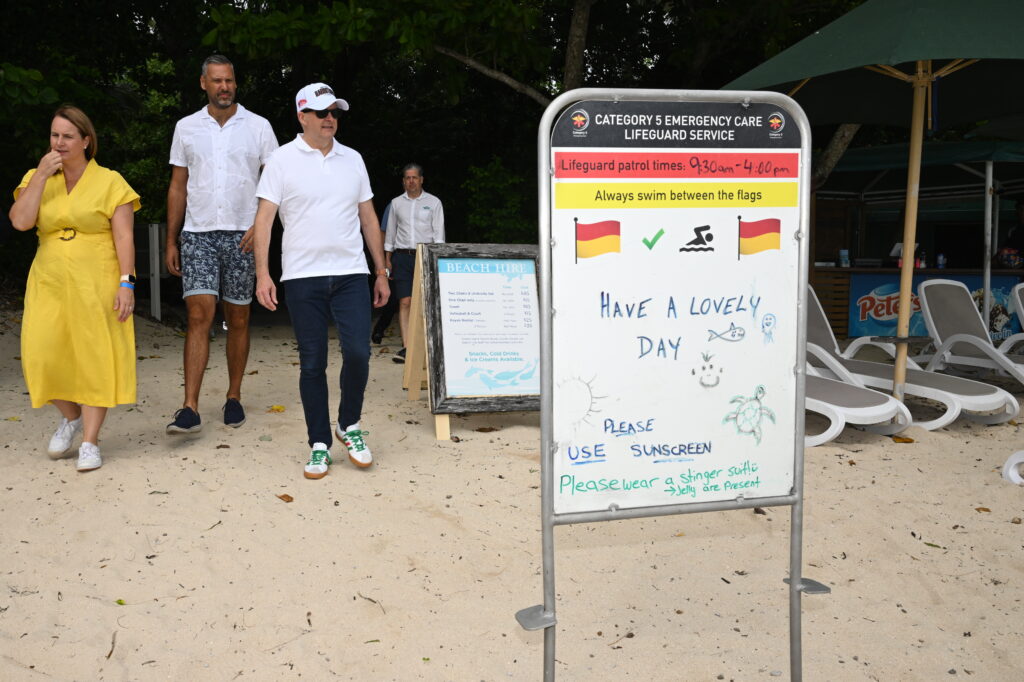
Australian Prime Minister Anthony Albanese, Labor candidate for Leichhardt Matt Smith and Labor Senator Nita Green arrive at main beach on Green Island in the electorate of Leichhardt on Day 13

Hayden Starr


Good news! Eastern suburbs private school Scots College will this week unveil their new $60 million faux baronial castle.

This line in the article is particularly hilarious

“Delays were blamed on acquiring sandstone slates from Scotland while architects toured Edinburgh to visit buildings designed by architect David Bryce in the planning stages. The cost of the total project was about double the original $29 million price tag.”

Our research: https://australiainstitute.org.au/post/taxpayers-subsidising-private-school-luxuries/

  • Tax deductions for private school building funds should be removed, as recommended by the Productivity Commission.
  • Four in five Australians agree that private school facilities should be accessible to community groups outside of school hours if taxpayers are funding their construction. 

Alexia op ed: https://australiainstitute.org.au/post/private-schools-public-subsidies/

In 2024, the Commonwealth Government will spend an estimated $29.1 billion on schools in Australia. More than half of this – $17.8 billion – will go to private schools, including those with Olympic sized indoor swimming pools (Cranbrook and Knox Grammar as well as many others), in-house baristas (Knox Grammar again), and those with an already extensive list of sporting fields and amenities, including on-site physiotherapy facilities (here’s looking at you, The Kings School and Trinity Grammar).

With some private schools in Sydney charging more than $50,000 per student this year, how can this be justified?

In addition to direct government funding, private schools take donations to their building funds, which are tax deductible. For some schools, these funds accumulate millions of dollars. At the risk of repetition – collectively, private schools get more Commonwealth funding than public schools. Could this help explain why enrolments in private schools are rising faster than enrolments in public schools? Is it surprising that parents want to take advantage of the tax-payer subsidised opportunity these facilities provide?


Australia’s education system is unbalanced. It disproportionately favours those who are already advantaged. It gives public money and tax concessions to private schools that end up going to private beneficiaries. Already wealthy schools do not need a leg-up from the taxpayer. It’s fine for private schools to have building funds and ask for donations, but public money could be better spent on public schools. Removing the tax subsidies given to building funds would help support equity in school funding, instead of undermining it.

Here is a bit more from Wong:

Well, there’s no question we live in an era, an era of great power competition. And I think you only need to look at some of the comments that have been made to demonstrate that. And there’s also no question that in a world where people don’t want tariffs, the President’s pause on the imposition of higher tariffs and the imposition of lower tariffs is has been received much more positively than than the alternative.

So you know, what can Australia do? We can continue to do what we’ve been doing, which is to advocate for open, fair, free trade, because that has been benefit to us economically and in terms of our power in the region, and to work with others to continue to keep markets open, to continue to try and diversify exports. That’s what our government is doing.

And on Peter Dutton’s approach, Wong said:

What we what we will do is stand on our own two feet. We stand on our own two feet, and we engage with countries in our national interest, and we look to further our national interest in relation to all countries. And we think our national interest requires us to diversify, continue to diversify our export markets, continue to work on resourcing and investing in a range of relationships.

That is what that is, what the Albanese government has been doing for the last three years stands in stark contrast with Peter Dutton. Mr Dutton is lost in our region. Mr Dutton gave a speech just recently billed as his big foreign policy speech.

He did not mention India, he did not mention Japan, he did not mention Korea. He did not mention Indonesia or any country within Southeast Asia, and he did not mention ASEAN.

Now, if you’re serious about Australia’s resilience in a world which is uncertain, in a world where we see increasing tariffs and counter tariffs, one of the things you have to do is to ensure you invest in and resource and build your other diplomatic and economic relationships throughout the Indo Pacific. Albanese’s Labor government’s been doing that. Peter Dutton is lost when it comes to our region.

Australia ‘won’t give ground’ on Trump administration’s demands: Wong

Penny Wong is addressing the Trump tariff’s on Sky News and she says:

In terms of Australia’s position. We are prepared to engage. We are not prepared to give ground on the issues, what the which the administration has indicated they are seeking us to compromise on. We are not going to compromise on the PBS, and we’re not going to be compromising on Australia’s biosecurity regime. So I can’t be clearer than that

Election entrée: First preferences of different governments

Skye Predavec

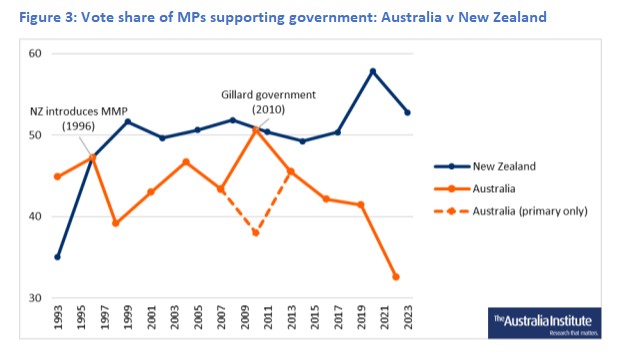
It’s funny that we call single-party government “majority” government, because no one party or coalition has won a majority of the first-preference or primary vote since 1975.

In 2022, the Labor Government received just 33% of the primary vote – but won a majority of the seats. In Australia’s single-member electorate system, a minority of votes easily becomes a majority of seats.

New Zealand adopted proportional representation in 1996 after an election where a majority government formed with a record low vote share of just 35%. Since then, most of its governments have formed from parties that won a majority of the vote.

In the 2023 New Zealand election, the incoming three-party coalition of Nationals, ACT, and NZ First had 53% of the vote between them. Another proportional system (Hare-Clark) is employed for elections in Tasmania and the ACT, where governments generally have the support of half or more of the primary vote.

While no Australian government has won a majority of the primary vote since 1975, the Gillard government was in some ways the closest to it.

Only 38% of Australians voted for Gillard’s Labor in 2010, but 13% voted for the Greens and independents who made formal confidence and supply agreements with the government.

That makes the 2010 election is the only time since 1975 where confidence in the government was based on MPs receiving the votes of most Australians.

Just in case you hadn’t heard: big gas is taking …

Angus Blackman
Podcast Producer

… the piss!!

Peter Dutton has it half right on gas. There is no supply shortage, but Australians need to be using less gas – not more.

On this episode of Follow the Money, Rod Campbell and Mark Ogge join Ebony Bennett to discuss the fixing Australia’s gas export problem, making gas companies pay their fair share in taxes and royalties, and why there is no need for new gas projects.

Dave Richardson
Senior Research Fellow

According to the Financial Review the Coalition will set up two new funds, a Future Generation Fund and a Regional Australia Future Fund. These will be financed by “80 per cent of positive windfall commodity receipts each year”.

Now just what that means is a bit confused. But it appears to mean to be the difference between what the Budget estimates company tax revenue from mining companies will be will be and what it ends up being.

The amounts are large but not that large – the Budget Papers show that every US$10 under-estimate of the iron ore price gives a A$0.4 billion revenue windfall in the first year, $0.5 billion in years 2 and 3 and then $2.1 billion in year 4. Significant but not a big deal in a budget with expected tax revenue of almost $700 million in 2025-26 and over that in subsequent years.

The Coalition says it wants to return the deficit to surplus and then put money in the new funds. The sorts of money we are talking about are not going to go very far towards the projected deficits of $42 billion in 2025-26 and a bit under $40 billion in subsequent years. So the funds are going to have to wait a long time before there is anything in them. And longer still before the funds make an income that can be distributed.

Angus Taylor said the wants to finance stronger regional communities. If so it’s a bit of a joke making the regions wait until the budget is in surplus. If stronger regional communities are a genuine priority they should be funded as a matter of priority.

Remember Australia’s projected deficits (max 1.5% GDP) are piddling compared with other OECD countries such as the US 6.6%, Britain 5.5% and the Euro area 3.3%.

Is Trump going to start asking for protection money, literally?

Frank Yuan
Postdoctoral Fellow at the Australia Institute

Before we open the celebratory champagne on the armistice of the global trade war – which is in all likelihood just a partial ceasefire – it is important to remember that all bets are off as far as American global engagement is concerned. And no one is safe from the ire of the Trump Administration.

On Monday, Trump’s top economic advisor, Steve Miran, called for ‘improved burden-sharing at the global level’ for what America’s service in providing global public goods. By that, he meant America’s military protection and provision of the US dollar and government bonds (i.e. US government debt). 

Whatever you think of America’s global military presence and actions, it is interesting that Trump, and so many around him, consider it a burden for America, that it is a net receiver of goods from the rest of the world. Only a failed domestic economic system can turn a stream of imperial tributes into a chronic social problem.

I’ll spare you the details of Steve Miran’s argument – including outright identifying China as America’s biggest adversary who helped create the Global Financial Crisis. He suggested five ideas for burden sharing, including accepting American tariffs without retaliation, buying more US-made weapons, and – can you believe it – “simply write checks to Treasury that help us finance global public goods”.

So, on top of sending us your produce in exchange for some IOUs we can type up on a keyboard (which you have probably made in the first place), you should also send us back some of that dollar you made on that sale!

Just soak in that for a second. I can’t image it would have gone unnoticed in countries like Vietnam, Indonesia, India, and so on, who have a significant reliance on exporting to the US. And if Australia want to maintain its influence in its regional neighbourhood, it would be well-advised to distance itself from America’s outright predatory stance.

The inimitable and irrepressible Amy has returned!

Appropriately caffeinated and ready to rumble.

It’s been a pleasure.

Hello, Amy Remeikis back with you for a little bit – big snaps to Glenn for stepping in – he is a total superstar.

The Coalition is proposing another future fund, but:

A simpler way to raise revenue and pay for things than the Coalition’s new mining-windfall-thingy-tax-diversion-magic would be to just stop giving away gas.

We estimated recently that if the Commonwealth just charged existing royalty rates on all the gas it gives away, it could raise $3.6b/year.

There’s no reason existing rates couldn’t be increased by 50% to raise $6.9 billion/year.

This could pay for things immediately rather than based on future maybe-interest from some difficult-to-understand fund.

PM attacks Dutton’s ability to take questions from independent journalists, rather than mates.

There’s been a lot of talk about why Peter Dutton is struggling in the polls in the Press Gallery over the past week.

Many feel it’s because, until now, he’s only taken easy questions from mates, usually with very few voters few watching or listening.

When he says something silly, he just disappears for a few days and, by the time he sticks his head up again, the political debate has moved on.

Amy wrote a fantastic column about this in The New Daily:

Without naming the Sky after darkers, who have almost non-existent audiences, the PM contrasts his record with Mr Dutton’s comparative inaccessibility to political journalists.

To be fair, I can say from experience, the PM goes on Sky News and takes hard questions from real journalists like Andrew Clennell, Kieran Gilbert and Peter Stefanovic.

Anthony Albanese:

I am always up for sit downs of course, and I think if you compare my availability to the media with the other side, I think they had two press conferences in Canberra before the national press gallery. In the same time I had 36. 36. So I’m available. I don’t just talk to one radio station and one late night TV channel, and I will leave it to you to work out what one that is. But I talk to everyone. That is the way that I engage. Look, you go through changes in society, we live in a much more fragmented society than we used to. And it is to be the case that people watched the ABC, or Channel 7, or Channel Nine, or Channel Ten news, and in more recent times, SBS as well, so there was a common set of facts, and they picked up the paper in the morning, a common paper, there was some commonality there, and that was how they got their information. So, therefore, there was less diversity and less noise, and genuine information.

Not getting ahead of myself, but …

The PM says he’s not getting ahead of himself when asked about a visit to Washington (“I intend to go there”) … but clearly he’s been doing a big of legacy thinking. A place in history beckons. And he knows it.

It is hard for Labor to win elections. We’ve won one in three. No Prime Minister has served out a full term having been elected by the people and been re-elected since John Howard in 2004. For 21 years we’ve had a (revolving) door of Prime Ministers. One of the things I offer at this election is not just me but a team who are competent, orderly, who are engaged, on top of their briefs, on top of their portfolios.

Next question is to the Prime Minister, about the government’s climate ambitions.

We have a plan to get to the 43% target. The Safeguard Mechanism together developed with the integrated systems plan developed by the Australian Energy Market Operator provides a pathway, certainty for business investment. The problem is that the former government had 23 different policies and did not land one. It changed. To talk about gas, they stood up day after day in Parliament and said they were going to have a lead recovery and nothing happened. Nothing happened. You can’t deal with economic policy just through media releases and a different announcement every day. What you need is a certainty and the business community asked for certainty. We’ve given it that. At 2030 target, a pathway to get there. The transition of course is in the context of the former Coalition, 23 policies, none of them landed. 28 coal-fired power stations in Australia. 24 of the 28 announced their closure during the period of the former government. 24 out of 28 and nothing happened. Nothing happened, no planning for energy security and indeed they just south of here at Collinsville, in North Queensland, they gave proponents of a new coal fired power station. Where is it? Nowhere. Because it didn’t stack up.

Labor’s Leichhardt candidate Matt Smith states his case

Labor star (and giant) candidate Matt Smith gets his first question of the presser … from the PM!

The former NBL player cuts an imposing figure.

Thank you. I take the opportunity to thank the Prime Minister deliver some fantastic health outcomes for our community. We’ve been struggling to keep people in radiology in the regions and what we’ve found in the evidence suggests the only radiology school in Queensland at the moment is in Mackay. This is an investment in Cairns’ economic future. You think about it, different universities, they last for a long time. Oxford has been around for a long time. It drives the economy. Cairns is lucky to have two world-class universities. I say this to everyone thinking about a career. Come to Cairns. Study. Get qualified and build your life here.

Is Dutton DOGE dodging?

Question:

Your Treasurer accused Peter Dutton of being a DOGE sycophant, borrowing policy from elsewhere. Do you agree with your Treasurer that he is a DOGE sycophant that’s adopted Donald Trump’s policies?

Anthony Albanese:

What’s interesting is the shadow Assistant Treasurer online has made a statement, very close confidant of Peter Dutton. When Jacinta Price was appointed as the shadow minister reflecting government efficiency referred very directly to DOGE and said that’s the model they would have. Peter Dutton has said on education, I don’t know why we have so many people in education if we don’t run schools. He said the same about health and hospitals. Peter Dutton, if you look at policies, people will be able to draw their own conclusions. I think on where some of the public service cuts, some of the rhetoric that comes through, some of the culture wars that have attempted to be stopped, people will look at similar policies around the world and they will make their own decisions.

Anthony Albanese turns the tariff debate against Peter Dutton and his tendency to tell a late-night, right-wing screamer something they want to hear in an echo chamber … then pretend it didn’t happen when he speaks to actual journalists.

You have to be an adult. You do not dial it up to 11 at every opportunity, which is what Peter Dutton’s plan is on everything. Just to say the first thing that comes into your head and pretend you have not said it and wind it back and never talk about it again. What you need to do in dealing with the United States, in dealing with other diplomatic relations as well, is to be consistent. That is what we have been.

Question to PM: how many new gas projects?

Is a pretty straight-forward question – sadly, it doesn’t get a straight-forward answer:

Gas is an important part of providing stability, providing stability so that businesses like Rio Tinto and Gladstone, this is not theoretical, this is what is happening, whether it is Rio Tinto at Gladstone or the facility in New South Wales, the largest energy user, so they can have that confidence of moving to renewables but backed by defending capacity that gas provides. We already have in the policy that was put forward in December 2022. We have strengthened the code of conduct to make it mandated. We made sure that … we can intervene to guarantee domestic supply. We of course reduced gas prices from $30 when we came to office down to $13. It was a direct result of the policy that we have put in place. All the opposition have is not a policy, they have gas lighting of the Australian public.

Is our strengthening relationship with China harming our chances of a tariff carve out?

No-one has a better deal than Australia at 10%. President Trump has announced another change in policy overnight. We have of course got a better deal than any other country on the planet in the announcements that President Trump made just last Thursday morning. Last Thursday morning I described this as an act of economic self-harm. It is quite clear from the response of the markets that the announcement is doing harm to the United States, it is doing harm to its prospects of employment, inflation, all the key figures as well. We will continue to advocate that Australia’s tariff rates should be zero. We do not impose tariffs on US goods into Australia. We have a free trade agreement with the United States and we expect that the sort of language that we saw from the US trade representative, where he spoke about … building up a buffer, when Australia currently imports US goods, twice as much as we export to the United States. We do not think it is an act of a friend, as I said last Thursday. We will continue to advocate strongly for Australia’s interest.

The presser moves on to the subject of China. The PM is asked about North Queensland’s links to trade with China and how the region benefits from Chinese tourists. Should the relationship be strengthened in light of Trump’s tariff nonsense?

Our trade relationship with China is an important one. Trade represents one in four of Australian jobs and China is, by a long distance, our major trading partner. We, of course, restored in excess of $20 billion of trade exports to China, where there were impediments. I think there is a lot of opportunity to grow tourism in particular from the Chinese market. The statistics show that Chinese visitors to Australia are big spenders. They tend to come for a longer period of time.

The Prime Minister is asked about what he can do for local Indigenous communities, which feel let down after the failure of the referendum on an Indigenous Voice to Parliament.

Indigenous communities, overwhelmingly, voted Yes. And that’s not surprising. Because this is an idea that came from Indigenous communities at the First Nations constitutional convention that was held at Uluru in 2017. We took up the gracious invitation of First Nations people to put that proposition to a referendum. It wasn’t successful. And we respect the outcome. So what we have been doing – and I’ve met with people like Noel Pearson from the Cape York Institute, of course – who’s done such an extraordinary job. There are wonderful examples, including here in the Cape, of improving the lives of First Nations people and closing the gap across a range of areas. We’ll provide practical measures going forward in closing the gap on education, on health, on housing. These are the measures that we’ve put in place through proper funding in our budgets going forward of – how do we make a difference so that the gap, which is far too wide, and, in some cases, is widening. It is a national issue and all governments have not done well enough. That is the truth. We’re committed to doing better in the future and, we’re committed also to engaging with First Nations people.

PM media conference

Prime Minister Anthony Albanese is speaking at Green Island in Queensland.

He’s wearing his Bunnies hat.

Health Minister Mark Butler is with him, as always … along with Queensland Senator Nita Green.

They’re announcing $10m in funding for the Great Barrier Reef.

If you haven’t seen them yet, check out our election entrées:

These are bite-sized factoids about the election and our voting systems that may surprise you.

I’ll have a fresh one shortly, but here’s a reminder of what our credibly talented team have come up with so far this week:

Thanks Amy. Top of the morning readers.

I watched the Chalmers-Taylor debate last night.

I love Ross Greenwood. Brilliant broadcaster. Incredible brain.

But, as a referee (sorry, moderator), I wish he’d taken a step back and let the combatants go at it.

I predicted a bit of (metaphorical) blood on the walls.

Sadly, it was like a three-way high school economics debate.

Was there a winner?

Dunno. I switched off as soon as they wrapped up their closing statements, desperate to avoid another feature-length Clive Palmer ad.

I am going to hand you over to Glenn for the next little bit – see you soon!

Monique Ryan calls for parliamentary review of AUKUS

Speaking of Melbourne independents, Kooyong independent Monique Ryan is calling for a review of Aukus.

Ryan said there needs to be a parliamentary review of Australia’s commitments under Aukus, given the rise in community concerns.


AUKUS is a vital partnership between Australia and our two closest defence allies. The AUKUS agreement has now been in place for three years. It’s an appropriate time for Parliament to consider whether the assumptions which underpinned the partnership in 2023 hold true, and whether there are any threats to the success of AUKUS,” said Dr Ryan
The UK Parliament recently committed to a review of the AUKUS arrangements: the next Australian
Parliament should do the same.
A long-term national commitment this big and this expensive should be the subject of regular reviews.

We’ve already spent more than $800 million on AUKUS and are committed to spending 400
times that much again. It would be foolish to assume that changing geopolitical and economic circumstancesmight not affect its delivery. We should consider all contingencies and alternatives in detailed strategic planning of our mid – and long-term defence capacity – to be sure that we’re investing enough on national security, and that this investment is being well spent”.

Where are the campaigns at?

Looks like it is target seat morning.

Anthony Albanese is in far north Queensland where he is hoping to get the seat of Leichhardt.

Peter Dutton is in Melbourne (this is his third trip I think) where he is hoping to get a few seats into the Liberal ledger. At this point it looks like Aston will go back to the Coalition after flipping at a byelection.

Dunkley is still line ball. So is McEwen. Labor is working both, very hard.

Chisholm looks ok for Labor at this stage, but Wills could go to the Greens. Macnamara is still a bit of a hard one, but Labor thinks that Josh Burns will hold on. In Cooper, Ged Kearney looks like being re-elected.

The teal seats are a little harder to judge, but so far, all teals look like retaining their seats. At this point.

The facts behind the Trump tariff ‘pause’

Greg Jericho
Chief Economist

Well overnight we saw a big change in Trump’s market manipulation strategy….oh sorry “trade policy”. He paused for 90 days (but really who knows) the new tariffs which he announced a week ago and which came into effect a day ago on all nations except China. This is rather meaningless for Australia because by “pause” Trump means just putting a blanket 10% tariff on all imports, which is what Australia already had.

This is not some masterful gambit by the big-brained President. It is an acknowledgment that his plan was tanking the US stock market, and even worse was sending US Treasury bond yields soaring. That is bad because it not only was going to cause interest rate in America to rise, and also increase the cost of paying US government debt, but it signalled that global investor were no longer treating the US currency as a safe harbour.

So, he reversed his position. This has nothing to do with anyone wanting to do a deal. The entire world knows with Trump all you have to do is make it sound like you will do a deal, let him tell his gullible supporters that he has won and then you go back to doing what you were doing.

By keeping the tariff at 10% Trump has still made everything more expensive for US residents and businesses. It’s just that things are not as bad as they were yesterday, so not surprisingly the market soared.

The big upshot though of this is that no businesses will ever move operations from China or Vietnam or India or anywhere to the USA. Why would you? Big companies make decisions for the next 2 decades, Trump couldn’t even keep to his policy for a week. There is no reason to move a factory from Vietnam to the USA when before you have even started building the factory the reason for doing so is completely gone.

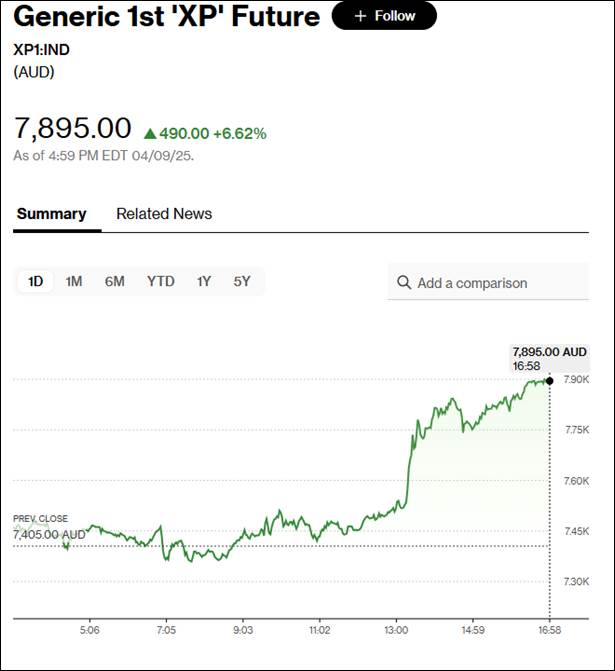
Because traders are sheep, the ASX looks set to open strongly – maybe up 6%. This is more about perception than reality. Nothing has changed for Australian companies and given the increased tariffs on China, you could argue things are worse. But because the US market soared, everyone will assume the Australian markets will – at least initially – soar, and so that will happen.

Anthony Albanese has spoken to Cairns radio 4CA about the tariff ‘pause’ Trump has given nations (who are now inline with the baseline 10% that Australia received originally).

On the tariffs, Albanese said:

This is an act of economic self harm from the United States that has hurt its economy, which is why we’ve had a change overnight from President Trump. But it’s also having an impact on the global economy. These tariffs are totally unwarranted.

My Government will always stand up for Australia’s national interest and that includes defending our biosecurity regime. The truth is, of course, that our beef is the best in the world.

We’re not frightened of competing with other countries because we just are much better at it. We have a number of local advantages, of course, in that, and that’s why it’s so much not the act of a friend, what we’ve seen from the United States.

And overnight we’ve seen this change. What it does is show how important it is that my Government have continued to engage in a considered, adult, mature way, including with the Trump administration.

We didn’t reach for any panic buttons. We got the best deal in the world. But we continue to say that what we want and what we expect is for goods to come into Australia at zero. That’s what we’re delivering. And we want our goods to go into the United States at zero because that’s what our free trade agreement says should occur.

And the relationship is a really important one. I mean, some of the decisions that have been made, of course, Norfolk Island, 29 per cent, a rather bizarre decision about Heard and McDonald Islands, which is only inhabited by penguins, I’m not sure what they trade. It is a very uncertain world that we live in and that is why I’m absolutely certain now is not a time for cuts. Now is not a time for chaos. Now is not a time for inexperienced people coming into government. Now is the time for us to have a steady hand on the ship of state.

Reversing years of lost power: the real reason behind Australia’s dismal wage growth

New research has revealed that real wages have been held back in Australia in recent decades because workers’ power to negotiate has been persistently and consistently eaten away.

The research, by The Australia Institute’s Centre for Future Work, reveals that until recently, government policies reinforced economic trends that eroded workers’ power.

This erosion normalised low wage growth in Australia for both union and non-union workers.

The report – The Curious Incident of Low Wages Growth – found that of the 16 key developments in the labour market over the past half century, 14 reduced workers’ power, one increased the power of female workers only and just one increased the power of all workers.

From 2014, the majority of federal legislation buttressed this trend and further reduced workers’ power.

Since the election of the Albanese government in 2022, almost all federal legislation impacting wages has done the opposite. It has increased workers’ power. And this may continue, with the government seeking a pay rise above the rate of inflation for low-paid workers in its submission to the Fair Work Commission’s annual wage review.

“These findings dispel the idea that governments can do nothing about wages,” said Professor Emeritus David Peetz, Laurie Carmichael Distinguished Research Fellow at The Australia Institute’s Centre for Future Work and author of the report.

“This report solves the mystery of why wage growth has been so low, despite a tight labour market and a brief surge in inflation.

“Why was there no wages explosion? The answer is that workers have lost a lot of power since the last wages explosion in the 1970s. Almost every change in the economy has taken away workers’ bargaining power.

“From 2014 to 2022, most government policies took away workers’ bargaining power. That changed in 2022 when policies shifted the pendulum back some way towards workers. Now, wages have begun to turn around.”

Greens push for renters to have access to solar

The Greens are announcing their renters’ right to solar policy today, which would see renters be able to install solar panels on their rental homes, with the upfront cost paid for by the government (and landlords eventually repaying, either upfront or at the sale of the home)

The Greens say there is nothing to help renters access cheaper renewable power on offer from the major parties and this policy would ensure more renters could see lower power bills as well as reducing emissions.

From the release:

The Greens’ plan would allow renters to request an average-sized solar panel system, up to 8kW, to be installed at their rental properties. Landlords would only be able to refuse on reasonable grounds, including restrictive body corporate rules, engineering challenges or local energy congestion constraints.

The solar systems and installation would be paid for through a new $10 billion fund established through the publicly-owned electricity company Snowy Hydro.

The panels will be listed as an asset on Snowy Hydro’s balance sheet with a caveat placed on
the title of the property.

Landlords could elect to pay this amount off early if they choose, otherwise Snowy Hydro will be entitled to be repaid the amount owing when the property is sold or its ownership transferred.

The interest rate would be whichever is lower between the annual change in either the Consumer
Price Index (CPI) or Average Weekly Ordinary Time Earnings (AWOTE).

Queensland Labor in the hunt for an extra senate seat

One of the unnoticed campaigns this election is the Queensland senate race. The LNP’s Gerard Rennick lost his spot on the LNP ticket, so he has quit the party and is running as an independent. Labor thinks that could split the conservative vote and the Greens and Labor are both looking to take advantage.

Queensland Labor’s senate team is on the road about to do a 650km tour of the Greatest Nation on Earth with Murray Watt, Anthony Chisholm and Nita Green and candidate Corinne Mulholland to visit Caboolture, the Sunshine Coast, Gympie, Maryborough, Bundaberg, Calliope and Rockhampton.

Why those towns? Well, they rely a lot on public service jobs, and the plan is to make some hay from the Coalition’s public service cut policies.

And being Queensland, Labor is linking Dutton’s plan to Campbell Newman (who is still despised) and his disastrous public service cuts in 2012. Queenslanders have long memories, which is what Watt, Chisholm and Green are counting on.


Angus Taylor and Jane Hume have called a press conference for mid-morning to discuss the revamped future fund plan (which is an offset fund).

That should be fun.

What about how we are handling our security arrangements with the US, given, you know *gestures* everything.

Marles:

Our security relationship with the United States is a different thing. I mean, unlike the Liberals, we’re not putting defence on the table here.

We really negotiate and have our relationship with the United States under the banner of the alliance on its own terms and, in fact, you know we’re optimistic about that going forward.

I met with my counterpart more than a month ago now in Washington, and had a really positive conversation about how we can walk forward together with the United States in terms of pursuing the alliance. The alliance has been in place since 1951. We have been fighting side by side with the United States since the First World War. It is a profoundly important defence relationship which really has transcended administrations in Washington and for that matter governments in Canberra, and we will continue to pursue that because it’s very much in Australia’s interest.

Defence minister Richard Marles is asked whether China and Australia will be working more closely in opposition to the trade policies of the United States.

He says:

Well, no, and it’s about pursuing Australia’s national interests, not about making common calls with China. So we’re not doing that. But we are focused on building markets and diversifying our trade, as I said. We have done a lot more in South-East Asia, for example, with countries like Indonesia which is, you know, a massive market that’s going to grow right next to us. We’re about to sign a new trade agreement with India which is the biggest country in the world now.

With every done a trade agreement with the UAE which is the gateway to the Middle East, an important market for Australia.

We have doubled our trade with the UK over the last three years. So we’re focused on diversifying our trade and, yes, we stabilised our relationship with China and that’s a good thing, but fundamentally what we’re doing is diversifying our trade around the world and building Australia’s economic resilience.

That’s really, you know, been the lesson, not just in the last couple of weeks, but really over the last five or 10 years about the importance of making sure that we have got strong diversified trade around the world and that’s our

On child care, Bridget McKenzie is asked what her plan is for child care:

Q: Do you actually have a comprehensive child care policy because if you’re building new child care centres in regional areas, presumably you need to attract the workers to staff those facilities. Would you support a rise in wages for child care workers, would you support a 3-day guarantee for low-income families to actually go to those child care centres? (Which is Labor’s policy)

McKenzie:

Well we as a Coalition made very clear our child care policy, but when you go specifically to regions, we don’t want to build massive day care centres, we have often got smaller regional centres that actually need a more creative, a more dynamic and flexible…

Q: Don’t they still need well-paid workers?

McKenzie:

Of course, everyone needs well-paid workers, but if you’re a dairy farmer, you need quite a specific child care support, so you can go and do the cows between 6:00am and 8, and again between 5 and 7. So when we’re out in the regions, we have been talking a lot about the funding drought and the child care drought that’s occurring in our regional centres and it’s not because we have got – in some places it’s because we got massive waiting lists for existing centres and in other places, it’s because red tape is tying up existing council offices to be able to be used for child care centres, we have been able to actually make commitments in, say, smaller communities in the seat of Parkes with Jamie Chaffey where a small investment of hundreds of thousands of dollars, not millions, not billions, actually frees up up to 40 places in those smaller towns because they’re just for the lack of space being tacked on to the existing buildings.

So we need a creative and tailored approach in the regions because, as you know, we’re not all the same.

Nationals senator Bridget McKenzie is questioned about integrity of how any future projects would be chosen for funding by a future Coalition government (sports rorts looms large)

McKenzie tells the ABC:

It’s a legislated fund with an independent analysis of the impact of any government’s decision-making on the state of the regions, that will be tabled in Parliament, and this information will inform ministers on where they need to invest that money.

Now, you talk about child care – I mean, we don’t even have child care centres in many regional centres. That’s the problem. When we see Labor Governments come to power, as we have seen under Anthony Albanese, in their very first budget, they cut $10 billion of regional programs from the Federal Budget. They have also cut, delayed and cancelled regional road projects right across the country. So that’s what happens when the Labor Party gets in and it doesn’t matter who holds seats, they just cut it to regional Australia

How much chaos does Nationals senator Bridget McKenzie think Trump’s tariffs could wreck on the world’s economy?

I think it’s not just Donald Trump, it’s – a potential trade war between China and the US would wreak havoc on the global economy.(Which Trump sparked when he put tariffs on products coming from China) We saw Australians’ superannuation and savings smashed over the last seven days and that volatility, I think in the global market itself as a result of these decisions, is an offshore threat to our economic future and I guess we have also got those onshore threats to our economic future in the form of the Labor Party and after Adam Bandt’s efforts at the National Press Club yesterday potentially being in the minority Government with the Greens and outlining $250 billion more of taxes on Australians which is a recipe for disaster for economic stability.

The Greens are not talking about being in a coalition with Labor – the party is talking about holding the balance of power when it comes to bill negotiations (which is a position it already holds at times in the senate) so let’s calm down Bridget.

Devil in the detail for Coalition’s new future fund mk II

The Coalition’s latest attempt at an economic policy is to create another future fund ( an offset fund) to pay down debt.

Now, Labor uses funds as well – the Housing Australia Future Fund being a great example – and what funds do is have a whole heap of money in them offsetting debt, with the dividends, not the capital, being used to fund projects.

Which sounds great in theory, but also means not a lot gets done. The best way to pay for something, is to use your capital. So setting up two future funds to offset debt doesn’t do a lot, other than have the Coalition be able to point to a very big number and say ‘behold, our $XX billion future funds’!

The plan, as laid out in the Australian newspaper (shockingly Coalition media have ignored our requests to be put on their media lists) is to take 80% of ‘windfall gain’ from mining revenues and put those into a special fund, where it will sit and offset the debt.

So let’s take a mining giant like BHP. It has quite a few commodities, and let’s say gold has a great year, but the arse falls out of iron ore, cancelling out the Australian gains. What goes into the fund? If BHP says – yeah, gold was great, but iron ore cost us and our books say they cancel each other out, how is the windfall calculated for the fund?

Funds like the future fund (and the HAFF) are considered ‘off budget’ spending, which means they don’t appear on the budget books. Which usually means the value of the fund is ignored when we talk about net debts.

At the same time, the Nationals are crowing about getting the returns of this $20bn new fund, which would suggest there is no money in the immediate future for regional investment. So sorry about those roads Wannon! You’ll have to wait until the fund starts making returns in a few years. And then it would be about $1-$2bn in the future, which anyone who has seen the numbers on infrastructure projects knows buys you less highway than you would think.

There is a good way to build a commodity fund – like introducing royalties on gas pulled up from Commonwealth waters, but that’s not a conversation the Liberals will be having.

So, as always, the devils are in the details and the details of this are…not great.

Australia won’t see any changes, because it has the baseline 10% rate, which the Trump administration is applying to every country as a minimum. And that hasn’t been changed. Countries like South Korea and Japan had 24% and 25% tariffs placed on their goods, which is why their has been the flurry of negotiation teams. But South Korea, Japan and China have also signed an agreement that they will look to diversify their trade.

Expect a whole heap more flip flopping before this is over.

Trump pauses some tariffs for 90-days, market rebounds

AAP has a wrap on how the market has responded to Trump’s about face on tariffs, with a three month pause now on offer:

The S&P 500 has closed up 9.5 per cent after US President Donald Trump declared a 90-day tariff pause for many countries, effective immediately, bringing some relief to investors worried about the global economic impact of US trade policies.

In an afternoon announcement, Trump said he would temporarily lower many new tariffs, but raised the levy on imports from China to 125 per cent. The pause on tariffs from dozens of trading partners came less than 24 hours after they kicked in.

The increase in China tariffs was in retaliation to China’s announcement of a levy of 84 per cent on US goods starting April 10.

While Trump’s announcement still left investors with uncertainty about his ultimate tariff policy, traders took the opportunity to shop for beaten-down stocks. Since Trump announced broad tariffs late on April 2, stocks had fallen more than 12 per cent, for their biggest four-day selloff in five years.

“Markets had been looking for a reason to rally for a few days. Markets can only sustain extreme conditions for so long before exhaustion sets in, rather like a toddler and a tantrum,” said Carol Schleif, chief market strategist at BMO Private Wealth in Minneapolis.

“The 90-day suspension does allow nice breathing room to allow negotiation to settle in and market valuations have clearly been reset. Yet the uncertainty for companies remains.”

After Trump’s reversal, Goldman Sachs said it was rescinding its recession forecast and reverting to its previous baseline estimate for the economy to grow in 2025.

Kevin Gordon, senior investment strategist at Charles Schwab, said Wednesday afternoon’s market rally from oversold levels made sense. But he cautioned that “to have a high conviction call on anything right now is a fool’s errand.”

“We just have to wait and see what the ultimate policy is, but unfortunately the policy changes almost on a daily basis,” said Gordon.

“You have to put yourself in the shoes of a business that’s trying to make capital spending or hiring plans in this environment. If the rules of the game are constantly changing on a day-to-day basis, I don’t see how that’s a healthy environment for businesses.”

According to preliminary data at closing, the S&P 500 gained 470.58 points, or 9.49 per cent, to end at 5,453.35 points, while the Nasdaq Composite gained 1,857.06 points, or 12.16 per cent, to 17,124.97. The Dow Jones Industrial Average rose 2,942.91 points, or 7.82 per cent, to 40,588.50.

Also helping investor sentiment was the US Treasury’s $US39-billion ($A65 billion) 10-year note auction, which came within market expectations, priced at a high yield of 4.435 per cent, lower than the rate forecast at the bid deadline, suggesting solid investor demand.

The upcoming earnings season will offer more insights into the health of corporate America as investors fear a hit to economic growth from the tariffs. US banks, including JPMorgan Chase, will report first-quarter results on Friday.

The CBOE Volatility Index – seen as Wall Street’s “fear gauge” – fell sharply after the tariff pause.

While the market was rallying on the tariff pause, minutes from the Federal Reserve’s meeting last month were released.

Fed policymakers were nearly unanimous that the US economy faced risks of simultaneously higher inflation and slower growth, with some policymakers noting that “difficult tradeoffs” could lie ahead for the central bank.

Good morning

Hello and welcome back to Australia Institute Live. We are still shaking our heads at the treasurers’ ‘debate’ last night – what was meant to be Jim Chalmers and Angus Taylor answering questions dissolved into Taylor and moderator Ross Greenwood saying whatever they wanted while Chalmers stood there saying ‘that’s a made up number, you’re making up numbers’ while shaking his head.

Disaster.

Today we have Chris Bowen and Ted O’Brien, but that will be at the press club and it’s at lunch time, so while it promises to be painful, it can’t be as bad as what Sky hosted last night.

As expected, Anthony Albanese turned up in Cairns to give Matt Smith’s campaign as he attempts to take the seat from the LNP. Warren Entsch is retiring there, which gives Labor its best opportunity in years, but it at the moment, thinks it will just fall short.

Australian Prime Minister Anthony Albanese speaks to the media during a visit to the Barron River Bridge in the electorate of Leichhardt

The Coalition is holding on to its energy plan, as it is one of the only things, other than the fuel excise policy, it has to talk about this weekend. Peter Dutton has been left carrying the load, with his shadow ministers largely absent – which is a direct result of how Dutton has run the partyroom. So while there are complaints from Liberal MPs that Dutton is “out there on his own”, perhaps it would be instructive to examine how Dutton has run the Liberal party since taking over, which was picking up the mantle from Scott ‘five ministries’ Morrison and running with it. The Liberal party is learning what happens when you choose ideology over talent and it’s playing out in this campaign.

You’ll have me, Amy Remeikis to guide you through the morning, and then the lovely Glenn Connley will add his voice to the mix when I go from being a typing monkey, to a talking monkey for a couple of hours.

But you’ll have the entire day covered off, along with fact checks from the incredible brains at the Australia Institute. For those who missed it, we fact checked the $1,300 figure the LNP keep using when talking about how much electricity prices have gone up (you’ll be shocked to learn it’s wrong and impossible to work out how they have calculated it) and the 30% increase in groceries Coalition MPs have been throwing around (also wrong – it’s about 12%) yesterday, so keep your questions coming.

Coffee number three is on the stove, so let’s get into it.


Read the previous day's news (Wed 9 Apr)

Comments

Start the conversation

The biggest stories and the best analysis from the team at The Point, delivered to your inbox.

Past Coverage