
Have you met your local member of Parliament during this election campaign – or ever?
As Australia’s population grows but the number of politicians stays the same, MPs are stretched thin – making it less likely that you will meet your local member or be able to share community concerns with them.
Increasing the number of parliamentarians is one of the 10 reforms in the Australia Institute’s Democracy Agenda for the 48th Parliament.
Anne Kantor Fellow Skye Predavec explains in our latest election entree.
Electorates are bigger than ever
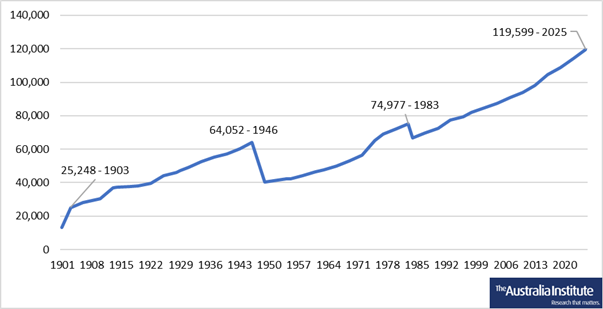
In the 2025 Australian election there will be about 120,000 registered voters per elected MP. This is the highest it has ever been, far above the 25,000 voters per MP in 1903 (the first election where most women could vote). In the intervening 122 years, parliament has significantly expanded twice: from 74 to 121 seats in 1949, and from 125 to 148 in 1984. Both times, the number of people per seat sat at a then record high: 64,000 and 75,000 respectively. While the number of registered voters is nine times that in 1903, the number of electorates has only doubled.
Australia’s voter–MP ratio is higher than Canada’s, the UK’s, and much higher than New Zealand’s. Across the ditch there is a member of parliament for every 30,000 voters, four times more representation than in Australia.
As the number of voters per MP grows, the access any individual voter will have to their member necessarily shrinks – Australia Institute polling in 2018 found that only 13% of Australians had ever spoken to their local MP. The more voters there are in an electorate, the larger a campaign needs to be to make any difference to the result, making it more difficult for grassroots campaigns to have an impact.
Figure 1: Registered voters per seat in parliament
No comments yet
Be the first to comment on this post.