Tomorrow is the first of the debates, which will be enough of a punish for us all, so you should switch off now and go live your life. Which is important!
We will bring you all the blow by blows of Day 11 on the campaign trail – we are in the midnight zone of the election campaign, which is when campaigns kinda go a little bit quiet because they don’t want to overwhelm you before the final flurry of activity in the last week. Labor is taking its foot off the accelerator to make it all about the Coalition, which is not exactly enjoying having the spotlight at the moment, given the lack of policy direction.
WHO KNEW YOU WOULD NEED MORE POLICY THAN ‘THE OTHER GUYS SUCK!’
Anyways. It’s all very Auspol.
Thank you to everyone who came by today – we do truly appreciate it. You are the reason this little project is even here, so we truly value you – and your questions have made us better. So thank you.
We will be back tomorrow early, and over caffeinated. And we will also take you through the debate. B But until then, take care of you. Ax
15.56 AEST
You only have a little over four hours to enrol to vote in the May 3 election. The rolls close at 8pm local time TODAY. You can check where you are enrolled to vote and even if you are on the roll and if not, it takes just a couple of moments.
The AEC says so far, 48,000 have added themselves to the electoral roll and we are looking at about 98% of eligible voters enrolled to vote. So huzzah for democracy.
15.38 AEST
The Coalition will also make its way back to Sydney at some point before tomorrow afternoon, given that the first debate (the News Corp People’s Forum) will be held in western Sydney.
Fun. Fun. Fun.
15.34 AEST
AAP has taken a look at Day 10 on the Liberal party campaign:
Leader of the Opposition Peter Dutton arrives at a petrol station in Adelaide on day 10
After stumbling on a key economic policy, Peter Dutton hopes turning attention back to the cost of petrol will fuel his path to victory.
For the fourth time in as many days on the election campaign trail, the opposition leader on Monday visited a service station to spruik plans to halve the fuel excise for motorists.
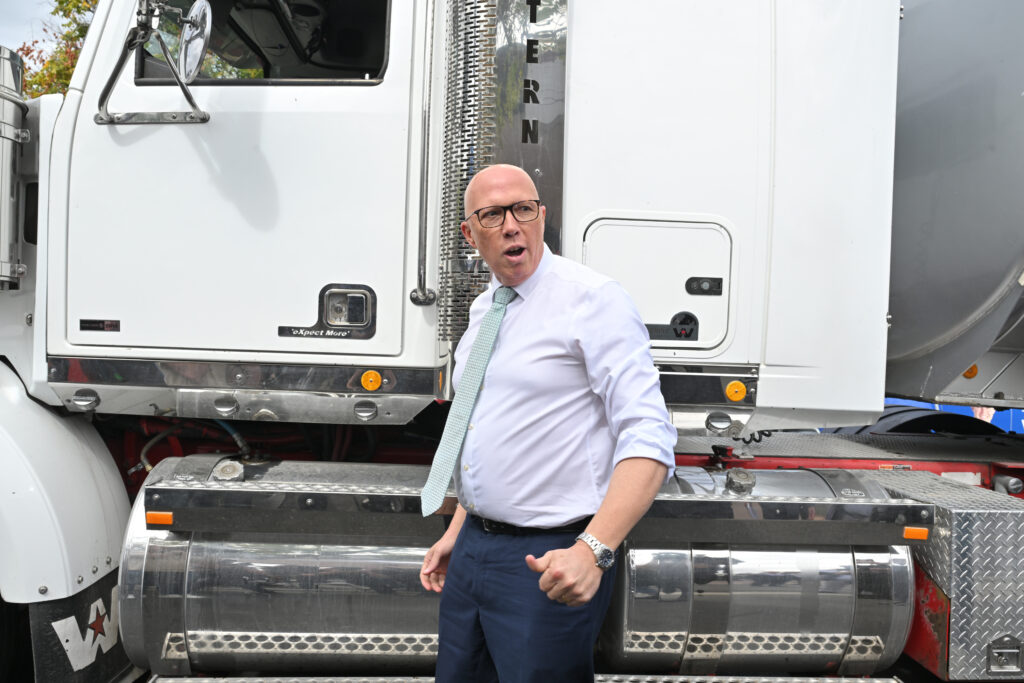
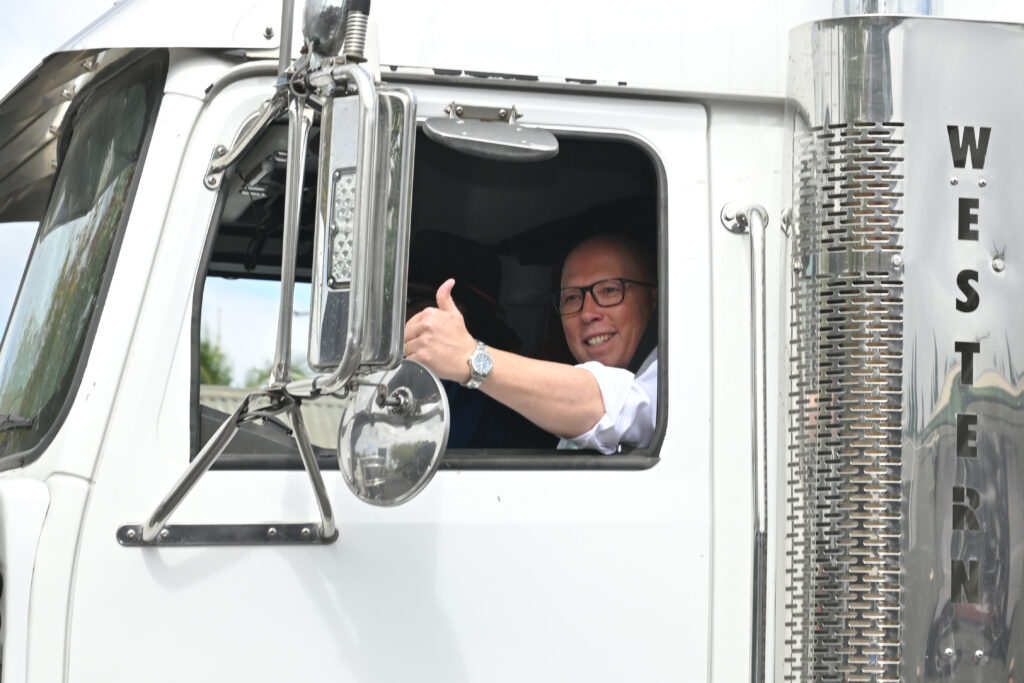
This time he went a step further, turning up to the Adelaide servo in the passenger seat of a fuel tanker.
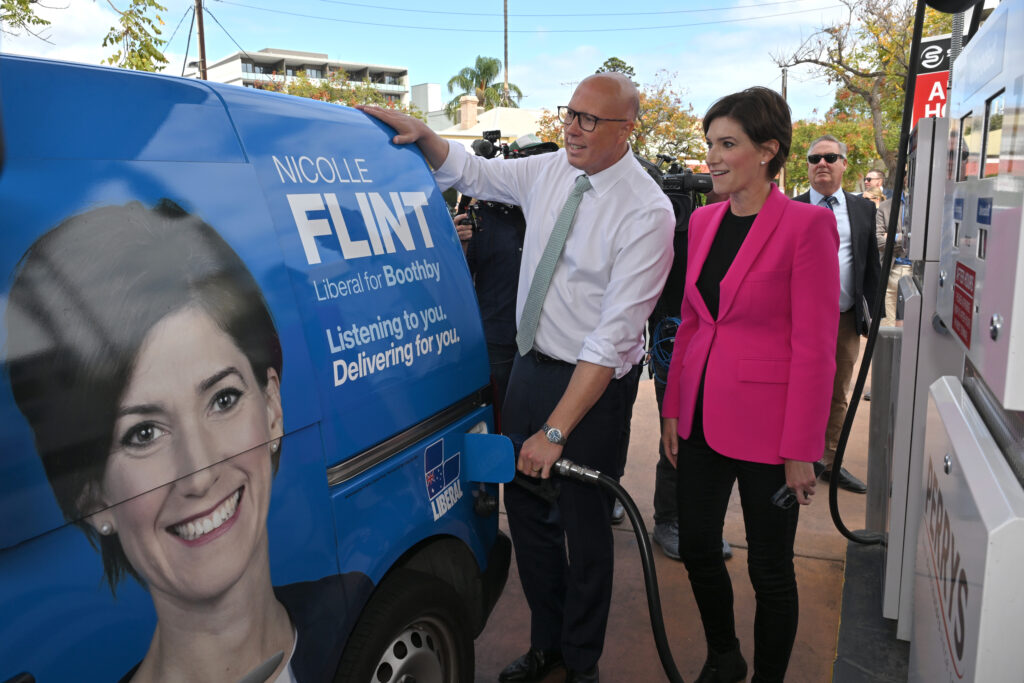
Mr Dutton then helped to fill up a campaign car for Liberal candidate Nicolle Flint, who is running in her former seat of Boothby as the coalition look to reclaim ground in South Australia.
Adelaide is a Labor heartland but the opposition is confident it can win back Boothby, with Labor holding the marginal seat on a 3.3 per cent margin.
It wasn’t the only road-related announcement for the day, with Mr Dutton earlier announcing an $840 million freight bypass in Adelaide.
“It provides a safety corridor, and it provides just something that every other state takes for granted,” he told reporters.
“We can’t have trucks coming down through one of the most dangerous intersections and road corridors in our country and pretend that nothing is to be done about it.”
The infrastructure announcement was made in the car park of a Sikh temple, with Mr Dutton also meeting worshippers from the community.
The temple sits in the electorate of Sturt, the only Liberal-held seat in Adelaide, which it maintains on a razor-thin margin of 0.5 per cent.
While campaigning alongside Ms Flint, Mr Dutton rejected suggestions the coalition has a problem with female voters after he was forced to backflip on a proposed work-from-home ban for public servants.
“We have the same number of women in the shadow cabinet as Labor does, exactly the same number,” he said.
“We have, I think, demonstrated in our policies that we want to help families, we want to help women, young women, and we want to make sure that we can do that in a vibrant economy.
“Are we going to be a better government for women and families? Absolutely.”
15.30 AEST
Factcheck: public service cuts by natural attrition
Matt Grudnoff
Senior Economist
While the back flip on work from home has been getting all the attention, there are other problems with the Coalition’s plan to cut the public service by 41,000 workers.
The Coalition have confirmed that the cuts will be achieved through natural attrition. But this conflicts with its claims that there will be no cuts to front line services. If a future Dutton government implements a hiring freeze, some of those that will leave the public service will be front line services. If the freeze doesn’t apply to front line services and they’re able to replace staff, then it will take far longer for a Coalition government to reach its 41,000 target.
The hiring freeze also flies in the face of the original justification for the cuts. The Coalition has been claiming that these cuts are about efficiency. But cuts aimed at improving efficiency would involve carefully analyzing where to cut public service fat. A blanket hiring freeze is the very opposite of that. What if the most efficient parts of the public service leave? What if the most inefficient parts stay?
This is an ill thought through policy. It will either save very little money or will degrade government services. Or both.
15.27 AEST
AEC updates its advice to cover social media influencers, podcasters and other new media
In case you missed it, the Coalition questioned whether Abbie Chatfield posting clips of her podcast interviews with Anthony Albanese and Adam Bandt on her social media platforms needed election authorisation. Most things involving political candidates do, except for media interviews. The Coalition was trying to pretend that new media, podcasts and social media influencers who may interview politicians for their content, might need those authorisations.
The AEC looked into it and found – no, in the case of interviewing someone for a podcast (where no payment was made, as was the case with Chatfield and other big players in this space like Hannah Ferguson) there is no need for an authorisation – that it is just like a media interview.
Change is happening peeps. Whether you like it or not, each generation is going to make their mark on how they use media and it’s always going to look different to what you grew up with.
With the increased involvement by influencers, podcasters and other content creators in political commentary during the 2025 federal election the following provides additional information and guidance.
Electoral communication distributed by individuals or organisations that are not political entities (e.g. candidates or political parties or otherwise required to register with the AEC as disclosure entity), does not require an authorisation unless:
the material is paid advertising, or
payment is involved to produce/distribute the material, or
gifts-in-kind are provided by a political entity that are conditional on certain material being distributed, or
the material is communicated by or on behalf of a political entity.
The factors outlined above are consistent with electoral authorisation requirements that have been in place for many elections and remain outlined in the AEC’s authorisations better practice guide.
Video content originating from an individual or organisation that is not required to authorise their unpaid communication could, if cross-posted by a political entity (e.g party, candidate or associated entity), introduce an authorisation requirement on that content, but only on behalf of the political entity.
The AEC is communicating with political entities directly to ensure this technical aspect of electoral authorisation requirements is understood.
15.22 AEST
The Labor campaign has left Victoria and moved on to Sydney, where it will stay until tomorrow morning from the looks of things.
The Coalition campaign has spent the day in Adelaide
15.08 AEST
The Migration Institute of Australia is also pushing back against the Coalition’s cut in international students policy:
All sides of politics should be supporting genuine international students and our higher education sector. International education is Australia’s fourth largest export industry bringing in around $50 billion to the Australian economy annually. On a more human level international students bring great vitality and skills to Australia and enrich our culture”, said Mr Peter van Vliet, CEO of the Migration Institute of Australia. Many studies have shown that international students are not responsible for the rental crisis in Australia as they either use purpose-built student housing or share in existing family homes. International students also assist in addressing critical labour shortages in lower skilled areas as they are allowed to work 48 hours per fortnight around their studies.
15.07 AEST
The Liberal party official spokesperson, Senator James Paterson spoke to ABC radio Melbourne earlier today where he was asked what other policies the Coalition might dump through the election campaign.
Paterson said:
we’ll be up front and honest about it with voters before the election. And we’re being up front and honest about this. You know, politicians from time to time get things wrong. We are human, and we should acknowledge when we get it wrong. We should admit when we get it wrong and we should correct course. I mean, the alternative here, is to proceed with a policy that we know that people don’t want us to and why would we do that?
Which of course begs the question – why was this policy created at all? What was the point of it?
14.56 AEST
Treasury tariff analysis
Greg Jericho
Chief economist
Modelling from the Treasury department on the impact of Trump’s tariff lunacy suggests that Australia will come through relatively unaffected.
The Treasury thinks the USA is about to experience some serious economic pain – with the real size of its economy being 0.8% smaller by 2027 than it would have been had Trump just decided to keep things as is and just gone golfing (instead of wrecking everything and then still go golfing). Treasury also estimates that inflation in the USA will be 1.4%pts higher than if everyone had let Trump keep sleeping rather than wake him up and let him talk.
China as well is going to struggle more than otherwise would be the case – it’s economy is expected to be about around 0.6% smaller.
Against that Treasury expects Australia’s economy will be much less affected. Prices will be about 0.2% pts higher (ie a bit but not much) and this will only be temporary. Our economy will be 0.1% smaller in real terms than it otherwise would be. This to be honest, is basically a rounding error.
The main reason we are not so affected is because only around 4.5% of all Australia’s exports go to the USA. Treasury notes that some sectors here will be more affected than others – agriculture, energy, mining and durable manufacturing the most, because they are mostly affected by world prices and whether or not the world economy is doing ok.
Pretty much all the impact comes from China, Japan, Korea and India likely wanting less of our stuff (because those economies will be hurt more from the tariffs than we are).
The other reason why we might get through this ok is our flexible exchange rate. As Matt Grudnoff pointed out earlier – a lower exchange rate makes our exports cheaper. So the impact of the tariffs will likely be lessened because the value of our dollar will likely fall (this has already happened today).
This does seem like good news, and it does reinforce that we should not be panicking, nor feeling any great need to do a deal with the USA on our tariffs.
But should things turn out worse – especially for China – then it will be tougher for Australia to avoid pain. And crucially it would not matter who wins the election. This is a Trump recession. All that matters is how the Australians government responds. Should the global economy all go to hell, no doubt both sides of politics will rediscover that budget deficits can actually be very good things that help the economy keep going when the economic tsunami from places on the other side of the Pacific hits our shores.
14.49 AEST
Peter Dutton has also switched up how the Coalition is going to achieve the 41,000 people it wanted to sack from the public service – it is no longer going to be by direct sackings, apparently, but through natural attrition (not replacing people who have decided to leave)
The community and public sector union have done some numbers on that:
A freeze on filling public service roles for 5 years is likely to exceed the 41,000 already on the chopping block.
The union says this reckless approach will hollow out essential services and leave millions of Australians worse off.
The latest iteration of Peter Dutton’s public service cuts would also have a disproportionate impact on frontline services where there tend to be higher staff turnover rates. (Based on current agency attrition rates.)
Services Australia would lose 12,500 jobs or 42% of staff over 5 years.
The Department of Veterans Affairs would lose almost 1,000 jobs or 27% of staff over 5 years.
The NDIA would lose 2,070 jobs, or 21% of the agency, over 5 years.
14.29 AEST
The Wombat trail – which is the Nationals election campaign – has been launched in…Bendigo.
Why is the Nationals starting their campaign in Bendigo and not leader David Littleproud’s home state of Queensland?
Well, the Nationals are still popular in regional Victoria, thanks to people like Darren Chester. They are less popular in Queensland under Littleproud’s leadership. There is not a lot of love for Littleproud in Queensland’s west, which is a power stronghold for the Nationals, traditionally.
14.02 AEST
Interest rates – what is going on?
Greg Jericho
Chief Economist
If you really want to get a sense of just how much the Trump tariff brain decimation has upended thing, just look at the market expectation for interest rates.
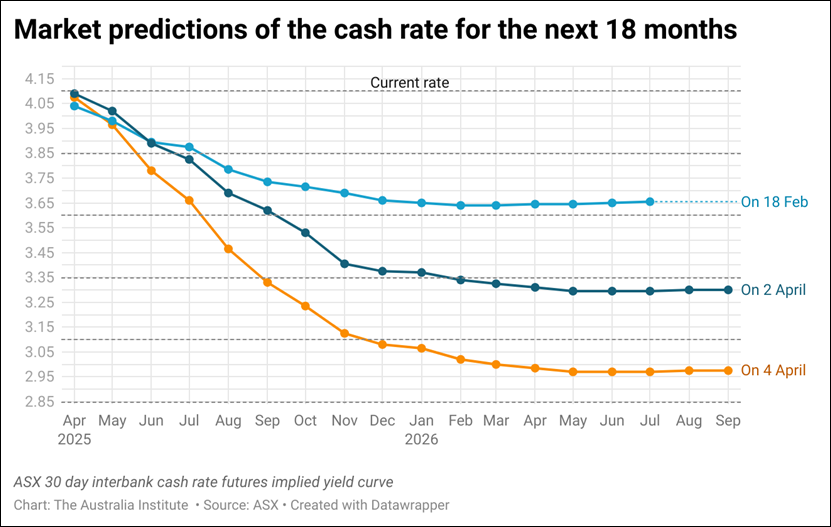
Back in February when the RBA cut the cash rate to 4.1% the market got the sense from the RBA Governor Michel Bullock that she rather liked high interest rates and thought we all needed to be still very worried about inflation even though inflation was below 3%.
The market anticipated maybe TWO rate cuts in the next 18 months. This was the time in which both major political parties were getting ready to go to the election. And you can bet the LNP was planning to hammer the issue of high interest rates all the live long day.
After the RBA’s meeting last week, the market was now of the view that all the inflation figures were very much looking good and that even while the RBA might have been far too scared to cut rates lest it look “political” a cut in May was almost certain and THREE rate cuts in the next 18 months was on the cards.
That rather dimmed the LNP’s attack because while the RBA had not cut rates, no one was out there saying they would not be cutting rates. It was clear worries about high interest rates was dimming.
Then Trump released his noxious fumes around the world.
Just three days after the RBA meeting the market had shifted to now expecting FOUR rate cuts by the end of this year.
Why? Well, all those fears of inflation are gone, and the need for the RBA to cut rates to help stimulate the economy are now all anyone was thinking about.
And with it as well has the entirety of the economy frame of this campaign.
13.59 AEST
Back to the second Albanese press conference – here is another example of how Anthony Albanese is handling tricky questions now. Not so long ago, these would have tripped him up.
Q:Peter Dutton’s policy was targeting Federal Government workers. This family are not Government workers. Is it disingenuous to be here today?
Albanese:
Not at all. These are people who’ve benefited from working from home. Peter Dutton said people should just go and job share. Now, Milly worked at TAFE. TAFE, in part, is supported by the Federal Government as well as the State Government.
Q: Prime Minister, if I may, what percentage of your own staff do you allow to work from home?
Albanese:
Oh, look, not everyone can work from home –
Q: Isn’t that his point? Aren’t you making his point for him?
Albanese:
No, that’s not his point. His point was that he would outlaw working from home. That was his point, except for himself at Kirribilli House, that is the point here. For many jobs, I can’t work from home. I can’t work a five-day week. That’s part of the deal. If you’re in construction, you can’t build a house from home. Milly worked as a nurse. When she was a nurse, she can’t be a nurse, you can’t bring the patient home. She worked at a hospital, but she does her TAFE work here at home, and that is the point here.
13.53 AEST
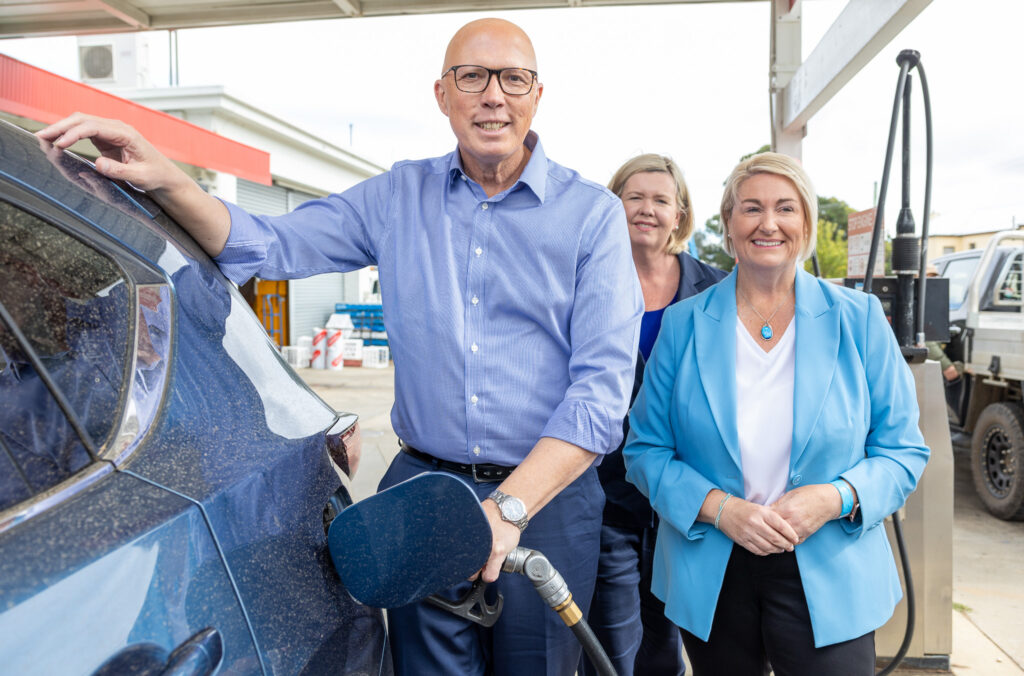
Meanwhile, Peter Dutton just can’t stay away from petrol stations now. It’s almost like the fuel excise cut policy (which has been overstated for price savings) is the only policy the Coalition still has to talk about.
Leader of the Opposition Peter Dutton and Liberal candidate for Boothby Nicolle Flint at a petrol station in Adelaide on day 10 of his 2025 Federal Election Campaign
13.50 AEST
In case you missed it, Anthony Albanese has been taking some advice and coaching from Daniel Andrews on how to better communicate (and also debate, which we will see the results of, tomorrow)
You can see some of that impact here.
Q: Prime Minister, the family you just met, the two parents – I think one works in finance, the other works for the TAFE here. Will you concede they won’t be impacted by Peter Dutton’s ‘Work from Home’ because they’re not Canberra public servants? And Chris Minns says he supports getting some public service back to the office, why is he wrong?
Albanese:
Well, your term ‘Canberra public servants’ shows you’re picking up on some of the language there. You know there are public servants who don’t work in Canberra. A majority of them do not work in Canberra. That’s one point.
The sort of people who are in Hervey Bay and in western Queensland, helping Queenslanders at this point in time deserve respect from the alternative Prime Minister.
Not to be denigrated, the sort of anti-Canberra rhetoric is, frankly, a bit unbecoming from a bloke who we know he doesn’t want to live in Canberra – we know he wants to live at Kirribilli House – but it’s a bit unbecoming. The truth is that public sector conditions then flow through and are used to argue in the private sector, that’s the way industrial relations works.
13.38 AEST
And here is where the political crosses over with the economics of the situation – Jim Chalmers:
I’m realistic about the impacts of these escalating trade tensions on the global economy, but I’m quite optimistic about Australia’s capacity to make the best of a bad situation, that’s because of the progress we’ve made, the plan that we have from here, and it also I think, sharpens the choice in the election.
Peter Dutton does pose an unacceptable risk to household budgets and to the Australian economy more broadly. We’ve seen that with his bin fire of cuts and chaos earlier today, but not just earlier today.
This would be the worst time to risk a change of government to a coalition government that would make wages lower, taxes higher, and who has secret cuts to pay for nuclear reactors.
13.35 AEST
Should we look at this modelling through rose coloured glasses, or as preparing for the worse?
Jim Chalmers:
This is the treasury’s best estimate of the impacts, it’s effectively the central case as they consider it. But there’s more than the usual amount of uncertainty and volatility when it comes to forecasting economic updates.
This is the third update of the modelling, no doubt there will be more updates under a government of either political persuasion. What this represents is the treasury’s best efforts to get a handle on impact on growth in the US, China and in Australia.
The treasury expects the impact on the American economy and Chinese economy to be significant. They do expect a substantial spike in prices in the US, and they expect impacts on the Australian economy, although a bit more modest and manageable than what we’re seeing in other countries. We released this modelling publicly and we’ve ensured the opposition has been briefed on it, because we want to work together with the people of Australia to understand the risks here, so people can understand what’s going on, what our expectations are and how we’re responding.
We’re responding with cost of living help, lower income taxes, a more resilient economy, more diverse expert offering, more engagement with the world. It’s more important than ever the work we’ve been doing to engage with our own region. This is our best defence against global uncertainty.
13.34 AEST
What about what Donald Trump would mean for people’s super balances (given the impact of the tariffs on the stock market and superannuation firms investments)
Jim Chalmers:
I can assure people that in a world of volatility and uncertainty, Australia is better placed and better prepared than our peers.
Everyone with a super fund, everyone with shares, I think, probably every Australian, is seeing what is happening on global share markets and in our own market with a degree of trepidation about all of this uncertainty.
I say to them the work we’ve done together over the course of the last three years, strengthening our economy, getting inflation down, helping with the cost of living, repairing the budget, all of these things are our best defence against this global uncertainty.
One of the big pressures on the budget we released not that long ago was these escalating trade tensions that do cast a dark shadow over the global economy and we won’t be immune from that, but we’re better placed, better prepared and Australians should take comfort from that.
13.33 AEST
On the major superannuation cyber attack, Jim Chalmers says:
We encourage super members to check their accounts and be vigilant and contact their funds if they have concerns. APRA and ASIC are engaging with all of the potential impacted super funds to support safe outcomes for members.
On Friday, we convened the council of financial regulator agencies to get an update on their ongoing response to this incident as well.
That’s working around the clock in response to the incident and it’s all about protecting fund members and improving security measures. We encourage all impacted super funds to continue to work with government agencies to assist in responding to this incident.
We are not currently contemplating some of the steps that you have mentioned in your question. But we’ll do what is necessary to make sure that super funds are safe in the first instance, that means making sure that the national office of cyber security is coordinating that work, working closely with the funds and with the regulators as well, and that’s our focus.
13.29 AEST
Jim Chalmers picks up that theme and runs with it:
So the global risks are real but we’re in good shape in Australia and we’re in good stead because of the progress we’ve made in the budget and the progress that Australians have made together in the economy. I invite to you compare and contrast the methodical and considered way that we have managed the budget and the economy over the course of the last three years, with what we’ve seen from Peter Dutton and the Coalition today.
Peter Dutton’s coalition is an absolute bin fire of cuts and chaos. Which would make Australians worse off. There could not be a worse time to risk wages and tax cuts and secret cuts in a world which is this uncertain.
Peter Dutton represents an unacceptable risk to our economy and to household budgets at the same time. There couldn’t be a worse time for Peter Dutton’s lower wages and higher taxes and secret cuts to pay for nuclear reactors.
13.27 AEST
Katy Gallagher takes advantage of this press conference to talk about Peter Dutton’s reverse ferrets on policy:
If we can make a comment on their shambles that is their public service policy and work from home. After campaigning for years for cuts to the public service, cutting 41,000 jobs, including mentioning it in the budget reply just a few weeks ago, Peter Dutton is now saying he didn’t really mean it.
On working from home, when he said that workers had to return to the office five days a week, he didn’t really mean that either. He tells us that 41,000 jobs will be cut by natural attrition, but front-line services will be protected.
The reality is where those high turnover departments, where we see turnover in public service, they’re in front-line public service agencies.
It’s simply not believable.
13.21 AEST
Jim Chalmers press conference
Jim Chalmers says forecasting is difficult enough in stable times, let alone the batshit crazy times we are currently in. And that in general, no one actually knows what Trump will do (he implies that, not says it directly)
Chalmers:
The direct impact of these tariffs, we believe to be manageable in the Australian economy, and the difference between the 10% levied on Australian imports into the US versus some higher tariffs opposed by other countries as well.
You can see all of these considerations reflected in the treasury modelling that we have released an hour or two ago.
This modelling has been briefed to the opposition as well, consistent with the right protocols in this caretaker period.
What our modelling shows is that we expect there to be big hits to American growth and Chinese growth. And a spike in American inflation as well.
We expect more manageable impacts on the Australian economy, but we still do expect Australian GDP to take a hit and we expect there to be an impact on prices here as well
13.17 AEST
The main point is this – real GDP to decline by 0.1% (estimated) and inflation to increase by 0.2% (on predictions
13.16 AEST
Treasury analysis of Trump tariffs has been updated
Here is what Jim Chalmers and Katy Gallagher are speaking on:
12.31 AEST
Factcheck: Working from home
Fiona Macdonald
Acting Director Centre for Future Work
The Coalition’s work from the office policy for Australian public servants has been abandoned but it is not clear that their views on this flexible work option have changed.
Peter Dutton and Jane Hume are reported as having said working from home created inefficiencies, harmed productivity and is much more common in the public than in the private sector. But is there any evidence to support these views?
The Centre for Future Work has today published a briefing paper reviewing the evidence on working from home, addressing the questions: Who works from home and why? Who benefits from working from home arrangements? Why do some employers (and politicians) want workers back in the office? What is the future for work from home arrangements?
Some facts:
More than one in three workers in Australia (36%) usually work from home at least some of the week.
According to the ABS, industries with the most employees working from home are Financial and Insurance Services, Professional Scientific and Technical Services, Information Media and Telecommunications, and Education and Training. Public Administration and Safety (including public servants) comes in fifth.
Benefits for individuals include increased productivity and managing work and care balance, saving time and money spent on travel, giving parents and carers more work and employment option, and providing better access to work for people with a disability or health condition
Employees’ increased job satisfaction contributes to better retention and significant reduction in employee turnover.
Increased workforce diversity and access to a larger pool of workers have productivity benefits.
There is little evidence to support a view that productivity and workplace culture suffer as a result of employees working from home. In fact, organisations benefit when they manage work from home well.
12.21 AEST
And here is that whole answer where Anthony Albanese seeks to exploit what is coming up in the focus groups – that the Liberal party has gone too far to the right and Dutton is a Temu version of Donald Trump. This is one of the under currents of the campaign – which is entirely on vibes – but the vibes are starting to take hold:
Peter Dutton lost another candidate overnight. I think the women of Australia will be asking themselves what is going on when Peter Dutton can endorse a bloke who has the views that he put forward over a long period of time, was a former candidate for the UAP. This is a part of the takeover of the Liberal Party by the hard right.
When you look at Alex Antic being number one on the ticket, he’s got his Shadow Health Minister at number two, a woman, Anne Ruston, who I would have some policy disagreements with on Medicare, but she’s the Shadow Health Minister. She’s been a Senior Minister in the Government, dumped for Alex Antic in South Australia.
In Victoria, here, you have a rump taking over. I mean, Jacinta’s opponent got hunted down by the right wing of the Victorian Liberal Party. You’ve got in WA all sorts of strange people with some very far right views who had to get dumped. There was a candidate every week going out. Roger Cook, it was hard for him to keep up during the State Election.
Goodness knows who they’re running in the Federal Election. They knocked off their sitting Members, Ian Goodenough knocked off, he’s running as an Independent. Poor old Member for Monash, he’d represented his local community for decades, he’s the Father of the House, I think, or maybe Bob Katter, but they’ve been there a long time. They knocked him off in preselection, just discarded, views weren’t right wing enough. I’m pretty confident we’ll be arguing not just to hold seats, but to win seats here in Victoria.
12.18 AEST
Labor’s finance team of Jim Chalmers and Katy Gallagher are holding a press conference later this afternoon – in response to the markets, tariffs and just general economic turmoil.
12.16 AEST
When he was asked how he would grow the economy in this climate, Anthony Albanese says:
Let’s be very clear about how you grow an economy. One way you grow an economy is by boosting productivity. And one way you boost productivity is by boosting infrastructure. So, this project here will enable people to get to the airport quicker. It will take cars off roads. It will make an enormous difference for productivity here in Melbourne, which is one way that you grow the economy.
And I’ll make this point.
My Government has provided not one, but two budget surpluses and yes, a deficit this year but a half of what was predicted. We have been responsible economic managers. We turned a $78 billion deficit into a $22 billion Labor surplus. A more than $50 billion deficit into a surplus above $15 billion and then halved the deficit that was protected. And we know that the finances of Peter Dutton are going to be diabolical because he’s got to find $600 billion for his nuclear reactors.
12.14 AEST
After not appearing at any petrol stations until Friday (the day after Phil Coorey wrote in the Fin that it was kinda insane Dutton hadn’t held a press conference at a petrol station, given the fuel excise cut policy, Dutton has now held his FOURTH photo shoot at a press conference.
Dutton just can’t get enough of filling up his car.
Leader of the Australian Liberal party Peter Dutton on day 9 of his 2025 Federal Election Campaign at Ampol Carrick in Tasmania, Sunday, April 6, 2025.
12.06 AEST
Well the reverse ferrets and confused policy has certainly made this attack line easier for Coalition opponents:
Peter Dutton’s making it up as he goes along. You can’t believe what the Liberals tell you.
A lower Australian dollar acts to make our exports cheaper. Tariffs do the opposite, increasing the price of our exports. So, what happens when the Australian dollar drops against the US dollar at the same time the US imposes tariffs on Australian exports? Well they cancel each other out.
The US imposed 10% tariffs on Australia, but the exchange rate has fallen 6%. This effectively means that the tariffs have been reduced from 10% to 4%. If the currency keeps falling Australian exports might actually be cheaper in the US.
12.00 AEST
Japanese Prime Minister Shigeru Ishiba says his government will continue to ask US President Donald Trump to lower tariffs against Japan, but admits results “won’t come overnight”, AAP reports:
“As such, the government must take all available means” to cushion the economic blow from US tariffs, such as offering funding support for domestic firms and taking measures to protect jobs, Ishiba told parliament on Monday.
Ishiba said Trump’s decision to slap tariffs on imports from Japan was “extremely disappointing and regrettable”, adding that Japan would continue to explain that it had done nothing unfair to the United States.
Ishiba also said he was willing to visit the United States for a meeting with Trump as soon as possible.
“But in doing so, we must ready a package of steps on what Japan could do,” he added.
Trump’s decision to slap a 25 per cent levy on auto imports, and a reciprocal 24 per cent tariff on other Japanese goods, is expected to deal a huge blow to Japan’s export-heavy economy with analysts predicting the higher duties could knock up to 0.8 per cent off economic growth.
11.57 AEST
‘Go fash, lose cash’
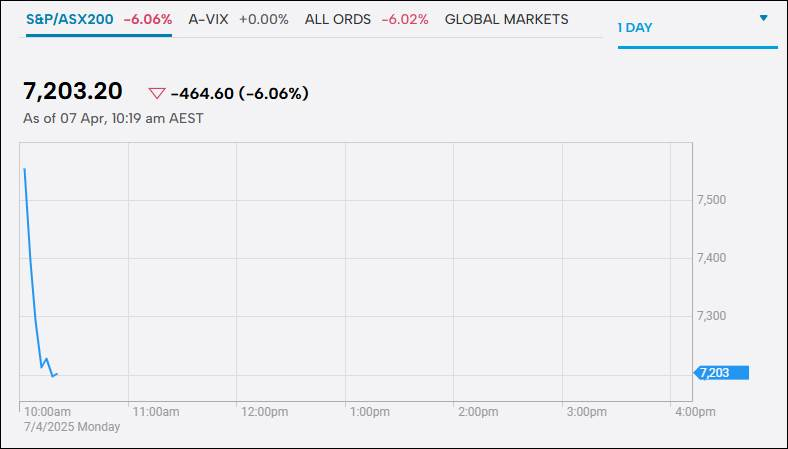
Given that at one point this morning, $160bn was stripped from the ASX (it now seems to have leveled out at about 6.3% lower after PLUNGING into the abyss upon opening this morning) it might be worth revisiting one of Maurice Newman’s favourite sayings:
As this thread shows, maybe we need to change that to ‘go fash, lose cash’ (turns out it is not just books they burn)
11.48 AEST
Time to increase territory representation in the senate?
Joshua Black and Bill Browne
Labor says it will push to double the number of senators for the ACT if re-elected. Finance Minister Katy Gallagher told ABC Canberra: “it’s certainly something we all support”.
The populations of the ACT and NT have more than doubled since they got their first senators (fifty years ago this year). While there is one ACT Senator per 227,000 Canberrans, the ratio in Tasmania is 1 Senator per 46,000 Tasmanians.
The Australia Institute has previously advocated for a ‘simple formula’ that would make territory Senate representation ‘proportionate to Tasmania’s population’. Doubling the ACT’s Senate seats would not achieve this, but it would be a big step in the right direction.
The Albanese Government was planning to increase territory Senator numbers in its first term but dropped the reform after the Coalition said it was opposed. Instead, the Labor and Liberal parties did a deal to pass rushed and unfair changes to Australian electoral laws.
A question for Senator Gallagher and the Albanese Government more broadly is: if they are going to continue to let the Opposition decide whether the territories are entitled to more Senators, it doesn’t matter whether the Labor Party “all support” the reform if they give the Liberal Party a veto over whether it happens.
Asked what he means by ‘strong leadership’ Peter Dutton says:
I think when we brokered the arrangement with the United States, AUKUS, a deal never possible under any previous Defence Minister, I demonstrated that we were able to land that deal. (Scott Morrison took credit for that deal. And its one Australians are increasingly questioning)
That will underpin our security for the next century. When I was Home Affairs Minister, I took the decision to deport 6,000 criminals from our country, people who had committed rape and sexual offences against children, I have spent my entire adult life as a police officer, as an Immigration Minister, as Home Affairs Minister, working to keep our community and our country safe. (He always neglects to mention the property developer business he held with his father after he left the police force. He has been a politician for twice as long as he was a cop)
I think I demonstrated leadership skills in relation to economic portfolios as well as the Shadow Minister for Finance and as the Assistant Treasurer as somebody who has the ability to know how to make the decisions that are right for our country.
I have demonstrated in relation to the housing policy and our team has done an enormous amount of work in this regard, that we are prepared to take the tough decision to cut Labor’s big Australia policy so we can get young Australians into housing. (The Coalition’s plans to allow people to have access to their super for deposits and loosen lending restrictions will only make housing more expensive)
If we do that, we can make for much better days ahead and I want to stop the pain that Labor has delivered over the last three years. I want to help families rebuild their position. I want to help get our country back on track. I want to make sure our country is safe. I want to deliver a first-class health system and it’s only a Coalition Government that can do that. (This, historically, has no evidence)
I think we have demonstrated those leadership qualities. At this election, it will be a choice between Mr Albanese who has no economic experience, never held an economic portfolio, only driven up inflation and created a household recession for Australian families – and a Coalition which David Littleproud and I lead. (Is Dutton really claiming that a junior ministry role almost two decades ago is ‘economic portfolio experience?’ And anyway, Albanese has a degree in economics and Labor inherited rising inflation from the previous Morrison government, which was pushed along by the global inflation shocks)
We have demonstrated that we can make the decisions to manage the economy well, particularly if there’s going to be a global recession or a war in Europe or uncertain times in which we live that need to be dealt with. At this election, I believe that the Coalition is the only party that can manage our economy well and help families deal with the cost-of-living crisis that Labor’s created.
11.38 AEST
Peter Dutton seeks to associate himself with Howard-Costello government in bid to re-invent himself in voters eyes. Again.
Peter Dutton is then asked this question:
Q: Mr Dutton, in January Jacinta Price…
Dutton: The amazing Jacinta Price, she does a great job! But please keep going.
Q: She told the Australian the public service reductions will take the form of hiring freeze. She then later clarified to the masthead she would actually reduce redundancies and sensible reductions I think she called them. When did this switch back to a hiring freeze?
Dutton does not repeat that he thinks senator Price is “amazing”. He also doesn’t address the question and instead seeks to link himself with the Howard-Costello government from 18 years ago.
Dutton:
We made our announcement to say we got the policy wrong and we made it clear now, our position. Labor will continue to lie about and run scare campaigns, but I think every Australian should hear that at the next election, there’s a choice about who is best able to manage the economy, who can most efficiently spend taxpayers’ money.
One of the things that strikes me as strange – is the Labor Party is telling you if they find waste in the expense of taxpayers’ money, they’re going to continue with that wasteful spending?
Is that what the Government is saying? Because I would think at the moment families who have seen 12 interest rate increases under Mr Albanese, who have seen their household budgets go back in seven consecutive quarters where effectively they have gone back, families are $50,000 worse off, people are not insuring their homes or cars an at the moment just to save money, people are pulling their kids out of low-fee paying schools to just make sure their budgets can be balanced.
They have tripped every dollar out of their dollar, discretionary are spending is down, and they are hearing Mr Albanese say that out of all the taxes that those people are paying, that the Federal Government’s not prepared to spend it efficiently.
I find that quite remarkable.
What it says to me is that they don’t know how to manage the economy and when I was assistance Treasurer to Peter Costello in the Howard years, we did have to make tough decisions and we did have to make sure that we had money for a rainy day.
Now, if there was a global recession, if the United States goes into recession, if there is a broader war in Europe, if there is a – an attack by Iran in the Middle East, if we see uncertainty in trading routes in the South China Sea, Australia is going to have an impact from all of that and Australians need to know they got a Government in Canberra that can deal with uncertain times, economically and in a national security sense as well, and that’s what a Coalition Government would do.
The Howard years were helped by a once-in-a-generation mining boom. And it was before the GFC which broke the world economy (something we are still seeing the ramifications from). The Coalition didn’t have a surplus while it was in government and its hunt for a surplus almost pushed the Australian economy into recession (do you remember the ‘per capita’ recession under the Morrison government, which is when things were supposedly strong?) Now that is not to say that surpluses are good, but if that is the measure by which you judge good government, as Dutton is here, then his government failed it.
11.30 AEST
What does Peter Dutton think of the polling which has shown the Coalition slipping on the two-party preferred measure (possibly opening up majority government for Labor again) – and this was before Trump’s tariffs?
Dutton:
In relation to polling, there will be scores of bowling between now and the election and we have got work to do, we are the underdog in this race but we are the only party who can provide support to Australians in a very uncertain age.
We are the only party that can manage the economy through difficult headwinds if you see a global recession or recession in the US*.
The party that has always supported small business and the economy is the Liberal Party.
The party who has done damage to the economy and families is the Labor Party and that is a story of the last three years so I have no doubt in my mind that when Australia’s front up on the 3 May, they know if they want to do the best thing for their families, for their businesses, for our economy, then they will vote for the Liberal and National candidates because if you do that, we can put the three bad years of the Albanese government behind us and help people with the cost-of-living pressures they have and we can restore integrity to the budget and help us get through what is obviously going to be a difficult
*Not sure what this is based on – Labor managed Australia through the GFC, and didn’t go into recession when similar economies did. The Coalition has championed austerity during economic crises which has the opposite effect on domestic economies – austerity sends economies into recessions, not stimulate them.
11.23 AEST
The reverberations of the Trump tariffs are still very much happening.
Greg Jericho
Chief Economist
In the first 20 minutes the Australian stock exchange has fallen 6%. This will be the first immediate impact of the tariffs on Australia – it won’t have any impact on prices, but investors are freaking out that a global recession is on the way.
Lower share prices do have an impact on the ability for companies to invest, and yes it does have an impact on superannuation – but people should always remember that superannuation is a long-term thing (this of course is not financial advice!)
11.20 AEST
Peter Dutton then confirms that the policy the Coalition has now adopted is from the John Howard era:
The policy we’ve adopted is based on John Howard’s formula in government to try and find ways [to save money].
….. I want to get money into front-line services. To train the GPs so we have a replacement for an ageing workforce. I want to be a prime minister to restore the dream of home ownership and we are cutting migration by 25 per cent because we want young Australians to get into housing because I don’t want Australians to be locked out of housing. (There is no evidence that cutting migration will make housing more affordable. Just look at what happened to housing costs when the borders were shut during the covid lockdowns – they skyrocketed. And there was no migration then)
That’s what will happen under this Labor government. I want to deliver a first-class health system. We can only do that if we manage the economy well and afford to pay for those services. Labor and promised to fund everything and they will always spend more money than any other party except the Greens and together they will be a disaster for the economy and I want to make sure we get our country a contract which we can do through good economic management and helping Australians lift their standard of living.
As has been pointed out in a previous post, the 2013 policy to cut the public service by natural attrition did not include costings of the impact to service delivery.
And we know what happened under the almost decade of Coalition governments to service delivery. That is not research, that is experience.
11.17 AEST
Asked how the Coalition can bank on savings from its public service cuts given it is now saying it will do it through natural attrition (which just means that you don’t replace people who resign) Dutton doesn’t answer the question:
Our country is going to $1.2 trillion worth of debt. We may have a global recession. People will see the value of their superannuation funds really dramatically decrease if that happens. Labor can’t manage money.
They can’t manage the economy is why they always tax. And our policies are about helping Australians – I want to improve the living standards of every Australian – over the last three years, people have gone backwards.
There’s been a household recession in this country. Families are $55,000 worse off. We need to be responsible in the way in which we manage the economy.
11.11 AEST
Peter Dutton press conference
The opposition leader is in Adelaide and is trying to mop up the work from home reverse ferret.
How bad was the polling when it came to women if the Coalition have had to drop what was one of its only consistent policies?
Peter Dutton:
The polling objective is to make sure we can win the next election so we can manage the economy well, to support families get through a really difficult period.
People can’t afford three more years of Labor. What we have said clearly is that where we’re collecting taxpayers’ money from people who are working harder than ever, you look around South Australia, people who are working second and third jobs just to pay the mortgage because it’s gone up by, you know, on 12 occasions under this government, they need to be reassured the taxes they’re paying is being spent effectively.
That in part was the point we’re making.
I have apologised for the decision we took in relation to work from home. It only applied to Canberra. Labor’s run this scare campaign and I think we bring an end to that today. And we strongly support flexible workplace arrangements.
11.01 AEST
Dutton then and now on contacting the Chinese embassy
An interesting point which was missed over the whole Darwin Port buy back kerfuffle over the weekend (both parties have pledged to take back the port from a Chinese owned company).
Interesting to hear Dutton say he gave a heads-up to the Chinese embassy of his decision to take back the Port of Darwin. I'm old enough to remember the 2022 election campaign – with the "Manchurian candidate" rhetoric – when he criticised Marles for sending the embassy a speech in advance #auspol
Here is what Dutton had to say then (there was no evidence Marles had given the speech for ‘approval’.
I would never run a speech through the Chinese embassy to get their approval before I spoke,” Mr Dutton said.
“And it shows the culture within the Labor Party, it is not going to keep our country safe… and Penny Wong and Richard Marles and Anthony Albanese out there this week show their naivety, their lack of preparedness to keep our country safe into the future.
“When you talk about border protection or you talk about the defence of our country, they just don’t have the culture within their party, the ability to make tough decisions when they need to be made and to stand up for our country.
“They’re backing China over the United States and that is a shocking mistake.”
And here is what Dutton had to say on the weekend:
This is an important national security issue and we had contact yesterday with the Chinese Ambassador, out of respect, before we made this decision.
I don’t know whether the Prime Minister made a call before he called ABC Radio but we have thought through this process for a long period of time and the Prime Minister jumping on the phone, trying to get in on the announcement that we’ve made today, I think, shows that this Prime Minister is like the fireman who turns up to the fire when the fire has already been extinguished. I mean he’s too late to everything and we’ve made the announcement today because it’s in our national interest and that’s exactly what we’ve done.
Things that make you go MMMMhhhhhhhh
10.45 AEST
Independent MP Dai Le looks like holding the seat of Fowler against Labor’s Tu Le (Anthony Albanese has said it was a mistake for the party to run Kristina Keneally in Tu Le’s place at the last election, but it looks like it has come too late)
Dai Le told the ABC she thinks she has made a difference in the parliament and her electorate knows that:
Can I say that I’m glad to see that both the major parties, you know, are now focusing on the cost of living. As the first independent to be elected to the federal parliament, I believe I was the first ever to raise the issue on cost of living in May 2022, and 2023.
So, I’ve been driving the conversation in Parliament, asking questions around tax cuts, around HECS reduction, around petrol fuel excise tax cut, about Medicare, so I’ve been, you know, harping on about those issues.
It’s great to see the major parties are now campaigning on those issues. I wonder though it’s a bit too little, too late for our community. Who are still really feeling, you know, the rise in interest rates, the rise in cost of living in particular for food, we have a lot of families here that are now lining up, asking for food hampers. Grocery prices have gone up. For businesses, energy price has gone up by more than 30%, and I hear that daily when I go out there and speak to those communities. Not just small businesses but also families struggling to pay their bills. So, um, I’m glad to see the major parties are campaigning on issues that I have been fighting for. And yeah, let’s see what happens on election day. And whether or not people will feel they’re going to be better off under the current government.
10.34 AEST
Labor held a campaign rally in Brisbane over the weekend with some familiar faces
Former Queensland Premier Annastacia Palaszczuk and Queensland Opposition Leader Stephen Miles attend a Labor campaign rally
And where the big announcement was $4000 off the cost of household batteries.
As AAP reports:
The subsidies, which would kick in from July 1 if the government is re-elected, would reduce the cost of a typical battery by 30 per cent.
While one in three homes have solar panels, only one in 40 households have batteries due to the high up-front cost, averaging around $14,000 per unit.
That means most consumers are unable to draw on excess solar power, generated during periods of peak supply during the day, at periods of peak demand at night.
A regular household taking advantage of the incentive to purchase a new solar and battery system can expect savings of up to $2300 a year – or 90 per cent – off their energy bill, government analysis shows.
Households with existing rooftop solar could save up to $1100 per year.
10.32 AEST
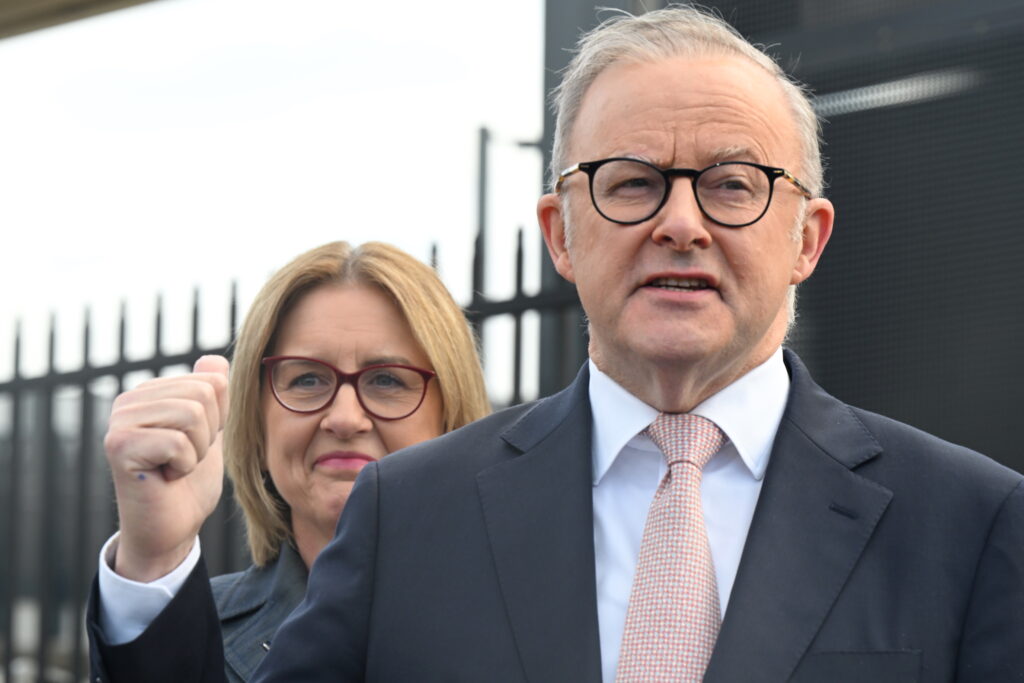
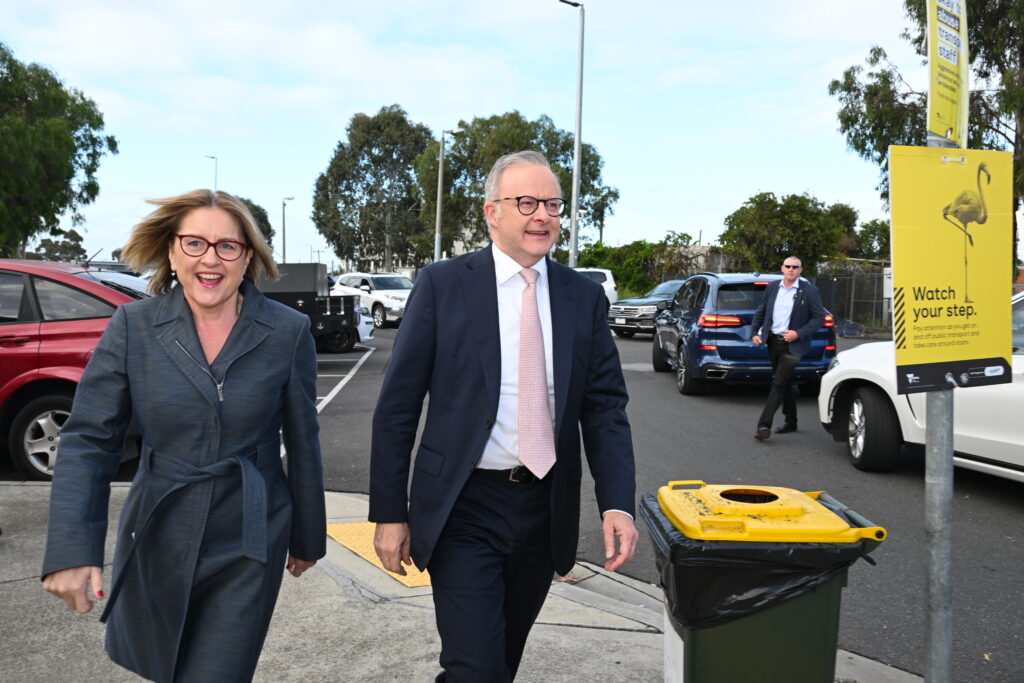
You know Labor is feeling the vibes are headed its way given this press conference:
Premier of Victoria Jacinta Allan listens to Australian Prime Minister Anthony Albanese speak to the media Sage and timeless advice
10.20 AEST
The RBA needs to reconvene
Greg Jericho
Chief Economist
Last week after Donald Trump announced his idiotic tariffs – that were so ill-thought out that he levied a tariff on penguins, Norfolk Island and a US army base in the Indian Ocean – we called for the RBA to reconvene and cut rates.
It was clear last Tuesday that the Reserve Bank was paralysed by the tariff announcement that was due to come out the next day. The RBA should have delayed their board meeting until after the announcement by Trump. Every economist knew that these tariffs would be unprecedented, but instead the RBA decided to carry on as usual and as a result did nothing except come up with excuses not to cut rates.
Now the markets and economists are clear – the RBA will cut rates in May, and because of the tariffs will likely have to cut rates by more than previously expected over the next 6 months.
We continue to call for the RBA to reconvene. There is no reason to wait till the end of May, there is no reason to just sit by and watch the world’s economy falter. Monetary policy should be nimble, and the RBA should show leadership by cutting rates before Australians suffer from the damage of Trump.
10.18 AEST
What is Anthony Albanese’s plan to hold Victorian seats, given that Labor is in trouble in its former stronghold state? Albanese then turns to the Labor attack line which is gaining some traction in focus groups – the Liberal party is too right wing.
Albanese:
I want to not just hold all our members here in Victoria, I want to win seats like Menzies and Deakin. That’s why I was in Deakin last week.
I hope Michael Sukkar is door knocking. I really hope he is. The more media appearances, the better. I encourage you to do interviews and to lift his profile with voters in Deakin. Because I think his whole way that he conducts himself is not what we need in 2025. What we need is effective local members who stand up for their communities.
This guy here, Daniel Mulino, is standing up for this community here in Sunshine. He’s standing up for Libby Coker in Corangamite and Richard Marles in Corio, standing up for the members in Ballarat and Bendigo, standing up for those people who want to get on the metro and get seamlessly through to the airport, right throughout Melbourne.
That’s what my members are doing.
I mean, Peter Dutton lost another candidate overnight. I think the women of Australia will be asking themselves what is going on when Peter Dutton can endorse a bloke who has the views he put forward, over a long period of time, was a former candidate for the UAP, this is a part of – a part of the take over of the Liberal Party by the hard right.
When you look at Alex Antic being number one in the ticket, he has his Shadow Health Minister at number two. A woman, Anne Ruston, who I would have some policy disagreements with on Medicare, but, she’s the Shadow Health Minister. She’s been a senior minister in the government, dumped by Alex Antic in South Australia.
Jacinta’s opponent got hunted down by the right wing of the Victorian Liberal Party. In WA, all sorts of strange people with some very far-right views, who had to get dumped. There was a candidate every week going out. Roger Cook was – it was hard for him to keep up during the state election. Goodness knows who they’re returning. Ian Goodenough, he’s running as an independent. He represented his local community for decades, the father of the house, I think, or maybe Bob Katter, but they knocked him off in pre-selection. His views weren’t right wing enough. I’m pretty confident, we’ll be arguing not just to hold seats but to win seats here in Victoria.
10.13 AEST
Given JP Morgan has increased its prediction of a recession across the globe by the year’s end from 40% to 60% (thanks to the Trump presidency’s insane policies) what would Anthony Albanese’s plan for getting Australia through it be?
Albanese:
What we’re doing is preparing for further uncertain times. We do live in uncertain times. And part of that is the impact of global changes, including the tariffs decisions that was made by the US administration last week.
That’s why you can’t afford to have a government that is a shambles and doesn’t know what it’s doing from day to day.
You need considered orderly government and competent ministers that know what they’re doing, that set up Australia as best as possible.
You can’t change global events. What you can do is prepare for them.
And that’s one of the reasons why we turned those Liberal deficits into Labor surpluses. That’s why we have delivered real wage increases five quarters in a row.
That’s why we’re assisting with tax cuts for every taxpayer, Peter Dutton wants to cut everything except for the income taxes of 14 million Australians. He wants to rip the heart out of fairness in our industrial relations system.
Doesn’t matter if it’s work from home, same job same pay, casualisation, gender equity in the workforce, Peter Dutton does not stand for fairness. The Labor Party does. It’s part of our core values that we try to implement with all of our programs.
10.11 AEST
But while the Coalition is on its ‘sorry about the whole you have to go back into the office thing, we all fam in the club’ apology tour, Anthony Albanese is not feeling the need to apologise.
Asked if Labor had anything to say sorry about, specifically the power price reduction promise, Albanese says:
Peter Dutton says as late as last week had the 41,000 job cuts front and centre. He never said sorry to the 22,000 veterans who were owed collectively $13 billion.
$13 billion, men and women who had worn our uniform, some of whom passed away while they were waiting for their entitlements.
He never said sorry about that.
Peter Dutton is now pretending to try and get through an election. But guess what? Before the last time the Coalition were elected, they said there would be no cuts to education, no cuts to health, no cuts to infrastructure, no cuts to the ABC, and they ripped the guts out of them in the 2014 budget. They didn’t deliver a single – a single surplus – when they promised a surplus the first year and every year thereafter.
10.09 AEST
This is Labor’s main attack message against Peter Dutton in Victoria (the state where the Coalition looks like having its most success (at this point) given the unpopularity of the Allan state government.
Anthony Albanese:
Peter Dutton is a Queenslander who wants to live in Sydney and wants to dud Victorians. Victorians had to put up with three prime ministers in a row who dudded Victoria when it came to infrastructure. They don’t need another one living at Kirribilli House who wants to dud Victoria of infrastructure and I won’t do that.
09.55 AEST
After facing criticism that he was not campaigning with Jacinta Allan in Victoria because of ger government’s drag on Labor’s federal vote.
Well Allan is out today with Anthony Albanese. Asked about the issue Labor is having with the unpopularity of her government, she deflected, saying:
What I know Victorians are focused on is a choice, a choice between a prime minister and the Labor government that’s backing Medicare, that’s backing the infrastructure projects our city and state needs and wants, as opposed to a Dutton government and a Liberal offering that is all about cuts,”
09.30 AEST
You may remember that the Coalition was obsessed with Labor oppositions providing costings. And you may also remember rapid journalists screaming WHERE ARE YOUR COSTINGS???? at Labor leaders.
So where are the Coalition’s costings?
Taylor:
We will put them out in – on the same timeline as past oppositions including Labor and it will be before the election. I’m not going to give you a date. You’ll get to see them in the detail that is customary and that’s – we’ll follow the normal practices.
The important point here – you will see, sneak preview – that our budget position is stronger than Labor’s. You will see that strong economic management is central to everything we’re doing, and you’ll see that, in particular, that a position where there’s red ink as far as the eye can see from Labor is not a sustainable position for a Liberal Party that has always believed in strong economic management as the pathway to aspiration, prosperity, housing, small businesses, all the things that we back.
This just doesn’t make sense, given that the Coalition has matched Labor in spends on health and education and this election campaign is tit for tat on infrastructure announcements.
09.22 AEST
So are there any other policies the Coalition is backing down on? Like nuclear?
Angus Taylor:
We absolutely not backing down on that, I can assure you, and we’re not backing down to making sure we drive down prices of electricity after the complete and abject failures of a Government that promised a $275 reduction and we’re not backing down on our strong economic management at a time where there’s so much uncertainty around the world.
Today we’re likely to see a big reduction over $100 billion wiped off our share market, self-funded retirees and young Australians saving up for a deposit for a home are all going to pay the price for this deeply uncertain world. We need strong economic management and that will continue to be our focus
09.19 AEST
Angus Taylor ‘we made a mistake’
The Coalition have sent out Angus Taylor to clean up the mess of the public service policy.
Which is going as well as you could expect.
Taylor tells the ABC:
We made a mistake. It is always a tough balance to get it right between accountability and efficiency of any workforce and at the same time, making sure we’ve got flexibility, flexibility really matters in a modern workforce. (welcome to 2025, Angus Taylor!)
We want the public service to be the best it can possibly be. We want to make sure it’s a public service that isn’t bigger than it needs to be where our great public servants are empowered to do their best work, and getting the balance right of every taxpayer’s money, their flexibility matters too in a modern workforce.
So we have adjusted this, there was a very dishonest scare campaign running from Labor, of course, that this was across the whole – of the private sector workforce, which it clearly isn’t what we’re talking about, we’re talking here about the public service.
(The private sector tends to follow the public sector in these things, which is one of the reasons conservative economists hate it when the public sector raises wages)
09.14 AEST
Now that the Coalition has settled on reducing the public service by natural attrition (this is the third version of this policy now – the first was to cut the APS by how much it had grown under Labor, which was 41,000 people. Then it was to limit those cuts to Canberra based people (which would have been impossible) and now its to do it through natural attrition – oh and don’t worry, the Coalition is now totally fine with work from home, even though it made forcing people back to work its whole personality for a moment there)
So this third incarnation is natural attrition. Which sounds very familiar – in 2013 the Coalition policy was to cut the public service by natural attrition.
Last week, in a surprise move, Peter Dutton announced a coalition government would not repeal Labor’s “Same Job Same Pay” laws that have raised the wages of thousands of labour hire workers.
Is Peter Dutton’s statement a good representation of the differences in the major parties’ positions on industrial relations? For a start, let’s look at what the major parties have said (or not) on minimum wage rises.
The Annual Wage Review
The Prime Minister has said a Labor government would tell the Fair Work Commission to raise the minimum wage above inflation to increase the real wages of low-paid workers.
Peter Dutton has said he supports an increase in the minimum wage but has not said how much of a rise or whether it should be above inflation. This leaves him with an awful lot of wriggle room.
Earlier this year, Shadow Minister for Employment and Workplace Relations, Michaelia Cash, was asked if she could “guarantee that workers won’t get a pay cut or fall under the Coalition”. Senator Cash failed to answer the question and, instead, responded “Let’s be very clear, it is under former Coalition government, the real wages moved forward”.
If the Coalition heeded the advice of business lobby groups ACCI and ABI, they would be wanting the Fair Work Commission to limit minimum and award wage increases to 2.5%. This would very likely mean a cut in real wages for the lowest-paid workers, with Treasury forecasting CPI at 3% to June 2025.
The ACTU is seeking a 4.5% increase to the minimum wage, arguing this is what is needed for the 2.6 million workers on minimum wages to get ahead of inflation.
Analysis by the Centre for Future Work shows that an increase in minimum and award wages of between 5.8% and 9.2% is needed to restore the real buying power of low-paid workers’ wages to pre-pandemic trends.
The Fair Work Commission’s annual wage review deliberations will continue through May. Peter Dutton and Michaelia Cash should tell us now exactly how much a Coalition government would like to see low-paid workers’ wages rise.
For these workers, a small difference in percentage points matters a lot because it means the difference between getting ahead or going backwards.
And if the Opposition leader and Shadow Minister will not support a real increase in minimum and award wages how confident can we be that a Coalition government would support the ongoing work of the Fair Work Commission to tackle gendered undervaluation of low-paid care workers in publicly-funded sectors? Would a Coalition government continue to fund multi-employer bargaining pay increases for early childhood educators and care workers ?
08.49 AEST
Labor is back in Victoria – Melbourne to be exact – for the second time this campaign, as Labor attempts to hold seats in what has become its weakest state.
As one Labor MP said to me recently, it is not the Liberals who Labor is having to fight against in Victoria, it is the Allan Labor government, which is on the nose in the polls and looking, at this point, to be pretty terminal.
The Coalition is in Adelaide, where there will be more infrastructure announcements, and also a continued reverse ferret on the public service cuts policy, which Dutton is desperately trying to back peddle on, as he continues to drop in the polls himself.
08.40 AEST
After polling, feedback and just the general vibe showed that forcing public servants back into the office wasn’t the winning policy the Coalition thought it was, the Coalition is now walking it back, by pretending that it never really existed.
I strongly support work from home,” Dutton told reporters in Darwin at the weekend.
I’ve been very clear about that and our policy … doesn’t have any impact on the public sector outside of Canberra.”
“Using existing frameworks, it will be an expectation of a Dutton Liberal government that all members of the APS work from the office five days a week.
“Exceptions can and will be made, of course; but they will be made where they work for everyone rather than be enforced on teams by an individual.”
Just in case you thought that was a one off, there was an entire section labelled ‘Back to Work’ in the speech Hume gave to the Menzies Institute (just last month) which made it VERY clear it was all APS workers. She called it a “return to disciplines”.
One public servant told my office that one of their colleagues worked from home five days a week. They were frequently uncontactable and thus unreliable.
Why? Because while they were working, they were also traveling around Australia with their family in a campervan.
The challenges faced by Australia today are significant.
We have been in a per capita recession for seven consecutive quarters – the longest on record.
27,000 small businesses have closed – a record high.
We are in an era of significant geopolitical competition, facing significant security challenges. Yet we have become less cohesive and less safe since October 7 2023.
There are many talented, driven people in the Australian Public Service. And if elected, I want them to come back to the office with me to help solve these challenges.
Using existing frameworks, it will be an expectation of a Dutton Liberal Government that all members of the APS work from the office five days a week.
Exceptions can and will be made, of course; but they will be made where they work for everyone rather than be enforced on teams by an individual.
This is common sense policy that will instil a culture that focuses on the dignity of serving the public, a service that relies on the public to fund it, and a service that respects that funding by ensuring they are as productive as possible.
A public service that respects its resources and a Government that is disciplined in its fiscal management, we can deliver more effective and more efficient services for Australians.
Expecting more from Government is both reasonable and essential for a healthy democracy.
It doesn’t require a new department, or a tech billionaire. But it does require a change of government, a restoration of disciplines Labor has abandoned, and a back to basics approach.
Under a Dutton Liberal Government, Australians will know that the taxes they pay are being spent in Australia’s best interests.
08.15 AEST
Labor ahead on Newspoll two-party preferred; 52 to 48
AAP has done a whoosh whoosh of all the different polls:
With just weeks until Australians take to the ballot boxes, Labor is leading the coalition 52 to 48 per cent on a two-party-preferred basis, the latest Newspoll shows.
The result is a percentage point improvement for Labor since the previous Newspoll was published on March 30.
The last time Labor led the coalition 52 per cent to 48 in Newspoll on a two-party preferred basis was May 2024.
The latest poll, published by The Australian on Sunday evening, was mostly conducted before US President Donald Trump’s tariff announcement on Thursday.
Multiple polls show a surge in support for the government over the coalition as party leaders zip across the nation to court voters ahead of the May 3 election.
A Redbridge and Accent Research poll for News Corp, conducted from a sample of 1006 people from March 28 to April 1, also showed Labor ahead 52 to 48 on a two-party-preferred basis.
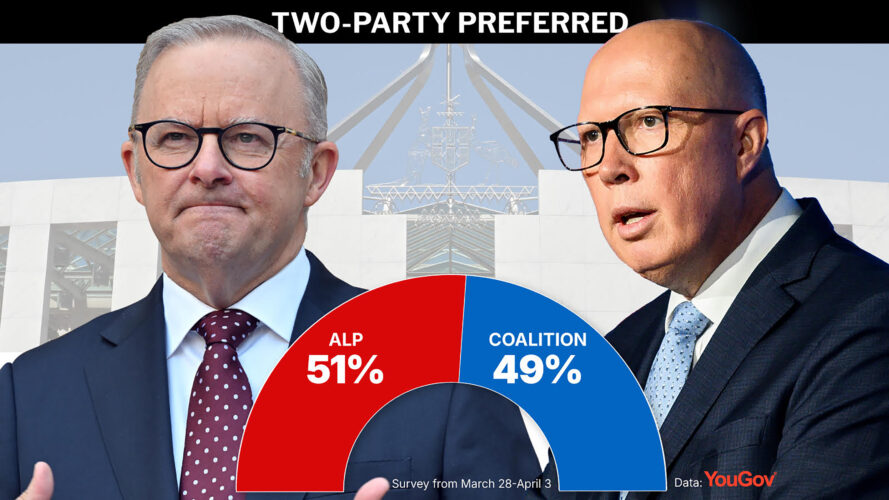
The first YouGov poll of the election campaign also had Labor ahead – 51 per cent to 49 on a two-party preferred basis.
The YouGov poll of 1622 people was conducted between March 28 and April 3, with a margin of error of 3.3 per cent.
08.01 AEST
Good morning
We have made double digits and the second week in this campaign – huzzah!
The weekend (where we hoped you switched off) saw both parties flinging mud – the Coalition are on the warpath after its planned announcement to buy back the Darwin port was gazumped by Labor – Anthony Albanese just called into a Darwin radio station and made the announcement first.
That set off all sorts of allegations that a journalist on the Coalition bus had leaked it, although as political commentator Niki Savva said on Insiders, the call came from within the Coalition itself. (Awkward)
Peter Dutton went to Tasmania (where the Liberals are a chance of winning Lyons and holding on to its other seats) and held a rally where he was all ‘Labor is lying about me, as if I would touch Medicare’ because it is also apparently awkward to have previous versions of yourself talking about how Medicare is unsustainable floating around.
The Coalition have also walked back its ‘policy’ to force public sector workers to return to an office, now saying it is just Canberra public sector workers who will have to do that. Because women, who benefit from flexible work arrangements, given their care responsibilities, decided the Coalition was a lost cause.
So now there is the whole question of where all those ‘savings’ forcing people back into the office were meant to bring (which were always overstated) and whether there is any meat to Coalition policies at all. Because everything seems able to be walked back the moment there is any sort of probing into what it would mean.
Dutton is also resenting the comparisons to Temu Trump apparently (maybe don’t try to emulate him then?) and is hoping for some sort of reset.
We’ll continue to follow the blow by blow of the campaign, along with some fact checks and research. You have the entire Australia Institute at your disposal, and me, Amy Remeikis at the blog helm for most of the day. Ready? Coffee number two is calling me. Along with a cupcake I think.





Comments
Start the conversation