
Wed 26 Mar

Australia Institute Live: Greens senator holds up dead fish in senate to protest environment wrecking laws. As it happened.

Amy Remeikis – Chief Political Analyst

This blog is now closed.

Start the conversation

Australia Institute Live: Greens senator holds up dead fish in senate to protest environment wrecking laws. As it happened.

Key Posts

The Day's News

Good evening

The senate is gearing up for the final fight over the salmon farming laws, which Labor and the Coalition are teaming up on to pass through its final hurdle, so that is pretty much that. There has to be a vote on it tonight, with the parties already passing a guillotine debate motion (to cut off debate and force a vote).

We’ll bring you the outcome of that in the morning, but I think you can see where that is going. Sigh. Vale Maugean Skate. Survived the dinosaurs, but not us.

If you are coming to our Politics in the Pub event tonight – Huzzah! You’ll have me instead of Richard Denniss, who is a bit unwell, so apologies for the poor stand in. But I am pretty annoyed at all politics at the moment and the budget hasn’t helped – so put a glass of wine in me and WHO KNOWS where the evening will go. Alice Grundy and senior economist Matt Grudnoff are very sensible though, and will keep me in check.

If not, hopefully we will see you tomorrow? We are really loving the little community we are building here. There are still some bugs to work out, and we are also working on how to introduce comment functions, because we know you love a below the line chat as well. Stay tuned for all of that.

In the mean time, we’ll be back bright and early tomorrow morning (well some of us will. I most likely won’t be bright, but I will be early.) Until then, take care of you. Ax


And as an extra treat, I’ll leave you with the ramblings of the man behind Scott Morrison’s PMO media team, Andrew Carswell. All those mis-steps from the Coalition? They are actually a mark of the GENIUS of the Coalition campaign team. You’re probably just not smart enough to see it.

It might not feel like it, deep within the bowels of a usually unflappable Coalition campaign team.

But the Coalition’s recent policy stumbles and missteps, the unexpected brain farts, the outbreak of ill-discipline that have all combined to take the wind out of the Coalition’s sails in the last three weeks is, well, highly advantageous.

Fortuitous, even. Probably even a Godsend. Yes, the Lord moves in mysterious ways.

Given the political commentary suggesting this pre-campaign mensis horribilis has damaged the Coalition’s chances of taking the fight up to Labor in the upcoming election, such a claim may appear either hopelessly naïve or wilfully delusional.

But better to have your worst three weeks in opposition before the election campaign kicks off, than during it — when voters are actually paying attention to what’s going on in Canberra.

Even that term “worst” is a bit harsh. Under Peter Dutton, this Coalition has been a picture of discipline and unity, the latter being the Achilles heel of the Liberals and Nationals marriage of convenience, usually because of the latter’s tendency to grandstand on behalf of its regional folk.

Dutton has not only kept the ship steady, its cannon have been firing with precision.

So yes, we are unfairly judging Dutton and his team for three unfortunate weeks, ignoring the three years of good behaviour up to that point.

How many public servants does the Coalition want to cut?

Angus Taylor:

“Well, I’ve been clear. I’ve said we want to get back to where we were last year.

Q: And how many is that?

Taylor: “Well, you know, it’s pretty clear that they’ve increased it by 41,000 and that’s the increase on where it was.”

This man was a Rhode’s Scholar don’t you know.

Anthony Albanese will do the ABC’s Afternoon Briefing today, then tomorrow is the Peter Dutton day while the senate is in estimates.
Albanese is also the Insiders’ guest on Sunday, so you KNOW the election is ON on.

Will he drive from the Insiders studio to Government House? I mean, stranger things have been done, but either way you will no doubt get live footage of a car driving up a drive way. What a thing to look forward to.

Just in case you haven’t had enough budget content, here is Grog’s and Matt running through the budget, after the budget lock up. (Hence the slight mania)

. @mattgrudnoff.bsky.social and I run through the budgetwww.youtube.com/watch?v=oE0d…

Greg Jericho (@grogsgamut.bsky.social) 2025-03-26T03:45:11.651Z

David Shoebridge has taken a look at the budget from the defence side of things and this is what he has come up with:

The Albanese Government has cranked up funding for AUKUS to $18 billion over five years, largely as a tribute payment to President Trump, in the recent Federal Budget. 

This represents an additional $6 billion compared to last year’s budget for nuclear-powered submarines. This AUKUS cost will keep growing year by year, with a total project cost now hitting $375 billion.  

This is funding that will not be going towards the things the public needs, like dental and mental health into Medicare, public housing or funding public education. 

This budget also sees the Albanese Government paying $1.6 billion to make a nuclear submarine base for the US off the coast of Perth at HMAS Stirling. 

Labor has also budgeted to pay $445.4 million as a payment to “sustain” nuclear submarines over the next five years, which are submarines we don’t have. This funding will likely instead sustain US nuclear submarines, having Australian taxpayers subsidise Donald Trump’s military.

There will also be $28 million to the Department of Foreign Affairs and Trade for “international policy advice and diplomatic support for the nuclear-powered submarine program.” Effectively, funding to send diplomats to beg Donald Trump to give us nuclear submarines. 

Largely due to AUKUS, the total Defence budget is now almost $59 billion a year and now makes up 6.6% of all Government expenditure. 

Greg Jericho
Chief Economist

One of the less big front-page aspects announced yesterday was the banning of non-compete clauses for non-executives.

These are very good changes that the Productivity Commission has called for and which Nobel Prize winner Joseph Stiglitz also called for last year when he visited Australia as a guest of the Institute. Traditionally non-compete clauses are to stop executives who are privy to commercial in confidence information moving to another executive role at a competitor. That is fair enough. But now these non-compete clauses ae being used to stop normal workers from going to work for a competitor – such as preventing McDonalds workers going to work for KFC.

This is bad because it means if you have skills you are most likely to find work in the same industry – but if you find a better job at another company in the same industry a non-compete clause prevents you from doing this for a set period of time – for example 12 months.

That means it is harder for workers to find better paying jobs, and it also means companies don’t have to worry about competitors poaching their workers so they don’t have to worry about increasing wages to try to keep their workers.

So it is no surprise at all that business groups hate the changes. ACCI for example says “employers are disheartened that legitimate uses of non-competes to protect legitimate business interests have been successfully demonised by the union movement.” Both it and the Business Council of Australia are saying the changes are not needed because the courts can decide if a non-compete clause is unfair. So yeah, a worker just needed to take a company to court! So easy!

There are not many things you can count on, but if the BCA and ACCI are against something, you know that something is good for workers and bad for profits.

Question time ends

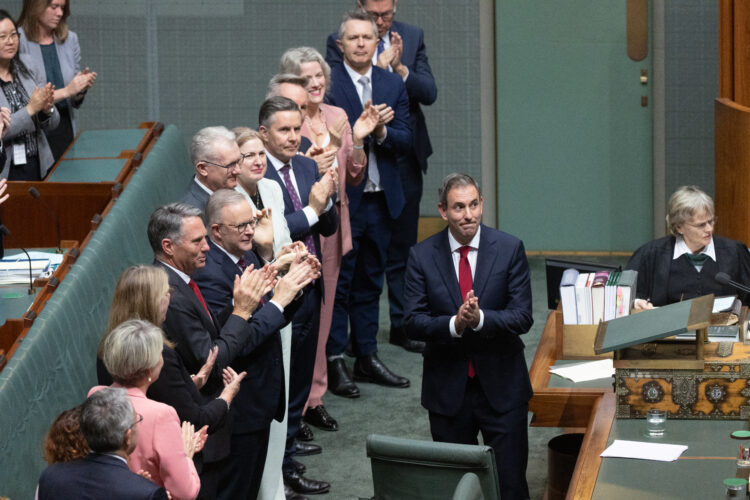
Question time ends and Anthony Albanese has a decided spring in his step.

It’s not a ‘I’m about to spring to Government House’ step, but it is a ‘this has gone better than I expected’ step.

He’ll head to Government House this weekend.

The senate is still recovering from the fish stunt Sarah Hanson-Young shocked them with.

And Angus Taylor has appeared to have distanced the Coalition from expectations it will announce its own tax cuts in tomorrow’s budget-in-reply speech – after he raised expectations in his 7.30 interview last night.

It is very possible Taylor actually doesn’t know what the position of the Coalition is. Don’t discount that either.

Tony Burke continues:

With net migration, the key driver any government has over it is how many visas you issue. There are some visas where we have taken action like we have with respect to student visas, action which they voted to make unlimited. Other actions we have taken, we got rid of the golden ticket fees are, one of the things that would feed into net migration figures, that is what we previously described as cash for visas, something that the Leader of the Opposition wants to bring back.

The overriding control you having immigration is how many visas you issue. In terms of the concept of record highs on that input, it has only happened twice in Australian history that a Minister for Home Affairs or immigration is issued more than 9 million visas. It has only happened twice. It was not myself as minister and not my predecessors. Who possibly would have issued more than 9 million visas two consecutive years? Know what else is caught up with this record.

Over in the house and Angus Taylor is still on his migration bent:

Q: I refer to the government’s increase the migration program of 1.8 million people over five years. Will the Treasurer guarantee it will not go higher than 1.8 million? (Mostly due to international students)

Tony Burke:

So good to get a question from them on net overseas migration because if there is ever a gap between their rhetoric and what they have done, it is on this issue. The latest figures that came out last week showed a 31% fall in net overseas migration year on year. 31%. And what measure that had been a particularly fast growing area of net overseas migration had been student visas. The government’s action on student visas also a 31% fall. When we put that measure to the Parliament, which way did they vote on student visas? They call for them to be unlimited? This government has taken action. You don’t like it, do you? It is terribly sad but it is the record you are responsible for and there’s a lot more to come.

Angus Taylor distances Coalition from tax cuts in budget reply

Here is a bit more of what Angus Taylor had to say today about the tax cuts.

He told Sydney radio 2GB:

They’re an election bribe, not a tax cut. They are a cruel hoax on the Australian people, where what we really need is an economy that works for hardworking Australians. We’ve seen the biggest collapse in our standard of living since the records began actually, in the 1950s. Worse than any of our peer countries across the world and what we get from Labor is the answer is 70 cents a day in a year’s time. I mean, seriously, what can you buy with 70 cents? I mean, not much, a few lollies maybe? I don’t know, but the truth is that Labor has failed us on the economy. The answer to this is strong economic management. That means beating inflation, boosting growth, fixing our housing supply, balancing housing with immigration, delivering affordable, reliable energy. We know how to do these things. It’s getting back to basics, to get back on track, but you won’t get that under Labor.

And asked what he would do he said:

What we need is standard of living relief, cost of living relief. We need a genuine underlying a solution to the problem rather than just another band aid on a bullet wound, and that that will continue to be our focus.

He promised that on Thursday, when he does his budget in reply speech, Peter Dutton will deal “with the underlying problems here, delivering affordable, reliable energy”.

And then asked: ‘so no tax cuts” said:

We need to balance immigration with our housing supply (this is just a random line – not at all related to the questions), and on tax, the best way to make sure people don’t pay more tax is to beat inflation because we’ve seen the average Australian pay $3,500 more in personal income tax despite the so called ‘tax cuts’. Well, these aren’t real tax cuts, let’s be clear, because people are paying more tax because inflation has been too high under Labor.

Which appears to be a very different thing to what he was saying last night, when he was saying that the Coalition supported tax cuts, but not these tax cuts (which the Coalition followed through on by not voting for the Labor tax cuts today).

The thing is, as Grog’s has pointed out numerous times, the $3,500 that Taylor is talking about there is because a) we have had pay rises and therefore are earning more and as a result are paying more in tax and b) the loss of the low and middle income tax offset that the COALITION PHASED OUT.

People aren’t paying more tax because of inflation. They are not paying more tax because of migration. They are not paying more tax because of energy prices (the Coalition also voted against the rebates). They are paying more tax because of PAY RISES and THE COALITION PHASE OUT OF THE LMITO.

The tax elephant in the room

Greg Jericho
Chief Economist

The opposition are running hard on how little this tax cut is and how it won’t help average Australians.

What they are not mentioning is that if the government had kept the Old Stage 3, then by the time these new tax cuts are in place, everyone earning less than $154,000 would be worse off.

Greg Jericho
Chief Economist

The latest monthly inflation figures came out today showing that in the year to February inflation rose just 2.4% – so in the bottom half of the RBA’s target range of 2% to 3%.

One of the big drops is the cost of building a new house – that rose just 1.6%. That is the lowest rise since May 2021. It’s also important because it is an aspect the RBA looks at and really the RBA should be cutting rates next week, because let’s be clear – the battle against inflation is won.

Also interestingly given there were a few conservatives last year calling for higher interest rate like they had in the USA, well inflation is now lower than in the USA – and it has come down faster than in the USA as well.

In the house, Greens MP Elizabeth Watson-Brown asks:

Australia’s biggest environmental organisation the Australian Conservation Foundation says you’re cutting of environmental laws with the Coalition today is a sell-out and means of nature is more poorly protected at the end of the Albanese government’s 3-year turn another start of it. Was the environment better protected under Scott Morrison than you and why has your government sold out the climate and environment?

Anthony Albanese:

I thank the member for her question and identifying a preference for Scott Morrison as prime minister. Compared with the Labor government that has put in place measures for the most serious climate change policy ever put in place by any Australian government in history. A40 3% target by 2030 with mechanisms to get there, the Safeguard mechanisms. The capacity investment scheme, the solar Sunshine program, hydrogen Headstart, all of these programs for batteries, the national restructuring fund to drive these through. Programs are critical minerals and rare earths through our production tax credits but they have the hide to coming here suggest that Scott Morrison, you may well have been the environment minister as well, that is possible.

We can’t rule that out. So much contempt he had for the environment that when he made himself treasurer, Finance Minister, industry Minister and everything else, he forgot to appoint himself as environment minister. That is how much contempt he had for the environment. We have protected, just on a Saturday, and extra 100 million hectares of Aussie ocean and bush, some $250 million program announced by our environment Minister in the budget to meet our commitment to protect 30% of Australia’s landmass by 2030.

That is what we have we have quadrupled the site of Heard Island and McDonald Islands Marine Park, the biggest acts of ocean conservation on the planet anywhere in the world in 2024. We have tripled the size of Macquarie Island Marine Park and blocked proposals like Clive Palmer big Queensland coalmine. We have doubled funding to better look after national parks, including Kakadu and Uluru and we are working with first Nations ranges to deliver that protection of the environment, taking account of 65,000 years of knowledge. We have throughout our environment invested $550 million to better protect our threatened plants and animals and to tackle the feral animals and weeds killing a native species. When it comes to the urban environment, we have our urban rivers program. We have a comprehensive plan and what’s more, a lot of it would have been implemented earlier if the Greens had just voted for it.

‘Dead, stinky, fish’ in the senate

Here is the moment Sarah Hanson-Young shocked the senate with a dead salmon in the chamber. Which almost caused the Liberal’s Michaelia Cash to choke.

Well, that certainly spiced things up!

It is the last senate question time of the parliament, as the senate moves into estimates tomorrow, so the gloves are off.

You can read more about the laws Sarah Hanson-Young was criticising, here.

Sarah Hanson-Young holds up a salmon in the senate chamber

Just moving to the senate for a moment where Sarah Hanson-Young held up a dead salmon in the senate while asking the government why it is passing the environment-destroying laws which will condemn the Maugean Skate to extinction.

This is after Greens senator Peter Whish-Wilson fronted up to the prime minister this morning while leaving the gym and “told them they were a pack of mongrels”.

“I’m pretty bloody angry about this, it’s the lowest thing I’ve seen in my 14 years as a senator,” he said.

“I would regret it more in my life if I didn’t tell the prime minister what I thought and give him an earful – which he bloody well deserves.”

Hanson-Young:

The Prime Minister has stitched up a deal with Mr Dutton to gut our environment laws, all in the name of a toxic, polluting salmon industry. Labor came into government promising to strengthen our environment laws. Isn’t it true that once these laws pass this place tonight, environment laws in this country will be weaker than they are when they were when you took government

The government accused the Greens of just seeking to divide for votes.

Hanson-Young asked again:

Now that the rotting, toxic salmon industry has a carve out from environment laws, what toxic industry will be next? Coal, gas, more forestry? Tell us who will get the next carve out under your government.

There is no real answer.

Hanson-Young then holds up a dead fish.

The Australian Conservation Foundation, the Australian Marine Conservation Society, WWF, the Australia Institute have all condemned these laws on the eve of the election. Have you sold out your environment credentials for a stinky, rotten fish?

The senate loses it. Michaelia Cash is laughing so hard someone might need to get her a doctor. Hanson-Young is told to remove “the prop” from the chamber.

This was Jim Chalmers’ answer:

It hasn’t dawned on the Shadow Treasurer that he is asking that question on the same day that he voted against tax cuts for every Australian worker. If the Shadow Treasurer again you Yunly cared about cost of living pressures and living standards in our economy he would have voted for our tax cuts but instead, he voted against those tax cuts. This was the consequence of the brain snap that the Shadow Treasurer had in Budget lock-up yesterday, when he decided in the face of these cost of living pressures, to recommend to his backbench that they vote against a tax cut for every Australian worker to help them with the cost of living.

That is why they’re all looking at their phones and their shoes because they know, once again, that the Shadow Treasurer’s been found out and he has been found wanting. This is why one of them described the Shadow Treasurer to The Australian as a “Dead weight”. I couldn’t agree more. What the Budget is all about is providing cost of living relief, cutting taxes for every Australian taxpayer, strengthening Medicare and building Australia’s future. It’s disappointing but not surprising to see that they voted against our tax cuts because whenever we have tried to help Australians with the cost of living, they have tried to prevent it.

As we get closer and closer to this election when the Prime Minister calls it, Australians will have a very clear choice – this Labor Government and this Prime Minister, cutting taxes for every taxpayer and helping Australians with the cost of living, or that Opposition Leader, who has a secret agenda for cuts, which will make Australians worse off.

As the Prime Minister said before, and I couldn’t agree more, this Opposition Leader wants to cut everything except taxes for workers in our economy. How dare they come up here and ask about living standards and ask about inflation, when they left us inflation multiples of what it is now and rising fast and we have got inflation down.

Another reason, in addition to the brain snap vote against tax cuts in the parliament this morning, the other reason that this question from the Shadow Treasurer is characteristically hand-fisted is because we got new inflation data today actually about 11.30. What that shows is inflation is down again – headline inflation is down again, underlying inflation is down again. It is a fraction of what we inherited from those opposite, so spare us the lectures about inflation and living standards, if you really cared about the cost of living, you would have voted for our tax cuts, instead you voted for higher taxes on every Australian worker. Well done.

Then there is this from Angus Taylor:

The Prime Minister’s cruel hoax of a Budget offers cash-strapped Australian families 70 cents a day in 15 months time. Prime Minister, when Australians with a mortgage are $50,000 worse off under Labor, isn’t this a Budget for the next five weeks not the next five years?

Don’t be surprised if the Coalition comes up with their own tax cut promises tomorrow, but Greg Jericho has looked at the numbers and can’t see how that would happen without massive cuts.

The opposition is right in that this budget is designed for the election campaign – you are already seeing the lines – three years of tax cuts, energy rebates, investing in the future yadda, yadda, which will be what the election campaign shapes up around.

But it is equally true that what the Coalition is offering is a fantasy. There is nothing behind its headlines and those policies it does manage to throw up get contradicted by its own members within 24 hours.

Question time begins

We all needed a bit of a long break there.

Having a look at the vote to pass the tax cuts (which the Coalition opposed) Andrew Hastie and David Coleman were both absent. Given Hastie’s future leadership ambitions, that seems unusual.

Also, the commentary around the salmon bill really needs to catch up. Journalists keep repeating ‘it’s just about jobs’ meaning the salmon industry jobs. Which has been revealed to be 60. Six. Zero.

This is not about jobs. Talk to any independent Tasmanian MP and they will tell you that locals don’t want the industry to be able to use Tasmania’s coastline for this – they would like to see the industry taken off shore.

But the salmon industry uses the jobs line so it becomes one of those ‘truisms’. The facts are there – you just have to look.

Meanwhile, this is an example of some of the analysis we are being offered: “I’m told the Coalition today will essentially be laying out why people are worse off under the Albanese government that they were three years ago.”

SIIIIGGGGHHHHHHHHHHH

The questions meanwhile, are playing out as you would expect.

Peter Dutton:

“My question is to the Prime Minister. Given last night’s cruel hoax of a Budget, can the Prime Minister explain how struggling Australians, by giving them just 70 cents a day in 15 months time is going to help them with their mortgage, energy, insurance and grocery bills today?”

SIIIGGGGGHHHHHH

Ok, David Littleproud is now speaking to the ABC pretending he has an economic plan, so perfect time to take a break ahead of question time.

This is it pretty much. The senate shifts to estimates tomorrow (with another day scheduled for Friday) and then we are in the official election campaign, so we have two question times left in this parliament.

Yesterday was a complete fizzer. Let’s see if there is any energy today. After coffee.

And then on the prospect of an election debate with Angus Taylor, Jim Chalmers says:

I’ve actually written to Angus with all of the requests that we received for debates. I think there are probably 10 different requests for debates. Why would happily debate the at least weekly during the election campaign. They mean that seriously. I think that would be a good thing. And a lot of you put forward suggestions about the best forum for that was if there is a neutral forum, an appropriate forum we should do it. I’ve made myself available for Q&A on Monday night to do an economic debate. Unfortunately he declined the opportunity and that’s for him to explain why he did that. But I would certainly be very, very happy to fulfil what I think should be an obligation on a Treasurer to front up to the National Press Club and do an economic debate and I hope he agrees your kind invitation.

Asked about four year terms – something Anthony Albanese has publicly and privately supported for some time, and also has the in-principle support of the opposition, but would need a referendum, Jim Chalmers says:

I’ve always been a believer in 4-year fixed terms. I can’t imagine that we would put that to a referendum ahead of some of the other referenda options that are available to us, and so I don’t want to say where that belongs in the queue. That would be better for long-term economic decision-making. They don’t think anybody seriously contest that. What would contest, respectfully, is this idea that 3-year terms prevents economic reform.

Q: In just over a week from today it’s Liberation Daily in the US, when US President Donald Trump will announce his new tariff regime. They wanted to check, in advance of that, and just now Donald Trump has said there will be very limited exemptions to the tariffs that are due to come into place, in advance of that day have you had any conversations with your counterpart, has the Government had any conversations with the Trump Administration to try to secure one of those exemptions and have you been given any guarantees?

Chalmers:

No, is the answer to the last part of your question. We take no outcome or no option for granted, but we are engaging, as you would expect us to, wherever we can, we are engaging. And we’re speaking up for in standing for Australia’s interest. You know, there are two kinds of concern associated with these escalating trade tensions for us. The direct impact on our industries and workers and businesses, obviously a big concern, we want to make sure we don’t trade away or give away the sorts of things that we cherish.

The previous is obviously a good example of that. But more broadly as well these escalating trade tensions are very substantial concern. You know, trade tensions, as you know and as your news organisation knows risk high inflation and slower growth at a time when the world is just coming to the good and of these inflationary pressures and we’ve had a period and expect a period of slow growth, so growth has not been thick on the ground in inflation has been a challenge and so we don’t want to see these escalating trade tensions make things worse.

We will continue to engage where we can, will continue to speak up instead stand up for Australia’s interest, and I’m sure that the outcome of President Trump as my deliberations will be known before long.

Q: Treasurer, you’ve said one of the priorities in the Budget is about lifting the productive capacity of the economy and you’ve also talked about the importance of small business, something the Coalition is clearly focused on. I wondered if you could clarify the status of the instant asset write-off? As I understand it, if legislation already before the Parliament is not extended by the time we leave here this week, the write-off level will remember revert to $1,000 for smalIer businesses. What’s your plan for that? And what’s your plan for the future?

Jim Chalmers:

The extension for the instant asset write-off we’ve already budgeted for has been held up in the Parliament. I think that’s, frankly, shameful that it’s been held up, held hostage to some Senate shenanigans. We want to see that passed. We’re talking with the crossbench about that right now and I don’t want to drop them in it but I had a conversation with a crossbencher this morning about it and we know it’s an issue.

In case we run out of parliamentary runway, we want to see that extended. That’s been our goal all along. We tried to pass it through the Parliament. Katy speaks fluent Senate. I don’t. She’ll have a better sense of the mechanics there.

We want to see that passed and as the Prime Minister indicated earlier today we’ll have more to say about the future of the instant asset write-off in addition to that. We want to dot right thing by Australian small businesses. We think it’s a great thing that something like 25,000 new businesses have been created on average every month for the life of our government, which is a record. We’re doing what we can to support them – energy bill relief, this instant asset write-off, supporting the hospitality sector with a tax break, extended practices for the ACCC to level the playing field. What we’re doing in Mergers and Acquisitions, that’s all about supporting small business and would like to pass the instant asset write off as part of that as well.

Q: I want to ask about tobacco excise. Over the past five years, Treasury forecast that you’d raise something like $77 billion and it’s now under $50 million. Somewhat of somewhat of a public policy disaster given smoking hasn’t really shifted in rates in recent years. And you’ve got a bit of a triple disaster in a bottom line falling out of tobacco, which was once the fourth biggest revenue source. Health outcomes not shifting and the creation of a multibillion-dollar industry for organised crime. So my question is what consideration has been given to reducing tobacco excise to attack the financial incentive that is so attractive for crime gangs?

Jim Chalmers:

Look, we’d rather give tax relief to every Australian taxpayer than to provide tax relief for smoking. We don’t think that’s the best way to go about this problem that we acknowledge. There is a substantial problem in the Budget when it comes to tobacco excise. There are two ways it comes down. One is a good way and one is a bad way. The good way is more people give up the darts. We want that. The bad way is that more people avoid the tax and we’re seeing in organised crime and other ways there’s been an increase in that kind of often violent tax evasion. And so what we’ve done in the Budget, recognising and acknowledging that problem, there is a serious problem when it comes to that revenue line is to invest another $157 million in enforcement and compliance. We think that’s a better way to collect more revenue in recognition and acknowledgement of that problem.

There was $188 million in resourcing for compliance and enforcement in January of 2024. We know we’ve got a problem there. We know we’ve got to do something about it. We’re not convinced that by cutting taxes for smoking we’ll get the objective we want. We think the better way is to invest in enforcement and that’s what we’re doing.

Q: I think the public are probably a lit by more concerned about how much tax they’re going to be paying when they’re 55. So I went back through some of the budgets. In your first budget I added up all the extra tax upgrades, tax revenue upgrades you’ve got from the first budget to this one and it comes to about $392 billion. So in that first Budget, you also predicted that fiscal ’26 deficit would be $42 billion. Last night, $42 billion. So that means that over those four years, you’ve had this extra unexpected $400 billion worth of tax revenue and yet you haven’t been able to reduce that fiscal year deficit. So I don’t – I mean, the public, the general voting public wouldn’t know those figures, so my question to you is why are you exploiting the lack of awareness from the voting public about where and how all that extra revenue you’ve got is being spent, not saved?

Chalmers:

OK. There are a few elements to that. Let me pull out the most important ones. What matters when you get revenuup grades in the Budget and they were more substantial at the of our term than in the Budget last night. There was a small revenue change in the Budget we put out last night, what matters is what you do with the upgrades and very, very unusual in historical terms if you want to make comparisons with the past, we’ve banked most of those upward revisions. Our predecessors use to spend most of them. We’ve banked $7 in every $10 in the course of our government. We recognise one way to get the Budget in better shape and one way we have been is to bank the upward revisions to revenue. I think if you’re going to quote the big number that you’ve quoted that the Liberal Party uses as well, you need to recognise…

Q: That’s my number.

Chalmers:

Understood. I’m not saying you got it from them, I’m saying it’s similar – you have to recognise that we’ve banked 7 in every 10 of those dollars because we understand the important role that that plays in Budget repair. I suppose the question is you’ve still got 70% that public don’t realise that that is being spent, not saved. Every Budget you make a series of decisions about revenue and investments in the future and cost-of-living help and in this case, tax cuts. It is historic ally unusual for a government to bank 70% almost of these upward revisions to revenue. Our predecessors and not just our immediate preyed setters but the Howard Government as well, used to spend almost all of it. We’ve saved the majority of it, almost three-quarters of it.

Q: In terms of what’s been announced so far in the lead-up to this election, we’ve seen billions in spending measures and not much on the savings side. Will you commit that before the election, you’ll reveal any additional savings that Labor would plan to make if it returned to Government? It won’t be something people find out from a Budget document if you’re re-elected?

Sigggghhhh.

Chalmers:

That’s our economic plan. We made that clear last night. And if there are additional savings we’ll detail them at the appropriate time. Before the election? If they’re decided before the election we’ll reveal them then. The Budget is not 20 hours old yet. The best sense of what we plan to do in the economy is what’s in the Budget. A couple of billion dollars of savings already. It’s normal in the course of an election campaign for there to be subsequent announcements and subsequent decisions taken and we’ll outline them in the usual way.

Q: On top-up tax cuts, once they’re fully in place they cost $7.4 billion every year. But there’s no saving of $7.4 billion a year in that year when they started so they’re unfunded. Why is that? Did you think you didn’t need to fund them by finding savings to offset tax revenue foregone?

Chalmers:

First of all, we’ve found $95 billion in savings over the course of our four budgets. I’d say again and I hope I’m not labouring this point it’s pretty unusual to have billions of savings in a Budget on the eve of an election. That’s unusual. There wasn’t many savings in the March ’22 Budget. As Katy said more eloquently than I do, the best way to think about Budget repair is not in any one specific moment in time but the progress that we’ve made over four budgets and But the previous savings… that… The improvement in the Budget is about making room for these sorts of things which are tax cuts, cost-of-living relief.

Q: But is that double counting? You’ve made savings in this term of Parliament but that doesn’t necessarily give you a new saving to fund a new initiative and here you’ve foregone the tax revenue without any additional saving to cover the cuts.

Chalmers:

The $207 billion improvement in the Budget is net of those investments we’re making in the tax cuts in addition to tax cuts we’re providing. Now, we think it’s a very important, very worthy objective to return bracket creep where you can and do it in the most responsible, cost effective, efficient way you can and that’s what the tax cuts represent. They’re modest in isolation but substantial with the rest of the tax cuts and cost-of-living help and they come in conjunction with this history-making improvement in the Budget more broadly, net of that, in addition to that.

Q: If you think back to where you were in 2022 and now, with no surpluses for the decade, was that the plan?

Chalmers:

You’ve deliberately ignored two surpluses we delivered. When we came to office, it was only deficits and we turned two into surpluses. You’d expect me to say in and maybe Katie will agree with me – we think that is too easily dismissed and diminished. We wouldn’t have had those if we’d not taken the responsible approach to banking and saving and the spending restraint we’ve shown. Let’s not lightly dismiss those surpluses. They’re hard to get. We haven’t seen back-to-back surpluses in this country for almost two decades so let’s not try and whitewash that from history. It’s part of our record and we’re proud of it and it meant there’s a structural benefit too because those two surpluses and smaller interest bill this year is paying dividends for us.

Q: I wanted to read you a couple of quotes and see if you can identify who said this. “That deficit of vision has reduced the Budget to a $100 billion missed opportunity, a Budget that borrows big and spends big but thinks small, a Budget that delivers generational debt without generational dividend, a trillion dollars in debt and growing, deficits as far as the eye can see but barely anything else designed to survive beyond the election.” Then there was this: “These guys wouldn’t know fiscal levers from a selfie stick.” That’s a good one. “Always the phoney photo I like the sound of this ops”

Chalmers: I like the sound of this guy.

Q: “You can exist like that and maybe for a time you can succeed and that’s the biggest risk in this Budget. Instead of laying out an economic vision, the government focused on political reception.” Both of those were from Jim Chalmers in 2021. You’ve delivered a Budget which forecasts a decade of deficits, a trillion dollars in debts and my question, Treasurer, is do you feel like a hypocrite today?”

Chalmers:

No, of course not, because central to last night’s Budget was an economic vision for the long term, building Australia’s future was a key element. Building a future made in Australia, investing in every single stage of education which will pay intergenerational dividends long after any of us are still here. The Budget is long on vision. It’s also long on recognising that people are under pressure and we’ve got responsibilities to them. When you mention the fiscal position, the fiscal position this year, you mention $1 trillion of debt which we inherited from predecessors. We’re at 940 this year, a lot of debt but it was supposed to be $177 billion higher without our efforts and that’s saving us on interest costs. I appreciate the opportunity to remember and reflect on what we inherited when we came to office and we have deliberately and decisively taken a different approach to our predecessors. Their Budget was weighed down by waste and rorts and missed opportunities and we’ve invested in the future of this country, building more homes, investing in lifelong learning, strengthening Medicare and these are legacy items we will leave behind whenever we finish up in this place.

The one thing every political party has in common, no matter who leads it, is once it is in government the debt is someone else’s fault. Like clockwork.

This question and the answer to it highlights exactly what we have been saying about budgets for years – that they are a series of choices. Every funding decision is a choice the government is making and it reveals what the government’s priorities are. And what they aren’t. Labor has spent a good number of decades saying it ‘wishes it could do more’. It could. It’s actively choosing not to. Why? Well that’s up to them to explain to voters who want that answer, but it’s not that they can’t do more. They are choosing not to. There is a very big difference there.

Q: Treasurer, today and in interviews yesterday many times you said this is about building up Medicare and the election campaign will be about protecting Medicare and there’s a lot of money for Medicare and bulk billing and urgent care clinics and the price of medicines but I want to ask about the biggest omission in Medicare since its inception that’s still an omission and that’s dental care. It can be absolutely life-changing for people who cannot afford to go and see a dentist, low-paid Australians, elderly Australians, it can literally keep them alive. I’m wondering if Labor will at least start a conversation to have some level of care covered by Medicare so Australians can get their teeth

Chalmers:

This is a crucial question. How do we continue to strengthen Medicare to make sure that it’s responsible and affordable and sustainable but also make sure that it’s delivering the kind of care that people need? And obviously very good people, including people in the room today – I can see around this hall – have suggested and lobbied and advocated for us to do that and the answer to that question is the same as the answer to a lot of things we’d love to do.

We’ve got to make sure that we can afford it and make sure there’s room for it in the budget. In this budget, the priority is incentivising bulk billing and women’s health but that’s not to say that in some future Budget under a government of either persuasion that we might find room from this. I know from my own community that dental health and mental health have a link to broader health. And any good government from Budget to Budget will try and work out if they can do more.

You can say a lot of things about Jim Chalmers, but one thing you can’t accuse him of is not listening to the question he is asked. He listens in a way not many politicians do, and rarely gets caught out because of it.

Q: Treasurer, you’ve emphasised in your speech a number of time global shocks and disruption that we’re seeing and we may see another round of that disruption next week when President Trump presents his new tariff policy. Given those rapidly changing circumstances, would you be willing later in the year to have an economic statement, a major economic statement to take account of new circumstances so that this Budget is not a set-and-forget document?

Chalmers:

There are a couple of important points in your question, Michelle. One of them takes the outcome of the election for granted and you won’t hear me doing that. We’ve got a relatively major event between now and then.

People will decide who governs them in the second half of the year.

But your broader point I think is well understood and your broader point is this – the big story of the Budget and the global economy and our own economy is this dark shadow which is being cast by escalating trade tensions which are very concerning to us but also the slowdown in China, a war in Eastern Europe, a collapsing ceasefire in the Middle East, political uncertainty in other parts of the developed world and all of that creates an element of heightened uncertainty in the global economy and the Budget is designed to provision for, that allow for that, anticipate that and to make sure we’re well prepared and well placed to deal with this economic uncertainty and the best insurance policy for Australia is to rebuild incomes and living standards at the household level, make sure that household budgets are more resilient and we’re making substantial progress there.

Tax cuts are part of that story, but secondly to make the economy more competitive and more resilient overall. The big story of the Budget is dealing with those two pressures at once – cost of living and global economic uncertainty – and the combination of those measures and calibration of those measures are about responding to that. You asked if there’ll be an economic statement later in the year. Again, I don’t take the outcome of the election for granted but we’ve shown a willingness to be nimble with our economic policy, to play the cards we’re dealt and trying to ensure that Australians are beneficiaries, not victims, of that churn and change.

Q: I wanted to go to the migration figures that came out the other day showing net overseas migration down to 380,000. Your Budget says next financial year that will fall to 260,000. And then after that down to 225,000 for the next few years. How will that drop be achieved? Given that Peter Dutton is suggesting he’ll go further, is it possible or even desirable from your point of view?

Jim Chalmers:

First of all, it’s not clear to me what Peter Dutton is saying. He’s made an announcement, walked it back and then denied he walked it back and let’s see what he says about that tomorrow night. More substantially, what you’re seeing in those migration numbers which you refer to is we are expecting the continuation of what has been now a very clear trend.

We had the post-COVID spike in might Craig, as those numbers recovered, and we have been managing that down over time to the levels that you rightly identify from the Budget last night. The forecast for net overseas migration in the year were broadly what they were in the midyear update. That is a combination of two things. It’s part of the normalising of the scheme after the big post-COVID spike and also partly because of the efforts that we have put into managing those levels.

Now, what I’ve tried to do – I think I’ve done it in this room in front of all of you before, but on every occasion, yourself and others, have asked me, you know, we want to make sure that we manage down net overseas migration and do it in a considered and methodical way which recognises that there are genuine economic needs for migration as well. You won’t solve, for example, a housing shortage without sufficient workers, mostly by training them but there’s also a role for migration. We’re managing it down in a considered and methodical way. There’s a role for migration in our economy and the best way to set policy is not to dial up division like our political opponents try and do.

On to the questions.

Jim Chalmers is asked if he can guarantee that the ‘top up’ tax cuts won’t be eaten up by increases in energy bills next year.

Chalmers:

I will assure people that we are doing everything we can to put downward pressure on electricity prices and that takes a number of forms. In the near term, extending energy bill relief is about taking some of the sting out of the electricity bills. That was an important part of the relief in the Budget last night. We know from the first two rounds that that has been helpful and meaningful. It’s been effective in limiting increases to power bills. Better than that – in the official CPI last year, the year to December 2024, electricity prices came down about 25%, largely, but not entirely, because of our rebates and in the near term, rebates have an important role to play.

In the medium and longer term, we are adding more cleaner and cheaper, more reliable sources of energy to the grid and over time, that will put downward pressure on prices as well. We know from AEMO and the experts that one of the reasons we’ve had this upward pressure is not the new parts of the system, not the cleaner, cheaper, more re liable parts of the system, but the legacy parts that are becoming less reliable over time. We’re doing those two things at once.

We know electricity bills are part of the cost-of-living pressure people have felt over the last four or five years. There’s good reason for, that international reasons in particular. But we’re doing what we can in the near term and in the longer term simultaneously.

Treasurer Jim Chalmers is delivering the traditional after budget press club address. You know what it is the speech, so we will bring you some from the question and answer section to save you from the repetition. It’s been a very long couple of days – find some peace where you can.

It is great to see media expand (in some cases) their list of people they listen to when it comes to lived experience, including poverty. Platforms matter and it is important more people hear directly from people living with the decisions of their governments.

“Everything is affordable when politicians want to do it… it’s really frustrating that they continue to pretend this is an us problem, not a them problem.” @kristin8x.antipovertycentre.org on the fourth Chalmers budget and how the welfare system holds us back. www.abc.net.au/listen/progr…

Antipoverty Centre (@antipovertycentre.org) 2025-03-26T00:20:05.235Z

NT Greens MP Kat McNamara has made international headlines for a speech she delivered in the NT parliament about the genocide Israel is carrying out in Gaza.

‘Wedge politics’ and reality

We see the old ‘wedge politics’ baton is out.

Wedge politics is the term used to describe when political parties, usually the one in government, does something in an attempt to ‘wedge’ their opponent into a corner. So they basically throw something up and then the opponent has to support it or not support it and then everyone goes on about the decision that was made.

In this case, it’s the tax cuts – rushing those through in order to ‘wedge’ the Coalition over tax cuts. Take that a step further and then the whole $17bn spend was just to ‘wedge’ the Coalition on tax cuts, which seems a very expensive way just to own the Libs.

The thing is, all this 4D chess bullsh*t plays out outside of people’s actual lives. The vast majority of Australians do not spend their time following politics this closely. So it only really works on the press gallery and political tragics who then run around about ‘wedge’ politics while ignoring that this is actual policy and decisions that impact people’s lives we are talking about, which has just been created to own an opposing political party. It doesn’t make for good government. And sure, there will be those who just say this is just a bonus outcome – that governments can do good policy and wedge their opponents at the same time. And sure, whatever. Believe what you want.

Ultimately though, ‘wedge politics’ does nothing to improve people’s lives, or the national conversation. Most undecided Australians do not even tune in to the political messaging until very late in the election campaign and those who have made up their mind did so based over a political party’s actions or non-actions.

In terms of how the budget bills are tracking (which includes the tax cuts due to come into effect next year) it’s passed the house, but the Coalition voted against the tax cuts.

We’ll learn about what is happening in tomorrow’s budget in reply, but the Coalition is sticking to Angus Taylor’s we are against these tax cuts, but not tax cuts, but these ones, for reasons (they are calling it a ‘hoax’ which – do they know what that word means? Because these are modest, but actual cuts to the income tax rates – so not a hoax, just not something to brag about) and maybe they’ll do their own tax cuts (hard to see how without massive cuts, but hey – maybe they’ll just pledge to get rid of the federal education department or something.)

AAP has taken a look at the Women’s economic statement (which looks at how women have benefited from the budget) and found that there is no serious funding for addressing domestic violence:

No to Violence chief executive Phillip Ripper said if the federal government was serious about addressing the issue, it should have shown it.

“The budget ignored the cost of men’s family violence and the cost of women and children living in fear,” he said.

“This week we saw more women dying by men’s violence. How many more will we accept and at what cost?

“The cost is immeasurable to some families, for the women and children who have lost their lives and others their health, safety and wellbeing.”

Minister for Women Katy Gallagher said women were now earning an extra $217 a week since Labor was elected in 2022.

“We’ve made women’s economic equality a key feature of the work we do when putting budgets together, they’re not an after thought,” she said.

“They’re there at the table, we’re thinking about it … and you will see continued effort in that area.”

New funding included $2.5 million in the 2025/26 financial year for emergency accommodation for women and children experiencing all forms of violence under an existing program.

Labor has since committed more than $4 billion in women’s safety and delivering the national plan to end violence against women and children since its launch three years ago.

Women will have improved access to healthcare and contraception under funding announced before the budget.

More than $134 million over four years will be allocated to increase the schedule fee for four long‑acting reversible contraception items on the Medicare Benefits Schedule.

Clinics providing specialist care to women suffering from pelvic pain and endometriosis will be given a $20.9 million boost over the next three years.

IVF treatment will be made more affordable from April this year, with some women able to get earlier access to combination therapy through the pharmaceutical benefits scheme.

What’s happening with the salmon farming legislation?

It’s going to pass. Bar any late night shenanigans from the opposition, the government will be able to rush the laws through the senate with the opposition’s help.

We reported earlier that Labor had set up the guillotine debate (where it sets a cut off time for a debate, to bring the matter to a vote) which the Coalition supported. That doesn’t happen unless there is a deal in place (otherwise why bring it to a vote) and it’s easy to work out who the deal is with by looking at who voted for the guillotine debate (the house and senate can’t change up business without the permission of the house or senate, if that makes sense – you have to vote on it and have the numbers)

What all of this means is….the Coalition are going to give Labor the numbers to ram this horrendous bill through the senate. Despite legal advice pointing at its gaping holes. Despite the damage it could cause to the environment. Despite being written in a way that could mean coal and gas mine projects could use it to bypass environmental protections.

Oh but don’t worry! Because Labor is going to fix everything with the environmental protection agency it is TOTALLY going to set up next term, despite promising it this term and not delivering anything but a toothless tiger it wouldn’t negotiate on.

Huzzah.

Inflation continues to fall.

The ABS has released its latest inflation data and all the ways it measures it – trend, headline and annually, are all down.

Per the ABS:

The monthly CPI indicator rose 2.4% in the 12 months to February, following a 2.5% rise in the 12 months to January. 

The monthly CPI indicator excluding volatile items and holiday travel rose 2.7% in the 12 months to February following a 2.9% rise in the 12 months to January. This series excludes Automotive fuel, Fruit and vegetables, and Holiday travel and accommodation. 

The annual trimmed mean is an alternative measure of underlying inflation that reduces the impact of irregular or temporary price changes. Annual trimmed mean inflation, which excluded the annual fall in Electricity, alongside other large price rises and falls, was 2.7% in February, down from 2.8% in January. 

Greens introduce ‘We All Come Together for Country Bill’

Greens senator and Yamatji Noongar woman, Senator Dorinda Cox has introduced a bill into the senate which would amend the Environmental Protection and Biodiversity Conservation Act 1999 (EPBC) to prevent damaging industrial action near vulnerable monuments. 

Cox:

I have a deep commitment to protecting Australia’s ancient culture by supporting the traditional owners and communities who say no to the destruction of their cultural heritage and preserving their connection to our ancestors through our ancient rock art. These monuments represent and record our rich, historic and vibrant culture.”

“These sites are not only a testament to the unique cultural tapestry of our First Nations people, but they are also a vital part of our Australian tourism industry, which brings billions into our economy.  It’s our duty and responsibility to our future generations to ensure we preserve our monuments, art and sacred spaces and to showcase these to the world. They are as precious as England’s Stonehenge and Egypt’s pyramids.”

“Time and time again, we have seen a failure in Federal leadership and we cannot leave our sacred places and monuments in the hands of those who clearly prioritise the profits of gas cartels and climate wrecking projects over our future generations connection to the world’s oldest continuous culture, Australia’s history etched in our landscapes tell a story of time, place and story.”

“We have seen the denigration and destruction for too long, we need Federal leadership on this issue and we need it now, every day that passes without action means this precious rock art will continue to be destroyed. These sacred monuments need to be safeguarded from the irreversible damage of industrial emissions, particularly from gas projects.”

“The We All Come Together for Country Bill 2025 fills a significant gap in our current legislation. Amending the EPBC Act, we are setting clear, enforceable standards that prevent harmful industrial activities from compromising our cultural heritage and tourism industry, they also provide the surety industry has been asking for. These amendments will ensure that future generations have the opportunity to experience and explore Australia’s history, landscapes and ensure that our tourism economy continues to thrive for decades to come.”

“Tourism is a lifeline for many of our communities, most being small operators and family businesses that contribute to our GDP and showcase our nation’s unique heritage to the world. With this bill, we are not only preserving irreplaceable First Nations cultural treasures but also protecting an industry that supports local jobs and enriches our national identity. I am proud to champion this Bill for the sake of our First Nations cultural heritage, tourism, economy, and our collective future.”

You can find more information on some of what communities are working to protect, here.

The Centre For Future Work has put together a budget briefing paper which has all the analysis you may want on the budget and some you probably didn’t even know you needed.

As expected with a Federal election looming, the budget is not a horror one of austerity. However, the 2025-2026 budget is characterised by the absence of any significant initiatives. There is very little in this budget that is new other than the surprise tax cuts, which are welcome given they benefit mostly those on low-incomes. There are continuing investments in some key areas supporting wages growth, where it is sorely needed, and rebuilding important areas of public good. However, there remains much that needs to be done in the next parliament.

https://futurework.org.au/report/budget-briefing-paper-2025-2026/

Why the North West Shelf expansion is a fail

While we are having a look at things that Peter Dutton is telling us he will do, let’s take a look at the North West Shelf expansion. Here is the Australia Institute’s view on that:

Peter Dutton says he’ll approve the North West Shelf (NWS) gas expansion within 30 days if he wins the election.

He also wants to introduce a National Interest Test for major projects seeking environmental approval. The test would take into account economic and social benefits.

Woodside’s proposed 50-year NWS gas expansion should be subject to a National Interest Test. 

It would fail miserably. 

Here’s why:

  • It would potentially give Woodside hundreds of billions of dollars worth of Australian gas for free. Fail
  • It would continue to push up gas and electricity prices in WA, which have tripled since Woodside started exporting the state’s domestic gas. Fail
  • It would likely drain WA’s domestic gas reserves. With NWS offshore gas fields rapidly declining, Woodside wants to process gas from any third party, including onshore WA domestic gas. Fail
  • It would continue to destroy one of the world’s great artistic treasures, the Murujuga Cultural Heritage site. Fail
  • The additional emissions would wipe out the emissions reductions from all of Australia’s climate policies many times over, increasing the frequency and severity of fires, floods and other disasters. Woodside’s own documents estimate greenhouse gas emissions are around 90 million tonnes annually, the equivalent of 12 coal power stations. Epic Fail

“The Australia Institute would welcome a National Interest Test on big gas projects like Woodside’s North West Shelf gas export terminal extension,” said Mark Ogge, Principal Advisor at The Australia Institute.

“It would fail miserably.

“Big gas companies like Woodside are draining Australia of gas, getting most of the gas they export for free, paying little or no resources tax and price gouging Australians for our own gas.

“Australian politicians should remember their job is to represent the interests of Australians, not the interests of a handful of mostly foreign-owned oil and gas corporations who are ripping Australians off every day of the year.”

The guillotine debate has been set up for the environmental gutting laws in the senate.

The Coalition voted for that, so at this stage, it looks like Labor will pass the laws (which will enable some projects to bypass the environment minister’s reconsideration powers) in this last senate sitting.

Amy’s analysis

Ok, let’s take a look at some of the things Peter Dutton has said.

“I think if you look at history, a Coalition Government has always come in to clean up a Labor mess. John Howard did it post the Hawke-Keating period and got our economy and our country back on track, and Tony Abbott did after Julia Gillard and Kevin Rudd, and we will do the same for our country…”

Does anyone remember the 2014 budget? The one that led to Abbott losing the prime ministership, Joe Hockey leaving federal politics and Peta Credlin who basically refers to herself as the mastermind, sitting in a late night commentating chair pretending she knows how to run the country?

Dutton is just saying ‘we’ll do the same for our country’.

Combine that with the public service cuts (which are now at about 41,000 people if you listened to Angus Taylor last night) and you have a fair idea where the Coalition wants to take the economy.

And how.

On 4 March, Dutton said this:

So, we’re not cutting frontline positions. We have a health department and an education department – the Commonwealth Government doesn’t own a school, we don’t run a hospital, we don’t employ a doctor or nurse or a teacher. That’s the difference than say the Queensland or the Victorian or the New South Wales Government.”

https://peterdutton.com.au/leader-of-the-opposition-transcript-doorstop-interview-kedron/

If you look at the language, and we really should be believing what these people say, because they more often than not do it, and combine that with what Angus Taylor has been saying as recently as yesterday morning:

What we’ve said is the public service has got too big. We’ll get it back to the levels it was at when we were last in government. I learnt in my private sector career, I had one unlike this hopeless Treasurer, in the real world, working with businesses across this country, I learnt that you don’t need to have a bigger team to have a better team. You don’t need to have a bigger team to have a better team.

This is just a more civil version of what the children running Elon Musk’s DOGE agenda have been saying. That they don’t understand why the US Treasury department would need more staff than privately owned banks.

When last in government, the Coalition basically imposed austerity. In an attempt to get to surplus before the pandemic, the Morrison government almost sent the economy into recession. Because that is what happens when you start taking money OUT of the economy (which is all surpluses do). No wage growth. Higher unemployment. All because before the pandemic began, it was ‘you can’t fix the economy until you fix the budget’ and then after the pandemic began, when the government lifted people out of poverty with a snap of their fingers it was because ‘you can’t fix the budget until you fix the economy’.

The Coalition is TELLING you what it plans on doing. Listen.

Meanwhile, Donald Trump whose influence was scattered all throughout the budget, but never namesd (he and Putin draw a long dark shadow) is happily dancing towards April 2, which he calls ‘Liberation day’ because that’s when all his tariffs will come into play.

It’s a short term strategy that is going to maybe give the US a little domestic bump if all goes well and then plunge it into an economic abyss. Which Trump and his acolytes wouldn’t care about, but we should, because it’s people.

Interestingly, the Financial Times (and as Noam Chomsky says in Manufacturing Consent, you should always read the business papers because that is where the people who control the economy talk to each other and tell the truth) has put together an article showing that most of the world (Mexico not included for obvious reasons) could probably untangle itself from the US economy and after some pain (again, that’s people suffering so should not be dismissed) would manage to carry on just fine.

As to the tariffs, here is what AAP is reporting:

Reuters reported on Tuesday that India is open to cutting tariffs on more than half of US imports, valued at $23 billion, in the first phase. India has among the highest trade-weighted average tariff rates at 12.1 per cent, compared to 2.5 per cent for the US, according to the World Trade Organisation.

A US delegation led by Assistant US Trade Representative Brendan Lynch is in New Delhi this week for trade talks with Indian officials from Tuesday through Saturday, the US embassy in New Delhi said.

Trump said on Monday he may give “a lot of countries” breaks on tariffs, but provided no details. Trump also said that separate tariffs on autos, pharmaceuticals and aluminium were coming in “the very near future”.

EU officials have struggled to talk Trump back from a trade war as he embarks on a multi-front tariff offensive expected to draw strong retaliatory measures.

Maros Sefcovic (the EU trade commissioner) said last week that little progress has been made in talks with Washington after Trump imposed 25 per cent tariffs on steel and aluminum imports earlier this month.

Canadian Prime Minister Mark Carney told reporters in Halifax that Canada was prepared to add retaliatory trade measures against the US, depending on Trump’s April 2 trade actions.

Trump has also threatened to end a month-long tariff reprieve for goods compliant with the US-Mexico-Canada free trade agreement.

But Carney said Canada was not rushing to the negotiating table with Trump, with whom he has not spoken since taking office, adding he wants “substantive discussions” between sovereign nations – a reference to Trump’s frequent demands Canada should be annexed by the US.

White House officials have cautioned that countries rushing for early tariff relief were unlikely to avoid them completely, because Trump’s reciprocal duty calculations will include non-tariff barriers, currency policies and other factors that are harder to roll back.

The house is ticking along with the change of business to get the budget bills through the house as quickly as possible. Then they’ll get through the senate.

That’s when the real fight will begin as the Greens and the crossbench try and stop the environmental gutting laws Labor is pushing through the parliament.

Over in the house of representatives, Jim Chalmers is introducing the supply bills that keep the money flowing and the parliament going (at least until it is dissolved later this week).

Chalmers uses it for one of his favourite past times – smashing up Angus Taylor:

There is no consistency or clarity in the Coalition’s policy positions except for this – their commitment to cut cost-of-living help for Australians.

Those opposite want to cut everything except for income taxes. That’s their position. They’ve consistently proposed the Government’s cost-of-living relief over the past three years.

If they had their way, Australians would be thousands of dollars worse off already. And they’ve now made it clear that Australians will be worse off still if they win the next election. They opposed cuts to student debt.

They opposed cheaper early childhood education and cheaper medicines. They opposed the first two rounds of energy bill rebates. They opposed more homes for Australians and more urgent care clinics, if you can believe it and now they oppose the tax relief that started rolling out halfway through this year and now these top-ups.

They are saying no three times in three years to three tax cuts. And this makes the choice at the election abundantly clear.

The Shadow Treasurer’s brain explosion opposing tax cuts now makes the choice at the election absolutely crystal clear – a Labor Government under this Prime Minister cutting income taxes for Australian workers and helping with the cost of living or those opposite and an Opposition Leader with a secret agenda for cuts which will make Australians worse off. That is the choice at the election. On this side of the house, we proudly stand for lower taxes for Australian workers. We are for Australians earning more and keeping more of what they earn and we are for doing everything that we responsibly can to help Australians under pressure. That’s what the Budget was all about last night. That’s what this legislation does and why we are proud to introduce it to the house.

The ‘brain explosion’ Chalmers is referencing there was Taylor’s 7.30 interview last night where he said that the Coalition was against Labor’s tax cuts, but not tax cuts, and implied the Coalition would do their own tax cuts. But also, maybe not do tax cuts.

This is after Taylor has been screaming about tax. But in this budget, the Coalition can’t actually afford to do tax cuts of their own unless they massively cut services and sack a bunch of people. Which you know, they have done before, but in this economic climate it would plunge the entire nation into recession quicker than Gwen Stefani can change cultures.

As part of the broadened media strategy Labor put in place while in opposition, it is not just traditional media that Anthony Albanese and other senior Labor ministers are engaging in. For the second year in a row, the government invited influencers, small online media organisations and youth media for a budget briefing and many of those people will also be interviewing the prime minister for their own audiences.

It’s not often given a lot of attention, but independent journalists and content creators are shaping their own media landscape which is attracting a lot of people, especially those under the age of 35. It’s a conversation that the mainstream aren’t tuned into – which is why there is a lot of hand wringing about younger people not being engaged with media or politics. They are – they are just doing it in different areas.

Post budget parliament sitting begins

The bells have rung, the prayers have been said and Milton Dick is in the big chair.

The second last sitting day – and last full day of senate sittings (which switches to estimates tomorrow) of this parliament is underway.

Anthony Albanese will most likely trot off to Government House on the weekend, so take a good look around – this will be one of the last times you see the parliament look like this.

Environment gutting laws coming up in the senate

The parliament will sit at 9am today – and first up will be the supply bills (which keep the money flowing) which both the house and the senate will deal with. The senate will then have to deal with Labor’s environment bypass laws which the Coalition passed along with Labor late yesterday afternoon in the house.

The Greens had moved to delay the laws by sending them to a committee for an inquiry, but that was voted down. The Greens and crossbench will try that again in the senate later today, but it will hinge on the Coalition.

These laws are part of John Howard’s legacy which no one has done anything to address in the decades since. The laws have led to more than 700 coal and gas mines being approved without any consideration to their impact on the climate. Australia has one of the worst extinction rates in the world (and we are about to add the Maugean Skate to that list with these new amendments Labor is ramming through) and deforestation continues.

Labor promised an environmental protection agency, but offered one up that wouldn’t actually do much to protect the environment. Rather than negotiation with the Greens and crossbench on it (which would have made it stronger) Labor pulled the legislation and now claims it was the Greens and crossbench which stood in the way of an EPA (when it would have been another toothless tiger).

So that’s the situation. We are about to see the parliament pass laws that will allow nature-destroying projects bypass an environment minister’s reconsideration powers and lead to the extinction of a fish that has been around since the dinosaurs, as well as severely impact a World Heritage area, all because the government doesn’t want to tell a foreign-owned industry that employs about 60 people in the area and pays no tax they can’t farm salmon in that one little spot.

Unless the Coalition decide to do something. Doubtful.  

As we said last night (and no doubt will continue to say because it’s very depressing) there is nothing in this budget which lifts people on welfare payments out of poverty. Currently, we are forcing people to live about 38% below the poverty line. We are compounding chronic health conditions, malnutrition, lack of community, isolation, mental health issues and everything else that goes with being unemployed (And having a proportion of the population unemployed is something we rely on to keep inflation down by the way) by ‘supporting’ them with a payment that can’t pay for a single rental property in Australia and increasingly makes rooms in cities unattainable.

Antipoverty Centre spokesperson and Disability Support Pension recipient Kristin O’Connell said of the budget:

This is an irresponsible budget that once again has betrayed millions of welfare recipients and left us in deep poverty – poverty that causes sickness, homelessness and suicides. This budget puts the nail in the coffin of Anthony Albanese’s cruel, false promise to leave no one behind.

So-called energy bill relief does nothing to help when energy companies keep ratcheting up prices. The government needs to stop pretending to help poor people with more handouts for big business, landlords and corporate charities.

For people on Centrelink payments life is harder now than it was three years ago, and this budget does nothing to change that.

We will bring you other bits and pieces from the budget responses today, but you get the main drift – both parties are heavily in sell mode and willing to slide around with the truth. The Coalition more so than Labor at this early stage, but again – it’s early.

Peter Dutton and the Coalition is running around with the lines “cruel hoax” and “a budget for the next five weeks” while Labor has “struck the right balance” and “a new generation of prosperity in a new world of uncertainty.”

But what politicians (and in a lot of cases the media) don’t understand is that people are not as obsessed with the budget as they are, they don’t pour through the pages and they don’t listen to politicians. It’s more of a ‘what’s in it that works for me’ and then that’s it. They move on with their life. It’s the vibe they pay attention to more than anything.

So how is sacking 41,000 people, sending them into unemployment, going to help Australia? Does Peter Dutton and the Coalition mean they want to help Australian families, just not if you work in the public service?

We’ll provide our budget reply on Thursday night, but we’ve been clear that there are real, really, three pillars.

So the mandate I seek at the next election is around making sure that we can provide support to families in a cost of living crisis that Labor has created (Labor didn’t create it) and that means fixing our energy system. (The Coalition’s plans for ‘fixing the energy system’ are a fantasy that includes opening more gas reserves that we don’t need, because we export 80% of our gas already and opening up more fields will just see more gas exported, making gas more expensive. And the Coalition already voted against gas reserves when it voted against the energy rebates. Nuclear is a complete and utter fantasy and is not happening.)

That means providing hope for young Australians in terms of home ownership. So that means cutting back on the massive, big Australia policy that has been implemented by stealth under the Albanese government. (Migration was forecast as being just as big, if not bigger under the Morrison government. But migration is not the reason people can’t afford houses. The average wage not being able to buy the average home any longer is the reason people can’t afford houses. Tax settings the major parties refuse to change, like negative gearing and capital gains, is the reason people can’t afford houses. Allowing a few people to cannibalise homes for investment is the reason people can’t afford houses. It’s not migration)

And it also means making sure that we can provide guarantees around health and education funding and essential services otherwise, and making sure that we can provide security, and we live in a very uncertain world. And I think Australians instinctually get that. They see it every night on their television screens, and people feel less safe at home, and our country is less less safe in this century, so we need to make sure that we protect our people in our country as well. (Dutton’s answer to this has largely been ‘I’ll be better friends with Trump’ which is not exactly standing up to Australia either – it’s kowtowing)

Peter Dutton is asked about what the Coalition would do to fix the structural problems in the budget (governments spending more than they collect) and pivots to the old tired line that the Coalition “cleans up Labor messes”.

Well, so I think if you look at history, a Coalition government has always come in to clean up a Labor mess. John Howard did it post the Hawke/Keating period, and got our economy and our country back on track. And Tony Abbott did after Julia Gillard and Kevin Rudd, and we will do the same for our country, because Australian families know that the debt and the deficit and the reckless spending that has now become the hallmark of the Albanese government has led to higher inflation. And the Reserve Bank Governor points this out independently, says that there is a homegrown inflation problem, and interest rates already started to come down in the US and the UK, New Zealand and Canada, before that came down here, and it gives an insight into the reality of what domestic impact the Albanese government has had, and it’s been all negative. Families are really struggling. 29,000 small businesses have closed over the last three years, and a lot of people despite working harder and going backwards under Anthony Albanese.

Ugh. Where to begin.

OK, first of all, John Howard and Peter Costello inherited the mining boom, which they spent like catnipped cats and increased inequality. Then Tony Abbott came to power after a little thing called the GLOBAL FINANCIAL CRISIS which hit economies across the developed world (and Australia didn’t enter recession unlike other nations).

The inflation crisis we have just lived through was a result of the shock to the global economy from the pandemic and Russia’s invasion of Ukraine. Australia experienced the inflation hit later than the US and the UK and didn’t start raising interest rates and until after the US and the UK, so it is no surprise that inflation, which arrived earlier, in the US and the UK, also started going down earlier in those countries. (same with Canada). And I don’t know if you have seen the impact the austerity measures have had in New Zealand but that is an economy which has absolutely tanked. So if Dutton is really worried about people going backwards and small business then he should take a look at what the conservative government has done in NZ.

You know how close we are to an election by Peter Dutton’s willingness to speak to the ABC. He was pretty happy dropping by the ABC RN studios where he spoke to Sabra Lane this morning about very Peter Dutton things.

One of the issues with interviewing Dutton is he is such an ideologue and states so many non-facts as facts in almost every sentence, it is almost impossible to pull him up.

Dutton:

I think what’s obvious to all Australians is that the Prime Minister is out of his depth, and I don’t think that they have put together a credible document, and we plunge into debt. And what is obvious is that there’s just red ink everywhere across this budget. For as far as the eye can see, there is Labor debt, and Labor debt now will extend to a trillion dollars in this budget. And not only that, I mean the impact on housing, for example, bringing in 2 million people over a year, bringing in 2 million people additional that is having a massive impact on housing in this country, and that’s why a lot of young Australians have lost the dream of home ownership under this government as well.

OK, well first of all, it isn’t ‘Labor debt’ – we all knew these deficits were coming. Even in the Morrison/Frydenberg years – you could see it coming. The forwards showed it. And when you have a lot of big spends – Aukus, stage three tax cuts, the NDIS and an aging population – and don’t change up the revenue streams, like – let’s say taxing fossil fuel companies properly – then this is what happens. But both major parties are guilty of that, and the Coalition was in power for almost a decade before these last three years, so it is not ‘Labor debt’.

Migrants are not the reason you can’t afford a house. House prices exploded during the pandemic border closures – when there was no migration.

There are a lot of very furrowed brows over the debt position with very serious mutterings about ‘what is in reserve’ if the geopolitical situation goes to sh*t. So there are a lot of questions about that floating around this morning. Here is Anthony Albanese’s answer to one of them:

What we’ve done is, through our responsible economic management, turn a liberal deficit that we inherited a $78 billion deficit in the first year into a $22 billion surplus, and we’ve continued to provide fiscal policy that was responsible. We have forecast the deficit this year is half of what was forecast at the last election, and combined, we have improved the budget bottom line by $207 billion in the year ahead.

Back to the budget sell. Anthony Albanese was on ABC radio RN Breakfast, where he was pressed on the tax cuts, which have been criticised for their cost to the budget – $17bn – and for their modest impact (it’s about $5 a week for someone earning $70,000).

Albanese says it’s a ‘top up’ and needs to be taken in consideration of the changed stage three tax cuts:

It’s a top up with around about $50 a week, or $2,500 a year once all of our tax cuts are put fully in place. We changed the legislation, as you’re aware of, to make sure that every Australian got a tax cut, and we were what we wanted to make sure was that every Australian got a tax cut, but did so in a way that was responsible.

Andrew Wilkie continued:

Do these people know how silly they look? It would be funny except it’s so serious. It’s serious insofar as ensuring the industry is sustainable. It’s serious insofar as ensuring the environment is protected and safe. And it’s serious when it comes to the very pointed matter here tonight of the extinction crisis. This is the context in which we’re saying: ‘The fish farms can stay in Macquarie Harbour,’ and the government and—I don’t know—I think the opposition are saying that they don’t give two hoots about one of the planet’s oldest species becoming extinct.

Why is all this happening? Why are the government and the opposition acting so patently at odds with the best interests of the natural environment, and of a threatened species in particular, and so at odds with the public interest, so at odds with the groundswell of discontent on the backbench and so at odds with having the best reputation for he industry in the future? It is for one reason: to harvest a few hundred votes in the electorate of Braddon.

It is that crude, that blunt and that ugly. The government is happy—well, it is prepared, I should say—to drive the Maugean skate to extinction because it might improve its chances of winning the Tasmanian north-west and west coast seat of Braddon.
When you think about it in that context, it’s all the more ugly. I suppose the government might hope there’s some benefit in the seat of Franklin and in the seat of Lyons, both of which also have fish farms. But, oh, the irony of it!
The member for Franklin is the Minister for Agriculture, Fisheries and Forestry, and the Tassal factory has a lot of Huon aquaculture farms down the channel and down the Huon River. Oh, the irony of it! That minister is going to be in here voting in favour of this, even though it is actually hastening the demise of the industry by the trashing of the industry’s reputation.
I struggled to get my head around this. For one seat—which, by the way, Labor has almost no chance of winning, so the whole exercise becomes even more ludicrous—they’re taking a species closer to the edge of extinction. They are annoying the majority of Tasmanians who want fish farms kicked out of Macquarie Harbour, all to chase some votes that ultimately won’t see them win the seat anyway. It’s just bizarre behaviour. It’s just crazy behaviour. It’s inexplicable, but that’s what raw politics is like.

To echo my colleagues behind me, it helps to explain why the primary vote of the major parties is collapsing and why, at this federal election, again, a third or more of the country will vote for someone else.

They will vote for people who will fight for the environment, fight for the public interest, fight for their communities, fight for rational policies to grow industries, not to kill them.

Labor and Coalition pass environment bypass legislation through the lower house

While there was a lot of focus on the budget (as expected) Labor and the Coalition also voted together to pass the environmental wrecking laws which will let some projects bypass the environment minister’s reconsideration powers. It’s been sparked by the foreign-owned salmon farming industry which wants to keep farming in Macquarie Harbour, despite scientists saying it will mean the extinction of the Maugean Skate.

Tasmanian independent Andrew Wilkie didn’t hold back in the house debate:

…At the moment, in Tasmania, fish that have died from Rickettsia bacteria in this appalling fish die-
off, so long as their gills are still pink, with a bit of blood in the gills, and so long as the fish aren’t already rotting on a beach somewhere, are being put in an ice slurry, taken away and processed for human consumption.

Even the fish that are apparently not infected by Rickettsia and are being harvested and processed are not being tested for Rickettsia.

Given that it can take up to two weeks for the symptoms of Rickettsia to present themselves and given
that we know as a fact that all of the farms and all of the farm sites and all of the pens now are infected with Rickettsia, you can draw no other conclusion than the fish companies in Tasmania are selling and consumers are purchasing and eating infected fish.

How on earth does that help maintain the reputation of Tasmania or the reputation of this industry? It doesn’t. I make the point again—I want to labour this point—that the people that are running a protection racket for the salmon industry in Tasmania are actually going to be part of its demise. What we should be doing is coming in here and making sure we have the very best environmental safeguards possible at a federal level and pressuring the state and territory governments to make sure they have the very best environmental safeguards and that they have the very best environment protection agencies so that we can have absolute confidence we’re not eating fish that died in a bacterial outbreak and looked good enough with their gills pink enough to be processed and sold at Coles or Woolies.

Rebekha Sharkie: “Yuck!”

Wilkie:

Yuck, yes! It’s gross. It’s really gross. That’s not as gross, believe it or not, as the images I’m sure
some honourable members have seen of the beaches on the east coast in Tasmania and on Bruny Island in recent weeks with rotting fish carcasses and globules of fish oil—up on the beaches, which the Tasmania government said are completely safe. ‘The water is clean, and the beaches are fine, but do not touch the fish.’

Is Jim Chalmers trying to “bribe” Australian voters at the coming election as the Coalition claims?

Chalmers tells the ABC:

No, what the budget papers make really clear is that what we are proposing and what we are announcing in the budget last night is consistent with inflation coming down lower and sooner. One of the most important things is Treasury expects inflation to be within the target band, six months earlier than had been anticipated at the end of last year.

That’s a very good thing. And what it shows is that in our economy, we’re getting inflation down. We have wages up. Unemployment is down.

The debt is down. Interest rates are starting to be cut and growth is rebounding solidly in our economy as well.

So our economy is turning the corner. The credit for that belongs to the people of Australia, who have been through a lot. We want to help them with the cost of living. Peter Dutton wants to prevent that. Peter Dutton wants to cut everything, except for people’s taxes. We’re providing tax cuts in the most responsible way that we can, recognising that people are still under pressure and we’re helping them.

Good morning!

Hello and welcome to the show – no one has had any sleep, everyone is seeing numbers behind their eyelids and we have all had wayyyyyyy too much sugar. Must be the post-budget mania!

Treasurer Jim Chalmers and prime minister Anthony Albanese are preparing for the big sell – every major broadcaster in Australia sets up on the parliament lawns and the leaders go from tent to tent speaking to different media hosts about the budget.

Peter Dutton and Angus Taylor will be doing the same thing – but like a wedding with divorced parents, they usually start from different ends.

The budget is not going to be an entirely easy sell – there is a lot of red in those numbers, but more importantly they show an economy which has reacted exactly as it is supposed to under the conditions it has been under for the last couple of years with higher interest rates, and budget surpluses (which is just taking money out of the economy) and is pretty depressed.

So let’s grab this third coffee and get into it?

Ready? I hope so because I am not.


Read the previous day's news (Tue 25 Mar)

Comments

Start the conversation

The biggest stories and the best analysis from the team at The Point, delivered to your inbox.

Past Coverage