Thu 27 Mar

Australia Institute Live: Coalition to slash migration, sack 41,000 people and establish 'anti-semitism' taskforce if he wins government. As it happened.

Amy Remeikis – Chief Political Analyst

This blog is now closed.

Start the conversation

Australia Institute Live: Coalition to slash migration, sack 41,000 people and establish 'anti-semitism' taskforce if he wins government. As it happened.

Key Posts

The Day's News

Good evening – and see you next week for the election blog, starting Monday!

And that is it for the 47th parliament. What a ride. Mostly a disappointing one, to be honest.

We’ll know the election date very soon – it’s just hours away now – which means we will all have to prepare for a pretty nasty few weeks.

This campaign is going to get very dirty. It already is. But there are a lot of vulnerable people who are pretty worried about the future right now, so make sure you are looking out for them.

Stand up, speak up and seek truth.

We’ll be guiding you through the election campaign with analysis, fact checks (someone has to do them!) research and yes, some snark as we cover it day by day on the live blog.

We hope that you will join us. And mostly, that you will find some community and some answers as we try and wade through the muck.

So get some sleep, have some fun. Find some small joys and delight in the ordinary moments we take for granted. Election campaigns don’t last forever, but that doesn’t mean people don’t get wounded, feel isolated, or targeted by being used for political point scoring. Keep those minds, and hearts, open.

So we’ll see you Monday. Until then, do good – and take care of you. And those around you. Ax

As for the rest of it? That detail will have to wait until the election, or after it. Dutton won’t say how they will cut migration by 25%, how that will lead to more affordable housing for people, how he would unwind the green energy contracts in place, how that would keep Australia’s reputation as a good place to invest, how nuclear or work or essentially, anything else.

And that’s it. That’s the election pitch.

Q: Let me just ask you this, because it’s very important that any discussion about gas is anchored in facts and detail, because claims about what anyone is going to do in relation to gas just don’t – don’t tend to work out. In relation to those fields where you say that you are going to be able to ramp up gas so quickly to reduce the price of gas by the end of this calendar year, how are you going to do that in the southern states where you have Labor governments who are not in support of the policy that you just put forward?

Dutton:

But, Sarah, we have capacity in the market now. So outside of the foundation contracts, gas that is being soldinto the international market. So that’s the point I made tonight. So extra supply is incredibly important and you make a good point, for some it will take time to come on. I’m hoping that if there’s a change of government in Victoria, and there is a very different conversation with business and even within the Labor government within Victoria about bringing more gas on – Peter Malinauskas, the South Australian Premier is keen to develop more in the space, because he knows the South Australian economy is dependent upon it so I think it’s a different when you picture when you go across each of the states but I want to grow jobs and economic activity in our country and we will work with the different state premiers to achieve that outcome.

Still on the gas reservation policy:

Q: So in relation to the gas available for export obviously this is gas used by very important partners of Australia, including the Japanese and Koreans, have you already spoken to them about the fact that there’s going to be less gas available to We have and we’ve spoken to those key players within the industry as And how did they respond? (Did you know Japan is a gas exporter despite not having gas fields? That’s because it imports more gas than it needs and then on-sells what it doesn’t need.)

Dutton:

I well. mean, sorry, the Japanese and the Koreans, for example. I’m not going to go into those conversations.

Q: Were they angry?

Dutton:

No, we’ve had a longstanding relationship with the Japanese ambassador and his predecessors and obviously other key players as well. We’ve been able to speak with, and we’ll have more of those conversations. And I think they understand there is a need for us to provide support to Australians and Australian gas should be first and foremost for Australians and it’s an important export industry for us and we’re not going to disrupt those foundation projects. I think, importantly also, what they’re asking of us – what they’ve asked of the government that hasn’t been delivered yet is assurances about the out years and the extension of those contracts, and that’s the assurance that we can give with more supply in the system, and that gives them assurance within their domestic market as well.

Q: Does that mean if the supply doesn’t come on, that additional gas in the outer years is not secure for our foreign gas partners?

Dutton:

No, there’s plenty of in the system and plenty of gas that’s discoverable. It’s completely unacceptable that Victoria is going to spend $800 million on a gas terminal to import gas into Victoria in a country where we have an abundance of the natural resource.

Q: Let me ask you about that, you said you were going to build a pipeline – where from and where to?

Dutton:

We will work with the industry because there are capacity constraints at the moment, particularly heading north/south. There is an argument about coming out of Darwin or coming west to east and you have seen those proposals in recent weeks but we say we need more capacity in the system and we will commit $1 billion to it so it’s not just capacity in the pipeline but storage as well so we can get through peak periods, particularly in the southern markets through winter.

Q: So are you talking about a pipeline from the north of Australia to New South Wales?

Dutton:

We already have existing corridors and those parcels of land and those pipelines are already identified.

Q: Coming from where? Could you just specify?

Dutton:

Well, again, we’ll work with the industry to work that out because it depends on what gas we can bring online. Narrabri in New South Wales for example is, you know, I think a project that has been delayed for a long time and it will depend on where you can bring gas in from, from which part of the country. But predominantly you’re going to be coming from Queensland and I want to make sure that we can have a conversation with Victoria about discovering more gas there, because I think Victorians have had enough of their economy being destroyed by the Labor Party.

On gas:

Q: I want to go to one of the major announcements in your speech this evening, which is about gas. Obviously, a highly contested but very important area for the Australian economy. You’ve announced a national gas plan, introducing gas reservation for the east coast, as we just saw, 10-20% of east coast gas from new fields and a price. You’ve named that price. Whether will we see gas at $10 a gigajoule?

Dutton:

We think by the end of the year is about the timing.

Q: By the end of this year?

Dutton:

Correct, of this calendar year, and that’s something we’ve been working on with key figures in the gas industry, and we’ve been doing months literally of work in relation to how this will work because I think it’s transformative for the economy and, as we know, energy is the economy, and it allows us not just for consumers but for businesses, for manufacturers, for food manufacturers, for farmers, etc, to reap a benefit from lower input costs and it’s just about gas per se, of course, gas is such an integral part of electricity production and that is how we can help some of the price pressures in the economy.

Q: Let’s get a few things clear about this. Are we talking about a gas reservation policy that applies to existing gas projects or only new gas projects?

Dutton:

So probably the most succinct way to explain it is that we honour our foundation contracts so with our international partners and that’s important because it is a big export earner for us. But the gas that’s sold beyond that we want to divert between, you know, 50-100 petajoules back into the market and that will fluctuate depending on the domestic need at the time and it will increase supply. We don’t want to temper demand.

I mean the Labor Party is tempering demand by closing down businesses and manufacturers who are moved offshore.

Q: I want to be absolutely clear about that.

Dutton:

Sure, so it’s gas in the market now and our pledge is to bring more gas on more quickly and we’ve announced, obviously, in relation to the west coast, the market there, that we will extend the life of the important project there which the Labor Party is refusing to do.

Q: But no breaching of existing contracts in relation to our international. partners

Dutton:

No breaching of existing contracts.

The interview moves on to why the fuel excise isn’t a bribe, but the tax cuts are a bribe.

Q: Let me talk about the fuel excise because recently you described that particular excise in 2023 and the Prime Minister quoted this in parliament today, he said that you said it was costly and able to be gamed by the oil giants. So was it Labor’s surprise tax cut that changed your mind on this?

Dutton:

No, actually there was a great quote today around Jim Chalmers who said it’s fantastic for there to be relief at the bowser for families. They said that two years ago.

Q: What about you, though?

Dutton:

I guess I would just put that context that there are a range of views out there that wasn’t what the Treasurer was saying today, but what we’ve said is that we want to put in place the ACCC to monitor and to make sure that all of it is passed on. To be honest, the experience when you look back to the Howard years, for example, but since then as well, where there has been a cut in the excise, it has been passed through to the consumer, and I think Australians who are pulling up at the bowser tomorrow morning on their way to work or tomorrow afternoon on the way home and they’re filling up, they know that next time they do it, if there’s a Coalition government, it will be $14 or $15 cheaper than what they are used to paying.

Q: How is that not, to use your words, an election bribe in the same way that you’ve accused the government of bribing voters on their tax cuts?

Dutton:

Because our benefit is now, it’s not promised in 15 months’ time. (Isn’t that more of a bribe?)

I suspect if the Labor Party is re-elected, particularly given it can only be in a minority form with the Greens, that they end up walking away from some of these budget measures because they will have to redo their budget.

Q: But on your one, why don’t it add up to being a bribe?

Dutton:

Well, it provides support to people now who are really hurting (giant ute drivers who spent the better part of a house deposit on a giant gas guzzler by choice – many of whom also used the instant asset write off to purchase it in the first place] and I believe that waiting 15 months is more about a political stunt. So if you accept, as I think all Australians must, that this has been a bad government and families and businesses are under pressure,they need that support now and our argument is that this is the most efficient way to deliver that and I think it will make a difference for families and for small businesses as well.

Peter Dutton rules out campaign tax cuts – first LNP to go to an election without tax cuts since 1972. Also first in living memory to commit to raising income tax rates

Peter Dutton is in the ABC studios:

Q: Now, you have taken the highly unusual step for a Liberal leader of rejecting, rather than offering, tax cuts. Can you confirm that there will be nothing further offered on income tax cuts during the election campaign?

Dutton:

Well, Sarah, I would love to introduce tax reform and tax cuts, but the Labor Party has racked up what we now see in the Budget papers of about $1.2 trillion of debt. So we have to be realistic and understand the constraints that we have. Now, government put forward a plan which had relief for people who are really doing it hard now which starts in 15 months. It’s about 70 cents a day. Our plan is to reduce tax in another part of the family budget and that, of course, is in relation to the halving of the fuel excise which we think will be beneficial across the economy for pensioners and for uni students and for families running kids around and for small businesses. But we think there’s better economic bang for the buck. It’s also not baked in as a structural spend in the budget.

Q: To be clear, so that is an absolute no for the campaign?

Dutton: We have a great desire at some stage when we clean up Labor’s mess, but we won’t be able to provide tax cuts during this campaign and I think, frankly, the Labor Party’s low tax cuts are a cruel hoax on Australians.

This argument still makes no sense. We think the tax cuts are a ‘cruel hoax’ (which would suggest they are not real) so we are going to raise the tax rate again, but give you a one off fuel excise that won’t benefit everyone (biggest winners are those stupid giant utes). But also the tax cuts are real enough that they should be brought forward by Labor and also they are going to cause structural damage, but the fuel excise cut, which costs about the same (as a yearly cost) won’t. It’s bonkers, but the Coalition aren’t after sense here.

There is rousing applause from a lot of white middle aged and elderly men.

Peter Dutton will now head to the ABC studios where he will pretend he is answering questions.

Peter Dutton continues [with Amy Remeikis]

I”n my travels across the country, Australians tell me they’ve never been more worried about crime and division. [hold your nose, here’s the hate part of the speech]

It started with the Prime Minister’s Voice referendum which sought to divide our country by ancestry and race. [This is Dutton’s narrative and not at all true. The only one dividing was him]

He then left a vacuum of leadership following the crime wave in Alice Springs and the antisemitism on the steps of the Sydney Opera House. [This did not happen]

All too often, this Prime Minister is too weak, too late, and too equivocal.

This Government has released 300 hardcore criminals from immigration detention into the community – with more than a third having reoffended. [This was a decision from the high court – any government would have had to do it]

It’s granted tourist visas to 3,000 people from a terrorist-controlled war zone before conducting thorough security checks. [This is such complete bullshit. He is talking about Gaza, which major human rights groups, international law groups, experts and more consider to be undergoing a genocide, with Israel carrying out collective punishment against a civilian population. But it is also bullshit that security checks were not carried out. They were. This has been put on the record several times. Dutton is lying.]

It’s failed to deter people smugglers – with more than 500 people trying to reach Australia illegally by boat. [500 in three years! Our navy must have been besides themselves!]

It’s turned a blind eye when our military personnel have been endangered.

It didn’t stand up for our country when Chinese Communist Party warships entered our waters without notice.[Again, a lie]

And it relied on Virgin Australia pilots to alert us to the Chinese Navy’s live fire exercise off our coast.

Australia should not be a country where people live in fear or worry about the future.

The choice is clear at the next election.

Under Labor, you will get the same weakness of leadership that has compounded crime and emboldened antisemitism on our streets.

You will get a nation that is less safe and secure.

But under the Coalition, we will provide the moral and political leadership needed to restore law, order, and justice.

We will establish a dedicated antisemitism taskforce to turn the tide of this scourge of hatred. [Dutton’s definition of anti-Semitism is criticism against Israel. He has said nothing on Islamaphobia, other forms of hate, or the genocide being carried out against a civilian population]

We will work with states and territories to develop national uniform knife laws.

We will toughen bail laws to stop domestic violence offenders.<

We will again stop the boats – just as we did in 2013. [Australian politics is the same year repeated ad nauseum]

We will again deport non-citizen criminals – just as I did in cancelling 6,300 visas of murderers, sex offenders, and drug traffickers as Home Affairs Minister.

We will again invest in defence to play our part as a credible partner to deter aggression and maintain peace.

My intention is to energise our domestic defence industry.

And to re-tool the ADF with asymmetric capabilities to deter a larger adversary.

During the election campaign, we will announce our significant funding commitment to defence.

A commitment which – unlike Labor’s – will be commensurate with the challenges of our times.

We also will nurture pride and unity in our country – at a time when we need it most.

That starts by no longer failing young Australians.

A Dutton Coalition Government will restore a curriculum that teaches the core fundamentals in our classrooms. [This is just Temu Trump]

A curriculum that cultivates critical thinking, responsible citizenship, and common sense. [The Coalition tried this last time they were in office – Alan Tudge wanted to both sides colonisation, not question the Anzac myth and basically return to the white 1950s version of history, as well as stop children learning about themselves, safe and age appropriate sex practices and leave children outside the gender binary in unsafe environments]

The health policy is basically Labor’s health policy with a little extra:

And we will double subsidised mental health sessions from 10 to 20 and make this arrangement permanent.

Two-out-of-five young Australians require access to mental health care in any given year.

Tonight, I announce that a Dutton Coalition Government will invest an additional $400 million into youth mental health services.

We’re still going:

“Under Labor, migration will continue to put pressure on housing, infrastructure, and services.

But under the Coalition, we will cut the migration intake to free up housing and restore the great Australian dream of home ownership.

We will cut the permanent migration program by 25 per cent. [business groups are now seeing wages and skills shortage go up. I mean, I like the wages bit… but…]

We will ban foreign investors and temporary residents from purchasing existing Australian homes for two years. [so foreign investor in housing are bad, but domestic investors in housing deserve a capital gains tax and negative gearing? Labor are also doing this]

We will set stricter caps on foreign students to relieve stress on rental markets.[ a recent report found that foreign student had no impact on rental prices, but hey, who needs evidence – https://www.abc.net.au/news/2025-03-21/australia-rent-crisis-not-international-students-fault-study/105076290]

We will invest $5 billion in essential infrastructure to get stalled housing projects off the ground and unlock 500,000 homes. [This is just $5bn for property investors and will do close to bugger all – as I wrote when they first announced it – https://australiainstitute.org.au/post/the-liberals-plan-to-boost-housing-is-just-a-5bn-gift-to-property-developers/]

And we will allow first home buyers to access up to $50,000 of their super for a home deposit. [oh god, more super, more juicing up demand = higher house prices!!!]

Consistent with our intent to pass the Lower Immigration and More Homes for Australians Bill, we will go further in lowering migration.”

Back to Peter Dutton [and Greg Jericho]

“AUKUS too has the potential to foster a new arm of our economy and transform our civil industrial base. [it most certainly won’t because any skills, equipment used in the development of any subs will be owned by the US military]

We will spend taxpayers’ money wisely – in a manner which has an economic multiplying effect, generates productivity, and can attract new investment. [so no more carparks in marginal seats?]

And we will curtail union militancy in workplaces. [union representation is at record lows]

We will revert to a simple definition of a casual worker. [because this will enable them to be sacked easier and also to enable workers can stay “casual” for well… ever]

The corrupt and disgraced CFMEU will be deregistered.

The construction industry watchdog will be restored – and big building sites will be safe again.

New anti-racketeering laws will be legislated.

And a dedicated AFP-led taskforce will tackle the criminal elements in our building sector that are ripping off Australians and undermining productivity. [why do I suspect they will not be looking at wage theft?]

Reviving growth also means having the back of small business, including tax relief.

We’ve got tax relief coming for small business:

We will increase the instant asset write-off to $30,000 and make this arrangement ongoing.

I note Labor has slashed this policy to a miserable $1,000 in its Budget – again showing its contempt for a sector that employs almost half of all our workers.

We will also provide a deduction of up to $20,000 per year for business-related meal expenses – which is also a much-needed shot in the arm for struggling cafes, restaurants, and pubs. [seriously, $20,000 to take your mates golfing and claim it as a business lunch. Just a terrible policy]

It will allow a local real estate agency or builder to take staff to a local café to celebrate a big sales event, or to say thanks for their hard work. [why on earth should tax payers pay for that? How will that improve productivity?]

It creates jobs – and supports the struggling hospitality sector. [spending in restaurants and take way has actually recovered very well after the pandemic]

Continued from previous post:

This week, the Minister for Resources Madeleine King convened meetings with Australia’s major east coast gas exporters to assess the outlook for east coast gas supply over the coming months.

These are quarterly meetings as part of the Heads of Agreement with LNG exporters.

The Government has also taken advice from the Australian Energy Market Operator and the Australian Competition and Consumer Commission about the energy outlook.

The latest AEMO forecasts, published last week, highlighted an improving medium-term outlook with annual gas market shortages pushed back to 2029. Importantly, this highlighted that there is sufficient supply of uncontracted gas to meet domestic needs until that time.

Updated advice from the ACCC shows that there is sufficient gas available in Q3 of 2025, but securing proactive commitments of 9PJ of gas prevents domestic demand being in competition with export customers.

While our advice suggests the market will remain well supplied, the Government has taken action to secure additional supply commitments from gas exporters for Q3 under the Heads of Agreement.

Gas producers have committed to make an additional 9 PJ of gas available for the domestic market in Q3. These new commitments mean there will be a buffer of gas supply during a time of peak demand. The commitments involve a range of measures including call options to gas powered generators, expressions of interests, delayed shipments of LNG cargoes and seasonal gas swaps.

The government anticipated the gas reservation announcement (which was pretty heavily telegraphed) and have made an announcement of their own:

Since coming to office in 2022, the Government has focussed on delivering energy security for Australians.

We have delivered more gas for Australians and imposed stronger powers to require producers to make gas available domestically at affordable prices.

The Government has strengthened the Heads of Agreement with LNG producers to ensure uncontracted gas is offered to Australians first.

We have introduced a mandatory Gas Code of Conduct which delivers legally enforceable domestic gas supply commitments, while putting downward pressure on prices. The Gas Code has secured almost 650 petajoules of gas for Australian homes and businesses.

We have also strengthened the Australian Domestic Gas Security Mechanism – so we can direct gas to be reserved for domestic use if there is a shortfall.

Peter Dutton [and Greg Jericho]

“This will secure an additional 10 to 20 per cent of the east coast’s demand – gas which would otherwise be exported.

Gas sold on the domestic market will be de-coupled from overseas markets to protect Australia from international price shocks.

And this will drive down new wholesale domestic gas prices from over $14 per gigajoule to under 10 per gigajoule.

This is just the start.

We will immediately audit development-ready projects with a focus on the southern states.

We will fast-track a decision on Western Australia’s North West Shelf project. [this project is purely for exports to so it will not help gas prices here at all – nor will it raise any PRRT, nor will the companies have to pay any royalties on the gas. Woodside have also proposed using domestic gas to help meet its own energy needs on the project, which means it would not only addabout 12 coal fired power stations emissions into the atmosphere each year, and triple WA gas prices, it would also take gas from the domestic reserve to do so ]

We will halve approval times.

We will defund the activist-led Environmental Defenders Office that has obstructed projects.

We will accelerate new investment in gas projects by reinstating a $300 million Strategic Basin Plan and include gas in the Capacity Investment Scheme.

We will invest $1 billion in a Critical Gas Infrastructure Fund to increase gas pipeline and storage capacity.

We will put in place ‘use it or lose it’ stipulations for gas drilling companies – so offshore gas fields are not locked-up for years.

And we will ensure we will have a fit-for-purpose gas trigger to safeguard supply.

This plan will deliver lower wholesale gas prices which will flow through the economy.

Energy prices will always be lower under a Coalition Government.

A Dutton Coalition Government will also secure our nation’s energy security for decades to come over the longer term.

We will join the other 19 top economies in the world in adopting proven, zero-emissions nuclear power.

This is one of the most visionary and necessary policies put forward in our country’s history. [So visionary and necessary they have stopped talking about it]

Skipping a bit because you have heard it all before, but on energy:

Tonight, I announce our National Gas Plan.

This plan will prioritise domestic gas supply, address shortfalls, and reduce energy prices for Australians.

We will immediately introduce an east coast gas reservation. [we of course have stonks of gas, but while a gas reservation policy seems fine, the problem is it works to create an incentive to keep using gas… gas which contributes to greenhouse gases (the cluse is in the name) and that make climate change worse. We do need to stop gas companies mining more gas and just shipping it off, but the real issue is to move as fast as we can to renewables]

Peter Dutton continues [so does Grogs. He’s barely holding on at this point]

I want Australian families to be making choices about what they will eat – not choosing whether to eat or heat.

To fight cost-of-living pressures, we need to get interest rates down.

To get interest rates down, we need to get inflation down.

And to get inflation down, we need to address its underlying causes – especially wasteful government spending.

Tonight, I announce that a Dutton Coalition Government will rein-in key inflationary, ineffectual, and imprudent spending measures of the Albanese Labor Government.

We will end the reckless $20 billion Rewiring the Nation Fund. [How will he get power to people from his pretend nuclear plants?]

We will stop the $10 billion Housing Australia Future Fund – under which not a single additional new home has been built. [Amy has covered the funds]

We will scrap Labor’s $16 billion of production tax credits over the next decade for critical minerals and green hydrogen. [Paging MAGA]

And we will reverse Labor’s increase of 41,000 Canberra-based public servants – saving $7 billion a year once in place, and well over $10 billion over the forward estimates.

But I also make this guarantee.

In line with the national interest and public expectations, we will continue to invest in essential services and critical areas of the economy – like health, aged-care, veterans’ support, the NDIS, and defence.

We won’t cut frontline service delivery roles. [uhuh]

We will ensure that the services Australians rely on are sustainable.

The choice is clear at the next election.

Under Labor, you will see more reckless and wasteful spending which will cause interest rates and inflation to stay higher for longer. [for example????]

And that means you will continue to pay more for everything.

More for food, for rents, for mortgages, for power, and for insurance.

You will continue to pay more tax too. [The Coalition is repealing legislated tax cuts meaning you would pay more tax under the Coalition]

But under the Coalition, we will fight cost-of-living pressures at their source.”

Peter Dutton [and Greg Jericho]:

“Over three years, the Albanese Government has increased spending as a share of the economy more than any other government since the recession of the early 1990s.

It’s lifted spending by an extraordinary $425 billion

That’s about $40,000 per Australian household. [So the government is spending more on households than in the past… isn’t that a good thing??!]

Much of this spending hasn’t gone to essential services or generated economic activity.

Rather, it’s been inflationary, ineffectual, and wasteful. [for example…. Oh so it’s not that kind of speech]

Such rapid and unrestrained spending is not only adding to the debt our children will have to repay.

It’s also keeping the pressure on inflation during a cost-of-living crisis – as the Reserve Bank Governor has repeatedly pointed out.

Core inflation under this government has averaged more than double what it was under the Coalition.

Personal income taxes paid have also increased by 24 per cent under Labor.

The average taxpayer paid $3,500 more in tax this year alone – or $7,000 more for a dual income household. [they get paid more, they earn more they have more after-tax income! This is such a dumb figure. It is meaningless because individual taxes always go up in dollar terms every year because incomes go up every year (hopefully)]

Peter Dutton [and Greg Jericho]

“To scale-up assistance and provide immediate relief, we will commit $50 million over four years for food charities – like Foodbank, SecondBite and OzHarvest – to expand their services, including school breakfast programs. [Charity is a failure of government – and increasing Jobseeker to above the poverty line would mean people wouldn’t need foodbanks (where they still have to pay for food)]

Of course, to get out of Labor’s economic mess – and to tackle Labor’s cost-of-living crisis – we need hard decisions and a proper plan.

A Coalition Government will do three things:

First, rein-in inflationary spending. [the level of public demand in the budget is actually lower than the average. The Budget is in no way inflationary]

Second, reduce the cost of energy.

And third, strengthen the economy to work for you.

Let me address each aspect in turn.”

Peter Dutton [And Greg Jericho]

“Instead, we will provide immediate cost-of-living relief for Australians.

A Dutton Coalition Government will halve the fuel excise for 12 months on the first sitting day of the next Parliament.

For a household with one car filling-up once a week, that’s a saving of $14 a week on average – or around $700 over 12 months. [that is if you fill up your car every week – which only about a third of people do. Most of use only fill it up twice a month or even less. You get rather less. Matt Grudnoff calculated it as $357 a year, or to use Peter Dutton;s framing – 98 cents a day. Also, if you don’t drive? Sorry nothing for you? Work from home? Sorry you get less. You bought a hybrid? Silly you, you get less. You have a big dumb ute? Yeah this is for you.. and don’t worry more is to come https://australiainstitute.org.au/post/fuel-excise-cut-bad-policy-and-not-worth-as-much-as-advertised/]

For a household with two cars filling-up once a week, that’s a saving of $28 a week on average – or around $1,500 over 12 months. [very weird maths. Most people with 2 cars do not use them equally as much. Also if we are now combining things, a reminder the tax cut is for individuals, so if 2 people work in a household they both get the tax cut, so that $1,072. See how easy it is to make number look bigger?]

Working with industry, we will ensure that heavy vehicle road users also benefit from this measure.

The ACCC will ensure that the fuel excise cut will be passed on in full to consumers.

This policy will cost $6 billion. [For $5.5bn they could have raised Jobseeker by $269 a fortnight to make it equal to the base rate of the age pension]

Amidst Labor’s cost-of-living pressures, charities are experiencing increased demand – including from Australians who have never previously relied on their support. [see above]

Peter Dutton: [And Greg Jericho]

“For three years, Labor peddled the lie that they inherited a trillion dollars of debt. [Both sides care far too much about debt. But any for the record in the March 2022 budget it forecast net debt reaching 33.1% of GDP in 2025-26. In Tuesday’s budget it forecast debt for next year of 21.5% of GDP, so not sure why Peter Dutton would want to talk about this topic. But then nominal numbers makes things look bigger]

Now, Labor’s own Budget papers confirm they will burden Australia with a trillion dollars of debt next financial year.

Jim Chalmers’ so called tax cut ‘top up’ is simply a tax cut cop-out.

It’s a cruel hoax. [Hoax: transitive verb “to trick into believing or accepting as genuine something false and often preposterous. Is this tax not real?]

Labor will spend $17 billion of taxpayers’ money to give you back 70 cents a day – in 15 months’ time. [reminder – that is $17bn over 4 years. Also 70 cents a day is not right given he is counting the whole 4 years, which include both of the tax cuts and means not $268 a year but $536 – or $1.47 a day]

And yet, a family with a typical mortgage is $50,000 worse off under Labor. [That’s the RBA’s doing]

Frankly, it’s insulting.

We oppose these tax cuts and will repeal them – because they come at a great cost to the economy with little cost relief for Australians.

Peter Dutton continues (and Grogs continues to annotate)

“In his fourth Budget – like the previous three – the Treasurer again painted a rosy picture of the economy.

But Australians aren’t stupid.

Your bills tell the true story of Labor’s cost-of-living crisis.

And here’s the facts of the Albanese Government’s economic legacy:

Rents are up 18 per cent.

Housing is up 14 per cent.

Groceries are up 30 per cent.

Electricity is up 32 per cent.

Insurance is up 35 per cent.

Australians have experienced the longest household recession – and the worst collapse in living standards – on record.

Interest rates have gone up 12 times – with only one cut – and stayed higher for longer compared to similar economies. [And yet they went up by less than other countries – right now the RBA has the cash rate at 4.1% that is lower the in the US (4.25%-4.5%) and the UK (4.5%)]

Labor was only able to deliver two surpluses by piggybacking off the former Coalition Government’s strong economic management – as well as record commodity price windfalls. [lulz. Surpluses have NOTHING to do with what happened the year before. Sure record commodity prices helped, but so did a one in a hundred year’s mining boom help John Howard have surpluses. As an aside quite hilariously in today’s The Australia they had a chart that suggested the 2023-24 surplus was a LNP surplus!]

And now, the outlook is one of deficits as far as the eye can see. [In the March 2022 budget handed down by Josh Frydenberg before the 2022 election it forecast *gasp* deficits as far as the eye can see. How far is that exactly, anyway? I need glasses, so I actually can’t see that far. Anyway, that budget the govt predicted a budget deficit in 2025-26 of 1.6% of GDP. In Tuesday’s budget, Jim Chalmers predicted a deficit of 2025-26 of 1.5% of GDP]

“A returned Albanese Government in any form won’t just be another three bleak years.

Setbacks will be set in stone.

Our prosperity will be damaged for decades to come.

But you have the power to change the path our country is on.

You have the ability to reverse the decline.

You have the opportunity to get our country back on track.

You can do that by voting for your Liberal or Nationals candidate – so a new Dutton Coalition Government can be elected.

At this election, the choice could not be clearer.

Tonight, I will outline the choice Australians face at this election and our plan to fix Labor’s mess.

We have a positive plan to deliver:

1. A stronger economy with lower inflation;

2. Cheaper energy;

3. Affordable homes;

4. Quality healthcare; and

5. Safer communities.

A plan to help you and your families.

A plan to bring about a stronger, safer, and better Australia.

A plan to usher in a more confident, resilient, and self-reliant nation in a more dangerous and disruptive world.

And to these ends, tonight, I will announce new policies that a Dutton Coalition Government would implement.

Tonight, I commit a Dutton Coalition Government to the following:

We will introduce four critical pieces of legislation on the first sitting day of the next Parliament: [very Trump like]

1. The Energy Price Reduction Bill;

2. The Lower Immigration and More Homes for Australians Bill;

3. The Keeping Australians Safe Bill; and

4. The Guaranteed Funding for Health, Education and Essential Services Bill.”

Dutton’s speech

As annotated by Greg Jericho:

“To Australians listening tonight, thank you for your time.

Soon, you will have a say in determining the future of our great country.

We live in the best country in the world.

We’re the beneficiaries of what our forebears built and defended.

We love this country because it has forged us into a remarkable people.

We’re compassionate [unless you are seeking asylum, or protesting genocide of climate change], stoic, fair, and quietly patriotic.

We cherish this country because it affords opportunities like no other.

But only – and I stress this point – if we’re governed well.

When Australia is governed badly, dreams and ambitions become beyond reach.

And that’s what’s happened during the last three years under the Albanese Government.

In my travels across the country, Australians tell me they’re working hard, but can’t get ahead.

In Perth, I met a mum in a grocery store. In tears, she told me how she and her husband couldn’t keep their heads above water with the bills stacking up.

In Adelaide, I spoke with a food manufacturer whose electricity prices have gone up by 300 per cent.

In Victoria, I heard from a supermarket employee – a woman in her 60s – who had a machete held against her throat.

In Brisbane, I listened to a young couple in their 30s who have moved in with parents because they can’t buy a home – even though they’re both working overtime.

Such stories are common across the country.

Stories of rent and mortgage stress.

Stories of power, shopping, and insurance bills going through the roof.

Stories of home ownership being out of reach for so many.

Stories of it being increasingly difficult to see a GP.

And stories of crime on our streets.

For so many Australians, aspiration has turned to anxiety, optimism to pessimism, and national confidence to national uncertainty.

The truth is, Australians can’t afford three more years of the Albanese Government.

Every election is important.

But this election matters more than others in recent history.

It’s a sliding doors moment for our nation. [Is Dutton the short haired Gwyneth Paltrow in this story or the long haired one??]

What are the cuts?

Here are the cuts Dutton has announced:

We will end the reckless $20 billion Rewiring the Nation Fund.

We will stop the $10 billion Housing Australia Future Fund – under which not a single additional new home has been built.

We will scrap Labor’s $16 billion of production tax credits over the next decade for critical minerals and green hydrogen.

And we will reverse Labor’s increase of 41,000 Canberra-based public servants – saving $7 billion a year once in place, and well over $10 billion over the forward estimates.

The first two are funds, and I am pretty sure are off-budget – they don’t cost $10bn or $20bn – it’s just that is how much money the goverment has put into a fund with projects paid for by the dividends. It is considered ‘off-budget’ because the money for the funds isn’t counted in the budget, because it is not technically spending, it is investment.

Scrapping the tax production credits for critical minerals and green hydrogen is a Trump move – he is doing the same thing in the states.

And the 41,000 public servants are people. He wants to sack 41,000 people in Canberra. That’s about the population of Dubbo. And those people will be replaced by labour force hires and private consultants.

Cutting the public service to save money is like saying you’ll save money by cutting your grocery spend and dining out every night. So you can point to your grocery bill and say you’ve saved $200 a week, but you’re just hiding that you’re spending $450 a week on dining out.

Emotive language and half truths

Dutton’s speech leans hard on the emotion. He begins by laying out several case studies of people he says he has encountered:

In Perth, I met a mum in a grocery store. In tears, she told me how she and her husband couldn’t keep their heads above water with the bills stacking up.

In Adelaide, I spoke with a food manufacturer whose electricity prices have gone up by 300 per cent.

In Victoria, I heard from a supermarket employee – a woman in her 60s – who had a machete held against her throat.

In Brisbane, I listened to a young couple in their 30s who have moved in with parents because they can’t buy a home – even though they’re both working overtime.

It’s been part of Dutton’s rebranding – that he is just the hard working family man whose heart is breaking from the stories of woe he is hearing across the country.

At the same time, Dutton continues to create his own narrative of events:

In my travels across the country, Australians tell me they’ve never been more worried about crime and division.

It started with the Prime Minister’s Voice referendum which sought to divide our country by ancestry and race*.

He then left a vacuum of leadership following the crime wave in Alice Springs and the antisemitism on the steps of the Sydney Opera House**.

All too often, this Prime Minister is too weak, too late, and too equivocal.

*The Voice to parliament did not seek to divide the nation by ancestry and race. It was an advisory body on Indigenous issues, which could not be scrapped by future governments, but did not have any power to pass or impose laws. Dutton knows this. I mean, you could say the Lobbying register is the actual Voice to Parliament, but he’s not worried about those who pay to play.

**This did not happen.

Peter Dutton delivers budget in reply; vows to cut migration, establish east coast gas reservation and sack 41,000 people

Well Peter Dutton is about to deliver his response to the budget. As is usually the case with these speeches, they are mostly about laying out the political messages, but with an election call just hours away, this one has a few more policy announcements compared to Dutton’s previous budget-in-replys.

The main take aways?

A 25% cut to migration, sacking 41,000 people in the public service, establishing an east coast gas reservation policy, pretending nuclear is still a go, scrapping regulations, crack down on unions, increase the instant-asset write off to $30,000 (was $40,000 under Morrison, reduced to $20,000 under Albanese), allow businesses to write off long lunches, allow people to access their superannuation for home deposits (which will only drive up prices further) and establish an ‘anti-Semitism taskforce’ (which will consider criticism of Israel to be anti-Semitic). And of course, the fuel excise that was announced today.

How? Detail is scant for a lot of it, but Dutton is promising four new pieces of legislation. The fourth one on this list is part of a promise to not cut frontline staff, but given the amount of processing, developing and implementing policy the public service does, cutting them just means hiring labour force workers or private consultants to do the work.

The four bills (along with the fuel excise)

  1. The Energy Price Reduction Bill;
  1. The Lower Immigration and More Homes for Australians Bill;
  1. The Keeping Australians Safe Bill; and
  1. The Guaranteed Funding for Health, Education and Essential Services Bill.

<

See you at 7.30

We’re going to rest the blog for a few hours and pick it up just before Peter Dutton begins his budget-in-reply speech.

It has already been dubbed ‘the speech of his life’ by the Australian, despite not having yet given it and despite the ‘average Australian’, especially those who drive giant gas guzzling utes which cost the better part of a house deposit and who Dutton is aiming his entire election campaign at, absolutely will not be watching. And neither will most undecided voters.

Because shockingly, most Australians have lives and won’t be watching the opposition leader deliver a budget-in-reply speech at 7.30 on a Thursday evening.

But don’t worry! We’ll be watching for you.

So see you around 7.30 – be good and take care of you. Go get a little treat. You deserve it. Ax

Also not getting a lot of attention – this happened yesterday

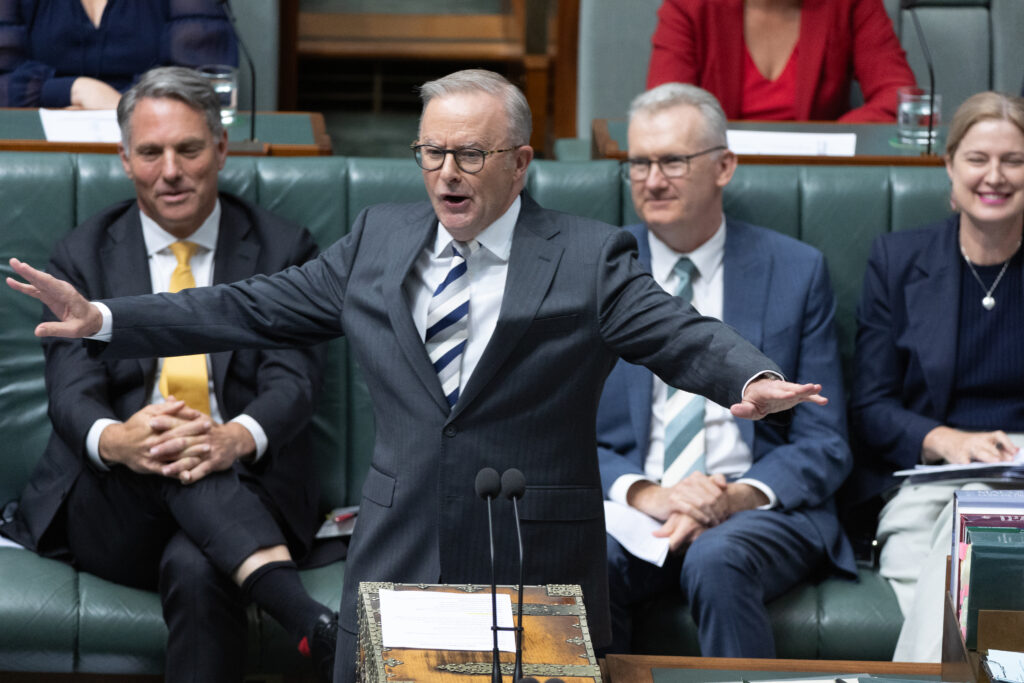
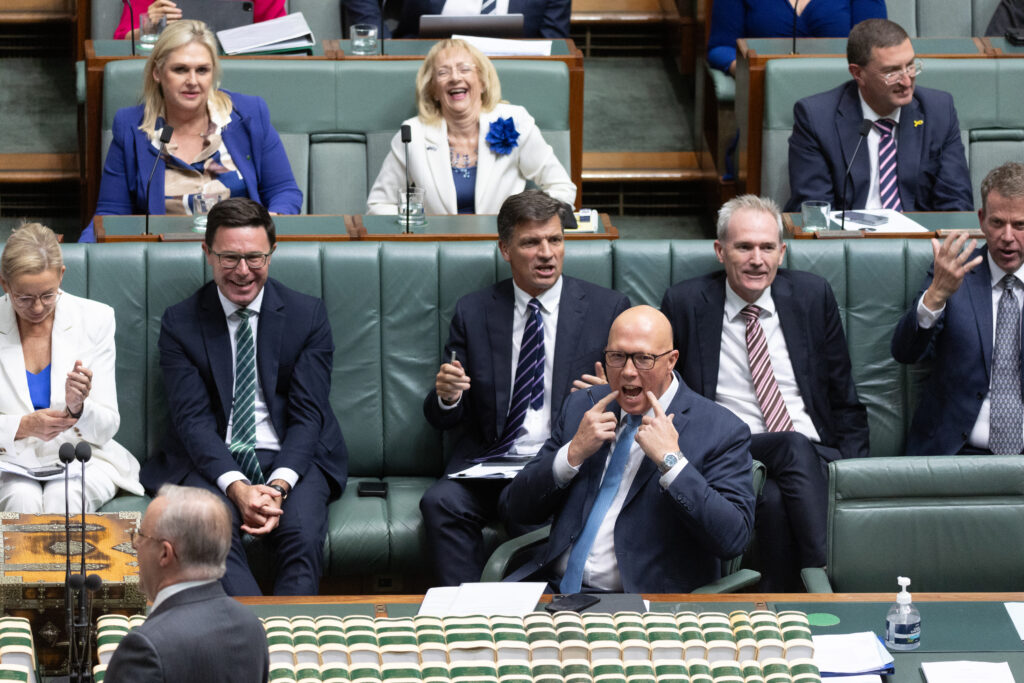
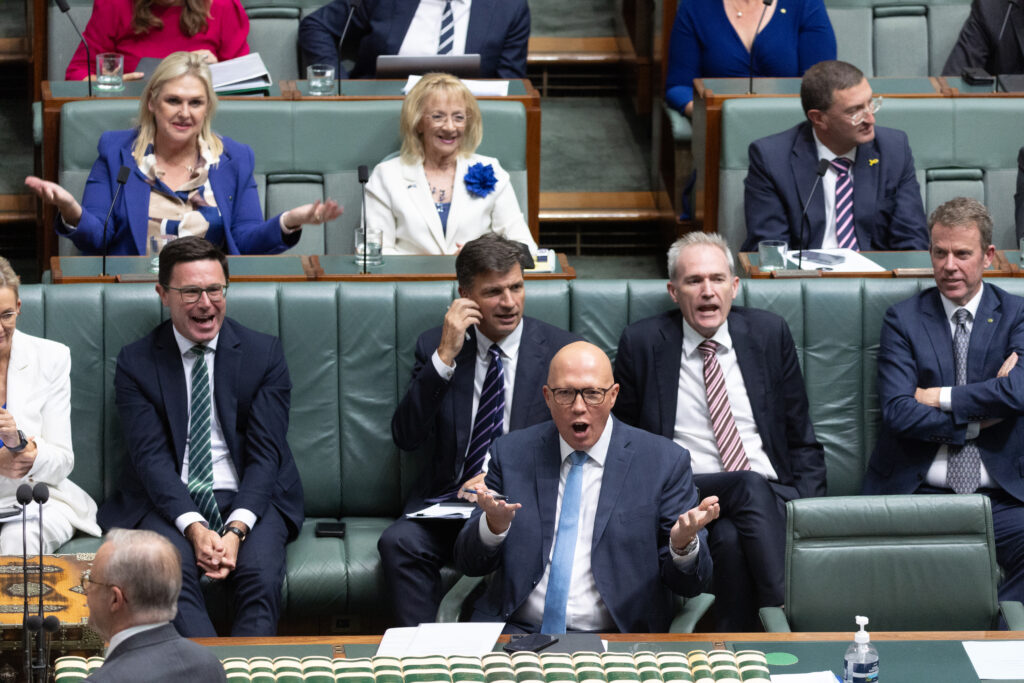
How did the leaders look for their final question time in this house of representatives?

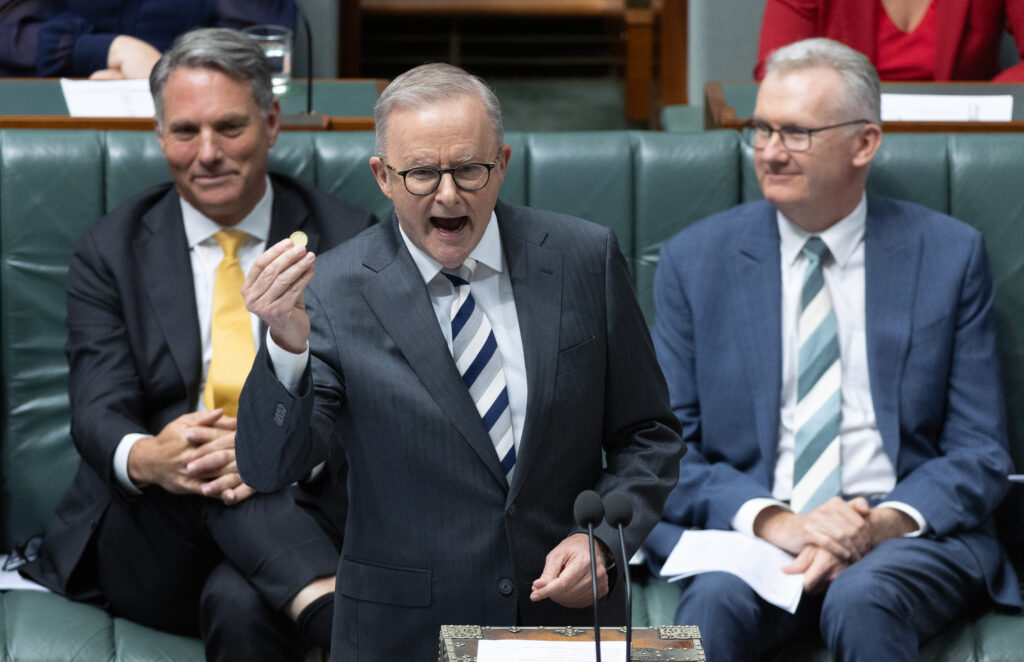
The dollar coin is back (and so is my eye twitch) Prime Minister Anthony Albanese holds up a dollar coin during question time
Anthony Albanese puts on a show
Opposition leader Peter Dutton finds his smile
Peter Dutton wonders where it went.

The changes to industrial relations show that bold policy delivers good outcomes.

Greg Jericho
Chief Economist

The Albanese government has often – and rightly – been criticised for lacking policy boldness in areas such as climate change and the need to address inequality and poverty through measures such as increasing Jobseeker. But with regards to industrial relations, the government has shown that bold policy is not just possible, but also successful.

Prior to the election in 2022, enterprise bargaining was on life support.  Over a decade of efforts by business groups had led to a record low share of 14.8% of employees being covered by enterprise bargaining agreements (EBAs). Enterprise agreements have long been disliked by companies and business groups because, as a general rule, they deliver better wage growth because they enable workers to combine their bargaining power – often and most effectively through representation by a union.

In 2023, the government introduced changes to workplace relations laws which strengthened the ability of workers to bargain in enterprise agreements and also to ensure more workers can be covered by such agreements. One significant policy reform was the introduction of the ability for multi-employer agreements to cover low-paid employees who often have little individual bargaining power.

The latest figures from the Department of Employment and Workplace Relations show that there has been a very strong increase in the number of workers covered by EBAs – up to 21.3%. This is the first time more than 20% of workers have been covered by EBAs since June 2020.

But the even better story is that wage growth is also improving. The average annual wage growth of all workers covered by EBAs is now 4.8%. This is admittedly an abnormal spike in wage growth given the approval of a new multi-employer agreement for 91,000 workers in early childhood education and care (ECEC) in the last quarter of 2024. This wage increase was greatly required to assist some of the lowest-paid workers doing vital work in the ECEC sector.

The average wage growth on newly approved EBAs in the private sector was 4.0% – a level that has been relatively consistent for over a year. This suggests that changes to IR laws are not leading to an unsustainable surge in wage growth but, instead, sustained and steady higher wage growth.

The changes to IR laws have not caused a wage-price spiral. Indeed, since the changes, inflation has come down. But they have led to better wages for workers – especially the lowest paid and those who would otherwise have had little ability to negotiate for better wages.

Bold policy works. and the IR changes should be an example to follow.

https://australiainstitute.org.au/post/increased-enterprise-agreements-and-wages-show-the-governments-ir-policy-is-working/

The last question time for the 47th parliament finishes

That’s it! It’s over. You won’t see the house of representatives look like that ever again.

Anthony Albanese finishes it up with a big run down of the last three years (the bits they want you to focus on anyway) and then wraps it up.

Fare thee well 47th parliament. We barely knew you.

‘Temu Trump’ makes the Hansard

The Greens MP for Brisbane, asking perhaps his final question in the house of representatives, makes sure it is a doozy:

My question is to the Prime Minister. Prime Minister, why would you invite Donald Trump it Australia when you have a Temu Trump sitting right opposite you! (He gestures to Peter Dutton)

I had to laugh – I came up with that term some time ago and it has been quite funny watching it be taken up and spread around.

The parliament erupts, but the laughter is quickly pulled up.

Milton Dick makes him reword the question and Bates is obviously ready:

Given Trump’s attacks on democracy and western institutions, and even threatening our allies and even the PBS, why would you invite him to Australia?

This is because Anthony Albanese said again yesterday there was an open invitation for Trump to visit and he had conversations with him where he had reiterated the invitation. Trump has not accepted.

Albanese:

I thank the member for Brisbane for his question. And Australia has a long standing relationship with the United States, it’s been an important ally since the Second World War. President Trump was elected by the American people last October.

We respect democratic outcomes in Australia. It’s something that I’m very proud of, that we have orderly transitions of power, and we had that between when Mr Morrison lost the election, there was an orderly transition of power. I have had two discussions with the President of the United States. Once after he was elected, but secondly, after his inauguration. Both of those conversations were some of that we had and it reflects the respect that Australia has shown with the United States as important allies.

The United States President will always be welcome in Australia. The United States President, I would expect, will attend the Quad meeting which will be hosted here either next year or the year after. This year’s Quad meeting is in India. The President of the United States has given me the courtesy of inviting me to visit the United States. I have returned the courtesy, as is normal practice. I will continue to engage in a respectful way – notwithstanding the fact that I have some different political views with different world leaders. But what I do is, I engage respectfully across-the-board, and I act in Australia’s national interest. And that is what people would expect of me. And I’ll continue to do that. I’ll continue to stand up for Australia’s national interest, including, of course, with issues such as the Pharmaceutical Benefits Scheme, and other things that are uniquely Australian assets. They say a lot about who we are. The PBS is something that was introduced, of course, by the Chifley government.

It is something that the Australian Labor Party is particularly proud, and I’m proud that we’ve strengthened the PBS by not just having the decrease from $42.50 down to $30, but now the further increase that we support down to $25 as well as 60-day scripts and other measures that we have put in place. Just like Medicare, it is something that I will always defend. Because I think that healthcare and accessibility is something that we should be proud of, if you compare our health system with the American health system. And what happens in this country is that people, no matter how wealthy you are or how poor you are, you have access to proper healthcare that’s something that we should be proud of, and that is something that I will always defend.

Greg Jericho
Chief Economist

Jim Chalmers just said:

“Including the changes to the PRRT, which will see the offshore LNG industry pay more tax sooner as well as the efforts on tax compliance.”

Alas those changes will see less revenue being paid by gas companies.

The PRRT is meant to be paid by gas companies when making excess profits. Alas even though we have an LNG boom, no LNG export project has paid a cent of PRRT

Last year the government changed the PRRT include capping eligible deductions against revenue at 90% of the revenue. They did this after asking the gas industry if the changes were ok. The gas industry said “Oh my god, YES!!!”

IN the 2023-24 budget – before the changes were made, the government estimated that $10.8bn would be raised by PRRT from 2023-24 to 2026-27.

In this week’s budget (after the changes are in place) the government now expects only to raise $6.3bn over those 4 years.

No wonder the gas industry loved the changes.

The coming election is going to mean more people are emboldened to send messages like this.

Dan Tehan gets a question and he looks about as happy about it as your boomer uncle being made to acknowledge their non-binary nibling.

In Labor’s cruel hoax of a budget, 1.8 million new arrivals are predicted to live in Australia over a 5-year period. Can the Prime Minister guarantee that this number won’t go beyond two million?

Tehan is in a LOT of trouble in Wannon, where independent candidate Alex Dyson is coming uncomfortably close to Tehan in the polls. We are hearing that Tehan is making A LOT of phone calls all over the place to try and shore up support and stop people from talking about climate. So that sounds fun.

I’m also not sure how something can be a “cruel hoax” and then also condemn Australia to years of economic insecurity, because if it is a hoax and only a “budget for five weeks” then how is it also real and powerful enough to tank the economy for a decade? Do these people own a dictionary?

Tony Burke takes the question but before he gets there the LNP’s Cameron Caldwell gets booted under 94A.

The guarantee is simple that only a Labor Government can return immigration to sustainable levels. And the laughter is loudest from the man who went the other direction in the strongest possible way. (Peter Dutton) Because to get immigration back to sustainable level, we had to first make sure that we were restoring integrity to the system. Because let’s not forget, let’s not forget the way integrity had been taken from the system under those opposite.

Tehan pretends he has a point of order. He does not have a point of order. Much like he does not have a defensible position on wind farms (which he was for, but now is against because he thinks that will win him his seat)

Burke:

To deal with net overseas which the question asks about, you have to go to the components of net migration. The area with the biggest growth was international students. So the net overseas migration, the 31% reduction year on year is a there that this Government has taken action on the unlimited nature of how international student visas were in place.

Now, when it was actually put to the Parliament whether that should be fixed, those opposite, including the shadow minister who just asked the question, didn’t amend the bill to say – oh, maybe it should be a different number. They actually voted for student visas to be unlimited in Australia. Unlimited in Australia. That’s their position and then they want to get up and ask about what will happen with respect to net overseas migration.

There is a gap from a previous speech that the Leader of the Opposition gave, where he claimed a number as to how low he would get net overseas migration. He’s made a couple of announcements to it, but he’s actually still 220,000 places short. 220,000. If you reduced, if you reduced the student visa system to zero, you still would not fix that gap.

You still would not fix that gap. And it’s not surprising that those opposite had no idea about how to run a system that is sustainable with integrity. Because look at what was said with that with how they ran immigration.

A company whose owners were suspected through the ownership of another company of seeking to circumvent US sanctions against Iran.

…Those opposite ran a system in complete disrepair. Complete disrepair. The only visa they said that they would act on is to bring back known for cash visas where you qualify for a visa in Australia on the basis that you’ve got cash and that’s it.

Jim Chalmers has narrowed the election attack (at least for this part of the campaign)

This morning on radio and then on TV, the Shadow Treasurer made a stunningly stupid admission, Mr Speaker. He said if those opposite win the election, they will legislate to increase income taxes for every single Australian taxpayer.

Now, as far as we can tell Mr Speaker, this is unprecedented. This has never happened before that an alternative government has gone to the people and said – elect us and we will jack up income taxes for every single taxpayer. I can’t imagine they’re happy about this up the back Mr Speaker, and that’s why they’re pretending to read and they’re looking at their shoes once again.

Because this confirms beyond any doubt that if they win the election, Australians will earn less and keep less of what they earn. It makes it absolutely crystal clear that Australians will be worse off if those opposite win the election, Mr Speaker.

And it’s now not just us saying it – it’s the Shadow Treasurer saying it as well. And as a consequence, they would increase tax-to-GDP. They would increase average rates. They would give back no bracket creep and they would harm participation. Now, this will haunt them for every single day of this election campaign, because this renders anything else the Leader of the Opposition says tonight absolutely meaningless

Angus Taylor gets another go:

“Given families are hurting because of Labor’s cost-of-living crisis, what was the logic in delaying by 15 months the Prime Minister’s 70 cents a day tax cut?”

Anthony Albanese takes this one and is THRILLED to do so:

I really, really, really thank the Shadow Treasurer for that question because what I’m asked by the Shadow Treasurer is – why isn’t the policy which have – well, lower, further top-up, our tax cuts right for every taxpayer, all 14 million of them, next year and then the year after making a total with the top-up of $2,500 less tax being paid for average taxpayers, why haven’t you done something that they voted against sooner! (LAUGHTER)

Prime Minister Anthony Albanese during question time in the House of Representatives chamber of Parliament House in Canberra. Photograph by Mike Bowers.

Albanese:

That is what they have asked, Mr Speaker. (INTERJECTIONS) But that wouldn’t be quite so bad. (INTERJECTIONS) Because it’s not just why haven’t you done what we opposed sooner, he’s actually asked – why haven’t you done what we’re going to repeal and reverse sooner?! (LAUGHTER) Having stood up – having stood up… Having stood up now and declared this morning that he would absolutely impose higher taxes on every taxpayer, he then says, “Why didn’t you just do the reverse sooner?” It’s just extraordinary.

Once the Labor laughter dies down, Albanese continues:

They have voted against every measure of cost-of-living support. On Tuesday night, it wasn’t just the lower taxes that the Treasurer spoke about on Tuesday night, it was the cheaper medicines, we know they opposed that. It was the energy bill relief, we know that they opposed that, they opposed the cap on gas and coal prices. We know that they opposed the cuts of $3 billion for student debt and opposed the future cuts that we will put in place that will cut student debt by 20% leading to an average – an average – $5,500 benefit for 3 million Australians. They opposed that. $5,500 for 3 million Australians. We know that proposed the measures that were put in place that allowed 11 million Australians get access to their GP just with bulk-billing. We know that they actually supported tax every time people visited GP rather than that. We know that they have called the largest increase in rent assistance in 30 years – waste. All of the measures we have put in place.

Now, those opposite who have the hide to come in here and say, “Why don’t you do what we oppose sooner?”, it says all about the – the lack of logic in their team. No wonder they have come up with this rubbish

This man is a Rhode’s scholar and thinks he will be prime minister and yet somehow manages to display what an empty head looks like on the outside.

Peter Dutton wants to be part of that answer, as both our major parties fall into line behind America. How wonderful.

Dutton:

I think that was a pretty good answer and I wanted to support the Prime Minister on what I think is an issue of national significance and importance. The Prime Minister and the Deputy Prime Minister have rightly pointed out that we live in the most precarious period since the end of the Second World War and it’s based on intelligence and the advice of the best people in uniform and not just here in Australia, but in Europe and in other allies, intelligence networks as well. It is appropriate that we make this investment and I think the Prime Minister when he was the then-Leader of the Opposition, made a brave call in supporting the Government Then-‘s decision to go with the AUKUS nuclear propelled submarine. It’s a safe technology. It provides the stealth capacity that the Prime Minister pointed out. It gives us the best-in-class of the technology, and it allows us to project and to provide defences to our country in a very uncertain century. And I think to question that is not wise, not in our national interest, and I think it is important for the Australian public and for our allies to hear that there is and there always will remain the bipartisan position when it comes to the submarines as the first line of defence, it will underpin our national security for decades and decades to come.

Independent MP Zoe Daniel has the first independent question (what will the crossbench look like the next time we sit? who knows!)

My question is to the Prime Minister: People in Goldstein are constantly raising with me their concerns about the stability of the Australia-US relationship under the Trump Administration and whether it’s sensible to be spending billions offer the AUKUS deal when the US congressional budget office says the submarines may never be delivered. What is your plan B?

Anthony Albanese:

Well, my plan is to implement the AUKUS arrangements that we’re committed to. I do that for a range of reasons. I do that primarily, though, for one reason – which is that it’s in the Australian national interest for us of the best defence assets that are possibly available to Australia.

And when we have briefings and I’m happy to arrange for appropriate briefings for the member for Goldstein on these matters, if you are an island continent located where we are, the best assets you can possibly have is a submarine, but importantly, you have to then ask yourself – what is the best form of submarine in terms of stealth, in terms of capacity to go long distances whilst not having to snort and rise to the surface? What is the way you can ensure that you are not detectable? And the answer to that is nuclear-powered submarines.

That is something that we have supported – have supported because we think it is absolutely essential for Australia’s national interest.

Daniel:

“The question went to either the capacity or the willingness of the US to deliver such subs.”

Dick rules Albanese is in order.

Albanese:

The AUKUS arrangements, though also have within them pillar 2. What that’s about is the capacity for us to lift up our capacity for advanced manufacturing. So really the most high-tech manufacturing that you can have. One of the things about the defence industry is that there are spin-offs as well. (which we may pay to make, but the US will OWN) I’m very committed to a future made in Australia. One of the ways that we can do that, and that’s why the National Reconstruction Fund for example has a component in it about innovation for defence industries. And working with the United States – which is the most advanced in terms of, obviously, the largest military in the world with the defence industries that they have – there are already companies, Australian companies, such as Austel for example that are located there in the United States, a fantastic operation, of course, based in Western Australia primarily, that will bring great benefit to Australia.

Now, with regard to the support for the AUKUS arrangements in the United States and the UK, I have met with over 100 Congress people and senators in the United States. There was overwhelming support from both Republican and Democrat people who are elected representatives. I have raised this issue in the discussions I have had with President Trump as well and he has expressed his support, as of course Prime Minister Starmer in the United Kingdom who I had a talk with just less than two weeks ago. We will continue to put in place these arrangements because it is in Australia’s national interest and I’m confident that an important part of the defence of this country is the AUKUS arrangements.

Jason Clare, who is going to be one of the main spokespeople for Labor during the election, showed he is still deft with a line:

Turns out now they’re going to jack up your taxes to pay for free lunches for bosses. You got to think for yourself – how ordinary is that? I know the opposition leader spent a lot of time checking out the all ordinarys in the GFC. If he wants to check out the All Ords right now is just check behind him. They’re all ordinary.

Angus Taylor has his serious face on!

The Treasurer has said, quote, “The reason why we support fuel excise relief, we want to see people under less pressure at the bowser. Nothing could make me happier than if there was some pressure taken off families who are doing it tough.” Why is the Treasurer now refusing to cut the full excise to provide immediate relief to cash-strapped Australian families?

Jim Chalmers:

Mr Speaker, the first point that I would make is if the Shadow Treasurer cared about the cost of living, he wouldn’t be the first Shadow Treasurer in living memory to take to an election a policy to increase income taxes on every single Australian taxpayer. (INTERJECTIONS) That’s the first and most obvious point, Mr Speaker. Now, in relation to petrol – in relation to petrol, what we did on Tuesday night from this Despatch Box is we found a way to give ongoing cost-of-living relief… (INTERJECTIONS) ..to every Australian taxpayer. The combination of cost-of-living relief whether it’s cheaper medicines, cutting student debt, strengthening Medicare, tax cuts, energy bill relief, a combination of temporary and permanent ongoing cost-of-living relief in the budget that we handed down on Tuesday night, Mr Speaker. Now, he asked me about comments from before – just before the last election.

Chalmers then goes through how much petrol prices were under Morrison and how much they are now:

That’s a very welcome opportunity, Mr Speaker, to tell the House that when the – during the week of the last budget of those opposite, on the eve of the last election, petrol prices in Sydney were $2.15 a litre, they’re now $1.95 a litre. Petrol prices in Canberra… Petrol prices in Canberra, $2.08 before the last election, $1.92 now. $2.15 before the last election, $1.70. $2.17 in Brisbane before the last election, 1.93 now. $2.18 in Adelaide before the last election, $1.82 now. $2.0 3 before the last election in Perth. $1. 75 now. $2 in Darwin before the last election, $1.81. $2.23 in Hobart before the last election. $1.82 now according to the Australian Institute of Petroleum weekly price report, Mr Speaker.

Now, we have found a much more effective way to help Australians..with the cost of living, and the key difference between our cost-of-living package and what those opposite have come up with the back of the coaster in the last couple of days, Mr Speaker, is we will provide ongoing cost-of-living help to every Australian taxpayer and not only do they oppose that, Mr Speaker, not only do they vote against that in the House and in the Senate yesterday, Mr Speaker, but quite bizarrely, unusually in hist tore call terms, the Shadow Treasurer was asked this morning – will he legislate to increase taxes on all 14 million Australian taxpayers, and he said, “Absolutely”, he would.

As the Prime Minister has pointed out, the between this side and that side, Prime Minister asked would he increase the minimum wage, he said absolutely. Those opposite asked will they jack up taxes for every working taxpayer in this country and they said absolutely and that goes right to the difference.

Question time begins

Peter Dutton:

The Prime Minister has caused a lot of pain to Australian families over the last three years. Will the Prime Minister join with me in cutting the price of petrol and diesel to save tradies, pensioners and families up to $28 a week instead of his 70 cent a day tax cut which doesn’t even come in for 15 months?

It’s not delivered with the energy you would expect.

Anthony Albanese:

“I thank the Leader of the Opposition for his question and, of course, the Leader of the Opposition, I wonder if he gave that speech or that question when he was sitting in the Cabinet room when indexation of petrol was reintroduced in the 2014 budget?

I wonder… (INTERJECTIONS) I wonder if…

Michael Sukkar has a point of order that is not a point of order:

The Prime Minister can’t give us a history on 100 years of excise. That cannot be relevant to the question. (INTERJECTIONS) It does in the mean that, for example, the Prime Minister can talk about things that happened 100 years

Speaker Milton Dick has to tell everyone to “take a deep breath” which is like telling toddlers to stop crying. (The toddlers are more rational).

Albanese:

I was talking about the temporary – the temporary one-year decrease that they have said, they will put out there. The Morrison leftovers have adopted the policy of the Morrison Government… (INTERJECTIONS) ..just like they did in 2022, Mr Speaker, when in the budget in 2022, they brought in a temporary measure and then it disappeared. And then it disappeared. That’s what I’m asked about. And the reason why it’s at the level it is today is because of the legislation that they brought in (INTERJECTIONS) in 2014.

That is why it is the level it is at today.

But those opposite have a view where this morning… they’re out there having voted against tax cuts for every taxpayer yesterday… (INTERJECTIONS) ..they this morning have declared they are the first opposition to ever say, “If you elect us to Government, we will increase the taxes for every single taxpayer.” “Every single taxpayer” will pay more tax if they’re elected at the election in May. So what we know now is that they have four policies. They have a nuclear power plan of $600 billion that they have to find cuts for.

Then they have their lunches, their lunch policy… (INTERJECTIONS) We haven’t forgotten about that. And then they have the further cuts that they have spoken about – further cuts that they have spoken about, but now they have something else as well, Mr Speaker, because we know the only thing they don’t want to cut is people’s taxes. Not only do they not want to cut them, not only did they vote against them, what they want to do is actually to jack them up for every single taxpayer. An extraordinary policy from those opposite who just don’t get it who have not put forward a single – a single lasting cost-of-living plan and opposed every single measure we have put forward.

Last question time of the 47th parliament about to begin

We are just about to enter the chamber for the last question time of this parliament.

There is a bit of an end of school day vibe to the parliament today. Not very demure. Not very mindful (if you get our drift).

Tania Lawerence, the Labor MP for Hasluck gets the gong to deliver the last members’ statement before question time – it is all about what is “at risk” if the Coalition is elected.

“DON’T TRUST DUTTON” she yells, just before Milton Dick calls the house to order.

Here we go.

2025 Dutton contradicts 2024 Dutton on tax

We don’t know if the Coalition will make mortgage repayments tax deductible rumours is true, but we do know that the Coalition, “the party of lower taxes” is planning on repealing income tax cuts which have already been legislated – essentially promising to INCREASE taxes. Wild times.

So let’s take a look at what Dutton said in last year’s speech:

https://peterdutton.com.au/leader-of-the-opposition-budget-in-reply-check-against-delivery-2/

Taxation is the killer of aspiration.

The working individual supports themselves, their family, community, fellow Australians and our country.

People should be rewarded for their hard work by keeping more of what they earn so they don’t become the new working poor.

The more you keep from what you earn, the less you’re dependent on the state.

And the more freedom and choice you have to realise your aspirations.

Be it studying, travelling, educating children, starting a business, owning a home, or retiring comfortably.

Your money is your money – not the government’s.

Under a Coalition Government I lead, your taxes will always be lower.”

Seems the department of prime minister and cabinet hit send a little bit too early on their scheduled tweet:

Banning foreign investors from buying existing dwellings won’t help housing prices

Jack Thrower
Research economist

Labor know that negative gearing and the CGT discount push up housing prices. That’s why they went to the 2016 and 2019 election saying they would crack down on it.

Their latest budget has shown they still believe this is the case. The budget bans foreigners from buying existing dwellings. This shows Labor knows that investors buying existing housing pushes out first-home buyers.

But foreign buyers only make up a tiny part of the market. If they really want to increase home ownership, they need to reform negative gearing and the CGT discount.

If the Government fixed negative gearing and the capital gains tax discount, we could stop housing speculation, raise billions, and reduce inequality.

Also in the budget:

In its first budget the Government funded work to establish “an independent Makarrata Commission to oversee processes for agreement making and truth telling”. Unfortunately this funding expires this year and the budget includes no further funding. The Prime Minister has said that the money is being diverted, but it seems clear that the Government continues to back away from its commitment to the Uluru Statement from the Heart.

Jack Thrower
Research economist

Australia is worried about American tariffs while continuing to adhere to our ‘free trade’ with the US which was a bad deal then and even worse now.

Instead of reconsidering this agreement, the budget shows the Government is spending $20 million (less than $1 per person) to “encourage consumers to buy Australian made products”.

Rumours, rumours everywhere….election called tomorrow and Coalition considering making mortgages tax deductible??

So there are a couple of big rumours which have taken hold in recent hours, and we stress that these are rumours (as in no one will confirm them) but given it’s the last day of the 47th parliament and everything is going a bit nuts, we thought we would fill you in.

One is that Anthony Albanese will call the election tomorrow. That would put an end to estimates and to any momentum Peter Dutton gets in his budget in reply speech (nothing takes attention away like an election!). Given the Oz is already running that Dutton hasn’t even had to give ‘the speech of his life’ to change the game and that the election call is actually a sign of “no confidence” in Chalmers’ budget and NOT BECAUSE THE BUDGET WAS ONLY DELIVERED BECAUSE A CYCLONE DELAYED THE ELECTION CALL THAT WAS ALWAYS GOING TO BE FOR MAY, it is worth nothing.

The other big rumour that is sweeping the place, including Labor offices, is that Peter Dutton will announce the Coalition will make mortgage payments tax deductible. This was floating around yesterday and so far there has been nothing to back it other than the rumour, but given how far it is starting to spread, we thought we would clue you in.

IF that was true:

  1. It will obviously mean people can borrow more and bid house prices up
  2. It will cost a fortune 
  3. The biggest benefits wlll go to those with the biggest mortgages 
  4. The higher your income, and the higher your marginal tax rate, and in turn the bigger the benefit

Coalition’s fuel excise savings questioned

Matt Grudnoff
Senior economist

Angus Taylor has been out spruiking the Coalition’s cut to fuel excise. But he seems to be assuming that the average driver fills up the tank once a week.

But in reality, two thirds of drivers fill up once a fortnight or less. In fact, we’ve crunched the numbers and the average driver will save only $9.80 per week or $510 per year. That’s less than Labor’s tax cut when it is fully implemented. A tax cut the Coalition has called a “cruel hoax”.

The cut in fuel excise will also encourage people to consume more fossil fuels.

If you walk to work, ride a bike, or catch public transport then you’ll miss out.

If you did the right thing and bought a hybrid or electric vehicle, you’ll get less.

If you work from home, then this is not going to help you.

This is poorly targeted cost of living relief that will also make it harder for us to meet our emissions reduction targets.

Dutton assumes that most people fill up a 55l tank once a week, whereas in reality both ABS surveys and those done by morning groups say that is the exception. A Budget Direct car insurance survey found that around two-thirds of people only fill up once every fortnight or less!

Getting rid of non-compete clauses (for workers earning under $175,000 – which good news – is almost all of us!) is a good thing and this is one of the reasons why

Tanya Plibersek’s Sydney voters care about salmon farming new poll finds

Sydney voters care about fish deaths and the impact of commercial fishing in Tasmania, according to a new poll.  

The federal government last night rammed changes to Australia’s environment law – aimed at protecting salmon farming operations in Tasmania – through the Senate. 

The legislation aims to scupper a long-awaited review of salmon farming in Macquarie Harbour, on Tassie’s west coast, by Environment Minister – and Member for Sydney – Tanya Plibersek. 

While the legislation was promised and driven by Prime Minister Anthony Albanese, this poll suggests voters may punish Ms Plibersek, revealing her first-preference support has fallen to 41.1%, down from 50.82% at the 2022 election.

The Australia Institute commissioned the polling from uComms, which surveyed 860 Australians living in Sydney between 17 and 18 March 2025.  

Key Findings: 

·                     61% support stopping salmon farming in areas where it is putting the endangered Maugean skate at risk of extinction; more than twice as many who oppose (24%). 

·                     63% have heard about the mass fish deaths currently happening in the salmon industry in Tasmania. 

·                     68% think the current mass fish deaths are having a negative impact on Tasmania’s ‘clean and green’ brand, including 36% who think it’s having a significant negative impact. 

“Voters in Sydney and all around Australia understand and have watched in horror at what’s happening in Tasmania,” said Eloise Carr, Director of The Australia Institute Tasmania. 

 “That includes voters in the Environment Minister’s own seat. 

“This poll was conducted before the amendments to the environment laws were rushed through. 

“If voters were angry then, they’re even angrier now. 

“If this shambolic, chaotic process was designed to shore up votes in Tasmania, it could blow up in the government’s face on the mainland. “  

Given it is the last sitting day of the parliament, there is not a lot going on.

Which means that Andrew Leigh is moving through a lot of maintenance requests, and requests for works on public buildings.

It is that sort of day. So if you have a maintenance request, better get it in before end of business!

Health Minister says EPBC don’t weaken protections

Speaking to the ABC a little earlier this morning, federal Health Minister Mark Butler argued the provisions in the environmental laws were “ridiculous”, while sidestepping a question about whether the changes impact Australia’s international reputation after Leonardo DiCaprio showed his support for the Maugean skate on Instagram.

“It doesn’t water down any of the other environmental protections that we have in place,” Minister Butler said.

Riiiiggghhhhtttt.

Here’s what the amendments do:

  • Increase the likelihood that Australian native species will become extinct, driven by a government which promised no extinctions under its watch.
  • Protect the destructive, foreign-owned commercial salmon industry in Tasmania.
  • Potentially stop anyone – from local community groups to Federal Government Ministers – from reviewing projects like coal mines, gas exploration, land clearing or other destructive practices.

The Australia Institute Tasmania Director Eloise Carr summed it up when she said: “for once, just as our nature law was about to do what it is supposed to – protect world heritage and species threatened with extinction – the major parties have changed the law”.

Also, let’s not forget a decade ago Anthony Albanese described similar proposed changes to the EPBC has an act of environmental vandalism.

How things change. And not for the better.

We don’t need no Education

Trump has signed an Executive Order that seeks to dismantle the Federal Department of Education – but can he actually do it?

On this episode of After America, Dr Emma Shortis and Angus Blackman discuss Trump administration group chats, Big Pharma’s big whinge, and the history of conservative efforts to dismantle the federal Education department.

Over on Perth radio 6PR, Anthony Albanese was sharpening his attack against the fuel excise cut the Coalition has announced:

The problem here with Peter Dutton is not only that is his team made up of the leftovers from the Morrison Government, they’re now adopting leftovers of the Morrison policies. That’s what they put in place in 2022 in their budget before they called the election. And of course they legislated to make sure that that decrease disappeared and this one will disappear as well. There’ll be no ongoing cost of living relief. What we’ve done is provide ongoing cost of living relief. Not just tax cuts, but cheaper medicines, cheaper child care, Free TAFE that we’ve legislated, the schools funding program that we’ve been able to deliver. The tripling of the bulk bill billing incentive for Medicare will mean not just for a year or two years, but forever. We want to lift the bulk billing rates to 90 per cent for Medicare. Urgent Care Clinics will be there forever so that people can get the health care that they need. If it’s not a life threatening emergency, they have somewhere to go rather than the emergency department. This is what good policy looks like and that’s what we implemented in Tuesday night’s budget and that’s what my government will do, building on the foundations that we’ve laid in our first term.
 

His team have been on the ball as well – making sure he was aware of the fuel prices in the city to which he’s calling in:

Q: Cheaper petrol though, for one year or not, is pretty appealing. Have you filled up lately? It was about $2 a litre yesterday in Perth.
 
Albanese:

Yeah indeed, I’m fully aware. The latest figures that I have is that in Perth per litre was around about $1.75 – I know people do shop around. But the last fuel excise reduction ended when the Liberals legislated it to end. And what they’re committing here to do is to end it again. Introduce it for a short term to get through an election campaign and then get rid of it at the same time as they are actually promising to legislate higher taxes. The first time in the entire time I’ve been involved in politics, which has been around for a while, that any government or opposition have said, ‘Vote for us and we’ll give you higher taxes for every single Australian taxpayer’. Not just for some, every taxpayer will be paying higher taxes under them. And they don’t support our cost of living measures.

What is really behind the government debt figures?

David Richardson
Senior Fellow

The Fin and others like to quote Australia’s gross debt which is expected to be $1,022 billion or 35.5% of GDP at the end of 2025-26. By contrast the government, the IMF and OECD tend to concentrate on net debt which is expected to be much lower at $620 billion or 21.5% of GDP. This is a big difference.

Why the difference? A lot of the gross debt is covered by liquid financial assets such as cash and deposits, advances paid and investments, loans and placements. These can be easily liquidated to repay debt if needs be. These account for the difference of $402 billion leaving the net debt at $620 billion.

It is also worth noting that the

·         net debt is expected to finance $185 billion in equity-like investments (lots of that in the Future Fund). Basically this amount of debt supports the FF and other equity investments, and

·         a big part of the debt includes “unfunded” employee and superannuation liabilities of $374 billion. The latter is a purely notional amount reflecting amounts the government pays each year from consolidated revenue. It is not an actual fund used to pay super entitlements. For more click here.

Anyway adjusting for those two, leaves just $61 billion or 2.1% of GDP.

Penny Wong won’t give clear answer on whether Netanyahu is banned from Australia

Skye Predavec

Penny Wong is getting questioned by the Coalition’s Michaelia Cash and James McGrath on Israeli prime minister Benjamin Netanyahu being welcome in Australia and is refusing to give a clear answer:

Cash: Minister, is Prime Minister Netanyahu welcome in Australia?”

Wong: “…That is a hypothetical and I won’t be responding to it”

The context here (not that the Coalition is thinking about this) is that Netanyahu is wanted by the International Criminal Court for war crimes and crimes against humanity. As a signatory to the ICC, Australia is under obligation to arrest Netanyahu if he steps into Australia’s jurisdiction. That’s not what the Coalition is seeking to discover here – this is part of the ‘criticising Israel is anti-Semitic’ campaign it has been running, but it is absolutely the context needed here.

Here is how Sydney radio 2GB is selling the tax cuts:

“The Prime Minister is saying that Aussies will have to wait for those tiny tax cuts. You’re saying that the fuel changes will be effective immediately if you win.”

OK, so let’s look at this question Peter Dutton received. It’s the definition of ‘friendly’ media.

‘Tiny tax cuts’ – this is from the same organisation that tried to say that stage three tax cut changes – which distributed the cuts across all tax brackets, not just the top 10% was a “broken promise”. Now those tax cuts are flowing and people are seeing it in their pay cuts, there is no mention of that, only ‘tiny’ tax cuts in relation to the new legislated cuts.

Also not mentioned – the Coalition’s fuel excise policy is only in place for a year. One year. That’s it. It’s $6bn for one year and will only make the difference the Coalition is claiming (about $750 a year for one average family is their figure) if the geopolitical space doesn’t go to shit. Because the moment there is any sort of invasion, threat to oil, supply chain problem, then fuel goes up and those savings go down. That is exactly what happened when the Morrison government did it.

And the fuel excise comes in the year before the tax cuts – so it doesn’t make sense to say that it is ‘in place of’ in terms of the budget position. There is no money foregone on the new legislated tax cuts until after the fuel excise is FINISHED.

It’s about the same cost to the budget year on year anyway, which is why they are saying it’s only for a year. Because the $17bn figure for the tax cuts is for THREE years – so just under $6bn a year. $6bn over three years is $18bn. The Coalition has already said that $17bn over three years is irresponsible so…here we are. A one off fossil fuel subsidy and a promise to increase taxes.

But of course that is not how it’s framed.

Anthony Albanese defends saying Peter Dutton is ‘delulu with no solulu’

Meanwhile, Anthony Albanese is also going viral on Tik Tok for calling Peter Dutton and the Coalition “dululu with no solulu” in question time yesterday (we were busy watching a dead fish in the senate)

Here is the origins of that particular villain story:

@listnrentertainment

SCREEAAMING! Prime Minister of Australia #AnthonyAlbanese five mins after hanging out with @LUCY AND NIKKI on #happyhourwithlucyandnikki #deluluistheonlysolulu

♬ original sound – LiSTNR Entertainment

The ABC’s Sydney radio host asks if he he knew what he was saying and Albanese says:

Yes I did and I do think that Peter Dutton is delusional if he speaks about fiscal policy and deficits given that he left deficits of $78 billion that we turned into a surplus. Another deficit of above $50 billion that we turned into a second surplus of $15 billion and then we’ve halved the deficit that we inherited this year. But this morning Angus Taylor’s made the rather extraordinary statement, declaration, that they will repeal our tax cuts. That is, they will introduce legislation for higher taxes. So, under Peter Dutton people will earn less and they’ll be taxed more.

New media, podcasters and content creators will all be part of Labor’s election strategy – it started well over a year ago when Labor invited social media influencers and new media for a budget briefing, which is something they repeated this year. But since the Democrats loss and Donald Trump’s ownership of the manosphere through new media and podcasts, Labor has ramped it up. There are journalists already grumbling about new media and content creators being on the election campaign, but politicians aren’t doing it for cred – they are doing it because THAT IS WHERE THE AUDIENCE THEY WANT TO REACH IS. People under 35 are not turning to legacy media for their news. There’s a gap, it is being filled, and politicians want in. The Coalition, Greens and independents will all be doing it too. If legacy media want those audiences, they have to give them what they want, and so far the data is saying that is not happening.

Election call won’t be today but is “imminent”

Talking to Hobart radio Triple M, Anthony Albanese got to listen to some Cold Chisel which he enjoyed.

He might then enjoy knowing that Jimmy Barnes is among the signatures urging the government to protect sacred Indigenous rock art by not extending the North West Shelf gas project.

He’s asked about when he will call the election and says:

It’ll be called pretty imminently, I can assure you of that as well, I think,” he said.

Well duh.

At the moment, the hottest take is that he will do Insiders on Sunday and then drive from the studio to Government House, calling the election.

But it will be called in the next 72 hours, so the when doesn’t really matter. It’s all about theatre at this point.

Worried about the budget deficit? You shouldn’t be.

Matt Grudnoff
Senior Economist

The Australian Federal Government rarely runs budget surpluses. If we look at the last 100 years, going all the way back to 1926-27, the government has run 20 surpluses and 80 deficits. But over the same time our living standards have boomed and despite what some politicians and commentators might say the government has never looked like going broke.

Australia is not unusual in mainly running deficits. Looking at 33 developed countries, only 5 are running surpluses. All the rest are running deficits. The last time the United Kingdom ran a surplus, Tony Blair was Prime Minister. The last time the United States ran a surplus, Bill Clinton was President.

One country that bucks this trend and consistently runs budget surpluses is Norway. This is because Norway has a sovereign wealth fund worth almost $3 trillion. This is invested overseas, and the fund pays into Norway’s budget.

The money in the fund has come from taxing its oil and gas industry. Imagine that? If only Australia could do the same.

In the meantime, the budget showed that revenue from the Petroleum Resource Rent Tax continues to fall. The PRRT is supposed to ensure that the federal government gets a fair share of the gas that all Australians own.

PRRT revenue is smaller than excise on beer, even after the government paused the beer excise.

It is smaller than tax on tobacco, even after the government massively revised down tobacco excise.

The PRRT is even smaller than the money the government collects on visa application charges.

Budgets are about choices. Norway chooses to properly tax its oil and gas industry. We give it away in the form of massive profits to foreign owned companies.

We have spent a lot of time this last week criticising Labor’s policy decisions – which is entirely valid – they are the goverment, they have power and the decisions they are making are not in the best interest of the environment, the future, or Australia has a whole. The budget did leave behind people living in poverty, there is no structural reforms of the tax system on the horizon and nothing in the budget will address the housing affordability crisis or growing inequity across our communities.

Add in Labor’s position in refusing to sanction Israel, as international law dictates, or stand up to vested interests like fossil fuel companies (and even News Corp most of the time) and it’s not exactly inspiring.

But that doesn’t mean we are also not taking a critical look at what the Coalition is offering. It not only supported Labor’s gutting of environmental protections this week, it is heading to an election having opposed energy bill relief, is promising domestic gas reserves by opening up more fossil fuel projects (rather than redirecting what we export – and let’s not forget that in opposing energy bill rebates, they also opposed the gas reservation policy that was part of it), forcing people back into the office, even though it will make the life of people with care responsibilities (mostly women) harder, sack 41,000 people (at the minimum), repeal tax cuts and offer a temporary fossil fuel subsidy in its place, approve a fossil fuel project that will be like adding the emissions from 12 coal fired power stations into the atmosphere every year, increase housing costs even further by giving people access to their super, which then makes them poorer again when they retire, cut migration without thought to the labour market, further criminalise protests (if those protests are against genocide or for climate action), add it’s definition of anti-Semitism to visa forms, deport people who are critical of Israel, and potentially cut from basic public services imposing austerity on the nation.

Not much of a choice, is it?

Here is a little more on Angus Taylor explaining the fuel cut excise.

On the face of it, I would say these figures need a bit closer examination:

Sabra Lane: How much does this equate to a week? Tax cuts that the government’s just legislated $5 a week, roughly. Yours?

Angus Taylor: Well, typically, over the course of a year, it’ll be, if it’s a tank, a family, it’d be $750. If it’s two tanks, it’s $1,500. So that’s a family.

Lane: So that’s roughly …

Taylor: So that’s a family …

Lane: $14 a week or something?

Taylor:

Yeah, something like that. $14 a week. $28 a week for a week for a two-tank family and I mean, that’s a significant help at a time which is really troubling for those sorts of families and I say, this is the group who are also suffering the greatest mortgage stress, who have the least capacity to deal with the pressures that they’re under, and any shock they might have on those pressures, whether there’s a big health bill or something else like that coming along.

This is a policy aimed at the Coalition’s ute’s drivers – the same ones they defended against the EV subsidy. Hybrids are becoming increasingly popular, which this policy doesn’t seem to take into account (deliberately so, one would imagine)

So the sell the Coalition is offering is that it will lower the price of fuel (assuming there are no global supply chain shocks that negate the temporary cut – as happened with the previous fuel excise cut the Coalition temporarily introduced) for one year, in place of ongoing tax cuts. The party of lower taxes wants to repeal tax cuts to own Labor.

That’s where we are.

Senate estimates is about to get underway – there will be two days of insanity before the election campaign gets officially underway.

Today we have Finance and Public Administration Committee

Legal and Constitutional Affairs

Environment and Communications

Rural and Regional Affairs and Transport

“If you can do it for the rotten salmon industry it will be the gas industry or coal industry or big polluters next”.

The fallback position is that this legislation, which takes away the environment minister’s reconsideration powers, and limits communities accessing the research and advice from third party civil society groups (like the Australia Institute) is that it protects jobs.

If a toxic sludge company was pouring toxic sludge into waterways every single day, but employed 60 people, would you stop trying to close down the toxic sludge company? Because that would be jobs too, right?

There is a narrative in the media that the salmon industry is SO important to Tasmania, because it is one of the only jobs available, which is bupkis. The industry is responsible for less than 1% of jobs in Tasmania. And in Macquarie Harbour itself? It’s 60 jobs. SIXTY. It would be cheaper to help those workers transition into other jobs than continue to prop up a foreign owned industry that pays no tax in Australia and sends its profits off-shore. But everyone is convinced it’s about ‘jobs’.

Hanson-Young says:

That’s one of the crazy things about this is that the impact on the environment and the clean, green image of Tasmanian food and the environment is all at risk because of this. These companies don’t pay any tax. They’re trashing our waterways, pushing animals to extinction and what they’ve got now because of the Labor Party and the Liberal Party’s lack of courage, bowing to the pressures of the corporations, is a law that gives them a carve-out from environmental protection. Who is next? If you can do it for the rotten salmon industry it will be the gas industry or coal industry or big polluters next.

Sarah Hanson-Young said it was worth bringing a dead (plastic wrapped) fish into the senate chamber, even if she didn’t convince the Coalition to vote against Labor’s laws and the Greens will now use it as an election issue (the environment, not the dead senate fish):

Yes, it absolutely wasn’t the reason being, of course, this terrible law that has now passed the Parliament under 4 hours from the moment it was introduced was being done under the cover of the Federal Budget. The Federal Government, the Labor Party, didn’t want people to know they were doing this. They wanted it rammed through while everybody was distracted on their budget night announcements. So, you know, we have at least put the spotlight on what’s happened. This is really bad. This is a bad law that is now going to mean that, you know, when there are activities underway that are trashing the environment, that are pushing animals to extinction, that the Environment Minister no longer has the power to step in and say, “Hang on a minute, we got to have a look at this and we have to make sure we can look after the environment and stop or modify the dangerous and damaging activity.” This is a gut to Australia’s environment protections, and what it means is that Australia’s environment laws are now worse than they were when the Labor Party came to office and that is absolutely shameful. It’s going to be an election issue. The environment is a major concern to Australians and we’re going to take this fight all the way to the ballot-box.

Greens Senator Sarah Hanson-Young has also been doing the media rounds this morning and said the government spending $37m re-oxygenating Macquarie Harbour to help improve water quality and save the Maugean Skate (the salmon farms are leading to a decrease in oxygen in the natural waterway, which is one of the issues impacting the skate) shows that there is a massive problem with having salmon farms in the area:

That says everything – and they got these foreign-owned salmon corporations that don’t pay any tax that are trashing and polluting the waterways, pushing our native species to the brink of extinction, and the taxpayer is funding millions and millions of dollars to put oxygen into the water, to oxygenate the water to look after the skate because these companies want to keep making rotten, stinking profits off this rotten stinking salmon industry.

Looking a little deeper into the temporary Coalition fuel excise cut policy

Let’s take a look at the Coalition’s temporary fuel excise cut.

Because that is what it is. Temporary.

So it will come through faster than Labor’s tax cut top up, but won’t be part of the system. That is how they are costing it at $6bn – because if they were to extend it over three years, then it would be $1bn more than Labor’s tax cut plan (which is $17bn over three years)

The messaging will work well with the Coalition’s base – white men with giant utes – but probably won’t do a lot to convince the undecideds.

Greg Jericho tells me this will be the first Coalition since 1972 to not have a tax cut policy.

Taylor’s line is that it comes through immediately, unlike the tax cuts that won’t flow through for another 15 months. Labor has already put through tax cuts, which people are seeing reflected in their pays, and is hoping that will be enough of a reminder that it is helping people with cost of living, along with the temporary extension of the energy rebates.

The Coalition is hoping that it will seem like it is being ‘more economically responsible’. Because they don’t need the tax cuts to pay for the fuel excise – the excise will be finished before the tax cuts flow through.

It’s more tinkering – the Coalition isn’t offering anything in terms of structural reforms, and it will appeal best to those already voting for them. But this election isn’t going to be fought on policy, just vibes. And the Coalition is hoping some of those vibes will go their way.

In case anyone still wanted to go to the United States (and risk arrest, being lost in immigration detention and spending thousands to get out – if you do) then the agreement to streamline travel between Australia and the US has been formalised!

Huzzah!

From the government release:

The Albanese Labor Government has passed legislation that will allow eligible Australians to apply for easier passage through US airports.

The United States’ Global Entry Program provides an avenue for eligible citizens of trusted partner countries to access expedited clearance processes on arrival in the US.

This is a mark of the closeness of the relationship and trust between Australia and the US and will be welcomed by Australian tourists, business leaders and corporate travellers who will be able to join faster entry lanes when they arrive in the US.

This program is voluntary, and only available for pre-approved, low-risk travellers who meet the strict eligibility criteria as set out by the US. Both Australia and the US will conduct background checks on Australian applicants.

The Global Entry Program membership also opens up eligibility to TSA Pre-Check program, making travel within the US a much simpler process.

A limited number of Australian citizens have been able to apply for Global Entry Program from January this year under phase one, which is now closed. The passage of this Bill will pave the way for the expansion of the program to all eligible Australians with phase two expected to commence in the second half of the year. 

Over on ABC TV, Angus Taylor is continuing his media blitz on the fuel excise, speaking to ABC TV and claiming they are more “responsible”

Labor’s policy is go going to cost $17 billion (over three years)

This is substantially more responsible.

But the important point is that it can be because it’s very, very targeted and it’s temporary. Also immediate – so it will be July 1, you’ll be waiting 15 months for Labor’s policy to come through, (this is the main line you’ll be hearing at the election) but more broadly, we have opposed $100 billion of Labor spend that we think is inappropriate at this time and I can assure you we’ll put our costings out before the election.

It will be a more responsible position than Labor’s, and importantly, we’ll re-establish those fiscal rules that households have to abide by, that businesses have to abide by, but that Government has thrown out since Labor came to power which has meant we got an extremely irresponsible budget where frankly the Treasurer has driven the budget off a cliff. (Morrison and Frydenberg also had deficits forecast. Not that deficits are inherently bad, but if we are going to get into it…)

Health minister Mark Butler has spoken to ABC radio RN, saying the government doesn’t believe that cutting the tobacco tax would do anything to combat the blackmark trade in tobacco. Organised crime gangs have stepped up their illegal tobacco businesses (and the violent crime that goes with organised crime activities) as smokes and vapes in Australia become more expensive.

Butler says it’s enforcement, not tax cuts that will solve the problem:

I don’t accept is the idea that if you make legal cigarettes cheaper, first of all, you’re you’re going to knock out illegal cigarettes. I don’t think there’s any evidence of that around the world markets like the US, many in the Europe that have cheaper legal cigarettes. In the US as case, quite cheaper legal cigarettes still have rampant black markets. So so you’re not going to get rid of the black market and organized crime in illicit tobacco just because you reduce the price of illegal cigarettes. The other reason is we know that cheaper cigarettes will drive up smoking. It’s no coincidence that Australia has some of the highest prices of cigarettes, but also some of the lowest rates of smoking in the world. So I’m not going to sort of raise the white flag on one of the most important measures around tobacco control, just because organized crime has got their hands into the illicit tobacco market. The answer is enforcement. It’s about tracking them down. It’s about putting them in the dock, and it’s about at the end of the day, putting in place really serious penalties.

Angus Taylor denies he’s hurt colleagues are backgrounding against him

In case you have missed it, there is a bit of a tussle going on in the Coalition. Angus Taylor was accused by some colleagues (privately) of backgrounding against Peter Dutton. There is some suggestion from some within the LNP who think Taylor is preparing for a leadership challenge if the Coalition lose this next election. (With Andrew Hastie to follow Taylor. What a line up.)

So of course, the response has been for some Dutton loyalists to start backgrounding against Taylor.

Dutton addressed this in the party room meeting by saying that Taylor had his full support and to stop white-anting him in the media. And we all know what that means.

Taylor is asked about it on ABC radio and says:

One of the one of the wonderful things about our jobs, yours and mine is we get lots of free advice. We only have to go onto Twitter to see that, probably for our mental health we shouldn’t do that…but the point is, that’s part of what what you have when you you’re pretty high profile.

…I’ve got, I’ve got, as you, as you would have seen, a very large number of colleagues who are massively supportive of what Peter and I are doing, because we are fighting hard against a bad Labor government that has left Australians poorer, and we can’t afford another three years of that.

And let me tell you, my colleagues understand that Peter has made that point on many occasions, and we will continue to fight hard for those hard working Australians who deserve relief at the bowser, who are paying too much for everything right now and who can get a better deal.

Are the ‘colleagues’ in the room with us now?

Angus Taylor and his massively supportive colleagues:

Coalition vows to repeal Labor tax cuts

Angus Taylor tells the ABC”s Sabra Lane that ‘the party of lower taxes’, the Coalition, would repeal Labor’s most recent tax cuts if they win government and replace it with the fuel excise cut.

“We absolutely would repeal it,” he said.

“This is a lower tax, let’s be clear. It’s a lower tax, and it’s alongside other major tax initiatives we’ve already announced, like accelerated depreciation for small businesses, like making sure we don’t have taxes on unrealised capital gains, and like, establish or re establishing the tax to GDP cap to make sure that over time, taxes are contained for Australian families.”

Australia Institute view

This is a dark day for two of Australia’s greatest treasures: the environment and our democracy.

Last night’s passing of amendments to the Environment Protection and Biodiversity Conservation Act weakens the protection of our natural treasures, rammed through by a government which promised greater protection.

The amendments increase the likelihood that Australian native species will become extinct, driven by a government which promised no extinctions under its watch.

The amendments are designed to protect the destructive, foreign-owned commercial salmon industry in Tasmania.

But the changes could stop anyone – from local community groups to Federal Government Ministers – from reviewing projects like coal mines, gas exploration, land clearing or other destructive practices.

 “This bill has ramifications for industries that goes well beyond salmon. It will affect all industries governed by this legislation,” said Eloise Carr, Director, The Australia Institute Tasmania.

“Labor and Coalition MPs described what they were trying to achieve as ‘fixing a flaw’ in the EPBC Act. There was no flaw in the law. 

“For once, just as our nature law was about to do what it is supposed to – protect world heritage and species threatened with extinction – the major parties have changed the law.

“We have a parliamentary process to scrutinise laws before they pass. But not this time.”

Ten years ago, Anthony Albanese described similar changes proposed by the coalition government as an act of environmental vandalism. 

“Now, Anthony Albanese and his government have committed environmental vandalism,” said Eloise Carr.

As if all that isn’t bad enough, the amendments have been so poorly drafted – and so devoid of scrutiny – they may not stand up to a court challenge.

“The bill is so poorly drafted that it risks not even applying to the salmon industry in Macquarie Harbour. Legal challenges are almost guaranteed,” said David Barnden, Principal Lawyer at Sydney litigation firm Equity Generation Lawyers.

Good morning

Hello and welcome to your last sitting day of the 47th parliament.

It’s going to be a big one, so strap in!

Peter Dutton will deliver his budget-in-reply speech this evening, but the Coalition media team have been out and about making sure everyone has the news he will cut the fuel excise by 25c, at a cost of $6bn.

Despite having called the Labor tax cuts “an election bribe” and a “hoax” (we are still working that one out) THIS is apparently just good policy.

“If elected, we will deliver this cost-of-living relief immediately, whereas people have to wait 15 months for Labor’s 70¢-a-day tax tweak,” Dutton has said in a statement.

Labor don’t seemed too fussed by it all, but it does show just how this election is going to play out.

The senate has turned to estimates after it passed Labor’s environment wrecking laws over night – so that is it for the senate for this parliament. But that’s not it for the environment laws, with opponents promising to continue to fight.

It’s going to be a five coffee morning. We’ll bring you all the news as it comes, so prepare yourself however you need.

Ready? I am absolutely not.

But let’s get into it, for the final time this parliament.


Read the previous day's news (Wed 26 Mar)

Comments

Start the conversation

The biggest stories and the best analysis from the team at The Point, delivered to your inbox.

Past Coverage