Mon 31 Mar

Australia Institute Live: Anthony Albanese paints Peter Dutton as the new Mr Harbourside Mansion, while gas befuddles both parties. Day Three of the election campaign, as it happened.

Amy Remeikis – Chief Political Analyst

This blog is now closed.

Start the conversation

Australia Institute Live: Anthony Albanese paints Peter Dutton as the new Mr Harbourside Mansion, while gas befuddles both parties. Day Three of the election campaign, as it happened.

Key Posts

The Day's News

Good evening – see you tomorrow for day 4!

The Labor campaign are on to an undisclosed location (this is how campaigns work – you never know until you’re basically there)

And the Coalition campaign is headed from southern Queensland to Brisbane where Peter Dutton has a Sky News commitment.

We have some questions we are looking into answers for you – but send me any questions you might have during this election campaign for either answers, or factchecks and we’ll see what we can do. You can find me at amy.remeikis@australiainstitute.org.au or on the socials (but email is easier to keep track of).

Today’s question:

Have almost 80% of coal workers in the US, the UK and Canada transitioned into working for the nuclear industry?

On the face of it, it doesn’t seem like it, but we are taking a longer look.

There is a lot of media attention on Anthony Albanese not being able to string a sentence together when he’s trying to repeat practiced lines (he is much better off the cuff)

Here was the whole answer to ‘will you negotiate with the Greens’ in a minority government, which is always asked and is always silly, because they always say no, but also, they are not turning down power. And also – they do negotiate with the Greens every week, in the senate.

Albanese:

That’s the matter for the organisational wing but I make this point as I have made it again – because there was some reporting of something in spite of the 385 times that I have said we will not govern in Coalition with anyone, including the Greens, that I rule out – I rule out – just to be really clear again – if you ask me, “Do you rule out governing in Coalition with the Greens?”, the answer to that is no. I don’t negotiate with the Greens.

The double negative in there has some people very excited about a faux pas, but honestly – can we move on to some actual issues?

We’ll be back tomorrow with more analysis, campaign coverage and fact checks – and we hope you will join us. It is very humbling to see how many of you have jumped on this little project so quickly. Thank you. We don’t take it for granted. Or you.

Until tomorrow, do good and take care of you. Ax
Jason Clare was also asked about the supermarket price taskforce Labor has announced and said:

It will provide us with the advice we need for legislation we need to put in place the sort of fines to stop this happening.

I think most Australians watching today will know they are being ripped off at the supermarket, one of the ways the big supermarket chains do this is increasing prices, then they dropped them by a bit and call it a sale or they shrink the size of the packet and charge the same amount of money.

Or price gouging, what we are talking about yesterday, which is really just charging excessive amounts for a product because they can because a is another product on the market because there was not enough competition.

In the UK they have done this, and Europe as well, they have done it in 30 states in the US where you can outlaw this and put in place the serious fines to stop the big supermarket chains doing this. We have already put in place of fines for the supermarket they come into effect I think tomorrow where they are ripping off farmers and suppliers and those fines are as big as $10 million or 10% of the turnover of a big company like Woolworth and Coles, that is a big amount of money and we have made in this announcement that we are prepared to do the same here when it comes to the price gouging that can happen at the supermarket.

Education minister Jason Clare has slid right back into being the campaign spokesperson for Labor. He had a chat to Stephanie Dalzell on Afternoon Briefing, where he was asked about power prices and said:

What we know is power prices will be low under Labor than there will be under Peter Dutton. He is the sort of challenge that we are facing. All of those old coal-fired power stations that are providing electricity for Australia right around the country, they are running out of puff, this has been obvious I think in the last two years where one of them has not been off-line.

They have to be replaced and there is a couple of options you can replace them with another coal fired power station where you can replace them with renewables backed up by gas and battery or you can replace them with these nuclear reactors that Peter Dutton is talking about.

The cheapest and fastest way to do this is by replacing them with wind and solar with renewable energy backed up by gas and batteries, the most expensive way to do this is to build nuclear reactors around the country which is Peter Dutton’s great idea. His big policy for the nation is to increase your taxes, to build nuclear reactors and also to make you pay more for your groceries and I don’t think it’s a recipe that Australians would like very much.

(continued from last post)

Greg Jericho
Chief Economist

The report also stated that while it was not examining whether or not the prices were excessive “while most grocery price increases from July 2019 to June 2024 appear attributable to increases in input and operating costs across the economy, at least some of those price increases appear to have resulted in additional profits for Coles and Woolworths.”

But here’s the thing about tracking prices to see if they are excessive. It is bloody hard – especially when that is not even the object of a report. There are a lot of moving parts – including many different items – imagine for example just trying to determine if the prices of soft drinks are being gouged – which brands, which type of brands, in which location, which sizes, cans or bottles, in individual bottles or when combined into packs. Now do that for every item you can think of.

Essentially if you want to do that you need.. gee I don’t know… how about a prices taskforce?!!

So anyway, after explaining that it did not look at explicitly whether or not there was price gouging going on, the ACCC still concluded:

“If there were a greater degree of competition between supermarkets, we would expect margins to be lower, either by way of lower retail prices, or higher costs incurred to improve quality of service, or both”

ie – the companies are making a motza and this is likely due to being able to charge higher prices. If we had better competition prices would be lower, or the quality of service would be better.

Through the lens of our media, this quickly became in the AFR “ACCC fails to find smoking gun on supermarket price-gouging” (yes, because they were not looking for a smoking gun!!).

Even worse though in the ABC, the line became “Price gouging claims don’t stack up”. That’s just wrong. The media are demanding evidence for something the ACCC was not investigating and then saying that no evidence was found is damning.

Fact check: no evidence of price gouging in the ACCC report – but the ACCC wasn’t asked to look into price gouging.

Greg Jericho
Chief Economist

It has become almost a fact that the ACCC’s Inquiry into supermarkets found no evidence of price gouging.

This is not surprising because the ACCC’s supermarket inquiry was not tasked with looking into price gouging.

Specifically with regards to price the Treasurer, Jim Chalmers asked the ACCC to

“take into consideration all of the following matters in holding the inquiry :

(c) factors affecting the price of inputs along the supply chain for groceries, including:

(i) any impediments to the efficient availability of inputs along the supply chain; and

(ii) any impediments to the efficient pricing of inputs along the supply chain; and

(iii) any difference between the prices paid, and prices charged, by suppliers, wholesalers and retailers for groceries

Now that might sound like they were looking at price gouging, but they were not – instead they were looking at why prices varied around the country  – for example the report found  “Apples were on average more expensive in remote Coles, Metcash banner and Woolworths stores than in non-remote stores across all years”, or that “Woolworths Metro stores employ a different pricing strategy to standard format Woolworths stores and prices tended to be more expensive. Prices in Coles Local and ALDI Corner Stores were similar to their standard format stores”

But they do not make any conclusions about whether that is due to price gouging, because as the report explicitly says it did not examine if price gouging was going on. This is made clear in “Key Points” of Chapter 7 of the report “Supermarket margins and Profitability”:

We have not sought to determine whether the prices or margins of ALDI, Coles, Metcash (or its banner stores) and Woolworths are excessive. Having or exercising market power, or charging high prices, or obtaining high margins, is not prohibited by the CCA.”

(continued in next post)

Peter Dutton will be heading back to his seat for his evening appearance with Sky’s Paul Murray for his ‘Pub Test’ which is quite hilarious if you have ever looked at who is in that audience. I don’t think they need to test for political affiliation, if you get my drift.

The big story on Sky is Anthony Albanese saying he wouldn’t negotiate with the Greens for minority government. We haven’t heard a lot on Sky about Dutton telling Sydney radio shocks Kyle and Jackie O he wants to be Mr Harbourside Mansion:

If you’ve got a choice between Kirribilli or living in Canberra and The Lodge, it takes Sydney any day over Canberra.

We love Sydney, love the harbour.

It’s a great city.”

That of course doesn’t only mean that Kirilly will be in Kirribilli – it also means that all the public servants and infrastructure required for confidential cabinet meetings etc – will all have to head to Sydney too. It’s expensive.

The weather is now the victim of woke politics it seems

(this is a joke. Obviously the weather is already a vegan).

The Coalition are announcing $10m for a new weather radar in south west Queensland, which has been devastated by floods. Quilpie mayor Ben Hall told the Australian last week that his town was a “blind spot” for the BOM and the town had been taken by surprise by the floods.

So the Coalition is promising a weather radar for the town which falls in the Maranoa region, which has been held by the LNP forever, including the last decade or so the Coalition was in power. In fact David Littleproud was the member for a nice chunk of those years. But the Coalition are blaming Labor for the lack of radar and this is their reasoning:

This $10 million funding announcement is yet another reflection that a Dutton-Littleproud Government would once again prioritise the needs of regional Australians after the neglect of the Albanese Government. 

The need for a weather radar in Central Queensland is not new. The Albanese Government could have acted at any time over the last three years, but they have been busy focusing on harvesting Greens votes and inner-city issues like the Voice than responding to the needs of this regional community.”  

Hmmm kay babes.

WA Liberal senator Michaelia Cash is holding a press conference in Perth now, where she is speaking about the cost of living. She said she was out with the Liberal candidate for Pearce, Jan Norberger, outside a supermarket speaking to people:

We spoke to person after person after person who was exiting the shops after just doing their shopping, and each one of us said [sic] that they were buying less because of the cost of living crisis under Mr Albanese, and they agreed that the most effective form of immediate relief in a state in particular like Western Australia, where we are a large state, we drive incredible distances here in WA, because we are a large state, is to lower the tax that they pay at the bowser.

The 70 cents a day in 15 months time [Labor’s top up tax cut] means nothing to them, but that immediate relief by halving the fuel excise – so in other words, every time you put that petrol pump into your car at the bowser by 25 cents a liter, 14 bucks a week for the average family [this has been overestimated] and in WA families can fill up at least once, twice, sometimes three times a week, depending on where you’re going, that is the real cost of living relief that they need, and they will get that flowing immediately under a Peter Dutton government.

Except, as we said – those fuel savings seem to have been overestimated:

Halving the fuel excise is a bad policy for the environment, but does it even deliver the $750 benefit Peter Dutton suggests? @mattgrudnoff.bsky.social ran the numbers and suggests most will get nothing like that amount #OffTheChartsaustraliainstitute.org.au/post/fuel-ex…

The Australia Institute (@australiainstitute.org.au) 2025-03-27T05:50:10.500Z

We don’t need more gas fields – which Dutton said himself on Saturday

And then there was this question:

Q: What gives you the confidence that gas giants are actually going to come to the table with these negotiations? Are you prepared to put in legislation to essentially force them to gather more gas into the grid? 

Dutton: 

And that’s exactly our plan. Our plan is to make sure that we can bring 50 to 100 petajoules into the system. Now that will vary according to the demand and according to the season, but by bringing that additional supply into the market, we put downward pressure on prices and that is a very significant thing that’s not happening now.

At the moment you’ve got a situation where the government is choking supply – so they’re stopping gas coming into the system – which is what will force up prices, and we say to the companies that there is a requirement to put that back into the system through the mechanism that we put in place. The important thing to remember here is that Mr Albanese is promising to increase the price of gas and electricity. We are promising to reduce it and that is something that only a Coalition government can deliver and we’ve outlined that plan

It is important to note that when Dutton is speaking about ‘choking supply’ he means the government isn’t approving enough new gas fields. But we do not need new gas fields to have a gas reservation policy – we have plenty of gas already, it is just that we export 80% of it.

So the more pertinent question is about getting the gas companies to reserve more of the gas they would be exporting for the domestic market – and at domestic prices, so Australians are not paying international prices for their own gas.

This is something Dutton DID address on Saturday when he spoke to Weekend Sunrise:

We can do it straight away because the gas is there, it’s being produced now. It doesn’t require any infrastructure. It is a matter of turning it back into the economy. “

That hasn’t been repeated again today – instead Dutton is back to talking about opening up more gasfields (which isn’t needed).

For example, the opposition is committed to immediately approving the North West Shelf gas field extension – a project which is for 100% exports of LNG. It will not add anything to domestic gas… but it will add the equivalent of 12 new coal fired power stations worth of emissions over the next 50 years.

Opposition Leader Peter Dutton has confirmed what Australia Institute research has long shown – there is no gas supply shortage in Australia.A reminder: – Australia collects more revenue from HECS than the PRRT- Nurses pay more tax than oil and gas companies- Big gas is taking the piss

The Australia Institute (@australiainstitute.org.au) 2025-03-31T03:57:52.620Z

Here is a little bit more on Peter Dutton avoiding answering whether or not his energy policy would actually cut power bills:

Q: How much will Australians’ electricity and gas prices be cut by in the first term of government if you’re elected, or is the cut of not such sufficient size that you’re really looking to stabilise the price after these price rises? 

Dutton:

Well, there are two offerings at the next election. One is from the government, which is guaranteeing you that electricity prices will go higher if Labor’s re-elected. Right, let’s be clear about that. Electricity and gas is up by 32 and 34 per cent now. Mr Albanese’s plan promises Australians that they will pay more for electricity and gas after the election.

Our plan, which is to create an east coast reserve, brings more gas into the system. If we bring more gas into the system, and don’t forget that gas is not just used at home but natural gas is used to generate electricity. It will be across the economy not just in the households but in businesses like this one which will benefit. 

Q: But are you looking to just stabilise it or actually cut it? 

Dutton: 

We will have in terms of our offering at the next election to the Australian people a definite plan about how we can reduce prices. Not just keep downward pressure, but I want to reduce power prices. I want to reduce power prices because that’s how we’re going to bring grocery prices down. 

Q:   Like 10 per cent, 20 per cent? 

Dutton:  

We’ll provide you with some more detail, as we’ve said. But the point I’d make is that there’s a choice for Australians to make. It’s about who can better manage the economy, who can better manage the energy system, and Mr Albanese’s plan is going to see certain increases in power prices. Don’t forget already, just in three years, electricity’s up by 32 per cent, and it’s going to go higher under Mr Albanese’s plan. There will be blackouts. The renewables energy only mix that he’s got on the table at the moment is a recipe for higher prices and Australians just can’t afford three more years of the Albanese Government. 

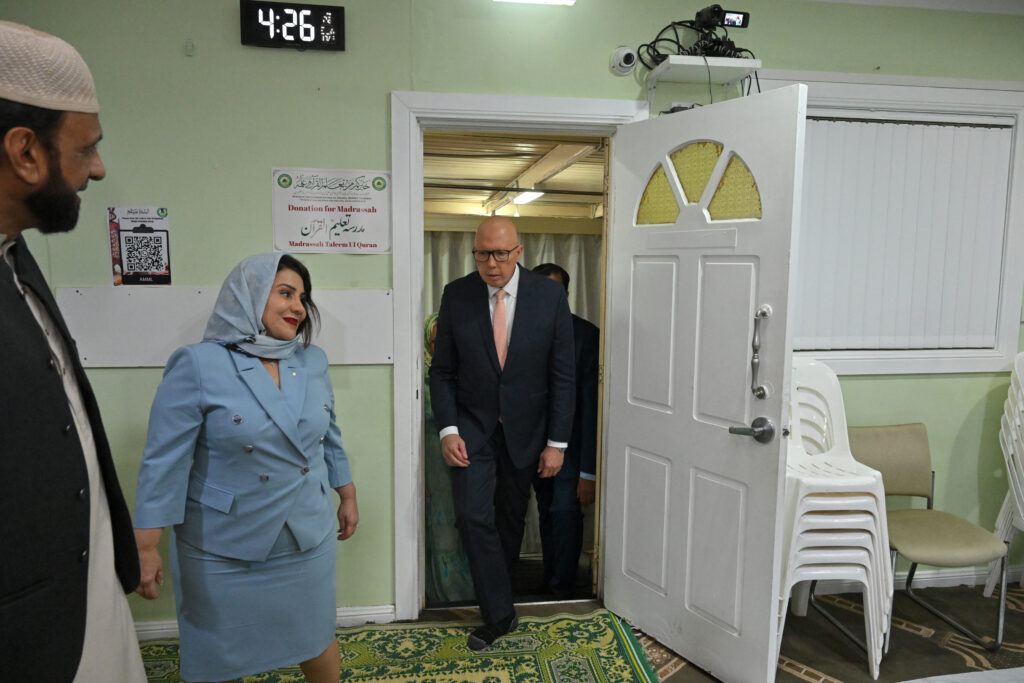
AAP has an update on Peter Dutton’s visit to Al Madinah Mosque in Leppington:

Muslim leaders from a mosque toured by Peter Dutton have distanced themself from him as debate about his migration policy heats up.

The opposition leader pledged $25,000 for CCTV and security for the Al Madinah Mosque in Leppington on Sunday but leaders later wrote to Mr Dutton saying his visit shouldn’t be seen as “an endorsement of any sort” and asked for an apology.

The letter, reported by the Daily Telegraph and seen by AAP, referred to previous remarks made by Mr Dutton about Lebanese-Australians and a lack of condemnation of Islamophobic incidents in contrast to his strong rhetoric on anti-Semitism.

His visit was an opportunity for them to share their views about the challenges Australian Muslims faced so he could come up with appropriate policies, the leaders said as they called for a public apology for Mr Dutton’s comments about some Lebanese-Muslim migration being a mistake.

Asked about the letter and whether he would publicly apologise, he didn’t respond directly but said all communities and places of worship deserved safety.

Leader of the Opposition Peter Dutton visits the Al Madinah Mosque in Leppington on day 2 of his 2025 Federal Election Campaign in the seat of Macarthur, Sydney on Sunday, March 30, 2025.

“The point that I’ve made consistently through my career is that people should be able to live in our country, in our society, particularly in the 21st century, peacefully and with freedom,” he told reporters in the Hunter on Monday.

“I don’t tolerate attacks on mosques, not on churches, not on temples, not on any place of worship.”

He pledged to keep envoys for Islamophobia and anti-Semitism put in place by Labor if they were making a difference.

The Liberals’ rhetoric on the war in Gaza, including a call to block all refugees coming from the strip, has put a large chunk of Muslim, Palestinian and Middle Eastern communities offside.

Mr Dutton’s pledge to cut permanent migration by 25 per cent – although he is yet to reveal from which programs – also has some feeling like multicultural communities were being used as a scapegoat for infrastructure and housing shortages.

Labor frontbencher Michelle Rowland, who represents the diverse Sydney electorate of Greenway, accused successive state and federal Liberal governments of ignoring infrastructure needs in the area, while Mr Dutton pointed the finger at population increases.

“Irrespective of where people’s country of origin may be, they’re experiencing the same infrastructure deficit as their neighbours,” she told AAP.

“It just demonstrates the way they’ve been let down to date.”

Anthony Albanese took a swing at the senate (he meant the Greens) for not passing Labor’s environmental protection agency, which might have been an agency, but wasn’t exactly designed to protect the environment.

The crossbench, including the independents and Greens wanted the EPA to have more powers. And in lieu of that, some actual commitments like a nationwide ban on native forest logging. That is when Labot (under Anthony Albanese’s orders) pulled the legislation from the senate. Albanese has blamed the senate for not passing the laws saying Labor didn’t have the votes. The crossbench said Labor stopped negotiating).

Sarah Hanson-Young responded to Albanese’s comments this morning that Labor would bring in EPA legislation in a second term, after again blaming the senate for not passing the legislation in the last term.

Hanson-Young:

Australia’s environment laws are weaker now than at the last election. Labor cannot be trusted to deliver on the environment, they have failed over and over again. But the Greens will force them to act.

The Greens are essential in the new parliament to clean up Labor’s mess and hold them to account. We must ensure that our environment is protected from the destructive influence of corporate interests and that real action is taken to address the climate and extinction crises.

Only with more Greens in parliament can we restore our ecosystems, safeguard our wildlife, and transition to a sustainable future.

The Greens will fight for robust environmental laws and a climate policy that prioritises nature over profit.”

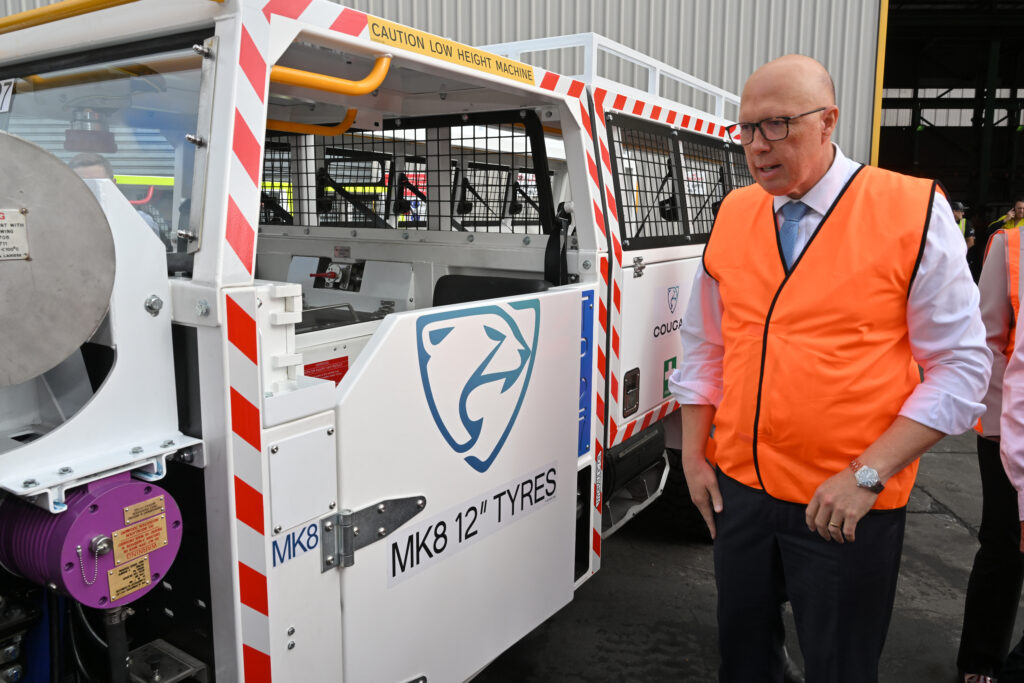
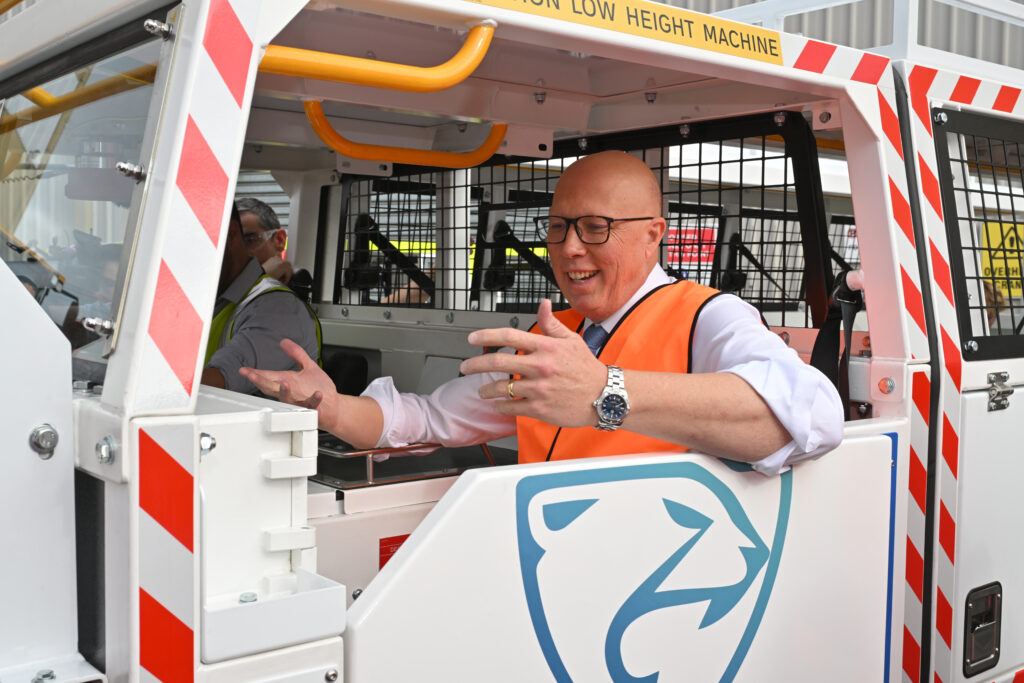
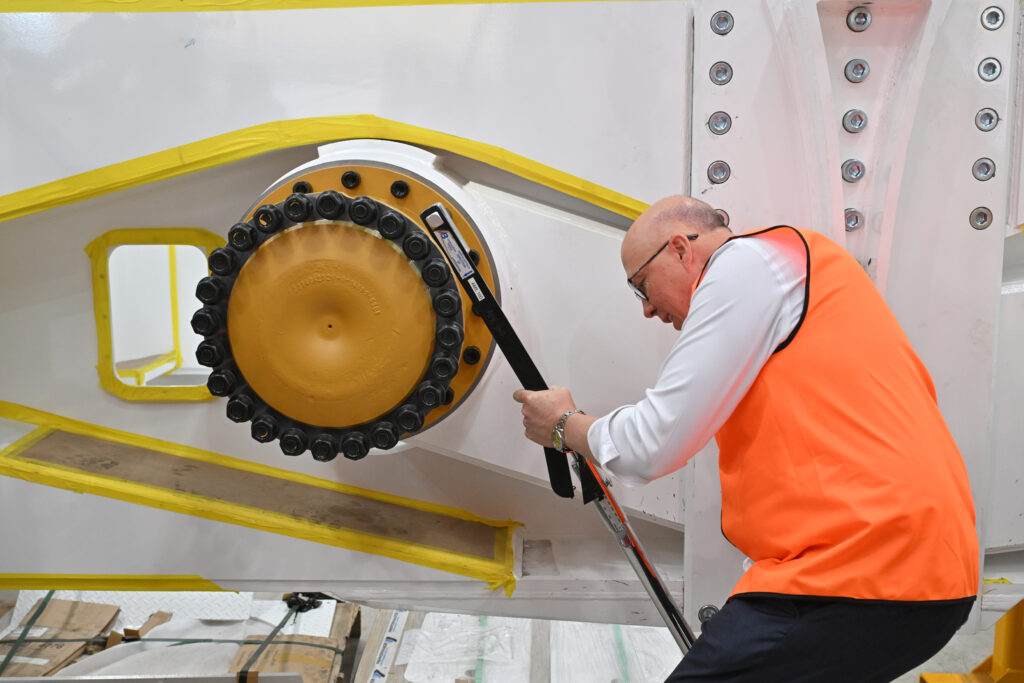
And there was high-vis at Peter Dutton’s campaign announcement this morning, so you know what happened:

Leader of the Opposition Peter Dutton is confronted with mine equipment
Peter Dutton celebrates opening a door and sitting in a truck
Leader of the Opposition Peter Dutton tightens a wheel nut

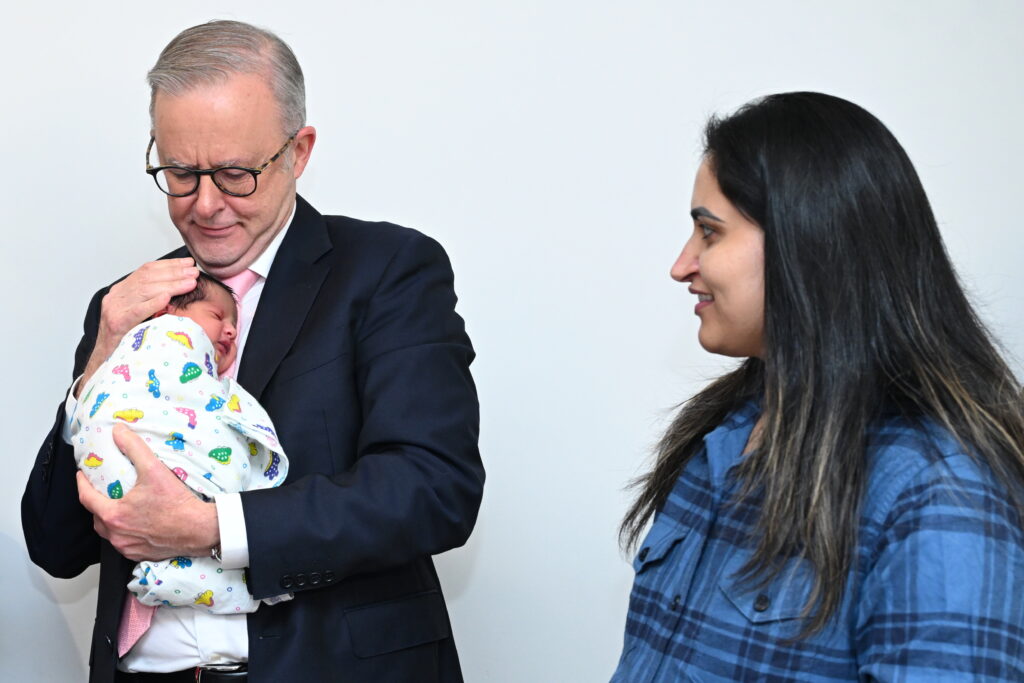
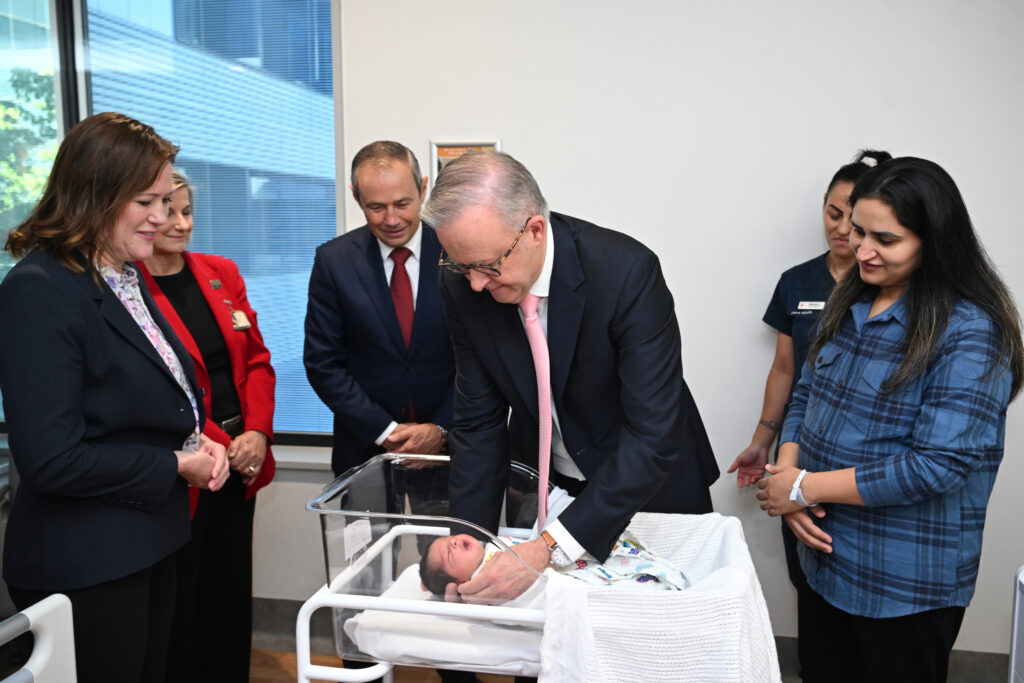
There was a baby at the WA health announcement with prime minister Anthony Albanese this morning, so you know what happened:

Australian Prime Minister Anthony Albanese holds newborn baby Amber as he speaks to mother Harsimranjeet Sidhu at the maternity ward during a visit to Midland Hospital on Day 3 of the 2025 federal election campaign, in Perth, Monday, March 31, 2025.
Australian Prime Minister Anthony Albanese puts newborn baby Amber down into a crib while visiting mother Harsimranjeet Sidhu at the maternity ward during a visit to Midland Hospital

Given all the talk of energy, it is probably also worth reminding that the Greens announced an energy policy earlier in March.

The Greens want to turbocharge electrification, so people move off gas faster. As part of that it wants to

Make available low interest loans and grants for battery storage support:

Up to $5,000 in grants and $10,000 in low interest loans for households

Up to $10,000 in grants and $50,000 in low interest loans for small businesses.

Support to electrify would also see grants and low interest loans made available:

Up to $10,000 in grants and $20,000 in low interest loans for households

Up to $25,000 in grants and $100,000 in low interest loans for small businesses

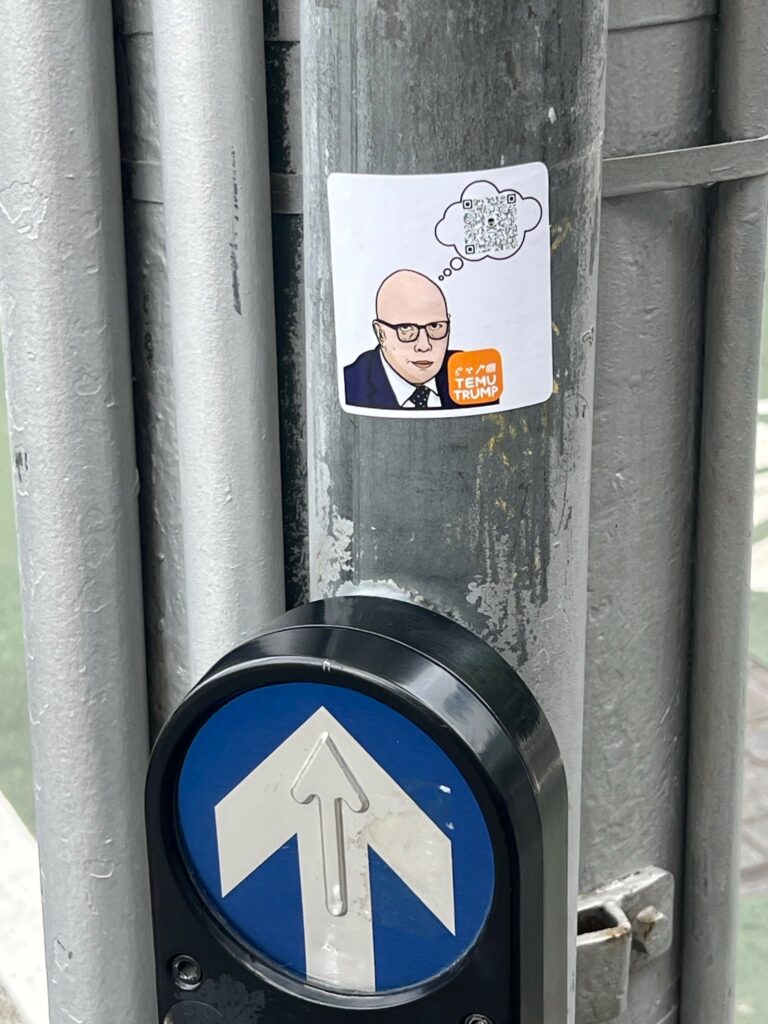
Another friend of the blog has sent this photo in, which they said was spotted in Melbourne.

Sometimes the simplest throw-away phrases can take off, if it seems to fit.

Parallels between Coalition and Musk’s DOGE on the public service

A friend of the blog has made a link to an op-ed Elon Musk had published in the Wall Street Journal a little while ago, where he laid out the plans to slash the public service. (The Guardian has written a story on the main points here.)

The op-ed read:

Requiring federal employees to come to the office five days a week would result in a wave of voluntary terminations that we welcome: If federal employees don’t want to show up, American taxpayers shouldn’t pay them for the Covid-era privilege of staying home.”

Does that sound familiar?

Here is Liberal senator Jane Hume not so long ago (as reported by the ABC)

Federal public servants would be required to work from the office five days a week under a Coalition government, with Shadow Finance Minister Jane Hume saying the workforce had shown a “lack of respect for the work that went into earning the taxes they spend”.

“While work from home arrangements can work, in the case of the [Australian Public Service], it has become a right that is creating inefficiency,” Senator Hume said.

And Dutton himself:

Our desire is to get public servants who are, at the moment, refusing to go back to work … and that is not acceptable,” Mr Dutton said.

“There will be a commonsense approach as there always has been, but I am not going to tolerate a position where taxpayers are working harder than ever to pay their own bills and they’re seeing public servants in Canberra refuse to go to work.”

Note that it is not ‘refuse to work’ it is about going into the office (in that quote)

Dutton has suggested that public servants who have care responsibilities could ‘job share’ which is a) a pay cut – to share a job you would have to not work full time in that job and b) there is no one job sharing in the public service at the moment, nor anyone recording job sharing in any of the data I could find. There are about 60% of public servants who have recorded some sort of work flexibility arrangements. Often, flexible work arrangements come at the expense of other perks like increased pay.

Gas reservation – but what about the consumers?

Dave Richardson
Senior Research Fellow

The best thing about the election campaign so far has been the acknowledgment by the Liberal Party that there is no gas shortage. The Liberal Party is now on a joint ticket with the Greens and Independents. (Come on in ALP, the water is fine!)

But the problem with gas is not just that we exports 80% of it.

Our analysis of Origin’s annual report for 2023-24 showed the price to consumers was $36.8/GJ and just $15.0/GJ for business – so they are charging consumers 2.5 times what they are charging businesses. And we are even being conservative because we aren’t counting the GST paid by consumers.

It costs a bit more to supply consumers but nothing like those figures – gas basically is gas is gas is gas – and this is just rampant price discrimination against consumers that essentially means we are all subsidising business – because our higher gas prices mean businesses can get it cheaper.

At AGL the difference was more extreme. Consumers paid $38.1/GJ versus $11.9/GJ for business. So consumers were paying 3.2 time the amount the AGL was charging businesses!

In the half year update for the last 6 months of 2024, AGL reported that it increased the prices it charges big business by 1% relative to the same six months a year earlier. How did consumers do? Not good. Consumer charges rose 5%.

In the last 6 months of 2024, AGL consumers paid over three times what business pays ($38.8/MWh compared with $12.4/MWh). Had consumers paid the big business price they would have saved $420 in that half year, or $840 in a full year.

So the problem is not just that most of Australia’s gas goes overseas, it’s that Origin and AGL so dominate the local gas market that they can rip off consumers.

They are the Coles and Woolies of the gas industry and they are all taking the piss.

Over on Sky News and Labor’s Sam Rae is ‘debating’ the Liberal’s Keith Wolahan for a segment, and both have made some choices.
Rae’s hair, which is famous within the parliament for its bouffant, is down slightly, which is one reason why some of his colleagues have dubbed it a recession indicator.

Wolahan is wearing a gilet (zip up vest) with his name on the front, we assume because as a moderate Liberal Sky viewers are probably not used to seeing him and would need help working out which one is the ‘Liberal’ in this conversation.

Both stick to the usual lines – only poll that counts is election day yadda, yadda, yadda and we all lost seven minutes of our lives.

Time for coffee number four!

Recap of the day so far

OK, so it has been a fairly calm day so far, but there has still been quite a bit. So let’s see what we have learned.

Peter Dutton started the day in the Hunter region, where the Coalition are trying to get the seat of Paterson.

Dutton attempted to make energy the issue of the day, but left open many questions on what the Coalition’s gas policy would actually do.

Dutton is unable to say if the Coalition’s policy will make energy ‘immediately’ cheaper, instead pointing to Labor’s policy being more expensive. Dutton still points to modelling showing the Coalition’s nuclear plan would be ‘44%’ cheaper, but neglects to mention that it is also for about 45% less power.

Anthony Albanese started the day in Perth, where Labor is looking to shore up WA seats.

He attempted to make health the issue of the day with a $200m funding announcement to extend a WA hospital.

There is no forthcoming response to the Coalition’s $400m youth mental health funding announcement from Labor as yet (if there is one coming at all)

Albanese is also brewing up a new attack line which was gifted to him from Dutton, who said he would like to live in Sydney if he was prime minister, instead of Canberra. Albanese:

It’s extraordinary that I’m a Sydneysider who’s lived there my whole life, but I’ve chosen to work and live in the national capital – I do spend time in Sydney, obviously. My electorate is there. But I believe the Prime Minister should live in The Lodge. Secondly, I believe there’s been a lot of hubris from Peter Dutton. We’ve seen that. I’ve seen the comments. He says he likes the harbour. You know, everyone likes the harbour. But your job is to be close to where the Department of Prime Minister and Cabinet is, where meetings happen almost every day – almost every day when I’m in Canberra, I’m in a meeting. I’m in the Cabinet Room, I’m in the secure room working away. So it’s up to him to make those declarations, I guess. But certainly I don’t take the privilege that I have of being Prime Minister for granted.

This will probably take hold in a way no policy announcement will. Dutton wanting to be Mr Harbourside Mansion is everything Labor has been trying to paint him as, and he walked right into it, himself, because of a chatty conversation with Sydney radio 2GB

Penny Wong on popular Malinauskas and unpopular tariffs

Foreign Minister Penny Wong is asked on Adelaide radio about cashing in on the popularity of South Australian Premier Peter Malinauskas in the marginal seats of Sturt and Boothby:

Q: “Could South Australians be forgiven for thinking Peter Malinauskas is actually running in this election?”

Penny Wong:

Look, I think a lot of different people who appear on different campaign materials. We’ve got Albo on campaign materials. We’ve got the South Australian ministerial team. We’ve got the Premier. You’ll see a range of materials, but I think the message is very clear.”

Ms. Wong is then asked if she’s spoken with US Secretary of State Marco Rubio ahead of “Liberation Day”, (Thursday, Australia time) when President Trump will announce another round of tariffs.

It’s our job to stand up for Australia, and that’s what we’ll do. We are engaging. I engaged, obviously with Secretary Rubio on the first day he took office, when I was also at the inauguration. But when it comes to the trade, trading policy of the Trump administration, I think Australians can see pretty clearly this is a very different America with a very different economic agenda. That’s what Americans have voted for. But from the Australian Government’s perspective, a Labor Government is not going to trade away the things that make us the best country in the world, like our healthcare system, like our PBS. We want to continue to deliver cheaper medicines for Australians, so we’ll continue to stand up for Australia.”

So, that’s a no?

Q: How will Labor be preferencing the Greens at this election? Can we expect you to preference them second?

Albanese:

That’s the matter for the organisational wing but I make this point as I have made it again – because there was some reporting of something in spite of the 385 times that I have said we will not govern in Coalition with anyone, including the Greens, that I rule out – I rule out – just to be really clear again – if you ask me, “Do you rule out governing in Coalition with the Greens?”, the answer to that is no. I don’t negotiate with the Greens. I’m about campaigning against the Greens and I’m confident we’ll be successful given…we saw a Labor majority, an absolute majority on the inner west council.

Now, if in the inner west of Sydney for those of you familiar with the demographics of Sydney, if the inner west of Sydney can deliver a majority of the Labor Party to govern the inner west council, then I’m pretty confident that I can deliver a majority of Labor members to the House of Representatives to govern the nation.

And for those up the back – preferences are YOUR choice. You can preference any which way you choose, it has nothing to do with the political parties, other than them setting out the way they wish you would preference.

As for ‘will not negotiate with the Greens’ – well Labor does. And so do the Coalition. In the little thing called the SENATE political parties negotiate with whomever will give them the numbers they want when they need the numbers.

If it comes down to having power or not having power – well, you know which way they’ll go. No matter what they say during the campaign.

Q: Prime Minister, your predecessor, Malcolm Turnbull says Donald Trump plainly doesn’t believe in the international rules-based order and his world view actually aligns with Vladimir Putin more than our own. Given Trump’s in the last few months spoken openly about taking over and controlling Gaza and annexing Canada and controlling Greenland by any means, why is Malcolm Turnbull wrong?

Albanese:

Well, Malcolm Turnbull can speak for himself. I’m not going to comment on all of the views of former Prime Ministers. I speak for Australia and the Australian Government’s position is that we continue to enjoy a strong relationship with the United States.

Oh cool beans. That’s completely reassuring.

Q: Former immigration detainee has been arrested and charged in Melbourne after allegedly charging at officers with a metal pole. He was released after that High Court ruling. Did your Government do enough to keep the community safe?

Anthony Albanese:

Well, the DPP charged the bloke. The Commonwealth DPP charged the bloke. We want people and we have introduced laws to ensure that that happens, but most importantly as well we have introduced laws – we want these people out of the country. But you can’t – you can’t override the High Court and that is just something that we have had to deal with. Peter Dutton would have had to deal with the same thing*

*This is true – it was a high court ruling which made indefinite detention illegal, because shock, horror – ministers and governments shouldn’t have the power to lock people up forever. That’s the court’s job (as a Queenslander I am very well across the separation of powers). This could have been avoided if at any time since 2007, either major party had a policy of what to do with asylum seekers and refugees who are unable to be returned to their country (because they face death, persecution, or are stateless) and have had their visas cancelled or rejected in Australia. It is also worth pointing out that if you are an Australian who commits a crime, no matter what crime that is, or how many times you have re-offended, you are released back into the community when your custodial sentence ends. Because that is how the law works.

And dear Dolly save us all – the MODELLING WARS ARE BACK.

For reasons not immediately clear, a reporter from the Australian seems very energised over modelling which sends all our eyes twitching back to 2019.

Q: Prime Minister, can you clarify – is the modelling on power prices still any part of Labor’s energy policy offering?

Albanese:

Our energy policy offering is all out there. The modelling was the modelling they put out. Our policy…

Q: You adopted your 43% target base off that modelling and 82% target, why are they still your targets if you’re now distancing yourself from…

Albanese:

I hope when you get the chance on the next – on the next leg where I assume you’ll be following around, to ask Peter Dutton what his 2030 target is.

Q: I will.

Albanese:

He doesn’t have a 2030 target. He doesn’t have a 2030 target. We have a 2030 target. We’re confident we’ll meet it and our policy is very clear. Our policy is for, same as this bloke’s [Roger Cook] policy, he just got elected and won 46 seats here in WA on, and the Liberal Party were reduced to seven and they just pipped the Nats on six, our policy is for renewables backed with firming capacity of gas, factories and hydro.

That’s our policy.

Q: Do you believe that the North West Shelf Gas project should be extended? And will approvals to that project be further delayed by Labor’s plans? Do we introduce nature positive legislation and the environment protection Agency?

Anthony Albanese:

On the latter, they won’t be delayed by that. They’ll be considered in accordance with the law but I make this point: Peter Dutton for people who haven’t followed, perhaps, the details the way the law works – in him declaring and pre-empting an announcement and a decision on North West Shelf, what he is doing is ensuring that it gets delayed.

That is what he is doing. And the former government the I the same thing with PEP-11 – the exploration licences off the coast of New South Wales, by pre-empting it, it meant that it got delayed and took a long period of time for eventually Minister Husic was given responsibility for it in accordance with the law and that issue is now settled.

If you go out there and you pre-empt the law which says that consideration must be given objectively by the Minister, then you, by definition, put yourself in a position of legal challenge.

There is no question that if the Coalition were to succeed and Peter Dutton were to move to Kirribilli with – on the Harbour, then what would happen would be there would be a legal challenge which is a bit of a lay down misere frankly, you can get any lawyer from – random, pick them out and they can win that case because it is shut, you know – a shut case. It is not sensible to do so for an alternative Prime Minister and there are so many ways in which the alternative government of this country shows that it is not ready to form government. They have been in opposition for under three years, what this shows is they need more time.

Some facts on Woodside’s North West Shelf plan:

https://australiainstitute.org.au/post/woodsides-north-west-shelf-gas-export-project-a-disaster-on-five-fronts/

Q: The Council of Small Business is asking both sides today to commit to a further tax cuts on small business from 25% to 20%. I’ll get your response to that. And also because you’re in the great minding state of WA, could you rule out further changes to the fuel tax credit for mining companies?

Anthony Albanese:

Of course, on the latter, yes. We have a tax policy, we announced on last Tuesday. Our tax policy is to give every Australian a tax cut. Every sickle one — single one, all 14 million of them. One of the big distinctions in this campaign is a Labor Government wanting tax cuts for every Australian and a Coalition promising to actually introduce legislation to increase income tax for all 14 million Australians at the same time as they’re cutting essential services.

Does Anthony Albanese have plans to visit a mosque today, for Eid?

(The context of this question which is missing is that there is a campaign from anti-genocide protesters to make MPs feel ‘uncomfortable’ at mosques, given the lack of response to what Israel is doing in Palestine).

Australian Prime Minister Anthony Albanese speaks to the media at a press conference during a visit to Midland Hospital on Day 3 of the 2025 federal election campaign, in Perth, Monday, March 31, 2025.

Albanese:

Not today, but I visited a mosque in Edmonson Park just a couple of weeks ago. That was one of the mosques that had been the subject of threats online. Some of what has occurred online with the threats talking about Christchurch and the need for it to be repeated. Quite frankly, they are reprehensible. So, my thoughts today – I’ve issued a statement of respect for those of Muslim faith who are celebrating Eid today. Eid is a time where the end of the fast – the breaking of the fast – the members of the Islamic community have been going through the period of Ramadan, which is a time for them to renew their faith.

Q: Do you believe you’re welcome within Australia’s Muslim communities?

Albanese:

Yes, I was very welcomed into that community. I thank Mazar Hadid for welcoming me there in south-west Sydney and I have had discussions regularly with members of the community.

Anthony Albanese is still pretending that the only reason there isn’t an environmental protection agency is that he doesn’t have the numbers in the senate and not that he would not allow negotiate with the crossbench in the senate because it might have actually made it stronger:

Well, we won’t be legislating the same model, point one. What we’ll be doing is attempting to legislate an EPA. We have 25 votes out of 76. I’m yet to see a list published, including by The Guardian, that shows a majority 50% plus one of the voting for any of the legislation that’s put forward. That’s just a fact. We took the recommendations from the Samuel review – importantly, a review initiated by the coalition, not by us – initiated because the EPBC Act is out of date.

We know that that is the case. What we will do if we are elected is sit down. And I had a discussion with Rebecca from the WA Chamber just last week, just last week. There is industry and environmental groups who both recognise that it’s not fit for purpose. What we’ll do is work it through, we’ll consult widely, make sure that we get it right, and that is what we will legislate. Something that provides certainty for industry and the way that processes occur – but also provides for sustainability. That’s what we’re after.

There are more questions on the research vessel that might be a spy ship and ‘what is Australia doing to protect underwater cables’ so that’s a thing.

Albanese:

What we have done is we’re continuing to monitor it. We won’t – for obvious reasons – broadcast everything that we’re doing. But we’re keeping an eye on this as we do.

BUT WHAT DOES THAT MEAN?

Albanese:

Australian Defence Force is monitoring what is happening. It’s going from New Zealand – we expect it to go around to China around way.

BUT DOES HE HAVE CONCERNS?

Albanese:

I would prefer that it wasn’t there. But we live in circumstances where, just as Australia has vessels in the South China Sea and vessels in the Taiwan Strait and a range of areas, this vessel is there. What our task is to do is to make sure that we represent Australia’s national interests. We do that each and every day. And I have every confidence – every confidence – in our Defence Force and our security agencies to do just that.

Anthony Albanese wants to debate Peter Dutton. Dutton has not yet responded to the agreement Albanese has put forward.

Q: It’s been reported this morning that a Chinese research vessel that doubles as a spy ship is currently circumnavigating off the coast of Western Australia inside our Exclusive Economic Zone. What’s your reaction to that? Are you concerned?

Albanese:

It’s been in New Zealand on a joint research operation, and this isn’t the first time that a similar vessel has been around the Australian coast. It occurred in 2020, for example, just to give one example. Australia, as you would expect, is monitoring this

Q: Prime Minister, Peter Dutton has said that, if he were to be elected, he would live in Sydney rather than Canberra. What do you make of those comments?

Anthony Albanese:

A fair bit of hubris behind that comment, I think. [He is] measuring up the curtains. I don’t take Australians for granted. As Australia’s Prime Minister, my job is to represent the country. One of the frustrations I think that was felt by people in the West was that previous occupants of The Lodge, of the prime ministership, saw themselves as being Prime Minister for Sydney.

It’s extraordinary that I’m a Sydneysider who’s lived there my whole life, but I’ve chosen to work and live in the national capital – I do spend time in Sydney, obviously. My electorate is there. But I believe the Prime Minister should live in The Lodge.

Secondly, I believe there’s been a lot of hubris from Peter Dutton. We’ve seen that. I’ve seen the comments. He says he likes the harbour. You know, everyone likes the harbour. But your job is to be close to where the Department of Prime Minister and Cabinet is, where meetings happen almost every day – almost every day when I’m in Canberra, I’m in a meeting.

I’m in the Cabinet Room, I’m in the secure room working away. So it’s up to him to make those declarations, I guess. But certainly I don’t take the privilege that I have of being Prime Minister for granted. I work each and every day to make sure I can continue to be there.

And as Dave Richardson pointed out earlier, it is not just about moving addresses – it is also about moving the public service and the infrastructure for all the briefings, cabinet and the rest of it. It costs MONEY for the prime minister to live in Sydney, that wouldn’t have to be spent if they were in Canberra.

What is Labor’s plan to address youth mental health after the Coalition offered another $400m for it?

Mark Butler:

Well, we’ve done a range of things, really, in mental health. We know there’s a very significant pressure in the community around this. The most important thing we do, first of all, is to expand bulk-billing access to GPs. GPs do more mental health work than any other part of the health workforce. The investments we’ve made in bulk-billing cover mental health items for GPs to be able to do that work as well. We’ve also expanded Headspace – only a short ago, we announced a range of expansions to Headspace, including modernising the model of care there, working with a whole bunch of people who set that model up after all.

These Medicare mental health centres the Prime Minister talked about – they’re bulk-billed, importantly, available on an urgent basis, like Urgent Care clinics. We’ve already opened 61. We’re opening over 35 of them. On 1 January, we will open for the first time an early intervention service available to every Australian without a doctor’s referral on the phone or on digital. This is something that operates in the UK and most other countries to which we compare ourselves and. It will provide much better, free-of-charge access to mental health services early when people need it.

Fact check on nuclear jobs following Dutton’s claim ‘80% of workers will transition’.

While we wait for the press release section of the press conference to wind up (we are not sure if Mark Butler has taken a breathe here) let’s revisit one of the claims Peter Dutton made in his press conference that sounded immediately suss.

So in the Hunter and elsewhere to be honest people realise if there is not a replacement industry for coal, then these jobs go, and that’s the reality, and there is a much higher in these communities then we see in the cities, and as we have seen in the UK, the US and Canada, there is about almost an 80% transfer of jobs from the coal sector across to the nuclear sector, so our plan underpins the economic success of our country for the next century.

First of all – this is a moot point. As we pointed out earlier, Australia’s coal fired power plants all close before 2040 which is when the CSIRO believes is the most feasible timeline to open one nuclear plant. They mostly all close before 2035 which is closer to when the Coalition think they can get one up. So the Coalition is literally telling you coal fired power will have to continue for longer, or those workers are supposed to just sit around and wait.

Rod Campbell has more:

Peter Dutton claimed in his earlier press conference that “in the UK, the US and Canada, there is about almost an 80% transfer of jobs from the coal sector across to the nuclear sector”.

To put it mildly, this claim is not easy to find evidence for:

·         Canada’s Task force on just transition for Canadian coal power workers and communities doesn’t use the word “nuclear” in it’s final report.

·         Here’s a feature piece on the closure of the UK’s last coal-fired power station – zero mentions of nuclear.

·         The USA Department of Energy published a report with a section on exactly this topic in 2022. It discusses how job numbers could increase by replacing a coal-fired power station with a nuclear one, but doesn’t conclude that actual individual coal workers can easily transition to nuke jobs, saying “Changes across occupations show how workers may be able to directly transition between the coal and nuclear workforces while staying in the same occupation although the day-to-day activities and knowledge required may differ…. there is not a perfect match from coal to nuclear workforces…” (p66). Importantly, this is in a hypothetical, modelling discussion. It presents no evidence of anything like an 80% shift of workers from a coal plant to a nuclear plant happening in the real world.

·         The International Energy Agency report on Coal in a net zero transition, makes net zero mention of coal power workers moving to nuclear plants, even though it supports expansion of nuclear generation and discusses siting nuclear reactors at retiring coal generators.

So, Dutton’s nuclear claim is BS. But we already knew that, you already knew that and I’m never getting back the 15 minutes it took to dig this up. Let’s move on!

Anthony Albanese is laying on the I HEART WA love THICK:

This is joint investment. It follows the announcement that the Cook government gave during their campaign that they are adding to. And it’s an example of the partnership I have with my friend Roger Cook. We’ve known each other for 40 years – sorry to give up our age here of both of us! – we’ve been friends for all of that time.

And it is an absolute privilege to be in a position of a bloke that we used to have a beer with 40 years ago, a chat about footy, and a chat about life – to actually be in a position to make a difference for Western Australians.

I regard Western Australia not as an add-on. Not as an afterthought. It’s something that is front and centre, and has been front and centre since I’ve been in public life.

I first came here in 1983-84. I had Christmas Day here in 1983 over at Rottnest Island as a very young man. Lateek, I was a very young man at that time. And I spent a couple of months here. And I came to love this great state and its people. Ever since then, I’ve returned, and returned as a public office holder to make a difference.

Opposition Leader Peter Dutton has confirmed what Australia Institute research has long shown – there is no gas supply shortage in Australia.

However, the Coalition has promised to make a decision on the North West Shelf gas project expansion within 30 days of taking office.

This has nothing to do with the domestic supply of gas and there is no need at all for more gas. 

Australia Institute research shows:

  • 80 per cent of Australia’s gas is exported
  • Gas exports have tripled Australian gas and electricity prices
  • Australia collects more revenue from HECS than the Petroleum Resources Rent Tax
  • Nurses pay more tax than oil and gas companies

Anthony Albanese press conference

Here is Albanese’s main message:

This is a choice, this election. It’s a choice between Labor building Australia’s future and strengthening Medicare, and a coalition led by Peter Dutton that wants to cut everything except for your taxes. A coalition that will cut Medicare as sure as night follows day. Because they’ve got to find $600 billion for their nuclear fantasy, including a nuclear power plant down there at Collie. He hasn’t actually bothered to visit that site up close. If he did, he’d see what is the real future of energy in WA – which is renewables, backed by gas, backed by firming capacity – including batteries – that are being built there on site to connect up with the transmission lines that are currently used by the Collie coal-fired power plant, which will close this decade, and which will be replaced by what is WA’s future energy needs, led by the Premier, Roger Cook.

Greg Jericho
Chief Economist

Back on gas, Peter Dutton this morning told reporters that “If we bring more gas into the system and don’t forget that gas is not just used at home, but natural gas is used to generate electricity, and it will be across the economy, not just in households, but in businesses like this one which will benefit.”

A reminder – more Australian gas is used each year to convert gas to LNG for exports than is used for the entire Australian manufacturing industry. We literally burn more gas just so companies can export LNG than is used to produce all the things that is made in Australia!

Dutton is making it clear with his policy for an east coast gas reservation that we do not have a gas shortage.  

 And thus we don’t need more gas.

New public service headcount data released – public service growing outside of Canberra

On Friday, when everyone was distracted, the latest APS headcount data was dropped.

You can find it here.

The key bits:

  • The APS headcount was 193,503, an increase of 16,462 or 8.5% from December 2023
  • Ongoing employment as a % of total headcount is 92.1%, up from 88.5% in June 2022
  • Overall, APS headcount is up 34,313 or 21.6% since June 2022
  • 64.1% of the APS headcount is located outside of Canberra, up from 61.7% in June 2022
  • The APS headcount in Canberra is 69,438
  • The APS headcount outside of Canberra increased by 25,846 or 26.3% since June 2022
  • 75.3% of the growth in APS headcount since June 2022 was outside of Canberra
  • 24,377 or 12.6% of APS headcount is located in regional Australia, up by 3,229 or 15.3% since June 2022.

Here’s the broad geographic breakdown of the APS workforce by capital city, rest of the state and state

LocationHeadcount% of total APS headcount
Canberra               69,43835.9%
Sydney               28,77914.9%
Regional NSW                 5,3122.7%
NSW               34,09117.6%
Melbourne               22,95311.9%
Regional VIC                 9,6685.0%
VIC               32,62116.9%
Brisbane               18,7379.7%
Regional QLD                 6,8363.5%
QLD               25,57313.2%
Adelaide               13,1476.8%
Regional SA                     4680.2%
SA               13,6157.0%
Perth                 8,8754.6%
Regional WA                     7250.4%
WA                 9,6005.0%
Hobart                 4,1112.1%
Regional TAS                     6780.4%
TAS                 4,7892.5%
Darwin                 1,5490.8%
Regional NT                     6900.4%
NT                 2,2391.2%
Overseas                 1,5370.8%
Regional               24,37712.6%
Capital cities            167,58986.6%
All            193,503100.0%

We are back after a little break – balancing a few balls at the moment.

Anthony Albanese is in Perth, where the big announcement is $200m for the expansion of the St John of God Midland Public Hospital, which is another way Labor wants to be able to spread their health policy message.

More graph crimes

Greg Jericho
Chief Economist

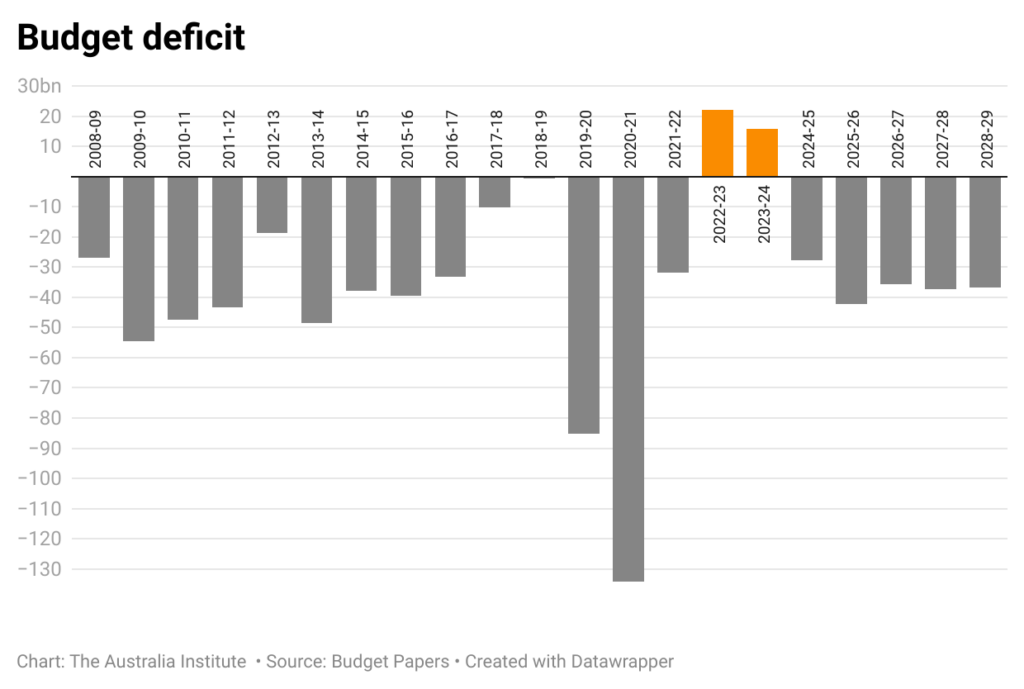
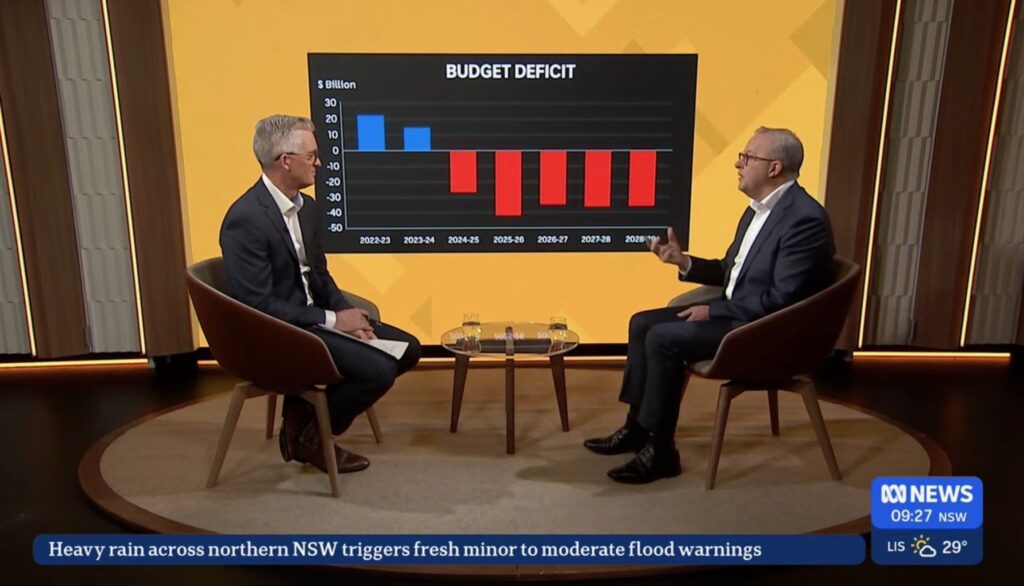
Amy earlier showed the graph that was used on Insiders yesterday during the interview with Anthony Albanese of the Budget Deficit.

It was a pretty disingenuous graph that committed a series of graph crimes.

The first was to use nominal dollars, when the most sensible way to look at any budget numbers is to use a percent of GDP – as this shows the size of debt (or anything) compared to the size of the whole economy and accounts for inflation. You could also argue that using blue for surplus and red for deficits made it look like the surpluses were the LNP (blue) and the deficits were ALP (red). This probably was not the intention, but it could have been cleared up with more context.  

This is the big issue with the graph – the lack of context. The Insiders graph starts in 2022-23, which was when the budget was in surplus for the first time in 15 years the budget was in surplus. But starting it there makes it looks like that is the norm. A good graph should always provide as much context as is necessary to ensure you are not presenting a biased view. Yes, there are budget deficits forecast, but hardly out of step with what has been the case since 2007.

So even if we were to use nominal dollars, Insiders could have given its audience more information by showing this graph instead. Sure, it would make it less of a gotcha for when interviewing the PM, but surely journalism should be about informing the viewer or reader?

Also in that press conference, Peter Dutton said:

as we have seen in the UK, the US and Canada, there is about almost an 80% transfer of jobs from the coal sector across to the nuclear sector, so our plan underpins the economic success of our country for the next century.

We are looking into that for a factcheck for you, but in the meantime, let’s take a look at timing.

Here is when the coal fired power stations are scheduled to close.

  • Eraring Power Station in Lake Macquarie is set to close in 2027.
  • Callide B Power Station in Central Queensland and Yallourn Power Station in the Latrobe Valley are set to close in 2028. 
  • Bayswater Power Station in the Hunter Valley and Vales Point Power Station in Lake Macquarie are set to close in 2033.
  • Loy Yang A Power Station in Victoria is set to close in 2035.
  • Collie Power Station in Western Australia is set to close in 2027.
  • Muja Power Station in Western Australia is set to close in 2029. 

Meanwhile, the earliest the CSIRO anticipates a nuclear plant could open is 2040. So that is not in enough time for those workers. Do they wait hoping that those jobs are on their way?

Matt Grudnoff
Senior Economist

Sticking with energy prices, Australia Institute research has shown that Australia is subsidising fossil fuels to the tune of $15 billion per year. That might sound like a lot, but this election the Coalition says ‘hold my beer’.

The Coalition’s nuclear plan will take decades to get up and running (if it ever does). This means they will need to run Australia’s old fleet of coal fired power stations for longer. That means burning a lot more coal, and it won’t come cheap. A recent agreement between Origin Energy and the NSW Government could cost as much as $450 million to keep the Eraring Power Station open for just an extra 2 years. The Coalition will need to enter into many more of these kinds of deals to try and keep the coal fired fleet running well into the 2040s.

The Coalition’s gas policy has a ‘drill baby drill’ vibe to it. They’re keen to approve as many new gas fields as possible and pump out as much gas as they can.

It’s not just gas and coal getting lots of love, petrol and diesel are also in the frame. The centrepiece of the Coalition’s election pitch is the slashing of fuel excise. This will not only encourage the use of petrol and diesel, but it will also discourage low emissions alternatives.

This must be one of the biggest pitches to fossil fuels by a major party in recent history. This will rapidly expand fossil fuel subsidies and make it even harder for Australia to reduce its emissions.

Peter Dutton then also pretends nuclear is a financially viable alternative:

That is why our plan is 44% cheaper, and what gives this away is that Labor has never disputed those figures. OK? So Labor has never punched a hole in any of the assumptions in the frontier reporting, they have never suggested the 44% figure is wrong. It is in accordance pretty well with what the Americans have predicted as well. So there are two different ways of achieving an outcome here. One is we can meet our net zero targets by 2050, we can have a stable energy market and we can reduce prices, that is the Coalition offering. So prices will be cheaper under us. Labor’s offering is uncertainty, blackouts, brownouts and much higher electricity and gas prices, and that is not something we are going tolerate

I can hear Greg Jericho yelling “THAT IS BECAUSE THEIR MODELLING IS FOR 45% LESS POWER” which is a fact usually ignored when Dutton starts talking about nuclear.

The Coalition can not say power will be cheaper under their policies. The technology they are speaking about with small modular reactors is not in commercial use, because it is TOO EXPENSIVE to be financially viable.

5-day-old salmon laws face legal threat

Just five days after the government rammed through changes to Australia’s environment laws, the amendments are being challenged in court.

The Bob Brown Foundation has this morning applied to the Federal Court, arguing the laws – which were designed to protect commercial salmon farming in Tasmania – should not apply to Macquarie Harbour.

The amendments to the Environment Protection and Biodiversity Conservation Act were rushed through Parliament in the final sitting week before the election, with the support of the coalition.

In its application to the Federal Court, the foundation says the laws apply to fish farms which have been operating in the same way for the previous five years. It argues the salmon farms in Macquarie Harbour have significantly changed the way they operate in that time.

“This rushed bill was intended to protect the three foreign-owned corporations from environmental protections for the Maugean Skate, which is on the edge of extinction, and to try to win Labor the seat of Braddon,” said Alistair Allan, Antarctic and Marine campaigner at the Bob Brown Foundation. 

“Albanese’s thinking that the best response to impending extinction is to back the very industry causing it is outrageous. Along with Peter Dutton, his rushing the law change has made it vulnerable to challenge.”

The changes to the EPBC effectively quash a long-awaited review of commercial fish farming in Macquarie Harbour, which Environment Minister Tanya Plibersek has been sitting on for months.

“We are telling the court that this industry has, in fact, not been exempted from the EPBC and that the minister should no longer delay her decision on the requests for her to reconsider and halt the Macquarie Harbour fiasco.”

Peter Dutton skirts around the policy and then turns to the government:

At the moment you have a situation where the Government is choking supply so they are stopping gas coming to the system which is what will force up prices and we say to the companies”

Enter Greg Jericho:

This is just talking about the government not approving more gas fields. This has nothing to do with domestic supply of gas. There is no need at all for more gas. Eighty percent of Australia’s gas is exported. The opposition is committed to immediately approving the North West Shelf gas field extension – a project which is for 100% exports of LNG. It will not add anything to domestic gas… but it will add the equivalent of 12 new coal fired power stations worth of emissions over the next 50 years.

Peter Dutton is asked about the gas reservation policy which materialised last week after it became obvious that nuclear was not going to get the Coalition through the election campaign.

Here are some facts on gas:

Key points:

  • 80% of Australia’s gas is exported. Gas export corporations use more gas to operate their export terminals than Australians use for electricity or manufacturing.
  • Gas exports have tripled wholesale gas and electricity prices.
  • Woodside’s North West Shelf export gas project is already draining Western Australia’s onshore domestic gas reserves.
  • New gas projects are too expensive to reduce gas prices. Australia’s low-cost gas is being exported, leaving only high-cost gas.

“Gas prices in eastern Australia have tripled as production has tripled. The definition of insanity is to keep doing the same thing over and over and expecting a different outcome,” said Mark Ogge, Principal Advisor at The Australia Institute.

“It’s ridiculous to try and solve a gas shortage caused by excessive gas exports by approving even more new gas export projects.

“Woodside’s North West Shelf is draining Western Australia’s domestic gas reserves and has tripled wholesale gas prices. Extending it for another 50 years would be a disaster.

“The only way to keep Australia’s gas for Australians is to cut exports.”

Peter Dutton press conference

Opposition leader Peter Dutton is holding his first press conference of the day. He is in the Hunter region (New South Wales). Labor look like holding the seat of Hunter, but the Coalition wants the nearby seat of Paterson.

Dutton’s message for the campaign is clear:

The point I make is is a choice for Australians to make. It’s about who can better manage the economy, who can better manage the energy system and at the Albanese’s plan is going to see certain increases in power prices. The thing is already in three years electricity is up by 32% and it will go higher.

This is a recipe for higher prices and Australians can’t afford three more years of Albanese government.

The Coalition can’t say how much its energy ‘plan’ will lower prices though, which is one of the sticking points of its message.

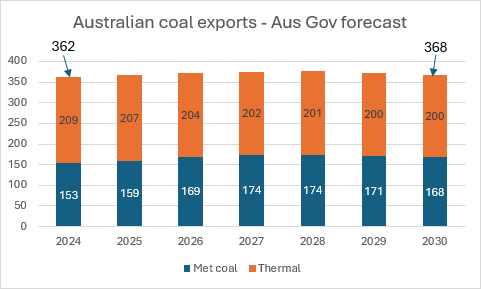
The latest Australian Government mining forecasts are out today. Good news for multinational coal companies, bad news for the planet.

Rod Campbell
Research Director

We’re going to an election with the Australian Government planning to slightly EXPAND coal exports out to 2030, from the 362 million tonnes in 2024, to 368 million tonnes in 2030:

These forecasts go out to 2030, the year that the Paris Agreement would ideally see the world emitting 43% less than in 2005. Australia apparently supports the Paris Agreement, apparently supports Pacific countries…yet is planning to export more emissions to the world, not less.

The next parliament has a chance to turn this around and begin a responsible phase out of the coal industry, starting by not approving new coal mines.

Alice Grundy
Research Manager, Anne Kantor Fellowship

How can we trust the United States to deliver on AUKUS when the President does not respect the agreements that underpin the democratic systems in his own country?

On a call with NBC today, “When asked whether he has been presented with plans to allow him to seek a third term, Trump said, ‘There are methods which you could do it.’” 

This kind of talk, consistent with other proposed or real breaches in the international rules-based order, is part of the reason why Australians think Trump is a greater threat to world peace than President Xi or President Putin, as Australia Institute polling showed

Trump won’t rule out seeking a third term in the White House, tells NBC News ‘there are methods’ for doing so President Donald Trump said in a Sunday-morning phone call that he was “not joking” about a third term, adding that “it is far too early to think about it.”www.nbcnews.com

What’s in a debt?

Greg Jericho
Senior Economist

The government is trying to let us all know that it has debt under control and that it has “lowered debt”.

And well… not really. The key line from the government is “gross debt in 2024-25 is $177 billion lower than what was projected at the time of the last election”.

What they are really saying is that in the March 2022 Budget (the last one by Josh Frydenberg) the Treasury estimate for gross debt in this current financial year of 2024-25 was $1,117bn or 44.9% of GDP, whereas in last week’s budget the estimate for this year is now $940bn – thus the $117bn difference.

But remember we are just talking about the difference between reality and a projection. Back in March 2022, things were still looking pretty grim coming out of the pandemic. Every forecast was rather pessimistic – on fact overly pessimistic. And what has happened is the recovery has been better than expected. So, has the government reduced debt? Not really, it’s just that the projections in March 2022 were very wrong – and to be honest, understandably so.

Both sides play silly buggers with forecasts not coming true. If a government forecasts a deficit and something changes – like a spike in iron ore prices – and so they raise more revenue than expected, they claim great budget management has delivered a surplus. If things go the other way and the projections are too optimistic, the opposition claims the government has lost control of the budget. It’s all rather stupid.

Just remember we have low government debt compared to most advance economics. We are still rated AAA by all credit agencies (yes the ones who helped cause the GFC) and the interest rates the government has to pay when it borrows money is currently lower than they had to pay back in 2006-07 when we had no net debt at all. In other words, no one sees our debt as a worry that the government will not be able to pay its bills.

Australia Institute executive director Richard Denniss has a piece in The Monthly talking about the election, where he also writes about tax:

Not all countries are as afraid to tax the fossil fuel industry as Australia, or indeed to tax property owners, retirement savings or billionaires. But if those elected to our parliament were brave enough to simply collect the average amount of tax, as a share of gross domestic product, collected by OECD countries, then the result would be an extra $135 billion per year in revenue. If we wanted to tax in the manner of Norway, Denmark, Sweden and Finland, we would collect an extra $330 billion per year. To be clear, if we did nothing more radical than copy the Nordic tax system we could afford to pay for the entire AUKUS program with one year’s worth of extra revenue. Just imagine the real problems we could solve.

Dave Richardson
Senior research fellow

But there are other things to consider with the prime minister living in Sydney as well – Peter Dutton living in Kirribilli means lots of business for the airlines, the VIP fleet and taxis, moving public servants from Canberra for briefings.

That means lots of travel allowance for his personal staff whether they are based in Sydney or Canberra and probably means he would have most Cabinet meetings in Sydney including Expenditure Review, National Security and other cabinet sub-committees  – again lots more public servants travelling Canberra to Sydney and back again, which is lots of travel allowance for those public servants.

Then there is the infrastructure – cabinet room facilities have to be duplicated in Sydney. So it’s not just a change of address.

Joshua Black
Postdoctoral Research Fellow

Meanwhile, Peter Dutton has signalled that he wants to live in Kirribilli House, not the Lodge. ‘I think you’d take Sydney any day over Canberra’ he said in an interview for Sydney’s KIIS FM radio.

It is all highly on brand for the opposition leader, who has made an obvious strategy of wooing Sydneysiders and indulging in Canberra-bashing already. Some have called NSW ‘the state to watch’ in this election.

Promising via a Sydney radio interview that he will live in Sydney rather than Canberra is an easy and zero-cost way of showing preferment. This signalling matters especially for Dutton as a Queenslander, but previous prime ministers, particularly John Howard, have made a point of staying at Kirribilli House instead of The Lodge where possible. Malcolm Turnbull preferred his own harbourside home in Point Piper, though he attracted plenty of criticism for this.

It’s not all about politics. Australian politicians have long complained that the Lodge is an international embarrassment. Paul Keating complained that neither The Lodge nor Kirribilli were appropriate for his young family. The Lodge was thoroughly renovated in 2015, but this did little for its reputation. In 2018 the University of Canberra and the Gallery of Australian Design ran an architecture competition to see if members of the public had better visions for a lakeside residence fit for Australia’s head of government. Polling from the Australia Institute has previously shown that more than half of Australians expect their leader to live in The Lodge. When Anthony Albanese chose to establish himself there, it sent a clear signal about the value of the national capital for the country as a whole.  

Where should the prime minister live?

Bill Browne
Director, Democracy & Accountability Program

Yesterday Peter Dutton said if he becomes Prime Minister, he will live harbourside in Sydney, rather than in the Lodge in Canberra, the nation’s capital. 

Australia Institute polling research after the 2022 election found most Australians thought the Prime Minister should live in Canberra (57% agree to 20% disagree). 

After Prime Minister Anthony Albanese moved into the Lodge, Ben Oquist wrote about the significance of the decision

It is a message that pays respect to the public service, the diplomatic corps, the Parliament, even the press gallery – all of which form part of the local ecosystem that is Australia’s democracy.

The new PM’s move to The Lodge can also be seen as being part of a bigger revitalisation of Canberra being pursued by the incoming government. 

Price gouging; what’s actually going on?

Greg Jericho
Chief Economist

BCA chief executive Bran Black: “Well, I think it’s very clear from the ACCC report that there is no price gouging. It goes back to the point that I was just making.”

This line is being spouted by everyone from Coles and Woolworths to conservative media, but the reason the ACCC found no price gouging is it wasn’t looking to see if there was any! Why wouldn’t they do that? Well because it is not illegal to price gouge! The ACCC has no power to look at prices, and so it doesn’t!

As the ACCC report states:

We have not sought to determine whether the prices or margins of ALDI, Coles, Metcash (or its banner stores) and Woolworths are excessive. Having or exercising market power, or charging high prices, or obtaining high margins, is not prohibited by the CCA.”

Supermarkets (or anyone else) is free to charge as much as they like – so long as they are not doing so in cahoots with another “competitor”. So if Coles can get away with raising price well above what they need to maintain a decent profit, they are free to do so, so long as they have not spoken to Woolworth s and both agreed to do it. Of course it is clear the grocery market is so dominated by Coles and Woolworths that they don’t need to collude. They know what is best for the both of them. This is why for example they take it in turns having products on “special” Coles will have Coke on special one week and Pepsi the next, and Woolworths will do the opposite.

The entire point of a price taskforce is about making price gouging illegal and empowering a body to examine prices. This is something we have been calling for and is a necessary measure given the duopoly and profit margins of the Coles and Woolworths is such that they have lost the right to demand they be treated like other companies. Food is a vital good – and the actions of Coles and Woolworths demand greater regulatory oversight:

How is Wall Street reacting to Trump’s Orwellian named ‘Liberation Day’ (when the US tariffs, which the US consumers and importers pay) kicks in?

AAP reports:

Wall Street stocks ended sharply lower on Friday, with selloffs in Amazon, Microsoft and other technology heavyweights, after US data stoked fears of weak economic growth and high inflation as the Trump administration ratchets up tariffs.

US consumer spending rebounded less than expected in February while a measure of underlying prices increased the most in 13 months.

Adding to concerns, a University of Michigan survey showed consumers’ 12-month inflation expectations soared to the highest in nearly two-and-a-half years in March, and that consumers expect inflation to remain elevated beyond the next year.

That data fuelled fears that a rush of tariff announcements from US President Donald Trump since taking office in January will boost prices of imported goods, drive inflation and deter the Federal Reserve from cutting interest rates.

Inflation and tariff worries sent shares of Wall Street’s most valuable companies sharply lower, with Apple, Microsoft and Amazon all losing ground.

As for the whole ‘added a journalist to the bombing Yemen group chat on Signal’ thing, Richard Marles is still not talking about that either.

Pete Hegseth has spoken on that and I will leave him to answer those questions. We have a very close security relationship with the United States. We do share a lot of information with the United States, in a very secure environment and that is really important for our awareness, for our own security. We make a real contribution to America’s as well. That information sharing has been one of the key parts of the alliance over decades and it will continue to be so. It is deeply important for us.

As for the Canadian approach of you know, standing up for your own nation against one that is sliding further and further into authoritarism while also undergoing a digital coup by an unelected oligarch, Marles says:

The alliance remains fundamentally important in terms of our bilateral relationship but the way in which we are going about both pursuing that relationship but our relationships more generally is in respect of Australia’s national interest. That is where we are focused. What you can be sure of, in terms of Anthony Albanese and an Albanese government, is we will put Australia first at every point. There is not going to be any deal that the Leader of the Opposition is talking about. We will be focused on our national interest and any arrangements that we do, with any country including the United States, will have Australia’s national interest the at forefront and that is the way in which we are going to conduct our affairs.

While other allies begin to muscle up against Donald Trump’s desires (which vice president JD Vance said was the reason that the US was going after Greenland ‘because we can’t just ignore the president’s desires’ – as if Trump’s ‘desires’ haven’t landed him in court time and time again, often finding that those ‘desires’ broke laws), Australia is continuing the ‘no comment’ approach.

Canadian prime minister Mark Carney, who is also in election campaign mode, released a video statement recently that his nation’s “old relationship with the US is over”. Canada is one of the five eye countries with Australia, and following Trump’s aggression towards its traditional ally, it has stood firm against him, with reports Carney wouldn’t even take Trump’s phone calls for weeks.

The pair spoke on the weekend for the first time, with both sides describing it as “constructive” but the issue of tariffs is still looming. Canada has promised retaliatory tariffs with “maximum impact” if the US follows through on its threats, and given the oil, mineral fuels and machinery and tech parts Canada exports to the US, it has a few cards of its own.

Trump has since softened his language against Canada considerably.

Richard Marles was asked about America’s second couple’s disastrous trip to Greenland (Usha Vance wanted to take their son to a dogsled race, but then JD muscled in on the trip and insisted on going, which meant no dogsled race and essentially no trip – no one in Greenland wanted to meet the Vance’s, so they were stuck on a military base the US controls for one night and then went home) and stuck to the no comment line:

I am not about to give a running commentary on where the Vice President of the United States goes and what is being said there. We are focused on our own capabilities, our own relationship with the United States and we will continue to do that.

…There is a lot of water to go under the bridge before any of that occurs. We have a very close relationship with the United States, certainly in respect of defence. Across the board also. In relation to defence and security, the alliance is our – is the cornerstone of our national security and we’re very focused on it. I was in Washington just over a month ago speaking with Pete Hegseth, my counterpart. It was a good meeting in terms of our ongoing defence and relationship with the United States. We are confident about how that will play under the Trump Administration.

On the taskforce, Richard Marles says:

The task force is there to look at how we implement legislation which will prevent price gouging. That will ensure across all markets, where there are – all sectors where you have the dominant players, where you have essential services in place to make sure price gouging in those circumstances is illegal. This is legislation which exists in other countries around the world and it should exist here as well. That is what we’re committing to. It will make a difference to ensure prices are kept as low as possible for consumers.

Richard Marles also defended the announcement from the weekend that Labor would put together a supermarket price taskforce to stop price gouging. Marles is asked why didn’t the government act during the term, which is completely fair – it’s not as though this is new information.

Marles:

There are countries elsewhere in the world which have anti-price gouging legislation. That is what we are seeking to introduce here. That was the commitment we made – the Prime Minister made over the weekend. That is an important step forward. What it is saying is if you have got, for essential goods and services in a sector where there are companies with market power, price gouging in those circumstances will be made unlawful and that is the heart of the legislation you see elsewhere.

Marles is then asked about the ACCC report which found no evidence of price gouging.

It is important to note that the ACCC report also found:

While they are not necessarily the most profitable in a given year, regardless of the metric applied (EBIT, NPAT or return on capital), Coles and Woolworths are some of the most profitable supermarket businesses among their global peers. ALDI has indicated its Australian supermarkets business is at the higher end of profitability when compared with ALDI supermarkets trading in other countries

ALDI’s, Coles’ and Woolworths’ average product margins increased over the last 5 financial years, while Metcash banner stores’ average product margins were relatively flat. While input and operational costs have increased over this time, Coles and Woolworths have maintained or increased their product margins.

We have not sought to determine whether the prices or margins of ALDI, Coles, Metcash (or its banner stores) and Woolworths are excessive. Having or exercising market power, or charging high prices, or obtaining high margins, is not prohibited by the CCA. If there were a greater degree of competition between supermarkets, we would expect margins to be lower, either by way of lower retail prices, or higher costs incurred to improve quality of service, or both.

In our view it is important to consider all metrics and the information each provides before drawing conclusions. ALDI’s, Coles’ and Woolworths’ margins increased at all accounting levels in recent years. Therefore, we consider it reasonable to conclude increasing EBIT margins over this period suggest these supermarket businesses have not passed on the full benefit of any cost saving initiatives. Increasing product margins appear to have contributed to the increasing EBIT margins – even if ALDI, Coles and Woolworths have acted to moderate cost growth.

Defence minister Richard Marles says he is not following the polls, because it’s “bad for your mental health”.

He told ABC:

We don’t follow opinion polls by the day. It is not good for your mental health if you are in politics. We focus on what our job is, which is to govern the country. We are not looking at that. This is a close election, everyone knows we are coming from behind. That is the way in which we’re proceeding here.

Greens leader Adam Bandt is campaigning in Wills today, which is one of the party’s target seats.

Labor MP Peter Khalil is under real pressure from the Greens candidate Samantha Ratnam in that seat, and Bandt says the Greens see opportunity. Especially when it comes to housing. Bandt said in a release:

Renters and people in mortgage stress will determine the outcome of the federal election, and they can tell you tinkering around the edges has not made housing affordable. In a wealthy country like ours, everyone should be able to afford a roof over their head, but in 2025 people are still being smashed by sky high rents and mortgages. Nothing changes if nothing changes – we can’t keep voting for the same old two parties and expecting a different result.

The Greens are campaigning as a bloc in Victoria, where they are also aiming to win Macnamara from Labor’s Josh Burns. Burns seems (at this point) to be in a safer position than Khalil, but there are a lot of days left in this campaign.

But this is still not the time to talk climate change policies, according to David Crisafulli, even though he acknowledges it’s real:

They are all great questions and they are all factual. There is going to be a massive economic cost but it runs a distant second to the personal cost. When you see the look in somebody’s eyes who has lost everything, there is a number of young people who have gone out on their own and bought properties. They will be wondering whether they can get back on their feet.

We are still dealing with recovery in the north of the state and south-east following massive events. We are seeing them more frequently and there is challenges. We have to do everything we can to build resilience into what we do, that is everything from the way we recover.

We have to make sure we have protections in place and making sure we build a state that is truly resilient. The people are, that is for sure. It is time that our infrastructure matches the resilience of the Queenslanders who live here.

Queensland south west is experiencing significant flooding, which has had a major impact on communities and the way they earn their money. Flooding has led to the death of thousands of cows, sheep and goats across grazier lands.

Premier David Crisafulli said the impact will have ongoing ramifications, but right now the focus was on keeping communities as safe as possible.

He told the ABC:

It is soul-destroying. We are dealing with tens of thousands of stock losses across beef as well as sheep and goats. There will be a massive economic impact but there is that real social and personal impact when you lose your livelihood. We will have to be there for them in the short and long term.

We still have water rising in the small communities, places like Thargomindah hasn’t hit the peak yet. They are big systems and they take a few days to get through.

We have had a couple of evacuations from some communities and those people are safe and well.

I met some of the residents from Quilpie who are being accommodated there. They will go home to complete and utter devastation. We will have to help them.

The real economic impact and what will flow through the community is the devastation to agriculture. We will have to make sure we continue to deliver fuel and fodder in the short-term. The work has been around the clock to give every hope where there is dry land to keep the animals fed. In the long term we will need to lead a big recovery, re-establishing exclusion fencing and helping them restock after devastating scenes.

Treasurer Jim Chalmers issued a press release this morning which seems solely aimed at the press gallery and campaign journalists:

The Budget shows that gross debt in 2024–25 is $177 billion lower than what was projected at the time of the last election.
 
This means we have lowered the debt by around $17,700 per household.
 
By lowering the debt, we’re avoiding around $60 billion in interest costs, or around $6,000 per household.
 
The Liberals left us a trillion dollars of debt during a decade where they racked up deficit after deficit.
 
In less than three years, we’ve turned two big Liberal deficits into two Labor surpluses, shrunk this year’s deficit, reduced Liberal Party debt by $177 billion and saved Australians billions in interest costs, while also delivering substantial cost-of-living relief.
 
The Coalition’s last Budget had gross debt above 40 per cent of GDP throughout the forecast and medium term. Under Labor, it’s now expected to peak  lower.
 
The change in gross debt over the Albanese Government – around $45 billion from 2021-22 to 2024-25 – is a much smaller increase than under Abbott, Turnbull and Morrison, even the pre-pandemic years:
 
    •    From end of 2012–13 to 2015–16, gross debt rose by $163 billion.
    •    From 2015–16 to 2018–19, it rose by $122 billion.
    •    From 2018–19 to 2021–22, it rose by $353 billion.
 
Peter Dutton and Angus Taylor have said “the best predictor of future performance is past performance”.
 
The Liberals’ past performance is higher debt, higher inflation, lower wages and cuts to Medicare, and that’s what they would deliver again if they win the election.
 
Under Labor, inflation is down, real wages and living standards are growing again, unemployment is low, debt is down, interest rates have been cut and growth is rebounding solidly.

That, we assume, is in response to graphics like this:

Screenshot from the Insider’s program, Sunday 30 March.

Meanwhile, in graph crimes, here is how the Australian chose to illustrate the breakdown of first preference votes.

The Coalition is only 4% ahead of Labor in terms of primary vote. Is that what this looks like though? The Greens and ‘other’ are on 12%, which together is a significant wedge – but is that what you would take from this?

It’s just another way that media can slightly alter how you view things – you see the number, sure, but you are left with the impression of the slice of the pie, which is deliberately outsized in this example.

After declining to invite MPs for Easter at Lakemba Mosque, Australia’s largest mosque, MPs were also told they were not welcome for the traditional Eid prayers and festivities this morning. That includes long-time western-Sydney Labor MPs like Tony Burke. Anti-genocide protesters have come together for the campaign, angry at the government’s response to Israel’s slaughter of Palestinian civilians.

Stand4Palestine says no pro-Israel MPs or candidates from any side of politics should be invited to any Islamic event or space, and those that do should be made to feel uncomfortable.

It’s one of the underlying issues of the election campaign which is not getting a lot of coverage, but MPs, particularly those in western Sydney, are facing a backlash from their community for how the two major political parties have handled Israel’s assault on the civilian population in Palestine, even after the ICC issued arrest warrants.

It has meant the campaigns have had to change how they do things, as spaces they may have taken for granted in previous years are no longer welcoming.

With Simon Birmingham’s departure, the job of Coalition spokesperson has moved to senator James Paterson.

Political parties usually have a senator take on the role of major spokesperson because they don’t have a seat to defend. The job of a senator, within the party, is to win lower house seats and part of that means spreading the party’s messages. Hence: Paterson as spokes.

Today’s questions are all about the polls, which are not trending the Coalition’s way. Paterson tells the ABC:

The polls show the next election is going to be close. Polls have shown that for the best part of a year. The Coalition are underdogs, we have a big task ahead of us. No first term government has been removed from office in 100 years. It shows the Australian people have a significant choice to make over five weeks. Can they afford another three years under a re-elected Anthony Albanese Labor Government, or do they want to get our country back on track by electing a strong Prime Minister in Peter Dutton and the Coalition?

Which is maybe the most obvious thing you could say about an election. ‘There is a choice to be made’. Yes, we know. That’s the whole point.

Good morning and welcome to day three

Hello! Welcome to day three of the election campaign, which has opened with some good news for Labor. It has seen a jump in the polls since the budget was handed down, with the latest Newspoll, first published in The Australian Newspaper, now putting Labor in front 51 to 49.

While that isn’t something to bet a Copacabana house on, it has put a bounce in Anthony Albanese’s step as he heads to Perth for the first time this campaign.

Labor’s primary vote (the number of people voting one) has increased, while the Coalition’s has fallen for the third poll in a row. Peter Dutton also saw a fall in the preferred prime minister vote.

That poll follows the YouGov poll the ABC released on Sunday, which had Labor on a potential 15 seats above the Coalition, and Resolve in the Ninefax papers, which also had Labor gaining ground.

But we still have a month to go, so anything is possible.

Dutton will stay fairly close to home with a Sky event planned for his electorate this evening, while Albanese tries to cement those WA seats which will be crucial to Labor retaining power.

We’ll cover all the day’s events as they happen – there is a second coffee bubbling away on the stove, and some Mars Bar slice on the breakfast menu this morning. My body is a temple. Just one that has been trashed by tourists and vermin.

If you signed up to follow the liveblog – thank you! We promise to keep you informed and entertained.

I’ll start getting some of those very smart people I work with to wake up to start factchecking some of what we learnt on the weekend. But for the rest of you, ready?

Let’s get into it.


Read the previous day's news (Thu 27 Mar)

Comments

Start the conversation

The biggest stories and the best analysis from the team at The Point, delivered to your inbox.

Past Coverage