
Don’t you just love it when a politician starts talking about a specific metric that they now would have you believe is the absolute most important and best way to measure something.
So, it is with Peter Dutton who is now fixated on “core inflation”, saying this morning “We have the highest core inflation rate of any of the G7 nations”.
What is core inflation?
Well, it’s basically just a way of measuring inflation that gets rid of the big rises and big falls – to measure more of the “middle”. Why do that? The RBA likes to use it because it helps then not get too worried if in a certain period something weird happens (like a cyclone sending the price of bananas sky high) that sees the official measure of inflation, the Consumer Price Index (CPI) rise or fall. In such times the “core” inflation probably won’t move much.
But the main reason Dutton is using it is it generally is slower to go up or down – and while the official CPI measure (the one that measures all prices) is 2.4%, the “core” inflation for the December 2024 quarter is 3.2%. Why is it higher, well have a look at all the price changes not counted in the core inflation:
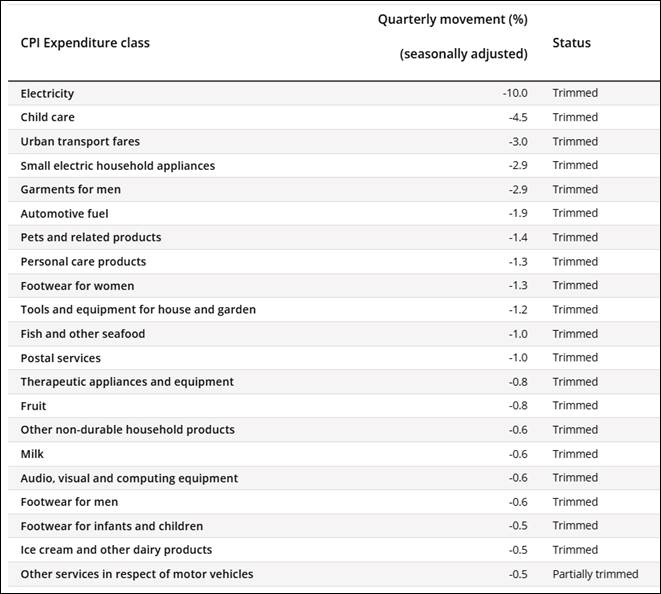
If you are looking at that table and wondering why we would bother caring about a measure of prices that does not count electricity prices, childcare fees, petrol prices, fruit and milk prices, etc etc etc then I agree with.
The core inflation measure is purely of interest to the RBA and economists. But you pay all price rises, all price falls. The CPI is what matters for people – so care about that – and it is also why the government has done energy rebates.
So don’t worry about core inflation – it is also coming down, and in the next March quarter figures it will likely also be below 3%.
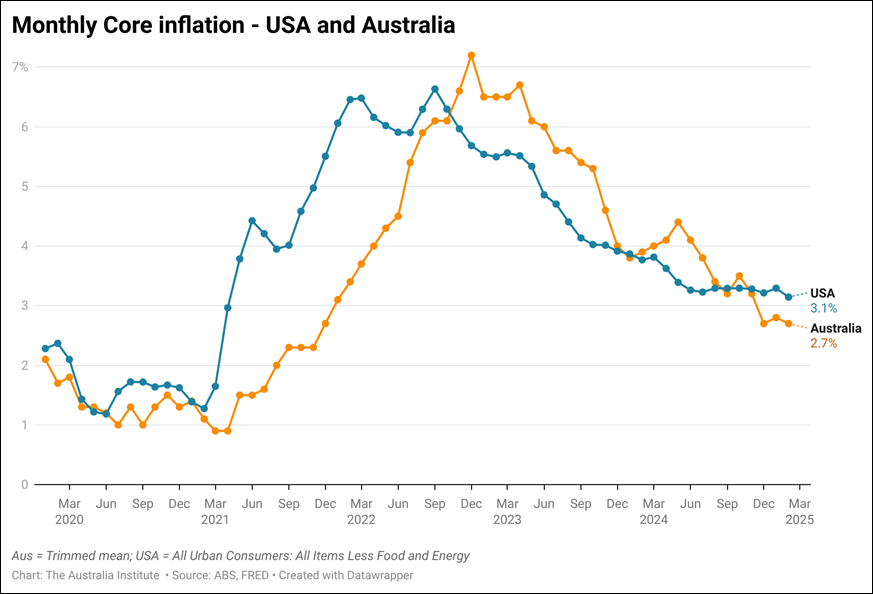
But what about the line that Australia has the highest core inflation among all G7 nations? Well, here’s the problem – countries measure core inflation in different ways. In the USA they use the “Consumer Price Index for All Urban Consumers: All Items Less Food & Energy” which is an aggregate of prices paid by urban consumers for a typical basket of goods, excluding food and energy.
They also measure it each month, and in February it was 3.1%.
Here in Australia the ABS has also started to measure inflation each month. And as a result, it also now measures core inflation each month. So, what was it in February? 2.7%.
Peter Dutton might need to find another measure.
No comments yet
Be the first to comment on this post.